18 AUGUST 2026 | VOL. 105 | NO. 8
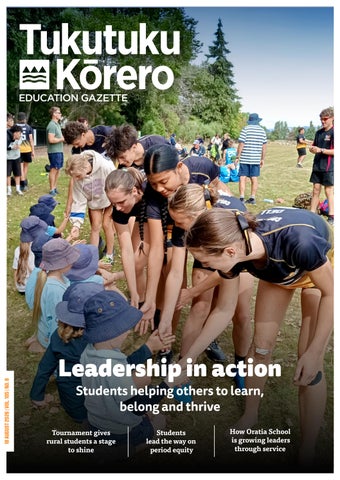
Leadership in action Students helping others to learn, belong and thrive
Tournament gives rural students a stage to shine
Students lead the way on period equity
How Oratia School is growing leaders through service
Share your practice Every day, educators across Aotearoa are finding new ways to support learners, strengthen their communities and improve outcomes. Some of the best ideas don’t come from reports, research papers or professional learning workshops. They come from your classrooms, staffrooms, playgrounds and offices. Each issue, we're asking educators one question. We'll publish a selection of responses in a future edition and some may inspire Education Gazette stories.
How do you create opportunities for learners to lead?
Scan the QR code and tell us in 50–150 words.
B
Education Gazette
gazette.education.govt.nz tinyurl.com/5n955xdd
ISSUE 105.8
In this issue Editor’s note
2
A
s I read through the stories in this issue, I was struck by the quiet power of students stepping up for one another and taking ownership of their learning and learning environments. At Oratia School, students are discovering that leadership begins with service to their communities. At Howick College, students have developed a system that ensures period poverty is never a barrier to learning, creating a welcoming space built on trust, dignity and peer support. Across Wairoa, rangatahi are helping younger tamariki participate in events designed to include everyone. And in rural communities across the top of the South Island, young people are learning that being part of a team means encouraging others, building connections and representing something bigger than themselves. There is also a strong sense throughout this issue that belonging matters. From positive school cultures and gratitude initiatives to online safety programmes and learning support networks, these stories show what can happen when people feel seen, valued and supported. While educators, whānau and communities play a vital role, many of these examples highlight the contribution students themselves make to creating environments where others can thrive. At a time when conversations about achievement and outcomes are rightly important, it is worth celebrating the qualities that sit alongside them: kindness, service, empathy, teamwork and leadership. These attributes strengthen school communities and help young people develop the confidence to make a positive difference in the lives of others. I hope you enjoy reading these stories as much as I did. Ngā mihi nui, Sarah Wilson Ētita | Editor
18 August 2026
How Oratia School is growing leaders through service
8
Tournament gives rural students a stage to shine
14
Students lead the way on period equity
18 22 28 34 38
How new PLD opportunities are strengthening learning support Ākonga driving changes in traditional school events How online learning is expanding opportunities for students Online safety as a team sport: playing your part during Netsafety Week Kaikorai Valley College puts positivity into practice
JOIN US ONLINE Get the latest vacancies, notices, and stories: gazette.education.govt.nz Follow us on Instagram: @edgazettenz PUBLISHED BY Education Gazette is published by the Ministry of Education PO Box 1666, Wellington. ISSN 2815-8423 (online) The Ministry of Education and Education Gazette do not endorse, approve, or accept responsibility or liability for the accuracy or content of information belonging to third parties, including but not limited to information in links to third party websites. Terms and conditions: gazette.education.govt.nz/terms-and-conditions © 2026 Education Gazette. All rights reserved.
KEY CONTACTS Story ideas and feedback We welcome your ideas and feedback. If you have a story in mind, email us a brief outline (50–100 words). gazette@education.govt.nz Vacancies and notices listings Vacancies@edgazette.govt.nz
On the cover School students share good camaraderie with young supporters from Tapawera Area School, hosts of this year's Top of the South Island (TOSI) Tournament.
Tukutuku Kōrero
1
Left and right: Students walk through native bush in the Waitākere Ranges, not far from school.
gazette.education.govt.nz
STU DENT LEAD ERSH I P
How Oratia School is growing leaders through service Five years after launching its Ngā Rākau Kaha leadership programme, Oratia School is seeing the impact of giving Year 6 ākonga opportunities to serve others, connect with their community and discover their ability to make a difference.
T
his year, West Auckland's Oratia School marks five years since launching Ngā Rākau Kaha (Strong Trees), an opt-in leadership programme for Year 6 ākonga. Deputy principal and programme leader Katherine Goldsmith created the initiative in 2021, drawing inspiration from the Duke of Edinburgh Awards and adapting the concept for primary-aged learners. Looking back, she's proud of what students have achieved. “The community service blows me away,” says Katherine. “Whether it's making toys for the SPCA, whether it's stacking wood or weeding at the local cemetery, sea cleaning on the harbour. It's amazing.” The programme partners with local organisations and community groups to encourage students to connect with and contribute to the world around them.
“It links beautifully to our school vision: confident connected learners making positive differences,” says Katherine.
Challenges with purpose
Ngā Rākau Kaha asks students to complete challenges across three areas: outdoor activities, a personal passion project and community service. Students document their progress through Google Slides, creating a record of their achievements throughout the year. “At the end of the year the slides get printed out and bound,” says Katherine. “They can take it home as a hard copy to show Nana and Poppa.” As students reach milestones, they earn badges and certificates recognising their efforts.
Tukutuku Kōrero
3
Outdoor challenges include school camps and bushwalks in the nearby Waitākere Ranges, while personal projects might involve learning a language, developing photography skills or tending a garden. Together, these experiences help students build resilience, confidence and self-discipline.
Leadership through service
For Katherine, the service component is the heart of the programme. “Service is a cornerstone of Ngā Rākau Kaha,” says Katherine. “Leadership is grounded in service to others.” Over the past five years, students have contributed to beach clean-ups, kiwi conservation projects, sports coaching, retirement village visits and mentoring younger children. One of the programme's most memorable partnerships is with environmental charity Sea Cleaners NZ.
4
Education Gazette
Students searching for rubbish, especially microplastics.
“Service is a cornerstone of Ngā Rākau Kaha. Leadership is grounded in service to others.” Each year, students rise before dawn to board a boat and help remove rubbish from the Waitematā Harbour. “It doesn’t cost us anything, which is great,” says Katherine. “We’ve picked up ovens, old dinghies, just heaps – they just haul it on board and take it back.” Ten-year-old Isla still remembers the experience. “I brought in a giant old mattress by myself,” she says. “I enjoyed it more than sitting in class. We went past the Chelsea sugar factory on the boat and picked up rubbish. “All different boats went to different areas of Auckland. I went under the Auckland Harbour Bridge. It was really fun.”
gazette.education.govt.nz
18 August 2026
Tukutuku Kōrero
Students comply with the rigid shoe cleaning stations en route, to help protect the spread of Kauri dieback disease.
5
The experience helps students understand environmental stewardship in a tangible way. “This partnership offers students a powerful, real-world environmental leadership experience and strengthens students' understanding of kaitiakitanga,” says Katherine. Year 6 student Olivia says the impact was eye-opening. “It’s really great because it teaches all the kids to be aware,” she says. “We went out there and saw so much rubbish, with dead starfish all along the beaches. “It shows that, when we litter, it goes into the oceans and then it’s going to kill all the beautiful stuff we have there.”
A programme powered by whānau
The programme's success depends on strong support from families. Whānau help students complete activities outside
school hours and often assist with transport to events and early morning service opportunities. “[Whānau] actually really love it,” says Katherine. “They love any opportunity for their kids to take on leadership experiences, to be a part of something, to give back to the community.” Managing a large leadership initiative alongside the day-to-day responsibilities of a deputy principal has its challenges, but Katherine says strong systems make it possible. “It is really busy,” she says. “Being able to check that the children all do their mahi in a shared Google Doc where I can dip in at any time and have a look has been essential.” Those systems have evolved over years of experience, helping Ngā Rākau Kaha grow from 17 students in its first year to more than 70 participants last year. “You’ve also got to be passionate,” adds Katherine.
“It’s not about the badges or the rewards. It’s about doing something for the community.”
Every item of rubbish makes a difference. At the end of the day, 6Left and right: Education Gazette students dispose of the rubbish appropriately at Westhaven marina.
gazette.education.govt.nz
“You’ve got to be excited about what you’re doing and about making a difference. Otherwise things just fall apart and the students don’t feel it.”
projects and community service opportunities. Katherine has been happy to support other educators interested in creating similar initiatives.
Inspiring the next generation
Making a difference that lasts
Katherine regularly shares students' achievements at school assemblies, helping younger learners see what is possible. “What I really love is, I put photos of ākonga's work on a PowerPoint in assembly. The whole school gets to see what they've been doing. That inspires the younger ones.” The programme's success has also inspired other schools. Former Oratia teacher Richard Loten adapted many of the same ideas when establishing the Shooting Stars leadership programme at Methven Primary School. Like Ngā Rākau Kaha, Shooting Stars encourages Year 6 students to pursue personal
While Katherine continues to refine the programme, she believes its core purpose remains unchanged: helping young people discover their ability to contribute to something bigger than themselves. “With the initiative running so well currently, we may not introduce another,” she says. “[Ngā Rākau Kaha] needs plenty of time supporting students which can be a challenge in a DP role. This is why we rely on parental support at home to help complete the badges.” For Olivia, the programme's true value has little to do with certificates or recognition. “It showed me that I really want to be that person that can help, and it’s not about the badges or the rewards. It’s about doing something for the community.”
Read more about Shooting Stars at Methven Primary School at gazette.education.govt.nz
18 August 2026
Tukutuku Kōrero
7
SPO RTS
Tournament gives rural students a stage to shine Hosting this year's Top of the South Island (TOSI) Tournament gave Tapawera Area School students the chance to compete, lead and represent their community, while continuing a tradition that has inspired rural young people for more than 30 years.
F
rom wearable arts to rugby matches and netball games, cooking competitions and art shows, almost every year since 2004, seven schools from the top of the South Island compete. Known as the TOSI Tournament, this year’s event was held at Tapawera Area School. Participating schools also included Rai Valley Area School, Collingwood Area School, Murchison Area School, Karamea Area School,
8
Education Gazette
A welcome pōwhiri starts the tournament.
Reefton Area School and South Westland Area School. Held over four days, football, volleyball, netball, touch, basketball and Kī o Rahi are the core events, with other competitions woven throughout. These usually reflect the host school’s own traditions and environment. It was Year 12 student Hunter’s third time representing his school in the competition, with past
gazette.education.govt.nz
TOSI Tournaments taking him to South Westland and Murchison. “The home tournament was quite exciting this year,” the keen rugby player says. “The result we had was quite a shock.” Tapawera won this year’s tournament by three points. Hunter was chosen to be the male team captain, an opportunity to lead he thought was a “pretty cool opportunity”. “We went into the tournament thinking we’d just try our best as we’d lost quite a lot of our older students,” he adds. Although the school took losses during the main sporting events like basketball, Hunter explains his team did “exceptionally well” in the minor sports
18 August 2026
and cultural events, like technology challenges, quizzes, paddle boarding and shooting. He even got to try Ultimate Frisbee for the first time, one of the specialty events at Tapawera's tournament.
More than just sport
Social science teacher and TOSI community liaison Susan Fenemor says the addition of cultural and recreational events has broadened the tournament’s appeal. “Including these cultural events has expanded the size of the tournament and allows more students to take part,” she says. More than 140 students participated in this year’s event, proudly donning T-shirts with ‘Eat, compete, sleep, repeat’ emblazoned across the back.
Tukutuku Kōrero
9
Susan has lived in Tapawera for almost 40 years. Her own children participated in the tournament during the mid 2000s, so she has seen firsthand the positive impact it has on rural students. “It’s more of an even playing field,” she says. At the TOSI Tournament, the teams can be mixed gender depending on numbers. If there are not enough older children, school’s children from the vertical age groups from Year 8 and up to Year 13 join the team. “This event gives students a chance to mix with like-minded students who enjoy the competition, but also to get to know each other over the years,” Tapawera teacher Stephen Haunch shares. “It gives many students a focus, and for some, keeps them coming to school. It opens connections, with such good experiences on and off the field for the students.” This is the third tournament that Stephen Haunch has been involved in organising at the school since 2009.
“It’s physically demanding, but they’re building up their strength,” says Susan. The whole school community then gets involved during tournament week. At Tapawera’s event, each class supported a team and helped out with scoring and catering. Some students acted as reporters and photographers. “As area schools, we tend to compete against each other a lot, so we get to know each other quite well, and so coming to these tournaments is pretty cool,” says Hunter. “It’s a social event; you get to meet a lot of new people too. It’s a great opportunity to make a lot of friends.”
Building confidence and connections
Students take the event extremely seriously. From the start of term 1, knowing the event will be held near its end, students practise a variety of activities to work on their fitness and sport strategies at every lunch hour, even repeating the dreaded beep test each week to stay fit.
10
Education Gazette
Younger Tapawera Area School students with their homemade sign.
Students Hunter and Jade hongi Tapawera teacher and event organiser Steven Haunch and principal Andy Ashworth.
gazette.education.govt.nz
Tapawera Area School competitors.
A whole-community effort
The huge event is not without its challenges, though, explains Susan. Finding billets for all the visiting students can be difficult. “You need the entire community to help you,” she says. “The experience they can bring is essential, especially as referees. The calibre of the players and the reputation of the whole school is on view.” Everyone from the school and wider community steps up and volunteers their time, propelling the event forward. Susan ran three events and helped organise speakers, support, sponsorship and public relations. The Tapawera team chosen for indoor bowls had actually never played before. But in preparation for the tournament, several indoor bowls players who have participated at the national competition level helped them practice.
Opening doors beyond school
Talented students from the tournament are chosen to take part in trials with the mid-Canterbury tournament students. Winners are then chosen as the TOSI squad, who travel and compete with other students from around New Zealand at the Area Schools National Tournament. 18 August 2026
It will be Hunter’s first time competing at nationals. “I’m quite nervous. I don’t actually really know a lot of the people I’m going with,” he says. “But I think it will be a pretty cool experience to go somewhere different.” The tournament encourages rural students to dream of competing on bigger fields. “The seed is planted at the tournament for many students to go and explore a sport or art practice,” shares Susan.
“This event gives students a chance to mix with like-minded students who enjoy the competition, but also to get to know each other over the years.” Pathways to future success
A professional rugby player for Matatū, the South Island Super Rugby Aupiki team, Sarah Jones attended Tapawera from 2011 to 2024. She competed in the TOSI Tournament from Year 9. “Getting the opportunity to take part in TOSI Tournaments and being selected to go to nationals was a big thing for me,” she says. Tukutuku Kōrero
11
Younger Tapawera Area School students supporting other schools.
She travelled from her “little country town” to Christchurch, Dunedin, Whangārei and Te Awamutu. “It was such a cool experience. Meeting people along the way and pushing yourself out of your comfort zone was a big thing coming from such a small area school.” Sarah’s first high-performance placement was with Tasman Mako. “It was daunting joining their team as a 16-year-old from an area school, but having had that experience of mingling with others from area schools, talking and expressing ourselves during the tournaments, definitely helped me,” she says. “By competing from such a young age, often against older students, it gave her the perseverance and resilience to keep trying at the sport,” adds Susan. Sarah came back to the school this year to share her journey from the TOSI Tournament to now. She told the students that it does not matter where they come from; they can still go as far as they can dream. Another student, Natasha Bannister, competed in the volleyball events for Tapawera. She later gained a scholarship to play volleyball at the University of Florida in the USA. “TOSI grew my love for volleyball so much and grew my want to progress through seeing the levels I could get to,” she says.
12
Education Gazette
“TOSI opened up so many opportunities for me. It was a door that showed me the pathways I could go down.” “If I wasn’t the best player on the court, I’d then find the best player and do what they were doing.” After taking part in nationals, Natasha realised it was something she could pursue professionally after school. “TOSI opened up so many opportunities for me. It was a door that showed me the pathways I could go down,” she says.
Looking ahead
Hunter says he’s already looking forward to his fourth and final TOSI Tournament, to be held in Karamea next year. He hopes to continue his rugby journey as well. “I want to take it as far as I can, and if it doesn’t work out, I’ll still play for a local club.”
gazette.education.govt.nz
Tapawera Area School winners of the 2026 Tournament.
18 August 2026
Good camaraderie: the Collingwood team shake hands with their on-site supporters.
Tukutuku Kōrero
13
14
Education Gazette
gazette.education.govt.nz
WELLBEI NG
Students lead the way on period equity From student-run period product offices to online ordering systems and schoolwide support networks, schools around Aotearoa are finding innovative ways to ensure period poverty is no barrier to attendance, wellbeing or achievement.
S
tudents in need of period products at Howick College can wander down the hallway to the school's own period product office, led and run by its very own students, and painted in the colours of women’s suffrage – purple, green and cream. “It changed my life. My mum is a single mum, and it really helped her budget. It was really accessible to me. The people were kind. It inspired me to volunteer shifts there myself,” shares Angela, a Year 12 student at Howick. Even before the Ikura programme began delivering free period products to young people, Howick College students were concerned about period poverty in New Zealand. A group of social studies ākonga had met with several MPs from the health subcommittee at the school to discuss period poverty, how it was affecting young people, and the solution: free period products in schools. When the Ikura programme began in June 2021, those students were thrilled.
“So over time, we thought about how we could address this,” says Anna. Howick’s Hauora Council, its student wellbeing leadership council, stepped up to the task, joining with the Z Club, a student branch of Zonta, an international women’s empowerment organisation run at the school. “Our system started down a line of women empowering women, with students working for others to ensure that they could all access these products,” says Anna. “Our students have taken on the running of the Ikura programme in our school.”
Student-led from the start
Anna Marsick, senior academic dean at Howick College, has helped her students weave Ikura into the daily motion of school life. With schools across New Zealand able to make the programme work for their environments, Anna says they have experimented to find out the best dispensary solution. Initially, they started with physical dispensers in bathrooms. But they did not fit the products. “With 1,200 female students in our 2,400-populated school, we couldn’t just put a big box of tampons in the toilets and say, ‘help yourself’,” explains Anna. The caretaker also acknowledged that they did not want toilets to be blocked.
18 August 2026
Tukutuku Kōrero
The period product office at Howick College.
15
Creating a welcoming space
The group was given all the products and put in charge of refilling bathrooms and boxes, to ensure the supplies are always stocked and available. That’s when they decided to create their own period product office. Cleaning, decorating and painting an unused office space at the school, the student team took charge. Open at every interval and at lunchtime, and staffed by the Zonta girls, Howick College students can get their period products from other students. There’s a female empowerment board hanging on the wall, with images of inspiring women that the students swap out. Currently, Beyoncé, Kate Sheppard, Malala Yousafzai and the American women’s ice hockey team, who won gold at the Olympics, look proudly over the students. “As a huge multicultural Auckland school, we have so many cultural issues with embarrassment and shame when it comes to menstruation,” says Anna. “In trying to overcome all those barriers to shyness, we wanted to create a space as gentle, accessible and friendly as possible.” Before Ikura was offered, some students would stay at home due to embarrassment and period poverty. Now, students can order whatever they need; it is not just for emergency situations. “Everybody is different. You ask for what you want, no questions are asked,” says Anna.
Innovation driven by students
In its fourth year, the students who originally opened the period product office are now senior students with roles on the school's leadership councils. Another group of Year 10 and 11 students have taken charge of the office. “It's been amazing to see the growth to the really nice space it is now. It's amazing to see the impact it has on our girls,” shares Florence, a Year 13 student leader and period product office founder. Howick has since introduced an online ordering system. Using a simple Google Form accessed by a QR code, students can view which products are available and request how many of each they would like. The students in the period product office then put together their order, sending an email to the student when it’s ready for collection. “We figured if students could see it on their phone and order instantly, we would get more orders and more students taking up the programme,” says Anna.
16
Education Gazette
Her role now is to send out a few emails to students, making sure they know where to find the Google Form and order the products they need provided through the Ministry of Education’s Ikura Programme.
It is student-led all the way
“The entire rest of the process, all of the day-to-day management, the rostering, the opening up and managing of orders, the getting products to the students is done by them,” says Anna. Products are always offered and stored in the library, the student office and the health centre, so students will never be caught off guard. The students ensure those locations are always topped up with products.
“It's all from the students empowering each other to lead it, empowering women to see their bodies are not a barrier to their education and chasing their dreams.”
Supporting students across Aotearoa
Rotorua Girls' High School has also signed up to Ikura. They have baskets of products available to all ākonga in their wellness centre and at the hostel. “It has taken the fear away from ākonga needing sanitary products,” deputy principal Raewyn Krammer says of the programme. “It allows us to take financial stress away from parents as we have several families struggling.” Tauranga Intermediate has a washing machine in its youth mentor space for emergencies. Students are provided with a change of clothes in the meantime, with their own clothes washed and dried before they head home. Sanitary products are available across the school: in dispensers in the wellness centre, the bilingual whare, classrooms and unisex toilets. Students can take extras home to cover school holidays. Teachers all have spares on hand, too.
gazette.education.govt.nz
“We’ve seen a direct benefit of this programme,” says acting principal Cheri Gallagher. “We’ve got students coming to school now who would’ve stayed home when they got their period.” With more than 1,200 students at the intermediate, Cheri says they communicate often with whānau about the programme. “Students are relieved to know they can lessen the financial burden on their parents, when maybe they have to decide between sanitary products and putting kai on the table,” she says. Assemblies are held for the students, with male teachers present, so students know they can talk
openly about their periods with anyone. It doesn’t have to be a secret. “I know where to go if I need anything, so I never have to worry,” shared one student.
Breaking down stigma
“The more women talk openly about menstruation, the less it’s a joke,” believes Anna. “And the more we publicise our Ikura programme, the better response we get. It’s all from the students empowering each other to lead it, empowering women to see their bodies are not a barrier to their education and chasing their dreams.”
“It changed my life. My mum is a single mum, and it really helped her budget. It was really accessible to me. The people were kind. It inspired me to volunteer shifts there myself.”
Howick College senior academic dean Anna Marsick and student.
18 August 2026
Tukutuku Kōrero
17
18
Education Gazette
gazette.education.govt.nz
LEARN I NG SU PPORT
How new PLD opportunities are strengthening learning support As learning support coordinators become part of more schools and kura across Aotearoa, a growing suite of professional learning opportunities is helping them build confidence, strengthen inclusive practice and better support learners, whānau and school communities.
L
earning support coordinators (LSCs) play a vital role in helping schools create inclusive environments where all learners can thrive. By 2028, all state and state-integrated schools and kura with learners in Years 1–8 will have access to an LSC. As part of this rollout, 474 schools have received an LSC allocation in 2026. To support significant growth in this workforce over the next three years and promote consistent practice, the Ministry of Education has developed a suite of professional learning and development (PLD) opportunities for LSCs.
18 August 2026
While designed specifically for LSCs, these opportunities are open and will benefit anyone working in learning support.
A tailored PLD pathway for LSCs
Rachael Vink, general manager of system design and practice at the Ministry, says their role is to drive nationally consistent access and experience of learning support across the motu. “Our key enabler for promoting consistent practice is the PLD we provide to LSCs. Our learning pathway recognises the complexity of the role and reflects the dynamic environment LSCs work in every day.” Designed to be flexible and practical, the PLD pathway helps LSCs to: » build confidence in their role » strengthen inclusive systems and practices » support teachers and school teams to respond effectively to diverse learner needs » improve outcomes for learners and whānau » contribute to more consistent learning support across Aotearoa New Zealand. The content is highly relevant for school leaders supporting LSC practice, as well as other learning support kaimahi.
Tukutuku Kōrero
19
Building strong foundations
Whether you’re new to being an LSC, returning or have been working in the role for some years, LSC Induction is a great place to start as it sets the foundation for success in the role. Over three courses, Induction focuses on the core knowledge, skills and professional understanding needed to perform the role effectively and consistently. Establishing Professional Identity and Purpose introduces the LSC role, explores responsibilities, key skills, support systems and the professional values and ethical practices that underpin effective learning support. Foundations for Inclusive Practice examines the legal and policy context for learning support, cultural responsiveness and the importance of developing strong networks, systems and schoolwide frameworks that foster inclusion. Embedding Practice and Leading Change explores ethical use of data and information systems, privacy best practice and the skills to champion inclusive practice, consolidate learning and plan future professional growth. Each course includes three modules (approximately 30–45 minutes per module) and involves practical activities, reflection prompts and tools to apply learning in your school context.
New in term 3 – Role Essentials
The latest PLD offering is called Role Essentials, and it’s an interactive, practical course focused on building skills and tools LSCs can use immediately. “Learning support is a team sport and when you’re really clear about the role you play in the team, it helps others understand their role as well,” says Rachael. In Role Essentials, learners see the skill being demonstrated in a realistic context, then have opportunities to apply their thinking, reflect on their approach and explore how they would respond. This shifts the learning from understanding what an LSC does to building confidence in how an LSC does it. The interactive modules cover: » early identification and support – recognising patterns, using tools and initiating support pathways » planning and learner supports – designing and reviewing support strategies with teachers and whānau » building capability and helping others grow – coaching and strengthening teacher confidence and practice.
20
Education Gazette
Throughout Role Essentials, LSCs can practise thinking through real situations in a safe environment and build confidence before they encounter those situations in real life. Modules are short, with each topic split into micro moments that could be completed alongside a cup of coffee, on any device. The full programme can be completed in under six hours.
Strengthening Learning Support Together: LSC Conference 2026
More than 1,000 educators joined the inaugural LSC Conference, creating a valuable opportunity for LSCs from across the country to hear from keynote speakers, attend workshops and share their experiences of the role, including how they are feeling and the ways they are connecting and collaborating within their existing networks. The conference reflected a sector-wide shift towards a more connected and nationally consistent approach to learning support. Expert speakers offered practical strategies, evidence-informed insights and inspiration for attending LSCs, SENCOs, RTLBs and school leaders. Recordings and resources from these sessions are available, providing valuable opportunities for ongoing learning and reflection. “Each presenter at the conference added a little more to my understanding about the role and tools that will help LSCs to be efficient in their roles,” said one attendee.
What’s next?
Looking ahead, additional PLD will be rolled out from early 2027 to support LSCs to build knowledge over time, based on their role and priorities. This will be tailored to different levels of experience and cover a range of subject matter areas (SMAs) including: » Stakeholders & Engagement » Leadership, Coaching & Influence » Bicultural Learning Support Practice » Specialist Learning Areas, such as Trauma Informed Practice, Speech, Language & Communication Needs or Specific Learning Disorders (Dyslexia, Dysgraphia, Dyscalculia). “At its core, the LSC role is about nurturing the ākonga we’re all here to serve,” says Rachael. “The programme of PLD is designed to nurture LSCs so they can help our learners thrive.”
gazette.education.govt.nz
Where to find the LSC PLD
LSC Induction and Role Essentials are available to anyone with an Education Sector Login (ESL) through the Ministry’s Education Learning Management System (LMS). Learning Support Coordinators in Schools includes detailed LSC information including the role description and skills matrix, as well as details about practice area PLD. Find out more at education.govt.nz.
Deepening practice through specialist learning LSCs can also access specialist professional learning to deepen their understanding of neurodiversity and learner support. Places are currently available in Tilting the Seesaw for LSCs (Autism New Zealand) and Kete into Practice (FASD-CAN), with both programmes taking strengths-based, neurodiversity-affirming approaches. These opportunities are available exclusively to LSCs until the end of 2026. More information is under the PLD section of the learning support coordinators in schools webpage.
18 August 2026
Tukutuku Kōrero
21
22
Education Gazette
Left and right: Tamariki taking on the inclusive Colour Run at Tiaho School, Wairoa.
gazette.education.govt.nz
PHYSICAL ACTIVIT Y
Ākonga driving changes in traditional school events Schools and kura across Aotearoa are reimagining traditional sporting events, working alongside ākonga to create experiences that prioritise participation, connection and fun while reflecting the diverse ways young people like to be active.
A
cross the motu, traditional school events are being reimagined to create fun, welcoming and inclusive events that the whole community can be part of. Schools and kura are shifting from cross-country events towards Festivals of Movement and Colour Runs; swimming sports are being reshaped into Swim and Splash events. Planning and decision-making are increasingly being shared, with kaiako and ākonga working together to make sure the events better reflect the different motivations ākonga have for participating.
18 August 2026
Caption.
The 2025 Student Voice Report, led by Sport NZ, found most young people enjoy being active when it’s fun, social and supportive, and when they have access to meaningful activities. Ākonga feedback shows the changes are making a difference. “Everybody in Room 4 had a great time being bombarded with colour and sprayed with too much water but also helping out with the various activities was exciting as well,” says one Year 8 student. “It was just so fun. I want to do it again,” says a Year 4 student.
Tukutuku Kōrero
23
24
Education Gazette
Tamariki enjoying the Colour Run.
gazette.education.govt.nz
Wāhine working together to create inclusive events in Wairoa.
“As educators, reimagining our school events is not just about changing what we do; it’s about changing how we do it together.” Creating events together
Erin Steel, a Healthy Active Learning lead from Sport Northland, works with senior leadership teams, kaiako and ākonga to create supportive and inclusive learning environments. “As educators, reimagining our school events is not just about changing what we do; it’s about changing how we do it together.” Key to success is partnership, respect and shared purpose. Kaiako bring their professional knowledge and care, ākonga bring their lived experience, creativity and voice. Together they are building events that are far richer than either could do alone. Successful events are defined not just by participation or performance but by fun, connection and inclusion. “When we pause and ask, ‘who is this event for?’ and ‘who feels included or excluded?’, we uncover powerful opportunities for change,” explains Erin. “Creating time and space to hear from students about what they enjoy, find challenging or wish to
18 August 2026
see differently shifts them from passive participants to active partners.” Schools are actively looking at how their events align with the school’s values and learning goals, making sure movement and physical activity is seen as part of the school culture and essential for learning.
Creating choice
Kaiako and school leaders play a crucial role in supporting events to be meaningful, inclusive and successful. This includes listening carefully and gathering insights from ākonga before planning any activities, moving beyond consultation to co-design to give students real decision-making power, and offering choice and flexibility to allow students to participate, lead and contribute in ways that suit them best. By working together, school leaders, kaiako and ākonga can create fun, inclusive events that create lasting memories, deepen connections and celebrate collective achievement.
Tukutuku Kōrero
25
Wairoa Police serving kai to participants and whānau.
Designing for inclusion in Wairoa
Coloured powder is flying, students are grinning, teachers and supporters are shouting their encouragement as tamariki take part in a colour run hosted at Tiaho School in Wairoa. This is just one example of how schools, kura and communities are reimagining traditional school events so all ākonga can participate in ways that meet their needs and aspirations. A collective of wāhine from schools, iwi and community organisations across Wairoa have been working together for 18 months to create inclusive events for taonga tamariki. This term, the event was a colour run involving 48 participants, plus student leaders from seven local schools. Sydney Rore, Healthy Active Learning advisor from Sport Hawke’s Bay, says it was great to see the community come together to support this event for taonga tamariki. “My favourite part of the day was seeing them enjoy
26
Education Gazette
the colourful course alongside their teachers, peers, whānau and community.” The colour run included different sensory stations like bubbles, a range of obstacles and tunnels and of course, lots of colour. Student leaders from Tiaho School and rangatahi from Wairoa College were there to tautoko the participants, as they chose what parts of the course they wanted to experience. In the spirit of manaakitanga, Kahungunu Executive provided fresh fruit and water to keep tamariki hydrated throughout the day. Together with Sport Hawke’s Bay, they also provided sausages cooked by Wairoa Police and served by rangatahi leaders from Wairoa College. “Our collective approach to designing and facilitating these events means all participants have the opportunity to participate in ways that suit them. The impact is shown in the increased numbers and huge smiles. An amazing day for all!” says Sydney.
gazette.education.govt.nz
Information about the programme is on the Ministry’s website.
New free professional learning available for teacher aides supporting Year 1 learners | ākonga. The Ministry of Education is pleased to launch Poipoia te kākano, a free and flexible professional learning and development (PLD) programme designed specifically for teacher aides supporting Year 1 learners | ākonga. Teacher aides play a vital role in helping learners engage, participate and thrive at school. Poipoia te kākano has been developed to build teacher aides’ confidence, knowledge and practical skills so they can better support Year 1 learners and contribute to positive classroom environments. Through six online learning modules, supported by webinars, podcasts and guidance material, teacher aides will learn: • why behaviours occur • practical strategies to support learner engagement and participation • approaches that help create positive learning environments. To support teacher aide participation, funding is available to help schools cover teacher aide learning time while completing the programme.
18 August 2026
Funding is available for teacher aides who: • work at a state or state-integrated primary or area school | kura • spend at least some of their working time supporting Year 1 learners | ākonga. Schools can apply for reimbursement funding for eligible teacher aides, for up to 14 hours of the teacher aide’s learning time. Applications must be approved before the teacher aide begins the programme, so we encourage schools to apply early. Funding is limited and will be allocated on a first-come, first-served basis until available funding is exhausted or 30 June 2028, whichever comes first.
Tukutuku Kōrero
27
VI RTUAL LEARN I NG N ETWO RKS
How online learning is expanding opportunities for students Virtual learning networks are helping schools overcome distance, staffing and subject availability challenges, giving students greater choice while keeping them connected to their local school communities.
Halfmoon Bay students in a digital technologies class with Lucie Lindsay.
28
Education Gazette
gazette.education.govt.nz
T
hink back to 2020 and the Covid-19 pandemic. Schools were scrambling to put learning online, and teachers were thrust into mastering the art of online teaching. The return to a physical classroom was for many a welcome return to normality. Yet, online learning has been growing and maturing in New Zealand since the very early days of the internet. Over the years, clusters of remote or small schools experimenting with e-learning have morphed into larger networks, one of the largest being Kōtui Ako VLN, a collaborative online learning network connecting primary and secondary schools and kura across New Zealand.
18 August 2026
Kōtui e-principal Rachel Whalley says online teaching is a necessity in many schools which don't have access to a broad range of subjects. “You just can't be the master of everything. We know primary school teachers in their classes are expected to know the whole curriculum and when you're in a small rural school, you're expected to know the whole curriculum at every level as well.” Today, 82 schools belong to Kōtui Ako VLN, including 49 secondary schools and 33 primary schools. The network records 1,114 learner registrations in online classes, including 751 secondary and 363 primary registrations.
Tukutuku Kōrero
29
Students in Spanish class.
30
Education Gazette
gazette.education.govt.nz
Kotui Akoate-principal Rachel Whalley deputytechnology e-principalresources Lucie Lindsay. Ākonga Mana College enjoy a suiteand of digital and tools, supported by strong network infrastructure.
Many participating schools are small or rural. Among primary schools, 72 percent have rolls of 150 learners or fewer and almost half have fewer than 50 students. At secondary level, nearly half are small rural, coastal or isolated schools, often with rolls of fewer than 400 students or operating small area school secondary departments.
Making connections
At its essence, the network exists to provide access to subjects where there are only a few students or where there's a gap in a school's ability to deliver. There are about 126 subjects on offer, including a music class based on songwriting byby Kāpiti-based Jan Bolton. A composer with a lifelong fascination for online teaching, Jan has been a secondary teacher, a Victoria University education lecturer and the head of arts at Te Kura before she joined Kōtui Ako six years ago. This year she fits in her class around a busy life of composing dance and theatre music. With students all over the country, Jan unearths some amazing talent. And she loves the structure of the weekly Zoom, followed by independent study and coming back together again.
“It's a wonderful way of working,” she says. However, online or not, she finds students still crave connection. “Today was the start of a new semester for us and I have seven new learners in my class. And while we definitely looked at lyrics and music as part of our class, the key focus from my point of view was establishing the first meaningful relationship with those newies and combining them with my existing learners.” “I would be very concerned if I came out of an online class and realised I didn't have multiple contacts with each learner.”
Motivation is key
In Warkworth, language teacher Angelika Young has stepped back from physical teaching but has continued to teach German online. She likes the motivation of her students who have chosen to be there and often have family connections to the language. Students quickly learn to become self-managing, she notes. Although they have only one Zoom with their teacher a week, students are expected to do four to five hours a week in total. However, they can contact their e-teacher as often as they need, as well as access their e-dean.
Wairakei songwriters. 18 August 2026
Tukutuku Kōrero
31
They learn how to learn, says Angelika. “For example, one student is not so good with past tense, another needs to revise a relative pronoun and the other one needs to look at conjunctions, so they learn to see their weaknesses and focus on that.“
How the network works
Angelika Young.
Jan Bolton.
Ian Callachan.
32
Education Gazette
Kōtui Ako VLN is a collaborative network of primary and secondary schools and kura serving Years 0-13, designed to improve access to educational opportunities through online learning. Participation is open to all New Zealand schools, with member schools contributing to the network and sharing expertise across it. Students are taught within their local school setting, with online learning timetabled during the school day and supported by staff on site. At primary level, schools can register a whole class, a small group of learners or individual students. Online teachers may also work with an entire class within a school. Kōtui Ako's primary operations have been funded by the Ministry of Education since 2009, supporting leadership, coordination and network-wide teaching provision. Participating schools contribute membership funding and can either draw on teachers working across the network or contribute their own expertise. Participation looks a little different at secondary level, where the network operates through a reciprocal model. Member schools contribute staffing and funding to help deliver online courses while gaining access to the full range of programmes offered across the network. Each secondary school contributes 0.08 FTTE staffing, plus a membership fee. An e-teacher typically delivers one online course for four to five hours a week, or the equivalent staffing contribution. Schools also appoint an e-dean, who provides pastoral support for students learning online and acts as a liaison between the school and the Kōtui Ako team. Ian Callachan, who is Head of Social Science at Tauraroa Area School south of Whangārei, is an e-dean and teaches geography for Kōtui Ako as well as at his own school. Already an experienced dean, he's a big fan. “For me as an e-dean, it's been really powerful. I learned so much about so many different subjects, how they operate, the marking guides and the clarifications. So it's been empowering for me.” Technology is also much better than the early days of online learning, Ian says. gazette.education.govt.nz
Students can go back over their Zoom recordings and Ian can see students' work in real time. “I can look into their folders, I can publish videos, it's made things so much easier. So as long as the students are motivated, it works really well.”
An online pedagogy
Online teaching isn't as simple as just switching on a camera, Rachel says. In fact, there is a whole pedagogy for online learning which tends to fly under the radar. She says online teachers must be well prepared and take a structured approach. But lessons still have to be learner-centred and flexible, building relationships with discussions and activities that help offset the effects of distance. Emergency remote teaching, in situations like the pandemic, is not the same as the online pedagogies they have been developing for decades. “[It's] about what works well for our online learners, to achieve success and make this worthwhile.” To reinforce their professional development, Kōtui Ako teachers are also part of the Kōtuitui Online Teachers Network, a professional learning community for 457 online teachers from across New Zealand. Funded through the Ministry of Education's Networks of Expertise programme, Kōtuitui provides
21 July 2026
Tuahara College students.
workshops, webinars, professional learning groups, online resources, a members' platform and ongoing guidance for teachers working in online environments. Both primary and secondary teachers belong to the network, although the Ministry funding supports secondary-sector activity, including implementation of the refreshed curriculum, assessment changes and national qualifications. Rachel admits online education is not for everyone. “But it's still needed. And for some people it is a great option and we've got some great teachers in this space and it's another way to make things more flexible.” She draws the analogy between watching the World Cup on TV or being in the stadium. “They are quite different, it's not either/or. I personally believe kids still need to go to school but there's different ways of how schooling can happen and kids can do really well online, in face-to-face and hybrid environments.” Ian is definitely sold.
For more on Kōtui Ako, visit Kōtuiako.school.nz For more on virtual learning pedagogy, read Towards Networked Learning: Stronger Together For more on the Kōtuitui Online Teachers Network, go to kotuitui.net.nz
Tukutuku Kōrero
33
Learn more about Netsafety Week at netsafe.org.nz/netsafety-week-2026. 34
Education Gazette
gazette.education.govt.nz
ON LI N E SAFET Y
Online safety as a team sport: playing your part during Netsafety Week Netsafety Week 2026 is a reminder that creating safer online environments for young people is a shared responsibility, with everyone in the school community having a role to play.
A
s classrooms across Aotearoa New Zealand become increasingly digital, supporting ākonga to be safer online is a responsibility shared across the education sector. Netsafety Week 2026 is from 17 to 23 August and offers a timely focus on what can be achieved through collective action. The theme this year is ‘online safety is a team sport’. It reflects how schools, whānau, students and technology partners all have a role to play in building a safer digital environment for young people. Online safety means building the skills, confidence and judgement needed to participate positively online, as well as staying safe from online threats. Netsafe New Zealand and Network for Learning (N4L) are two of the organisations championing online safety in schools year-round, and especially during Netsafety Week. Netsafe is New Zealand’s independent online safety organisation and a global digital citizenship expert. It provides education, resources, advice and support for people of all ages across schools, homes, workplaces and communities.
18 August 2026
Tukutuku Kōrero
35
N4L provides network infrastructure alongside a suite of safety and security services to schools that help strengthen technical defences from online threats. These protections are a part of school safety, but technology alone cannot address the full range of risks young people face online. Schools also need strong policies, practical education, trusted support, and regular conversations with ākonga and whānau about healthy online habits and digital citizenship. With a heightened focus on online safety, young people are increasingly stepping up and becoming more engaged in the issues that affect them. Some students are helping others navigate online safety and make the online world a more positive place. Netsafe supports youth voice through initiatives including the Youth Action Squad and Otago Young Digital Leaders. A new Generative AI and Young People report from Netsafe, the AI Safety Forum and The Light Project is being released to mark International Youth Day. It explores how young people are using AI, the opportunities they see and the support they need.
36
Education Gazette
A student perspective on digital safety
Elijah, a Year 12 student from Wellington who is passionate about online safety, views it as an essential daily practice. “Online safety is hugely important,” Elijah says. “Nearly everyone’s daily life includes some form of digital influence, so for students, practising good digital safety is vital.” Elijah sees Netsafety Week as a chance for schools to reset and discuss their digital safety habits openly. “Netsafety Week is a great opportunity to remind students, staff and whānau about staying safe online,” he notes. “Having good online safety practices is important for teachers, students, parents … everyone really.” Maia, a Netsafe Otago Young Digital Leader echoes this, saying playing your part is about how you show up online every day. “You can’t expect your feed to be a safe place if you’re bringing negative energy, sharing private information or acting differently behind a screen. How you behave online reflects who you are, and being trustworthy helps make the internet safer for everyone.”
gazette.education.govt.nz
Practical steps
Building robust digital defences does not require an immediate, complex overhaul. Taking small, structured steps can significantly improve a school’s overall digital safety over time. When you have strong policies and guidelines about online safety in your school or kura, it is easier to make decisions about the tools, settings and responses you will use. These policies help school boards and leaders navigate issues such as web filtering, strong passwords, sharing personal information online, device use and supporting ākonga when harm occurs. It is also important that learners and their whānau understand how to navigate the online world safely. Easy-to-access resources, regular conversations about online behaviour and opportunities to develop critical thinking all help build a culture of positive digital citizenship. Netsafe’s Kete is a free educator platform with digital safety content for schools. It includes frameworks, guidelines, templates, lesson ideas, advice and downloadable tools to support positive digital citizenship across the school community.
“Having good online safety practices is important for teachers, students, parents ... everyone really.” Utilise N4L safety tools
Technical safeguards can help catch cyber threats before they reach the classroom. Schools should check they are using N4L’s Internet Safety & Security Services with the recommended settings. Web Filtering helps block inappropriate websites, apps and internet categories, while SafeSearch helps filter inappropriate search results to support safer browsing across the school network. Schools can use MyN4L’s self-service tools to request changes to their web filtering settings and view browsing activity across the school network.
Working together for ākonga
Maintaining online safety is an ongoing process that requires continuous effort from all parts of the school community.
18 August 2026
Technical protections reduce risks across school networks, while Netsafe’s education, resources and support help schools, ākonga and whānau build the knowledge and skills needed to navigate the wider online environment. By combining secure infrastructure with strong policies, practical digital citizenship education and regular, open conversations, schools can create safer digital environments where learning can thrive. To learn more about Netsafe’s free education services, contact education@netsafe.org.nz. If schools need help with from N4L with online safety, they can contact N4L’s Customer Support team through email at support@n4l.co.nz or by calling 0800 532 764. More information about online safety can also be found at n4l.co.nz/protect.
Netsafe resources and support Netsafe’s Kete provides free resources, frameworks, lesson ideas and downloadable tools to promote positive digital citizenship and better online safety. Visit education@netsafe.org.nz. For Netsafety Week, schools can also access a free resource pack with classroom activities, videos and resources, plus a public webinar series featuring New Zealand and international experts. More information is available at netsafe.org.nz/netsafety-week-2026. Netsafe is also asking schools, kura, educators and whānau to complete its School Communities Survey before 14 August. Feedback will shape future resources, and respondents will go in the draw to win one of two $500 Prezzy Cards.
Tell Netsafe what you need School guidance counsellors play an important role in responding to online harm. Netsafe is piloting a Supporting Young People with Online Harm e-learning module, aiming to reach 1,000 participants by October. The free, self-paced course takes around an hour and includes a certificate of completion. Pastoral care staff and school counsellors are also invited to join co-design workshops. Contact education@netsafe.org.nz for more information.
Tukutuku Kōrero
37
38
Education Gazette
The gratitude wall behind reception is a highlight of the school's 'gratitude week'.
gazette.education.govt.nz
P OSITIVE BEHAVIO U R F OR LEARN I NG
Kaikorai Valley College puts positivity into practice From gratitude walls and appreciation notes to positive reinforcement and restorative practices, Kaikorai Valley College is finding new ways to strengthen wellbeing, celebrate success and build a positive school culture.
T
here’s a refreshing air of positivity at Dunedin’s Kaikorai Valley College (KVC). It hits you as soon as you spot the gratitude board behind the reception desk, filled with sticky notes written by students ranging from, “I'm grateful for having food,” to “I'm grateful for the office ladies not being mad at me for being late.” These sticky notes of appreciation is part of the school’s recent ‘gratitude week’ – their latest initiative to keep positivity at the forefront of its culture. Having long been a proponent of the Ministry of Education’s Positive Behaviour for Learning (PB4L) programme, the school has been looking at ways to refresh its approach and make better use of pastoral data to target areas of greatest need. It helps that the person leading the charge on the school’s efforts around PB4L, assistant principal Damian Burden, is a man who can’t seem to not smile. An anonymous sticky note penned by a fellow staff member and left on his desk during gratitude week, tells you all you need to know about his rightness for the role: “Damian, your energy and kindness is second to none. Your ability to make everyone around you feel better about themselves is a quality that cannot be matched.”
A champion of cheer
Damian is not new to championing positive school culture. Previous examples of his commitment to student wellbeing include an award for going above and beyond that he received in OfficeMax’s national A Day Made Better campaign in 2014. Or the Otago Daily Times photo of him during Bullying-Free New Zealand Week in 2019, sporting perky-pink dyed hair. The ‘gratitude week’ idea stemmed from an activity Damian had promoted in his own Year 7 homeroom class. 18 August 2026
“At the end of each year, I’d get the kids to put their name on a little ticket and pass it around so that everyone could write something on it they appreciated about that student. “It made me think about how we could do that on a schoolwide level to lift wellbeing and spirits and be grateful for all the things we have.” Damian kicked things off at assembly by sharing a reflection from his own life. He told students how gutted he’d been to not be reappointed as coach of the NZ Touch Blacks team, and how a positive mindset helped him navigate that. This set the tone for the ensuing tide of school optimism.
“The value of creating a positive culture is that it allows everyone to perform their best. It’s what I’m most proud of as a teacher.”
“The kids wrote gratitude notes to each other in whānau class. Over the week, well over 1,000 notes were written – and we're a school of approximately 450. Then there was the gratitude wall in the office – that really took off and it was a very humbling exercise reading the kids’ messages.” On the final day of term, some of the Year 13 students ran a free barbeque to further cement the week's vibe. Messages of appreciation (to everyone from the principal to the caretaker) were deemed legal tender for a sizzled sausage. Damian was careful to not place any onerous burden on the teaching staff. Tukutuku Kōrero
39
“There are lots of changes happening in education, so I didn't want to add anything extra to their list. But the staff were awesome and we saw a real shift in mood.”
Positive reinforcement
After 15 years dividing focus between his homeroom class and his assistant principal role, Damian has relinquished the former to focus on the latter. This has given him more time to focus on keeping school spirits nicely buoyed. Along with his PB4L team, he’ll continue to lean into the KVC pastoral data to figure out where to put their next positive step. “We’ve done a bit of restorative practice training in the last five years and looked at how we can embed those practices. Every school has rules, but we focus more on expectations – on the positive rather than the negative.” This approach was used to great effect midway through term 1 when concerns emerged about uniform standards. “We stationed our pastoral team at the school entrances and, rather than hammering the kids that were scruffy or late, we gave lollipops out for prompt attendance and tidy uniform. The kids were stoked. It was awesome.” Damian has also started opening the gym three times a week during his lunch hour to encourage students to get active. The privilege is all his, he says. “It means I get to work with kids from Years 7–13, and the gratitude thing has spread there too. When they leave, they thank me every time.”
A sense of pride
Damian’s connection to Kaikorai Valley College runs deep, having attended the school as a student from 1994–1998. He returned to the fold four years later as a trained teacher and has been there ever since. “It’s a place that really helped me become who I am, and I’m passionate about the kids.” Asked if he’s just hardwired for positivity, Damian says, “I think so.” “When I had my homeroom class, I worked really hard to create a place where every kid would feel welcome and happy to take risks, happy to try stuff, happy to express themselves and have a go. “The value of creating a positive culture is that it allows everyone to perform their best. It’s what I’m most proud of as a teacher.”
40
Education Gazette
“The kids wrote gratitude notes to each other in whānau class. Over the week, well over 1,000 notes were written – and we're a school of approximately 450.”
gazette.education.govt.nz
The Kaikorai Valley College leadership team: Deputy principal Janette Potter, assistant principal 18 August 2026 Stewart Tagg, assistant principal Damian Burden, and principal Jatin Bali.
Tukutuku Kōrero
41
The trusted voice of education in Aotearoa.
Get real stories from classrooms and communities, plus jobs and professional learning opportunities.
Scan to stay connected.
gazette.education.govt.nz