13 OCTOBER 2026 | VOL. 105 | NO. 10
Celebrating community and connection North Shore principals unite to strengthen collective leadership
Building belonging through sport in Wairoa
How Tiniroto School keeps its rural community connected
Share your practice Every day, educators across Aotearoa are finding new ways to support learners, strengthen their communities and improve outcomes. Some of the best ideas don’t come from reports, research papers or professional learning workshops. They come from your classrooms, staffrooms, playgrounds and offices. Each issue, we're asking educators one question. We'll publish a selection of responses in a future edition and some may inspire Education Gazette stories.
When did you partner with a community group or business to enrich a learning opportunity?
Scan the QR code and tell us in 50–150 words.
B
Education Gazette
gazette.education.govt.nz tinyurl.com/5n955xdd
ISSUE 105.10
In this issue Editor’s note
2
I
n this edition, we explore what happens when schools and communities work together as part of a connected ecosystem of support for ākonga. At Tiniroto School, community members contribute their time, knowledge and practical support to enrich learning in the mara kai and strengthen local connections. In Wairoa, schools, whānau and community organisations have come together to ensure disabled and neurodiverse ākonga can experience the joy, confidence and belonging that comes through sport and movement. At Sylvia Park School, authentic community partnerships help learners understand that their ideas and actions can shape the world around them. Importantly, community partnerships don’t just benefit students. They strengthen teacher practice and development. Whether through principal networks sharing wisdom and encouragement, teacher aides growing into teaching careers, volunteers supporting environmental learning, or local organisations opening doors to new experiences, these relationships expand what schools can offer and remind educators that they don’t carry the work alone. This thread of collective responsibility reflects a growing understanding that student success is built through the combined efforts of educators, whānau, community groups, iwi, businesses, volunteers and local leaders, each contributing their unique strengths. Ehara taku toa i te toa takitahi, engari he toa takitini.
6 10 16
Stepping up to teach in the communities they call home Building belonging through sport in Wairoa Sylvia Park School’s recipe for belonging, engagement and attendance How Tiniroto School keeps its rural community connected
20 24 28 34 40
North Shore principals unite to strengthen collective leadership Te Pou Ārahi: A culturally grounded approach at Hamilton Girls’ Championing language, learning and opportunity Learning from the little blue penguin Broader horizons: How a small school made a big curriculum
JOIN US ONLINE Get the latest vacancies, notices, and stories: gazette.education.govt.nz Follow us on Instagram: @edgazettenz PUBLISHED BY Education Gazette is published by the Ministry of Education PO Box 1666, Wellington. ISSN 2815-8423 (online) The Ministry of Education and Education Gazette do not endorse, approve, or accept responsibility or liability for the accuracy or content of information belonging to third parties, including but not limited to information in links to third party websites. Terms and conditions: gazette.education.govt.nz/terms-and-conditions © 2026 Education Gazette. All rights reserved.
KEY CONTACTS Story ideas and feedback We welcome your ideas and feedback. If you have a story in mind, email us a brief outline (50–100 words). gazette@education.govt.nz Vacancies and notices listings Vacancies@edgazette.govt.nz
My strength is not that of an individual, but that of the collective.
Mauri ora, Sarah Wilson Ētita | Editor
13 October 2026
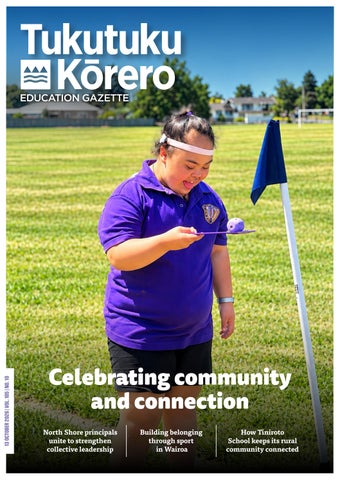
On the cover With the help of the Halberg Foundation, Sport Hawke’s Bay ran two ‘Have a Go’ days at the Wairoa Community Centre. Students played with modified equipment, and had a go at sports such as balloon badminton and wheelchair basketball.
Tukutuku Kōrero
1
2
Education Gazette
Woodville School teacher aides Crystal Sargent (left) and Alisea McDonald.
gazette.education.govt.nz
TEAC H ER TRAI N I NG
Stepping up to teach in the communities they call home At Woodville School, two teacher aides are training to become teachers without leaving the community they already serve. Their stories, along with a student teacher in Te Anau, show how schools are growing their own future workforce and strengthening the communities around them.
W
hen Woodville School principal Wes Va’ai-Wells looked at the future teaching workforce, he didn’t start by looking outside the district. He looked across the staffroom. There he saw two teacher aides with university qualifications, strong connections to the school and a passion for working with tamariki. “I wanted to grow capable teachers within Tararua and within our own school,” says Wes. Today, Alisea McDonald and Crystal Sargent are training to become teachers with the support of the Ministry of Education’s School Onsite Training Programme (SOTP), which combines teacher education study with extensive in-school experience.
Drawn to education
For Alisea, becoming a teacher wasn’t a sudden decision. “I’ve always wanted to make a change in the world in whatever way, shape or form,” she says. After studying psychology and working with Oranga Tamariki in both care and protection and youth justice settings, she found herself drawn to education. “I think teaching means to me being the change that I want to see around me and being able to create a safe environment for tamariki to thrive in.” Each morning, she is greeted at the school gates by smiling children wanting to talk about their day. “I feel like every day that I come in, it’s always positive. It’s always light.” The programme appealed because it allowed her to continue learning in the environment that first sparked her passion for teaching. 13 October 2026
“What the programme allows for me to do is to continue that passion within the environment that was fostered, which is a really special and unique experience.”
“I wanted to grow capable teachers within Tararua and within our own school.” Community connection
For Crystal, the pathway solved a different challenge. A mother of five with a partner running a business, she had dreamed of becoming a teacher since she was 12 years old. “Working and studying is good for me because I have a big family. “The aspect of the programme that’s had the biggest impact is being able to do the programme and work as a teacher aide because without that I don’t think I could afford to do this.” Having already worked at the school helped. “I know the school. I know the kids. I know the staff.” What both women have in common is a deep connection to their community. They are already known by students and whānau. They understand the local context. They’re not arriving as strangers. That local connection is exactly what appealed to Wes. “I think bigger picture-wise, the benefits will come through building the teaching capabilities of the Tararua District.” Tukutuku Kōrero
3
Te Anau School teacher aide Bernice Cullen.
Learning by doing
The programme places student teachers in a host school three days a week while they complete a one year teaching qualification. For the aspiring teachers involved, that means learning in real classrooms, with real students, every week. Crystal believes that amount of immersion is invaluable. “Being in school three days a week for a whole year, you get a lot of knowledge. “You’re not just learning how to be a teacher. You’re learning school culture. You’re learning management. You’re getting to know kids really well.” Later she describes the experience another way. “You’re exposed to different teaching styles and you learn so much. You’re just amongst it for three days straight and you can’t not learn. It’s like through osmosis.”
4
Education Gazette
Alisea says the mentoring relationships have also played a major role in her development. “Being paired with a mentor for the entire year and getting a mentor at your away school is really beneficial. “You feel really safe and walked through the entire process.”
Staying close to home
More than 1,600 kilometres south of Woodville, Bernice Cullen’s story reflects another benefit of the programme. “I was interested SOTP because it meant I could live at home.” That mattered. She coaches tennis locally and wanted to remain connected to the community where she lives. Te Anau School principal Fallon Graham sees that as one of the programme’s greatest strengths.
gazette.education.govt.nz
“For people who are part of a community like ours, it means that you don’t have to leave your hometown or your family to go and pursue something.” “For people who are part of a community like ours, it means that you don’t have to leave your home town or your family to go and pursue something that you want to become. “It’s a nice, supportive way of looking after people in your own community.” Since beginning the programme, Bernice has become deeply immersed in both school and community life. “As I didn’t grow up here, I didn’t actually know a lot of the community. “Doing a programme like this and being so involved with the school and the community, it’s been really helpful.” For Fallon, the value extends beyond supporting individual student teachers. “It’s about including your community. These teachers, they want to be part of your crew. We need good teachers.”
Growing the next generation
For all three student teachers, the programme is ultimately about making a difference for young people. Alisea wants to create environments where children feel safe and supported. “I just want to make the day-to-day lives of tamariki feel brighter and happier.” Crystal talks about helping children discover a love of learning that stays with them throughout life. “I want to have an impact to make children feel safe, heard, and enjoy the learning process.” Bernice hopes to remain working in a rural community after she graduates. “I grew up in a small school in a small community and I would love to stay around the area.” Her confidence has grown dramatically over the past year.
13 October 2026
“I don’t think I realised I wasn’t actually that confident standing in front of a classroom until I actually had to do it. “And now I’ve grown so much and I think I am ready to get out there and actually teach.” For Wes and Fallon, those individual journeys point to something bigger. As schools across Aotearoa think about future workforce needs, the answer may not always lie in attracting teachers from elsewhere. Sometimes, the future teaching workforce is already there: supporting students as teacher aides, coaching the local netball team, volunteering in the community, and waiting for an opportunity to take the next step.
School Onsite Training Programme at a glance What is it? A school-based pathway into teaching that combines study with practical classroom experience.
How does it work? Student teachers spend three days a week in a host school or kura. They complete a one-year initial teacher education qualification. They receive ongoing support and mentoring from experienced teachers. Participants receive a tax-free bursary to help with study and living costs.
Why schools are getting involved It helps grow teachers from local communities. Student teachers gain extensive hands-on classroom experience. Schools can support talented teacher aides and other local staff into teaching careers. For more information, visit SOTP Information for students SOTP Information for schools
Tukutuku Kōrero
5
I NCLUSIVE EDUCATIO N
Building belonging through sport in Wairoa Thanks to a collaboration between schools, community groups and mana whenua, Wairoa neurodiverse and disabled ākonga are thrilled to participate in inclusive sports days – and reaping the rewards.
At the ‘Have a Go’ days, students played with special or modified equipment.
T
here is a diverse range of needs,” says Bernadette Reedy, special education needs coordinator (SENCo) at Wairoa College. Currently supporting 10 students aged 11 to 21 in the school’s Rangiātea Centre, she says most have autism and six are classed as non-speaking. Their physical activity was previously limited to 30 minutes a week in the school gymnasium due to demand for the facility, using their own equipment or making do with what was set up. “We wanted to look at another way we could get our students more physically active.” Di McCallum, a learning support coordinator working with hundreds of students in the Wairoa region, also felt a new approach was needed. “The kids were doing their normal, modified PE programmes at school, but there was nothing for them outside of that,” she explains. “Why couldn’t they get out and have their own sports days?” At the same time, Sydney Rore, healthy learning advisor at Sport Hawke’s Bay, was developing action plans with Wairoa schools as part of the organisation’s Healthy Active Learning initiative. “A lack of inclusive opportunity was a common theme,” she says.
“They are gaining confidence from having a go and being brave and taking a few knocks along the way and being OK about it.” Getting a move on
With the help of the Halberg Foundation, Sport Hawke’s Bay ran two ‘Have a Go’ days at the Wairoa Community Centre. Students played with modified equipment had a go at sports such as balloon badminton and wheelchair basketball. Alongside these events, Sport Hawke’s Bay also ran inclusion trainings facilitated by Halberg advisors for teachers, community members and high school students, to help them better support children with diverse needs to engage in physical activity.
13 October 2026
“The kids had an absolute ball at the ‘Have a Go’ days”, says Di, “and we were cheering them on from the sidelines. Seeing the response from the kids, we thought, ‘we need to do more of this. Let’s make it happen’.” A working group of Di, Bernadette, Sydney and Luana Mitchell from Māori health and social service provider Kahungungu Executive, set about doing just that. Funding from Wairoa’s Te Whare Maire o Tapuwae Charitable Trust paid for a range of equipment, such as foam balls, crawl tunnels, mats, hoops and balancing gear. Funding from Tu Manawa Active Aotearoa, distributed through Sport Hawke’s Bay funded a trailer to transport the equipment, while local roading company QRS is sponsoring its maintenance. The unstructured sports days soon evolved into themed sporting events, aligned with the interschool calendar, says Sydney. “The whānau response was that they wanted their children to experience different forms of activity and experience the same things mainstream students get to experience.” The first event was a swimming sports day in term 1, says Di. “The community centre put up a floating castle. The kids just loved the day; they are absolute water babies.” That was followed by a colour run in term 2. “The little ones just ran around and around for three hours,” she laughs. In August, ākonga enjoyed a gymnastics day, while term 4 will see the students take part in a modified athletics day. “All the schools in our area are invited to send all their students with disabilities or who are neurodiverse,” says Bernadette. “We started with 20 kids; we’re now up to 40-plus. “More kids and schools are coming.”
Improved wellbeing and socialisation
The sports days are an opportunity to get kids physically active, without it being too strenuous or overwhelming, says Bernadette. But the events are achieving far more than just movement. “The opportunity to go on trips is exciting for them. They are happy when they come back and it seems to be flowing through to their general wellbeing.” The students are learning to socialise and make new friends, says Di.
Tukutuku Kōrero
7
“They get to mix with other kids like themselves and they are starting to recognise others from other schools. It’s just opened up their worlds a little bit more.” Teachers and support staff, who sometimes work in isolation, are also meeting and forming social and support networks, says Bernadette. “The job has incredible rewards but it does have its challenges.”
Growing confidence in tamariki and whānau
Teachers have noticed increased confidence among their ākonga, who can find new types of physical activity intimidating, says Di. “They are gaining confidence from having a go and being brave and taking a few knocks along the way and being OK about it. The kids come back from their day out and they are excited and heightened by it.”
Students played wheelchair basketball.
Funded through Tū Manawa, this trailer transports specialised equipment purchased for the days.
8
Education Gazette
That growing self-assurance is flowing through to whānau. “Their response has been incredible. We’re having a lot more parents joining in these days and just having fun with their kids. They are more relaxed about their children being out in the community. They know it’s OK and they know the kids know how to behave.” Bernadette says the sports days have also allowed ākonga who will be attending Wairoa College to become familiar with her, her staff and the other students – smoothing the way for their transition to high school. “It’s not as scary and they feel a little bit more comfortable coming into our space.”
Strengthening school and community connections
Whānau report the sports days have made their tamariki more positive about attending school, and they are enjoying increased interaction with ‘mainstream’ school children as well. As a kaihauora (health worker), Luana visits schools to deliver Māori games, such as kī-o-rahi and tapu ae, and development programmes for younger children learning skills including catching and throwing. In school grounds all around Wairoa, she sees the impact of the sports days first-hand, on both taonga tamariki and mainstream students. “Diverse tamariki see me at schools and come running up to me and join in my sessions. I just love their reaction to being involved with everyone else.” Student leaders who help at the sports days take their learning back to their schools. “Other tamariki learn not to exclude them or yell at them but be patient with them. And if a diverse child is playing up, they are more likely and willing to comfort them.” The sports days have become largely sustainable in terms of funding – thanks to the equipment, schools hosting events where possible and community support. New World Wairoa provides sausages – cooked by Wairoa Police, who also join in the sports days – while Kahungungu Executive supplies water and fruit. Senior leaders from Wairoa College are always on hand to help set up, prepare kai, participate in the games and pack down. “Whānau just keep asking for more”, says Luana. “We’d love more people to help us and give input as to what their kids would like and need. Parents just love having something for these children in Wairoa. “I absolutely love it too. They have the biggest hearts and the biggest smiles.”
gazette.education.govt.nz
Student leaders from Wairoa College help prepare kai.
“Seeing the response from the kids, we thought ‘we need to do more of this. Let’s make it happen’.”
Teachers have noticed increased confidence among ākonga.
10
Education Gazette
Sylvia Park School has worked hard to create a school its students can feel proud of.
gazette.education.govt.nz
AT TEN DANC E
Sylvia Park School’s recipe for belonging, engagement and attendance Attendance has climbed steadily at Sylvia Park School in Auckland, but principal Thomas Bartlett says the numbers tell only part of the story. Behind them lies a community-wide effort to create a school where tamariki feel known, valued and excited to learn with whānau, local organisations and the wider community all playing a part. n any given day at Sylvia Park School, students might be tending community gardens, rehearsing kapa haka, competing for their house, designing labels for honey from the school’s own beehives, or preparing for a cultural celebration with their whānau. It’s the kind of place where opportunities spill beyond the classroom, and where principal Thomas Bartlett believes every child should be able to find something that makes them want to come to school. “If we want our tamariki to come to school every day, what are we giving them to come to?” he asks. That question has shaped much of the school’s work over the past four years. Attendance has risen steadily, reaching 77 percent regular attendance in 2026, but Thomas says the numbers tell only part of the story. “We realised that you cannot separate attendance from engagement, engagement from achievement, or achievement from a child’s sense that they belong.”
O
should be built with the people who experience it every day. “We wanted ours to be alive. If you ask our kids about attend, engage, achieve and succeed, they understand the journey because they helped build it.” For educators, Thomas believes the sequence offers an important reminder that attendance cannot be viewed in isolation. “Attendance is not the destination. It is access to the destination. “If a student isn’t here, they don’t have access to that brilliant reading lesson, that maths discussion, that teacher relationship, the kapa haka practice, the sports trial, the speech competition, the conversation with a friend or that moment when a teacher suddenly makes them believe they are capable of something bigger.”
Attend, engage, achieve, succeed
“A strong school creates enough doors for every child to eventually find one they want to walk through.”
Attend. Engage. Achieve. Succeed. This is the school’s mission, and Thomas says the order of those four words matters. “Attend means being here consistently. Engage means having a reason to be here and feeling connected to people and learning. Achieve means making progress and experiencing success. And succeed is broader than an academic result. It is developing confidence, identity, relationships, resilience and aspirations for what comes next.” The school’s largest-ever student and whānau consultation process helped shape the final mission and vision, reflecting a belief that school improvement 13 October 2026
Tukutuku Kōrero
11
Creating a school students are proud of
As attendance became a growing focus, staff found themselves returning to the question: “Have we created a school they actually want to attend?” The answer required looking carefully at every part of the student experience. Over recent years, classrooms and outdoor spaces have been upgraded, digital learning resources expanded, new sporting facilities added and an outdoor classroom established as part of the school’s Green-Gold Enviroschools kaupapa. The library collection has grown, sports uniforms have been upgraded and new opportunities for participation have been created across the school. More than $400,000 in grant funding has helped support many of these improvements. For Thomas, however, the improvements are not about appearances but whether the environment tells children they are worth investing in. “Children notice their surroundings. They know when something has been cared for. They know when the basketball hoops work, when the library has books they want to read, when their classroom looks inviting, when their sports team has a uniform they are proud to wear. “Those things don’t replace quality teaching. Nothing replaces quality teaching. But they help create pride, and pride creates belonging.” That sense of belonging is reinforced through a wide range of opportunities. Sport, kapa haka, cultural groups, coding, leadership programmes, arts initiatives, environmental projects and house competitions provide different ways for children to connect. Student voice has helped shape many of those opportunities. “Tamariki are very good at telling you what makes school exciting, what makes them feel safe, what they are proud of and what they would change.” Their ideas have influenced everything from recreation spaces and school celebrations to leadership opportunities and recognition systems. Those conversations have reinforced an important lesson. “One child may find their place through mathematics or literacy. Another through kapa haka. Another through basketball. Another through technology, art, leadership or service. “A strong school creates enough doors for every child to eventually find one they want to walk through.”
12
Education Gazette
Principal Thomas Bartlett believes every child should be able to find something that makes them want to come to school.
gazette.education.govt.nz
Principal Thomas Bartlett (far right) with kaiako (left to right) Jody, Jesse and Jess.
“If we want our tamariki to come to school every day, what are we giving them to come to?”
Whānau and community as partners
The school believes in community partnerships to help students develop a stronger sense of purpose.
13 October 2026
Relationships sit at the heart of the school’s approach. Rather than engaging with families only when difficulties arise, Sylvia Park School has worked to build ongoing partnerships founded on trust and shared responsibility. “Our whānau are absolutely essential,” says Thomas. “Schools can have wonderful teachers, programmes and facilities, but sustainable change happens when families believe in what the school is trying to achieve and become part of that journey.” That partnership can be seen throughout school life. Families support cultural groups and language weeks, contribute to performances and celebrations and share language, stories and cultural knowledge. During cultural celebrations, whānau often bring dishes associated with their culture for staff to share, creating opportunities for connection well beyond the classroom. Whether it is Te Wiki o te Reo Māori, Samoan Language Week, Tongan Language Week, Filipino celebrations or Cook Islands celebrations, the aim is for children and families to recognise themselves within the school community. “For us, culturally responsive practice isn’t about displaying culture; it is about children recognising themselves in their school.” That philosophy also shapes learning. Alongside its Te Puna Waiora Māori immersion pathway, the school’s wider Pakirehua approach connects learning with identity, curiosity and authentic experiences, ensuring students can see relevance and purpose in what they are doing.
Tukutuku Kōrero
13
At Sylvia Park, a sense of belonging is reinforced through a wide range of opportunities, including kapa haka.
Learning beyond the school gates
Community partnerships provide another layer of connection. One of the school’s strongest partnerships has developed with Kiwi Property and Sylvia Park shopping centre through community and eco-garden projects. Working alongside the wider community, students contribute to gardens that benefit others while strengthening their understanding of kaitiakitanga. “It gave our students a genuine opportunity to care for the environment, contribute to their community and see that the work they do can make a difference.” The impact extends beyond environmental learning. “They get a real sense of ownership and pride from being involved. They know that the gardens need looking after and that they have an important role to play.” For some students, that responsibility has even influenced engagement and attendance. 14
Education Gazette
“Having that responsibility and knowing they are needed to help in the gardens can give them another reason to want to be at school.” Thomas believes community partnerships help students develop a stronger sense of purpose. “When organisations like Kiwi Property and Sylvia Park Mall invest their time and resources into our young people, it sends a really positive message that our students are valued and that the wider community cares about their success.”
When success starts compounding
As attendance has improved, the school has noticed changes that extend well beyond the attendance register. “When children attend more regularly, they miss less learning. They understand classroom routines. Friendships become stronger. Teachers know them better. They participate more. They experience more success, and success gives them another reason to come back tomorrow.” gazette.education.govt.nz
For Thomas, those outcomes matter far more than percentages. “What matters is what sits behind the attendance figures,” he says. When more children are present for teaching, and participating in sport, culture and leadership, they also experience the satisfaction of improvement. Over time, he says, the culture begins to shift. “It moves from ‘I have to go to school’ towards ‘This is my school and I want to be there’.”
No silver bullet
After more than 20 years in education, Thomas is cautious about presenting Sylvia Park School’s journey as a formula that can simply be copied elsewhere. “There isn’t one programme that fixes attendance, engagement or achievement.” Instead, he describes improvement as the result of many deliberate decisions working together 13 October 2026
over time: knowing children well, understanding whānau, listening to student voice, following up absences quickly, creating meaningful opportunities, building community partnerships and ensuring children feel proud of their school. His advice to other educators is simple. “Don’t start by asking, ‘What attendance initiative should we run?” “Start by asking, ‘Why would our kids want to be here? What stops them getting here? What happens when they arrive? Do they feel known? Is the learning strong? Is there something here that lights them up? And if they disappear, how quickly do we notice?’ At Sylvia Park School, those questions continue to shape decisions large and small. Because, as Thomas puts it: “Whānau have to help us get their tamariki through the gate… After that, the challenge belongs to us. We have to make every day worth showing up for.” Tukutuku Kōrero
15
16
Education Gazette
Tiniroto’s māra kai (vegetable garden) is a strong community-kura collaboration.
gazette.education.govt.nz
S MALL AN D RU RAL SC HO O LS
How Tiniroto School keeps its rural community connected Sixty kilometres inland from Gisborne, Tiniroto School serves as the beating heart of its small rural community. Locals cool off in the school pool, gather kai from the garden and socialise at school events. It’s a deeply reciprocal relationship, with the community rallying to provide enriching experiences for the tamariki of Tiniroto.
C
alling the roll at Tiniroto School is a short-lived affair. Just seven students, ranging from Years 1 to 8, currently attend this country kura. There is one class, taught by the principal, a release teacher and a teacher aide. Tiniroto is small, but its impact spreads well beyond the five families enrolled. In a place with little to no public amenities, the school is also a community sports and social centre, says Jess Kawenga, Tiniroto School Board presiding member. Facility maintenance is a major focus for the board, so the community can continue to enjoy its full-size and fully covered tennis court, swimming pool, native nursery, vegetable garden and orchard. “When you live this far out, there are not many things you can do with your children without having to drive for an hour each way. Over summer, the school is humming. We have families in the pool, having picnics and playing tennis.” A community-funded tennis instructor served up lessons not just for ākonga, but the wider community too – who have also benefited from swimming lessons in the school pool. School-hosted events, including the annual Matariki evening, foster vital community connection, says Jess. “We do have a few people out here living on their own. They are older and can be a bit more isolated.” In return, the community gives back in spades – sometimes quite literally. A working bee each term is incredibly well-supported, says Jess, and not just by those with a current connection to the school.
13 October 2026
“Everyone from the community turns up with their tractors and spades and the farmers bring their farming cadets with them too.”
“Local families will also come and gather what they need and they bring us a lot as well.” Nourishing community connections
Tiniroto’s māra kai (vegetable garden) has been a community-kura collaboration right from the get-go, says Jess. Community working bees first established the boxed garden beds. With the support of local Te Reinga Marae and the Enviroschools programme, ākonga have learned to gather and grow seeds, giving their seedlings to the wider community. Produce from the garden is used in their Ministry of Education-funded, school-made lunches. “Our chef uses the garden weekly, and we love hearing the kids say, ‘Can we go and get some strawberries for morning tea?’ It’s extra special that they have grown them themselves. “Local families will also come and gather what they need and they bring us a lot as well. One lady comes and gets veges and brings buckets of fruit for the kids.” Tukutuku Kōrero
17
The community garden is a great way for students to learn about the process of growing but also giving back to the community.
The school recently received funding to construct a greenhouse, so it can grow more produce year-round. “We noticed the amount of people coming in to gather was growing and there are no garden shops or anything like that around. It’s a great way for kids to learn about the process of growing but also giving back to the community.”
“Over summer, the school is humming. We have families in the pool, having picnics and playing tennis.” Enabling enriching experiences
The deep community support enables Tiniroto to host large, interschool events that would otherwise be logistically impossible, says Jess. Tiniroto is the proud host of the annual Tairāwhiti Small and Rural Schools Cross Country, which last year saw 200 runners converge on the community; and in 2024, the school put on the Wairoa Kapa Haka Festival – an event attended by 3,000 people. “These events are a real challenge for a school of our size to manage. But the community always helps. 18
Education Gazette
They take time off work and give workers time off to help. They run the barbecue, do the marshalling, bake the morning teas and our local butcher donates the sausages. We just couldn’t do it without them.” The Tiniroto community also supports ākonga in their day-to-day learning, says Jess. “One of our neighbours comes and does the mail – we’re also the Tiniroto Post Office – and she shares her knowledge with the kids. She takes them to gather watercress from the streams and shows them the chrysalises forming in butterfly season. “We have another lady, and although her grandchildren go to a neighbouring school, she still comes in fortnightly and runs a library for our kids.”
School a community lifeline
When Cyclone Gabrielle washed out the road into Tiniroto, the school opened its gates to all children in the community, providing routine for students and reducing stress on farming parents. “We kept classes and lunches going for everyone. The roll doubled to 17 and we called it our Storm Class.” Without small rural schools like Tiniroto, farming communities wither, says Jess. “If you don’t have access to a school, your prospects for employees minimise. It’s hard to get families to come live in these places and we need that variety of people in rural communities to keep them alive.” gazette.education.govt.nz
We’re on Instagram! us for real stories from classrooms and communities across Aotearoa. 13 October 2026
Tukutuku Kōrero
19
LEADERSH I P
North Shore principals unite to strengthen collective leadership As schools continue to implement curriculum and assessment changes, leaders across Auckland’s North Shore are coming together to learn, share ideas and strengthen collective capability. For the North Shore Principals’ Association, collaboration is not just about professional learning, it’s about building the relationships and trust that help schools respond confidently to change and support better outcomes for learners.
E
arlier this year, school leaders from across Auckland’s North Shore gathered to explore curriculum implementation and leadership practice. The summit days, organised by the North Shore Principals’ Association, were designed to help school leaders make sense of change collectively. “The pace and scale of curriculum change created a clear need to come together,” says Nathan Janes, principal of Mairangi Bay School and executive vice president of the North Shore Principals’ Association. “Principals were navigating new curriculum content, assessment expectations, implementation timelines and professional learning needs, often while
independently interpreting the same information.” The association wanted to create space for leaders to step back from the immediate operational demands of their schools, examine changes collectively and learn from one another’s experiences. “Our intention was to reduce isolation, strengthen leadership capability and ensure that schools did not have to solve the same challenges separately.” While the summit days had a curriculum focus, Nathan says their wider value was bringing leaders together to build shared understanding, collective capability and confidence.
“The strongest collaboration moves beyond networking.”
20
Education Gazette
gazette.education.govt.nz
Learning together
The events brought together principals, curriculum leaders and middle leaders from across the North Shore. “Sustainable improvement requires alignment at every level of leadership,” says Nathan. “Principals help establish the strategic direction and conditions for change; curriculum leaders develop shared pedagogical understanding; and middle leaders translate this into effective classroom practice. “When these leaders learn together, they develop a shared language and a clearer understanding of both the intent and practical implications of change.” Nathan says the approach has also strengthened distributed leadership. “Curriculum and middle leaders have been positioned as active contributors to schoolwide improvement, helping build capability beyond the principal or senior leadership team. “Each school brings different strengths, experiences and community perspectives. By sharing these openly, we can challenge assumptions, identify effective practice and avoid unnecessary duplication.”
More than networking
A recurring theme across the summit days was the value of schools learning from one another. For Nathan, meaningful collaboration is far more than an opportunity to network. “Effective collaboration is purposeful, reciprocal and grounded in trust.” Across the North Shore, this has included sharing resources, implementation challenges, planning approaches and professional learning priorities, while exploring how similar issues are being addressed in different school contexts. Importantly, those conversations are most valuable when leaders feel able to be honest about what is working and what still needs attention.
15 September 2026
“It involves leaders sharing resources, implementation challenges and emerging practice honestly, not presenting only the polished outcomes.” Nathan believes the most effective networks create opportunities for leaders to think collectively about problems and solutions. “The strongest collaboration moves beyond networking. It creates opportunities for leaders to think together, test ideas, share responsibility and return to their schools with greater clarity and practical next steps.”
Building trust
Strong collaboration depends on strong relationships. “Trust develops when leaders know that the purpose of collaboration is collective improvement rather than comparison or judgement.” Creating that sense of trust takes time, but Nathan says it allows leaders to engage in deeper professional conversations. “School leaders need spaces where they can acknowledge uncertainty, ask difficult questions and share challenges without feeling that they must already have every answer.” The relationships built through regular interaction become just as important as the professional learning itself. “Trust grows through consistent contact, generosity, confidentiality and a genuine willingness to listen.” That connection can help leaders recognise that many of the challenges they face are shared by others. “Leadership can sometimes feel isolating. Open professional relationships remind us that uncertainty is not an individual weakness; it is often a shared feature of leading through significant change.”
Learning from different perspectives
One of the most valuable discussions during the summit days centred on balancing consistency with responsiveness. Nathan says leaders were often asking similar questions, even though their schools and communities looked different. “What should be consistent? Where should teachers adapt? How do we maintain high expectations while responding to learner diversity?” Hearing how colleagues approached those questions broadened thinking and opened up new possibilities. The conversations also reinforced that collaboration does not require total agreement.
Tukutuku Kōrero
21
“Constructive differences can deepen thinking and help schools make more deliberate decisions.” Nathan says collaboration is not about creating identical approaches. “Consistency should mean equitable access to effective teaching, not identical teaching in every classroom or school.”
An ongoing conversation
For the North Shore Principals’ Association, the summit days were never intended to be one-off events. “Momentum is sustained by treating each event as part of an ongoing learning journey rather than an isolated occasion.” Nathan says leaders need opportunities to trial ideas in their own schools before reconnecting with colleagues to share what they have learned. “Leaders also need opportunities to return to their schools, test ideas and then reconnect to discuss what has worked, what has changed and where further support is needed.” Maintaining those relationships between events is crucial to sustaining momentum and building collective capability over time.
A collective response
Feedback from participants highlighted the value of having dedicated time to think, question and plan alongside colleagues. Leaders particularly appreciated being able to bring principals, curriculum leaders and middle leaders into the same conversations, strengthening alignment between strategic leadership and classroom implementation. “A consistent message was that leaders left with increased clarity, reassurance and a stronger sense that they were part of a collective response rather than navigating change alone.” For Nathan, that sense of collective responsibility is one of the most important roles principals’ associations can play. “Principals’ associations are uniquely positioned to connect national direction with local leadership and community context.” They can bring leaders together around shared needs, facilitate professional learning and create trusted spaces for collective problem-solving. Most importantly, they can help ensure leadership does not happen in isolation.
22
Education Gazette
“When leaders learn with and from one another, we build collective capability, improve coherence and create stronger conditions for every learner to succeed.” For associations or networks wanting to create similar opportunities, Nathan’s advice is simple. “Begin with a clearly identified, shared need and involve leaders in shaping the learning. “One-off presentations can build awareness, but sustained collaboration develops capability.”
What were leaders exploring? The North Shore Principals’ Association summit days used mathematics education as a context for broader leadership conversations about curriculum implementation and improvement. Among the key ideas explored were:
Fidelity and flexibility How can schools maintain clarity around curriculum intent, shared principles and expectations while still responding to the strengths, identities, cultures and needs of their learners?
What, how and why Participants discussed the importance of understanding what learners need to know, how they learn most effectively, and why particular learning experiences matter.
Assessment for learning Leaders explored how assessment information can be used to identify next learning steps and inform responsive teaching.
Consistency and professional judgement Schools considered how to create coherent approaches across classrooms while preserving the professional expertise of teachers and leaders.
Collective capability The summit reinforced the role of principals, curriculum leaders and middle leaders in building shared understanding and leading improvement together. To understand more about the learnings from the day, contact nathanj@mairangbay.school.nz
gazette.education.govt.nz
Subscribe to get fortnightly email updates with: • the latest magazine
• practical resources
• inspiring stories and web content
• podcasts
• education news and updates
• career opportunities
13 October 2026
Click here to sign up
Tukutuku Kōrero
23
TE REO M ĀO RI
Te Pou Ārahi: A culturally grounded approach at Hamilton Girls’ When Hamilton Girls’ High School’s Aotea Apiti travelled to Montana State University for an Indigenous knowledge exchange, she found herself sharing more than a teaching framework. Presenting Te Pou Ārahi on an international stage showcased the values, relationships and cultural foundations that shape teaching and learning at HGHS, while revealing strong common ground between Indigenous communities separated by thousands of kilometres.
24
Education Gazette
gazette.education.govt.nz
Hamilton Girls’ High School head of department Te Tari Māori Aotea Apiti (middle left) with principal Marie Gordon and students.
I
n July, a delegation connected with Te Ao Hurihuri at the University of Waikato travelled to Montana State University for a culturally immersive programme focused on Indigenous education, relationships and knowledge sharing. A key event during the visit was the inaugural REDTalks summit, hosted by the Native American Studies Department at Montana State University. Bringing together Indigenous academics, educators and students from the United States, Canada and Aotearoa New Zealand, the summit explored cultural sovereignty, Indigenous research, self-representation and the role of higher education in supporting Indigenous communities. Among the speakers was Aotea Apiti, Hamilton Girls’ High School head of department Te Tari Māori. Her presentation focused on Te Pou Ārahi, also known as ‘The HGHS Way’, a shared pedagogical framework developed by the school to create a more consistent and culturally grounded approach to teaching and learning.
Baskets of knowledge
Explaining Te Pou Ārahi to an international audience meant sharing the knowledge, values and aspirations that sit at the heart of learning at Hamilton Girls’. Each morning, students in Whānau Māori begin with a karakia that recalls the journey to Rangitūhāhā to obtain the three baskets of knowledge, a journey associated with Tāne-nui-a-Rangi in this karakia and with Tāwhaki within Tainui traditions. The story provides an important metaphor for learning at Hamilton Girls’. Knowledge is not just something received. Its real value becomes apparent when it is shared and used to help us all flourish. That whakaaro sits strongly alongside Te Pou Ārahi, the school’s pedagogical framework. Developed as the ‘HGHS Way’ of teaching and learning, its evolution has been a collective effort, led by principal Marie Gordon and shaped by kaiako across the school. It is grounded in four mātāpono: Whanaungatanga, Kotahitanga, Manaakitanga and Tika me te Pono.
“Our leadership is measured not by what we achieve ourselves, but by the opportunities we create for others to flourish.”
13 October 2026
Caption.
Tukutuku Kōrero
25
Aotea Apiti presenting on Te Pou Ārahi at the inaugural REDTalks summit.
“Although our contexts are different, the importance of relationships and language was the same.” Together, these values provide a foundation for teaching that recognises the cultural needs and aspirations of ākonga, with the aim of creating meaningful learning experiences. Marie says Leading to the North East by Russell Bishop “emphasised the way we had to teach and relate to our learners, to drive the change in our kura”.
Teaching the person before the subject
When speaking in Montana, Aotea brought Te Pou Ārahi to life through practical examples rather than theory alone, sharing how its values are embedded in everyday school practice - from creating an environment where students’ names, identities, and cultures are respected, to strengthening relationships with whānau, incorporating karakia, and establishing shared expectations across classrooms. Importantly, Te Pou Ārahi is not intended to sit on a wall as a set of values. It asks what these principles actually look like in classrooms. A visitor to Hamilton Girls’ will see kaiako building strong and respectful relationships with students, creating welcoming environments where learners feel known, valued and supported. They will see teachers drawing on students’ prior knowledge and experiences, holding high expectations, using formative assessment and feedback and adapting their teaching to respond to the strengths and needs of individual learners. 26
Education Gazette
Whanaungatanga encourages teachers to “teach the person before the subject”, learning about students’ interests, cultures and backgrounds, developing authentic relationships and working alongside whānau. Manaakitanga asks staff to create environments characterised by care, inclusion and respect, while Tika me te Pono challenges teachers to recognise Māori language, culture and heritage as strengths and to reject deficit explanations for learner achievement. For Marie, leadership and learning are deeply connected. “Our leadership is measured not by what we achieve ourselves, but by the opportunities we create for others to flourish.” Te reo Māori and tikanga Māori are central to the foundation of Te Pou Ārahi. Through ongoing professional learning and shared practice, kaiako are supported to strengthen their confidence and capability in engaging with te ao Māori and to reflect this meaningfully within their teaching. The framework encourages staff to continue developing their own knowledge and practice while creating learning environments that affirm and value Māori language, culture and identity.
Finding common ground
“What stood out to me during my stay in Montana was how much we had in common,” says Aotea. “Although our contexts are different, there was a strong shared understanding that education is most powerful when it is grounded in identity, relationships, community and Indigenous knowledge.” The wider Montana programme reinforced those connections. Participants had opportunities to spend time with Native American communities and learn through practical and cultural experiences. These included helping to construct tipis, learning about their design and cultural significance, and participating in activities that encouraged deeper conversations about identity, community and the transmission of knowledge. The group also witnessed a bison harvest, which provided an opportunity to learn about relationships between people, whenua, animals and food systems. The experience highlighted the cultural significance of the bison and the responsibilities connected with harvesting, preparing and using the animal respectfully. gazette.education.govt.nz
Karakia in Whānau Māori Classes at Hamilton Girls’ High School
Each morning, students in Whānau Māori begin with a karakia that recalls the journey to Rangitūhāhā to obtain the three baskets of knowledge.
Participants also learned about sweetgrass, a sacred plant used by a number of Native American peoples in ceremonies and cultural practices. They were shown how to weave the plant and learned about its significance, including the values and responsibilities associated with gathering, preparing and using it. For Aotea, these experiences were an important reminder that Indigenous knowledge is not limited to academic discussion. “Some of the most powerful learning took place through being present, listening and participating,” she says. “We were able to learn not only through presentations, but through relationships, stories, cultural practices and time spent with community.” The visit also created space for delegates from Aotearoa and Montana to compare experiences within their respective education systems. Before travelling, Aotea had been learning about Montana’s Indian Education for All initiative, which requires students to learn about the histories and contemporary experiences of Montana’s tribal nations. She says this prompted reflection on the ways 13 October 2026
Tēnei au tēnei au Ki te hōkai nei o taku tapuwae Ki te hōkai nuku Ki te hōkai rangi Ki te hōkai ō tātou tupuna a Tāne-nui-ā-rangi I pikitia ai ki te Rangitūhāhā Ki te tihi o Manono I riro iho ai ngā kete o te wānanga Ko te kete tuauri Ko te kete tuatea Ko te kete aronui Ka tiritiria, ka poupoua Ka puta mai iho te ira tangata Ki te whai ao Ki te ao mārama Tihei-mauri ora
mātauranga Māori, histories and values are embedded within education in Aotearoa, as well as the challenges involved in ensuring Indigenous perspectives are represented authentically.
An ongoing journey
“It was a privilege to share some of the work happening at Hamilton Girls’ High School, but it was equally important to be there as a learner,” she says. “The generosity of our Indigenous brothers and sisters in Montana, who welcomed us, shared their knowledge and invited us to participate in these experiences, is something I will carry with me.” The exchange reinforced an important lesson for Hamilton Girls’ about culturally responsive practice. “It made me realise that Te Pou Ārahi is not something we ever finish – it is an ongoing journey that we continue to grow together. “Culturally responsive practice is an ongoing journey we must always take the time to reflect upon and action. It is not a destination reached through a single framework.” Like the knowledge carried by Tāne, the value lies in what happens when that knowledge is shared, planted and allowed to grow. Tukutuku Kōrero
27
ESOL
Championing language, learning and opportunity As the population of English as an additional language learners across the motu grows, meet the Ministry of Education senior ESOL verifiers supporting schools to help linguistically diverse learners thrive.
ESOL students from Kohia Terrace School, Balmoral Primary and Balmoral Intermediate Schools attend a ‘conversation club’.
28
Education Gazette
gazette.education.govt.nz
W
alk into almost any New Zealand school today and you are likely to hear a rich tapestry of languages spoken in its classrooms and playgrounds. As cultural and linguistic diversity continues to grow, schools are embracing the challenges and opportunities of supporting learners who speak English as an additional language. Behind many of the success stories is a duo of dedicated education professionals working alongside schools every day: Ministry of Education senior ESOL (English for speakers of other languages) verifiers. Inge Millard and Debbie McFall, both based in Auckland, are the sole senior ESOL verifiers responsible for conducting ‘verifications’ for primary schools throughout New Zealand. “It’s our job to work with schools to ensure they have strong policies and procedures in place to support multilingual learners,” explains Debbie. “We help schools make early identification of students from linguistically diverse backgrounds a priority, so they can get the support they need as soon as possible.
“We check whether students are eligible for ESOL funding and review the English language learning support their school provides. We look at assessment information and compare it with the English Language Learning Progressions (ELLP) to make sure judgements about students’ progress are accurate and consistent.” They also provide advice and support to help schools review how well their programmes are working and identify practical steps to improve outcomes for multilingual learners. “It’s a privilege working alongside principals, senior leadership teams and EAL coordinators across the motu,” she says.
Growing with New Zealand’s diversity
Inge says the role of senior ESOL verifier has evolved significantly in recent years. “Many schools once supported only a handful of linguistically diverse learners. We’re seeing them now welcoming dozens, and in some cases hundreds, of students from diverse language and cultural backgrounds.”
“We’re seeing schools adapt incredibly well. We see leaders who are eager to learn and create environments where multilingual learners thrive.”
When schools see multilingualism as an asset, they create environments where learners feel a strong sense of belonging. 13 October 2026
Senior ESOL verifiers work with schools to support multilingual learners. Tukutuku Kōrero
29
Collaboration is the secret ingredient
Ministry of Education senior ESOL verifiers Debbie McFall (left) and Inge Millard.
Schools are looking for practical guidance on how to teach multilingual learners effectively, she says, and design high-quality programmes, assess learner progress and use culturally responsive approaches that value students’ languages and identities. That means an important part of the senior ESOL verifier role is helping schools respond confidently and plan strategically as the number of linguistically diverse learners grows. “We’re seeing schools adapt incredibly well,” smiles Inge. “We see leaders who are eager to learn more about second language acquisition and how they can create environments where multilingual learners thrive.” One of the most rewarding aspects of school visits, Debbie and Inge enthuse, is seeing innovative and effective practice in action. “Strong ESOL programmes share several common features,” says Debbie, reeling off a list. “They use assessment to identify learners’ needs and they provide targeted, explicit language support linked directly to classroom learning.” “They also understand that learners’ languages, cultures and identities are strengths that should be celebrated – they’re not barriers to overcome,” adds Inge. The schools that see the most success with their learners, they say, are the schools that collect and use meaningful data to monitor progress. “This makes sure support is responsive and learner centred,” comments Debbie. “They actively engage whānau and create a shared commitment to student success.”
30
Education Gazette
One factor the senior ESOL verifiers say contributes to strong learner success is collaboration. By sharing expertise, identifying learners’ needs, planning targeted support, tracking progress and using effective teaching approaches, classroom teachers and EAL specialists working closely together can help students develop both their English language proficiency and their curriculum learning at the same time. “Teaching key vocabulary, language structures and curriculum concepts before students encounter them in class can make a big difference,” says Inge. “This can be done by EAL specialists, English learning assistants or classroom teachers. It helps linguistically diverse learners understand new content more easily, participate with confidence and engage more fully in their learning.” Taking a collaborative approach also strengthens what educators often describe as “knowing your learners”, adds Debbie. When teachers and EAL specialists share their observations and insights, they each build a better understanding of each student’s language, culture and educational experiences. “This helps them adapt their teaching to meet students’ needs and provide more effective support for learning.”
Schools are welcoming many more students from diverse language and cultural backgrounds.
gazette.education.govt.nz
Shifting the narrative
The duo love to challenge misconceptions about multilingual learners. “One common misunderstanding,” says Inge cautiously, “is that students who are still learning English arrive with limited knowledge or skills. “In reality, these young people bring so much experience, perspective, knowledge and cultural capital to their classrooms and school communities. They add so much value.” “Another is that maintaining a learner’s home language will slow English acquisition,” adds Debbie. “But actually, research and classroom experience says the opposite: when EAL students have strong first language foundations, they’re really well set up to learn more languages.
“It’s also great for strengthening their overall learning, developing higher order thinking skills, crosslinguistic transfer and creativity.” The pair say that when schools see multilingualism as an asset, they create environments where learners feel a strong sense of belonging and are empowered to contribute fully to school life.
More than language learning
If there’s one thing senior ESOL verifiers want schools to know, it’s that the impact of effective ESOL support extends far beyond language development. “When learners gain confidence in using English, they are better able to access the curriculum, participate in classroom discussions, build friendships and engage in the wider life of the school,” says Inge.
“These young people bring so much experience, perspective, knowledge and cultural capital to their classrooms and school communities. They add so much value.”
Debbie attends a student welcome at Hillview School, Christchurch.
13 October 2026
Tukutuku Kōrero
31
“Their sense of belonging grows and with it, their wellbeing, engagement and achievement.” “The learners themselves bring extraordinary strengths to the classroom,” Debbie chimes in. “Being able to speak multiple languages means they’re skilled in flexible thinking, have problemsolving skills, not to mention being really resilient and having intercultural understanding. “These capabilities enrich learning for everyone.” As New Zealand’s schools continue to become more diverse, Debbie and Inge say the importance of high-quality ESOL provision will only increase. “As senior ESOL verifiers, we see a future where teachers have more confidence in supporting multilingual learners,” says Inge, “where culturally sustaining practices are embedded across schools, and where language diversity is recognised as one of New Zealand’s greatest educational strengths.” Ultimately, the goal remains simple but powerful: ensuring every learner, regardless of the language they speak at home, has equitable access to learning, opportunity and success. “We hope we can keep being trusted partners on that journey,” says Debbie, “helping schools transform diversity into one of their greatest strengths”.
Supporting learners is everyone’s responsibility Debbie says one of the most important parts of their role is building teachers’ knowledge and confidence. “During ESOL verifications, we look at what specialist qualifications and professional learning teachers have in second language acquisition pedagogy and discuss opportunities to strengthen expertise across the school,” says Debbie. “One of the key messages we tell schools is that supporting linguistically diverse learners is everyone’s responsibility,” adds Inge. “While specialist EAL teachers are vital, the most successful schools are the ones where ESOL practice is embedded across all classrooms and woven throughout the curriculum.” With EAL pedagogy lining up closely with the Science of Learning, the pair say there’s clear evidence that what works well for culturally and linguistically diverse learners benefits all students. “We encourage schools to take a planned, long-term approach to professional learning around EAL. The most effective professional learning is relevant, practical and provided in manageable steps over time,” says Inge. “Principals, senior leaders and EAL coordinators have an important role in planning learning opportunities that become part of teachers’ ongoing development and everyday teaching practice.” “Our goal is to help schools build their capability so that all teachers are well equipped to support linguistically diverse learners,” adds Debbie. The Ministry of Education’s Teaching English to Speakers of Other Languages (TESSOL) Scholarships are an excellent opportunity for teachers to gain specialist qualifications through the University of Auckland, University of Canterbury, Massey University or the University of Waikato. The scholarships support teachers to build their expertise, confidence and leadership in teaching English as an additional language.
Left to right: Wakaaranga Primary School ELL coordinator and deputy principal Jonathan McPhail, specialist ELL teacher Nikki Monson, Debbie McFall and principal Caroline von Sierakowski.
32
Education Gazette
Learn more about TESSOL scholarships on education.govt.nz
gazette.education.govt.nz
Teacher Bonding Scheme Looking for a new teaching opportunity? Eligible teachers appointed to Teacher Bonding Scheme (TBS) roles at Priority Staffing Schools can receive up to a maximum of $40,000 (before tax) over five years. TBS placements are allocated to schools and linked to specific teaching vacancies. Vacancies that are part of the scheme are clearly identified in job advertisements. You may be eligible if you: •
Hold a practicing certificate with the Teaching Council of Aotearoa New Zealand.
• Have not been employed by the school in a permanent or fixed-term role within the previous 12 months (some exceptions apply). TBS payments are made directly to teachers.
Interested? Look for vacancies marked Teacher Bonding Scheme and apply directly through the advertised role here.
You can find out more about the TBS at Teacher Bonding Scheme | Education Workforce
13 October 2026
Tukutuku Kōrero
33
34
Education Gazette
Fenwick School students learn about coastal threats in the Ōamaru Penguins Discovery Centre.
gazette.education.govt.nz
KAITIAKITANG A
Learning from the little blue penguin For a nation blessed with ready access to its coastlines, the potential for schools in Aotearoa to take their learning out to the sea’s edge is immense. Some of the caretakers of New Zealand’s kororā (little penguins) are leaning into this geographical luck by building fruitful connections with teachers.
T
wo of the kaitiaki actively engaging with tamariki are Places for Penguins (a Forest and Bird conservation programme based in Wellington) and Ōamaru Penguins (a scientific research/conservation facility in the southern region of Waitaki).
Ridgway School makes Places for Penguins
When Te Kura o Tawatawa – Ridgway School deputy principal Nathan Crocker heard that the kororā along Wellington’s South Coast were in need of new nesting boxes, it was music to his ears. Having recently devised a new technology programme, Ridgway School was on the lookout for projects that would fit with the hard materials curriculum. Enviroschools facilitator Chloe Bisley-Wright got wind of this and put Nathan in touch with Josh Forrest, a Places for Penguins volunteer who was dreaming of building 300 new penguin homes. Nathan couldn’t sign Ridgway up fast enough. He arranged for a cohort of Year 7 and 8 students to help Josh put a dent in that figure. So far, those students have constructed 28 penguin hotels, which they decorated with the help of fellow Wellington Enviroschool students. Josh, thrilled with their mahi, describes the hotels as ‘mint’. “The encouraging messages inside are so cute.” The project has yielded much more than a lesson in hard materials – it’s cross-curricular gold. 13 October 2026
Tukutuku Kōrero
35
Inviting the Ridgway School box crafters to install their penguin hotels, Josh took them along the stretch of coast between Waitaha Cove and Ōwhiro Bay. With students strategising where to position their homes, he talked them through some of the factors that imperil penguin wellbeing – the cars on the road between the kororā and their nesting sites, unleashed dogs and climate change. “I wanted the kids to think deeply about the positive and negative impacts humans have on their local environment, so I came up with the provocation, ‘It’s my backyard, I can do what I want!’, says Nathan, outlining how the project tied in perfectly with Ridgway School’s inquiry learning theme. “In terms 1 and 2 we made tunnel traps for Predator Free Brooklyn. Then to extend on that in terms 2 and 3, we made penguin boxes.” The opportunities for hands-on learning beyond the school gate are hugely enriching, he says. “Our school is really community focused – doing things that matter for the community and the environment is big for us.” The kororā conservation lessons have continued outside of school hours too. “We’ve had kids go and visit the boxes with their families on the weekends. There’s been so much learning and excitement around the project. It’s been awesome.” Nathan is keen to pursue further learning opportunities with Places for Penguins.
“We’re keen to continue working with Josh and do a little bit of citizen science for them by monitoring the boxes in the future. When the penguins find the houses our kids have made and start living in them, we want to be the ones to check on them and do the count.” He’s a firm believer in the power of these sorts of projects to enrich the minds of young students. “Kids don’t remember the reading, writing or the maths. They remember the projects and the days where they did something special.”
Tawatawa Ridgway students carrying one of their ‘mint’ penguin boxes.
Tawatawa Ridgway students selecting a peril-free site for their penguin hotel.
36
Education Gazette
Research and conservation at Ōamaru Penguins
Te Waipounamu South Island ecotourism operation Ōamaru Penguins has done much to strengthen its engagement with the public. While its primary focus is on caring for the kororā colony, the recent redevelopment of its Discovery Centre has allowed the Ōamaru Penguins team to showcase its research and conservation efforts in a more compelling and accessible way. New state-of-the-art interactive displays and hands-on learning opportunities have amplified the appeal of Ōamaru Penguins for school groups. They’ve also developed two education programmes with the help of a local teacher. ‘Kaitiaki of the Coast’ and ‘Penguin Protectors’ are tailored for junior and senior learners and aligned with current and emerging curriculum requirements.
gazette.education.govt.nz
Ōmakau School: Kaitiaki of the coast
Wanda Jaggard of Ōmakau School in Central Otago signed her Year 6–8 class up for the ‘Kaitiaki of the Coast’ programme as part of the school’s annual camp trip. As most of her students have grown up in a tussocky hinterland a couple of hours from the coast, the chance to get up close to the world’s smallest penguins in their Ōamaru habitat was a rare treat. “I see so much value in these sorts of trips. A lot of kids don’t go very far from where they live so it’s really great when you can show them something different,” says Wanda. The ‘Kaitiaki of the Coast’ programme began with a harbour audit along the coast near the Discovery Centre. “It was a good way to make the kids look. Then we got to see where the chicks were nesting. Some of the penguins were having their ‘catastrophic moult’ as they call it and were looking quite raggedy. The kids thought it was really special because I don’t think any of them had been there before.” Wanda says the most impactful aspect of the programme was hearing about the town’s efforts to accommodate and protect its feathered residents. “We had a great classroom session there and talked about what happens when nature collides with people and towns. It was neat to see that they’ve built this place around the care and protection of the penguins.”
Little penguins in the specially designed darkroom at Ōamaru Penguins.
That nature-people collision dates back to 1970, when a population of plucky penguins took up residence in the town’s old rock quarry. The then-mayor and some of his council members were not thrilled about this and had a fence built to thwart the penguin settlement in the 1980s. But many impassioned locals pushed back on this decision and convinced the council to turn the unused quarry site into a protected breeding ground. That saw the establishment of the Ōamaru Blue Penguin Colony in 1992.
“Kids who may not have had a voice suddenly want to speak up for the birds. They’ll run up and say, ‘Look how many pieces of rubbish I’ve found! I’ve just saved another bird’s life’.”
Ōmakau School students explore the penguin habitat with Henry Elsom, team leader (environmental) at Ōamaru Penguins. 13 October 2026
Tukutuku Kōrero
37
The Ōmakau students were intrigued by this history – and by the 25-metre-long tunnel (New Zealand’s first wildlife underpass) which was built under one of Ōamaru’s roads a decade ago to create a safe passageway for kororā to waddle through on their way from the sea to their nests. Wanda says this provided a great springboard for inquiry learning back in the classroom. “I set the kids up with questions to do more research on. I also gave them a claim – that the penguins need to be protected – and they had to justify it either way. It really got them thinking and it covered us right through the rest of the term.”
Fenwick School: A tuākana-tēina approach to penguin advocacy
Fenwick School teacher Sara Brown is another big fan of Ōamaru Penguins. With the help of Waitaki District’s Enviroschools facilitator, the school has built a great relationship with the staff there. Sara says this has strengthened since the opening of the new Discovery Centre and her Envirogroup has been helping re-plant one of the new habitat areas. “Our senior kids are passionate about the penguins,” says Sara. “One group developed a soft plastics recycling programme after learning that rubbish had been found in the Waitaki river. “They spoke to the junior classes about rubbish flowing into the penguins’ feeding area and showed them pictures of penguins that had been affected by it. Some kids then go home and talk to their families about it. Those small changes we learn from our kids can impact a whole household.” This tuākana-tēina approach to penguin advocacy has had a heartening knock-on effect at Fenwick School. “The junior classes are now obsessive about penguins,” explains Sara. “We have the Ōamaru Penguins website up in our classrooms and quite often the live cams are on. The children come in and say ‘what are the penguins up to today?’ It’s gorgeous.” Having ‘reality penguin TV’ on tap has given the kids a sense of the kororā life cycle. Fenwick School deputy principal Kelly Roger receives regular updates from the juniors. “If something exciting happens, the little kids run down the hallway to my office and say, ‘Mrs Roger, Mrs Roger! The eggs are here!’” she laughs.
38
Education Gazette
Sara says that one of the most heartening things is seeing the quieter, nature-attuned students shine. “Kids who may not have had a voice suddenly want to speak up for the birds. They ‘simmer up’ and become passionate little enviro-warriors. They’ll run up and say, ‘Mrs Brown, look how many pieces of rubbish I’ve found! I’ve just saved another bird’s life’.” She thinks community-school collaborations like this are a boon to education and says that watching the deep kororā engagement spread through her school is a total joy. “It’s gold, it really is.”
“Our school is really community focused – doing things that matter for the community and the environment is big for us.”
Ōamaru Penguins Educator Jasmine Rixon speaks to students about research and conservation at the colony.
gazette.education.govt.nz
Little penguins interacting on the rocks after returning from sea in the evening.
THE PRINCIPALS PODCAST | SEASON 3, EPISODE 1
Educational Leadership Goodwood School How practical changes to teaching practice, classroom design and attendance have lifted student outcomes significantly.
SCAN TO LISTEN
Or find the full list of episodes wherever you listen to podcasts.
Westlake Girls’ High School A whole school answer to post-COVID disengagement, built on belonging and shared language.
APPLE
SPOTIFY
Listen on:
13 October 2026
Tukutuku Kōrero
39
ON LI N E LEARN I NG
Broader horizons: How a small school made a big curriculum At Reefton Area School students are learning Korean, Japanese and psychology. Not one of those classes could sit on the timetable on its own without the school taking a networked approach to broadening the curriculum.
W
est Coast’s Reefton sits inland about halfway between Westport and Greymouth. It’s a small town: total population just over 1,000; total school roll 175. The secondary school at Reefton Area School is run by just six teachers. It’s not nearly enough to offer a great deal of specialist subjects, and yet the school’s students are learning Korean, Japanese, psychology and more. Using NetNZ, Reefton students are part of a community of learners across participating schools. They sit in their own school, with their own people around them – but they take a course taught from another town by a teacher from another school.
Teachers in member schools teach their specialist subject to students across the network, and each school keeps an ‘eDean’ to hold the local end together. At Reefton Area School, that eDean is Carolyn Milne, a social science and food technology kaiako. She keeps the students who are learning online on track and teaches other students in the NetNZ network. “As an eDean, I maintain close contact with my students, particularly our online learners,” says Carolyn, though she adds that all of the teachers delivering online courses across Aotearoa also help with engaging and motivating their learners. “I check in with our Reefton online learners on a regular basis.
Reefton Area School principal Yvonne Catherwood (left) and eDean Carolyn Milne.
40
Education Gazette
Learning online means students can access subjects and specialist teachers they wouldn’t otherwise have access to at school.
“Being a small school helps – I can catch up with them informally as well as formally, for example, in the lunch line as well as after online lessons.” It’s one of the real benefits of working in a small school, enthuses Carolyn. “I love the fact that I know my students well and that learning programmes can be highly individualised to meet each of their needs, including accessing learning programmes offered through external providers like NetNZ.”
Growing the curriculum
The subjects available to Reefton students stretch further than what six teachers could ever cover. “We simply cannot offer every subject that a larger secondary school can offer,” says principal Yvonne Catherwood, who took on leadership of the school in 2025 and is a steadfast supporter of online courses. “Online learning means that our students can access subjects and specialist teachers that we wouldn’t otherwise be able to provide locally, giving them more opportunities to follow an interest or career pathway.” “Taking subjects online means a lot to our students and their futures,” agrees Carolyn. “There is demand for specialist subjects at Reefton, and the demand is growing as students increasingly look toward tertiary study – which has not always been the case. “NetNZ means our students are able to follow a specific career pathway or choose particular subjects needed to move to tertiary study, for example chemistry and geography.” Yvonne says her biggest hope for Reefton Area School 13 October 2026
ākonga is that “when our students leave school, they believe that there are lots of possibilities for their future”. “NetNZ gives our students opportunities that simply wouldn’t exist for them otherwise,” she adds. “A student sitting in Reefton can be learning alongside students from other schools around New Zealand and working with a teacher who may be hundreds of kilometres away. “That can really broaden their thinking about what is possible.”
A different way of learning
Yvonne carefully challenges the assumption that online learning is easy. “I don’t think we should pretend that online learning is automatically easy for every student,” she says. “It does require a different set of skills. Some students take to it very quickly, while others need more support to develop those skills. “For some students, the online environment actually suits them extremely well because it gives them a level of independence and responsibility that they enjoy. “For others, it takes time to develop those skills. Like any form of learning, it is about knowing the student and providing the right support.” “Some students need more support than others, especially at the beginning of the year,” agrees Carolyn. “I make sure that these students get the support they need through one-on-one meetings that can be organised to coincide with their timetabled ‘distance learning’ subject line.” Tukutuku Kōrero
41
Learning online gives some students a level of independence and responsibility that they enjoy.
Yvonne recommends other schools “choose students carefully” when it comes to providing online courses. The key, she says, is making sure they understand that online learning comes with responsibility. “It isn’t an easier option – it is a different way of learning.”
Enjoying the challenges
Day to day, Carolyn says her role as an eDean is similar to a house dean in bigger schools. “I have a regular flow of students passing through my class to ask questions or to attend their online class in the space adjacent to my classroom. “I follow up with students who I note have been absent from a class and support them as issues arise – technical, educational or personal. I follow their progress and keep up to date with their grades, processing results from internals as they come in, and keep in contact with other eDeans.” She describes her role as being beyond what most people would refer to as organised. In addition to supporting students, she teaches classical studies and says that teaching online requires you to have a plan B and C “in case something goes wrong technology-wise”. “For every online lesson, you have to think about how your delivery of the curriculum is incorporating your students’ ability to work collaboratively to build knowledge – but also work independently to ensure success. “You also have to understand how each home school supports their students and how you are going to facilitate the asynchronous portion of the week,” she adds. “But luckily I enjoy these challenges!” 42
Education Gazette
Carolyn says the things she especially enjoys about teaching online engaging such a diverse range of students in a subject they would not otherwise have access to. “Over the years, I’ve had the privilege of working with English language learner students and some who’ve not felt confident enough to speak online until term 2!”
Aligning with core values
At Reefton Area School, one te reo Māori student has carried on from last year, two Year 11 students are taking Korean, and one Year 13 ākonga is taking beginner Japanese. All three, Carolyn says, love what they’re doing. “I am really enjoying learning Korean. I am very grateful that our school can provide such unique learning opportunities for students,” says Year 11 ākonga Sophie. For Yvonne, offering courses aligns with the schools’ core values and its goals for their ākonga. “Specifically, it ties in with self-management. Students have to communicate with teachers they have probably never met, work independently and manage their time,” she says. For some students this is a big ask, says Carolyn. “Students need to be self-motivated and work to keep engaged and succeed in the online learning environment. But often, the process involved in online learning enables students to become more independent in their learning anyway. “Some students absolutely thrive.” gazette.education.govt.nz
While Carolyn says initially offering online courses can be a steep learning curve “especially if you are a school that is going to contribute staffing by delivering a course” she is quick to encourage schools to make the most of networks of learning like NetNZ and Kotui Ako. “Take advantage of the vast experience of teachers across New Zealand!” Yvonne couldn’t agree more. “Don’t let the size of your school limit your thinking about what you can offer your students.”
The networked learning model has been around for more than 30 years in various forms and is now supported nationally through two large networks, NetNZ and Kōtui Ako. To learn more about NetNZ and Kōtui Ako visit netnz.org and kotuiako.school.nz
Students need to be self-motivated and work hard to stay engaged in an online learning environment.
The Ministry of Education is offering a free professional learning programme – Poipoia te kākano.
Are you a teacher aide interested in professional learning and development?
Designed to build teacher aides’ confidence, knowledge and practical skills, Poipoia te kākano is tailored to teacher aides supporting Year 1 learners but is open to all teacher aides.
› Flexible online learning › Free › Practical strategies to support learners › Webinars, podcasts and supporting resources › Funding available for learning time for teacher aides supporting Year 1 learners
All teacher aides can access the programme through the Learning Management System If you are a teacher aide supporting Year 1 learners: • your school can apply for reimbursement funding for up to 14 hours • funding is limited and on a first-come, first-served basis Find out more and encourage your school to apply today Teacher Aide Professional Learning and Development | Education Workforce
The trusted voice of education in Aotearoa.
Get real stories from classrooms and communities, plus jobs and professional learning opportunities.
Scan to stay connected.
gazette.education.govt.nz