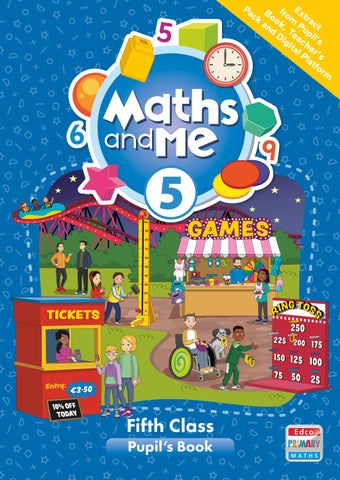
Pa B fr Ex ck oo om tr an k, P act d Te up Di a il’ gi ch s ta e l P r’s lat fo rm
A playful, flexible and inclusive Maths programme Maths and Me is a highly engaging programme, seamlessly integrating interactive digital resources, high-quality pupil’s books, and comprehensive teacher’s supports. Developed by experienced primary teachers, authors and maths experts, it is fully aligned to the new Primary Maths Curriculum and is designed for today’s classroom.
Maths and Me provides an exciting range of components for Fifth Class: Pupil’s Book Pupil’s Progress Assessment Booklet
200g
200g
1kg 200g
500g
500g
FREE Teacher’s Pack FREE Digital Platform Access FREE Pupil/Parent App FREE Manipulatives Supports
Fifth Class The Educational Company of Ireland Maths & Me Fifth Class Samples Cover.indd All Pages
Pupil’s Book
09/01/2026 09:59
Mia
Maths and Me 5 Sample Booklet Complete.indd 1
Jay
Lexi
Dara
Monty
09/01/2026 09:48
and
Me
Class
Maths
Maths
and
Me
A member of the Smurfit Westrock Group plc © The Educational Company of Ireland 2026 Design and layout: Design!mage and Carole Lynch Illustrations: Beehive (Nadene Naude, Andrew Pagram) Photos: Shutterstock All rights reserved. No part of this publication may be reproduced, stored in a retrieval system, or transmitted in any form or by any means, electronic, mechanical, photocopying, recording or otherwise, without either the prior permission of the Publisher or a licence permitting restricted copying in Ireland issued by the Irish Copyright Licensing Agency, 63 Patrick Street, Dún Laoghaire, Co. Dublin. While every care has been taken to trace and acknowledge copyright, the publishers tender their apologies for any accidental infringement where copyright has proved untraceable. They would be pleased to come to a suitable arrangement with the rightful owner in each case. Web references in this book are intended as a guide for teachers. At the time of going to press, all web addresses were active and contained information relevant to the topics in this book. However, The Educational Company of Ireland and the authors do not accept responsibility for the views or information contained on these websites. Content and addresses may change beyond our control and pupils should be supervised when investigating websites. As per the requirement of the General Product Safety Regulation, please contact us at safety@edcolearning.ie in relation to any product safety queries.
09/01/2026 09:48
Book Pupil’s
Book l Links klet /Schoo nt Boo Home essme Pupil’s ss Ass k r’s Pac Progre ess Teache Pupil’s rm Acc FREE Platfo App Digital arent FREE il/P ports Pup s Sup FREE ulative Manip E FRE
of pany l Com iona ucat The Ed
Maths and Me 5 Sample Booklet Complete.indd 2
First
ive inclus and xible mme ful, fle progra A play Maths
1
First published 2026 The Educational Company of Ireland Ballymount Road Walkinstown Dublin 12 www.edco.ie
nd Irela
4
Fourth Clas s
AN SCOIL
A play
Maths
2
200g
Dundalk
1kg 500g
500g
Maths and Me Pupil’s Tickets Home Pupil’s /Schoo Progre l Links ss Ass Book ess FREE Teache ment Boo FREE klet r’s Pac Digital k Pla tfo FREE rm Acc Pupil/P ess FREE arent Manip Ap p ulative s Sup ports
Limerick
First
Mia
Class
and
Me
Class Second ok
Book Pupil’s
Book l Links klet /Schoo nt Boo Home essme Pupil’s ss Ass k r’s Pac Progre ess Teache Pupil’s rm Acc FREE Platfo App Digital arent FREE il/P ports Pup s Sup FREE ulative Manip E FRE
Pupil’s
Bo
s Third Clas ok Pupil ’s Bo
Mia
Lexi
Dara
Monty
Fourth Class
Jay The Ed uc
at
Pupil’s Book
Pupil’s Book
EDCO
d nd lan ela Class of Ire First okCompany
Lexi
Fifth Classional Company of EDCO
Maths
Jay
Pupil’s Book
1
and
d Class Secon
Me
ful, fle xible Maths prog and incl ra am Me mme usive
and
Sligo Galaway 200g 200g
Tralee
usive d incl ble anmme flexi ra yful, hs prog Mat
Maths
Mia
Jay
Dara Ire Siland
The Ed
uc
Monty
Lexi
Dara xth Clas ational Compa s Junior ny of Pu
pil ’s Book
Irela
Pupind l’s
Infant Book
s
Monty
Senio
r Infa
l’s Bo nts ok
Pupi
Boal ion catl’s Pupi The Edu EDCO
of pany l Com iona ucat The Ed
nd Irela
Contents Digital Resources Digital Platform Overview
4
Digital Resources for Unit 8: Fractions, Decimals and Percentages
6
Link to Online Demo of Digital Resources
7 Pupil’s Book Extract
Pupil’s Book Contents
9
Extract from Unit 8: Fractions, Decimals and Percentages
10
Teacher’s Planning Book Extract Teacher’s Planning Book Extract Contents
20
Unit 8: Short-Term Plan
21
Unit 8: Lesson Plans
24
Maths and Me 5 Sample Booklet Complete.indd 3
09/01/2026 09:49
Maths and Me – Innovative Digital Resources Maths and Me provides access to an extensive range of over 2,500 fun, innovative, easy-to-use and engaging FREE Interactive Digital Resources including editable planning documents and a full range of printables. All resources are central to the programme and integrated into lessons, providing rich learning opportunities for children, by encouraging active participation and positive engagement. Designed specifically for Maths and Me, with the key pedagogical practices in mind, the resources promote maths talk, allow for formative assessment, include cognitively challenging tasks, mathematical modeling and lots more. The extensive range of digital resources include: n
Rich multimedia resources – engaging videos and animations
n
Interactive classroom activities
n
Virtual manipulatives
n
Editable planning documents
n
Printables
4 Maths and Me 5 Sample Booklet Complete.indd 4
www.mathsandme.ie 09/01/2026 09:49
Explainer videos help pupils to understand key maths concepts and strategies.
Classroom activities such as Concept Cartoons, Quick Images and Three-Act Tasks engage learners, support key pedagogies such as maths talk and playful learning, help pupils develop skills such as reasoning and allow for formative assessment.
Engaging animations feature the Maths and Me characters in relatable maths-based real-life scenarios.
Free access to a dedicated web app with digital resources for pupils to use at home or in school on devices.
An extensive range of colourful printable resources can also be accessed via the platform, including Maths Language Cards and Manipulative Printables.
Digital resources are accessed through an easy-to-use web platform.
www.mathsandme.ie Maths and Me 5 Sample Booklet Complete.indd 5
5 09/01/2026 09:49
Digital Resources for 5th Class, Unit 8: Fractions, Decimals and Percentages Day
Lesson
Lesson Title
Resource Title
1
1
Fractions as Decimals and Decimals as Fractions
Same But Different – Fractions as Decimals
Reason & Respond, with Think-PairShare; Write-Hide-Show
Slideshow
Benchmark Fractions
Reason & Respond, with Write-HideShow
Slideshow
Quick Images, with Write-Hide-Show
Quick Images
Reason & Respond, with Write-HideShow
Video
Same But Different – Percentages
Reason & Respond, with Think-PairShare
Slideshow
Introducing Per Cent
Reason & Respond, with Write-HideShow
Video
What Value Does this Represent? (2)
Quick Images, with Write-Hide-Show
Quick Images
Can __34 Be Expressed as a Percentage?
Concept Cartoon, with Think-PairShare
Concept Cartoon
2
3
4
5
6
7
8
2
3
4
5
6
7
8
Converting Fractions to What Value Does this Decimals and Decimals Represent? (1) to Fractions Converting between Fractions and Decimals Percentages
Percentages as Fractions and Decimals
MAM Routine
Converting between Benchmark Quick Images, with Write-Hide-Show Fractions, Decimals and Percentages Percentages Reason & Respond, with Write-HideConverting between Fractions, Decimals and Show Percentages
Resource Type
Quick Images Video
Comparing and Ordering Fractions, Decimals and Percentages
Order Them
Would This Work?, with Build it; Sketch it; Write it
Would This Work?
Cycling Competition
Three-Act Task
Three-Act Task
Calculating Percentages of Amounts
Calculating using Related Percentages
Number Strings, with Write-HideShow
Slideshow
Boys in the School
Would This Work?, with Build it; Sketch it; Write it
Would This Work?
Test Score
Would This Work?, with Build it; Sketch it; Write it
Would This Work?
Sale Time
Concept Cartoon, with Think-PairShare; Build it; Sketch it; Write it
Concept Cartoon
Percentage Increase and Decrease
Reason & Respond, with Write-HideShow
Slideshow
Percentage Increase and Decrease
6 Maths and Me 5 Sample Booklet Complete.indd 6
www.mathsandme.ie 09/01/2026 09:49
Scan the QR code below to access a selection of our new digital resources for Maths and Me 5th and 6th Class:
FOR A DEMO OF THE NEW DIGITAL RESOURCES
www.mathsandme.ie Maths and Me 5 Sample Booklet Complete.indd 7
7 09/01/2026 09:49
Maths and Me 5 Sample Booklet Complete.indd 8
09/01/2026 09:49
Pupil’s Book Contents
Note: The contents shown indicate what is included in the full Pupil’s Book.
Unit 1: Place Value
Review 3
Unit 2: Operations 1
Unit 11: Location and Transformation
Unit 3: Operations 2
Unit 12: Patterns and Rules
Unit 4: Expressions and Equations
Unit 13: Time
Review 1
Review 4
Unit 5: Shapes and Angles
Unit 14: Money
Unit 6: Fractions
Unit 15: Ratio
Unit 7: Operations 3
Unit 16: Measuring 2
Review 2
Unit 17: Chance
Unit 8: Fractions, Decimals and Percentages
Review 5
Unit 9: Measuring 1
Let’s Try More
Unit 10: Data
Glossary
The Maths and Me Pupil’s Pack includes a Progress Assessment Booklet and the following inserts to support learning: mini-whiteboard with open-number line on reverse, spinners (for playing games), cut-out Place Value Counters and a cut-out Fraction Wall.
Maths and Me 5 Sample Booklet Complete.indd 9
09/01/2026 09:49
PCM 1
Unit 8 Digital Resources
Fractions as Decimals and Decimals as Fractions A Express each coloured amount as a fraction and a decimal. 1.
__9__
0· ______ = ______ 10
2.
3.
4.
______ = ______
______ = ______
______ = ______
B Use your thousandths grids (PCM 1) to represent the fractions below. Write the equivalent decimal form for each. 1.
1 __ 4 = ____
2.
3 ___ 10 = ____
3.
1 __ 5 = ____
4.
4 __ 5 = ____
5.
13 ____ 100 = ____
6.
129 _____ 1,000 = ____
7.
1 ___ 20 = ____
8.
7 ___ 20 = ____
C Write the position of each letter as (a) a decimal and (b) a fraction. B
A
0 A D
0·1 (a) ____ (a) ____
0·2
0·3
(b) ____ (b) ____
C
0·4 B E
D
0·5
(a) ____ (a) ____
E
0·6
0·7
0·8
(b) ____ (b) ____
C F
(a) ____ (a) ____
F 0·9
1
(b) ____ (b) ____
D Complete the table.
1.
(a) Decimal
(b) Decimal expanded form
0·461
0·4 + 0·06 + 0·001
(c) Fraction 461 _____ 1,000
2. 3.
(d) Fraction expanded form __4__
6 2 _____ ____ 10 + 100 + 1,000 8 9 6 ___ ____ _____ 10 + 100 + 1,000
0·015
4.
0·7 + 0·003
5.
76 _____ 1,000
Try this! Jay made a 4-digit decimal number:
.
0
The other digits he used were 2, 4 and 6. Write in (a) decimal and (b) fraction form… 1. the greatest number that he could have made (a) ______ (b) ______ 2. the least number that he could have made.
10
(a) ______ (b) ______
Unit 8: Fractions, Decimals and Percentages. Day 1, Lesson 1
Maths and Me 5 Sample Booklet Complete.indd 10
09/01/2026 09:49
Converting Fractions to Decimals and Decimals to Fractions A Complete these in order to express the fractions as decimals. 1.
O· t h
35 7 5 ___ ____ __ . 20 × 5 = 100 = 0 ___
35
2.
O· t h
9 2 ___ ____ __ . 50 × 2 = 100 = 0 ___
O· t h
3 4 ___ ____ __ . 25 × 4 = 100 = 0 ___
3.
B In your copy, do these in a similar way to the ones in A above. 1.
3 __ 4
2.
1 __ 5
3.
4 __ 5
4.
11 ___ 20
12 ___ 25
5.
6.
21 ___ 50
C Complete these in order to express the decimals as fractions. 55
11
5 ____ = ____ 1. 0.55 = 100 ÷ __ 5
____ 2. 0.85 = 100 ÷ ____ = ____
____ 3. 0.14 = 100 ÷ ____ = ____
D In your copy, do these in a similar way to the ones in C above. 1. 0.05
2. 0.65
3. 0.04
4. 0.16
5. 0.48
6. 0.72
E Match each decimal to its most likely equivalent fraction. Use a calculator to check your answers. 0.08
0.33333
0.375
0.125
0.16666
1.6
0.66666
% M-
M+
7
8
9
4
5
1
2
0
1 __ 8
3
1__ 4
3 __ 8
1 __ 3
2 ___ 25
1 __ 6
2 __ 3
ON
R.CM
+
1.75
6
-
3
+
=
3
1__ 5
F Let’s talk! Not all fractions convert easily to decimals. Some become recurring decimals. 1. Which fractions in E convert into recurring decimals? Why do you think this is? 2. Recurring decimals are often written with a dot over the repeating digit(s) to show they repeat. Why do you think this is?
Try this! 1. In your copy, express each test result on this report card as... (a) a fraction in its simplest form (b) a decimal number. 2. In which subject did this pupil perform... (a) best? ______________ (b) worst? ______________
Report card: test results English
60 out of 80
Irish
26 out of 40
Maths
40 out of 50
History
18 out of 20
Geography
21 out of 24
Science
17 out of 20
Recurring decimal: has infinite (never ending) digits
What model could you use to prove your answers?
3. When Lexi converted a specific fraction to a decimal her answer was 0·6. Write down three possible fractions. Unit 8: Fractions, Decimals and Percentages. Day 2, Lesson 2
Maths and Me 5 Sample Booklet Complete.indd 11
11 09/01/2026 09:49
Percentages A Write the amount that is coloured as per cent and hundredths (fraction form and decimal form). 1.
2.
____ ____% = 100 = 0.____ 17 17
4.
3.
____ ___% = 100 = 0.___
5.
____ ___% = 100 = 0.___
____ ___% = 100 = 0.___
6.
____ ___% = 100 = 0.___
____ ___% = 100 = 0.___
B In your copy, write the amount that is uncoloured in A above as per cent and hundredths (fraction form and decimal form). C Solve these. 1. Jay has read 79 pages of a 100-page book. What percentage has he (a) read? ____ (b) left to read? ____ 2. There are 100 children in a club. 37 of them are boys. What percentage are (a) boys? ____ (b) girls? ____ 3. There were 100 trees planted, but 13 were damaged during a storm. What percentage of the trees were undamaged? ____
Try this! 1. Of the 10 bananas in a bunch, three of them are not yet ready to eat (unripened). (a) What percentage are ready to eat? ____ (b) What percentage are not ready to eat? ____ 2. 12% of the people surveyed wear glasses. How many people wear glasses, if the number of people surveyed was (a) 100? ____ (b) 200? ____ (c) 50? ____
Let’s talk!
I believe in you 100%.
Read the statements. What do you think they mean? When might people use them? What other per cent phrases do you know?
12
I’m 100% sure that’s right.
I’ll give it 110%. He only gave 50% in the match.
Unit 8: Fractions, Decimals and Percentages. Day 3, Lesson 3
Maths and Me 5 Sample Booklet Complete.indd 12
09/01/2026 09:49
Percentages as Fractions and Decimals A Write the amount that is coloured as a percentage and a fraction. 2.
1.
3.
__1__
___% = ____
____% = 10 10 4.
___% = ____
5.
6.
___% = ____
___% = ____
___% = ____
B Complete the table. (a) Percentage 1.
50%
2.
25%
(b) Fraction (hundredths)
3. 4.
(c) Fraction (simplest form)
50 ____ 100
1 __ 2
(d) Decimal 0.5
1 __ 4 75 ____ 100
10%
5.
1 ____ 100
6.
1 __ 5
7.
0.05
Try this! Fill in the blanks. 1.
1 7 ___ ___ 10 is ___%, so 10 is ___%
2.
1 4 __ __ 5 is ___%, so 5 is ___%
3.
1 3 ___ ___ 20 is ___%, so 20 is ___%
4.
1 4 ___ ___ 50 is ___%, so 50 is ___%
5.
1 8 ___ ___ 25 is ___%, so 25 is ___%
6.
1 1 __ __ 4 is ___%, so 8 is ___%
Unit 8: Fractions, Decimals and Percentages. Day 4, Lesson 4
Maths and Me 5 Sample Booklet Complete.indd 13
13 09/01/2026 09:49
Converting between Fractions, Decimals and Percentages A Change the percentage to a decimal number or vice versa. 1. 56% = ____ 0·56
2. 0.04 = ____
3. 0.48 = ____
4. 70% = ____
5. 0.9 = ____
6. 9% = ____
B Change the percentage to a fraction (simplest form) or vice versa. 1.
3 __ 5 = ____
2. 40% = ____
4. 6% = ____
C Maths eyes
5.
3. 65% = ____
11 ___ 20 = ____
1.
6. 2.
13 ___ 50 = ____
3.
Express each fraction as both a fraction (simplest form) and as a decimal. ______________ ______________ ______________
D Look at the image and solve these. Dara is going to put these cards into a bag. Then, without looking, he will pull one card from the bag. Express as (a) a fraction and (b) a percentage the chance he has of pulling… 1. a 6 (a) ___ (b) ____ 2. an odd number (a) ___ (b) ____ 3. a multiple of 3 (a) ___ (b) ____ 4. a multiple of 4 (a) ___ (b) ____ 5. a heart (a) ___ (b) ____ 6. a Jack (a) ___ (b) ____
E Look at Mia. Fill in three possible ways to complete the sentence.
In a test where all of the questions were worth the same amount, I scored 95%.
Mia got ___ questions correct out of ____. Mia got ___ questions correct out of ____. Mia got ___ questions correct out of ____.
Try this! 1. Change the percentage to a decimal number or vice versa. (a) 110% = ____ (d) 12·5% = ____
(b) 1·5 = ____ (e) 0·375 = ____
(c) (f)
7·5% = ____ 200% = ____
(b) 44% = ____
(c)
125% = ____
(e)
(f)
320% = ____
2. Change the percentage to a fraction (simplest form) or vice versa. (a) (d)
14
22 ___ 25 = ____ 120 ____ 100 = ____
96% = ____
Unit 8: Fractions, Decimals and Percentages. Day 5, Lesson 5
Maths and Me 5 Sample Booklet Complete.indd 14
09/01/2026 09:49
Comparing and Ordering Fractions, Decimals and Percentages A Use the open number line below, or on your mini-whiteboard, to show the position of each representation below. (a)
(b)
(c)
3
(d)
30%
0%
100%
B Which value is greater… 1. 20% or 0.4? ____ 4. 50% or 0.52? ____ 7. 0.5 or 6%? ____
5
3.
3
6. 2 or 20%? ____
2. 40% or ___ 10 ? ____
5. 38% or __ 4 ? ____ 8. 123% or 1.32? ____
1 __ 2 or 18%? ____ 1
9. 1__ 2 or 110%? ____
C Put these in order starting with the smallest. ____ 1. 80%, 0.18, 100 ____ ____ ____ 1 3. __, 0.41, 14% ____ ____ ____
2.
5.
____ ____ ____
6.
____ ____ ____
8.
81
7.
4 3 __ . 4 , 3 4, 34% 1 12%, 0.2, ___ 20
4.
1 __ . 2 , 21%, 0 24 ____ 1 __ . 5 , 15%, 0 51 ____ 3 0.35, 53%, __ 5 ____ 4 0.4, __ 5 , 54% ____
____ ____ ____ ____ ____ ____ ____ ____
D Fill in one of the values below to make each expression true. 72%
1. 0.45 < ____ < 55% 3 4. __ > ____ > 0.6 4
0.43
3 __ 5
0·8 2.
2 __ 5 < ____ < 45%
5. 65% > ____ > 0.56
27% 3. 6.
1 __ 2
1 __ 2 < ____ < 90% 1 __ 0.3 > ____ > 4
F Solve this. The children were practising taking shots. Out of 25 shots, Jay scored 15 points. Out of 20 shots, Mia scored 13 points. Out of 10 shots, Lexi scored 7 points. Whose point-scoring was the most accurate? _______
Try this! Who has read the most of their book? _______ I’ve read 243 pages of a 300-page book.
I’ve read 210 pages of a 250-page book.
Unit 8: Fractions, Decimals and Percentages. Day 6, Lesson 6
Maths and Me 5 Sample Booklet Complete.indd 15
I’ve read 182 pages of a 200-page book.
15 09/01/2026 09:49
Use the bar models to help you.
Calculating Percentages of Amounts A Solve these. 1. In a club, 60% of the members were boys and the rest were girls. If there were 120 members, how many were… (a) boys? ___ (b) girls? ___
2. Of the cars in a car park, 25% were black, 35% were white and the rest were silver. If 56 of the cars were silver, how many cars…
____% 100 = ____ 120 children
12 ___% 60 = ___ boys
___% = ___ girls
___% = ___ cars
(a) were there altogether? ____ (b) were black? ____ (c) were white? ____ 3. There are 80 members in a chess club. If 30% of the members were absent last week, how many were… (a) absent? ___ (b) present? ___ 4. Mia has saved 60% of the cost of a new computer game. If she has saved €30 so far, how much…
___% 25 = ___% 35 = ___ black ___ white
___% = ___ 56 silver
___% = ___ members
___% = ___ absent
___% = ___ present
___% = ___ cost
(a) does the game cost? €___ (b) more does she need to save? €___
5. Dara has read 40% of his book. If he has 96 pages left to read, how many pages are there in the entire book? ____
___% = ___ saved
___% = ___ needed
___% = ___ pages
___% = ___ pages read
B Use a calculator to check your answers to A above.
%
ON
M-
M+
7
8
9
4
5
1
2
6 3 =
+
R.CM
0
16
___% = ___ pages unread
+
Unit 8: Fractions, Decimals and Percentages. Days 7 and 8, Lesson 7
Maths and Me 5 Sample Booklet Complete.indd 16
09/01/2026 09:49
%
ON
R.CM
M-
M+
7
8
9
4
5
1
2
0
6 3 =
+
C Model and solve these. Use a calculator to check your answers.
+
1. In a class of 30 pupils, 60% said that their favourite sport is Gaelic football. How many pupils in the class chose Gaelic football? ______ 2. James has saved €35, which is 50% of the money he needs to buy a new sports strip. What is the total cost of the sports strip? €______ 3. 75% of the players on a soccer team played in the final. If 12 of the players played in the final, what is the total number of players on the team? ______ 4. 20% of the 185 flowers planted in a garden had bloomed. How many flowers were yet to bloom? ______ 5. So far, a school has raised €200, which is 10% of their total fundraising goal. What is the school’s total fundraising goal? €______ 6. The O’Neill family are travelling from Cork to Dublin, a distance of 260km. When they have travelled 90% of the journey, how far have they still to go? ______km 7. In a test in which every question was worth the same marks, Toni scored 75%. If she answered 36 questions correctly, how many questions… (a) did he get wrong? ______ (b) were there in the test altogether? ______ 8. Zofia wants to send letters to 16 friends. 50% of the letters will need one sheet of paper each and the rest will need two sheets each. How many sheets will be needed altogether? ______ 9. Sam’s smart watch is 80% charged. If the fully charged battery lasts 5 days, how many days are left? ______
Try this! Look at the image and answer the questions. 1. How long more until this device is fully charged? ___ mins 2. At what time will that be? ______ 3. If this device was allowed to completely discharge (i.e. for the battery to run out), for how many hours and minutes would it need to be plugged in to fully recharge? ___ hrs ___ mins 4. If this device was plugged in 1 hour and 10 minutes ago, what percentage would it be at then? ____
Unit 8: Fractions, Decimals and Percentages. Days 7 and 8, Lesson 7
Maths and Me 5 Sample Booklet Complete.indd 17
75%
40 minutes until fully charged
17 09/01/2026 09:49
Percentage Increase and Decrease A Let’s talk! Look at B below. Is each special offer an increase or a decrease? Could you solve it mentally? If yes, how? If no, how else might you solve it?
B Model and solve each of these (without a calculator) to find out the current value. 2.
1.
4.
3.
Was €260 Now 50% off
Was 1.5l Now with 10% extra free
Was €480 Now 50% off
Was 800m l Now with 20% extra free
€____
____l
€____
____ml
5.
7.
6.
8.
Was 0.5kg Now with 30% extra free
Was €80 Now 50% off
Was 20l Now with 5% extra free
Was €300 Now 40% off
____kg
€____
____l
€____ % M-
M+
7
8
9
4
5
1
2
0
Try this! Use a calculator to work out the… 1. total cost of a meal that was €95 before adding a 10% service charge. €______
ON
R.CM
6 3 =
+
C Use a calculator to check your answers to B above in a different way. In your copy, record the inputs you made on the calculator.
+
Round your answers to the nearest whole number as needed.
2. total cost of a holiday that was €1,785 before adding a 4% booking fee. €______ 3. total cost of cinema tickets that cost €48 before adding a 3% bank card fee. €______ 4. amount of fibre in an apple that contains 8% of the recommended daily fibre intake of 75g. ______g 5. amount of sugar in a cookie that weighs 23g and is made up of 26% sugar. ______g
18
Unit 8: Fractions, Decimals and Percentages. Day 9, Lesson 8
Maths and Me 5 Sample Booklet Complete.indd 18
09/01/2026 09:49
Teacher’s Planning Book Extract Contents
Unit 8: Fractions, Decimals and Percentages Unit 8 Short-Term Plan
20
Unit 8 Lesson Plans
24
The Maths and Me Teacher’s Pack contains a Teacher’s Planning Book and a Teacher’s Resources Book. Along with the plans for each unit, the Teacher’s Planning Book also contains a comprehensive introductory section featuring the following sections: ●
How Maths and Me Aligns to the Primary Maths Curriculum
●
Your Guide to Maths and Me
●
Supporting Maths Learning in Your Classroom
●
Yearly Overview
The Maths and Me Teacher’s Resources Book includes all additional materials outside of planning. A range of photocopiable materials (PCMs) will be available, including general PCMs. For each unit the following are provided: ●
Let’s Strengthen PCMs
●
Let’s Deepen PCMs
●
Let’s Strengthen Suggestions for Teachers
●
Maths Journal Prompts PCMs
●
Home/School Links PCMs
●
Games Bank
Additionally an Answer Booklet and various printables (such as manipulative printables, Maths Language Lists and Equipment List) are also available.
Maths and Me 5 Sample Booklet Complete.indd 19
09/01/2026 09:49
16-08 MaM 5th class TPB STUP U8.indd 20
09/01/2026 09:46
Unit 8: Fractions, Decimals and Percentages
Converting Fractions to Decimals and Decimals to Fractions: Converts fractions to decimals and vice versa, without manipulatives and other representations (U&C)
Percentages: Recognises the per cent symbol (%) and relates this to ‘number of parts per hundred’ (U&C); Identifies percentages as a fraction [with denominator 100] and as a decimal (R)
Percentages as Fractions and Decimals: Demonstrates an understanding of benchmark percentages (For example: 50%, 25%, 10%, 1%) in the context of fractions and decimals (C); Identifies benchmark percentages as a fraction in its lowest form and as a decimal (R); Models and expresses percentages as fractions and decimals and vice versa (C)
Converting between Fractions, Decimals and Percentages: Explores the relationship between fractions, decimals and percentages (R); Converts between fractions, decimals and percentages, without manipulatives and other representations (U&C)
Comparing and Ordering Fractions, Decimals and Percentages: Orders fractions, decimals and percentages, of the same and of various whole units, by their comparative value (R)
Calculating Percentages of Amounts: Solves problems involving operations with whole numbers, fractions, decimals and benchmark percentages (A&PS)
Percentage Increase and Decrease: Solves problems relating to percentage increases and decreases (A&PS); Completes problemsolving tasks involving percentages, fractions and measures, explaining methods and reasoning (A&PS)
Review and Reflect: Reviews and reflects on learning (U&C)
2
3
4
5
6
7
8
9
CM P Reason & Respond L1–3, 5, 7–8
P Exploring Other Fractions L1
Planned Interactions:
Intuitive Assessment: responding to emerging misconceptions
Assessment
L6–8
C
P Build it; Sketch it; Write it
Print resources Pupil’s Book pages 76–84 PCMs XX
D Number Strings L7
D Three-Act Task L6
D
D Would This Work? L6–7
as Percentages and Decimals L4
20
Assessment Events: information gathered from completion of the unit assessment in the Progress Assessment Booklet page XX
gleaned from children’s responses to learning experiences
C Let’s investigate! Benchmark Fractions responding to insights
D Concept Cartoon L4, 8
C Modeling Per Cent L3
D Quick Images L1, 4–5
C
D Write-Hide-Show L1–5, 7–8
D Think-Pair-Share L1, 3–4, 8
D
Learning Experiences
Key: Elements: (U&C) Understanding and Connecting; (C) Communicating; (R) Reasoning; (A&PS) Applying and Problem-Solving. CM: Cuntas Míosúil: please tick when you have completed the focus of learning. Learning Experiences: C concrete activity; D digital activity; P activity based on printed materials, followed by lesson numbers.
Fractions as Decimals and Decimals as Fractions: Models and expresses fractions as decimals and vice versa (C); Identifies benchmark fractions as a decimal (R); Identifies and represents equivalent fractions of a given fraction, including tenths and hundredths (C)
1
Focus of Learning (with Elements)
Through appropriately playful and engaging learning experiences children should be able to: explore (model, compare and convert) the relationships between fractions, decimals and percentages; investigate proportionality and ratios of quantities (sets).
Learning Outcome(s)
Lesson
Number > Fractions.
Strand(s) > Strand Unit(s)
Maths and Me: 5th Class – Short-Term Plan, Unit 8: Fractions, Decimals and Percentages ( January: Weeks 1&2)
Editable planning document
Unit 8: Fractions, Decimals and Percentages
Additional information for planning Progression Continua
See ‘5th Class Maths and Me Progression Continua Overview’ for a detailed breakdown of how all progression continua are covered.
Maths Language
See ‘5th Class Maths and Me Maths Language Overview’ (Appendix 2) and individual lesson plans and Unit 8 Maths Language Cards.
Equipment Inclusive Practices
See ‘5th Class Maths and Me Maths Equipment Overview’ (Appendix 3) and individual lesson plans. ●
See Let’s Strengthen and Let’s Deepen suggestions throughout lesson plans.
●
See Unit 8 Let’s Strengthen Suggestions for Teachers. (These address the Common Misconceptions and Difficulties listed below.)
●
See Unit 8 Let’s Strengthen PCM.
●
See Unit 8 Let’s Deepen PCM.
Integration
See individual lesson plans.
Home/School Links
See the Unit 8 Home/School Links PCM and Pupil/Parent App.
Background and rationale ●
This unit is a two-week block of content that builds upon the children’s understanding from Unit 1 Place Value (decimals, in particular), Units 2 and 3 Operations 1 and 2 (multiplication and division, including multiples and factors) and Unit 6 Fractions. This unit also lays the foundations for future exploration of fractional understanding in Unit 15 Ratio.
●
In this unit, the children will be formally introduced to the concept of percentages, but it is likely that they will already have encountered this concept informally in a variety of real-world contexts.
●
It is essential that calculator use is developed as a tool, alongside other strategies and models, such as pictorial representations (e.g. thousandths and hundredths grids, number lines, bar models) and written calculations. Once the children grasp the concept, and if demonstrated and used meaningfully, the use of calculators can help them with checking answers and encourage them to estimate. It can also allow them to focus on the process in an efficient way, rather than focusing on doing the calculations only.
●
In Maths and Me, we have consciously avoided focusing too much on memorising rules for converting between percentages, fractions and decimals, such as ‘to convert percentages to decimals, move the decimal point two places to the left’, or ‘to convert fractions to percentages, multiply the numerator by 100 and divide by the denominator’. Emphasising rules such as these can be counterproductive for several reasons, including: hindering conceptual understanding (children may not understand the underlying rationale); discouraging exploration and identification of patterns and relationships, leading to confusion and mistakes (they might mix up the rule, or apply it correctly to the wrong context); limiting problemsolving flexibility (rigid application of rules does not foster adaptive reasoning).
21 16-08 MaM 5th class TPB STUP U8.indd 21
09/01/2026 09:46
Unit 8: Fractions, Decimals and Percentages
Common misconceptions and difficulties Difficulties in understanding the connection between percentages and their equivalents may stem from misconceptions about fractions or decimals. Therefore, refer also as required to the Common Misconceptions and Difficulties for Unit 1 Place Value and Unit 6 Fractions for further insight. ●
__ , but struggle to The children may correctly identify that a percentage such as 25% means 25 100 1 simplify this fraction to its lowest form of __ due to misconceptions about fractions and factors. 4
●
When converting a percentage to a decimal, they may misplace the digits. For example, they might write 50% as 50.0 instead of 0.50 or 0.5. It is important to constantly reinforce that since per cent is the same as hundredths, we typically are using the first two decimal places (i.e. tenths and hundredths) when converting percentages to decimals.
●
They may be able to recall the equivalent benchmark percentages and fractions (knowing that 1 __ __ , which simplifies , 1 is 25%, etc.), while not understanding why (e.g. that 50% equals 50 50% is __ 2 4 100 1 ). to __ 2
●
They may struggle to convert fractions to percentages when they do not have a denominator of 1 to a percentage). They may not realise or recall that they need to find an 100 (e.g. converting __ 5 __ ) before converting to the equivalent equivalent fraction with a denominator of 100 first (e.g 20 100 percentage (e.g. 20%).
●
1 , 0.4, 6%), they may try When comparing and ordering fractions, decimals and percentages (e.g. __ 2 to compare them in their different formats. This in turn may lead to other difficulties, such as incorrectly assuming that the value with the larger digit/number is always greater (e.g. thinking 6% is the greatest because 6 is greater than 1, 2 or 4). Instead, encourage them to convert the values to hundredths and/or to use their reasoning and ‘fraction sense’ to justify the ‘size’ of each amount. For 1 as tenths is 5 tenths (greatest), and 6% is 6 hundredths, which example, 0.4 is 4 tenths, whereas __ 2 has no tenths and is therefore the least.
●
When calculating a percentage of an amount, they may apply a procedure without knowing why or how it works. For example, when finding 75% of 60, they might apply the ‘divide by 100 and multiply by the per cent’ procedure (i.e. divide 60 by 100, then multiply by 75), which works, but they may 75 of the total amount. In not understand the underlying concept that they are finding the value of __ 100 3 __ doing so they may also fail to appreciate that since 75% is also 4 , it would have been easier to divide 60 by 4, then multiply by 3.
●
When calculating percentage increase and decrease, they might confuse the meanings of increase and decrease. Furthermore, they may incorrectly add or subtract the percentage itself. For example, if an item costs €50 and has a 10% discount, they might say that the new price is €40, having subtracted 10 instead of 10% of €50 (i.e. €5).
The Unit 8 Let’s Strengthen Suggestions for Teachers address the common misconceptions and difficulties listed above.
22 16-08 MaM 5th class TPB STUP U8.indd 22
09/01/2026 09:46
Unit 8: Fractions, Decimals and Percentages
Mathematical models and representations ●
Thousandths and hundredths grids
●
Diagrams of 2-D shapes divided into various parts/fractions and/or with various parts coloured
●
Bar models
●
Physical materials that can be used to build bar models, such as number rods (e.g. Cuisenaire) or interlocking cubes
●
Number lines and other similar linear representations, including metre stick
●
Physical materials to represent hundredths (e.g. base ten money, place value counters)
3.
Thousandths grid
Circle divided into hundredths
Write the position of each letter as B
A
0
0·1
0·2
0·3
C
0·4
D 0·5
E 0·6
0·7
F 0·8
0·9
1
Number line
Teaching tip The following manipulative printables are available to support the unit: Thousandths Grid, Hundredths Grid, Open Number Lines, Base Ten Money, Place Value Counters. Click on the resources icon on the Maths and Me book cover on edcolearning.ie
23 16-08 MaM 5th class TPB STUP U8.indd 23
09/01/2026 09:46
Unit 8: Fractions, Decimals and Percentages
Day 1, Lesson 1
Fractions as Decimals and Decimals as Fractions Focus of learning (with Elements) ●
Models and expresses fractions as decimals and vice versa (C)
●
Identifies benchmark fractions as a decimal (R)
●
Identifies and represents equivalent fractions of a given fraction, including tenths and hundredths (C)
Learning experiences
Equipment
D Digital activity: Same But Different – Fractions as Decimals MAM Routines: Reason & Respond, with Think-Pair-Share; WriteHide-Show
● ●
Reusable dry-erase pockets (if available) PCM xx
D Digital activity: Benchmark Fractions MAM Routines: Reason & Respond, with Write-Hide-Show C
P Concrete activity: Exploring Other Fractions
P Pupil’s Book page 76: Fractions as Decimals and Decimals as Fractions
Maths language ●
fraction(s), decimal(s), fraction/decimal form, equivalent form, equal, tenth(s), hundredth(s), thousandth(s)
Warm-up D Digital activity: Same But Different – Fractions as Decimals MAM Routines: Reason & Respond, with Think-Pair-Share; Write-Hide-Show
Play the slideshow and, using Think-Pair-Share, ask the children to propose reasons for why the images are the same and why they are different. Using Write-Hide-Show to gather feedback, ask: ●
How might you write these amounts?
●
Can they be written/shown in multiple ways? Show us.
Teaching tip If not suggested, prompt the children to consider equivalent fraction forms, when appropriate (e.g. 70 700 7 __ = __ = __ ). While decimal equivalents (e.g. 10 100 1,000
0.7, 0.70, 0.700) are not required at this stage, if suggested, acknowledge them and ask the children to suggest reasons for why they are also valid answers.
Teaching tip Encourage the children to use both decimal and fractional language when verbalising decimal notation, i.e. expressing 0.75 as ‘zero point seven five’ and also as ‘seventy-five hundredths’. Using fractional language to read decimal numbers reinforces the value of the digit(s) in the decimal place(s). However, when using decimal language, emphasise that it is incorrect to say ‘zero point seventy-five’, because the suffix -ty means tens.
Main event D Digital activity: Benchmark Fractions MAM Routines: Reason & Respond with Write-Hide-Show
Teaching tip Using PCM xx Thousandths Grids placed in reusable dry-erase pockets, the children could copy each of the fractions being displayed each time.
24 17-08 MaM 5th class TPB LP U8.indd 24
09/01/2026 09:46
Unit 8: Fractions, Decimals and Percentages Teaching tip
Display the slideshow. Using Write-Hide-Show to gather feedback, ask: ●
What fraction of the grid is coloured?
●
How might you represent this fraction in writing?
●
How might you represent it in fraction form?
●
How might you represent it in decimal form?
For each slide (excluding the first slide), repeat the questions above, but this time, ask: What fraction of the grid is uncoloured?
●
Depending on the availability of digital devices, online virtual manipulatives could also be used to model fractions. See the Optional Consolidation and Extension Possibilities below for suggestions. The following questions could be posed during or after the activity to assess understanding: ●
Show me your representation. How do you know you are correct?
●
How might you do this in an efficient way (e.g. for 129 thousandths, instead of colouring in and counting 129 individual parts, colour instead one full row/column and 2 hundredths, and 9 thousandths)?
●
What value is represented by the uncoloured parts of the grid? How do you know? Do you need to count all of the uncoloured parts? Explain why.
Let’s strengthen The children may find it beneficial to review the video titled ‘Decimal Fractions’ from Unit 1, Lesson 3.
Let’s deepen Challenge the children to suggest how they might prove that the fraction form and decimal form are equivalent, without referring to the image or using any visual or concrete supports. For example: ●
●
1 25 __ __ multiplied by 25 (a fraction equivalent of 4 25 __ 1) = 100 = 0.25 5 5 __ 0.05 = 100 divided by __ (a fraction equivalent of 5 1 __ 1) = 20 (simplest form)
Explain how the first step must always be to change the fraction or decimal to its equivalent fraction form, where the denominator is 10, 100 or 1,000. This will be explored in more depth in the next lesson. C
P Concrete activity: Exploring Other Fractions
Distribute a copy of PCM xx Thousandths Grids placed inside a reusable dry-erase pocket to each pair. Tell the children to turn to activity B on page 76 of their Pupil’s Books. Ask them to colour or highlight the given fractional amounts on the PCM, and record the amounts as decimal form.
Let’s deepen Challenge the children to suggest strategies for identifying the value of the uncoloured amount, and to come up with a way to justify their approach. If not suggested, prompt them to first consider how many parts in total, and then use their understanding of bonds of 10, 100 and/or 1,000 to help identify the uncoloured amount.
Teaching tip Maths Journals: The children could record what they have learned in this lesson, and/or paste in their completed thousandths grids from PCM xx. P Pupil’s Book page 76: Fractions as Decimals and Decimals as Fractions
Unit 8 Digital Resource
s
Fractions as
A Express each
Decimals and
coloured amoun t as a
1.
2.
Decimals as
Fractions
fraction and a decimal. 3.
PCM 1
4.
__9_
_ _____ 10 _ = _____ 0· _
______ = _____ _
______ = _____
_ ______ B Use your thousa = ______ ndths grids (PCM equivalent decima 1) to represent l form for each. the fractions below. 1 1. __ Write the 4 = ____ 3 2. ___ 5.
10 = ____
13 ____ 100 = ____
6.
C Write the positio
A D
0·1
(a) ____ (a) ____
D Complete the (a) Decimal 1.
0·461
2. 3.
B
0·2
0·3
(b) ____ (b) ____
table.
1 ___ 20 = ____
7.
as (a) a decima
C 0·4
B E
1 __ 5 = ____
3.
129 _____ 1,000 = ____
n of each letter
A
0
(a) ____ (a) ____
(b) Decimal expand ed form
4 __ 5 = ____ 7 ___ 20 = ____
E
n.
0·6
0·7
0·8
(b) ____ (b) ____
C F
(a) ____ (a) ____
(c) Fraction
0·4 + 0·06 + 0·001
4. 8.
l and (b) a fractio
D 0·5
461 _____ 1,000
F 0·9
1
(b) ____ (b) ____
(d) Fraction expand ed form __4__
6 ____ 2 10 + 100 + _____ 1,000 8 ___ 9 ____ 6 _____ 10 + 100 + 1,000
0·015
4. 0·7 + 0·003
5.
76 _____ 1,000
Try
this! Jay made a 4-digit decimal number: The other digits . he used were 2, 0 4 and 6. Write in (a) decimal and (b) fraction form… 1. the greatest number that he could have made 2. the least number (a) ______ (b) that he could have ______ made. (a) ______ (b) ______
76
Unit 8: Fractions
, Decimals and
Percentages. Day
1, Lesson 1
Optional consolidation and extension possibilities Maths Journal Use the Lesson 1 Maths Journal
Prompt from the Unit 8 Maths Journal Prompts PCM. Display Set up a display for Fractions, Decimals and Percentages or add to an existing display for Fractions in the classroom. This could include examples of the children’s work from this and subequent units, alongside appropriate labels (see the Unit 8 Maths Language Cards).
Digital Online Tool These virtual manipulatives could be very useful to model and compare tenths, hundredths and/or thousandths: ‘Decimal Squares’ at edco.ie/7any Games Bank Play ‘4 Spins to 1’ (Decimals). The children could use PCM xx Thousandths Grids to colour in what they choose each time. Review and Reflect Use the prompt questions in the Review and Reflect poster.
25 17-08 MaM 5th class TPB LP U8.indd 25
09/01/2026 09:46
Unit 8: Fractions, Decimals and Percentages
Day 2, Lesson 2
Converting Fractions to Decimals and Decimals to Fractions Focus of learning (with Elements) ●
Converts fractions to decimals and vice versa, without manipulatives and other representations (U&C)
Learning experiences
Equipment
D Digital activity: What Value Does This Represent? (1) MAM Routines: Quick Images, with Write-Hide-Show
●
D Video: Converting between Fractions and Decimals MAM Routines: Reason & Respond, with Write-Hide-Show
There is no equipment needed for this lesson.
P Pupil’s Book page 77: Converting Fractions to Decimals and Decimals to Fractions
Maths language ●
denominator, powers of ten, fraction equivalent to 1, simplify, greatest factor
Teaching tip In the previous lesson, the children learned to identify and represent equivalent fractions and decimals using thousandths grids, whereas in this lesson, they will use alternative strategies that do not depend on manipulatives or other visual representations.
Warm-up D Digital activity: What Value Does This Represent? (1) MAM Routines: Quick Images, with Write-Hide-Show
Teaching tip While this is a Quick Images resource, due to the level of detail in the graphics, these slides may need to be displayed on screen for longer than usual. Display the slideshow. Click to briefly reveal and then hide the image on the first slide, which shows a representation using a thousandths grid. Ask the children to record the value represented on their MWBs, and to ‘show’ their proposed answer when called upon. Record all of the proposed answers on the board, being careful not to give any undue weight to the correct answer. Ask: ●
Which answer are you going for?
●
What proof do you have?
●
Does anybody have different proof?
●
Are there any proposed answers that are equivalent forms, representing the same amount or value (‘same value, different appearance’)?
If any unreasonable answers are suggested, ask: ●
Are there any answers that are unreasonable/ unlikely because they don’t make sense? Which ones?
●
Why do you think this?
When there are no new strategies to discuss, reveal the image again and confirm the answer using a variety of possible strategies. Repeat for the remaining images.
Teaching tip For every image, prompt the children to suggest multiple different ways to write the amount (e.g. 1 25 __ __ 250 __ as 100 , 1,000 , 0.25, 0.250). As the children 4 suggest various forms (or as they become more confident with identification), identify each as decimal or fraction form.
26 17-08 MaM 5th class TPB LP U8.indd 26
09/01/2026 09:46
Unit 8: Fractions, Decimals and Percentages
Main event D Converting between Fractions and Decimals MAM Routines: Reason & Respond, with Write-Hide-Show
Play the video and, using Write-Hide-Show, ask the children to respond to the questions on their MWBs, giving reasons for their responses as appropriate.
Teaching tip While the children are learning to discuss and identify the greatest or highest factor possible, they will not be expected to use the terminology of highest common factor (HCF) until 6th Class.
Let’s strengthen The children may struggle to identify the common factors of numbers. They may benefit from compiling a personal reference chart (e.g. in their Maths Journals) in which they list the factor pairs for the composite numbers up to 25, and other composite numbers that commonly occur (e.g. 40, 50, 100). See the Unit 8 Let’s Strengthen Suggestions for Teachers for more information. P Pupil’s Book page 77: Converting Fractions to Decimals and Decimals to Fractions
Converting Fract ions A Complete these 1.
1.
s the fractions
35
B In your copy, 3 __ 4
1 __ 5
2.
100
1. 0.05
4 __ 5
5
11 ___ 20
s the decimals
11 = ____
2. 0.85 = ____ ____ ÷ 100
do these in a
O· th 3 ___ 4 __ ____ 25 × 4 = 100 = 0.___
3.
the ones in A
4.
in order to expres
55 1. 0.55 = ____ 5 ÷ __
D In your copy,
similar way to
3.
Decimals to Fract ions
as decimals.
O· th 9 ___ 2 __ ____ 50 × 2 = 100 = 0.___
2.
do these in a
C Complete these
to Decimals and
in order to expres
O· th 7 ___ 5 __ 35 ____ 20 × 5 = 100 = 0.___
5.
above. 12 ___ 25
3. 0.14 = ____ ____ ÷
0.33333
= ____
the ones in C
2. 0.65 above. 3. 0.04 4. 0.16 E Match each 5. 0.48 decimal to its most Use a calcula tor to check your likely equivalent fraction. answers. 1.75 0.08
21 ___ 50
6.
as fractions.
= ____
100
similar way to
0.375
0.125
0.16666
6. 0.72
0·125
1.6
0.66666
% R.CM
3 __ 8
F Let’s talk!
1 __ 3
2 ___ 25
1 __ 6
2 __ 3
Try this!
Unit 8: Fraction
s, Decimals and
Percentages. Day
2, Lesson 2
9 6 3 =
+
3 1 __ 5
Not all fraction s convert easily to decimals. Some 1. Which fraction become recurrin s in E convert g decimals. into recurring decimal you think this is? s? Why do 2. Recurring decimal digit(s) to show s are often written with a dot they repeat. Why over do you think this the repeating is?
1. In your copy, Report card: express each test test results result on this report card as... English 60 out of 80 (a) a fraction in its simplest Irish form 26 out of 40 (b) a decimal number. Maths 40 out of 50 2. In which subject did this pupil perform History ... 18 out of 20 (a) best? _____ _________ Geography 21 (b) worst? _____ out of 24 _________ Science 3. When Lexi 17 out of 20 converted a specific fraction to a decimal Write down three possible fraction her answer was s. 0·6.
ON
M+
8 5 2
+
3 1 __ 4
M-
7 4 1 0
1 __ 8
Recurring decimal: has infinite (never ending) digits
What model could you use to prove your answers ?
77
Optional consolidation and extension possibilities Maths Journal Use the Lesson 2 Maths Journal
Prompt from the Unit 8 Maths Journal Prompts PCM.
Online Game Play this game, choosing ‘convert
Display The children could contribute samples of
fractions to decimals’: ‘Maths Invaders’ at edco.ie/cqr6
Games Bank Play ‘Spin and Keep’ (Decimals).
the Review and Reflect poster.
their own work from this lesson and label them.
Review and Reflect Use the prompt questions in
Day 3, Lesson 3
Percentages Focus of learning (with Elements) ●
Recognises the per cent symbol (%) and relates this to ‘number of parts per hundred’ (U&C)
●
Identifies percentages as a fraction (with denominator 100) and as a decimal (R)
Learning experiences
Equipment
D Digital activity: Same But Different – Percentages MAM Routines: Reason & Respond, with Think-Pair-Share
●
D Video: Introducing Per Cent MAM Routines: Reason & Respond, with Write-Hide-Show
●
Reusable dry-erase pockets (if available) PCM xx
C Concrete activity: Modeling Per Cent P Pupil’s Book page 78: Percentages
27 17-08 MaM 5th class TPB LP U8.indd 27
09/01/2026 09:46
Unit 8: Fractions, Decimals and Percentages Maths language ●
per cent, percentage
Warm-up Teaching tip
D Digital activity: Same But Different – Percentages MAM Routines: Reason & Respond, with Think-Pair-Share
If not suggested, prompt the children to consider equivalent fraction forms, when appropriate 90 9 __ __ = = 90 out of 100 = 100 (e.g. 9 out of 10 = 10 0.9 = 0.90).
Play the slideshow and, using Think-Pair-Share, ask the children to propose reasons for why the images are the same and why they are different.
Main event D Video: Introducing Per Cent MAM Routines: Reason & Respond, with Write-Hide-Show
Play the video and, using Write-Hide-Show, ask the children to respond to the questions on their MWBs, giving reasons for their responses as appropriate. C Concrete activity: Modeling Per Cent Distribute a copy of PCM xx Hundredths Grids placed inside a reusable dry-erase pocket to each child. Ask the children to use each grid to represent a random value as a percentage (e.g. 36%, 54%, 19%, 1%, 7%).
Teaching tip The digital version of the PCM could also be displayed on the IWB in order to demonstrate each representation using the inbuilt pen/ annotation features. The children shade/colour in the amount and record the values as per cent and hundredths in both fraction and decimal form below the pictorial representation 36 __ and 0.36). (e.g. 36 per cent as 36%, 100
Teaching tip Depending on the availability of digital devices, online virtual manipulatives could also be used to model per cent. See the Optional Consolidation and Extension Possibilities below for suggestions.
●
How might you do this in an efficient way? (e.g. For 36%, instead of colouring in and counting 36 individual squares, three full rows/columns could be coloured, plus six more squares).
●
Express the uncoloured parts of the grid in different ways.
●
How do you know? Do you need to count all of the uncoloured parts? Explain why.
Teaching tip Maths Journals: The children could record what they have learned in this lesson, and/or paste in their completed hundredths grids from PCM xx.
Let’s deepen Challenge the children to suggest strategies for identifying the value of the uncoloured amount, and to come up with a way to justify their approach. If not suggested, prompt them to realise that if there is 100% (100 hundredths) in total, they can use their understanding of bonds of 10 and 100 to help them identify and express the uncoloured amount. P Pupil’s Book page 78: Percentages
Perce
ntages A Write the amoun t that is colour and decimal form). ed as per cent and 1.
____% 17 = ____
100 = 0.____
17
4.
The following questions could be posed during or after the activity to assess understanding: ●
hundredths (fractio
n form
2.
3.
___% = ____ = 100
0.___
___% = ____ =
5.
___% = ____ = 100
0.___
100
0.___
6.
___% = ____ = 100
0.___
___% = ____ = B In your copy, 0.___ 100 write the amoun and hundredths t that is uncolo ured (fraction form and decimal form). in A above as per cent C Solve these. 1. Jay has read 79 pages of a 100-page book. has he (a) read? What percenta ____ (b) left ge to read? ____ 2. There are 100 children in a club. are (a) boys? ____ (b) girls? 37 of them are boys. What percentage ____ 3. There were 100 trees planted , but 13 were What percenta damaged during ge of the trees a storm. survived? ____
Show me your representation. How do you know you are correct?
Try this!
1. Of the 10 bananas in a bunch, three of them are not yet ready to eat (unripened). (a) What percenta ge are ready to eat? ____ (b) What percenta ge are not ready to eat? ____ 2. 12% of the people surveye d wear glasses. How many people wear glasses, if (a) 100? ____ the number of people surveye (b) 200? ____ d was (c) 50? ____
Let’s talk!
78
I believe in
you 100%. Read the stateme nts. What do you think they mean? When might people use them? What other per cent phrases do you know?
Unit 8: Fraction
s, Decimals and
Percentages. Day
I’m 100% sure that’s right.
I’ll give it 110%. He only gave 50% in the match.
3, Lesson 3
28 17-08 MaM 5th class TPB LP U8.indd 28
09/01/2026 09:46
Unit 8: Fractions, Decimals and Percentages
Optional consolidation and extension possibilities Maths Journal Use the Lesson 3 Maths Journal
Prompt from the Unit 8 Maths Journal Prompts PCM.
Display The children could contribute samples of their own work from this lesson and label them.
Integration Geography: Interpreting data about the world around us that uses percentages (e.g. ‘What percentage of the Earth’s surface is covered by water?’ or ‘What was the percentage of the different types of waste collected in our class clean-up?’). STEM: Technology could be used to create spreadsheets and graphs of data collected for the aforementioned Geography activity, as well as to analyse and communicate findings using percentages.
Maths Eyes Use food packaging, supermarket flyers, brochures, etc., to collect images that express percentages. Add these to the class display (see above). Ask the children to find examples of
percentages in the classroom, school and/or at home. They could draw the examples or take photos to share digitally with the teacher and class.
Digital Online Tools These virtual manipulatives, while not specific to percentages, can be used to represent them: ●
‘Number Frames’ (counters and customisable frames; drag a 100 frame out onto the workspace) at: edco.ie/s89u
●
‘Number Rack’ (virtual rekenrek; add rows of beads until there are 10 rows of ten) at: edco.ie/3jff
●
‘Beadstring’ (horizontal 100-bead string; use the beads to model decimals to hundredths) at: edco.ie/7285
Review and Reflect Use the prompt questions in the Review and Reflect poster.
Day 4, Lesson 4
Percentages as Fractions and Decimals Focus of learning (with Elements) ●
Demonstrates an understanding of benchmark percentages (For example: 50%, 25%, 10%, 1%) in the context of fractions and decimals (C)
●
Identifies benchmark percentages as a fraction in its lowest form and as a decimal (R)
●
Models and expresses percentages as fractions and decimals and vice versa (C)
Learning experiences D Digital activity: What Value Does This Represent? (2) MAM Routines: Quick Images, with Write-Hide-Show 3
Be Expressed as a Percentage? D Digital activity: Can __ 4 MAM Routines: Concept Cartoon, with Think-Pair-Share
Equipment ● ●
Reusable dry-erase pockets (if available) PCM xx
C Concrete activity: Let’s investigate! Benchmark Fractions as Percentages and Decimals P Pupil’s Book page 79: Percentages as Fractions and Decimals
Maths language ●
benchmark fractions/percentages, equivalent, ‘same value, different appearance’, simplest (form)
Teaching tip While the children are not yet expected to calculate conversions of per cent to fractions and decimals and vice versa (this is for the next lesson), it is anticipated that they will understand and recall the per cent form 1 __ 1 3 1 1 __ , , __ , __ and 100 . of the benchmark fractions, especially __ 2 4 4 10
29 17-08 MaM 5th class TPB LP U8.indd 29
09/01/2026 09:46
Unit 8: Fractions, Decimals and Percentages
Warm-up D Digital activity: What Value Does This Represent? (2) MAM Routines: Quick Images, with Write-Hide-Show
Teaching tip While this is a Quick Images resource, due to the level of detail in the graphics, these slides may need to be displayed on screen for longer than usual. Display the slideshow. Click to briefly reveal and then hide the image on the first slide, which shows a representation of per cent as hundredths. Ask the children to record the value represented on their MWBs in multiple ways, and to ‘show’ their proposed answer when called upon. Record all of the proposed answers on the board, being careful not to give any undue weight to the correct answer. Ask: ●
Which answer are you going for?
●
What proof do you have?
●
Does anybody have different proof?
●
Are there any proposed answers that are equivalent, representing the same amount or value (‘same value, different appearance’)?
If any unreasonable answers are suggested, ask: ●
Are there any answers that are unreasonable/ unlikely because they don’t make sense? Which ones?
●
Why do you think this?
When there are no new strategies to discuss, reveal the image again and confirm the answer using a variety of possible strategies. Repeat for the remaining images.
Teaching tip For every image, prompt the children to suggest multiple ways of writing the value (e.g. 63 __ , 0.63). 63 hundredths as 63%, 100
Main event 3
D Digital activity: Can __ Be Expressed as a 4 Percentage? MAM Routines: Concept Cartoon, with Think-Pair-Share
C Concrete activity: Let’s investigate! Benchmark Fractions as Percentages and Decimals
Teaching tip
Display the Concept Cartoon, in which the characters are discussing whether or not 3 __ can be expressed as a percentage. 4 Click to hear each character’s thoughts. Then, using Think-Pair-Share, ask: ●
What do you think? Explain why.
●
(Point to a specific character.) Do you agree with their idea? Explain why.
●
Do you think something different? What do you think? Why do you think this?
If appropriate, record the children’s responses to these questions on the board. Allow the children the opportunity to respond to (agree/disagree with or query) others’ responses, but do not confirm or reject any of the ideas. Ask: ●
Benchmark fractions are common, easy-tovisualise fractions that serve as reference points for estimating and comparing other fractions. Commonly accepted benchmark fractions include 1 __ 1 1 1 1 1 __ , , __ , __ , __ , __ and their multiples. The 2 4 5 10 20 100 fraction equivalents of 0 and 1 are also often included, since they provide context for the fractions that fall between them. Distribute a copy of PCM xx Hundredths Grids placed inside a reusable dry-erase pocket to each child. Display the digital version of the PCM on the IWB. Ask/say: ●
The common fractions, that are often easiest to work with, are sometimes referred to as ‘benchmark’ fractions. Write some fractions that you think are benchmark fractions. (Record the children’s suggestions on the board.)
●
Let’s work with one of these benchmark fractions 1 ). Colour in one of the grids on your PCM (e.g. __ 4 to represent 1 quarter. Show me. (Encourage the children to do this in different ways, and then demonstrate these on the IWB.)
How can we find out who is correct?
Encourage the children to present their suggested approaches and/or solutions.
30 17-08 MaM 5th class TPB LP U8.indd 30
09/01/2026 09:46
Unit 8: Fractions, Decimals and Percentages ●
What do you notice about the parts of the grid that have been coloured in?
●
How many hundredths have been coloured? Record this in both fraction and decimal form. 25 __ = 0.25) (25 hundredths = 100 What is the amount of hundredths when expressed as a percentage? (25%)
●
What do you notice about the parts of the grid that are not coloured? How might you express this portion?
●
Repeat this process with other fractions, including 1 1 1 3 1 1 __ __ __ . , , __ , __ , __ and 20 2 4 10 100 5
Let’s deepen Challenge the children to identify the per cent equivalent for various amounts of tenths, fifths or twentieths. For example, if they know the per cent 1 1 1 __ __ __ , can they use this , 5 and 20 equivalent for 10 knowledge to identify the per cent equivalent for 7 4 3 __ __ __ ? , and 20 10 5 P Pupil’s Book page 79: Percentages as Fractions and Decimals
Percentages as
A Write the amoun 1.
2.
10
___% = ____
___% = ____
2.
6.
___% = ____
___% = ____
table.
(a) Percentage
50%
(b) Fraction (hundredths) 50 ____ 100
25%
(c) Fraction (simplest form)
(d) Decimal
1 __ 2
0.5
1 __ 4
3. 4.
n.
___% = ____
5.
B Complete the
Decimals
tage and a fractio 3.
1 ____% 10 = ____
4.
1.
Fractions and
t that is colour ed as a percen
75 ____ 100
10%
5. 1 ____ 100
6.
1 __ 5
7.
0.05
Try this! Fill in the blanks. 1.
3. 5.
1 ___ 7 10 is ___%, so ___ 10 is ___% 1 ___ 3 20 is ___%, so ___ 20 is ___% 1 ___ 8 25 is ___%, so ___ 25 is ___%
Unit 8: Fraction s, Decimals and
2. 4. 6.
Percentages. Day
1 __ 4 5 is ___%, so __ 5 is ___% 1 ___ 4 50 is ___%, so ___ 50 is ___% 1 __ 1 4 is ___%, so __ 8 is ___%
4, Lesson 4
79
Optional consolidation and extension possibilities Maths Journal Use the Lesson 4 Maths Journal
Prompt from the Unit 8 Maths Journal Prompts PCM. The children could also create their own personal fractions, decimals and percentages reference grid for the new equivalent forms they identified in this lesson in their Maths Journals, and paste in their completed hundredths grids from PCM xx.
Online Game Play the game ‘Decention’ (which involves making groups containing a fraction, a decimal and a percentage of equal value) at edco.ie/59cw Story Read Piece = Part = Portion: Fractions =
their own work from this lesson and label them.
Decimals = Percents by Scott Gifford, which showcases real-world examples of fractions and their equivalents. A reading of the story is also available at edco.ie/ndhw
Games Bank Play ‘Pairs’, using PCM xx Pairs (1 of 2).
Review and Reflect Use the prompt questions in
Display The children could contribute samples of
the Review and Reflect poster.
Day 5, Lesson 5
Converting between Fractions, Decimals and Percentages Focus of learning (with Elements) ●
Explores the relationship between fractions, decimals and percentages (R)
●
Converts between fractions, decimals and percentages, without manipulatives and other representations (U&C)
Learning experiences D Digital activity: Benchmark Percentages MAM Routines: Quick Images, with Write-Hide-Show
Equipment ●
There is no equipment needed for this lesson.
D Video: Converting between Fractions, Decimals and Percentages MAM Routines: Reason & Respond, with Write-Hide-Show P Pupil’s Book page 80: Converting between Fractions, Decimals and Percentages
31 17-08 MaM 5th class TPB LP U8.indd 31
09/01/2026 09:46
Unit 8: Fractions, Decimals and Percentages Maths language ●
There is no new maths language for this lesson.
Warm-up D Digital activity: Benchmark Percentages MAM Routines: Quick Images, with Write-Hide-Show
Teaching tip While this is a Quick Images resource, due to the level of detail in the graphics, these slides may need to be displayed on screen for longer than usual. Display the slideshow. Click to briefly reveal and then hide the image on the first slide, which shows a representation using the hundredths grid. Ask the children to record the value represented on their MWBs in multiple ways, and to ‘show’ their proposed answer when called upon. Record all of the proposed answers on the board, being careful not to give any undue weight to the correct answer. Ask: ●
Which answer are you going for?
●
What proof do you have?
●
Does anybody have different proof?
●
Are there any proposed answers that are equivalent forms, representing the same amount or value (‘same value, different appearance’)?
When there are no new strategies to discuss, reveal the image again and confirm the answer, using a variety of possible strategies. Repeat for the remaining images.
Teaching tip For every image, prompt the children to suggest multiple different ways to write the amount (e.g. 25 1 __ __ , 0.25, 25%). As the children suggest as 100 4 various forms, ask them also to identify it as being fraction, decimal or per cent form.
Let’s strengthen The children may be able to recall the equivalent benchmark percentages and fractions as facts 1 1 __ , is 25%, etc.), while (knowing that 50% is __ 2 4 not understanding why. Encourage them to justify their reasoning (with models, as appropriate) in order to assess their understanding. For example, can they explain 50 1 __ , which simplifies to __ ? that 50% equals 100 2
If any unreasonable answers are suggested, ask: ●
Are there any answers that are unreasonable/ unlikely because they don’t make sense? Which ones?
●
Why do you think this?
Main event D Video: Converting between Fractions, Decimals and Percentages MAM Routines: Reason & Respond, with Write-Hide-Show
Play the video and, using Write-Hide-Show, ask the children to respond to the questions on their MWBs, giving reasons for their responses as appropriate.
Let’s strengthen As mentioned previously, the children may struggle to identify the common factors of numbers, and so may benefit from compiling a personal reference chart (e.g. in their Maths Journals).
Additionally, when converting a percentage to a decimal, the children may misplace the digits. Constantly reinforce that because per cent is the same as hundredths, we typically are using the first two decimal places (i.e. tenths and hundredths). P Pupil’s Book page 80: Converting between Fractions, Decimals and Percentages
Converting betw een
A Change the
B Change the 1.
Fractions, Deci
mals and Perce ntages
percentage to a decimal numbe r or vice
1. 56% = ____ 0·56 4. 70% = ____
2. 0.04 = ____ 5. 0.9 = ____
percentage to a fraction (simple st form)
3 __ 5 = ____
2. 40% = ____
4. 6% = ____
5.
C Maths eyes Express each fraction as both a fraction (simplest form) and as a decimal.
11 ___ 20 = ____
1.
versa.
3. 0.48 = ____ 6. 9% = ____
or vice versa. 3. 65% = ____ 6.
13 ___ 50 = ____
2.
3.
__________ ____ _____ _________ __________ these. ____ Dara is going to put these cards without looking into a bag. Then, , he will pull one Express as (a) card from the bag. a fraction and (b) a percenta chance he has ge the of pulling… 1. a 6 (a) ___ (b) ____ 2. an odd number (a) ___ (b) ____ 3. a multiple of 3 (a) ___ (b) ____ 4. a multiple of 4 (a) ___ (b) ____ 5. a heart (a) ___ (b) ____ 6. a Jack (a) ___ (b) ____
D Look at the
image and solve
E Look at Mia. Fill in three possib complete the le ways to sentence. Mia got ___ question s Mia got ___ question correct out of ____. s Mia got ___ question correct out of ____. s correct out of ____.
In a test where all of the question were worth the s amount, I scoredsame 95%.
Try this!
1. Change the percentage to a decimal number (a) 110% = or vice versa. ____ (b) 1·5 = ____ (d) 12·5% = ____ (c) 7·5% = (e) 0·375 = ____ 2. Change the ____ percentage to (f) 200% = a fraction (simples ____ 22 (a) ___ t form) or vice versa. 25 = ____ (b) 44% = ____ ____ (d) 120 100 = ____ (c) 125% = ____ (e) 96% = ____ (f) 320% = ____
80
Unit 8: Fraction s, Decimals and
Percentages. Day
5, Lesson 5
32 17-08 MaM 5th class TPB LP U8.indd 32
09/01/2026 09:46
Unit 8: Fractions, Decimals and Percentages
Optional consolidation and extension possibilities Maths Journal Use the Lesson 5 Maths Journal
Prompt from the Unit 8 Maths Journal Prompts PCM. The children could also create their own personal fractions, decimals and percentages reference grid for the new equivalent forms they identified in this lesson in their Maths Journals.
Display The children could contribute samples of their own work from this lesson and label them.
Online Game Play this game, choosing ‘convert
fractions to percentages’: ‘Maths Invaders’ at edco.ie/cqr6
Fraction Tool To assess the children’s ability to
recall the equivalent fractions, decimals, and percentages, go to the Manipulatives e-Toolkit and open the Fraction tool. Create a representation of a 1 ), and then ask the children to known fraction, (e.g. __ 2 write on their MWBs, what the equivalent percentage and/or decimal for that amount would be. Click on 1 symbol adjacent to the representation, to the __ 2 toggle through the decimal and the percentage numerical representations also.
Review and Reflect Use the prompt questions in
Games Bank Play ‘Pairs’, using PCM xx Pairs (1 of 2).
the Review and Reflect poster.
Day 6, Lesson 6
Comparing and Ordering Fractions, Decimals and Percentages Focus of learning (with Elements) Orders fractions, decimals and percentages, of the same and of various whole units, by their comparative value (R)
●
Learning experiences
Equipment
D Digital activity: Order Them MAM Routines: Would This Work?, with Build it; Sketch it; Write it
●
Calculators
D Digital activity: Cycling Competition MAM Routine: Three-Act Task P Pupil’s Book page 81: Comparing and Ordering Fractions, Decimals and Percentages
Maths language ●
compare, order, greater than (>), less than (<), equal to (=), common denominator
Warm-up D Digital activity: Order Them MAM Routines: Would This Work?, with Build it; Sketch it; Write it
models and approaches chosen by the characters. Do they work? Encourage the children to discuss and consider the accuracy and efficiency of each character’s approach. Ask:
Display the activity and play the opening sequence. Begin by asking the children to use Build it; Sketch it; Write it to model and solve this question:
●
Put these amounts in order, from the least to the greatest.
Do the answers and/or approaches look reasonable? Explain why.
●
How could we check the answers?
●
Which is the most efficient way to arrive at an answer, in your opinion?
●
Allow the children sufficient time to explore various ways to build, sketch and write solutions, and to provide feedback. Then, click to reveal the various
33 17-08 MaM 5th class TPB LP U8.indd 33
09/01/2026 09:46
Unit 8: Fractions, Decimals and Percentages Teaching tip
Allow the children time to comment on each and justify if the methods/opinions work.
Encourage the children to also consider equivalent values for the benchmark values (e.g. 5 1 __ __ and 50 hundredths). is the same as 50%, 10 2 Given that the other amounts are both less than 1 5 __ has to be the greatest. , then __ 50% and 10 2
Main event D Digital activity: Cycling Competition MAM Routine: Three-Act Task
Click to play or ask: ●
What information do you have now?
Teaching tip
●
To get an answer, what needs to be done?
Ensure that the children have calculators available to them for this task, should they choose to use them.
●
What strategies can you use?
This is a Three-Act Task to work out which school won a cycling competition.
Using Build it; Sketch it; Write it, the children choose their preferred way to mathematically model their strategies/solution(s).
Teaching tip If required prompt the children to express the cyclists in each school as a fraction of the overall pupils in that school, and to then convert the fractions to hundredths, simplifying where appropriate. For example:
Act 1: Notice & Wonder Play the animation, which shows a cycle-toschool competition for local schools. Using Think-Pair-Share, click to play or ask: ●
What do you notice?
●
What do you wonder?
Record the children’s responses to both questions on the board. Allow the children the opportunity to respond to (agree/disagree with or query) others’ responses, but do not confirm or reject any of the ideas. ●
Act 2: Productive Struggle Look at the image. Using Think-Pair-Share and Write-Hide-Show, click to play or ask: Write an estimate that is too high on your MWB.
●
Write an estimate that is too low.
●
Write a reasonable estimate.
120 6 60 __ __ = = __ = 60% 200 10 100
150 3 60 __ __ = = __ = 60% 250 5 100
120 3 75 __ __ = = __ = 75% 160 4 100
A calculator could be used to explore possible factors for each initial fraction (e.g. exploring the common factors for 105 and 140). Another possible approach using a calculator would be to divide the numerator by the denominator to create a decimal (as shown in the video titled ‘Converting between Fractions and Decimals’ from Lesson 2).
(Reveal the focus question.) Which school won the competition?
●
72 9 90 __ __ = = __ = 90% 80 10 100
Act 3: The Big Reveal The children share and discuss their strategies, solutions and models. Click to play/ask:
The children work in pairs or small groups to answer the focus question. If necessary, prompt them by asking:
●
What answer did you get?
Do you have enough information? What else do you need to know?
●
What strategies did you use to get the answer?
●
What do you think was the most efficient strategy?
●
Once the children explain that knowing the number of cyclists is not sufficient information, and they need to know how many children there are in each school, click to flip the images and reveal that extra information.
Click to flip the card and play the final part of the animation to reveal the answer (Castlemore NS were the winners, as 90% of their pupils cycled all week). Click to play or ask:
34 17-08 MaM 5th class TPB LP U8.indd 34
09/01/2026 09:46
Unit 8: Fractions, Decimals and Percentages Is this the answer that you expected? Why or why not?
●
P Pupil’s Book page 81: Comparing and ordering Fractions, Decimals and Percentages
What ‘I wonder’ questions did you answer?
●
Do you have any new ‘I wonder’ questions?
●
Comparing and
Ordering Fract ions, Decimals and Perce
ntages A Use the open number line below, position of each or on your mini-w representation hiteboard, to below. show the (a)
(b)
3
(c)
(d)
30%
0%
B Which value
100%
is greater…
1. 20% or 0.4? ____ 4. 50% or 0.52? ____ 7. 0.5 or 6%? ____
C Put these in
order starting
5 2. 40% or ___ 10 ? ____ 3 5. 38% or __ 4 ? ____ 8. 123% or 1.32? ____
1 __
3. 2 or 18%? ____ 6. 2 or 20%? ____ 1 9. 1 __ 2 or 110%? ____
with the
smallest. 1. 80%, 0.18, ____ 81 100 ____ ____ 1 ____ 1 3. __ 2. __ 4 , 0.41, 14% ____ 2 , 21%, 0.24 ____ ____ ____ ____ ____ 3 1 5. __ 4. __ 4 , 3.4, 34% 5 , 15%, 0.51 ____ ____ ____ ____ ____ ____ 7. 12%, 0.2, ___ 1 6. 0.35, 53%, __ 3 ____ ____ 20 5 ____ ____ ____ ____ 4 8. 0.4, __ D Fill in one 5 , 54% ____ ____ of the values ____
Teaching tip
below to make
72%
0·8
1. 0.45 < ____
Maths Journals: The children could record using images and/or words what they built, sketched or wrote above.
< 55%
3 __ 4 > ____ > 0.6
4.
F Solve this.
3 __ 5
each expression 0.43
2 __
2. 5 < ____ < 45% 5. 65% > ____ > 0.56
The children were practising taking shots. Out of 25 shots, Jay scored 15 points. Out of 20 shots, Mia scored 13 points. Out of 10 shots, Lexi scored 7 points. Whose point-sc oring was the most accurate? _______ Try this! Who has read the most of their book? _______ I’ve read 243 pages of a 300-page book.
Unit 8: Fraction
s, Decimals and
Percentages. Day
I’ve read 210 pages of a 250-page book.
true. 27%
1 __ 2
1 __
3. 2 < ____ < 90% 6. 0.3 > ____ __ 1 > 4
I’ve read 182 pages of a 200-page book.
6, Lesson 6
81
Optional consolidation and extension possibilities Maths Journal Use the Lesson 6 Maths Journal
Games Bank Play ‘Percentage Pairs’, using PCM xx
Display The children could contribute samples of
Review and Reflect Use the prompt questions in
Prompt from the Unit 8 Maths Journal Prompts PCM.
their own work from this lesson and label them.
Pairs (2 of 2).
the Review and Reflect poster.
Days 7 and 8, Lesson 7
Calculating Percentages of Amounts Focus of learning (with Elements) Solves problems involving operations with whole numbers, fractions, decimals and benchmark percentages (A&PS)
●
Learning experiences
Equipment
D Digital activity: Calculating using Related Percentages MAM Routines: Number Strings, with Write-Hide-Show D Digital activity: Boys in the School MAM Routines: Would This Work?, with Build it; Sketch it; Write it D Digital activity: Test Score MAM Routines: Would This Work?, with Build it; Sketch it; Write it C
● ●
Calculators Materials that can be used to build bar models (e.g. number rods or interlocking cubes)
P Concrete activity: Calculating Amounts Involving Percentages MAM Routines: Reason & Respond, with Build it; Sketch it; Write it
P Pupil’s Book pages 82–83: Calculating Percentages of Amounts
Maths language ●
There is no new maths language for this lesson.
Warm-up Teaching tip It is not necessary to do all of the number strings. Choose a selection that best suits the ability of your class, on either or both days.
D Digital activity: Calculating using Related Percentages MAM Routines: Number Strings, with Write-Hide-Show
This slideshow contains five number strings. Each slide builds up a number string, with one part revealed per click.
35 17-08 MaM 5th class TPB LP U8.indd 35
09/01/2026 09:46
Unit 8: Fractions, Decimals and Percentages Play the slideshow, revealing the first part of the first number string. Using Write-Hide-Show, ask the children to record their proposed answer only on their MWBs. Emphasise that during the ‘hide’ stage they should consider their strategy and other strategies that might work.
Repeat with the remaining parts of the number string. Repeat using the other number strings.
Teaching tip Encourage the children to identify the connections between each part of the number 1 1 of 50%; 5% and also __ string (e.g. 25% is __ 2 4 1 1 __ __ of 50%). could be considered as 2 of 10% or 10
Record all of the children’s answers on the board, being careful not to give away the correct answer. Ask: ●
Are there any answers that are unreasonable/ unlikely because they don’t make sense? Which ones? Why do you think this? (e.g. Is the answer too big or too small because the incorrect operation was used?)
●
Which answer do you agree with? Explain the strategy you used to get your answer.
●
Did anybody use a different strategy?
Let’s deepen Challenge the children to suggest how they might calculate 17.5% of an amount using related percentages (e.g. 10% + 5% + 2.5%).
Main event Teaching tip
D Digital activity: Boys in the School MAM Routines: Would This Work?, with Build it; Sketch it; Write it
Maths Journals: The children could record using images and/or words what they built, sketched or wrote above.
Let’s strengthen To encourage the children in the drawing of bar models, it might be beneficial to review the digital resource titled ‘Slow Reveal Problems’ from Unit 6, Lesson 4. Display the activity and play the opening sequence. Begin by asking the children to use Build it; Sketch it; Write it to model and solve this question: ●
In a school of 350 children, 40% are boys. How many boys are there?
Allow the children sufficient time to explore various ways to build, sketch and write solutions and to provide feedback. Then, click to reveal the various models and approaches chosen by the characters. Do they work? Encourage the children to discuss and consider the accuracy and efficiency of each character’s approach. Ask: ●
Do the answers and/or approaches look reasonable? Explain why.
●
How could we check the answers?
●
Which is the most efficient way to arrive at an answer, in your opinion?
Allow the children time to comment on each and justify if the methods/opinions work.
Teaching tip Encourage the children to estimate. If not suggested, prompt them to realise that since 40% is less than half, the answer will be less than half of 350 – perhaps one hundred and something. Afterwards, explore the various approaches further. Ask/say: ●
When solving percentages, typically a fraction method or decimal method is used. Which of the children used a fraction method? Who used a decimal method?
●
In what ways are the fraction methods similar? In what ways are they different?
●
In your opinion, which fraction method was most efficient in this case?
●
Will that fraction method always be the most efficient method? What might it depend on? (It will always depend on the numbers involved.)
●
In what ways are the decimal methods similar? In what ways are they different?
●
In your opinion, which decimal method was most efficient in this case?
●
Will that decimal method always be the most efficient method? What might it depend on?
36 17-08 MaM 5th class TPB LP U8.indd 36
09/01/2026 09:46
Unit 8: Fractions, Decimals and Percentages (While the calculator is probably most efficient, that will be dependent on a calculator being available.) ●
●
●
Can a calculator be used alongside the fraction method or is it only appropriate to use with the decimal method? (It can be used with both, e.g. the calculator could have been used to divide 350 by 10 and multiply the answer by 4.) Another fraction method would have been to 40 __ think of 40% as 100 . Would this have resulted in a more efficient or less efficient calculation in your opinion? When might it be more efficient to use a calculator? (if the fraction equivalent is not an easy one to divide/multiply by).
D Digital activity: Test Score MAM Routines: Would This Work?, with Build it; Sketch it; Write it
Display the activity and play the opening sequence. Begin by asking the children to use Build it; Sketch it; Write it to model and solve this question: ●
How many questions were on the test in total?
Allow the children sufficient time to explore various ways to build, sketch and write solutions and to provide feedback. Then, click to reveal the various models and approaches chosen by the characters. Do they work? Encourage the children to discuss and consider the accuracy and efficiency of each character’s approach. Ask: ●
Do the answers and/or approaches look reasonable? Explain why.
●
How could we check the answers?
●
Which is the most efficient way to arrive at an answer, in your opinion?
Allow the children time to comment on each and justify if the methods/opinions work.
Remind the children that they should now know that dividing by a number smaller than 1 will result in a larger answer and multiplying by a number smaller than 1 will result in a smaller answer. It might suffice to explain this as a strategy that could be used to check solutions, after using the more visual approach of drawing a bar model. Afterwards, explore the various approaches further. Ask/say: ●
What other fraction methods could have been 8 4 __ ) instead of 10 used? (e.g. using __ 5 C P Concrete activity: Calculating Amounts Involving Percentages MAM Routines: Reason & Respond, with Build it; Sketch it; Write it
●
On pages 82–83 of the Pupil’s Book, choose an activity appropriate to the general ability of the class. Ask: ●
What are you being asked to do?
●
How could you model this? What could you build, sketch or write?
●
How could you check?
●
Is there more than one way to do this?
●
Estimate: Will the answer be greater or less than the number(s) given? Why do you think this?
Build it; Sketch it; Write it: With the children working in pairs or groups of three, allow them time to consider, explore, model, solve and present their approaches/solutions. ●
Build it! If appropriate, provide suitable concrete materials for the children to build bar models (e.g. number rods or interlocking cubes to represent the bars).
●
Sketch it! Draw a bar model to represent the quantities, relationships and missing value(s).
●
Write it! Write an equation, representation or explanation of what was done.
●
Use a calculator to check your calculation.
Teaching tip Maths Journals: The children could record using images and words what they sketched and wrote above.
Teaching tip While the approach with the calculator works, many children might find this difficult to conceptualise, i.e. how dividing results in a greater answer. Use a much simpler example, e.g. 6 divided by 0.5: this is the same as asking how many halves are in 6, which can be represented visually before arriving at an answer of 12.
Can you describe the error made by Mia? What tips might you offer to avoid making this mistake in the future?
After an appropriate amount of time, ask the children to show and share with the class their strategies and models.
Teaching tip Maths Journals: The children could record the strategies and models they used.
37 17-08 MaM 5th class TPB LP U8.indd 37
09/01/2026 09:46
Unit 8: Fractions, Decimals and Percentages Let’s strengthen
P Pupil’s Book pages 82–83: Calculating Percentages of Amounts 1. In a club, 60% of the members were boys and the rest were girls. If there were 120 members, how many were… (a) boys? ___ (b) girls? ___
2. Of the cars in a car park, 25% were black, 35% were white and the rest were silver. If 56 of the cars were silver, how many cars…
____% 100 = ____ 120 children
12 ___% 60 = ___ boys
___% = ___ girls
___% = ___ cars
(a) were there altogether? ____ (b) were black? ____ (c) were white? ____ 3. There are 80 members in a chess club. If 30% of the members were absent last week, how many were… (a) absent? ___ (b) present? ___ 4. Mia has saved 60% of the cost of a new computer game. If she has saved €30 so far, how much…
___% 25 = ___% 35 = ___ black ___ white
___% = ___ 56 silver
___% = ___ members
___% = ___ absent
___% = ___ present
___% = ___ cost
(a) does the game cost? €___ (b) more does she need to save? €___
5. Dara has read 40% of his book. If he has 96 pages left to read, how many pages are there in the entire book? ____
___% = ___ saved
___% = ___ needed
___% = ___ pages
C Model and solve these. Use a calculator to check your answers.
% R.CM
M-
7
8
4
5
1
2
0
ON
M+
9 6 3 =
+
Use the bar models to help you.
Calculating Percentages of Amounts A Solve these.
The children should be encouraged to use a calculator to check their answers. Those who struggle with the required operations should also be encouraged to use a calculator for assistance with the calculations.
+
1. In a class of 30 pupils, 60% said that their favourite sport is Gaelic football. How many pupils in the class chose Gaelic football? ______ 2. James has saved €35, which is 50% of the money he needs to buy a new sports strip. What is the total cost of the sports strip? €______ 3. 75% of the players on a soccer team played in the final. If 12 of the players played in the final, what is the total number of players on the team? ______ 4. 20% of the 185 flowers planted in a garden had bloomed. How many flowers were yet to bloom? ______ 5. So far, a school has raised €200, which is 10% of their total fundraising goal. What is the school’s total fundraising goal? €______ 6. The O’Neill family are travelling from Cork to Dublin, a distance of 260km. When they have travelled 90% of the journey, how far have they still to go? ______km 7. In a test in which every question was worth the same marks, Toni scored 75%. If she answered 36 questions correctly, how many questions… (a) did he get wrong? ______ (b) were there in the test altogether? ______ 8. Zofia wants to send letters to 16 friends. 50% of the letters will need one sheet of paper each and the rest will need two sheets each. How many sheets will be needed altogether? ______ 9. Sam’s smart watch is 80% charged. If the fully charged battery lasts 5 days, how many days are left? ______
Try this! Look at the image and answer the questions. 1. How long more until this device is fully charged? ___ mins 2. At what time will that be? ______
___% = ___ pages read
Unit 8: Fractions, Decimals and Percentages. Days 7 and 8, Lesson 7
M-
ON
M+
7
8
9
5
1
6
2
-
0
82
___% = ___ pages unread
% R.CM
4
+
B Use a calculator to check your answers to A above.
3 =
3. If this device was allowed to completely discharge (i.e. for the battery to run out), for how many hours and minutes would it need to be plugged in to fully recharge? ___ hrs ___ mins 4. If this device was plugged in 1 hour and 10 minutes ago, what percentage would it be at then? ____
75%
40 minutes until fully charged
+
Unit 8: Fractions, Decimals and Percentages. Days 7 and 8, Lesson 7
83
Optional consolidation and extension possibilities Maths Journal Use the Lesson 7 Maths Journal
Prompt from the Unit 8 Maths Journal Prompts PCM.
Review and Reflect Use the prompt questions in the Review and Reflect poster.
Display The children could contribute samples of their own work from this lesson and label them.
Day 9, Lesson 8
Percentage Increase and Decrease Focus of learning (with Elements) ●
Solves problems relating to percentage increases and decreases (A&PS)
●
Completes problem-solving tasks involving percentages, fractions and measures, explaining methods and reasoning (A&PS)
Learning experiences
Equipment
D Digital activity: Sale Time MAM Routines: Concept Cartoon, with Think-Pair-Share; Build it; Sketch it; Write it
● ●
D Digital activity: Percentage Increase and Decrease MAM Routines: Reason & Respond, with Write-Hide-Show C
P Concrete activity: Calculating Percentage Increase and Decrease MAM Routines: Reason & Respond, with Build it; Sketch it; Write it
Calculators Materials that can be used to build bar models (e.g. number rods or interlocking cubes)
P Pupil’s Book page 84: Percentage Increase and Decrease
Maths language ●
increase, decrease, original
Warm-up D Digital activity: Sale Time MAM Routines: Concept Cartoon, with Think-Pair-Share; Build it; Sketch it; Write it
Display the Concept Cartoon, in which the characters are discussing the meaning of ‘25% off’. Click to hear
each character’s thoughts. Using Think-Pair-Share, ask: ●
What do you think?
●
(Point to a specific character.) Do you agree with their idea? Explain why.
38 17-08 MaM 5th class TPB LP U8.indd 38
09/01/2026 09:46
Unit 8: Fractions, Decimals and Percentages ●
Do you think something different? What do you think? Why do you think this?
Afterwards, present this problem: In the same sale, an item is now €24. What was its price before the sale? (Some of the children may 1 of €24 = €6 and assume incorrectly calculate __ 4 that the original price was €30, instead of 3 of the original recognising that the sale price is __ 4 price, which therefore must have been €32.)
●
If appropriate, record the children’s responses to these questions on the board. Allow the children the opportunity to respond to (agree/disagree with or query) others’ responses, but do not confirm or reject any of the ideas. Ask: ●
How can we find out who is correct?
Let’s deepen
Encourage the children to present their suggested approaches and/or solutions.
Challenge the children to explain how finding a percentage of an amount or finding the whole amount is related to multiplication and division. In what order should the operations be used? Why?
Build it; Sketch it; Write it: Using materials and/or sketches, encourage the children to provide/create models as examples and/or counter-examples to prove/disprove the characters’ ideas. Maths Journals: The children could record their findings and proofs.
Main event D Digital activity: Percentage Increase and Decrease MAM Routines: Reason & Respond, with Write-Hide-Show
●
What fraction bar model could be used to represent the amount after the increase/ decrease? Sketch this on your MWB.
Play the slideshow and for each revealed part of the image, using Write-Hide-Show to gather feedback, ask the children:
●
(After revealing the deal on the left-hand side) What do you notice? What do you wonder?
What other details can you add to your bar model? What do we know? What are we looking for? (e.g. original value, question mark on new value)
●
Is the original amount going to increase or decrease and by what percentage?
(Reveal the right-hand side of image.) Is this what you expected? Would this work?
●
What percentage represents the original or whole amount at the beginning? (100%)
What else do you need to do to arrive at an answer?
●
How will you check your answer?
●
●
●
●
What percentage will then represent the amount after the percentage increase/decrease? (In the case of the first one, it will be 90%.)
●
What fraction is this percentage equivalent to? (Prompt the children to suggest the simplest form, if not suggested.)
●
What fraction bar model could be used to represent the original or whole amount at the beginning? (Prompt them to think of fractions 2 __ 4 5 10 , , __ , __ , etc.). equivalent to 1, i.e. __ 2 4 5 10 Sketch this on your MWB.
Repeat the questions above with the remaining pairs of images.
Let’s deepen Challenge the children to consider ways in which their calculator could be used to check the answers (other than just checking the accuracy of the calculations required to perform the fraction method). For example, the following could be input directly: 230 × 0.9 or 230 – 10% 300 × 1.5 or 300 + 50%
Let’s strengthen The children may prefer to use number rods or interlocking cubes to physically build the bar models. ●
By what fraction of the whole amount does this amount increase/decrease?
C
P Concrete activity: Calculating Percentage Increase and Decrease MAM Routines: Reason & Respond, with Build it; Sketch it; Write it
On page 84 of the Pupil’s Book, choose an activity appropriate to the general ability of the class. Ask:
39 17-08 MaM 5th class TPB LP U8.indd 39
09/01/2026 09:46
Unit 8: Fractions, Decimals and Percentages ●
What are you being asked to do?
●
●
How could you model this? What could you build, sketch or write?
Write it! Write an equation, representation or explanation of what was done.
●
Use a calculator to check your calculation.
●
How could you check?
●
Is there more than one way to do this?
●
Estimate: Will the answer be greater or less than the original amount given? Why do you think this?
Teaching tip
Build it; Sketch it; Write it: With the children working in pairs or groups of three, allow them time to consider, explore, model, solve and present their approaches/solutions. Build it! If appropriate, provide suitable concrete materials for the children to build bar models (e.g. number rods or interlocking cubes to represent the bars).
●
Maths Journals: The children could record their findings and proofs. After an appropriate amount of time, ask the children to show and share with the class their strategies and models. P Pupil’s Book page 84: Percentage Increase and Decrease A Let’s talk!
ase and Decr ease
B Model and solve to find out the each of these (without a calcula current value. tor)
1.
2.
Was €26 Now 50% 0 off
3.
Was Now wit 1.5l h 10% extra free
€____
5.
____kg
4.
Was €48 Now 50% 0 off
____l
6.
Was 0.5 Now wit kg h 30% extra free
Was €80 Now 50% off €____
Was 800 Now wit ml h 20% extra free
€____ 7.
____ml 8.
Was 20l Now wit h 5% extra free
Was €30 Now 40% 0 off
Use a calculator to work out the… 1. total cost of a meal that was €95 before service charge. adding a 10% €______ 2. total cost of a holiday that was €1,785 before 4% booking fee. adding a €______ 3. total cost of cinema tickets that cost €48 3% bank card before adding fee. €______ a 4. amount of fibre in an apple that contains 8% of daily fibre intake the recommended of 75g. _____ _g 5. amount of sugar in a cookie that weighs 23g and is made up of 26%
84
Unit 8: Fraction s, Decimals and
Percentages. Day
%
R.CM
7
4
1
0
ON
M-
M+
8
9
5
2
6 3 =
+
____l C Use a calcula €____ tor to check your In your copy, record the inputs answers to B above in a differe you made on nt way. the calculator. Try this!
Sketch it! Draw a bar model to represent the quantities, relationships and missing value(s).
●
Percentage Incre
Look at B below. Is each special offer an increase or a decrease? Could you solve it mentally? If yes, how? If no, how else might you solve it?
+
Round your answers to the nearest whole number as needed.
sugar. ______g
9, Lesson 8
Optional consolidation and extension possibilities Maths Journal Use the Lesson 8 Maths Journal
Prompt from the Unit 8 Maths Journal Prompts PCM.
Display The children could contribute samples of
their own work from this lesson and label them.
Online Game Use this quiz to test overall
understanding of percentages and their application: ‘Mathopolis’ at edco.ie/fwzu
Maths Eyes The children could use websites, brochures, flyers, etc. (ensure websites are childfriendly and content/items advertised are appropriate), as inspiration for scenarios to create percentage-based problems (e.g. calculate the current value if there is 50% or 20% off the displayed price). Review and Reflect Use the prompt questions in the Review and Reflect poster.
Day 10, Lesson 9
Review and Reflect Focus of learning (with Elements) ●
Reviews and reflects on learning (U&C)
Warm-up Carry out a warm-up activity of your choice from one of the lessons in this unit.
Main event Choose from this menu of activity ideas, or choose your own way to best structure this last lesson to suit your needs and the needs of your class.
40 17-08 MaM 5th class TPB LP U8.indd 40
09/01/2026 09:46
Unit 8: Fractions, Decimals and Percentages Let’s talk!
Let’s play!
Classroom poster: Review and Reflect
Play any of the fraction games from the Games Bank.
Use Think-Pair-Share alongside the prompt questions to review the unit. Individual children could present examples of their own drawings/work/ constructions to the class, and talk about what they have learned.
Play or use some of the online digital resources referenced in the unit (see the Optional Consolidation and Extension Possibilities throughout).
Maths language
Maths strategies and models
Ask the children to explain the following terms (perhaps using examples or drawings on their MWBs): fraction(s), decimal(s), fraction/decimal form, equivalent form, equal, tenth(s), hundredth(s), thousandth(s), denominator, powers of ten, fraction equivalent to 1, simplify, greatest factor, per cent, percentage, benchmark fractions/percentages, equivalent, ‘same value, different appearance’, simplest form, compare, order, greater than (>), less than (<), equal to (=), common denominator, increase, decrease, original.
Ask the children to give examples of the strategies they used in this unit (e.g. how to convert between fractions, decimals and percentages, how to calculate amounts and percentages, including increases and decreases, how to use a calculator to check calculations). Ask the children to give examples of the models they used in this unit (e.g. what they built, sketched and wrote, how they used bar models or thousandths and hundredths grids). Which strategies and models did they prefer and why? What needs to be considered when choosing the ‘best’ strategy and model for each situation?
Use the Unit 8 Maths Language Cards for this unit to revise the key terms. For example: if the image and text are cut apart, can the children match them?
Progress Assessment Booklet
Maths eyes
Complete questions xx–xx on pages xx–xx. Alternatively, these can be left to do as part of a bigger review during the next review week.
Use examples of fractions, decimals and percentages in the school and/or local environment as well as in media (print and online) to create problems (e.g. If there are 320 children in a school and 45% are boys, how many boys is that?).
Let’s strengthen
Let’s deepen
Identify children who might benefit from extra practice with some of the key concepts or skills in this unit. Consult the Unit 8 Let’s Strengthen Suggestions for Teachers and/or use the Unit 8 Let’s Strengthen PCM.
Use the Unit 8 Let’s Deepen PCM.
41 17-08 MaM 5th class TPB LP U8.indd 41
09/01/2026 09:46
Notes
42 17-08 MaM 5th class TPB LP U8.indd 42
09/01/2026 09:46
43 17-08 MaM 5th class TPB LP U8.indd 43
09/01/2026 09:46
44 17-08 MaM 5th class TPB LP U8.indd 44
09/01/2026 09:46
45 17-08 MaM 5th class TPB LP U8.indd 45
09/01/2026 09:46
46 17-08 MaM 5th class TPB LP U8.indd 46
09/01/2026 09:46
47 17-08 MaM 5th class TPB LP U8.indd 47
09/01/2026 09:46
48 17-08 MaM 5th class TPB LP U8.indd 48
09/01/2026 09:46