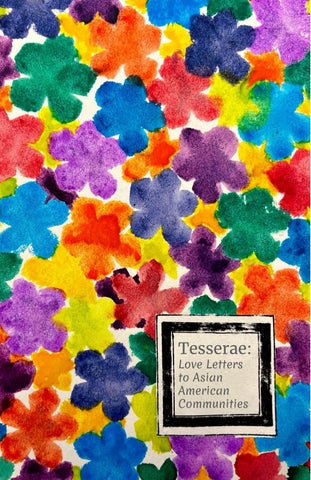
Tesserae: Love Letters to Asian American Communities
inside art (left)
inside art (right)
Table of Contents Foreword………………………………………………………...…....1 Immigrant Dreamers…………………………………………….…..2 Community Erasure…………...………………………………...…..4 Reclaiming Uchina………...……………………….…….………..…6 Matrimony, Mirrors, and Myths……….……...………………..…..8 A Love Letter………………………………………………………...9 Ōlelo Hawai’i…………………………………………………….….10 Underlying Truths: Medical Silence..………………………….…..12 Breaking Down Barriers in Healthcare: The Korean American Story…………………………………..…………………….……..…14 Growing Up Pinoy: Sharing experiences with Filipino Parenting……………………………………………………….……16 Job Difference and Disparities……..……………………….……...18 Anime Conventions and their Impact on Asian American Communities……………………………….…….…….……………20 Your Gay Filipino Son………………………………………………22 To Cut a Warrior's Hair………….………………………………...24 Afterword……………………………………………………………26 Author Bio’s…………………………………………………………28 Recommended Readings: Work Cited.…...……………………….32 Fall 2023 Syllabus…………………………………………………...33 Credits……………………………………………………………….35
Published in December 2023 The support of the UCCS Sociology Department made the initial printing of this zine possible.
1
Imm Drea
The sun they use to watch, Rise and set, Was not the same out in the west. They saw the same stars And the same moon.... Humming old traditions And cracked tunes. In search of freedom And whatever is the American Dream. Letting stories unravel in the soil At the seam. Across borders, Across oceans, Tearful smiles across tired faces. DaeDae Rocha
2
igrant mers
3
Yesenia Cruz Garduno
Community 唐 人 街
Erasure
4
Gary Cameron
How Chinatowns Came To Be As Chinese-Americans faced discrimination and mistreatment across the United States, they were forced into certain segments of cities. Making do with what they had, Chinese-Americans constructed an enclave to protect their own businesses, families, and their very community in what came to be known as “Chinatown”. These places are representative of a struggle to survive and thrive, and each Chinatown tells the story of the respective history of Chinese-Americans in each area. While a plethora of major cities in the United States have an established Chinatown, Denver does not. This is largely due to the Race Riot of 1880, which targeted Chinese-Americans and saw the destruction of their community and the history of their contributions to the American West (Wei).
Reclamation All is not lost, and reclamation efforts in the historical location of Denver’s Chinatown are underway. This presents a unique opportunity to start anew while still honoring the past. With new research on Chinatowns and their respective economies, Denver’s Chinatown has the potential to build a truly encapsulating enclave for Chinese-American culture, and control its own economy through ethnic goods and culinary culture (Santos & Yan).
5
Gary Cameron
7
𝓜𝓪𝓽𝓻𝓲𝓶𝓸𝓷𝔂, 𝓜𝓲𝓻𝓻𝓸𝓻𝓼, 𝓪𝓷𝓭 𝓜𝔂𝓽𝓱𝓼 The rising intermarriage rates of Asian Americans in the U.S. have begun to render the ideas of “undesirability” and “unassimilable” as archaic terminology to describe the current position of mate selection for Asian Americans today.
Interracial marriageability in these communities' functions as a social construct that affords Asian multiracial individuals less constraints socially.This is attributed to social mobility that Asian Americans have gained through the passing of the the 1965 Immigration and Nationality Act.
This act has changed immigration and the conceptualization of racial mobility through socioeconomic status and ideas of the model minority myth. This had led to the acceptance of interracial marriage, but only between Asians and Whites. The racialized history of the U.S. that has produced strong anti-Black sentiments is evident in Asian American communities through the lack of mate selection towards Blacks. The racial triangulation of Asian Americans produces the model minority myth and perpetuates anti-Blackness.
Through nationally representative samples exploring Asian Americans patterns of approval of intermarriage, age proves to be a pivotal factor, especially in marriage between Blacks and Asians. Older Asian Americans tend to be more resistant to interracial marriage to Black people.
8
May you never define yourself by the stagnancy of society that can only deemean and denigrate Don’t you know that a world that seeks to anticipate and assimilate is a world that damns your fate? It is not by the standard of others that thy self is defined Rather it is the amalgamation of mind, body, and soul that thy self is refined So when you dare to be, dare to dream, dare to step into your full exuberancy May you always remember contrary to what everyone thinks, it is in liberation where you will find your Me
Nikki Asuquo 9
“Only a whispering spirit remains” - Dr. Haunani-Kay Trask.
Hawaii’s deprival of their culture and sacred homeland has been manipulated for colonial gain to further the financial interests of those who committed robbery against the Native Hawaiian people. The true traditions of Hawaii are no longer worth anything, only appropriations of what it used to be. -Kim Sufian 10
E Lauhoe Mai Na Wa’a
Everybody paddle the canoes together
Reintroducing Ōlelo Hawai’i to the public schools system reinforces Aloha and what it means to reconnect young people to their ancestors and heritage. It resists the annexation of the islands and rejects the idea of colonization. To remind students and all people that Hawaii’s true culture will not be forgotten or ignored. Colonialism will not reproduce a more palatable form of culture for non-natives to exploit. Children will be given the right to learn their pre-colonial life customs. Around 30 schools have integrated Native culture and practices, along with the Native language (Ōlelo Hawai’i) into their curriculum.
St. Paul Daily Globe, February 3, 1893
12
Allison Schell
13
Areyou you Are Ok? ok?
No, I haven’t been feeling well lately, but I’m not sure who to go to for help.
*In English* Tell me about your symptoms. Maybe Google will know! Where can we find reliable healthcare in Korean?
Mr. Kim decided to go online and look for different healthcare options. Little did he know it would not be easy.
How many pills each time?
*In Korean* I have pain here.
The Kims arrived at the hospital to find zero help. The language barrier did not allow them to get the help they needed.
Let’s go honey, they can’t help.
Take this 3 times a day. The Kims walked into the pharmacy, facing the same problem. There was medical confusion.
I’m sorry. I don’t speak Korean. Do you speak English?
I’m not sure what you’re asking.
Hey Bob! We’ve had trouble with communicating with medical people.
Eventually, the Kims found a clue to help them.
Hey, it’s the Kims! How can I assist y’all?
Well, you came to the right place. There is a local Korean American community center that can help with healthcare resources!
None of them understand us!
This is great! We’re better equipped now to access the healthcare we need.
Hello, did you know we provide resources, translation, and support for healthcare system?
Let’s go back to the doctor’s now!
WOW! That’s amazing, thank you for the help.
After a long journey the Kims were finally able to access the improved healthcare.
The feeling of empowerment coursed through the Kim veins. They were ready to head back to the hospital with higher hopes.
Now, let us discuss your symptoms.
This comic strip highlights the challenges faced by the Korean American community in accessing healthcare, such as language barriers and a lack of information, but also emphasizes the importance of community support and resources in breaking down these barriers to improve healthcare access. 15
16
17
Job Differences and Disparities Although we find a high rate of Asian Americans in jobs that require higher skills, for example, those in computer engineering, physicians, physical and life scientists, and the medicinal field. 18.4% of working Asian Americans (Including Pacific Islanders) are currently working in STEM fields compared to the 7% of all working Americans in the United States that work in STEM fields. We also find a lot of Asian Americans In jobs that are less professional, for example, service workers like manicurists, food service, cashiers, and those in the retail industry.
National Institute of Diabetes and Digestive and Kidney Diseases, National Institutes of Health
18
Job Income Inequalities When it comes to ranking Asian Americans based off their income compared to other Americans, we see that on average those with college degrees make the most. When it comes to those without a college degree, we see that Asian Americans make the least. Those without a college degree make a median amount of $26,000 witch aligns with Black and Hispanic workers with the same amount of skill. This amount is still $30,000 less than the median amount of a white individual similar skills. Although the average Asian American does not live in poverty, certain groups do suffer from very high poverty rates such as Bangladeshi Americans, Pacific Islanders, and Chinese Americans.
Marisa Emoto/The Occidental
Lance Rivera
19
Anime Conventions and their Impact on Asian American Communities by Rowan Hight
Anime conventions began as small informal gatherings of self-proclaimed “fanatics” of primarily Japanese animated shows and movies. Over time, these small gatherings became larger and larger as the shows became more popular with a Fans attending a panel at Con+Alt+Delete wider range of people. Soon, the informal conventions became formal, not just places where the fans could meet and discuss their favorite shows, but events that held viewings of shows, competitions for fans who dressed up as characters, panels with voice actors, writers, and artists alike. These newer additions to the convention or “con” experience created opportunities for the discussion of Japanese culture and for fans to make their own community surrounding their appreciation of such rich culture. Now cons have grown from their focus on Japanese culture and animation to include other Asian media, including but not limited to J-pop and Vocaloid (styles of Japanese music), K-pop (Korean pop music), donghua (Chinese animations) and K-dramas (Korean drama shows). These additions to the con scene allowed for even wider appreciation of Asian cultures, especially in the United States, where they became annual events. In addition to creating spaces of cultural appreciation and A scene from the anime Mashiro no Oto community, cons have also become a means of raising money for various causes. At Nan Desu Kan, a convention in Denver, CO, there is an “artist’s alley” which allows creators to make and sell merchandise of their favorite shows. There is also an annual charity auction that has been used to send aid to the Japan America Society of Colorado and the Japanese Red Cross, among others. In 2011, an event called Rave2Save Japan was hosted to help with Japanese disaster relief. 20
The Down Side of Anime Conventions Unfortunately, even the best communities have aspects that are less than desirable. In the con community this tends to be in the form of a tendency to fetishize Asian individuals. There are two main types of fetishization that can be found most often at cons - otakus and fujoshis. Otakus are typically men that find Dakimakura of J-pop Hatsune Miku figurine star Gackt female anime characters and Asian women attractive, specifically as the result of a racist stereotype that Asian women are both submissive and hypersexual. Otakus tend to focus on these perceived traits of Asian women and have been known to harass them not only at cons, but anywhere in public. Fujoshis are typically women who are obsessed with gay men, and often infantilize Asian men while also viewing them in a hypersexual light. They are very common in K-pop fans, often writing or drawing fiction of the idols in relationships with one another. An example of this hypersexualization is the selling of dakimakuras (body pillows) with designs of anime characters and idols. The dakimakura pictured above is a prime example - the idol’s clothing actually unzips and comes off to reveal a barely clothed image of him. Another example is anime figurines, such as the one above - if one were to turn the figurine around, Miku’s underwear is clearly visible. Both the dakimakura and the figurine contribute to the hypersexualization of Asian Americans by encouraging fans to view the performers as sexual objects rather than people or characters. Some animes even cater to these oversexualized stereotypes in order to profit off of them. Additionally, there are a good deal of fans that think they know Asian cultures better than the people that actually live in them simply because they have some experience with the cultures through the lens of anime. These types of fans and products can be found in abundance at cons, which can unfortunately make them uncomfortable to attend for Asian American fans.
Your Gay Filipino Son by Josh Umaguing
Yes, Dad. My homework is done. I bet, Dad. Sports seem kinda fun. Yes, Mom. I’ll throw away the trash. Not yet, Mom. But I’ll pray ‘til I crash. Of course, Mom. Move in with me when you’re old. I’m sorry, Dad. I will do as I’m told. Sure, Mom. I can give God a whirl. Not really, Dad. I haven’t met any girls. Yes, Mom. I’ll always be here. No, Dad. My friend’s not a queer. Okay, Dad. I’ll stay ‘til church ends. Really, Mom? He’s literally just a friend. Yes, Mom. I got straight A’s. No, Dad. It’s not just a phase. Cool, Mom. But I don’t think that’s true. Thanks, Dad. But no one asked you. It’s no one‘s fault. I’m just me. I’m still your son. Why can’t you see!? I hate you! Your mind’s so fucking closed. Do you honestly think this is something I chose?
22
(cont.) I’m sorry for that night, Mom. For all the things I said. I never actually meant them. I just totally lost my head. I forgive you too, Dad. We were all seeing red. This was a good talk. Well, I better get to bed. Oh hey, Dad! Yes, it does feel like a while. Happy to hear, Mom. That really made me smile. I’ve been well, Dad. I actually met this guy. Sure, you can, Mom! But he’s kinda rather shy. Oh, you don’t have to do that. That’s way too much work. But if I turned down your chicken adobo, I’d be kind of a jerk. Awesome, can’t wait! Should I bring anything? Well, if you change your mind, just give me a ring. Thanks, Mom. For dinner. Last night meant a lot. Yes, Dad. It really was. Glad we gave it a shot. He liked you guys too. We should do it again! I love you too, Mom and Dad. And the church said, “Amen.”
23
To Cut a Warrior’s Hair The Model Citizen Disguise The model citizen finds itself to be contradictory when faced with queerness in minority communities. This is not an exception in Asian American communities, in fact this becomes more prominent when it comes to Asian American Queer women. These intersecting identities provide a layered sense of identity as well as a broad spectrum to grasp. Performing all these identities at once force many to assimilate into heteronormative culture in order to lessen the daunting task of presenting all these identities at once. This causes many to adhere to what is best suited to not test the waters to make waves. This in turn enforces the idea that you need to blend in as much as possible, circling back to the model citizen archetype.
24
To Cut A Warrior’s Hair Grow your hair, It will grow long and beautiful, It will show youth and conventionality, Your hair will fall in dark waves, In between peaceful and ferocious, Just enough to enjoy the beauty, For the length adds to its presence. Grow your hair, As Androgyny is too forward, It brings too much attention and confusion, Your hair is a protest to the heteronormative, It is too 예뻐 (pretty) to cut short. It will rock the boat too much. To cut a warrior’s hair, Means to stand against the norm, TO fulfill your desire to express yourself To allow the light to touch your face, To show your true self. To cut a warrior’s hair, May fill their heart with joy, Representing their own choice, A warrior’s hair choice, May follow with disdain, But just stay true, For you are you, And no one is the same 25
26
27
Nicole Asuquo (She/Her/Hers) I am a senior at UCCS, double majoring in Political Science and Women and Ethnic Studies with a minor in Pre-Law. My hobbies include writing poetry, doing makeup, and styling clothes. This course has been essential in my understanding of communities outside of mine, and the ways in which the Asian diaspora has struggled, resisted, and triumphed. It has also informed my understanding of how identities in the Asian diaspora are constantly being created and shaped by both the U.S. and international context.
Lauren Boyd (she/her) I am a third-year majoring in Intercultural Studies, with a minor in Japanese, and have been a member of the Colorado Springs Okinawa Kenjinkai for over a year now. My grandma is half-Okinawan, so we have been learning to play the sanshin and we perform a couple of times throughout the year. Being a part of it has been very healing to our ancestry and allowed for meaningful connections despite some generational and language barriers
Gary Cameron (he/him) I am a Criminal Justice major pursuing a minor in Asian Studies. I’m incredibly interested in learning about different cultures and communities, and this course drew my attention to my topic of interest for this course: Chinatowns.
28
Maliyah Carter (She/They) I am a third year undergrad at UCCS,majoring in Women’s and Ethics Studies with a Minor in Pre-Law. I was born and raised in Colorado Springs, and I spend most of my time doing part-time makeup and modeling in Denver. I chose this topic because of my personal experience as an Asian American and how it sometimes enforces the model minority myth. This course has helped me understand the ways in which many systems are set in place that a lot of people don’t consider towards Asian Americans, it has really opened my eyes to the ways in which it has affected my family. This has been enlightening on what it was like for my grandma to move here and honestly prompted me to ask more questions about my heritage.
Yesenia Cruz Garduno (She/Her/Ella) I am a Junior double majoring in Criminal Justice and Sociology. A hobby I enjoy is cross word puzzles and a fun fact about me is I am a cofounder of the first Latina sorority at UCCS. This course has been crucial in my understanding of immigration and the effects of stereotyping Asian Americans face today. My zine pages are based on the “Dreamers Act” which is temporary residency given to immigrant students. A butterfly is the symbol of the organization which represents freedom and the ability to choose your path in life.
Parker Gregory I am a senior studying Criminal Justice, Sociology, and Cybersecurity.
29
Yesenia Guevara (she/her). As of right now I am a freshman. I am currently enrolled as an undecided student at UCCS with an interest in sport medicine and economics. I come from Denver, Colorado and Fort Lauderdale, Florida. I love playing sports and learning more about the game. I chose this class specifically because I love learning about other cultures and ethnicities and one day I wish to travel to be able to partake in such cultural events.
Rowan Hight (They/He) I am currently pursuing a minor in Asian Studies in addition to my dual major History/Philosophy and wish to become a museum curator. I find it incredibly valuable to understand the workings of systemic oppression because without first understanding, nothing can begin to change. I have presented at two conferences in my undergraduate years - I presented a paper on the fetishization of Egyptian queens at the Colorado Springs Undergraduate Research Forum (2022) and a paper on the connection between how queerness and vampires have been portrayed in popular media at the Great Lakes Philosophy Conference (2022).
Lance Rivera (He/Him/His) I am currently in my second year of College at UCCS and I am majoring in a dual degree, Criminal Justice/Sociology. I am originally from a small town in New Mexico called Los Alamos where I lived for most of my life until I moved out here to Colorado Springs for college. A fun fact about me is I really enjoy sports, especially slow-pitch softball as well as any other physical activity. I chose the topic I did because I have always found it interesting as to why I find a majority of Asian Americans in certain jobs
30
Allie Schell (she/her) I am currently a sophomore here at UCCS with a major in Women’s and Ethnic Studies and a minor in Pre-Medicine. I am actually from the east coast and love representing my home grounds of Philly, PA. I chose to write on the topic of healthcare as it pertains to my future career goals and learning the battles of discrimination in this field has helped me gain knowledge to use with respect to patients in my future job.
Kim Sufian (she/her) I am currently working on my senior year at UCCS as a Sociology major. I was born and raised in Pueblo, Colorado and moved to Hawaii for a job that lasted 5 years. It was there that I learned from Native Hawaiian people the destruction and indoctrination that Colonial USA has inflicted on their culture and land. These influences have yet to seize and the effects have started to look everlasting, though through the work of dedicated people, this could potentially change or at least encourage true culture to come back. This is why I chose the topic I did.
Josh Umaguing (he/him/his) Josh Umaguing. I am a super, super senior getting my undergrad in Sociology. I initially took this course simply because it fulfilled a requirement for my degree audit and because I wanted to learn more about my Asian American history. To my pleasant surprise, this course grew into so much more, and I have gained so much knowledge that has made me a more whole human being. Some fun facts about myself are that I have Tourette Syndrome and that I have performed for Barack Obama and sang at a St. Louis Cardinals game.
31
Recommended Readings Konishi, Junko, and Evangelia Papoutsaki. ‘From Local Media to Vending Machines: Innovative Ways of Sustaining Okinawa’s Shimakutuba and Island Culture’. Agovino, Theresa. “Asian-Americans Seek More Respect, Authority in the Workplace.” Shang, Zhida, Jennifer Y. Kim, and Shuliang O. Cheng. "Discrimination Experienced by Asian Canadian and Asian American Health Care Workers during the COVID-19 Pandemic: A Qualitative Study." Gonlin, Vanessa, and Mary E. Campbell. "Is Blindness Contagious? Examining Racial Attitudes among People of Color with Close Interracial Relationships." Wei, William. “Asians in Colorado: A History of Persecution and Perseverance in the Centennial State” Chiquan Guo and Chengyan Zeng. “Anime and Manga Fandom in the 21st Century: A Close-Up View by.” Yoo, Grace J., and Sachiko Wood. “Challenges and Opportunities for Improving Health in the Korean American Community.”
Works Cited:
32
Asian American Communities Fall 2023 Syllabus Unit 1: Race, Nation, and Migration Film: Who Killed Vincent Chin? (1987) Craig Santos Perez, “The Poetics of Mapping Diaspora, Navigating Culture, and Being From” Lisa Lowe, “The International within the National” Claire Jean Kim, “Racial Triangulation of Asian Americans” Edward Said, Orientalism, Introduction William Wei, Asians in Colorado, Chapter 2 “Chinese Pioneers: Looking for Work, Finding Violence Instead; Chapter 8 “A Concentration Camp in the Centennial State”
Unit 2: Gender, Sexuality, and Disability Yen Le Espiritu, “We Don’t Sleep around Like White Girls Do” Haunani-Kay Trask, “Lovely Hula Hands” Amy Sueyoshi, “Breathing Fire” Tan Hoang Nguyen, “The Rise, and Fall, of a Gay Asian American Porn Star” Asian American Feminist Collective, Asian American Feminist Antibodies: Care in the Time of Coronavirus Mia Mingus, “Access Intimacy, Interdependence and Disability Justice”
Unit 3: War and Imperialism Film: Hearts and Minds (1974) Grace Cho, “Diaspora of Camptown” Yen Espiritu, “Critical Refugee Studies and Asian American Studies” Jasbir Puar and Amit Rai, “Monster, Terrorist, Fag” Junaid Rana & Diane Fujino, “Taking Risks, or the Question of Palestine Solidarity and Asian American Studies” Qiao Collective, “Can the Chinese Diaspora Speak?” Long Bui, “A Better Life?”
Unit 4: Radical Struggles Daryl Maeda, “Black Panthers, Red Guards, and Chinamen” Judy Tzu-Chun Wu, “Journeys for Peace and Liberation” Dylan Rodríguez, “Asian-American Studies in the Age of the Prison Industrial Complex” Wen Liu, “Complicity and Resistance” Nodutdol, “Sanctions of Empire” The East Is a Podcast, “KEEP: Stories from North Korea” 33
34
Credits Editorial Gary Cameron Parker Gregory Kimberly Sufian Josh Umaguing
Design/Illustration Maliyah Carter Rowan Hight Allison Schell
Writing Yesenia Cruz Garduno Yesenia Guevara
Outreach Lauren Boyd Lance Rivera
Appendix Nicole Asuquo 35