

full


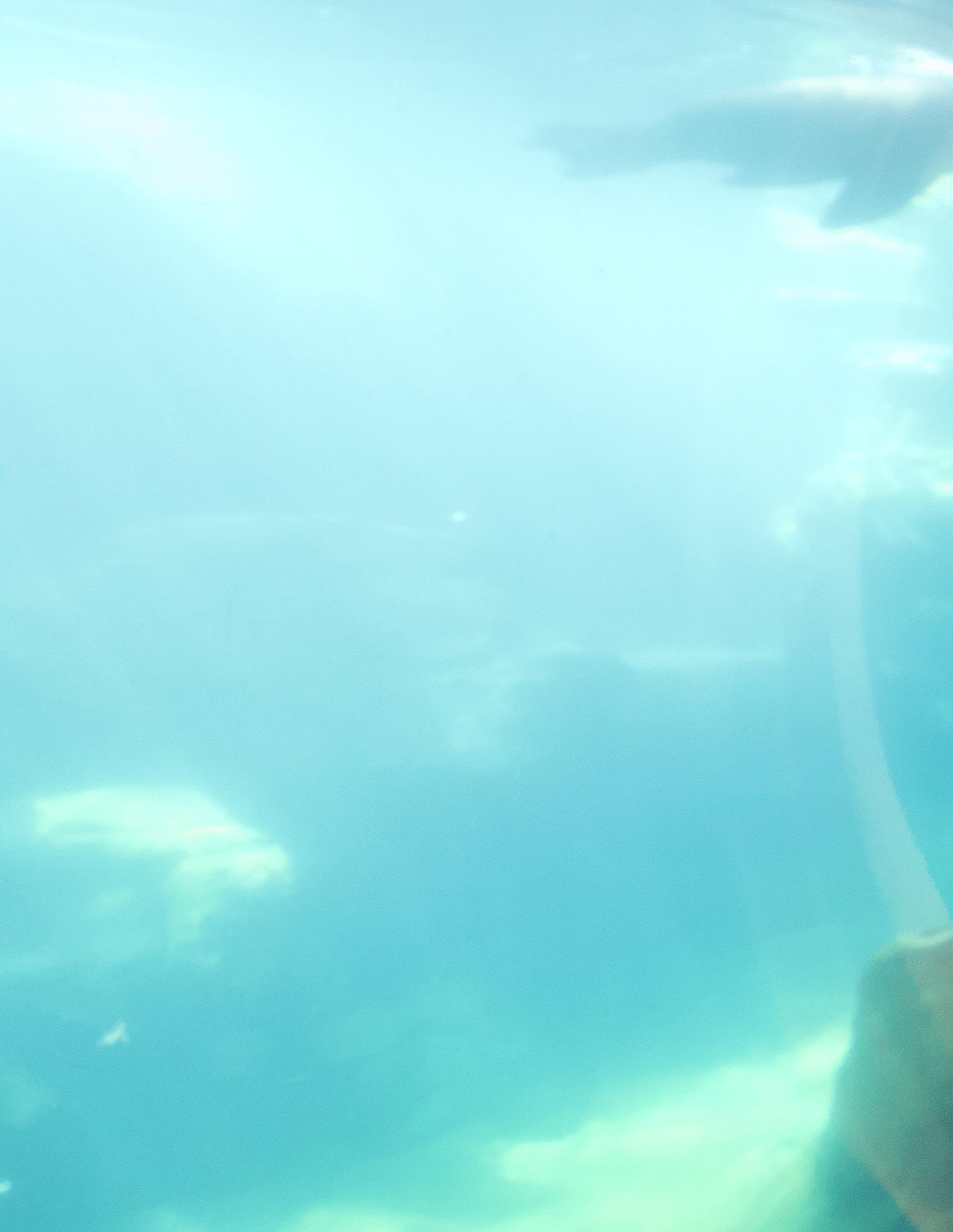
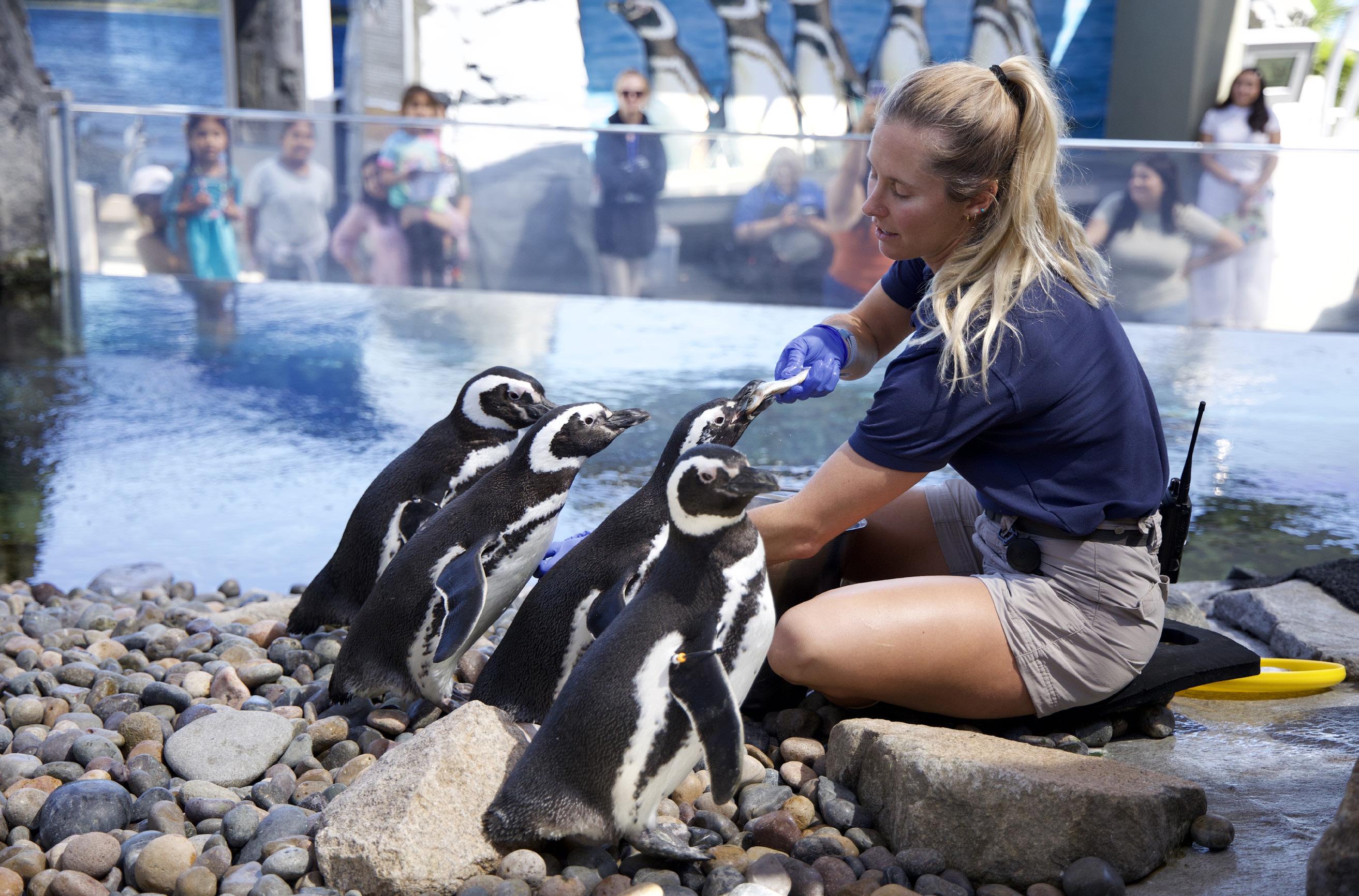
Left: Penguins catch rays at the Aquarium of the Pacific in Long Beach. Read the
story on Page 30. Photos by Nikki Yunker
Right: The aquarium’s underwater tunnel with seals and sea lions.

full
06 To space and beyond
For Lauren Sánchez
Bezos, El Camino College was a launchpad to an out-of-this-world career
39Beat the heat
These 5 South Bay spots serve up frozen sweet treats to help stay cool this summer
42The whole nine yards
Flag football Warrior makes impacts on and off the flag football field
10The road starts here
Trucking program turns beginners into licensed professionals in just 10 weeks
20Nailed it
Spring/summer 2026
18 Caffeine: The socially accepted drug
Coffee went from a pick-me-up to a necessity
05Between the bylines
Los Angeles Times journalist was award-winning reporter at El Camino
68 Written in the stars
El Camino alumna, mystical guide talks zodiac signs, birth charts and more
71Legally magic
Professor, attorney teaches law principles by day, performs card tricks by night
16Surf ‘n’ Turf with student savings
Ensenada’s serves up a delicious Baja-inspired, large menu swimming with discounts
52SoCal spice special
Family-owned wing spot serves up creative flavors with a side of hospitality
Practice makes perfect manicures, pedicures and more for young entrepreneur
30Bird is the word
El Camino alumna joins the flock caring for hawks, penguins, lorikeets and more at the Aquarium of the Pacific
54Jazzed up
Two aspiring saxophonists play jazz across the country
60Motherhood with a mission
Mom turns silent struggles into a business rooted in wellness and community
Five
25Top 5 investing tips
New club offers advice to make money grow
28 Rack ‘em up
Top 5 places to play pool near El Camino
50Just a train ride away
Top 5 day trips by rail in California
51Top 5 Thai restaurants near El Camino
Skip the 17-hour flight and keep the authentic, international flavor
26 Adventures in ‘bad’ veganism
Exploring the ups and downs of a plant-based lifestyle
40Latino excellence
Discrimination made me rise above and embrace my culture
58 Distortion My journey with weight and gender struggles taught me acceptance
66Filling my empty cup
Finding myself as an only child
70Fire, earth, air and water Summer horoscopes for every sign and placement
For additional stories, photos and content, scan the QR code below or visit the website at eccunion.com and look for Warrior Life Magazine.

Editor-in-Chief
Nikki Yunker
Managing Editor
Rosemarie Turay
Social Media Editor
Savannah Anderson
Staff Writers
Heather Austin
Juan Carlos Cardoso
Jennifer Figueroa
Ananya Iamcharoen
Maya Ochoa
Gilbert Sanchez
Osvin Suazo
Instructional Assistants
Gerard Burkhart
Joe Difazio
Jessica Martinez
Jack Mulkey
Photographers
Chelsea Alvarez
Kaitlyn Estrada
Donovan Harris
Ryan Hirabayashi
Patrick Martinez
Illustrators
Paulina Galvan
Evan Guan
Brad Hess
Celeste Muñoz
Christol Nguyen
Jun Tran
Advisers
Stefanie Frith
Kate McLaughlin
Nguyet Thomas
Warrior Life is a biannual student-run magazine produced by El Camino College students enrolled in Journalism 9. Our newsroom is located in Humanities Building Room 113 at El Camino College, located on 16007 Crenshaw Blvd., in Torrance, Calif. Students interested in being on staff must enroll in Journalism 9 or email Student Media Adviser Stefanie Frith for more information at sfrith@elcamino.edu.
Visit us online


Front cover: Cydney-Elise Koné practices flag football.
Photo by Ryan Hirabayashi
Back cover: Lauren Sánchez
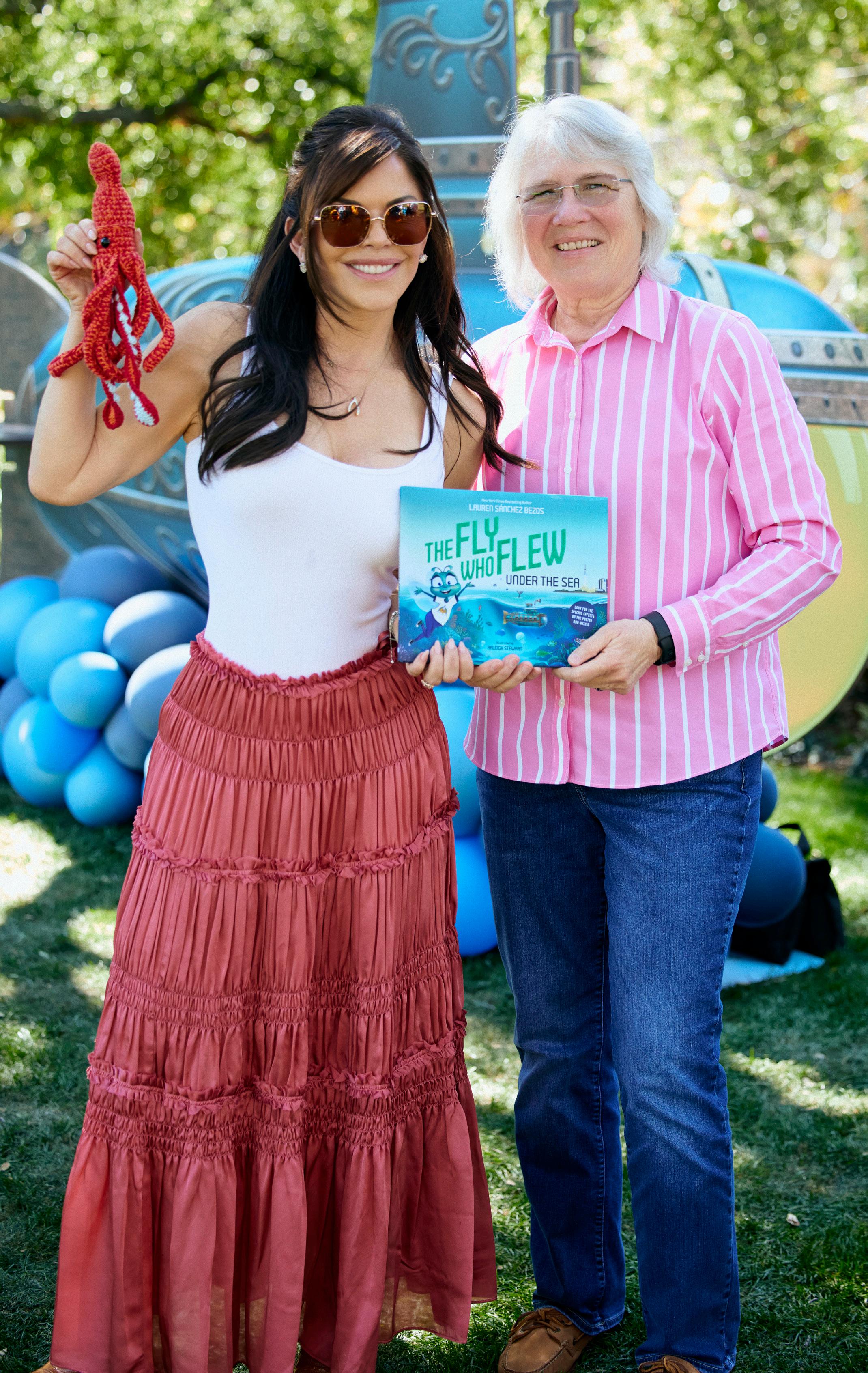
Bezos holds her second book, “The Fly Who Flew Under the Sea.” Photo courtesy of Nicolas Gerardin

ElCamino College’s first two words, translated from Spanish, mean “the road,” “the path” or “the way.” Accordingly, Warrior Life’s focus has remained on this same “road” and its community since its first magazine in spring 1963.
Fittingly, the storytelling inherent to roads inspired three different writers this spring to headline their drafts starting with “The road ... .” Only one kept it.
Yet, many stories do start with roads. From the alumni features and a spotlight on a student entrepreneur to a story on the truck driver training program, this issue is all about journeys and the different paths in life.
Blooming within this magazine is also a sense of the fresh beginnings brought by spring, starting with our new front cover design.
Our cover story with Warrior Cydney-Elise Koné represents her first foray into women’s flag football, a program which El Camino just began offering this year.
Similarly, the featured Q&A with Lauren Sánchez Bezos, a 1991 El Camino journalism program alumna, is her first ever interview with our college’s student publications. This campus was where Sánchez Bezos realized her dreams in broadcast TV were possible.


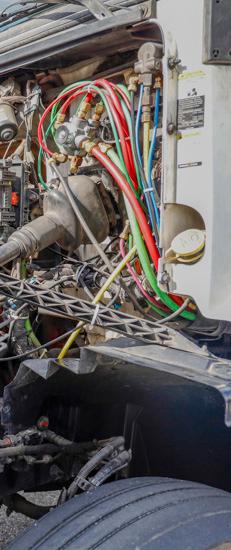
Background: Wires in an engine. Read the full feature story on Page 10. Photo by Donovan Harris
Right: Warrior Life Editor-inChief Nikki Yunker. Photo by Ryan Hirabayashi
Now, thousands of students this semester are also merging into a new lane in their lives as they graduate.
El Camino’s name aptly describes its role in our local community and beyond. It’s a small world in a big way. Let this issue be your guide.
With gratitude, Nikki Yunker
Editor-in-Chief
P.S.: Thank you to everyone part of this issue and who made this spring 2026 magazine possible.
Story by Nikki Yunker
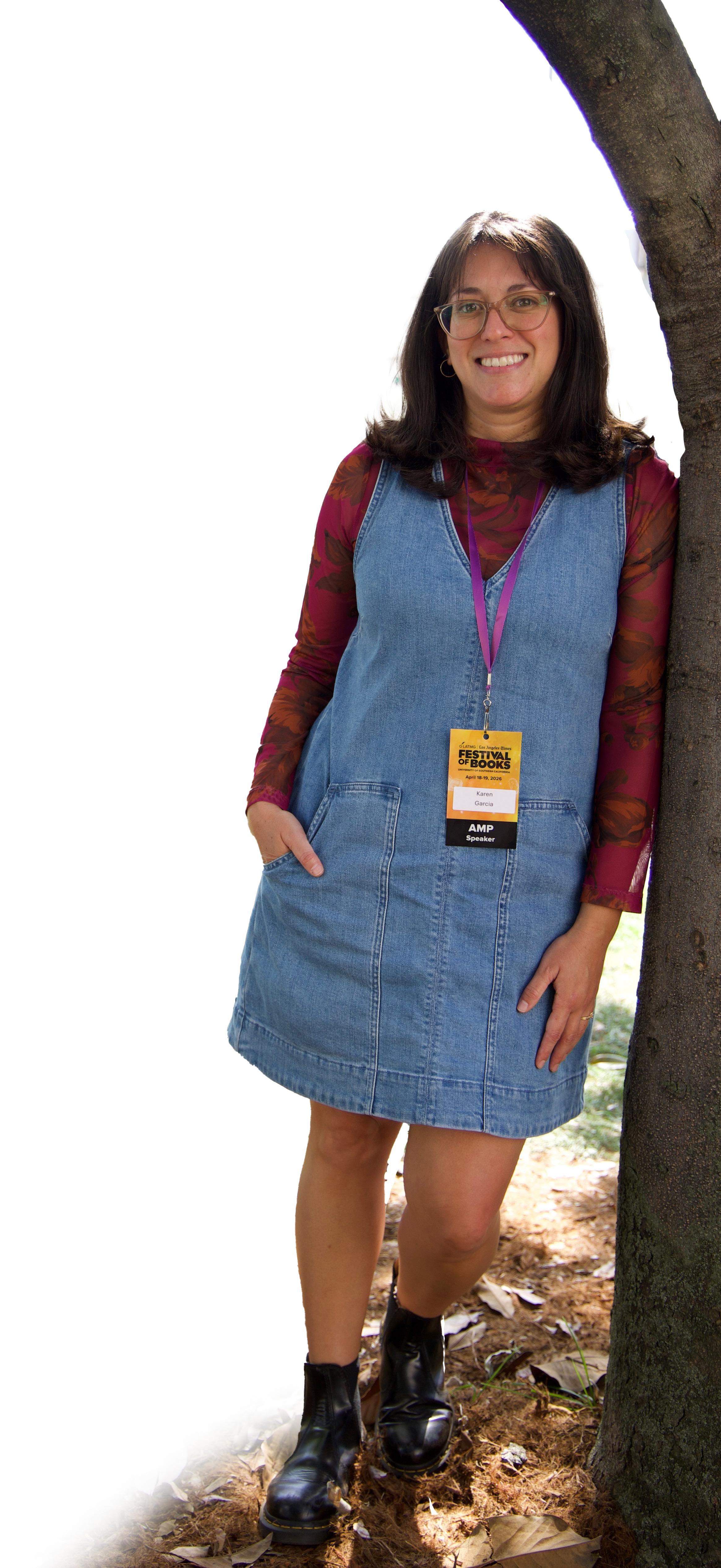
Karen Garcia gets the facts, fast. From The Union’s newsroom at El Camino College and to the breaking news desk at the Los Angeles Times, Garcia has over a decade’s worth of bylines — and even more stories behind the story.
She started at Torrance High School’s student paper before becoming an editor for The Union and its best reporter in spring 2013 — engra ved on the Jolene Combs Memorial plaque.
Graduating in 2013, Garcia transferred to California Polytechnic State University, San Luis Obispo, where she reported for the Mustang News and earned a bachelor’s in journalism.
Before joining the Times in 2021, she was a writer, worked for local newspapers and did radio.
Warrior Life met with Garcia for an interview at the L.A. Times Festival of Books, where she moderated a panel earlier. What’s it like working at the Times?
“The L.A. Times is a really fun, crazy, fast changing place. I’m lucky enough to be on the breaking news team and I can say that I do a bit of everything. There’s no like beat per se that I have, but I also have really great editors that welcome a lot of different ideas. And I do any kind of daily story. I do explanatory reporting. I also do videos with my video journalist colleagues.”
How was your experience at El Camino College?
I worked with [professor] Kate McLaughlin and she was a really great mentor and guide on understanding who I was as a reporter. I had really great teammates. I think that was a space that was really supportive and we championed each other, big or small — whatever the assignment was, and that’s really helpful too. Journalism is hard and it is a really tough industry and when you have folks who are very supportive, that helps boost your morale.”
What should people do in a breaking news situation?
“If you are seeing something happening in real time, maybe you [safely] took a video of it or maybe you just are remembering a description of the event ... If you share it on X, formerly known as Twitter, or Instagram and we are searching for that, those first person accounts we might see that, contact, and have a conversation. ... It’s a great way to kind of work together with the community and piece together a story.”
For Lauren Sánchez Bezos, El Camino College was a launchpad to an out-of-thisworld career
Story by Nikki Yunker
Before Lauren Sánchez Bezos became a multi-hyphenate Emmy-award winning journalist, helicopter pilot, aerial film company founder, vice chair of the Bezos Earth Fund and space traveler, she was Wendy Sánchez, a journalism student at El Camino College.
Recently adding the title of twotime New York Times bestselling author to that list, Sánchez Bezos dedicated her latest children’s book to Lori Medigovich, the El Camino professor who changed “everything” for her, and to all caring teachers.
Medigovich noticed Sánchez Bezos was a driven student but needed support and connected her with the Special Resource Center, where Sánchez Bezos later learned she had dyslexia and has since become a dyslexia awareness advocate.
As a staff writer in spring 1991 for El Camino’s student newspaper — then called the Warwhoop before becoming The Union in 1998 — she contributed nine articles, including front page news, student viewpoint interviews, an op-ed and a feature about a retiring physics professor.
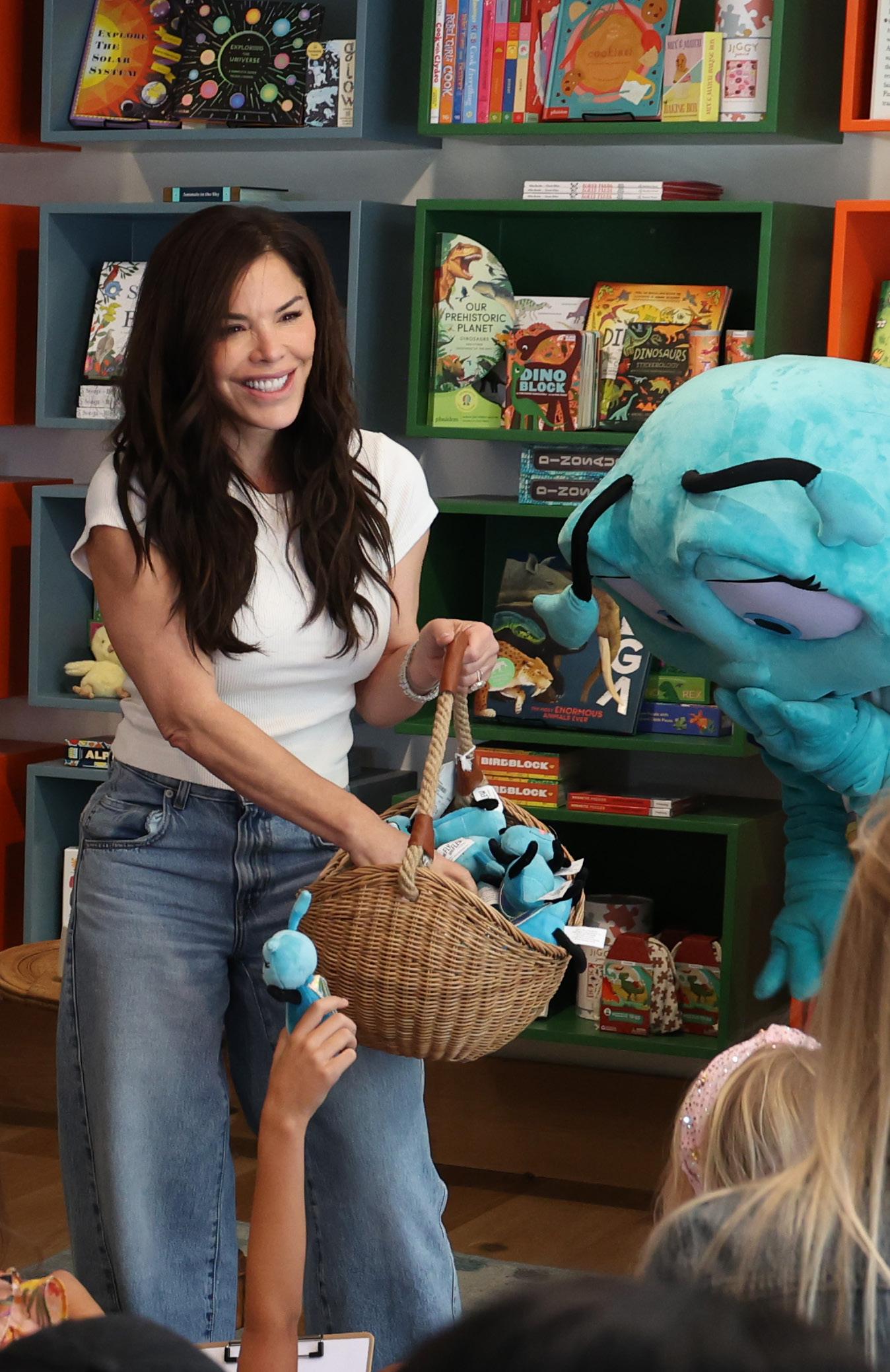
“
[El Camino] was where I discovered I could do this. The first time I saw my name on a front page story, something clicked.”
-Lauren Sánchez Bezos New York Times bestselling author, pilot, philanthropist, space traveler and El Camino College alumna
She later transferred, with Medigovich’s encouragement, to the University of Southern California.
One of her first TV co-anchor roles in Los Angeles was with Rick Chambers at KTTV Fox 11.
“Her look lit up the screen,” Chambers, who now anchors at KTLA-5, said. “She was off and running, and it was refreshing.”
Throughout her life, Sánchez Bezos has been on air, in air and at the edge of space, but remains graciously down to earth.
Warrior Life, which conducts live interviews, accommodated Sánchez Bezos’ schedule in an email format. How did you decide to enroll in the journalism program at El Camino College?
“I didn’t have a plan. I just knew I wanted to tell stories. El Camino had a great journalism department and it was close to home. I could afford it. I’m so grateful I ended up there because it changed everything for me.”
What was your experience being a journalism student at El Camino College?
“It was where I discovered I could do this. The first time I saw my name on a front page story, something clicked. I thought, okay, maybe I belong here. That feeling
carried me through a lot of hard years.”
What might be a memorable moment from that time?
“My professor noticed I was struggling with reading and suggested I get tested for dyslexia. I had spent my whole life thinking I was stupid. That one conversation changed everything. I learned I just think differently. I’ve dedicated my children’s books to her.”
What advice would you give students studying journalism at a community college?
“I remember a news anchor came to talk to our class. Afterwards, I went up to him and said, ‘Do you have a card? I’m looking for an internship.’ He gave me the news director’s number. I called and the news director said, ‘No, he’s not hiring interns.’ So I called again. He said no again. I called him every month, the first Tuesday of the month. He said no about six times. Finally he said, ‘Fine, come in for an interview.’ I got the internship. My advice is don’t take no for an answer. Keep going. No one is going to hand you a job. You have to go out and get it yourself.”
Before becoming an Emmyaward-winning journalist, what were the biggest challenges you faced?
“My dyslexia made things harder. I’d get stuck on big words on the teleprompter. It just meant I had to read the script three or four times before I went on the air to make sure I knew exactly what I was saying. I had a co-anchor who
would whisper words to me when I got stuck. I worked twice as hard as everyone else just to keep up.”
When you were a child, what did you dream about?
“I dreamed about being a news anchor. I’d grab a newspaper and read it in front of the mirror over and over again like Connie Chung. She was my idol. I remember thinking how amazing she was. She was one of the only minorities on the air at the time, so I just related to her.”
What led you to become a helicopter pilot and start an aerial production company?
“Aviation is in my blood. My dad was a flight instructor and mechanic. I didn’t get my license until I was in my 40s, but once I did, it felt like coming home. I started Black Ops Aviation because I understood both sides: the camera and the cockpit. There was a gap in the market and I filled it.”
What was your experience being in space aboard the allfemale Blue Origin flight?
“It changes you. Looking back at Earth from up there, you see how fragile and beautiful it is. Doing it with that crew of women made it even more meaningful. We still share that bond.”
You went from broadcasting to flying helicopters and to space. What gives you strength and courage?
“My family. And knowing that life is short. The things that scare me are usually the things most worth doing.”
Who are the most inspirational people in your life?
“My dad, who taught me to work with my hands and showed me what flight was. Jeff [Bezos], and all the love he gives to our family and friends. He’s one of the most generous people I know. And every teacher who didn’t give up on me when I was struggling.”
What would be your most favorite memory so far?
“Watching my kids grow up. Seeing them reach for things I never dreamed of. That’s the best part of my life and it just keeps getting better.”
What does a typical day look like and what’s your favorite way to spend a weekend?
“I’m always moving. Working on the next Flynn book, meeting with the Bezos Earth Fund team, being present for my kids. On weekends, I love flying kids who have never been in a helicopter and are thinking about aviation. It’s one of my joys if I can inspire them. Or just a quiet dinner at home with the family.” What inspired “The Fly Who Flew to Space” and the sequel?
“A tiny fly got into the cockpit while I was flying with my kids. Before we even took off, we started imagining where this little fly might end up. That became Flynn. For the second book, I was talking to a conservationist at the Bezos Earth Fund and they mentioned how much of the ocean is still a mystery to us. I wanted to take Flynn somewhere new and let kids discover that world through curiosity instead of fear.”
Flynn inspires everyone to dream bigger. What’s next?
“More exploration. I’m just getting started. You’ll have to wait and see.” What message would you like to share with readers?
“Your journey starts exactly where you are. I started at El Camino. I made it to the anchor desk and then to space. This life is yours. It’s what you make of it. If you want to do something, you have to put in the work to make it happen. There’s a quote I’ve lived by since I was a young girl: “What the mind can conceive and believe, it can achieve.” –Napoleon Hill. It’s in you. Don’t let anyone tell you your dreams are too big.”
Lauren and Lori: A dedicated and supportive professor’s joy
Warrior Life Magazine also interviewed Sánchez Bezos’ former professor, Lori Medigovich, who taught journalism at El Camino for over 20 years before retiring in 2013.
Medigovich taught Sánchez Bezos in three classes starting with Journalism 1, news writing.
Sánchez Bezos still has the paper she wrote on “Women in the News Media” for Medigovich’s media
“ ... Lauren was one of those maybe 20 or so students that made an impression from the beginning.”
-Lori Medigovich
Retired El Camino College journalism professor and adviser Lauren Sánchez Bezos’ former professor
studies class, Journalism 12.
But broadcast news writing, a class no longer offered, really stood out.
“That’s the class she really was excited about,” Medigovich said over the phone. “I’d bring in guest speakers and talk about careers as a broadcast journalist.”
What was Sánchez Bezos like?
“I taught thousands of students, but Lauren was one of those maybe 20 or so students that made an impression from the beginning. ... She was so enthusiastic, she asked a lot of really good questions, she talked about what she wanted to do ... she wasn’t shy.”
How did you recognize she may have had dyslexia?
“She got on the newspaper staff and she didn’t do very well there. ... I took one of her papers to [journalism professor] Jolene [Combs] and I said there’s something with this student, she’s got everything to be a broadcast journalist ... but there’s something wrong with her writing.”
Combs thought the issue may have been dyslexia, and Medigovich agreed. Next time after class, Medigovich walked with Sánchez Bezos to the Special Resource Center to make an appointment.
“I wanted to help her because she really, really wanted to be a broadcast journalist,” Medigovich said. “So from there she blossomed ... sitting in the front row of the class, asking questions, talking to the guest speakers I’d bring in.”
How did it feel for you to see your student have a successful career in journalism and more?
“It’s always very exciting, to see her out there accomplishing exactly what she wanted to accomplish,
doing what she has set out to do as a community college student.”
The first time Medigovich saw Sánchez Bezos after she transferred to USC was as an anchor on KTVKTV in Phoenix, Ariz.
“I thought ‘Wow, she’s really done it. She’s made it.’”
Sánchez Bezos dedicated her latest book to you — what does that mean to you?
“It’s just one of those unbelievable things to have somebody who has the status of a Lauren Sánchez Bezos, and has the talent and the intelligence and all of those things, and then she writes a book, and the very first words are, ‘For Lori.’”
What was it like for you and your spouse to be invited to the Blue Origin launch last year in West Texas?
“It was just super awesome ... Not only am I a big fan of Lauren’s, but I’m also a big fan of Gayle King and so I got to shake her hand. After they all came down safely, Lauren gave me a big hug and then Jeff [Bezos] gave me a big hug and it was just really unbelievable and incredibly gracious of her and quite a once in a lifetime kind of memory.”
What would you like student journalists to know?
“My main hope would be that journalism students learn the story about Lauren and that they learn that dyslexia and potentially other learning disabilities that they may have may not be able to stop you.“ What would you like to add?
“I‘m very appreciative of all the kudos that Lauren has given me, but I also want to put it in perspective. Lauren’s the one who achieved all these amazing goals.”
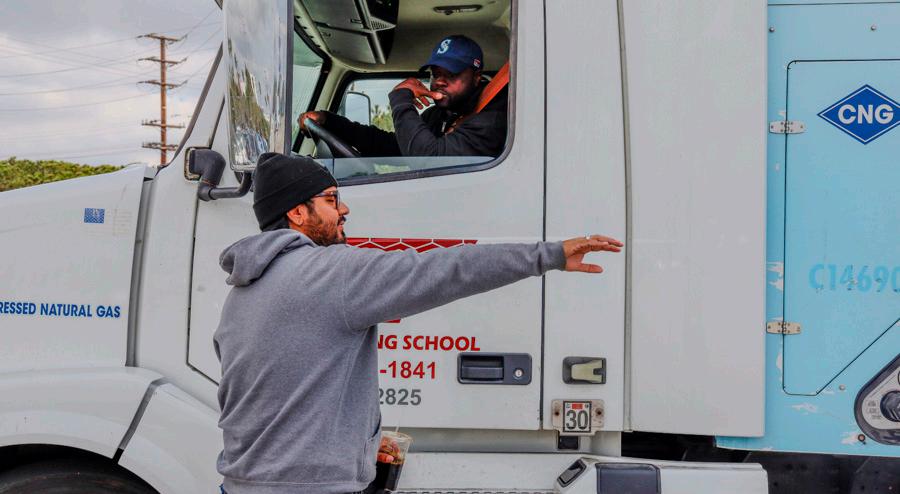
Parking Lot L at El Camino College was once lined by the cars of students and employees. Now, bright orange and white traffic cones barricade a space that has more life than ever before.
The sun rises and it’s brisk. By 8 a.m., the lot is filled with 18-wheelers. Students pace alongside them, holding wooden pointers and reciting pre-trip inspections as instructors watch closely.
It’s a new beginning. For some, it’s their first time around trucks. For others, it’s a career that has followed them throughout their lives.
For the past three years, El Camino’s Community and Continuing Education Department — partnered with the TGA Truck Driving School — provides students a non-credit opportunity to learn a
new career in just 10 weeks.
The program’s destination is not just for students to pass their California Class A commercial truck driving licensure test, but to get a job in the industry.
For instructor Mike Evans, 56, this goal is simple.
“The main thing is a career, a job,” Evans said. “It’s more than just a license.”
Job placement is uncertain in many educational pathways, but El Camino and TGA’s partnership is built for immediate employment.
“Once they graduate, they have eight different job offers,” Evans said.
Evans, originally from Los Angeles, spent 36 years in the trucking industry before becoming an instructor with TGA at El Camino in August 2025.
Instead of hauling loads, he’s
preparing students to enter the world of trucking.
Job offers after completing the program come from nationally recognized carriers, including Swift, Schneider and Western Express.
Evans said those are the most frequent recruiters.
“That’s just the ones we call, but there’s more,” Evans added.
Unlike traditional academic programs on campus, the course compresses everything into two and a half months. The students begin in the classroom, preparing for permit exams and learning regulations, before heading out to Lot L — known as “the yard” — where the training becomes more physical.
Repeatedly, they walk around and point, waving their wooden pointers around like wands.
“Pre-trip is just making sure everything’s working,” Evans said.
“ I gave my 50% in to actually make it. But they gave me the 50% back to understand it.”
-Gladys
“Teaching them, showing them the materials to pass when they take the exam at the DMV.”
The repetition can feel relentless, but it’s intentional.
“It’s almost like getting a master’s [degree],” Evans said. “Maybe not as much time, but it’s a lot of effort and a lot of rules and a lot of stuff you’ve got to learn in a 10-week period.”
For graduate Gladys Kimberly Reyes, 32, this structure works.
Before enrolling in the program on campus, she had tried multiple different trucking schools. Each time, she stepped away.
“The difference that I saw in the other schools, they just give you an app and tell you [to] go take the test,” Reyes said. “I felt like it was just a paycheck for them.”
She remembers feeling lost and helpless in her three prior programs.
“I had a lot of difficulty, so I’m assuming that’s why I kept dropping out, because I didn’t have someone there to actually help me,” Reyes said.
Reyes found out about the trucking program at El Camino through a friend. It was convenient, as she was working at the Port of Los Angeles. She enrolled in the upcoming course and got to work, where she first met TGA instructor Andrea Viera.
“I met Andrea, met her team. And I was really fascinated, like, in the beginning,” Reyes said.
Reyes, a student who once felt hopeless, finally met her match with El Camino and TGA.
“I gave my 50% into actually make it. But they gave me the 50% back to understand it,” Reyes said.
“That’s what made me get through the class, get through the testing and pass everything on the first try.”
Reyes graduated from the program in October 2025 and got a job with Prime Inc., a freight transport and logistics trucking company based in Springfield, Missouri. TGA helped her land this job, and she’s been driving ever since.
“I literally have not stopped,” Reyes said. “Christmas, New Year’s, Thanksgiving — I was driving.”
Not every student stays on the road after graduation, but the program can still help shape a career.
Treveon Allums, 28, is from Shreveport, Louisiana, and moved to California in late 2025. Carrying a noticeable Louisiana accent and no experience behind the wheel, he decided to try the program.
Allums was not initially a student at El Camino, but he found out about the trucking program while searching for employment at America’s Job Center of California in Torrance. The
opportunity to get his commercial driver’s license and a grant caught his eye.
“The whole process was phenomenal. I’m not gonna lie,” Allums said. “Coming in, I didn’t have any experience with the trucks. They really took time to teach us about the trucks, not only how to drive the trucks, but how the trucks operate.”
He gave heavy praise to Evans and Viera. He said they were both excellent instructors who shaped his experience in the program.
After completing the program in January, Allums decided to take a different route.
He decided to re-enroll as a business administration and management major at El Camino and started participating in oncampus organizations to grow his personal network.
He’s now part of El Camino’s Formerly Incarcerated Re-Entry Students Thriving Program and Men of Color Action Network, while also having his own company, TAP ’N LLC, which moves freight from other companies.
Allums’ goal is to get his degree in business administration and apply his skills to his business all while exploring potential job opportunities.
Allums said he is grateful for having the opportunity to take and complete the program and sees it

“ Coming in, I didn’t have any experience with the trucks. They really took time to teach us about the trucks. ”
- Treveon Allums January 2026 alum
not in search of a new beginning, but an advancement in his career.
A former fire science student at El Camino, Hitt is the director of operations at Code Four, a marketing company in Huntington Beach.
The reason he chose the early morning class is to go to work afterward, where his main priority is setting up Sofi Stadium with signage for the 2026 FIFA World Cup.
as a vital stepping stone toward his own entrepreneurship journey.
“I thank God for the opportunity — it was phenomenal,” Allums said.
The El Camino trucking program offers a flexible schedule, making it available to a variety of students. Evans said he’s had students ranging in age from 22 to 58.
There are three time options for the program: morning, 8 a.m. to noon; evening, 1-5 p.m.; and night, 6-10 p.m. Classes take place Monday through Thursday and are all taught by Evans, with assistant Kevin Millones and substitute Viera.
The class variety is convenient for students in different stages of their careers. The 8 a.m. course this spring also includes Delorean Harry and Jim Hitt.
Harry, 41, born in South Los Angeles, is looking for a new beginning to his career. He spent 18
years living in Georgia and Alabama before coming back to Los Angeles last year.
“Before I even turned 22, I was in the streets out here, been to 15 funerals before I turned 19.
It was depressing,” Harry said. “I went out there, had a chip on my shoulder. The South can really humble somebody.”
He came back as part of his fiveyear plan, which includes starting a career and caring for his elderly mother. He said that he’s already ahead of his plan.
Harry chose the morning class to have more time throughout the day to help out his elderly mother in the early stages of dementia, to better accommodate his appointments and to attend to others who depend on him for rides.
Hitt, 59, is a Torrance native and former El Camino College student
“The whole reason why I’m taking this class is to drive the stage,” Hitt said. “We have a stage we move around [at Sofi Stadium].”
Getting a commercial driver’s license is both a personal and careerdriven goal for Hitt.
“Well, I’ve always wanted to get a class A license, but the company [Code Four] is supporting it by paying for me to come here,” Hitt said.
Although these two are on different paths, they work as a team and share a common goal: to get a commercial driver’s license.
Harry, Hitt and a few other classmates often meet outside of class time to study. Sometimes at Starbucks and sometimes even Hitt’s job in Huntington Beach.
“When I have the opportunity where I work — we could use our box trucks as examples and study on those,” Hitt said.
They use this study time to perfect their pre-trip inspections during

global pandemic.
“[COVID-19] didn’t ever shut the industry down because things have to move on trucks,” Evans said.
Top right:
their grueling 10-week course.
Harry, Hitt, and their other classmates aim to complete the program in May 2026.
The trucking industry is a unique one, as it — like many others — is one that is constantly evolving while making changes to help the economy and drivers.
The biggest change in the industry since Evans started driving 36 years ago is the current shift to using automatic transmissions.
“Not only is it better for fuel efficiency, but it also significantly extends driver life as it’s less fatiguing on their knees,” Evans said.
Job security is a major factor that draws students to the program. For example, during the COVID-19 pandemic when many industries were facing massive layoffs, truckers stood tall. Evans has firsthand experience working through the
For Dennis Haynes, a container freight station manager for the Redondo Beach-based DSD Trucking — consistency has always defined the trucking industry.
“Cargo is steady,” Haynes said. “I’ve always had that opportunity to make pretty much as much money as I really wanted to — as many hours as I was willing to work.”
Haynes, 66, started driving when he was 19. Working in the warehouse with DSD before becoming a driver, he used his skills to eventually create his own container freight station.
Haynes and DSD primarily pick up cargo from LAX, the same place where he learned to drive his truck. Work never stops at LAX.
“The planes never stop landing, so cargo is steady coming in — 24 hours a day,” Haynes said.
While COVID-19 never shut down the industry, it did reduce work.
“It affected [trucking] quite a bit,” Haynes said. “There was not as much cargo coming into LAX … the world was pretty much shut down.”
The biggest change was having to slightly cut some of his drivers’ hours, giving them only four hours a day rather than their standard eight.
Haynes said since trucking is labeled as essential, they still had the opportunity to go out and work when others didn’t.
Security is why April 2025 alumnus Dion Geata, 44, chose to enroll in the course.
Gaeta was an aspiring actor who moved from Iowa to Los Angeles in hopes of getting his first big break.
As he grew older, he started to realize that acting jobs were getting harder to come by.
“Well, I stopped getting the roles,” Gaeta said. “Getting the auditions… for like, ‘guy coming out of the pool’ — to ‘guy coming out of the pool’s father.’”
The effect on the film industry due to the Palisades fires was the breaking point in his shift to trucking, as jobs were harder to get.
“When the fires happened, I was looking for a change, and I decided to go with truck driving because I’d always been interested,” Gaeta said.
Growing up in Iowa, Gaeta felt like he was destined to drive trucks.
“I had family members when I was growing up who were in trucking and I grew up on a farm, so I was operating heavy machinery from a very young age.” Gaeta said. “Trucking is always one of those things where it’s kind of like in my peripheral.”

Gaeta enjoyed the challenge the course brought. Learning to use heavy machinery in only 10 weeks was an interesting experience.
“The class was great. It’s really interesting — it’s very difficult in a sense,” Gaeta said. “Ten weeks is just — it’s like, you know, you’re learning to operate heavy machinery in a very fast-paced moving environment.”
Gaeta is now happily working with May Trucking Company in Oregon. He applied to the company through El Camino, but he also applied to Werner, Swift and others.
“May is a great company. I highly recommend new drivers try out — if they can pass the tests,” Gaeta said.
Although he enjoys his job and the company, the work isn’t all sunshine and rainbows in Gaeta’s eyes.
“I like the job. I enjoy being in the truck. I enjoy doing the pickups and the deliveries,” Gaeta said. “But as far as the industry goes, there’s a lot of things in the industry that I don’t particularly care for.”
Gaeta says the lack of regulation is a concern for him in the industry.
“You get all these promises, oh, we make $50,000 a year, $80,000 a year, so on and so forth.” Gaeta said. “Unfortunately, there is no real oversight to that.”
Other aspects of the industry also decided the paths taken. That is especially true for Villones, a TGA instructor at El Camino.
He was an owner and operator of his own LLC for five years before becoming a TGA instructor and chose to stay local, only going as far as San Diego to stay close to family.
“That way I’m always home every night,” Villones said. “I didn’t want the truck to absorb my life.”
El Camino partnered with TGA Truck Driving School in 2023, under a one-year agreement renewable for up to five years. The partnership has been extended through 2026 and was most recently renewed on Jan. 21.
The original contract outlined a payment structure based on
Source: American Trucking Associations Trends 2025
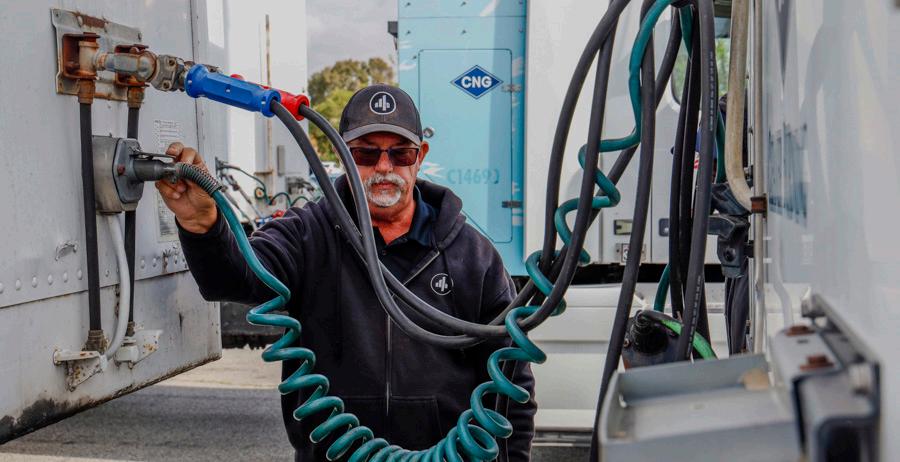
Top left: The insides of a truck’s engine in Lot L.
Top right: Christian Escoto, a truck driving instructor, drives a truck to set up skill training lessons for students in Lot L.
Bottom left: A Lot L traffic cone.
Bottom right: TGA instructor
Kevin Millones aids a student sitting in the driver’s seat of a TGA training truck on April 21.
students and contained three units: permit preparation, range training, and road training. In 2024, it was switched to a flat revenue rate of 15% of student registration fees.
Despite the change, the program’s finances have not shifted. Since 2023, El Camino estimates $311,952 in revenue and $228,000 in expenses, resulting in an estimated net gain of $83,952.
Viera, a TGA instructor, said TGA Truck Driving School is currently working on a program that students could graduate from in five weeks.
“I’ve already graduated students within five weeks, and it’s been working out,” Viera said. “We’re just trying to make it official.”
It is unclear if El Camino College will adopt these five-week courses.
While contracts, revenue and expansions shape the future of the partnership, the impact is visible every day in Lot L.
The sun sets and it’s cold. By 10 p.m., the lot is still filled with 18-wheelers as students put away their wooden pointers and head back to their cars while instructors also pack up for the night.
Lot L isn’t what it once was. It is now a concrete ground for stability, advancement or even a new beginning.
For students like Kimberly-Reyes, it’s proof that the right environment can mean all the difference.
“I wasn’t feeling lost,” Reyes said. “I was really feeling motivated.”





Ensenada’s serves up a delicious Baja-inspired, large menu swimming discounts for El Camino students
Story by Rosemarie Turay



Ensenada’s Carne Asada Tacos


They are $2.99 each on Tuesdays
They cost about 30 cents less with an El Camino student discount every Tuesday



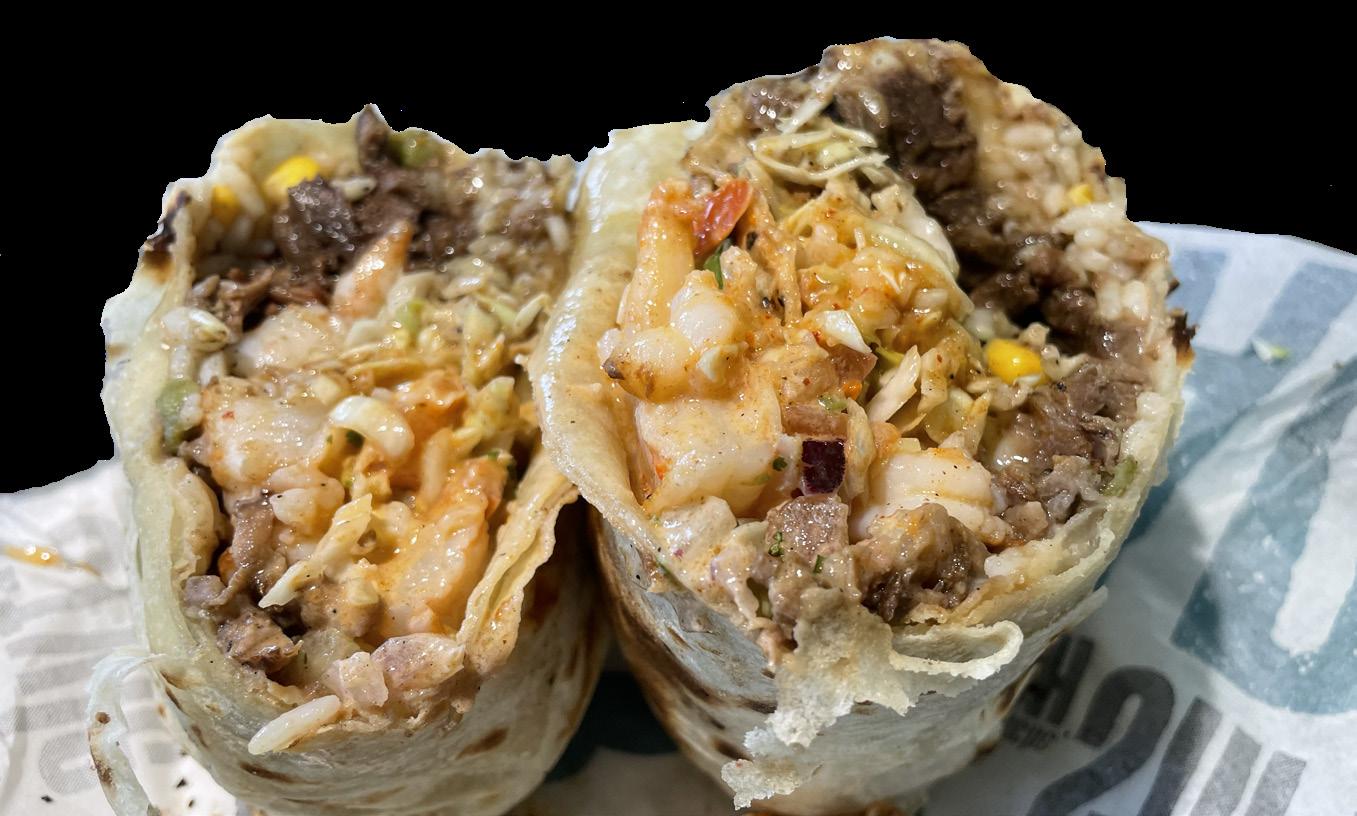
Ensenada’s Burrito, the Surf ‘n’ Turf Shrimp and Asada Burrito
It is $20 and about $18 with an El Camino student discount

Comes with a choice of battered or grilled shrimp
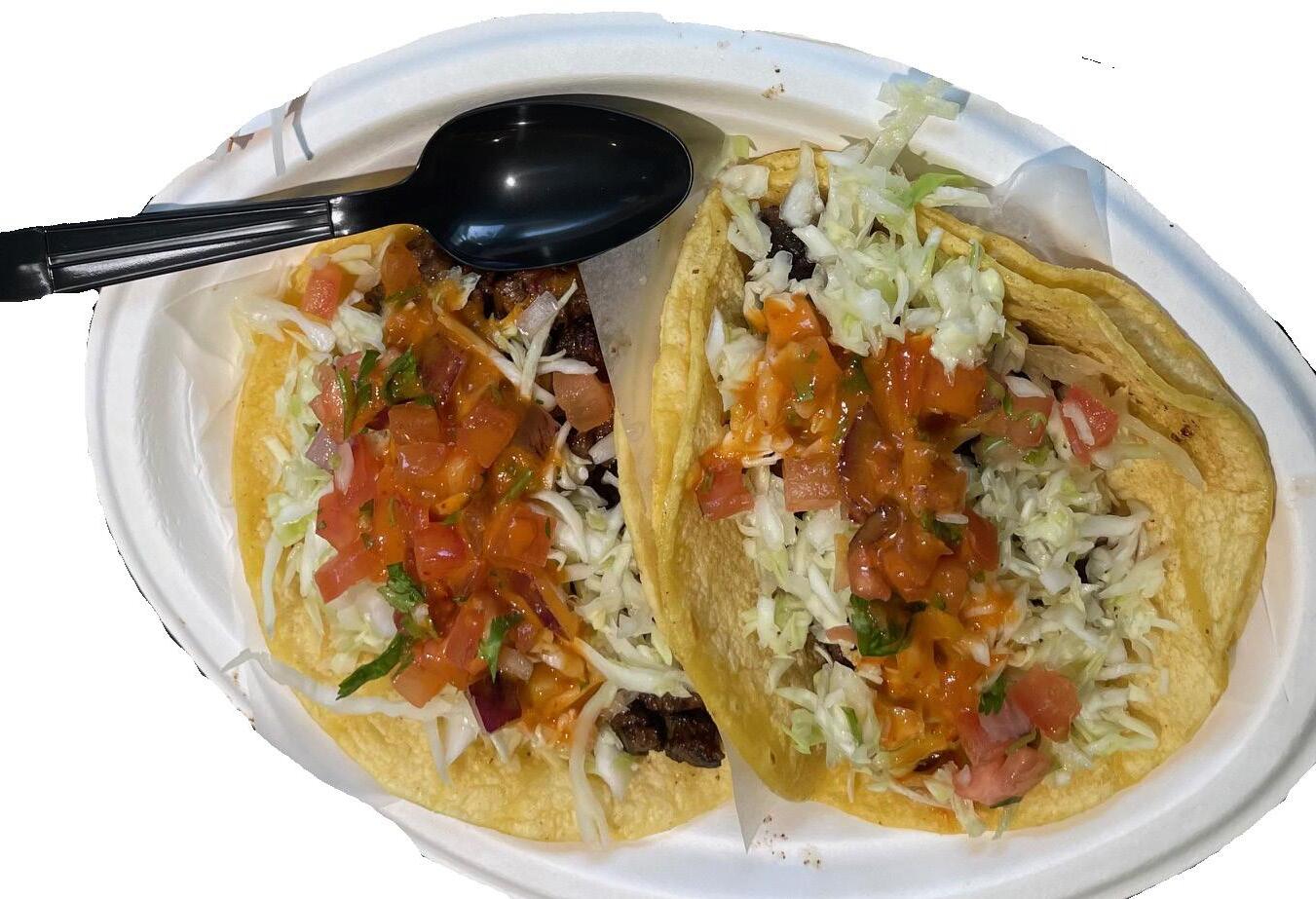
Ensenada’s Surf N Turf Grill offers a discount to all El Camino College students with a valid student ID. The restaurant is located on Crenshaw and Manhattan Beach Boulevard and has an extensive menu. Photos by Rosemarie Turay

In a sea of restaurants where taco trucks and Mexican eateries thrive, Ensenada’s Surf N Turf Grill stands out for its bold flavor and pairing of delicious steak and seafood and generous portions.
Ensenada is a six-minute walk and a three-minute drive from El Camino College and is located on Crenshaw Boulevard and Manhattan Boulevard.
Aside from the short distance, the best part for students is that these dishes remain affordable and fulfilling.
Ensenada offers a 15% discount for El Camino students who present a valid student ID, making this the perfect destination for those wanting a satisfying lunch or hearty dinner before, after or between classes.
The restaurant is open daily from 10 a.m. to 8 p.m., and known its vibrant presentation and bold flavors.
Ensenada’s also keeps it exciting with two daily specials.
Taco Tuesday features your choice of meat tacos– carne asada, carnitas, al pastor, chicken, or barbacoa — also for $2.99. Fish taco Wednesdays highlight battered fish tacos for $2.99.
Carne Asada Taco – $2.99, about $2.69 each with the student discount on Tuesdays
The carne asada taco captures bold seasoning and crisp textures in one bite. Well-seasoned, smoky steak is held by two soft corn tortillas that hold it all together, with a drizzle of smooth white crema, fresh pico de gallo, salsa and bright green lettuce that not only adds flavor but color.
Seafood lovers can also enjoy goldenbattered fish that is fried until a nice, crisp bronze while remaining wellcooked inside.
Topped with cabbage, crema and salsa, the taco offers a soft crunch for a tasty finish.
Ensenada Burrito, surf and turf – $20, or about $18 with the student discount
Don’t let the price discourage you from this burrito. The restaurant’s signature surf-and-turf creation delivers both an excellent size and great flavor.
Priced at $20 and about $18 with the student discount, the burrito is neatly wrapped in a warm flour tortilla that is generously packed with your choice of grilled or battered shrimp, steak, rice and beans and more.
Given its size, it may be tempting to cut down the middle; each bite carries juicy steak, tender shrimp, and a balance of corn and cabbage.
Don’t forget to grab fresh sliced onions, peppers and yellow lemons.
and sweet jamaica — $2.99 regular, $3.99 large.
For those who enjoy a sweet treat after something savory, the choices of flan, chocoflan, fruta con crema and jericalla for $4.25 are offered at Ensenada’s grill.

Ensenada’s Fish Tacos

They cost $2.99 Tuesdays
They cost about 30 cents less each Wednesday with an El Camino student discount

A variety of hot sauces are offered at the tables to kick up the flavor and turn up the heat is offered to customers.
To calm down the spice, Ensenada’s offers fountain drinks and smooth horchata


Story by Gilbert Sanchez
I’m on my way to work.
I realize I forgot something. A drug. Do I stop to get it and make myself late?
If I don’t, the rest of my day will be miserable. My pounding head and lack of focus will make the day’s responsibilities feel much worse. If I do, it will make me late. I put my credibility on the line. That’s an addiction.
But it wasn’t a hard, illegal drug I
needed. It was a Ghost energy drink with 200 milligrams of caffeine.
I consume all sources of caffeine — energy drinks, black coffee, espresso shots — whatever will get the job done to get through the day.
Now, imagine if that same dependence wasn’t on caffeine, but on a substance like nicotine or even cocaine, and it was still sold at nearly every U.S. convenience store.
This feeling must be normal, I thought. Everybody needs their morning cup of coffee, right?
Caffeine addiction is real and
should be treated like one.
My average daily caffeine intake was roughly 600 milligrams per day –equivalent to three energy drinks a day or six cups of coffee.
That’s a 50% increase above the Food and Drug Administration’s recommended amount of 400 milligrams per day, equivalent to one and a half energy drinks or four cups of coffee.
College students consume more caffeine than the rest of the American population, about 800 milligrams a day — about four

energy drinks or eight cups of coffee, according to a 2021 study.
It is easy to understand the stress and workload of a student considering school assignments and other responsibilities they may have.
Caffeine’s accessibility is the gateway to addiction that many college students fall into.
Caffeine is a readily available drug across El Camino College.
You can find a coffee or an energy drink at the Bookstore, Cafe Camino, and every convenience store near campus. I usually pick one up at 7-Eleven on the way to campus.
I was 19 when I had my first energy drink. I thought a little boost before the gym, after work, wouldn’t hurt. It’s what everyone does.
I didn’t drink much caffeine growing up. I always enjoyed the flavor of coffee, but refrained from it because I was always told by my family that it would stunt my growth, which is a myth, according to a Harvard Health article.
But beyond myth, caffeine overconsumption has real risks. It can cause heart palpitations, high blood pressure, insomnia and more symptoms according to the Food and Drug Administration.
“ Those mornings — like the ones where skipping that caffeine stop on the way to work feels impossible — are only proof of how powerful it can be.”
Not only is too much caffeine not great for your health, but it’s also not great for your wallet.
A drink from a coffee shop is about $5. Buying a coffee or energy drink five times a week can end up costing over $1,000 a year.
My first energy drink was an orange cream-flavored Ghost — my favorite flavor combination, and a flavor I still can only find in energy drinks.
The unique taste, along with the buzz it gave me during my workout, kept me coming back.
“Only before the gym,” I told myself to refrain from getting hooked.
I stood by that for about a year until I got a job working the overnight shift at Target when I was 21. That’s when caffeine went from a recreational habit — a boost for the gym — to something I needed to function properly — a jolt for keeping myself awake during overnight shifts.
Today, caffeine feels mandatory. Every week, I work six days and go to the gym four times on top of being a part-time student.
Young adults between the ages of 20 and 24 represent 30% of El Camino students who are still developing habits they will carry with them for the rest of their lives.
Caffeine abuse awareness should be spread in the same way as other substance abuses.
El Camino’s 2022 Biennial Review of the Drug Free Schools and Communities Act states that the college “is committed to having a drug and alcohol free campus.”
Some policies and acts focus on drugs like alcohol and nicotine, but caffeine isn’t in that discussion.
Based on a study by the Sleep Foundation, 94% of American adults consume caffeine. Many, like me, have made it a part of their lifestyle.
Although caffeine is highly addictive, I do not think it should be banned. Those mornings — like the ones where skipping that caffeine stop on the way to work feels impossible — are only proof of how powerful it can be. I won’t be quitting any time soon.
My doctor says I’m healthy, and I still crave the extra boost it gives me to handle my responsibilities, but I am cutting down my usage. Instead of 600 milligrams a day, I aim toward 400 milligrams, the FDA’s recommended daily limit.
To protect my wallet, I’ve started buying Ghost energy drinks in bulk from Costco and making my own coffee at home.
People are busy and I am too, and sometimes we need that extra push to keep ourselves going.
Unlike other drugs, caffeine

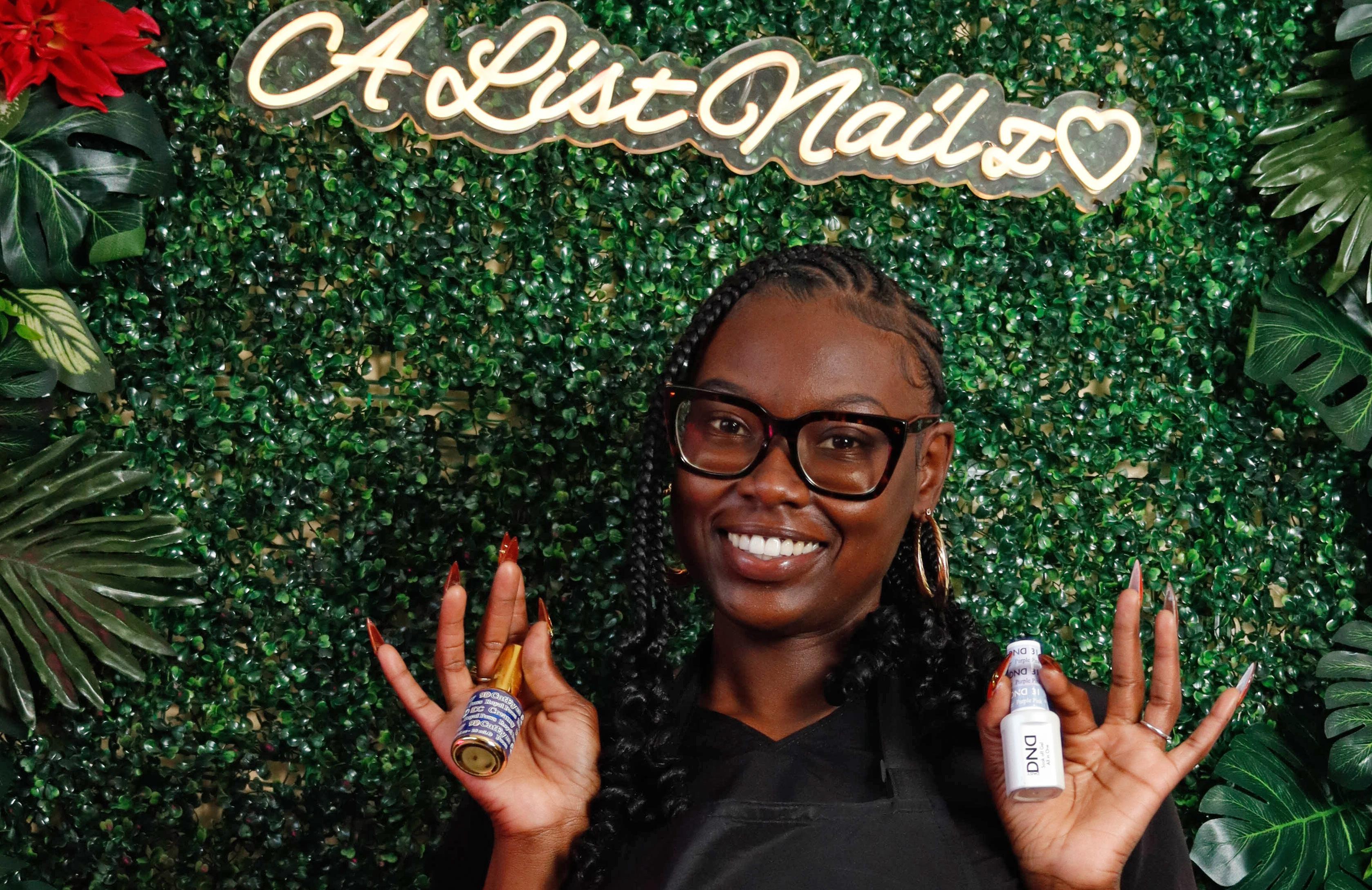
Story by Ananya Iamcharoen
When it comes to getting nails done, it’s not just about the design.
To business and marketing major Alyssa Parker, 24, it’s about the care.
Parker is a student entrepreneur who started her own nail technician business. From her dining-roomturned-nail-spa, Parker polishes clients nails in a couple hours into eye-catching art.
Building A List Nailz didn’t happen
in a magic snap of her fingers.
She started it fresh after graduating El Segundo High School in 2019.
“There was a lot going on in the world and I felt like I wanted to do something with substance,” Parker said. “Something that I can contribute to this world — and nails were the first thing I thought of.”
Posting her nails on Instagram and TikTok helps keep her business active and reach people. She has worked with OPI and Nike, and also does catered nail work at birthday parties, events and corporate events.
She started having clients over every two weeks.
A client that stepped in on a Friday was Jennifer Donnell, 53, who came in with a friendly warm smile. She sat down on the seat ready for her new set of polished nails.
Donnell knew Parker before she started her own nail shop.
“She was working at another nail salon that I would go to, and she was one of the nail artists there that would do my nails. So I was already familiar with her work.”
She went to an event in Hawthorne
“ Seeing the satisfaction and the happiness of my friends, like, that fueled me to keep going. That led me to be like, ‘OK, let me try it on myself more, let me do crazy art.’”
- Alyssa Parker Owner, A List Nailz Business and marketing major
it,” Parker said.
The moment Parker saw the colorful patterns, her eyes fluttered as she stared at the vivid designs.
She tilted her head curiously. Her eyes scanned around the room and watched how others worked.
“It wasn’t like a color that caught my eye. It was just admiring the workers and how hard they had to work to get something out of nothing,” Parker said.
As she sat quietly behind the workers, she noticed every move they made.
“I would love seeing the person sitting right next to me do a really cool design,” Parker said.
featuring small businesses at Glow and Flow, a beauty supply store that opened in 2024.
That’s when she saw A List Nailz.
“It’s very private, it’s very personal. This is for people who want personal attention. She’s not starting and stopping and doing anything else. It’s one on one. You have her full attention,” Donnell said.
Polished mastery
Fred Jones from the Professional Beauty Federation located upstate in Auburn said there are about 50,000 licensed hair, skin and nail establishments in California.
Jones has been a legal counsel advocate representing the beauty industry and has 26 years of experience when it comes to starting businesses.
He said for nail service providers, it’s not just about applying their craft but valuing the safety of their client.
“The beauty industry allows them to balance their professional and personal life. In a way, there are a lot of other careers that are more nine to five, five days a week. We want to give them that kind of flexibility. But it’s not just about finances. It also includes time management and freedom which is a very attractive element,” Jones said.
His advice to students who are learning to build their own company like Parker is that health and safety are just as important as artistic ability.
“Because we need to be able to convince our clients that we hold their safety paramount. That comes first,” Jones said.
Before business marketing major Parker, 24, started her own gel nail business, she had a nail biting dilemma on her hands.
Taking a shine to nails
Over a decade ago, inside the Kings and Queens nail spa in Hawthorne is actively filled with clients, and everyone has a role to play.
Until click, click, click.
A noise came from a 12-year-old girl sitting in the corner of the room.
It was Parker leaning back against her chair as she frequently fought the temptation to bite her nails.
And now her nails clicked together against her teeth.
Her mother didn’t like how Parker would bite her nails. Shortly after, she put acrylic nails on Parker in the nail shop in an attempt to stop her from biting them.
“That’s what really got me into nails as a kid cause I used to bite my nails often and my mom needed something for me to do, so I wouldn’t keep biting
The way their eyes locked on the nails like magnets and their gentle care for their clients inspired Parker. That’s when the idea of nail technicians sparkled in her mind.
She was in middle school at the time and the thought of becoming a nail technician herself never occurred to her. Over time, Parker discovered paying attention to small details at the nail salon in giving her a sense of purpose and a way to contribute to the world.
Parker said she notices little things about herself and other people to the point where she wants to help them take care of their nails too.
The bottle opens
A couple of years later, it’s a quiet, late night in Hawthorne.
No cars pass by.
Then splash.
Somewhere in the corner of the beige, single-story house was a tiny dining room where Parker was up practicing nail designs.
A nail polish remover bottle wobbles before tipping over. Its liquid sizzled, spreading across like lava to devour a table cloth.
Most people should be sleeping around 3 a.m. She was worried she would get in trouble.
But her mother wasn’t upset. She

“ There was a lot going on in the world and I felt like I wanted to do something with substance. ... nails were the first thing I thought of.”
-Alyssa
Parker Owner, A List Nailz Business and marketing major
saw the determination in Parker and is supportive of her daughter.
“In the beginning I had a deep passion for being creative so I really used that moment to use a time of peace, this is where I want to get too. It motivated me to stay up at night. I was able to step away and have fun and learn something new,” Parker said.
Staying up until the early morning hours taught her all of this is to show her family she can work hard like them too.
The tenacity for staying up late at night applying nails and working tirelessly motivates her to pursue this passion even more when she notices them smile.
“Seeing the satisfaction and the
happiness of my friends, like that, fueled me to keep going. That led me to be like, ’OK let me try it on myself more, let me do crazy art,’ Parker said.
But to her, the owner of A List Nailz, it’s not just about designing nails.
“I want to learn how to run a business,” Parker said. “I went back to school for business and marketing, mainly business, so I can be able to come out to the world freely and calmly. So I can put in the footwork.”
The streets of the same Hawthorne neighborhood were active with cars driving by as Parker stayed in that same house.
What was once a dining room now transformed into Parker’s own nail
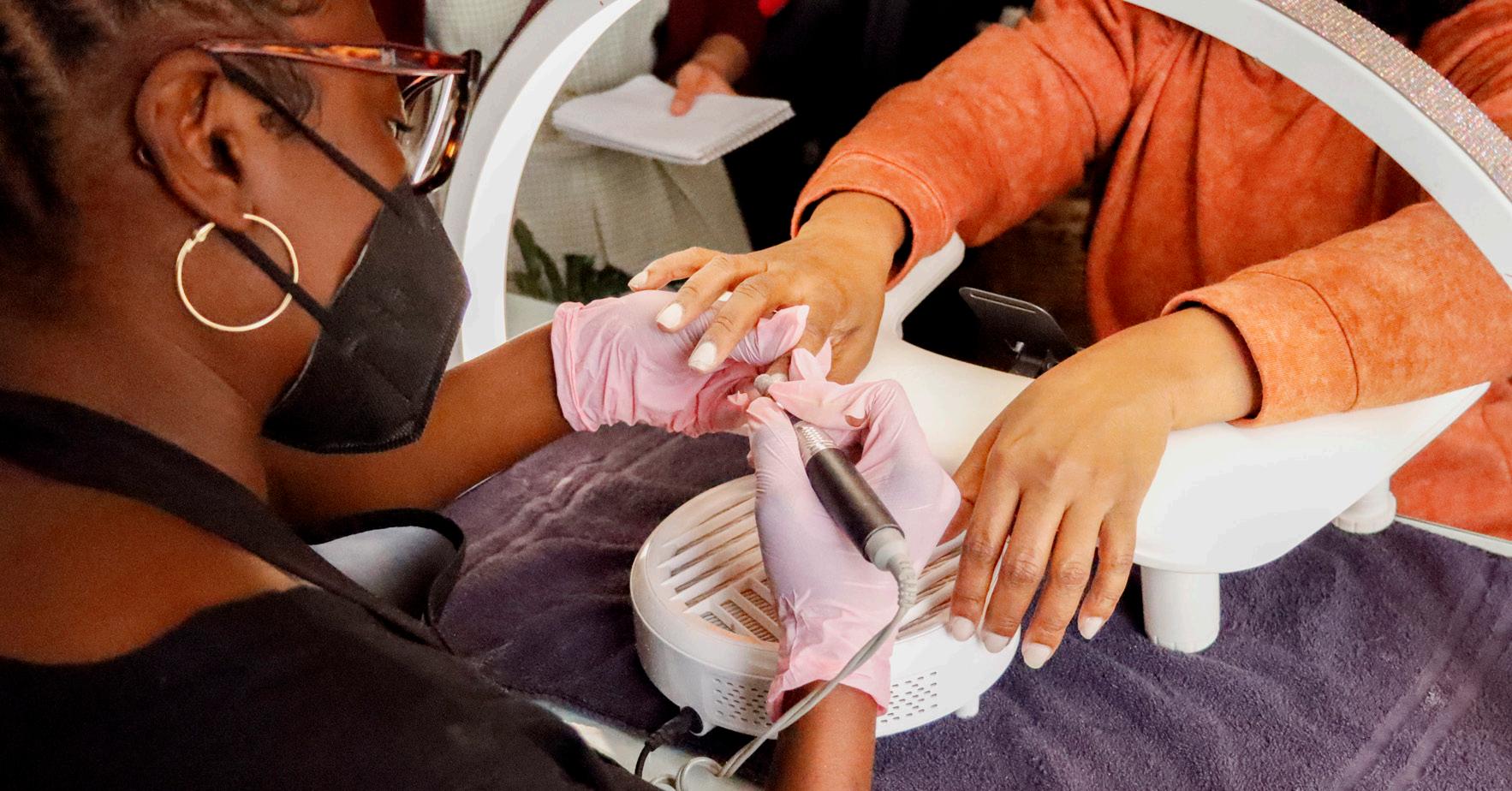
Above: Nail technician, business and marketing major Alyssa Parker, 24, preps Jennifer Donnell’s nails with a nail drill in her at-home studio March 27. Right: Parker sits in her luxury spa chair used for pedicures in her athome nail salon April 17.
salon. There are many items displayed around the floor and the walls. LED lights, a red lip-shaped pillow and nail hand figure stand props.
In the corner sits the pedicure chair with an iridescent foot spa basin and a table stands across from it where she works with her clients.
She transforms it into a nail salon that has impressed people. She said she created a system of consistency where people are able to trust her.
Parker paused.
Then ZAP. BUZZ. CLANK.
Electric tools, nail bits and hand files for nails are now in the grasp of Parker as she sat at her very own table, present in her own nail room. Her sleeves were folded up and she wore a black apron with bejeweled polish bottles that float below the phrase, “Pick a color,” written in gemstones.
She was ready to dip into the work of nail designing.
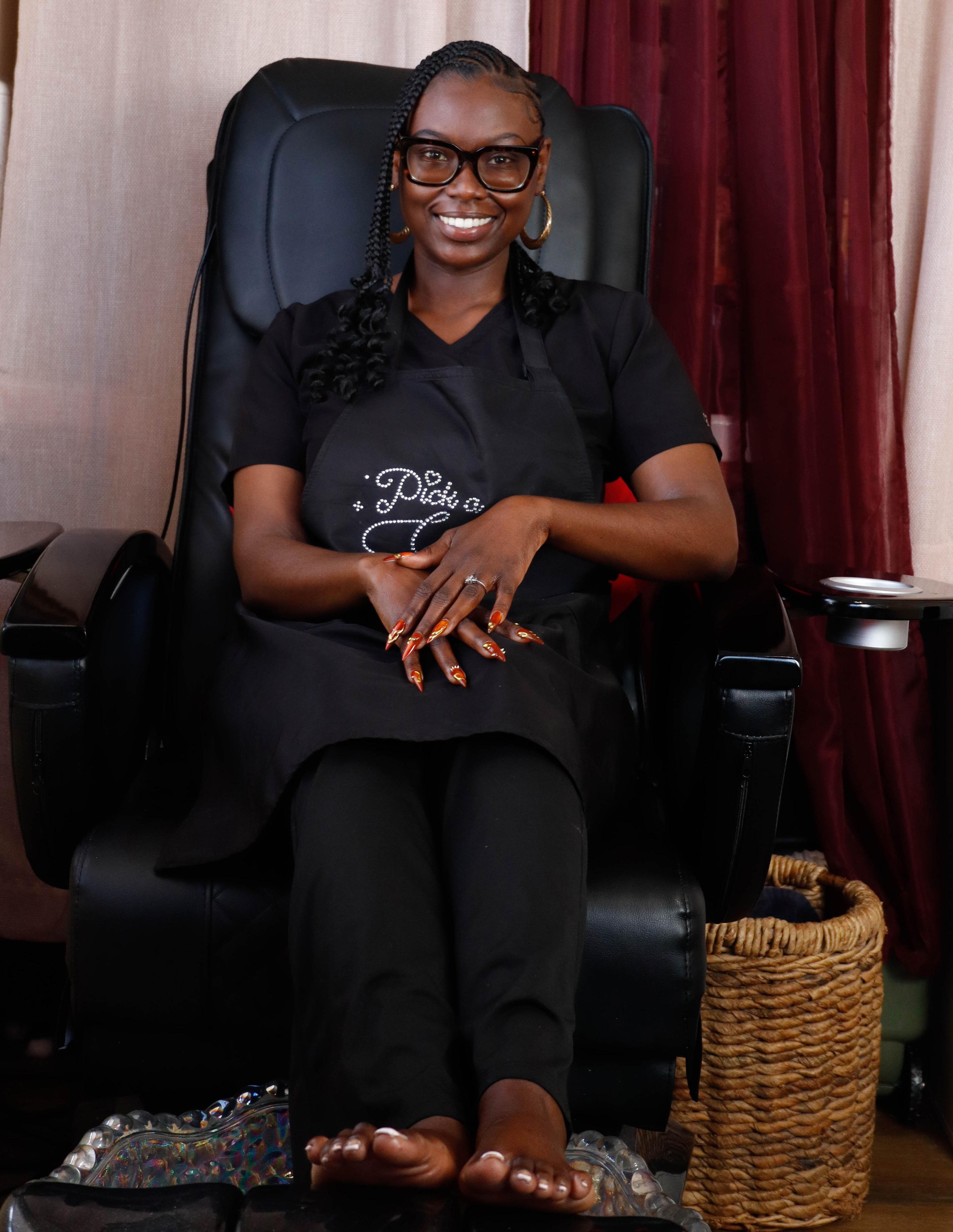
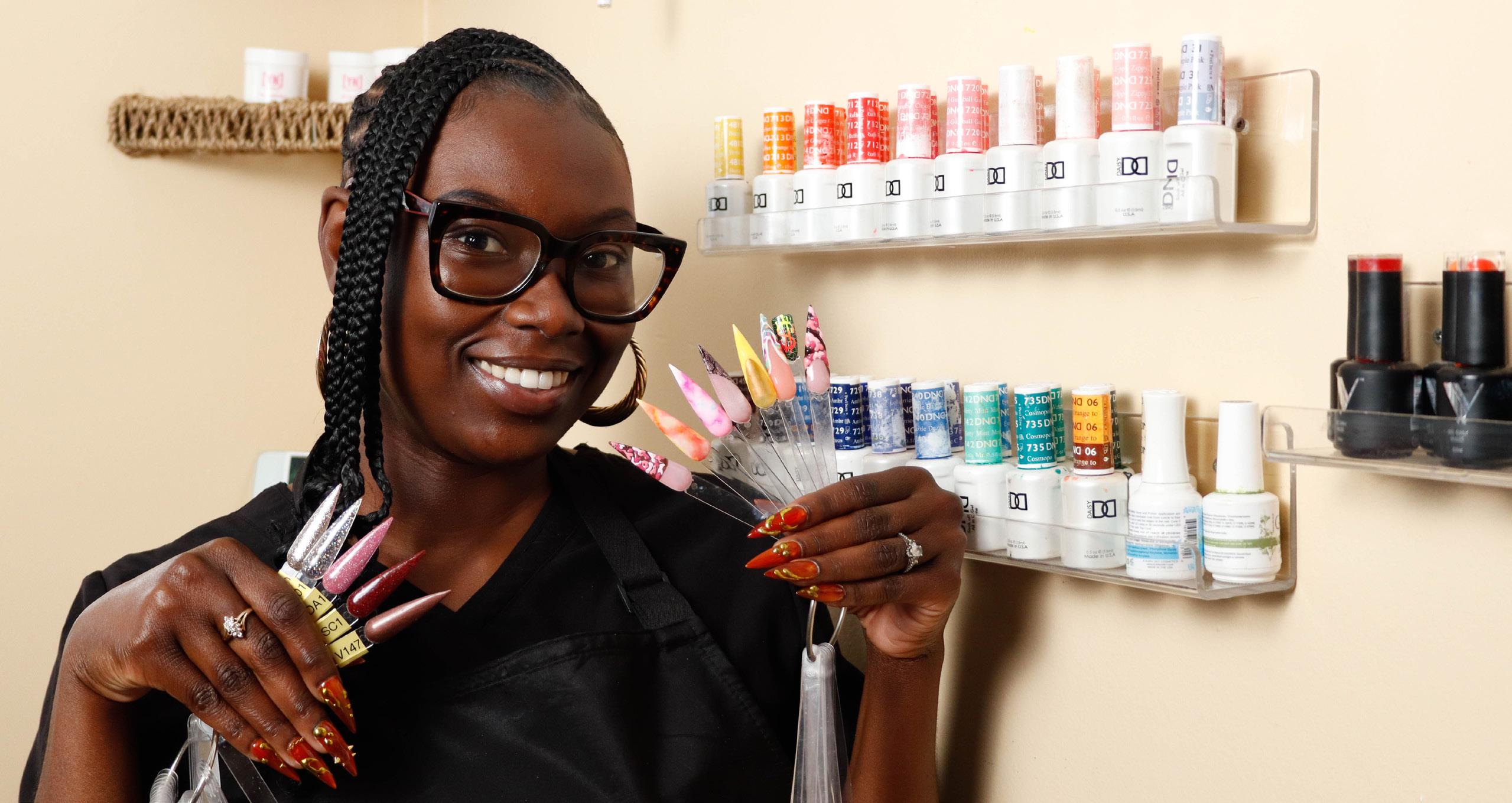
One of Parker’s clients is biology major and dog trainer Kennedi Huff, 24, who comes every two weeks. She found Parker on Instagram and enjoys her experience at A List Nailz.
“I felt relieved that I kind of have a safe space,” Huff said. “I can appreciate that she’s professional but also friendly.”
• Eat a healthy, nutritious diet that nourishes nails.
• Find an experienced nail technician.
• Stay hydrated and use lotion.
• Keep a regular nail care maintenance routine.
• Go to a service provider.
Source: Alyssa Parker
Many people compliment Huff on her nails.
They ask if she got them from a shop. But Huff always tells them the same thing.
“No, actually I go to a person, a nail tech,” she said.
She said watching Parker and her company grow has been inspiring.
“She is inviting, she is professional and adaptable,” Huff said.
To Donnell, Parker’s shop packs a concierge experience complete with free snacks and beverages. Prices range from manicures for $40, pedicures for $45, basic gels for $50 and hard gels for $65.
Sparkly ideas, big dreams
Parker wants her business to transform into a lounge at a new location.
“I want it to be like a wellness center where they can sit down, relax and be pampered. The surface would be clean and their nails are healthy,” Parker said.
Parker has two dream ideas for her future career.
Her first idea was to be a medical nail spa for diabetics, athletes who are hard on their feet and the elderly.
Now, Parker is in school training to get a medical nail license where she can work side by side with a nail podiatrist. That involves treating nails
Above: Nail technician, business and marketing major Alyssa Parker, 24, fans out samples of her nail designs while her DND brand gel polishes line the wall of her at-home nail studio. Parker began her business, A List Nailz, after graduating high school and now serves clients weekly.
with excellent care.
“I want the medical nail spa to be clean and healthy. We’re focusing on growing people’s nails. Changing people’s nail lives,” Parker said. In the medical nail spa dream, she wants to give her clients healthy snacks and a workshop to educate her community.
Her second idea is to open a nail lounge with seats, meeting and study rooms offering places to do homework.
Parker envisions her lounge to be a place for the people to relax until it is time for the client’s turn to get their nails done in private rooms, one on one.
Throughout her work process, sometimes doubt and anxiety come across her mind.
“There is no pressure now even though I do good work, sometimes I feel pressured like, ‘Oh, there’s an expectation on me now.’ People know my work is good, so I have to make sure it’s always good,” Parker said.

Story by Nikki Yunker
Graduating from college with a car and retiring a millionaire are milestones within everyone’s reach.
That’s something the newlyformed El Camino College Investing Club believes students can bet on.
“If I can teach people something important, like a life skill that’s going to pay dividends in their future, I feel like I should do that,” President Shreyans Rana, 18, said.
Generation Z invests earlier and at a greater rate than prior generations, according to an article by the World Economic Forum.
“[Rana] knows probably more than some of the stock brokers working [on Wall Street],” John Yeressian, real estate professor and former New York stockbroker, said.
Rana, club Vice President Matthew Freeman, 18, and adviser Xavier Miranda shared five tips for starting in investing.
1.Take an investor type quiz
Free investor risk adversity assessments online from Vanguard and others help people identify their investing style.
Rana said risky traders may choose exchange traded funds, safe investors may invest in established companies such as Coca Cola and growth investors may choose Nvidia.
”Find out what company you believe the most in. Put the majority of your money for the portfolio into that,” Rana said.
2.Track expenses and budget
Before people start investing, they will need to know how much they can invest.
“If you don’t have money to invest with, you’ll never invest. So, track your expenses. Make a budget. Make cuts,” Rana said.
Rana said to look at which expenses are variable and find alternatives if too much money is being spent.
Miranda said using resources including the Warrior Pantry, located near Lot L, helps lower grocery costs.
3.Use simple, low-cost brokers
Brokers allow people to buy or sell assets. Rana recommends Robinhood for
Left: Vice President Matthew Freeman, 20, and President Shreyans Rana, 18, were calculus classmates in fall 2025 and formed the Investing Club this semester.
accessibility and zero fee commissions.
”I always recommend Robinhood. It’s super easy to understand,” Rana said.
Other online broker options include Webull, Fidelity and Vanguard.
“Don’t go to a professional stock broker because they’re going to charge like a 100-bucks commission every time you buy or sell. That’s going to cost you a fortune,” Miranda, who teaches a personal finance class each summer and winter session, said.
4.Don’t procrastinate, invest now
Freeman said that any student, regardless of major, can invest.
“Like if you’re making money, you can invest,” Freeman said.
Investing can start with a small amount.
“A lot of people just have their money in checkings, in savings, but they forget inflation. So with inflation then they’re actually losing the value of their money over time,” Rana said.
5.Keep on investing
Money can grow quickly over time with favorable rates of return.
“People need to know that if they invest over time, keep compounding, they’ll beat inflation — not even just beat inflation, but they’ll make a lot more money,” Rana said.





Story by Heather Austin
Ibecame a vegan at the beginning of summer in 2019 to live healthier.
Media including the 2011 film “Forks Over Knives” and 2015 book “How Not to Die” inspired my desire to lose weight and reduce my chances of cancer. However, I struggle to be consistent in meeting my goals. I have been making unhealthy or “bad” vegan choices since I began attending El Camino College in fall 2025, and I can no longer afford the ingredients
that I initially bought when I became vegan.
I don’t have time to shop at different stores to get the lowest food prices. Before attending El Camino, I had eliminated bread and peanut butter from my diet.
My mushroom pastas turned to plain pastas with only tomatoes and seasonings quickly, especially with the closing of 99 Cent Stores.
Healthy and economical vegan food sometimes seems about as common as plant based dieters. Roughly 6% of the U.S. population is vegetarian and
about 4% is vegan, according to data from Statista.
The research mentions that individuals with these diets desire a healthier lifestyle, a choice more prevalent among younger consumers.
After watching “Forks Over Knives” in 2019, I lost about 10 pounds n two months by cutting meat and oil out of my diet.
Back then, I ate pasta, beans and rice, cabbage soup, and when I had time, steamed vegetables.
I used mushrooms in my pasta and drank lemon tea regularly. I read labels, avoided foods with
“ I am like many Americans, struggling to stretch a dollar for food and other necessities in an inflationary environment. ”
unrecognizable ingredients, and prioritized organic foods.
I was happy with the initial weight loss, but another benefit was an improved immune system.
As a carnivore, I was frequently sick and was not keeping track of the impact that my food choices had on my health. Common colds on a carnivorous diet for me lasted up to two or three months.
I did not get sick until after Thanksgiving in 2020 with what I thought was the COVID-19 virus, but wasn’t certain of.
I never got tested for it, and never went to the hospital, instead treating it on my own with Chinese skullcap tea, a home remedy which I learned about from Stephen Buhner’s 2013 book, “Herbal Antivirals.”
Each time that I got sick with what I thought was coronavirus, the symptoms became milder and milder, like a common cold.
Over the course of a year during the lockdowns, I lost nearly 60 pounds on this diet.
I can testify to the benefits of a vegan diet and herbal medicine, but I am not a perfect vegan: Finances, time and boredom bring inconsistencies in my vegan food choices.
I am also like many Americans, struggling to stretch a dollar for food and other necessities in an inflationary environment.
During the fall 2025 semester, when food prices went up, I had to go back to peanut butter sandwiches to survive. This is a vegan choice; but not a good one.
During the same semester, going to El Camino’s Warrior Pantry gave me more options.
But I also started to get bored
with veganism. I used to eat nothing but cabbage soup for a few days in a row.
Sometimes I would cook pasta or beans and rice before rotating back into cabbage soup, while watching my family eat cookies and cakes. I still haven’t experienced a birthday cake for several years now.
Yet, this was where I learned about vegan baking.
Through this new venture, I’ve baked vegan zucchini muffins, banana muffins, chocolate chip cookies and applesauce cake.
I used agave as a sweetener before prices went up and then I turned to processed sugar.
With all of my unhealthy vegan choices and now baking, I gained the weight right back.
El Camino nutrition professor Mary Lyons, a registered dietitian who has a master’s in nutrition science with an emphasis in food science from California State University, Long Beach, offered me some advice for getting back on track with my lifestyle and health goals.
Lyons provided many tips, including avoiding junk foods, candy, sodas and sweetened plant-based milks by loading up on fruits and vegetables instead.
After speaking to Lyons, I realized that our conversation was not enough.
The tips she gave me for this article is enough to get started on the path to eating well. I have looked at the nutritional science classes and I have always been curious to learn more about food.
Now, I really want to enroll in nutrition science in the future, so I can learn how to be a healthier vegan.
Professor and registered dietitian Mary Lyons offered tips on how people on plant-based diets can make healthier choices within their diet.
“You can do omnivore very well. You can do omnivore very poorly. You can do vegan well. You can do vegan very poorly,” Lyons said.
Lyons teaches nutrition science at El Camino College and California State University, Long Beach.
1.Avoid unhealthy food choices.
Vegan junk food such as processed carbohydrates, potato chips, french fries, candies, sweetened beverages, sweetened dairy substitutes, sweetened almond or coconut milk, high fructose corn syrup, sweetened fruit juice, fake meat substitutes and soda are common culprits in plant-food diets.
2.Choose whole food options. Entire fruits, vegetables, fungi, yeast, nuts, seeds, legumes and grains or meals made from these simple ingredients are better than overly processed versions. Some items worth including in a diet are veggie burgers made of mushrooms, unsweetened dairy alternatives, olive oil, avocado oil, coconut oil, dark chocolate, coffee, tea, quinoa, buckwheat, amaranth, edamame and tempeh.
3.Buy frozen produce.
Fruits and vegetables from the freezer section help reduce waste, save money and hold more nutritional value.
“It’s picked at the peak of ripeness ... It’s achieved optimal nutritional value, and then it gets flash frozen and it keeps its nutritional value, so when you’re ready to use it, it didn’t get lost in the freezing process,” Lyons said.
4.Batch cook healthy dishes. Prepare food on days off, then freeze some and keep the rest available in the refrigerator to grab for a quick meal.
5. Get routine check-ups. Make annual health appointments with a doctor. Bloodwork helps assess one’s vitamin levels such as B12, vitamin D and iron. Don’t take iron supplements without a doctor’s recommendation.
Story by Gilbert Sanchez
Illustrations by Gilbert Sanchez

Pool tables may seem hard to come by or expensive, but the South Bay offers plenty of options — from pool halls and dive bars to pizzerias — making it easy to rack ’em up at the best spots to shoot pool around campus.

Address: 21020 Hawthorne Blvd.
Torrance, 90503
Hours: Sunday - Thursday, noon to 1
a.m.; Friday - Saturday, noon to 2 a.m.
Phone: 310-371-9489
Mr Lucky’s Billiards is the biggest pool hall in Torrance, with 10 tables available — five Diamond regulation tables and five slightly smaller bar tables. Whether you’re a casual player or looking for serious competition, this is the place to be.
With a Jukebox, beer, chips, and candy, Mr Lucky’s has all the essentials to keep you playing for hours. Tables start at $10 per hour before 7 p.m., then prices increase to $17. It’s $19 on Friday and Saturday.

Address: 1851 W Redondo Beach Blvd., Gardena, 90249
Hours: Monday - Saturday, noon to 2 a.m.; Sunday, 1 p.m to 2 a.m
Phone: 310-894-3395
Seoul Billiards is a classic pool hall experience. Eight tables and one TV. The tables are usually pretty available, and the demographic consists of regulars, making this a great spot for casuals or even first timers. This pool hall only accepts cash. Tables are $18 an hour, with a minimum of half an hour for $10.



Address: 4419 Torrance Blvd. Torrance, 90503
Hours: Monday - Saturday, noon to 2 a.m.; Sunday, 10 a.m. to 2 a.m.
Phone: 310-371-8054
The Bounty Room is a cozy dive bar in the heart of West Torrance. Two pool tables, darts, and plenty of TVs provide all you need for a night of pool. Outside of their league on Mondays and Tuesdays, this bar uses a classic dry-erase board as a queue to see who plays next. The pool is only $1 per play, and paired with their daily noon to 6 p.m. happy hour, this is perfect when on a budget.

Address: 15707 Vermont Ave. Gardena, 90247
Hours: Sunday - Friday, 9 a.m. to 11 p.m.; Saturday, 9 a.m. to midnight
Phone: 310-324-1244
Known primarily as a bowling alley, Gardena Bowl is a great place to rack ‘em up. Their billiards room consists of nine regulation tables and three TVs, making it a perfect place to shoot pool and watch the game. If you get tired of playing pool, hit the lanes and go bowling, or enjoy their other arcade machines. Gardena Bowl has a fixed rate of $5 per person per hour for playing pool.
Address: 4525 Calle Mayor, Torrance, 90505
Hours: Monday - Wednesday, 3 p.m. to 10 p.m.; Thursday - Saturday, 11 a.m to midnight; Sunday, 11 a.m to 10 p.m.
Phone: 310-921-8083
Mom Said Yes isn’t your average pool hall. In fact, it’s a pizza parlor and dive bar hybrid with a full food and drink selection. Despite only having one pool table in “The Basement,” it’s truly a oneof-a-kind experience in Torrance.

is the word
El Camino alumna joins the flock caring for hawks, penguins, lorikeets and more at the Aquarium
of the Pacific
Story by Nikki Yunker
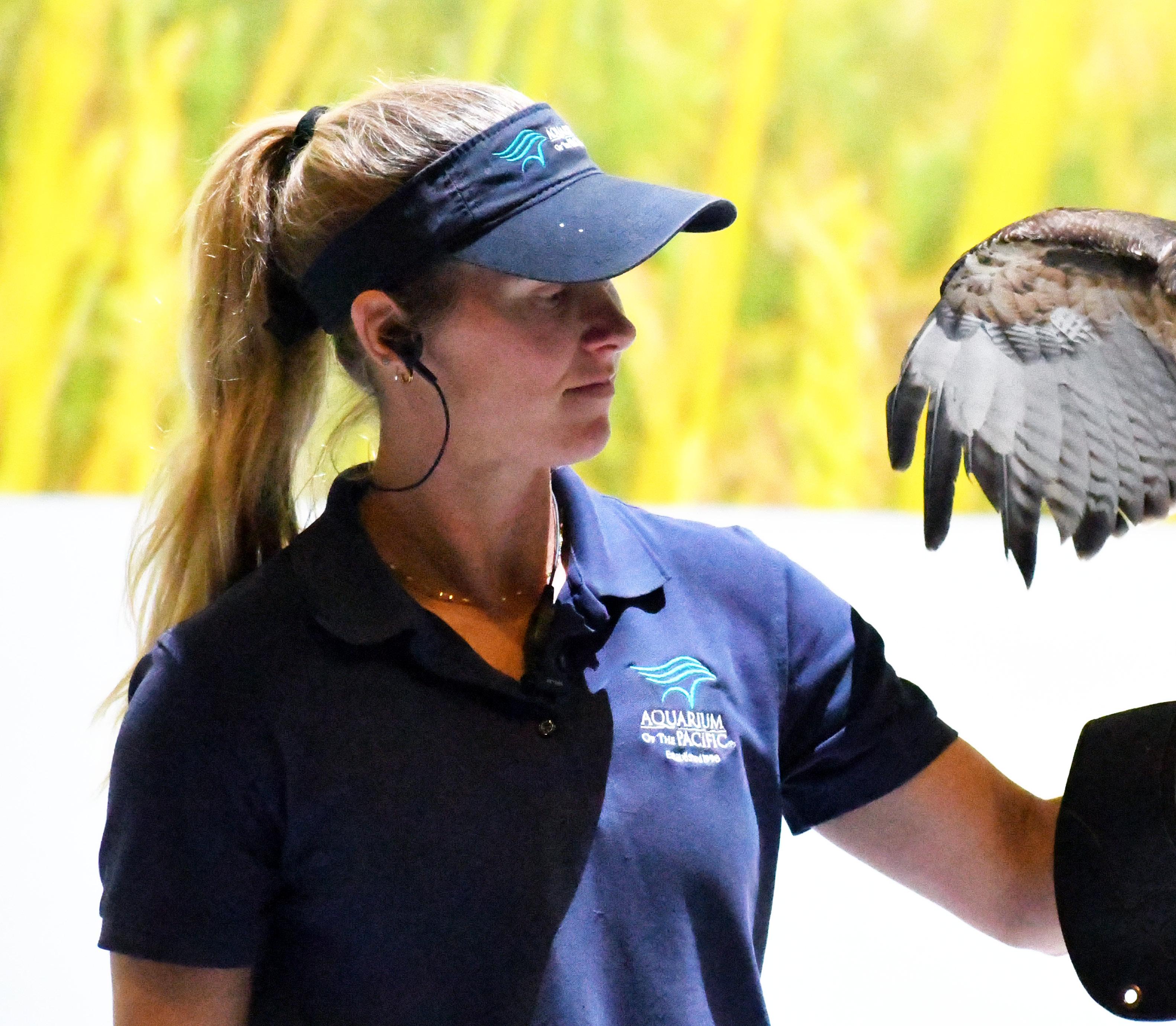
Above: Katrina Wilbanks holds Lyra, a red-tailed hawk, as part of the 15-minute “Birds of the Pacific” show at the Aquarium of the Pacific. The show is everyday at 2 p.m.

Lcapable of flying 120 miles per hour, takes off in seconds to descend from the top of a dark, 300-seat theater at the Aquarium of the Pacific.
The raptor glides silently above the audience’s heads as they gaze in awe before she lands on the perch that is Katrina Wilbanks’ gloved hand.
Her 5-foot wingspan engulfs Wilbanks, a 2012 El Camino College graduate, who stands only a few inches taller.
“She’s large and in charge,” she said later.
The flight brings the daily “Birds of the Pacific” show to a close at the aquarium in Long Beach, where
The fast-paced nature of working at Southern California’s largest aquarium, which opened in 1998 and now welcomes about 1.5 million visitors annually, keeps the bubblyvoiced Wilbanks on her toes.
“There’s something different every day, the animals do whatever they want,” she said.
Wearing running shoes and socks with cat faces, she’s light on her feet. At work, her colleagues know her best by her nickname, “Kat.”
She works from 7 a.m. to 4 p.m., and her daily tasks vary among the 20-member animal husbandry team.
Her light straw-colored ponytail falls on her uniform, a navy polo and khaki shorts. The combination
echoes the rare coloration of her right eye, which is ocean blue with a brown spot — a trait from her mom.
After the bird show, the tawnyhaired alumna looks at her turquoise wristwatch. She’s on time to feed the penguins their capelin and herring dinner at 2:30 p.m.
From a penguin not feeling hungry for seafood at meal time to Freyja the raven choosing whether or not to solve a puzzle during show time, the aquarium’s residents are free to choose what they do.
But while the animals are decisive, Wilbanks herself didn’t always know she wanted to be a zookeeper.
At El Camino, Wilbanks earned a general science degree with honors and pole-vaulted her way as a student athlete on the track and field team to a near-full scholarship at California State University, Northridge, in 2013.
However, studying kinesiology at Northridge left her unfulfilled.
She needed a major change.
“OK, what’s the coolest thing I could ever hope to do?” Wilbanks, now 33, recalls wondering.
Thinking back to her childhood aspirations, she was transported back to the sixth grade in Torrance.
After school, her parents would turn the Animal Planet channel on in their living room and she’d watch zookeeper Steve Irwin’s TV shows.
Memories of the late, famed crocodile wrangler inspired her to switch her major to biology and become a zookeeper, which she said would be “pretty cool.”
“I always remember him having the utmost respect for animals and just the animal kingdom and the environment that we live in and just being really conscientious about that,” she said.
Wilbanks, who graduated from Northridge in 2015, said her parents and younger brother, who works in information technology, were excited for her newfound career path.
Seven zoos, two sanctuaries and 13 years in the making, Wilbanks’ work with animals has flown her across the country and the world to tackle unpaid internships as well as seasonal and full-time positions.
“ It is a very competitive field because, I mean, who wouldn’t want to work with animals?”
-Joseph
Nappi President, American Association of Zoo Keepers
Aviculturist, a bird care specialist
Climbing up and down staircases, she slides over and under the aquarium’s life support system water pipes, navigating dimly-lit spaces guarded by staff-only signs.
After zooming through warm-hued halls and cubicles, she wipes her gray sneakers on a soft mat and passes into the fishysmelling, steel kitchen.
She’ll take live meal worms and restaurantquality seafood from the walk-in fridge or simply bring back dishes on her way to and from exhibits.
Fitting for her athletic nature, Wilbanks describes her spirit animal as a hummingbird, sharing both fast heart rates and large appetites despite their tiny frames. Birds of a feather
Specializing in birds was also as unexpected for her as zookeeping.
Her first encounter with birds was in 2016 at the Indianapolis Zoo as a seasonal worker.
“I honestly at that point would not have picked birds like at all … It’s not really the animal I want, but that was my first paid job,” she said.
But their charming natures started to nip at her heart, despite their often discordant vocalizations.
“Full of personality, each and every one of them,” she said.
A year later, her next job was as a wildlife theater trainer at the Denver Zoo, being part of a free-flighted bird show that included slow-mammals.
Audiences watched as crowned cranes walked across the stage, porcupines meandered, tamandua anteaters slowly climbed and every bird from hawks and owls to macaws and vultures soared.
Center: Aviculturist
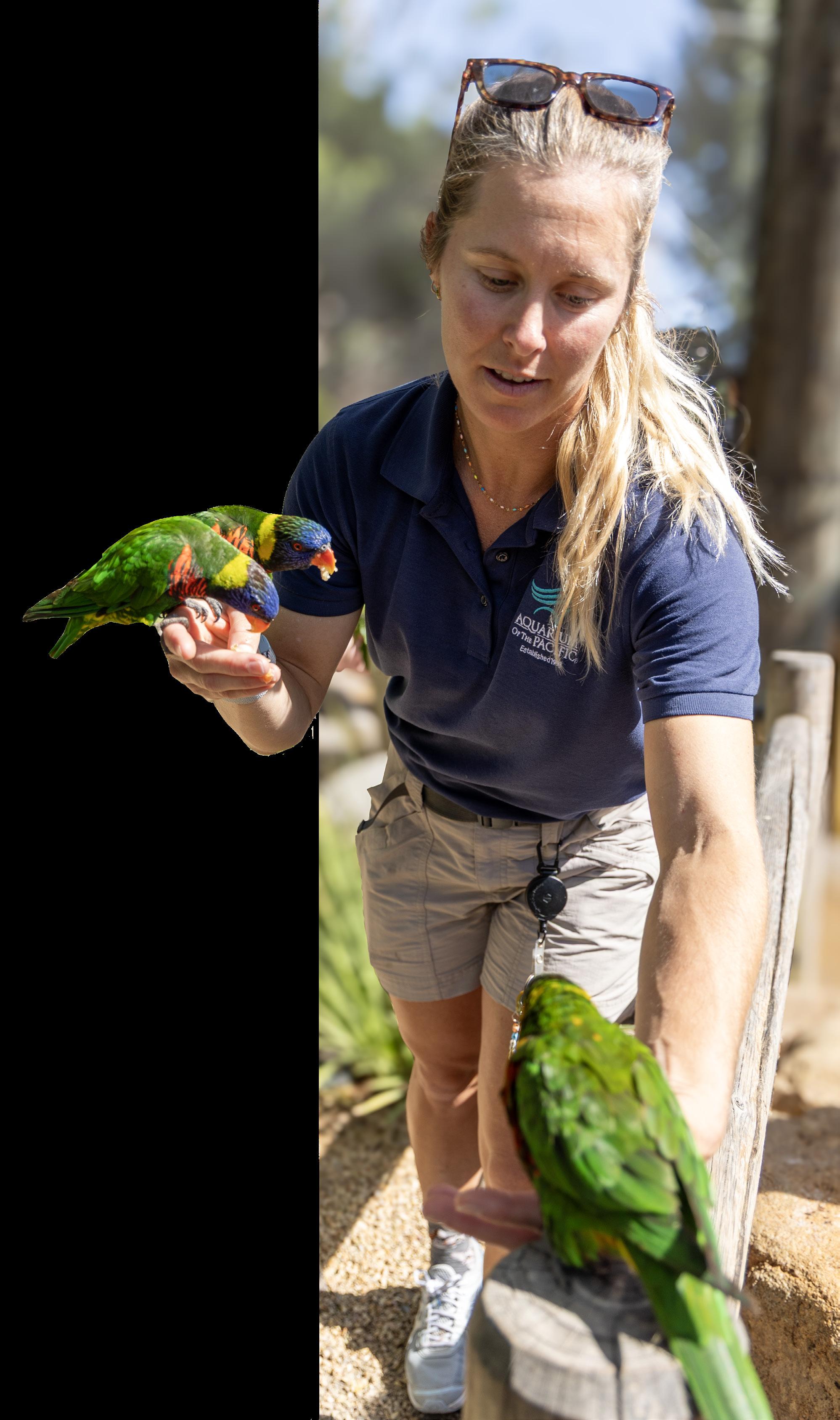
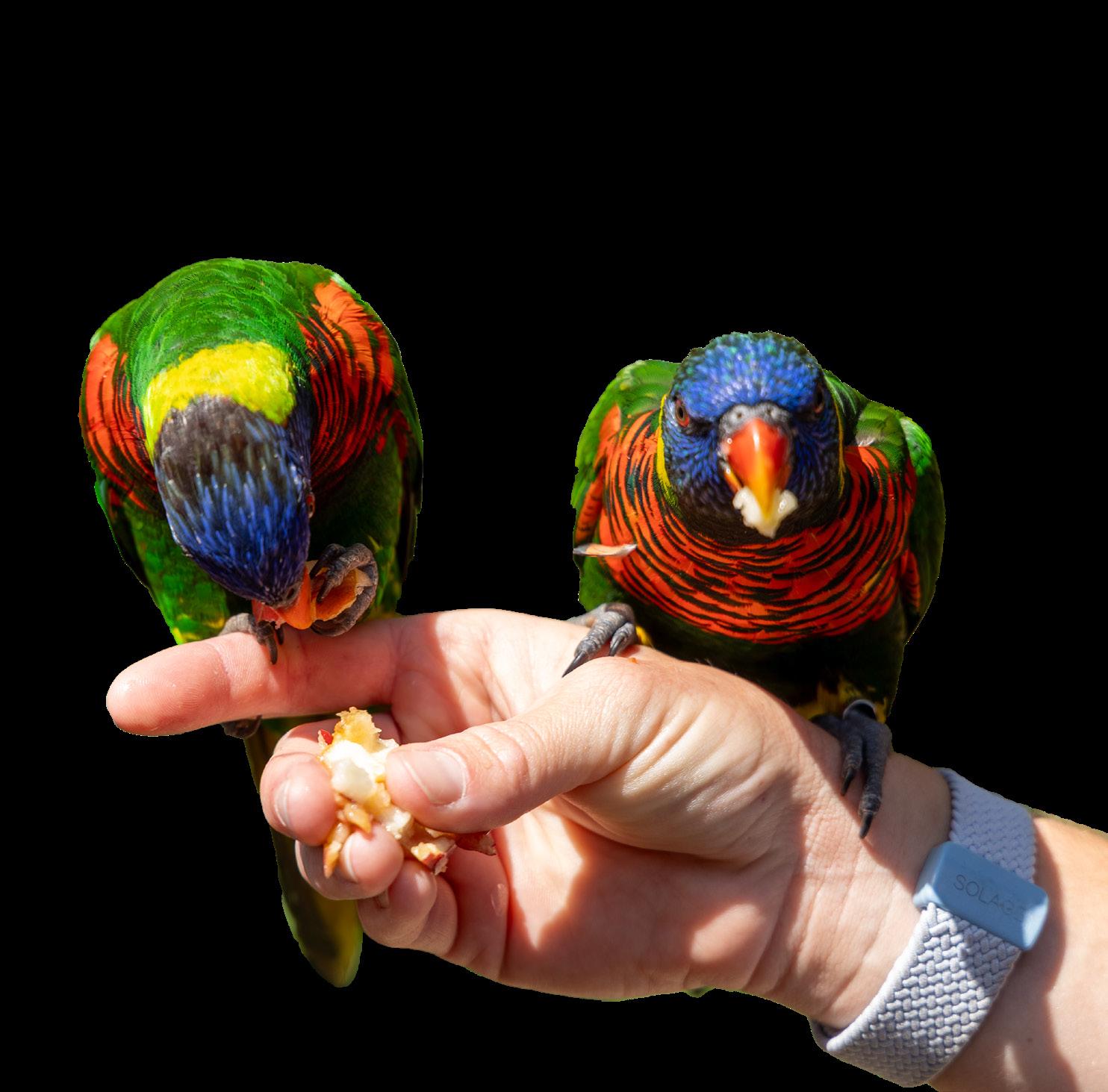
Katrina Wilbanks holds lorikeets at the Aquarium of the Pacific in Long Beach.
Right: Lorikeets eat from a piece of apple in Wilbanks’ hand.
From 2013 to 2026 onward
1.The Wildlife Waystation Sylmar, Calif.
2.Topeka Zoo Topeka, Kan.
3.Indianapolis Zoo Indianapolis, Ind.
4.Denver Zoo Denver, Colo.
5.The Koala Park Queensland, Australia
6.Lincoln’s Children Zoo Lincoln, Neb.
7.Downtown Aquarium Houston, Texas
8.San Antonio Zoo San Antonio, Texas
9.Aquarium of the Pacific Long Beach, Calif.
The show wasn’t as effortless as it seemed, Wilbanks said, when she worked behind the scenes in a “catch and release” fashion. Each animal had to be locked and secured before the next one could make its entrance.
“We had fly offs like crown cranes where now the speaker has to stall the audience because the show actually cannot go on because I need to go collect that bird,” she said. “And sometimes they would just, like the Macaw, sit up in the tree.”
Then the show would end for the team to stare up at the bird, thinking, “They’ll come down eventually.”
But Wilbanks said one of the scariest parts of the job was the show’s popularity.
She was sometimes put on the spot with public speaking — an activity which ranks at No. 46 in the list of Americans’ biggest fears, according to Chapman University’s 2025 study. Fortunately, her seasonal position
1.Get involved early and volunteer.
2.Major in a related or applicable field.
3.Be open to traveling far for work.
Source: Aviculturist Katrina Wilbanks, El Camino College professor Bryan Carey and the American Association of Zoo Keepers
meant she didn’t have to go through a main role on stage.
“Every day was so different. The people, the full-timers, were definitely some personalities. Like to do the show, you are outgoing, ecstatic, like you have so much energy,” she said.
The Denver Zoo was also where she learned to handle birds of prey with one free hand and the other gloved amid their sharp talons, like she does now with Lyra. “I’m a raptor girl and I really like them,” she said.
From Denver she flew around the globe to Australia in 2018, finding work in Sydney as a health and wellness consultant at Arbonne — a company for humans.
But she couldn’t stay too far away from the animals.
For two weeks, she moved up north to Magnetic Island, located off the coast of Queensland and about 30 miles away from the Great Barrier Reef, to volunteer at The Koala Park in exchange for food and board.
“They were like, ‘Wait, you actually work with animals back home? This is crazy. … Could you please stay?’” Wilbanks said.
Returning to Southern California was always “endgame,” she said, but the job market was competitive coming back from Australia in 2019.
Out of the 50 or so applications she sent, she heard back from about two employers, and in one pool, she was chosen from around 150 other job seekers to work at the Lincoln Children’s Zoo in Lincoln, Nebraska. A competitive, growing field
The animal care and services field, which includes jobs working with pets as well as zoo animals, is projected to grow much faster than average, 11% by 2034, according to the U.S. Bureau of Labor Statistics.
Joseph Nappi, president of the American Association of Zoo Keepers, said zookeeping specifically is a relatively static industry in terms of growth because the demand for
positions surpasses zoo facilities.
“It is a very competitive field because, I mean, who wouldn’t want to work with animals? So you have to really set yourself apart while you’re in college especially to really stand out, and often people have to be willing to move across the country,” Nappi said.
“Kat” and the big cats
In Lincoln, Wilbanks worked with carnivorous animals including wallabies, river otters, bobcats, snow leopards and fossa, highlighted as a fearsome predator in Dreamworks’ 2005 animated film, “Madagascar.”
Behind the scenes, exhibits had to be cleaned and the big cats secured in a separate space before she enters.
“One of the things with zookeepers is, ‘Did I lock that lock?’” she said. “You’ll go home sometimes and be like, ‘Did I?’”
For Wilbanks, who worked alone in her exhibits, the worry would bear on her mind enough for her to call a late-shift colleague to check, but the locks were always secure.
“So, that job I started to learn what anxiety was. I did not really know or feel what it was until that year in Nebraska,” she said.
Yet, one of her most favorite moments as a zookeeper happened in Lincoln when she was checking on the river otters.
Opening their boxes, she had to do a double take: Three otter pups.
It was a total surprise to the staff.
“Seeing the baby otters for the first time, that blew my mind and will forever be ingrained in my memory,” she said.
Female otters are able to delay the implantation of their fertilized eggs, making babies more uncommon.
From Nebraska, she moved to the Lone Star State for two years, working at the Downtown Aquarium in Houston in 2021 and the San Antonio Zoo in 2022.
Keeping on zookeeping
Up until her work in Texas, she also had to work mostly part-time restaurant server jobs.
In her career, she didn’t want to be
Tuesday, April 7.
limited to the nearby South Bay zoos and didn’t want to wait around.
“You have a higher success rate of just going to the places that nobody really wants to be, like Kansas, like Nebraska,” she said. “It was easier to get my foot in the door there than to wait here back home where there’s way more people who want this job who are willing to wait it out.”
El Camino biology professor Bryan Carey similarly recommends that students take related classes including marine biology, transfer and get involved with local zoos, aquariums and other facilities.
“It’s also about trying to get your foot in the door, as they say, and being able to [do] even just some volunteering that sometimes translates into other opportunities,” Carey said.
“ They don’t have a voice, so I try to use mine to better their life here.”
-Katrina Wilbanks
Aviculturist, Aquarium of the Pacific El Camino College alumna, 2012
While Wilbanks didn’t get a head start by volunteering with animals before college, her athletic background built the muscle and endurance needed to keep up with large cats and flighty birds.
From a young age, Wilbanks’ parents supported her in any sport she wanted to try, including soccer, swimming, softball, tennis, track and her favorite: volleyball.
When she went to West Torrance High School, she focused on track and pole vaulting.
She continued the sport at El Camino, where she set a pole vaulting record of 12 feet during the South Coast Conference in 2012.
“I remember that day like it was yesterday,” she said. She was scouted right then by a Northridge recruiter.
Her name was on a plaque at El Camino for over a decade just until last spring, when her record was bested by three fourths of an inch. Coach Kevin Hughley shared the news with her in a text.
Wilbanks was excited.
“That was such a hard footage to beat and for me to get to,” she said.
Medium to heavy strength levels, frequently lifting up to 50 and sometimes 100 pounds, are needed daily from 76% of animal caretakers, including zookeepers, according to the U.S. Bureau of Labor Statistics. It’s also a stand up job — with workers being on their feet for 82% of the workday.
Nappi, a senior keeper at the Bronx Zoo, said women are now the majority of zookeepers in what used to be a male-dominated field, partly due to the physical demands.
“[It’s] hard to say exactly why that may be. I don’t know if it’s like a nurturing thing, but it’s just totally
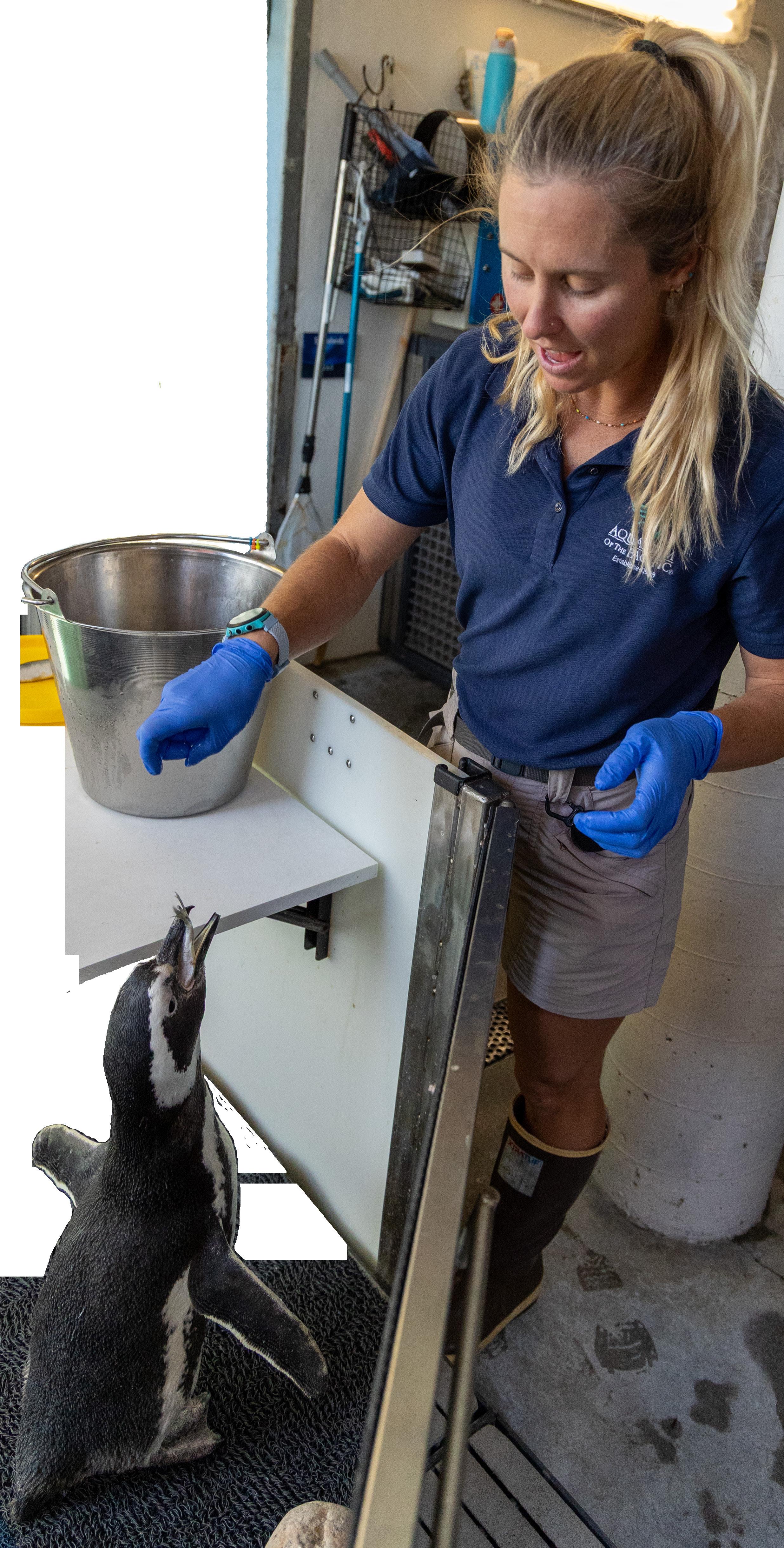
Right: Aviculturist Katrina Wilbanks feeds 21-year-old penguin Shim, who requires special care and treatment for arthritis, behind the penguin exhibit at the Aquarium of the Pacific in Long Beach.
changed,” Nappi said.
Working at the Aquarium of the Pacific, Wilbanks’ journey has come full circle as she lives in Torrance with her parents and their two cats and dog.
Feeding penguins at the aquarium, Wilbanks is assisted by volunteer Leala Stephenson in tallying the number of fish each penguin eats and their behavior.
Wilbanks notes the behavior of Anderson, a sassy male who hatched at the aquarium close to 13 years ago, and offers fish to the penguins swimming in the exhibit’s chilly, 60-degree water or brooding in their rocky holes.
The penguins, tuxedoed for a black-tie affair, swallow fish whole and make loud vocalizations described as donkey-like brays.
Stephenson, who has also taken classes at El Camino, is one of the aquarium’s estimated 1,000 volunteers. She started last year and sometimes helps with the penguins, where Wilbanks is often found.
“She has got so much positive energy, she’s so effervescent, she’s
just got a good vibe,” Stephenson, 54, said. “Very smart, very thoughtful, great with the animals and great with the volunteers.”
Wilbanks had only liked birds — not loved them — until her last job working with waterfowl and flamingos as an animal care specialist at the San Antonio Zoo. She realized avians were her favorite animals.
“Like this is it,” she said.
Although beaks and claws still pose an occupational hazard, she appreciates the lesser danger of birds compared to other, larger zoo animals.
“So that puts my mind more at ease, whether I’m thinking
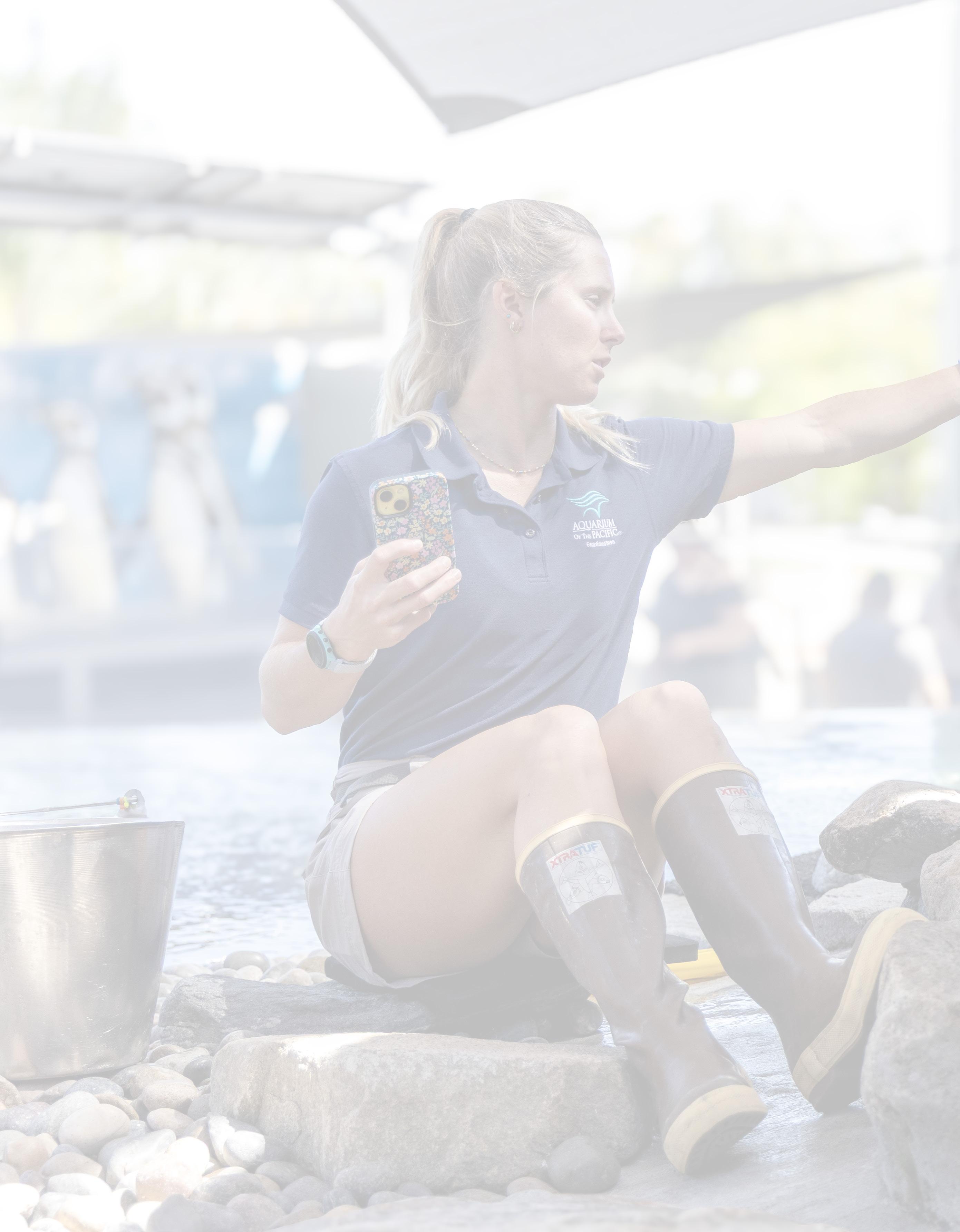
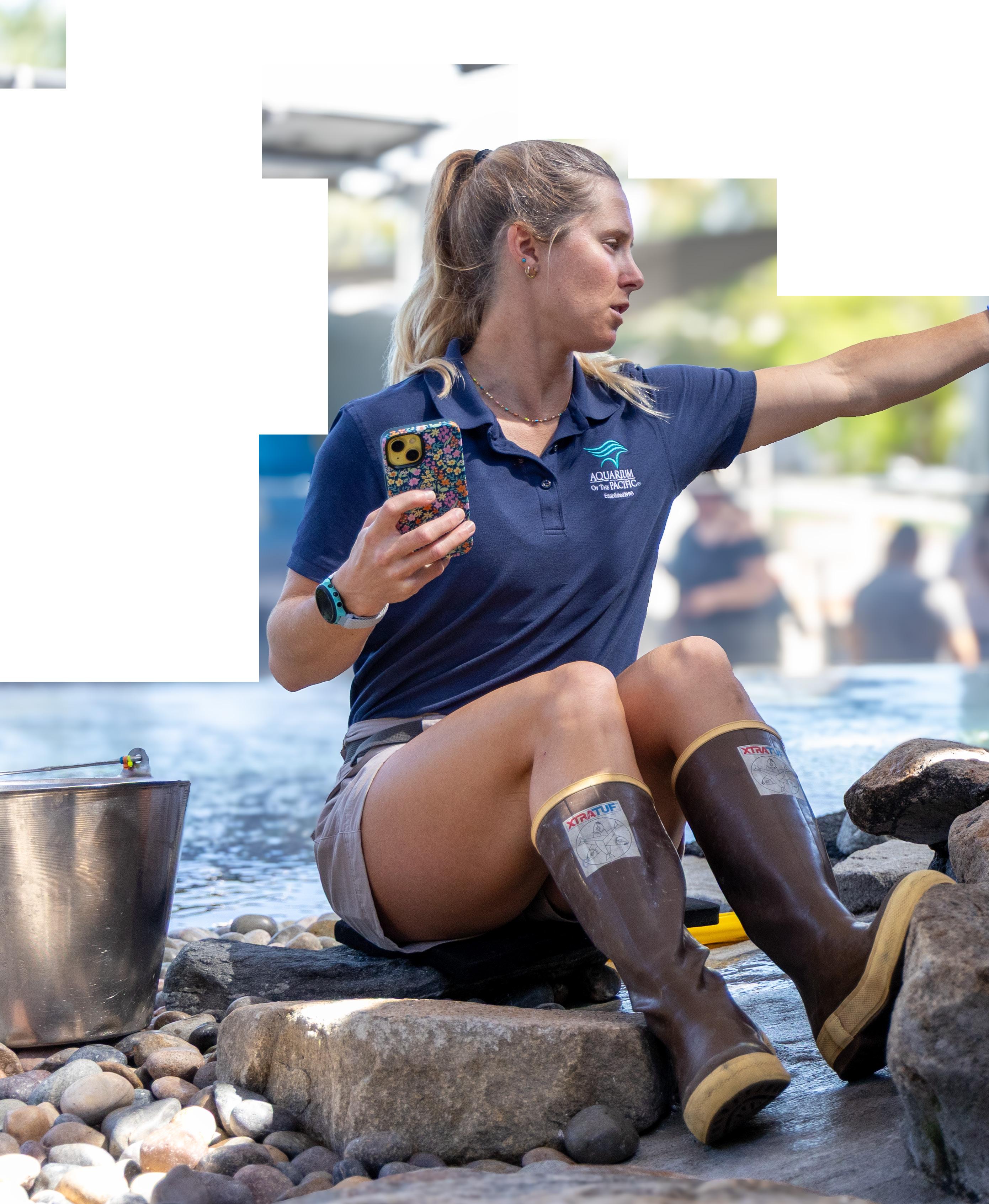
of a lock that I have to check or if I have to pick you up, are you going to injure me,” she said.
She also enjoyed their personalities.
“I didn’t think that they were going to be so, so different from individual to individual within a species or from species to species. They are so different,” she said.
She also enjoyed learning what they found interesting and how they wanted to spend their time.
Outside of work, Wilbanks herself has many interests. As a hummingbird goes flower to flower, she goes hobby to hobby, she said.
Baking bread and pastries, drawing, crocheting, rock climbing, Pilates, yoga and volleyball are among her growing list of activities.
She also does photography and watercolors, with birds being the often subject and hopes to exhibit her artwork in a gallery.
Birding or birdwatching is another pastime of hers. She warns it’s addicting, like “adult Pokémon.”
“I just started noticing them more in my world, environment and then now it’s just an obsession,” she said. “I’m always looking for birds and trying to identify them.”
So far, she’s seen 230 birds over her life, keeping track through the Merlin Bird ID app by the Cornell University Lab of Ornithology.
Katrina Wilbanks feeds Magellanic penguins their capelin and herring dinner starting at 2:30 p.m. at the Aquarium of the Pacific in Long Beach. She also monitors their behaviors, taking notes on her phone.
“[Birding] just had a huge spike in popularity around 2020, and now it’s like it just exploded in popularity, especially with a lot of young people,”
Frank Izaguirre, marketing and
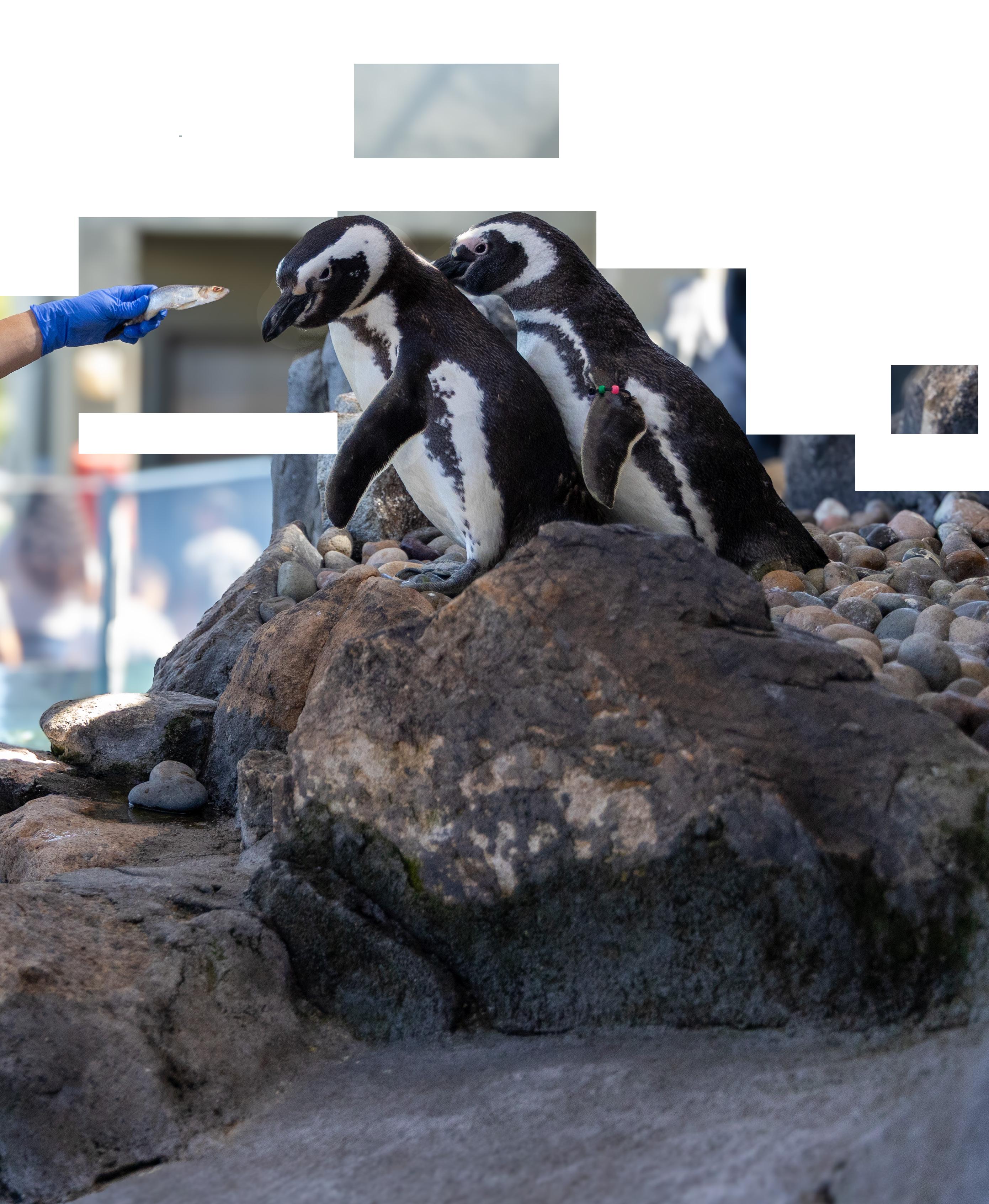
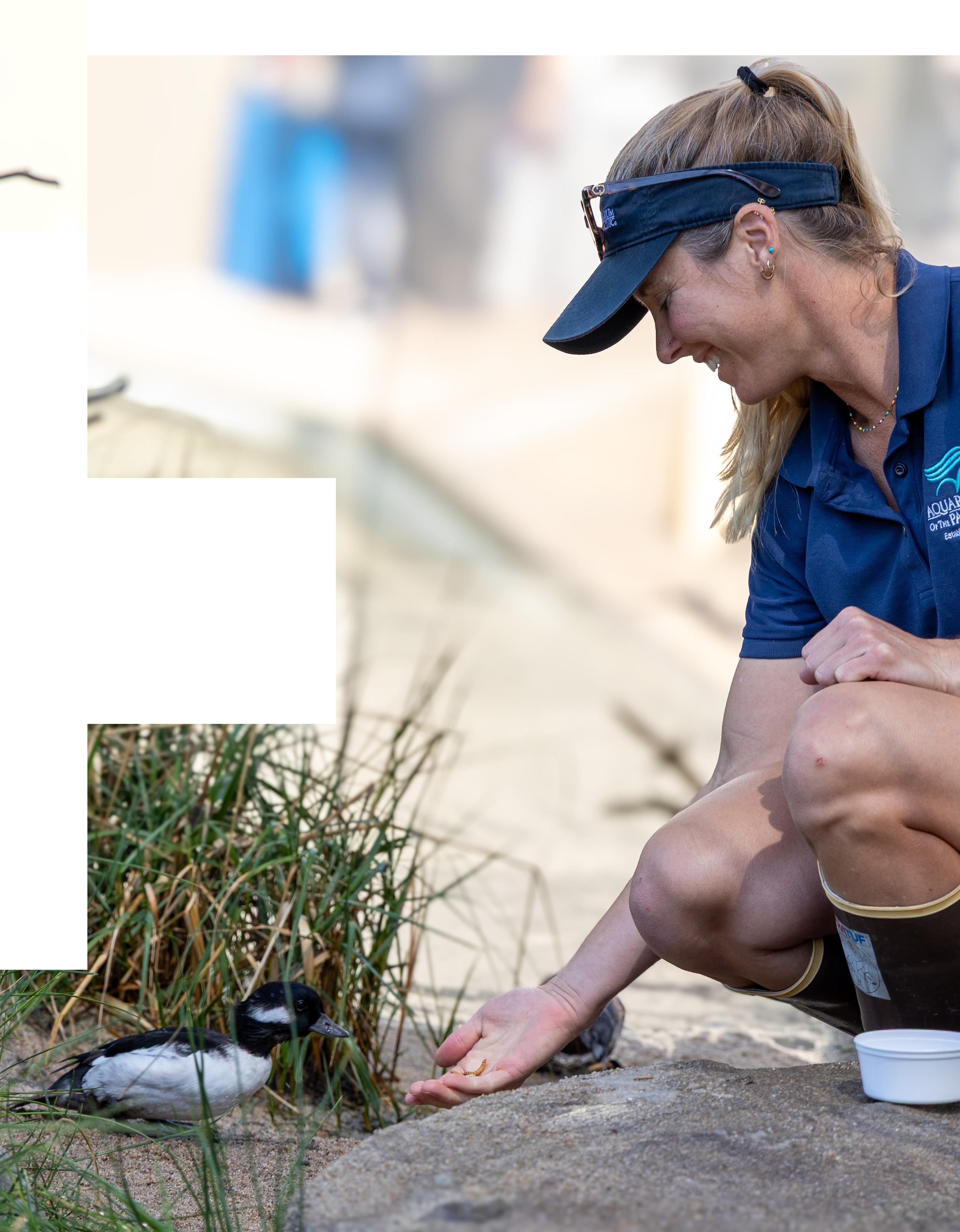
communications manager for the American Birding Association, said.
While avians in exhibits don’t count for birders, zoos and parks including the Aquarium of the Pacific raise awareness and educate visitors about different species.
The aquarium’s animals are often rescued — including Lyra, whose permanent foot damage prevents her from hunting prey in the wild — when they won’t survive if released.
The Aquarium of the Pacific was re-accredited in March by the Maryland-based Association of Zoos and Aquariums, which certifies facilities upholding high animal welfare standards.
Only about 10% of the zoos and aquariums in the United States receive AZA accreditation.
AZA President Dan Ashe said members describe the accreditation process, which occurs at least every five years, as “exhaustive.”
“It represents the facilities that are really at the top of their game. It’s like the NBA or the NFL of the zoological world. A facility like the Aquarium of the Pacific represents the very, very best,” Ashe said.
The aquarium partners with the AZA’s Species Survival Plan for the healthy breeding of Magellanic penguins under human care.
In the wild, the internationally near-threatened penguins face difficulties breeding and sourcing food — challenges linked to climate change. Four rescues from Brazil make up the aquarium’s colony of 16 penguins, which were added in 2012. An oasis for animals and people
After feeding the penguins, Wilbanks hums through the building, set on a six-acre site.
Outdoors, Wilbanks checks on Batman the yellow-crowned night heron, living in the Wetlands exhibit
among daisies and rosemary she planted.
“We really try to make it as naturalistic as possible,” Wilbanks, one of the aquarium’s self-described “plant ladies,” said. “We try to get plants that were native to the area that they [the animals] are found.”
Batman perches so quietly in his habitat, located across from a gift store with plush animals, most visitors question whether he’s real or a toy. He lives right across from the Lorikeet Forest, a large, mesh-enclosed aviary. With the sand and sky
Wilbanks loves her “stolen moments” with the rainbow lorikeets.
But her favorite exhibit, “hands down,” is the Shorebird Sanctuary, a multi-species space featuring three species of fish and several birds.
The land-and-sea style exhibit’s tide, which sparkles with iridescence in the sunlight, fluctuates daily.
“Being in there — if you didn’t see the windows, didn’t see the mesh — you feel like you could be out in the wild. It’s just so serene and peaceful, and there’s also birds,” Wilbanks said. “I could get lost in there.”
Like her many feathered friends, her near-and-far career journey resembles a migratory pattern of her own making.
“Job-wise, I don’t really know what they have in store for me at work,” Wilbanks said. “I’m just there along for the ride.”
Serene scenery: Aviculturist
Katrina Wilbanks feeds Luanne, a senior bufflehead duck, in the Shorebird Sanctuary at the Aquarium of the Pacific in Long Beach.
These 5 South Bay businesses are serving up frozen and sweet treats to help stay cool this summer
Story by Rosemarie Turay
With temperatures on the rise, the craving for something cold and sweet follows closely behind. From stacked sorbet creations to churro sundaes and frozen yogurt, these five South Bay spots turn simple desserts into summer must-haves with trending, delightful flavors and many creative combinations.
1. Frostbites Frozen Delights
A layered sorbet cream featuring taro and salted caramel sorbet with a chocolate custard base, topped with vanilla custard and mango and strawberry lemonade sorbet, is served at Frostbites Frozen Delights in Torrance. Hours: Sunday through Thursday from noon to 9:30 p.m. and Friday and Saturday from noon to 10 p.m. Address: 21641 S. Western Ave., Unit B, Torrance, 90501.
2. Rolling Zone Creamery
A cookie butter-rolled ice cream topped with whipped cream, rainbow jelly, and a toasted marshmallow is prepared at Rolling Zone Creamery in Lawndale. Hours: Monday through Friday from 9 a.m. to 11 p.m., Saturday from noon to 11 p.m. and Sunday from noon to 10 p.m. Address: 15732 Hawthorne Blvd., Lawndale, 90260.
3. Manhattan Beach Creamery
Scoops of Cookie Monster and cookies and cream ice cream are served in a waffle bowl at Manhattan Beach Creamery. The shop offers a mix of classic and trendy desserts near the Manhattan Beach shoreline. Hours: Sunday through Thursday from 10 a.m. to 9 p.m., Friday and Saturday from 10 a.m. to 10 p.m. Address: 1120 Manhattan Ave., Manhattan Beach, 90266.
4. Menchie’s Frozen Yogurt
Banana pudding frozen yogurt with Nilla wafers and assorted toppings is served at Menchie’s Frozen Yogurt in Redondo Beach. The self-serve shop allows customers to customize their desserts with a variety of toppings. The shop offers a casual, customizable dessert experience. Hours: daily from 11 a.m. to 9 p.m. Address: 2515 Artesia Blvd., Ste. E, Redondo Beach, 90278.
5. Azucanela
A churro sundae topped with vanilla ice cream, caramel drizzle, chocolate and pecans is served at Azucanela in Hawthorne. The dessert pairs warm churros with cold ice cream for a contrast in texture and temperature. Hours: Monday through Wednesday from 8 a.m. to 9 p.m., Thursday and Friday from 8 a.m. to 10 p.m., Saturday and Sunday from 9:30 a.m. to 10 p.m. Address: 13303 S. Inglewood Ave., Hawthorne, 90250.




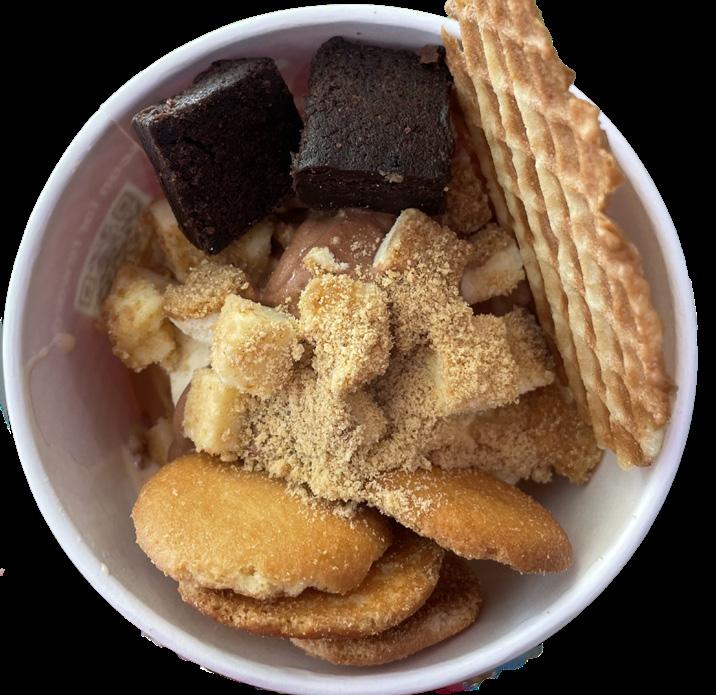


Story by Jennifer Figueroa
Growing up, I never saw myself on the big screen. Not in television, movies or anywhere in the media.
Anytime my people were visible, we were diminished into racist jokes and stereotypes like gardeners or characters with exaggerated accents like Sofia Vergara.
We were depicted as labor workers — never doctors, lawyers or scientists. Hispanic people are the largest racial minority in the U.S., making up 19.5% of the population according to the U.S. Census Bureau, but they never seem to have the media representation as expected.
Because of the ignorance portrayed on television, many Latinos were constantly grouped into the same majority: “Mexican.”
Being from Los Angeles, I always heard, “Where are you from?” and “El Salvador — where is that?”
I always felt as if my culture wasn’t as important to others as it was to me. My El Salvadoran identity was always being erased.
My ethnicity will always be important to me. Not only is it a part of my life, but it’s part of my family’s as well. I didn’t enjoy feeling like my family and customs were being erased.
When I was in primary and secondary school, many of my classmates would make fun of the way I spoke Spanish.
I had a different dialect from theirs.
I sounded “too Salvadoran.”
Some would say it was too ghetto or that I sounded uneducated.
Eventually, I just stopped talking Spanish at school, especially to my non-Central American friends.
My Central American friends, however, were the only ones who understood my Spanish and knew how it felt to constantly be made fun of for their culture.
I spent a lot of time irritated that some of my classmates couldn’t understand the thought of different Latino cultures existing, but as I got older, I just learned to let it go.
I was 14 when I experienced racism. My brother and I used to take the bus to school. He bumped into an older woman by accident.
Following his apology to the woman, she then went on to call us “dirty Mexicans’’ and “wetbacks.”
She continued to yell at us for 15 minutes straight on a full bus.
Taking the bus to school was normal for me, but being called slurs wasn’t.
I wasn’t ignorant. I knew that there were people who didn’t like us.
“ With the thought of so much negativity around me, I started having second thoughts about how successful I could become.”
Living in South L.A., I always thought we minorities stuck together, since people of color make up at least 56% of the area, according to 2020 U.S. Census Bureau data.
So to be discriminated against by another minority in the neighborhood I grew up in was an odd experience. Many emotions passed me after I had realized what had happened.
Once again, I had been grouped into the Mexican majority. But that’s not what had bothered me the most during the encounter.
Being called degrading words is what disappointed me the most. I grew to wonder how people can be so prejudiced.
Never once growing up did I think to discriminate against others, so why would others discriminate against me?
With the thought of so much negativity around me, I started having second thoughts about how successful I could become.
Ethnic minorities were historically excluded in powerful media industry positions and their voices absent in mainstream content, according to 2015 research by Riva Tukachinsky, a
professor at Chapman University in Orange, Calif.
Nothing was uplifting me but myself. The law didn’t defend me, nor the media, nor society.
Even so, I began to realize Latino success was everywhere, and that I just wasn’t looking in the right places.
Politicians, artists, actors, and more are proving that Latinos can be successful in everything.
Role models including U.S. representative Alexandria OcasioCortez have impacted the Latino community greatly. She’s a reminder that we can achieve anything.
Musical artists such as Bad Bunny and Kali Uchis also began to showcase their roots more often.
They influenced many Latinos to be proud of themselves and their customs. The messages in their music made me comfortable enough to embrace my roots again.
The recent Super Bowl LX halftime show might’ve been a culture shock to many, but to Latinos like me, it finally felt as if we were seen and represented the right way.

We were seen successfully.
With all the walls meant to keep us out, Latinos continued to overcome those borders and show that we can also be part of something special.
After seeing their impact, I’ve become more driven to be successful as well, knowing one day I’ll join the rising 20.8% of Latinos who received a degree, according to the Postsecondary National Policy Institute.
What has driven me more than to be successful for my people is to be successful for my family.
My biggest supporters through all my endless struggles are the same people I hope to one day give back to, and one day do even more for than they’ve done for me.
For them, I hope to show them the Latino excellence I continue to see.
• Latinos make up less than 10% of the lead roles in the entertainment industry.
• Criticisim when speaking Spanish in public is one of the most common ways Latinos face rasicm in the United States.
• Bad Bunny’s halftime show averaged 128.2 million viewers, making it the fouth most-watched halftime show in Super Bowl history.
Sources: Latino Donor Collaborative, New Hampshire Public Radio, ESPN
Story by Savannah Anderson
There were several track and football athletes on the Murdock Stadium field that gloomy afternoon, but most eyes were on flag football player No. 5, Cydney-Elise Koné.
The camera was, too.
The pale sunlight crept through her curly brown hair when she caught the football. It was like she was floating through the air, athletic limbs balanced on an invisible beam, a graceful form she picked up from 15 years as a gymnast.
Right below the mole on her face was a charismatic grin. Her eyes were focused, honing in on the sky. Landing neatly, she opened her chest to the camera, sporting her new flag football uniform, laughing lightly.
“I’m not used to these poses,” Koné said.
Koné, 28, graduated from
Sacramento State University with a degree in criminal justice in 2021. Her road to El Camino, with a pursuit in French to sharpen her skills, began serendipitously. It’s the same road that led her to El Camino’s first flag football team.
For the past year and a half, Koné has dedicated her time to training in flag football, a sport she’s new to, but has always been passionate about.
Her father played football, her uncle played and coached, and her grandfather, D. Richard Walker, coached for the Steelers and Ohio State University.
“They didn’t have flag football when I was growing up, so now that there’s an opportunity for it, I’m excited to be a part [of it],” Koné said. “Plus, I have hopes of making the national team.”
In the fall of 2023, the International Olympic Committee approved flag football for its Olympic
debut at LA28, an event and team that Koné is training to be a part of. Flag football is a sport also growing on high school and college campuses across the country. NFL Flag, the largest youth flag football league in the country, reports that the sport has grown by 38% since 2015 in young athletes from the ages of 6-12.
The National Federation of State High School Associations reports that, within the past five to seven years, the sport has seen growth across the country. California is one of nine states to have sanctioned the sport for girls, and 17 other states are in different stages of pilot programs.
California community colleges, including Cypress College, Irvine Valley College and Saddleback College, have added the sport to their campuses since spring 2025. El Camino recruited for the club sport around October, began playing at the
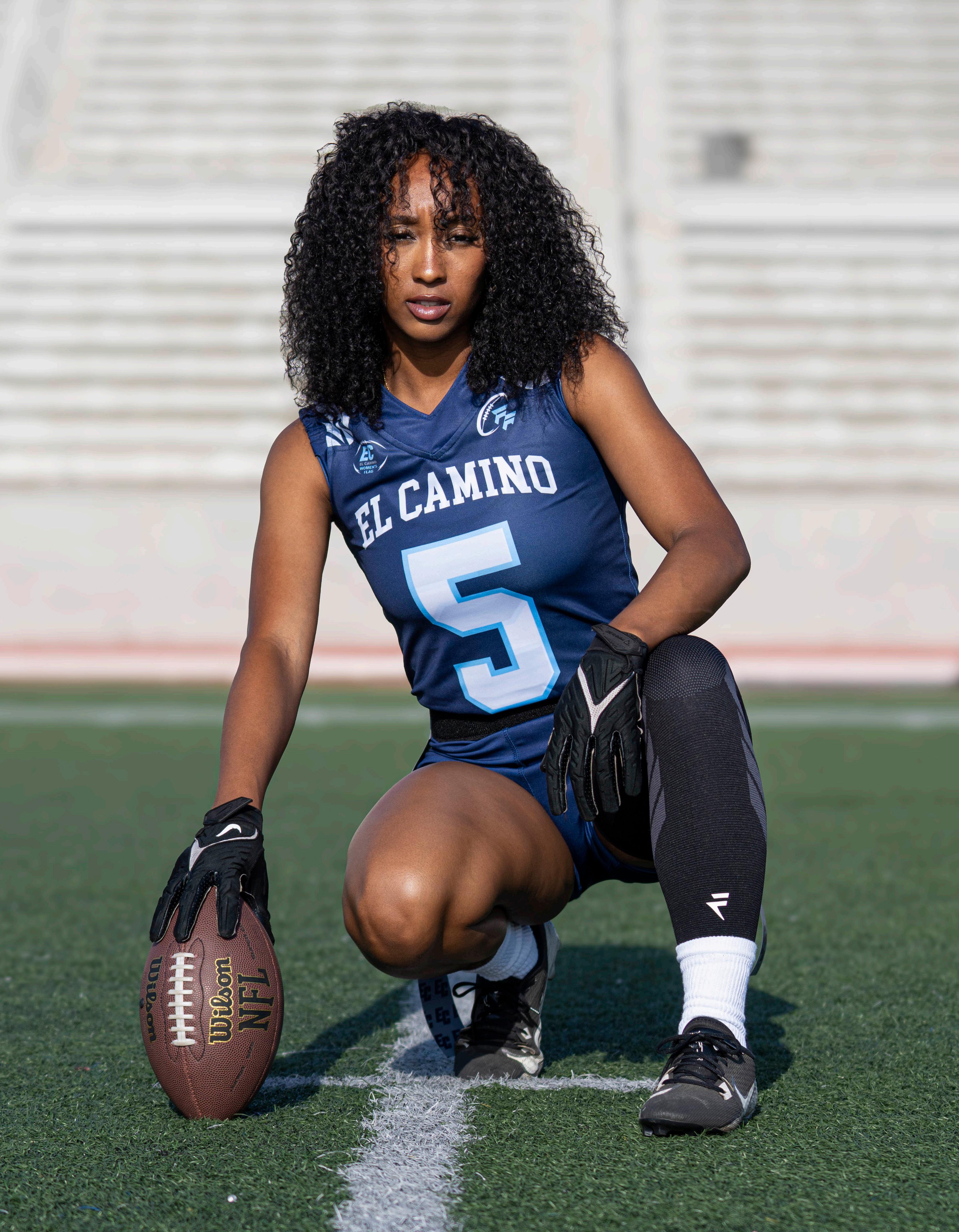
El Camino College’s flag football player Cydney-Elise
on Wednesday, March 25.
start of the spring semester, and the team hopes to become an official El Camino sport by 2027.
This sport is making history, a history that El Camino and Koné are now a part of. The team’s recruitment began as soon as physical education and kinesiology instructor John Hall was hired in October. Hall had two months to get a team together, a recruitment process that was far from traditional.
Koné and Hall crossed paths one day, and it felt like fate, Hall said.
Koné was on the athletics field in February, going through drills with a friend, when she caught his eye.
The team was already a couple of games into their first season, and on this day, Hall was packing up equipment in their van, getting ready for another game. He saw Koné work her drills, and it stopped him in his tracks. He knew he didn’t recognize her as an athlete within El Camino’s athletics department, so he had to approach her.
“It felt kind of like fate, you know?” Hall said. “She was put there for a reason. We were meant to interact.”
After exchanging contacts, Koné joined the team for workouts and practices, establishing herself as a new member. She was quickly vetted by assistant coach Agion Quinney, otherwise known as Coach AJ.
Quinney recognized Koné as one of the players from LA Legends, a premier women’s and girls’ sports organization within the Women’s National Flag Football League, based in Los Angeles, which is focused on leadership development, discipline and teamwork that she coaches for.
Other members of the team were recruited through outreach

methods including interest forms, skill showcase events and social media initiatives. Hall was focused on targeting enthusiastic, open-minded individuals committed to learning and joining
Art and architecture major Dechelle Brackett, 20, known as “Dynamite” by her team, was one of the first students to show interest. Brackett believes her dedication and leadership skills landed her the captain position. She leads her team with motivation, highlighting where the team has improved and pushing them from potential to results.
The team is already making an impact on campus. Athletics Department administrative assistant Linda Olsen is impressed by how the team is coming together, given that some players have little to no football experience. She sees these young women as one big family, pushing for improvement and playing with great sportsmanship.
“They’re all one unit,” Olsen said. “When they lose a game, they come in to get snacks from me, and they say, ‘That’s OK, Miss Linda. We’re gonna get them next time.’
Hall and Quinney agree that Koné brings a unique experience and perspective as someone who’s trained as a college athlete and is a
“She’s the prototype of the type of athlete I want to coach,” Quinney said. “She doesn’t talk back, she doesn’t complain, she gives full effort.”
Koné’s ambition and discipline was instilled in her from a young age through sports and family. Her mother, Tia Spells, trained in several sports, including gymnastics, cheerleading and wrestling. She is
El Camino College’s Cydney-Elise Koné goes to catch the ball at Murdock Stadium on Wednesday, March 25. Photo by

She’s the prototype of the type of athlete I want to coach. She doesn’t talk back, she doesn’t complain, she gives full effort.”
also a black belt in kung fu and wushu. Both her parents are also personal trainers, so hard work, fitness, and training for life, not just sport, is the expectation.
She and her siblings, older sister Raven and younger brother Cheik, were born and raised in Georgia. Her mother’s side of the family resides in South Mississippi, Texas and Atlanta, while her dad’s side of the family is in Senegal and Canada.
When Koné moved to California in 2005 at the age of 7, she had her grandparents, but found a lot of community through sports and other organizations.
Now living in Inglewood, Koné juggles a hectic daily schedule. Day by day, her schedule changes with a mix of business for her and her mother’s nonprofit, flag football practices and training, rehearsals for musicals, and auditions for films.
As a kid, when Koné first moved to L.A., she began acting and modeling before gymnastics took over. She got back into entertainment around 2022, and at the beginning of the year, Koné signed with O Models. They’re a modeling agency that represents talent across different platforms of fashion, beauty and commercial print and represents Koné in her acting and modeling career.
Koné’s acting history is made up of a range of roles in commercials, different shows including “The Family Business” and “Skeletons,” which is set to come out this summer. She recently finished production for the musical “Born 2 Reign”, a modern retelling of the story of King David, in her role as
Right: El Camino College’s Cydney-Elise Koné jumps for the ball at Murdock Stadium on Wednesday, March 25.
Photo by Ryan Hirabayashi
Michal, David’s first wife. The musical took place at The Miracle Theater in Inglewood.
Off the field and on the stage, Koné’s presence is commanding, and during one rehearsal for the musical, it was felt.
The sun was setting on a slow evening in late April. The city was settling down, but in a small white church in the Los Angeles area, music was alive. The cast of “Born 2 Reign” was inside on the second floor, running through scenes from their performance that would take place in a week.
Koné and her mother arrived an hour or so into rehearsal, clacking up the stairs to the second floor in shiny black heels and sleek suits. They had come from a business conference in West Hollywood, but were quick to slip into their practice clothes, their heads switching gears like an automatic response.
There was a deep focus in Koné’s eyes, as sharp as they looked on the field. Her movements during the first scene she rehearsed were poetic; each rise and fall of her arms was a stanza, each sway of her hips was a rhyme. She fell in place like a soldier in line, steady and agile.

“ I would tell her, ‘You came to conquer and you cannot be beat, and she would live in it.”
-Tia Spells
Cydney Koné’s mother Founder, 4ever4kids Foundation
uproot children from racism.
“You see what each person or race contributed,” Spells said. “That eliminated racism ‘cause you can’t say that one race did everything when all these different people did all these things.”
“She’s been a star for as long as she’s been born,” Spells said. “She literally lives and embodies and fulfills everything that she wants to do, and that is so inspiring to me.”
Koné’s passion for the arts runs in her family. Her grandmother, CCH Pounder, has played in roles including Mo’at in James Cameron’s “Avatar” and Dr. Loretta Wade in “NCIS: New Orleans.”
Outside of rehearsals, one of Koné’s biggest commitments is to her community. She honors that through the shared nonprofit she built with her mother.
Koné and Spell’s 4ever4kids Foundation focuses on service toward opportunity-challenged youth, senior citizens and those experiencing homelessness. They offer an Integrity in Action 12week life skills youth program and their efforts are executed through resource distribution, community outreach and social events. They just celebrated their first year as a foundation in January.
Along with these services, Spells is a children’s book author, and her stories explore underrepresented communities with the mission to

Spells wanted to instill these values in her own children, insisting that they know they come from greatness. She told them that they are kings and queens and repeated their family motto every chance she got – “I came to conquer, and I cannot be beat.”
“I raised them, and I said, in life, you can love whoever you want, but you’ve got to love yourself first,” Spells said. “So I’m a huge advocate of Black history, knowing that first and then learning about everyone else.”
Associate professor of journalism and sociology at the University of Southern California, Ben Carrington, understands what it takes to be an athlete, especially one who is Black and female.
Within the field of sports, Black people are often seen as physically superior but intellectually inferior, making it harder for them to fit into leadership roles, he said.
For Black women, it can be a double burden when their sexuality and gender are called into question, Carrington said.
Carrington also acknowledges what kind of mindset it takes to be a top athlete, a mindset that is reflected in Koné’s actions. Top athletes overcome adversity and failure, and are at a certain level of commitment and dedication, Carrington said.
“I think the key characteristics, undoubtedly, you know, [are] a strong sense of self-identity, perseverance, and determination,” Carrington said. “Actually, most sports, it’s about failure, about not winning, about coming second, but then still going the next day.”
As a little girl, Koné performed with nerves of steel, Spells said. In gymnastics, she progressed incredibly

fast, and during her competitions, she owned the spotlight.
“I would tell her, ‘You came to conquer, and you cannot be beat, and she would live in it,” Spells said.
At the age of 8, Koné was up on a beam, telling her mom to stand close and watch her, an unnerving thing for a gymnast’s parent.
Her bravery was uncanny, and her strength was like magic seeping out of her small body and pouring out into the world around her. Spells said Koné would execute each routine and kill it.
She gives a lot of credit to gymnastics for shaping the mindset she carries today. By the age of 8, she was training 30 hours a week in the sport, learning time management, discipline and figuring out the best ways to succeed as an athlete. She spent three years at Sacramento State competing as a Division 1 athlete with her team. Despite it not being a contact
sport, Koné said you take on a lot of injuries and a heavy mental load while maintaining a high GPA.
“Gymnastics is a whole other beast on its own, I mean, it’s [one of the] top three most dangerous sports in the world,” Koné said. “So the mental capacity and tenacity that you build in that sport is just completely different than anything else, but I’m grateful.”
With so much on her plate, rest and recovery have become a method of grounding. Koné is no stranger to stress and burnout and at some point, it consumed her.
During her time at Sacramento State University, Koné studied engineering, even being offered yearly summer jobs with Raytheon. However, strict requirements from the NCAA made her change courses. While she was on track academically, 40% of her major needed to be done to compete, so the ultimatum was that she needed to
change her major or be ineligible to compete on the gymnastics team.
With so much of her time and energy being given to gymnastics, she made the decision to change her major to criminal justice, and a year later, she blew out her shoulder, ending her gymnastics career.
Her medical retirement from the team was crushing and watching her team compete without her sent her into a dark place.
She was faced with an identity crisis she didn’t quite know how to navigate, so she left campus and her team to study abroad at Oxford Brookes University in the United Kingdom. Her new venture was cut short when COVID-19 hit, and she had to go back to the states.
In 2022, Koné got into a bad car accident that left her with a broken back and the very wakeup call she needed to make a change.
She felt her next fit of burnout may have been something she

“ No matter what you do, no matter who you are, no matter what responsibilities you have, your number one priority is you first ... Everything else has to come after because it’s an extension of you.”
-Cydney-Elise
French major, performer, former Division 1 gymnast
wouldn’t have recovered from.
“I just had to sit with myself and deal with my problems,” Koné said. “So I did a lot of unpacking, soul searching, therapy, all the things. And coming out of that, I vowed that I would, you know, never lose myself again.”
Through reconnecting with nature, writing and self-care, Koné worked endlessly to reclaim who she was, learn who she was without her sport
and prioritize her health.
“Whenever I start feeling like I’m floating, I’m like, oh, I need to get grounded,” Koné said. “The float starts to happen, and then eventually your feet can’t touch the ground at all.”
Despite the trials and tribulations she’s faced, she’s grateful for the wisdom and deep understanding of life she now carries because of it. Currently, her ultimate goal is
the national flag football team and to compete with them in the 2028 Olympics. Her place on the team at El Camino is helping her achieve that through consistent opportunities to practice and play.
Just last year, Koné appeared in a campaign commercial produced by NFL Flag 50, promoting the growth of women in a male-dominated sport. During this opportunity, Koné was surrounded by national team members from a variety of countries, including Germany, France, Mexico, Brazil, Australia, and the U.S.
Koné had been working hard to get to that point and playing with the team was the exact encouragement she needed to continue her training. She never doubted her place on the field, but starting the sport only a year and a half ago from ground zero, when others have been training for years, set her further back.
“Playing with them and kind of seeing these are the best representing their countries at the game, and I wasn’t far behind them,” Koné said. “I feel that I do have the ability, and with the right training and the right opportunity, I can succeed at that.”

Left: El Camino College’s Cydney-Elise Koné motivates the team to get a stop on defense and score in their game against East LA College at Murdock Stadium on Thursday, April 7. Photo by Ryan Hirabayashi
Right: Koné goes up for the onehanded catch at Murdock Stadium on Wednesday, March 25. Photo by Ryan Hirabayashi

Story by Osvin Suazo
Students and employees trying to save cash and gas should consider spending their weekends traveling by train. Using a mix of Metrolink and Amtrak’s Pacific Surfliner, students can reach historic missions and world-class theme parks in under three hours.
Jump on a ride through these top five day trips accessible by rail from the Los Angeles area.
1
Santa Barbara Known as the “American Riviera,” Santa Barbara is the crown jewel of the Pacific Surfliner route. The station is located two blocks from the beach and the foot of State Street. The three-hour ride from downtown Los Angeles offers some of the most dramatic ocean views in the state.
2
Oceanside At the southern terminus of the Metrolink Orange County Line, Oceanside offers a classic, laidback beach experience. The station is a short walk from the Oceanside Pier, one of the longest wooden piers on the West Coast. Students can visit the California Surf Museum or the Oceanside Museum of Art, both located within three blocks of the tracks.
4
Anaheim The Anaheim Regional Transportation Intermodal Center, known as ARTIC, is an architectural landmark in itself. Located steps from Angel Stadium and the Honda Center, it is an ideal destination for sports fans. For those heading to the “Happiest Place on Earth,” a quick shuttle ride from the station drops passengers at the gates of the Disneyland Resort.
5
Scenic routes: An afternoon Metrolink train travels from Oceanside to Los Angeles at Track One of Santa Fe Springs’ Metrolink Station. Photo by Osvin Suazo
3
Santa Clarita For a change of scenery, the Metrolink Antelope Valley Line heads north into the Santa Clarita Valley. For thrill-seekers, a short bus connection from the Santa Clarita Station leads to Six Flags Magic Mountain.
San Juan Capistrano This city offers perhaps the most seamless “train-to-tourism” transition in California. The platform drops passengers directly into the Los Rios Historic District, the oldest continually occupied neighborhood in the state Visitors can tour Mission San Juan Capistrano, founded in 1776, or order something to eat at one of the many cafes that line the tracks.


Skip the 17-hour flight and keep the authentic, international flavor
Story by Ananya Iamcharoen
Combining sweet, sour, salty and spicy flavors, these five spots around the South Bay highlight Thai culture from the country’s ambiance to its popular dishes. Thai food is the third most common Asian cuisine in the U.S., and Southern California hosts the largest Thai population outside of Thailand, according to Pew Research and Neilsberg data.
1
A vibrant, shredded green papaya salad with orange carrots for $13.95 is a refreshing plate. Every bite, featuring peanuts, has a satisfying crunch. A pinch of lemon boosts the sour flavor profile even more. Address: 24631 Crenshaw Blvd., Ste. J, Torrance, 90505.
Hours: Monday–Sunday, 11 a.m. to 8:30 p.m. Closed Tuesdays.
3
SWEET RICE
Right next door to Bowl Thai is Sweet Rice, which offers Thai snacks and beverages at the front cashier. Coconut sauce atop sticky rice complements the comforting chew of soft yellow mango slices comprising a dessert for $12.78. After a spoonful, this menu item has a creamy, sweet taste that can induce happiness.
Address: 1630 W. Redondo Beach Blvd. Ste. 4, Gardena, 90247.
Hours: Tuesday–Sunday, 11 a.m. to 9 p.m.
2
This self-service restaurant exhibits a clean, wide space and lots of seating. For one dish, both onion and green onion act like the cherry on top of a rice pile with oyster soy sauce for $16.99. Address: 1630 W. Redondo Beach Blvd., Ste. 9, Gardena, 90247.
Hours: Tuesday–Sunday, 11 a.m. to 9 p.m.
4
Just one glance of the Tom Yum noodles can make the mouth drool. For $17, this dish has bean sprouts, ground pork and fish balls floating inside the bowl. Four types of condiments are provided to increase the spice level in each bowl. A drop of spice helps the Tom Yum build a tangy taste. Customers who often visit PCH order Tom Yum, Tom Kha and Pad see ew. Address: 2413 W. Pacific Coast Hwy., Ste. 102, Lomita, 90717.
Hours: Monday–Sunday, 11 a.m. to 3 p.m. and 5 p.m. to 9 p.m.
5 SARTORI THAI CUISINE
A Thai Tea Creme Brulee ($8.95) is a rare treat in the South Bay because of its long baking time. The first bite pairs a crunch with sweet custard tasting like Thai tea. Address: 1255 Sartori Ave., Torrance, 90501. Hours: Monday, Thursday and Sunday from 11 a.m. to 9 p.m.; Wednesday, Friday and Saturday from 11 a.m. to 9:30 p.m.

Story by Savannah Anderson
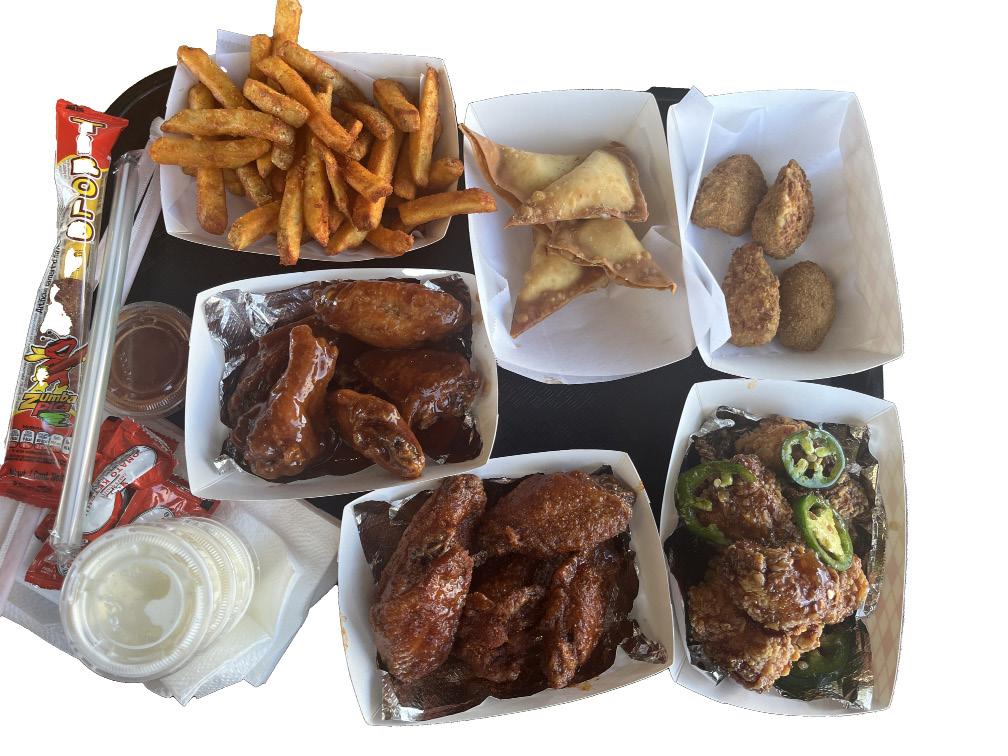
From Cajun fries to sweet potato pies, SoCal Wings in Hawthorne offers an extensive menu that all palates can enjoy. Only three miles away from El Camino College’s campus, this Asian-American fusion cuisine combines home style items with creative twists, always fresh and made to order.
Combos and wing flavors
Making your way down the menu? Try starting with a classic five-, 10-, or 15-piece wing combo, ranging from $13 to $27. Wet sauce flavors include Honey Garlic Sriracha, Spicy BBQ, and the sweet and spicy House Special, covered in a sweet Asian-inspired sauce and topped with sliced

Chicken skin is also an alternative, as a combo or a standalone.
You can pair those wings with any side of your choosing, including waffle fries, mozzarella sticks, macaroni and cheese and even fried zucchini. Their Cajun fries are seasoned to the heavens, crispy and perfect with their ranch. They’ve got this slight kick paired with great Cajun flavor. Or, go for their seasoned fries for a more classic wing pairing. Smoothies, slushies, refreshers, and teas
For drinks, they offer a variety of milk teas, refreshers and their SoCal signature smoothies and slushies. Their small 24-oz drinks are $5.99, while large 32-oz drinks are $7.99.

If you’re into something nostalgic, the Carnival Apple smoothie is perfect. Caramel cream and drizzle are added to a green apple base and blended with milk. It has the perfect pop of fruity freshness that feels like walking through a fair.
Or try the Chamango Slush, a mango slushy with chamoy, Tajin, and mango bits. The Wolly Rancher, a green apple, strawberry and watermelon slush with green apple jelly is another sweet choice. For the milk tea lovers, SoCal Wings offers Thai iced tea, green Thai tea and fusion Thai tea drinks.
You can customize drinks exactly how you like them. Toppings and mix-ins are an extra 75 cents and include crystal boba, mango, green apple, lychee or pineapple jelly, caramel cream and sea salt cream.
Before heading off, grab another dish to go. Maybe you’re feeling the crispy cheese wontons, the popcorn chicken served with a sweet chili sauce or even filling garlic noodles. Cobblers, cakes, pies, and puddings
Finish off with one of their many dessert options including carrot cake, peach cobbler, cheesecake and pecan pie ranging in price from $2.99 to $3.99. Their banana pudding, $3.50, comes chilled and has the perfect amount of sweetness. It’s layered
with Nilla Wafers, sliced bananas and a thick, smooth banana pudding.
At SoCal Wings, bodies are fed, but so is the atmosphere. Kathy Mao, cousin of owner Linda Arn, welcomes guests into the space with the kind of hospitality that feels more Southern than Western. Despite the busy nature of the business, she’s meticulous and warm with each order she prepares.
It’s the kind of service you can expect at SoCal Wings. Mao has been an employee for 10 years, ever since the start of the restaurant’s inception. Now, the family has spread the business to five locations across SoCal in Hawthorne, Carson, Long Beach, Fullerton and Westminster, their first location.
The best part of working at SoCal Wings is getting to work with family, Mao says. Most of the employees behind the scenes are blood relatives, while others are close family friends. Together, they cultivate a menu and atmosphere that is impossible for people to forget.
SoCal Wings
Address: 2851 W. 120th St., Hawthorne, 90250
Distance from El Camino College: 3.2 miles, or about a 10 minute drive
Hours: Every day, 11 a.m. to 10 p.m. Phone: 562-360-0009
El Camino saxophonists take on New Orleans in new, prestigious ensemble band
Story by Heather Austin
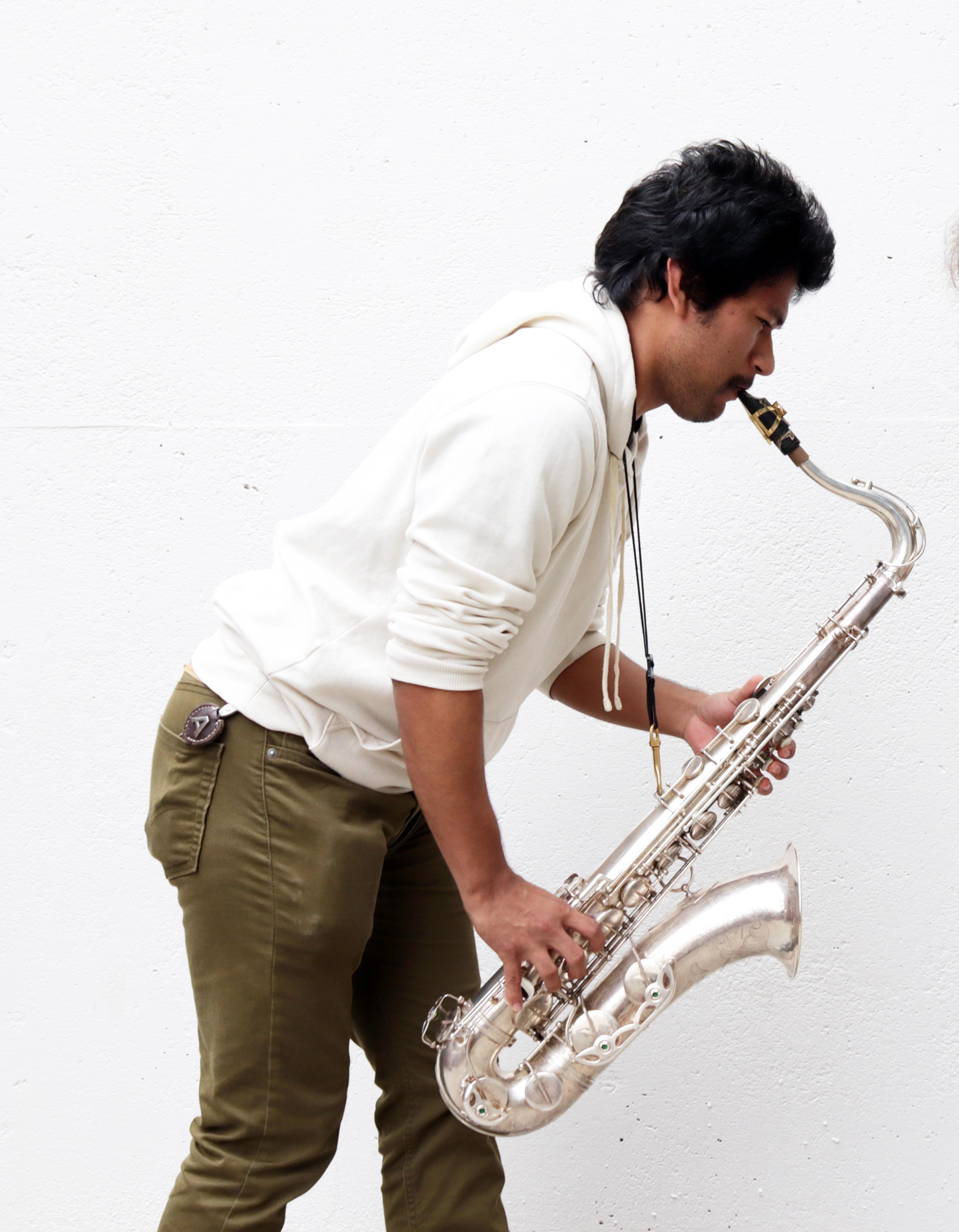




Commercial music major Alex Gonzales, 21, and music major Aidan Jennings, 21, play their saxophones. Photo illustration by Patrick Martinez and Nikki Yunker
Getting to The Big Easy was about as improvisational and spontaneous for El Camino College students
Alejandro “Alex” Gonzales, 20, and Aidan Jennings, 21, as jazz itself.
Along with several other El Camino students, commercial music major Gonzales applied to the Jazz Education Network’s Intercollegiate Community College Honors Jazz Ensemble — a highly competitive, new opportunity selecting jazz students from all over the U.S. — during the fall 2025 semester.
Gonzales, who plays the tenor saxophone, was announced as an alternate if another chosen student could not attend.
On Jan. 7 — the opening date of the four-day event — Gonzales got a phone call from his jazz professor, David Moyer, about a space on the ensemble opening up.
It was a miracle.
“It was just such a wonderful opportunity to be able to get called from your director,” Gonzales said. “I chose to go because I was, this is a very exciting moment for me.”
The only problem was Gonzales had to find a way to fly out same-day to New Orleans at his own expense.
Gonzales spoke to his parents, Benjamin and Maria Reed, about the opportunity and they were happy to supported him.
“I really felt like I was in some kind of movie,” Gonzales said. “When we landed as it was, I couldn’t believe like where am I.”
The JEN Conference goes to The Crescent City as its location every four years, Moyer said.

“When it’s in New Orleans, it’s kind of a big thing for the jazz community,” he said.
Gonzales had to study the sheet music in a few hours on the plane ride.
“It was really challenging music.
But I have to thank the program at El Camino for, building those skills for me and to be able to do that as
“ It was really challenging music. But I have to thank the program at El Camino for building those skills for me and to be able to do that as quick as possible.”
-Alejandro
“Alex” Gonzales Saxophonist and music major, 21 Alternate for the Jazz Education Network
Intercollegiate Community College Honors Jazz Ensemble
quick as possible,” he said.
After landing, he caught a Lyft to the Hyatt House New Orleans to drop off belongings at his room, paid for by JEN, and then a JEN organizer picked him up at the hotel.
The JEN jazz ensemble was already practicing that evening when he arrived that . With only a few hours of sight-reading under his belt, Gonzales joined the band to practice for a performance Saturday.
“The band I was playing with were spectacular musicians,” Gonzales said. “It was great for you to hear them and be able to be, be able to be a part of that.”
Other El Camino students selected as alternates for the JEN ensemble were bassist Max Hughes and baritone saxophonist Jacob Iverson, according to a press release. Aidan Jennings
While Gonzales had just a few hours to prepare, music major and saxophonist Aidan Jennings, 21, had nearly a month to study the music.
But he also had an unconventional journey to New Orleans.
When other ECC students were having winter break, Jennings was on tour between Christmas Day and Jan. 3. Then, he flew to The Big Easy shortly after.
Although Jennings had time to practice the JEN jazz ensemble’s selections, he had scheduled a tour along the West Coast from California to Oregon and Washington state with his screamo band, Me+You.
The band’s first show was in October 2022, and Jennings plays

with two of his childhood best friends, ECC undeclared major Nicholas Zavala, 21, and David Lestiri, 21.
Jennings’ varied background started with an introduction to jazz by his late grandfather, who died during the COVID-19 pandemic. His first music instructor was a private tutor who lived across the street from him, and he began playing jazz while at Redondo Union High School. His former high school music teacher, Raymundo Viscarra, now works as a part-time music professor at ECC.

Alejandro “Alex” Gonzales Gonzales had a different start.
He was raised on a mix of his mother’s and father’s music, with his father favoring Queen, Depeche Mode, Cindy Lauper, Madonna and Journey; and his mother, Maria, enjoying Michael Jackson, the Latin group Maná and Vicente Fernández — “the Michael Jackson of the Latin community,” Gonzales said.
Gonzales’ father, Benjamin, recommended Gonzales join the marching band at North High School because he was a tuba player in the marching band as a teen and made lifelong friends.
Gonzales entered music during the
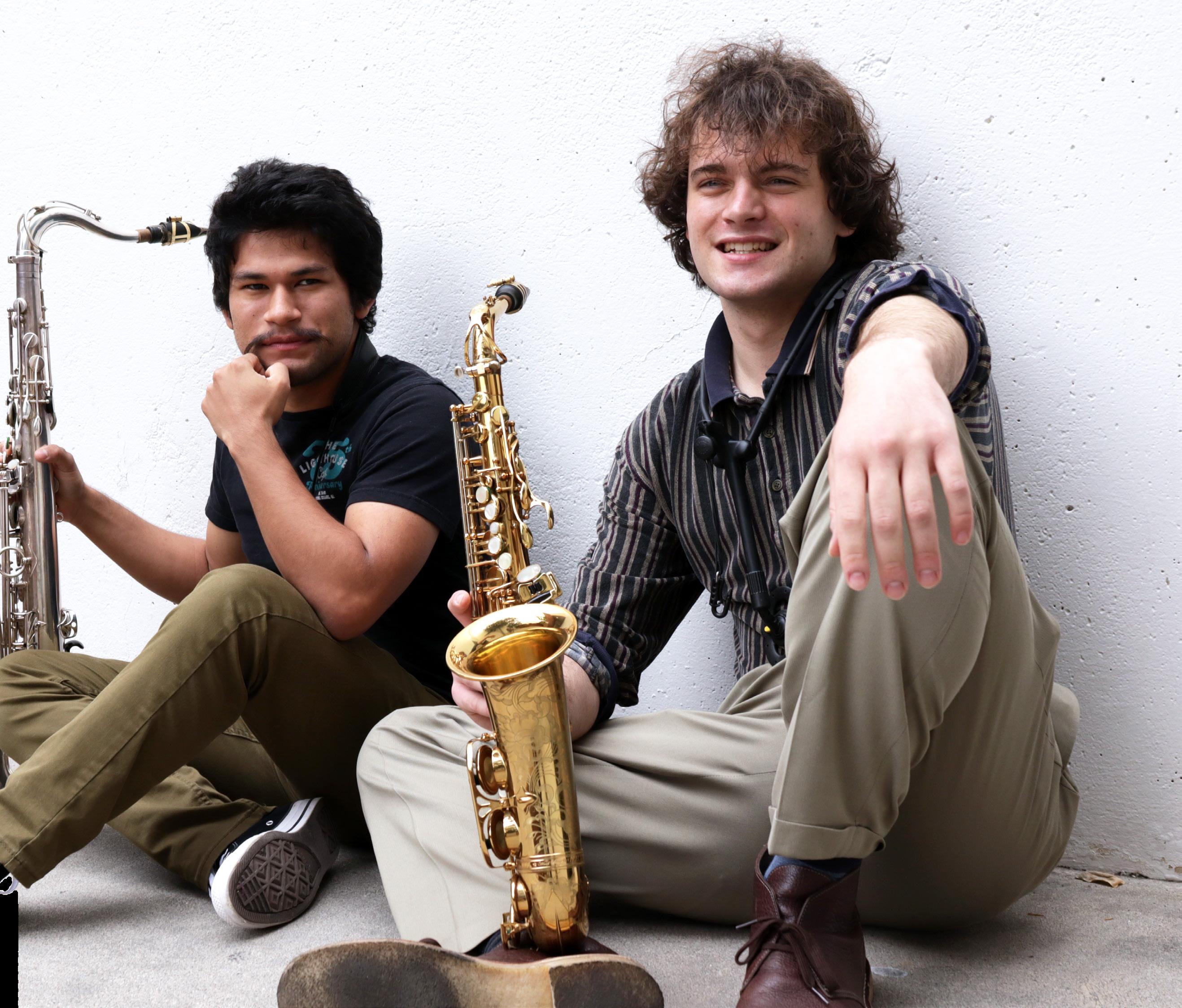
where he decided he needs to be, citing its “pretty big history in jazz,” community and atmosphere.
COVID-19 pandemic. He was in the marching band from 2020 to 2024, where he was introduced to jazz and found his passion for it.
“Alex got so excited about jazz, he was teaching us,” Maria said.
When the lockdowns happened, Gonzales said it was a very sad time for the band because they had to adapt to online learning.
Gonzales aspires to further his musical education beyond ECC at the Manhattan School of Music,
“A lot of notable players have graduated from there,” Gonzales said. “Just everything about it was like this is where I need to be.”
Jennings aspires to further his musical education at either California State University, Northridge, or CSU Long Beach, and become a music teacher.
He currently tutors five students from his former Redondo Beach schools in connection with the Long Beach Woodwinds music store.
While the JEN Conference was
Gonzales’s first chance to visit New Orleans, Jennings had traveled to New Orleans twice before during high school jazz band field trips.
Both Gonzales and Jennings appreciate a variety of musical genres but especially enjoy how improvisation makes jazz special, unlike the rigidity of other styles.
Jennings, who also enjoys learning history, said jazz is unique to the musician, as they will make the song sound different every time.
“And if you look back in human history, what is celebrated the most? The arts,” Jennings said. “The arts are a part of being human.”

Story by Maya Ochoa
As a little girl, I never put any thought toward my gender, nor did I understand its complexities.
If my brother had his Game Boy out, I would play with it.
If my sisters wanted to play out dramatic stories with our dolls, I was a happy participant. In my childish mind, I existed and that was enough for me.
However, one thing that was always on my mind was my weight.
I was a fat kid growing up.
One in five children in the U.S. has obesity, according to the Centers for Disease Control. I was an example of this statistic.
My weight was a topic among the adults in my family. I would often hear, “You need to go on a diet,” as a little girl. Because of this, it felt like all eyes were on me whenever I ate a plate of food. It was unnerving, like I couldn’t enjoy food without someone commenting on how fat I was or would get if I ate so much.
My weight rooted itself as my one true insecurity and it stuck to me like black tar.
A raging storm
When I was 9, school began to take a negative toll on me.
Classmates who I once viewed as friends were making fun of my weight. I felt isolated from my peers, and I no longer had any definitive friend group.
I was now just “the fat girl.”
From then on, my life at school
“ I often found myself staring at the mirror, wishing I looked like someone else — anyone else — as long as I didn’t have to look at my own face.”
would be very lonely. And, at the age of 14, my insecurity about my weight would also become entangled with my own gender.
In many Latino households, gender roles are apparent at a young age.
Women would do all the cooking and cleaning. My sisters and I were expected to help, but I rarely saw male relatives in our tiny squared kitchen.
For the men to do nothing much but flip a few pieces of meat on the grill seemed so unfair to me.
In fourth grade, I had learned about women’s rights and about our struggles, both past and present.
Although women have increased their presence in workforces once mostly dominated by men, women as a whole still find themselves in mostly lower-paying occupations, according to the Pew Research Center. I didn’t want to be brutalized for being a girl.
My preexisting hatred for my body grew, making me want to tear myself apart for it.
I often found myself staring at the mirror, wishing I looked like someone else — anyone else — as long as I didn’t have to look at my own face. I
felt like a distorted lump of flesh. And most of all, I didn’t want to be a girl anymore.
A temporary calm at sea
In middle school, around 2020, I heard the term “transgender” and learned that it meant someone who didn’t identify with the gender they were assigned at birth.
It made sense to me.
If I could become a boy, then maybe I would feel less insecure about my body. Maybe my self-loathing would disappear. So, I came out to my family as transgender when I was 15 and cut my hair. My family even helped me choose my new name: Arion.
I went with male pronouns, wore loose-fitting pants that didn’t emphasize my curves, and I didn’t shave.
For a time, I was happy. Being perceived as a boy and nothing else made me happy, but my weight continued to bother me.
And I eventually began to question my gender once more. I was frustrated by not fitting in with any gender.
I wasn’t brave enough for the boys, and I certainly wasn’t feminine
enough for the girls. I was in the middle, but this middle ground eventually led me to learn about the term “nonbinary,” which describes someone who does not fit into the male-or-female binary.
Changing tides
Being nonbinary felt right, and so, for the rest of high school and during my first year of college, I identified as nonbinary. But then, through mutual friends, I met my then-boyfriend, Damian. At first, I was nervous about the prospects of our relationship. I saw myself as this ugly person, but Damian saw things differently.
His love steadily made me appreciate my body more and slowly realize that I was beautiful and shouldn’t believe my own negative self-perception.
A sense of security was growing around me, and I eventually began to question my gender once more. But this time, it didn’t weigh heavily on me like it used to.
After so many years of despising my body and questioning my gender, I realized that I had been hiding behind labels to shield myself from my self-loathing instead of facing my insecurities head-on.
And now, identifying as a woman no longer felt like something I should fear but rather embrace.
Nowadays, whenever I look in the mirror, I no longer see a confused girl who believed herself to be ugly for most of her life.
Rather, I see a confident and bright young woman who couldn’t be happier with herself.
I see security.
Statistics
• One in five children in the U.S. have obesity
• More than 5% of U.S. high school students either identify as transgender or question their gender
• At age 13, at least 53% of girls don’t like their bodies
Sources: The Centers for Disease Control, the Pew Research Center, the National Organization for Women


on a
Mom turns silent struggles into a business rooted in wellness and community
Story by Rosemarie Turay
Mothers are often expected to take care of everyone, but when they begin to struggle, that expectation doesn’t always come with support.
Francia Telesford created a business to change that.
Telesford, 41, is a Los Angelesbased medical social worker, certified maternal mental health specialist and lactation counselor with 20 years of experience across nonprofits, hospitals, government agencies and private practice.
Now, she brings this experience into community spaces across Los Angeles County, including El Camino College gatherings such as the Black History Flea Market, Taste of Soul, Business Expo and more.
born’s meaning “God’s grace.”
The meaning doesn’t just live within the name.
It shows up in how she creates a welcoming space for others.
Standing behind a wooden table, Telesford greets visitors with a calm, steady demeanor.
Her posture relaxed, her hands are open as she speaks with an ease that invites conversation.
A , fluffy pink rug stretches across the ground in front of her display, where neatly arranged flyer’s sit alongside wooden scent sticks and jars of body butters and oils.
A small ray from the sun hits directly through the glass window in the roof, shining on her Jamaicanraised, brown skin.
It brightens her
beneath thick black locs that frame her face and graze her shoulders gently.
Likewise, Telesford’s visibility shines through to the regional and statewide level.
Through pitch competitions, media recognition and community partnerships, her work continues to expand. Recently, she was named an Unsung Excellence finalist and received funding support from the Black Business Association to grow her business.
She has also been celebrated by many local municipalities and the California Senate with certificates of recognition and appreciation.
These achievements, however, sprouted from something deeper.

Born in St. Ann’s Bay, Jamaica, and raised in Los Angeles since age 4, Telesford grew up seeing migration and sacrifice early on.
Her parents built their lives through trades. Her mother was a nurse and her father a mechanic. Both went without access to higher education because in Jamaica, higher education stops being free after middle school.
“I remember my dad would say, ‘We came to America for a better life,” she said.
Gracelamp provides services such as self-care products, individual and Support Group Services, Maternal Health and Support Training.
After her parents separated when she was 10, Telesford took on added responsibilities, which often meant helping care for her younger sister.
During periods of instability, including homelessness and her mother’s gambling addiction, she experienced what she described as “parentification.” This is when a child takes on care giving responsibilities typically held by a parent.
While she still considers her childhood positive in many ways, she developed a desire to understand trauma and human behavior better.
At Redlands High School, about 60 miles east of Los Angeles, she took a psychology class that shifted her perspective
“ I want moms to feel like they’re not alone ... Like what they’re feeling is real and it’s valid.”
-Francia Telesford Owner and founder, Gracelamp Wellness El Camino College vendor
and made her want to understand people and her childhood.
That curiosity led her to study psychology at the University of California, Los Angeles, where she received her bachelor’s with a minor in French.
Followed by a master’s in social work with a Children and Families concentration from the University of Southern California, where she worked as a financial aid counselor.
Her early career out of college focused on children and families in crisis. At United Friends of the Children, she supported foster youth transitioning into adulthood, helping them build independent living skills.
“Imagine the things your parents would normally teach you,” she said. “A lot of them didn’t have that.”
Later, she worked as a social worker for the Los Angeles County Department of Children and Family Services. Here, she managed up to 35 cases at a time.
She wrote court reports that offered referrals for substance abuse and domestic violence for families.
She now works part-time at St.
Mary’s Medical Center in Long Beach, helping patients with chronic illness and housing instability.
Across each of her roles, a common theme prevailed: people need support groups as basic stability can feel impossible without them.
“Social isolation puts you in a position where you’re not connected to the community,” Kimberly Gray, director of perinatal maternal health equity at Maternal Mental Health NOW , said. “It can limit your access to resources.”
Despite years of professional experience, Telesford said nothing fully prepared her for motherhood.
“The idea that you have of motherhood before you became a mom is totally different,” she said.
After the birth of her first daughter in 2014, she struggled with new and unfamiliar adjustments.
Stopping work — something she had done since age 15 — felt foreign.
As a child of immigrants and an immigrant herself, all she knew was to work.
At times, her childhood trauma resurfaced: The lack of protection she felt as a child, the feeling that she didn’t have enough food and her fear of abandonment.

crept into how she would parent.
“I had her and immediately just had this sense of like, ‘I just want to protect you. I need to be the one to protect you.’ I felt like I was failing even though I had a whole support system, part of me felt like I was abandoning my child,” she said.

These feelings
Telesford experienced postpartum depression and anxiety.
“I would get really scared that I wasn’t doing a good job,” she said.
Some memories from that time feel like fragments.
She recalls having photos she
Left: Gracelamp Wellness offers self-care products including body oils and butters with scents inspired by her Jamaican roots and upbringing.

doesn’t remember capturing, that serves as reminders that she was present, even when it felt like she was moving through life on autopilot.
Experts say that experience is not uncommon and is often misunderstood and overlooked.
“Baby blues and mental health conditions are often misconstrued,” Gray said. “It can diminish what someone is experiencing.”
She also received her lactation certification online at the University of San Diego while she was pregnant.
Cynthia Cervantes, full-time child development professor and advisor of the Child Development Club at El Camino, said that the effects can extend further beyond the mother.
“If the parent is not okay, they will not be able to provide as much as they would like for their child,” she said. “It’s important to have a village.”
For Telesford, those experiences became the foundation for her business Gracelamp Wellness.
With a focus on creating judgmentfree spaces, she began Mommy Wellness Groups, which are gatherings held in parks, community spaces and online. These sessions include guided reflection, mindful practices and open conversation designed to reduce isolation.
At Charles H. Wilson Park in Torrance, she led one session on a Saturday afternoon.
Telesford’s floral, white-lace fringed
Francia Telesford leads an inperson Mommy Wellness Group on Saturday April 4, 2026, at Charles H. Wilson Park. Telesford led one mother and son on a 10minute mindful walk before having a meditation moment on yoga mats. Telesford hopes to one day open her own space to host these groups and also provide all her services in one space.
shawl blows gently in the breeze as she guides a mother, a young boy and the mother’s mom on what Telesford calls a 10-minute mindful walk.
Around them, the park hums with life, birds chirping, couples walking by and children playing in the distance with the faint squeak of swings in the distance.
Afterward, the family and Telesford gather on pink, purple and blue yoga mats with heart-shaped pillows to match, arranged in a circle. Telesford sits at the center, leading a quiet meditation under the bright sun.
Gradually, the atmosphere shifts.
The mother begins to open up slowly; her once tense posture softens and relaxes.
Right: Francia Telesford speaks with two visitors at a vegan market on Saturday, March 14, hosted by The Plant Base LA, a vegan, Latin and queer-owned event organizer. Telesford’s work focuses on closing the gap in maternal wellness resources by combining education, community groups and self-care products. Her mission reflects a commitment to empowering health in postpartum recovery. She has shared her work across many platforms and events, including El Camino College’s Taste of Soul, Business Expo and Black History Month Flea Market event.
Within these groups, Telesford excels at providing a level of comfort for mothers to express themselves, not focused on outsiders, but on the oneon-one conversation being held.
Elizabeth Alvarez, is a stay-at-home mother as of right now of a 3-year-old who now both reside in Ohio, agrees, having attended a Mommy Wellness Group session before moving.
Alvarez expressed that the surroundings put her at ease.
The atmosphere felt “serene” from the moment she arrived. Soft music played in the background as she took in the setup — pillows arranged on chairs in a circle as calming, scented oils filled the air.
“Everything just envelopes you,” she said. “You feel like you don’t have any worries.”
Within the groups, shared moments from Alvarez and other mothers brought resonance, agreements that motherhood can often be portrayed as “more tangible” — the topic often being “fluffed up” and not mentioning the struggles and hard times.
“It just immediately gives you that sense that you’re not alone,” Elizabeth Thomas, a peer support programs outreach manager at PSI, said.
After Alvarez noticed how her body responded to the environment, the
tension and tightness she once carried lightened without her realizing it.
She said Telesford brought out “a new structure, where it’s okay to need to talk and have big feelings and the way we go about.”
“One of the biggest challenges in postpartum mental health is isolation, and peer support helps break that by creating safe, non-judgmental spaces for connection,” Thomas said.
And that, Telesford says, is where the healing begins.
“Sometimes you just need to hear that someone else is going through the same thing,” she said.
Support groups, experts say, are often one of the most accessible forms of support and help.
Beyond conversation, Gracelamp Wellness emphasizes self-care.
“I can’t take care of myself if no one makes room for me to take care of myself,” Gray said. “Self-care can’t be
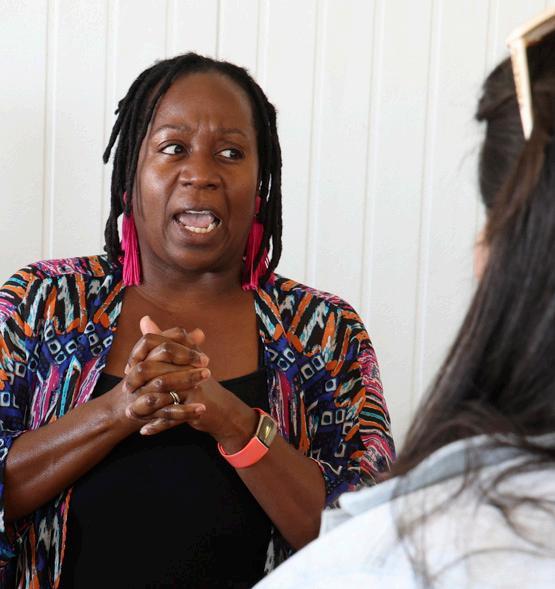
done in isolation.”
For Telesford, this philosophy is deeply personal as she offers curated wellness boxes with aroma therapy.
Scents are inspired by her Jamaican roots like Sweet Lady Apple and Magnolia Jasmine. Others, like Tropical Trio and Passion-fruit Peach, were helped named by her daughters and husband and have become personal favorites.
Chrisbert Telesford, who she has been together with since October 2010, as a major part of her support group during her postpartum times and continues to be for her business.
“Strawberry shortcake on my wife [is my favorite scent]. I love that Gracelamp Wellness has awesome products and services that help support women of all ages,” he said.
Outside of her wellness work, Telesford finds her sense of grounding in the moments spent with
her family.
Dance parties in the living room, watching sci-fi shows, attending her daughter’s cheer competitions, or simply stepping away from the stress and demands of work to rest.
Those moments, she said, are what keep her centered as she balances motherhood, her job at St. Mary’s and running Gracelamp Wellness.
Looking ahead, Telesford hopes to expand Gracelamp Wellness beyond pop-ups and community events into a permanent space where mothers can easily and consistently gather to access mental health support and find resources all under one roof.
With a vision of a wellness hub that removes barriers mothers face when seeking help.
“I want moms to feel like they’re not alone,” she said. “Like what they’re feeling is real and it’s valid.”

In Los Angeles County, 25% of birthing people reported a depressed mood during pregnancy and/or the postpartum period.
Postpartum rates are highest amongst African American and Medi-Cal patients.
Across the state of California 72% of people with perinatal depression or anxiety never received counseling or treatment.
Studies show that 1 in 5 women and 1 in 10 men may experience depression and anxiety during the perinatal period.
Perinatal Mental Health (PMH) conditions are the number one complication of childbearing.
Perinatal PTSD is caused by a traumatic or disappointing experience during pregnancy, delivery or postpartum.

Symptoms may include feelings of anger, fear, guilt, lack of interest in the baby, appetite and sleep disturbances, difficulty concentrating and possible thoughts of harming oneself or the baby.
Source: Maternal Mental Health NOW and Post Partum Support International
Story by Ananya Iamcharoen
Nonoise and no distractions. I never realized before how quiet a house can be.
Even my own room, neat and tidy, stood so silently. Everything looked and sounded perfectly still.
A strange feeling hit me: solitude. That loneliness evokes the same thought that’s been with me for all my years — my longing for a sibling. About 20% of children in the United States do not have siblings, according to data from the U.S. Census, and I’m one of them.
I’ve noticed every family household around me, including my neighbors and cousins, has two or more children.
Something about that makes my chest feel tight inside because I know I’ll never get to experience bonding with a sibling.
From a young age, I’ve always dreamed about having a sibling — someone who I could share my highs and lows with.
Perhaps if I had a sister we would share endless talks at night, go shopping, watch movies and dance all our worries out.
Maybe if I had a brother he would be checking in daily, making sure things were OK and protecting me. Being an only child made me feel like my glass of water was half empty, leaving me to question, “Who can fully fill my glass of water?”
Especially in a classroom environment, including at El Camino

College, teachers sometimes ask if any of their students have siblings.
I always sat silently as other students raised their hands.
The moment my head lowered down, I started to remember the moments during middle school where I started to think about siblings.
During games or events, siblings would cheer for each other. When waiting to get picked up, there were times I had to wait unaccompanied.
For someone who often spends time alone, I often feel like the lack of companionship follows me.
Every time my cousin’s daughters — my nieces — connect with each other, yapping, I sometimes stand in the corner thinking about these thoughts, making me feel left out and detached from others.
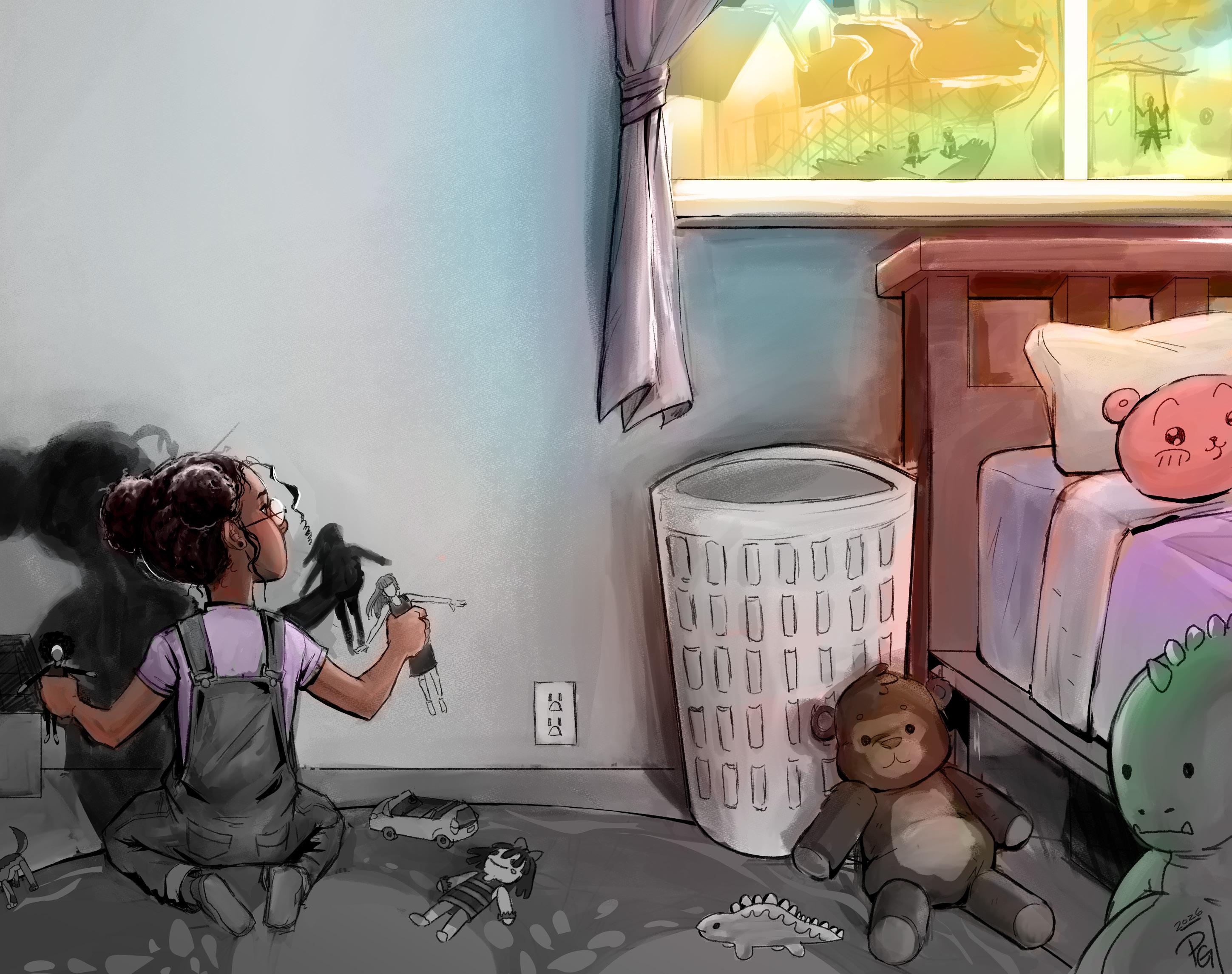
Sometimes I feel welcomed to chat with them but it doesn’t seem to be the same thing as when you’re with your own siblings.
The smiles, the shared talks and laughter they share are different from the ones I experience.
Deep down, being an only child sometimes makes me feel alone and isolated from others.
Being an only child is also a growing trend, as the average number of children born to U.S. women fell in 2024 to its lowest rate of 1.6 — a number that matches global rates, according to a Johns Hopkins University article.
Growing up without siblings meant I never got to share my toys or bedroom with anyone.
I didn’t have to share the same
closet or fight over things.
Some people tell me I’m lucky to be an only child because I don’t have to argue with a sibling.
But honestly, I would be really happy and curious to experience what it’s like to have one.
Sigh.
That feeling of solitude I experience causes my mind to spiral every time I’m in a room with my own thoughts.
But being without siblings does have good and easy moments.
I got to explore more activities and find the things I enjoy most, including theater, which I joined for the first time as a freshman in high school.
The first play I ever did was “She Kills Monsters” by Qui Nguyen. Participating in productions like that introduced me to new people and let
me explore a new world in theater. I learned doing things alone is okay. Being on stage makes me feel free and builds my confidence, too.
Not only that, but as I’m acting in a scene or as a character, it helps to distract my mind from overthinking the longing of wanting a sibling.
And the more time I spend alone, not only does it help me gain independence but it makes me enjoy my own company even more.
Looking at my glass as half full, throughout my years of being an only child, I really enjoyed spending time by myself and focusing on my goals.
Being alone doesn’t mean you are incomplete. Instead, it means you can find yourself.
By being myself, I’m gaining the courage to fill my own cup.
Story by Nikki Yunker
Spiritual teacher Athena Perrakis describes herself as “kind of a cynic.” After all, the El Camino College alumna was trained in the scientific method and was a professor for over a decade.
Now, Perrakis’ students around the world know her best by another name: The Sage Goddess, a brand selling metaphysical supplies and classes online and at the company’s Torrance location on Vermont Avenue.
Long before she became versed in astrology, gemology and more, she was an English major and in the Honors Transfer Program at El Camino.
“I just didn’t fit into the normal boxes. … and I grew up kind of sheltered,” Perrakis, 52, said. “So, I really wanted to explore and find out what I didn’t know about the world.”
While at El Camino, the then 17-yearold took two astrology classes at the now-shuttered Psychic Eye Bookshop in Torrance, and at night began to study it as well as numerology, crystal healing and aroma therapy.
Perrakis graduated in 1994, speaking at Commencement, and went on to receive her bachelor’s and master’s in comparative literature from the University of California, Irvine, and the University of Southern California. She has a doctorate in educational leadership from USC.
She taught English at El Camino from 1998 to 2000 before teaching leadership at USC and the University of San Diego — up until 2011, when she founded her company to teach more mystical subjects.
Warrior Life met Perrakis on Zoom for the following question and answer session, edited for clarity and brevity.
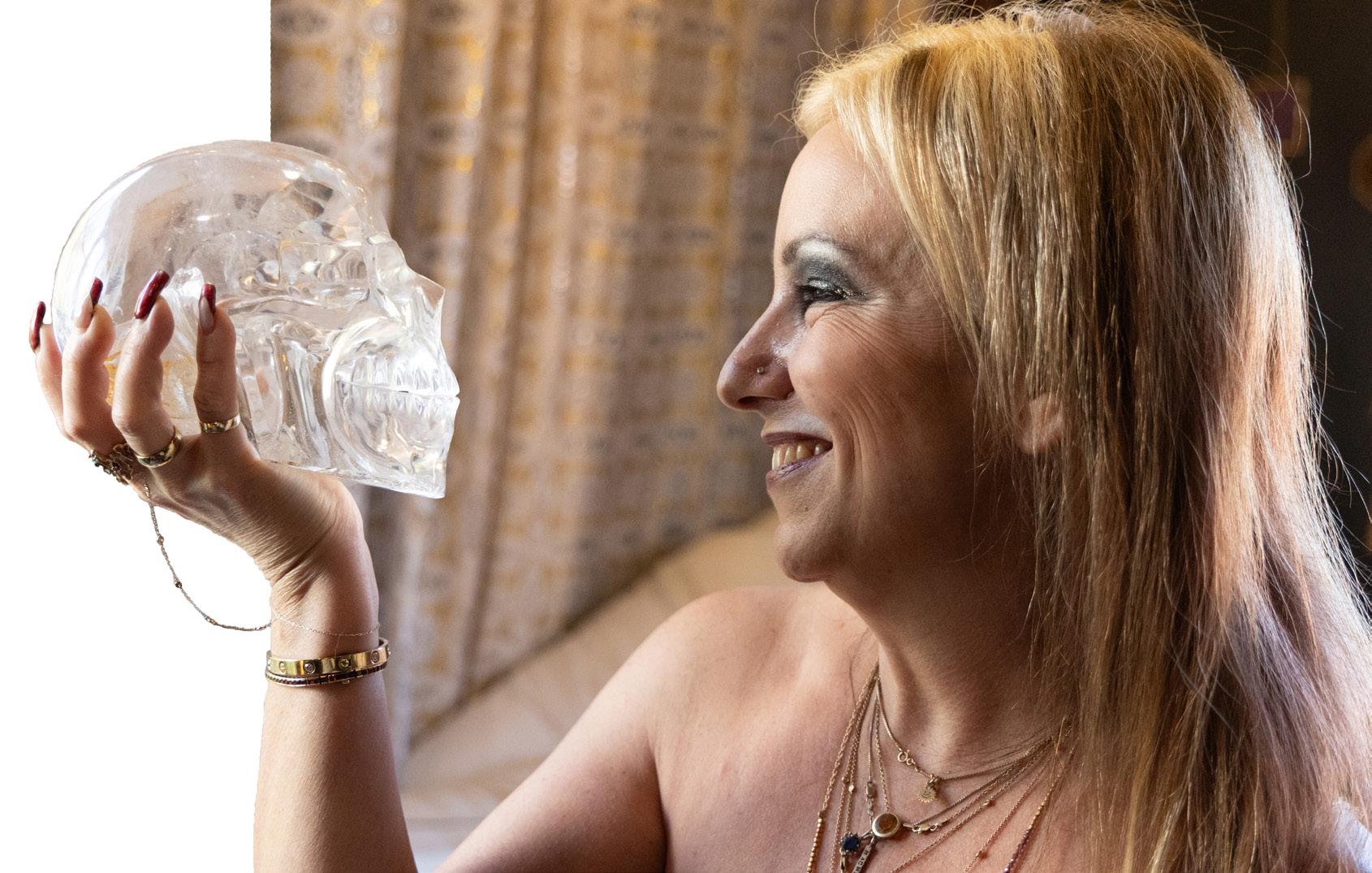
“It is a science-based examination of the sky at the moment you were born. And everybody’s chart is minute to minute,” Perrakis said.
Celestial bodies rotate and change positions frequently, meaning small time differences can change a person’s astrological placements.
“Your birth chart is a very unique snapshot. And with it we can tell almost everything about you,” she said. “We live in a dynamic universe and there’s an interplay between the planets that is so complex that it is almost fingerprint-like unique for each person.”
How does astrology work?
Perrakis said astrology is predictive but not causal.
“It’s a hint at what’s going on, but there’s always free will. There’s the environment that you grow up in. There’s all sorts of factors that influence
the path,” she said. “But … what fascinates me is I’m still waiting for that person where it doesn’t make sense.”
What do some of the planets and positions mean?
Perrakis said the rising sign is how people appear on first impression, the sun sign is who people are at their core, the moon sign is what drives people subconsciously and the north node is what career a person should have.
However, she said that rather than examining signs in isolation, each planet and the houses they are part of combine to tell the whole story.
“That [a sun sign] is the tiniest part of who you are. The rest of it, the iceberg, is really different,” she said.
Who can benefit from astrology?
“I think it’s particularly helpful for people when they’re young,” she said. “That’s a time when you are now on your own. And actually our entire job
“
[A sun sign] is the tiniest part of who you are. The rest of it, the iceberg, is really different.”
-Athena Perrakis
El Camino College alumna CEO, The Sage Goddess
from 18 to 25 is to answer the question, ‘Who am I — what are my gifts?’” Perrakis said. “Astrology is the number one source of information about that in my opinion.”
She noted that astrology requires an open mind, especially from anyone who may resist definitions or labels or who does not see it as a technology or science. What contributes to astrology’s popularity?
Perrakis said social media including Snapchat, which offers public zodiac profiles for users, and search engines, which can help users find their birth charts or those of celebrities, are making astrology information more accessible and less taboo.
“When I was starting 35 years ago … it used to be like, oh, that’s scary or that’s the occult or whatever. And now it’s kind of like it’s a pseudo-science,” she said.
Yet, what’s online feels weird to her.
“As an astrologer, that would make me feel naked,” she said. “I can tell you so much about you with that information. It’s almost like hacking your system.” How can artificial intelligence be used in astrology?
Perrakis said current AI chatbots cannot accurately calculate a person’s birth chart but that it can describe particular placements and “help illustrate the story.”
“If you search an AI and you say [for example], ‘My rising is Libra,’ it can give you some pretty interesting narratives about what that means,” she said. Where should someone start with learning about astrology?
Perrakis recommends Yasmin Boland’s books and oracle decks and Debra Silverman’s 2025 book, “I Don’t Believe in Astrology: A Guide to the LifeChanging Wisdom of the Stars.”
“It’s written from a skeptic’s perspective and I really valued that,” Perrakis said.
Left: Athena Perrakis gazes at a crystal skull at home in Palos Verdes Estates.
Right: Perrakis steps out on star-studded carpet in her “Crystal Room.” Photos by Nikki Yunker
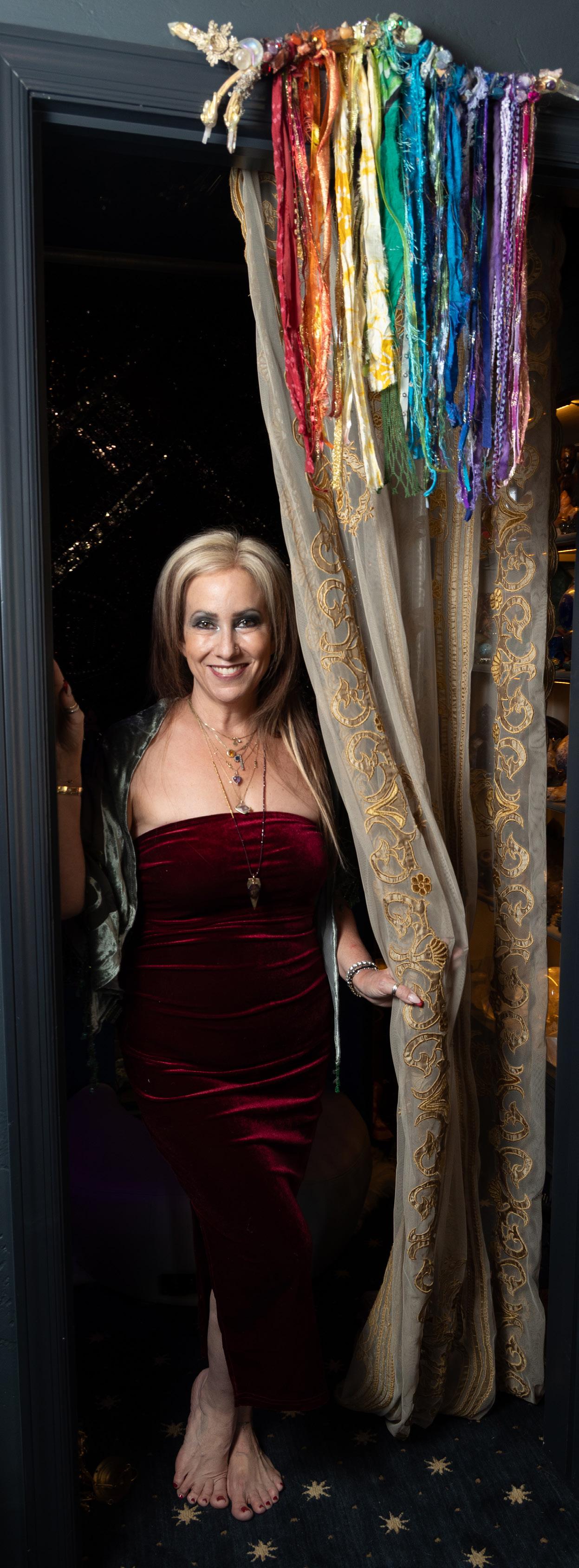
Athena Perrakis, El Camino College alumna and Sage Goddess CEO, looks on as smoke from burning sage rises in her “Crystal Room” at home in Palos Verdes Estates on March 24. Photo by Nikki Yunker
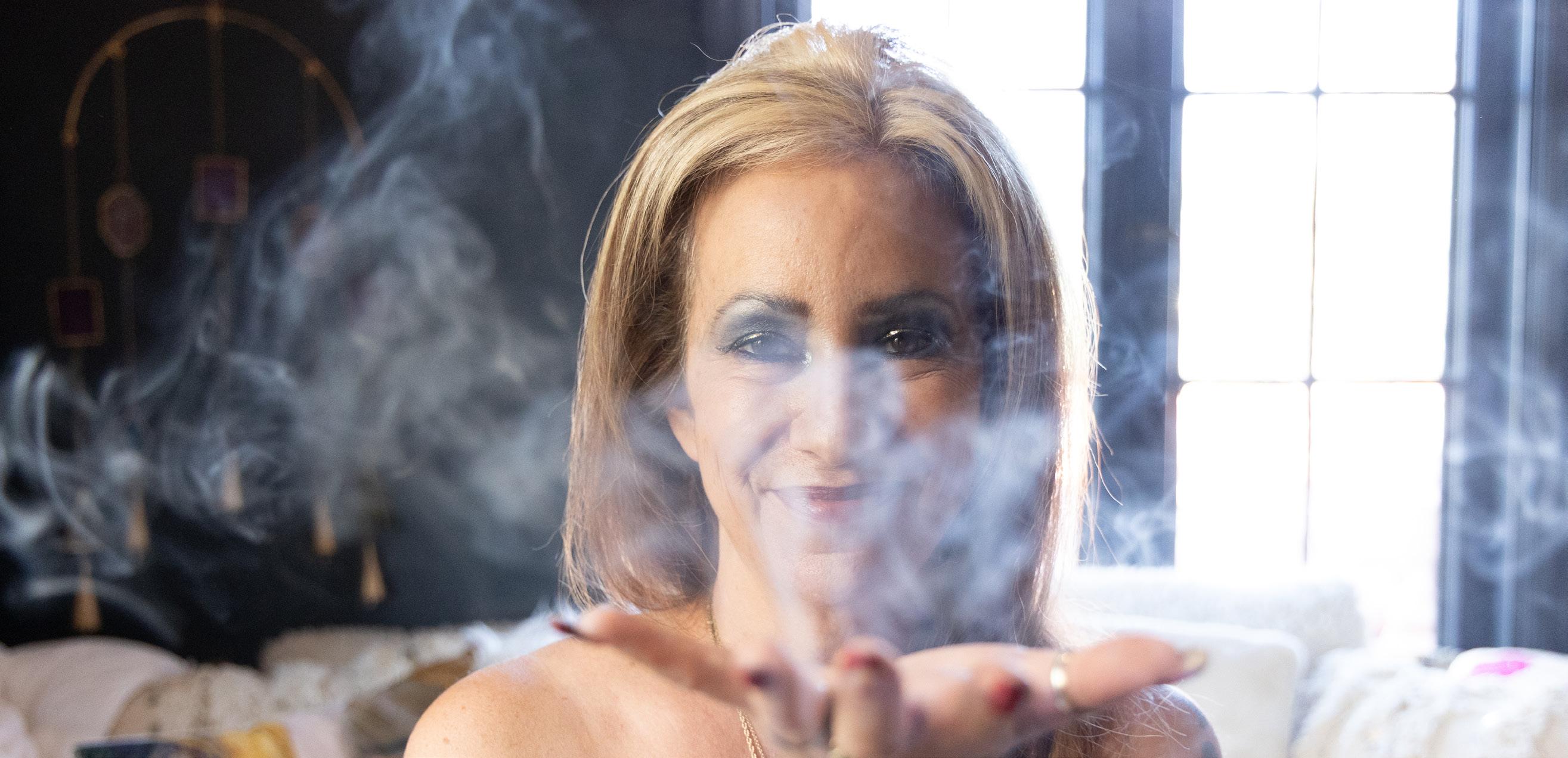
Zodiac signs give meaning to each planetary body, including the sun, moon and beyond. Create a birth chart online, then see this guide for advice on everything from personality — via your sun
^Pause before acting, feel before deciding and choose direction over speed.
Release what no longer fits, trust the unknown and choose growth over comfort.
Choose truth over peacekeeping, express what you’ve been holding back and trust the right connections will remain.
Sit with what is changing, trust your process and release control over timing.
Speak with purpose, listen more deeply and honor the weight of your words.
sign — to relationships — via your Venus sign. These horoscopes were contributed by El Camino College alumna and Sage Goddess CEO Athena Perrakis. “Feel the words without overthinking,” she writes.
Care for yourself as you do others, create safety within and honor your emotional truth.
Express yourself authentically, release the need for validation and lead with your heart.
Rest your mind, trust your body and allow things to unfold without intervention.
Reconnect with purpose, follow what feels true rather than fun and explore with intention. Let others support you, express what you usually hold in and allow vulnerability to exist alongside strength.
Reconnect with your body, simplify your routines and bring your ideas into lived experience. Follow what feels good, create without pressure and let yourself receive.
Right: El Camino College law professor Nicholas McGrue shuffles cards by his office in the Math, Business and Allied Health Building. McGrue practices card tricks, rubber band magic and mentalism.
by Nikki Yunker
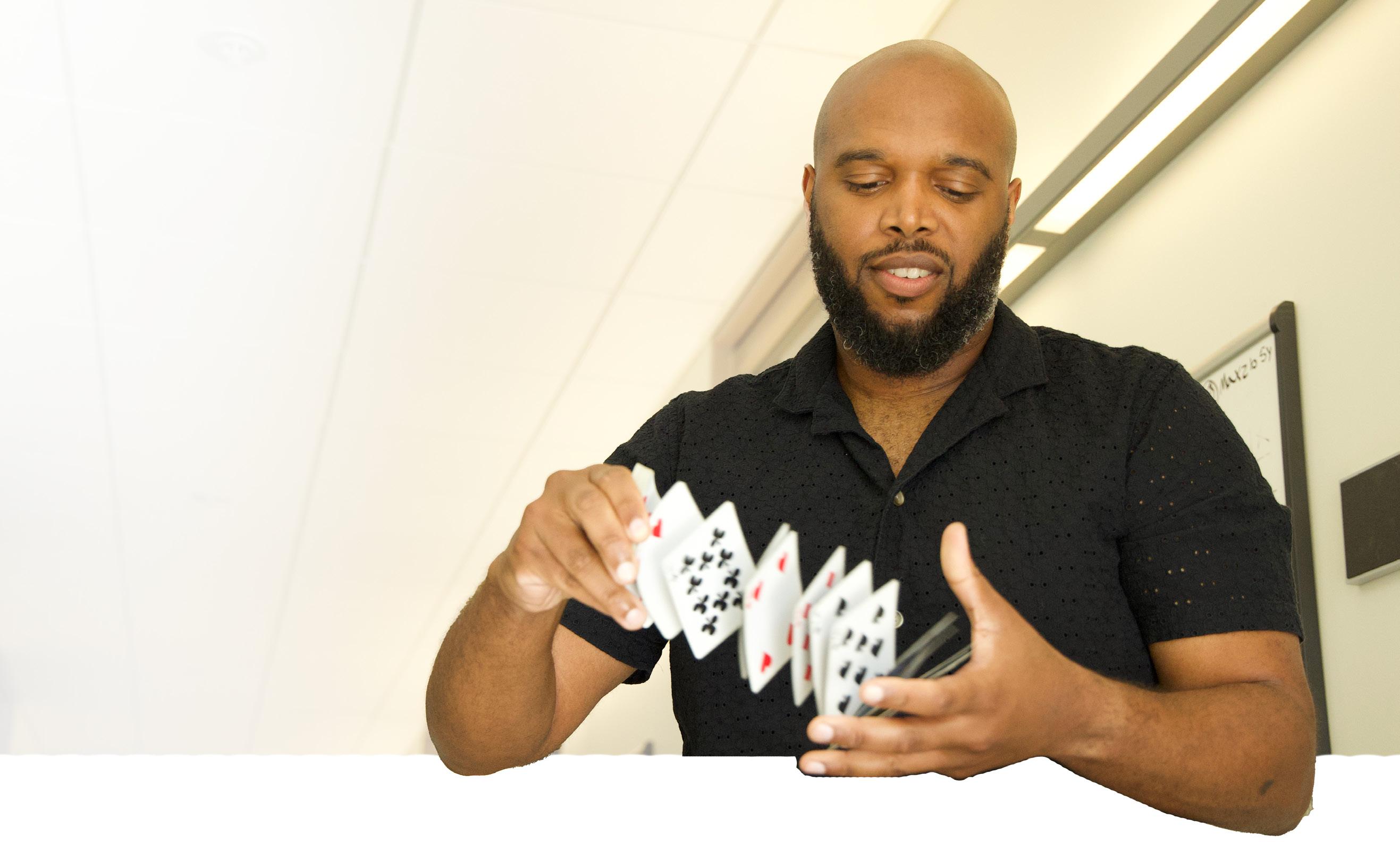
Story by Nikki Yunker
In his life, law professor Nicholas McGrue has taken at least three oaths: two as an attorney of the California and Washington state bars, and lastly, as a member of the International Brotherhood of Magicians.
McGrue, 42, began teaching law at El Camino College in 2014. After being invited to the Magic Castle in 2018 and taking classes, he now performs for friends and family.
While McGrue swore not to reveal the secrets behind his magic, he chronicled his journey into sleightof-hand during a sit-down interview with Warrior Life.
What inspired you to learn and perform magic?
“I think the amazement of it, especially as a lawyer, you don’t have a whole lot of magic. It allows you to kind of feel like a kid again.”
What was the first trick you learned to do?
“I was able to turn a piece of foil into a quarter.”
What’s your favorite part about doing magic?
“It actually teaches you a whole lot about how our brains work, and teaches you about human psychology because magic is basically taking advantage of when our brain takes shortcuts.”
What about studying magic surprised you?
“As an adult, you don’t really work on motor skills a lot. With magic, it was a whole thing where ‘I’m not used to holding cards and manipulating them different ways.’
Now I’ll do something and people are like, ‘Wait, woah!’ And I’m just doing it casually.”
How does teaching help with performing tricks for others?
“Being a teacher actually helps
because you’re managing a crowd and managing an audience similar to a classroom. With magic, you’re thinking about, ‘What am I doing with my hands,’ and also doing the trick, but you’re also watching the audience and making sure they’re engaged and doing the right thing.”