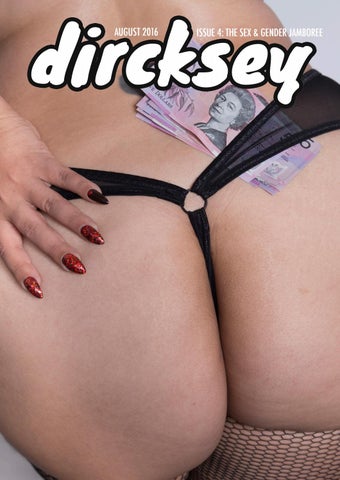
AUGUST 2016
ISSUE 4: THE SEX & GENDER JAMBOREE
DIRCKSEY
ISSUE 4: THE SEX & GENDER JAMBOREE
The Best & The Worst of Dircksey’s Pickup Lines
2
what’s on
Do you have a cool event coming up? Let us know. k.turpin@ecuguild.org.au
AUGUST MONDAY 1
TUESDAY 2
WEDNESDAY 3
4
FRIDAY
SATURDAY
SUNDAY
5
6
7
12
13
14
PROPS Professional Workshop @ ECU ML 10.131 6PM
Late Night Hysterics EP launch @ The Bird
Jeff’s Dead album launch @ Mojos
18
19
20
21
26
27
28
Writers’ Night JO 9.207 (Free Pizza)
Writers’ Night ML 10.307 (Free Pizza)
8
THURSDAY
9
15
16
Writers’ Deadline
Kimberly Pace & Dan Bourke studio talks @ Another (Gallery Space) 7PM
22
23
Artists’ Deadline
Laura Vermeulen gallery recidency ends @ Another (Gallery Space)
29
30
10
17
11
Eduardo Cossio EP launch @ Four5Nine
24
25 Sarah Chaffey & Rebecca Jensen collaborative residency starts @ Another (Gallery Space)
31
ECU Quidditch Club Bunbury Quidditch match & quiz night
Contributors: Corey Booth Sun-Mi Clyburn Caitlyn Latham Vee Lowe Jane Piotrowski Melody Schnauer Artists: Aimee Chappel Luke Clark Kaysie Hilton Zal Kanga-Parabia Nikki Lundy Ebony Talijancich Marziya Mohammedali
Editor: Kitty Turpin k.turpin@ecuguild.org.au
Music Editor: Mae Anthony music.dircksey@gmail.com
Advertising: Tom Reynolds t.reynolds@ecuguild.org.au (08) 9370 6609
Films Editor: Sarah Stopforth film.dircksey@gmail.com
dircksey.com.au
Art & Literature Editor: Rhys Tarling art.dircksey@gmail.com
Special Thanks To: Cover Model: Kenjai - Goddess of the heavenly booty
facebook.com/kenjaibootygoddess/ @kenjaibootygoddess
Logo: Sella Winadi
Next Theme: Politics Mon 1 Aug 5PM Contributors Night ML Building 10.307 Thu 4 Aug 6:30PM Contributors Night JO Building 9.207
The opinions expressed herein are not necessarily those of the Dircksey Editor(s), sub-editors/ section-editors, Edith Cowan University or the Edith Cowan University Student Guild. Reasonable care is taken to ensure that Dircksey articles and other information are up-to-date and as accurate as possible, as of the time of publication– but no responsibility can or will be taken by the abovementioned entities if an issue of Dircksey has any errors or omissions contained herein.
Online print just got better.
pictondiy.com.au
CONTENTS REGULARS
ARTS & LITERATURE
3 Calendar 6 Editorial
18 Moist by Nikki Lundy 22 Indie Comic Spotlight: Black Hole 23 Poetry 24 Book Reviews
FEATURES 7 Homophobia Rears Its Ugly Head 8 Friends in Unexpected Places 9 Ally’s Guide to Teaching Acceptance 10 Save Safe Schools 11 Arranged Marriage in the 21st Century 12 Lobster 13 High Heels: From Horsemen to Marilyn 14 Phthalates: The Unsexy Side of Sex Toys 16 Before you buy a car... 17 The Absence of Sex
MUSIC 25 Dirty Blues 26 Effeminate 27 Music Reviews
FILM 28 30
Sarah’s Top 8 LGBT Films Film Reviews
Photo by Ebony Talijancich See more at ebony-tali.tumblr.com
DIRCKSEY
ISSUE 4: THE SEX & GENDER JAMBOREE
PRESIDENT’S NOTE As we didn’t recieve the Guild President’s report, you can use this space to write your crushes names:
EDITOR’S NOTE This issue is all about sex, sensuality, relationships and lack there of. Hello to all our mid-year entrants. If you’ve picked up Dircksey by accident, we’re your ECU student magazine! Yes, Dircksey is a strange name. We got it from our lady Edith, who was one of two women to have the middle name “Dircksey”. That’s meant to symbolise our individuality, but really we’re just another student rag. We scraped through with just enough articles for this issue, but the Sex & Gender Jamboree is packed full of quality reads that we hope you enjoy…some more than others, with a sneaky non-phthalate sex toy. A big thank you to everyone who came to the writers’ nights even if it meant coming back on campus during your uni break. Without your eagerness I wouldn’t be here writing this crap column that none of you probably read for a fourth time. Don’t forget, if you have anything that you feel can’t be jammed into the print edition word count send them to us! We can publish your articles, reviews and creative pieces on our website: dircksey.com.au Hope you are all relaxed and rejuvenated for second semester. The Dircksey squad is still working hard in the ex-storeroom-that-might-be-renovated-soon over the next semester, bringing you the next issue: Politics.
6
DIRCKSEY
Homophobia Rears Its Ugly Head
ISSUE 4: THE SEX & GENDER JAMBOREE
Photo by Marziya Mohammedali (@kikeidotnet)
by Kitty Turpin On the morning of Saturday 12 June at 2:02am a lone gunman entered Orlando’s best known gay nightclub, Pulse, and opened fire on unsuspecting LGBT+ club goers. 49 people died and 53 were injured. The attack was called the deadliest mass shooting in modern U.S history. This attack couldn’t have come at a worse time, in the month of June, which is across countries considered Pride month. No matter how many politicians label this crime a terrorist attack “on every one of us” (Malcolm Turnbull), you cannot deny the Pulse Orlando shooting was a homophobic hate crime, intended to instill fear specifically in the LGBT+ community. In 2015, the United Nations reported:“violence motivated by homophobia and transphobia is often particularly brutal, and in some instances characterised by levels of cruelty exceeding that of other hate crimes.” Within the report thousands of attacks on LGBT+ people were documented from over the last few years. The reports of such attacks and planned attacks are still apparent in everyday news. For example the attempted attack on the LA Gay Pride Parade only a day after the Orlando shooting. The sheer amount of attacks that are still happening to the LGBT+ community highlight the amount of homophobia that is still apparent in today’s society. As Orlando hospitals desperately called for blood donations, and hundreds of people queued to answer the call, gay men were barred from potentially saving their friends due to the laws, entrenched in homophobic stigma from the AIDS epidemic of the 1980s, that men must wait one year after sexual contact with another man to donate blood. This is better than the pre-2012 laws that permanently banned gay men from donating blood, but still meant those who were sexually active could not donate. These laws in particular were a slap to the face of the LGBT+ community after facing such a tragedy. Though the LGBT+ community has been hit hard by this attack,
they certainly have not let it discourage them to continue being out and proud of who they are, with Pride events going ahead across the U.S, and the world, during Pride month. Here in Perth a candle lit vigil for the victims was held in the Perth Cultural Centre. Around 100 people gathered, holding candles, to pay their respects to those killed and injured in the Pulse Orlando shooting. There was a quiet and respectful atmosphere to the vigil, with not a hint of illumination from a phone or conversation to be heard. In Orlando, two weeks after the tragedy, Pulse held a Latin night street party, three kilometers away from the boarded up club. Barbara Poma, the owner of Pulse, said in a statement: “We need to show that we are strong, that Pulse continues and that we appreciate all the help the community has shown us.” The event inevitably became a celebration of life, survival, family and solidarity. Regular attacks on the LGBT+ community across the world are particularly worrying for Australia with our, so far, reluctance to introduce a marriage equality act. Senator Penny Wong has voiced her doubts about a plebiscite on marriage equality, which Malcolm Turnbull has insisted on going through with, saying that it would “license hate speech to those who need little encouragement.” As we cast our eyes to Britain, and #Brexit, we see the decline into anarchic racist and violent tendencies shown by the divide in the community due to their referendum. We can only hope that if the plebiscite goes ahead, it will not follow this trend. Often those who do not identify as LGBT+ forget why gay pride celebrations are needed, and should be commemorated yearly. It’s attacks like these that remind us why we still need to stand with those in the LGBT+ community. Now more than ever. FEATURE / 7
DIRCKSEY
ISSUE 4: THE SEX & GENDER JAMBOREE
Friends in Unexpected Places by Melody Schnauer
It’s no secret that the relationship between the LGBT+ community and the Christian community is strained. There’s no lack of Christian protesters against the community, and many LGBT+ people tend to avoid Christians. Being born in a Christian household involves being taught certain ideologies and practices. Some are good, as the religion itself teaches love and compassion above all other things. There are, however, certain passages in the bible that can suggest that the LGBT+ community are all ‘sinful’. As a result, growing up with these ideas can affect how you perceive perfectly normal people. As one of these Christians, I grew up being told to love and accept everyone. This didn’t just include my friends and family, it also included sinners and enemies. I was taught that it was okay to love and accept the LGBT+ community. However, I was taught that I shouldn’t look into their lifestyle. I shouldn’t get too close to them, or let their ideologies ‘pollute my mind’. It was a fact of my life, and it was backed up by not only my family, but by many Christian friends that I have. The topic of the LGBT+ community is controversial at best and completely taboo at worst, and churches don’t talk about the community, simply because there are too many differing opinions. In the end it meant that I had to do my own research, and do it in secret, far away from prying eyes. The problem with this mindset, and being brought up this way, is that Christians often have no real understanding of people in the LGBT+ community. I met a lovely homosexual guy, who literally seemed to shrink when I told him I was a Christian. It was like he was trying to make himself less of a target, like he expected me to attack him for his sexuality. I wasn’t going to, obviously, but it saddened me to know that my religion was a threat to his willingness to express his sexuality and be himself. I was desperate to find more allies within my religion. I looked through fellow Christians Facebook accounts to find proof that they were allies. I looked it up online. I even asked for some opinions in church (not an easy task). What I found actually intrigued me. Despite the huge movement of bigots in our religion, there are many Christian organisations out there speaking of not just acceptance, but also of people in the community living how they feel comfortable, and still being a member of the religion.
8 / FEATURE
I found the many rants of a friend who ferociously defended her ability to be both a Christian and bisexual. In the U.S. there are over 5,000 churches which are LGBT+ inclusive. If the ‘Bible Belt’ can do it, surely Australians can do the same. With more conversations and open support, Christianity and the LGBT+ community may not be mutually exclusive. In the future, I won’t have to hide my pride as an ally and others will feel the same no matter their religion. Our conversations can open doors to a future where inclusivity is not a dream, but a reality. We may have different views now, but each day we can become closer to working together. Not just protests. Not just one side against the other side. But first, we need open-minded and civil discussions which express acceptance, the type that will remind both groups that we are all people fighting for the same cause of love. As a Christian, I’m openly extending my welcome to the LGBT+ community and I hope others do the same.
DIRCKSEY
ISSUE 4: THE SEX & GENDER JAMBOREE
o t e d i u G s ’ y l l The A e c n a t p e c c A g n Teachi by Anonymous I’m sure you’ve come across people who do not accept others across the gender/sexual identity and orientation spectrum, this including the LGBT+ community, and it can be very frustrating as equality seems such a basic thing to wrap your head around. At first, I rejected the LGBT+ community. It was only when someone actually asked why I rejected them that I realised there was a flaw to my thinking – I simply didn’t know. I didn’t have a reason. Not everyone will be receptive to changing their beliefs but with people you care about – for example friends and family - it is worth a shot. There are a few reasons why some people choose not to accept the LGBT+ community and these include: a) Repeating the values they’ve been taught without thinking, b) Their views have been met with praise from others, c) They have a fear of what is outside their “normal” as it can threaten their views or way of life. Having been one of these people, I understand there is a few ways to tactically try and change their minds. But first recognise that the other person has their own view about the LGBT+ community and they’re likely to cling onto that idea, for the reasons stated above. From my experience, and my own journey to becoming an ally, I’ve found these simple ways to deal with these people:
1. Talk with them calmly about the reason for their opinion. Sometimes the reason is that it just “seems right” to them, which can stem from their upbringing or experiences. This can be hard to listen to and keep your calm. Remember to know your limit and back out of a conversation if you can’t take it. By listening to them, they are more likely to listen to you. 2. Propose some scenarios that they can relate to that gets your point across. By building common ground, you can slowly get your opinion out. Don’t hide your opinion when asked however. Affirm that you’re an ally, and believe in gender inclusion and sexual diversity if it is safe to do so. 3. Always allow the other person thinking time. People aren’t likely to show change of decisions straight away. With your constant demonstration of acceptance they may change their mind but an overnight revelation is unlikely to happen. It’s hard to let go of opinions that have taken years to develop. But by giving up on these people, they will never change these opinions. I’m not trying to say changing people’s opinions is as easy as this, or that it’s your job to spend time trying to convince people to support the LGBT+ community. I understand people are stubborn beings, especially if they have been conditioned to feel a certain way. But if that one person hadn’t tried to change my opinion, I wouldn’t be the person I am today.
FEATURE / 9
DIRCKSEY
ISSUE 4: THE SEX & GENDER JAMBOREE
Save Safe Schools
Photo by Marziya Mohammedali (@kikeidotnet)
by Kitty Turpin Since it surfaced the Safe Schools Program has been protested, debated and scrutinised. But what exactly is the Safe Schools Program? Oscar Kaspi-Crutchett is a 15-year-old Year 10 student and the Member for Perth in the Youth Parliament of WA. He is involved in political activism and campaigning for the program. However his support for the program isn’t political: it’s moral. Having experienced bullying during his time at school, Oscar believes the program will teach what needs to be taught, and say what needs to be said, to reduce attitudes of homophobia and transphobia, making schools safer for thousands of students across the country. What is the Safe Schools Program? Who created it and what is it trying to achieve? OKC: The Safe Schools Program is the first ever government funded program with the intention of making schools safer and more supportive of LGBT students. It was created by academics and activists, including Roz Ward. The SSC [Safe Schools Coalition] wants to achieve the reality of a safe education for all people. We do not have that at the moment in this country. We have education which is long, drawn out and torturous for some. Intersex, transgender and same sex attracted students endure bullying and exclusion to the point of suicide in many instances. Safe Schools stands up to this, and says we can do better. Why are some upset about it? Has an alternative been presented? OKC: Backlash and outcry against safe schools comes from two particular attitudes: Queerphobia and red-phobia. The right wing media and right wing politicians attack the program because they are either against Queer rights all together or because they believe it is some kind of far-left communist conspiracy. Some people find the content of the program itself to be offensive or obscene, but this usually derives from attitudes of homophobia and transphobia, because the content itself is not arbitrary or negative. It’s not a manifestation of Marxism and it’s not going to turn your children gay. As aforementioned, the program is the only government funded NGO which actively fights for LGBT+ Students. As of now there is no alternative. If it were to be scrapped the gap it would leave would remain unfilled (at least under a Liberal government). 10 / FEATURE
What would the implementation of the Safe Schools Program across Australia mean? What would it mean for you, other high school students, primary school students, and future students? OKC: Further extending the reach of this program, as some are proposing in the Labor Party and the Greens, would be beneficial to students across the country. As of now Safe Schools operates across hundreds of schools, and counting, but it still could be much larger. If the program was to be implemented even further it would help protect students from bullying and from mental illness - defending our youth from these two things would only help us as a society. Safe schools would help me, because I would feel safer in my school. It would help my friends, who’d feel safer too and it would help the entire education system in general. Everyone, from primary school students to parents would feel like the education system is a safer and more accommodating place for them. I am lucky because I always had a supportive safety net of family and friends but not everyone has that, some of the most vulnerable people in the community have nothing. This is especially prevalent in the LGBT community. The SSC stands up for them. It saves them.
DIRCKSEY
ISSUE 4: THE SEX & GENDER JAMBOREE
Arranged Marriage in the 21st Century by Sun-Mi Clyburn
“Love is not looking at each other, but looking together in the same direction.” Antoine de Saint-Exupery
The concept of marrying for love is a very recent one. Up until the 20th century marriage was about consolidation and distribution of wealth, strengthening alliances and prolonging family lines. Love and romance had nothing to do with it. The individualism of the modern and, particularly, the postmodern eras have redefined our understanding and definitions of marriage. In western society we view arranged marriages and marrying for practical reasons as weird, outdated, cold-hearted, calculated even reprehensible. However, studies show that arranged relationships have a higher success rate than those that go through the “first comes love, then comes marriage” formula. Recent statistics show an average divorce rate of 40-50% for love marriages and 4% for arranged marriages. These numbers vary depending on the country and are highly debated as marriage longevity doesn’t account for marriage satisfaction, happiness or personal security. Also, the very low divorce rate in societies where arranged marriage is the norm would be a result of divorce being generally considered unacceptable. There are definitely advantages of going through a matchmaking process rather than choosing a partner to fall in love with. You are more likely to have a similar belief system, background, upbringing, goals and priorities. You are also a lot less likely to have the typical issues and arguments with the In-laws. After all, if your parents choose your spouse or were involved in the process they can’t complain about them later, can they? In the case of arranged marriage, the bond isn’t just between two individuals, but also between families and communities, which in the long run can provide a lot of support and stability, but can also be a source of pressure. There are many different kinds of arranged marriages and supporters of arranged marriage are adamant about making a clear distinction between “arranged” and “forced” marriage. However, advocates for human and women’s rights claim that in many situations the difference between them is very subtle. Even if a young woman isn’t threatened with any sort of violence, the pressures put on her by people she is completely dependent on places her in a position where she doesn’t really have a choice. In this day and age, parents and children working together is the most common practice of matching potential life partners.
Art by Aimee Chappell (@aimeechappellstudio)
The parents find suitable candidates, but the last say belongs to the son or daughter. The element of choice is very important. Some would say that online dating is no different to arranged marriages. Instead of your parents, you ask a dating service to match you with compatible potential partners based on a number of variables and data. Online and facilitated dating services (like speed dating) have lost most of their stigma, have increased in popularity in the past decade and now is the second most common way to meet people. So why is the same concept considered outdated when it involves our family members, but progressive and modern, if it’s over the internet? As weird as it sounds, mature love is calculated. It’s thinking of the long haul and the bigger picture. It takes more than love to make a relationship work for years, decades or the rest of your life. If the end game is to find someone to love and love us in return, no matter what life throws at us, does it really matter how we get there?
ARTS & LITERATURE FEATURE / 11
DIRCKSEY
ISSUE 4: THE SEX & GENDER JAMBOREE
Lobsters by Caitlyn Latham I binge watched Friends instead of studying for my Year 12 exams. At the time I thought it was just a funny show with awesome characters - I didn’t look too far into it. Some scenes resonated with me and I couldn’t work out why, notably the one where Rachel, Phoebe and Monica all sat on the couch wearing wedding dresses. Now I know that it’s because of what it represented. They were a womanly force against the world, showing that women can indeed be independent. The whole show shows strong female stereotypes, between Rachel breaking her label of a spoilt brat and working her way up in the fashion industry, to Monica always following what she believes in, and finally Phoebe always accepting compliments like a boss – “Oh you like that [her name]? You should hear my phone number!” Come on, you know you’ve heard that line. Friends’ first season aired in 1994, and it was a massive hit. Sit coms up until that point revolved mainly around the family home or work place, but Friends didn’t revolve around a family, and the main female leads weren’t just domestic housewives. It was different and turned out to be very popular because it didn’t follow the preceding conventional path.
world. She blossoms into one of the strongest female characters and I loved her for it. However, I feel that this is often overpowered by her love interests; the first time we see Rachel she’s run out of her wedding, she’s fawned over at the coffee shop by co-worker Gunther. She has many love interests throughout the series, most notably her on/off relationship with Ross which left her with 2 marriages, a divorce and a baby. To scrutinise this point even further, their first dramatic break up was over his jealousy of her friendship with a co-worker. And finally, the last time we see Rachel she’s giving up her dream career in France to stay in America with Ross. I believe in true love, and Rachel may have been Ross’ lobster, as Phoebe put it, but what I do not believe in is the stereotypical portrayal of women having love as the most important part of their lives – something that is embedded in the fabric of the entire ten seasons of the show.
Let’s take Sex and The City which came out four years later in 1998. It too revolved around strong female characters. Carrie Bradshaw is the main character, and she is a columnist for The New York Star. But while she has a strong career, her column is about I’m going to zone in on Rachel’s the dating scene in New York City. She character. At the beginning of the first and her friends gather frequently to season, she is naïve and spoilt, working discuss their life and more often than at the coffee shop and not even doing not – boys. that right. By the end of the series, Rachel is an executive at Ralph Lauren. This is where I think the portrayal She develops street smart intuition and of women in sitcoms fails us. While learns to fend for herself in the real we are now seeing women out of the 12 / FEATURE
domestic goddess roles, (Carrie can’t cook and lives off takeaway) their lives revolve around finding love – as if they are not complete without it. They’re taken out of the final product, but are instead trying to find the final product (a family). So there we have two hallmark American sit-coms. Because they came out around 20 years ago, you could argue that they were just a stepping stone into strong female personalities in the sitcom genre. What do we have to show for this evolution now? New Girl, where Jess sleeps with her colleague and then her housemate? Or My Crazy Ex-Girlfriend, a show I have refused to watch simply on the principle of the misogynistic connotations attached to the title of the show? 2 Broke Girls comes close, showing them with a strong work-orientated value, but even that incorporates sexual harassment of them by a co-worker as one of the main attempts at humour. I’ve come off quite critical of these shows and I guess that’s because I’ve been given this topic to write about. In reality, sitcoms are some of my favourite shows to watch, and I’ve never really thought about the points I’ve discussed, or the underlying flaws of the roles of these women, especially not whilst I was watching them. But that’s part of the problem. As long as people keep laughing at the same jokes, they are going to keep writing the same characters. As long as we keep laughing, who’s to say it’s ever going to change.
DIRCKSEY
ISSUE 4: THE SEX & GENDER JAMBOREE
High Heels: From Horsemen to Marilyn by Rhys Tarling Fun fact: high heels were originally worn by men and were for utilitarian purposes rather than the fashion conscious. Another fun fact: The history of high heels is fascinating in that it’s consistently, even if tangentially, connected to sex and violence. Consider what at one time was the mightiest mounted military force in the world, the ancient Persian riders circa the 9th century. The key to their mightiness? Heels. Heels were perfect for securing themselves in their stirrups and were necessary for good horsemanship. Good horsemanship was essential for the riders to successfully perforate their enemies with a well-aimed crossbow bolt. Heels were intended to be a functional object until the 16th century, where an interest in Persian culture swept Western Europe. The upper class were particularly fond of the high heels’ aesthetic – they were masculine, gorgeous, and so impractical for walking on stone cobbled streets that, naturally, they would be perfect for projecting privilege. King Louis XIV, the ruler of France from 1643 to 1715, adopted and popularised the red high heel amongst the aristocracy. The red heels, the little King declared, were a mark of those in royal favour. Being red-heeled was like being granted the highest of honours – a seat at the cool kids table. By this time high heels were no longer gendered and were considered to be a fine choice of shoe for men and women – wealthy men and women. The red symbolised blood, the willingness of the wearers to crush enemies of the State beneath their heels. Appearances were important. It wouldn’t do for the masses to think that the aristocratic red-heeled were a collection of well-dressed though ineffectual weaklings (also, it can be concluded that subtlety as a concept was decidedly not in fashion). Louis XIV’s personal heels were even more outlandish than anybody else’s; he ordered them to be decorated with scenes depicting great battles. Were those heels a precursor to those 2009 Converse Chuck Taylors emblazoned with a choice selection of Kurt Cobain lyrics in order to demonstrate how little of a shit the wearer gives about polite society? Maybe. This isn’t to say that high heels were a universally adored object across all of Western Europe, however. The English Parliament in the 17th century adopted a dim view of women wearing high heels.
Art by Kaysie Hilton
The accusers – perhaps in the event that a sane person demanded the missing link between witch and footwear – noted that the shape of the high heel bared a remarkable resemblance to the cloven hoof of the devil (and this was during the so called Age of Enlightenment, so figure that one out). Fast forward a few centuries later to 1953, where the world witnessed the debut of the most popular high heel of all time – the stiletto. These beautifully timeless shoes debuted at a Christian Dior fashion show and were invented by French fashion designer Roger Henri Vivier. Stilettos, named after the Italian word for slim dagger – specifically a slim dagger that in medieval times was used to quickly kill a defeated knight – were an immediately fetishised object. They were prominently worn by Hollywood movie stars such as Marilyn Monroe who adorned pin-up posters, pornography’s younger and adorably sunnier sibling. There’s a science to their sexual allure. Renowned sex anthropologist Helen Fisher pointed out that “high heels thrust out the buttocks and arch the back into natural mammalian courting – actually copulatory – pose called ‘lordosis’ ”. Ever since then, the stilettos have been trendy and not so trendy, but never really what you could call out-of-fashion. Perhaps this is due to the stilettos representing the nexus point of the high heel, the zenith if you will, of embodying the perfect balance of the shoe’s history of things that will never be unfashionable: sex and violence.
If women were wearing high heels it was concluded that they must be plotting to entice men into marriage, and so they were tried as witches and presumably burned to death. FEATURE / 13
DIRCKSEY
ISSUE 4: THE SEX & GENDER JAMBOREE
Phthalates: The Unsexy Side of Sex Toys by Jane Piotrowski Art by Luke Clark (@meatwavves)
Sex toys have become more socially acceptable in recent years, both for solo and partnered pleasure. Using sex toys can improve your sex life and therefore your wellbeing, but is it possible that some sex toys could cause more harm than good to your health? As it turns out, toxic sex toys are a lot more commonly used than most people think. Many sex toys are made of plastic – it’s cheap, flexible, and smooth, all desirable qualities in an insertable toy, like a dildo or butt plug. Plastic itself is not inherently toxic to the body, but many of the chemicals that are added to the plastic are. There are many types of chemicals that are used in sex toys that can be harmful to the body, but let’s examine the most common type – a group of plasticisers (chemicals that are used in plastic most commonly PVC, to increase transparency and flexibility) known as phthalates. There are many different kinds of phthalates, not all of which are harmful. However, phthalates do not chemically bond to the plastics they are used in – they leak out in the form of an oily, strongly plastic-smelling liquid, making it easy for the toxins to be absorbed through mucous membranes, such as those found in the mouth, vagina, and anus. While there have not been any scientific studies so far on the long term effects of phthalates in sex toys, several studies have
linked phthalates with disruption of the endocrine system, including hormonal imbalances, reproductive defects, organ failure, and cancer. In the short term, use of toys containing phthalates can cause irritation, itching, burning, nausea, mild chemical burns, and infections requiring antibiotics. It’s no surprise, then, that phthalates are banned in children’s toys in many countries, including Australia. But when it comes to sex toys, there are no safety regulations whatsoever. Sex toy manufacturers can – and do – throw around phrases like “body-safe”, “non-phthalate”, “skin safe”, and “non-toxic” to appeal to consumers, with no repercussions whatsoever in exposing their customers to potentially harmful substances. Despite this, there are plenty of ethical manufacturers in the sex toy industry that only make phthalate-free, body-safe sex toys, but their products can easily get lost in a sea of false claims. So if there’s nothing to stop companies from labelling their harmful toys as non-toxic, how can consumers know which toys to avoid and which toys are actually body-safe? Perhaps the easiest and simplest way is to examine what materials the sex toys are made of. It’s easy for a company to claim their product is non-toxic, but almost impossible to claim it’s made of a different material altogether. Certain materials are more
likely to contain phthalates, and should generally be avoided to be on the safe side. Definitely stay away from anything made of jelly, PVC, rubber, or vinyl. Even if it’s supposedly “body safe”, “non-phthalate”, “skin-safe”, or “non-toxic” – it’s not, trust me. Toys containing phthalates give off some signs, including omitting a strong plastic smell (like a new shower curtain), leaking oily fluids, being very soft and flexible, and clear or transparent. Even if these toys are free of phthalates (which is unlikely), these materials are porous, meaning they harbour bacteria and can’t be sanitised. In other words, they may be non-toxic, but they’re still not body-safe. Materials that are widely known to be toxin-free and body-safe include medical-grade pure silicone, glass, stainless steel, aluminium, wood, ceramic, hard plastic, and hard ABS plastic. Unfortunately, as sex toys made of these materials are higher quality they are therefore generally more expensive. Before buying your next sex toy, research the company with a quick two-minute Google search of their name with the phrases ‘phthalates’, ‘body safe’, and ‘ethical’ to find out if they really are what they say they are. Remember, kids, safety is sexy!
FEATURE / 15
DIRCKSEY
ISSUE 4: THE SEX & GENDER JAMBOREE
“Before you buy a car you take it for a test drive” by Sun-Mi Clyburn
When Samantha from Sex and the City said this she was being crude, oversimplifying the matter. Her words refer to having sex before you commit. There is wisdom in her philosophy. I agree, you should know what you are getting and if it is compatible with you. This can be tricky, because it means you need to identify who YOU are first. Our personal sexuality develops from a mix of biology, upbringing and life experience. It takes a lot of time, courage and self-exploration (and sometimes therapy) to figure it out. But once that’s done, it can be incredibly frustrating to be with someone who does not share this.
Psychology Today puts infidelity in the top four reasons why relationships fail, and this happens due to lack of communication and unmet needs and expectations. Many people don’t have an open dialog with their partner for fear of judgement and rejection. Not talking about sexual preferences, definitions and boundaries can have much worse consequences in the long run. The key here is consent and consensus, not compromise. Compromise means giving up matters that are important to you to meet someone “half way” and, more often than not, that leads to resentment and the death of intimacy.
When finding a partner, having similar morals, life goals and priorities are generally accepted as being most important. However, as a society we tend to ignore the importance of sex as well, even though many studies have demonstrated that sexual satisfaction and relationship satisfaction are closely linked. We have been groomed to believe that as long as you love each other, the sexual component should come naturally. In reality human sexuality is very complex. There is a good chance that two people who love each other, might not find sexual satisfaction with each other. It is unfortunate that we are socially conditioned to view sex as extremely private, taboo and an inappropriate topic of conversation, as it would help to pick us a compatible partner.
Knowing and accepting your sexuality, preferences and what you are comfortable with are important for your health and wellbeing. Similarly, sexual compatibility is important for the health and wellbeing of a longterm relationship. Psychologists call this “perceived sexual compatibility” which is defined as “the extent to which a couple perceives they share sexual beliefs, preferences, desires and needs with their partner”. One’s perception is, of course, their reality.
16 / FEATURE
Our main problem as a society is our obsession with being “normal”. Which is flawed in itself, because who gets to decide what is “objectively normal” or if there is such a thing. This idea of being “normal” takes away from discovering who we are, embracing that and being
the best authentic version of ourselves. We end up wasting years (sometimes our whole lives) creating a fake image that we think others will deem acceptable, inevitably leaving us feeling bitterness towards ourselves, and then onto those who love this preconceived image of us. No one path is right or wrong, better or worse. Our journeys are unique and different and someone out there will find this beautiful. Sexuality, as a deciding factor, can be just as important as an attractive smile, a sense of humour and a warm personality.
DIRCKSEY
ISSUE 4: THE SEX & GENDER JAMBOREE
The Absence of Sex by Mae Anthony
In the latter half of the 20th century the rise of many advances in the area of psychology was increasingly prominent. Psychiatric specialists are particularly interested in the behavioural and biochemical analysis of sex, one of the most imperative and intriguing human behaviours. Abraham H. Maslow was the man behind “Maslow’s hierarchy of needs”, a theory of social psychology that placed the order of needs in which one builds on, from the basic psychological ones featured at the bottom of the hierarchy – in which food, shelter, and sexual gratification must be met - through to safety and to the more socially evocative areas of companionship, self esteem and, finally, self-actualisation. He thought that this was the order of needs in which people worked through from a socially psychological perspective. So in saying this, what about people who do not fulfil their sexual needs? What about the people who don’t have these needs? Or don’t know how to express them? There’s a lot to know about sex, but what about the absence of it? Here we’ll look at some of the different kinds of social and biological “absent” sexual states. Asexuality Asexuality in humans is a lack of sexual attraction to anyone. It can also consist of a low-level interest in sexual activity. It is distinct from other forms of abstinence, as it is less to do with behavioural or social implications. Some asexual people engage in purely romantic relationships, others do not. Some asexual people participate in sexual activity with others and themselves. It is not to be confused with anxiety disorders surrounding sexual contact such as Sexual Aversion Disorder (SAD) or Hypoactive Sexual Desire Disorder (HSDD), or any kind of chemical imbalance. Asexuality is not the inability to be sexually attracted to someone, but an innate lack of desire for it. There is a lot of research that suggests that asexuality is a sexual orientation, and some research contradicts this. However, it is widely considered, particularly amongst the LGBT+ community, to be an orientation. Sexual Anorexia Sexual Anorexia is a lesser known phenomenon. It is often spoken alongside sexual addiction, as it is virtually its polar opposite. Despite this, both share similarities. Sexual Anorexia is the pathological avoidance of sexual
or emotional intimacy. Its roots are thought to lie in a kind of anxiety, one that overwrites any kind of emotional conditions associated with being isolated. Regardless of how sad a person might feel about being alone and lacking emotional intimacy, these feelings, no matter how desolate, cannot combat the anxiety of, or disassociation with, sexual (or emotional) intimacy. Its similarities to sexual addiction are with regards to the purging and binges in sexual activity that sexual anorexics can experience. This is where people have compulsive sexual experiences, but possess a complete avoidance of sexual activity in the context of an emotional connection. Celibacy Celibacy can refer to being abstinent from marriage and/ or sexual activity. It is most commonly associated with religious or sacrificial devotion, both on a large scale, such as a priest or a nun, or a small scale such as the case of someone who follows it as part of their own personal religious practice but is not locked into it. It is also the most common adjective to describe someone who doesn’t partake in sexual activity out of choice. So an asexual person, or someone who suffers from sexual anorexia, may very well describe their sexual status as celibate, as it has become, in the wider sense, synonymous to the word ‘abstinent’. So it may not have anything to do with religion, although that is where the word derives on a mass-scale because we associate the choice of lacking sexual activity with religious practice. However, there are plenty of religious people who do not follow this aspect of their religion. It’s important to look at what people need based on their own circumstances. An important thing to remember is that each of these has underpinning causes and factors. The only one that is naturally problematic is the concept of social anorexics. People who, similar to people who suffer anorexia nervosa, have a pathological condition that stems from anything from sexual abuse, to low self-esteem, and other varying conditions that cause them to develop anxieties over. Similar to this are Sexual Aversion Disorder (SAD) and Hypoactive Sexual Desire Disorder (HSDD). As far as all of this is concerned, the key is respect and effort to develop understanding. In our complex social society, it is important to recognise the natural course of evolution. The planet has never contained so many people – it is only logical that we would see some variation throughout what is considered “normal”.
ARTS & LITERATURE FEATURE / 17
DIRCKSEY
ISSUE 4: THE SEX & GENDER JAMBOREE
Moist
Nikki Lundy Nikki Lundy is a Perth based emerging artist, currently in her final year of a Bachelor of Arts at ECU. Lundy’s current practice explores the universally unseen energies and fluids of the body amid human interaction through a series of process based investigatory works. The featured works are details from Lundy’s late 2015 to early 2016 body of work ‘moist’ concerning bodily fluid and physical matter. The featured explorations are influenced by but not limited to ideals and experiences of sexual interaction and desire. Lundy’s current body of work stems from the initial investigations through the moist project and has shifted from the subjective to the objective; in an attempt to make sense of human presence in a material world based on the ethos that the human form is that of an equal entity. Lundy uses sitespecific investigations of human life as her ‘palette’ and then applies an imagined filter to generate further responses. Details of this body of work will be on display in the corridors of Building 5 at ECU Mount Lawley for 2016 Open day.
Want your art featured in Dircksey? Email us at: art.dircksey@gmail.com
18 / ARTS & LITERATURE / CREATIVE
DIRCKSEY
ISSUE 4: THE SEX & GENDER JAMBOREE
Nikki Lundy, 2016, flesh and fluid study, Process painting: Plaster, pigment, mirror disk, acrylic medium on marine ply, 54cm dia. Exhibited at Another (art source studios) Ashfield W.A, 25 March 2016. Photo Credit: Kristen Brownfield
CREATIVE / ARTS & LITERATURE / 19
DIRCKSEY
ISSUE 4: THE SEX & GENDER JAMBOREE
20 / ARTS & LITERATURE
DIRCKSEY
ISSUE 4: THE SEX & GENDER JAMBOREE
Left image: Nikki Lundy, 2016, Detail: The wet wall - flesh study, Ephemeral installation of studies: Poster paint, clear plumbers silicone on Gallery wall, dimensions variable. Exhibited at Another (art source studios) Ashfield W.A, 25 March 2016. Photo credit: Nikki Lundy. Right image: Nikki Lundy, 2015, Stained, Installation: mirror disk, acrylic medium pour, and spot light reflection, dimensions variable. Exhibited at Abridged pop up exhibition, Spectrum project space, Mount Lawley, W.A, 17 November 2015. Photo credit: Nikki Lundy.
CREATIVE / ARTS & LITERATURE / 21
Indie Comic Spotlight:
Black Hole – The (Un)joy of Sex By Rhys Tarling Charles Burns’ Black Hole is a 12 issue comic book series that isn’t pre-occupied with things like narrative sense or character development. This isn’t a criticism. You’ll have an easier time with this work if you read it as a strange vision of the yin and yangs of Disgusting and Erotic, Horror and Love. Black Hole’s art and writing is textured with the trashy affectations that defined the underground comics of the late 50s and 60s – with its emphasis on sex, drugs, and earnest emotional sincerity. But beneath the texture there lies some complex thematic work. While this boggling complexity makes it almost impossible to decode and construct a succinct summarisation of, it’s endlessly fascinating in the sense that everyone will have their own reading of it. It’s like a Rorschach ink blot that actively pokes and prods the subconscious, looking for things about sex that are disgusting and terrifying. It’s the 1970s in suburban Seattle. Teenagers are contracting a disease known only as ‘the Bug’ that rapidly spreads via sexual intercourse. The disease manifests itself as grotesque physical and mental mutations; the afflicted shed their skin like snakes, develop tails, have strange visions, and, in one case, a second mouth on their throats – complete with a tiny set of teeth and a tiny tongue – that utters his deepest secrets. There’s a particularly memorable panel where a woman passionately makes out with the little neck-mouth. It’s so alarmingly bizarre that it’s almost unbearable to read. But for the boy it’s almost unbearably erotic - “Wait, that’s enough! You’ve gotta stop or you’re going to make me crazy. Nobody’s ever done that to me before, it’s almost too much.” The intention here to regard a freakish deformity as an erogenous zone is challenging, and it’s part of what makes this graphic novel so perversely engaging. The perversity extends to other seemingly innocuous images such as a giant gash on a dead frog or skewered, glistening sausages being roasted over a camp fire. The art is sublime, confronting, and despite paying homage to 1950s film noir and horror stories, unique. During key moments, the panels will collapse in on one another and spiral into something deformed and twisted, struggling to contain images that are uglier still. These hallucinatory moments of horror illustrate a wide gulf between society’s expectation of sex and one’s own personal sexual hangups. The result? Dissonance. Consider the panel of the Bug-bitten boy gazing upon a vagina shaped gash on a dead infant; a gash that’s a portal to stranger images. 22 / ARTS & LITERATURE
Though this story is clearly rooted in a reality that mirrors our own, the Bug is never explained in a way as to grant it feasibility. The Bug is simply a plot device in which to explore the psychological and physiological fallout of sex. The lack of explanation also works in its favour as a horror story. After all, what’s more terrifying than the unexplainable? Burns wisely avoids using ‘the Bug’ as a specific commentary on any one thing such as teen pregnancy, the AIDS epidemic, or STIs of the less fatal sort. Instead it’s kept as a vague enough concept that it could be read as a commentary on all of these things. It would be doing a disservice to the complexity of this graphic novel if the erotic and genuinely affectionately sweet scenes were to go unmentioned. Most pertinently – though the graphic novel is peppered with such scenes – the first love scene between Keith and Chris. For a comic book that’s targeted quite clearly at geeks (yes, geeks; this graphic novel isn’t easily accessible – it’s long, meandering, and off-putting) who have an appetite for the intellectual and the strange, the scenes are genuinely moving and free of irony. Chris’ internal monologue as Keith is hurriedly pumping inside her like the realistically clumsy teenager he is, is equally earnest and real. Though these moments are inelegant, clumsy – human, they are the only defence against the existential horror of the Bug, the only thing that pulls Black Hole away from a pit of despair. Yet it’s only through such moments that the Bug can thrive. It’s why it’s appropriate to label the comic’s concepts of Disgust and Eroticism, Love and Horror as a yin and yang. A quote from one of the greatest writers, David Foster Wallace, is a good place to end this. It articulates Black Hole’s unblinking yet hopeful gaze into the abyss: “We’d probably agree, most of us, that these are dark and stupid times, but do we need fiction that does nothing but dramatise how dark and stupid everything is? What’s engaging is to take the dark and grotesque and ask how is it that human beings can still have the capacity for joy, for genuine connection?”
DIRCKSEY
ISSUE 4: THE SEX & GENDER JAMBOREE
GARDEN OF WARMTH Let’s not dwell on our occasionally poor etiquette, our dry mouths or lost tongues, The overripe frottage or kisses deprived of order. It is essential for me and perhaps you that we don’t hang about and doubt what comes naturally, for nature is always coming. And not fearing second place, her knowing the race to be greater than any prize. I find myself guided by her wisdom, her patience becomes my anthem. I extend my entire gratitude; it comes leaping from me to find Warmth and inclusion within you bosom or your gardens, my lips brimming To kiss the walls and taste the fruit lying beyond the tendrils… I worship your valley, your holy land of new beginnings; Let me be the ox that tends to your topsoil, and from your mouth Will come food for my soul, and anything extending beyond it. Should I be so foolish as to forget my farming hands, you will forgive me. You produce without the rain, and thus alleviate my pain – you know where I fall short. You’re my postcard of Eden, my heavenly savor I’m a few cubic feet of flesh to your billion acres. By D.K. Woodstock
warm words
Photo by Zal Kanga-Parabia (@zalkp) facebook.com/ruartist
the bones in my body break and beat from the inside out and I’m uncertain why they do this but they do and who am I? to question another’s bones? why they break and beat when I don’t understand my own forever we ask questions and are curious who do I love? why do I love them? what am I doing with my life? there’s so much to learn about ourselves I don’t think I’ll ever know exactly how I feel but what I do know is that when you give me love I feel it By Zal Kanga-Parabia (Ru) CREATIVE / ARTS & LITERATURE / 23
DIRCKSEY
ISSUE 4: THE SEX & GENDER JAMBOREE
BOOK REVIEWS Bonjour Tristesse
Men Without Women
Françoise Sagan, 1995
Ernest Hemingway, 1927 Of no relation to Bye Felipe, this 100 page story tells the French domestic drama of Cecile, her father and his love interests, on holiday together. Those around Cecile body shame her for being too thin, disrespect her autonomy and talk down to her - reading this book through modern eyes rings alarm bells that it is demeaning towards women. With a judgmental narration strewn with a delectable vocabulary, Cecile fancies herself an extraordinary youth advanced above her years - this outlook means she fits right into social snobbery. As a reader it is hard to have sympathy for Cecile; she leads a luxurious life and is overall bland as she oscillates between an obsession over her father’s love life, her own selfish thoughts and her lust for a man named Cyril. Read this if you’d like a “traditional” tale of seductive men, women pigeonholed into narrow characteristics and a rambling protagonist.
and act without the distraction of the female gaze (which tends to be a pretty significant distraction) or influence. Whether this is good or bad is subjective to each character’s circumstances, but the untouched masculinity is definitely in the tone. Hemingway’s attention to detail fascinated me, describing every little thing in a scene, enabling to play out each page in my mind like a film with a brilliant art director. Its direct and modest writing style made his stories wash over me with ease. My question is: are these men happy without any women? Do they prefer it? Perhaps we will never know.
Vee Lowe
Sarah Stopforth
Men Without Women was my first Hemingway, and it did not disappoint. Among the collection are fourteen short stories. Bullfighters, boxers, gangsters, hired hands and hard liquor drinkers, are among the many men without women. They are free to live
Revolutionary Road
Sputnik Sweetheart
Richard Yates, 1961
Haruki Murakami , 1999
Frank and April Wheeler are a young, attractive, seemingly successful and happily married couple, but under the surface they are miserable and bored with their mundane suburban life. The frustration and humiliation of a failed production at a community theatre sends April over the edge. After many days of heated arguments, she pours her heart out to her husband and convinces him to move to Paris, where they would have a shot at being extraordinary. Their newfound zest for life also rekindles their passion for each other, but eventually leads them down the path of destruction and heartbreak. Revolutionary Road is a tale of love, betrayal and loss and what happens when we only look to where the grass is greener and forget to tend to our own lawn.
Sputnik Sweetheart is a story centred on unrequited love and how peculiar life can be. Sumire, an aspiring author and college dropout, meets Miu, a woman twice her age and everything Sumire is not. Naturally, Sumire falls for Miu’s grace and elegance, making her a lesbian – which isn’t really the twist of the novel. Sputnik Sweetheart is not one of Murakami’s best. It’s a fantasy set in reality, commenting on the strangeness of existence – something that Murakami does well without unnecessary fictional elements like “ghosts” and the “other world”. I just found this novel somewhat disorganised and hard to believe. Mui’s trauma story, although incredibly touching, is ridiculously explained. Was it lost in translation? I guess I won’t find out.
Sun-Mi Clyburn
Kitty Turpin
24 / ARTS & LITERATURE
Read a book lately? Send us your review: art.dircksey@gmail.com
DIRCKSEY
ISSUE 4: THE SEX & GENDER JAMBOREE
Dirty Blues
by Mae Anthony Picture an elegant woman with a petite but refined body shape, high cheek bones, big red lips encasing an elegant and warm smile, and a porcelain skin tone magnified by honey-red fine hair. Now imagine that same woman, standing in an intimate late-night Jazz bar, singing famous Jazz songs, and revealing all of the dirty connotations they hold within their seemingly tame nature. To top it off, imagine she’s got a killer sense of humour, a voice of pure sensuality and impeccable skill, and an electric five-piece band to back her. Ladies and gentlemen, I give you Jessie Gordon & the Dirty Blues Band. I was fortunate to speak to Jessie about her Dirty Blues show, where it came from, and what inspired it. Photo by Kitty Turpin
What inspired you to create this show? JG: I’ve been singing jazz and blues for over a decade now, and I recently came to realize two things. Firstly, that I’ve finally developed the ability that I’ve wanted to have since I was 16: the ability to sing a sexy song convincingly. Secondly, a lot of my favourite songs have become my favourites not just because they have interesting melodies or harmonies, but because the lyrics are either beautiful or disarmingly cheeky for songs written so long ago. I guess these two things came together to produce the Dirty Jazz and Dirty Blues shows. What do you love the most about performing the Dirty Blues show? JG: Too many things to give a succinct answer. I love that I get to work with incredibly talented, charming and hard working musicians who care about creating something interesting. I love that I get to sing a lot of songs that were originally recorded by men and they sometimes take on a very different meaning when delivered by a woman. I love watching Jon Matthews solo on guitar until he nearly falls over (or, if you see the show on the right night, until he actually does fall over). I love watching Michael Perkins and Shane Pooley (drums and bass, respectively) communicating through every song with glances and eyebrows. I love watching Mark Turner solo on his baritone sax, which usually includes a member of the audience, some dirty dancing, and a lot of ‘big horn’ jokes.
with and what they find uncomfortably embarrassing. And playing with that space and shifting it throughout a show so that by the end the audience are completely accepting of your most risqué material can be really entertaining for me. Also, these shows are a great way to have a female voice talk about sex, power, and the role that sexism has had in jazz and blues over the last 100 years. I think as a performer it has taken me a long time to feel comfortable being physical or performing my femininity on stage. A lot of my comfort now stems from dancing and having an awareness of how to move my body. As a woman it can be challenging to perform very sensual material, but I think that’s the case for any performer. And there’s nothing I do that couldn’t be done by a man or woman or non-gendered or transgendered person gyrating in a suit, or shimmying in a dress, or tottering in a sparkly onesie and heels. My point is, being comfortable performing femininity isn’t just for women. And sauciness should be for everyone. Jessie is spending the remaining six months of 2016 in Berlin where she is singing, meeting people, soaking up new influences in a new scene, and eating French cheese. Don’t worry, it’s likely she will do Dirty Blues again for Fringe World Festival 2017, or at some point during the year to come, so keep an eye out for her.
What is it like singing about such saucy topics in front of live audiences? As a woman, does presenting a show on this topic present challenges to you as a performer, or do you think it makes it easier to deliver? JG: It’s incredibly fun to sing about the things our society generally considers provocative. There’s a great liminal space as a performer between what people are comfortable
MUSIC / 25
DIRCKSEY
ISSUE 4: THE SEX & GENDER JAMBOREE
Effeminate by Mae Anthony I meet with Jake on the corner of Whatley Crescent and Ninth Avenue on a deceptively crisp and cloudy Monday morning. The Maylands shopping strip is unusually quiet for this time of day. After a swift walk we settle on Mrs. S. We agree that it seems to satisfy both our needs: mine being somewhere comfortable to sit and shoot the breeze and his being a good cup of coffee. We’re both classical music students at WAAPA and we talk about how we both spent the semester. This is where I met Jake – during an inconceivably quiet pocket of time amidst a frenzy of back-to-back classes during second year. We talk about music for a while: Jake is a classical singer – along with being a tall, well-built figure with dark hair, a contagious smile and the humblest eyes, he is originally from the country, often wears gym clothes occasionally mixing it up with a suit for performances, and can be found looking over music, swimming, and inventing creative, albeit terrible, music puns. As our coffee arrives I ask him about what growing up in the country was like. I ask whether he hung out with a lot of men. He strongly confirms, not just with the stern tone of his smooth, deep voice as he says “yeah” three times, but in a sudden sharp furrow of his eyebrows. “I was part of those typical straight boy clans that, I have come to realise, were quite misogynistic in nature,” he admits. “Especially because I was part of the surfing crowd down there.” I chew on my next question for a while. “I feel as though men who are artistically inclined are seen as effeminate. Do you think people see you that way, or question your sexuality because of what you do?” He nods, warmly welcoming this conjecture. He says, “I think it’s largely based on previous generations who may have been influenced by a military upbringing. This was certainly the case with me, as with my father and his father before him.” He discusses how it seemed that people found it hard to believe that 26 / MUSIC
he wasn’t going to take up a trade or study engineering, fathers of mates referring to his singing career as a “sing-song”, and most distinctively, the lack of openly gay people at his school. He conveys the social stigma surrounding people who “come out” in the country. “It was a huge shock coming to the city and seeing how many openly gay people there were. Personally, I’m not gay, but you don’t have to be to see how much more freedom people have in the city, compared to out there. Sadly, it’s the way of the country.” I feel the reality of how prevalent this lineage is in our society – the way it is passed on in undercurrents of social attitudes. It hits me hard as I sit there and stare at the dried coffee staining the sides of my cup in rough patterns of opulent sedimentation. Jake orders another coffee. I begin to think of just how much Jake would have grown as a man through exploring opera, a dramatic and expressive performance art. I tell him this, and he says, “A lot of men are trapped inside that box where showing emotion is thought to be weak, and I think once you break through that, you’re almost set free and so much more open to everything you come across.” Jake then makes an interesting point by telling me about how as an opera singer, you are restricted to your voice type and your physical stature. “Sometimes I get sick of being over six feet-tall. I’ll never play Leporello, or Don Giovanni. I’m always going to be the overtowering Commendatore, the father, or the priest, the slow-moving, still, authority figure.” I laugh at the thought of 6’4 Jake playing Don Giovanni: a manipulative, smooth-talking womaniser with a list of pitiful heartbroken victims four-hundred pages long. He’s not quite spineless enough in appearance: I can see it in his caeruleus eyes that don’t seem to contain a shade of cruelty. He’s too nurturing and too honest. As I’m thinking this he offers up a beautiful sentiment: “Something you learn through the arts, unlike
people outside of this sphere, is how essential it is to be comfortable with who you are and what you have to offer.” I agree and think of how the constant reminder of your limitations, and your vast potential and capabilities, leaves you no choice but to be honest with yourself. I proceed to ask him whether living in the country, where the attitudes are so much more rigid, influenced his decision to move to Perth. He considers this for a while. I notice the small pale-walled café has become busier. I listen to the passing cars and get caught in the hum of the local street traffic when he says, “In a way it was these things, along with leaving school, leaving the country for the city, leaving my friends and going on this journey that set off a kind of change in me.” He tells me how he walked this road whereby coming up here and being able to do what he loves, he met many people along the way who were open and comfortable with themselves. He said it made him feel like he could be himself. He adds, “Something I don’t think I realised at the time, but those attitudes just didn’t sit with me. I didn’t feel like I needed to prove my manhood, it just never crossed my mind to need to do it.” Jake steps out for a moment. I bide my time by pondering our conversation. It seems interesting to me to think that people within the artistic sphere could feel rejected by those outside of it, and yet so welcomed by those inside of it. Knowing this leaves me feeling more at home in the performing arts community than ever before. Where often it’s so competitive, I somehow feel like this is the common ground for us all. It is comforting to think that we can relate to one another not just because of our differences, but because we are the same; we all share a common trait of knowing what it is like to feel at home in one’s skin. Or, at least, aspiring to.
DIRCKSEY
ISSUE 4: THE SEX & GENDER JAMBOREE
MUSIC REVIEWS The Bride
Stripped
Bat For Lashes, 2016
Christina Aguilera, 2002
The Bride is the fourth studio album by English-Pakistani singer-songwriter Natasha Khan. It was released on 1 July 2016 and, like her previous albums, was released under the stage name Bat For Lashes. It is an ode of the life and death that comes with loving another, and comments on the role that commitment plays in the life of a human soul. This indie-baroque-synth pop amalgamation is a concept album that follows the journey of a bride who embarks on a honeymoon alone after the death of her fiancé. She travels in a messy whirlwind of emotions, moods and spiritual awakenings, only to find herself at home, without her love, but with herself. The instrumentation is layered in a profound tapestry with the deep essences of her melodies – all of which are rich in their own right and, although quite similar at times, synthesise the overall contrast of each agonising healing chant.
Christina Aguilera’s unique voice can go from sexy and sultry to emotionally captivating. Stripped features hits like “Fighter”, a strong women’s anthem, and “Beautiful”, your stereotypical Year 7 graduation song. Stripped is a long album for a pop singer coming in at an hour and seventeen minutes and shows Aguilera’s versatility within twenty songs. Most famous for her RnB style, Stripped also features Aguilera’s attempts at some punk vibes with “Make Over”. However, I prefer the singer doing what she does best. I got bored with the songs after “Beautiful”, as the album takes on a lighter vibe. Stripped is a perfect album for a break-up, with some amazing pick-me-up songs that revel in the strength of women.
Mae Anthony
Kitty Turpin
Baby Caught The Bus Clairy Browne & The
Transgender Dysphoria Blues
Bangin’ Rackettes, 2011
Against Me!, 2011
These folks sure don’t mess around. They show us all of the sleek and sex of blues and soul in 12 tracks of upfront tunes depicting bold relationship facets in the realms of hot-headed, bitter and sexy. With hard-hitting soul grooves, catchy tunes, and gyrating harmonies brought to heat by protruding hornlines, the album creates a unique film to cover a seemingly been-there-done-all-we-can-do genre. Up-tempo tunes such as “I’ll Be Fine” and “Whatta Man” take on a temperate back-burner growl whilst, in contrast, ‘softer’ tunes take the form of dark moderate-paced blues numbers. You’re buying what they’re selling – it’s in the band title, a thoroughly authentic slogan to the band’s product – the bottomless pit of powerhouse vocals of leading lady Clairy Browne, belting out in all her passion and promiscuousness, steadily supported by the sweet and succulent harmonies of her cheeky backing Rackettes.
Transgender Dysphoria Blues is the sixth studio album from punk rockers Against Me! and has, like many a punk rock album, enough rage to project. What makes this album unique is that it’s negotiating with less righteous stuff like confusion and anxiety. Appropriate as at the time of its release in 2011 lead singer/songwriter Thomas James Gabel was making the transition to Laura Jane Grace. The lyrics reflect on the tumultuous change; consider the defiantly anthemic, “You’ve got no cunt in your strut!” and the quietly crushing “Standing naked in front of that bathroom mirror, she still saw her mother’s son.” Transformations are a complicated process; Grace spotlights and eviscerates her adolescent toxic bro-ish past with the excellent “Drinking With the Jocks”. It’s heady, but Grace exorcises her dark sadness with an infectious shit-eating grin rather than allowing it to consume her. Just like a true punk.
Mae Anthony
Rhys Tarling
Have an EP, CD or Single coming out? Send it to us at: music.dircksey@gmail.com
MUSIC / 27
DIRCKSEY
ISSUE 4: THE SEX & GENDER JAMBOREE
Sarah’s Top 8 LGBT Films & Drinks of Choice by Sarah Stopforth This was tricky. Entering only eight films from forever into a time capsule of sorts is never an easy task. The common thread among all of these films is that they were game-changers, not only in film, but also in the representation of, and impact in, the LGBT+ communities. If I missed out your all time favourite, I send my sincerest apologies. Brokeback Mountain, My Own Private Idaho, Mysterious Skin, Victor Victoria, The Birdcage, Dog Day Afternoon and Tomboy were among the great films that were left out. When its that time of the evening to make yourself a drink and pop a movie on – I’ve got you covered. Here is your essentials checklist: The Rocky Horror Picture Show 1975, Jim Sharman Drink of choice: Bloody Mary Let’s do the time warp again! The Rocky Horror Picture Show has stood the test of time. Starring Tim Curry, Susan Sarandon, and Barry Bostwick, it is an unquestionable song and dance classic.
Cabaret 1972, Bob Fosse Drink of choice: Dirty Martini Liza Minnelli stars as the charismatic Sally Bowles, an American performer at the Kit Kat Club, a place to “Leave your troubles aside!” in Berlin, 1931. In a time of Nazi Germany, Cabaret focuses on sexuality; from threesomes to anti-Semitism to bisexuality, where anything goes at this club of fun. The film changed the movie-musical genre, putting a spotlight onto the raunchy and darker social aspects, which at the time were often swept under the rug. Boys Don’t Cry 1999, Kimberly Peirce Drink of choice: Red Wine This movie is based on the documentary The Brandon Teena Story. Hilary Swank transforms into the role of Brandon Teena in a film of love, tragedy and courage.
A Single Man 2009, Tom Ford Drink of choice: Screwdriver In Tom Ford’s directorial debut, this stunning story, set in 1962, is the role of a lifetime for Colin Firth as British Professor George Falconer living in California. The film was adapted from the 1964 novel of the same name, and follows George as he deals with the loss of his long-term partner (Matthew Goode), and seeks comfort from close friend Charley (Julianne Moore). Tom Ford’s stylish interpretation of this story of love, life and death is a bittersweet tale.
28 / FILM
DIRCKSEY
ISSUE 4: THE SEX & GENDER JAMBOREE
Rebecca 1940, Alfred Hitchcock Drink of choice: Champagne (or Mimosa) Rebecca is the Hollywood debut of renowned English filmmaker Alfred Hitchcock (Psycho, Vertigo). An early example of a psychological thriller, it follows the life of newlyweds Mr. (Laurence Olivier) and Mrs. (Joan Fontaine) De Winter and their obsessive housekeeper Mrs. Danvers (Judith Anderson), and how they are all affected by the life and death of the late Rebecca, Mr. De Winter’s first wife, who never actually appears on-screen. Winner of the Best Cinematography, in the then Black and White category, and Best Picture Academy Award, Rebecca is a beautiful film. It implies not only the love of a widower, but also a coded, unrequited love, in a time where love was very black and white. Carol 2015, Todd Haynes Drink of choice: Whiskey on the rocks It’s Christmas in 1952, New York, and Therese (Rooney Mara) is a photographer working in a department store for the holidays. A dazzling woman appears before her at the counter. Her name is Carol (Cate Blanchett), and nothing would ever be the same for her again. This stunningly shot film depicts a 1950s love affair, with a 1950s film aesthetic, in 2015. Films like this do not come along very often.
The Times of Harvey Milk 1984, Rob Epstein Drink of choice: White Russian This 1984 documentary follows the life and career of politician and gay rights activist, Harvey Milk, who was the first openly gay public official in California. Milk is the man who also inspired the critically acclaimed 2008 biographical film Milk starring Sean Penn in his Oscar winning role. This is a powerful story that everyone should know.
The Adventures of Priscilla, Queen of The Desert 1994, Stephan Elliott Drink of choice: Margarita with extra ice Guy Pearce and Hugo Weaving as two drag queens and Terence Stamp as a transsexual dance in ABBA-like costumes to some classic tunes is thoroughly entertaining. The three performers are contracted to do a show in Alice Springs, so they all board a bus to travel across the desert. The film is a hilariously flamboyant journey of fun, friendship and iconic moments, with the Australian outback as the backdrop. “I Will Survive” definitely sounds better when it’s played with a didgeridoo.
FILM / 29
DIRCKSEY
ISSUE 4: THE SEX & GENDER JAMBOREE
FILM REVIEWS
American Beauty
Tropical Malady
Sam Mendes, 1999 This is the rare kind of 6/10 film that has some 10/10 moments. Unfortunately, for a film that has a lot on its mind, American Beauty doesn’t cohere into a meaningful statement on anything. This is disconcerting considering its subject is an easy, not to mention specific, target – late 90s white middle class malaise. Is this going to be a seething satire? A conventional drama, palatable enough to serve during Oscar season? A challenging meditation on suburban existential ennui? All of these things? I’m not sure the film knows, and so it tries to be some of these things at random times. But every confused frame of it looks terrific. The performances are above reproach especially Kevin Spacey’s, the dad who’s suffering from a mid-life crisis and does terrible things to his family in the hopes of feeling young again. An asshole, in other words, yet Kevin Spacey imbues him with a peculiar likability.
Apichatpong Weerasethakul, 2004 Tropical Malady is by far my favourite film from Apichatpong Weerasethakul that doesn’t feature a fish going down on a woman. It is as if Brokeback Mountain and Predator had a Thai baby. The film comes in two: a love story between a country boy and a soldier, and a tense savage hunt through the jungle after a deadly shapeshifting shaman. The latter appears as folktale – almost a story within the story – contributing to the theme of new and old Thailand meeting. Using the same cast for both halves, the concept of new love is likened to a fevered hunt and the all-consuming nature of love and desire is highlighted. Either that, or Weerasethakul gets his kicks baiting audiences with a gentle romance, only to transport them into a thriller, filled with magical realism and a maneating tiger-ghost. Whatever his reasons, Weeasethakul has crafted a beautiful, hypnotic and meditative masterpiece.
Rhys Tarling
Corey Booth
Blue is the Warmest Colour
Brokeback Mountain
Abdellatif Kechiche, 2013 The colour blue has always held a significant place in my life, so when I finally watched this beautiful French film, everything fell into place. Blue is the Warmest Colour or La Vie d’Adèle follows the life and experiences of reclusive adolescent Adèle (Adèle Exarchopoulos). Change occurs when she meets Emma (Léa Seydoux) with bright blue hair. Unable to forget her, Adèle soon finds her at a gay bar, where they speak for the first time. From there the pair encounter each other slowly, but soon begin a journey of passion, love, companionship and pain. The film has an undeniable realism and an unshakeable French cool and beauty that the actors pull off perfectly. This is a story with an unwavering truth; we cannot label love… he, she, I, you; love is love, and blue is the warmest colour.
Ang Lee, 2005 Time moves so fast in this film I can barely keep up with it. Has it been a few minutes, 9 months or years between cowboy Ennis (Heath Ledger) and Jack (Jake Gyllenhaal) driving sheep up on Brokeback Mountain? It doesn’t matter. The scenery is exquisite with beautiful mountain ranges and tranquil rivers. The story isn’t. Two cowboys interested in each other but living in the wrong time and place – 60s and 70s Southern states of the USA – and cannot share their feelings openly. So both men get on with their family lives but are in emotional turmoil because of their feelings for each other. Ledger and Gyllenhaal play their parts well, both being extremely versatile actors, and their chemistry held my interest throughout the movie. Brokeback Mountain is a classic must-see film.
Sarah Stopforth
Kitty Turpin
30 / FILM
Watched a movie recently? Send us your thoughts at: film.dircksey@gmail.com
GET INVOLVED, GET PUBLISHED, GET EXPERIENCE
Email to see how YOU can get involved: k.turpin@ecuguild.org.au
W: :
dircksey.com.au facebook.com/dircksey
Next Theme: Politics
Student Banking Join1 today and to say thanks we’ll put $202 into your account.
Visit us at O-Day; Joondalup 18 July – Bunbury 20 July – Mt Lawley 21 July
We’ll look after you when you need it most, now and in the future Our student banking has been developed especially with you in mind, incorporating a range of products designed to help you during this busy and exciting time in your life. Join the Bank that gives back to you and your community today and we’ll look after you when you need it the most, now and in the future.
Apply1 today or visit us at O-Day unibank.com.au or 1800 864 864 UniBank is a division of Teachers Mutual Bank Limited ABN 30 087 650 459 AFSL/Australian Credit Licence 238981. 1. Membership eligibility applies to join the Bank. Membership is open to citizens or permanent residents of Australia who are current or retired employees, students and graduates of Australian Universities, or family members of existing members of the Bank. This student banking package is available to members or customers of the Bank who are current full time students at any Australian University or other tertiary education institution and may be withdrawn at any time. When you join the Bank as a member you will need to pay a $10 share which is held by us until you resign your membership. Conditions of use – Accounts and access document and Fees and charges brochures are available online or from any of our offices. You should read both of these documents before deciding to open accounts and access facilities issued by Teachers Mutual Bank Limited. Any advice provided here does not take into consideration your objectives, financial situation, or needs, which you should consider before acting on any recommendations. For further information call 1800 864 864 or go to unibank.com.au 2. The Bank will credit an initial $20 into your Everyday account once opened. An additional $20 will be credited into the Everyday account when you make a purchase with your UniBank Visa Debit Card within 28 days of opening your membership. 3. Terms and conditions apply and are available upon request. Membership must be opened by 31/8/16 to be eligible for the prize draw. UniBank is a division of Teachers Mutual Bank Limited ABN 30 087 650 459 AFSL/Australian Credit Licence 238981 | 00972P-MAR-UB-0716