CANCUN
VOL. 35, NO. 3, Fall 2026
CANCUN
1902
MEXICO
2014
192nd ECS Meeting
Pa ris Paris France
1997
ting S Mee 1st EC
ia delph PhilaPA US
ECS
& SM & SMEQ EQ Joint Internatio nal Meeting, E2 S ECS
H H
25
NG
CS MEET HE I T 0
lu u l o on
2026
lu u l o Hawaii on
CA
LGA
R Y,
CAN
50th EC S
Meeting
, Washin
ADA
1926
1999
Special Issue
Meeting 196th ECatSiona l Meeting
250
Celebrating
Joint Intern
ECS Meetings Far
-Fr Alu om-E min um quilib All rium oys
36
2026 Class of ECS Fellows
76
ECS M e ECS M mbers on eeting s
41
gton, D
C US
Find a home for your research with The Electrochemical Society The Electrochemical Society, a prestigious nonprofit professional organization, has led the world in electrochemistry, solid state science and technology, and allied subjects since 1902, providing a rigorous and high-quality home for the whole community. The Society is dedicated to moving science forward by empowering researchers globally to leave their mark.
VOL. 35, NO. 3, Fall 2026
Are you ready to publish? Visit iopscience.org/partner/ecs
Dr. Syndy has landed.
Meet Dr. Syndy, the newest and most credentialed leader to join the Pine Research flock. She does it all: electrosynthesis, electrocatalysis, simulation, energy storage, education, and more! Dr. Reducks and his Post-Duck have eagerly awaited her scientific contributions.
Get your own Dr. Syndy
Order a new Pine Research potentiostat or rotator today and look for Dr. Syndy inside the shipping box (or catch her making a rare appearance at our next conference booth)!
2
The Electrochemical Society Interface • Fall 2026 • www.electrochem.org
FROM THE EDITOR
Keep the Faith
I
n July, the United States of America celebrated 250 years since the Declaration of Independence defined the starting point of a new country and a new democracy. The current mood in the country seems to be a bit all over the place. There is pride for having made it through some very difficult times, including a civil war, two world wars, a global depression, several recessions, assassinations, as well as large protests on both sides of every issue imaginable. That said, there is also a widespread, palpable fear that, as they say in all investment commercials “past performance is no guarantee of future results.” One of the strengths of this system of government is that, while the framers of the Constitution believed in the people as a whole, they were wary of people as individuals or small groups, so the document creates a separation of powers through checks and balances. No one likes to be limited by the checks and balances from others, especially politicians, who know what is best. Or so they think. Throughout our history the struggles among the three branches (i.e., executive, legislative, and judicial, listed for Jennings Taylor’s benefit) have spent a mind-boggling amount of time and energy as each branch tried to increase its power. Throughout our history, each one has had its time(s) in the sun, only to fly too close to the sun, channeling their inner Icarus. During the transitions between times, it did not take a dedicated pessimist to predict the end, and the Civil War in the 1860’s did represent what turned out to be a temporary break, albeit a long and bloody one whose echoes are still heard and felt today by many. The US has been able to manage its way through all these challenges. Of course, virtually every country in the world has a similar story about the cycles in its history of government. In the midst of each massive challenge, there have been people—smart people—who predicted that the end of the democracy was imminent. And it has been a close thing a few times. Sometimes the win has come in extra time (nod to the World Cup). The saving grace is that people are resilient—amazingly so. When we are surrounded by a challenge, time seems to stand still. It is like the first time you take a trip somewhere; it seems to take forever to get there, then suddenly, you are there. We don’t know where we are in the current challenge. We could be 10% or 90% into it, but we must hang in there and keep the faith—in ourselves, in each other, and in the undeniable fact that the arc of moral history does indeed bend toward justice (originally Theodore Parker, 1853; immortalized by Martin Luther King). Part of the trick is, of course, that not everyone agrees on what justice looks like. I have been reading the book We the People: A History of the U.S. Constitution by Jill Lepore, and I have been repeatedly struck by the number and depth of constitutional crises. When I read about some issue from the early 1800’s, I think, “Those people were nuts,” and then it strikes me: history doesn’t repeat, but it rhymes, as is often attributed to Mark Twain, albeit controversially. I take great solace in this saying although it is usually uttered surrounded by negative connotations. Although part of the rhyming is the crisis, a more important part is the success of the response. Often the response is not captured in a single, dramatic event, but instead in a slow shift in public opinion that returns the ship to its intended direction. The curmudgeonly among you may scoff and declare that I am a Pollyanna, or Nero playing the violin while Rome burns. You might be right, but I don’t think so. Although the above has focused on US history primarily due to the limitations of my public education, my travels have shown me that we are all a lot more alike than we are different. The great philosopher Yogi Berra once said, “It’s tough to make predictions, especially about the future,” which is hard to argue with. That said, I will be bold and predict that we will come through this time with the scars to prove it, but undaunted. If I am wrong, please visit me in the gulag. Until next time, be safe and happy.
Rob Kelly Editor-in-Chief https://orcid.org/0000-0002-7354-0978
The Electrochemical Society Interface • Fall 2026 • www.electrochem.org
Published by: The Electrochemical Society (ECS) 65 South Main Street Pennington, NJ 08534-2839, USA Tel 609.737.1902, Fax 609.737.2743 www.electrochem.org Editor-in-Chief: Robert G. Kelly Guest Editor: Marca Doeff Contributing Editors: Christopher L. Alexander, Christopher G. Arges, Scott Cushing, Ahmet Kusoglu, Donald Pile, Alice Suroviec Senior Director of Publications: Adrian Plummer Production Editor: Kara McArthur Graphic Design & Print Production Manager: Dinia Agrawala Staff Contributors: Frances Chaves, Francesca Di Palo, Genevieve Goldy, Maggie Hohenadel, Mary Hojlo, Christopher J. Jannuzzi, John Lewis, Anna Olsen, Fern A. Oram, Jennifer Quartararo, JaneAnn Wormann Advisory Board: Jie Xiao (Battery Division) Eiji Tada (Corrosion Division) Eva Kovacevic (Dielectric Science and Technology Division) Andreas Bund (Electrodeposition Division) Vidhya Chakrapani (Electronics and Photonics Division) Minhua Shao (Energy Technology Division) Xingbo Liu (High-Temperature Energy, Materials, & Processes Division) Elizabeth Biddinger (Industrial Electrochemistry and Electrochemical Engineering Division) Chong-Geng Ma (Luminescence and Display Materials Division) Ardemis Boghossian (Nanocarbons Division) Ariel Furst (Organic and Biological Electrochemistry Division) Loraine Torres-Castro (Physical and Analytical Electrochemistry Division) Praveen Kumar Sekhar (Sensor Division) Publications Subcommittee Chair: Marca Doeff Society Officers: Francis D'Souza, President; Robert Savinell, Senior Vice President; Marca Doeff, 2nd Vice President; Jennifer Hite, 3rd Vice President; Gessie Brisard, Secretary; Paul J. A. Kenis, Treasurer; Alice Suroviec, Community Inclusion Chair; Christopher J. Jannuzzi, Executive Director & Chief Executive Officer Statements and opinions given in The Electrochemical Society Interface are those of the contributors, and ECS assumes no responsibility for them. Authorization to photocopy any article for internal or personal use beyond the fair use provisions of the Copyright Act of 1976 is granted by The Electrochemical Society to libraries and other users registered with the Copyright Clearance Center (CCC). Copying for other than internal or personal use without express permission of ECS is prohibited. The CCC Code for The Electrochemical Society Interface is 1064-8208/92. ISSN : Print: 1064-8208
Online: 1944-8783
The Electrochemical Society Interface is published quarterly by The Electrochemical Society (ECS), at 65 South Main Street, Pennington, NJ 08534-2839, USA. Subscription to members is part of membership service. © Copyright 2026 by The Electrochemical Society. *“Save as otherwise expressly stated.” The Electrochemical Society is an educational, nonprofit 501(c)(3) organization with more than 9,000 scientists and engineers in over 75 countries worldwide who hold individual membership. Founded in 1902, the Society has a long tradition in advancing the theory and practice of electrochemical and solid state science by dissemination of information through its publications and international meetings.
3
Superior Accuracy & Precision
O D
E N
Reference 620 Measure impedances up to TOhm Fast CV, ultra-low current Electrically isolated 4
www.gamry.com
The Electrochemical Society Interface • Fall 2026 • www.electrochem.org
36
Reports from the Frontier: Far-From-Equilibrium Aluminum Alloys: A Route to Concurrent Strength and Corrosion Resistance by Jijo Christudasjustus edited by Scott Cushing
41
Special Issue Celebrating 250 ECS Meetings by K.M. Abraham, Tim Arthur, Netzahualcóyotl ArroyoCurrás, Doron Aurbach, Roque Calvo, Uroš Cvelbar, Damilola Daramola, Marca Doeff, Francis D’Souza, Teruhisa Horita, Paweł J. Kulesza, Johna Leddy, Shelley Minteer, Tetsuya Osaka, Fred Roozeboom, Iwona A. Rutkowska, Alice Suroviec, E. Jennings (EJ) Taylor, Sannakaisa Virtanen, David P. Wilkinson, and Eugeniusz Zych edited by Marca Doeff
Vo l . 3 5 , No . 3 Fall 2026 the Editor: 3 From Keep the Faith Corner: 7 Pennington Preserving Peer Review, Preserving Trust in Science of the 10 Highlights 249th ECS Meeting
17 Society News 25 Eye on Capitol Hill 2026 of the 250th ECS 28 Preview Meeting 33 People News 40 Tech Highlights 62 Section News 65 Awards Program Class of Fellows of 76 2026 The Electrochemical Society 80 New Members 85 Student News for Papers 101 Call 251st ECS Meeting Washington, DC US
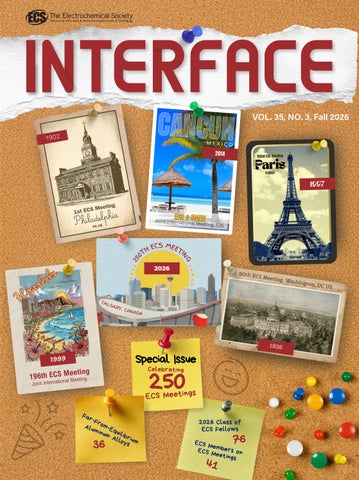
The cover art is an original work by Dinia Agrawala. Each postcard evokes a pivotal ECS Meeting from the Society's history, combining a novel design with period-inspired images, fonts, and card styles that aim to reflect the past. Cover design: Dinia Agrawala.
The Electrochemical Society Interface • Fall 2026 • www.electrochem.org
5
PENNINGTON CORNER
Preserving Peer Review, Preserving Trust in Science n May, the White House Office of Management and Budget (OMB) proposed significant revisions to the “Uniform Guidance for Federal Financial Assistance,” the rules governing US grant review. The proposed changes would require senior political appointees to conduct pre-award reviews of discretionary grants and would relegate scientific peer review to being only advisory rather than determinative in funding decisions. The proposed regulation would also expand the authority of politicians and bureaucrats to review, modify, suspend, or terminate awards based on broader policy considerations. OMB has stated that these changes will improve transparency, accountability, and consistency across federal grant programs while ensuring that awards align with presidential priorities. However, the OMB proposal raises profound concerns about the future of US scientific research. Most notably, it would fundamentally alter the longstanding balance between scientific expertise and political oversight by allowing political appointees to override recommendations developed through rigorous peer review. Since World War II, the US has led the world in scientific discovery and technological innovation through a research funding system built on merit-based, technical peer review. Federal agencies rely on independent panels of qualified experts to evaluate grant proposals based on their intellectual merit, technical feasibility, and potential impact. While agency leadership is responsible for final decisions, peer review is the cornerstone of a process designed to insulate scientific decisions from political influence and ensure that our taxes support the highest quality research. Peer review is not a bureaucratic formality. It is the internationally accepted gold standard for evaluating the quality, originality, and feasibility of research proposals using established standards developed over centuries. Replacing that expert-driven process with broader political discretion threatens a system that depends upon objectivity, predictability, and trust. Political appointees, regardless of their qualifications or intentions, are selected to implement an administration’s policy agenda rather than to evaluate highly specialized scientific questions across hundreds of research disciplines. Under the new rules, funding decisions could become increasingly influenced by short-term political priorities instead of long-term scientific merit. The consequences extend far beyond individual grant applicants. Scientific research requires years of sustained investment before producing meaningful results. Researchers develop multi-year programs, universities build laboratories, graduate students choose research careers, and private-sector companies invest in commercialization based on confidence that federal funding decisions are made through consistent and objective processes. The proposed changes also raise significant concerns for the international scientific community. The changes threaten cross-border collaborations that address
I
The Electrochemical Society Interface • Fall 2026 • www.electrochem.org
global challenges such as climate change, pandemics, and space exploration and increase uncertainty for our international partners. This is not to suggest that federal agencies should operate without accountability. But there is an important distinction between setting strategic priorities and substituting political judgment for technical expertise in evaluating individual scientific proposals. The current system successfully accommodates both by allowing administrations to define broad research priorities while relying on independent experts to determine which projects best advance those objectives. To help preserve and defend robust support of science, ECS and many of our partner societies have significantly increased our advocacy efforts in recent months. As you can read in more detail here, ECS leaders and colleagues from the Materials Research Society (MRS) traveled to Capitol Hill to share our communities’ concerns with Congress. In addition, ECS’s Executive Committee submitted a request to OMB Director Russell Vought to extend the public comment period for the proposed changes. The OMB provided only 45 days for public comment, half of the customary 90-day period. The Executive Committee also voted to join the American Institute of Chemical Engineers, American Chemical Society, and MRS, among others, in sending a letter to congressional leadership outlining our concerns about the proposed rule changes. What impact will these efforts have? It is difficult to say. Typically, this type of proposal receives around 2,500 public comments. To date, Regulations.gov reports nearly 500,000 comments, about 94 percent of which oppose the changes. We are hopeful that this overwhelming level of public engagement will help inform the administration’s final decision on this critical topic. In August, the Senate Appropriations Committee released a continuing funding resolution which includes language that would pause the OMB’s proposed rewrite of the policies and procedures governing the federal grantmaking process. While this is only one step in the legislative process, it is nevertheless a positive development and reflects the growing concern among policymakers regarding the proposed changes. Furthermore, it demonstrates why it is so critical that ECS and our partner societies help ensure that important decisions are informed by sound science, that research funding and scientific institutions remain strong, and that the expertise of scientists and engineers is respected in the policymaking process.
Christopher J. Jannuzzi ECS Executive Director & Chief Executive Officer https://orcid.org/0000-0002-7293-7404
7
Fuel Cells & Electrolyzers + M470
HTF-1100
Scanning Electrochemical Workstation
High Temperature Furnace
• Customize up to 7 modules • Differentiate local corrosion effects • High throughput screening
Materials & Components
+
• Through & in-plane measurements • Atmospheric & pressure control • Temperature scan up to 20°C/min • Measurements up to 1100°C for SOFC
Small Cell Investigations
+
+ SP-300
BluRev
Premium Potentiostat
Electrode Rotator
• ±1 A (up to 120 A) • ±10 V (up to [0; 48] V) • EIS up to 11 MHz
• ±1 RPM accuracy over rotational range • Wide range of RDE & RRDE tips
Supporting every step of your Fuel Cell & Electrolyzer journey Fuel cell and electrolyzer development requires precise characterization and reliable testing performance at every stage. Whether you’re screening new materials, studying electrochemical interfaces, optimizing cell operation, scaling up, or
biologic.net
8
The Electrochemical Society Interface • Fall 2026 • www.electrochem.org
Innovation at every stage +
+ VMP-300
Premium Potentiostat • ±1 A (up to 150 A) • ±10 V (up to [0; 48] V) • EIS up to 11 MHz • Parallelization
Large Cell Investigations
VMP-3e
Essential Potentiostat • FlexP booster up to 60 V • Single cell & full stack EIS • Test station synchronization
Small Stacks
BluPEM Test Stations
Custom Configurations
HCP-803
• Up to 2 kW • Dew point accuracy within ±1°C (60–90°C)
High Current Potentiostat • Up to ±3 V • Up to 80 A • EIS up to 10 kHz
evaluating stack performance, BioLogic provides the instruments, test stations, and software expertise needed to accelerate your fuel cell and electrolyzer innovation.
Shaping the future. Together.
The Electrochemical Society Interface • Fall 2026 • www.electrochem.org
9
249th ECS Meeting
May 24–28, 2026 | Seattle, WA US
Highlights of the 249th ECS Meeting
T
he 249th ECS Meeting convened in Seattle, WA, May 24–28, 2026. A total of 2,360 registrants (including 26 guests) from 62 countries came together under the banner of Sustainable Technologies! The meeting included 47 symposia with 358 sessions. The total of 2,894 accepted abstracts included 2,250 oral talks and 644 posters. Of these, 1,077 abstracts were from students (764 oral and 313 posters). The meeting featured 524 invited talks and 31 ECS award and keynote talks. The Sustainable Technologies theme resonated throughout the meeting, underscoring the vital role electrochemistry and solid state science play in addressing today’s most pressing sustainability challenges—from clean energy and decarbonization to circular materials and climate-resilient systems. Scientists and engineers from academia, industry, and government came together to exchange ideas, foster collaborations, and accelerate progress on technologies that improve lives and protect the planet. This vibrant scientific community explored the latest research and cutting-edge innovations advancing climate action, resource efficiency, and long-term environmental sustainability.
Meet the Leaders and Divisions ECS leaders and division members met with Opening Reception attendees at dedicated tables. Conversations ranged from ECS and division initiatives to opportunities for electrochemistry and solid state science. The lively discussions reflected the collaborative spirit of the ECS community and reinforced the importance of direct engagement between Society leadership and members.
Opening Reception The 249th ECS Meeting Opening Reception hosted a full house, with attendees enjoying food and beverages. Attendees reaffirmed old connections and made new connections.
Division board members discussed division activities and opportunities to become more involved with their divisions with members new and old.
ECS Awards & Recognition Ceremony
Socializing at the Opening Reception.
ECS Executive Director & Chief Executive Officer Christopher J. Jannuzzi welcomed participants and introduced ECS Secretary Gessie Brisard. They delivered the session’s opening remarks together. Chris and Gessie elaborated on the meeting’s theme, Sustainable Technologies, emphasizing its relevance not only to materials, systems, and innovation, but also to how we build a more sustainable world—and the scientific community that makes it possible. In an increasingly uncertain world, fostering a sustainable scientific community is just as important as advancing sustainable technologies. They encouraged the audience to think about sustainability in a broader sense, recognizing that the future of electrochemistry and solid state science will be shaped not only by breakthroughs, but also by the strength of the community behind them. At ECS, sustainability is reflected in mentorship, the transfer of knowledge, the strength of our global community, and the shared responsibility to advance science for future generations. These connections keep knowledge moving forward and have sustained
Colleagues gather at the Opening Reception. ECS Executive Director & Chief Executive Officer Chris Jannuzzi (left) and ECS Secretary Gessie Brisard (right) welcome attendees to the ECS Awards & Recognition Ceremony. 10
The Electrochemical Society Interface • Fall 2026 • www.electrochem.org
the Society throughout its nearly 125-year history. In 2025, that connectedness was evident in an international community spanning nearly 70 countries, with nearly 10,000 members, 163 student chapters, and 52 Institutional Partners. Over the past year, ECS presented more than 300 grants and Society, division, section, and student awards. ECS publications reached a record 21.5 million downloads from the ECS Digital Library, reflecting both the demand for the ECS community’s research and the enduring strength of its peer-review network. ECS educational programs, webinars, and online learning opportunities reached more than 6,200 learners, while ECS meetings brought together nearly 6,000 scientists and engineers from around the world across more than 100 symposia and thousands of technical and poster sessions, accelerating the exchange of knowledge and fostering collaboration. Chris thanked Gessie, then welcomed home current members and invited non-members to join the Society. He thanked meeting and symposia sponsors, Institutional Partners, exhibitors, and the ECS divisions and sections, all of whom made the meeting possible. He then introduced ECS President James (Jim) Fenton. Jim said that the people of ECS are what stand out most from his time as president. At a moment when scientific funding, collaboration, and public trust face significant challenges, he noted that sustainability is reflected in people continuing to show up, share their knowledge, and create opportunities for the next generation. He expressed gratitude for the privilege of serving as president and for being part of the ECS community—having attended its twice-yearly “family reunions” for more ECS President James (Jim) than 40 years. Jim emphasized that Fenton takes the stage at the what makes the Society strong is not ECS Awards & Recognition the person serving as president, but the Ceremony. members who contribute through their own roles and efforts. He pledged to continue showing up, sharing his work, asking questions, and helping make ECS a place people want to return to—encouraging the audience to join him in that commitment. Jim then acknowledged the award winners, starting with the ECS Division Awards and encouraging participants to attend their award presentations. He congratulated the ECS University of Washington Student Chapter, represented by Rose Lee and Anthony Romero, for winning the 2025 Student Chapter Award. Established in 2012, the award recognizes distinguished student chapters that demonstrate active participation in the Society’s technical activities, establish community and outreach activities in the areas of electrochemical and solid state science and engineering education, and create and maintain a robust membership base. Jim recognized Institutional Partners who earned Leadership Circle Awards for reaching significant anniversary milestones in 2026: • GE Aerospace Research, a Legacy Level partner, celebrating 70 years of institutional partnership. Jie Yue accepted the award on GE’s behalf. • NSF Center for Synthetic Organic Chemistry, a Bronze Level partner, celebrating five years of institutional partnership. Shelley Minteer accepted the award on their behalf. • Plug Power, also a Bronze Level partner, celebrating five years of institutional partnership. Fan Yang accepted the award on their behalf. Jim introduced three members acknowledged for their service to the Society: • Luca Magagnin, who served as ECS Electrodeposition Division Chair for the 2023–2025 term;
Jie Yue accepts the Shelley Minteer accepts Leadership Circle Award the Leadership Circle honoring GE Aerospace Award acknowledging Research’s Legacy Level the NSF Center for 70 years as an ECS Synthetic Organic Institutional Partner. Chemistry’s Bronze Level five years as an ECS Institutional Partner.
ECS honors Luca Magagnin for his service as ECS Electrodeposition Division Chair for the 2023–2025 term.
Fan Yang accepts the Leadership Circle Award acknowledging Plug Power’s Bronze Level five years as an ECS Institutional Partner.
ECS celebrates Nae-Lih The Society honors (Nick) Wu’s 12-year Colm O’Dwyer, who term as Associate Editor served as ECS President for the Journal of The for the 2024–2025 term. Electrochemical Society.
• Nae-Lih (Nick) Wu, who completed his 12-year term as Associate Editor for the Journal of The Electrochemical Society. • ECS Past President Colm O’Dwyer, who served as ECS President for the 2024–2025 term. Jim announced the Society Award winners: • Jose Lopez Ninantay of the Georgia Institute of Technology (who could not attend the 248th ECS Meeting) received the 2024 Bruce Deal & Andy Grove Award, for his Journal of Solid State Science & Technology article, “Chemically Amplified, Dry-Develop Poly(aldehyde) Photoresist,” coauthored with Anthony Engler, Jared Schwartz, and Paul A. Kohl. The award is given annually to the young author of the best paper published in the preceding JES volume year. • Debra R. Rolison from the US Naval Research Laboratory received the 2025 Allen J. Bard Award, which was established in 2013 to recognize distinguished contributions to electrochemical science. The award is named in Allen J. Bard’s honor in recognition of his outstanding advancements in electrochemical science. • Thomas A. Zawodzinski Jr. of the University of Tennessee Knoxville received the 2026 Vittorio de Nora Award. Established in 1971, the award recognizes distinguished contributions to the field of electrochemical engineering and technology. Dr. de Nora is known internationally for his many contributions to industry, particularly in the manufacturing of chlorine and in the development of dimensionally stable electrodes. (continued on next page)
The Electrochemical Society Interface • Fall 2026 • www.electrochem.org
11
249th ECS Meeting
May 24–28, 2026 | Seattle, WA US (continued from previous page)
Jose Lopez Ninantay Debra R. Rolison receives the 2024 Bruce receives the 2025 Allen Deal & Andy Grove J. Bard Award. Award.
Thomas A. Zawodzinski Jr. receives the 2026 Vittorio de Nora Award.
After recognizing ECS members who reached their 30-, 40-, 50-, and 60-year milestone anniversaries as part of the ECS community, Jim concluded the ECS Awards and Recognition Ceremony.
Plenary Session: The ECS Lecture Following the Awards Ceremony, Chris introduced the highly anticipated ECS Lecture, “Wearable Bioelectronic Platforms,” given by Joseph Wang. Dr. Wang is the SAIC (Science Applications International Corporation) Endowed Chair, Distinguished Professor of Chemical and Nanoengineering, Director of the Center of Wearable Sensors, and Co-Director of the Center for Mobile Health Systems at the University of California San Diego (UCSD). He has made pioneering contributions to wearable sensors, microrobots, and bioelectronics, translating fundamental electrochemistry into practical technologies, including flexible body-worn sensors, biofuel cells, and novel electrodes for trace metal detection. His many signal honors include being named Fellow of The Electrochemical Society, Royal Society of Chemistry, and American Institute for Medical and Biological Engineering. He has been an ECS member for over 50 years. Joseph Wang (University In his talk, he described his lab’s of California San Diego) journey toward developing skin-worn presents the ECS Lecture. bioelectronic platforms, the energy and systems-integration advances that have enabled them, and recent efforts to translate these technologies into commercial products for managing conditions such as diabetes, Parkinson’s disease, and sepsis. Wearable electronic systems have attracted considerable attention because of their potential to continuously monitor health and wellness. Building on the success of continuous glucose monitoring, the field has advanced rapidly over the past decade with the development of epidermal electrochemical sensors capable of continuously and noninvasively capturing rich, dynamic molecular information. Electrochemical sensors are particularly well suited for on-body health monitoring because of their high performance and compatibility with miniaturization. Multimodal wearable systems that simultaneously monitor multiple chemical and physical parameters now provide unprecedented spatiotemporal insights into human health. Prof. Wang also discussed one of the field’s greatest challenges: providing a continuous power supply for wearable devices. He outlined the development of integrated, energy-autonomous wearable microgrids that optimize energy management under
12
changing environmental conditions and user demands, enabling nextgeneration health monitoring platforms to meet their growing power requirements. At the conclusion of the ECS Lecture, Chris returned to the stage, thanking Prof. Wang for sharing his groundbreaking research with the ECS community. Chris invited attendees to join Prof. Wang for a Q&A at the ECS Hub in the Exhibit Hall. Chris pointed out the sea of blue and green, the ECS colors, worn by audience members. He encouraged the audience to support the meeting host city by contributing to the Green Seattle Partnership, which helps restore and enhance Seattle’s forested parklands. Chris noted that at the meeting, leadership will consider approval of eight new Student Chapters in India, Saudia Arabia, Mexico, France, and the US. He reminded everyone to plan to attend the 250th ECS Meeting in Calgary, Canada, October 25–29, with the theme Celebrating the Society’s 250th Meeting! He also reminded attendees to save the dates of the 2027 ECS meetings, which will celebrate the Society’s 125th anniversary. He encouraged everyone to visit with the exhibitors in the Exhibit Hall and to browse the posters. He urged attendees to visit the Video Hub (or scan a QR code) to share their favorite meeting story. He concluded by thanking everyone for participating in the ECS Awards & Recognition Ceremony and the plenary ECS Lecture by Prof. Joseph Wang. He welcomed all to the 249th ECS Meeting and reminded everyone: Our Science Is Better When We Are Together!
Division Awards & Presentations ECS divisions presented 14 awards (including eight student and early-career awards). • Battery Division M. Stanley Whittingham Mid-Career Award: Yi-Chun Lu, “Material Designs for Sustainable Aqueous Batteries” • Dielectric Science & Technology Division Thomas D. Callinan Award: Mahendra Sunkara, “Plasma‐Catalysis for Chemical Production: Hydrogen, Green Methanol, and Ammonia” • Energy Technology Division Graduate Student Award Sponsored by BioLogic: S. Avery Vigil, “Multiscale Studies and Interfacial Strategies to Accelerate Oxygen Evolution Electrocatalysis” • Energy Technology Division Graduate Student Award Sponsored by BioLogic: Siddharth Rajupet, “Electrostatically Controlled PFSA Ionomer Adsorption to Catalyst Particles in Catalyst Inks” • Energy Technology Division Research Award: Minhua Shao, “Development of High Performance and Durable Fuel Cell Electrocatalysts” • Energy Technology Division Supramaniam Srinivasan Early-Career Investigator Award: Antoni Forner-Cuenca, “Engineering Electrode Materials Across Length Scales: How Microstructure and Surface Chemistry Govern Performance in Flow Batteries and Fuel Cells” • Industrial Electrochemistry and Electrochemical Engineering Division H. H. Dow Memorial Student Achievement Award: Simon Rufer, “Systems and Materials for Electrochemical CO2 Capture and Conversion” • Industrial Electrochemistry and Electrochemical Engineering Division Student Achievement Award: Xintong Yuan, “MultiFaceted Roles of Lithium Metal in Batteries and Beyond” • Industrial Electrochemistry and Electrochemical Engineering Division Ralph E. White Outstanding Student Award: Tushar Khemraj Telmasre, “Relevance of Classical Models and Simulation Approaches for Battery Digital Twins”
The Electrochemical Society Interface • Fall 2026 • www.electrochem.org
• Nanocarbons Division Richard E. Smalley Research Award: Jeffrey L. Blackburn, “Fundamentals of Interfacial Charge Transfer in Mixed-Dimensionality Heterojunctions” • Nanocarbons Division SES Research Young Investigator Award: Kyu-Young Park, “Redefining the Function of Carbon for Next-Generation Rechargeable Electrode Design” • Organic and Biological Electrochemistry Division Manuel M. Baizer Award: Shelley Minteer, “Transitioning Bioelectrocatalysis from Sensors to Energy Conversion and Electrification of the Chemical Industry” • Sensor Division Early Career Award: Itthipon Jeerapan, “Small and Simple by Design: Electrochemical Systems for Modern Analytical Chemistry and Energy Sustainability”
249th Z01—General Student Poster Session Congratulations to the winners of the 249th ECS Meeting Z01— General Student Poster Session Awards. More than 90 posters were submitted to the competition.
Virtual Judges Scott Calabrese Barton, Michigan State University Vivek Kamat, Vanderbilt University Seongjae Ko, University of Tokyo Ahmet Kusoglu, Lawrence Berkeley National Laboratory Changhee Lee, Tokyo University of Science Nurul Omar, Technische Universität Ilmenau Venkateshkumar Prabhakaran, Pacific Northwest National Laboratory Yuliya Preger, Sandia National Laboratories Eiji Tada, Institute of Science Tokyo Maureen Tang, Drexel University Sreeram Vaddiraju, Texas A&M University ECS thanks Dr. Alice Suroviec, Berry College, for serving as the Z01—General Student Poster Awards symposium organizer.
Symposia Best Presentation and Poster Awards The following 249th ECS Meeting symposia presented muchappreciated awards for best posters, presentations, and papers. The symposia organizers thank the sponsors who generously supported these awards.
A01—New Approaches and Advances in Electrochemical Energy Systems STUDENT/POSTDOC POSTER AWARDS Daniel M. Markiewitz (A01—0041), Massachusetts Institute of Technology: $500 Thuy Tran (A01—0059), Carnegie Mellon University: $400 Gulzat Nuroldayeva (A01—0058), Nazarbayev University, National Laboratory Astana: $300 From left to right: Rebecca Willner (Colorado College), Marola Lenhard (Max-Planck-Institut), and Leonhard Tannesia (Nanyang Technological University) are the 249th Z01—General Student Poster Session Award winners.
1st Prize – $1,500 Marola Lenhard, Max-Planck-Institut für Chemische Energiekonversion Z01—2684 “Simple and Versatile Electrochemical Synthesis of Highly Substituted 2,1-Benzisoxazoles”
2nd Prize – $1,000 Leonhard Tannesia, Nanyang Technological University Z01—2673 “Tunable, on-Demand H₂O₂ Production via Optimized 2e⁻ ORR Catalyst for Electrolyzer Applications”
3rd Prize – $500 Rebecca Willner, Colorado College Z01—2656 “Exploring Bipolar Electrochemistry Application to Electrochemical Liquid-Liquid-Solid Crystal Growth”
General Student Poster Session Judges The Society thanks the ECS members who served as reviewers for the 249th ECS Meeting Z01—General Student Poster Session. In-person Judges Sarah Berlinger, Lawrence Berkeley National Laboratory Dylan Boucher, Baylor University Scott Calabrese Barton, Michigan State University Thiagarajan Soundappan, Navajo Technical University
STUDENT/POSTDOC ORAL PRESENTATION AWARDS Dongjae Kong (A01—0049), Stanford University: $500 Léa Bucher (A01—0096) Université Grenoble Alpes, CEA, Liten: $500 Nejira Hadzalic (A01—0098), Universität Bayreuth: $500 Nodoka Takeda (A01—0103), Tokyo University of Science: $500 Aakriti Aggarwal (A04—0566), The University of Texas at Austin: $500 Xintong Yuan (A01—0111), University of California, Los Angeles: $500 Shuguo Sun (A01—0117), University of Delaware: $500 Malaurie Paillot (A01—0120), Université de Montréal: $500 Molly Corr (A01—0131), Stanford University: $500 Ilian Ramirez (A01—0110), Massachusetts Institute of Technology: $250 Aditaya Mehrotra (A01—0110), Massachusetts Institute of Technology: $250
A02—Whittingham Young Investigator and Student Slam 2 STUDENT PRESENTATION AWARDS: $600 Donghyeok Son (A02—0198), Yonsei University Myunggeun Song (A02—0152), Korea Advanced Institute of Science and Technology Mohammad Sufiyan Nafis (A02—0179), University of Colorado Boulder Simon Danitz (A02—0149), University of Washington Jenny Nicolas (A02—0157), University of California San Diego
(continued on next page) The Electrochemical Society Interface • Fall 2026 • www.electrochem.org
13
249th ECS Meeting
May 24–28, 2026 | Seattle, WA US (continued from previous page)
A03—Li and Beyond Li Chemistries for Rechargeable Batteries: Electrodes, Electrolytes, and Interphase EARLY CAREER AWARD: $600 Xueli (Sherry) Zheng (A03—0396), Stanford University, SLAC National Accelerator Lab Chang-Xin Zhao (A03—0265), University of Maryland Lucie Quincke (A03—0411), Technische Universität München POSTER AWARD: $300 Jinki Hong (A03—0305), Ulsan National Institute of Science and Technology (UNIST) Mohammad Amaan (A03—0332), University of Michigan Taichi Asakura (A03—0462), Osaka Metropolitan University Ida Nawrocka (A03—0298), University of Exeter
A04—Materials Advancements for Beyond Li-ion Batteries from Industrial and Academic Perspectives STUDENT PRESENTATION AWARD: $500 Kun Wang (A04—0544), The University of Chicago Tongtai Ji (A04—0536), Northeastern University Nihao Cai (A04—0546), University of Miami Lubhani Mishra (A04—0566), The University of Texas at Austin Jayanti Sharma (A04—0543), University at Buffalo Hugo Braun (A04—0555), Eidgenössische Materialprüfungs- und Forschungsanstalt (EMPA)
B01—Carbon Nanostructures for Energy Conversion and Storage STUDENT PRESENTATION AWARD: $300 Chi-Wei Wu (B01—0716), National Tsing Hua University Wen Sun (B01—0735), National Tsing Hua University
Old friends and new friends come together at the Student Mixer.
Student Mixer More than 200 students and early career professionals packed the sold-out Student Mixer. After a full day of symposia, they mingled and compared notes over refreshments. Special thanks to Pine Research Instrumentation and Scribner for supporting our students by sponsoring the event.
Notable Special Events Blue & Green Day Monday was Blue & Green Day, an opportunity for meeting attendees to show off their ECS pride by wearing blue and green, ECS’s official colors. Lots of people got in on the action, sporting blue and green hair, clothes, and accessories in a visual celebration of the community’s unity.
D01—Chemical Mechanical Polishing 18
STUDENT ORAL PRESENTATION 1st Place: $1,000 Cesar D. Alvarado Oreliana (D01—1225), Lewis University 2nd Place: $800 Zinnat Morsada (D01—1210), Clarkson University 3rd Place: $600 Chaerin Park (D01—1234), Sungkyunkwan University STUDENT POSTER PRESENTATION 1st Place: $500 Atefeh Sadrimofakham (D01—1233), Clarkson University Going green for Blue & Green Day.
Happy in blue at Blue & Green Day.
2nd Place: $300 Charmy Jani (D01—1236), Clarkson University 3rd Place: $200 Jeewoon Choi (D01—1229), Sungkyunkwan University, Samsung Institute of Technology
14
ECS Video Hub The Video Hub returned to the 249th Meeting. ECS invited everyone who was interested to stop by and record a brief video message. The Society collected almost 50 videos, with people sharing experiences ranging from how the Society enhanced their research, to connections made at meetings that propelled their work and careers, to what made meeting participation outstanding—and others congratulated ECS on its upcoming 250th meeting.
The Electrochemical Society Interface • Fall 2026 • www.electrochem.org
249th ECS Meeting – Exhibitors Thank you to our exhibitors!
No scripts, no stress! Nearly 50 meeting attendees dropped by the ECS Video Hub and recorded short videos about their ECS experiences.
Sponsors and Exhibitors
The 249th Meeting Exhibit Hall gets two thumbs up from Tomi Belosevic, next Machinery Group | nextCoatema. 249th ECS Meeting | Seattle, WA US | May 24-28, 2026
ECS applauds the meeting sponsors and exhibitors whose support and participation contributed directly to the meeting’s success. Thank you for developing the tools and equipment driving scientific advancement, sharing your innovations with the electrochemical and solid state communities, and providing generous support for the 249th ECS Meeting!
Literature Display
electrochem.org/249 | #ECS249
249th ECS Meeting – Symposia Sponsors 249th ECS Meeting | Seattle, symposia WA US | May 24-28, 2026 Thank you to the 249th ECS Meeting sponsors!
GOLD
SILVER
Meeting sponsor Scribner shares new products and old faithfuls with an appreciative audience. BRONZE Meeting | Seattle, WA US | May 24-28, 2026 249th ECS Meeting249th–ECS General Meeting Sponsors
Thank you to the 249th ECS Meeting sponsors!
CONTRIBUTING Applied Materials Inc. BioLogic
Huck Institutes of the Life Sciences – The Pennsylvania State University
Materials Research Institute – The Pennsylvania State University
Cellerate
Entegris
Toyota Research Institute of North America
BASF
Envision Energy USA Gamry Instruments Center for Biodevices |
SILVER
Tyfast VoltMatters, Inc.
electrochem.org/249 | #ECS249
CONTRIBUTING Bruker
Orbia Fluor & Energy Materials MEDIA
electrochem.org/249 | #ECS249
The Electrochemical Society Interface • Fall 2026 • www.electrochem.org
15
SOCIET Y NEWS
16
The Electrochemical Society Interface • Fall 2026 • www.electrochem.org
SOCIET Y NEWS
Publications Update Stewards of the Scholarly Record: Research Integrity Is a Shared Responsibility by Adrian T. Plummer, MPA, PMP, Senior Director of Publications The advancement of scientific discovery is woven into the core Much of this work is informed by the guidance of the Committee mission of the ECS Publications. However, this goal can only be met on Publication Ethics (COPE), whose internationally recognized when the scholarly record can be trusted. standards provide practical frameworks for addressing publication Every manuscript submitted, every peer review completed, every ethics consistently, transparently, and fairly. COPE’s guidance has editorial decision rendered, and every article published contributes to become foundational to scholarly publishing, helping editors and a permanent body of knowledge upon which future research is built. publishers navigate increasingly complex ethical questions while Researchers around the world rely upon the published literature to ensuring that decisions remain focused on preserving the integrity of develop new hypotheses, design experiments, validate findings, and the scholarly record rather than serving individual interests. advance our collective understanding of the ECS topical interest Research integrity, however, extends beyond written policies. areas. That confidence exists only because the scholarly community Conversations about integrity frequently use the words morals has long recognized that preserving the integrity of the scientific and ethics interchangeably, although they describe distinctly different record is a shared responsibility. concepts. Morals generally reflect an individual’s beliefs regarding Today, that responsibility has never been more important. what is good or bad and are often influenced by culture, upbringing, The landscape of scholarly publishing continues to evolve personal experience, or circumstance. Ethics, by contrast, establish rapidly. Scientific collaboration has expanded across disciplines and shared professional standards that define what is right and wrong continents, submission volumes continue to grow, and the pace of within a community. Ethical standards are intentionally designed to discovery continues to accelerate. At the same time, the pressures remain stable over time because they provide consistency, fairness, faced by researchers have become increasingly complex. Competition and accountability regardless of changing personal perspectives. for funding, institutional recognition, career advancement, and Scientific publishing depends upon those ethical standards, and publication in prestigious journals has become an undeniable reality the responsibility to uphold these standards belongs to all of us. of modern research. Authors have an obligation to present their work accurately, Competition itself is not the problem. In many respects, healthy acknowledge the contributions of others appropriately, disclose competition has driven some of humanity’s greatest scientific conflicts of interest, and report their findings honestly and achievements. The challenge arises when competition becomes more transparently. Reviewers contribute by providing objective, important than the journey and the constructive, confidential, and trustworthy pursuit of knowledge. independent evaluations that improve Across scholarly publishing, both individual manuscripts and the publishers increasingly encounter quality of the scientific literature. “Predatory publishing, paper mills, individuals and, in some cases, Editors must evaluate submissions manipulated peer review, falsified reviewer organized enterprises whose impartially and make decisions based identities, inappropriate authorship practices, objective is not to advance scientific solely upon scientific merit and the image manipulation, undisclosed conflicts understanding, but rather to exploit integrity of the peer-review process. the publication process for personal, Publishers must establish transparent of interest, and fabricated or unreliable data financial, or professional gain. policies, investigate concerns fairly, are some of the challenges faced by scholarly Predatory publishing, paper mills, and correct the scholarly record publishers across every discipline.” manipulated peer review, falsified whenever necessary. Readers also play reviewer identities, inappropriate an important role by raising legitimate authorship practices, image concerns when errors or potential manipulation, undisclosed conflicts of ethical issues are identified. interest, and fabricated or unreliable data are some of the challenges The publication of scientific research should never be viewed as confronting scholarly publishers across every discipline. the final objective. Rather, publication represents the beginning of The overwhelming majority of researchers conduct their work a conversation that allows knowledge to be challenged, validated, with honesty, professionalism, and an unwavering commitment to refined, and expanded by future generations of researchers. That advancing knowledge. Nevertheless, safeguarding the scholarly process depends entirely upon confidence in the integrity of the record requires every participant in the publication process to remain published record. vigilant. Research integrity cannot be preserved by publishers and Every manuscript submitted to a journal either strengthens or editors alone. Authors, reviewers, editorial board members, readers, weakens that record. Every peer review either improves science institutions, and scholarly societies all serve as stewards of the or misses an opportunity to do so. Every editorial decision either scientific record. reinforces trust or diminishes it. Every citation carries forward That shared responsibility is reflected throughout the publication confidence in the work that came before it. policies of ECS journals. The scholarly record is not owned by publishers, editors, or Over the past two years, ECS has strengthened numerous authors. It belongs to the scientific community itself and to the publication policies specifically to support research integrity and generations of researchers who will rely upon it long after today’s the long-term reliability of the scholarly record. Among these discoveries have become tomorrow’s foundations. enhancements are requirements for verified ORCID identifiers at At ECS, we remain committed to maintaining publication policies the point of submission, strengthened policies governing authorship that promote fairness, transparency, accountability, and scientific changes after submission, clearer expectations regarding revisions rigor. We encourage every member of our community to become throughout peer review and production, expanded guidance regarding familiar with the Author Guidelines and publication ethics policies publication ethics, and more comprehensive policies that address that govern our journals not simply because compliance is expected, conflicts of interest, image integrity, data transparency, and editorial but because these standards exist to protect something far greater than oversight. any individual manuscript. We didn't implement these requirements to increase administrative Our obligation is not merely to publish science. Our obligation procedures or to create additional hurdles for authors. Each policy is to preserve the integrity of the scientific record so that those who reflects lessons learned across scholarly publishing and addresses follow can build upon a foundation that is accurate, trustworthy, and areas where ethical concerns have become increasingly common. worthy of the confidence that science demands. In many instances, a small procedural safeguard implemented early in the publication process prevents far more significant ethical challenges later. The Electrochemical Society Interface • Fall 2026 • www.electrochem.org
17
SOCIET Y NEWS Ping Liu Appointed Technical Editor for Battery and Energy Storage Leadership transition marks a new chapter for the largest and most influential topical interest area of the Journal of The Electrochemical Society Ping Liu has accepted appointment as Technical Editor for the Battery and Energy Storage topical interest area of the Journal of The Electrochemical Society (JES). Dr. Liu will serve an initial three-year term from June 1, 2026, through May 31, 2029. The appointment marks one of the most significant editorial leadership transitions for JES in more than a decade. The Battery and Energy Storage topical interest area is the Journal’s largest editorial program, consistently receiving the highest volume of manuscript submissions while also generating the greatest number of article downloads and scholarly citations. As one of the world’s premier publication venues for electrochemical energy storage research, leadership of this topical area plays an important role in advancing the scientific quality and impact of the Journal. Dr. Liu brings to the role more than three decades of experience in electrochemical energy storage research, innovation, and scientific leadership. He is Professor and William Coles Endowed Chair in the Aiiso Yufeng Li Family Department of Chemical and Nano Engineering at the University of California San Diego and serves as Director of the Sustainable Power and Energy Center. His career has also included leadership positions at the US Department of Energy’s Advanced Research Projects Agency-Energy (ARPA-E), HRL Laboratories, and the National Renewable Energy Laboratory (NREL), where he has advanced research in batteries, fuel cells, electrochemical materials, and sustainable energy technologies. An accomplished researcher, inventor, and entrepreneur, Dr. Liu has published more than 190 peer-reviewed publications, has been awarded more than 60 US patents, and co-founded Tyfast Energy to commercialize fast-charging battery technology. In recognition of his contributions to scientific innovation, he is a Fellow of the National Academy of Inventors.
Dr. Liu also brings extensive editorial experience to JES. Most recently serving as Associate Editor for Electrochimica Acta, he has held editorial leadership roles with Nano Energy, Journal of Power Sources, Materials Research Bulletin, and Nanotechnology. He also serves on the editorial advisory boards of MRS Energy & Sustainability and EcoMat. A longtime member of The Electrochemical Society, Dr. Liu has maintained a strong publication record in JES and views the Journal as the home of foundational battery research. In his statement of interest submitted to ECS, he expressed his commitment to strengthening the Journal’s influence within the battery community by engaging emerging researchers while ensuring that JES continues to publish research characterized by both scientific innovation and rigorous electrochemical analysis. Dr. Liu succeeds Dr. Doron Aurbach, who will conclude more than 11 years of distinguished service as Technical Editor at the end of 2026 after reaching the maximum term permitted under ECS governance. During Dr. Aurbach’s tenure, the Battery and Energy Storage topical interest area became the Journal’s most prolific and most influential scientific program, leading JES in manuscript submissions, article readership, and scholarly citations. His dedication to editorial excellence and scientific rigor has helped establish the Journal as one of the world’s leading publications in electrochemical energy storage. Dr. Liu and Dr. Aurbach will work in parallel until the close of Dr. Aurbach’s term on December 31, 2026, to ensure that the transition of leadership is smooth for authors and for other editors who support the topic. The Electrochemical Society extends its sincere appreciation to Dr. Aurbach for his exceptional leadership and lasting contributions to the Society’s publications program and warmly welcomes Dr. Liu as he begins guiding the future of the Battery and Energy Storage topical interest area within the Journal of The Electrochemical Society.
IN THE
NEXT ISSUE The winter 2026 issue of Interface, our last one of the year, kicks off the Society's 125th anniversary celebration with a special issue built around the theme, “On Deck: Emerging Topics in Electrochemistry and Solid State Science.” The curated collection of articles, guest edited by members from across all of the ECS divisions, will highlight the overarching ECS mission of advancing science through a
18
thoughtful set of timely perspectives on emerging science, technology, and areas of opportunity across our community. Together, the articles will identify the scientific and technological areas that ECS members will be hearing considerably more about over the next three to five years—written by members who are especially well-positioned to help our community understand the science behind the topics themselves as well as their emerging importance.
The Electrochemical Society Interface • Fall 2026 • www.electrochem.org
SOCIET Y NEWS
Editorial Update The Electrochemical Society (ECS) Publications Subcommittee and the Technical Affairs Committee (TAC) recently approved the following editorial appointments and reappointments across the ECS publications portfolio. Trisha Andrew has accepted reappointment as an Associate Editor for ECS Sensors Plus (ECSSP) for a one-year term, September 5, 2026– September 4, 2027. Shichao Ding has accepted appointment as an Associate Editor for ECS Sensors Plus (ECSSP) for an initial oneyear term, July 1, 2026–June 30, 2027.
Itthipon Jeerapan has accepted reappointment as an Associate Editor for ECS Sensors Plus (ECSSP) for a one-year term, July 16, 2026–July 15, 2027.
Yue Qi has accepted reappointment as an Associate Editor for the ECS Journal of Solid State Science and Technology (JSS) for a 24-month term, September 1, 2026– August 31, 2028. Minhua Shao has accepted reappointment as Technical Editor for the Fuel Cells, Electrolyzers, and Energy Conversion topical interest area of the Journal of The Electrochemical Society (JES) for a 36-month term, September 16, 2026–September 15, 2029.
Sheng-Joue Young has accepted reappointment an Associate Editor for the Sensors topical interest area of the Journal of The Electrochemical Society (JES) for a oneyear term, June 1, 2026–May 31, 2027. Kent Zheng has accepted reappointment as an Associate Editor for ECS Advances (ECSA) for a 24-month term, August 19, 2026–August 18, 2028.
CELEBRATING A MAJOR MILESTONE!
ECS ADVANCES R EC EIV ES ITS F IRST
Impact Factor!
Included in the Clarivate Analytics Journal Citation ReportsTM 2026 release—a proud moment for our authors, editors, reviewers, and the entire ECS community!
THANK YOU FOR BEING PART OF THIS JOURNEY.
1.9 2026 IMPACT FACTOR
The best is yet to come!
The Electrochemical Society Interface • Fall 2026 • www.electrochem.org
19
SOCIET Y NEWS
ECS Board of Directors Report The ECS Board of Directors held its spring gathering on Thursday, May 28, in conjunction with the 249th ECS Meeting in Seattle, WA, US. ECS President James Fenton called the board to order and kicked off an agenda-packed meeting. In addition to reports on the Society’s major initiatives, key motions were passed to finalize the Society’s 2025 financial reporting, set the strategic direction for ECS’s operational units such as meetings and publications, and approve the next round of ECS Society Award Winners. ECS Secretary Gessie Brisard presented the minutes from the previous board meeting and had the pleasure of announcing the recently elected board members: Elizabeth Biddinger, ECS Industrial Electrochemistry and Electrochemical Engineering Division; Ardemis Boghossian, ECS Nanocarbons Division; and Eva Kovacevic, ECS Dielectric Science and Technology Division. Their two-year terms began immediately following the board meeting in Seattle and will end in May of 2028. Congratulations and best of luck to our newly elected board members! Following the secretary’s report, the board heard updates from new Education Committee Chair Scott Calabrese Barton who outlined changes to ECS’s enormously successful fellowship program with Toyota; Individual Membership Committee chair EJ Taylor who, with ECS Executive Director & Chief Executive Officer Chris Jannuzzi, presented eight new ECS Student Chapters for approval; and Institutional Engagement Committee Chair Alex Peroff who shared details of another nearly sold-out exhibition floor at the Seattle meeting. ECS Treasurer Lisa Podlaha-Murphy discussed the state of ECS’s finances, noting that, despite concerns over policy changes and disruptions to science funding that have negatively impacted Society operations, especially in the US, ECS had a very strong year financially, adding nearly $2M to its net assets. Next, Audit Committee Chair Colm O’Dwyer presented the Society’s audited financials and
990 tax form, both of which were approved by the board. Colm also thanked the ECS Finance Department, led by Chief Financial Officer Tim Gamberzky, for their outstanding work managing the Society’s finances and preparing the 2025 audit. ECS Vice President and Technical Affairs Committee Chair Francis D’Souza, along with Chris Jannuzzi, then provided the Technical Affairs Committee report, which included an update on the ECS meetings, Publications, and Interdisciplinary Science and Technology Subcommittees. Highlights from the report included: • Approval of 2027 ECS Meeting registration rates; • Announcement of the new JES Battery and Energy Storage Technical Editor Ping Liu from the University of California San Diego; • Celebration of 20 million downloads of content from the ECS Digital Library on IOP Science in 2025; • Interdisciplinary Science and Technology Subcommitteesponsored symposia at the upcoming Calgary meeting to include Z02—Celebrating Electrochemical and Solid State Science Innovations: Commercialization of Electrochemical Processes and Products, organized by EJ Taylor. The meeting concluded with the report from Honors & Awards Chair Adam Weber, who presented a motion to approve Burcu Gurkan for the Charles W. Tobias Early-Career Award and Robert Savinell for the Edward Goodrich Acheson Award. We look forward to sharing in the public recognition of these awards in Calgary later this year. Lastly, a motion to close the meeting was made, seconded, and unanimously approved. The board will reconvene in October 2026 during the 250th ECS Meeting in Calgary, Canada.
Orazem Presents Three-Part Impedance Spectroscopy Webinar On April 1, 8, and 15, 2026, Mark E. Orazem (Distinguished Professor of Chemical Engineering, University of Florida) presented a three-part webinar series on impedance spectroscopy. The sessions were hosted by NeuroNexus and cosponsored by The Electrochemical Society and the International Society of Electrochemistry. The first session introduced electrochemical impedance spectroscopy as an electrochemical technique with broad applications to batteries, fuel cells, corrosion, sensors, and electrodes for neural applications. The discussion included the history of impedance spectroscopy, applications that demonstrate the unique capability of impedance spectroscopy to quantify important phenomena, and the philosophy for measuring and analyzing impedance. The second session covered the methods used to measure impedance, the influence of instrumentation parameters on the measurement, and a systematic approach to model development based on electrode geometry and proposed reaction mechanisms. The third session emphasized electrodes used for neural stimulation, including SIROF (sputtered iridium oxide film) and TiN (titanium nitride) electrodes, and discussion of model development and regression results, including comparison to cyclic voltammetry.
20
About 2000 people registered for the event. The first session drew 735 participants, the second 721 participants, and the third 494 participants. Recordings of the sessions are available on YouTube (Session 1, Session 2, and Session 3).
Screenshot of the opening slide of the first session of the three-part Electrochemical Impedance Spectroscopy Webinar given by Mark E. Orazem and co-sponsored by ECS.
The Electrochemical Society Interface • Fall 2026 • www.electrochem.org
SOCIET Y NEWS
ECS Division Contacts H M
Battery Division Jie Xiao, Chair Pacific Northwest National Laboratory Jagjit Nanda, Vice Chair Xiaolin Li, Secretary Neil Dasgupta, Treasurer Doron Aurbach, Journals Editorial Board Representative H+ Cl–
D
Xingbo Liu, Chair West Virginia University Teruhisa Horita, Vice Chair Dong Ding, Junior Vice Chair Xinfang Jin, Secretary/Treasurer Minhua Shao, Journals Editorial Board Representative Industrial Electrochemistry and Electrochemical Engineering
Corrosion
Eiji Tada, Chair Institute of Science Tokyo Rebecca Schaller, Vice Chair Yaiza Gonzalez-Garcia, Secretary/Treasurer Sannakaisa Virtanen, Journals Editorial Board Representative
High-Temperature Energy, Materials, & Processes
Elizabeth Biddinger, Chair City College of New York Chockalingam Karuppaiah, Vice Chair William Tarpeh, Secretary/Treasurer Paul Kenis, Journals Editorial Board Representative
S
Dielectric Science and Technology
Luminescence and Display Materials
Eva Kovacevic, Chair GREMI Thorsten Lill, Vice Chair Hiroki Kondo, Secretary Neelakandan Marath Santhosh, Treasurer Peter Mascher, Journals Editorial Board Representative
Chong-Geng Ma, Chair Chongqing University of Posts and Telecommunications William Cohen, Vice Chair Luiz Jacobsohn, Secretary/Treasurer Won Bin Im, Journals Editorial Board Representative
T
Nanocarbons Electrodeposition Andreas Bund, Chair Technische Universität Ilmenau Rohan Akolkar, Vice Chair Adriana Ispas, Secretary Massimo Innocenti, Treasurer Takayuki Homma, Journals Editorial Board Representative Electronics and Photonics Vidhya Chakrapani, Chair Rensselaer Polytechnic Institute Zia Karim, Vice Chair Travis Anderson, 2nd Vice Chair Jennifer Hite, Secretary Helmut Baumgart, Treasurer Travis Anderson, Journals Editorial Board Representative Tae-Yeon Seong, Journals Editorial Board Representative Energy Technology Minhua Shao, Vice Chair Hong Kong University of Science and Technology Hui Xu, Vice Chair Iryna Zenyuk, Secretary Ertan Agar, Treasurer Minhua Shao, Journals Editorial Board Representative
Ardemis Boghossian, Chair Independent Researcher Michael S. Arnold, Vice Chair Anton Naumov, Secretary Jeffrey Blackburn, Treasurer Jihyun Kim, Journals Editorial Board Representative O
B
Organic and Biological Electrochemistry
Ariel Furst, Chair Massachusetts Institute of Technology Jeffrey Halpern, Vice Chair David Hickey, Secretary/Treasurer Alice Suroviec, Journals Editorial Board Representative Physical and Analytical Electrochemistry Anne Co, Chair The Ohio State University Svitlana Pylypenko, Vice Chair Iwona Rutkowska, Secretary Valentine Vullev, Treasurer Andrew Hillier, Journals Editorial Board Representative Sensor Praveen Kumar Sekhar, Chair Washington State University Dong-Joo Kim, Vice Chair Leyla Soleymani, Secretary Harshini Mukundan, Treasurer Praveen Kumar Sekhar, Journals Editorial Board Representative
The Electrochemical Society Interface • Fall 2026 • www.electrochem.org
21
SOCIET Y NEWS
Division News Energy Technology Division The ECS Energy Technology Division (ETD) hosted a luncheon on May 27, 2026, during the 251st ECS Meeting. The event featured division updates and an awards ceremony. ECS President Jim Fenton joined the luncheon and delivered brief remarks. Notably, more than half of the attendees were participating in an ETD luncheon for the first time, demonstrating strong enthusiasm for electrochemistry-driven energy technologies. The presence of so many new participants reflects the division’s continued growth and the strong momentum and sustainability of ETD and ECS as they expand and strengthen the community.
New Energy Technology Division members meet with Division Vice Chair Hui Xu and Secretary Iryna Zenyuk.
2026 PARTNER OPPORTUNITIES GUIDE sponsorship@electrochem.org
250th ECS Meeting October 25–29, 2026 Calgary, Canada BMO Centre
NEW OPPORTUNITY: Solutions in Motion Meetings enewsletter advertising
Position your brand as a leader in global impact and invest in the ECS community!
22
The Electrochemical Society Interface • Fall 2026 • www.electrochem.org
SOCIET Y NEWS Abstract Submission Deadline
December 4
https://ecs.confex.com/ecs/251/cfp.c i
Characterize All-Solid-State Batteries with the new PAT-Cell-Solid Test Cell! Adjust and measure up to 9000 N of applied force (up to 318 MPa at 6 mm / 114 MPa at 10 mm electrode diameter) For aprotic chemistries with solid-state and liquid electrolytes Built-in force, gas pressure and temperature sensors Half cell SiC480 + LPSCI vs. In/InLi
Build reproducible Cell Stacks with the new PAT-Solid-Core:
Solid-State Cell Stack
+49 40 79012 Society 734 Interface sales@el-cell.com www.el-cell.com The Electrochemical • Fall 2026 • www.electrochem.org
23
SOCIET Y NEWS
UPCOMING ECS SPONSORED MEETINGS Visit the ECS website for more information.
21st International Meeting on Chemical Sensors July 11–14, 2027 | Montréal, Québec, Canada Concordia University 20th International Symposium on Solid Oxide Fuel Cells (SOFC-XX) July 11–July 16, 2027 | Tokyo, Japan Plaza Heisei (Tokyo International Exchange Center) To learn more about what an ECS sponsorship can do for your meeting or to request ECS sponsorship for your technical event, please contact ecs@electrochem.org.
24
The Electrochemical Society Interface • Fall 2026 • www.electrochem.org
Image: ChatGPT
EYE ON CA P I TO L H I L L 2 0 2 6 In June, The Electrochemical Society (ECS) joined the Materials Research Society (MRS) for a third visit to advocate for science with senators, representatives, and their staff on Capitol Hill. Their meetings came at a time of growing political polarization over science, with deepening partisan divisions in the US over the use, funding, and review of scientific research.
ECS Past President James (Jim) Fenton (University of Central Florida); Katherine (Kathy) Ayers (Vice President, R&D, Nel Hydrogen; Past Chair, ECS Energy Technology Division); and Christopher (Chris) Jannuzzi (Executive Director & Chief Executive Officer) The Electrochemical Society) represented the Society. They visited the offices of: Robert Aderholt, US Representative, Alabama’s 4th District; Richard Blumenthal, Senior US Senator, Connecticut; Cory Booker, Senior US Senator, New Jersey; Rosa DeLauro, US Representative, Connecticut’s 3rd District; Andy Kim, Junior US Senator, New Jersey; Christopher Murphy, Junior US Senator, Connecticut; and Frank Pallone, US Representative, New Jersey’s 6th District.
Chris: My biggest takeaway is that it’s a mixed picture. The executive orders coming out of the White House are potentially very damaging to scientific research. One such order, proposing sweeping changes to the federal grant-making process, had just been issued when we visited Capitol Hill, so it became a major topic in many of our meetings. Our message, however, remained the same regardless of political party: investing in science benefits everyone. It strengthens the economy, improves health and national security, and drives innovation. We wanted lawmakers to understand how cuts to research funding would directly affect their districts and states, while also emphasizing the broader national and global consequences.
Over the summer, Jim, Kathy, and Chris answered questions about their advocacy efforts.
Kathy: Generally the reception was the same—the staffers are typically engaged and eager to talk to us. But we meet with some different staffers/offices every time depending on availability, so it is important to keep up the momentum. I would also say that some offices seemed more frustrated with the status quo this year, based on what OMB has been doing to obstruct funding to their states. The impact is hitting harder. Jim: This year’s conversations were more discouraging because the impacts of federal funding cuts have become real. Since the previous visit, my organization has lost about $6 million in awarded federal funding, resulting in layoffs and the effective shutdown of my research organization. It seemed as if congressional staff and legislators understood even less about the importance of federally funded research than before, partly because legislative staff were less involved in developing budget proposals. However, legislators seemed to listen better when discussions were tied directly to local jobs, companies, and constituents. Chris: We’re already seeing the impact. Student participation at our conferences has dropped by 50 percent over the past year, mainly due to funding and immigration changes. Those students are conducting the kind of fundamental research that industry often won’t fund because the payoff isn’t immediate. Historically, federal investment in university research has produced enormous long-term returns by enabling discoveries that industry later transforms into new technologies and products. We also stressed that the United States risks losing its leadership in science and technology as other countries invest more aggressively in research. This isn’t a Democratic or Republican issue—it’s about maintaining America’s competitiveness. In meetings with lawmakers,
What were your biggest takeaways from this year’s meetings, and how do we take what we learned from this visit and apply it to the Society’s goals and strategies? Kathy: One of my biggest takeaways is that scientists have to help make science credible and accessible. Every congressional office has staffers with different specialties; we primarily met with science staffers, so they understood our points well and agreed with the importance of funding basic and applied research. However, their constituents often don’t, and they are the ones voting. One staffer specifically asked us for help in explaining the benefits and risks of technology implementation. For example, residents in a rural community are not going to listen to Meta telling them that a data center will be good for their town. But they might listen to a National Lab, or a Technical Society, which can present a less biased view of what precautions they can take as residents to ensure corporate responsibility while recognizing the economic benefits. Jim: ECS must do much more than an annual Capitol Hill visit. ECS needs to educate policymakers, local communities, and our members about the importance of electrochemical science and federal research funding. ECS should equip members, student chapters, and local sections with materials to communicate how electrochemical technologies drive economic development, workforce training, and energy independence. Advocacy should occur year-round, particularly with local elected officials, not just in Washington.
What was different about the conversations compared to your previous visit(s)?
(continued on next page)
The Electrochemical Society Interface • Fall 2026 • www.electrochem.org
25
(continued from previous page)
we made the discussion local. For example, when we met with Representative Robert Aderholt’s office, we highlighted how research funding supports key industries in his district. We also shared data showing the projected funding losses each state could face. In New Jersey alone, the proposed FY 2027 budget includes approximately $900 million in research funding cuts, putting students, laboratories, researchers, and future discoveries at risk.
How did you communicate the importance of electrochemistry and solid state science to a nontechnical audience?
Kathy: The staffers are typically at least a little bit technical. But we usually talk about the value of science in general, not specific methods or research studies. We also talk about technologies at a very high level. For example, when I talk about hydrogen, I talk about what it is used for (weather balloon filling, chemical feedstocks, semiconductor processing, power plant cooling, etc.) and why even though electrolysis is “expensive” as opposed to making hydrogen from natural gas, when you factor in purification, transportation, and delivery costs, it can actually be cheaper to make hydrogen via electrolysis at the point of use. I don’t talk specifically about the detailed research we are working on. Jim: I framed electrochemistry in terms of everyday benefits rather than technical details. I explained that electrochemical technologies—including batteries, fuel cells, hydrogen electrolyzers, and solar photovoltaics—enable affordable, locally produced energy, reduce dependence on imported fossil fuels, create jobs, improve energy security, and lower electricity and transportation costs. And I stressed that universities produce highly trained people who drive innovation and economic development. This makes research funding an investment in future workers rather than just about funding laboratories. Chris: It depends on the office. In some cases, we’ve been building relationships for several years. For example, Senator Cory Booker’s science team knows ECS well and has a much stronger understanding of what we do than they did when we first started meeting. Even when people aren’t familiar with electrochemistry or solid state science, they understand the value of investing in scientific research. One of the United States’ greatest strengths has been attracting and training talented scientists from around the world. That leadership has fueled innovation, economic growth, and technological advancement for decades. What concerns me is that we’re beginning to lose that advantage. Scientists—both international researchers and US-born researchers— are increasingly being recruited by countries that are offering stable funding, well-equipped laboratories, and the freedom to pursue ambitious research. If that trend continues, we risk losing not only talented scientists but also the discoveries and innovations they would have made here.
26
What issues generated the most interest or questions from legislators and their staff? Kathy: One issue was how to get people to trust in science. They also are very appreciative of facts and quantitative data that can help support the arguments for science funding and against political influence in science, such as the proposed OMB rule requiring all grants to be approved by political appointees and allowing termination at any time. Jim: The people we visited paid the most attention when discussions were connected to local economic impacts, such as jobs created by battery manufacturing, companies in their districts, or constituents directly affected by research funding. They generally agreed research is valuable but ranked it far below more immediate political concerns.
What do you hope congressional offices remember from your meetings? Kathy: That we are available if they need help or information. We tell them that every time, but I don’t know if they ever reach out to ask about a specific science issue that comes their way. Jim: I hope congressional offices remember that federally funded research produces people—not just scientific discoveries. I want policymakers to recognize universities as economic development engines and understand that investment in research develops the skilled workforce needed for future technologies. They should appreciate that electrochemical science is essential for affordable energy, economic competitiveness, and national prosperity. Chris: Our approach wasn’t to be combative. It was to show lawmakers how we can work together to strengthen their states and districts through continued investment in science. When Congress is closely divided, every conversation matters. You never know which meeting or which message will make a difference.
Were there any discussions that left you particularly encouraged or discouraged about the future of science policy? Kathy: I am always encouraged by the fact that we are met with bipartisan support. The discouraging part is the amount of work that needs to happen to give the general public better science literacy and to rebuild trust in science. Jim: I was more discouraged than after the previous visit because my organization has suffered major funding losses and layoffs despite having received award letters. I’m frustrated that research is not viewed as a legislative priority. That said, I am encouraged by the long-term outlook for electrochemical technologies and renewable energy. They are economically inevitable. Continued advocacy can eventually have an influence. An example is Ukraine’s persistence despite difficult circumstances.
The Electrochemical Society Interface • Fall 2026 • www.electrochem.org
Chris: I actually came away a little more optimistic this year. There was a level of recognition we didn’t see during previous visits. While many of the legal challenges to recent policy decisions aren’t making national headlines, members of Congress are aware of them and understand the impact these funding cuts are having.
Why do you think it is important for organizations like ECS to maintain a presence in science policy discussions and for the ECS community to engage directly with policymakers? Kathy: Because ECS is a collective, it will naturally be viewed as less biased than an individual company, researcher, or university. We also have access to a wide variety of information and expertise and can act as a valuable resource if the staffers know us. It is also good for ECS to understand the tone of what is happening in Washington, DC, so that we can be prepared with the right messages and help Society members navigate the political landscape. Jim: ECS has an essential role because policymakers do not fully understand the value of research or electrochemical science. If ECS doesn’t advocate, the situation will get worse. I think that as well as our Capitol Hill visits, ECS should empower our members, student chapters, local sections, and industry partners to educate elected officials and the public about how research funding, STEM education, and electrochemical technologies benefit society and the economy. Chris: Advocacy is part of ECS’s mission. Our purpose is to advance electrochemistry and solid state science, and that means helping ensure researchers have the support and resources they need to do their work. Science should inform public policy, and organizations like ECS have a responsibility to bring the expertise of our community into those conversations. From a practical standpoint, science policy also affects the Society’s ability to fulfill its mission. Research funding drives scientific discovery, publications, conferences, and collaboration. When support for foundational research declines, the entire scientific enterprise is affected. We’ve also seen that advocacy is effective. Working alongside other scientific societies, ECS helped overturn legislation in Washington State that would have negatively affected nonprofit organizations like ours. That effort demonstrated the value of having a strong voice on behalf of the scientific community. I would absolutely encourage ECS members to engage with policymakers. They can amplify their voices through ECS by serving on committees or participating in advocacy efforts, but they can also make a difference as individual citizens. Every conversation, letter, and meeting helps policymakers better understand the importance of scientific research and its impact on their communities.
For ECS, this issue directly affects our mission. When research funding declines, fewer scientists are conducting research, publishing papers, and attending our meetings. That ultimately slows scientific progress. The consequences extend far beyond ECS. Reduced investment in fundamental research affects economic growth, healthcare, environmental progress, and national security. Simply put, no area benefits from cutting support for foundational science. That’s why advocacy is so important. If our core scientific community suffers, our ability to advance electrochemistry and solid state science suffers as well.
Is there anything else you’d like to add about this year’s Capitol Hill visit? Kathy: It would be great to get more people involved, especially from states (whose representatives) we haven’t visited. Typically, at least one member of ECS and/or MRS needs to be from the state we are visiting in order to get the meeting. But talking to Congress requires some communication training, so it would be good to leverage the technical societies to do that. Jim: The Capitol Hill visit is only the beginning. Advocacy should continue throughout the year in our members’ home districts, where they can spend more time with elected officials and staff. I’d like to see ECS develop educational materials that local sections and student chapters can use in their communities. Yes, I’m disappointed about my research situation, but I’m optimistic about the longterm future of electrochemical technologies. ECS is needed now more than ever! Chris: One of the highlights of this year’s Capitol Hill visit was the outstanding partnership between ECS and the Materials Research Society (MRS). We had a diverse group of scientists and volunteers who shared a common purpose: ensuring that policymakers understand the importance of sustained investment in scientific research. There was a real sense of collegiality, and I left feeling that Congress was more receptive to our message than during previous visits. Another concern is that I hope our international members also care about this issue because science is a global enterprise. The United States has long been a leader in funding research, attracting talented scientists, and producing discoveries that benefit the entire world. Those advances have always depended on international collaboration. If U.S. investment in science declines, the effects won’t stop at our borders. Research ecosystems take decades to build, and once they’re weakened, they can’t simply be recreated elsewhere overnight. Other countries will continue to innovate, but slowing scientific progress in one of the world’s largest research economies affects everyone. That’s why strong support for scientific research is not just a US issue—it’s a global one.
The Electrochemical Society Interface • Fall 2026 • www.electrochem.org
27
250th ECS Meeting
October 25–29, 2026 | Calgary, Canada
Preview of the 250th ECS Meeting
T
he 250th ECS Meeting takes place in Calgary, Canada, October 25–29, 2026, at the BMO Centre. The meeting’s theme— 250th ECS Meeting Celebration—highlights the central role the Society has played—and will continue to play—in the scientific evolution of our modern world. For 250 meetings, ECS has united researchers, engineers, and leaders from around the globe to exchange ideas that transform technology and improve lives. This milestone gathering honors the Society’s legacy of discovery while igniting new collaborations that will define the next era of electrochemical and solid state science. Featuring world-class presentations, panels, poster sessions, and exhibits, the 250th ECS Meeting celebrates the power of the ECS community to connect, inspire, and create the next century of breakthroughs in clean energy, sustainable technology, and materials science.
250 th ECS MEETING
“Reaching ECS’s 250th meeting is a historic milestone. For generations, our biannual gatherings have united world-changing researchers to transform technology and improve lives. As we look toward Calgary, we aren't just honoring a legacy of discovery; we are actively igniting the next era of innovation. Let’s make this historic 250th meeting a launch pad for a cleaner, more sustainable future.” Francis D’Souza | President ECS – The Electrochemical Society
Plenary Session: The ECS Lecture Monday, October 26
“Electrochemistry: A Keystone of the Energy Future” Esther Takeuchi, Stony Brook University Electrochemistry has driven remarkable advances over the past century and will play an increasingly important role in the future. It underpins technologies ranging from portable electronics and computers to electric vehicles, shaping how we live and work. Historic breakthroughs demonstrate its transformative impact. More than 100 years ago, the introduction of electrolytic aluminum production reduced the metal’s cost from that of silver to a widely available industrial material. Other electrochemical processes, such as electrowinning, remain essential for producing metals critical to modern society.
Looking ahead, electricity is expected to become the dominant energy source for homes, industry, and transportation. Demand continues to rise, driven in part by the growth of artificial intelligence and energy-intensive data centers. Meeting this demand will require continued innovation in electrochemical science and engineering. Electrifying industrial processes, improving battery technologies, and developing more efficient materials and systems will help lower costs and expand the use of electrified transportation. As new forms of electricity generation are deployed, affordable, large-scale energy storage will become increasingly important. In this evolving energy landscape, electrochemistry will remain fundamental to enabling a more electrified and sustainable future.
Can’t-Miss Events
(Consult the Online Program for days/times)
Opening Reception Kick off the meeting by connecting with old friends and new faces at the Opening Reception. Enjoy drinks and a selection of hors d’oeuvres while mingling in a relaxed, informal setting. Be
28
sure to look for the division tables, where division representatives are available to meet new members and answer questions. Make connections, catch up with your ECS division, and get the meeting off to a great start.
The Electrochemical Society Interface • Fall 2026 • www.electrochem.org
Student Mixer
Sponsored by Pine Research and Scribner You're out of the lab, so come have fun at the Student Mixer! After a full day of symposia, unwind your mind and meet up with friends old and new over small bites and beverages. Students and earlycareer researchers are welcome (ticket required).
ECS Publishing Forum: Insights, Integrity, and Impact in Scholarly Publishing
Whether you’re preparing your first manuscript or have years of publishing experience, the Publishing Forum provides practical guidance from ECS publishing experts to help you navigate today’s publishing landscape. Gain valuable insight into research integrity, peer review, and strategies for increasing the visibility and impact of your research.
Blue & Green Day
Show off your ECS spirit by wearing blue and green—the official colors of ECS! From presenting research and attending sessions to networking with colleagues, let’s visually celebrate the unity of our community!
Exhibit Hall Discover the latest innovations in instruments, materials, systems, publications, and software as you explore the vibrant Exhibit Hall. Meet face-to-face with leading organizations and experts from across academia, industry, and government—all gathered to showcase what’s next in electrochemistry and solid state science.
that draw you in! ECS General Student Poster Session Awards recognize research of general interest to the Society and aim to promote graduate and undergraduate work in electrochemical and solid state science and technology while encouraging active student interest and participation in ECS. Posters accepted for presentation are eligible for awards of $1,500 (1st place); $1,000 (2nd place); and $500 (3rd place).
Award Talks Gain unique insight, inspiration, and motivation throughout the week at Society, division, and section award winners’ talks. Hear firsthand about their research innovations and how they achieved success. Network with “the best and the brightest!”
Video Hub & Headshot Hub
Show off your passion, boost your professional presence, and help inspire the science and technology community—one smile and one great first impression at a time. Visit the Video Hub to step in front of the camera and record a quick video telling your ECS story. Then get your free professional headshot to glow-up your LinkedIn profile and give your job search—or next career move—a boost. (continued on next page)
General and Z01—Student Poster Sessions Presenters meet and greet peers, professors, and industry representatives; field questions; make connections; and discuss compelling research questions. Browse the aisles and find the posters The Electrochemical Society Interface • Fall 2026 • www.electrochem.org
29
250th ECS Meeting
October 25–29, 2026 | Calgary, Canada (continued from previous page)
New & Newsworthy Be on the Lookout for White Cowboy Hats! Calgary’s iconic white cowboy hat has been a symbol of the city since 1946 and traditionally hats are presented by the mayor to visiting dignitaries. During the ECS President’s Reception in Calgary, where we recognize ECS volunteers for their shared time and expertise, the City of Calgary will be showcasing its White Hat Ceremony for ECS! Want to win one of these special white hats and be part of the ceremony? Stay tuned for details!
First-Time Attendee Meetup
that pop up along the way. Whether you’re attending solo or with colleagues, you’ll leave with new connections, practical advice, and the confidence to make your first ECS Meeting an unforgettable one.
Meet our Social Media Ambassadors: Your Eyes and Ears at the 250th Look for our new Social Media Ambassadors, who will debut at the 250th. They’ll be there sharing live meeting updates, photos, and highlights. Follow along to catch behind-the-scenes moments, attendee experiences, and some of the meeting’s biggest announcements. Be sure to like, comment, and share their posts!
Welcome to your first ECS Meeting! Take 30 minutes with us to discover the can't-miss events; how to get the most out of the technical sessions, posters, and Exhibit Hall; and answer any questions
Symposium Topics A— Batteries and Energy Storage A01—Innovative Materials and System Designs for Electrochemical Energy Conversion and Storage Golareh Jalilvand, Yuliya Preger, James Saraidaridis, Loraine TorresCastro, Chockkalingam Karuppaiah, Duhan Zhang, Mickael Dolle, Vincent Chevrier, Jian Xie, Devashish Kulkarni ECS Energy Technology; ECS Battery; ECS Industrial Electrochemistry and Electrochemical Engineering; ECS Physical and Analytical Electrochemistry A02—Battery Safety and Failure Modes 5 Jun Xu, Donal Finegan ECS Battery A03—Next Generation Aqueous Batteries: Electrodes, Electrolytes, and Interphases 2 Veronica Augustyn, Xiulei (David) Ji, Xueli (Sherry) Zheng, Tao Gao, Ömer Çapraz ECS Battery A04—Electrode/Electrolyte Interfaces in Solid State Batteries: Theory, Experiments, Materials, and Cell Design Naga Phani Aetukuri, Dominic Bresser, Sai Gautam Gopalakrishnan, Srinivasan Ramakrishnan ECS Battery A05—Organic Materials for Electrochemical Energy Storage Yan Yao, Wei Wang, Brett Helms, Bishnu Prasad Thapaliya, Alae Eddine Lakraychi, Liangbing Hu ECS Battery; ECS Organic and Biological Electrochemistry A06—AI-Driven Battery Materials Design and Manufacturing Changmin Shi, Yangang Liang, Jeffrey Lopez, Dong Zhang, Peng Bai, Yumin Zhang, Jason Hattrick-Simpers, Shangqi Li ECS Battery A07—Advances in Lithium Circularity: From Mining Extraction to End Use Alvaro Videla, Gao Liu, Jagjit Nanda, Dongping Lu ECS Battery B— Carbon Nanostructures and Devices B01—Carbon Nanostructures: From Fundamental Studies to Applications and Devices Jeffrey Blackburn, Ardemis Boghossian ECS Nanocarbons C— Corrosion Science and Technology C01—Corrosion General Poster Session Eiji Tada, Rebecca Schaller, Hiroaki Tsuchiya ECS Corrosion
30
C02—Critical Factors in Localized Corrosion 12 Rajeev Gupta, Ingrid Milošev, Nick Birbilis, Michael Rohwerder, Eiji Tada ECS Corrosion C03—Atmospheric and Marine Corrosion 4 Brendy Rincon Troconis, Masayuki Itagaki, Yaiza Gonzalez-Garcia, Samantha Gateman ECS Corrosion D— Dielectric Science and Materials D01—Semiconductors, Dielectrics, and Metals for Nanoelectronics 22 Zhi Chen, Eva Kovacevic, Durga Misra, Hiroki Kondo, Stefan De Gendt, Sunghwan Lee, Kuniyuki Kakushima ECS Dielectric Science and Technology; ECS Electronics and Photonics D02—Plasma and Thermal Processes for Materials Modification, Synthesis, and Processing 7 Hiroki Kondo, Uroš Cvelbar, Eva Kovacevic, Thorsten Lill, Peter Mascher, Oana Leonte, Kuniyuki Kakushima, Neelakandan Santhosh, Sunghwan Lee, Kay Song ECS Dielectric Science and Technology; ECS Electronics and Photonics E— Electrochemical/Electroless Deposition E01—Electrochemical Deposition for Enhanced Materials and Energy Applications Luca Magagnin, Jean-Yves Hihn, Faisal Alamgir, Maria Eugenia Toimil-Molares, Adam Maraschky ECS Electrodeposition E02—Electrodeposition Processes for Magnetic and Microelectronic Materials and Devices: In Memory of Lubomyr Romankiw Lili Deligianni, Qiang Huang, Adriana Ispas, Stanko Brankovic ECS Electrodeposition E03—High-Throughput and Combinatorial Electrodeposition for Accelerated Material Discovery Electrodeposition Jon Ustarroz, Andreas Bund, Daniel Hooks ECS Electrodeposition F— Electrochemical Engineering F01—Advances in Industrial Electrochemistry and Electrochemical Engineering Elizabeth Biddinger, Paul Kenis, Chockkalingam Karuppaiah, Venkateshkumar Prabhakaran, Duhan Zhang, Luca Magagnin, Maria Inman ECS Industrial Electrochemistry and Electrochemical Engineering; ECS Electrodeposition; ECS Energy Technology
The Electrochemical Society Interface • Fall 2026 • www.electrochem.org
F02—Modeling Electrochemical Systems for Transportation Applications 4 Taylor Garrick, Jeff Lowe, John Staser, Samuel Kazmouz ECS Industrial Electrochemistry and Electrochemical Engineering; ECS Energy Technology F03—MXenes in Electrochemical Systems Ruocun Wang, Yury Gogotsi, Abdoulaye Djire, Xuehang Wang ECS Industrial Electrochemistry and Electrochemical Engineering; ECS Nanocarbons; ECS Sensor G— Electronic Materials and Processing G01—Atomic Layer Deposition & Etching Applications 22 Fred Roozeboom, Jeffrey Elam, Jolien Dendooven, Oscar van der Straten, Andrea Illiberi, Ganesh Sundaram, Rong Chen, Oana Leonte, Matthias Young, Bhaskar Bhuyan, Stefan De Gendt, Alexander Kozen, Thorsten Lill ECS Electronics and Photonics; ECS Dielectric Science and Technology G02—19th International Symposium on Semiconductor Cleaning Science and Technology (SCST 19) Sangwoo Lim, Takeshi Hattori, Koichiro Saga, Paul Mertens, Jason Keleher, Ismail Kashkoush ECS Electronics and Photonics G03—Semiconductor Wafer Bonding: Science, Technology, and Applications 18 Roy Knechtel, Helmut Baumgart, Frank Fournel, Mark Goorsky, Karl Hobart, Vincent Larrey, Naoteru Shigekawa, Chuan Seng Tan, Masahisa Fujino ECS Electronics and Photonics G04—SiGe, Ge, and Related Compounds: Materials, Processing, and Devices 12 Jean-Michel Hartmann, Uppili Raghunathan, Xiao Gong, Gianlorenzo Masini, Judson Holt, Mikael Östling, Andreas Mai, Atsushi Ogura, Osamu Nakatsuka, Wengang Bi, Andreas Schulze ECS Electronics and Photonics G05—Sustainability in Semiconductors Gautam Banerjee, Jennifer Hite, Eva Kovacevic, Jeffrey Blackburn, Sreeram Vaddiraju, Vidhya Chakrapani ECS Electronics and Photonics; ECS Dielectric Science and Technology; ECS Nanocarbons H— Electronic and Photonic Devices and Systems H01—State-of-the-Art Program on Compound Semiconductors 69 (SOTAPOCS-69) Jennifer Hite, Travis Anderson, Qiliang Li, Wayne Johnson, Colm O’Dwyer, Yuji Zhao ECS Electronics and Photonics H02—Low-Dimensional Nanoscale Electronic and Photonic Devices 19 Yu-Lun Chueh, Seokwoo Jeon, Song Jin, Federico Rosei, Jyh-Ming Wu, Colm O'Dwyer, Kuniharu Takei, Sang-Woo Kim, Johnny Ho, Zhiyong Fan, Qiliang Li, Jr-Hau He, Gary Hunter, Peter Mascher, Lance Li, Daisuke Kiriya ECS Electronics and Photonics H03—Thin-Film Transistors 18 (TFT 18) Yue Kuo ECS Electronics and Photonics H04—Gallium Nitride and Silicon Carbide Power Technologies 16 Michael Dudley, Balaji Raghothamachar, Noboru Ohtani, Mietek Bakowski ECS Electronics and Photonics H05—Electronic, Thermal, and Electrochemical Properties of Metal– Organic Frameworks (MOFs) 4: Technology, Applications, and Emerging Devices Chung-Wei Kung, Christopher Wilmer, Helmut Baumgart, Mark Allendorf, Paolo Falcaro, Jihye Park ECS Electronics and Photonics
I— Fuel Cells, Electrolyzers, and Energy Conversion I01A—Fuel Cell Catalyst Activity and Durability Katsuyoshi Kakinuma, Yong-Tae Kim, Mehtap Özaslan, Jacob Spendelow, Erik Kjeang ECS Energy Technology; ECS Industrial Electrochemistry and Electrochemical Engineering; ECS Physical and Analytical Electrochemistry I01B—Electrolyzer Catalyst Activity and Durability Shaun Alia, Hui Xu, Marian Chatenet, Kensaku Nagasawa, Erik Kjeang ECS Energy Technology; ECS Industrial Electrochemistry and Electrochemical Engineering; ECS Physical and Analytical Electrochemistry I01C—Ionomers, Membranes, and Separators for Fuel Cells and Electrolyzers Ahmet Kusoglu, Sara Cavaliere, Austin Plymill, Erik Kjeang ECS Energy Technology; ECS Industrial Electrochemistry and Electrochemical Engineering; ECS Physical and Analytical Electrochemistry I01D—Fuel Cell Electrodes and Diagnostics Marc Secanell, Jens Eller, Yirui Zhang, Iryna Zenyuk, Erik Kjeang ECS Energy Technology; ECS Industrial Electrochemistry and Electrochemical Engineering; ECS Physical and Analytical Electrochemistry I01E—Electrolyzer Electrodes and Diagnostics Jasna Jankovic, Dario Dekel, Yuki Orikasa, Erik Kjeang ECS Energy Technology; ECS Industrial Electrochemistry and Electrochemical Engineering; ECS Physical and Analytical Electrochemistry I01F—Cells, Stacks, and Systems for Fuel Cells and Electrolyzers Balsu Lakshmanan, Cynthia Rice, Karen Swider-Lyons, Christopher Capuano, Robert Mantz, Erik Kjeang ECS Energy Technology; ECS Industrial Electrochemistry and Electrochemical Engineering; ECS Physical and Analytical Electrochemistry I01Z—Plenary Session Erik Kjeang, Mayank Sabharwal ECS Energy Technology; ECS Industrial Electrochemistry and Electrochemical Engineering; ECS Physical and Analytical Electrochemistry I02—Photovoltaics for the 21st Century 22: New Materials and Processes Hiroki Hamada, Mario Alpuche-Aviles, Zhi Chen, Meng Tao, Thad Druffel ECS Energy Technology; ECS Dielectric Science and Technology I04—Solid State Ionic Devices 16 Cortney Kreller, Xinfang Jin, Kannan Ramaiyan, Kevin Huang ECS High-Temperature Energy, Materials, & Processes I05—Photocatalysts, Photoelectrochemical Cells, and Solar Fuels 16 Nianqiang Wu, Valentine Vullev, Heli Wang, Hui Yang, Jae-Joon Lee ECS Energy Technology; ECS Physical and Analytical Electrochemistry I06—Broadband Electrical Spectroscopy Vito Di Noto, Valentine Vullev, Jian Xie ECS Energy Technology; ECS Battery; ECS Physical and Analytical Electrochemistry I07—Neutron and X-Ray Scattering for Studies of Electrochemical Energy Systems Adam Imel, Antoni Forner-Cuenca, Mayank Sabharwal, Jian Xie, Maxime van der Heijden, Devashish Kulkarni ECS Energy Technology; ECS Battery; ECS Physical and Analytical Electrochemistry J— Luminescence and Display Materials, Devices, and Processing J01—Frontiers of Luminescence: Toward Sustainable Development and New Technologies Chong-Geng Ma, Eugeniusz Zych ECS Luminescence and Display Materials (continued on next page)
The Electrochemical Society Interface • Fall 2026 • www.electrochem.org
31
250th ECS Meeting
October 25–29, 2026 | Calgary, Canada (continued from previous page) L— Physical and Analytical Electrochemistry, Electrocatalysis, and Photoelectrochemistry L01—Physical and Analytical Electrochemistry, Electrocatalysis, and Photoelectrochemistry General Session Anne Co, Svitlana Pylypenko, Iwona Rutkowska ECS Physical and Analytical Electrochemistry L02—Molten Salts and Ionic Liquid 25 (MSIL—25) Adriana Ispas, Paul Trulove, Allan East, Robert Mantz, Vito Di Noto, Tetsuya Tsuda, Mikito Ueda, Yasushi Katayama, Jian Xie ECS Physical and Analytical Electrochemistry; ECS Electrodeposition; ECS Energy Technology L03—Computational Electrochemistry 11 Stephen Paddison, Yue Qi, Ariel Furst, Robert Warburton, Hui-Chia Yu, Scott Calabrese Barton, Zhenhua Zeng, Xueping Qin ECS Physical and Analytical Electrochemistry; ECS Energy Technology; ECS Organic and Biological Electrochemistry L04—Fundamentals of Carbon Dioxide Reduction Pawel Kulesza, Iwona Rutkowska, Plamen Atanassov, Yun Jeong Hwang, David Raciti, Paul Kenis ECS Physical and Analytical Electrochemistry; ECS Energy Technology L05—Invited Perspectives and Tutorials in Physical and Analytical Electrochemistry 2 Plamen Atanassov, Abdoulaye Djire, Svitlana Pylypenko, Anne Co, D. Noel Buckley, David Raciti, Maxime van der Heijden ECS Physical and Analytical Electrochemistry; ECS Energy Technology L06—New Horizons in Spectroelectrochemistry and Photoelectrochemistry 2 Valentine Vullev, Katarzyna Rybicka-Jasińska, Gary Moore, Kalina Peneva ECS Physical and Analytical Electrochemistry L08—Electric- and Magnetic-Field-Induced Electrocatalysis and Electrochemistry Robert Warburton, Johna Leddy, Joaquín Rodríguez-López, Matthew Glasscott, Adriana Ispas ECS Physical and Analytical Electrochemistry; ECS Electrodeposition L09—Physical Chemistry of Electrolytes and Electrified Interfaces Burcu Gurkan, Yue Qi, Andreas Bund, Anthony Shoji Hall, Jianbo Zhang, Sarah Berlinger, Vito Di Noto ECS Physical and Analytical Electrochemistry; ECS Electrodeposition
32
M— Sensors M01—Recent Advances in Sensors Systems General Session Thiagarajan Soundappan, Stefano Cinti, Lok-kun Tsui, Nianqiang Wu, Aida Ebrahimi, Leyla Soleymani, Dong-Joo Kim ECS Sensor M02—Point-of-Care Sensors and Wearable Devices in Conjunction with Celebrating Fellows, Awardees, and Chairs of the Sensor Division Larry Nagahara, Gary Hunter, A. Robert Hillman, Peter Hesketh, Rangachary Mukundan, Nianqiang Wu, Leyla Soleymani, Dong-Joo Kim ECS Sensor Z— General Z01—General Student Poster Session Alice Suroviec, Jennifer Hite, Venkateshkumar Prabhakaran, Christopher Capuano All Divisions Z02—Celebrating Electrochemical and Solid State Science Innovations: Commercialization of Electrochemical Processes and Products E. Jennings Taylor, Mahendra Sunkara, Reed Wittman, Chockkalingam Karuppaiah, Xingbo Liu, Liangbing Hu, Yue Kuo, Adam Weber, David Raciti, Juan Lopez-Ruiz, Uroš Cvelbar, Xiao Su, Anne Co, Luca Magagnin, Shizhao Su ECS Industrial Electrochemistry and Electrochemical Engineering; ECS Nanocarbons; ECS Physical and Analytical Electrochemistry; ECS Organic and Biological Electrochemistry; Interdisciplinary Science and Technology Subcommittee; ECS Battery; ECS Corrosion; ECS Dielectric Science and Technology; ECS Electrodeposition; ECS Electronics and Photonics; ECS Energy Technology; ECS HighTemperature Energy, Materials, & Processes; ECS Luminescence and Display Materials Z03—Intersection of Poly-/Per-Fluoroalkyl Substances (PFAS) and Electrochemistry: Separation, Destruction, Sensing, Recycling, and Alternatives Christopher Arges, Chockkalingam Karuppaiah, Xiao Su, Zhongyang Wang, E. Jennings Taylor, Juan Lopez-Ruiz, Gerardine Botte, Karen Swider-Lyons, Jean St-Pierre ECS Industrial Electrochemistry and Electrochemical Engineering; ECS Battery; ECS Electrodeposition; ECS Energy Technology; ECS Organic and Biological Electrochemistry; ECS Physical and Analytical Electrochemistry; ECS Sensor; Interdisciplinary Science and Technology Subcommittee
The Electrochemical Society Interface • Fall 2026 • www.electrochem.org
SOCIET PEOPLEY NEWS NEWS
Francis D’Souza Receives the Hans Fischer Career Award for Lifetime Achievement On June 29, 2026, at the Fourteenth International Conference on Porphyrins and Phthalocyanines (ICPP-14) in Kyoto, Japan, the Society for Porphyrins and Phthalocyanines presented ECS President Francis D’Souza with the 2026 Hans Fischer Career Award for Lifetime Achievement in the Field of Porphyrin Chemistry. Sponsored by the Hans-Fischer-Gesellschaft and named for Hans Fischer, the 1930 Nobel Prize in Chemistry laureate, the award is presented biennially to a senior scientist in recognition of lifetime contributions to porphyrin and phthalocyanine chemistry. The honor includes an engraved plaque, a cash award, and an invitation to deliver an award lecture at the conference. Prof. D’Souza presented his lecture, “Bio-inspired Supramolecular Electron and Energy Transfer: Design Perceptions for Producing High-Potential, LongLived Charge Separated States,” on June 29 at ICPP-14. Francis D’Souza is Regents Professor of Chemistry and Materials Science and Engineering at the University of North Texas and a researcher with the Applied Materials and Manufacturing Processing Institute. His research spans chemistry, nanophotonics, electrochemistry, and materials science, with a focus on carbon nanomaterials, light-energy harvesting, photovoltaics, sensors, and catalysts. He earned his PhD from the Indian Institute of Science, Bangalore, and has authored more than 570 publications with over 26,400 citations (h-index: 81). Prof. D’Souza joined ECS in 1993 and was named Fellow of The Electrochemical Society in 2010. Before
becoming ECS president, he held numerous Society leadership roles, organized more than 45 ECS symposia, and served as Technical Editor of the ECS Journal of Solid State Science and Technology from 2011 to 2022.
From left to right: ICPP-14 Host and Chair Prof. Hiroshi Imahori, Kyoto University; ECS President Francis D’Souza; and Society for Porphyrins and Phthalocyanines President Karl M. Kadish present Prof. D’Souza with the 2026 Hans Fischer Career Award at ICPP-14.
The Electrochemical Society Interface • Fall 2026 • www.electrochem.org
33
SOCIET PEOPLEY NEWS NEWS
In Memoriam ... Mark Salomon (1935–2026) Dr. Mark Salomon, an emeritus member of The Electrochemical Society and a prominent physical chemist and electrochemist, passed away peacefully in Little Silver, NJ, on June 11, 2026. He is widely recognized for his decades of pioneering research on battery technologies. He is particularly known for his work on lithium-based battery electrolytes. Born and raised in Brooklyn and Queens, NY, Dr. Salomon knew that he was interested in science at a very young age. After graduating from Hunter College, he earned his PhD in Electrochemistry from the University of Ottawa. He then worked for NASA in the Boston office; when that office closed in 1972, he moved to New Jersey to work for the US Army Research Laboratory Power Sources Division at Fort Monmouth, where he spent the rest of his career focusing on improving energy technologies for military and commercial applications. This work also led to an affiliation with MaxPower, Inc., a battery and energy technology company in Harleysville, PA.
He met his wife Carol (née Linden) while working summers at a hotel in the Catskill Mountains of New York as both the headwaiter and the dance instructor, much like the plot of one of his favorite movies, Dirty Dancing. They married in 1959 and moved several times before settling into life in Fair Haven, NJ, in 1972. Together they enjoyed summers at the beach, entertaining with friends and family, and traveling internationally while Dr. Salomon attended scientific meetings or was a guest lecturer at international universities. He was a prolific author and editor of dozens of significant scientific publications, including serving as editor and contributor to the Pure and Applied Chemistry (IUPAC)-NIST Solubility Data Series. He held patents in the fields of electrochemistry, thermodynamics, and transport properties of gelled electrolytes. His research focused heavily on electrolyte solutions, battery stability, and solubility problems relating to lithium battery technology, helping lay the foundational knowledge for rechargeable battery systems. Dr. Salomon joined ECS in 1973 and maintained emeritus membership with the Society as a Battery Division affiliate. Dr. Salomon leaves behind his wife, Carol, three daughters, six grandchildren, and two great-grandchildren. This notice is based on contributions from Carol Salomon.
In Memoriam ... Frederick J. Strieter (1934–2026) The Electrochemical Society was saddened to learn of the passing of Dr. Frederick John Strieter, who passed away peacefully surrounded by family at his home in Austin, TX, on January 5, 2026. Fred was born on September 14, 1934, in Davenport, IA. He attended Augustana College in Rock Island, IL, where he met Ann, his wife of 68 years. In church, raising a family, and traveling to the far ends of the earth, Fred and Ann were together in every endeavor. Fred graduated from Augustana in 1956 with an AB degree in Chemistry. His studies then took Fred and Ann out West to the University of California, Berkeley, where he received his PhD in Physical Chemistry in 1960 with thesis work in X-ray crystallography. Fred joined the Central Research Laboratories of Texas Instruments, Inc. (TI) in 1959 as a member of the technical staff, bringing Fred and Ann to Dallas, TX, which became their home for 65 years. During his 23 years at TI, Fred worked in the research and manufacture of semiconductors and integrated circuits. His initial assignments were concerned with the preparation and characterization of semiconductor materials such as bismuth and lead tellurides for use in energy conversion devices. He then studied the characteristics of molten electrolyte fuel cells until he transferred to TI’s Semiconductor Research and Development Laboratory in 1962. His responsibilities included process development for high frequency transistors and integrated circuits, and diffusion, photoresist, and oxide technology. He spent five years in several operating departments 34
with both engineering and manufacturing operations reporting to him. In 1972, he returned to the Semiconductor Research and Development Laboratory as Manager of Microdefinition Technology with responsibility for electron beam patterning and other submicron geometry printing techniques. In April 1975, he became Manager of the Circuits Design and Development Pilot Line involving process development and manufacture of large, new bipolar and MOS integrated circuits for industrial and consumer applications. From 1977 to 1979, he managed the Magnetic Bubble Memory Wafer Fabrication area. Following his time at TI, Fred continued his career at Honeywell for 13 years, before retiring as a General Manager of Eastman Kodak in Rochester, NY, in 1997. As his wife Ann says, Fred “flunked retirement” and became an adjunct professor in the Electrical and Computer Engineering Department at Texas A&M University for the next 14 years. He became a member of The Electrochemical Society in 1961 and was active in the North Texas Section. He served as Treasurer of the Society from 1973 to 1976 and on several committees: Honors & Awards, Publications, Finance, Financial Policy Advisory, Society Meeting, and Technical Affairs. The Society elected him Vice President in 1979 and President for the 1982–1983 term. The Society awarded him Honorary Membership in 1996. He is survived by his wife, Ann, and their two daughters, Susie Strieter and Nancy (Dean) Schaffer, as well as two granddaughters, Samantha (Colin) Brock and Shannon Schaffer, all of whom he loved dearly. This notice is based on the Life Tribute created by Fred Strieter’s family. The Electrochemical Society Interface • Fall 2026 • www.electrochem.org
Complete your lab with XAFS and XES
XA F S A N YW H E R E
Our easyXAFS/XES product line features versatile, hard X-ray spectrometers. Using easily-maintained, industry-standard X-ray sources, optics, and detectors, these instruments provide synchrotron-quality spectra from 4.5-25+ keV.
Fluorescence Mode XAFS Now Available!
ANYTIME
Fluorecence Mode XAFS Now Available! Representative XANES spectra for Mn and Nb oxides
The easyXAFS instruments offer: Proven performance with hundreds of peerreviewed customer papers Simple operation with fully-supported, easy-touse software Fully automated for multiple sample measurements Reliable, low-maintenance components
easyxafs.com
XES Fe Kβ spectra showing sensitivity to changes in oxidation state and local coordination environment for Fe(0) and Fe(III) [Fe2O3]
Modular sample stage suitable for many sample environments including in-situ or operando
Sample Types for XAFS and XES: Powders, solids, liquids, thin films, capillaries, battery pouch cells, in-situ cells, and more!
For Sales contact us at Sales@easyxafs.com | For Information contact us at Info@easyxafs.com The Electrochemical Society Interface • Fall 2026 • www.electrochem.org
35
Reports from the Frontier edited by Scott Cushing, Interface Contributing Editor
This feature is intended to let ECS award-winning students and post-docs write primary author perspectives on their field, their work, and where they believe things are going. This issue we highlight the work of Jijo Christudasjustus, recipient of the 2025 Corrosion Division Morris Cohen Graduate Student Award.
Far-From-Equilibrium Aluminum Alloys: A Route to Concurrent Strength and Corrosion Resistance by Jijo Christudasjustus
A
luminum alloys are central to contemporary lightweight engineering applications.1 They make aircraft lighter, vehicles more efficient, and structures easier to manufacture. Yet their greatest strength is also tied to one of their deepest vulnerabilities. When exposed to air or water, aluminum rapidly forms a nanoscale oxide film that protects the underlying metal from continuous dissolution. This passive film is often only a few nanometers thick, yet it determines whether an aluminum component survives for years or fails prematurely by localized corrosion.2 The challenge is that this protective film is not invincible. In chloride-containing environments, such as seawater, deicing salts, or humid atmospheric conditions, the passive film can locally break down. Once a small region of the film fails, the exposed metal underneath can dissolve rapidly, forming a pit. If the pit chemistry becomes sufficiently aggressive, the damage can propagate beneath the surface, link with microstructural features, and eventually contribute to cracking or structural failure. For many engineering alloys, corrosion resistance and mechanical strength are treated as competing requirements. High-strength aluminum alloys often gain their strength from precipitates and intermetallic particles. These features impede dislocation motion and strengthen the metal, but they also create local electrochemical differences within the microstructure.3,4 Some particles become cathodic relative to the aluminum matrix, accelerating oxygen reduction reactions and promoting localized dissolution nearby. Others can dissolve selectively, leaving behind noble metal-rich remnants that stimulate secondary corrosion.5 Thus, the same microstructural complexity that gives an alloy strength can also make its passive film vulnerable. This long-standing tradeoff raises a fundamental question for alloy design: Is it possible to develop aluminum alloys in which both mechanical strength and corrosion resistance originate from a unified microstructural strategy, rather than from competing features? Recent work has explored this question using a class of materials known as far-from-equilibrium nanocrystalline aluminum alloys.6–8 In particular, the work has focused on Al-V alloys produced by high-energy ball milling (HEBM), where vanadium is forced into aluminum far beyond its equilibrium solubility limit.9 This approach
36
changes the matrix chemistry, the passive film structure, chloride interaction, and early-stage repassivation.10
Reevaluating the Dynamic Nature of Passive Films The term passive film can be misleading. It suggests a static, inert layer that sits on the surface. In reality, passive films are dynamic nanoscale structures. They grow, dissolve, hydrate, dehydrate, accumulate point defects, exchange ions with the electrolyte, and respond continuously to the alloy beneath them upon exposure to different environments.2 Their protective ability depends not only on thickness but also on chemistry, defect density, electronic structure, crystallinity, and local heterogeneity.2,11 A passive film can be thought of as a selective gate, which slows the movement of metal cations outward and aggressive anions inward. In chloride-containing environments, failure is governed less by the first contact with chloride than by whether chloride can penetrate defects, destabilize, or exploit defects in the film.12 If the film contains a high density of mobile defects or if local microstructural features accelerate dissolution, chloride-assisted breakdown becomes more likely.12,13 If the film has low defect density, favorable chemistry, and the ability to regenerate after local damage, corrosion may be arrested before a stable pit forms.14,15 This distinction between pit initiation and stable pit growth is critical. A surface can experience many early breakdown events, but only some become stable pits.12 The difference often lies in repassivation. If the exposed region quickly reforms a protective film, the event dies out. If the local chemistry becomes sufficiently acidic and chloride-rich, the pit becomes self-sustaining. Therefore, the future of corrosion-resistant alloy design depends not only on preventing breakdown, but also on promoting rapid recovery after breakdown. Alloying elements are powerful in this context because they can enter the passive film, modify defect transport, stabilize the oxide, and generate locally inhibiting species.16 The challenge is to place these beneficial elements in the right location, in the right chemical state, and at sufficient concentration without creating unwanted secondary phases.
The Electrochemical Society Interface • Fall 2026 • www.electrochem.org
Fig. 1. (A) Conventional high-strength Al alloys undergo localized corrosion when cathodic intermetallic particles, Cu-rich remnants, and defective passive films promote chloride penetration, pit growth, and corrosion product accumulation. (B) In far-from-equilibrium nanocrystalline Al-based alloys, supersaturated solute atoms enrich the passive film/metal interface, form oxyanions to restrict chloride transport, annihilate point defects, and promote soluteassisted repassivation near cathodic particles before stable pits develop. (Adapted from Ref. 5,10,22)
Insights from Conventional High-Strength Aluminum Alloys Conventional high-strength Al alloys such as AA2024-T3 illustrate why passive-film design is needed.5 Their Cu-rich, Fe/Mncontaining, and Mg-containing intermetallics strengthen the alloy while also creating electrochemical heterogeneity that controls where corrosion begins and how it spreads.17,18 Long-term immersion studies in chloride solution reveal that corrosion in AA2024-T3 is not a simple surface process. After exposure, the alloy develops a multilayered corrosion product. At the corrosion product/metal interface, Cu enrichment can develop because Al dissolves more readily than Cu. Inside pits, sponge-like Cu clusters, and metallic Cu-rich fragments can remain after selective dissolution of Al, Mg, Mn, or Fe from intermetallic particles (Fig. 1A). These Cu-rich remnants can sustain local cathodic activity, while intergranular and exfoliated pathways allow electrolyte to spread beneath corrosion products.19 Thus, corrosion is not simply a surface phenomenon, but it is guided by particle/matrix interfaces, grain boundaries, pits, and the alloy’s defect landscape.5 This behavior motivates far-from-equilibrium alloys, where beneficial solutes are placed directly in the matrix so that mechanical performance and passive-film stability can be coupled rather than traded off against each other.
Far-From-Equilibrium Aluminum Alloys: Overcoming Solubility Limitations In equilibrium metallurgy, each alloying element has a certain solubility in aluminum. Most of the alloying elements in the periodic table exhibit extremely low equilibrium solubility in Al at room temperature.1 Under conventional casting or thermal processing, these elements generally do not remain uniformly dissolved in the aluminum matrix. Instead, they tend to form intermetallic phases or segregated particles. Such second phases may contribute to strengthening, but they can also introduce microgalvanic heterogeneity that influences localized corrosion behavior.20 HEBM changes this situation through repeated fracture, weld, and deform under severe mechanical energy.1,21 This process can
force alloying elements into solid solution far beyond equilibrium predictions while also refining the grain size into the nanocrystalline regime. The resulting alloy is not at thermodynamic equilibrium; it is a metastable, far-from-equilibrium material. In mechanically alloyed Al-based systems, this approach can produce nanocrystalline aluminum matrices containing transition metals such as V, Cr, Mo, or Nb in supersaturated solid solution.7 Grain sizes can be reduced to tens of nanometers, while the solid solubility of these alloying elements can increase by many orders of magnitude relative to equilibrium values. Such microstructures distribute alloying elements throughout the matrix rather than confining them to isolated particles, making solutes available near the surface to tailor both mechanical properties and passive-film chemistry.
How Alloying Elements Modify the Passive Film The corrosion behavior of aluminum is strongly influenced by the alloying elements present in the matrix. Beyond their traditional roles in controlling strength, stiffness, and microstructural stability, alloying elements can also participate directly in passive film formation and evolution. When appropriately selected and distributed, they can alter the chemistry, defect structure, transport properties, and self-healing capability of the passive film, as shown in Fig. 1B. As a result, corrosion resistance can be enhanced through several coordinated mechanisms:10,16,22,23 (i) Interfacial solute enrichment: Preferential Al oxidation leaves less-reactive solutes enriched at the passive film/metal interface, forming an additional barrier to dissolution. (ii) Passive film modification: Solutes incorporated into the film form mixed oxides/hydroxides that improve film stability and dissolution resistance. (iii) Point-defect annihilation: Incorporated solutes reduce defect density and mobility, limiting ionic/electronic transport through the passive film. (iv) Cathodic particle deactivation: Solute deposition on Fe/C-rich cathodic particles lowers local cathodic activity, suppresses pit stabilization, and promotes early repassivation. (continued on next page)
The Electrochemical Society Interface • Fall 2026 • www.electrochem.org
37
Christudasjustus (continued from previous page)
Achieving Strength and Stiffness through a Unified Strategy The far-from-equilibrium approach is attractive not only for its improved corrosion resistance but also for its enhanced mechanical properties. Aluminum alloys are lightweight, but their relatively low elastic modulus limits their use in applications that require high stiffness. Traditionally, increasing stiffness involves adding ceramic reinforcements, building composites, or using hybrid structures. These approaches can introduce processing complexity, interfacial problems, and corrosion concerns. A supersaturated solid solution offers a different route. When alloying elements such as V, Mo, Nb, Si, or Cr are added to aluminum, they can reduce the lattice parameter, depending on their effective atomic size and solubility.8 This lattice contraction reflects changes in interatomic spacing and the bonding environment. In the studied Al-5M alloys, where M represents different alloying elements, the elastic modulus increased as the lattice parameter decreased. Among the tested solutes, vanadium was especially effective. This links stiffness to atomic-scale alloy design: changing the matrix itself can increase modulus, while nanocrystallinity and high solubility enhance hardness.8 Thus, the same processing strategy, HEBM to create supersaturated nanocrystalline alloys, can improve hardness, stiffness, and corrosion resistance.24–26 In many alloy systems, improving one property compromises another. Here, the goal is to apply the same microstructural principle to improve several properties simultaneously.
Processing Controls Whether the Design Survives Far-from-equilibrium alloys are powerful because they are metastable, but this metastability is also their challenge. A supersaturated solid solution contains excess free energy. If the alloy is exposed to sufficient thermal energy, it will tend to decompose into the equilibrium phases.9,22 Therefore, processing is not just a manufacturing step; it is part of the alloy design. HEBM is often used as a precursor step for a range of powderbased processing routes, including additive manufacturing
(AM),27,28 cold spray,29 spark plasma sintering (SPS),9,30–32 and other consolidation techniques. This helps retain nanocrystalline grains and high solid solubility. However, the microstructure remains sensitive to processing temperature. At lower processing temperatures, a high fraction of solute can remain in supersaturated solid solution, preserving the desirable matrix chemistry. At higher temperatures, the alloy experiences diffusion-driven transformation, leading to phase decomposition, elemental partitioning, and grain growth. These features influence hardness, elastic modulus, and corrosion response. This processing dependence highlights an important design rule for Al-based alloys, where the target is to retain a non-equilibrium state. Composition, milling time, consolidation temperature, pressure, and dwell time all determine whether the beneficial solute distribution survives. In this sense, the alloy is designed across a processingstructure-property chain. HEBM creates the far-from-equilibrium state, consolidation preserves it, and the retained microstructure governs the passive-film chemistry, corrosion resistance, and mechanical properties.
The Road Ahead: From Observing Passive Films to Engineering Them The next frontier is to observe passive films as they form, break, and repair in real time (Fig. 2). Many current studies rely on ex situ characterization, where the sample is removed from the electrolyte before analysis. This approach is valuable, but passive films can change during drying, air exposure, or vacuum transfer. Hydroxides may dehydrate. Local chemistry may relax. Short-lived intermediates may disappear. The most important events in corrosion, such as chloride penetration, point defect migration, void nucleation, film rupture, and repassivation, occur dynamically at buried interfaces. In situ and operando methods33 such as liquid-cell TEM, environmental TEM, synchrotron X-ray techniques, and spatially resolved electrochemical probes can help capture the dynamic evolution of passive films. These tools can reveal how quickly solutes enrich beneath the film, which solute species suppress chloride attack, whether nanoscale voids heal before becoming pits, and how grain orientation alters local chemistry. Predictive modeling must also connect solute chemistry, defect formation, oxide stability, dissolution kinetics, and microstructure.34 The long-term vision is a new alloy design paradigm: passivefilm-by-design. In this approach, the passive film is treated as an
Fig. 2. Passive-film-by-design framework integrating in situ/operando characterization and predictive modeling to study the dynamic passive film evolution for alloy design in far-from-equilibrium aluminum alloys. 38
The Electrochemical Society Interface • Fall 2026 • www.electrochem.org
engineered nanoscale material whose chemistry and defect structure are determined by the underlying alloy.35 For the next generation of structural alloys, the primary challenge extends beyond identifying new compositions to mastering the design of the nanoscale surface film that ensures alloy longevity. © The Electrochemical Society. DOI:10.1149/2.F04263IF
About the Author Jijo Christudasjustus, Postdoctoral Associate, Sandia National Laboratories Education: BTech in Mechanical Engineering (Gujarat Technological University), MTech in Metallurgical and Materials Engineering (Indian Institute of Technology Roorkee), PhD in Materials Science and Engineering under Rajeev Gupta (North Carolina State University) Research Interests: Materials degradation in extreme environments, Corrosion and passivity, Environment-assisted fatigue, Irradiation effects, Moltensalt corrosion, In situ/operando TEM, and Correlative nanoscale characterization Publications: > 30 peer-reviewed publications, h-index of 18, >15 conference presentations Awards: 2025 ECS Morris Cohen Graduate Student Award, Outstanding Performance Award from Pacific Northwest National Laboratory, Innovative Students’ Co-Creation Awards for Leadership and Excellence https://orcid.org/0000-0002-6024-4467
About the Editor Scott Cushing, Assistant Professor of Chemistry, Caltech Education: BS in Physics, emphasis in Material Science and Chemistry and PhD in Physics, under Nick Wu and Alan Bristow (West Virginia University). Research Interests: With a multidisciplinary background spanning Chemistry, Materials Science, and Physics, his research focuses on the creation of new scientific instrumentation that can translate quantum phenomena into practical devices and applications. The Cushing lab is currently pioneering the use of attosecond X-ray, time-resolved TEM-EELS, and ultrafast beams of entangled photons for a range of microscopy and spectroscopy applications. Work Experience: Past appointments include Dept. of Energy EERE Postdoctoral Fellow, Prof. Stephen Leone Group University of California, Berkeley with a Co-Appointment at Lawrence Berkeley National Laboratory. Currently Senior Research Advisor for Pacific Integrated (PI) Energy, San Diego, CA. Pubs & Patents: >60 publications, 3 patents, h-index >30, cited ~8,000 times Awards: 2022 Cottrell Scholar, 2022 Shirley Malcom Prize for Excellence in Mentoring, 2019–2021 Young Investigator awards for DOE, AFOSR, ACS, and Rose Hill Foundation. Work with ECS: ETD Division: assist with organizing and chairing symposium. Member for >15 years. Website: cushinglab.caltech.edu https://orcid.org/0000-0003-3538-2259
References 1. R. K. Gupta, B. S. Murty, and N. Birbilis, An overview of highenergy ball milled nanocrystalline aluminum alloys, p. 1–99, Springer, (2017). 2. E. McCafferty, Introduction to Corrosion Science, p. 574, (2009). 3. J. Li, N. Birbilis, and R. G. Buchheit, Corros Sci, 101, 155 (2015). 4. Z. Zhao and G. S. Frankel, Corros Sci, 49, 3064 (2007). 5. J. Christudasjustus, V. B. Vukkum, and R. K. Gupta, Corros Sci, 215, 111056 (2023). 6. J. Esquivel and R. K. Gupta, Acta Metall Sin Engl Lett, 30, 333 (2017). 7. J. Esquivel, H. A. Murdoch, K. A. Darling, and R. K. Gupta, Mater Res Lett, 6, 79 (2018). 8. J. Christudasjustus, T. Larimian, J. Esquivel, S. Gupta, A. A. Darwish, et al., Mater Lett, 320, 132292 (2022). 9. J. Christudasjustus, C. S. Witharamage, G. Walunj, T. Borkar, and R. K. Gupta, J Mater Sci Technol, 122, 68 (2022). 10. J. Christudasjustus, C. S. Witharamage, V. B. Vukkum, G. Walunj, T. Bokar, et al., J Electrochem Soc, 170, 031508 (2023). 11. E. McCafferty, J Electrochem Soc, 150, B238 (2003). 12. G. S. Frankel, J Electrochem Soc, 145, 2186 (1998). 13. Z. Szklarska-Smialowska, Corros Sci, 41, 1743 (1999). 14. S. T. Pride, J. R. Scully, and J. L. Hudson, J Electrochem Soc, 141, 3028 (1994). 15. R. K. Gupta, N. L. Sukiman, M. K. Cavanaugh, B. R. W. Hinton, C. R. Hutchinson et al., Electrochim Acta, 66, 245 (2012). 16. C. S. Witharamage, J. Christudasjustus, J. Smith, W. Gao, and R. K. Gupta, npj Mater Degrad, 6, 15 (2022). 17. R. G. Buchheit, R. P. Grant, P. F. Hiava, B. Mckenzie, and G. 1 Zender, J Electrochem Soc, 144, 2621 (1997). 18. A. Boag, A. E. Hughes, N. C. Wilson, A. Torpy, C. M. MacRae et al., Corros Sci, 51, 1565 (2009). 19. P. C. King, I. S. Cole, P. A. Corrigan, A. E. Hughes, T. H. Muster et al., Corros Sci, 55, 116 (2012). 20. W. Zhang and G. S. Frankel, Electrochim Acta, 48, 1193 (2003). 21. R. K. Gupta and N. Birbilis, Corros Sci, 92, 1 (2014). 22. J. Christudasjustus, M. R. Felde, C. S. Witharamage, J. Esquivel, A. A. Darwish, et al., J Mater Sci Technol, 135, 1 (2023). 23. L. Esteves, J. Christudasjustus, S. P. O’Brien, C. S. Witharamage, A. A. Darwish, et al., Corros Sci, 186, 109465 (2021). 24. L. Esteves, C.S. Witharamage, J. Christudasjustus, G. Walunj, S.P. O’Brien, et al., J Alloys Compd, 857, 158268 (2021). 25. C. S. Witharamage, J. Christudasjustus, and R. K. Gupta, J Mater Eng Perform, 30, 3144 (2021). 26. F. Ozdemir, C.S. Witharamage, J. Christudasjustus, A. A. Darwish, H. Okuyucu et al., Corros Sci, 209, 110727 (2022). 27. V. B. Vukkum, E. Delvecchio, J. Christudasjustus, S. Storck, and R. K. Gupta, Corrosion, 79, 624 (2023). 28. V. B. Vukkum, J. Christudasjustus, T. Y. Ansell, A. Nieto, and R. K. Gupta, Corros Sci, 224, 111494 (2023). 29. C. S. Witharamage, M. A. Alrizqi, J. Chirstudasjustus, A. A. Darwish, T. Ansell et al., Corros Sci, 209, 110720 (2022). 30. G. Walunj, A. Bearden, A. Patil, T. Larimian, J. Christudasjustus, et al., Materials, 13, 5306 (2020). 31. J. Ye, L. Ajdelsztajn, and J. M. Schoenung, Metall Mater Trans A, 37, 2569 (2006). 32. M. U. F. Khan, A. Patil, J. Christudasjustus, T. Borkar, and R. K. Gupta, J Magnesium Alloys, 8, 319 (2020). 33. S. Li, l. Yang, N. R. Overman, B. D. Wirth, et al., Nat Commun, 15, 6149 (2024). 34. T. Li, D. E. Perea, D. K. Schreiber, M. G. Wirth, G. J. Orren, et al., Corros Sci, 174, 108812 (2020). 35. S. Choudhary and S. Cushing, Electrochem Soc Interface, 33, 32 (2024).
The Electrochemical Society Interface • Fall 2026 • www.electrochem.org
39
TECH HIGHLIGHTS From Laboratory to Application— Differences between Small and Large Battery Cells There can be significant differences in the electrochemical performance of battery electrode materials when they are cycled in different cell formats. For example, the electrochemical performance observed in small format cells is often not representative of what can be achieved in larger format cells. A team of researchers based in Germany has conducted a thorough review to investigate the impact of different battery cell formats on the electrochemical performance of lithiumion and sodium-ion batteries. The review focused on the most common anode and cathode materials for both battery chemistries and compared results across a selection of cell designs ranging from coin and PATcells to pouch and cylindrical cells. The key takeaways from this review include that laboratory-scale cell data should not be used to predict application-level performance, and that scale-dependent phenomena— including impedance, thermal gradients, electrode architecture, and rate limitations— fundamentally alter cell behavior. This review indicates that scale-dependent divergences between low-TRL laboratory cells and highTRL pilot or commercial formats should be addressed from the outset to ensure mechanistic validity, translational relevance, and efficient use of resources and research effort. From: T. Waldmann, A. Innocenti, V. Scheck, et al., J Electrochem Soc, 173, 050501 (2026). Reproducibility of Critical Crevice Temperature (CCT) Measurements for Two Duplex Stainless Steels Crevice corrosion limits the safe use of duplex stainless steels in chloride-containing services, yet critical crevice temperature (CCT) is often reported as a single value despite uncertainty over its reproducibility and statistical scatter. This work addresses that gap by systematically quantifying CCT distributions for SAF 2205 and Zeron® 100 under controlled changes in chloride concentration, potential, crevice-former torque, inhibitors, surface finish, and passivation, with repeated measurements for each condition. The authors used potentiostatic CCT testing with serrated PTFE crevice formers while ramping temperature at 1 °C min⁻¹; CCT was defined by sustained current increase beyond 10 μA cm⁻². Across conditions, CCT values remained tightly distributed, typically within 3–9.5 °C and with standard deviations ≤2.8 °C. Higher chloride concentration reduced CCT, while sulfate and especially nitrate inhibitors increased it. Fine polishing and nitric-acid or electrochemical passivation improved crevice corrosion resistance, and Zeron® 100 showed much higher CCT than did SAF 2205. Statistical analysis further showed that most variables shifted mean CCT rather than broadening its
distribution. This work demonstrates, with replicate-rich statistics, that potentiostatic CCT is a reproducible threshold parameter for duplex stainless steels, supporting more reliable materials selection in chloride environments. From: D. Nakhaie and E. Asselin, J Electrochem Soc, 173, 061503 (2026). A Novel Green Sensing Platform for Potentiometric Determination of Cloperastine Fendizoate in Pharmaceutical Dosage Form and Synthetic Wastewater Electrochemical sensing strategies are increasingly attractive for pharmaceutical and environmental monitoring, particularly when aligned with green analytical chemistry principles. In a recent study, researchers from Helwan University reported a sustainable potentiometric platform for determining Cloperastine fendizoate (CPF), a widely used antitussive increasingly detected in water systems after pandemic-era use. The sensor employs a graphite rod coated with a poly(vinyl chloride) membrane incorporating a CPF–tetraphenylborate ion pair and onitrophenyloctyl ether plasticizer, forming a selective ion exchange interface. This architecture delivers a near Nernstian slope of 58.8 mV decade⁻¹ across a broad linear range (10⁻⁶–10⁻² M), with a detection limit of 5 × 10⁻⁷ M and a rapid 30 s response. The membrane’s high dielectric environment enhances ion mobility and charge transfer, while ion pair chemistry ensures strong molecular recognition with minimal interference. The sensor shows excellent accuracy, stability, and reversibility, enabling direct CPF quantification in pharmaceutical suspensions and synthetic wastewater without complex preparation. Greenness assessments confirm its low environmental impact, highlighting a simple, cost effective, and sustainable ion selective electrode design for pharmaceutical contaminant monitoring. From: M. M. A. El-Alamin, O. A. Elkhalek, and M. M. Azab, J Electrochem Soc, 173, 045501 (2026). Impedimetric Interrogation to Reduce the Degradation of Electrochemical Aptamer-Based Biosensors Electrochemical aptamer-based biosensors (E-ABs) enable rapid detection of target analytes in complex biological matrices such as blood or saliva. The conventional electrochemical technique for interrogating these sensors is square wave voltammetry (SWV). However, the large potential perturbation associated with SWV leads to sensor degradation, such as breakage of thiolgold bonds, production of degrading oxygen species, and gold oxidation. Researchers at the Université de Sherbrooke recently evaluated a single-frequency impedance spectroscopy (SF-EIS) method designed to reduce sensor degradation, by the application of a small potential modulation (±10 mV) that maintains
40
the sensor near electrochemical equilibrium. To test this, they interrogated electrodes fabricated with various parent aptamers using both the conventional approach of SWV and SF-EIS in a phosphate-buffered saline (PBS, 1X) at 37 °C. They also tested electrodes for sensitivity via SF-EIS in undiluted bovine whole blood. The results confirm that SF-EIS provides a sensitive measurement comparable to SWV, while significantly enhancing sensor stability by up to 79% relative to SWV. This work establishes SF-EIS as a promising approach to extend the lifetime of E-ABs and enable their more-widespread use in longterm continuous monitoring. From: N. Corcoran and P. DauphinDucharme, J Electrochem Soc, 173, 047501 (2026). Na3V2(PO4)3 Anchoring on Carbon Spheres with Promoted Electrical Conductivity and Electrochemical Performance in Zn-Ion Storage Aqueous zinc-ion batteries have the potential to be an alternative solution to lithiumion batteries due to their safety, low cost, and environmental friendliness. One class of materials that is considered for zincion batteries is polyanionic compounds, and the most promising among this class is NASICON (Na3V2(PO4)3). While it possesses a high voltage, a high specific capacity, high safety, and the 3D open framework structure that facilitates good ion insertion and extraction, the severe drawback is poor electronic conductivity. Various methods such as nanosizing, carbon coating, and ion doping have been employed to improve the electronic conductivity. Researchers at Guilin University of Technology in China came up with a novel way to address this further through the creation of a composite of carbon spheres and NASICON. They synthesized this composite via hydrothermal processing followed by high-temperature calcination. The framework nearly doubled the specific surface area (13.86 vs. 6.27 m² g⁻¹) and boosted the electronic conductivity. NVP-C@ CSs delivered 126 mAh g⁻¹ at 100 mA g⁻¹ versus 113 mAh g⁻¹ for NVP-C, and retained 90 mAh g⁻¹ at 2000 mA g⁻¹, far exceeding NVP-C’s 59 mAh g⁻¹. High-current cycling stability also markedly improved. From: Q. Mo, Y. Liang, W. Xu, et al, ECS J Solid State Sci Technol, 15, 041002 (2026). Tech Highlights was prepared by Chao (Gilbert) Liu of Shell, Chock Karuppaiah of Vetri Labs and Ohmium International, David McNulty of University of Limerick, Mara Schindelholz of Sandia National Laboratories, Zenghe Liu of Abbott Diabetes Care, and Donald Pile of EnPower Inc. Each article highlighted here is available online. Click on the article link to take you to the full-text version of the article.
The Electrochemical Society Interface • Fall 2026 • www.electrochem.org
Special Issue Celebrating 250 ECS Meetings Introduction by Marca Doeff
T
o celebrate the 250th Electrochemical Society Meeting in Calgary, we asked members from around the globe to give us their thoughts on what ECS meetings mean to them. The contributors to this Interface issue come from different countries and divisions and range in age and experience, but as we read through the essays, some common themes emerged: memories of presentations using transparencies and overhead projectors(!), awestruck students meeting and talking to Nobel Prize winners and renowned scientists between sessions, and friendships and collaborations forged and maintained over the years. While science and technology are at the forefront of any ECS Meeting, it’s those personal connections that people cherish the most. My first ECS Meeting was in Phoenix in 1991. As a young staff scientist from Lawrence Berkeley National Lab, I gave a presentation (yes, using overhead transparencies!). I no longer remember the topic or the title, but I recall the nervous flutters beforehand, and the sense of relief and accomplishment when someone complimented me in the hallway afterward. I survived and went on to attend and present at many more ECS meetings. Which were the most memorable ones? The meetings in Hawaii, held every four years, certainly stand out, not only for the beautiful location but also for the chance to hear from our Asian colleagues in sister societies. Throughout most of the 90s, the entire meeting was contained in the Hilton Hawaiian Village, where most of us were staying. At one meeting, several of us went to register at the usual hall, only to find it completely empty. We looked at each other with puzzled expressions, until someone pulled out the instructions, which told us that the technical sessions were now being held at the Hawaii Convention Center and that was where we could register. We had outgrown the facilities at the Hilton! While ECS meetings have grown over the years I’ve been involved with ECS, they are still the right size: not so large that attendees
get lost, but still chock-full of content and opportunities to talk to colleagues from around the world. I think my all-time favorite has to be the spring 2022 meeting in Vancouver, though. We had just gotten through the COVID-19 pandemic and several meetings in a row had been made virtual up to that point. It was the first opportunity in two years to meet face-to-face, and I’ll never forget the joy I witnessed as we greeted one another in person in that beautiful conference center with a view of Coal Harbour. Whether you are a seasoned ECS veteran, or a first-time attendee in Calgary, we hope you enjoy and benefit from this special issue of Interface, celebrating the 250th ECS Meeting. Take note of your experiences: who knows if you’ll be asked to reminisce for a special Interface issue commemorating the 300th meeting, 25 years from now! Contributed by Marca Doeff, Affiliate with the Energy Storage and Distributed Resources Division at Lawrence Berkeley National Laboratory and 2nd Vice President of ECS. A Fellow of The Electrochemical Society, she has been an ECS member since 1991.
Reflections on 250 Meetings from the ECS President by Francis D’Souza
I
joined ECS in 1993, and I have attended every one of the in-person spring meetings (and some fall meetings) ever since. Clearly, I believe in the importance of attending ECS meetings! Some of the great benefits of attending ECS meetings include: (i) Gaining access to cutting-edge research from researchers worldwide, as we have participants from 60+ countries. (ii) Networking and getting to know junior researchers in the field.
Over the years, meetings with senior colleagues have become more like meet-and-greets. I like the enthusiasm and energy the junior researchers show when discussing their research results. It reminds me that I was once like that, too! Finally, (iii) ECS meetings are held in different locations, including some outside the US, which provides an opportunity to see different places, understand their culture, and explore local cuisine. (continued on next page)
The Electrochemical Society Interface • Fall 2026 • www.electrochem.org
41
Special Issue Celebrating 250 ECS Meetings D'Souza (continued from previous page)
ECS Meetings and ECS Governance As my involvement with ECS grew, so did my participation in the governance process that is an integral part of ECS meetings. On my way to assuming the presidency this year at the spring ECS Meeting, I held multiple roles in the ECS governing body. That participation is perhaps the best experience I have gained as preparation for serving as president, while learning how different committees help fill in the pieces of the puzzle to make ECS, as an organization, a whole. What I have noticed is that ECS governance strikes a good balance between tradition and innovation to support future growth. When it comes to innovation and future directions, ECS governance is open to supporting new symposia (through ISTS) and co-sponsoring meetings with other societies to improve broad participation. Although programs do exist, I would like to see more efforts to lower barriers to global engagement, diversify the leadership pool, and increase support for underrepresented regions and people from developing countries.
My First Meeting and Memorable Meetings My own first meeting in 1993 in New Orleans was perhaps my most memorable. At that time, the fullerene was new, and we were trying to establish a Fullerene Group at ECS, thanks to Karl M. Kadish for his efforts in convincing the ECS leaders. As new discoveries emerged in this area (e. g., nanotubes, graphene, etc.), we grew into a full-fledged division, ECS-Nano. I served as the division chair for four years (2004–2008) during the division’s budding stage. I should mention here that, when it came time to expand the scope and test it, we had the unequivocal support of ECS (both leadership and staff). Over the years, ECS-Nano has established three endowed research awards, including one for young investigators, to recognize breakthrough contributions from junior and senior colleagues. So, every meeting over the last 30+ years has been special for me because we had something new to look forward to as we established ECS-Nano at the Society. This is in addition to the great science I have heard from notable figures in this field, such as Rudy Marcus, Richard Smalley, and Sumio Iijima, among others. Attending meetings regularly has also helped me build my collaborative network and make new friends and colleagues. So, ECS has played a significant role in my academic career and continues to do so.
synthesis. These systems have been designed to exhibit sequential energy transfer followed by electron transfer upon photoexcitation, resulting in the electron-transfer products, so-called charge-separated species, with appreciable energy stored. Such events are probed by ultrafast spectroscopic techniques. We subsequently use the stored energy either to generate electricity via photoelectrochemistry or to produce fuels (e.g., splitting water into hydrogen and oxygen). The biggest challenge in this area of research is enhancing the photostability and efficiency of molecular systems. In the field of electrocatalysis, we design molecular systems that bind substrates, such as nitrogen, nitrides, and carbon dioxide, and convert them into value-added products. Renewable electricity drives such catalytic processes. For example, nitrogen reduction to ammonia to replace the energy-intensive Bosch-Haber process, nitrate reduction to ammonia to clean up the groundwater, and carbon dioxide reduction to useful carbonaceous products. In this area of research, the biggest hurdle is to make the catalyst bind the substrate selectively in its natural state and produce the desired products in high yield. Understanding the key mechanistic details is also another important factor. Contributed by ECS President Francis D’Souza, Regents Professor of Chemistry, University of North Texas; Fellow of The Electrochemical Society and ECS member since 1993.
Roque Calvo, Former ECS Executive Director and ECS Historian, and Francis D’Souza at the 231st ECS Meeting, May 28–June 1, 2017, New Orleans, LA.
Current Research Interests and Challenges We work in the areas of artificial photosynthesis and electrocatalysis. In the field of artificial photosynthesis, we molecularly engineer and build modular systems that mimic natural photo-
Shunichi Fukuzumi receives the 2017 Nanocarbons Division Richard E. Smalley Research Award at the 231st ECS Meeting, May 28–June 1, 2017, New Orleans, LA. From left to right: Francis D’Souza, Dirk Guldi, Shunuchi Fukuzumi, Raj Krishnan, and Slava Rotkin. Naoki Komatsu, Francis D’Souza, Bruce Weisman, Eric Booth, and Alan Balch enjoy ECS Meeting fellowship. 42
The Electrochemical Society Interface • Fall 2026 • www.electrochem.org
People Make ECS Meetings: A Personal Remembrance of Andrzej Wieckowski by Paweł J. Kulesza and Iwona A. Rutkowska
A
s we honor the achievement that is the 250th ECS Meeting, we are reminded of all the members who made ECS meetings special but who are not able to celebrate with us. We are certain that many of us have friends we looked forward to seeing every year at ECS meetings, and that even more of us can name an interaction at a meeting with another ECS member that altered our lives, research directions, or careers. We hope that this personal remembrance of just one mentor and distinguished researcher will spark your own memories of the extraordinary scientists and human beings who attend our meetings, and of the connections forged and strengthened there. One such member who made ECS meetings special was distinguished researcher and teacher Andrzej Wieckowski, who passed away on January 30, 2019. Andrzej was Professor of Chemistry at the University of Illinois Urbana-Champaign. Before coming to the United States, he was a member of the chemistry faculty of the University of Warsaw. Andrzej was a leader at the University in the Polish Solidarity (Solidarność) movement, a Polish nongovernmental trade union, which was established in 1980 and, over time, evolved to become a nonviolent anticommunist social movement, generally viewed today as having greatly contributed to the fall of the Sovietstyle system in Central and Eastern Europe. Andrzej is well-known for his significant achievements in surface electrochemistry, especially with respect to the electrocatalytic properties of noble metals such as platinum and gold. His research focused on the use of electroanalytical, radiochemical, and spectroscopic methods to study the molecular-level structure and redox dynamics of the surfaces of electrodes, single crystals, and nanoparticles. In his 300 scientific papers and numerous ECS presentations, he notably contributed to the study of electrochemical processes by techniques such as ultra-high vacuum methods, nuclear magnetic resonance, sum frequency generation, radioactive labeling of adsorbates, and microscopy. His important achievements also concern the comparison of theory vs. experiment in the modeling of electrocatalytic systems, as well as the chemistry of fuel cells. Andrzej and his group managed to obtain key atomic-level adsorption and reaction data for sulfate and acetate on a variety of samples (both single crystal and polycrystalline) using radioactive labeling, low-energy electron diffraction, Auger spectroscopy, and chronocoulometry. His achievements opened new horizons for the design of novel electrocatalytic systems, and he was at a forefront of single-crystal and nanoparticle-based catalysis science, especially in terms of electrooxidations for low-temperature methanol and formic acid fuel cells. He pioneered and presented research that led to the development and use of the method now known as electrochemical nuclear magnetic resonance (NMR) that combines metal/surface NMR and electrochemistry for studies of the structure and dynamics of electrochemical interfaces. His subsequent collaboration with
Professors Eric Oldfield, YuYe J. Tong, and Jean-Philippe Anserment (Lausanne) allowed him to make unprecedented progress in developing, understanding, and emphasizing the importance of electrochemical NMR. His outstanding results led to the development of new catalysts capable of handling much higher fuel cell current densities than materials known at the time. Afterward, while collaborating with Prof. Dana D. Dlott, he successfully applied broadband sum frequency generation to the study of electrochemical interfaces. He also was the co-inventor, with Prof. Richard Masel, of the direct formic acid fuel cell. Indeed, he significantly contributed to new catalyst syntheses and to the development of electroanalytical and spectroscopic methods of electrochemical surface science. His choice of research topics and instrumental methods are rigorously interconnected. His work made significant contributions to the knowledge of electrochemical interfaces through the design of ingenious experiments and insightful interpretation of their results, all of which was chronicled through successive presentations at ECS meetings over the years. Andrzej became a Fellow of The Electrochemical Society in 2006 and received the Physical and Analytical Electrochemistry Division David C. Grahame Award in 2003. Another reason he was a fixture at ECS meetings was his role in Society governance. He served as a member of The Electrochemical Society’s Board of Directors, Technical Affairs Committee, and Honors & Awards Committee. In addition, he served as chair of the Fellow Selection Subcommittee and a Division Advisor for the Industrial Electrochemistry and Electrochemical Engineering Division and the Corrosion Division. Andrzej was world famous as one of the most ingenious, enthusiastic, productive, and insightful electrochemists. Larry Faulkner, former head of the Department of Chemistry (University of Illinois) and former president of The Electrochemical Society, summarized his life path as follows: “With his whole life, Andrzej has shown commitment to freedom, truth, and professional integrity. These are fundamental values of science. Andrzej has lived them wonderfully successfully, because he is also a focused man of extraordinary courage.” We also would like to mention his personal characteristics, such as bravery and strong dedication to science, in addition to an ability to attract young scientists full of enthusiasm to collaborate with him—which was certainly facilitated by the community spirit of ECS meetings. Remembering Andrzej is a reminder that every ECS Meeting is an opportunity to interact with pioneers and future pioneers. Contributed by Paweł J. Kulesza, Professor of Chemistry, University of Warsaw, and Fellow of The Electrochemical Society, and Iwona A. Rutkowska, University of Warsaw. Paweł joined ECS in 1990 and Iwona joined in 2008.
The Electrochemical Society Interface • Fall 2026 • www.electrochem.org
43
Special Issue Celebrating 250 ECS Meetings
The Role of ECS Meetings in My Journey as an Electrochemist by Netzahualcóyotl Arroyo-Currás (a.k.a. Netz Arroyo)
I
became an electrochemist thanks to the extraordinary mentorship of my undergraduate research advisor at Tecnológico de Monterrey (Mexico), Dr. Marcelo Videa. A physical chemist trained under C. Austen Angell at Arizona State University, Dr. Videa is an exceptional teacher who shaped my early scientific path. With his support, I presented my thesis on the electrochemistry
Netz Arroyo presenting at his first ECS Meeting, PRiME 2012, in Honolulu.
of polyphenols in aprotic solvents at the 2010 Congress of the Mexican Society of Electrochemistry in Zacatecas, Mexico. This meeting, co-sponsored by ECS because it was the 3rd Meeting of the Mexican Section of the Society, was my first introduction to the Society’s broader community. Shortly after my graduation, Dr. Videa helped connect me with Allen J. Bard in Austin. Under Dr. Bard’s guidance, I formalized my training in theoretical and analytical electrochemistry. In 2012, ECS hosted PRiME at the Hawaii Convention Center. I was eager to attend, but funding was limited at the time. Bard encouraged me to apply for travel awards, and with support from both ECS and the Department of Chemistry at UT Austin, I was able to participate. PRiME 2012 was my first ECS Meeting presenting independently, and it remains one of my most formative professional experiences. I was asked difficult questions, challenged in my assumptions, and—most importantly—welcomed into a vibrant and supportive community. I will never forget that meeting. Since then, my professional journey has remained closely connected to ECS. I served as Outreach Coordinator for the ECS Student Chapter at UT Austin, became a reviewer for the Journal of The Electrochemical Society (JES) during my postdoctoral years, and later served as an Associate Editor for JES and as Technical Editor for ECS Sensors Plus. Last year, I was honored to step in as Interim Editor-in-Chief for ECS Sensors Plus. I am deeply proud of the Society’s mission to support the mentoring and growth of students (like me back in the day), and I am committed to advancing that mission through my editorial work. I am a member of several professional societies, but only ECS truly feels like home. Wishing you all happy ECS meetings for years to come! Contributed by Netz Arroyo, Associate Professor of Chemistry, University of North Carolina at Chapel Hill, Editor-in-Chief of ECS Sensors Plus, and ECS member since 2011.
Netz enjoying Hawaii and PRiME.
44
Netz at PRiME in Hawaii.
The Electrochemical Society Interface • Fall 2026 • www.electrochem.org
The Power of Bringing People Together by Roque Calvo
A
s ECS approaches the milestone of its 250th biannual meeting, I’ve found myself reflecting on the remarkable role these gatherings played in my professional life. During 38 years on the Society staff—including 26 as Executive Director—the meetings became the rhythm of my professional career. Although my perspective differed from that of the typical scientist-attendee, I came to appreciate the meetings not only as forums for scientific exchange, but as life-shaping experiences shared with colleagues and friends from around the world. At their core, ECS meetings exist to advance the exchange of scientific and technical knowledge. But their enduring strength has always been the power of bringing people together in pursuit of a common purpose. For 125 years, scientists and engineers worldwide have gathered twice each year to advance electrochemical and solid state science, making the meetings the driving force behind the Society’s mission. Decades ago, pioneering MIT professor and ECS Past President Harry Gatos described ECS meetings as “the central stage on which the scientific tale has unfolded”—a characterization that still resonates today. While the technical sessions and exhibition halls were designed to maximize scientific exchange, some of the most meaningful interactions occurred elsewhere—during coffee breaks, receptions, hallway conversations, lobby gatherings, and occasional poolside discussions. Those informal moments often sparked collaborations, mentorships, and friendships that endured long after the meetings ended. For me, the meetings were also an opportunity to engage faceto-face with the Society’s elected leaders, many of whom became mentors and trusted advisors. By happenstance, the first ECS President I served under as Executive Director was Larry Faulkner. It would have been difficult to find a better tutor in organizational leadership, and his guidance set the tone for many of the professional relationships that followed. Over the years, leaders such as Bruce Deal, Dick Alkire, Bob Frankenthal, Esther Takeuchi, and Bruce Wagner each left a lasting impression on me through their wisdom, vision, and commitment to the Society. Some also taught lessons that extended well beyond organizational leadership. Charles Tobias, for example, insisted that I join him for a glass of Rémy Martin VSOP at Presidents Receptions while explaining the virtues of a fine cognac. Bruno Scrosati demonstrated, through both example and personality, the importance of diplomacy and human connection in science as he tirelessly built collaborations within the international lithium battery community. He combined the technical brilliance of an Edison with the diplomatic instincts of a Kissinger. The more contemporary presidents I served alongside became true partners in shaping ECS meetings and advancing the Society’s growth. Their support and ideas drove the continuous evolution of the meetings into the world-class events they are today. Among them, Barry Miller and Paul Kohl played especially important dual roles both in the meetings and in ECS publications. Barry succeeded the legendary Norm Hackerman as editor of the Journal of The Electrochemical Society, while Paul became founding editor of ECS Interface and later took the reins from Barry as JES editor. Together, they helped ensure that the scientific story unfolding at ECS meetings was preserved and shared with the broader scientific community. Much has changed since my first ECS Meeting, driven largely by advances in technology and the Society’s remarkable international growth. Yet despite those changes, the essential purpose of ECS
meetings has remained remarkably consistent: bringing people together to advance science and, in the process, advance one another. My assignment for this article was to reflect on the meetings from a personal perspective, but with so many milestones, memorable moments, and extraordinary individuals associated with them, selecting only a few highlights was no easy task. In the end, I chose to borrow a familiar broadcast tradition and present a “Top 10” list of meeting experiences that, for me, best capture the spirit, evolution, and enduring sense of community that have defined ECS meetings for generations. (continued on next page)
The luau during the first PRiME Meeting, in 2008 in Honolulu (214th ECS Meeting). The aloha shirts reinforce the idea of a unified PRiME team consisting of leaders from ECS and ECSJ. Roque Calvo is wearing a hachimaki, a traditional Japanese headband presented to him by his Japanese colleagues in honor of the occasion.
Future ECS President Gerardine Botte participating in the “Science for Solving Society's Problems Challenge” during the 226th ECS / XXIX SMEQ Congress (Joint Meeting), Cancun, Mexico (2014). The challenge was organized in partnership with the Bill & Melinda Gates Foundation.
The Electrochemical Society Interface • Fall 2026 • www.electrochem.org
45
Special Issue Celebrating 250 ECS Meetings Calvo (continued from previous page)
Top 10 Meeting Experiences 159th Meeting — Minneapolis, 1981
My first ECS Meeting featured Intel co-founder Gordon Moore as the plenary speaker, providing an early glimpse into the caliber of scientific leadership that ECS meetings regularly attracted. It also marked the beginning of several memorable interactions with one of the most influential technology leaders of the twentieth century.
172nd Meeting — Honolulu, 1987
The first joint meeting with The Electrochemical Society of Japan (ECSJ) in Honolulu laid the foundation for what would eventually become PRiME, now recognized as the world’s premier meeting in electrochemical and solid state science.
175th Meeting — Los Angeles, 1989 Martin Fleischmann and Stanley Pons presented their controversial claims surrounding cold fusion, generating extraordinary scientific and media attention that extended far beyond the meeting itself and shaped scientific debate for years afterward.
182nd Meeting — Toronto, 1992 During the meeting, The Royal Swedish Academy of Sciences informed ECS that presenter Rudy Marcus had been awarded the Nobel Prize in Chemistry, prompting a celebration unlike any I experienced during my years with the Society. The timing also provided the inaugural issue of Interface with its first major news “scoop.”
187th Meeting — Reno, 1995 The introduction of the exhibit and Student Poster Session at our Monday Evening Mixer created new opportunities for interaction among attendees and launched meeting traditions that quickly became integral parts of the ECS experience.
189th Meeting — Los Angeles, 1996 Recognizing the growing importance of the internet, ECS launched its first website and introduced electronic abstract submission. More than half of the meeting abstracts were submitted digitally, positioning ECS among the earliest scientific societies to embrace online publication processes.
192nd Meeting — Paris, 1997
The first ECS Meeting held outside North America, organized jointly with the International Society of Electrochemistry (ISE), attracted record attendance and demonstrated the expanding international reach of the Society.
200th Meeting — San Francisco, 2001 A reciprocal joint meeting with ISE drew one of the largest attendances in ECS history. Held during the first week of September to accommodate ISE’s typical schedule, the meeting fortuitously concluded only days before the September 11 terrorist attacks dramatically altered international travel and daily life around the world.
201st Meeting — Philadelphia, 2002 The ECS Centennial Meeting returned to Philadelphia, birthplace of both the Society and its first meeting. The celebration included the Centennial Campaign, which seeded initiatives that strengthened publications, meetings, education, and outreach across the Society.
226th Meeting — Cancun, 2014 ECS expanded its international partnerships through its joint meeting series with the Sociedad Mexicana de Electroquímica. The meeting also featured collaboration with the Bill & Melinda Gates Foundation, which funded more than $500,000 in research initiatives through the “Science for Solving Society’s Problems Challenge.” Contributed by Roque Calvo, ECS Historian and staff member of The Electrochemical Society for 38 years (1980–2018), including 26 years as Executive Director.
ECS Adventures and Lessons Learned by Johna Leddy
I
am grateful to The Electrochemical Society for collecting my colleagues and friends in one place and for protecting the integrity of the research. My adventures with ECS are numerous. Here are a few adventures with lessons learned.
The Beginning: Grad Student to Assistant Professor
I joined ECS in 1979 as a grad student in Bard’s Lab where I worked on modified electrodes. As a postdoc in the Fuel Program at Los Alamos National Lab (LANL), I attended my first ECS Meeting and gave my first talk at a meeting about characterizing Nafion films composites in about 1985. I was so nervous. The clip-on-mic kept sliding off my jacket with no lapels; I had overheads and backed into the projector and scattered the transparencies all over the floor. The session chair scooped up the transparencies and looked worried. I gave a talk that generated no questions, not even from Joe Maloy, who generally knew what I was saying. And when I got back to 46
LANL, I realized I had not taken a reciprocal in the data analysis so the conclusions were all incorrect. Lesson Learned: No matter how bad that first talk, all the ones after will be better. First talk ≠ last talk. The next memorable talk was as an assistant professor at Queens College, CUNY, in the late 1980s. Still nervous. The topic was ion exchange polymers. There were about 30 people in the audience. Mic attached, transparencies at the ready, talk about to start. I look up and Dick Buck, world’s leading expert on ion exchange is pacing back and forth in the back of the room, unsmiling. I start the talk, and the only person in the room is Dick. Dick is still pacing. A few minutes in, he cups one hand about each ear and waves his hands backward and forward. I talk louder. Another few minutes in, Dick, still pacing, is nodding yes, and flags with an occasional thumbs up. Lesson Learned: Endorsement is not always in a letter. In all my years at ECS meetings, I have only seen someone go after a student once. And this person began in a snide voice, but only got through half a sentence when six ECS members all stood and, in cacophony, voiced over the snide one. Lesson Learned: Electrochemists do not eat their young. The Electrochemical Society Interface • Fall 2026 • www.electrochem.org
In 1991 with Joe Maloy, I organized my first symposium at the DC ECS Meeting, on Computational Methods in Electrochemistry. My brother, Bill Leddy, gave a talk on distributed programming and parallel computing. In response to a question, Bill said that FORTRAN would not be significant, because if we waited long enough, all FORTRAN programmers would be dead. Lesson Learned: Tools may change, but critical thinking remains.
The Physical Electrochemistry Division In 1993, I was elected member at large for the then Physical Electrochemistry Division.1 At the first meeting of the PED executive committee, I walk into the room to find Shimshon Gottesfeld, Brian Conway, Andrzej Wieckowski, and Radoslav Adzic. And Adzic looks up and says, “Ahh, our token American.” Thank you, Adzic. Lesson Learned: The Old Ones were always supportive. Only a fool dismisses others because they are in some way different, and the Old Ones were not fools. Eventually, I was elected to the PED Secretary, Vice Chair, and Chair. There was no treasurer. One memory was the extra suitcase needed to bring all the xerox copies needed for the PED symposium planning and executive committee meetings. In PED and then PAED, I found people to talk to about electrochemistry, easily, without concern about saying something that violated thermodynamics. These are among my most respected colleagues and friends. Competent and dedicated electrochemists. Lesson Learned: It is easier to talk electrochemistry with capable electrochemists, because they know the sign in the Nernst equation. At about this time, I was invited to give a talk at a local section meeting held at a hotel. I arrived at the meeting with slides, but had to sketch on transparencies because there was only an overhead projector. The walls were thin, and as I began to talk, an aria overwhelmed my voice. An opera club was convened in the next room. Thank you to my PED colleagues for a most memorable experience.
The Society Secretary In 2008, I was elected Secretary for the Society. It was a time of disruption in scientific publishing as for profit publishers and impact factors2 rose. Some for profit publishers returned 40% annually to investors, feeding off federal research funding and volunteer efforts of the reviewers. Predatory publishers were born. The issues continue today with paper mills that sell authorship, and AI generated manuscripts that further overwhelm the review process. ECS is the sole societal, not for profit publisher in electrochemistry. ECS was founded in 1902 “to advance the theory and practice of electrochemistry.” In response to pressure on publications, the Society’s mission evolved “to advance theory and practice at the forefront of electrochemical and solid state science and technology, and allied subjects” and mandated “dissemination of knowledge in these fields.” The integrity3 of the review is core to advance the field. ECS publications provide competent, integrous reviews by knowledgeable reviewers who are dedicated to the research and its dissemination. Often, a first, seminal paper is reviewed and published in ECS journals where ECS certified content then serves as the platform to publish in journals of broader interest. It is interesting that both fundamental and applied research is captured in ECS publications, but academic purists sometime dismiss the fundamental content as tainted by the applied. Yet the society that supported the research best benefits when the fundamental and applied integrate synergistically. Lessons Learned: Reviews for ECS journals vet the
science, not the JIF. And the fundamental and applied entwine to serve society.
The Society Executive Committee I was elected third vice president in 2014 and was President in 2017–2018. The Executive Committee was Yue Kuo, Christina Bock, Stefan De Gendt, Jim Fenton, E. Jennings Taylor, and Roque Calvo, all outstanding colleagues working in the best interest of the Society, its members, and the research. Two major objectives focused on open access publications and on developing opportunities for the students. The students will inherit the science and the challenges of research in service of society. Preserving the integrity of the research is paramount, with critical thinking and the scientific method immediately attendant. One of the opportunities as President was a From the President article in Interface (Interface 2017, 26, 3) about gradients and the responsibility of researchers to society, “It’s All About Power....” Responsibilities to dissemination and the students remain. Lesson Learned: Vote and think before you vote. Integrity is critical.
And Now Now, I return to being a member at large for PAED, where I find my colleagues and friends, old and new; support symposia perhaps a little outside the box (magnetoelectrocatalysis, constructive interference of thin layer sonoelectrochemistry, lanthanides and actinides) or visiting old boxes (modified electrodes, education); and watch out for the Young’uns. In this and all that has occurred over the last 47 years, I am grateful to the outstanding staff at ECS and all their extraordinary efforts to make ECS work so well. Thank you to my Old Ones for all the support over the years. I am grateful to and proud of my students (47 years, I have electrochemical great-grandchildren; how did that happen?).
Words from an Old One Now that I have achieved the status of Old One, here are a few words. To the not so young ones: The Young’uns are our best asset. Train them well as they evolve from student to colleague. Appreciate that almost every university across the world has an electrochemist; that is a powerful network. Don’t rely on people who are more committed to their careers than their science and their students. To the Young’uns: ECS is home to Johna Leddy, Professor researchers from all over the world of Chemistry, University of Iowa, Past ECS President. who are dedicated to the science. They are driven by curiosity and founded in integrity. If you have a question, ask; they will help. Do good work. Think critically, outside the box. Ingenuity and integrity are key. To all: Protect the opportunities of good research and good colleagues. Pass it on. And thank you for all the adventures. Contributed by Johna Leddy, Professor of Chemistry, University of Iowa. An ECS member since 1979, she is a Fellow of The Electrochemical Society and Past ECS President.
1
The division name changed in 2005 to PAED, the Physical and Analytical Electrochemistry Division. Journal impact factor, JIF, is the ratio of citations in the current year to papers published over the prior two years. One perspective on the JIF is that nothing significant was published prior to three years back. 3 Adrian Plummer states, “scholarly publishing relies on our collective commitment to ethical conduct, transparency, and trust. . . . achievements that endure are built on a foundation of integrity.” From the Director’s Desk – June 2026. 2
The Electrochemical Society Interface • Fall 2026 • www.electrochem.org
47
Special Issue Celebrating 250 ECS Meetings
Celebration of the 250th Meeting of The Electrochemical Society by Tetsuya Osaka
I
t is a great honor to offer a few words for this commemorative issue celebrating the 250th meeting. I joined the Society in the early 1970s when I was a doctoral student. I initially became a member of the Electrodeposition Division; I later joined the Battery Division. My first ECS Meeting was also my first lecture overseas, in Honolulu in 1987, which was the first Joint Hawaii Meeting between ECS and The Electrochemical Society of Japan (ECSJ) after I had become a professor at Waseda University in 1986. After completing my doctoral degree in 1974, I studied in the United States under Professor Robert de Levie at Georgetown University in 1976 (the US Bicentennial), where I conducted research on impedance methods and the analysis of electrode–electrolyte interfacial electric double-layer structures in the field of physical electrochemistry. After returning to Japan, I developed a rapid impedance measurement method using fast Fourier transform (FFT) with a potentiostat (Bull Chem Soc Jpn, 1982, 55, 36), which was applied to battery materials. This system was the first application of FFT in electrochemistry, which made it too early for publication in conventional chemistry journals, which criticized the work for not being "chemistry," but some other field. In the end, it was accepted only by a Japanese English-language journal. I also continued to publish papers in the Journal of The Electrochemical Society (JES) on electroless catalysis, which led up to the Hawaii meeting. Although I had been a member for many years, it took considerable time before I could attend an ECS Meeting, as I was very busy with my responsibilities before becoming a professor. At the 1987 Hawaii meeting, my presentation fortunately happened to be scheduled at the end of a session. After the talk and discussion, a large number of attendees lined up to ask further questions. This left a strong impression on me. I believe this was because I had continuously published pioneering papers in JES on Pd–Sn catalysts for electroless plating. At that time, it was still rare to combine ESCA analysis with electrochemical methods, and we were able to demonstrate that the Pd–Sn catalyst was not a complex but a supercolloid particle (J Electrochem Soc,1980, 127, 2343; 127, 1021; 127, 2652). This attracted considerable interest. There were also patent disputes among companies developing plating catalysts, and the topic was actively discussed in the Discussion Section of JES. From that time, I began friendships with Prof. Mordechay Schlesinger at the University of Windsor in Canada and Dr. Madhav Datta of IBM. Later, I developed a close relationship with Dr. Lubomyr (Luby) Romankiw of IBM and his group. Luby was an amazing innovator of a magnetic thin-film head using a groundbreaking plating method of great originality. I was invited almost every year to give lectures at the IBM Watson Research Center, which greatly deepened our exchanges. Later the plated-writing head for magnetic recording head technology was commercialized by NEC and FUJITSU based on my group’s invention, which brought big patent royalty fees to Waseda University (Nature, 1998, 392, 796), then to my being awarded the Purple Ribbon Medal by the Emperor of Japan. I also recall the significant efforts of Dr. Yutaka Okinaka of AT&T Bell Laboratory (legendary innovator of gold plating for connectors), who served as one of the JES editors and who offered us tremendous support, marking the beginning of our long association. The Hawaii meetings held every four years were particularly memorable. At one point, Luby brought more than 100 participants 48
Tetsuya Osaka at the 225th ECS Meeting in Orlando, FL, May 11–14, 2014, with successive ECS Presidents.
from IBM to the Electrodeposition Division symposium, creating a vibrant and exciting atmosphere. I have fond memories of organizing a dinner gathering on an ocean passenger ship at 2004 for strengthening friendship between US and Japan, as well as delivering a Plenary Lecture, “New Developments in Electrochemical Nanotechnology,” at the 2008 PRiME (Pacific Rim Meeting of ECS and ECSJ), before fully packed audiences with standing attendees. After serving as President of the Japan Institute of Electronics Packaging (2001), The Electrochemical Society of Japan (2005), and the Magnetics Society of Japan (2007), I accepted the presidency of ECS in 2013. The ECS Executive Committee meetings were held every three months, so traveling from Japan to Pennington, New Jersey, was demanding. I would first fly to New York and then drive a rental car to New Jersey. Although physically challenging, I very much enjoyed fulfilling this responsibility. At ECS, governance utilized the divisional structure quite effectively, respecting long-standing traditions while incorporating new initiatives for revitalization. During my presidency, we placed particular emphasis on expanding beyond the United States and strengthening ECS’s global presence. We worked to transform ECS into a society that serves not only the United States but also is a central organization for electrochemistry worldwide. As mentioned earlier, the most memorable ECS Meeting for me was my first one in Hawaii. Another memorable meeting was the one I served as President (Orlando, 2014). The Cancun meeting in 2018, which marked expanded collaboration with the Mexico-South America group, was also impressive, especially the ECS Masters Series interview conducted by Chris Jannuzzi. The divisions with which I have been most closely involved are the Electrodeposition and Battery Divisions. In the Battery Division, Bruno Scrosati attended my lecture and came to speak with me afterward (J Electrochem Soc, 1987, 134, 285; 134, 758; 134, 2096; 134, 2479). From that time on, we engaged in joint research and organized joint meetings, and I remember gratefully receiving Bruno’s guidance as if from an elder brother (cf. the latest paper concerned with batteries,
The Electrochemical Society Interface • Fall 2026 • www.electrochem.org
J Power Sources, 2025, 660, 238546). Through this connection, I also became close with Profs. Boone Owens and William H. Smyrl from the University of Minnesota. I was invited to stay as a visiting professor in his laboratory, and I fondly recall enjoying life in the United States during that period. I have been a member of ECS more than for half a century. As I have described, ECS activities have provided a foundation for my research and have enabled me to build international connections with many outstanding researchers. Many of my former students have also participated in the Society and have found it to be a valuable
stage for their professional achievements in the field. In recent years AI technology suggests a singularity for the next turning point, but it becomes a more important issue to cultivate humanity. It is my great pleasure to see the continued growth of ECS at this point and its increasing contributions to the development of global talent and the advancement of research activities. Contributed by Tetsuya Osaka, Professor Emeritus, Waseda University. An ECS member since 1979, he is a Fellow of The Electrochemical Society and Past ECS President (2013).
Some Reflections on 50 Years of ECS Meetings: Professional Growth, Lifelong Friendships, and Enduring Impact by E. Jennings (EJ) Taylor
T
he first ECS Meeting I attended was the 151st ECS Meeting in the spring of 1977 in Philadelphia. I presented my master’s thesis work, “New Alloy Systems for Hydrogen Storage,” after which it was published in the proceedings volume Symposium on Electrode Materials and Processes for Energy Conversion and Storage. Approaching the 250th ECS Meeting, nearly 50 years have passed, and I still vividly remember the collegiality, sense of community, and broad representation across science, engineering, and technology. As a student, I felt genuinely welcome—and I have attended nearly all of the meetings since. I feel blessed that my PhD advisor at the University of Virginia (UVA) was Prof. Glenn Stoner, who received the Henry B. Linford Award for Distinguished Teaching in 2000. I had the unique opportunity to conduct my doctoral research as a non-resident student at the UVA while working at DOE’s Brookhaven National Laboratory under the guidance of Drs. Supramaniam Srinivasan, Bill O’Grady, and Jim McBreen. All were well-known and respected electrochemists deeply committed to encouraging ECS participation among their students and post-docs. I consider them vital mentors in my professional development. My fellow UVA graduate students, Prof. Pat Moran (US Naval Academy), Dr. Gery Stafford (National Institute of Standards and Technology), Dr. Paul Natishan (Naval Research Laboratory and past ECS President), and Dr. Craig Davidson (TTM Technologies), have become leaders in corrosion science, electrodeposition, and industrial electrochemistry. They remain important colleagues, periodic collaborators, and close personal friends. Though our research focuses on differing subfields, ECS meetings have always provided a welcome venue to reconnect. In 2017, along with other former students and colleagues, we created the Glenn E. Stoner Collection in the Journal of The Electrochemical Society and held a reception in his honor at the 232nd ECS Meeting in National Harbor, MD. The photo to the right shows me with Prof. Stoner, Prof. Pat Moran, Prof. Rob Kelly, and Dr. Paul Natishan. Prof. Stoner was an important mentor who provided many life as well as professional lessons. Beyond my graduate cohort, I have formed many additional professional and personal relationships at the biannual ECS meetings. Every meeting offers fresh learning opportunities, sparks new ideas for research and development, and renews my commitment to electrochemical innovation and its industrial implementation. I am continually inspired by longtime ECS colleagues, new acquaintances, and especially first-time attendees and student
members. The exchange of ideas at these gatherings has been central to my professional growth. When I founded Faraday Technology, Inc., in 1992, Pat Moran joined my technical advisory board. Earlier, Prof. C.-C. Liu of Case Western Reserve University (CWRU), whom I first met at an ECS Meeting, encouraged me to start Faraday and offered his full support. One of Faraday’s earliest contracts, a $1.7 million DARPA award for electrowinning metal waste from defense-related electronics manufacturing, benefited greatly from CWRU’s involvement as a subcontractor. This partnership lent credibility to a young startup. The CWRU effort was led by Prof. Bob Savinell, who has since become a longtime colleague, collaborator, and friend. A 1993 photo of the Faraday-CWRU team (then-graduate student Badawi Dweik, Prof. Savinell, myself, and Prof. C.-C. Liu) was delightfully recreated in 2018 at the AiMES meeting in Cancun. Personal friendships have been one of the greatest gifts of ECS meetings. One group has gathered for annual golf trips since as early as 1990. These excursions represent cherished memories rooted in our shared ECS experiences. (continued on next page)
From left to right: EJ Taylor, Glenn Stoner, Pat Moran, Rob Kelly, and Paul Natishan at the reception celebrating the Glenn E. Stoner Collection in the Journal of The Electrochemical Society at the 232nd meeting in National Harbor, MD.
The Electrochemical Society Interface • Fall 2026 • www.electrochem.org
49
Special Issue Celebrating 250 ECS Meetings Taylor (continued from previous page)
A 1993 photo of the Faraday-CWRU team (Badawi Dweik, Bob Savinell, EJ Taylor, and C.-C. Liu) recreated in 2018 at the AiMES meeting in Cancun, Mexico.
Over the years, I have served as chair of the local section (Boston, now New England), IE&EE division chair, member or chair of numerous committees, and ECS Treasurer (2014–2018). Working alongside fellow volunteers and the dedicated ECS staff has been deeply rewarding. I encourage all members to seek ways to serve the Society—you will not regret it! As treasurer I worked closely with ECS CFO/COO Tim Gambersky and collaborated with the Board of Directors, CEO Roque Calvo, and ECS staff on launching the Free the Science (FTS) open access initiative. FTS was based on the recommendations of the Committee on Free Dissemination of Research (led by ECS past-President Dr. Larry Faulkner) and was adopted by the ECS Board of Directors under then-President Prof. Paul Kohl. I believe FTS is one of the most significant developments in ECS history. Open access directly advances the Society’s mission to disseminate
Working sessions from the “Science for Society’s Problems Challenge,” in collaboration with the Bill & Melinda Gates Foundation, held at the 2014 ECS and SMEQ Joint International Meeting in Cancun, Mexico. The challenge harnessed the talents of ECS members to address Gates priorities in water, sanitation, and hygiene in under-resourced countries. More than 100 attendees formed teams and developed one-page proposals. From 47 submissions, 30 finalists were selected. Finally, the finalists delivered fiveminute “Shark Tank” presentations, resulting in four seed grants totaling $210,000 (the collaboration ultimately resulted in >$500,000 in funding).
50
electrochemical and solid state science and technology to the broader community. Since its launch, ECS has expanded open access across more publications while implementing efficiencies that position ECS as the low-cost provider of high-quality content. I am thrilled by the continued progress of FTS under subsequent leadership, CEO Chris Jannuzzi, and the professional and dedicated ECS staff. Some of my fondest memories from ECS meetings are random encounters. At one recent meeting, I joined a table of student members in a BioLogic suite. A UVA student engaged me in a discussion about entrepreneurship and starting a business. I was amazed and inspired by the maturity, vision, and focus of this PhD candidate. In another instance, after an “innovation” talk, an Innovation Fellow from Oxford University approached me for advice on promoting entrepreneurship. Such encounters have led to ongoing communication and reconnection at future meetings. If I had to choose my favorite ECS Meeting, it would be the joint ECS/SMEQ 2014 meeting in Cancun. There, along with Dr. Brian Stoner of RTI and others, I helped establish and execute the “Science for Society’s Problems Challenge” in collaboration with the Bill & Melinda Gates Foundation. The goal was to harness the talents of ECS scientists, engineers, and technologists to address Gates priorities in water, sanitation, and hygiene in developing countries. Over 100 attendees formed teams and participated in a brainstorming exercise facilitated by RTI. Researchers then had two days to develop one-page proposals. From 47 submissions, 30 finalists were selected by a panel I led. Finally, the finalists delivered five-minute “Shark Tank” presentations, and we ultimately awarded four seed grants totaling $210,000. The enthusiasm and creativity on display were profoundly fulfilling. For me, ECS meetings have always been, and continue to be, a powerful forum for collaboration and exploration of creative solutions to societal problems. Now that I have retired from full-time work and limit my technical efforts to consulting, I continue to eagerly anticipate each biannual ECS Meeting. I remain passionate about bridging laboratory discoveries to marketplace implementation and continue collaborating on symposia focused on commercialization. At the 250th ECS Meeting in Calgary, I am serving as lead organizer for the symposium “Celebrating Electrochemical and Solid State Science Innovations: Commercialization of Processes and Products (Z02).” I look forward to seeing many of you there and at future meetings! Contributed by E. Jennings (EJ) Taylor, Fellow of The Electrochemical Society; Principal, Faraday Strategies, LLC; ECS member since 1978; and Past ECS Treasurer.
The Electrochemical Society Interface • Fall 2026 • www.electrochem.org
ECS Meetings: A Community that Expands Possibilities by Alice Suroviec
F
or many scientists, professional societies play an important role in career development, but for me, The Electrochemical Society (ECS) has come to mean something more personal. My connection to ECS began in 2002, when I was a graduate student at Virginia Tech and my advisor, Dr. Mark Anderson, encouraged his students to join. At the time, I could not have known how influential that simple suggestion would become. Soon after beginning my career at Berry College, I gave my first ECS presentation at the Society’s 211th ECS Meeting in Chicago, and over time what began as a professional opportunity gradually became a place where I felt grounded. After attending intermittently for several years, I became more deeply involved in 2011 when I joined the Physical and Analytical Electrochemistry Division (PAED) as a member at large at the Boston meeting. Since then, ECS meetings have become a meaningful and steady part of my professional life. What deepened that connection most was the sense of community I found there. At my first PAED meeting in 2011, I met several people who would go on to shape my experience in lasting ways, including Drs. Shelley Minteer and Johna Leddy. Their warmth, generosity, and willingness to welcome me into the broader ECS community made a lasting impression. In a field where it can sometimes take time to find where you belong, those early encounters mattered a great deal to me. They helped ECS feel not just professionally valuable, but genuinely welcoming. That experience has stayed with me, and it is one reason I try to offer the same encouragement and openness to newer members whenever I can. Over the years, the meetings have given me far more than opportunities to network or learn about new research; they have given me a sense of connection to the people doing the work I care about most. One of the most meaningful ways I became involved beyond divisional service was by volunteering to judge the student poster session (now called Z01). Mentoring students and talking with them about their work, their ideas, and their next steps has always been one of the most rewarding parts of being an educator, so when I began serving as a poster judge in 2013, it immediately felt like a natural fit. Poster judging quickly became my favorite part of the conference each year. There is something energizing about seeing students share their research with such enthusiasm. In 2019, I was grateful for the opportunity to take on a larger role by helping organize the student poster session. That work has allowed me to support student researchers more directly, and it remains one of the parts of ECS service that I find most fulfilling. Over time, my involvement with ECS has grown in ways I would not have anticipated when I first joined. I began as a PAED member at large in 2011, later served as chair from 2017 to 2019, and then chaired the Education Committee from 2020 to 2024. Most recently, I began my term as chair of the Community Inclusion Committee.
Each of these roles has given me a different way to serve a society that has given so much to me. In particular, the work of the Community Inclusion Committee has felt especially important because it reflects something I care deeply about: helping ensure that people feel seen, welcomed, and heard within ECS. Working with this committee, it has been encouraging to see the committee members begin to make a positive difference, and I am grateful to be part of that effort. Perhaps what I value most is the way ECS has shaped not only my own professional path, but also the opportunities available to my students. At an institution where undergraduate education and research are central, that has mattered enormously. Our work on enzymatically modified biosensors has grown stronger through the meetings we have attended and the relationships we have built with other researchers in the field. Just as important, the open-access availability of the Journal of The Electrochemical Society, Sensors Plus, and ECS Advances has given my students access to high-quality scholarship that might otherwise have been difficult to obtain. When I look back on my involvement with ECS, I see not only a record of service and professional growth, but also a community that has expanded what is possible for the students I teach and mentor. For that, I remain deeply grateful. Contributed by Alice Suroviec, Fellow of The Electrochemical Society; Professor of Bioanalytical Chemistry and Dean of the School of Mathematical and Natural Sciences, Berry College; ECS member since 2002; and Chair, Community Inclusion Committee.
Alice Suroviec when she was a student member of ECS.
The Electrochemical Society Interface • Fall 2026 • www.electrochem.org
51
Special Issue Celebrating 250 ECS Meetings
How a Steak in Arizona Turned Me into an ECS Lifer by Uroš Cvelbar
M
y relationship with the ECS began, as the best relationships do, over dinner. The year was 2008, the place was Phoenix, and the occasion was the 213th ECS Meeting. I had flown in to give an invited talk in the Dielectric Science and Technology Division’s “Thermal and Plasma CVD” symposium. I might well have gone home as a polite one-time visitor had two of my colleagues, both ECS Fellows, not staged a friendly intervention. Their weapon of choice was an enormous Arizona cow steak. By dessert I was, for all practical purposes, a member asking me to get involved. I have been coming back ever since, which says something, either about ECS or about the quality of Arizona beef. Before Phoenix, my scientific life orbited tidily around plasma science and materials. ECS was a revelation precisely because it refused to stay in one lane. Suddenly, I was wandering between sessions on topics I had never heard of, eavesdropping on fields next door to my own, and discovering that the view of science looks rather different from someone else’s window. That mixture of new topics, new perspectives, old friends, and a gentle pressure to get involved is still exactly what I come for. What has changed since 2008? In a word: a lot. (In two words: rather a lot.) The questions have grown larger, the instruments cleverer, the boundary between “my field” and “the next field over” delightfully harder to locate. Conversations that once felt exotic now feel essential. Or at the end, maybe I have just become older.
Then there are the meetings themselves, which have a habit of doubling as the most educational holidays one can justify on a travel grant. Honolulu remains the standout: lush tropics bolted onto a working American city. Saddled with stubborn European jetlag, I became a 5 a.m. runner up to Diamond Head before full days of sessions and late-night ones to match, all gloriously intensive. I had circled the globe for half a year on an open-jaw ticket after finishing my physics bachelor’s, so palm trees were nothing new, but that particular collision of paradise and conference badge, however, was. Cancún offered scientific discussions conducted, scandalously, on the beach under the light of evening. Vancouver delivered snowcapped mountains and the warmest locals. New Orleans supplied the jazz. And, for the record, I never once missed a plenary lecture. (My colleagues are welcome to dispute this.) Finally, divisional governance. People ask what it is like, and the honest answer is: “it is a schedule.” On-site, the day begins early and surrenders only after the last ECS talk ends, threaded through with committee meetings, session chairing, collaborators, friends gatherings, and the occasional break of actual science. Add preparation beforehand and a respectable tail of follow-up afterward, and the commitment is considerable. It is also, somehow, the very thing that gives an ECS Meeting its charm. Contributed by Uroš Cvelbar, Past Chair of the Dielectric Science and Technology Division and ECS member since 2008.
A photo collage of recent ECS meetings. 52
The Electrochemical Society Interface • Fall 2026 • www.electrochem.org
My Journey Following the Inspiring Heritage of J. B. Goodenough by Doron Aurbach
T
hroughout my career, I have been deeply inspired by the pioneering, innovative, systematic work of Prof. John B. Goodenough, the father of Li-ion batteries. At the 247th ECS Meeting in Montréal, on May 19, 2025, I was privileged and proud to receive the prize that commemorates his great heritage in electrochemical, materials, and energy sciences: the John B. Goodenough Award of The Electrochemical Society. ECS meetings are not only about the science, the connections, and the community; through the awards program, the meetings are also provide opportunities to honor the important work that ECS members are doing, and to reflect upon the giants in the field who preceded them. In my John B. Goodenough Lecture, “Following the Heritage of J. B. Goodenough—The Challenge of Safe, Cost-Effective Rechargeable Batteries of High Energy Density and Prolonged Cycle Life: From Basic Science to Practical Devices,” I intended to review my research in the field of advanced rechargeable batteries, showing how my efforts were inspired by the pioneering and systematic work of Prof. Goodenough. His key scientific contributions that made him a legend in his own lifetime are familiar to us all: John B. Goodenough in his The NASICON structure, LCO, laboratory at the University of Texas. LFP cathodes, SOFCs, and, of Photo: University of Texas at Austin, course, solid state batteries are via Getty Images just a few of his most important contributions. His academic legacy is equally impactful. He formally mentored hundreds of scholars and advised and collaborated with hundreds of colleagues and fellow ECS members. He authored 1200+ publications, 85 book chapters and reviews, and authored five books. He received 100+ patents. He remains the most-cited researcher in the field of batteries. This incredible body of work resulted in prestigious awards that included the Fermi Award (2009), alongside metallurgist Siegfried Hecker; the National Medal of Science (2013), presented by US President Barack Obama; the Draper Prize in Engineering (2014); the Welch Award in Chemistry (2017); C.K. Prahalad Award (2017); the Copley Medal of the Royal Society (2019); and of course the Nobel Prize in Chemistry (2019), alongside M. Stanley Whittingham and Akira Yoshino. In my talk, I emphasized the renaissance of high energy rechargeable batteries based on Li metal anodes in recent years. I began with a short review on Li-ion batteries’ advantages and current and future roles in the major uses for rechargeable electrochemical power sources: Portable devices like mobile electronics and power tools, communication, electro-mobility (electric vehicles), and large energy storage (renewable energy sources, grid applications). Using Li metal anodes increases the batteries’ energy density but may also increase safety risks and reduce durability. High energy density rechargeable Li and Li-ion batteries comprise three highly reactive bulks (anode, cathode, electrolyte) and two
Doron Aurbach (right) receiving the John B. Goodenough Award of The Electrochemical Society from ECS President Colm O’Dwyer at the 247th ECS Meeting in Montréal, on May 19, 2025.
interfaces in between, with different ion and electron transport mechanisms that are never in equilibrium. Their operation depends on complex interfacial passivation phenomena, and thereby development of high energy batteries requires multidisciplinary basic scientific work, using electrochemical tools in conjunction with spectroscopy, HR microscopy, diffractometry, computational chemistry, and other techniques. After more than 30 years of work, and some stops-andstarts, we can now promote the renaissance of Li metal anodes for rechargeable batteries with very high energy density and durability, which are also efficient and relatively safe. Today there are several options to elaborate and operate high energy rechargeable Li batteries. In fact, we have now an arsenal of electrolyte solutions that enable fully reversible operation of Li metal anodes, thanks to development of effective passivation mechanisms. We have also developed an arsenal of high-voltage/high-capacity cathode materials. Combining electrochemistry judiciously with a wide variety of advanced analytical tools enabled us, over the years, to reach the necessary insights to learn how to control the most complex interfaces and highly reactive components like active metal (Li, Na, Mg, Ca) electrodes. Consequently, very high energy rechargeable batteries are a realistic option today, and have become a commercial reality for unmanned propulsion, robotics, aviation, and other applications. These advances could not have happened without the pioneering work of Prof. John Goodenough. In the spirit of scientific collaboration that imbued his life and achievements and his scientific heritage which continues to inspire thousands of researchers, the talk concluded with the challenges, unanswered questions, and opportunities that remain in high energy density rechargeable batteries research. The John B. Goodenough Award presentation at the ECS Meeting was a wonderful opportunity to reflect upon his contributions to the field and on our role as researchers in furthering his work. Contributed by Doron Aurbach, Professor of Chemistry and Founding Director of the Electrochemistry Research Group at BarIlan University. A Fellow of The Electrochemical Society, he joined ECS in 1983.
The Electrochemical Society Interface • Fall 2026 • www.electrochem.org
53
Special Issue Celebrating 250 ECS Meetings
A Personal Celebration of Electrochemical Society Meetings by Sannakaisa Virtanen
M
y first ECS Meeting was the fall meeting in Chicago in 1988; it was an extremely inspiring experience for me. Attending the conference was both exciting and somewhat intimidating. As an inexperienced PhD candidate, I was given the opportunity to present my research in an oral presentation, which made me rather nervous. At the same time, it was my first trip to the United States, adding an extra sense of adventure and significance to the occasion. As I did not know anyone at the meeting personally, attending the social events—beginning with the Sunday evening reception—felt a little daunting. But I can still remember the sense of accomplishment that came from overcoming these challenges. Most importantly, I successfully delivered my presentation and had the opportunity to discuss my research with renowned and established corrosion scientists. Those interactions strengthened my enthusiasm for both research and the scientific community. Following this positive experience, I continued to attend ECS meetings regularly. One aspect that particularly impressed me in those early years was the Society’s ability to integrate younger scientists into its activities. Early-career researchers were encouraged not only to present their work in symposia but also to become actively involved in the Society itself. I was fortunate to get to know several established researchers who encouraged and supported my participation, helping me become an active member of the ECS community. Throughout the years, scientific exchange with colleagues has remained the primary reason for attending ECS meetings. In addition, my involvement in numerous ECS committees has made committee work an important part of every conference. Serving on the Executive Committee of the Corrosion Division—from member at large through the various leadership positions and ultimately as chair—gave me the opportunity to contribute to shaping the scientific program in our field. Together with many dedicated colleagues, we sought to ensure that the symposia addressed the most relevant and timely topics in corrosion science and engineering. As the ECS fall meetings have consistently been among my highest-priority conferences, many colleagues whom I see almost exclusively at ECS meetings have become friends over the years.
These personal connections have enriched my professional life and remain a strong motivation for continuing to attend. Apart from my very first ECS Meeting, it is difficult to single out any one meeting as being more important than the others. Nevertheless, some locations have been particularly memorable and enjoyable—Honolulu being a notable example. In addition, symposia organized in honor of distinguished colleagues have always been especially meaningful and memorable occasions. Everyday work and life can at times be demanding, and there are times when one wonders whether adding a conference trip to an already busy schedule is really worthwhile. Yet once the meeting begins, those concerns often seem to disappear. The stimulating scientific discussions, the opportunity to learn about new developments, and the chance to reconnect with colleagues and friends invariably provide renewed energy and inspiration that more than compensate for the effort of long-distance travel. Today, travel has become increasingly challenging, and the pandemic demonstrated that virtual conferences can serve as an effective alternative in certain circumstances. While online meetings offer clear advantages in terms of time, cost, and accessibility, they cannot fully replicate the experience of meeting people in person. The spontaneous conversations, personal interactions, and informal exchanges that occur during conferences when colleagues meet faceto-face remain invaluable and are often among the most rewarding aspects of scientific meetings. These experiences have enriched my professional life and continue to motivate me to attend ECS meetings whenever possible. I very much hope that future generations of electrochemists and corrosion scientists will continue to benefit from these unique experiences, just as I have throughout my career. Contributed by Sannakaisa Virtanen, Professor for Surface Science and Corrosion, Friedrich-Alexander University ErlangenNürnberg, Fellow of The Electrochemical Society, Past Chair of the Corrosion Division, and ECS member since 1988; current Associate Editor of Corrosion Science and Technology for the Journal of The Electrochemical Society.
From Attendee to Steward: Reflections on an ECS Journey by Eugeniusz Zych
L
ike many scientists, my introduction to The Electrochemical Society (ECS) did not happen at the very start of my career, but rather at a pivotal moment when my scientific identity was beginning to take shape. Toward the end of the twentieth century, during the final phase of my postdoctoral work at Boston University, my research interests were coalescing around luminescent and solid state materials. At that time, I had the 54
privilege of working with Charlie Brecher, Alex Lempicki, and Andrzej (Andy) Wojtowicz—an experience that profoundly shaped my perspective. My chemical background met a surprising, yet always beneficial, physics-oriented approach to scientific problems. While my research direction was becoming clearer, my understanding of the broader solid state community was still maturing. The Electrochemical Society Interface • Fall 2026 • www.electrochem.org
I attended my first ECS Meeting in 1997 in Paris—an experience that left a lasting impression. While it took some time before ECS meetings became a fixture of my annual calendar, what stood out then, and has continued since, was not only the high scientific caliber but also the openness of discussion. I was struck by the ease with which early-career researchers could engage directly with established leaders. From that initial encounter, ECS gradually became a recurring point of reference in my professional life. Over the years, ECS meetings have consistently offered far more than a venue for presenting results; they provide an intellectual breadth difficult to replicate elsewhere. Symposia frequently place closely related topics alongside emerging areas, encouraging a genuine cross-fertilization of ideas. Just as important are the informal interactions—discussions after lectures or during poster sessions that evolve into long-term collaborations. As my career progressed, these meetings became moments of reflection, allowing me to assess how my work fit within the evolving landscape of electrochemistry and solid state science. Toward the end of the COVID-19 pandemic, my transition from participant to steward began when I took on the role of vice chair, and later chair, of the Luminescence and Display Materials (LDM) Division. LDM occupies a unique position within ECS, spanning fundamental photophysics, materials chemistry, and applications ranging from displays, through radiation detection to sensing and energy. Supporting this broad scope—while ensuring visibility for both established and emerging topics—was a rewarding challenge. Divisional governance is remarkably collegial, relying on collective insight rather than top-down direction. Serving in this role offered a deeper appreciation for the volunteer-driven model that sustains the Society and ensures continuity across generations. Several meetings remain vivid in my memory—some because of timely symposia that defined new research directions, and others
because the location fostered unusually vibrant discussion. There are individual talks that, in hindsight, proved remarkably prescient, introducing concepts that later became central to the field. These moments reinforce the value of ECS meetings as indicators of where the field is heading. My own work lies at the intersection of materials chemistry and solid state physics. I have witnessed substantial shifts in the field: from incremental materials development to application-driven research, and from isolated measurements to multimodal characterization. ECS has mirrored—and often anticipated—these changes. As ECS approaches its 125th anniversary, it remains unmistakably future-oriented. Its longevity rests on Eugeniusz Zych, a willingness to evolve—embracing Professor of Chemistry, new scientific directions and fostering University of Wrocław dialogue across generations. To support this forward-looking ethos, and with my encouragement, the LDM Division has established three new ECS Student Chapters in recent years. Looking ahead, I see ECS continuing to play a central role in connecting people and ideas. Being part of this community—first as an attendee, then as a contributor, and eventually as an LDM leader—has been both professionally enriching and personally rewarding. And I am glad my younger coworkers are happy participating in ECS meetings. Contributed by Eugeniusz Zych, Professor of Chemistry, University of Wrocław, Past Chair of the ECS Luminescence and Display Materials Division, and ECS member since 2017.
Thirty Years of Evolution with ECS by Shelley Minteer
I
joined ECS 30 years ago as a graduate student at the University of Iowa and I generally thought of ECS as the publisher of the Journal of The Electrochemical Society (JES), but not really as a community of people, until I attended my first ECS Meeting in the fall of 1999. At that point my perspective changed in several ways. First, I met a bunch of electrochemists whose work I had read and admired from their archival publications, but I had never really thought of them as real people. Second, I learned that although I hated public speaking, I really enjoyed having a captive audience in a room listening to my science and giving me suggestions. Third, I realized that ECS really was a community focused on sharing all of our passion for electrochemistry and the future of the field. After I started my own faculty position, I attended ECS meetings regularly for a while, giving talks, and then Viola Birss asked me if I would like to run for member at large of the executive committee of the Physical and Analytical Electrochemistry Division (PAED) and I excitedly said yes, although I was sure that I wouldn’t win the election, because nobody knew me. However, I won (actually I think everybody who ran for office won, but I didn’t know that at the time). Being a member at large got me more involved in symposium planning, which was an exciting way for me to learn about the new and emerging areas of physical and analytical electrochemistry. Eventually, this led to me becoming Chair of the division and really understanding how the Society functioned and all of the efforts that (continued on next page)
Tim Paschkewitz (Pine Research Instrumentation) and Shelley Minteer at the Pine picture display.
The Electrochemical Society Interface • Fall 2026 • www.electrochem.org
55
Special Issue Celebrating 250 ECS Meetings Minteer (continued from previous page)
were underway at ECS, including Free the Science, which led me to being the physical and analytical electrochemistry Technical Editor for JES for a few years. It was during this time with PAED that I realized that ECS was not just my community, but it was where I went twice a year to see my friends, my previous students, and my collaborators. While I was working with PAED, my own personal research was moving from electroanalytical chemistry to bioelectrochemistry and then organic electrosynthesis, but I definitely had imposter syndrome at the thought of attending an Organic and Biological Electrochemistry (OBE) Division meeting. Then one day Dennis Peters (Indiana University) invited me to the OBE Division meeting to help improve the coordination of symposia between PAED and OBE. I went to the meeting and quickly found a new home at ECS. The OBE Division was extremely welcoming, and I immediately felt assured that everyone accepted me even if I was a trained electroanalytical chemist. After a few years of attending their meetings, I started my path toward leadership by chairing OBE. In the 30 years during which I have been a member of ECS, there has been a lot of change. I no longer get on an airplane to an ECS Meeting with transparencies; instead I prepare my talk on the airplane. I no longer flip through a physical issue of JES; instead I have the entire library at my fingertips—and it is a searchable library. Amazing progress!!! However, there is one thing that hasn’t changed: the community. My electrochemistry friends are still there every fall and every spring, and I look forward to every meeting not just for the science that I will learn, but also for the community I will get to spend five days with.
Contributed by Shelley Minteer, Professor of Chemistry and Director of the Kummer Institute Center for Resource Sustainability, Missouri University of Science and Technology. An ECS member since 1996, she is a Fellow of The Electrochemical Society and past Chair of the Organic and Biological Electrochemistry Division.
Alice Suroviec and David Hickey (former postdoc in the Minteer Group) at an ECS plenary.
The Electrochemical Society: Reflections from 1999 Until Today by Fred Roozeboom
I
became an ECS member in 1991 and have attended meetings practically every year, sometimes even both fall and spring meetings. In 1999, together with a few other co-organizers, I started initiating annual symposia on Rapid Thermal Processing (RTP) when this technique was still immature.
What I Get Out of Attending Meetings
Attending the meetings is a great and comfortable forum to update my knowledge field and familiarize myself with new trends and topics. Equally important is to interact and network with experts worldwide in my field and in new, related fields.
What has Changed in the Field Over the Years at ECS meetings Topic-wise, the Society’s two main fields are energy storage and generation and solid state science and technology. I have been active primarily in the solid state field and have organized some 50 symposia for the Electronics Division, where I have seen both the division and the symposia (including our own) assimilate to the new trends in electronics and photonics. The division is now called the Electronics and Photonics Division, and besides RTP we have
56
implemented other short-time thermal processing technologies for Si-based CMOS devices such as atomic layer deposition (ALD). I have seen symposia shifting focus from materials to devices, equipment, and applications. We also started new symposia on topics like Heterogeneous Integration and Packaging in 2007 with more or less success. We gradually lost traction, but the topics are now regaining full attention worldwide. Yet, some other societies have taken over the role of the mainstay home for these technologies and have settled as such. It will be challenging for ECS to regain traction. Dissemination-wise, three decades ago most symposia, including ours, disseminated their annual ECS Proceedings Volumes. Many volumes amounted to 200–300 pages and contained the articles as they were presented at the meetings. Over the past 20 years, however, presenters have started losing interest in publishing in proceedings volumes, which suffer from poor h-index numbers. Despite the Society’s attempts to promote the quickly published ECS Transactions, the downward trend continued, resulting in discontinuation of the series. On a personal note: my last co-edited transactions date back to 2023.
Memorable ECS meetings One ECS Meeting that really stands out in my mind was the 242nd, held in 2022 in Atlanta, the second in person biannual meeting after the COVID-19 shutdown. The plenary ECS lecture was given by The Electrochemical Society Interface • Fall 2026 • www.electrochem.org
Prof. M. Stanley Whittingham, winner of the 2019 Nobel Prize in Chemistry, to a fully packed room. His lecture on his disrupting work on lithium-ion batteries entitled “The Critical Role of Energy Storage in the Electric Economy and Overcoming Climate Change” can be viewed on YouTube. (During the entire week, especially during the exhibition hours, Stan was accessible for virtually all meeting participants wanting to talk to him, take selfies, etc. This of course is highly inspiring for all scientists and engineers—young and old.) Another meeting that I remember was in Toronto (197th) in the spring of 2000, offering a symposium that had invited speakers only on future electronic and photonic materials. A great experiment that should be re-invented again! Whereas ECS meetings are mostly in North America (Canada, Mexico, and Hawaii included), it has been a while since they touched down in Europe. After the fall (216th) meeting in 2009 in Vienna, Austria, a period of 14 years passed before in fall of 2023 the 244th version was held in Gothenburg, Sweden. The Gothia Towers were a splendid venue accommodating record-high attendance and participation numbers and great, affordable catering. No surprise that Gothenburg is on the list for spring 2028 Fred Roozeboom, (253rd ECS Meeting). Faculty of Science & Technology, University Noteworthy are also the meetings held of Twente, Fellow of The in Cancun, Mexico, where participants Electrochemical Society. could enjoy the hotel’s all-inclusive arrangements. On a personal note, the fall 2014 meeting there was best for me, as I was elected Fellow of The Electrochemical Society. PRiME meetings are held every four years in Hawaii for good reasons: these meetings attract many participants from East Asia, who present their latest results in electrochemical and semicon research. ECS also endorses special meetings in different continents. One memorable example for me was the 20th Symposium on Microelectronics Technology and Devices (SBMicro 2005) in Florianópolis, Brazil, where I was invited to give a presentation on 3D heterogeneous integration and a tutorial on microsystems technology.
ECS Awards at the Society and the Divisional Levels ECS has an active honors and awards program for its members and sometimes also for non-members who have achieved exceptional results in electrochemical and solid state science and technology. The awards are presented at the Society level as well as by the divisions and sections. I feel personally honored that I received one at the Society level, the 2023 Gordon E. Moore Award for Outstanding Achievement in Solid State Science and Technology, at the 243rd Meeting in Boston. An equal honor is the EPD Division Award that I will receive this fall: one more reason to look forward to the 250th lustrum meeting in Calgary, and to be an active ECS member!
Fundraising for ECS Symposia When a symposium covers economically hot topics, its success can be substantially strengthened by external sponsorship. With such extra funding, organizers can help support the travel costs for highlevel invited speakers. Academic staff especially and also talented students can profit from (partial) travel assistance. It is up to symposium co-organizers to raise the interest of potential industrial partners to sponsor at levels like Bronze, Silver, Gold or any other. This can be done in several ways, yet it all comes down to warm personal and technical contacts sustained over the years. Relationships are built over the years, and organizers should realize that loyal partners can unexpectedly discontinue their sponsorship due to relocation or reorganizations. So, organizers should stay active in scouting new sponsors. There are many ways to sustain a good relationship, and ECS formally helps by offering industries a sponsor benefits package. In the entire process it is important for organizers to communicate well: approaching contacts, sending them reminders, and keeping some spontaneous contact over the years, like sending a holiday card. After all, it is all about people interacting with other people worldwide within the ECS context! Contributed by Fred Roozeboom, Fellow of The Electrochemical Society, Faculty of Science & Technology, University of Twente, ECS member since 1991.
ECS Meetings: An Essential Platform for Advancing Electrochemical Science and Technology by Teruhisa Horita
I
joined ECS prior to 2010, at a time when the Solid Oxide Fuel Cell (SOFC) symposium series was held in Japan. Since then, the SOFC symposium has remained an integral and highly valued component of ECS meetings, and those of us working in the SOFC field have long regarded it as a central forum for scientific exchange and community building. Beyond the SOFC symposium, the High-Temperature Energy, Materials, & Processes (H-TEMP) Division has continuously organized a diverse array of intellectually stimulating symposia, encompassing topics such as ionic devices, high-temperature corrosion, materials for space applications, energy conversion using ionic conductors, and electrochemical fuel synthesis. Whenever I attended these sessions, I was struck by the originality of the
ideas presented and the high scientific quality of the research, which consistently reflected the cutting edge of the field. The level of engagement of the audience has been equally impressive. The sessions are typically characterized by lively and thoughtful discussions, with probing questions that are both scientifically rigorous and constructive. Such exchanges not only enrich the presentations themselves but also provide invaluable opportunities for deeper learning and fresh perspectives. In this sense, ECS meetings play a vital role in fostering highlevel scientific dialogue while bridging fundamental research and real-world applications. They serve as an essential platform for (continued on next page)
The Electrochemical Society Interface • Fall 2026 • www.electrochem.org
57
Special Issue Celebrating 250 ECS Meetings Horita (continued from previous page)
advancing electrochemical science and technology toward practical implementation and commercialization—including technologies such as fuel cells and batteries. One particularly memorable experience for me was the fall 2023 meeting held in Gothenburg, Sweden. Being hosted outside the United States, the meeting offered a distinctly different atmosphere from typical ECS gatherings, making it both refreshing and especially enjoyable. As a member of the H-TEMP Executive Committee, I would also like to reflect on divisional governance. Our executive members are highly proactive in proposing timely and compelling symposia that attract broad participation. These sustained efforts not only strengthen
and expand the division but also contribute meaningfully to the continued growth of ECS as a whole. Importantly, such activities provide valuable opportunities for students and young researchers, who represent the future of both the H-TEMP Division and the Society. I firmly believe that the continual introduction of emerging topics and new scientific trends within the electrochemical community is essential—not only for the long-term vitality of ECS, but also for the continued advancement of our field and its contributions to society. Contributed by Teruhisa Horita, National Institute of Advanced Industrial Science and Technology, (AIST), Tsukuba, Japan, Fellow of The Electrochemical Society. An ECS member since 2006, he is currently Vice Chair of the H-TEMP Division.
From Poster Award to PI: My ECS Story by Damilola Daramola
W
hen I won second place in the student poster competition at the 220th ECS Meeting in 2011, I was a graduate student completing my PhD and presenting density functional theory work on proton abstraction from aqueous ammonia. What I remember most was not the award itself, but who I shared it with: the undergraduate student I was mentoring, Lingchong Mai, was first author. Seeing an early-career student recognized at a major meeting was instrumental in my future approach to mentoring. That 220th meeting was in Boston, a city I returned to as tenure-track faculty member at Northeastern University in 2023. My work has since expanded from the purely theoretical toward a combined approach to the electrochemical recovery of resources from waste streams: precipitating phosphorus and nitrogen from municipal
and agricultural wastewater, characterizing and designing electrodes that stay stable in those harsh matrices, and modeling electrolytes and reactors for scalability. ECS has been the natural home for this direction, especially through the biennial “Energy Conversion Based on N, P and Other Nutrients” sessions that I now co-organize and co-chair. Currently, I advise seven PhD students and a postdoctoral researcher; half of them have contributed to this work on molecules critical to survival on this planet. I once stood beside a single student at a poster board; now I stand beside several. Contributed by Damilola Daramola, Assistant Professor, Chemical Engineering and Chemistry & Chemical Biology, Northeastern University, and ECS member since 2006.
Reflections on My ECS Journey by David P. Wilkinson
F
or the celebration of the 250th meeting of The Electrochemical Society (ECS), where do I begin in reflecting on my experiences with ECS meetings? I was recently reminded of just how long I have been a member when I was informed that my dues were no longer required due to my transition to emeritus status—41 years! To trace this journey, I need to turn the clock back to my first real exposure to electrochemistry. During the final year of my Chemical Engineering degree at the University of British Columbia (UBC), a fourth-year research project was required. I chose to work with Professor Colin Oloman, an electrochemical engineer focused on electrochemical reactors and electrosynthesis. My project, titled “Potential Distribution and Efficiency of a Trickle Bed Electrode,” introduced me to electrodes, electrochemical kinetics, and mass transport—and I was hooked. After graduation, I set out to find a job in electrochemical engineering, my newly discovered passion. There was, however, 58
a complication: I was a member of the Canadian National Rowing Team and needed time off to compete. This proved incompatible with most employers—except for one small startup in North Vancouver, Ultra Energy, Inc., who hired me as a research engineer working on primary Li/SO₂ battery research and development. There, I expanded my interests to include battery research. That small startup later became Ballard Power Systems, a world leader in polymer electrolyte fuel cell technology. During this period, I attended a couple of Pacific Northwest Section ECS conferences in Seattle. Although I was not yet a full ECS member, my path was clearly taking shape. Following the Olympic boycott in 1980, and with encouragement from my employer, I decided in 1981 to pursue a PhD in electrochemistry with Professor Brian Conway at the University of Ottawa. By 1985, I had made solid progress on my thesis, focused on proton donor and medium effects in electrochemical proton discharge—and joined ECS as a student member. That year proved pivotal: I was awarded an Electrochemical Society Energy Research The Electrochemical Society Interface • Fall 2026 • www.electrochem.org
Summer Fellowship sponsored by the US Department of Energy. My fellowship report, “Comparison of ‘True’ Kinetic Parameters for H₂ Evolution from Various Proton Donors in Water, Acetonitrile, and N,N- Dimethylformamide,” became my first publication in the Journal of The Electrochemical Society (December 1985, pp. 011C–013C)—an exciting milestone for any student. That same year, I attended my first ECS conference: the 167th ECS Meeting in the spring in Toronto with several colleagues and Professor Conway (see photo). Despite the short trip from Ottawa, the scale of the Toronto meeting was overwhelming: the number of talks, the breadth of topics, and the presence of many leading figures in the field. I recall that the opening plenary lecture was delivered by Rudolph (Rudi) Marcus on electron transfer theory. Presentations at the time relied on acetate transparencies displayed on overhead projectors. I vividly remember sitting on the plane next to Professor Conway as he prepared slides with colored felt-tip pens. It was remarkable—he would create an entire talk in transit, complete with full references drawn from memory. In contrast, I took a more cautious approach, preparing my slides well in advance and even packing a backup set. I cannot say I was sorry when these transparencies were phased out in the late 1990s in favor of PowerPoint. That first meeting was truly inspirational, as I believe it is for every student attending an ECS Meeting for the first time. Over the years, I have attended and presented at numerous ECS meetings across the US and Canada, often serving as a session chair or co-chair and helping organize sessions, particularly on the West Coast. Many of these meetings have been memorable and impactful. For example, at the 182nd ECS Meeting in Toronto in the fall of 1992, Rudolph Marcus received news that he had won the Nobel Prize in Chemistry. The excitement was palpable as we celebrated together—an extraordinary moment for electrochemistry. On a personal level, the plenary lecture by Nathan (Nate) Lewis at the 208th ECS Meeting in Los Angeles in fall 2005 was especially influential. At that time, I had recently joined UBC as a Professor and Canada Research Chair and was in the process of establishing my research program. His lecture, “Scientific Challenges in Sustainable Energy Technology,” broadened my perspective and helped shape the direction of my research beyond the areas I had pursued during my previous 20 years in the private sector. The insights gained and the collaborative networks formed through ECS meetings have been invaluable throughout my career. While modern communication platforms such as Microsoft Teams and Zoom, particularly since 2020, have expanded opportunities for interaction, ECS meetings historically served as one of the few central venues for fostering collaboration, especially in earlier stages of my career. Over four decades of participation, what has changed? Perhaps there is now less emphasis on foundational electrochemical principles and more focus on emerging, fast-growing areas reflected in new
From left to right: David Tessier (PhD candidate), David P. Wilkinson (PhD candidate), David Harrington (postdoc; later became a professor at University of Victoria), and Prof. Brian Conway at the 167th ECS Meeting, held in Toronto in the spring of 1985.
symposia themes. These include electrochemistry for decarbonization and climate, green manufacturing, water treatment and environmental applications, bioelectrochemistry, flexible and wearable systems, extreme-condition electrochemistry (such as ionic liquids and molten salts), next-generation energy storage beyond lithium-ion, and AIdriven electrochemistry. Another significant change has been the advancement and accessibility of diagnostic tools for materials and electrochemical characterization. The modularity, compactness, and wireless capabilities of modern equipment have opened the field to a much broader community. That said, I occasionally miss the tactile experience of turning knobs on a potentiostat or printing cyclic voltammograms on graph paper. Nevertheless, I believe my generation has been fortunate to witness, and contribute to, the remarkable evolution of electrochemistry over the past several decades. Looking ahead, it is clear that as the world moves toward electrification, electrochemistry will only grow in importance, particularly in fields such as energy conversion and storage. This bodes well for future generations of electrochemists, and for the continued leadership of The Electrochemical Society. Contributed by David Wilkinson, Fellow of The Electrochemical Society, Professor Emeritus (Canada Research Chair – Tier 1) and Associate Head of Chemical and Biological Engineering, University of British Columbia. He has been an ECS member since 1982.
My Connection with The Electrochemical Society by Tim Arthur
M
y connection with The Electrochemical Society (ECS) spans nearly two decades, and it has been one of the most rewarding professional communities I have been fortunate to be part of. My first ECS Meeting was in 2009 in Denver, when I was still in graduate school. I remember being both excited and a bit overwhelmed— presenting my work, meeting leaders in the field, and realizing that I was stepping into a global community united by a shared passion
for electrochemistry. That first experience set the tone for what ECS would continue to represent for me: a welcoming and intellectually vibrant environment where ideas are openly exchanged. Over the years, attending ECS meetings has become something I genuinely look forward to. Beyond the technical sessions, it is the quality of engagement that stands out—conversations in hallways, connections made over coffee, and the opportunity to reconnect with (continued on next page)
The Electrochemical Society Interface • Fall 2026 • www.electrochem.org
59
Special Issue Celebrating 250 ECS Meetings Arthur (continued from previous page)
colleagues and friends from across academia, industry, and national labs. There is a strong sense of community at ECS that makes even a large meeting feel personal and collaborative. I have always found it inspiring to see the breadth of topics and the enthusiasm people bring to advancing electrochemical science and engineering. After joining Toyota in 2010, ECS took on an even deeper significance for me. It became not only a place to stay connected to the frontiers of research but also an important bridge between industry and academia. Through ECS, I have had the opportunity to help build and strengthen professional relationships, identify emerging talent, and connect researchers with opportunities to collaborate with Toyota. This alignment between scientific excellence and realworld impact is something I value deeply, and ECS provides a unique platform to support it. One of the most memorable milestones in my ECS journey was the Chicago meeting in fall 2025. That gathering was particularly meaningful as we celebrated the 10-year anniversary of the Toyota– ECS Young Investigator Fellowship. Seeing the growth and success
of that program was incredibly rewarding. The partnership has supported outstanding early-career researchers, helping them pursue innovative work and establish themselves in the electrochemical community. Being able to celebrate that milestone with fellows, mentors, and colleagues in Chicago made it a truly special experience. What continues to resonate with me is the shared passion that unites everyone at ECS. Whether you are a student attending your first meeting or a seasoned researcher presenting decades of work, there is a mutual respect and enthusiasm that drives meaningful dialogue. For me, ECS has never been just a conference—it has been a foundation for professional growth, collaboration, and lifelong connections. Looking back to Denver in 2009 and reflecting on where I am today, I feel fortunate to have grown alongside this community. I am equally excited to continue engaging with ECS in the years ahead— supporting innovation, strengthening partnerships, and helping cultivate the next generation of electrochemists. Contributed by Tim Arthur, Senior Research Manager, Toyota Research Institute of North America, ECS member since 2006.
K.M. Abraham’s Experiences at Electrochemical Society Meetings by K.M. Abraham
I
am very proud to have been associated with The Electrochemical Society, my professional home for nearly half a century, and to contribute to its programs and growth. My first ECS Meeting was in Philadelphia in 1977; I joined the Society two years later, in 1979. Ironically, my present hometown of Langhorne, Pennsylvania, is only about twenty miles northeast of Philadelphia, and approximately fifteen miles northwest of Pennington, New Jersey, where ECS headquarters is located. I have published around 90 research articles in Electrochemical Society journals and meeting proceedings. I have co-organized many symposia for the Battery Division of ECS and co-edited the Proceedings Volumes of those symposia. This account provides a brief summary of my experiences at those meetings. I began my professional career at EIC Laboratories Inc. (EIC Labs) in Norwood, Massachusetts. The president of the company, Dr. A. C. Makrides, was a student of Prof. Norman Hackerman of the University of Texas at Austin who served as Technical Editor of the Journal of The Electrochemical Society from 1950 to 1989, and as the President of the Society from 1957 to 1958. There were several other scientists at EIC Labs with academic training in electrochemistry. My work at EIC Labs combined Inorganic Chemistry and Materials Science with Electrochemistry, focusing on novel rechargeable batteries. At the 151st ECS Meeting in Philadelphia in 1977, I presented my first ECS paper, titled “A Novel Sodium/Sulfur Battery Using a Soluble Sulfur Cathode,” at the Electrode Materials and Processes for Energy Conversion and Storage Symposium. The full paper was published in the proceedings volume of the same title, edited by J. D. E. McIntyre et al. (ECS Proceedings, 1977, 77-6, 985). My EIC colleagues and I also presented a paper entitled “A Lithium/Dissolved Sulfur Battery with an Organic Electrolyte” at the Philadelphia meeting. The Philadelphia ECS Meeting was professionally energizing, and I learned a lot about what was going on in the lithium battery world which prepared me for later work in this emerging 60
battery field. I met a few young scientists at the Philadelphia meeting who have become lifelong friends. My second memorable meeting was the 156th ECS Meeting in Los Angeles in 1979. One of the research projects at EIC Labs was to demonstrate the cycle life of a practical rechargeable lithium battery cell utilizing a Li metal anode and TiS2 cathode together with a new organic electrolyte we developed (J Electrochem Soc, 1981, 128, 2493). Our work followed the demonstration of TiS2 as a highly rechargeable cathode material for ambient temperature lithium batteries by Prof. Stanley Whittingham who was then at Exxon Corporation Research Labs in New Jersey. I was tasked with synthesizing TiS2 and demonstrating its electrochemical performance in test cells. Having succeeded, I presented my work at the Los Angeles meeting. A full paper titled “Secondary Lithium Cells” was published in the Proceedings of the Symposium on Power Sources for Biomedical Implantable Applications and Ambient Temperature Lithium Batteries, edited by B. B. Owens and N. Margalit, ECS PV80-4, 384 (1980). I am extremely proud of this work, as it kickstarted my research and development work on rechargeable lithium batteries, leading to many research publications in ECS journals and elsewhere. At the LA meeting I formed a professional acquaintance with Dr. Boone Owens who was working on medical batteries at Medtronics Inc. in Minnesota. Boone Owens and I became good professional friends and got together socially at ECS meetings in the US and at international meetings in Europe. One place deserving special mention is Rome, where Boone and I attended many battery meetings, mostly organized by our mutual colleague Prof. Bruno Scrosati who was President of The Electrochemical Society in 2003–2004. I did not miss an opportunity to attend the many meetings Bruno organized in Italy, especially those held in Rome. Bruno and his colleagues organized the biannual International Meeting on Lithium Batteries (IMLB) which I regularly attended. The Electrochemical Society published focus issues containing papers from IMLB meetings starting in 2014. The Electrochemical Society Interface • Fall 2026 • www.electrochem.org
As I continued to publish lithium battery research papers, my Electrochemical Society colleagues took notice of my work; I received the ECS Battery Division Research Award at the 188th ECS Meeting in Chicago in 1995. I was elected a Fellow of The Electrochemical Society at the 198th ECS Meeting in Phoenix in 2000. Perhaps the location of this meeting was symbolic of a lithium battery phoenix rising from the ashes of electrochemistry to become a widely recognized electrochemist and battery scientist. With more experience with the Society, I became involved in ECS activities. I served as the Treasurer, Secretary, Vice Chair and Chair of the Boston Local Section (now the New England Section) of the Society from 1983 to 1987. There I served along with Dr. James Fenton who was a Chemical Engineering professor at the University of Connecticut. He is now the Immediate Past President of ECS. Jim is a good friend, and we got together recently at the Society headquarters in Pennington. Another person I served with at the Boston Local Section was Dr. E. Jennings (EJ) Taylor who was then a scientist at Physical Sciences Inc. in Andover, Massachusetts. He served as the Treasurer of the Society for many years. In addition, Dr. Taylor has written a series of articles entitled “Looking at Patent Law” in ECS Interface. I was elected Chair and Vice Chair of the ECS Battery Division for the 2006–2008 term, and I served as a Member of the Board of Directors of the Society during that period. I also served as a member of the executive committee, Treasurer, Secretary, and Vice Chair of the Battery Division. The fall ECS meetings during this period were in memorable places: The 210th ECS Meeting was in Cancun, Mexico, the 212th ECS Meeting in Washington, DC, and the 2014th ECS Meeting was in Honolulu, Hawaii. I always looked forward to the meetings in Hawaii as the tropical weather and vegetation in Hawaii reminded me of Kerala State, the southern state in India from which I immigrated to the United States in 1969 for my graduate education at Tufts University. I worked at EIC Laboratories for 24 years and then became an independent consultant on Li-ion batteries. I consulted with 90 or so organizations in the United States and abroad, providing expert technical advice on materials and processes for Li-ion batteries. I also became a research professor in the chemistry department at Northeastern University in Boston, Massachusetts, during the 2005 to
EXHIBIT SPONSOR ADVERTISE
2015 period. At Northeastern University, I mentored six students for their PhD theses, studying the chemistry and electrochemistry of lithium-ion and Liair batteries. My EIC Lab colleague and I invented the Li-air battery, as we reported in the Journal of The Electrochemistry Society in 1996 (J Electrochem Soc , 1996, 143, 1). Our work on the Li-air battery has received worldwide research and development interest. Together with my EIC Labs coworkers and Northeastern K.M. Abraham, Principal University students, I presented papers on of E-KEM Sciences and these topics at ECS meetings. My student Former Professor at the Dr. Cormac O’Laoire wrote the following Center for Renewable comment in the acknowledgement section Energy Technology of his PhD thesis: “It is an honor to be (NUCRET), Northeastern the first graduate student and the first of University what will be a long line of students of Dr. K.M. Abraham. I am grateful for K.M. taking me under his wing and selflessly imparting decades of scientific and life advice. His uncanny knack of turning lemons into lemonade is inspiration to all his students and serves as a life lesson to us all.” Cormac’s words and those of other colleagues have continued to inspire me in a long career as an electrochemist specializing in the research and development of advanced batteries (J Phys Chem Lett, 2015, 6, 830; J Electrochem Soc, 2023, 170, 100524). Our good fortune has persuaded my wife and me to establish an endowed fund, the K.M. Abraham Student Travel Award, at The Electrochemical Society Battery Division, for college students to travel to Society meetings and present papers. We are pleased that this fund will help develop the next generation of electrochemists. © The Electrochemical Society. DOI:10.1149/2.F06263IF Contributed by Dr. K.M. Abraham, Principal of E-KEM Sciences and Former Professor at the Center for Renewable Energy Technology (NUCRET), Northeastern University, Fellow of The Electrochemical Society, and ECS member since 1979.
Contact sponsorship@electrochem.org TODAY!
LEARN MORE
The Electrochemical Society Interface • Fall 2026 • www.electrochem.org
61
SECTION NEWS
ECS Canada Section
Canada’s Rising Stars in Electrochemical Systems: Showcasing the Next Generation of Electrochemical Innovators Canada is fortunate to benefit from one of the world’s lowest-carbon electricity grids. Yet, despite this advantage, Canadians remain among the highest per-capita emitters of greenhouse gases globally. Achieving significant decarbonization will require transformative technologies capable of electrifying transportation, enabling sustainable chemical manufacturing, supporting renewable energy integration, and reducing industrial emissions, with electrochemical systems playing a central role in this transition. Recognizing both the opportunity and the growing talent emerging across the country, the Canada’s Rising Stars in Electrochemical Systems symposium was established to celebrate early-career researchers whose work is advancing electrochemistry in academia, government, and industry. The inaugural virtual event was launched in 2022 through the leadership of Drs. Drew Higgins (McMaster University), Anna Klinkova (University of Waterloo), David Sinton (University of Toronto), and Erik Kjeang (Simon Fraser University). Since then, the symposium has evolved into a biennial tradition that brings together emerging leaders from across the Canadian electrochemical community. The 2026 edition was hosted on April 16 and organized by cochairs Drs. Samantha Gateman (Western University) and Sami Khan (Simon Fraser University), together with organizing committee members Drs. ChungHyuk Lee (Toronto Metropolitan University), Lindsay Grandy (Royal Military College of Canada), and Jason Lee (University of Victoria). The meeting was well attended, with more than 150 participants from around the world. This year’s symposium featured 17 invited speakers representing 11 universities, two industrial organizations, and one federal government laboratory. The program was organized into four thematic sessions spanning batteries, energy systems, electrochemical manufacturing, electrocatalysis, advanced characterization, modeling, and environmental electrochemistry. Each session combined lightning-talk research presentations which sparked interactive panel discussions with audience Q&A, providing attendees with a unique opportunity to engage directly with emerging leaders in the field. Engineering Electrochemical Interfaces for Advanced Batteries The symposium opened with a session focused on battery technologies and electrochemical interfaces. Speakers highlighted advances in lithium-metal batteries, next-generation rechargeable battery chemistries, solid state battery mechanics, and low-cost energy storage solutions. Presentations from Drs. Weilai Yu (University of Toronto), Sixu Deng (Concordia University), Teng Cui (University of Waterloo), and Jinhyuk Lee (McGill University) showcased the breadth of Canadian expertise aimed at improving battery performance, safety, and reproducibility across the field.
Sunmoon Yu (University of Toronto), Mohammadreza Karamad (Simon Fraser University), Eric Lees (University of British Columbia), Shaoxuan Ren (National Research Council Canada), and Holly Fruehwald (Wilfrid Laurier University) explored carbon capture, electrocatalytic synthesis, reactor modeling, industrial electrochemical technologies, and advanced interface characterization. These talks illustrated how electrochemistry is transforming chemical production and reducing industrial carbon emissions. Seeing, Modeling, and Diagnosing Electrochemical Systems in Real Time The final session emphasized emerging tools for understanding electrochemical systems through advanced characterization, modeling, and diagnostics. Drs. Chunyang Zhang (Canadian Light Source), Conrard Giresse Tetsassi Feugmo (University of Waterloo), Dhésmon Lima (Mount Saint Vincent University), and Desmond Williams (Canadian Nuclear Laboratories) presented research spanning in situ spectro-microscopy, physics-informed machine learning, environmental electrochemistry, and materials degradation in nuclear systems. These presentations demonstrated the growing role of advanced analytical and computational approaches in accelerating electrochemical discovery. ECS Canada Section Mixer To further strengthen community connections, the organizers partnered with the ECS Canada Section to host an in-person networking mixer on May 25 in Toronto. The event provided an opportunity for attendees to meet many of the Rising Stars speakers face-to-face while fostering new collaborations and connections across Canada’s electrochemical community. The organizers gratefully acknowledge the support of the ECS Canada Section, Metrohm Canada, and HEKA Instruments for helping make the 2026 Canada’s Rising Stars in Electrochemical Systems symposium and networking events possible. The future of electrochemistry in Canada is bright, and, judging by the enthusiasm, creativity, and scientific excellence on display throughout the symposium, it is in very capable hands. For more information, visit the event website.
Architectures and Materials for Scalable Electrochemical Energy Systems The second session examined the materials and architectures required for large-scale electrochemical technologies. Drs. Maxime van Der Heijden (University of Waterloo), Jasneet Kaur (Brock University), Jay Werber (University of Toronto), and Bertrand Neyhouse (University of Toronto) discussed topics that ranged from architected porous media and two-dimensional materials to ionexchange membranes and electrochemical manufacturing. Together, these talks highlighted the importance of engineering materials and transport phenomena across multiple length scales to enable future energy systems. Electrochemical Synthesis and Industrial Decarbonization Electrochemical manufacturing and industrial decarbonization formed the focus of the third session. Presentations from Drs. 62
The Electrochemical Society Interface • Fall 2026 • www.electrochem.org
SECTION NEWS
ECS Detroit Section The ECS Detroit Section hosted a dynamic series of seminars in early 2026, starting with a virtual event in January featuring Prof. Jeff Dahn (Dalhousie University), who discussed challenges and opportunities in LiFePO₄ (LFP) batteries, including strategies to address limitations in energy density and elevated-temperature performance. Building on this momentum, the section transitioned to in-person programming with strong participation from industry and academic communities. In April, Boaz Mamo (Addionics) presented on the impact of porous 3D current collectors in enabling next-generation battery performance
and scalable manufacturing, followed by a joint seminar featuring Drs. Yong Seok Kim (Samsung SDI R&D America) and Ping Liu (University of California San Diego), who provided complementary industrial and academic perspectives on US battery development and solid state sulfur battery chemistry. The spring series concluded in May with Dr. Jeff Lowe (General Motors), who highlighted how atomistic modeling can accelerate electric vehicle battery design through multiscale simulation frameworks that bridge fundamental chemistry and engineering applications. Each event included student poster sessions, providing valuable opportunities for emerging researchers to present their work, engage with experts, and build connections across academia and industry. To further support career development, the section introduced “Open to Work” identifiers during poster sessions, helping connect students and job seekers directly with industry attendees and strengthening career pathways within the electrochemical community. These programs reinforce the Detroit Section’s role in fostering collaboration, innovation, and professional development within the electrochemical community.
A seminar hosted by the ECS Detroit Section on April 15, 2026, included joint presentations by Drs. Yong Seok Kim (Samsung SDI R&D America) and Ping Liu (University of California San Diego) highlighting the industrial and academic perspectives on advanced battery technologies, along with a student poster session. All Photos: Deepesh Gopalakrishnan and Shweta Lingaya
The May 12, 2026, ECS Detroit Section seminar featured Dr. Jeff Lowe (General Motors) presenting atomistic modeling approaches for accelerating electric vehicle battery design.
Rejoin the Society Led by Scientists, for Scientists Like You!
Championing research & technologies for a sustainable future The Electrochemical Society Interface • Fall 2026 • www.electrochem.org
63
SECTION NEWS Section Leadership Connect with Local Scientists and Engineers ECS Sections introduce and support activities in electrochemistry and solid state science within specific regions and bring technical news and activities to those not able to attend ECS meetings. Sections participate in overall ECS affairs, work to increase ECS membership, and help create awareness for science. Getting involved with a section
Section Name
Section Chair
Arizona Section
Candace K. Chan
Brazil Section
Raphael Nagao
Canada Section
Christian Kuss
Chile Section
José H. Zagal
China Section
Open
Detroit Section
Tobias Glossmann
Europe Section
Ingrid Milošev
Georgia Section
Faisal Alamgir
India Section
Sinthai Ilangovan
Israel Section
Eran Edri
Japan Section
Seiichiro Higashi
Korea Section
Won-Sub Yoon
Mexico Section
Norberto Casillas Santana
Mid-America Section
Ahmed Farghaly
National Capital Section
Alexander Zestos
New England Section
Joshua Gallaway
Pacific Northwest Section
April Li
Pittsburgh Section
Open
San Francisco Section
Xiong Peng
Singapore Section
Qingyu Yan
Taiwan Section
Chi-Chang Hu
Texas Section
Yan Yao
Thailand Section
Soorathep Kheawhom
Twin Cities Section
Lifeng Dong
64
is an excellent networking opportunity for those new to the field or advanced in their careers! For more information on your region’s section, go to https://www. electrochem.org/sections. For more information on joining, contact ECS Section & Chapter Engagement Specialist Maggie Hohenadel.
Learn more about ECS sections at www.electrochem.org/sections.
The Electrochemical Society Interface • Fall 2026 • www.electrochem.org
AWARDS AWARDS PROGRAM
ECS Awards, Fellowships, and Grants The ECS Honors & Awards Program celebrates the innovators and changemakers driving breakthroughs in electrochemistry and solid state science and technology. The program shines a spotlight on exceptional technical achievements while honoring those whose dedication and service strengthen the Society. With opportunities spanning Society, division, section, and student awards—along with fellowships and travel grants—the program empowers and elevates excellence at every stage of the scientific journey. Award amounts are in US dollars unless otherwise noted. *Nomination period: October 31, 2026, through January 31, 2027 **Nomination period: October 15, 2026, through January 15, 2027, unless otherwise noted.
Visit www.electrochem.org/awards for more information.
Society Awards *Carl Wagner Memorial Award (est. 1980) acknowledges midcareer achievement, excellence in research areas of interest to the Society, and significant contributions in the teaching/guidance of students/colleagues in education, industry, or government. The award consists of a sterling medal, wall plaque, ECS Life Membership, and meeting registration, including up to $1,000 for travel expenses. *Olin Palladium Award (est. 1950) recognizes distinguished contributions to electrochemical or corrosion science through a $7,500 prize, palladium medal, wall plaque, ECS Life Membership, and meeting registration. *Fellow of The Electrochemical Society (est. 1989) honors advanced individual technological contributions to electrochemical and solid state science and technology, and active membership and involvement in ECS’s affairs, with a certificate and a lapel pin. ECS membership is required. Leadership Circle Awards (est. 2002) recognize our Institutional Partners in electrochemistry and solid state science for reaching milestone levels of support with commemorative plaques. Nominations are not accepted.
Division Awards **Battery Division Early Career Award (est. 2020) recognizes and supports the development of talented future leaders in the field and encourages excellence among battery and fuel cell postdoctoral researchers by providing a $2,000 prize, certificate, and meeting registration, including up to $2,000 in travel reimbursement. ECS membership is required. **Battery Division Postdoctoral Associate Research Award Sponsored by MTI Corporation and the Family Foundation (est. 2016) encourages I Jiang excellence among postdoctoral researchers in battery KJ GROUP and fuel cell research with a prize of $2,000, certificate, and up to $1,000 in travel reimbursement. ECS membership is required.
**Battery Division Research Award (est. 1958)—with the prize of $2,000, a certificate, ECS Battery Division membership, and discretionary travel reimbursement—recognizes excellence in battery and fuel cell research; honors outstanding contributions to the science of primary and secondary cells, batteries, and fuel cells; and encourages publication in ECS journals. ECS membership is required. **Battery Division Technology Award (est. 1993) recognizes significant achievement in battery and fuel cell technology and encourages development in this area with a prize of $2,000, certificate, ECS Battery Division membership, and discretionary travel reimbursement. ECS membership is required. **Corrosion Division Early Career Award (est. 2024) acknowledges corrosion science and technology early career researchers’ and engineers’ contributions with a prize of $1,000, certificate, and meeting registration, including up to $1,000 in meeting travel expenses. ECS membership is required. **Corrosion Division H. H. Uhlig Award (est. 1973) distinguishes excellence in corrosion research and outstanding technical contributions to the field of corrosion science and technology with the presentation of a $1,500 prize, a certificate, and meeting registration, including up to $1,000 in meeting travel expenses. **Corrosion Division Rusty Award for Mid-Career Excellence (est. 2021) recognizes corrosion science and technology mid-career achievements and contributions with an award of $1,000, a certificate, and meeting registration, including up to $1,000 in meeting travel expenses. ECS membership is required. **Electrodeposition Division Early-Career Investigator Award (est. 2015) acknowledges outstanding early-career electrochemical deposition science and technology researchers with a $1,000 prize, a certificate, meeting registration, and a division business meeting luncheon ticket. ECS membership is required. (continued on next page)
The Electrochemical Society Interface • Fall 2026 • www.electrochem.org
65
AWARDS PROGRAM (continued from previous page)
**Electrodeposition Division Research Award (est. 1979) rewards outstanding recent electrodeposition achievements or research contributions (as demonstrated by quality papers published in the Journal of The Electrochemical Society or other ECS publications) with a $2,000 prize, a certificate, and a division business meeting luncheon ticket. ECS membership is required. ** Energy Technology Division Walter van Schalkwijk Award for Sustainable Technology (est. 2021) honors, with $1,000 and a certificate, the research scientists, academicians, and entrepreneurs making innovative and transformative contributions to sustainable energy technologies. ECS membership is required. **High-Temperature Energy, Materials, & Processes Division J. Bruce Wagner, Jr. Early-Career Award (est. 1998) recognizes a young Society member demonstrating exceptional promise for a successful career in high-temperature materials science and/or technology with a $1,000 prize, a certificate, and meeting registration, including up to $1,000 in meeting travel expenses. ECS membership is required. **High-Temperature Energy, Materials, & Processes Division Subhash Singhal Award (est. 2017) recognizes the excellence and exceptional research contributions of distinguished researchers to the science and engineering of solid oxide fuel cells (SOFC) and electrolyzers (SOEC) materials, processes, and manufacturing with $1,000 and a certificate. ECS membership is required.
NEW! **Texas Section Electrochemistry Award Sponsored by UL Research Institutes (ULRI) on Behalf of the Electrochemical Safety Research Institute (est. 2026) honors up to two scientists or engineers working in Texas each year for their contributions to electrochemical science and technology and/or solid state science. The award consists of a certificate and $1,000.
Student Awards **Battery Division Student Research Award (est. 1979) encourages promising young engineers and scientists studying electrochemical power sources to initiate or to continue careers in the field. The award comprises a $1,000 prize, a certificate, and meeting registration, including up to $1,000 in travel reimbursement. ECS membership is required. **Canada Section Student Award (est. 1987) supports promising young electrochemical power source engineers and scientists initiating or pursuing careers in the field with $1,500 and a certificate. **Corrosion Division Morris Cohen Graduate Student Award (est. 1991) rewards outstanding corrosion science and/or engineering graduate research with a $1,000 prize, a certificate, and up to $1,000 in meeting travel expenses.
**Organic and Biological Electrochemistry Division Manuel M. Baizer Award (est. 1992), consisting of $1,000 and a certificate, recognizes outstanding achievements in the electrochemistry of organic and organometallic compounds, carbon-based polymers, and biomass, spanning fundamental and applied research.
ECS General Student Poster Session Awards (est. 1993) recognize research of general interest to the Society and aim to promote graduate and undergraduate work in electrochemical and solid state science and technology while encouraging active student interest and participation in ECS. Posters accepted for presentation are eligible for awards of $1,500 (1st place); $1,000 (2nd place); and $500 (3rd place).
**Physical and Analytical Electrochemistry Division Max Bredig Award in Molten Salt and Ionic Liquid Chemistry (est. 1984) recognizes excellence in the field and stimulates publication of highquality PAE research papers in the Journal of The Electrochemical Society with $1,500 and a certificate.
**Georgia Section Outstanding Student Achievement Award (est. 2011) honors academic accomplishments in any area of science or engineering in which electrochemical and/or solid state science and technology is central. The award is $500. ECS membership is required.
**Sensor Division Early Career Award (est. 2021) recognizes contributions to sensors and encourages early-career engineers and scientists to continue careers in the field and to remain active in the ECS Sensor Division. Recipients receive a $1,000 prize, a certificate, meeting registration, and a division business meeting luncheon ticket. ECS membership is required.
**Korea Section Student Award (est. 2005) acknowledges a Korean university PhD student’s academic accomplishment in any area of science or engineering in which electrochemical and/or solid state science and technology is central. The award is $500.
**Sensor Division Outstanding Achievement Award (est. 1989) encourages excellence in sensors by acknowledging outstanding service to the sensor community and achievement in research and/ or technical contributions. The award is a $1,500 prize, a certificate, meeting registration, and a division business meeting luncheon ticket. ECS membership is required.
Section Awards **Canada Section W. Lash Miller Award (est. 1967) recognizes excellence in publications and/or technical contributions in the field of electrochemical science and technology and/or solid state science and technology with a CAD $1,000 prize. **Europe Section Heinz Gerischer Award (est. 2001) honors an individual or up to three individuals for outstanding contributions to semiconductor electrochemistry and photoelectrochemistry, including the significant underlying areas of physical and materials. The award consists of €2,000 and a certificate. 66
**Pacific Northwest Section Electrochemistry Student Award Sponsored by Thermo Fisher Scientific (est. 2021) inspires promising young engineers and scientists pursuing PhDs in electrochemical engineering and applied electrochemistry in Washington, Oregon, and Idaho, through a $1,000 prize, to continue in the field. ECS membership is required. **San Francisco Section Daniel Cubicciotti Student Award (est. 1994) assists deserving students in Northern California pursuing careers in the physical sciences or engineering with $2,000 and a plaque. Up to two students receive honorable mention awards of $500 and a certificate. **Sensor Division Student Research Award (est. 2021) honors promising graduate students conducting outstanding sensor research with a $500 prize, a certificate, meeting registration, and a division business luncheon ticket. ECS membership is required.
The Electrochemical Society Interface • Fall 2026 • www.electrochem.org
AWARDS AWARDS PROGRAM
Fellowships Colin Garfield Fink Fellowship (est. 1962) provides postdoctoral scientist/researchers with $5,000 to pursue research from June through September in a field of interest to the Society, and the opportunity to publish a report in ECS Interface. ECS membership is required. Application deadline: January 15, 2027 ECS Summer Fellowships (est. 1928) provide students with $5,000 to pursue research from June through August in a field of interest to ECS and publish a report in ECS Interface. Support is through the Edward G. Weston Fellowship, Joseph W. Richards Fellowship, F. M. Becket Fellowship, and H. H. Uhlig Fellowship. ECS membership is required. Application deadline: January 15, 2027 ECS Toyota Young Investigator Fellowship (est. 2015 in partnership with the Toyota Research Institute of North America), encourages young
professionals and scholars to pursue research into innovative electrochemical research in green energy technologies (batteries, fuel cells, hydrogen, and future sustainable technologies). Fellows receive $50,000 to conduct their proposed research within one year and ECS membership for one year. Recipients are required to present their research at a Society meeting and publish an open-access article in an ECS journal. ECS membership is required. Application deadline: April 30, 2027
Travel Grants Biannual Meeting Travel Grants, offered by many ECS divisions and sections to undergraduates, graduate students, postdoctoral researchers, and young professionals and faculty presenting ECS biannual meeting papers, range from meeting registration to luncheon/reception tickets, travel expenses, and more. Application requirements vary by division and section. 251st ECS Meeting Travel Grant application deadline: March 1, 2027
Society e m o S o t s Change Periods! n io t a in m Award No • Nominations March 15 through June 15 (approved in the fall) • Nominations October 31 through January 31 (approved in the spring)
Know someone making a big impact? Plan accordingly to submit your nomination within the new window!
www.electrochem.org/society-awards
The Electrochemical Society Interface • Fall 2026 • www.electrochem.org
67
AWARDS PROGRAM
ECS Award Winners Join us in congratulating our colleagues recognized by the ECS Honors & Awards Program for their outstanding technical achievements and contributions to electrochemical and solid state science and technology.
Society Awards Charles W. Tobias Early-Career Award Photo: Case Western USE
Burcu (Eksioglu) Gurkan is the Kent Hale Smith II Professor in the Department of Chemical and Biomolecular Engineering at Case Western Reserve University (CWRU). She is also Director of BEES2 (Breakthrough Electrolytes for Energy Storage Systems), a US Department of Energy | Energy Frontier Research Center. Her team develops deep eutectic solvents and ionic liquids for solving problems in separations, electrocatalysis, energy storage, and conversion, with particular focus on understanding solvation, transport, and interfacial properties. Prof. Gurkan completed a BS at the Middle East Technical University (2004) and PhD in Chemical Engineering at the University of Notre Dame (2011). Before joining CWRU in 2016, she worked as a Postdoctoral Researcher in Chemical Engineering at the Massachusetts Institute of Technology (2011–2013) and in Polymer Engineering at The University of Akron (2013–2015). Prof. Gurkan has published close to 100 articles with an h-index of 39. She was included in the 2019 Class of Influential Researchers by ACS Industrial and Engineering Chemistry Research. Honors she has received include the 2025 Presidential Early Career Award for Scientists and Engineers (PECASE) Award, 2021 Scialog Fellowship in Negative Emissions Science, 2021 NSF CAREER, and 2018 NASA Early Career Faculty awards. Prof. Gurkan is an Associate Editor for ACS Applied Engineering Materials. Prof. Gurkan joined ECS in 2016 and is the treasurer of the ECS Mid-America Section and member at large of the ECS Physical and Analytical Electrochemistry Division.
Edward G. Acheson Award Robert F. Savinell is Distinguished University Professor and George S. Dively Professor of Engineering at Case Western Reserve University (CWRU). He also holds a position as Adjunct Professor of Physics at the University of Limerick. His research is directed at fundamental science and mechanistic issues of electrochemical processes, as well as device design, development, modeling, and optimization. Prof. Savinell earned his PhD in Chemical Engineering at the University of Pittsburg under the guidance of Professor Chung-Chiun Liu. He was a research engineer at Diamond Shamrock Corporation and faculty member at the University of Akron before joining the faculty of CWRU in 1986. At CWRU, Prof. Savinell served as Director of the Ernest B. Yeager Center for Electrochemical Sciences for 10 years and Dean of Engineering for seven years. He has been a visiting professor at Yamanashi University, Danmarks Tekniske Universitet, and the Massachusetts Institute of Technology. Prof. Savinell was the Director of the DOE Energy Frontiers Research Center on Breakthrough Electrolytes for Energy Storage (BEES) from 2018 to 2026. Prof. Savinell is a Fellow of The Electrochemical Society (2000), Fellow of the American Institute of Chemical Engineers (2003), and Fellow of the International Society of Electrochemistry (2013). He was elected to the National Academy of Inventors in 2024. His numerous honors include the 2020 CWRU Frank and Dorothy Humel Prize for exceptional achievements in teaching, research, and scholarly service that have benefited the community, the nation, and the world. In 2022, ECS presented Prof. Savinell with the Vittorio De 68
Nora Award, and in 2018, he received the DOE Emerging Frontiers Research Center Grant. Since joining ECS in 1978, Prof. Savinell has been an active member. He currently serves or served in the past in many Society leadership roles and on many committees. Prof. Savinell is Senior Vice President of the Society for the 2026–2027 term and a member at large of the ECS Industrial Electrochemistry and Electrochemical Engineering Division (2012–2028). He was the Editor-in-Chief of the Journal of The Electrochemical Society from 2013 to 2024.
Bruce Deal and Andy Grove Young Author Award Hongpeng Zhang is an Associate Professor and Master’s Supervisor at the School of Optoelectronic and Communication Engineering, Xiamen University of Technology. He also supervises the Master’s Program in Electronic Information, recruiting one to two students annually. His research focuses on ultra-wide bandgap semiconductor devices, particularly gallium oxide (β-Ga₂O₃) power electronics. Key areas include the design, fabrication, and reliability of Ga₂O₃based power devices, SiC and Ga₂O₃ process technologies, and semiconductor device simulation. Prof. Zhang holds a PhD in Electronic Science and Technology from Xidian University (2021) and is recognized as a Class C HighLevel Talent of Fujian Province. He has led projects funded by the National Natural Science Foundation of China (NSFC), Fujian Provincial Department of Education, and Xiamen Science and Technology Bureau. He has published more than 20 papers, two of which have been ranked as highly cited by Clarivate and the Institute of Physics. His winning paper is “Spectroscopic Calculation of Band Alignment Between High Permittivity Composites ZrSiO, AlSiO and β-Ga2O3.” Clarivate Essential Science Indicators and the Institute of Physics | IOP Publishing each ranked one of his papers as highly cited.
Norman Hackerman Young Author Award Ruihao Deng is currently a PhD candidate in Mechanical Engineering at Rensselaer Polytechnic Institute (RPI), where he works in Professor Fudong Han’s research group on advanced electrochemical energy-storage materials and battery systems. Deng’s research focuses on solid state and sodium ion batteries. Working at the interface of electrochemistry and materials science, he aims to understand how synthesis, processing, microstructure, and interfaces influence cell performance, cost, and lifetime. His recent work includes a calendaraging study of thiophosphate-based solid state batteries. By measuring the capacity decay of Li6PS5Cl-based solid state batteries, he reported internal self-discharge as the dominant source for calendar decay of solid state batteries. The work proposes a largely overlooked challenge for solid state battery development and calls for more careful study of the electronic transport properties of lithium solid electrolytes. Before joining RPI, Ruihao received his BS in Process Equipment and Control Engineering from the China University of Petroleum and his MS in Mechanical Engineering from Northeastern University. He has authored/co-authored six research articles in the Journal of Electrochemical Energy Conversion and Storage, ACS Energy Letters, Journal of Materials Chemistry A, ACS Applied Materials & Interfaces, and Advanced Functional Materials. He has also presented his work at two professional conferences. The Electrochemical Society Interface • Fall 2026 • www.electrochem.org
AWARDS AWARDS PROGRAM
Photo: Baybatt Portraits
Matteo Bianchini is Chair of Inorganic Active Materials for Electrochemical Energy Storage at the Universität Bayreuth, part of the Bayerisches Zentrum für Batterietechnik (BayBatt), of which he is Vice Director. At BayBatt, his group investigates and develops electrode materials, synthetic methods, and analytical tools for the next generation of batteries. Their current focus is Li-, Na- and K-ion batteries, as well as sodium solid state batteries. He also serves as the program moderator for the master’s degree program, “Battery Materials and Technology,” and co-director of the ALISTORE European Research Institute. Prof. Bianchini studied Physics Engineering at Politecnico di Milano and obtained his PhD in Solid State Chemistry in 2015 with Prof. Christian Masquelier, Dr. Laurence Croguennec, and Dr. Emmanuelle Suard in a program shared by the Institut LaueLangevin, Laboratoire de Réactivité et de Chimie de Solides, and Institut de Chimie de la Matière Condensée. He was a Postdoctoral Researcher in Prof. Gerbrand Ceder’s group at the Lawrence Berkeley National Laboratory (LBNL), working on the design, synthesis, and characterization of materials for Na- and K-ion batteries. He then became a postdoctoral researcher at BELLA-KIT (Battery and Electrochemistry Laboratory at the Karlsruher Institut für Technologie) under Prof. Jürgen Janek. There he investigated Ni-rich cathode materials for Li-ion batteries, prior to joining BASF as a lab team leader to co-supervise the BELLA lab. He joined the Universität Bayreuth in 2021. Among the awards Prof. Bianchini received are the 2025–2026 IBA (International Battery Materials Association) Early Career Award and 2021 ERC (European Research Council) Starting Grant for his 4SBATT project. He joined ECS in 2015, the year he received the ECS Battery Division Student Research Award.
I KJ GROUP
Battery Division Postdoctoral Associate Research Award Sponsored by MTI Corporation and the Jiang Family Foundation Sicen Yu is a postdoctoral researcher in the Department of Materials Science and Engineering at the University of Washington. His research focuses on advanced materials for high energy batteries, particularly lithium metal anodes and sulfur-based cathodes. Dr. Yu received his BS from the Southern University of Science and Technology and PhD in Materials Science and Engineering from the University of California San Diego.
Battery Division Research Award Martin Bazant is the Chevron Professor of Chemical Engineering and Mathematics at the Massachusetts Institute of Technology (MIT). His contributions span multiple scales, from quantum theory of coupled ionelectron transfer and statistical cluster models of ionic liquids to continuum models of electrokinetics, electro-chemo-mechanics, and electrochemical phase transformations. He has integrated these advances into the open-source multiphase porous electrode theory (MPET) software for battery simulations. He is also the Chief Scientist and Cofounder of Lithios, Inc., an MIT startup
Battery Division Technology Award Ping Liu is the William Coles Chair Professor of Nanoengineering and Director of the Sustainable Power and Energy Center (SPEC) at the University of California San Diego (UCSD). Prof. Liu’s research focuses on electrochemical materials science, including its applications in energy conversion and storage as well as in nanomaterials synthesis. His work on rechargeable lithium batteries includes the design of both solid and liquid electrolytes, disordered rock salt anodes, sulfur cathodes, and safety. Prof. Liu received his PhD in Chemistry from Fudan University in 1995. From 1997 to 2003, he was Senior Scientist with the National Renewable Energy Laboratory (NREL), then from 2003 to 2012, he managed the Energy Technology Department at HRL Laboratories where he was named a Distinguished Inventor for multiple years. Prior to joining UCSD in 2016, Prof. Liu was a Program Director at the Advanced Research Projects Agency-Energy (ARPA-E) from 2012 to 2015. There he initiated and managed research programs in energy storage for electric vehicles and thermal management technologies to improve building energy efficiency. Prof. Liu has published more than 180 peer-reviewed papers and holds 60 US patents. He is a cofounder of Tyfast Energy and founding advisor to Sonocharge. He received a 2009 R&D 100 Award for a solid state battery technology developed at NREL and was inducted as a Fellow into the National Academy of Inventors in 2025. Prof. Liu joined ECS in 2003 and was recently appointed as a Technical Editor for the Journal of The Electrochemical Society. Photo: UCSD
Battery Division Early Career Award
commercializing advanced lithium extraction (ALE) from brines by intercalation in battery electrodes. After completing a PhD in Physics at Harvard University in 1997, Prof. Bazant joined the MIT Mathematics faculty in 1998. He joined the Chemical Engineering Department in 2008, where he served as Executive Officer from 2016 to 2020. From 2015 to 2025, he was Director of the D3BATT Center for Data-Driven Design of Batteries sponsored by Toyota Research Institute, “re-making battery science” and pioneering battery informatics. He cofounded the International Electrokinetics Society and serves as its President. He consults extensively for industry and serves as Chief Scientific Advisor for Saint-Gobain Research North America. Prof. Bazant is a Highly Cited Researcher in batteries, member of the National Academy of Engineering, and Fellow of The Electrochemical Society, International Society of Electrochemistry, Royal Society of Chemistry, and American Physical Society. He holds multiple awards, including the 2019 MITx Prize for Teaching and Learning in MOOCs (Massive Open Online Courses), 2018 American Institute of Chemical Engineers (AIChE) Andreas Acrivos Award for Professional Progress in Chemical Engineering, and 2015 International Society of Electrochemistry (ISE) Alexander Kuznetsov Prize in Theoretical Electrochemistry. He joined ECS in 2008.
Corrosion Division Early-Career Award Samantha Gateman is an Assistant Professor in the Department of Chemistry at Western University and Nuclear Waste Management Organization Chair in Radiation-Induced Corrosion Chemistry. Her research focuses on understanding how materials degrade in complex environments through the development of electrochemical methods. She is interested in localized corrosion and links between microstructure and material performance. Dr. Gateman is recognized for her work in advancing scanning electrochemical probe microscopy for corrosion science, including the development of methodologies that improve the reliability and interpretation of localized electrochemical measurements. Her group Photo: Darryl Lehteenmaa-Western Communications
Division Awards
(continued on next page) The Electrochemical Society Interface • Fall 2026 • www.electrochem.org
69
AWARDS PROGRAM Award Winners (continued from previous page)
applies these techniques to challenges that span transportation, energy, nuclear materials, and biomedical device technologies. In parallel, she is pioneering the emerging field of radiation electrochemistry, developing in situ electrochemical methods to investigate how ionizing radiation influences corrosion. Her research is supported through collaborations with organizations in the nuclear sector in Canada and abroad. Dr. Gateman received her BSc and PhD in Chemistry from McGill University and completed an NSERC Postdoctoral Fellowship at Sorbonne Université Paris. In 2024, Chemical & Engineering News included her in their annual “Talented Twelve” list, which recognizes scientists making a global impact. In 2025, she received Western University’s Postdoctoral Supervisor of the Year Award for her commitment to mentorship and trainee development. Prof. Gateman joined ECS in 2016. Outside the laboratory, she enjoys spending time with her husband and son, exploring the outdoors through running, and relaxing with knitting projects. She is passionate about mentoring the next generation of scientists and fostering collaborative research communities that support both scientific excellence and personal growth.
Corrosion Division H. H. Uhlig Award Arjan Mol is Professor of Corrosion Technology and Electrochemistry and Vice Chair of the Department of Materials Science and Engineering at the Technische Universiteit Delft. His research focuses on studying fundamental material degradation and protection mechanisms, specifically local electrochemical analysis of corrosion, advanced surface treatments, metal-polymer interfacial bonding, and eco-friendly, active protective and self-healing coatings. Alongside his faculty position, Prof. Mol is Scientific Director of 4TU.Centre High-Tech Materials, coordinating collaborative materials research across the Netherlands’ four technical universities. His extensive contributions to academic publishing and international societies include being Editor-in-Chief of Corrosion Science since 2017. He held successive leadership roles within the European Federation of Corrosion (EFC), serving as Chair of the Scientific and Technology Advisory Committee (2014–2016), Vice President (2017–2018), President (2019–2020), and Past President (2021– 2022). His impactful research and professional service have earned international accolades. He received the 2023 EFC European Corrosion Medal for his profound contributions to the global scientific community. The Netherlands Academy of Engineering recognized his leadership in technological innovation in 2023 with election as a Fellow. The UK Institute of Corrosion honored him with the prestigious 2026 UR Evans Award, the institute’s highest distinction for outstanding international achievements in pure and applied corrosion science. His academic portfolio remains dedicated to translating fundamental electrochemical and interface science into practical engineering solutions for corrosion lifetime prediction and longevity. Prof. Mol joined ECS in 2007.
Corrosion Division Rusty Award for Mid-Career Excellence Yoshinao Hoshi is Associate Professor in the Graduate School of Engineering at Nagoya Institute of Technology. His research spans both fundamental and applied corrosion science, including alloy dissolution, localized corrosion, hydrogen evolution during metal dissolution, corrosion diagnosis, and advanced impedance-based analysis; focuses include electrochemical impedance spectroscopy and the development of advanced electrochemical methodologies for corrosion science. Through innovations in impedance-based analysis, corrosion 70
monitoring, and real-time electrochemical imaging, he has contributed to the quantitative characterization and mechanistic understanding of corrosion processes in metallic materials. His recent work on threedimensional complex impedance plot analysis and real-time imaging has provided new insights into the relationship between microstructure and corrosion behavior. Prof. Hoshi received his BS in Materials Engineering from Shibaura Institute of Technology in 2007 and his MS and PhD in Materials Engineering from the Tokyo Institute of Technology in 2009 and 2012, respectively. He joined the Tokyo University of Science as Assistant Professor in 2012, was promoted to Junior Associate Professor in 2017, and moved to Nagoya Institute of Technology as Associate Professor in 2020. Prof. Hoshi is the author of more than 100 peer-reviewed publications. An active member of The Electrochemical Society since 2008, Prof. Hoshi has presented more than 120 abstracts at ECS meetings, including invited talks; organized several ECS symposia; and currently serves on the ECS Interdisciplinary Science and Technology Subcommittee and the ECS Community Inclusion Committee. He also served as Chair of the 4th Asian Symposium on Electrochemical Impedance Spectroscopy (AEIS 2024).
Electrodeposition Division Early Career Investigator Award Walter Giurlani is an Assistant Professor of Chemistry and researcher in the Laboratory of Applied Electrochemistry (LEA) at the Università degli Studi di Firenze (UniFi). His research focuses on the deposition and characterization of metal coatings and the development of new analytical methods for electrodeposition processes. He started his research with electrochemical atomic layer deposition (E-ALD), then moved to bulk industrial electroplating processes principally exploiting pulse and reverse pulse currents. Prof. Giurlani also studied the electrodeposition of metals and compounds on silicon. Recently, he has been involved in the electrochemical fabrication of silicon nanowires. Driven by industrial and environmental needs, his work contributes to the implementation of sustainable, low-impact production processes and to developing metal-recovery devices for a circular economy. Prof. Giurlani graduated in Chemistry in 2016 from UniFi and received his PhD there in 2020. He held research grants for three years on metal and semiconductor film deposition and their morphological and spectroscopical characterization. He has published 39 articles with an h-index of 21. Prof. Giurlani joined ECS in 2020.
Electrodeposition Division Research Award Luca Magagnin is Full Professor of Surface Engineering and Applied Electrochemistry at Politecnico di Milano. His research focuses on applications in electrochemical systems for energy storage (redox flow batteries, LIBs, and anode free batteries), surface engineering, and in the development, fabrication, and testing of innovative functional materials and coatings by electro/ electroless deposition. Prof. Magagnin received an MSc in Nuclear Engineering at the Politecnico di Milano in 1997 and PhD in Electrochemical Engineering there in 2000. He was a visiting scientist at the University of California, Berkeley, in 2000, then joined the Politecnico di Milano as Assistant Professor in 2008, becoming Associate Professor in 2015 and Full Professor in 2020. The author of more than 300 publications (papers and book chapters), Prof. Magagnin is the coinventor of more than 20 patents. In 2018, his significant contributions to the plating and surface engineering fields on an international scale were recognized by the Surface Engineering Association (SEA) Outstanding International Contribution Award, presented jointly with CHTA, and sponsored The Electrochemical Society Interface • Fall 2026 • www.electrochem.org
AWARDS AWARDS PROGRAM by British Jewellery & Giftware International. Prof. Magagnin received the 2013 Institute of Materials Finishing Johnson Matthey Silver Medal, 2003 International Society of Electrochemistry (ISE) Hans-Jürgen Engell Prize, and 2003 NACE A.B. Campbell Award. Prof. Magagnin has been President of the Italian Association of Metal Finishing since 2012 and a board member of the European Academy for Surface Treatments (EAST) since 2015. He joined ECS in 2009 and from 2023 to 2025 served as Chair of the Electrodeposition Division.
Energy Technology Division Walter van Schalkwijk Award in Sustainable Energy Technology Vito Di Noto is Full Professor of Electrochemistry for Energy and Solid State Chemistry in the Department of Industrial Engineering at the Università degli Studi di Padova (UNIPD), where he leads the Chemistry of Materials for the Metamorphosis and Storage of Electrochemical Energy (CheMaMSE) Research Group. His research focuses on advanced functional materials for electrochemical energy conversion and storage, supporting sustainable energy transition through innovations in batteries, fuel cells, electrolyzers, supercapacitors, and solar cells. He pioneered novel electrolytes and electrode materials and contributed to the fundamental understanding of ion-conduction mechanisms in condensed phases. Prof. Di Noto is actively involved in major European research initiatives, including the European Energy Research Alliance, Batteries Europe, Batteries European Partnership Association, and Hydrogen Europe Research. Over the past three years, he has coordinated more than 10 national and international projects, securing over nine million euros in funding. Prof. Di Noto obtained his PhD in Chemistry at UNIPD in 1992. He worked as a researcher in the university’s Department of Inorganic, Metallorganic, and Analytical Chemistry until 2002 when he was named Professor of Inorganic Chemistry in the Department of Chemical Sciences. In 2015, he became a Full Professor. He received the 2022 ECS Energy Technology Division Award and 2024 Italian Knowledge Leaders Award. The author of more than 378 scientific publications with an h-index of 60, he holds 32 patents. Prof. Di Noto is included in Stanford University’s list of “World's Top 2%” scientists. He joined ECS in 2003 and has served on multiple award committees and as a member at large of the Energy Technology Division. He was named an ECS Fellow in 2019 and received the ECS Energy Technology Division Research Award in 2022. A Past President of the Italian Chemical Society Electrochemistry Division, he currently coordinates its Thematic Group on Conversion and Storage of Electrochemical Energy (ACee). He also chairs the International Society of Electrochemistry Publications Committee and co-leads the European Innovative Advanced Materials Initiative Working Group 5–Materials Innovation Markets (Energy).
High-Temperature Energy, Materials, & Processes Division Outstanding Achievement Award Turgut Gür is an Adjunct Professor of Materials Science and Engineering at Stanford University and Past President of The Electrochemical Society (2022–2023). He recently retired from Stanford after a career spanning more than three decades that included providing leadership to three major campus-based multi-disciplinary team- and theme-based research centers focused on energy and advanced materials. He also holds
a Visiting Professor appointment at the Chinese University of Mining and Technology-Beijing (CUMTB), and an International Mentor appointment from the Norwegian University of Science and Technology. Prof. Gür completed BS and MS degrees in Chemical Engineering at the Middle East Technical University and three graduate degrees, including a PhD in Materials Science and Engineering at Stanford University. He is a recognized leader in high-temperature electrochemical energy research, materials, and technologies with 11 US patents and more than 160 publications. An active member of ECS since 1973, Prof. Gür has assumed numerous leadership positions in the Society, including serving on multiple ECS advisory boards and committees and the ECS Board of Directors and Executive Committee. He was ECS President (2022– 2023) and Chair of the ECS High-Temperature Energy, Materials, & Processes Division (2015–2017) for which he is now a member at large. He co-organized 17 ECS symposia and coedited their ECS Transaction volumes. He was named Fellow of The Electrochemical Society in 2018. Prof. Gür also served for three separate terms over 10 years on the Board of the International Society for Solid State Ionics (ISSI) and was an Associate Editor of the Journal of the American Ceramic Society for 12 years. In 2020, out of more than 186,000 energy scientists in the world, he was the 702nd most-cited energy researcher and ranked in the top one percent of most-cited scientists in the world across all scholarly fields of sciences, engineering, and medicine. He ranked in the top five percent of cited researchers in Royal Society of Chemistry journals.
Luminescence and Display Materials Division Outstanding Achievement Award Eugeniusz Zych heads the Luminescent Materials Group at the Uniwersytet Wrocławski (UWr). His research interests encompass energy storing luminescent materials, persistent luminescence phosphors, scintillators, dosimeters, phosphors for LED lighting and horticulture, luminescent temperature sensors, and multifunctional nanomaterials for biological and medical applications. After receiving a PhD from UWr in 1994, Prof. Zych completed a postdoctoral fellowship in the Department of Chemistry at Boston University (1994–1997). He has headed the UWr Luminescent Materials Group since 2009 and served as Vice Dean of the Faculty of Chemistry (2005–2012) and Vice Rector for Research (2020–2022). Prof. Zych has supervised more than a dozen PhD students and numerous graduate students there. He has led nearly 20 nationally funded research projects, as well as several supported by the European Union, NATO, and industrial partners, including Philips. The author of more than 200 scientific publications, Prof. Zych’s received distinctions include the 2023 Minister of Science and Higher Education Award and the Golden Cross of Merit, presented by the President of Poland in 2023. He joined ECS in 2017 and served on multiple committees and chaired the ECS Luminescence and Display Materials Division for the 2023–2025 term.
Physical and Analytical Electrochemistry Division David C. Grahame Award Marc Koper is Professor of Surface Chemistry and Catalysis at Universiteit Leiden (LEI). His research focuses on fundamental aspects of multi-proton and electron transfer in relation to electrocatalysis, theoretical and computational electrochemistry, and electrochemical surface science, with relevance to renewable energy and chemistry. (continued on next page)
The Electrochemical Society Interface • Fall 2026 • www.electrochem.org
71
AWARDS PROGRAM Prof. Koper received his PhD from Universiteit Utrecht in 1994 with a thesis on nonlinear dynamics and oscillations in electrochemistry. He was an EU Marie Skłodowska-Curie Postdoctoral Fellow at the Universität Ulm and a Fellow of the Royal Netherlands Academy of Arts and Sciences at the Technische Universiteit Eindhoven, before moving to LEI in 2005. Among his various national and international awards are the 2026 European Chemical Society Gold Medal, 2021 Netherlands Organization for Scientific Research Spinoza Prize, 2021 ECS Allen J. Bard Award in Electrochemical Science, 2019 Netherlands Catalysis and Chemistry Award, 2017 Royal Society of Chemistry Faraday Medal, and 2013 ECS Carl Wagner Memorial Award. He also holds an honorary degree from the Universiteit Antwerpen and served as President of the International Society of Electrochemistry from 2021 to 2022.
Sensor Division Early Career Award Aida Ebrahimi is an Associate Professor of Electrical Engineering at The Pennsylvania State University, with a courtesy appointment in Biomedical Engineering. She is the Director of the Bioelectronics and Biosensor Engineering Laboratory, where her research focuses on bioelectronic interfaces, electrochemical and field-effect sensors, wearable and implantable devices, and advanced materials for healthcare and environmental monitoring. Her group develops multimodal sensing systems that integrate materials, devices, electronics, and artificial intelligence to interrogate complex biological systems ranging from microbial communities to neural and physiological processes. Prof. Ebrahimi received her BS and MS in Electrical Engineering from the University of Tehran, and PhD in Electrical Engineering from Purdue University. Her research has been supported by the National Science Foundation, National Institutes of Health (NIH), US Department of Agriculture, industry partners, and private foundations. She has received the NSF CAREER Award, NIH:NIBIB (National Institute of Biomedical Imaging and Bioengineering) Trailblazer Award, ECS Sensor Division Early Career Award, Penn State Engineering Alumni Society (PSEAS) Outstanding Research Award, Rustum and Della Roy Innovation in Materials Research Award, Thomas and Sheila Roell Early Career Professorship in Electrical Engineering, and the Scialog Fellowship from the Research Corporation for Science Advancement. Prof. Ebrahimi joined the Society in 2017 and is a member at large of the ECS Sensor Division, member of the ECS Sensor Division Awards Committee, and chair of the Women in Sensors Research Subcommittee. She is also an Associate Editor of the IEEE Sensors Journal.
Sensor Division Outstanding Achievement Award Larry Nagahara is Vice Dean for Research and Translation at the Whiting School of Engineering and Research Professor in the Department of Chemical and Biomolecular Engineering at Johns Hopkins University. For more than 25 years, he has been a devoted thought leader and steadfast advocate of nanotechnology and sensor application applied to biomedical applications. He has made lasting contributions through his groundbreaking work on nanometer scale phenomena at the solid-liquid interface with scanning probe microscopy and his pioneering applications made toward bio/chem nanosensors. Prof. Nagahara received his BS in Physics from the University of California, Davis, and PhD in Physics from Arizona State University 72
under Prof. Stuart Lindsay. He completed a postdoc fellowship in Akira Fujishima’s lab at the University of Tokyo, where he later became an assistant professor. In 1994, Prof. Nagahara joined Motorola, leading the company’s nanosensor effort and rising to the rank of Distinguished Member of the Technical Staff. In 2007, he joined the National Cancer Institute as an Associate Director in the Division of Cancer Biology, where he directed and coordinated programs and research activities related to expanding the role of the physical sciences and engineering in cancer research. He is the author of more than 100 peer-reviewed articles and three book chapters and holds close to 30 issued/filed patents. Since joining ECS in 2004, he has been an active member of the ECS Sensor Division, helping to organize more than 20 symposia and serving on the division’s Executive Committee since 2008, and as Division Chair (2022–2024). He is a Fellow of The Electrochemical Society, American Association for the Advancement of Science (AAAS), American Institute for Medical and Biological Engineering (AIMBE), American Physical Society (APS), IEEE, and a former member of Motorola’s Scientific Advisory Board.
Sensor Division Outstanding Achievement Award Praveen Kumar Sekhar is Associate Professor of Electrical Engineering at Washington State University Vancouver (WSU-V). An internationally recognized engineer, educator, and scholar, his work has advanced sensing technologies while expanding opportunities for students and communities historically underserved in STEM. At WSU-V, he has built a distinguished interdisciplinary research program at the intersection of electrochemical sensing, quantum sensing, wireless sensor systems, machine learning, and advanced manufacturing. Prof. Sekhar received his BS from the Coimbatore Institute of Technology, and MS and PhD from the University of South Florida (USF). Over the course of his career, Prof. Sekhar has secured more than $2.25 million in research funding and led innovative projects that address critical societal challenges in healthcare, food security, environmental monitoring, and sustainable agriculture. His work has resulted in widely recognized advances in chemical/biosensing and sensor-enabled technologies, fostering collaborations among academia, industry, government agencies, and community partners. Prof. Sekhar’s contributions have earned national and international recognition. He is a Fellow of the Royal Society of Chemistry, Alexander von Humboldt Fellow, and Fulbright Specialist. He joined ECS in 2000 and currently chairs the ECS Sensors Division and serves as a Technical Editor of the Journal of The Electrochemical Society. From 2021 through the 2026 term, he was Associate Editor for ECS Sensors Plus. His excellence in research, teaching, leadership, and service has been recognized through numerous honors, including the Washington State University Chancellor’s Award for Research Excellence, Chancellor’s Award for Advancing Equity, Martin Luther King Jr. Distinguished Service Award, Student Award for Teaching Excellence, and Partners in Innovation Award. Equally notable is his commitment to educational access and community engagement. Through mentorship, workforce development initiatives, and partnerships with Tribal Nations, K-12 schools, and community organizations, Prof. Sekhar has created pathways that empower the next generation of scientists, engineers, and innovators. He joined ECS in 2006 and has served on many committees. He is currently Chair of the ECS Sensor Division (2024–) and Technical Editor for Sensors for the Journal of The Electrochemical Society. Photo: WSU Vancouver Office of Marketing and Communications
Award Winners (continued from previous page)
The Electrochemical Society Interface • Fall 2026 • www.electrochem.org
AWARDS AWARDS PROGRAM Section Awards Canada Section Electrochemical Award Linda Faye Nazar FRS FRSC OC is the Senior Canada Research Chair in Solid State Energy Materials and University Research Professor of Chemistry at the University of Waterloo. Her research focuses on developing new electrochemical energy storage materials and advancing next-generation rechargeable battery research through a combination of materials synthesis, advanced characterization tools, electrochemistry, and modeling. She is Liebig Professor at the Justus-LiebigUniversität Gießen. Prof. Nazar completed a BSc in Chemistry in 1978 at the University of British Columbia and PhD in Chemistry in 1984 at the University of Toronto. She has co-authored more than 310 publications garnering more than 96,000 citations (h-index 140; Google Scholar), and 33 patents/patent applications. She was a member of the US Department of Energy’s Hub, the Joint Center for Energy Storage Research, from 2013 to 2023, and part of their Directorate. Prof. Nazar currently sits on the Advisory Council for Princeton University’s Andlinger Center for Energy and the Environment. Prof. Nazar is a Fellow of the Royal Society (UK), Royal Society of Chemistry, and Royal Society of Canada. Among the many awards she has received are Officer of the Order of Canada; the 2025 Paul Corkum Killam Foundation Fellowship; 2024 Royal Society Hughes Medal for outstanding contributions in the field of energy; 2020 Materials Research Society Medal; 2019 University of Illinois Urbana-Champaign Bailar Medal; Chemical Institute of Canada 2022 Steacie Award; 2019 CIC Medal; 2017 International Automotive Lithium Battery Award; and 2009 ECS Battery Division Research Award.
Europe Section Alessandro Volta Medal Philippe Marcus is CNRS Director of Research Emeritus at the Institut de Recherche de Chimie Paris, École nationale supérieure de chimie de Paris, Université Paris Sciences et Lettres. His research focuses on surface science, surface electrochemistry, and corrosion science, with an emphasis on understanding the structure and properties of metal and alloy surfaces and thin oxide layers at the atomic and nanoscale. His work reveals the link between surface reactions at the nanoscale and the macroscopic corrosion behavior of metals and alloys. Prof. Marcus received his PhD in Physical Sciences (1979) from the Université Pierre et Marie Curie. He has published more than 450 papers in international journals with an h-index of 96 and 33,998 citations (Google Scholar, June 2026). He has given more than 150 invited lectures at international conferences and serves or has served on the editorial board of five international journals, including Electrochimica Acta, npj Materials Degradation, and Corrosion Science. Among the many honors Prof. Marcus has received are the 2024 Institute of Corrosion Marcel Pourbaix Award, 2017 ECS Olin Palladium Award, 2015 European Federation of Corrosion’s Corrosion Medal, 2010 Institute of Corrosion UR Evans Award, and 2005 ECS Corrosion Division H. H. Uhlig Award. He is a Fellow of The Electrochemical Society, International Society of Electrochemistry, AMPP (formerly NACE/SSPC), and Chinese Society for Corrosion and Protection, and is an elected member of the European Academy. Prof. Marcus is currently Chair of the International Steering Committee for the European Conferences on Applications of Surface and Interface Analysis, Head of the EFC Paris Office, and President of the French Corrosion Society (CEFRACOR). In the past, he served as President of the European Federation of Corrosion (2008–2012)
and Chair of the Gordon Research Conference on Aqueous Corrosion (2006). Since joining ECS in 1986, Prof. Marcus has served on Society committees and as Chair of the ECS Europe Section (2020–2023) and member at large of the ECS Corrosion Division (2014–2020).
San Francisco Section Award Oana Leonte is Director of Research at Berkeley Polymer Technology. Her expertise spans a remarkable breadth of chemistry and chemical engineering, with impactful work in batteries, supercapacitors, semiconductor processing, and catalysis. Her research has consistently translated into viable industrial processes with significant economic benefits. For instance, her pioneering monopropylene glycol technology, implemented in a 12,000mt/year plant in Romania in 1978, replaced highly corrosive catalysts in a world first; that original equipment remains operational at full capacity today. As Director of the Heterogeneous Catalysis Laboratory at the Institute of Physical Chemistry of the Romanian Academy, her leadership in palladium catalyst regeneration technology led to a dedicated plant in 1986. This innovation eliminated costly imports and saved millions of dollars until the industry’s restructuring in 2000. Furthermore, her root-cause analysis and solution for NiH₂ battery failures were instrumental in returning Space Systems/ Loral to profitability in the mid-1990s after years of severe financial distress. Other career highlights include her 1995 design of a robust thinfilm electrode at Pinnacle Research Institute, which enabled the production launch of a high-power, low-cost supercapacitor. Between 1996 and 1998, at EKC Technology (DuPont Electronic Materials today), she developed novel post-etch residue removers at 50 percent of the commercial cost, a breakthrough that secured critical market share during an industry-wide supply shortage. She later made vital contributions to Copper/Low-k dielectric integration at Allied Signal Honeywell from 1998 to 2000 and to core etch and cleaning technologies at Lam Research. Dr. Leonte’s exceptional contributions have been recognized with prestigious awards that include the Societatea de Chimie din România 2025 C.D. Nenițescu Medal, 2024 Romanian Society of Chemical Excellence Award for Lifetime Achievement, 2013 American Chemical Society California Section Salute to Excellence, Lam Research 2008 Vista Award, and Romanian Academy 1978 Nicolae Teclu Prize. She received her PhD in Chemical Engineering from the Politechnic University of Bucharest and has nine issued patents and four pending. For over 30 years, she has been a pillar of The Electrochemical Society. Her dedicated service includes establishing a self-sustained ECS San Francisco Section Award, serving as ECS Dielectric Science and Technology Division Chair and as Treasurer of the ECS San Francisco Section, and on the ECS Board of Directors, and organizing more than 60 ECS symposia on advanced topics.
Student Awards Battery Division Student Research Award Ziqing Wang is a PhD candidate in Analytical Chemistry at The University of Texas at Austin, working with Professor C. Buddie Mullins. During his PhD studies, he has integrated electrolyte engineering, ultramicroelectrode (UME) voltammetry, fast-scan electrochemistry, scanning electrochemical cell microscopy (SECCM), operando characterization, and theoretical frameworks such as Marcus-Hush theory to uncover how solvation structures, electric (continued on next page)
The Electrochemical Society Interface • Fall 2026 • www.electrochem.org
73
AWARDS PROGRAM Award Winners (continued from previous page)
double layers, charge-transfer kinetics, mass transport, and crystallography govern metal plating/stripping behavior and battery reversibility. Ziqing received his BS in Materials Science and Engineering from Central South University. Since his sophomore year, he has focused on interfacial electrochemistry in advanced rechargeable batteries, with particular emphasis on aqueous zinc metal batteries. Ziqing has authored 24 research papers, including nine as first author, in journals such as Angewandte Chemie, Advanced Materials, and ACS Energy Letters. His work has been cited more than 2,800 times, with an h-index of 16. His achievements have been recognized through multiple honors, including the 2025 ECS Joseph W. Richards Summer Fellowship, CAS Future Leader TOP 100 program, UT Austin Graduate Continuing Fellowship, Graduate School Dissertation Writing Fellowship, and Allen J. Bard CEC Student Scholar Fellowship. Ziqing joined ECS in 2023. He is also a cofounder and technical lead of StandUp Energy LLC, a startup focused on free-standing, high-energy-density electrodes for lithium-ion batteries. Outside the lab, Ziqing dedicates himself to amateur bodybuilding.
Battery Division Student Research Award Xinzhe Xue is a PhD candidate in Chemistry and Biochemistry at the University of California, Santa Cruz, working under the supervision of Prof. Yat Li. His research focuses on electrode/electrolyte interface, nucleation chemistry, thick electrode architectures, and advanced manufacturing for advanced and scalable energy storage devices. Through a combination of in situ/ operando characterization techniques, he established how interfacial environment, redox mediation, and interface thermodynamics regulation control materials nucleation, growth, and electrochemical reversibility. His work has enabled dense, uniform, and conformal MnO2 electrodeposition at ultrahigh mass loadings and inspired new strategies for designing scalable, high-performance energy storage systems. Xinzhe has authored 21 publications with nine as first author, in leading journals that include the Journal of the American Chemical Society, Advanced Materials, Advanced Energy Materials, ACS Energy Letters, and Nano-Micro Letters. His research and leadership have been recognized through multiple awards and collaborations with the Lawrence Livermore National Laboratory, Oak Ridge National Laboratory, and SLAC National Accelerator Laboratory. He was honored by the ACS Graduate Student and Postdoctoral Scholars Recognition Program (2024) for promoting mentoring, research safety, and diversity, equity, inclusion, and respect. He also received the 2026 ECS San Francisco Section Daniel Cubicciotti Student Award (Honorable Mention), and University of California Chancellor’s Dissertation-Year Fellowship (2025). After completing his PhD, he plans to continue advancing electrochemical energy storage technologies through academic research.
Canada Section Student Award Luma Clarindo Lopes is a PhD candidate in Chemistry at the University of Manitoba (UM) under the supervision of Dr. Sabine Kuss. Her research interests lie in electroanalysis and biosensing, with a particular focus on developing innovative electrochemical approaches for antibiotic susceptibility testing. She investigated antibiotic uptake in bacterial cells using electrochemical techniques as indicators of antimicrobial susceptibility, contributing to the development of rapid and sensitive diagnostic methodologies. Her research also explores the application of single-entity 74
electrochemistry to bacterial systems, providing new insights into antimicrobial resistance at the single-cell level. Luma received her BSc and MSc in Chemistry from the Universidade Estadual de Ponta Grossa, where her research focused on electrode modification, nanomaterial-based electrochemical sensors, and immunosensor development. As first author, she has published original research articles and reviews in journals that include Journal of The Electrochemical Society, Analytical Chemistry, Analysis & Sensing, and Talanta. Her research has been recognized through the Falling Walls Lab Manitoba Award, 2nd International Workshop on Bioelectrochemistry Best Poster Presentation, and multiple UM graduate scholarships. Beyond her research, Luma is passionate about mentorship, scientific communication, and leadership. She was a co-founder and former President of the ECS University of Manitoba Student Chapter, where she promoted student engagement and helped strengthen the electrochemistry community at UM. Looking ahead, she aims to develop interdisciplinary sensing technologies by integrating electrochemistry, biosensing, and microfluidics to address important challenges in healthcare and biomedical diagnostics.
Corrosion Division Morris Cohen Graduate Student Award Ho Lun Chan is an emerging materials engineer dedicated to driving innovation for today’s most challenging materials problems across the aerospace, nuclear, and semiconductor domains. He is currently an Innovation Fellow at the Defense Advanced Research Projects Agency (DARPA). Dr. Chan earned his PhD in Materials Science and Engineering from the University of Virginia under the mentorship of Prof. John Scully, and his BS in Chemical Engineering from California State Polytechnic University, Pomona, advised by Dr. Vilupanur Ravi. A former NSF Graduate Research Fellow, Dr. Chan has authored approximately 25 publications and received 15 poster awards, including being a two-time recipient of ECS Z01 poster awards. His contributions have been widely recognized by major materials, corrosion, and electrochemistry societies. He joined the Society in 2019.
Korea Section Student Award Youngjun Jeon is a PhD candidate in the Department of Materials Science and Engineering at Seoul National University, where he started his graduate studies in the spring of 2021. His research under Prof. Kisuk Kang’s supervision focuses on the advanced synthesis and design of highenergy-density cathode materials for nextgeneration Li-ion batteries. He successfully synthesized 10-micrometer-scale ultra-high nickel single crystals and demonstrated a high-density electrode system. His investigation into the degradation behavior and superior battery safety characteristics of these large single crystals compared to conventional defect-rich single-crystal systems was published in Nature Energy and officially registered as a patent. Youngjun also conducts ongoing research to reveal fundamental crystal growth behaviors, aiming to establish universal morphology control principles for layered oxide materials.
The Electrochemical Society Interface • Fall 2026 • www.electrochem.org
AWARDS AWARDS PROGRAM Pacific Northwest Section Electrochemistry Student Award Sponsored by Thermo Fisher Scientific
Minh Duong is a PhD student in Materials Science and Engineering at the University of Washington (UW). An electrochemist and data scientist, he is broadly interested in how data can be used to accelerate battery technology development. His PhD research focuses on applying machine learning to accelerate electrolyte development for lithium-metal batteries. Motivated by the potential of machine learning to unlock new insights in materials science, he aims to enable the faster, more efficient design of energy storage systems. His research is conducted in collaboration with the Pacific Northwest National Laboratory under the supervision of Dr. Jun Liu and Dr. Xia Cao as part of the Battery500 Consortium. Born in Vietnam, he graduated with honors from the Ho Chi Minh University of Science with a BS in Chemistry. He then pursued the Erasmus Mundus Joint MS program in Interdisciplinarity in Materials for Energy Storage and Conversion (i-MESC), studying at the Politechnika Warszawska, Université Paul Sabatier Toulouse III, and Université de Picardie Jules Verne. During the program, he also gained research experience at the Helmholtz-Institut Ulm and Umicore N.V., where he applied machine learning techniques to optimize cell performance in all-solid-state batteries.
San Francisco Section Daniel Cubicciotti Student Award Siddharth Rajupet is a fifth-year PhD student at the University of California, Berkeley, working in the Energy Conversion Group with Dr. Adam Weber and Prof. Clay Radke. His thesis explores interactions between ion-conducting polymers (ionomers) and catalyst particles in inks deposited to form fuel-cell electrodes. In particular, his work investigates the driving forces for and factors limiting the extent of ionomer adsorption to catalyst particles, which governs the ionomer distribution and structure of the final fuel-cell electrode. His research combines fundamentals of colloid science and electrochemistry to address these questions. Sidd earned his BS and MS in Chemical Engineering from Case Western Reserve University in 2021. There he worked with Prof. Daniel Lacks, investigating forces governing the dynamics of fine particles adhered to surfaces, suspended in air, and dispersed in solution. He won the 2026 ECS Energy Technology Division Graduate Student Award Sponsored by BioLogic and the 2019 AIChE Student Poster Competition Award.
San Francisco Section Daniel Cubicciotti Student Award (Honorable Mention) Jacob Florian is a PhD candidate in Professor Zhenan Bao’s group at Stanford University, where he researches electrolyte decomposition and lithium metal passivation for next-generation batteries. As the lithium interface is highly reactive, Jacob utilizes advanced operando characterization, specifically dynamic electrochemical impedance spectroscopy (dEIS), to analyze interphase evolution in real time. His notable
contributions include developing a highly accessible, microporous reference electrode that successfully isolates lithium-metal impedance within standard coin cells. Additionally, his mechanistic insights have challenged traditional paradigms by demonstrating that the liquid electrolyte can actively assist lithium-ion transport through the passivation layer, counter to conventional solid electrolyte models. Jacob completed an MPhil in Physics at the University of Cambridge (2022) and a BS in Chemical Engineering at the University of Michigan (2021). A National Science Foundation Graduate Research Fellowship (2021) and Churchill Scholarship (2021) supported his undergraduate work using molecular dynamics to simulate surface reactions, a computational foundation that informs his current experimental approach. Outside the laboratory, he enjoys playing tennis, weight training, and reading.
San Francisco Section Daniel Cubicciotti Student Award (Honorable Mention) Xinzhe Xue is a PhD candidate in Chemistry and Biochemistry at the University of California, Santa Cruz, working under the supervision of Prof. Yat Li. As the recipient of the 2026 Battery Division Student Research Award, his full biography can be found under that award, above.
Sensor Division Student Research Award Yingjie Hang is an incoming Postdoctoral Researcher at Harvard Medical School. Her research focuses on developing innovative materials, devices, and strategies for pointof-care sensing and therapy guided by clinical needs. With a multidisciplinary background in chemistry, biochemistry, materials science, and chemical engineering, she is passionate about understanding the fundamental principles of light-matter and biointerfacial interactions and applying “materials-by-design” and “device-by-design” strategies to address challenges in biomedical sensing and healthcare technologies. Dr. Hang received her PhD in Chemical Engineering from the University of Massachusetts Amherst (UMA) under the guidance of Prof. Nianqiang Wu. Her PhD research focused on developing plasmon-enhanced optical probes for point-of-care testing and imaging. She identified key limitations of conventional paper lateral flow strips, including limited sensitivity and sample matrix interference, and demonstrated that these challenges can be addressed by applying plasmonic principles to optical probe design and by engineering lateral flow strip architectures. This work contributes to the development of next-generation point-of-care biosensors. She has authored 21 journal publications, including six as first author, and holds four patents. Dr. Hang joined the Society in 2022 and received ECS Travel Grants for the 243rd and 248th ECS meetings. She served as an ECS Student Ambassador at the 243rd ECS Meeting in 2023. UMA presented her with its 2025 Eldridge Outstanding Teaching Assistant Award.
The Electrochemical Society Interface • Fall 2026 • www.electrochem.org
75
AWARDS PROGRAM
2026 Class of Fellows of The Electrochemical Society The designation of Fellow of The Electrochemical Society was established in 1989 for advanced individual technological contributions in the fields of electrochemistry and solid state science and technology, as well as for service to the Society. These members are recognized at a Plenary Session for scientific achievement, leadership, and active participation in the affairs of ECS. Each year, up to 15 renowned scientists and engineers are chosen by their peers for this honor. Join us in celebrating the 2026 Class of Fellows of The Electrochemical Society. Mikhail Brik is affiliated with Tartu Ülikool, Chongqing University of Posts and Telecommunications, Uniwersytet Jana Długosza, and Univerzitet u Beogradu, and has active collaborations with many academic and industrial research groups in Europe, Asia, and the US. His research focuses on first-principles and semi-empirical calculations of various properties of optical materials doped with transition metal and rare-earth ions. His main scientific contribution relates to the understanding of optical properties of Mn4+ ions in phosphor materials for lighting applications. Prof. Brik completed a PhD at Kubansky gosudarstvenny universitet (1995) and Habilitation at the Instytut Fizyki, Polska Akademia Nauk (2012). He is an Editor of Optical Materials, Foreign Member of the Latvian Academy of Sciences, and Honorary Member of the Academy of Romanian Scientists. He received the 2022 Chinese Government Friendship Award; 2022 International Science and Technological Cooperation Award of Chongqing Municipality; 2015 100 Overseas High-Level Experts Project, Chongqing Municipality; 2013 Estonian State Prize in the Field of Exact Sciences; and 2006 Dragomir Hurmuzescu Award of the Romanian Academy. The President of Poland honored him with the title of Professor in 2018. According to Google Scholar, he has more than 16,100 citations with an h-index of 64. He joined ECS in 2013. Dev Chidambaram is a Nevada Regents Researcher and Professor of Materials Science and Engineering at the University of Nevada, Reno. He is internationally recognized for pioneering work in corrosion science, electrochemistry, and surface chemistry, especially in challenging environments such as molten salts, supercritical media, and temperature extremes. His group has led the development of in situ and operando Raman, UV–Vis–NIR, and X-ray techniques for molten salts, enabling mechanistic understanding of corrosion and speciation central to nuclear fuel cycles, molten salt reactors, batteries, and sustainable energy technologies. Prof. Chidambaram received his BT in Chemical and Electrochemical Engineering from the Central Electrochemical Research Institute and holds three graduate degrees, including a PhD in Materials Science and Engineering from the State University of New York (SUNY) Stony Brook. He then worked at the Brookhaven National Laboratory as a Goldhaber Distinguished Fellow and a staff scientist. Prof. Chidambaram has built nationally recognized educational and research programs in corrosion, nuclear materials, batteries, and sustainability, mentoring 35 undergraduate students and 33 graduate students with leading positions in industry, national laboratories, and academia. The author of more than 300 publications and presentations, Prof. Chidambaram is the lead inventor on multiple US patents. Scale and corrosion inhibitor technologies he developed have been deployed commercially by Ormat Technologies with multimillion dollar annual impact. Prof. Chidambaram joined ECS in 1996 and is now a Life Member. He has held numerous service positions with the Society, 76
including ECS Corrosion Division Chair (2022–2024), organizer of more than 35 ECS symposia, guest editor of the summer 2021 ECS Interface issue, and long-serving member/chair of major committees. He received the 2025 Corrosion Division Rusty Award for MidCareer Excellence and the 2005 Corrosion Division Morris Cohen Graduate Student Award, as well as awards from the International Society for Electrochemistry, American Vacuum Society, and Society for Applied Spectroscopy. Yu-Lun Chueh is a Chair Professor in the Department of Materials Science and Engineering at National Tsing Hua University (NTHU). His research focuses on the synthesis and applications of onedimensional (1D) and two-dimensional (2D) nanomaterials for energy conversion technologies and electronic devices, including fundamental materials growth, nanotransistors, memory devices, sensors, and emerging energy technologies. Prof. Chueh received his PhD in Materials Science and Engineering from NTHU in 2006 and was a Postdoctoral Researcher in Electrical Engineering and Computer Sciences at the University of California, Berkeley from 2007 to 2009. He joined NTHU in 2009, was promoted to Distinguished Professor in 2022, and became a Chair Professor in 2024. Since joining NTHU, he has published more than 400 papers in international journals. According to Google Scholar, his work has received over 27,000 citations and has an h-index of 80, demonstrating sustained productivity and significant international impact. He has also led and participated in numerous international collaborative projects, established long-term partnerships with more than 30 leading research groups worldwide, and served as editor-inchief of Discover Nano. His honors include Associate Fellow of the Asia-Pacific Academy of Materials, Fellow of the Royal Society of Chemistry (2017), Fellow of IOM3 (2019), Fellow of the Institute of Physics (2020), and Fellow of Optica (2020). Some of his recent awards include the 2025 Distinguished Alumnus of National Sun Yat-sen University, 2023 International Outstanding Inventor Lifetime Achievement Award of Taiwan, and 2019 and 2022 MOST Outstanding Research Awards. After joining ECS in 2009, Prof. Chueh actively served the Society as lead organizer of the Electronics and Photonics Division LowDimensional Nanoscale Electronic and Photonic Devices symposium for more than 12 years, and as an EPD executive committee member for over eight years. Dong Ding is a Directorate Fellow in the Energy and Environmental Science & Technology (EES&T) Directorate and Senior Advisor for the Hydrogen, Fuel Cells, and Electrochemistry Program at Idaho National Laboratory (INL). He serves as Principal Investigator for multiple research initiatives, including both direct-funded projects and Laboratory Directed Research and Development (LDRD) programs. His research supports several of INL’s strategic mission areas, including Integrated Energy Systems (IES), Advanced Design and Manufacturing (ADM), and the emerging Chemical Molecules and The Electrochemical Society Interface • Fall 2026 • www.electrochem.org
AWARDS AWARDS PROGRAM Science (CMS) initiative. His technical expertise spans hightemperature water electrolysis, natural gas upgrading, carbon capture and utilization, ammonia electrosynthesis, advanced manufacturing of solid oxide cells and stacks, fuel cells, and electrocatalysis. Dr. Ding has played leadership roles in several US Department of Energy (DOE) hydrogen initiatives. He served as Technical Lead and Steering Committee Member for the HydroGEN consortium within the Energy Materials Network (EMN) and the H2NEW consortium under the DOE Office of Energy Efficiency and Renewable Energy (EERE) Hydrogen and Fuel Cell Technologies Office. He currently serves in the same capacity for the H2Nuc consortium, established under the Alternative Fuels and Feedstocks Office (AFFO) within the Office of Critical Minerals and Energy Innovation (CMEI). Since earning his BS and PhD in Materials Chemistry at the University of Science and Technology of China (USTC), Dr. Ding has co-authored more than 160 peer-reviewed publications and three book chapters. He is an inventor on 17 US patents, with an additional 23 patent applications. Prior to joining INL, he worked in industry as a Senior Materials Engineer focused on solid oxide fuel cell technologies. He holds joint or affiliated faculty appointments at the University of Utah, University of South Carolina, New Mexico State University, and University of Idaho. He has contributed extensively to the scientific publishing community, serving on the Editorial Advisory Board of Journal of Power Sources Advances and as Guest Editor for Frontiers in Materials, Frontiers in Chemistry, Journal of Physics: Energy, and Journal of Materials Research. Dr. Ding has received numerous prestigious honors, including recognition as a Finalist for the Platts Global Energy Awards in the Rising Star Individual Category (2025), INL Inventor of the Year (2025), Energy and Environment Science & Technology (EES&T) Mentor Award (2024), INL Director’s Exceptional Scientific Achievement Award (2022), EES&T Leadership Award (2021), Asian American Engineer of the Year (AAEOY) Most Promising Engineer Award (2020), and the Federal Laboratory Consortium (FLC) Far West Region Award for Outstanding Technology Development (2019). Dr. Ding is a Fellow of the Royal Society of Chemistry (FRSC). Dr. Ding joined ECS in 2017 and is the Junior Vice Chair of the High-Temperature Energy, Materials, and Processes Division (2025– 2027). Robert Lynch is a Senior Lecturer and Lead Investigator in the Energy Storage and Semiconductor Technology Research Group at the Department of Physics and the Bernal Institute at the University of Limerick; course director of the Department’s flagship program, the BSc in Applied Physics; and Adjunct Associate Professor of Engineering at Case Western Reserve University. Prof. Lynch completed a BSc at the University of Limerick (2013) followed by a PhD there in Electrochemistry (2007). An internationally recognized researcher in electrochemistry and energy storage, Prof. Lynch’s work focuses on large-scale electrochemical energy systems, particularly the development and in situ characterization of advanced electrode materials for redox flow batteries. He has made significant contributions to understanding reaction kinetics at graphitic carbon electrodes in vanadium flow batteries, helping to resolve apparently conflicting results in the literature. His work clarified the role of electrochemical pretreatment and identified distinct surface states governing activity, representing an important advance in electrode kinetics. His group has also contributed to understanding the thermal stability of vanadium electrolytes, developing models and testing approaches that are now important for predicting operational lifetimes in practical systems. Prof. Lynch has further advanced techniques for monitoring state-of-charge and state-of-health in flow batteries, including spectroscopic, electrical, and electrochemical methods,
enabling improved operando diagnostics and system control. His research also spans nanotechnology and photoelectrochemistry, including work on nanoporous semiconductors, TiO₂ nanotubes, and metal-oxide electrodes. Since joining ECS in 2004, Prof. Lynch has been an active member of Society, serving in leadership roles in the ECS Europe Section and Treasurer and Member at Large of the ECS Electronics and Photonics Division. He has organized symposia, chaired sessions, and contributed to Society publications. He is also deeply committed to teaching, outreach, curriculum development, and mentorship, supporting the development of students and early-career researchers in electrochemistry, physics, and energy science. In addition to his academic research, he plays a leadership role in industry-linked projects on grid-scale energy storage and frequency stabilization, collaborating with several energy technology companies. Luca Magagnin is Full Professor of Surface Engineering and Applied Electrochemistry at Politecnico di Milano. His research focuses on applications in electrochemical systems for energy storage (redox flow batteries, LIBs, and anode free batteries), surface engineering, and in the development, fabrication, and testing of innovative functional materials and coatings by electro/ electroless deposition. Prof. Magagnin received an MSc in Nuclear Engineering at the Politecnico di Milano in 1997 and PhD in Electrochemical Engineering there in 2000. He was a visiting scientist at the University of California, Berkeley, in 2000. He then joined the Politecnico di Milano as Assistant Professor in 2008, was named Associate Professor in 2015, and became a Full Professor in 2020. The author of more than 300 publications (papers and book chapters), Prof. Magagnin is the coinventor of more than 20 patents. In 2018, his significant contributions to the plating and surface engineering fields on an international scale were recognized by the Surface Engineering Association (SEA) Outstanding International Contribution Award, presented jointly with CHTA, and sponsored by British Jewellery & Giftware International. Prof. Magagnin received the 2013 Institute of Materials Finishing Johnson Matthey Silver Medal, 2003 International Society of Electrochemistry (ISE) Hans-Jürgen Engell Prize, and 2003 NACE A.B. Campbell Award. Since joining ECS in 2009, Prof. Magagnin served as Chair of the Electrodeposition Division (2024–2025) and a member of the Board of Directors. He has been President of the Italian Association of Metal Finishing since 2012 and a board member of the European Academy for Surface Treatments (EAST) since 2015. Bryan D. McCloskey is the Chair of Chemical and Biomolecular Engineering and The Warren and Katharine Schlinger Distinguished Professor in Chemical Engineering at the University of California, Berkeley (UC Berkeley). He holds a joint appointment as a Faculty Senior Scientist in the Energy Technologies & Systems Storage Division at Lawrence Berkeley National Laboratory (LBNL). At UC Berkeley, the McCloskey laboratory has studied a variety of electrochemical processes related to energy storage and conversion systems. Prof. McCloskey earned his BS in Chemical Engineering from the Colorado School of Mines in 2003 (research advised by Andy Herring and Tom McKinnon) and his PhD at the University of Texas at Austin in 2009 (advised by Benny Freeman). He joined UC/LBNL in 2014 following a postdoctorate at IBM Almaden Research Center (2009–2011), followed by a position there as Research Staff Member (2012–2013). He has co-authored more than 175 peer-reviewed
The Electrochemical Society Interface • Fall 2026 • www.electrochem.org
77
AWARDS PROGRAM publications on topics that include ion transport in liquid, polymer, and composite electrolytes; metal-air battery electrochemistry; Liion battery fast charging and low temperature performance; Li-ion cathode high-voltage stability (Ni-rich and Li- rich NMC oxides and Li-excess disordered rocksalt materials); outgassing phenomena in Na-ion batteries; plasmon-enhanced CO2 reduction; graphene-based oxygen reduction electrocatalysts; and water purification membranes. His contributions have been recognized through numerous honors, including the 2020 ECS Charles W. Tobias Early-Career Award, NSF CAREER Award (2017–2022), 2021 International Society of Electrochemistry Tajima Prize, and 2015 VW/BASF Science Award Electrochemistry. He was named a Clarivate Web of Science Highly Cited Researcher in 2020 and 2021. An ECS member since 2013, Prof. McCloskey has served as the ECS San Francisco Section Chair, Session Chair at numerous ECS meetings, and as a guest editor for “Current Trends in Electrolytes,” the summer 2019 issue of ECS Interface. William Mustain is Professor in the Department of Chemical Engineering and Director of the Carolina Institute for Battery Innovation at the University of South Carolina. He works in several areas related to electrochemical energy generation and storage, including high-capacity materials for Li-ion batteries, alkaline batteries, battery recycling, corrosion and passivation of materials, catalysts and supports for proton exchange membrane and anion exchange membrane fuel cells and electrolyzers, electrochemical reactor design, and electrochemical synthesis of fuels. Prof. Mustain received his PhD in Chemical Engineering in 2006 from the Illinois Institute of Technology. He has published articles more than 160 peer-reviewed articles (h-index 57) and delivered more than 100 invited lectures. Awards he has received include the 2024 ECS Energy Technology Division Research Award, 2022 USC College of Engineering and Computing Research Achievement Award, 2018 USC Department of Chemical Engineering Publication Award, 2017 UConn Chemical Engineering Faculty of the Year Award, 2015 ECS Energy Technology Division Supramaniam Srinivasan Young Investigator Award (now the Early-Career award), 2014 Connecticut Quality Improvement Platinum Innovation Prize, 2013 US Department of Energy Early Career Award, 2009 Illinois Institute of Technology Young Alumnus Award, and 2016 Fulbright Scholar Fellowship. Since joining ECS in 2003, Prof. Mustain has chaired the Energy Technology Division and Individual Membership Committee, as well as serving on numerous committees. He was Chair of AIChE Area 1E: Electrochemical Fundamentals. Chao-Yang Wang is the Executive Director of the UL Electrochemistry Safety Research Institute (ESRI) and the former William E. Diefenderfer Chair Professor of Mechanical Engineering, and Professor of Chemical Engineering and Materials Science at The Pennsylvania State University. He is widely recognized for pioneering the electrochemical–thermal co-design paradigm for batteries and fuel cells. Wang made seminal contributions to water management and coldstart technology in polymer electrolyte fuel cells. The all-climate battery he invented was deployed at the 2022 Winter Olympics and commercialized by major automakers. The Guardian recognized his fast-charging battery research as one of the top 10 science stories 78
of 2022. Professor Wang also developed AutoLion™, a multiphysics commercial software platform for battery and energy storage system design, later acquired by Gamma Technologies and now used by hundreds of companies worldwide, including nearly every automaker. His recent work on battery safety established the critical importance of lithium oxidation reaction in both lithium-ion and all solid state batteries and introduced fundamentally safer battery concepts. After receiving his BS and MS from Zhejiang University (1984 and 1987 respectively), Prof. Wang completed a PhD at the University of Iowa (1994). He has authored two books and 250 journal publications, holds 140 patents, and has delivered more than 140 invited lectures. An ECS member for more than 30 years, he is also a Fellow of the National Academy of Inventors (NAI) and the American Society of Mechanical Engineers (ASME). Werner Weppner is Professor Emeritus at Christian-Albrechts-Universität zu Kiel (CAU). His work covers a wide range of aspects of fast ion transport in solids from fundamental understanding, experimental techniques, materials characterization, and development of new materials through practical applications in batteries, fuel cells, chemical sensors, and electrochromic devices. He is particularly known for the galvanostatic intermittent titration technique (GITT) and his work on novel solid state lithium-ion conductors. With the latest discovery of garnet-like Li₇La₃Zr₂O₁₂ (LLZO), a solid state electrolyte was found with high ionic conductivity (~1 mS/cm), stability toward metallic lithium, and high decomposition voltage. Prof. Weppner holds a diploma in Physics from Johannes Gutenberg-Universität Mainz, and a PhD in Chemistry (1973) from Universität Dortmund where he worked under Hans Rickert. After completing a postdoctorate at Stanford University (1975–1977), he joined the Max-Planck-Institut für Festkörperforschung as Group Leader and established the Solid State Electrochemistry Lab (1977– 1993). He also worked as an adjunct professor at Stanford University (1981) and obtained his habilitation and Venia Legendi in Physical Chemistry at Universität Stuttgart (1985). In 1993, he was named Full Professor (C4) at CAU. The author or co-author of more than 300 peer-reviewed papers in all areas of solid state ionics, Prof. Weppner holds more than 35 patents. He received the 1st European Research Prize in 1986. He was a member of the Organization for Economic Co-operation and Development (OECD) and UNESCO committees and has organized 11 Euroconferences on Solid State Ionics. He joined ECS in 1977 and served as member at large of the ECS High-Temperature Energy, Materials, & Processes Division from 2001 through 2007 and again in 2009. Gang Wu is the Elvera and William R. Stuckenberg Professor at Washington University in St. Louis. His research addresses energy and environmental sustainability through electrochemical engineering, with emphasis on fuel cells, water electrolyzers, CO₂ conversion, nitrogen electrochemistry, renewable fuel synthesis, and advanced batteries. He is internationally recognized for pioneering platinum-groupmetal (PGM)-free atomically dispersed single-metal-site and PGM intermetallic catalysts for fuel cell technologies. His work established the feasibility of replacing platinum in fuel-cell oxygen reduction catalysis with earth-abundant metal–nitrogen–carbon active sites. His decade-long effort in the field significantly advanced the design, synthesis, characterization, and device integration of highperformance PGM-free catalysts. Photo: WashU
2026 Class of Fellows (continued from previous page)
The Electrochemical Society Interface • Fall 2026 • www.electrochem.org
AWARDS AWARDS PROGRAM Prof. Wu received his BS in Electrochemical Engineering, MS in Applied Chemistry, and PhD in Environmental Engineering from the Harbin Institute of Technology. He completed postdoctoral training at Tsinghua University, the University of South Carolina, and Los Alamos National Laboratory. Before joining Washington University in St. Louis in 2024, he was a staff scientist at Los Alamos National Laboratory and a faculty member at the University at Buffalo, SUNY, where he rose from Assistant Professor to Full Professor.
Prof. Wu has authored more than 380 refereed publications, and his work has received more than 70,000 citations with an h-index of 143. He holds 11 patents on fuel cell catalysts and has been recognized as a Clarivate Highly Cited Researcher every year since 2018. After joining ECS in 2009, Prof. Wu served on award and membership committees as well as a member at large of the ECS Energy Technology Division since 2016. He received the 2025 ECS Energy Technology Division Research Award. He is currently an Associate Editor of the Journal of The Electrochemical Society.
ECS CAREER CENTER jobs.electrochem.org OPEN 365 DAYS A YEAR FOR EMPLOYERS AND EMPLOYEES!
RESUME WRITING
COACHING
Stand out to employers and step into your dream career with a professionally written resume, cover letter, LinkedIn profile, and interview prep with Job Seeker Premium Services.
Elevate your career with personalized guidance from an experienced and certified career coach.
INSIGHTS
JOB SEARCH
Access to in-depth data on industry outlook, wages, qualifications, and more.
Discover new niche job opportunities tailored to your industry—you won’t find these anywhere else!
Create a profile today to take advantage of all the tools the ECS Career Center offers. Save time, increase exposure, and find exactly what you’re looking for in your professional career.
The Electrochemical Society Interface • Fall 2026 • www.electrochem.org
79
NEW MEMBERS ECS is proud to announce the new members for April, May, and June 2026. Members are listed alphabetically by family/last name.
Members
I
A Mohammed Almesfer, Abha, Asir Province, Saudi Arabia Miguel Aparicio, Mountain View, CA, US Ary Assunção, Wiener Neudorf, Niederösterreich, Austria Shaimaa Awadh, Al-Asimah, Kuwait
B Ahmed Badreldin, University, MS, US Je Hyun Bae, Daejeon, ChungcheongnamDo, ROK Magda H Barecka, Boston, MA, US Mostafa Bedewy, Pittsburgh, PA, US Ravindra Bhardwaj, Lakewood, CO, US James Bondi, Beaverton, OR, US Dylan Boucher, Waco, TX, US Etienne Boutin, Lausanne, VD, Switzerland Christopher Boyer, Grand Prairie, TX, US Ezra Bussmann, Albuquerque, NM, US
C Stephanie Candelaria, Seattle, WA, US Hung-Ming (Joseph) Chang, Costa Mesa, CA, US Sue-Min Chang, Hsinchu, Hsinchu County, Taiwan Chuan Pin Chen, Willowsprings, IL, US Lei Chen, Ann Arbor, MI, US Xi Chen, Riverside, CA, US Byoung-Ho Choi, Seoul, Gyeonggi-Do, ROK
D Hoang Dang, Kingston, ON, Canada Aaron Dangerfield, Sunnyvale, CA, US Timothy Davenport, Cumberland, RI, US Ruihao Deng, Niskayuna, NY, US Kamil Burak Dermenci, Brussel, Brussels, Belgium
F
J Kyoungsuk Jin, Seoul, Gyeonggi-Do, ROK
K Deepak Saagar Kalaikadal, Ypsilanti, MI, US Kathleen Kash, Shaker Heights, OH, US Shahid Khan, Delft, South Holland, Netherlands Constantine Khripin, Westford, MA, US Jihyeon Kim, Changwon, GyeongsangnamDo, ROK Yong Nam Kim, Santa Clara, CA, US Christian Kissig, Olmsted Township, OH, US Shinichi Kumakura, Shinjuku, Tokyo, Japan Vasileios Kyriakou, Groningen, Groningen, Netherlands
L Brent Laing, Greenwood Village, CO, US Walter Lambrecht, Cleveland Heights, OH, US Chang Young Lee, Ulsan, GyeongsangnamDo, ROK Tengfei Li, Blacksburg, VA, US Jongheun Lim, Boise, ID, US Fuding Lin, Eugene, OR, US Hongfei Lin, Boston, MA, US Ting-Yu Liu, New Taipei City, New Taipei, Taiwan Ying Liu, Chicago, IL, US
Tianyue Gao, Downers Grove, IL, US Rokas Gerulskis, Seattle, WA, US Lyudmila Goncharova, London, ON, Canada Jaideep Goswami, Mumbai, MH, India João Grilo, Aveiro, Aveiro, Portugal Robson Grosso, Greensboro, NC, US Allen Gruber, Vienna, VA, US Minsu Gu, Busan, Gyeongsangnam-Do, ROK
H Hendra Hermawan, Quebec City, QC, Canada Jian Hong, Cupertino, CA, US Sheng-Chun Hung, Taichung, Central Taiwan, Taiwan
M
N Ryosuke Nakae, Sokashi, Saitama, Japan Carter Ness, Portland, OR, US
O Luiz Oliveira, Mount Vernon, OH, US
P Jian Pan, Ann Arbor, MI, US Richa Pandey, Calgary, AB, Canada Martin Petit, Solaize, Auvergne-RhôneAlpes, France Carolina Portillos Baek, Urbana, IL, US Surendra Puri, Owensboro, KY, US
Q Quinn Qiao, Jamesville, NY, US Xiaoxiao Qiao, Philadelphia, PA, US
80
Kimberlee Raley, Cedar Park, TX, US Janna Rathert, Malden, MA, US Ryan Richards, Golden, CO, US
S Michael Scarpulla, Salt Lake City, UT, US Zachary Schiffer, Cambridge, MA, US Nimat Shamim, Olympia, WA, US Hojin Shin, Rochester, MN, US Pavan Shukla, Martinez, GA, US Peter Smith, Athens, GA, US Jay Hyok Song, Suwon-Si, Gyeonggi-Do, ROK Jamie Stull, Los Alamos, NM, US Xiangcheng Sun, Rochester, NY, US
T Simon Trudel, Calgary, AB, Canada Shota Tsujimoto, Kobe, Hyogo, Japan
U Burak Ülgüt, Ankara, Ankara, Turkey
V Carlos Valero-Vidal, Monterey, CA, US John Van Citters, San Jose, CA, US
W Wei-Chih Wang, Seattle, WA, US Jason Webber, Jindalee, WA, Australia Lance Wheeler, Golden, CO, US Nathan Williamson, Syracuse, NY, US
Y Woo Jong Yu, Suwon, Gyeonggi-Do, ROK Young Soo Yun, Seoul, Gyeonggi-Do, ROK
Thomas Madden, Glastonbury, CT, US Javier Marugán, Mostoles, MAD, Spain Isidro Mendoza, Hillsboro, OR, US Kurt Mitts, Northville, MI, US Kyojiro Morikawa, Hsinchu, Hsinchu County, Taiwan
Amar Flood, Bloomington, IN, US
G
R
Andrew Ichimura, San Francisco, CA, US
Z Hongpeng Zhang, Xiamen, Fujian, China Miao Zhang, Moraga, CA, US Lihong Zhao, Houston, TX, US Yuanrui Zhao, Brooklyn, NY, US
Student Members
A Alejandra Acevedo Montano, Richland, WA, US Aakriti Aggarwal, Austin, TX, US Patrick Aghadiuno, New York, NY, US Gerard Jaque Agravante, Calgary, AB, Canada Raihan Ahamed, Pittsburgh, PA, US Juneseo Ahn, Daejeon, ChungcheongnamDo, ROK Alanis Alvarez, New York, NY, US Benjamin Andrews, Eugene, OR, US Ifra Ilyas Ansari, Eugene, OR, US Alison Arissa, Union, NJ, US Kyle Arnold, Richmond, TX, US
The Electrochemical Society Interface • Fall 2026 • www.electrochem.org
NEW MEMBERS Aryan Aryan, Orléans, Centre-Val De Loire, France Meysam Azizzade Herouzi, Mainz, RP, Germany
B Bair Bandeev, San Francisco, CA, US Nicolás Bardají Medrano, Madrid, MAD, Spain Axelle Baudy, Saint-Martin-D’hères, Auvergne-Rhône-Alpes, France Reagan Beers, Seattle, WA, US Pouya Beigzadeh Arough, Savona, LIG, Italy Snehal Bhalekar, New York, NY, US Laxmi Bhardwaj, Noida, UP, India Soumya Shouvik Bhattacharjee, Lafayette, IN, US Logan Brennan, Irvine, CA, US Daniela Bushiri, New York, NY, US Feray Buyuktopcu, Urbana, IL, US
C Nihao Cai, Coral Gables, FL, US Safa Chaaben, Montréal, QC, Canada Ting-Yu Chang, Hsinchu City, Hsinchu, Taiwan Wei-Chen Chang, Taipei, Taipei, Taiwan Darshana Chatterjee, Kolkata, WB, India Alfredo Chavez Ramos, El Paso, TX, US Kathiresan Chelladurai, Didigul, TN, India Chia-Ling Chen, Hsinchu, Hsinchu, Taiwan Mengyan Chen, Victoria, BC, Canada Pengjia Chen, Newark, DE, US Xuehan Chen, Bethlehem, PA, US Joohwan Choe, College Station, TX, US Janghyun Choi, Seoul, Gyeonggi-Do, ROK Seongsu Choi, Daejeon, ChungcheongnamDo, ROK Seung Joon Choi, Edmonton, AB, Canada Athena Christodoulou, Chicago, IL, US Jiaxiang Cui, Lexington, KY, US Sofia Czerny-Holownia, Vancouver, BC, Canada
D Mohammad Parham Dabir, Milano, LOM, Italy Bindu Dahal, Cincinnati, OH, US Jyoti Dalal, New Delhi, DL, India Nhat Minh Dang, Newark, DE, US Emilly Cristine De Brito Dorneles, Boston, MA, US Vivek Shastry Devalla, Irvine, CA, US Clarice Doyle, Grenoble, Auvergne-RhôneAlpes, France
E Luisa Ermoneit, Garching, BY, Germany Kogie Esteban, Halifax, NS, Canada Brian Evans, Lakeville, MI, US
F Aida Farsi, Cambridge, MA, US Saam Farzam, Encino, CA, US Garrett Fields, Maryville, TN, US Lauren Frank, Seattle, WA, US Alba Frutos, Madrid, MAD, Spain
G
L
Mihiretu Ganta, Opole, Poland Xinxin Gao, Montréal, QC, Canada Fitunerediate Gebeyehu, Lorton, VA, US Jenny Gibson, Santa Barbara, CA, US Melvin Gnoassia, Laurel, MD, US Aritra Guha, Barddhaman, WB, India Priyanka Gurdev Singh, Tucson, AZ, US Udit Gururani, Haldwani, UT, India Erick Gutierrez-Monje, Columbia, MO, US
Wei-Cheng Lai, Taipei, Taipei, Taiwan Ching-Yao Lan, Nantou, Nantou, Taiwan Margaux Laurella, Trois-Rivières, QC, Canada Elizabeth Lee, Cupertino, CA, US Hyeongyu Lee, Daejeon, ChungcheongnamDo, ROK Jihyun Lee, Suwon-Si, Gyeonggi-Do, ROK Kate Leslie, Halifax, NS, Canada Xiang Li, Columbia, MO, US Hsinping Lin, Hsinchu, Hsinchu, Taiwan Madeline Liu, Huntsville, AL, US Mingyan Liu, Saint Louis, MO, US Kara Loudon, Winnipeg, MB, Canada
H Ali Haider, Liège, Wallonia, Belgium Muhammad Hamza, Orléans, Centre-Val De Loire, France Daniel Han, Vancouver, BC, Canada Danish Hassan, Calgary, AB, Canada Zhi-Xian He, Taichung, Central-Western, Taiwan Bryson Hedrick, Seneca, SC, US Erin Heeschen, Boston, MA, US Thomas Heipke, München, BY, Germany Patrick Herchenbach, Lafayette, IN, US Vincent Hoareu, Trois-Rivières, QC, Canada Lixin Hou, Columbia, MO, US Tsung-Chen Hsieh, Hsinchu, Hsinchu, Taiwan Ijan Hsiung, Hsinchu, Hsinchu, Taiwan Isabella Hughes, Boulder, CO, US Sheng Chun Hung, Taipei, Taipei, Taiwan
I Arisa Ida, Sanda, Hyogo, Japan Md Roxy Islam, Orlando, FL, US
J Jyotimala Jadhav, Detroit, MI, US Astha Jain, Faridabad, Hr Haryana, India Brady Jason, Winnipeg, MB, Canada Chanki Jeon, Seoul, Gyeonggi-Do, ROK Ham Jihwan, Cheonan City, Chungcheongnam-Do, ROK Jake Johnson, Maryville, TN, US Joann Johnson, Clinton Twp, MI, US Ravindra Joshi, Taipei City, Taipei, Taiwan
M Aiswarya M, Coimbatore, TN, India Shrindhi M, Coimbatore, TN, India Eshika Mahanty, Orlando, FL, US Lisia Maity, New Delhi, DL, India Nishanth Reddy Manda, Central, SC, US Suman Mandal, Bryan, TX, US Saibhargava Reddy Mandapati, West Lafayette, IN, US Antonia Mangstl, München, BY, Germany Luis Marcus, Zella-Mehlis, TH, Germany Menandro Marquez, Kyoto, Kyoto, Japan Elizabeth Martin, Darien, IL, US Friedrich Marx, München, BY, Germany Samuel Meil, Newark, DE, US Xiangyue Meng, Columbia, MO, US Jacob Miller, Atlanta, GA, US Olga Misic, Toronto, ON, Canada Andrea Mitchell, Troy, NY, US Scott Mitchell, Maumee, ON, US Camilla Molinaro, Milano, LOM, Italy Alexis Morales Arroyo, New York, NY, US Valeria Morozova, Scarborough, ON, Canada Shadi Motamed, Lincoln, NE, US Matthew Moy, Cambridge, MA, US Ayushi Mukherjee, Noida, UP, India Matthew Mulvehill, Louisville, KY, US Aishwarya Muthuraman, Columbia, SC, US
K
N
Monika Kajal, Winnipeg, MB, Canada Maho Kamiyama, Sendai, Miyagi, Japan Prisca Stéphanie Kandjo Ngoubeyou, Orléans, Centre-Val De Loire, France Libby Katzman, Berkeley, CA, US Aqsa Khan, Potsdam, NY, US Laiba Khan, München, BY, Germany Navid Khiabani, Houston, TX, US Gwangho Kim, Seoul, Gyeonggi-Do, ROK Subin Kim, Jeonju-Si, Jeollabuk-Do, ROK Kuo-Feng King, Houston, TX, US Takumi Kitano, Tokyo, Tokyo, Japan Özge Kiziltan, Graz, Styria, Austria Gwangyong Ko, Daejeon, ChungcheongnamDo, ROK Nandu Koripally, San Diego, CA, US Claire Kuhlmann, San Luis Obispo, CA, US Sonu Kumar, Pune, MH, India Naoya Kumazawa, Chiba, Tokyo, Japan
Mahiro Nara, Sanda, Hyogo, Japan Foysal Ahmed Neerob, Willimantic, CT, US Jing Lian Ng, Austin, TX, US Dante Nguyen, Kansas City, MO, US Trung Nguyen, Seattle, WA, US Giorgia Nicosia, Calcinato, LOM, Italy Nishat Tasnim Nimmu, Potsdam, NY, US Nisha Nisha, New Delhi, DL, India Nada Nouichi, Würzburg, BY, Germany Aiisha Nurmanova, Jeddah, Makkah, Saudi Arabia
O Henry Oakes, Berkeley, CA, US Michael Olaya, Richardson, TX, US Brianna Olynyk, Brentwood Bay, BC, Canada Maebh O’Neill, New York, NY, US Jacob Otabil Bonsu, Sydney, NSW, Australia
The Electrochemical Society Interface • Fall 2026 • www.electrochem.org
81
NEW MEMBERS (continued from previous page)
P Harish Pahal, Noida, UP, India Gunhee Park, Jinju, Gyeongsangnam-Do, ROK Seongeun Park, Seoul, Gyeonggi-Do, ROK Amrapali Patil, Ulm, BW, Germany Sebastian Peck, Seattle, WA, US Nich Nearyrat Phalkun, Brookline, MA, US Ranga Teja Pidathala, Louisville, KY, US Julia Pitsiaeli, Vancouver, BC, Canada Tulsi Poudel, New Bedford, MA, US Maheswar Prasad, Noida, UP, India Markus Puetz, Günzburg, BY, Germany
Q Ruosi Qiao, Syracuse, NY, US
R Md Habibur Rahman, Urbana, IL, US Saurav Raj, Kunigami-Kun, Onna-Son, Okinawa, Japan Adith Ramakrishnan Velmurugan, Seoul, Gyeonggi-Do, ROK Tristan Ruigrok, Vancouver, BC, Canada
S Mohammad Hossein Saberi, Columbia, MO, US Amir Safikhani, Lubbock, TX, US Shivam Saini, Houston, TX, US Kayley Sanchez Forbes, Sterling, VA, US Isaias Sandoval, Mexico City, Valley Of Mexico, Mexico Debargha Sarkar, Noida, UP, India Mauliady Satria, Dhahran, Ash Sharqiyah, Saudi Arabia Hassaan Shahid, Orléans, Centre-Val De Loire, France Rohan Shorey, Winnipeg, MB, Canada Krishna Shreyashree, Noida, UP, India Vikas Kumar Shukla, Worcester, MA, US Roozbeh Siavash Moakhar, Montréal, QC, Canada
Roger Simon De Febrer, Onna, Okinawa, Japan Kelsey Sinclair, Ave Maria, FL, US Ayushi Singh, Kanpur, UP, India Cheyanne Soderquist, Halifax, NS, Canada Azin Soleymani Tameh, Milano, LOM, Italy Jessica Solomon, Marietta, GA, US Chan-Eui Song, Pittsburgh, PA, US Jeonghyun Song, Bowling Green, KY, US Johannes Sterzinger, München, BY, Germany Muhammad Suleman, Orléans, CentreVal De Loire, France Jihpeng Sun, Ann Arbor, MI, US Sree Sundararaman, Berkeley, CA, US Yusuke Suzuki, Kashiwa, Chiba, Japan Jordan Sweeney, Arvada, CO, US
T Akira Takahashi, Sanda, Hyogo, Japan Pingping Tan, Heverlee, Flemish Region, Belgium Cosmo Taniguchi, München, BY, Germany Malisha Islam Tapotee, Orlando, FL, US Abdullah Tayyem, Victoria, BC, Canada Cecilia Testa, Milano, LOM, Italy Cheng-Hsi Tien, Zhubei, Hsinchu, Taiwan Sakina Tirmizi, Rochester Hills, MI, US Jacquelyn Tolth, Ann Arbor, MI, US Sadia Tonima, New York, NY, US Lun Tsai, Taichung, Central-Western, Taiwan Naakaii Tsosie, Provo, UT, US Arjun Tyagi, Calgary, AB, Canada
U Hari Haran Udhayakumar, Columbia, SC, US Naqeeb Ullah, Lakki Marwat, KPK, Pakistan
V Moritz Valeske, Nürnberg, BY, Germany Prabhu Kiran Vandranki, Potsdam, NY, US Radhika Varshney, Bhopal, MP, India Tiana Vitry, Aurora, CO, US Herbert Voss, West Vancouver, BC, Canada
W Chen Wang, College Station, TX, US Xiao Wang, Cambridge, MA, US Navodha Weerapperuma, Houston, TX, US Alexandra Whyard, Halifax, NS, Canada Quentin Woelflick, Ingolstadt, BY, Germany Guanting Wu, New Taipei City, Taipei, Taiwan Ping-Cheng Wu, Hsinchu, Hsinchu, Taiwan Ting-Yi Wu, Hsinchu City, Hsinchu, Taiwan
Y Guangjie Yan, Pearland, TX, US Mizuki Yano, Fukuoka, Fukuoka, Japan Rigobert Ybarra, Los Alamos, NM, US Philip Yormasah, Athens, OH, US Yongchang Yu, Washington, DC, US Yukun Yu, Amherst, MA, US Martins Yusuf, Winnipeg, MB, Canada
Z Coby Zach, Lincoln, NE, US Muhammad Zain, Houston, TX, US Muhammad Zaka, Orléans, Centre-Val De Loire, France Dilkhush Zaroliwalla, Mumbai, MH, India Xiaozhi Zhang, Taipei, Taipei, Taiwan Kelvin Zheng, Vancouver, BC, Canada Hengqing Zhou, Pittsburgh, PA, US Tobias Zielbauer, Illertissen, BY, Germany
Advertisers Index BioLogic........................................................................ 8–9
IOP Publishing....................................... inside front cover
easyXAFS....................................................................... 35
Pine Research Instrumentation ........................................ 2
EL-CELL GmbH............................................................ 23
Scribner LLC..................................................................... 1
Gamry Instruments........................................................... 4
The Battery Show North America............................... 104 Wiley................................................................................. 6
82
The Electrochemical Society Interface • Fall 2026 • www.electrochem.org
NEW MEMBERS New Members by Country
Look who joined ECS in the second quarter of 2026 AUSTRALIA........................................ 2 AUSTRIA............................................ 2 BELGIUM........................................... 3 CANADA........................................... 34 CHINA................................................. 1 FRANCE............................................. 9 GERMANY....................................... 14 INDIA................................................ 21 ITALY.................................................. 6 JAPAN.............................................. 14 KUWAIT.............................................. 1 MEXICO............................................. 1 NETHERLANDS................................. 2 PAKISTAN.......................................... 1 POLAND............................................. 1 PORTUGAL........................................ 1 SAUDI ARABIA................................... 3 SOUTH KOREA................................ 22 SPAIN................................................. 3 SWITZERLAND.................................. 1 TAIWAN............................................ 21 TURKEY............................................. 1 UNITED STATES............................ 182
AUSTRALIA
AUSTRIA
BELGIUM
CANADA
CHINA
FRANCE
GERMANY
INDIA
ITALY
JAPAN
KUWAIT
MEXICO
NETHERLANDS
PAKISTAN
POLAND
PORTUGAL
SAUDI ARABIA
REPUBLIC OF KOREA
SPAIN
SWITZERLAND
TAIWAN
TURKEY
UNITED STATES
Personal & Professional Growth Webinars for online education Workshops for targeting your career growth Honors & Awards for recognizing the amazing Career Center for job seekers & employers
The Electrochemical Society Interface • Fall 2026 • www.electrochem.org
83
84
The Electrochemical Society Interface • Fall 2026 • www.electrochem.org
STUDENT NEWS ECS Welcomes Eight New Student Chapters The ECS Board of Directors chartered eight new student chapters on May 28, 2026, bringing the total number of chapters to 171 with these new additions! The new chapters are in France, India, Mexico, Saudi Arabia, Spain, and the United States. Join us in welcoming these institutions into the global community of ECS Student Chapters.
New Student Chapters
NEW
• Amity University – Noida, Uttar Pradesh, India • Indian Institute of Technology, Bombay – Mumbai, India • Saudia Arabia Student Chapter – Dhahran, Saudi Arabia • Universidad Nacional
Autónoma de México – Ciudad de México, México • University of Delaware – Newark, Delaware, US • University of Orléans – Orléans, France • University of Wisconsin-Madison – Madison, Wisconsin, US • Yale University – West Haven, Connecticut, US
For more information about student chapters visit the ECS Student Center and Student Chapter Directory. Interested in establishing an ECS Student Chapter at your academic institution? Review the guidelines for starting a chapter and submit a new student chapter application today! b)
The Electrochemical Society Interface • Fall 2026 • www.electrochem.org
85
STUDENT NEWS ECS American University in Cairo Student Chapter The American University in Cairo (AUC) Student Chapter hosted a distinguished lecture, “High-Entropy Alloys for the Hydrogen Evolution Reaction (HER),” delivered by Prof. Ali Abdelhafiz, Research Scientist at the Massachusetts Institute of Technology (MIT), and incoming Assistant Professor at Florida State University. Prof. Abdelhafiz discussed the design and application of highentropy alloys as advanced electrocatalysts for hydrogen production, providing students with valuable insights into current research trends in electrochemistry and sustainable energy technologies. Following the lecture, Prof. Abdelhafiz generously spent additional time with student members during an open discussion. He shared his experiences conducting research at MIT, discussed the challenges and opportunities of pursuing graduate studies abroad, and offered practical advice on research, career development, and preparing for international academic opportunities. This interactive session was highly appreciated by the students and made the event especially impactful.
Prof. Ali Abdelhafiz (Massachusetts Institute of Technology) poses with attendees and Prof. Ehab El-Sawy (American University of Cairo) following his presentation, “High-Entropy Alloys for the Hydrogen Evolution Reaction (HER).” All Photos: ECS American University in Cairo Student Chapter
Members of the ECS American University in Cairo Student Chapter Committee with Prof. Ali Abdelhafiz (Massachusetts Institute of Technology) and Prof. Ehab El-Sawy (American University of Cairo).
Prof. Ali Abdelhafiz (Massachusetts Institute of Technology) discusses research and careers with ECS American University in Cairo Student Chapter members following his lecture, “High-Entropy Alloys for the Hydrogen Evolution Reaction (HER).”
ECS Case Western Reserve University Student Chapter In April the ECS Case Western Reserve University (CWRU) Student Chapter welcomed its new executive board officers: President Rahul Singh, Vice President William Lvovich, Secretary Madaline Oakes, Treasurer Nisarga Rajagopal, and Social Media Liaison Sophia Chan. To begin the new term, the President and Vice President met with Faculty Advisor Dr. Robert Savinell to discuss and strategize plans for the upcoming academic year. These plans included continuing the Electrochemistry Lecture Series, organizing outreach activities, and pursuing further collaboration with other ECS student chapters. The chapter celebrated the end of the spring semester with a Spring Social and Networking Reception on April 30 at The Jolly Scholar in Cleveland, OH. The event brought chapter members together, away from research, in a relaxed and welcoming atmosphere. Participants enjoyed food, refreshments, and meaningful conversation, recognizing the semester’s accomplishments, strengthening connections within the chapter, and celebrating spring academic achievements, research progress, and successful chapter activities. The gathering fostered collaboration among new and returning members, encouraged meaningful networking, and reinforced the chapter’s strong sense of community. The event concluded the semester on a positive note and built enthusiasm for continued chapter activities and success in the months ahead. 86
The chapter’s Electrochemistry Lecture Series featured Dr. ChanYeop Yu, Senior Engineer at the Schaeffler Group, on May 12. His lecture, “Inside Solid-State Batteries: Decoding Failure Mechanisms Through Impedance Analysis,” focused on the use of electrochemical impedance spectroscopy (EIS) and distribution of relaxation times (DRT) analysis to investigate degradation mechanisms in sulfidebased all-solid-state lithium-ion batteries. The talk demonstrated how advanced electrochemical characterization techniques can identify and quantify impedance sources at electrode-electrolyte interfaces, providing insight into battery performance, stability, and failure mechanisms, while connecting fundamental battery science with industrial applications. On June 10, 2026, the chapter welcomed Dr. Jerome Babauta, Marketing Manager at Gamry Instruments, who presented “Potentiostats, Cyclic Voltammetry, and Electrochemical Impedance Spectroscopy.” Dr. Babauta opened by situating the talk within a broader trend in the field. As electrochemical methods find applications across an increasingly wide and varied research community, potentiostats and related instrumentation are now frequently used by researchers for whom electrochemistry is supplemental rather than central to their work. Much of Dr. Babauta’s time is spent helping users navigate this gap. He framed the session as a distillation of those recurring conversations, beginning with the fundamentals The Electrochemical Society Interface • Fall 2026 • www.electrochem.org
STUDENT NEWS and reviewing how a potentiostat functions within a three-electrode electrochemical cell. He explained how the instrument controls and activates electrochemical reactions at the working electrode while
measuring the resulting current, and he walked through the distinct roles of the working, reference, and counter electrodes in achieving this while minimizing interference from other processes in the cell. He then moved into impedance, discussing the interpretation of constant phase element (CPE) behavior in double-layer impedance, a recurring source of confusion for those analyzing Nyquist and Bode plots. He explained that geometry and surface roughness are the primary drivers of CPE behavior at the electrode interface and pointed attendees to further reading on the subject. The presentation concluded with an interactive Q&A session, drawing engaging questions from an international audience of graduate students and faculty members from across CWRU.
Incoming ECS Case Western Reserve (CWRU) Student Chapter executive board officers for the 2026–2027 academic year are (clockwise from top left): President Rahul Singh, Secretary Madaline Oakes, Vice President William Lvovich, Social Media Liaison Sophia Chan, and Treasurer Nisarga Rajagopal.
Members of the ECS CWRU Student Chapter enjoy the End of Semester Celebration at The Jolly Scholar. Photo: Rahul Singh
ECS Central Electrochemical Research Institute Student Chapter The ECS Central Electrochemical Research Institute (CECRI) Student Chapter launched its first Scientist Lecture Series on June 8, 2026. The series is a new initiative to provide students and young, newly joined scientists with regular opportunities to interact with experts, exchange ideas, and gain exposure to advanced techniques and international scientific developments. The first event commenced with encouraging remarks from chapter Faculty Advisor Dr. N. Lakshminarasimhan, Scientist-G, CSIRCECRI (Council of Scientific and Industrial Research-CECRI), who appreciated the enthusiasm, dedication, and organizational efforts of the student members. Chapter Vice President Ann Marya Daniel welcomed the gathering. Dr. Manilal Murmu, Scientist-C, CSIRCECRI, the featured speaker, delivered the lecture “Electrochemistry of Biofuels for a Sustainable Future.” He discussed the crucial role of electrochemistry in the synthesis of sustainable biofuels. Elaborating on the opportunities and challenges associated with biofuels, particularly ethanol-blended fuels, he discussed innovative electrochemical approaches to address current technological and implementation challenges—especially those related to corrosion. He highlighted ways of mitigating corrosion associated with use of biofuels. The session featured an interactive discussion with AcSIR (Academy of Scientific and Innovative Research) scholars and chapter members, providing participants with valuable insights into emerging research directions in sustainable energy. Chapter Secretary Bhera Ram thanked the speaker, faculty advisors, and participants. The event, which drew about 150 participants, received positive feedback for its informative content and interactive discussions. The Scholar Lecture Series is envisioned as a continuing platform to nurture scientific curiosity, broaden research perspectives, and strengthen the academic culture within the student community. Given the inaugural event’s success, the chapter plans to conduct more such lectures regularly, creating a vibrant forum for knowledge sharing and professional growth.
The chapter launched its first Distinguished Expert Lecture Series on June 9, 2026, which drew about 200 participants and received positive feedback. The new initiative provides students with opportunities to interact with experts, exchange ideas, and gain exposure to basic and advanced topics in electrochemistry. Chapter Vice President Ann Marya Daniel welcomed participants to the first event featuring Prof. (Dr.) Vijayamohanan K. Pillai, (continued on next page)
From left to right: Chapter Advisor Dr. M. Sathish, speaker Dr. Manilal Murmu (Council of Scientific and Industrial Research-CECRI), Advisor Dr. N. Lakshminarasimhan, Secretary Bhera Ram, and Vice President Ann Marya Daniel present a memento of appreciation to the speaker for his insightful and inspiring lecture.
The Electrochemical Society Interface • Fall 2026 • www.electrochem.org
87
STUDENT NEWS (continued from previous page)
Visiting Professor, Indian Institute of Science Education and Research (IISER), Tirupati, India, and Former Director, CSIRCECRI, Karaikudi, India. In his thought-provoking talk, “Dirty Stories Behind Clean Energy Storage,” Prof. Pillai provided a comprehensive perspective on the hidden challenges associated with clean energy storage technologies. He discussed the critical role of artificial intelligence (AI) and machine learning (ML) in advancing battery research and in accelerating the development of nextgeneration energy storage systems. He highlighted the opportunities and challenges in battery materials research, raw materials, and supply-chain-related issues. The lecture further explored the global energy landscape, emphasizing sustainable pathways to address the energy crisis in India and worldwide. The session concluded with
an engaging interaction with AcSIR scholars, ECS-CECRI Student Chapter members, and scientists providing the participants with an excellent opportunity to discuss current research trends and future directions in energy storage and in general electrochemical science. Chapter Secretary Bhera Ram closed the event, expressing gratitude to the distinguished speaker, faculty advisors, and all participants for making the event a success. The Distinguished Expert Lecture Series will nurture scientific curiosity, broaden research perspectives, and strengthen the academic culture within the student community. The chapter is committed to organizing impactful lectures and knowledge-sharing activities that inspire young researchers, promote innovation, and foster academic excellence.
Group photo at the ECS CECRI Student Chapter’s Scientist Lecture Series.
ECS Clarkson University Student Chapter The ECS Clarkson Student Chapter Research Seminar Series, an initiative launched in fall 2025 to promote scientific exchange and professional development within the electrochemistry community, continued in spring 2026. The series featured distinguished invited speakers from leading institutions across the US, including Dr. Jason J. Keleher (Department of Chemistry, Lewis University), who presented “Leveraging Dynamic Electrochemistry to Unravel What’s Really Happening Across the Chemical Mechanical Planarization (CMP) Ecosystem,” Dr. Ian Billinge (Department of Chemical & Environmental Engineering, Yale University), who presented “Making Ultrapure Water from Sewage: Challenges and Prospects,” and Dr. Chengcheng Fang (Department of Chemical Engineering & Materials Science, Michigan State University), who presented “Closing the Scale-Up Gap: Advanced Materials and Manufacturing for High-Performance Lithium Batteries.” Held both in-person and virtually, these seminars provided faculty members, postdoctoral researchers, graduate students, and undergraduate students with regular exposure to cutting-edge developments in electrochemical and solid state science. The series has evolved into a dynamic intellectual platform that connects researchers across institutions and disciplines while facilitating the dissemination of innovative research in areas such as environmental sustainability, chemical mechanical planarization (CMP), water treatment, and advanced battery technologies. By bringing diverse expertise to campus, the seminar series enriches academic discussions, broadens participants’ scientific perspectives, and encourages interdisciplinary collaboration. The series is a 88
cornerstone initiative of the chapter, fostering scientific curiosity, expanding research horizons, and strengthening the chapter’s academic community. This ongoing effort reflects the chapter’s strong commitment to advancing education and research in electrochemical and solid state science through meaningful engagement, knowledge exchange, and professional development opportunities.
Dr. Jason Keleher, Lewis University, presented “Leveraging Dynamic Electrochemistry to Unravel What’s Really Happening Across the Chemical Mechanical Planarization (CMP) Ecosystem,” as part of the chapter’s research seminar series. Photo: Maithreyan Venkatraman The Electrochemical Society Interface • Fall 2026 • www.electrochem.org
STUDENT NEWS
ECS Clarkson University Student Chapter receives the Phalanx Award on Clarkson’s Recognition Day. From left to right: Chapter Treasurer Murali Ramu, Social Media Coordinator Rubaita Younus, Councilor Zinnat Morsada, President Sheraz Bashir, Councilor Ramya Muralidaran, and Secretary Charmy Jani. Photo: Maithreyan Venkatraman
In recognition of its outstanding contributions to the Clarkson University research community, the chapter received the Phalanx Award, the university’s highest honorary distinction. The Phalanx Honorary Society recognizes excellence in leadership, service, and extracurricular engagement. The award reflects the chapter’s sustained commitment to advancing electrochemistry and electrochemical engineering through impactful programming, professional development, scientific outreach, and active engagement with faculty and graduate and undergraduate students. The award ceremony was held on April 18, 2026, during Clarkson’s University Recognition Day as part of the Celebration & Recognition of Excellence Weekend (CREW). Chapter President Sheraz Bashir accepted the award together with fellow chapter members. The recognition testifies to the chapter’s collective dedication, teamwork, and continued efforts to foster scientific excellence and collaboration. Through its initiatives and activities, the chapter has strengthened the campus research community, promoted knowledge exchange, and expanded awareness of electrochemical and solid state science within Clarkson and beyond. The chapter was active in community outreach in the spring of 2026. Sheraz, who is in the Green Electrochemical Research Lab, represented the Department of Chemical Engineering at Clarkson University’s Open House on April 11, 2026. He and another graduate student hosted an interactive demonstration table featuring fundamental electrochemistry experiments designed to engage newly admitted students and their families. The demonstrations included colored dye degradation and hydrogen production under an applied electrical field, offering a visually compelling introduction to electrochemical processes. Visitors were particularly captivated by the transformation of colored water into a clear solution under solar-driven conditions, sparking curiosity and enthusiasm about the science behind the phenomenon. Several prospective students and their families stopped by to observe, ask questions, and learn more about the role of electrochemistry in modern engineering applications. This outreach activity reflects the chapter’s commitment to inspiring the next generation of engineers and to highlighting the critical role of electrochemical engineering in advancing cutting-edge research and sustainable technologies. Additionally, Sheraz and chapter member Zinnat Morsada presented their research at departmental graduate seminars. In March, Sheraz presented “pH-Mediated Electrochemical Precipitation of Scaling Ions from Reverse Osmosis Concentrate in Brackish Groundwater Desalination.” In April, Zinnat presented
“Functionalized Polyurethanes: Leveraging Chemistry for Abrasivefree CMP.” These presentations aimed to increase the visibility of electrochemistry-related research and engage an interdisciplinary audience, fostering greater understanding and collaboration across diverse academic backgrounds. Chapter members actively represented the chapter at conferences, showcasing their research achievements at regional, national, and international conferences in spring and summer 2026. Chapter Vice President Kelechi Okere received second prize for his research presentation, “Integrating Calcium-Driven Crystallization for Phosphorus Recovery with Bipolar Membrane Electrodialysis for Ammonia Nitrogen Removal,” at the 98th New York Water Environment Association (NYWEA) Conference in February 2026. In April, Sheraz and Vice President Kelechi Okere presented their research on electrochemical resource recovery from wastewater in the New York State Pollution Prevention Institute (NYSP2I) Sustainable Innovation Student Competition Exhibition and Research Poster Showcase with student researchers from Clarkson University, Cornell University, SUNY Binghamton University, Rensselaer Polytechnic Institute (RPI), and Rochester Institute of Technology (RIT). In May, chapter members Sheraz, Kelechi, Ramya Muralidaran, and Murali Ramu showcased their research in a poster presentation at the 4th Annual Meeting of the New York State Center of Excellence in Healthy Water Solutions at the State University of New York College of Environmental Science and Forestry (SUNY ESF). Chapter members Murali, Charmy Jani, Ramya, Zinnat, Atefeh Sadrimofakham, and Prabu Vandranki delivered oral and poster presentations at the 249th ECS Meeting. Murali, Charmy, and Ramya received Travel Grants from the ECS Dielectric Science and Technology Division. Members won multiple awards in the D01 symposium: Atefeh received the 1st Place Outstanding Poster Award for “CFD Simulations of Slurry Spreading Patterns on Circular and Radial Grooved Pads during the CMP Process.” Zinnat received the 2nd Place Exceptional Talk Award for “Functional Polyurethane Chemistry for CMP Pads: Abrasive-Free Polishing System for Bulk Copper CMP.” Charmy received the 2nd Place Outstanding Poster Award for “Deconvoluting Slurry Chemistry in High-Rate Acidic Copper CMP Using Electrochemical Analysis and Response Surface Modeling.” It was a remarkable achievement for the chapter to have multiple members recognized at such a prestigious international conference. These awards reflect the chapter members’ dedication, innovation, and excellence in advancing electrochemical engineering research. Collectively, these accomplishments highlight the chapter’s (continued on next page)
Chapter President Sheraz Bashir engages prospective students at Clarkson University’s Undergraduate Open House through an interactive demonstration featuring a fundamental electrochemistry experiment. Photo: Fatima Zarif
The Electrochemical Society Interface • Fall 2026 • www.electrochem.org
89
STUDENT NEWS (continued from previous page)
continued commitment to advancing scientific discovery, fostering professional development, and sharing impactful research with the broader electrochemical community. Plans include expanding the Electrochemistry Webinar Series with invited speakers from academia and industry to promote knowledge exchange, interdisciplinary collaboration, and career development. The chapter will continue to support graduate students through mock qualifying exams, candidacy presentations, and professional networking events to strengthen technical expertise and scientific
Atefeh Sadrimofakham (second from left) and Chamry Jani (fourth from left), along with fellow award winners and session chairs, after receiving the 1st and 2nd Place Outstanding Poster Awards for their poster presentations in the D01 (Chemical Mechanical Polishing 18) symposium at the 249th ECS Meeting. Photo: Murali Ramu
communication skills. Outreach efforts will engage local high school students with interactive electrochemistry demonstrations and handson activities to increase STEM awareness and inspire future interest in electrochemical science and engineering. The chapter also aims to foster a stronger research community by organizing student socials, research mixers, and collaborative activities that encourage peer learning and professional connections. Through these initiatives, the chapter will continue to advance education, outreach, and professional growth within the electrochemical sciences.
Zinnat Morsada (second from left) with her advisor, Prof. Devon Shipp (first from left), and fellow award winners after receiving the 2nd Place Exceptional Talk Award for her poster presentation in the D01 (Chemical Mechanical Polishing 18) symposium at the 249th ECS Meeting.
ECS Gdansk Tech Student Chapter Over the past six months, the ECS Gdańsk Tech Student Chapter (RedOx Student Science Club), which currently brings together 30 active members, has achieved several important milestones. The chapter secured funding for two student-led research projects. The first project focuses on upcycling food waste into conductive carbon
materials for electrochemical sensing applications and is funded by the Ministry of Science and Higher Education of the Republic of Poland. The second project, carried out in collaboration with the Bakterioza Student Science Club from the University of Gdańsk, aims to develop a portable prototype device for the detection and monitoring of microorganisms.
ECS Gdańsk Tech Student Chapter, a.k.a. RedOx Student Science Club, representing Gdańsk University of Technology in the Red Rose Competition. From left to right: Chapter President Krzysztof Wojno, Gdańsk University of Technology Vice Rector Prof. Barbara Wikieł, and chapter member Filip Kozłowski.
RedOx Student Science Club with university Vice Rector Prof. Barbara Wikieł at the Baltic Festival of Science.
90
The Electrochemical Society Interface • Fall 2026 • www.electrochem.org
STUDENT NEWS
The ECS Gdańsk Tech Student Chapter (RedOx Student Science Club) visits the Łukasiewicz Science Center.
The ECS Gdańsk Tech Student Chapter (RedOx Student Science Club) created an interactive model of a water treatment plant.
In addition, the group successfully completed another research project that resulted in three scientific publications, including the most significant paper: W. Lipińska, et al., “Transforming Organic Waste: Cabbage-Derived Carbon Containing Copper for Electrochemical Sensing of Ascorbic Acid,” in Sustainable Materials and Technologies. Together, these achievements highlight the chapter’s commitment to addressing real-world challenges through interdisciplinary research and practical electrochemical solutions. Another major achievement was the chapter’s nomination by Gdańsk University of Technology to represent the university in the Red Rose Competition as its leading student research group. This distinction is especially meaningful because the university hosts
nearly 80 student science clubs. The nomination recognizes the scientific activity, engagement, and teamwork of chapter members. The chapter has also been actively involved in science outreach. During the Baltic Festival of Science and the Fahrenheit Science Picnic, members presented an interactive model of a water treatment plant at events attended by approximately 15,000 total visitors. The fully functional and visually engaging model demonstrates the key stages of water treatment before water reaches the city distribution system. Its development required nearly 200 hours of work and has become an effective educational tool for promoting environmental awareness, engineering, and electrochemistry.
ECS Indian Institute of Technology Madras Student Chapter The ECS IIT Madras chapter hosted a two-day workshop on X-ray photoelectron spectroscopy (XPS) May 22–23, 2026, at the Department of Chemistry. The Madras chapter organized the event with the Society of Materials Chemistry (SMC) Chennai Chapter, with Thermo Fisher Scientific serving as the knowledge
partner. The program featured lectures by Prof. Kothandaraman Ramanujam (IIT Madras), Dr. Clinsha P. C. (Indira Gandhi Center for Atomic Research [IGCAR], Kalpakkam), and Dr. Karthik Balasubramanian (Thermo Fisher Scientific), along with live (continued on next page)
Prof. Kothandaraman Ramanujam thanks speaker Dr. Karthik Balasubramanian from Thermo Fisher Scientific. Photo: Kathir Paulraj
Workshop participants learn the functions and operations of an XPS instrument in hands-on demo sessions. Photo: Manavi Rajan
The Electrochemical Society Interface • Fall 2026 • www.electrochem.org
91
STUDENT NEWS (continued from previous page)
The ECS IIT Madras Student Chapter organized a two-day XPS workshop with the Society of Materials Chemistry (SMC) Chennai Chapter. Thermo Fisher Scientific served as knowledge partner. Photo: Sandeep Kumar
software demonstrations, instrument demonstrations, and interactive discussion. The workshop introduced students and early-career researchers to XPS as a critical surface characterization technique for materials chemistry, electrochemistry, catalysis, and energy storage research, with a particular focus on characterizing cathode materials. Beyond the formal program, the chapter helped transform the workshop into a student-centered training experience rather than a conventional lecture-based event. By coordinating participant engagement, batch-based hands-on sessions, and peer-supported instrument demonstrations led by trained IIT Madras students, the chapter enabled participants to bridge the gap between theoretical knowledge and practical experimental workflows. Attendees gained experience not only with XPS fundamentals but also with sample loading, vacuum operation, survey spectrum acquisition, elemental
identification, depth profiling, chemical-state interpretation, and CASA XPS-based data analysis. The workshop’s scale and reach further highlighted the chapter’s impact on the broader student community. A total of 56 participants attended, including eight from IIT Madras and 48 from other institutions in Chennai. Participants trained in seven groups of eight participants to encourage close interaction and individualized instruction. By providing access to advanced instrumentation, industry expertise from Thermo Fisher Scientific, and scientific guidance from experts, the chapter strengthened participants’ technical skills, research readiness, and professional networks. Initiatives like this one position the chapter as an important bridge spanning academic training, national laboratory expertise, and industry-oriented analytical practice.
ECS Montréal Student Chapter The Montréal Student Chapter hosted two webinars over the past few months. In April, Dr. Alex Peroff (Pine Research) presented an educational webinar on electrochemical impedance spectroscopy (EIS). He reviewed the fundamentals of alternating current signals, explained the nature of impedance measurements, and discussed how EIS data are plotted and interpreted. In June, Prof. Lior Sepunaru (University of California, Santa Barbara) presented “Electrochemistry Beyond Batteries.” Prof. Sepunaru demonstrated how electrochemistry can provide fundamental insight into catalytic, biological, and dynamic chemical interfaces far beyond its traditional role in energy storage. The chapter’s 14th Annual Symposium took place on September 17 at the MIL Campus of Université de Montréal. Students and researchers in electrochemistry from across Québec gathered for the event. In addition to student presentations and posters, keynote presentations were given by Prof. Samela Martic from Trent University and Prof. Guillaume Goubert from Université du Québec à Montréal. Upcoming chapter events include a Sip of Science networking event. 92
Prof. Lior Sepunaru (University of California, Santa Barbara) presents the webinar “Electrochemistry Beyond Batteries.” The Electrochemical Society Interface • Fall 2026 • www.electrochem.org
STUDENT NEWS ECS Münster Student Chapter The ECS Münster Student Chapter has continued to organize a diverse and engaging program of events, offering students and researchers valuable opportunities for scientific exchange and career development in electrochemistry and battery research. In the fall of last year, the chapter welcomed Dr. Wesley Dose from the University of Sydney for an in-person seminar on interfacial reactivity in lithium-ion batteries. His talk addressed an important topic in battery research and encouraged direct exchange between students and researchers in an interactive setting. A particular highlight was the annual Alumni Day, held in person in October 2025. Alumni from the MEET (Münster Electrochemical Energy Technology) Battery Research Center and the HelmholtzInstitut-Münster returned to share their career pathways and professional experiences. Their contributions gave students valuable insight into possible careers in academia, research institutions, and industry while also creating space for open and inspiring discussion about professional development. Furthermore, in June 2026, the chapter organized a startup event featuring Benno Leuthner, CEO, and Dr. Jan Diekmann, CTO, Customcells, and Dr. Kolja Beltrop, cofounder and CTO, E-Lyte Innovations. The event gave students the opportunity to learn more about entrepreneurship, technology transfer, and innovation in the battery sector directly from leaders who are actively shaping the field. The discussion offered valuable insight into startup culture, industrial challenges, and pathways from academic research to commercial application. The chapter’s online seminar series continued with talks by leading battery scientists, including Prof. Perla Balbuena and Prof. Saiful Islam, whose presentations offered insightful perspectives
on electrochemical processes and sparked lively discussion among attendees. The chapter hosted an online seminar with Prof. Tobias Schmidt, who offered participants an engaging perspective on innovation strategy and technology policy, broadening the chapter’s program beyond core electrochemistry topics and highlighting the wider framework in which energy technologies are developed and deployed. Through these activities, the ECS Münster Student Chapter continues to foster a strong and connected community while promoting scientific learning, exchange, and professional growth.
Alumni from the MEET (Münster Electrochemical Energy Technology) Battery Research Center and the Helmholtz-Institut-Münster return to the university to share their career pathways and professional experiences. Photo: Dominik Weintz.
ECS National Tsing Hua University Student Chapter The ECS National Tsing Hua University (NTHU) Student Chapter in Taiwan organized the 2026 Q+Q Conference-Spring on March 22, 2026. The event was hosted by the Quantum Dots & Life-Enviro Materials Lab under the supervision of Prof. Hsueh-Shih Chen, the chapter’s faculty advisor. Prof. Chen delivered the opening remarks, emphasizing the importance of student-led research conferences in fostering scientific exchange, professional development, and community building within the ECS network. The conference centered on four key thematic areas: (1) quantum dot synthesis and advanced materials development; (2) photoluminescent quantum dot color conversion (QDCC) for nextgeneration applications; (3) quantum dot–enabled sensing platforms and optoelectronic devices; and (4) electroluminescent quantum dot devices (QD-EL) and emerging display technologies.
The ECS National Tsing Hua University Student Chapter’s 2026 Q+Q Conference-Spring featured four oral presentations.
The meeting featured talks by doctoral and graduate students from NTHU’s Department of Materials Science and Engineering, showcasing cutting-edge research in quantum dot technologies: • Kuan-Chi Lee: “Quantum Dots Photoresist for High Resolution Color Conversion” • Yu-Sian Lin (invited): “Study on Electroluminescent Quantum Dot Light-Emitting Diodes and their Integration with Upconversion Devices” (continued on next page)
The 2026 Q+Q Conference-Spring included oral presentations of research on quantum dot photoresist, transparent thin films, and up-conversion devices.
The Electrochemical Society Interface • Fall 2026 • www.electrochem.org
93
STUDENT NEWS (continued from previous page)
• Kapil Patidar (invited): “Pb-reduced CuInSe₂ Hole-Transport Layers via Molybdenum Trioxide Interface Engineering for p-i-n PbS Quantum Dot Solar Cells” • Tyng-Woei Jang (invited): “Chemical Anchoring of Quantum Dots onto KSF Micro-Phosphors: A Core-Satellite Strategy for Wide-Color-Gamut Backlights” In total, the symposium featured four oral presentations and six poster presentations spanning such topics as colloidal quantum dot synthesis, infrared photodetection, QLED microdisplays, leadfree perovskite solar cells, carbon quantum dots, and advanced encapsulation films for next-generation optoelectronic devices. The conference concluded with a voting-based award ceremony recognizing outstanding presentations. For the Best Oral Presentation
Top and bottom right: Oral presentations at the 2026 Q+Q ConferenceSpring. Bottom left: Tyng-Woei Jang takes first place for Best Poster Presentation.
Award, MS student Kuan-Chi Lee received first place and PhD student Yu-Sian Lin received second place. For the Best Poster Presentation Award, PhD student Tyng-Woei Jang placed first and MS student Hsueh-Pin Lu placed second. The 2026 Q+Q Conference-Spring brought together graduate students and researchers to share their latest findings, exchange ideas, and strengthen the ECS community at NTHU. The conference was organized by chapter officers Kapil Patidar (chapter president), TyngWoei Jang and Yu-Sian Lin (chapter vice presidents), and Hsueh-Pin Lu (chapter treasurer), under the faculty advisory of Prof. Hsueh-Shih Chen. The chapter’s tradition of excellence continues with the 2026 Q+Q Conference-Fall, which welcomes broader participation from ECS student members from across Taiwan and from other countries as well.
The ECS National Tsing Hua University (NTHU) Student Chapter 2026 Q+Q Conference–Spring Award Ceremony. Left: Kuan-Chi Lee, firstplace Best Oral Presentation; top right: Yu-Sian Lin, second-place Best Oral Presentation; bottom right: Hsueh-Pin Lu, second-place Best Poster Presentation.
ECS Ohio University Student Chapter During the spring 2026 semester, the ECS Ohio University Student Chapter focused on establishing its incoming officer team and expanding its outreach to local high school students. The chapter welcomed four incoming officers on February 27, 2026: Favour
Bawa (President), Philip Yormasah (Vice President), Beverly O’Neill (Secretary), and Javier Serrano (Treasurer). These officers will help guide future programming, support student engagement, and promote electrochemistry across campus during the coming academic year.
New officers of the ECS Ohio University Student Chapter are (from left to right): President Favour Bawa, Vice President Philip Yormasah, Secretary Beverly O’Neill, and Treasurer Javier Serrano. Photo: Abigail Paul
From left to right: ECS Ohio University Student Chapter members Ashleigh Clabaugh and Abigail Paul reach out to the community at Trimble High School. Photo: Favour Bawa
94
The Electrochemical Society Interface • Fall 2026 • www.electrochem.org
STUDENT NEWS To broaden interest in electrochemistry beyond Ohio University, chapter members delivered an “Introduction to Electrochemistry” presentation on April 15 at Trimble High School. The outreach event introduced students to electrochemistry—the study of chemical reactions involving electron transfer—and highlighted its relevance to energy storage, corrosion, materials, and everyday technologies.
The session encouraged students to connect what they learn in science classrooms with the many STEM pathways available to them. The ECS Ohio University Student Chapter looks forward to building on this work through future student programming, professional development activities, and community engagement.
ECS Ontario Tech University and Trent University Student Chapter The Ontario Tech University and Trent University Student Chapter launched a webinar series held on the first Thursday of each month. Each hour-long webinar features a presentation from a professor, alumnus, or industry partner, followed by a student presentation and a Q&A session. During the first webinar session on May 7, 2026, Faculty Advisor Dr. Sanela Martic (Trent University) gave an insightful talk titled “Diversity of Electrochemistry: From Electroanalysis to Electrosynthesis and Many Other Things in Between.” The presentation was followed by a talk from Chapter Chair Fanqi Kong (Ontario Tech University), “Doped Metal Suboxide Catalysts toward Oxygen Electrocatalysis in Fuel Cells and Metal-Air Batteries.” The chapter was excited to engage in discussion about the research presented with students and faculty members from both Trent University and Ontario Tech University. Many thanks to all who attended and helped give this webinar series a great start! The following session, on June 4, 2026, featured another excellent set of talks and discussion. Dr. Liliana Trevani (Ontario Tech University) presented “Pushing Boundaries in High T,p Physical Chemistry and Materials Science,” and Chapter Secretary Cordelia Adams (Ontario Tech University) presented “Investigating Molecules as Potential Fluorometric and Colorimetric Sensors for Heavy Metal Ions.” On July 2, 2026, Trent University alumnus Carlos Quintero Arias shared “Academia to Industry: Finding Your Place Postgraduation.” Chapter Treasurer Louis Tsakiris (Ontario Tech University) presented “Surface Modification of Advanced Carbon Materials for Energy Storage Applications.” Finally, many thanks to Vice-Chair Tyra Lewis (Trent University) for designing and launching the chapter’s website.
In May, the ECS Ontario Tech University and Trent University Student Chapter launched a monthly webinar series (Poster by Cordelia Adams.)
ECS Purdue University Student Chapter The ECS Purdue University Student Chapter conducted two successful spring 2026 webinars under the theme “Modeling, Characterization, and Analytics (MoChA) in Electrochemical Energy Systems,” featuring Dr. Sobana Rangarajan (General Motors) and Dr. Daniel Juárez-Robles (Southwest Research Institute). Building on this momentum, the chapter concluded the series with a presentation by Dr. Ankit Verma, staff scientist at the National Laboratory of the Rockies and an ETSL alumnus. Dr. Verma’s talk, “Rapid Calendar Life Evaluation of Next Generation Batteries Containing Silicon Anodes,” addressed challenges in calendar aging and emerging approaches for rapid lifetime evaluation and material optimization in silicon anode-based batteries. The webinar brought together students and researchers for an engaging discussion on battery lifetime, degradation mechanisms, and career pathways in energy storage research.
The chapter also launched its inaugural newsletter, E-news: ECS Purdue Student Chapter Initiative, celebrating the chapter’s growing community. The newsletter highlights recent events, invited speaker presentations, and student initiatives in electrochemical energy storage and related technologies at Purdue. It also reflects on the chapter’s journey, including signature initiatives such as Women in Electrochemical Sciences and Engineering (WIESE) and Modeling, Characterization, and Analytics (MoChA) in Electrochemical Energy Systems, while documenting the milestones and memories that have shaped the chapter’s legacy. Through these efforts, the chapter continues to increase visibility, strengthen student engagement, and share its impact with the broader ECS community.
The Electrochemical Society Interface • Fall 2026 • www.electrochem.org
95
STUDENT NEWS ECS Texas A&M University Student Chapter Over the spring, the ECS Texas A&M University Student Chapter coordinated events focused on networking, collaboration, and community outreach. On April 11, the chapter continued its annual tradition of hosting students from The University of Texas at Austin (UT Austin), marking the third year of collaboration between the two universities. ECS student members from Texas A&M and UT Austin learned about electrochemical and solid state science research at Texas A&M through presentations and tours of the Lutkenhaus Lab, Djire Lab, AggieFab Nanofabrication Facility, and National Corrosion and Materials Reliability Lab. Presentations were given by Rih-Jia (Jarvis) Liu, who discussed semiconductor research under Dr. Jiho Shin; Autumn Kudlack, who discussed polymer electrolytes in the Lutkenhaus Lab; Laura Hoagland, who described MXene research in the Djire Lab; and Adnan Khan, who reviewed corrosion research under Dr. Bilal Mansoor. Both Aggies and Longhorns had the opportunity to learn about exciting research at Texas A&M and network with fellow students throughout the event. The day concluded with a social outing featuring bowling, arcade games, and laser tag.
To connect with the statewide community, the chapter hosted a workshop on June 2 at the 2026 Texas 4-H Roundup College/ Career Fair & Trade Show. Walin Moorsol began the workshop with an introduction to the basics of electrochemistry. Following the introduction, approximately 40 youth and adult attendees participated in hands-on activity stations featuring homemade batteries guided by Autumn Kudlack and Sayyam Deshpande, a piezoelectric speaker and microphone setup led by Connor Dixon, and a rust removal demonstration developed by Tiago Sousa. At the end of the workshop, participants competed for door prizes through an interactive quiz designed to reinforce concepts covered during the activities. On June 6, several chapter members embarked on a “research trip” to the movies. The goal was to strengthen relationships by spending time together, while also drawing inspiration from the scientific and technological elements featured in the story. The movie included creative concepts ranging from starships to advanced defense systems, illustrating how electrochemistry concepts could be applied in future technologies. The story also highlighted the importance of loyalty, helping others, and having fun (or a good laugh!). Overall, the outing provided a fun opportunity to build community and connect over shared interests in science.
Students from Texas A&M University and The University of Texas at Austin pose in front of the Giesecke Engineering Research Building after touring the AggieFab Nanofabrication Facility and the National Corrosion and Materials Reliability Lab. Photo: Rohit Raj
ECS Texas A&M University Student Chapter member Walin Moorsol presents an overview of anodes, cathodes, and electrolytes at the 2026 Texas 4-H Roundup College/Career Fair & Trade Show. Photo: Autumn Kudlack
ECS Texas Tech University Student Chapter The ECS Texas Tech University (TTU) Student Chapter had a highly active spring semester marked by academic engagement, community service, and continued chapter growth. A major highlight of the semester was the ECS at TTU Online Electrochemistry Seminar Series, an initiative designed to connect students, faculty, and researchers with leading experts in diverse areas of electrochemical science and engineering. Through this series, the chapter created a platform for academic exchange, professional development, and discussion of emerging research directions in electrochemistry. The seminar series featured five invited speakers from leading institutions: Dr. Damilola Daramola, Dr. Chibueze Amanchukwu, Dr. Joaquín Rodríguez-López, Dr. María Escudero Escribano, and Dr. Shelley Minteer. Each seminar highlighted a different area 96
of electrochemical research, allowing attendees to gain exposure to the breadth and impact of the field. Topics included electrified wastewater treatment for circular food-energy-water systems, electrolyte engineering for electrochemical transformations, automated electroanalysis for high-throughput experimentation, electrocatalytic interfaces for renewable fuels and chemicals, and enzymatic bioelectrocatalysis for electrosynthesis. Overall, the series strengthened the chapter’s academic programming and increased engagement within the Texas Tech electrochemistry community. It also expanded the chapter’s visibility by fostering connections with researchers and students beyond the university. The chapter also remained engaged in sustainability and campus service through participation in Arbor Day activities. Student The Electrochemical Society Interface • Fall 2026 • www.electrochem.org
STUDENT NEWS members gathered to plant flowers on campus, contributing to a greener and more welcoming campus environment. This activity reinforced the chapter’s commitment to sustainability beyond the laboratory. Throughout the semester, the chapter continued to strengthen its visibility through social media outreach, event promotion, and engagement with students across diverse research areas. These efforts helped expand the chapter’s presence and encouraged broader participation in ECS-related activities at Texas Tech.
Chapter members participate in Texas Tech University’s Arbor Day celebration by planting flowers on campus, contributing to the university community through hands-on service.
The chapter hosted the 2026 ECS Texas Section Symposium at Texas Tech University September 19–20, 2026. Distinguished invited speakers included Dr. Gerardine Botte, Dr. Sergi GarciaSegura, Dr. Lane Baker, Dr. Yuanyue Liu, and Dr. Loraine TorresCastro, along with keynote lectures, networking opportunities, industry engagement, and a poster competition. The chapter enjoyed welcoming the electrochemical community to the university.
Flyer for the 2026 ECS Texas Section Symposium at Texas Tech University.
ECS Universidad Nacional Autónoma de México Student Chapter The ECS Universidad Nacional Autónoma de México (UNAM) Student Chapter is pleased to announce its recent establishment. The chapter’s executive committee comprises Chair Hugo Domínguez Arroyo, Vice Chair Rigel Antonio Téllez Rosas, Secretary Jorge Alberto Solis Badillo, and Treasurer Ana Celia Martínez Barrios.
Dr. Ana Lilia Ocampo Flores, Dr. Julio César Aguilar Cordero, and Dr. Alejandro Gutiérrez Sánchez serve as faculty advisors. The chapter aims to build a broad student community that brings together undergraduate and graduate students from UNAM while promoting (continued on next page)
Faculty of Chemistry students participate in ECS Universidad Nacional Autónoma de México (UNAM) Student Chapter outreach activities during Quimitorneo. All Photos: Hugo Domínguez
ECS Universidad Nacional Autónoma de México (UNAM) Student Chapter officers engage with undergraduate students during Quimitorneo.
The Electrochemical Society Interface • Fall 2026 • www.electrochem.org
97
STUDENT NEWS (continued from previous page)
outreach activities that enrich students’ experiences and knowledge in electrochemistry. The chapter’s first activity was its participation in Quimitorneo (Chemistry Tournament), an annual event organized by the Sociedad Estudiantil de Ciencias Químicas (Student Society of Chemical Sciences, SECIQ) of the Faculty of Chemistry at UNAM. Held on May 21, 2026, the event featured educational activities designed for undergraduate students. The Student Chapter presented a memory game in which participants matched metals with their most common oxidation states, as well as anions with their characteristic charge numbers. This activity reinforced fundamental chemistry concepts
and, through direct interaction and feedback, supported learning among participants both within and beyond the Faculty of Chemistry. The chapter also presented a puzzle activity in which participants were asked to correctly identify and arrange the main components of galvanic and electrolytic cells. These simple yet engaging activities introduced basic electrochemical concepts in an accessible and interactive way. Finally, the chapter took advantage of the event’s high attendance to promote its recent establishment and social media channels. As a result, the chapter gained 40 new followers in a single day, many of whom expressed interest in participating in future chapter activities.
ECS University of Alabama Student Chapter The ECS University of Alabama Student Chapter began the spring semester by participating in Get on Board Day, an annual campus event that connects student organizations with new and returning students. Each spring, the chapter uses this opportunity to introduce students from chemistry, materials engineering, chemical engineering, and related fields to The Electrochemical Society and the broader electrochemistry community. Through conversations with prospective members, chapter representatives highlighted the organization’s mission of creating an interdisciplinary community for students interested in electrochemical science and technology. They also shared plans to help students explore research opportunities across the university, build professional and peer networks, and participate in activities such as laboratory tours, research discussions, and outreach events. The chapter also supported incoming students through orientation and research-focused programming featuring faculty members from departments across the university. During these events, professors
introduced their research areas, discussed opportunities available in their laboratories, and provided insight into their research groups and ongoing projects. These presentations helped students learn about the wide range of electrochemistry-related research conducted on campus while encouraging cross-disciplinary collaboration. By connecting students with faculty, research groups, and one another, the ECS University of Alabama Student Chapter continues to strengthen its role as a bridge for student engagement, research discovery, and professional development.
ECS University of Alabama Student Chapter panelists (from left to right) Dr. Shanlin Pan (electrochemistry), Dr. Małgorzate Makoś (AI/ML in electrochemistry), Dr. Zhongyang Wang (fuel cells), Dr. Hohyun Sun (batteries), Michael Melly (battery manufacturing), and Dr. Qiang Huang (semiconductors/industrial electrochemistry), and attendees discuss cutting-edge electrochemistry research, industrial innovations, and career opportunities. All Photos: Shivam Rai.
From left to right: ECS University of Alabama Chapter officers Secretary Allie Bradshaw, President Zachary Dale Griffith, and Vice President Shivam Rai represent the chapter with prospective students at Get on Board Day, sharing information about membership, research opportunities, and upcoming chapter activities.
98
The Electrochemical Society Interface • Fall 2026 • www.electrochem.org
STUDENT NEWS ECS University of California, Irvine Student Chapter The ECS University of California, Irvine Student Chapter is having a successful and productive year. The executive board welcomed two new members, Feven Gebresilassie and Juan Garcia, who joined current board members Ciara Gillis (President), Chris Pantayatiwong Liu, Hannah Ruffo, Ivy Wang, Nergis Mahajar, and Filip Mackowicz. The chapter’s first event of 2026 featured Dr. Genis Turon, Senior Engineering Manager at Toyota Motor North America, for a careerfocused seminar. Dr. Turon shared his scientific career journey and discussed how he applied his research skills and technical expertise to his current role at Toyota. The seminar also covered topics such as applying for jobs after graduate school, the interview process, and the future of fuel cell research. Following the seminar, members of the chapter’s executive board visited Toyota North American Hydrogen Headquarters (H2HQ) in Gardena, CA, where Dr. Turon led a facility tour. Each spring, the chapter hosts a conference for the broader Southern California electrochemistry community. For the past three years, the chapter has organized the SoCal Electrochemistry Conference for Students (SCECS), which features keynote presentations, student talks, networking opportunities, and a poster session. This year, the chapter expanded its programming by launching the inaugural SoCal Electrochemistry School for Students (SCESS). SCESS provides educational lectures for students who are new to electrochemistry as well as those interested in learning techniques
The ECS University of California, Irvine Student Chapter hosts the 2026 SoCal Electrochemistry School for Students. Photo: Ab Mir
beyond those used in their own laboratories. The inaugural program featured four lectures, which were given by Prof. Elizabeth Lee (University of California, Irvine), Prof. Jenny Yang (University of California, Irvine), Prof. Lior Sepanaru (University of California, Santa Barbara), and Prof. Carlos Morales-Guio (University of California, Los Angeles). Topics included cyclic voltammetry, nanoelectrochemistry, electrochemical impedance spectroscopy, and electrochemical thermodynamics. The program concluded with a demonstration by Dr. Jerome Babauta, Marketing Manager at Gamry Instruments, who presented practical strategies for troubleshooting cyclic voltammetry (CV) and electrochemical impedance spectroscopy (EIS) measurements when working with a new compound. By combining introductory instruction with advanced topics, the new conference format offered valuable learning opportunities for attendees at every experience level. Thanks to the generous support of Toyota, Gamry Instruments, and ECS, the 2026 SCESS was offered free of charge. Over the summer, the chapter prepared for the upcoming academic year by developing new programming and building on the success of its student-led conference. The executive board also continues to explore new ways to strengthen and support the electrochemistry community throughout Southern California.
Chapter board members and 2026 SoCal Electrochemistry School for Students presenters (from left to right): Feven Gebresilassie, Chris Liu, Prof. Lior Sepanaru (University of California, Santa Barbara), Dr. Jerome Babauta (Gamry Instruments), Prof. Jenny Yang (University of California, Irvine), Prof. Carlos Morales-Guio (University of California, Los Angeles), Ciara Gillis, Filip Mackowicz, Hannah Ruffo, and Ivy Wang.
ECS University of Texas at Austin Student Chapter The ECS University of Texas at Austin (UT Austin) Student Chapter has had an active semester, bringing students together through educational events, outreach, and collaboration. Highlights include launching a YouTube interview series, continuing the chapter’s popular Chalk Talk series, hosting electrochemistry-themed events, and strengthening ties with the ECS Texas A&M University Student Chapter. The semester began with a Chalk Talk by Dr. Raul Marquez, the chapter’s former treasurer and now a postdoctoral researcher in the Resasco Lab. Dr. Marquez, who completed his PhD on anode interfaces for water electrolysis, discussed the importance of
storytelling in scientific presentations, with an emphasis on effective slide design and audience engagement. The presentation is available on the chapter’s YouTube channel. On April 11, 2026, chapter members traveled to College Station for a visit with the ECS Texas A&M University Student Chapter. Participants attended research presentations from four host groups covering energy storage, semiconductors, and corrosion science. The Lutkenhaus Lab presented work on polyelectrolyte-based battery materials, while the Djire Lab discussed nitride MXenes for energy storage and electrocatalysis. The Jiho Shin Research Group (continued on next page)
The Electrochemical Society Interface • Fall 2026 • www.electrochem.org
99
STUDENT NEWS (continued from previous page)
highlighted semiconductor fabrication for applications such as neural probes, and the National Corrosion and Materials Reliability Laboratory shared research on the corrosion behavior of 3D-printed stainless steel. Following the presentations, attendees toured the host laboratories, including the Lutkenhaus Lab’s coin-cell fabrication facility and gloveboxes, the Djire Lab’s furnaces and electrochemical testing facilities, and the National Corrosion and Materials Reliability Laboratory’s corrosion-testing equipment. The visit concluded with a tour of the AggieFab Nanofabrication Facility clean room, where students observed advanced fabrication tools, including the Clustex 100SP sputtering system. The exchange provided valuable insight into both cutting-edge research and student chapter activities while strengthening collaboration between the two universities. The chapter concluded the semester by launching its Electrochemistry Interview Series (EIS), beginning with an interview featuring Chapter Advisor Prof. Arumugam Manthiram, a leader in energy storage research. In the inaugural episode, Prof. Manthiram reflected on his career, discussed his pioneering work on polyanion cathodes, shared memories of working with Nobel Laureate Dr. John B. Goodenough, and offered his perspective on the future of battery technology and energy storage. He also provided advice for incoming graduate students and shared personal insights beyond his research career.
During the summer, the chapter hosted an Electrochemistry Trivia Night and expanded collaborations with ECS student chapters in Delaware and across Texas. Chapter officers are President Nagalakshmi Gayathri Maddala, Vice Presidents Rohit Raj and Siddhartha Nanda, Secretary Anamika Dixit, Treasurer Mairead Brownell, and Public Relations Liaison Ayrton Yanyachi. Hook ’Em!
The AggieFab Nanofabrication Facility tour included the clean roomʼs Clustex 100sp sputtering system, donated by Hewlett Packard Enterprise, which deposits thin films using up to three magnetron sputtering heads at substrate temperatures up to 1000°C.
Members get a closer look at the instrumentation facilities and electrochemical techniques during a tour of the research labs at Texas A&M. All Photos: Rohit Raj
100
ECS UT Austin Student Chapter Treasurer Mairead Brownell and President Nagalakshmi Gayathri Maddala interview Prof. Arumugam Manthiram for the inaugural episode of the chapter’s new Electrochemistry Interview Series (EIS).
The Electrochemical Society Interface • Fall 2026 • www.electrochem.org
CALL FOR PAPERS 251st ECS Meeting May 30–June 3, 2027 Washington, DC US
Walter E. Washington Convention C enter and Marriott Marquis
Honoring the
PAST www.electrochem.org/251
Honoring the
PAST
ABOUT THE 251st ECS Meeting – HONORING THE PAST The 251st ECS Meeting launches the Society’s year-long celebration of its 125th anniversary, bringing the global ECS community to Washington, DC, May 30–June 3, 2027. As the first gathering of this milestone year, the meeting reflects on the discoveries, people, and partnerships that have shaped The Electrochemical Society since 1902, while recognizing the enduring legacy that continues to advance electrochemical and solid state science. Featuring world-class presentations, panels, poster sessions, and exhibits, the 251st ECS Meeting honors the foundations of scientific excellence and the community that has driven 125 years of collaboration, innovation, and impact. Great Discoveries. Lasting Legacies.
ABSTRACT SUBMISSION To be considered for an oral or poster presentation, submit an original abstract via the website no later than December 4, 2026. Faxed, emailed, and/or late abstracts are not accepted. In the abstract, explicitly state the work’s objectives, new results, and conclusions or significance. Symposium organizers evaluate abstracts for content and relevance to the symposium topic, then schedule accepted submissions as either oral or poster presentations.
REGISTRATION All participants—including authors and invited speakers— must pay the appropriate registration fees. Find registration information on the ECS website. The discounted early registration deadline is May 3, 2027.
HOTEL RESERVATIONS The most up-to-date information on hotel availability and blocks of rooms with special rates is on the ECS website. The hotel block is open until May 3, 2027, or it sells out.
BIANNUAL MEETING TRAVEL GRANTS Some ECS divisions and sections offer biannual meeting travel grants to support students, postdoctoral researchers, and young professionals attending ECS biannual meetings. Applications open Decembre 2026, and are due by March 1, 2027. Contact travelgrant@ electrochem.org for more information.
SYMPOSIA FUNDING ASSISTANCE Symposium organizers may administer limited additional financial assistance. For more information, contact the symposium’s organizers.
ACCEPTANCE LETTERS
MEETING PUBLICATIONS
In February 2027, accepted abstracts’ presenting authors receive emailed Acceptance Letters with the date, time, and location of their presentations. Symposium organizers determine how/when posters and oral presentations are scheduled, regardless of presenters’ requests. These letters do not imply any financial responsibility on the part of ECS. If an official Letter of Invitation is required, email abstracts@electrochem.org.
• ECS Meeting Abstracts – All accepted and successfully presented meeting abstracts are published in the ECS Digital Library, copyrighted by ECS, and become ECS’s property upon presentation. Abstracts are published approximately 90 to 120 days after the meeting ends. • ECS Journals – Authors presenting papers at ECS meetings are encouraged to submit to the Journal of The Electrochemical Society, ECS Journal of Solid State Science and Technology, ECS Advances, and ECS Sensors Plus. See author instructions.
ORAL AND POSTER PRESENTATIONS Oral and poster presentations must be in English. Oral presentations • LCD projectors and laptops are provided in each session room. • Presenters MUST bring their presentations on USB flash drives for use on the session room’s laptop. • Requests for additional equipment must be emailed to meetings@electrochem.org at least one month before the meeting for appropriate arrangements to be made, subject to availability, at the author’s expense. Poster presentations • Print posters in A0 format (84.1cm x 118.9cm or 33.1in x 46.8in). • Label posters with the abstract number and day of presentation as shown in the Online Program. Z01—General Student Poster Competition • Participants must: aSubmit abstracts to the Z01—General Student Poster Session. Late poster submissions are not considered. aUpload digital poster files by the emailed deadline. aBe present during the in-person judging session. • Prize categories are (award amounts in USD): 1st Place ($1,500 award), 2nd Place ($1,000 award), and 3rd Place ($500 award).
102
EXHIBIT HALL The 251st ECS Meeting is the premier destination for showcasing products and services to a global audience. Exhibitors at ECS connect with key decision-makers, maximize visibility, boost brand credibility, and launch and promote new products. Space is limited; contact sponsorship@electrochem.org to learn more.
SPONSORSHIP OPPORTUNITIES Develop collaborative partnerships and potential business leads by sponsoring events at ECS meetings. Event sponsorship boosts worldwide visibility and aligns companies with advancing electrochemical and solid state science. Whether it’s increasing brand awareness, supporting future innovators, or connecting with thought leaders, ECS sponsorships are a unique, powerful way to meet sales goals. Explore the possibilities— contact sponsorship@electrochem. org.
QUESTIONS & ADDITIONAL INFORMATION The Electrochemical Society 65 South Main Street, Pennington, NJ 08534-2839, USA Tel: 1.609.737.1902; fax: 1.609.737.2743 meetings@electrochem.org www.electrochem.org The Electrochemical Society Interface • Fall 2026 • www.electrochem.org
251ST ECS MEETING SYMPOSIUM TOPICS AND DEADLINES A— Batteries and Energy Storage A01— Innovative Materials and System Designs for Electrochemical Energy Conversion and Storage A02— Whittingham Young Investigator and Student Slam 3 A03— Interplay between Temperature and Battery Phenomenon 3 A04 — Past, Present, and Future of Beyond Lithium-Ion Batteries: In Memory of Bruno Scrosati A05— Advanced Materials for Fast Charging and High-Power Energy Systems A06 — Electrolyte & Interphase Engineering in Li/Na Batteries A07— Turning Materials Innovations to Materials Manufacturing in Batteries A08 — Performance Benchmarking of Solid State Batteries: From Materials, Interfaces to Cell Design B — Carbon Nanostructures and Devices B01— Carbon Nanostructures for Energy Conversion and Storage B02 — Carbon Nanostructures in Medicine and Biology B03— Carbon Nanotubes – From Fundamentals to Devices B04 — Nano in Germany
H — Electronic and Photonic Devices and Systems H01— Wide-Bandgap Semiconductor Materials and Devices 28 H02 — Advanced CMOS-Compatible Semiconductor Devices 22 H03— Solid State Electronics and Photonics in Biology and Medicine 13 I — Fuel Cells, Electrolyzers, and Energy Conversion I01— Low Temperature Water Electrolysis (LT-WE) for H2 Production 5 I02 — Renewable Fuels via Artificial Photosynthesis or Heterocatalysis 13 I03— Materials for Low-Temperature Electrochemical Systems 13 I04 — Electrosynthesis of Fuels 10 I05— Waste Heat Harvesting Using Electrochemical Methods K — Organic and Bioelectrochemistry K01— Biological Approaches to Solve Electrochemical Problems K02 — Small Molecule Mechanistic Electrochemistry L— Physical and Analytical Electrochemistry, Electrocatalysis, and Photoelectrochemistry L01— Physical and Analytical Electrochemistry, Electrocatalysis, and Photoelectrochemistry General Session and Grahame Award Presentation
B05— Fullerenes, Endohedral Fullerenes, and Molecular Carbon
L02 — Electrocatalysis 13: In Honor of Piotr Zelenay
B06 — 2D Layered Materials from Fundamental Science to Applications
L03— Charge Transfer: Electrons, Protons, and Other Ions 8
B07— Light Energy Conversion with Metal Halide Perovskites, Semiconductor and Nanostructures, Inorganic/Organic Hybrid Materials, and Dynamic Exciton
L04 — Electrochemical Studies by Synchrotron and Neutron Techniques 4
B08 — Porphyrins, Phthalocyanines, and Supramolecular Assemblies B09— On-Surface Synthesis of Carbon Nanomaterials C — Corrosion Science and Technology C01— Corrosion General Session D — Dielectric Science and Materials D01— Dielectrics for Nanosystems 12: Materials Science, Processing, Reliability, and Manufacturing D02 — Plasma Electrochemistry and Catalysis 6 D03— Quantum Dot Science and Technology 5 E — Electrochemical/Electroless Deposition E01— Electrodeposition of Difficult-to-Plate Metals and Compounds 2 E02 — Modern Aspects of Electrodeposition F — Electrochemical Engineering
L05— Physical and Analytical Electrochemistry Methods for Degradation and Safety L06 — Electrochemistry of Nitrogen and its Simple Inorganic Compounds: Fundamentals and Potential Applications L07— High-Resolution Electrochemical Measurements: Nanoscale Imaging, Single Entities Toward Mechanistic Insights M — Sensors M01— Recent Advances in Sensor Systems for National Priority and Grand Challenges M02 — Plasmon and Nanophotonics for Photo-(electro)chemical Reactions, Sensing, and Medical Therapy 2 Z — General Z01— General Student Poster Session Z02 — Materials, Devices, and Systems for Neuromorphic Computing and Artificial Intelligence Hardware 4 Z03— Artificial Intelligence, Machine Learning, and Data Science Across Electrochemical Systems
F01— Advances in Industrial Electrochemistry and Electrochemical Engineering F02 — Electrochemical Science and Engineering on the Path from Discovery to Product 5 – with NET Award Address F03— Electrochemical Science and Engineering for Liquid Energy and Hydrogen Carriers F04 — Industrial Electrochemistry and Process Intensification F05— Electrochemical Engineering Students – Industry & National Laboratory Connections G — Electronic Materials and Processing G01— Silicon Compatible Emerging Materials, Processes, and Technologies for Advanced CMOS and Post-CMOS Applications 17 G02 — Processes at the Semiconductor Solution Interface 12
Key Dates & Deadlines Abstract submission deadline..................................... December 4, 2026 Biannual meeting travel grant application opens........ December 4, 2026 Notification to presenting authors of abstract acceptance or rejection.............................. February 15, 2027 Online Program published.......................................... February 15, 2027 Registration opens............................................................. February 2027 Biannual meeting travel grant application deadline.......... March 1, 2027 Sponsor and exhibitor deadline (for inclusion in printed materials)................................. March 19, 2027 Biannual meeting travel grant approval notification......... April 19, 2027 Hotel and early meeting registration deadlines.................... May 3, 2027
G03— Organic Semiconductor Materials, Devices, and Processing 11
The Electrochemical Society Interface • Fall 2026 • www.electrochem.org
103
OCTOBER 12-15,2026
Huntington
Place
DETROIT, MI
Join Industry Leaders at North America’s Premier Battery and EV Tech Event • Source New Products and Technologies from 1,300 Exhibitors • Elevate Your Expertise at the 5-track Conference Program • Shape the Future of Electrification and Mobility at the Executive Summit • Gain Insights at Multiple Workshops • Expand Your Professional Network at Multiple Networking Opportunities
Use Promo Code ELSO for FREE Explorer Pass (Does not include Explorer Plus) and 20% Off Conference Pricing.
thebatteryshow.com 104
The Electrochemical Society Interface • Fall 2026 • www.electrochem.org
2026 INSTITUTIONAL PARTNERS BENEFACTOR PARTNERS
PATRON PARTNERS
BioLogic, Knoxville, TN US Duracell US Operations, Inc., Bethel, CT US Gamry Instruments, Warminster, PA US Hydro-Québec, Varennes, QC Canada PalmSens BV, Houten, Netherlands Pine Research Instrumentation, Durham, NC US
easyXAFS, LLC, Renton, WA US Energizer Battery, Westlake, OH US Faraday Technology, Inc., Clayton, OH US GE Aerospace Research, Niskayuna, NY US Lawrence Berkeley National Laboratory (LBNL), Berkeley, CA US Scribner, LLC, Southern Pines, NC US Toyota Research Institute of North America (TRINA), Ann Arbor, MI US
SPONSORING PARTNERS
SUSTAINING PARTNERS
BASi, West Lafayette, IN US Center for Solar Energy and Hydrogen Research Baden-Württemberg (ZSW), Germany Central Electrochemical Research Institute, Tamil Nadu, India Corteva Agriscience, Indianapolis, IN US DLR – Institute of Engineering Thermodynamics, Oldenburg, Germany
BMW Group, München, Germany Current Chemicals, Cleveland, OH US Electrosynthesis Company, Inc., Lancaster, NY US General Motors Holdings LLC, Warren, MI US Giner, Inc., Newton, MA US
EL-CELL GmbH, Hamburg, Germany
Ion Power, Inc., New Castle, DE US
Ford Motor Company, Dearborn, MI US
Los Alamos National Laboratory (LANL), Los Alamos, NM US
GS Yuasa International Ltd., Kyoto, Japan
Metrohm USA, Inc., Riverview, FL US
Honda R&D Co., Ltd., Tochigi, Japan
Microsoft Corporation, Redmond, WA US
Medtronic, Inc., Minneapolis, MN US
next Machinery Group | nextCoatema Technologies GmbH, Chadds Ford, PA US
Nel Hydrogen, Wallingford, CT US
Occidental Petroleum Corporation, Houston, TX US
Nissan Motor Co., Ltd., Yokosuka, Japan NSF Center for Synthetic Organic Electrochemistry, Salt Lake City, UT US Pacific Northwest National Laboratory (PNNL), Richland, WA US
Sandia National Laboratories, Albuquerque, NM US Sandisk GK, Yokkaichi Mie, Japan Sensolytics GmbH, Bochum, Germany
Panasonic Energy Corporation, Osaka, Japan
Sherwin-Williams, Minneapolis, MN US
Permascand AB, Ljungaverk, Sweden
Spectro Inlets ApS, Copenhagen, Denmark
Plug Power, Inc., Latham, NY US
Technic, Inc., Providence, RI US
Teledyne Energy Systems, Inc., Sparks, MD US
United Mineral & Chemical Corporation, Lyndhurst, NJ US
UL Research Institutes, Northbrook, IL US
Westlake Corporation, Monroeville, PA US
Help us continue the vital work of ECS by joining as an Institutional Partner today. To renew, join, or discuss institutional partnership options, please contact Anna Olsen, Sr. Manager, Corporate Programs, sponsorship@electrochem.org.
*Years of membership as of May 12, 2026
UPCOMING MEETINGS
250th ECS Meeting October 25–29, 2026 Calgary, Canada BMO Centre
251st ECS Meeting
May 30–June 3, 2027 Washington, DC US Walter E. Washington Convention Center and Marriott Marquis
252nd ECS Meeting
October 17–21, 2027 Detroit, MI US Huntington Place Convention Center
253rd ECS Meeting
May 21–25, 2028 Gothenburg, Sweden Swedish Exhibition & Congress Centre
electrochem.org/meetings