
ECO SCIENCE JOURNALS
We care for health & Nature

ASSESSMENT OF DRUG PRESCRIPTION PATTERN IN ST-SEGMENT AND NON-ST SEGMENT ELEVATION
MYOCARDIAL INFARCTION PATIENTS
Dr. Ahmadi Banu 1 , Nizampuram Bhavani 2, Tekulapally Pavani Brundha 3*, Vanjari Indumathi 4
1. Vishnu Institute of Pharmaceutical Education and Research, Assistant Professor, Department of pharmacology, Vishnupur, Narsapur, Medak, India- 502313 2,3,4. Vishnu Institute of Pharmaceutical Education and Research, Vishnupur, Narsapur, Medak, India- 502313

ARTICLE INFO
Received 05 May 2024
Revised 06 May 2024
Accepted 08 May 2024
Available 25 May 2024
KEYWORDS
Myocardial infarction
Cardiology society of India
Prescription pattern
ST- segment
Non ST- segment
CORRESPONDING AUTHOR
Vishnu Institute of Pharmaceutical Education & Research, Vishnupur, Narsapur, Medak, Telangana, India

ABSTRACT
Background: An assessment of drug prescription pattern in patients who were diagnosed with ST and Non-ST Segment myocardial infarction and who met the inclusion criteria and exclusion criteria was carried out in the Malla Reddy Narayana Multispeciality Hospital, Hyderabad.
Aim: To study drug prescription patterns in patients with ST and Non ST- segment elevation myocardial infarction.
Methods: A prospective observational study for a period of 5 months was conducted in the cardiology department of Malla reddy hospital. The percentage of the data was calculated using Microsoft Excel 2016.
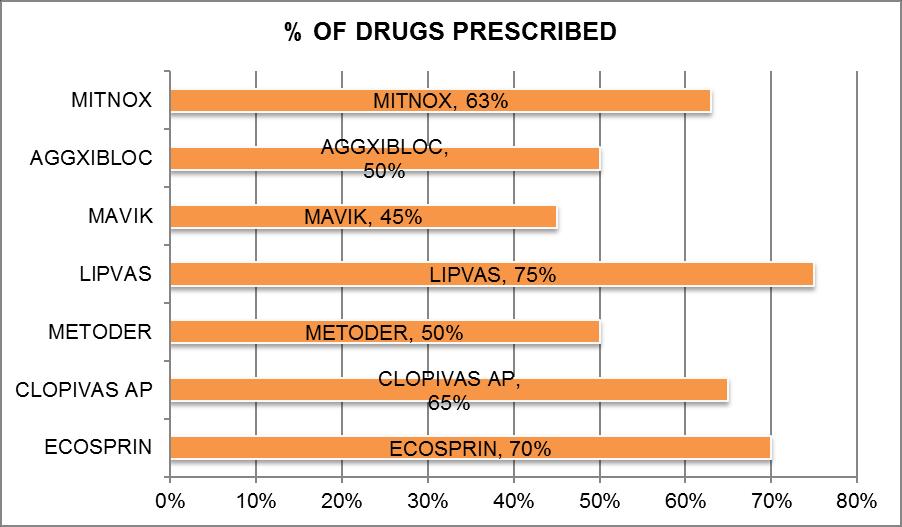
Results: A total number of 55 patients were enrolled in the study of which 36 [65%] were male patients and 19 [35%] were female patients. The NSTEMI patients are more in number when compared to STEMI patients. The age group between 50-70 are mostly facing MI and later comes the 40-49 age population.While, 20- 30 years age group are seen in exceptional cases with other diseases being main cause [ blood clots]. The drugs prescribed for STEMI and NSTEMI in India are LIPIVAS[Statin] with 75% prescribed for patients. Then comes the ECOSPRIN [Anti-platelet medicine] prescribed for 70% of patients, CLOPIVAS [Anti-platelet medicine] prescribed for 65% of patients, MITNOX [Anticoagulant] for 63%, AGGXIBLOC and METODER [β-BLOCKER] with 50% prescribed. And MAVIK [ACE inhibitor] withleast i.e., 45% prescribed. The overall prescription patterns involved in our study is satisfactory.


Pin code: 502313 pavanibrundha007@gmail.com +91-7075514145
INTRODUCTION:
Myocardial infraction, commonly known as heart attack, occurs when blood flow to a part of the heart is blocked for a long enough time that part of the heart muscle is damaged or dies. It is a serious medical emergency and requires immediate attention. Symptoms can include chest pain or discomfort, shortness of breath, nausea, sweating and discomfort in other areas of the upper body such as arms, back, neck or jaw. Prompt medical treatment can help minimize damage to the heart muscle and improve outcomes.

Types of Myocardial infraction:
There are mainly two types of myocardial infarction. They include: -
1. ST- segment elevation myocardial infarction [STEMI]
2. Non - ST - segment elevation myocardial infarction [NSTEMI]
ST- segment elevation myocardial infarction [STEMI]:
This type of heart attack is caused by a complete blockage of a coronary artery, leading to significant damage to the heart muscle. It is characterized by a specific pattern on an electrocardiogram [ ECG/ EKG] known as ST-segment elevation.
Non - ST - segment elevation myocardial infarction [NSTEMI]:
This type of heart attack occurs when there is a partial blockage of a coronary artery, resulting in less damage to the heart muscle compared to STEMI. It may not always show the characteristic ST- segment elevation on an ECG, hence the name non-STsegment elevation.
AIM:
To study drug prescription patterns in patients with ST and non-ST- segment elevation myocardial infarction.
OBJECTIVES:
To determine the prevalence and variations in drug prescription patterns.
To assess adherence to established guidelines for drug therapy.
To investigate the association between drug prescription patterns and clinical outcomes.
To investigate health care provider practices and decision-making processes regarding drug therapy selection, dosing.
To analyze the demographic characteristics of patients.
METHODOLOGY:
Study Site: The study was carried out at Malla Reddy Narayana Multispecialty Hospital, Jeedimetla, Hyderabad.
Study Design: A prospective observational study.
Dr. Ahmadi Banu
Vol 1, Issue 5, 2024.
DOI: http://dx.doi.org/10.62057/ESJ.2024.V1.I5


WEB SITE: https://www.ecosciencejournals.com Research Article
2
Study Criteria:
Inclusion Criteria: Patientsof either gender with diagnosisconfirmed of ST and Non-ST segment elevated myocardial infarction
Exclusion Criteria: Pregnant woman and lactating woman, Patients with other heart diseases.
Source of Data: Patient Case File.
STUDY PROCEDURE:
Drug prescription pattern:
The patient demographic details were collected and recorded in data collection form.
The drug details [ drug name, dose, dosage form, route and frequency of administration] are collected.
The past medication and medical history were also obtained from patients or caretakers through medication history interview forms.
The drugs prescribed to each patient were critically analysed given their indications and evaluated for their rationality.
STATISTICAL ANALYSIS:
Data was entered in MS Excel 2016 and analyzed. Descriptive statistics expressed in terms of actual numbers, percentage was used for data analysis.
RESULTS:
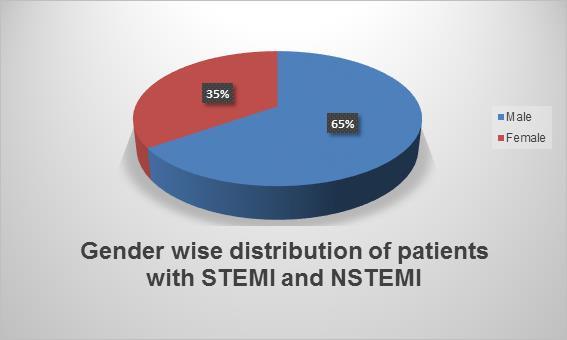
A total number of 55 patients were enrolled in the study of which 36 [65%] were male patients and 19 [35%] were female patients. The male to female ratio among patients was 2:1. The incidence of myocardial infarction was more common in male compared to female.

Dr. Ahmadi Banu
Vol 1, Issue 5, 2024.
DOI: http://dx.doi.org/10.62057/ESJ.2024.V1.I5
WEB SITE: https://www.ecosciencejournals.com Research Article
3
The patients are divided into 5 groups based on their age groups and are being kept at age gap of 10 years. When categorized, it is observed that maximum number of patients i.e., 40% were from age group of 61-70 years, the 20% were from 51-60 years and 12% from 41-50 years. The minimum number of patients are in 21-30 and 31-40 years were 5% and 9%.
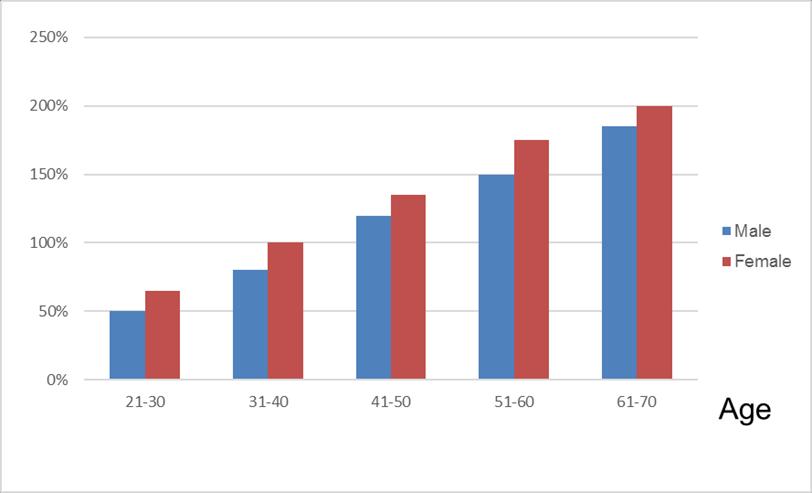
Age wise distribution of patients with STEMI and NSTEMI

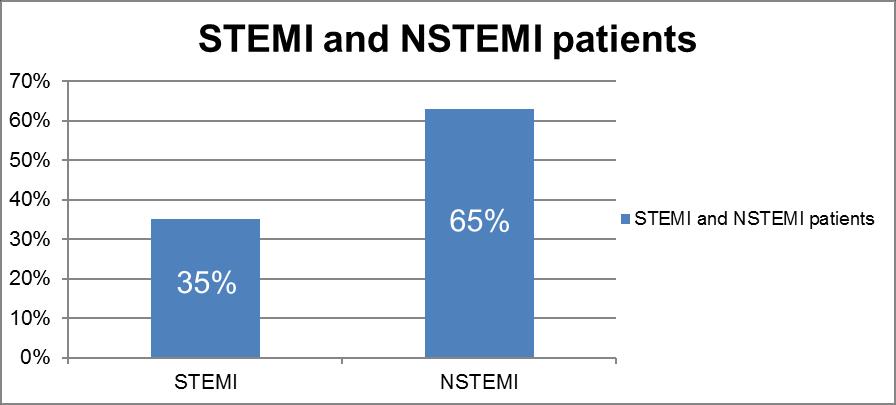
In our study, patients with STEMI and NSTEMI were 35% and 65% i.e., 36 members out of 55 were NSTEMI patients and 19 members were STEMI patients.

Dr. Ahmadi Banu
Vol 1, Issue 5, 2024.
DOI: http://dx.doi.org/10.62057/ESJ.2024.V1.I5
WEB SITE: https://www.ecosciencejournals.com Research Article
4
DETAILS OF PRESCRIPTIONS STUDIED IN ASTEMI AND NSTEMI PATIENT:
DRUGS PRESCRIBED FOR STEMI AND NSTEMI PATIENTS:

Dr. Ahmadi Banu Vol 1, Issue 5, 2024. DOI: http://dx.doi.org/10.62057/ESJ.2024.V1.I5
WEB SITE: https://www.ecosciencejournals.com Research Article
5 S. No Details about prescriptions Number of drugs 1 Total number of patient’s prescription analyzed 55 2 Total number of drugs prescribed 165 3 Average number of drugs per prescription 4
Drug present Dosage of drug Percentage of prescribed drugs 1 ECOSPRIN 75mg 70% 2 CLOPIVAS AP75 75mg 65% 3 METODER - 50 50mg 50% 4 LIPVAS 40mg 75% 5 MAVIK 2mg 45% 6 AGGXIBLOC - 100 ml i.v route 0.4µg/kg/min 50% 7 MINTOX - 60 1mg/kg 63%
S.NO
DRUGS PRESCRIPTION PERCENTAGE IN PATIENTS
DISCUSSION: The prescription patterns for STEMI and Non-STEMI are mainly anti-platelets. The anti-platelets are compulsorily involved in treating both conditions. A quality of life study should be conducted on these patients to find out more about the overall after effects of anti-platelet treatment.
CONCLUSION: Myocardial infarction [MI], has become an emerging pandemic in Indian population. Although our studies show results on small number of patients which is the limitation of our study, it points out towards trends in prescribing patterns in myocardial infraction. Our study is in compliance with Cardiological society of India. And we came to know that the males are mostly effected by myocardial infarction rather than females. The NSTEMI patients are more in number when compared to STEMI patients. The age group between 50-70 are mostly facing MI and later comes the 40-49 age population. While, 20- 30 years age group are seen in exceptional cases with other diseases being main cause [ blood clots]. The drugs prescribed for STEMI and NSTEMI in India are LIPIVAS[Statin] with 75% prescribed for patients. Then comes the ECOSPRIN [Anti-platelet medicine] prescribed for 70% of patients, CLOPIVAS [Anti-platelet medicine] prescribed for 65% of patients, MITNOX [Anticoagulant] for 63%, AGGXIBLOC and METODER [β-BLOCKER] with 50% prescribed. And MAVIK [ACE inhibitor] with least i.e., 45% prescribed. The overall prescription patterns involved in our study is satisfactory. The smaller number of injectable prescribed in our study is appreciable imposing relatively less cost burden on patients.
Dr. Ahmadi Banu Vol 1, Issue 5, 2024. DOI: http://dx.doi.org/10.62057/ESJ.2024.V1.I5
WEB SITE: https://www.ecosciencejournals.com Research Article
6
BIBLIOGRAPHY
1) Bhatt DL, Lopes RD, Harrington RA. Diagnosis and Treatment of Acute Coronary Syndromes: A Review. JAMA. 2022 Feb 15;327(17):1710.
2) Baviera M,Genovese S, Colacioppo P, Cosentino N,Foresta A, Tettamanti M, Fortino I,Roncaglioni MC, Marenzi G. Diabetes mellitus duration and mortality in patients hospitalized with acute myocardial infarction. Cardiovasc Diabetol. 2022 Oct 29;21(1):223.
3) Han X, Bai L, Jeong MH, Ahn JH, Hyun DY, Cho KH, Kim MC, Sim DS, Hong YJ, Kim JH, Ahn Y; Other KAMIR-NIH Registry Investigators. Higher Long-Term Mortality in Patients with Non-ST-Elevation Myocardial Infarction than ST-Elevation Myocardial Infarction after Discharge. Yonsei Med J. 2021 May;62(5):400-408.
4) Guha S, Sethi R, Ray S, Bahl VK, Shanmugasundaram S, Kerkar P, Ramakrishnan S, Yadav R, Chaudhary G, Kapoor A, Mahajan A, Sinha AK, Mullasari A, Pradhan A, Banerjee AK, Singh BP Cardiological Society of India: Position statement for the management of ST elevation myocardial infarction in India. Indian Heart J. 2017 Apr;69 Suppl 1(Suppl 1):S63-S97.
5) Partow-Navid R, Prasitlumkum N, Mukherjee A, Varadarajan P, Pai RG. Management of ST Elevation Myocardial Infarction (STEMI) in Different Settings. Int J Angiol. 2021 Mar;30(1):67-75.
6) Frampton J, Ortengren AR, Zeitler EP. Arrhythmia's After Acute Myocardial Infarction. Yale J Biol Med. 2023 Mar 31;96(1):8394.
7) Vijayakumar TM, Ananthathandavan P, Zago BA. Assessment of prescribing pattern and adverse drug reaction in patients receiving anticoagulant therapy: A prospective observational study. Health Sci Rep. 2023 Aug 17;6(8):e1425.
8) Silber S. Evidenzbasiertes Vorgehen beim ST-Strecken-Hebungsinfarkt (STEMI). Neueste Leitlinien der Europäischen Gesellschaft für Kardiologie (ESC) 2010 [Evidence-based management of ST-segment elevation myocardial infarction (STEMI). Latest guidelines of the European Society of Cardiology (ESC) 2010]. Herz. 2010 Dec;35(8):558-64.

Dr. Ahmadi Banu Vol 1, Issue 5, 2024.
DOI: http://dx.doi.org/10.62057/ESJ.2024.V1.I5

WEB SITE: https://www.ecosciencejournals.com Research Article
7