12 ISSUE NO. 15
PULSEBUSINESS.COM WWW.ISSUU.COM/ECONSOCYORK
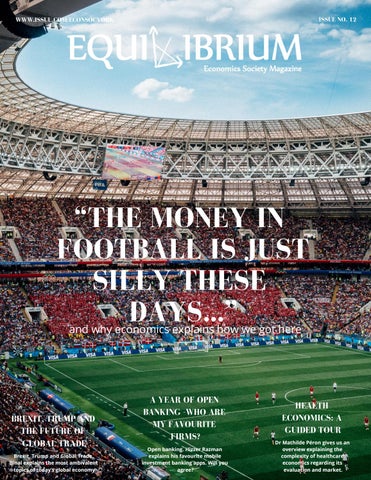
“THE MONEY IN FOOTBALL IS JUST SILLY THESE DAYS…” and why economics explains how we got here
BREXIT, TRUMP AND THE FUTURE OF GLOBAL TRADE Brexit, Trump and Global Trade. Binal explains the most ambivalent topics of today’s global economy
A YEAR OF OPEN BANKING -WHO ARE MY FAVOURITE FIRMS? Open banking. Hizzer Razman explains his favourite mobile PHOTOGRAPHED BY IAN CASTANEDA investment banking apps. Will you agree?
HEALTH ECONOMICS: A GUIDED TOUR Dr Mathilde Péron gives us an overview explaining the complexity of healthcare economics regarding its evaluation and market.
CONTENTS 05
“THE MONEY IN FOOTBALL IS JUST SILLY THESE DAYS…” The real reason why Neymar is paid so much. Adam Davis explains the numbers behind one of the most popular sports in the world.
07
STRAWS: PLASTIC VS PAPER Cost vs environment. Why businesses should swap to from plastic to paper straws in the future?
09
BREXIT, TRUMP AND THE FUTURE OF GLOBAL TRADE Binal explains the most ambivalent topics of today’s global economy.
11
UNDERSTANDING UNEMPLOYMENT From labour unions to labour markets, Dr Joao Madeira gives us a full analysis surrounding unemployment.
14
FOOD WASTE What it means, what it does and what can be done. Explore the problem that is bigger than you thought?
15
THE CASE FOR BEHAVIOURAL ECONOMICS The microscopic analysis of behavioural economics.
17
HEALTH ECONOMICS: A GUIDED TOUR Dr Mathilde Péron gives us an overview explaining the complexity of healthcare economics regarding its evaluation and market.
19
FORMULA 1: NUMBERS BEHIND THE WHEEL The formula for success. A beyond the number’s analysis of the most advanced sport in the world.
21
WHY IS THE VENEZUELAN ECONOMY FACING INFLATION RATES OF 1,000,000%? Dive deep to Venezuela’s volatile economy with inflation rates of 1 million percent.
23
A YEAR OF OPEN BANKING WHO ARE MY FAVOURITE FIRMS? Open banking. Hizzer Razman explains his favourite mobile investment banking apps. Will you agree?
25
THE FUTURE OUTLOOK FOR BIOTECHNOLOGY Drug discovery to deals worth billions. Today's outlook on biotechnology.
26
UTILITY OF "PERFECT" INFORMATION Ever wondered why used cars depreciate so fast or why fake Rolexes exist are being bought?
EDITOR'S LETTER The University of York Economics Society is proud to announce the latest edition of Equilibrium Magazine. This edition has a wide variety of themes for you to enjoy. Kicking off with the economics behind our national sport and why players are paid accordingly. Today’s economy is a synonym for uncertainty with articles talking about Brexit and Trump and the complexity labour market. You’ll learn about the environmental concerns of using plastic straws and its main alternative as well as the uncovered food waste problem. Moving onto a more commercial outlook, with articles surrounding biotechnology and its new direction and an analysis of the growing branch that is health economics. This edition answers microeconomic questions such as: how economists and businesses try to control and predict consumer behaviour? and why perfect information is impossible to achieve? We hope you will enjoy this issue of Equilibrium and become more involved in our Economics Society here at York. If you have any question or comments regarding this edition please contact the editors at
Equilibrium Editor Debbie Idowu
di547@york.ac.uk or aog511@york.ac.uk. We would like to thank all the students and staff members who for us and thank you to the Economics Department for sponsoring this magazine and supporting it throughout the years.
Equilibrium Editor Adam O'Grady 4
“THE MONEY IN FOOTBALL IS JUST SILLY THESE DAYS…” and why economics explains how we got here
better than in 2000? In fact, many would argue the complete opposite. We can use this idea to ask the question of why has this taken place if not everyone in football can agree whether the quality has improved as suggested by increased fees? The top 6 transfers of all time have all taken place in the last 2 years and they make 12 of the top 20. It can be argued that the most recent changes in transfer fee growth can be accounted for by two main factors. Firstly, Neymar’s world record transfer fee to Paris Saint German in 2017 for £197 million blew open the conceivable values paid for football players. Secondly, is the increase in value of TV rights deals across football but most particularly in the English Premier League allowing for a greater level of spending and especially from clubs that fans don’t naturally think of when talking about the footballing elite.
Neymar’s transfer from Barcelona to Paris Saint Germain in August 2017 shook the football world with his record-breaking fee of £197 million. This more than doubled the previous record and with that caused a major shift in what was previously considered reasonable payment for one of the sport’s most coveted individuals. The doubling in value of transfer fees that the world had seen left a huge level of possibility for clubs looking to sell their players for increased profit as the By Adam perceived value of players had completely changed. No longer Davis could clubs be confident on the apparent value of their players 07/01/2019 now that they have seen that one of the world’s best players was now going for twice that of another world-renowned player in the form of Paul Pogba with his move from Juventus It’s the same old cliché with different figures every summer, the to Manchester United for £89 million the season before. With idea that the money in football is getting ridiculous. In the last uncertainty comes perceived misevaluations and inflation. For 10 years transfer fees and wages within the global game have example, if the British economy saw this level of shift in values increased exponentially. With fast pace comes confused fans it’s the same as having an inflation rate of more than 100%, trying to comprehend why their favourite clubs have just spent assuming Pogba is considered as good as Neymar. This example £50 million on a backup. The debate is discussed on all forms of of sudden inflation would almost certainly collapse an economy. media every transfer window and most particularly in England Yet football carried on.world’s best players was now going for as the increase in transfer fees has been most notable in the twice that of another world-renowned player in the form of ever-lucrative Premier League. The quote within the title of this Paul Pogba with his move from Juventus to Manchester United article will often be thrown around by pundits, journalists and for £89 million the season before. With uncertainty comes the average member of the public because they do not perceived misevaluations and inflation. For example, if the understand the economics behind it all. This article hopes to British economy saw this level of shift in values it’s the same as shed light on this issue both where we saw most significant having an inflation rate of more than 100%, assuming Pogba is changes in this issue and what the future holds for the world’s considered as good as Neymar. This example of sudden most played sport. inflation would almost certainly collapse an economy. Yet football carried on. Since 2000 the world record transfer fee has been broken 6 times but more pressingly Luis Figo’s transfer from Barcelona to A second notable reason for this extreme level of inflation is Real Madrid for £37 million, the world record transfer in 2000, the increased impact of the commercialisation of football. is now the 29th all time. Now does this mean that football is 5
Examples of this has been seen worldwide but none more so than in the English Premier League. Major media corporations such as Sky, BT and the BBC, as well as international firms, are paying ever more for exclusive coverage of the most talked about sports league in the world. It has been argued the reason the Premier League is so large is because they were the first league to allow commercialisation to this extent when it was formed in 1992. From the diagram below, it is clear to see the astronomical rise in value of the Premier League TV rights deals. Revenue is split in accordance with where the club end up in the Premier League table from the previous season. The more successful the club is, the greater proportion of revenue they receive. This does not mean those at the bottom do not receive any benefits from the TV rights deal. This also did not mean that the clubs coming up from the Championship, England’s 2nd division, do not benefit from the TV income. The prospect of promotion to the ever more lucrative Premier League has caused a positive shift in spending from clubs in the Championship both from domestic and foreign investors. The success that has come from this is varied as we see success stories of clubs such as Wolverhampton Wanderers from last season as well as the failure of clubs such as Queens Park Rangers both looking to achieve the same goal.More money in the league can lead to obvious cases of inflated transfer fees. N’Golo Kante’s transfer from Leicester City to Chelsea in 2016 for £30 million compared to Danny Drinkwater’s same move a year later for £35 million seems overvalued given that Kante won the League’s best player award the year of Drinkwater’s move suggesting prices have increased significantly in just 12 months.
Anderson is the type of player who less than 5 years ago would’ve only been a signing for clubs such as Manchester United or Chelsea. Instances of this can be seen across the league as well trickling into the Championship as discussed previously. More money in the league should not be a dangerous prospect but rather as a sign of lowering barriers to trade in the domestic game and improving the spectacle for fans.
Although pumping more money into the Premier League could be viewed as inflationary it can also be argued that another basic economic tool is more prominent, the Multiplier Effect. Another football phrase heard on television sets and in pubs across the nation is that “the Premier League is the best league in the world.” Inflation implies that media companies are paying more each deal for the same goods. I would dispute that it is better viewed as receiving more investment allows better quality players to join the league, the overall quality of the league improves. This is both with the major teams and lower end Premier League clubs who can now afford some of the big names which were viewed as unattainable not that long ago. A notable example of this is Felipe Anderson when he moved from Lazio to West Ham United for £36 million in 2018 6
In conclusion, although price rises in the English transfer market are abnormally high it’s simply a caricature of a much wider and intriguing market that is simply catching up with all other industries of similar value to football. Football clubs are run as businesses and yet have lacked the sense of basic economic and business principles in the past. The money pumped into virgin territory will lead to waste in its infancy but eventually will correct itself. The emergence of extensive data analytics within football has led to increased confidence in player acquisition. The reasons for ‘bust’ signings will no longer be as a result of poor due diligence and a lack of hard facts. However, this is not to argue failing signings for big money won’t continue to happen. Measuring phycological factors and their impact on the game should be considered in much more detail than it has been, but I argue that the transfer market is turning a corner with silly money of yesteryear being considered a bargain soon.
Understanding Unemployment
By Dr. Joao Madeira 05/01/2019 11
Unemployment has important welfare consequences for individuals. This is particularly the case for those affected by a prolonged period of unemployment (for a survey see Nichols, Mitchell, and Lindner, 2013). The most obvious impact is on reduced income. US workers unemployed for more than six months suffered a fall of 40% during the Great Recession in family income in most cases (Johnson and Feng 2013) and 2012 Current Population Survey data showed them to be more than three times as likely to be poor as those never unemployed. There are substantial long-term effects of unemployment too. Workers in the US who lost their jobs during the during the 1982 recession saw immediate earnings losses of 30%, with losses of about 20% in earnings persisting even 20 years afterwards (von Wachter, Song, and Manchester 2009). A recent study (Guvenen et al., 2017), also with US data, shows that a full year of unemployment leads to about 35% to 40% losses in earnings even after 10 years (with about 2/3 of the losses being due to an increase in the incidence of nonemployment and 1/3 due to a decrease in wages).
Job loss also impacts a) physical and mental health; b) children and families; and c) communities. Estimates using data from the state of Pennsylvania in the US indicate that losing a job results in 10% to 15% increase in mortality for the next 20 years (Sullivan and von Wachter, 2009). A study using Denmark data found that becoming unemployed increases alcoholrelated disease, mental illness and suicide attempts (Browning and Heinesen, 2012). Paternal job loss has been linked to lower school performance by children (Rege, Telle, and Votruba, 2011, Stevens and Schaller, 2011, Wightman, 2012) and lowers their later earnings as adults (Oreopoulos, Page, and Stevens, 2008). Job loss has been found to affect the emotional well-being of mothers and lead to depressive symptoms in adolescents (McLoyd et al., 1994). Higher incidence of unemployment has also been linked to increased crime in several studies (Rege, Telle, and Votruba, 2012, Freeman, 1992, Grogger, 1992, Fagan and Freeman, 1997).
However, other economists consider that unemployment reflects market failures and represents a waste of resources.
Such significant consequences make the study of unemployment central to economics. In perfectly competitive labour markets those unemployed bid wages down until supply equals demand and markets clear. Therefore, economists who view labour markets as perfectly competitive consider that unemployment consists of individuals between jobs or who desire a wage higher than is justified by their productivity. However, other economists consider that unemployment reflects market failures and represents a waste of resources. There are three broad theories as to why labour markets may depart from the perfectly competitive case (for a summary see the textbook by Romer, 2011): 1) contracting models; 2) search and matching models, and 3) efficiency wage models.
US workers unemployed for more than six months suffered a fall of 40% during the Great Recession
Contracting models explain the failure of labour markets to clear because explicit or implicit agreements with workers prevent firms from reducing wages to take advantage of higher unemployment. Many jobs involve long-term attachments (Akerlof and Main, 1981, and Hall, 1982, found that typically a US worker will have the same job for about a decade), which implies that the wage paid does not have to clear markets each period. An individual will be happy at his/her current job if the income stream expected from it is better than outside opportunities (current wages may play only a small role in such an analysis). Contracting models can explain unemployment because the group of workers who negotiate the contract, the insiders, don't take into account the interests of those who may be hired after the contract is set, the outsiders. Economic sectors dominated by insiders will have higher wages than other sectors. New entrants to the labour market have anincentive to try to find jobs in those which will result in higher unemployment levels and in longer unemployment spells. Oswald (1993) and Gottfries (1992) are prominent examples of insideroutsider models. Insider power (such as union-wage setting) can make negative economic shocks have long-lasting effects in unemployment. A fall in labour demand reduces the number of insiders which results in a greater number of individuals losing their voice in the wage bargaining process. Economists call this phenomenon hysteresis. Blanchard and Summers (1986) argue
that hysteresis is particularly important to understand unemployment dynamics in Europe (several European countries had low unemployment levels until the mid-70s but the oil crises of the period resulted in an increase in unemployment to 10% which has lowered only slightly since then).
shocks (resulting in increased unemployment) because of concerns of their effects on workers' morale. However, evidence from surveys raises understandable concerns among many economists. Wage-setters may not necessarily fully understand what determines their decisions. In such circumstances, the way questions are phrased may have different connotations to respondents and inadvertently bias the results. This makes it important to test the fairness view of efficiency wages by means of laboratory experiments.
Search and matching models consider that unemployment is explained by the differentiation between jobs and workers. Therefore, the matching of workers with jobs does not occur through markets (wages will therefore not be determined by the intersection of supply and demand curves) but through a complex process of search. Since this process is not instantaneous it will lead to the existence of unemployment. Thus unemployment in search and matching models reflects what is typically called frictional unemployment. US labour markets have a high rate of turnover (in manufacturing at least 10 per cent of existing jobs disappear each year, Davis and Haltiwanger, 1990, 1992) which indicates that a significant fraction of unemployment is frictional. However, half of out of work individuals will be unemployed for more than 6 months (Clark and Summers, 1979) which cannot be easily attributed to frictional unemployment. In 2010 the Nobel prize in Economics was awarded to Diamond, Mortensen and Pissarides "for their analysis of markets with theory of search frictions."
Fehr, Kirchsteiger and Riedl (1993) showed in a laboratory experiment that workers reciprocate higher wage offers with higher (noncontractible) effort, which is consistent with efficiency wages but does not demonstrate by itself that wages don't adjust to negative economic shocks. Building on their work, Miguel Fonseca (University of Exeter) and I have demonstrated in an economic experiment that reciprocity concerns reduces the speed of wage adjustment.
...becoming unemployed increases alcohol-related disease, mental illness and suicide attempts
Efficiency wage models explain the failure of labour markets to clear because it would not be in the interest of firms to take advantage of higher unemployment to reduce wages since that would reduce worker productivity. There are several reasons why this could be the case. One, higher paid workers can affordbetter nourishment and health care. Second, if a firm can only monitor workers imperfectly then a higher wage can lead to increased effort (Shapiro and Stiglitz, 1984). This is because workers who are paid a high wage will find it hard to find an equally valuable job if they are caught shirking and the firm lets them go. Third, if higher ability workers have a higher reservation wage then better pay will increase the quality of the applicant pool and that of hired workers (Weiss, 1980). Fourth, higher wages can increase the morale of workers which they reciprocate with a greater level of effort (Akerlof, 1980, Akerlof and Yellen, 1990).
In our experiment, some subjects play the role of firms whereas others play the role of workers. In the first stage, firms decide the wage to offer and the quantity of output to request. In the second stage, workers decide whether to accept the offer and whether to produce output of high or low quality (subjects have the choice to opt between two real-effort tasks, which vary in terms of difficulty). The experiment allows us to observe the role of reciprocity concerns because while wage and quantity are contractible, quality is not.When workers can opt between high or low quality output we found that a 50% productivity drop leads to only an immediate 17% wage fall. When workers cannot determine output quality, a 50% productivity drop reduces wages immediately by 52%. These findings indicate that reciprocity concerns can explain downward nominal wage rigidity and that would explain why unemployment increases when an economy is affected by economic shocks.
Efficiency wages and the possibility that reciprocity can explain unemployment is a research interest of mine. Surveys such as those conducted by Bewley (1999) indicated that managers don't cut wages in periods hit by negative economic
The understanding of unemployment remains one of the most relevant issues for society today. Economists will certainly continue to pursue further research into its causes and effects. 13
Straws: Plastic vs Paper What people think, and which is most economics?
By Siobhan Wilson 13/01/2019 It seems that environmental issues are increasingly becoming part of an almost status-like symbol, with celebrities and social media generally making these campaigns gain traction amongst the public faster than it seemed previously possible. In 2018 a key campaign seems to have been the fight against and for replacing plastic straws with paper ones. For me, part of hearing about this was seeing a photo of a sperm whale full of plastic. This whale had nearly 6kg of plastic waste within it including 25 plastic bags. It is pictures like this that show the
effect of plastic use globally. Therefore, it is unsurprising that the campaign to ban plastic increased during 2018 and going into 2019, to put it simply people do not want to see these images of animals dying because of their shopping bags.
"Paper straws cost about 2½ cents, compared with a half-cent for plastic straws" 7
paper straws than they would have previously with plastic straws. Therefore, it would be imperative to find cheap paper straws ideally half the price of the previous plastic ones, is this possible?
Now plastic straws are the focal point of the current debate, but firstly what are the alternatives, and how much better are these alternatives to plastic? Firstly, reusable straws; in principle, these seem like a great solution only a certain number would be needed, there would be reduced waste and seems like a green option. However, unless these are purely for non-chain, non-takeaway restaurant and beverage options it seems slightly pointless, as to see a big effect the no-plastic rule needs to be adopted by large chains, who normally offer takeaway options. Therefore, in the disposable market paper seems to have the upper hand. They are designed to biodegrade and be eco-friendlier than their plastic competitors. Unsurprisingly it is paper straws that have become the main replacement for most larger organisations, most notably Starbucks, who have said they plan to have phased out plastic straws by 2020. These bans have had a very wide reach with companies like IKEA, Alaska Airlines, and SeaWorld all making changes to their plastic policies.
Starbucks...have said they plan to have phased out plastic straws by 2020 Apparently, paper straws can cost two or three times the price of plastic straws, with CNBC giving an article that said "Paper straws cost about 2½ cents, compared with a half-cent for plastic straws" as a quote from Adam Merran, CEO of PacknWood. Therefore, if people on average use at least one if not two or three straws for one drink and straws cost two or three times the price of plastic straws, how does the industry intend to make this profitable for themselves? An obvious way is to increase the price of the finished products, making Starbuck's coffee even more expensive; however, with price rises there needs to be adequate demand for the product at this new price, which given the hit this industry has been taking over the past year may not be enough. Therefore, this would suggest that there may be an opening in the market for very cheap paper straws.
However, the key issue that still faces companies like Starbucks from an environmental perspective is that what to do with the plastic cup that drinks are still served in, how do you make that also eco-friendlier? Another issue is with the transition of straw to bin to landfill, if it never leaves landfill then how does the new straw help? These are all issues facing the beverage and restaurant industry; however, an organisation cannot function without looking at its financials. Therefore, let's analyse the financial differences between paper and plastic.
The danger in this is where these straws come from and where they are going to, if they are made in the country and relatively nearby to the factory for distribution and then transported to the distribution centre then the carbon emissions are limited to trucks, which aren't the best but beat a shipping container or plane followed by a truck. However, what is more, likely is that these straws will be not be produced within individual countries for distribution centres within those countries at least not for all countries purely because of the costs of production and labour in certain countries.
Something to bear in mind with paper straws is unlike plastic they tend to go soggy whilst you drink your beverage. This is a problem that means many people end up asking for multiple straws just to finish one drink or giving up on the straw altogether and just drinking the beverage from the cup. This is an issue, as it may cause organisations to need to order more
Overall, is a plastic-straw-less future going to happen within the next few years? Probably, and this could start a series of changes towards a more plastic-free future. However, the costs associated with truly making these changes environmentally better is yet to be seen, as the cost of production of the actual straw and then cost of production and labour in a specific country are all variable costs, which organisations will naturally wish to minimise. Therefore, whilst we may be heading into a plastic-straw-less world it is not necessarily going to be a much greener world.
...in the disposable market paper seems to have the upper hand. They are designed to biodegrade and be eco-friendlier than their plastic competitors
8
Brexit, Trump and the Future of Global Trade
By Binal Raval 06/01/2019 The future of global trade is one of constant uncertainty; the protectionist economic trading policies of Donald Trump, coupled with the possibility of a ‘no-deal' Brexit has created a significant degree of unpredictability over future global trading patterns. This article will attempt to make sense of it all, and how the policies of Trump and the fate of Brexit's trade deals are important forces in mapping out what global trade will look like in years to come. When discussing what lies ahead for the future of global trade, it is inevitable that the subject of President Trump's economic policies for the US have an important role to play. His protectionist policies have arguably intensified global trading tensions between the US and other superpowers. In fact, according to The Economist, the trade war between the United States and China was ‘the world's worst such dispute in
9
decades.' The result of this trade war was $250 billion worth of tariffs on Chinese goods. This led to a response from China, and eventually over time during 2018 the trade war intensified, as more and more of US' and China's goods had import tariffs on them. This evidence suggests that global trade is likely to look more closed off and hostile. However, China has recently announced that it is going to make a commitment to bringing the trade war to a close, recognising that it is harshly impacting its individual economy. According to The Economist, ‘GDP in the third quarter grew at the slowest pace since the financial crisis', and there has been a link made between this slow economic progress, and the impact of the trade war. At the recent G20 summit in Argentina, it was announced that fact, according to The Economist, the trade war between the United States and China was ‘the world's worst such dispute in decades.' The result of this trade war was $250 billion worth of tariffs on
Chinese goods. This led to a response from China, and eventually over time during 2018 the trade war intensified, as more and more of US' and China's goods had import tariffs on them. This evidence suggests that global trade is likely to look more closed off and hostile. However, China has recently announced that it is going to make a commitment to bringing the trade war to a close, recognising that it is harshly impacting its individual economy. According to The Economist, ‘GDP in the third quarter grew at the slowest pace since the financial crisis', and there has been a link made between this slow economic progress, and the impact of the trade war. At the recent G20 summit in Argentina, it was announced that China and the US have until March 1st to reach a new trading deal. On paper, this seems to mark that the current hostile global trading environment is likely to change, based off of mutual co-operation between the two countries. However, in reality, this is more complex, as Trump's administration is also acting as an important force in the trade decision making process with China. There are conflicting views among different secretaries, which makes the direction of the process much harder. With that being said, hopefully, the US will make a move towards ending the trade deal; evidence suggests they are already being prompted, due to China cutting tariffs on auto imports, for instance. As we can see, the trading relationship between the US and China is one that is constantly shifting and changing, either for better or for worse. There is an element of unpredictability as to what will actually be decided on March 1st, but Trump's attitude does appear to be shifting slightly (see tweet above). However, the result or likely outcome of the trading relationship between the US and China is not clear-cut and definite; it is evident that there are several different possibilities that could occur following March 1st. This contributes to the overall unsureness of future global trade relations, as a trade deal is undecided between two economic superpowers.
the UK is set to leave. However, as this date looms closer, it seems that the most likely outcome will be a ‘no-deal' Brexit. This has been due to weeks of political instability, caused by events such as the no-confidence vote, and opposition from Jeremy Corbyn and the Labour Party. Parliamentary tensions have added to pressure for what Brexit should look like, and these debates and disputes have slowed down reaching the end goal of settling a suitable trade deal between the UK and the EU. One thing that researchers are sure of, is that a ‘nodeal' Brexit will be harmful to future global trade prospects. The UK's trading and overall economic position will become significantly weaker and vulnerable. In a recent online article from capital.com, ‘If Theresa May's plan could potentially result in new trade barriers and cause the economic slowdown, the chaotic exit with ‘no deal' would be worse than the UK suffered during the global economic crisis in 2008. The no-deal scenario will also mean the added cost of protectionism, which is likely to harm the UK's ability to be globally competitive, and have an impact on economic growth. This has already happened in China, following the trade war with the US. Therefore, there is an obvious cause for concern that this could happen in the UK too. The clear unreliability surrounding the Brexit negotiations with regard to trade, make global trading patterns look unclear and hard to predict, even amongst experts. When thinking about global trade in terms of tensions caused by Trump and the increasing uncertainty over Brexit, the future looks quite unsettled and unclear. However, it is not all negative. For instance, there is a possibility that Trump could comply with China, which will help to make global trading less hostile, and a lot more cooperative. Furthermore, whilst the immediate impact of a ‘no-deal' Brexit will be harmful, there is no reason that global trade in this sense cannot quickly recover; according to The Independent, ‘the government has ruled out remaining in the customs union because it would prevent the UK from negotiating trade deals with other nations.' Therefore, in this sense, leaving the EU altogether may be beneficial in the long run, as it will allow the UK to establish new trading relationships. When taking it from this perspective, the future of global trade looks positive. On balance, the future of global trade has the potential to go in lots of different directions, which as we have seen, can have both positive and negative effects. Only time will tell, and hopefully, in 2019, the landscape of global trade will become clearer as problems with Trump and Brexit negotiations hopefully become resolved.
"...the trade war between the United States and China was ‘the world's worst such dispute in decades'." As if global trade was not complicated enough by Trumps' economic policies, the continuous discussion about Brexit is also adding to global trading tensions. Britain is supposed toave a deal for leaving the EU in time for March 19th, when
10
By Arsalan Sharagulov 06/01/2019
FOOD WASTE WHAT IT MEANS, WHAT IT DOES AND
HOUSEHOLD
WHAT CAN BE DONE BY US
INTRODUCTION
2/3 of all food waste has been made by households. Despite the campaigns mentioned the target to reduce household food waste by 5% by 2015 compared with 2012 had not been achieved, with the estimated amount of annual
1/3 of all food is wasted annually,
£13
billions of
food (7.3 million tonnes) was thrown away from households in 2015 alone in the UK approximately 60% of the waste could be
household waste having risen from 7.0 million tonnes in 2012 to 7.3 million tonnes in 2015. Even though, people are aware of the problem, a question is “How to resolve it” Sainsbury’s has invested
£1 million int a new technology process in Swadlincote, which
halves the food waste of a household. The process includes actions such as giving out fridge thermometers, 30 smart fridges, winnow technology, a community fridge as well as
avoided. In order to avoid the unpleasant consequences of the food waste, a certain action needs to be undertaken - by consumers, legal authorities and retail and the manufacturing sector.
food saver champions in the area and school engagement. The purpose was also to develop “in an open-source way, ways we can share with [...] people across the industry, councils and schools what are the things that work, so that we collectively get to the heart of the problem”. To help the problem become solved, the government needs to keep increasing the sponsorship of WRAP, as the latest figures show a relative annual decrease and make
PERSONAL COSTS
corporations invest in the new technology to reduce the food waste of households.
A simple misunderstanding of “use-by” and “best before” lead to a number of problems for a household budget through increasing cost of living by buying unnecessary food, which creates
FOOD SERVICE
food inflation “Wasted food is estimated to cost each British household
£250–£400
£15,000–£24,000
per year, accumulating to
over a lifetime.” - stated the
The waste from the food service sector comes from preparation, spoilage and customer plates. Approximately 30% of the total waste generated in the hospitality sector was from
Guardian in 2009.
customers’ plates. The most common foods thrown were items such as chips, bread rolls
There is also increased taxation, as councils
and coleslaw. It is estimated that the equivalent of 1 in 6 meals served in the UK is wasted.
collect and dispose food waste funded by
Smaller portions, take-home service and clarification of sides that come along with the
council tax.
main dish needs to be applied. This would not only reduce food waste but also have health benefits such as minimising obesity rates.
GOVERNMENT The government uses voluntary initiatives to reduce food waste. For example, the
RETAIL
government-funded programme Waste &
The retail sector is a main cause of the household food waste
Resources Action Programme (WRAP), created in
Improved labelling and packaging would be a viable solution. Research by the Food
2000, leads the voluntary work.
Standards Agency in 2008 show that date labelling is still confusing. Food dates were
WRAP has made a campaign “Love Food Hate
poorly understood by consumers; 36 per cent of people mis-interpreted the “best before”
Waste” informing UK households of the problem
date as the “use by” date and only 55 per cent correctly interpreted “use by” dates.
and how to deal with it. Campaign reduced a
The current labelling is misleading and unnecessary confusing to customers, there is a need
21% of avoidable household food waste from
for either more clarification on the packaging, or use 1 standardised date.
2007 to 2012.
Moreover, storing food also has an important role in limiting food waste. Retailers need to
“Courtauld Commitment” - a voluntary
better inform consumers regarding the storage of food. Better storage would significantly
agreement to bring together organisations across
extend product life.
the food system - from producer to consumer - to
A use of “wonky vegetables” would ultimately reduce the food waste of perfectly ready to
make food production and consumption more
cook fruits and vegetables, but which apparently did not fit the standard of artificial
sustainable.
cosmetic standards. It is estimated that 5–25% of apples, 9–20% of onions, and 3–13% of
The commitment allowed a partnership of local
potatoes are rejected on cosmetic grounds.
supermarkets in York, such as Marks and Spencer
Making small changes to specifications (such as a 2-millimetre change to potato
with a Food Charity called “YorCafe”, which
specifications) could, it is estimated, “reduce waste by 15%”. For example, Morrisons retails
redistributes the excess food of a supermarket to
wonky vegetables for a lower price and and larger packages, Sainsbury’s uses the wonky
disadvantaged people in the area. It has
vegetables in preparation for smoothies and ready-to-eat food, and etc.
targeted to reduce food and drink waste by 20%
Retailers need to relax the cosmetic standards and make wonky vegetables sold as a part
by 2025.
of the main fruit and vegetable line.
14
THE FUTURE OUTLOOK FOR BIOTECHNOLOGY
sustain price increases, politically speaking and in terms of their relationship with patients. Biotechnology involves using living organism, for example manipulating the genetics of a microorganism to create antibiotics. We are now discovering Biotechnology companies are behind some of the most innovative discoveries when it comes to treatments and cures. In fact, the majority of drugs being approved by the FDA are coming from Biotechnology companies. This is because biotechs unlike Big Pharma deal with much less bureaucracy in terms of securing approval for taking a drug to clinical trial. Biotechs also seem to be able to take bigger risks regarding research and development that Big Pharmaceutical companies won’t.
...it is becoming harder for pharmaceutical companies to sustain price increases, politically speaking and in terms of their relationship with patients. As a result, there has been a boom in acquisitions of biotech companies, with nearly $100 billion dollars spent by Big Pharma companies acquiring leading biotechs in the past month. At the end of last year, GlaxoSmithKline bought Tesaro for $5.1bn; and at the beginning of this year Bristol-Myers Squibb By Debbie Idowu announced it would acquire Celgene for $90bn. Eli Lilly has also recently announced their plans to buy Loxo Oncology for $8bn. 21/01/2019 What all these deals have in common is that they are Oncology In the past, the Pharmaceutical industry has struggled with focused, Oncology focusing on the treatment of tumours. issues regarding: how to increase their productivity, reduce the Oncology treatments are progressively coming from a amount of time it takes to find and develop a promising combination of drugs. As a result, biotechs are now more open medicine and take it to market. Over the past 20 years this has to doing deals with Big Pharma and vice versa, they’re looking not seemed to improve. The problem is that although Big for that compound that in combination with their own drugs pharma companies often restructure their operations or hire will lead to a profitable treatment. Another reason biotechs are new people in the hope of making a significant difference. In eager to do deals, is because it is getting harder to make reality, there is still a degree of luck to finding the right drug money from just a single drug. that works for a certain condition. So, considering biotech companies are trading relatively Before pharmaceutical companies could still make huge profits cheaply at the moment, with the NASDAQ Biotech Index taking from being the fourth or the fifth most widely used drug. But a 20% fall in the Q4 of last year. Coupled with the fact that nowadays doctors are more focused on drugs that are going to biotechs have a lot to invest in drug development and Big make a huge difference to our lives. The tougher pricing Pharma is looking for complimentary assets to add to their environment is also making it much harder to make money medicines, I think that the general consensus is that there is unless you’re one of the large firms in a particular area. This is going to be a lot of acquisitions in the future surrounding because it is becoming harder for pharmaceutical companies to biotech. 25
A fully rational agent who always makes the optimum decisions to maximize their utility is referred to as a homo economicus abbreviated to “econ” (Thaler, 2015). These “econs” are described as fictional forms of humans by Thaler and provide the basis of all of our favourite models and while no one would suggest that such an agent exists in the real world, the theory is that if everyone rationally, they act in their best interests. At least close enough for our models to retain validity. This assumption was first challenged by 1978 Nobel Prize winner Herbert Simon for his work on bounded rationality. This theory states that one’s decision making is constrained by factors such as time, imperfect information and cognitive restrictions. This therefore means that consumers could never act like true “econs”. Yet, while Simon undoubtedly made an important contribution to the field, his work never led to any large-scale change in economic thought. As Thaler points out, as long as the errors in rationality were random then errors at both ends of the spectrum cancel each other out and bounded rationality could be safely ignored. This is then the key issue that pioneers of behavioural economics have sought to prove over the last 40 years, that these errors are not random, that they can be predicted and that they are important.
The Case for Behavioural Economics
By Matthew Hemmins 06/01/2019
Thaler puts these errors down to “supposedly irrelevant factors,” or, SIFs. These are all considerations that the rational model of economics would ignore, yet in the real world their presence can drastically change the outcome. A good example of such a supposedly irrelevant factor is sunk costs. Sunk costs are money that is already gone and cannot be recovered, rational theory would therefore state that it should be ignored in any future decision-making, it is irrelevant. Yet this is not what we find in the real world. To illustrate this, assume you have paid £100 for a concert ticket. Should there now be any difference in cost if you attend the event or not? Rational theory would suggest not, the money is already gone. Yet most people would see skipping the event as a loss of £100, while attending would register as even. In actuality you have lost £100 either way, you don’t gain it back by attending said concert and any decision should therefore be made purely in the present, and not past tense. This thought process becomes more important in explaining why someone would brave a blizzard to attend an event they have already paid for or continue a pre-paid sports event even though they are injured. We have an innate desire to satisfy this mental accounting and get our money’s worth. It is also worth noting that this 15
behavioural trait can be used to our advantage and often people attempt to do exactly that, with gym memberships in particular. The theory goes that if we have already paid in advance for a set time period then this will incentivise us to go and thereby “get our money’s worth,” of course this theory would never hold with an “econ” they only think in present tense, however it can be effective for humans. I’m sure that everyone reading this has heard their parents use that phrase, “get your money’s worth,” or have even used it themselves. But what does this actually mean? For an “econ” this can be defined in terms of consumer surplus. Consumer surplus only measures the utility gained from an object purchased, clearly an ice cream on a warm day is worth more to most than one on a cold day for instance, but this is incomplete. Behavioural economics adds one further dimension, transaction utility. This attempts to measure the utility gained from the value of the deal itself and is determined by how much you pay relative to what you expected to pay, with either positive or negative results. Consumers can become addicted to this transaction utility and as a result, businesses can become stuck with them. This, therefore is exactly where behavioural economics enters the real world. In 2012, JC Penney moved away from coupons and instead introduced an everyday lowprice strategy, with its CEO declaring an end to “fake prices.” Now this may seem sensible to most of us, yet JC Penney then reported a net loss of $163 million in the first quarter of 2012 and their decline only worsened over the next two years. CEO Ron Johnson said back in 2012 that, “we [JC Penney] have work to do to educate the customer on our pricing strategy. By mid2013, Johnson was ousted, having lasted only 17 months. While Johnson’s war on “fake prices” sounds promising in theory, it robs consumers of the “transaction utility” accrued in sales, because who doesn’t love seeing products marked as 50% off? The fact that the product in question would likely never have been sold for the higher price likely doesn’t factor into our mental accounting, what matters is that we feel like we have got a bargain. However, sales, coupons and “fake prices” are far from the only techniques used by businesses to incentivize us to spend more, the high street is full of behavioural economics in action. From the music being played, to the choice of produce placed at eyelevel and even down to where they place high-value items in the store, small changes are everywhere, attempting to make us change our behaviour in a predictable 16
...these errors are not random, ...they can be predicted..they are important. way. Should it matter what produce is placed at eye level or slightly further away? Not to an “econ,” all that should matter is the utility you derive from each item. Yet once again, a supposedly irrelevant factor, in this case – location, has a noticeable impact. Thaler’s ground-breaking book, Nudge, begins with a story of a school that wants to make kids eat healthier. However, instead of heavy-handed measures such as bans, taxes or subsidies, they found that by simply rearranging the cafeteria one could increase or decrease consumption of any particular food by up to 25%. This involves no real cost, nor loss of utility, and yet can yield powerful results. Realization of the profound impacts of behavioural economics also was likely the reason that the government set up the Behavioural Insights Team (unofficially known as the “Nudge Unit”) in 2010, two years after Richard Thaler published Nudge. Behavioural economics therefore has profound impacts on every aspect of our decision-making and yet we have barely scratched the surface so far. It is simply not enough to assume that we are all fully rational “econs” when time and time again this has proven not to be the case, and those pesky “supposedly irrelevant factors” have proven highly relevant. However, if you are reading this convinced that you are immune to the tricks of the supermarkets and you have mastered the art of mental accounting then you may actually be right. In Misbehaving, Thaler asked people if it would be acceptable for the owner of a hardware store to raise the price of snow shovels from $15 to $20 the morning after a large snowstorm. Unsurprisingly perhaps, 82% of respondents labelled this “unfair.” Yet when he asked his MBA Economics students, 76% found it “acceptable.” We have been immersed into this world of “econs” and rationality and the further down the rabbit hole we go the easier it is to lose touch with the average consumer. So perhaps it is time for a change, indeed when he began on his mission to bring behavioural economics into the mainstream, Thaler began with a mission statement: “Build descriptive economic models that accurately portray human behaviour.” Perhaps it is time for Economics to return to that.
By Dr Mathilde Péron 05/01/2019
Health Economics: A Guided Tour Health Economics was born in the '60s in a context of increasing demand for health care, unprecedented medical progress and exponential costs. The United States was then dedicating 5% of its annual GDP to health care and Selma Mushkin was concerned about "the optimum use of resources for the care of the sick and the promotion of health". Sixty years later, health spending accounts for 18% of US GDP and Health Economics is a thriving discipline of Economics. It has its own journals, conferences and academic programmes. Health economists nourish close bonds with the real world and disseminate avidly the outcomes of their research to policy makers and actors of the health care sector. Chauvinistic fun fact, the University of York was a pioneer and still plays a leading role today in the development of Health Economics. The Centre for Health Economics, founded in 1983, employs around 60 economists. Since 1978, York's MSc in Health Economics has trained over 750 health economists that are now involved in academic research, health care organisations, pharmaceutical companies and governments around the world. 17
Health economists' raison d'être is to address policy issues related to health and health care. Why do individuals invest in their health? What are the socio-economic determinants of obesity? How should health insurance be organised? How should we pay our doctors? Is competition good for hospitals? Do patients have equal access to health care? Is it worth funding a new expensive treatment? To answer these questions, health economists mobilise a wide range of theoretical and empirical methods used in other fields such as applied microeconomics, econometrics as well as industrial, labour, political and development economics. It is not uncommon either for health economists to cross the border and converse courteously with health scientists, epidemiologists, social researchers or philosophers. My purpose here is to give you a short, necessarily nonexhaustive and slightly subjective guided tour of Health Economics. We will come across four key topics: (i) the demand for health; (ii) the design of health care markets; (iii) the concern for equity; and (iv) the necessity of economic evaluation. The demand for health. Health economists distinguish themselves from health scientists or social researchers by conceptualising health as a commodity. Individuals value health as a consumption good (health directly increases utility) as well as an investment (health indirectly increases utility via an increased amount of time to produce and consume). Individuals make choices and trade-off health against other consumptions: they eat junk food, smoke and accept hazardous jobs. Michael Grossman (1972), in his influential contribution, defines health as a stock, a capital. This stock depreciates over time in the absence of investment (exercise, medical care). Investment is costly in terms of time and resources and individuals choose their optimal level of health depending on their constraints and preferences. This framework is the starting point of many empirical contributions exploring the relationships between socio-economic status and health behaviours such as obesity, smoking or health care use. For instance, the model predicts
...health and health care are not standard commodities and the market for health care...cannot be a perfectly competitive market
that education makes individuals more efficient in their production of health and therefore increases the demand for health. Using US data, Cutler and Lleras-Muney (2010) show that better-educated individuals are indeed less likely to smoke, to be obese or to be heavy drinkers. The design of health care markets. Health economists differ from their mainstream colleagues on one critical point: health and health care are not standard commodities and the market for health care (i.e. transactions between patients and physicians, hospitals or pharmaceutical companies) cannot be a perfectly competitive market. Kenneth Arrow himself, father of the general equilibrium theory, signed in 1963 the seminal paper "Uncertainty and the welfare economics of medical care". Arrow argues that uncertainty is intrinsic to health: patients are uncertain about their risk of being sick, the financial consequences of illness and the outcome of medical treatments. Asymmetric information on both sides creates incomplete contracts: physicians have more medical knowledge whilst patients can hide information or choose not to comply with the doctor's orders. Barriers to entry and externalities also characterise health care markets and make traditional models unfit for health-related policy questions. Another specificity of the health care market is that, very often, the consumer is not the payer. Public or private insurers, also subject to asymmetric information on the risk and severity of illness of their insurees, pay the bill. These very complex interactions between patients, providers and payers yield inefficient or missing markets and partly explain why health care systems are so heavily regulated. The concern for equity. The prominent role of governments in health care markets is also justified by a vivid concern for equity. Health is different from other commodities such as cars or shoes. We do care about the distribution of health, about people's ability to access care and about the financial consequences of illness on households. In Europe (it is less obvious in the US), there is a general commitment that access to care should be based on need and not ability to pay
(horizontal equity), health care financing should be progressive with income (vertical equity) and that reducing health inequalities should stand as a fundamental policy objective. In reality, empirical contributions have shown that in most European systems, access to care does depend on socioeconomic status. Van Doorslaer and Masseria (2004) report a pro-poor inequity for GP visits whilst the opposite is true for specialists: for the same needs, the poor visit specialists less than the rich. Evidence of significant health inequalities is striking, even within rich economies with extended and expensive health care systems. According to the Office for National Statistics, in York, the life expectancy at birth for men is 80.4 years. In Manchester, it is only 75.5. The necessity of economic evaluation. Our tour ends on probably the most controversial aspect for the non-specialist who, in many instances and quite wrongly so, accuses health economists to put a "price on life": the economic evaluation of health care technologies and policies. In a context of fixed budgets, all new treatments cannot be funded. The question is whether a new intervention offers "value for money", whether it leads to better outcomes than would otherwise be achieved if resources had been used in other ways. Economic evaluation provides the necessary framework to compare alternative drugs and technologies and weight the benefits against the costs. Health economists answer the challenge of measuring the multidimensional benefits of medical treatment by two sets of methods: cost-utility analysis, which measures benefits in terms of quality-adjusted life years (QALYs) and cost-benefit analysis, which converts health gains into monetary value, based on the concept of willingness to pay. In the UK, the National Institute of Health and Care Excellence (NICE) is mandated to advise on the cost-effectiveness of health interventions and uses economic evaluation when making recommendations on which treatments the NHS should fund. Economic evaluation techniques also translate into decision rules, setting priorities on health programmes, especially in developing countries where resources are scarce and health needs appalling. Demand for health, health care markets, equity and economic evaluation. I like to picture these four key topics as cairns, these human-made piles of stones used as landmarks. These four cairns mark the field of Health Economics. They shape the economic approach of health. They signpost intellectual and methodological challenges for economists. They are built, one stone after the other, to inform, guide and enlighten medical, social and political debates.
...the University of York was a pioneer and still plays a leading role today in the development of Health Economics 18
Formula 1: Numbers behind the wheel
By Adam O'Grady 06/01/2019
History and successful teams having such high budgets. Over the last 2 decades the subsistence levels within F1 have risen considerably. To have a chance of becoming a regular team you need a lot of money. It’s a vicious circle as to win large sponsors and suppliers of parts you need to be successful and to be successful to you need to be able to afford the high salaries of the established drivers. The inflated budgets stem also from the fact the Formula 1 is the highest class of motorsport, if you start out in Motorsports you aspire to be racing in formula 1.
The sport started in the early 20th century for rich playboys racing their expensive sports cars. Technology was limited meaning no one really had an edge over other drivers. Over the years as the sport grew, teams replaced national racing colours (ours being British racing green) with sponsorships bringing in more money. As a result, budgets and salaries increased significantly and overall the sport was taken more seriously.
Driver Salaries
Force India Fiasco
Like in other sports, the dispersion between athletes between rookies and champions is staggering. Sebastian Vettel racing for Scuderia Ferrari, having recently updated his contract until 2020 valued at around $60 million dollars, while Brendon Hartley only having an annual salary of $350,000 for Toro Rosso. F1 is a ruthless sport with many drivers being replaced with better or more prospective drivers. Jolyon Palmer, who raced for Renault F1 for only two seasons from 2016 to 2017 due to his lack of success. Like in other sports especially football, teams are paying a lot for either existing success or future talent.
Formula one teams aren’t always well managed. With lower teams who struggle to win races and get large sponsorship deals. Sudden outflows also cause problems for teams. Have you ever wondered how much it costs to repair an F1 car whenever it crashes or catches fire during a race? Teams can spend in excess of around £1.2 million to replace an F1 engine.Small components such as the rear wing and DRS (Drag Reduction system- a flap that opens on the rear wing allowing air to pass through the wing for greater speed) still costs about £60,000.
Team Budgets Mercedes and Ferrari both have budgets of around £250 million. While the younger American ‘Haas F1’ team founded in 2014 enjoys a smaller budget of around £140 million. Overall, there are high barriers to entry in the sport due to established
19
During the Hungarian Grand Prix in July 2018, the Force India Racing team went into administration. This is due to a lack of funding from owners. With only podium and 7 retirements between both drivers of the team throughout last season, it was clear the team was struggling to make money. It owed its
creditors around £28.m million to over 450 companies such as hotels and manufacturing going as far as owning money tospecific race tracks such as Abu Dhabi. Its largest bill is £13.7 million to its engine supplier Mercedes. Best Water Technology (BWT), Force India’s main sponsor supplied the team with a loan of around £5 million. Although this was pocket change in retrospect, it covered the cost of the July salaries however there was still a funding requirement for £9.6 million for August to include salaries and car builds, shut down maintenance costs as well as preparatory costs for upcoming races. In the end a buyer was found, Canadian Billionaire and owner of Racing Point, Lawrence Stroll, son of current F1 driver Lance Stroll provided the team with a loan of £15 million.
Regulation and the future of the sport Regulation of the sport has been a talking point. F1 rights holder Liberty Media wants to impose a cap of $150m (£112m) a year on teams from 2021.This will ensure less disparity between the teams as well as reducing unnecessary capital spending such as 2018 Red Bull launch party held at the opening grand prix of the season in Australia. This event labelled as the “party of the decade” cost the team in excess of $2.5 million. I believe regulation is necessary as every year F1 makes changes to the rules and regulations for the cars. This year
20
the changes will allow for closer racing and more overtaking with changes like wider DRS flaps on the cars. These had dramatic effects team budgets as in 2016, the new rules for the cars for the following season increased team budgets by a combined £167.6 million. This is a relatively new problem as usually cost increases are manageable due to teams relying on re-using 50% of the car from a previous season for following season. For the 2017 season, over 90% of Force India's car this year is completely new. However, although capping seems like the solution, it will cause many jobs cuts as many team bosses Toto Wolff (Mercedes) and Christian Horner (Red Bull Racing) explain. Liberty Media also explains it wants to impose engine regulations from 2021 to improve fuel efficiency. Over the years engine sizes have fallen from V12 to turbocharged V6 engines which are both more fuel efficient and more powerful. In my opinion I feel competitiveness, Formula 1 has lost its competitive edge. Over the last 8 years the constructor’s championship has been won by two teams Red Bull Racing from 2010 to 2013 and Mercedes onwards. The constructor’s championship being calculated through combining the podium points of both drivers for a team added up in one season. Hopefully I have given you an insight into the glamour and difficulty of the of the most technologically advanced sport on the planet.
Force India-2018 Circuito de Barcelona
Why is the Venezuelan Economy Facing Inflation Rates of 1,000,000%? 21
By Alexandra Storton 06/01/2019
The History
Venezuela, it is reported that 87 per cent of people live in poverty according to a study by Amnesty International. Consequently, 2.3 million Venezuelans have fled the country since 2014, most of them attempting to enter the neighbouring countries of Columbia and Brazil or heading further afield to the U.S. and Spain. The Colombian government have been particularly welcoming to the Venezuelan people, however most other countries in the region have taken measures of varying degrees to deter immigration into the country.
In 1999, Hugo Chavez was elected the president of Venezuela. He was loved and was a hero to his people, especially the poor, having cited corruption among the political elite as a key factor contributing to the poverty in Venezuela. To address this problem, billions of profits from the lucrative oil industry were invested in public services including: food subsidies, health care and an improved education system. These investments saw massive improvements in the standard of living of many Venezuelans seeing poverty rates fall by 50% between 2003 and 2007. It also led to a decrease in unemployment levels and increased access to education and health care. In June 2010, Chavez declared that Venezuela was facing an "economic war" as a result of increasing shortages, as the impacts of excessive government spending on social welfare were becoming apparent. On March 5th 2013, Hugo Chavez was announced dead and his successor Nicolas Maduro became his successor securing 50.61% of the vote. Maduro’s early presidency unfortunately coincided with the 2014 oil price drop, where the trading price of $115 a barrel in June 2014 began to fall reaching as low as $27 a barrel by January 2016. This triggered an economic crisis in Venezuela as the economic policies of Hugo Chavez and Nicolas Maduro failed to diversify the economy, leading to a significant over dependence on the price of oil. Fewer revenues from the oil industry meant that Chavez’s social policies could no longer be supported, making it so that many Venezuelans could no longer afford food and medicine as the prices were too high given the lack of government support through subsidies.
Maduros...does little to remedy the hardships of the Venezuelan people and continues to consolidate the power and wealth of himself and his allies. What the Government is Doing The Venezuelan government has made many attempts to resolve the hyperinflation within the country. In August 2018, the government released a new currency the "sovereign Bolivar" which is to replace the old currency the “sovereign Bolivar”, in addition to circulating eight new banknotes and two new coins. This new currency takes five zeros off from the old currency, in attempts to stem hyperinflation and restore the value of the Bolivar. In addition to this, a second accounting currency, the virtual petro, will be used alongside the sovereign Bolivar and will have an official exchange rate. In combination with these new currencies, the Venezuelan government devalued the currency and significantly inflated minimum wage rates. Nicolas Maduro has been continuously criticised by the U.S. and the world community from pushing his country from a democracy towards an authoritarian rule and allowing for serve human rights violations. He is also the subject of many antigovernment protests within the country after successfully pushing for the election of a new law-making body which is predominantly run by Maduro supporters who instead of an opposition controlled legislative branch, allowing him to consolidate his power over the country. The creation of this body was highly controversial and was held despite the wide protests of the Venezuelan people and the international community which left 46 people dead. Over recent years, Maduros approval ratings have continued to fall as he does little to remedy the hardships of the Venezuelan people and continues to consolidate the power and wealth of himself and his allies.
The Current Situation The IMF predicted by the end of 2018, it is expected that the Venezuelan Economy will see inflation rates reach 1,000,000%. This economic collapse has been happening since 2014 and has meant that the citizens of Venezuela are increasingly unable to access necessities, including food and medicine. The rapid hyperinflation has made it difficult for wage increases to keep up with inflation making the real value. This has made attempts to increase the minimum wage, such as in 2017 futile, as the increase in the wage amounted to a real increase of less than a fifth of its value in the space of a year. These increases in the minimum wage have only exacerbated the problem, as the implications of the hyperinflation are only amplified with the printing of more money by the Venezuelan government. In 22
A Year of Open Banking -
Who are my favourite firms?
By Hizzer Ramzan 13/01/2019
23
Money Box
It has been a year since Yolt and Lloyds bank made the first transaction that used the Open Banking framework set out by the government in 2018. Open Banking is a government scheme that allows financial organisations access to your personal information, in short, it allows third party providers to build apps and services around out financial information. A year after it's inception and the UK retail banking sector has changed, more and more digital banks are hitting the market and consumers are willingly sharing their financial information to help them shop around for the best deal. Whilst the FinTech industry growing in popularity and market size, Splendid Unlimited found that only 20% of Brits who had heard of Open Banking knew what it entailed, and only 25% had actually heard of Open Banking. Despite this, there have been a plethora of firms who have done well over the last year, from digital bank to budgeting apps.
If you have used YouTube over the last year then you would definitely have heard of MoneyBox. Like Monzo, MoneyBox raised £14m bringing total funding to around £21m. The microinvesting app aims to change the way millennials save and invest their money, aiming to bring increased wealth to the next generation. Money Box is a brilliant example of how open banking can help us make smarter, wiser decisions about our capital. The app rounds up transactions you make on a linked current account to the nearest pound and investing that in a Stocks and Shares ISA. Say you spend £3.45 on a small coffee at Starbucks, the app will add 55p to your piggy bank and invest it for you. In an era of low interest rates, Money Box is an easy way for your capital to experience some degree of return. It is a brilliant idea for those of us who need a bit of a push towards saving. Reminder, when investing, your capital is at risk.
Monzo One of the biggest winners of 2018 was Monzo, they raised a further £20m within under three hours with just under 36,000 of their customers investing an average of £556 each in the business. It wasn't just funding where Monzo won, after almost a decade on top of the Which? Consumer survey, First Direct were beaten by Monzo as Britain's best lender.
Chip A smaller player in the Fintech market that stands out to me is Chip, the micro-saving app created to help save tiny amounts a week. They crowdfunded £3.6m in 2018 taking their total funding to £4.6m.
Monzo's product is simple, they are like a high street bank except they aren't on the high street, only on your phone. You will still have a current account and a debit card, the only difference is you won't be able to cash a cheque into the account, or pop into the store to ask for help. Monzo wins with the convenience of the product and the speed of the customer service. The app notifies you that you've withdrawn money before the money has come out the ATM - it's quick. That is not all, if you're an avid traveler then they offer the MasterCard Inter-Bank exchange rate, a rate that you will not get at any exchange in the world.
Money Box is an easy way for your capital to experience some degree of return 24
The app used artificial intelligence to analyse consumer spending and set aside a tiny amount each week to save. The AI powered algorithm looks at your spending and calculates the amount you can afford to put away in a savings account. On top of the automatic saving, you can also move up to £100 a day from your account to your Chip account up to 6 times a month. Chip is a brilliant idea and has proven to be very helpful for those who aren't inclined to save. Unlike Money Box, your money isn't invested in stocks and shares so the value will remain the same and will not go up or down. There are a whole host of other companies out there doing the same or similar things to the businesses I mentioned above. As we look forward to 2019 it looks to be a promising year for Fintech firms who are growing in popularity and consumers, who are continually benefitting from rapid innovation in the Fintech sector, giving us newer, better ways to manage our money.
However, this theory is obviously very simplistic, despite its significance to common economic doctrine. Is there ever an example of true perfect information? The amount of information that is available to today’s consumers and firms is astounding compared to previous eras. With the digital age and the rise of social media, information is everywhere. There is so much data out there that it can be difficult to know if we have sufficient information about an industry, let alone perfect. Do you know everything about every company you purchase from? No, because there is a lot to know and it is difficult to distinguish which pieces of information are going to be useful. Not all information is useful. What utility would you gain from the price of food you buy in Wales, unless you plan on staying there for a while? Go on a boat trip and try to buy a drink, you may see how the prices are artificially inflated compared to on land. But if you’re thirsty and buy a drink on the boat, that information has no use to you. Many students won’t care about the fact that realistically drinks are going to be cheaper from a shop than a club, pub or bar. That fact is irrelevant. The prices of each establishment’s drinks these students wish to go to would be more useful.
Utility of "Perfect" Information
By Joshua Broderick Gray 06/01/2019
When going over market failure at any level of economics, the idea of perfect information always comes up. The disparity and simple lack of certain pieces information by economic agents can lead to inefficient outcomes and can prevent utility maximization within that market. For example, a social stigma against discussing wages or salaries with work colleagues can lead to disparities in pay. The effect on workers losing out on potential pay increases is greater than the utility from savings made by the company who may keep pay unequal via this failure. After all, if they can afford to pay workers a higher wage, surely their labour productivity is high enough to justify that wage for all workers? If these workers had perfect information, they would be able to correct this failure using collective bargaining. 26
This may sound like information which provides plenty of utility to anyone. The cheapness of a pint or a shot of vodka can be used by anyone right? A retired grandmother isn’t likely to find any use for this, obviously depending on whom we’re talking about. In the same way, students are extremely unlikely to find any use for benefits to over 65s. Suppose we were to take a family on a low income and provide them with data regarding prices in Waitrose. Then suppose we take a higher income family and provide the same data to them. It would be fair to say that the latter would benefit more than the former, as they are more likely to take advantage of this. What if we were to provide both of these families with information regarding how best to manage their finances? Sounds ideal, but then if we give them false information the damage could be immense. In this digital age especially, false information is everywhere with corporate vagaries and Russian-made “fake news”. It can be as minor as being told that Rolex is real to as major a “big company” supposedly needing your credit card information to protect your account due to a security leak. False information isn’t always intentional mind you. The person who gave you wrong directions on the street didn’t mean to send you the wrong way, they simply mis-remembered.
Regardless of how much information we give people, we cannot expect them to recollect every piece of information. You’d be hard pressed to remember the cost of coffee at every single venue you’ve been to in your hometown. Sometimes you just forget. You may even mis-remember something long term. If you’ve ever sworn that something was the case, but it wasn’t you’re not alone. This is known as the Mandela effect, named after Nelson Mandela whom many had thought had died in prison before his unfortunate passing in 2013. There are many mechanisms by which we struggle with information as our brains cannot retain every single piece of information we acquire efficiently.
or at least find out information about this beforehand. They are not always obligated to reveal information, nor may they have the incentive to. There is the famous example of Akerlof’s lemon which described how those who owned a low value car which is almost indistinguishable from a high value car can sell at a price of which they can make a profit. Akerlof, whom has gone into detail of this entire phenomena, points out that even though the buyer will want to pay less due to the uncertainty of the quality of the car, the seller will still make a profit due to the low value of the car. This is all at the expense of the poor buyer whom did not have the same information as the seller. Even in Marshall’s famous example of the fish market as an idea of a perfect market, there are plenty of examples of price discrimination to certain demographics in real life examples. In New York for example, many of the sellers on the docks sell fish at a higher price to perceived higher income individuals, with these buyers not being informed of the lower price to others.
In addition to this, information is not always used or acquired regardless of availability. Of course, you could google most things you want to find out, but that is not always the case. If you wanted to know about the spending habit of each demographic of your home town, you aren’t likely to find it on google. Especially if you’re from somewhere small. Most information about the general population isn’t readily available, it requires either some collecting or processing. The majority of people don’t know a large amount about science, so the real health benefits of some foods or physical dangers of some products may not be clear to some.
It would be naive to assume that information can be acquired without cost. Surveys, questionnaires, focus groups amongst others nearly always impose a cost. This may be financial, or maybe in terms of labour or time. As pointed out earlier, different pieces of information provide different amounts of utility to different economic agents. Imagine a scenario where the price of every single piece of cheese in every shop across all of the UK was documented in a government report which cost millions of pounds? This would definitely be a misallocation of resources, even if it is an extreme and unlikely example.
Information isn’t always clear even when readily available. If you wanted to compare the prices of your entire shopping list across multiple supermarkets, you would either need to do this manually or use some sort of phone application. Be honest though, do you do either of these despite the blatant benefits? I know I don’t, I would say most do not and will never do this. Of course, the information is there, but people survive without doing so. Regardless of how much we may be told to compare the benefits of each bank and choose which one we use based on that, many will just stick with one. Whether it’s because of busyness, lack of priority or simple laziness, many simply won’t or can’t make the effort to acquire useful information.
Of course, there are many firms which do provide information to people. News providing organizations are obvious examples. Government statistics are available to some degree and regulations on many everyday products mean companies are forced to reveal information. Famously in the UK on cigarette packets, warnings of the dangers of lung cancer amongst other health issues are put straight on the packet. It’s essentially unavoidable. On alcohol bottles and cans there are unit recommendations of healthy consumption. Evidently, there are effective ways in which information can be gathered and spread. Ultimately there is a lot of good, or utility if you prefer, to be promoted by doing this. The key appears to be doing it in a way that has a minimized opportunity cost while maximizing the amount of utility which can be promoted for that cost.
...different pieces of information provide different amounts of utility to different economic agents. Private firms will usually have more information than consumers. Often dealing directly with the production process 27