13 ISSUE NO. 15
PULSEBUSINESS.COM WWW.ISSUU.COM/ECONSOCYORK
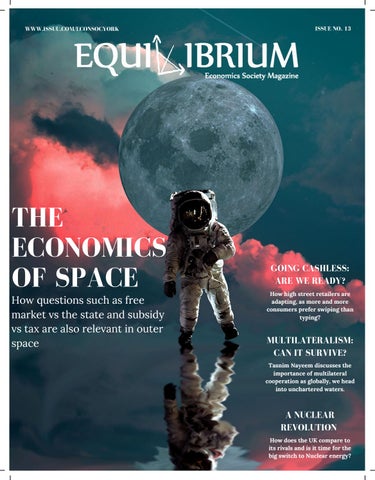
THE ECONOMICS OF SPACE
GOING CASHLESS: ARE WE READY? How high street retailers are adapting, as more and more consumers prefer swiping than typing?
How questions such as free market vs the state and subsidy vs tax are also relevant in outer space
MULTILATERALISM: CAN IT SURVIVE? Tasnim Nayeem discusses the importance of multilateral cooperation as globally, we head into unchartered waters.
A NUCLEAR REVOLUTION PHOTOGRAPHED BY IAN CASTANEDA
1
How does the UK compare to its rivals and is it time for the big switch to Nuclear energy?
CONTENTS 05
THE ECONOMICS OF SPACE How questions such as free market vs the state and subsidy vs tax are also relevant in outer space.
07
THE EXISTENTIAL PROBLEM OF PROSPERITY How do we define prosperity in today’s capitalist times and is it harder to become more prosperous now?
09
THE CASE FOR UNIVERSAL BASIC INCOME Should we adopt Universal Basic Income… free money for everyone?
11
CHINA ONE-CHILD POLICY Mathilde Roca examines its effect on Chinese society and its economy. Was it a successful policy?
14
A NUCLEAR REVOLUTION How does the UK compare to its rivals and is it time for the big switch to Nuclear energy?
16
BREXIT AND THE NHS The troubling question of what will happen to the NHS is made clearer.
2
18
THE HISTORY OF EQUILIBRIUM FORECASTING
Dr Michael Thornton gives a brief analysis on Forecasting models and indicators to use.
20
GOING CASHLESS: ARE WE READY? How the High Street is changing as more consumers prefer paying with card rather than cash.
22
THE US-CHINA TRADE WAR The feud between Jinping and Trump...when will it end?
23
BREXIT AND THE POUND Since the referendum the pound has been acting like a yoyo, what are the key checkpoints worth knowing?
26
MULTILATERALISM: CAN IT SURVIVE? Tamsin Nayeem discusses the importance of multilateral cooperation as globally, we head into unchartered waters.
28
ECONSOC EVENTS See the back page for latest social our society has to offer
3
EDITOR'S LETTER The University of York Economics Society is proud to announce the latest edition of the Equilibrium Magazine along with two new additions to the team. This edition has a wide variety of themes for you to enjoy. Kicking off with the economics behind the world’s biggest space agency and how the industry is changing with better technology and competition. You’ll learn about the environmental importance of
Equilibrium Editor Debbie Idowu
shifting from coal to nuclear energy and how desperate a switch is in the UK. Today’s economy is synonymous for uncertainty with articles addressing issues such as what will happen to the NHS and how the erratically the pound has behaved since the referendum. Following on from this you’ll learn about the changing high street industry in light of a
Equilibrium Editor Adam O'Grady
growing cashless society. This edition examines macroeconomic topics such as the trade war between the two biggest economic superpowers and the serious need for multilateral cooperation as we head for a global recession. We hope you will enjoy this issue of Equilibrium and become more involved in our Economics Society here at York. If you have any question or comments regarding this edition please contact the editors at econsoceq@gmail.com
Equilibrium Editor Mathilde Roca
We would like to thank all the students and staff members who wrote for us and thank you to the Economics Department for sponsoring this magazine and supporting it throughout the years.
Equilibrium Editor Vera Ivanova
4
THE ECONOMICS OF SPACE How questions such as free market vs the state and subsidy vs tax are also relevant in outer space
By Jack Scerri 30/08/2019
5
new regulation and property rights are put in place. For example, with asteroid mining becoming an increasingly likely prospect, there is no current binding legislation that gives the miner ownership of resources extracted. The Commercial Space Competitiveness Act 2015 was created to allocate space objects based on who has first accessed them, however this has faced backlash from many who believe that this would prevent any scientific gains that could be made which would benefit society as a whole. With a lack of property rights, it is also difficult to hold agents accountable. Recently, there has been a vast increase in ‘space junk' with debris increasing by 67% in the last decade. This makes collisions with satellites and shuttles more likely as well as larger debris posing a risk to humans. There is currently no authority with the ability to impose a tax on the perpetrators and internalising this negative externality could cancel out any welfare gains made by subsidisation. If an international legislative body is formed and with the introduction of property rights, we could see the space industry increase exponentially in size and importance in the near future.
"Space is for everybody. It's not just for a few people in science or math or a select group of astronauts. That's our new frontier out there, and it's everybody's business to know about space." – Christa McAuliffe
Since NASA was set up in 1958 space exploration has shifted from a state monopoly to a hub for wealthy firms willing to overcome high risks to exploit the huge profits available. Initially, NASA's state monopoly was justified by its purpose of providing security against Russia during the cold war (the space race), providing national pride such as the sense of achievement felt as a result of the 1969 moon landing and increasing scientific knowledge which is diffusible. These public goods would be otherwise underprovided by the free market as they are non-excludable and non-rivalrous, therefore only the state can supply the optimal amount to society, funded by taxation. NASA receives around 0.5% of US GDP per annum, allowing it also to overcome the high costs associated with travel and fuel supply. It can be argued that in recent decades, NASA's military and national pride purposes have become less prominent following the end of the cold war and the moon landings. "It is estimated that regular transport to space Moreover, the utility gained from scientific knowledge could be provided as soon as 2025." experiences diminishing marginal returns from when space is first explored. This along with the introduction of private agents The discipline of space economics proves that economic in space exploration such as Elon Musk's SpaceX have raised analysis is not only relevant to Earth but in all stately affairs. economic questions on the role that the state should have in As technology improves, space will reveal more opportunities space. for firms to make profits. In the short term, commercial space flights may be introduced. Virgin Galactic is in the late stages It can be argued that with recent commercialisation since the of testing, achieving its first suborbital space flight in 2017. In Commercial Space Launch Act 1984, it would be more efficient the long term, as overpopulation becomes a big issue on Earth for space exploration to be performed completely by the free and our climate becomes more and more uninhabitable, humans market, with NASA instead providing the framework needed for may even look towards colonising other planets and moons as firms to operate as the increased competition would drive down seen in science fiction novels. However, it will surely be a very costs. Private firms have embarked upon space exploration as a long time before that becomes a possibility. In the meantime, it result of high derived demand for satellites due to the thriving may be best that our time and money be spent on issues closer telecommunications market as well as the highly profitable to home with pollution and climate change becoming a real opportunities of fuel extraction and asteroid mining. Allocating threat as well as inequality still increasing. If anything, space the state the important role of providing fuel depots, transport allows economics and other educational disciplines to be and water supply rather than exploring space themselves would studied from a ‘clean slate' which may help with the open up the funds for the subsidisation of new entrants, development of research. There is also some solace in the increasing competition and in turn driving innovation and knowledge that however bad things seem on Earth, they are efficiency. It is estimated that regular transport to space could ultimately irrelevant on a universal scale. be provided as soon as 2025.
"There is perhaps no better a demonstration of the folly of human conceits than the distant image of our tiny world" – Carl Sagan
The Outer Space Treaty 1967 states that space should be considered the ‘province of all mankind'. For the free market to play a bigger role in space exploration, it may be necessary that 6
Prosperity is a relatively modern phenomenon. For most of human history, almost all except a small elite such as the kings and his lords lived in poverty. Indeed, poverty is the natural state of humanity. Fundamental needs such as healthcare, adequate shelter, clean water and good food have not always been as readily available as they are now. There as always been a fight against impoverishment. Humans have evolved with and been defined by this fight.
THE EXISTENTIAL PROBLEM OF PROSPERITY
Since the 1700s, with the rise of industry and capitalism, this status quo has been thoroughly challenged. Today, most people do not live in poverty. All the while, large populations in busy cities have now become sustainable. A lifestyle of luxury and abundance is now possible for most people. However, this raises a fundamental issue regarding human nature and existence. If humans have evolved to fight this battle, to strive to against starvation, cold and danger, then what now is our purpose? As we begin to move towards a "postpoverty" world, what fundamentally is our purpose? The status quo of millions of years is being dismantled.
"Would you necessarily find meaning from doing the exact same thing for sixty plus years or that you had achieved your full potential?"
How do we define prosperity in today’s capitalist times and is it harder to become more prosperous?
By Joshua Broderick Gray 02/09/2019 5
7
That is not to say that poverty should somehow be preserved. It has caused more misery and loss than most if not all other human problems. Its eradication would provide happiness to many who today still live with economic hardships. Happiness does not come from fighting against impoverishment. For example, someone working over sixty hours a week simply to support their family isn't necessarily going to be happy just because they're putting food on the table. Regarding work, this has become inherently less meaningful. Adam Smith considered the founding father of economic theory, suggested that the division of labour and task specialisation is a key component in delivering prosperity and boosting production. His famous example is that of the pin factory which he once visited. Instead of having the workers do each task concerned with production, which would result in about twenty to thirty pins a day from each worker, each task had a single worker. One worker made the head of the pin, the other the body and so on. This overall boosted production to about four thousand eight hundred produced a day for each worker. The idea is to break down the production process into as many tasks as possible and have each worker specialise and become great in one task.
However, this highlights a fundamental problem in terms of workers needs. Taylorism, the ideas of scientific management and pay related motivation were once prominent, but they have become horribly outdated. According to the Psychologist Abraham Maslow, peoples needs include that of self-actualisation. In short, it means to be all one can be and to find meaning in what one does. If jobs are broken down into a single task, repeated all day and every day, one may struggle to achieve this. Would you necessarily find meaning from doing the exact same thing for sixty plus years or that you had achieved your full potential? It's unlikely that you would. It's no coincidence that essentialist philosophy saw it's most significant decline during and after the industrial revolution. In the pre-capitalist age, philosophers such as Plato and Aristotle, as well as the church dominated the way people thought about morality and meaning. For thousands of years, people believed in the universal existence of good and meaning, whether than be through god, reason or any other grand essence. In the age where the agricultural economy depended upon family values and obedience to a feudal or imperial master, the prominence of essentialist can be tied to economic incentives. In short, society was more stable and sustainable with these values. However, in the age where urbanisation and industrialisation became common, this began to change. The embrace of new scientific ideas in the industry, the introduction of rugged individualism and the decline of workplace conditions fostered resentment against political and intellectual authorities. People moved away from their families and into the big cities, leading to a decline in the firm belief in family values and communal spirit. Many people, as soon as they got to the city, were alone. The existentialists, such as Kierkegaard and Nietzche, as well as psychologists such as Freud and Jung, became evermore relevant in public thought an dialogue. Society began to view people as the origin of truth, good and meaning. The economic incentives now promoted self-interest, cynicism and scepticism. These are issues not unique to capitalism. Even in command economies such as the Soviet Union or in modern China, many workers have found very little meaning in monotonous production of cheap goods. Just look at the suicide rates of many factory workers in modern China for example. Mandated meaning cannot override the meaninglessness of dull and repetitive work. As a general trend, the division of labour and streamlining of workplace practices can lead to huge morale problems. Especially when goods and services are arguably 8
more homogenised than ever before. So what can we do going forward? We could fight those last few key battles left. The plight of the homeless for one is still an issue. International poverty and violence are ever present sicknesses. There are many problems which we can still whittle away. Beyond that, we have many battles which are become even more relevant than ever. As we move away from economic troubles, our social issues have increased in frequency and scale. As people have more time to worry about issues such as race and gender, we have become increasingly socially conscious. The mental health crisis has been getting worse, as people are more isolated than ever in this digital age. Climate change presents us with a ticking timebomb, while resources are coming ever closer to depletion despite increasing consumption.
"As we begin to move towards a "postpoverty" world, what fundamentally is our purpose?" On the one hand, some groups now rely more on social relations to determine their purpose and identity as working become less urgent. As these people engage more with social affairs, more issues can arise. For example, someones toxic behaviour becomes increasingly noticed upon prolonged exposure, causing resentment and emotional harm. Other groups, on the other hand, withdraw from wider society as the internet has provided an immediately gratifying platform to escape to. The anonymous nature of the internet and deliberately addicting electronic entertainment allows many to become captivated by their computers. This isolation can cause serious issues regarding loneliness and social isolation, with it being very difficult to get out and switch off. It's not all bad news though. As we have become richer, we have been able to indulge more in our deepest desires. Having more time for most to connect to hobbies such as sports and the arts is unique to the modern age. We have more access to knowledge and culture from across the world than ever before. It's become more possible than ever to stay connected to friends and family despite massive geographical distance. We have a great opportunity to change the way we behave for the better. Instead of keeping our head down to focus on our necessities, we can instead look up to greater things. Dedicating ourselves to what we truly love to do, spending time with friends and family, changing the world for the better, anything is possible.
reason was not that it was unachievable, nor too expensive. No, as Bregman points out in his book Utopia for Realists, it was because in one UBI experiment in Seattle the number of divorces had apparently jumped 50% as a result of the cash transfer. It turned out that UBI gave women too much independence to become a reality‌ Or it would have if a re-analysis of the data 10 years later hadn't shown that the increase in the divorce rate was simply an error. UBI had been shelved for good over a mathematical mistake.
THE CASE FOR UNIVERSAL INCOME Should we adopt Universal Basic Income‌free money for everyone?
It's also important to note that Nixon's plan was far from controversial. Bregman notes that a White House poll found 90% of all newspapers were enthusiastically receptive to the plan, and it was only originally held back as the Democrats felt it didn't go far enough! It was to be the plan that would finally eradicate poverty, a historic moment to be sure, just one that never quite came to fruition.
"The Economist even concluded, "the most efficient way to spend money on the homeless might be to give it to them."
By Matthew Hemmins 02/09/2019
Instead of course, the United States, United Kingdom and most other developed countries around the world are now stuck with a complicated web of social security and welfare payments, all making up the welfare state as we know it. UBI would make most of that redundant.
For those of you unfamiliar with the concept it may help to first define Universal Basic Income (UBI) and how it differs from traditional welfare payments and benefits. To borrow a definition from Economic-Historian, Rutger Bregman, UBI is "free money for everyone." It has no strings attached, no bureaucratic red tape and no conditions required to attain it. It is simply an amount of cash given to every adult in a country. In his 2020 Presidential bid Democrat, Andrew Yang has referred to it as a Freedom Dividend, making it his flagship policy proposal and placing the amount at $1000 a month.
The basic idea behind UBI is that people are intrinsically good and that they know what is best for them. They don't need to be shepherded around, they don't need to be treated like a child and they don't need red tape. Fundamentally, poverty itself is a lack of money, not a lack of character, and it's that lack of money that we need to address as a society. UBI would free people from the stigma of welfare payments and the bureaucracy of means testing, it would save people from the state intervening in their lives, and it would provide a safety net for the future, giving people comfort and peace of mind.
Understandably, this may sound a bit strange, but hopefully by the end of this article, with the help of a bit of theory and a few real life examples you may at the very least want to learn a bit more about the idea, or you may even become a supporter of it!
That last point is also worth emphasizing, as automation is undoubtedly a massive risk for the future. Yang has made this clear in his Presidential campaign but to further underline it – Massive structural change is coming as a result of automation, and many will likely lose their jobs to it. UBI would provide a safety net to allow people to retrain and follow their passions, rather than simply working in an industry that you despise, just to survive.
First, some historical context may be useful. Because this idea is far from new, in fact it was almost a reality in America some 50 years ago under the Presidency of Richard Nixon. But, in 1969 it almost came to be that every American family of four would get at least $1600 a year, around $10,000 today from the government as part of Nixon's Family Assistance Plan (FAP). No strings attached. Of course, this never came to pass, but the
9
This all being said it's fair that you take such benefits with a pinch of salt whilst ever they are unsupported by hard data. Fortunately, there are many studies to support the benefits of introducing a UBI all over the world. For the first example, you need not look any further than London in 2009. 13 homeless men had been sleeping rough there for between four and forty-five years and The Economist estimated that they had been costing the state around £26,000 each annually in health, police and prison bills. No matter the efforts of the welfare state they simply ended back on the streets. Then a charity called Broadway gave them £100s to spend as they wished. No strings attached, no red tape and no further questions. 11 have since moved off the streets, and none of them wanted any of their money spent on drink, drugs or gambling. Even more impressively, it only cost an average of just under £800 per person, on top of staff costs. Much less than the re-occurring £26,000 that was previously being spent on them. The Economist even concluded, "the most efficient way to spend money on the homeless might be to give it to them." You see, people don't want to waste their lives away. They genuinely want to turn them around but they are hamstrung back a lack of money. Bregman in Utopia looks at Simon, one of the beneficiaries of the cash in London. Simon had been addicted to heroin for 20 years, yet when he received the money everything in his life "just clicked." As of the publication of Bregman's book Simon was washing, shaving and thinking about reconnecting with his two kids.
I
the people there spent their income on "education or medication, on furniture or chickens, on seeds or building material," all of which are items that can quite clearly be used to build a better future. The reporter continued that the amount of money was not sufficient for people to stop working, but it did allow the villagers to worry less about their basic needs, such as food and school bills. To that effect, the number of pupils in the local school rose from 290 to 330, in just two years, with almost all of that increase coming from kids in the local area. UBI is more than just a fantasy; it could soon be a reality. Just a couple of months ago a report wrote by Professor Guy Standing recommended introducing a basic income of £48 a week, and The Labour Party are openly musing embracing a similar proposal in the next general election. Per the BBC, the author of the study, Professor Standing, highlighted the fact that £48 is "not a lot for most people," but there are also a "significant amount of people" with very little left after bills, that it would benefit. "Additionally, the criticism of people working less is simply not backed up by the data from countless experiments." Of course, I would be remiss to leave out the criticisms of UBI, but luckily there are only three main ones and those are: Cost, people would stop working and that people would misspend the money. Fortunately, these can all be addressed fairly easily. With regards to cost, as Professor Standing points out, HM Treasury's estimates put the savings from phasing out tax reliefs at £480bn per year, and for some context a UBI of £48 per week to 60 million adults would only cost £150bn a year. Additionally, the criticism of people working less is simply not backed up by the data from countless experiments. If people do work fewer hours it is normally to further their education or spend more time with a newborn, both objectively positive things. Similarly, people would blow money on drink, drugs or otherwise is simply not supported by the data. People want to change their lives for the better; this is just about allowing them to do that.
"In his 2020 Presidential bid Democrat, Andrew Yang has referred to it as a Freedom Dividend, making it his flagship policy proposal and placing the amount at $1000 a month."
It isn't only in developed countries that this holds true. A selection of villages in Kenya in 2016 were chosen to receive the equivalent of $22 a month for 12 years, as part of a study being monitored by several top Universities and carried out by the charity Give Directly. The villages are closed off to visitors currently, to maintain the integrity of the results. But a BBC reporter visited a village that was used as a dry run for the main experiment and is open for visitors. The reporter described that
Personally, I think that if we can move away from an economy where people feel they have to work any given job just to survive and provide for their family, towards one where people feel they have the safety net required to take a job they truly enjoy – even if it pays less – or to go back to school to advance their prospects in a few years, then I feel we have progressed as a society.
10
For context: Chairman Mao was a Chinese communist revolutionary and the founder of the People's Republic of China in 1949. He launched the Great Proletarian Revolution to reassert his control over the communist party. During this time, Mao also launched a pronatalist campaign which raised birth rates to an average of six children per family (Fong, 2016). This meant that the population was far too large and resources far too scarce to support the entire population, causing significant poverty and famine. After Mao's death, Deng Xiaoping led China through significant economic reforms to fix Mao's failed economic planning. This is when the one-child policy came about.
The one-child policy: The idea behind the policy was that a smaller population would lead to an increase in income per capita. Hence reducing poverty. The policy started as some sort of social experiment and was only implemented in some areas of China. From an economic perspective, the policy didn't seem to be a bad idea in the shortrun. But the government ignored the unavoidable consequences which would result from the policy in the long-run, such as an ageing Chinese population. Furthermore, the government did not predict the significant gender imbalance which would result from the policy.
CHINA ONE-CHILD POLICY An examination on its effect on Chinese society and its economy. Was it a successful policy?
By Mathilde Roca 31/08/2019
From a social perspective, I think the policy was completely immoral especially because of the coercive methods which were employed to impose it. Those who followed the rules were presented with a "one-child certificate" that entitled them to receive government awards such as cash, more convenient access to public nurseries, more educational opportunities for their children, subsidies for medical care, better housing and additional food (Jiang, 2013). However, those who did not follow the rules were punished; the usual mode of punishment was fining. Sometimes if women gave birth illegally, the authorities would seize their family members and hold them hostage to coerce the women into undergoing sterilization. Conditions and rules of the policy differed from place to place; those living in rural areas could have a second child if their first child was a girl, and the policy was not imposed on ethnic minorities. However, for the rest of the population, though it was illegal to use force or promote late-term abortions, officials believe it would have been impossible to enforce the policy without such punishments (Fong, 2016). 11
The impact of the one-child policy: The "hukou" was first established in 1954 by chairman Mao. It is a kind of passport or household registration system, and is also referred to as an "urban passport" or China's "internal passport". They limit public service access based on the holder's birthplace. The urban hukou gives people access to education, healthcare, housing and pensions. On the other hand, citizens with a rural hukou are given limited access to the country's welfare system and are unable to move freely to China's urban areas. Therefore, owning a hukou in many ways defines a person's life chances. Unfortunately, all the children who were born illegally under the one-child policy were denied a hukou. Hence, all these children missed out on education and access to healthcare because of the one-child policy.
The one-child policy also caused an occurrence which the Chinese call the "xiaohuangdi" phenomenon, or the "little emperor" phenomenon. This reflects how Chinese only-children are spoilt and treated like royalty by their parents and grandparents. Although being an only child means that you receive a lot of care, love and attention, it can also be very pressurising. The Cultural Revolution meant that a great number of the parents of the one-child policy generation were deprived of an education or had their education interrupted. They felt they did not have the chance to fulfil their ambitions, so they felt a sense of achievement through their only-child. Hence, being their parents' only legacy, the children had to deal with huge pressure to achieve academic excellence. However, despite the care that they received and the sacrifices their parents made in order for them to reach a high level of education and a well-paid job, "little emperors" will suffer huge economic pressures as they will eventually have to shoulder the burden of ageing parents and grandparents without the help and support from siblings and fewer family members, as well as limited help from China's still nascent social safety net. This is called the 42-1 phenomenon which highlights the fact that when an onlychild reaches working age, he or she will have to care for two parents and four grandparents in retirement.
significant number of women in China suffer from the psychological pain and trauma of getting a forced abortion. This led to very high suicide rates. However, on the positive side, statistics show that the representation of Chinese women in higher education has steadily increased since the one-child policy was established. In 2014, 51.1% of university students were female, compared to only 35% before the policy was established. This could be due to the idea that being supported by only one child during old age is likely to generate an incentive to acquire more education, obtain a better job, and save for retirement. However, the advantages of being highly educated are not reflected in Chinese women's labour related statistics. Inequalities remain in the world of work, such as how much women are paid compared to men, the age at which they are forced to retire, etc. Overall, it remains unclear whether the policy had a positive or neutral overall effect on women's socioeconomic status. But it could be argued that the increase in education received by women may lead to positive changes in the long-term, where their higher level of education might lead to greater independence and achievements. In Chinese society, like in many other societies, men are seen as having a higher social status than women. The one-child policy leads to a society with the world's greatest gender imbalance; the fact that there are now 33.5 million more men than women in China has led to another new phenomenon: the "bare branches". This is how the Chinese describe the 33.5 million men who will not find a wife in China, and who therefore are biological dead ends. Overall, the "bare branches" phenomenon seems to have caused an increase in violent crimes and human trafficking. And it also seems to have impacted the economy in various ways. This is because of the caili which is a type of reverse dowry given by the groom's family to the bride's. Nowadays, the caili plays a significant role in Chinese marriages. It has led to the creation of a hugely competitive bride market where men with the best financial situation have a greater chance of getting married.
"After Mao's death, Deng Xiaoping led China through significant economic reforms to fix Mao's failed economic planning. This is when the one-child policy came about."
Now onto the impact on Chinese women. The one-child policy had an undeniable impact on Chinese women's health. Forced late-term abortions and sterilization not only impacted women physically but also psychologically. An estimated 80 per cent of women were subjected to forced or mandatory abortions, so a 12
In terms of the economic impact, although the caili encourages men to get more education and a high-skilled job, which could increase living standards and GDP in the long-term, a recent study has found that the caili has also contributed to higher levels of savings (Golley & Tyers, 2014). This could damage the national economy by reducing aggregate demand.
"In 2014, 51.1% of university students were female, compared to only 35% before the policy was established." Now onto China's ageing population. This is a quote from One Child by Mei Fong: "in a little, under a decade there will be more Chinese retirees than Europeans". An ageing population means that the number of workers supporting each retiree will fall. In 2000, one retiree was supported by 10 workers. However, in a little over 30 years from today, this number is predicted to fall to 2 workers per retiree. Therefore, supporting the elderly in China will become increasingly difficult and financially challenging. Furthermore, the pension system and elderly care in China are very poor, and with a smaller working population, it will be increasingly difficult to finance these facilities. The smaller working population is also likely to reduce consumer spending, and diminish all-around productivity which is likely to cause a fall in China's GDP (Fong, 2016). Nonetheless, there is the hope that increasing levels of automation and the emergence of artificial intelligence will help make up for any shortfalls China will face in the future.
So was the policy a success?
It could be considered successful given that the policy's aim was achieved: decreasing poverty through increasing income per capita. But we must observe the socioeconomic impacts in the short and long-term. The short-term consequences of the onechild policy were successful from an economic perspective; as without the policy, it would have been unlikely for China to experience its two-digit GDP growth, and the population's living standards and lifestyle may not have progressed as significantly. Nevertheless, the policy has left the majority of today's Chinese population in a precarious economic situation which will be challenging to overcome in the long-term. Furthermore, the social impacts of the one-child policy were considerably negative both in the short and long-term. Overall, I think the policy was immoral and caused uncalled-for psychological trauma and economic hardship for many people.
It also led to unintended consequences, including the gender gap and ageing population, which will shape the social and economic future of China for at least the next 30 years. In conclusion, despite achieving its aims in the short-term, the policy has left too many substantial problems for China's future generations; therefore, due to its numerous faults, I do not consider the onechild policy to have been successful overall.
The two-child policy? In December 2015, China's one-child policy officially became the two-child policy, allowing all couples to have two children. The policy change has been widely seen as an attempt to correct the long-term economic problems caused by the first policy, but its success remains uncertain. In 2013 already, certain exemptions were introduced; a couple could have a second child if at least one of the parents was an only-child, or if their first child was disabled or unable to work because of non-hereditary diseases. However, just 6.7% of eligible families applied to have a second child, far from the 20% which the Chinese authorities were expecting. The reason for this could be due to a shift in the population's view of having children; today young couples are more likely to think of children as an economic burden. Many couples seem to want to focus on their career or are choosing to spend their wealth on a better standard of living rather than on having children, especially given the rapidly escalating cost of living in urban areas that are becoming densely populated. Moreover, it is likely, any future economic decline in the country could also lead to many couples putting off the decision of having a second child. Therefore, at this point in time, this new policy seems unlikely to be successful. It also seems probable that if Chinese people do not start having more children soon, the government might be inclined to impose the two-child policy on the people, rather than allowing them to have two children by choice. But this new two-child policy almost certainly came about too late to reverse the negative consequences of the original one-child policy.
"Nevertheless, the policy has left the majority of today's Chinese population in a precarious economic situation which will be challenging to overcome in the long-term." 13
A NUCLEAR REVOLUTION How does the UK compare to its rivals and is it time for the big switch to Nuclear energy?
By Josh Broadhurst 02/09/2019 When we think of clean energy our minds turn instantly to things like wind, solar, tidal, or even geothermal energy. Whilst these are all very valid alternatives to turn to instead of fossil fuels, it is nuclear energy that really should catch our eyes. It's time for a Nuclear Revolution in Britain because when it comes to Climate Change, we're almost out of time. In the UK 36.9% of carbon emissions come from energy
production. By comparison, energy production makes up 13% of emissions in France. However, unlike in the UK, 70-75% of French energy comes from nuclear sources. Large amounts of nuclear energy plants have allowed their nation to become net exporters of energy whilst providing cheap energy for its customers. This is ultimately good for the economy of the whole nation as it acts as a positive contributor to GDP via energy 14exports. It ensures France has a reliable source of clean energy.
It also gives a helping hand to consumers as they benefit from increased supply in the market from a cheap source, which ultimately causes prices to fall. Good for the planet, good for energy security, and good for consumers. Nuclear energy also has the potential to be a driver of green job creation in the future. Nuclear power stations create approximately 200,000 job-years of employment for each 1,000MWe of nuclear capacity constructed. Should these plants be built in deprived areas, like the coast, or perhaps even old mining communities, it will allow us as a country to make huge strides in bringing back much needed wealth to these communities that have been left behind for decades. That wealth comes from increased jobs which increase tax receipts locally, more consumer spending in the local area, and investment in local infrastructure due to the need to build and maintain these plants. We need greener jobs, and we need to breathe life into poor communities. So despite a green solution that creates jobs, where is the political will?
good for energy security and most importantly good for the planet, the UK is set to lose half its nuclear energy capacity by 2025. This to me seems ludicrous. If the planet doesn't change course then climate change is set to become irreversible by 2030. This means we need solutions here and now, ones that can be implemented quickly and create a reliable source of clean energy. It's time for the UK government to push forward with massive nuclear projects, irrespective of public opinion. This statement may win me very few friends, but ignorance is not a sustainable solution.
The government needs to push forward with these projects in a variety of ways. Large amounts of public money need to be directly spent to quickly stimulate the nuclear industry in the UK, ensuring we have new plants being built quickly and at the earliest opportunity. Tax incentives need to be given to companies who build, operate, and buy their energy from nuclear power stations. In the next budget a Carbon Emissions tax needs to be introduced to increase the prices further on carbon producing energy, thus making nuclear and other green energy Part of the reason we lack the political will is public fear of far more competitive. By law, all energy companies should give nuclear energy in the UK. Following the Fukushima Daiichi consumers the choice of what kind of energy powers their home, nuclear disaster in Japan public support for nuclear energy with positive incentives being given to consumers who choose to dropped by 12%. However, when it comes to nuclear disasters in buy nuclear. This could take the form of a tax rebate from the Japan and the public's fear of them, we need to remember an central government, a reduction in council tax, or even discounts extremely important factor, one that utilises GCSE Geography. at public facilities such as public operated leisure centres. Finally, Japan is situated on the Ring of Fire, an area of the world if necessary, bans need to be put in place on carbon producing renowned for extremely high levels of tectonic activity. This energy to try and eliminate it before the 2030 deadline. means Japan is highly susceptible to earthquakes and even tsunamis which are ultimately what caused the nuclear disaster If you put in place the right combination of regulation, in Fukushima. consequences, and incentives, you can start a nuclear revolution in the UK's energy sector. You can transform capitalism from a By comparison, the UK is situated in an area of the world that driver of carbon emissions, into a force for real progress when it has relatively low levels of tectonic activity, which therefore comes to tackling climate change. But it won't change on its own means nuclear disasters caused by earthquakes and tsunamis and that's why the policy agenda set out above needs to be are extremely unlikely should more nuclear power stations be seriously considered. erected in the UK. France, which geographically is more comparable to the UK, in its history has had 12 nuclear incidents. Climate change does not wait for public opinion and on an issue Whilst this may seem like a lot, what we shouldn't lose sight of is as serious as this, neither should we. We see above that nuclear the fact that none have been greater than level 4 on the energy is safe. It provides energy security, lower prices for International Nuclear Event Scale (INES), there hasn't been a consumers, jobs, and most importantly is a source of clean level 4 incident since 1980, and in the 21st century there hasn't energy. It's time for the UK government to show real leadership. been a nuclear incident in France above a level 2. So despite its Pump money into nuclear energy, provide incentives for the chequered past, nuclear energy in the 21st century provided it's private sector to invest, ignore public opinion if they have to, and situated in an area of low tectonic activity, is relatively safe. truly kick start a nuclear revolution so we can save our planet from man made destruction. Despite being safe, creating jobs, being good for consumers, 15
BREXIT AND THE NHS The troubling question of what will happen to the NHS is made clearer.
A no-deal Brexit will cause the NHS a lot of uncertainty as well. It has already been struggling for a few years from a lack of staff, increasing demands for its services, and a lack of money invested in health and social care systems across the country. A health policy review published in The Lancet in February 2019 found that a no-deal Brexit situation would have further diminishing impacts on the availability of medications, the workforce of the NHS and the sharing of medical research. Will there be a medicine shortage? The UK imports 37 million packs of medicine from the EU. In a no-deal scenario, there is concern over the potential for huge delays at the port of Dover, which is the main supply route into the UK for imports. Under May's transition agreement, this would have not been affected, but under a no-deal Brexit, where no such agreement exists, there is a lot of uncertainty over how medication will enter the UK. A no-deal dossier, leaked to the Sunday Times, warned that leaving the EU without a deal could lead to months of disruption at ports, consequently resulting in patients in the UK having to wait longer for common medicines, such as flu vaccines and insulin. The government has told firms to stockpile six weeks' worth of medication to mitigate potential problems, however this is operationally difficult as some medicines, such as the two mentioned above, need refrigerating. Other medicines, such as cancer drugs, have a short shelf life. Furthermore, smaller firms will struggle to store drugs due to a lack of cash flows.
By Dasha Thomas 25/08/2019
Martin Sawer, of the Healthcare Distributors Association, even suggested in October 2018 that the public might have to stock medicines themselves, however the government has since advised against this. In January 2019, the BBC reported that there had been a huge rise in the number of drugs on the "shortage of supply" list for England – 80 medicines were in such short supply that the Department of Health agreed to pay a premium for them. Academics at Oxford University estimated that the cost of these 80 drugs trebled in December 2017, from £11.4m to £37m. Ultimately, it is the NHS paying for this and, given that a no-deal scenario is becoming increasingly possible, we can only assume that, unless other agreements are made before 31 October, this strain on medications in the UK will continue and the NHS will have to bear the brunt of it.
Following the recent Tory leadership contest, Prime Minister Boris Johnson has been vocally adamant on following through with the referendum on Brexit. He remains committed to leaving the EU by 31 October, with or without a deal. Thus, the possibility of a ‘no-deal' Brexit is becoming increasingly likely as the due date fast approaches and the UK and EU continue to clash over a deal. A no-deal scenario would essentially mean that the UK leaves the EU immediately, with no formal arrangements in place for future relationships or transition periods – the UK would leave the customs union and single market, as well as EU institutions such as the European Court of Justice. Under former PM Theresa May's deal, which was rejected by Parliament three times, the UK would have entered a 21-month transition period to allow both the EU and the UK to negotiate trade deals. Johnson's likely no-deal situation holds a lot of uncertainty and risk for the future of the UK economy and has been dubbed the worst-case Brexit scenario. 16
"...the government has said it is committed to increasing UK research development spending to 2.4% of GDP by 2027..."
Secondly, could a no-deal Brexit lead to a shortage of staff in the NHS? The healthcare sector employs around 1.5 million people. The British Medical Association (BMA) reported that 7.7% of doctors in England are from the European Economic Area (EEA). In their 2018 report outlining the potential dangers of a no-deal Brexit on healthcare, they found that 45% of 2000 EEA doctors were considering leaving the UK following the referendum on Brexit and that 39% of those 45% had already made plans to leave. This is equivalent to 18% of doctors in the NHS making plans to leave the UK. Furthermore, the UK government has announced that the EU free movement rule will cease to exist should a no-deal Brexit be the outcome on 31 October; this would affect the right of EU citizens who come to the UK after this date and creates a lot of uncertainty over the status of future EU citizens who want to work in the NHS.
extent to which this is true remains to be seen. They also believe that, since the UK is such a key player in medical and scientific research, a "mutually beneficial outcome" to these issues can be reached. But if the UK and EU cannot even come to an agreement over Brexit after three years, this is also up for debate.
"The UK imports 37 million packs of medicine from the EU." What will be the effect on NHS demand? One of the main challenges the NHS faces is increasing demand from the population, and the majority of the public believe EU migrants are a contributing factor to this, and thus a factor to the decline of NHS services. In the final few weeks referendum campaign, the topic of immigration was key in debates and it can be argued that the eventual vote to leave the EU was largely as a result of anti-immigration attitudes as opposed to actual politics. In 2017, an Ipsos opinion poll discovered that 58% of the UK population believed that immigration placed pressure on public services such as the NHS. Furthermore, findings from the British Social Attitudes survey in the same year showed that 73% of those who voted Leave were worried about immigration.
Ultimately, a reduction in doctors moving to the UK, or an increase in doctors leaving the UK due to Brexit (which is incredibly likely, as reported by the BMA) will undoubtedly have a debilitating effect on the NHS and health and social care across the UK. This will also further destabilise overstretched staffing levels onwards in hospitals, GP surgeries and communities across the UK. This results in the quality of patient care and patient safety being put at risk. However, the Migration Advisory Committee (MAC) researched this in 2018. In a report published in the same year, they "...migrants were actually net concluded that migrants were actually net contributors to the NHS, contributing £4.7bn more in taxes than they use in services contributors to the NHS, contributing and benefits. The MAC stated that this was because of the £4.7bn more in taxes than they use in considerable number working in the health service, and the fact services and benefits." that they are generally less likely to use it, as well as these What about medical research? The UK is considered a world migrants tending to be young and healthy. Should these leader in the field of medical research, having produced 25 of migrants choose to leave the UK following Brexit as a result of the top 100 prescription treatments. At present, it benefits anti-immigrant views, this could have a knock-on effect on hugely from access to research funding through EU programmes potential funding for the NHS. The Treasury said in 2018 that a such as Horizon 2020; from 2007 to 2017, the UK received combination of economic growth and perhaps tax rises may be £1.2bn in EU funding, the highest level amongst all EU countries. needed to cover the rising cost of the NHS, and this will impact Under a no-deal scenario, there is a lot of ambiguity over on households in the UK. whether the UK will be able to remain a part of the programme and could lose out on a lot of future medical funding and health- Whatever the outcome following 31 October, the effects of related project collaborations if not. Additionally, following the Brexit on the NHS are going to be felt all across the UK. Under a recent announcement of the end of free movement should a no- no-deal Brexit, such effects could be a shortage of medicines deal Brexit occur, the movement of researchers and academics and declining quality of the service. As the winter and flu season into the UK will be impacted. Currently, nearly 1 in 5 of approaches, the NHS is only going to continue to struggle academics in UK institutions in science, technology, engineering following 31 October unless robust preparations are put in place, and mathematics are from the EU. On the other hand, the which they have not been as of yet. Ultimately, the possibility of government has said it is committed to increasing UK research a risky no-deal Brexit coupled with an already struggling and development spending to 2.4% of GDP by 2027, however the cash-strapped NHS is a real concern – and time is running out. 17
THE HISTORY OF EQUILIBRIUM FORECASTING Brief analysis on Forecasting models and indicators to use.
By Dr. Michael Thorton 19/08/2019 1940s and '50s. These were largely static models, consisting of a number of equations each attempting to capture a particular part of the economy. The main theoretical developments were prompted by the realisation, based on earlier attempts to model supply and demand curves, that it was unclear what was being captured by ordinary least squares estimates when the data were determined by the interaction between multiple relationships simultaneously. At first, it proved conceptually and computationally difficult to apply the maximum likelihood framework to these problems and so closely related regression methods were developed instead. The method of two-stage least squares was developed by Basmann and by Theil to tackle the so-called simultaneity bias. This was naturally followed by Zellner and Theil's three-stage least squares, which uses the correlation between the disturbances to capture more of the interdependency between the different equations. (Those expecting the logical next step to have been christened fourEarly attempts at producing large scale macroeconomic models stage least squares will be disappointed but can be consoled by were based on the work done at the Cowles Commission in the the fact that three-stage least squares can be iterated, six18 The history of macroeconomic modelling and forecasting contains many moments of insight and endeavour that belie the tarnished reputation it sometimes enjoys among politicians and the wider public tempted to dispute unfavourable predictions. It is worth remembering three things about macroeconomic forecasts. The first is that to model a diverse modern economy is to track a large number of interconnecting components (different firms, households, governments, both at home and abroad) fitted together in a complex and non-linear system, each one of which is, in a certain sense that planetary or weather systems are not, unfathomable. The second is that the best way to be a rich country next year is to be a rich country this year, which is to say that there is a high level of persistence in, and therefore the information in the recent past of, most macroeconomic series. The third is that most forecasts will depend to a certain extent on the judgement of the forecaster.
stage, nine-stage, etc. ad infinitum where it approaches Anderson and Rubin's limited information maximum likelihood estimator.) All of this was accomplished at the time when a computer was a job description and if you found one sat on your desk you would politely ask her (for the majority where female) if she wouldn't mind moving. The first national models were built by the Dutch economist Jan Tinburgen, firstly for the Netherlands (1937), then for the United States (1939) and for the United Kingdom (1951). Tinburgen's work was awarded the Nobel memorial prize in 1969 in Economics. The first international macroeconomic model was the Wharton Econometric Forecasting Associates' LINK project, for which Lawrence Klein was awarded the Nobel Memorial Prize in 1980. Models of this type were widely used in statistical and economic agencies, some growing in size to tens and hundreds of equations, each attempting to describe the behaviour of a particular group, aggregate or sector.
that long run equilibrium. It anticipated the work in the 1980s of Engle and Granger that macroeconomic series might be subject to common trends.
One of the hardest thing for any model to do is to detect turning points, when economic growth is starting to stall or beginning to pick up. This is because they are essentially backward looking and since for most quarters when an economy is growing it keeps on growing, that becomes a sensible thing for a model to predict. It is difficult to predict the relatively few quarters when it changes direction. (To be fair, the high level of seasonal variation in a series like GDP means it isn't entirely straight-forward after the event either.) This is not helped by the fact that it takes a considerable time for statistical agencies to collect and publish the data series that these models use, or the fact that the data are then revised, sometimes heavily, over the course of the next couple of years. Recent research has explored models that use higher-frequency, more up to date, While these models remain in use in some restricted form in financial series to ǹow-cast' low-frequency, heavily delayed, many agencies to this day, their pre-eminence was dealt a blow macroeconomic series. in the 1970s when their forecasting performance was shown generally to be inferior to the statistical time series models of the autoregressive-moving average type promoted by Box and "As George Box himself famously noted Jenkins. With only a handful of estimated parameters, these "all models are wrong, but some are models could capture the patterns of persistence for a wide useful" and these were the most useful range of time series. Based mainly on the recent past of the forecasting tools of the day." series, they adapted relatively quickly to the sudden swings in the global economy that characterise that decade. As George Box himself famously noted "all models are wrong, but some are Besides using formal models, economists take particular interest useful" and these were the most useful forecasting tools of the in certain l̀eading indicators'. The Office for National Statistics day. has just begun to publish their economic activity faster indicators. These include data on VAT receipts, shipping volumes The parsimony of these models was, however, from some and measures of the traffic levels around major ports. Internet perspectives a significant drawback. Statistical time series search data will grow in importance: searches for consumer models make little attempt to explore fundamental relationships durables suggest things are going well; searches on between economic variables, remaining agnostic on how they ùnemployment' less so. At the international level, the price of interact and thus silent on what would happen were a policy- globally traded commodities and the price of shipping shed some maker or some external event to intervene and so it was light on the state of the global economy. Another indicator is perhaps inevitable that modellers would attempt to combine the annual rate of interest paid on government borrowing over these approaches by adding lagged variables into traditional different horizons. In normal times governments pay a higher models. An early benchmark was the DHSY model of UK annualised rate to borrow money over five years than over one household consumption of Davidson, Hendry, Srba and Yu in to compensate investors for being tied in for longer. When they 1979. The DHSY models were written with the change in pay less it is a signal that investors are pessimistic and want to consumption being explained by lagged changes in consumption hold a safe asset over the medium term. This is known as and income as well as the level of consumption and income at inverting the yield curve. one lag, which expressed the notion that the economy could be moving along a path towards equilibrium as well as capturing Guess what's just happened. 19
By Ella Doughty 24/08/2019
GOING CASHLESS: ARE WE READY? How the High Street is changing as more consumers prefer paying with card rather than cash.
We have long used currency as our main means of exchange, with the first known form being the Mesopotamian shekel, introduced nearly 5,000 years ago The Anthropology of Money, Bill Maurer. Since this introduction, cash has grown exponentially in popularity due to its favouring factors; its portability, durability and inherent value. However, these are all factors that are now attributed to digital payments, the current opposition to cash. 20
Over the past decade, cash has drastically declined in use, the main reason being the popularity of digital payments skyrocketing. In Sweden, the amount of retail cash transactions has declined by 80% in the last decade, and this trend is most notably prominent in rich countries. However, this is also emerging in other countries. Take China for example, digital payments have risen from 4% of all payments in 2012, to 34% in 2017, suggesting that eventually all countries will go cashless, but are we ready?
banks may not have as great an effect as previously suggested.
"...300 cash machines disappearing every month."
However, the rise in digital payments does introduce risks; consumers are now in danger of technology failures, on both small and large scales. For example, cyber-attacks. Any individual or organisation can be targeted, and this may result in them losing the ability to make a digital payment, or perhaps having As with all economic changes, there are positives and negatives money stolen from their online bank account. Occurring recently to going cashless. Physical payments are decreasing for several with devastating effects, the government of Baltimore was reasons, one being changing consumer trends. Younger attacked, resulting in the prevention of online payments to city consumers are now choosing digital transactions over cash departments for a period of time. However, instead of the cause because they coincide with their digital lives; cash cannot be being the risks associated with digital payments, Liron Barak, used online nor is it anywhere near as convenient as tapping your chief executive of cyber-security firm BitDam, has blamed the card or smartphone on a terminal. structure of government departments, stating they are easy targets for hackers. Perhaps this means cyberattacks are Perhaps the popularity of cash is decreasing due to the fees preventable however governments cannot yet do this and are associated with physical money; suppliers are developing consequently not fully prepared to go cashless. payment technologies which are far less expensive than the infrastructure behind the cash economy. However, this is Another reason we are not yet ready to go completely cashless perhaps forcing consumers to use digital payments when they is the lack of anonymity associated with this. Many consumers would prefer to keep using cash because banks are reducing the prefer cash because it does not leave a trace and cannot be amount of ATM's, with 300 cash machines disappearing every tracked by Consumer Relationship Management, unlike online month. For many, the move to a cashless world is not their own and digital payments. Perhaps, to combat this opposition, choice, but one they have been forced into. The closure of ATM's companies should offer different services, some which offer is accompanied by more than 3,000 bank branches being shut CRM and some which do not. Many already do this, offering free down in Britain in just over four years, and they are continuing to services with advertisements, and paid without, such as free close at a rate of almost 70 each month. Whilst many are ready software in app store's which, for a fee, can have for this change, certain demographics will not cope. advertisements removed. Also, along with other software like CRM, more security risks are introduced, such as data breaches. Many consumers do not have access to aspects of digital banking This is a contributing factor as to why many consumers prefer which will soon be essential. For example, many homeless or cash over digital payments because they trust cash more. With elderly will not have online bank accounts, or indeed the time, these beliefs may change, however, currently this raises equipment required to access them; closing the doors to banks big concerns with consumers, especially after the Cambridge and ATM's could make accessing their money extremely difficult. Analytic data breach which saw millions of Facebook user's data To combat this, many companies are introducing schemes to used without their consent. keep consumers up to date with these changes, such as The Big Issue. This is a company which sells magazines to homeless Alternatively, digital payments may reduce crime as they make people, who then sell them on to earn an income. Recently, The the process of measuring fraud and tax evasion far easier, they Big Issue has partnered with iZettle to bring contactless allow businesses to sell their products and services online, payments to vendors so they can keep making sales during the reaching a larger market, and they create a credit history for rise of digital payments and, in fact, increase their sales by consumers. These are all positive which imply that whilst we may reaching more consumers. Also, according to UK Finance, 99% of not be completely ready to go cashless currently, digital retail banking customers can carry out basic banking at one of payments are definitely on the rise, and it looks like cashless 11,547 Post Offices across the UK, meaning the closure of payments are here to stay. 21
THE US-CHINA TRADE WAR The feud between Jinping and Trump...when will it end?
By Diana Osipov 02/09/2019 One of the hot-button issues is the United States-China trade war, which is an ongoing economic disagreement between two of the most powerful global economies. The conflict has originally started by the president of the United States Donald Trump who has brought up the idea of increasing tariffs and other trade barriers to cause China to change "unfair trade practices". At a closer look, the US criticizes the growing trade deficit, the theft of intellectual property, and the forced transfer of American technology to China. In this paper, we present five facts on the developing trade war between the U.S. and China.
violated "World Trade Organization rule" adding that it would ultimately, "harm, not help America's businesses and people." Beijing has said China will retaliate with taxes on oil, natural resources, and plastics to "safeguard core national interests." IN RESPONSE TO CONCERNS OVER THE TRADE WAR, DONALD TRUMP TWEETED, "WE ARE NOT IN A TRADE WAR WITH CHINA, THAT WAR WAS LOST MANY YEARS AGO."
President Trump has complained about China illegally stealing U.S. intellectual property as well as the technical legal practice of "Forced Tech Transfer". In other words, the U.S. firms are now forced to share their technology with Chinese partner firms as a part of doing business in China. For instance, AxiTrader Chief Market Strategist Greg McKenna said that due to the "aggressive" tone of Chinese state media, "We are past the first shots fired in an escalating trade war." PRESIDENT TRUMP'S TARIFFS, COVERING 818 CHINESE PRODUCTS, AND THE COUNTER TARIFFS BY THE CHINESE COULD HIT SOME U.S. INDUSTRIES IN THE SHORT TERM.
The U.S. tariffs will have a significant effect on the operational costs of a wide variety of farming machinery, causing farmers to either eat their costs or raise prices. Additionally, the Chinese counter tariffs target products associated with an additional 40 U.S. industries and 2.1 million jobs. These industries range from large scale enterprises such as plastics, and aircraft manufacturing enterprises to smaller industries, such as corn and soybean production.
AN ENORMOUS 25% TARIFF STORM ON $34 BILLION WORTH THERE ARE CONCERNS THAT THIS CONFLICT COULD TURN OF CHINESE IMPORTS TO THE U.S. WENT INTO EFFECT INTO A WIDER, MORE SIGNIFICANT TRADE-WAR. The Chinese Commerce Ministry spokesman, Gao Feng, has said AFTER MONTHS OF TENSION
The American tariffs are mainly aimed at industrial goods and technology, specifically vehicles, aerospace machinery, and medical devices. In response, China has imposed similar tariffs on $34 billion worth of U.S. products. Following this, Donald Trump announced levying taxes on an additional $16 billion worth of Chinese goods. In an attempt to justify it, the US president has cited the country's $336 billion bilateral trade deficit and China's widespread theft of U.S. intellectual property, with one recent research saying it costs the U.S. as much as $600 billion per year.
that "China will be forced to fight back to defend the core interests of the nation and the interests of the people." However, the tariffs have already affected the Chinese economy — and its stock market index went down 12 per cent at some point during the trade war. With much of the United States' business industry – including the U.S. Chamber of Commerce – concerned about the consequences of a progressing trade dispute, they hope the two countries can come to a negotiated agreement that prevents further escalation.
So what's next? Looking at the trade war progression, it's not a secret to anyone that it has already started to affect the global CHINA'S MINISTRY OF COMMERCE SAID THE UNITED STATES economy both on micro and macro levels. More specifically, it "HAS LAUNCHED THE BIGGEST TRADE WAR IN ECONOMIC has some significant effects on the U.S. exports to China, and on HISTORY SO FAR." prices Americans pay for some Chinese-made goods. The Chinese Ministry of Commerce claims that the US has 22
BREXIT AND THE POUND Since the referendum the pound has been acting like a yo-yo, what are the key checkpoints worth knowing?
23
By Adam O'Grady 31/08/2019
The result of the referendum has undermined the value of the pound, on the day of the result the pound fell by more than 10% against the dollar and more than 7% against the Euro. What does this mean and why such a sudden steep you might ask?
expectations about the future value of the exchange rate of course also matter for the current value. This can be shown through the famous Uncovered Interest Parity condition. We can write one version of it approximately as: UK interest rate = EU interest rate + (next period's expected price of euros in terms The 23rd of June 2016, the day that decided the future of of pounds [in logs] - the current price of euros in terms of Europe. 0.1 per cent of all votes swaying the result to leave the pounds [in logs]). This implies that, if the future value of the EU customs union. This is the free trade area with its main pound is expected to fall (if the next period's price of euros in advantage being that there are no tariffs to trade. Within Brexit, terms of pounds goes up, by ceteris paribus the current value of the European single market must also be taken into the pound will also fall. consideration, encompassing the 4 economic freedoms: goods, services, capital, and labour. Being a member of the EU, you Since the Referendum the pound has remained overall quite agree to these 4 freedoms. stable, I would describe the effect as a shift down by approximately 10 index points as shown in the graph, where One important aspect of the pound is that it is floated freely, 2005 is the base year. Here is a brief timeline of the value of the that is to say, traders determine its value through buying and pound at key events: selling. With the loss of a single market, we will undoubtedly face tariffs especially considering Johnson's push for a no-deal Brexit. This will discourage FDI as many multinationals will be unlikely to August 2016 invest in a UK office due to the cost of exporting. Decreased FDI First dip: Since the Referendum in June, the Bank of England cut will translate in lower demand for the pound, meaning it will fall interest rates to 0.25%. This is the first sign that the in value. The lower FDI also ties in with the uncertainty because policymakers expect the economy to worsen perhaps into a the referendum has so far taken around three years to perform recession. A fall in interest rates encourages consumer spending and will become more definitive later this year. vs saving. The forecast for GDP for 2018 was cut from 2.3 to 1.8. Since this decision, the pound fell 1% against the dollar. It A further explanation of this point is related to the UK trade worth remembering that the last time interest rates before this deficit that was an around ÂŁ30.0 billion in Q1 2019 (5.6% of decision were in 2009 to fight off the financial crisis. GDP), up from ÂŁ23.7 billion (4.4% of GDP) in Q4 2018, this deficit is financed by capital inflows such as FDI and portfolio investment. Declining FDI means that the pound will have to fall October 2016 to correct the imbalance of the current as it makes out exports Article 50: As the graph shows there was a dip in the value of cheaper. the pound when article 50 from the Lisbon treaty was announced for March the following year. The pound slowly Professor Neil Rankin states an even more basic point saying clawed its way back up following the referendum but took that when Brexit occurs especially a no-deal, then the tariffs another hit staying at only $1.22 compared to the $1.50. that UK firms will face on exports will increase then therefore will worsen the trade deficit. However, this could theoretically be offset by the tariffs which the UK will impose on imports from June 2017 the EU, thereby lowering imports and correcting the deficit; but Theresa May's Snap Election: The announcement caused the the government's intention at the moment seems to be to keep pound the climb 2.7% to $1.28. This election was supposed to such tariffs low. The resultant effect is instead a fall in the confirm her power but instead, she lost Conservative party seats pound to correct the imbalance. forcing a merge with the DUP party. The hung parliament caused the pound to fall by 2% relative to the dollar. He also says we must also not forget Brexit is yet to take place. This means that the trade deficit and the fall in the pound are simply scenarios of Brexit. Also, ever since the Referendum FDI November 2017 has taken a hit so the same to that point too. However, Brexit and the Bank of England: as political instability continued 24
to divide the country, speculation rose regarding what the interest rates would be? With a weaker pound, the UK was facing higher inflation and costs of living due to price hikes on imported goods for example fuel. This led the bank of England to raise interest rates for the first time in two years from 0.25% to 0.5% leading to another fall in the pound from $1.32 to $1.30.
December 2017 The first round of Brexit negotiations: following the interest rate hike, the pound reached a high of $1.35, but took a major hit falling to $1.13 after the phase one of the Brexit negotiations as announced.
March 2018 Brexit transition plans released: the pound regained some lost ground trading at $1.40 for the first time since the referendum. After the announcement of a 21-month transition period, the pound continued trading at $1.43. It took two hits however, due to the uncertainty that the Bank of England would not be raising interest rates and took a hit by 3.5% 10 $1.39. A further hit took place after Brexit ministers demanded a clean break from the EU to $1.35.
February 2019 Brexit vote delay: a month after the Brexit deadline may be announced that the parliamentary vote would be postponed. Late February, May announced there might be an extension to the deadline line if there was a hard Brexit or a no-deal Brexit agreement. This was positive news and the pound rose to $1.32.
August 2019 Steady Decline: The pound lost 6% of its value in the last three months against its major trading partners the Euro and the Dollar. This was mainly due to Boris's bold announcement that Britain will exit the EU regardless of what takes place in October.
September 2019 Boris and Parliament: The pound takes another sharp crash to the lowest levels since October 2016, to $1.197. This due to anticipations of the Rebel MP's and attempt to seize control of the house of commons forcing Johnson so extend Brexit in mid-October if he is unable to negotiate a deal Brussels.
July and August 2018
"The result of the referendum has
Johnson's Resignation: With David Cameron's resignation, the undermined the value of the was hope of a soft deal Brexit when May was elected. This hope pound, on the day of the result caused the pound to hike to by 0.56%. However, one day later Boris Johnson announced his resignation causing the pound to the pound fell by more than 10% fall again to $1.32. Uncertainty over negotiations commented by against the dollar and more than Mark Carney caused the pound to crash to 1.29%. In August, it 7% against the Euro." also worth noting that there was an increase in the UK base interest rate from 0.5 to 0.75, the second increase in a decade. The increase was a good sign as the Monetary Policy Committee This timeline has given you a brief insight into the sensitivity of explained the increase was fuelled by strong household the pound and the journey the UK has taken ever since the spending. Referendum. I think the 3 key parts of the timeline not including the referendum are highlighted in the referendum. I think both resignations from David Cameron and Boris Johnson's hit the pound hard as I believe it created the highest amount of November 2018 First draft approval: Theresa May secured the first draft of the uncertainty. It cemented the uncertainty within the government. Brexit deal and it was approved by the cabinet. This caused the Both events hit the pound by the largest amount. I believe with pound to fall to $1.27. on the 10th of December, the pound took Boris in power the Economy will take a turn for the worst but a hit after the Brexit deal was delayed the pound fell again to like other major economic events it will level out and the $1.25. economy will adapt and grow in the future. 25
By Tasnim Nayeem 28/08/2019
MULTILATERALISM: CAN IT SURVIVE? The importance of multilateral cooperation as globally we head into unchartered waters.
26
Multilateral Cooperation is when three or more countries join together to tackle global challenges and promote prosperity for all. Most successful multilateral institutions created after the World War II such as the UN, the World Bank, the General Agreement on Trade and Tariff (GATT) which was later succeeded by World Trade Organization (WTO), etc. form the core of multilateralism. For years these institutions have worked to allow countries to negotiate agreements on trade and global challenges, such as climate change, according to the principles of sovereign equality so every country can be represented fairly, establishing a framework to support global peace and prosperity.
fairly and its voices heard to reach a proper solution that will not only benefit the Maldives but most of the countries that are majorly affected by climate change. Thus, multilateral cooperation cannot be escaped, or so its supporters argue.
On the other hand, critics of Multilateralism argue that global institutions are results of the past century. Severe economic circumstances and profound geopolitical shift of the current century require a new order of cooperation. According to them the last successful global agreement that included specific commitment was Millennium Development Goals, passed in the year 2000. Since then multilateral summits have accomplished very few successful policy changes. The ethical point in their argument identifies that multilateral negotiations have grown "As few prominent world leaders too inclusive. With more players discussing complex issues, more look away from multilateral conflicts are embarked upon and this has made the search for cooperation, does this mean we common ground almost impossible. World leaders often take approach a dead end or just a test of one-sided decisions that may not be beneficial for the whole world. The most recent example is that of the United States of time?" America pulling out of the Paris Agreement. Analysts suggest However, international cooperation is now facing a sharp threat; instead, cooperation should be restricted to only countries that mounting trade wars and stalled global trade talks have led to are capable of enacting policy changes such as the G7 summit the questioning of the legitimacy of these global institutions by formed by the major world powers. prominent countries. Things look even more dull for International Security Cooperation, as illustrated by the slow acceptance of safeguards under the Treaty on the Non-Proliferation of Nuclear "Globalization means that there Weapons.
is no one man army in the game and cooperation among countries is more important than ever."
Analysts have always identified multilateral cooperation as the key to solving major international problems. International cooperation provides platforms to resolve differences peacefully and to agree on common policies; it also creates channels to exchange ideas and practices so that countries can learn from one another. Globalization means that there is no one man army in the game and cooperation among countries is more important than ever. The spread of multinational companies due to digital transformation has made countries more interconnected and largest of these companies do not only dominate markets domestically but globally. Therefore, uncoordinated national rules and policies will not be effective in achieving its goals if countries fail to cooperate.
Critics further argue that on the issue of climate change, multilateral talks are only delaying actions that need to be taken right away. Although restricted cooperation will exclude the Maldives from international cooperation as it has limited military and economic power, a deal can still be reached quicker than via a multilateral approach. When it comes to tackling global challenges, fairness has to be sacrificed for the greater good; and according to analysts, on global issues like Climate Change, any deal is better than none at all.
Moreover, the urgent issue of Climate change is more important than ever. It is a challenge that needs to be tackled immediately via a multilateral approach. For instance, Maldives is an island state and a chief beneficiary or loser of any climate agreement. In a multilateral cooperation stage, Maldives will be representedÂ
As we head towards a crucial future, cooperation across borders cannot be forgone. However, it must be reshaped accordingly taking into account all of the criticisms. As few prominent world leaders look away from multilateral cooperation, does this mean we approach a dead end or just a test of time?
27
ECONSOC FRESHERS' WEEK WEEK 2 Monday - BBQ Tuesday - T-Shirt Bar Crawl Friday - Movie Night Sunday - Club Night at Revolution
ECONSOC SOCIALS WEEK 5 Halloween Social WEEK 7Â Club Night in Leeds 28