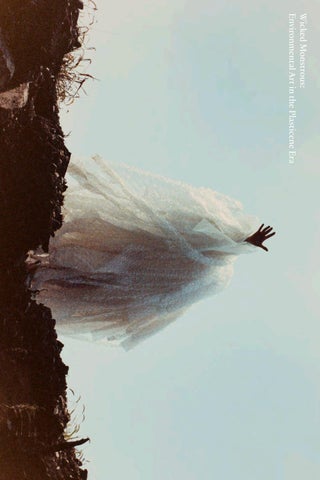
Wicked Monstrous: Environmental Art in the Plasticene Era
Wicked Monstrous Environmental Art in the Plasticene Era
Contents
6 Patricia Watts Wicked Monstrous: Introduction 18 Aurora Robson Environmental Art in the Plasticene Era 24 Deanna Pindell Queering the Polymer: A Different Future for Trees and Plastics 32 Leah Dalton Plastic Bodies: Poetics of Materiality in the Expanded Field of Sex Ecologies 42 Minal T. Mistry Dis/solution 44 Constance Mallinson A Fatal Attraction? 48 Blue McRight Future Creatures: Plastinauts and the Great Transformation 54 Sayaka Ganz & Felipe-Andrés Piedra Plastihenge: Channeling Life through Sculpture 60 Megan Wong What Now? A Participatory Workshop Model for Change
66 Marguerite Perret An Atlas of Avertible Catastrophies, or The Metamorphosis Recast 72 Jennifer Kotter Soup 78 Bee (Beverly) Naidus The Dance with Plastic: To Embrace or Refuse 82 Bryan Northup Wrap Me In Eternity 84 Ashton S. Phillips Becoming Plastic Bodies, Queering Human/Nonhuman Divide, and Embracing the Transness of Matter 90 Ann Savageau Art as Intervention: Bags Across the Globe 94 Constance Old Deep Sea Medusa 351 Artist index 363 Timeline
A wicked problem is a social or cultural challenge that is highly complex, interconnected with everything, and inherently difficult or impossible to solve. The term was coined in 1973 by design theorists Horst Rittel and Melvin Webber. It does not refer to evil; rather, it means that the problem resists resolution. When facing a monstrous problem, we must manage, adapt, and learn our way through it.
A monstrous problem is an issue characterized by its massive, terrifying scale, or a situation that feels shockingly wrong, cruel, and deeply unnatural. The term describes a problem that is either grotesquely complex or morally reprehensible. In order to face a monstrous problem, one needs to break it down into immediate, manageable actions instead of trying to fix everything at once.
Wicked Monstrous: Introduction Patricia Watts
The era of plastics—or what has become a wicked, monstrous problem—began with a man-made material called Parkesine, a semi-synthetic plastic invented in 1856 by British chemist Alexander Parkes. The developments of Celluloid, Bakelite, and Plexiglas were to follow, in the early twentieth century. By the 1920s the originators of Constructivism, Russian-born brothers Naum Gabo (1890–1977) and Antoine Pevsner (1884–1962) created abstract sculptures by experimenting with cellulose acetate and nitrate plastics to explore the interactions of space, light, and transparency that plastics offered (fig.1). The earliest American artist of note who experimented with plastic was Alexander Calder (1898–1976), whom New York's Museum of Modern Art selected to present a sculpture at the 1939 World's Fair in Flushing, in Queens, New York. The abstract figurative work was made of layered colored Plexiglas, a modern material that allowed him to incorporate light as a secondary medium. The artwork was sponsored by the producer of Plexiglas, the Rohm & Haas Company, a chemical corporation based in Philadelphia. Its promotional campaign boasted that the company was “nature’s most formidable competitor.”1 Calder used Plexiglas again in the early 1940s for his suspended mobile works, as did each of the Pevsner brothers for their sculptures. Ultimately, however, Calder abandoned the material in favor of metal. Another early adopter was Hungarian-born painter and photographer László Moholy-Nagy (1895–1946), who worked with industrial sheet Plexiglas from 1931 to 1945; like Pevsner, he sought to manipulate light and shadow. He molded, incised, and painted the plastic for his translucent painting-sculpture hybrids, collectively known as the Space Modulators series.2 These and other early experiments by artists set the stage for the surge of plastic-art exhibitions that would come years later, after the end of World War II (see "Timeline," p. 363). Almost two decades after the 1939 World's Fair in New York, there was a rising synergy among conceptual artists working with the material—so much so that San Francisco art critic Palmer French coined the term “plasticraft” in an exhibition review in Artforum. Unlike the term plastic arts, which derives from the Greek word plastikos (meaning “to mold” or “to shape") and has been used since 1624 to describe the plasticity of textures or optical illusions of three-dimensional form, “Plasticraft,” referred to a movement in the 1960s that relied
1. Danielle O’Steen, “The Pioneers of Plasticraft: When Artists Found Plastics in the United States,” chap. 8 in Plastics, Environment, Culture, and the Politics of Waste, ed. Tatiana Konrad (Edinburgh: Edinburgh University Press, 2023), 161–80, esp. 168–72; ebook available, https://edinburghuniversitypress.com/book-plastics-environment-culture-and-the-politics-of-waste.html. 2. László Moholy-Nagy produced several Space Modulators between 1931 and 1945, artworks made with industrial Plexiglas, which he would bend by heating the plastic over a stove to create a filter that would cast complex shadows from light. The artist died of leukemia in 1946, at fifty-one years of age. The definitive monograph is Moholy-Nagy: Future Present, by Matthew S. Witkovsky, Carol S. Eliel, and Karole P. B. Vail. Published in 2016 for the major retrospective by the Art Institute of Chicago, the Solomon R. Guggenheim Foundation, and the Los Angeles County Museum of Art. 7
on a synthetic material literally called plastic, as well as other recently developed polymer-based materials employed to mold and shape forms.3 Between 1965 and 1972, more than a dozen museum and gallery exhibitions across the United States focused on works made of plastics (see "Early Exhibitions," p. 369).4 Eva Hesse (1936–1970), a German-born American artist, began making sculptures in 1965 after moving into an abandoned textile mill near Essen, Germany, where she lived and worked for a year. During her abbreviated career, she began working with fiberglass, polyester resin, latex, and vinyl. In 1968 she presented her first solo sculpture exhibition, Chain Polymers. Two years later, she died from a brain tumor. Many of her artworks can no longer be exhibited because, over time, they curled in on themselves and crumbled away. Hesse knew that these materials were not meant to last, and she was conflicted about selling the works to collectors, yet she embraced their immediacy. Her writings at the time reflected a profound acceptance of impermanence; she believed that “Life doesn’t last; art doesn’t last.”5 Other early wicked monstrous artists include Christo (1935–2020) and Jeanne-Claude (1935–2009), whose works of the early 1960s featured everyday objects wrapped in polyethylene and bound with twine, including a baby carriage, a telephone, an armchair, a Vespa, and a shoe. The artists wrapped hundreds of objects before expanding their practice to monumental projects, covering buildings and bridges with woven synthetic fabrics such as polypropylene and nylon.6 Feminist sculptor Mimi Smith, while in graduate school at Rutgers in 1965, made her Recycled Coat, sewn together with plastic bags (fig. 2); in the following year, she produced Maternity Dress (fig. 3), a cocktail dress rocking a Space Age aesthetic that she modeled herself, showing her unborn child popping through a clear plastic dome over her belly. Around the same time, Bonnie Ora Sherk (1945–2021), who attended Rutgers in 1967, made a sculptural object of floating clouds airbrushed on board, which included a plastic receptacle at the bottom that symbolically "caught" falling clouds (fig. 4).7 Mierle Laderman Ukeles was photographed dutifully dusting her clear plastic shower curtain during one of her Private Performances of Personal Maintenance as Art of 1970–73 (fig. 5).
3. “The new pioneer of plasticraft has invaded a domain,” declared art critic Palmer French in his review of the 1967 exhibition Plastics West Coast, at Hansen-Fuller Gallery in San Francisco. He wrote that the artist "is actually experimenting and, in some cases, innovating techniques and potentially useful modifications not hitherto explored in commercial applications." O’Steen, “Pioneers of Plasticraft," 161; Palmer French, "Plastics West Coast," Artforum 6, no. 5 (January 1968): 48. 4. O’Steen, "Pioneers of Plasticraft," 161–80. 5. Arthur C. Danto, "All About Eva,” The Nation, July 17, 2006, 32. https://www.thenation.com/article/archive/all-about-eva/. 8
Figure 1 Antoine Pevsner, Torso, 1924–26. Plastic and copper, 29 1/2 x 11 5/8 x 15 1/4 in. Katherine S. Dreier Bequest. The Museum of Modern Art, New York. © ARS, NY. Photo: © The Museum of Modern Art/Licensed by SCALA/ Art Resource, New York
6. Christo was part of Nouveau Réalisme, a movement based in Paris that was founded in 1960. Among the group's artists was Martial Raysse, who created Oiseau de Paradis (Bird of Paradise) (1959–60), made with plastic objects attached to metal rods. Others in the movement were Yves Klein, Jean Tinguely, and Niki de Saint Phalle. They defined themselves as having a “new perspective in approaching reality” of twentieth-century consumer society in the face of industrial expansion. While Nouveau Réalisme owes a debt to Marcel Duchamp and is associated with Pop Art, it is more closely tied with Dada. In Wikipedia. https://en.wikipedia.org/ wiki/Martial_Raysse; https://en.wikipedia.org/wiki/Nouveau_r%C3%A9alisme. 7. Both Mimi Smith and Bonnie Ora Sherk attended Douglass College, Rutgers University, in the mid-1960s, and both studied under Robert Watts, a member of the Fluxus collective who, in 1965, made a work out of Plexiglas titled Three Clouds. In Fluxus, plastics were often used for multiples, for their transparency, and as plastic readymades. 9
Figure 2 Mimi Smith, Maternity Dress, 1966. Silver-vinyl, plastic, zippers, and screws, 33 1/2 x 15 1/2 x 11 in. Collection at RISD Museum, Rhode Island, Helen M. Danforth Acquisition Fund. Courtesy of the artist Figure 3 Mimi Smith, Recycled Coat, 1965, worn by the artist. Plastic bags, plastic, thread, bottle caps, and aluminum hanger, 48 x 34 x 5 in. Nonextant. Courtesy of the artist
10
In 1966 Cecilia Vicuña had a daily practice of making small sculptures with plastics, including fishing line, fraying ropes, and netting, hat she collected along a beach on the coast of northern Chile. She called these ephemeral site works basuritas—“little garbages” in Spanish. The detritus represented the resilience of marginalized communities under oppression, things discarded by society. These temporary artworks acknowledged that we humans and the earth's animals are inextricably linked to the current ecological crisis. Vicuña continued to incorporate collected plastic waste in the work she made during the early 1970s, while in art school in London, and beyond. Like Vicuña, British sculptor Tony Cragg, who was previously a lab technician at the National Rubber Producers Research Association, collected plastic waste that from the streets and local rubbish dumps in West London, in addition to the ocean plastics he found on the shores around Liverpool. In 1979 he exhibited Red Skin (fig. 6), a large sculpture assembled on a wooden floor. It was composed of red plastic fragments in the shape of a Native American figure, based on a plastic “red Indian” toy he found. In 1982–83, he presented a similar work, Red Indian (fig. 7), a relief sculpture standing almost ten feet high on a large white wall. On the surface, Cragg's colorful plastic works appeared to be merely fun and whimsical, although they were actually more confrontational than art reviewers acknowledged at the time. By the late 1980s, Christy Rupp, who had drawn attention to an impending plastics crisis with her earlier work about rats during a 1979 garbage strike in New York (fig. 8), had started making formal sculptures in which welded steel held plastics, visually illustrating how the rats were becoming ubiquitous outdoors in nature. As Lucy Lippard stated in a 1992 catalogue essay, “Endowed with her usual humor and irony, [Rupp's works] are formally cohesive as image and message at once." Wave of the Future, for example, is at first glance a beautiful object—a great metal snail shell with a translucent blue material, which turns out to be nonbiodegradable plastic water bottles (fig. 9). The artist, who collects the bottles at the recycling center in the Bronx, scrubs them ferociously to make them "art-clean.” Synthetic Water is filled with green and white Perrier bottles (fig. 10).8 Judith Selby Lang and Richard Lang began visiting Kehoe Beach in the Point Reyes National Seashore in 1999, where they found a plethora of plastic debris. The artists collected and curated the plastic bits by color and size, then fashioned them into artworks and wearables. They have gathered tons of plastics from the Pacific Ocean on just one thousand yards of shoreline and have been
8. The exhibition Natural Selection: Sculpture by Christy Rupp was on view at the Burchfield Penney Art Center, in Buffalo, New York, in 1990. It then traveled to Picker Art Gallery, Colgate University, Hamilton, New York; Contemporary Art Center, Seattle, Washington; and Decker Gallery, Maryland Institute College of Art, Baltimore, Maryland. Catalogue essay by Lucy Lippard. 11
making them into series of artworks for almost thirty years. Their epic and more recent work is sited in the kitchen at the former Cliff House restaurant in San Francisco. Titled for here or to go? it is a large-scale installation, commissioned by the For-Site Foundation, that includes piles of white plastic pieces on white ceramic plates, as if the artwork is serving up plastics for people to eat (see p. 182). One might assume that the ocean plastics the artist duo collects were discarded on the beach by picnickers, but it was clear that most of these objects had been at sea for a long time before they had washed ashore. In 2005 Pam Longobardi was inspired to address plastic waste after walking on a remote beach in Hawaii, where she noticed that the ocean was “vomiting” plastics onto the black lava shoreline. She then began her Drifters Project, which has been ongoing for over twenty years. It is an archive of tens of thousands of mostly plastic objects collected on beaches around the globe. Longobardi also organizes her collected ocean plastics by colors and shapes to make large sculptural installations (see p. 222). In 2013, along with fellow artists and scientists, the artist participated in the Gyre Expedition, traveling from the Great Pacific Garbage Patch all the way north to the Gulf of Alaska. Longobardi believes that plastics washed up on the shore are being revealed by nature as “ghosts of our consumption.”9 Fast forward to 2023, when more artists than ever were making work with plastics. ecoartspace launched a monthly Zoom meetup called the "Plastic Dialogues"—the idea being to bring these artists together to discuss their work. The first year felt almost like an AA meeting, with artists apologizing that they actually liked working with plastics, for the colors, for the free materials, and for their contribution to the clean-up of beaches and other areas. There were often tears. When giving online tours of their studios, some were embarrassed by their many piles of plastics. Conversations would arise about health impacts, which led some artists to stop using plastics altogether, because the exposure could lead to immune disorders or even cancer. Some of the artists have recently turned to making bioplastics, which are alternatives made with plants. Tackling plastic waste in Africa has become a monstrous problem. It is driven by rapid urbanization and the rising use of consumer goods, along with the lack of municipal waste infrastructure that worsens urban flooding by clogging waterways. To represent the incredible work artists are doing in Africa, in this book are meaningful demonstrations of creative expressions by Ogwado Joachim (Uganda), Pascale Marthine Tayou (Cameroon), Serge Attukwei Clottey (Ghana), Sandra Suubi (Uganda), and Moffat Takadiwa (Zimbabwe). These artists
9. Gyre: The Plastic Ocean, staged by Alaska's Anchorage Museum in 2014, was one of the first museum exhibitions to address plastics. It presented the work of twenty-six artists—among them, Pam Longobardi, Cynthia Minet, and Judith Selby Lang and Richard Lang, who are included in the present volume. In conjunction with the exhibition, Longobardi was invited to join the Gyre Expedition in the Gulf of Alaska. 12
Fig. 5 Mierle Laderman Ukeles, Dusting a Baffle, 1970–73, from Private Performances of Personal Maintenance as Art, 1970–73, black-and-white photograph, 10 x 8 in. Photo: Jack Ukeles ©Mierle Laderman Ukeles. Courtesy of the artist and Ronald Feldman Gallery, New York
Figure 4 Bonnie Ora Sherk (attributed), untitled, ca. late 1960s. Acrylic on board and plastic. Nonextant. Courtesy Bonnie Ora Sherk Estate
13
are raising awareness of the health implications for individuals and creating opportunities for upcycling plastic waste to generate income. Rwanda stands out as an African nation that, in 2018, boldly instituted a governmental program addressing plastics. The legislation created one of the strictest plastic bag bans in the world, which was expanded in 2019 to include all single-use plastics. The law prohibits the manufacture, importation, use, and sale of plastic carry bags.10 There is also an innovative NGO program in Dakar, Senegal, called the Deekali Plastic Recovery Project, in which trained collectors and organized women’s groups retrieve plastic waste from dump sites, beaches, households, and public spaces. The materials are delivered to partner recycling facilities, where the plastics are transformed into high-quality flakes and chips for manufacturing, as well as into durable plastic lumber for household and commercial products. 11 Plastics are everywhere—in our soils, food, waterways, buildings, and air. Highly concerning are the health impacts of plastics, which include endocrine disruption that mimics or blocks hormones, leading to reproductive disorders, early puberty, and impaired fetal development. When plastics are ingested or inhaled, their particles can trigger damage to DNA. The impact of plastics on our digestive system is a wicked, wicked problem; it is known to cause inflammatory bowel disease and colorectal cancer, both of which are currently on the rise. We now know that plastic exists in our bodies, and even in placentas—the natural barrier that protects developing babies in utero. The message is clear: If plastic is doing all this to humankind, it is also doing it to every other animal and to all living plants. This essay focuses primarily on the proliferation of plastics, on how artists came to incorporate them into their art making, and on the plastic crisis we find ourselves in today. It does not address in depth the insidious impacts of plastic production in places such as Louisiana's Cancer Alley and the Texas Gulf Coast, where massive multinational plastics conglomerate Formosa operates facilities that severely affect the health of nearby communities, human and animal. In 2025 ecoartspace worked with the Descendants Project in Wallace, Louisiana, to present an exhibition titled Plastic, The New Coal (funded by apexart International), co-curated by Monique Verdin (Houma Nation) and myself. The numerous car washes and dialysis centers in the area were evidence that living near oil refineries, where crude oil and natural gas are processed for plastics, not only eats the paint off your car but can contribute to end-stage renal disease. Chemical plants are known to generate high emissions of the carcinogens ethylene oxide and chloroprene, as well as other harmful volatile organic com10. Fines can reach up to $60 (or tens of thousands of Rwandan francs) for individuals caught with prohibited plastics in Rwanda, while businesses involved in their sale or production face much steeper fines or even imprisonment. 11. Verra, "Turning Plastic Waste into Opportunity in Senegal," accessed February 2026, https://verra.org/case-studies/deekali-plastic-recycling-project/. The Deekali Plastic Recovery Project in Senegal is the first plastic-credit initiative in Africa developed by Africa Carbon & Commodities (ACC) to meet the rigorous requirements of the Verra Plastic Waste Reduction Standard. 14
Figure 6 Tony Cragg, Red Skin, 1979. Red plastic fragments, 19 1/2 x 16 1/2 ft. © 2026 Artists Rights Society (ARS), New York / VG Bild-Kunst, Bonn Figure 7 Tony Cragg, Red Indian, 1982–83. Red plastic fragments, 10 x 7 1/2 ft. ©2026 Artists Rights Society (ARS), New York / VG BildKunst, Bonn
15
Figure 8 Christy Rupp, Wave of the Future (left) and Synthetic Water (right), 1989. Each: plastic bottles and welded steel, approx. 31 x 18 x 20 in. and Synthetic Water, 1989, Plastic bottles and welded steel, approx. 31 x 18 x 20 in. Courtesy of the artist
16
pounds. ecoartspace's goal for the exhibition was to bring the art-going public from New Orleans and Baton Rouge to a midpoint along the Mississippi River, where the effects of plastic production disproportionately harm nearby Black and low-income communities, as well as farmland where food is grown. Sixty years ago, art critics viewed the use of plastics as a material innovation and were often blind to the ways in which the work was subversive, using beauty to expose environmental harm. Even now, generally speaking, people are not ready to comprehend the harmful undertow of plastics. In 2013 Timothy Morton coined the term hyperobject to help explain this phenomenon. He defined a hyperobject as something so vast that it extends across space and time, confounding human perception because it vastly exceeds ordinary experience. Within this framework, the concept of the local is irrelevant: there are no boundaries. Morton identified all plastics ever manufactured as a single hyperobject—a material that will outlast humans while permeating the entire biosphere.12 Plastics have become the poster child for Morton’s concept of an omnipresent and deep entanglement that, ironically, derives from crude oil, itself formed from the remains of marine plants, algae, and plankton that lived millions of years ago. We live in a "hyperplastic" era that demands polymeric thinking—the ability to recognize chains of connections, entanglements, and interdependent systems in order to survive. Organizations like Plastic Vortex, founded by Aurora Robson, are supporting artists dedicated to intercepting plastic pollution that would otherwise go to landfills, be incinerated, or land in oceanic drift. The artists included in this book seek to illuminate connections between our pursuit of convenience and the health and safety of our future.
12 Timothy Morton, Hyperobjects: Philosophy and Ecology after the End of the World (Minneapolis: University of Minnesota Press, 2013). 17
Environmental Art in the Plasticene Era Aurora Robson
After twenty-plus years of intercepting the plastic waste stream to source material for art, I’ve had some time to reflect on the meaning and context of such a contemporary art practice. As I write this, it is mid-summer 2026, in the Hudson Valley of New York, and we have just surpassed a series of dystopian events. The season began with a punishing heat wave, gave way to severe flooding, then choked us with toxic wildfire smoke—all atmospheric consequences of the burning of fossil fuels and the petrochemical systems that spawn plastic. For an encore, climate disruption has now presented us with an unprecedented influx of mosquitoes, whose global range is expanding as we upend the environment. Despite their critical ecological roles as pollinators in cold regions and foundational links in aquatic food webs, these runaway populations pose a massive threat to humans, making time spent outside a high-exposure risk of malaria, dengue, West Nile, and Zika. A time of dis-ease is fully upon us. Humans cannot find ease under these volatile climate conditions, especially the vast majority who do not possess protective bunkers or the financial resources to adequately shield themselves. Working with plastic, a lightweight material that floats on currents in the ocean and the wind, has an insurmountable weight to it. Plastic debris is inextricably tied to Land Art as we are harvesting what has become a literal, geologic stratum combined with and contributing to our changing planet. Yet, it can also be an aesthetically pleasing material, akin to Objet Trouvé. These synthetic scraps arrive in our hands as intimate, derelict fragments bearing eerie lineages, bizarre shapes, and layered social histories. The urgency of intercepting this material is driven by stark data reported by the United Nations that a staggering 91% of the world's plastic waste is never recycled; it is left instead to choke marine pathways, saturate landfills, or be incinerated, releasing noxious carcinogenic chemicals into the atmosphere. Because the chemical bonds in plastic resist natural decay, environmental analysts emphasize that virtually every piece of plastic ever manufactured still exists on this planet in some form. The sheer volume of this material that has been and continues to be manufactured represents an ecological monstrosity; we are David to Goliath. Tiny drops of light in a massive and dark bucket. But if we are going to live with this material for the foreseeable future, the simple question is: What form do we wish for it to take, and where would it be best situated to reduce its negative impacts? Using discarded plastic for art and design applications is a way of addressing the profound defiance of natural cycles that this material presents. It is a medium born from extracting compressed ancient biology—plankton and
19
organic matter buried three hundred million years ago—and forcing it into a synthetic immortality that the earth cannot digest. When molecular architect Leo Baekeland mixed coal tar and formaldehyde in 1907 to create Bakelite, he initiated a revolution that permanently altered our relationship to physical matter. Suddenly, humanity was no longer restricted to materials that rust like metal, rot like wood, or shatter like glass. We inadvertently unleashed a vampire into our ecosystem—a material possessing a sinister, permanent quality because it simply does not die. Fast forward a few decades, and the invisible bite of that molecular revolution has spread. Its synthetic descendants have now found their way into us, among us, and all around us. Microplastics have wickedly infiltrated human organs, global food chains, plants, and weather patterns. Society considers this material devoid of value, viewing it with shared disdain and disgust. It is a material that is bordering on the scatological. Our work as artists requires establishing a rigorous protocol within the studio wherein this material can be transformed into a viable, expressive art medium without harming ourselves or anyone else. There is a radical aspect to this workflow. It is a dystopian evolution of Land Art—or Earthworks. Unlike the monumental interventions championed by Robert Smithson or more ephemeral works made in and with nature formed with ecological intent by Agnes Denes, art made from repurposed plastic will simply never return to the earth. Artists employing plastics are working with an immortal medium, forcing a confrontation with the unwholesome synthetic footprint that this material is leaving behind. In 2009, I extended my dedication beyond my studio practice to the creation of Project Vortex, an international collective of artists, designers, and architects intercepting the plastic waste stream. Many Project Vortex members are featured in Wicked Monstrous, a book that demonstrates the immense breadth of this medium. Rather than treating plastic as a monolithic pollutant, these artists indiscriminately interact with it through an astonishing variety of techniques. Stitching, weaving, fusing, carving, combining, studying, re-molding, and ruminating on it, we are collectively leveraging its unique attributes to tell a story rich with juxtapositions and contradictions that mirror the very nature of the material. I am incredibly grateful to ecoartspace founder Patricia Watts for her visionary leadership and to every artist featured here. Together, we alter the destination of these derelict, destructive objects. Subverting the toxic residue of this global crisis, we take what was designed to be anonymous and “disposable”
20
Aurora Robson, Be Like Water, 2011, postconsumer plastic including PET bottles HDPE and PP bottle caps 25 x 25 x 25 feet Aurora Robson, Eos, 2024 injection welded post-industrial plastic including highway safety drums, detergent barrels and trash bins LEDs, 20 x 6 x 6 feet
21
and grant it a permanent, meaningful place in art history—ensuring that this insidious, immortal matter serves rather than destroys, while offering a humble, enduring testament to human ingenuity.
Aurora Robson, Encapsulate Yellow, 2026, 3D printed post-industrial plastic R-PETG and post-consumer HDPE and PP bottle caps, 22 x 16 x 17 inches
22
Citations 1. Global Recycling Rate (9%): Organization for Economic Co-operation and Development (OECD), "Global Plastics Outlook: Policy Scenarios to 2060" (2022); and United Nations Environment Programme (UNEP), "Turning off the Tap: How the world can end plastic pollution and create a circular economy" (2023). Historical global datasets confirm that only 9% of all plastic waste ever generated has been successfully recycled. 2. Mosquito Mortality Rates: World Health Organization (WHO), "Vector-Borne Diseases Fact Sheet" (2020/2024 updates); and Centers for Disease Control and Prevention (CDC), "Impact of Malaria." Public health data identifies the mosquito as the world’s deadliest creature, causing over 700,000 human fatalities annually through the transmission of malaria, dengue, West Nile, and Zika. 3. History of Synthetic Plastics: American Chemical Society National Historic Chemical Landmarks, "The Invention of Bakelite" (1993). Leo Baekeland’s 1907 patenting of Bakelite marked the creation of the world's first fully synthetic polymer, combining phenol (derived from coal tar) and formaldehyde to eliminate reliance on natural resins. 23
Queering the Polymer: A Different Future for Trees and Plastics Deanna Pindell
Synthetic Silk: Dupont erected a 35-foottall leg to launch the invention and post-war sale of nylon stockings after women gave up silk stockings for WWII parachutes. Los Angeles, California, 1946
Trees good, plastics bad … is that right? What if plastics could have prevented much of the North American deforestation? Could polymers have a positive place in our future global ecosystem? Queer ecology theory asks us to invert and subvert our assumptions as a strategy for seeking ecological solutions. There’s no doubt about the expansive layers of harm that we are now experiencing from our misuse of plastics, our extractive over-use of arboreal resources, our relentless gluttony for material goods, and the close-minded self-absorption that drives the fossil fuel industries and their consumers. However, as Einstein wrote, “We cannot solve our problems with the same thinking we used when we created them,” and this is especially true for the ubiquity and multivalence of challenges we face inside this hyperobject we call the Plasticene: plastics are a wicked problem, impossible to articulate clearly as one composite issue, and cannot be solved in any way that is clear-cut or final. The widespread perspective that plastics are the problem and need to be eliminated or controlled is nullified, because our entire world has become plasticized, from the ocean bottoms to our inner cellular structures. We cannot correct, protect, or escape from them; we can only make kin and find ways to live with them. We are the center of the problem: not just our ecocidal actions, but the basic assumptions underlying them.
Natural vs. Synthetic: A False Binary This essay attempts to disentangle one thread of the nasty knot, apply queer theory to our effort to upend the thinking that brought us to this point, and speculate on an alternative reality based on the relationship between trees and plastics. Global deforestation is even too big a slice to contemplate, so this essay will focus on North American, or perhaps even more narrowly, the United States’ complicity in this crisis. A crisis about the trees I love, the ones I live with, my kin among the great Pacific Northwest temperate rainforest conifers. We begin by queering the false binaries. The “natural vs. synthetic” binary falls exactly in line with the others that have dominated Western culture for 400 years: “mind vs. body,” “nature vs. culture,” and, of course, “male vs. female.” Reality, at both the macro ecosystem level and the micro level of quantum entanglement, is much more co-constitutive1.
1. Barad, Karen. Multiple writings. See “Meeting the Universe Halfway” 2007. Durham, North Carolina: Duke University Press. Print. 25
The polymers, which are the basis of plastics, are found throughout the living world, existing before they were ever synthesized. The plant-based cellulose of cotton, wood, and hemp, plus the naturally occurring chemicals such as phenol and formaldehyde, were used to create the first plasticized materials. The earliest plastics were actually meant to preserve natural species and ecosystems. “The first synthetic polymer was invented in 1869 by John Wesley Hyatt, who was inspired by a New York firm’s offer of $10,000 for anyone who could provide a substitute for ivory. The growing popularity of billiards had put a strain on the supply of natural ivory obtained through the slaughter of wild elephants. By treating cellulose derived from cotton fiber with camphor, Hyatt discovered a plastic that could be crafted into a variety of shapes and made to imitate natural substances like tortoiseshell, horn, linen, and ivory… Advertisements praised celluloid as the savior of the elephant and the tortoise. Plastics could protect the natural world from the destructive forces of human need.”2 The beneficiaries of these new materials were not limited to elephants, tortoises, and rhinos. Synthetic silk (aka nylon) preserves the silkworms; pleather reduces the demand for the skins of cows; and eventually recycled plastic lumber designed to ease the demand on the Douglas fir forests. This well-intentioned effort to recognize our responsibility and relational kinship succeeded until overwhelmed by the tsunami of cultural flaws that bring us to this current monstrous moment.
First celluloid billiard ball, invented in 1869 to save wild elephants
2. Science History Institute Museum and Library. “History and Future of Plastics”. Accessed May 2025. 26
Bakelite synthetic resin, invented in 1907, brought color and style to a wide array of affordable consumer products.
Plastics vs. Deforestation The first fully synthetic plastic was invented in New York in 1907 and called Bakelite.3 Plastics became a popular and highly desirable new material through the affluence of the Roaring 20s. In the mass industrialisation of WWII and the post-war era, plastics provided inexpensive, durable replacements for trees. Middle-class people covered their hardwood floors with vinyl and synthetic rugs and chose Formica for fashionable countertops. Plastic building materials printed with realistic woodgrain became widespread for affordability, durability, and easy maintenance. As with most fashionable trends, plastic goods became so widespread, inexpensive, and often “disposable” that the fashion pendulum has swung back. Consumers demand “real wood,” as plastic is thought to be cheap and tacky. Last winter I noticed that Home Depot was carrying thick, massive slabs of tropical woods for countertops alongside beautiful prints of vinyl flooring, in spite of widespread awareness of tropical deforestation. Stacked high, each slab promises luxury and happiness for an affordable price. In North America, a 2,000-square-foot home might require around 48 mature trees, about 60 years old.4 Ten to twenty mature trees5 are needed just for the hidden frame, usually a softwood like Douglas fir from the PNW. Any carpenter can affirm that the quality of the lumber for framing studs has greatly deteriorated from the lumber available 100 years ago… any old-home remod-
3. Leo Baekeland received his United States patent for Bakelite in December, 1909. 4. Spratt, Steve. .Home Preservation Manual. ”Learn How Many Trees it Takes to Build a House”. online. Accessed May 2025 5. A “mature” Douglas Fir, for the purposes of the logging companies, is around 60 years old. In the natural ecosystem, this tree can easily live to 500 years, and some live past 1000. 27
el will demonstrate this degradation. Trees are not a renewable resource. With each clear-cut, vast amounts of life-giving nutrients are hauled away rather than left to decompose and become topsoil for the next generation. A clear-cut area, “managed” as timberland, can produce a maximum of four generations of trees before it is totally depleted of the living topsoil that took millennia to form. As a multi-generational resident of the timberlands of the Pacific Northwest, I want to describe a clear-cut forest to my readers. It is dry, bone-dust-dry. The ecosystem feels dead. There is no canopy of trees reaching for the sun, so there is no shelter for the shade-loving plants that provide food and habitat for the creatures of the forest. Without shade, the sun bakes the ground to dust so that the microscopic life that we know as soil goes dormant or dead. Acres upon acres of land become tinder, vulnerable to any spark. As a carpenter myself, back in the day, I loved those fir studs and planks. I loved the heaviness of them, the sappy forest smell when cutting them to length, and the close observation of each individual board to see which way it might bow or bend. Now, I can choose strong and durable Structural Plastic Lumber (SPL) made from 100% recycled HDPE (high-density polyethylene),6 which will never rot or need maintenance, will forever be reusable, and doesn’t require the extermination of beloved conifer forests.
Deanna Pindell, Clearcut Hide I, 2025, collage of photographs and maps, encaustic on paper, 28 x 22 inches
Not long ago, I selected this recycled lumber for my wheelchair ramp. What’s not to like? It will never rot or need a sealant. And definitely more expensive upfront. But in the long term, this choice is more economically efficient. The PNW mosses are slow to cover the surface, unlike everything else here. It’s very practical, not ugly, and available in a multitude of colors. Yes, there are horrific pollution problems with the recycling industries that should be addressed by current technologies. Yes, wood is by far more lovely and sensual, but at least using recycled plastic lumber allows the arboreal habitats to recover.
Valuation of Materials vs. Late-Capitalist Economies So, why wouldn’t we all use this for housing? Mostly because it’s expensive. It’s way more expensive to recycle used plastic jugs than it is to mow down an entire ecosystem, one mountainside after another. How did we get to such an upside-down, potentially suicidal, value system? Economists put a number on the value of all ecosystem benefits, both tangible (such as lumber) and intangible, such as clean air and water filtration. Next, government agencies decide how much to charge for the lumber rights and who will receive them … usually well below market rate on federal land and accompanied by generous subsidies, tax benefits, and grants. The US Forest Service and Department of Natural Resources (DNR) lose money every year as logging companies pay less per acre than the costs of administering the land agreements.” “It actually costs taxpayers millions to ‘sell’ timber that we collectively own, which makes no sense,” said Autumn Hanna, vice president of Taxpayers for Common Sense.7 Meanwhile, the recycled-plastics industries receive a much lower level of economic support. It’s really not much more complex than that. If we valued our forests as if our survival depended on it, the money would flow toward industries based on other highly available, low-demand resources: landfill-bound plastics and ocean plastics. Innovative designs for recycled-plastic building products are multiplying in spite of the limited support for research and design. Here are two successful examples. In 2020, Ocean Voyages Institute (OVI) collected 100 tons of plastic from the North Pacific Gyre,8 then gave this material to various organiza6. Plastic Lumberyard. 100% recycled plastics such as detergent bottles and milk jugs. The same simple process can be used to make 100% recycled filament for 3-D printers and other goods 7. “ New Report: Taxpayers Lost $1.7 Billion from Money-Losing Timber Sales in the Tongass over Last Four Decades”. Taxpayers for Commons Sense. Sep 2, 2020, Website blog. 8. The center of the North Pacific Gyre is often called the Great Pacific Garbage Patch, referring to an area of trash collected by the currents, roughly the size of the state of Texas. 29
tions. One of OVI’s recipients, ByFusion, has developed a recycling method that can be applied to all kinds of plastic waste, using only steam and compression, without adding any new chemicals. ByFusion ultimately turned 20 tons of the collected ocean waste into a construction block that can be used like concrete blocks (which also saves land from the mining needed for concrete). Similarly, a Columbian company, Conceptos Plásticos, recycles landfill plastic into oversized Lego-type blocks, which are earthquake-stable and fire-proof, lightweight so that anyone can build their own home, more durable than concrete, and far less expensive in multiple aspects than traditional home construction. 10 Even within this one narrowly defined strand of our snarled plastics web, we can demonstrate that technology is ready to step up with solutions; entrepreneurial innovators are passionate about ecologically-smart business opportunities. A forward-looking culture would support these recycling industries rather than extracting the wood from stunted forests and the last drops of fossil fuels from open wounds on the skin of the earth.
Artists and Cultural Change Consumer desires are arbitrary and easily manipulated when a society is saturated with social media and marketing from every angle and when the economic market is so biased toward existing industries. Trees, and all natural resources, are typically wildly undervalued in their natural state, but this is an arbitrary, culturally driven valuation that can be impacted by citizen participation and consumer demand. How do we shift those cultural values? What is the role of the arts? In 2022, scientists undertook a meta-analysis of 430 behavioral science studies that investigated strategies for encouraging climate-adaptive behaviors.11 Collectively, these studies demonstrate that social and cultural pressure is the most effective way to encourage people to change toward climate-adaptive behavior, with financial incentives a close second among other strategies. Educational data alone ranked poorly. “Social comparison” is the term given for observing and modeling desirable adaptive behavior and expanding that behavior into social norms. This is where artists and arts professionals can be effective. In calling for interdisciplinary approaches, Beth Carruthers notes:
9. Altasea. Turning Ocean Plastic into Construction Materials. November 2022. Blog. See also: ByFusion company website. https:// byfusion.com/ 10. Conceptos Plásticos from Inhabitat https://inhabitat.com/lego-like-building-blocks-of-recycled-plastic-allow-colombians-tobuild-their-own-homes/ 30
“Precisely because environmental problems are rooted in cultural practices and ideologies, it is artists, immersed in world and cultural practices, who are ideally situated to locate and develop effective responses.”12 All of the festivals and parades and giant puppets; all of the public eco-art interventions and community projects; all of the major eco-art exhibits and books and films and posters and theater and more: each cultural action encourages the normalization of new sets of values, preferences, and choices. Wicked problems require myriads of diverse creative approaches. Creative thinking, as arts workers are trained to do, is flexible, non-linear, innovative, process-oriented, iterative learning, and playful, which is precisely what is needed to address the existential crises we face. Many of us struggle, as do I, with grief and despair over the flaws of our ecocidal culture, but the future is not a binary choice between a toxic dystopian existence versus an early expiration date. Culture workers are needed as visionaries. The arts can help to drive a long-term cultural shift toward ecological accountability and relationality, which science and education alone cannot do. When our work as creative culture workers feels bleak, just remember the White Queen: “Why, sometimes I’ve believed as many as six impossible things before breakfast!” 13
11. Berquist, Magnus, et al. “Field interventions for climate change mitigation behaviors: A second-order meta-analysis”. Proceedings of the National Academy of Sciences (PNAS). 2023 Vol. 120 No. 13. Print. 12. Carruthers, Beth. “Art, Sweet Art” Alternatives. Journal of the Environmental Studies Association of Canada, 32:4/5. 2006 13. Carrol, Lewis. Through the Looking Glass. 1871. 31
Plastic Bodies: Poetics of Materiality in the Expanded Field of Sex Ecologies Leah Dalton
David Wojnarowicz's passage speaks not only to mortality but also to conditions under which bodies are made to live. Within capitalism, disposability becomes an everyday logic shaping how bodies, materials, and environments are valued and discarded. Thinking in terms of categories of beings (e.g. races, genders, species, etc.) seems in human history to inevitably result in ranking forms of life, in hierarchy that brings cruelty and exploitation.1 —Kim TallBear Tall Bear names the violence embedded in classification itself. Hierarchy does not merely organize difference; it authorizes harm, determining which lives are protected or rendered expendable. My work unfolds in response to this recognition. I approach eros, not as sensation alone but as orientation. Audre Lorde describes eros as a well of knowledge and inner power, demanding depth, accountability, and presence. Within this understanding, eros becomes a method, guiding my attention toward intimacy, relation, and care as political acts. From this ground emerges my engagement with sex ecologies, an interdisciplinary field examining pleasure, affect, and embodiment across human and more-than-human worlds. Sex ecologies insists that environmental and social justice cannot be separated2 and that sustainability must reckon with how bodies are governed, consumed, and disciplined. Within this expanded field, I began researching plastics, not as waste alone, but as material bodies entangled with human flesh, policy, industry, and desire. Plastic becomes a site through which the politics of endurance, reproduction, contamination, and refusal are made visible. This essay is an inquiry rather than an argument, moving between theory and poetics, science and intimacy, river and body. It seeks not resolution, but proximity. Here, endurance, metamorphosis, and resistance collide. The erosion of environmental and social justice reshapes bodily autonomy, consent, and care across human and material bodies, pressing toward new forms of kinship. Sex ecologies considers sustainability as inseparable from social and environmental justice for building more equitable worlds. It questions compulsive heterosexuality, structural racism, and ongoing colonialism, countering it with waywardness, polyamory, interspecies care, and song. —Stefanie Hessler3
1. Stefanie Hessler, ed., Sex Ecologies, 1st ed. Trondheim, Norway: Kunsthall Trondheim, 2021. 2. Ibid. 3. Ibid. 33
Sex Ecologies, Eros, and Animacy The overturning of abortion rights in 2022 intensified long-standing struggles over bodily autonomy in the United States. Autonomy operates across multiple registers: through law, access to medical care, the regulation of movement, and what enters the body without consent. At the same time, scientific studies revealing microplastics in bloodstreams and placentas exposed another form of intrusion. When infiltration becomes ubiquitous, choice itself begins to fracture. Within extractive capitalism, bodies are disciplined for productivity. Pleasure narrows. Care becomes negotiable. Ecological and bodily health are exchanged for labor and output. Reproductive autonomy becomes inseparable from systems that require continuous reproduction in service of economic gain. Political philosopher Murray Bookchin names this condition as the institutionalization of life itself for industrial gain.4 How, then, are bodily autonomy and ecological crisis politically entangled? I understand this entanglement as intentional, not accidental. Any attempt to solve the ecological crisis within a bourgeois framework must be dismissed as chimerical. Capitalism is inherently anti-ecological. Competition and accumulation constitute its very law of life, a law…summarized in the phrase, “production for the sake of production.5 —Murray Bookchin Are human bodies not also ecological bodies? What is lost when we imagine ourselves as separate from the systems that sustain us? This work does not seek to abolish production but to ask how production might exist alongside care. My hand slides down, resting at the base in thought. To what end shall we meet, and which of us will outlast the other? Not my form. I will decay, be eaten, turned into fuel. You will go on, smaller and smaller, yet everywhere. Filling every hole, even the ones meant to stay empty. Babes will suckle you down, and whales swallow you whole. In every body, there you will be. You were not made through consent, so you are blind to its meaning. But were you not also once decaying, eaten, mined, turned into fuel, into plastic?
4. “Post-Scarcity Anarchism.” 2024. The Anarchist Library. https://theanarchistlibrary.org/librarly/murray-bookchin-post-scarcity-anarchism-book. 5. Washington, RA. 2023. “Everlasting Plastics—the Notes within My Blood.” Everlastingplastics.org. https://everlastingplastics.org/ sketches/the-notes-within-my-blood. 34
Leah Dalton, Ever Lasting, 2024, video still from 1 hour performance, video: 13 minutes
35
Architect and urban theorist Terry Schwarz calls for rethinking our relationship to plastics in her contribution In Place Of for Sketches on Everlasting Plastics. She describes the illusion of boundaries that allow materials, bodies, and environments to be treated as separate.6 “Most of this plastic will never fully disappear,” Schwarz writes. “It just gets smaller and smaller, infiltrating water bodies and human bodies at an alarming rate.” Mel Y. Chen reminds us that animacy is never neutral. Hierarchies of aliveness organize value, shaping which bodies are protected and which are abandoned. Plastic unsettles these hierarchies. It is intimate and unwanted, omnipresent and disavowed. Its persistence demands reckoning.7 The river where I live, and where this project began, ranks among the most plastic-polluted in the world, releasing an estimated thirty-two million microplastic particles into the Ohio River every second.8 It also bears the legacy of the 2008 coal ash disaster, when over one billion gallons of toxic sludge spilled into tributaries feeding the river. These histories remain suspended in water, soil, and memory. The Tennessee River exceeds damage. It is a living body, connecting watersheds across state lines and moving through interspecies communities. In response to this water, alongside my body and the plastic body, inquiry takes shape through entanglement. Could plastic also be a body, one seeking return, ruptured from origin? Environmental policy scholar Dr. Arturo Castillo contributes, “A rethink of the whole value chain of functions provided by plastics is essential, and no single policy or technical solution will suffice.”9 This insistence raises the question of imagination itself. Is imagination not the origin from which life, intellect, desire, and possibility emerge? Living alongside the river has taught me that contamination is not evenly distributed. It settles into societal cracks along riverbanks away from view, seeping quietly below ground, ingesting sites in the slow boil of time. As we learn to bear the intimacy of scrutiny, and to flourish within it, as we learn to use the products of that scrutiny for power within our living, those fears which rule our lives and form our silences begin to lose their control over us.10 —Audre Lorde
6. Ibid. 7. Chen, Mel Y. Animacies : Biopolitics, Racial Mattering, and Queer Affect. Durham, NC: Duke University Press, 2012. 8. “Plastic Pollution in the Tennessee River, USA.” 2021. Ecohubmap.com. https://www.ecohubmap.com/hot-spot/plastic-pollution-in-the-tennessee-river-usa/b2rkhiklehb62nk. 9. "The Fraud of Plastic Recycling," Climateintegrity.org, 2024, https://climateintegrity.org/plastics-fraud. 10. Lorde, Audre. Sister Outsider: Essays and Speeches. Trumansburg, NY: Crossing Press, 1984. 36
In the spring of 2023, I visited the Tennessee Aquarium Conservation Institute with collaborating artists. We met with Dr. Anna George, Vice President of Conservation Science and Education, to discuss the Tennessee River. Dr. George shared research conducted with German scientist and endurance swimmer Dr. Andreas Fath, who tested and swam nearly the 652-mile length of the Tennessee River in 2017. Their findings revealed between 16,000 and 18,000 microplastic particles per cubic meter of water. These levels were double those found in China’s Yangtze River and more than 8,000 percent higher than those recorded in the Rhine River11, surpassing levels in some of the most documented rivers in the world. The labor of mitigation remained ongoing and incomplete. Outcomes not guaranteed. Mirroring my own artistic practice, where results are not predetermined and complexity is held rather than resolved. We discussed species of fish that spend part of their lives as one gender and the rest as another, like the snook, a protandrous hermaphrodite. They can spawn as male and later as female within the same season, possessing both female and male sex glands in the gonads. Gonads.12 I have always found the word “fascinating.” This was the first time I felt kinship with it. I think more deeply about biological openness, the labor of care, and the labor of mitigation. Both demand endurance. The Nature Conservancy identifies the Tennessee Basin as the most biologically diverse river system for aquatic organisms in the United States. It also contains the highest number of imperiled species of any large basin in North America, including fifty-seven fish species and forty-seven mussel species considered at risk. The Tennessee River alone is home to approximately 230 fish species and 100 mussel species, many endemic to the watershed. According to Tennessee Riverkeeper, roughly thirty mussel species have been extirpated from the river system, a third now considered globally extinct.13 Especially in an age of mass extinction, should not every form of life be celebrated, congratulated?14 —Elvia Wilk
11. “Analysis Finds Staggering Level of Microplastic in Local River.” 2018. Tennessee Aquarium. October 12. “Phillip and Patricia Frost Museum of Science.” 2016. Frost Science. November 14. https://www.frostscience.org/fun_fact/common-snook/. 13. “Tennessee RIVERKEEPER | Species.” 2024. Tennesseeriver.org. https://www.tennesseeriver.org/species.html. 14. Hessler, Stefanie, ed. Sex Ecologies. First edition. Trondheim, Norway: Kunsthall Trondheim, 2021, 241. 37
Plasticity, Mutability, and Queer Resistance To remain with the river is to remain with transformation. Plasticity emerges here not only as material condition but as a political and bodily force. Plastic possesses an indomitable quality, the capacity to change, receive form, and resist eradication. As Kyla Schuller writes, “As a concept, plasticity describes these fantastical capacities of matter. Yet plasticity simultaneously has politics. Ideas about the qualities of matter and the potentiality of life itself are far from neutral.”15 Plastic’s endurance has long been framed as threat or excess, mirroring how queer bodies are often positioned as disposable unless aligned with dominant systems of reproduction and productivity. To work with plastic becomes an act of resistance as well as endurance, in kinship with French philosopher Catherine Malabou’s thinking on mutability and queer resistance. Plastic, like queer bodies, refuses disappearance. Benjamin Dalton’s essay Queer, Plastic Residues: Biological Mutability and Queer Resistance in Robin Campillo’s 120 BPM (2017) and the Work of Catherine Malabou. Campillo’s film follows the HIV/AIDS activist group ACT UP and includes a moment where the cinematic lens shifts from dancing bodies in a nightclub to a microscopic view of cells under attack. Collapsing pleasure and vulnerability into one another. Dalton describes this shift as a way of reimagining queer resistance through biology itself. Rather than positioning vulnerability as weakness, the film reframes transformation as power. As Dalton writes, “Malabou and Campillo both look to biology to think about and rethink bodies that are transformable and vulnerable but that are at the same time capable of potent political resistance and innovation precisely because of this transformability and vulnerability.”16 Biology becomes not merely a site of injury but a terrain of persistence, adaptation, and refusal. When I gather plastic, wash it, bind it, and carry it both inside and against my body, I am not seeking redemption. I am marking entanglement. My practice is informed by the ethos of artists within the Mono-Ha movement, a response to Japan’s rapid industrialization in the 1960s. Rather than shaping materials into form, Mono-Ha artists often practiced the unmaking or minimal intervention of materials. Artists such as Lee Ufan, Nobuo Sekine, Koji Enokura, and Kishio Suga revealed the poetics of material through encounter
15. Schuller, Kyla. 2023. “Everlasting Plastics—the Racial Logic of Impressibility.” Everlastingplastics.org. https://everlastingplastics. org/sketches/the-racial-logic-of-impressibility. 16. Dalton, Benjamin. “Queer, Plastic Residues: Biological Mutability and Queer Resistance in Robin Campillo’s 120 BPM (2017) and the Work of Catherine Malabou.” Modern & contemporary France 30, no. 2 (2022): 193–208. 38
rather than control, creating spaces where materials remained what they were while becoming something else.17 This lineage guides my approach. Plastic is not sculpted into illusion. It is encountered, remaining what it is while becoming something else. The highest level of expression is not to create something from nothing, but rather to nudge something which already exists so that the world shows up more vividly.18 —Lee Ufan My sculptural and performative practice engages plastic as a collaborator rather than an object. Forms assembled from found and personal waste are wrapped, dismantled, emptied, and filled with moss, soil, and Tennessee River water. Carried through forests and cities, they are projected upon, danced with, and held. I have yet to find their limits or escape their presence. In performance, my body orbits plastic bodies, binding together until collapse. For a moment, hierarchy loosens. The line between flesh and material softens, borders blurred and permeated. It’s the kind of weight that is felt most when it falls off, suddenly reminding you of how light your body can feel.
Expressions: Material and Body Working through materials, I found resonance with Cassils’s Becoming an Image, particularly in its negotiation of power, visibility, and endurance through form. I also turned to David J. Getsy’s Abstract Bodies: Sixties Sculpture in the Expanded Field of Gender,19 seeking language that could hold abstraction as a site of gendered and erotic expression. Abstraction offered a way to speak without disclosure, to document lived experience through gesture, density, and restraint. Through Getsy’s essay A Sight to Withhold, recommended by my thesis advisor Giovanni Aloi, I revisited Cassils’s work PISSED, exhibited in Monumental at the Ronald Feldman Gallery. The piece, a glass cube containing two hundred gallons of the artist’s urine, confronts viewers with the material consequences of policy enacted during the Trump administration targeting transgender access
17. Missouri. 2021. “Causing the Earth to Earth: Encounters with the Art of Mono-Ha / Japan Semester Lecture.” YouTube Video. YouTube. https://www.youtube.com/watch?v=nneLirUjMWc. 18. “ArtAsiaPacific: Illusions and Interrelationships «News «BLUM.” 2024. Blum-Gallery.com. https://www.blum-gallery.com/news_ item/artasiapacific_illusions_and_interrelationships. 19. Getsy, David J., Abstract Bodies: Sixties Sculpture in the Expanded Field of Gender. New Haven: Yale University Press, 2015. 39
to public space. Here, material becomes evidence. The body becomes archive. Policy visible through matter.20 As of January 2023, more than 11,000 plastic and resin manufacturing businesses operated in the United States. My plastic body sculptures continue to evolve. I hold them in my hands, feeling surfaces smooth, rippled, and scarred, not unlike my own skin. They carry a tragic beauty. Sharing my work with mentor Julie Tolentino, we discussed documenting the acts of cleaning, binding, and arranging video and performance, alongside microbial audio. Tolentino later shared Sketches on Everlasting Plastics,21 a publication she encountered at the Venice Biennale, along with the collective’s exhibition. The project unfolded along the Ohio River, into which the Tennessee River flows. Waters reconnect. Ideas migrate.
Staying with the River Plastic will outlast my body and already resides within it. The Tennessee River will carry memories long after I am gone. This work does not seek purity or resolution but relationship with self, material, and what refuses disappearance. In an age of ecological precarity and political erosion, care becomes a radical act. To remain with what has been deemed disposable is an ethical commitment. The work continues through Bodies and Borders: Ecologies of Consent, developed in collaboration with Women Eco Artists Dialog, bringing together artists, writers, and activists across 38 cities, 17 regions, and 4 countries. As curator, I shape spaces for gathering, experimentation, and dialogue where material, body, and ecologies meet. Poetry remains a practice of staying. Of listening. Of making space for one another. It drifts into the night, into conversation, into the long hours that feel necessary. Isn’t this what it is about: creating places that remain habitable, places left wild, places of expression, of undoing, and becoming. When I put my hands on your body on your flesh I feel the history of that body. Not just the beginning of its forming in that distant lake but all the way beyond its ending.22 —David Wojnarowicz
20. Getsy, David J., A SIGHT TO WITHHOLD. Artforum International. Vol. 56. New York: Artforum Inc, 2018. 21. Baldenebro, Tizziana, Lauren Leving, Joanna Joseph, and Isabelle Kirkham-Lewitt, eds. Everlasting Plastics. Columbia Books on Architecture and the City, 2024. 22. Wojnarowicz, David, and Barry Blinderman. David Wojnarowicz : Tongues of Flame. Normal, Ill: University Galleries, Illinois State University, 1990. 40
Dis/solution Minal T. Mistry
In small things big lies sold Peddlers of throwaway convenience Know you a little truth : Small neglects abound —compounding Wicked mischief thrives ! River sea earth sky wind Fish whale turtle bird child —we Ensnared between horizons of vast abuses In these breaths our distrust bound Enduring plastics infect lovely beings ! God Devil Heaven Hell —Eden spent Alchemy chemistry science magic A bill of good lies prop novel horizons : What was cast aside keeps returning —persistent Plastics swirl unseen in our bosoms ! Clever chemical conundrums —monstrous Blood bone lungs gut brain heart Nature & nurture of wombs —defiled Life's germ polymerized —infected We each duped : my soul semi-plasticized ! Fecund mother of mothers : Earth Womb of wombs : nurture of nature Will She forgive my ineptitude —my neglect I am the dis/ease cause : may I be the cure O’ burdened scientific orthodoxy —Unlearn ! Dis/solution too is an Earthly way —Pause Things coming are already becoming —Awaken Things done can be undone —Stop Things concocted can be reformed —Think Things wronged may be righted —Start !
43
A Fatal Attraction? Constance Mallinson
Holiday baubles and decorations, food packaging, action figures, Barbie dolls, Mylar balloons, dog toys, hi-chromed plastic wraps, American flags, bottlecaps, tech waste, party goods, medical supplies, water and soda bottles, ribbons, polychromed tubings, garbage bags, car parts, shopping bags, detergent containers, toy animals, pickleballs, flip flops, Styrofoam packing, stuffed animals, water pistols, furniture, school supplies, large toy cars, paint tubes, souvenirs, game pieces, artificial flowers, turf and plants, gardening items, glasses, sports paraphernalia, pacifiers, Amazon bags, kitchen supplies, jewelry, personal care items…can we ever finish the list of plastic items from our contemporary lives? We are now the “Empire of Waste” with plastics consisting of much of what is readily and globally disposable as every microscopic fragment infiltrates the waters, soils, foods, and sentient beings of the earth. The unbound consumption barrels forward, seemingly unstoppable and ultimately suicidal. With art historic roots in 17th-century Dutch still life, the landscape tradition, as well as heroic modernist abstraction, my large-scale figurative works depict massive accumulations of a tiny fraction of the castoffs, which are retrieved from the urban streets during my daily walks—items that, although from my urban neighborhood, could be found all over the world. Many of the collections of post-consumer goods are set within sublime landscapes of stormy Turner-esque skies, swampy decaying debris fields, or leafy woodlands or sitting beside turquoise tropical waters. Paradoxically, despite the hypnotic allure of seductive bright colors and playful forms, there are also hints of abandonment and loss and the post-apocalyptic. Just as the colonial-era Dutch traders displayed the wealth and luxury of their spoils in their dripping pearls and chambered nautiluses, the paintings reflect global hyperconsumption and an abundance beyond comprehension. Part heroic documentation, part poetic meditation on our relationship to quotidian objects, and even a celebration of human ingenuity, there is no single correct meaning—all these interpretations exist in tandem. Multiple timeframes are simultaneously evoked, promoting myriad questions about our historical attitudes concerning the complexities and moral dilemmas as well as the future of living in a techno-consumerist world while contributing to the earth’s imminent destruction. The paintings engage in perennial utopian/dystopian debates. But who would argue plastics’ role in keeping our food safe, or giving us sterile, life-saving medical treatments, or making life affordable, enjoyable, and convenient for billions of people? In questioning whether painting is the appropriate visual language for expressing this endgame situation, I appreciate that a painting can be intended
45
as a permanent record, a means to bear witness to our particular conditions, as its long and revered tradition and its preservation have proven. Moreover, they are multi-leveled and layered with aesthetic pleasure while delivering a critique all at once. I have no illusions that a painting will raise consciousness concerning plastic pollution enough to stop it. But painting can make highly memorable, visually and formally compelling images and can philosophically engage shared ideas about contemporary existence. Much like Picasso’s Guernica did not stop wars, the painting has inspired contemplation about the horrors of war into perpetuity. Its meanings are never exhausted. As the painter Leger wrote, “We need to have our eyes remade.” For me, a part of painting’s task is to make us see what we don’t typically notice with its innovative techniques and compositions and unusual personal perspectives, often with considerable labor involved. Art slows us down to think. The juxtapositions in my paintings of so many disparate objects produce endless symbologies and significations. What does a plastic toy soldier placed next to a hamburger wrapper reveal to us about our national priorities? Or polychromed prescription bottles amongst the litter of Mylar happy-face balloons? Whether in the present or in hindsight, paintings such as these can be one important link in the cultural chain of imagining and visualizing the trajectory we find ourselves on.
46
Constance Mallinson, The Land of Last Things (detail), 2015, oil on canvas, 60 x 192 inches Constance Mallinson, Cliffhanger, 2017, oil on canvas, 108 x 50 inches
Future Creatures: Plastinauts and the Great Transformation Blue McRight
The ancient inland sea covering much of what is now the American Southwest has vanished. Still, I imagine the exposed seabed of rock and scrub strewn with trash as filled with water, rising into the sky. The ocean is invisible yet alive with the ghostly presence of past lives. And of lives to come: the Plastinauts. Plastinauts are marine-like creatures from the future whose organic bodies have evolved to be completely replaced by plastic. They are among the winners of the evolutionary processes that occurred over millennia during a period known as the Great Transformation. They are survivors; Soft Bodies that successfully replaced themselves bit by bit with various kinds of plastic. The billions of Soft Bodies that could not adapt gradually died off. Did the Soft Bodies’ diet as organic creatures contribute to their evolution into an all-plastic species? Such direct consumption wasn’t required, although it surely happened. It is more likely, given what is known about their environment at the start of the Great Transformation—the complete dispersal of plastic and plastic trash everywhere around the globe—conditions were such that nano- and microplastics entered the body not only through consumption of air, water, and food but also by absorption through skin and membranes. The colony of Plastinauts that appears in this installation is the only largescale aggregation found so far. The site continues to yield more specimens as new Plastinauts are discovered and collected. they are added to the installation. Despite ongoing searches conducted throughout the region, no other colonies or intact individuals have yet been located, although it is thought that others may be scattered across the prehistoric seafloor. For example, an area known as Echo Basin, named for the continuing resonance of the Invisible Ocean, contains concentrated deposits of seemingly random plastic materials, possibly body parts. Could these deposits be indicators of as-yet-unknown populations of Plastinauts? Microplastics are the plankton of the Invisible Ocean, providing Plastinauts with abundant sources of nutrients. However, despite a landscape strewn with plastic trash in various colors, Plastinauts discovered thus far display a restricted palette of red, white, and clear across all specimens. This indicates that these colors were most readily absorbed and tolerated while others were secreted or avoided altogether. Although lacking eyes, they can sense colors and patterns and thus recognize each other. It is possible that red is symbolic, persisting through the eons as the embodied memory of what was once blood and muscle.
49
Transparency plays an important role in body composition. Clear limbs and organs, often of plastic straws and film, make hiding in plain sight easier. But elaborate and beautiful configurations of netting and other attention-getting forms of ornamentation are also present in most individuals. Do Plastinauts hold an instinct for beauty, sensing appearances and displays that influences their choice of partner(s) in regeneration? These lightweight, porous materials and the Plastinauts’ small scale also facilitate movement: they can utilize the slightest of wind currents, making it easier to gather, pursue, or flee. At the beginning of the Great Transformation, plastic parts used in computing began to absorb basic elements of the digital information they were in proximity to. Incorporating the information into their very substance, it became part of them. Over millennia the plastic itself learned functions such as duplication, accretion, and simple modes of movement and communication without having a central brain. The plastic became capable of animating the inanimate. Under optimal conditions (electric charges may play a role), replicative and regenerative responses are triggered and a Plastinaut releases part of its body. Individuals may come together at this time for mass “spawning” events where body parts are interchanged. The castoff limb or organ, regardless of size, joins with others (or not) and then develops according to environmental cues and available nutrient sources into a new Plastinaut, distinct from yet like the others. Does death occur among the Plastinauts? Or like the Immortal Jellyfish (Turritopsis dornii) of the Soft Bodies era, is the life cycle one of endless reconfiguration and reconstitution? A different interpretation of why body parts are discarded poses some questions: rather than deliberately or instinctively casting off parts of themselves, were their fragile bodies torn apart by time and weather, or by some kind of predator? Here, the scattered pieces are seen as evidence of disintegration and death. 62 days, 12 hours, and 17 minutes: that is the amount of time I have spent underwater as a scuba diver to date. My mind and heart are full of images and knowledge of the world beneath. Crisscrossing the antediluvian seabed on my frequent drives between Los Angeles and New Mexico, I look at the desert and see ancient seas filling up the sky. Underwater in the ocean at night where the water is deep, I have witnessed the Diel Vertical Migration; the largest animal migration in the world, one that happens every day in every ocean. Trillions of larval creatures rise from the depths at night to feed near the surface and return at dawn to spend the day in darkness. They are mostly clear at this stage of life and
50
Blue McRight, Plastinauts Series, 2024-present, salvaged plastic straws, nets, bracelets, film, rings, fasteners and other objects, glass beads and elastic hair ties, thread, dimensions variable. photo: Brad Trone
51
52
adorned with beautiful, extravagant filaments and fins, the tiny animals flickering and shimmering as they race or drift along through the night sea. The Plastinauts and their installation allude to the Diel Vertical Migration. I envision the Plastinauts ascending on currents of air into the nighttime darkness of the Invisible Ocean, prompted by an ancient instinct that somehow persisted and continued to be transmitted over the eons of the Great Transformation: the overwhelming urge to gather and follow the moon.
53
Plastihenge: Channeling Life through Sculpture Sayaka Ganz and Felipe-Andrés Piedra
Take a piss in the woods and marvel at it. Unwind in it. Feel the wind whisper through your skin as it rustles the leaves. The glorious quiet, nature’s simplicity—one felt within a profoundly complex actuality. Beneath the woods’ soothing murmur, largely invisible to us, is a restless weaving and unweaving of life. The smallest creatures—bacteria, fungi, archaea, and their viruses—coalesce into and disperse from secret alliances; form cosmopolitan cities and devour them; build and demolish; and concoct and deliver molecular gifts of food and poison. They do this most conspicuously in and around soil and wherever the decay of multicellular life is noticeable, but they also dwell on surfaces everywhere, including those both external and internal to every one of the woods’ multicellular beings (ourselves included). Through their many-layered skin(s) of interactions, these microscopic beings form the metabolic interstitium binding every organism to each other within an ecosystem. Collectively, they ensure that any living or life-engendered form, a body or a molecule, lasts only so long. Hence the logic of every highly evolved ecosystem: that every product is also an input into a downstream process joining into the larger creative process that is the ecosystem as a whole. Enter us and our global civilization. Masters of matter. We restlessly create chemical forms to resist decomposition, but the resistance is incomplete. Our plastics, billions of tonnes already released into the world’s environments and hundreds of millions of tonnes more pouring out per annum, release— through weathering and mechanical rupture (even via the spinning of our cars’ tires against pavement and the machine washing of our clothing)—microscopic particles (micro- and nanoplastics, MNPs) that accumulate in diverse organisms, including essentially every plant and animal we consume. MNPs found in our bodies have become associated with reproductive issues, chronic disease, and death. As a species, we do so many things so brilliantly well, but we haven’t designed the basic life-sustaining logic of a highly evolved ecosystem into our own technological civilization. We urgently need to, and we can. After all, we’re as much nature’s children, the products and agents of her creative unfolding, as any wild orchard, hive of bees, or colony of microbes. In fact, the brilliance of our species makes us something else, too: responsible for the flourishing of life on Earth. We propose to help bridge this chasm between the ideal and real through a focused and synergistic combination of sculptural aesthetics, citizen sci-art, and academic science. A multidisciplinary and trans-sectional creative process
55
Sayaka Ganz and Felipe-Andres Piedra, Plastihenge, 2025, watercolor, 11 x 14 inches
56
flowing through and dependent on an outdoor monument, PLASTIHENGE, designed to honor our deep past and, at once, point the way forward.
Plastihenge: Beauty and Function in Transformation and Decay Plastihenge reimagines the ancient monument of Stonehenge using discarded plastic items, creating both a visually compelling sculptural installation and a functional scientific research site for discovering environmental microbes with a ‘taste’ for plastic. This collaboration between artist Sayaka Ganz and microbiologist Felipe-Andrés Piedra represents a radical new approach to addressing plastic pollution—one that embraces transformation and decay as essential artistic elements while contributing directly to needed scientific discovery through a synergistic combination of citizen and academic science. The core scientific goal of this proposal is to accelerate the discovery of microbes able to use, degrade, and ideally consume (UDC) all common plastic polymer types found in solid waste (PE, PET, PP, PS, PVC, and others) through a kind of open-air lab evolution (OALE). OALE is a potentially powerful and efficient way of selecting for plastic UDC microbes (PUDCMs) from environmental microflora and, more speculatively, of channeling their evolution. A further goal is to use the most promising PUDCMs in fermentation-based processes for rapidly converting plastic waste (macro, micro, and nano) into microbial biomass—i.e., raw living stuff or biomatter. A civilization that does this with its waste no longer produces any and thereby positions itself to endure and flourish into the future.
Artistic Vision Unlike Sayaka’s previous sculptures that transform discarded plastics into refined, permanent animal forms, Plastihenge deliberately incorporates planned deterioration. The installation will feature diverse plastic types arranged in a circular formation reminiscent of Stonehenge, symbolizing humanity's deep connection to both past and future. Each element will be carefully positioned
57
to create a visually striking monument while providing varied microenvironments for microbial communities. This project marks a significant philosophical shift in Sayaka’s artistic practice—from preserving discarded objects in perpetuity to celebrating their gradual transformation through natural processes. This approach connects deeply with Japanese aesthetic principles of wabi-sabi and mono no aware, finding beauty in impermanence and the pathos of things while addressing urgent environmental concerns.
Scientific Logic and Approach Plastihenge embodies a logic that is both simple and novel. Its non-structural sampling sites are designed for hotspots of microbial evolution. Each sampling site will contain 1-2 polymer types (for example, polyethylene terephthalate (PET) and high-density polyethylene (PE)) of 6-8 total. Crucially, at the bottom of each sampling site neighboring materials belonging to a given polymer type will be embedded in both soil and gravel. It is soil, with its soft organic complexity supported mainly by decaying plant matter, that sustains the high microbial load and diversity needed to discover PUDCMs; but it is gravel, a nutritional desert from any perspective (human or microbial), that we hypothesize will play the essential role in ‘revealing’ PUDCMs by enabling their proliferation away from multitudes of competing microbes. We hypothesize that without this coupling, we would either 1) have insufficient microbial load and diversity to successfully select for and/or efficiently channel the evolution of PUDCMs (i.e., from no soil), or 2) have insufficient ‘signal’ to observe emerging PUDCMs within the ‘noise’ of so many microbes proliferating plastic-independently (i.e., from no gravel). Plastihenge will be sampled by high school students working through the DeBakey Cell Lab at The Health Museum (Houston) every 2-6 weeks for plastic-dependent bioactivity using simple assays Dr. Piedra has already developed for PET. Any ‘hits’ (i.e., putative PUDCMs) will be sent to Dr. Piedra’s lab (Restore Lab) at Baylor College of Medicine (Houston) for more thorough characterization including biodegradation assessments and whole genome sequencing of any species discovered to degrade/consume plastic. This approach democratizes research while potentially contributing to scalable solutions for plastic remediation.
58
Community Engagement The project operates at multiple levels of community engagement: –Educational opportunities for students participating in sampling and analysis –Public engagement through The Health Museum (180,000+ annual visitors) –Documentation through photography and scientific reporting –Online sharing of both artistic evolution and scientific discoveries
Transformative Potential PLASTIHENGE represents a new model for environmental art that moves beyond metaphorical representation into functional scientific contribution. By finding beauty in decay rather than permanence, the project challenges conventional notions of value while demonstrating how ancient philosophical understandings of impermanence can inform new approaches to our modern environmental crisis. This long-term project (10+ years) will document both the physical transformation of plastics and our evolving relationship with these problematic materials, offering both aesthetic contemplation and practical pathways towards solutions, including use of the most promising PUDCMs discovered in engineered processes for rapidly converting plastic waste (macro, micro, and nano) into living matter to be used in a variety of eco-positive and life-centric ways.
59
What Now? A Participatory Workshop Model for Change Megan Wong
What now? Stories from the afterlife of plastic is a participatory storytelling workshop model that invites participants to engage with the material reality of the longevity of plastic. Asking this question, "What now?" was born from a personal moment of reckoning. It is the question I asked myself as I sat on my living room floor, surrounded by plastics. Spread before me are pieces of plastic marine debris collected from the oceans off Queensland, Australia. They are 'plastiglomerates’1, coined to describe plastic waste that has fused with rock and other natural materials, signaling plastic’s entry into the geological record. Slow material changes to these plastics—such as warping, melting, and the presence of marine growths—illuminate how long this plastic waste has spent in the ocean and the longevity of plastics overall. The very existence of this plastic waste—not ‘gone’ as our waste processing systems would make us believe—challenges our waste infrastructure systems and calls into question normative perceptions of plastic as easily disposed of. They bring to the forefront an uncomfortable truth: plastic waste must go somewhere after disposal and can never just 'disappear.' They continue to persist in spaces we can’t see after being thrown away. The ease and convenience with which we dispose of plastic is no longer a credible illusion. Their resurfacing is undeniable proof that what is out of mind and out of sight is still, in fact, present and active in the world. And while these plastics are currently under my custodianship, rescued from the oceans and guarded in the holding space that is my living room, what happens to them once their purpose has been served? They will eventually go elsewhere, especially after I have died. They have to, because they can never just disappear. These future journeys of plastic are the stories we must confront when addressing the catastrophic consequences of plastic waste. Asking What now?—imagining a plastic’s lifespan beyond trash and beyond our lifespans—can be powerful in facilitating genuine and tangible realizations about the continued persistence of plastic waste. It is a question that has proven to be impactful in facilitated conversations and workshops I have run, hoping to inspire shifts in understanding about how unfathomably long plastic exists in others. Using the collected plastiglomerates as a visual has been an accessible gateway for storytelling about the future. My workshop series, What now? Stories from the afterlife of plastic create a shared space where participants can sit with, trace, and generate stories about what happens to plastic waste after it is
1. Coined by Patricia L. Corcoran, Charles J. Moore and Kelly Jazvac in An anthropogenic marker horizon in the future rock record (2013). 61
discarded. Beginning with tacit and material play, participants are encouraged to look at and touch the plastiglomerates. This allows participants the space and time to tacitly recognize that plastic is a material and not solely consumer objects with a set purpose, de-establishing human-centered hierarchies of users and objects. To evoke the same unease I felt upon realising I had become the custodian of a material that would outlive me, I asked participants, 'If you left with this piece of plastic today, what would you do with it?' From there, I prompted them to consider where their plastic might be in one year’s time. I then ask where their plastic might be in ten years. Then 100 years. Then 1,000 years. This begins a process of speculative story generation, where participants start to recover known yet hidden stories about plastic waste and the lives they lead after disposal. “Well if it’s in a landfill in 10 years’ time, how’s it going to get out of the landfill? What do they do? Do they just stay there?” —Past participant response With my insistence on asking "What is next?" and not letting participants evade the question, they are propelled outside of their normative consumer realities to consider plastic as more than just a throwaway material. They are invited into a deeper, more uncomfortable reckoning with the myth of ‘away’ and realise that our bins and waste systems are not the ultimate solution. That "easy come" is not "easy go." “I’ll put it in a projector, and I don’t know, just launch it out into space and get some other aliens to deal with it.” —Past participant response “You’re giving me an existential crisis.” —Past participant response
62
Megan Wong, Warped Plastic Marine Debris Series, 2019, include plastic shopping bags, toothbrush, bucket lid, bottle cap, nylon rope and fishing line, with algae, coral and sea sponge growth, photographs documenting found plastiglomerates in the oceans off Queensland, Australia, ranging from approximately 2 x 16 inches in diameter
63
This workshop model subverts the ease and convenience of our household bins as the last place plastic goes before they are ‘gone.’ Recognising that a piece of plastic—no matter how small—persists for centuries helps participants to visualise and make tangible the invisible ways plastic has been allowed to permeate our environments. By generating and co-creating their own speculative stories, participants are afforded the ability to arrive at, interpret and understand the truly deep and nonhuman lifespans of plastic in a way that is meaningful to their own way of thinking. What now? Stories from the afterlife of plastic encourage collective reckoning with the longevity of plastic. The facts that plastic exists despite disposal and will continue to do so for untold amounts of time—beyond human lifespans to a scope of time that is deep, geological and without end—are stories that demand attention and reflection. It is not plastic that is wicked and monstrous, but rather the human systems of overproduction and consumption that allow it to spread and contaminate environments. Perhaps if manufacturers, policymakers and mass corporations had asked, "What now?" earlier, our landscapes would not be littered with plastic. But by asking it now—and continuing to ask—we may begin to shift how we see, think about, produce and discard plastic.
64
65
An Atlas of Avertible Catastrophies, or The Metamorphosis Recast Marguerite Perret
Vol. II: Fresh Waters: Lakes, Rivers and Streams Potamoi plastikós Not too bad, not too bad, he thought, tracing the contours of his face with his fingertips before the dressing mirror. Then with ritualized precision, he took both hands open-palmed with fingers spread and gently pressed, lifting the skin at his neck, moving slowly up under his jawline, over the mouth, and under the cheekbones. “Damn,” he said out loud. Under the right cheekbone, a hard piece of plastic had turned an edge outwards. He massaged it back into place, flat under the dermis. Perfection, the price of celebrity, he mused with a mental smirk. He internalized his facial expressions to avoid shifting the plastic. His sudden aging had been disorienting. He, the very wellspring of vitality, was suddenly weak, withered, and lethargic. While once everything he touched became productive, now little took root in his wake. He knew somehow it was related to the changes. Towns, cities, and industrial parks materialized on the river's edge seemingly overnight. All manner of refuse and pollution—the backwash of progress—was spilling into the watershed. Minor tributaries and streams that used to flow into his veins and arteries every spring were largely dried up, diverted, or blocked. Familiar creatures disappeared, and new ones, less varied, more opportunistic, and rapacious, took their place. Then there was this ubiquitous new material, this plastic. Fibers shed from clothing, pellets used for manufacturing, and tiny residual fragments of plastic bottles, bags, bits of fishing line, and the odd child’s toy. The larger objects collected in pools and eddies where exposure to ultraviolet light and abrasion broke them down into a slurry of ever smaller pieces. At first, he was unaware that he was accidentally ingesting it, but then the plastic began to migrate inside him. Horrified, he could feel it collecting uncomfortably under his skin, around his torso, shoulders, and neck. One day, he realized he could manipulate it and knead it into place to smooth his features and plump his sunken chest. He was young again! Or maybe something less dewy and more synthetic. But sometimes the plastic became hard or shifted, and he had to work it back into place. Maintaining this veneer of his former self took considerable attention to detail.
67
Polyisoprene pellets (synthetic rubber) with an overlay of water textures applied by the artist.
68
Sometimes, as he practiced this ritual before the mirror, he caught himself daydreaming about the past. How he taught himself to sing and play instruments, many of which were of his own design. He loved riding the river, rolling thunderously along the littoral margins in the spring when the water was high and languidly when the river was full and satisfied and quiet in the high summer. And when the steamboats came, he traveled the river with cheerful companions, gambling, drinking ‘fixes’ of apple jack and gin, and falling in love. Pushing back from the dressing table, he made his way towards the stage and looked out across the empty theater. Yes, it all looked good for the 6pm show. Somewhere between dying and embracing this strange, tainted reality, he reinvented himself as the owner of a riverboat casino. And he rediscovered his voice after setting music aside for many years. With a hint of twang, a pinch of gravel, and a powerful longing for all that had been lost, he was an instant hit with the local crowd and became his own headliner. This new life on a boat that was permanently moored felt something of a defeat, at once familiar and awful. The attention he received from his fans was intermittently rewarding and depressing. He thought of his devotees in that earlier time who worshiped him no less ardently. How much his realm had contracted. Moving into the main room, he scanned the turnout. “Look!” a woman exclaimed loudly to her friend. “There he is!” and "He is so much more handsome in person,” referring to the promotional image on the illuminated billboard dockside. “I will be at the show," someone else yelled out. “I never miss it.” Beneath the din of electronic jingles, pings, and other sound effects, he could hear one of the security staff arguing with a patron, "Look, you can’t smoke in here, especially if you are hooked up to an oxygen tank." "You are going to blow us all up!” With a breathless response, “No worries, honey, I don’t even have the damn thing turned on.” He paused to consult his reflection in a mirrored column from the corner of his eye. Throughout the long decades and centuries that had flowed into the millennium, he had always understood who he was and his place in the world. But now he was uncertain. Was he still a god? Or something more monstrous? Yet, he was still a striking figure: lean, with hypnotic almost iridescent blue-green eyes, skin just a shade lighter than the rocky shores of the headwaters where he was born, and a luxuriance of silvery hair the color of oyster shells. He smiled inwardly to avoid shifting the plastic. His audience was waiting.
69
Notes In Greek mythology, the Potamoi were the gods of the rivers and streams. Their fates were joined with watery realms they inhabited. If the river dried up or became too polluted the Potamoi would die. The English word plastic comes from the Greek plastikós which means "capable of being shaped or molded." The Metamorphosis by Ovid is an epic poem written in 8 CE as a mythological history of the Greco-Roman centered world from the creation until the deification of Julius Caesar in 46BCE. Appendix: A Short Field Guide to Microfibers in our Waters These images and physical samples were collected by the artist and scientists at the Lake Champlain Research Institute, SUNY Plattsburgh, N.Y., the Lake Champlain Sea Grant, Burlington V.T. and the Water Resource Recovery Facility, Plattsburgh N.Y. While the river alluded to in the story is most likely the Mississippi, the microplastics shown here are common to many rivers and lakes throughout the U.S. and globally. Microplastic particulates can be characterized as fragments, fibers, films, foams, or pellets that measure 5 millimeters (0.2 inches) or less. The 81 mile (131 km) long Saranac River empties into Lake Champlain at Plattsburgh N.Y. The Saranac is one of several primary rivers that flow into Lake Champlain where this research was conducted. The notation Vol II in the title of this essay refers to a work in progress that will consist of two distinctly themed volumes of illustrated stories and essays, neither of which is complete at this writing.
70
Stalked ciliates, microscopic single celled organisms that employ hair-like structures (cilia) to feed, photographed by the artist at the Water Resource Recovery Facility, Plattsburgh N.Y. Recent studies suggest that ciliates may prefer microfibers, shed from clothing during washing and in textile manufacturing, to food. And because ciliates are a food source for other organisms, the fibers move up through the food chain where they become concentrated. Extruded Polystyrene (foam) fragment, collected by the LCRI and photographed by the artist. The most likely source is a construction site. This is a significant source of pollution in many locations. Rotifers with microfibers, photographed by the artist at the Water Resource Recovery Facility, Plattsburgh N.Y. Rotifers are microscopic, multicellular filter feeders and recyclers that are common in activated sludge treatment and more broadly in the environment where they break down organic materials. Microfibers are only partially removed from wastewater treatment and a significant amount is still released into the aquatic environment. Consumption of microfibers in the environment has been shown to have a detrimental effect on both nutrition and reproduction. Polyethylene Nurdles with green plastic netting, collected by the artist at the Plattsburgh City Beach, Lake Champlain, NY, during a community beach clean-up. Nurdles are small plastic pellets used in manufacturing for everything from toys to plastic bottles and medical supplies.
PEEP: An installation of microplastics and related subjects viewed through keychain slide viewers by Marguerite Perret with display shelf design by Bruce Scherting and installation by Walter Early.
71
Soup Jennifer Kotter
If boiling seas on an active volcanic planet formed the "primordial soup” that yielded the first simple life forms on earth, then that soup is our mother. JK A subsistence artist/photographer with a small apartment in New York’s East Village, I found Soup the solution for a tight budget, especially when I cooked it myself. At one point I even considered writing a cookbook. One could make broth from any combination of vegetable, fruit, legume, protein, miso, and whole grain carb to serve with fresh herbs, yogurt, a condiment, a drizzle of olive oil, lemon juice, or balsamic for a delicious complete meal—homemade Soup became my lifeline. The "primordial soup" theory was first proposed in the 1920s by Alexander Oparin (Russian biochemist) and JBS Haldane (British geneticist), who each suggested that organic molecules were formed when lightning and UV radiation reacted with atmospheric gases like methane, ammonia, and water vapor. With their landmark “Miller-Urey experiment” in 1953, Stanley Miller and Harold Urey further supported the primordial soup theory by creating a lab simulation of the early earth atmosphere that generated organic amino acids from inorganic molecules, demonstrating “chemical evolution,” the formation of organic from inorganic—the process of abiogenesis. Harold Urey is the Nobel Laureate namesake for Urey Hall on the UCSD campus where I studied. He is best known for his work on the Manhattan Project with his discovery of heavy water, commemorated by the annual watermelon drop from the 7th floor and measuring the breadth of its splat. Traditional analog photography relies on a wet darkroom for processing exposed film in a sequence of wet solutions called Soup. Starting with the developer, a base solution makes visible the exposed film’s “latent image,” followed by a stop bath of acetic acid, which halts the development. Then a "hypo" fixing bath of sodium thiosulfate clears the unexposed silver, leaving only the developed, exposed parts visible on the transparent film, which needs thorough washing for permanence. The chemistry of black and white photography traces how light-sensitive silver salts embedded in a gelatin coating (emulsion) on a clear plastic film are exposed to light through a finely tuned lens and revealed by controlled wet processing. Stored clean and dry, safe from contaminants and abrasion, black and white photo negatives usually have a long shelf life. Water was the basis of my first career as a life guard at sixteen. Growing up in West Los Angeles, I could never imagine living anywhere landlocked. As
73
a child I remember finding bits of tar and seaweed at the tideline along with shells, sea glass, and other debris we collected. Any real trash was dumped in local bins. These beach excursions were followed by a turpentine foot wash to remove residual tar from nearby oil wells. Molecules happen when two or more atoms become chemically joined to create a substance, first defined by James Maxwell (Scottish physicist) in 1873 as the “smallest portion of a substance” composed of smaller atoms, whose defining elements are considered the building blocks of matter. Simple molecules are monomers, while larger, more complex ones are polymers, both organic and human-created. Memorizing the Periodic Table (chemistry 101) was a prerequisite for science students. Visual Arts skipped that and tossed first-year students directly into the studio to use whatever applicable chemical processes they needed for art-making ventures. For me, basic drawing and painting and object-making skills were enriched by cinema, video, and live performance. All of this influenced my later decision to focus on still photography, which also provided an income. Chemistry’s earliest experiments can be traced back to ancient times. Historians note the first “Chemical Revolution” (1700s-1800s) grew from alchemy—attempting to transform common substances into gold. A larger boom came with WWII and changed industry forever—advancing medicine & health, food, agriculture, construction, transportation, fashion, natural science, the environment, and household & personal care. Today the word "polymer" once defining complex molecules of all kinds, has become synonymous with any synthetic plastic. I carried my grandfather’s heavy hardwood tripod for years for large-format work until the handle with an ornate bakelite knob was shattered to dust during rough transport. Bakelite, “a thermosetting resin" and one of the first plastics from the 1920s, now a cherished collectible, is made from phenol and formaldehyde. It is brittle, absorbs water, and can be formed only once with components and techniques considered volatile and toxic by today’s standards. It's even sometimes embedded with asbestos. My own beautifully carved Deco tripod knob resembled amber. Night driving through the Soup of coastal fog along Torrey Pines State Park was always slow. Headlights on high and windshield wipers were useless, so clearing the windshield directly by hand worked best. The 405 from San Diego to LA passed acres of strawberry fields swathed in plastic. It shined in wide silver stripes between the silhouetted farm workers. On the beach in La Jolla, I wondered why so many plastic tampon dispensers washed up with the tides.
74
Jennifer Kotter, Muriel, 2019, salvaged household plastics, nylon cord & fishing line, thread, wire, 79 x 12 x 12 inches
75
Plastics are here to stay. Five giant swirling gyres of it continue to grow in our oceans as quantities continue to break down slowly and sink in smaller and smaller pieces—micro ≤ 5 millimeters down to 1 micrometer (pencil eraser to grain of salt); and nano ≤ 1 micrometer down to 1 nanometer (virus particles not visible to most microscopes). Greater quantities of plastic debris, around 80% of Earth's, end up in the soil, while freshwater systems inland accumulate even higher concentrations of it before flowing out to sea. The lifespan of plastic is said to vary from one year to 1,000—water bottles, toothbrushes, and disposable diapers take about 500 years, while cigarette butts break down in two, plastic bags take twenty, and plastic straws last 200 years. Some synthetic polymers, PFAS (per- and polyfluoroalkyl substances) called “forever chemicals,” will remain in every biome they contaminate forever. Meanwhile, as new plastic is being manufactured exponentially, it is claimed only around 10% is recycled. By 2040 the quantity of plastic predicted in our world is calculated in the hundreds of billions of tons, infiltrating the planet’s soil, water, and air—our very own Soup. Living yard-less in New York apartments since 1982, I frequently pick bits of plastic from new bags of organic potting soil. My Tribeca houseplants on the fire escape experienced an extra lush burst of growth in 2002. Living six blocks north of the World Trade Center, we smelled the distinct sweet/sour smoke through New Year. Frequent nosebleeds lasted over a year, and coughing spells began about 10 years later, especially outdoors in winter. In the ocean, plastic micro and nano particles mimic ocean snow and accumulate in the “sink” of the ocean floor. Nano plastics are known to be ingested, inhaled, and absorbed through the skin of a wide variety of life forms with unknown long-range consequences. Plastic particles have been found in every part of the human body and are known to be capable of penetrating living cells. Where do we go from here? Will this somewhat wanton synthetic polymer infiltration kill us all or simply change us slowly through evolutionary processes? I lean towards the latter because in theory, evolution, by definition, is a process of survival rather than demise. The body wants to heal. The question is, who will we be, in years to come? Hundreds, thousands, millions of years into the future, will Earth be a desiccated “dead planet” like our moon or Mars, or will it be experiencing a more optimistic rebirth of lush life within a re-engineered Primordial Soup? The answer lies in our urgent collective behavior and respectful management of the vital life forces on this planet—our home.
77
The Dance with Plastic: To Embrace or Refuse Bee (Beverly) Naidus
“There’s a great future in plastics.” —The Graduate (film), 1967 Growing up in the 1950s/60s, many of us took plastic for granted. It was ubiquitous in a way that we didn’t quite comprehend. We moved in a world increasingly filled with plastic, not unlike how kids today move through a world of digital connectivity. For our parents, this material was cutting edge technology and often seemed like a miracle. You could pack lunches and not worry about things dripping and leaking. You could store things safely in the fridge and freezer. No one had yet heard about the endocrine disruptors and toxins locked in the chemistry of plastic and how the latter would interrupt the immune systems of ecosystems, causing great harm for hundreds, if not thousands of years. Plastic in its material essence arrived uniquely in my life via my late father, Ed Naidus. He was a chemical engineer who designed plastics for domestic and architectural use. As a young child I was exposed to the pungent smell of the toxins emitted by the plastic factory where he worked in a small town in Maine. Thankfully we only lived in that town for two years. He brought home experimental items that he created for home design as part of his job: placemats embedded with silk and flowers, shower doors with dried leaves and bamboo layers, serving bowls, and coasters. Many of these items are still floating around peoples’ homes, including my own. After moving to a small town in New Jersey, my dad went into business on his own, designing and making skylights for buildings. He developed patents on certain skylights that would reduce damage in factories by releasing smoke in the case of fire and diminish damage caused by explosions. My dad seemed to live out the slogan “Better living through chemistry,” given his propensity to experiment with new and cutting-edge chemical interventions in our family’s vegetable garden. One of my art projects from the mid-1990s, “Canary Notes: The Personal Politics of Environmental Illness,” examines these issues closely through images and text. I began to work with scavenged plastic as an art material as early as high school. I recall softening PVC scraps in the oven and then shaping them to create game boards as well as a marble maze. I was warned not to breathe in the fumes of the warmed plastic too deeply. The smell was reminiscent of that factory town in Maine, so I didn’t feel compelled to work with PVC scraps again. When I gave up oil painting in the late 1980s, I switched to water-based acrylic paint, and plastic gently roared back into my studio. Although I was not
79
really promoting my work as a painter (most people knew me as a multi-media conceptual artist whose materials were scavenged, becoming part of socially engaged and often interactive installations), whenever I was between exhibitions, I found myself drawing text and making images on paper, cardboard, or whatever surface I could locate. It was my intention to finish my affair with plastic and move on to more ecological materials, but I was already scavenging most of my art materials, and I felt ambivalent about the virtuosity signalling that having a so-called ecologically pure studio implied. I was still going to be embedded within the complexity of oppressive systems. Had it not been more worthwhile to emphasise the critical content of my work while still being sensitive to the forms I used? As I developed my recent installations, sewing together scrap plastic sheeting and bubble wrap that had been used for packaging or wrapping, I contemplated both my repulsion and attraction to plastic materials. My abhorrence to the latter is, of course, influenced by the profound damage that has been done to the Earth and her species, but reusing this substance that has such a long duration is strangely compelling. The latter thought helped me turn the “trauma curtains” from my installation, “We Almost Didn’t Make It,” into the more hopeful, “The Dead Ocean Scrolls and Other Possible Futures.” My vision for the latter project was that protective plastic scrolls containing possibilities for healing the traumas of this time would allow future descendants to read and comprehend how humanity made the shift from self-destruction to regeneration. Plastic offers us daily conundrums, but striving to live a plastic-free life may be an impossibility and futile task given how much in our current economic system is fossil fuel-based. Perhaps our energy is best spent creating communities that develop the skills to change the current system rather than aiming for ecological virtuosity. Being part of a movement to reduce plastic use and waste is not a bad thing, but it is not sufficient for the times we live in. It's also important to recognize that research is being done on how to effectively decompose plastic without causing harm to the earth and her residents. A few bacteria and fungi seem to have the potential to digest and metabolize plastic and other toxic materials, so there’s some hope that the planet will regenerate despite human assaults on her wellbeing.
80
Bee (Beverly) Naidus, Dead Ocean Scrolls and Other Possible Futures: Weather Calming Deity, 2021, quilted scrap plastic, acrylic paint, tracing paper, printed text, and digital print of deity, 49 x 96 inches Bee (Beverly) Naidus, Dead Ocean Scrolls and Other Possible Futures: Ecocidal Grief Deity, 2021, quilted scrap plastic, acrylic paint, tracing paper, printed text, and digital print of deity, 72 x 84 inches
Wrap Me In Eternity Bryan Northup
Crinkly cushion of bubbles filled with nothing, maybe some machine’s pneumatic breath. Sealed in thin film, like skin skin of stardust extinguished and puddled in a crude ooze All Natural oil of prehistoric carbon life. This dark archive in the earth of an eon ago’s crater Proof that something lived that long ago yet now we burn it. Plasticville is real fake animals and children’s toys, snacks wrapped take-out containers straws for more sucking a new heart valve. the prescription of orange glows infinite as a message bottled, the residues of a human life the curse; now it’s all eternal Like a poison memory outliving its maker. Shrink wrap keeps forever.
83
Becoming Plastic Bodies, Queering Human/ Nonhuman Divide, and Embracing the Transness of Matter Ashton S. Phillips
Once we embrace Glissant’s weaving together of opaque beings as a form of creative, relational resistance, we have already begun the work of “decentering the sovereignty of the gaze itself.”16 We have turned our attention away from the lurking outsiders who want only to stare and squint - scanning the visual field for signs of impurity and hidden deviance—and toward the reparative, sympoietic work of finding and making with other potential collaborators (human and nonhuman, organic and synthetic).17 But, is it enough to embrace the power of opacity while retaining the categories of “viewer” and “viewed”? Can we imagine some other structures of relation that do more to complicate these either/or roles? Especially in the context of art that includes nonhuman actants, how does the structuring of separateness between the human “viewer” and the nonhuman “object” reinforce unhelpful and unnecessary binary thinking about power, agency, and relationships, including, e.g., human/nonhuman; spectator/spectacle; consumer/consumable; scientist/ specimen? Can art be an aspirational practice of cultivating queer interspecies worlds where these binaries lose their coherence and authority, instead?18 Womb/Tomb/Boom—attempts just that, inviting human visitors to share space, air, light, sound, and matter with styrofoam-metabolizing beetle larvae and the plastic waste they inhabit and consume. Utilizing cast purple and magenta light emanating from overhead fixtures of contaminated earth and plastic, a sonic field of consumption and metamorphosis resonating from the walls and ceiling of the chamber, a collection of styrofoam beds and benches that humans can touch and sit upon, and an assemblage of architectonic styrofoam towers inhabited by a colony of more than 10,000 mealworms, Womb/Tomb/Boom positions the “viewer” as a part of a larger sensory system of contaminating repair that consumes and metabolizes them as much as they consume and metabolize it. Instead of spectators, then, Womb/Tomb/Boom engages the humans who enter the space as concrete participants in a living queer ecosystem of mutually (de)constructing human, insect, and plastic bodies. This open queer ecosystem replaces the passive object of the cishuman gaze with an active, nonlinear performance of the perpetual metamorphosis of matter/form/energy.19
16. I share Wark’s sense that decentering the sovereignty of the gaze itself is likely to yield more interesting, radical, and useful pathways forward than attempting to reform the cis gaze or construct some better, “more trans-inclusive,” form of looking. Wark, “The Cis Gaze and Its Others (for Shola)”(“I don’t want to think from the point of view of this dominating, controlling, and yet fragile cis perspective, nor even to critique it. I want to think, and feel, and imagine from outside of it…. I want to think beyond how ambivalent desires and anxieties structure the field of vision around race, sexuality, and gender, and decenter the sovereignty of the gaze itself.”) 17. For more on sym-poiesis as a strategy for staying with the trouble and making kin across species in a time of spiraling ecological devastation, see Donna Haraway, Staying with the Trouble (Duke University Press, 2016): 58-98. 18. For more on the structures of relation embedded in much “environmental art” and how they are part of the problem, see Timothy Morton, All Art is Ecological (Penguin Classics, 2021). 19. On transness of matter/energy, see Karen Barad, “Transmaterialities: Trans*/Matter/Realities and Queer PoliticalImaginings,” GLQ: A Journal of Lesbian and Gay Studies 21 (2015): 387 - 422. 85
According to Timothy Morton: Evolution means lifeforms are made of other lifeforms. Entities are mutually determining: they exist in relation to each other and derive from each other. Nothing exists independently, and nothing comes from nothing.20 In this immersive material performance, we hear the sound of human machinery extracting petroleum from the ground, and we see a synthesized version of that material, cobbled together in architectonic towers, rubble heaps, and beds of polystyrene foam. We see, hear, and smell this styrofoam becoming mealworm, as 10,000 beetle larvae consume and metabolize thousands of tiny mouthfuls of the plastic, just inches from our bodies. We glimpse these styrofoam-nourished mealworms slowing down and becoming still on their towers of trash-turnedfood, preparing to change form: first, into cream-colored pupae, twitching and quiet; then, erupting in completely restructured form, as darkling beetles. We see, hear, and maybe even touch these curious, determined creatures, as they climb over and through the toppling towers of plastic up the canopies and out into purple space, searching for each other, food, water, and maybe also you. We listen and lay, as the insects become frass, sheds, and carcasses—all nitrogen and calcium-rich fertilizers for a nearby posthuman garden, where these material descendants of styrofoam will nourish a scrappy village of pollution-consuming plants. As we lay on our slabs of styrofoam-performing-marble, we stare up at a provisional-looking chandelier over head, noticing the compositions of commingled dirt, plastic particulate, desiccated plant parts, and insect bodies behind a plane of translucent violet plastic, and we imagine our own bodies as impure material in the commingled field of plastic becoming dirt and plant and animal inside this chamber. We rise to leave and encounter an offering of dehydrated mealworms in a glass bowl with a silver spoon—an invitation to welcome this post-plastic body into our body and become a material part of this churning plastic ecosystem. What does this encounter with the fundamental plasticity of bodies (styrofoam, insect, plant, and human) do to our understanding of the cishuman gaze? Is anything really cis, i.e., “on the same side as” anything, if everything (synthetic and organic, “inanimate” and animate) is a part of a bubbling field of perpetually transmuting matter? Are all of us gazing outward, only to look back at some once and future version of ourselves—a phantasm of the plastic body we will become or an echo of a form we once helped hold?
20. Timothy Morton, “Guest Column: Queer Ecology,” PMLA 125.2 (2010): 273-82. 86
Ashton S. Phillips, Womb/Tomb/BooM - A Refuge for Plastic Bodies, 2021, installation detail, mealworms in larval, pupae, and beetle forms, partially consumed styrofoam, mealworm frass and sheds, offertory flowers, and found feather, dimensions variable
87
88
Might this focus on the decentralized transness of matter help us shift our attention to the more-than-visual senses, too, to stop just looking out at a focal “other” and to listen, feel, sense in the round and within? If we apprehend that the detested, contaminating “other” we were gazing at/trying to strip/dissect/interrogate with our eyes (be it styrofoam, insect, or shapeshifting trans person) is already inside us, will we start to look at, listen to, and sense our own bodies as objects of complexity already filled with “otherness”, as material that is already impure, as a teaming field of aliveness that is largely beyond our control? In other words, could an awareness of and focus on the transness of matter open the door to an experience of something like trans embodiment, including the possibility of a disorienting and ultimately liberating dysphoria?21 And, how might this dysphoric liberation inform how we relate to nonhuman actants, particularly taboo nonhuman actants associated with contamination, abjection, and decay (like insects, fungi, and “invasive” weeds)?22 Excerpt from Queering Nature: Subverting the Cisgaze by Ashton S. Phillips, for Antennae, The Journal of Nature in Visual Culture, Summer 2024. pp. 12-31.
21. To invoke Susan Stryker’s stirring confrontation in My Words to Victor Frankenstein Above the Village of Chamounix, can this ecosystem of plastic bodies reveal the impurity, instability, and transness of all the human viewers’ already plastic bodies? In so doing, could it help the cisviewer discover that “they are as constructed as” any trans person, that “the same anarchic womb has birthed us both?” Could it show them how “the nature you bedevil [trans people] which is a lie” and help them discover the “seams and sutures” in themselves? Could this work show viewers how all bodies (cis and trans, animal, plant, and plastic) are made up of this same field of shifting synthetic and organic stuff (styrofoam trash, these little bugs, this contaminated earth) and just as unstable, impure, and un/natural? Susan Stryker, “My Words to Victor Frankenstein Above the Village of Chamounix: Performing Transgender Rage,” GLQ 1 (3) (June 1994): 237–254. 22. On the political, philosophical, and psychological relationships between queerness, sex, the abject, and the insect, including a Deleuzian discussion of “becoming insect”, see Rosi Braidotti, Metamorphoses: Towards a Meta- morphoses: Towards a Materialist Theory of Becoming, (Cambridge, UK: Polity Press, 2002): 148-71. 89
Art as Intervention: Bags Across the Globe Ann Savageau
90
In 2008, I launched Bags Across the Globe (BAG) in response to growing concerns about the environmental damage caused by single-use plastic shopping bags and textile waste. The project was based on the belief that artists and designers have both the ability and responsibility to address social and environmental challenges through creative action. BAG pursued several interconnected goals: raising awareness about plastic pollution and textile waste; encouraging the use of reusable bags made from locally available materials; diverting plastics and textiles from landfills through creative reuse; inspiring similar initiatives worldwide; and engaging University of California, Davis, students in experiential learning focused on sustainability. The project utilized waste materials generated on campus, including durable fabric swatches and large vinyl banners. These materials became the primary components of reusable shopping bags. Cotton webbing was selected for the handles because it is durable and compostable, and labels were created from discarded laminate samples. This approach reflected the tradition of bricolage— the creative use of available materials to produce something valuable. While student interns produced the bags, I contacted 100 friends around the world through social networking. Each participant received two bags: one to keep and one to pass on to someone else. This strategy expanded the project’s reach and encouraged collective action. Over 100 participants from 63 countries responded with photographs and messages. Unexpectedly, some also contributed reusable or repurposed bags from their own cultures, enriching the project and later becoming part of the exhibition. BAG was exhibited at four venues. It debuted at the UC Davis Design Museum in 2011, featuring displays on plastic pollution, traditional handmade bags, reusable bag production, a world map of participants, and a pledge wall encouraging sustainable behavior. A dramatic centerpiece was a thirteen-foot “tornado” of 1,000 plastic shopping bags, representing the number used annually by a California couple. Another powerful exhibit was a polybezoar from a camel’s stomach, provided by researcher Dr. Ulrich Wernery, illustrating the deadly consequences of plastic ingestion by animals. The project was later exhibited at SOFA Chicago, where a giant suspended plastic shopping bag appeared to give birth to reusable bags, symbolizing the transition from disposable to sustainable alternatives. Additional installations were created for the San Francisco Eco Center and the Smithsonian Folklife Festival in Washington, D.C., where the polybezoar became a major attraction.
91
Following the festival, it was donated to the environmental organization “Five Gyres,” a marine plastic pollution research organization. Although BAG concluded in 2014, its impact continued. The project influenced hundreds of participants worldwide, including schoolchildren who created their own bags from discarded fabrics. Nearly 100 UC Davis students participated, and many have carried sustainability principles into their careers. The project demonstrated how simple actions can inspire meaningful behavioral change. Each bag was unique, challenging the idea that beauty and value depend on expensive consumption. By transforming discarded materials into useful objects, BAG redefined waste as a source of possibility and creativity. The project ultimately encouraged a return to practices of resourcefulness and environmental stewardship, offering an alternative to the wasteful habits of modern consumer culture.
92
Iranian schoolgirls made their own bags from local materials, 2010, Iran (provided by Ms. Tara Goudarzi)
93
Deep Sea Medusa Constance Old
I am the Resistance now. I am a manifesto. I have been to the Deep. I will no longer perform as dutiful fishing line. I will no longer conform. I am here to make you uncomfortable. I am wild and wooly. I will not be contained. I am in awe of the Sea. I carry a message from her: she is pissed. I wear a tangled wire headdress. The Sea gave me this tiara. She crowned me as an emissary. I am back on shore as a reminder: the Sea roils, she beats up plastic, she spits it out in mangled masses, she sends it back to its origins. I am a warning. I am a totem, a symbol of the entire Ocean’s rage. I am the Resistance.
95
Aindreas Scholz Plastic Bag, 2020 96
My practice explores the entanglement of human impact and ecological breakdown through cameraless and analogue photographic processes. I use sustainable, site-responsive methods to examine how extractive systems damage ecosystems and communities and to ask how art might act through care, repair, and refusal. In Gyre, first exhibited with Climanosco in Switzerland, I addressed the global plastic crisis by mapping fragments of marine debris through cyanotype. Using sunlight, polluted seawater, and archival watercolour paper, I created spectral blueprints that function as both evidence and elegy. The works reveal the pervasive presence of petrochemical waste in our oceans, landscapes, and bodies. For me, plastic is not only a toxic material but also a symbol of systemic neglect, where disposability replaces responsibility, and profit overrides planetary health. My practice resists this logic by treating photographic making as a collaborative, non-extractive act shaped by natural elements and close attention to place. Through environmentally conscious processes and socially engaged methods, I aim to make visible what is often ignored and to contribute to urgent conversations about ecological responsibility, sustainable creative practice, and more just futures.
Annette Nykiel
Discarded synthetic materials and processed metals are becoming artefacts in this current geological epoch. Fossils decompose amidst the spinifex and mulga amongst the weathering products of some of the oldest rocks on Earth. In Australia’s arid lands, woodlands morph into grasslands as fire, grazing and rainfall patterns change. My images form part of “ground truthing the anthropocene,” an ongoing imaginary of deep time and “lithic landscapes.” Lithic landscapes in both the sense of the toolmaker and thinking with Stephen Pyne’s context of burning sequestered biomass fossil fuels in this age of anthropogenic fire. Other mappings in this series metamorphose in the geomorphology of woodland ecotones, granite inselbergs and saline watercourses. I am an interdisciplinary PhD artist-researcher with a keen interest in materiality and the non-human agency of Western Australian non-urban spaces. My geoscientist background deeply influences a slow-making process, as I attentively observe, gather, and wander. I contemplate the fragility of soils and the interconnectedness of ecological systems, noticing and recording things that disrupt the local patterns. As a fibre/textile artist and photographer, my practice encompasses solo and collaborative projects, exhibitions, and residencies.
Mapping the Anthropocene, 2025
99
Beth Bando Mama PlaPla: Plant or Plastic, You Are What You Eat, Wanna Be Plastic?, 2025 100
Our world is stuck at the intersection of ignorance, helplessness, and/or a lack of will to address the threat of microplastics and plastic pollution, which affects every living being on our planet. Oil & gas companies, already benefiting financially from government subsidies, have found a new cash cow in plastics. With one simple lie, that plastics are recyclable, they created a false sense of relief to ease our concerns. However, if any plastic is actually recyclable, the process consists of a highly toxic and polluting protocol. How is this acceptable? Through my writing, seminars, performances and eco-art, I create spirit-lifting and potentially ‘culturally healing’ projects. I am drawn to the question of “What can we do to make life better for ourselves, the Earth, and all?" During my time as Education & Climate Creatives Director for my area's Climate Reality Project, I suggested, "If we can’t make environmentalism sexy, let’s at least make it fun!" With these words, Mama PlaPla: Plant or Plastic was born.
Beth Shepherd Plastic Fields Forever, 2025
Plot 46 is the name of a multi-year art-research project I conducted to study the power of regenerative agriculture at a local urban farm in Ottawa, Ontario. While tending my beds, I was surprised at the amount of plastic debris I found in the soil. During the 2024 growing season, I collected bits of plastic and kept them in a little metal box, like a set of specimens for further study. Back in my studio, I washed and sorted the aesthetically promising pieces. Using glue and acrylic paint, I assembled them into five mini-sculptures of critters I might imagine in the soil. In the spring of 2025, I took the plastic pests back to the farm for a photo shoot in my strawberry patch. My photomontage poem, Plastic Pests Forever, was born. Perhaps a surprise to many, plastics are even more concentrated in terrestrial settings than in water (Falconi et al. 154). Plastics get into agricultural soils from many sources, including compost from domestic waste, plastic film mulch, and other debris in the environment. Plastics affect soil health and enter many food chains. The title riffs on Lennon and McCartney’s 1967 song “Strawberry Fields Forever.”
Bev J Elgar Plastic Intrusion, 2024 102
I have always had a fascination with the natural world and spent much of my childhood escaping outdoors to observe nature. This lifelong curiosity and deep engagement strengthened when I experienced a life-changing illness seven years ago, which also initiated an exploration into environmental issues. I became more aware of the detrimental impact that micro- and nanoplastics were having on the planet and needed to communicate my deep concern through my art. Through my photographs, drawings, paintings and textile works, I celebrate my life, the Earth and all the fascinating living organisms within it. Especially my garden in North Wales, UK, which has become a sanctuary and, currently, the primary site and catalyst that has driven my MA Fine Art research into mycelium, the invisible fungal networks that exist under the soil’s surface. Time and connectivity are significant components of my research and are represented in my project, which began at the start of 2026. The organic garden and my home studio are spaces to research and experiment with different drawing and painting techniques. I am making the transition from using conventional paints to making my own pigments from various organic materials, including soil and plants grown in the garden.
Caroline MacMoran Unknown Gesture, 2024–2025
I conjure fanciful worlds of interiority using marine debris collected in my daily walks along the coastline of Martha’s Vineyard. My objects and installations engage with ideas of play and the private non-verbal universe of imagination. Tides, winds, and storms unearth mysterious, unrecognizable objects. A circular part of a toy, a metal coil, the tine of a plastic fork, or a fragment of a boat. My collection is an archive of the unknown, an orphanage of debris. What was it when it was shiny and new? Did it start its life close by or thousands of miles away? These questions swirl in my mind as I inspect the day’s haul. In an act of close attentiveness, I carefully wash, dry, and sort the left-behind pieces. Using my own idiosyncratic taxonomy, I arrange these curious beings on small blankets lined up in my studio. These foundlings assert qualities of shyness, confidence, pride, and self-acceptance and begin to form their own world. I attach them with wire to hand-pinched ceramic bases and frames, where they lean towards and away from one another in gestures of relation. In my world, pieces of debris reanimate into tender, hopeful characters of resilience.
104
Charlotte Bastian
The themes of my artistic work are shaped by landscapes altered through human intervention and resource extraction. Intensive engagement with water and climate cycles has led me to focus on climate change and its impact on environments and landscapes. Using photographs taken during travels and in the studio, I construct new landscapes as 2D and 3D collages. My work moves beyond documentation towards connection, invention, and transformation. In recent years, I have concentrated on photographic collage in both flat and stereoscopic formats. By combining two to four photographic scenes, I create visual simultaneity and placelessness that evokes cognitive dissonance, with a central focus on landscape transformation in the Anthropocene. Plastic waste has become a recurring motif in this exploration. As a material, it embodies the paradoxes of the Anthropocene: synthetic, mass-produced, and enduring far beyond its intended use. In my collages, plastic appears as environmental residue and cultural symbol, disrupting ecological systems and visual expectations while blurring the boundaries between nature and artifacts. The resulting imagery evokes fragmentation and dislocation, inviting reflection on disposability, material permanence, and our evolving relationship with landscape.
Islaka, 2023
105
David Ellingsen Testing the Wild (Hula Hoop), 2018 106
On any given day, millions upon millions of plastic objects slowly dissolve into soil, air and water. Working their way into the nutrients ingested by the creatures of the planet, plastic’s microscopic compounds are now found deep within the very flesh of animals and humans. For my ongoing project titled Unknown Entities, I employ long exposure times focused on found materials to explore and offer a visual interpretation of the deepening plastics crisis. Focusing my camera on found objects that have begun to break down, or inevitably will with time… includes materials found or still in use but whose particles are destined to become embedded in the biosphere. These items include a fishing buoy, a hula hoop, a kite, and a glo-in-the-dark dog toy. Using fine wire rigging and long exposures of seconds and minutes in combination with the currents of wind and water, these photographs reflect a reality of plastic, one of the most ubiquitous substances on the planet, as an unknown entity literally diffusing, dissolving, and evolving into the fabric of life itself. While common sense might suggest some disturbing conclusions, scientific studies are only just beginning on the long-term effects of these compounds.
107
Cindy Pease Roe Medusa, 2024 108
My artistic journey began with the phosphorescent glow of jellyfish during childhood night swims off Cape Cod, sparking a lifelong connection to the ocean. I first explored this relationship through watercolor, oil, and encaustic painting, capturing the sea’s shifting beauty and emotional depth. Over time, however, my work evolved alongside a growing awareness of the ocean’s fragility and the escalating environmental crisis threatening marine ecosystems. In 2012, I discovered the sculptural potential of plastic marine debris collected along shorelines. This pivotal moment transformed my practice. Today, my sculptures are created entirely from 100% found marine plastics—nets, rope, buoys, bottle caps, and fragments of discarded consumer waste gathered by hand from beaches and waterways. These materials carry the story of human consumption and environmental neglect. By repurposing marine debris into large-scale sculptures, I seek to create a dialogue between beauty and urgency, resilience and loss. In 2017, I founded UpSculpt, a charitable organization that brings environmental education into classrooms and communities through hands-on workshops using recovered plastics. Through both art and outreach, my mission is to inspire awareness, engagement, and collective responsibility for the future of our oceans.
Heidi Dauphin
My artistic identity is rooted in the role of collector and gatherer. I think of my creative practice as an ongoing journey—one in which I continually pick up fragments of memory, material, place, and experience. These accumulations shape both my conceptual approach and the physical form of my work. I am drawn to patterns, grids, numbers, maps, and organizational systems like calendars and mathematical manipulations for inspiration. Multiples and repetition are essential to how I construct artwork. I am fascinated by the interplay between micro and macro: how small pieces, when gathered and arranged, become part of a much larger visual structure. I create strong overall designs to draw viewers in from a distance but love to incorporate small details that are discovered upon closer inspection. Baby Bud Quilt II reflects my practice of collecting and saving even the most mundane items through traditional quilt patterns. Utilizing the “Baby Bud” quilt pattern, I stitched together personal birth control pill packets that were used to prevent pregnancy and maintain hormonal balance. This work serves as a commentary on women’s health, the freedom of choice, population control, and essential personal liberties, which are all in question under our current political landscape.
Baby Bud Quilt II, 2025
109
Dawn Stetzel Liferaft, 2020 110
Liferaft connects climate change, economics, and survival through a familiar object: the plastic cooler. Patented in 1953 during the rapid expansion of plastics in the United States, portable ice chests became symbols of convenience, leisure, and the petrochemical economy. Built from fourteen discarded coolers, Liferaft transforms objects associated with recreation—often most accessible to those with wealth—into a precarious survival mechanism. Liferaft carries traces of family gatherings, camping trips, and the idea of a home outside the home. Stories embedded in these coolers, once separate in landfills, are now bolted together into a floating raft.
This act of connection reflects my wish for unity and equity, particularly for those on the frontlines of the climate crisis. Climate change binds all people through a shared condition, yet its consequences are distributed unevenly. As a survival device, Liferaft is absurd, inadequate, and potentially dangerous. Improvised engineering and visible patches expose the fragility of repair and adaptation. Will it float or won’t it? Liferaft reflects my attempt to imagine a life less dependent on convenience and more accepting of risk, resourcefulness, and interdependence in order to envision a more equitable and sustainable future.
Devan Horton Time Bomb, 2020 112
In this series, Penchant, I am exploring our culture’s obsession with consumption by analyzing our relationship with garbage. Through artifacts left behind by great societies throughout history, we can determine how cultures lived and what they most valued. How will future societies view us? I paint our blind relationship with the things we throw out to bring a more mindful awareness to the ways we consume. Through experimentation with color and texture, threatening piles of trash evoke feelings of curiosity and playfulness while creating a sense of foreboding doom. Penchant brings to light our relationship with waste in hopes of convincing others that even through the endless social and economic issues compounding around us, our planet is always of the utmost importance. Nature has always influenced my work, and during college my paintings focused on swarming organisms and invasive species. Naturally, I was outside hiking a lot in search of inspiration and often became overwhelmed by the amount of garbage that I would collect during these outings. The trash completely stole my focus, and I began seeing it as the evidence of our own “swarm.” These paintings are the catalyst for me to live more sustainably.
Emma Akmakdjian Anthropocene Kelp Forest, 2020 (2018–ongoing) 114
To highlight our complacency toward plastics, I have created an ongoing installation with plastic fishing gear collected from the Southern California Channel Islands. The Anthropocene Kelp Forest’s long tendrils and bulbous floats, made from fishing waste, extend into ceilings and rafters to create the effect of drifting through kelp forests. As a volunteer on beach-cleanups through the Santa Rosa Island Research Station, I was watching tangled knots of nylon rope and plastic bait containers wash ashore with the natural bundles of kelp wrack on the beach. I realized these plastics alter not just shorelines but the larger kelp forest ecosystem. Since 2018, I have developed the installation with more than 8 large-scale works from reclaimed plastics and engaged with fishers and scientists to explore sustainable ocean practices that support continued fishing traditions while addressing plastic pollution. When I am not working in my studio, I am volunteering for The Bay Foundation as a scientific diver. I am the current Marine Debris Grant Program coordinator for the Santa Rosa Island Research Station through California State University Channel Islands, and I teach as an adjunct professor of fine arts.
115
Laurie Riccadonna Ever After, 2025 The natural world inspires my curiosity, delight, and awe as a painter. Its beauty, reflected through art, serves as a reminder of our responsibility to protect fragile ecosystems. Drawing on the vanitas tradition, I explore the transient nature of life and the tension between beauty and impermanence, connecting these ideas to contemporary concerns such as consumer culture and society’s dependence on plastic. Together, these themes underscore the human impact on the environment and the ongoing cycle of life, loss, and transformation. My current series merges landscapes of plastic debris with fragments of jigsaw puzzle imagery. Works such as Ever After evoke memory, absence, and environmental change. The puzzle pieces suggest traces of a once-vibrant natural world now diminished, while accumulations of plastic form dense, coral–reef–like structures that imagine a future shaped by synthetic materials. By contrasting remnants of a nearly lost landscape with evidence of human intervention, these paintings encourage viewers to reflect on their role in shaping the planet’s future and to consider the urgency of environmental awareness and change 116
Heather Law A Second in Time (16 percent), 2025
My work responds to environmental degradation, rampant consumerism, and the accumulation of waste, particularly single-use plastic packaging. As both an artist and educator, I use my practice to question material culture and examine the lasting impact of human consumption on the natural world. Surrounded by the detritus of a throwaway society, I transform evidence of waste into objects that invite reflection and renewed meaning. Working primarily in clay, I repurpose discarded materials and plastic debris to create ceramic sculptures that confront the tension between permanence and disposability. By casting everyday waste into enduring ceramic form, I expose the long-term consequences of consumption while emphasizing the transformative potential of materials. A Second in Time addresses the environmental and health impacts of plastic waste and global dependence on single-use bottles. The installation is currently in progress and will ultimately consist of 1,500 cast ceramic bottles derived from discarded plastic waste and mounted on 100 tiles. Representing one second of plastic bottle consumption in the United States, the work translates an invisible statistic into physical form. The project operates as both protest and memorial, calling attention to consumer culture and collective responsibility toward a more sustainable future.
118
During the COVID-19 lockdowns, I became increasingly aware of the growing plastic waste generated by home deliveries. In response, I began collecting packaging, food containers, and other discarded materials, transforming them into sculptural works. These pieces evolved into towering plastic totems that resemble an eerie, human-made forest—an installation titled A Dark Wood. Accompanied by drawings on Yupo depicting human displacement and soundscapes of poetry, the project invited viewers to reflect on their role in the climate crisis. I created this work in collaboration with environmental poet Sasha West, and together we merged sculpture, text, and sound into a multimedia experience. We explored climate change, environmental degradation, and the emotional weight of living in a fragile ecosystem,
Hollis Hammonds A Dark Wood, 2021–2025
engaging in what philosopher Timothy Morton calls “grief work,” confronting the sorrow and responsibility tied to ecological collapse while leaving space for awareness and action. My sculptures, built from plastic debris, blur distinctions between natural and human-made disasters, suggesting a future shaped by fossil fuel dependence and environmental neglect. My work reflects a formative experience: the loss of my childhood home to a fire. Reframed through the lens of climate change, this personal trauma has become a warning of broader global instability. A Dark Wood is an immersive environment where boundaries dissolve and viewers confront their participation in shaping the planet’s future.
John Melvin EvoGyre, 2019 120
Plastic pollution is a global problem solved locally through curbing consumption, eliminating single-use, and repurposing waste. In 2019, I was commissioned to create EvoGyre, a site-specific eco-art sculpture for the Conrad Maldives. Suspended 9 meters above the Rangali Bar dancefloor and descending 5 meters, this 4-meter-diameter installation is composed of 5,000 plastic bottles reclaimed from the local community. The title merges evolution and gyre. Five great gyres—natural confluences of ocean currents—circle our planet: two in the Pacific, two in the Atlantic, and one in the Indian Ocean, home of the Maldives. Plastic carried by these currents accumulates in each gyre. Single-use bottles are the dominant offender. Those 5,000 bottles represent exactly what a family of four consumes in a year. EvoGyre is inspired by jellyfish. Jellyfish populations surge when ecosystems are stressed or collapsing, making them nature’s warning signal. Some scientists fear that within a decade, jellyfish may be the only seafood left. The sculpture remains in place as long as it continues to positively impact the community—a condition that mirrors its message: we must evolve our behavior before we lose the environment we depend on for life.
121
Kathleen King Vexed Insurrection, 2025 122
I am a San Francisco Bay Area-based artist making assemblages, sculptures, and installations out of materials gathered from the waste stream. This work reflects states of co-existence, contingency, and control as it agitates new meanings from things we discard. Viewers are challenged to look at abandonment as both material and spiritual conditions and to think about satisfaction, which is linked to consumption and global climate catastrophe. In 2025, I filled a storefront space in Oakland, California, with a grouping of stacked plastic sculptures. Fabric chains sprouted from their tops and coiled into nests on the floor. Contradictions flowed between the nests, the spires, and their linkages. Discarded plastics and fabrics are artifacts of colonial/capitalist waste culture, residues of our intimate exchanges and the exhaustion of our daily lives. Rather than discarding these materials, I used them to intuitively map the creation of new existences that support life, believing that the forces of our uncertainties help us to find our balance in an increasingly cruel world. The installation was titled Vexed Insurrection, inspired by “Spheres of Insurrection: Notes on Decolonizing the Unconscious” by Suely Rolnik.
Katy Rodden Walker
Questioning constructed boundaries, hierarchies, and entrenched systems, my creative practice explores the complexities and interconnections between humans, nonhumans, and technology with an environmental justice focus. Shifting cultural perspectives toward stewardship requires deep investigation into places, communities, and ecosystems. It requires a rhizomatic approach toward artmaking, through collaboration, process, medium, and education. Various materials and processes are used to create object-oriented reflected forms and experiential environments illuminating interdependencies between humans, nonhumans, technologies, and systemic effects on the environment. Community Blooms was a collaborative project and an immersive art exhibition focused on the negative impact of plastic pollution through the lens of jellyfish blooms. Jellyfish blooms indicate ecosystem imbalance and occur more frequently due to climate change. All plastic used in the exhibition was collected from South Coast Massachusetts beaches or was single-use plastic that entered my home. Over two years, community members were invited to make jellyfish sculptures from the collected debris during free maker workshops. Over 300 sculptures were made, and those who participated were listed on a collaborators’ wall leading into the exhibition, showcasing the community effort and diversity of voices that came together to promote community activism surrounding plastic pollution in the local environment.
Community Blooms (detail), 2025
Laura Nova
I am a story doula—visual artist, educator, and community activator amplifying unheard voices through participatory projects that bridge generations around public health and the environment. Teaching in the CareLab at The New School and serving as an Urban Field Station NaturePlace Artist, I advocate for the care and longevity of humans and trees as kin—and believe community stories must be preserved for future generations. Carriers 1 grows from this insistence by bringing together natural and industrial forms of environmental strangulation to propose acts of care as resistance to throwaway culture. By transferring an image of a tree consumed by invasive vines onto a discarded plastic water jug, I create visual metaphors for how microplastics infiltrate ecosystems and bodies, contaminating our food chains. The water jug—symbol of single-use consumption—transforms into a repository for environmental memory and intergenerational warning, suggesting speculative futures where communities gather to share stories, recipes for plastic-free living, and collective strategies for healing. I question whether our monstrous plastic production amplifies nature’s own cycles of dominance or represents something more wicked—a synthetic stranglehold lacking nature’s capacity for regeneration. These transformed artifacts become teaching tools, sparking conversations about reciprocal care between humans and more-than-human worlds.
Carrier 1, 2025
125
Martha Lewis Marley’s Ghost 3, 2025 126
As a consumer, I purchase as little plastic as possible, yet there is always this nasty pile, ever-accumulating, nagging at me from the corners of my peripheral vision. I decided to contend with it, documenting the traces of scraps that dog my steps. The images of landfills haunt me. Marley’s Ghost considers the invisible river of plastic streaming behind each of us. This series acts as a diary of my interaction with these diaphanous bits of detritus. Their details are revealed by making pencil-rubbings of each and picking out specifics with watercolor on unbleached paper, materials I hope will do no harm. The title refers to Jacob Marley, the central apparition in Charles Dickens’s story A Christmas Carol. “I wear the chain I forged in life,” replied the Ghost. “I made it link by link, and yard by yard; I girded it on my own free will, and of my own free will I wore it. Is this pattern strange to you?” The act of recording this data visually drives home the quantity over time. My mounting debt clock, a fragment of the larger refuse hoard we all produce for our collective debt clock. Marley’s Ghost is a calendar of unwanted accumulation.
Monique Martin An Ocean of Plastic, 2025 128
The 100 silkscreened/monoprinted floor-to-ceiling transparent sheer cloth panels and discarded commercial fishing nets and other ocean plastics comprise the installation An Ocean of Plastic. The imagery on the cloth depicts the plastics floating in the ocean. The viewers are trapped by the ‘ocean debris,’ making the invisible visible. The work is lit from only one place to replicate the light of the sun, and the panels are hung in curves to mimic waves in the ocean. The viewers are inside a symbolic Great Pacific Garbage Patch. The problem of ocean plastics seems so far away and therefore removed from our understanding; it is my hope that experiencing this installation will change how people see plastics in their world. Our nascent attempts to change fate and reduce plastic currently in our environment will never keep up with what is already in the world and being added daily. The impact of plastics is ubiquitous, perennial, and a challenge for this and the next generation. The evincing nature of taking action creates more action by others. Our true worth can be measured in how we help others and the planet.
Nicole Cooper Coral Bleaching Mask, 2020 130
Through my work, I investigate the emotional complexity of the climate crisis to create pathways towards connection, reflection, and action. Coral Bleaching Mask draws on coral bleaching, where corals, under stress from a human-caused warming planet, expel their symbiotic algae partners, revealing bone-white skeletal forms. Upcycled single-use plastics—cutlery, Q-tips, bags, straws, foam, and netting—protrude like bleached coral growths from a monstrous creature. The color red signals alarm, urgency, and loss. A straw, lodged in the creature’s mouth and aimed at the viewer, references the viral image of a sea turtle in distress, an emotional flashpoint that catalyzed public action. The eye sockets hold a classic View-Master toy displaying slides of pristine seascapes to the would-be viewer—images that contrast sharply with the degraded state of today’s oceans. A surprising detail: the word “Act” appears in the fin-like frills, an accidental remnant from a found bag’s branding and an unintentional yet fitting call to action. By subverting childhood innocence and recontextualizing waste into visceral form, the work challenges passive nostalgia and invites viewers to confront ecological collapse. Plastic is both symbol and substance here—reminding us of our capacity to respond before more vital ocean life slips beneath the surface.
Riva Weinstein
Reclaiming the Sacred was the initial title of this series and the first image I made. I stand somewhat triumphantly in a Vermont field dressed in a vintage kimono from my vintage clothing collection. The mask, made from single-use aseptic containers, is, like the clothing, a costume. As the work progressed, I dressed in more everyday clothing, standing far less dramatically, sometimes playfully, and at others more thoughtfully, in witness to the natural world. A 1990s Jack in the Box advertising campaign featured a fictional character, CEO named Jack Box, dressed in a business suit, sporting an oversized ping-pong-ball head with blue features and a yellow hat. A world run by bobble-headed businessmen is indeed one reason nature is being decimated. The mask is reminiscent, too, of the oversized diving gear pictured in films of the 1960s, allowing humans to quite literally dive into natural places not otherwise accessible. It may be seen as alien, astronaut, and points also to a cultural bias for (over)thinking and to the overpackaging of everything from food to nature, corporations to individual selves.
Portrait of the Artist as a Bobblehead (Vermont Field), 2013
132
Although we live in a period of great wealth, there continues to exist poverty and hunger; although we are increasingly aware of our environment, we continue to damage it incredibly; and although we have made great strides in understanding human diseases, we struggle to provide person-centered care and promote health. There is evidence that participation in the arts promotes health and well-being in individuals and their community. It is therefore critical that artists explore collaboratively within their communities the issues that confront people of all ages.I describe myself as an interdisciplinary research artist. Since 2011, my practice has evolved to be a composite of socially engaged art, envi-
Pierre Leichner Tomato Undosed, 2012
ronmental art, and multimedia art. I work on two intertwined tracks: a socially/politically engaged one and one of personal inquiry. Most of my research focuses on our environment and mental health. I like to bring in surprise and humor in my work. In my Biological Gardens series, I captured growing vegetables in containers from recycling bins. They grew despite the constraints. This led to the emergence of Dr. Legumes, a plastic surgeon for vegetables who videotaped his daring operations to free them from the plastic on YouTube.
Robert Lach Colony II, 2011 I have a deep connection to nature and fascination with how animals and organisms construct their homes or living spaces. Through my art practice, refuse becomes the building blocks to create architecture. Recycled habitats are constructed from plastic, discarded materials, and nature’s debris. The overconsumption of our societies’ stuff poisons our land and waterways, and my way of correcting some of this shameful indifference is in creating art. My work is a ritual expression of being uprooted. It reflects the childhood memory of moving from place to place, which feeds into my innate instinct to gather things that have been discarded. The overwhelming amount of trash that clutters our environment is huge, and the act of removing as much as possible from local waterways and streets brings me both joy and outrage. Scavenging is an act of regeneration and renewal, channeling anger into a constructive life force, turning difficulties and challenges into something positive. I see garbage and the residue of nature as beautiful, and turning that abundance into art is my goal. 134
Sara Mast The Elements: Air, Soil, Water, Fire, 2023–24
The Elements: Air, Soil, Water, Fire (2023–24) is etched on PEM (Plasma Enhanced Melter) glass, a byproduct of the waste-to-energy technology, plasma gasification. Designed at MIT’s Plasma Science and Fusion Center in the mid-90s to address nuclear waste, the PEM gasifier converts all types of waste (shredded cars, construction waste, ghost nets, all plastics, and even chip bags) into: 1) a gas that can be converted into ethanol and other fuels; and 2) a non-toxic, vitrified glass. When waste enters the gasification chamber and is exposed to temperatures as hot as the sun, it breaks down to its molecular elements. Emissions register below California EPA standards, with zero dioxins and furans released into the atmosphere in a closed-loop system. From 2017 to 2021, I saved all my plastic waste, from clam shells to product bottles to any plastic I could not avoid. In 2021, I delivered five 30-gallon bags of plastic (one bag/year) to InEnTec in Richland, WA, where it was shredded as feedstock and transformed into fuel. The first US large-scale commercial plasma gasification unit used for consumer trash was installed by InEnTec at the Columbia Ridge Landfill in Arlington, Oregon, in 2010, where it processes up to 25 tons of Seattle’s waste per day.
Sarah Knobel
Synthetic Nature 2 is one of my many series in which I look at my family’s plastic waste and the packaging that protects things until they arrive at our home. For this body of work, I focus on discarded take-away containers and packaging from perishable foods, plastics that once stored fruits, baked goods, and prepared meals. I wonder what these shapes symbolize now that their purpose has been served and how much energy and design it takes to make these items. At what cost do these items exist for our consumption? But I also appreciate the beauty in their simple forms. For this series, I photograph and collage these plastics as they interact with natural elements, presenting them as artifacts or imagined ecosystems. Using vivid colors and light, I highlight both their beauty and their artificiality, imagining new, futuristic connections between the man-made and the natural world. This process helps me face my grief over what happens after consumption and the ease of modern living that seems impossible to escape. It encourages viewers to rethink how plastics influence their access to everyday items. Plastics don’t disappear; they outlive us. They become part of us and the world we inhabit.
Synthetic Nature 2, 2022
137
Sarah Umles Pod Protection v1.0, 2024 138
Pod Protection v1.0 is a video installation experienced from inside a WeatherPod shelter designed to protect a single person from inclement conditions. The synthetic pod functions as an ironic reflection on individualism amid a global climate crisis and serves as a device to isolate viewers, confronting them directly with the installation’s content. Part of the ongoing Unearthed Series (2022–present), the work examines connections between technology, media, consumerism, anthropocentrism, and environmental degradation. A three-channel video collage combines footage of Iberian killer whales attacking boats off the coasts of Spain and Portugal—a phenomenon that has resulted in hundreds of incidents since 2020—with shopping haul videos that glorify overconsumption. The installation also incorporates excerpts from an AI-generated educational video about the North Atlantic Garbage Patch, an “island” of floating garbage estimated to be hundreds of miles wide. Narrated by a glitchy synthetic voice, the video highlights research suggesting that microplastic concentrations may be approaching unsafe levels for marine life. Its unsettling presentation underscores the distancing effects of technology while drawing attention to urgent environmental concerns. Designed to isolate, disorient, and disrupt, Pod Protection v1.0 invites viewers to consider their own relationship to overconsumption, waste production, and the ecological systems they inhabit.
Tara de la Garza
Environmental justice and stewardship of the planet sit at the core of my practice. I work with the overlooked residue of daily life, tracing the stories embedded in our collective consumption, particularly single-use plastic. By delving into what might be considered the archaeology of contemporary waste, I reposition these materials not as detritus but as evidence—artefacts of a culture defined by convenience and excess. My sculptural language draws from minimalism yet holds a maximalist charge. Clean lines and restrained forms carry within them dense accumulations of material history. LED light tubes wrapped in post-consumer plastic glow like stratified relics, luminous time capsules of consumption. Concrete columns embedded with plastic fragments sequester and preserve these materials as markers of our geological moment. Alongside my studio practice, my social practice operates as a site of collective action. Through workshops, local collection systems, and material experimentation, I work to reduce plastic waste at a community level. My design line is Rubbish Art, extending this ethos into the everyday, transforming problematic waste streams into wearable objects that invite both use and reflection.
Monument to the Plastocene II, 2019
Yevgenia Davidoff
These cement paintings function as miniature frescoes, hand-cast from single-use plastic food packaging and painted with medicinal wildflowers. The molds transfer familiar packaging forms—cavities, ridges, and embossed text such as “Microwavable” or “Oven Safe”—directly onto the surface, embedding the language of disposability within a durable material. Rendered with a restrained, icon-like precision drawn from early botanical and devotional painting traditions, the plants are painted using interference pigments that produce a faint, shifting luminosity. They appear slightly removed, as if existing no longer as living specimens but as images—records held at a distance. The works are conceived as future archaeological fragments from the Anthropocene. In this context, the painted flora begins to read as residual traces, visually entangled with both the packaging that shaped them and the consumed contents those forms once contained. By collapsing the distinction between plant life and consumed matter, the work positions both as equally subject to use and disappearance. What remains is not the organism itself, but its imprint—preserved within a material designed to outlast it, registering the persistence of systems built on extraction and disposability.
Eco Altar, 2025
141
Zelda Zinn
I transform everyday materials through interventions made before and after pressing the shutter. I approach photography as a visual puzzle—one that is able to conjure more than the page. In my studio, I use simple materials like paper and plastic to construct images that feel convincing yet open-ended. By using less, I aim to imply more, leaving space for the viewer’s imagination. My constructions, shaped by the camera and my hand, exist between reality and fiction. Rooted in the physical world but moving into the imagined, they blend the factual and the invented, following in the tradition of Henry Peach Robinson, F. Holland Day, and Man Ray. Working within photography, I move towards the subjective and painterly, expanding its possibilities. For over a decade, I have focused on materials of little inherent value—packing bubbles, security envelopes, magazines, shredded paper, and plastic bags. While some are recyclable, plastic bags are not. Shiny and seductive, they pose lasting threats to ecosystems and human health, breaking down into microplastics that permeate every stage of life. Plastic’s protean nature allows it to mimic living forms. Its allure draws viewers in, inviting quiet reflection on a world increasingly shaped by synthetic, disposable materials.
Perpetual Plastic Series, 2018–19, (25 total)
143
Alejandro Durán Museo de la Basura, 2023 144
I am a multimedia artist whose work investigates the relationship between consumer culture and the natural world. In my ongoing project, Washed Up: Transforming a Trashed Landscape, I collect plastic debris that washes ashore along the coast of Sian Ka’an, a UNESCO World Heritage site in Mexico. This waste—originating from over fifty nations and territories—becomes the raw material for ephemeral, site-specific installations that mimic organic forms like roots, rivers, and fruit. Through photography, sculpture, and spatial interventions, I examine how synthetic materials are woven into the fabric of even the most remote ecosystems. Washed Up also serves as a platform for public engagement and environmental education. I collaborate with schools, museums, and communities to spark dialogue around plastic pollution and sustainability. My work aims not only to transform a trashed landscape but also to shift the way we see, think about, and relate to waste in the world around us. When I first arrived in Sian Ka’an, I hadn’t planned to make plastic work. But witnessing the sheer volume of debris washing ashore—on one of Mexico’s most protected coastlines—was a revelation. Washed Up began as a direct response to that encounter. Since then, I’ve collected plastic waste manufactured in over sixty countries and territories, carried by ocean currents to a single stretch of beach. These fragments reveal the global reach of our consumption and the illusion of “away.” I see plastic not only as pollution but as a material loaded with meaning—one that can also symbolize environmental crises we cannot see, like air pollution, water contamination, and global warming. By transforming this waste into installations that echo the natural world, I hope to create space for reflection and connection. My work asks us to see more clearly—what we consume, what we discard, and how we might choose differently.
145
Alejandro Durán
Moretón (Bruise), 2023
146
Andrea Polli Biofoam Happy Hour, 2025 148
In my work, I examine materials chemistry, including biochemistry, to create new forms and unexpected material responses, for example, creating porous foam glass shapes using chemical catalysts and growing mycelium on rubbers and plastics. My work examines theories and myths related to air across cultures, technology as a bridge between breath on a human scale, air on an architectural scale, and atmosphere on a geologic scale. In 2025, I was an artist-in-residence at the Space Department in Nara, Japan, where I lived in a restored farmhouse amid rice fields for two months. I worked with several bio-based materials, including rice paper, tsuchi kabe, and kanten (agar), to make sculptures. I wanted to embed air into the bioplastics I created and developed a sustainable, plant-based foam material as an alternative to traditional polystyrene plastic foam. While many of these materials formulated to be biodegradable lacked long-term stability by design, I also wanted to find a more stable material that might be used for longer-term installations, including architecture. I found success creating a bioplastic-earth hybrid material using tsuchi kabe and kanten colored with blue algae, beet powder, turmeric, and indigo. Many of the bioplastics I created were fully edible, using materials common to gelatin food preparation in Japan. To engage with the community, I created the Biofoam Happy Hour, where guests were invited to ‘cook’ edible biofoam that they could taste and enjoy, including chocolate, matcha, and even sangria and margarita bioplastics that were edible cocktails. Since we were working with familiar materials, often those used in local kitchens like kanten (agar) and powdered algae and flowers, local gardeners were able to connect with the work.
Anne-Katrin Spiess Death By Plastic (New York City), 2019 150
I create temporary installations and performance works in wide-open landscapes, chiefly in the deserts of the American West. I can work in these extremely isolated locations thanks to an Airstream trailer, which serves as my traveling studio and hermitage for weeks at a time. I use a combination of natural materials, such as soil, branches, and water, along with industrial materials that I carefully introduce to contain or support them. I often employ my body as a tool, and the space takes on significance through the actions performed within it. My practice is a way to explore solitude and to become fully immersed in and with the land. My work merges conceptual and historical approaches to Land Art. My love of landscapes has grown into a deep concern for the ecology of the planet, which is reflected in some of my more socially engaged projects that directly address climate change and current environmental issues. My projects are always ephemeral; I document them through photography, video, and text. As an ecological artist, I develop installations that highlight pressing environmental issues. My work has explored topics like trash, desertification, and deforestation. Currently, I am focused on the global crisis caused by single-use plastics. This concern prompted me to examine the lifecycle of plastic, an incredibly useful material that is a leading cause of pollution on the planet. The result is “Death by Plastic," which features my body lying inside a clear plexiglass casket covered with single-use plastics. This project aims to raise awareness about items we believe (or hope) are being recycled but are actually landfilled. Plastic is overwhelming our planet, and urgent solutions are needed to prevent an irreversible crisis.
151
152
Barbara Cooper Waste Warrior, 2024 Anthropogenic Life Form 4, 2024 154
My obsession and horror have been with microplastics, now found within all parts of the environment and ultimately winding up within our air, water, and food. These tiny particles (and larger ones) have become so embedded into our life systems as to be inseparable. The earth is unable to digest what we are putting into it, and, consequentially, it is affecting our own health as well as that of the environment within which we and all life forms exist and function. The sculptures, Anthropogenic Life Forms, refer to our own body systems that allow us to absorb ideas, air, and nutrients, all of which have been found to harbor surprisingly large amounts of microplastics. The structures are sewn from aluminum window screening, stitched like surgical incisions. Plastic water bottles picked up off the streets of my neighborhood are manipulated to fit into the screen forms, then coated with layers of paper pulp and beeswax. The process is intended to mirror how plastics in daily life become embedded into all of life. Waste Warrior was made entirely from post-consumer single-use packaging, cut and woven together into squares, pieced together in a quilt-like manner to make the fabric from which the garments was made. It was intended to bring some humor and irony to the dire quantity of trash that we are producing and the burden we are now bearing. My goal as an artist is the transformation of materials, finding the tension between the beauty in the ugly and discarded, creating jewels that are ironically holding the poison of our epoch and drawing attention to that deception.
155
Belén Millán The Invisible Within (Lo Invisible que Habita), 2025 156
I often collaborate with divers, scientists, and conservation groups to recover and analyze residual materials directly from affected environments. While this work sometimes intersects with processes of cleanup, my interest does not lie in restoration alone. I approach plastic not only as a symbol of pollution but also as a material condition and an ontological presence. Produced from fossil fuels and designed for permanence, it exceeds its intended use, dispersing as microplastics, fibers, and chemical traces. It moves through oceans, soils, food chains, and human bodies, operating at scales that are largely imperceptible yet deeply consequential. My installations and audiovisual work focus on this threshold of perception: what remains unseen but continues to act. Through image, sound, and narrative, I work with residue as both material and trace, exploring plastic as a force that infiltrates, accumulates, and persists beyond visibility. Working in the coastal landscapes of the Alboran Sea in the mediterranean, I recover materials that exist in ambiguous states, neither fully inert nor alive. These materials become part of a broader narrative in which plastic is no longer external but something that inhabits ecosystems and bodies. I am interested in making perceptible what resists perception and in how to confront a material that has already entered the invisible strata of life, shaping bodies, environments, and futures in ways that cannot be undone.
Belén Millán
The Overflow (El Desborde), 2025
158
159
Benjamin Von Wong Perpetual Plastic Machine, 2023 Mermaids Hate Plastic, 2016 160
My original giant faucet was the piece that launched the global #TurnOffThePlasticTap movement. Standing three stories tall and fabricated from 200+lbs of salvaged steel ventilation ducts rescued from a building bound for demolition, the work was mounted on a forklift so it could be raised in under a minute and photographed across radically different worlds—a sunset beach, an active landfill, a shipping-container yard, a recycling plant, even a children’s playground. I calculated that at 167 plastic bottles per person per year, every individual will be responsible for 10,000 bottles of waste by age 60. Plastics are collected through recycling centers, then cleaned, de-labeled, organized, and tied together by volunteers. The resulting photographs transform an abstract statistic into visceral imagery—and after the shoot, every bottle is returned to recycling. In 2023, for the UNEA 5.2 gathering at the UN Headquarters in Nairobi, Kenya (Africa), I worked with a local NGO, Human Needs Project (HNP), to enlist the help of people living in some of the harshest conditions in the world, providing temporary jobs for over 100 residents from the slums of Kibera (just 10 miles from the UN site). Plastics were sourced from the informal waste sector, sanitized, and tied together before being brought to the pristine fields of the United Nations. The 30-foot-tall installation greeted the 1500 delegates from 193 countries who came together to discuss what was termed the “Paris Agreement for Plastics.” Perpetual Plastic Machine is a colossal 15-foot-tall kinetic art installation—a custom, creaking oil rig intersecting a plastic production line to form a giant red "X" calling for a stop to virgin plastic production. Built in a Greenpeace warehouse in Hamburg, Germany, the work was unveiled in front of the Musée d’Orsay in Paris during the INC-2 Global Plastic Treaty negotiations in Paris in 2023.
161
162
Bryan Northup Sea Change, 2016 Trails We Leave, 2023
I have been fascinated by the notion that plastic was once an ancient living being. A carbon life-form, a dinosaur, is the primordial stardust that evolved under the same sun we depend on today. This material represents an ancient arc of material transformation and human manipulation that is still occurring on this planet. Plastic is a residue of our culture, an altered substance that does not fit in the planet’s energy web, and a uniquely human marker on Earth, our indelible footprint. Depicting what we cannot readily see drives my practice. Through abstracted views of microscopic cell interactions, molecular-level contamination, and cross-sections of interconnectedness, I imagine how this human-made material is infiltrating and interacting with living systems at the deepest level, while exploring layers of meaning in an age where this toxic material of our own creation has saturated the environment and penetrated our species—both biologically and culturally. Plastic is inherently nefarious. It’s toxic, off-gassing, made to be thrown away, and here to stay. It came from this earth, conjured by a human desire for convenience in a society of overabundance. But plastic happens to be an incredible physical material, infinitely moldable and tragically abundant. Its durability is estimated to be in the thousands of years, yet it is truly unmeasured. Other materials used for creating art, like wood, steel, iron, or stone, have to be mined by destructive means, while plastic is abundant and largely overlooked as an art medium. I aim to extract meaning from this material, which does not fit in the natural world or food web, and seek to interpret the impacts of a material that is now, in less than 200 years of its “invention,” a toxic blight on this planet that has infiltrated places no one imagined it could.
Calder Kamin Deathcap, 2021 164
Plastic is everywhere. Man-made substances litter roads, fill oceans, and have entered the tissue of all living things. Humans transformed nature to make our lives more convenient, only to leave a massive mess for the next generation. What are the steps to solve this crisis? My contribution to radical change is to shift society’s perception of trash. Through art, education and an enduring optimism, I am out to empower others to see potential in by-product materials and themselves. Taking time to be still in nature and observing bird behavior fundamentally impacted the materials I choose to use in my work. Nature’s endless ability to reuse and adapt motivates me to eliminate waste and reimagine it as sculpture, animations and installations for audiences of all ages. Like the scavenger animals I sculpt, I collect a variety of waste materials from my environment and extended community. I see rubbish as a resource for developing beautiful textures such as fox fur or flower petals. Friends and fans send donations of rubbish from all over the world, and together, we've diverted hundreds of pounds of materials from the waste stream. This exchange has profound meaning to me. With only my hands and hot-glue gun, I’ve encouraged others to act. We are all capable of being a part of the transformation. Reuse and art are both powerful tools for healing hearts and a planet devastated by climate disaster. The recycling system in the United States is a farce. We’ve been sold a greenwashed myth that most of our post-consumer waste is reused when disposed of in a recycling bin, when that is not true. Education is a large part of my practice, and most of my projects are accompanied by public participation or workshops. This is the moment when we must be courageous and creative about the second life of consumer byproducts and our vision for the future. Nature Never Wastes. That's why I reuse!
Wolk Cloud, 2019 Kunststof 734/Plastic 734, 2025
167
Carolien Adriaansche
As a visual artist, I have worked with plastic waste for over 30 years. Collecting and selecting discarded plastic by shape, colour and size is an essential part of my practice. By transforming waste into artworks, I hope to inspire people to reflect on their consumption habits and the impact they have on our environment. My work invites viewers to consider their responsibility in creating a more sustainable future. Between 2015 and 2022, I created a series of floating monochrome installations entitled Floating Cities, inspired by rising sea levels. Living 4.5 metres below sea level myself, I began to wonder whether floating houses or even floating cities could become part of the solution. I collected most of the materials while cycling through The Hague, gathering discarded objects left on the streets. Many were still in good condition. My artwork, Wolk/Cloud addresses the issue of microplastics. Inspired by research showing that microfibres fall from the atmosphere during rainfall, the installation highlights the invisible spread of plastic pollution. The work is constructed from 1,000 detergent bottles. For the sculpture exhibition Voorhout Monumentaal, I realised the site-specific installation Kunststof 734/Plastic 734. The work consists of 734 pieces of plastic waste collected in The Hague through collaborations with recycling organisations, a waste-processing company and local residents. Using only locally sourced waste, the installation draws attention to the scale of plastic consumption and the possibilities of reuse.
E Tyler Burton Three Amigos, 2024 The Archeology of the Everyday, 2022 168
My work grows from a sustained interest in the natural world and the ways humans shape, use, and alter it. I am drawn to materials that hold evidence, like plastic designed for convenience yet built to last. These materials are not metaphors. They are records. In my series Fossils of the Future, everyday plastics are embedded within concrete strata, imagining them as artifacts from a civilization defined by consumption. The work considers how something designed to be used briefly can persist for centuries, leaving a physical trace that will outlast us. More than 90 percent of plastic ever produced still exists in some form, fragmenting into microplastics that move through soil, water, and air. These materials do not disappear. They disperse. The Archaeology of the Everyday extends this idea, imagining a future core sample of our present moment. Layers of discarded packaging, bottles, and fragments accumulate as a stratified record, suggesting a time when the most ordinary objects of daily life are studied as artifacts. What we use without thinking becomes what defines us. I am not interested in presenting solutions. The work slows the viewer down and offers a space to consider the material reality of our choices. The record is not complete. It is still being formed.
169
Elizabeth McAlpin Pawns Game, 2023 Discarded Single Use Plastic Bottles, 2022 170
My work focuses on the transformation of discarded materials into objects of contemplation, specifically exploring the concept of plastic as fossils made from fossil fuels. These images showcase the repurposing of single-use plastic bottles to draw attention to society’s “out of sight, out of mind” mentality. Made from fossil fuels and discarded as waste, plastic symbolizes the tension between human ingenuity in a linear economy and nature’s cyclical systems. My work focuses on single-use plastic bottles, ubiquitous pollutants of water, soil, and air, as icons of modern consumption overwhelming the natural world. A central feature of this practice is the full single-use plastic chess set, titled Pawns Game, which symbolizes the strategic battle between environmental policy and corporate interests. As seen in the outdoor installations, the board made of single-use plastic bags and its repurposed plastic bottle pieces aim to engage directly with the problem of industrial consumption. Each bottle is jammed with single-use plastic on the inside and layered with paper, gesso, and hand-painted symbolic imagery on the outside that transforms them into objects of contemplation rather than indifference. By transforming ubiquitous pollutants into tactile art objects, I encourage viewers to engage with the very objects that are typically discarded with indifference. Other sculptural forms in the collection emphasize materiality and erosion. Here clay is manipulated into twisted plastic bottle forms and fired with an iridescent oil-like glaze. As a cluster, they resemble fossilized remains discarded by one culture and excavated by another. This contrast between the indestructible machine-made and the fragile handmade explores the themes of permanence and impermanence. Ultimately, these images reflect on the persistence of plastic. By elevating these "icons of consumption" into sculptural compositions, my work serves as a visual inquiry into our mentality regarding the fossils of our modern era.
171
172
Ellen Driscoll
My artistic practice includes drawing, sculpture, installation, and public art. Environmental and social justice are a through line in all my work. I begin with research—scientific, sociological, and historical—looking for visual details that can hold a larger story. In my drawings I use walnut ink to draw plants which can remediate environmental toxins in air, water, and soil. My sculptures are made from HDPE plastic bottles pulled from the waste stream. I transform them into landscapes of maps, of networks of molecules, dotted with complex architectures, including bridges, houses and oil refineries. These landscapes evoke both the chemical nature of plastic, used to contain and sell water, and the inextricability of its molecular bonds, which makes breaking it down to recycle an impossibility. For Distant Mirrors, I floated three large plastic islands in the Providence River for six weeks, the islands rising and falling with the daily tides. Two floating islands depicted the North American continent surrounded by oil fields, representing our dependence on the oil economy. The third island was a map of a 17th-century Rhode Island utopian colony that disintegrated because of conflict over resources, with an overlay of 21st-century architecture. In this piece, as in all my work, I hope to promote awareness of our global environmental crisis and point to possible solutions.
Distance Mirrors, 2011
173
174
175
Griffith Aaron Baker Raft Of The Doldrums, 2008 176
My practice is defined by my research and observations into mass-produced materials, media processes, consumer society, and the natural sciences. As process leads to insight, insight, in turn, leads to execution. Where one object on its own may not resonate much in meaning, an installation of assembled objects demands consideration, not only within their own state of existence but also the state of our existence in relation to those objects. In this moment, icons of consumerism, elements of the natural environment, and the concepts of art history collaborate and encourage patterns of reorganization and repetition, forming sculptures of complex hybridized metaphors in cultural interpretation and discourse. The result is an object that strives to not only be visually accessible and to engage viewers in the conception and imagination of the sculpture but also to bring about the desire to re-evaluate what they interact with on a daily basis.
On the extreme side of the material spectrum, plastic is appealing because it is so far removed from the organic, natural world that it effectively emphasizes the complexity of man-made objects. These objects exist as evidence of abandonment, as the designers of this or that don’t really consider the implications of the objects that they’re producing. As an artist creating new objects in an object-overwhelmed world, I find the ethics of production necessitate an essential role in the forming of my work. I strive to utilize post-consumed materials in all aspects of the creation of the sculpture. Obsolete objects of a consumerist system, generated by compartmental production, are continually transformed through tedious processes of deconstruction or construction that emphasize my relationship towards a material that I am simultaneously attracted to and repulsed by.
Griffith Aaron Baker
Asylum (detail), 2008
178
Jemma Woolmore Seasick Hair Nets, 2020 180
Plastics are leaky. My research follows the endocrine-disrupting chemicals (EDCs) that leach from plastics—before, during, and after use—into bodies, water, and soil, without consent. Tracing substances like per- and polyfluoroalkyl substances (PFAS) and bisphenol-A, I explore how all bodies are being shaped by plastic-related chemicals. In the case of persistent pollutants like PFAS, this becomes a forever relationship. I work with installation, ritual, and workshop—embodied and participatory practices that gather bodies, materials, experiences, actions, and symbols—to explore how we might live with chemically altered bodies. These formats are containers for multiple perspectives, creating spaces for complexity and interconnection, rather than centering on individuals (molecules/people), purity or solutionism. My artwork These Relations Are Forever uses endocrine-disrupting chemicals as a thematic thread to trace a path through the research practices of three scientists of the EU Joint Research Centre (JRC)—Caterina Cacciatori, Sandra Coecke, and Irene Guerrero—and Strathclyde University academic Saskia Vermeylen. Together we weave science, law, policy, and art into four co-created rituals. We use ritual as a tool to step outside of everyday life, to prioritize forms of experiential knowledge, and to open narrative pathways that acknowledge alteration and entanglement of bodies and ecosystems. These rituals are a way of paying attention to plastics and industrial chemicals, beginning with the systems within which scientific and academic practices sit and expanding attention out into the wider earth systems within which they function. Through ritual we draw together scientific and embodied modes of knowing into practices of care in the face of pervasive plastic pollution.
Richard Lang, Judith Selby Lang for here or to go? at Lands End (Cliff House), 2021 182
At San Francisco's former Cliff House—a shuttered dining establishment perched on the edge of the Pacific—For-Site Foundation presented Lands End, work by 27 contemporary artists/collectives who responded to the unique architecture of the place and reflected upon the fragility of our planet's health. In the kitchen, as if ready for service, we filled the steam tables with ocean-returned plastic instead of food. From the myriad of possible colors, we decided to show only white to sidestep the visual noise of color that might be read as decorative or chaotic. Attention was focused on the variety of shapes plastic takes. Cool lighting gave the installation a clinical, institutional feeling that reinforced the message about the horrors of plastic pollution. Everything dished up was gathered from a thousand yards of Kehoe Beach in the Point Reyes National Seashore. This plastic was not left by negligent picnickers but was carried in by the sea—long-traveled, salt-worn, and finally ashore. Plastic is the unseen background of daily life. It moves through our food, our shopping, our consumer goods—a swirl of material so ubiquitous it has become invisible. And beneath the visible blight, something quieter and more alarming: a brew of toxic chemicals leaching steadily into our bodies. Today, every human carries traces of plastic polymers in their bloodstream. When plastic entered everyday life during World War II, it arrived as a promise—a revolutionary new material. And it has been delivered. But revolution curdled into convenience, convenience into a throw-away ethos, and now the ocean returns what we have discarded. At the Cliff House—a place for gathering, a place of celebration, a place balanced on the edge of the Pacific—at this precipitous moment, we ask the questions of our day: What if? Will this be our legacy? Will that be for here or to go?
183
184
185
Karen Hackenberg Red Tide, 2009 Fossil Feud, 2016 186
You may find me combing the beaches near my home in the Pacific Northwest of the United States, not looking for shells or natural forms, but for the rubbish, the objects we purposefully ignore and discard. I take these items back to my studio and lovingly, meticulously paint images of plastic beach trash in oil and gouache to provoke a visual collision of form and idea. Today, 2,000 truckloads of plastic are dumped into the world’s oceans and waterways, indelibly wreaking havoc on delicate ecosystems. Micro- and nano-plastics are found virtually everywhere on the planet, from the top of Mount Everest to the depths of the Mariana Trench, and even in the cells of animals and humans. Despite efforts to recycle and reduce their use, consumerist culture’s addiction to plastics continues to grow. The World Economic Forum estimates that by 2050, the world’s oceans will contain more plastic than fish. Facing such horrific realities, paralyzing defeatism is understandable, yet I approach environmental activism in my artwork with measured persistence in every brushstroke on my canvases. Nature’s life force drives my practice and offers me a welcome sense of hope. I believe that, like a raindrop falling on the ocean's surface, a single person’s voice can effect change, rippling outward to touch and commingle with the many voices of our collective consciousness. After my first environmentally focused painting, Red Tide, in my Watershed series in 2009, I began to see ironic messages about the state of the natural world in nearly every man-made object I found washed up on the beach. My ongoing paintings draw the viewer in with bright colors, playful compositions, and precise technique. Carefully arranged found objects occupy my seemingly pristine seascapes. My joy of painting and place is undeniable, and my tongue-in-cheek titles offer a humorous interpretation. These attractive qualities, however, are precisely what power the artworks’ subversive intentions. Upon closer inspection, one must confront the paintings’ contradictions. Beauty and humor become a veneer for an ugly, very serious calamity. In my painting, Carrying Capacity, I use environmental science terminology: “carrying capacity” is the number of people, other living organisms, or crops a region can support without environmental degradation. In contrast to the sunlit glow of its companion painting Carrying Capacity, Lunar Landing is moodier and bathed in evening moonlight under a starry sky. It suggests that plastics keep landing on our shores while we sleep, while we're obliviously asleep at the wheel and not paying attention. I believe we must sustain ourselves with humor and seek joy in the face of the climate crisis, because, as David Brower put it, “Have fun saving the world, or you’re just going to depress yourself.”
Karen Hackenberg
Carrying Capacity, 2024 Lunar Landing, 2024
Katharine K. Owens December 2023, 2023 May 2023, 2023 190
I am an interdisciplinary scientist and artist focusing on the global plastic pollution crisis. I hand-sew portraits of the wildlife harmed by plastic pollution, using unrecyclable film plastics collected from daily life. By repurposing these materials, I confront the permanence and ubiquity of plastic waste while drawing attention to its devastating impact on ecosystems and species. Through the labor-intensive process of stitching plastic onto canvas, this work embodies the tension between fragility and resilience. The animals serve as both victims and witnesses, offering a visual narrative of our shared vulnerability in the face of environmental collapse.
191
Kelsey Merreck Wagner Golden Land Project, 2024 192
Golden Land Project is a large-scale, vibrant woven textile installation made entirely from plastic bags, wires, clothing, tinsel, post-consumer waste, and textile remnants. All of my weavings are made using plarn (plastic yarn), which I create by cutting plastic bags and other recycled materials into long strips that are used for the weft of my textiles. My creative practice focuses on transforming waste into dazzling artwork that draws attention to the negative impacts of plastic pollution throughout the world. The project was commissioned by the Bangkok-based Jim Thompson Art Center and uses leftover upholstery, selvedges, silk, and yarn. The silk factory is located in Korat, Thailand, and is also the site of an annual Art on the Farm festival. The Art of the Farm festival is situated on rice and flower fields adjacent to the factory and is a celebration of the connections between art, culture, nature, and agriculture in the Isan region of Thailand. At the start of the Golden Land Project, I completed a site visit to the factory, where I got to see both traditional and industrial looms, dye vats, and screen-printing machines that give life to the colorful patterned fabrics they are famous for. I chose an array of fabrics to incorporate into the project, which were combined with recycled materials I had collected in Thailand, Laos, and the United States. The resulting project includes two weavings: Isan Water and Rice is Life. The blue Isan Water weaving represents rivers in the region, while the earth-toned Rice is Life weaving represents the stages of rice cultivation. Both weavings were suspended from the ceiling of an outdoor pavilion where I wove on a jack loom as the festival’s artist-in-residence.
193
194
The PopUpCycler, 2021–ongoing
197
Kim Bernard
I’m an artist making sculpture that is public, recycled, interactive, and involves the community. For the past several years, I’ve been making sculptural installations using recycled materials: ocean debris, bicycle inner tubes, denim, pallet boards, and lots of plastic. Our environment is one of the most critical global issues we all face today. If we don't address climate change, global warming, our increasing carbon footprint, overconsumption, and the depletion of natural resources, we'll suffer the consequences. Waste reduction and disposal are issues that we can all address locally by reducing our consumption of goods made of raw materials and committing to recycling whenever possible. In an effort to specifically address the plastic problem, I’ve embarked on a community upcycling project, turning plastic trash into sculptural installations that inspire and raise awareness about preserving our precious natural resources. Using two compact and portable plastic recycling machines, a shredder and extruder, I create upcycled plastic sculptural installations. The PopUpCycler, a mobile upcycling unit I built it, allowing me to trailer my machines anywhere, creating upcycled plastic installations. in schools, arts centers, neighborhood communities, and public settings where the local community (after being encouraged to collect plastic) deposits their plastic waste into one end and a new, malleable plastic would emerge from the other end. Participants collect, clean, shred, and extrude #2 plastic milk and water jugs into a colorful collaborative sculptural installation for all to keep and enjoy. The machines are only one component of a much larger initiative... to create art using recycled materials that transcend their history. I hope that all of my installations are first captivating, mesmerizing, and inspiring, and only subsequently does the viewer know that the materials were recycled.
Leticia Bajuyo Loop/Gravity Returning, 2025 One Step, 2026 198
Compassion and empathy fuel my studio production as I combine remnants of past yearnings to reassess their present silence. CDs/DVDs migrate from one role to another in search of harmony as I fashion them into aesthetic visions where everything convincingly fits together. The ease and coordination of the designs contain, and occasionally reveal, the reality of struggles, pressures, fears, and disappointment within. My interest in unpacking value perceptions and assessing expectations finds its roots in my autobiography, growing up bi-racial in a small, rural town on the border of Illinois and Kentucky. The time and space of quiet landscapes outside and the multinational dialogues inside my family’s house influenced the development of my critiques of consumer capitalism, fickle domestic desires, and internalised pressures of assimilation. Crafted to be desirable while being self-reflexively critical at heart, my artworks reflect on issues of identity and emphasize the relationship between longing and belonging. Inspired by cyclical patterns, human ingenuity, and wormholes in science fiction, my use of the CD and DVD as a primary medium aims to create a sense of joy and awe as the vortexes and horns offer a place these analog/digital memories can be woven together into a tapestry. Crafted to be desirable, these sculptures explore fickle appetites as values and desires change. As one’s favorite movie or song becomes less desirable and is replaced by another, this sculpture is made of past desires and is often crafted as a loop or wormhole with no beginning nor end. Alongside installations, I often set up CD/DVD donation drives to welcome more collecting of CD/DVDs and people’s stories to keep the plastic and metal out of the waste stream and add to future artworks.
199
200
Liina Klauss
Waste occupies a space between invisibility and hypervisibility. The more we ignore it, the more it returns. We are very uncomfortable with waste. As an artist I look at exactly that discomfort. I get my hands dirty with what no one wants to touch, literally and physically. As a child, my favourite thing to do was to collect colourful cut-offs in my mother's tailorng. workshop and assemble them into collages. Today my process is a similar one, picking up colourful plastics washed ashore on beaches. The key is colour, every time. Colours in themselves are neutral; they elude our judgement. How can a hue of blue be sustainable or polluting, valuable or worthless, good or bad? It is this perspective of a painter that leads my artistic process. Waste materials, like all materials, are simply molecules accumulated into form and have potential for transformation. The key to this process is my hands. Touching what is lost, abandoned or rejected, restores a sense of dignity, belonging, value, and lastly, accountability. Physical touch becomes the magic wand, transforming the outer landscape visibly and the inner landscape viscerally. Through my artistic work, I have found a way to deepen the connection between land and myself, and, when working on bigger projects with lots of people, between land and people. I am continually searching for new ways to make the human experience of, in and with nature more conscious. It’s like turning up the volume on a song: awakening all the senses, touch, smell, sound, sight, and then allowing oneself to be guided by the body and by the body of the land. Art becomes a way of entering into dialogue with the earth.
Make Art Not War, 2022
201
202
203
Margaret Smithers-Crump Symbiosis, 2018 Arctic Lichenography, 2022 204
Plastics threaten the very foundation of the food chain and, by extension, the overarching biosphere. As an artist focusing on the countless ecological interactions that support all life, I became increasingly inspired by the conceptual and creative possibilities of incorporating recycled plastic into my work. That fascination led me to begin repurposing discarded plexiglass and polycarbonate, which are thrown out in enormous quantities across industries. Reflecting on my own environmental footprint as an artist, I realized it would be especially meaningful to salvage discarded plexiglass and polycarbonate from the commercial art framing business, which disposes vast amounts of these materials when reframing private and corporate collections. Though not an environmentally friendly media in and of itself, the act of transforming discarded plastics into artworks saves these materials from entering our landfills and oceans. And in doing so, these materials provide an important opportunity to create dialogue around how plastic adversely impacts critically important—and increasingly precarious—ecosystems. Having experimented with these materials over the past 40 years, I’ve discovered that recycled plexiglass is also a dynamic, transformative media that yields diverse creative possibilities for my two- and three-dimensional works. Using power tools such as sanders, routers, and various saws, I can cut these materials into virtually any shape. After sanding the surface, these materials accept almost all drawing, painting, and collage media. Furthermore, by painting on both the front and back of these translucent materials, they offer a unique sense of visual depth and dimension. For my three-dimensional works, I use heat guns and chemical bonding adhesives to form, fuse, and fold these materials into dynamic sculptures and installations. Most importantly, the practice and creative possibilities of transforming discarded plastics into dimensional, glass-like works advance my core conceptual ambition to encourage collective advocacy and stewardship of our resolutely interconnected biosphere.
206
Moffat Takadiwa
I create large-scale sculptures using materials salvaged from landfills—primarily computer waste, plastic bottle caps, toothbrushes, and toothpaste tubes. After collecting and sorting these objects by shape and color—always in vast quantities—I weave the discarded items together into rich, tapestry-like hangings. Suspended on walls, these organic-shaped, post-industrial textiles take on the aura of totemic or ritual objects through their exquisite quality. Harare, where I live, in the Mbare neighborhood, is one of the country’s major hubs for recycling and the informal economy. As a member of the post-independence generation, I address themes of consumption, inequality, post-colonialism, and the environment. From the outset, I have used my artistic practice as a vehicle for community revitalization, collaborating with other young local artists and creators, with the aim of establishing the world’s first art district dedicated to the use of repurposed materials. I gather these fragments from the landfills around Mbare, a neighborhood that doubles as both a recycling hub and a monument to the afterlife of mostly Western consumer goods. Each key once helped someone in London or Los Angeles dash off an email, now long forgotten. I fit them into patterns, circular and repetitive, each arrangement held together with a kind of stubborn precision. The result is beautiful, which is where the trouble begins. If beauty could settle old scores, the art world would have solved more than it has. I have spent nearly twenty years in this terrain. Rearranging the materials does not erase their origins. If you have ever pressed 'delete' and believed the problem was gone, my work offers a quiet correction. Nothing disappears; it only travels, usually to places like Mbare in Zimbabwe.
The Water Vessels, 2024
207
Moffat Takadiwa
Personal Portraits, 2025 Pink Nails, 2026
210
211
Nicole Dextras The Algae Mantle (Biota V Performance), 2024 212
I am a Canadian artist based in Vancouver, and I work across diverse mediums, blending textile arts, natural materials, performance, photography, and film. My current series, The Algae Project, was funded by the BC Arts Council, which allowed me to fully dedicate myself to researching and testing biomaterial fabrication. This research led to the creation of The Algae Mantel in 2024, developed for the premiere of Biota V during the FlowILM event in Wilmington, NC. Made primarily from an algae-based biomaterial, it acts as an eco-superhero cape that transports the wearer and the audience into the liminal space of ponds and estuaries. In the second year of research, I focused on developing a viable alginate-based bio-thread for loom weaving, a process that culminated in the creation of The Red Bio-Jacket. The design is inspired by the iconic Chanel jacket; however it replaces the brand’s synthetic fantasy yarns with sustainable bio-threads made from seaweed and gelatin, transforming a symbol of luxury fashion into an inexpensive DIY garment. My art practice is centered around raising awareness about the devastating impact of polyester fabric on our air and water systems. These microplastics are not only infesting our marine life but are now finding their way into our bodies. Through community engagement and speculative fiction, my work aims to offer glimpses of hope through the biomaterials movement as a means of getting off the plastic treadmill. I am fully committed to using only sustainable products in my work while also advocating for renewable materials such as seaweed, gelatin, natural dyes, and reclaimed food waste in textile fabrication. My work has been exhibited during events such as Fashion Revolution and Slow Fashion Season and in galleries such as the Visions Museum of Textile Art and the Huston Center for Contemporary Craft.
214
216
YYZ Squared, 2014
217
Niki Lederer
In keeping with my low-carbon philosophy, my artwork explores themes of recycling, repurposing, and overconsumption. I make sculptures from umbrellas and post-consumer plastic that I harvest from curbside recycling, garbage cans, and the street. I find the colors are intoxicating and can’t resist collecting them. The sheer volume of recyclables and broken umbrellas creates an endless, overwhelming supply of material. The umbrellas become flags, pennants, and banners, ranging in scale from diminutive to heroic. The bottles become organic clusters and other flat forms. The smallest sculptures are suspended with a monofilament line—light and buoyant, they gently sway as viewers pass by. Self-supported sculptures stand at human scale, with concealed interior armatures. The largest pieces range from 10 to 30 feet long, winding their way down unseen ropes like synthetic vines in vibrant colors. I seek to draw the viewer’s attention back to these discards and take a moment to notice how wonderful they are. Discarded and found objects are my starting point. I explore themes of throwaway culture, consumer excess, and upcycling in my sculptures made of repurposed umbrellas and post-consumer plastic harvested from curbside recycling, garbage cans, and the street. Both of these waste streams are entirely of brightly colored plastic, and I use them exclusively. The bright colors of these discarded plastics are what initially drew me to the material. I call the color “found color” since I maintain the integrity of the material and do not change the color of the plastic in any way before I use it. The waterproof nature of plastic lends itself to the type of temporary outdoor public sculpture I make. The plastic is weatherproof and does not break down over time. These qualities are detrimental to the environment, and I keep some post-consumer plastic out of the waste stream by creating sculptures from it.
Niki Lederer
Don’t Rain on my Parade, 2018 Umbrella Gown, 2022
218
219
Ogwado Joachim
In my practice, I delve deeply into the significance of materials, particularly single-use plastics, which hold immense relevance in our lives. My work revolves around storytelling, focusing on themes of memory, artivism, and climate action. Collaborating closely with my community, I source these materials, infusing them with narratives that transcend their ordinary purpose. Drawing from my cultural heritage, I employ various craftsmanship techniques, such as cutting, weaving, and assembling, to transform these materials into diverse artworks. I see stories and a self that I want to share. I explore deeply the significance of objects, focusing on single-use plastics that are one with us. Collaborating with my community, plastics embed narratives that transcend their original purpose. Guided by the intrinsic qualities of the plastics, I allow them to lead the creative process, resulting in futuristic creations that call attention to environmental and societal challenges, to help clean up dumping sites and repurpose discarded single-use plastics into bold public art. In Kabuuma on the outskirts of Kampala in Uganda, on a former dump site, I founded Plastik Talks, a community-based organization that employs the visual arts to fight environmental pollution. This initiative mobilizes local youth to collect discarded polythene bags, bottles, packaging waste, and even used PPE and then turn it into art using ancestral weaving and sculpting techniques. With support from the Kuonyesha Art Fund, the project has grown into exhibitions and community learning, helping residents recognize their own waste in a new form and sparking conversations about disposal, burning plastics, and environmental health.
Plastik Talks, 2021–ongoing
221
Pamela Longobardi Endless (Zombie Brancusi), 2020 222
I founded Drifters Project in 2006 when I was dumbstruck by endless amounts of plastic regurgitated onto lava beaches in Ka Lae (South Point), Hawaii. As a child born into the age of plastics, my mother, a state swimming and diving champion, and my father, an ocean lifeguard and biochemist for Union Carbide, ocean plastic has become the central exploration of my life. I am obsessed with plastic objects, each with the potential to be a message from the ocean—a poem, a metaphor, a warning. I harvest them for the stories they contain and to mitigate damages they cause. I am consumed with the study, documentation, and collecting of plastic to return it to cultural space. I am a witness to a great crime and need to document it and begin a forensic-aesthetic investigation. I believe the ocean is the consciousness of the planet, where all life on earth began. By paying attention to the greater interconnected network outside ourselves, we
witness the effects of our actions on all other lifeforms in this world. Plastic pollution is more than garbage; it is valuable information being laid out in front of us. Plastic is saying something about the ocean’s state of being: the ocean uses it as a communication tool. Plastic objects are the cultural archeology of our time—a portrait of global consumer society, mirroring our desires, wishes, hubris and ingenuity. These are objects with unintended consequences that become transformed as they leave the quotidian world and collide with nature to be transformed, transported, and spewed from the shifting seas. The ocean is communicating with us through the materials of our own making. We created plastic products, and we have an innate understanding of them—as if there is an elementary language that bridges the vast complexity that is nature and the limits of human comprehension.
223
224
Pamela Longobardi
Anchor (albatross) and Hope Floats, 2017
226
Pascale Marthine Tayou
The plastic bag has become a democratic and transcultural object, crossing borders andsocial classes, whether in their functional use or as discarded waste, deteriorated by timeand handling. It is an object in permanent transit, in motion toward other destinations,and is therefore emblematic of the condition of modern humanity: trapped in systems of repetitive action, confined within spatial and cultural limits, yet constantly seeking moments of connection, escape, and the discovery of unknown or unexpected horizons. Plastic Bags is a series of monumental installations composed of thousands ofmulticolored plastic bags. This evolving piece, presented in various locations around theworld and tailored specifically to each space in which it is exhibited, questions the role ofeveryday objects in our society and their environmental impact. By using plastic bags,symbols of mass consumption and pollution, the artwork sheds light on the contradictions of contemporary society: it evokes the superficial beauty of disposable objects while challenging our relationship to the environment, consumption, and sustainability. In certain African traditions, the shade of the “Palaver Tree” or “Talking Tree” hosts daily public gatherings where everyone can express themselves on the social, economic, or political life of their community. It is a place where the city develops according to the needs and experiences of its inhabitants. Cultures evolve and new aesthetics emerge: the tree’s fluted trunk evokes a Greek column, recalling the agora, a kind of ancient “Palaver Tree.” The meeting place is thus a universal space, present in different forms across continents and eras, highlighting the constant transfer of forms and their inevitable blending, while the human being remains unchanged.
Plastic Bags, 2001–2014
227
228
Pascale Marthine Tayou
L’arbre à palabres, 2012
Portia Munson
My art installations are a contemplation and comment on our manufactured perceptions of nature. We as a culture are defined by the objects we mass-produce, consume, and throw away. I collect these objects and assemble them into congested installations, using as my resource the refuse of consumer culture that usually ends up in landfills. Each iteration of the Pink Project reveals the marketing of femininity and infantilization of the female gender while exploring this culturally loaded color and its projection onto girls and women—investigating female identity and sexuality as dictated through ephemeral commodities. Her Coffin, a glass box enclosing a mass of small pink plastic disposable objects arranged in graduated shades of pink, is a sealed time capsule of the commercialization of the female and the toxicity of plastic and its impact on our bodies. Through a conceptual approach each installation functions as an archive of social, commercial, and global change. By using the environment as my reference and plastic as my medium, I am appraising our consumer-driven habits and their effect on the world we live in. And the impact of mass production on the formation of identity and resulting connection between the ongoing struggle for gender equality, reproductive rights, and ecological preservation.
Today will be AWESOME, 2022
231
Portia Munson
Pink Project: Bedroom, 1994–ongoing
232
Zostera: Guardian of the Eelgrass Meadows, 2023
235
Posey (Pamela) Moulton
I am a Maine-based artist and environmental activist. My work explores the realm of eco-mythology, telling tales of nature’s superheroes. My practice consists of sculpture, public art, performance, and installation focused on climate issues, including rising sea levels and sinking lighthouses. My art has been described as part sea creature, part Dr. Seuss, and all imagination. Visitors wonder, ”What is that: a plant or animal or a mysterious creature from a yet-to-be-categorized kingdom?” The sculptures actively resist categorization, relying on material transformation to inform and amuse. I am an art missionary; I always build community with my practice. It's vital to me and nurtures my existence. My trio of pink sculptures, The Pinkies, was a massive collaboration engaging over 5,000 volunteers to bring them to life. They are steel armatures sheathed with over 2 tons of salvaged fishing gear. To date, I have led efforts to recover over 20 tons of ghost gear from the ocean. Demystifying science by working in the realm of eco-mythology, I encourage viewers to consider their responsibility as we face environmental reckonings. Zostera, guardian of the eelgrass meadows, was born through a collaboration with marine biologists. These amphibious sculptures made from unraveled polypropylene float rope are superheroes who perform contemporary dance in both museum and ocean settings, inspiring stewardship of the rapidly diminishing eelgrass meadows. Every year, an estimated 640,000 tons of derelict fishing gear—ghost gear in fishing industry lingo—are abandoned in the ocean, resulting in aquatic graveyards. These nets and ropes are made from a cocktail of lethal synthetic polyester and nylon plastics; designed to withstand extreme ocean gales and brutal storms, they take hundreds of years to break down. Haunting our oceans, they entangle marine life and harm habitats and coral reefs, causing economic losses to fisheries and other maritime industries.
236
Posey (Pamela) Moulton
The Pinkies, 2022
Rebecca McGee Tuck Tidal Creed, 2023 238
My practice begins at the wrack-line—the shifting boundary where tides deposit seaweed, shells, driftwood, and human-made debris. I collect materials from the Massachusetts coastline that are shaped by use and erosion. Some objects are familiar, while others are strange and unplaceable. These remnants, especially plastics, are designed for convenience yet persist for centuries. In Tidal Creed, I weave together rope, fishing line, and marine debris, reflecting both accumulation and entanglement. This ocean tapestry holds what washes ashore in layers that follows the logic of the tides. I approach weaving as a collaboration with the ocean, responding to the materials and allowing them to guide the form. The materials carry histories of labor and overconsumption, transforming the act of weaving into a process of witnessing. Collecting debris through shoreline cleanups is the first step in my process, where removal and sorting becomes as meaningful as the final form. I trace the entanglement between fossil fuel production, environmental injustice, and everyday consumption. Transformation is an act of repair and recomposition. Through these works, I create spaces where beauty and consequence exist side by side, inviting reflection, awareness, and a deeper sense of responsibility toward the ocean and the systems that we shape.
240
Ruth Peche LucyDarkGreen, 2018 LucyOrange, 2018
My main interest is to explore the love/toxic relationship between human beings and nature. This dynamic is present due to our desire for control of the natural world. The human “use” and "abuse," or intervention, turns out to be a moral problem, driving us to a landscape deeply altered by humans; nature is wounded to death by progress and civilization. I am also involved in research on contemporary artistic work and its ecological footprint in an attempt to critically analyze artistic practice itself. Most of my interventions in the natural environment are ephemeral, so they end as photographic images. During the past years I have been exploring ways to transform these discarded plastic materials, giving them artistic value. Deeply concerned about the saturation of plastic waste, I imagine dystopian scenes. I gather and use this material on its way to the waste stream. I explore the tension between organic and synthetic, natural and artificial, and handcraft and industrial. I'm very conscious about the fragility of the image and the reality it represents. I wonder how we perceive the landscape through the inherent decontextualization of the images.
Sandra Suubi Kiragala, 2021 242
I treat both the human body and the gallery space as dual sites of historical and environmental advocacy. A single piece of discarded plastic feels harmless and minor in isolation, stripped of value by society. Yet, when massed together through the physical labor of my practice, these elements reflect the compounding, communal nature of our daily habits, transforming individual consumption into macroscopic, structural events. This friction fully materializes in my performance installation, the Samba Gown. Constructed from recycled plastic waste, the gown is a powerful statement of resistance that re-enacts the 1962 Ugandan independence ceremony as a wedding. By framing independence as a metaphor for a binding contract between Uganda and its former colonizers, the work exposes how systemic exploitation is woven into our modern ecological fabric. This exploration of material and movement is extended in, In Transit, and the Weave, where the tactile construction of the work mirrored the complex societal structures we are challenged to dismantle. For me, artivism transcends a single medium; the visual installation and the sonic object are two sides of the same coin. My musical compositions, such as Kiragala, Taasa Obutonde, and Take a Stand, are not merely accessories to the physical structures, but equal components of a multi-layered ecosystem. In presentations like the Climate Story Lab, the rallying cry of Kiragala breathes a visceral sonic life into dead materials, bridging the gap between sight and sound to provoke a deep environmental and political awakening. Ultimately, my work serves as an urgent backdrop to the performance that is daily life. By establishing a flat ontological equality between institutional spaces, historical narratives, and community waste, I invite viewers to look and listen again. I challenge them to confront the familiar objects of their displacement, recognize our shared responsibility, and inspire collective action for our planet's future.
Sandra Suubi
Samba Gown, 2022
244
Scott Bluedorn
My work with plastics goes back twenty years or more, when I began to collect found objects on my local beaches to integrate into assemblages. My awareness of the global plastic pollution crisis began to crystallize in an experiential way through this intimate activity of observing these materials in my favorite natural environment, and I began to sort and catalog my collection thereafter. Over time I noticed particular forms recurring, and it inspired me to identify them and research where they may have come from. Today, this research has grown into a personal project I call the Macroplastic Archive, in which I collect objects from beaches and cities around the world as a primary aspect of my practice. After sorting, I paint these objects in the tradition of scientific illustration, treating each as a “specimen" and noting data that includes location, date, and possible identification. In this manner I become an archivist who seeks to create a collection for posterity during this time of climate and ecosystem upheaval. In other works such as Plastiglyphic Obelisk (Monument to Lost Civilization), I imagine a lost civilization of unknown origin that could be similar to our own modern western society. This imagined culture has utilized plastic objects to create a written language in the form of impressions in soft mediums such as clay or plaster, reminiscent of hieroglyphs. I am creating artifacts that purposely resemble familiar ancient works to tie our own society to those that have vanished, as a comment on contemporary values of disposability and durability. In exploring various materials, transformative techniques, long-term projects, and environments as a stage for experimentation, I continue to consider the relationship between human and non-human nature as a field for inquiry.
Microplastic Archive, 2023
247
Serge Attukwei Clottey Gold Falls, 2022 250
I work with specific materials in Ghana that represent migration and also become symbolic in our lives to survive the environment. I work with oil containers that are used for transporting cooking oil from the West to Africa because this object is very symbolic. After a couple of years they are discarded everywhere; even storing water in them becomes contaminated after a couple of days. In my practice as an artist, I began to be responsible for getting rid of that in the system through my artistic expression. I travel around and buy them from people and trade them to take action to get rid of them. It is a radical situation because people are so tied to this object. You see people carrying water in them and storing them in their rooms; with over 200 in their house, they take over the architecture. We started responding by sourcing them from different parts of the region and cutting them into pieces as a way of manipulating them to be more artistic, to become a statement. When we started cutting them, there was a huge conflict within my community; especially the women were against it because it is very symbolic for women because they use them to survive water scarcity. We invited them into the studio to show them that it’s not hygienic to store water in them. When you cut them, you can see the inside looks very bad. The practice has become a value chain where everybody in the community is sourcing them and making a profit out of it, becoming a central part of the community. It impacts them in a way that sustainability becomes a responsibility. These objects are now a valuable commodity. My work has become a ritual and is taking place across many communities. It’s a futuristic approach to transforming stories of migration, community, and sustainability, as well as being responsible for our environment. Excerpts by Clottey (who coined the term Afrogallonism) during interview on Compost, Cotton and Cornrows, podcast episode #42, April 1, 2026.
251
Serge Attukwei Clottey
Nshor Naa Tumo nor, 2018
252
Serge Attukwei Clottey
Yellow Brick Road, 2016
254
Plasticus Organicus, 2022–ongoing Colligo: A False Comfort, 2023
257
Shani Nottingham
My art practice is diverse and multi-disciplinary. I am a curator and educator. Originally a photographer and illustrator, I now work with post-consumer waste and packaging, in particular plastic bread tags, as the creator of The Breadtag Project—with tags saved and sent to me from supporters globally. My practice reflects our problematic relationship with plastic, the environment and consumerism, investigating and inviting dialogue around waste, value and sustainability. I am invested in actively transforming plastic ‘waste’ into works of art that speak to us on a human level and evoke an emotive response. More than just personal expression, it has become a response to feelings of overwhelm and a choice to channel into action. I transform single-use plastics from their initial purpose as an act of direct environmental action that underlines the obvious fact—if we continue to make everlasting items that are only momentarily useful, then our responsibility for them remains everlasting. Our Anthropocene consumer culture creates effortless plastic abundance in an ecosystem where it is clearly unsustainable. By creating work that is 'other', making objects that confront and surprise, questioning disposable plastics' usual lack of value, and taking objects from their initial context, I seek to challenge and shift perceptions around reuse and the potentials inherent to plastic waste & investigate its cultural value.
Shani Nottingham
Worship (to the Plastic Gods), 2020
258
Steve McPherson Void, 2024 Persistent Inconsistencies, 2016 260
The process is lengthy—I collect plastics from my local coast, then wash and sort them into colour and type. All time-consuming but necessary tasks were made more difficult due to my colour blindness. In the studio, works are inspired from images in dreams, museum visits, pieces of text, or play and experimentation with materials. All the objects I find are bound to me personally, to my history and the location where I grew up. It’s as if when I scour the beach, I’m not only picking up the pieces of others but also picking up the pieces of my own past to re-examine and to re-evaluate. The problem of plastic pollution is not just individual but collective, not just local but global. In Wavelengths, one of my infographic series that describes environmental data, I represent the depth and area of the world’s oceans using the pollutant that disrupts its fragile ecosystems. In Skeumorphs Nets, I collected abandoned fishing gear to create small hand-woven sculptures. Inspired by museum artefacts, this delicate vessel’s theme revolves around future archaeology, where I look back to look forward. I researched global methods of basket weaving for inspiration to create sealed containers. They are holders for thoughts, receptacles for projections of the viewer, and places to store and keep silent things. Often, I make works using plastics of one colour. Void is an example of this and is the first artwork where I utilize negative space as a mode for drawing. In many works, anomalous colour inclusions occur due to my colour blindness. Where blue works, include purples; red works, include greens and browns, etc. These anomalies have resulted in artworks such as Persistent Inconsistencies, which I created purely from objects that I cannot ascribe a colour to. My aim is to occupy a space with familiar individual objects to create an unfamiliar whole.
Toby Zallman Plastic Bags in Water, 2018 Complicit Series, 2018–2026
Transforming waste into evocative objects of abstract seduction that bring a sense of beauty to what are considered environmentally devastating situations is what compels me to make my current work. Since 2005, I have made sculptures, paintings, installations, and drawings that respond to the by-products of our society's rampant consumerism and the harm we have done to the land, oceans, flora, and fauna, as well as our own bodies. By using images of, or actual plastic consumer products, I show viewers my, and their, complicity in contributing to climate change while making visually intriguing works. The physical qualities embodied in this waste attract me and provide a rich range of possibilities for transformation into both two-dimensional and three-dimensional forms. I want the work to incite both pleasure and a disturbing awareness that the extraction of the oil and the disposal of plastics have contributed to the degradation of the environment. I create my art mainly from repurposed single-use plastics—plastic bags, water bottles, and food or other packaging material. I collect most of the refuse that I use from the street, recycled bins, my own household, or donations from others. Since beginning to use plastics as my medium in 2005, the plastics problem has grown exponentially. There has been no large-scale effective way to safely dispose of plastics. The microplastics we ingest from the air, water, and our food, which are a result of the plastics breaking down into smaller and smaller units, have been shown to disrupt our endocrine systems and cause numerous health problems. As the number of gas-powered vehicles shrinks, oil companies are ramping up their production of plastics. Residents of Cancer Alley in Louisiana continue to suffer pollution-related health problems as oil companies are building even more plastics-producing plants.
Toby Zallman
Water Bottle Drawing, 2019
264
266
The Faced Their Homes to the West and Put Up Fences, 2009 Shades of Blue, 2009,
267
Tom Jones
I am an Indian First and an Artist Second addresses the idea that Native art does not need to rely on recognizable Indian symbols or imagery to express Native ideology and ways of thinking. A work can emerge from an Indigenous viewpoint even when it resists conventional visual markers of Native identity. This series references Fritz Scholder’s rejection of the label of “Indian artist”; he insisted on being recognized as an artist first. The debate continues within contemporary American Indian art, where some artists embrace their Native identity while others seek to minimize or distance themselves from it. I question whether this denial of one’s cultural background is shaped by the expectations of mainstream Western art or whether it reflects a form of cultural erasure. Why do some American Indian artists assert the Native identity by employing Indigenous imagery or participating in exhibitions dedicated to Native artists while simultaneously resisting the designation of “Native artist”? The works explore these tensions and examine the complexities of identity within the context of America’s perceived “post-race” society. Using a scanner, I photograph the bases of plastic toy Indians. This unusual perspective abstracts the figures, denying the viewer access to their familiar forms and functioning as a metaphor for the loss, obscuring, or erasure of cultural identity. At the same time, the work questions what makes an artwork distinctly American Indian when it contains none of the visual tropes typically associated with Native identity. The resulting abstractions offer only a surface impression of the layered, evolving complexities of Native identity in the twenty-first century.
268
Tom Jones
White Circle, 2011
270
Alanna Baird Ocean Floor, 2022
I share the beauty and fragility of our sea while offering my visual voice to global concerns. As I walk the floor of the sea, I am gifted treasures. Artifacts, organic or manmade, revealed by receding tides, tell me stories. Sea creatures offer up their remains. Invasive species appear, and plastic gathers. The oceans are the depths from which my work has emerged. As a witness to these changes, I walk amidst the warnings. In celebration of this littoral zone, my work remains tied to the sea. Plastics are a relatively recent addition to my work. I am intrigued by the possibilities offered. Plastic can be captivating, lightweight and capable of casting shadows through transparency. Yet I am horrified by plastics and the harm we are causing through their use. I am filled with guilty pleasure and work towards offsetting this as I strive to convey this dichotomy. How something that seems practical, even beautiful, can also be so destructive. My explorations through repurposing my intent to captivate through the aesthetic lead towards engagement and thoughtful discussion. It is my hope this interaction will instill an ecological awareness of fragility. How plastic can be both beautiful and wickedly monstrous.
Alicia Escott
Twenty years ago, when I began working with plastic, we already knew about the gyres. Yet, in this span, we’ve nevertheless produced more than half the plastic on earth. Rapid climate change caused by the oil industry (of which plastic has historically been a by-product) is amplifying wildfires in which forests themselves stop being carbon sinks and become potential sources of carbon release. Meanwhile, refineries increasingly focus on plastic as a primary industry, no longer a "downstream" product. In my installations technology is tangled up with the “natural,” asking, “Just what is ‘nature’?” What hubris to think we can make something outside it? By this logic, isn’t plastic part of nature?—but it’s different. I’ve come to understand that what we mean when we say “nature” is that relationships co-evolved over time or, simply, community. Plastic (molecularly altered and so suddenly produced at unbelievable scales) has not had time to co-evolve its community. It’s lonely. Oaks, though, are community builders. This work is composed of individual drawings of acorns rendered on plastic gathered from construction sites. Its clean, glossy, shrink-wrapped aesthetic belies a material off-gassing terribly. These scraps are cut and remelted, disarticulated and recontextualized. But each drawing remains a meditation on the possibility inherent in each seed: an oaktree and the community it supports.
Disarticulated Production, 2023
273
274
Amanda Thackray 1000 Square Feet, 2025
Through processes that incorporate shoreline-foraged plastics into printmaking and installations, I reveal the hidden narratives embedded in discarded materials. 1,000 Square Feet is a pivotal place-based project ongoing since 2017. This work depicts a fictionalized section of the Great Pacific Garbage Patch and is rooted in time spent observing global waterways. It is site-responsive and reflective of a multitude of global shorelines—each print is made with handmade paper created on-site with collected local water and monoprinted with imagery created from plastic debris that is collected on-site, focusing on place-based information as source material. To date, this project has explored shoreline sites in Maine, New Jersey, Pennsylvania, Florida, Benin, West Africa, and the international territory of Svalbard. Ultimately, this project serves as both a record of plastic pollution and a call to transformative environmental action. As a multidisciplinary artist and educator based in Newark, New Jersey, whose work is grounded in place-based practice and investigations into hyperlocal materials, I am interested in the relationship between communities and watershed ecologies—from local to global. My work explores long histories and speculative futures: what came before industrialization, what will come after, and the tension between exploitation and regeneration.
Anna Mein
Committed to a rigorous methodology, a deep ecological stewardship of the land, and nonproliferation of toxic creative work, I presently use only found material. My multimedia body of work is conceived in handmade inks, locally gathered earth pigment, foraged lake clay, and found wood and plastics. Coming upon material rather than pursuing it helps me shift the mundane into the sacred when I tend and house ephemera. I nest found objects in hand-carved driftwood and locally foraged lakeside clay to create intimate, freestanding, organic sculptures. I find serendipity in congruent connections of manmade and natural substrates, creating wall structures connected through discarded drinking straws. Pairing this three-dimensional work in dialogue with my handmade plant ink drawings creates vectors for me to work through the conceptual premise. In response to the overwhelming proliferation of plastic goods, Wood and Waste is an ongoing series of wall sculptures comprised of the compatible joinery of sticks, found detritus, and disposable straws. Not using adhesive, the slow pursuit of serendipitous connection between the natural and human-made substrates offers an unlikely marriage that can be both incongruous and complementary. The modular nature of this work means the sculptures can be disassembled and reassembled in new compositions and ultimately disposed of in a responsible manner.
Wood And Waste // Perpetuity No.1, 2025
277
Barbara Lubliner Plastic Bottle Pyramids, 2012 278
My artwork is rooted in transformation. Using plastic bottles, I create forms that evoke soap bubbles, balloon animals, and glowing light sticks. The shift from waste to wonder reframes environmental blight as potential for renewal. My building methods reflect geometric patterns that suggest a deep connection between plastic refuse, natural systems, and universal order. My work raises awareness of post-consumer waste. It is about the act of care, of making meaning and connection by harvesting castoffs and transforming them into expressions of beauty and spirit. It is a nurturing gesture—an offering of presence, attention, and hope through material and form. Single-use plastic bottles have a characteristic "anatomy" with threaded "necks" and stabilizing "feet." By studying these features, I devised a building system of joints and segments. To create the basic edge segment, I insert the base of one partially cut bottle into another. I also designed various joints crafted from bottles to connect these segments into larger forms. My "dogs" utilize three three-prong joints, while complex structures like octahedrons require six four-prong joints and twelve segments. The Plastic Bottle Pyramid, made in collaboration with Sung Jin Oh, is a space frame octahedron structure comprising over one thousand bottles.
279
280
Bethany Taylor
My practice investigates socio-political and ecological narratives embedded in everyday materials, using drawing and textile-based processes as forms of critical inquiry. Through experimental methods that blend analog and digital technologies, I engage with the urgent realities of the Anthropocene, including environmental degradation, extinction, adaptation, and inequality. Working across disciplines, I create evolving, ephemeral works that encourage dialogue among art, science, and climate justice. pLASTic OCEAN (21st Century Albatross) transforms discarded and recycled plastic into a continually evolving installation of engraved transparent drawings on post-consumer waste. Echoing the ever-expanding ocean gyres of circulating plastic debris, the work remains intentionally unfinished, shifting and growing with each reinstallation. Engraved images of discarded plastic objects drift throughout the installation alongside albatrosses, marine life, plastic human skulls, and my daughter, entangled in a fishing net, forming a fragile constellation of loss, responsibility, and survival. Her presence acknowledges my own participation in systems of consumption while evoking the environmental inheritance that will be passed to future generations. The albatross, long associated with guilt and consequence, becomes a metaphor for plastic itself: a material created for convenience that has become a persistent ecological weight.
pLASTic OCEAN, 2015–ongoing
281
Carol Sogard
I am a designer and educator who is committed to a multi-faceted artistic practice. My work sheds light on the environmental impacts of plastic waste, habitat destruction, industrial pollution, and climate change. I work with a variety of mediums, including reclaimed plastic bags and found materials. I integrate analog and digital collage processes, weaving, and sewing into the creation of works that are complex in layered details. These works inspire viewers and users to contemplate their relationship with the natural world and consider how human behavior dramatically impacts it. This work focuses on the tenuous relationship between the natural and the consumptive world. Single-use plastics represent the eternal artifacts of our modern world. Our planet, diet, and nature have become altered by it. Plastics are ubiquitous around and inside us. We are so accustomed to this way of living that we do not question the value, purpose, and life span of single-use disposable plastic after its value is no longer useful to us. The making of this artwork calls attention to the effects of our consumption and the artifacts that will survive long after we are gone and places this dichotomous relationship on display for the consumer.
Wisdom Chair and Stooble, 2017 Endangered Sea, 2022
Charity Ridpath
Accretion Helmut, 2019
284
In 2017, I collected every piece of single-use plastic I used for one year to better understand my own footprint. This project, Year of Plastic, became the foundation of my practice. My work translates natural forms through the very materials that contribute to their decline. Mushroom Bracelet references the role mushrooms play in breaking down and transforming waste into resources. Ice Core Bracelets draw inspiration from Antarctic ice cores, whose layered records reveal how environmental events connect distant places and generations. Accretion Helmet imagines plastic as a future resource, taking on the appearance of a mineral formed through slow accumulation. Growing up above a capped landfill shaped my understanding that what we throw away does not disappear. By working in jewelry, objects historically tied to value and inheritance, I ask what it means to wear a material designed to be discarded and how value shifts when we learn to work with what we typically throw away. While my work transforms plastic after its intended lifecycle, it does not resolve the systems that produce it. Instead, I imagine speculative futures where waste becomes a resource and my jewelry can hold both the grief of environmental loss and the possibility of resilience through transformation.
285
Charity Ridpath
Ice Core Bracelets, 2019
286
This work began during a residency located on a seaweed farm in South Korea, where the industrial scale of plastic use in aquaculture became impossible to ignore. In response, I took daily walks after work, documenting the sites, objects, and soundscapes encountered along the way. This record of a small rural village transformed into a site of mass extraction became the basis of a work that brings together sculptural objects and a 7-minute video filmed on the farm and its surrounding environment. The sculptural elements are constructed from recycled steel doors salvaged from lobster pots and assembled into a tall, open house-like structure, a gesture toward home, shelter, and displacement. This frame is partially covered with seaweed and plastic gathered on walks along the coast of Mayo, weaving together two geographically distant but ecologically linked landscapes through the oceanic drift of seaweed. Auction explores the fusion of hard and soft matter, biological and man-made materials, light and sound. These forces are shaped by the dynamic interactions of air, water, and space, subject to the unpredictable conditions of global weather systems and seabased transportation networks. Together, these raise questions about extraction, value, and what we choose or are compelled to keep.
288
Christine Mackey
Auction, 2024
289
Christine Mackey
Home Stretch, 2024
290
Clare Thomas Anthropocene Soaps 1, 2022 292
Fifteen years ago, I was on my favourite beach when I looked down and noticed all the plastic debris along the tideline: water bottles, bits of foam and broken plastic, nylon rope and plastic bags. I picked it up, stuffed it into my backpack and took it home. Since then, I have been picking up, sorting, documenting and storing ocean plastic pollution from the beaches where I live. Our seas are full of plastic. Plastic that has been dumped or lost in shipping accidents or washed out of our clothes. The tide pushes some of that plastic onto beaches— the rest is slowly falling to the sea floor, where it will, over time, create a new sedimentary layer in the Earth’s geological record. These sculptures, small enough to be held in the hand, contain debris found on beaches and reference that future human-made strata in the Earth’s crust. By the sea, I enclose the debris in a plastic baggie found on the same beach. In the studio I trap the debris in clear soap, making imaginary chunks of sedimentary rocks that might be dug up by geologists in the far future.
293
294
Cynthia Minet Pack Dogs, 2024
I am an artist and educator whose work focuses on environmental issues. I am best known for my illuminated, site-responsive sculptures and installations of life-sized animals made from recycled plastics. My work draws attention to climate change, species extinction, and ecological devastation, offering a research-based visual language that connects emotionally with viewers. I have been working with repurposed plastics and LEDS since 2010. I am drawn to plastic’s translucency and the way it transmits and manipulates lighting effects. I am also inspired by the forms of found plastics such as detergent bottles, plastic toys, and other products that are made from plastic. While I am seduced by the physical qualities of the various types of plastics, I am equally repulsed by their detrimental environmental impacts. My illuminated installation, Pack Dogs, was made in response to the Alaskan landscape. Commissioned by the Anchorage Museum for the Gyre exhibition, the 40-foot installation features five life-size dogs who pull a sled made from a reconfigured vintage rowboat. The sculptures' internal LEDs reference the Aurora Borealis. As the quintessential working animals of Alaska, the dogs' service and their prime material parallel the burden that our use of plastic places on our planet.
Colette Copeland
Plastivore is a visceral eco-performance confronting the pervasive presence of microplastics in our water systems and their infiltration into marine life and human bodies. In this work, my body becomes a hybrid entity merging the human with salvaged plastic materials. The costume—a bodysuit sewn with human hair layered with collected plastics—acts both as body armor and burden, a second skin that makes visible the toxic inheritance of our disposable culture. The performance emerges from research into the lifecycle of plastic waste and its impact on marine ecosystems, focusing on the alarming accumulation of microplastics in the food chain and human organs. By embodying this monstrous fusion, I explore the blurring boundaries between human and environment, raising questions about consumption, contamination, and the cost of survival. As I move, breathe, and strain under the weight of this artificial exoskeleton, the performance becomes a ritual of reckoning. It is a protest, a mourning, and a speculative future vision, where the human body becomes the archive of its own ecological undoing. Plastivore provokes reflection and dialogue around our complicity and resilience in the Anthropocene, asking what it means to live, evolve, and adapt when our environments and ourselves are forever changed by plastic.
Plastivore, 2025
297
Diedra Krieger Plasticfantastic, 2014 298
Creating immersive environments for unscripted play is the driving force behind my cultural production, which focuses on Plastic Fantastic, a traveling 16-foot geodesic dome constructed from over 6,000 post-consumer water bottles. The dome serves as an organizing structure for civic reckoning and social relations. Play is the operative force guiding the project's lifecycle—from its collaborative building to its eventual deconstruction. The public is invited to step out of the everyday and participate in the dome’s construction or engage in its varied programming, which includes activist actions, public talks, and sunset dance parties. Through this participatory framework, the installation prompts visitors to confront the complex politics of access to drinking water and environmental sustainability. Plastic Fantastic was recently activated at New Paltz High School, where students and faculty co-created the installation on their campus. Krieger leverages collectivity and unconventional social connection to foster dialogue. By transforming discarded materials into a hub for public engagement, the work opens up new possibilities for social change and fundamentally shifts our relationship with the everyday.
300
Duke Riley Eight Articles Selected for the Poly S. Tyrene Memorial Maritime Museum, 2021
Culling plastic debris from the ocean, I transform discarded material into contemporary maritime artifacts that interrogate histories of industry, consumption, and ecological collapse. My reinvention of scrimshaw substitutes whale teeth with plastic refuse, replacing portraits of whaling captains and prominent families of the whale oil era with lobbyists and CEOs of the plastic and fossil fuel industry. Brightly colored single-use plastics are assembled into DIY fishing lure displays—objects frequently mistaken by fish as food— implicating both the ecological crisis and the mechanisms of human consumer culture. I similarly re-envision the sailor’s valentine, a 19th-century maritime craft tradition of arranging seashells into intricate geometric mosaics. As seashells grow increasingly scarce and plastic ever more prevalent, I shift my material accordingly, mirroring the altered ecology of contemporary urban shorelines and reframing maritime tradition through the intersecting lenses of mass production, pollution, and climate crisis. Across more than two decades of practice, my work has examined overdevelopment, the environmental degradation of waterfront communities, political contradictions, and the role of the artist in society—realized through drawings, mosaics, scrimshaw, and large-scale interventionist projects.
Elisabeth Condon Archipelago, 2024 302
Archipelago (2024) approaches landscape as a synthetic construction. It combines upcycled detritus found on walks around the city—wadded tinfoil, leaves, and a Mardi Gras Kings Cake baby—with fluid acrylic in a self-leveling gel. Inspired by Chinese scrolls, it forms a synchronous terrain that is simultaneously interior and outdoors. Pour and pattern flow together, complicating the surface and unfolding of time. The work originates in the conservative, lavishly decorated household of childhood, where décor doubled as god. Wallpaper surrounded and surveilled me, the plant and lattice patterns abbreviating nature as scrolls do. Now, as fluid paint meets self-leveling binder, color smears into organic patterns that resist the instinct to control. Yet the work’s references to vintage décor, scroll painting, and abstraction interpret the landscape from a feminist perspective. During pandemic, I began making found compositions with items found on walks to incorporate the immediate surroundings. Polymer transformed these efforts into a plastiglomerate landscape, simultaneously real and fake. The polymer as a liquid suspends gravity, then reinforces gravity as it dries. The material becomes both surface and substrate in a new form of dimensional painting.
304
Elise Vazelakis Never the Same River 4, 2026 Never the Same River 8, 2026
In my series Never the Same River, I explore the potential of bioplastic yarn made from an algae-based material. Using a traditional basketry technique known as twining, I weave each form. While the bioyarn mimics the qualities of plastic, it differs by responding to its environment: contracting as it dries and expanding with moisture, eventually unraveling if submerged in water. Previously, I used traditional textile techniques to transform petroleum-based plastic packaging into sculptures. This type of waste is difficult to recycle and continues to impact our environment long after it’s discarded. In this new series, I continue to twine sculptural forms, but with a material that will eventually biodegrade. This basketweaving technique provides structure while allowing the material to engage continually with its surroundings. The series title draws on Heraclitus’s philosophy that we can never step into the same river twice, reminding us of the constant changes in both the river and ourselves. Change is central to this artwork, contrasting plastic's persistence with the biodegradable qualities of bioyarn. These sculptures invite us to rethink our beliefs about material longevity and to envision what a future with more temporary plastics might look like.
Eurhi Jones Overflow 4/ Storm Over the Atlantic, 2024 306
I am a Korean-American multimedia artist from Philadelphia. Inspired by natural phenomena, interconnectedness, and art’s potential to help turn the tide of environmental peril, I work on themes of sustainability, watershed, community gardens, native species, food sovereignty, immigration, and environmental education. I am a climate justice and peace activist, a mother and a gardener. My 20-year experience as a community muralist informs my approach to making art with household plastics. I often incorporate public engagement, and I work on a large scale. I choose to work mostly with the ubiquitous bottle cap because of the fantastic range of colors and how easily they can be harvested from kitchens, beaches and sidewalks. In my Overflow series of installations, strands of caps and bottles create multiple line drawings suspended in space. The color choices for every iteration of Overflow relate to the site of the installation, the natural world, or an aspect of plastic production. Storm Over the Atlantic, at the Philadelphia International Airport, considers the regional geography of plastic production, from origins in western Pennsylvania fracking to an ultimate destination of trashing the ocean. Every version of Overflow is a maximalist vision of the monstrous excesses of our global plastic consumption.
Faith Bebbington Creature 3, 2023 308
My practice centres on transforming household waste, including cardboard, paper, plastics, and aluminium cans, into dynamic sculptures. For my largest work, I repurposed over 3,000 deconstructed plastic milk bottles. My work embodies an authentic commitment to sustainability, with disability, gender, and social justice at its heart. For my public works, I highlight endangered species, plastic pollution, and the climate crisis. In the "Creatures" series, I transform discarded plastic milk bottles—intercepted from the waste stream—into unsettling hybrid creatures based on domestic pets. I deliberately make them spiky and enraged rather than cute and furry, representing the emotions triggered by plastic pollution: wariness, fear, anger, and defensiveness. These sculptures embody a disturbing reality that micro-plastics now inhabit us all and permeate the natural world. Growing up in the 1960s, plastic was hailed as a fantastic new material. Over my lifetime, I've witnessed its transformation from miracle substance to environmental catastrophe. I create these works as monuments to our plastic age, unsettling reminders of what we've unleashed upon the natural world.
Francesca Busca
I am an Eco‑artivist, Rubbish Artist and Waste Mosaicist who uses waste—my “trashure”— to create artworks that protest disposable lifestyles, using art as a catalyst to advocate for systemic re‑thinking, from anthropocentric to one focused on the common good of the whole. By transforming discarded materials into natural forms, I expose the paradox of recreating what we are destroying, inviting viewers to reconsider the systems and habits that harm the wider web of life. My eco‑artivism is Gesamtkunstwerk: I am vegan, powered by renewables, wear second‑hand, avoid plastic (…) and rarely fly. I founded Payment in Kind(ness), ArtforTrash, and GREENy bastARTs, an international eco‑artivist collective uniting artists, scientists, professionals, communities and activists across Europe to bridge environmental understanding with transformative action. I give eco-activist talks and run eco‑awareness projects with schools and organizations; collaborate with Venice’s Institute of Marine Sciences, with the University of Birmingham on how to re‑quantify our systems based on nature rather than profit, with the Captain Paul Watson Foundation UK as a member of Project One Wave. And, I am a partner of the London Clean Air Initiative, donating 10% of all ArtforTrash income to environmental charities.
A Monument to Summer (Too), 2018–2024
310
Ian Trask
Guided by invisible attractive forces, matter in the universe has a tendency to gather itself: interstellar dust into stars and planets, atoms into molecules, and complex compounds into life. Similar to gravity and nuclear forces, which hold celestial bodies and atoms together, materialism is also an attractive force—we are emotionally drawn to things. Influenced by these notions, I see the waste stream, a byproduct of rampant material excess, as a reservoir of unmet potential. Sourced predominantly through donations of unwanted materials from the local community, my work presents a kaleidoscopic view of everyday materials routinely destined for the landfill. Among these materials, plastics play an outsized role. I strip this abundance down to its parts, then bundle the material into orb-like building blocks. From there, I apply a variety of techniques to construct complex new arrangements from these elements, with outcomes ranging from molecular structures (Molecule 3) to precisely suspended orbital pathways (Infinite Pathway) to massive installations. One installation, Waste of Space, was a sarcastic nod to space colonization—a harrowing vision of a future in which humanity ignores the lessons of the past and leaves in its wake a multitude of defiled planets that inevitably fall victim to the same sad fate as Earth.
Waste of Space, 2018
312
Janine Brown Mama's Vegetable Garden, 2026
My practice investigates the invisible labor of women, their perceived domestic roles, and the extensive influence of capitalism. My unique perspective is shaped by my background in fashion design and my upbringing in rural Iowa, where I was taught to cook and sew from a young age. These skills evolved into an interdisciplinary approach grounded in deep material exploration. In my current work, I delve into the scientific origins of home economics, intentionally embracing cooking, sewing, and traditional craft skills. Using kitchen chemistry, I create all-natural, biodegradable plastics and composite materials embedded with kitchen leftovers, family financial statements, shredded U.S. currency, and the language of flowers. These symbolic, home-cooked materials are then stitched and crafted into objects and quilt patterns, like the featured variations on Grandma's Flower Garden, to examine the domestic sphere and the unpaid domestic labor of women. The biodegradable nature of these pieces introduces a critical tension: their longevity depends on the attentive care of their keeper, paralleling the ephemeral yet demanding nature of the domestic labor they critique. Rather than use fossil fuel plastics, I cook starch-based bioplastics that can be melted down and reused, giving each material an evolving life across multiple works.
Johanna Törnqvist Butterfly Effects, 2021 314
Value and lack of value are concepts that I address in various ways in my art. By working with materials that have no value, I try to turn the question of the value we place on materials in our time on its head. Through fusing needle and thread, I process and refine trash beyond recognition, creating adornments for both the body and the space that surrounds it. Our world is constantly changing. We fight wars, we fight pandemics and we deplete the earth of natural resources. With excess trash, plastic in the ocean, chemicals and medication in our soil and our bodies, we humans affect our environment with everything we do. With one foot rooted in craft and the other firmly in the criticism of consumption, I want to raise questions about how we value today's material as well as today's human. I find the speck of gold in the superfluous material and try to create a provocative contrast between the transience of the trash and the precision of the craft. In my work I want to make the unprecious precious, the unwanted wanted and the unseen seen. Side Effects are created from discarded blister packs and other medical disposable items. It is a commentary on the healthcare industry and the ongoing debate on medication for a "normal life." Butterfly Effects highlights how a small flutter of a wing on one side of the globe can cause major turbulence on the other. Consumables and medical waste have randomly been modified and transformed to shape plants, flowers and insects that are infected carriers of human trash.
315
316
Kalliopi Monoyios Year of Plastic, 2021
Americans are obsessed with youth and beauty, novelty and convenience. We invented the throw-away culture and perfected planned obsolescence. We are the insatiable market that drives the fast fashion machine. This economic model worked for the last 75 years, but its drastic costs are mounting. My work explores the possibilities that might exist if we made longer-term commitments to the things we buy and expanded our thinking beyond next quarter’s profits. In Year of Plastic, Family of Four, I highlight a year’s worth of one family's plastic trash. In One Way Street, a luxurious overcoat unravels at the hem, signifying that whether we use plastic for thirty seconds or thirty years, it's all a one-way street to trash. In Modest Bear, a layered agate accretes around marketing gimmicks that drive consumption; the complexity of our entanglement with plastic has been accruing for almost a century and is only now being brought to light. At a time when people’s reflexive reaction to the plastic pollution problem is to lament low recycling rates, I pull back the curtain on American consumerism to steer the conversation towards the engines that serve profits over people and planet.
Kat Kazlauskas Adventitious Roots, 2020 318
The ubiquity of plastics in our daily lives is overwhelming. It feels impossible to escape— with microplastics being found in the most remote areas on Earth and within our own bodies, it is the most destructive technological advancement short of modern weaponry. Its versatility has allowed great advancements, but it has been so carelessly commodified that it is causing more harm than good. Conceptually, I am interested in how first-world societies deal with excess and over-consumption in the name of convenience. My work examines the entanglements of our social, emotional, and psychological relationships to climate crisis issues that are directly linked to overconsumption. I strive to illuminate the connections that bind us over borders, boundaries, and oceans—making these connections more visible in order to bring awareness to our collective culpability and responsibility. This work was created to encapsulate the futility I felt while cleaning beaches on O‘ahu, but it has continued to gather new meanings and associations since its inception. It has always held the feeling of the futility of war. Especially now, with all of the useless wars causing immense environmental damage that will continue to destroy life—near and far.
Kate Dodd
Terrain was a site-specific installation for the Nurture Nature Center (NNC) in Easton, Pennsylvania, which focuses on climate resiliency education. Easton has a history of disastrous flooding, and the center has several exhibits about this aspect of the town’s history. The NNC’s gallery is in a huge three-story space in a former Independent Order of Odd Fellows Hall (IOOF), and the windows are approximately 15 feet above the floor, so the room feels like a sunken indoor swimming pool. The entire floor and wainscoting up to 4 feet are painted the same mud brown color, so I immediately thought of a post-flood landscape with a line of mud that shows the high water mark. I built these two islands out of non-recyclable consumer products and plastic packaging, with the idea that this is the sort of waste that gets carried along in a flood and washes up along the shore. I painted these islands up to the 4-foot level with the same brown that filled the gallery space to make these conglomerations suggest a post-flood landscape. Above the 4-foot mark, I left the clear plastic packaging unpainted and used that as a projection screen for a looping image of Hurricane Ida traveling ashore.
Terrain, 2022
319
Katharine Harvey Flow, 2020 320
My 40-year artistic practice encompasses painting, installation, and public art on a monumental scale. A bold, energetic palette characterises all my multi-layered works. I combine the haptic presence of shimmering, glowing colours with complex design elements that obscure and reveal photorealistic details. My creative process begins with photographs rendered in loose brushstrokes, then building numerous layers of acrylic paint and gel to create magical 3-dimensional effects. I repaint luminous highlights on uppermost surfaces, playing with depth to emphasize the interactive quality of radiant colours. For my large-scale public works, I apply this film-layering methodology to hand-painted or digitally printed glass and mosaics, exploring the magical interventions of reflective light. My works invite viewers to discover hidden details camouflaged beneath surfaces, physically manifesting explorations of indistinct memories and ephemeral moments existing between reality and imagination. I have created over 20 temporary installations since 2001 using thousands of recycled plastic objects in Toronto, Vancouver, New York, Los Angeles, Monterey Bay, and Hamburg. Since 2001, I have transformed discarded plastic containers—free and abundant materials from my home and neighbourhood—into giant wall curtains and chandeliers. Corporate clients, including Brookfield Properties and Cadillac Fairview, have commissioned large-scale works for their lobbies to educate tenants about recycling. The Monterey Bay Aquarium installed my permanent piece to demonstrate the impact of plastic pollution on marine life. My assemblages, alluring from a distance, simulate the pulsating energy of falling water or the luminous qualities of a crystal. Up close, the transparent detritus reveals an environmental message about consumer excess—a strange disconnect between aesthetic allure and ecological harm. This series addresses growing climate awareness while exploring the human psyche and our complicated relationship with the natural world.
Kathryn Frund
My work examines society's tenuous connections to the environment, with a particular focus on the expanding amounts of synthetic fast fashion in contemporary life. These garments serve simultaneously as muse and art material, drawing attention to the exponential amounts of synthetic fibers entering the world's oceans via the consumer waste stream. In my practice, I alter and reassemble synthetic clothing into nautical chart installations. With a preference for graphic striped garments, these altered, stretched, and contorted fragments morph into room-sized nautical maps, addressing the perceived void society often sees between landforms and the unidentifiable contours of the world's oceans. Inspired by DADA, Abstract Expressionism, and Feminist Art, my sculptures and installations generate dialogue around sustainable practices and human connectivity. My work explores the dichotomies of consumption and sustainability, rigidity and flow, and excessiveness. Plastic-based fibers have become pervasive, as clothing has shifted toward synthetics, making up 69 percent of global garments. Fast fashion doubled its use of synthetic fiber since 2000. These garments are quickly made, discarded, and ultimately degrade into invisible nanofibers that spread through landfills, waterways, and the world ocean, transforming visible waste into a more insidious and potentially dangerous form.
Cape Cod Bay, 2022
Kelly M O'Brien
My practice centers on a paradigm shift in sculptural materiality: I develop natural polymer bioplastics as part of a broader artistic response to plastic pollution, moving beyond critique toward the invention of regenerative alternatives. Working with ingredients such as gelatin, agar, glycerin, and plant matter, I invent and adapt castable bioplastic formulas that replace petroleum-based plastics and resins in my work. Each sculpture becomes both artwork and experiment, shaped through testing, observation, and a commitment to ecological accountability. Through casting, extensive handwork, and slow assemblage, I explore ecological grief, fragility, and creative agency. Forms reflect cycles of transformation and repair, inviting attention to impermanence, resilience, and porous boundaries. Beyond art as commentary, I see it as a model for living differently, with greater care, tenderness, and responsibility. This material transition is both technical and philosophical. In the face of global plastic pollution, my work asks what it would mean to make sculpture through regenerative material systems. I see this practice as an act of refusal, inquiry, and hopeful reimagining.
The Trees Might Save Us, 2025
323
Luba Zygarewicz Alveare Luminoso (Glowing Hive), 2025 324
Alveare Luminoso (Glowing Hive) was a suspended, super-hive structure that activated its environment through light and movement. Inspired by the vital role of bees in ecosystem health and their complex lives of interdependence, the sculpture was meticulously constructed from vertical layers of woven acrylic hexagons attached to a hexagonal frame. As it oscillated with natural wind drafts, the sculpture absorbed and refracted and refracts light, casting poetic reflections that commented that comment on our environmental impact. Grounded in a deep attentiveness to my surroundings, my practice is an "act of care"—a way to uncover beauty in the mundane and inspire a more profound connection to the world. I began working with acrylic during the pandemic, transforming a material then synonymous with global separation into an agent of connection. By integrating the shifting light of dichroic glass, I capture the transience of landscape and time, creating place-based works that bridge memory and site while weaving themes of cultural identity, ecological awareness, and resilience. At the Descendants Project along the Mississippi River, Alveare Luminoso stood as a beacon of hope, anchoring local histories of resistance and reflecting the collective effort that turned the fight against plastic pollution into a unifying force for environmental justice.
Leah Mata Fragua The New Cultural Resources, 2022
I am a California Indian artist working from my homelands along the central coast. My practice grows from relationship to land, tribal community, and the materials that allow me to make. My work is place-based and kincentric, shaped through gathering, listening, and holding space within a bioregion. I approach my practice with ephemeral intent, understanding materials as living participants that shift, return, and carry responsibility. Environmental degradation and restricted access to gathering sites shape my process. The loss of abalone required adaptation and shifting. I work with plant fibers, handmade paper, and gathered materials reflecting environmental flux and women’s labor tied to land. As a scholar-artist and educator, I share this work to amplify discourse around the climate crisis, cultural resources, and sovereignty of practice. Through making and teaching, I invite engagement grounded in consent, consensus, and care. Plastic in the ocean is part of what I encounter when I am on my homeland’s gathering. It moves with the tide and settles among kelp, shell, and plant materials my tribal community has long worked with. Its presence changes how I navigate those spaces. It reflects environmental degradation shaping the bioregion in real time and altering relationships between people, materials, and place. I engage it as lived condition. At times I gather it alongside natural materials; at times I leave it where it rests, remaining accountable to what it signals about extraction and displacement tied to larger systems. This awareness carries into my installations and teaching. The work holds attention to responsibility and community care, asking viewers to sit with the material realities our ocean and homelands continue to carry.
Natalya Khorover Iron Spine 5XL, 2016 326
I reclaim and repurpose trash from streets, forests, waterways, and beaches—materials gathered from my home, my community, and my daily walks. Single-use plastics, shopping bags, water bottles, food wrappers, found thread, and vintage linens become the raw material for my objects, installations, and public artworks. Through cutting, collaging, and stitching—by hand and by machine—I mend and beautify these discards, turning them into relics that reveal the materials choking our environment and overflowing our landfills. My practice is deeply community-rooted. Together, we collect trash from neighborhoods and homes, transforming it into installations and objects that inspire creativity, connection, and stewardship. Every contribution counts, reinforcing the belief that small actions can lead to profound change. In my Urban Perspective Series, I search for the light filtering through scaffolding, slipping through fire escapes, and flickering beneath bridges. It's mingled with grime, dust, and the residue of urban life, layered with human activity, polluted yet poetic. I no longer long for the pristine. I’ve learned to see beauty in the used, the discarded, the overlooked.
327
Lynn Cazabon
The works featured are from two different projects that address the physical residue of obsolete technologies that are largely made from different types of plastic. Discard 3 (Enoch Pratt Library, Baltimore) is from a body of work called Discard, which consists of several discrete series of photographic prints featuring movie films discarded by public institutions (libraries, schools, and archives). Celluloid film originated in the late 19th century as a flexible, transparent plastic developed from nitrocellulose and camphor and revolutionized photography and cinema by replacing glass and paper. Harking back to the 19th-century practice of postmortem photography, each print serves as a memento mori to an obsolete film. More generally, the series reflects on the often arbitrary process that determines which cultural artifacts are digitized and preserved and which are discarded. The second work, Diluvian, is a collection of forty 8 x 10 inch unique solar photograms from the series of the same name and were created using expired black-and-white photographic paper and lengthy solar exposures. These unique cameraless, contact prints feature shadowy images of discarded electronics, which persist in the environment long after their obsolescence, juxtaposed with organic materials, highlighting their vastly different rates of decay.
Diluvian (detail), 2013 Discard 3, 2004
329
330
Nicole Hixon
I am a New York–based public and installation artist whose practice examines interconnected systems—ecological, social, and material. I work with repurposed and organic materials as part of ongoing cycles of use, decay, and regeneration, guided by the question: How does a material move through a closed ecosystem, and what responsibility accompanies its transformation? I create immersive, site-responsive environments that behave as living frameworks rather than static objects. Industrial detritus and organic matter entwine, dissolving boundaries between the manufactured and the natural. Structures root, weave, and accumulate, shaped by time, weather, and human presence. In What Happened Here? Where Are We?, I imagine a post-apocalyptic terrain where mounds of plastic waste begin to shift—softening, fusing, and rising into sentient, organic forms. These emergent bodies turn towards a synthetic sky, illuminated but unfamiliar, as if awakening into consciousness. They exist in quiet dialogue—with themselves, with one another—tracing a new ecology born from accumulation. The work lingers in a space between ruin and becoming, where what was discarded learns to breathe. Informed by ancestry, motherhood, loss, and resilience, I view care as structure. My practice is an act of tending—holding space for transformation, interdependence, and belonging.
What Happened Here? Where Are We?, 2014
331
Pauline Galiana
Fantastic Mazes and Fantastic Blooms delve, in an ironic manner, into the intricate relationship between humans and non-humans and consumerism and the environment. The ‘irony’ is the absurdity of trying to recycle non-biodegradable trash into art while representing it in its true, invasive form. Plastic waste and dead tree limbs are both scavenged and meticulously crafted. The Fantastic Mazes monumental drapery swaying in the draft of a room or in the breeze of an outside installation serves as a reminder of the barriers we built around ourselves through destructive patterns, and prompts viewers and participants to break free, just as marine wildlife would desperately attempt to. My reading of anthropology research—i.e., Philippe Descola’s exploration of the human/non-human dichotomy and Anna Tsing’s studies of forest ethno-ecologies and multi-species interactions, as well as the reading of the visionary fiction of Ursula K. Le Guin—provides the backbone for the Fantastic Blooms Series. These works investigate the mysteries and abilities of nature in the face of human intervention and metaphorically explores the potentiality for a sustainable symbiosis.
Fantastic Blooms #10, 2024 Fantastic Maze #1, 2020
333
Reenie Charriere
My father was the chief industrial engineer of a plastics company. During my high school summers, I would work as a mail messenger walking through all parts of the plant. From that moment I knew something was horribly wrong. The odors almost made me pass out. After my father retired, he tried to start a plastics recycling loop company. By then he knew that plastics were not the solution but, rather, uncontrolled pollution. I have spent my time living by the Atlantic and Pacific Oceans and currently live by the Mediterranean Sea. I am in awe of the cycles and rhythm of the waters. The sound of the waves stays in my head as I fall asleep. A day doesn’t go by where I encounter reminders of our plastic times, pieces of broken plastic washed up, plastic bags empty and full of discarded waste carelessly thrown away or blown out of garbage cans. My recent artworks are made of collections of plastic packaging and bags that have been given to me by people who don’t know what to do with their mountains of discards. I repurpose them as sculptural tapestries of our times.
Waste Not Want Not, 2025
335
336
Ruth Tabancay
I started embroidering on plastic with the concept: what if living organisms could digest plastic? For Devour III and Thank You, I embroidered stitches that looked like microorganisms. Later, I learned that this research had been taking place in laboratories all over the world. Larvae of the darkling beetles, Tenebrio molitor and Tenebrio obscurans, and the superworm, Zophobus morio, have been found to digest polystyrene, commonly known as Styrofoam. It’s been found that different kinds of bacteria and fungi can digest various plastics such as low-density polyethylene, polyethylene terephthalate, polyester polyurethane, nylon, and compact discs. A main cause of global warming is the burning of petroleum-based fuels, which are also used to manufacture plastics. Corals form a mutualistic relationship with the algae zooxanthellae. Warmer ocean temperatures cause them to expel the algae and, if sustained, eventually kill the corals. Instead of stunning colors, a bleached coral reef is left behind. For the early pieces in the Bleached Series, I crafted imaginary reef organisms from white plastic discards. Whorls of hyperbolic crochet, a structure seen in corals, surround the organisms.
Devour III, 2020 Thank You, 2017
337
Sari Nordman Anxiety Swimming Exercises, 2024 338
I am an interdisciplinary artist working across public art, fiber art installations, and socially engaged practices. Many of my projects have been informed by climate change and respond to environmental justice issues. To amplify multilingual voices from around the world, I engage people of diverse backgrounds through interviews and fiber-art processes. For instance, Anxiety, a communally made fiber art project, highlights tapestries knotted with recycled plastic film. The project addresses the impacts of single-use plastics while giving visual form to ecological anxiety and transforming collective concern into a shared, tactile experience. My interdisciplinary video installation, Tower, highlights accounts of climate change gathered through interviews with people of multilingual backgrounds, weaving them into a collective narrative. Drawing on my background in dance, I developed Anxiety Swimming Exercises to invite audience members to imagine climate extremes and physically rehearse responses—navigating scenarios such as falling debris, burning landscapes, and swimming among skyscrapers. Across disciplines, I investigate how art can function as a transformative tool— shifting viewers from eco-anxiety toward agency and collective action. Through communal making and public dialogue, my work invites collective reflection on consumerism, environmental responsibility, and our evolving relationship to the natural world.
339
Sayaka Ganz Hishou (eagle), 2025 My sculptures transform discarded plastic objects into dynamic animal forms that embody movement and life. Influenced by my Japanese Shinto upbringing, I see all objects as possessing spirits—including abandoned items yearning for purpose and belonging. Each work begins with gathering plastic items, which I arrange like three-dimensional brushstrokes to create fluid compositions, balancing density with negative space so the form can “breathe.” We know there is plastic inside sea animals, but there is also a whale inside plastic objects. I look for elements that resonate with an animal’s form and energy, imagining breath traveling through the body, and then translating that flow into lines and curves. My eyes follow these imaginary strokes through the sculpture, selecting shapes that carry the flow, always ensuring energy can move freely. Plastic embodies contradictory truths—once hailed as miraculous and now reviled as toxic. Yet even mundane plastic contains the essence of beauty discoverable through imagination and a shifted perspective. My art doesn't directly address pollution but highlights plastic's multiple truths. Beauty creates trust and openness, allowing viewers to extend empathy further than previously willing. From this place of empathy, we may find different solutions than what we have thus far. 340
Swapna Namboodiri Amphitrite, 2025
Amphitrite merges art and environmental activism. Crafted entirely from upcycled plastics and fabric scraps, this innovative creation is a tribute to the ocean’s beauty and a poignant reminder of the devastating effects of coral bleaching. Inspired by the Greek goddess of the sea, who is often associated with the balance and harmony of the seas, this wearable piece of art embodies the beauty of the ocean and features organic shapes that mimic the intricate forms of coral reefs and the vibrant ecosystems now threatened by climate change. Amphitrite not only transforms waste into wearable beauty but also invites a deeper connection to the health of our planet’s most precious ecosystems. My practice explores material transformation by working with a diverse range of materials—discarded plastics, reclaimed paper, fabric, yarn, and wood. Overlooked or undervalued items are carefully intertwined and reassembled through slow and handled processes to create tactile surfaces that speak of time, labor, and intention. The act of cutting, wrapping, binding, and assembling becomes meditative, echoing cycles of repair, adaptation, and persistence found in both nature and human experience. My practice is embedded in slowness, reuse, and the belief that resilience is possible. I invite viewers to pause, reflect, and reconsider their relationship with consumption, responsibility, and hope for repair.
TOMO Bouquet, 2025 342
I turn trash into hope. My work begins where others see waste. Using discarded plastic bottles collected through beach and town clean-up activities—as well as bottles from my own household—I sculpt flowers, botanicals, and wildlife—without glue, wire, or any additional materials. Every piece is made entirely from what the earth has already suffered. My practice started in 2021, sparked by my family's awakening to the scale of plastic pollution. What began as a single flower became a commitment: to show that plastic waste can be transformed into something beautiful, meaningful, and alive. The ocean connects us all. Plastic that flows into it does not stay local—it travels, harms, and accumulates. Through my art, I hope to make that invisible crisis visible. A portion of every sale is donated to environmental conservation and refugee support organizations. Because the world's problems are connected, and so are its solutions. Plastic is not the enemy—indifference is. I work exclusively with discarded plastic bottles collected from beaches, roadsides, and my own home. No new materials are purchased. No glue. No wire. The bottle itself is the medium, and its past life as waste is part of the message. Plastic pollution is one of the most visible symptoms of a throwaway culture. Yet plastic also has an extraordinary second life waiting inside it—flexibility, translucency, color, and form. I use traditional Japanese dyeing techniques such as indigo and persimmon tannin to draw out that hidden beauty. My goal is not simply to recycle but to transform—to make people pause and ask, “Was this really trash?” If art can change how we see plastic, perhaps it can change how we treat the planet.
Taina Litwak The Struggle, 2025
My work is driven by dismay over the destruction humanity is wrecking on the planet. My installations are autobiographical and are assemblages of discarded plastics and electronics, mostly my own, from my office and my neighbors. I juxtapose familiar and cryptic objects to evoke a personal emotional response and connection. The work is immersive and monochromatic. Seeing the mass of elements in one flat, somewhat ominous color draws attention to the fact that they are all the same petroleum-based material, and it is toxic. We buy and discard plastic every day. It is all so varied in color, texture, weight, intended use, and length of time it is useful that we seldom think of it as the same substance. The explosive growth in the volume of our plastic waste is now poisoning the world. We must change, and I try to convey the urgency of this in a visceral way. Plastics: celluloid, polyvinyl chloride, vinyl, polystyrene, nylon, polyester, polyethylene, kevlar… By 1950 humans were turning fossil fuel into two million tons of plastic annually. By 1964 it was fifteen million tons. In 2024, 460 million tons, and by 2040, the volume is projected at 800 million tons. Food packaging, clothing, shoes, tools, appliances, carpets, and cars: all made totally or in part of plastic. The international economy runs on plastic, and less than 10 percent is effectively recycled. The fossil fuel industry and manufacturers lobby the government to ensure they continue to profit from producing and selling increasing volumes. Plastics break down into smaller particles but do not go away. These particles are accumulating in our water, soils, air, food, and bodies. Your shampoo bottle, car bumper, jacket, and cell phone case will be in the food your great-great-grandchildren eat, in the water they drink, and in their brain cells.
Tracy Penn Ubiquitous / Microplastics in Our Bodies, 2024
Ubiquitous: Microplastics in Our Bodies was created to bring attention to the proliferation and dangers of microplastics in the human body. The installation features over 200 creamy-white microplastic sculptures suspended from the ceiling, hung on walls, and grouped in piles on the floor, as well as 20 paintings celebrating the colors of nature. To emphasize the abundance of plastic in our society, the sculptures are filled with discarded plastic, and both the paintings and sculptures are textured with upcycled plastic. As viewers move through the exhibition, they have the experience of being fully encompassed by the work, raising their consciousness about the pervasiveness of microplastics in our bodies. They learn about the harmful effects that the oil and packaged goods industries have on the environment through the creation and distribution of single-use plastic. In addition, they come to know about research that shows that microplastics have been found in major organs of humans and chemicals that leach from plastic have been tied to serious diseases. The goal of Ubiquitous is to inspire the viewer to be part of the solution to reduce the creation and consumption of single-use plastic and the microplastics that are created when they break down.
Twyla Exner Regs Diet Ginger Ale, 2019 346
I am inspired by the curiosities of nature, compelled by the reciprocal systems of refuse, and captivated by the idea of waste evolving beyond its intended purpose. Using discarded bottles and plastic-coated copper wire reclaimed from land-line telephone systems, I create sculptural hybrids that exist somewhere between synthetic artifact and speculative organism. These forms appear to sprout, cling, molt, and adapt like unfamiliar species. I am interested in the transformation of everyday objects and how the previous lives of materials contribute to their continued journeys as artworks. Plastic bottles and communication cables, once valued for convenience and utility, become reimagined through the labor-intensive processes of cutting, weaving, stitching, and accumulating. The investment of handwork into objects deemed disposable is an act of care and recognition for the persistence of these materials and the systems from which they emerge. The sculptures draw formal inspiration from coral, fungi, sea life, cellular growth, and invasive organisms. They occupy a space between the whimsical and the worrisome, proposing artificial ecologies where natural and manufactured forms become increasingly entangled. Through these material transformations, the works consider cycles of consumption, obsolescence, adaptation, and survival within environments shaped by waste.
Virginia Katz
Plastic Nature is a sculptural painting composed of acrylic paint (plastic in itself) on wire, combined with plastic items that were found in my studio parking lot. Inspired by the notion that landscape is wherever we are, I saw the bougainvillea vines growing on the fence that borders the lot and their entanglement as a metaphoric indicator of our own indelible connection to nature. Plant life, like all life, now includes plastic as part of its DNA, and nature lives completely enmeshed with it. When these seamless, sculptural paintings are incorporated into the lot through interventions, boundaries are blurred between reality and illusion and between landscape painting and nature. My work has focused on the range between three-dimensional and intangible environmental space through various painting and drawing media. The emphasis is on our shared and shifting relationship with the world around us. This scope of conceptual approaches to landscape reflects the multi-faceted nature of the environment itself and offers an opportunity to experience the landscape through the lens of art.
Plastic Nature, 2022
348
Wiebke Schroeder Plasticspecies, 2020
In my artistic practice and research, I am focusing on materiality, ecology, and the environmental afterlives of human production. My ongoing project Plasticine directly engages with the global crisis of plastic pollution, particularly the devastating accumulation of [micro]plastics in ocean ecosystems. It encourages questions about our shared future in the context of this complex material. Rather than simply depicting these materials, I work with found plastic debris from shorelines as both subject and substance. Through lens-based, post-photographic, and sculptural approaches, I transform discarded plastics from their disguise of familiarity and passivity into speculative forms and uncanny, vital entities—ghostly technofossils. The included images depict 2D representations of 3D scans of various pieces of garbage after they have been photographed and processed into 3D scans. They appear in different iterations and materials as new vital organic specimens, interplaying between being alive and fading away, between objects and their ghosts, and their legacy. After wrestling with plastic for a couple of years, I continue to appreciate these polymers: they have sparked numerous questions and discussions; their plasticity and my entanglement with them have altered my relationship with time and place, the material world, my understanding of my implications, and the established hierarchies relying on petrocapitalism.
350
Index
Carolien Adriaansche, 166 Wolk/Cloud, 2019, plastic detergent bottles, height dimensions variable and approximately 16.5 x 6.5 feet Kunststof 734/Plastic 734, 2025, plastic waste, approximately 10 x 16.5 x 6.5 feet, The Hague, The Netherlands Emma Akmakdjian, 114 Anthropocene Kelp Forest, 2020 (2018–ongoing), marine debris installation at Skylight Row, Los Angeles, California for the exhibition Technosphere, 24 x 18 feet Alanna Baird, 270 Ocean Floor, 2022, plastic structures hand drawn using a 3D pen using new plastic strands, beading with upcycled plastic acupuncture needle sleeves, objects based on sea creatures including tunicates and sea urchins, 9 x 12 x 28 inches Leticia Bajuyo, 198–199 Loop: Gravity Returning, 2025, CD/DVD discs, aluminum, monofilament, reusable cable ties, stainless steel cable, hardware, and lights, 17 x 25 x 15 feet, Oklahoma Contemporary Arts Center, Oklahoma City, Oklahoma Photo: Blake Studdard One Step, 2026, laminated CD/DVD disc fragments, 6 x 5 x 3 inches Griffith Aaron Baker, 167–179 Raft Of The Doldrums, 2008, plastic bottle caps, 6 foot3 Asylum (detail) 2008, post-consumed plastic and paper, 240 x 72 inches Beth Bando, 100 Mama PlaPla: Plant or Plastic, You Are What You Eat, Wanna Be Plastic?, 2025, video still, video 5:43 mins/secs Charlotte Bastian, 104 Islaka, 2023, photocollage, 21.5 x 29.5 inches Faith Bebbington, 308 Creature 3, 2023, plastic milk bottles and chicken wire, 24 x 15 x 20.5 inches photo: Matthew Thomas 352
Kim Bernard, 196 The PopUpCycler, 2021-ongoing, mobile makerspace for offering plastic upcycling workshops, pop-up for selling upcycled wares and wearables, shredder for turning plastic into flakes for recycling, and extruder for heating plastic to 400°F so it can be molded Scott Bluedorn, 246 Microplastic Archive, 2023, watercolors, 9 x 6 inches each Janine Brown, 312 Mama's Vegetable Garden, 2026, homecooked bioplastic, spinach, kale, parsnips, cauliflower, carrots, cherry tomatoes, sweet potatoes, acorn squash, beets, red onions, red cabbage, shredded US currency, hand-stitched with crochet thread and pearl cotton, 84 x 71.5 x 1 inches E Tyler Burton, 168–167 Three Amigos, 2024, concrete, hydrocal, resin and found plastics, 11 x 16 x 4 inches The Archeology of the Everyday, 2022, concrete, hydrocal, resin and found plastics, 120 x 18 x 18 inches Francesca Busca, 309 A Monument to Summer (Too), 2018-2024, 100% waste, discarded Actimel bottles, leftover buttons, bits, bobs, fruit nets, ringpulls, old business cards and a whole lot of stitching, crocheting and loving on a few layers, 40 x 40 inches Lynn Cazabon, 328 Diluvian (detail), 2013, forty unique silver gelatin solar photograms, 8 x 10 inches each Discard 3 (Enoch Pratt Free Library, Baltimore, Maryland), 2004, pigment ink jet print, 40 x 70 inches Reenie Charriere, 334 Waste Not Want Not, 2020, collected repurposed plastic bags, 15 x 8 x 7 feet Serge Attukwei Clottey, 250–255 Gold Falls, 2022, Desert X AIUla, Saudi Arabia
Nshor Naa Tumo nor, 2018, Labadi Beach, Aacra, Ghana Yellow Brick Road, 2016, Labadi Beach, Accra, Ghana Elisabeth Condon, 302–303 Archipelago, acrylic, detritus, polymer, tulle, 176 x 57 inches Barbara Cooper, 154–155 Waste Warrior, 2024, post-consumer single use packaging, thread, life-size Anthropogenic Life Form 4, 2024, aluminum screening, plastic water bottles, abaca paper pulp, beeswax, 16 x 28 x 10 inches Nicole Cooper, 130 Coral Bleaching Mask, 2020, climateadapted cyanotype on archival watercolour paper, 16.5 x 23 inches unframed Colette Copeland, 296 Plastivore (video stills), 2025, HD video, 5 mins (edited from 2 hour performance), Lake Granbury, Texas. Filmed by Jason Flowers, Music composed and performed by Dallin B. Peacock, Produced, Directed, Performed and Edited by Colette Copeland Leah Dalton, 35 Ever Lasting, 2024, video still from 1 hour performance, video: 13 minutes Heidi Dauphin, 109 Baby Bud Quilt II, 2025, birth control blister packets, thread, 22.5 x 23 inches Yevgenia Davidoff, 140 Eco Altar, 2025, acrylic on concrete, 35 x 18 inches Nicole Dextras, 212–214 The Algae Mantle, 2024, biomaterial made with alginate, cheesecloth, seagrass, yucca, basketry reed, cotton, sheet forming, casting, braiding, bead forming, sewing, 30 x 36 x 12 inches Kate Dodd, 319 Terrain, 2022, repurposed plastic and paper mache, paint, video, 8 x 8 x 12 feet 353
Ellen Driscoll, 172–175 Distance Mirrors, 2011, HDPE plastic with cement anchors, three floating islands, 20 inches x 10 feet x 30 feet, 12 inches x 12 inches x 12 feet, 12 inches x 12 inches x 12 feet Alejandro Duran, 145–147 Museo de la Basura, 2023, exhibition documentation of site-specific installation made with found plastics, Sian Ka'an Biosphere Reserve, Mexico Moretón (Bruise), 2023, archival pigment print of site-specific installation made with found plastics, 40 x 52 inches, Sian Ka'an Biosphere Reserve, Mexico Bev J Elgar, 102 Plastic Intrusion, 2024, digital photograph David Ellingsen, 107 Testing the Wild (Hula Hoop), 2018, pigment ink on cotton rag paper, 40 x 50 inches / 20 x 25 inches Alicia Escott, 172 Disarticulated Production, 2023, ink hand drawn on found plastic construction sheet wrap film (low-density polyethylene (LDPE) and resins), used Ipods, found acorns, and acorn branches, burnt PVC pipe recovered from the Sonoma fires, various wires and chargers, electricity, dimensions variable Twyla Exner, 346 Regs Diet Ginger Ale, 2019, altered plastic ginger ale bottle and woven reclaimed telephone wire and copper wire, 12 x 7 x 6 inches Leah Mata Fragua, 325 The New Cultural Resources (resource 3 rendition), 2022, plastic store trade bags, straws, deer hide, black acrylic paint with oil, can top tabs, bottle caps, and plastic drink lids, size small small Courtesy of IAIA Museum of Contemporary Native Arts, Santa Fe, New Mexico photo credit Jason S. Ordaz Kathryn Frund, 321 Cape Cod Bay, synthetic clothing, mesh, 74 x 104 inches
Pauline Galiana, 332–333 Fantastic Blooms #10, 2024, 7.5 x 16 x 10 inches Fantastic Maze #1, 2020, 120 x 117 inches Sayaka Ganz, 340 Hishou (eagle), 2025, stainless steel and nitinol wire, reclaimed plastic objects and remnants, 33 x 59 x 36 inches Tara de la Garza, 139 Monument to the Plastocene II, 2019, rammed earth, shells, LED lights, carbon and plastic, 6 x 4 feet, Collection of SK Hynix, North America Headquarters Karen Hackenberg, 187–189 Red Tide, 2009, gouache on paper, 5.5 x 7 inches Fossil Feud, 2016, oil on canvas, 22 x 28 inches Carrying Capacity, 2024, oil on linen, 60 x 30 inches Courtesy Rebecca Hossack Gallery, London
Eurhi Jones, 307 Overflow 4: Storm Over the Atlantic, 2024, salvaged bottlecaps, bottles, various household objects and monofilament, 9 x 40 x 1.5 feet Photo courtesy of Philadelphia International Airport Tom Jones, 266–269 The Faced Their Homes to the West and Put Up Fences, 2009, digital photograph, 50 x 40 inches Shades of Blue, 2009, digital photograph, 40 x 40 inches White Circle, 2011, digital photograph, 40 x 40 inches Calder Kamin, 165 Deathcap, plastic waste: cutlery, koozis, packaging, drink stirs, plastic bags, bottle and marker caps, 10 x 12 x 13 inches
Lunar Landing, 2024, oil on canvas, 60 x 30 inches Courtesy Rebecca Hossack Gallery, London
Romulus Remus Recycle, 2023, post consumer textiles, plastic waste: cutlery, koozis, plastic bags, toys, game pieces, bottle caps, marker caps and glass eyes, junkmail, toilet paper rolls, wire, 11 x 40 x 41 inches
Hollis Hammonds, 118 A Dark Wood, 2021-2025, ink on Yupo with plastics, detritus, 120 x 312 x 240 feet
Virginia Katz, 347 Plastic Nature, 2022, high relief acrylic paint on wire and found plastic, 17 x 17 x 3 inches
Katharine Harvey, 320 FLOW, 2020, recycled plastic objects, Plexiglas, mirror, 17 x 17 x 11 inches Featured in the Canadian Geographic magazine July/August 2020 issue
Kat Kazlauskas, 318 Futility, 2019, found marine debris in gelatin, 4 x 3 x 3 inches
Nicole Hixon, 330 What Happened Here? Where Are We?, 2014, recycled plastic water bottles, base and armature, approx. 4 x 6 feet Pop M’Art, Installation view. photo: JC Chen Devan Horton, 113 Time Bomb, 2020, oil on canvas, 40 x 30 inches Ogwado Joachim, 123 Plastik Talks, Kabuuma youth turn plastic into public art, Uganda, Africa
354
Natalya Khorover, 327 Iron Spine 5XL, 2016, repurposed vintage linen, single-use plastic, dryer sheets, vintage lace, stitched by hand and machine, 77 x 51 inches Kathleen King, 122 Vexed Insurrection, 2025, discarded plastic containers and fabrics, dimensions variable Liina Klauss, 200–203 Make Art Not War, 2022, 20,000 abandoned shoe soles, Kedungu, Bali, Indonesia, The shoe collection stems from a 1-year effort of Sungaiwatch, an Indonesian NGO that is dedicated to cleaning Bali's rivers of plastic waste. The installation was created by 100
volunteers within one day and disassembled by evening. All shoe soles were repurposed by a collective of artists and brands in Bali. Sarah Knobel, 136 Synthetic Nature 2, 2022, archival pigment print, 42 x 56 inches Jennifer Kotter, 75–76 Muriel, 2019, salvaged household plastics, nylon cord and fishing line, thread, wire, 79 x 12 x 12 inches Diedra Krieger, 299 Plasticfantastic, 2014, three tier geodesic dome, 6,000 post-consumer single use water bottles, 16 feet diameter Robert Lach, 134 Colony II, 2011, recycled plastic bottles, wire, glue and common reeds from Edwin B. Forsythe Wildlife Refuge Oceanville, New Jersey, 12 x 20 x 15 inches Judith Selby Lang & Richard Lang, 182–185 for here or to go? at Lands End (Cliff House), 2021, in the kitchen with steam tables & plates filled with everyday detritus of lids, caps, disposable lighters, broken shards & fragments of plastic objects, a FOR-SITE Foundation project, San Francisco, California Heather Law, 117 A Second in Time (16 percent), 2025, porcelain, 4 x 4 x 5 inches. Mendocino College Art Gallery photo: Nathan Dehart Niki Lederer, 216–219 YYZ Squared, 2014, recycled plastic bottles, wire fasteners, wood dowel, acrylic paint, 66 x 65 inches Don’t Rain on my Parade, 2018, umbrella canopies, nylon thread, nylon webbing, grommets, 61 x 103 inches Umbrella Gown, 2022, umbrella canopies, nylon thread, 50 x 70 x 2 inches Pierre Leichner, 132 Tomato Undosed, 2012, plastic syringe and zucchini and plastic urinalysis container and tomato, 19 x 14 inches 355
Martha Lewis, 127 Marley's Ghost 3, 2025, pencil rubbing, watercolor on paper, 25 x 40 inches Taina Litwak, 343 The Struggle - Can We End our Plastic Addiction, 2025, site-specific assemblage made with discarded plastics, from my own and my neighbors waste streams, latex paint, 7 x 13.5 feet, installation at Crows Nest Gallery, Baltimore Pamela Longobardi, 222–225 Endless (Zombie Brancusi), 2020, 2020, vagrant polystyrene removed from remote sea cave in Kefalonia, Greece; sea turtle bites, wood, steel, magnets, 9 strands varying from 6 feet to 3 feet in length Anchor (albatross) and Hope Floats, 2017, ocean plastic from Hawaii, Alaska, Belize, Greece, Gulf of Mexico, California, Alabama, steel armature, wire, 8 life rings of emergency survival blankets retrieved from Lesvos, Greece, life vest straps, 144 x 168 x 36 inches (anchor) Barbara Lubliner, 279 Plastic Bottle Pyramid, 2012, plastic bottles, 8 x 11 x 11 feet Christine Mackey, 289–291 Auction, 2024, video (still), 7 minutes Home Stretch, 2024, recycled lobsters steel doors, handwoven seaweed entwined with collected nylon string and rope on circular birch base, 5.5 x 1 x 1.5 feet Caroline MacMoran, 103 Unknown Gesture, 2024–2025, marine debris, wire, handbuilt ceramic base, dimension variable Constance Mallinson, 47 The Land of Last Things (detail), 2015, oil on canvas, 60 x 192 inches Cliffhanger, 2017, oil on canvas, 108 x 50 inches Monique Martin, 129 An Ocean of Plastic, 2025, transparent fabric panels, printmaking and plastics collected from beaches around the world, 72 x 36
inches, photo: Len Thomas, Exhibited at Children's Wonderhub Museum (June 2025), Granville Island in Vancouver (July/August 2025), Fusion Arts Centre (2026), and upcoming at Estevan Art Gallery and Weyburn Art Gallery (2027). Funded by the Canadian Ocean Literacy Coalition.
The Overflow (El Desborde), 2025, outdoor public garden intervention made with reclaimed plastic mesh salvaged from construction sites, dimensions variable
Sara Mast, 135 The Elements: Air, Soil, Water, Fire, 2023–24, etched PEM glass, 9 x 9 x 9 inches each
Cynthia Minet, 294 Pack Dogs, 2014, recycled and re-purposed plastics, PVC, hardware, LEDS, coaxial cable, dimensions variable, Commissioned by the Anchorage Museum for the exhibition titled Gyre: The Plastic Ocean
Elizabeth McAlpin, 170–171 Pawns Game, 2023, single use plastic, paper, paint, 53 x 53 x 12 inches
Kalliopi Monoyios, 316 Year of Plastic, Family of Four, 2021, single-use plastic, polyester thread, 26 x 26 feet
Discarded Single Use Plastic Bottles, 2022, ceramic and hand mixed glaze, 3.5 x 3.5 x 7 inches each
Posey (Pamela) Moulton, 234–237 Zostera: Guardian of the Eelgrass Meadows, 2023, amphibious wearable sculpture made from discarded fishing net, test tubes, hog rings and helmet, human size
Steve McPherson, 261 Void, 2024, unaltered marine plastic objects found on the UK coast (1994-2024), 2.75 x 39.5 x 39.5 inches Persistent Inconsistencies, 2016, unaltered marine plastic objects found on the UK coast (1994-2024), 2.75 x 39.5 x 39.5 inches Blue McRight, 51–52 Plastinauts Series, 2024-present, salvaged plastic straws, nets, bracelets, film, rings, fasteners and other objects, glass beads and elastic hair ties, thread, dimensions variable photo: Brad Trone Anna Mein, 276 Wood And Waste // Perpetuity No.1, 2025, found sea plant, driftwood, plastics, straws, 18 x 13 inches John Melvin, 121 EvoGyre, 2019, 5000 up-cycled single-use plastic bottles, Conrad Maldives, Rangali Island Belén Millán, 157–159 The Invisible Within (Lo Invisible que Habita), 2025, multimedia installation with multi-channel video projection and reclaimed plastic fishing nets recovered from the floor of the Mediterranean Sea, dimensions variable
356
The Pinkies, 2022, three steel sculptures sheathed in discarded fishing gear, hog rings, multiple layers of exterior coatings, 12 x 9 feet diameter Portia Munson, 230–233 Pink Project: Bedroom, 1994-ongoing, a room filled with found pink plastic objects, pink synthetic clothes, shoes and salvaged bedroom furnishings, carpets, found music box sound track and all the stuff that girls need, 8 x 24 x 20 feet (size variable) Courtesy Museum of Sex, New York, New York Today will be AWESOME (front view), 2022, found pink objects, pink synthetic fabric and cloths, mannequin, salvaged round bar table and a deconstructed secretary desk/cabinet, 70 x 64 x 88 inches, Courtesy P·P·O·W, New York, New York Bee (Beverly) Naidus, 81 Dead Ocean Scrolls and Other Possible Futures: Weather Calming Deity, 2021, quilted scrap plastic, acrylic paint, tracing paper, printed text, and digital print of deity, 49 x 96 inches Dead Ocean Scrolls and Other Possible Futures: Ecocidal Grief Deity, 2021, quilted scrap plastic, acrylic paint, tracing paper, printed text, and digital print of deity, 72 x 84 inches
Swapna Namboordiri, 341 Amphitrite, 2025, upcycled post consumer plastics, thrifted fabrics, metal wires, beads, yarn, found objects, acrylic paint, approximately 70 x 43 inches Sari Nordman, 339 Anxiety Swimming Exercises, 2024, costume tapestry made with knotted recycled plastic, cloth, 7.5 feet x 8 inches x 5 inches Performed at Woodside Dance Project,Queens, New York photo: Sihan Cui Bryan Northup, 162–163 Sea Change, 2016, reclaimed singleuse plastic and foam assemblage wall relief, 36 x 48 x 6 inches Trails We Leave, 2023, reclaimed singleuse plastic and foam assemblage sculpture, 18 x 15 x 12 inches Shani Nottingham, 256–259 Plasticus Organicus, 2022-ongoing, post consumer plastic breadtags and repurposed, recovered wire frames, dimensions variable Colligo: A False Comfort, 2023, stacked blue and white “china” made with moulded post consumer plastic breadtags, dimensions variable Worship (to the Plastic Gods), 2020, post consumer plastic breadtags and wire, made during artist residency at The Corridor Project, Wyangala NSW Australia, dimensions variable Laura Nova, 124 Carrier 1, 2025, photo transfer on plastic water jug, one gallon Annette Nykiel, 98 Mapping the Anthropocene, 2025, digital still of found object in situ taken from documentary film on Country with local Elders, -27.98,122.96 Kelly M O’Brien, 322 The Trees Might Save Us, 2025, agar-agar, gelatin, glycerin, monofilament, pine needles, potato starch, vinegar, water, soap, matcha, compost, 12 x 15 x 2 feet 357
Katharine K. Owens, 190–191 December 2023, artist with the life-sized Orca portrait, hand sewn unrecyclable plastics, 24 feet long May 2023, hand sewing a life-sized Bowhead whale portrait using unrecyclable plastics, on Main Street in Middletown, Connecticut, 52 feet long Ruth Peche, 240–241 Solastalgia: Bleeding Earth, 2019-2024, photograph, 47 x 31 inches LucyDarkGreen, 2018, photograph, 20 x 27.57 inches LucyOrange, 2018, photograph, 20 x 27.57 inches Tracy Penn, 344 Ubiquitous: Microplastics in Our Bodies, 2024, wire mesh, plaster bandages, encaustic, and upcycled plastic, dimensions variable Marguerite Perret, 68–71 Polyisoprene pellets (synthetic rubber) with an overlay of water textures applied by the artist. Stalked Ciliates (microfiber consumers), Extruded Polystyrene, Rotifers with Microfibers, Polyethylene Nurdles with Green Netting. PEEP, An installation of microplastics Ashton Phillips, 87–88 Womb/Tomb/BooM - A Refuge for Plastic Bodies, 2021, installation detail, mealworms in larval, pupae, and beetle forms, partially consumed styrofoam, mealworm frass and sheds, offertory flowers, and found feather, dimensions variable Felipe-Andres Piedra, 56 Plastihenge, 2025, watercolor, 11 x 14 inches Deanna Pindell, 28 Deanna Pindell, Clearcut Hide I, 2025, collage of photographs and maps, encaustic on paper, 28 x 22 inches
Andrea Polli, 148 Biofoam Happy Hour, 2025, edible, biodegradable, and compostable algae (seaweed) biofoam experiments, 3D scans, community workshop and biofoam/tsuchi-kabe sculptures on view at Nara Center, projections in window at the Space Department Laurie Riccadonna, 116 Ever After, 2025, oil on canvas, 57 x 62 inches Charity Ridpath, 284–287 Accretion Helmut, 2019, single-use plastic, monofilament, thread, dimensions variable Ice Core Bracelets, 2019, fused bubblewrap, dimensions variable Duke Riley, 300 Eight Articles Selected for the Poly S. Tyrene Memorial Maritime Museum, 2021, reclaimed ocean plastic, ink, industrial paint, resin, wax in wood & glass case, 17.5 x 49.5 x 7 inches Aurora Robson, 21–22 Encapsulate Yellow, 2026, 3D printed post-industrial plastic R-PETG and post-consumer HDPE and PP bottle caps, 22 x 16 x 17 inches Be Like Water, 2011, postconsumer plastic including PET bottles HDPE and PP bottle caps 25 x 25 x 25 feet Eos, 2024 injection welded post-industrial plastic including highway safety drums, detergent barrels and trash bins LEDs, 20 x 6 x 6 feet Cindy Pease Roe, 108 Medusa, 2024, plastic marine debris, 26 x 10 x 8 feet Christy Rupp, 16 Wave of the Future, 1989, plastic bottles and welded steel, approx. 31 x 18 x 20 in. and Synthetic Water, 1989, Plastic bottles and welded steel, approx. 31x18x20 in. Courtesy of the artist Synthetic Water, 1989, plastic bottles and welded steel, approx. 31 x 18 x 20 in. and Synthetic Water, 1989, Plastic bottles and welded steel, approx. 31 x 18 x 20 in. Courtesy of the artist 358
Ann Savageau, 93 Iranian schoolgirls made their own bags from local materials, 2010, Iran (provided by Ms. Tara Goudarzi) Aindreas Scholz, 97 Plastic Bag, 2020, climate-adapted cyanotype on archival watercolour paper 16.5 x 23 inches unframed Wiebke Schroeder, 348 Plasticspecies, 2022, inkjet print on backlit film, 150 x 130cm Beth Shepherd, 101 Plastic Pests Forever, 2025, photomontage poem, digital Margaret Smithers-Crump, 204–205 Symbiosis, 2018, acrylic on hand cut recycled translucent Plexiglas, 100 x 100 x 4 inches Arctic Lichenography, 2022, acrylic on hand cut recycled translucent Plexiglas, 62 x 105 x 4 inches Carol Sogard, 282–283 Wisdom Chair & Stooble, 2017, reclaimed plastic bags, billboard vinyl, wood, 8 x 44 x 27 inches (chair), 15 x 11.5 inches (stooble) Endangered Sea, 2022, archival pigment print, 48 x 24 inches Anne-Katrin Spiess, 151–153 Death By Plastic, 2019 - ongoing series, has been performed in Moab, Utah, Venice, Italy, New York City, Boston, Massachusetts, and Almeria, Spain Dawn Stetzel, 110 Liferaft, 2020, 14 plastic coolers and plastic paddle found in the dump, ratchet-straps found on the side of the road and in the dump, flag found on the road, boat bumper floats and line found along the harbor, handles, patches, rope and row locks from a discarded inflatable boat, and lifejacket made with canvas from discarded beach lounge chairs, trashed foam sheets and road straps and buckle, 8 x 7.5 x 6.2 feet
Sandra Suubi, 243–245 Samba Gown, 2022, upcycled clothing, plastic pipes, used jeans, used cables, life size inches unframed Kiragala, 2024, upcycled clothing, plastic pipes, used jeans, used cables?, life size Ruth Tabancay, 336 Devour III, 2017, hand embroidery on polystyrene tray with embroidery floss, 5.75 x 8.25 x 1 inches Thank You, 2017, hand embroidery with plastic bag on embroidery floss, 10 x 8 x 1 inches Moffat Takadiwa, 206–211 The Water Vessels, 2024, keyboard keys, pen casings and plastic bucket handles, 70.75 x 305.25 inches photo: A. Mole, Courtesy Semoise Personal Portraits, 2025, plastic calculator keys, plastic computer keys, buttons, 76 x 70.25 inches photo: Pauline Assathiany, Courtesy Semiose, Paris Pink Nails, 2026, keyboard keys, plastic tooth-brush heads and nail polish parts, 92.5 x 59.75 inches, photo: Rebecca Fanuele, Courtesy Semiose, Paris Bethany Taylor, 280 pLASTic OCEAN (21st Century Albatross), 2015-ongoing, an ever-accumulating installation of engraved drawings on recycled plastic Pascale Marthine Tayou, 226–229 Plastic Bags, 2001–2014, plastic bags, 31 x 26 feet Courtesy of the artist and Galleria Continua copyright: ADAGP, Paris photo: Giorgio Benni L’arbre à palabres, 2012, plastic container, metal and cement 29.5 x 10 feet Courtesy Galleria Continua copyright: ADAGP, Paris photo: Oak Taylor-Smith Amanda Thackray, 274 1000 Square Feet, 2025, suminagashi monoprint site-specific handmade paper, 40 x 10 feet Clare Thomas, 293 Anthropocene Soaps 1, 2022, beach debris in clear soap, 5.5 x 3 x 1 inches
359
TOMO, 342 Bouquet, 2025, plastic bottle, approximately 20 x 12 inches Johanna Törnqvist, 315 Butterfly Effects, 2021, recycled consumables, plastic, blister packs, disposable gloves, tread, 59 x 39 inches Ian Trask, 310–311 Waste of Space, 2018, miscellaneous materials bound in string, monofilament, 9 x 20 x 24 feet photo: Will Ellis Rebecca McGee Tuck, 238–239 Tidal Creed, 2025, collected sea debris, 96 x 24 x 2 inches Sarah Umles, 138 Pod Protection v1.0, 2024, one-person WeatherPod®, three-channel video collage, 7 minute loop Elise Vazelakis, 304–305 Never the Same River 4, 2026, Bioplastic Yarn (Sodium Alginate, Glycerin, Water) 8 x 4.5 x 4 inches Never the Same River 8, 2026, Bioplastic Yarn (Sodium Alginate, Glycerin, Water) 8 x 5 x 7 inches Kelsey Merck Wagner, 193–195 Golden Land Project, 2024, two woven textiles made from plastic bags, textile waste, and post-consumer waste, 32 inches x 42 feet each photo: Faii Swita Katy Rodden Walker, 123 Community Blooms (detail), 2025, upcycled plastic waste, AC motors, projection, lights, sound, 12 x 15 x 30 feet Image: Courtesy of the New Bedford Whaling Museum, Massachusetts Riva Weinstein, 131 Portrait of the Artist as a Bobblehead (Vermont Field), 2013, digital photograph Benjamin Von Wong, 161 Perpetual Plastic Machine, 2023, wood, steel, upcycled single-use plastics, collaboration with Greenpeace, Musée d'Orsay, Paris
Mermaids Hate Plastic, 2016, upcycled plastic bottles, 20 x 50 inches Megan Wong, 63–65 Warped Plastic Marine Debris Series, 2019, include plastic shopping bags, toothbrush, bucket lid, bottle cap, nylon rope and fishing line, with algae, coral and sea sponge growth, photographs documenting found plastiglomerates in the oceans off Queensland, Australia, ranging from approximately 2 x 16 inches in diameter Jemma Woolmore, 180 These Relations Are Forever, These Relations Are Forever, 2024, four channel video installation, 36 minutes Toby Zallman, 265 Plastic Bags in Water, 2018, ink jet prints on muslin and paper, plastic bags and pastel, approximately 90 x 104 x 48 inches Complicit series, 2018-2026, discarded household plastic, 5 columns, each approximately 72 x 20 x 20 inches Water Bottle Drawing, 2019, Ink Jet prints and pastel on muslin, 85 x 139 inches Zelda Zinn, 142 Perpetual Plastic Series (25 total), 2018/19, archival pigment prints, 19 x 13 inches Luba Zygarewicz, 324 Alveare Luminoso (Glowing Hive), 2025, dichroic glass, acrylic, aluminum, wire, light, weight 90-100 lbs, 13 x 8 x 6 feet, site installation at The Descendants Project, Wallace, Louisiana for the apex international art exhibition Plastics, The New Coal
360
361
362
Timeline
1856
British inventor Alexander Parkes patented the first man-made plastic, called Parkesine.
1937
A research team led by Otto Bayer at Leverkusen laboratory in Germany synthesized polyurethane plastics.
1869
American inventor John Wesley Hyatt created celluloid, the first plastic to be used commercially. It served as a substitute for the ivory used in billiard balls.
1939
1907
Belgian-American chemist Leo Baekeland created Bakelite, the first fully synthetic pla-stic, made from phenol and formaldehyde.
New York’s Museum of Modern Art hosted a competition for sculpture made with plastic on the occasion of the World’s Fair in Flushing, New York. The contest was funded by Rohm & Haas Company, a chemical corporation based in Philadelphia and Darmstadt, Germany, which launched Plexiglas at the fair. Alexander Calder, the winner among 250 submissions, was awarded the $800 prize.
Early 20th century Chemurgy, a branch of applied chemistry developed in the early 20th century, was concerned with the production of industrial products from agricultural raw materials. The term, coined by chemist William J. Hale, was publicized in his 1934 book The Farm Chemurgic. Chemurgy found application during World War II but was opposed by the petroleum industry. By the 1950s, the term had fallen out of use. George W. Carver, the most prominent Black scientist working in the field, sought to make plastics from fiber plants, oils, gums, and waxes. 1920s Russian artists and brothers Naum Gabo and Antoine Pevsner made Constructivist sculptures using cellulose nitrate and cellulose acetate. In the late 1930s, they turned to an acrylic product called Perspex. Gabo reconstructed his masterful Cubist work Constructed Head No. 2 with rhodoid, a cellulose acetate plastic used to make dolls. 1924–26 Antoine Pevsner made his important, well-known sculpture Torso with cellulose nitrate plastic and copper (see p. 9). 1932–mid 1940s Another early adopter of plastics for making pioneering industrial and sculptural design works was Isamu Noguchi. His work Radio Nurse (1937) was constructed with Bakelite and cellulose acetate.
364
1939–45 Plexiglas, or polymethyl methacrylate (PMMA), was used widely for military airplane windshields during World War II. It was made from petroleum, a product of crude oil and natural gas. 1939–45 Hungarian-born László Moholy-Nagy worked with industrial sheet Plexiglas, which he molded, incised, and painted for the translucent, hybrid painting-sculptures of his Space Modulators series. He died of leukemia a year after completing the series. 1945
The United States detonated the atomic bomb Little Boy over Hiroshima, Japan, on August 6. It was followed by Fat Man, dropped on Nagasaki on August 9, 1945. Both events are geological markers of the modern human era that is often referred to as the start of the Anthropocene.
Late 1950s Artists of the ZERO group in Europe benefited from the possibilities that plastic offered in the late 1950s. Group members Otto Piene and Heinz Mack experimented with plastic films to produce their light sculptures. 1959
French artist Martial Raysse began assembling everyday plastics to make sculptures representing what he called the “thriving society of plenty” of the early 1960s. His critique was more playful than that of his Nouveau Réalisme peers (see p. 365).
1960
Christo and Jeanne-Claude, who were part of the French Nouveau Réalisme movement, began wrapping objects with polyethylene sheeting, including a baby carriage, a telephone, and an armchair.
1965
Robert Watts, founding member of the Fluxus avant-garde art movement, made his work Three Clouds, which incorporated three pedestals with semi-opaque white Plexiglas cubes covered with photographs of clouds. Everyday plastics, often valued for their transparency, were used to create early Fluxus works, such as plastic readymades and multiples.
1966
Cecilia Vicuña began making small ephemeral basuritas, or “little garbages,” as a daily practice, using plastics—including fishing line, fraying ropes, and plastic netting—that she collected along a beach in northern Chile.
1968
1969
Eva Hesse presented her first solo exhibition, Chain Polymers, with sculptures made of various plastics, including fiberglass, polyester resin, latex, and vinyl. She died two years later of a brain tumor. US spacecraft Apollo 11 landed on the moon, a feat that was credited to plastics.
Late 1960s–early 1970 was the height of the Light and Space movement, which included a small group of artists who used costly new technologies to sculpt plastics, creating forms and surfaces for durable works. These artists, mostly men, continued making work with plastics, often in factory settings. They included Craig Kauffman, Donald Judd, Robert Morris, Keith Sonnier, and Los Angeles's Finish Fetish artists Peter Alexander, Larry Bell, Robert Irwin, DeWain Valentine, and Helen Pashgian. Artists who created large-scale public works employing plastics included Claes Oldenburg, Louise Bourgeois, and Lynda Benglis. 1970
365
Martial Raysee, Oiseau de Paradis (Detail), 1959-1960, Plastic objects on metal rods, Musée d'Art Moderne de Paris. Photo/ Patricia Watts
Fred Eversley, a Black artist based in Los Angeles who had worked as an aerospace engineer in the 1960s, cast sculptures in
polyester resin using a new centrifugal casting method that he had invented, which produced sculptural forms expressing aesthetic concepts of energy. 1979
Tony Cragg exhibited Red Skin, made of red plastic fragments laid on the floor, inspired by a red plastic toy of a Native American Indian.
1989
Christy Rupp began making her plastic and welded steel sculptures of birds, turtles, and other animals that are being impacted by plastic pollution (see p. 16).
1990–91 Fern Shaffer performed rituals for her Urban Series, wearing bubble wrap packing material to address a garbage crisis in Chicago (see p. 366 and cover). 1994–2019 In 1994, Steven Siegel created his first installation, Cake, with upcycled plastics. The large-scale work was sited at Miami University, Oxford, Ohio. Siegel went on to make at least a dozen other large public sculptures using plastics (see p. 367).
Fern Shaffer and Othello Anderson, Urban Series, December 1990, documentation of plastics ritual, empty lot near the artists' Peoria Street Studio, Chicago
1994
Dianna Cohen started making her large collage works with plastic bags. Eight years later, she stopped producing these works after realizing that the material was degrading over time.
1995
Shirley Tse began working exclusively with plastics—synthetic polymers, Styrofoam, polystyrene, and vinyl—to create enigmatic sculptures and installations that explore the connections between the organic and the industrial.
1998
Roxy Payne began producing his series of Replicants—meticulous, hand-painted polymer and synthetic replicas of toxic mushrooms, poison ivy, and hallu cinogenic or weed-choked vegetation.
1999
Judith Selby Lang and Richard Lang began collecting plastics along a thousand-foot stretch on Kehoe Beach, along the Point Reyes National Seashore. They continue to collect and curate the plastic bits by colors and size, then fashion them into artworks and wearables.
366
2006
Pam Longobardi began her Drifters Project, which has been ongoing for over twenty years. It is an archive of tens of thousands of mostly plastic objects collected on beaches around the globe. She organizes these ocean plastics by color and shape to make large sculptural installations.
2006
Charles Moore, sea captain and oceanographer, along with artist Kelly Jazvac, discovered rocks on Kamilo Beach, Hawaii, composed of a mixture of sedimentary grains and other natural debris, including shells and wood, held together by plastic. Moore, geologist Patricia Corcoran, and Jazvac collaboratively coined the term plastiglomerate in 2012.
2006
Karen Hackenberg painted her first plastic bottle of Tide laundry detergent (see p. XXX), which she found washed up on the shore near her home in Port Townsend, Washington. Since then, Hackenberg has made over a hundred
a wide range of organizations, businesses, and individuals to achieve a more just, equitable, and regenerative world, free of plastic pollution and its toxic impacts.
realistic paintings of the plastics she has collected, displaying them along with her paintings. 2007
2008
2009
2009
Tomás Saraceno used repurposed plastic bags and transparent polyvinyl chloride (PVC) in large-scale, interactive nomadic installations, starting with Museo Aero Solar. By transforming everyday waste into massive, floating solar sculptures, he created work that reimagined ecological architecture and critiqued society’s reliance on fossil fuels.
2009
Project Vortex was founded by Aurora Robson. This international collective of artists, designers, and architects is dedicated to intercepting plastic pollution.
2012
Aurora Robson created her largest site-specific work, The Great Indoors, an immersive installation made with over fifteen thousand upcycled plastic bottles. It was presented at the Rice Gallery, Rice University, Houston.
Cyrill Gutsch and Lea Stepken founded Parley for the Oceans, a global collaboration network focused on the health of oceans. They then created Parley Ocean Plastic, which intercepts plastics through beach cleanups to create upcycled plastic materials and to protect oceans.
2013
Chris Jordan photographed plastic accumulation in the stomachs of birds in the North Pacific Ocean, then invited fellow image makers and poets to join him on the first Midway Atoll expedition.
The Gyre Expedition invited scientists and artists (including Pam Longobardi) to engage with plastics that drift from the Great Pacific Garbage Patch, all the way north to the Gulf of Alaska.
2016
Deekali Plastic Recovery Project, a pioneering Senegalese waste-management and recycling initiative developed by Africa Carbon & Commodities, began operations of collecting and recycling plastic waste.
Plastic Pollution Coalition is a nonprofit communications and advocacy organization founded by sisters Dianna Cohen and Julia Cohen. The coalition works with
Steven Siegel, Cake, 1994, plastic and paper installation, Miami University, Oxford, Ohio
2019
2024
2025
Beyond Plastics, an environmental nonprofit founded and led by Judith Enck, initiated training programs whose educational approach pairs the experience of environmental policy experts with the energy of grassroots advocates, in order to build an effective movement to end plastic pollution. The exhibition Plasticulture: The Rise of Sustainable Practices with Polymers, curated by Aurora Robson, took place at the School of Visual Arts Chelsea Gallery, New York. The first exhibition featured artists from Project Vortex. Plastic: The New Coal was an alternative, site-based exhibition organized for The Descendants Project in Wallace, Louisiana. Curated by Patricia Watts and Monique Verdin (Houma Nation), it was funded by Apex International.
Reading List The Problem With Plastic: How We Can Save Ourselves and Our Planet Before It's Too Late by Judith Enck, Adam Mahoney, and Beyond Plastics. New York: The New Press, 2025. Enck, the founder of Beyond Plastics, is a former regional administrator of the US Environmental Protection Agency. Her coauthor, Mahoney, is a climate and environmental reporter. Plastics by Anne Gunnison and David Joselit. Princeton, NJ: Princeton University Press, 2025. The book explores how modern and contemporary art, as well as art conservation, cannot be understood without the revolutionary impact of plastics. Untangling Plastics: The Missing Link in Miti gating Climate Change by Bob Gedert. Austin, TX: River Grove Books, 2025. Everlasting Plastics, edited by Tizziana Baldene bro, Lauren Leving, Joanna Joseph, and Isabelle Kirkham-Lewitt. New York: Columbia University Press, 2024.
368
Plastic Capitalism: Banks, Credit Cards, and the End of Financial Control by Sean H. Vanatta. New Haven, CT: Yale University Press, 2024. Plastic World, edited by Martina Weinhart. Ost fildern, Germany: Hatje Cantz, 2023. Catalogue for exhibition, Schirn Kunsthalle Frankfurt, 2023. A visual and critical overview of ways in which over fifty international artists utilize plastics in installations, pop culture, and ecocritical works. Plastics, Environment, Culture, and the Politics of Waste, edited by Tatiana Konrad. Edinburgh: Edinburgh University Press, 2023. (E-book available online.) Plastic: Remaking Our World by Vitra Design Museum. Weil am Rhein, Germany: Vitra Design Museum, 2022. Ocean Gleaning: Art and Research of Pam Longobardi, 2005–2021. Atlanta, GA: Fall Line Press, 2022. Plastic Ocean: Art and Science Responses to Marine Pollution, edited by Ingeborg Reichle. Berlin: De Gruyter, 2021. Plastic: An Autobiography by Allison Cobb.Brooklyn, New York: Nightboat Books, 2021. Pollution Is Colonialism by Max Liboiron. Durham, NC: Duke University Press, 2021. Life in Plastic: Artistic Responses to Petromodernity, edited by Caren Irr. Minneapolis: University of Minnesota Press, 2021. Plastic Paper by Plastic Paper Co. New York: ShoShibuya, 2019. This book started with the mission of celebrating the graphic design heritage of the City of New York while advocating for eliminating single-use plastic bags. Plastic Capitalism: Contemporary Art and the Drive to Waste by Amanda Boetzkes. Cambridge, MA: MIT Press, 2019. Boetzkes discusses how ecological crises and the oil economy have led contemporary artists to engage with nonbiodegradable waste.
Plastic Fantastic: American Sculpture in the Age of Synthetics by Danielle Eileen O’Steen. PhD diss., University of Maryland, College Park, 2018. Art Plastic: Designed for Living by Andrea Di Noto. New York: Abbeville Press, 1984. This design reference book covers the history of plastic objects from Art Deco through the Pop Art era. Plastics as an Art Form by Thelma R. Newman. Philadelphia: Chilton Book Co., 1969. Early Exhibitions, 1965–72 Plastics, John Daniels Gallery, New York, 1965 Plastics West Coast, Hansen-Fuller Gallery, San Francisco, 1967. Plastic as Plastic. Organized by the Museum of Contemporary Crafts (now Museum of Arts and Design), New York, 1968. Traveled to the Arts and Industries Building, Smithsonian Institution, Washington, DC, and Oberlin College, Oberlin, Ohio, between 1969 and 1970. Sponsored by the Hooker Chemical Corporation, a subsidiary of Occidental Petroleum Corporation (held partially responsible for the Love Canal environmental disaster discovered in 1977). Plastics: L.A., California State College at Los Angeles, 1968. Made of Plastic, Flint Institute of Arts, Flint, Michigan, 1968. Plastics and New Art. Organized by the Institute of Contemporary Art at the University of Pennsylvania, Philadelphia, 1969. Traveled to Marion Koogler McNay Art Institute, San Antonio, Texas, 1969. Hard, Soft and Plastic, Wilcox Gallery, Swart more College, Swarthmore, Pennsylvania, 1969. A Plastic Presence. Organized by the Milwaukee Art Center (now Milwaukee Art Museum), the exhibition traveled to the Jewish Museum, New York, & the San Francisco 369
Museum of Art (now San Francisco Museum of Modern Art), between 1969 and 1970. The exhibit included forty-nine artists working in the United States and Canada. Editions in Plastic, University of Maryland Art Gallery, College Park, Maryland, 1970. Works in Plastic, Trinity College Art Gallery, Hartford, Connecticut, 1970. Tony Delap/Frank Gallo/Eva Hesse: Trio, Owens-Corning Fiberglas Center, Toledo, Ohio, 1970. The Last Plastics Show, California Institute ofthe Arts, Valencia, 1972. DeWain Valentine, Judy Chicago, and Doug Edge were among the twenty artists in the show. Source: Danielle O’Steen, “The Pioneers of Plasticraft: When Artists Found Plastics in the United States.” Chapter 8 of Plastics, Environment, Culture, and the Politics of Waste, edited by Tatiana Konrad, 161–80 (early exhibitions, 174–76). Edinburgh: Edinburgh University Press, 2023. (E-book available online.) Documentaries 2026
The Plastic Detox follows six couples with unexplained infertility as they lower their exposure to plastics in the hope that this will help them conceive.
2025
Plastic People: The Hidden Crisis of Microplastics chronicles humanity’s fraught relationship with plastic and one woman’s mission to expose shocking new revelations about the impact of microplastics on human health.
2020
The Story of Plastic, produced by Dianna Cohen and Jackson Browne, exposes the root causes of the global plastic pollution crisis and challenges the narrative promoted by the fossil fuel and petrochemical industries.
2018
Drowning in Plastic is a BBC documentary that investigates the scale of the global ocean plastic pollution crisis, its devastating impacts on marine ecosystems, and potential scientific solutions.
2016
Plastic China is a portrait of poverty and ambition set in a world of waste.
2010
Bag It documents an average person's pledge to stop using plastic bags but quickly evolves into a global investigation into the true cost of our reliance on single-use plastics.
2009
Plastic Bag is a short film narrated from the perspective of a discarded object, a plastic bag, as it travels through various environments in search of its original owner. The film explores themes of purpose, abandonment, and environmental impact through a unique and contemplative lens.
370
Wicked Monstrous is published in conjunction with our annual ecoartspace call for artists in 2025. Front cover: Fern Shaffer and Othello Anderson, Urban Series, July 11, 1991 Text contributions: Patricia Watts, ecoartspace Aurora Robson, Project Vortex Deanna Pindell, Olympic College, Washington Leah Dalton, artist Minal Mistry, Oregon Department of Environmental Quality Constance Mallinson, artist Blue McRight, artist Sayaka Ganz, Artist and Felipe-Andrés Piedra, Baylor School of Medicine Megan Wong, research‑led service designer, Sydney, Australia Marguerite Perret, Washburn University, Topeka, Kansas Jennifer Kotter, artist Bee (Beverly) Naidus, artist Bryan Northup, artist Ashton Phillips, artist Ann Savageau, artist Constance Old, artist Editor: Patricia Watts Designed by: Tyler Owens and Dexin Chen Printing and binding: Lulu Press, Inc., print-on-demand Typeface: Practice, Optimo First edition: 150 ISBN: 979-8-9884004-5-5
All rights reserved ©edition: ecoartspace ©texts: the authors ©design, drawings, photographs: the authors All rights reserved. No part of this book may be reproduced, in any form, without permission from the publisher, authors,and artists. Published by: ecoartspace ecoartspace PO Box 5211 Santa Fe, New Mexico 87502 ecoartspace operates from the unceded lands of the Tewa people in Santa Fe, New Mexico (USA), called O’ghe P’oghe, which means White Shell Water Place. We want to acknowledge and express gratitude to all Indigenous people who have lived in relation with the earth, including trees, animals,air, soil, and water for thousands of years here on Turtle Island and beyond. We acknowledge that extractive, exploi tative colonialism continues to threaten the survival of all species and that ancestral Indigenous Knowledge needs to be recognized and preserved.
There is a radical aspect to this workflow. It is a dystopian evolution of Land Art—or Earthworks. Unlike the monumental interventions championed by Robert Smithson or more ephemeral works made in and with nature formed with ecological intent by Agnes Denes, art made from repurposed plastic will simply never return to the earth. Artists employing plastics are working with an immortal medium, forcing a confrontation with the unwholesome synthetic footprint that this material is leaving behind. —Aurora Robson
ISBN 979-8-9884004-5-5