Soils Turn
Introducing the Soils Turn: Contemporary Practices of Soil Art
Alexandra R. Toland
EARTH: Engaging with Soils as Medium and Collaborator, 1967 to 2000 and Today
Patricia Watts
Soil Museology—Reflections on a Decade of Soil Exhibitions on European Grounds
Elise Malik
Two-Dogs
Samantha
Nanih Bvlbancha
Anne-Katrin Spiess
Antoinette LaFarge
Bernice Ficek-Swenson
Kim Norton
Crista Cammaroto
Eileen Hutton
Heidi Lowell
Delcy
Mary Mattingly
Maru García
Ashanti Chaplin
Annie Sprinkle and Beth Stephens
Cassandra Tytler
Valerie Constantino
Deanna Pindell
Barbara Brown
Evgenia Emets
Kate Foster
Donna Cooper
Pattie Beerens
Mary Swander
Sarah Misselbrook
Chrissie Orr
John Newling
Johanna Meyer
Madelaine Corbin
Ruth Loveland
Linda-Marlena Ross
Michael Wang
Veslemøy Lilleengen
Moira Bateman
Marion Belanger
Liz
Myka Baum
Tim Andreae
Ruth Wallen
Priscilla Stadler
Beth Shepherd
Katie Taylor
Luc Biscan-White
Susana Soares Pinto
Mark Brest van Kempen
Christine Mackey
Blair Butterfield
Violet Bond
Allie Horick
Marina 'heron' Tsaplina
Jill Price
Pathway Ecologies
Jackie Amézquita and Lili Flores Aguilar
Kosmologym
Lola Ben-Alon
Heather Bird Harris
Soil Health and Agroecological Living Lab
Jodi Connelly
Katrina Bello
Rebecca Schultz
Christina Bertea
Liz McGowan
Jo Pearl
Martha Willette Lewis
Phil Lambert
Emily Joy
Andrea Krupp
Veronika Pfaffinger
Future Farmers
Kim V. Goldsmith
Agnes Meyer-Brandis
Anne Yoncha
Ben Kinsley
The Hercules and Leo Case
Tim Collins and Reiko Goto
Susan Suntree
Chrissie Orr
The Soil Factory
(p)Art of the Biomass
Amanda Stomecki
Asad Raza
Amy Youngs
Camila de Andrade Bianchi
Christopher Lin
Ashton Philips
Nancy Macko
John K. Melvin
Renata Buziak
Kathleen King
Nina Rastgar
Folke Köbberling
Emilie Houssart
Mary Waltham
Susan Rostow
Robin Raznick
Nancy Winship Milliken
Cindee Klement
Daniel Robles Lizano
Peter Ward
Rachel Frank
Pamela Casper
Gabby Morris
Ruben Olguin
Melinda Kiefer Santiago
Ela Spalding
Nikki Lindt
Alyce Santoro
Christa Donner
Samuel Johnstone
Bia Gayotto
The Tissue Culture & Art Project
Vicki Mansoor
Rhonda Janke
Robert Dash
Helen Elizabeth
Sheila Novak
Alicia Escott
Vaughn Bell
Adelaide Theriault
Katerie Gladdys
Leslie Labowitz Starus
Beverly (Bee) Naidus
Stephanie Rothenberg
Erica Fitzgerald
Stephanie Garon
Melinda Hurst Frye
Erin Wiersma
Kathryn Maguire
Lauren Bon + Metabolic Studio
Junuka Deshpande
CV Peterson
Carole Milon
Dawn Stetzel
Saskia Jorda
Susan Felter
Austen Camille
Alyson Ogasian & Shona Kitchen
Steffie de Gaetano
Miranda Whall
Saša Spačal
Andrea Bersaglieri
Kelly Eckel
Esha Chiocchio
Claudia O'Steen and Aly Ogasian
Daro Montag
Geraldine Ondrizek
Daniel Hengst
Paula Castillo
Perdita Phillips
Sophy King
Further Readings
Stacy Levy
Alexandra Toland
Olivia Newroz
Stefania Boiano
Francesca Virginia Coppola
Annette Nykiel
Riva Weinstein
Shawn Skabelund
Lori Nozick
Betty Beier
Jennifer Gunlock
Susan Smith
Catriona Leahy
Jann Rosen-Queralt
Louella Aquino
Linda Duvall
Jen Urso
Lilian Cooper
Juniper Harrower
Cat Hart
Aindreas Scholz
Cindy Stockton Moore
Dana Hemes
Myriel Milićević and Susanne Jaschko
Brooke Singer
Frances Whitehead
Alexandra R. Toland
In the summer of 2015, a twelve-acre wheat field began to ripen in the upscale business district of Porta Nuova in downtown Milan. The re-installment of Agnes Denes’ iconic New York Wheatfield from 1982 coincided with the 2015 World Expo.¹ Under the slogan, Feeding the Planet, Energy for Life, the Expo showcased agricultural innovation from all over the world, while facing criticism for paving over 250 acres of local agricultural land to provide built infrastructure for the event’s more than 21 million visitors.² The simplicity of Denes’ message—stretching across two continents and two generations—lay in the spectacular gesture of staging one of the world’s most commodified crops at the heart of a district symbolizing economic growth, on the occasion of the largest public event dedicated to food and nutritional security to date. Meanwhile, that same summer, works from twelve artist residencies on farms, forests, and protected peatbogs across the UK were featured at the Create Centre in Bristol as part of the city’s European Green Capital celebration. The Young Shoots residencies provided artists with the opportunity to fully immerse themselves in material and performative research as part of the Centre for Contemporary Art and the Natural World’s Soil and Culture program.³ Spearheaded by Clive Adams and Daro Montag, Soil and Culture was an ambitious multi-year program including exhibitions at multiple locations, an extensive outreach program in partnership with the British Society of Soil Science, regular social gatherings focused on food culture hosted by Touchtone Collaborations,⁴ and a concerted effort to connect local and international artists working with soils. These were just some of the artistic activities in 2015, brought to life on occasion of the United Nations’ dedicated “International Year of Soils” (IYS). Since the IYS, soils have entered the global spotlight, spurring an abundance of art exhibitions, festivals, and other awareness-raising activities.⁵ Community engagement through citizen science, transdisciplinary research, and new policymaking on soil health is on the rise.⁶ In a striking confirmation of this increase in interest, Soil Art even appeared as number one on the list of “Don’ts” for art magazine Hyperallergic’s New Year’s resolutions for 2025—a dismissal of “earthy works” as overdone and overly earnest.⁷ As this volume demonstrates, however, what is excess to some is rich compost for others. Strategies, ideas, and working techniques are reconfigured to generate new forms of situated knowledge and cultural imaginaries that extend beyond the art world into other social spheres of activism, entrepreneurship, science, and policy making. Facing the polycrises of climate change, biodiversity loss, and soil degradation, the proliferation of soil-related art—or the so-called “soils turn” in the arts—can be understood as a timely cultural response to the need for different forms of soil literacy, essential to educational and political agendas but also deeply rooted in the arts. Soils Turn—A Field Guide to Artistic Earthly Engagements is, on the one hand, a comprehensive survey of contemporary creative practices that engage with soil materials, soil memories, soil sites, and soil creatures. On the other hand, it is a tribute to the diversity and endurance of earthy artistic agendas by, for, and with artists, curators, educators, researchers, community activists, and concerned planetary citizens committed to soil—a resolute call for more, not less, Soil Art.
PROCESS: BUILDING
Building on the last ten years of attention to Soil Art, the 2025 annual ecoartspace publication develops Soils Turn as an atlas that aims to map out a diverse terrain of artistic practices.⁸ It offers readers not a fixed taxonomy but rather a set of coordinates for finding their own paths through an emerging field. Like a good compost heap, the work on this book was iterative, limited to the materials available, and necessarily incomplete or rather ongoing. The contents have been assembled on the basis of 1) “secondary observations” of exhibition and funding announcements and social media posts, 2) “primary observations” of works directly encountered at exhibitions and festivals, conferences, and community workshops, and 3) most importantly, through direct conversations with artists who have been coming together for several years in a regular online meeting group hosted by ecoartspace called Soil Dialogues.⁹ Many of the contributors to Soil Dialogues are also represented in this book, which sees itself as a kind of community garden of artistic ideas, practices, and processes–a collaborative effort of call and response, seeds planted here and there and shared as material and tactile knowledge. Framed as an atlas, a garden, and sometimes a compost heap, the process of making this book reflects not only its soil-centered contents but also the networked, relational, and generative nature of ecoartspace as “fertile ground” for artistic knowledge and skills sharing.
Alexandra R. Toland
To facilitate this generative call and response approach, an open call for contributions first went out to ecoartspace members in March 2024 and then snowballed to other individuals and networks from there. An exhibition of Soil Art by Soil Dialogues members in May 2024 on the occasion of the Centennial Congress of the International Union of Soil Sciences, consolidated efforts and established the scope of the book through further dialogue with members of the scientific community.¹⁰ Invitations based on secondary and primary observations ensued on a running basis. In the author submission form, we used an online survey to gather initial images and texts from contributors, asking them to briefly describe the methods they used, and to give soil statements in addition to artist statements: “What soil do you care for? What soil do you call kin? What does soil mean to you?” From the framing of the call and collection of statements to the selection and sorting of materials, we placed a special focus on practices, positionalities and relationships with place over particular artistic biographies. Images often feature artists at work or works in progress. Texts highlight memories of soils tended with family, friends, and lovers, and deep-rooted associations with particular soil types or ancestral or adopted landscapes. Despite our efforts to be as inclusive as possible, with 175 contributions, many excellent projects are missing in this book due to limitations of language, proximity, or knowledge. Echoing Donna Haraway and other feminist researchers’ recognitions that knowledge is always situated, our observations of Soil Art practices, like our knowledge of soil more generally, are situated in the time and spaces we inhabit.¹¹ The premise of inclusivity is, however, inherent: Soil Art offers an umbrella term for all forms of artistic and curatorial practice, cultural programming, and arts-based research aimed at creating understanding, facilitating experience, and cultivating relationships with soils. The works represented here are thus a sampling of Soil Art as an emerging field, reflecting an already active community of ecologically engaged artists from ecoartspace and beyond. They offer a glimpse into the kind of work with soils that artists, curators, and cultural organizations have been bringing to public attention in small and large-scale formats since the IYS ten years earlier.
Continuing the gardening metaphor as an organizing principle for the book, the question of book structure or approach to categorization must also be addressed. Here too, we take inspiration from plant-soil-people relations. Some plants have affinities with others and have been culturally and historically recognized as such, for example in the Guild Planting designs promoted by permaculturists, or the Three Sisters corn–beans–squash tradition of Indigenous North America. In such planting schemes, groupings are made according to ecological relationships, nutritional complementarity, and cultural symbolism. After poring over this rich collection of images and supporting texts, we found ourselves metaphorically in a garden. Looking for kindred associations, we kept asking, “Where are the relationships between works? Which works offer complementarity with others? Which stands out with particular cultural or symbolic meaning?” In this way, clusters could be built and iteratively reshuffled.
While we drew inspiration from naturalist field guides and soil scientific taxonomies in the early editorial design of the book, we were continuously wary of the ontological and epistemological baggage that comes with categorization of any kind. In their glossary of Critical Concepts for the Creative Humanities, Iris van der Tuin and Nanna Verhoeff warn about the pitfalls of classification, which can easily lead to “classifixation,” or the “erasing of diversity and mutability.”¹² Guided by “contemporary scientific research informed by nonlinear biology and quantum mechanics, but also the humanities after poststructuralism with their canon-and-genre critical approaches,” the authors hint at fruitful ways for overcoming classifixation, suggesting that, “it is also in the realm of art practices that alternative categorical logics… are explicitly experimented with.”¹³ Moving from a genre or discipline-based lens to a case-by-case-encountering encouraged us to think more profoundly about alternative categorical logics. A “directory” was the word we often used in our communication to describe the total collection of artistic approaches, while featuring some examples with more space for text and images, and compacting others to show the breadth and diversity of the field. Imagining a garden of related works, or “family resemblances” in philosopher George Lakoff’s terms, we thus set out with the creative task of categorization without fixation–gathering and pruning, replanting and repositioning until settling on the categories as they now appear.¹⁴
Alexandra R. Toland
ASSEMBLING draws on philosophical, political, and aesthetic theories of assemblage and assembly to highlight critical artistic practices of gathering and collecting, compiling, convening, congregating, aggregating, archiving, and otherwise coming together. These works all deal with multitudes—of material samples, soil experiences, stories, images, memories, scenarios, acts, and gestures—to highlight the relational qualities and potentialities of multitudes. For a body commonly regarded as a homogenous, uniform mass, the proposition of assembling grants soil an infinite number of differentiated faces, analogous to the pedogenetic diversity of the world’s soils as they are recognized by scientists and local and Indigenous Land stewards. CARING presents artistic practices in response to debates on soil care and soil health.¹⁵ Following a longer history of feminist care practices in the arts, these works include practices of healing, grieving, marriage, and burial rituals; monuments and memorials that give attention to more-than-human ancestries, hidden or oppressed heritages and neglected things; acts of individual and collective mysticism and witchcraft; durational performance, remediation and restoration projects; and mindfulness-based ways of living with (damaged) soil ecosystems. FIGURING is presented as a conceptual container or vehicle, closely related to other concepts of configuring, disfiguring, and figuration. This section presents artists’ work with figures, quite literally in the form of soil-based objects, sculptures, and paintings, while inviting contemplation on how these may also become thought figures in a more philosophical sense. LISTENING challenges readers to imagine soil-based equivalents to the sound of waves, waterfalls, or wind. The works in this section include sonification designed to give access to hidden soil soundscapes, musical interventions, audio walks, sound sculptures, and the creation of new musical instruments. These works not only make the inaudible audible, but also introduce new ways of listening to and perceiving soil bodies and soil habitats beyond the ocular. Soils, after all, are generally hidden from view beneath vegetation or pavement. METABOLIZING draws on discursive developments in political ecology and social theory to show how artists have developed life-supporting processes and practices of co-production with more-than-human collaborators, such as worms, mushrooms, microbes, incubators, sensors, and other vibrant entities to make material flows, species interdependence, and economic growth and degrowth tangible. These include a host of different composting practices, live microscopy, poetry, virtual reality, speculative economics, and burial rituals. SURFACING challenges aboveground-belowground and inside-outside dualisms to poetically investigate surfaces as dynamic and thought-provoking “zones of mingling.”¹⁶ The works in this section bring attention to the vibrant interface between soil, air, water, and skin, including things like tracing, digging, puncturing, dragging, burying, scanning, tapping, polishing, brushing, dancing, and walking. Finally, WITNESSING provides an artistic foil to soil scientific and social scientific empiricisms. These works use laboratory aesthetics, forensics, systematic observations, mapping, sampling, soil chromatography, live illustrations, documentary and speculative fiction, and sometimes the appropriation of scientific methods to challenge paradigms of objectification and soil-othering. In these works, it is not about data collection or replicability of results per se, but rather an “arts of noticing,” to borrow Anna Tsing’s words.¹⁷
Taken together, these categories do not assume to stake out the field of Soil Art with rigid classifixations, but rather to offer points of orientation—places to begin, directions to follow, and connections to make across a growing terrain. The categories of this book leak across disciplines, media, and levels of audience engagement to productively overlap and cross-pollinate. They are never exclusive or exhaustive. The clustered practices in Soils Turn thus have much in common with the vegetal affinities in a garden: they are dynamic and mutable yet at the same time deeply grounded in traditions of making, experimentation, and exchange.
Alexandra R. Toland
1
Wheatfield was commissioned by the Fondazione Riccardo Catella, in partnership with the Fondazione Nicola Trussardi and Confagricoltura as part of the “MiColtivo: The Green Circle” urban revitalization project. Fondazione Nicola Trussardi, “Agnes Denes: Wheatfield,” accessed September 29, 2025, https://www.fondazionenicolatrussardi.com/en/mostre/wheatfield_/
2 For a critical analysis of the Expo 2015 see: Daniela Danna, “Expo 2015 in Milan: The Power of the Machine,” Journal of Political Ecology 24 (2017): 901–20, https://doi.org/10.2458/ v24i1.20973.
3 Centre for Contemporary Art and the Natural World, “Soil and Culture,” accessed September 29, 2025. https://ccanw.org.uk/projects/ soil-culture/
4 Sustainability Institute, “Kitchen Culture Meets Agriculture with Touchstone Collaborations,” August 2016, accessed September 29, 2025. https://www.sustainabilityinstitute. net/5167-kitchen-culture-meets-agriculture-with-touchstone-collaborations/
5 See table of noteworthy events since 2015 in Elise Malik’s essay in this volume.
6 See, for example the inclusion of arts-based activities in the far-reaching Soil Mission projects of the Horizon Europe, including SOILSCAPE, Soil Tales, and CURIOSOIL projects.
7 Valentina Di Liscia, Hakim Bishara, Hrag Vartanian, and Lisa Yin Zhang, “2025 New Year’s Resolutions for the Art World,” Hyperallergic, December 30, 2024, accessed September 29, 2025. https://hyperallergic.com/979814/artworld-dos-and-donts-for-202,and 5
8
This book also significantly builds on earlier collaborations established in: Alexandra R. Toland, Jay Stratton Noller, and Gerd Wessolek, eds., Field to Palette: Dialogues on Soil and Art in the Anthropocene (Boca Raton, FL: CRC Press/Taylor & Francis, 2018).
9 With “observations” we mean an iterative process of collecting and sorting information gathered through various online announcements, social media and scholarly networks, not in a strict research sense, but for the curation of this publication. The Soil Dialogues group of ecoartspace members who regularly met over a period of 3 years, was one of the most significant sources of information on emerging and ongoing works, events, research and funding opportunities.
10 ecoartspace, “Dialoghi del Suolo 2024 Italy,” Il Conventino fuori le Mura, Florence, May 21–23, 2024, accessed October 1, 2025, https://ecoartspace.org/Dialoghi-del-Suolo-2024-Italy
11 See: Donna J. Haraway, “Situated Knowledges: The Science Question in Feminism and the
Privilege of Partial Perspective,” Feminist Studies 14, no. 3 (1988): 575–99..
12 Iris van der Tuin and Nanna Verhoeff, Critical Concepts for the Creative Humanities (Lanham, MD: Rowman & Littlefield, 2022), 47.
13
van der Tuin and Verhoeff, Critical Concepts for the Creative Humanities, 48.
14
See Lakoff’s musings on family resemblances, membership gradients, and the importance of categorization in the development of cognitive models: George Lakoff, Women, Fire, and Dangerous Things: What Categories Reveal about the Mind (Chicago: University of Chicago Press, 1987).
15
See, for example, the ongoing work of Soil Care Network.
16
Mike Anusas and Cristián Simonetti, “Introduction: Turning to Surfaces,” in Surfaces: Transformations of Body, Materials and Earth, ed. Mike Anusas and Cristián Simonetti (London: Routledge, 2020), 1–13.
17
Anna Lowenhaupt Tsing, The Mushroom at the End of the World: On the Possibility of Life in Capitalist Ruins (Princeton, NJ: Princeton University Press, 2015), p. 22.
Alexandra R. Toland
The earliest of contemporary artists who used soils in art making, beginning in the 1960s, provide a point of departure for today’s ecological artists, many of whom are included in this “field guide.” Introducing natural materials into one’s art practice can be challenging and transformative. Early contemporary artists often worked with soil at arm’s length, with the material standing in as colors or forms, ultimately as another tool in the artist’s palette. Today’s research-based artists are digging deeper, seeking to understand the science as well as the role of soil health in today’s changing climate. These artists explore the social, cultural, and sensorial elements of soil and, in doing so, have influenced a resurgence of the use of natural materials for artistic expression.
Iron and other minerals found in soils have been used as pigments for body paint, sun protection, and other symbolic and practical purposes since 300,000 years ago, during the Paleolithic period (a.k.a. the Old Stone Age). About 73,000 years ago, early humans began making pictographs with the clay earth pigment ochre, painting on rock surfaces inside limestone caves and on animal hides. Clay figurines, fired at low temperatures, date to around 27,000 years back, in eastern Europe. Later, around 5,000 years ago, Indigenous mound builders in Africa, Australia, and Turtle Island (North America) constructed large-scale ceremonial and burial complexes, while Egyptians were painting frescoes on the walls of tombs by applying natural pigments to plaster. Thereafter, Chinese artists painted with mineral pigments on silk scrolls. And in Europe, at the onset of the Middle Ages, artists started painting on wooden surfaces, a practice that continued into the Renaissance, when the use of linen grounds became widespread.
During the Renaissance, there began a violent divide between humans and nature, which has continued over the last five centuries. Colonial invasion by European conquerors, and American settlers driven by the delusion of Manifest Destiny, severed many Indigenous peoples' ties with their ceremonial traditions and their familial relations with the land (or, as it is called in Australia, “Country”). Through this fracture, settlers also lost their own ancestral knowledge while suppressing, through forced assimilation, the connections that “primitive” peoples had with their plant and animal kin. On Turtle Island, as in the Amazon, Africa, Australia, New Zealand, and Asia, due to colonizing forces, “resource” extraction and deforestation damaged soils significantly. This devastation has had a cumulative global impact on biodiversity loss, desertification, and soil and water contamination. Forced migrations of Indigenous peoples, who lost connections with their farming practices and Traditional Ecological Knowledge, have led to our current situation: up to 40 percent of the world’s lands are now degraded—a phenomenon that has disrupted stable water cycles.
A garden is a nursery for nurturing connection, the soil for cultivation of practical reverence. And its power goes far beyond the garden gate—once you develop a relationship with a little patch of earth, it becomes a seed itself.¹
—Robin
Wall Kimmerer
The postwar avant-garde was a time in early contemporary art of extreme experimentation, when art movements became speculative. In Italy, the Arte Povera movement, named in 1967, responded to global unrest and a growing consciousness of environmental degradation that had emerged in the early 1960s, when federal laws in the United States were put into place to protect air, soil, and water. Much art made during this time embodied a primal response to a consumer culture that was growing exponentially. Artists sought out natural and found materials, including soil, to create environments that blurred the boundaries with everyday life. This development was a turning point in the global collective ecoconsciousness. The more-than-human world was at risk.
Pino Pascali (1935–1968) was a key figure in the Arte Povera movement. He had formerly worked in set design, and his work conveys an industrial sensibility, as if assembled from found construction materials. During the three years he was active in Rome (1965–68), he created one of the first contemporary art installations inside a museum to use soil. For an exhibition at the National Gallery of Modern Art in Rome, he combined two independent modular elements: Campi arati (Plowed Fields) and Canali d’Irrigazione (Irrigation Channels), creating Plowed Fields with Irrigation Channels ( fig. 1) (1967). It was one of three similar installations he made that year that incorporated corrugated fiber cement, to hold soil, or iron sheeting, to contain water. Pascali’s representations of agricultural systems used both organic and industrial materials, combining the rural with the urban. This minimalist and architectural sculpture directed attention to farmers’ need
Patricia Watts
Introduction
for irrigation canals to bring water to farmlands efficiently. The artist had never lived on a farm, so his relationship with nature is seen here through the lenses of twentieth-century technology and the human desire to control nature. The work exhibits core principles of the Arte Povera movement, in which impoverished materials accessible to everyday people were elevated in contemporary art.²
On its surface, Pascali’s artwork, displayed in an opulent, Neoclassical-style museum with marble floors and columns, can be compared to an installation entitled The Museum of Edible Earth (2016–) by artist, researcher, and “museum” founder Dr. masharu Both installations have a minimalist aesthetic, are presented in a museum context, and contain their own internal juxtaposition—namely, formal qualities in dialogue with ecological implications—and both use precious soils. Dr. masharu’s six hundred edible soils from forty-four countries are placed in individual plastic containers on sixteen stacked shelves installed on a massive curved white wall (p. 60-63). Display cases contain a soil library of geophagia—the human consumption of clay or chalk driven by nutritional, cultural, and medicinal factors. This behavioral adaptation is known to occur in over one hundred species of primates. Dr. masharu conducts workshops where participants learn about terroir, the distinctive smells and flavors of minerals present in soils that create a sensorial experience. While Pascali’s and Dr. masharu’s installations are apparently similar, they are different in an important way. Plowed Fields with Irrigation Channels is dominated by its setting, a museum whose Neoclassical design is both grand and authoritative. In contrast, Dr. masharu’s museum emporium inverts the expected relationship between the artwork and the host venue, expanding the agency of the artist.
A project of Lisa Moren, Flinders Ranges Body Paint (2015), also exhibits a minimal aesthetic with industrial overtones that connect it to Pascali’s sleek soil containers. Moren displays a line of posh makeup, including foundation, eye shadow, blush, lipstick, and lip gloss, made by the artist from hand-collected and processed natural and mineral pigments (p. 53). As does Pascali, who views agriculture through a slick and formalist industrial lens, Moren slyly equates high-end glamour products with Aboriginal face and body paint, reminding viewers of traditional Indigenous ceremonial practices that incorporate soils. In contrast, cosmetics are now produced by advanced technical processes and made with petrochemicals for monetization.
In 1968, Walter De Maria (1935–2013) experimented with his first interior “earth room,” which became Gallery Earth Room, Munich, or Pure Dirt (Pure Earth, Pure Land) (fig. 2), exhibited at Galerie Heiner Friedrich in Munich. Made with a rich dark humus and delivered in compacted blocks to the gallery, the soil, placed in a series of three connected rooms, was spread evenly onto plastic-lined floors and up the walls, to four feet in height. Visitors, separated from the rooms by transparent panels that prevented entry, gazed across the “plots” of displaced earth. The installation, which could be re-created anywhere, was available for purchase. Six years later, a second earth room was installed in Germany, this time filled with local sandstone gravel—a change that might have been made to prevent mold growth. With these first two earth rooms, De Maria meant to engage the viewer in contemplation of light, darkness, and time. Neither work still exists.³
DIRT · PURE
NO OBJECT ON IT
NO OBJECT IN IT
NO MARKINGS ON IT
NO MARKINGS IN IT
NOTHING GROWING ON IT
NOTHING GROWING IN IT
—Galerie Heiner Friedrich, exhibition poster, 1968
De Maria’s third and ongoing installation, The New York Earth Room, opened on Wooster Street in SoHo in 1977 and became a project of the Dia Foundation in 1980. Visitors view the soil through a wide glass viewing station overlooking 3,600 square feet of floor space holding 280,000 pounds of soil 22 inches deep. At Dia, the composition of earth, peat, and bark is tilled regularly and culled of all mushrooms and other growth. Presumably, the artist might have characterized the grooming of the soil as “meaningless work”—work that does not accomplish a conventional purpose.⁴ The description “PURE DIRT · PURE EARTH” in the exhibition poster for the first installation (implying that the soil was without contamination) may have been an attempt to assure potential collectors
Patricia Watts
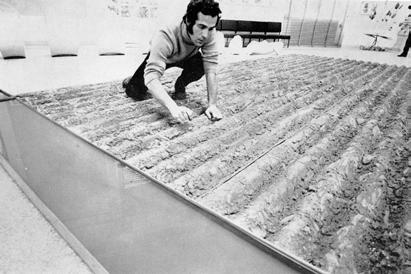
Fig. 1 Pino Pascali, Campi arati (Plowed Fields), 1967. Corrugated fiber cement and soil, dimensions variable. Artist installing earth into corrugated fiber cement substrate. Image scanned from Pascali exhibition catalogue (De Luca Editore, December 1967). Courtesy of Archivio della Galleria Nazionale d’Arte Moderna e Contemporanea, Rome
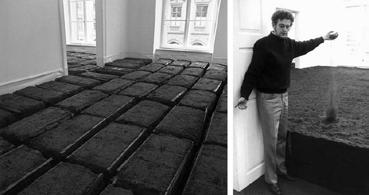
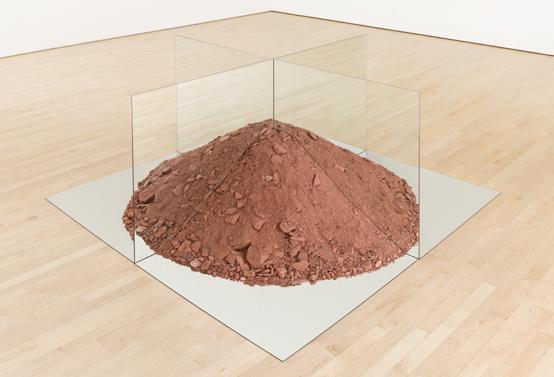
Fig 3 Robert Smithson, Nonsite (Essen Soil and Mirrors), 1969. Soil and 12 mirrors, 36 x 72 x 72 in. San Francisco Museum of Modern Art, Purchase through a gift of Phyllis C. Wattis and the Accessions Committee Fund: gift of Collectors' Forum, Doris and Donald Fisher, Patricia and Raoul Kennedy, Elaine McKeon, Helen and Charles Schwab, Norah and Norman Stone, and Robin Wright. © Estate of Robert Smithson/Licensed by VAGA at ARS, New York. Photo: Katherine Du Tiel
that they need not fear bacterial or fungal exposure. Given the minimal aesthetic that prevailed and the urban mindset that nature should be tamed, the image of “contained soil” is representative of that time. Over years, visitors would see no visible change to the soil, even though they might actually witness the official caretaker's meticulous cleaning procedures. DeMaria, rather than encouraging focus on the dynamic nature of soil, created the image of a field that is static and timeless. This seductive artwork restricts observers from doing anything other than taking in the soil’s aroma and its luxurious, uniform color, demanding a memorable sensory and perceptual experience.
For almost fifty years, the soil in The New York Earth Room has remained visually consistent. De Maria’s goal was to reveal the limits of perception. While keeping the installation in its pristine condition requires extensive care, “cleaning” the soil (meaningless work?) is precisely what Asad Raza chose not to do in his version of an earth room, called Absorption, performed in Berlin at Gropius Bau in 2019–20. Raza allowed visitors to walk on the soil while interpretive docents explained the process of making “neo soil” (Technosol) as they composted everything from cuttlefish bone found on local beaches, coffee grounds, and cardboard, to shredded museum palettes (p. 214-15). Rather than solely engaging visitors' perceptual faculties, as did De Maria, while they observe the “meaningless” work, Raza invited interaction, even offering each participant a bag of “artificial” soil to take home. Similarly, in Christopher Lin’s time-based installation Seeking New Gods (2024), the artist presented three large glass urns, which he called “soul jars,” where earthworms, springtails, and other organisms regurgitated symbols of capitalism, making visible the metabolic decay of American currency and the American flag into soil. Lin also planted seeds into soil at the top of the urns, providing a hopeful sign of regeneration that grew, literally, out of these symbols of human greed (p. 224-227). While De Maria focuses his viewers on the aesthetic experience of soil, Raza calls on participants to experience the dynamics of soil creation over time, and Lin calls viewers to witness the microbial process.
In 1969, Robert Smithson (1938–1973) installed one of his first “nonsite” works, titled Mirror Displacement, in Earth Art, an exhibition at the Andrew Dickson White Museum of Art, at Cornell University, in Ithaca, New York. For this work, he brought piles of rock salt into the gallery, transporting them from the nearby Cayuga Rock Salt Company—at the time, the deepest salt mine in North America. Later in 1969, the artist traveled to West Germany, where he collected rocky red soil excavated from a coal mining site in the Ruhr region. The resulting work, Nonsite (Essen Soil and Mirrors) (fig. 3) was first presented in the avant-garde international exhibition Prospect 69, at Städtische Kunsthalle, Düsseldorf. This work, incorporating the red soil and twelve square mirrors as a framing device, consists literally of a displacement of land. The mirrors were used to explore themes of perception (including reality and representation) and to allow perception of the “site” in space and time.⁵ Like Pascali and De Maria, Smithson compartmentalized the earth, so as to present it as an aesthetic material, creating an illusion of the “natural” through a quite “unnatural” containment in a white-cube setting.
For hundreds of years, the displacement of Indigenous Natives and Africans through land dispossession has set the world on a path of ecological destruction that has erased much of their previously existing reciprocal relationships with land. An ongoing Indigenous-led community project, launched in 2024, including Monique Verdin of the Houma Nation, is an earthen mound in New Orleans known as Nanih Bvlbancha, which tells a different story than Smithson’s about soil and displacement. Created as a public monument, the mound, or “nani” as she is lovingly called, was built to honor the sediments that have been deposited by many tributaries, which have carved out homelands for millennia (p. 64-67). The soils that compose the nani represent the diversity of peoples who inhabit these places. The public is invited to send small ceremonial samples of soils from around the world, accompanied by geographic coordinates and land stories, as offerings. The mound, along with these displaced microsamples, honors ancestors and is meant to anchor a future in reciprocity with soils.
An installation by Ashanti Chaplin, The Hidden Gospels of Dust (2024), incorporates a sculptural framing device, similar to Smithson’s. The artist filled a large Plexiglas box with swirling red dust made of iron-laden clay, collected in the historical Black town of Boley, Oklahoma. A wooden base is covered in clay from the town of Grayson, and a mix of dried and ground clays from the towns of Boley and Tatums dusts the floor (p. 90-93). Displacement, or “nonsite,” in Chaplin’s installation is viewed through the lens of imagination. Visitors are encouraged to consider the stories that even a microscopic point of
Patricia Watts
dirt could tell. An AI image of a dust devil served as inspiration for the work and is a metaphor of a powerful energy that conceals our hidden ancestral terrestrial accumulations.⁶ Whether Smithson was addressing displacement as problematic, the displacement of soils is, scientifically speaking, a critical problem. Erosion caused by agriculture, mining, construction, and logging has modified up to 50 percent of the earth’s surface to date. In the last century, as much sediment has been displaced as would have been moved in a period of 3,000 years by natural processes.
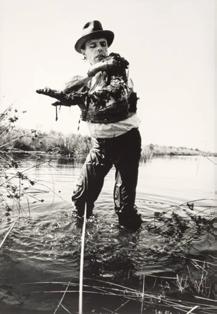
An artist who inspired other early contemporary artists interested in environmental issues in the mid- to late 1960s was the radical German ecologist, artist, and Green Party activist Joseph Beuys. At that time, he envisioned a conceptual art practice, known as social sculpture, which included ecology. An early action by Beuys addressing peat, an important horticultural amendment to improve soil structure, was titled Aktion im Moor (Bog Action), which he performed in 1971 (fig. 4). To protest the lack of understanding of peat bogs’ role in water filtration and regulation, the artist hiked through a wildland bog in the Netherlands, covering himself with peat and imitating various animals. In contrast, over the last five years, Maru García has developed strategies for community building in Los Angeles, as a call to action for soil care. In 2021 she launched Pb (Prospering Backyards) to address lead contamination in disadvantaged communities, to reduce exposure, and to advocate for government cleanup (p. 86-89). García performed this work as a soil campaign by building a graphic identity and distributing her DIY Soil + Soul Healing Tool Kits, a brochure to inform residents of phytomycomicrobial remediation—encouraging the use of soil amendments, such as zeolites, compost, and peat-free mulch without tilling. Mulch comprises a variety of materials, including straw, bark chips, and sometimes peat, which is primarily used in potting soil and compost. Peat bog ecosystems, which generate this critical soil material, are endangered today because of habitat destruction caused by excessive peat extraction and drought from climate change, which has led to long-term fires in Canadian, Indonesian, and Chilean peat reserves.
Inspired by Beuys's concept of social sculpture, an important husband-wife partnership that quietly made ecological work in the late 1960s was the artist team of Helen and Newton Harrison (Helen, 1927–2018; Newton, 1932–2022). In 1969–70, New-
Introduction
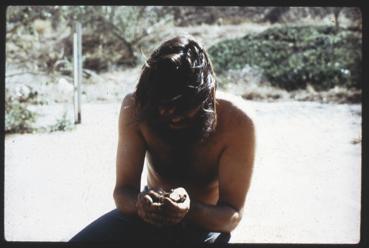
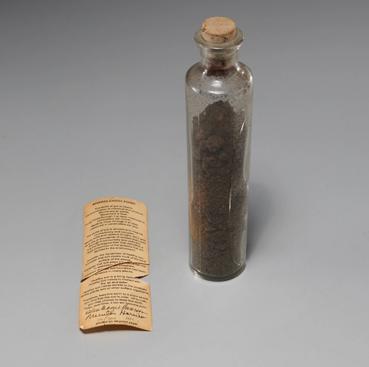
ton researched and performed Making Earth at the Pepper Canyon Outdoor Studio of the Visual Arts Department at UC San Diego, in La Jolla. This ritual work was the duo’s earliest collaboration, created to coincide with the first Earth Day, for which Newton combined sand, clay, sewage, manure, soil, leaves, and worms that he watered and tilled over four months to arrive at a rich, earthy soil (fig. 5). Helen documented the process and then used the soil to grow strawberries for her performative installation Making Strawberry Jam (1972). Several years later, the Ronald Feldman Gallery commissioned a holiday multiple titled Making Earth Again (1990), an edition of three hundred small vials containing “healthy soil,” each with a signed and numbered soil manifesto label (fig. 6).⁷ The couple continued their organic approach to art making throughout their practice, as they endorsed collaborating with nature instead of trying to control it.
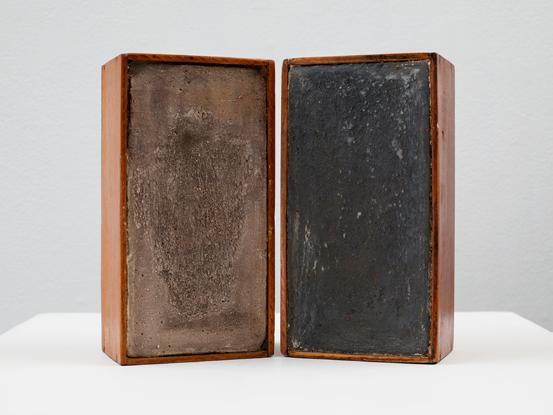
Soils specific to geographic locations are presented visually in science museums in the form of vertical soil profiles called soil monoliths. Dating from the late 1800s, these monoliths offer access to scientific data. Two early sculptures by Michelle Stuart, titled Earth Diptych (1968) and Earth Diptych: Self Imprint / No Imprint (1969), call to mind this format. The first work was made with a vibrant red clay from Georgia, which coats the insides of two pine boxes. For the second work, Stuart used a dark brown humus from Moray Hill, near Kingston, New York, which she adhered to the front surfaces of two wooden boxes that she placed side by side. The lighter side is coated with a combination of soil and plaster marked by the artist’s hand (fig. 7). Inspired by travels in Mexico, Morocco, Guatemala, and New Mexico, the artist went on to produce soil books as well as large monochromatic earth drawings, or “maps,” made with soil, clay, and crushed-rock mineral pigments burnished on paper scrolls. Stuart’s diptychs and earth maps represent unique soil profiles, or monoliths, of human collaborations with lands, creating a visual diary of her travels. In 2024, Maru García created a series of columns that evoke the form of scientific core samples. These columns, which the artist calls “remediating sculptures,” are titled Boiling Rocks 3 and are composed of layers of soil amendments, including zeolites, compost, mulch, and seeds. The columns, a robust 6 feet tall and 30 inches in diameter, are designed for parks and public spaces where soil contamination has been identified, and where they will slowly erode (ultimately exposing the words “Home,” “Madre,” and “Alive”) while amending the soil beneath them (p. 86-89). Another form related to a soil profile is an obelisk made by Ashanti Chaplin. A towering 13 feet tall, the sculpture Earth Elegy (2024) is composed of clays and soils she collected from thirteen historic Black towns in Oklahoma (p. 91). The obelisk, a specialized type of stele, acts both as a territorial soil marker and, in this case, as a monument to the knowledge of invisible or unseen ancestral histories hidden in soils—which Chaplin gathered from around her home grounds to explore ancestral soil's “first-person” as cultural memories.⁸
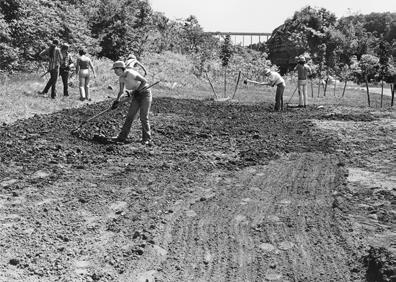
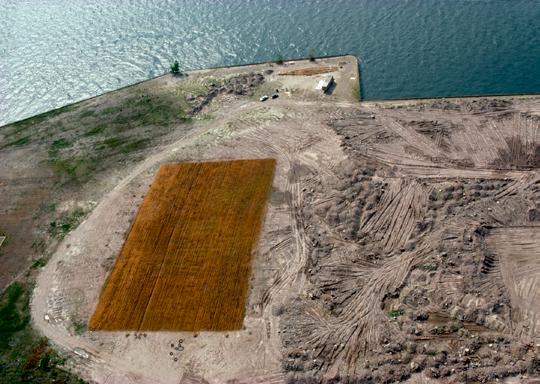
In an open field at Artpark in Lewiston, New York (fig. 8), Agnes Denes re-created her work Rice/Tree/Burial (1977–79), originally sited on private land in the Catskills in 1969. The first outdoor installation, a personal ritual of growing rice, was the artist’s declaration of her commitment to environmental issues. Denes stated, “The act of sowing implied the source of growth, the introduction of a thing into another environment in order to initiate a process, the setting of something into motion (fertilization, conceiving, induction).” Three years later, Denes grew her best-known monumental project, Wheatfield—A Confrontation (1982). This two acre crop of wheat was sited across from the World Trade Center, on the Battery Park landfill, in Lower Manhattan. Rocks and garbage were cleared from the site, then two hundred truckloads of “dirt” were spread two inches deep (fig. 9). Volunteers dug 285 furrows by hand, then seeds were sown and furrows covered with topsoil. After four months, the crop yielded over 1,000 pounds of golden wheat, and some hay, which was donated to the New York City Police Department Mounted Unit.⁹ It is no accident that Denes sited Wheatfield adjacent to the recently constructed Twin Towers, icons of international political power. This dramatic work graphically exposed the need for food sovereignty. It was the artist’s call to action to address economic inequality and global warming.
The act of burial, or placing into the ground and receiving from it, a cause-andeffect process, marks our intimate relationship with the earth. On the one hand, it indicates passing, returning to the soil, disintegration, and transformation; on the other, generation and life-giving, placing in the ground for the purpose of planting. It is also a metaphor for human intelligence and transcendence through the communication of ideas—in this case, to future descendants.¹⁰
—Agnes Denes
Patricia Watts
Denes’s work has inspired dozens of ecological artists, including artists working at an epic scale in urban alternative spaces. Among them is Lauren Bon + Metabolic Studio, whose temporary public art project, Not A Cornfield (2005–06), cultivated 32 acres of corn at the Los Angeles State Historic Park. The harvested corn was made into biodegradable food containers, and the fodder was transformed into a multi-baled, timebased sculpture titled Anabolic Monument. Recently, Bon has been leading a series of soil regeneration projects on land adjacent to the Los Angeles River at Metabolic Studio. One of the studio’s current initiatives is Un-Development (2015–), which involves cracking open the concrete foundation of an industrial building, unlocking seeds and soil that have been buried for decades (p. 264-269). Another ambitious project is Swale (2016–19) by Mary Mattingly, who spent three years operating a 130-foot barge as a floating food forest and alternative public edible park. It slowly traveled the waterways of New York City while promoting food access. Soil was made aboard, with compost from food waste watered by rain and filtered river water from the Hudson and East Rivers. The barge docked in the Bronx, at Brooklyn Bridge Park, and at Governors Island, where visitors harvested edible, perennial plants for free (p. 82-85). Mattingly was able to take her project straight from barge to table, growing edibles for humans who were invited to self-harvest. A second barge is now in the works. Bon’s and Mattingly’s epic projects each fulfill a range of objectives: to provoke discourse and stimulate support for accessibility to healthy soils for food production in urban areas.
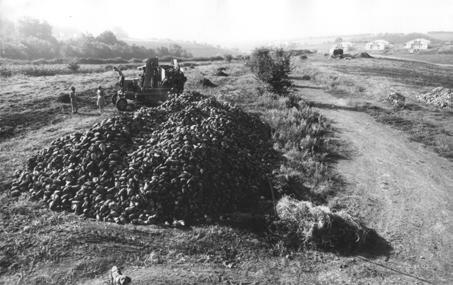
In contrast, Gianfranco Baruchello (1924–2023) moved outside of Rome to Santa Cornelia, Italy, choosing to address food security in a rural context by creating an experimental project known as Agricola Cornelia S.p.A., 1973–81. He cultivated soils and grew beets, wheat, and other crops, with the aim of “working the land” as art (fig. 10). This was his way of responding to the Land Art movement and his unease with “the symbols it deals with.” Baruchello, a student and good friend of Marcel Duchamp, wanted to go beyond the gesture of the everyday object as art. His attempt with farming as art was “pulling aesthetics into economy . . . fundamental forms of agricultural economy into aesthetics.” Paintings, drawings, photographs, and films documented the experiment. The “illusion that anything is art” was explored further in a conversation with Henry Martin recorded in their book How to Imagine: A Narrative on Art and Agriculture of 1983. Baruchello went on to initiate a symbolic and literal exchange of soils in his project Earth Exchange (2014–17). Soils were exchanged among the Fondazione Baruchello in Rome and sites in Puglia, Venice, Hamburg, Karlsruhe, and Iraq. The earth was shipped in wooden crates, then mixed to blur the boundaries between locations symbolically. Customs authorities ultimately put an end to the exchange to prevent the potential spread of pathogens, a serious concern for artists working with soils.11
As a primary activity, agriculture is the enterprise that’s already closest to art if only because of their mutual involvement with the magic of manuality, and so it’s the most natural field in which to see what sort of difference is made by imbuing it with the spirit of art. If science can be promoted to art, the same thing has to hold even more so with practical activities.12
—Gianfranco Baruchello
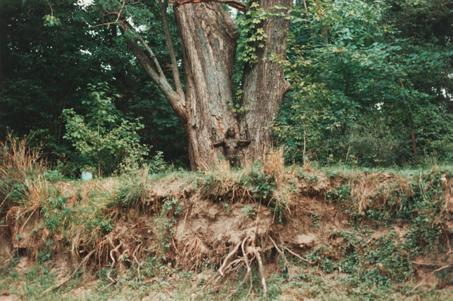
Like Baruchello, who sought to distance himself from the Land Art movement during the 1970s, Ana Mendieta (1948–1985) began creating her Earth / Body sculptures, which she often executed alone and documented with photographs and video. She referred to her site works, made in “symbiotic relation with the natural environment,” as Siluetas (1973–80), which she executed in Iowa, between 1973 and 1978, and in Mexico, where she spent her summers, between 1973 and 1980. In Mexico she visited pre-Columbian sites and became interested in Indigenous Central American and Caribbean culture and rituals. She also researched her Cuban heritage and pursued knowledge of Indigenous practices relating to fertility and the elements. For the Siluetas series, Mendieta often placed her body into the landscape, literally or representationally (by imprinting her own form into the soil). A work she made in Iowa, Árbol de la Vida (Tree of Life) (1976), reveals the artist standing against a large “mother tree,” her hands held up and her body, almost invisible against the trunk, covered in mud (fig. 11). An exposed riverbank fills the foreground, revealing layers of roots that extend outward. The grasses that obscure her lower body enhance the illusion that Mendieta is one with nature.13
Patricia Watts
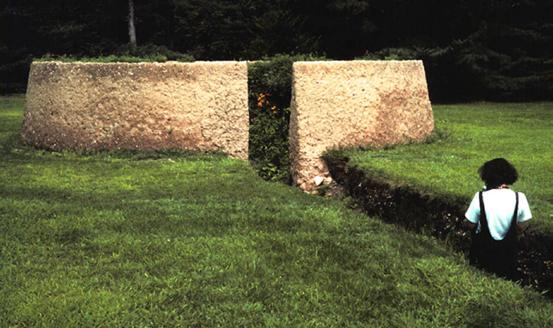
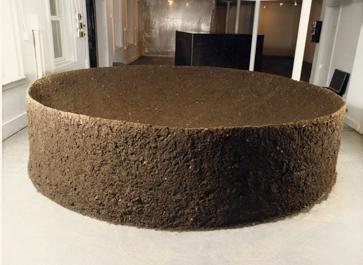
Meg Webster began experimenting with soil, sand, and salt in the late 1970s. A few of her early soil-based installations include Hollow (1984–85) and Concave Earth (1986; re-created in 1990)—earthen architectural works that are sculptural gardens for nurturing and healing. Webster installed her first outdoor installation, Hollow (fig. 12), at the Nassau County Museum of Fine Art on Long Island. A narrow pathway led to the gateway of an earthen structure whose vertical bermed walls cut into the earth. Inside the circular coned garden was a “womb” of heavily planted seasonal and nonflowering plants. In 1986 Webster took over Forecast, an industrial gallery space in Peekskill, New York, where she experimented with a series of installations. One work, titled Concave Earth (1986), consisted of a bowl-shaped form made of a rich dark loam (fig. 13). It later shapeshifted into a second work, titled Radish Disk, during the same exhibition, becoming a new disk in which the artist planted radishes.14 The transformation from a minimalist compacted earthen sculpture into a bed for life, where food was grown, is emblematic of the tension between formal values and ecological content seen in many soil works.
Architecture and soil are also reconnecting, as evidenced in the 2025 Venice Biennale of Architecture exhibition Earthen Rituals (2025) by Lola Ben-Alon, director of the Natural Materials Lab at Columbia University Graduate School of Architecture, Planning and Preservation. She and the Lab collectively created 3D-printed objects and wearable textiles made from soil, construction waste, and agricultural by-products using an industrial extrusion process combined with the traditional techniques of rammed earth, weaving, and basketry (p. 136-139). These 3D works suggest the potential for expanding materials options to reduce extractive construction practices. The building of dwellings made of mud bricks (adobe) started around 9,000 to 12,000 years ago, while earth construction using turf and soil for insulation dates back even further, to 17,000 years ago. The earthen structures that Webster created as contemporary art recall a time when homes were grounded in nature. Both Webster and Ben-Alon have elevated this simple material, soil, to create gardens and experiments, strategies for regenerating ourselves and the planet through sensorial experiences that reconnect humans with nature.
Mel Chin, who in 1989 was envisioning his next series, learned about the plant genus Datura from the Whole Earth Catalogue, through an article by Terrence McKenna, who referred to Datura as a phytoremediator. Inspired by the idea that certain plants could
Introduction
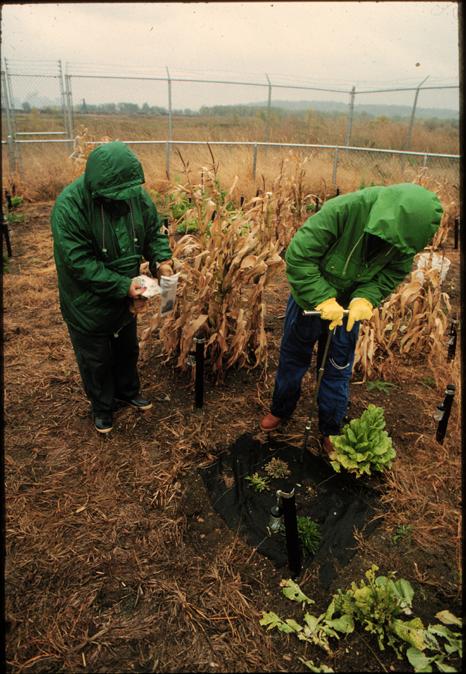
pull toxins from the soil, Chin was challenged by the prospect of turning this research into an art project. The artist reached out to McKenna, who advised him to find a collaborator, possibly a scientist. Chin then partnered with Rufus Chaney, a senior research agronomist at the U.S. Department of Agriculture. Although Chaney didn’t believe that Datura could absorb heavy metals, he was interested in researching bioindicator plants to determine whether there were others that could. Their multiyear project, Revival Field (1991–93), sited at the Pigs Eye Landfill in Saint Paul, Minnesota, was then born. They started by performing field tests—while envisioning the process as a poetic methodology for remediating sites contaminated with cadmium (fig. 14). The artist-scientist duo affirmed the validity of hyperaccumulation, a way to “clean” soil using plants that absorb cadmium and zinc. They went on to test at the Palmerton Zinc Pile Superfund site in Pennsylvania and at Floriadepark, Zoetermeer, in the Netherlands. Plants that showed promise included a variety of dwarf corn, romaine lettuce, red fescue, berry catchfly, and the most effective hyperaccumulator, alpine penny-cress (Thlaspi caerulescens).¹⁵ Years later, in 2006, following Hurricane Katrina, Chin developed a community-driven creative campaign in New Orleans, titled Operation Paydirt, to advance awareness and prevention of lead poisoning in soil.
With Revival Fields, there were a couple things that were very freeing. The first freedom was beginning to imagine a project that may be completed after you’re dead. You are freed by that constraint of time. So, there’s that first liberation. The second liberation was to understand art as a catalytic structure. It’s not necessarily a language that forms, but a platform on which another language can emerge.¹⁶
—Mel Chin
While at a residency in London, Irish artist Kathryn Maguire conducted scientific research for her ongoing work Silt & Other Matters (2023–), exploring materials present in soils in the geologic layer designated London Clay, along the river Thames. Near the Thames Estuary, Maguire was able to identify iron silicates pushing out of the clay, as seen through an electron microscope (p. 260-263). She learned that these crystalline formations were caused by a buildup of heavy metals, which can damage the DNA of earthworms. The artist then printed a series of Microns, electron micrographs printed on textiles, making visible this jagged metallic element that has emerged as a global environmental concern. Maguire’s micrographic works focus on yet another element pertaining to the contamination of soils: the effects of soils disturbed by mining and construction on our wiggly earthworm soil engineers, who enrich soils by creating nutrient-rich castings and improving soil structure.
Amy Youngs, who creates speculative works incorporating technology, goes a step further, coming to soil health from the more-than-human, first-person perspective. Her collaborative work Belonging to Soil (2022–25) is an immersive virtual reality ecosystem that amplifies living networks in soil. Participants wear VR headsets, inhabiting an arthropod avatar, the springtail, while navigating tunnels and eating soil bacteria. Part fantasy, part scientific knowledge, the program helps participants learn through animations how these quick-moving, omnivorous acrobats break down organic matter, acting as beneficial decomposers, making soil through pooping (p. 216-219). Whereas Chin’s Revival Field sought to remove heavy metals from soil by physically employing plants, working from the top down, Maguire addresses the same issue—heavy metals in soil—by creating awareness visually, from the bottom up, through micrographic imaging. Youngs's approach, inviting a first-person perspective, challenges us to “become” the springtail, our beneficial kin.
Over the last century, language referencing the “use” and “control” of the environment.¹⁷ The compulsion for control, which distorts our perceptions of the world around us, can call up defense mechanisms such as compartmentalization or displacement, which can disconnect us, making our species vulnerable to extinction. As we come to realize that our impacts on the planet have contributed to extreme climate change, a knee-jerk reaction of resignation can arise: the situation is hopeless, and the earth is better off without us. Such notions allow us to avoid responsibility; after all, how can we be held accountable to act if nothing can be done? But Indigenous knowledge says otherwise. Indigenous knowledge says nature needs us. If anything can help us, it is the embrace of reciprocity, which can create opportunities for the survival of humankind.
Patricia Watts
Over the last sixty-five years, the works artists have made with soils have created a new art form, making this an important time for reflection on our collective ecoconsciousness. Historically, that which was considered art—traditional paintings and sculptures—did not create occasions for learning about science, nor did it create opportunities to have physical interactions with nature outdoors, which artists since the 1960s have contributed. This new art elevates soil from the status of a mere form of color or texture (thus, a material stripped of its powers) to a substance liberated to perform its unique ability to develop nutrients and grow plants, feeding and housing people, while also enabling cultural expression. Artists are forever seeking a greater purpose, a way to address the urgency of the time. The artists featured in Soils Turn are rising to meet this unprecedented moment, causing a “turning” that points us toward a balance of care and kinship for the more-than-human world.
Early soil works were made by Robert Rauschenberg for his Elemental Paintings series (1953), and a proposal was made by Walter De Maria’s Art Yard (1960) to dig a big hole in a vacant urban lot. Alan Sonfist made a proposal in 1965 to re-create a seventeenth-century forest at the corner of LaGuardia Place and West Houston Street in New York; the work, titled Time Landscape, was realized in 1978. Other artists participating in the soil zeitgeist created early works outdoors in the late 1960s; these artists and their artworks include: Giuseppe Penone, sculptures sited in the Maritime Alps, Italy; Robert Smithson, Tar Pool and Gravel Pit (1966); Richard Long, Dirt (1967); Dennis Oppenheim, Cut in an Oakland Mountain (1967); Claes Oldenburg, Placid Civic Monument, or “The Hole,” in New York’s Central Park (1967); and Michael Heizer, who, in 1967, dug trenches in sun-baked mud flats at Blackrock, Nevada. In October 1968, Earthworks, curated by Robert Smithson (1938–1973), was presented at New York’s Virginia Dwan Gallery, where Robert Morris (1931–2018) placed on the floor a large pile of soil mixed with industrial construction waste, thereby acknowledging the existence of anthropogenic soils. Another early exhibition, conceived in 1967 by Willoughby Sharp (1936–2008), was Earth Art (1969), staged at the Andrew White Museum of Art, Cornell University, Ithaca, New York. It included an untitled work by Robert Morris, an installation featuring multiple cone-shaped piles of soil, anthracite, and asbestos poured on the gallery floor, and Hans Haacke’s Grass Mound (1968), a cone-shaped pile of soil mixed with peat moss in which rye grass was growing. A previous piece by Haacke, Grass Cube (1968), included a clear plastic tube with grass growing out of the top, on exhibit at Hayden Gallery, Massachusetts Institute of Technology. Through the 1970s and 1980s, monumental Land Art—mark-making on land made primarily in the American Southwest—stood in sharp contrast to lesser-known works by artists, mostly women, who were lighter on the land, being more interested in the ecological or the spiritual. These artists and their artworks include: Patricia Johanson (1940–2024), garden designs, begun in 1969, which led to several important public art projects, beginning with Fair Park Lagoon (1981), Dallas, Texas; Beth Ames Swartz, performative fire-ritual paintings incorporating soils, done in the 1970s and early 1980s; Bonnie Ora Sherk (1945–2023), Crossroads Community (the farm) (1974–87), a multiyear project with an after-school and community hub for growing food; Ruth Wallen, photographic series documenting soil erosion and topographical forms at Chaco Canyon, New Mexico, commissioned by the National Park Service (1980); Leslie Labowitz-Starus, Sproutime (1980–), ecofeminist art and business venture, Los Angeles, California; Beverly Buchanan, Marsh Ruins (1981), mounds formed of her ancestral soil and shells, in coastal Georgia; and many others, including Harriet Feigenbaum, Mary Beth Edelson, and Michelle Stuart, artists included in Heresies’s “Earthshaking/Earthkeeping” issue (no. 13, 1981). In the summer of 1991, ARTnews dedicated an entire issue to “The Greening of the Art World,” which included a ten-page feature by Robin Cembalest titled “The Ecological Art Explosion.” The following year, Fragile Ecologies: Contemporary Artists’ Interpretations and Solutions, curated by Barbara C. Matilsky, was presented at the Queens Museum of Art in New York. It included Feigenbaum’s Erosion and Sedimentation Plan for Red Ash and Coal Silt Area, Willow Rings, planted in 1985, and John Roloff’s untitled garden for hummingbirds. In the 1990s, ecological artists pursued large-scale multiyear opportunities that involved restorations, reclamations, or demonstrations. These artists and their artworks include: Aviva Rahmani, Ghost Nets (1991–2000), a restoration of a large salt marsh and successional forest, meadows, and uplands, in Vinalhaven, Maine; Betty Beaumont, Ocean Landmark
Patricia Watts
(1978–80), a removal of coal ash that had created a dead zone in soils near an Ohio coal plant, which the artist used to make cement bricks for an underwater reef and fish habitat off Fire Island, New York; Helen and Newton Harrison, Endangered Meadows of Europe (1994), the transplantation of a four-hundred-year-old meadow to the rooftop of the Kunst- und Ausstellungshalle, Bonn, Germany; Kathryn Miller, Seed Bombs (1992–2001), a performative action of throwing biodynamic seed bombs in industrial suburbs of Southern California; Jackie Brookner, Of Earth and Cotton (1994–98), an installation of soil casts of cotton farmers’ feet collected throughout the American South, to honor their labor, placed on top of 60 tons of soil; Mierle Laderman Ukeles, Fresh Kills Landfill, Staten Island (1989–), a monumental project that seeks to transform an urban landfill in New York City into an art park with multiple site works; Buster Simpson, Host Analog (1991), a large nursing log slowly decomposing into soil to host new tree seedlings in Portland, Oregon; Tim Collins, Reiko Goto, and Bob Bingham, Nine Mile Run Greenway Project (1997–2000), a brownfield restoration plan and multiyear education program in Pittsburgh, Pennsylvania; Susan Leibovitz Steinman, Mandela Artscape (1998–99), a transformation of a collapsed section of freeway that had been destroyed by an earthquake, creating a native plantscape in Oakland, California; Shai Zakai, Concrete Creek (1999), a stream reclamation in Emek Ha’Ela, Israel; and Stacy Levy, AMD&ART (1995–98) a restoration of a wetland by introducing a water treatment system, creating land suitable for a recreational park in Vintondale, Pennsylvania. These ecological public art projects are discussed in detail by Sue Spaid in her 2002 book Ecovention: Current Art to Transform Ecologies, and she later focused on soil projects in Europe, including those by herman de vries, George Dietzler, and Vera Thaens in her 2018 book, Ecovention Europe: Art to Transform Ecologies, 1957-2017 Clive Adams and Daro Montag edited the first art and soil field guide, Soil Culture: Bringing the Arts down to Earth (Totnes, UK, 2015), which included Ulrike Arnold, Chris Drury, David Nash, and many other artists based in Europe. Dr. Alexandra R. Toland, coeditor of the present volume, also edited Field to Palette, Dialogues on Soil and Art in the Anthropocene (Boca Raton, FL, 2018), a compilation of contributions by over one hundred researchers and practitioners (see “Further Readings,” p. 330 herein).
Watts
1
Robin Wall Kimmerer, Braiding Sweetgrass: Indigenous Wisdom, Scientific Knowledge and the Teachings of Plants (Minneapolis: Milkweed Editions, 2020), 122–23.
2
Pascali, catalogue of the December 1967 exhibition at the Galleria Nazionale d'Arte Moderna, Rome (De Luca Editore, December 1967). Pascali created two other similar works in 1967, also included in his series Elementi Naturali (Elements of Nature): Fiume a foce tripla (Triple-mouth River) and Acque Stagnanti (Stagnant Waters), both of which were included in the exhibition. Descriptions of these pieces were provided by Antonio Frugis, Collections Manager, Fondazione Pino Pascali, Polignano a Mare, Italy (personal communication, June 17, 2025). For information on Pascali’s childhood and set-design experience, see interview with Chris G. Bennett and Leslie Deere at Museo d’Arte Contemporanea, Polignano, Bari, Italy, 2007, https://www.youtube.com/watch?v=jVLosz8E7qc&t=3s.
3 Jeffrey Weiss, “The Principle of Impermanence: The Preservation of Walter De Maria’s Earth Room,” Artforum 62, no. 2 (October 2023), https://www.artforum.com/features/jeffrey-weiss-preservation-walter-de-mariasearth-room-512524/. The first earth room was exhibited at Galerie Heiner Friedrich between September 28 and October 10, 1968. For The New York Earth Room, see Dia Foundation: https://www.diaart.org/collection/collection/de-maria-walter-the-new-york-earthroom-1977-1980-135.
4 Walter De Maria, Meaningless Work, a “score,” or mini-manifesto, pulished March 1960, https://georgemaciunas.com/exhibitions/ mr-fluxusan-anthology-of-essays-films-documents-architecture-and-ephemeral-objects/ an-anthology/compositions-essays-meaningless-work-natural-disasters/. De Maria explained, “By meaningless work I simply mean work which does not make you money or accomplish a conventional purpose,” and he gave an example of “digging a hole, then covering it”—a rejection of conventional purpose. He considered such work to be the most important and significant art form of the time. The Menil Collection, Houston, which owns many of De Maria’s works, included the mini-manifesto in its exhibition Walter De Maria: Boxes for Meaningless Work (2022–23); also mentioned in a review: Julia Robinson, “Extreme Measures: The Art of Walter De Maria,” Artforum 62, no. 2 (October 2023), https://www.artforum.com/features/ julia-robinson-art-walter-de-maria-512531/.
5
For information on the Smithson mining installation, see the catalogue of the Earth Art exhibition at the Andrew Dickson White Museum of Art, Cornell University, Ithaca, New York, February 11–March 16, 1969 (Ithaca, NY: Cornell University, 1969), https://monoskop.org/images/a/ab/Earth_Art_1969_catalogue.pdf. Regarding locations where Smithson collected soils for Nonsite (Essen Soil and Mirrors) and dates of the exhibition Prospect 69 (September 30–October 12, 1969): Natalie Rae Good, collections manager, Holt Smithson Foundation, Santa Fe, New Mexico, personal communications, August 27 and September 7, 2025.
6 Tulsa, Oklahoma, artist Ashanti Chaplin, personal communication, September 7, 2025.
7 Making Earth: Joshua Harrison, co-executor of The Helen and Newton Harrison Family Trust, personal communications, July–August 2025; Tatiana Sizonenko, historian and author of Helen and Newton Harrison: California Work (2024), personal communications, September 2, 2025; Sue Spaid, author of ecovention (2001), personal communications, September 26, 2025; artists’ website, https://www.theharrisonstudio.net/making-earth-1970. Helen and Newton Harrison’s Making Earth inspired further soil installations. The largest was Spoils’ Pile Reclamation (1976–78 and ongoing), commissioned by Artpark Foundation and sited at Artpark (Earl W. Brydges Artpark State Park), Lewiston, New York; it included 2,000 truckloads of earth and organic debris (leaves, tree trunks, grass cuttings, sludge, etc.). The smallest installation inspired by Making Earth was Making Earth Again, which included a wooden box containing soil and a shovel; visitors were invited to fill fifty canvas bags with healthy soil, to be dispersed where they found poor soil. Making Earth Again was part of the traveling exhibition Revered Earth (1990–92), initiated by the Center for Contemporary Art, Santa Fe, New Mexico, and curated by Dominique Mazeaud and Robert Gaylor. The title Making Earth Again was also used for the Feldman Gallery commissioned edition of small vials of soil (Marco Nocella, personal communication, September 27, 2005).
8 Tulsa, Oklahoma artist Ashanti Chaplin, personal communication, September 7, 2025.
9
Agnes Denes, Rice/Tree/Burial: http://www. agnesdenesstudio.com/works2.html. Wheatfield—A Confrontation: http://www. agnesdenesstudio.com/works7.html; https://en.wikipedia.org/wiki/Wheatfield_ %E2%80%94_A_Confrontation.
10 Agnes Denes, http://www.agnesdenesstudio. com/works2.html, paragraph 8.
11
Ottavia Galloni, research assistant, and Carla Subrizi, scientific director, Fondazione Baruchello, Rome, personal communications, July 16–31 and August 6, 2025; https://www. neroeditions.com/farming-as-a-work-of-art/; Gianfranco Baruchello and Henry Martin, How to Imagine: A Narrative on Art and Agriculture (Kingston, NY: McPherson & Co., 1983), Kindle version, 438, 478, 485.
12
Gianfranco Baruchello and Henry Martin, How to Imagine: A Narrative on Art and Agriculture (Kingston, NY: McPherson & Co., 1983), Kindle version, 2,070–71.
13
Genevieve Hyacinthe, Radical Virtuosity: Ana Mendieta and the Black Atlantic (Cambridge: MIT Press, 2019), 71, 87. Hyacinthe discusses the performative aspects of Mendieta’s Siluetas (part of the Earth / Body sculptures), as well as the artist’s practice of working alone and the role of documentation in her intermedia work.
14
Meg Webster’s first one-person exhibition was at Leavenworth Street, San Francisco (1980), where she grouped small mounds of earth, cones of salt, and angular shapes of sand on the gallery floor. The artist’s website contains images of works she presented in her Forecast Gallery exhibition in Peekskill, New York: http:// viewingroom.paulacoopergallery.com/viewing-room/meg-webster (click “my public file” to download PowerPoint presentation Webster gsa2.ppt); Eve Arballo, head image archivist, Paula Cooper Gallery, personal communications, summer 2025. http://megwebsterstudio. com/index.html.
15
Mel Chin, interview by Patricia Watts and Amy Lipton, New York, April 2015; Peter Boswell, “Invisible Aesthetic: Revisiting Mel Chin’s Revival Field,” Walker Reader (Walker Art Center), “Visual Arts” section, October 9, 2017: https://walkerart.org/magazine/mel-chin-revival-field-peterboswell-rufus-chaney-eco-art
16
Mel Chin, “Don’t Worry, It’s Only Mud” (from interview by Patricia Watts and Amy Lipton, New York, April 2015), in Field to Palette: Dialogues on Soil and Art in the Anthropocene, edited by Alexandra R. Toland, Jay Stratton Noller, and Gerd Wessolek (Boca Raton, FL: CRC Press/Taylor & Francis, 2018): chapter “Function 3 (Interface),” 333.
17
George C. Wood and Harry A. Carpenter Wood, Our Environment: How We Use It and Control It (New York: Allyn & Bacon, 1927). Revised editions of this 1927 high school environmental-science education textbook were published up to 1960.
Elise Malik
In the following, I will consider ways of curating and engaging with soils in exhibitions towards a museology of soils (Richer-de-Forges et al. 2021) driven by the questions: What are some characteristics of soil exhibitions as a typology, and what are the most recent stages in the development of soils on display? Included in this exploration are soil exhibitions primarily on European grounds that took place directly before or during the UN International Decade of Soils 2013–2025 (see Table 1 for overview). The conceptual, material and digital objects curated into the exhibitions represents a great variety, spanning from large soil profiles on the wall (World Soil Museum, The Soil–A Walk Through Life, Down to Earth–Art and Soil Science in Conversation) and smaller soil samples in containers (Soil Procession, Jordsans, Soils), to heaps of soil minerals (Av jord, Rå/Stof, Glocal Worm-ing, and large amount of soils lying on the floor for the visitors to walk on (We are compost /// Composting the We). In some exhibitions, soils are combined with growing plants (Living Soil Exhibition, Our Living Soil, Levende matjord), or have incorporated microscopes to reveal details of soil fauna (Levende matjord). The artistic expressions are similarly diverse, from clay sculptures and paintings to soil-inspired science fiction scenography and digital representations of the rhizosphere. All exhibitions are motivated by a self-proclaimed goal to increase soil literacy and/or transform human-soil relationships. While soil literacy is a growing field of interest within the soil sciences that tends to focus on measurable attitudes, behaviors, and competences (Katikas et al. 2024), soil museology offers a different, complementary approach, in that it introduces relational materiality and aesthetic understanding as new ways of living with soils. To explore these matters, I will consider the sites of the exhibitions, the curatorial languages, the different sensory dimensions, and finally the relational aspects that together constitute the soil exhibition experiences.
The reparative turn in museology circles around a certain caring and “decolonial mode of thinking” and, with a “desire for repair–for some kind of reforging and remaking of the world...” (Sterling and Larkin 2021). When looking at different curatorial responses to soil crises and how, and what, they seek to repair, a key question arises: what are the relationships between the exhibitions and their sites, and potential soil-related issues in the specific local contexts? Another important issue is to ask how the exhibitions mobilize audiences, especially on a sensory level, to soil-related issues. Following Beatrice Von Bismarck, venue plays a crucial part in how the exhibition is developed and perceived: “the curatorial constellation consists of the coming-together of human and nonhuman participants in public, and if the meaning of its individual components is only established in the relations they enter into among themselves, and only on a temporal basis, then what are the implications for the hosting venue, which is always also a participant?” (Von Bismarck 2022: 164). The chosen sites for the exhibitions in this overview can thus be perceived as defining curatorial acts. This relationship is reciprocal; the different locations impact the exhibition, and the exhibitions impact the sites. “The space in which the exhibitions are laid out is a fundamental part of the way the displays are perceived. Space does not simply refer to the physical parameters of the room in which objects are displayed but includes consideration of the way visitor movement is directed or guided within that space” (Moser 2010: 24).
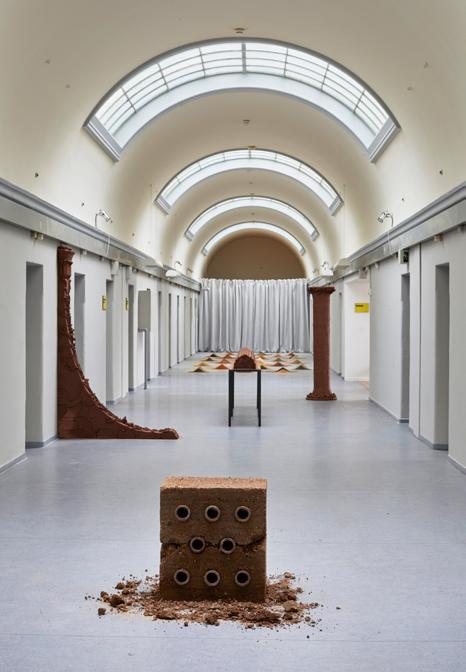
The exhibition venues vary from museums (Museo del Suolo, Soil Matters, Av Jord, Soils), gallery spaces (Our Living Soil, Soil Works), and science centers, including connected gardens (Jordsans), to conference venues in academic institutions (The Soil -A Walk Through Life). A few of the exhibitions are located inside farm barns (Levende matjord, Reisen i jorda) or in specific buildings made for the exhibitions on farmlands and urban agriculture (Summer of Soil Exhibition, World of Soil). The exhibition series “Renæssancejord” was located inside a former prison facility, aiding in the transformation of the penitentiary facilities into a cultural site in the citadel.¹ As Moser (2010: 25) points out, when exhibitions are created in already existing places (such as Levende matjord and Jordsans), the succeeding curatorial choices are often influenced by predetermined conditions. Purposely built hosting venues (such as Summer of Soil Exhibition, World of Soil), on the other hand, can reinforce and complement aspects and intended messages. Either way, the purpose of the site is to “facilitate effective absorption of the exhibition message” (Moser 2010: 25).
Elise Malik
EXHIBITION TITLES
Museonder
Living Soil
World Soil Museum
Levende matjord (Living soil)
Soil Procession
One Hectare
The Soil A Walk Through Life
Museo del Suolo
Reisen i jorda (Journey to Earth)
The Thin Skin of the Earth, Our Soils
Sounding Soil
Soil Matters
Earth as Superfood, Museum of Edible Earth
Soft Soil, aardtijd
Glocal Worm-ing
Our Living Soil
We are Compost /// Composting the We
Down to Earth: Art and Soil Science in Conversation
Down to Earth
Soil Works–When Rocks Weather
World of Soil
Living Soil
Renæssancejord*
Jordsans
Soils
Av Jord
Dialoghi del Suolo
SOIL: The World at Our Feet
Soil and Friends
Kröller-Müller Museum, The Netherlands Farmland, Järna, Sweden
World Soil Museum, Wageningen, The Netherlands
Bygdø Kongsgård, Oslo, Norway
Losæter, Oslo, Norway
Park am Gleisdreieck, Berlin, Germany
National Museum of Natural Sciences, Madrid, Spain
Museo del Suolo, Pertosa, Italy
NØRSOK research barn, Tingvoll, Norway
Naturhistorisches Museum Wien, Austria
Switzerland/online
Design Museum, Helsinki, Finland
World Soil Museum, The Netherlands
Glazen Huis in Amstelpark, Amsterdam, The Netherlands
South Tyrol Museum of Nature, Bolzano, Italy
Zone2Source in Amstelpark, Amsterdam, The Netherlands
Centre for Contemporary Arts, Glasgow, Scotland
Design Campus, Dresden University of Technology, Germany
Architecture Biennale of Versailles, France
Glazen Huis, Amstelpark, Amsterdam, The Netherlands
Airfield Estate, Dublin, Ireland
Royal Botanical Garden, Edinburgh, Scottland
Vridsløselille Prison, Albertslund, Denmark
Gallery (DK), science center (NO) and design center (SE)
Eindhoven’s Van Abbemuseum, The Netherlands
Telemark Art Museum, Norway
Il Coventino fuori le Mura, Firenze, Italy
Somerset House, London, UK
Ujazdowski Castel Centre for Contemporary Art, Warsaw; PLATO City Gallery of Art, Ostrava, Czech Republic
Table 1 Soil exhibitions primarily on European grounds that took place directly before or during the UN International Decade of Soils 2013–2025.
*6 exhibitions: Rå/Stof, Rod/System, Jord/Liv, Jord/Luft, Længsel, Sightseeing
MAIN PERSPECTIVE ON
Archeological, historical
Agricultural
Soil scientific, agricultural
Agricultural
Artistic, agricultural
Artistic, scientific
Soil scientific, agricultural
Ecology and soil scientific
Agricultural, ecology
Soil scientific, biology, ecology
Eco acoustic, artistic, soil management
Design, material
Artistic
Artistic
Eco-Social Design
Artistic
Artistic
Artistic and soil scientific
Architectural
Artistic
Agricultural, soil scientific
Artistic, gardening
Artistic, design, architecture, agricultural, scientific
Artistic, design, architecture, agricultural, scientific
Artistic
Artistic
Artistic, scientific
Artistic
Artistic
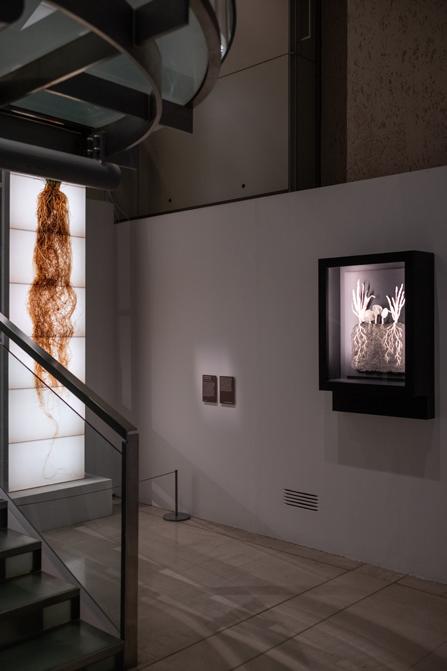
While exhibitions are sites for encountering and engaging with (soil) materials, the words and languages that accompany and in part produce the exhibition experiences are equally as important. Curatorial language defines how soils are understood and influences how our relationships to them can grow within the exhibitions. When moving soils into exhibition spaces, it is essential to consider which words accompany which objects, and which thoughts and constructed experiences are provoked through curatorial language. “Feet,” “teaspoons,” “handfuls of soil,” “soils as living beings,” “soils in need of our care” are some of the linguistic imprints that are integrated into the exhibition experience and have dominated a full decade of exhibition making. Many of these words are also to be found in international soil literacy campaigns, such as the UN’s International Year of Soils promotional material and infographics (https://www.fao.org/soils-2015/resources/promotional-material/en/). Curators and artists lean on certain established soil literacy keywords and make their own written and materialized versions that perpetuate in the exhibitions and beyond. A vast majority of the exhibitions contain the word “soil” in their titles, while “earth," “world,” “worms” and “compost” are also represented. Soils are textually represented as their own spatial realm, as somewhere for us to explore, as a place where we walk on or travel through. This is often represented by the words “down” and “journey.” Soils are furthermore presented as “alive” or “living,” and in many cases presented in the possessive–soil are ours. The exhibitions also give strong directional focus on where soils are located, namely under us. Soils are described as “secret,” “hidden,” and “below our feet.” The word feet actually appears in many of the exhibition descriptions. Museo del Suolo even describes soils as “the black box of the ecosystem.” The simplified, but still much used notion of soil as something “hidden” underneath our feet (Meulemans and Granjou 2020:4 and Puig de la Bellacasa 2019: 393) is unfortunately a result of us not seeing the volume that soils are, not seeing the minuscule lifeforms in soils and not seeing the critical ecological processes that play out there. The so called “secrets of soils” can also be traced back to soil literacy educational material promoted by UN’s Food and Agricultural Organization (https://www.fao.org/soils-2015/resources/educational/en/). The invocation of a “magical universe” underground (Renæssancejord and Jordsans), that lives on in soil exhibitions, acknowledges how soils are a “valuable good,” “resource for humans” that “provide eco system services” and entail “soil properties.” The interlinking of human health and soil health is also the focus point of exhibitions, such as “Matjorda” at Bygdø Kongsgård in Oslo in 2015. Ten years later, we encounter “power,” “potential” and “health” of soils, as described in the “SOIL: The World at Our Feet” exhibition at Somerset House in London.
Exhibitions are often made to feed our eyes. So, how is the exhibition experience shaped when soils are exhibited especially to be looked at? The soil exhibitions invite us to use our gaze in many ways. The aspect of soil as something “hidden” is problematized in a few exhibitions by veiling part of the installations (Sightseeing) or by using UV-light to make details visible (Soil Dialogues). In the Danish exhibition “Jordsans” soil gazing is curated as its own discipline by placing viewing-sculptures around soil pits outside in the garden of the gallery for the audience to spend time gazing into a hole in the ground. Soils are also made into sculptures and mounted as volumes in the rooms (Jord/Liv, Soil Works), soil pigments are painted with (Av jord) and textiles are buried to let different decomposing agents in the soil leave their marks on the fabrics (Soil Dialogues). Making soil fauna visible is elaborated through both drawings, paintings and sculptural models (The Thin Skin of the Earth–The Soil, Reisen i jorda, Jord/Liv, Living Soil, World of Soil). Other exhibitions have incorporated microscopes to reveal details of soil fauna (Levende matjord). Exhibitions that feature strong sensory components related to soils are well represented in the previous decade, especially among art and artscience exhibitions (Toland and Wolter 2023). Many of the exhibitions in the study make soils sensible and facilitate soil experiences beyond the gaze to underline the curatorial message. Although it has been a full decade since scholars seriously started investigating sensory experimentation in contemporary curatorial practice, there has been little attention towards soil exhibitions as a unique field of enquiry. The sensory turn, or “sensual revolution” as professor of anthropology David Howes refers to it (Howes 2003), is a multifaceted approach because we turn our attention to the senses both as object of study and means of enquiry. Scholars study them and use them at the same time (Pink 2015). Inspired by
these developments, I argue that soil exhibitions are developed as sensescapes (Classen and Howes 2006), sites for sensory inquiry (Levent and Pascual-Leone, eds. 2014), and “portals to emotional experiences” (Varutti 2023: 69).
Making soil sensible, as all the exhibitions do, is realized through very different curatorial strategies. With that said, the actual physical contact with living soil, for example through our hands, feet or other body parts, is a part of the experience in very few of the exhibitions. There might be many reasons for this, one of them being that soils are culturally still associated with dirt, mud, and mess. One exhibition (World of Soil) even encourages their young audiences to “Dress for Messy Adventures!,” highlighting how “...wearing old clothes that can withstand a bit of dirt,” or apron, while participating in activities. In addition to tactual sensations and smells, vibrant soil life is made immediately experiential through soil sound recordings (Sounding Soil, Jord/Luft, Glocal Worm-ing, Av jord). In the last decade there has been an ongoing sonic exploration of soils (Toland and Wolter 2023), for example as overall curatorial framework (Sounding Soil), as single element in an installation (Glocal Worm-ing) or as topic in certain pieces in soil art exhibitions (Jord/Luft (Vibrant Soil and Av jord).
Whether it is through sonic explorations, participatory clay sculptures, or science fiction-inspired performance art, the exhibitions in Table 1 all acknowledge global and local soil crises and anthropogenic impacts on soils. Soils are characterized as threatened, destroyed, depleted, exploited, overproduced, degraded, contaminated, deforested, compacted, eroded, salinized, even abused and attacked. There are interesting nuances in the different understandings of the crisis. The exhibitions thus take on a reparative force, placing themselves as catalysts in the mobilization of more caring interactions with soils. This reparative force and “sensitive understanding” of soils is both proclaimed as something new and something we need to revive.
Again, we see that the curatorial language frames local and global soil crises as relational exercises. One statement proclaims, “the issue of soil degradation is of such magnitude and complexity that it is beyond the power of any single organization, industry, or country to address alone. A broad-scale, cross-sectoral collaborative approach is needed. And it is needed now.” (Living Soil Exhibition). Other curatorial statements explain how “Fertile soil is currently being depleted faster than it can be renewed, a crisis referred to as Peak Soil, resulting from not only continuous economic growth, but the forms of patriarchal, colonialist, and human-centered cultures of the Global North, and the separation of natureculture, which is apparent in the emerging environmental, social, and climate crises.” (Glocal Worm-ing, 2022). Some exhibitions directly address relationships by statements such as “But the relationship between human and earth is also often strained. From land depletion and overproduction to land grabbing and (labour) exploitation” (Soils) and “The soil, our basic foundation of life, no longer quietly accepts our unrestrained actions and abuses, but rather rebels and defends itself against these injuries” (Down to Earth: Art and Soil Science in conversation).
The exhibitions are also quick to point out that soils consist of many lifeforms and insist on our interdependence. The exhibition “Living soil” in The Royal Botanic Garden in Edinburgh, is termed as a celebration of life and living animals in soils. Care is brought forward as an important aspect. For example, the exhibition, “Soil Works: When rocks weather” is described as “… a performative exploration of both the care and control that is part of the human relationship to soil... As matter changes shape over time, we contemplate how every particle of sand, through its own tactility, tells us a story.”
Many of the exhibitions foster exchange between different “worlds” and their more than human inhabitants, citing “dialogue” and “connection.” Dialogue, for example, is in the forefront of the artistic exhibition “Dialoghi del suolo” on the occasion of the Centennial Celebration of the International Union of Soil Sciences Conference in Florence in 2024. Renewed connections with soils are fostered through co-creative methods and a questioning of scientific and artistic subjectivity. For example, the “We are Compost /// Composting the We” exhibition and symposium intentionally stirs up the “we,” while playing with Donna Haraway’s words. Other exhibitions even come up with new words and concepts–like “Jordsans” (Sense of Soil or Soil Sensing). This art exhibition and collaborative project between Denmark, Sweden and Norway, took on the shape of a soil sensing training facility. In addition to soil relational and textual development, the exhibition also paved a way for a new genre within curatorial engagements with soils, that is–soil sensing
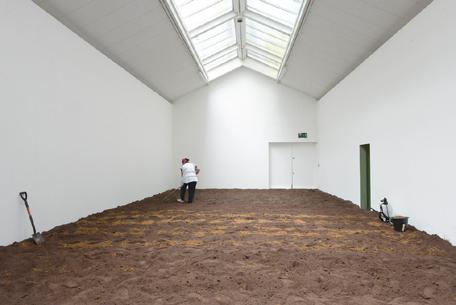
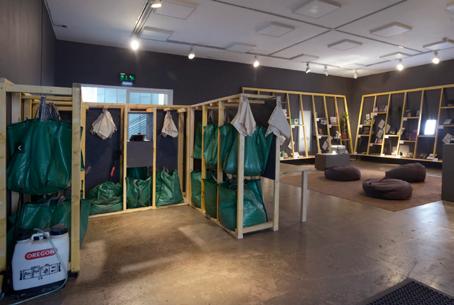
as an independent artistic discipline. Such exhibitions seek to develop new methods and facilitate relational exercises through the senses inside the exhibition spaces. To form new relational grounds, both words and bodily exercises are needed.
Building new relations can also be shaped through movement (Springgay and Truman 2018). Exhibitions are walk-through-media and the walking aspect can be emphasized by curatorial choices. Movement might even work as a particular strategy for encouraging relationality. As pointed out by artist and writer Salomé Voegelin in the book, The Multisensory Museum (Levent and Pascual-Leone 2014) “The curator has to remember that he/she curates time as well as space, the time of walking through (or listening to); curating environments and zones that are activated by my walking through and whose boundaries are less certain than its architecture might have us believe.” (Voegelin 2014: 128). Soil and bodily movement were, for example, the key concepts in the Norwegian “Soil Procession” in 2015. In “Reisen i jorda” the relationship between humans and earthworms was activated by walking further down in the building while models of earthworms got increasingly larger. In other exhibitions, visitors were invited to crawl through the soil matrix (Længsel) and dance like mycelium in a collaborative performance (Jord/Liv). Movement in soil exhibitions is sometimes combined with the carrying of soil, or the bringing of soil samples (sometimes for building of collective soil sculpture) in smaller or bigger amounts (Soil Procession, Soil Works, Soils, We are Compost /// Composting the We). Tactile interactions are brought into the “Jordsans” exhibition, where visitors are invited to walk around gathering natural materials outside and then perform soil spa treatments on each other–a relational exercise under the banner of radical closeness with soils. Some of the exhibitions (Levende matjord, Museo del Suolo) include functional composts. When worm compost is displayed, the audience is often invited to touch the compost, as if to make acquaintance with the worms.
Different curatorial projects contribute a more relationally-oriented approach to the concept of soil literacy. I would argue that the exhibitions mentioned above are doing sensibility work–a relational way of raising soil awareness to develop soil literacy. This is done not only through factual representations and intellectual dissemination, but through creating sensitive understandings, fostering soil affection and sensory practices related to soils. The exhibitions focus on practical and emotional responsibilities, including audiences in the larger circle of soil advocates. This approach problematizes how aesthetic soil experiences alter not only our gaze but also our relationships when being confronted with soils.
The exhibitions furthermore mobilize audiences in many different ways, asking us directly or indirectly to take on different roles. On an intellectual level, the exhibitions invite us to “acknowledge our dependence and reciprocity” (Soil Works), “foster dialogue and conversation” (Soil Dialogues), “rediscover new stories to understand and experience our relationship to soils” (Our Living Soil), and “nurture mutual human-soil relations together with earthworms and active citizen-participation in order to enhance multispecies co-existences in cities. (Glocal-Worming). Notions of growing awareness, caring, repairing, fostering, giving back, nurturing, transforming, restoring, strengthening, developing, grounding and re-grounding are very much at the heart of the exhibition language.
In conclusion, the exhibitions mentioned as a whole take on a reparative force (Sterling and Larkin 2023), placing themselves as initiators in the mobilization of more caring interactions with the soils. By focusing on the relationality, sensoriality, and language of museums and curatorial studies, this museological approach to soil exhibitions offers an experiential materiality to different aspects of the reparative. The exhibitions facilitate places where visitors can “relearn” how to relate to the more than human and distribute “response(ability)” in times of local and global soil crisis. The exhibitions essentially equip visitors to be reparative forces themselves and initiate different kinds of relational and sometimes practical forms of soil “repair.”
Elise Malik
Elise Malik
Bergsveinn, Þ. (2020). “Walking through the Anthropocene: encountering materialisations of the geological epoch in an exhibition space.” Nordisk museologi (Online).
Classen, C., et al. (2006). The Museum as Sensescape: Western Sensibilities and Indigenous Artifacts, Routledge: 199–222.
Howes, D. and P. Michigan (2003). Sensual relations: engaging the senses in culture and social theory. Ann Arbor, University of Michigan Press.
Howes, D. (2014). “Introduction to Sensory Museology.” The senses & society 9(3): 259–267.
Katikas, L., et al. (2024). “Preliminary assessment of the knowledge gaps related to soil literacy.” Soils for Europe 1.
Krzywoszynska, A. and G. Marchesi (2020). “Toward a Relational Materiality of Soils.” Environmental Humanities 12: 190–204.
Levent, N., and A. Pascual-Leone. 2014. The Multisensory Museum: Cross-Disciplinary Perspectives on Touch, Sound, Smell, Memory, and Space. Lanham: Rowman & Little eld Publishers.
Meulemans, G. and C. Granjou (2020). “Soils: A new frontier for environmental knowledge and policies.” Revue d'anthropologie des connaissances 14(4).
Moser, S. (2010). “THE DEVIL IS IN THE DETAIL: Museum Displays and the Creation of Knowledge.” Museum anthropology 33(1): 22–32.
Pink, S. (2015). Doing sensory ethnography. Los Angeles, Calif, Sage.
Puig de la Bellacasa, M. (2019). “Re-animating soils: Transforming human–soil affections through science, culture and community.” The Sociological Review 67: 391–407.
Richer-de-Forges, A. C., et al. (2021). Chapter Five - A review of the world's soil museums and exhibitions. Advances in Agronomy. D. L. Sparks, Academic Press. 166: 277–304.
Springgay, S. and S. E. Truman (2018). Walking methodologies in a more-than-human world: Walkinglab. London, Taylor and Francis.
Sterling, C. and J. and Larkin (2021). “Towards reparative museology.” Museums & Social Issues 15(1–2): 1–3.
Toland, A. and D. Wolter (2023). Soil art: Sensory and symbolic engagement with soils.
Voegelin, S. (2014). Soundwalking the Museum: A Sonic Journey through the Visual Display in “The Multisensory Museum: Cross-Disciplinary Perspectives on Touch, Sound, Smell, Memory, and Space.” Edited by Levent, N., and A. Pascual-Leone. 2014. Lanham: Rowman & Little eld Publishers.
Von Bismarck, B. The Curatorial Condition, Sternberg Press, 2022.
What is “assembling,” and why is it fitting to think about such an activity in terms of artworks with soil? In a letter to Henri Matisse about his Texturologies works from 1958, Jean Dubuffet described his new series of paintings as “an assembling of pieces of soils.”¹ “Assembling” at first seems to be a provocative and rather specific word for an artist to use in describing the act of painting. Before Gilles Deleuze and Félix Guattari introduced the concept of “assemblage” as a constellation of relations between bodies, things, ideas, and institutions, artists such as Jean Dubuffet and Robert Rauschenberg had been constructing assemblages out of wood, metal, textiles, and indeed “pieces of soils” decades earlier.² While it can be argued that soil is a more-than-human assemblage in both an artistic and a philosophical sense—it can be pieced together into a deliberately arranged composition, and it encompasses constellations of relations between natural bodies (such as peatbogs or sand dunes), things (such as legislative measures to protect those bodies), ideas (such as sustainability or food sovereignty), and institutions (such as the USDA or IPCC). It can also be argued that soil is an assembly in a political sense of the term.³ An assembly of individual bodies that come together to demand rights to land or access to healthy food or fair labor compensation comes to mind. Assembly is not just a human domain. Compaction of healthy soil aggregates under the weight of heavy machinery, mudslides on deforested slopes, or tailing piles on the periphery of mines are assemblies of soil particles mobilized by political as well as material conditions. Certainly, such gatherings are a result of agencies other than soils’ own, indicative of a displacement-politics led by human will that ironically also affects human well-being. But who is to speak for the soil aggregates and with what means?
The Farlex Free Dictionary defines assembling as an activity, “1. to bring or call together into a group or whole; and 2. to fit together the parts or pieces; to gather together; congregate.”⁴ Iris van der Tuin and Nanna Verhoeff make the point that “just as an assembly can consist of people, organisms, and things... assembling happens both within and across cultural, natural, and artificial domains.”⁵ Soils are a good example of how assembling happens across these domains in that they are a confluence of bodies at the interface of the lithosphere, atmosphere, hydrosphere, biosphere and technosphere or anthroposphere. Indeed, in some soil science textbooks, soil is defined as a confluence of these different spheres of being.⁶ Artists bring these confluences to light in a variety of ways. In this section we highlight works that bring attention to soil as a both assemblage and assembly. Shown here are critical practices of gathering and collecting, compiling, convening, congregating, aggregating, archiving and coming together, that all might fit under the umbrella of assembling in the philosophical, political, aesthetic, and activist senses sketched out above. These include the collection of site-specific ochres on ancestral Lands (Lisa Moren, Samantha Passaniti); an archive of edible earth that compiles years of cultural research and hundreds of taste samples (masharu); a gathering of sacred sediments for a place of “many tongues” (Nanih Bvlbancha), the mapping of soil samples in different environments through soil chromatography and other photographic means (Eileen Hutton, Marion Belanger), and the weaving, threading, or absorbing of soils through cloth (Moira Bateman, Ruth Loveland, Madelaine Corbin). With precision and material expertise, artists have used experimental methodologies to develop new protocols and speculative scenarios for contamination testing (Heidi Lowell), to systematically record sites of anthropogenic change (Linda-Marlena Ross; Liz Miller
Alexandra R. Toland
Kovacs), to propose new approaches to sampling (Kim Norton, Antoinette LaFarge, Bernice Ficek-Swenson), and to render soil samples into repeatable forms (Veslemøy Lilleengen, Michael Wang, Anne-Katrin Spiess, John Newling) or unique new creations (Johanna Meyer, Crista Cammaroto).
These works introduce insightful acts of assembling to make sense of soil materials and sensory experiences based on multitude. Where there is multitude, van der Tuin and Verhoeff argue, there is also relation: “assemblings of all kinds tend to be excessive in material, relational, and subjective terms, as assemblings produce more relations than are present at the initial moment of assembly.”⁷ Following van der Tuin and Verhoeff, artistic acts of assembling soils are done so with the intention of creating new relations or bringing attention to relationships perhaps otherwise unseen. They are granular and at the same time sticky, zooming into single samples, sites, or stories while zooming out to make visible connections between individual entities and underlying social and political conditions. Deleuze and Guattari propose that “Assemblage is precisely this increase in the dimensions of a multiplicity that necessarily changes in nature as it expands its connections.”⁸ Rather than fixed archives or collections of soil samples, observations, or experiences, assembling describes a strategy for gathering agencies and building multitudes of ever-expanding human-soil relations.
1 Dubuffet, cited in Christian Feller, Edward R. Landa, Alexandra Toland, and Gerd Wessolek, “Case Studies of Soil in Art,” SOIL 1 (2015): 543–59.
2 Gilles Deleuze and Félix Guattari, A Thousand Plateaus: Capitalism and Schizophrenia, trans. Brian Massumi (Minneapolis: University of Minnesota Press, 1987), 503–08.
3
See: Hannah Arendt, On Revolution (New York: Viking Press, 1963), 253–56; Judith Butler, Notes Toward a Performative Theory of Assembly (Cambridge, MA: Harvard University Press, 2015); María Puig de la Bellacasa, “Matters of Care in Technoscience: Assembling Neglected Things,” Social Studies of Science 41, no. 1 (2011): 85–106.
4 Farlex, s.v. “Assembling,” The Free Dictionary, accessed September 30, 2025, https://www.thefreedictionary.com/assembling
5 Iris van der Tuin and Nanna Verhoeff, Critical Concepts for the Creative Humanities (Lanham, MD: Rowman & Littlefield, 2022), 26.
6 See, e.g. Alex B. McBratney and Alfred E. Hartemink, “Define Soil,” Soil Security 2 (2024): 100009.
7 van der Tuin and Verhoeff, Critical Concepts for the Creative Humanities, 26.
8 Gilles Deleuze and Félix Guattari, A Thousand Plateaus: Capitalism and Schizophrenia, trans. Brian Massumi (Minneapolis: University of Minnesota Press, 1987), 8.
Alexandra R. Toland
Lisa Moren
1 Archeologist Peterson and Lampert estimate that 300 metric tonnes of karku ochre have been removed from the Parachilna mine over the millennia.
2 Father Flynn was a Rome ordained minister and the first Aboriginal to lead his own mission. He spoke with linguist and author Bruce Chatwin and is quoted in his 2012 book “Songlines.” Father Flynn notes that due to ignorance, Aboriginal land rights are often misunderstood in courts [Mabu Case, Murray Island 1992], including the role of spirit-fathers in inheritance.
3 Father Flynn says songlines are similar to the “Birds [who] also sing their territorial boundaries.” The idea of creating trade routes and songlines was possibly modeled on the bird practicality of being in motion for survival. There is some anthropological evidence of ancient cultures that literally walked the migration paths of the birds with a language that mimicked their sounds, or bird songs.
OCHRE WARS
Every summer, for thousands of years, approximately 80 of the strongest men from the Diyari [Dyari, Diyari, Dieri, Dieyerie] tribe walked armed from their home near Lake Eyre, South Australia, to Parachilna north of Flinders Ranges [Mulvaney/Kamminga] to mine the famous karku [karrku], “blood of the emu.” The Diyari were the exclusive stewards of the secret location and techniques to extract the prized red-ochre on the Australian continent. It’s said the shimmery soil had a creamy texture, even iridescent [possibly from mercury, or cinnabar, and mica], and was savored for the most sacred rituals. The Diyari ground up this iron ore rock and soil into a powder and then used water or urine as a binder for cakes, wrapped it in grass and human hair. Each man carried the 20–35 kilos several hundred kilometers back to Lake Eyre where their tribe relied on trading the ochre for the rest of the year.¹
All Aboriginal nations had ochre for everyday life, and red-ochre is critical for rock art, wood, stone, fur products, and to adorn the body during Corroborees and spiritual ceremonies, such as weddings. But there were only three primary Aboriginal mining sites, including Parachilna in Flinders Ranges where the best pigments were mined. The Diyari’s Parachilna karku was treasured for ceremonial purposes possibly for the last 20,000 years [Mulvaney/Kamminga].
This ancient pilgrimage was travelled peacefully until 1860, when the “whitefella” sheep farmers first came into direct conflict with the Diyari. While following their ancestral path, the Diyari hunted the farmer’s sheep for food; to the colonizers, this was a crime that was punishable by hanging. But the Diyari were responsible for the land, and any fences, homesteads, animals, food, etc., belonged to them.
Tensions escalated throughout the 1860s with violence on both sides known as the Ochre Wars. Eventually, administrators in Adelaide suggested a solution. I want to get to that solution later, because in nearby Victoria, the settlers were engaging in another mining project where gold was first discovered in Australia. I became fascinated by the idea that one culture believes in the value of their shimmering mineral over another culture’s shiny mineral. The familiar story of a gold rush that led to Australia’s first stock exchange in Bendigo, coincided with the diminishing mining at Parachilna, revealing deeper narratives of identity, spirituality, and economy. This ochre vs. gold story became the focus of my pigment projects, “eLAND,” “Songlines,” and others.
ECONOMY AND BIRTHRIGHT
To better understand the clash and why the Diyari didn’t go around the fences to avoid conflict, I needed to understand the Aboriginal “songline,” or Dreaming Path. A songline is a historical path that includes recording how the landscape came into being. It’s passed down as an inheritance with responsibilities [Gammage, 2011].
Bruce Chatwin describes that a newborn receives both a biological and a spiritual father. A spirit-father allows families to have five full biological siblings with allegiances inside and outside the tribe, addressing imbalances, feuds, or vendettas. Biological fathers were advised to take a wife 2 or 3 ‘stops’ along their songline where the song passed out of their ownership. Everyone hoped to have at least four interconnected locations that allowed them to travel away from their tribe in the event of a crisis. Therefore, “Every tribe—like it or not—had to cultivate relations with its neighbor,” and the idea of invading their neighbor’s land would “never have entered their heads” [Flynn via Chatwin, 1988].²
Father Flynn said that when “White men [came to this continent they]… made the common mistake of assuming that, because the Aboriginals were wanderers, they could have no system of land tenure. This was nonsense. Aboriginals, it was true, could not imagine territory as a block of land hemmed in by frontiers: but rather as an interlocking network of ‘lines’ or ‘ways through’…,” and said that “all our words for “country”… are the same as the words for “lines,” and that the word for “white man” is the same as the word for “meat” or sitting prey³ [Chatwin, 1988]. Therefore, the farmers on the Diyari songline, and all their belongings, including their sheep, were literally sitting prey. In terms of economy, there were formal rules for exchanging commodities. Flynn says songlines were “a kind of bush-telegraph-cum-stock-exchange, spreading messages between peoples who never saw each other, who might [otherwise] be unaware of the other’s existence” [Chatwin, 1988]. Generally, Aboriginals had the idea that ‘goods’ and objects were potentially malign and would work against their possessors unless they were forever in motion.
Lisa Moren

4 Mabu Case, Murray Island 1992.
5 Unfortunately, the same networks that carried trade and messages along songlines also spread smallpox after settlers arrived. Songlines were later pieced together through mapping the disease’s path.
While commodities in constant circulation are the foundation of economic growth in Western systems, for Aboriginal peoples, the true value lies not in the objects themselves but in the act of exchange and the relationships they foster between people. “People liked nothing better than to barter useless things—or things they could supply for themselves: feathers, sacred objects, belts of human hair” and even umbilical cords. “Trade goods,” he continued, “should be seen rather as the bargaining counters of a gigantic game, in which the whole continent was the gaming board and all its inhabitants’ players. ‘Goods’ were tokens of intent: to trade again, meet again, fix frontiers, intermarry, etc… A shell might travel from hand to hand… since time began.” [Chatwin, 1988]
The Diyari were a respected and feared tribe in the Central region of the continent, where several significant trade routes met. Part of the Diyari songline was the “Two Dog” path that connected the north to the south coast and to Western Australia, over 3,000 kilometers of territory. This communication was advantageous for acquiring knowledge and spiritual objects such as engraved pearl shells and the oval baler-shell ornaments [Kerwin, 2012]. In addition to trading secrets and songs, the ochre was a currency for sacred items such as pituri [tobacco], large mulgawood fighting spears, shields, possum skin cloaks, animal nets, traps, belts, medical resources, gum cement, string bags, boomerangs, baskets, grinding dishes, bags, and digging sticks. [Mulvaney/ Kamminga, 1975]
The songline’s complex inherited system of histories and geographies are assigned at birth. The spiritual father gives the child a wood or stone, “tjuringas,” symbolizing the ancestral deed of the songline. Chatwin describes the spirit-child conception“as a kind of musical sperm where the child may claim paternity along the line of his footprints.”⁴ The performance of songlines during an annual event called the “Big Place” or Corroborees are re-enactments of ancestral time. This involved neighboring tribes “…one after the other, each ‘owner’ of an inherited songline, would sing his stretch of the Ancestor’s footprints. Always in the correct sequence!” Singing it out of order was a crime, punishable by death because it would “un-create the Creation,” and undo history [Chatwin, 1988]. Therefore, mastering one’s land-right in the songline—without deviation—was paramount.
As the owners of the karku, the Diyari were also keepers of its Dreamtime, the Aboriginal land creation story. The Dreamtime story was an inherited totem that included a geo-history expressed in songs, dances, paintings, an “ecological proof of the unity of things… Every particle of land, sea, and sky must lie on a songline; otherwise an ancestor can’t have created it, and it could not exist.” [Gammage, 2011]
Although versions vary, for Aboriginals, the Parachilna Dreamtime always centers on the Diyari Kuringgii [Kuringai] god, who often appears as an emu. In the story, the sacred emu is chased and attacked by dingoes, a man, and a ferocious dog, where the emu [Kuringgii] eventually bleeds to death. The dingoes rest and become limestone boulders, the man becomes a hill and Kuringii’s blood, karku, the red-ochre. For Aboriginal people, this soil marks the Two-Dogs songline, a Dreamtime story carried by a single melody translated into various languages, including sign language, “every song cycle went leap-frogging through twenty languages, [and may travel 4,000 km] and yet it’s the same song. People recognize the tune, which is always the same, even though the language, words, and meaning will change.”⁵ [Chatwin, 1988]
Bill Gammage’s book, “The Biggest Estate on Earth,” postulates that indigenous Australia was an interconnected estate with cross-continental trade and land management that First Nations people fully controlled, making plants and animals abundant, convenient, and predictable. He argues that in Australia, grazing animals, such as sheep, were shepherded via bushfire [fire and stick farming] because, other than humans, they had no predators. The songline running through the Parachilna sheep farms brings me back to the story of the Ochre War.
The Adelaide administrators wanted to stop the violence between the sheep farmers and the Diyari. Since the Anglo-Australians couldn’t prevent the Diyari from going to the ochre mines in Parachilna, they concocted a ruse to relocate the mine to the Diyari in Lake Eyre. The problem with this scheme is that the prized value of the redochre was not only its unique shimmery texture, but its real value was from the Diyari’s
Lisa Moren
exclusive inherited right to the path and secret location. This secret is what gave the Diyari their high status in the region.
The final problem with the Adelaide scheme is that in 1874, the administrators moved the wrong mine. No transport company would take on the project as it was an impossible task for ox carts. They instead found laborers to haul four tons of red-ochre 700 km in harsh Australian conditions from a mine near Adelaide to Lake Eyre. Not believing the Diyari would know the difference in the quality of the ochre, the Adelaide administrators persuaded German missionaries to distribute the ochre to the Diyari. However, as Victoria Finlay states:
“Trading happens when one item is seen to be almost equal in value to another. What value did free paint have? It wouldn’t have bought very many precious pearl shells from the Kimberley coast, nor would it have bought much of the pituri tobacco the Diyari people were so keen to buy from other tribes. The recipe for making pituri leaves into a super-narcotic was a secret, kept only by the elders of certain tribes, so swapping ochre for pituri was swapping a secret for a secret and therefore appropriate. If the Lake Eyre tribes were denied sacred ochre, then it would mean they were not able to play their part in the complex trading network that Aboriginal tribes depended on.” [Finlay, 2004]
Not taking the Adelaide ochre offer seriously, the Diyari continued their pilgrimage, clashing with farmers and hunting their sheep into the 1870s. After the failed ochre mine relocation, Adelaide officials ordered the Diyari men to be killed when they next approached the farm. Consequently, massacring the strongest, fittest men of the tribe shattered hope of longevity for the remaining Diyari, mostly women and children. As stewards of the songline, the Diyari were obligated to honor the path Two Dogs, which passed directly through the settlers’ fenced farmland. To avoid the fence would have been in violation of ancestral law, an act tantamount to undoing history, and also could be punishable by death. The Diyari, once guardians of the shimmering red-ochre and its relevant Two-Dog songline, had no alternative. When they were replaced by the first Australian gold mine and stock exchange in nearby Bendigo, the settlers shifted focus to the new shiny prize. One arbitrary rock and soil replaced another as the highest commodity and most coveted resource on the continent.
When I retraced the Diyari songline with my family in 2012, I’d never seen a photograph of the site, I relied on line drawings of published maps and talking to locals. I found the old tire with the hand-painted letters “ochre mine” leading to a dirt road that shifted in color from brilliant red to yellow to white, then red again. Our car was covered in red dust as I collected rocks from the side of the road to later create pigments.⁶ The result of my pilgrimage and soil mining was the pigment projects “eLAND,” “Songlines,” and “Currentsē” that explore the value discrepancy between gold and the shimmering ochre (iron ore). They also serve as a homage to the Diyari people and their impressive, socially and economically interconnected songlines. Another series created from the ochre includes “Flinders Ranges Body Paint.”
“eLAND” is an intaglio series of simplified QR codes exclusively made from the Diyari ochre pigment. When a participant holds their phone over the QR code, they’re taken to a photograph along the songline where the pigment they are viewing was mined; yet another QR code will bring up a Google map where the ochre was mined. A third QR code will display a number preceded by a plus or minus. The number refers to a stock quote displaying how much the pigment has increased or decreased in value since it was mined in July 2012. This live value shift is calculated using a bot and an Apache server that pulls real-time data from Yahoo Finance, applying a simple mathematical formula to reflect fluctuations in market worth, drawing a connection between earth matter, the value of the art itself, along with our economic belief system.
Other intaglios in the “eLAND” series feature QR codes printed in the dimensions of Australian $5, $10, and $20 banknotes. This reference to Western currency systems underscores a shift in belief toward the gold standard, replacing an Aboriginal cultural value system once centered around ochre, karku. One belief system built on shimmering minerals replacing another.
The “Songline” intaglio is the visual opposite of the rigid angles of the QR code and its digital bots. The interwoven network of lines in this project echoes the Diyari
eLAND, 2013, Intaglio on paper with redochre mined by the artist, Australian outback [Flinders Ranges, SA] 9 x 12 inches.
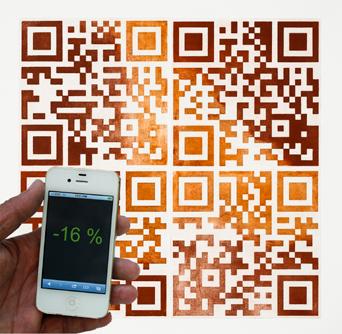
Flinders Ranges Body Paint, 2013, mixedmedia, oil, hand-mined ochre, wax, and cosmetic containers, 20 x 9 x 6 inches [variable]
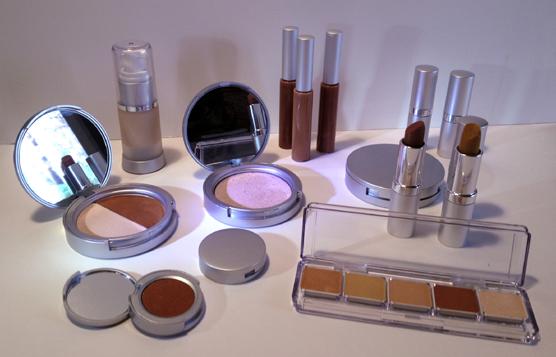
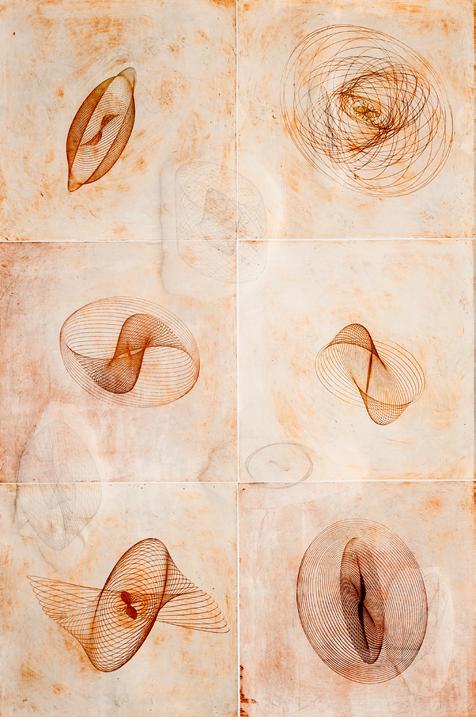
6
Just before turning on the dusty ochre-colored road, we saw a bright, shiny red 18-wheeler truck with gold scripted letters spelling “Halliburton.” My bright-eyed nine-yearold son, confused by my gasp and shocked expression at the shiny truck, asked innocently, “What’s wrong, Mommy?” I learned later, the former US VicePresident Dick Cheney’s company was introducing fracking to the region.
Bibliography
Chatwin, Bruce. The Songlines. New York, Penguin Books, 1988.
Kerwin, Dale. Aboriginal Dreaming Paths and Trading Routes: The Colonization of the Australian
Economic Landscape. Brighton, Sussex Academic, 2012.
Gammage, Bill. Biggest Estate on Earth: How Aborigines Made Australia Allen & Unwin, 2011.
Finlay, Victoria. Color: A Natural History of the Palette. New York, Random House Trade Paperbacks, 2004.
Mulvaney, Derek John, and Johan Kamminga. The Prehistory of Australia Melbourne, Penguin Books, 1975.
Paterson, Nicolas, and Ronald J. Lampert. “A Central Australian Ochre Mine.” Records of the Australian Museum 37, no. 1 [August 1, 1985]: 1–9.
people's web-like songlines and fluid cultural networks that connect the Aboriginal Australian continent in both elegant and complex ways. Using an open source design, we built a 19th century drawing machine. The harmonograph uses natural phenomena (gravity and momentum) to visualize the mathematical theory of the Lissajous curve without electricity. It creates a triadic weight distribution attached to a writing utensil, or in this case, an etching needle. The complexity of this curve has been used in early Western currencies as a tool to protect against counterfeiting to oscilloscopes, and early monitors.
The third project in the Ochre Series, “Currentsē” involved creating hundreds of marbled papers, each the size of Australian currency. Through workshops, Australians were invited to craft their own 'currency' directly from their landscape. Each piece featured a stamp of the GPS location where the pigment was mined.
For the final ochre project, “Flinders Ranges Body Paint,” a hand-processed and packaged make-up series with contemporary branding was created. The process of making them revealed a nearly identical color scheme to both European face painting and the face and body painting of the Aboriginals. They were also made into oil paints.
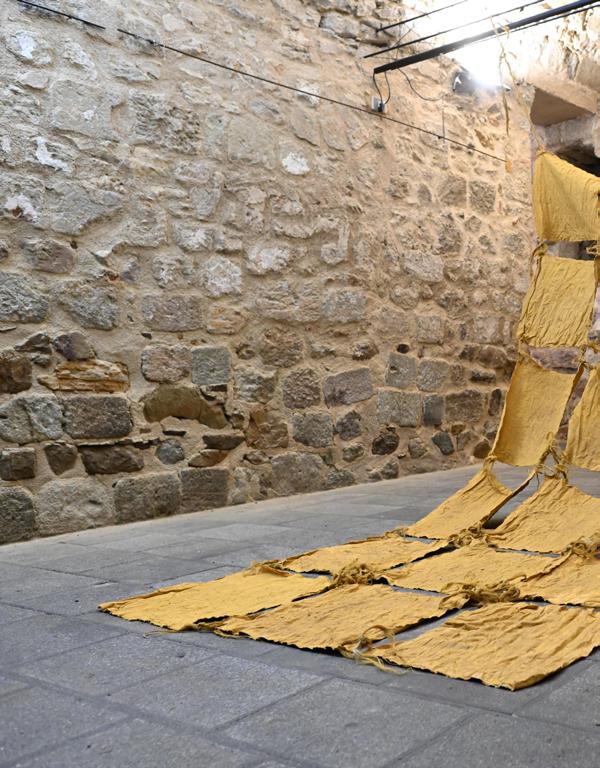
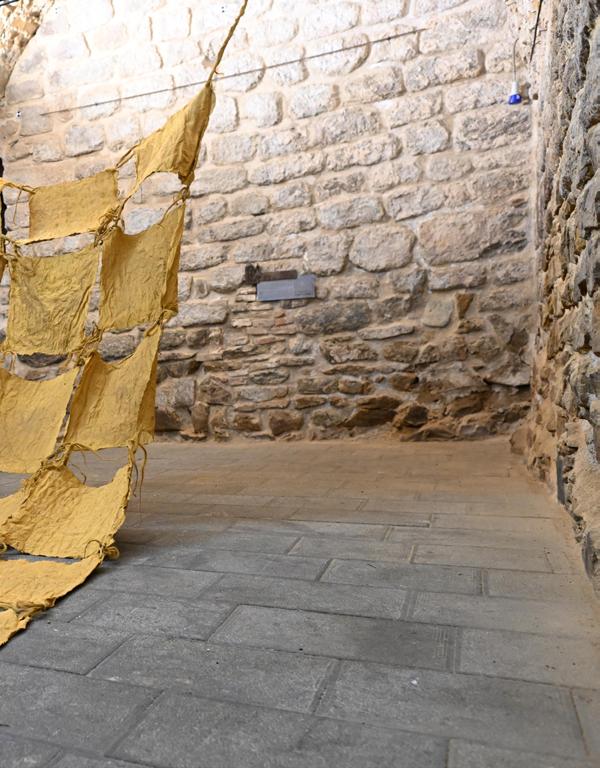
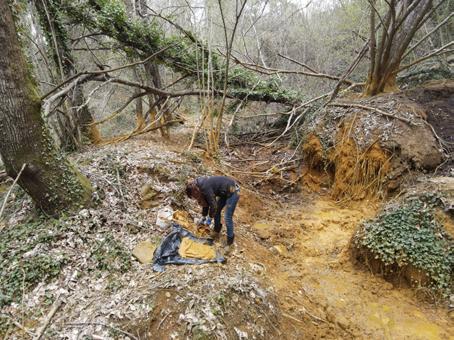
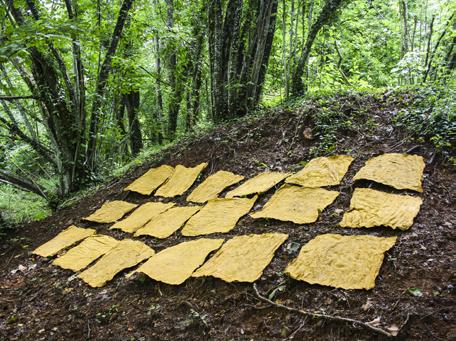
I am an Italian artist, and my artistic research focuses on experimentation with natural materials collected from the environment and salvaged materials that become objects of reflection and investigation into the complexity of human relationships and existential experience. My pictorial, sculptural and installation works arise from a continuous relationship, dialogue, and exchange between inside and outside, between the intimate world and the environment, between humans and nature, between existential experience and natural cycles, with a special focus on ancestral symbologies and spiritual archetypes that have connected humans to the natural world that hosts them since the earliest times. The materials I use allow me to enter into total connection with nature through performative practices of gathering in the environment and become a symbol of an artistic language attentive to environmental issues and the eco-sustainability of mediums.
Soil is one of the materials I work with most, and I started collecting it on a trip to Morocco in 2015. To date, I work with earth collected in many parts of Italy and the world. This material interests me a lot because it has been used since the Paleolithic as an artistic medium and therefore has a strong connection to the history of art and painting. But the aspect that interests me most is the strong symbolism associated with this element that relates to endless themes. The earth is the world we inhabit, the soil on which we walk, the surface that covers geographies, potential material from which energy and food can be derived, it is the base on which vegetation grows, and thus is the source of the whole in which we are embedded.
The image offered here represents the work Oltreterra created for an interdisciplinary project in 2023 called Oltreterra Art Project in collaboration with the Natural History Museum and Accademia dei Fisiocritici of Siena. The project is a research around the historic natural Sienna pigment, Terra di Siena, which was once mined on Mount Amiata. With the help of art curators Davide Silvioli and Valeria De Siero, two geologists from the Museum of Siena, and two environmental guides, I went to rediscover one of the ancient, now abandoned pigment quarries, and within that specific place, I made the installation Oltreterra. The goal was to rediscover an abandoned place and reconnect the art of the past with the contemporary through a material charged with meaning.
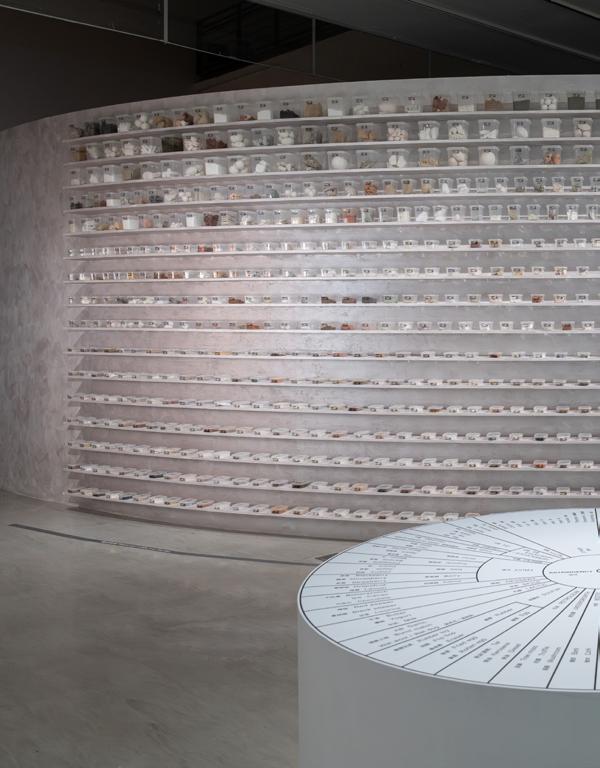
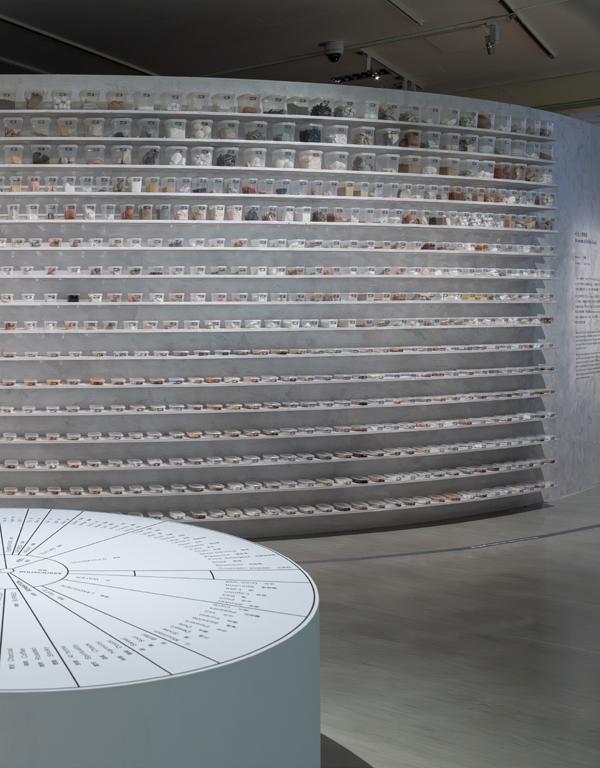
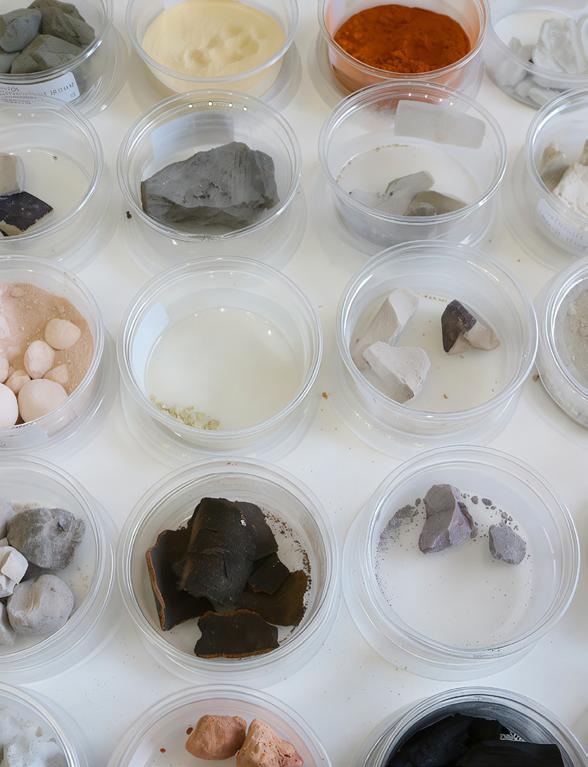
The Museum of Edible Earth (MEE) is a cross-disciplinary project that brings together a global collection of edible soils, inviting the audience to question our relationship with the environment and rethink their understanding of the earth and cultural traditions through creative thinking. The Museum of Edible Earth explores questions such as: How do earth-eating traditions differ across cultures? Where does edible earth come from? What are the possible benefits and dangers of eating earth? How do the material properties in earth affect its flavor?
The museum’s mission is to collect an extensive collection of edible soils from as many countries as possible and examine the diversity of their historical contexts and cultural meanings. Through cross-disciplinary partnerships, workshops, and collaborations, it aims to reshape our conception of earth consumption. Geophagy is the scientific name for the intentional consumption of earth materials, which includes soil and earth-like substances such as clay and chalk. It is an ancient global practice driven by diverse nutritional, cultural, and medicinal factors.
For reference and archival documentation, masharu studio has developed an extensive database of edible soils available on the market. This database, in addition to extensive descriptions of earth samples and their respective backgrounds, also collects descriptions of tasting experiences shared by visitors. The museum’s collection now consists of more than 600 earth samples. The materials originate from 44 countries, including: Armenia, Austria, Belarus, Cameroon, China, Congo DR, Côte d’Ivoire, Cuba, Denmark, Ecuador, France, Germany, Ghana, Guatemala, Haiti, Iceland, India, Indonesia, Iran, Iraq, Ireland, Japan, Kazakhstan, Kyrgyzstan, Latvia, Lithuania, Malawi, Mexico, Morocco, the Netherlands, Nigeria, Pakistan, Portugal, Russia, Slovenia, South Africa, Suriname, Switzerland, Thailand, UK, Ukraine, USA, Uzbekistan and Zimbabwe. A vast majority of the samples were gathered during field trips, as well as purchased online and received as gifts.
Between 2016 and 2025, the Museum of Edible Earth has travelled to 22 countries, appearing in more than a hundred exhibitions and public events. The nomadic nature of the project, with its respective mobile presentations, field trips and collaboration with local partners, has played a vital role in its evolution. Through this time, the collection has been constantly enriched by new materials, narratives and taste impressions. The website www.museumofedible.earth is both an online database, showcasing a partial selection of the Museum of Edible Earth, and as a participatory platform for the audience to share their earth-tasting experiences. Between 2020 and 2025, we gathered more than 600 comments describing tastes, flavors, and associations representing more than 140 earth samples. These contributions, along with collected statistics, make the project a participatory and constantly evolving work.
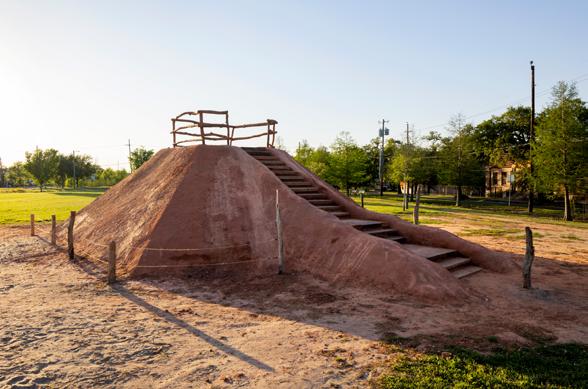
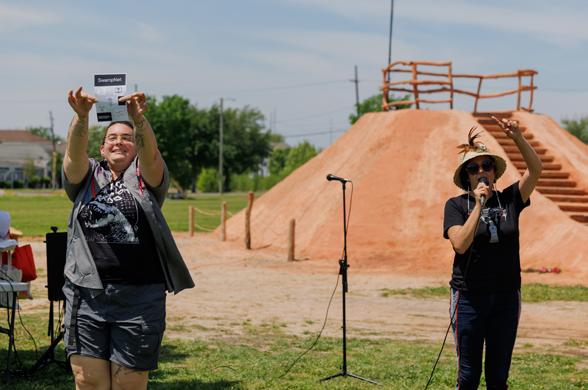
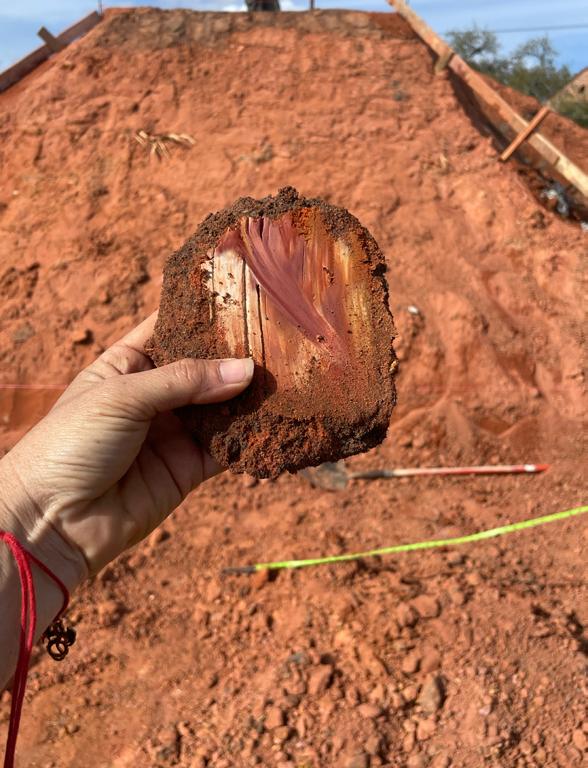
Our Nanih calls attention to the lands and other mounds we are losing in South Louisiana, and the urgent need to protect coastal and tribal communities, marking the four directions, calling us into a balanced way of being, recognizing that the health of our world, and ourselves, depends on that balance. We welcome these teachings in these precarious times. Nanih Bvlbancha reclaims a place for Indigenous peoples in the heart of Bvlbancha and honors, not only our ancestral histories, but also, our contemporary realities. It anchors us in relationship, reciprocity, respect for all beings, and inspires opportunities to gather as a culturally diverse community, educate in traditional ways that involve active participation, care and tend in more sustainable ways for our native plants, play ancient Southeastern ball games, and more! We invite you to be a part of Nanih Bvlbancha.
WHAT IS A “NANIH?”
Nanih is a Chahta (Choctaw) word for hill or mountain, and is commonly used to describe our Ancestor’s earthen mound architecture.
WHERE IS BVLBANCHA?
Bvlbancha means “place of babbling tongues,” or “place of many languages” in Chahta (Choctaw), and is the only recorded pre-colonial name for the land that is now known as New Orleans. Many rivers have carried sediments and people here for millenia. We use this name to honor this rich history and diversity that continues to this day.
In October of 2022, descendants of southeastern moundbuilders were invited to submit a “public monument” proposal to Prospect’s Artists of Public Memory Commission. Our proposal was accepted, and in March of 2023 Prospect publicly announced the Commission and our participation in it. In early 2024, Dr. Tammy Greer (United Houma Nation), Ida Aronson (United Houma Nation), Jenna Mae (Eastern Siouan, Mvskoke, and Cherokee descent), Ozone 504 and Monique Verdin (Houma Nation) invited community to join in helping to build and activate an earthen mound to honor our ancestors and anchor our future. The site will include native plant gardens and a stickball field with intentions to provide pathways to health and healing, as well as a site for contemporary Indigenous lifeways, and communal gatherings. An Intertribal collective of Artists, Educators, Researchers, Gardeners, Herbalists, Water Protectors, Land Defenders and Culture Keepers are stewarding Nanih Bvlbancha as one of Prospect New Orleans Artist of Public Memory modern monument initiative. This is an invitation to you all to participate in this monumental endeavor. We are calling on our Indigenous relatives, and communities of color all over Turtle Island, from the bayous to the headwaters, to send us your soil which will become an offering to Bvlbancha.
We humbly request a ceremonial sample of the soil from your lands! About 4 tablespoons or less, in a sealed container. (Ziploc or equivalent is great!) We need: the name/location of your lands, and any stories of your lands you would like to share! Locations and stories will be archived, and included in visual mapping/graphics on site. It takes approximately 4-5 forever stamps to send 4 tablespoons. Let us know if you would like us to send you a prepaid mailer.
Nanih Bvlbancha
P.O. Box 52316
New Orleans, LA 70152
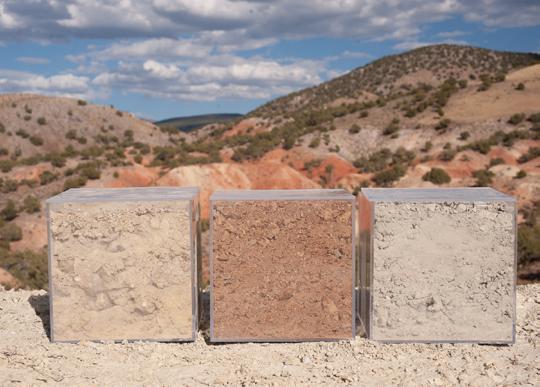
Anne-Katrin Spiess
My artistic practice is defined by a profound relationship to the land. I create site-specific work addressing environmental issues, as well as socially engaged art that employs direct action to inspire change. Even though soil is the basis of all terrestrial life, we tend to neglect its great importance. Homage to Soil is part of an ongoing series documenting geological diversity. To picture soil as a subject displays the fragility of one of our most valuable resources. As we move increasingly towards metropolitan centers, where the soil is covered by concrete, we lose our connection to nature and its cycles. At the same time, deserts are expanding and more soils are becom-
ing barren and infertile. Through my work, I hope to encourage an appreciation of one of the most basic but often ignored elements of life on this planet. This specific iteration of Homage to Soil chronicles a pilgrimage across southern Utah to collect soil. What emerged was not just a sense of place but a study of soil as medium, both materially and conceptually. I built a custom wooden box to store the samples atop my airstream trailer and recorded each site by its longitude and latitude. Some soils were photographed on-site as portraits; others were later taken out of context and arranged as grids to create abstract landscape compositions.
More than four decades ago, the Institute of Cultural Inquiry, a Los Angeles-based arts research space, began assembling the Earth Kabinett, an archive of dirt and rocks from around the world. This collection of samples has served as a map of places that ICI members and grantees have visited and undertaken research. It has also served as a resource for many ICI projects and publications. In 2007, the ICI published Searching for Sebald, an examination of W.G. Sebald’s unique approach to mixing fiction and visual images. The following year the ICI created special editions of the book housed in suitcases together with Sebald-inspired objects by artists. My contribution was a set of small plastic cases that functioned as portable twosided vitrines. They were filled with a combination of seeds, sand, plant matter, dirt, and especially salt, an inhibitor of many forms of life. Entitled no longer not yet, they resemble landscapes—either the remnants of landscapes long dead or those looming in our climate-changed future when many areas of the world will become hotter and drier. The dirt in these tiny reliquaries was compost I had made myself, imprisoning the vitality of living earth behind
the plastic that stands as a sign of contemporary civilization. And although present etiquette tells us never to open a sealed artwork, one day it might be more important to find out if life remains inside.
no longer not yet, 2008, plastic cases with seeds, sand, plant matter, dirt, and salt, 4 x 5 inches (four variations)
Bernice Ficek-Swenson
Drafting maps for geologists early in my career introduced me to many categories of rocks, culminating in the opportunity to hold a moon rock in my hand. That moment was a revelation in my perception of time and space. Since that point, my imagery has expanded from using stone and soil as a metaphor for landscape to a larger concern about environments touched by human presence and the stories shared about each site. Traces explores the Earth’s physicality by using 42 glass tubes filled with soil from alternating terrestrial and aquatic locations, hung in 3 vertical columns of 14 tubes. The number 14 is significant, as it represents the atomic number of silicon, the most abundant element on Earth, found in quartz and calcite. Fragments of soils were collected from a reclaimed mining site, several locations in the arid
west, and several rivers, including the Mississippi, Rio Grande, and Yellowstone. Fourteen place-name descriptions and poetic quotations printed on Plexiglas are part of the installation. The top tube, filled with quartz chips from a reclaimed mining site, features the following quote by J.B. Jackson: “Landscape is history made visible.” Another tube filled with lava flow from Idaho has a quote from Wallace Stegner (1992): “You have to get over the color green; you have to quit associating beauty with gardens and lawns; you have to get used to an inhuman scale; you have to understand geological time.”
Stegner, Wallace. Thoughts in a Dry Land. Where the Bluebird Sings to the Lemonade Springs, 1992, p.45.
Kim Norton
A large part of my interdisciplinary project-led practice involves working site-specifically, exploring scale, and making work that focuses on how we interact with spaces and the impact these works have on the human senses. Materiality, physicality, and presence of material are always evident. Conscious of the consumption of materials and resources, I approach each project by questioning how materials are used, where they are sourced, and how the permanence or impermanence of these objects or installations has an effect. London, where I live, is a city built on and by clay soil. You often catch glimpses of its distinctive yellow tones. Soil becomes a marker of place, where history is embedded in and anchored by earth materials. It can act as a mapping system for deep time, it holds and stabilises if left undisturbed, and yet it contains potential life-sustaining, complex, and fragile ecosystems. The work shown here is part of a larger body of works as an ever-increasing archive of small, roughly pinched porcelain forms with soil samples mixed into clay. This began in 2017 and is ongoing. The collection currently comprises 152 forms containing small samples of earth that have been respectful-
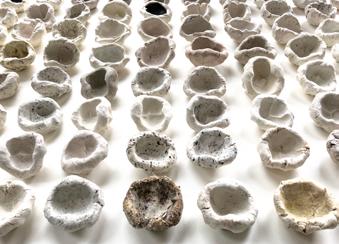
ly collected from different locations across the UK, Europe, North America, and Japan. This has become an ingrained part of my practice, a method of documenting geological colour, and a process of mapping
the essence of a place. Mixing the earth into 100 grammes of porcelain allows the earth’s colours and material behaviour to show through when fired to 1250°C, where the porcelain simply acts as a stabiliser.
I have been working with the red clay of the Southeast United States for about 30 years in multiple ways: as a land artist, photographer, art educator, gardener, hiker, and mountain biker. The Terra Forma series began in 2016 and has grown to show many different soils, including those with high clay content, forest humus, sand from coastal regions, creek beds, and bleachedout construction dirt. I begin these works by first sensing and observing what grows without effort from the soil within the area, as well as the social aspects of site in relationship to the surrounding place. From this, I make a sketch to design
the soil molding forms, and determine places to dig so I can access and use local soils. If this is not possible, I use soil from construction sites within a 5-mile radius of my installation location. I fill the soil into my desired design, I pound, mold, and form, sometimes using a bit of red art clay powder in a mix with existing soil and water for greater molding capabilities. Vegetation is carefully chosen and placed within the ground relief form and refreshed or changed with the community. Touching and molding soil individually and in community is a grounding experience that I seek to propagate through my practice.
Eileen Hutton
As an American and recent Irish citizen, the materiality of soil grounds me in my new home. Seeking to establish a baseline understanding, I found that Irish soils were formed mostly by primeval woods and glacial deposits between 100,000 and 15,000 years ago. And yet, soil is a vibrant living material which is in a continually transient state. It offers not only direct access to deep time but to the ephemeral. Through soil, I aim to attentively be with and think alongside a complex living system, to unlearn routine patterns of sensing, and to imagine new ways
of being and systems of making. Reframing my engagement with soil has rekindled an essential ecological relationality, positioning soil as a multispecies living world not in need of protection but in need of response-ability and vibrant relational ontology. Seeing and Sensing Soil, was a soil based installation situated at the Irish Museum of Modern Art during the Earth Rising Festival in 2022. The project grew from participants’ existing knowledge of soil, while providing multiple entry points for fluid conversations on the importance of soil, its role in support-
ing biodiversity, our food systems and the vast microcosms that exist underfoot. In order to facilitate deep connection to and curiosty about local soils, organic horticulturalist James Haughey and I established our site as a temporary research lab. We used a stereo microscope to highlight the various roles of microfauna and demonstrated the process of Pfeiffer's method for Circular Chromatography. Our participatory approach becomes a way to tell the stories of soil, sink into the rhythms, the aromas, the experiences of the more than human world.
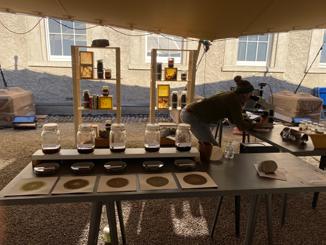
As a multi-disciplinary artist based in Austin, Texas, I make work that focuses on environmental issues. I source site-specific soils and other plant materials from sites around Texas and the country to produce my own paint. My current series of work, Dust to Dust, examines my intimate relationship with the soil. It is our origin and our final resting place. When I put my hands into the soil, I am literally and metaphorically touching everything that has existed on this planet. In this sense, soil is a conduit for a deeper connection with all of existence on our little blue plan-
et. I have had two completely separate and unrelated cancer diagnoses during my life, starting at the age of 24. Because of this, I have tried to avoid toxins for a long time. I started collecting soils to create pigments several years ago in an effort to avoid the plasticizers and chemicals in paints. I then started wondering how many toxins might be in the soil I was using. I am currently partnering with Dr. Alison Veach on a 5-year study on soil health in Central Texas, where I live. I am collecting soil samples, which will be tested to assess their health as well as to make pigments.
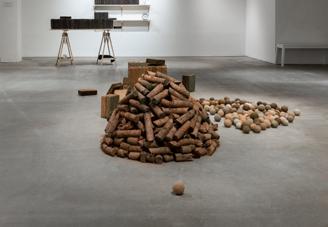
John Newling
As part of a generation of artists whose work evolved from Conceptual Art, Land Art, and Arte Povera, my work similarly places emphasis on the concept, process, and site of the work, alongside material and aesthetic properties. Great attention is paid to the complex dynamics of ecological systems in terms of urban,
Johanna Meyer
Everywhere we go, elements of the landscape remain unseen or simply ignored: micro-particles of dust, water droplets, vapor, sound vibrations, electrical waves, insects, clothing fibers, skin, hair, sediments. I am particularly attached to the interactions between heritage and contemporary creation. Through these points of friction, contact and exchange, SOIL is the representation of all states of transition, layering at the same time memories and culture through life and natural phenomena. To explore my surroundings and drift in the local landscape is always an important aspect of my artistic research. I collect soil samples during my walks and make multiple tests: corresponding with patterns of strata, the shape of the water and erosion, organic clusters of lichen, and the reflections of minerals. With the focus on giving voice to the material without trying to bend it to my will, I am attentive and try to understand more than to interfere, to connect more than to guide. In this process, I also collaborate with the local community and geologists from the area.
social, political, and cultural ecologies. Art can be situated on this shared ground, where the artificial distinction between nature and culture no longer makes sense. A social ecology, in a state of co-creation with nature, could provide the grounds for addressing the question of how to properly constitute the well-being of
Language from the Cores and Burning Forests, 2020-2022, soil cores, filtered soil, grass, vegetative debris, shredded text, rain water, dimensions variable
life. Since the early 2000s, I’ve been making sculptures and installations using soil and plants grown in my garden. This work was created by taking soil cores at a depth of 1 meter from my garden using a Soil Corer. The cores are then dried, crushed, filtered, and then used in a number of different artworks.
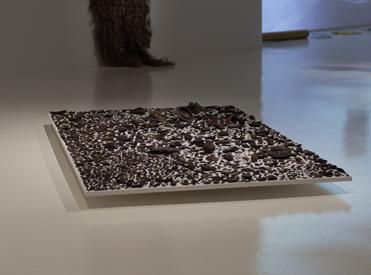
Madelaine Corbin
A fleck of ash, a drop of blue, a grain of salt, a speck of dust, and a particle of soil—a constellation of meaning is composed from these elements. My practice earnestly endeavors to listen to, translate, and contextualize the conversation between the vibrancy of matter sensed by our fingertips and the expansive questions cultivated by the universe around us. Spaces that invite wonder and research coalesce to question the quotidian materials accepted as normal when few things are actually so. Sunlight, water, and blue are not so simple. Using my own relationship to ecology, rooted in a valley town in Oregon as a starting point, I articulate the complexity and range of relationships to the land beneath our feet, that which once was, and that which will never be. Through text, fibers, natural dyes, and more, I explore the elements that compose our world and connect us to one another. From Above for Below (we share a center) is a textile work made from
soil collected from the Eastern Market neighborhood of Detroit. The text consisted of gathered footnotes and questions accumulated from various research about the relationships and mingling of humans and soil while meditating on the act of soil collection and eventual dispersal. How is soil gathered, dug, and piled? The text loops forward and back for multiple readers, including humans looking from above and the earth from below. The soil textile was activated in a performance in the interstice of time between active event and closed venue. When the event concluded, a public display of maintenance took place as I wiped away the textile, gathered each speck of soil into an apron pocket, and returned the pocketful of dirt to its origin the following morning. This looping of origins and destinations, of text forwards and back represents a one way we can experience time on a more-than-human scale.
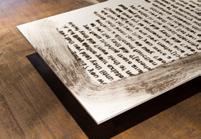
Ruth Loveland
My practice is to collect colored clays and mineral deposits and then process them as pigments. Connecting with the formal and sometimes subtle aspects of color and texture, the pigment hunt becomes a way of connecting with my natural environment. A record is collected of where I have been, and the study of it carries both emotional, geographic, and geological significance. The pigment is mixed with water, allowed to settle, strained, dried, and then powdered before being mixed with a
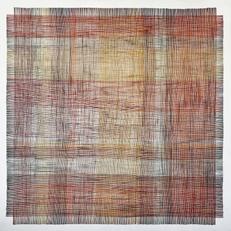
binder to form paint. My kin is the range of reds, oranges, and grays found in the soil of Oklahoma. I was born here and have known it all my life. As a child, my family and I would swim in Lake Thunderbird where the iron-rich water would stain the white parts on any clothing and rim our sneakers in red. The red earth can be seen opened up in great swaths when road construction is underway, it rises like miniature Martian mountain ranges when bulldozed. Sometimes the creeks run or-
ange, and veins of exposed earth are a rich red in contrast to plains of green grass. There is nuance in the red soil found here, represented by a wide range of tones and textures. It is the most elemental part of the home. The marks made with soil pigments create a woven record of my constant striving to connect with and observe the natural world. I use soil as an artistic medium and as a point of connection with the natural world, and value it for the stories contained therein.
Linda-Marlena Ross
I live in an old town, originally called Hochelaga-Maisonneuve, a 16th century fortified Iroquois village, now called Ville-Marie, the City of Montreal, in Quebec. Incessant excavation and building is everywhere. Earth is constantly being extracted, removed, and replaced, evoking a transitory and accidental aesthetic, paradoxical and ambiguous within the urban landscape. My work explores the active and current transformation of the urban landscape, the marginalization of nature, and the disruption of biodiversity. My photography captures acres of excavated land with the memory and perspective of what went before, creating a polarity that demonstrates an unintended beauty to engage, to catch the eye of the viewer, rather than to turn away from contaminated urban wastelands. Earth removal, extracted down to solid bedrock, exposes granite, limestone, or sandstone we would otherwise never see. These interventions into the landscape are alternately toxic and beautiful. Replacing bo-
real forests, high-rises now emerge from these deep pits, sprouting like large-scale installations, adding yet another layer to the historical, geological past. My method: grabbing my camera and searching out super large construction sites, usually early Sunday mornings. Fewer overseers. Fewer people. More visual choices. Generally, no one is allowed on construction sites for good reasons. Some are seriously dangerous. Sometimes I can get behind fences that are slightly ajar, or climb over low barricades, just enough to find my image. What is startling is the strange beauty of colorful tools and machinery strewn across the excavated landscape, like children’s toys. Soon, the site will be covered up with landfill, soil, and gravel, never to be exposed again, like layers of archeological artifacts in waiting, compressed and impenetrable, to be discovered millennia from now. I have captured and photographed the traces under the skin of the city as they disappear.
Michael Wang
In my work, I appropriate systems that operate at both regional and planetary scales as media for art: climate change, species distribution, resource allocation and the global economy. Terroir (2015-) is a series of monochrome paintings made from the pulverized bedrock of a single city. A fragment of the original stone accompanies each painting. To move through the geography of 21stcentury capital is to move through cities remade as assets. The earth is divided into property, dissolved into dollars, euros, yen. Land liquefied. A city mapped and measured in price per square foot. Brand names: London, Paris, New York, Hong Kong. A pied-à-terre, a plot of ground, a handful of dirt. The geological foundations of a city are its necessary other. A natural history gives rise to a civilization. No stone. No city. London: city of clay. Fossilized mangrove swamps are trapped within the blue-grey earth. Paris: city of chalk. Berlin: city of sand. On entering (with Napoleon), Stendhal would write:
Lone Digger Excavation, 2020-2022, photograph, 20 x 31 inches
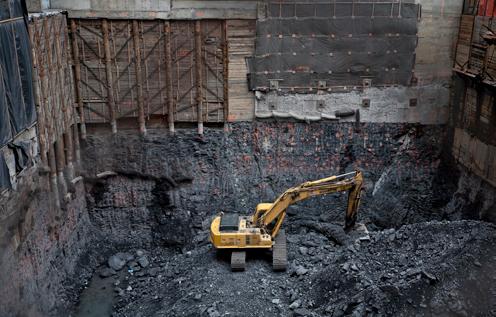
“In all the places that are unpaved, one’s foot goes down up to the ankle, and sand has turned the outskirts of the city into a desert ... I do not know who had the idea to put a city in the midst of all this sand.”1 Bedrock is an urban unconscious—a subterranean nature hidden except in moments of disruption. A foundation is poured, cables laid, pipes replaced. Stone is broken, earth unearthed, subsoil exposed. Or a park preserves the memory of a lost wilderness. A rocky outcrop in a public garden is like an animal in a cage.
1 Eyewitness accounts of Napoleon's entry into Berlin - napoleon.org. https://www.napoleon.org/ en/history-of-the-two-empires/articles/eyewitness-accounts-of-napoleons-entry-into-berlin/
Terroir (New York, Milan, Berlin, Hong Kong), 2015, powdered stone, binder, linen, geological samples, 70 x 19 inches each
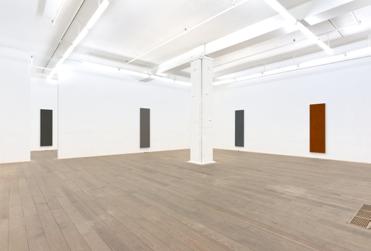
Veslemøy Lilleengen
Hikaru Dorodango is a traditional Japanese craft that involves shaping soil into shiny spheres using only your hands and an egg cup. It is said to have been developed 1300 years ago as an exercise for craftsmen. It has since become an important tool for research on children’s play and is well known to any kindergarten teacher in Japan. I come from a long line of farmers and woodsmen; I know how to move my feet in a newly ploughed field. As in many farms, our kitchen table was the centre of everything, made of oak, solid enough to dance on, and grieved by. I have no religion, but I believe in the power of gathering around a table. I have always known where I belong, but after living most of my adult life in a city, I found myself waking up in the middle of the night with a horrifying feeling that I no longer know how to plough. I began filling my studio with soil from our farm, with no intention of growing anything; I simply wanted to reconnect by using soil as a material. Gradually, I started to notice the soil around me in the city. Whenever there was an excavator dig ging, I stood there like a child looking into the hole. I was amazed by
the colours and the different qualities, the traces we have left–our use and misuse. It's all there in the layers of soil. I experimented, made paint, wrote, smelled, read. One day, I stumbled upon a YouTube video about Hikaru Dorodango, and the following month I made 52 shiny spheres of soil from our farm. Grunntanker / Grounded Thoughts is an installation featuring all the tools necessary to create Dorodango, accompanied by a series of gatherings around a table. Participants bring soil from a place that has meaning to them. Together we make Hikaru Dorodango. The slow and meditative process of Hikaru Dorodango creates a space for connecting to the material and to the place it has been gathered, but equally important is the connection between the people that develops through the conversation around the table.
Grunntanker/grounded thoughts, 2021–ongoing, dorodango ball making workshop: soil, water, sieves, egg cups and various containers, dimensions variable
Grunntanker/grounded thoughts, 2021–ongoing), soil, sift, egg cup, water, various containers, dimensions variable
Moira Bateman
Waterways are my primary collaborators as I welcome chance and the action of the elements to shape my work. Early work in landscape ecology and the reclamation of native plant communities has fueled my creative practice in natural ecosystems. My work is grounded in the land and abundant waterways throughout the State of Minnesota, home to the ancestral lands of the Dakota and Anishinaabe people. The Dakota name for the region is Mni Sóta Makoce, which translates to “the land where the waters reflect the skies”. The prairies, savannas, forests, wetlands, rivers, lakes, and bogs—along with the soils that energize them are the places of my lifelong home. I often use a form of fermented mineral mud dye to create cloth in deep colors that approach black, featuring irregular patterns and natural deterioration, with threadbare textures and wrinkle patterns. The technique combines naturally occurring plant tannins, mineral-rich mud, and microorganisms that dye the cloth. Organic matter feeds the microor-
ganisms living in the mud, converting iron into ferrous sulfate, which dyes and further deteriorates the fabric. Patching, waxing, stitching, and assembling these pieces further are meditative processes for me, meant as healing gestures that respond to the marks, wrinkles, and deterioration made by the waterway and mud. Recent work draws from a 2024 residency in Ålvik, Norway, along the Hardangerfjord and features the fjord’s currents and tides, microalgae, and remnants of a fisheries industry woven plastic “big bag” I recovered from the water. Eroded, shedding microplastics, brittle and degraded, with sand-embedded wrinkles, and spotted with algae, this “big bag” became a poignant parallel to my process of leaving natural, organic cloth in waterways to stain and degrade naturally over time. Like the absorbent cloth, we too are porous and become “of the” places we inhabit over time–through the water we drink, the air we breathe, the vegetables we grow and consume, and the overall energy we absorb.
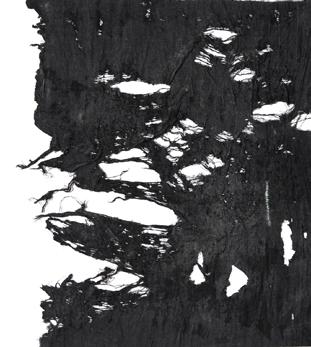
Marion Belanger
The Underneath is an ongoing installation made in collaboration with Martha Lewis, initially commissioned by Artspace New Haven in 2018, while in residence at the Connecticut Agricultural Experiment Station. The shape of the installation varies, utilizing recontextualized archival records of scientific root and soil studies, as well as entomological and plant pathology documentation drawn from the library and archives of the agricultural station. These, and additional photographs made of contemporary root studies, are hung as wallpaper to create a “soil room” where the viewer is surrounded by roots, soil, hands, and insects. A video of worms in compost is projected onto a screen and beyond. Glass containers filled with compost fill the air with an earthy scent, and historic definitions of roots and soil are projected within the darkened room. Liminal spaces and shifting boundaries have long been the subject of my work. I look for traces and evidence of use upon the land: geological phenomena (tectonic plate edges), mun-
dane built environments (cul-desacs), and fragile ecosystems (drained swamplands). Recently, in response to both anthropogenic disruption and the experience of living with a blind child, my working process has come to include photographic manipulation, repetition, double exposure, and applied color fields; abstracted patterns suggest scientific recordings (weather, earthquakes, climate records, medical monitors); hands touching surfaces (moss, earth) or tying/reading braille. I utilize images, sound, and re-contextualized archive documents to create multi-layered conversations that embrace fragility and beauty, discovery and disorientation. I have lived in Guilford, Connecticut, for almost three decades. It is still characterized as a rural/agricultural area, but to me, it has become more and more suburban. The soil here is acidic and rocky. Glacial erratics are plentiful. I take great joy in creating a more friable soil through the composting of leaves, seaweed, and kitchen scraps, and the presence of worms and mycelium in the soil is what I strive for. I grew up in a river valley community, not so far away, that was made toxic through manufacturing. That fact has created a fierce determination within me to nurture and care for the ground upon which we live.
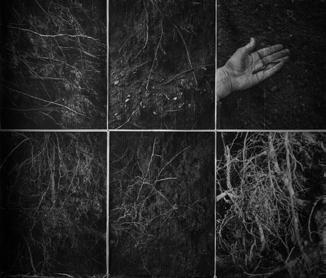
Liz Miller Kovacs
My long-term project Supernatural, ponders, “What will future cultures think of the scarred earth we leave behind?” The series is captured entirely on location in landscapes surrounding extractive industries. In the photographs, I envision future archaeological discoveries and the possible mythologies that could emerge about us if ours becomes a lost civilization. The high concentrations of minerals and acidity buildup from these industries create otherworldly visual forms and chemical elements. I highlight these striking visuals in my photos to inspire inquiry into the scope of extractivism. Witnessing and documenting these sites firsthand helps me confront my anxiety about a possible future in which the environment becomes uninhabitable. A key aspect of my practice is capturing the sublime
from a female perspective–drawing parallels between environmental exploitation and the objectification of the feminine. I stage self-portraits within these environments, wrapped in self-designed fabric costumes, transforming my body into a female-coded object. Rather than delve into my personal identity, I evoke mythological femininity as seen in ancient art—Venuses, effigies, and fertility figures unearthed in archaeological sites.
What does it mean to care for soil? First, it is important to contemplate what care is in the first place, and how care in conventional contexts (e.g. of one’s body, family, or community members) can be extended to care of more-than-human others. In the introduction to Matters of Care–Speculative Ethics in More than Human Worlds, Maria Puig de la Bellacasa asks: “What is care? Is it an affection? A moral obligation? Work? A burden? A joy? Something we can learn or practice? Something we just do?”¹ These questions address a larger transdisciplinary discourse on care, which has emerged as a key paradigm of this century, alongside the eco-social poly-crises of the Anthropocene that care practices are meant to counter. Among other things, care has been framed as an antidote to “carelessness” (Care Collective), a form of labor (Puig de la Bellacasa), a philosophy of ethics (Joan Tronto) a matter of justice (Gilligan), or a form of political engagement (Lorde; Ahmed).² Sharing the same etymological root–curare–care is furthermore at the heart of curatorial practice. These include the care of how a work of art is conceived and created in ethical, non-wasteful, and non-harmful ways, to how it is documented, archived, recycled, exhibited, performed, published, or otherwise shared with the world.
In soil scientific circles, care is often framed in terms of soil health, or “the continued capacity of soil to function as a vital living ecosystem that sustains plants, animals and humans, and connects agricultural and soil science to policy, stakeholder needs and sustainable supply-chain management” (Lehmann et al., 2020).³ Many books and journal articles have focused on the various aspects of how soil health can be measured, communicated, taught, and implemented into land use policy and various land use practices. The works presented here contribute to both debates on care in the social sciences and humanities and conceptual developments of soil health in the earth sciences. They recognize that “both the concept and the practices of care are established as immediately entangled with intersectional relations of power both within and between communities and across social, natural, and technological environments.”⁴ The works in this section are furthermore part of a longer history of soil care practices in the arts. They continue a legacy of early socially-engaged ecoartworks, such as Bonnie Ora-Sherk’s “life-scale environmental and social artwork” in the form of a community Farm (1974) near a freeway in California, or Agnes Denes' iconic planting of a Wheatfield (1982) in New York City as a form of protest against world hunger. Many of the artists presented in this volume could be said to provide concrete answers to Puig de la Bellacasa’s questions regarding care in the form of singular and collective art projects and practices. Regarding soils, a “practice-oriented view of care,” writes Anna Krzywoszynska, “seeks to push thinking about care beyond the primary focus on individual sentiment or emotion, and encourage the recognition that care is also a practice, a series of activities.”⁵ The works included here span a range of practices that include healing, grieving, marriage, and burial rituals (Marina 'heron' Tsaplina, Violet Bond, Katie Taylor, Tim Andreae, Blair Butterfield, Mary Swander); monuments and memorials that give attention to human and more-than-human ancestries (Maru Garcia, Luc Biscan-White, Allie Horick, Mark Brest van Kempen, Myka Baum, Valerie Constantino, Kate Foster), hidden or oppressed heritages and neglected things; acts of individual and collective mysticism and witchcraft (Cassandra Tytler, Priscilla Stadler, Barbara Brown); durational and relational restoration projects that offer mindfulness-based ways of being in (damaged) soil ecosystems (Christine Mackey, Susana Soares Pinto, Ruth Wallen, Deanna Pindell, Beth Shepherd, Sarah Misselbrook, Evgenia Emets). Key words that came up in artists’ statements about
Alexandra R. Toland
their works included things like reciprocity, reclaiming, decolonizing, belonging, resilience, responsibility, medicine, meditation, and transformation. They promote spiritual practices of “honoring ancestral cosmologies” (Delcy Morales), “giving and receiving pleasure” (Annie Sprinkle and Beth Stephens), “ritual and reclamation” (Ashanti Chaplin), “treading lightly” (Chrissie Orr), as well as material practices of “biochar and low-intensity fires” (Donna Cooper), “cleaning, removing, sorting” (Jill Price), “challenging citywide laws” (Mary Mattingly), and “crafting by ‘working with’ more than ‘doing to’ materials” (Pattie Beerens). In these ways, soil artworks (re)present a range of caring and careful practices that grant an affective, emotional, and perhaps even spiritual dimension to the debates on care mentioned above.
1 María Puig de la Bellacasa, Matters of Care: Speculative Ethics in More than Human Worlds (Minneapolis: University of Minnesota Press, 2017), 45.
2 The Care Collective, The Care Manifesto: The Politics of Interdependence (London: Verso, 2020); María Puig de la Bellacasa, Matters of Care: Speculative Ethics in More than Human Worlds (Minneapolis: University of Minnesota Press, 2017); Joan C. Tronto, Moral Boundaries: A Political Argument for an Ethic of Care (New York: Routledge, 1993); Carol Gilligan, In a Different Voice: Psychological Theory and Women’s Development (Cambridge, MA: Harvard University Press, 1982); Audre Lorde, A Burst of Light: Essays (Ithaca, NY: Firebrand Books, 1988); Sara Ahmed, Living a Feminist Life (Durham, NC: Duke University Press, 2017).
3 Johannes Lehmann, Deborah A. Bossio, Ingrid Kögel-Knabner, and Matthias C. Rillig, “The Concept and Future Prospects of Soil Health,” Nature Reviews Earth & Environment 1, no. 10 (2020): 544–53
4 Iris van der Tuin and Nanna Verhoeff, Critical Concepts for the Creative Humanities (Lanham, MD: Rowman & Littlefield, 2022), 41.
5 Anna Krzywoszynska, “Taking Soil Care Seriously: A Proposition,” in Cultural Understanding of Soils, ed. Nikolaus Patzel, Stephan Grunwald, Eric C. Brevik, and Christian Feller (Cham: Springer, 2023), 395.
Alexandra R. Toland
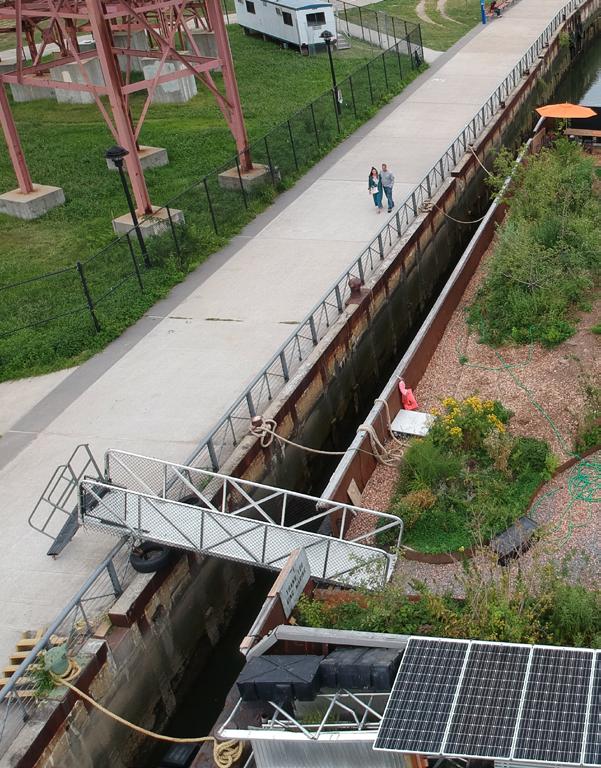
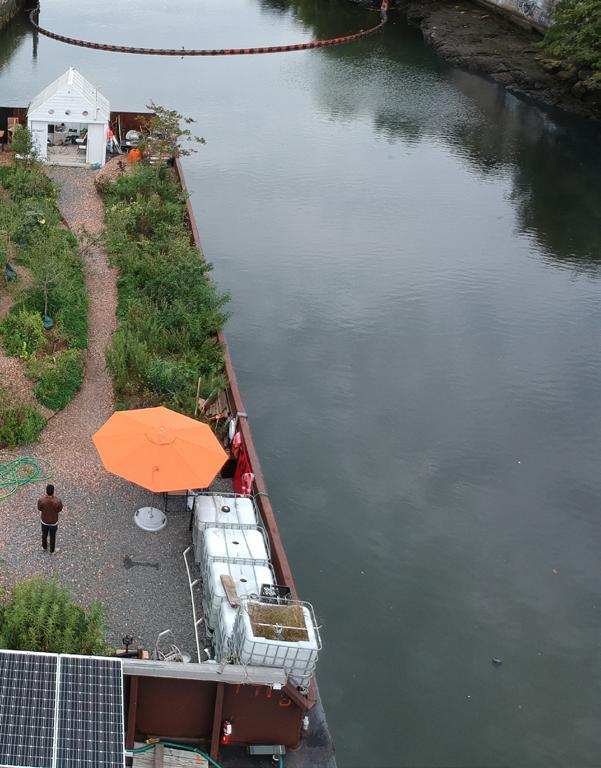
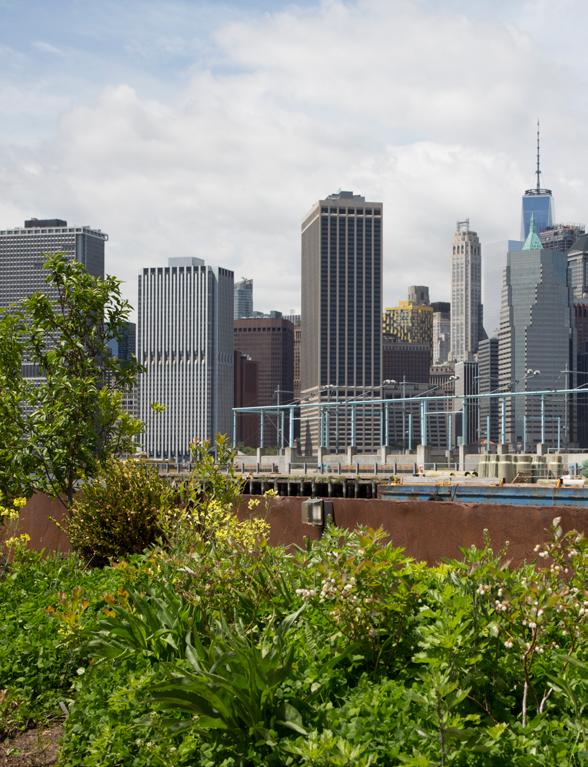
Swale was a floating food forest and edible public park built on a barge. It traveled New York City’s waterways challenging citywide laws about foraging on public land, promoting food access, and public space. At its core was living soil. Its health determined what could grow and whether communities could thrive around it. This soil was made from NYC’s composted food waste, and was watered by rain and filtered river water. It was not treated with chemicals because it didn’t need to support monocultures; it rejected extractive practices and supported attention, and regeneration.
Swale was a place for embodied inquiry. People arrived skeptical, returned with neighbors and questions. They shared stories about plants while harvesting arugula and basil, and talked about what would be possible if our public lands were available for stewarding and growing.
In this way, the soil’s invisible labor became a teacher, teaching us to model coexistence in a large, busy city. It taught through slowness, decomposition, and breath. It also probably witnessed our grief: for lost land, for displacement, and severed food systems. Sitting with soil felt like sitting with time.
Swale asked a simple but radical question: What if fresh food was public? Since then, NYC Parks built its first 24-hour public foodway, and we’ve begun developing a new, more permanent version of Swale. This next chapter carries forward food sovereignty, public stewardship, and ecological kinship. Swale was both an act of resistance and a shared offering inviting more people to imagine what else public space can nourish.
Swale was founded in 2015 by Mary Mattingly, through a grant from A Blade of Grass and Kickstarter campaign. The barge launched in 2016. In the summer of 2016, Swale began at Concrete Plant Park in the South Bronx, one of the largest food deserts in the United States. Food deserts are a reality in many communities; as many as three million New Yorkers live in communities with limited access to places where they can access fresh produce. In addition to the 100 acres of community garden spaces in NYC, Swale began as an idea to advocate for food to be grown on some of the 30,000 acres of public land in the city through stewardship initiatives led by community partners in the South Bronx.
Since 2016, Swale has hosted 347,000 visitors, over 940 guided tours, 92 school field trips, 50 free public programs and 68 Summer Youth Employees.
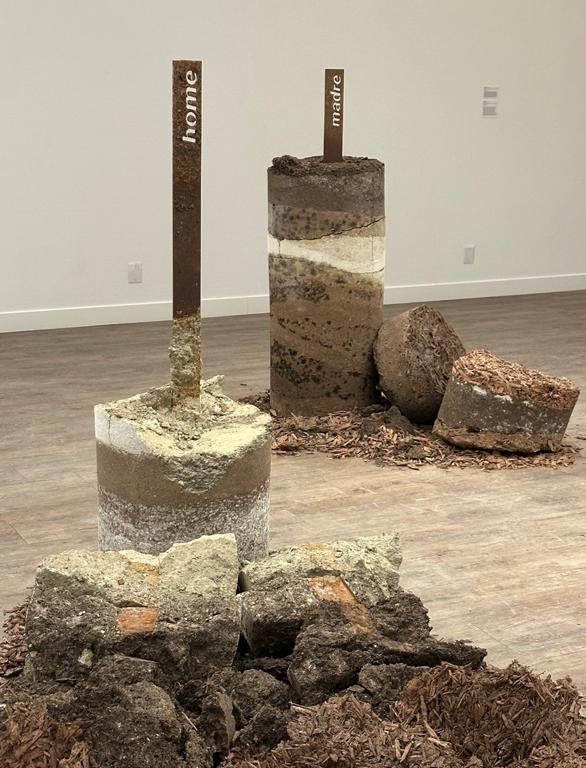
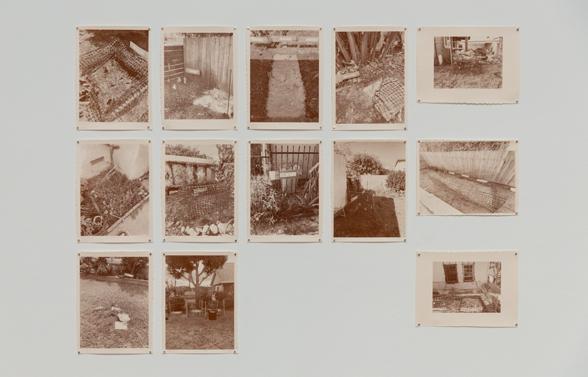
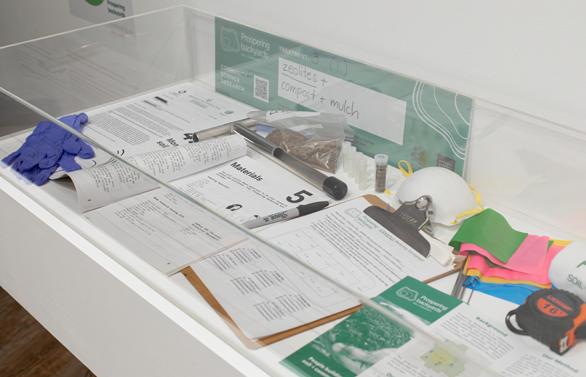
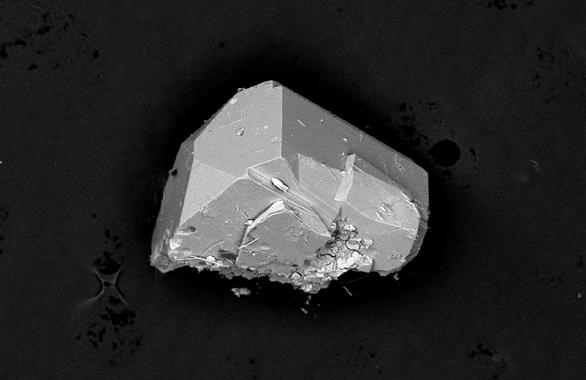
I am a Mexican, LA-based artist/chemist working across art + science + environment. My use of media encompasses research, installations, performance, sculpture, and video. My areas of interest are biosystems, multispecies relations, and the capacity of living organisms (including humans) to act as remediators in contaminated sites.
One of my most recent projects is Prospering backyards (Pb), a community science research project in neighborhoods in South East Los Angeles, where there has been a high level of lead contamination caused by a battery smelter. This project involved organizations like Self Help Graphics and Art, the Natural History Museum of Los Angeles County, community scientists, artists, activists, and scientists working together to develop an alternative method for reducing lead exposure in yards while considering the health of the soil and the environment.
For this project, we began by offering free bilingual workshops on soil health, called Soil Time!, to help establish our community around soil, and provided free soil testing for individuals concerned about their soil's health. We received more than fifty testing requests, and with a group of volunteers, we collected the samples and analyzed them at the Mineralogy Department at the Natural History Museum. Based on the results, we invited 13 community members to participate with us as Community Scientists after they received training and materials. We installed testing sites in the community scientists’ backyards, where we used natural materials that could change lead chemical form and toxicity (bioavailability). We took samples over the course of a year and observed how the treatments worked. We found that zeolites (a type of mineral used as an amendment for water retention) can also help reduce lead exposure by encapsulating lead, making it less bioavailable. All our processes and learning experiences were collected in a report accessible at the Pb website prosperingbackyards.com .
I was able to translate our journey into a series of artworks called Boiling Rocks, a name derived from the origins of the mineral zeolite (Zeo “boiling,” lithos “stone”).
Boiling Rocks 1 is a series of mosaics featuring compressed pellets made of contaminated soil collected by community scientists in their own yards. The inspiration for this piece comes from the lead analysis method developed at the NHMLA laboratory, where soil samples were pulverized and compressed in pellets for use in an X-ray Fluorescence (XRF) Spectrometer.
Boiling Rocks 3 is a series of sculptures designed to remediate the soil in the process of disintegration. They are based on the core sampling process and the materials used in Pb for remediation. Soil amendments are compressed into a cylinder structure supported by a steel pole at its center. Each pole features a laser-cut word that reveals the meaning of soil to participants in Soil Time! Workshops: Madre, Alive, and Home.
Boiling Rocks 4 is a collection of prints showing the testing sites at Community Scientists’ yards. I consider these structures to be collaborative site-specific installations. Boiling Rocks 4 also includes various elements from scientific research, such as working books, Pb uniforms, and sampling instruments.
Collaborators include, Marvella Muro and team from Self Help Graphics & Art, Dr. Aaron Celestian and Community Science team from the Natural History Museum of Los Angeles County, Dr. Maura Palacios, Mt San Antonio College, Dr. Jeffrey Cole, Pasadena City College, Dr. Levi Simons, UC Santa Cruz, community scientists, Pb team, and volunteers.
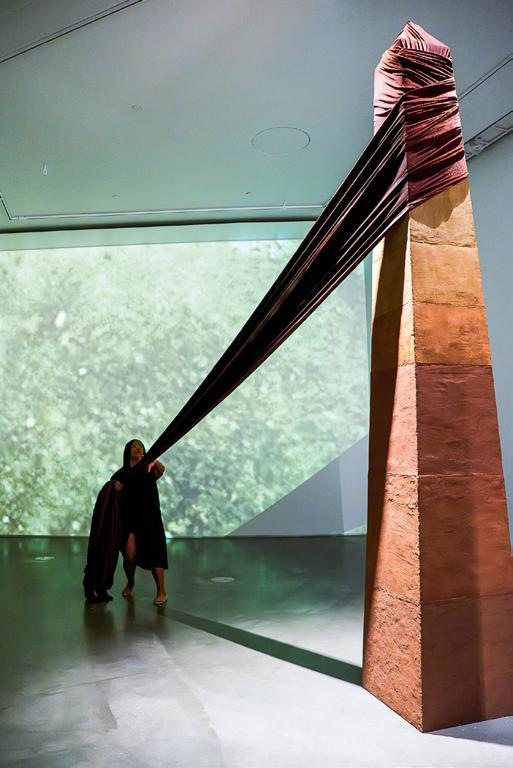
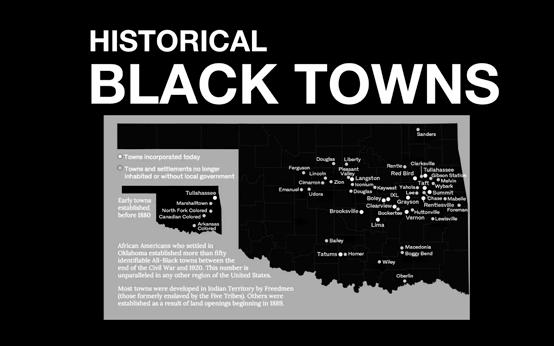
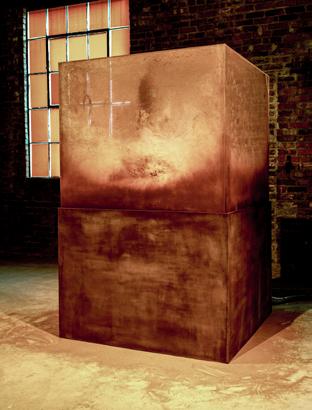
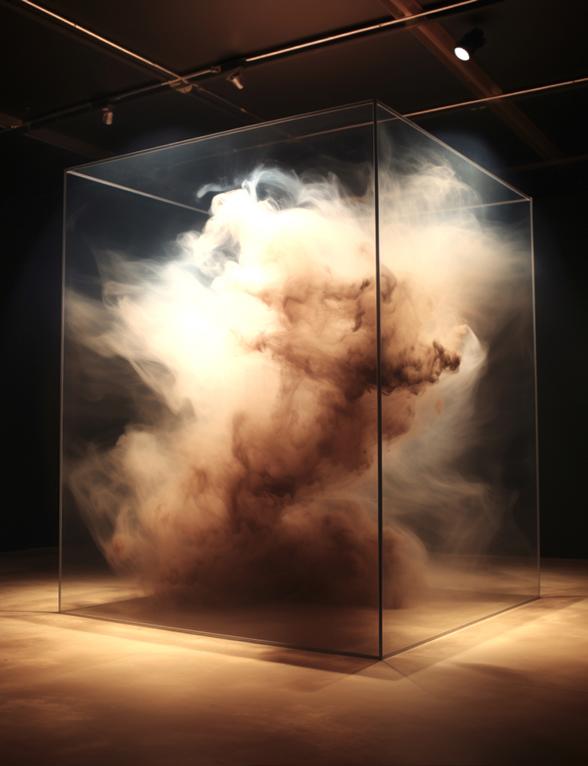
As a child, I claimed the wind as my friend, a companion who whispered stories of places I could not yet fathom but believed existed without a doubt. Now, I revere soil, clay, and dust as ancestors, guides, and kin. The land speaks, and I listen for wisdom in the particulate and truth in the terrestrial. I know that worlds live within each grain of sand and that fallen empires return as dust. What once felt like mystery in the breeze has become a presence in the ground, a living archive alive with spirit.
My practice is rooted in ritual and sustained through my curiosity about how ancestral knowledge fertilizes terrestrial matter. Earth Elegy was realized by collecting clay from Oklahoma’s thirteen remaining historically Black towns. I chose the obelisk as the clay's form as a nod to ancient civilizations that used the structure to tell stories of place. The work was activated through a performance and sonic score, Dust to Dirge—utterances, moans, and melodies that translated what was heard, felt, and captured at the thirteen sites. The act of gathering was as vital as the form itself—an embodied ritual of reverence for communities whose legacies of resilience and self-determination run deep. This is not monumentality for monument’s sake, but a practice of remembrance that resists erasure and insists on the permanence of presence. Hidden Gospels of Dust deepened my inquiries, treating dust as sacred material and collective memory rather than residue. The work animated dust suspended in light and smoke inside sculptural enclosures. Take Me to the Altar, a performance and sonic score, activated the installation with sound drawn from jazz, blues, and gospel. Here, dust becomes gospel and altar, both testimony and testament: a medium of revelation that renders the unseen tangible. The work asks who and what lingers as well as who and what is buried. For me, dust is not what remains after life departs; it is what persists, carrying its own narrative forward. The AI-generated Dust Devil visualizes my fascination with dust as a tool of divination. Reminiscent of a
crystal ball, the dust devil appears as a contained vortex, at once oracle, antagonist, bearer of knowledge, and destroyer of naiveté, a phenomenon where chaos and clarity converge. These works suggest that matter itself can speak in riddles, offering revelation while also issuing warnings. Each work is a threshold where atmosphere becomes form, matter becomes memory, and the sacred emerges from within the soil.
I am a multifaceted conceptual artist. Ritual, reclamation, power, and transformation are the thematic compass points that anchor my approach, which intersects social, spatial, and material practices. I aim to create new models of embodied cultural equity, fostering world-building across media, disciplines, and audiences.
I explore the omnipresence and profundity of terrestrial matter such as soil, clay, and dust—mundane yet mystically significant substances that bear silent witness to the cycles of life, death, deep time, and the cosmos.
I care for the soil of Oklahoma’s 13 historical Black towns—Boley, Brooksville, Clearview, Grayson, Langston, Lima, Red Bird, Rentiesville, Summit, Taft, Tatums, Tullahassee, and Vernon. This soil holds the stories and legacies of these communities, serving as a repository of their cultural memory and historical significance.
I call the soil from these towns kin, as it connects me to my heritage and ancestors. This soil is more than just earth; it is a part of my identity and a testament to the resilience and history of my people.
Soil, to me, is a canvas of human experience and natural history. It is a living archive, recording the passage of time and the footprints of countless lives. Each grain is a vessel of memory, holding stories of growth, decay, struggle, and resilience. Through my art, I aim to reveal the soil’s role as an active participant in the narrative of our existence, transforming it from mere dirt to a dynamic testament of life’s journey. Soil is where we come from and where we return, a profound reminder of our continuous dance with the earth and the cosmos.
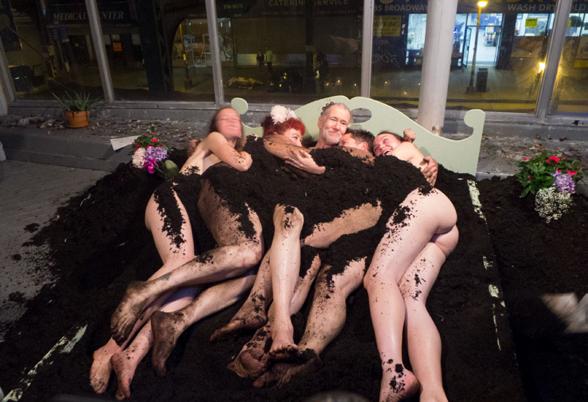
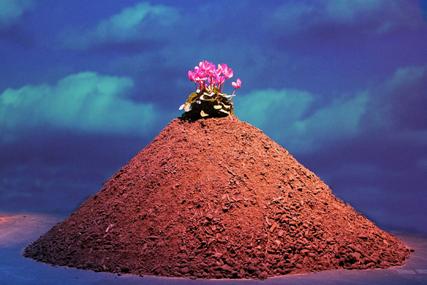
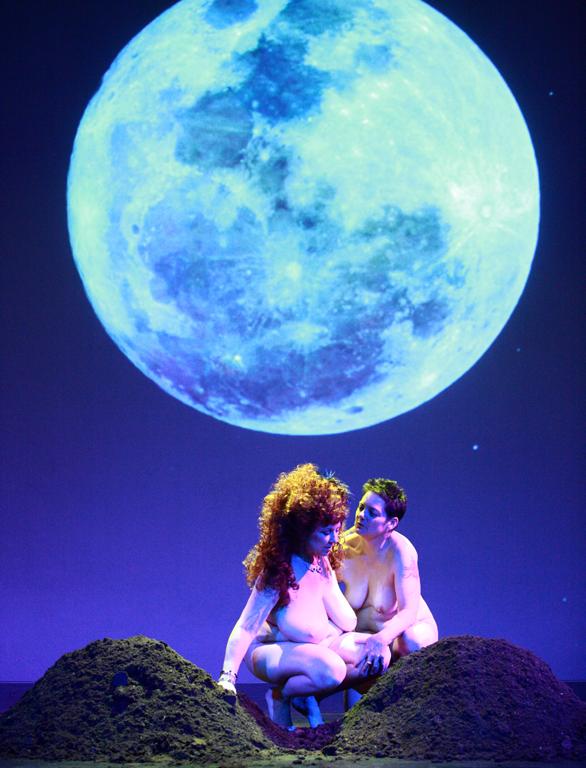
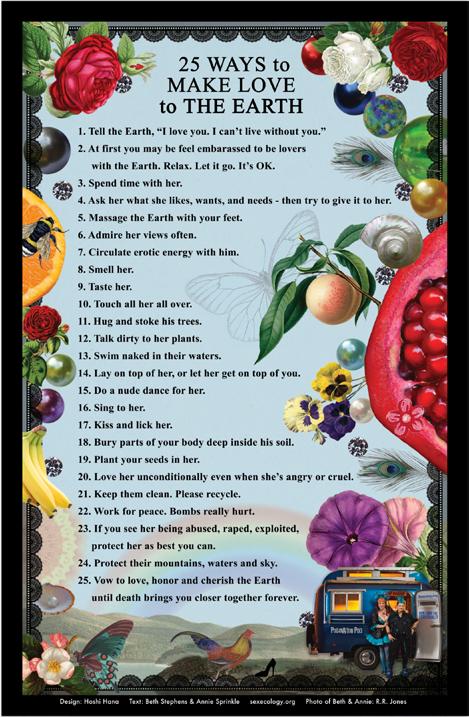
As ecosexuals, we imagine the Earth as our partner, and a sensual lover whom we enjoy giving and receiving pleasure with. Soil is the skin of our lover, and we like to be intimate with it and get down and dirty. Soil smells divine. Especially when it’s a rich, loamy, dark black. Or a dark red clay. It tastes fecund. We like to lie in beds of soil, get naked, and roll around in the dirt, as a performance art ritual. We like that healthy soil is teeming with life. When soil is dead, it makes us sad. As we walk, we balance on the backs of billions of creatures and imagine that we are massaging the Earth with our feet, even as we are probably killing billions of the little creatures. Soil is a delightful collaborator—in art, in life, and in death. We love soil, and with all it give us. It must love us too.
We have collaboratively created multi-media art projects about love, sex, and queer ecologies together since 2002. Annie was a sex worker from 1973 to 1995 and morphed into a feminist performance artist and sex educator. In 1994, Beth became a professor of sculpture and intermedia at the University of California, Santa Cruz, where she still teaches and directs the E.A.R.T.H. Lab. These days, we make environmental films with an ecosexual gaze; we also create theater, performance art, eco-activism, and produce symposiums and workshops. Our Wedding To The Earth and the Ecosex Manifesto launched the Ecosex movement in 2008. We were official dOCUMENTA (14) artists, received a 2019 Eureka Fellowship, and a 2021 Guggenheim Fellowship. Our new book, Assuming the Ecosexual Position—the Earth as Lover, available at the University of Minnesota Press, chronicles our epic love story and art/life adventures. Soil-related works include Dirt Bed, 2012, performed at Grace Exhibition Space in Brooklyn, New York, and again at Emmetrop, Bourges, France, which turned into a Louis XIV soil bed ecosex show. Also, our work Wedding To The Soil, 2014, which includes a spoken-word piece called DIRT, performed at the multimedia arts festival Donaufest in Krems, Austria. In The Dirt, 2018, we ’played around’ in 18 tons of soil that filled the Vortex Theatre in Austin, Texas.
Stephens
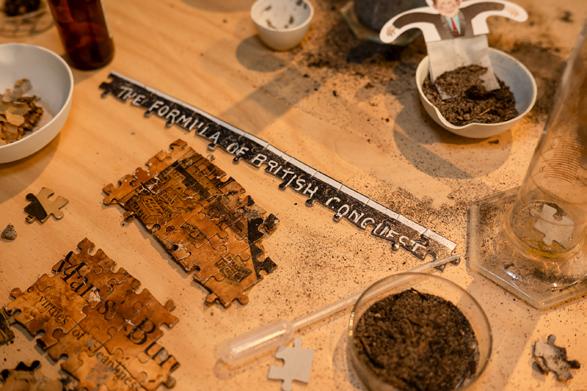
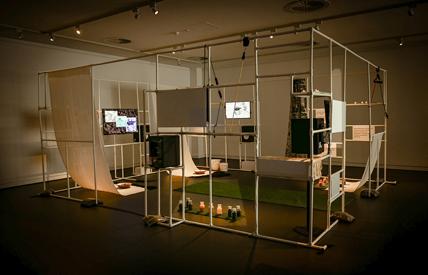
Cassandra Tytler, A Journey Forward, 2024, soil (Whadjuk Noongar boodja), puzzle pieces, tea bags, scientific ephemera (test tubes, scales, microscope, soil sieves), dimensions variable
It Will Not Be Pure, 2024, soil (Whadjuk Noongar boodja), PVC Piping, Astro Turf, Speakers, TV monitors, jars with soup, bowls, shower curtain, exercise straps, cotton, tea lights, coreflute, plastic buckets, dimensions variable
In Solidarity I Eat Dirt!, 2024, bentonite clay, water, salt, baking powder, white sugar, powdered sugar, dimensions variable
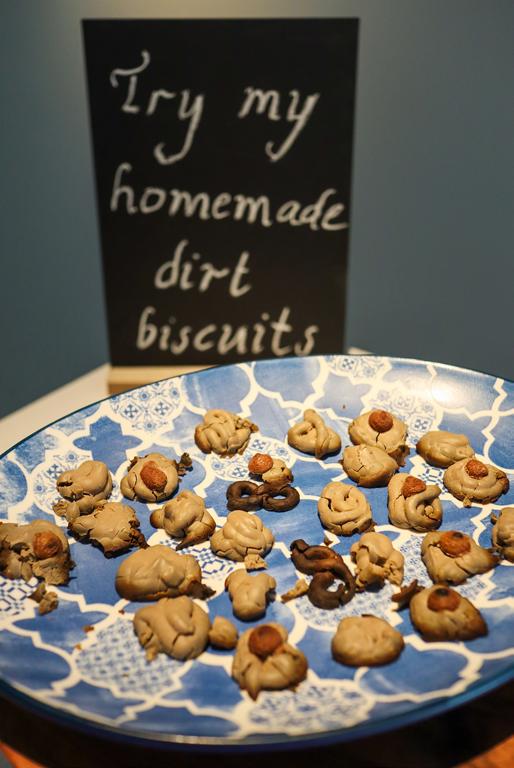
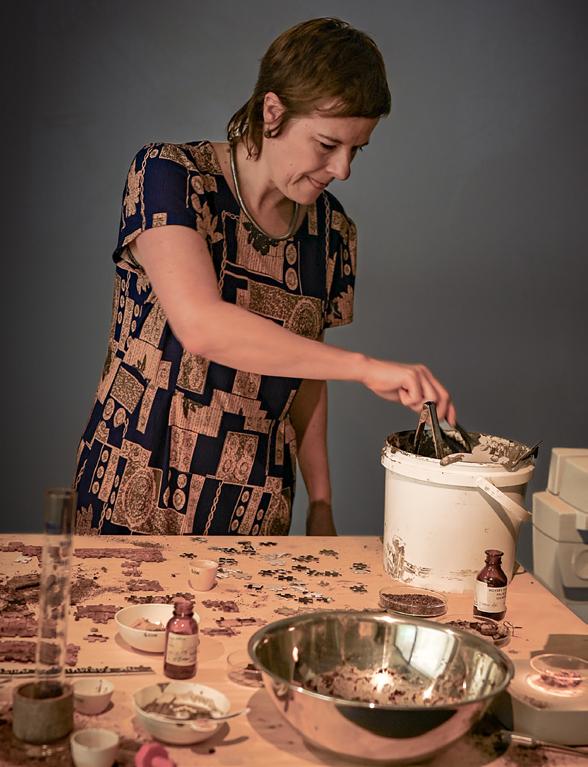
I am an artist specialising in single-channel video, performance, video installation, and site-specific practice. I am particularly fascinated by using digital media to create embodied encounters within sites as participatory actions. My intention is to amplify stories that inspire climate-informed action, empathy, and inclusion. I aim to evoke a sense of the ’more-than-individual’ in a compelling way, fostering understanding of the interconnections between the environment and all people. My work centres on race, gender, colonisation, and class concerns within climate care discussions. It is an ongoing examination of the mechanics of video performance, both onscreen and through the hands of the video artist.
Through this exhibition, I have explored what soil means to me, where each artwork functions as a ’soil act’ by expressing a different interpretation of the complex interrelationships between humans, soil, and dirt. It examines how social narratives of what is soiled and what is pure reinforce hierarchies of race, gender, and society. In this tapestry of soil relations, an evolving narrative is created, where time, place, politics, and bodies intertwine with the substance of the ground. Soiled in this sense communicates my ’soil statement’. It takes a critical approach to an essentialist idea of ’nature’ that is disconnected and divided from humans. It challenges externalising classification practices alongside the human/non-human binary. Instead of viewing the environment as a resource for extracting life and capital from, the artworks in Soiled seek to expand the idea of soil and dirt as part of an ecology of being. There is a consistent theme that runs through each artwork.
The video installation, It Will Not Be Pure, shows a world where there is no soil left to grow food. Small ’gated’ communities exist that are rich in soil, but only the privileged few can live there. The small community ’beyond the wall’ has rejected purity systems of categorisation and segregation and eats dirt biscuits. They exclaim, “In solidarity, we eat dirt”.
In Solidarity We Eat Dirt takes its title from this rallying cry. In the gallery sits a plate of dirt biscuits that gallery-goers can eat. The recipe is a mixture of sugar, water, and bentonite clay, the same recipe made in It Will Not Be Pure.
A Journey Forward is an interactive table with scientific equipment, local soils, colonialist puzzles, advertising soap, and royal family tea bags. Visitors interact with this material and feed the puzzle pieces back to the soil.
These works were featured in a solo exhibition titled Soiled, at Gallery25, Edith Cowan University, Boorloo/Perth, Western Australia in 2024.
1 Cecilia Vicuña and Delcy Morelos, “Weaving Words: A Conversation,” in: Kamilah N. Foreman, Alexis Lowry & Zuna Maza (eds), Delcy Morelos, exh. cat. Dia Art Foundation, New York (self-publishing, 2024), p. 80.
2 Alexis Lowry, “Touching the Earth,” in: Foreman, Lowry & Maza, pp. 16–20; Michael Kurtz, “The Soil Confronts the Harvest,” in: CAAC Seville, Delcy Morelos. Profundis, exh. cat. CAAC, Seville (self-publishing, 2025), p. 17.
3 Julienne Lorz, “The Case of Munich, 1968–1972,” in: Philipp Kaiser & Miwon Kwon (eds), Ends of the Earth. Land Art to 1974, exh. cat. The Museum of Contemporary Art Los Angeles & Haus der Kunst Munich, Munich/London/New York (Prestel, 2012), p. 163.
4 Zuna Maza, “Selected Earth Works, 2012–2023,” in: Foreman, Lowry & Maza, p. 106.
5 Julián Sánchez González, “Delcy Morelos: Working with Soil to Free the Soul,” https://www.moma. org/magazine/articles/900, MOMA Magazine, 25 May, 2023, last accessed 26 May, 2025.
6 Kristina M. Lyons, Vital Decompositions: Soil Practitioners & Life Politics, Durham & London (Duke University Press, 2020), pp. 2–3, 11–14, 129–130.
7 Ibid., p. 83.
8 Sánchez González.
9 Jimena Blázquez, “The Cosmic Dance to the Rhythm of the Abysses of the Soul,” in: CAAC Seville, p. 11.
10 For Pachamama, see: Vicenta Mamani-Bernabé, “Spirituality and the Pachamama in the Andean Aymara Worldview,” in: Ricardo Rozzi et alii (eds), Earth Stewardship: Linking Ecology and Ethics in Theory and Practice, Cham et alii (Springer, 2015), pp. 65–66.
Soil is the essence of the artistic practice of Delcy Morelos (b. 1967, Tierralta, Colombia), which has received significant international acclaim following her monumental installation Earthly Paradise (Fig. 1) at the 2022 Venice Biennale. The labyrinthine structure is constructed from scented soil, smelling of cinnamon and cloves, and can be entered by visitors. To walk into Earthly Paradise is to immerse oneself physically in the earth—the very element from which all life emerges and to which it ultimately returns.
As scholar Jane Caputi writes, soil functions simultaneously as a womb and a tomb. Seeds germinate within the earth; humans and “more-than-human” beings—such as flowers and flies—live upon it; and when we die, we are buried in soil, where we ferment, and, through becoming compost, provide fertile ground for new lives, creating an eternal cycle of transformation. Morelos describes soil as “the matrix that all life-forms are woven into,”¹ and her works remind us of the urgent need to care for and with soil.
Her practice has been linked to the Land Art movement that emerged in the 1960s, when mostly male artists began incorporating natural materials into their art.² An example is Walter De Maria’s The New York Earth Room (1977), a gallery filled with earth at the Dia Art Foundation in New York. There, Morelos engaged with this work through El abrazo [The Embrace] (2023) (Fig. 2), featuring a vast, earthen monolith that appears to levitate above the ground. Its craggy soil walls are adorned with stubbly bits of hay, extending nearly to the ceiling. As in Earthly Paradise, spectators are invited to step into the earth, which is again infused with aromatic spices. However, Morelos’s approach diverges from that of De Maria. For her, earth is far more than dirt.³ Rather than merely placing soil in a room, she creates multi-sensory constructions that embody her deep commitment to the material.
Such care for soil is rare in today’s time of the Anthropocene, the era dominated by humans, who exploit the earth by different means. Interventions, like deforestation, mining, or intensive tillage, lead to environmental disasters, including landslides, floods, and the loss of habitable land. In Colombia, the construction of a dam in 2000 caused the Sinú River to become heavily polluted, alternately drying up and flooding. This destroyed the livelihood of the Indigenous Emberá Katío people, who regard the river—once a vital source of life—as a mother. Morelos’s 2014 installation No es un río, es una madre [It’s not a River, it’s a Mother] (Fig. 3) mourns the loss of the river. Thin, elongated shapes made of fique fabric impregnated with red earth and tobacco leaves evoke a flowing stream but replace the water and therefore allude to both the environmental grief and the emotional pain experienced by those who once lived with the Sinú River.⁴
For Morelos, the color red symbolizes blood and violence—particularly in the context of Colombia’s armed conflicts. The so-called “war on drugs” led to struggles over land ownership and often forced people to sell the very soil they lived on to powerful landlords.⁵ In the course of this conflict, fields were air-sprayed with the chemical glyphosate, which killed narcotic plants like coca but also harmed other crops and left the soil infertile, making food cultivation impossible. This environmental damage displaced rural Indigenous families from fertile lands, pushing them into remote areas with less fruitful soils.⁶ These communities believe the earth remembers the tragedies it has endured. Thus, the soil itself can be seen as a wounded victim of the war.⁷ The impact that violence has on earth shaped Morelos’s relationship with the material. Her first work with soil, Eva (2010/13) (Fig. 4), marks her transition from painting—where she often employed hues of red—to installation, as also the earth in Eva, which is applied onto canvases and other surfaces that are displayed on walls, is red due to its high iron content.
Iron is, as Morelos points out, “the same element that makes the blood that runs through our veins red,”⁸ therefore directly linking the soil of Eva to the body. Also, Andean ancestral cosmologies, which Morelos often references, consider humans to be “living earth,”⁹ because it is understood that we emerge from soil that is seen as a womb that generates life—and therefore as feminine. The title Eva nods to the biblical first woman and mother, underscoring this maternal notion.
In Andean regions it is believed that humans are nourished by Pachamama (pacha = universe, mama = earth), who is not only a divinity of the earth but also a living and conscious entity. Pachamama is fertile; she gives the grass and vegetables of the fields, but she also demands reciprocation for her generosity. Offerings, such as fruits, seeds, and coca leaves, are returned to her by being placed into or directly onto the soil as a gesture of gratitude.¹⁰
Morelos’s practice echoes this cycle of giving and taking, as she typically returns the earth she uses to its place of origin after exhibitions conclude. A further con-
Agnes Rameder
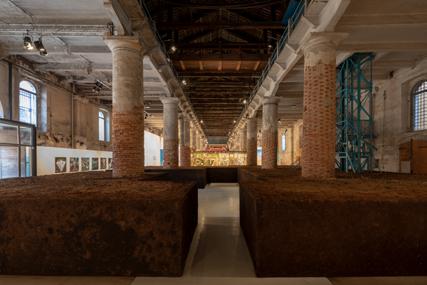
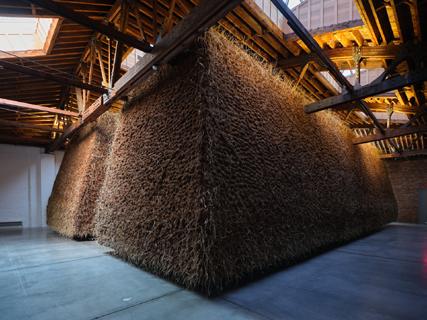
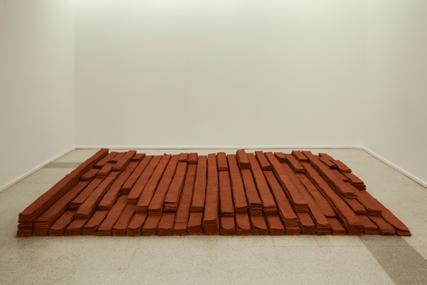
Morelos, No es un río es una madre, 2014, soil from Fute, Colombia, tobacco leaves and acrylic binder on fique, dimensions variable, exhibition view: Selva cosmopolítica, Museo de Arte de la Universidad Nacional de Colombia, Bogotá
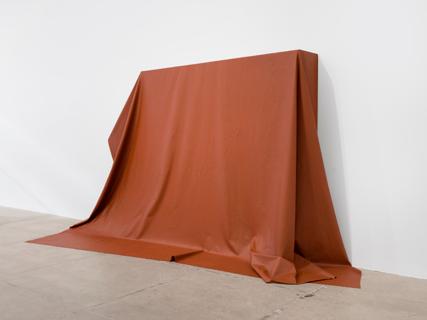
11 Greta Gaard, Critical Ecofeminism, Lanham et alii (Lexington Books, 2017), pp. 52–53.
12 Maza, p. 120.
13 Lowry, p. 15.
14 Vicuña and Morelos, p. 86.
15 See also Silvia Federici, Caliban and the Witch, 3rd edition, New York (Auto-nomedia, 2009), pp. 200–201.
16 Ibid., pp. 165–166.
17 Blázquez, p. 11.
18 Edmée Lepercq, “Delcy Morelos Speaks Through Soil,” in Frieze, 9 January 2025, https://www. frieze.com/article/delcymorelos-profundis2025-review, last accessed on 26 May 2025.
19 Maria Mies and Vandana Shiva, Ecofeminism, 2nd edition, London/New York (Zed Books: 2014), pp. 4–6.
20
“MGG Presents | Delcy Morelos in Conversation with Humberto Moro,” youtube, 17 October 2023, https://www.youtube.com/ watch?v=4kJhkZEVJcE, last accessed on 26 May 2025.
21 Ibid.
nection to Pachamama’s seeds can be seen in her recent work Madre [Mother] (2025) (Fig.5), a house-sized installation of scented soil at Berlin’s Hamburger Bahnhof. The structure includes three passages through which the earth, which comes from Berlin, can be accessed. Its soil—or body—has pieces of buckwheat mixed into it, referencing the nourishing quality of the earth through a locally grown crop commonly consumed in Central and Eastern Europe.
The thousands of flattened, cookie-like balls of soil and clay in Enie (2018) (Fig.6)—named after the word for “earth” in the Indigenous Uitoto language—also recall offerings for Pachamama, as they are placed on the floor. The scent of Enie is intended to trigger memories of motherly care by evoking the smell of breast milk, which, as ecofeminist Greta Gaard writes, provides both nutrition and affection.¹¹ Morelos aligns with this notion. She follows the teachings of her mentor, Isaías Román, a keeper of Uitoto knowledge, who compares the earth to maternal milk, as both nourish us.¹² The V-shaped openings that allow visitors to enter El abrazo and Madre are another tie to the maternal womb, as they remind the curator Alexis Lowry of the form of a vagina.¹³ By stepping into the wombs of her structures and being embraced by soil, Morelos suggests that earth, like a mother, or madre in Spanish, can offer sustenance and emotional care.
To create the olfactory essence for Enie, Morelos mixed beeswax, cacao butter, brown sugar, cinnamon, and cloves in a large cauldron—an act she compares to that of a witch.¹⁴ In this context, the witch embodies healing knowledge and a desire to protect nature. The political philosopher Silvia Federici highlights that the early modern manmade witch hunts aimed to suppress women’s knowledge of ancestral herbal medicine and reproductive control. During a period of demographic decline, women were expected to give birth to create a new labor force and not be educated by so-called 'witches' about their menstrual cycles or about methods of abortion. This is why influential female healers were eliminated.¹⁵ Simultaneously, when European men burned women at the stake, they also killed and exploited Indigenous people in their colonial endeavors that began with Christopher Columbus’s invasion of the Americas in 1492. Federici argues that both of these processes were intertwined, driven by a patriarchal need for dominance and essential to the emergence of capitalism, as control was exercised over 'unruly' beings.¹⁶ Colonization also led to the repression of ancient belief systems and the erasure of much Indigenous knowledge, as seen in the destruction of numerous Mayan codices by the Spanish in 1562.
Morelos directly engages with colonial histories in Profundis (2024) (Fig. 7), exhibited at the Andalusian Center of Contemporary Art in Seville—a former monastery with a “Chapel of Columbus.” She filled this space with local earth as well as seeds native to the Americas, including tobacco, cocoa, cinnamon, cloves, and pepper, which were brought to Europe during the 15th century after the Spanish conquest.¹⁷ The demand for these goods in Europe led to the establishment of plantations in the Americas, which often relied on slave labor,¹⁸ exploiting both Indigenous soil and people. By including these earthly products in an exhibition in the city from which Columbus embarked on his fatal journey and by planting the colonized seeds into Spanish soil, Morelos reminds us of the enduring legacy of colonialism.
To counter these patriarchal oppressive powers that are responsible for the brutality against Native Americans, the environment, and women, the ecofeminist thinkers Vandana Shiva and Maria Mies call for a return to traditional Indigenous feminine knowledge that maintains all forms of life by loving and caring for each other.¹⁹ This echoes Morelos’s practice that is deeply embedded in Andean ancestral cosmologies that associate soil with motherly qualities and that challenges colonial and patriarchal narratives of human domination over other beings. Morelos believes that desires to control and exploit the earth are rooted in human disconnection from nature that occurs too often in the Anthropocene. Therefore, by allowing visitors to enter her installations and by encouraging them to engage their senses—smelling, listening, and perhaps carefully touching the soil—she invites us to reconnect with earth not just as a physical substance but as a living entity. While inside her structures, we are meant to feel that soil, like a mother, sustains and enfolds all life. In the ‘wombs’ of Morelos’s works, we are reminded that we are part of the earth and bear responsibility for it and all beings living upon and within it, rather than seeking to exploit, kill, or subdue them in a capitalist manner.²⁰ Morelos rescripts our relationship to soil by asking us to feel kinship with the earth so that we might transform our sensations into actions. The next time we hear about a dam being built or a forest being decimated for the construction of
Agnes Rameder
a factory—as happened recently in Brandenburg, where space was “needed” for the US company Tesla—we might remember how tender and embracing the local Berlin soil in Madre felt and smelled and take action by joining a protest to protect the earth and advocate care for her.
While Morelos adopts the formal visual vocabulary of the male-dominated Land Art movement, she subverts it by urging us to reimagine our relationship with soil. Her work calls for a shift from control to care. In a time of environmental crisis, Morelos’s art is both spiritual and political. As Earthly Paradise suggests, paradise is not a distant afterlife²¹ but lies right beneath our feet—in the living soil that binds all humans and more-than-humans in an eternal cycle.
Agnes Rameder
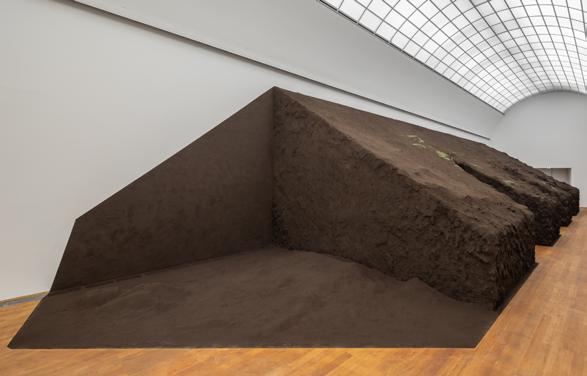
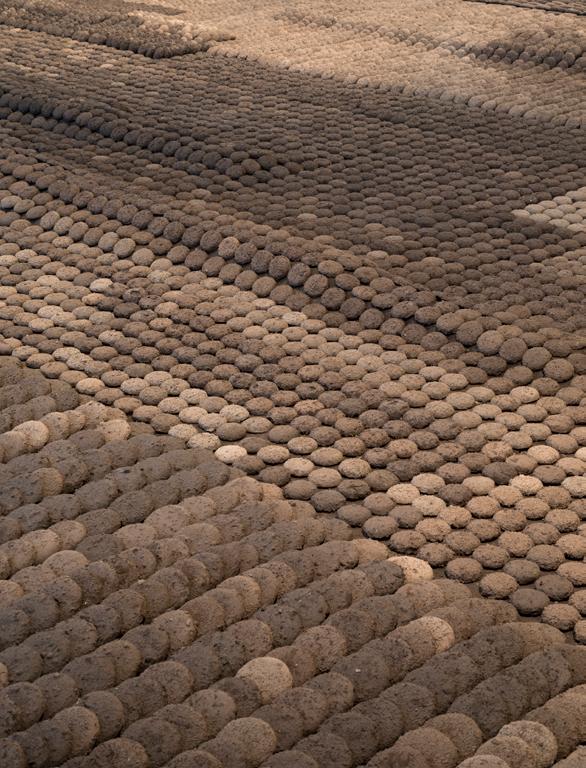
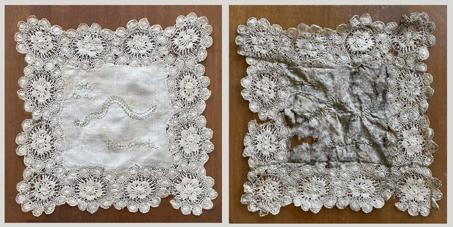
Valerie Constantino
In 1912, my paternal grandmother emigrated from a small village outside of Naples, Italy, to the Midwood section of Brooklyn, New York. This lacy textile that I have buried and exhumed was handed down to me as part of what I reverently consider her legacy. It was she, after all, who taught me how to crochet and whose finely wrought stainless steel crochet hooks I also inherited and hold dear. This history inspired my enduring interest in textiles. Their reticulated structures and allegorical properties prompted further explorations into life’s essential compositions and substantive environments. All that surrounds us—the actual air, waters, and soil—is alive, just as every being who dwells upon and within these elements lives. And just as the air and water are now perilously contaminated, the earth’s soil, too, is in decay. As all who rely upon the integrity of these habitats suffer their degradation, invisible, teeming communities of microorganisms are also threatened. There are more than a million species of nematodes living throughout the world’s microbial habitats, in marshlands, deserts, oceans, and soils. Often described as transparent, threadlike worms—nema
means thread in Greek—nematodes propose a distinct marriage of metaphorical and empirical interconnectivity1. As they consume and metabolize bacteria, fungi, and other microfauna, including other nematodes, they stitch the soil’s nutrients and minerals together, performing their sinuous choreography for the soil food web. Studies regarding extinction have usually focused on aboveground species, but the crisis underground is now recognizably urgent. Pollution, urbanization, over-tillage, and climate change lead to erosion and elevated levels of atmospheric carbon dioxide. For nematodes and other microbes, these conditions create imbalances between their beneficial and harmful species, intensifying the threat of extinction for all. Consequently, extended research on nematode variations, vulnerabilities, and relationships to soil health is now critical. My unearthed textile, Ode to a Nematode, has taken on the faded black-brown cast of the soil. It has several holes now where its threads have been absorbed into the moist underground hollow. And the vanishing thread stitching, rather than disintegrate with the rainfall as expected, has ei-
ther remained in place or contracted, producing a kind of smocking. These outcomes reflect the relative dryness and poor drainage of California’s Central Valley soils, where drought followed by atmospheric storms has led to severe runoff and erosion. Our planet’s surface layers of soils are of the skin, bone, blood, and chromosomal matter of human and other living and once living beings. Within our genetic coding, we carry the histories of grandmothers and fathers, animals, flowers and trees, insects and microbes, water, sand, and soil. We hold, too, the blueprints for weblike structuring that manifest as variously configured objects, textiles, architecture, and written ciphers of communication. My family heirloom lacework, its internment and resurrection; a song in sotto voce, not only to the one but to all extant organisms, delicate strands of life on earth.
1 Kiontke, Karin, and David H. A. Fitch. “Nematodes.” Current Biology, vol. 23, no. 19, 7 Oct. 2013 https://www.cell.com/current-biology/full text/S0960-9822(13)00985-8?_returnURL=https %3A%2F%2Flinkinghub.elsevier.com%2Fretrieve%2Fpii%2FS0960982213009858%3Fsho wall%3Dtrue. Accessed 17 Apr. 2024.,
Deanna Pindell
The Pacific Northwest (USA) has been my ancestral home for multiple generations. Its ecosystems have been at the center of my work for over four decades. As the challenges of climate change and extinctions mount, my empathy for these ecosystems sometimes overwhelms me. I can think of nothing more important than caring for them. I have been the steward of a beautiful 2.5-acre plot of Pacific Northwest conifer forestland for over two decades. Underneath the thin topsoil, we find glacial till. The fir trees are all second or third growth, which means this land was once clearcut. Logging is not a renewable resource; for every generation of trees extracted, the soils are impoverished. I have been slowly working to restore the native plants and habitats to their pre-colonization health. Gratefully, I watch as the bereft, san-
dy surface has gradually turned lush with native grasses, flowers, fruiting shrubs; the trees grow large, and new species of native birds appear every year. Warmly, I anticipate my own return to the soil and my place in this beautiful cycle. Seeking Salal is a playful, meandering, sculptural line drawn through Webster’s Woods–a thick rope of handmade straw-wattle 200 feet long. The name for Salal in eight Pacific Northwest indigenous lan-
guages has been hand-stitched with black wool yarn, as well as an old anonymous poem in English, “Salal grows in the darker places, like love, and like love, takes hold in the shadows.” This evergreen shrub is a keystone indigenous plant within the Pacific Northwest temperate rainforest ecosystems. This forest-habitat remediation began with removing invasive vegetation and replacing it with native Salal, using the wattles for mulch and protection.
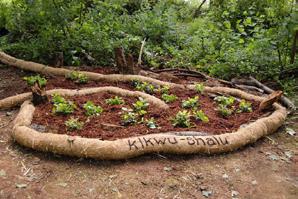
When a tree falls in the forest, it provides nutrients and eventually becomes soil to support the next generation. Grief literacy advocate Stephen Jenkinson once suggested that soil is made of everything that failed to live forever. Dust, the last image in the EarthBound series, explores the poignant narrative of our ultimate return to Earth. Beginning by building a bed or background of partially decayed and decomposing plants mixed with soil, I then seeded it with wheat grass, covered it to let it germinate and sprout. Within this living tableau, a life-sized impression of a human form was delicately pressed, leaving a shadowy
trace evoking our connection to and final destination in the earth. The final image is 78“ tall by 39”. In this series, I explore the evocative journey of being reclaimed by soil. Drawing parallels to the timeless cycle of life and death observed in the garden, where the remnants of past seasons enrich soil for future growth, Dust invites viewers to contemplate human-soil connections. We, too, are integral participants in this natural rhythm, intertwined with the land that sustains us and ultimately embraces us in our final moments. How will your departure feed and enrich the tapestry of life's eternal renewal?
From extractive practices to regenerative approaches, through syntropic agriculture, reforestation, local food production, education rooted in active participation, and the engagement of the whole community in the process, Art of Shading the Sun is part of a series of artworks that reflect on community and landscape and how these interact in space and time. The photographs reflect on the centuries of human presence on the land and the current efforts of a community in Portugal to help restore the social and ecological balance in the area. Eternal Forest (launched 2018) is an ongoing mul-
tidisciplinary project that includes a network of 1,000 forest sanctuaries to be protected for 1,000 years through art and community. The artwork shown here is a film still on a Giclee print with writing over it. The poem is written with earth pigments from two distinct but connected locations in Portugal: 39.100000, -9.266700, Outeiro da Zibreira, Torres Vedras, (where the artist lives), and 39.0248099, -9.2344469, Serra do Socorro, a protected UNESCO Heritage site, Geopark (PT). In the poem, the Earth speaks to the people, reminding them that they are forever and deeply connected to her.
When all your streams are bare You turn to me
When all your soil is desert You turn to me
When all your food is poisoned You turn to me
When all your seeds are fruitless You turn to me
When all your kin is crying You turn to me
When all your days are counted You turn to me
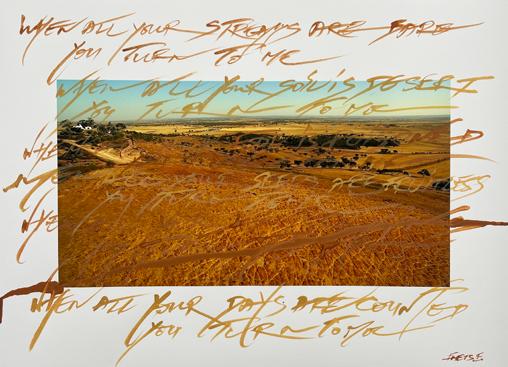
Kate Foster
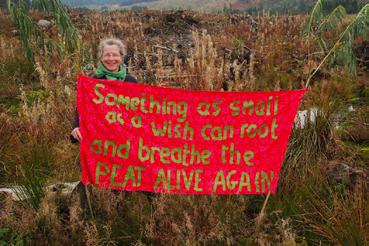
Donna Cooper
We have a responsibility to build the health of our soil for future generations. As a steward of a 30-acre parcel of land, my photography-based performance work is a meditation on actions, dialogues, and rituals with the land. Most of this land has been cultivated as pasture over the last 150 years, but is currently being transformed and rewilded back to its original way of being prior to colonization. In unearthing the story and psychology of place, I am also creating narratives for my body to comfortably reside in. My process includes learning the flora and fauna of the land I work with. I believe that the land is conscious and retains memories just like our bodies. In my most current work, Fire Talks, I am working to heal the soil through biochar practices and low-intensity fires. The work utilizes the element of fire to address topographical and physical trauma on a multigenerational farm in Virginia. The local river continuously brings organic matter to my house. I often interpret this as an offering, as a collaboration, and a call to generate fires to balance and maintain the local ecosystem. In collaborating with
the land I live on, I have a two-method approach. One is working with fire to increase the health of the farm, soil, and land. The second is documenting the rituals and performances I create with fire in transforming myself and the land. Documenting these performances is part of an intervention process, a way to open space for a healing shift to occur.
Cultural connectivity to soil has become central to my artistic work with twin concerns of peatland preservation and making peat-free compost to support ecological gardening. I work mostly in non-art spaces with a commitment to hope-oriented and empathetic practices, for example, delivering workshops in public and outdoor settings, presentations, online publications, bookworks and zines, commissions for international exhibitions, as well as publications in peer-reviewed journals. Creating networks as well as artworks, I believe creative work should nourish ethical and reciprocal relationships with participants and materials. I grew up with the squidgy, muddy feeling of salt marshes in the east of England, and this shaped my sense of what makes a good landscape—that which can be experienced through your toes. Moving to Scotland to study and work, I learnt to love its peatlands, and especially the characteristic mosses and flowers of the Southern Uplands. As an artist, I connected to grassroots restoration efforts in Southern Scotland, which have led to an ongoing exploration of peat’s presence in research and museum contexts at Wageningen University (Netherlands). In the Netherlands, I am learning about the strength and depth that cultural heritage can exert in fluid landscapes. My artist’s project, Peat Cultures, explored different ways of supporting restoration efforts by amplifying the cultural aspects of wetlands. In developing a socially engaged practice, I also know that the source of my creative work is an embodied response to a specific context. This informs how I thread visual artwork into unexpected settings to prompt dialogue.
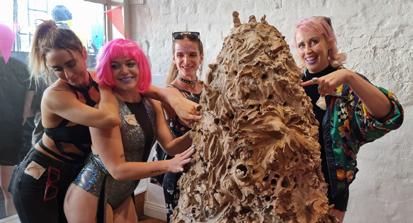
Living on the unceded lands of the Wadawurrung People, Australian born of migrant heritage, I engage in rituals of gathering and weaving to nurture relations with materials. As a ceramicist, I have formed
Mary Swander
As former Poet Laureate of Iowa and artistic director of a theatre troupe that performs dramas about food, farming, and the wider rural environment, I make work to imagine and promote healthy food systems through the arts. Healthy soil means healthy plants and animals, which means a healthy human body. Some may look at this location and soil as “flyover land.” I look at my soil as the richest soil on earth. Squatters on Red Earth is a play I wrote that explores the positive relationship between the Amana Inspirationists and the Meskwaki Indigenous people of Iowa. The Amana Inspirationists were a group that fled religious persecution in their homeland, Germany, only to become part of the white settler land grab in the United States. The Inspirationists sought productive land hidden from the rest of the mainstream society in the Iowa River Valley, where they encountered the Meskwakis and their long agricultural traditions. The two groups, both agrarian and communal with strong spiritual beliefs, managed to live together peacefully, with a mutual respect for the ecology and
a personal relationship with clay that has led me to pivot from object-making to creating collaborations with clay through a practice of ‘clay weaving.’ I often work with ‘scores’, as used in dance, and have
an interest in the ethos emerging from practice: caring for materials as kin; crafting by ‘working with’ more than ‘doing to’ materials, and experiencing being part of, more than separate from, nature.
sacredness of the land. Meanwhile, the U.S. government enacted policies to displace Indigenous peoples throughout the United States, forcing them to take up European methods of farming. For years, the Inspirationalists and the Meskwakis have each struggled to hold their center in the midst of the outside pressures of capitalism and colo-
nization. Squatters on Red Earth features actor Rip Russell, director Brant Bollman, Indigenous voices Brian Henning and Sarah Leo Piché, music composed and performed by Laura Hudson Kittrell, and costumes designed and created by Michele Payne Hinz. The set designer was Shelley Buffalo, and the puppet designer was Monica Leo.
Sarah Misselbrook
The soil beneath my feet has become the parched skin of my body. Originally from the city of Southampton in the UK, I am now immersed in nature on an olive farm near Riba-Roja d’Ebre, Catalonia, Spain. To me, this soil represents the essence of life itself—a precious resource in an unforgiving environment. It’s not just dirt; it’s a living, breathing ecosystem. The connection to the land underscores the importance of stewardship and conservation, especially in the face of climate change. Investigating female identity and feminism, I explore connections between the human body and nature. My art practice includes monochrome charcoal drawings, large installations with natural elements, performance art, and experiments with voice and action. For Territori, 8 días : 8 terres, created during my residency at the Territori performance art festival in Ibiza, I used a method deeply rooted in the island’s soil. Collecting soil samples from eight distinct locations, I processed them into a fine powder, transforming them into natural pigments. Activating these pigments, I engaged in a site-specific live performance at the church of Sant Joan de Labritja. Participants were invited to dip their feet in the paint and contribute to a largescale drawing on a white surface laid out on the porch. The interactive process aimed to foster mindfulness and reflection on our interconnectedness with the land and our impact on it.
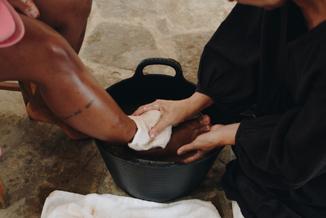
Chrissie Orr
As a sensitive provocateur, I aspire to produce art that is not self-referential but relates and responds powerfully to entities outside itself. My participatory work is about developing an aesthetic around community and site with issues relevant to both. My aim is to conduct a relational process to animate placebased poetics in spaces that are readily accessible. The foundation of this practice is centered on observation, farming, walking, writing, and drawing. Part of my essential creative practice involves growing heirloom varieties of corn, beans, and grains. On the dry, prickly land
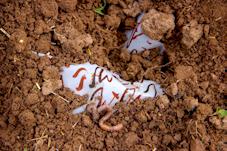
that we steward, the soil shifts and changes from east to west and north to south. The copse of trees provides a shaded ecosystem whose soil is rich, dark, and full of humus. To the west, towards the Green Stain River, the soil turns sandy, and a cryptobiotic crust has formed over thousands of years. Red Racers burrow here, and the Horned Owls nest high above. A narrow path meanders down to the river; we do not stray so as not to disturb. The field below the old adobe has been cover-cropped and amended with shredded compost and dried corn stalks. The soil beams back as we plant the ancient
varieties of corn, beans, and grains. We gently unfold a soil rich with worms and microbes, fostering a mutual relationship of nurture. Slowly, we move with the seasons, learning by putting our hands in the earth and treading lightly. When I head to the river, the sounds transport me to a deep imaginal space where I can imagine ways to play and create. Then back to the studio where I play some more, grind pigments, draw, and research until something arises that I might want to share. It is a forever-shifting and mysterious process that requires a resilient array of practices.
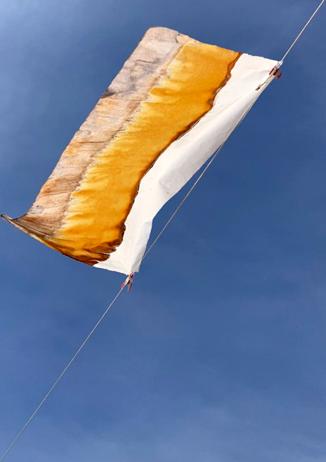
Myka Baum
Soil is vital to life on Earth and has been fundamental to the formation of cultures since the beginning of civilisation; yet, it is often overlooked, and its role as an ecosystem is undervalued. I am interested in soil as a whole and intrigued by its diversity and potential in mitigating climate change. My focus is on revealing the hidden beauty within soil through chromatography, a process that makes its complexities visible in an accessible way. My practice is rooted in empathy for the overlooked and broken, seeking to reshape humanity’s relationship with nature
through close collaboration with organisms such as earthworms, fungi, and bacteria. My fascination with natural processes of transformation, including growth, decay, and regeneration, drives much of my artistic inquiry. My work often integrates photography with found or crafted sculptural objects. Utilising cameraless and lens-based techniques, I employ processes like soil chromatography, lumen printing, cyanotypes, and analogue and digital photography, combining artistic exploration with scientific inquiry, and focusing on the intricate rela-
the Line, 2024, original chromatograph
tionships between soil, environment, and human impact. Soil chromatography extracts pigments and nutrients from soil samples, allowing the soil to reveal its characteristics on light-sensitive paper. In this work I use non-invasive sampling methods, collecting soil from molehills to preserve the integrity of the surrounding landscape. In this way I aim to deepen our understanding of soil's vital role in sustaining life while inviting viewers to appreciate the hidden beauty and complexities of the soil and reflect on the consequences of human intervention.
Tim Andreae
Soil is vital to life on Earth. Caring for soil is caring for ourselves. Even as we speak and live, we are already soil. Generally we tend to run towards a fantasy of endless growth. Using storytelling and contemplative techniques, I've tried to draw attention to the big unknowns, like ourselves becoming soil. Death Mask was a series of workshops I facilitated in which participants made their own death masks. It began as a response to the nuclear industry’s attempts to create a source of energy that never dies, bypassing the death portion of the life cycle. Using clay and sand to create a base for the masks, the work itself was the process. Dominant Western cultures share a collective blind spot when it comes to death and dying. And so, blindfolded and using clay as a medium, participants created their “mask”—that place of intimacy where we feel into the unknown–in this case, our own face when we die. Participants were encouraged to place their completed masks in a garden as an offering where they would then see their death mask “live” as it became the face of the greater surrounding natural systems. Cracks would expand and contract with frost. Wind opened up pores for critters to inhabit. Seeds stuck to the clay and sunk in. In this way, the masks added story to the substrate from which new life grows.
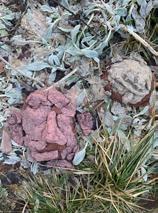
Ruth Wallen
For over a decade, I have been walking with coastal live oaks at Pine Valley Creek, once arguably the largest, most stunning grove of oaks in San Diego County, bearing witness and offering palliative care while Goldspotted oak borers, likely imported on firewood from Arizona, ravage the oaks. I stay present as graceful naked bodies, revealed by dropping leaves, are gradually reduced to more elemental forms. First, small twigs and then large branches break and fall to the ground, until years later the remnants topple over and slowly sink into the earth, decomposing into the soil from which they arose. From the soil springs new life, including the cliff roses that now offer colorful memorials to the oaks every summer. The soil is further enriched by the droppings of cows
who trample the ground and nibble on seedlings, unfortunately preventing the regrowth of the oaks. Since the start of the pandemic, I have come to visit this charnel ground for the oaks at least once every season. I come to sit with the fallen trees. I meditate, summoning the compassionate, healing energy of the earth, and write and photograph about my experiences. Initially, my focus was on the oaks, but the oaks both spring from and return to the soil. In a wet spring, mushrooms sprout from their fallen logs and branches, evidence of the rich mycelial network from the underground that supported them in life and aided their return to the soil in death. To care for the trees, to ensure their future well-being, we must protect the earth from which life springs.
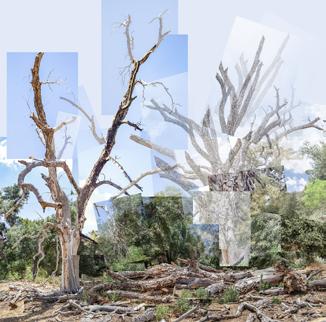
Priscilla Stadler
My multifaceted practice centers on pressing issues such as the domination of NYC neighborhoods by profit-driven real estate, and Long Island City’s proximity to contaminated Newtown Creek. SLUDGE, my project exploring the Creek, delves into a two-century history of industrial abuse and contemporary remediation efforts. Designated a Superfund site in 2010, reduced dumping has allowed the ecosystem at Newtown Creek to start recovering. Although much needs to be done, mollusks, plants, and other organisms are returning, signaling the creek's resilience and potential for renewal. Forest biologist Dr. Suzanne Simard’s work introduced me to the dynamic activity in soil, revealing energy exchanges between fungal (mycelial) networks and tree roots. This discovery intrigued me, despite living in a NYC apartment. Inspired, I drew the Rooted series, and later stitched Mycelial Jacket. Using stitching with thread as a form of drawing, Mycelial Jacket evolved from my initial mark-making on scratchboard, which I used to explore underground energy exchanges between fungal networks and tree roots. Although this work was developed while researching mycelial science, my creative engagement with the “underearth” draws from intuition, mysticism, and the challenge of visually representing the unseen. As a science-challenged learner, I adapt intuitive methods to facilitate
learning. For example, I use bibliomancy—opening a book at random to find answers—by selecting a relevant science text and creating an ink painting based on a phrase that stands out. Juxtaposing incongruous learning methods allows me to explore what they can offer each other: science as a process that includes divination as a structural system. This blend of art, intuition, and science helps me visualize and understand the hidden processes of the natural world.
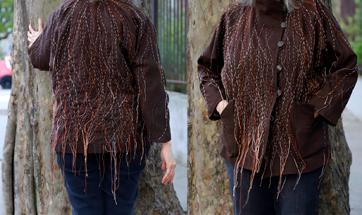
Beth Shepherd
My art-research practice embodies notions of systems change, transformation, and healing. Plot 46 is a multi-year field project I am undertaking to learn about regenerative organic agriculture. The project is named after the 400 square foot allotment I rent on an urban farm near my home in Ottawa, Ontario. Starting my third year, I still feel like a stranger on this land with so much to learn. The first year, I took a no-till approach, so as not to disturb the soil, and I kept my beds covered with lots of leaf mulch. By the second year, my beds were already benefiting from a growing layer of humus. I added flowers to attract pollinators and deter pests, and lots more mulch. By
the third year, I added some perennials like raspberries, rhubarb, and herbs to ensure I have roots in the ground year-round. Rather than pulling out weeds like dandelions, clover, and lamb’s quarters, I embrace them as a food source. I also embrace the diversity of insect “pests,” willing to share part of the harvest to foster a diverse and balanced ecosystem. As well as regenerating the land while growing nutritious food, I am producing multiple series of prints, collections of objects, poetry, and journals representing the land from multiple perspectives over time. The Unterwelt of Plot 46 is a poem I wrote to embody being (in the) soil. To evoke a sense of “soilness” without
trying to be representative, I produced five experimental prints using Akua ink and found objects. I then integrated the spoken poem with clips of the prints in a two-minute video.
Katie Taylor
As a contemporary sculptural installation artist based in Oxford, UK, my artistic focus centers on exploring our place in the world, the fragility of life, the inevitability of death, and the precariousness of existence. Historical research is foundational to my work, and I often integrate it into my artistic practice. Forensic anthropology and its role in identity determination are central themes in my current Ph.D. research. Nettles have been key within forensic investigation, and archaeological evidence shows that nettles were used in prehistory to make fabrics. Nettles are prevalent in nature, growing well in high-nitrogen soils. Nettles are known by everyone but are usually avoided because of their sting. This has powerful correlations with attitudes to outsiders, homelessness, and unidentified death. Using nettles from the sites of unidentified deaths, I halt the nettle from its natural cycle of growth and decay to investigate an individuality. At each site of unidentified death, I collected three tall nettles and processed each of them at the location where they were found into initial fibre strands. If the weather was good, I would then allow them a little time to dry, and before making these three nettles into a small sample of cordage. The action of doing this at the actual site allowed for a meditative space to consider the individual whose life ended there, putting something of the experience and the space into the ritualised object that resulted. The time to produce this small object turned the ubiquitous plant material into something that held an acknowledgement of that individual. When making each, there was a rhythm that came with the process, slow and steady like a heartbeat or breathing that resulted in a small sample of nettle that became a commemorative relic.
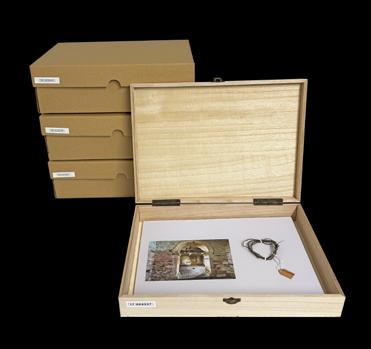
I’m Luc Biscan-White, a nonbinary and queer, Appalachian Siksiká (Blackfoot) sculptor, imagemaker and forest ecologist. Appalachian mysticism permeates my practice, underlying the vital presence of hope within a history of exploitation, arguing for the existence of a mountain queerness. The ritual of burying, and then recovering my work, pressing it into tree bark, layering charcoal leaf shapes, and writing creates layers that mimic the complex and conflicting realities that challenge hope. Soil are those mountains that Appalachian Power beheads each year to harvest and steal from those mountain ancestors of mine. Soil is the silt that is kicked up when the rains come harder each year, flooding away more of my region due to mountaintop removal. Soil is the tender hands of the complicated poor people who raised me from the ground and gave me everything they had and more, so that I might have a chance in a system that doesn’t take kindly to my people. Soil is that tether that connects you and me, from the roots of trees that created my bloodline to the fungi that support our feet, to even the vegetables you and I have the privilege of eating each day. Caring for soil is a relationship of reciprocity, giving yourself to the Land so that others will have the privilege of enjoying this ground, too. My methodological artmaking includes both academic approaches of investigating literature, reviewing data, and conducting research experiments, and artistic practices of giving back to the Land that I am allowed to enter, recognizing the colonial history that has occurred on these stolen Lands. I weave scientific methodology with Appalachian, Siksiká, and Land-based knowledge pathways to uplift erased wisdom. By understanding how scientific systems interact with the socio-cultural fabric of a place, proper appreciation and justice can be delivered and demanded. For me, ecology is more than a scientific field of study, but a social-political framework. I believe we cannot truly conduct science until we know how to bring those results into the hands of the public. My art practice and research are grounded in advocacy and uplifting, for making art and conducting research that will aid in accomplishing
change. I create found-object and uniquely fabricated sculptures with my material collaborators—SCOBY, Metal, Clay, Fungi, Coal, Dirt, Plant Relatives, use alternative darkroom processes, and foraged natural materials to challenge the notion of individualism by reminding us of our collective ecologies. The dialogue that emerges from my artistic process disrupts norms and expectations, particularly in relation to identity and gender. I create testimonial work, exploring many paradoxical realities: queerness and ruralness, poverty and abundance, faith and desperation, hope and loss. The alternation of conventional photographic processes merged within collaborative material ancestors mirrors the discomfort of negotiating optimism in an unwelcoming social-political landscape.
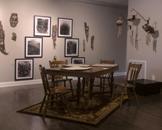
Collective Hope (2024), recycled industrial paper waste dyed with dandelion (Taraxacum officinale), white ash bark (Fraxinus americana), embedded native seeds from crimson-eyed rose-mallow (Hibiscus moscheutos), wild geranium (Geranium maculatum), woodland sunflower (Helianthus divaricatus), and purple coneflower (Echinacea purpurea), 16 x 20 inches
Appalachian Hymns (2024), ceramics, analog photography, book arts, found-object sculpture, rituals, performance art, music of oaks and ash, story of family and loss, queer joy, wisdom deeper than our roots, windchimes that bring company, jars keep us safe, table to hold us together when the river runs high, dimensions variable
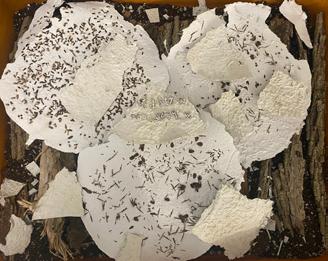
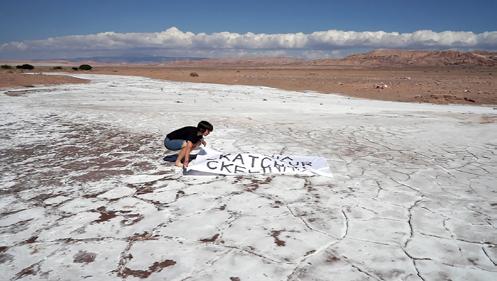
Susana Soares Pinto
My artistic practice develops between the margins of art and extractivism. Regeneration of damaged [eco]systems and community collaboration in the creative process have been recurrent. Video, sound, and drawing with natural materials are combined in site-specific or immersive multimedia installation formats. I am in a constant exercise of de-growing and developing logics that trouble the socio-economic tendencies and those of the Earth. I was on a poetic mission of returning a stone to the Atacama Desert. Etymologically, Atacama means meeting of people. Contrary to Western anthropocentric views, human beings in pre-Columbian Andean communities were not the center of the universe nor the owners and dominators of nature, but rather simple borrowers of resources. In this place, where indigenous peoples still live according to some ancestral laws and attempt to preserve their original language (Kunza) and natural resources, two mining companies are extracting lithium from the Salar. In 2012, with the government change
in Chile, negotiations were held for the country to enter the trade circuit with the European Union. To do so, the Chileans had to recognise their native communities by returning part of their territories to them. The Tebenquiche lagoon, a habitat for extremophiles, was returned to the community of Coyo, where I was on an artistic residency in March 2020. Among extremophiles, cyanobacteria are those that perform oxygenic photosynthesis. Their importance dates back to the beginning of life on Earth as we know it, marked by the presence of oxygen in the atmosphere. Cyanobacteria oxygenated the seas and the atmosphere, created the ozone layer, and prepared the planet for life dependent on O2. Together with Sandra, Carlos, and their daughters, an indigenous family from Coyo and guardians of Tebenquiche, we wrote in Kunza: aiquiá ckapatur ckatchbi ckelinar (here the air grows). Low on resources, I used my bed linen and a graphite pencil to write it, and chose video as the medium to record the spreading of the cloth in the middle of the desert. What is
happening in the Atacama Desert is a problem that not only affects local communities but the whole planet. In addition to the scientific support that can be given to communities in the fight against mining, I believe the insertion of act, return, repair, de-growth, and preservation where humans should contribute, reducing CO2 emissions and increasing O2 emissions. It may be utopic, but necessary for the extreme lovers–of life itself.
Mark Brest van Kempen
Combining Conceptual Art, Land Art, and Social Practice, my sculptures and performances often use the landscape itself as sculptural material. From the Free Speech Monument on the UC Berkeley campus to Land Exchange at the National Academy of Art in China, my work explores the range of emotions and issues that are embodied in our complex relationship to the environment, land, and place. Soil as a material is rich with cultural and political meaning. We grow our food from soil, laws become embedded in soil, identities are associated with soil, and our bodies ultimately become soil. When I approach a site, I consider the materials found on site as well as its history. Humans
sometimes interact physically with a landscape, and at other times, they interact conceptually by creating laws, rules, and traditions associated with specific places. Private property, political borders, laws that apply within one boundary and not in another are all interesting “materials” for me to work with as sculpture. Column of Earth and Air (Free Speech Monument) is an example of one project that has included people and political processes as material for sculpture. Winner of a national public art competition to commemorate the 1964 Free Speech Movement at UC Berkeley, it consists of a six-inch column of land and airspace redefined as not being a part of any nation, state, or city;
therefore, no laws are applicable within the small space. An engraved granite ring was installed framing the small piece of land and bears the inscription: “This soil and the airspace extending above it shall not be a part of any nation and shall not be subject to any entity’s jurisdiction.” The free space attracts speakers and political events to the site, framing them as living monuments to the Free Speech Movement.
Column of Earth and Air (Free Speech Monument), 1992, soil, air, laws, six inches diameter, approximately 100 kilometers high
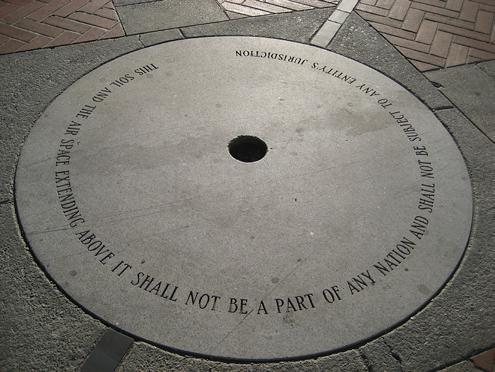
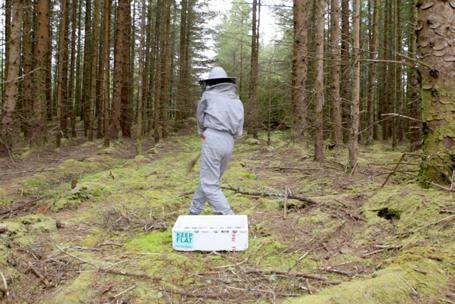
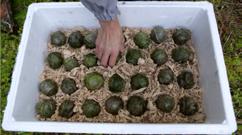
Christine Mackey
My work engages with the culture of composting as a new material strategy through which ecological emergencies, such as peak soil, can become visible. From 2021 to 2024, I was in a residency programme at Interface in County Galway, where I engaged with alternative farming activities on barren lands. One such activity involved the use of seaweed and sand. Farmers collected fresh seaweed each year from the shore. Brought to the fields, they spread this material out onto the land and, in some instances, combined it with sand. I have explored these historical and contemporary practices and integrated them into my approach to rehabilitating degraded sites through soil amend-
ments. The site of my residency has suffered degradation due to the planting of a Sitka spruce forest on a bog habitat. In response to this degradation, I devised a series of material interventions. These “acts of care” include nourishing young saplings with seaweed to provide essential nutrients and offer protection from deer that hinder their growth. I also cultivated a herbal protein amendment to enrich the damaged soil, cast in a sliotar form. Each of these actions aims to create change and highlight the vulnerability of these habitats, demonstrating that even small efforts can make a difference or at least draw attention to the issues. These activities are documented in video form.
Blair Butterfield
I was born in Florida to the daughter of a Cypriot immigrant. Since losing my native soils, I have called all soil home. I deeply grieve the loss of my Florida home, the ecology that raised me and taught me to love. As an artist and founder of PlantLust Botanicals, I integrate practices of healing and land regeneration into my work. Through plant medicine and regenerative farming, I engage the divine feminine to challenge patriarchy and industrialism, while advocating for ethical supply chains. This series of photographs emerges from an immersive soil-building practice of mulching and composting. By harvesting foods, medicines, and ephemeral materials for the camera, soil becomes both source and collaborator—offering life, creativity, and transformation. These images reflect the intimacy of this connection and acknowledge the death that must nurture new life. The smells, textures, and colors call me into total immersion, a biophilic collaboration. These photographs document my relationship with the land: a performance of reciprocity, where body and soil weave care, grief, and renewal.
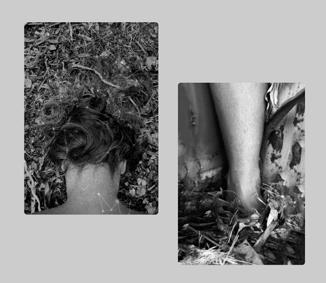
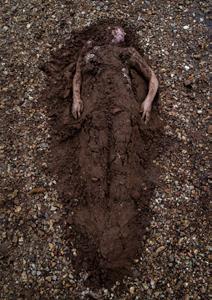
Violet Bond Earth Works made in the river of the sand and gravel mud washed away in rain.
As a multidisciplinary artist and photographer who creates body sculptures, I pose the question, “How do we connect with the dirt under our feet?” Much of my work is about mortality and what we leave behind. How, in the end, we are all dust, nothing more than fertiliser for the flowers.
Allie Horick
As an interdisciplinary artist and educator living in Nashville, Tennessee, my work investigates the act of mourning in a more-than-human world. How can mourning be seen as an inherently ecological act–one that acknowledges interdependence, relationality, adaptation, and life cycles? For me, soil is a bridge between the living and the dead, both in an ecological sense and a spiritual one. I work with soil collect ed from family cemeteries where my ancestors have been buried. The place where my maternal grandparents are buried is a tiny, side-ofthe-road family cemetery in East Tennessee with deep red clay. I imagined myself covered in it, becoming as physically close to my grandparents and other ancestors as possible. I explore their loss in my work, and in the soil they’re buried in,
I found their presence. From there, I began to visit other family cemeteries to collect soil samples. The soil is the embodiment of my ancestors' remembered and forgotten, a substrate that enlivens the past in the present. Soil Quilt (2023) is the re-creation of a quilt made by my great-grandmother. Soil samples from 14 different cemeteries located in Tennessee and Texas and my childhood home were used to create the pattern. At the end of the exhibition, the quilt was swept up, reminiscent of a Tibetan Buddhist sand mandala, which, among other things, symbolizes impermanence. The quilt, once composed of careful ly separated soil samples representing distinct people, now exists combined as a pile composed of a single new soil, just as I am a combination of those who are buried there.
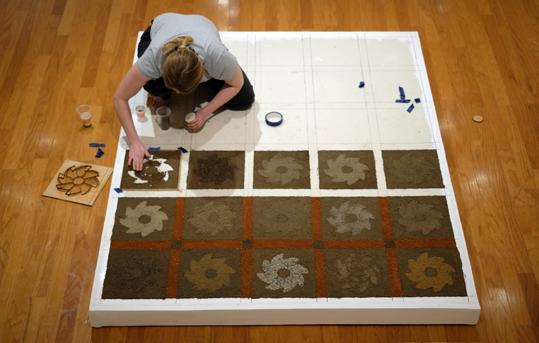
Marina 'heron' Tsaplina
I work with the composing and decomposing life-force of soils through eco-puppetry, place-based performance, and participatory community practices. We are in a time of decomposition. Perhaps I care most deeply for disabled soils—those soils that are scientifically categorized as dirt by soil scientists. It's not romantic: The Land still endures, despite all that has been done to her. My lifelong chronically ill embodiment grounds my practice in disability culture and wisdom. Within both people and soils, healing does not mean curing. I resist dreams of cures and restoration that pretend that the violence enacted on people and land is erasable. I embrace the fractures of memory, brokenness, and the courage to be with what is. My belonging to/with soil marked by colonial theft is rarely easy. I temper settler desires to make stolen soil kin, while encouraging relation, imagination, and co-existence. From star to stone to soil, we all belong on this Earth. We are all welcome. Yet the colonial imagination teaches white people that all soil is for us/them, and this must be
undone. There are depths of relation between Indigenous peoples and the soils of Lenapehoking–and this greater continent—that I will never know; they are not for me to know. My Russian upbringing informs my sense of animacy of the living world. The Slavic poetry, animated films and fairytales that cradled me shape my perception of how the more-than-human earth speaks, feels, and dreams, even as these languages remain unknowable and immeasurable. Animacy becomes my political refusal of racial-colonial hierarchies of human domination that have rendered the speaking earth mute. I attend to the fractured, dismembered relations between people and soils. By connecting people to their own bodies and imaginations, I seek to open and strengthen a felt, heart-based perception of the communicativity of the flesh of the earth: soil.
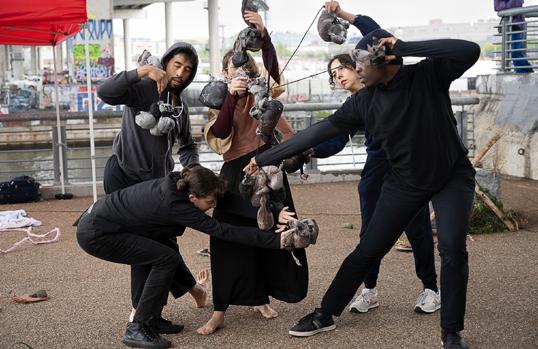
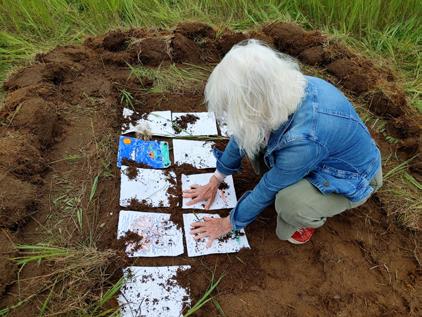
Jill Price
Currently caring for soils located on the traditional Land of the Anishinaabeg people in Simcoe County, an area settled as a result of pre-confederate Southern Ontario Treaties of 1764–1862, including Treaty No. 5, Treaty No. 16, and the Williams Treaties of 1923. One of the most diverse and ecologically important regions in Ontario, it is made up of limestone plains, till plains, sand plains, clay plains, marshes, rivers, lakes, and granite bodies, and home to 68 significant wetlands, hardwood and pine forests, 1500 vascular plant species, 150 types of nesting birds, 50 mammals and 33 reptiles and amphibians. The soil I consider kin is located along the Canadian shorelines and watersheds of Lake Ontario, as it was in these areas that I played, planted, picked, dug, buried, burrowed, and built as a child. This type of play helped develop a deep connection to different types of earth and their abilities. While working at the intersection of art, ecology, ethics, and aesthetics, my work explores how art might be a service that models a more inclusive understanding
of the public that acknowledges the inseparable physical and psychological interconnectivity of human and more-than-human worlds. Actions are based on goodwill and social responsibility, often incorporating durational performativity and invitations for community participation. Noticing, acts of cleaning, removing, sorting, dismantling, reconfiguring, and/ or recycling are carried out to ensure soils are not further contaminated or that materials can return to the Land in a good way. This at times leads to composting and plantings, as in the case of a collaborative project with Roy and Sue Hickling entitled Words and Wildflowers for the Land. An iteration of a project entitled Composting for the Commons, this happening involved creating native seed paper from waste and then inviting community members to write or draw messages to the Land before introducing the pages to recovering farmland. The hopes were to improve the diversity of plant life and gradually increase the number of pollinators and soil microbes in the process. Soil is life.
Why do we use the terms figuring or figuration to speak about Soil Art? In the introduction to their book, Figure–Concept and Method, edited by Celia Lury, William Viney, and Scott Wark, figure is framed as a kind of container concept that encompasses a range of meanings, from numbers and literary characters to diagrams and visual depictions of people or things, to artistic expressions, mathematical abstractions, personifications, and gestures.¹ The figure is a conceptual container or vehicle, that gives rise to further linguistically related conceptual containers: prefiguring, configuring, disfiguring, misconfiguration, figural, figurative, and figuration.
From Erich Auerbach’s (1938) theological account of figural interpretation and Jean-François Lyotard’s (1971) distinction between discursive and figural modes, through Gilles Deleuze and Félix Guattari’s (1980) introduction of the rhizome as a non-representational figure, to Donna Haraway’s (1997; 2008) use of cyborgs, string figures, and companion species as figures for situated knowledge-making, the concept of figuration has been reworked across philosophy, feminist theory, and STS.²
We agree with Iris van der Tuin and Nanna Verhoeff, that figuring is an inherently creative process: “As a concept, figuration refers to the creative act of producing form for thought but also to the process of the taking shape of thought figures, as well as to the result of this act and process.”³ This reciprocity between figures of thought and thoughtful-figures is brought to life by some of the artists here with reference to, e.g., Deleuze and Guattari’s rhizome (Jo Pearl, Lola Ben Alon, Pamela Casper) or Haraway’s companion species (Daniel Robles Lizano, Peter Ward). Figures can also function as boundary objects, or objects that, according to Susan Leigh Star, have a shared point of reference but allow actors from different social worlds to come together: the peat briquette (Andrea Krupp), an SUV (Folke Köbberling), or a “wanderer’s desk (Emily Joy) are figurations that certainly have different associations to different people.
For our purposes here, we are interested in how artists work with figures, quite literally in the form of soil-based objects and sculptures (Rachel Frank, Nina Rastgar, Ruben Olguin, Veronika Pfaffinger), paintings and drawings (Phil Lambert, Robin Raznick, Mary Waltham, Rebecca Schultz) and other works sparked from artistic imagination (Melinda Kiefer Santiago, Liz McGowan, Emilie Houssart, Jodi Connelly), and how these have the potential to become thought figures in a more philosophical sense. For example, a decomposing basketball court with engraved dedications to soil made from living plants in the place of courtliness becomes a playful means to “co-construct(s) shared cultural and natural commons.”⁴ A twisted sculpture of found materials poetically acts as an “instrument” “that can broadcast into the ethers, inviting that wayward carbon to come home and settle back into the soil where it can work its beneficial magic” (Christina Bertea, p. 128). In another example, Folke Köbberling parked a compost mixture deceptively disguised as an SUV on a busy street in Munich, slowly giving space for decomposition as a comment on a culture that often gives more rights to mobility infrastructures and the automotive lobbies behind them than to soils. In a similar move, Cindee Klement placed a life-sized bison made out of soil materials in the former headquarters of the Texaco Building in downtown Houston, making the connection between the figure of the bison as a former keystone species preserving soil health in the Great Plains and the figure of big oil in the intentional erosion and erasure of Indigenous Land management practices in that area. In less figurative acts of figuration, Heather Bird Harris uses found and gifted clays in largescale
Alexandra R. Toland
expressive washes that comment on the precarity of geologic shifts in the urban ecologies of Bvlbancha (New Orleans) and Martha Willette Lewis (p. 130), working together with Marion Belanger, uses process of leakage and evaporation as “a visual way of thinking about the things we cannot see, yet know to be happening.” Chimeras are created (Susan Rostow), and stories are told through figurative language and symbolic imagery (Jackie Amezquita, Nancy Winship Milliken, Katrina Bello), or through archetypes like tarot that help us create our own stories (Gabby Morris).
Following van der Tuin and Verhoeff’s understanding of figuration, these works “cut across traditional categorizations of the figurative versus the abstract as two distinct categories of representation in art history.”⁵ Together, the works in this section show how figuration can operate beyond conventional registers of representation or abstraction. They present a range of artistic practices for thinking with bodies, soils, and more-than-human worlds through symbolic, material, playful, and performative interventions, offering “a perspective on the way in which thought figures are drawn, take shape, and produce thought.”⁶
1 Celia Lury, William Viney, and Scott Wark, “Introduction: Figure, Figuring and Configuration,” in Figure: Concept and Method, ed. Celia Lury, William Viney, and Scott Wark (Singapore: Palgrave Macmillan, 2022), 1–20.
2 Stephen G. Nichols, “Erich Auerbach’s Political Philology,” Critical Inquiry 45, no. 1 (Autumn 2018): 29–46; Jean-François Lyotard, Discours, figure (Paris: Klincksieck, 1971); trans. Antony Hudek and Mary Lydon as Discourse, Figure (Minneapolis: University of Minnesota Press, 2011); Gilles Deleuze and Félix Guattari, Mille plateaux (Paris: Les Éditions de Minuit, 1980); trans. Brian Massumi as A Thousand Plateaus: Capitalism and Schizophrenia (Minneapolis: University of Minnesota Press, 1987); Donna J. Haraway, Modest_Witness@Second_Millennium.FemaleMan©_ Meets_OncoMouse™: Feminism and Technoscience (New York: Routledge, 1997); and When Species Meet (Minneapolis: University of Minnesota Press, 2008).
3 Iris van der Tuin and Nanna Verhoeff, Critical Concepts for the Creative Humanities (Lanham, MD: Rowman & Littlefield, 2022), 98.
4 Walker Tufts and Greg Stewart, “Dirtball,” this volume, 135.
5 van der Tuin and Verhoeff, Critical Concepts for the Creative Humanities, 98.
6 Ibid.
Alexandra R. Toland
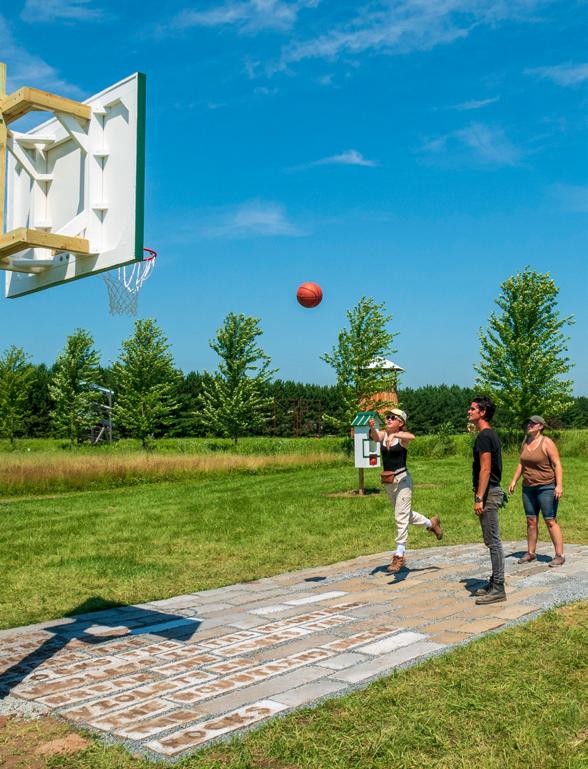
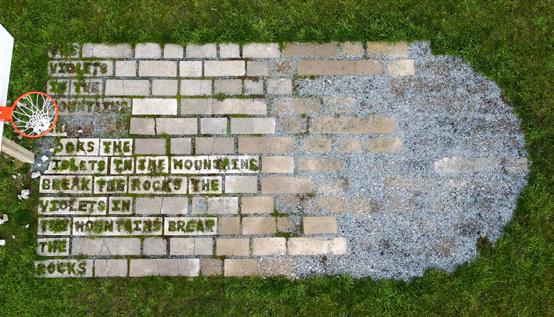
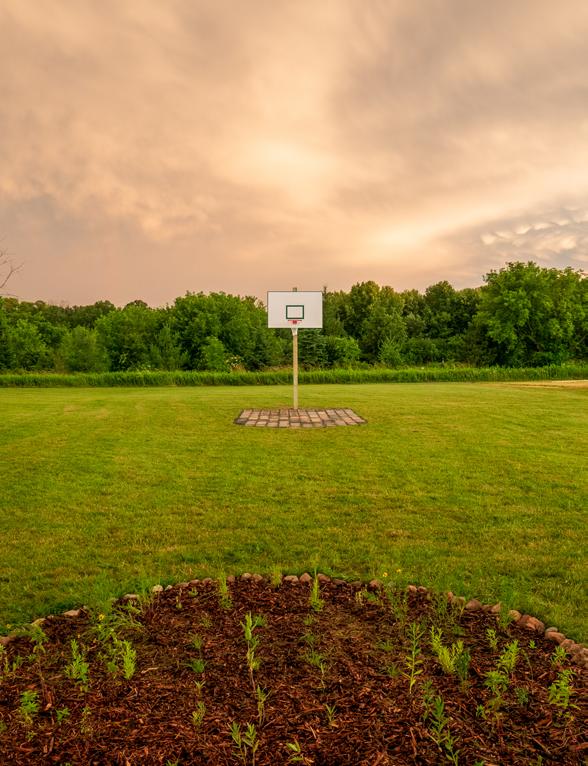
Kosmologym is an art and game design collective. Our games challenge players to encounter others (human and more-than-human) and place human bodies in physical relationships to global systems. Drawing on rules and artifacts from board games, behavioral economics, folk games, climate modelling, and sports, our games imagine means of co-constructing a shared cultural and natural commons.
Dirtball is our love letter to Earth. Dirtball is a reimagined basketball court that uses experimental concrete, a garden, and a birdhouse to tie individual humans and their actions to the soil forming process. As people play on the experimental concrete, their movements wear away the surface and release minerals that enrich the surrounding soil and help plants draw carbon from the atmosphere into the soil.
Walker Tufts and Greg Stewart, Dirtball’s lead artists, have both called the Shenandoah Valley home. The Appalachian mountains, once 20,000 feet tall, have slowly eroded and contributed lime and other minerals to the valley’s resulting rich soil. We’ve both fed and been fed by this generous soil.
We see the Dirtball courts as tiny spaces of time accelerated in the soil’s favor. Dirtball’s concrete mixes are made with local materials that will likely end up in the soil over time. Dirtball 1 at Franconia Sculpture Park, in Shafer, MN once sat beneath the Laurentide glacier. We used sand from a nearby glacial esker and dresser trap rock (a local basalt) as well as basalt rock dust, while the clay letters were carved from clay beneath the sculpture park. As weather and basketball wear away the court, these materials offer enriching minerals to the soils.
Dirtball courts combine an experimental concrete court, a birdhouse, and a garden. The first three courts use a collection of experimental concrete mixtures designed to be destroyed by the physical weathering of basketball and the effects of local climate. Concrete is usually a portrait of local geology. While cement might be produced at a distance, the sand and gravel that make up the aggregate are sourced locally. A poem, carved from local clay, is cut into the concrete of each key. Yes!
Dirtball 1 includes a purple martin hotel, Dirtball 2 (Governors Island, NYC), and Dirtball 3 (Charlotte, NC) include chimney swift towers. Both of these acrobatic aerial insectivores, long adapted to living in human-built structures, join in the soil formation process. Beneath the birdhouse are garden keys that bring local cultivars to the court. We are investigating meaningfully and visually inviting more diverse collaborators as we develop new courts.
Kosmologym includes Greg Stewart & Walker Tufts
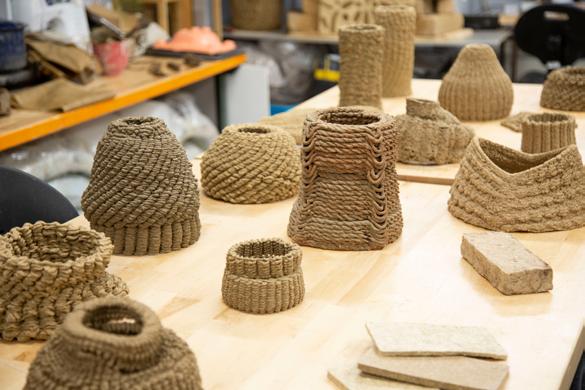
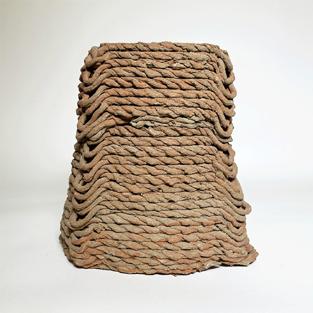
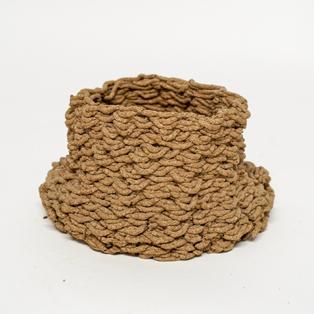
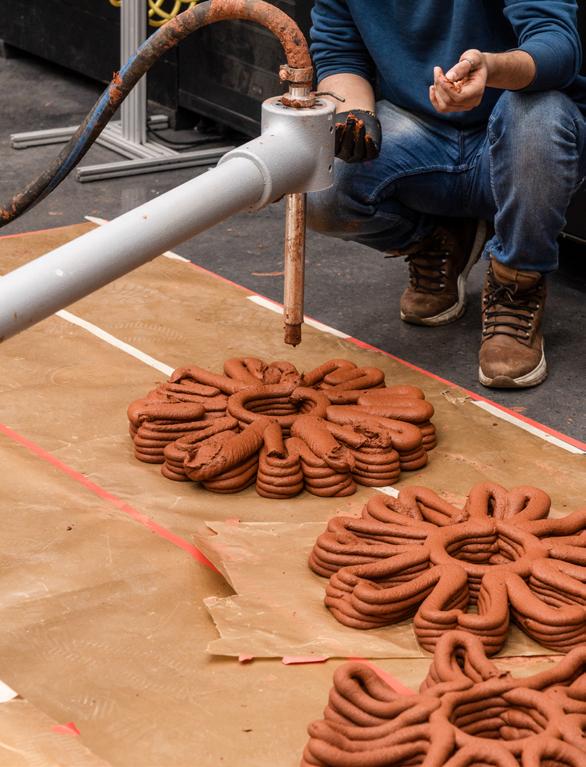
I wish to be immersed in mud, to plaster my body with earth-fiber cob. I want to paint architecture in brown: granular, texturized, dirty.
Soil is, indeed, a fundamental and personal element within my design rituals, scholarly research, writing, teaching, and making. What does it mean to stem from a geo-material scholarship? To tap into deep time and space within the earthen core—its clay minerals, histories and narratives? I see the work with soil not only as a speculative fabrication of artifacts and elements but also as an activist engagement with the future of soil-composites earthen construction in cities and societies, through broader geotechnical possibilities, digital translations, and compassionate machine-making. A mode of making that deeply bathes—bodily speaking—in earth materials as paste-like medium, deposited line by line.
My work with 3D printed earth creates building blocks, ritual objects, and wearable textiles, but also ingestible substances that can be consumed. By doing so, I aim to expose climatic, societal, and technological inequities and crises through the lens of soil, investigating topics such as perception, health, thermal pleasure, soil nutrition, and recyclability.
The materials I work with at the Natural Materials Lab are inherently and extremely variable: clay soils, excavated dirt, mud and loam, plant fibers, bast, stem and leaves from straw, sisal, kenaf, and hemp. With natural materials, one batch is never the same as another. Claysoils may exhibit entirely different features compared to a batch from a construction site nearby. This variance is not a flaw, but a feature—it indicates the quality of being different, divergent, inconsistent: extensively variable, porous, and resolutely disobedient.
At the Natural Materials Lab, which I have founded and directed since 2020, we salvage clay-rich soils
from construction sites in New York, and plant fibers from agricultural co-products, to formulate building materials and assemblies that are mechanically compressed, 3D printed, or manually crafted. When creating new composites, I draw parallels to other disciplines of making and art–from ceramics to baking. I practice Material diets; I work with Alchemistry of recipes; I turn mud to bread, then to gold. I am intrigued by the variability of clays, soils, rocks, and geological strata, as elements that form building material “recipes.”
I employ shredding machines for legumes (used to chop fibers), industrial dough mixers (utilized to create mud composites), and silicon cookie forms (for testing minibricks). The recipe for me is a method of responding to ratios. It helps me inform a more wholesome material knowing by adjusting quantities and constituencies. As such, recipes have agency in many directions: as a written documentation of experiments, as a dissemination of a successful formula, and as a guiding baseline for further creativity.
Rebecca May Johnson, a contemporary literature writer and cook, writes in her book Small Fires: An Epic in the Kitchen: “When we perform the recipe, things become other things in a messy transformation–like words in a sentence.” Knowledge-making, similar to cooking, similar to honey-making, is about transformation. The written words are the hive; The creation of a recipe is the honey.
Johnson, Rebecca May. Small Fires: An Epic in the Kitchen Pushkin Press, 2024. Page 51.
The Natural Materials Lab projects, led by Lola Ben-Alon, include the following lab team members: Olga Beatrice Carcassi, Mohammad Hossein-Zowqi, Valery Kate Perez, EunJinShin, and Tashania Akemah.
Earth is not to keep; it is only ours to hold.
To care for it is not to resist change but to move with it–to witness the bloom, the fade, the shift, and the becoming. Value lies not in what lasts, but in what we choose to cherish, knowing it may not endure. Here, transformation and impermanence are not losses, but manifestations of life unfolding. What we nurture changes–and so do we.
Care does not seek to fix or possess; it honors the connections that form a bridge between existence and meaning, as we navigate the cycles of an interconnected world.
La Tierra no es para apoderarla; solo nos corresponde sostenerla. Cuidarla no es resistirse al cambio, sino moverse con él: ser testigos del florecer, el desvanecerse, la transformación y el devenir.
El valor no reside en lo que perdura, sino en lo que elegimos atesorar, sabiendo que tal vez no dure. Aquí, la transformación y la impermanencia no son una pérdida, sino una manifestación de la vida en pleno despliegue. Lo que nutrimos cambia, y nosotros también.
Cuidar no es arreglar ni poseer; es reconocer los lazos que forman un puente entre la existencia y el sentido, mientras transitamos los ciclos de un mundo interconectado.
—Jackie Amézquita
1 López Ocón, “Joaquín Torres García, el hombre para el que el Sur era nuestro Norte,” January 16, 2023; Pérez Oramas, L., & Torres-García, J. (2015).
2 Survivance is a term from native literary theory and practice that emphasizes an active sense of presence over absence and the continuation of stories as renunciations of dominance and the unbearable sentiments of tragedy (Vizenor 2008).
Nuestro Norte siempre a sido el Sur, an exhibition by artist Jackie Amézquita (b. 1985, Xelajuj No’j, Cuauhtemallan), features a corpus of biomaterial work navigating ecologies of movement, encapsulating the journeys not only of humans but of more-than-human entities: animals, plants, and spirits across the U.S.-Mexico border. The title of the exhibition extends from América invertida (inverted map of South America c. 1944) by late 19th century artist Joaquín Torres-Garcia (Montevideo, Uruguay, 1874–1949).1 Through ambiguity and refusal of Cartesian logic, Joaquín-Torres states, “el Sur era nuestro Norte,” challenging Eurocentric systems. Amézquita deliberately alters the spelling of the exhibition’s title, subverting the grammatical norms of colonial Spanish and enacting a refusal rooted in Indigenous aesthetics. In doing so, Nuestro Norte siempre a sido el Sur reorients perception through a disruption of analogical syntax and imposed linguistic order.
Amézquita’s aesthetic analogies are informed by Mesoamerican ways of being and relating–specifically informed by the Maya Indigenous diaspora residing on occupied Gabrielino/Tongva homelands (Los Angeles, California). Amézquita’s gestural soil paintings retrace persisting practices of Indigenous movement, futurity, and their contingent Mesoamerican cosmologies and philosophies, delineating themes of regeneration and the constant transformation of life. Her pieces are created through fundamental semiotic processes of ritual and iconic representation that embody fissures within societal and environmental landscapes, while also illuminating paths toward Indigenous survivance.2 The forms in her soil paintings are ambiguous due to the life and agency of soil, and its ability to expand, shrink, or break.
Central to Amézquita’s process of making is ritualistic sourcing, and alchemical transformation of biomaterials, which posits and reimagines fissures and ruptures as moments of liberation where regeneration can exist. Utilizing sourced soil from migration paths along the U.S.-Mexico borderlands, in the occupied homelands of the Tohono O’odham, O’odham Jewed, Chiricahua Apache, Piro, Tampachoa, Mescalero Apache, Lipan Apache, and Kumeyaay peoples, Amézquita’s paintings are constructed through alchemical processes. Before being fired, the soil is frozen–preserving its raw state as a fragile memory before transformation and the transient materiality of the earth. Then comes fire. First as flicker, then as force. Fire speaks in cycles—ignition, blaze, ember, ash. In its heat, things are revealed; in its dying, they are reborn. It is not destruction, but transformation. Participants gather, not to watch, but to enter–a shared stillness, an ancient memory. The flames do not divide; they gather. They call us in.
bajo el cielo sobre el mismo suelo, is a large-scale, immersive work composed of seventy baked earthen “soil paintings” framed in copper, created from soils harvested across the U.S.–Mexico borderlands. Amézquita’s grid recalls the spare geometries of postminimalist artists like Eva Hesse, while her use of earth gestures to the legacy of land art. Yet unlike those traditions, this work foregrounds urgent political realities. It offers not only a record of geographies, but of forced displacements, converging ecologies, and layered sovereignties. In this sense, moments of liberation are reimagined through depictions of entities being in community despite the presence of borders associated with extractive and exploitative industrial and capitalist regimes.
Jackie Amézquita & Lili Flores Aguilar
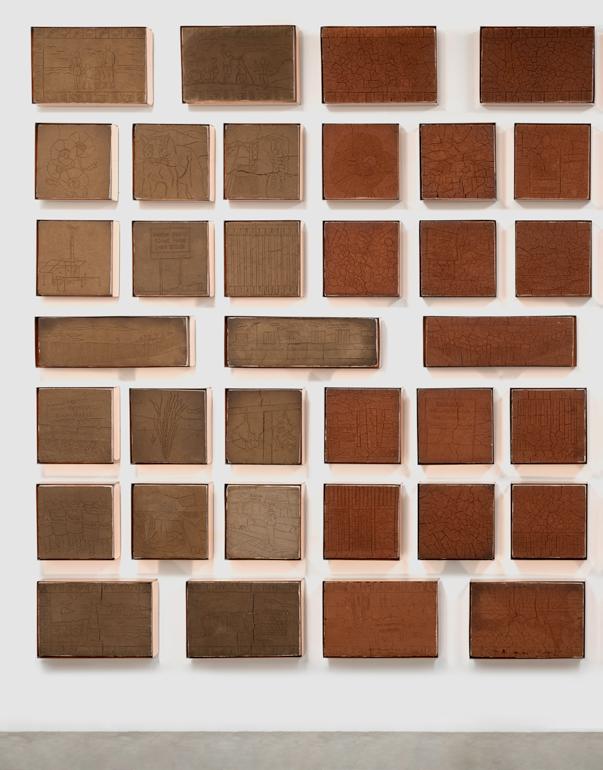
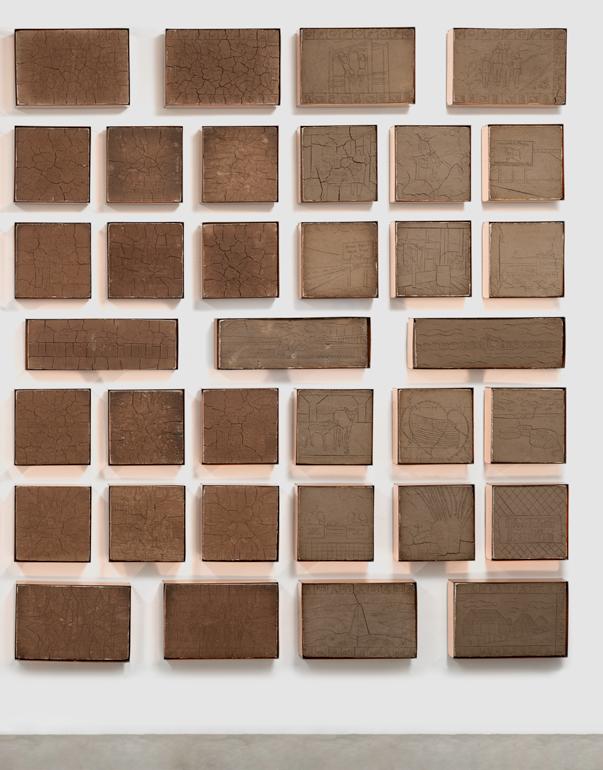
3 Indigenous people often use the phrase ‘time immemorial’ to describe the temporal depth of their connections with ancestral lands. Anyone who is even slightly informed on this topic knows that Indigenous peoples are not recent arrivals in the Americas stated by Indigenous oral histories and archaeological data (Belshaw et. al 2016).
4 Felix, Guattari, and D. Guattari. “A thousand plateaus: Capitalism and schizophrenia.” Trans. by Massumi, B.)., University of Minnesota, Minneapolis (1987).
5 Original Classic Maya iconography incised on bone excavated at the archaeological site of Burial 116 at the urban center of Xaj Mutal (Tikal, Guatemala) (Vernon 1998).
6 Barreno, Willy, “Decolonizing Time - Constellations” (Decolonizing Time - 2 E, Popol Nah, Cuauhtemallan–remote lecture, March 3, 2025).
More than a human narrative, the work speaks to the journeys of animals, plants, and spirits who also traverse these terrains. Gestural incisions in the soil paintings echo tectonic shifts and movements/migrations, mapping collective displacements shaped by imperial inheritances. The cracking of the panels, a result of their transformation through fire, becomes a visual language of release–moments of rupture that also mark acts of liberation. Amézquita engages a cosmology where nothing is fixed, where borders are porous and memory is sedimented in the land.
Amézquita chooses to draw from the adaptive journeys of multiple entities, portraying a shared struggle of maintaining pathways that traverse political, physical and psychological borders and boundaries since time immemorial.3 Her paintings are a physical and metaphorical deterritorialization4 that speaks to the mending of divided landscapes and peoples.
Rooted in Maya philosophies, and the cyclical logic found in the culturally syncretic Maya Ki’che text, the Popol Vuh, her work emphasizes transformation, decay, and regeneration. Life and death are not opposites, but twin forces of balance. In this spirit, bajo el cielo sobre el mismo suelo becomes not just a reflection on division, but a visual invocation of reconnection–an offering to the past, and a path toward wholeness.
navegando las veredas del despojó, features etched Maya Classic iconography on obsidian, depicting multispecies ancestral paddlers on a canoe.5 Amézquita’s work makes legible blessings rites performed in caves associated with cyclical voyages to and through the watery depths of Xibalba. In Maya cosmology, subterranean spaces–caverns, caves and ts’ono’ot (cenotes)–intertwine, as liminal realms for ancestors to dwell, transmute and guide living relatives. Amézquita situates navegando las veredas del despojó between two additional obsidian etchings: one depicting Wukub’ Kaqix (Osa Mayor) outlined alongside the recognizable contours of the North and South American continents; another featuring the constellation of Xamxib (Osa Menor). Together, these celestial maps guide the migration/movements of both people and spirits, tracing ancestral pathways across land, water, and sky.
grounding energies is a series of soil paintings that consider the interplay between displaced biomaterials and their coexistence as diaspora. By fusing fossilized shells with pigments derived from plant and animal entities, Amézquita symbolically invokes the interconnectedness of worlds–tracing how human and more-than-human activity and global trade have long transcended geographic boundaries.
The underground gallery space echoes the built chamber spaces known as choltun–earth-embedded structures used as sacred and quotidian repositories–grounding energies functions as an archive of mnemonic relations. Soil, rainwater, crushed fossilized shell along with masa, salt, copal, bee pollen, cochineal, achiote, pea flower, obsidian, and lava rock evoke pathway ecologies and repertoires of Maya life. Each biomaterial carries its own memory, and in fusing them into soil slabs, Amézquita gestures toward the integration of plural elements within disassociated environments–challenging fixed notions of belonging and place.
grounding energies stimulates meditation on the formal logic of the choltun: a navel, a nexus to practice the long-count order of 360 days as measured by the movements of Ajaw (sun); a site of spiritual cleansing, and ancestral reverence. From the ritual gathering of materials to composite soil paintings, Amézquita’s work raises urgent questions around what forms of intuitive care and tending emerge through intimate, embodied relationships with land.
Throughout ancestral spacetime and contemporary cultural practices, Maya cosmologies and aesthetics are expressed through the simultaneity of symbolic meaning-making and material embodiments. Informed by Maya aesthetics and indigeneity, Nuestro Norte siempre a sido el Sur is grounded in Mesoamerican worldviews, and foregrounds the continuity between ancestral memory and movement. Amézquita’s compositions cultivate moments of reflection–urging us to sense and reclaim who we are beyond colonized and capitalist ontologies, to confront the traumatic histories of dis/placement we carry, and to engage the present with a heightened attunement to futurities. In doing so, the work calls forth multispecies communities of care, deep listening, and reciprocal interconnectedness.
In her performance, como el agua que fluye, Amézquita walks a choreographed pedestrian route. Acts of walking in Mesoamerican codices are often represented with symbols of footsteps, indicating paths of origin and movement. Amézquita’s body retraces her own pathways of memory and migration embedded in urbanity and border-
References
1 Belshaw, John Douglas Sarah Nickel, and Dr Chelsea Horton, (2016) “3. ‘Since Time Immemorial.,’ ”https://histindigenouspeoples. pressbooks.tru.ca/chapter/3-since-time-immemorial/.
2 Barreno, Willy, “Decolonizing Time - Constellations” (Decolonizing Time - 2 E, Popol Nah, Cuauhtemallan–remote lecture, March 3, 2025).
3 Felix, Guattari, and D. Guattari. “A thousand plateaus: Capitalism and schizophrenia.” Trans. by Massumi, B.)., University of Minnesota, Minneapolis (1987).
4 “Joaquín Torres García, el hombre para el que el Sur era nuestro Norte,” January 16, 2023, https://www. tiempoar.com.ar/cultura/ joaquin-torres-garcia-elhombre-para-el-quese-sur-era-nuestro-norte/.
5 Vernon L. Scarborough, “Ecology and Ritual: Water Management and the Maya,” Latin American Antiquity 9, no. 2 (June 1998): 135–59, https://doi. org/10.2307/971991.
6 Pérez Oramas, L., & Torres-García, J. (2015). Joaquín Torres-García : the Arcadian modern / Luis
7 Vizenor, Gerald. “1. Aesthetics of Survivance.” Survivance: Narratives of native presence 1 (2008).
lands. Synchronistically, Amézquita’s choreography includes the linguistic plurality of her constellation of friends and artists who count each step. Amézquita’s poly-synchronous community is made present through digital communication devices which are vital for maintaining connections amongst diasporic peoples.
Inviting people within her web of relations, and attendees of the exhibition, Amézquita challenges people to consider their own relationship in supporting migrant place-making practices in global systems of movement.
Her choice of biomaterials and performance embodies the liminal space of potential for recovery and renewal amidst disruption and decay–embracing the interconnectedness of all life forms through webs of relations through movements via land, water, or air. The concept of fissures–both literal and metaphorical–is prevalent in Amézquita’s pieces. These allude to political dimensions of deterritorialization that neoliberal capitalism and subsequent environmental destruction have on migration and movements, that also serve as sites of potential rhizomatic growth and rebirth. Through her exhibition, Amézquita visualizes these breaks as starting points for conversations about regeneration, showing how damaged realms, be they ecosystems or communities, might be crystallized back together, reflecting a wound–a scar’s presence as a form of teachings.
Nuestro Norte siempre a sido el Sur profoundly retraces and embodies the fluidity of movements across borders–geographical, biological, and conceptual. Amézquita’s work serves as a spatio-corporeal-temporal site for expressing narratives of collectivities, the cosmologies of Mesoamerican people, and the transformative power of materiality. Amézquita’s work invites viewers to contemplate the ongoing cycles of movement and change and to participate in supporting a future where these cycles foster not fragmentation but Indigenous futurity and the persistence of their collective memories. Her artworks and performance propose a world in which regeneration from past disruptions paves the way for connections and shared futures, urging a rethinking of borderlands not as divides, but as spaces ripe for collaboration, and reimagining growth and belonging. Amézquita’s use of elements encourages viewers to contemplate the multifaceted nature of global interconnections and implications for our shared future.
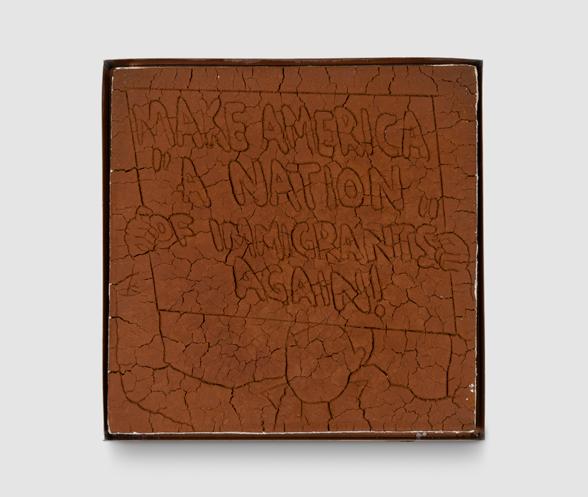
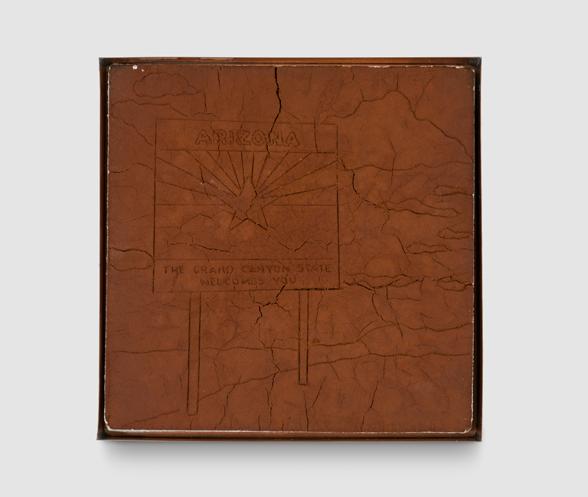
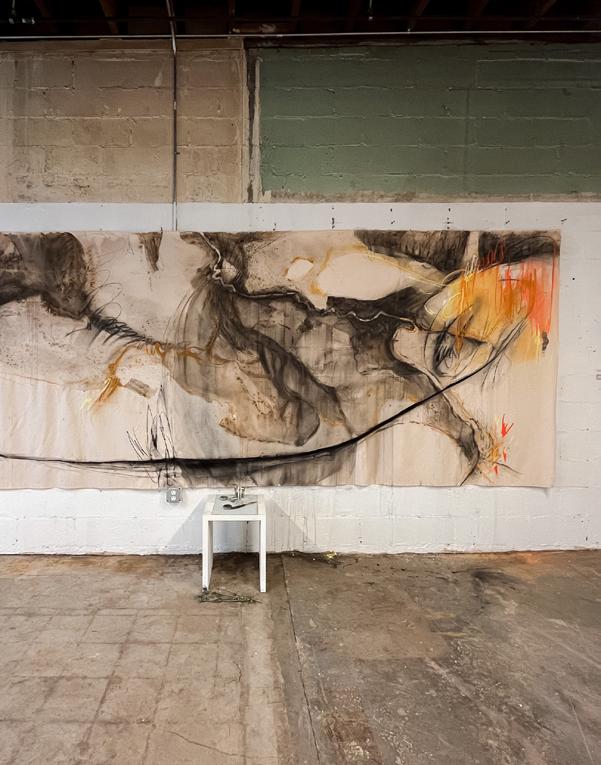
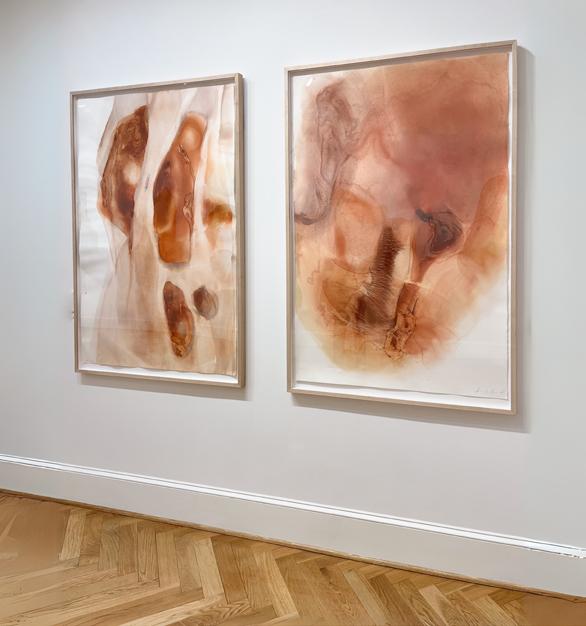
As a mother growing new life amid the death throes of imperialism, capitalism, and the resulting planetary anguish, I keep wondering about the depth of my miseducation. What knowledge has been stripped from us intentionally, for profit? What would it feel like to live free of systems that betray every cell in our bodies? An antidote has been this question: What can healthier ecosystems teach us about how to live? The answers have become armor, a growing defense against the pressure to believe this capital construct as reality. The lessons are so naturally evident that once-immovable systems are now clearly fragile abstractions. Fractals are more real than borders and nations.
So I learn by going outside, observing life and its patterns, and gathering what the land offers freely: disturbed clay, plants in abundance, windfall seeds, water. Making becomes a process of discovery: of natural relationships, of myself, and of our shared ways of being. That’s the space where the truth-armor emerges from, because if it’s true for soil then it’s true for me, too.
The clay I used for Affordances of Water (Atchafalaya Basin) was gifted to me by a friend in New Orleans, gathered with an elder from a Mississippi River tributary, where pink and light-orange veins run through the banks, known locally for their healing properties. (This is the first lesson: community is health care.)
Since the 1920s, Louisiana’s coastline has been dissolving into the Gulf of Mexico, a football field every 45 minutes. But one spot in Atchafalaya Bay defies this trend, building a square mile of new wetlands each year. Unlike the Mississippi, which is confined by levees that funnel sediment into the Gulf’s dead zones, the mouth of the Atchafalaya River is allowed to flow freely. When ecosystems are not controlled, they regenerate and thrive
Affordances of Water mirrors this geologic process: water carried clay pigment across the substrate until it settled naturally, forming tributaries and islands. The materials followed their own course, evoking the pre-colonial fluidity of the land, when the river was free and people in Bvlbancha lived in relationship with it, moving seasonally.
Perhaps the force of water moving land would be beautiful and not terrifying if we weren’t living in colonial precarity on its edge. Tributaries are strategies for becoming, waves repeat patterns to reveal pathways of energy and growth. Flowers, nebulae, and our bodies have curled edges from an acceleration of thermal particles, and one day these forces will break us down to make something new. And we think we can control a river?
We are matter, bound by the same laws of physics. A body of moving water is also the body of a woman preparing to hold life: building, settling, nurturing, and regulated, litigated, and dammed. But the mouth of the Atchafalaya is free and growing again, as should my body, and my daughter’s, and her daughter’s.
We are not separate from the earth, we are of it, holding all the same might and truth. This disconnection is temporary.
humus beings
Soil Health and Agroecological Living Lab
Whom, us?
Yes, us
Dust to dust
Us to us
Lust to lust
Flux to flux
Just to just
Stuffs to stuffs
Tuft to tuft
Guts to guts
Trust to trust
Yes, us
A person whose wisdom exceeds their good deeds Is a tree, Whose branches are numerous, But whose roots are few
The winds of the world easily uproot them
They do not protect what is not theirs They do not understand that they are animals
They do not drink from the same stream, The same stream As every neighbor— Or at least that’s what they believe, That somehow their rivers never reach the ocean
When the wind blows sideways, They swallow their tongues, Taste iron, Lean in—
Erosion dust plasters their throats
So visible the disrespect To Mother Earth, Their machines gnawing, For profit
The windstorm may pass, But the monsoon won’t arrive on time, Or the drought may linger
Long enough for even the richest of soils to dry
When will they learn?
How to tolerate the desiccation
Open their stomata to the darkness
Drop their leaves
As early as they need
A person whose good deeds exceed their wisdom, Is a tree, Whose branches are few, But whose roots are numerous
When the winds of the world blow against them, They cannot be moved
They give up their excesses
Like the eared lady fern, the desert sage, and the dogwood Who teach us how to make it through We could all live like this—
Guided from the ground up
Growing goodness below the surface, Where the mycelium murmur the way
We can bend down and hear the soil roar— She tells stories
About a planet so small, It fits in the palm of our hands— Precious and fragile
In cradle graves of moss and mineral
Soil is what sustains
The truth is, she is us, A miraculous web beyond understanding
When the world turns harsh, Root deeply
In concert with our community Harmony made organic against the wind
Imploring us to heed each storm
Casting us like seeds
Upon fertile soil
With the promise that our goodness will grow
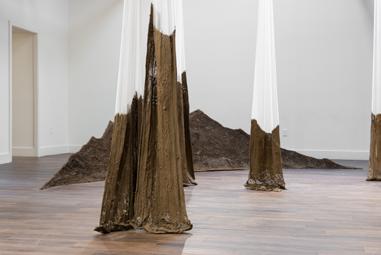
Jodi Connelly
The first soil I knew was in North Carolina: a burnt-orange clay whose color vibrated against the soft green pines and glimmered in creek beds. My sister and I pinched it into horses, birds, and vessels. This was the ground where I learned to garden. These early experiences have had a lasting impact on my art practice. Much of my work is influenced by the impact of mining
in California and how it has transformed ecosystems and landforms. I dig soil by hand, process wild clays, and create rammed earth sculptures to experience the physicality of moving earth, reenact geological forces, and to witness the impact of my interactions with the land. For the installation, Embodied Terrain, forms made from heavy clay soil are positioned in a vertical for-
mat to be in relationship with the body. I want the viewer to encounter the soil they have been walking on, stripped down to its powerful, raw, elemental state for contemplation. The surrounding earth forms contain this meditative space and evoke the mountains that surround the Sacramento Valley.
Katrina Bello
In Tagalog, my native language in the Philippines, the word for soil is“lupa.” At the same time, “lupa” is also the Tagalog word for “land.” Growing up in the place where I was born in the Philippines, little did I expect that I would immigrate as an adult to a country where “lupa” would mean more than just soil and land for me, but would also signify other things. Now living in country where I am not fully rooted, and far from the land -and soil- of my birth, I am hyperaware and conscious of the politics, environmental issues, issues of ownership, rights and access, lyrical narratives, stories of identity and belonging, and human relationships when it comes to land and soils. My artistic work emerges from my reflections and observations of our complex relationship with the natural world. What I’m interested in representing
in my work are expanses that feel like vast and remote landscapes and seascapes. I sense that it speaks of what is “other” to our human world, our dreams, our fears, and what is beyond our control. I’m interested in land, the environment, bodies of water, particularly the politics, histories, and narratives when it comes to human relationships with them.
The reference for this large drawing is a photo I took of fire-scorched tree bark from a Redwood tree I encountered in Armstrong Woods, Sonoma County, California. The tree likely survived the wildfire that occurred in October 2017, one of the most destructive wildfires in California’s history. When I examined the bark up close, it seemed like a charred landscape, like a landscape after a fire had razed it. I titled the work Lupain, which refers to the Filipino word for
land but also spells out the letters of the English word “pain,” an allusion to what land and soil potentially undergo in an environmental catastrophe.
Rebecca Schultz
My work with soil is grounded in deep engagement with place and its materiality; research and knowledge-building through collaborations with scientists; and employing diverse techniques and visual languages. The image in this publication was inspired by my field work at the Hubbard Brook Experimental Forest in New Hampshire. A spodosol is a soil profile often found in boreal and coniferous forests; a leached soil layer creates a distinct light band between the surface and sub-surface horizons.
I ground soil gathered from a soil pit into pigment and made printing ink for this hard-ground etching. I have also made oil, watercolor, egg tempera, and casein paint from soil and incorporated soil chromatography as a collage material. I learned in my work with scientists that soil, which is made up of rock, plants, fungi, and animals, is the binder of life. Soil embodies the impermanent and cyclical nature of our planetary processes, the simultaneous messiness and perfect order of our living world.
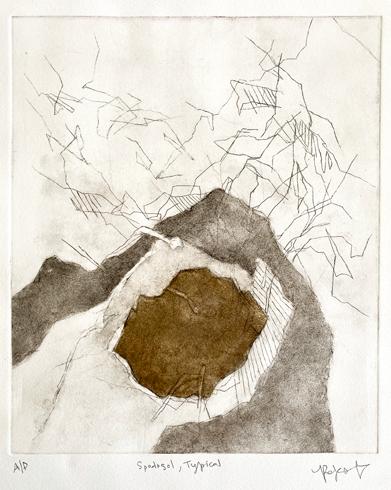
Christina Bertea
Ever since we started clawing at the earth’s surface with sharp plow blades, the soil has been bleeding its carbon into the atmosphere. Now we understand that we must bring carbon back into the soil with the help of billions of microbes, who receive carbon from a plant’s roots and can sequester it in stable forms that create enduring soil structure and a sponge-like water holding capacity. Our urgent task is to create the conditions that enable soil microbial life to flourish and to rethink practices of industrial agriculture and even backyard gardening. This piece imagines an elegant “instrument” that can broadcast into the ethers, inviting that wayward carbon to come home and settle back into the soil where it can work its beneficial magic. Castaways that I find beautiful or oozing with latent potential provide the material resources for my work. Making a piece starts with an intention to convey meaning—in this case, our need to bring carbon out of the sky above and back into the ground below. The delicacy of the barbecue grill grate was perfect for broadcasting as an antenna. The lampshade bowl could gather the carbon and transmit it down the water heater flue baffle to where the post hole digger plants it into the soil, contained in a clay pot. Assembly is always the challenge, requiring cutting, bending, filing, sanding, grinding, epoxying, and other improvisations.
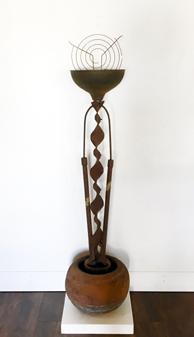
Liz McGowan
What would it be like to wear the landscape like a skin? To be sensuously wrapped in the elements? Supposing, instead of walking along a footpath, we were walking inside an ever-changing kaleidoscope of texture, colour, light, and process. Supposing we were literally cloaked in our surroundings?This cloak is made using saltmarsh mud as an expression of caring and being cared for by this unique shifting salty soil. It is an expression of intimacy. It is an invitation to immerse oneself in this world of mud, in its textures and movement, and wear it like a skin.The cloak mediates between the human body and the landscape it emerges from. It is an invitation to immerse
oneself in the more-than-human world, like plunging into cold water, and by referencing ritual cloaks, it opens up the possibility of a connection with the genius loci, the deep spirit of the land. The saltmarsh mud is from the coast of Norfolk, UK, where I live. Salty and slick, fluid yet stable, washed by the tides, home to unique plants and algae, protector of our fragile coastline, and an essential carbon sink. The presence of filamentous cyanobacteria binds the clay particles and traps particulate matter, creating a soil for salt-tolerant plants to grow, providing food for ducks, geese, swans, and wading birds, and a home to fish, otters, shellfish, and insects.
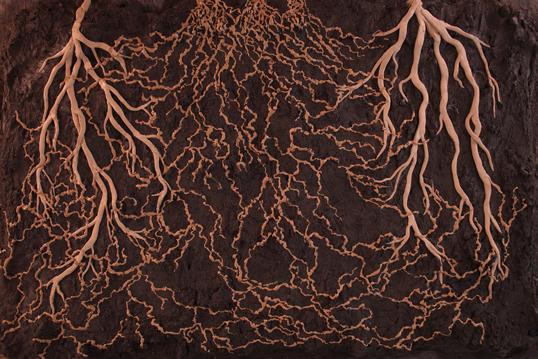
Jo Pearl
My early childhood was spent in Bedfordshire, UK, renowned for its clay soils and home to the London Brick Company. Later trained as a ceramicist, I fell in love with clay as a sculpting medium–the feel of it in my hands, its amazing plasticity. It was reading George Monbiot’s Regenesis in 2022 that I experienced a turning point in my understanding of the importance of healthy soils and how they relate to the current climate and biodiversity crises. I realized that the medium of clay could be a highly appropriate way to explore and celebrate the importance of healthy soils. Combining ceramics with clay stop-frame animation, Unearthed is created as a fantastical world that celebrates the awe-inspiring biodi-
versity in healthy soil: from mycelium to microbes, earthworms to insects. The project aims to breathe life into clay and clay into life. In a germophobic world where so many people are repulsed by insects, Unearthed is an attempt to get viewers to fall in love with the biodiversity of healthy soils. Accompanying the short animation are Unearthed ceramic pieces. These abstractions of soil microbes and invertebrates are pinned onto display panels, suggesting speculative entomology specimens. Playing with scale is central to both the animation and sculptures, revealing myriad beings to the naked eye. Kinetic works put ceramic microbes spinning and teetering on unfeasibly tapered metal rods. This delicate bal-
ancing act speaks of the fragility of our soil biome. My artistic approach allows me to minimize my carbon footprint: I only fire once, but create and record hundreds of forms using the same ball of clay. If clay is kept wet, you can keep sculptural work moving. I capture clay forms photographically and then weave these into a narrative using stop-motion software to create the illusion of life. At the end of a shoot, the sculptures are bisque-fired to transfix them ceramically. These two outcomes allow me to investigate notions of the fleeting and timelessness. I furthermore avoid glazes for environmental reasons, using instead different types of clay and sometimes stains to create my palette.
Martha Willette Lewis
My work is about science, the history of human knowledge, what we know, and what we once thought. I have always invoked “nature,” the world, and landscape through physics, mathematics, fractal geometry, and mapping. Lately, my approach is less oblique, less abstract: I have been collaborating with artist Marion Belanger, staining and collaging her unique photographs. I use traditional marbling techniques, evaporation, and other experimental paint processes for letting fluid reshape the images, highlighting and obfuscating the original print. This is a visual way of thinking about the things we cannot see, yet know to be happening —substances infiltrating the land-
scape as the byproducts of extraction, waste emptied, jettisoned, or leaked: things half-glimpsed, seeping up or fogging over, coating. I have always enjoyed making my own art materials. This fascination with substances drives my participation in the series we call Ever/ After, an active collaborative experiment, and a conversation about the soil, the climate crisis and how to process the weight we bear. We spend time in the woods, we talk, we read, we make work together. I like to use water’s inherent properties, working with flow and viscosity to float inks, which I glide Marion’s rice paper prints over. I blow, rippling the surface, tilt the pan, submerge, lift. The tricky part is vi-
sualizing the initial image and then echoing its form in the tray. The process requires quickness, lightness, and acceptance of the limited control one can exercise. It is an alliance with physics, with nature. The paper we use has a refined texture that responds beautifully to pigments. The marbling technique requires advanced preparation before the actual making begins. Thickeners, attractors, and mordants, all made of salts, gums, and binders harvested from the ground, sea, and vegetation, are whipped up in the kitchen. The dance that follows in the studio is about unleashing the interactions that can resemble trunks and branches, currents, smoke, fog, and vapor.
Phil Lambert
For me, working with soil came from a series of interconnected thoughts and coincidences. First, a memory of herman de vries’ soil work. Then, a coincidence: while reading A. N. Whitehead’s philosophy during building work on our house, we noticed the bricks we removed were stamped “Whitehead.” So, I began working with clay from the former Whitehead brickworks nearby. This was followed by a feeling that soil was overlooked and debased, which I identified with, a sort of anarchic quality. It felt right to make art from a humble, dirty, brown, cheap and ugly material. Lastly, as I am colour blind, it made sense to focus on paint as material rather than colour, drawing out metaphorical and material associations. I balance my art practice with family life and other work, so subject matter is very practi-
cal, but it also unashamedly champions the fundamental importance of everyday spaces. These works are created with a single pigment, a mud sourced from my garden and transformed into oil paint. The paintings emerge through layers that are added and scraped away, revealing textures and opacity against the white ground. They are created with a slow, observational process which allows me to become unconscious in the making. I think this brings me closer to the subjects and the soil, allowing their voices to be heard. Homes, in effect, are made from soil and quite literally form our roots. The absence of people in the domestic rhythms of the paintings gives a sense of time passing or even a feeling of loss. I think this echoes the cycles of life, growth and decay present in soil.
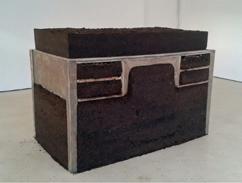
Emily Joy
A democratic material of creation, soil invites a sort of meddling touch. It is a poor, familiar, crumbly, compressible material, and a rich, life-supporting, nutrient-loaded mass. It is the earth of our bodies and the ground of our imagination. Working with soil often necessitates the presence of another person to share the work, and voices are freed to talk when the body is engaged in earthy labor. Handling soil frees speech. Soil is both burial and seed-bed, both muting blockage and tongue-freeing
language, both battery and dust. My current project, Land, Earth, Empathy, explores personal and ecological loss and restoration, land-based nostalgia spanning countries and cultures, and the opening of personal narratives through non-hierarchical participatory works. I work with my mentors, Dr Elizabeth Hodson (anthropologist), Dougald Hine (Dark Mountain Project co-founder), and Jürg Alean (glaciologist/geologist), and a host of other artists and researchers to organize community
events, talks, and symposia. In this project, I seek to question cultural hierarchies, historical and personal narratives, and to unsettle ideas about truth, absolutes, and binary ways of thinking in the context of land loss. Casting is an important process in this work, as is the use of materials out of place. Hands, touch, and sharing (of tools, materials, touch, threads, space) are vital as these connect people through simple making and un-making processes.
Andrea Krupp
This graphic work borrows the form of a modern industrial age relic–the BNM peat briquette. Once a ubiquitous retail fuel commodity in Ireland, peat briquettes were burned in homes and loved for the warm and nostalgic glow they emitted. Now, however, the true costs of burning fossil fuels like peat, coal, and oil, are being called to account. The government-owned Peat Board, or Bord Na Mona, ceased production of the BNM briquette in 2024. In spite of the feeling of grief or cultural loss,
the inexorable global transition away from burning fossil fuels continues. My creative research projects emerge from the native human instinct to observe, wonder, and create new meaning from what I see, experience, and feel. Thinking about peat led me to thinking about Pennsylvania anthracite coal, the subject of my current work. Close study and slow processes such as carving, grinding, polishing, drawing, and printing keep my focus on the here-and-now, and draw me closer to nature.
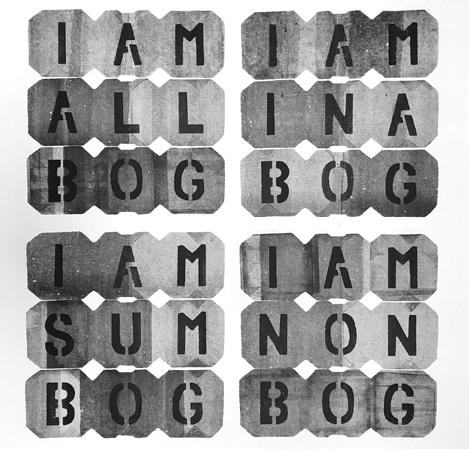
Veronika Pfaffinger
Soil as material is timeless. It represents the past, the future, and the present equally. For me, there is no material that is more elemental, inspiring, and alive. Understanding the cycle of life has profoundly altered my perspective on the world and our human existence within it. As explored in the Meadow Series, which was part of the Down to Earth exhibition in Dresden in 2022, I work with soil to visualize transformation processes in the landscape in the mirror of materiality. In temporary interventions, installations, and sculptural works, I examine the human influence on ecosystems and cultural landscapes and vice versa.
Wiesenstücke, 2022, metal, concrete, glue, meadow with roots, approximately 14 x 14 inches x 7 feet
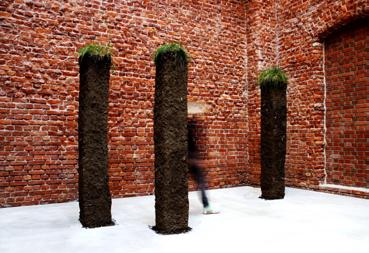
Nina Rastgar
Born and raised in northern Iran among the Gilaki-speaking natives of Gilan’s green and lush province, my visual research is grounded in the conceptual strength of materiality and touchability. The soil in Gilan is a rich mix of silt and sand, ideal for agriculture. The moisture and texture of the soil evoke a profound sense of sensibility and responsibility in me, inspiring careful stewardship of water, soil, and seeds. The region’s climate and fertile soil have made agriculture one of the most important and oldest occupations for women, profoundly influencing our way of life. In addition to agriculture, craft art, diverse cuisine, and traditional clothing hold significant cultural value, blending practicality and artistry in ways that reflect both individual imagination and communal identity. This soil has deeply influenced my artistic practice, playing a crucial role in both my daily life and artistic endeavors. I perceive objects in space as a dynamic medium encapsulating the essence of humanity. As Judith Butler eloquently states, “There is earth and air and food that mediate our relationship as humans, and we belong to those regions as much as we belong to one another” (Butler, 2022). This relationship with the soil mediates my understanding of
life and art, shaping my approach to both. Soil can be used as a medium to tell stories of resilience, growth, and continuity. The soil's essence becomes a vessel for cultural and historical narratives, bridging the past and present together to celebrate the life it sustains. When I manipulate materials with my hands and install pieces in place, I reflect on my experiences and convey stories, using materials as a mode of knowledge and storytelling. Working on a farm exposed me to concepts and stories that shaped my perspective on tools as embodiments of human nature. I began crafting copper bowls that resemble seeds—functional objects with movable handles that materialize my emotions and concerns.
Butler, Judith. What World Is This?: A Pandemic Phenomenology. Columbia University Press, 2022, p. 56.
Folke Köbberling
In September 2024, I initiated the art project “Mash & Heal” at three locations in Munich’s urban area. Large-scale replicas of SUVs were made from a compostable composite material and placed in the city center. As a critical commentary on the dominance of the automobile and the sealing of the city‘s surfaces, the sculptures also served as indicators of the use of public space in Munich. At the three locations–Europaplatz, the corner of Herzog-Wilhelm-Straße
and Kreuzstraße, and the corner of Schleißheimerstraße and Dachauer Straße–they were used in different ways: They served as shelter, experienced vandalism, or were cared for and preserved by neighbors. After the vehicles decomposed in the city over a period of 12 months, the remains of the three composted SUVs will be brought together this fall in two processions, accompanied by the city’s residents, through the streets of Munich to a central location–in advance to the IAA Mo-
bility 2025 motor show and of the premiere of BMW‘s latest SUV. At Schleißheimerstraße 6, they will be combined into a new, green sculpture and ceremoniously interred.
“Mash & Heal” addresses the growing pressure that increasingly large and numerous cars exert on our public space. Given that cities are becoming more and more sealed and congested, the symbolic transformation of SUVs into sustainable sculptures aims to reclaim urban space for people.
Emilie Houssart
Through absurdist interventions, I work in opposition to Dutch and British colonial legacies, particularly the ecological dissociation woven into our language and daily actions. This project creates a rupture in the woods, a virus-like set of growths that entangle a recreational area of the forest floor with industrial farming and local food waste. Co-co-codac! was made in collaboration with a series of guests, who were invited to hand-mix potting soil and talk about food and land relationships. The potting mix was created from forest soil, local municipal compost, sand, and fermented horse manure. We then rammed it into geometric molds, embedding industrially farmed potatoes between layers. For me, the ramming was a potent action, making a totally unsustainable, incongruous shape from living material by force, where it would form a new, displaced, interdependent community and eventually rearrange itself according to its needs. The conversations varied widely and included people's personal experiences and associations, considerations of pessimism, hope, food deserts, education, and brainstorming alternative futures.
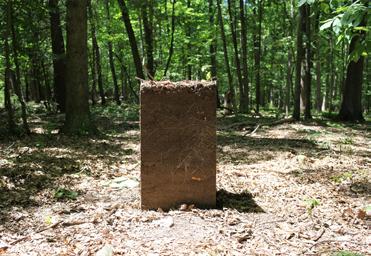
Co-co-codac! (detail), 2021–22, forest floor, local town compost, sand, fermented horse manure, industrially farmed potatoes, dimensions variable
Mary Waltham
Artistic expression about nature can make a pressing commentary on the state of our planet, the politics and policies that shape public debate about our environment, and the questions we need to confront. My intention is to spark new conversations by bringing the landscape to life through my work. After a career in science and science publishing, and as a biologist, I bring a distinctly different perspective to artistic expression, with firm roots in both science and ecocriticism. Ground is an ongoing series of artworks centered on the soils of New Jersey as a pro-
cess of discovery and exploration. In my most recent art practice, I collect soil from public lands in New Jersey. I grind my samples by hand using a pestle and mortar. The soil extract is then used as paint by adding water and acrylic medium, and painting it onto my support. My painting technique is loose and intuitive. Currently, I am interested in the contrast between different soil types and may use other natural materials such as rust and ash for contrast in some of the pieces. The aesthetic qualities of soils are well able to speak for themselves.
Susan Rostow
Through the tactile process of sculpting and the organic qualities of my materials, I seek to inspire a connection with the natural world. Making paint from soil, sand, and natural binders grounds my work in a sense of place and time. The variability of the soil, from the rich, dark hues of fertile land to the sandy, pale tones of arid regions, reflects the essence of the diverse places they come from, encapsulating their history, geography, and personal stories. I create mixed-media sculptures using a blend of materials, including paper with sand, clay, fungus, and various natural binders. The process begins with layering prints and drawings on paper, forming the foundational layer of the sculpture. I then bind the paper layers together using soil, sand, and natural binders. This technique buries the earlier layers and selectively reveals fragments of the original drawings and prints, creating an interplay of textures and visuals. The organic materials imbue each piece with a sense of earthiness and connection to nature, while the partially obscured elements invite viewers to explore and uncover hidden details.
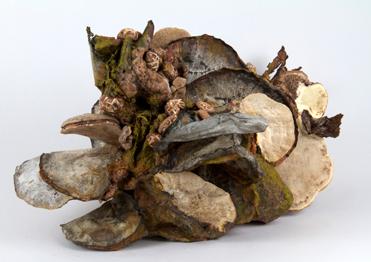
Robin Raznick
I'm a desert dweller. Contrary to the notion that the desert is barren, it's actually quite the opposite. Desert soils are biologically and texturally diverse, sandy, gravely, clayey, sticky, sometimes rocky. Despite water scarcity, high ph, and the sometimes extreme heat, these soils teem with a fantastical array of creatures and plant life. I’m interested in these variations of texture, color, and composition, and the geological processes and interactions with desert flora and fauna over millennia, that give this landscape such a surreal and spiritual depth. As an impasto painter, I incorporate organic materials, (soil, sand, feathers, dead bugs, sticks, abandoned nests, etc..) into the surface of the canvas. The material mark-making adds a physical, con-
ceptual and spiritual dimension to the act of painting. I push the texture by combining materials to create contrast and variety. Clumps of paint are scraped from palettes, squeezed from pastry tubes, and smeared with hands so much so that the faces of the paintings are sometimes 2” or more in depth. Although the natural elements are embedded in oil paint, there is an inevitable decay in the work as part of a life cycle. Just as over time the oil paint will crack and the surface will undergo changes, so the organic material may gradually fade away.
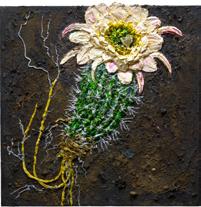
Nancy Winship Milliken
I use soil as a sculptural material and as a paint. My studio near Lake Champlain in Vermont is a placebased environmental art studio committed to building community through collaborative expressions of reverence for land, humans, and animals. The geological history of the area defines the soil that I work with. Once an inland sea, our soil contains limestone and clay, making it a wonderful material for building and painting. I am also surrounded by regenerative farms and have made earth-based paintings in response to their unique care of our soils, highlighting the work of our farmers and their animals. For the Earth Press project I created three publicly engaged installations with words collected from the public and imprinted into earthen blocks. These blocks were then made into sculpture. I have engaged with cattle (and sheep, farmer and oxen) to print with their hooves onto canvas using the field soil as the paint. This project highlighted intensive rotational grazing. I have buried canvas and silk into compost piles on farms, allowing varying degrees of breaking down and imprinting the beautiful hues of our rich regenerative farm soils. I also use the beautiful limestone in the soil around the studio to create bas-reliefs of the pollinator plants growing in that soil by creating a limestone slurry and layering it onto the plants.
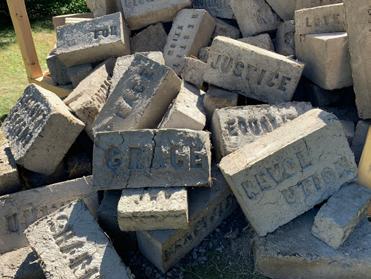
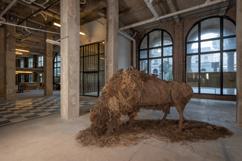
I use principles from regenerative agriculture, systems theory, and holism, incorporating time and movement through sculpture and printmaking. My artistic practice focuses on implementing systems thinking to inspire social change that will ultimately reimagine urban landscapes, return the carbon in the air to the soil, support wildlife, reduce water run-off, and support flood control. Inspired by biologist M. Thomashow’s proposition that natural history is collective memory, I developed the
Endangered Knowledge series of works, in which I explore the natural systems of Texas's ecological history. I seek to reseed how we see urban landscapes and to propose the holistic restoration of biological balance—awakening urban consciousness to our kinship with living systems and restoring what is lost. Endangered Knowledge: The Soul of Humus is part of a comprehensive installation that I am currently developing, which considers the role of the American bison within Houston's
specific soil ecological history. The sculpture records the endangered natural history through the dense coat of the powerful humus-built bison, dripping in the armor of locally sourced native grasses and sedges, seeds, and pods. While agriculture rejuvenates the soil, the bison sculpture has rotated through multiple pastures/exhibitions, from a historic grain silo to the former Texaco Building in downtown Houston.
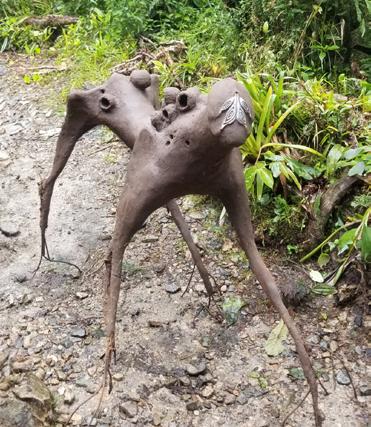
Daniel Robles Lizano
Soil is a quiet creature, a breathing creature. It feasts and nourishes itself with the essence of all beings. It is all beings. Within its depths, it cradles, birthing life anew with each passing season. It is both womb and tomb, the primordial soup from which all life emerges and returns. This creature of soil, born from the amalgamation of life and potential, connects us all in a web of existence. I care for this soil as kin, recognizing its vital role in sustaining life's intricate dance and the cyclical nature of existence. As a visual artist from Mexico City, my work explores mutations, hybrid identities, and interspecies relationships. By portraying the monster as a permeable membrane that breaks down categories, my sculptural pieces help reimagine our
interconnectedness with various beings, both real and symbolic. Through speculative objects and characters, I play with fictions and fabulations that echo popular culture, creating intersections and reflecting on the human and the non-human. For this work, I created a structure made out of rods that I welded together and added a metal mesh on the surface with wire, then fermented mucilage from nopal cactus, made a mixture of soil and straw, and added it in layers on top and started sculpting as clay. Then I created a face with ceramic clay, then made a mold and cast it in aluminum metal. I then took it to an animal conservation center in Mera, Ecuador, where it now lives in the jungles of the Amazonas.
Peter Ward
I do not ‘care’ for soil! It is perfectly capable of caring for itself, adapting and mutating in response to the multifarious impacts humanity and universal ecology inflicts upon it. Whether it is then ‘useful’ is an entirely different matter, and it is just this inferred dominant ‘extractive’ relationship that is at issue with regards to our continuing destructive interactions. My own interest lies with geological kin that act as a foundation for soil, specifically in southwest England, my matrilineal home for at least 1000 years, and how we may communicate better to appreciate our evolving
place and development. My work aspires to connect and evaluate reciprocal relationships to local rock, clay, soil, and other earthly kin through informed (artistic, cultural, and scientific) processes of foraging, creative engagement, and reflective conversation. Our pets, like all animals, if we treat them compassionately, have the ability to keep us grounded through care and connection to our environment, offering opportunities for kin relationships and familiarity with the more-than-human. Holly was a very small and characterful Jack Russell and a much cherished family member.
Rachel Frank
I work as a licensed wildlife rehabilitator specializing in the care of waterfowl birds and raptors. This intimate work informs my practice. Combining sculpture, video, and performance, my work focuses on the connections between non-human species that aid in the protection, healing, or repair of surrounding ecosystems. Using materials such as bronze, glass, and clay, all of which undergo a process of heating, melting, and liquefying before reaching their final states, I’m interested in the transforma-
tive malleability of these materials. Through the use of these media that can move from one state to another, my practice explores the radical restoration of species and landscapes through “Rewilding” and more broadly, the interconnections and exchanges between species. Soil is the connective tissue at the crust of the earth—a rejuvenating “dermal layer” breaking things down below the surface and supporting growth to the world above. Soil is also a physical memory of past living plants, animals,
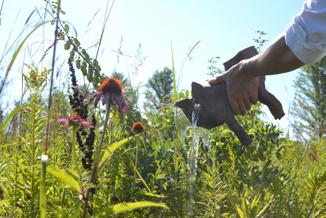
microbes; every living thing eventually becomes soil. Depending on mineral content, soil can vary in color, but typically people think of it as brown. Brown “umber” (appropriately from the Latin words for shadows) is derived from clay and was used in some of the first artworks on cave walls. As a sculptor who works in clay, I think about the transformability of clay, a type of soil, and its cycle from the past (malleable and porous) to taking form in my hands and becoming rigid with the heat of firing.
Through my paintings, I explore the hidden biosphere within soil and among tree roots. Inspired by forest walks and soil biology reading, I recognize fungi and soil life as vital for planetary health. I chose to communicate this through an invented landscape approach, condensing information in a relatable way and fostering connections between painting and thinking. This method avoids traditional compositions, relying on intuition and memory. Underground paintings start by pouring paint onto wet ground, creating patterns that lead to new expressions. A loaded brush forms root-like growth patterns, while saturated colors reflect the energy of these systems. Blending abstraction and figuration, I transform shapes into fungi, insects, and microscopic matter, shifting perspective from tiny structures to human-sized organisms, showcasing nature's diversity. Painting with textile—cotton canvas is buried in soil for three months, then exhumed. I embroider interpretations of microscopic organisms that lived near and on the textile. A circle is cut in the painting. The textile is glued under the edges and lies flush with the surface of the painting like a microscopic lens placed over the soil, magnifying the unseen.
Gabby Morris
What if Soil could help us to think and design differently? I came to soil not through science, but through feeling. As a designer and regenerative futurist working across rural futures, food systems, and experience design, I’ve long been drawn to the overlooked foundations of life. Under the pressures of climate change, food sovereignty, and biodiversity loss, care of soils is urgent and demands attention from all angles: emotional, cultural, political, and practical. In rural places, especially, soil shapes livelihoods, landscapes, and the long-term resilience of communities. I found myself searching for ways to help people reconnect with soil, not just as a resource, but as a living, relational system we’re entangled with. My interest lies in designing tools and experiences that help people make sense of complexity, not bypass it. Grounded Wisdom is a tarot-inspired toolkit designed to surface reflection, not prediction. Each card explores ideas of ecological
care, systems thinking, and regenerative design through the metaphor of soil. I created Grounded Wisdom because we need more than data and logic to face the challenges ahead; we need practices that help us feel our way through complexity. Soil, like tarot, holds stories, tensions, and memories. Working with soil also means working with endings. Decomposition, decay, and what gets returned to the earth. It reminds us that nothing lasts forever, but nothing is ever truly lost either. That cycle, of breaking down and beginning again, feels vital not just in ecology, but in design. In knowing when to let go of what no longer serves, and how to build with more care, more reciprocity. In a time of planetary urgency, we don’t just need better strategies, we need better questions. Questions that bring us back to the ground, to interdependence, and to the responsibilities that come with being part of a living world.
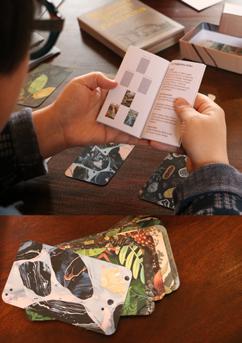
Ruben
Olguin
As an artist based in New Mexico, working in ceramics, adobe, sound, video, and electronic media, my work draws on my mixed Indigenous American and Spanish (mestizo) heritage. I incorporate traditional hand processes with earthen materials, blending them with modern elements, and focusing on spending as much time in the desert as in the computer lab. My art practice is holistic. I understand the power of art and conservation, and teach new media art along with socially engaged art practices. Through the education of our youth, our families, and our hearts, Art can enrich our lives and integrate with our everyday experiences. Leaving a lasting but non-invasive impact while nurturing the environment, my work uses soil, clay, stones, sticks, and seeds to create an eroding structure that will incubate its surrounding environment for years. The body and flesh of our mother earth, soil, gives life and home for all living things. I call Clay Mother kin; she taught the Tewa people pottery and how to use her flesh to bless the world with ceramics. The spirit of the soil lives in the vessels and gives medicine to our homes. The soil has sustained my family for generations, raising cattle, corn, beans, and cottonwoods. The Solstice series was made in tandem with Bill Gilbert’s 500 Dams Project, at the Randall Davey Audubon Center and Sanctuary, Santa Fe, New Mexico, as part of Where There is No Name for Art, the exhibition organized by ecoartspace, August 2024.
Melinda Kiefer Santiago
My multilayered practice explores the porous boundary of oneself with the living world through sculpture, photography, and installation. Source materials include photos of soils from New York woodlands, urban spaces, and sites with legacies of nuclear testing. Combining figuration with abstraction, I draw upon a range of influences such as surrealism and earth art. To me, soil means a living body full of relations, including many organisms, minerals, gases, liquids, decomposition, and regeneration. Soil is the substance that supports life. Soil can be overlooked, but it is an essential part of the ecosystem and a barometer for climate change. On a symbolic level, I see soil as base material, death and decomposition, buried histories, unformed, unfixed
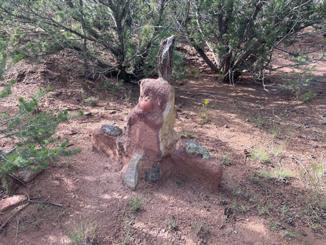
states, and the subconscious. Just as blood circulates through the body, water circulates through the earth.Created during my residency at the Soils Room at Swale House on Governors Island, NYC, this symbolic soil profile is made from an assemblage of images and repurposed materials from Governors Island and NY state along with photos from my recent travels to the Bradbury Science Museum at Los Alamos, New Mexico, the site of the creation of the atomic bomb. Some say legacies of nuclear waste in the earth signify the Anthropocene, pointing, for example, to the emergence of trinitite, a glassy fused soil created from the first nuclear test. Collaging past and present histories along with future speculation, I blur fact and fiction to envision healing through remediation.
How do we listen to the soil? In Joseph Beuys’ Urobjekt: Erdtelephon (1967), a clump of heavy soil with straw stubble is connected by a wire to a rotary telephone typical of the times. The work is both a statement on the energy infrastructures needed for global communication and the earthly resources that both provide ground for those infrastructures and symbolically listen in.¹ Erdtelephon, like many of Beuys’ works, juxtaposes hardness, in this case the standard plastic form of the telephone, with softness, in the form of the lump of clay alongside it. We can only speculate what the call of soil on the Erdtelephon would sound like, and if we could hear it at all. Reflecting on Michel Serres’ philosophy of the senses, Steven Connor makes the point that “It is hearing, its organ a magical transformer of hard skin into the soft touch of sensation, that preserves the complex, unintegrated language of the senses, the way in which we are spoken to by the world in which we participate.”² For those who have the biological ability to hear, it is not difficult to imagine the acoustic worlds of the elemental forces of water, fire, or air. These worlds “are spoken” to us through the lapping of waves, patter of raindrops, gush of a waterfall or streetside hydrant, crackling of fire, or wind blowing through trees. Such acoustic cues belong to common soundscapes that are elemental to our cultural understandings of rural and urban environments. They are also tactile, as studies have shown a close connection in the brain between the processing of sound and touch.³ Fine hair-like structures in the inner ear called stereocilia vibrate in response to being “touched” by sound waves that trigger electrical signals in the brain interpreted as sound. They are furthermore psychological. Musician and sound studies pioneer, Pauline Oliveros, differentiates listening from hearing as a phenomenological act having to do with consciousness, or “acting with awareness, presence and memory.”⁴ What kind of soil consciousness or acoustic awareness is then needed to pick up the call on Beuys’ Erdtelephon? What examples of earthly sounds can we point to that conjure up similar acoustic memories as those of the elements water, fire, or air? How do we listen to soil, whose movements are not as obvious, dynamic, or mobile as these other elements? Could the subtle vibrations that make up an earthworm’s perception be made accessible to human ears? And most importantly, how can listening to soil create a deeper awareness of soil environments and soil conservation concerns? The artists selected for this section use prompts for mindfulness and imagination (Ela Spalding, Ben Kinsley, Bia Gayotto), extended sensory apparatuses (Samuel Johnstone), musical sensibilities (Hercules and Leo Case), keen acoustic observations and associations (Kim V. Goldsmith), and more-than-verbal storytelling and sonic speculations (Anne Yoncha, Agnes Meyer-Brandis), to cultivate a consciousness for soils through sound. These are often in conjunction with visual and haptic elements that together exemplify practices of multisensory listening. They range from sonifications designed to give access to specific environments (Marcus Maeder, Nikki Lindt), to musical interventions based on sound recordings and geologic data (Future Farmers), to audio walks (Christa Donner), audio sculptures and creative new musical instruments (Alyce Santoro, Tim Collins and Reiko Goto). Together, these works are not only make the inaudible audible, but they introduce new ways of listening to and perceiving soil bodies and soil habitats. Invoking Pauline Oliveros again, “To hear is the physical means that enables perception. To listen is to give attention to what is perceived both acoustically and psychologically.”⁵ These works teach us that, when we hear, we are literally touched by sound, and when we listen, we are moved by acoustic associations, memories, and awareness of the environmental worlds we inhabit.
Alexandra R. Toland
1
Dierk Stemmler, “On the Multiples of Joseph Beuys,” arspublicata (2010), https://arspublicata.com/catalogue-raisonne/joseph -beuys%E2%80%93-the-multiples/chapter/on-the-multiplesof-joseph-beuys.
2 Steven Connor, “Edison’s Teeth: Touching Hearing,” in Senses and Sensation: Volume 3, ed. David Howes (London: Routledge, 2018), 87.
3
Tony Ro, Timothy M. Ellmore, and Michael S. Beauchamp, “A Neural Link Between Feeling and Hearing,” Cerebral Cortex 23, no. 7 (2013): 1724–30.
4
Pauline Oliveros, Deep Listening: A Composer’s Sound Practice (New York, Lincoln, Shanghai: iUniverse, 2005), 25.
5 Ibid.
Alexandra R. Toland
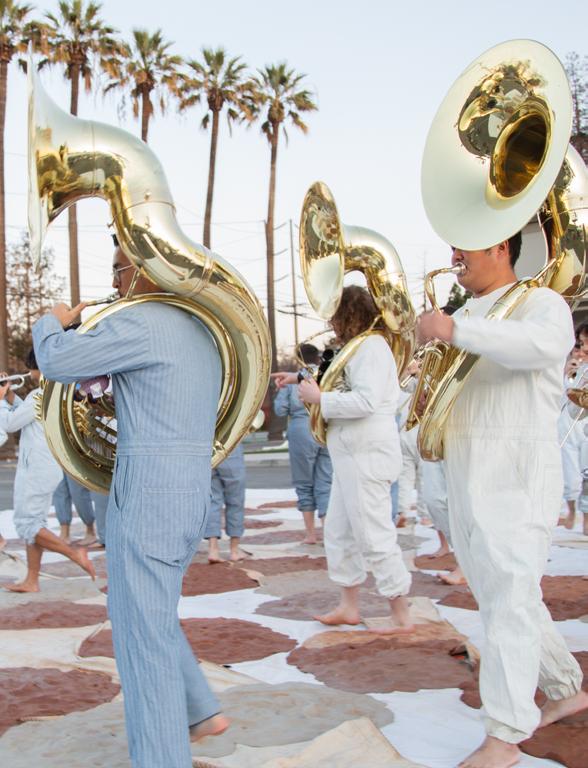
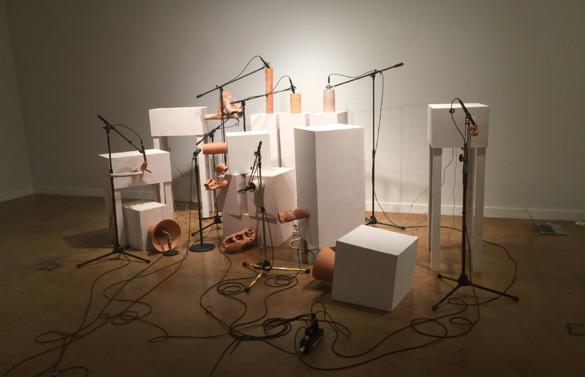
Future Farmers, Soil Horizons (Summoning Pleistocene Lake: Luigi Russolo’ Intonarumori Reconstructed), 2023, sound, Corcoran clay (San Joaquin Valley, CA), moon (JSC-1A Lunar Soil Simulant), raspberry pie, motors, 9 x 5 x 4 feet photo: Jin Zhu, 2023
On a sunny day, the San Jose State University marching band played compositions based on data sets of two soils: one clay found on the moon (JSC-1A Lunar Soil Simulant), made and used by NASA to research future materials for lunar dwelling; and one from deep underground California's central valley, a byproduct of ever-deeper drilling in search of water for industrial agriculture (Corcoran Clay). In this project we were attending to clays as a transformative medium; Corcoran Clay—A Pleistocene Lacustrine Deposit in San Joaquin Valley, California, and lunar soils imagined to be used for building dwellings on the moon. This continuum of soils brought up from 500–800 feet and from beyond the Earth’s atmosphere draws our attention to the extent to which we stretch our resources. The San Joaquin Valley is a major agricultural region in California and the United States. It's the most “productive” agricultural region in the world and produces more than half of California's agricultural output. This valley has been in a 10-year drought and as farmers drill their wells deeper and deeper, the aquifer has nearly disappeared and the land is sinking. Many farmers have abandoned their fields and turned to other land use options (housing, Amazon facilities, waste processing…) These two soil samples make clear the lengths (and depths) humankind will go to conquer new frontiers: the moon, the West, nature itself, the future. Soil is a fundamental medium for life.
The band marched on top of carefully arranged heaps of clay, performing a necessary process of compacting and aligning particles, “wedging” it to prepare it to be formed into a series of “sounding vessels”—horns for amplification and objects for percussion in a later performance, exhibition and a vinyl record. Made in collaboration with sound artists Yasi Pererra and Chris Cooper, who used soil data analysis from geologist, Jane Willenbring, and Sara Keen of Stanford’s Life & Landscape program, Soil Horizons brought together artists, ceramicists, a behavioral ecologist, electrical engineers, musicians, composers, farmers and drilling companies within the context of an art museum embedded in a university. This constellation of practices worked with soil as a medium to call into question the lengths we go to maintain human curiosities, knowledge and cultural production. We worked with sound, sensors, a.i., and students from the university to determine the form of sound vessels to be made from the collected soil. Soil Horizons embraced an embodied approach—forming the clay with the movements of bodies—a marching band, which in turn was moved by the soil scores derived from the two soil data sets (moon and Corcoran clay). The band members’ feet wedge the clay, their breathing articulating the data of soil into sound to be heard across the university campus and then inscribed into vinyl to be distributed further and performed in programs of public listening…
Futurefarmers’ work is based on enmeshed acts of wandering and material processes. In the context of public artworks, they cultivate public life in place through a process-led approach, inviting materials and communities to arrive and intersect at a specific site or situation. Through time and the practiced presence of Futurefarmers, the meeting place of people and materials transform from provisional arrangements into durable forms and functions of their work.
Maeder
Soils are under global pressure, including threats from population growth, increasing industrialization of agriculture, climate change, and in that context, the degradation of soils by machinery compression, monocultures, overfertilization, drought, and the use of pesticides. The arts may initiate a different view of soil ecosystems that includes criticism of human land use and enables an immediate, emotional experience of life in the soil. In the research and art project Sounding Soil, sound installations were developed that address soil life and problems and make them tangible. As part of the larger Sounding Soil project, the two works presented here are understood as sonic liminal spaces that aim to transform the perception of soils in the broader public through immersion and listening to the unfamiliar sounds from the ground. Deep Listening methods are employed that seek to achieve low-threshold immersion and dialogue about what is heard.
ON LAND, INSTALLATION, 2021
An interest in the audibility of different forms of agricultural management in soils led the Sounding Soil team to collaborate with the Research Institute of Organic Agriculture FiBL. Our goal was to investigate intensive and sustainable agriculture in more detail for the first time in a field experiment in summer 2020, looking for differences in acoustic diversity over space and time. FiBL’s famous “DOK trial” (short for Dynamic, Organic, Conventional) has been comparing bio-dynamic organic and conventional (integrated/intensive) farming systems since 1978. A review of the 40-year experiment showed clear differences in soil health between the integrated/intensive and the biodynamic cultivation of the fields. Over the years, biodynamic cultivation produced only 80% of the crop yield of conventional cultivation systems, but soil health in terms of colonization of roots with mycorrhiza and their diversity, phosphorus content, and soil fertility in general were higher in the biodynamically cultivated plots than in the conventional ones (Mäder et al., 2002). We were interested in whether those differences were also audible in the soil, i.e., whether the acoustic diversity in two differently managed maize fields differed in time and space. To this end, we distributed four soil microphones per field and recorded the soil sounds at 10 minute intervals during the growing season from April to September 2020.
The recordings were examined by a student of ETH Zurich within the scope of her bachelor’s thesis regarding their acoustic complexity (Felber, 2021). No indications were found to suggest that acoustic diversity of soil animals was higher in either field. In soil samples taken during the recording period, slightly more soil animals were found in the sample of the biodynamic area; however, overall, too few animals and their sounds were discernible in both areas that the experiment did not reveal any useful scientific results. This highlights a general problem in agriculture regarding intensification: Sounds of soil fauna in biodynamically managed crops seem to differ little from intensively cultivated ones. Except for the use of pesticides and mineral fertilizers, the management of both fields differed only slightly—indeed, the soil in the biodynamic plot was even more disturbed by the regular mechanical removal of weeds. Whether intensive/integrated or biodynamic, agriculture today is an industrial activity in which monocultures are grown and maintained by machines; this is also the case with organic management (Trewavas, 2001). A much greater difference would probably be seen between permaculture and intensive cultivation, because in permaculture, care is taken to ensure that the soil is always covered with a layer of vegetation, thereby creating better habitats for soil fauna and allowing for a diverse soil life (Krebs and Bach, 2018).
As a reflection of these results, the installation On Land consists of two black resonating bodies/panels lying on wooden frames with acoustic emitters attached to the underside. The resonating bodies were made of honeycomb cardboard, which has good resonance capabilities. The installation is a sculptural model of the experimental setup in the DOK experiment: On each panel (representing the intensively and biodynamically farmed fields), the acoustic emitters are placed at the locations where the soil microphones were placed in the corresponding plots. The installation thus represents a kind of landscape instrument on which the biotic and abiotic conditions and ways of life in the soil are played back. Between the two plots in the DOK experiment was a weather station, where two cameras recorded time-lapse images of the course of the day, the growth of the plants, and the weather conditions. These movies can be seen on the screens between the panels. The recordings of the growing period—from the sowing of the seedlings to the harvest—can be heard in the sound installation, played back synchronously with the time-lapse videos of the two fields.
Marcus Maeder
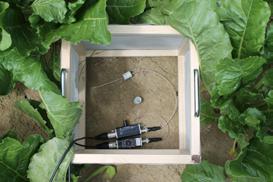
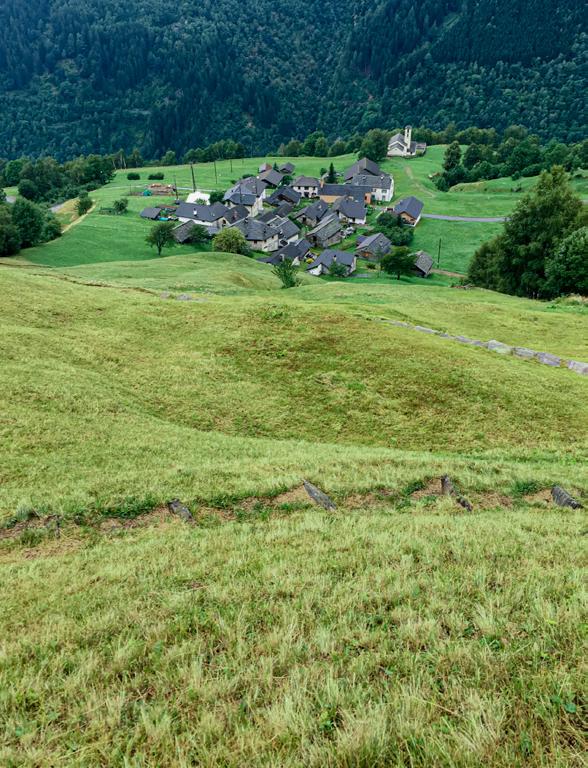
On Land, whose title comes from a record from Brian Eno’s “Ambient” cycle from the 1970s to 1980s, is an artistic model of a scientific experiment—a model that, as an acoustic observatory, turns visitors into observers: where and when is what heard? To what extent is this related to what is seen on the screens? The ambiguity of the scientific findings of this experiment becomes the ambiguity of art: the interpretation of the experience is up to the viewer—questioning their own evaluations and values and rather foregrounding the concrete experience of the artwork: What do I hear, see here and what meaning does it have?—and beyond that: How might sustainable agriculture be imagined, thought further about, in light of its artistic questioning?
The artistic vision for On Land was conceived by Marcus Maeder, with scientific advice by Andreas Fliessbach and Paul Mäder. Programming was conducted by Ken Gubler, and Field maintenance/ecoacoustic analysis by Samira Felber. Additional artistic collaboration by Nino Tempini and curation by Damian Jurt. This work was commissioned by the Bündner Kunstmuseum, and was presented in the exhibition Landliebe: Kunst und Landwirtschaft (Love of the Land. Art and Agriculture), at Bündner Kunstmuseum, Chur, Switzerland (2021-2022).
EDAPHON BRAGGIO, SOUND INSTALLATION, 2019–2023
Soil soundscapes can vary significantly over relatively small areas in the Swiss Alps. Alpine regions and ecosystems are characterized by a high diversity of biotopes, which is related to exposure, altitude and sometimes extreme microclimatic conditions (Körner, 1995). In addition to the high microclimatic variability in alpine landscapes, in areas populated by humans, the complex and small-scale forms of cultivation and ownership contribute to the great diversity of soil soundscapes. The acoustic structure of the soil in an area—the soil soundscape—reflects both the local communities of soil organisms and the influence of cultural land-use forms, ultimately revealing the human relationship to the natural environment (Moscoso et al., 2018). The soundscapes of soils form a category of their own in the characterization of a landscape: an acoustic topography that is structured quite differently from above-ground landmarks or, for example, the boundaries of plots of land. State territories are as inaudible as municipal boundaries or private property—the soil soundscape suggests a geography that is oriented toward ecosystem boundaries and their interlocking, overlapping displacements and transformations—and, of course, toward the human influence between sustainable cultivation and degradation. With these considerations in mind, we turn our focus to the soil soundscape of Braggio, a community in the Calanca Valley/GR, Switzerland.
The area of Braggio, a small mountain village in the southern Swiss Alps, is characterized by extremely fragmented land divisions related to a long history of inheritance, in which the land was repeatedly divided among family members. Underlying the issue of landscape fragmentation is the debate about alpine cultural landscapes and their preservation (Stotten, 2016), which is being conducted in Switzerland. Alpine agriculture, in many cases, is not economically profitable and cannot fully cover the food needs or livelihoods of the inhabitants of the alpine region (Pezzatti, 2001; Meusburger, 2008). The ways of life in the alpine region of Switzerland depend on state subsidies, which are mostly directed and understood as compensation for the preservation of a cultural landscape worthy of protection (Miéville-Ott, 2001). The predominant form of agriculture in the Braggio region is dairy farming, since topographical and climatic conditions mean that arable farming can only play a subordinate role. However, a somewhat intensive alpine farming is often not very sustainable (Cozzi and Bizzotto, 2004)—grazing livestock causes overfertilization of alpine pastures and soil erosion. Meadows become pure protein suppliers of low biodiversity due to too short cutting intervals and intensive grazing, and forests/bushlands are fragmented by grassland farming (Meusburger and Alewell, 2008; Battaglini et al., 2014). This raises the question of whether these forms of farming should continue to be subsidized and how sustainable (also in terms of resilience to global warming) this preservation of cultivated landscapes is. The question is increasingly being asked as to whether the alpine region should be left to wilderness and the human settlements instead be concentrated in the already urbanized areas.
The concept of the edaphon was formulated at the beginning of the 20th century by the Austrian botanist and microbiologist Raoul Heinrich Francé and describes the totality of all soil organisms (Francé, 1921). Edaphon also includes the word part “phon,” which is Greek for voice, sound, or tone. The soil in the municipality of Braggio sounds very diverse: from the rumbling in the raised bog to the humming in the rough meadow,
Battaglini, Luca, et al. “Environmental sustainability of Alpine livestock farms.” Italian Journal of Animal Science 13.2 (2014): 3155.
Cozzi, Giulio, and Bizzotto, Marina. “Sustainability and environmental impact of the dairy production systems in mountain areas.” Acta agriculturae Slovenica. Suplement 1 (2004): 21–28.
Felber, Samira. Soil Acoustics of Agroecosystems. Bachelor thesis, Distributed Computing Group, Computer Engineering and Networks Laboratory, ETH Zurich (2021).
Francé, Raoul Heinrich. Das Edaphon: Untersuchungen zur Oekologie der bodenbewohnenden Mikroor ganismen. No. 2. Franckh'sche Verlagshandlung (1921).
Krebs, Julius, and Sonja Bach. “Permaculture—Scientific evidence of principles for the agroecological design of farming systems.” Sustainability 10.9 (2018): 3218.
Mäder, Paul, et al. “Soil fertility and biodiversity in organic farming.” Science 296.5573 (2002): 1694–1697. Meusburger, Katrin., and Alewell Christine. “Impacts of anthropogenic and environmental factors on the occurrence of shallow landslides in an alpine catchment (Urseren Valley, Switzerland).” Natural Hazards and Earth System Sciences 8.3 (2008): 509–520.
Miéville-Ott, Valérie, Erwin Stucki, and Antoine Assal. “Paysage et développement durable au Val d'Anniviers: perceptions et préoccupations des acteurs d'une vallée alpine.” Schriftenreihe/ETH Zürich, Institut für Agrarwirtschaft 2001.3 (2001).
Moscoso, Paola, Mika Peck, and Alice Eldridge. “Emotional associations with soundscape reflect human-environment relationships.” Journal of Ecoacoustics 2.1 (2018): 1–19.
Pezzatti, Marco G. “Effect of development on the agricultural structure in the Alpine region: an agroeconomic analysis using four regions of Switzerland as examples.” (2001): 205-pp.
Stotten, Rike. “Farmers’ perspectives on cultural landscapes in central Switzerland: How landscape socialization and habitus influence an aesthetic appreciation of landscape.” Society & Natural Resources 29.2 (2016): 166–184.
Trewavas, Anthony. “Urban myths of organic farming.” Nature 410.6827 (2001): 409–410.
from the crawling in extensively cultivated grassland to the silence in a freshly cut meadow. Twelve recordings of the soil sounds from Braggio are part of a sound installation made from a black plate that has the shape of the outlines of the municipal area and lies on wooden stands. It is simultaneously a sound object and an acoustic map: acoustic emitters are attached to the underside, allowing the hollow plate to resonate. This creates a sound topography where the sound sources can be heard at the corresponding recording locations in the municipal area. They sometimes overlap, complement, and mask each other.
An acoustic geography is created that, in the imagination of the visitors, forms an imaginary landscape: What are the possible sound sources, what is the nature of the landscape, how is it managed? The visitors themselves become researchers and a discourse about alpine landscape and human land use develops. To initiate a dialogue about the inner alpine region itself, the installation was shown at several locations in the southern alpine region. In Switzerland, with soundwalks and introductions carried out by the artist.
The work on the installation was accompanied by drawings that seek to take conventions of territorial representation and imagination, of common terrestrial concepts and projections in question: Impossible, surreal, overlapping, indistinguishable borders, river courses, coastal forms. Is this land or water, river or border? What if river courses were considered borders, if countries had areas of overlap? Depending on the possibilities, the drawings were exhibited together with the installation.
Edaphon Braggio has been exhibited at the following Swiss institutions: for Earthbound, at Möllerei Esch, Luxembourg/HEK (Haus der Eleketronischen Künste) Basel, 2022; at Museo Moesano, San Vittore, 2021; at Archivio Calanca, Cauco, Switzerland, 2021; and for Electric Flow(er), at Fundaziun Nairs, Scuol, Switzerland, 2019-2020.
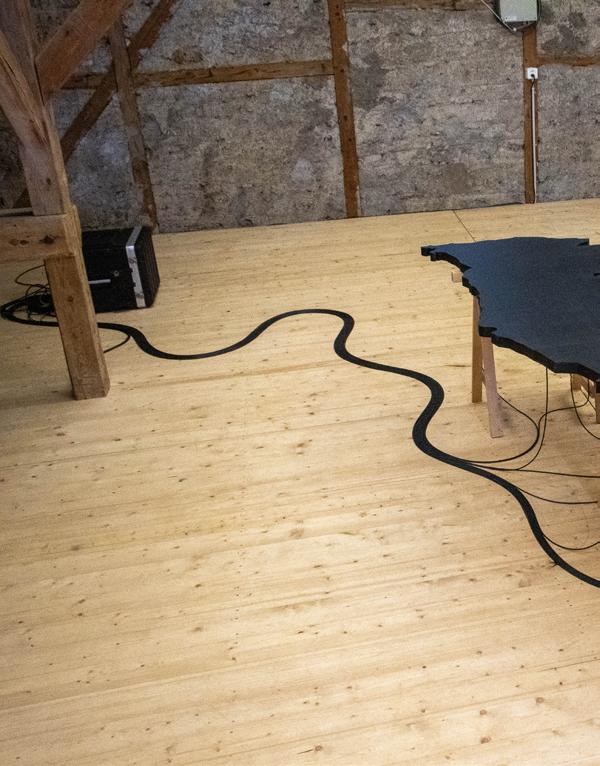
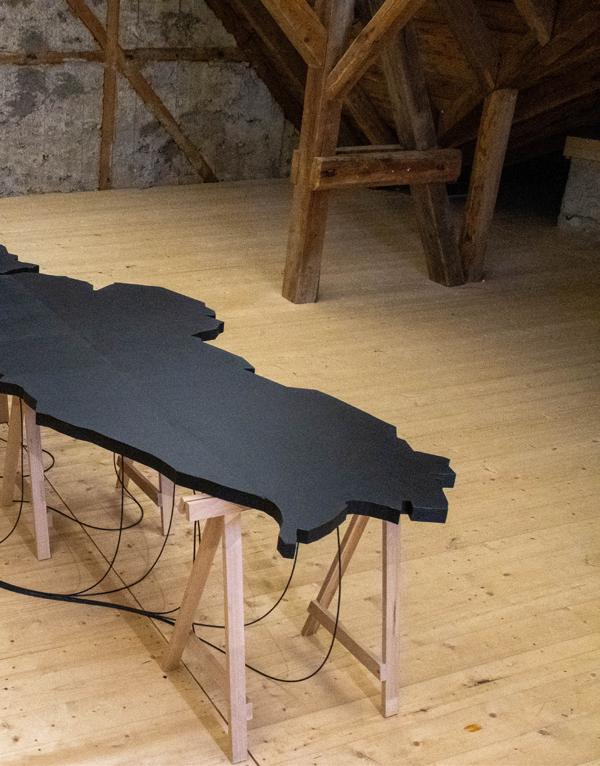
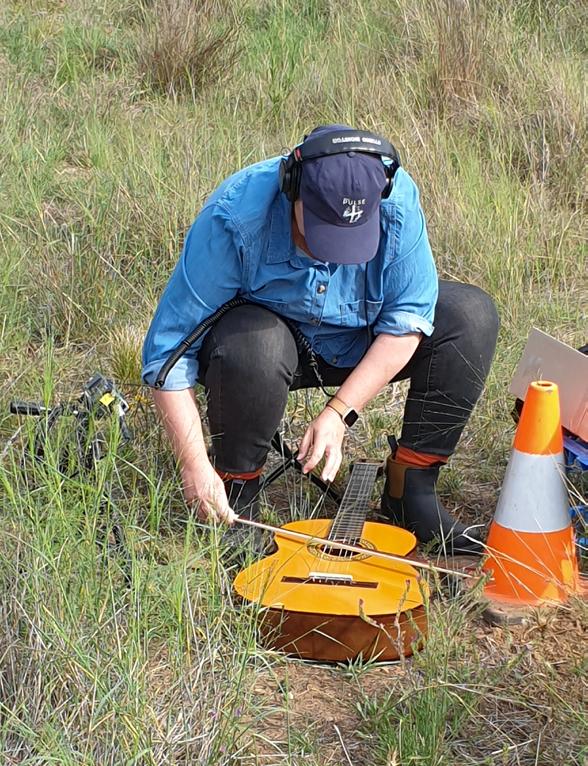
recording sounds of an out of tune guitar played with violin bow using a contact microphone buried in the soil on her property near Dubbo NSW Australia, 2024; (above) Subterranean Serenade, 2024, soundscape-composition with animated video (still), 4 minutes
Living and working in Wiradjuri Country in Central West New South Wales, Australia, I pay attention to stories of the past and stories of the future, and I realize the need to listen with more care today. Over five decades, soils have been ground into my skin, inhaled in billowing clouds, darkened creases on my body, gathered beneath my nails, caked my teeth, clothes, and boots, and nurtured my creativity. Across inland New South Wales, from the cracking grey clay soils of the central north-west floodplains and the red sandy loams of Poplar box and Callitris country close to my remote childhood home, to the deep, alluvial brown silt loams of the Macquarie Valley, and the pockets of poor tenosol and rudosol soils of my periurban home today—these ancient soils are not only fundamental to my life but to life on earth as we know it. Gentle breath after gentle breath, my heartbeat slows, and porous boundaries dissolve as I listen to life beneath my feet.
Listening to soils in real time requires time and technology. Sitting quietly to listen with microphones buried in the soil, I allow the grains, clods, and soil life to settle around the microphone before recording. While waiting, I observe the site—recording soil and air temperature, moisture content, and the presence of wind, taking shorthand notes about plants, insects, and birds present, and what vertebrates have been here in the form of tracks and scat. Anthropogenic sounds are also logged. The longer I listen, the more aware I am of my breath and pulse.
Repeated every fortnight over months, the recordings build into a multi-track sonic narrative that changes as the season shifts. I also photograph the sites I listen to. Layers of information build in responsive writings, capturing feelings of connection and thoughts about what the soils are trying to tell me, alongside the data, facts, and acousmatic soil recordings.
With a background in journalism, communications, agriculture and natural resource management, my interdisciplinary practice engages community engagement, enquiry, exploration, walking, listening, observation and documentation using field-recorded sound, audio storytelling, video, photography, and writing, to dig into the layers of nuance and complexity within the rural and regional territories I work. Pursuing new voices and perspectives—human and more-than-human—I look for hidden elements that make a place vibrate, aiming to present environments in ways that are new even to those who know them well. In the process, the soundscape compositions, audio stories, video works, and prose tease out narratives of multi-species connection and give voice to the voiceless.
Kim V. Goldsmith
Agnes Meyer-Brandis Earth Core Laboratory & Elf Scan (2003–2004) is an experimental setup that utilizes a specifically designed device, the “Elf Scanner,” to locate and visualize fantastical creatures inside Earth cores that are not visible to the naked eye. A delicate touch and high sensitivity are crucial to success; the tactile scan device is worn on the tip of the finger, like a thimble. The other end is equipped with a funnel-shaped sensor that is used to gently scan the Earth cores and subterranean life forms. The creatures and micro-universes found in the Earth cores can be observed and listened to via the display box and headphones. My institute, Researchraft for Art and
Subjective Science, is asking questions but not giving answers. At the beginning, I wanted to know: What is under my feet? What am I standing on? Literally, as well as metaphorically. In 2002, I started developing the work series Tools To Search to explore possible hidden worlds, remote worlds—be they subterranean, too small, too volatile, or too slow— imperceptible with the help of our senses. Where do we need technology to explore them? And that's where the construction of our world begins. I'm interested in the holes and gaps that open up within these constructions—a kind of artistic exploration of reality. A much-discussed question in the Middle Ages
was: How many angels can fit on the tip of a pin? And the answer back then was: an infinite number, because they have a different dimension. Today, we can ask: How many soil organisms live in a spoonful of soil? There are more creatures in a handful of soil than there are people on Earth, which is fascinating and unimaginable to me. There is so much more that we cannot define or imagine, but that exists just like us, in a different dimension. And with the help of my Tools To Search, the visitor can make a kind of field experiment into possible hidden worlds, e.g., underground coral reefs, subterranean icebergs, or elves and other soil creatures in Earth core samples, etc.
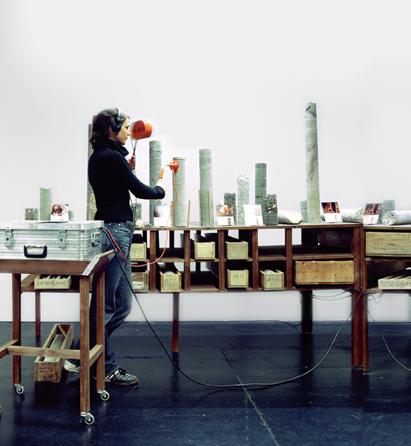
Earth Core Laboratory & Elf Scan, 2003, coresamples, custom hard-and software instruments, dimension variable
Crosstimbers, 2004, still frame of stop -motion animation, graphic score and sonification of Oklahoma soil microbes, made with vocalist Shari Feldman, video projection, 22 x 22 inches, 2 minutes
Buried textile for 30 days, May 2023. Site: (34.738956, -96. 550667) Ada, Oklahoma (US)
Anne Yoncha
When public understanding of ecological problems is limited, artists can uncover background narratives, thereby shaping how scientifically-declared emergencies are perceived and acted upon. How do we balance a sense of urgency in a time of climate change with the potentially unintended consequences of our interventions? My work combines experimental art and ecological science to explore the mechanics of plant physiology. By translating these processes into artworks, I aim to build affinities with unfamiliar ecologies apparently out of sight or possessing different temporalities than our own. My practice combines digital sensing technology, such as bio-data sonification, and analog processes, including painting with ink I make from locally-sourced plant biomass. The collaboration for Crosstimbers began in Ada, Oklahoma, at the boundary of forest and prairie, where wetter eastern ecosystems meet drier western ones.
I began to wonder about the boundary line of the Earth. Do different types of microbes meet here too? How do they co-exist? How are their lives entangled with ours? And if we can’t see these other entities, could we possibly hear them? The images in the paintings indicate to a musician what types of sounds to make. The forms of the microbes can determine the shape of the sound. The microbes thus become composers, and we humans read and perform the score they write. Six pieces of 22 x 22 inch cotton cloths were buried for a month at Wintersmith Park, while a small soil sample was tested at the MR-DNA Lab in Shallowater, Texas, to identify microbial diversity. After a month, one fabric piece had been almost entirely decomposed, and one was gone completely. I was able to recover four partially completed “paintings” that reacted to the marks made by the microbes. Playing with scale, they became many times larger than life.
Crosstimbers: A Graphic Score and Sonification of Oklahoma Soil Microbes, made with Shari Feldman, vocalist 2024, video projection, running time two minutes. Buried textile for 30 days, May 2023. Site: (34.738 956, 96.550667) Ada, Oklahoma (US)
Top 22 microbial collaborators (by phylum and genus): Verrucomicrobia Cthoniobacter, Actinobacteria Gaiella, Acidobacteria Aridibacter, Actinobacteria Conexibacter, Proteobacteria Bradyrhizobium, Proteobacteria Rhodoplanes, Verrucomicrobia Pedosphaera, Actinobacteria Solirubrobacter, Actinobacteria Mycobacterium, Bacteriodetes Terrimonas, Proteobacteria Chondromyces, Proteobacteria Reyranella, Cercozoa Gymnochlora, Ascomycota Penicillium, Ascomycota Cladophialophora, Mucoromycota Mortierella, Cercozoa Bigelowiella, Ascomycota Trichoderma, Ascomycota Acremonium, Ciliophora Neobalantidium, Xanthopyceae Vacheria, Chytridiomycota Maunachytrium
Ben Kinsley
“Dirt worshiper” has been used as a derogatory term to describe environmentalists; however, it has become increasingly clear that soil health plays a vital role in the health of our planet. In Colorado, much attention is given to rain patterns, soil moisture, overnight temperatures, and elevation. I have spent a good amount of time over the past 7 years caring for the soil in my yard in Colorado Springs-composting, vegetable gardening, and slowly transforming
seven sprinkler zones of Kentucky bluegrass into a native, drought-tolerant landscape on drip irrigation. And as an avid mushroom hunter, I spend a lot of time moving slowly while staring at the ground. This has become a meditative practice for me. Dirt Worshiper I is a macro audio/visual meditation on the flora in my backyard, created in a period of self-isolation and stay-at-home orders during the 2020 COVID-19 pandemic. The work was shot on a
Sony a7sii camera at 120fps using a DJI Ronin gimbal. The footage was slowed down to 24fps to create the slow motion. I recorded audio with a C-Series contact microphone built by sound artist Jez Riley French.
Seen: Ground covered in early spring snow, soil and compost in garden bed, ground under juniper tree, groundcover, grass, mycelium under mulch.
Heard: Snow melting, compost pile, grass, wind in leaves and groundcover, hay and mulch.
The Hercules and Leo Case
The Hercules and Leo Case is a performance collective (Maria Berauer, Karo Knote, and Kat Petroschkat) based in Munich, Germany. The collective creates sound arrangements rooted in voice and language, expanded by self-made instruments. The human voice serves as a tool for artistic research, exploring the relationship between bodies and resonating socio-and eco-spheres. For Edaphon (2023), a sound installation with molehills, speakers, and audio players, the performance collective
imagines and explores the sound of the “edaphon”—the totality of organisms living in soil. Vocal sounds inspired by underground smacking and crunching have been recorded and are played through speakers hidden within displaced molehills, creating ever-changing arrangements. To approach the unknown universe of soil, the collective creates sound arrangements rooted in voice and language, expanded by soil-made instruments and installative soil stagings.spoke support
Tim Collins and Reiko Goto
What is a bogland? It is a plateau, a valley, or an ancient lake filled with peat, plant forms that never fully decayed. Mosses, sedges, shrubs, and even trees can be buried in the spongy peat where they were held in stasis by a deep, wet (natural), acidic condition that lacks oxygen. In a bog, sphagnum moss accumulates, moving upwards. Its growth is sustained by a mix of groundwater and/or by being constantly wet from above by rain. Plants, growing on the decay of previous generations, extend towards the light. Bogs are complex metabolisms composed of a diversity of living things, typically treeless. Sphagnum, in both its living and dead states, can hold up to twenty times its dry weight in water. They reproduce by an effective pressurised (popgun) release of spores, which are then distributed by the wind. The CO2 is a key component of photosynthesis in plants and a fundamental part of the bogland ecosystem..We are interested in hearing what cannot be heard and seeing what cannot be seen; our goal in much of what we do is to engage a sense of otherness through our creative practice. To meet that end, we engage art and philosophy, a bit of science, and a fair amount of technology to answer questions like: what would it sound like if
we could hear a Leitrim peat bog breathing? In this work, we explore the grand boglands of northwestern Ireland to listen to photosynthesis and transpiration as revealed by HAKOTO, a body instrument that has been adjusted for use on Irish boglands. Peat is treated as a material entity with social and political agency in Ireland. Our strategies include ideas about empathy and the use of sensors, technology, and sound to reveal the life signs in a small clump of sphagnum, embedded in a larger ecology of an Irish peat bog. In the construction and preparation of HAKOTO for bog work, we have a performative instrument that focuses our attention on field work, bog process, and context. In this, we understand plants have senses that respond to light, temperature, humidity, and air.
We rely on our inner and outer perceptions, knowledge, and imagination to read a plant’s physical state through careful observation and experience. Through this field work, we care about value changes over time. We practice being in a place or being amongst people and other beings, including intra-relationships with living entities such as forests and boglands. Artwork emerges as a critical, creative reflection of experiences that are uniquely true.
Ela Spalding
I engage with soil both literally and metaphorically, addressing its multiple layers or horizons of time, as well as its uses as avenues of connection. I mostly care for the tropical soils of Panama, where I was born, where I ate the most, played the most, and fell in love the most with its inhabitants: plants, animals, humans, as well as colors, smells, temperatures, and seasons. As life has taken me to other latitudes, I have come to appreciate northern, temperate soils, and have recently started a new relationship with Mediterranean soils. My work functions as gestures or offerings that provide time and space for people to reflect, connect with, (re)create, celebrate, (re)value, harmonize, or simply observe our place in the world. Using sound and voice, artist books, spatial interventions, performative experiences, artist residencies, workshops, or bespoke support for individuals and organizations, I experiment with nature-culture practices and narratives to reflect on our interconnectedness with all of life. With the SUELO Field Guide and the sound piece, Suelo, Here and Now, I have created a brief toolkit for reconnecting with place. For
SUELO, I have relied on soil science and the multifaceted nature of soil as a base on which to ignite care for place, for land, and for the soil that feeds and holds us. Engaging with multiple knowledges and persons (human and non-human), I believe in the equal value of each participant. Experience and multi-sensorial engagement are key factors of the SUELO path of inquiry. Constant dialogue with the shifting paradigms that we are faced with today,as well as writing, hosting, listening, drawing, sharing, re-writing, and persistence are integral to my methods.
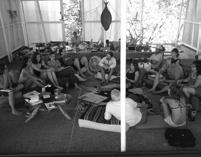
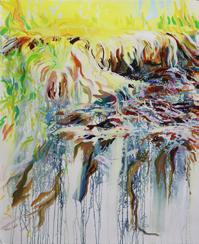
Based in Brooklyn, my interdisciplinary work focuses on environmental stewardship and people’s relationship to natural areas. Using the mediums of painting, sound, and video I explore the subterranean realm, from permafrost in the Arctic to underground soundscapes in urban forests. Frequently collaborating with other researchers and at residencies at field stations, I explore the subterranean world of soils in the local forests of NYC. I care for these soils in several ways; I have been a volunteer as a Tree Soils Care Captain for the New York City Parks Department for several years, and as an artist, I create work bringing attention to this unseen and mysterious world. In addition to NYC soils, I also focus on soils that are experiencing dramatic change due to the climate crisis. I have been recording and documenting thawing permafrost (frozen soils) in the Arctic Circle for many years, documenting profound changes in the landscape through interdisciplinary projects including sound, visual documentation, and painting. Along with wa-
ter and light, soil is one of the most basic biological needs for a healthy ecosystem and, by extension, ourselves. What makes soil so compelling to me is its life force- it is both generative and creative by nature. I record underground and listen within soils using various microphones. This has been an experimental practice that began in 2018. To best listen to these sounds, I have repurposed various types of microphones and even built some of my own. Over time, through countless hours spent listening underground in multiple locations and conditions, I have become familiar with the language of subterranean acoustics. I am exploring the relationship between this acoustic language and the more visual language of mark-making. I have done this in my work by translating the patterns, rhythms, and the emotive qualities of the sound recordings into visual works. Parallel community-based projects where participants work together to form large-scale visual interpretations of the acoustics in local soils have been another focus.
Alyce Santoro
I belong to 10 acres of land in a historically agrarian valley in Northern New Mexico. As an orchardist, forager, and farmer, I care for the well-being of the tangibles and intangibles with whom I share this small tract of earth. My life and work are based on the philosophy that all is simultaneously (and paradoxically) a-part-of yet apartfrom everything else. As such, soil and I are extensions of one another, quite tangibly entangled—as I nurture soil, it nurtures me, and the boundary between “self” and “other” becomes irrelevant. As a scientist-turned-artist, I seek to capture the sublime, record the subtle, defy dualisms, and conduct absurd experiments with rigorous care, im-
buing tender meaning into the obvious. Atmospheric landscapes, expressionistic sound collage, and painterly illustration emerge through a practice of attuning to visual and auditory phenomena. For me, field studies, philosophical questioning, and delicate investigation of natural phenomena—flora, fauna, terra, and aqua—become portals through the Anthropocene into another present era. In an age of intensifying social and ecological strife, documenting the marvelous becomes an act of defiance, reverence, and deep longing. Clays can help or hinder the growth of some plants depending on the density of their presence in the soil. Upon discovering
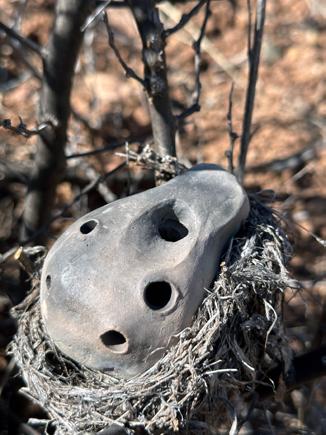
that the soil on the land where I live is rich in clay, I became curious about the process of isolating it to its pure form for use in earthen vessels. A question came vividly to mind: What does this earth sound like? As a flute-player, improvising musician, and sound artist, creating wind instruments from mud seemed an obvious way to explore the sonic properties of soil. For this work, clay was harvested, dried, sifted, ground, and reconstituted. The flutes are hand-shaped, tested, tuned, and slowly dried before being pit-fired with wood collected on-site. The instruments are then sealed with local, abundantly available substances such as piñon pine pitch and beeswax.
Christa Donner
My practice combines material exploration and social exchange to propose speculative models that move between the emotional architecture of our own bodies and the layered histories of the world we inhabit. Through multisensory and multimedia modes, I look to engage caregiving, conflict, and cooperation in this changing world. Humus began with field recordings made in the West Ridge Nature Preserve, a 21-acre natural area bounded by busy urban streets and a large cemetery in Chicago, Illinois. Through regular walks through the space, I wrote a short script to engage the cycle of life among the many species who share the land, including human children who activate the nature play area I helped develop there as a community volunteer. Visitors to the Preserve can now find this work through the QR code on a trail marker in between the graveyard and playspace. Humus is therefore meant to be experienced outdoors with your own smartphone and headphones, merging narration with the existing soundscape through site-specific prompts to listen, smell, and find your place in the ecosystem. It is a message to Homo Sapiens from Humus, the transformative medium through which many beings mingle, where death and growth are one and reincarnation is a matter of fact. This work was created as part of the larger multispecies audio walk “Dear Human.” The voice of Humus was read by artist and healer Margaret Morris.
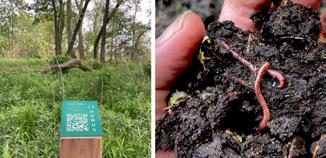
Samuel Johnstone
In Soil Loop, an artistic research project and sound installation at the Botanical Garden Höxter, Germany, approaching soil is a way of conceptualising space vertically, and moving beyond the dualism of aboveand underground. Soil is a different auditory landscape, where vibrations are conducted at different speeds as through air. By placing microphones into the soil, we are not plugging into a hidden ecosystem, but rather con-
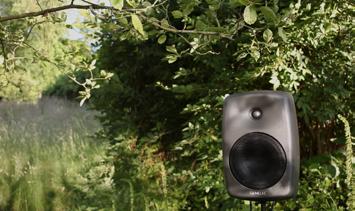
necting to a different soundscape where above- and underground are indistinguishable, and the sounds of anthropogenic or more-than-human agency are interwoven with seismic activity. Geophones are placed in the soil in order to “audition” the subterranean sonic landscape. The sounds present in the soil–from insect activity or moisture transfer through root networks, or anthropogenic activities like footsteps, garden machinery, and electromagnetic signals from seismic activity–are sent into a live audio processing patch and integrated into a complex generative sonic system in which the soil sounds are interwoven into an electronic soundscape. The soundscape is then presented in an immersive sound installation, in which the technological methods of mediation are made evident and thematized, leading to an entanglement of ecological, anthropogenic, and technological sonic agencies. A series of field recordings was made during the installation to capture the embedded, entangled sonic system emerging out of the soil.
Bia Gayotto
Living in a redwood forest, I see signs of fungal activity all around me. In this healthy rainforest environment, the mycelium keeps the soil structure solid, reduces erosion, and creates fertile ground for new forest to grow. They are so tiny that one cubic inch of soil can contain enough to stretch for 8 miles! More Than One is an experimental video featuring a group of women mushroom foragers living on the Sonoma Coast who embody the mycelial network below. Although largely invisible to the aboveground eye, mycelium plays a vital role in decomposing plant material, resisting pathogens, absorbing water and nutrients, and helping forests absorb carbon to delay the effects of global warming. With an open form, the video juxtaposes documentation, SFX, and performance, close-up and wide shots, and real and imagined worlds. I interviewed nine women on the Sonoma Coast about their mush-
room foraging experiences. Like the fungi, the women have fruiting bodies and help to care for the well-being of our communities. To create the video soundtrack, I invited Sara Roberts (CalArts Emeritus Professor and founding director of the Integrated Media Program) to conduct a reading chorus workshop, where the women whisper short and long sentences extracted from the interviews. Since mycelium is largely invisible, I also collaborated with SFX artist Takashi Takeoka to create CG animations. By mixing real and imagined scenes, I wanted to stimulate contemplative responses, evoking relations between wilderness and ecofeminism, activism and desire, above and below. More than One invites audiences to think through these incredible ancient forest beings, urging us to reconsider our ecosystems and ourselves, and imagine new forms of living and modes of collaboration.
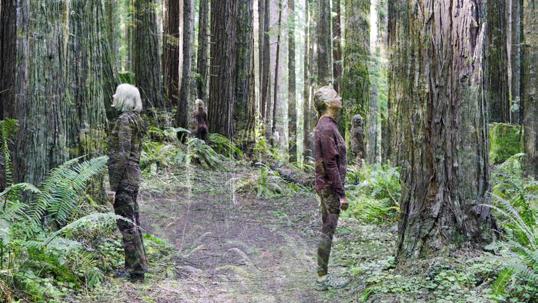
What is artistic metabolizing? Metabolism offers a compelling lens for thinking about soils, because, as Hannah Star Rogers and Adam Bencard point out, it “serves so many possible needs for scientists, scholars, and artists by providing metaphors, models, puzzles, solutions, and balances.”¹ Defined in biological terms as the sum of chemical processes that sustain life by transforming matter and energy, metabolism includes catabolic processes of breaking down and dispersal and anabolic processes of synthesis, growth, and repair. Extended into social and political theory, metabolism, and specifically the concept of “metabolic rift,” was famously posited by Karl Marx as an exchange between humans and soil through labor.² Subsequently, the metabolic rift has been theoretically developed as a framework for critique of capitalist disruptions to socio-ecological cycles indicative of the Anthropocene. This framework includes theories of ecological Marxism (John Bellamy Foster),³ biopolitics (Hannah Landecker),⁴ metabolic shifts rather than rifts (Jason W. Moore),⁵ and communist models for degrowth (Kohei Saito), just to name a few.⁶
Parallel to discursive developments on metabolism, metabolizing, and metabolic rifts, artists have been developing life-sustaining processes of co-creation and participation with human curious collaborators: worms, microbes, urban plots, incubators, infrastructures, and other more-than-human entities. Metabolizing practices render material flows, species interdependence, economic growth and degrowth tangible. In recent contemporary art and curatorial circles, metabolism has been mobilized as a lens for exploring material transformations, energy cycles, and ecological entanglements.⁷ Artistic “metabolizing” emerges as a hallmark of Soil Art in the public-making frameworks of community-based food-production, urban design, and remediation and restoration projects.⁸ To cite Rogers and Bencard: “Drawing on metabolism from the sciences, embodied experience of metabolism, and the potential of laboratory and home metabolism practices to create encounters with life and life processes, many artists and art-aligned practitioners have created art and art-science works that relate to metabolism.”⁹ These include works using performative participatory microscopy (Janna Holmstedt & Malin Lobell), zines about the circular bionutrient economy (Johannes Lehmann, Ella Ziegler & Rebecca Nelson), poetry (Amanda Stomecki, Chrissie Orr), sculptural intervention (Christopher Lin, Alicia Escott, Vaughn Bell, Adelaide Theriault, Kathleen King, Ashton Philips, John K. Melvin), participatory composting (Asad Raza, Tissue Culture & Art Project, Vicki Mansoor, Katerie Gladdys), virtual reality (Amy Youngs), vibrant instrumentalization (Camila de Andrade Bianchi), speculative economics (Stephanie Rothenberg, Leslie Labowitz Starus), photographic work (Nancy Macko, Renata Buziak, Robert Dash), and burial rituals (Rhonda Janke, Beverly (Bee) Naidus, Sheila Novak, Helen Elizabeth). What these works share, beyond a common theoretical affinity to metabolic rifts and their various meanings for social theory, is an operative mode of conviviality. “The art of composting,” suggest (p)Art of the Biomass “calls attention to affective ecologies, living heritage, and material relational webs, where soil conviviality comes to the fore.”¹⁰ Compost is seen here not only as a product of metabolism but as a companion species and transdisciplinary partner in anabolic-catabolic relations. It is, in Lobel and Holmstedt’s words, “a breathing, steaming, moist and shapeshifting creature of creatures, both pet and ancestral crowd that provides glimpses into the mystery of decomposition, the life-death continuum, metabolic creativity and transformative powers.”¹¹ While metabolism has been framed by
Alexandra R. Toland
feminist STS scholars such as Donna Haraway, Michelle Murphy, and Hannah Star Rogers as an ongoing process of interdependence in which organisms and environments are co-constituted and co-created, the works in this section show us what that co-creation can look and feel like.¹² They offer a window into the lives of often invisible partners in more-than-human co-creativity. Metabolizing, as a strategy, takes pleasure in breaking things down in order to transform materials and mindsets, to build up relations in new configurations that not only recognize but also repair metabolic rifts.
1 Hannah Star Rogers and Adam Bencard, “Metabolism and Art,” Leonardo 56, no. 4 (2023): 388.
2 Karl Marx, Economic and Philosophic Manuscripts of 1844.
3 John Bellamy Foster, Marx’s Ecology: Materialism and Nature (New York: Monthly Review Press, 1999).
4 Hannah Landecker, “The Metabolism of Philosophy, in Three Parts,” in Dialectic and Paradox: Configurations of the Third in Modernity, ed. Ian Cooper and Bernhard Malkmus (New York: Peter Lang, 2013), 193–214.
5 Jason W. Moore, Capitalism in the Web of Life: Ecology and the Accumulation of Capital (London: Verso, 2015).
6 Kohei Saito, Karl Marx’s Ecosocialism: Capital, Nature, and the Unfinished Critique of Political Economy (New York: Monthly Review Press, 2017).
7 See also “Underground Roots Akilah Martin in conversation with Nance Klehm;” “Soil in the City The Socio-Environmental Substrate Debra Solomon and Caroline Nevejan;” and “The Soil Assembly and Dissemination
Authority (SADA) A Thought Experiment in Building Tomorrow’s Soils Today Ellie Irons, in collaboration with Jean Louis Morel” in Field to Palette – Dialogues on Soil and Art in the Anthropocene, ed. Alexandra Toland, Jay Noller and Gerd Wessolek (Boca Raton: CRC Press Taylor & Francis Group, 2018).
8 See, for example: Metabolic Selves at Serpentine Galleries, 2019; the We are Compost /// Composting the We exhibition at the Centre of Contemporary Art Glasgow, 2022; and Medical Museion. Metabolic Arts Gathering at University of Copenhagen, 2023.
9 Rogers and Bencard, “Metabolism and Art,” 389.
10 (p)Art of the Biomass (Janna Holmstedt & Malin Lobell), “A Subterranean Carnival,” this volume, 206.
11 Ibid.
12
Donna J. Haraway, Staying with the Trouble: Making Kin in the Chthulucene (Durham, NC: Duke University Press, 2016); Michelle Murphy, The Economization of Life (Durham, NC: Duke University Press, 2017); Rogers and Bencard, “Metabolism and Art,” 388.
Alexandra R. Toland
Soil's work is to breathe with its brown skin:
Microbes at home in the dirt
Inhale O
Exhale CO2
consume the tossed and littered stems, leaves, rind, and corpse
filtered through soil to the sky.
Worms sliding around angular grains drag the surface down dark corridors breath in O breathe out CO2. Worms die crumbled into the soil, their bodies
Exhale CO2
filtered through the soil to the sky.
Thick round root limbs mirror the birds' branching home search with slim fingers through dirt for water and the mineral meal feeding the tree as it fledges green leaves and these leaves with all living greens open their myriad pores
Inhale CO2
exhale into the great circle O
Microbes and worms roots, trees, and all that is living die after a life of breathing their bodies gift a final breath
Exhale CO2
filtered through the soil to the sky.
Turn Turn
Chrissie Orr
Turn return
The weathered rock
Wind whipping Hair and feathers
Turning turning Air and water
Revealing secrets well kept in layers of sediment holding traced memories of dusted bones broken bee wings clover corn from years past
Turning over under the riddles surface caught in the currents circling above below over and through to land again grounded moist rooting dig we dig
Soil soiled do not get dirty
The palimpsest of worms
Scaping ground Sun-bathed warmth
Fine grains slip between fingers to seed the growth
Earth we hold Soil turns Returns Above and below
Soils are not static, soils are in motion, they build up, they erode, they weather and decompose, they accumulate and loose, soils are fertile, which means they produce abundant and nutritious crops through delivery of nutrients and water to plant roots that take these up to feed photosynthesis to produce edible plant parts that we humans eat or use in other ways. This leads to loss of water from soils, more than if the soil would have been bare. It also leads to export of nutrients with agricultural products, all to say that fertile soils lose what makes them fertile. And therefore, nutrients and water and carbon have to be constantly added.
In natural soils, this constant loss of nutrients can be compensated by weathering of rock or atmospheric deposition or by microbial fixation of nitrogen gas from the atmosphere; for agriculturally used soils, the annual export of nutrients is too high to be balanced by these inputs. We make a similar albeit not identical argument for carbon, greenhouse gases and the global climate: soils contain several-fold more carbon than all plants and the entire atmosphere together. Therefore, relatively small changes in organic carbon contents in soils result in big changes for atmospheric carbon dioxide, with huge implications for the global climate. A global effort is therefore underway to sequester organic carbon in soils. The hitch is that global soil organic carbon is anything but sequestered: in fact, the high amounts of organic carbon in global soils are only maintained because of continuous input of plant residues. The circle of photosynthesis and decay maintains soil organic carbon levels, a tenuous balance between input and output in a large global carbon cycle. Maintaining or increasing soil organic carbon levels therefore requires constant care, as circles do.
Any soil therefore must receive nutrients and carbon all the time, we conducted an artist-led workshop on changing our societal approach to soil care, focusing on nutrient and carbon needs through a circular economy, where are all our nutrients going? Should they go there? What shifts in mindset are needed to replumb our world to feed our soils? All soils. Any soil.
The Circular Bionutrient Economy art-science project is a result of a workshop at The Soil Factory in Ithaca, New York, an undisciplinary collaborative space for community collaboration and sustainability. We gathered 15 people across ages (10-60) and professions (student, academic, politician, self-employed) to share thoughts, food, and space for a weekend, and generated eight ideas on how to tell a story, make change, this ranged from a postcard to a song sheet to a poem to a children’s book to a picture book. Ella Ziegler then worked these into a print format that we distributed at scientific conferences as well as to stakeholders and politicians, and they are shared electronically for free at The Soil Factory.
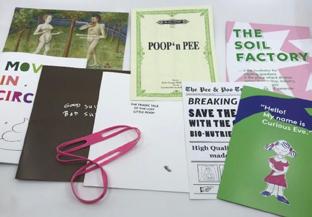
(p)Art of the Biomass is a collaborative art platform for transdisciplinary explorations, where art, ecology, science, and the humanities can meet and frolic. The platform is based in Sweden and was initiated by artist and gardener Malin Lobell and artist and researcher Janna Holmstedt. Through our context sensitive and processual work, we explore multispecies relations, co-cultivation, speculative futures, and participatory processes. In collaboration with biologists, growers, researchers, and other curious-minded people and organizations we develop exploratory labs, exhibitions, festivals and public adventures. We refer to our work as ecosocial sculptures that unfold over time. They function as artist-led open stages, not for virtuoso performances, but for improvisations and explorations. Between 2021 and 2024 we were part of the art and research project Humus economicus at the National Historical Museums, Sweden, that focused on human-soil relations at the intersection of art, urban planning and cultural heritage. Since 2022, we collaborate with soil ecologist Edith Hammer and her team at Lund University and The Soil Chip Project.
In the first iteration of the work Soil Correspondences, in which people were invited to write letters to soil that were not only read and shared but also composted, we attended to urban soils and the language of urban development plans. In these plans a very restricted range of soil relations are addressed, where humans are positioned as users of nature and its so-called services. Such instrumental framings tend to background reciprocal relations. In stark contrast to this, the art of composting calls attention to affective ecologies, living heritage, and material relational webs, where soil conviviality comes to the fore. We find that through making 18-day microbial compost-sculptures, a compost kinship emerges that sensitizes us to an unimaginable superabundance of soil biota. The compost companion is a breathing, steaming, moist and shapeshifting creature of creatures, simultaneously both pet and ancestral crowd that provides glimpses into the mystery of decomposition, the life-death continuum, metabolic creativity and transformative powers.
In the ongoing work Compost-o-scene, correspondences, collective soil making, microscopy, and soil conviviality all come together at different sites and in various contexts. Inspired by Natasha Myers’ notion “Planthroposcene” it seeks to offer an “aspirational episteme” through which various forms of multispecies coexistence and empathy could be approached and (re)imagined. We use both wordplay and workplay, alongside more-than-textual concepts. The microbial compost is an example of such a materially entangled concept that offers a framing without definitions, as the compost is collectively fed, turned, and cared for. It gathers people, matter, soil biota, memories, and stories through the work it requires.
The compost soilkin has opened portals to worlds within worlds, which has been further explored in the work MIKROBio with its subterranean carnival. Microscopy further familiarizes us with the unknowable. To make the invisible and photophobic available to human eyes could be intrusive, but also inspire scale-shifting, respect, and modes of noticing, visiting, and even mimicking. MIKROBio is a participatory installation that functions as a stage, film studio, a cinema and a lab, all at once. The installation consists of two parts, a stage with a greenscreen and a cinema salon. They are separated and joined by the film screen in the middle, which can be seen from both sides. Much like the glass slide in a microscope, the screen shows creatures that live in soil and peat bogs. When entering the greenscreen stage, you shrink and are immediately projected into the kingdom of microbes. The stage and studio offers second skins, green body socks, that make the human form fade away and become transparent. With other amorphous costumes, you can transform your body further and follow the movements of the microbes. In the darkness of the cinema salon on the other side, scenes emerge on the screen. You can lie down, crawl into a hibernation bag and become dormant, similar to rotifers, flagellates, and amoebas that can become dormant when resources are scarce or dramatic environmental changes occur. It is called cryptobiosis, hidden life. In this state, they can wait for thousands of years until more favorable conditions emerge. MIKROBio offers an exercise in scale-shifting, alongside play, dance, and contemplation. Some of the film footage used in the film loop is from the Soil Chip Project, and filmed by Fredrik Klinghammer at Edith Hammer laboratory, at the Institute of Microbiological Ecology, Lund University. They generously contributed knowledge and material during the preparatory work. This collaboration continues as we further develop the MIKROBio together during 2025–2027.
Our work has been supported by Formas, a Swedish Research Council for Sustainable Development (DNR202001062), and the Swedish Arts Grants Committee.
(p)Art of the Biomass, Janna Holmstedt & Malin Lobell
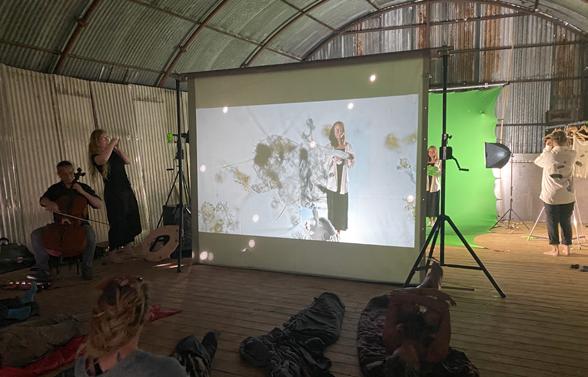
Cities of Dirt
Amanda Stomecki
little beings Living souls thousands, seething on the smallest crumb of Dirt They Changed our atmosphere 2.5 billion years ago the collective Breath of a legion of tiny cells Changed our history
Underground lives our past our future lies in wait what will the tiny denizens of an ancient, endless kingdom bestow upon us next? another Healing shroud? rich in oxygen and pregnant with possibility? or a noxious poison to exterminate all those endowed with multiple cells who have so desecrated what was built for us…
suspended in a matrix of Earth of rotting leaves and shells minerals elements precious stones and Earthly jewels dwarfed by giant annelids and rollicking isopods nettled in a riot of roots consuming converting sleeping
aspiring to nothing grander than to live and grow Unchanging for billions of years yet constantly Exchanging the currency of genes
Hope new lifestyles assumed each niche filled one for all and all for us might we take note, learn to adapt so freely, to let go and move on
to Begin again.
…our Collective womb cradle of regeneration and rebirth so as the Soil and its teeming masses of single-celled stewards have given us life, so They may take it away we should be cowed by their power Their offerings to the air our bodies to Gaia
may we all one day repay Their gifts with our Carbon our compounds our Breath Innumerably divided among the cells of our microbial brethren Timeless keepers of the Soil perpetuating our Planetary story
our deaths no death at all but the birth of billions upon billions of new lives
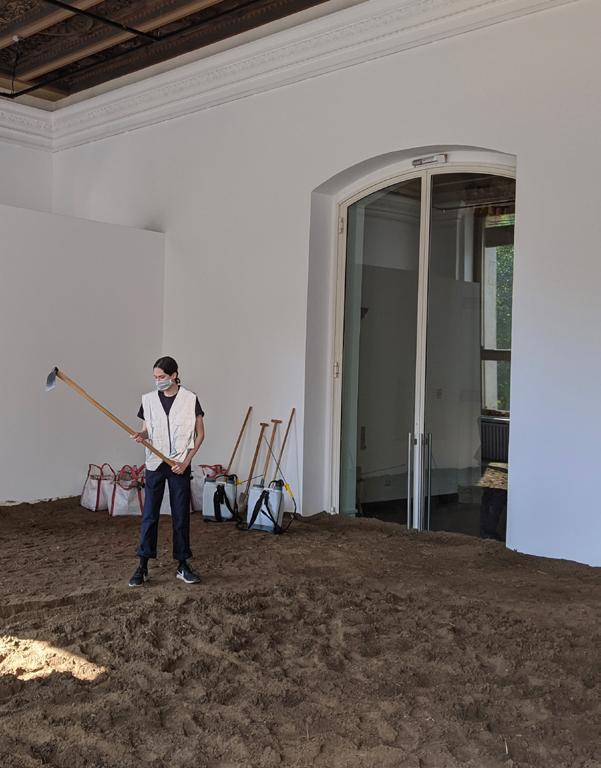
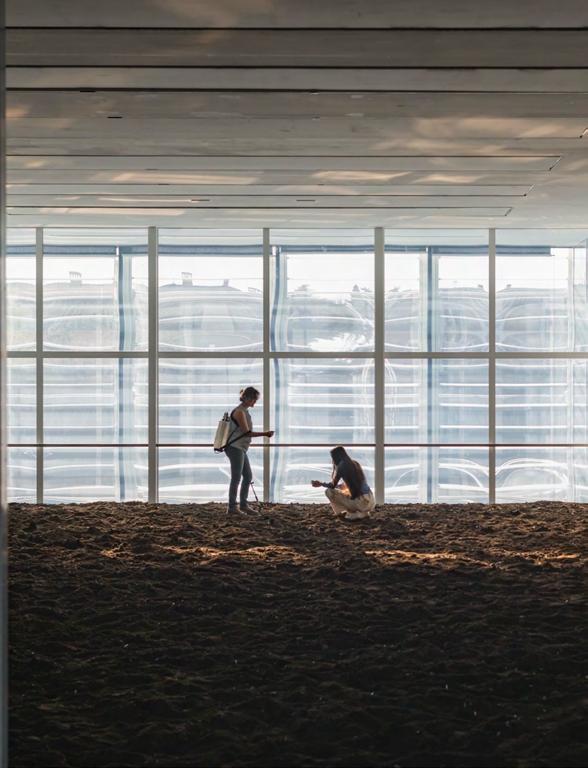
Visitors enter a room full of an earth-like substrate that immediately penetrates all senses. The air is heavy and smells vaguely familiar. A trained “cultivator” explains that she is digging freshly discarded cacao waste from a local roastery into the substrate. A collection of tools and instructions typically used in soil mapping and site investigation allows visitors to train their own senses to better assess the substrate at hand. After systematically introducing new materials with spades, the cultivators rake, water, and performatively maintain the surface, engaging with visitors as much as the soil materials. Before leaving the exhibition, visitors are invited to fill up specially printed bags of neo-soil and accept these as gifts to further cultivate at home. Through this direct confrontation, first through sensory encounter and then as a gift, visitors are encouraged to literally absorb a feeling of care and hidden labour, to reflect on the material transformation of waste streams as commons, and to speculate on the idea of soil in society. The remaining soil is given away to local gardens, parks or brownfield restoration sites. A sense of direct responsibility is imparted as both visitors and museum staff are tasked with further care invoked through the exchange. Upon leaving the exhibition space, visitors use an exit ramp in order to prevent soil spreading to the other areas of the museum. This final gesture, of an otherwise sensual and inspiring encounter with the earth, is both logistically necessary and symbolic. Unless we directly engage with soil, for example, through art, science, environmental education, or gardening, soils are relatively invisible, imperceptible, and in many cases undesirable and “dirty” in public life.
The “Technical Manual” developed for Absorption is both a how-to for the co-creation of a particular work as well as a reflection on the transformative potential and the role of “host environments” and eco-social responsibility of curation, replicated here courtesy of the artist.
Absorption is a work in which elements of the landscape, which have been separated by industrial processes, are recombined into a fertile “neosoil,” which is then given away to visitors to an exhibition, thereafter to be used by the visitors for any purpose. Therefore as a project it has multiple phases, of which the middle phase is a museum exhibition.
Prior to the exhibition, there is Phase One. This involves recruiting scientific advisors, cultivators and sourcing local waste products and ingredients for the creation of a fertileneosoil, soil itself being a network of interacting living organisms that serves as the natural floor for human life. This neosoil will be capable of absorbing elements from the environment around it, including water, nutrients, toxins, carbon, and other matter. The goal is to create a holistic product that can be the origin of new growth projects.
In the second and most visible phase, Phase Two, the museum exhibition, neosoil is created in the museum, and given away to museum visitors. A group of cultivators, who take care of the soil and interact with visitors to the exhibition, will be the key element to this phase of the project. A lively and transforming experience for the visitor will be created within the horizon of a powerful and somber visual tableau. As this phase of the work has both a material aspect and a performative aspect, it must be noted that both parts are required for the work to exist.
In the final phase, Phase Three, which encompasses the deinstallation process, the remaining neosoil (which has not been given away
already) is distributed to members of the community, such as community gardens, botanical gardens and other individuals who want or have a need for soil. All the neosoil created in the museum must be redistributed for use in the world.
Absorption is also able to act as a host environment to performances and to other work by artists invited by Raza to develop initiatives within the space created by the work. These may take performative or installation-based forms. On various levels, the project reverses a fundamental trope of twentieth century aesthetics: the fragmentation of nature and its replacement by an artificial landscape. Absorption aims to bring the biological substrate of life back into the foreground, this time not considered as an inert and lifeless clay, but as a living mixture or mesh of organic and inorganic forms. The base conditions of life are neglected only at our peril. The project attempts to access the mineral, the inert, and the opaque aspects in addition to the organic, the lively, and the representational. In a third space, these elements are combined into the lived experience of growth, and decay.
Excerpt from the Absorption Technical Manual by Asad Raza, compiled by Olivia Fairweather. 2019. Intro description by Alexandra Toland on occasion of the We are Compost /// Composting the We exhibition at Centre for Contemporary Art Glasgow, 2022.
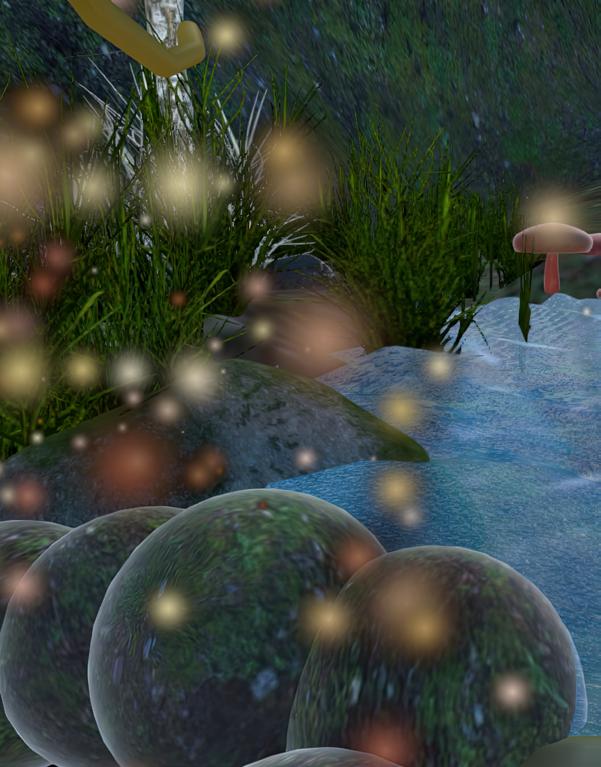
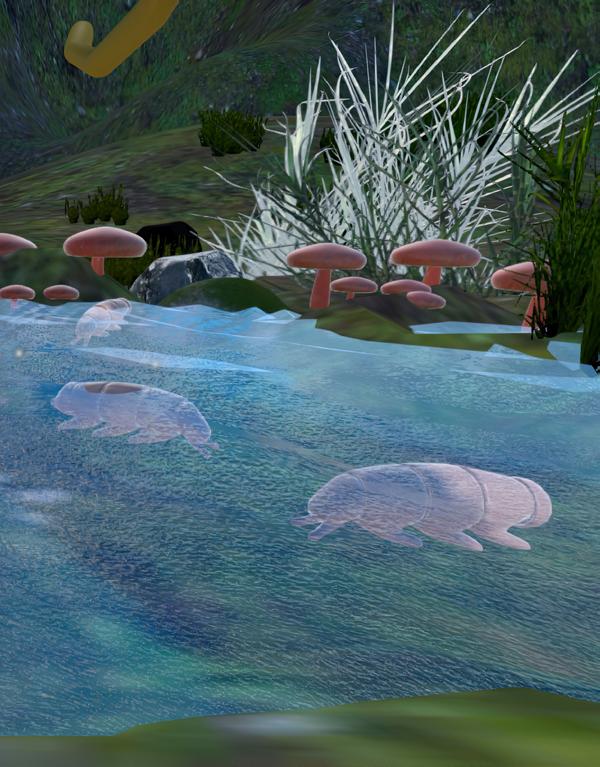
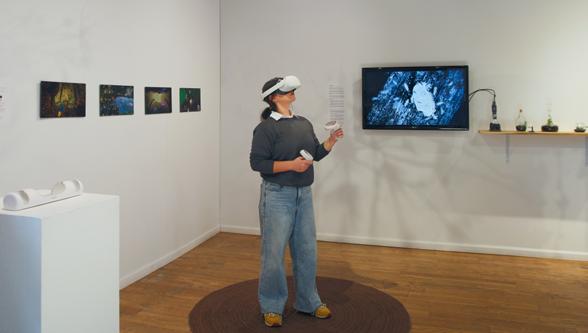
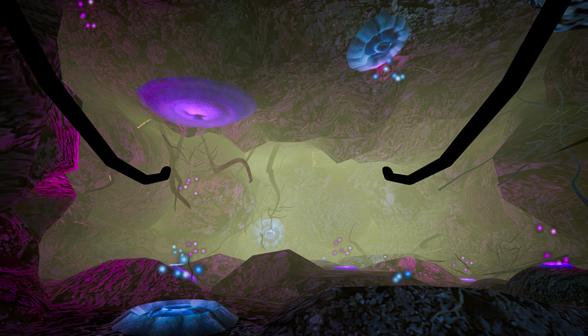
HOW CAN WE SEE UNDER THE SURFACE—AND GET INSIDE OF SOIL?
This virtual reality experience simulates the world of a springtail, an important creature living in soil ecosystems throughout the world. You inhabit the body of this tiny arthropod avatar so you can travel as it does: riding on a flying ant to find new territory, leaping through the air to escape predators, swimming in water to catch and eat waterbears, crawling underground to see the beauty there, exploring tunnels, eating sporulating bacteria, feeding on roots, and discovering friends. Soil is alive. This intricately interwoven ecosystem is full of tiny creatures that our lives depend upon. How can we see and experience the fascinating creatures who have complex, symbiotic relationships with each other? This project offers a virtual meeting of sorts—with the critters who are doing the important work of absorbing waste and transforming it into healthy fertilizer that feeds plants, which feed animals, like us. Soil is opaque, difficult to see, and hard for us to understand. The living terrariums on display highlight springtails, one of the many important creatures of the soil. They are visible, yet so tiny they are rarely noticed by us. The video microscope shares their world at a scale that makes them easier for us to see and to watch as they interact with their environment and each other.
They are arthropods who have a spring-loaded jumping organ that allows them to “hyperspace” jump up and away from predators.
They help build healthy soils by grazing on fungi, bacteria, and decaying matter, and by turning these into nutrients that plants can eat through their roots.
The “earthy scent” that often occurs after it rains is due to a symbiotic relationship that one type of bacteria (Streptomyces) has formed with springtails. The bacteria creates the scent to attract springtails, who help the bacteria by spreading their spores (kind of like seeds) throughout the soil where new colonies can grow. The springtails are rewarded by a meal of bacteria, who are in the last stages of their lives when they are producing their spores.
Fossilized springtails have been discovered in amber, clinging to the bodies of flying insects, causing scientists to believe that this is one method they used to travel and populate most types of terrestrial environments.
They come in many types and colors, but they are so small and are often underground, so you might not ever see them. If you want to see others—including purple, orange, iridescent, and variegated varieties—look them up by their scientific name, Collembola, or follow the hashtag on instagram, #collembola.
They are beneficial and not harmful to humans, even though they get bad press on the internet. Perhaps due to pest removal companies who would like to scare you into believing they are pests and might bite humans—not true!
Belonging to Soil is a collaborative project by Amy Youngs (Artist), Shadrick Addy (Designer), Mayen McClain (3D Environment Artist), Luke Stephens (3D Character Designer), JT Thrash (Lead Programmer), Andrew Sanchez (Programmer), Josh Rodenberg (Musician), Megan Wright (Designer), and William Yuan (3D Artist), and supported by a grant from the Arts & Humanities at The Ohio State University.
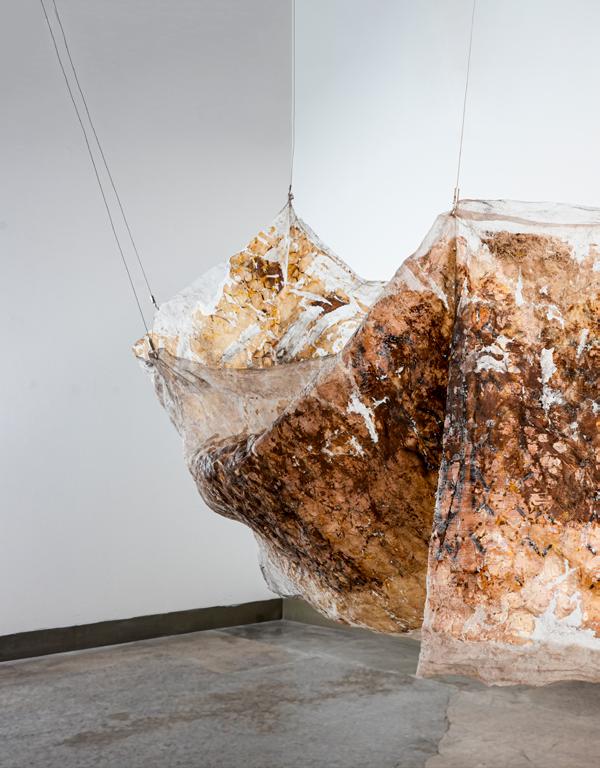
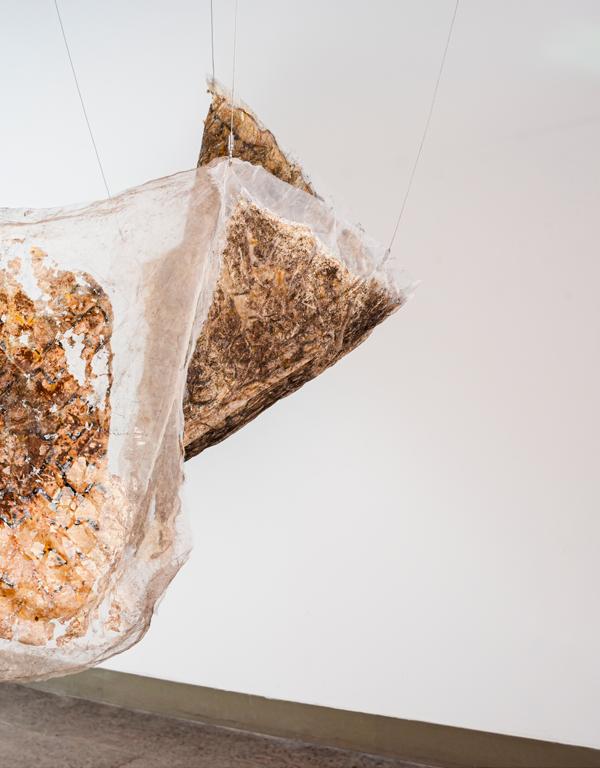
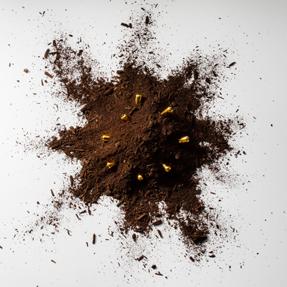
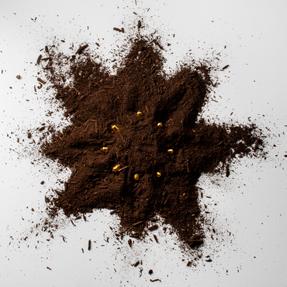
Soil is an extension of my body. Soil biota is kin to my gut biota. Composting is Gaia’s digestive system, and much like my intestines, it processes nutrients and toxins into a rich, fertile life. Inspired by Brazilian philosopher and educator Paulo Freire and his methodology of praxis as an action and reflection upon the world, I collaborate with composting bodies and the vibrant matters of food waste as a means for modeling human-soil interdependence. My work proposes a praxis that parallels reflection-digestion and action-care. In this work, I aim to highlight the similarities between reflection and digestion as metabolic processes that can break down and separate nutrients from toxins, which are symbolic methods for processing rotten ideologies. As a practical action, caring for compost is habitual and embodied learning, where an intimate relationship with our waste activates alchemy, where rot is transformed into fertile soil. At times, my praxis takes on composting workshops/participatory performances where participants are invited to conceptualize composting as an extension of their digestive systems, and reflect on the metaphorical decay present in their lives, and process it back to the earth symbolically through composting. At other times, it takes on participatory performances of sonic collective chewing and spitting, building communal sculptural composting systems, and the playful use of alternative caretaking tools.
Vibrant Instruments is a proposition for contemplating alternative modes of care. Inspired by acts of self-care, the use of vibrators in this work proposes an allyship between humans and soil to consider the ways in which penetration is weaponized to violate and exploit bodies and, in turn, reimagine the same gesture as a method of providing health care to the soil by aerating it with vibrators.
Sites Of Complexion invites viewers to experience an alternative understanding of being human by softening dichotomies between the individual and collective, the internal and external. In this work, I explore the porosity of bodies by emphasizing the skin as a perceived boundary of separation, and as a contention to this view, I refer to the skin—the largest organ in our bodies—as a point of relationality. To reflect the skin, I cultivate kombucha symbiotic cultures of bacteria and yeast (SCOBY) as collaborators that generate membranes of cellulose-based biofilm, inspiring extensions of our bodies. A reference for understanding ourselves as part of a larger body, whether human or not.
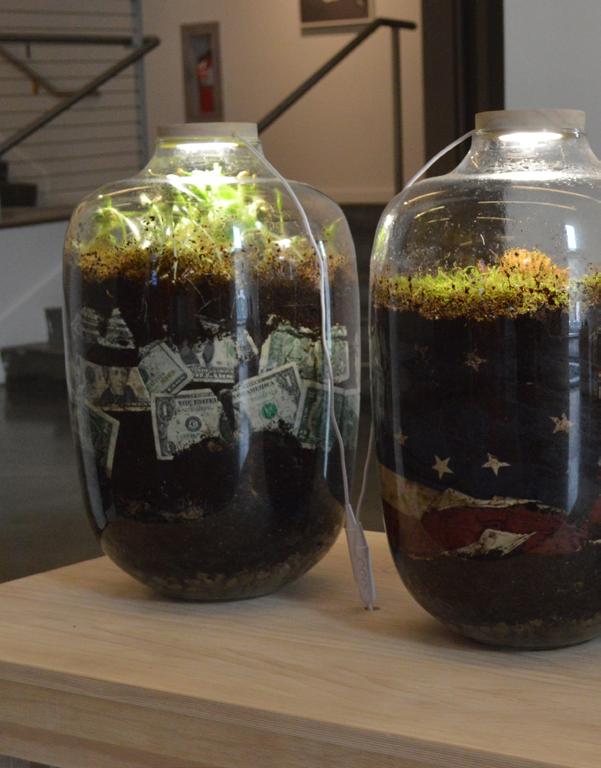
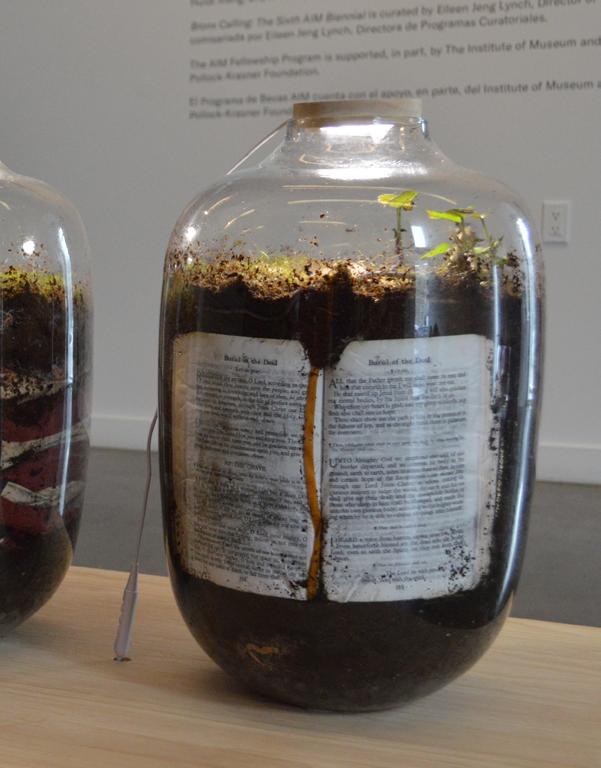
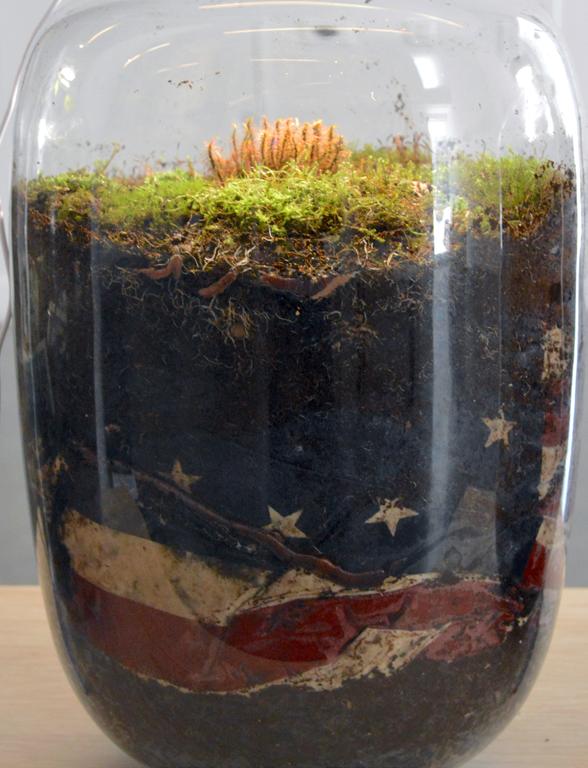
Soil is sustenance. We depend on it to grow the food we consume and support the environments we inhabit. Soil is transformation. When all organisms die, we decompose, consumed by detritivores like worms and fungi, becoming the soil itself. Soil is history. It is the accumulated remains of all things organic returning to the Earth as humus, living earth. Soil is interconnectivity. We, as soil, will be reconstituted into other organisms, which ultimately die and continue the cycle. Soil is living matter. It is a composite of these living systems over time, reflecting the health and practices of all who inhabit it. It must be tended to and maintained for the benefit of all. Soil is what we sustain ourselves from, what becomes us, and what we all will become.
Seeking New Gods is a time-based installation consisting of glass urns that contain microcosms of decay and regeneration. Within the vessels, earthworms, springtails, and various other detritivores reconstitute decaying organic material and powerful icons into fertile soil. Each urn contains symbols representing our current gods, the forces that dominate modern American society: capitalism, nationalism, and religion. One vessel reconstitutes currency, transforming capitalist notions of value into growth. Another entombs an American flag, decomposing a symbol of nationhood and imperialism into the earth itself. The last urn slowly digests a prayer service for the burial of the dead from the Book of Common Prayer and Bible, given to me upon my confirmation. These soul jars reflect the possibilities of composting as a metaphor for positive transformation—that we can learn from the metabolism inherent to the living earth to reconstitute our systems in productive ways. Seeds germinating from composted material sprout from the topsoil, hinting at regeneration and regrowth in this visualized future.
My practice questions the world we inhabit and envisions the one we will leave behind. Through collaborations and choreographed interactions with living and non-living systems, I construct performative sculptures and installations that incorporate familiar objects interacting in unfamiliar ways to challenge the framework of our everyday world. Reflecting on my background as a scientific researcher, I combine elements of scientific investigation and material exploration. Experimental play transforms into poetic contemplation as I embed organic materials, such as teeth, brain coral, and sensitive plants, within a synthetic world of hand sanitizers, polystyrene, and the magenta glow of LED grow lights to render the science fiction nature of our reality. I collect, deconstruct, and recombine materials to create chimeras that reflect on the existential trauma of our persistent environmental anxiety. These ephemeral constructions allude to their impermanence and, by proxy, our own.
Christopher Lin
Ashton Philips
As an interdisciplinary artist based in Los Angeles, CA, I work directly with dirt, water, pollution, and morethan-human agents of (dis)repair as my primary materials and collaborators. I'm interested in the transness of material, the plasticity of bodies (human and nonhuman), and the promise of queer ecological praxis. This includes interspecies collaboration, experimental “play,” and speculative (un)making, which I see as pathways for making meaning, building resilience, and generating new forms of knowing, feeling, and being in the late Capitalocene. Worm Hole includes images of Pyre and some of the Swarm Pots I created for a recent solo show. Pyre is a mound of partially-consumed waste styrofoam that has been transmuted into fertile earth by a colony of metamorphosing mealworms. The Swarm Pots hold this post-plastic earth in coil-built ceramic vessels recalling the swarms of mealworms that built this soil. This soil is nourishing a trio of cacti that began as abandoned pieces of distressed bodies, cast
off from their parent cacti onto asphalt during California's long drought. Soil is alive, shifting, and impure–plastic, really. It is capable of being contaminated by humanity's toxic behaviors and contaminating others both physically and metaphorically with these traces of toxicity and its taboo “dirtiness.” I care for soil that holds the traumas of industrial, military, and colonial history in its body—in the form of lead, arsenic, and petroleum by-products. I add post-plastic frass and sheds from styrofoam-metabolizing mealworms, pollution-consuming fungi,washed and dried kelp from polluted beaches, and biochar from found remnants of wildfires to this soil, not to “fix” it, but to remember that even damaged, impure, traumatized bodies and places can heal and thrive in their contaminated imperfection.
+ Famine, 2020 –25, living ecosystem of metamorphosing mealworms, partially-consumed styrofoam, mealworm frass and sheds, pupae, post-plastic darkling
beetles, partially-consumed wildflowers, contaminated and partially-healed dirt, mycorrhizal fungi, and mealworm-friendly, chromatic light, dimensions variable
Nancy Macko
My most recent body of work, Decompositions, highlights the organic waste we accumulate in a kitchen container until it is disposed of in the outdoor compost bin. Observing the choreography that occurs as each element is added to the container was the initial inspiration. It started with the asparagus… noticing how the stem ends fell in perfect symmetry like little Lincoln logs as they tumbled into the container. As more elements were added, the composition continued to shift. It didn’t matter how much of an ingredient was added. Each part only made the whole more complex, more interesting. As they decomposed, the organic scraps created mysterious, evocative compositions that resembled Dutch masters’ vanitas paintings as well as abstract expressionist works. Shot with a macro lens and presented as largescale archival prints, the resulting images present the viewer with an unknown realm to experience and consider. My collaboration with
composting continues to sustain me in my photographic explorations. Compost is a vital component of soil ecology that enriches the earth with organic matter and fosters plant growth. Its role extends beyond simple nourishment: compost actively participates in the decomposition process, driving renewal and transformation in the soil. As compost integrates into the soil, it attracts a diverse community of organisms, including bacteria, fungi, and earthworms, which break down organic matter into essential nutrients. This collaborative effort sustains and rejuvenates the soil, enhancing its vitality and resilience. Through the partnership between compost and soil, a narrative of abundance and sustainability emerges, ensuring fertile ground for future generations. Compost's ability to promote decomposition serves as a cornerstone of soil health, providing a continuous supply of nutrients and fostering a dynamic ecosystem where life flourishes.
John K. Melvin
Soil is everything we need and should be the context within which we frame every human activity on Earth. For the work pictured here, I chose materials that would degrade or capture pollutants and focused on the idea that art can feed the earth. Moss, a natural sink for heavy metals, was placed on bran plates in hemp cradles. The bran and hemp were able, over time, to degrade and feed the soil below. The moss filtered the rain and protected the tree and soil below. The entire installation is designed to decompose as it feeds the tree.
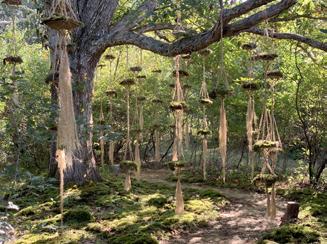
Renata Buziak
My art practice explores the fusion of organic matter and photographic materials through the creation of biochromes—images shaped by the natural processes of decay and transformation. Primarily working with plants (such as medicinal, Gondwanan), I sometimes extend my research to include soil and other organic matter. Working with soil allows me to honour invisible life forces—microbes, fungi, and organic networks—that are essential to wellbeing and belonging. In this project, soil is not only the setting but also a collaborator, marking and transforming materials over time. The work shown here is part of a new series on the exploration of life cycles, organic decay, and the metamorphic forces of nature. It was created on Minjerribah (North Stradbroke Island), a place close to my heart, where sandy soils and microbial activity transformed both cotton fabric and photographic materials over time. Microbial activity and soil conditions left physical
and chemical marks on the surfaces, illustrating the entanglement between organic decay and image making. Some cotton fibres remain embedded within the photographic material, highlighting the interconnectedness of the process. Through the biochrome process, I seek to foster connection with Country, honour ecological stewardship, and invite reflection on the interdependence of all living systems.
Donna Haraway suggests that “chip ping and shredding and layering like a mad gardener, (we must) make a much hotter compost pile for still possible pasts, presents, and futures.” 1 My interest is in urban land use, specifically in Oakland, CA., where I was born and raised, the unceded territory of Xucyun (Huichin), the Chochenyo speaking Lisjan Ohlone people. In my childhood, our Oakland neighbors, including my grandmother, still had large gardens in their yards. In the 1960s, Oakland was divided by massive freeway systems. Asphalt streets and concrete sidewalks covered the soil for car travel, and the built environment took over the land. Food began to be transported on these freeways, and it became increasingly difficult to find locally grown. Urban land was enclosed in lots, fenced, and privately owned. Public land was managed by government bureaucracies. Community and connection were lost.Today, I see compost as a metaphor for our need to turn waste into
fertility on environmental, social, and psychic levels. Oakland As Soil is a sculpture and social practice project, displayed in an art gallery setting, that raises awareness about urban farms and gardens in our neighborhoods and explores the concept of a compost society within the community. For this project, I gathered discarded plastic bottles, compost from farms and gardens, and volunteered at the urban farms and gardens where I was allowed to collect compost samples. A wall label references a webpage with research and information linked via QR code. There is also a flyer with this information. There are opportunities for events and interactions, including a meet-up or talk by representatives of the farm and garden organizations, or a signup for a tour of the sites.
1 Haraway, Donna. “Tentacular Thinking: Anthropocene, Capitalocene, Chthulucene.” E-Flux Journal, no. 75, 2016.
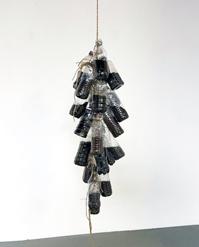
Oakland As Soil, 2023, soil, plastic water bottles, twine, 30 x 76 inches
The Tissue Culture & Art Project (TC &A) explores interactions between the life sciences, art, and biopolitics, transforming living tissues and biological materials into artistic media, and creating evocative narratives that question human-centric perspectives and explore multispecies relationships. Soil, often overlooked as mere dirt, is celebrated in our projects for its vibrant, life-giving properties. In recent projects, we utilised compost that evolved into rich soil, teeming with diverse microbial communities that generate, through decomposition, the necessary heat to sustain cell cultures in vitro. Particularly through our recent Compostcubator project, our artistic exploration delves into the transformative power of soil, which harnesses the heat generated by microbial decomposition to sustain living systems (both, in vivo and in vitro) and create humus that further enriches the soil. This dynamic interplay showcases soil not merely as dirt but as a vibrant, life-giving
medium. By integrating woodchips, decaying matter, and microorganisms, we create art that challenges notions of control and optimization while celebrating interdependence and multispecies ecologies. Soil, with its rich microbial communities, acts as both caretaker and creator, supporting the cycle of life and questioning technological innovation. Initially, in the standalone Compostcubator installations, compost was used solely to heat an incubator for in vitro cell growth. In subsequent projects, these cells produced small amounts of fertilizers for soilless media (hydroponics) while generating vast quantities of humus for soil enrichment. The Compostcubator (2016–2021), Sunlight, Soil & Shit (De)Cycle (3SDC) (2022), and the upcoming Project Metabolic Rift Technologies (MRT) (2025) explore what we refer to as Metabolic Rift Technologies (MRT). MRT promises a fantasy of ecological restoration through technologically-mediated, guilt-free, and
nature-less human existence. These projects utilize over four tons of decaying organic matter as a crucial and dynamic element for the art piece to function. This approach brings the lab into the farm, while critiquing the current obsession with technological solutions. This is demonstrated through the paradox, in which the audience celebrated the absence of soil in the hydroponic systems and ignored (mainly due to ignorance) the compost’s “technological” abilities. Our projects thus reveal the magical thinking of much of the current imaginaries of future food systems, where technological promises replace natural processes, creating a fantasy of nature-free, guilt-free existence and soilless farming techniques, where the production of food and other grown products is decoupled from nature in the name of sustainability.
The Tissue Culture & Art Project (TC&A) included Oron Catts & Ionat Zurr in collaboration with Devon Ward.
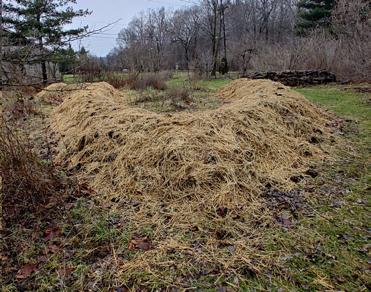
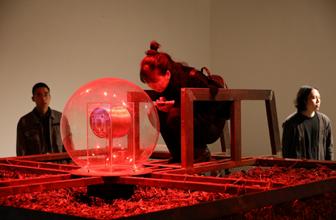
Vicki Mansoor
In 2001, I locked my studio doors to do a “makeover.” In 2004, I became engaged with a parcel of land, affectionately named “Homeadow Song,” in order to expand my understanding and relationship towards creative process and the renewal of self, community, and the natural world. My work now builds on ongoing experience and skills in the arts, regenerative land practices, nutrition, food preparation, education, and community engagement. Life, work, and art are fluid and are structured within the seasonal. Things move in one direction as far as possible and then collapse. Each cycle is cumulative, encompassing harvest and debris, while also growing towards new levels of organization and complexity.Soil/Soul/Sal (2023) is a series of undulating earthworks inspired by the forms and function of organs of digestion. These biodynamic compost piles are the most recent of many activities that have and still take place in a pollinator meadow that was conceived 45 years ago. My community helps stir and apply special medicinal teas, known as biodynamic preparations, that stimulate life processes in the soil and help it become more sensitive to its surroundings. I also prepare food and host a conversation for various participants help gather materials to build forms for specific periods of time.
Transformation requires sacrifice:
LIVE LIFE AS ART! COMPOST YOURSELF! DIE AND BECOME!
Massage the soil/soul with bare hands, breaking up tension. Amend with humus. Give drink and observe the breath. Provide enough light and air. Put to bed, let lie, fallow. Read, sing, pray.
Make fragrant blankets to soften the blow of unstable weather, cool and moisten.
Provide children’s laughter and instill awe.
Stir and apply special medicinal teas so that Earth can once again hear the intelligence of the cosmos. Nourish with all that has fallen: Heap tree, grass, kitchen scraps, animal manure, dried leaves, clay, bodies of sheep, chickens, and me too. Then wait.
Rhonda
Janke
In a series of recent projects, I work with time and soil to explore the decomposition of cotton canvas, revealing a beauty in a process often hidden from view. I approach nature, art, and science with humility and a willingness to dwell in the unknown. I see nature as a collaborator, not as a resource to be exploited. My art explores the intersection of artistic expression, science, food, farming, and sustainable agriculture, while also addressing issues of social justice and healing. I feel that much of life is spent remembering what we already know. Art is a pathway to that remembering. In these works, cotton cloth is buried in soil, but the microbes are the creative energy revealed in the markings, colors and patterns. Microbes are responsible for the air we breathe and the food we eat. Soil is much more than the minerals derived from the geologic parent material. There is the air in the soil pores, water, which all affects the microbial ecology of this mostly hidden universe. Recent DNA analysis of the soil used for these “buried cloth quilts” revealed more than 1400 species of bacteria and fungi, most of which are beneficial, or of unknown function. Some produce pigment, which are the markings on the cloth, due to the growth of colonies of bacteria and mycelia of fungi. Al Batinah Fields was created in 2023/24 from cloth buried in various fields in Oman by organic farming students. The Al Batinah coastal plain is a rich, productive agricultural region of Oman.
In my childhood home, food waste was churned up and whisked away by a garbage disposal or sent to the landfill. This was classic modern sanitation, which amounted to isolating and devaluing the potential benefits of food waste. As an adult, I’ve learned to prize these resources, and I use a worm bin to convert all of that waste into compost. The mix created by the red wiggler worms seen in this image is a welcome addition to our soil and garden. The further addition of biochar to soils, if done correctly, can greatly increase the capacity of soils to hold water, nutrients, and carbon. Biochar has been called a “microbial hotel” due to its suitabili-
ty for housing dense populations of invertebrates and bacteria. These images come from my book and traveling exhibition, Food Planet Future, which uses art to reimagine the tangled crises of food security, climate change, and biodiversity loss. For nearly six years, I’ve explored hundreds of foods–mostly plants–along with other items; I’m drawn to those with spectacular artistic appeal, together with a significant story related to climate change and ecosystem health. For these works I employ photomontage to blend scanning electron microscope (SEM) micrographs of pollen, seeds, leaves, and other elements with macro photographs.
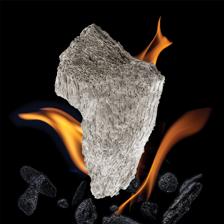
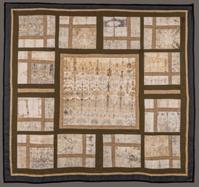
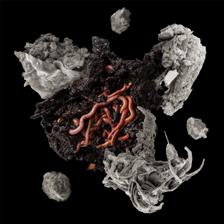
Helen Elizabeth
As an artist and psychologist based in London, I view my practice as a series of encounters, a collaboration with non-humans, that explores processes of loss, decay, repair, and renewal. Key themes are associated with materiality, deep time, impermanence, and change, along with broader questions about what is at risk and what is possible. I have developed a deep interest in soil as metaphor, ‘membrane’, material process, and ‘container’. As complex, rich, and abundant as a rainforest or coral reef, soil is largely taken for granted. I see the role of soil as the ‘cooking pot’ or crucible within which a re-enchantment can evolve. What can soil tell us about this moment? Can it teach us reciprocity? Can it teach us care? I’m interested in soils everywhere, but focus primarily on the soil at the back of my garden in and around a degraded urban brook. We work together to see what can happen… I’m touching, smelling, listening, crumbling, squeezing, digging, pushing, and being with the soil there, the changing, unstable edges of the brook. For this piece, I left out pieces of cardboard and an old cardboard box with charcoal and pigment for over a year, exposed to the elements, the soil, and a whole host of other non-human collaborators. This is what happened.
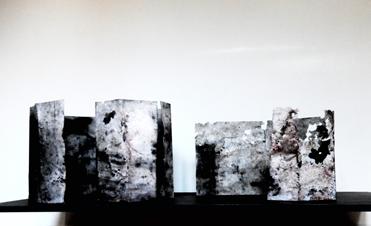
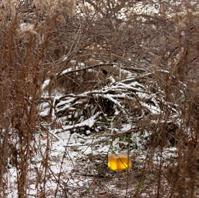
From the perspective of a visual artist (Sheila Novak) and soil scientist (Johannes Lehmann), we ask: How can we cultivate reciprocal relationships with plants? Can we view human existence as one that supports rather than depletes the land? This project explores one method of practicing reciprocity: nutrient and carbon recycling. In this work, two sites represent distinctly different human-ecological relationships: the Rosen Brothers Scrapyard Superfund Site (Cortland, NY), still toxic after 25 years of cleanup, and the Fischer Old Growth
Forest, one of the only forest ecosystems in the Finger Lakes region that has not been logged. Despite their opposing histories, these sites hold a shared past: human presence on the land. While the superfund site illustrates Western ontologies that promote a culture of harmful extraction, the old-growth forest illustrates Gayogohó:nǫʼ stewardship of the health of our more-than-human kin. In this project, urine is (re)contextualized as medicine: urine is presented as a glowing form, a golden cube, a treasure, a healing gift. Working with nu-
trient reclamation, these ephemeral bio-art sculptures were formed and decayed in December 2023, fertilizing and healing the soil with nitrogen, phosphorus, and potassium.
Land Medicine offers a cultural healing, where our bodies are a source of connection and reciprocity. This work was developed in collaboration with Johanness Lehmann, Liberty Hyde Bailey Professor, School of Integrative Plant Science, Soil and Crop Sciences Section, Professor, Department of Global Development at Cornell University, Ithaca, New York
Alicia Escott
Much of my work over the last several years has been informed by three rogue habitat restoration projects on public lands. For me, this labor is Artwork, but artwork with a lowercase 'a'. These projects are a way of giving back to my (non-human) collaborators. I also spend my winters into spring cultivating Metabolic Rifts, hosting workshops during the winter solstice in which we place soil into bags discussing: grief we would like to sequester into the earth and the power of darkness and soil as a generative force for growth. Then we sow the seeds for possibilities in the year ahead. This year, I am conducting this work on sandy soil at the top of a massive aquifer, highlighting the value of de-paving so that rain can seep through this dune soil to recharge our aquifer. Grown inside discarded plastic with local compost, these “sculptures,” started
from seed, include multiple plants growing to form one body or one persona. The resulting ecologies assume a relatable bodily form. Yet these sculptures are also collectives entangled in community. Their body-like shape reinforces this. The plastic’s transparency exposes the soil in long tubes, a nod to excrement as form. Karl Marx's concept of metabolic rift describes the tendency of capitalism to destabilize ecological systems and shows how our physical outputs are increasingly disconnected from natural cycles. As a sculptural intervention, these Metabolic Rifts are plant bodies, urban micro-ecologies, and hosts for local insects as an attempt to repair the metabolic rifts in Marx’s critique. The use of compost here references the fruitful decomposition of ideologies and systems within our culture(s) that need to die away so that future life may thrive.
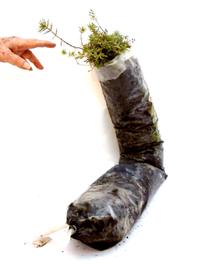
Memory (Metabolic Rifts), 2024/25, soil, compost, wildflower seeds, reclaimed plastic packaging, water, time, sunlight, human engagement, dimensions variable
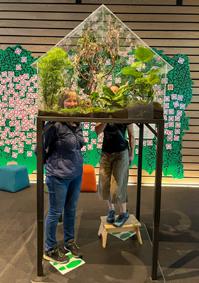
Vaughn Bell
Village Green: Loopscapes (2024) invites people to encounter plants growing in soils made from composted local municipal sewage. The installation was commissioned by the Gates Foundation Discovery Center as part of their exhibition about sanitation. The artwork addresses human feelings of revulsion around waste and creates a space for sensory and somatic understanding of our connection to cycles of decomposition and growth. Like other works in the Village Green series, this artwork invites humans to share space with plants and with each other. Together, these works enable people to experience symbiotic relationships with the atmosphere and plants in a direct, sensory manner.
We share our breath with plants, and we witness on a bodily level the fluctuations in air temperature and moisture within the biosphere. We also experience, in a child-like way, a shift in scale and attention with an invitation to look closely at small plants and living soil. Responding to local conditions and collaborating with local communities allows a new work to take form. Each Village Green project is unique. The forms of the structures and the species inside are all determined through a process of conversation amongst people and places. The long-term life of the artwork is considered, from the care for the plants inside, to the potential eventual re-planting, re-purposing, and re-inventing of the structures.
My practice stems from an interest in the ecologies that exist beyond human sensory spectra, from a desire to regularly molt and regrow perceptual habits. This research often takes form through experimentation with scale, repositioning myself within the context of the movement and change enacted by the beyond-human parts of my respective ecological circuits. I am often immersed in the feral ecologies of medians, transition zones, and in-betweens. I work with installation, sound, and environmental sensors to illuminate the place-making intelligence of more-than-human cohabitants within the wake of global capitalism. My attention is currently held within the sonic-ecological impacts of highway and rail infrastructure in the Blackland Prairie ecoregion of Texas. Soil is the site in which entire life cycles are spun–not just a site of growth and birth but also of sustenance, breakdown, and returning. I have called many soils home, but the soils where I was raised were largely held in the caring grips of prairie plants and deeply rooted tallgrasses, simultaneously woven through and ruptured by anthropocentric conduits for the transport of water,
oil, and power. In this work, I recognize microfibers and microplastics as contemporary soil components–matter extracted as petroleum from the soils of a long-passed geological era, trying but unable to break down enough to return wholly to the soil it lies within. Soil is a teacher and an archive. I am interested in how a mass rejection of taught objectification of the world’s non-human matter might impact the way that we understand and tune in to waste ecologies and systems of extraction. In my research, I look at water, waste, and agricultural infrastructure to understand the ways that microplastic pollutants move terrestrially. One way microplastics travel is through landfill leachate, where water moves through industrial and municipal landfill waste, carrying eroded microplastic particles with it. Another way is through the practice of fertilizing agricultural soil with recycled biosolids from wastewater streams, where microplastic fibers from laundering and manufacturing processes accumulate. With this knowledge, and using the laundry lint I collect from local laundromats (comprising hair, skin, and both natural and synthetic fibers), I plant grass seeds from native
Katerie Gladdys
Honoring the sandy soils and the ever-fluctuating water conditions of north central Florida, my backyard functions as a testing ground for speculative practices on sustenance in times of climate change. My artistic practice oscillates between local food systems and managed forests, punctuated by investigations into the hyperlocal of my backyard. Informed by research in geography, environmental studies, forestry, ethnography, agriculture, community activism, and physical computing, I create installations, sculptures, and performances as a
Continuous Compost, 2019, single-channel or multi-channel triptych video, dimensions variable, 9:14 minutes
form of critical spatial practice. Continuous Compost is a non-narrative triptych or single-channel video that documents and aestheticizes the cycle of converting waste into fertile soil. The video illustrates composting at three different scales. Acres of decomposing piles of mulch mixed with chicken manure depict the large-scale composting operation at Siembra Farms, a local organic CSA farm. Hardworking insects and fungi, minute in scale, are contrasted with mystical, fecund mountains of steaming compost. In the next video, chickens feed on food scraps
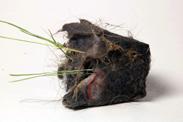
From Old Growth, 2022, hair, skin, synthetic and natural fiber lint, dust, water, locally native grass seeds, dimensions variable
grasses. I water these “soils” over the course of several weeks, jarred by the understanding that plastics can accumulate in such large quantities and come into frequent contact with the soil, yet still remain so far from being returned to it.” to “As I water these “soils” over the course of several weeks, the grasses sprout as if emerging from old growth. Plastics exist in increasing amounts as components of many contemporary soil bodies–close in proximity to its organic memory, but unable to fully reintegrate.
collected from local restaurants and then excrete on an ever-growing pile of nascent soil at Grow Hub, a notfor-profit plant nursery staffed with adults living with disabilities. And finally, the third video illustrates composting on a very personal scale in my backyard, where my domestic waste is transformed into a co-created enterprise between humans, animals, plants, and microbes. I hesitate to use words such as “amendment” and “fertilizer” because these terms imply a lack rather than a recognition of an ancient and sustained ecosystem that preceded the predominantly deforested and lawned landscape of my neighborhood. Soil invites me to examine my agency with respect to remediation, cultivation, and restitution in the diversion of byproducts of my consumption through compost back into its corpus. My care for soil is a hyperlocal act that advocates for a closer human relationship with soil.
Leslie Labowitz Starus SPROUTIME, the core of my fourdecade-long eco-feminist practice and durational art/life project, integrates personal and global survival into performances, installations, and urban farming. It began with a micro-urban farm, growing organic sprouts and greens in my yard in Venice, California, and a series of ecologically-minded performances and installations produced in galleries across the United States. During a difficult time in my life, I went into my backyard and began planting edible greens in trays using soil that I had prepared myself with organic soil amendments. In 10 days, I had greens ready to eat. These greens needed hand watering several times a day and night. I turned this growing ritual into a meditation in 1980. I have continued to integrate sprouting as a daily spiritual practice. By 1990, I moved to an agricultural property with 30,000 sq ft of greenhouses where we used soil in truckloads. Rather than throwing away the “root mats” created by growing in the trays, they were added to the soil in a 50’ compost pile, enhancing soil biodiversity. As an outgrowth of my art practice, I founded my Sprou-
(CalArts, Earth Edition: Visions 2030), 2023, live greens, sprouts, roots with recycled signs, dimensions variable photo: Laurie Peterson
time business in 1980, developing a green enterprise that grew and distributed organic food throughout the US until 2011. As a legacy of this, I still maintain my sprout stand in the Santa Monica Farmers Market. A series of healing and nurturing projects, SPROUTIME, counteracts my experience with intergenerational trauma as a child of a holocaust survivor. The materials I use to grow and sell sprouts, beans, and greens are integrated into the installation, along with hand-painted signs that represent actual protest signs, personal history, quotes, and the growing ritual. White buckets, wood pallets, crates, and trays of leftover plant material are arranged to make decomposition visible. The roots grow through the trays and are installed root side up as they are my main visual element and building blocks, piling them on top of each other or across a long span. Crates are used for dimension. Adding the signs is the last step. Throughout the exhibit, live trays of greens are set on top of the mats to wilt and decompose. There are smells and flies by the end of the exhibit. The installation is donated to local urban farmers for compost.
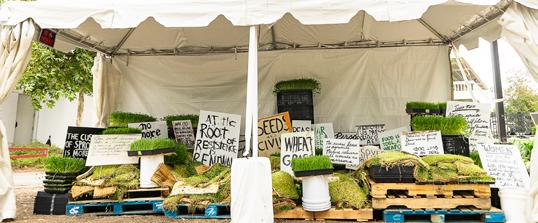
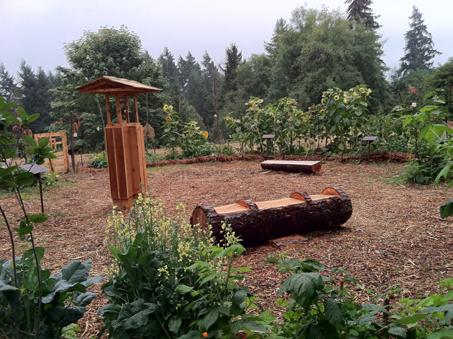
Beverly (Bee) Naidus
I have been working with soil as a material since graduate school, but my limited perspective as a young art student was disassociated and materialistic–I saw soil as texture, color, and metaphor, something inert, rather than as kin, potent with story, possibility, and history. Eden Reframed (2011–2024) was an eco-restoration and permaculture design project featuring a food forest, a story hive, and a demonstration of how to heal contaminated soil with plants and mushrooms. Inspired by my late partner’s social ecology group, SEEDS, we originally had been invited to place the project on one of the most toxic sites on the island. Not only is
the Beall Greenhouse site a place where heavy metals were aerially transported from Tacoma’s ASARCO copper smelter, but the soil there also received an influx of pesticides and fossil fuels as part of the rose cultivation industry. Unfortunately, the kind folks who invited us to place the project at the Beall were asked to leave by the owners in the same week that I received the grant to fund the project. After many negotiations with the owners (who did not want attention drawn to the contamination of their land), we decided to move the project to a public park where the soil was not contaminated. The project opened to the public in 2011. The food forest
became a favorite “snack bar” and a place for meditation, gatherings and rituals. The story hive was filled with stories from gardeners and farmers about why they planted seeds in a time of environmental crises. Many stakeholders cared for the project once we moved off the island, but eventually, those people moved on, and over the years, it was clear that the project had fulfilled its mission. We did a final ceremony as part of the composting process this past fall, adding a bit more of the soil made by my late husband’s composted body to the land. The fruit trees and berry bushes will remain to feed visitors.
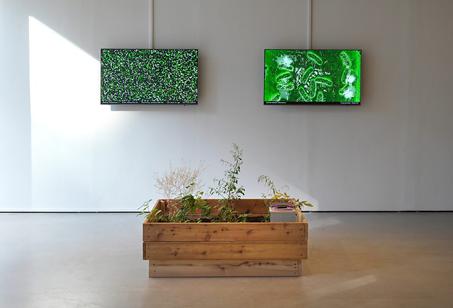
Stephanie Rothenberg
Beneath the soil is a terrestrial world of microorganisms that scientists are discovering can generate electricity. This “microbial machine” comprises bacteria such as Geobacter and Shewanella that feed off carbon-based particles, oilbased pollutants, metal, and radioactive materials that have collected in the soil from pollution. This process of microbial bioremediation produces an electrical current as the microbes transfer electrons. If harnessed strategically, power can be generated, so much so that NASA researchers are even considering microbial power for future space missions. In the speculative design project, Proof of Soil, I imagine a new system in which energy is harvested from the accumulated waste of industrial toxic landscapes to power the massive energy needs of global data flows. Through this entanglement, a new set of rules and form of communication emerges not only between the artificial intelligence of the machine algorithm,
but also with the sentient world of non-human organisms. I care about toxic soil. I am interested in how soil presumed to be “dead” in unwanted/undesirable landscapes of extraction can be transformed and remediated into generative “living” resources. I first learned about microbial fuel cells (MFC) through the science toy, MudWatt, a “bio-energy pet.” I was overjoyed by the simplicity of the system–that I could light up an LED with a coffee mug of dirt! The more I learned about MFCs, I started to really understand their potential as a regenerative, scalable solution that could contribute to global energy needs. The title, Proof of Soil, plays on the Bitcoin process of mining known as “Proof of Work.” By using speculation, my goal is to make visible the challenges and often false promises of new technologies. In this scenario, what is at stake is the promise of a fully virtual economy, and what other options and world-making are possible. The plot of land
shows a physical model of MFC in contaminated brownfield soil that can generate up to 5 watts–enough to charge a phone. The small LCD screen displays the amount of energy generated and the devices it can charge. The infographic poster shows a map of the greater Chicago area with red dots indicating data processing centers and brown dots indicating brownfields. Chicago is the 3rd largest data processing center in the U.S. If MFCs were used throughout the over 36,000 acres of brownfields, it could potentially charge half the amount of electricity needed to power Chicago’s major data processing centers. The 2 video screens show: 1. Data visualization showing real-time mining of Ethereum and actual algorithms being processed to create cryptocurrency and the electricity required to perform the transactions; and 2. Simulation of the Geobacter bacteria in a microbial fuel cell that is metabolizing metals in contaminated soil.
Why do surfaces matter when it comes to thinking about soils? Psychologist James J. Gibson once famously wrote, “the surface is where the action is.”¹ Reflecting on Gibson’s remark, cultural theorists Mike Anusas and Cristián Simonetti suggest surfaces provide, “a compelling perspective for how to think about the world relationally,” by giving “necessary attention… to the thresholds that occur between different states of matter.”² With regard to soil, this statement rings true on many levels. Surfaces of individual mineral particles are key to soil vitality and plant growth. The vast surface area of clays, for example, with their fine pores and electrically charged surfaces, is effective at holding water and nutrients before they are absorbed into plant roots.³ In another understanding of surfaces, “surface hardness” refers to the ability of the topmost layer of soil to resist deformation, and is often used as an indicator of compaction, moisture content, and soil strength.⁴ In both instances, we encounter surfaces as thresholds, on the one hand between the potential for resilience or collapse, for example, under the stress of heavy machinery, and on the other hand between bodies in constant energetic exchange.
Aesthetically, historian Joseph Amato writes, “surfaces are transformed from sensations and perceptions into concepts, images, symbols, and language.”⁵ Surfaces, and more specifically, surfacing—the act of creatively investigating, visualizing or interacting with soil surfaces—has emerged as an important strategy of artists working with soils. They “structure our encounters in and movements through the world, as well as our imagining and our thinking.”⁶ The artists in this section show us that surfaces are also places of gentle touch but also places of friction. Surfaces “draw us to acknowledge that life furthers itself not only due to flows of matter but also due to frictions of matter… the earth is formed by the rubbing and collision of tectonic plates, its lands eroded by the forces of weather.”⁷ While soils are naturally swallowed up through processes of weathering and geologic activity over millennia, they are also now in danger of being erased and replaced by human construction. The Joint Research Centre of the European Commission has estimated a total sealed area of 175,664 km2 across Europe, with an increase of 1297 km2 between 2015 and 2018.⁸ What is at stake when skin becomes concrete, or when water cycles are purposefully buried? Transdisciplinary soil care means that staggering figures can be brought together with affective images and data storytelling, such as the projects shown here.
Surfacing as an aesthetic strategy furthermore challenges aboveground–belowground, inside–outside, ephemerality–permanence dualisms to poetically engage with surfaces as dynamic and thought-provoking “zones of mingling.”⁹ As artists in this section demonstrate, surfacing can bring attention to the vibrant interface between soil, air, water, and skin. These include things like tracing (Junuka Deshpande), digging (Stephanie Garon, Erica Fitzgerald), casting (Betty Beier, Lori Nozick), dragging and pulling (Erin Wiersma), rubbing (Francesca Virginia Coppola), driving (CV Peterson), burying and unearthing (Saskia Jorda, Annette Nykiel, Stefania Boiano, Carole Milon), blowing (Olivia Newroz), de-sealing (Stacy Levy, Lauren Bon & Metabolic Studio), scanning (Melinda Hurst Frye, Kathryn Maguire, Susan Felter), polishing (Veslemøy Lilleengen), dripping (Alexandra Toland), dancing, and walking (Dawn Stetzel, Shawn Skabelund, Riva Weinstein, Jennifer Gunlock). Further activities have been identified by Tim Ingold in his anthropological study of “Surface Visions” such as “washing, scrubbing, brushing, sweeping, raking, shaving, ironing, mowing… scraping,
Alexandra R. Toland
grinding” and other surface-oriented “operations that turn rough into smooth, dull into shiny, opaque into transparent, written scrawl into blank slate.”¹⁰ Artistic practices of surface-marking and visual capture show that “surfaces are important not in themselves but for what they potentially open up, and for what they disclose… also important for what they hide, and for the deceit that they can practise on us.”¹¹ Artists bring to the fore the tensions between surface as a place of disclosure and a place of deceit, a place of softness and a place of friction. They scratch and scrub not to hide or reveal but to bring attention to the surface as a place of encounter, a place of exchange, or a place of loss. Surfacing offers a strategy for repairing, bearing witness, and remembering, using lateral movements and contact gestures of all kinds to turn friction into a productive force and show us why surfaces matter.
1 James J. Gibson, The Ecological Approach to Visual Perception: Classic Edition, ed. Edward Reed, R. Jones, and David Leitan (New York: Psychology Press, 2015), 19.
2 Anusas and Simonetti, “Introduction: Turning to Surfaces,” 4.
3 Georges Kogge Kome, Roger Kogge Enang, Fritz Oben Tabi, and Bernard Palmer Kfuban Yerima, “Influence of Clay Minerals on Some Soil Fertility Attributes: A Review,” Open Journal of Soil Science 9, no. 9 (2019): 311–25, https://doi.org/10.4236/ojss.2019.99010
4 See, e.g.: Gaius D. Eudoxie, Dennison Phillips, and Raymond Springer, “Surface Hardness as an Indicator of Soil Strength of Agricultural Soils,” Open Journal of Soil Science 2, no. 4 (2012): 341–46, https://doi. org/10.4236/ojss.2012.24040
5 Joseph A. Amato, Surfaces: A History (Berkeley: University of California Press, 2013), xv.
6 van der Tuin and Verhoeff, Critical Concepts for the Creative Humanities, 184.
7 Anusas and Simonetti, “Introduction: Turning to Surfaces,” 7.
8 European Commission, Joint Research Centre, Soil Sealing (Luxembourg: Publications Office of the European Union, 2023), European Soil Data Centre (ESDAC), https://esdac.jrc.ec.europa.eu/themes/soil-sealing
9
Mike Anusas and Cristián Simonetti, “Introduction: Turning to Surfaces,” in Surfaces: Transformations of Body, Materials and Earth, ed. Mike Anusas and Cristián Simonetti (London: Routledge, 2020), 1–13.
10 Tim Ingold, “Surface Visions,” Theory, Culture & Society 34, no. 7–8 (2017): 99–108, at 100.
11 Ingold, “Surface Visions,” 102.
Alexandra R. Toland
Hole Erica Fitzgerald
Neither soggy north and south, west, east, nor wet but blooming rock, in time
Breaking earth through voids Deep can be dark, a yonic Circles and spaces
To dwell in darkness
Other worlds lighten shadow manifesting eyes
In fertile dwellings it quietly rolls through graves while stumbling downward
Multifarious Sockets within cavities
Determined a hole
Quietly notice Passages of time to center Underneath caverns
Hephaistos an axe But peculiarly human Adaptations fall
Digging with fingers
A dream of vortex crevice towards pink dim holes
Fermenting eggs to seeds and fertile bottomless roots hollow nostrils birthed
A hole, hole, a hole
From under, within ourselves A hole, a hole, hole
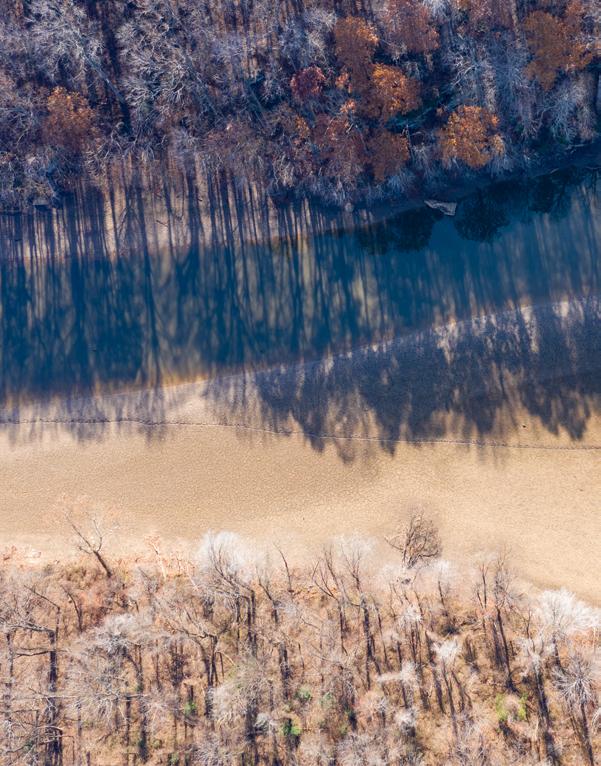
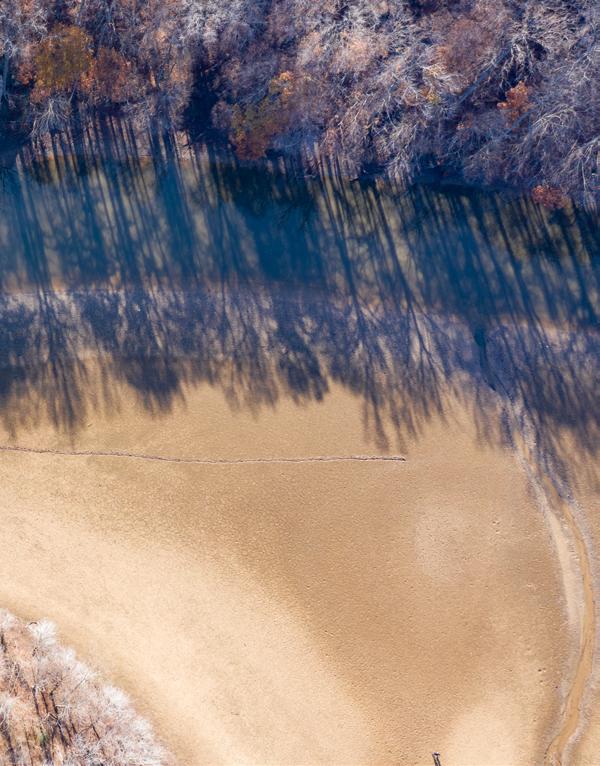
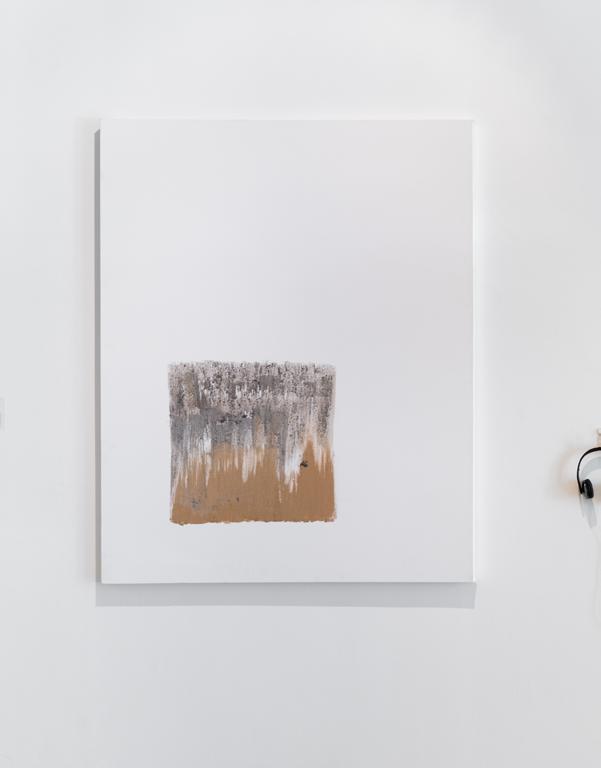
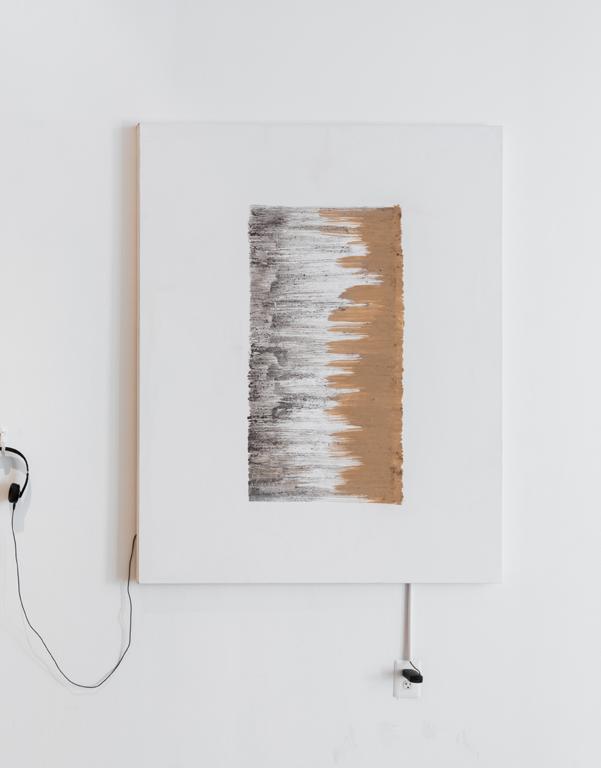
Dig was a performative work documented with video and accompanying prose resulting from my creation of a 500-foot-long land artwork located along a section of the Patuxent River, an area shaped and managed by a hydroelectric dam in the State of Maryland. The dam was completed in the 1940s and has been managed by the Washington (D.C.) Suburban Sanitary Commission but serves as a replicated model across the United States for the intersection of land claim, environmental conservation and natural resource use. Six months after the piece was completed, the dam was reopened, and the artwork was submerged beneath the water—echoing the fate of countless Mid-Atlantic prehistoric petroglyphs that were destroyed during the expansion of hydroelectric projects. In this interactive and time sequenced piece, Dig was also a meditation on the transitory nature of human mark-making in the face of environmental and industrial forces. By exploring the interplay between humanity and nature, the work emphasized impermanence as both concept and condition, inviting viewers to consider the ephemeral aspect of both the soil and the work of art.
My practice, especially artworks employing soil as a material emphasis, investigates humanity’s interruptions of nature. I am drawn to the literal and metaphorical power dynamics embedded in landscapes. I investigate dichotomies: fragility versus formality, permanence versus impermanence, extraction versus care. These tensions animate the artworks, consideration, and discussion surrounding the issues of land claim.
As I attempt to understand specific environments, I engage with the land through embodied research. I start by exploring the same paths as ancestors of the land have walked. I listen to the silence, the wind, the water. I touch, bathe in, and smell the soil. I try to treat each grain with reverence—as both a physical trace of geological time and a cultural artifact linking continents, histories, and disruptions. I interview earth scientists, tribal members, geologists, economists, activists, policy makers, and town locals to integrate their knowledge. Then I sketch, experiment with materials, and create forms. In Dig, the excess materials I gathered during this project were transformed into soil paintings and sculptures, then returned to the original site. This circular process of making and returning further emphasizes themes of labor, land claim, and time.
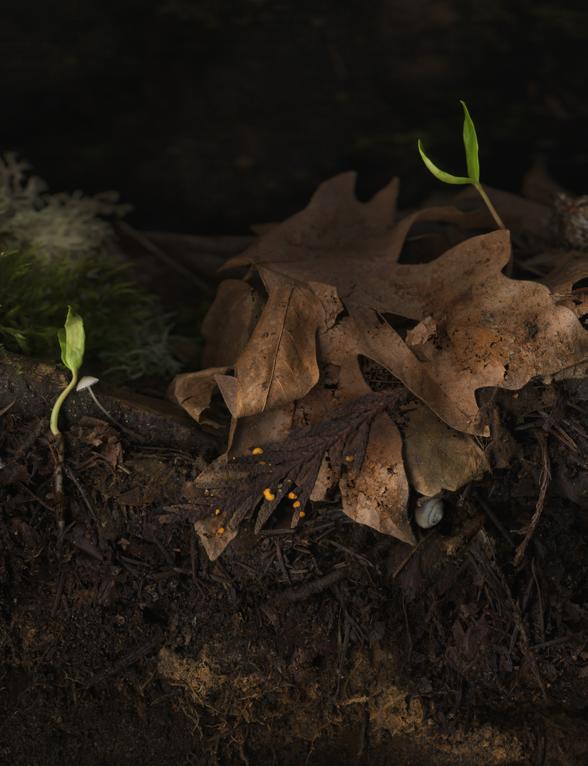
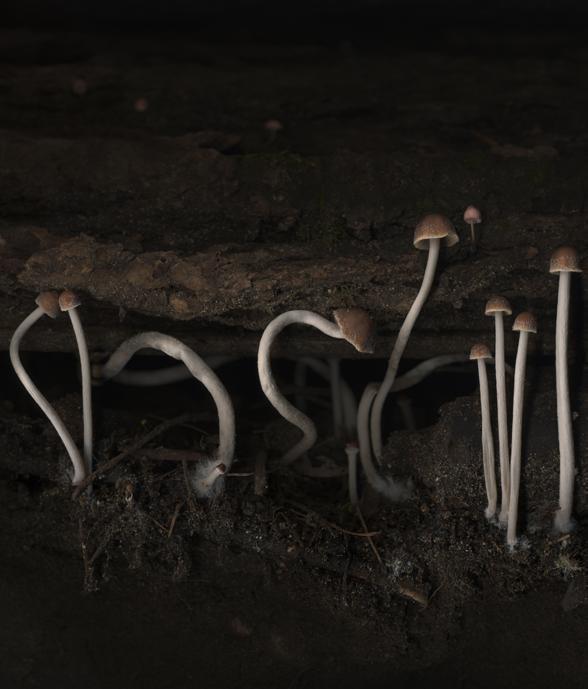
The surface is not a border, but an entrance to homes and habitats, highways and systems, decomposition, and regeneration. Analogous to scenes from a natural history museum, flora takes the center stage to illustrate that we are always tied to migration, evolution, and metamorphosis. Decay turns to growth, slime mold migrates, changing shape while it decomposes its host, and hyphae beneath the forest floor exchange nutrients and signals between the trees. Other fungi recycle the fallen wood and return the deadfall to the earth. The fruiting bodies provide evidence of the efforts and the slow churning of the soil that takes the forest apart so that it may become again.
In a summer punctuated by the pandemic, I moved to my childhood home with my own family, adjacent to an urban forest outside of Seattle, Washington. We walk the same trails I explored when I was young; we forage, greet the ferns, and let time slow down while watching the light change and smelling the earth. We observe the change in seasons, mushrooms exploding on fallen logs, and the forest growing while decaying at the same time. The soil that I care for, that I do indeed call kin, is the soil that nourishes the trees that grow around my family.
In my practice, I seek to witness the mysterious service and relationships under the Pacific Northwest’s understory by using a flatbed scanner as a camera to tell stories about place. My attraction to the soil is to the transitional barrier of permeable worlds, of regeneration, and of partnerships known and unknown. My choice of working with a flatbed scanner is very intentional as it slows my own frenetic pace and allows for me to observe the small interactions and relationships in the understory, including chromatic transitions from the loam to the clay, and fungi reaching out of the blackened soil in landscapes that have experienced a burn. The use of the scanner as a camera in the field calls for patience, and a slowness in observation. The physicality of holding the scanner still as its optical eye passes over sprouting fungi or a small patch of charred soil, forces my body to be uncharacteristically still while only observing (as my muscles resist shaking). This stillness gifts me the observational space to witness soil with curiosity as an assemblage, as well as an entity.
Melinda Hurst Frye
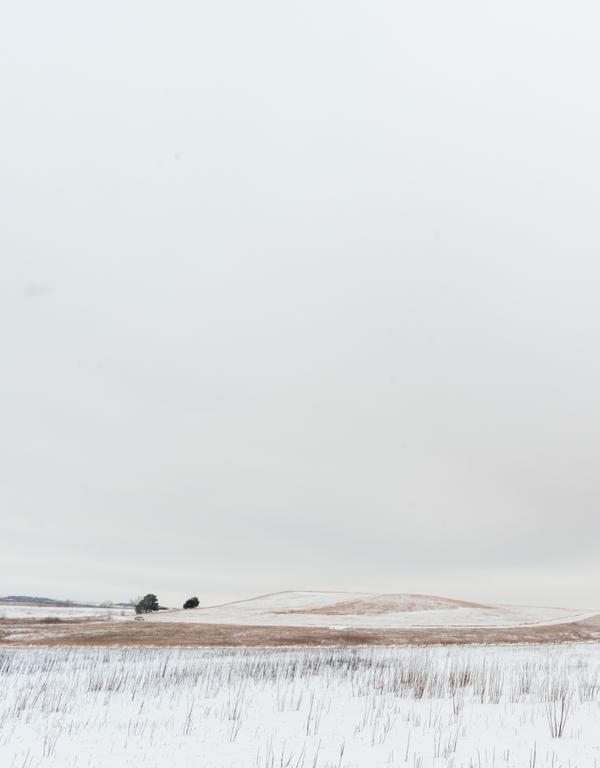
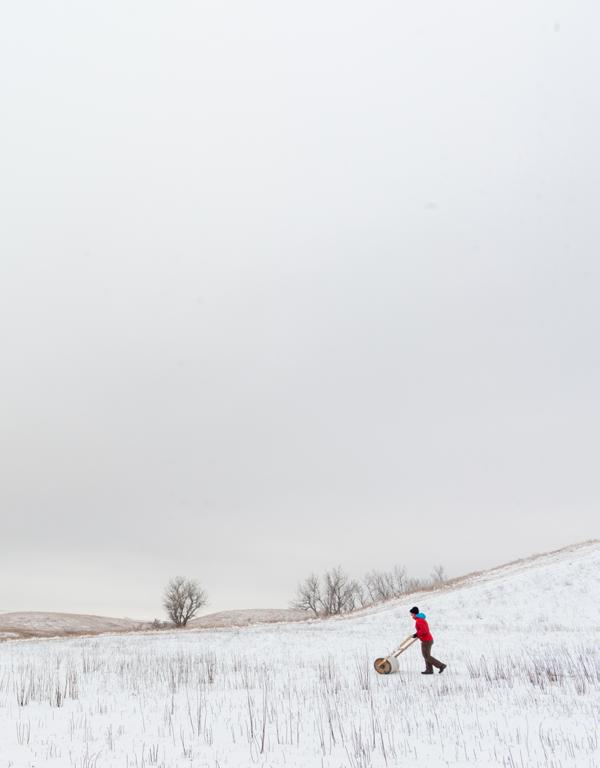
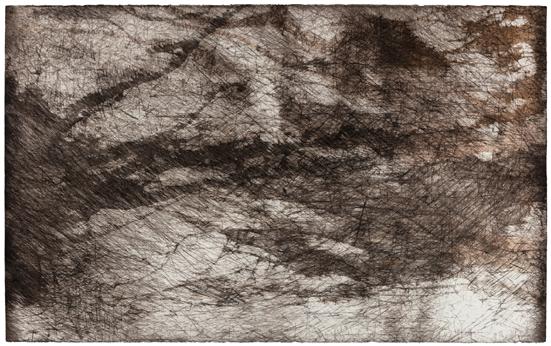
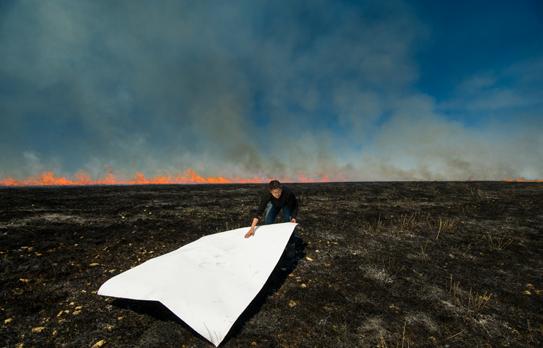
My artistic practice focuses on the body’s capacity to absorb and respond to the environment, working on location in protected grasslands, the Konza Prairie Biological Station. The Konza Prairie works on paper are drawn directly in the tallgrass prairie after prescribed burns. I use the land’s own ancient soil and residue from fires, known as plant biochar, as my medium. Fire has been a driving force in maintaining the tallgrass prairie, dating back to the Kaw Nation and other indigenous peoples who cared for these lands. Drawing in this way allows me to create with the prairie’s natural resources, embedding deep time and reflecting evidence of the ancient interior seaway. Collaborating with the prairie also deepens my connection to both the land and the history of this place I call home.
The soil I work with is the Konza Prairie. Less than 4% of the original tallgrass prairie remains in North America, with the most extensive tracts in the Flint Hills of Kansas. This ecoregion is rich in history and fertile soil, unchanged for centuries due to its rocky terrain, making it unsuitable for cultivation.
Drawing with the soil and land, I create works throughout the prairie’s lifecycle. For most of the year, the soil is hidden beneath a sea of flora until spring, when fire becomes present. Prescribed fire plays a vital role in maintaining this ecoregion. As the fire clears the land, it enriches the ancient soil, revealing a new landscape and marking the prairie’s death and rebirth. The perennial plants remain underfoot as the previous season’s growth turns to biochar, and as I walk the land, I envision the extensive roots, reaching deep into the soil.
I create with the prairie; it influences my actions into largescale, abstract drawings that become a reflection of the place, entwined with the prairie’s natural beauty and history. Pulling, rubbing, dragging, pushing, and lifting–changed by the elements: wind, temperature, humidity, and the landscape itself. Paper offers an unparalleled medium to make the process visible to the viewer. By marking paper with the land’s topography after prescribed burns, I create drawings that are intrinsically connected to this place, resulting from each locale’s varying burn treatments, fire intensities, and vegetative composition. Due to these conditions, each drawing is unique, and their potential diversity is as vast as the environment in which they are produced. Through this process, I have a discourse with the land, its past and present speaking simultaneously. As the prairie becomes both the subject and the medium, new knowledge is formed, allowing me to know where I dwell.
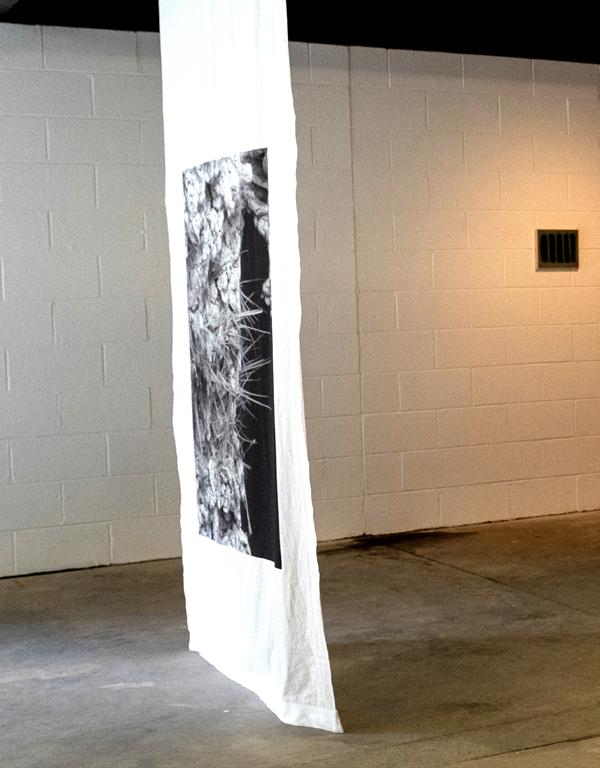
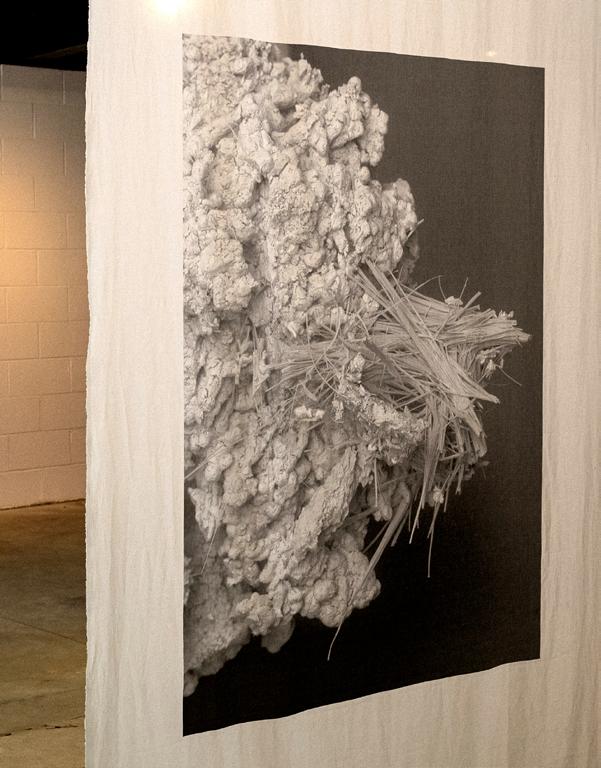
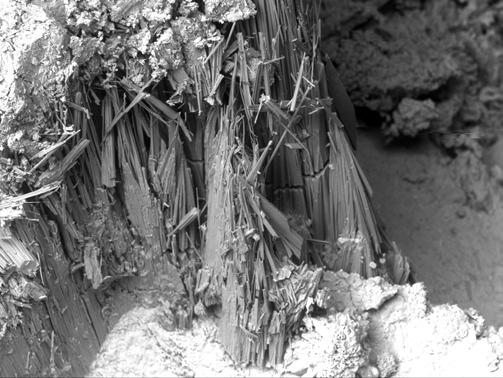
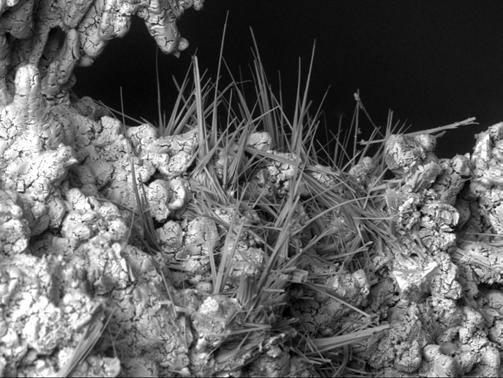
In 2022, I was awarded the King's College Artist in Residence with Dr Jemima Matthews in the English Department at Kings College, London. We used the River Thames as a point of discovery to explore the rich history and possible futures of riverine and estuarine matter. We focused on Silt & Other Matters, which took the title for the final exhibition and output. In that time, we explored various materials that portrayed the rich life of the river. A specific geological layer to the River Thames is a material called London Clay, it is part silt, part soil and clay and is very sticky. The stickiness is from the presence of smectite, which is a mineral with silicates.
Silt is both river and host and also acts like clay. The London Clay is found within the silt and sand along the Thames Estuary. It has the potential to hold stories and memories. I've gathered many microfossils from riverine adventures. I created a brick from the London Clay and took samples from the estuarine localities. The soil sample led to the work Microns. We held a Silt Symposium at Kings College, inviting selected speakers.
The work Microns includes images that show the spherules of iron oxide silicates pushing out of the clay. The clay was gathered from the site of River Thames Tideway project where the Super Sewer was appointed. Geologist Dr. Tim Newman sourced me London Clay samples and other geological strata from the River Thames. I then went to Innes Clatworthy, Electron Microscopist in the Imaging and Analysis Core Research Laboratories at The Natural History Museum in London, and used an electron microscope to create the Electron Micrographs shown. The Mineral Bible was consulted to try and figure out what the spikes were, as they were unknown. We discovered they were iron silicates that had built up over time due to pollution. I wanted to make the images as big as possible to allow the viewer a micron image at premium size to view pollution and feel immersed in it, printed at 300cm height. I work in Sligo, Ireland.
I hold a Master's in Sculpture from the Royal College of Art. Exploring geology, the history of materials, building materials, and the circular economy, my practice concentrates on lithics, minerals, mining, and knowing place from the mantle up. I am examining rocks, minerals, and fossils in various international locations. I attempt to understand the experience of the complexities of deep time visible in materials. Using performance as ’survey/workshop/lab,’ a connection between artist and scientist is explored, creating and presenting demonstrative elements in the gallery and the field. I involve experts as a source of knowledge rooted in scientific phenomena. Attempts to reveal fundamental and invisible forces and energies, explored by scientists and experts alike, are central to my practice. In new works, I have used scientific technology to reveal the geomythologies that we inhabit and host. I want to celebrate all the earth workers silently churning and turning the soil. Heavy metal pollution of soil poses a serious threat to earthworms.
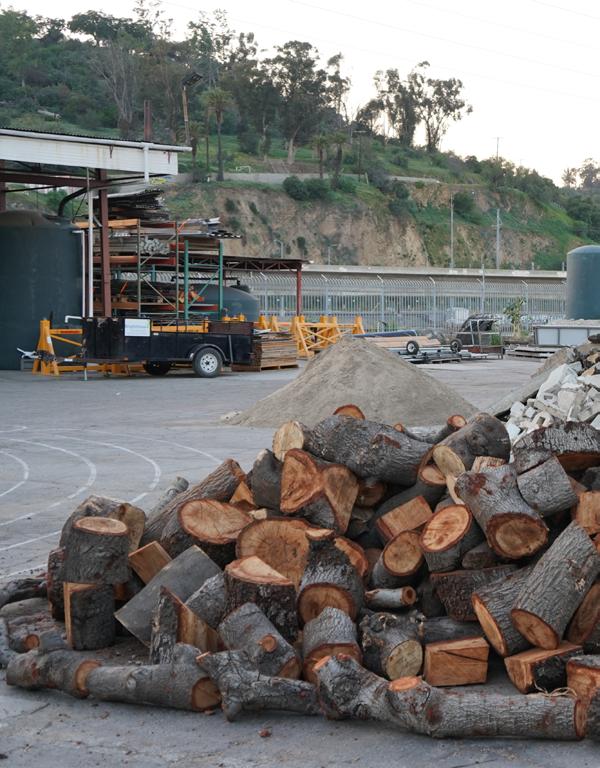
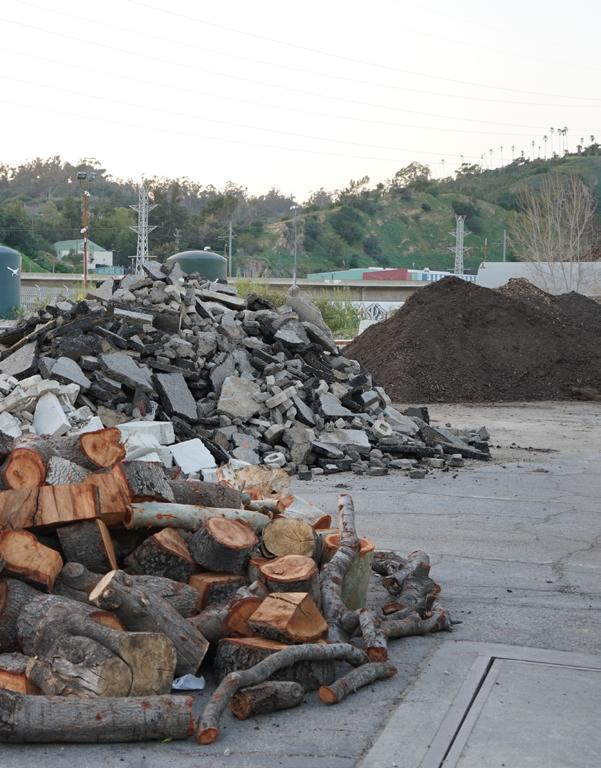
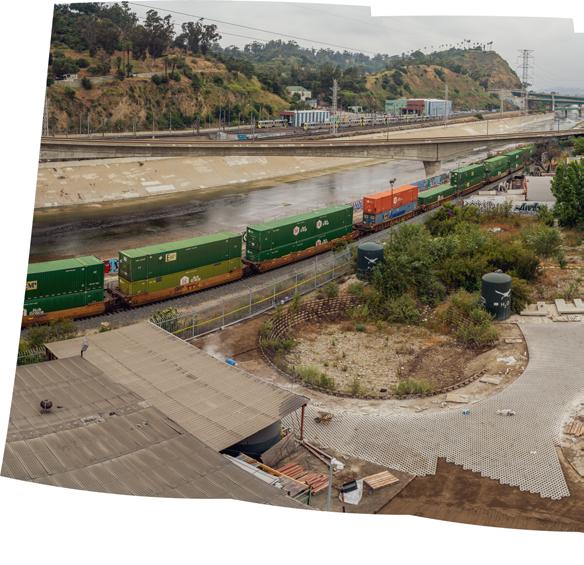
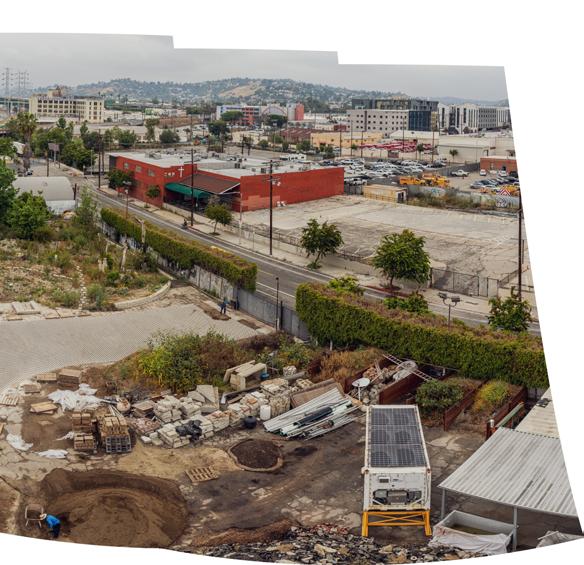
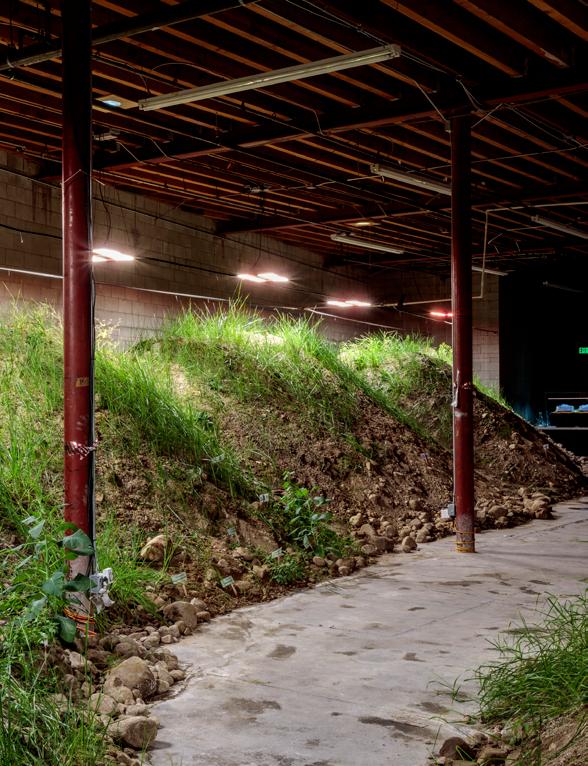
“The whole idea of development is about profit and about private well-being. What if we could take apart the notion of development by using 15,000 square feet of warehouse space, to take the building's floors out instead of storing commercial stuff in here. What we’re storing are the building blocks of life itself; soil, seed, and bringing in community process.
This building was built as a storage warehouse, it is Standard Oil. But before it was Standard Oil, it was part of the most fertile land in the network of basins we call now Los Angeles.
What if we could crack open the concrete floors here, clean the toxicity from Standard Oil, put the rocks, and soil, and seeds [that you see all around us] that come from the time before Standard Oil. That seed and soil is still alive and able after 100 years to rebound (like you see here). Everything you see in this room was buried underneath the ground, we haven’t added anything. This building wants to be a flood plain again.
So the idea of Undevelopment is like a practice to make abundance in a new way. Because abundance is more than just having a lot of something. Abundance is about an interspecies quality of wellness.
We have to start with what is. It makes sense to keep the LA River in the form it’s in. The flood control measure that was put into place in 1938. When it does rain, it rains a lot, and that river is preventing loss of life, loss of property. So the speculation is, what if we were able to manufacture a version of a flood plane without taking apart the river. What if we could pierce small holes to reconnect the rain that falls to the groundwater underneath our feet. This warehouse is just like the sidewalk outside
your house or your parking lot. What if we could do that everywhere, a patchwork network of small novel ecosystems throughout the City of Los Angeles.”
—Lauren Bon, as stated in video posted on Metabolic Studio Instagram account 2/13/2025
Un-development 1 challenges the urban landscape by engaging in a transformative process of removing tarmac and dismantling concrete foundations. The project involves introducing salvaged logs from the Los Angeles Forest and incorporating floodplain materials that were once under the Los Angeles River, effectively recreating a floodplain where it historically and naturally existed. The work also harvests rainwater from the site’s rooftops and utilizes solar energy to power pumps, offering an alternative city utility system.
Un-development 1 aims to reconnect the sky, ground, and sky cycle, envisioning a city where the inherent logic of floodplains is embraced. By recognizing the power of a violent flood as a transformative disturbance, the project emphasizes the sediment, organic matter, and life that settle in basins as a result. Decay within these basins fosters abundance and biodiversity, contributing to the health of the ecosystem.
Undevelopment proposes breaking away from conventional urbanization practices and dismantling structures that suffocate living systems. It envisions a city that embraces the natural processes of decay, abundance, and interconnectedness, revitalizing the relationship between the city and its environment.
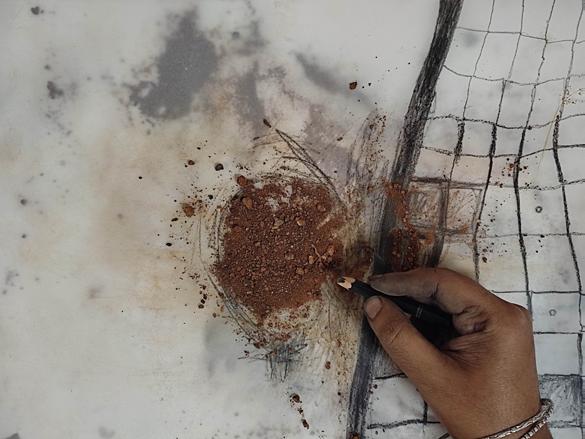
I live in the city of Bengaluru, a metropolis, within one of the most densely populated countries, India. The city seems to be constantly constructed and reconstructed and there’s a tension between the dense presence of people, dwellings, and aspirations, and the development plan of the government. The approach strives to resemble the “developed world”—but in doing so, it often erases the nuances, lives, and spaces in between. Many things remain unseen, especially in the cracks. And in these cracks, the politics of hierarchy and power become visible. The cracks also have soil that is controlled by layers of concrete. The silent presence of soil in the crevices feels like a voice of politics and fracture. I draw what I see every day at the construction site of an underpass. Drawing becomes a way to be in transformation. Buses go by, hawkers sell their goods, people rest on pavements, processions pass by—all while the construction continues.
Once, I left some half-finished drawings on the ground. I abandoned them, letting them interact with the chaos of the site. There was a patch of soil underneath, one of the rare spots untouched by construction that blew particles onto my drawing. In that moment, the visual and conceptual transformation came together in a way I hadn’t expected.
The observation of both the image I was making, and the space around me deepened my understanding of urban transformation. It prompted me to pay attention to the fractures—the places where things were changing. And so, my drawing began to explore the subtle interactions between construction techniques and mark-making techniques, opening up new possibilities for my practice. It lifts the pressure off representation, which often limits documentary work. Drawing becomes a space where I can be vulnerable—unguarded, unprotected—in the face of complex chaos. And in this vulnerability, there is freedom.
Repeated visits to this construction site brought me into a relationship with the place. It’s a place made for transit—impersonal, uniform, just like any other underpass. But as I spend more time there, I begin to feel attachment.
The act of drawing this space between possibility and inevitability expands and manipulates the reality I’m witnessing. I’m not just recording or illustrating what’s around me. I’m decoding it— piece by piece, grain by grain, mark by mark. Sometimes it feels like a mirror, sometimes like a conversation. Fragile, transient. And that fragility mirrors the fragility of the landscape around me—the landscape under transformation. Through this journey with soil, I see that it’s the difference—the presence of what’s beneath the surface—that drives larger narratives of homogeneity, power, and hierarchy.
In my mother tongue, we have a word for soil: Maati. It’s derived from mṛ t, meaning “dead”—the clay from which everything is made and to which everything returns. Maati is not just a word for soil—it’s a word for territory, for home, for a place we return to. The silent, omnipresent soil is a reminder of what exists beneath all the structures—an alternative place that’s always in motion, offering us a chance to reflect, to speculate, to world.
Carole Milon
UnEarthed begins by working in situ, outside, under a canopy of trees on a reclaimed industrial site after 100 years of clay extraction and brick manufacturing in the Don River Valley in Toronto. This soil I call kin is in the Land Between, a bioregion of Ontario, Canada, situated between the St. Lawrence Lowlands and the Canadian Shield. It is here that I bury the paper for my drawings, where I hike the woodland and wetland trails, and where I learn about the interdependent ecosystems supported by its particular humus. I feel attached to this ground as I collaborate with the marks left by the soil on my paper. I investigate the effects of the forest floor on cotton rag paper by burying it under plant detritus for several weeks. Once the sheets are unearthed, I respond to the stains and the decay of the paper with abstract marks reminiscent of entwined roots, squiggly lichen, and delicate mycelium networks. My interventions may counter, enhance, or articulate these organic imprints and smudges, with fluid lines or subtle shading, as a form of dialogue with the land. The unexpected marks that the earth infuses into the paper motivate me to take action and make my own marks. I assemble several individual sheets into a larger piece and extend
marks beyond each component to create connections. I’m experimenting with using natural drawing materials such as ink, charcoal, pastel, and watercolor derived from foraged plant and soil pigments to invite nature to further influence the final images.
CV Peterson
Soil is where life emerges from. Without healthy soil, crops and forests would not grow, and we would not have the oxygen or nourishment we need to survive. Hydraulic Agriculture is a performance piece that examines the intersection of human intervention and natural ecosystems in rural landscapes. In the piece, I drive a tractor through a field while leaking hydraulic fluid, symbolizing the unintended and uncontrollable aspects of humanity’s effect on landscapes. The fluid is caught by strategically placed traps on the ground, creating relics of the action. These captured traces of hydraulic fluid serve as physical remnants of the interaction between human-made systems and the environment. The performance explores the concept of Jane Bennett’s “vibrant matter,” suggesting that all elements —human and nonhuman—possess agency that influences the environment in unrecognized ways (see Bennett, 2010). The fluid seeps into the earth, blurring the boundaries between controlled, human-designed spaces and the wild, unpredictable forces that persist in the cracks. Hydraulic Agriculture highlights the delicate balance of manipulating landscapes, reminding us of the liveliness of all matter and the consequences of our actions.
Bennett, Jane.
Dawn Stetzel
I take cues from soils that shift, become waterlogged, parched, or airborn from climate extremes. I Know I am Stepping On You is about the tenderness that can exist after an acknowledgement of human impact on the environment. The piece echoes the same tenderness that can exist after realizing that we, as humans, at times unavoidably hurt the ones we love. In this work, I use a low-tech approach and a resourceful use of local natural materials. Sitka spruce tree needles provide my
pin connectors, and shore pine tree resin provides my glue. The materials chosen for this work are specific to the soil of the Oregon coast as well as ethnobotanical research specific to this area, including: the literal soil under my feet from my first step in the woods at the Sitka Center for Art and Ecology on October 1st 2008, soft rush, Sitka spruce tree needles, sea lettuce seaweed from the Salmon River, and shore pine tree resin that binds together the cradled nucleus of soil.
Saskia Jorda
In a world where a six-hour airplane flight can transport a person into a completely alien environment, cultural identity is often retained through rituals surrounding clothing, play, language, and food. Having relocated from my native Venezuela to the United States as a teenager, I became aware of the layers of ‘skin’ that define and separate cultures— one’s own skin, the second skin of clothing, the shell of one’s dwelling place—all these protecting the vital space of one’s hidden identity. As an interdisciplinary artist and object-maker, my site-specific installations, soft sculptures, and drawings map the tension between retaining one’s cultural identity and assimilating a foreign persona. This immigration and assimilation experience continues to fuel my work as I explore the relationships among body, space, cultural identity, and mapping
a sense of place. I feel connected to the Southwestern United States since I immigrated here with my parents in the mid-1990s. I have chosen to “plant my roots” in Phoenix, Arizona, and my ties to the Sonoran Desert continue to grow here. Rooted compares the embedded information of unseen soil microbes with the idea of memory, specifically connotations of homeland and the uprootedness of the immigrant experience. For this work, I folded and buried pieces of cotton at a site near the roots of a Palo Verde tree for two months in the spring of 2023 to determine the microbial profile of a specific location in the Phoenix Metro Area, a patch of desert surrounded by an urban setting. Palo Verdes are representative of the area’s vegetation. I sent a soil sample of my chosen site to a genomics testing lab for analysis. The unearthed cloth,
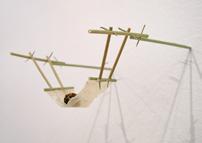
along with the lab analysis, serves as a visual device to interpret the different microbial profiles of Rooted. The resulting cloth, embroidered and shaped into a pair of slip-on shoes, interprets the idea of a “second skin” to explore the memory of place. Just as the DNA mapping of soil microbes can reveal unseen characteristics of soil, the immigrant experience is one where memories of one’s homeland become an invisible layer beneath more recent lived experiences. This correlation is linguistically notable in Spanish, where the word “soil” translates to “tierra,” with rich connotations such as “mi tierra,” meaning “my homeland,” or more literally, “my soil.”
Building on this linguistic connection in my own art practice, my Rooted project combines research on soil health with narratives of immigration, assimilation, and identity.
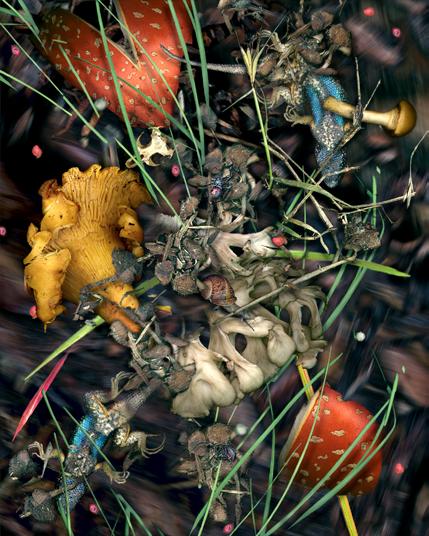
Susan Felter
Forest Floor Life is from my Hunting and Gathering series of digital montages of photos and scanned objects. I was captivated by the process of making “creative non-fiction” scenes that brought normally disparate elements together for contemplation. Carving into a hillside to make a flat lot for our house created a 12-foot-high
cliff. The almost vertical surface revealed intriguing layers of slightly different colors of rock and dirt, going back through geological eras. We kids built little “roads” for our tiny toy cars, snaking up through the layers, oblivious to the earth's history in front of us. As an adult, I've come to appreciate the meaning of natural history on Earth.
Stacy Levy
Using a blended language of science and art to tell the ecological story of site, my pieces are direct collaborations with the forces of land and water. The dendritic pattern of a watershed, the clock of tidal rivers, the sogginess of pluvial flooding, the spiraling hydrological patterns of stream flow are all part of my collaborations with urban nature. I blend the natural processes of a site with the lasting presence of sculpture. From rainwater runoff and infiltration, to the biota in a puddle—these projects are built to make the invisible visible. Parking lots have a strange job of offering “car day care” while humans are at work or shopping. The cars wait for our return and then leave the empty expanse of hardscape behind when we drive away. I believe the day care job of a parking lot can be expanded to include both higher levels of ecological function, and the simple pleasures which humans derive from co-existing with plants and pollinators. My parking lot interventions exhume the living earth that lies under the hardscape of the ubiquitous asphalt and concrete of parking lots. The hard blanket of parking lots prevents the rain and sun from coming in contact with the soil, rendering the once-living surface a dead zone. Break into that surface and let the rain pour in and incoming seeds germinate, and you have a parking lot prairie. In the project Topo Swale (2022), I started by drawing a workable pattern on the ‘grey paper’ of the asphalt. The pattern was positioned to catch rainfall as it flowed across the surface. Then the asphalt was cut open with concrete saws or milling machines. Adding soil and native vegetation to the newly opened swales gave a place for plant communities to thrive more quickly—but simply making the openings allowed wind-blown seeds to germinate in the parking lot. On the shoreline of an urban river, this parking lot has become a riverine buffer zone, capturing rainwater and allowing it to infiltrate into the soil before it rolls directly into the river carrying contaminants. This artwork presents a simple way to soften the industrialized shoulders of the urban river, allowing for dual uses of the site: parking and plant growth.
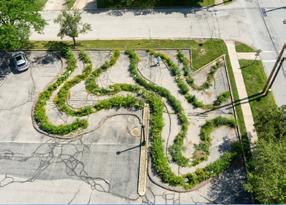
The Soilkin project (2020–2024) emerged from forest kinships developed during the pandemic and evolved as a series of relational exercises with soil and stones. Inspiration for this work came from the instructional practices of the (anti) art movement Fluxus, a group of artists, designers, architects, engineers, musicians, and theorists from the late 1960s onward known for their process-based work that conceptually challenged established aesthetic, political, and social paradigms. The Soilkin exercises (so far 9 instructions in meme format) are envisioned as embodied thought experiments to be tested and shared in different ecologies with diverse actors, seeking kinships across knowledge
cultures, generations, and communities of practice. The exercises trouble neoliberal expectations of the ‘performativity’ of soils and agricultural landscapes through the lens of performance art. With a critical view toward the expectation of soils to ‘perform’ in terms of yield, the project asks, what other performative acts can engender human-soil relations towards a ped-ontology of reciprocal soil kinship? With reference to John Cage’s Water Music (1952) and 4'33" (1952), Podsol Drip was a re-enactment of George Brecht’s Drip Event (1959–62) adapted for sandy soils in a pine-oak forest in the Biosphere Reservation Chorin. Instructions for performance: Drip water on quartz-rich sands covered by humus and wait.
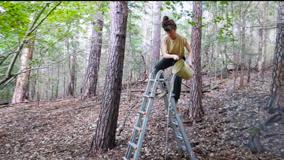
Olivia Newroz
By reconceptualizing soil as something not only grounded but also airy, we can begin to see it as part of an interdependent system that operates on a planetary scale. While local and place-specific, soil also contributes to global weather patterns, which have localized effects. Soil lifted from the Sahara, a landscape often considered barren, is a key component of the nutrient cycle in the Amazon, for example, replenishing the soil after being transported thousands of miles. The Dust Machine centers on dust as a material system that blurs the line between the ground and the atmosphere. While this blurriness is visualized at both particle and planetary scales, at the human scale, it becomes less evident. I developed the Dust Machine as a tool for bridging these scales. Drawing from Lisa Moffitt’s discussion of “environmental models”–models that don’t merely simulate phenomena but rather produce the underlying force itself–the scale of the machine itself becomes par-
ticularly significant.1 Running the machine, I created visualizations of how dust operates at a human scale with the aim of “uncoupling” ground “from the physical and conceptual strangleholds of [the] merely solid.”2 It became clear that dust was moving through a series of cycles. At the same time, the ground was altered through both dissolution and deposition, the ground itself altered the way in which dust moved through the air, thereby affecting redeposition patterns. The Dust Machine consists of two parts: a machine-object, which moves air, and the grounds–earthen tiles constructed with kaolin, sieved soil, and sand. Each underwent several iterations. The machine -object has two flows of air controlled through Arduino. One is a direct push of air against the ground, and the other is a steady state flow of air being pulled through the chamber, creating an air column with upper and lower air masses. It is where these air masses and the ground interface that a blurry section line
Settling Dust, Unsettling Ground (Dust Machine Stills), 2024, sand, kaolin, sieved soil, made airborne and resettled inside a machine, using acrylic, dc motors, cardboard, tape and arduino board, dimensions variable
is produced. For the earthen tiles, I used the carazas test as a precedent. I developed a matrix of abstracted ground conditions, with topography, mix ratios, and the saturation-desiccation processes as parameters. Each of the tiles has varying micro and macro topographies and adhesion levels. As such, each of the grounds shapes the air differently, which in turn re-shapes the ground.
1 Moffitt, Lisa. 2023. Architecture’s Model Environments. London: UCL Press.
2
Jerry Zee, Continent in Dust: Experiments in a Chinese Weather System (Oakland: University of California Press, 2022), 183.
Stefania Boiano
In my art practice, I capture the essence of wild, untamed landscapes, their raw beauty, and sublime power through painting, camera-less photography, moving images, field recordings, and installations. In co-creation with nature, I document weather phenomena such as rain and strong winds, exploring the inherent agency of natural materials. By leaving nature to authentically imprint its own physical marks, my process becomes a statement of humility towards nature, acting as a metaphorical expression of my commitment to minimizing human interference. Inspired by Karen Barad's insight that “matter feels, converses, suffers, desires, yearns, and remembers,” I aim to evoke empathy and wonder for the unnoticed vitality and energy of the more-than-human world that surrounds us. I partially buried the canvas beneath soil and
AEON, 2023, soil, atmospheric sediments, cotton canvas, 51 x 71 inches
left it partially exposed to the elements for three months. Similar to an alternative photographic process but engaging with dark matter rather than light, the soil's microorganisms, moisture, and environmental factors interacted with the canvas, creating organic patterns and textures. This approach highlights the dynamic relationship between art and nature, where the artwork evolves as it is influenced by its surroundings. The element of time is also crucial, as it allows for gradual transformation and the silent processes within the soil. By documenting these changes, I capture the essence of this temporal interaction, emphasising the unseen but vital life within the soil.
Barad, Karen. “Matter Feels, Converses, Suffers, Desires, Yearns and Remembers.” New Materialism: Interviews & Cartographies, edited by Rick Dolphijn and Iris van der Tuin, Open Humanities Press, 2012, pp. 48–70.
Francesca Virginia Coppola
Soil is what we walk on, what we exist on. It is a fundamental material to work with, as it is the substance of existence itself. If I exist in a specific moment, I stand on soil. Wherever I find myself being, it is on soil. From this condition, stripped of everything else, my gesture emerges: rubbing a sheet of paper on the ground as the most direct way to translate this existential encounter into form. Each of my soil works is a record of time and place specific to the land it represents. These works were made by rubbing paper onto the soil in several parks in Los Angeles. During this performative process, my view of the surface is obscured, ceding control over the marks, the colors, the forms. Each work represents an encounter between my own temporality and that of the landscape in the moment we coexisted. The result is a performative trace where the artwork becomes both record and residue of an elemental exchange between self and world.
Annette Nykiel
As a textile artist with a background in geosciences, I have a keen interest in materiality and processes of “slow-making.” My work as an artist, facilitator, project manager, and occasional academic encompasses solo and group practices, such as participation in the artist collectives UnderFOOT and ecoartspace’s Soil Dialogues. I attentively observe,
gather, and explore, contemplating the fragility of soils and the interconnectedness of ecological systems inside and outside Boorloo/Perth, Western Australia, one of the most isolated cities on Earth. In Nyungar boodja (Southern Western Australia), Indigenous cultures and land management practices span 60,000 years, and sovereignty has never
Riva Weinstein
I walk, I find, I make, I make meaning. On daily walks through life, both literal and metaphorical, I collect materials, images and ideas. From these, I create objects and site specific outdoor installations that invite contemplative experiences of art and nature. In Gaia’s Slippers, vintage shoes are covered with natural materials found while walking. The slippers (made of some unknown manmade material) were decomposing; I didn’t want them to end up in the global garbage heap. Reimagining them as footwear the earth goddess herself might wear, I’ve sought to create a symbol of walking gently on the earth—even with reverence. Over time, the feathers, pine needles, pods, seeds, and bark would have returned to the earth to become soil if left where they originally lay. And ultimately I imagine they still may.
been ceded. Soil and Country/Earth are all boodja, having formed over the oldest rocks in the world. These more-than-human ecologies are seriously under threat from resource extraction, industrial farming, and humanly induced climate change. Autumn rains have been late, sporadic, and soil moisture is critically low, leading to large-scale plant die-off. Forest collapse and clearing in this biodiversity hotspot affect the soil. Deep-rooted trees, smaller shrubs, and their microbial ecosystems are soil makers and bioengineers actively modifying soil profiles and mining and storing nutrients in ancient ‘infertile’ landscapes. Working with attention is critical to my practice and the places I care for. Spending many hours wandering and observing natural systems, making sense of patterns means a multisensory reading of changes to Country. Found objects and natural installations bring attention to the minutiae within complex ecological systems, brought to focus through a lens. Using windfall plants and other natural pigments made of soil and clay, I invite microbes to color repurposed cloth and fibers buried in the soil. This “printed” cloth is manipulated into 2D and 3D forms by both human and non-human agencies to allow other stories to emerge.
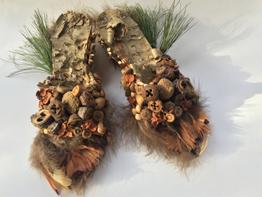
Shawn Skabelund
Just as water is life, the soil in my family's garden is literally life. For years, I taught drawing at the university level. For their first homework assignment, students were challenged to create a drawing without using their bodies. Then, over the next three weeks, they had to execute three drawings without using their hands. For the most part, their finished works were beautiful compositions. Before each charcoal mark was made, they had to focus on where they were going to place the next mark on their paper. Teaching drawing or, for that matter, teaching any type of art form, is not about learning how to draw, but learning how to see. The year after I left teaching, I decided to create a drawing without using my hands. I pulled on a clean pair of white socks and walked through a field of cosmos wildflowers that had gone to seed. Walking on the ground, walking through the field, the seeds’ sharp spines became embedded into my socks, becoming my “charcoal” and my socks, my “drawing paper.”
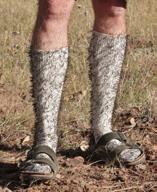
Anchors (from Masts and Anchors), 2018, dirt, cement, mixed by feet, earthen shallow dug outs, 2 x 3 x 8 feet Masts and Anchors), 2018, dirt, cement, mixed by feet, earthen shallow dug outs, 2 x 3 x 8 feet
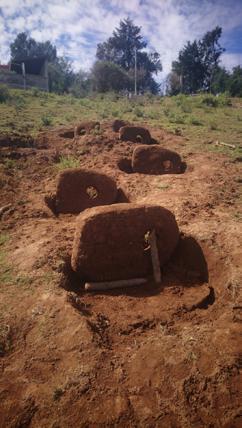
Lori Nozick
I love dirt and all dirt is precious and home to me. I've lived in many different environments and found favor in different soils; from the sticky, stringy mud in the Everglades in Florida, to the dry, rocky, mineral-filled clay soil of the California low desert, and the rich, loamy earth of the Northeast. Each variation has the potential to transform and recreate a landscape, an artwork, an environment.I love the way dirt smells, how different soils feel, the promise of fertility, and the potential for growth. I have a primal connection to soil and have used it as an active element in my art. I have
always grown gardens more to have my hands in the dirt than to grow plants, although that is part of the process. As a sculptor, I love working hands-on with earth materials. I created molds dug out of a hillside, to cast earth mixed with a natural cement to create sculptural elements for a sculptural installation. In Mexico, we mixed the red and sticky soil and cement with our feet. I have also cast small houses out of earth, using wooden molds. As soils display so many different colors, I sometimes use the dried mud to create pigments for drawing on paper.
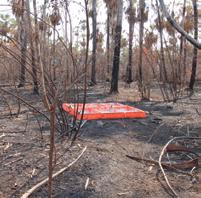
Betty Beier
The central question for me is: “Which soil is close to your heart?” For me, soil is a reflection of our actions and an incorruptible witness to our interactions with nature. Soils are archives that bear witness to human impact. They tell the story of landscape changes and carry narratives of the past, present, and future. The aim of my work is to increase appreciation of nature in general and soil in particular, and to stand in solidarity with people who are literally
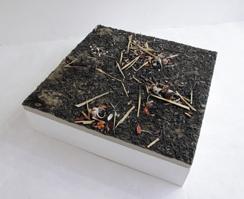
losing the ground beneath their feet. The exploitation of soil and land for the benefit of human profit is steadily increasing. Landscapes everywhere are changing—drastically and incessantly. Dams, power plants, and other large infrastructure projects swallow the landscape. The insatiable hunger for raw materials is destroying nature all around. Monocultures make the landscape monotonous. Always on the move with a red frame, I accompany processes of landscape change
in the form of my Earth Print Archive. I have been drawn to controversial construction projects in Germany, Iceland, China, Alaska, Brazil, and most recently in Paraguay. Through on-site, surface-preserving measures, I capture picture-sculptures, which I call citizen earth prints. These are documentations on a 1 to 1 scale of what is lost. Earth prints are permanently fixed and stretched on frames, accompanied by a history of origin, photo documentation, and drawings.
My overall practice conveys a fascination with the collision of natural and built environments. By combining a collage of photographs, video footage, and sound that I record on my travels, I construct video installations depicting landscapes that are marked by infrastructure such as mines, oil wells, cell phone towers disguised as trees, and buildings for habitation. During my July 2023 residency at PLAYA in Summer Lake, Oregon, I took daily walks along the semi-dry lake bed and meditated by the pond, observing how this desert was both dry and wet. Due to the presence of underground springs, the firmness of the playa would unpredictably shift between dry and cracked and soft and malleable. This video of my muddy hike was shot on a cell phone camera by fellow resident Dawn Stetzel.
Experiencing clay: sensual; cold; a thick, wet, sloppy, slippery primordial co-mixing of sand and decomposing material; an intimate, tactile connection to a geological story; a welling up of playful, feral, childish glee; an unsettling similarity to feces; a connection to my ancestors’ use for making pots and building homes; a piece of soft ground to dig a hole to ceremonially, symbolically bury the dead.
Tres Gigantes (1), Pantanal, Paraguay (September 13, 2019), 2019-2022, earth print process documentation, forensic investigation after the illegal slash-andburn event known as “The Day of Fire;” sculpture, 40 x 40 x 5.5 inches, coordinates: S20°04.634, W058°10.079 Summer Lake, 2023, video, 4:27 minutes looped
What does it mean to witness? In her groundbreaking thesis on feminism and technoscience, Donna Haraway proposes that witnessing is a form of “seeing; attesting; standing publicly accountable for, and psychically vulnerable to, one's visions and representations.”¹ This kind of seeing and standing is furthermore a shared responsibility: “Witnessing is a collective, limited practice that depends on the constructed and never finished credibility of those who do it, all of whom are mortal, fallible, and fraught with the consequences of unconscious and disowned desires and fears.”² To witness the soil is to acknowledge the collective desires and fears that are tied up in matters of diminished food security, climate-threatened forests and wetlands, soil degradation, landslides, mudslides, wind and water erosion, and the efforts of scientists and land managers, but also artists and activists to understand and counter these calamities. This account of witnessing sets up a good framing for the practices of attentiveness on the following pages, which in many ways provide an artistic foil to technoscientific as well as social scientific empiricisms, with regard to how they relate to soils. The artists in this section, and more broadly in this book, approach site research and material histories with a “modesty” (in Haraway’s terms) for truth-seeking and public attestation that is expressed both individually (i.e., by singular artists) and collectively (i.e., through the arts) to bear witness to soil worlds in an age of great anthropogenic change.
Witnessing, as a form of observation, furthermore, does not assume a kind of outside objectivity. As feminist theorist Karan Barad reflects, “we are not outside observers of the world. Nor are we simply located at particular places in the world; rather, we are part of the world in its ongoing intra-activity.”³ This is striking in the openness with which some of the artists in this book observe. For example, in Residency in a Hole, Linda Duvall writes,
“we lay in the sand, examining bugs as roots dangled overhead; we sang to the soil; we talked, laughed, and sat in silence. Some brought scientific knowledge, others danced. Bank swallows built nests in the walls around us. A tornado passed nearby, the sun baked us. All breathed in the presence and spirit of the soil.”⁴
The kind of more-than-human inclusivity in Duvall’s act of hole-witnessing acknowledges that it is not only humans who are capable of observation. Meanwhile, in other projects in the book, drawing is used as a type of note-taking and record-keeping, for example, by artists Andrea Bersaglieri, Miranda Whall, and Jen Urso. Andrea Krupp writes about an innate “human instinct to observe, wonder, and create new meaning,” and Annette Nykiel recounts, “I attentively observe, gather, and explore, contemplating the fragility of soils and the interconnectedness of ecological systems.”
Attentive observation in the arts can also lead to a wealth of rich and poetic data. Regarding the potential data that can be gathered in practices of witnessing, “artsbased methodologies constitute some of the most dynamic strategies at our disposal for the conservation, organization, and renewal of data,” writes arts-based research theorist James Haywood Rolling Jr. These “effectively inform human beings of who we are, where we come from, what our purpose is, and where we may be going,” Rolling Jr. continues.⁵ Witnessing as a dynamic strategy for engagement allows artists to gather and appropriate data from a variety of sources, weaving hidden facts into new forms of data storytelling (e.g. in the works of My-
Alexandra R. Toland
riel Milićević and Susanne Jaschko, Cindy Stockton-Moore, and Lilian Cooper). The works in this section use biological aesthetics (Geraldine Ondrizek, Daro Montag, Kelly Eckel), performative fieldwork (Frances Whitehead, Brooke Singer), iterative forensics (Catriona Leahy, Susan Smith), systematic observations (Jann Rosen-Queralt), mapping (Cat Hart, Louella Aquino), sampling (Dana Hemes), soil chromatography (Claire Pentecost, Aindreas Scholz, Claudia O'Steen and Aly Ogasian), “anticipatory achival”⁶ (Perdita Phillips, Sophy King), documentary (Paula Castillo, Esha Chiocchio), speculative fiction (Saša Spačal, Daniel Hengst), and sometimes the appropriation of scientific methods (Juniper Harrower, Austen Camille) to challenge paradigms of objectification and soil-othering. Despite this diversity of approaches, for most of the artists represented here, it is not necessarily even about data collection or analysis, but rather the development of an “art of noticing,” to borrow from Anna Tsing.⁷
In the words of artist collaborators Alyson Ogasian & Shona Kitchen, witnessing works are often “research-driven and site-responsive,”⁸ while at the same time conscious of their own limitations and ethical motivations. Images are presented as evidence while embracing, as Steffie de Gaetano describes, an “illusion of readability” or replicability.⁹ These works do not seek to visualize technoscientific facts, but do often poach technoscientific methods to queer representation and expose glitches. More than anything, they introduce ways of witnessing as an art of tending and attending to soil sites and beings with mindfulness, criticality, and curiosity–not to make claims but to create connections. They stand as public statements on what is observable in the first place, giving others an opportunity for reflection.
1 Donna J. Haraway, Modest_Witness@Second_Millennium.Female Man©_Meets_OncoMouse™: Feminism and Technoscience (New York: Routledge, 1997), 267.
2 Ibid.
3 Karen Barad, “Posthumanist Performativity: Toward an Understanding of How Matter Comes to Matter,” Signs: Journal of Women in Culture and Society 28, no. 3 (2003): 828, https://doi.org/10.1086/345321.
4 Linda Duvall, “In the Hole Residency,” in this volume, 324.
5 James Haywood Rolling Jr., “Arts-Based Research: Systems and Strategies,” Art Education 69, no. 3 (2016): 5, https://doi.org/10.1080/ 00043125.2016.1158561.
6 “Anticipatory archival” is described by Perdita Phillips in this volume, 321.
7 Anna Lowenhaupt Tsing, The Mushroom at the End of the World: On the Possibility of Life in Capitalist Ruins (Princeton, NJ: Princeton University Press, 2015), p. 22.
8 Alyson Ogasian & Shona Kitchen, “Made Ground 01,” in this volume, 292.
9 Steffie de Gaetano, “Permeance,” in this volume, 296.
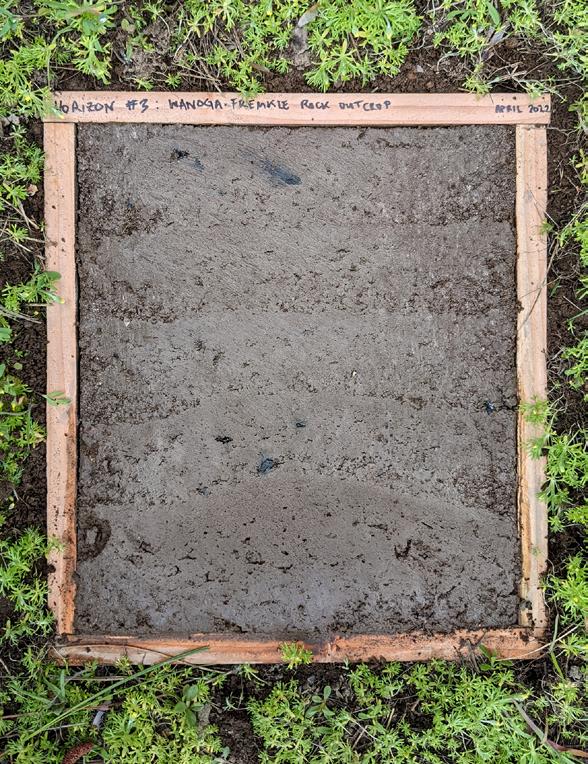
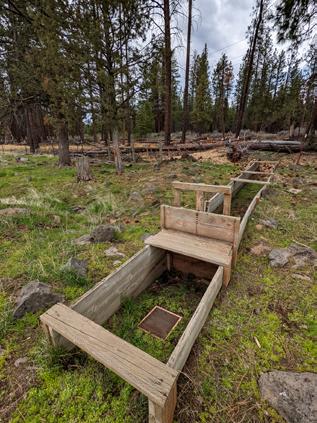
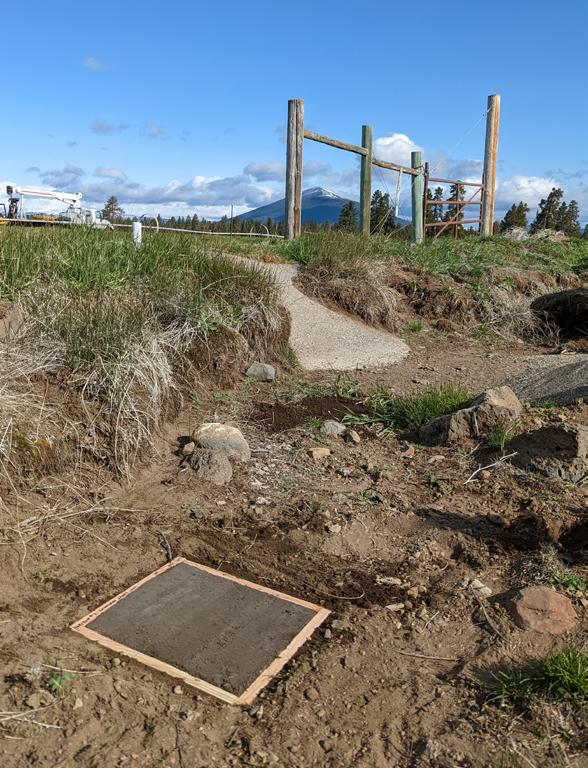
I am no soil scientist. Rather, I have gotten to know the soil here in the same way one goes about beginning a relationship with a lover. Hello there, who are you?
Amongst the three soil profiles situated within the property lines, extreme differences in moisture and consistency were anticipated but not yet understood. Through sustained touch, texture, I have become attuned to each particular soil type. While carrying each soil back and forth across the pasture, the first time as a loose bucket and second time as a dense compacted brick, I learned its weight. The dimensions of each brick (4 x 11.5 x 16 inches) were dictated by my body’s strength; I can manage a bucket, no more. How unwieldy it is, to carry around dirt.
A soil horizon–imagine a layer of variable thickness–is bounded by its difference in characteristics to the soil horizons above and below. The English word horizon is derived from the Greek horos, meaning boundary, land-mark. More of a line, really: the limits of a thing. The uppermost soil horizon (the place I formed a relationship with) is ultimately bounded by air, water, plants, and the bottom of my feet. Limits are shifty by nature, however. Changing the surface, I dug three holes around the property.
In each location, there used to be water: a rerouted stream bed, an old irrigation ditch, a canal. The uncovered soil is both local and carried from upstream (transplant / again, shifty limits). This area has been in a drought for two years now, and at the moment the precipitation forecast indicates that this trend will continue. Everyone talks about water here; (rivers don’t stop running until they do).
I walked down to Whychus Creek (running with vibrancy) one afternoon and filled a jug. It seemed right to reallocate a small quantity of water from the creek in the process of soil remediation, and to bind the particles in a structural form.
A structural form. Originally, (before beginning the relationship), the intent of this work was to learn how an architectural form might be able to respect and respond to its environment. I dreamt of rammed earth bricks for weeks. A building material, built of the site itself. And then I learned how loose, how ashy, the soil here is; everything crumbled to pieces before I began thinking about amendment.
Each small 0.37ft³ brick of soil has been augmented with biochar to increase water retention, dolomitic lime to allow plants better absorption of nutrients, kaolin to decrease the runoff of both water and nutrients.
These small architectures were not necessarily intended to remediate the soil. As the relationship evolved, however, the act of removing and returning material required an intermediary step that was more actively beneficial. A friend said, “extraction and restoration,” and this is precisely what ended up happening. One act necessitates the other. You cannot talk about building without talking about soil, about water, about site, about the way everything is bound to change, the way in which that change can be regenerative.
Wrapped / bounded by the earth around them, these are small sites of potential remediation. A space where seeds might start. Horizon was created while in residence at the Pine Meadow Ranch Center for Arts & Agriculture in Sisters, OR, on the traditional territory of the Wasco, Warm Springs, and Paiute people.
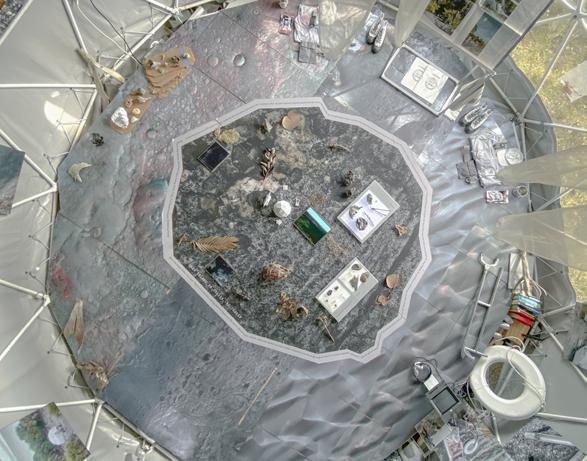
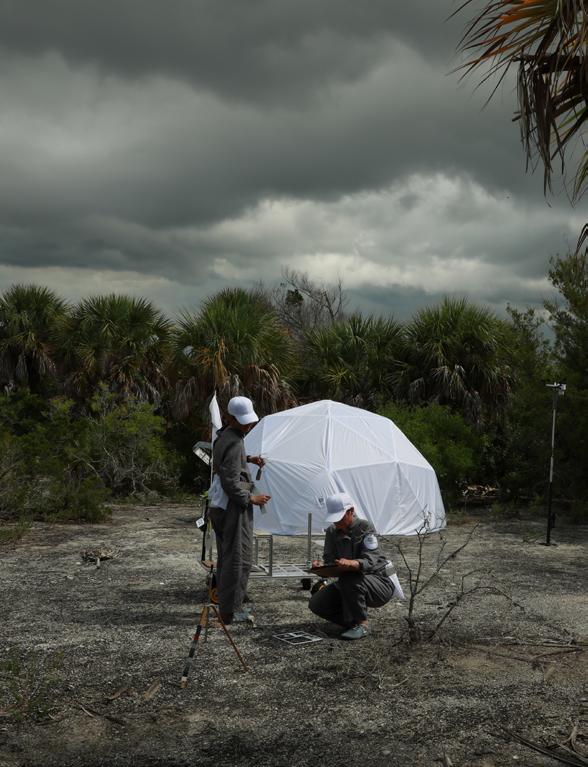
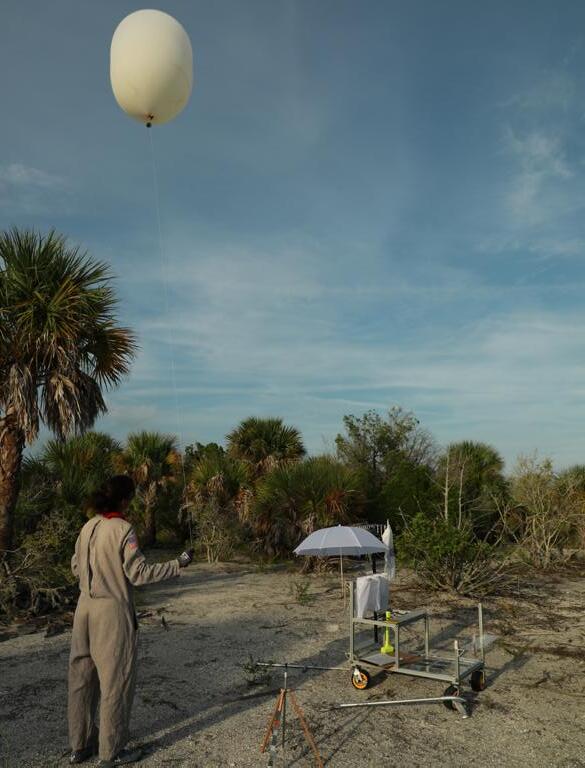
Our practices are research-driven and typically site-responsive, sparking conversations about everyday life and survival in a rapidly changing environment. Recent projects critique notions of expedition in the 21st century and play with the idea of an island as a metaphor, exploring notions of adaptation and survival, community and individualism, terrestrial and extraterrestrial, nature and technology. Our collaborative project, Another Final Frontier, investigates an artificial island located inside of Kennedy Space Center and Merritt Island National Wildlife Refuge.
Spoil islands like this one are waste products from dredging channels. The focus is on the channels, which are measured and maintained—not on the islands, which are left to their own devices. They are cast to the side and often overlooked, if not forgotten entirely. This chain of spoil islands was formed in the late 1920s and early 1930s when the US Army Corps of Engineers was cutting an East Coast channel through Florida’s Mosquito Lagoon that would become the Intracoastal Waterway. Grey Island is a bit younger. The island first appears on a USDA aerial photograph taken during the third flight line on March 18, 1951. Its form, already rounded by currents, looks like a white hole in the metal-gray waters of the lagoon.
Grey Island floats in two overlapping areas—a refuge and a space center, one founded on nature and the other on technology. Both came after the bucket and pipeline dredgers had laced the lagoon and the Indian River with spoil islands. Grey Island comprises two acres of the 140,000 acres that NASA acquired in 1962 to expand its exploration of space, specifically its lunar landing program. Look south from the island, between palm trunks and pepper tree limbs, and you can see the Vehicle Assembly Building on the horizon. That is where engineers assembled the rockets for the Apollo missions that sent us to the moon. If there were a large enough crane, the VAB could be lifted and placed over the island like the glass cover of a bell jar. We lived on an artificial island within Kennedy Space Center in a habitat of our own design. We constructed our own tools and systems to catalog this cast aside, yet rich habitat, basing their design on those developed for the Apollo space program.
From this vantage point on the spoil island, we embark on our own mission, exploring what we don’t yet know and training ourselves to live in a place that is both near and far, a place that is remarkable yet also quite ordinary. A place forgotten in plain sight. We have found our own landing site amid the constellation that is this 3,000mile string of islands, stretching from New York City to Brownsville, Texas. It is hot, the mosquitos cloud like moon dust, the ground is hard, and the sea is rising. We have traveled far into space without ever leaving Earth.
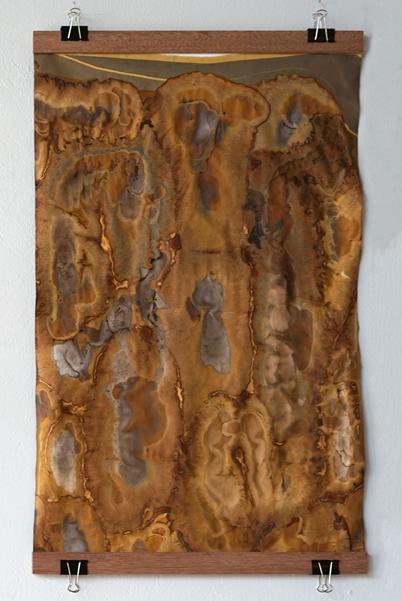
Steffie de Gaetano, Permeance, Mapping II, 2021, Dommel river soils on chromatographic filter paper, 40 x 25 inches
Permeance, Mapping II, 2024, Dommel river soils on chromatographic filter paper catalysed with olive oil on light table, 40 x 25 inches
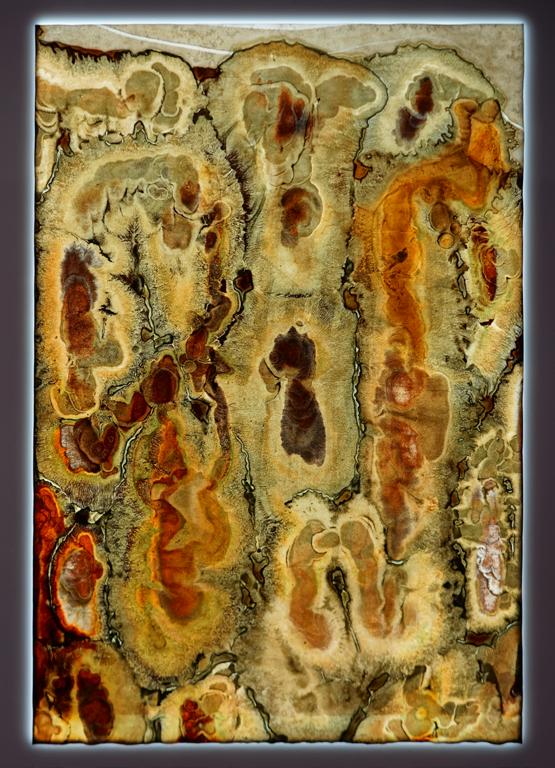
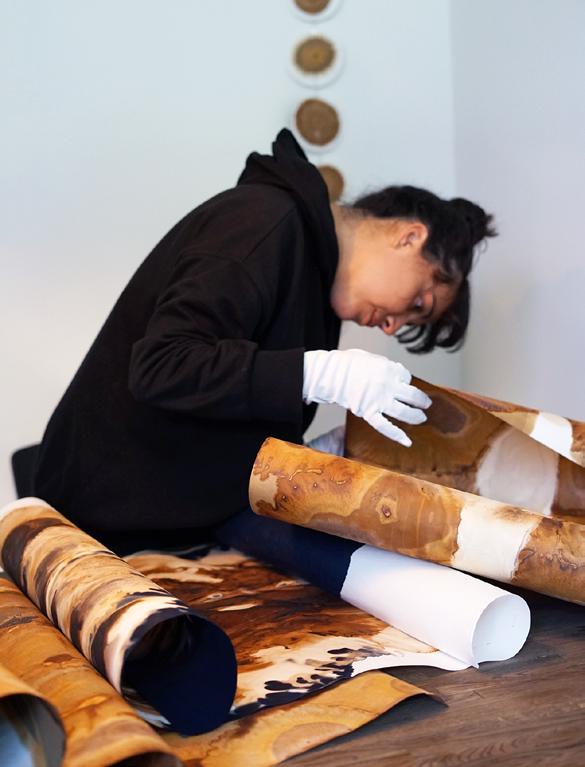
Permeance (2021-2024) has been a morphing journey of artistic research, with its beginnings in the desire to ground a practice in my inherited landscape of the Campine. Starting from tales of the river that once was, my interest grew in following contaminated soils removed from the banks of the river Dommel to a site undisclosed. The waste heap of discarded soils sits on the property of the offender, a zinc smelting industry just across the Belgian border. Tracing further, to the geologic origins of the ore that, once melted, produced the cadmium contamination, the investigation leads to the mines that dug into contested, expropriated and colonized lands, from Belgian Congo to the Emu Foot Province. Through a permeable lens, following polluting chemistry to minerals processed by extractive industries, the contamination affecting river biota, soil and humans alike, becomes linked to colonial histories.
In subversion towards a scientific and modern ideology, the agency of the polluted river is amplified through the misuse of soil chromatography, disrupting ordered patterns and undoing their readability. In the wet stage, isolated soil samples regain their complicity by fluidly re-encountering on paper. The samples cross-contaminate one another, permeating their chemistries into the light-sensitive medium. Forming an unusual cartography of polluted river soils, these maps are ephemeral ever-changing double-sided photographic long exposures. In a later stage of the project, for the 2024 ‘Soils’ exhibition at the Van Abbemuseum (Eindhoven, NL), the Permeance map series was treated with olive oil, synthesizing the dual dutch-italian landscapes I inhabit. Exposing the translucent maps through the lightbox, and catalyzed by the olive oil, the gradual deterioration of the image was accelerated, an act for Mediterranean solidarity.
Through Permeance, I attempted to initiate a beyond-human communication with soil, a language drawn on a macroscopic scale and in wavelengths visible to human eyes. In the chromatographic process, the earth is the subject, subjectifying the paper through its saturation. By doing so, it undoes the subject | object dichotomy of camera-led photography. The transmutation of soil into its new form is far from being a landscape representation: the chromatography too is the contaminated soil. Arranged into a light sensitive map with endless exposure, colorful patterns are read as indices suggesting the presence of pollutants and compounds of the river. Yet, in a river cartography made of tainted soil samples, the accompanying PCC’s (Pfeiffer's circular chromatographies) serves as a phantom legend, an illusion of readability. The maps take a stance, maintaining the earth-knowledge concealed, eluding the scientific gaze through the inscrutability of muddied patterns.
Situated as a Dutch-Italian interdisciplinary researcher currently based in Belgium, my work is placed at the intersection of architecture, landscape, art, and anthropology, disciplines I seek to critically unbuild. My artistic research practice focuses on bridging sociocultural and environmental degradation to colonial and modern legacies through the traces left by material and matter flows, and beyond-human indices.
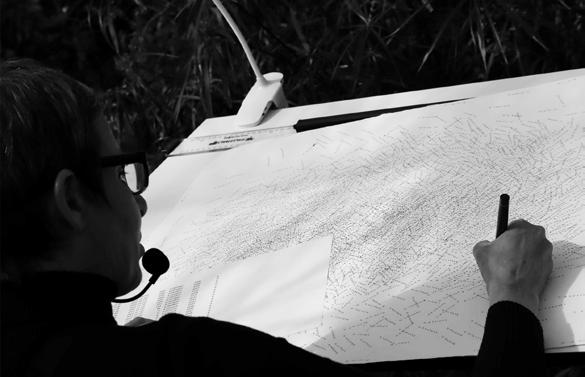
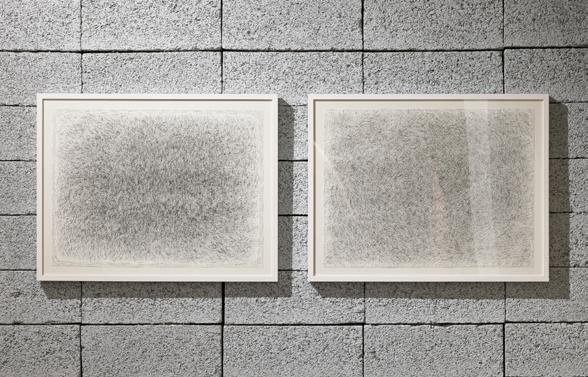
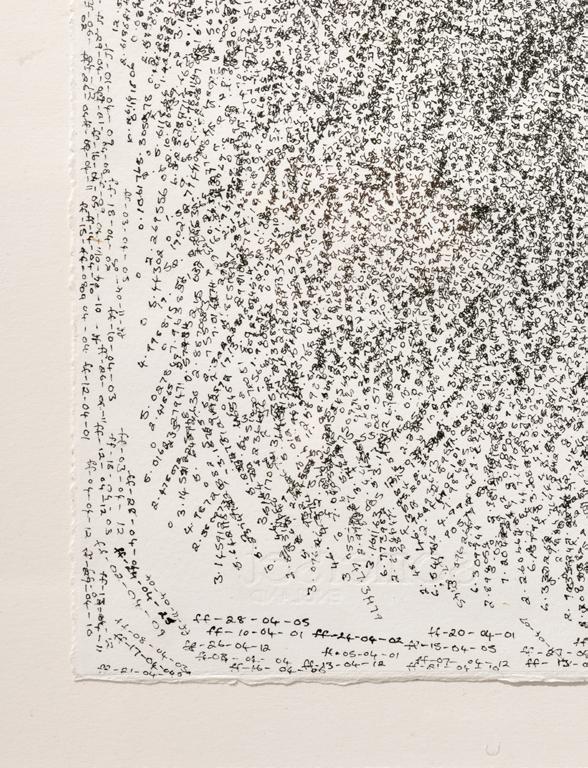
My practice presents a post-minimalist, post-humanist and new materialist aesthetic across expanded drawing, performance and film. Drawing is a solo, meditative and durational practice; performance and film are collaborative, generative and experimental.
The work begins with raw, unprocessed environmental datasets. I draw on continuous live data streams generated by high-resolution, long-range soil-sensor networks. Quantitative data is inscribed, recited, pin-pricked, punched, performed and sonified. What seems invisible becomes visible, material, temporal and spatial through performance, film and drawing on, with and beyond paper. In my work, drawing is an ecology of matter and gesture: marks and their absences, made across paper, inflatables or sky. Data is translated into form, and time spent with the data is embodied. Immersion in digital measures of temperature, moisture, humidity and gas becomes a way of being with place, of being present, proximate and intimate with soil and other ecologies.
Through accumulation and erasure, the data becomes void, illegible and ‘dirty,’ unusable. This echoes the inaccessibility of unprocessed scientific datasets and, more broadly, the opacity of large-scale digital infrastructures, the erasure of ecological specificity, and Timothy Morton’s notion of the “hyperobject,” where phenomena exceed human perception. The work also addresses the intangibility of the digital data cloud and critiques the misleading lightness of the cloud metaphor, which suggests neutrality and disembodiment while obscuring its material, infrastructural and ecological weight.
The durational drawings featured render time in ways that challenge anthropocentric narratives. They do not only test human endurance; they attend to more-than-human rhythms, ecological time, and data as an active, material and entangled participant.
I am deeply connected to the upland landscape of the Cambrian Mountains, West Wales. I know its soil and peat, its rock, heather, white clover, Molinia grass, rushes and mosses intimately. I know its topography viscerally, having crawled it for 5½ miles on my hands and knees for Crossed Paths–Sheep (2018). I know it by day and night, through storms and sunshine, having lain in a self-dug ditch for over 13 hours (twice) for Soil Voices (2023). I know it remotely, having spent hundreds of hours writing thousands of soil-sensor data points to generate Dirty Drawings (2024) and Boggy Gassy Drawings (2025/26). I have embodied this upland’s stretching horizons, large skies, rolling clouds and skylarks.
My work stages multimodal encounters between the human and the more-than-human across data generation, sonification, performance and drawing. Treating data as material, ecological and generative. I approach it as alive, relational and environmental.
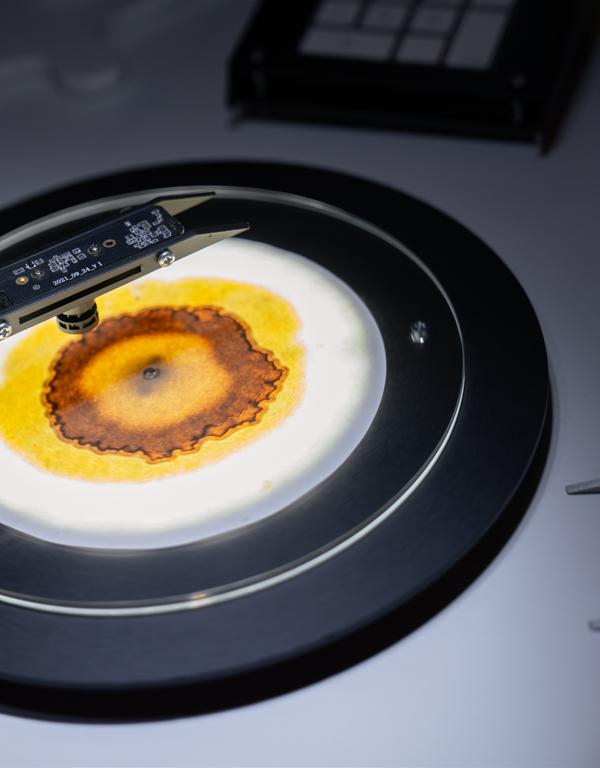
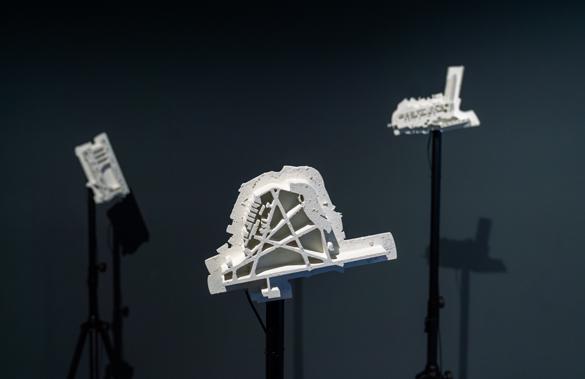
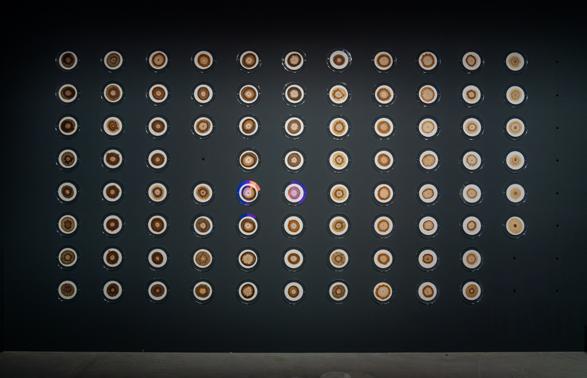
Humans have an ambiguous relationship to the ground, often identifying and personifying with the soil of their ‘homeland’, and depending on its fertility to survive–and yet, all too often, treating it as mere dirt. This neglect is more extreme in technological zones, not only in industrial areas, but in spaces of communication and transportation. In her new artistic research Terra Xenobiotica Saša Spačal explores soil life at airports. “Toxins are seeping into the ground, creating unfamiliar lands that call for different kinds of stewards—the ones who navigate and nurture, rather than gatekeep or extract” states Spačal. “As humanity remains locked in an ongoing cycle, a holding pattern of take-offs and landings, the notion of a final landing lurks in an unimaginable distant future.”
Humans often identify with their homeland’s soil and depend on its fertility—yet treat it as mere dirt. This neglect intensifies in industrial, communication, and transportation zones. In Terra Xenobiotica, Saša Spačal studies airport soil. “Toxins seep into the ground, creating unfamiliar lands that call for stewards who navigate and nurture, rather than extract,” she says. “As humanity remains locked in an endless cycle of take-offs and landings, the notion of a final landing lurks in an unimaginable future.”
The installation Eternity Scanner, based on a residency at the Rillig Lab for Plant Ecologies at Freie Universität Berlin, invites the public to explore how pollutants, especially Perfluoroalkyl and Polyfluoroalkyl Substances (PFAS) such as Teflon, so called ‘forever chemicals,’ permeate the soils of airports. Essential in the art piece are 85 soil chromatograms developed from earth gradually polluted by increasing amounts of PFAS, making up Gradients of Eternity, a database created as first of many to train an AI neural network to recognise PFAS pollution on soil chromatograms, and metaphorically symbolising the 85 years since PFAS were first accidentally discovered. Visitors are encouraged to choose a soil chromatogram and place it on the Eternity Scanner, which acts as a contemporary oracle. “The directive is clear and compelling; our only requisite action is to attune ourselves to the scanner’s perpetual
soundscapes.” remarks the artist. Powered by AI, the scanner reads the chromatogram, producing a sonification of the information it contains, acting as a clarion call for a new generation to come forward and regard the land not as dominion, but as kin.
The film Holding Patterns, written by Saša Spačal and cultural theorist Alison Sperling, creates a dystopian near-future scenario where airports still exist but without function, exploring the matter of ground and soil pollution. Essential for Spačal is the “question of grounding, of being grounded, and of groundedness in the unique space of Berlin’s iconic defunct airport at Tempelhof Field”. The film examines the complex and varied epistemologies involved in modern concepts of travel and identity, proposing a new model of responsibility, care, and stewardship.
Terra Xenobiotica (2023) by Saša Spačal was curated and accompanied by texts from Regine Rapp and Christian de Lutz, with scientific consulting by India Mansour (Institut für Biologie, Freie Universität Berlin). The installation, interface, and programming were developed by Dmitry Morozov, with assistance from Flore Wormskamp. The film component involved storytelling by Alison Sperling, a Tempelhof walk by Frances Hennigan, editing by Maja Andlovic, a soundtrack by Ah!Kosmos, and camera work by Kevin Klein. The artwork was first produced during an artistic residency at Art Laboratory Berlin in 2023, with additional scientific support from the Rillig Lab | Plant Ecologies (Freie Universität Berlin), and further production in 2024 at Projekt Atol Institute. The project was supported by the Berlin Senate | Department of Culture, Slowenisches Kulturzentrum–SKICA Berlin, Technische Universität Berlin, Berlin Science Week, the Ministry of Culture of the Republic of Slovenia, and the City of Ljubljana. Terra Xenobiotica premiered in its inaugural exhibition at Art Laboratory Berlin, Germany, from 11 November 2023 to 2 February 2024.
Claire Pentecost
1 For making the course of human taphonomy clear, I want to thank Dr. Jenifer DeBruyn, a microbiologist and environmental scientist doing research at the Body Farm at the University of Tennessee, Knoxville.
God made everything out of nothing. But the nothingness shows through.
—Paul Valéry, Mauvaises pensées et autres, 1942
We could say that the soil is both womb and grave of terrestrial life. It is likely that the minerals in your body once sheltered in the ground. With the help of a team of wild microorganisms, those minerals were made available to a plant’s roots. Collecting these bioavailable minerals and absorbing the energy of sunlight, the plant grew into something we call food. Either you ate the plant, or you ate an animal who ate the plant. Or possibly your mother ate the plant while you were gestating in her womb, building a little body to carry you through this life. Before you incorporated them, those minerals may have once been part of the bedrock, the sea, or myriad living organisms—bees and beans, badgers and belugas. In these ways you are part of a vast and highly efficient living recycling system. And when you die, you have the chance to reinvest the elements present in your body at that moment; back they go into the fertile mesh of life. Unless you consent to be embalmed as is customary in the mortuary culture of the U.S. In that case you will be hoarding your riches in your cadaver (after a good percentage of them have been removed and what, thrown into the garbage stream?). And if your people pay for the full package, what’s left of you will be entombed in something impenetrable to agents of the otherwise ubiquitous recycling system.
But let’s say you fall in a forest. When your heart stops beating, your cells will quickly be starved of oxygen. Carbon dioxide increases and pH decreases. Waste products collect in your cells, poisoning them and triggering the enzymes that perform autolysis, or self-digestion. This will release enzymes called lysozymes, which break down the matter of the cells into molecules of their constituent materials, liberating nutrients that will first be ingested by the microbes that have been living in and on your body. These resident symbionts will get the message of your demise and will unleash their microbial appetites on your infrastructure. Soon the abundance of nutrient-rich fluids leaking or erupting out of you will become food for the bacteria and fungus living in the rich leaf litter of the woods. In short, your death is a fertilization event, a potlatch featuring the redistribution of nutrients. Your necrobiome is a pop-up food web, a transient hot spot releasing the elements that built your body and orchestrated the life you’ve called your own.¹
Meanwhile avian and mammalian scavengers are quick to respond to the presence of fresh kill. Right behind them come the flies, laying eggs, so that larvae can hatch and grow fat on the bounty. Carrion beetles will also arrive punctually. Then come the secondary consumers, organisms that feed on the primary revelers e.g., the bacteria and the maggots. This party will include nematodes, protozoa, slime molds, wasp ants, birds, butterflies, worms, even predators who zero in to lay eggs in the living bodies of the maggots. The soil where you lie will darken as it receives the seepage of compounds being remineralized and snatched up in the cause of new life.
This can be described by a decomposition curve. As an animal your curve will be sharper than that of a plant of roughly the same mass. You are a fairly concentrated nitrogen fertilizer, but a plant will have a higher ratio of carbon which decomposes more slowly. For instance, a mature hardwood tree and a small pony have about the same amount of nitrogen, although their relative biomass differs significantly. Given the right conditions, the pony will be fully recycled in a matter of weeks, while the deceased tree becomes an ecosystem in itself, yielding its substance only slowly. During this process, your nutrient island will be warmer than the surrounding forest, and will be the site of a measurable oxygen drawdown, as the feasting microbes demand oxygen with their meals and to fuel their very active reproduction cycle. Yes, they are rapidly multiplying. As conditions in the various rooms of your crumbling temple become anoxic, you will be off-gassing carbon dioxide (CO2), nitrous oxide (N2O), ammonia (NH3) and methane (CH4), to name a few. When all the soft tissue has been thus digested, there you will lie, a dry and disarticulated skeleton, thin enough at last! Remnants of your carbon content will be sequestered in the ground. Subsequently your bones may be carried off by animals eager for a good gnaw, or may remain in place acquiring the elegant teeth marks of mice, shrews, and other rodents in situ.
The price of anything is the amount of life you exchange for it.
—Henry
David Thoreau, Walden, 1854
Claire Pentecost
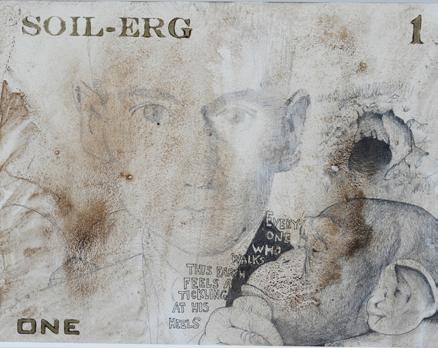
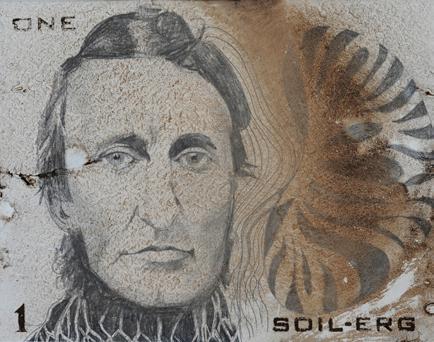
2 Wall Kimmerer, Robin. Braiding Sweetgrass, Milkwood Editions, Minneapolis, 2014
So we could say that, in order to grow itself, new life harvests what it needs from old life. Death provides. As we eat our way through the years, we are continually harvesting from the soil and from the labor of the decomposers who convert the mineral riches of the dead into bioavailable sustenance. Botanist and adept of the plant wisdom of her Anishinaabe forebears, Dr. Robin Wall Kimmerer² relates the concept of the honorable harvest, furnishing guidelines for extraction of resources. The imperatives of the protocol include:
–know the ways of the ones who take care of you, so that you may take care of them; –take only what you need; –don’t waste what you have taken; –share what you take; –give thanks for what you have received; –give a gift in reciprocity for what you have taken.
A code of ethical gathering reminds us to care for the soil as the site of an essential, vivifying alchemy. Besides dying, how do we give back to the soil? Compost. We waste not that part of our harvest we might otherwise throw away. Realizing that there actually is no such place as “away,” we know that organic waste will only rot in a landfill, producing methane. So we reserve the husks, the stems, the rinds, the seedy pulp, the yellowing broccoli, and other organic disjecta, and let the microbes take it back to the soil. Compost is the process of oxygenated decomposition. If not oxygenated, as when buried in the anaerobic conditions of a city dump, the good biology gives way to the pathogenic, and we meet the odor of rot. We can get complicated about it, but it’s pretty straightforward; you want to maintain a balance of nitrogen-rich (green or fresh) ingredients and carbon-rich (brown or dried). It can be achieved with a light application of attention, a little of your time. You can even engage worms to help this process along. Compost. Oxygenated decomposition. Fertility. Good food. Life. The virtuous circle. Does our current system of industrial agriculture give back to the soil?
Let’s say you fall in a field of genetically modified soybeans, a monocrop of identical plants, engineered to resist the herbicide glyphosate. Lying there dead, you will learn that industrial agriculture makes for some lonely places. The avian and mammalian scavengers, such that can persist in the toxic soy belt of the American Midwest, will find you. And the flies will show up to install a maggot nursery in your flesh. But the microbial action will be seriously wanting, stymied by pesticides and crushed by heavy machinery. In this field the collective work of a microscopic community has been bypassed in favor of a spray or dusting of raw vitamins, primarily nitrogen-phosphorous-potassium (NPK). Our plants are raised on processed food. Meanwhile we do nothing to replenish the soil where they sprout. To make matters worse, the excesses of synthetic nitrogen make a field very attractive to weeds and other pests, necessitating more rounds of biocides, until the living dimension of the soil is annihilated. Over time, this kind of relentless extraction lends the land to a kind of desertification. Inputs. Runoff. More inputs. Sterility. Corporate profit. Bad food. The vicious circle.
You have probably heard that one of the worst causes of stream and river pollution in the U.S. is the wanton application of synthetic fertilizer to our fields. It turns out that the best place to store reserves of nitrogen is in the bodies of thriving bacteria. Gluing themselves to available particles and to each other, they form microaggregates in which the nitrogen will hold fast and not be flushed downriver with the first heavy rain. When the roots of plants call for nitrogen, or any other nutrient for that matter, the bacteria and fungi give it up in the appropriate amount, The plant has a sense of just how much it wants and when, and communicates this via chemical messages (as far as we know) and by trading in exudates of sugars and starches. What’s more, the irregular microaggregates are necessary contributors to soil structure, enhancing the flow of oxygen and water. Without it, the soil is compacted and destined to go anaerobic, making a cozy home for pathogens. Really. This is how it works.
The life cycle of salmon exemplifies most miraculously the practice of giving something back. Born up river in the shallows, the fry spend their first year growing and then make for the sea. After a mature life in the ocean, they heroically hoist themselves against the current back to the precise place of their birth, where they will spawn and die. Where they spawn and die also becomes the site of fruitful decomposition releas-
ing the precious nutrients the salmon accrued at sea. Their bodies become a gift of sea proffered in the mountains.
Just as the forest and the field are distinct, so is the substrate of any other given terrain. Wanting to see these differences, I took up making portraits of soils collected in the course of my comings and goings. These images, made by a process of soil chromatography, demonstrate the ordinary and astonishing fact that any given stretch of earth is different from any other. The differences, expressed chromatographically in a subtle range of tones and marks, may be small or large, a result of the specific geological, climatological, biological, and cultural history of that place. What’s more, the soil undergoes continual changes, so the visage that appears is one corresponding to a passing moment in that patch of earth’s life.
Back in the forest near where you have been falling apart, the resulting putrescine, cadaverine and roughly 400 other compounds of decomposition dissipate. Then we can feel and smell a sweet friable soil resulting from generations of fallen plant life. Figure two is a chromatograph of such a soil, with finely articulated rings and feathery rays in warm tones. Alternatively, over in the soy field where you are waiting to complete the disbursement of your mineral accumulation, the takers are more thin in the ground. Figure three reveals the greying, organic void of the factory that is industrial agriculture. But the question is not so much where would you rather die, but where would you rather cultivate life.
Every creature who walks the earth feels a tickling at his heels.
—Franz Kafka, “A Report to an Academy,” 1917
These words are spoken in Kafka’s “Report to an Academy” by Red Peter, an ape who has acquired language and lives as a human. What is that tickling? Is it the life in the soil eager to reclaim us? Is it our fear of such a reclamation? Perhaps it is our unacknowledged kinship with beings that for centuries have been considered ontologically different, inferior, at times even repulsive. Red Peter would like to gratify the expectations of the “academy” by accounting for his transformation, but it’s not so easy. All he can really say is that he was a captive and eager to change his status. “I imitated because I was looking for a way out,” much as a human infant gurgles, squeals, and screams until capable of the imitation that will guide her into subjecthood and civilization. In exchange for the privilege, the humans surrender any memory of whatever constitutes the subjectivity of our primate cousins, or even our own pre-linguistic state. Although language allows us to articulate almost anything we can imagine, recollection of our essential animality is off-limits; it has long been the negative hallucination in our linguistically conscious panorama.
Today, given the rise of critical animal studies, plant studies, and speculative realism, many humans seem ready to dis-identify with their own species, or at least shift their weight deeper into the network of previously disavowed biological and material kinship. Will we also embrace the return of our corporeal weight to the soil, in the previously disavowed process that is death? And what is the fate of our desecrated planet? If it should become too hot to host the range of exquisite life recently enjoying this globe, will it be swept by the soot of its own decay? The hospitable atmosphere in which we have evolved, itself evolved along with the first single-celled algae and bacteria who consumed the CO2 swirling around at the time and processed it in their bodies, exhaling O2. Carbon has built the biological structures while oxygen has maintained the wildly diversified breath of this known world. The masses of carbon-dense exoskeletons and endoskeletons accumulating under pressure over geological time furnish the fuels we can’t seem to stop burning. Now that an economic system based on incessant growth is serving up enough carbon dioxide to change earth’s atmosphere yet again, what is the likelihood of somewhere down the line generating an atmosphere congenial to a range of species comparable to what is being destroyed now? Or, perhaps our future dehydrated planet will start to crumble, expressing our collective dust into the galaxy, and on to the galaxies beyond that one and those beyond that, to a world where new life blooms in unknown air.
Originally published in Being Material, MIT Press, 2019
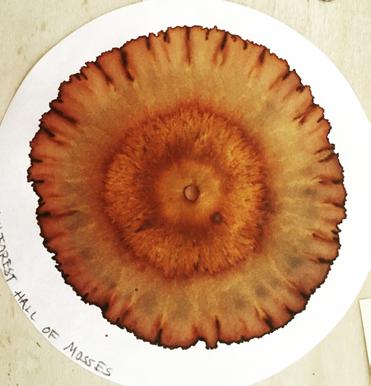
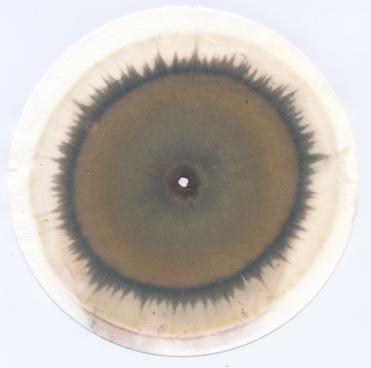
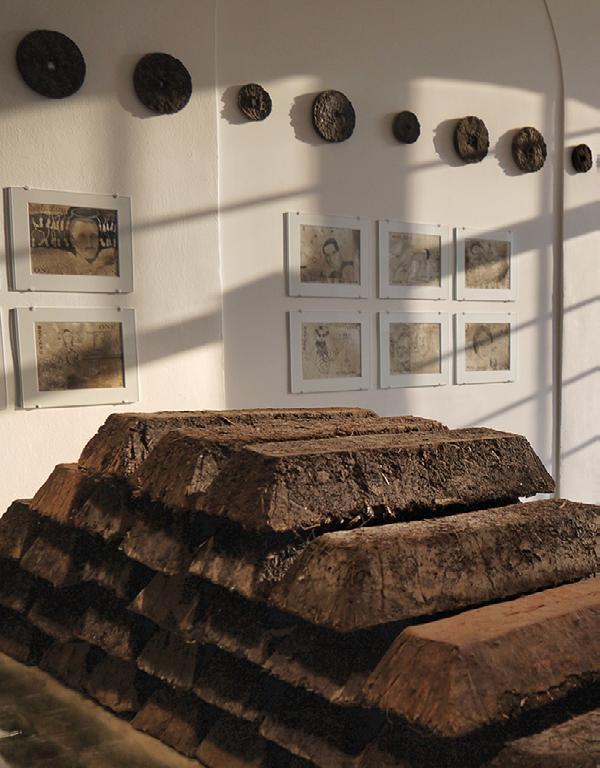
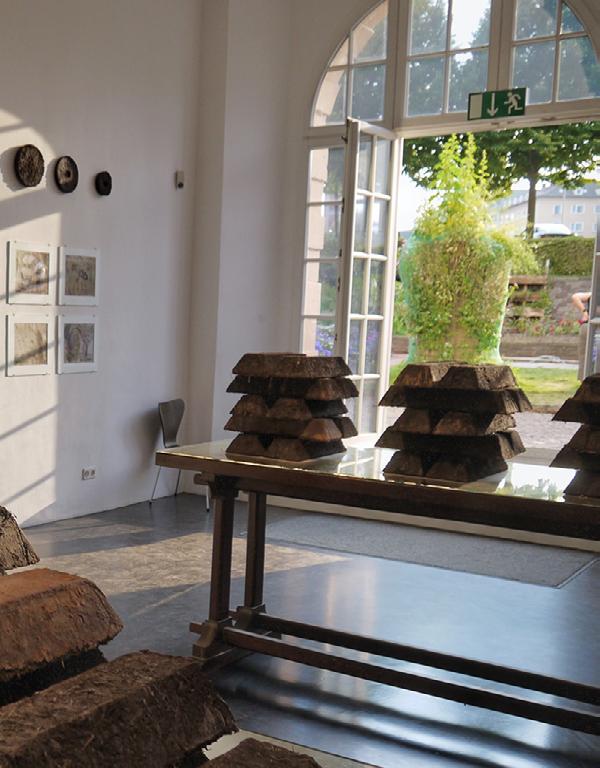
Andrea Bersaglieri
According to the US Department of Housing, 79% of Americans describe the place where they live as urban or suburban. (Sub)urbanites often view nature as being “over there” (e.g., national parks, oceans, pristine landscapes). I, too, live in the heart of a suburban metropolis–the Los Angeles Basin. I moved here from a more rural area of Northern California decades ago. The change in environment forced a change in my relationship to nature that has fueled my work. Over the past 10 years, my work has coalesced around the idea of recognizing the beauty and awe in the nature of suburbs, with a close attention to soil, even if it is just the soil of a parking strip. The strata of soil hold time from topsoil to bedrock. By digging it is possible to travel back in time to when the climate seemed more stable and people were not as detached from the earth. As a gardener on a slice of suburbia, I live on the landing place of my Armenian immigrant in-laws, on soil that was part of Spanish and Mexican land grants and Rancheros, the
ancestral home of the Tongva-Gabrielino. As I dig in my garden, I dig through and touch this history. The soil depicted in my work is from this land. I primarily work with traditional, compostable, eco-friendly drawing and painting materials, paying homage to what I notice with careful observation and straightforward depiction. For me, drawing is an observational tool, a way to examine and understand the world. There is an intimacy to the simple, deep, and literal witnessing required for observational drawing. The resulting images are a type of record keeping, a way to log, organize, and communicate the observed. Much like traditional portrait painting, I have my “sitter” before me and I work from direct observation. The outward visual information eludes the invisible, the soul, so to speak. These drawings are large in scale, the Pods are human scale, and Underbossom will fill the viewer's field of vision. Created with charcoal on paper, they are also ready to be composted and returned to the soil.
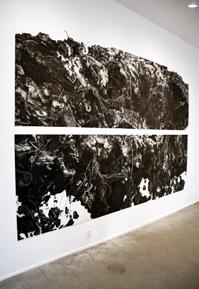
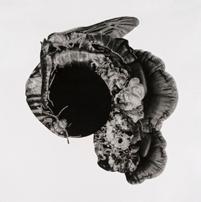
Kelly Eckel
The soil is the skin of our planet, which most people take for granted. Yet, soil degradation has contributed to the decline and eventual end of many civilizations. It is vital to understand the systems in our environment so that we don’t degrade them. Understanding the dynamics of the world humbles me and makes me want to have less of a negative impact on it. My work is an expression of joy that engages me to move through the world in a respectful manner. The focus of my work appreciates the importance of all creatures that live on this planet; the more diverse an ecosystem, the stronger it is. I aim to create space and awareness for all creatures in my artwork. Community is more than human.
Pill bugs, a crustacean in the desert, segmented bodies and antennae
with fine hairs, details of reflective wings, dewy fruiting bodies connected to miles of mycelial threads, layers of leaves in the process of decay being devoured by mites and springtails, diggers and burrowers aerating soil, flowers that smell of fruit or rotting flesh, attracting those to which they have adapted.
The photopolymer etchings originate from photographs that I have captured under a microscope, in my studio, on hikes, and at Natural History collections; these images are then collaged into various shapes. I then transform the images using an intaglio method, a labor-intensive and visually beautiful process, which involves using light-sensitive etching plates that are inked and printed.
Esha Chiocchio
As a mother living in the high desert of New Mexico, I'm concerned with the future of our land and water. The true heroes are those working to improve the vitality and resilience of soil, and I feel called to tell their stories. So far, I have made fourteen photo essays and multimedia videos about soil stewards from goat herders to urban farmers to those working to restore vast grasslands after more than a century of overgrazing. Soil is our most precious resource. It has helped civilizations thrive and, when abused, brought their downfall. My long-term project, Restoring
Earth's Canvas, documents efforts to revitalize terrestrial, aquatic, and atmospheric cycles in the face of a changing climate. This project is about hope and humans' vital role in increasing resilience, regenerating ecological systems, preserving diversity, and re-envisioning a harmonious and enlightened path forward. Using long-form documentary photography, multimedia videos, and public exhibitions, I aspire to shift perspectives about sustainable land management practices and highlight our role in restoring Earth's canvas for our children's children.
Winter Herding (Bostwick Farm), Melrose, New Mexico, 2022, photograph, dimensions variable
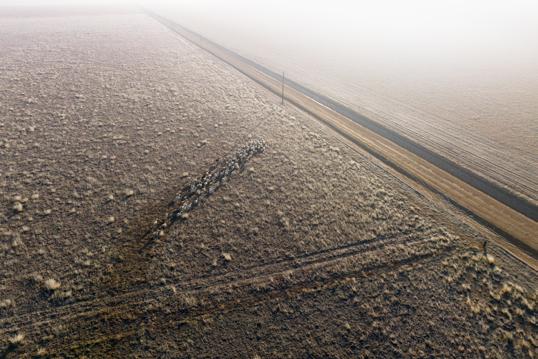
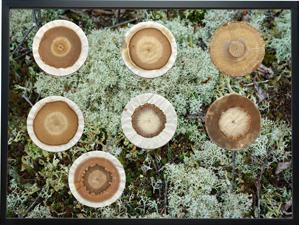
Claudia O'Steen and Aly Ogasian O’Steen and Ogasian work collaboratively to produce multimedia, research-based installations. Our work incorporates sculpture, digital media, drawing, writing, and photography, taking a flexible, idea-driven approach. Projects always involve fieldwork, and installations
incorporate artifacts and “data” collected from the landscape itself. The work focuses on relationships with the changing environment, using methodologies borrowed from citizen science to critique traditional notions of exploration and conquest. Keweenaw Observing Sta-
tion examines the effect of climate change on Lake Superior and the Great Lakes System. The work consists of a series of site-responsive, portable sculptures that function as observational stations/instrumentation as well as repositories of information. The sculptures are inspired by local NOAA monitoring systems, such as the Great Lakes Water Levels Monitoring Network. The instruments poetically measure wind, waves, visibility, water level, and temperature, exploring both the possibilities and limitations afforded by perceptual observation. Within the artwork, our observations are contextualized vis-à-vis large, ongoing collections of data via satellite imagery, scientific instrumentation, human memory, and citizen science intended to help predict the future of the lake. The project touches upon the lake as a “site of memory” by examining how winter conditions contribute to subsequent summers while also engaging human memory. This work was made to investigate the soil in the Keweenaw on Rabbit Island, Michigan. Soil chromatography, a camera-less photographic process that indicates the chemical, physical and biological characteristics of the soil, was used to document soil samples collected at different points on the island in relation to the shoreline.
Daro Montag
We need to protect soil globally. I look after an acre of soil at my home in England. When I moved to a new house in Cornwall, I realized that the place was already occupied. Numerous creatures, from badgers to buzzards, had lived here for generations. It seemed impertinent to think of this place as mine. I needed to find a way to get to know the place and some of its inhabitants. I started with the soil. Taking a sample of healthy topsoil, I placed it on some pre-processed photographic film. The soil microbes, who are part of the larger soil organism, started to slowly spread across the film’s surface and into its colored gelatin layers. After a few days, the micro-fauna and fungal mycelium in
the soil had left a trace of their activities within the film. After two weeks, a print was made from the film. The finished work shows us that the soil is a living organism teeming with vitality. My work records the activities of living organisms and natural phenomena through the traces they leave behind. It acknowledges that we exist within an interactive and interdependent matrix of other beings. It explores the processes of living matter—what living means and what mattering means. In my work, I appreciate soil as a living organism upon which most terrestrial life depends. More than just a material where soil organisms live, it is an organism in its own right.
Geraldine Ondrizek
My work sits at the intersection of art and biology. I draw from observations of cellular and genetic development, epigenetics, and eugenics. Since 2018, I have been creating works about in vitro fertilization and early-stage cell development. I find the ability of cells to divide, thrive, and make animal and plant embryos to be magical. Both have epithelial cells, which are amazingly elastic, rapidly growing cell tissues that are in contact with the interior and exterior of the given organism.
Epithelial cells create a protective layer on a plant’s roots, and are responsible for human neural tube development. In the summer of 2023, I documented seed germination. Using a compound microscope, I was able to observe each plant daily and see the growth of the epithelial cells as they elongated and expanded through the soil. After the first week of germination, a seed must have the proper soil. The correct pH, electrical conductivity, and nutrient content, partic-
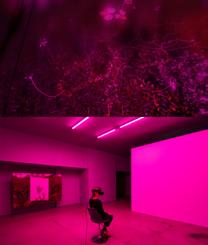
ularly nitrogen (N), phosphorus (P), and potassium (K), are necessary for favorable young plant development. I injected the plants with Safranin, an azo dye commonly used for plant microscopy, to see the water flow through the roots. I took multiple photographs so that the entire length of the root and plant could be understood. Through this work, I hope to share these astonishing biological systems, whose delicate structures are vulnerable and vital to our lives.
Daniel Hengst
In 2019, I encountered a peat bog for the first time with full consciousness. I was standing in the bog of Kemeri, near Riga in Latvia, and there was nothing but the bog as far as the horizon. This was an eye-opening moment for me that triggered so many questions about organic soils and their plant inhabitants. I studied the latter and understood that it is precisely they, in combination with rainwater, that make the bog what it is: an archive of the past, a space in which life and death exist in correlation with each other. The bog is a testament to the origin and source of our existence and an indicator of our future. In every breath, these soils are part of my body, and I am part of them. In my work on peatlands, I often work with light, code, video, and sound. Recently, I started to engage with the practices of Paludi culture (agriculture on peatlands). An unconditional and uncompromising attention to plant life in peatlands provides a glimpse of a reality in which we humans prioritize our actions to meet the needs of plants. Observation and photography play an important role in my work. Pictures inform a multitude of realistic representations of bog flora, which populate the virtual space in my creations. These ‘artistic greenhouses’ are attempts to create an intimate proximity at a maximum distance. In the rapid attention economy, these slow habitats and their equally slow plant inhabitants hardly have a chance to be seen. In many encounters with peatland scientists, I learn how dedicated, detail-oriented, and long-term the study of peatlands is. This is a huge motivation for my artwork–to incorporate these perspectives and methods into my work and make them visible.
Paula Castillo
As a rural Mestiza artist based in Córdova and Belén, New Mexico, I draw on the complex and malleable intersections between the physical and cultural landscapes as the primary source of my work. Positioning myself as Genízaro descendant from detribalized and mixed-race slaves and victims of human trafficking as part of the violent economic and political power struggles between Indigenous Americans and European peoples across the slaving frontier of the Comanche-New Mexico border, my personal history fuels my motivation to collaborate with diverse communities to advance public-facing art that critically examines the complex hierarchies, asymmetries, and inequalities at the root of our human failures. It acknowledges our global entanglements and heavy responsibilities towards each other and our environments, and provides, through interaction, an authentic renewal to strengthen communities' commitments to work for environmental justice and equality across racial and national boundaries. Aggregates,
or sand, are the most mined materials on Earth and the foundation of modern civilization. They are essential for providing shelter, infrastructure, and communication, but are increasingly scarce. These alluvial-mined inorganic materials are vital for the global economy, particularly due to the central role of concrete in urban development. Aggregate mining can substantially impact soil-water cycles, with open-cast pit mining potentially disrupting hydrological and hydrogeological systems, resulting in far-reaching effects on water quality and availability. Aggregate mining can also significantly affect the availability of and access to local water tables and change local flood processes. A recent trend has also led to the disproportionate labeling of informal aggregate miners as criminals. Linking informal miners to criminal networks generalizes and simplifies the global situation of miners and also stigmatizes vast numbers of people in poverty. The environmental consequences of aggregate mining activities in many
landscapes are thus complex, with numerous geomorphic, ecological, societal, and health implications. The project, How to Denegate a Mountain, combines documentation with naming: aggregate mining at a rural mine in an economically depressed community in New Mexico is meticulously documented. The title brings attention to and questions another example of homo sapiens star-crossed love affair with Earth's terrestrial landscape and with ourselves. The titling, an even more straightforward act than documentation, leverages an accounting to create a poetic pining and awareness of the life of mountains and men as serving humans in a true negation, an active invalidation. The “How to” approach succinctly provides an ironic recipe for obliterating both mountains and people in the service of economies and modernization. This work illustrates the extinction that inevitably comes from nullification–a slow erasure and emptying of identity that manifests the false claim that mountains and humans alike are replaceable.
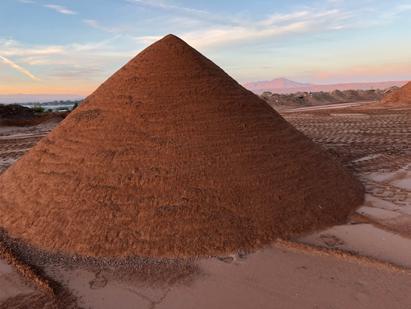
How to Denegate a Mountain (Veguita, New Mexico), 2023, mined arena dirt, photograph, dimensions variable
Perdita Phillips
As an ecological artist, my work often plays with the sense of distance between humans and more-thanhuman worlds. Sometimes I work closely, walking my way through Country and touching the earth beneath my feet. But I also make wider connections to extractivism—and systems of classification inherent in science—showing why these might be inherently unstable in a world of complexity and raw beauty. I try to balance the use of technological processes with a generosity towards the autonomy of biotic and abiotic forces, co-creating artworks. I make ‘anticipatory archives’—working with historical sources to comment on futures ‘not already in existence’. Whilst spanning diverse artistic me-
dia, underlying themes of ecological processes and a commitment to a resensitisation to the physical environment are apparent in my work. Returning to the ruins of my grandparents’ farm in the Wheatbelt of Western Australia, on unceded Njaki Njaki Nyoongar land, the hubris of settler culture’s conquest was foremost in my mind. The large-scale clearing of dry woodlands for wheat and sheep led to rising water tables. The consequence of this was the release of large quantities of salt stored in the soil, which turned the valley bottoms into salt lakes, turning the red soils white. My grandparents had acted in good faith, but it is my generation and the younger that are paying the price of imposing wrong
Sophy King
As a multidisciplinary environmental artist, I investigate the nature-culture continuum through immersion in place. Using sculpture, installation, film, and sound, I examine experiences of the world and narratives of time, communities, and ecologies, including conceptualizations of e.g. the Anthropocene, Planthropocene, Deep Time, Dark Ecology, and Vibrant Matter. I look at moss, fungi, earth, peat, wildfires, and water, as subjects of small-midscale urban rewilding projects, investigating their social, economic, and ecological qualities and our relationships with the non-human. No place exists or evolves without the species and cultures that inhabit and shape it over time. Tim Ingold (2023) refers to “Deep Surface,” or the idea that we stand not on solid ground but a permeable layer of eruption and erosion. We’re just beginning to understand soil’s rich ecology of microbeasts and mycelial networks, mysterious connections and communications. On
tographic archive, 8 minutes looped
agricultures and wrong economies on the soil. I therefore return to Country seeking evidence of the restoration of ecosystems and the survival of trees in the landscape, as ways forward from ecological disaster. In February 2023, I was given an unassuming tray of about five or six thousand small photographs. The origin and date of the archive are obscure, but it shows farming properties and salt lakes in the Wheatbelt, Western Australia. Taken from a plane, they are an archive made by humans, for humans. I turned these flickering images into a video. I set myself the task of unsettling the eye of settler colonialism, challenging the ‘POV’ with a more ecological vision: saltlakes turned into bloody ghosts.
the one hand, the idea that we have only a few years of fertile soil left is terrifying, on the other, we can see how wastegrounds quickly form their own ecologies. The Whole of Recorded History (2022) confronts viewers with a 5000-year-old peat pine subfossil from Lindow Moss, found buried under 5 meters of peat, representing an extinct pine forest from around 3000 BC. Chalk drawings explore various timelines from the ancient domestication of wild horses to the invention of the combustion engine to speculations of future uncertainties. The title refers to the development of cuneiform writing 5000 years ago, and the potential for the climate crisis to end human history. Alongside the installation, whisky and truffles resembling peat stacks are offered to the viewer, allowing them to taste the effects of peat and time.
Ingold, Tim. “The Earth, The Sky and The Ground Between.” Metode, vol. 1, 2023, pp. 48–70, https://metode.r-o-m.no/media/files/articles/ tim-ingold.pdf.
Susan Smith
As an artist, activist, educator, and faculty coordinator for the graduate art program at the University of Maine, I am deeply committed to work that reflects stewardship of land and water. My work begins with visits to site, a witnessing of place and the forces that shape it. The site itself determines the materials I use and the form of the final work. Sometimes I think of these pieces as artifacts of a placemaking experience. My practice is a push-pull between collaborative community work and personal studio work. As one of the art extension directors for the Urban Soil Institute, I am connected to soil scientists, botanists, and earth keepers. Our conversations and gatherings feed the concepts and inspiration for new work, as does working with soil and witnessing the seasons in my garden and the guerrilla gar-
dens I plant each season. Through sustainable land management practices, we honor the soil's role as a living, breathing entity essential for planetary health. By prioritizing conservation, preventing degradation, and fostering regeneration, we uphold our responsibility to soil as a fundamental support system, ensuring its vitality for future generations. Soil sustains life beyond our own, nurturing diverse ecosystems and supporting countless organisms. I work to educate myself on practices, whether in my creative work or as a gardener, conscious of my ancestors’ role in the colonization of lands, and questioning our past to better form our future. My current work is based in field research along waterways and at industrial sites with documented levels for PFAS (forever chemicals), taking my process for
creating natural dyes and pigments, and using those with materials from these sites. I am also part of a team of artists and soil scientists working on reforestation/grafting and wetland prototype garden spaces. The artwork for me is an artifact of the research and takes many forms.
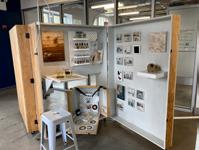
Catriona Leahy
The peaty soil of the bogs in the Midlands of Ireland holds 90% moisture. Ostensibly unproductive, the hidden depths of the bog record and condense a series of epochal shifts into its stratigraphic record. It is a storehouse for carbon, a rich resource that was exploited and harvested on an industrial scale for decades, resulting in irreversible degradation of our peatland habitats. Despite their rep-
Deep Time Feeling, 2024, hand-printed silver gelatin print, fibre paper, 4 x 10 feet
utation as infertile wasteland, peatlands are part of what is described as the critical zone: a dynamic system, but a relatively thin layer on Earth, where terrestrial life flourishes and feeds most of humanity. Through my work with experimental analogue photography, I aim to call attention to the temporal and physical rifts in and on the surface of the landscape. Through a process of visual and
physical tailoring, I cut, fold, manipulate, splice, and exhaust photographic negatives of the bog to create new and alternative landscapes. The negatives are cut, collaged, cut again, and re-collaged again to the point of exhaustion. An iterative, cumulative process with no possibility for return to the original, I set about a process of intervention on the images. The resulting collages resonate with the layered formation of the peat landscape but also highlight its fragmented nature due to industrial extraction. Foregrounding a method of the anachronic over the chronologic, I seek to elude the continuous march forward and instead search for gaps and holes in the ostensible ordered stratigraphic record, thus understanding the time of landscape not as duration but as rhythm–sometimes lithic, sometimes instant. As landscapes are ‘re-formed’ via extraction, they undergo a process that also re-assembles our material and immaterial relationships between past, present, and future, reminding us that landscape is always in process—a moving, emerging, ongoing event.
Jann Rosen-Queralt
Soil is quite literally the substrate of life. Composed of an amalgamation of broken-down rocks and organic materials, soil is a record of the passage of time and an indicator of nourishment and fertility. Far from “one size fits all,” the soil blend native to any locale is specially formulated by decaying organic materials and minerals. Seeds from plants are dispersed in ant tunnels below ground, helping new plants to sprout. Fertilization of the soil continues as ants bring organic matter into their nests, where it decomposes, enriching the earth supporting the living flora and fauna of the area. My artworks reveal and explore social and ecological relationships, connecting them to universal themes. Curiosity and intuition ground my exploration followed by research and experimentation. For these projects, I was interested in the scientific and biological relationships between soil and insects. Integrated Tendencies brings the natural world indoors through a ‘garden’ of sensorial elements and insect habitats. These projects explore the biological processes, symbiotic relationships, and human interaction crucial to soil health. Custom flooring with a reciprocating pattern is a metaphor for the infinite process of nutrient cycling in soil for which ants are active contributors. A wall-mounted ant farm demonstrates how tunneling loosens soil, improving porosity, allowing water and oxygen to penetrate deeper to reach plant roots. On either side of the ant farm and on adjacent walls in the gallery, sugar cube molecular models displayed on mantles refer to glucose, the essential high-energy fuel source ant colonies require for foraging, building and defense. My approach is to engage the viewer’s senses. I don’t just want them to see that the work is about nature; I want them to become aware of this essential process of life, the cyclical aeration of soil caused by respiration and fermentation.
Using different media in my work, from painting to performance, sculpture to food, and poetry to video, I explore themes of identity, memory, alchemy, home, and peace. My current body of work explores my identity as a settler in Hawai’i, reconnecting with my Philippino indigeneity and growing my relationship with place and the land. I work across different media because I perceive them all as distinct spaces for care-scaping, or developing care landscapes, for myself, my communities, and future generations. The soil I greet and touch ev-
Where We Harvest, 2021-2023, digital painting, dimensions variable, photo: Santiago Flores
Integrated Tendencies, 1991, ants, beeswax, formica mantles, newspaper, picture frames, plexiglas, soil, sugar cubes, vinyl, wood, 9 x 23 x 16 feet
ery morning is in Waiahole in the Ko’olau-poko of O’ahu. I would describe the soil as moist and very dark, maybe black, and fluffy. While the land we steward is my partner’s family’s farm, dating back to the late 1940’s, the soil reminds me of the soil my mother and father used to walk on in the provinces in the Philippines. My method involves observation and participation. I make hypotheses and make mistakes. I learn. My approach is rooted in inheritance, instruction, and intuition. The tools I most often use are just my hands and eyes.
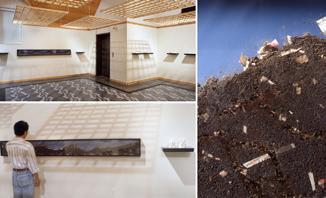
Linda Duvall
As a visual artist living on Treaty 6 territory in what is now Saskatchewan, Canada, my work explores connection to place, grief and loss, and the many meanings of exclusion and absence. At the core of my recent work is my complicated relationship to an 80-acre piece of undisturbed native grassland, a site of both pleasure and intense pain and personal loss. Unlike most of
the vast grasslands of North America, this particular patch of land has never been tilled or plowed, probably because of the unusual hills and valleys shaped by glaciers. The sand and the air around it maintain the aroma and presence of millennia. When I dig into the soil, the roots of native plants are held by the grains of sand, protecting all from the winds, the waters, the erosive forces
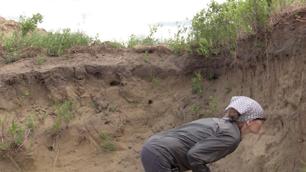
Hole Residency
Jen Urso
Soil is the underpinning of everything that grows and lives. In a place as dry as the desert, people tend to think it is incapable of growing anything, but it has a rich, complex biome that flourishes and functions in its conditions. I’m interested in nurturing that soil and getting out of the way of its capabilities. My current work, Yard Work, aims to reject our current methods of working the land we call “ours”—weed whacking, raking, leaf blowing, covering in rock, non-native grass, and astroturf. Instead, native plants grow and go to seed, and leaves drop to the ground. Yard Work is a slow-moving action performed under the umbrella of a larger project titled Leaving Land to Itself. Wearing white coveralls, I perform careful
weeding (pulling invasive weeds out one at a time). I map and draw the seasonal plants I find and write about my experiences of interactions with the land. I record everything directly onto my white coveralls in permanent ink and wear just one set of coveralls for each season as they collect the stains, dirt, notes, and drawings of each season. Any time I am doing intentional work in my front yard, I am wearing these coveralls. Over time, they become a recording of the land and my direct interaction with it. I work in this slow, deliberate action of touching soil, plants, and insects and giving it the mental attention it has been neglected, to better understand how it evolves over several years.
of nature. Deep in the layers of sand are ridges of calcium, possible evidence of an ancient lake, and small waxy stones as traces of ancient glacial activity. In the Hole was a residency I created located in a 6-footdeep earthen hole. I spent 65 days in this hole with 45 different people from around the world. The residency was advertised internationally in free residency listing sites, and the response was overwhelming. Each resident spent 6 hours a day for up to 2 days in the hole with me. There was no preordained agenda. We had neither electric power nor Internet access–none of the usual distractions. We lay in the sand, examining bugs as roots dangled overhead; we sang to the soil; we talked, laughed, and sat in silence. Some brought scientific knowledge, others danced. Bank swallows built nests in the walls around us. A tornado passed nearby, the sun baked us. All breathed in the presence and spirit of the soil. I see my role in this residency as protector of this soil ecosystem, against development, against interference.
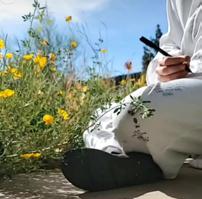
Lilian Cooper
Through the medium of drawing, I seek to find a balance between the urgency of our present environmental situation and the need for a message that leads to lasting change. My work has a poetic quality, aesthetically relying on form and line. I work with research institutes, universities, national parks, and botanical gardens to ensure the factual basis of my work is correct. I also carry out my own primary research in the field, in libraries, state plant collections, and laboratories, as well as artist residencies. Living in the west of the Netherlands on flat alluvial soil from the flood plains of major rivers coursing through several European countries, I have grown to love this abundant earth despite the landscapes being imbued with centuries of industrial processes and hazardous waste disposal. For example, the soil that I cherish sits upon the foundations of a 16th-century brewery covered with waste matter. This drawing and text installation is an early piece that embodies the essential nature of soil. It is a profile of the exact
chemical make-up of my soil in my former garden in Amsterdam. It was a motivating reason for me to leave; it was also a formative piece, which is why I chose to send it. In this work (and later pieces), I have used the soil itself to portray the soil. The
data show the make-up of the soil with its chemical constituents, including an excess of mercury. The city council of Amsterdam was generous enough to give me access to their soil sample records, and I used this data for the work.
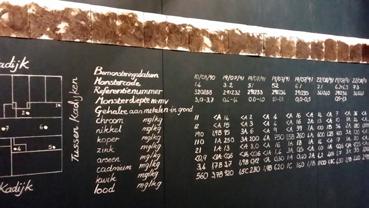
Juniper Harrower
With a doctorate in plant/fungal ecology, I work with scientific methodologies in my artistic practice, interested in pushing this research forward through a feminist science and queer ecologies lens. I am interested in how power systems show up in the ways in which we work with more-than-human beings. In addition to traditional painting and mark-making media, I work with fungi and living plants to find reparative paths forward in collaboration with damaged ecosystems. The materiality of particular ecosystems and their speculative wild or industrialized histories contributes to my research questions and aesthetics, and further propels my interest in co-creation and care across history, difference, and species. My work with Joshua tree soil communities has demonstrated that climate change impacts Joshua trees and their species interactions, directly influencing current species pro-
tections. Having been involved in multi-year restoration projects with Joshua tree communities, I apply these research insights to create underground painted soilscapes that hold an abundance of information on fungal species, soil types, temperatures, and moisture, which are visually experienced as colors and texture. Illustrated root patterns are illuminated by Joshua tree roots grown in glass chambers and treated with desert fungi, allowing for a collaboration between the plant, fungi, and me. The tears in the paper and changing stitching patterns represent my symbiotic findings and the outcomes of tree-fungal relationships across climate zones. The painting can also be activated by downloading the free Artivive phone app and pointing a camera at the image. The Joshua tree painting thus becomes animated, highlighting the impact of urban sprawl on desert plant and soil communities.
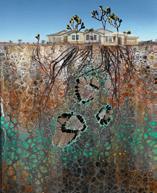
Cat Hart
As a first-generation settler on unceded Coast Salish homelands in so-called Canada, I discovered that my migration from the UK followed a well-worn path facilitated by the Salvation Army. In the late 1800s, the Army sought to transform East Londoners’ lives of so-called sin and poverty into those of hard-working “ideal migrants” to be sent to the overseas colonies and preserve the “British character” of these lands. Modeled as a farm colony, Christian morals and agricultural skills were used to discipline ecologically rich wetlands into lands of industrial production. The tensions between Indigenous views of land as a relative and capitalist-colonialist views of land as a source of economic value continue today in both of my homes. As I explore themes of good land relations, ecological balance, and colonial ideologies through an engagement with local history, I seek to develop an art praxis that challenges the ways that capitalism encourages an extractive, non-relational orientation to land. Influenced by decolonial and queer ecologies, my interest in materiality and place has engendered a focus on more sustainable, accountable, and site-responsive approaches to making. This hands-on, laborious
approach is an opportunity to slow down, explore the origins of materials, and celebrate the unexpected results of site-specific processes. This image is part of a series that uses satellite imagery and the low-toxic process of cyanotype. I sensitized locally gathered soil to create aerial photographs of the salt marshes and bordering farmlands of my home of origin, alongside those of the home where I currently reside. I also used this process to print photograms of seaweed gath-
ered from the sites. These images are printed on clay-rich soil harvested from my childhood home on historic farm colony land, as well as peat-rich soil bordering the wetlands of my current home on stolen Coast Salish homelands. This combination of advanced technology, hand-printing, and soil-harvesting brings together the tensions over land use, land rights, and ecological conservation on colonized lands under capitalism.
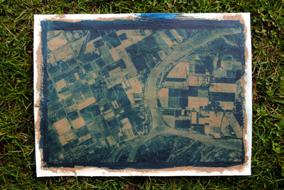
Aindreas
Scholz
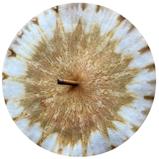
My artistic practice merges 19thcentury and contemporary photographic techniques to pioneer sustainable printing amidst the climate crisis. The outcomes are a nuanced exploration of specific sites, weaving narratives of human, non-human, and environmental interconnectedness. I delve into deep time, juxtaposing geological processes with the immediacy of climate change. Documenting change is a central and urgent practice. Collaboration with elements like seawater and rain shapes my creative process, while sunlight, silt, and soil forge connections within images. I aim to transcend observation, sparking conversations and fostering personal and artistic growth. My work catalyses dialogue on our collective responsibility amid environmental catastrophes. During an artist-in-residency programme at The GroundWork Gallery, I ex-
plored Norfolk’s rich tapestry of human-landscape interactions. Supported by local partnerships, I used soil chromatography to document the region’s history from prehistoric times to the present. This method involves collecting soil samples and creating chromas with silver-nitrate-coated filter paper to reveal the soil’s composition. Dark, intricate chromas indicate organic richness, while paler ones suggest depletion, almost mirroring tree rings and lost natural histories. This approach weaved past insights with current environmental challenges, focusing on Norfolk’s coastal vulnerabilities such as land erosion due to human-induced climate change. It serves as a tool for visual advocacy and ecological restoration, aimed at inspiring action towards biodiversity recovery in areas scarred by human activity.
Cindy Stockton Moore
My practice revolves around collaboration with site, materials, and community to explore place and connectivity, aiming for a zero-waste, environmentally sustainable artistic approach. I integrate historical research and untold narratives into my work with painting, video, and animation, emphasizing experimentation, learning, and attentive listening as foundational practices both in the studio and in the field. In this project, I conducted a series of textile burials in late February, May, and July of 2023 at the John Heinz National Wildlife Refuge at Tinicum, Pennsylvania, the country’s first urban natural refuge. A wetland transformed by human intervention, its marshes were first drained and filled by Dutch colonists, then settled with the expansion of the city of Philadelphia. Established in 1972, the current refuge protects 1200 acres of land for the preservation of the marshland ecosystems. Poised between the airport, industrial waste centers, and Interstate 95, Heinz is an unexpected oasis for wildlife, connecting diverse communities to nature and protecting surrounding neighborhoods from flooding. The soil here, while em-
bodying histories of neglect, abuse, and displacement, also represents ecological healing, biological diversity, and community care. As part of a larger collaborative project of textile burial work with the ecoartspace soil dialogues group, soil tests included XRT analysis (the equivalent of a CT scan for soil) and RDNA analysis, which showed an abundance of fungi and aquatic bacteria, underscoring the marsh’s proximity to the Chesapeake Bay. The animation in my short video introduces some of the most prevalent species in each kingdom, a small sample from the thousands of more-than-human inhabitants that have affected the soil. It also includes examples of the soil chromatography tests I ran on-site. The variegated color from the buried cloth samples and the abstracted data were compiled into a series of translucent scarves. The project includes a portrait of Yessenia Mendez, Community Engagement Specialist, wearing the scarves on-site–connecting one of the stewards of the land to its data, making tangible the interconnected web of this complex urban refuge.
Dana Hemes
I understand the world as a system made up of many small interactions. Each moment is an event–an active, participatory state where all parts of a system affect and are affected. Soil, as a system, is vibrant, emergent, and co-created. It is a mingling of actors–living, non-living, human, non-human. It connects rock and sky. It soaks in liquids and expels gases. It is food and home, solid and empty, rich and depleted, essential and poisonous. It is soft, hard, sandy, gritty, dark, sparkling, squelchy, odorous, and bitter. I develop an art of evolving boundaries, shifting scales, and conversion devices. I build environments that facilitate events that encourage cross-species interactions and a weaving of new and old narratives. The work is a functioning system, where humans and nonhumans are invited to enter, explore, and engage. It is participatory and changes through intentional and/or unintentional action. There is no neutral. Through the creation
of interspecies spaces, I aim to illuminate the connectedness of our environments and provide a viewpoint that reframes our individual roles and impacts in the world. This work is a site-specific work developed on a retired cornfield. After years of mono-crop cultivation, the field was depleted and lacking diversity. To explore this human, corn, and soil relationship, I first sampled the soil from various points around the field. The samples were taken from 7 points that mirrored the Seven Sisters constellation–a constellation that was used by early agricultural communities as an indicator for planting and harvesting. All samples tested very low for nitrogen. To reintroduce nitrogen and biodiversity to the landscape, I created seven cornstalk-inspired bird feeders. The feeders had perches and plates for birds to eat and poop (bird feces is rich in nitrogen). They also had LEDs and fiber optic tassels at the tops, powered by the Earth. The feeders were
positioned at the location of each sample, providing food throughout the day, and softly glowing back up to the stars at night.
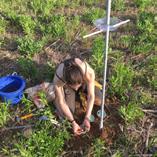
Myriel Milićević and Susanne Jaschko
Who has the right to land? The Out of Soil project brings attention to the correlation of land use, farmers’ rights, and the global loss of fertile soil. Growing consumption and increasing demand for resources are taking their toll—urbanisation, intensive agriculture, erosion, and land grabbing are just some of the manifold challenges facing soils of the world. Soil as matter is as much affected as the lives of people who have farmed for generations. As an interactive, speculative design research project, Out of Soil examines these different threats, and blends play and politics, performance and participation. The Out of Soil Map illustrates large-scale land acquisitions: the buying of large pieces of land by domestic and transnational companies and governments. These transactions have long-lasting consequences for local and regional agriculture and ecosystems, for farmers, and for the provision of the local population. The Soil Press Station is a live print shop, discussion forum,
geography class, and registration point. Instead of regular name tags, people receive their personal soil profiles. Scientists produce soil profiles by vertically cutting through the ground to reveal the various layers and sediments. Here, the Soil Profiles were produced in dialogue with the participants, making their personal relation to soil visible. People wore their Soil Profiles tags in order to engage in further exchange with other visitors. Each participant also receives Soils Stamps, which represent 10 square meters of land. The stamps are printed at the Soil Press Station with ink made from soil. The Soil Stamps resemble food stamps, thus reminding us that food can only be produced in exchange for other resources. They are stamped according to what people consume in a day. Out of Soil was presented in 2015 at the International Week of Justice at Friedrich Ebert Stiftung Berlin, A-Z of Agroecology, Navdanya Farm, Dehra Dun, and at Bhoomi: Maati Ma—The Festival of Soil, International Centre, New Delhi. nternational Centre, New Delhi.
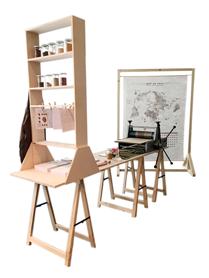
Brooke Singer
Design in the age of the Anthropocene requires collapsing categories to face extreme shifts, upheavals, and extinctions occurring in our world. Part of this process includes taking knowledge out of its “home” context to reframe ideas, start new discourses, and allow for altogether different possibilities. To do this, my work includes websites, workshops, gardens, flags, photographs, visualizations, and social spaces that seek public participation in pursuit of social change. Working across different media, I aim to provide entry into technosocial issues that are often characterized as specialized and closed to the public. My work with soil began in 2011 with the public artwork Excedentes/Excess, a collaboration to divert edible food from the garbage and into the hands of people. The initial work, designed for the city of Madrid, was revised for New York City to include composting. The following year, I co-founded a community garden in Brooklyn
called La Casita Verde as a place for creative, land-based interventions. These works acknowledge that soil is both a practical and poetic matter. It is a vital and living entity. More than half of terrestrial species live in the soil, making it the most species-rich habitat on Earth.
Human life depends on the health of these organisms, mostly unknown to us. When working with soil, one must think simultaneously about contrasting time and spatial scales, from the scale of a single molecule or microbe to global atmospheric circulations. In 2018, I initiated Carbon Sponge at the New York Hall of Science as Designer-in-Residence in collaboration with soil scientists. The goal was to develop methods for urban carbon farming through a hybrid museum exhibition and professional scientific study. The series Site Profile Flags, shown here, represents symbionts of an ecosystem or land-based markers of bioregional over geopolitical space.
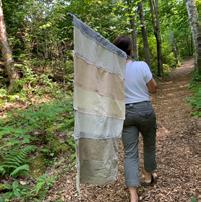
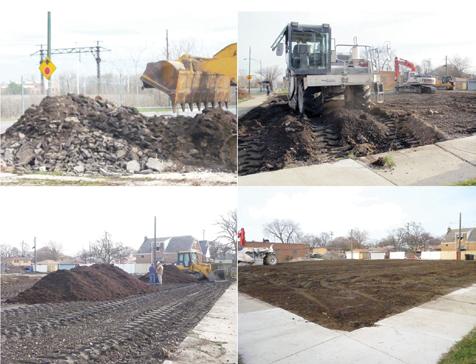
Frances Whitehead
My work over the last decades has been with forgotten and disturbed urban soils. This work includes soil remediation, re-wilding, “un-development,” urban agriculture, and innovative green spaces. These “post” landscapes include the slag-impacted soils of the Great Lakes industrial cities, and the abandoned, rewilding, glacial sands of the Gary, Indiana dunes. These soil conditions also resemble the privatized landscapes of post-colonial sites in Mexico and South America, where I have also worked. A long- term resident of the Great Lakes, I have recently relocated to Santa Fe, New Mexico, to focus on xeric landscapes and water, establishing the Casa Agua. The emerg-
ing NOPALOGY project explores agri+cultural futures for Aridoamerica’s iconic cactus species, including its relationship to high alkaline desert soils. Here in New Mexico, deep time is legible in the landscape. The arid conditions produce high alkalinity soils, aridisols, which are hostile to all but a few plant species. The desert soils have special names: Penistaja is the official state soil of New Mexico, and caliche is the white salt deposit left by low rainfall. This specific relationship between soil, water, and plants drives my current work towards new plant ecologies. I have learned to work at the scale of environmental impacts and do not operate within the limitations of artistic convention.
I developed this capacity through cross-disciplinary collaboration with scientists, engineers, architects, planners, and communities. Opportunities for these collaborations came by launching innovative practice platforms such as the Embedded Artist Project, where I have frequently partnered directly with municipalities. As a transdisciplinary artist, I bring the methods, mindsets, and strategies of contemporary art practice to imagine possibilities for the future. Connecting emerging art practices and the discourses of climate change, vegetal consciousness, and counterextinction, I deploy the knowledge of artists as change agents, asking: What do Artists Know?
Adams, Clive, and Daro Montag, eds. 2015. Soil Culture: Bringing the Arts Down to Earth. Totnes, UK: Centre for Contemporary Art and the Natural World and Gaia Project Press.
Andraos, Amale, and Dan Wood. 2010. Above the Pavement—the Farm!. New York: Princeton Architectural Press.
Arnold, Leigh, ed. 2023. Groundswell: Women of Land Art. New York: DelMonico Books, for Nasher Sculpture Center. Exhibition catalogue.
Ball, Bruce C. 2015. The Landscape Below: Soil, Soul, and Agriculture. Glasgow, SCT: Wild Goose Publications.
Baruchello, Gianfranco, and Henry Martin. 1983. How to Imagine: A Narrative on Art and Agriculture. Kingston, NY: McPherson & Co.
Benish, Barbara L., and Natalie Blanc. 2023. Art, Farming, and Food for the Future. New York: Routledge.
Boettger, Suzaan. 2003. Earthworks: Art and the Landscape of the Sixties. Oakland: University of California Press.
Boetzkes, Amanda. 2010. The Ethics of Earth Art. Minneapolis: University of Minnesota Press.
Bonvehi-Rosich, Montserrat, and Seth Denizen. 2025. Thinking Through Soil: Wastewater Agriculture in the Mezquital Valley. Cambridge, MA: Harvard University Press.
Born, Megan, Helene Furján, and Lily Jencks, eds. 2012. Dirt. Cambridge, MA: MIT Press.
Bottinelli, Silvia. 2023. Artists and the Practice of Agriculture: Politics and Aesthetics of Food Sovereignty in Art since 1960. New York: Routledge.
Churchman, G. Jock, and Edward R. Landa, eds. 2014. The Soil Underfoot: Infinite Possibilities for a Finite Resource. Boca Raton, FL: CRC Press/ Taylor & Francis.
Collins, Tim, and Reiko Goto-Collins. 2020. Deep Mapping: Lough Boora Sculpture Park. Offaly Tullamore, IE: Offaly County Council. Exhibition catalogue.
Cos Rebollo, Teresa, Zena Cumpston, Charles Esche, Inez Dekker, Wapke Feenstra, Victoria Lynn, Rolando Vázquez. 2024. Soils. Eindhoven: Van Abbemuseum. Exhibition catalogue.
Denes, Agnes. 2008. The Human Argument: The Writings of Agnes Denes. Thompson, CT: Spring Publications.
Douglas, Anne, and Chris Fremantle, eds. 2024. Thinking with the Harrisons. Re-imagining the Arts in the Global Environment Crisis. Ithaca, NY: Cornell University Press.
Eibhlín Ní Chathasaigh, James, Albert Martin, Anne Dorthe Vester, and Maria Bruun. 2023. Soil Lab: A Built Experiment. Barce-lona: Actar Publishers.
Ferry, Robert, and Elizabeth Monoian, eds. 2013. Regenerative Infrastructures: Freshkills Park, NYC. New York: Prestel.
Foreman, Kamilah N., Alexis Lowry, and Zuna Maza, eds. 2024. Delcy Morelos. New York: Dia Art Foundation.
Fowler, Alys. 2026. Peatlands: A Journey Between Land and Water. London: Hodder Press.
Franceschini, Amy, and Myriel Milicevic. 2010. Beneath the Pavement: A Garden. Loughborough and London: RadarUK.
Gustafson, Heidi. 2023. Book of Earth, A Guide to Ochre, Pigment, and Raw Color. New York: Abrams.
Haraway, Donna J. 2016. Staying with the Trouble: Making Kin in the Chthulucene. Durham, NC: Duke University Press.
Haupt, Lyanda Lynn. 2021. Rooted: Life at the Crossroads of Science, Nature, and Spirit. New York: Little, Brown Spark.
Hyacinthe, Genevieve. 2019. Radical Virtuosity: Ana Mendieta and the Black Atlantic. Cambridge, MA: MIT Press.
Kimmerer, Robin Wall. 2013. Braiding Sweetgrass: Indigenous Wisdom, Scientific Knowledge, and the Teachings of Plants. Minneapolis, MN: Milkweed Editions.
Landa, Edward R., and Christian Feller, eds. 2009. Soil and Culture. Berlin: Springer Nature.
Logan, William Bryant. 2007. Dirt: The Ecstatic Skin of the Earth. New York: W. W. Norton.
Longwell, Alicia G., Anna Lovatt, and Jane McFadden, eds. 2013. Michelle Stuart: Drawn from Nature. Berlin: Hatje Cantz. Exhibition catalogue.
Lyons, Kristina M. 2020. Vital Decomposition: Soil Practitioners and Life Politics. Durham, NC: Duke University Press.
Mazeaud, Dominique, and Robert Gaylor, eds. 1990. Revered Earth. Santa Fe, NM: Center for Contemporary Art. Exhibition catalogue. Includes Suzi Gablik, “The Ecological Imperative,” 6–7.
McFadden, Jane. 2016. Walter De Maria: Meaningless Work. London: Reaktion Books.
Montag, Daro. 2007. This Earth. Cornwall, UK: Festerman.
Orlow, Uriel. 2019. Affinités des sols/Soil Affinities Paris: Aubervilliers Laboratories, and Rennes, FR: Shelter Press.
Patzel, Nikola, Sabine Grunwald, Eric C. Brevik, and Christian Feller, eds. 2023. Cultural Understanding of Soils: The Importance of Cultural Diversity and of the Inner World. Cham, CH: Springer International Publishing. Includes Anna Krzywoszynska, “Taking Soil Care Seriously: A Proposition,” 325–42.
Penniman, Leah. 2018. Farming While Black: Soul Fire Farm’s Practical Guide to Liberation on the Land. White River Junction, VT: Chelsea Green Publishing.
Puig de la Bellacasa, María. 2017. Matters of Care: Speculative Ethics in More than Human Worlds Minneapolis: University of Minnesota Press.
Raza, Asad. 2019. Root Sequence. Mother Tongue Berlin: König Books.
Robida 9: “Soil” (“suolo prst soil”). Robida [magazine], issue 9 (2024).
Salazar, Juan Francisco, Céline Granjou, Matthew Kearnes, Anna Krzywoszynska, and Manuel Tironi, eds. 2020. Thinking with Soils: Material Politics and Social Theory. London: Bloomsbury Academic.
Sharp, Willoughby, and Thomas W. Leavitt, eds. 1968. Earth Art. Ithaca, NY: Andrew Dickson White Museum of Art, Cornell University. Exhibition catalogue.
Shiva, Vandana. 2015. Soil Not Oil: Environmental Justice in an Age of Climate Crisis. Berkeley, CA: North Atlantic Books.
Sonfist, Alan, ed. 1983. Art in the Land: A Critical Anthology of Environmental Art. New York: E. P. Dutton.
Spaid, Sue. 2002. Ecovention: Current Art to Transform Ecologies. ecoartspace.org, greenmuseum.org, and Contemporary Arts Center, Cincinnati.
——. 2017. Ecovention Europe: Art to Transform Ecologies, 1957–2017. Sittard, Netherlands: Museum De Domijnen.
——. 2012. Green Acres: Artists Farming Fields, Greenhouses, and Abandoned Lots. Cincinnati, Ohio: Contemporary Arts Center.
Struzik, Edward. 2021. Swamplands: Tundra Beavers, Quaking Bogs, and the Improbable World of Peat. Washington, DC: Island Press.
Toland, Alexandra R., Jay Stratton Noller, and Gerd Wessolek, eds. 2018. Field to Palette: Dialogues on Soil and Art in the Anthropocene. Boca Raton, FL: CRC Press/Taylor & Francis.
Van Horn, Gavin, Robin Wall Kimmerer, and John Hausdoerffer. 2021. Kinship: Belonging in a World of Relations. Vol. 1, Planet, Kinship series. Libertyville, IL: Center for Humans and Nature.
Wu, Xin. 2016. Patricia Johanson and the Re-Invention of Public Environmental Art, 1958–2010. New York: Routledge.
Soils Turn, A Field Guide to Artistic Earthly Engagements is published in conjunction with the annual call for artists through ecoartspace, 2024.
Front Cover:
Olivia Newroz, Settling Dust, Unsettling Ground (Dust Machine stills), 2024 (p.278)
Text Contributions:
Dr. Alexandra R. Toland, Bauhaus-Universität Weimar, Faculty of Art and Design
Patricia L. Watts, ecoartspace
Elise Malik, Vitenparken Campus Ås Lisa Moren, University of Maryland, Baltimore County (UNBC)
Agnes Rameder, Hamburger Bahnhof Berlin
Jackie Amézquita and Lili Flores Aguilar, University of California, Los Angeles (UCLA)
Marcus Maeder, Hochschule Luzern (HSLU)–Design Film Kunst Johannes Lehmann, Ella Ziegler, Rebecca Nelson, The Soil Factory
Janna Holmstead & Malin Lobell, (p)Art of the Biomass
Claire Pentecost, School of the Art Institute of Chicago
Editors:
Dr. Alexandra R. Toland and Patricia Watts
Designed by:
Tyler Owens and Dexin Chen
Printing and binding: BuchOne, Pliezhausen, Germany
Typeface: Antique Legacy, Optimo
Second edition of 300
ISBN 979-8-9884004-3-1
All rights reserved © edition: ecoartspace © texts: the authors © design, drawings, photographs: the authors
All rights reserved. No part of this book may be reproduced, in any form, without permission from the publisher, authors, and artists.
We thank the Chair of Arts and Research, Bauhaus-Universität Weimar, and the Kreativfonds of the Bauhaus-Universität Weimar for material and intellectual support in the development and printing of this publication.
Published by: ecoartspace
ecoartspace PO Box 5211
Santa Fe, New Mexico 87502 www.ecoartspace.org
ecoartspace operates from the unceded lands of the Tewa people in Santa Fe, New Mexico (USA), called O’ghe P’oghe, which means White Shell Water Place. We want to acknowledge and express gratitude to all Indigenous people who have lived in relation with the earth, including trees, animals, air, soil, and water for thousands of years here on Turtle Island and beyond. We acknowledge that extractive, exploitative colonialism continues to threaten the survival of all species and that ancestral Indigenous Knowledge needs to be recognized and preserved.
In the face of the polycrises of climate change, biodiversity loss, widespread soil degradation, and sociopolitical frameworks that endanger food sovereignty and rights to Land, the proliferation of soil-related art—or the so-called ‘soils turn’ in the arts—can be understood as a timely cultural response to the need for different forms of soil literacy, essential to educational and political agendas but also deeply rooted in the arts. Soils Turn: A Field Guide to Artistic Earthly Engagements is, on the one hand, a comprehensive survey of contemporary creative practices that engage with soil materials, soil memories, soil sites, and soil creatures. On the other hand, it is a tribute to the diversity and endurance of earthy artistic agendas by, for, and with artists, curators, educators, researchers, community activists, and concerned planetary citizens committed to soil.
—Alexandra R. Toland
ISBN 979-8-9884004-3-1