






85 Mawson Lakes Boulevard, MAWSON LAKES, SA 5095
PO Box 80, ENFIELD PLAZA, SA, 5085
Telephone: 08 8368 3311
Email: admin@endeavour.sa.edu.au
Web: www.endeavour.sa.edu.au
Office Hours: Monday to Friday 8.15am to 4.00pm
Mission Statement
“A Christian environment for each student and staff member to develop their God-given abilities for LIFE and community.”
We acknowledge that our loving Creator, Godfirst gave the land on which we are placed to the peoples of the First Nations. We acknowledge and pay our respects to the Kaurna people, the TraditionalCustodians of the Ancestral Lands on which we live, work and learn. We acknowledge the deep attachment and relationship of the Kaurna people to Country and acknowledge the care they have given, and continue to give, to the Land. We pay our respects to the Kaurna people and Elders past, present and emerging.
The College is committed to providing a complete and distinctive education. The school’s philosophy of education is based upon the Holy Scriptures and the Wordof God is central to all aspects of school life. We acknowledge the Christian home to be the primary agency of Christian education, which our school extends and builds upon.
Everyone who becomes part of theEndeavour College community is challengedto enrich the whole community, not just by paying attention to individual needs and concerns, but also by freely giving of their gifts and talents for the sake of the whole community. (1 Corinthians 12:12-31)
In developing the whole person, the College aims to:
Support the primary role of parents as educators.
Nurture faith in Christ and a life commitment to Him integrated into daily activities.
Encourage active participation in local congregations and service in the church.
Encourage the value of inner discipline as students develop values, attitudes and relationships emanating from and consistent with their Christian faith.
Develop positive and responsible attitudes towards the whole of God’s creation.
Equip young people to be useful and responsible members of society.
Develop self-confidence, sense of worth, respect and consideration for others.
Promote the physical, mental,social and emotional wellbeing.
Provide opportunities for growth in creative and artistic pursuits.
Provide a program of academic studies which aims at excellence and offers a broad range of pathways.
Promote the value of joy and enthusiasm in theCollege community’s daily life.
Encourage student and staff outreach in service to the wider community.
Encourage a pride and involvement in Endeavour College’s traditions and approach to education.
Promote the importance of respectful relationships between students, staff and students and staff and parents.

“This logo houses many of the traditional motifs seen as recognisable icons within the Lutheran Church without planting them too definitely. Within the logo can be seen the cross of Christ as the central focus of its form. Around it appears the rising sun from the horizon made from the vertical of the cross. This also suggests itself as the halo depicting a living Christ. The form of robes hanging from the arms of the cross also suggest the form of Christ with no need to create the defined features. A head-like form canalso be seen in the overall shape of the logo, as well as the alteredform of the traditionalshield. The Endeavour influence appears not only in the boat like formation of the logo but also in its imageof a sail and its representationof direction – the motion toward the future, and a secure one within the Lutheran Education Curriculum.” Adam Paschke – the designer
For many years Lutherans onthe central northern side of Adelaide had wanted to build a secondary College. There arecurrently nine other Lutheran Colleges in South Australia. When land became available at Mawson Lakes it seemed like the ideal time and place to begin. The Salisbury Lutheran Kindergarten and the three Lutheran Primary Schools at Wynn Vale, Para Vista and Blair Athol were keen to see the educational quality and caring of their Primary system extend to Years 8 to 12.
The K – 12 vision of LutheranSchooling in the Northern Suburbs becamea reality with Year 8 commencing in temporary accommodation in 1998 with20students and 3 teaching staff. In 2016 we welcomed the first Year 7 cohort and extended Year 8 and Year 9 cohorts to five streams. The College is governed by a keen and dedicated College Board. The College is supported by eight Lutheran congregations on the northern side of Adelaide. Endeavour College has approximately 750 students (Years 7-12) and over 120 staff.
The College continues tofind cooperative partnerships that help us to enact our mission. The most important of these is the Connected Schools partnership. Endeavour College works together with Salisbury Lutheran Kindergarten, Golden Grove Lutheran Primary School, Good Shepherd Lutheran Primary School and St Paul Blair Athol to provide a Christ-centered K-12 learningexperience. Partnership arrangements also exist withAdelaide University for the use of recreationand learning facilities. Needless to say, the advantages this offers us as a College are many and we continually look for opportunities to forge relationships with various university faculties, sothat our students can experience the challenge of learning and discovery at a tertiary institution.
We are continually creating our history which is an exciting timefor students, staff, parents andsupporters of our College.
Care Group Teacher(s) Care Group Teacher(s)
Head of Florey V Falero
Florey North J Richards
Florey South A Fitridge / L Higgins
Florey East A Leach / L Brown
Florey West B Herne/ N Hamze
Head of Heysen J Otto-Williams / L Brenko
Heysen North I Ackerley
Heysen South A Bonini / D Hebberman
Heysen East A Farrell
Heysen West A Harten / P Forrester-Brown
Head of Kavel R Dissel
Kavel North J Schmidt / C Thomas
Kavel South K deLacy / M Wells
Kavel East T Lange / S Chng
Kavel West M Pearce
Head of Litchfield L Gray
Litchfield North A John / R Piro
LitchfieldSouth L Durbridge / G Garth
Litchfield East J French
Litchfield West L Zilm / S Singh
Head of MacKillop L Dutton
MacKillop North D Thiele / A McNicol
MacKillop South S Schoeman
MacKillop East SO’Connell
MacKillop West S-A Maddern / C Sakamoto
Head of Mawson B Willcocks
Mawson North Z Rankine
Mawson South C Stanley / S Avadhani
Mawson East S Charlton / T Whittle
Mawson West T Kupke
Head of Mitchell S Maddern
Mitchell North R Hutton / N Parker
Mitchell South W Slattery
Michell East T Visser / S Schmaal
Mitchell West T Wilhelm / K Wong
Head of Spence L Clarke
Spence North T Dawson / S Barry
Spence South H Gronow / C Barnes
Spence East A Kropf / A Slater
Spence West H Carter
Mr Richard Baird PRINCIPAL
Leadership Team
MrPeterPearse Deputy Principal, HealthandPhysicalEducation
Mr Tim Grandy Business Manager
MissValeshaTrigg Head of People and Culture
MrNigelScoggins Head of Teaching & Learning, English
MrMichaelVickery Head of Senior School, ActivatingIdentitiesandFutures
MsLouisaMulligan Head of Middle School, English
PastorChrisMann CollegePastor
Teaching Staff
MrsInnikaAckerley Head of Science,Psychology,Science
MrsShikhaAvadhani Biology,Psychology,Science
MrsCatherineBarnes Coordinator of Activating Identities and Futures,TeacherLibrarian
MsSandraBarry ActivatingIdentitiesandFutures,English,ExploringIdentitiesandFutures,HASS
MrAnthonyBonini ChristianLiving,English
MsLauraBrenko MaternityLeave
MrsLauraBrown Mathematics,Science
MsHelenCarter Service-Learning Coordinator,ChristianLiving,Geography,HASS
MrScottCharlton Coordinator of Sport and Carnivals, Health&PhysicalEducation,OutdoorEducation, Voyage
MrsSharonChng Art, ChristianLiving, Music
MissLaylaClarke Spence Head ofVillage, English,ExploringIdentitiesandFutures
MissGemmaColagiovanni Year 7 Head of Village, Year7Core,ChristianLiving,English,HASS
MrThomasDawson Christian Living, English,HASS
MsKellideLacy Head of Humanities, Business Innovation Coordinator,BusinessInnovation,History
MrRodneyDissel Kavel Head of Village, Year7Core,Science,Mathematics
MrsLisaDurbridge ChristianLiving,DesignTechnology,FoodTechnology
MissLaurenDutton MacKillop Head of Village, Health&PhysicalEducation,Health&Wellbeing,Voyage
MissVeronicaFalero Florey Head of Village, Mathematics
MrsAshleeFarrell Mathematics
MrsAnnieFitridge Exploring Identities and Futures Coordinator, ExploringIdentitiesandFutures,Health& PhysicalEducation,Health&Wellbeing
MrPaulForrester-Brown Mathematics
MrJarrodFrench Mathematics
MsGeneneGarth English
MissLaurenGray Litchfield Head of Village, SACE Coordinator, Biology,Chemistry,Mathematics,Science
MsHayleyGronow TeacherLibrarian
MsNibalHamze Physics,Science
MrAndrewHarten Visual Arts Coordinator, Art&Design
MissDemiHebberman FoodTechnology
MrBrentonHerne Year7Core,ChristianLiving,Mathematics
MrsLucyHiggins Enrichment and Middle School Coordinator, English,FoodTechnology,HASS
MrsLisaHunter MaternityLeave2026
MrsReneeHutton Head of Technologies, Food Technology Coordinator,FoodTechnology
MrAndrewJohn Head of Mathematics, Mathematics
MrAlexKropf German
MrTimKupke Head of Health andPhysical Education,HealthandPhysicalEducation,Voyage
MissTenayahLange Health&PhysicalEducation,OutdoorEducation,Voyage
MrsAlyssaLeach Psychology,Science
MrsShae-ArnaMaddern Literacy
MrSimonMaddern Mitchell Head of Village, Health&PhysicalEducation,Voyage
MrAndrewMcNicol ActivatingIdentitiesandFutures,ChristianLiving,English,Japanese
MrStephenO’Connell Design Technology Coordinator, Advanced Manufacturing, DesignTechnology
MrJakeOtto-Williams Acting Head ofHeysen Village, DesignTechnology
MsNaomiParker ChristianLiving,Japanese
MsMikaelaPearce Art&Design
MrsRachaelPiro HealthandPhysicalEducation,Voyage
MissZoeRankine ChristianLiving,DigitalCommunicationsSolutions,Drama,English
MrJamieRichards Head of The Arts, Drama Coordinator,Drama
MsChihiroSakamoto Head of Languages, Japanese
MsShereeSchmaal ChristianLiving,German,English
MrsJudiSchmidt
Geography Coordinator,ExploringIdentitiesofFutures,Geography,IntegratedLearning
MrsSiobhanSchoeman Head of English, English
MrSatchetSingh Digital Technology Coordinator,DigitalTechnology
MrsAlisonSlater LSLSemester1
MrWayneSlattery AdvancedManufacturing,DesignTechnology,Voyage
MsCatherineStanley
MrDavidThiele
Music Coordinator, Music
History Coordinator, History
MrsCarolThomas Inclusive Education Coordinator
MrsTertiaVisser
ChristianLiving,ExploringIdentitiesandFutures
MrMitchellWells Year7Core,ChristianLiving,English,HASS,Geography,WorkplacePractices
DrTracieWhittle Chemistry,Science
MrTravisWilhelm Mathematics,Science
MrsBelindaWillcocks Mawson Head of Village, Mathematics
MsKirstyWong Biology,Science
MrsLianneZilm BusinessInnovation,English
Administration & Support Staff
Mr Nathan Barden
Mrs Skye Barr
Miss Emily Becker
Mrs Justine Buckley
Miss Andrea Campbell
Ms Kathy Chen
Property Assistant
Learning Support Assistant
Reception / Administration
Enrolments Coordinator
YouthChaplain
Art and Drama Support Officer
Mr Gordon Coles Workshop Technician
Dr SandiiConstable Laboratory Technician
Ms Alissa Delia
Mrs Cristy Fopp
Ms DeborahFrahn
Ms Aida Grant
Mr KounkiaHean
Ms Lucy Hosking
Ms Navneet Kaur
Payroll/Finance Officer
PastoralAdministration Assistant
Pathways Coordinator
Learning Support Assistant
Ministry Youth Worker
Principal’s Assistant
IT Support Officer
Ms Monica Kim Executive Project Officer
Mr Henry Lee
Mrs Beth Madigan
Miss Crystal Manning
Ms Rosanne Mavrantzas
Mrs Nicole Measday
Miss Nicole Molloy
Student Counsellor
Library Technician
Educational Support Officer
Finance Manager
Food Technology Technician
Music Administration Assistant
Ms Tamika Morrison Receptionist
Mrs Michelle Munday Laboratory Technician
Ms Emily Nelson Community andEvents Coordinator
Mr Dale Norman Grounds and Maintenance Assistant
Mr Nicholas Pill
Mrs Jana Ponikvar-Dudfield
Mr Liam Pratt
Mr Zac Semmler
Mr Jaiden Spencer
Mrs Michelle Stavrou
Ms Bronwyn Stringer
Ms Rachel Tennosaar
Mrs Penny Werner
Mrs Debbie Wesselingh
Mr Lachlan Williams
Miss Holly Wilson
Mr Greyson Young
Emailing Staff
Learning Support Assistant
Daily Organisation Coordinator
Leave in Semester 1
Property and Maintenance Manager
Junior ICT Support Officer
Student Services Coordinator
Student Services Receptionist
PastoralAdministration / Well Receptionist
Education Support Officer
Finance Administration Assistant
PE & Sports Support Officer
Learning Support Assistant
Audio Visual, Soundand Lighting Technician
The email address if you wish to contact staff directly is: firstname.surname@endeavour.sa.edu.au (e.g. JoeSmith = joe.smith@endeavour.sa.edu.au)
Endeavour College has a collaborative agreement for the use of various facilities. Students will be supervised by staff for all activities.
Staff and students at various times can participate in various learning experiences at the Adelaide University Mawson Lakes campus. These are offered andadvertised as they become available.
Students are not to use aerosolsprays at school. This is extremely dangerous practiceas some people can have a severe reaction to them. Students are reminded that there is a health issue associated with aerosol sprays.
Assessment is the ongoing process of gathering, analysing and reflecting on evidence to make informed and consistent judgments to improve future student learning.
Assessment at Endeavour College in allyear levels is in line with the Achievement Standard for each learning area as outlined in the Australian Curriculum or in Year 11 or 12 SACE performance standards.
Assessment for improved student learning requires a range of assessment practices to be used withthree overarching purposes:
Assessment FOR learning - occurs when teachers use inferences about student progress to inform their teaching
Assessment AS learning - occurs when students reflect onand monitor their progress to inform their future learning goals
Assessment OF learning - occurs whenteachers use evidence of student learningto make judgments on student achievement against goals and standards.
Reporting is the process in which assessment information is communicated to help students, parents/caregivers, teachers and the College makedecisions by providing information about what students know and cando, together with recommendations for their future learning.
The sharing of assessment levels of achievement with students and parents/caregivers occurs formally in two ways.
1. Continuous feedback via Canvas
2. End of semester reports via TASS
Academic feedback will also be given in informal ways.
Canvas is the College’s learning management system. It allows for course work to be uploaded as well as assessment and feedback results. When posted, data goes to both students and parents simultaneously. Teachers will add the following to Canvas for each course:
Due dates for assessment tasks
Task sheets
Results and feedback
Overview of the course with key due dates
Results for tasks will be uploaded within two weeks of the due date. This may change in line with any individual extensions offered and the size of individual assessments. Each subject will post two feedback comments per term alignedwiththemarkingcriteria.Twoofthesepersemester willincludeaprogress comment onthestudent’sapproach to learning in class.
End of Semester Reports
Endeavour College’s End of Semester Reports reflect the division of the school year into two semesters. At the end of each semester a formal written report, including grades and attitudes, is produced and made available to parents/caregivers via TASS.
For semester length subjects this will mark the end of the subject and for year-long subjects, it will show a snapshot of their achievement at that point in time.
All formal academic reports to families include:
A quantitative assessment of achievement at that stage (a grade A+-E-) in line with the Australian Curriculum Achievement Standards or SACE standards.
A code 1-5 denoting a student’s approach to learning.
A place for a comment if required.
Assessment is in terms of both academic achievement and the student’s approach to learning. The categories used are:
Reporting Academic Achievement Codes for Years 7 to 12
Achievement and Examination codes
95-100% A+
90-94% A Outstanding Standard
85-89% A-
80-84% B+
75-79% B Very Good Standard
70-74% B-
65-69% C+
60-64% C Satisfactory standard
55-59% C-
50-54% D+
45-49% D Marginalstandard
40-44% D0-39% E Unsatisfactory standard
Other codes used:
NA Not assessed. Used where that assessment tool is not accessed by students, for example, a student absent for their History examination or used where there is insufficient evidenceto make a judgement on a student’s learning in a subject.
Continuous Feedback
The College recognises the importance of students receiving timely feedback in order to make improvements in their work. To this end, assessment pieces and achievement levels are providedin an ongoing manner.
The posting of results and feedback allows parents/caregivers to have helpful conversations about assessment pieces andthelearningthatisoccurringinclassrooms.Feedback givenforatleasttwoassessmenttaskspertermshouldgive anongoingpicture of how a student is progressing. Acomment onattitudeto learning should be included at least twice per semester.
Full year subjects in Years 7-10 use a fullyear reporting schedule. Semester subjects use a semester reporting schedule.
Year 7s
Year 7s have an extended Learning Conversation at the end of Term 1.
Year 12s
Year 12 students will receive their Semester 1 report early in Term3 to include their mid-year examination grades. This will be followed closely by a Year 12 Learning Conversation evening.
Our aim at Endeavour College is to educate the whole person andso, our Care Group reports also communicate about:
Involvement in the pastoral program
How a student reflects the College’s values within the Endeavour Way
Vision for Learners characteristics
Extra-curricular involvement
Positions of responsibility/special areas of involvement
Spiritual growth
Service to others; for example, general service at the College, to others such as staff or students and to the Care Group.
Punctuality
Uniform
Organisation
In bothsemesters, an evening is set aside for students, parents and caregivers to meet with teaching staff to discuss a student’s academic progress and/ or attitude to learning. Subject teachers may request to meet with parents/caregiver and students with a focus on a student’s progress and improvement. Likewise, parents and caregivers may book to meet with a subject teacher. Requests for Learning Conversations will be made via email to the parents/caregivers concerned. Allbookings for Learning Conversations will occur using TASS. Codes and details regarding these evenings will be emailed closer to the events. We encourage parents and caregivers to take advantage of these opportunities to discuss student learning and progress. Year 7 students in Semester 1 will havean extended format.
Use of the examination achievement in overall semester grades in Year 10 and Year 11 (Stage 1)
At Year 10, the examination result may be counted in the semester grade to a maximum of 15%. This is applied consistently across allclasses within a subject. At Stage1, examinations may be counted towards a semester grade. This is at the discretion of the Learning Area and must be appliedconsistently across each class within a subject and in line withthe SACE Board requirements.
Approach to Learning Codes
Attitude Codes
1 Outstanding effort. Consistently committed to achieving to the best of their abilities, valuing the College as a community of learning and supporting the learning of others, organised and prepared to learn. Seeks continuous improvement. Makes their learning a priority.
2 Positive effort. Usually does their best and frequently tries to improve. Generally organised and prepared to learn
3 Satisfactory effort. Makes aneffort to meet the requirements of the task but they are content with their current level of achievement and learning. Could seek improvement.
4 Unsatisfactory effort. Sometimes makes aneffort to meet the requirements of the task. Not committed to achieving to the best of their abilities or seeking to improve their learning. (Also consider: They are encouraged to take risks to improve their learning and could challenge themselves in their learning).
5 Detrimentaleffort.Somebehavioursindicatethatthey donotvaluetheCollegeas aplaceoflearningorrespectthe right of others to learn. Rarely invests in their learning.
INTRODUCTION
Assignments and extended assessment items are anintegral part of all courses studied during the secondary years of schooling. To assist students with planning extended assessment pieces and to prevent students from falling behind in their studies, Endeavour College has a policy on the submission of assessment items and guidelines for its enactment.
The structure acts as an early warning for students experiencing difficulty within an area of study.
The guidelines are intended tosupport students at all year levels in taking responsibility for their learning and in meeting their obligations. The degree of success enjoyed by students relies on students meeting the obligations of assessment for each subject they study. Obligations for assessment include meeting the expectations of the subject teacher and submitting work for assessment by the due date.
The guidelines cover all year levels at Endeavour College; however, some differences do exist between students studying subjects for their SACE and those studying inYears 7-10. To this end, the guidelines consist of two sections identifying these differences.
The College guidelines for summative assessment in Stages 1 and 2 of the SACE is based on the SACE Board’s Assessment and Reporting Guidelines
In addition, the College Policy includes statements regarding plagiarism and absence from summative assessments which apply to all Stage 1 and Stage 2 subjects. It should be noted where students inother year levels are studying a SACE subject, they are alsobound by this section of the policy.
Any subject specific assessment information is communicated clearly to students at the beginning of asemester, including the subject Canvas page.
1. SACE Board Assessment Deadline Policy
a. The term ‘assessment deadlines’ refers to dates and times set by teachers and schools for the submission, by students, of school and certainexternal assessments to their teachers/schools.
b. Schools are responsible for developing and managing anassessment deadlines policy and associated procedures based on the principles and considerations (Assessment Deadline Policy, 2016)
c. Due dates that cannot be met require negotiation with the teacher and/or a medicalcertificate.
These guidelines relate to summative assessments that are to be included in the school assessed component of an overall grade and in some cases, to external assessments that are producedoutside of anexamination.
2. School Procedures and Guidelines on due dates for SACE subjects
a. Students willbe given a clear indication of which assignments and tasks are for summative assessments at the time when the initialduedates are set.
b. Due dates will be set, in consultation with the subject group, keeping in mind i. that a reasonable time needs to be provided to completethe given task ii. that all students need to have access toCollege or community resources iii. any other school activities or other special subject requirements which make demands on student time.
c. Summativeassessments of a lesson in length completedunder test conditions will be announced at least two school days before the assessment. Reasonable notice will be given for shorter tests as appropriate.
d. The assessment due date, includingdate and time, will be written on each assignment sheet issued to students following consultation with the class andposted to Canvas.
e. It is the responsibility of students who are absent to determine which assignments have been given in their absence and the due dates for these assignments.
f. All work set for summative assessment purposes must be submitted on the due date or on a negotiated extension date whether completed or incomplete.
3. Criteria and process for negotiating extension for SACE subjects
a. Special extensions can be negotiated on the following grounds based on suggestions made by the SACE Board. These are;
i. Special provisions for disabilities as defined by the Disability Discrimination Act 1992 (DDA)
Tobe considered for a special provision because of an impairment, reasonable evidence of the impairment must be provided to the Inclusive EducationLearning Leader and Head of Learning. Applications for Special Provisions for examinations are submitted to the Special Provisions Assessment Team (Inclusive Education Learning Leader, SACE Coordinator, Head of Senior School, and Head of Learning (convenor)).
ii. Misadventure
Misadventures are usually ‘one off’ events such as significant power failure, a major storm or family bereavements.
For a special provision of misadventure, a student should supply supporting evidence and a declaration signed by a parent or guardian to the subject teacher, their Headof Village and/or the SACE Coordinator.
b. The following procedure for negotiating alternatives to due dates must be followed to ensure that;
- students are treated fairly and consistently
- students attempt to manage their time effectively
- students accept responsibility for meeting due dates
- students take responsibility for the negotiating process.
i. Students with a satisfactory reason may negotiate an extension of time up until24 hours before the due date.
ii. Work not submitted by the timeset by the subject teacher, on the due date will receive a zero (0) mark. This includes students who are present at school for the day but do not attend the lesson (i.e. attending a music lesson).
iii. If a student is absent from school on the due date, then it is their responsibility to ensure: - the assignment is submitted to the teacher usingthe appropriate platform prior to the due date. (e.g. email, Canvas)
iv. If the above conditions cannot be met dueto extenuating circumstances, then it is the responsibility of the student to contact the subject teacher to explain the situation. The subject teacher, in consultation withrelevant staff, will decide as to whether the work willbe accepted.
v. If a student becomes ill on the night before the due date, then the student’s parents or caregiver should forwarda letter explaining the situation, with the work completed so far attached. When the student returns to school equivalent time willbe negotiated with the subject teacher. At Stage 2a medicalcertificate is required.
vi. If a student is absent for an extended period of time, contact must be made to the College and subject teacher, and medical certificates provided. This proceduredoes not mean that the assessment item can be ignored but, in some cases, alternative arrangements may be negotiated.
vii. Students are entitled to appropriate feedback on work whichreceives a zero (0) mark dueto late submission.
viii. Students missing key checkpoints set for the completion of larger assignment can be asked to attend the ARK for support.
1. Students must make every effort toattend summative assessments. A notefrom a parent or guardian explaining the absence to the subject teacher will be required if a student anticipates anabsence on the day of an assessment.
2. In thecase of illness or accident on the day of an assessment, contact needs to be made with the College and the subject teacher. A medical certificate and/or other relevant documentationmust be presented to the subject teacher and Head of Village when the student returns to school.
3. Students who miss a summative assessment, with good reason, will at the discretion of the teacher and in line with SACErequirements, be marked absent and no penalty is imposed, or advantage gained. If a student is absent with no valid reason, then a zero (0) mark will be given.
4. At the teacher’s discretion, students may sit for a test they have missed, in their own time, at a later date.
The completion and submission of work is key to the learning process. Students at all year levels are supported to use all independent learning skills to meet due dates. Should a due date not be ableto be met, students are encouraged to speak to their teachers to negotiate an extension.
Should any due date not be met after the encouragements and supports have beenutilised, students willhave a conversation with their class teacher, and unless there are extenuatingcircumstances, will beadded to the ARK. The ARK (Assessment Reset Kiosk) is designed to support students to complete work that is owed to ensure the continuity of their learning anddevelopment. Students whodonot attend their allocated ARK session will be given a reminder and have a conversation with their subject teacher.
1. Students are reminded that all work submitted must be their own. Plagiarism is the copying, paraphrasing, AI (Artificial Intelligence) generating or summarising of work, in any form, without acknowledgment of sources, and presentation of this work as the student’s own (BSSS, 2012). Examples include:
- word-for-word copying of sentences or paragraphs from one or more sources whichare thework or data of another person’s
- closely paraphrasing sentences or paragraphs fromoneor more sources without appropriate acknowledgment in the form of a reference to the original work or works
- using another person’s ideas, work, or research data without appropriate acknowledgment
- using AI (Artificial Intelligence) togenerate content
- submitting work which has been produced by someone else on the student’s behalf as if it were the work of the student
- producing work in conjunction with others (other students, a tutor, parents, online platform, AI) when it is presented as the student’s own work.
Collusionis where the work of two students, under indirect supervision, is too similar. The teacher in consultation with relevant staff will determine the appropriate penalty depending on the contribution of each student.
(SACE Board (2015) Ethical conduct of research policy and procedures, p.9)
2. Students should understand the difference between collaborative learning situations and tasks being undertaken for the purposeof summative assessment. Students are expected towork without communication (verbal or nonverbal) in test situations and for summative assignments.
3. If a teacher can clearly establish that unethical conduct in a piece of work has occurred, then allaspects of the test or assignment, that can be verified as not the student’s own work, will receive azero mark.
The degree of success enjoyed by students relies on students meeting their responsibilities to;
Submit work by the due date and to meet the expectations of subject teachers in being up to date in long term assignments.
Seek assistance if problems are encountered.
Negotiate for an extension with thesubject teacher at least 24 hours before the due date or in unforeseen circumstances, as soon as possible.
Submit work by the negotiated due date.
If students feel they have not understoodthe requirements, they should discuss this, in the first instance, with their subject teacher and if the issue is still unresolved, the Head of Department, Head of Villageor aHead of School.
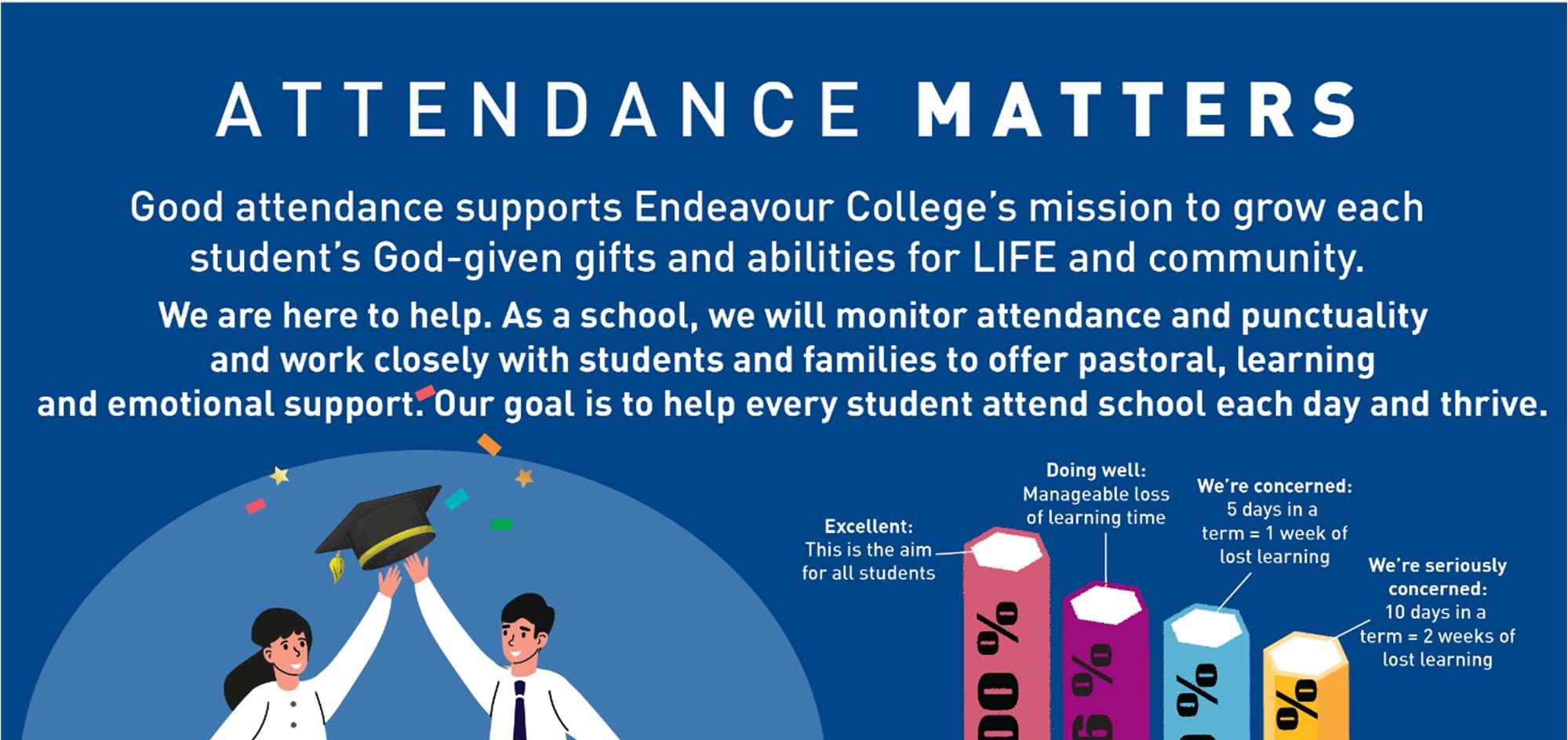
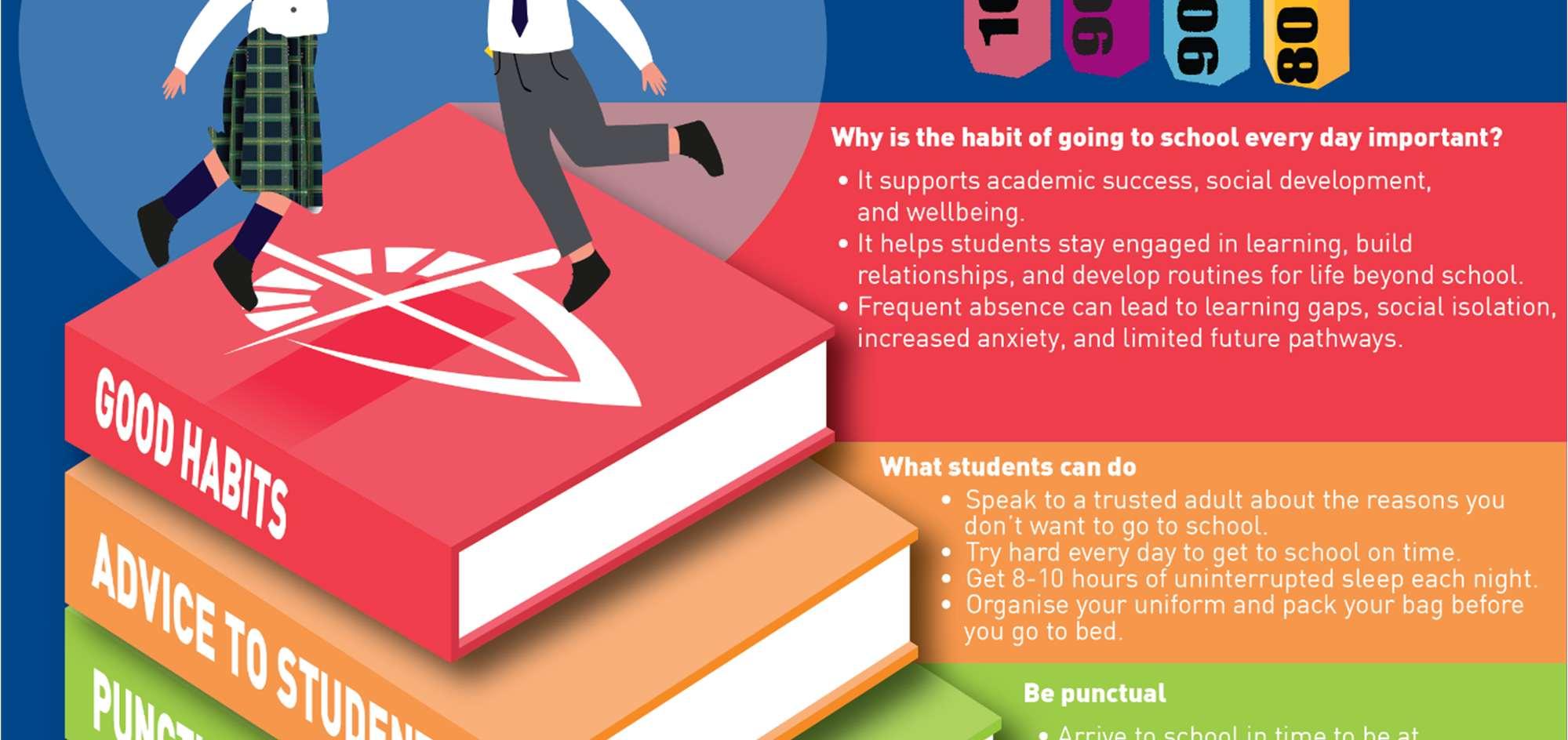
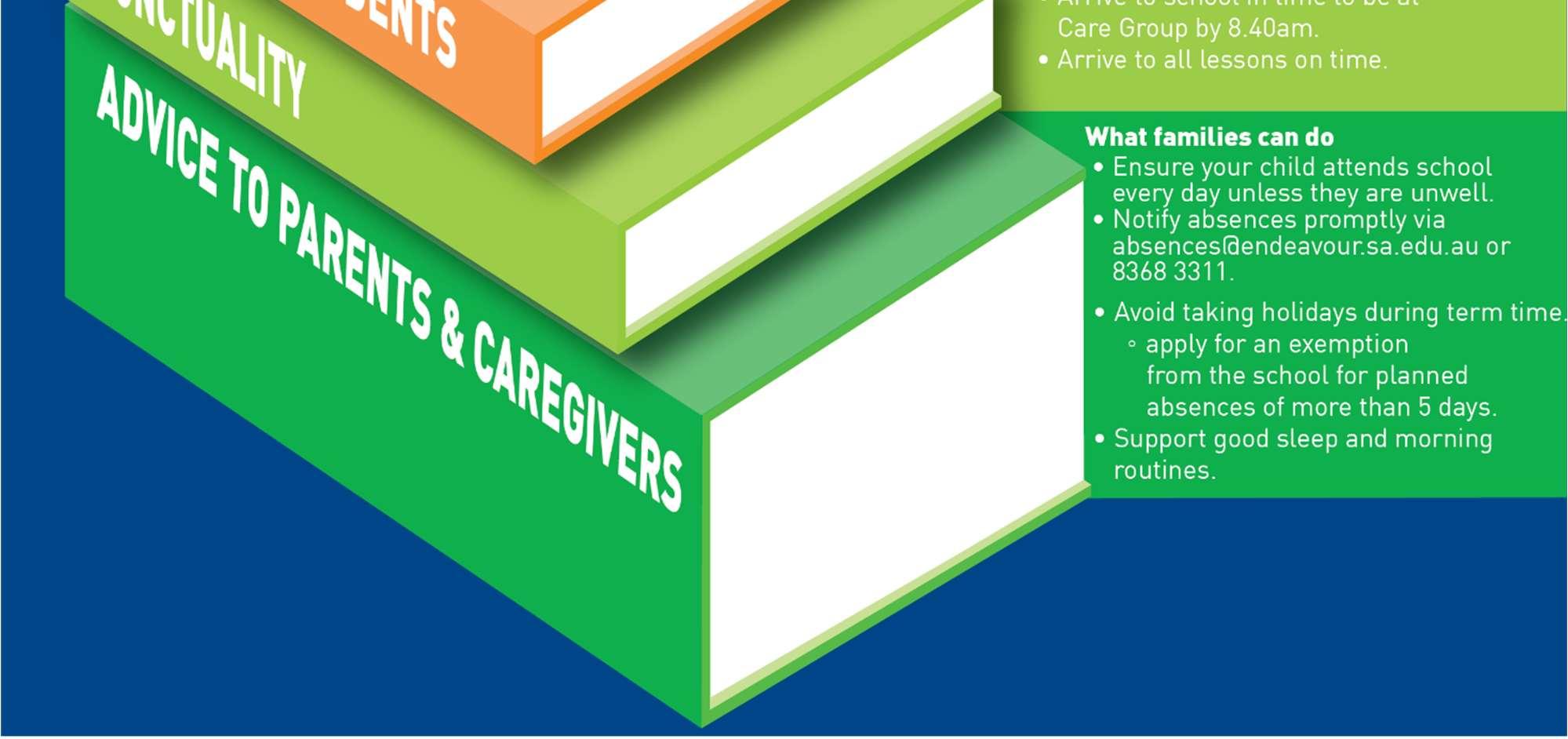
We remind parents that students are expected by law to attend school regularly until the age of 17 years. Each day missed means work and progress are hampered. Students should only be away from school when it is absolutely necessary. Acceptable reasons for absence are illness and injury. Caregivers should submit an Application for Exemption from School form for family holidays/events, andextra-curricular competitions that occur during term time. Forms can be requested from Student Services.
Full school uniform is to be worn to and from school, unless approval has been givenfor some variation due to a particular event (e.g. carnivals, non-uniform days).
Arrival at School
Students are expected to arrive at Endeavour College between 8:15am and 8:35am each morning so that they can prepare for the day and be at Care Group by 8:40am with their diary, hat, device and all equipment for Lessons 1 and 2. Once students have arrived on campus, they are not toleave the College grounds. Supervision in theyard is provided by staff from 8.15am.
Latearrival
If a student arrives after 8.40am, they must report to Student Services to indicate the time of arrival, read the morning notices and then attend the appropriate lesson as per their time of arrival. A phone call or email to absences@endeavour.sa.edu.au from a parent or caregiver must bemade by 9am on the day of absence. Lateness by the student without parent/caregiver notification to the College will incur a Reminder.
If a student leaves the school premises prior to the end of the day (illness, medical appointment etc.), they must report to Student Services to sign out. Where the appointment is planned, acallor email should be sent to absences@endeavour.sa.edu.au. Senior students on particular external subjects/programs must sign in / out according tothe known schedule.
Year 12 students canleave the Collegegrounds during study lessons and break times once permission has been provided by a parent/caregiver. They must sign in and out each time.
A student who is ill during the day must go to Student Services for medical attention. Parents will then be contacted if a child is too illto remain at school. It is important, as part of our duty of care, that students do not contact parents to arrange to be collected.
Absence
Parents are asked to inform the College when their childis absent. This can be done by telephoning the College between 8:15am and 9.00am, email (absences@endeavour.sa.edu.au) or leaving a message on the answering machine (on the day of absence). Any unexplained absence or failure of a student to register their presence at College will be followed up by notification to parent/caregivers that day.
If there is a reason which requires students to be absent on a regular basis, parents are asked to discuss thematter initially with their Care Group teacher and then inform the Principal and/or Head of Middle School/Head of Senior School of the reason for the students absence in writing.
We urge parents to use the school holiday periods for their family holidays if possible, and to avoid having their children miss classes.
Work Missed
When a student misses lessons, whether this is due to illness, excursions, music tuition or any other reason, it is the student’sresponsibility to find out what class work has been missed and make arrangements to catch up.
Students and parents/caregivers are asked to take note of the following arrangements in the event of absence from College. For planned absences – please see theinformation and legal requirements described on page 18.
YEARS 7, 8, 9 & 10 – ILLNESS
1. For an illness of 1-5 days, teachers will not provide work for students at home. It is felt that students should rest to regain their full health. If deemed necessary by the teacher, the student will be able to catch up on their return to the College. In most cases students would have ongoingassignments or reading material at homewith them if they wish/be able to pursue their studies.
2. If the illness extends beyond a week, then parents or the student may wish to contact the Care Group teacher and request that work be providedto the student, where possible. In this case, a minimum of 48 hours turnaroundtime is needed to enable teachers to prepare.
YEARS 7, 8, 9 & 10 – HOLIDAYS
1. For a family holiday of one or two weeks during term time, teachers will not be required toprepare work for students. If the student is currently working on assignments, they would be expected to complete these and submit them before their holiday commences or upon their return to the College.
2. For an extended family holiday parents should contact the Care Group teacher and Head of Village to discuss the situation. Teachers may wish to provide some general work for students to complete.
YEARS 11 & 12 – ILLNESS
1. For an absence of 1-3 days students, if able, should continue with any ongoing assignments. If they are not, however, able tocomply with a due date then they should obtain a medical certificate andstudent/parent contact should be made with the subject teacher. Alternative duedates can be negotiated with teachers on thestudent's return to the College.
2. For an absence of more than three days the parent should contact the Care Group teacher and Head of Village who will request that, where possible, teachers prepare work to be completed by the student at home. This willbe collated and available for pick upat Student Services, or emailed where possible, no sooner than 48 hours after initial contact. A medicalcertificate should be obtained for presentation to teachers upon return to the College.
3. Most summative assignments will still need to be completed by students.
YEARS 11 & 12 – HOLIDAYS
It is our advice that families should avoid taking holidays during the school term.
If a holiday cannot be avoided, then it is the responsibility of the student to negotiate with individual subject teachers beforehandwhat work needs to be undertaken and/or completed during the holiday period. It is strongly recommended that this work be undertaken before and not after the period of absence.
Pleaserefer to the Allergy Awareness Policy in the Appendix.
At the end of each semester, the College awards the highest achieving students with awards to recognise their academic achievements.
Academic Application: Recognising students who consistently demonstrate exemplary effort, engagement, and attitude in their learning, as reflected in their end-of-semester report.
Academic Achievement: Recognising excellence in academic achievement across their course of study.
Academic Achievement with Merit: Honouring students who meet an exceptionally high academic standard.
Middle School Outstanding Achievement: Recognising students who have displayed outstandingachievement and application to their studies throughout 6 semesters of study in the Middle School.
Year 12 Subject Prizes: Honouring students who demonstrate excellence in academic achievement or academic application in their Stage 2 subjects.
Criteria:
Academic Application: All attitude designations in the end-of-semester report must be rated as 1 or 2, with the majority being 1s.
Academic Achievement: Students must achieve a TASS GPA of 13 (an A- average) or above.
Academic Achievement with Merit: Student must be in the top 3% or equal to the top 3% of TASS GPA in their Year Level and achieve all A grades
Middle School Outstanding Achievement: Student must have achieved both an Academic Application and Academic Achievement awardin all 6 semesters of study of Years 7, 8and 9
Year 12 Subject Prizes: Achievement award presented to the student with the highest school-based gradein each subject. Applicationawards presented to the students who showed outstanding application towards their studies in an individual subject
Pleaserefer to the Bullying and Harassment Prevention and Intervention policy in the Appendix, or on our website.
It is a right of all students and drivers on school buses to be able to travel to and from school safely. Students are therefore required to adhere to the following rules when using a school bus at any time. The rules are based on common sense and courtesy. Any disruption to the bus driver’s concentration places the safety of all people on the bus at risk. Consequently, any action, physical or verbal, threatening the driver’s concentration must be avoided.
Every bus trip must be validated with the Student ID card, and a bus pass purchased either in advance or after the trip has occurred throughthe Bus Minder app.
Consequences
Failure to comply with the bus policy willresult in follow up by a Head of Village or Head of Middle School / Head of Senior School. Consequences may includethe inability totravel on the bus for a period of time.
The College expects students to apply the same rules when they are travelling on any public or private transport.
Although our College buildings are at low risk of being affected by a bushfire, we are aware that some of our families (both students and staff), may live in an area that could be affected by such an event. In the case of a catastrophic event, the College willfollow the advice of local authorities.
Camps and whole year level events enableus to achieve educational, spiritual and pastoral objectives. Attendance at camps/whole year events is compulsory for all students. Costs are additional to the standard school fees. Camp costs will be debited toyour account at the start of each school year. Full charges for the camp/event will be debited to your account for non-attendance unless a doctor’s certificate for the duration of the activity is supplied.
Incoming information related to careers, and assistance with enquiries about such matters is handled by the Pathways Coordinator in conjunction with the Heads of Village who also act as Course Counsellors. Contact deborah.frahn@endeavour.sa.edu.au.
There is a Careers Canvas course for all Year 10-12 students and families. The Endeavour Pathways site is also filled with relevant careers and pathways information.
Care Group Connection evenings are one way that parents/caregivers can maintain contact with Care Group teachers. Families will attend one Care Group Connection evening where students can speak with their Care Group teacher(s) and parents/caregivers about their social and personal growth, and to set some future focused goals.
These nights arescheduled to occur at the beginning of Term 2 and Term 4. These nights arevaluable in developing in students a level of increased independence, interdependence andcollective action.
Term 2: Year 12, Year 11 and Year 8.
Term 4: Year 10, Year 7 and Year 9.
All items belonging to a student must be clearly andpermanently named in an obvious position. This is particularly crucial with uniform items and calculators.
Students must take goodcare of items which are in their possession and show respect for the belongings of others.
Money and valuables should be locked in lockers or left at Student Services for safekeeping and collected at the end of the day. Musical instruments can betaken to the Music Storeroom in the morning for storage during the day and collected at home time. The College will not take responsibility if they are lost, stolen or damaged other than the normal channels of follow up through student notices.
(See also Valuable Items and Lost Property)
Appearance of Student Possessions
(Books, folders, pencil cases, school bags, sports bags etc.)
It is important that students show proper care and attention to all possession so that their appearance reflects the College's values and expectations.
The following guidelines have been established:
All items should have theowner's name neatly and clearly written for identification purposes
Pencilcases, school bags, diary and sports bags should be clean of graffiti and students may be asked to purchase new items if marked inappropriately
Any decorations on laptops, exercisebooks or folders and wallpaper on digitaldevices should be minimal and should not be offensive in any way
Hire books must not be marked in anyway as they are on loan from the College
Students are required to attend the various carnival days throughout the school year. On these days it is important that students areappropriately dressed toparticipate in these activities. At various carnivals students will be encouraged to support their Village by the colour of their clothing and accessories.
Teams willbe selected across allyear levels for Inter-School Swimming and Inter-School Athletics subsequent to Inter-Village competition. These are Term 2 competitions.
Students must abide by the guidelines set out below when attending these events:
On all occasions students, should dress modestly with common sense, considering others in the College community
Appropriate practicality of bathing suits for the Swimming Carnival should be taken into consideration before they are worn(students should ensure their bathers properly cover them/maintain integrity during swimming events)
Clothing worn should not haveany slogans that are offensive to anyone in the College community and should be ageappropriate (i.e. not clothing with reference to alcohol or other inappropriate messages).
Shirts should cover the upper body including shoulders
If on the day of the event, staff deem the attire is inappropriate (taking into consideration the above guidelines) wewill insist that the student cover themselves up with a shirt and/or shorts.
Where appropriate for the event, sunscreen, hat, etc. should also be incorporated.
These guidelines are put in place to ensure that all members of the community can work and learn in an environment where they feel safe and valued.
CanvasistheCollege’slearningmanagementsystem.Itallowscoursework tobe uploadedaswellas assessment and feedback results to be shared. When posted, data goes to both students and parents simultaneously. As a minimum the following needs to be added to Canvas for each course:
Due dates for assessment tasks
Task results and feedback
An overview of the course
Resultswillbeuploadedwithintwoweeksoftheduedate.Thismaychangeinlinewithanyindividualextensionsoffered andthe size of individual assessments.
Our College mission statement identifies us as a Christian environment for LIFE and community. As Christianstaff in a Christian school, we acknowledgethat Jesus Christ stands at the centre of all we do, both in and out of the classroom, andthat we are to do everything for God’s glory (1 Corinthians 10:31). ALL we do is to be an act of worship.
In addition to this understanding, Endeavour College has a daily program of spirituality designed to facilitate the knowledge and experience of Jesus Christ as Saviour. This is demonstrated especially through the importance placed on the devotional life of the school.
Each day the staff meet at 8.25am to share devotional time together and for students, a spiritual focus is part of the pastoral time at the beginning of each day. This could include voluntary Worship, Chapel, Year Levelmeetings and / or Village/Care Group.
Staff and students are required toattend Chapel once a week. SpecialChapel Services are held at important times in the Christian Calendar, including AshWednesday, Easter, Pentecost, All Saints, and Advent.
Special Chapel
Special Chapelservices often have extra time provided, as they focus onimportant times in the Christian Calendar and include Christian expressions of faith that students are invited to participate in, as their faith and wishes determine. Some of these expressions of faith include (but are not limited to) thefollowing:
Ash Wednesday – The Imposition of Ashes
The Imposition of Ashes is a ritual for Christians to remember their brokenness, and their desire to live God’s way, often known as repentance. Students and Staff who would like to participate come forwardand have ash placed on their forehead in the shape of across. This ritual is adjusted appropriately as COVID-19 and other factors determine.
Easter – Holy Communion
Easter focuses on the deathand resurrection of Jesus. Often an Easter service will include Holy Communion (as may other services from time to time.) Holy Communion is a meal where participation expresses trust and faith in Jesus, andas such, it is treated with respect in the Endeavour College Community. Many Christian traditions place a high value on receiving Holy Communion. Staff and students are invited to participate according totheir faith, and to do so in a way that honours and respects the understanding of the Lutheran Church of Australia, of which Endeavour College is a part. Staff and students who are unsure about Holy Communion are encouraged to speak with the College Pastor or Ministry Staff, or anotherChristian staff member within the College. If a student wishes to commence receivingHoly Communion in the College environment, we strongly recommend a conversation with the Ministry Staff at Endeavour, in order to assist the student with their understanding of the Christian faith.
Pentecost – Prayer for the Holy Spirit
Pentecost focuses on the coming of the presence of the Holy Spirit in the life of a Christian. As part of the Pentecost service, students and staff are often invited tohave someone pray for them, especially that they would receive the gift of the Holy Spirit in their life. This service takes place approximately 7 weeks after Easter.
All Saints – Lighting of Candles
All Saints takes place on, or near to, November 1st, and is an opportunity toreflect onthe lives of thosewho have passed away in the previous 12months, andto thank God for the gifts that we have received from them. Students and staff are invited to light a small candle as part of their reflection, and to place it on the altar.
Advent
Advent marks the beginning of the Christian calendar. It links to the Christian understanding that Jesus came to start putting things right in our world at Christmas, and will make all things right at the end of time. At Endeavour, we specifically focus on the lead up to Christmas. This Special Chapel does not generally include a specific ritual for students to participate in.
Endeavour College is committed to the safety and wellbeing of allchildren andyoung people. Only in a safe learning environment can students reach their full potential. We support the rights of the child and will seek to ensure a child safe environment is always maintained. We support and encourage all our staff and volunteers in building and maintaining a secure environment for our whole community.
Refer to our Child Safe Policy in the Appendix, or on our website.
College life is an important aspect of student development and as a result all students are encouraged tobeinvolved in some of the activities offered at the College. These are designed to both challenge and extend the students’ abilities.
An annual Clubs booklet is availablefor students to see what is being offered at theCollege that year.
For communication between home and College related to student wellbeing and learning, the first person to be contacted is the CareGroup teacher. Issues can then be referredonif necessary.
Endeavour College Website: www.endeavour.sa.edu.au
Absences: absences@endeavour.sa.edu.au
Teaching Staff: as indicated on page 10.
General Student Matters: Student Services
School Calendar: on the College website or TASS Parent Lounge
General Principles
As part of the curriculum, Endeavour College allows students access to its computer network and certainon-line facilities such as:
Internet
Electronic mail (email)
Access to the computer network is a privilege which may beenjoyed as long as certain standards are observed. Those standards are set out in the Digital Devices policy – see Appendix.
The College employs a counsellor whose role is student wellbeing and the critical foundation this provides for quality learning at the College. The Counsellors are available to provide counselling and additional support to students in all year levels at Endeavour, for all presenting issues, and may refer students to other external services where appropriate.
Students can make an appointment to see a Counsellor by contacting The Well themselves. Appointments can only be made during College hours, except when parents negotiate special arrangements. Parents may also communicate with the Counsellors to discuss wellbeing concerns andrefer their child by phoning the College or emailing thewell@endeavour.sa.edu.au There are no charges to parents or students for using this service.
At the heart of our College is our learning program.
A comprehensive range of subjects is provided. This reflects the variety of student interests and abilities, the unique opportunities of our educational environment and the pursuit of excellence that is part of the Lutheran schooling pursuit. Our offerings areconstantly under review and meet the requirements of the Australian Curriculum andthe SACE Board. Please refer to the Middle School Curriculum Guide and the Senior School Curriculum Guide for relevant course information.
Curriculum booklets are published in the latter part of the current school year to supply information and requirements for the subjects to be chosen for the followingyear.
In Term 3 each year, course counselling will occur for senior students (Year 10 and Year 11) to ensure subjects chosen meet SACErequirements and future study requisites. The Head of Village will act as Course Counsellor for each student and deal with all aspects of their courses and changes until the end of Year 12.
Subject choices are based on the following:
students meets the entry requirements for the subsequent year (usually a pass inthe previous year)
student achieve an Attitude notation of 1-3 and
students have an attendancerate of at least 80%
Students in Years 10 -12 have a two-week grace period at the start of each semester to request any subject changes. At this time no further changes will be accepted (except under exceptionalcircumstances). Parents and students will be requiredto sign off onRequest to Change Subjects forms before changes can be made. Subject change requests cannot be guaranteed and are dependent on a variety of factors including class sizes, recommendations and prerequisites being met. All requests for changes must belodged prior to the Friday of the second teaching week in each semester.
Students in Years 7-9 will also select their subject preferences in Term 3.
Subject allocations will be sent out to families inTerm 4 to allow booklist selections for the following year.
Endeavour College encourages each student to consider playing an instrument (includes voice). Regular practice of a musical instrument and subsequent performance is an excellent way to develop positive attitudes andself-confidence. Instrumental teachers come to the College weekly to give instrumental tuition. Instrumental lessons are normally organised on a rotating timetable. These lessons are available from Year 7 and attract an additional cost. Year 7s may choose to undertake group lessons. Instrumental lessons, if taken at the College, are an addition to the normal school timetable and consequently students miss lessons to attend instrumental tuition. Students have the responsibility to catch up on lesson work missed as a result of an instrumental lesson.
There are several co-curricular performance ensembles. These may rehearse at lunchtimes and/or after school. Students taking instrumental lessons are encouraged to become members of at least one of the College’s performance ensembles. These ensembles perform at College and community events throughout the year. Further information can be found by contacting Catherine Stanley, Music Coordinator catherine.stanley@endeavour.sa.edu.au
Endeavour College supports the inclusion, valuing and acceptance of allindividuals in our College community. We aim to engage students in educational programs that set them up for success as learners. It is our practice to include andsupport students with special needs and learning difficulties within the mainstream classroom. All teaching staff have a responsibility to differentiate the learning activities and assessment within their classrooms. The primary role of Learning Support staff is to work within classrooms with individual students or in smallgroups. Learning Support staff also act in an advisory role for curriculum adjustments and modifications. Learning Support staff operate out of The Hub.
Students with learning needs are identified in the first instancethrough the enrolment process. Students may also be identified after they have commenced at the College, following the observations of their classroom teachers or through broad testing such as PAT testing. Learning support needs of students are itemised in their Individual Learning Plan (ILP) which is made accessible to relevant staff via TASS. ILPs are revised regularly.
The Homework Club is a service provided by The Hub. This operates on Tuesday afternoons from 3.30 - 4.30 pm. Any student may attend Homework Club to work on tasks in a supported and supervised environment.
Endeavour College aims to support each student to develop their God-given abilities in an inclusive, caring and supportive environment. It is our policy to support gifted students within the mainstream classroom. Teachers differentiate theircurriculum to provide an environment of challenge and encouragement for students toachieve their potential. While our policy is one of inclusion, some possibilities for acceleration and extension classes exist. There arealso opportunities for curriculum enrichment through a rangeof clubs and special programs, both internaland external.
Identification
Giftedness, in the educational sense, refers to a group of approximately 10% of the student cohort who possess exceptional abilities. Identification of gifted students is an ongoing process that relies on more than one method to provide accurate information about a student’s abilities. Identification methods may include formal tests, such as PAT, NAPLAN results and tests by psychologists and other professionals, observations by parents and teachers, and student work samples.
Teachers provide enrichment within their classes. In addition, gifted and talented students are encouraged to involve themselves in a range of extra-curricular activities to broaden their educational experience. Participationin external competitions is also a valuable source of enrichment.
Students should generally not arrive at College before 8.15am and they should haveleft the College grounds by 3.45pm as these are the limits of adult supervision in the yard. TheCollege Library is staffed until 4.00pm Monday to Thursday, and until4pm on Friday should students wish to use it. If there is a reason why any student needs to be on the Collegeproperty outside of these hours, on a regular basis, parents should arrange this with the Head of Village andHead of Middle School or Headof Senior School.
Once students have arrived on the premises, they are not to leavethe College grounds. As a matter of duty of care, students, once arrived on the College premises must remain on the premises. It is not acceptable to leave without parental permission until the endof the school day. Year 12 students may sign out during study periods and break times with parental permission.
It is important that students are organised for the day and are at Care Group by 8:40am.
The use of the College Library until4.30pm Monday to Thursday and4.00pm Friday is an option.
AllstudentsinYear7aretousetheCollege-issueddiaryforrecordinghomework,subjectassessmentgradesandgoals andreflections.Parentsareaskedtomonitoritsuse.Teacherswill,onappropriateoccasions,assiststudentsintheuse of the diary.
Withrespecttopersonalorganisation,weencouragestudentstochooseamethodforrecordingtheirtasksandmanage their time that best works for them. This may be a written or electronic method. Regardless of their chosen method to record their tasks and manage their time the following expectations apply:
students should record each task at thetime it is set by the teacher
students should also record the amount of time that the teacher has suggested to be spent on the task
students should note the duedate for the task
It is each student’s responsibility to record the set task appropriately. If a task is not completedby the due date, the subject teacher may ask thestudent to attend the ARK at lunchtime to enable them to complete thetask with teacher support.
These procedures relate to any personal electronic device that could be used for communications or data storage. This includes but is not exclusive of mobile phones, USB devices, tablets and laptop computers.
In General
Apart from a laptop device, there is no expectationfromthe College that any of these items are required by students at College, therefore the College would encourage students not to bring these items. The College takes no responsibility for damageor theft to any of these personal items. Students bring them to College at their own risk.
Equipment must not be used to harass or victimise other students or staff or to abuse aperson’s right toprivacy (for example, taking, storing and then using a digitalphotograph without a person’s permission is an invasionof privacy andcould have legal implications).
Student owned Devices
The College has a 1-1 Laptop program in place for all students. Families who have students who are new to the Laptopprogram, will be provided with a separate document / policy outlineat the start of the school year. The College supplied device is the only devicethat students are expected to bring to College.
USB Devices
USB devices areuseful tools for transferring data and their use is encouraged where applicable. However, when brought on campus these are to be free from files that contain inappropriate or offensivecontent. It is important that students label their USB device clearly as they are to take personal responsibility.
Use of Electronic Communication Equipment during Assessments
Students must not bring any electronic communication equipment (even if it is turned off) into an assessment setting for tests and examinations, without teacher permission. This includes smart watches. If this equipment is found during assessment tasks, this will be considered a breach of rules and may incur severe penalties.
Refer to the Digital Devices Policy in the Appendix.
Permission todrive to school is a privilege granted to senior students by you as their parents / caregivers in recognition of their growing independence and responsibility.
We as a College acknowledgewe have no control over who drives to school; however, for the safety and wellbeing of all students it is necessary to maintaina thorough record of all student drivers and their passengers.
Aside from legal requirements, driving other students is an enormous responsibility and therefore needs to be carefully considered by all parties. Students who wish to carry passengers to and from school must obtain the permission of both their parents and the passenger’s parents. Families will be asked to complete the Student Driver and Passenger Registration form, which will be provided to Year 12 families at thestart of theyear.
Pleasenote that commencing in 2026, students are not permitted to access their cars duringstudy periods, recess or lunch, unless they havesigned out for the day and do not intend to return. Any breaches in the responsibilities of drivers or passengers will be responded to in accordance with the College’s Student Engagement Policy.
There is no longer any student parking available on campus. We recommend the Adelaide University carpark. Parking fees apply and can be paid via the smartphone app or at the Pay-by-Plate machine.
Limited parking may be available in nearby streets. Students whochose this option are asked to give due consideration to residents, and ensure they avoid parking across driveways andaccess points, and that they do not park across from other vehicles thus restricting access to large vehicles and emergency services.
In the event of an emergency the siren willsound. Students will be involvedin drills for both evacuation procedures and lock in/out procedures throughout the year.
On hearing the alarm for the evacuation procedure, students should stay calm, follow theinstructions of their teacher and proceed to their Village positions on the eastern side of the College.
Upon hearing the alarm for the lock in/lock out procedure, students should remain calmand follow the instructions of their teacher. This procedure couldinclude such actions as; remaining in their classroom, sitting quietly under their desk or being led over to the University courtyard area.
At Endeavour College we aim to develop a community culture where relationships are valued and members feel connected, safe and respected. We believe this approachfosters an optimal learning environment to fulfil staff and students God given abilities for life and community.
The Restorative Practices approach emphasises working with Endeavour College community members to educate them to address behaviour and value relationships. It calls community members to make a personal transformation from a focus on the self towards a focus onothers and the commongood, and as such it reflects themodel of Christ in terms of dealing with others.
The Restorative Practices approach reflects thecentral value the College’s community places on relationships –amongstudents, staff and families. This approach forms the basis of our Student Engagement policy.
The College believes that its approach to student engagement should primarily be an educative one. That is, the fundamentalaim of the student engagement philosophy and practice should be for students to learn to be responsible for themselves andtheir actions and to make genuine, positive contributions to their community. A restorative approach sees conflict or wrong doingas an opportunity for students to learn about the consequences of their actions, to develop empathy with others, and to seek to make amends in such a way as to strengthen the community bonds that may have been damaged.
The Endeavour Way (Love, Courage, Forgiveness, Hope) are the lived values of Endeavour College and assists us to reflect the love of God through the way we seek to provide a safe and caring environment for all adults and students involved in our College community
Endeavour College celebrates the achievements of our students both academically and for service to the community at the endof the year:
Valedictory Service (Year 12) Thursday 19 November (7.00pm)
Senior School Final Service (Year 10 & 11) Wednesday 2 December (2.00pm)
Middle School Final Service (Year 7, 8 & 9) Monday 7 December (1.30pm)
These are issued to students for positive behaviours andactions that reflect the Endeavour Way values –showing Love, Courage, Forgiveness and Hope
They earn 2 points which are tallied toward the Village Shield
Endeavour College aims to support each student to develop their God-given abilities in an inclusive, caring and supportive environment. It is our policy to support gifted students within the mainstream classroom. Teachers differentiate theircurriculum to provide an environment of challenge and encouragement for students toachieve their potential. While our policy is one of inclusion, some possibilities for acceleration and extension classes exist. There
arealso opportunities for curriculum enrichment through a rangeof clubs and special programs, both internal and external.
Identification
Giftedness, in the educational sense, refers to a group of approximately 10% of the student cohort who possess exceptional abilities. Identification of gifted students is an ongoing process that relies on more than one method to provide accurate information about a student’s abilities. Identification methods may include formal tests, such as PAT, NAPLAN results and tests by psychologists and other professionals, observations by parents and teachers, and student work samples.
All teachers at Endeavour College have a responsibility to differentiate the curriculum to cater for different learning needs, including giftedness. Adaptations that may be made to cater for the needs of a gifted student include:
Enrichment, extension, acceleration
Increased pace or complexity of learning
Activities that develop higher order thinking, creativity, critical thinking
Activities that promote independent learningskills
The use of community resources and mentors.
In addition, gifted and talented students are encouraged to involvethemselves in a range of extra-curricular activities to broaden their educational experience. Participation in externalcompetitions is also a valuable source of enrichment.
Endeavour College provides examinations experience for all senior students in preparation for the Year 12 SACE examination requirements. Students inthe Senior School can expect tosit an examination for any subject for which there is an equivalent SACE Stage 2 examination. Timetables and further information regarding these examinations will be circulated closer to the time. Subjects for which there is an electronic examination at Stage 2, will also run examinations in an electronic format in Years 10-12, where possible.
End of Semester 1 Examinations
Year 10-11 Examinations
Year 12 Mid-Year Examinations
End of Semester 2 Examinations
Year 10 Examinations
Year 11 Examinations
Year 12 Examinations
23 - 25 June
30 June - 2 July
30 November – 1 December
24 – 26 November
2 – 13 November (as per SACE Board schedule)
If weather conditions make it unsuitable for students to use outside areas at recess and lunchtime due to wet weather or extreme heat, ‘Extreme Weather’ will be declared by sounding asiren. Once Extreme Weather is declared, the outside areas are out of bounds. Indoors are made available to students for orderly use only (no ball games, running, throwing, etc.).
On the day of a major event when the forecast temperature is 360 C or above as published theprevious day by the Bureau of Meteorology (BOM), a risk assessment will be made as to whether the event will becancelled. Some events may continue if it is deemed safe to do so. For example, water sports, indoor or morning events may continue with a modified format. Occasionally events may be cancelled earlier than the previous day based on a longer-range forecast. A message will be sent home via a student announcement, or if that is impractical, anemailwill be sent to families.
Parents are reminded to ensure children apply sunscreen and bring their water bottles daily. Parents may also exercise their right to keep students’ home on days of extreme heat.
All staff will exercise duty of carewhen taking students for physical activity/fitness lessons during hot weather to ensurethat students do not overheat, and that sun exposure is kept to a minimum. Staff are advisedto minimise outdoor activities between 11.00am and 3.00pm.
Refer to Inclement Weather Policy in the Appendix.
Completed Enrolment Application forms must be accompanied by an application fee of $50 per student to cover administration costs involved in processing the application. This fee is non-refundable and does not guarantee enrolment at the College. Connected Schools families are exempt from this payment.
Should the College offer enrolment, an enrolment bond of $500 must be paid. This bond is refundable inthe final term of the student’s enrolment.
The bond will be refunded provided the following conditions are met:
All financial obligations to the College are paid
The return of all hire textbooks in good order and condition
At least one term’s notice of leaving the College is givenin writing to the Principal. This notification must be provided in a formal letter addressed to thePrincipal.
The enrolment bond will not be refunded if the offer of placement is accepted but withdrawn before the student starts College. The above conditions may be waived at the discretion of the College Board.
The tuitionfee includes a textbook hire fee and a composite fee to cover various sundry items. The College will, from time to time, charge separately for items such as the laptop program, ICT levy, compulsory subject charges, camps and excursions, etc. There will benotification of these additional charges.
The full year of fees willbe charged in January each year. Fees are due and payable by the last Friday in January. If you are unable to pay in advance, we ask for regular direct payments being in place, either via a direct debit froma nominated bank account or card, cash or BPay payment to the College. Card payments can also be madethrough the TASS Parent Lounge. Late payments may incur a $25 fee. Statements willbe emailed in the first week of each month, with your outstandingamounts owing.
For families with more than one student concurrently enrolled at theCollege the following concessions apply:
2nd child
3rd child
4th and subsequent child
10% fee reduction
15% fee reduction
20% fee reduction
Families who have one or more children enrolled at St Paul Lutheran School, Blair Athol, Good Shepherd Lutheran School, Para Vista or Golden Grove Lutheran School, Wynn Valewillreceive an additional fee concession of 5% of the Collegefees for each childat those schools.
In exceptional circumstances we may consider fee remissions. Any change inyour situation or difficulty paying fees needs to be communicated as soon as possible and willrequire full financial disclosure. Application for fee remission forms are available from the Finance Manager. All information provided by families in theseforms willbe heldin the strictest confidence by the College. Any fee remission granted will only apply for oneacademic year unless continued for multiple year in exceptionalcircumstances.
Endeavour College has partnered with Edstart as a commitment to improve the affordability and accessibility of an Endeavour educationfor all families in our community. The Edstart Extend option will ensure families arenot reliant on receiving a fee remissioneach year to help pay for their annualfees.
Instrumental andvoice lessons areavailable to allstudents at the College on an individual or if in Year 7, group lesson basis. The College has arranged for suitably qualified teachers to provide such lessons. All fees associated with such tuition, which is not part of the formal College curriculum, areto be paid directly to the teacher(s) concerned. Allmusic tuition is a private arrangement between the teacher and the student and the payment for these lessons is in no way the concern of the College.
Should a student wish to discontinue enrolment at the College, one term's notice in writing to the Principal is required, or payment of one term'sfees in lieu. This notification must beprovided in aformal letter addressed to
the Principal. Variations to payment of a term's fee may be considered only in specialcircumstances, upon receipt of a written submission.
At the beginning of your child’s schooling at Endeavour College, you will be asked to complete aGeneralConsents form requesting your consent for the following areas:
Local Excursions: This consent relates to excursions that occur in the immediate environs of Mawson Lakes. For any trips or excursions out of the local area, separate permission will be sought.
Participation in Events, Performancesor Competitions: This consent relates toevents, performances or competitions conducted at the College or within the Mawson Lakes area where the cost is under the dollar amount nominated on the form. Noticewillbe given to parents/caregivers beforehand, outlining the nature and associated cost. Where the cost is over the nominated amount, or the event requires students to be transported to another venue, separate parent/caregiver permission will be sought.
Moviesand Other Media Formats: This consent relates toyour child being able to watch movies or other media formats used as a method to enhance student learning outcomes and rated at the appropriate classification for their age (General (G), ParentalGuidance(PG) or Mature (M)).
Photography / Video: This consent relates to the use of your child’s photograph/video (without full name or other identifying information), and any sample work to be used in print and online promotional, marketing, media and education material external of Endeavour College andits educational partners. This includes materials available toschools andeducation departments around Australia under the NationalEducational Access Licence for Schools (NEALS) which is a licence between education departments of the various states andterritories, allowing school to use licensed material wholly and freely for educational purposes.
Note: Once students reach the age of 15 years, under the Australian Privacy Principles (APPs), they are also able to consent to the release of their personal information (i.e. use of their photograph/video image for marketing purposes). The College will seek separate consent from all students oncethey are in Senior School(Years 10-12), however it is important to note that should your child choose togive their consent, the College will only use their images if the parent/caregiver has also provided their consent.
Consents given by parents/caregivers on this form will continue for the duration of the student’s schooling at the College unless the College is advised otherwise in writing from the parent/caregiver. This may be in the form of a signed letter, or via an email to admin@endeavour.sa.edu.au.
At Endeavour College we value relationships and that all conflict should be resolved through the use of Restorative Practices. We support theright of any member of the College community who has a grievance to be treated with respect, given information and guidance on how to appropriately resolve the issue and be supported in their actions to do so.
Confidentiality is essential in the grievanceprocedure and may be a legal requirement. Grievances should be discussed within the Restorative Practices framework with the aim of restoring harmed relationships and preventing further issues.
The usual procedure to be followed in addressing a grievance is that initially, it should be dealt with in an informal and timely manner (eg; where the grievance arises at the class level there should be a genuine attempt to resolve the grievance at this level). More issues are resolved restoratively when bothparties are calm and able to discuss issues rationally and openly.
If this is not possible or if a grievance cannot be resolved informally, it may mean that a more formal grievance procedure will need to be followed as set out in thetable below.
Tellthepersoninvolvedwhatyour concernsareandwhatyouwould liketohavehappen.
Arrangeatimetospeaktotheperson concerned.Youmayseekthehelpof anadvocateoradesignatedcontact person.
Arrangea time,throughtheoffice,to speaktothestaffmember concerned.Allissuesinvolving studentsshouldbeaddressed
Listenandbeopentotheir response.
Ifthegrievanceisnotresolved,speak toyourappropriateleader,orastaff memberyoufeelcomfortablewith,and askfortheirsupportinaddressingthe grievance.
throughanappropriatestaffmember andnotdirectly withthechild.
Letthe staffmemberknowwhatyou considertobeunjustorunfair.
Atthemeetingclearlyoutlinethekey issuesandworktogethertodevisea suitableresolution. Thismaybe written.
Issues moving to the shaded area may involve a restorative conference.
Explainthegrievancetoateacher, includewhowasinvolved,what happened,whatyoudidandwhat youbelieve wasunjustorunfair. Youmaybringsomeone withyou forsupport.
Ifyoufeelthegrievancehasnot beenaddressedarrangeatimeto speaktotheHeadofVillageorthe CollegeCounsellor.
Ifthisgrievanceisongoing,arrange atimetospeakwiththeHeadof MiddleorHeadofSeniorSchool, DeputyPrincipalorPrincipal.
Ifthegrievanceisstillongoing,makea timetodiscusswiththeDeputy PrincipalorPrincipal.
Ifyouarestilldissatisfied,thenfollow theprocedureasattachedfromthe Lutheran Schools Enterprise Agreement 2012.
Ifyoufeelthegrievanceisnot addressedyoumayarrangeatimeto speaktosomeoneintheCollege leadershipteam(eg;Principal, DeputyPrincipal,Pastor,Headof Learning,HeadofMiddleSchools, Head ofSeniorSchool).
Ifyouarestilldissatisfiedapproach theCollegeBoardChairperson.
Ifyouarestilldissatisfiedcontactthe LutheranEducationSA,NT,WA office whowilltrytoassistyouto resolvethesituation. ThePrincipal canproviderelevantnamesand contactnumbers.
RefertotheComplaintsHandling PolicyintheAppendix,oronthe Collegewebsite.
Endeavour College is an incorporated association, the affairs of the College are managed and governed by the Endeavour College Board.
The Board is made up of:
Ms Leanne Ridsdale
Chairperson
Mr Vinoy Pereppadan Deputy Chairperson
Mr Peter Freund FRAC Chairperson
Ms Victoria Brown
Ms Leanne Oborn
Mr Michael Hawke
Mrs Louise Mills
Mrs Rebecca Wallace
Pastor Wayne Kerber
Ex Officio
Mr Richard Baird Principal
Mr Tim Grandy BusinessManager
Endeavour College is a Health Promoting School, which ensures that what is taught in the curriculum is complemented and reinforced by practices outside the classroom. We work in a way that demonstrates a whole College commitment to improvingand protecting the health and wellbeing of the College community. Underpinning the Health Promoting School concept is the understanding that:
The promotion of both health and learning is core business of schools
Health and learning are linked
Endeavour College provides an integrated approach which displays in everything it says and does, support for and commitment to enhancing the academic, spiritual, emotional, social and physical wellbeing of all members of the College community in the context of our ministry of pastoral care.
Sickness and Medical Emergency
All staff have basic First Aid training. Reception andPE staff havecurrent Senior First Aid qualifications and deal with the initial assessment of medical situations. Pastoral leadership staff have MentalHealth First Aid Training qualifications. In more serious cases parents will be contacted in order to make further arrangements for the careof the student. In the event of an accident or other medical emergency, an ambulance will be called and the parents notified. We strongly encourage families to have ambulance cover.
As a general rule, students can stay in the Sick Room for up to a maximum of 2 lessons. After this time, they will either return to class or parents/caregivers will be contacted.
Families are asked to complete a Medical Record form for each student at the commencement of enrolment and are asked to keep the College informed of any significant changes to the medical condition of their children via the TASS Parent Lounge. Care plans must be supplied to Student Services. These should be reviewed annually or when your child’s condition changes including, but not limited to, Asthma, Diabetes, Allergies, Anaphylaxis. Student medication must be stored at Student Services. Please ensure it is in originalpackaging with the expiry date clearly visible and supporting documents regarding dosage or other relevant information. When a student has been diagnosed with a significant healthissuean individual management plan willbe put in place for that student. These plans are developed in partnershipwith the student’s parents/caregivers and their medicaladvisors.
Homework plays an important role in student learning, therefore, teachers set meaningful homework activities that consolidateand enhance student learning, provide opportunity for students to practise vital skills or assess students’ learning. Furthermore, homework gives students an opportunity to work independently to develop organisational skills and learn to manage their time. Thepurpose of having homework guidelines is to guide teachers in the settingof appropriatetasks and to support students intheir learning. Teachers will set homework for their subject as best suits their subject area and the learning needs of the students. For example, a Mathematics teacher may set several small tasks during the week that practise skills learnedin class. A History teacher or a Health and PE teacher may set a research task to be completed over atwo-week period. Prior to tests or examinations, students will need to spend time practising the skills and revisingthe content that has been learned in the relevant period.
Students also need flexibility in how they complete their homework during the week to allow them to manage family commitments and other activities. For this reason, there is not a set homework timetable, but it is expected that students manage their time to complete homework by the due date. As a guide, it is suggested that the following number of hours be allocated for homework per week. It is important to remember that this is a guide only and that somestudents may need to spend moretime on homework and to seek assistance toachieve their learning goals.
Year 7: 4 hours
Year 8: 5 hours
Year 9: 6 hours
Year 10: 7 hours
Years 11 and 12: 10 hours or as needed
In general, it is preferable for students to allocate some time each day to their homework, but it is understood that this is not always possible. When planning homework time, it is best to complete small tasks on a regular basis and to plan ahead to make surethat longer term assignments are completed by the due date. There may, of course, be some weeks during the schoolyear when students find that they have more or less homework than the suggested times above. Managing these periods is easier if students have planned their time appropriately. To assist students to plan their time, teachers will include an estimate of theamount of time they expect to be spent on a task at the timethe task is set. If students find that they are consistently strugglingto complete their homework across allsubjects within the suggested timeframes, it is important that this is communicated to the Care Groupteacher. Difficulties in a particular subject area should be directed to the individualsubject teacher.
A homework club runs every Tuesday afternoon, between 3:30 to 4.30pm in The Hub. The Hub offers students the opportunity for support inorganisation of assignments and specific academic support. Students may attend any week
of their choosing. At times, students may also be recommended to attend by subject teachers, Care Group teachers and/or Heads of Village.
If a student needs medical assistance during class, they will be directed to Student Services.
Immunisations are provided by the Government of South Australia. At present, Year 7 and 8 students are immunised against diphtheria, tetanus, whooping cough and human papillomavirus (HPV). Year 10s receive theMeningococcal B and ACWY vaccine. Information and consent forms for all immunisations that become available at theCollege are sent home as required.
A 24-hour accident/death cover is provided for allstudents as part of the tuition fees. Please notethat this insurance does not cover general ambulance costs and we recommend families have adequate ambulance cover. Any inquiries regarding insurance should bedirected to finance@endeavour.sa.edu.au.
The Lutheran Church of Australia (LCA) has a policy statement and procedure to respond to any claims of sexual abuse by people in positions of trust within theLutheran Church of Australia. Endeavour College, as an organisation of the Lutheran Church of Australia, fully endorses and supports the LCA policy.
The LCA Standards of Ethical Behaviour are available to families on request.
All students are encouragedto be leaders on a daily basis by the way they present themselves to others through their appearance, manners and values, work habits and involvement in everyday school life.
Official leadership positions are available to students in various areas of interest including: Year 12 College Captains and Student Action Team Captains forming the Student Executive
Year 12 Co-curricular Leaders: Art, Audio Visual, Chess, Cultural, Debating, Drama, Environmental Sustainability, Health and Wellbeing, Information Technology, Library, Music, Pedal Prix, Peer Learning, Spiritual, Sports and STEM
Year 12 Senior School Village Captains
Year 9 Middle School Captains and Village Captains
AllYear Levels – Student Action Team and Village Councils
Written applications and/or an interview process occur for allpositions of responsibility. A formal preference procedure occurs for some positions.
In bothsemesters, an evening is set aside for students, parents and caregivers to meet with teaching staff to discuss a student’s academic progress and/ or approach to learning. Subject teachers may request to meet with parents/caregiver and students with a focus on a student’s progress and improvement. These are shown on TASS. Likewise, parents and caregivers may book to meet witha subject teacher. All bookings for Learning Conversations will occur using TASS. Specific details regarding these evenings will be emailedcloser to the events. Weencourage parents and caregivers to takeadvantage of these opportunities to discuss student learning and progress. Year 7 students in Semester 1 will have an extended format.
Endeavour College supports the inclusion, valuing and acceptance of allindividuals in our College community. We aim to engage students in educational programs that set them up for success as learners. It is our practice to include andsupport students with special needs and learning difficulties within the mainstream classroom. All teaching staff have a responsibility to differentiate the learning activities and assessment within their classrooms. The primary role of Learning Support staff is to work within classrooms with individual students or in smallgroups. Learning Support staff also act in an advisory role for curriculum adjustments and modifications. Learning Support staff operate out of The Hub. The Inclusive Education Coordinator collects and prepares submissions for SACE special provisions.
Identification
Students with learning needs are identified in the first instancethrough the enrolment process. Students may also be identified after they have commenced at the College, following the observations of their classroom teachers or through broad testing such as PAT. Learning support needs of students are itemised in their Individual Learning Plan (ILP) which is made accessible to relevant staff via TASS. ILPs are revised regularly.
The Homework Club is a service provided by The Hub. This operates on Tuesday afternoon from 3.30 - 4.30 pm. Any student may attend Homework Club to work on tasks ina supported and supervisedenvironment.
The hours of operationat present are 8.30am to 4.30pm Monday – Thursday and until 4.00pm Friday.
The College lift is only to be used by students that have registered their need through Student Services. A lift pass will be issued to the student with the following rules to befollowed:
Only the holder to use lift (friends must use stairs)
Only valid for dates given.
Students who need to be use the lift, must have a doctor’s certificate or letter from parents indicating the length of time that the lift will be needed.
These are available for the storage of students’ books and bags duringthe school day. It is an expectation that lockers arekept clean and in good order. Locks for lockers will be issued to allstudents, and a minimal fee will be charged. No other locks are to be usedonthe lockers other than those issued by theCollege.
Students are expected to use a locked locker to secure personal belongings duringthe day.
Students are directed to visit Student Services to check and report their lost belongings. Staff willnotify a student of found items that arenamed via their Care Groupbasket.
At the end of each term, all unnamed clothing that remains in Student Services will be taken to the Uniform Shop tobe sold as second-hand clothing. Other items such as water bottles, containers, non-uniform items etc will be disposed of or donated to charity.
Students are encouraged to use a locked locker to secure personal belongings during the day.
If something has been lost or misplaced
1. Report the misplaced item immediately at Student Services and complete a Missing Item form.
2. If staff are available – discuss the issue/report with the Head of MiddleSchool/ Head of Senior School, Head of Village or Care Group teacher.
3. Make clear when reporting when the item was misplaced and from where.
Staff will follow up any report of a missing item as soon as practicable. Follow up may include one or allof the following:
A student notice will be placed in morning notices
Follow up with staff of students having left their classroom at particular times during the day
Discussion and follow up withstudent/s by Head of Middle School/ Head of Senior School, Head of Village or Care Group teacher
If deemednecessary, discussed with in classroom, at awhole College assembly, or Year Level meeting.
At all times staff will appeal for honesty and respect for others and their property.
The College canteen is now managed by Rory’s School lunches. Students order lunch through the QKR app by 8.00am sharp each morning (advise completing by 7.45am). At the beginning of each new year, students will need to log into the QKR app to update their current year level.
A range of items are available for purchaseat recess and lunch subject to first come, first served basis. Pleasepre order lunch to ensureyour child receives the lunch they want.
We ask all parents to see that an adequate breakfast is eaten by students and that suitable arrangements are in place for the nutritional needs of the student duringthe day.
The College magazine, The Catch is produced and published each year. This contains a record of student efforts, achievements and involvement in College activities and is distributed at the beginning of the next calendar year.
The College does not have ready facilities for passing messages from parents to students during the school day. We ask that you avoidplacing this expectation on office staff unless there is an emergency. We also request that youdonot phone or text message your child during theschool day.
All students are required to keep their personal devices ‘off and away’ between the start and end of each school day and while they are attending authorised College activities off-site, such as camps and excursions. Students may only accesstheirpersonaldevicesduringthesetimesiftheyhavereceivedanapprovedexemptionfromtheirCollegetouse the device for a specific, agreed reason. Access refers to both physical access, including wearing any wearable technology that fits the definition of personal devices in this policy (other than smartwatches), including remote access, such as connecting other technology to the personal device’s hotspot or using headphones or Air Pods that are paired to the personal device.
Movement during lessons is to be minimal to ensure maximum learning time for all students.
Students are expected to have all requirements for all consecutive lessons between official breaks (for example all requirements between recess and lunch) and lockers should not be visited during lesson time.
Endeavour College encourages each student to consider playing an instrument (including voice). Regular practice of a musical instrument and subsequent performance is an excellent way to develop positive attitudes andself-confidence.
Instrumental teachers come to the College weekly to give instrumentaltuition in flute, clarinet, saxophone, trumpet, trombone, guitar, bass guitar, drum kit, tuned percussion, piano, violin, viola, cello, doublebass and voice. These lessons are available from Year 7and attract an additional cost. Free group lessons for a semester are offered to Year 7 beginners on the followinginstruments: flute, clarinet, saxophone, trumpet and trombone. Year 7s may choose to undertakegroup lessons on other instruments privately, incurring additionalcost. Instrumental lessons arenormally
organised on a rotating timetable during school, although some students may organise before or after school lessons through negotiation with the private music tutor, with priority given to senior students. Students should leave class for their music lesson no more than five minutes prior to thelesson. It is an expectation that students will follow up what is missed from the subject lesson and ensure that they arenot disadvantaged by theirabsence while attending a private music lesson.
Students wishing to undertake instrumental tuition must contact the College for an enrolment form, which is then processed through the Music Assistant. Contact Nicole Molloy at nicole.molloy@endeavour.sa.edu.au
Absence from lessons: (camps, excursions, and anticipated illness), please notify the instrumental teacher concerned as soon as possible and at the latest the night before a lesson.
Requests to discontinue lessons must be given in writing to both the instrumental teacher and the Music Learning Leader at least 2 weeks before the end of a term.
There are a number of co-curricular performance ensembles. Students taking instrumental lessons are encouragedto become members of at least one of the College’s performance ensembles. These ensembles perform at College and community events throughout the year.
Music Tutors 2026
Nigel Collasco Drums
Cristy Cox Flute
Jackson Faulkner Trumpet/Trombone
Tim O’Brien Saxophone
Shaun Ramners Clarinet/Saxophone
Charisa Saunders Voice
Thomas Saunders Piano
Chelsea Smart Voice
Callum Unger Bass Guitar
Shelley Walker Violin/Viola
William Joyner Guitar
Show Band: weekly after school rehearsals – opento students by audition/invitation.
Middle School Concert Band: weekly after school rehearsals – open to any beginner students.
Worship Band: lunchtime rehearsals as scheduled by teachers to perform music for Worship services.
Junior VocalEnsemble: weekly lunchtime rehearsals– open to all students in Year 7-9
Senior VocalEnsemble: weekly lunchtime or after school rehearsals – opento students in Year 10-12 by audition/invitation.
Big Band: weekly after school rehearsals – open to students by audition/invitation.
Funk Band: weekly lunchtime lessons – open to rhythm section instruments by invitation.
1. All students who take up membership of one of these groups are required to attend all rehearsals.
2. If a student finds it necessary to withdraw, he/she must discuss the matter with the conductor/coordinator.
3. Performances:
Students will be notified as early as possible
Students who take up membership are expected to attend performances
Parents are asked to consult with the conductor if it is not possible for students to meet the commitment for a particular performance
Students are expected to assist with preparing for and packing up after each performance.
The Anchor newsletter is issued to all families via email. It is the main form of regular communication fromthe College to parents and caregivers. Parents are encouraged to read it carefully and follow up matters where required. The Anchor is distributed electronically on a fortnightly basis.
See the Uniform policy
General Reception is open from 8.15amto 4.00pm, Monday to Friday during school terms. General Reception is where parents can make general enquiries, pay fees and meet with teachers. Parking for this area is in the Visitors’ Carpark.
Holiday office hours willbe notified via the Anchor newsletter at the end of the school term.
Student Services is openMonday to Friday: 8.15am to 3.45pm and is located at the northern side of the Middle School Centre.
Students must report to Student Services if signing in late, leaving early or feeling unwell. The Sick Room is adjacent to Student Services. Student Services is for student-basedenquiries or for parents to drop off or collect their child during the day. Lost property is also stored here.
Endeavour College (CRICOS Provider 02402K) welcomes overseas students who wish to continue their learning in Australia. Please refer to the policy and procedure document entitled Overseas Students at Endeavour College Students are welcome to apply at any year level with a view to being accepted intothe mainstream teaching program. Prior to enrolment students will attend an enrolment interview where conditions of their enrolment, visas, accommodation, English language level and preparedness to engage fully in our curriculum will be discussed and assessed. In addition to these requirements, the College and applying families will abide by the procedures and guidelines outlined in the above-mentioned, Overseas Students at Endeavour College and all related government regulations.
Pleasenote that paracetamol (Panadol) cannot be given to students on request. If students feel that pain relief may be required during the day, a suitable analgesic shouldbe brought from home, supported by parental notification.
Medication for students must be stored at Student Services. Please ensure it is in original packaging with expiry date clearly visible and comes with supporting documents regarding dosage or other relevant information.
Parent Information evenings areheld at varying times throughout the year and for specific purposes. We encourage parents toattend these as the best means of gaining comprehensive information on school life andlearning and to connect with staff.
During Term 3, there are Courseand Subject Information sessions for students entering Years 10, 11 and 12 the following year as a precursor to the course counselling process.
Definition of Pastoral Care
A Christian perspective of pastoral care celebrates that all peopleare created inthe image of God and can be positively influenced by Christ. Pastoral care is full of hope because it is always open to the giftedness of each person.
At Endeavour College, Pastoral Care is the expression of the caring partnershipbetween members of the College community (students, staff and parents). It integrates the academic, social, emotional, moral and spiritualdimensions so that an atmosphere of care pervades the whole College community. The recognition of individual needs, gifts and uniqueness are recognised and supported.
The fundamental unit of the PastoralCare system offered at Endeavour is the Village. Each Village has two Middle School and two Senior School Care Groups. Middle School Care Groups have students in Years 7-9 and Senior Year Care Groups have students in Years 10-12. Care for theindividual person is at the heart of Pastoral Care at
Endeavour College. Each student is regarded as gifted and unique. The Care Group teachers are the first point of contact for personal, academic or practical issues related to the student.
The College Pastor and Counsellors are also available to allstudents and their families. Head of Village and Head of Senior School also provide pastoral support for students.
Pastoral Care of the individual is a high priority at Endeavour College. To this end, contact with staff members on the following basis is encouraged,.
Care Group teacher
Subject teacher
Head of Department
Head of Village
First point of contact for matters of student safety and wellbeing andenquiries about routinematters.
First point of contact for specific subject matters.
These people are support to the subject teacher and are responsible for curriculum and overall organisation of their learning area.
These people give support to the Care Group teacher and are responsible for organisational and student wellbeing matters across the student’s time at the College.
Head of Middle School / Head of Senior School
Responsibility for student wellbeing and engagement for each sub-school.
Head of Learning
Responsibilitiy for whole College curriculum. Support Heads of Department in curriculum matters. Responsible for course counselling, oversight of ACARA, SACE, NAPLAN, NCCD, course counselling, scholarships, assessment and reporting and related areas.
There are many times when family situations change during the course of the year, or betweenthe time of making application for enrolment and actually enteringthe College. Please inform us of any changes in address, email address, telephone number, legal guardianshipor other relevant personal information so that our records can bekept up to date. These changes can be made viathe TASS Parent Lounge.
Photographs of students for the purpose of ID cards and in-house record keeping are taken in the early weeks of Term1. Official group photographs are generally scheduled tobe taken in Term 3.
Endeavour College’s policies are under constant review. Some general College policies are available through the College website, while morespecific policies are available on request. Refer to the Policies document inthe Appendix, or on the College website.
The Privacy Policy information is issued once only, at thebeginning of your child’s enrolment. Please advise us if your situation changes at any time throughout your child’s attendance at Endeavour College.
To support the making of positive course decisions and to support students in findingareas in which they excel, the College has implemented a Progressions Policy. To progress automatically to next year’s level of a subject the following criteria need to be met.
Students achieve a passing grade, or the prerequisite grade as noted in the Curriculum Guide.
Students achieve a satisfactory attitude notation (1-3).
Students attend the College for at least 80% of the time.
These processes will always take into consideration all adjustments identified as part of an ILP.
Should a student look like they may not meet these benchmarks, academic support can be offeredand if at the end of the semester/year one or more of these criteria are not met, students will be precluded from enrolling in thesubject in
the subsequent year. For compulsory subjects, the student and their parent/s will meet withthe Head of Village to design a Learning Plan to ensure progress is made towards these criteria inthe subsequent year. For further detail on the Progressions Policy please contact the Head of Learning.
The College is responsible for the safety of all community members and as such there are a number of items that are prohibited from the College grounds andtherefore not be inthe possession of students at College.
College prohibiteditems include:
Chewing gum
Energy drinks such as Mother, V and Red Bull
Liquid paper
Steel rulers and knives
Laser pointers
Matches and cigarette lighters
Aerosols
This includes items which when misused can causedamage to buildings and furniture or be used as a weapon. Students who accidentally or willfully damage College property will be responded to according to theEndeavour College Student Engagement policy. In some circumstances, students may also be asked to pay for the damage and/or perform community service as a consequence of their actions.
A number of items are, by law, identified as Illegal and thereforeshould not be brought to College under any circumstances.
Unlawful items include:
Weapons of any kind (this includes replicas)
Prohibited substances (e.g. illegal drugs, prescribed medications – unless given to student services staff or when the prescribed medicine is an asthma inhaler)
Alcohol
Cigarettes (including e-cigarettes/vapes)
Pornographic or offensive material (the College determines what is offensive by its Christian values/teachings as well as consideration of wider community values)
The College accepts no responsibility for the loss, theft or damage of any of the above items.
Further Information
Students are not permitted to smoke tobacco, nicotine or vape, consume or use alcohol or illegal, non-prescribed drugs while at College, in College uniform, engaged in College activities or in association with any College functions.
The possession of any of these substances and/or associated equipment at College or College-organised activities is also an offence. It is also an offense to procure and/or sellsuch substance and equipment. Students who donot comply with these expectations will incur serious disciplinary action. In addition, this disciplinary action may include notification to the police and will be complementedwith counselling from inside and/or outside the College when it is deemed appropriate.
Students who are aware of the use and/or possession of such substances andassociated equipment at College or at a College function are encouraged to report such matters.
If students choose to bring any prohibited items onto theCollege grounds, there willbe consequences for their actions which may be enacted by the College or thepolice.
Any alcohol or drug infringement at the College or College event requires police notification as part of government requirements.
Drug and Alcohol Strategy
In our Christian community at Endeavour College, we are all valuable in God’s sight. Our Collegeis committed to maintaining a safe, secure and supportive environment for its community. Part of this community commitment is our whole College Drug Policy that includes a rangeof curriculum, policies and procedures, and positive College environment initiatives. Our College takes action to prevent drug use by students and intervenes by taking a whole College approach. The use, possession and/or distribution of illicit drugs and the unsanctioned use and distributionof drugs such as alcohol, tobacco and prescription drugs, are not accepted.
Reporting is the process by which assessment information is communicated to helpstudents, parents, teachers and the college to make decisions by providing information about what students know and can do, together with recommendations for their future learning.
To ensure a consistent connection between home and the College, the sharing of upcoming assessment tasks and results is providedin an ongoing manner via Canvas. Canvas is theCollege’s learning management system. Due dates for assessment tasks areposted as soon as possible after they are set and results will be uploaded, in the majority of cases, within twoweeks of the date submitted. This time frame may change with assessments of significant size. This allows parents and caregivers to keep up to date in an ongoing manner with the progress of a student.
A summary semester report and Care Group report are prepared at theend of Term 2 (Semester 1) and Term 4 (Semester 2) and made available via TASS. For semester length subjects this will recognise the learning for the entire subject. For year-long subjects, this will indicate the levelof achievement and attitude at that point intime.
Learning Conversations for students, parents/caregivers and teachers occur at the end of Terms 1 and 3.
Contact between home and the College is recommended any time to gain clarity about achievement or engagement in classes.
Rationale
At Endeavour College we aim to develop a community culture where relationships are valued and members feel connected, safe and respected. We believe this approachfosters an optimal learning environment to fulfil staff and students’ God givenabilities for lifeand community.
The Restorative Practices approach emphasises working with Endeavour College community members to educate them to address behaviour and value relationships. It calls community members to make a personal transformation from a focus on the self towards a focus onothers and the commongood, and as such it reflects themodel of Christ in terms of dealing with others.
Intent
The Restorative Practices approach reflects thecentral value which the College’s community places on relationships –amongstudents, staff and families. This approach forms the basis of our Student Engagement policy.
The College believes that its approach to student engagement should primarily be an educative one. That is, the fundamentalaim of the engagement philosophy and practice should be for students to learn to be responsible for themselves and their actions and to make genuine, positivecontributions to their community. A restorative approach sees conflict or wrong-doingas an opportunity for students to learn about the consequences of their actions, to develop empathy for others, and to seek to make amends in such a way as to strengthen the community bonds that may have been damaged.
Students who wish tosell personal items to another student are asked to conduct these transactions outside of College hours – as a privatearrangement under the supervision of their parents.
Endeavour College offers scholarships for students in Year 10. These scholarships follow through untilYear 12 and range from 50%- 10% tuition fee scholarships. Alltesting in conducted on campus in March of the previous year. For further information about the application process please refer to the College website
https://www.endeavour.sa.edu.au/scholarships/. For any other enquiries please contact the Head of Teaching and Learning, NigelScoggins at the College.
Endeavour College has clearly defined boundaries. Students are not permitted outside of these boundaries during the schoolday without permission from the Principal or the delegated staff member. Specific requirements for subjects that take students off the Endeavour College campus and into the University campus or Mawson Lakes precinct will be supervised. Year 12 students may leave the College premises with parental permission during study lessons and break times. They must sign in and out at all times.
These items carry our College badge. To honour the College badge andto show care and respect, students are expected to keep these items graffiti free. This also includes writing and stickers on the base of the school bag. If students choose to deface any of these goods, they will be asked to clean themor purchase replacement goods.
Summer Uniform: students are to wear this uniform during Terms 1 and 4.
Presentation Uniform: students areto wear this uniform during Terms 2 and 3and may choose to wear it in Terms 1 and 2. Mixing items from both uniforms is not permitted.
Endeavour College aims to help Year 10, 11 and 12 students develop the responsibilities associated with privileges that come with being a senior student member of our community:
The responsibility of being a role model to Middle School students which is to behave and act toward others in a positive way, wear their uniform with pride and be immersed inCollege life.
The need to develop independence, interdependence and collective action which is a necessary part of succeedingbeyond theirsecondary education.
Year 12 students may remain oncampus during their study lessons or sign out to make use of community facilities. Whether they remain on the College grounds or leave, it is expected that students will show maturity and selfdiscipline and use this time in a productive manner.
For study lessons the following guidelines are in place:
Students are permitted to be off campus for any study periods only once permission is confirmed by parents/caregivers in TASS Parent Lounge.
Students must sign out prior to leaving and sign in on their return.
Students are required to be in Care Group/Village time/Chapel/Worship/Assemblies when they occur independent of when their study lessons occur.
Students can use the Plazas in the Senior School Building or the Discovery Centre for their study periods.
Any Year 10 or 11students who have study periods must remain on the College premises. Year 10 and 11 students may have study periods due to studying VET courses or because they are engaging with other negotiated pathways. Students can use the Plazas in the Senior SchoolBuilding or the Discovery Centre for their study periods.
The College organised a small number of social activities for all students. Times and details are advisedvia The Anchor newsletter. Care Group teachers may also organiser Care Group outings and willoften invite parent involvement in these outings. Official notification will be sent from theCare Group teacher. Parents should contact the College if there is any doubt about whether a function is organised by the College or is a private event.
Endeavour College offers a range of sporting opportunities for all students. Students willhave the opportunity to participate in a variety of sports depending on the interest of students.
Programs may include:
SACSA Carnivals, Years 7-12
Knockout Carnival for elite teams, Years 7-12
Community Sport.
Please note:
Selection for representative teams will be based on performance, attitude and attendance at practice/training along with satisfying the following criteria:
Students will only be able to be selected to play in TWO carnival teams per term.
Any student with a prior, formally scheduled extra-curricular event must meet that obligation.
Allstudents missing regularly timetabled lessons as a consequence of selection in sports team MUST arrange with individual teachers the completion of missed work. Failure to do this may affect further involvement in sport.
Students must complete a Sport Excursion form and giveit to the staff supervisor at least one day before the event.
Supervising teachers and/or Sports and Carnival Coordinator are solely responsible for the selection of sport teams.
Endeavour College offers Community Sport which is played weekly throughout the term. Students participating in Community Sport will be required to purchase the appropriate sports uniform for that sport. Sports uniforms for each sport will be available for purchase from the Uniform Shop. The purchase of extra-curricular uniforms will be communicated and advised by the Sports and Carnivals Coordinator.
Students representing Endeavour in one day carnivals at SACSA will be allocated an appropriate sports uniform for the sport from the College’s carnival uniform supplies. Uniforms will be distributed under the guidance of the Sports andCarnivals Coordinator or lead teacher on the day of the carnival. Students competing incarnivals will be required to wear the College Physical Education uniform to and from the event venue so that allocated uniforms canbe returned to the lead teacher prior to leaving the event venue. Failure toreturn an allocated sports uniform at the completion of the carnival will result in theuniform being charged to the parent’s school account.
Students should pre-purchase all required stationary prior to any courses undertaken.
The Student Action Team(SAT) is a forum that provides opportunity for students to formally discuss matters associated with College life and to facilitatethe organisationof student activities within the College.
The team is led by Year 12 students and is made up of representatives from each year level. These representatives attend regular meetings andact as the liaison between the Heads of School, and the general student body.
See Student Engagement Policy in Appendix
Students are issuedwith an ID card displaying the student’s photograph. Students are required to carry the ID card at all times for routine procedures at the College, suchas borrowingbooks from the library, charging laptops, the school bus or signing in and out of Music lessons.
If a student misplaces their student ID card throughout the year, a new card canbe ordered from Student Services. This incurs a cost which will be charge to your family account.
Open Monday to Friday: 8.15am to 3.45pm. Located at theNorthern side of the Middle School Centre.
Students must report to Student Services if signing in late, leaving early or feeling unwell. The Sick Room is adjacent to Student Services. Student Services is for student-based enquiries or for parents to drop off or collect their child during the day. Lost property is also stored here.
Students are given a copy of their timetable each semester. These are emailed to students and can be found on their TASS student café.
Issues associated with their timetable should be directed to their Care Groupteachers or Head of Village.
Curriculum booklet Senior School students and Middle School students are supplied electronically to all students in the latter part of the current school year to provide information and requirements for the subjects to be chosen for the following year.
In Term 3 each year, subject counselling will occur for senior students (Year 10 and Year 11) to ensuresubjects chosen meet SACErequirements and future study requisites. The Head of Village will act as Course Counsellor for each student in their Village andsupport students with selecting their subjects and pathways.
Subject allocations will be sent out to families inTerm 4 for the following year. Students in years 10-12 have a two week period at the start of each semester to request any subject changes. At this time no further changes will be accepted (except under exceptional circumstances).
Parents and students willbe required to sign Request to Change Subject forms before changes can be made. Subject change requests cannot be guaranteed and are dependent on a variety of factors including class sizes, recommendationand pre-requisites being met.
Year 7
Compulsory
Languages
Arts Strand
Onesemester of each
Technology Strand
Onesemester of each
Year 8
Compulsory
Christian Living English
Health
Mathematics
Peer Support Physical Education Science Discovery
HASS (including Geography, History, Civics, Economics and Business)
German or Japanese
Art / Drama / Music
Design and Technology / Digital Technologies / Food Technology
Christian Living
English / Geography / History
Civics and Citizenship/Discovery
Health and Physical Education
Mathematics Science
Languages German or Japanese
Arts Strand
Students indicate a preference for two of these subjects to study for a semester
Technology Strands
Students indicate a preference for two of these subjects to study for a semester
Year 9
Compulsory
1. Music (band)
2. Drama
3. Art
1. Design and Technology
2. DigitalTechnologies
3. Food Technology
They choose their final subjects from either the Arts or Technologies areas.
Christian Living
English
Geography and History
Health and Physical Education (Voyage)
Mathematics Science
Languages German or Japanese
Electives
4 semesters
Advanced Manufacturing
Art and Design
Digital Technologies
Drama
Food Technology
Materials Technology
Music (Band)
Please note that subject offerings in Years 10, 11 and 12 are dependent on a number of factors including viable class numbers and access to facilities:
Year 10
Compulsory
Nopreferences
Electives
4 semesters
Year 11
Compulsory
Electives
6 semesters
NB. All year = 2 semesters
Christian Living English
Health and Physical Education
History (onesemester)
Mathematics
Exploring Identities and Futures (Stage 1)
Science
Advanced Manufacturing
Art
Biology / Chemistry
Biology / Psychology
Business and Economics
Chemistry / Physics
Design
Digital Technologies
Drama
Enrichment Mathematics
Food Technology
Geography
German
History
Japanese
Digital Communication Solutions
Music
Outdoor Education (Stage 1)
Product Design
Christian Living English
Mathematical Methods or General Mathematics or Essential
Mathematics
Activating Identities and Futures (Stage2)
Advanced Manufacturing
Biology
Business and Innovation
Chemistry
Digital Technologies
Drama
Food and Hospitality
German
Health and Wellbeing
Japanese
Modern History
Digital Communication Solutions
Music
Outdoor Education (Stage 2)
Physical Education
Physics
Product Design
Psychology
Specialist Mathematics
Visual Arts - Art
Visual Arts - Design
Year 12
Electives
5 full year subjects
Compulsory
Christian Living (MAX) (one semester)
Advanced Manufacturing
Biology
Business Innovation
Chemistry
Digital Communication Solutions
Digital Technologies
Drama
English
English Literary Studies
Essential English
Essential Mathematics
Food and Hospitality
Health and Wellbeing
Integrated Learning
General Mathematics
German
Japanese
Health and Wellbeing
MathematicalMethods
Modern History
Music
Physical Education
Physics
Product Design
Psychology
Specialist Mathematics
Visual Arts – Art
Visual Arts – Design
Workplace Practices
The College provides students access to sunscreen during the school day.
TASS is the College’s student management system. Students access the Student Cafe and Parents access the Parent Lounge. It is used by parents to:
- updatecontact details
- view student timetables and day schedules
- view student attendance data
- updatemedical information
- notify of student absence
- access semester reports
- provide permission and pay for excursions
- book learning conversations with your child’s teacher
Parents are sent access details for TASS upon enrolment.
For emergency use only, a telephone is available at Student Services for student use during break times. In the event of an emergency, communication must be madethrough Student Services.
Endeavour College provides the majority of text books to students on an annual hire system and the cost is included with the fees. Students are asked to treat them with care. Students are not to mark the hire books received from the
College. Lost or damaged books willincur a cost to thestudents concerned. Allbooks are to have the name of the student inside the cover on the label provided.
Students are reminded that when travelling to and from the College sensible behaviour is important, expected and consistent with the safety and wellbeing of others.
Cyclists are urged to exercise extreme care at all times. Bicycles are to be parked in the locked bicycle rack area during the day and should be lockedwith a bike lock. Cyclists are required to wear an Australian Standards approved helmet.
Students are to behave appropriately on public transport. Courtesy is expected at all times towards other passengers. Conversation is to be maintained at a levelthat does not embarrass others. Uniforms must be complete and correct from home to College and until students return home. Students should on all occasions show courtesy to others, especially theaged and thosein need, assisting them if the occasion should arise and offering them a seat.
The College has a private bus service that covers some areas not adequately covered by public transport. Please see the Business Manager regarding this service. The College has bus guidelines and breaches of this code could lead to the student being suspendedfromthe bus for a period of time.
Parents dropping off and picking up students are requested to usethe zones on University Boulevard or the drop-off driveway on the College grounds. If parents need to enter the College to collect students, they must enter via Student Services at the eastern side.
The General Reception area at the western side of the College is for paying bills, deliveries, visitors, meetings with teachers and general enquiries. In thesecases, parents can park in the visitors’ carpark on the western side of the College.
At no time are parents to walk through the College buildings from one reception area to another without staff guidance/permission.
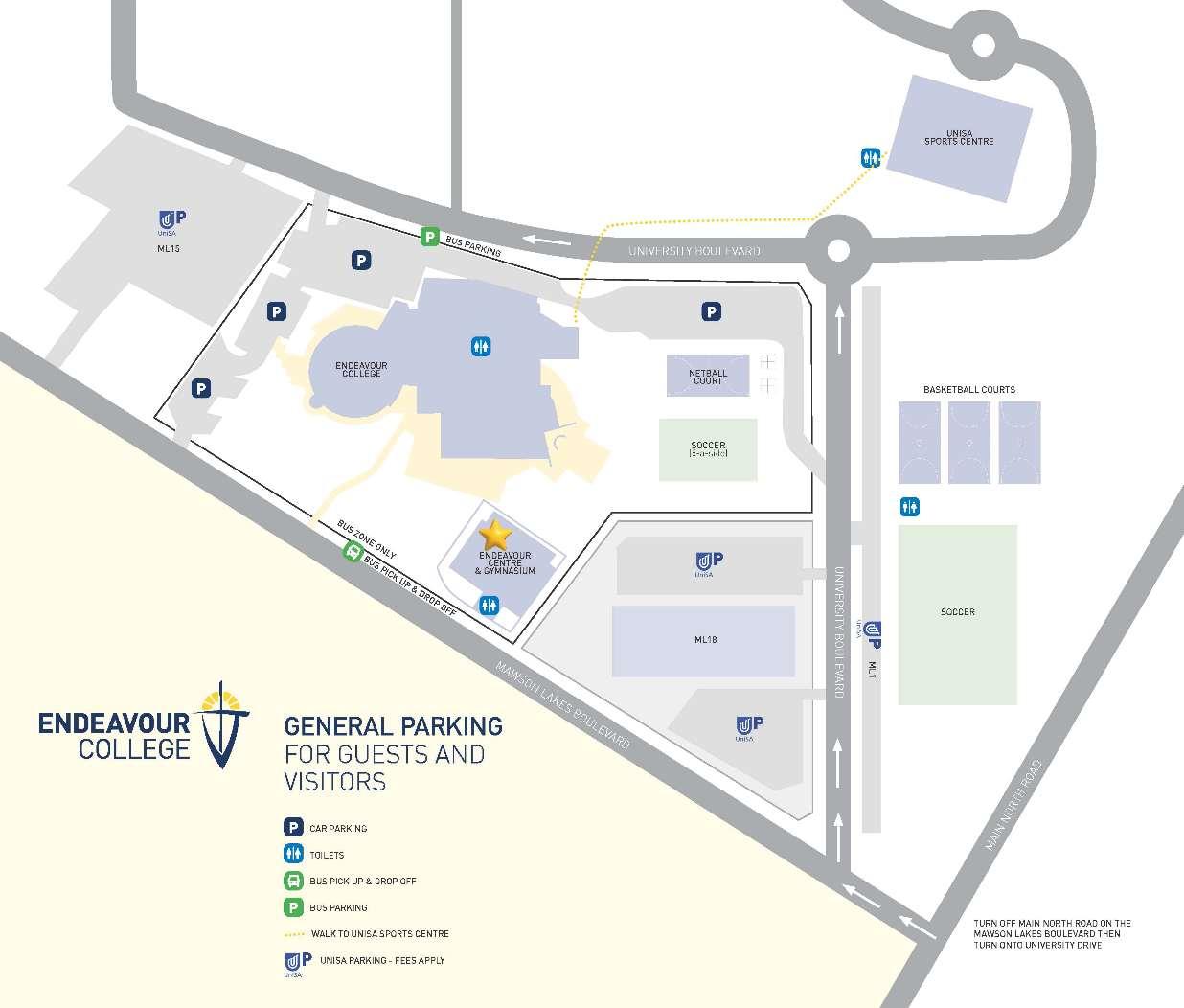
RATIONALE:
Endeavour College has a compulsory formal College uniform and a Physical Educationuniform. Students are encouraged to take pride in the way they wear their uniform, respecting the College through their correct wearing of the uniform both at College and in the wider community. The uniform aims to uphold our unique College identity and serves as an important statement about our standards and culture. The uniform creates a sense of unity and equity for our students. It promotes a senseof belonging, builds community and is designed to be practical and appropriate regardless of the trends at the time.
The uniform has bothcompulsory and optional items offering students some individual choicewithin the requirements, andflexibility for a variety of learning, curricular and co-curricular activities.
Uniform Expectations:
The correct uniform should be worn during school hours, when travelling to and from the College and whenstudents arein engaged in any College related activities.
We ask that parents/caregivers and students assist and work with us as we seek to ensure that students wear the College uniform correctly and that the uniform is well-laundered and in good condition. Students who come toCollege or attend a Physical Education lesson without the appropriate items of uniformshould have a note signed by a parent/caregiver or email communication to the Care Group teacher and/or Physical Education teacher explaining the reason. Items that are lost, stained, torn, defaced or ill-fitting will be required to be repaired or replaced. The uniform cannot be modified or altered in its appearanceor form in a way that compromises the integrity of the uniform. This particularly relates to dress, skirt, shorts, trouser and shirt lengths. The College reserves theright to decide the appropriateness of all elements of the uniform requirements which includes a neat and tidy appearance and grooming.
The Endeavour College Student Engagement policy outlines responses to non-compliance regarding uniform and grooming. It is important to note that astudent who presents at the College in breach of theuniform or grooming requirements will be managed in alignment with our Student Engagement policy.
Parents seeking exceptions or alterations to the uniform requirements for religious, ethnic, or cultural reasons, or due to student disability or health conditions should discuss this at the enrolment interview or must apply for inwriting to the Principal, who will make decisions based on individual circumstances.
Students wear thesummer uniform during Term 1 and 4and thewinter uniform during Term 2 and 3. Students must always wear the complete summer or winter uniform. They should not mix and match summer and winter items of clothing. Unseasonal weather events may result in changeto uniform expectations. This will be communicated by the College via email.
The Uniform Shop is open during the following hours for the purchase of new or replacement items.
MONDAY 8:00am – 11:30am
TUESDAY CLOSED
WEDNESDAY 1:00pm-4:00pm
THURSDAY CLOSED
FRIDAY 8:00am – 11:30am
Payment must be made at the time of purchase by cash or card. Other arrangements must be negotiated through Dobsons.
The following details are for guidance and clarification.
College Hats
Students are required to wear a College hat in Terms 1 and 4 for UV (sun) protection when outside of College buildings during the day. This includes recess and lunch. Students will be required to remain inside if they do not have a College hat and may be excluded from all outside activities until they obtain one. All hats must be clearly marked with thestudent’s full name and Care Group. Students are required to carry their hats with them throughout the school
day as a general expectation of being prepared for the day. As a mark of respect, students should not wear their hats inside, including the classroom, meetings, Chapel or Worship.
Scarves and gloves must be plain and in the College colour of navy.
Hairstyles and Colours
Hairstyles can be an expression of individuality and are often influenced by fashion and trends. With this in mind, our general expectation is that hair be clean, neat and tidy and not extreme in style or colour. Hairstyles are to be moderate. Extreme styles, including uneven cuts, contours/patterning, shaving, skin fades, or experimental styles are not appropriate. Conservative graded haircuts are acceptable. Short overall haircuts and fades areto be the minimum of a number 1 blade or clipper size.
If hair is dyed, colours must be natural in colour. Brightly coloured streaks, highlights or obvious variations in colours arenot acceptable.
Haircuts, and/or colouring that do not meet College expectations, will be managedas per our Student Engagement policy in the manner most appropriate for thesituation.
Hair shouldalways be off the face. It should not be hanging over the eyes andneeds to be secured. Hair that falls past the top of the shoulder or longer is to becompletely tied back. Half-up hairstyles are not acceptable. Hair that is shoulder/bob length may be secured with a headband. All hair accessories must be plain (unpatterned) in the College colour navy or in a colour matching the student’s hair colour.
We encourage students, parent/caregivers, if unsure, to seek guidance from the Head of Middle or Head of Senior School before making extreme changes to a child’s hairstyle or colour.
Facial Hair
Students are to be clean shaven.
Requests for cultural exemptions must be put in writing to the Head of School (Middle or Senior). Jewellery
Students may wear:
a watch
a plain gold or silver chain or a chain with a small cross around their neck
A maximum of two earrings in each ear. The earrings must be plain small studs or sleepers.
A ‘Medic Alert’ bracelet
Pleasenote that the followingare not permitted to wear:
Chains with any emblems or pendants other than a cross
Chains which are madeof leather, string or other solid materials
Adornments including rings, bangles and bracelets
Visible body piercing (except for the ears).
Students wearing jewellery other than that outlined above, may have items confiscated. Any confiscated items willbe held for collection at the end of the day in the first instance and may be helduntil collected by the parent/caregiver if the student continues to wear the inappropriateitems.
Students are encouraged to undertake any ear piercingonly whenthere is sufficient time for healing in order to meet the given expectations. Covering with a Band Aid and clear studs is not acceptable and piercings that are concealed in this way will needto be removed.
Make-up including nail polish
Light foundation that provides sun protection is acceptable. It should be discreet, lightly applied andin natural tones. Nailpolish should be clear or a natural nail look (including artificial nails).
Nails shouldbe clean and of a length as would be expected for safe play, sport and learning (including artificial nails). Nailpolish should be clear or French polished.
It is currently unlawful in South Australia for a person toobtaina tattooif they are under the age of 18 years (without parental permission). With this in mind, it is against College expectations for students to have any tattoos.
Visible tattoos are not acceptable for Endeavour College students. If students are tattooed, they must ensure the tattoo is covered by their uniform during school hours, when travelling toand from the College and during any Collegerelatedactivity.
Shoes
Students’ footwear includes:
With the summer and winter College uniforms – black lace up healed school shoes (leather/leather look) with black laces.
Sneakers (including black leather sneakers suchas Nike Airforce Ones), slip-on or canvas shoes are not acceptable.
With the PE uniform – sport/athletic sneakers with suitable arch and heel support and cushioning. Canvas, slip-ons or ‘street’ shoes arenot acceptable. It is suggested that consideration be given to colours that complement the Physical Education uniform.
Students will be advised of the specific days for Physical Education lessons and other occasions requiring their Physical Education uniform. On these days, students must wear their Physical Education uniform when travelling to andfrom College.
Physical Education uniform may be worn when:
• The student has a scheduled double Physical Educationpractical lesson
• The student has a weekly/on-going sport commitment – training or competition
• The student is competing in a sport carnival
• An excursion requires physical exertion (this will be indicated on the excursion consent form).
Students are to wear the correct summer or winter uniform including the blazer when on excursions. Any exception, dueto thenature of the excursion, will be advised by the staff member in charge. The information relating to uniform expectations willbe included with the covering letter and permission/consent form.
Blazer/Jacket/Jumper
The Endeavour College blazer is a compulsory item of the College uniform. Theblazer (and Junior Jacket) is part of the Collegewinter uniform and must be worn:
when attending formal events suchas:
o Opening and Closing Services
o Valedictory Service
o Chapel
o Assemblies – Middle/Senior/WholeCollege
for excursions
when representing the College
when travelling to and from the College
Any lightweight garment worn under a shirt must be such that it is not visible when being wornwith the uniform.
The Year 12 commemorative jackets are to recognise and celebrate our Year 12 students. The jacket represents comradery and is seen as memorabilia; therefore, it is an optional item of clothing. It must not be worn in place of the blazer.
Non-uniform days are designed to allow students to come to the College in casual dress, inreturn for making a donation to a social justice group or charity. It is important that students consider their clothing choices for community and lesson appropriateness.
On all occasions, student should dress using modesty, discretion and common sense.
Students need to avoid extremely short skirts andshorts. The midriff should not be exposed. Shirts should cover theupper body including shoulders.
Clothing shouldnot have any slogans that are offensive to anyone.
Appropriate supportive and enclosed footwear should be worn on any nonuniform day. Thongs andUgg boots are not to be worn.
During Terms 1 and 4, hats or caps are tobe worn at recess and lunch times and for any other outside activity.
Students should consider clothes that allow them to safely and actively participate in practicalsubjects (for example PE) on any non-uniform day.
If students choose to wear inappropriate clothing outside of the guidelines for a nonuniform day, parents/caregivers willbe asked to collect students from the College for them to change into appropriate clothing. If parents/caregivers are not able to collect students, they may be required to stay in the Reflection Spacefor the remainder of the day.
Endeavour College offers Community Sport which is played weekly throughout the term. Students participating in Community Sport will be required to purchase the appropriate sports uniform for that sport. Sports uniforms for each sport willavailable for purchase from theUniform Shop. The purchase of extracurricular uniforms will be communicated and advised by the Sports and Carnivals Coordinator.
Students representing Endeavour in one day carnivals at SACSA will be allocated anappropriate sports uniform for the sport fromthe College’s carnival uniform supplies. Uniforms will be distributed under the guidance of the Sports and Carnivals Coordinator or lead teacher on the day of the carnival. Students competing in carnivals will be required to wear the College Physical Education uniform to and from the event venue so that allocated uniforms can be returned to the lead teacher prior to leaving the event venue. Failureto return an allocated sports uniform at the completion of the carnival willresult in the uniform being charged to the parent’s school account.
New Uniform Change-Over Expectations
- Year 9s and 12s can be in blazers without yellow piping
- Any new blazers sold from the uniformshop willbe with yellow piping
- Year 9-12 could be in either old or new PEuniform, but if purchasing new, then only the new uniform items willbe sold (Year 7 and 8 should be inthe new uniform)
- By 2027, all students shouldhave transitioned the new uniform items
Uniform Visual Guide


Money and valuable items should be stored in locked lockers or left at Student Services for safekeeping and collected at theend of the day.
If such items are brought to College, the College will take no responsibility if they are lost, stolen or damaged other than the normal channels of follow up.
The College uses a system of Village groupings for organisational and competitive sport purposes. The Villages are names after prominent South Australians.
Colour
FLOREY Red
HEYSEN Green
KAVEL Black/Pink
LITCHFIELD Orange
MACKILLOP Purple
MAWSON Gold
MITCHELL Silver
SPENCE Blue
Lord HowardFlorey, 1898 – 1968, Co-discoverer of penicillin
Sir Hans Heysen, 1877 – 1968, Artist
Pastor August Kavel, 1798 – 1860, Led the 1st German Lutherans to SA.
Dame Ruby Litchfield, 1912 –2001, Patron of charity organisations and heavily involved with Youth and the Arts.
Mary Mackillop, 1842 – 1909, Founder of the Order of the Sisters of St. Joseph
Sir Douglas Mawson, 1882 – 1958, Scientist and Antarctic explorer
Dame Roma Mitchell, 1913 –2000, Prominent judge and Governor of SA
Catherine Helen Spence, 1825 –1910, Teacher, author, journalist, social and political reformer –suffragette
Each group has four sub-groups – Care Groups North, South, East and West
Working parallel with the Endeavour Way, the Vision for Learners articulates what learning looks like at Endeavour College. It seeks to give an overview of the key attributes that we would like tosee explored in all learning areas. The Vision for Learners is centered around student development connected tothree key principles – Independence, Interdependenceand Collective Action. Each principle is then divided into four key aspects forboth Middle andSenior School. This is then broken down further into a series of qualities that need to be developed and practices that will encourage their development in learning areas. While Vision for Learners philosophies aredifferent for Middle and Senior School, they are designed to reflect progress and the development that occurs in students throughout the middle year to the endof the Senior School.
The Endeavour College mission and The Endeavour Way inspire our students to develop as individuals, be effective collaborators, and contribute to the wider community.
Learning in the Middle School at Endeavour College is an adventure designedto capture thecuriosity and imagination of every student. Students develop the ability to inquire, make connections and can articulate their developing capabilities as learners. With increasing independence and personal responsibility, students courageously explore a variety of opportunities to grow.
An empathic understanding of and respect for others enables learners to productively collaborate with different people in a variety of situations. An emphasis on positive relationships empowers our students to be inclusive and use their social awareness to influence aculture where all can thrive.
Students in the MiddleSchool understand their responsibilities as global citizens to support a sustainable future encompassing fairness for all. They engage in experiences that extendtheir thinking about the wider community, their civic responsibilities and their capacity to make a difference. Students in the Middle School seethe world and the future as full of hope and opportunity.

ActiveLearner Personally Responsible Reflective Courageous
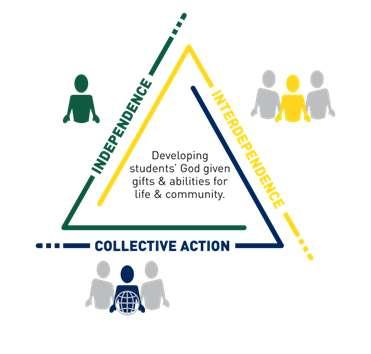
SociallyAware TeamPlayer Communicator Forgiving


GloballyAware Changemaker Lovingand Respectful
At Endeavour College, senior students are knowledge-seekers who pursue their curiosity and passions with a sense of independence and purpose. A well-developed emotional and intellectual flexibility allows students to meet challenges with grit, and to flourish. By working with others, students broaden their perspectives and solve complex problems. An empathetic understanding of the world beyond theimmediate, builds acapacity within students to be change-makers.
Senior students at Endeavour have the hearts andminds to self-direct their futures, work with others and become influencers in their communities.
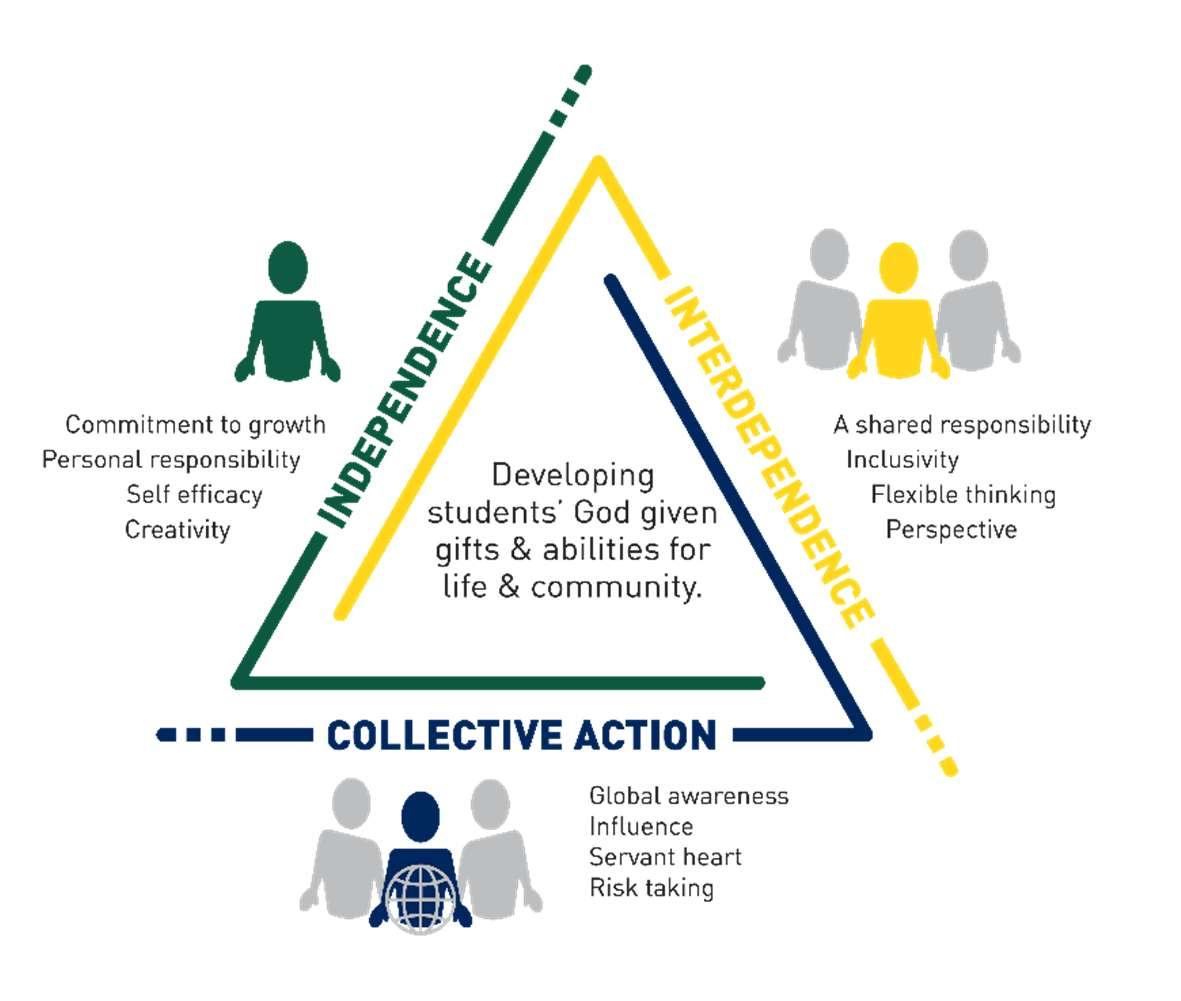
Visitors to the College during the day, including parents, must report to General Reception from where they willbe directed for their particular purpose. When visiting the College it is a requirement to sign in electronically and a visitor’s name tag will be issued. Upon leaving the College, visitors areto sign out.
The General Reception area at the western side of the College is for paying bills, deliveries, visitors, meetings with teachers and general enquiries. Inthis case parents can park inthe visitors’ carpark on the western side of the College.
Parents dropping off and picking up students arerequested to use thezones on University Boulevard or the drop off driveway on the College grounds. If parents need to enter to the Collegeto collect students, they must enter via Student Services at the eastern side of the College.
At no time are parents to walk through the College buildings from one reception area to another without staff guidance/permission.
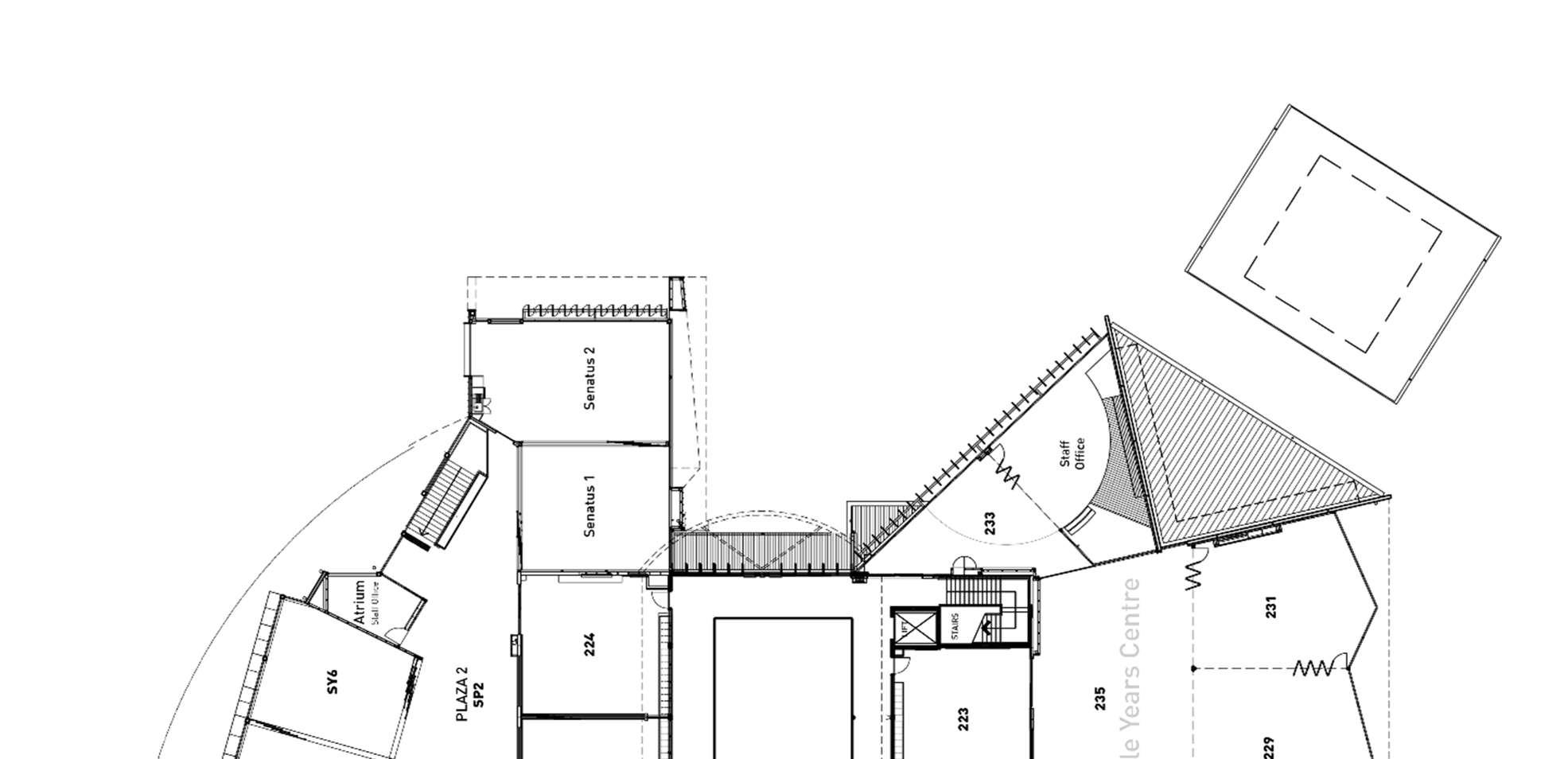
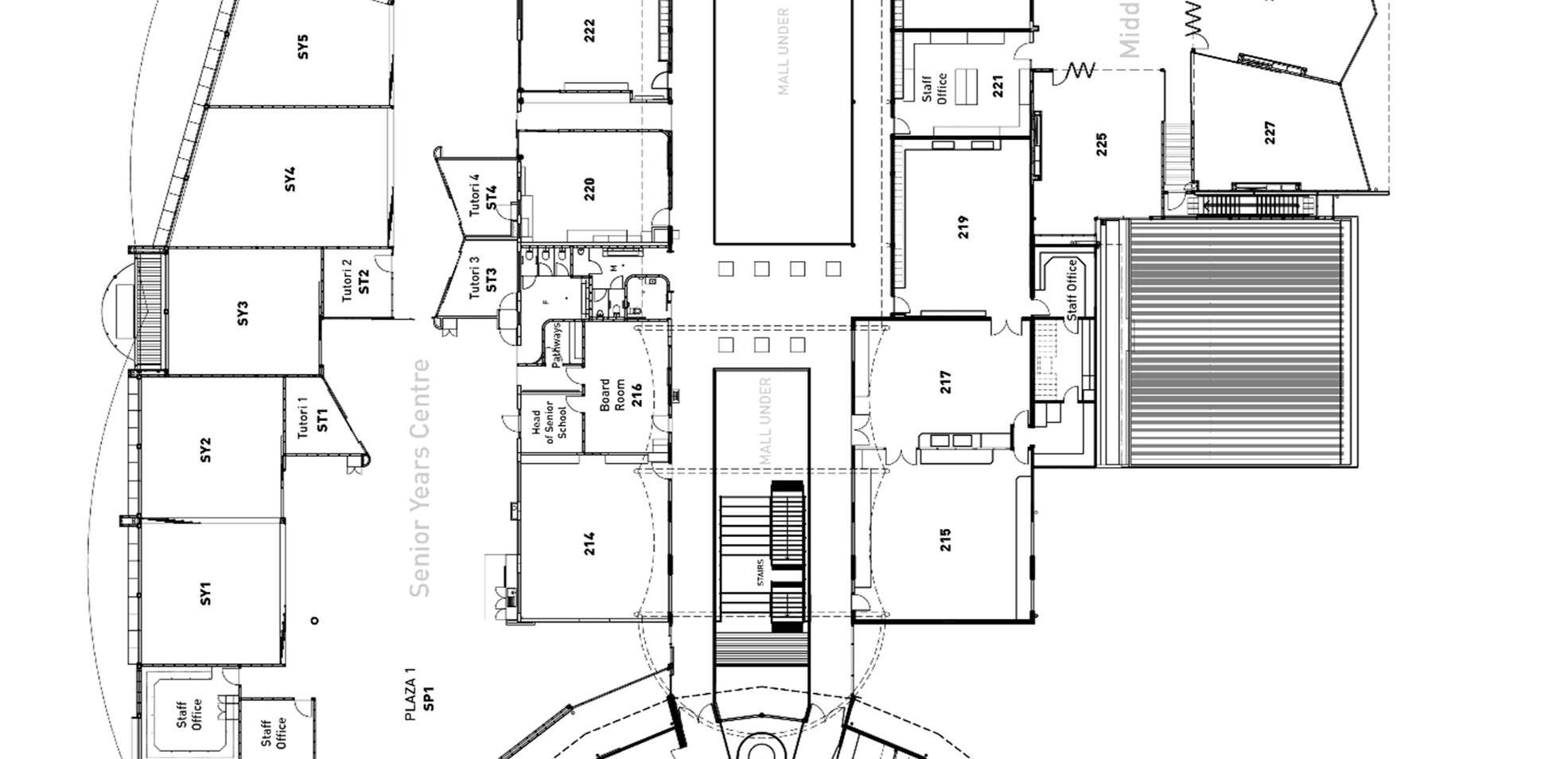
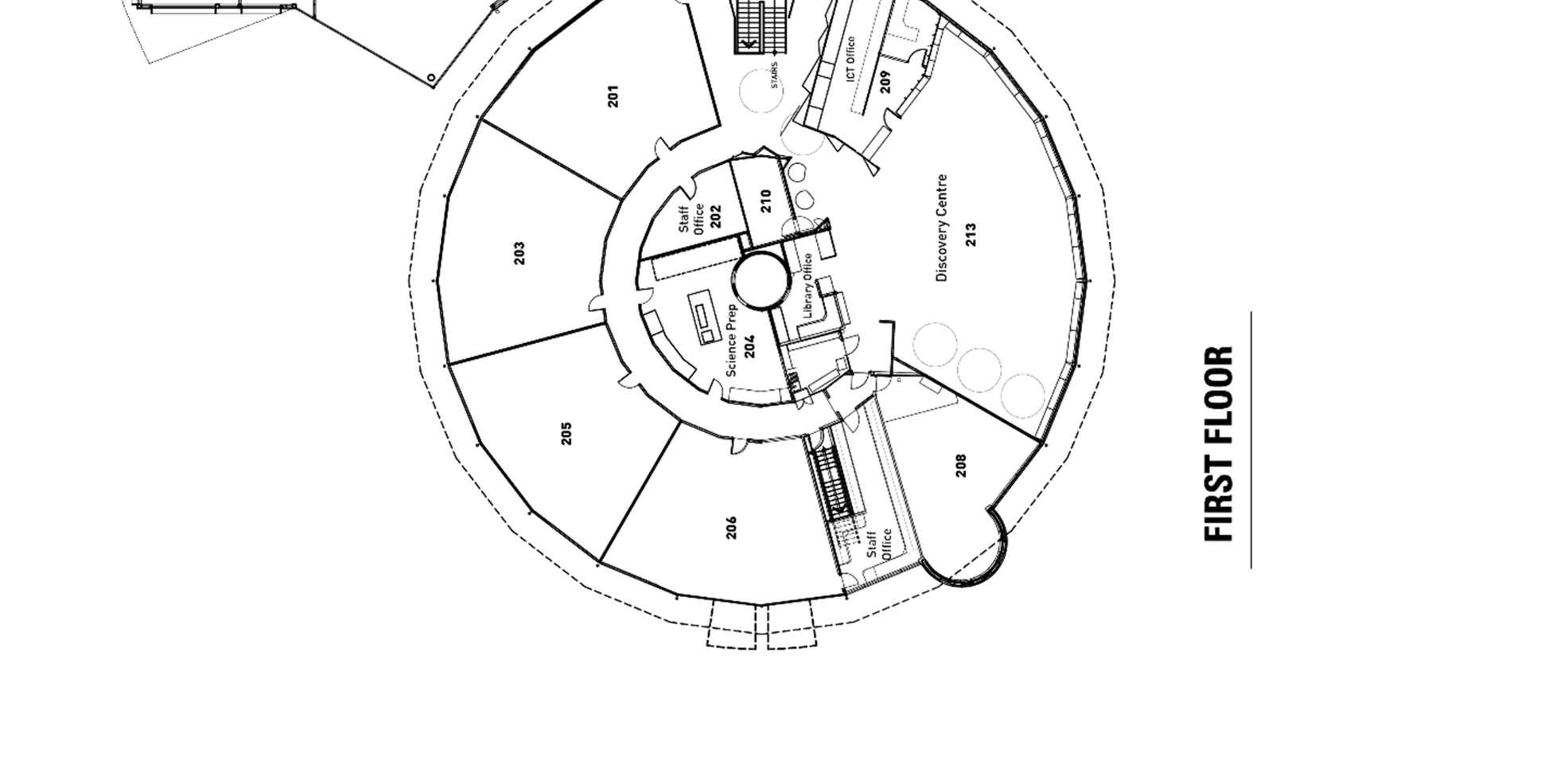
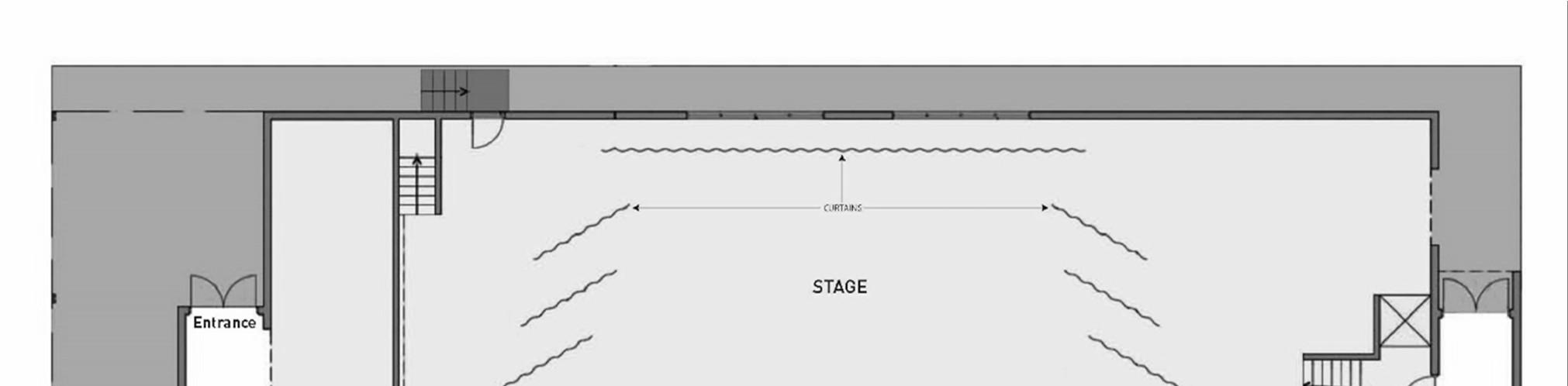
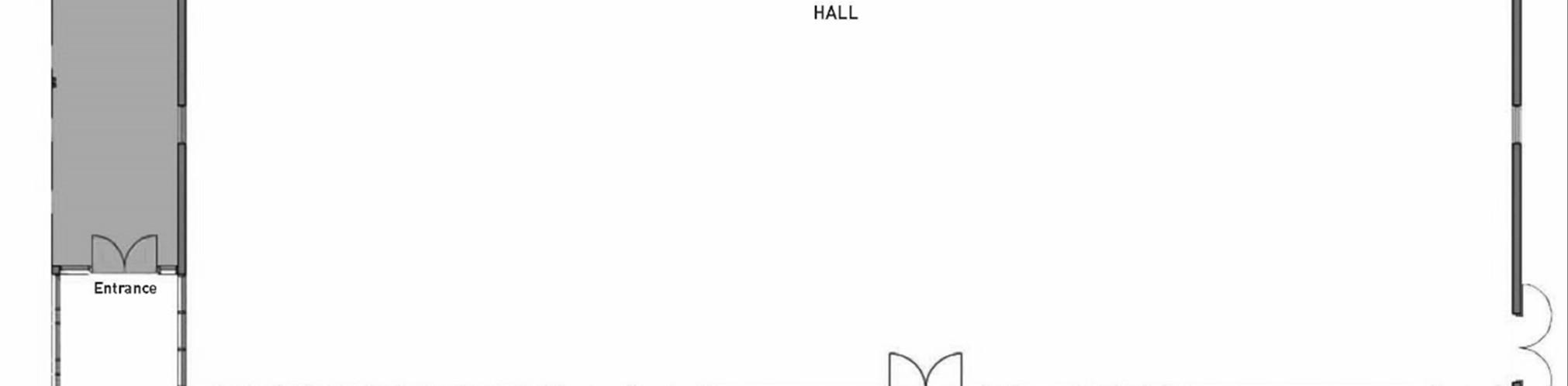
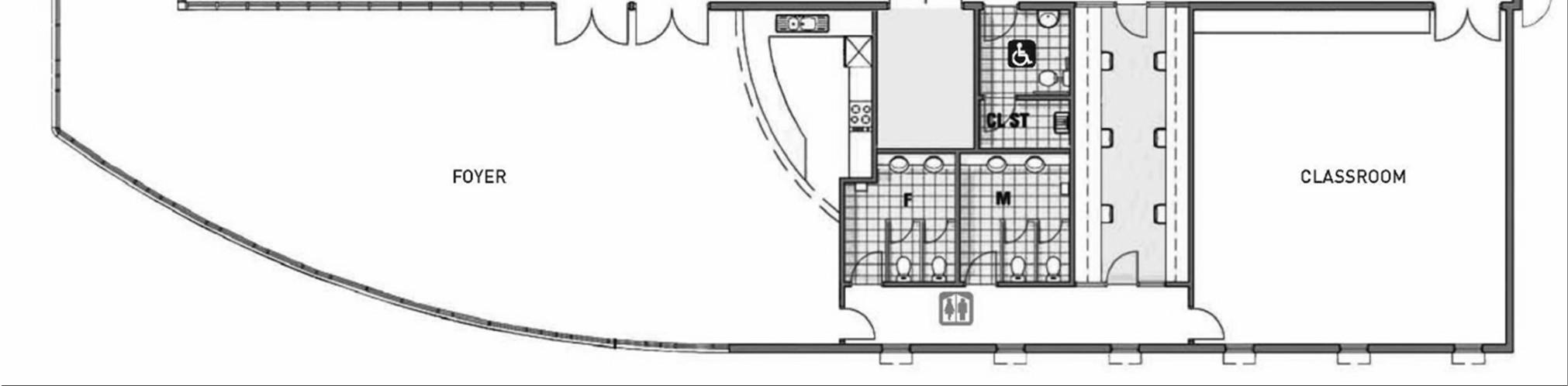
Allergies occur when the immune system reacts to substances (allergens) in the environment, which are usually harmless. Examples include proteins, pollens, dust mites and insect venoms.
Anaphylaxis is a severe, rapidly progressive allergic reaction that is potentially life threatening. Endeavour College engages with parents/caregivers through the completion of a Medical Health Care Plan for each student at risk of anaphylaxis. The College ensures that anaphylaxis is considered when assessing risks and developing risk minimization strategies, and ensure that staff haveknowledge about student allergies, and how to respond to an anaphylactic reaction.
Endeavour College is committed to providing a safe learning environment for all our students and in particular to minimise the risk of allergen exposure. It is our policy:
To provide, as far as practicable, a safe andsupportive environment in which students at risk of allergies can participate equally in all aspects of the student’s schooling
To raise awareness about allergies andthe College’s allergy management and Anaphylactic Shock Management in the College community
To engage with parents/caregivers of each student at risk of allergies assessing risks and developing risk minimisation strategies for the student
To ensure that staff have knowledge about allergies, anaphylaxis and the college’s guidelines and procedures inresponding to an anaphylactic reaction.
Endeavour College has developed the following work practices and procedures to increaseallergy awareness:
Parents/Caregivers are requested to notify the College of all medical conditions including allergies.
Given the number of foods to which a student may be allergic to, it is not possible to remove all allergens.
It is better for the Endeavour College community to become aware of the risks associated with allergies and for the College to implement practical, age appropriate strategies to minimise exposure to known allergens.
At Endeavour College we do not promote that we either ‘ban nuts’ or are ‘nut-free’. Promoting a College as ‘nut-free’ is not recommended for the following reasons:
It is impractical to implement and enforce
There is no evidence of effectiveness
It does not encourage the development of strategies for avoidance in the wider College community
It may encourage complacency about risk minimisation strategies (for teachers, students and parents/caregivers) if a food is banned.
We consider that being ‘allergy aware’ is a more appropriate term.
Whilst we do not claim to be ‘nut free’, minimizing exposure to foods such as peanuts andtree nuts can reduce the level of risk. This can include removing nut spreads and products containing nuts from the Food Technology room and College canteen but does not guarantee the removal of products that ‘may contain traces’ of peanuts or tree nuts.
We may alsochoose torequest that parents/caregivers do not include nut spreads in sandwiches or products containing nuts in their lunchbox.
Peer support and understanding is important for the student at risk of allergies (anaphylaxis).
Staff can raiseawareness throughfact sheets or posters displayed in hallways, canteens and classrooms or in class lessons.
Class teachers can discuss thetopic with students in class, with a few simple key messages:
Always take food allergies seriously
Don’t share your food with friends who have food allergies or pressure them to eat food that they are allergic to
Not everyone has allergies – discuss common symptoms
Wash your hands before and after eating
Know what your friends are allergic to
If a schoolmate becomes sick, get help immediately
Be respectful of a schoolmate’s medical kit
While all care will be taken to protect the identity of students with medical conditions, the College will take all steps necessary to meet our duty of care.
Bullying Prevention
A student at risk of allergies may have an increased risk of bullying in the form of teasing, tricking a student into eating a particular food or threatening a student with a substance that they are allergic to, such as peanuts.
Endeavour College seeks to address this issuethrough raising peer awareness so that the students involved in such behaviour are aware of the seriousness of allergic reactions.
Any attempt to harm a student at risk of anaphylaxis with an allergen is treated as a serious and dangerous incident and treated accordingly under the College’s Bullying & Harassment Prevention and Intervention Policy.
Raising General Learning Community Awareness
Endeavour College takes active steps to raise awareness about allergies and anaphylaxis in the College community so that parents/caregivers of all students have an increased understanding.
These steps include providing information about our allergy awareness strategy to the broader College community through newsletters, fact sheets, posters and other publications.
Parents/caregivers of a student who is at risk of allergies (inparticular anaphylaxis) may experience high levels of anxiety about sending their child to school.
It is important to encourage an open and cooperative relationship with parents/caregivers so that they feel confident that appropriate risk minimisation strategies are in place.
In addition to implementing risk minimisation strategies, the anxiety that parents/caregivers and the student may feel can be considerably reduced by keeping them informed of the increased education, awareness andsupport from the College community.
Staff Responsibility
As members of the Endeavour College community, all workers must be allergy aware.
Signage
Allergy awareness signage is posted in various locations aroundthe College.
Implementation
This policy is implemented througha combination of:
Endeavour College premises inspections (to identify wasp and bee hives)
Staff training and supervision
Maintenance of medical records
Effective incident notification procedures
Effective communication procedures with the student’s parents/caregivers
Effective communication procedures with the broader College community
Endeavour College’s Value Statement
AllmembersoftheEndeavourCollegecommunityhavearighttofeelsafeandprotected,andfreefrom bullyingandharassment.Weaimtodevelopacommunityculturewhererelationshipsarevaluedand membersofthecommunityfeelconnected,safeandrespected.Webelievethisapproachfostersan optimallearningenvironmenttofulfilstaffandstudents’Godgivenabilitiesforlifeandcommunity.
InourChristiancommunity,webelieveweareallequalintheeyesofGod,andtherefore,weareequal intheeyesofothers.JesusshowedHislovetoallpeopleregardlessofgender,race,sexual orientation,classorstatus.Ourcommunityiscommittedtoencouragingotherstorecogniseand embracetheirowngifts,andcaresfor,values,accepts,supportsandforgiveseachotherintheway Jesusshowedus.
EndeavourCollegeadoptsaRestorativePracticesapproach,whichprioritisesrelationshipsandsocial connections.RestorativePracticesfocusesonbuilding,maintainingandrestoringrelationshipsand fostersself-regulatorybehaviours.Inpractice,thismeanslivingoutTheEndeavourWaythroughLove, Courage,ForgivenessandHope.Itcallscommunitymemberstomakeapersonaltransformationfrom afocusontheselftowardsafocusonothersandthecommongood,andassuchitreflectsthemodel ofChristinhowwedealwithothers.
Endeavour College accepts it has a duty to provide students a safe and positive learning environment where individual differences and diversity within the College are respected and accepted.
Bullying and harassment are not tolerated at Endeavour College. It is our policy that:
Bullying and harassment are managed through a restorativeapproach using The Endeavour Way, and involving students, staff and parents/caregivers.
Bullying and harassment prevention strategies are implemented within the College on a continuous basis with a focus on teaching age-appropriate skills and strategies to empower staff, students and parents/caregivers to recognise bullying andharassment and respond appropriately.
Responses to bullying and harassment being sensitive to the circumstances of each incident, with a focus on Restorative Practices.
Bullying and harassment prevention and intervention strategies are reviewed on a regular basis against best practice.
Staff present as positive role models emphasising our no bullying and harassment culture.
Bullying is an ongoing and deliberate misuse of power inrelationships through repeated verbal, physical and/or social behaviour that intends to cause physical, social and/or psychological harm. It can involvean individual or a group misusing their power, or perceived power, over one or more persons who feel unable to stop it from happening.
Harassment is unwanted behaviour that offends, humiliates, intimidates or creates a hostile environment (where that reaction is reasonable in thecircumstances), and targets an individual or groupon the basis of a characteristic such as gender, race, culture or ethnic origin, religion, physical characteristics, sexual orientation, age, ability or disability.
Bullying and harassing behaviours can include but are not limitedto:
Physical: which involves physical actions such as hitting, pushing, obstructing, unwanted and uninvited sexual contact, or physical contact which is used to hurt or intimidate someone. Damaging, stealing or hiding personal belongings is also a form of physical bullying. Refer to our Assault (Student Against Student) Policy for more information.
Psychological: which is when words or actions are used to cause psychological harm. Examples of psychological bullying and harassing behaviours include name-calling, offensive language, teasing or making fun of someone, offensive notes or materials (including via digitaltechnology), intimidation, belittling, ridiculing, and the exclusion of individuals.
Indirect: which is when deliberate acts of exclusion or spreading of personalinformation or lies that are usedto embarrass, shame or intimidatesomeone.
Cyber: which is using technology to, directly or indirectly, threaten or harm another person or persons. Cyber bullying can occur in chat rooms, on social networking sites, through emails, on mobile devices, etc.
Singleincidents,argumentsordisputesbetweenpeoplewhereno-onehasasignificantpower advantage,andbothfeelequallyaggrievedarenotdefinedasbullyingbutshouldbeclosely monitoredasthesebehavioursmayevolveintoabullyingsituation.
Behaviourswouldnotbeconsideredtobebullyingifanyoneormoreofthefollowingfeatureswere present,butmaystillbeconsideredharassment:
It occurred only once and was not part of a repeated pattern
It (genuinely) was not intended to offend, demean, annoy, alarm or abuse
It was not directed towards the same person(s) each time
Bullying and harassment are unacceptable and need to be addressedas part of creating a safe College environment.
Bullying & Harassment Prevention Strategies
Endeavour College recognises that the implementation of whole-College prevention strategies is the most effective way of eliminating, or at least minimising incidents of bullying and harassment withinour community.
Our prevention strategies to foster a ‘no bullying or harassment’ culture within the Collegeinclude:
Astructured curriculum and peer group support system, that provide age-appropriate information and skills relating to bullying and harassment (including cyber) prevention to students over thecourse of the academic year.
Education, training and professional development of staff in bullying and harassment prevention and response strategies.
Regular provisionof information to parents/caregivers, to raise awareness of bullying and harassment as a College community issue to equipthem to recognise signs of bullying and harassment, as well as to provide them with clear paths for raising any concerns they may have relating to bullying and harassment directly with the College.
Promotion of a supportive environment that encourages the development of positive relationships and communication betweenstaff, students and parents/caregivers using The Endeavour Way.
Promotion of responsible behaviour and action amongst students, staff and parents/caregivers as modelled through The Endeavour Way.
Regular risk assessments of bullying and harassment within theCollege through collection of information from the College community.
Records of reported bullying and harassment incidents are maintained and analysed, in order to identify patterns of behaviours and to implement targeted prevention strategies where appropriate.
Statements supporting bullying and harassment prevention are included in students’ College diaries, and inthe Family A-Z Guide
Anti-bullying and anti-harassment messages are displayed strategically within the College.
Promotion of student awareness and a no bullying or harassment environment through participation in relevant events (e.g. NationalDay of Action Against Bullying and Violence).
When people are bulliedor harassed, they may not want to talk about it for fear that it will make things worse. Behavioural changes in a student may be indicative of bullying or harassment. Some signs that a student is being bullied or harassed may include:
An unwillingness or refusal to go to school.
Adecline in quality of schoolwork and/or concentration.
Headaches or stomach aches.
Stolen or damaged possessions.
Becoming withdrawn, lacking confidence and/or interest in usual activities.
Actingunreasonably or out of character, including showing signs of anger
Unwillingness to discuss their problems, or secrecy about their onlinecommunication.
Unexplained bruises or scratches.
Displaying feelings of embarrassment or humiliation.
While there can be other reasons for these signs to be present, parents/caregivers are encouraged to notify the College through a staff member (such as a Head of Village, Head of Middle or Head of Senior School or the College Counsellor) immediately if they suspect their child is experiencing bullying and/or harassment. It is also important for parents/caregivers to support their child to communicate and be proactive inthe resolution of bullying and/or harassment.
Students and their parents/caregivers are sometimes reluctant to pursue incidents, for fear that it will only make matters worse. Students and parents/caregivers can be confident that reporting an incident of bullying or harassment provides powerful support at a time which can be emotionally challenging.
A key part of the College’s bullying and harassment prevention and intervention strategy is to encourage reporting of bullying and harassment incidents as well providing assurance to students who experience bullyingand harassment (and their parents/caregivers) that:
Bullying and harassment are not tolerated within the College.
All reports willbe taken seriously.
The College has a clear strategy for dealing with bullying and harassment issues.
Bullying and harassment incidents should be reported either verbally or in writing to a teacher or staff member, or to a Head of Middle School/ Head of Senior School, the Deputy Principal or the Principal.
Bullying and harassment behaviours vary considerably in their extent and intent and, consequently, each situation needs to be dealt with individually and personally.
In all circumstances the College:
Takes bullying and harassment incidents seriously.
Provides assurance that confidentiality will be respectedwhere appropriate.
Takes time to properly investigate the facts including discussing the incident with all involved persons.
Takes time to understand any concerns of individuals involved.
Responds based on all available information.
Will implement effective follow up strategies utilising Restorative Practices.
Maintains records of reported bullying and harassment incidents.
The following may occur as part of the restorative process:
Notification of/consultation with parents/caregiver.
Disciplinary action, at the Principal’s discretion, including suspension or expulsion in persistent or severe incidents.
It is important to note that where an act of bullying is serious, it may also warrant police involvement and /or legal action.
Implementation
This policy is implemented througha combination of:
Effective training for staff and students.
Effective incident reporting procedures and record keeping.
Effective management of reported bullying and harassment incidents.
Initiation of restorative actions.
LCA Standards of Ethical Behaviour, and the Prevention of Harassment and Abuse Policy.
Staff Responsibilities
All staff areresponsible to:
Be positive role models emphasising our ‘no-bullying and harassment culture’.
Sustain and foster a ‘no-bullying andharassment culture' within the College community.
Complete relevant training, includingRestorative Practices, The Endeavour Way, Valuing Safe Communities, and adhere toother legislative requirements.
Ensure effectivemanagement of bullying and harassment incidents, including the initiation of restorative actions, incident reporting and record keeping.
Student Responsibilities
All students are responsible to:
Follow the College’s student expectations as enactedthrough the Endeavour Way and as described in the Student Engagement Policy.
Take actionif they are experiencing, witnessing or are aware of bullying or harassment. Taking action can stop or diminish a specific bullying or harassment incident or support another student to manage it.
Report, seek help and communicate with an adult on the occurrence of any bullying or harassment incident.
Provide support to any person being bullied or harassed.
Actions students can takeinclude:
Solve it themselves – use positive and assertive language ask for the behaviour to stop.
Solve it with the support of friends – talk to and listen to advice of their friends, and ask for the behaviour to stop with their friends’ support.
Solve it with the support of an adult – report the behaviour to an adult. Assistancemay be in the form of coming up withappropriate actions, or where the adult is a staff member, approaching the individual(s) on the student’s behalf.
Students should remember that:
Any concerns about bullying or harassment should be reported to an adult immediately.
If the bullying or harassment continues after it has beenreported and actions taken, it should continue to be reported until it ceases.
All members of the College community impacted by an incident of bullying or harassment willbe supported in an appropriate way to resolve and repair relationships.
Bullying or harassment can be stopped by discussing and resolving the matter in a positive way. This may involve a restorative chat or conference using the Endeavour Way as a basis for restoration.
While students may request the matter to be treated in confidence when bullying and harassment is reported, it is important to know that in serious cases, staff members arerequired by law to report instances or suspected instances of children at risk of harm.
All parents/caregivers are responsible to:
Support their child to act in a safe and respectful way towards all others at the College andencourage students to resolve conflict in a respectful and restorativemanner.
Be aware of signs of distress in their child and keep the College informed of concerns about behaviour, their child’s health, and other relevant matters.
Communicate in a respectful manner with College staff about issues or concerns and assist their child (where necessary) to discuss the problem with a staff member.
If aparent/caregiver believes that their child is being bullied or harassed at theCollege, we recommend the following steps:
Stay calm and listen to your child.
Make notes of what your child tells you to help when you or your child shares the information with the College.
Advise your child about potential actions and solutions.
Assure your child that sharing information about being bullied or harassed is courageous and is the appropriate action to take.
This Child Safe Policy has been developed in accordance with and implements Principle 1 of the National Principles for Child Safe Organisations (National Principles).
The Child Safe Policy is published on Endeavour College’s public websiteand provided to new staff, as well as to Direct Contact Volunteers and Contractors as part of their induction.
Our Child Safe Policy, which includes our Statement of Commitment to Child Safety, was written to demonstrate the strong commitment of Endeavour College to promoting children’s andyoung people’s wellbeing and safeguarding them from harm or risk of harm, and to provide an outline of the policies and practices that we have developed to keep our students safe, including from abuse, harm and risk of harm.
It is an overarching policy that provides the key elements of Endeavour College’s approach to being a child safe organisation and sets the tone for the College’s entire Child Safe Program.
The Child Safe Policy provides the framework for:
Implementing the National Principles
Developing systems, practices, policies and procedures that promote child protection within the College
Creating a safe and supportive environment and a positiveand robust child protectionculture
Promoting and openly discussing child safety issues within the College
Complying with all laws, regulations and standards relevant to child protection in South Australia
Endeavour College’s Child Safe Policy applies to all adults in the learning community including staff, volunteers, contractors, external education providers, parents/caregivers, and other family members. This policy applies in all College environments, bothphysical and online, and on-site and offsite learning community locations (e.g. camps and excursions).
‘In the Lutheran school the gospel is to inform allprograms, relationships and activities’ (LCA and Its School statement). The love of God in Jesus Christ is to govern all that is done, in response to this love, people in
the school community aredirected to their fellow human beings. Where they love others, they love him. Christ’s promise is that whatever is done for others is done for him. Informed and transformed by God’s creative, redemptive and sanctifying love, God’s people are concerned with the total needs of their fellow human beings.
The Child Safe Program in place at Endeavour College defines power as the capacity to set and care for boundaries. Boundaries are the structures which support human development within community; boundaries may be personal, communal, spiritual, psychological or physical. In Christ, there is an empowerment by the gospel to recognise boundaries and prevent their destructive crossing and to care for those who have been violated. Our responsibility of leadership is to care for professional boundaries through the establishment of structures that protect them. Structures provide for support, examination, and action to ensure that leaders, staff and students act according to boundaries that help, protect and uphold the dignity, worth andsafety of each individual. (Valuing Safe Communities: Statement of values)
All children and young people who come to Endeavour College have a right to feel and be safe. We are committed to the safety and wellbeing of all children and young people. Weare committedto providing a child safe and child friendly environment, where children andyoung people aresafe and feel safe, andare able to actively participate in decisions that affect their lives.
We have a zero tolerancefor harm to children and young people and arecommitted to acting instudents’ best interests and keeping them safe from harm and risk of harm.
Endeavour College regards its childsafe responsibilities with the utmost importance and is committed to providing the necessary resources to ensure compliance with all relevant child protection laws and regulations and maintaining a childsafe culture.
Each member of the learning community has a responsibility to understand the important and specific role that they play individually, and collectively, to ensurethat the wellbeing and safety of all students is at the forefront of all that they do, and every decision that they make.
The National Principles for Child Safe Organisations were developed by the Australian Human Rights Commission in response to recommendations of the Royal Commission into Institutional Responses to Child Sexual Abuse. The NationalPrinciples are comprised of 10 Principles that were informed by, but go further than, the 10 child Safe Standards recommended by the Royal Commission. They are:
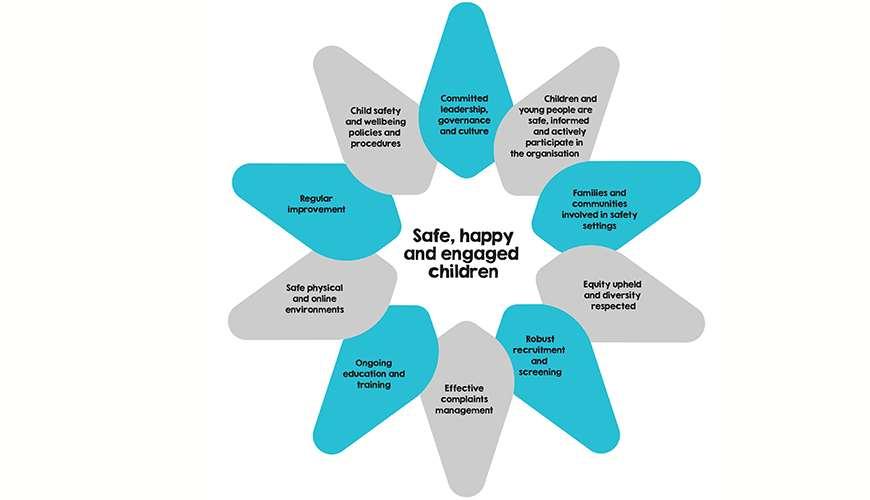
Endeavour College is a child safe andchild-centered organisation. Our environment is friendly and welcoming to all children and young people.
We actively seek to include students in decisions that affect them. This includes decisions about organisational planning, delivery of services, management of facilities, and learning and assessment environments.
We ensure students know about their rights to safety, information and participation. We recognise the importance of friendships and support from peers. We actively seek to understand what makes students feel safe in our College, and regularly communicate with students about what they can do if they feel unsafe.
Endeavour College recognises that parents/caregivers have the primary responsibility for the upbringing and development of their children. We ensure they participate in decisions affecting their children.
We ensure that families and other relevant communities in which our College operates, know about Endeavour College’s operations and policies, including the Child Safe Policy and Child SafeAdult Code of Conduct, record keeping practices, risk management, and complaints and investigation processes.
We actively seek to include families and relevant communities in decisions about organisational planning, delivery of services, management of facilities, and learning and assessment environments.
We build cultural safety at the College through partnerships with relevant communities
Endeavour College values diversity and does not tolerate any discriminatory practices. To achieve this, we:
support the culturalsafety, participation and empowerment of Aboriginal and Torres Strait Islander students and their families
support the culturalsafety, participation and empowerment of students from culturally and linguistically diverse backgrounds and their families
support students witha disability and their families and act to promote their participation
welcome students and families of gender and sexual diversity, and encourage their inclusion in our community
seek to recruit a workforce that reflects a diversity of cultures, abilities and identities
aim to provide Staff, and Direct Contact Volunteers andContractors with training about Aboriginal and Torres Strait Islander cultures, disability, culturally and linguistically diverse backgrounds, and communities with particular experiences or needs
have a physical environment that actively celebrates diverse cultures and recognises cultural differences
commit to ensuringthat our facilities promote the inclusion of students of all abilities
Endeavour College is committed to theeffective implementation of our Child Safe Programand ensuring that it is appropriately reviewed and updated. We adopt a risk management approach by identifying key risk indicators and assessing child safety risks based on a range of factors including the nature of our College’s activities, physical and online environments and the characteristics of the student body.
Our Child Safe Programrelates to all aspects of child safety andprotecting students from harm, and establishes work systems, practices, policies and procedures to create and maintain a child safe environment and culture at the College. It includes:
Child Safe Codes of Conduct
Staff and Student Professional Boundaries Policy that provides detailed guidance for all adults on maintaining professional boundaries between students and adults at Endeavour College
clear information as to what constitutes harm and associated key indicators of different forms of harm to children andyoung people
procedures for reporting to external agencies, including Mandatory Notifications tothe Department for Child Protection(DCP) through theChild Abuse Report Line (CARL), and reportingto Police, which makeclear that all Staff, Volunteers and Contractors must, as their first priority, fulfill their legal obligations to report harm or risk of harm to a child.
clear procedures for reporting childsafety incidents or concerns internally, and for responding to incidents or allegations of harm to a child or young person
strategies to support, encourage and enable Staff, Volunteers, Contractors, parents/caregivers and students to understand, identify, discuss and report child safety matters
procedures for recruiting and screening members of the Board, Staff, Volunteers andContractors
pastoral care strategies designed to empower students and keep them safe
strategies to support and encourage the participation and inclusion of Aboriginal and Torres Strait Islander students, students from culturally and/or linguistically diverse backgrounds and students with disability
Child Protection training
information regardingthe steps to take after a disclosure of harm to protect, support and assist students
guidelines with respect to record keeping and confidentiality
policies toensure compliance with all relevant laws, regulations and standards (including the National Principles)
As apart of Endeavour College’s induction process, all Staff, as well as relevant Volunteers and Contractors are required to complete induction in our child safe polices, practices and procedures, as well as receiving refresher and ongoing child safety training.
Staff, and Direct Contact Volunteers and Contractors are supported and supervised by the College’s Child Safety Officers, Management Team, and Executive to ensure that they are compliant with the College’s approach to child safety.
Any person, including Staff, Volunteers, Contractors, parent/caregivers or students, can at any time report a reasonable suspicion about harm orrisk of harm to a child or young person directly to the Department of Child Protection (DCP) using the 24/7Child Abuse Report Line (CARL) on 13 14 78 or online at https://www.childprotection.sa.gov.au/reporting-child-abuse/report-child-abuse-or-neglect
Whenever there are concernsthat a child is in immediate danger, the Police should be called on 000.
All Staff, Volunteers and Contractors must also report any child safety incidents and concerns internally to the College through one of the Child Safety Officers regardless of whether an external report has been, or willbemade.
Child Safety Officers can be contacted for guidance onmaking a report, or to answer any questions regarding child safety.
Our Child Safe Programcontains detailed guidance on how to identify key indicators of different forms of harm and risk of harm to children and young people, and how to report child safety incidents or concerns:
to relevant externalauthorities, including DCP through the Child Abuse Report Line (CARL) and the Police
internally to one of the College’s Child Safety Contact Officers.
Students at Endeavour College are provided with information about and encouraged to use multiple pathways to raise child safety incidents or concerns about or at the College. These include by contacting CARL and/or by reporting internally to the College via informal and formal ways, an ‘anonymous’ way, and throughexternal child advocacy or child safety organisations.
Parents/caregivers, family members and other community members who have child safety concerns, or who suspect that a child or young person associated with Endeavour College may be subject to harm or risk of harm should immediately contact CARL. They should then also contact:
Endeavour College’s Senior Child Safety Officer, Peter Pearse by phoning 08 8368 3311 or emailing richard.baird@endeavour.sa.edu.au, or
If the concernrelates tothe Principal, the Chair of the Board
Any person can also contact the Senior Child Safety Officer or Chair of the Board if they have concerns regarding Endeavour College’s leadership in relation to child safety. Communications will be treated confidentially on a ‘need to know basis’.
Whenever there are concernsthat a child is in immediate danger the Police should be called on 000.
Child Safety is everyone’s responsibility. Alladults in the learning community have a shared responsibility for contributing to the safety and protection of students. Specific responsibilities include:
A number of senior staff members arenominated as the College’s Child Safety Officers. Our Child Safety Officers receive additional specialised training with respect to child safety and protection issues and can support Staff, Volunteers and Contractors making a report to CARL. They area point of contact for raising child safety concerns within the College subsequent to reporting directly to CARL. They are also responsible for championing Child Safety within the College and assisting in coordinating responses to childsafety incidents.
Contact details for our Child Safety Officers are set out below: Name
RichardBaird Principal 0883683311
PeterPearse DeputyPrincipal 088368 3311
HenryLee CollegeCounsellor 0883683311
Richard.baird@endeavour.sa.edu.au
Peter.pearse@endeavour.sa.edu.au
Henry.lee@endeavour.sa.edu.au
MichaelVickery HeadofSeniorSchool 0883683311 michael.vickery@endeavour.sa.edu.au
LouisaMulligan HeadofMiddleSchool 088368 3311
Louisa.mulligan@endeavour.sa.edu.au
Endeavour College has appointed Peter Pearseas the College’s Senior Child Safety Officer. The Senior Child Safety Officer has additionalchildsafety responsibilities, such as being the College’s contact person for child safety concerns or queries by parents/caregivers and other members of the wider learning community, and coordinatingthe College’s response to child safety incidents in consultation with the Management Team, Executive and Board.
The Board is Endeavour College’s governing body. The Board is responsible for ensuring they have a current understanding of the College’s operations and the child protections risks associated with these operations, approving this policy, and ensuring that:
appropriate resources are made availableto allow the College’s Child Safe Policy and the Child Safe Program to be effectively implementedwithin the learning community;
the Collegeimplements and monitors processes toensure that the College is complying with its legal andregulatory obligations with respect to child safety;
the Collegehas appropriate processes for receiving and considering information regarding childsafety issues and is able to respond in a timely way to that information; and
the Principal andManagement Team are held accountable for the ongoing effectiveness of the Child Safe Policy and the Child Safe Program.
The Board has delegated its functions relating to the operational management and implementation of the Child Safe Program to the Principal.
The Child Safe Human Resources Management section below sets out the requirements for Board Members (as Volunteers) with regards to Child Safety.
The Principal is responsible, and will be accountablefor the operational management of the College and the Child Safe Program. They are responsible for taking all practical measures to ensure that this policy, and the College’s Child Safe Program are implemented anddeployed effectively andthat astrong and sustainable child safe culture is maintained within the learning community. This includes ensuring that:
the Collegeimplements the Child Safe Program effectively, and deploys allavailable resources for that purpose
the Collegeappoints andtrains appropriate Child Safety Officers at the College
a strong and sustainable child safe culture is maintainedwithin the learning community
all child safety incidents or concerns are dealt with professionally and in a timely manner
the Board receives regular reports with respect tochild safety matters
all Staff, and Direct Contact Volunteers and Contractors are aware of the College’s Child Safe Program, and are trained in implementing the Program’s processes and procedures
the Collegecomplies with its legal and regulatory obligations with regards to child safety
Each member of Endeavour College’s Executive and Management Team is required to ensure that appropriate resources are made available in their area of operations to allow the College’s Child Safe Program to be implemented effectively within the learningcommunity, and to support the Principal in the practical applicationof the College’s child safety strategies, policies, procedures and work systems.
All Staff are required to comply with our Child Safe Policy and Child Safe Adult Code of Conduct, be familiar with our Child Safe Program and understand their legal obligations with respect to the reporting of harm and risk of harm to children and young people and Working with Children Checks (WWCC).
The Child Safe Human Resources Management section below sets out the requirements of Staff with regards to Child Safety.
It is everyone’s responsibility to be aware of key indicators of harm and risk of harm, to be observant, to meet their legal obligations to report harm and risk of harm directly to CARL and the Police, and subsequently raise all childsafety incidents and concerns with one of the Child Safety Officers.
Volunteering means an activity which is of benefit to the College community, is doneof one’s free will, and is undertaken without monetary reward.
In the College’s Child Safety Program, volunteers are classified as either ‘Direct Contact Volunteers’ or ‘Indirect Contact Volunteers’.
Direct Contact Volunteers are those volunteers who are involved in providing support, guidance, and supervision directly to students and could potentially have direct unsupervised contact with students during the normal course of providing the volunteer service. Examples of Direct Contact Volunteer activities include Board Members, volunteers involved in College camps and excursions, coaching sporting teams, or assisting in learning activities.
Indirect Contact Volunteers arethose volunteers who are involved in providing support and services whilst not directly assisting a specific group of students. Indirect Contact Volunteers are not responsible for supervising students and would not have ‘unsupervised’ contact with students during the normal course of
providing the volunteer service. Examples of Indirect Contact Volunteer activities may includeassisting with College functions, or at fundraising barbeques.
All Volunteers at Endeavour College areresponsiblefor contributing to the safety and protection of students inthe learning community environment.
All Direct Contact Volunteers are required to comply with our Child Safe Policy andChild Safe Adult Code of Conduct. They are also required tounderstand their legal obligations with respect to the reporting of harm and risk of harm to children andyoung people.
The Child Safe Human Resources Management section below sets out the requirements for relevant Volunteers with regards to Child Safety.
It is each individual’s responsibility to be aware of key indicators of harm to childrenand young people, to be observant, tomeet their legal obligations to report harm and risk of harm directly to CARL and the Police and subsequently raise all child safety incidents and concerns with one of the Child Safety Officers.
In the College’s Child Safety Program, Third Party Contractors are classified as either ‘Direct Contact Contractors’ or ‘Indirect Contact Contractors’.
Direct Contact Contractors are:
thosethat have direct contact with students duringthe normal course of their work;
thosewho may be able to establish a relationship of trust with a student notwithstandingthat unsupervised access tostudents would be rare(for example College Canteen personnel); and
any contractors whom a school is legally required to screen.
Direct Contact Contractors include, for example, maintenance and building personnel, consultants, casual teachers, tutors, sports coaches and cleaners. This also includes music teachers and other extra-curricular teachers and instructors whoare engaged by students and their families directly, rather than the College, but have an agreement with the College to use the learning communities’ facilities. While not paid for their services, pre-serviceteachers, interns, or students completing work experience at the College would also fall into this category.
Indirect Contact Contractors arethose contractors who do not meet the definitions of ‘Direct Contact Contractor’.
These contractors are those who have nocontact with students as part of their role, or undertakeroles where students are not reasonably expected to be present (for example those contractors who complete maintenance work during school holidays). This type of contractor may also include contractors engaged in response to an emergency, who only have incidental contact with students, whose contact with students is not expected, or who work for less thanthe minimum frequency for working with children (7 days in any calendar year).
All Contractors engaged by Endeavour College are responsible for contributing to the safety and protection of students in the learning community environment.
All Direct Contact Contractors engaged by the College are required tocomply with our Child Safe Policy and Child Safe Adult Code of Conduct. They are also required to understand their legal obligations with respect to the reporting of harm and risk of harm to children and young people.
The Child Safe Human Resources Management section below sets out the requirements for relevant Contractors with regards to Child Safety.
The College may include these requirements in the written agreement between it and the Contractor.
An External Education Provider is any organisation that Endeavour College has arranged to deliver a specified course of study that is part of the curriculum, to a student or students enrolled at the College. The delivery of such a course may take place on College premises or elsewhere.
All ExternalEducation Providers engaged by the College are responsible for contributing to the safety and protectionof students in all learning community environments. They must have lodged a child safe environments statement to the Department of Human Services prior to being engaged by the College.
All ExternalEducation Providers engaged by the College are required to comply with our Child Safe Policy and Child Safe Adult Code of Conduct.
The College may include these requirements in the written agreement between it and the External Education Provider.
Endeavour College applies best practice standards in the recruitment and screening of Staff and Direct Contact Volunteers and Contractors. Our recruitment procedures comply withthe College’s Child Safe Human Resources Management policies and ensure that allreasonable steps are taken to engagethe most suitable and appropriate people to work with children and young people.
All Staff, Direct Contact Volunteers and Contractors at the College are required to:
read and acknowledge(electronically or in writing) the College’s Child Safe Policy, Child SafeAdult Code of Conduct, and Staff and Student Professional Boundaries Policy
maintain a valid WWCC
complete relevant RRHAN-EC training
Some Indirect Contact Volunteers and Contractors may also be required to hold a current WWCC where there is a legal obligation to do so, and in some instances read and acknowledge the above-mentioned policies.
Endeavour College ensures that the College’s Staff and relevant Volunteers and Contractors undergo a child safety induction, and receive ongoing education and training as part of our commitment to safeguarding children and young people from harm and risk of harm.
All Staff, Volunteers and Contractors are provided with regular supervisionand performance monitoring by their manager or a member of staff.
Endeavour College recognises the importance of a risk management approach to minimising the potential for harm and risk of harm to children and young people to occur and we use this information to inform our policies, procedures and activity planning.
The College has developed a comprehensive Risk Management Program to assist in the identification, assessment and management of child safety risks in alllearning community environments.
Endeavour College has a ChildSafe Record Keeping policy and is committed to best practice record keeping.
In accordance with our policy, and as requiredby our Procedures for Responding to and Reporting Child Safety Incidents or Concerns, allinternal and external reports of child safety incidents and concerns, as well as any other responses by theCollege arerecorded and stored with our College Counsellor.
Where staff or others that require assistance determining the information required for a report, they can speak to a Child Safety Officer or use the template available that outlines the requirements. Note that where
a template is used, this should be completed in hard copy and provided to the CollegeCounsellor for secure record keeping.
When keeping records of child safety incidents or concerns, Endeavour College maintains confidentiality and privacy for students and families in accordancewith federal privacy legislation.
Endeavour College enforces this Child Safe Policy. Wherethere is an event of non-compliance of any of the requirements outlined in this Policy, Endeavour College will take appropriate action which may include (depending onthe severity of the breach):
remedial education
counselling
increased supervision
the restriction of duties
appointment to an alternative role
suspension or
in the case of serious breaches, disciplinary action up to and including termination of employment, termination of contract or engagement.
Some breaches may also constitute civilor criminal offences and may result in civil action or prosecution.
Endeavour College is committed to thecontinuous improvement of our Child Safe Program. The Program as a whole is reviewed at least every 5years for overall effectiveness and to ensure compliance with all child protection-relatedlaws, regulations and standards.
When undertaking these reviews, the College will actively seek, action, and incorporate feedback from students, families, Staff, Volunteers and Contractors, and will communicate any adjustments or amendments widely throughout the learning community.
This policy is reviewed annually, in response to any significant changes at the College, and to ensure compliance with all child protectionrelated laws, regulations andstandards.
The core values of the Endeavour Way; Love, Courage, Forgiveness and Hope, underpin all College policies. As a restorative school, Endeavour College values the on-going development of authentic relationships in realtime. Endeavour College also acknowledges the importance of personal interaction and face-to-face conversation, and we aim to build a culture which values both screen and screen-free time.
While mobile phones offer us lots of benefits, they can impact on the safety and wellbeing of students when used inappropriately. Prohibiting the use of mobile phones during College hours help us to limit the negative impact from inappropriate use and reduces unnecessary distractions in classrooms to help both teachers and students focus on learning. It also encourages students to use breaks as quality time away from screens. The College has ensured that students have access to resources that are sufficient for their learning without the use of mobile phones.
The aim of this policy is to help promote:
Classroom environments whereteachers canteach, and students can learn, free from distractions caused by personal use of devices.
Safe environments with reduced negative impacts of inappropriate use of devices at College, such as cyberbullying, exposure to harmful content, and critical incidents that involve mobile phones.
Use of breaks as quality time away from screens, encouraging physical activity and play and meaningful face-to-face connections with peers.
Overview
This policy:
Requires students to keep theirpersonal devices, particularly mobile phones, “off and away” between the start and end of eachschool day and while attending authorised College activities off-site.
Outlines the circumstances where students may be given an exemption to use their personal device during the school day for a specific, agreedpurpose.
Helps the College to manage student mobile phones and personaldevices that arebrought to College.
What is a digital device?
Digital devices are electronic devices that can create, generate, send, share, communicate, receive, store, display or process information. Digitaldevices contain a computer or microcontroller. Examples of a digital device include Mobile phones, iPads, smartwatches, servers, desktops, gaming devices and laptops.
For the purpose of this policy, the use of College approved laptops is not included, however, the use of College approved laptops is stillsubject to the ICT agreement.
This policy also allows for the exemption of smartwatches. However, they are not to be used duringclass (andwill also be subject to teacher discretion of appropriate use) and must not be taken into exams or assessments.
What kinds of negative outcomes do digital devices possess?
Endeavour College acknowledges parents may wish their child to carry a mobile phone for safety reasons outside of the formalschool day. The right of a student to have access tosuchdevices at the College and on College events must be balanced with the responsibility of using it appropriately. During the school day, the College reserves the right to set guidelines and parameters for the use of all digital devices by students.
Digital devices (in particular mobile phones) havethe potential to create a range of risks including:
They are valuable items that can be lost, stolen or damaged.
Using digitaldevices to bully or harass people will have serious consequences whichmay include police involvement or legal action. The sameconsequences may also apply to the creation or sharing of some content.
Inappropriate use of digital devices outside of college hours also has the potential to harm or impact relationships withinthe College. Whilethe College will work to protect students from harm when they arein our care, unlawful use of digital devices outside of our direct supervisionand school hours should involve direct parental action, and may also involve policeand/or legal action; and
Digital device usage within the College has the potential to disrupt learning for the user, as well as for fellow students if the device is used inappropriately.
policy
It is our policy that:
Students must sign andreturn an Information and Communication Technology (ICT) Agreement before they are permittedto usenominated digital devices on the College network or bring any other digital devices to the College.
Digital devices are brought to the College at the owner’s own risk. No liability will be acceptedby the College in the event of loss, theft or damage.
Mobile phones are not to be brought to class, including Care Group time or Care Group events or break times, except where an exemption exists.
To minimise distractions, mobile phones must be kept inthe student’s locker (or at Student Services) during classroom lessons, Care Group, Recess/Lunch and College activities.
Staff should be alerted, and exceptions requested if a student has specialcircumstances requiring the use of their mobile phone during College hours (i.e. health issues);
Mobile phones and/or wearables should not be brought into examinations or class assessments under any circumstances.
Digital devices must not be used inappropriately on College grounds including before and after College. Refer to our Bullying Prevention and Intervention, Cyber Safety, Informationand Communication Technology – Student Usage and Photography & Video policies.
In alignment with andwith respect to privacy laws, digital device cameras should be used with great caution withinthe College grounds, and, in particular, where it would be considered inappropriate, such as in change rooms or toilets.
Students should never photograph or record any person without their express permission.
Misuse of mobile phones could lead to the confiscationof the device for the duration of the day.
Consequences will be enforced on a 3-caution basis. Where astudent is seenin possession of their personal device without an exemption, the device will be confiscated. Where a student receives a second caution about possessing a device, the device will again be confiscated, and the student’s parent/caregiver willbe contacted. Where a student receives a thirdcaution about possessing adevice, the device will be confiscated, and parents/caregiver’s will be contacted to come and pick up the device/s.
Parents are informed that in cases of emergency, the College (via Student Services) remains the most appropriatepoint of contact to reach their child quickly. Parents andstudents have a shared responsibility to prioritise learning during class time; and
Staff have the right to confiscate any digital device if it is being misused.
All staff areresponsible to:
Modelappropriatedigital behaviour at all times.
Ensure all students are provided with ICT agreements, that they understand them, and that they understand they will face disciplinary action in the event they misuse ICT equipment and/or digital devices.
Be vigilant in monitoring students and theiruse of mobilephones, wearables, and other digital devices.
Ensure mobile phones and/or wearables are not taken into examinations or assessments.
Ensure digital devices stored by the College are signed in and out.
Remove digital devices(s) from students should that device’s use compromises the learning of that student or others or should their use of devices go against the Digital Devices policy;
Removed devices should be taken to Student Services to be collected by the student or parents after school, with afollow-up restorative conference held for repeat offenders.
Address inappropriate digital device use in accordance with this policy and in alignment with restorative practices; and
Ensure that any incident of inappropriate digital device use is recorded and reported appropriately. This could include, but is not limited to, informing parents, Head of Villages, the appropriate Head of Senior School / Head of Middle School or College Counsellor, and Police depending on the nature and severity of the incident.
Students are permitted to bring personaldevices to College:
As a measure to ensure their safety while travelling to and from College
For parents and part-time employers to contact them outside of school hours
To be used duringschool hours in line with an exemption under this policy, if approved by theCollege.
To be carried by Year 12’s if going off campus duringnon-contact time.
Other extenuating circumstances as they arise.
The College encourages students not to bring mobile phones and personal devices to College unless necessary for these purposes.
Student use of personal devices at College
All students are required to keep their personal devices ‘off and away’between the start and end of each school day and while they areattendingauthorised College activities off-site, such as camps and excursions. Students may only access their personal devices during these times if they have received an approved exemption from their Collegeto usethe device for a specific, agreedreason. Access refers to both physical access, including wearing any wearable technology that fits the definitionof personaldevices in this policy (other than smartwatches), including remote access, such as connecting other technology tothe personal device’s hotspot or using headphones or Air Pods that are paired to the personal device.
Storage of personal devices
The College allows students to make the decision on where and how they willstore their devices during the school day at their own discretion. This could include:
in an individual’s student locker
in thestudent’s College bag
in a secure storage location such as student services or the front office.
Students are required to turn their devices off or place them in flight modebefore storing them in the location given.
A procedure for the storage of personal devices at student services will be made available to all staff and students.
Liabilityand damage, loss, or theft
The College does not provide insurance for accidental loss or damage to personal items including mobile phones and personal digital devices brought to College by students. Where a personal device is lost, stolen or damaged while in possession of the College (through confiscation) or while locked in a student’s locker, the College will review the situation on acase-by-case basis.
Students are not permitted to access their personal devices at any time during school hours or whilethey are attending authorised College activities unless they have received an approved exemption in line with this policy. Exemption approvals aresubject to the student using their personal device appropriately and only for the specific, agreed purpose of their exemption.
Individual students may have exceptional circumstances that require a longer term (or indefinite) exemption from the requirements of the policy, including where:
The device is used tomonitor or help manage a health condition.
The device is a negotiated adjustment to a learning program for a student with disability or learning difficulties.
The device is used for translation in the classroom by a student where English is an additional language.
The student has extenuating personalcircumstances that require them to have more ready access to their personal device, such as being a parent themselves or aprimary carer to younger siblings or an unwell family member.
All requests for exemptions from parents or independent students on the above grounds must be considered by the principal or their delegate on a case-by-case basis. Approved exemptions for these purposes must be documented in the student’s learning plan, or student file (as appropriate) and made accessible totheir teachers, including temporary relief teachers.
There may be rare circumstances when there may be a wholeclass exemption to this policy should digital device use be required for specific learning activities. Should this be the case, the teacher responsible must notify and seek approval from theprincipal for such an activity.
While this policy is specific to managing student use of personaldevices while they are at College, we know that most young people are also using digital technologies at home(and by extension, internet-based services including social media and gaming). Therefore, it is essential that College and families work in partnership to support students to develop the skills neededto live and work in an increasingly digital world safely, responsibly, and respectfully.
This includes recognising how and when it is appropriate to use devices for personal and recreational purposes, and the importance of also going‘offline’ each day to participate in physical activity and play, get quality sleep, be fully present in face-to-face social situations, and spend time doing other enjoyable things like reading, creative arts, and being outdoors. Research shows that balancing screen time withthese other important activities is critical to promoting physical and mental health, socialand emotional wellbeing, and healthy development for children andyoungpeople.
Adults, including College staff and parents, can support students to make positive choices by modelling responsible and respectful use of personal devices and helping children and young people develop the tools to self-manage their behaviour.
The College willrespond to students usinga personal device for anon-exempted purpose in line with our Student Behaviour policy. As a first response, the student will be reminded to put their device “off and away” redirecting them to the appropriate task and removing their phone for the remainder of the day.
Consequences for repeated or intentional non-compliance with behaviour expectations are confiscation of the device, escalation to leadership and contact with parents. Ramifications willbe enforced on a 3-caution basis:
Caution 1 - Where a student is seen in possession of their personal device without an exemption, the device willbe confiscated.
Caution 2 - Where a student receives a second caution about possessing a device, the device will be confiscated, and the student’s parent/caregiver will be contacted.
Caution 3 - Where a student receives a third caution about possessing a device, the device will be confiscated, and parents/caregivers will be contacted to come and pick up thedevice/s.
In some circumstances and as a last resort, it may be necessary for schools to consider responses to noncompliance in line with the ‘Suspensionand Expulsion of Students’ policy. In other less serious cases, a restorative conference may be held.
In accordance with the 3-cautionrule, students’ personal devices may be kept by collegestaff for short periods of time for instances of less-serious misuse. Devices confiscated inthese circumstances should be returned to the student (or the students’ parent) at the end of the sameCollege day or untila parent or caregiver is able to collect.
The College will not keep seized devices for an extended period (being beyond theCollege day) unless advised by the South Australian Police. The College may contact South Australian Police for advice if a student’s personal device has been used to filman unlawful event, suchas an assault etc.
Confiscation must occur with student cooperation. There is no lawful authority for College staff to use force to confiscate a device from a student. Where a student refuses to comply with a staff members request to hand over their device, the principal will be notified, and such consequences willbe to their discretion.
Misuseor illegal use of devices
Incidents of misuse of personal devices may be in relation to:
Bullying and harassment
Transmission of explicit images
Photographing, recording or uploading inappropriate content.
Where incidents occur during College hours, or in connection with the College, they will be managed and reported in line with the College policies and procedures. Any illegal activity will be reported to the police.
Roles and responsibilities
The following roles and responsibilities are outlined below.
The principal:
Ensure the policy is communicated and accessible to all students, staff and families.
Ensure there is a process for regular review of the policy.
Ensure that securestorage is available for students to store their digital devices.
Ensure that exemption requests are reviewed and responded to
Ensure that students have access to alternative devices for learning.
Ensure that processes are in place for monitoring the internet and College network use by all members of the learningcommunity.
Enforce the policy for instances of non-compliance.
Model appropriate use of digital devices
Support families to understand the importance of promoting safe, responsible, and respectful use of digital devices.
Report and respond to incidents of inappropriate use of personal devices in line with this policy and legislativerequirements.
College staff:
Deliver learning opportunities and maintain asafe and productivelearning environment,
Minimise distractions from digitaldevices in the learning environment.
Respond to instances of non-compliance in line with the College policy.
Ensure that all incidents of inappropriate use of personal devices are reported and responded to in line with this policy.
Ensure that if students are given permission to access their personal device due to an exemption, that they are using it appropriately and only for the specified purpose.
Ensure that any personal devices that are confiscated are returned to students or parents at the end of the day and that they are logged in and out accordingly.
Ensure that confiscated devices are stored safely and appropriately.
Model appropriate use of personal devices.
Support families to understand the importance of promoting safe, responsible, and respectful use of personaldevices.
Students:
Comply with the requirements of this policy and follow all reasonable directions from the principal and College staff.
Switch all personal devices off upon enteringthe College eachday and store them in the chosen manner.
Usepersonal devices for the approved exemption use only where an exemption has been approved.
Communicate respectfully with others and not use a personal device to bully, harass or threaten another person.
Respect others’ rights to privacy and not take photos, film, or audio records of other people without their explicit consent, knowledge or permission.
Where needed, notify College staff if there areany issues in which they may need to be in contact with parents or employers etc.
Parents/Caregivers:
Support the implementation of the College’s policy, including the consequences for non-compliance with the policy.
Encourage their children not to bring a personal device to College unless necessary.
Understand that theCollege does not provide insurance under any circumstances for student’s personaldevices brought ontoCollege grounds.
Contact the College reception or student services should they need to pass a message to their child/children.
Encourage their children to report to astaff member should they feelunwell or experience an issue while at College.
Recognise theimportant part they play insupporting their child touse their personaldevices in a safe, responsible and respectful way.
Assist their child in understanding the natural consequences of using personal devices as a way of bullying, harassment or ina threatening manner.
Endeavour College’s Policy
It is our policy that:
Students must sign and return an Information and Communication Technology (ICT) Agreement before they are permittedto usenominated digital devices on the College network, or bring any other digital devices tothe College
Digitaldevices arebrought to the College at the owner’s own risk. No liability will be accepted by the College in the event of loss, theft or damage
Mobile phones are not to be brought toclass, including Care Group time or Care Group events, except at the teacher’s discretion and where its use is in alignment with the learning goals for that time
Tominimise distractions, mobile phones must be kept in the student’s locker (or at Student Services) duringclassroom lessons, Care Group and College activities, unless otherwise instructed by ateacher
Wearables must be kept on silent and Bluetooth capacity should be disabled. Push-notifications are also to be disabled
Staff should be alerted, and exceptions requested if a student has special circumstances requiring the use of their mobile phone during College hours (i.e. health issues)
Mobile phones and/or wearables should not be brought into examinations or class assessments
Digitaldevices must not be used inappropriately. Refer to our Bullying Prevention and Intervention, Cyber Safety, Information and Communication Technology – Student Usage and Photography & Video policies
In alignment with and with respect to privacy laws, digital device cameras should beused with great caution within the College grounds, and, in particular, where it wouldbeconsidered inappropriate, such as in change rooms or toilets
Students shouldnever photograph or record any person without their express permission
Misuseof mobile phones and/or wearables could lead to the confiscationof the device for the duration of the lesson, day, or the duration of subsequent school days depending on the natureof the misuse
Parents areinformed that in cases of emergency, the College(via Student Services) remains the most appropriate point of contact to reach their child quickly. Parents and students have a shared responsibility to prioritise learning during class time
Staff have the right to confiscate any digital device if it is being misused
TheHazards –Heat, Wet/Cold & Air Quality
Inclement weather conditions posea number of potentially serious threats to students, staff, visitors and guests of the College including exposure to heat, wet/coldand poor air quality.
Extreme heat conditions can cause heat stress including cramps, exhaustion, heat strokes and fainting. A person’s ability to tolerate heat willvary and the type of activity being conducted will affect the tolerance of heat. Individual factors such as age, weight and physical fitness will contribute to the individual’s effects of heat stress.
Wet weather conditions can cause exposure injuries such as hypothermia, andalso have the potential to make surfaces dangerous, increasing the likelihood of slips and falls.
Poor air quality conditions can be caused by pollutants such as fumes, general airborne toxins frommanmade sources, dust, and pollen levels. Sensitivities to theseallergens can heighten chances of a reaction such as an asthmatic response.
Endeavour College’s Policy
Endeavour College is committed to providing a safe working environment for all out students, staff, visitors and guests. It is our policy that:
In inclement weather conditions that may cause harm, preventative measures will be implemented
In the event a person suffers from adverse effects of inclement weather conditions, the treatment guidelines outlined in this policy should be followed.
Heat
The risk of students, staff, visitors andguest exposure to heat stress in extreme heat conditions can be reduced by the following:
Avoiding exposure to direct sunlight. Ondays where the advertised temperature on the Bureau of Meteorology (BOM) website is 36 degrees Celsius or above, the Soccer Pitch duty area will be closed. Safe indoor spaces have been defined. Carefulconsideration to cancelling outdoor activities will be given
Avoiding physical activity. This may involve cancelling outdoor sporting activities, outdoor lessons, and instructing staff to undertake alternative activities
Use of the summer uniform in Terms 1and 4 whichincludes the compulsory wearingof a College hat whenever outdoors, as well as the option to use sunscreen during outdoor lessons or whenever exposed to direct sunlight
Wearing appropriate lightweight clothing, a hat, sunglasses andsunscreen when outdoors and exposed to direct sunlight
Drawingblinds and curtains in classrooms where possible to keep heat out
Using fans and/or air-conditioners where possible
Having plenty of drinking water available
Encouraging drinking of fluids to prevent dehydration
Being alert for signs of heat stress as described below
In wet weather conditions, the College bell will sound and students are expected to move indoors to defined safe indoor spaces
Surfaces that may become slippery will bemonitored with water being removed from these areas or mats placed downto reduce the hazard
Being alert for signs of cold-relatedconditions as described below
Where low air quality is advised on news broadcasts, the College will aimto alert students, staff, and visitors to remain indoors in spaces at lower risk of airborne particles
Being alert for signs of air quality conditions
Heat
Heat related conditions vary from mild dehydration through to heat stroke which is a severe medical emergency that can be fatal.
The five main heat stress conditions in order from least severe to most severe are:
Dehydration
Heat Cramps
Heat Syncope
Heat Exhaustion
Heat Stroke
The Heat Stress Symptoms & Treatment Tablesets out each of theconditions, their symptoms and treatment plans, and will be displayed at Student Services
Cold-related conditions are more likely when a person becomes wet, hence the best form of treatment is to avoid becoming wet.
Symptoms of exposure to cold include:
Shivering, cold, pale, and dry skin
Tiredness, confusion, and irrational behaviour
Slow and shallow breathing
Slow and weakened pulse
Anyonesuffering from cold-related conditions should be managed using correct first aid procedures including drying the patient and warming them slowly.
Slips and falls should bemanaged according to first aid management procedures.
The most likely result of exposure to poor air quality is an asthma attack. In such circumstances, this should be managed by following the affected individual’s asthma management planor following correct first aid management procedures.
All staff must follow the guidelines as set out in this policy
Implementation
This policy is implemented througha combination of:
Staff training and awareness of issues relating to heat stress, cold/wet conditions, and the potential hazards of poor air quality
Implementation of preventativemeasures
Signage and/or messaging
Effective incident notification procedures
First aid
Critical incident and medical emergency procedures
Initiation of corrective actions where necessary
At Endeavour College, we believe that positive, clear and effective communication between the College and community members is central to providing a mutually supportive environment that will enable our students to meet their full potential.
The College recognises that from time to timethere might be instances where individuals or organisations may disagree with the way the College has handled matters andmay wish to lodge a complaint. Such individuals may include parents, students, suppliers, localresidents, and other external bodies with whom the College has dealings.
The College acknowledges that complaints present an opportunity to improve, and is fully committed to resolving complaints in an efficient, fairand timely manner. The College recognises that its complaints handling procedures must be fair to the complainant as well as the person about whom the complaint is made. Accordingly, the College will:
document all formal discussion and processes involving a complaint
acknowledge receipt of the complaint within twoworking days
treat all parties with sensitivity, respect and courtesy
investigate matters impartially andfairly
provide allparties with a responsewithin 14days, or provide interim information if a response is not yet available
provide clear reasons as to why any actions have been taken or are proposed to betaken
keep matters confidential
monitor the effectiveness of outcomes
provide a right of appeal to the Principal and Chair of the College Board if the College’s response to the complaint is not satisfactory.
We ask that, where appropriate, you first raisethe matter directly with the relevant staff member. If that is not appropriate, or the issuewas not addressed to your satisfaction, please contact Peter Pearse, Deputy Principal on 08 8368 3311, or at peter.pearse@endeavour.sa.edu.au
There may, at times, be concerns or complaints relating to the College’s Child Protection Program, for exampleregarding the College’s management of achild protection incident.
When a child protection-related complaint is made, the College will first consider whether the complaint raises any concerns about unreported abuse and/or risk of abuse at the College.
If concerns of this nature are raised by the complainant, the College’s Procedures for Responding to and Reporting Child Protection Incidents should be followed.
Child protection complaints that do not raise concerns of unreported abuse, or a risk of abuse at the College willbemanaged in the same manner as other complaints received by the College. The complaints willbe recorded to ensurethat any further developments relating to the same incident or issue aremonitored.
[Note that neither the Minister for Education and Child Development nor the Department for Education and Child Development has any power to directly intervene in any complaints relating to the operations of the College.]
Many students within our College have special health issues that may need to be managed through the development of individualised health care plans. Common examples include students with asthma, diabetes and those that may suffer from anaphylactic shock.
Where these health issues are common within the College, Endeavour College has developed specific policies dealing with these issues including:
Anaphylactic Shock Management
Asthma Management
Diabetes Management
Seizure and Epilepsy
Eating Disorders
Self-Harming behaviours
These policies are available to parents/caregivers on request.
The common feature of eachof these policies is that they require the development of a health careplan for individual students affected.
The purpose of this policy is to provide somedetail as to the development of and management of health care plans.
A health care plan describes:
The student’s specific health care needs
The agreed actions Endeavour College will take to meet those needs
The procedures to be followed in emergencies
Parent/caregiver notification procedures
Health care plans should be agreed between the College, the student (depending on their age), their parents/caregivers and any relevant medicaladvisors (where applicable).
Health care plans should be reviewed regularly as a student’s health care needs change, and is the responsibility of the parent/caregiver.
Individual health care plans must be developed for students diagnosed with severeasthma, type1 diabetes, epilepsy, anaphylaxis, eating disorders and self-harming behaviours where the individual students are considered to be at high risk of requiring emergency medical intervention, or require the regular supervised administration of medication.
The College has discretion as to whether a written healthcare plan or safety plan is developed in other cases.
It is the responsibility of the College to ensure that key elements of a student’s health care plan are effectively communicated to staff.
A summary of health careplans is made available tostaff at the beginning of each schoolyear, and updates are provided throughout the year as required.
The College Counsellor may also produce student safety plans throughout the course of the year, which willbecommunicated to the appropriate staff at that time.
All student health care plans are stored securely inthe Student Management System, and inconfidential folders in strategic locations around the College.
Student medical information will be communicated to relevant staff in a confidential manner on an as needed basis. Healthcare plans must always be stored securely.
Where the health care plan indicates that a student requires assistance with administering prescription medication, administration is to be conducted in accordance with the College’s Medication Administration Policy.
Parents/caregivers must notify the College upon enrolment, if a student has been diagnosed with any health conditions which require the development of a health care plan.
Parents/caregivers must inform the College of any changes to their child’s medical conditions, medication requirements or emergency contact details to ensure allrecords are kept up to date.
All staff areresponsible to ensure that they:
Are aware of the specific health care plans for students in their care especially where an emergency medical response may be required
Cooperate in the implementation of health care plans for students in theircare
Assist in the development of individual health care plans where they are requested to do so
This policy is implemented througha combination of:
The development of specific policies for medical conditions that may require emergency responses
The development of individual health care plans through effective communication between the College, parent/caregivers, health professionals and staff
Staff training
Effective maintenance of medicalrecords
Effective incident notification procedures
Effective communication procedures
Initiation of corrective actions where necessary
This Privacy Policy sets out how Endeavour College manages personal informationprovided to or collected by it.
Endeavour College is bound by the Australian Privacy Principles (APPs) contained in the Commonwealth Privacy Act 1988
The College may, from time totime, review and update this Privacy Policy to take account of new laws and technology, changes to the College’s operations and practices and to make sure it remains appropriate to the changing College environment.
What kinds of personal information does the College collect and how does the College collect it?
The type of information the College collects and holds includes (but is not limited to) personal information, including health and other sensitive information, about:
students and parents and/or guardians ('Parents') before, during and after the course of a student’s enrolment at the College;
job applicants, staff members, volunteers and contractors; and
other individuals who come into contact with theCollege.
Personal Information you provide: The College will generally collect personal information held about an individual by way of forms filledout by Parents or students, face-to-face meetings and interviews, emails and telephone calls. On occasions people other than Parents and students may provide personal information.
Personal Information provided by other people: In some circumstances the College may be provided with personal information about an individual from a third party, for example a report provided by a medical professional or a reference from another College.
Exception in relation to employee records: Under the Privacy Act, the APPs do not apply to an employee record. As a result, this Privacy Policy does not apply to the College's treatment of an employee record, where the treatment is directly related to a current or former employment relationship betweenthe College and employee.
How will theCollege use the personal information you provide?
The College will use personal information it collects from you for the primary purpose of collection, and for such other secondary purposes that are related to the primary purpose of collection and reasonably expected by you, or to which you have consented.
Students and Parents: In relation to personal information of students and Parents, the College's primary purpose of collectionis to enablethe College to provideschooling for the student. This includes satisfying the needs of Parents, the needs of the student, and the needs of the College throughout the whole period the student is enrolled at the College.
The purposes for which the College uses personal information of students and Parents include:
to keep Parents informed about matters related to their child's schooling, through correspondence, newsletters and magazines;
day-to-day administration of the College;
looking after students' educational, social, and medical wellbeing;
seeking donations and marketing for the College; and
to satisfy the College's legal obligations and allow the College to discharge its duty of care.
In some cases where the College requests personal information about a student or Parent, if the information requested is not provided, theCollege may not be able to enrol or continue theenrolment of the student, or permit the student to take part in a particular activity.
Job applicants, staff members and contractors: In relation to personal information of job applicants, staff members and contractors, the College's primary purpose of collection is to assess and (if successful) to engage theapplicant, staff member or contractor, as the case may be.
The purposes for which the College uses personal information of job applicants, staff members and contractors include:
administering the individual's employment or contract, as the case may be;
for insurancepurposes;
seeking donations and marketing for the College; and
to satisfy the College's legal obligations, for example, in relation to Child Protection legislation.
Volunteers: The College also obtains personal information about volunteers who assist the College in its functions or conduct associated activities, such as alumni associations, to enable the College and the volunteers to work together.
Marketing and fundraising: The College treats marketing and seeking donations for the future growth and development of the College as an important part of ensuring that the College continues to provide a quality learning environment in which both students and staff thrive. Personal information held by the College may be disclosed to organisations that assist in the College's fundraising, for example, the College's Foundation or alumni organisation or, on occasions, external fundraising organisations.
Parents, staff, contractors and other members of the wider College community may from timeto time receive fundraising information. College publications, likenewsletters and magazines, which include personalinformation, may be used for marketing purposes.
Who might the College disclose personal information to?
The College may disclose personal information, including sensitive information, held about an individual to:
other schools, and teachers at those schools;
government departments (including for policy and funding purposes);
medical practitioners;
people providing educational, support and health services to the College, including specialist visiting teachers, counsellors, sports coaches, and volunteers
providers of specialist advisory services and assistance to the College, including in the area of Human Resources, child protection, and students with additionalneeds
providers of learning and assessment tools;
assessment and educational authorities, including the Australian Curriculum, Assessment and Reporting Authority (ACARA) and NAPLAN Test Administration Authorities (who will disclose it to the entity that manages the online platform for NAPLAN;
people providing administrative and financial services to the College;
recipients of College publications, such as newsletters and magazines;
Parents;
anyone you authorise the College to disclose information to; and
anyone to whom we are required or authorised todisclose the information to by law, including child protection laws.
Sending information overseas: The College may disclosepersonal information about an individual to overseas recipients, for instance, to facilitate a College exchange. However, the College will not send personal information about an individual outside Australia without:
obtaining the consent of the individual (in some cases this consent will be implied); or
otherwise complying with the APPs or other applicable privacy legislation.
The College may use online or ‘cloud’ service providers to store personalinformation and to provide services tothe College that involve the use of personal information, such as services relatingto email, instant messaging, and education and assessment applications. Some limited personal information may also be provided to these service providers to enable them to authenticate users that access their services. This personal information may be stored in the‘cloud’ which means that it may reside on a cloud service provider’s servers, which may be situated outside Australia.
How does the College treat sensitiveinformation?
In referring to 'sensitive information', the College means: information relating to a person's racial or ethnic origin, political opinions, religion, trade union or other professional or trade association membership, philosophicalbeliefs, sexual orientation or practices or criminal record, that is also personalinformation; health information and biometric information about an individual.
Sensitive information will be used and disclosed only for the purpose for which it was provided or a directly related secondary purpose, unless youagree otherwise, or the use or disclosure of the sensitive information is allowedby law.
The College's staff are required to respect the confidentiality of students' and Parents' personal information, and the privacy of individuals.
The College has in place steps to protect the personal information the College holds from misuse, interference and loss, unauthorised access, modification or disclosure by use of various methods including locked storage of paper records and password access rights to computerised records.
Under the Commonwealth Privacy Act, an individual has the right to seek and obtain access to any personal information which the College holds about them, and to advise the College of any perceived inaccuracy. Students will generally be able to access and update their personal information through their Parents, but older students may seek access and correction themselves.
There are some exceptions to these rights set out in the applicable legislation.
To make a request to access or update any personal informationthe College holds about you or your child, please contact the College Principal in writing. TheCollege may require you to verify your identity and specify what information you require. The College may charge a fee to cover the cost of verifying your application and locating, retrieving, reviewing and copying any material requested. If the information sought is extensive, the College will advise the likely cost in advance. If we cannot provideyou with access to that information, wewill provide you with written notice explaining the reasons for refusal.
The College respects every Parent's right to make decisions concerning theirchild's education.
Generally, the College will refer any requests for consent and notices in relation to the personal information of a student to the student’s Parents. The College will treat consent given by Parents as consent givenon behalf of the student, and notice to Parents will act as notice given to the student.
As mentioned above, parents may seek access to personal information held by theCollege about them or their child by contacting the College Principal. However, there will be occasions when access is denied. Such occasions would include whererelease of the information would have an unreasonable impact on the privacy of others, or where the release may result in a breach of the College's duty of care to the student.
The College may, at its discretion, on the request of a student grant that student access to information held by the Collegeabout them, or allow a student togive or withhold consent to the use of their personal information, independently of their Parents. This would normally be done only when the maturity of the student and/or the student’s personal circumstances warrant it.
If you would like further information about the way the College manages the personal information it holds, or wishto complainthat you believe that the College has breached the APPs, please contact Mr Peter Pearse, College Acting Principal in writingat Peter.Pearse@endeavour.sa.edu.au or c/- Endeavour College 85 Mawson Lakes Boulevard, Mawson Lakes SA 5095. The College will investigate any complaint and will notify you of the making of a decision in relation to your complaint as soon as is practicable after it has been made.
The Endeavour College community caters for students, staff and families with diverse religious, social and culturalbackgrounds. By choosing to join this community allpeople have accepted the College’s philosophy and aims and committed themselves to working within the framework of College policies.
As astudent moves from childhood through adolescenceand into adulthood, it is expected that reliance on external controls and approval will give way to independence and personal responsibility. This growth process may well be characterised by exercising self-discipline, anticipating consequences of actions, accepting consequences by not blamingothers, and learning from the experience of the inevitable mistakes. We want our young people to develop self-reliance based on the College's belief that each child is created in the imageof a loving and serving God revealed to us in Jesus and so move from self-centredness towards a greater sensitivity to the needs of others.
A high standard of personal conduct is expected and demanded from students at Endeavour College. This applies not only during school time and at College functions but also when students arerepresenting the College and its community.
When it comes to student engagement, we believethat aRestorative Practices approach is an educative one. That is, a fundamental aim of thestudent engagement philosophy and practiceshouldbefor students to learn to be responsible for themselves and their actions and to make genuine, positivecontributions to their community. A restorative approach sees conflict or wrong doings as an opportunity for students to learn about the consequences of their actions, to develop empathy for others, and to seek to make amends in such a way as to strengthen the community bonds that may havebeen damaged.
Through an emphasis on student wellbeing and positive attitudes and behaviour in relationships, Endeavour College aims to promote the emotional, academic, moral, social and spiritual development of thestudent as an individual withinthe community.
Related policies and guidelines: Student Engagement, Bullying and Harassment Intervention and Prevention, Uniform, Mobile Devices, ICT.
The Student Engagement Policy is a whole school approach that:
Develops positive and restorative school culture and promotes Endeavour Way values by setting high expectations and providing high levels of support.
Assists students to develop their own inner, self-motivating framework to enable them to become lifelong learners with the skills to understand themselves and others and to change theway they live, behave & relate.
Celebrates success in learning and improves student wellbeing.
Serves the centralpurpose of the College - education - by providing an orderly environment where everyone can feel safe and effectively learn.
Aims:
• Students feel safe and cared for at school and have a sense of belonging to the community.
• Staff respond consistently to student learning and behaviour.
• Parents/caregivers and the community areinvolved in students’ school life.
The following expectations have been developed to ensure the Endeavour community is aplace of positive relationships, behaviour and learning. At Endeavour College, we recognise the diverse nature of student needs and accept that our responses to student needs and behaviour may sometimes require differentiation by a Head of Village or a Head of School.
Students
Follow school policies (Student Engagement, Uniform, Mobile Devices, ICT and Bullying and Harassment Intervention and Prevention), The Endeavour Way values and expectations.
Be personally responsible for their learning and behaviour.
Access Canvas, Outlook, and TASS Student Cafe
Seek support from Teacher, Care Group Teacher, Headof Village, Head of Department, The Well, The Hub, and Heads of School to address and resolve issues and challenges.
Act in a physically, culturally andpsychologically safe manner.
Parents/caregivers
Support school policies (Student Engagement, Uniform, Mobile Devices, ICT and Bullying and Harassment Intervention and Prevention), Endeavour Way values and expectations. Be responsive to school initiatives and strategies.
Acknowledge and celebrate positive student behaviours.
Communicate relevant attendance, engagement, learning, wellbeing, health and other important information with the school.
Access Canvas and TASS Parent Lounge to remain informed.
Seek support from Teacher, Care Group Teacher, Headof Village, Head of Department, The Well, The Hub, and Heads of School to address and resolve issues and challenges.
Act in a way that upholds theCommunity Code of Conduct.
Staff
Endorse school policies (Student Engagement, Uniform, Mobile Devices, ICT and Bullying and Harassment Intervention and Prevention), Endeavour Way values and expectations.
Create engaging and rigorous learning opportunities.
Develop and foster positive relationships with students and families.
Model and teach the rules and behaviours that are expected in the classroom.
Acknowledge and celebrate positive student behaviour.
Access Canvas and TASS Staff Kiosk and Eduplanet21 to plan, remain informed, and communicate with students, parents and colleagues.
Communicate and interact respectfully with students and families.
Adhere to protective practices guidelines and model Restorative Practices.
Ensure consistent implementation of school policies (Student Engagement, Uniform, Mobile Devices, ICT and Bullying and Harassment Intervention and Prevention), Endeavour Way values and expectations.
The Heads of the Department are responsible for supporting and guiding classroom teachers in establishing and maintaining a positive and productive classroom culture, providing resources, professional learning, and a framework for setting clear expectations across the department. The Heads of Village are responsible for supporting and guiding Care Group teachers in establishing a positive pastoral culture, providing resources, professional learning, and a framework for settingclear expectations that are in keeping with the Middle or Senior Pastoral Frameworks.
Include staff, students and families in learning and behaviour decisions and follow-up.
Provideprofessional development opportunities for staff in relation to classroom and behaviour management.
Collaborate with Adaptive Education, Counselling and Ministry staff toprovide relevant support for staff, students and families.
A successfulclassroom provides for high level expectations and accountability as well as high level support, encouragement and grace, from and for individuals and the whole school community. At Endeavour this equates to clear and consistent expectations as well as caring and fair treatment, for all involved, while nurturing positive and respectful relationships.
Heads of Department work with their faculty to ensure a positive and consistent environment and expectations that are designed to enhance student learning andoutcomes (Level 1). Should subject teachers need assistance they should seek the support of theHead of Department in the first instance. Heads of Village work with students who are consistently struggling to work productively within the Level 1 expectations and exhibit more significant engagement issues (Levels 2-5). This may require intermediary discussions with a classroom teacher or referral to the Head of Department.
Level 1 (Positive Classroom Culture) STRATEGIES FOR POSITIVE CLASSROOM CULTURE
RELATIONSHIPS AND RESPECTFUL BEHAVIOUR
A positive classroom climate requires attention to the interactions between staff and students including:
• proximity
• active listening
• positive body language and gesturing
• pleasant tone of voice
• use of student’s name.
Organising the physical space will include attention to:
• layout of learning space to allow movement, access to resources and defined areas for working
• cleanliness of desks and tidiness of classroom cupboards, pinboards and shelves
• lighting and temperature control
• seating arrangement and plans for all Middle Years classes (in line with subject requirements) and encouraged in Senior Years classes
• class resources
• displays of student work.
ENCOURAGEMENT OF EXPECTED BEHAVIOURS
Establish positive and respectful boundaries/relationships:
• learn details about the student’s life and learning needs
• establish guidelines for sharing and discussion that makes students feel safe and heard (refer to circle time guidelines)
• respond to student needs and circumstances with empathy
• hold boundaries on respectfulresponses and language when students address staff and each other.
CLASSROOM EXPECTATIONS
To be an effective classroom, behaviours and expectations need to be:
• linked to school-wide expectations
• student negotiated
• clearly posted on Canvas Home pages (and/or walls)
• explicitly taught and reinforced.
FOLLOW-UP (may include)
• Individual praise.
• Endeavour Way in Action.
• Communication with parent/caregiver (phone, email, TASS).
• Regular review and feedback.
• Requests for resources.
• Regular classroom audits.
• Regular classroom tidying and desk cleaning.
• Individual praise and recognition.
• Endeavour Way in Action.
• Communication with parent/caregiver (phone, email, TASS).
• Individual praise.
• Endeavour Way in Action.
• Communication with parent/caregiver (phone, email, TASS).
Classroom routines must include:
• students waiting outside the classroomuntil the teacher arrives
• students arrive at allclasses with the materials required for that lesson. For Care group this means materials for Lessons 1 and 2
• students and staff standing andgreeting at the start of each lesson (except in CG)
• students in the main should remain in classrooms. Should the need arisefor students tosit in breakout areas, these need to be closely supervised
• no unsupervised outside-of-classroom breaks no eating in class
• closely monitored bathroom breaks that occur on an individual basis.
Positive contributions may include:
• student leadership
• peer mentoring and peer support
• extra-curricular activity
• lunchtime club
• service.
3 Reminders
• Individual praise.
• Endeavour Way in Action.
• Communication with parent/caregiver (phone, email, TASS).
• Individual praise.
• Endeavour Way in Action.
• Communication with parent/caregiver (phone, email, TASS).
• Awards.

Childhas a restorative Conversation with their Care Group teacher(s)
Care Group teacher calls home
Child has an Engagement Conversation with their Head of Village (Wednesday lunch)

4 & 5 Reminders
Childhas a restorative conversation with their CareGroup teacher(s)

6Reminders
Your child and you meet with the Care Group Teacher & Head of Village

Your child serves an after-school Community Service (Thursday afterschool) with Deputy Principal or Director

7Reminders
Your child works in the Reflection Spacefor 1 day
Your child and you meet the Director and Head of Village

Discussionaround Recommitment Agreement and next stage if further Reminders

8 Reminders
Your childworks from home for 1 day
A re-entry meeting with your child, you, Deputy Principal & Director

Discussion around enrolment status
An Engagement Conversation is designed to give students time to reflect on their self-management with their Head of Village to elicit improvements and embrace the Collegeculture. After school Community Service is supervised by the Deputy Principal and is an opportunity for the student to provide a serviceto the College.
Classroom teachers will run their own lunchtime sessions for non-completion of homework, classwork or other classroom self-management issues.
The Reflection Space can be used by the teacher when a student fails to comply with general classroom expectations and behaviours, when the student has not appropriately responded to the teacher’s classroom restorative approach. Thestudent willbe asked to fillout aRestorative Reflection to reflect on why they were sent to the Reflection Space and a restorative conversationwillfollow to restorethe relationship between the teacher and the student, and to return the student to the classroom as soon as possible.
Staff Responsibilities
All staff areresponsible to:
Model appropriate behaviour at all times, in line with The Endeavour Way
Reward positive student behaviours that demonstrate andreflect The Endeavour Way; and
Monitor and address inappropriate behaviours in line with Restorative Practices.
Policy Purpose:
To promote academic achievement, responsible behaviour, and consistent attendance among students while supporting their participation in activities where representation of the College is in a more public setting. This forms part of a well-rounded education, prioritising time in class and seeing activities beyond the classroom as a privilege to be earned.
Eligibility Requirements
To be in "Good Standing" and eligible to participate in school-based activities, students must meet the following criteria:
1. Academic Performance
Maintain a minimum C average across subjects or meet individualized academic progress plans.
In line with theProgression Policy students on academic probation may not participate until grades improve.
Academic eligibility will be checked at the end of each reporting period (quarter or semester) and periodically during the term.
2. Behaviour and Conduct
Endeavour College’s code of conduct on and off campus must be adhered to Students with suspensions or repeated disciplinary referrals may be declaredineligible for a set period (e.g. 1-2 weeks or longer, depending on severity).
Any involvement in bullying, fighting, substance use, or other serious offenses may result in immediate suspension from the team/group/class
Students must adhere to all school rules including uniform and punctuality
3. Attendance
Maintain at least 90% school attendance (including excused and unexcused absences).
Students must attend all trainings/meetings/rehearsals prior to the e vent unless they have a medicalcertificateor have another academic excursion/camp at the same time
Chronic tardiness may affect eligibility.
4. Coach /Teacher Feedback
Coaches and teachers may provide input regarding the student's readiness to participate based on
work ethic, effort, and attitude.
Students are expected to be on top of all class work expectations including completion of a l l
class assignments while also maintaining respectfulrelationships withstaff and peers
Probation and Appeals
Students who lose good standing may be placed on probation for a set period withthe opportunity to regain eligibility through demonstrated improvement.
An appeals process may be available througha school eligibility committee composed of leaders, teachers, and coaches.
Communication and Support
Parents/guardians will be notified if a student is at risk of losing eligibility.
Academic support and mentoring may be offered to help students meet requirements.