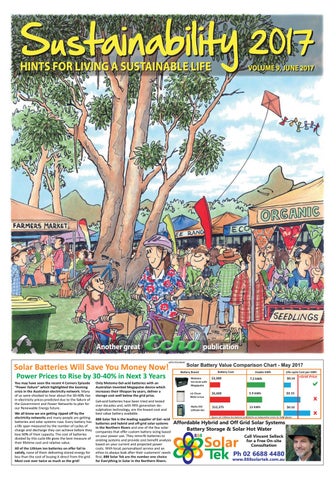
Sustainability 2017
HINTS FOR LIVING A SUSTAINABLE LIFE
Another great
VOLUME 9, JUNE 2017
publication advertisement
Solar Batteries Will Save You Money Now! Power Prices to Rise by 30-40% in Next 3 Years
You may have seen the recent 4 Corners Episode “Power Failure� which highlighted the looming crisis in the Australian electricity network. Many of us were shocked to hear about the 30-40% rise in electricity prices predicted due to the failure of the Government and Power Networks to plan for our Renewable Energy future.
We all know we are getting ripped off by the electricity networks and many people are getting batteries and solar systems now. Every battery has a life span measured by the number of cycles of charge and discharge they can achieve before they lose 60% of their capacity. The cost of batteries divided by this cycle life gives the best measure of their lifetime cost and relative value. All of the Lithium Ion batteries on offer fail to satisfy, none of them delivering stored energy for less than the cost of buying it direct from the grid. Most cost over twice as much as the grid!
Only Motoma Gel-acid batteries with an Australian invented Megapulse device which increases their lifespan by years, deliver a storage cost well below the grid price.
Gel-acid batteries have been tried and tested over decades and, with fifth generation desulphation technology, are the lowest cost and best value battery available. 888 Solar Tek is the leading supplier of Gel -acid batteries and hybrid and off-grid solar systems in the Northern Rivers and one of the few solar companies that offer custom battery sizing based on your power use. They retro-fit batteries to existing systems and provide cost benefit analysis based on your current and projected power costs. With local, personalised service and an ethos to always look after their customers' needs first, 888 Solar Tek are the number one choice for Everything in Solar in the Northern Rivers.
Affordable Hybrid and Off Grid Solar Systems Battery Storage & Solar Hot Water 888
Call Vincent Selleck for a Free On-site Consultation
Ph 02 6688 4480
www.888solartek.com.au
Sustainability 2017
Sustainability 2017 – an Echo supplement
THE BYRON SHIRE
www.echo.net.au/byron-echo
NETDAILY
www.echonetdaily.net.au Supplement Editor: Michael McDonald Advertising Manager: Angela Cornell Design & Production: Ziggi Browning Front cover: Ross Johnson Contributors: John Brodie, Mary Gardner, Eve Jeffery, Mandy Nolan, Aslan Shand Photographers: Tree Faerie, Shelli Van Santen, stock and supplied images © 2017 Echo Publications Pty Ltd ABN 86 004 000 239 Village Way, Stuart Street, Mullumbimby Phone 02 6684 1777 Fax 02 6684 1719 Printer: Fairfax Media Brisbane Reg. by Aust. Post Pub. No. NBF9237. Printed on recycled paper
People power tackles carbon problems While we often consider renewable energy projects as the main ways to reduce carbon levels in the atmosphere, the Drawdown project found that reduced food waste and plant-rich diets on their own beat solar farms and rooftop solar combined. Also in the project’s top ten was ‘educating girls’ at no. 6. According to the project leaders, ‘Drawdown maps, measures, models, and describes the 100 most substantive solutions to global warming. For each solution, we describe its history, the carbon impact it provides, the relative cost and savings, the path to adoption, and how it works. ‘The goal of the research that informs Drawdown is to determine if we can reverse the buildup of atmospheric carbon within thirty years. All solutions modelled are already in place, well understood, analysed based on peerreviewed science, and are expanding around the world. ‘There have been agreements and proposals on how to slow, cap, and arrest emissions, and there are inter-
national commitments to prevent global temperature increases from exceeding two degrees centigrade over pre-industrial levels. One hundred and ninety-five nations have made extraordinary progress in coming together to acknowledge that we have a momentous civilisational crisis on our earthly doorstep and have created national plans of action.
HIGHLIGHTS
‘The UN’s Intergovernmental Panel on Climate Change (IPCC) has accomplished the most significant scientific study in the history of humankind, and continues to refine the science, expand the research, and extend our grasp of one of the most complex systems imaginable – climate. ‘However, there is as yet no roadmap that goes beyond slowing or stopping emissions. ‘To be clear, our organisation did not create or devise a plan. We do not have that capability or self-appointed mandate. ‘In conducting our research, we found a plan, a blueprint that already exists in the world in the form of humanity’s collective wisdom, made manifest in applied, hands-on practices and technologies. Individuals, communities, farmers, cities, companies, and governments have shown that they care about this planet, its people, and its places. ‘Engaged citizens world over are doing something extraordinary. ‘ Find out more at drawdown.org.
Councils join the green push 4–5
Healing the human
Local partners in sunshine
Sustainable building design 10
Four councils with innovative projects Enova and COREM work together
6
Learning about Permaculture 7 Aslan Shand looks at our local college
Eve Jeffery tackles mental health issues John Brodie outlines a practical path
Message in a bottle
Mandy has a go at the plastic avalanche
9
13
Winter is Coming More than ever the performance of your solar system is important to fight back against rising costs of electricity. Juno Energy builds high quality systems from the ground up with the number 1 & 2 solar modules as tested by Choice magazine. We also use SolarEdge inverters & optimisers to ensure each panel reaches its full potential. Each system is custom designed and can be matched with leading battery brands including LG & Sonnen. If you would like to book an appointment with us to start the process of learning more please contact us. Give us a call 02 6687 2569 Patrick 0425 256 802 Andy 0423 343 323 132 Jonson St, Byron Bay Authorised local LG solar dealer
www.junoenergy.com.au 2 volume 9, June 2017 Sustainabilty 2017
Electrical licence number: 255292C
www.echo.net.au/sustainability
Hints for living a sustainable life
Business as usual is not the path to resilience Mary Gardner Sustainability is a powerful way of thinking about the impact of our activities. In spite of attempts to trivialise the idea, it has deep roots that spread into many parts of our lives. As catastrophic change happens, such as flooding and other impacts of climate change, we size up the situation in terms of what I call emergency resilience: what’s needed for a community to bounce back again. We also need to ponder what I call deep resilience: sustainability across decades and generations. Scenarios are imaginative ways to picture various options about sustainability and both types of resilience. Numerous scenarios were presented by Donella Meadows and her colleagues in their famous 1972 book Limits to Growth. The trends in growth for world population, industrialisation, pollution, food production, and resource depletion were all examined as different scenarios projected a hundred years into the future. The ‘business as usual’
www.echo.net.au/sustainability
scenario showed that when limits in these five areas were ignored, the result was a ‘sudden and uncontrollable decline in population and industrial capacity’. Sustainability specialists J Nørgård and colleagues, who reviewed the book and its impact 38 years later, found that critics of the 1970s concentrated entirely on this one example. The radical free-market ideologists tried to discredit the entire work by insisting that economies must always focus on more jobs and unlimited growth. J Nørgård and colleagues double-checked that growth scenario from 1972 and found that it is now playing out much as the book predicted. In all this time, vested interests continued with ‘business as usual’ and fobbed off looking ahead. One trend that was clearly troublesome in 1972 was the growing inequities in wealth. These were predicted to pick up momentum in the 21st century, destabilising both ecology and human societies. Meadows and her colleagues had ideas to counter that unsustainable trend. They were optimistic about
what they called steady-state economies. They wrote ‘the state of global equilibrium could be designed so that the basic material needs of each person on Earth are satisfied and each person has an equal opportunity to realise his individual human potential.’ What could that mean? Consider water, one of the basic material needs of not only people but all life. Here in the dry Australian continent, the limits to the quantities and qualities of fresh water are generally fobbed off with a ‘business as usual’ attitude. The quality of
marine water, coastal and beyond, are not regularly well monitored. Useful growth plans for an abundant coastal and marine life are non-existent. Coastal rural areas face more challenges. Individual interests in organic permaculture and regenerative farming are important, but the abilities to advance these are often thwarted along the waterways. The waters run true to their ancient purpose and flow to the lowlands and the sea. Ignoring legal titles, surveyed boundaries and other aspects of private property,
they act in a stubbornly collective way. Some farmers might receive grants to replant the banks of the water and fence out the farm animals. But after the funds are used, the upkeep continues, on top of the other farm work. The pressures are increased when other properties along the waterways are not all rehabilitated. The erosion and pollution continue in their collective ways and can overwhelm individual repairs that are started. The toll on aquatic creatures continues. A sustainable design would be to manage the banks of waterways as a new type of commons. The strips, of suitable widths, would be restored and maintained by the new generation of bush regeneration, permaculture and environmental science graduates and community volunteers. Facilitators and accountants can join the collective of workers and landholders developing new processes, assessments and records. Government may use rates rebates and other incentives. Artists and other creatives would explain and promote
these commons, integrating the collective efforts about both urban and rural water. Finally, sustainable jobs would exist, solving urgent difficult problems. Growth over decades would be in deep resilience that aligns with cycles of nature. These new commons would be where aquatic animals have their turn to act on their own growth plans. With the help of people, oyster reefs can be restarted. Other aquatic habitats would repair. In turn, the coastal economies would support what I call a renewed fisher farmer community. This diversification supplements the current economy featuring real estate and tourism. Using this design to meet people’s material needs about water helps realise human potential and assist with animal potential too. Sustainability? Maybe just in the nick of time. • Dr Mary Gardner, writer and biologist, has a special interest in local ecology, place-based knowledge and deep resilience. Read more at echo.net.au/tangle-of-life.
Sustainabilty 2017 volume 9, June 2017 3
Sustainability 2017
Local councils join the push BYRON SHIRE
FigTrees Organic Farms are proud to offer in the Northern Rivers district:
~ natural ~ ethically raised ~ pasture fed ~ ~ organic beef ~ organic, nitrate-free pork ~ Linking consumers and healthy food to a healthy environment
Experience the amazing healthy taste of FigTrees organic beef and pork! Available in whole bodies or half sides, cut up to your specifications, or as individual cuts – see our website for your nearest outlets. For more information contact: Glenn 0409 272 894 Henry 0428 237 282
www.figtreesorganicfarms.com.au
4 volume 9, June 2017 Sustainabilty 2017
In the world of sustainability, it’s exciting times ahead for Byron Shire Council. Two key projects for 2017 include the investigation of bioenergy with Byron Shire and the regional electric vehicle strategy. The biomass prospectus is currently being compiled and considers all sources of organic waste material, termed ‘biomass’, produced in the Shire. Biomass is organic matter from commercial or farming activities that could be utilised for its highest available reuse value by being ‘fed’ into a bioenergy plant. Council’s sustainability officer, Kim Mallee, said the innovative utilisation of the Shire’s biomass provides an excellent opportunity for reducing carbon emissions and creating a valuable resource from the mass of organic waste material produced within the Shire. As a very first step Council engaged Planit Engineering to do a detailed assessment to quantify and qualify the possible sources of biomass within the Byron Shire. The project has involved the community from the beginning and includes the farming and commercial sources of organic waste currently not collected. This could be from dairy, pig and chicken farms or commercial food manufacturing. The final bioenergy study will be presented to Council within the next couple of months. Byron Shire Council’s study into available biomass builds on the regional work completed as part of the Sustain Northern Rivers collaboration. The other key renewable energy project is the regional study into electric vehicle charging stations. Byron Shire had its first electric vehicle charging station installed earlier in the year at the Byron Bay Library. It was the first fast-charge electric vehicle station in regional NSW. Ms Mallee said a key barrier to electric vehicle uptake is ‘range anxiety’ – the fear of not being about to get home. ‘Having fast charging stations throughout the region will help allay those fears. ‘When completed, the regional electric vehicle study will detail the locations of charging stations and enable people to seriously consider
Sandi Middleton inspects Byron Shire Council’s EV recharging station outside the Byron Bay Library. this zero-emissions transport option,’ she said.
TWEED SHIRE Tweed Shire Council is introducing an 0rganics household waste service, as part of a new 3 Bin System to direct more food waste away from landfill. The 3 Bin Collection Service for urban residents including a weekly organics collection service (green-lid bin) for all food scraps and garden waste, one landfill (red-lid) bin and one recycling (yellow-lid) bin – will bring the Tweed in line with other northern rivers councils. The NSW Government has set a target for all NSW councils to divert at least 70 per cent of waste from landfill, by recycling and reusing materials where possible. The Tweed cannot come close to meeting that target without the introduction of the 3 Bin System, and its organics service, because of the high proportion of food waste currently in households’ red-lid bins. Endorsed by the NSW EPA and implemented by councils across the country, the 3 Bin System has been proven to help the environment, while saving money for ratepayers in the long term by curbing the increasingly expensive process of responsibly disposing of waste. All the information about how the new system will work, including changes to what goes in each bin and when they will be collected, is available at www.tweed. nsw.gov.au/BinServices
Tweed Shire Council is the newest signatory to the Global Covenant of Mayors (CoM) for Climate & Energy. The Tweed joins 7,444 other cities and local government areas around the world to reduce local greenhouse gas emissions, enhance resilience to climate change and track progress publicly. The council is compiling an updated community greenhouse gas emissions inventory, thanks to a grant from International Council for Local Environmental Initiatives (ICLEI Oceania). Council is also analysing costeffective options to reduce emissions from energy use across Council buildings and services through greater energy efficiency and renewable energy uptake. Tweed Shire Council is celebrating confirmation of a Building Resilience to Climate Change fund grant for a regional response to mosquito-borne disease. The $58,000 grant will enable northern rivers councils to work together to develop a response plan to protect their communities against mozzie-borne disease, an emerging climate change risk. As part of the project, councils will test themselves in a mock outbreak scenario. The councils will also seek to gain an understanding about their communities’ readiness and receptiveness to stay safe against potential container-breeding mosquito related diseases such as dengue, zika and chikungunya.
www.echo.net.au/sustainability
Hints for living a sustainable life
for green energy solutions
Mock-up of a floating solar farm for Lismore City Council. Photo Ciel & Terre International
LISMORE CITY Later this year, Lismore City Council will launch the first council/community solar farm project in Australia. The project has been in the making for many years and includes two solar farms powering separate Council sites with renewable energy and bringing benefits to mum-and-dad investors who have funded the project. Lismore Community Solar is a collaboration with Farming the Sun, a not-for-profit renewable energy facilitator, to build two 99kW solar farms – a rooftop solar farm at Goonellabah Sports & Aquatic Centre and a floating solar farm at the East Lismore Sewage Treatment Plant. Two companies each with 20 local investors raised the funds for the project and loaned these to Council to build the solar farms. The investors will see a return on investment slightly better than that of a bank. ‘These solar farms are Australia’s first council/community solar farms and we believe the floating solar system will be the largest floating solar farm in Australia,’ says Lismore councillor Elly Bird. ‘After several years of hard work between Council, Farming the Sun, and locals committed to renewable energy, it will be incredibly exciting to see these solar
farms begin operating.’ The solar farms are one of many measures in Council’s Renewable Energy Master Plan to achieve Council’s bold goal of self-generating all its electricity from renewable sources by 2023. Local solar installer Rainbow Power Company was the successful tenderer for the Goonellabah Sports & Aquatic Centre solar farm while the innovative floating solar system is to be installed by Suntrix. The floating solar farm will be constructed on an overflow pond at the East Lismore Sewage Treatment Plant. A large body of water with low velocity, the pond also increases longevity of the solar farm with the cooling properties of water helping the panels to last longer and perform better, while increased shade from the panels will reduce evaporation and algal growth on the pond. Both solar farm projects have been assisted by funding from the NSW Office of Environment and Heritage Growing Community Energy grants program.
BALLINA SHIRE Ballina Shire Council continues to make waves in the national water scene with their rollout of recycled water. Recycled water is crystal clean, safe, cheaper to use
and is available 24/7, even in times of drought. It’s also suitable for a range of uses inside and outside the home, including toilet flushing and the cold-water washing machine tap, watering gardens and washing cars. The use of recycled water within Ballina Shire is helping conserve precious drinking water, reduce wastewater discharge to waterways and ensure a sustainable water supply for future generations. The shire’s innovative water program was introduced in 2016 and continues to be at the forefront of Australia’s recycled-water sector. The community has welcomed recycled water into their homes and according to Ballina Shire Council’s water and wastewater manager, Bridget Walker. ‘This is only the beginning. By 2018, more than 800 households across the shire will be using recycled water. Over the next 30 years we hope to have another 3,000 homes connected to the drinking-water alternative’, she says. ‘The delivery of recycled water is changing the way our community thinks about water and will help ensure a more sustainable future for our community.’ To find out more about recycled water, visit: www.ballinawater.com.au.
real farmers, real food Your local farmers market: the sustainable way to shop
BYRON BAY Thursdays 8-11am Butler St Reserve
BANGALOW
FARMERS LO
MARKET est. 2004
CA
L AND AUTHEN
* Live music * Great coffee * Gourmet food
C TI
BANGALOW Saturdays 8-11am Behind the hotel
BYRON
FARMERS LO
KET M Aest.R2002
CA
L AND AUTHEN
TI
C
Photo ballinawater.com.au
www.echo.net.au/sustainability
Sustainabilty 2017 volume 9, June 2017 5
Sustainability 2017
Local partners in solar energy: Enova and COREM Aslan Shand The Bentley Blockade win has been the genesis of many things from success and friendships to the inspiration behind the idea of the Community Owned Renewable Energy for Mullumbimby – otherwise known as COREM. In June 2014 COREM became a reality and has been focusing on how we can decarbonise, decentralise and democratise our outdated electricity system ever since. ‘Imagine a future where renewable energy is produced nearby and recirculates wealth in our local economy,’ said COREM vicepresident Dave Rawlins. ‘That’s exactly what early local visionaries created with Mullumbimby’s Lavertys Gap hydroelectric station. Funded by the local council and opened in 1926, it brought electricity to our area. Sadly, now we are tied to a network of transmission lines importing polluting electricity from the Hunter Valley and paying for the privilege!’ In the last year COREM has built four solar PV projects that are owned by the
community. A combined 33 kilowatts of solar PV is now operating on the The Drill Hall Theatre, Mullumbimby Showgrounds, Brunswick Valley Rescue Association and the Mullum Museum. Not only is this addressing climate change, but all these groups also benefit from lower electricity bills. Repayments to COREM’s interest-free loan to pay for the solar installation are returned in order to install more community solar. This model reflects the way COREM sees our energy future – clean and equitable with community benefit. Last year COREM launched Renew Fest. This sustainability event showcases the resources available and the action required for sustainable transition. This year’s event expanded into a two-day festival. Currently they are working on a pre-feasibility study to recommission the Lavertys Gap hydro project to create a community-owned electricity-generation asset. ‘COREM has a big vision, to run the 2482 area on 100 per cent renewable energy by 2020,’ said Dave.
‘The three ways to create a 100 per cent renewable energy transition requires us all to reduce unnecessary usage, generate renewable energy on our homes and businesses and whatever we still require we can purchase as clean renewable electricity. ‘Conserving power saves money, installing solar panels is a financial investment and you can switch to an ethical electricity retailer who drives climate action without burning a hole in your pocket.’
Enova Like COREM, Enova was born last year out of a collective desire to do something about energy when the nation’s leaders weren’t. ‘Now there is a debate about how we will fuel our country’s future,’ said Enova co-founder Melissa MacCourt.
‘This is good news. Finally, our politicians and business leaders are engaging in a conversation that’s long overdue.’ The northern rivers is an area that has long recognised the need to respond to climate change and investigate alternative energy. ‘Since Enova’s inception as Australia’s first communityowned energy retailer, we have set clear imperatives to instigate change within the industry. And we are making an impact,’ Melissa continued. ‘Earlier this year when other energy retailers were offering much less, despite being “the little guy” Enova set the benchmark with a 12c per kWh feed-in tariff – the best in the market – in an attempt to encourage more rooftop solar generation, forcing other larger retailers to follow suit, and recently
the New South Wales pricing regulator (IPART) recommended the solar feed-in should increase from July 1.’ Focusing on locally generated renewable energy opportunities for both customers and suppliers Enova is working on a number of projects. An interest-free loan from CORENA (Citizens Own Renewable Energy Network Australia Inc) will allow them to install a small 18kW solar system on their office roof to become a power generator. They are looking into local energy trading, including ‘peer-to- peer trading’ where energy generated can be traded between different companies, and these companies negotiate their own prices. They are also investigating how buildings owned by the same company can share the power they generate. ‘Progress is being made on a community solar garden, and we are working closely with Essential Energy to look at ways to lower network tariffs for local generation,’ said Melissa. COREM and Enova have
now come together in a formal agreement to work together across a wide range of joint community-benefit initiatives. They are primarily centred on education, creating energy-aware communities, and assisting community groups and non-profit organisations to transition to renewable energy. Together they co-ordinated a community bulk buy of solar PV and batteries and COREM is encouraging users to switch to Enova. ‘Enova energy is a fantastic ally as it is not only predominantly owned by northern rivers residents, but 50 per cent of profits go into energy efficiency and renewable energy programs,’ said Dave. ‘To be part of the energy revolution, take the pledge to use 100 per cent renewables and learn more about our 2017 goals as part of our crowdfunding campaign at www.corem.org.au.’ Switch to Enova Energy and they will donate $25 to COREM and give you a $25 credit on your first bill. Use the promotional code ‘COREM25’ to trigger the discount.
BILL BUSTER SPECIAL
www.tamarasmith.org.au
5.4 kW Solar System
“I’m supporting innovative thinking and design for a sustainable Northern Rivers region”.
ONLY
$4,495* Fully installed
1300 18 20 50 • www.saegroup.com.au BILL BUSTER SPECIAL * Extra 2 panels dependent on roof space, terms and conditions apply. ** Limited time only.
Electrical License Numbers: QLD: 72250 | NSW: 227526C Air-conditioning Licence Number: Arc Tick L061221
5.4 kW Solar System 20 X 270 WATT SOLAR PANELS
TAMARA SMITH MP
Your Local Member
ONLY
$4,495* Fully installed
GOVERNMENT REBATES SET TO REDUCE SOON...
IT’S TIME TO ACT NOW!
For email updates from Tamara sign up at www.tamarasmith.org.au/sign_up Shop 1, 7 Moon Street, Ballina NSW 2478 T: (02) 6686 7522 E: ballina@parliament.nsw.gov.au Authorised by Tamara Smith, MP using Parliamentary entitlements.
1300 18 20 50 • www.saegroup.com.au * Extra 2 panels dependent on roof space, terms and conditions apply. ** Limited time only. Electrical License Numbers: QLD: 72250 | NSW: 227526C Air-conditioning Licence Number: Arc Tick L061221
6 volume 9, June 2017 Sustainabilty 2017
www.echo.net.au/sustainability
Hints for living a sustainable life
A special kind of knowledge from a local college Aslan Shand Creating a fun, local learning environment Byron Region Community College provides a great range of courses and experiences to students. From business training, art and dance to aged care, cooking and sustainable living, these are just a few of the courses available. Coral Latella, pictured, has just completed the Certificate IV Permaculture Design and recommends it to everyone. ‘Through my experiences during the permaculture course I am now much more aware of the work that goes into the fruit, vegetables and grains that I eat and conscious about where they are coming from,’ said Coral with enthusiasm. Throughout the ninemonth course students learn a wide range of skills beyond purely setting up permaculture systems. Students learn to read landscapes, coordinate community projects, plan and design of food forests, orchards and windbreaks as well as drawing and drafting plans that
assist them in developing the skills they need to set up permaculture in both rural and urban settings. ‘I feel like I can never look at a piece of land the same way again! I instantly take note of the geography, aspect, and soil and start to think about the way it’s being managed,’ said Coral. ‘I learnt how to better read a piece of land, considering all inputs and outputs, how to plan and design a space that incorporates sustainable
growing and management techniques while ensuring client wants and needs, and how to physically construct a range of growing systems to suit different briefs.’ Inspired by her grandparents and their love of gardening, Coral described how she had ‘always taken an interest in growing things but had never properly taken the time to start my own garden.’ ‘My Italian grandfather, Nonno, has an incredible
kitchen garden, including three-metre-high heirloom tomato plants, fruit trees, olive trees etc which he has kept for more than 60 years in a small backyard in the middle of Bankstown in western Sydney. ‘My Australian grandfather has five acres of lush tropical flowers and trees interlaced with pebbled pathways and overgrown archways up in Bilambil Heights-Tweed Heads. ‘I have clear memories of sitting beneath my nonno’s
and nonna’s big olive tree with my cousins and holding a blanket out while some of the uncles climbed the tree and shook all the olives down for us to catch and sort. Also wandering behind nonno as he picked takehome goodies from the garden for everyone at the end of every family lunch.’ Students spend time working in the Mullumbimby Community Garden as well as other permaculture farms in the region. ‘I really enjoyed the field trips we made out to a range of different local farms in the northern rivers area,’ Coral said. ‘Seeing different approaches to farming and meeting some of the incredibly passionate and hardworking people behind these businesses was very inspiring. ‘I also loved getting into the physical side of implementing some of our designs – learning how to use tools properly and get my hands dirty was incredibly rewarding.’ With a background in environmental science and the
Certificate IV Permaculture Design under her belt, Coral said she can now see herself heading in the direction agricultural science. ‘I am already using the knowledge and skills I have gained to make more conscious decisions as a consumer, in addition to creating a range of home gardens, and am able to share these ideas and skills with with those around me. ‘The dream is to put everything into practice and one day have my own little piece of land to manage and love and enjoy.’ • Byron Region Community College is a not-for-profit community organisation with a strong commitment to high quality innovative learning for adults (15+). Its vision is to involve and engage people through inspiring learning experiences. The beauty, diversity and fragility of the region’s natural environment has been the inspiration behind the college’s commitment to socially and environmentally responsible practice. Find out more at byroncollege.org.au.
Bush regeneration services
As a landholder you may want to restore native vegetation, attract wildlife, regenerate farmland, control weeds or learn about your local ecosystems: rainforest, coastal, koala habitat or waterways. Restoring native vegetation and habitat corridors has positive effects on agricultural productivity: • Reducing erosion and land degradation • Reducing heat stress in livestock and creating protective windbreaks • Protecting soil and improve soil moisture • Providing habitats for native birds and insects that control pests • Improving water quality www.echo.net.au/sustainability
Envite Environment is a local not-for-profit community-based organisation with more than 20 years’ experience in all aspects of vegetation management including bush regeneration and ecological restoration services. Services include: • Control of noxious and environmental weeds, lantana, camphor laurel, coral tree, giant devils fig and others • Bush regeneration to restore native vegetation • Advice on weed control techniques, native plants and weed identification • Planting • Native landscaping • Mapping and property planning For specialised advice or to request a quote, please contact Envite:
02 6627 2800 • environment@envite.org.au 56 Carrington Street (PO Box 1124) LISMORE NSW 2480 ENVITE ENVIRONMENT IS A DIVISION OF WORKWAYS AUSTRALIA
www.envite.org.au Sustainabilty 2017 volume 9, June 2017 7
Sustainability 2017
Seeking answers among mangrove debris Eve Jeffery It’s 2017 and we know a lot better, yet people are still not only creating and consuming too much rubbish, they are still dumping refuse in waterways that lead to the ocean and directly onto our beaches, and this is causing untold damage to ocean ecology and marine life. Professor Steve Smith from Southern Cross University has been doing marine plastic surveys that have local, national and international implications. Steve, along with research assistant Bob Edgar, has been picking through five transects, each measuring 20m, along the waterway in mangrove areas adjacent to Ballina CBD. The aim is to gain an understanding of the types and quantities of debris in an urbanised estuary on the NSW north coast, and to provide preliminary data to fine-tune future sampling programs aimed at assessing the effectiveness of management actions. ‘All debris larger than 5mm in size was collected in these transects with further collections for bottles, plastic
tions, including a sub-Antarctic island and remote atolls in the Coral Sea and off the NW coast of Western Australia. ‘I’ve seen debris washed ashore on beaches and the effects it has on wildlife’, he says. ‘Regular visits to Indonesia are an eye-opener with the amount of rubbish in waterways, on beaches and in marine waters having to be seen to be believed. ‘Along the coast of eastern Australia there are increasing amounts of rubbish accumulating on our beaches and in our waterways. Thus, the opportunity to be involved in surveys to understand
the nature and scope of the problem on the mid-north coast is one I’m very happy to have taken up. ‘If we don’t understand the problem then it is all the more difficult to solve.’ Professor Smith presented his findings to a recent federal Senate inquiry. ‘Research projects like these also play a really important role in raising awareness of this global problem and can encourage people to take part in cleanup programs.’ To find out more about the work that Southern Cross University is doing, visit www.scu.edu.au.
Steve Smith and Bob Edgar examine debris from mangrove sites adjacent to Ballina CBD at the National Marine Science Centre, Coffs Harbour. Photo Shelli Van Santen
Benefits of biochar
bags and fishing-related gear assessed over a total length of 500m’, said Steve. ‘We surveyed 100m of mangroves adjacent to Ballina. ‘We found a debris load of 495 items; 60 per cent of these items were made of plastic. Plastic bags and bag remnants comprised 19 per cent of all items and glass items (bottles and broken bottles) comprised 19 per cent of all items.’
Research from NSW Department of Primary Industries (DPI) has been published in the international Nature Climate Change Journal, presenting for the first time the results of ten years’ research that shows the accumulation of carbon in soil following a single application of biochar. NSW DPI senior principal research scientist, adjunct professor Southern Cross University and project leader,
Bob Edgar says that he and Steve were assisted by nine volunteers – six from Ballina, and three from Coffs Harbour. ‘It’s fantastic to note that all the volunteers were young adults who are taking active steps to make a difference in the amenity their local urban environment’, says Bob. ‘All have expressed a willingness to be involved in future surveys and clean-ups.’
Edgar says there are plans to conduct further surveys at exactly the same locations in the Richmond River to measure the rate of accumulation of rubbish and to determine whether the composition changes over time. ‘I’m currently planning another survey towards the end of next month.’ Mr Edgar says his involvement in the project stems from visits to remote loca-
Dr Lukas Van Zwieten, said the research was conducted on the state’s north coast where biochar derived from eucalypt residues was applied in 2006 into a pasture soil managed for intensive dairy production. ‘This research demonstrates the ongoing benefits of biochar in farming systems to improve pastures.’ See more at http://bit.ly/ biocharDPI.
Your one-stop local renewable energy supplier The largest stockist of solar and renewable energy products in the Northern Rivers
PROUDLY SUPPORTING:
• Canadian and Seraphim Tier 1 Solar Panels • Solar Inverters from trusted brands like Delta, Solaredge, Fronius, SMA & Selectronic • Solar Racking from Clenergy • Large options of solar battery storage from brands like LG Chem • Guaranteed quality, warranties and backup service from a long term local electrical wholesale business • Professional and trustworthy advice • Recommendations of reputable local solar designers and installers • Large range of energy efficient products including LED lighting and solar lighting options • Generators from Yamaha & Honda/Dunlite
3/74 Centennial Circuit, Byron Bay 02 6685 8728 • haymansbyronbay.com.au 8 volume 9, June 2017 Sustainabilty 2017
www.echo.net.au/sustainability
Hints for living a sustainable life
Healing the human is a sustainable pathway Eve Jeffery A large proportion of the people in my life live with mental health issues. There are those who might speculate that it says less about the state of the planet and more about the state of me. I think it’s a little of column A and a little column B. In my life I have a people parade with all sorts of challenges from high-functioning Asperger’s through a myriad of bipolar disorders, including highs to buy grand pianos and lows that include suicidal tendencies, and those who are tugged on a lead by the black dog of depression. Sadly, people with mental health problems often find themselves at the end of a corridor faced with a brick wall and I have more than once stepped in to save a life desperately wishing to end. I can tell you it doesn’t feel heroic. It hurts – it hurts me to see those I love so sad or distraught, or anxious and depressed and hopeless, that to them, the only way out of their pain is to opt out of life. It’s not about dying, it’s about not being like this any more. I share my daily space
• • • • •
Photo Tree Faerie with a man who lives with schizophrenia. Sadly, the general kneejerk reaction from people when I tell them this is fear for my life. Schizophrenia is not code for axe murderer, okay? Please people, stop watching crappy movies. The truly sad thing is the only life that is in danger here is his and mostly that is from people whose basic lack of understanding of his illness keeps him in a cage made of human prejudice. What people may not see or understand is that knowing
EROSION + SEDIMENT CONTROL WASTEWATER TREATMENT ENVIRONMENTAL REGENERATION NUTRIENT CYCLING IMPROVEMENT SOIL REHABILITATION
• • • • •
this man has enriched my life in ways that could never be expected. Recently I spent time in a facility visiting a friend who needed a break from life. This place is gold. Large bright sleeping quarters, healthy nourishing food, therapy on tap and a nicely designed garden. Fortunately my friend can afford the medical cover to access this service. Unfortunately, many folk who need this type of service not only can’t afford the weekly rate, they can’t manage or afford
SOIL + WATER CONSERVATION WATERWAY PROTECTION COASTAL PROTECTION AGROCHEMICAL CONTROL DISASTER MITIGATION
Vetiver (Chrysopogon zizanioides) is a fast growing, non-invasive (sterile), perennial grass with a vast interlinked root system and strong stems. It has the capacity to act as “live nail” reinforcement, create living walls and filter systems, and performs as a pioneer plant for land rehabilitation and regeneration. Vetiver has been used worldwide to address a multitude of environmental, engineering, agricultural and industrial rehabilitation needs. • • • • • •
INCREASES SOIL MICROBIAL ACTIVITY TRAPS SEDIMENTS BREAKS DOWN + ABSORBS TOXICITIES WITHSTANDS FLOODING + DROUGHT IMPROVES SOIL SHEAR STRENGTH BY 45% ROOT TENSILE STRENGTH OF 75MPA 1/6th OF MILD STEEL • ROOTS GROW TO DEPTHS OF 5+ METRES • STERILE = NO WEED POTENTIAL
VETICON is an Australian and international leader in Vetiver System design enquiries@veticon.com.au
www.echo.net.au/sustainability
0415 257 108
www.veticon.com.au
to put a roof over their heads at all. Why? Many people in this situation can’t get life right, let alone all its accoutrements such as clean clothes, three meals a day, paying an electricity bill, or a hot shower, not to mention mental health services such as quality counselling and social work. This type of clinic should be available to everyone but it’s not. I am not pointing the finger at service providers here; I think the government has a lot to answer for in the
management of distressed people, but at a grassroots level, healing starts with us, the community of people surrounding those whose view of life comes from an unusual place. Humanity needs a 12-step program for their attitude towards mental health, and all of those steps are: be compassionate. We rightly rattle tins and find sympathy for those suffering from severe physical conditions such cancer and quadriplegia, yet we find it hard to see that mental illness is simply another form of illness – some from birth and some acquired – and just
as life-shattering as many other diseases or conditions. So, open your heart, open your mind. It’s time mental health was guided quietly and gently out of the closet and into the light. Sustain-ability of humanity starts with you and your willingness to see we are all Earthlings. Some of us are just a bit… different. • Eve Jeffery is a photojournalist, filmmaker, artivist and co-founder of Cloudcatcher Media. Find out more at cloudcatchermedia.com. Those triggered by this article can seek help at Lifeline 13 11 14, lifeline.org.au.
Climate change and emotions ‘As our awareness of environmental problems increases, many strong emotions can surface, says the Australian Psychological Society. ‘It is common for people to experience a range of emotions and psychological reactions when faced with information about environmental threats and predictions of an uncertain future. ‘People may feel anxious, scared, sad, depressed,
numb, helpless and hopeless, frustrated or angry. But climate change doesn’t need to be faced with dread. ‘There is a lot of information available about what we need to do to combat environmental problems, and many changes are very easy to make. Change can also mean we end up living better.’ See more at psychology.org.au/publications/ tip_sheets/climate.
Australian Pork Limited
2015 Best Australian Pork Spring Awards Punjab Piggery 15 September 2015
Come in and see our friendly staff for a choice of local, grass-fed, organic and free-range meats – all antibiotic and hormone free. Now using gluten-free crumbs!
Our smallgoods range includes locally produced smoked leg ham, salami and a variety of gluten-free sausages.
7am–5pm Mon–Fri 8am–12pm Sat 70 Dalley Street, Mullumbimby Phone 6684 2137 Sustainabilty 2017 volume 9, June 2017 9
Sustainability 2017
Steps to practical sustainable building design John Brodie Rising resource costs, increased demand for energyefficient buildings, outcomes of a changing climate or simply living or working in a comfortable place are all contributing to the demand for a sustainable home or workplace. Over the last 15 years, sustainable design has developed and progressed across a range of initiatives and architectural outcomes. However, there is still a large amount of discontent and misinformation around sustainable buildings. Uncomfortable, noisy, inefficient, impractical. Many sustainable buildings aren’t sustainable or don’t provide delight. Often, this is a result of an unsuitable approach to the design process. What do you want to achieve in your building? Do you want your building to be the world’s best practice or just more efficient? Do you want the building to look good and also be practical? These types of questions must be asked as they help
the project team (architect, builder, consultants, client) define the way forward.
Climate Imagine building an igloo in Cairns as a place to live? Comfortable for about five minutes! Australia is full of homes that are totally irrelevant to their local climate. This results in irrelevant, uncomfortable and resourcehungry buildings. It is imperative to understand important factors such as cooling/heating wind directions and speeds summer and winter, hours of daylight per annum, angle of the sun at your location year round, retained soil temperatures across a year, and natural shading opportunities. These and assorted other criteria should all be understood so they can inform your design process so your home will be relevant to where it is located. This results in less demand for heating and cooling and significantly improved thermal comfort levels. What thermal comfort criteria do you want in your home? Remember thermal comfort is very subjec-
tive, very complicated and questions around thermal comfort are not often asked during the initial design process. For example, is airconditioning a necessity? Do you want 22.5C all year round in your facility or your home? Or will you accept varying temperatures in your space but, for example, tempered with strong, cooling air movement in summer?
Design strategy The answers should make a significant difference to the design process of your building. Once the prevailing three questions have been answered in sufficient detail
Replace your old shower and get a refund from Council
to inform the design process, then the correct sustainable design strategy can be formulated. An air-conditioned building should have a different design strategy to a nonair-conditioned building. A building located on the beach should have a different design strategy from one located in the mountains. There is a raft of passive and low-tech opportunities available for you to implement on your building. Very important is to make the building do the work by shaping it to catch and accelerate air flows, for example, or to offer improved cooling
or heating opportunities through engineered thermal mass or natural ventilation are some examples of cost effective passive solutions. A lot of those ideas are initiated at a stroke of a well-informed designer’s pen, nothing more. Consider the use of nonrefrigerant air-conditioning options such as thermal labyrinths or geo-exchange cooling and heating. Create multiple benefits from one item. Incorporating solar panels – thermal and electric – as part of the building shading or façade are examples of relatively low tech solutions too. Lots of opportunities abound.
Diagnosis One of the great advances in technology is the use of software to model your building and provide indepth diagnosis of how your building will perform and what you will get once it is built. Before it is built. This can be a great costsaving initiative if undertaken during the early design development process. A great example is in the specification of glazing. Through modelling you
can identify the value of important initiatives such as higher-performance glazing, increased insulation levels or the value of air flow for cooling etc. The list of options is endless. Once all the upfront work as noted above has been undertaken, a final sustainable design strategy can be compiled where all the relevant criteria can be correlated to assist the design team create a comfortable and resourceefficient building. The message to remember is that to create a truly sustainable and comfortable home, a clear sustainable design methodology should be followed. And that involves utilising some science. This way you can ensure that your required outcomes are met and everyone involved in the project is working towards an agreed result: your sustainable home. • John Brodie is a sustainability consultant who holds a master of design science (Sus Des) USyd and is the managing director of VIM Sustainability ESD, now based in Byron Bay. Find out more at www.vim.net.au.
WHAT’S IMPORTANT TO YOU? When it comes to solar power, there are a few things you have to consider
Saving more than 15,000 litres of water per year and up to $100 in water and electricity costs is as easy as installing water-saving showers, basin and sink spouts, mixers, aerators and flow controllers or regulators. Council provides homeowners a 50 per cent rebate on the purchase and installation of approved water saving products such as showers and tapware.
If you upgrade your outdated showers and tapware with water efficient products, Council will refund 50 per cent of the total purchase and installation costs for eligible products to a maximum of $100.
For further information on the rebate program, including terms and conditions and the application form, please visit www.tweed.nsw.gov.au/WaterRebate or call Council on (02) 6670 2400.
10 volume 9, June 2017 Sustainabilty 2017
Why do you need it? In our experience, most customers want to take out some insurance against electricity prices rising, many think that it’s one of the easier steps to take to reduce their footprint on the planet. Why would you go to Rainbow Power Company to buy solar systems? Because of our experience, 30 years’ worth in fact. We have a staff of 28 people who each play a part in selling, manufacturing, managing technical specifications and testing of equipment and installing these systems. You can also be assured we will be around to handle any warranty claims if the need should arise. We’re here for the long haul, give us a call if you want to know more, We’re not expensive, we’re worth every penny.
Call the company you can trust ... Powering on since 1987
Phone: 02 6689 1430 or visit www.rpc.com.au www.echo.net.au/sustainability
12 Recycling Rules for your yellow bin
Never miss another R U bin collection day! L E
1
BAG THE BAG THE DIRTY DOZEN 12 Recycling Rules for your yellow bin
BAG THE BAG
R You can recycle all soft plastic Upackaging including plastic bags, You can recycle all soft plastic L clean cling wrap, frozen vegie bags, packaging including plastic bags, andcling biscuit etc. E pastaclean wrap, packets frozen vegie bags,
1
etc. Place pasta it all and in abiscuit bag,packets tie it up it all in a bag, tie it up and putand itPlace inputyour recycling bin. it in your recycling bin.
Plastic packaging with foil lining such as chip packets are not accepted in our soft plastics recycling. They need to be placed in your red landfill bin.
THE DIRTY DOZEN 12 Recycling Rules for your yellow bin
GRAB A GRAB A SATCHEL SATCHEL
THE DIRTY DOZEN 12 Recycling Rules for your yellow bin
R U LGrab a Resource Recovery Collection Satchel for household reading E Grab a Resourcebatteries, Recovery Collection glasses,Satchel corks,forX-rays, CDs and DVDs, household batteries, reading glasses, and corks,accessories, X-rays, CDs andprinter DVDs, mobile phones mobile phones and accessories, printer cartridges, small electronics, electrical cartridges, small electronics, electrical cords and alarms. cordssmoke and smoke alarms.
9
Satchels can be collected from all local libraries, Council’s Mullumbimby office, the Cavanbah Centre, Bunnings Byron Bay and Mitre 10 Byron Bay. Once your satchel is full. Seal it up and put it straight into your yellow-lidded recycling bin.
www.echo.net.au/sustainability
Sustainabilty 2017 volume 9, June 2017 11
Sustainability 2017
Bringing back native plants and animals The Byron Shire hinterland is green and lush but not all that is green is good. Virginia Seymour, restoration ecologist with Envite Environment, explained, ‘Weeds grow very well in disturbed sites and on former agricultural land. Our bush regenerators can control weeds and restore native plant and animal habitat on your property.’ The Big Scrub rainforest once extended from Byron Bay to Ballina and inland to Lismore. This 75,000ha area of lowland subtropical rainforest provided habitat to thousands of native rainforest plants and animals. By the late 19th century most of the rainforest was cleared for timber and agriculture and the rainforest was reduced to scattered remnants. Much of our coastal vegetation has also been disturbed by past sand mining and development. Weeds such as camphor laurel, privet, bitou bush, lantana and vine weeds have invaded remaining native vegetation. Envite Environment bush
Indigenous and community groups, local councils and government agencies. Its services include ecological restoration planning, seed collection, propagation and revegetation, flora and fauna survey, large-scale infrastructure landscaping
projects and environmental training. Contact Envite Environment on 6627 2800 for a free property assessment, advice and quote for bush regeneration works on your property. See also www. envite.org.au.
Renewable energy needed to drive uptake of electric vehicles
Iain Stych, bush regeneration team leader, provides training at a field day. regeneration team leader Peter Verrall said, ‘Our team is experienced in controlling weeds to assist natural regeneration of native plants.‘ ‘We use organic or conventional weed control techniques where appropriate. We also help landholders identify weeds and native plants and explain options for managing weeds and restoring native habitat.’
Virginia continued, ‘We can control weeds among native vegetation and plant native species in open areas to improve habitat for native birds and other animals. ‘ In areas around creeks this can reduce erosion and improve water quality. You can improve biodiversity on your property while also enhancing its value.’ Envite Environment is a
not-for-profit organisation delivering ecological restoration services since 1993. With 24 years of experience in bush regeneration on the NSW north coast Envite has the expertise required to assist landholders restore native habitat. In addition to bush regeneration, Envite Environment provides a range of services in partnership with Landcare,
Plugging into renewable energy sources outweighs the cost and short driving ranges for consumers intending to buy electric vehicles, according to a new study. QUT postdoctoral research fellow Dr Kenan Degirmenci, from QUT Business School, said environmental performance was more important than price or range confidence for electricvehicle consumers. ‘High purchase costs and short driving ranges have been considered to be the main factors that impede people’s decision to buy electric vehicles,’ he said. ‘Since electricity needs to be produced from renewable energy sources for electric vehicles to be a truly green
alternative, the environmental performance has also been presumed to be a factor.’ The study involved interviews with 40 consumers and a survey with 167 people who participated in test drives with plug-in battery electric vehicles in Germany. ‘We found the majority of participants placed great emphasis on the need for electricity for electric vehicles to be produced from renewable energy sources in order for them to be a true alternative,’ he said. Dr Degirmenci said Australia’s transport sector accounted for 16 per cent of the country’s greenhouse gas emissions. See the study at http://bit. ly/2o7WdEa.
Get Sustainable! We have courses available in...
• Permaculture • Horticulture • Aquaponics • Beekeeping • Wild Fermentation • Vegan nut cheeses and milks • Seed saving • Sustainable housing • Permaculture Design Course and more...
Do you want a wood heater that: Provides 24 hour heat from a 2 hour burn? You can lean against while it is burning? Is a beautiful feature of your home? Doesn't need constant refuelling?
Enrol Now! call 02 6684 3374 www.byroncollege.org.au 12 volume 9, June 2017 Sustainabilty 2017
A Masonry Heater ticks all the boxes.
Releases few emissions? Doesn't clog your flue? Leaves little ash? Uses less wood?
0409189659 admin@heavenlyheat.com.au www.heavenlyheat.com.au
www.echo.net.au/sustainability
Hints for living a sustainable life
There’s an environmental message in a bottle Mandy Nolan Bottled water now outsells Coca-Cola. Who would have thought this freely available resource would one day outsell the ultimate diabetes juice, ‘American champagne’! Sure, water is sugar free! It’s ‘unprocessed’. It’s vital for human existence. It also lives in every house in every street, available at the turn of a tap, so why do we buy it? Bottled water is the ultimate capitalist product. They basically took something like access to drinking water that should be a human right and put it in a plastic bottle and sold it back to us for up to $4 a pop, depending on the fancy label. It’s just marketing. When you choose between different waters you are basically just choosing a marketing campaign. Is there really a spring? Is the water you are drinking ‘purified’ or ‘organic’? I mean what is ‘organic’ water anyway? Do you have to get it certified? Most ‘pure’ water you drink is sourced from the tap. When was the last time you went to Minyon Falls and noticed a bunch of
www.echo.net.au/sustainability
factory workers leaning into the rapids, patiently filling up bottles? No-one markets their product with a picture of a tap on it. Although in third world countries the ‘tap’ as an indicator of treated clean water supply is probably a more powerful image than a naturally occurring spring. I’m surprised CocaCola haven’t cottoned on to selling ‘Sydney Tap’ to India. According to an article in the Daily Telegraph a few years back, ‘Sydney Water boasts one of the world’s most advanced filtration systems. It sells water at $2.13 for 1,000 litres but companies sell it for about $2.50 for 600ml. Even accounting for a 15c bottling cost, that is the mark-up of more than 180,000 per cent.’ So what are we buying? Certainly not water. We are buying packaging. We are buying plastic. That plastic ends up in landfill. In fact it is one in ten of the items found on Clean Up Australia Day. It seems ludicrous. Here we are looking for ways to reduce our environmental impact and here’s something we could give up today
Discarded plastic water bottles, India. Photo Jonny Hughes flickr.com/jonny2love without any impost. We are paying for a product that we can source locally. We don’t have to grow it. We don’t even have to take a basket to the farmers markets. It’s in our own homes. It requires us putting water in reusable containers and taking them with us. Pop a few bottles of water in the car. And if you don’t have a bottle, find a friendly tap and ask for a glass. The other day I did a plastic-bottle audit in my car and I found five. If it were five empty bottles of Coca-Cola I’d be embarrassed. But water is ‘healthy’ so no such stigma
exists. No-one begrudges you buying bottled water. Except perhaps fish. Think about the environmental and health impacts. Most bottled water is packaged in PET (ployetheylene terephthalate) converted from crude oil. Besides the impacts of plastic production, plastic is harmful to human health, and by bottling water you are taking a healthy resource and adding a chemical load. It doesn’t matter whether your water came from an ancient spring tended by virgins in g-strings made from chia seeds, if it’s in a plastic bottle you’re
most probably drinking the harmful chemical Bisphenol or BPA. And while some plastics claim to be BPA free, it’s a bit like finding a healthy cigarette. All plastics are bad for your health, and contain chemicals that work as disruptors in our hormonal messaging. They certainly don’t put that on the label. A picture of the glorious Mount Franklin Spring being ruined by plastic. A picture of a turtle choking on a bottle top. Buying and selling water is bad for the environment. It takes up to three litres of water to produce just one litre of water. I don’t know if you’re much of a maths boffin but every bottle of water leaves us with a two-litre deficit. Unlike tap water, bottled water doesn’t just ‘turn up’ through a clever piping system. You have to put it on trucks. Trucks burn fossil fuels. The average plastic bottle, even when recyclable, takes up to 1,000 years to break down. We’re now becoming aware of their devastating effect when they hit the sea and kill marine life. Ironically, bottles that once contained
water end up in the water and kill fish – 100,000 marine creature die each year from plastic enganglement. Not one marine creature has ever been harmed by your turning on the tap. Australians spend more than half a billion dollars a year on bottled water. That’s something we could have got free. Give that money you would have spent to a charity that drills well in third world countries. Buy some sturdy water bottles and stop supporting corporate greed. Every single person in this country could make a powerful environmental impact right now. We’re working towards making our Shire plastic-bag free, why not plastic-waterbottle free as well? It’s a powerful political action that will facilitate real change. You don’t have to chain yourself to a tree. You don’t have to march yelling slogans. All you have to do is turn on the tap. • Mandy Nolan is a writer, comedian and comedy coach. Find out more at http://mandynolan.com.au.
Sustainabilty 2017 volume 9, June 2017 13
Sustainability 2017
A smarter approach to energy and raw materials Over the past century, the world population has grown exponentially, as has our need for energy and raw materials. If we wish to continue to live prosperously in the future, we have to radically restructure our economy and consumption. Scientific research is underway in Holland to solve this problem. ‘When you hear “sustainable use of raw materials”, many people think of recycling,’ says Arnold Tukker, Professor of Industrial Ecology. ‘But we need something much more radical. ‘We have to completely rethink our approach to supply and demand, production and consumption, stocks and waste. ‘Make materials less complex. Make sure that components can be reused. ‘Create a society built on “elements of hope” – materials such as sand, iron and aluminium that are so common that scarcity is not likely to be a problem any time soon.’ Tukker is scientific director of the Leiden Institute of Environmental Sciences (CML) as well as director of the Leiden-Delft-Erasmus Centre for Sustainability, a partner-
In a city such as Amsterdam there are a lot of reusable materials. The PUMA project, Prospecting the Urban Mine in Amsterdam, aims to exploit this ‘urban mine’. ship across three universities and different academic disciplines, from chemists to engineers and computer scientists, from psychologists to economists and public administration experts.’ Each of the universities has its strong points, explains Tukker. ‘Delft is good in new technologies and design, Rotterdam in business and policy. And we in Leiden investigate the “metabolism of society”: how do physical flows of raw materials
move across the world? How important are they? What are they influenced by?’
Raw material flows Leiden maintains the world’s largest database in the field of raw material flows, including gas and coal. ‘The database covers the entire economy of the 44 largest countries,’ says Tukker, ‘and the import and production of 180 product groups over the past fifteen years, including emission
and waste streams.’ René Kleijn, senior university lecturer and scientific director of the industrial ecology department, also works on the raw materials database. ‘We use it for large-scale analysis projects,’ he explains. ‘For example on aquaculture, recycling of concrete and other construction materials, and materials needed to produce sustainable energy.’ The current generation of windmills, for example, still contains materials that are
finite. The demand for clean energy means that already we have to increase the production of raw materials such as copper in order to meet the demand in fifteen years’ time. The challenge is to look ahead, says Kleijn. ‘You can also make windmills without scarce metals – they may be slightly less efficient, but a more future-proof source of energy. You can only make these kinds of considerations if you have a clear view of the material flows, which is precisely what our database provides.’ One of the consequences of upscaling wind energy is that the earth metal neodymium, which is used in the wind turbine generators, is becoming scarcer.
Circular economy A frequently heard concept in this context is the ‘circular economy’: an economy where energy and materials are constantly reused, and there’s no waste. ‘The economy is not likely to become fully circular any time soon,’ says Kleijn. ‘There will always be raw materials that are too expensive, too
energy-consuming or too polluting to recycle. In these cases you shouldn’t do it – recycling should never be a goal in and of itself.’ But we still have large supplies of raw materials in unexpected places. As an example, Tukker mentions the PUMA project: Prospecting the Urban Mine in Amsterdam, being carried out by CML researchers. This project maps precisely where metals, such as steel and copper, can be found in Amsterdam. ‘For example in ships and in buildings. The next step is to design an infrastructure to exploit this “mine”.’ Leiden is also strong in so-called lifecycle analysis, or LCA: a method to map the origin and destination of raw materials, including the energy required. The best-known example is: Is it better to wash your coffee cup or use a plastic disposable cup? ‘The answer is: it depends,’ laughs Tukker. ‘What we do is map the factors this depends on for the most important product groups.’ Find out more at http://bit.ly/pumaresearch. Electric Lic 124600c
Your local, qualified team • Specialists in standalone & grid interact system designs • Hybrid battery systems
Pioneering Holistic Dentistry
in the Byron Shire for over 20 years • General and Family Dentistry • Emergencies • 3D Imaging, Scanning and Treatment Planning • Hygienist and Dental Therapist • Implants • Extensive Bleaching Options • Comprehensive Cosmetic Treatments • Bulk billing for Child Dental Benefits Scheme
Save our planet, save your money. Let the sunshine work for you ! Reduce pollution & your energy bills Real Battery Support, Best Off-Grid Bar None, 20 years’ Experience
Pioneers of the solar industry
Serving Northern NSW since 1998
Call us on 6679 7228
Call 0266 851 264
m 0428 320 262 e sunbeamsolar@bigpond.com w www.sunbeamsolar.com.au
Shop 6/18 Mullumbimbi St, Brunswick Heads
w w w. b r u n s w i c k d e n t a l . n e t
14 volume 9, June 2017 Sustainabilty 2017
www.echo.net.au/sustainability
ADVERTISING FEATURE
Life is busy, but as we go about our day-to-day tasks with a little awareness, we can make choices that lessen our footprint on the planet.
Painted Earth: sustainable paints and finishes Located in the Green Building Centre in the Byron Arts & Industry Park, Painted Earth sells Australia’s largest range of modern eco-friendly paints and wood finishes. They’ve collected together the best products from more than ten different manufacturers to give a complete range of ecofriendly finishing products for walls, floors, furniture, decks, roofs, and more. They include high-quality acrylic paints – just like Dulux Wash’n’Wear – but without the toxic paint smell! As well as natural paints, natural wood oils, and clay and lime plasters and renders. With 12 years’ experience selling these paints and finishes they can help you find the right products for your home or workplace. Purchasing low-VOC paints and finishes assures you of providing healthy indoor air quality for your home and workplace, as well as looking after our environment. You will also be pleasantly surprised to find many products are a similar price to regular paints. Once you try them you won’t look back. 1 Brigantine St, Byron Arts & Industry Park www.painted-earth.com.au 6685 7522
Whitewood: thoughtful industry interior design Whitewood is an interior architecture and design agency that creates interior spaces that are unique and considered. They design spaces for all industries, from retail, hospitality, health and fitness, office spaces and even residential. They love to work with clients who have passion and are driven by the need to see change in the world. Whitewood’s designs are developed by gaining a strong understanding of the client’s or brand’s needs and vision. The concept is then further refined by thoughtfully selecting sustainable finishes, methods and building materials to reduce the impact on the environment and the user’s wellbeing. Services and pricing are tailored based on the projects needs and budget to make sure amazing people and brands achieve amazing results in their interior spaces. Whitewood have worked with local clients such as the Bay Leaf Cafe and the recently opened Dreamers & Drifters store on Jonson Street with ongoing projects in Brisbane, Byron Bay and Auckland, NZ. If you have a special project you’re working on then get in touch, Whitewood would love to hear from you. www.whitewood.agency hello@whitewood.agency 0400 441 981
Smart Energy Group Pty Ltd Energy and Communication Pty Ltd have been trading since 2013 and have installed more than 180,000 quality solar panels across Australia. Energy and Communication is in partnership with Smart Energy Group Pty Ltd. A 100 per cent Australian owned and operated renewable energy technologies company, they guarantee to bring you only the highest quality solar installations possible. Smart Energy Group pride themselves in helping Australian homeowners, families and businesses to reduce or eliminate their power bills by providing top-quality, tailored solar power systems. With a love for great solar technology, they provide only tier-1 systems and industry-leading warranties. Smart Energy Group’s core belief is that solar should be affordable for everyone. With a range of flexible payment plans coupled with our community bulk buy scheme, they have made this possible. Smart Energy’s mission: to help Australian homeowners, families and businesses reduce or eliminate their power bills by using their love for great solar technology. At the core, solar power should be accessible to all. With Smart Energy Group’s variety of solar options, they can provide this. 4/60 Centennial Circuit, Byron Bay Arts & Industry Estate 0417 143 328 elliot@smartenergygroup.com.au www.smartenergygroup.com.au
www.echo.net.au/sustainability
Sanctum: certified organic skincare for the whole family Since establishing itself within the coastline of Byron Bay 25 years ago, Sanctum has remained true to its roots. Each product encapsulates the pure tranquillity of this area by combining locally sourced botanical ingredients, where possible, with a vision to sustain and nurture. Along with this inspired vision, Sanctum provides authenticity for its customers, upholding ‘Truth within Labelling’, by being independently certified organic, cruelty free and vegan. Sanctum was started from a desire to provide pure and unspoiled care for our family. After years of commitment, research and development we have created an holistic, family-oriented skin, body, hair, baby and men’s care ranges. Certified organic doesn’t stop at the product or the ingredient level either. Sustainability is integral to Sanctum and its family of brands; solar panels power the entire manufacturing process at our factory in Billinudgel. We also add a biodegradable enzyme to our tubes and ensure all packaging is completely recyclable. From formulation to bottle, our approach is about providing a sustainable future for our family and yours. Visit our factory outlet in Billinudgel where we display our family of brands. 5/9 Lucky Lane, Billinudgel 1300 653 983
Simply Ethical Advice: your local ethical investment and superannuation specialists When ethical investment advisers make investment decisions they use the same strategies as mainstream advisers: they consider the financial strength of an investment. Ethical advisers then take an additional step and look at more data. They consider the social, environmental and governance performance of an investment. Essentially more risks are considered when making investment decisions. This helps to explain why studies have shown the outperformance of ethical investments. Companies that consider the communities and environments in which they operate are valued by consumers, communities and the environment. Whether you want to learn more about your own financial strategy or simply have someone take care of it for you. We offer tailored solutions and guidance in relation to investment, superannuation, cash flow, retirement planning, personal insurance, estate planning, goal setting and debt management. We assist clients to invest into solutions such as renewable energy, education, recycling, information technology. Hope Evans has eight years’ experience in financial planning. Hope has worked in mainstream advice mentored by prominent advisers before establishing Simply Ethical Advice and returning home to Byron. Hope now sits on the board of Ethical Advisers Co operative, has a Masters of Sustainable Development from Bond and a Bachelor of International Business from Griffith. Authorised Representative of Ethical Investment Advisers AFSL 276544. www.ethicalinvestment.com.au. Please contact Hope on 0421 778 683 or hope@simplyethical.com.au www.simplyethicaladvice.com.au
Sustainabilty 2017 volume 9, June 2017 15
• Dedicated ‘Food for All’ area supplying fresh fruit, vegetables, eggs and honey to community in return for donations • Nursery providing plant seedlings in return for donations • Composting and worm farming (using organic waste from local cafes) • Individual allotments for community members who would not otherwise have access to space for growing vegetables (currently approx 45 members) • Educational space (classroom and two growing spaces) for Byron Community College permaculture, horticulture and bamboo building training courses
• Educational growing space for Mullumbimby High School students • Venue for community workshops and groups including vegetable growing, yoga, mothers and children singing group • Weekly lunch using garden produce in return for donations • Dedicated children’s garden space where mothers and children group and grandparents group meet regularly • Space for young farmers • Space for Mullumbimby Men’s Shed (in development) • Elders’ Space
SHOW US SOME LOVE BY We Need You! Regular volunteers welcome: Organic gardeners of all ages and experience; Site maintenance and handypersons; Daily site co-ordinators; Administration and creatives! We Need Your Support! Join our organisation as a financial member and ensure the ongoing success of this amazing asset and invest in this community-owned and -operated facility. Mullumbimby Community Gardens at southern end of Stuart Street. Contact us – www.mullumseed.org.au president@mullumseed.org.au admin@mullumseed.org.au
Grow to share - Share to grow MULLUMSEED INC We are a not-for-profit volunteer based charity that aims to build a respectful, supportive and resilient community with interactive activities based around sustainability and environmental awareness.
We also promote and practise ecologically sustainable development and education programs that enhance and protect the natural environment. Through our Bunya Sustainabilty Fund we support other community initiatives including chemical-free bush regeneration, dunecare, renewable energy, alternative building
techniques, soil health and carbon farming. We are now registered as an Environmental Organisation with Deductible Gift Recipient and Tax Charity.
To support our diverse range of projects please contact us at www.mullumseed.org.au/donate.
MU L LUMS E E D I N C : P R OJ ECTS A N D PA RT N E R S
BYRON COMMUNITY COLLEGE
N RY FA
Byron College has a wide range of sustainabilityoriented classes from short taster workshops to longer courses. This includes hands-on education in permaculture, energy efficiency, food growing, composting, bee keeping, aquaponics, energyefficient house design and many more. The program changes from term to term. To see what’s on offer www.byroncollege. org.au | 6684 3374.
Northern Rivers Young Farmers Alliance is a voice for young farmers in the northern rivers region of NSW.
SHARA COMMUNITY GARDENS Shara Community Gardens, next to the preschool on Shara Boulevard in North Ocean Shores, is a lovely social meeting place and organic food garden. At present a toilet is being built, which will add greatly to the community’s usage! We have run out of funds, so our GoFundMe ‘We need a toilet!’ campaign allows you to contribute to finishing this important asset. 0431 151 950 GoFundMe Campaign www.gofundme.com/weneed-a-toilet | www.sharacommunitygardens.org info@sharacommunitygardens.org
It’s building unity through support, promoting, networking and collaborating the exciting work of young farmers in our area. The Northern Rivers Young Farmers Alliance is an opportunity to meet, greet, share ideas and values. www.NRYFA.org.au | FB: nryfa BY R O N FA I R FO O D Byron Fair Food is enabling community connections so together we transform our local food system. We are uniting our energy to bring forward a local, sustainable, ethical, clean and transparent food system within the Byron region. We know that a clean, transparent and supportive community food system where everyone has access to healthy ecologically grown food is the possible future. Looking for new energy on our project management committee contact us on FB: ByronFairFood.
FUTURE FEEDERS
MULLUMBIMBY MENS SHED
Future Feeders is growing a movement for our next generation of young farmers. We want to engage young people in sustainable agriculture, develop pathways for collective skills development and grow opportunities for young farmers. Let’s develop our local ecological agriculture industry. www.futurefeeders.org FB: futurefeeders farm@futurefeeders.org
To provide a safe place for men of all ages in our community to relate shoulder to shoulder with consideration to access and equity, and social and cultural inclusion.
16 volume 9, June 2017 Sustainabilty 2017
Our vision for MMS is to have an inclusive, productive and supportive environment for men of all ages with a positive effect in the community and everyone benefits. FB: mullumshed | e: mullumenshed@gmail.com
PLASTIC FREE BYRON BAY Plastic Free Byron offers tailored and customised solutions to our community to remove the need of plastic bags and other single-use plastic items from the Byron Shire. As an association of eight environmental organisations they provides a supportive service to assist in the adoption of less wasteful and more environmentally friendly habits of tourists and residents. For more information visit www.plasticfreebyron.com FB: plasticfreebyron e : plasticfreebyron@gmail.com. BYRON CHEMICAL FREE LANDCARE Byron Shire Chemical Free Landcare’s next fortnightly working bee will be on Saturday 3 June, from 9am till 1pm, at Brunswick Heads Crown Land Reserve site. Meet at the end of South Beach Road fire track gate, not far from the Surf Club. Nadia de Souza Pietramale: Project Coordinator 0478 272 300 www.byronshirechemicalfreelandcare.org e: byronshirechemicalfreelandcare@gmail.com LUMINOUS YOUTH Luminous Youth has a commitment to human and community prosperity, and ecological sustainability, for the youth of our world. We offer transformative
workshops in the Byron Shire for adults and youth, seasonal celebratory events, inner-journey meditations, audio and visual podcasts with pioneering adults, inspiration for parents and more. www.luminousyouth.com FB: luminousyouthvillage paul.luminousyouth@gmail.com MULLUM CARES Mullum Cares is embarking on building a stock of assets that the northern rivers community can share. To register your interest and support of this initiative please sign up and add any items you’d love to see in the Library. FB: Mullumbimby Library of Stuff. Ph: Sasha on 0422 641 474 FB: mullumcares www.mullumcares.com.au e: mullumcares@gmail.com COMMUNITY OWNED RENEWABLE ENERGY MULLUMBIMBY COREM is developing community-owned renewable energy projects that generate income to fund more community-owned projects. Be part of this truly sustainable solution. To find out more / donate to their crowdfunding campaign go to www.corem.org.au FB: COREM.Australia e contact@corem.org.au.
www.echo.net.au/sustainability