Power-Building in Action: How Community Organizing is Transforming Child Care
Project Director
804,525 people reached THROUGH DIGITAL MESSAGING in 2024
16,226 people engaged IN DIRECT ADVOCACY in 2024
In times of social and political change,
the strength of grassroots leadership is especially critical. The Early Childhood Funders Collaborative (ECFC) launched The Raising Child Care Fund (RCCF) in 2019 as a response to shifting political landscapes and the growing urgency to center community voices in child care advocacy. RCCF was built on the belief that those most affected by the child care crisis—parents, early educators, and providers—must lead the movement for change. By pooling private funding and directing resources to grassroots organizations, RCCF has not only strengthened advocacy efforts but also deepened ECFC’s commitment to racial equity, community-driven solutions, and philanthropy that shifts power.
Grassroots organizing is essential to building power and advancing equitable policies—not just in moments of crisis, but always. The pandemic made clear that child care is the workforce behind the workforce, and community-driven advocacy remains critical to securing lasting change. Over the last six years, RCCF grants have expanded to organizers in 20 states, helping lift voices, build power, and expand equity. Grantees have reached over 800,000 people through digital messaging and engaged more than 16,000 in direct advocacy actions in the last year alone. Their work extends beyond child care, linking cross-issue coalitions advocating for issues like paid leave, the child tax credit and tax equity, economic justice, reproductive rights, racial equity, voter rights, immigrant rights, and housing. Together with allies in their states, they have secured state investments in child care and improved compensation for early educators — wins that require ongoing organizing to protect and expand.
There are still challenges ahead on the path toward building the power to make transformative policy change. Where states expanded child care investments in previous years, organizers spent 2024 fighting to sustain and implement those gains equitably. In New Mexico, voters approved a ballot measure expand access to early education funding, yet advocates calculate that fully funding quality care and fair compensation will require even more resources. In Mississippi, years of advocacy led to the elimination of eligibility requirements that were preventing single mothers from applying for child care subsidies, but a surge of 17,000 new applicants in 2024 led administrators to warn that waiting lists were imminent. These wins are not one- and- done—sustained organizing is necessary to build upon progress.
A robust, well-funded child care system is critical to the health and well-being of families, communities, and economies. Yet, too many parents and providers are left struggling, overlooked by policymakers who are often far removed from these challenges. RCCF remains committed to continuing our partnership with parents, providers, and grassroots organizers around the country to push for lasting change. We invite philanthropic partners to join us—not just as funders, but as engaged learners, allies, and contributors—in this journey toward securing child care justice.
Rachel Schumacher, MPP Director, The Raising Child Care Fund
A Project of the Early Childhood Funders Collaborative
Our Theory of Change
Our Theory of Change starts with centering the voices of those who most rely on and work in child care, especially people who have been historically disenfranchised and left out of decisions that impact them. Additionally, RCCF supports intersectional leadership and underwrites our grantee partners’ capacity to combat the historic race and gender inequities built into child care in America. Our ultimate goal is for robust funding to resource and center the experiences of families, early educators, and caregivers in the development of an equitable child care system.
We give grants to community organizers to:
LIFT VOICES
Lift parent, early educator, caregiver, and ally voices and increase their participation in crafting equitable policy solutions in states and/or communities.
BUILD POWER
Build effective coordination among RCCF grantee partners and advocacy groups, community groups, parents, early educators, caregivers, and allies.
EXPAND EQUITY
Expand financial resources to secure increased and equitable funding to quality child care, including through intentional strategies to reach and prioritize children and families most affected by injustice and inequity.
Developing Capacity and Power to Make Change Over Time
The Raising Child Care Fund’s (RCCF) primary goals since it began grantmaking in 2019 have been to support the capacity of grassroots groups to lift voices, build power, and expand equity in child care. Over the years, RCCF has demonstrated that robust, multi-year general operating grants are fundamental for community organizers working with parents and child care providers to progress toward these goals. Each grantee partner faces unique opportunities and challenges, depending on factors such as the state’s history of public investment in child care, population demographics, and political and public will. We trust our grantee partners to chart their own activities and define their own success—cheering their wins and continuing funding despite setbacks. Through annual interviews, RCCF tracks how our grantee partners develop the capacity and power to create change over time.
MomsRising (West Virginia)
When RCCF first made a grant in West Virginia in 2021, there were no organizing groups focused on child care. Seeking to expand funding into states with high proportions of children in poverty—West Virginia has about one in five children living in poverty— RCCF partnered with a national leader, MomsRising, to support the work of Rattle the Windows, led by a part-time consultant.
This lone organizer began by traveling across this rural state to engage child care providers and parents frustrated with the existing system. By 2023, she had organized seven town halls, which earned media coverage in small-town newspapers. Providers shared their difficulties making payroll during and after the pandemic and advocated for changing state policy to pay providers based on child enrollment, rather than attendance. With a coalition of organizations, they successfully pushed for this change and participated in federal advocacy, with support and training opportunities provided by MomsRising.
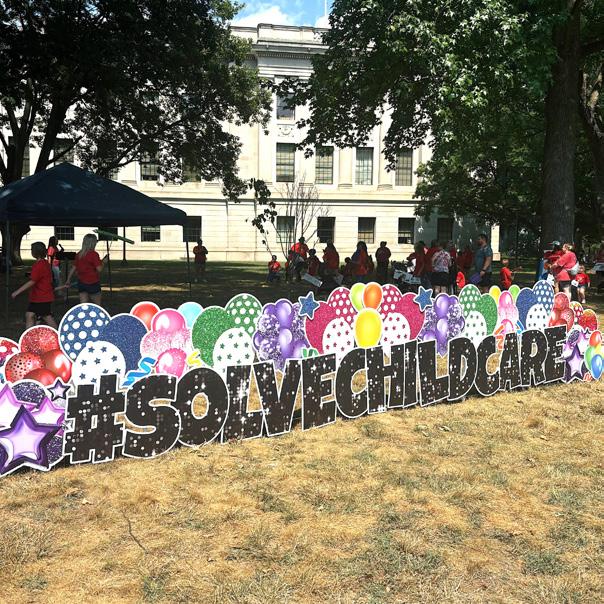
In 2024, RCCF increased funding to $150,000 annually, enabling West Virginia’s organizing partner to become full-time. She worked with volunteers to host 11 town halls across the state, drawing 500 participants. These events have become a platform for sharing community experiences, collecting over 80 pages of signatures, and 53 video testimonials. Multiple child care bills have been filed in the state legislature informed by themes from the town halls, including (now a U.S. Senator). Notably, a town hall at the state Capitol on August 25th attracted over 100 attendees—up from 55 the prior year—who used a large #SolveChildCare banner (pictured below) to amplify their message on social media, mobilizing support.
First Up (Pennsylvania)
In 2022, First Up became an RCCF grantee, launching a Latinx Early Childhood Education Equity Project, which grew out of Zoom calls held in Spanish during the pandemic. This project has since attracted members in new geographic areas of the state, establishing itself as a key voice for Spanish-speaking providers and families with the state administration, legislative leaders, and statewide early care and education advocates. As a result of their advocacy efforts, the state now translates official documents, such as grant applications and compliance guidelines, into Spanish. This change addresses a critical barrier, as educators had been previously penalized for noncompliance due to language misunderstandings. The Legislative Latino Caucus now regularly seeks input from First Up and the Latinx Early Childhood Education Equity project on child care-related issues. RCCF expanded funding to $125,000 in 2024.
Grantee since 2022
Investing in Organizing for Long-Term Change
Investing in organizing for the long haul provides the foundational capacity needed to build movements. RCCF’s commitment provides relief to our grantees by reducing the time spent seeking renewals and completing extensive reports, allowing them to focus on their mission. Sustained funding from RCCF has helped many grantees secure additional revenue sources to expand their work, while for others, it has provided the financial stability needed to maintain organizing capacity despite limited statebased philanthropic support.
The Impacts of Organizing
Measuring the impact of organizing means understanding both the methods of building collective power and the signs of success that emerge along the path to policy wins. RCCF grantee partners build community and connections among parents and providers, equipping them to organize in their own communities to inform local, state, and national leaders, and to hold decision-makers accountable for policies that impact child care. This investment in leadership development has an exponential effect, as those closest to the inequities in the system become leadership of future organizing efforts and spokespeople in the media. As a result, parents and providers, and their expertise, priorities, and policy ideas, are increasingly recognized by government leaders.
RCCF grantee partners and their members are strengthening their influence on policymakers. With sustained and growing grant support, grantees are engaging more elected officials as champions for policies and public investment that build a more equitable and affordable child care system while ensuring early educators are compensated fairly for their essential contributions to society.
Family Forward Oregon
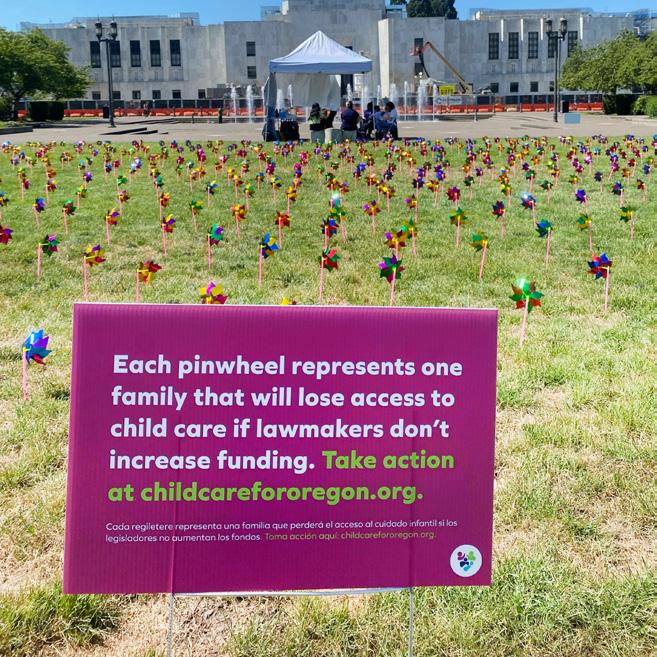
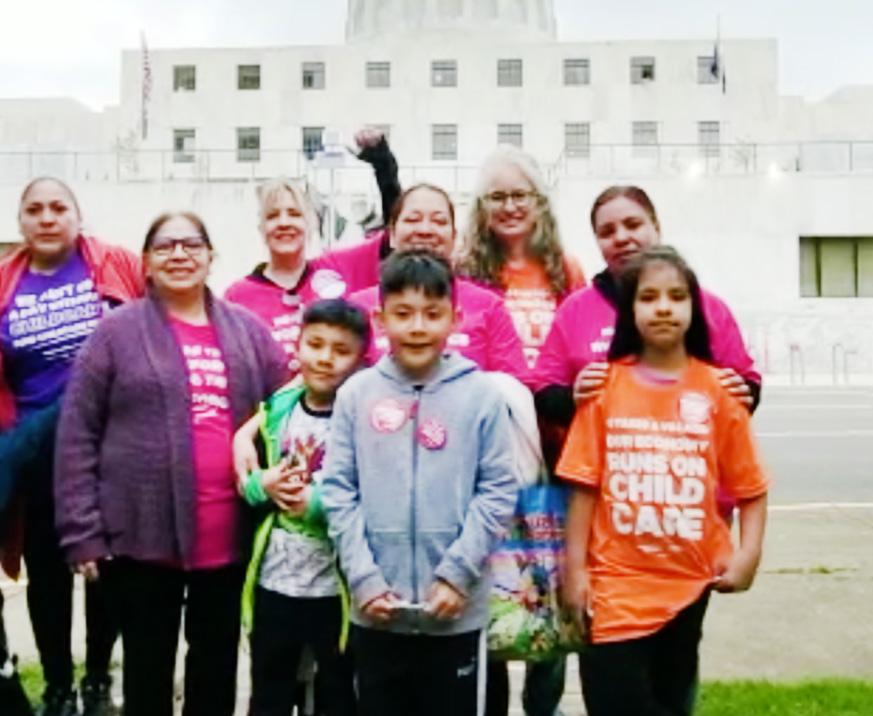
Family Forward Oregon has organized moms and caregivers for over a decade and has been an RCCF grantee since 2019. During this time, they have successfully advocated for significant increases in state funding for child care. However, legislative turnover means they have to continually educate new leaders to sustain these gains. In January 2024, Family Forward Oregon hosted a day of action at the Oregon Capitol Mall, where their action team of parents, providers, and child care advocates dressed in onesies to garner media attention. Their message was clear: Oregon’s insufficient child care budget and growing waitlist for child care assistance would leave over 7,000 eligible families without access.
At the Capitol, demonstrators shared their stories directly with policymakers and the media. One parent confronted a legislator who had not previously supported child care funding, asking about his own experiences accessing care. This exchange shifted the legislator’s perspective, leading him to join the Child Care Alliance and co-sponsor child care legislation aimed at expanding supply of care. Following the event, a state senator became the chief sponsor of a bill establishing a pilot program for neighborhood-based child care microcenters. By the end of the legislative session, Oregon had increased child care assistance funding by $99 million, with an additional allocation during a special session in December 2024.
$99 MM increased state funding DUE TO DEMONSTRATIONS AND MEDIA COVERAGE DURING THE LEGISLATIVE SESSION
IN 2024
16 states and DC
16,000 people joining IN PERSON AND ONLINE ACTIONS FOR CHILD CARE
800,000 people reached WITH INFORMATION ON CHILD CARE AS A PRIORITY for children, families, and early educators, and caregivers
ALL GRANTEES ARE PART OF THE LEADERSHIP OF organizing and advocacy strategy in their state
64 FTEs organizing
ALL GRANTEES ORGANIZE ON RELATED ISSUES LIKE paid leave, economic and tax justice, racial equity, AND voting rights FOR CHILD CARE JUSTICE
The impact of organizing grows as people realize they have power to challenge systems and policies that were not created with them in mind. As noted in the Letter from the Project Director, RCCF grantees have engaged over 16,000 people in direct advocacy actions and reached more than 800,000 through digital messaging—demonstrating how grassroots leadership is building sustained power for child care justice. This work is labor intensive and moves at the speed of trust. Organizers need foundation partners who understand that lasting change requires long-term investment.
Staying the Course for Long-Term Change
Historic wins require continued organizing to ensure equitable implementation and sustained funding.
RCCF builds trust with our grantees so they can openly share about setbacks, lessons learned, how they will refine their strategy, and needed support.
In 2024, some grantee partners faced challenges to sustain progress from previous years.
Louisiana Power Coalition for Equity and Justice
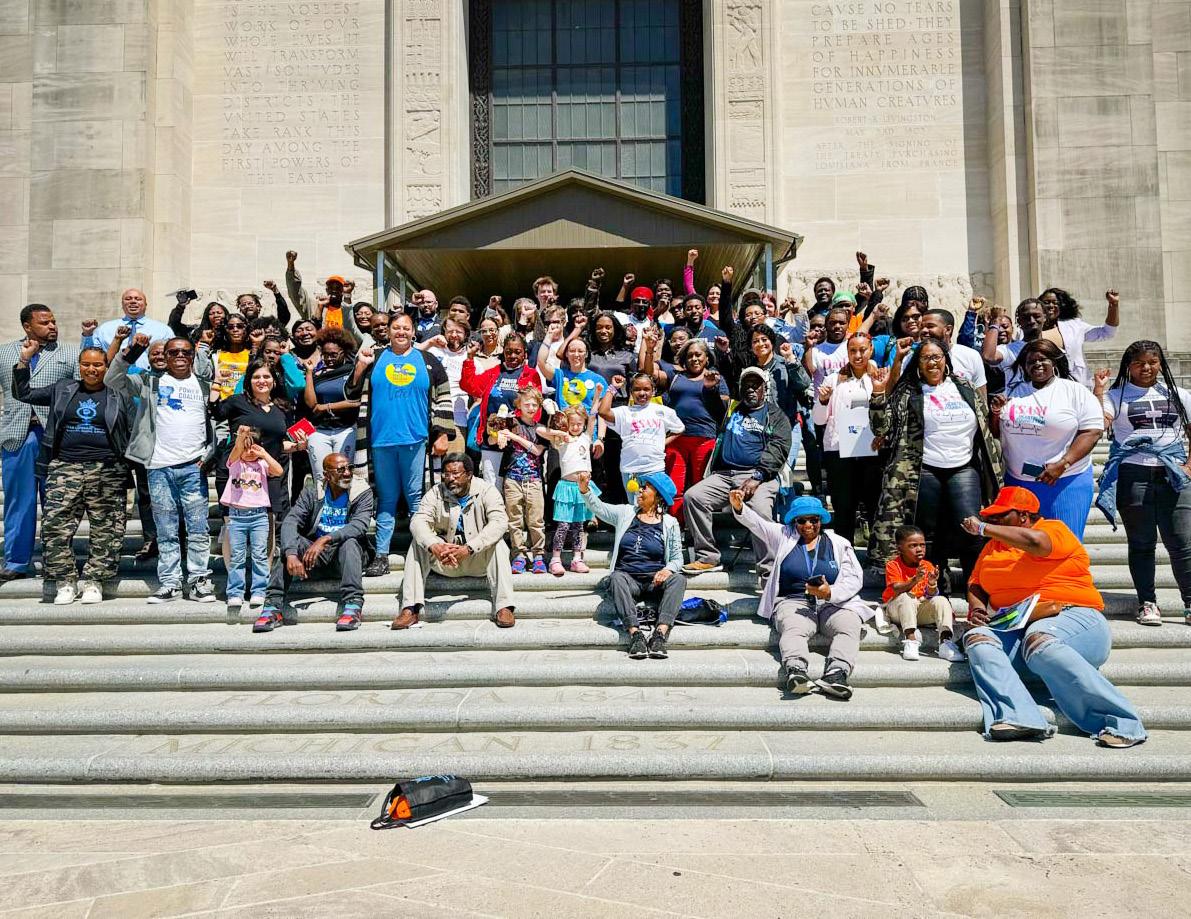
Louisiana Power Coalition for Equity and Justice has been an RCCF grantee since 2021. In 2023, they helped secure the biggest increase in state funding for child care ever—$52 million. In 2024, however new state gubernatorial leadership with less commitment to child care sought to reduce funding for social programs, leading the Coalition and partners to organize against a proposed constitutional revision of tax and revenue policies (including school funding formulas) that could have gutted the state’s limited investments in child care and working families. Despite setbacks, they succeeded in restoring most of the child care budget, but organizers faced high stress and burnout from the ongoing struggle.
Colorado Statewide Parent Coalition
$52 MM state funding BUDGET FOR CHILD CARE DEFENDED
Colorado Statewide Parent Coalition (CSPC), an RCCF grantee since 2021, helped pass key legislation in 2024 that codified federal updates to child care subsidy policies to limit family copayments and expand eligibility for families under the federal limit of 85% of state median income. CSPC also secured a provision allowing family, friend, and neighbor caregivers to participate in the subsidy system. In addition, they helped to pass a refundable tax credit that will go into effect in 2026 for the lowest paid child care workers. However, progress was impeded by a decades old state amendment that limits revenue intake. According to the state constitution, when state revenue rises above a certain level that portion of funds must be given back to taxpayers. This prompted CSPC to join a broader tax coalition to build power to advocate for future revenue increases.
Family
Friend and Neighbor caregivers
GIVEN ACCESS TO CHILD CARE SUBSIDY
Even historic policy wins do not mean the work is over. Many grantee partners face inequitable restrictions placed on access to new programs, temporary funding, or the withdrawal of promises when administrations change. This is where funders must stay the course and continue to support community organizers to ensure that “wins” translate into lasting improvements for children, families, and providers.
Sharing Power with Grassroots Partners
One of the first lessons RCCF learned from organizing partners was: “Nothing for us, without us.” Power is rarely shared willingly—even in philanthropy. RCCF is committed to sharing power with grantee partners by prioritizing their leadership in decision-making and funder education.
RCCF established a Partner Advisory of grantees to provide input on strategy, shape funder education programs, and prioritize topics for peer-to-peer conversations. The Partner Advisory consists of five leaders from RCCF grantee partners who are compensated for their time. This collaboration fosters trust and camaraderie between grantees and RCCF staff, with some members even sitting on RCCF hiring committees. In 2024, RCCF and the Advisory reflected on the high levels of exhaustion grantees were reporting, especially during an election year. In response, RCCF offered mini-grants for grantees to provide respite for their staff and parent and provider volunteers.
The RCCF Partner Advisory is one of my favorite spaces.
As an organizer, I have rarely been able to have meaningful relationships with a funder beyond grant reporting and check-ins. The Partner Advisory is focused on the issues arising in the child care space, brainstorming how we can get over the next hurdle and drawing strength from each other's experiences as motivation to keep going. I hope this is a model that other funders use to build a bridge between organizing and successful campaigns.”
— AMY JO HUTCHISON, Campaign Director, West Virginia at MomsRising
RCCF and ECFC also share power by centering grantee voices in funder education programs, including ECFC’s in-person convenings. In October 2024, RCCF grantee partner Springboard to Opportunities in Mississippi, a nationally recognized innovator on guaranteed income, presented about the Magnolia Mothers Trust—the longest running guaranteed income program in the country that provides low-income Black mothers with $1,000 each month for one year. Sarah Stripp, director of socioeconomic well-being, shared key insights while two mothers who benefited from the program spoke directly to the impact it had on them and their children.
RCCF’s governing structure reflects our commitment to sharing power, with grassroots experts holding seats on both our Managing and Executive committees. In 2024, RCCF met with these experts to continuously improve our structure. Based on their advice, we raised the stipends and increased the representation of grassroots organizers in governance.
Funders as Learners
As a project of ECFC, RCCF is deeply embedded its strategic plan to learn, connect, and catalyze. Learning directly from grantee partners allows RCCF to amplify their voices in philanthropic spaces and push for shifts in funder. RCCF was created in response to the historic underfunding of organizing, which has a hindered policy change and excluded leaders of color from state and national strategies.
Despite the progress made by RCCF’s funder community—now 16 foundations strong—there is still more to learn and repair to build trust with historically marginalized communities. Child care is an issue that intersects with a range of philanthropic funder goals, including economic mobility, gender and racial equity, and child development.
“As a funder committed to expanding economic opportunities for families, children, and youth, Casey has supported efforts to improve the financial security of child care providers through the RCCF initiative since 2019. RCCF’s inclusion of child care providers and organizers in leadership aligns with Casey’s commitment to involving those most affected in decision-making.”
— QUANIC FULLARD, Senior Associate, and BEADSIE WOO, Director, Family and Youth
Financial Stability, Annie E. Casey Foundation
“As a funder focused on advancing racial, gender and economic equity, being part of the RCCF initiative since 2022 has provided an opportunity to connect with new early childhood funders, increase child care organizing capacity for grassroots organizations, and ultimately ensure that economic opportunities and social safety nets are more supportive of women and their families.”
— EESHA BHAVE, Program Officer, Gender and Reproductive Equity Grantmaking, Charles and Lynn Schusterman Family Philanthropies
The opportunity to learn together, share challenges, and rethink strategies continues to attract new funders.
“Roots & Wings is committed to helping children grow strong from the roots up. By strengthening the capacity of public systems and community programs for our youngest children, we can make a huge difference. This is why we decided to join The Raising Child Care Fund in 2024. We appreciate RCCF’s approach to centering the voices of parents and providers while also building power through parent leadership and advocacy. We were impressed with RCCF’s impact in the first five years and are excited to see more transformational change in the years to come.”
We extend our sincere thanks to the following funders for their continued support.
"As a funder with a desire to help build a stronger movement on behalf of young children and their families, being part of the State Learning Cohort has provided an opportunity to learn from others who share our goals and are working in a similar context.”
— SHANNON COTSORADIS, Director, Policy & Strategy, Buffett Early Childhood Fund