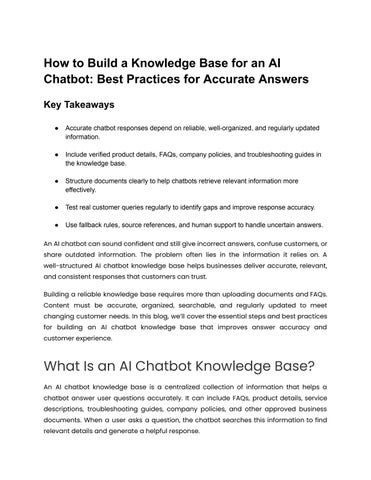
How to Build a Knowledge Base for an AI Chatbot: Best Practices for Accurate Answers Key Takeaways ● Accurate chatbot responses depend on reliable, well-organized, and regularly updated information. ● Include verified product details, FAQs, company policies, and troubleshooting guides in the knowledge base. ● Structure documents clearly to help chatbots retrieve relevant information more effectively. ● Test real customer queries regularly to identify gaps and improve response accuracy. ● Use fallback rules, source references, and human support to handle uncertain answers. An AI chatbot can sound confident and still give incorrect answers, confuse customers, or share outdated information. The problem often lies in the information it relies on. A well-structured AI chatbot knowledge base helps businesses deliver accurate, relevant, and consistent responses that customers can trust. Building a reliable knowledge base requires more than uploading documents and FAQs. Content must be accurate, organized, searchable, and regularly updated to meet changing customer needs. In this blog, we’ll cover the essential steps and best practices for building an AI chatbot knowledge base that improves answer accuracy and customer experience.
What Is an AI Chatbot Knowledge Base? An AI chatbot knowledge base is a centralized collection of information that helps a chatbot answer user questions accurately. It can include FAQs, product details, service descriptions, troubleshooting guides, company policies, and other approved business documents. When a user asks a question, the chatbot searches this information to find relevant details and generate a helpful response.
Unlike a basic FAQ page, an AI chatbot knowledge base can support natural language queries, allowing users to ask questions in their own words. Depending on the system, the chatbot may retrieve relevant passages using semantic search or retrieval-augmented generation (RAG). This makes information easier to find and helps the chatbot provide answers grounded in business-specific content.
Why Does Your Knowledge Base Matter for AI Chatbot Accuracy? Even a powerful AI model can give unreliable answers when it works with incomplete, outdated, or conflicting information. A well-maintained AI knowledge base gives the chatbot reliable content to reference, helping it respond more accurately to customer questions and business-specific queries. A strong knowledge base also supports better customer service in several ways:
1. Consistent answers Customers receive reliable information about products, services, and company policies.
2. Faster resolutions The chatbot can find relevant information quickly and address common questions without unnecessary delays.
3. Fewer escalations Clear documentation helps resolve routine queries before they need human support.
4. Better customer trust Accurate, relevant responses make interactions more useful and dependable.
5. Reduced misinformation Updated, approved content helps limit incorrect answers, although it cannot eliminate AI hallucinations entirely.
The quality of the information matters as much as the AI technology itself. If the knowledge base contains contradictory policies or missing product details, the chatbot may still struggle to answer correctly. Keeping information accurate, organized, and relevant gives the chatbot a stronger foundation for reliable responses.
What Information Should an AI Chatbot Knowledge Base Include? The quality of an AI knowledge base depends on the information it contains. Businesses should select content that reflects their products, services, policies, and common customer needs. Well-prepared chatbot training data helps the system understand business-specific questions and provide relevant answers. Here are the key information sources to include:
1. Product and service documentation Add product descriptions, features, specifications, pricing details, and service guidelines to answer customer questions accurately.
2. Frequently asked questions Include common queries about orders, payments, subscriptions, account access, and other routine customer concerns.
3. Company policies Add approved information about refunds, returns, cancellations, warranties, and service terms to maintain consistency.
4. Troubleshooting guides Provide
clear
instructions
for resolving common technical issues, errors, and
product-related problems.
5. Customer support conversations
Review past chats and support tickets to identify recurring questions and gaps in existing documentation.
6. Internal documentation Include relevant process guides and operational instructions, ensuring confidential information remains restricted to authorized users. Before adding content, verify that it is accurate, current, and approved for customer-facing use. Remove duplicate documents and resolve conflicting information to prevent inconsistent responses. Organize the remaining material into clear categories so the AI chatbot knowledge base can support effective information retrieval.
How to Build an AI Chatbot Knowledge Base: 7 Essential Steps Building a reliable knowledge base requires careful planning, content preparation, and regular testing. Follow these seven steps to create a knowledge base that supports better responses and improves AI chatbot accuracy.
1. Define the Chatbot’s Purpose and Scope Identify the questions your chatbot should answer and the tasks it needs to handle. Set clear boundaries for queries that require human assistance.
2. Collect and Audit Existing Content Gather information from your website, FAQs, product documents, help center, and support records. Remove outdated content, duplicates, and conflicting information before adding it to the knowledge base.
3. Organize and Structure the Information Group content by product, service, topic, or customer intent. Use clear headings, short paragraphs, and direct answers to make information easier to find.
4. Prepare Content for AI Retrieval Divide long documents into smaller, meaningful sections while preserving the context of each passage. Add useful metadata, such as product names, categories, and update dates, to help the chatbot retrieve relevant information.
5. Connect the Knowledge Base to the Chatbot Upload documents or connect approved information sources through supported integrations. Retrieval-augmented generation (RAG) can help the chatbot find relevant content before generating a response.
6. Test Answers Using Real Customer Questions Test common, complex, and ambiguous questions using examples from actual customer interactions. Check whether the chatbot retrieves the correct information and responds accurately without guessing when answers are unavailable.
7. Launch, Review, and Improve Monitor chatbot conversations after launch to identify missing information and incorrect responses. Assign content owners and update the knowledge base whenever products, services, or business policies change.
Best Practices for Improving AI Chatbot Accuracy Building a knowledge base is only the beginning. Following the right practices helps keep information reliable and enables the chatbot to provide useful answers as customer needs change.
1. Maintain a single source of truth Keep product details, pricing, and policies consistent across all documents. Remove conflicting versions to prevent the chatbot from retrieving outdated information.
2. Write content in clear language Use simple wording, descriptive headings, and direct explanations. Clear documentation makes it easier for the chatbot to retrieve relevant information and generate understandable responses.
3. Keep chatbot training data updated Review documents regularly and revise them whenever products, services, or policies change. Assign content owners to ensure important information remains accurate.
4. Set clear fallback rules Instruct the chatbot to acknowledge when it cannot find a reliable answer. Provide an option to contact human support for unresolved or sensitive queries.
5. Use reliable information sources Prioritize verified company documentation and approved content. Where supported, include source links so users can check the information behind an answer.
6. Test with real customer questions Use support tickets and previous conversations to identify common queries. Test different question phrasings to find gaps in content and retrieval.
7. Protect confidential information Separate public content from internal documentation and apply suitable access controls. This helps prevent the chatbot from revealing information to unauthorized users.
Ready to Build a More Accurate AI Chatbot? A reliable AI chatbot knowledge base starts with accurate information, clear organization, and regular updates. By following these best practices, businesses can
improve response quality, reduce misinformation, and deliver more consistent customer experiences. eBotify offers chatbot development to help businesses create useful, customer-focused conversations. With the right knowledge base and chatbot capabilities, businesses can deliver reliable support and build stronger customer relationships.
Frequently Asked Questions 1. How can an AI chatbot knowledge base handle questions it cannot answer? Set clear fallback rules so the chatbot acknowledges missing information and directs users to human support when necessary.
2. Can outdated information affect customer trust in a chatbot? Yes. Incorrect pricing, old policies, and irrelevant answers can frustrate customers and reduce their confidence in the business.
3. How can businesses identify missing information in a chatbot knowledge base? Review unanswered queries, customer complaints, and support conversations to discover recurring questions that existing documentation does not address.
4. Should every document be available to an AI chatbot? No. Include relevant, verified content and apply access controls to prevent confidential or internal information from reaching unauthorized users.
5. How can businesses maintain chatbot accuracy as their products change?
Assign content owners, update documentation after important changes, and regularly test chatbot responses against the latest approved information.