September | 2026 VOL 36 NO 1
IN THIS ISSUE
TO THE ON THEIR WAY TO GROW A5 Diocese A6 ROOM B1 PRIEST RESCUE of Knoxville's newest class Religious Sisters of Mercy of priesthood candidates follows different paths to seminary
of Alma are outgrowing their motherhouse facilities
Father Michael Willey saves family from fire
Catholic commentary ....................... A3 Parish news ....................................... B4 Diocesan calendar ............................ B5 Columns ..........................................B6-7 Catholic schools ..........................B9-10 La Cosecha ............................Section C
Bearing the Light of Christ Bishop Beckman gives vision for diocese with launch of new pastoral plan
By Bee Goodman
DEACON PATRICK MURPHY-RACEY
A
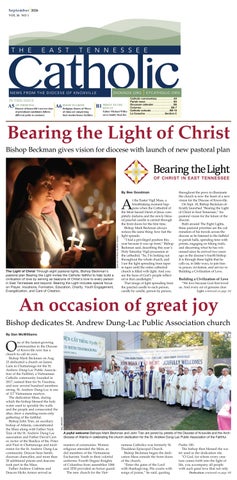
The Light of Christ Through eight pastoral lights, Bishop Beckman's pastoral plan Bearing the Light invites the Catholic faithful to help build a civilization of love by serving as beacons of Christ's love to every person in East Tennessee and beyond. Bearing the Light includes special focus on Prayer, Vocations, Formation, Education, Charity, Youth Engagement, Evangelization, and Care of Creation.
t the Easter Vigil Mass, a breathtaking moment happens when the Cathedral of the Most Sacred Heart of Jesus completely darkens and the newly blessed paschal candle is carried through the front doors for the first time. Bishop Mark Beckman always notices the same thing: how fast the light spreads. “I had a privileged position this year because it was up front,” Bishop Beckman said, describing this year’s Holy Saturday Vigil procession at the cathedral. “So, I’m looking out throughout the whole church, and I see the light spreading from taper to taper until the entire cathedral church is filled with light. And you see the faces of God’s people reflected in that candlelight.” That image of light spreading from the paschal candle to each person, candle by candle, person by person,
throughout the pews to illuminate the church is now the heart of a new vision for the Diocese of Knoxville. On Sept. 18, Bishop Beckman officially launched “Bearing the Light of Christ in East Tennessee,” his pastoral vision for the future of the diocese. Built around The Eight Lights, these pastoral priorities are the culmination of his travels across the diocese as he listened to the faithful in parish halls, spending time with priests, engaging on hiking trails, and discerning what he has witnessed since he arrived two years ago as the diocese’s fourth bishop. It is through these lights that he calls us, in little ways, to join him in prayer, invitation, and service in Building a Civilization of Love.
Building a Civilization of Love
“We love because God first loved us. And every act of genuine charLight continued on page A4
An occasion of great joy Bishop dedicates St. Andrew Dung-Lac Public Association church By Dan McWilliams
BILL BREWER
O
ne of the fastest-growing communities in the Diocese of Knoxville now has a church to call its own. Bishop Mark Beckman on Aug. 23 dedicated a church on James Lane in Chattanooga for the St. Andrew Dung-Lac Public Association of the Faithful, a Vietnamese Catholic community founded in 2017, named then for St. Faustina, and now several hundred members strong. St. Andrew Dung-Lac is one of 117 Vietnamese martyrs. The dedication Mass, during which the bishop blessed the holy water used to sprinkle the walls and the people and consecrated the altar, drew a standing-room-only gathering of the faithful. Bishop John Tran, an auxiliary bishop of Atlanta, concelebrated the Mass along with Father Nick Tran of the St. Andrew Dung-Lac association and Father David Carter, rector of the Basilica of Sts. Peter and Paul in Chattanooga and moderator for the St. Andrew Dung-Lac community. Deacon Sean Smith, diocesan chancellor, and more than 20 additional priests and deacons took part in the Mass. Father Andrew Crabtree and Deacon Hicks Armor served as
A joyful welcome Bishops Mark Beckman and John Tran are joined by priests of the Diocese of Knoxville and the Archdiocese of Atlanta in celebrating the church dedication for the St. Andrew Dung-Lac Public Association of the Faithful. masters of ceremonies. Women religious attended the Mass, as did members of the Vietnamese Eucharistic Youth in their colorful uniforms. Fourth Degree Knights of Columbus from assemblies 1084 and 3250 provided an honor guard. The new church for the Viet-
namese Catholics was formerly St. Thaddeus Episcopal Church. Bishop Beckman began the dedication Mass outside the front doors of the church. “Enter the gates of the Lord with thanksgiving, His courts with songs of praise,” he said, quoting
Psalm 100. The bishop then blessed the water used in the dedication rite. “O God, for whom every creature comes forth into the light of life, you accompany all people with such great love that not only Dedication continued on page A8
‘Red dirt Catholic’
By Tony Gutiérrez OSV News
B
lessed Stanley Rother’s witness in the face of persecution in Guatemala hits home, said Gaby Damasceno, who has family in Nicaragua where the Church is facing increased persecution. “We still have an uncle over there, and we see how hard it is, especially with kids and raising families over there,” Mrs. Damasceno said. “We’re turning to (Blessed Stanley) for his help. Seeing the work and the love that he’s done with Guatemala, it’s a light into what’s going on in Nicaragua right now.” Mrs. Damasceno and her husband, Pietro, attended the Blessed Stanley Rother Feast Day Mass at the Blessed Stanley Rother Shrine on July 28 ahead of the premiere of the documentary on Blessed Stanley’s life later that evening. The documentary was released in theaters nationwide in both English and Spanish Aug. 25-27. With a social media following through Gaby Damasceno’s small Catholic home décor company Gabrielle Isabel, the couple, who attend St. Ann Parish in Coppell, Texas, had been invited to help promote the film.
Sr. Regina
“It really is a really meaningful story to me,” Pietro Damasceno said of Blessed Stanley Rother’s life. “It’s not easy to make a documentary and to get promotion, which is important. So, we love to just be able to contribute to that.” The Mass readings for the feast day recounted Samuel’s anointing of David, drawing parallels with Blessed Stanley. After Samuel had met the physically impressive seven older sons of Jesse, the prophet was told by the Lord to anoint instead the youngest brother, the ruddy shepherd David, as the new king over Israel. “The one that the Lord chose was not the obvious one. That’s one of the things that struck me,” Archbishop Paul S. Coakley of Oklahoma City told OSV News. “Stanley was a good man, ordinary guy, but may not have stood out in a crowd as the Lord’s anointed. God’s ways are not our ways; God’s ways are mysterious. He chooses whom He will.” When Blessed Stanley first arrived in Santiago Atitlán, Guatemala, in 1968, other members of the mission team looked down on him because they didn’t consider him to be “up-to-date theologically” or sophisticated on matters concerning the Church. “But Father Rother gave his life and his heart for Blessed continued on page A20
© 2026 Handmaids of the Precious Blood
OSV NEWS PHOTO/ARCHDIOCESE OF OKLAHOMA CITY
Documentary released on Blessed Stanley Rother
Hitting home The official poster from the documentary "American Martyr: The Stanley Rother Story," which was released in theaters nationwide Aug. 25-27.
How to sign up and qualify for Diocese of Knoxville’s safe-environment program
T
The Handmaids of the Precious Blood this year celebrate the 79th year since their founding in 1947; more than three-quarters of a century of prayer and sacrifice for priests. To receive weekly cartoons and short reflections and news from the Handmaids of the Precious Blood, visit their website, nunsforpriests.org, and sign up for the FIAT newsletter.
A September prayer intention for the care of water “Let us pray for a just and sustainable management of water, a vital resource, so that everyone may have equal access to it.” –– Pope Leo XIV
DIOCESE OF KNOXVILLE PROCEDURE FOR REPORTING SEXUAL ABUSE
Anyone who has actual knowledge of or who has reasonable cause to suspect an incident of sexual abuse should report such information to the appropriate civil authorities first, then to the McNabb Center victim's assistance coordinator, 865.321.9080.
he Diocese of Knoxville has implemented the CMG Connect platform to administer the Safe Environment Program, which replaces the former Safe Environment Program (VIRTUS “Protecting God’s Children”). CMG Connect is a web-based platform that will assist in ensuring that all employees and volunteers who are in a position of trust with children and vulnerable adults within Diocese of Knoxville schools and parishes are trained to recognize behavior patterns of potential abusers and provide pro-active measures for preventing abuse in any context. “Safe Haven-It’s Up to You” is a three-part video that provides vignettes of real-life situations to educate the viewer about methods of grooming, desensitization, bullying, and neglect, all of which can lead to abuse. Each part of the video is immediately followed by a brief questionnaire to further develop understanding. Education is a key
element of the Safe Environment Program. All clergy, employees, contracted school personnel, volunteers, members of groups and organizations over the age of 18 who work, volunteer, or participate in any capacity are required to complete the diocesan Safe Environment training and a criminal-background check before they can begin employment, volunteer, or participate with ministries, groups, and organizations affiliated with the Diocese of Knoxville. In addition, the mandatory renewal training must be completed every five years and a new background check submitted before the five-year expiration of prior training. The Diocese of Knoxville Safe Environment compliance training and renewal training is a condition of employment and for volunteer ministry in the Diocese of Knoxville.
The CMG Connect platform contains all three elements of the Diocese of Knoxville’s Safe Environment Program: n Annual review of the Diocese of Knoxville’s Policy and Procedures Relating to Sexual Misconduct; n CMG Connect Safe Haven training program to be completed every five years; n Criminal background check to be completed every five years. In compliance with the Diocese of Knoxville’s Safe Environment Program, all affiliates require that volunteers and employees complete the requirements prior to working and/or volunteering in a parish, school, or through Catholic Charities of East Tennessee and/ or St. Mary’s Legacy Clinic. Go to https:// dioknox.org/safeenvironment on the Diocese of Knoxville website for more information. ■
STAY CONNECTED WATCH UPDATES CHECK US OUT FOLLOW US knoxdiocese dioknox KnoxDiocese DioKnoxTV
ADVERTISE IN THE EAST TENNESSEE CATHOLIC
> CONTACT US AT 865.584.3307 OR bbrewer @ dioknox.org.
> FIND US AT dioknox.org.
NEWS FROM THE DIOCESE OF KNOXVILLE PUBLISHER EDITOR
Bishop Mark Beckman Bill Brewer bbrewer@dioknox.org COMMUNICATIONS DIRECTOR ASSISTANT EDITOR
John Mecklenborg Dan McWilliams
THE EAST TENNESSEE CATHOLIC (USPS 007211) is published monthly by The Diocese of Knoxville, 805 S. Northshore Drive, Knoxville, TN 37919-7551. Periodicals-class postage paid at Knoxville, TN. Printed by the Knoxville News Sentinel. THE EAST TENNESSEE CATHOLIC is mailed to all registered Catholic families in East Tennessee. Subscription rate for others is $15 per year in the United States. Make checks payable to The Diocese of Knoxville. POSTMASTER: Send address changes to THE EAST TENNESSEE CATHOLIC, 805 S. Northshore Drive, Knoxville, TN 37919-7551.
A2 n SEPTEMBER 2026
www.di o k no x .o rg
jmecklenborg@dioknox. dan@dioknox.org org MULTIMEDIA DIGITAL MEDIA REPORTER PRODUCER Bee Goodman Emily Booker bgoodman @dioknox. ebooker@dioknox.org org CONTACT US 865.584.3307 VISIT US ONLINE dioknox.org | etcatholic.org
TH E EA S T TEN N ES S EE C ATH OLI C
A Word from the Bishop
by Bishop Mark Beckman
The hard work of love Let us bear the light of Christ and help build a civilization of love
BILL BREWER
A
ll is gift! As I noted last month, everything we have in this created world is a gift from the Lord to us. Our first response to that awareness is always gratitude, but gratitude must inevitably lead to a generous and outgoing love on our part. If all that we have is gift, then we must freely give of all that we have and are in a response of love to our God and to our brothers and sisters in our world. Pope Leo XIV recently reminded us in his first encyclical letter that we are all called to help “build a civilization of love,” a phrase first used back in 1970 by Pope Paul VI and often repeated by Pope John Paul II, who said, “…Be disciples and witnesses of the Gospel, so that the Gospel may be the good seed of God’s kingdom, the civilization of love! Be builders of peace and unity!” Recently, I was asked what “building a civilization of love” really is. First, to speak of what it is not. A culture of death that embraces war and intolerance, apathy toward those in need, and a place where human suffering is ignored speak to the opposite of the Gospel call to love. Building a civilization of love is creating a culture in our communities, nation, and world where every human person is valued and
Bearing the light and building love Ladies of Charity volunteers prepare to give out food to residents in need during a mobile food pantry with Second Harvest Food Bank on Aug. 29. cherished, human dignity is respected, and each one is enabled to contribute to the good of the world. Such a civilization is founded on the dignity of the human person, respect for life, care for this creation God has given us, and founded on the principles of peace, respect, truthful communication, compassion, and empathy for those who are suffering. It creates structures locally and globally that promote the genuine good of people, a society built on tolerance, peace, and respectful
dialogue and mutual understanding. This involves hard work on our part! Each of us in the end of our lives on earth will be judged by how we have responded to the least of our brothers and sisters as Jesus makes clear in Matthew 25. “Think global, act local” captures in a nutshell the challenge of building a civilization of love. Each one of us has a sphere of influence. With our financial resources, time and energy, unique talents and gifts, we can be about spreading the light of the Gospel in all of our encounters
with persons on a daily basis. We can personally treat others with respect and dignity. We can help the neighbor in need right in front of us with the resources God has given us. We can work hard to enable others to participate in all the good works of the kingdom. Radiating outward, we can become involved in organizations and activities, engaging our time, talents, and resources in efforts to make our local communities more reflective of these Gospel values. We can also become more engaged citizens, working with diligence and reaching out to our elected representatives and supporting efforts in our state, our nation, and internationally that promote genuine peace and the building of a culture of life and respect. No one of us can do everything, but together, guided by the spirit of God, great things begin to happen! As Pope Leo just reminded us in his Wednesday audience, “We cannot remain as unengaged spectators. … With Christ and sustained by the power of His Spirit, believers are called to take on the burdens of their brothers and sisters, especially those crushed by injustice, discrimination, and violence.” Sisters and brothers, let us bear the light of Christ here in East Tennessee and do our part in building the civilization of love! ■
A very important collection each year
World Mission Sunday on Oct. 18 helps the Church spread the Gospel By Michael Mitchell The Pontifical Mission Societies
TH E EAST T E N N E S S E E C AT HO L I C
CATHOLIC NEWS SERVICE PHOTO/LOLA GOMEZ
A
merican Catholics are accustomed to second collections at Mass on Sunday mornings. Many of us often do not really know precisely what the money we contribute to these collections is going to be used for. If the Church endorses it, and the basket is passed, we try to give something. But if we knew more about the collection, its connection to our faith, and its impact, we might want to give more generously. I think that’s definitely the case with regard to the World Mission Sunday collection that will take place this year on Oct. 18. The World Mission Sunday collection helps the Church spread the Gospel in missionary lands. These are places (1,130 of them to be exact) where the Church basically barely exists, or where she is so young, poor, or persecuted that she cannot support herself in terms of personnel and resources. World Mission Sunday is first and foremost a day of prayerful solidarity for missionaries and mission Churches. But it’s also a day in which we try to help them succeed. World Mission Sunday features the only collection mandated in the Church’s canon law because it’s essential to the Church carrying out the mission Jesus entrusted to us to proclaim the Gospel to all people and nations. The funds raised on World Mission Sunday are used to make possible the heroic work of missionary bishops, priests, religious Sisters, and lay catechists who labor, sometimes under threat of death, to share our faith. It helps build churches, seminaries, convents, and catechetical centers. It provides for basic needs like transport, food, and shelter. It helps pass on the faith to children and to their parents. Nowhere is this reality more vivid than in a place like Mongolia. This is one of the youngest Catholic communities on earth. If you don’t count the occasional forays by missionaries in times long past, Mongolia has only had a stable Catholic community for just over 30 years. It was in 1992, following the fall of communism, that three Catholic missionary priests arrived from Italy. At the time, there were zero Catholics except them. But today, thanks to the hard work of these missionaries, supported in large part by World Mission Sunday, about 50 Mongolians a year have become Catholic. As of Easter Sunday, there are exactly 1,575 baptized Catholics in a nation of over 3.5 million people. The Church in Mongolia is the missionary frontier in the fullest sense, and most of this work has been made possible by the support the missionaries receive from abroad, especially World Mission Sunday. The first three missionaries, and the two
Sharing Christ with the world A priest distributes Communion during Pope Francis’ Mass in the Steppe Arena in Ulaanbaatar, Mongolia, on Sept. 3, 2023. dozen or so missionaries who have followed after them, are literally building the Church from scratch. Even today, the first seminary is still in its planning stages, and the first native priest was ordained only in 2016. Mr. Mitchell These Catholics are in the exhilarating but fragile phase of first-generation faith. Monsignor Roger Landry, national director of The Pontifical Mission Societies-USA, helps oversee the distribution of the World Mission Sunday collection to these remote places that are in need of prayerful solidarity and financial support, making sure every U.S. dollar is stretched as far as possible. He has highlighted Mongolia as a powerful example of why World Mission Sunday matters. “Mongolia is at the frontier of the Church’s mission. Two thousand years after Christ’s death and resurrection, most Mongolians have never heard of Jesus’ saving name, not to mention been exposed to His teaching and had the chance to enter into His life through the sacraments,” Monsignor Landry said. “In 2024, there were 1,516 Catholics; in 2025, 1,549. Today, 1,575. That’s less than converted on Pentecost in Jerusalem and less than most U.S. parishes. It’s an honor to witness and help the www.di o k no x .o rg
Commentary courageous Catholics in Mongolia to live out Jesus’ parable of the mustard seed, starting small but eventually growing into a large tree where all the birds of the air will find refuge,” he added. Last year, support from U.S. Catholics helped the Church in Mongolia expand a formation center to train catechists and Church workers to bring the faith more effectively throughout their vast country as well as a study center where the Christian classics can be translated into Mongolian. Right now, only the Bible exists in Mongolian; at the new study center, the translation of the Catechism of the Catholic Church is underway, together with writings of the popes and classics from the saints. Pope Leo XIV on June 1 said, speaking about World Mission Sunday, that it helps “remind people in the older churches, if you will, in the established churches, how important it is that they, too, join in the missionary spirit of the whole Church.” On Oct. 18, when your parish takes up the World Mission Sunday collection, I hope you will join this “missionary spirit” of the Church, considering the people in Mongolia. Their names and faces, and their dreams, are the names, faces, and dreams of World Mission Sunday. ■ Michael Mitchell is World Mission Sunday director for The Pontifical Mission Societies-USA. SEPTEMBER 2026 n A3
Bearing the Light of Christ - Building a Civilization of Love
Evangelizing Sisters mark Golden Jubilee Bishop Beckman, priests join in celebrating Mass for Sisters from across the U.S. By Bill Brewer
Light continued from page A1 ity—however quiet, however small—is another stone laid in the foundation of the civilization of love we are called to build together, right here in East Tennessee.” The vision’s centerpiece, “Building a Civilization of Love,” borrows this phrase that Bishop Beckman traces to St. Paul VI, later echoed by St. John Paul II, and now, Pope Leo XIV. In a recent talk at the Community Connections event at St. Thomas the Apostle in Lenoir City, Bishop Beckman offered his own definition. “A Civilization of Love is a society, a civilization where every single human person, from the moment of conception to their natural death, is valued and treasured as a beloved child of God, created in the image and likeness of God, and that every single person has what he or she needs to become fully alive and fully human,” the bishop said. He envisions a community, stretching beyond our own diocese, where every person and all of God’s creation is lovingly cherished. It is seeing Christ’s image in the person that glows beneath the candlelight at the Vigil and in the stranger in the street. Bishop Beckman believes the Church has been building that for 2,000 years, pointing to the early Christian communities described in the Acts of the Apostles who “never had anyone who had any need because the entire community shared their resources.” He also points to the Church’s role in ending the Roman Empire’s practice of branding slaves, establishing the first hospitals, and preserving learning through the monasteries of the early Middle Ages. The bishop compared the work ahead to constructing a medieval cathedral, a project that took generations and required every kind of laborer. “The person who’s laying the cornerstone is just as important as the person who’s laying the capstone on top, and every stone in between,” he said. “So, all of us have work to do. We each have work that we can do.” A4 n SEPTEMBER 2026
BILL BREWER
T
Jubilee milestone Above: Bishop Mark Beckman is joined by priests, Knights of Columbus, and the Evangelizing Sisters of Mary following the golden jubilee Mass for the Sisters at St. John Neumann Church on Aug. 15. Left: Sisters in procession placed lighted candles before the altar in St. John Neumann Church during the Mass.
JENNY MARTINEZ
he solemnity of the Assumption of Mary on Aug. 15 was an especially joyous day for the Missionary Congregation of the Evangelizing Sisters of Mary from Uganda. The three Evangelizing Sisters who serve in the Diocese of Knoxville at St. John Neumann Parish in Farragut—Sister Maureen Ouma, Sister Elizabeth Wanyoike, and Sister Restituta Nyinoweitu—celebrated the feast day of their patroness, and they were joined by 13 members of their order from across the United States to mark the order’s Golden Jubilee with a special Mass celebrated by Bishop Mark Beckman. “Today is a great day of joy. We celebrate 50 years, the Golden Jubilee of the Evangelizing Sisters of Mary. What a joy it is to celebrate with you, particularly on this great feast day of the Assumption of Mary, body and soul, into heaven. Where Mary has gone, all of us hope to follow,” Bishop Beckman said, welcoming the Sisters, all clergy, and the St. John Neumann congregation. Concelebrating the Mass from the Diocese of Knoxville were Father Mark Schuster, pastor of St. John Neumann Parish; St. John Neumann associate pastors Father Bo Beaty and Father Michael Raj Joseph; Father Daniel Cooper, associate pastor of St. Francis of Assisi Parish in Fairfield Glade; and Monsignor Patrick Garrity. Priests with the Apostles of Jesus religious order concelebrating the jubilee Mass were Father Pontian Kiyimba, pastor of St. Mary Parish in Gatlinburg and Good Shepherd Parish in Newport; Father Augustine Idra, the regional superior based in the Diocese of Allentown, Pa.; Father Speratus Kamanzi, also of Allentown; Father Apolinary Kavishe of the Diocese of Cleveland in Ohio; and Father Jeoffrey Inira, who was visiting from Nairobi, Kenya. As the Evangelizing Sisters, priests, and deacons processed into Mass, accompanied by a Knights of Columbus Fourth Degree honor guard, each Sister placed a lit candle to mark the 50th anniversary on a table before the altar. Bishop Beckman recognized Monsignor Garrity for his role in embracing the Evangelizing Sisters of Mary when they were assigned to St. John Neumann when Monsignor Garrity was pastor there from Feb. 1, 2010, to July 1, 2018. “St. John Neumann, in particular, gives thanks to Monsignor Garrity. Thank you for your instrumental role in bringing them to this beautiful Diocese of Knoxville,” the bishop said. Also recognized during the Mass intentions were the Evangelizing Sisters of Mary founders, Bishop Sisto Mazzoldi, FSCJ, and Father John Marengoni, of Moroto Diocese, Uganda. Bishop Mazzoldi died in July 1987. Father Marengoni, MCCJ, died in July 2007. As the readings were given that foretold of Mary’s Immaculate Conception and the testament
"With great appreciation, I stand here today on behalf of the Evangelizing Sisters of Mary who minister here at St. John Neumann. To God we give all glory and praise, for it is in Him that we live and move and have our being." — Sister Maureen Ouma, with the Missionary Congregation of the Evangelizing Sisters of Mary of her saying yes to God, the Holy Mother’s presence began to fill the church through the people in attendance to uplift her. In his homily, Bishop Beckman recounted his first visit to the Holy Land nearly 20 years ago. “I will never forget the April morning that our tour bus pulled up to the hill in the hill country of Judea, where the place of the visitation is marked. … When we arrived at the top, we found a beauti-
The Eight Lights
The vision dives deeper by recalling another image from Easter Vigil—the baptismal font. Since the early centuries of the Church, baptismal fonts often have been in the shape of an eight-sided octagon. Eight is the number of new beginnings, of resurrection, of the life that baptism opens, and a reminder to live our baptismal promises in all corners of our life. Around this font, the bishop’s vision organizes into “The Eight Lights”: Prayer, Vocations, Formation, Education, Charity, Youth Engagement, Evangelization, and Care of Creation. “One light kindles the next,” the vision introduction reads. “You do not need to carry all eight. Wherever you are right now, this is an invitation to let them catch in your life.” Bishop Beckman’s call is simple, through individual prayer, invitation, and service, one can make a meaningful impact in many important ways.
Pray. Invite. Serve.
When discussing The Eight Lights, Bishop Beckman keeps returning to three words to describe what any single person can do: pray, invite, serve. “The Eight Lights. Eight small, ordinary acts,” reads the closing passage of the vision, “a prayer, a question, a name remembered, a door opened." None of those acts seem like much by themselves, but the vision’s whole logic rests on the same image that Bishop Beckman keeps reflecting from Easter Vigil: one flame catching the next until a whole cathedral, or a whole diocese, renewed in baptism is illuminated with Christ’s love. Pray means starting each day by actively listening for God’s voice. Invite means opening your life to Christ through individual prayer or by connecting with one person and asking God for the courage to bring them closer to Christ, to the Church, or to whatever calling He’s already placed in their life. Serve means encountering the person in front of you, whoever that is, with a generous love rather than waiting for a program or a committee to do it first. www.di o k no x .o rg
ful image, statues of Mary and Elizabeth standing in the garden, both with child, Elizabeth further along than Mary. And the Franciscan friar was in the flower bed planting spring flowers in the courtyard,” the bishop recalled. “As we went up to the Church of the Visitation with all the east-facing windows to celebrate Mass at that location, the sun had just risen, and beautiful morning light filled the church. And our hearts were full of joy as we celebrated Mass of the visitation, which is what you do when you’re in the Holy Land at that location, whatever time of year it is. Mary, mother of God, the Holy Theotokos, carries in her being the light of the world,” he continued. “She is the tabernacle of the Most High God as she goes to visit Elizabeth. And the inevitable response on the part of John in the womb of his mother is to leap for joy, the same joy, the taste of it, that we experience … as the morning light Jubilee continued on page A18
Bishop Beckman is explicit that this isn’t meant to feel like homework layered on top of The Eight Lights. It’s the mechanism underneath all of them. Every light, from Vocations to Care of Creation, moves the same way: someone prays, someone gets invited, someone serves, and that is what ignites the next flame. A parishioner who starts spending 15 quiet minutes with God each morning is living prayer. A father who pulls a teenage son aside and asks if he has ever thought about the priesthood is living vocations through invitation. A parish that hands out winter coats or volunteers with a mobile clinic is living charity through service. The three acts do not sit apart from The Eight Lights; they’re how ordinary Catholics walk into any of them. They transform ideals into practical actions everyone can participate in. That’s also why the bishop’s vision insists nobody needs to carry all eight lights, or master all three apostolates, at once. Wherever a person appears in their faith, whatever single light has sparked in their life right now, praying, inviting, and serving are simply the next honest steps. Bishop Beckman is not asking for perfection; he is asking us to take that step. At baptism, a candle is entrusted to a parent or godparent with the charge to keep its flame burning. As the faithful renew their baptismal promises together, Bishop Beckman’s vision gives that call a simple shape: Pray. Invite. Serve. “The light is already here,” the vision states in its closing lines. “Let us bear it together.” For Bishop Beckman, that is not a metaphor waiting to be explained but an instruction. Pray today. Invite one person this week. Serve whoever God happens to put in front of you. Do that, and the light spreads exactly the way it did through that dark cathedral on Holy Saturday, one candle at a time. Visit www.dioknox.org/bearing-the-light for more information. Booklets, prayer cards, and more information will be available at parishes starting in early October. ■ TH E EA S T TEN N ES S EE C ATH OLI C
Bearing the Light of Christ - Building a Civilization of Love
‘Feeling that feeling’ Diocese of Knoxville men follow different paths on their journey to priesthood By Bill Brewer
Henry Flasch
Mr. Flasch was born into a Catholic family in Chattanooga
TH E EAST T E N N E S S E E C AT HO L I C
BILL BREWER
A
s the Diocese of Knoxville’s growth rate sets a feverish pace, studies suggest it needs to be adding priests at an equally impressive rate to keep up with the rise in Catholic population across East Tennessee. Henry Flasch, Michael Siegenthaler, Daimen Storch, and Nick Kelley are determined to do their part as they launch into their first semester of seminary studies this fall with the goal of becoming priests in about six years. The young men for the first time gathered together at the Chancery in August to get their paperwork in order before leaving for seminary, and they took the opportunity to share their vocation-discernment stories. Mr. Flasch, 20, Mr. Siegenthaler, 49, and Mr. Storch, 22, are studying to be Diocese of Knoxville priests. Mr. Kelley, 30, is a Knoxville Catholic High School graduate (class of 2014) who is joining the Oblates of the Virgin Mary (OMV) religious order and will become one of their priests when he completes studies at St. John’s Seminary in Boston, where the Oblates of the Virgin Mary provincial offices are located. Their backgrounds may be as different as the reasons they’re becoming priests, but what they share is a sacrificial devotion to the Church and a deep desire to serve God and His Son.
Called to serve Seminarians, from left, Henry Flasch, Daimen Storch, Nick Kelley, and Michael Siegenthaler are shown in the Our Lady of the Mountains Chapel in the Chancery of the Diocese of Knoxville. Mr. Flasch, Mr. Storch, and Mr. Siegenthaler are studying to become diocesan priests, and Mr. Kelley is studying to become a religious order priest. and is one of four children. He has an identical twin brother, Ben. And he has two older siblings, Max, who is 23, and Belle, who is 22. He is learning early in his vocation discernment the meaning of sacrifice. He shared that he turned down an appointment to the U.S. Air Force Academy to pursue his dream of becoming a priest. However, the Flasches are well represented on the Air Force Academy campus. Max, Belle, and Ben all accepted appointments to the Colorado Springs military school. Mr. Flasch attended Notre Dame High School in Chattanooga for two years and then transferred to McCallie School, where he and his twin brother were swimmers and where they graduated.
“I was raised in a very devout Catholic family, very loving and supportive. I don't think anyone ever really thought about Church vocations in my family, but it wasn’t totally out of the question. I first heard, I guess, my call to the priesthood or a religious life when I was in eighth grade. But for a long time, I kind of pushed that to the back of my mind. I guess I believed I wasn’t really fit to be called to serve God in that way. I definitely couldn’t see myself being some great saint or some great priest. I didn’t really feel worthy of a profession like that and devoting my life to God in that way. I still can't really tell you fully why,” Mr. Flasch said. He acknowledged “pushing away” the idea of priesthood for several years. But that idea never left him, and after spending
www.di o k no x .o rg
a year at Queens University of Charlotte in North Carolina as a swimmer, he relented. “I was still feeling that feeling. And it came to me that there’s no way that I could push this feeling away unless it was a call from God, because no matter how much I as just a man was trying to live a different life, it was clear to me that God was still calling me,” the Chattanooga resident said. “And I knew it was God because I didn’t really want to be a priest at the time. I wanted to be able to live a regular life. I didn’t want that sacrifice. But the more I discerned on it and prayed on it, the more I dove back into my faith.” As he came to terms with his decision, he still felt called to discuss it with his priest. “About Christmastime was the first time I went to confession about it. I asked my priest at the Basilica of Sts. Peter and Paul, Father David Carter, about my decision and told him that I feel guilty,” Mr. Flasch said. A heartfelt talk with Father Carter led to an equally in-depth discussion with Father Mark Schuster, the pastor of St. John Neumann Parish in Farragut who also serves as the director of vocations for the Diocese of Knoxville. “Father Carter, he’s an amazing man, and definitely an inspiration of who I want to be when I think about becoming a priest,” Mr. Flasch said. “Father Schuster helped me think about why I felt called to the priesthood. And from there, that just gave me so many opportunities of fully Seminarians continued on page A19
SEPTEMBER 2026 n A5
Bearing the Light of Christ - Building a Civilization of Love
Religious Sisters of Mercy’s growth spurt Number of vocations in Alma, Mich., order on the rise, so is need for more space By Bill Brewer
COURTESY OF THE DIOCESE OF SAGINAW (4)
T
he Religious Sisters of Mercy of Alma, Mich., continue to experience a spiritual and physical growth spurt, with more than 25 Sisters in their basic formation program. Seven novices made their first profession of temporary vows on Aug. 15, two Sisters renewed their temporary vows on Aug. 14, and two Sisters professed their perpetual vows on Aug. 16. And the order’s sustained growth is exposing an emerging necessity: the need for expanded facilities at the Alma motherhouse to accommodate all of the Sisters, who now total some 120, having been founded by seven Sisters in 1973 as a re-foundation of the Religious Sisters of Mercy founded by Venerable Catherine McAuley in Ireland in 1831. The Masses for profession of temporary vows and renewal of vows are held privately at the community's motherhouse chapel in Alma, Mich. The more solemn public Mass for the profession of perpetual vows was celebrated at the Cathedral of Mary of the Assumption in the Diocese of Saginaw, Mich., on Aug. 16. Bishop Robert D. Gruss of the Diocese of Saginaw served as celebrant of the Masses. Concelebrants were Bishop John O. Barres of Rockville Centre, N.Y., and visiting priests. For the two women who professed final vows, their profession was the culmination of eight years of religious formation and professional education in the areas of nursing and bioethics. It is their consecration to Jesus forever in a spousal relationship, signified by the ring they will wear on their finger and grounded in the Mercy Cross they wear with their habit. During the Mass, each Sister professed her vows—including poverty, chastity, obedience, and service to the poor, sick, and ignorant—while kneeling before the superior general of the Religious Sisters of Mercy of Alma. After both Sisters professed their vows, Bishop Gruss prayed a solemn prayer of consecration over them. Mother Mary Christa Nutt then placed a ring signifying their religious profession on the finger of each Sister, reminding them that they are betrothed to the Son of God, Jesus. Sister Claudia Marie Murray, who serves as a pediatric nurse practitioner and patient navigator for the St.
Growing the body of Christ Above: The Religious Sisters of Mercy of Alma, Mich., gather for photos with Bishop Robert D. Gruss of the Diocese of Saginaw, Mich., and Bishop John O. Barres of the Diocese of Rockville Centre, N.Y., on the steps of the Cathedral of Mary of the Assumption in Saginaw on Aug. 16. Seven Sisters, including Sister Claudia Marie Murray, who currently serves in the Diocese of Knoxville, made their first profession of vows on Aug. 15, and two Sisters, including Sister Joan Miriam Nelson, who has served in the Diocese of Knoxville, professed their perpetual vows on Aug. 16. Below left: Sister Joan Miriam, left, and Sister Karoline Marie To prepare to profess final vows during the Mass of Perpetual Religious Profession. Below middle: Sister Joan Miriam professes her vows before the superior general, Mother Mary Christa Nutt. Below right: Sister Joan Miriam is pictured with Bishop Gruss at the Mass of Perpetual Religious Profession.
Mary’s Legacy Clinic in the Diocese of Knoxville, professed her first vows on Aug. 15. Then Sister Joan Miriam Nelson professed her perpetual vows on Aug. 16. Sister Joan Miriam received her nursing degree from Lincoln Memorial University in 2025. Sister Gianna Marie Savidge, who is the superior of Mary, Mother of Mercy Convent in Knoxville and also is the medical director of the St. Mary’s Legacy Clinic, participated in the Mass of First Religious Profession and the Mass of Perpetual Religious Profession along with the other Sisters in the order. Sister Gianna Marie, who professed
her perpetual vows on Aug. 16, 2024, noted that the Sisters who took their vows spent much of the summer on retreat and then at the motherhouse preparing for their perpetual profession. “It’s a really critical time for them, but it’s also a time of deepening communion for all the professed Sisters who grow in their awareness that all of us who are perpetually vowed have made this commitment for time and eternity,” Sister Gianna Marie
said. “So, it’s a time of joyous celebration but also renewal in our awareness of our spousal commitment.” That time of preparation and communion led to the joyous, beautiful celebration of vows, which each Sister takes deeply to heart. “People will compare it to a wedding, but it’s more than a wedding in the sense that it has the character of being both a temporal and a transcendent reality or like a supernatural Vows continued on page A8
‘It was a great day’ Ladies of Charity, Second Harvest partner for mobile food pantry By Bill Brewer
A6 n SEPTEMBER 2026
BILL BREWER
T
he Ladies of Charity of Knoxville and Second Harvest Food Bank of East Tennessee partnered for a mobile food pantry on Aug. 29, where scores of shopping carts full of food, including fresh vegetables and fruit, were distributed to people experiencing food insecurity. A line of Ladies of Charity clients stretching around the nonprofit organization’s building at 120 Baxter Ave. anxiously waited for the food pantry to open and a chance to meet former Tennessee Volunteers basketball standout Jahmai Mashack, who now plays for the Memphis Grizzlies in the NBA. Mr. Mashack and 2026 Miss Teen Tennessee Becka Williams of Knoxville helped hand out bags of food during the Second Harvest Mobile Food Pantry. Susan Unbehaun, Ladies of Charity executive director, and her staff and volunteers organized the mobile food pantry with Rachael Ellis, Second Harvest CEO, and her team. Mrs. Unbehaun expressed gratitude to Second Harvest for its partnership on the mobile food pantry
Responding to the need Susan Unbehaun, executive director of Ladies of Charity (left center) oversees the Ladies of Charity-Second Harvest Food Bank mobile food pantry on Aug. 29 at Ladies of Charity's Knoxville facility. Assisting is former Vol basketball player Jahmai Mashack (right center). project as well as to the staff, volunteers, and the scores of people who received food, much of which was grown locally on East Tennessee farms. “It went very well. You never know who’s going to show up at the door, but we had a full parking lot and a line that wrapped around the parking lot,” Mrs. Unbehaun said. “So, we know that it was im-
portant to people to come today and get all those products that we were promoting, the sweet corn, the tomatoes, the fresh meats, all locally grown. And of course, the farm-fresh eggs, which I'm partial to.” She emphasized that the fresh vegetables, fruit, eggs, and meat were the result of a Second Harvest initiative to partner with area farm-
www.di o k no x .o rg
ers in acquiring their produce to feed people in East Tennessee. “Everyone looked like they were grateful to be getting these food items. They’re like, ‘Thanks for doing this, especially on a Saturday when other food pantries might not be open and available,’” Mrs. Unbehaun said. “They were going away with a lot of products. They had shopping carts full of food— dry goods, canned beans, peanut butter, the proteins, but also the fresh farm products, the fresh meat, and fresh cheese.” She pointed out that the recipients were residents Ladies of Charity serves each day. Mrs. Unbehaun noted that Second Harvest earlier this year named Ladies of Charity its Agency of the Year for its ministry in providing food to those in need. Second Harvest has been a primary supplier of food to Ladies of Charity for more than a decade. “A key objective of Ladies of Charity is to partner with Second Harvest to respond to food insecurity in the community. Here at Ladies of Charity-Knoxville, we focus mostly on Knox County. We do serve other areas, but Second Pantry continued on page A16 TH E EA S T TEN N ES S EE C ATH OLI C
Bearing the Light of Christ - Building a Civilization of Love
Return of Ministries Day a success Workshops for lay ministers, volunteers make a comeback at All Saints Parish By Bee Goodman
BEE GOODMAN
B
efore the Sept. 18 launch day arrived on the diocesan calendar, the people who will actually carry Bishop Mark Beckman’s pastoral plan “Bearing the Light” into parish life got a working preview of it. Ministries Day, held for catechists, directors of religious education, youth ministers, and other parish volunteers, landed this year on Aug. 15, the feast of the Assumption of the Blessed Virgin Mary, at All Saints Parish in Knoxville. More than 250 people registered for the day, filling sessions offered in both English and Spanish. The lineup was built for the practical, everyday work of lay ministry that takes place in every parish in the diocese. Christine Blair led “Teaching Liturgical Living in the Home,” walking catechists and parents through bringing the rhythm of the liturgical calendar into family life, while Sarah Warner Sperl’s “The Candidacy Path,” alongside
Facilitating discussion Ministries Day workshops on Aug. 15 at All Saints Parish in Knoxville, like this one led by Crystal Marchand, drew more than 250 lay ministry leaders from across the Diocese of Knoxville. an overview of the OCIA manual and the diocese’s portal for directors of religious education and catechists, gave OCIA leaders tools for walking new Catholics through initiation. Julie Radachy presented “Diocese of Knoxville Special Friends: Special Needs Ministry,” high-
Pope Leo marks 9/11 with prayer for all who bear wounds of that day
lighting the diocese’s efforts to welcome and form Catholics with special needs in parish life, and Greg Ward’s “Financial Freedom and Purpose” brought a stewardship lens to the day, connecting personal finances to a life lived with purpose. Other sessions turned outward,
including “Catholic Social Teaching and the Migration Issue,” a topic Bishop Beckman has spoken about directly as one of the pressing needs of the moment, led by husband and wife Charlie and Geri Mulligan. Also included was a session on media in ministry, led by Emily Booker of the diocese’s Office of Communications, on the growing role of social media and how best to use online platforms for ministry. Several additional breakout sessions rounded out the day, covering everything from sacramental preparation to volunteer formation. “In my session, attendees received clarification about who candidacy is for, how it differs from the catechumenate, how it fits within the Church’s initiation process, and what that means practically for parish ministry,” said Mrs. Warner Sperl, assistant director of the diocese’s Office of Christian Formation. “Bringing these conversations to the diocesan level helps create greater consistency while giving Ministries continued on page A16
Building Faith. Inspiring Futures. A Sacred Space for Our Parish Community Your Pledge. Our Legacy. His Kingdom.
By Courtney Mares and Kurt Jensen OSV News
P
ope Leo XIV commemorated the 25th anniversary of the terrorist attacks of Sept. 11, 2001, in his Sunday Angelus address, praying for “those who continue to bear the wounds of that tragic day.” Speaking from the window of the Vatican’s Apostolic Palace on Sept. 13, the first U.S.-born pope said, “Two days ago marked the 25th anniversary of the Sept. 11 terrorist attacks in the United States of America.” “I renew my prayers for those who lost their lives and for those who continue to bear the wounds of that tragic day,” he said. “At a time when conflict and violence afflict so many of our brothers and sisters, I invite everyone to pray that the Lord will bestow His gift of peace upon the world.” Switching from English to Italian, the pope added that the memory of the tragic events of 9/11 “prompts us to renew our commitment to peace, first and foremost through prayer, which we entrust to the intercession of the Virgin Mary.” Pope Leo, then-Father Robert Prevost, was 45 years old and in Rome taking part in the Augustinian Order’s ordinary general chapter on the date of the 9/11 attacks that left nearly 3,000 people dead that day, with thousands more dying of related illnesses in the aftermath. Just days later, on Sept. 14, 2001, his 46th birthday, he was elected prior general of the worldwide order. As the newly elected head of the Augustinian Order, Father Prevost reflected on “the tragic events that shook the United States on Sept. 11” in his homily for the closing Mass of the order’s meeting Sept. 21, 2001. “The violence that the world witnessed last week in the United States is a tragic expression of a series of problems that are becoming increasingly acute everywhere. Hatred and violence will continue to grow as long as so many people are forced to live in extreme poverty and are oppressed by so many forms of injustice,” Father Prevost said in his homily in the Church of Santa Maria del Popolo, according to Vatican News. “While many seek revenge,” he said, “Augustinians must bear witness to the Gospel and to its values of unity, dialogue, peace, and reconciliation.” While overwhelming sorrow at the memory of the dead from 9/11 comes easily, the continuing challenge for Catholics is forgiveness and reconciliation in a fractured world, Archbishop Timothy P. Broglio said in his Sept. 11 homily. Archbishop Broglio, head of the U.S. Archdiocese for the Military Services, called for “reconciliation, dialogue, and rebuilding a sense of our common humanity.” The afternoon Mass celebrated by the military archbishop in the Crypt Church of the Basilica of the National Shrine of the Immaculate Conception was a quiet, reflective end to a day filled with
HELP US BUILD THE FUTURE OF HOLY GHOST
118 YEARS
For 118 years, Holy Ghost Catholic Church has been a place of worship, friendship, formation, and community. Today, our parish has grown from 500 families to more than 1,100 families—and we need space to continue serving our parishioners and future generations.
1,100+
Our Parish Life Center project will restore the historic church originally dedicated in 1908 and transform it into a vibrant center for parish life.
OF FAITH & COMMUNITY
FAMILIES AND GROWING
MORE THAN 10,000 SQ. FT. OF NEW MEETING & MINISTRY SPACE
YOUR GIFT HELPS MAKE THIS POSSIBLE.
Every gift matters. We invite you to prayerfully consider making a gift or pledge above and beyond your weekly offering to help build a home for the ministries and families of Holy Ghost for generations to come.
For the glory of God and the good of souls.
PRAY. GIVE. BUILD OUR FUTURE. LEARN MORE & DONATE:
holyghostknoxville.org/new-parish-center
HOLY GHOST CATHOLIC CHURCH KNOXVILLE, TENNESSEE
Pope continued on page A24 TH E EAST T E N N E S S E E C AT HO L I C
www.di o k no x .o rg
SEPTEMBER 2026 n A7
Bursting at the seams
The Sisters in Alma reside in five homes on one street in Alma. “In terms of our capacity to accommodate the Sisters who come home during the summer and at other times for retreat, in our chapel we’re to the point where we simply can’t accommodate everybody,” Sister Gianna Marie said. Another concern is ongoing care for aging Sisters and the need for an infirmary. “We’re caring for them in a makeshift infirmary at this point. We have two Sisters who are in the infirmary right now, and then two Sister nurses who help care for them full time,” Sister Gianna Marie pointed out. “But we recognize the need to expand that. And at this point, we don’t have that ability. So, we are looking to grow or to build an infirmary.” Sister Claudia Marie noted that the Religious Sisters of Mercy are in a unique position to care for their fellow Sisters because of their medical
BILL BREWER
As more Religious Sisters of Mercy profess vows and begin their service to God and the Church, rooted in the spiritual and corporal works of mercy—whether in medical care, education, or helping those in poverty— there is a growing need for additional space at the Alma motherhouse. Sister Gianna Marie explained that currently at the motherhouse, the chapel has a capacity to seat about 80 Sisters, which is more than 40 shy of the total number when they are all together. The main gathering space for the Sisters is called the Our Lady of Grace Educational Center. It was formerly a used-car dealership when it was purchased some 20 years ago.
Celebrating religious life Above: From left, Sister Marie de Paul Stokes, Sister Joan Miriam Nelson, Sister Gianna Marie Savidge, Sister Mary Timothea Elliott, and Sister Claudia Marie Murray with the Religious Sisters of Mercy of Alma, Mich., are joined by Bishop Mark Beckman at a Mass to celebrate World Day of Consecrated Life at the Cathedral of the Most Sacred Heart of Jesus. Below: Sister Joan Miriam signs her handwritten vows on the altar at the Cathedral of Mary of the Assumption in the Diocese of Saginaw, Mich., on the solemnity of the Assumption of the Blessed Virgin Mary as the superior general, Mother Mary Christa Nutt, observes.
COURTESY OF THE DIOCESE OF SAGINAW
Vows continued from page A6 reality that’s occurring,” Sister Gianna Marie said. “It’s perhaps better compared to a priestly ordination, although it’s different than a priestly ordination. The Sisters do prostrate before the altar as part of that ceremony. And we prostrate before the altar because in professing, especially the vow of obedience, we are united in a particular way as religious women to the sacrifice of Christ on the altar, who is the obedient One, and by His obedience redeems the world through His loving obedience to the Father. We are being conformed to the person of Christ through all the vows, but especially the vow of obedience,” she added. Sister Gianna Marie emphasized that the vow of obedience is something the Religious Sisters of Mercy “live out in a very deliberate way in the sense that when we’re asked to go somewhere, we receive that as a true mission and as God’s call in our lives.” “So, if I’m asked to go to Ireland, even though I’m a doctor and there’s no particular mission for doctors in Ireland, but mostly teaching and evangelizing, I would still willingly go to Ireland trusting that that’s God’s will. Or if I’m asked to study theology as a physician, which many of our Sisters do, that’s part of God’s plan for my life,” she said. God’s calling is at the heart of every Sister’s life and vocation. “Our life has a Marian dimension, and that’s very much lived through the vows because that fiat of Our Lady: let it be done unto me according to God’s will. Mary didn’t know that she was going to have to go to Bethlehem and Egypt and the foot of the cross. But through all that adventure of her life she participated in the redemption of the world and we, in our constitutions, are referred to as “associates of Our Lady at the foot of the cross, of Mary, Mother of Mercy,” said the Legacy Clinic medical director.
DAN MCWILLIAMS
Bearing the Light of Christ - Building a Civilization of Love
DAN MCWILLIAMS
Bless this association Priests of the Diocese of Knoxville and the Archdiocese of Atlanta (above) participate in the Mass to dedicate the new church for the St. Andrew Dung-Lac Public Association of the Faithful (below).
A8 n SEPTEMBER 2026
backgrounds. “We just lack the physical space to be able to have a safe enough enclosure on one level, with all those things that are needed for those who are in wheelchairs and things like that,” Sister Claudia Marie said. “We just don’t have the physical space to be able to keep them safe altogether right now. The makeshift infirmary was needed quickly, but it is maxed out in its space by having the two Sisters who are currently residing there, and there are several more who need to be there.” Sister Claudia Marie said it is vital that the aging Sisters continue to participate in liturgical prayer or meals as a community, so access to existing space is a must. “Everything, as Sister Gianna Marie said, comes from our life of prayer and our common life. We live in homes instead of in institutional kinds of dwellings because we very much seek to create a Home of Mercy: we share meals in common, we share recreation
Dedication continued from page A1 do you nourish them with fatherly care, but you mercifully cleanse them of their sins with the dew of charity and constantly lead them back to Christ the head,” Bishop Beckman said. “For in your merciful plan, you established that those who descend as sinners into the sacred waters to die with Christ should rise free from guilt and be made His members, heirs with Him to an eternal reward. “Sanctify, therefore, with your blessing this water which you have created, that, sprinkled on us and on the walls of this church, it may be a sign of the cleansing waters of salvation in which we have been washed in Christ and made a temple of your Spirit. Grant that, with all of our brothers and sisters who will celebrate the divine mysteries in this church, we may come at last to the heavenly Jerusalem, through Christ our Lord.” The bishop spoke in his homily of the day’s Gospel reading from Matthew 16, where Jesus at Caesarea Philippi calls Peter to be the foundation of His Church. “At the beginning of our liturgy today, we used holy water, blessed water, upon which we sprinkled you to remind you of your baptism in Christ and also to sprinkle the walls of this church, now to be dedicated to the glory of God,” Bishop Beckman said. “At the moment of your baptism, the Lord Jesus called you, each one of you, to follow Him. Just as He called Simon on the shores of the Sea of Galilee, He said to him, ‘Simon, come and follow me.’ And we know that Simon and the others left behind their belongwww.di o k no x .o rg
time in common, and it’s about being able to build up that community life. We want the Sisters to be able to live out that part of our life until the Lord calls them home. That’s another part of the infirmary to me that is why we need it so badly,” Sister Claudia Marie said. As the Religious Sisters of Mercy begin to address their facilities shortcomings in Alma, they understand how blessed they are to have 23 Sisters in temporary vows, four postulants just entering discernment, two first-year novices, and four second-year novices in addition to the seven Sisters who just professed first vows and the two who took their final vows. The order is ethnically and nationally diverse, with Sisters from Sweden, Scotland, Canada, Germany, India, Malaysia, United Arab Emirates, Iraq, Lebanon, and South Korea in addition to the United States. Sister Gianna Marie and Sister Claudia Marie pointed out that a number of the Sisters are converts to the faith. “We are always amazed by the stories of these women who find us, because we’re not a huge institute. We’re kind of hidden. When you look at the stories of these women, and how they came to know about us, you will always find God’s hand in it,” Sister Gianna Marie said. Sister Gianna Marie and Sister Claudia Marie give much credit to priests, who tend to be the main source of referrals to their order. They also credit the order’s foundress, Mother McAuley, for her continuing influence in the order’s growth and charism. The Sisters know that by attracting more Sisters into the order and through any upgrade or expansion of facilities, they are simply furthering Venerable Catherine McAuley’s charism of union and charity in the Church. “The Religious Sisters of Mercy have been here before in a sense. It’s been a time of renewal of religious life in the Church since Vatican II, and we are so grateful to our refoundresses because they really put themselves out there at a time of critical renewal for religious life, which was not easy for them, I’m sure,” Sister Gianna Marie said. “The Sisters who founded our community embraced the call of the Church to discover again the charism and the essential elements of religious life and to find a way to ... be a vital point of evangelization in the Church,” she added. “We love the sacramental dimension of the Church, which is communicated through love of the priesthood, but we also know that we need to carry Christ’s eucharistic heart out to the people through what we can do as religious Sisters. We can bring him to the poor and the sick as doctors, nurses, psychologists, counselors, teachers, and lawyers.” ■
ings, their homes, everything in their life that they were used to, to follow the Lord Jesus. “And we arrive today at Caesarea Philippi, a most important place in the Gospel. In the Gospel of Mark, it is the great hinge. Who do you say that I am? And the Gospel of Matthew also heard today, a very important moment in the Gospels.” That place in the Gospel is “so important that when I went to the Holy Land, I wanted to go to Caesarea Philippi,” the bishop said, before telling of his disappointment as “I looked over my list of places to see that Caesarea Philippi was not included. The second time I went, I said, I must go. And so, we all got on the bus one day and took a long ride together. It’s about as far away from Jerusalem as Jesus will go. And there, when we arrived, a place of great beauty, the base of Mount Hermon, where all the snow melts and the waters come down, eventually flowing into the river, down to the Sea of Galilee, then to the Dead Sea eventually. “And we stood over this immense rock cliff, and I imagined at that moment Jesus looking at the Twelve Apostles and asking them that question: ‘Who do you say that I am?’ It was Simon who said, ‘You are the Christ, the son of the living God,’ and because of that, Jesus will say to him, ‘Simon, you are Petros, you are rock, and upon this rock I will build my Church.’ As we stood before this immense stone cliff, it struck me that the disciples must have been astonished. This human being, this fisherman, Dedication continued on page A9 TH E EA S T TEN N ES S EE C ATH OLI C
Dedication continued from page A8 is now rock. He is going to be the foundation of the Church? We know Peter’s humanity, don’t we? The only way that Simon Peter could really be the rock for the Church is because of the bond he shared with the Lord Jesus Christ, his faith, you are the Christ, the Son of the living God.” Those gathered for the dedication Mass hold the same belief, Bishop Beckman said, also pointing out an appropriate construction material in St. Andrew Dung-Lac Church. “Brothers and sisters, we are here today because we believe Jesus is the Son of God, don’t we? He is the foundation of the Church. And because of that, Simon Peter became the cornerstone. I love the fact that we have so many stone columns today, a stone altar, because we are reminded that all of us are living stones. … They’re part of God’s holy people,” he said. “And here in this place, all moments of our life will be touched by the sacred mystery of a God who chose to become human and feeds us with His own body and blood, very soon at this new altar to be consecrated for that sacred purpose. What a day of great joy. I know you all have waited a long time for this church, and thanks be to God we are here today celebrating this great mystery, and for that we can always say thank you for the many blessings and gifts of life.” Bishop Tran followed Bishop Beckman and delivered a homily in Vietnamese on the Gospel reading. At the end of Mass, before the community announcements were read, Bishop Beckman made what he called “the most important announcement.” “St. Faustina is no longer the name of this community, but now it is St. Andrew Dung-Lac. So, by proclamation, the Vietnamese martyrs are now your patron saints,” he concluded, with a round of applause following his words. Bishop Beckman said that “it is indeed also a true blessing to have so many people from throughout the world who have gathered here from all over the planet, literally. I also understand there are a few hundred people outside the church building as well, and I know that others have joined us on the livestream, so what a cause of joy today.” Father Carter then took the microphone. “Bishop Beckman, as the hopefully temporary moderator of the newly named St. Andrew Dung-Lac Public Association, we are so grateful for your presence and for consecrating this church and this altar for the use of this community,” he said. “What a joy it is to celebrate, and I thank Bishop Tran from Atlanta for his presence and his wisdom in helping us, and for being here today. I thank Father Nick Tran, who has led this community for many years, and my gratitude goes out to all in this community, for all the many who have helped to make this day a reality. There are too many to name, but you can see just by all of the things that are here, all of the things that you will experience today and have experienced today, many people came together. “And it’s because this is a resilient community of faith who believe in Jesus Christ and have come together to worship Him and are strong in His name. And we are grateful to be a part of the Diocese of Knoxville as the St. Andrew Dung-Lac Public Association. Thank you, Bishop.” Another ovation followed Father Carter’s remarks. A reception with plenty of Vietnamese food took place under tents outside the church after Mass. Bishop Beckman spoke before the reception on how a church dedication is one of the happiest days for a diocesan shepherd and for the diocese itself. “Absolutely—there was such joy in the place, and I feel like this is such an occasion of great joy, a reminder that all of us are living stones being built into the temple of God. This is a very sizable community, a few hundred it looks like,” TH E EAST T E N N E S S E E C AT HO L I C
BILL BREWER (4)
Bearing the Light of Christ - Building a Civilization of Love
Sprinkle me, O Lord Above: Bishop Mark Beckman sprinkles holy water in the nave of the new church for the St. Andrew Dung-Lac Public Association of the Faithful in Chattanooga on Aug. 23. Below: Bishop Beckman and Bishop John Tran celebrate the liturgy for the Vietnamese community.
Newly consecrated Above: Bishop Beckman consecrates with sacred chrism the new altar for the St. Andrew Dung-Lac Public Association of the Faithful Church in Chattanooga. Below: Deacon Hieu Vinh (third from left) of the Diocese of Knoxville is shown with clergy of the Archdiocese of Atlanta.
he said. “Incredibly, apparently there were even a couple of hundred people outside the church who couldn’t even get in, so a very large gathering, people from all over the planet.” The Chattanooga Vietnamese community’s patron is most important to them. “St. Andrew Dung-Lac is one of the principal Vietnamese martyrs, he and his companions, so they mean a great deal to the Vietnamese community,” Bishop Beckman said. Father Tran said that the St. Andrew Dung-Lac association has some 500 members. “Most of them came here today,” he said. “We also have some people from Georgia, Atlanta, some people from New York, some people from Texas, Florida.” According to Father Tran, the community worked quite hard to move from its previous meeting
places to a church of its own. “I do the best I can, but I think God blessed us,” he said. St. Andrew Dung-Lac (1795-1839) was a Catholic convert who was canonized in 1988 by Pope St. John Paul II. “He became Catholic, and he became a priest. He died for the Vietnamese, he died for the people, he died for Christ,” Father Tran said. Father Carter spoke of his moderator role for the St. Andrew DungLac association. “The reason why I was asked to step into that role temporarily was to help the community to understand the canonical structures that have to be developed and processes and procedures and policies followed in order to advance them from a public association to a parish,” he said. “So, I’m there as a bridge builder, as someone who will assist them in learning how to be
www.di o k no x .o rg
a parish and what are the ins and outs, the behind-the-scenes realities of the offices, the councils, the policies, the procedures that the person coming off the street wouldn’t otherwise know, and with the idea that I’m assisting them, I’m a servant to the community to help them to continue their arch or their trajectory of growth to eventually becoming a parish.” Father Carter and Deacon Smith signed documents after Mass to formalize the name change from St. Faustina to St. Andrew Dung-Lac. Bishop Beckman also signed the formal papers, and Deacon Armor witnessed the signings. “The mission for the Vietnamese that was originally established as a public association was under the patronage of St. Faustina, but that didn’t really have any connection to the Vietnamese culture, language, or anything like that,” Father Carter said. “And so the bishop thought to ask and the community very much responded in positive terms with a change of name from St. Faustina to St. Andrew Dung-Lac, one of the Vietnamese martyrs. And so that was partly what was going on in that document that was signed; it was the official declaration decree changing the name from St. Faustina to St. Andrew Dung-Lac. “And then also a decree (was signed) providing for the current church that we now have to be the chapel, the official location of the new St. Andrew Dung-Lac Public Association. Bishop Tran was invited to the dedication Mass by Bishop Beckman, Father Carter, and Deacon Armor. He said the Diocese of Knoxville shepherd allowed the Mass time to move from 4 to 6 p.m. so the Atlanta bishop could attend. “For me, it’s certainly a blessing to be here,” he said. Bishop Tran said the visit was his first to a Vietnamese community in the Diocese of Knoxville, which is also home to Divine Mercy Parish in Knoxville, a thriving group of Vietnamese faithful itself. “I know that in various parts of the country and also in Atlanta, we just established a new parish in Atlanta, a Vietnamese parish, and now we have three,” Bishop Tran said. “I am so happy and grateful to Bishop Beckman for allowing the community to establish here. I hope and pray that they will continue to grow. The commitment of the parishioners today is very obvious but also the support of the surrounding Catholics, including priests. I saw some priests from Georgia who are here today, and so that’s a blessing.” The bishop from Georgia said that Vietnamese Catholic communities are present in several states, some with more members than others. “But even with a small number, they still want to celebrate Mass in Vietnamese, which is important for them, and also to worship in Vietnamese and to form a community,” Bishop Tran said. The Vietnamese bishop came to the United States from a refugee camp at age 9 in 1975. “I’m from Binh Gia near Saigon. And, luckily, my family escaped just a few days prior to the fall of Saigon,” he said. “And back in the ’50s, 1954, when the country was divided in two, my dad was sentenced to 18 years in prison. After three years, he escaped, went over to Laos, and then moved south and reunited with my mother. And there they had the five of us. But unfortunately, due to the war, my mother was killed when I was only 2 years old back in 1968. And then later on, my oldest brother also was killed. “But that’s a story of war-torn countries, not only soldiers who died and certainly our U.S. service personnel, so many of our young men here from the U.S. that died for the freedom of South Vietnam. To be in this country today, I’m full of gratitude. And hopefully for all of us who are privileged to be here, we will give back not only to our Church but to our community here in the U.S. in various ways and to be productive citizens.” ■ SEPTEMBER 2026 n A9
Bearing the Light of Christ - Building a Civilization of Love
People of Hope Traveling museum shares personal stories from Catholic Charities By Emily Booker
EMILY BOOKER
P
eople of Hope: Faith-Filled Stories of Neighbors Helping Neighbors, a national storytelling initiative, arrived in the Diocese of Knoxville last month, sharing stories of and insights into lives impacted by Catholic Charities. Catholic Charities USA (CCUSA) launched People of Hope in March. The traveling, tractor-trailer–sized museum will be touring the country for the next two years, offering immersive experiences and personal stories to help people understand the lives of Catholic Charities’ clients and staff. The museum opened in Knoxville at World’s Fair Park on Aug. 7 with a blessing by Bishop Mark Beckman. After its Knoxville leg Aug. 7-8, the museum was in Chattanooga at Miller Park Aug. 11-12. Deacon David Duhamel, executive director of Catholic Charities of East Tennessee (CCETN), welcomed those who attended the opening and blessing of the museum. “Thank you for coming out. As we inaugurate and welcome the People of Hope museum here in East Tennessee, first in Knoxville and then later on next week down in Chattanooga, we’re very blessed to have you all participate,” he said. He particularly thanked Just Love Coffee, which provided coffee and snacks for the opening, and CCETN community partners The Church of Jesus Christ of LatterDay Saints, which helped with the organization and made a large food donation. “Thank you on behalf of Catholic Charities. I love the partnership, and it means a lot to us,” Deacon Duhamel said. He also thanked the CCETN board members, volunteers, and diocesan vicar general Father Peter Iorio for attending the opening. Bishop Beckman then offered the blessing over the museum and all the staff and volunteers who made the experience possible. “God is love. In a desire to make us share in this love, He sent His own Son into the world to come to our aid and as a gentle kindness to help those who are weak, sick, or unfortunate,” he said. “In this great love for all of us, Christ said that whatever we do for
Providing hope to the community Tiffany Doxey, Deacon David Duhamel, Bishop Mark Beckman, Kimberly Montierth, Trevor Hobbs, Father Peter Iorio, Tiffany Shreve, and Jasmine Ball take part in the People of Hope traveling museum in Knoxville, which was on display at World's Fair Park Aug. 7-8. the least among us, we do for Him. We call those who show mercy blessed of His Father and promise them eternal life. Let us now pray for the Lord’s riches and blessings upon all of those who need our assistance and all of those who are devoted to helping our brothers and sisters. “Let us pray: Blessed are you, O God of mercy. Your Son gave us a marvelous example of charity and the great commandment of love for one another. Send down your blessings upon your servants who so generously devote themselves to helping others when they are called on in times of need. May they continue to faithfully serve you and their neighbor. This we ask through Christ our Lord.” Inside, visitors found multiple immersive experiences to engage with, highlighting dignity and hope: first-person video stories from Catholic Charities staff and volunteers across the country about clients who impacted them deeply; interactive poverty-simulation activities to demonstrate the challenges many families living in poverty face; poverty data visualizations that offer insight into local and national needs; audio recordings of book excerpts about poverty, social isolation, and bridge-building; and a recording booth where visitors could share their own stories of hope, service, and compassion. Jasmine Ball, marketing and
events coordinator for CCETN, emphasized how the personal experiences helped visitors understand the situations of many people in their communities that often go unnoticed. “Guests spent the most time going one-by-one, participating in the poverty simulations, which was an eye-opening opportunity to learn about the daily struggles faced by seniors, veterans, single mothers, families with disabilities, and individuals re-entering society after incarceration who are experiencing poverty in America,” she said. “The simulations forced us to put ourselves in their shoes and face the heartbreaking reality of choosing between basic needs like food or life-saving medicine. “Many left enlightened and deeply moved to take immediate action and do more to give back. Seeing these struggles firsthand shattered preconceptions and created more unity in our community through shared compassion,” she added. But she noted that sense of hope and compassion is bittersweet when faced with the reality of the challenges people live with every day. “For some of our guests, this was the story of their life. A handful of whom we were able to successfully connect with our program leaders to find help or additional resources they needed that they could access right away. For others, it was a heartbreaking reality knowing we
are not able to help everyone who truly needs it,” she said. Bishop Beckman toured the museum, listening to personal stories, interacting with a poverty simulation, and looking at statistics for different demographics in Tennessee. “I think this is a great opportunity,” he said. “One of the things I enjoyed most as I walked in was just experiencing the opportunities to connect with how we bring hope to each other. There are stories along the way of people who need hope and life, and you walk alongside them and make decisions. Do you accept this job with its perils or not? And then you see kind of the consequences of making those choices for the individual. That part was very interesting. “Another thing they had was some of the Catholic Charities employees who bring hope to others, and the thing that really touched me about the story I listened to was that this worker at Catholic Charities helped this man who had pretty severe mental illness find an apartment. And three years later, he’s still living there, a model employee. But at the end of the story, you find out that the employee came from Jamaica and needed shelter himself when he first came to the U.S. So, you know, he experienced other people helping him and now he’s helping others,” the bishop said. Ms. Ball said she was thankful that CCETN was able to host People of Hope in both Knoxville and Chattanooga and considered both legs of the tour a success. More than 200 guests came through the museum, with some traveling from more than an hour away to catch the interactive exhibit. “Hosting the People of Hope Museum was a profound experience that deeply moved our community, leaving a lasting impact on everyone who walked through the doors,” Ms. Ball said. “We cannot unsee these truths; we must work harder as a community to support our vulnerable neighbors, whether that’s through volunteering or considering the various ways to give back,” she added. “We are deeply grateful to everyone who came with an open heart and a willingness to understand.” ■
Diocese pays tribute to Dolly Parton East Tennessee and the world mourn loss of entertainment legend with local roots The East Tennessee Catholic
A10 n SEPTEMBER 2026
COURTESY OF WIKIMEDIA COMMONS
D
olly Parton, the iconic entertainer and global phenomenon whose music career spanned seven decades and attracted generations of fans around the world and who rose from an adolescent Sevier County songstress to the “Queen of Country Music,” died on Aug. 25 at the age of 80. The Diocese of Knoxville is remembering the late Mrs. Parton—whose career as a singer, songwriter, actress, businesswoman, and philanthropist has become legendary—as “one of our own.” Bishop Mark Beckman said he was “very sorry to hear of her passing” and is “praying for those who are mourning her loss.” “She made a wonderful contribution to our world and our community, and she will be greatly missed,” Bishop Beckman said. The diocese further stated that “she was a daughter of Sevier County, and her life carried the spirit of our mountain home far beyond the Smokies.” Mrs. Parton was born on Jan. 19, 1946, in Pittman Center before her family moved to Locust Ridge, which is in the foothills of the Great Smoky Mountains National Park. The Parton parents and their 12 children lived in a small, wood-frame cabin with no electricity or running water. At age 6, Dolly began playing guitar and singing in her grandfather’s Protestant church in
East Tennessee's own Dolly Parton is pictured early in her illustrious career. People around the world are mourning Mrs. Parton's death on Aug. 25 at the age of 80. Sevier County. She was a 1964 graduate of Sevier County High School, where she played the drum in the school marching band. Her Christian upbringing would stay with her for the rest of her life, and she frequently shared that faith with her fans and the public, whether through hymns and religious songs she recordwww.di o k no x .o rg
ed, stories she shared, or in her daily walk of life. She was universally beloved. A young Dolly’s performances around Sevier County drew the attention of grocer Cas Walker, also a Sevier County native, who sponsored his own local radio broadcast and television show in Knoxville, “The Cas Walker Farm and Home Hour.” Mr. Walker featured Dolly on his program in 1956 when she was 10. A 13-year-old Dolly recorded the song “Puppy Love” that she wrote with her uncle, Bill Owens, when she was 11. It was Mr. Owens who drove Dolly to her first professional performances on Mr. Walker’s variety show and Knoxville’s WIVK radio station. Those early appearances in Sevier and Knox counties led Mrs. Parton to pursue her dream of becoming a singer/songwriter in Nashville, where she relocated to in 1964, the day after her high-school graduation. Her graduation gamble paid off. She wrote country songs for other artists, including Bill Phillips, Skeeter Davis, and Porter Wagoner. And that early work landed her a featured role on “The Porter Wagoner Show” in 1967. The syndicated television program aired from 1960-81. Mrs. Parton left that country music show in 1974. Upon leaving, she wrote the No. 1 song “I Will Always Love You” as a farewell tribute to Mr. Wagoner. Her other hits included “Jolene,” “Coat of Many Colors,” and “9 to 5,” the No. 1 title track to the hit 1980 movie of the same name Dolly continued on page A21 TH E EA S T TEN N ES S EE C ATH OLI C
TH E EAST T E N N E S S E E C AT HO L I C
www.di o k no x .o rg
SEPTEMBER 2026 n A11
Bearing the Light of Christ - Building a Civilization of Love
Young professionals group focuses on diocese Catholic organization seeks young adults for faith-based networking opportunity
Y
oung Catholic Professionals is a national organization under the patronage of St. Joseph dedicated to building a network of young Catholic professionals who can deepen their faith, succeed in their careers, and navigate the relationship between the two. The organization seeks to evangelize through professional connections, with the goals of deepening the faith of those who are already Catholic and connecting with and drawing in those who do not yet know the Church. According to the organization, Young Catholic Professionals “offers a generation of restless young workers in their 20s and 30s a way to go deeper in faith, life, and work.” The organization “seeks authentic friendships, a richer sense of purpose, and both personal and professional excellence.” “Above all, we’re here to help inspire modern-day saints,” a spokesperson for the organization said. The founder of Young Catholic Professionals, Jennifer Baugh, “experienced a season of soul-searching and longing for something more.” Her desire was “to learn how to balance work and faith.” This is what the organization strives to do in each of its more than 40 locations across the United States. Young Catholic Professionals is a 501(c)(3) nonprofit organization charged with carrying on this mission: Working in Witness for Christ. Knoxville and surrounding areas within the Diocese of Knoxville form a rapidly growing, fast-paced, and attractive region. Among its populace is a growing number of Catholics. OCIA is expanding, the pews are full to overflowing, and the parishes are vibrant. The Diocese of Knoxville is experiencing a Catholic rejuvenation. The faithful of Knoxville, with the support, permission, and prayers of Bishop Mark Beckman, hope to plant a branch of Young Catholic Professionals in the diocese’s see city because of the growing Catholic population in Knoxville and since a large percentage of it is made up of young professionals. What this means for Knoxville and the surrounding areas is that young Catholic adults will have an opportunity to become part of a large and growing network of young Catholic professionals around the nation. More spe-
COURTESY OF YOUNG CATHOLIC PROFESSIONALS/NICK TAN
By Brendan Walsh
Incorporating faith and career Young Catholic adults in the work world enjoy a networking event. The organization Young Catholic Adults is looking to open a branch in the Diocese of Knoxville. cifically, it will foster personal and professional relationships among like-minded, devout Catholics and provide mentorship from wellestablished Catholic professionals who wish to see the next generation thrive. YCP Knoxville will provide mentoring opportunities, networking events, Q&A sessions, panel discussions, and more. It also will allow those who are not Catholic but wish to be part of a growing Christian organization to explore the Catholic faith and learn more about those who belong to it. Knoxville’s chapter of Young Catholic Professionals will offer a series of opportunities for Catholic professionals, including: n Panel discussions with established Catholic professionals within and around Knoxville and clergy/ religious, facilitated by a director of YCP Knoxville. n Keynote speakers, featuring Catholic professionals and at times religious men and women regarding topics of importance for young Catholic professionals. n Networking happy hours for young and established Catholic professionals to foster professional relationships and continue current and future vibrancy of the Knoxville area. n A quarterly newsletter, published for members of the organization, featuring a column from a Catholic professional within Knoxville, as well as a column from the chaplain, discussing important items from his point of view for young Catholic professionals (as well as those already established). n An annual weekend retreat, featuring Mass, networking, and the fostering of community.
Young Catholic Professionals, based in Knoxville, will put in place something that it does not have at this time—a purposeful connection between the Catholic faithful and the secular work that all must do, designed to teach, guide, and elevate the next generation of Catholic professionals to a greater holiness and success, lifting up all of Knoxville with it. Despite the mission that Young Catholic Professionals has in mind for Knoxville, none of it will be possible without an infusion of capital to finance these goals. The branch of the national Young Catholic Professionals organization needs resources to begin its mission, including: 501(c)(3) formation, marketing materials, website creation and monitoring, social media platforms, e-mail/Google Drive accounts, and other essential administrative resources. The annual budget is financed by a six-person board of directors. However, there are immediate costs required to get the branch off the ground. These costs associated with launching YCP Knoxville come to $25,000. At this point, the new branch already has raised more than $8,500, leaving it with a residual need of approximately $16,000. There are several ways that people in the diocese can help make Young Catholic Professionals a real12,75x21 FULTON EN Print.pdf
1
3:29 PM
World Mission Sunday October 18th, 2026
YOUNG CATHOLIC
© Vatican Media
“Let us be charitable about the missions, remembering that the Lord who said: ‘Go teach all nations’ is the same Lord who bewailed: ‘I have mercy on the multitudes.‘”
PROFESSIONALS Working in Witness for Christ
— Blessed Archbishop Fulton J. Sheen National Director The Pontifical Mission Societies USA (1950 – 1966)
You Y ou aare re iinvited n vited tto oh help elp Y YCP CP K Knoxville... noxxv ville... nv Kn
Launch! L aau u n cch h! La unch! un nc Bring the nation’s largest young Catholic professional network to Knoxville!
9/6/26
ity in Knoxville, including time, talent, and treasure. First, in order to get the organization off the ground, it is in need of capital, which is the easiest and fastest way to support YCP Knoxville at this time to bring the branch to life. A tiered system for donations (both startup and annual) has been put together for YCP Knoxville. In return for various levels of donations/sponsorships, the local organization will feature businesses and/or individuals with increasing visibility: n Tier 1: Distinguished Patron: $15,000-plus (annual formal dinner with directors and board). n Tier 2: Founding Patron: $10,000plus (vocal event recognition). n Tier 3: Ambassador: $5,000-plus (printed event recognition). n Tier 4: Steward: $1,000-plus (quarterly newsletter recognition). Beyond this, once YCP Knoxville is established, mentors, speakers, panelists, event hosts, and others will be needed. YCP Knoxville will graciously accept the time, expertise, and resources of those interested in participating. Hosting an event, providing catering or beverages, or offering other forms of assistance are all excellent ways to help the organization bring its plans to fruition. With the prayers and support of the bishop, clergy, and the faithful throughout the Diocese of Knoxville, Young Catholic Professionals can become a lasting source of fellowship, formation, and opportunity for generations to come. Whether through a financial gift, professional expertise, mentorship, event support, or prayer, every contribution will help young adults unite their faith with their work and live more fully as witnesses for Christ. Together, YCP Knoxville can get established to strengthen the Catholic community and help form the next generation of faithful professionals who will serve the Church and the wider Knoxville community with excellence, integrity, and charity. With the help of all who want to participate, YCP Knoxville hopes to “Work in Witness for Christ.” ■
C
M
Y
CM
MY
CY
CMY
K
DONATE TODAY
GIVE BY TEXT “MISSIONS26” TO 53555
For more info contact: Brody Susnjar Vice President of YCP Knoxville brodyns@proton.me 424-477-4886 www.youngcatholicprofessionals.org/donate
A12 n SEPTEMBER 2026
Last year your gift helped:
w ww.di o k no x .o rg
Form 41% of seminarians worldwide
Build 751 new churches
Sustain 1,130 mission dioceses
Train 843,785 missionary catechists
Support 50% of all religious sisters worldwide
TH E EA S T TEN N ES S EE C ATH OLI C
Young Readers
s d i K s o r i a K
The ETC
We LOVE our Saints!
Fun Facts: St. Matthew was a tax collector before becoming Jesus’ disciple. He wrote one of the Gospels in the Bible. His symbol is often a winged man.
h t i w n Fu
! h t i a yourF
Bible Verse
"But seek first His kingdom and His righteousness, and all these things will be given to you as well." Matthew 6:33 What is your favorite holiday, and what do you do to celebrate it? --Sarah Kate, first grade
A sk Th e Bish op
Answer: I love Christmas, especially the celebration of Midnight Mass! I enjoy the family time together in the days that follow!
“Children are a heritage from the Lord, offspring a reward from Him.” - Psalm 127:3 thecatholickid.com
By: Mary-Hannah MacCurdy
TH E EAST T E N N E S S E E C AT HO L I C
www.di o k no x .o rg
SEPTEMBER 2026 n A13
O holy Knight: Fr. McGivney praised Sainthood awaits Conn. priest and Knights of Columbus founder known for holiness By Bee Goodman
ILLUSTRATION COURTESY OF VATICAN NEWS
I
f you’re familiar with the Knights of Columbus, you more than likely know who Blessed Michael McGivney is. Often called the “Apostle of Spiritual Brotherhood,” Father McGivney founded the Knights of Columbus in 1882. Father McGivney, beatified in 2020 by Cardinal Joseph Tobin on behalf of Pope Francis, isn’t a saint yet, but he is highly recognized as a holy soul among many. Father McGivney’s parents emigrated from Ireland in 1849 and married in 1850. Born Aug. 12, 1852, in Waterbury, Conn., he was the eldest of 13 children born to Patrick and Mary McGivney, six of whom died in infancy or childhood. Two of his surviving brothers also became priests. Father McGivney’s effort to form a fraternal brotherhood didn’t start with the grand idea of what the Knights of Columbus is today; it started as a parish organization to help immigrant families. The Knights of Columbus was created specifically as a mutual aid and insurance organization to provide financial security and emotional support to immigrant families. As it developed through the 20th century, it came to be known as the world’s largest Catholic fraternal organization.
Strong in the faith Above: An undated image of Father Michael McGivney as a parish priest in Connecticut between 1878 and 1890. Below: a photograph of Father McGivney at work in ministry.
Saints & Souls
A childhood cut short
The birth of the Knights of Columbus
Because of the explosion of industrial growth in America, many families were left fatherless and struggled to survive. Factory work was dangerous, life insurance was scarce and expensive, and Catholic immigrants, who were mistrusted by much of Protestant America, were often shut out of the few mutual aid societies that did exist to serve their communities. Father McGivney had already seen this reality up close: he had become legal guardian to a young parishioner, Alfred Downes, after the boy’s father died and left the family in poverty. It was one more example of exactly the kind of tragedy he hoped to prevent. Father McGivney called for a meeting in the basement of St. Mary’s Parish on Oct. 2, 1881. This was the first meeting of what would become the Knights of Columbus; it would officially be recognized by the Connecticut legislature in 1882. The vision was practical as much as it was spiritual: laymen banding together, paying into a fund, so that if a husband and father died, his widow and children would not be left destitute. But Father McGivney also wanted something more than an insurance policy—he wanted Catholic men to find in one another a spiritual brotherhood, a source of strength for their faith in a culture that often made practicing that faith difficult. A14 n SEPTEMBER 2026
while continuing to minister to his parishioners. He died on Aug. 14, 1890, two days after his 38th birthday. He was buried in Waterbury, but in 1982 his remains were moved to St. Mary’s Church in New Haven on the centennial of the founding of the Knights of Columbus. This allowed his body to rest in the parish Ms. Goodman where it all began. Pilgrims and Knights still visit today, praying for his intercession and giving thanks for blessings received.
COURTESY OF DIOCESANPRIEST.COM
Young Michael’s own life gave him firsthand education in the hardship he would later spend his priesthood trying to relieve. At just 13 years old, he left school to work in a Waterbury brass factory, helping to support his family the way so many immigrant sons of that era did. At 16, he set off for the College of St. Hyacinthe in Quebec to begin studies for the priesthood, but when his father died, Michael had to leave seminary and return home to help support his mother and younger siblings. It was a sacrifice that could have ended his path to the priesthood altogether. Instead, with the support of his bishop, he resumed his studies, completing them at Our Lady of the Angels Seminary in Lewiston, N.Y., and finally at St. Mary’s Seminary in Baltimore, where he was remembered as much for his love of baseball as for his holiness. Blessed Father McGivney was ordained on Dec. 22, 1877, at the Basilica of the Assumption, America’s first cathedral, in Baltimore, and was quickly thrust into a large leadership role as a new priest. In 1878, he wrote to a favorite professor from St. Mary’s Seminary, Father Alphonse Magnien: “I have been alone all summer with the whole work of the parish on my shoulders.” His new assignment, as assistant pastor at St. Mary’s Church in New Haven, Conn., already carried a debt of roughly $165,000, which is approximately $5.5 million today adjusted for inflation. Despite this pressure, the young priest did not succumb to the stress. He delved into his ministry, becoming “a man of the people” as his contemporaries described him. He visited the sick, directed parish plays and fairs to raise funds, and involved himself in the everyday lives of his parishioners and community, Catholic and non-Catholic alike. One of the most striking stories from his New Haven years involved a 21-year-old convicted murderer named James “Chip” Smith. Mr. Smith was convicted for killing a police chief. Father McGivney ministered to Mr. Smith in the months leading up to his execution, visiting him in his cell and walking with him to the gallows. It was said that Father McGivney’s steady, compassionate presence helped the condemned man face his death with peace. That same instinct to stand beside people in their most desperate hour would soon shape something far larger than one parish.
The long road to the altar
A 2018 publication of Columbia, the magazine of the Knights of Columbus, included letters from Father McGivney’s early years of shaping the order. Of the only 13 letters that survived from Father McGivney’s life, many detail the organization’s difficult creation. Father McGivney was eager to see the Knights grow across New England, and the early years were not easy. Just a year after its official establishment, he wrote that “the Order I was endeavoring to establish fell back almost lifeless, but not dead.” Despite that discouragement, by 1884 there were 11 parish councils formed, a sign that the idea, however slowly, was taking root. Though there is no official patron saint of baseball, along with St. Rita, Blessed McGivney is also often considered. Through his adoration for the sport and the continued tradition through the Knights, many can see why Father McGivney is being considered for sainthood. While the sport was still young, Father McGivney developed a love for baseball that would carry on as a tradition for the Knights of Columbus. Baseball became more than just a pastime for the men; it became a way to evangelize and fundraise for the order’s growth. In fact, baseball is big for the Knights, and some Knights became big in baseball. Legends like Babe Ruth, Joe DiMaggio, Connie Mack, and Nap Lajoie were all members of the Knights of Columbus. Baseball followed Father McGivney throughout his life. He organized games at parish picnics in New Haven and Thomaston, Conn. His love for the sport easily became a characteristic of the Knights, and the game became a tool for charity and evangelization. In his remembrance, the Archdiocese of Detroit raised funds for McGivney Field in Clinton Township, Mich. The effort led by the Knights created a safe place for special-needs athletes over the age of 16 to play the game that Father McGivney adored. Forty-two Knights of Columbus councils across the Detroit Archdiocese joined the cause and raised $65,000 together.
A priest worn thin
Father McGivney’s own health, however, could not keep pace with his labors. In 1884, he was reassigned as pastor of St. Thomas Church in Thomaston, a smaller, quieter post, though by no means an easier one. He continued serving as chaplain to the growing Knights of Columbus even as he took on the full weight of his new parish. The winter of 1889 into 1890 brought a pandemic that swept across the world, likely caused by a coronavirus, according to more recent scientific analysis. It’s a detail that carries an eerie resonance given the pandemic more than a century later during which Father McGivney would be beatified. The Connecticut priest fell ill with pneumonia www.di o k no x .o rg
For more than a century, Father McGivney was remembered primarily within the Knights of Columbus as its founder. That began to change in 1997 when Archbishop Daniel Cronin of Hartford formally opened his cause for canonization, giving him the title Servant of God. In March 2008, Pope Benedict XVI declared him “Venerable,” recognizing that Father McGivney had lived a life of heroic virtue. The next step was beatification, which required proof of a miracle attributed to Father McGivney’s intercession after his death. That miracle came through a Tennessee family, Daniel and Michelle Schachle, whose unborn son was diagnosed with fetal hydrops, a normally fatal buildup of fluid in the body of a baby still in the womb, compounded by a diagnosis of Down syndrome. A specialist told the family she had never, in 30 years of medical practice, seen a baby survive that diagnosis. The Schachles, along with hundreds of friends and fellow Knights, prayed for Father McGivney’s intercession. At the next ultrasound, the fluid buildup had inexplicably resolved. The boy was born with Down syndrome but was otherwise healthy and was named Michael McGivney Schachle in thanksgiving. He is now a healthy child, and doctors have offered no medical explanation for his recovery. Michael’s birthdate, May 15, 2015, is the anniversary of the first Knights of Columbus council. On May 27, 2020, the Vatican announced that Pope Francis had approved the miracle, clearing the way for beatification. On Oct. 31, 2020, Father McGivney was declared “Blessed” at a Mass in the Cathedral of St. Joseph in Hartford, the diocese where he had spent his entire priesthood. Cardinal Tobin of Newark, N.J., read the apostolic letter on behalf of Pope Francis, who wrote that Father McGivney’s “zeal for the proclamation of the Gospel and generous concern for the needs of his brothers and sisters made him an outstanding witness of Christian solidarity and fraternal assistance.” Father McGivney became the first priest to be beatified who had spent his entire priestly ministry within a single American diocese, and the first Connecticut-born man to be beatified by the Catholic Church. His feast day was set for Aug. 13, deliberately chosen as the day falling between his birthday, Aug. 12, and the day of his death, Aug. 14, so that his whole earthly life, beginning to end, is bound up in his annual remembrance.
What remains
One more confirmed miracle, attributed to Father McGivney’s intercession after his beatification, is required before the Church can declare him a saint. Knights and their families around the world continue to pray for that day, reciting a formal prayer for his canonization and reporting favors: healings, McGivney continued on page A18 TH E EA S T TEN N ES S EE C ATH OLI C
Bearing the Light of Christ - Building a Civilization of Love
Synod moves into action in the diocese Delegates across East Tennessee discuss Bishop Beckman’s ‘guiding questions’ By Jim Wogan
"Synodality is, at its heart, a simple invitation to walk together as the people of God, listening to one another and, above all, listening for the voice of the Holy Spirit."
O
n Sept. 19, more than 70 parish and ministry delegates gathered at four locations in the Diocese of Knoxville to reflect on the process of synodality in the Catholic Church. It was a major step in a Vatican-initiated effort that started in 2021—For a Synodal Church: Communion, Participation, Mission. The concept of synodality isn’t new even if the word itself is unfamiliar. “Every step of the Church is a return to its source,” says the Introduction of the Final Document of the XVI Ordinary General Assembly of the Synod of Bishops in 2024. It’s a sentence that is beautiful in its simplicity and profound in its meaning. It acknowledges that the Church is always moving, addressing the needs of its people, guided by the Holy Spirit, while always returning to its source: the life and teachings of Jesus Christ. It is within this framework that the current Synod works. A construct that elicits both excitement and resentment—that something may be won or lost. Which is exactly what the Synod is not about. The aforementioned Final Document, all 155 paragraphs of it, is up for discussion, but Bishop Mark Beckman has called on delegates who gathered at deanery locations at St. Jude Parish in Chattanooga, St. Alphonsus Parish in Crossville, St. Mary Parish in Johnson City, and the Cathedral of the Most Sacred Heart of Jesus in Knoxville to focus on three “guiding questions” to help move the diocese in a positive direction. n How can we build and strengthen better community in our parishes and diocese? n How can we foster a culture of collaboration between the laity and the clergy, and what does this truly mean? n How can we create a welcoming and inclusive community that recognizes our shared responsibility for all of God’s creation?
— Jim Wogan, diocesan Synod Team leader His questions brilliantly embrace each of the three motivating pillars of this Synod: communion, participation, and mission. In a very practical and tangible way, and with deference to the rich and deeply sourced theological language of the Final Document, it is safe to say that Bishop Beckman has given us something to work with. It is not to say that we’re not doing this in some respects. But can we do better? Synodality is, at its heart, a simple invitation to walk together as the people of God, listening to one another and, above all, listening for the voice of the Holy Spirit. Its purpose is not to change the Church’s faith or teaching, challenge the hierarchy, disrupt our traditions, nor to create another program or process. Rather, synodality calls on us to deepen the way we live our life as the Church: to listen with humility, to accompany one another with charity, and to discern together how God is calling us to proclaim the Gospel and serve His people. And it’s not a new concept. Pope Francis gave us a clue about this when he spoke to the Synod of Bishops on Young People in 2018, three years before the current synod started. “We recall that the purpose of the Synod is not to produce documents, but to plant dreams, draw forth prophecies and visions, allow hope to flourish, inspire trust, bind up wounds, weave together relationships, awaken a dawn of hope, learn from one another, and create a bright resourcefulness that will enlighten minds, warm hearts, give strength to our hands.” Synodality is a journey, and it’s
important to remember that holy Scripture and the Church’s history are full of journeys: wanderings, walks, encounters, exiles, and discoveries, each with its own set of challenges and rewards. In each example, we are reminded that those who listened found their destination. As this synodal journey continues, the Church is asking us to listen closely to the Holy Spirit. Synodality is also about listening to each other, therefore, to assist delegates this month, they encountered a method of discernment called Conversation in the Spirit. Conversation in the Spirit challenges our typical (and sometimes chaotic) way of discussing issues. It is a structured approach to group discussion recommended and often used in the Church's synodal process. Participants speak in turn about a question, listen without immediately responding or debating, spend time in silence and prayer, and then discuss what they heard— including areas of agreement, disagreement, and questions that emerged—while listening for the guidance of the Spirit. It is not a fast process. Each of Bishop Beckman’s three questions could consume 45 minutes of thoughtful reflection and discernment. And while it may be new to some of us, the foundation of Conversation in the Spirit has been around a long time. The U.S. Conference of Catholic Bishops offered this translation of a letter of instruction on appropriate behavior sent to Jesuits attending the Council of Trent in 1546: “Learn the surpassing worth of conversation; be slow of speech,
Commentary be considerate and kind especially when deciding on matters under discussion, pay attention to the whole person, understand the meaning, learnings, and wishes of those who speak, be free of prejudice, argue from authority cautiously, quote important persons only if arranged beforehand, consider the reasons on both sides without showing attachment to your own opinion, avoid bringing dissatisfaction to anyone, be modest when you are certain, choose to speak at the other’s convenience even when certain, give conversation the time that it needs.” Almost 500 years later, it still seems like sound advice. Later this year, the delegates attending the deanery gatherings will assemble at the Cathedral of the Most Sacred Heart of Jesus for a synodal-style gathering with Bishop Beckman in attendance and joined by diocesan vicar general Father Peter Iorio. What the delegates discuss and discern at this month’s gatherings will help shape the discussion points and agenda for November. As this synodal journey continues, the Diocese of Knoxville, like every Catholic diocese in the world, will be called to give an account of the steps it has taken. As part of his first Ad Limina visit with Pope Leo XIV early next year, Bishop Beckman, like all other bishops, will be asked to update the Vatican on the ways the diocese has incorporated synodality into its life. And the Vatican is already shaping instructions for the next steps in this ongoing process, which will continue through 2027 and culminate in an ecclesial assembly in Rome in 2028. ■ Jim Wogan, a former communications director for the Diocese of Knoxville, is the diocesan Synod Team leader. He and his wife, Mary, are members of St. Thomas the Apostle Parish in Lenoir City.
Diocese to host regional meeting on immigration The East Tennessee Catholic
F
ollowing the Tennessee bishops’ statement on immigration enforcement and the dignity of migrants and the U.S. Conference of Catholic Bishops’ special message on immigration, the Diocese of Knoxville will host a regional gathering on the Catholic Church’s response to migration from 8:30 a.m. to 5 p.m. on Wednesday, Sept. 30, at the Cathedral of the Most Sacred Heart of Jesus. The gathering, themed “Deepening Our Moral Witness,” serves the dioceses in Tennessee, Kentucky, North Carolina, Alabama, Georgia, West Virginia, and Virginia. The day will include training and essential information on Catholic social teaching on migration, solidarity with immigrant communities in a time of mass deportations, communication strategies, and diocesan and parish planning. Bishop Mark Beckman will celebrate a noon Mass and, along with Bishop John Stowe, OFM Conv, of the Diocese of Lexington, Ky., will give a presentation at the event. Catholic Charities workers and volunteers, parish leaders, leaders of social ministries, those in Catholic health care or Catholic education, members of communications teams, and those serving in Hispanic and multicultural ministries are invited to participate in the daylong event. Registration is $25 and includes breakfast and lunch. If financial support is needed, e-mail Monica Andrews at mandrews@hopeborder.org for assistance. Register or learn about hotel arrangements at dioknox.org/events/deepening-our-moral-witness. The Tennessee bishops’ statement on immigration can be viewed at dioknox.org/news/ tenn-bishops-on-immigration-enforcementdignity-of-migrants. The USCCB special message on immigration can be viewed at www.usccb.org/ news/2025/us-bishops-issue-special-messageimmigration-plenary-assembly-baltimore. ■ TH E EAST T E N N E S S E E C AT HO L I C
www.di o k no x .o rg
SEPTEMBER 2026 n A15
Bearing the Light of Christ - Building a Civilization of Love
entered the Church through OCIA in recent years, and Bishop Beckman has said the growth isn’t only newcomers relocating to East Tennessee for its mountains and its slower pace of life; it also includes people encountering the faith for the first time. For Rachel McCarthy, administrative assistant in the diocese’s Office of Christian Formation, who helped organize this year’s Ministries Day and led one of its sessions, the turnout was a milestone in itself. “We were excited to see such a great turnout for the return of Ministries Day,” Mrs. McCarthy said. “It has been nearly a decade since this event was last held in the diocese, and we are grateful for the opportunity to bring it back in a big way.” Mrs. McCarthy shared that next year’s event is expected to attract even more attendees. Details about the 2027 Ministries Day will be announced in coming months. As the Diocese of Knoxville moves forward with “Bearing the Light,” Ministries Day stands as an early marker of what that vision looks like in practice: parish leaders gathering not for their own sake, but to be equipped to serve their communities better. With attendance already surpassing expectations after nearly a decade away, diocesan officials say the event isn’t a one-time revival but a renewal of an annual tradition— one they hope will keep growing alongside the diocese itself. ■
Pantry continued from page A6 Harvest reaches out to 18 counties in East Tennessee,” she said. Mrs. Unbehaun recognized her staff and team of volunteers as well as the Second Harvest group on hand for their work in making the ministry work so well in reaching out to those in need. “We must have had 25 to 30 volunteers here, students to regular volunteers that work the food pantry. It was one of those days that they could actually see the clients and hand them food directly instead of packing a bag and having them pick it up. This was just embracing the community and serving, and you could see all the smiles on their faces today. It was a great day,” she said. Andy Holder, operations manager for Ladies of Charity, said the mobile food pantry served 118 households, feeding more than 300 people. Ms. Ellis also thought the mobile food pantry at Ladies of Charity was a success. “We are grateful to have Jahmai Mashack come back to East Tennessee to support our newest initiative, Harvesting Hope, which gives back to our local farmers who provide the nutritious food that is produced here locally that then goes back into A16 n SEPTEMBER 2026
Ministering to the lay ministers Above: Bishop Mark Beckman celebrates Mass at All Saints Church in Knoxville for Ministries Day on Aug. 15. Assisting the bishop are Deacons Jim Bello and Rafael Pubillones. Below: Luis Ramos, who serves as a pastoral associate at Our Lady of Fatima Parish in Alcoa, leads a discussion during Ministries Day.
BILL BREWER
Ministries continued from page A7 parish leaders the tools and resources they need to accompany each person appropriately. Our role as a diocese is ultimately one of servant leadership: equipping our parishes so that, together, we can bear the light of Christ more effectively,” she added. The “Candidacy Path” workshop, as well as other sessions, “are important to discuss at Ministries Day because they (attendees) benefit from a shared diocesan understanding, not just a parishby-parish approach,” Mrs. Warner Sperl said. “As the Diocese of Knoxville prepares to bear the light of Christ more intentionally through prayer, vocations, formation, education, charity, youth engagement, evangelization, and care of creation, Ministries Day gives our ministry leaders an opportunity to learn together and strengthen how they serve their communities,” she noted. In a way, Ministries Day mirrored the day when Jesus took loaves of barley and fish to feed thousands, but this time their hunger brought them to serve, not to be served. The desire to be formed for that work is itself a sign of the growth Bishop Beckman describes throughout the new pastoral plan: a diocese that has grown from roughly 70,000 Catholics to about 83,000, even as Catholics remain a little over 3 percent of the region’s population. Record numbers of adults have
BEE GOODMAN (2)
Abrahan Da Silva ordained to the transitional diaconate Diocese of Knoxville seminarian Abrahan Da Silva, pictured above, was ordained a deacon on Aug. 15 at the Cathedral of St. Catherine of Alexandria in St. Catharines, Ontario. Participating in the transitional diaconate ordination from the Diocese of Knoxville were Father Peter Iorio and Deacon Sean Smith. Photos courtesy of Nikhil Mitra Photography
A group effort Ladies of Charity staff and volunteers gather around Miss Teen Tennessee Becka Williams for photos at the conclusion of the Mobile Food Pantry put on by the Ladies of Charity and Second Harvest Food Bank. the community to those who are food insecure,” Ms. Ellis said. “And Ladies of Charity has been an incredible partner.” Ms. Ellis explained that Second Harvest is supporting local farmers by purchasing their produce so that they have a constant buyer for their fruits, vegetables, and meat. “And if we don’t have food from our farmers, we’re all in trouble. So, that's essentially what’s happening is we want to support our farmers who then are turning around and supporting the community that is
food insecure. It’s a win, win, win,” she said. “Having Jahmai here allows us to shine a little light and create awareness, which is really important.” Mr. Mashack traveled from Memphis to take part in the mobile food pantry, and he said he believes he and most everyone else can give at least some of their time to help others. “My advice is to give 1 percent. Start by giving 1 percent. One percent can change somebody’s day. One percent can change some-
www.di o k no x .o rg
body’s week. It doesn’t matter how much you have, but giving is, I think, one of the best forms of kindness and it can bring somebody’s day from low to high very quickly,” Mr. Mashack said. As he gave out food, Mr. Mashack also signed autographs for fans who were in line to receive food. A number of those autographs were on posters depicting his days playing for Tennessee. He played for the Volunteers from 2021-25 and appeared in 137 games as a shooting guard. He was named to the Southeastern Conference All-Defensive Team, won the Field of 68 National Defensive Player of the Year award in the 2024-25 season, and was considered one of the top defensive players in the nation. He also was named to the 2025 SEC Community Service Team and was a 2025 University of Tennessee Torchbearer, which is awarded to students based on achievement in academics and in community service. He will perhaps be best remembered for his thrilling, game-winning, three-point buzzer-beater to defeat Alabama 79-76 on March 1, 2025. At the time, Tennessee was ranked No. 5 in the country and Alabama was ranked No. 6. ■ TH E EA S T TEN N ES S EE C ATH OLI C
Bearing the Light of Christ - Building a Civilization of Love
A summer full of blessings One Bread, One Cup internship is a faith-life-changing experience By Maggie Parsons
Commentary
TH E EAST T E N N E S S E E C AT HO L I C
COURTESY OF ST. MEINRAD ARCHABBEY
I
had the privilege of serving as a college intern for six weeks at St. Meinrad Archabbey in St. Meinrad, Ind., for the “One Bread, One Cup” summer conferences, where I grew in community with 20 other college students throughout the summer, growing in human and spiritual formation to be able to pour myself into the lives of those I was surrounded with. The College Ministerial Internship Program is centered on intentional Christian living through Benedictine spirituality in the prayers and practices of the Catholic Church. The weeks of the internship consisted of daily Mass, praying the Liturgy of the Hours daily, formation classes, and intentional community time. The purpose of the internship was to form the interns so that we were able to lead the younger participants’ progress through the One Bread, One Cup program. Each One Bread, One Cup fiveday conference is held at the St. Meinrad Archabbey, with three conferences in June and July. High-school participants are led in learning the Word, sacrament, and mission of the Church and how they
Candle-bearing teens One Bread, One Cup intern Maggie Parsons assists a group of teens attending the summer conference at St. Meinrad Archabbey in St. Meinrad, Ind., with lighting candles for Mass. play vital roles in the foundation of the Church and its liturgies. One of the main roles I filled throughout the summer was as a leader for the youth participants in my designated groups. I was the intern for the Liturgical Arts formation session, which consisted of me assisting the catechists with leading the youth in learning about the importance of art in the Church and the role art plays.
I painted liturgical candles with the youth that were placed on the altar at the conference’s last Mass. These candles that were hand-painted represented their vital role in the liturgy of the Mass. I also led a theological-reflection group each night of the conference that was based on the foundations of One Bread, One Cup. These discussions allowed the youth to recognize and reflect on the role they had
www.di o k no x .o rg
in the Word, sacrament, and mission of the Church. One of the greatest joys I experienced as an intern was getting to see the growth of the Ms. Parsons participants from day one to day five during the conference. At the beginning of the week, they were nervous and hesitant to really dive into the conference and its community. But as the week went on, I witnessed how they truly let the Lord work in their life, opening their hearts to allow Him to be a part of their words and actions. Since the internship took place at a Benedictine monastery, throughout the summer I entered into different aspects of monastic life. Punctuality is a hallmark of the monastic community. This was implemented during the conference in our scheduled prayers, meals, Intern continued on page A22
SEPTEMBER 2026 n A17
Jubilee continued from page A4 filled the Church.” Those cherished memories led Bishop Beckman to highlight a faith-filled community devoted to Mary and her infinite love for her Son. “The Evangelizing Sisters of Mary, like Mary herself, have been bearers of the light of Christ with you wherever you have gone in this world. Imagine that this great history began 50 years ago, a Golden Jubilee that we celebrate today,” the bishop pointed out. “There is in each one of you a palpable joy, and I know it comes from the presence of Christ within you. Each one of you was bathed in light when you were baptized. You carry within your very being the mystery of the Trinity: God, Father, Son, and Spirit. But in consecrating or being consecrated to religious life, the gift of that presence is made more palpable and visible to all of us in the world. And we are so grateful for that,” he noted. He thanked the Evangelizing Sisters for being their order’s forerunners of the faith in the United States, comparing them to John the Baptist. “The beautiful witness of your lives is a testament to Christ, the life of the world,” Bishop Beckman shared. “Dear brothers and sisters, these Sisters are living signs of what all of us are called to be in our own baptismal promises. The Lord longs for us to carry Christ into the world as tabernacles of His sacred light, that all people may be touched by that light and drawn to the joy of the Gospel.” Bishop Beckman recognized the priests of the Apostles of Jesus who were on hand, welcoming them to the parish and the diocese, and thanking them for their gift in serving God and His people. “This day of Mary is the great promise of the light of God to come. A woman clothed in the sunlight bearing a child. A great icon of Mary, Mother of God, clothed fully in the light of God. At that moment, when the Lord drew her to Himself, body and soul, into the glory of heaven. Where Mary has gone, we do hope to follow,” the bishop said. “So, may the good Lord continue to use each of us in spreading the joy of the Gospel, the light of Christ in the world. Thank you, Sisters, for doing it here with us in the Diocese of Knoxville. We are most grateful for you, but also to all the members of your community throughout the world and know that our prayers are with all of you today,” the bishop concluded. During Holy Communion, the Sisters sang a hymn in the Kiswahili language based on the 42nd Psalm, “Like a deer that longs for running streams, so my soul is yearning for you, my God.” Then, following the Liturgy of the Eucharist, the Sisters rose from the front pews and stood before the statue of Mary and sang “Mary Loving Mother” by Mathias Francis Bbaale: Mary loving Mother; Mary loving Mother, On our knees we pray you; Listen to your children; Mary love, Mary love; Mary loving Mother Mother of the Savior; Virgin full of grace; We praise you today; We greet you door to heaven; We sing your boundless glory; Your name is sweet and holy; At the annunciation; Your yes became salvation; Within our songs we thank you O Queen of all the Angels; O Queen of all the people; Accept us in your kingdom; O Queen of all the Apostles; O Queen of all the martyrs; Your glory may be ours. Near the conclusion of Mass, Sister Maureen and Sister Elizabeth addressed Bishop Beckman, Father Schuster, all the clergy, and the congregation on behalf of their order. “With great appreciation I stand here today on behalf of the Evangelizing Sisters of Mary who minister here at St. John Neumann. To God we give all glory and praise, for it is in Him that we live and move and have our being,” Sister Maureen began. “Our presence here today has been made possible by so many wonderful people. First and foremost, I want to acknowledge his excellency, Bishop Mark Beckman, our shepherd and spiritual McGivney continued from page A14 resolved hardships, and answered prayers received through his intercession. Whether Father McGivney is ever formally canonized, his practical vision has already outlived him by more than a century. What began as a small group of men gathered in the basement of a debtridden New Haven parish has grown into an organization of roughly 2 million members across North and Latin America, the Caribbean, Asia, and Europe still built on the same foundation Father McGivney A18 n SEPTEMBER 2026
JENNY MARTINEZ
Bearing the Light of Christ - Building a Civilization of Love
Icing on the cake Above: Evangelizing Sisters of Mary hold a cake commemorating the golden jubilee of their order, which was celebrated with a Mass on Aug. 15 at St. John Neumann Church. A reception for the Sisters in the St. John Neumann School gym followed the Mass. Below left: In a moving devotion to the Blessed Mother, the Sisters sing "Mary Loving Mother" by Mathias Francis Bbaale before the statue of Mary in the church. Below right: An Evangelizing Sister of Mary receives Communion from Bishop Mark Beckman during Mass.
BILL BREWER
guide in the Diocese of Knoxville. A year ago, when I approached you about leading us today in this eucharistic celebration, your willingness was an immediate yes, even before you checked your calendar. Thank you, Bishop, for leading us today as we praise God for His gift of salvation in the celebration of the Holy Eucharist. “Secondly, I want to thank our pastor, Father Mark Schuster, who has been a vital part of this preparation by giving his consent and full support together with the priests who serve alongside him here at St. John Neumann, Father Bo and Father Michael. I would like to acknowledge the presence of the priests of the Diocese of Knoxville, Monsignor Patrick Garrity and Father Daniel Cooper, as well as Father Augustine Idra, the regional superior of the Apostles of Jesus, and all his brother priests who have traveled from far and near and are here with us,” Sister Maureen said. Sister Elizabeth then addressed Bishop Beckman and all those in attendance. “On behalf of our superior general, Mother Jacinta Mary Adhiambo and her counsel, who are also celebrating this day of jubilee in Uganda, Africa, where we were founded. And on behalf of my Sisters in the United States, I take this opportunity to thank each and every one of you for joining us to thank the Lord for these 50 years He has given to us,” she said. Sister Maureen and Sister Elizabeth told those assembled that the United States, the Diocese of Knoxville, and St. John Neumann are where they feel well-received and accepted. “Thank you so much. There is an African saying by Ubuntu that says, ‘I am because you are.’ This reminds us that we walk through this life together, sharing our joys and our pains. This strengthens our faith and the mission entrusted to us, and that's what we share in common. This is what we celebrate, and as a missionary congregation we know and have experienced that we are who we are because of each one of you who is present, and even those who are not here today. You stand with us and for us in all that we do. We are united by a common mission to be Christ to one another, and that is our experience here,” Sister Maureen said. She noted that on Aug. 15, 2010, after an invitation by Bishop Richard F. Stika, the Diocese of Knoxville’s third shepherd, two Evangelizing Sisters of Mary arrived in the Diocese of Knoxville. She recalled that Monsignor Garrity ministered with the Sisters and invited them to St. John laid: Catholic men, who are bound together in faith, owe one another a kind of brotherhood strong enough to catch a family when a husband or father falls. It’s worth remembering that Father McGivney never set out to build an empire. He was a parish priest with a mountain of debt, an overworked schedule, and a habit of noticing the people everyone else overlooked: the widow, the orphan, the immigrant, the man on death row. The Knights of Columbus was simply the tool he built to answer www.di o k no x .o rg
JENNY MARTINEZ
Neumann. “This parish community has been part of our journey for the past 16 years. You are a living reminder to us of Christ’s promise. ‘Everyone who has given up houses of brothers or sisters, or father or mother of children, or learned for the sake of my name will receive 100 times more.’ We have truly experienced the fulfillment of this promise right here among all of you,” Sister Maureen said. Sister Elizabeth then asked Sister Maureen and Sister Restituta to come forward for a presentation of gifts to Bishop Beckman and Father Schuster for their love and support. A reception for the Evangelizing Sisters was held in the St. John Neumann School gym following the Golden Jubilee Mass. The congregation was founded in 1975 in Moroto Diocese, Uganda, by Comboni Missionaries Bishop Mazzoldi and Father Marengoni, driven by a vision to spread the Good News of the Risen Lord to the unreached. The Evangelizing Sisters of Mary are currently more than 470 professed Sisters from six African countries: Democratic Republic of Congo, Zambia, Uganda, Kenya, Tanzania, and South Sudan. The order serves 12 countries: South Africa, Uganda, Kenya, Tanzania (Zanzibar), Zambia, and South Sudan in Africa; Germany, Italy, and the United Kingdom in Europe; the United States in North America; and Jamaica and Cuba in the Caribbean. The order’s mission is carried out through four formation centers, 62 apostolic communities in 32 archdioceses, and dioceses across three continents. According to its charism and mission, the Evangelizing Sisters are “inspired by the pierced heart of the crucified Jesus Christ, the Good Shepherd.” “We are called to evangelize the non-Christian world. First evangelization through catechetical instruction, planting new churches and strengthening existing ones. Our holistic mission seeks to uplift human dignity spiritually, psychologically, socially, intellectually, morally, and materially,” according to the order’s charism and mission statement. “Our mission is to evangelize holistically through pastoral ministry, education ministry, health ministry, and social ministry.” ■ what he saw in front of him. And that, more than the size of the organization he left behind, may be the real lesson of his life: holiness. For Michael McGivney wasn’t about grand gestures; he was more like showing up, again and again, for the people nobody else would. ■ Bee Goodman is a multimedia journalist for the Diocese of Knoxville who writes for The East Tennessee Catholic. She is a member of the Cathedral of the Most Sacred Heart of Jesus. TH E EA S T TEN N ES S EE C ATH OLI C
Bearing the Light of Christ - Building a Civilization of Love Seminarians continued from page A5 contemplating it and discerning it. And I fell in love with the idea of being a priest. I did look into a couple of different religious orders, but in the end, I felt that the lifestyle that I want to live and the way that I want to devote myself to God was through being a diocesan priest.” As he weighed the decision, he confided in his twin brother the decision he was wrestling with. A reassuring nod from Ben made an impact. “I was very, very fortunate when I told my twin brother first. He was very proud of me. And I guess that gave me that first bit of either hope or confidence to actually tell a priest about it and ask them for help. And from there, the Diocese of Knoxville was super helpful about helping me discern my vocation. Several priests helped me think about it and helped reassure me that I was doing it for the right reasons and that I wasn’t doing it for some jealous reason, like wanting to escape the normal life. They helped me see that I wanted to better myself and make my life a fulltime commitment to God, not just on the weekend, not just at daily Mass, but in everything I do. In everything I say, I think I want it to be about God, and I figured this was the way to do it. I figured that’s how God was calling me to do it,” Mr. Flasch shared. Mr. Flasch is attending Conception Seminary College in Conception, Mo. His parents are Missy and Andy Flasch.
Michael Siegenthaler
Mr. Siegenthaler was born in Daytona Beach, Fla., and relocated to East Tennessee from Utica, N.Y., where “the Catholic side of the family” is from. His mother’s side of the family is from the Norris Lake area of Campbell County. “They’re the Baptist side of the family,” he noted. Mr. Siegenthaler is a 1996 graduate of Mainland High School in Daytona Beach (where he attended with NBA Hall of Fame basketball player Vince Carter). Following graduation, he went to the Savannah College of Art and Design in Georgia, where he graduated in 2000. He explained that he grew up in the Catholic Church and would spend summers helping his grandparents on their farm in LaFollette. “I would just do canning, picking vegetables, that sort of stuff, and working the tractor when I got a little older. I never really had a calling to the priesthood growing up because I was more interested in baseball, surfing, basketball, that sort of stuff. But when I got to seventh and eighth grades, the church I went to had a really good confirmation class. It was two years long. We did two hours every week for two years, except for the summer in between those two years. And that's really when I got a call into the priesthood. I was interested then,” Mr. Siegenthaler shared. He acknowledges falling away from his faith as a boy and younger man. But he returned after finding meaning to his faith through people like Bishop Robert Barron, Bishop Fulton Sheen, and other influential Church fathers. Mr. Siegenthaler since college has worked in commercial design and illustration, doing product development for different companies like Walmart, CVS, Walgreens, Hobby Lobby, Michaels, and JoAnn Fabric. He also worked for an arts-and-crafts company called Spellbinders. But akin to Mr. Flasch, Mr. Siegenthaler recalled that beginning in middle school he felt an early call to the priesthood. “Well, initially it was seventh and eighth grade. And even when I started going into high school I started taking Latin and ancient Athenian Greek. So, I had three years of Greek and one year of TH E EAST T E N N E S S E E C AT HO L I C
"We need vocations. We need priests. As it
was in the beginning, is now, and ever shall be, we need priests. We need priests to be ministers to bring the sacraments to the people, to teach the faith. Yes, we need priests." — Father Mark Schuster, director of vocations for the Diocese of Knoxville and pastor of St. John Neumann Parish
Latin when I was in high school. It was something that I was really interested in. And I had a priest who taught me Latin and Greek in high school. He had stepped away from the Church because he was battling cancer. After he beat cancer, he ended up teaching at a high school. And he died from the cancer while I was there. In the short time that I spent with him, he really put a fire in me for the classics. That was something that I continued with. His name was Father Robert Brown,” Mr. Siegenthaler recalled. The fact that he is a late vocation is not lost on Mr. Siegenthaler, who is a parishioner at Our Lady of Perpetual Help in LaFollette. “I’m very late,” he said. “I was actually interested in becoming a deacon. I was on the deacon list. … But I was like, well, I’m just going full tilt (toward the priesthood).” Mr. Siegenthaler shoulders concerns that his younger counterparts don’t yet have to worry about. “The toughest thing about being older is I have houses, cars, property. My parents live on my property. They’re in their late 60s,” he said. “And so they’re on my property. And I had to get rid of livestock, had to do some things in order to make it easier for them. And that is a concern. I have to find people to help them mow, do things around the house. So, that’s a difficult thing. And also, I’ve worked my entire life. I don’t have anything from my parents. So, I have to rely on myself. I’m hoping I can rely on the Church while going through this formation. We’ll see how it goes,” he said. Mr. Siegenthaler is attending St. Meinrad Seminary and School of Theology in St. Meinrad, Ind.
Daimen Storch
Mr. Storch comes from a closeknit family that takes a unique approach to faith. He and his family are originally from Pine Bush, N.Y. They relocated to East Tennessee about four years ago and now live in White Pine in Jefferson County. His parents, Erin and Aaron Storch, have three children in addition to Daimen. His older brother, Kaden, is 25; his older sister, Devin, is 24; and his younger sister, Ashlyn, is 21. “I’m a cradle Catholic, born into the faith and have an interesting faith dynamic in my family. My dad's what I like to call a nominal atheist. He kind of professes atheism, but only in the sense that he’s not Christian. He doesn’t practice anything spiritually, but he has a strong sense of moral justice. And I think he intuits that there is some kind of higher order that is dictating the way that things prevail here. But he’s not in the faith. But my mom is Catholic,” Mr. Storch said. He described his mother as having a St. Monica kind of faith— practicing a persistent, a patient, and an unyielding prayer life. “My mother has always been very devout for the extent of my life and has raised us all in the Church. I have two sisters and a brother. Both of my sisters are very devout as well. Both are recently married, and my brother is an agnostic of sorts. He is kind of spiritually apathetic but interested in these things at least philosophically, so we get good conversations,” Mr. Storch noted. At an early age, Mr. Storch wit-
nessed “this immense wisdom in my mom’s faith.” He said his dad’s opinions on faith tended to overshadow his mother’s beliefs, but her steadfast Catholic faith life resonated with him and his sisters. “It was an ignition for me to start pursuing studying these things myself. And so I became really interested in philosophy and theology early in high school,” Mr. Storch said, adding that he attended a private, Christian high school in New York. He acknowledged the positive influence of both his mother and father on him and his siblings and the sacrifices they made to send them to a private, faith-based school. His parents agreed that a private, Christian education was best for their children. “My dad has a strong moral compass, and he recognized the practicality of the Christian faith and the virtues that it professes, and he wanted us to have that as well. It was a strong sacrifice for him. We don’t come from a lot of money, and we had to pay for private school on top of public-school taxes,” Mr. Storch said. “New York is not an inexpensive place to live. It was difficult. We didn’t vacation or anything like that. It was because we were going to that school. If we were going to public school, things would have been a lot easier.” He pursued his high-school interests at Gordon College in Wenham, Mass., which perhaps foretold of his interest in the priesthood. “I got a double major in philosophy and English and a minor in theology. And I wanted to teach. That was what my passion was. I felt that I had been given such an amazing education in high school, and I felt indebted in a sense and wanted to give that back. And so that was my passion like early on in high school all the way through college pretty much,” he said. During his junior year at Gordon, he recalls attending Mass one day and desiring to improve his Mass experience. “I was thinking that perhaps this is something like I could step up and do. … I need to implement some change or be the change that I’m looking for. And that was my first thought about priesthood in years. Very early on when I was about 5, I wanted to be a priest. That was what I wanted to do,” he recalled. He remembers playing Mass when he was a young boy and dressing up as a priest for Halloween. “Yes, all of those fun things. But I never really seriously considered the priesthood until my junior year of college,” he said. In the meantime, he was involved in two serious relationships, including one where he believed he would be married. “And I’d always said jokingly, if we break up, I’m going to join a monastery. But that was in jest. But there was a little bit of seriousness to it. And so we ended up breaking up,” Mr. Storch recalled, adding that he then dated another young woman for more than a year before they went their separate ways. “Toward the end of that relationship I was really thinking that I haven’t even given thought to discerning a vocation, and I feel like it's something that every young devout Catholic man should at least consider. Marriage isn't your only option. There are equal sacri-
www.di o k no x .o rg
fice and equal greatness and love that can be found in the vocations of priesthood or religious life or otherwise. And so, I was like, all right, well, I feel like right now I’m called to at least discern this route,” he continued. Mr. Storch acknowledges that even as he begins his seminary studies, he still is discerning. He knows “I want to be a priest like 100 percent,” but he continues to confirm God’s call. “I’m just trying to strengthen my relationship with Christ and let that be a vessel through which I can pour into other people. That has been the greatest discerning experience. Even as I go into seminary now, as much as I want to be a priest, I don’t know if this is what God is going to fulfill in me. But I'm being called here now, and that’s what's important to me,” he noted. Mr. Storch is joining Mr. Siegenthaler in attending St. Meinrad Seminary and School of Theology.
Nick Kelley
Mr. Kelley is an East Tennessean, although his family moved around the country while his father served in the military. He still considers Knoxville his home—after all, he is a graduate of KCHS and the University of Tennessee. His father is Danny Kelley and his mother is Jennifer Tekstar, who works with Catholic Charities of East Tennessee. He has a brother, Hunter, who is 29, a sister, Josephine, who is 22, and a half-sister, Irisz, who is 9. Before even attempting to discern the priesthood, Mr. Kelley worked in information technology for nearly 10 years, using his computer science degree to navigate cloud engineering, which is designing, building, and managing computer infrastructure and systems that run applications over the Internet instead of on servers. He was a member of St. John Neumann Parish in Farragut growing up and St. John XXIII Parish while attending UT. Since he graduated from college, he has been attending Holy Ghost Church in Knoxville. “I was a cradle Catholic. My dad was Baptist, but he came into the Catholic Church when I was maybe 10. It was when we lived in Germany. I would say my religious calling really first began when I was in high school and went through confirmation. After confirmation I had this real conviction that the Lord was calling me to something,” Mr. Kelley said. Mr. Kelley developed an early interest in the Jesuits religious order and was set to attend a Jesuit high school in Tampa, Fla., where his father was stationed. However, his parents’ divorce led him and his mother to relocate to Knoxville, where he attended KCHS. “That caused, I think, the real deepening of my faith, and it was very challenging for a couple of years. Then, there were a few graces in my life, which really started to settle things in my life again. From then on I was always thinking about the priesthood,” he said. He described eight years of “interior work” as his desire to discern continued to build. In the meantime, he was working in information technology and building a life for himself in the lay world. “But during that time, I would say I kind of almost bargained with God. I was kind of like, well, let me do this thing first, let me finish this, let me do that, and then I’ll look at it. So, first, of course, it was college. It’s like, let me finish this degree. It was like, OK, I bought the house, let me pay off the house. And then it was, OK, well, I need to have a relationship. So, let me experience a real relationship. I did that. And then it’s like, OK, thank you, Lord,” he shared. “And then I actually applied to Seminarians continued on page A20 SEPTEMBER 2026 n A19
Bearing the Light of Christ - Building a Civilization of Love
Celebrating, honoring grandparents Wishing all of our matriarchs and patriarchs a Happy Grandparents Day By Gabrielle Nolan
Column
G
Interview
ries and can even spark a new interest for the younger generation, carrying on a family hobby.
Prayer
RACHEL MOORE PHOTOGRAPHY
randma Rosie mowed her own lawn until she was 80 years old. She is masterful at crochet, stays awake into the wee hours of the night reading, and still yells at the television to cheer on her home team of the Buffalo Bills. She just celebrated her 99th birthday with a sparkly tiara on her head. Is my grandmother the coolest person ever? I know I’m biased, but isn’t the obvious answer yes? Our country celebrates National Grandparents Day this month, on Sept. 13. Grandparents have a special role within families and the culture at large. They hold family history— memories and stories that are to be passed down to future generations. They possess wisdom and knowledge from life experiences that they can impart to those going through similar situations. And, let’s be honest—most grandparents also hold the key to delicious family recipes that just don’t taste as good anywhere else (I’m looking at you, pierogi and Christmas cut-out cookies). If you need some ideas to connect with your grandparents, here are some suggestions to consider in the coming weeks:
Saluting grandparents everywhere A 2017 photo of Gabrielle Nolan and her Grandma Rosie taken at Mrs. Nolan’s wedding.
Our grandparents need our prayers! Perhaps their old age has been accompanied by health problems, loss of loved ones, or financial hardship. Ask your grandparents how you can specifically pray for them on a regular basis. This could even look like praying the rosary together, or driving your grandparent to Mass if they can no longer drive themselves. If any of your grandparents are deceased, prayer is a powerful way to stay connected with them through the body of Christ. You can offer Mass for your deceased loved ones or visit their graves on the feast of All Souls Day in November. I personally have visited the grave of Grandma Rosie’s husband, our beloved Grandpa Joe, just to say hi and talk to him. In addition to National Grandparents Day, the Catholic Church celebrates the feast day of Sts. Joachim and Anne, the maternal grandparents of Jesus, on July 26. These saints are the perfect intercessors for families—whether you’re a grandparent, parent, or child, you can ask this holy couple to intercede for any of your family’s needs. One final thought—although honoring your grandparents on the national day is a nice gesture, I would encourage you to not let it stop there. May this day be a stepping stone to recommit to, and reconnect with, your grandparents. There is so much to learn and gain from one another. Sts. Joachim and Anne, pray for us and our grandparents! ■
I’m not lying when I say one of the best days of my life was when I interviewed my Grandma Rosie during a two-hour phone call in 2020. Her stories fascinated me, and having her voice on a recording is priceless to me. You won’t regret this—take the time to interview and learn more about the intricacies of your grandparents’ lives. What was your grandfather’s first job? How did your grandparents meet and fall in love? If your grandmother could travel anywhere in the world, where would that be and why? Whether it’s over a phone call, video recording, or in person, find a way to preserve the answers. In addition to the interview, see if your par-
ents or grandparents have old family photos they would be willing to share with you. These images could be added to a scrapbook or other written book the interview is documented in.
Seminarians continued from page A19 do a come-and-see (seminary visit) with the diocese in 2020. And the week it happened, COVID kicked off. So that come-and-see went away. I was like, OK, Lord, I really don’t know what you expect of me,” he continued. He was eventually able to visit seminaries, giving his discernment a jumpstart. He again landed with the Jesuits, which he decided to join as a seminarian. “The Jesuits made a lot of sense. There were a lot of good signals to say, yeah, go ahead. I applied and was accepted and entered in August 2024. Man, that was an awesome year, but a year of trials,” he said. Mr. Kelley remembered that as part of the Jesuit formation, he was given $5 and a bus ticket across the country and given two weeks to get back to the Jesuit campus. “A lot of experiences are like that. Is this really wise or prudent? It’s like, no, but you’re doing it,” he said. “I would raise money until I could get a Greyhound (bus) ticket to the next spot. How would you raise money? Well, people were generous. They always gave me stuff. Homeless people gave me things like chocolate bars. I was homeless and getting help from the homeless.” He noted that when he was with the Jesuits, most of his work was in homeless ministry. “So, I had really good relationships with a lot of people all over the country starting out.” However, he began to realize that the Jesuit superior wasn’t someone who could help him further his discernment, so he left the order. He returned to Knoxville to regroup. He served in lay ministry as his discernment continued. Through the Jesuits he had encountered the Oblates of the Virgin Mary, which share similar ministries. Mr. Kelley entered the Oblates as a postulant
on Aug. 15. “Their specific work, they were started during the Jesuit suppression by former Jesuits. And specifically, their mission is to preach the spiritual exercises and to essentially apply the principles of the discernment of spirit with the Salesian gentleness to give the best possible confessions and direction that they can for their parishioners. They are based out of Boston, and their seminary is in Boston. So, I'm going to be in Boston. I’m actually going to be in the Oblate community attending St. John’s Seminary with also classes from Boston College. So ironically, I’m still getting a Jesuit education. That's how it goes,” he said. Mr. Kelley believes there is providence in his past and present discernment. “I think that was part of that discernment—the spirituality was the correct fit, but the way it was governed was not. Like, OK, well, there are others that are in that family,” he noted. “So, by God’s grace, I applied, got accepted, and now I get to go back to the bottom and relearn those lessons in humility and see where God takes me next.” Father Mark Schuster, pastor of All Saints Parish in Farragut and director of vocations for the diocese, is excited to see the diocese’s newest candidates for the priesthood enrolled in seminary and beginning their studies. He has been working closely with Mr. Flasch, Mr. Storch, and Mr. Siegenthaler in their preparation for the seminary, including accompanying them on their come-and-see visits. “All three are very faithful men who really want to follow Christ as closely as possible. It takes an act of trust to respond to God in such a way, and even just the willingness to risk oneself in following Christ’s call,” Father Schuster said, noting that he is visiting Mr. Flasch, Mr. Storch, and Mr. Siegenthaler this month as he accompa-
nies a new group of young men discerning the priesthood on another round of come-and-see visits to the seminaries. Beth Parsons, who manages the Office of Vocations for the Diocese of Knoxville, also is excited about the diocese’s newest class of future priests. She is praying for their continued discernment and God’s will in their lives as well as their happiness and success at seminary. “It is such a joy to see the ways the Holy Spirit continues to work in the lives of young men throughout our diocese. All three of our new diocesan seminarians participated in the Men’s Discernment Group led by Father Schuster, which has been a real blessing and has borne wonderful fruit. Giving young men the opportunity to pray together, ask questions, and walk alongside other men who are discerning has been so valuable. We are incredibly grateful for these four men and for their willingness to say yes to where the Lord may be calling them. Their entrance into seminary is also a beautiful reminder of what can happen when we continue to pray for vocations, invite young men to consider the priesthood, and give them opportunities to discern that call,” Mrs. Parsons said. As vocations director, Father Schuster sees the continuing need for vocations firsthand. “We need vocations. We need priests. As it was in the beginning, is now, and ever shall be, we need priests. We need priests to be ministers to bring the sacraments to the people, to teach the faith. Yes, we need priests, we need consecrated religious, we need good, holy marriages,” Father Schuster said. “All of us are working together in cooperation with our Lord, but we definitely need priests. And we have a lot of young men who are responding through the Men’s Discernment Group, which is very encouraging, as we see all across the country.” ■
Blessed continued from page A2 his people. He was the one of that original mission team that persevered to the end, persevered to the point of shedding his blood,” Archbishop Coakley said in his homily that day. Blessed Stanley, the archbishop said, was given little chance of being ordained by his first seminary because of his failure to master Latin. Reminiscent of Pentecost, however, after arriving in Guatemala Blessed Stanley mastered not only Spanish but became “more proficient than any of the other missionaries on the team in the intricacies of Tz'utujil, an obscure Mayan dialect,” the archbishop said. While in Guatemala, not only did Blessed Stanley learn the native language, but he also opened a health clinic, created farm and craft co-ops,
trained catechists, and established a radio station in Tz'utujil to evangelize the people in their own language. The fact that Blessed Stanley struggled in seminary serves as a source of inspiration for seminarians and priests today, the archbishop told OSV News. While there are still a few priests who knew Father Rother personally, younger priests and seminarians are continuing to get to know him today. “We have a new generation of young priests that didn’t know him and were not around, so we’re trying to acquaint a new generation of priests and seminarians with Blessed Stanley because his is a life worthy of studying and a witness and an example worthy to be imitated,” he said. “There’s a great
deal of interest and pride among the priests and seminarians here in Oklahoma regarding Blessed Stanley Rother—he’s one of our own. He’s a reddirt Catholic.” Delaney Schmidt—a parishioner of St. Damien Parish in Edmond, Okla., who moved to the state from Colorado in January—brought her 10-monthold son, Augustine, to the feast day Mass with her. As a Catholic convert, she explained why she looks to the witness of martyrs such as Blessed Stanley. “I definitely faced opposition from my family and friends who didn't understand,” Ms. Schmidt said of her journey into the Catholic Church from nondenominational Christianity. “Taking that small bit of inspiration from him who gave up his life for the Church, I think that's really inspiring for me.” ■
A20 n SEPTEMBER 2026
Hobbies
A few years ago, my grandmother taught my mom and me the basics of crochet. It was fun to watch my grandmother’s skillful hands create so effortlessly, and my mom and I had some laughs amidst our learning curves. Maybe for your grandparent, their hobby is assembling puzzles or solving crosswords or playing chess—find out what they like and do it together. These moments create precious memo-
www.di o k no x .o rg
Gabrielle Nolan is a multimedia journalist who formerly was with The East Tennessee Catholic. She and her husband, Kevin, and their son, Liam, attend the Cathedral of the Most Sacred Heart of Jesus.
TH E EA S T TEN N ES S EE C ATH OLI C
Dolly’s final gift to arrive in 20 years She planned one particularly special offering for a generation still to come By Cerith Gardiner Aleteia
T
he late, great Dolly Parton spent more than six decades giving us songs. Songs to dance to, cry to, work to, fall in love to, and, on occasion, sing rather passionately into a hairbrush when nobody else was home. And it turns out she wasn’t quite finished. As fans around the world mourn the death of the much-loved queen of country at 80, stories of her extraordinary generosity, humor, and faith are being shared everywhere. Yet tucked away in East Tennessee is one final Dolly story that somehow manages to contain so much of what made her special: her music, her humor, her roots, and her remarkable ability to think several decades ahead. The only hiccup: We just have to wait 20 years to hear it! Hidden inside a wooden box at Dollywood’s DreamMore Resort in Pigeon Forge is a song nobody apart from Dolly and those involved in its recording have ever heard. It’s called, rather poignantly now, My Place in History. Dolly wrote and recorded it in 2015 and left instructions that the box remain sealed until January 19, 2046, the day she would have turned 100. And her death doesn’t change the plan: Dollywood confirmed that the song will remain under wraps until then.
tains where she grew up. As part of the opening, a time capsule was created, but this being Dolly Parton, apparently photographs and a few mementos weren't quite enough. She was asked to write and record an entirely new song that would remain unheard for decades. The recording was placed inside a chestnut “Dream Box,” displayed behind glass at the resort. Dolly even included a CD player alongside the recording, presumably in case the inhabitants of 2046 stare at a CD with the same bewilderment today’s children reserve for a cassette tape—and actually, CDs, too, come to think of it. A piece of wood from the porch of her childhood home is also displayed with the box, adding another little link between the girl who grew up singing with 11 siblings in rural Tennessee and the extraordinary life that followed.
A song for the future
Dolly continued from page A10 in which she co-starred with Jane Fonda, Lily Tomlin, Dabney Coleman, and Sterling Hayden. During her career, she collaborated with many other music artists, including Kenny Rogers, Reba McEntire, Emmylou Harris, Linda Ronstadt, Loretta Lynn, Tammy Wynette, her goddaughter, Miley Cyrus, Beyonce, Sabrina Carpenter, Norah Jones, Elton John, Stevie Nicks, Sting, Pink, Brandi Carlile, Paul McCartney, and Ringo Starr. Mrs. Parton released 49 studio albums and wrote more than 3,000 songs. She sold more than 100 million records, making her among the best-selling music artists of all time. At the time of her death, her net worth was estimated to be $450 million to $650 million. In addition to acting with her “9 to 5” co-stars, she appeared in other movies with Burt Reynolds, Sylvester Stallone, Sally Field, Julia Roberts, Shirley MacLaine, Daryl Hannah, Olympia Dukakis, Queen Latifah, Alec Baldwin, Jim Nabors, Charles Durning, and Dom DeLuise. Also, she made more than 400 television appearances. Other than Mr. Wagoner, her TV appearances were with Cher, Mac Davis, Johnny Carson, Tina Turner, Elton John, Rod Stewart, Bette Midler, Merle Haggard, Bruce Willis, Oprah Winfrey, and on “Saturday Night Live.” Mrs. Parton would use her talents to earn 11 Grammy Awards, three Emmy Awards, nominations for two Academy Awards, six Golden Globe awards, and a Tony Award. In addition to “9 to 5,” her acting credits include “Steel Magnolias” and “Coat of Many Colors,” about her life. She even has a star on the Hollywood Walk of Fame. While her music, acting, and business endeavors are renowned, Mrs. Parton is beloved for her philanthropic work. Her Imagination Library provided free books to any child in the United States, Canada, United Kingdom, Australia, and Ireland from birth to age 5, and she has funded scholarships and education programs. She also has given millions of dollars for medical research and TH E EAST T E N N E S S E E C AT HO L I C
Would Dolly be there to hear it? When Dolly wrote about the mysterious song in her 2020 book, Songteller: My Life in Lyrics, the question of whether she might actually make it to the grand unveiling was still open. She knew she’d be approaching 100, but Dolly being Dolly, she wasn’t ruling any-
COURTESY OF KNOXVILLE NEWS SENTINEL ARCHIVES
The story began in 2015, when Dolly opened the DreamMore Resort near the Great Smoky Moun-
There was, however, one slight problem with this perfectly executed plan: Dolly decided she’d written far too good a song to leave sitting in a box. Years later, she remained magnificently irritated about having agreed to it. Appearing on The Tonight Show Starring Jimmy Fallon in 2022, she admitted: “I have regretted that because it was a really good song!” She even joked that she kept asking to dig it up and replace it with something that wasn’t quite as good.
True to her roots Dolly Parton gives the commencement address at a University of Tennessee graduation in 2009, where she was awarded an honorary doctorate of Humane and Musical Letters. hospitals. And in 2016 following the wildfires that destroyed parts of Sevier County, she provided monthly financial relief to families who lost homes. She also contributed millions of dollars in 2024 toward recovery efforts following Hurricane Helene, which caused immense destruction in western North Carolina and East Tennessee. President Donald Trump honored Mrs. Parton on Aug. 25 and ordered that American flags be lowered for one week beginning Aug. 25. And Great Britain’s royal family honored the music legend on Aug. 26 by having the King’s Guard play her famous song “9 to 5” outside of Buckingham Palace during the Changing of the Guard ceremony. The royal family praised Mrs. Parton for her lifetime of music achievement and for giving free books to millions of children through her Imagination Library. The Grand Ole Opry, where Mrs. Parton first performed as a 13-yearold in 1959, held a sold-out tribute show for her on Aug. 29, and a number of artists performed in memory of her. Closer to home, Mrs. Parton and East Tennessee Children’s Hospital in Knoxville announced a partnership in March in which the longtime pediatric medical center has been renamed Dolly Parton Children’s Hospital. And Tennessee’s football team is wearing a helmet sticker this season
to honor Mrs. Parton, who has sung “Rocky Top” in Neyland Stadium. The sticker is an orange butterfly in
thing out. “I don’t know if I want to live to be 100 or not. But you never know,” she wrote, adding that if she did, she planned to be there for the opening. She was also characteristically concerned about the practicalities, wondering whether the recording and its technology would actually survive three decades intact. Sadly, we now know she won’t be standing there when the box is opened. But the idea of leaving something behind for people she might never meet feels like the ultimate gesture from a woman whose generosity so often stretched far beyond her immediate world. You’ve no doubt heard of her Imagination Library, which began in her home county in East Tennessee in 1995. Thanks to this initiative, hundreds of millions of free books have been sent to young children. Her investment in Dollywood transformed the economy of the region where she grew up, creating jobs and opportunities while keeping her beloved Smoky Mountains at the heart of the enormous success she’d built elsewhere. And, as we’ve seen in the press and social media, she took the time out of what must have been a pretty hectic schedule to write to people she’d never met, such as the famously troubled rapper Eminem, to offer them encouragement and support. So, the song feels like one last act of generosity: a gift left waiting for fans and generations she knew she might never meet. History continued on page A23
white trim with the word “Dolly” written in cursive. Butterflies have been Mrs. Parton’s signature symbol. She has received honorary doctorate degrees from the University of Tennessee and Carson-Newman University. In the days following her death, Nashville International Airport and Gov. Bill Lee announced plans to rename the airport after Mrs. Parton. A small, private funeral service for Mrs. Parton, attended by immediate family only, was held on Aug. 28 in Nashville, and she was entombed inside a mausoleum in Davidson County’s Woodlawn Memorial Park and Mausoleum beside her husband, Carl Dean. Her death occurred only 17 months after her husband of 58 years died in March 2025 at the age of 82. ■
ENCOUNTERING ENCOUNTERING JJESUS ESUS IN IN THE THE GOSPELS GOSP G OSPELS WITH BISHOP MARK BECKMAN
Young Adults (18-35) are invited to join Bishop Mark Beckman at the Chancery for an exploration of the Gospels: Matthew, Mark, Luke, and John.
TUESDAYS, 6:30 - 8:30PM STARTING SEPTEMBER 8TH BYOB&S (Beverages & Snacks) Scan the QR code for RSVP & Updates
www.di o k no x .o rg
SEPTEMBER 2026 n A21
Grounded in faith
Belief in God carries Catholics who lost family to 9/11 terror attacks 25 years ago
By Simone Orendaine OSV News
Intern continued from page A17 and sessions. Just as the monks do in their own daily lives, if we were working, we would stop what we were doing to pray together at set times. The monks at St. Meinrad live by the words Ora et Labora, meaning prayer then work. Prayer always comes first. We live in a world that is constantly chasing after worldly things, so being at a place that focuses on the true goodness of stopping our daily lives to form our relationship with Christ was a true blessing. There were about three-and-a-half weeks during the summer that the youth were not at the monastery. This was when I and the other interns spent time in formation classes and intentional community time together. This also was when the interns went from strangers to lifelong friends in Christ, whether it was swimming in the pond, playing volleyball with a monk, going on walks around campus in the Indiana humidity, or just ending the day talking together. I never felt like I was stuck on the grounds of the monastery, but rather it quickly became a home, and the interns became my family. As an intern, learning how to surrender myself to Christ was one of the most fruitful things I was able to cultivate at St. Meinrad. I also learned how the monastic community vows a commitment to stability and how we are each called to vow stability in our own Christian ways of living. I learned that this is where we should rely on the Lord through every experience in our life, in our joy and in our suffering. He calls us to stay grounded in Him throughout it all. There is something so beautiful in having complete joy in the Lord, where we can authentically be ourselves. He invites us to share that joy with others, as He so intentionally pours His love and mercy into us so that we can pour into others in return. The One Bread, One Cup program, and the internship specifically, were beautiful ways for me to A22 n SEPTEMBER 2026
OSV NEWS PHOTO/KATHY WILLENS, REUTERS
J
oseph Connor had his back turned to the large window of his 36th-floor office when he “suddenly more felt than heard” the massive impact of a commercial jet slamming into the north tower of the World Trade Center a third of a mile away on Sept. 11, 2001. As Mr. Connor watched pages and pages of office paper slowly rain down from the burning skyscraper against the clear sunny sky, the realization hit that his cousin Steven Schlag, a bond trader at the brokerage firm Cantor Fitzgerald, worked high up in one of the towers. The banker suspected the number of lives lost was quickly rising as he frantically tried to call his cousin, a very close relative. Then, the middle of the second tower burst into a fiery ball, struck by a second jet. For Mr. Connor, this confirmed a terrorist attack. “How could this happen again?” he remembers asking himself. “(Steven) had a wife—a foreignborn wife, like my mom was—and three kids. My mom had two. But why, God? What? How did you let this happen?” He knew well the anguish of a young widow left with young children. It was the story of his mother on the day she lost her husband to a terrorist bombing 26 years earlier, at a historic tavern near his Wall Street office. Mr. Connor, 60, recently described to OSV News the devastation that unfolded before his eyes in New York on Sept. 11, 2001, as the United States marked the 25th anniversary of the terrorist attacks. The al-Qaida-led attacks in New York and Washington, D.C., with a thwarted attempt failing in Pennsylvania, left close to 3,000 people dead. Mr. Connor said he questioned God after seeing “specks jumping” from the blazing towers to their deaths on 9/11. “How are people left to make a choice: whether to burn or drop 1,000 feet?” Mr. Connor asked. “So, that’s something I had struggled with. But I think over time, my faith has gotten much stronger, and certainly in the last decade or so, I think it has even gotten more so.” Mr. Connor, a regular Massgoer, credits his
Cross of steel Franciscan Father Brian Jordan, standing with laborers and emergency workers on Oct. 5, 2001, blesses a 17-foot-tall cross formed by steel beams and recovered from the rubble of the World Trade Center in New York brought down nearly a month earlier in the 9/11 terrorist attacks. stronger faith after the losses in part to his son, an Augustinian friar studying for the priesthood. He said his son’s faith has helped him to “become more introspective … and understand what it means to be Catholic … to really embrace God and embrace Jesus.” Now a New Jersey-based anti-terrorism advocate, Mr. Connor lost his father days after his 9th birthday. On Jan. 24, 1975, 33-year-old Frank Connor was at lunch at Fraunces Tavern in the heart of Manhattan’s financial district when he and three other men were killed and nearly 60 were injured in a bombing. The Armed Forces of National Liberation (FALN), a Puerto Rican separatist group, claimed responsibility. Mr. Connor said he has had no inclination to
see how a community of faith comes together in the body of Christ, learning how to grow with others, within myself, and most importantly in my relationship with Christ through the foundations of the Church. At St. Meinrad, I have learned what it means to surrender to God and how to stay grounded in my relationship with Christ. It was a beautiful opportunity to get to know youth from all different walks of faith and see how they are able to grow closer to Christ and surrender their own will toward Him, even when they least expect to. Overall, St. Meinrad is a place where I have continued each summer to meet Christ in the faces I have encountered. Then through that I have been able to grow further into my Christian identity. When you say you spent a summer at a Benedictine monastery, many people will give you blank stares or just assume that you spent most of your days only praying and staying tucked away from the world. Although throughout the summer I was able to spend a lot of time in prayer, cultivating my relationship with Christ, I also cultivated what the Lord calls each of us to further do in our lives. But the summer was also more than that. I learned what it means for me to greet each person I meet as Christ would, and to recognize that the connection I have in the full communion of the Church is a way I have encountered Christ in His people. Falling in love with the Catholic faith while being surrounded by those who share in that same desire to grow in holiness was a blessing and something I will cherish and keep with me to share with others in my own life. ■ Maggie Parsons is a student at the University of Tennessee-Chattanooga, where she attends the UT-C Catholic Newman Center. She also is a freelance journalist for The East Tennessee Catholic.
walk away from God, unlike some others he knew who lost loved ones on 9/11. The experience, he said, of losing his father and being raised by a mother and grandmother who were devout, Irish women kept him grounded and better able to handle the loss of his close cousin, whom he described as tough and funny. “We went to church and all those things, but Grandma Connor always instilled in us never to be raised with hate,” Mr. Connor said. His cousin Jean Schlag Nebbia of Naples, Fla., also clung to her faith shortly after her older brother Steven, who was 41, died in the terrorist attack. “I never blamed God for 9/11. I felt that you’re given the gift of life, and then you’re given the gift of choice. And sometimes there’s bad people and they make bad choices, and other people are hurt through bad choices,” Ms. Nebbia, a former special needs teacher’s aide, said. Three months after the attacks, she came to a realization. Ms. Nebbia, 63, described watching news footage of the burning towers obsessively, trying to find her brother among those jumping out of the buildings. On the third month of nonstop viewing, her husband gave her some advice a Christian coworker had given him: “to say ‘I’m going to put this in God’s hands.’” “The moment he said that to me is the moment I started to live … giving up my worries and giving up the unknown,” Ms. Nebbia said. “You know, ‘God, I need a good night’s sleep. I’m going to put this in your hands.’ That, to me, was a turning point. And I don’t know if I could have done that if I didn’t have my Catholic base.” Ms. Nebbia said her 12 years of Catholic education and growing up as a regular Massgoer gave her a solid grounding in faith in God’s providence. She said she goes to God in prayer for almost every aspect of her life because “He has my back” just like her older brother, whom she was very close to, “always did.” Vera Murphy Trayner also leaned heavily on her faith after losing her husband, Patrick Murphy. On the morning of the attack, Mrs. Trayner prayed the rosary fervently as she rushed home from her son’s nursery school while pushing him 9/11 continued on page A24
The annual Bishop’s Appeal for Ministries makes possible the formation of clergy, the growth of Catholic education and campus ministries, the provision of food, shelter, and medical care to those in need, and vibrant faith formation in every parish—impact made possible each year by the generous support of the faithful of our diocese.
Make your gift and learn more today at dioknox.org/appeal. CATHOLIC MINISTRIES SUPPORTED BY THE BISHOP’S APPEAL FOR MINISTRIES Clergy and Seminarian Formation
www.di o k no x .o rg
Christian Formation
St. Mary’s Mobile Medical Clinic
Youth, Young Adult and College Campus Ministries
Catholic Charities
TH E EA S T TEN N ES S EE C ATH OLI C
I
n the days since Dolly Parton’s death, one of the questions that followed her throughout her life has inevitably resurfaced: Why didn’t she have children? Dolly answered it many times, usually with the generosity and candor that characterized so much of what she did, although her answer, understandably, wasn’t always quite the same. She once imagined children of her own. God had other plans, and somehow her family ended up becoming much, much bigger. When Dolly and her beloved husband, Carl Dean, were young, children were simply part of the future they imagined. “We just assumed we would have kids,” she once explained. They even discussed names. In a wonderfully Dolly detail, as shared by Yahoo, she remembered wondering whether their children would be tall like Carl or “little squats like me.” A daughter, they’d decided, would be called Carla. “We talked about it, and we dreamed it,” she said, “but it wasn’t meant to be.” That little Carla never arrived. Nor did any of the other children they had imagined, and Dolly admitted that for a time she wondered whether she should regret it. Eventually, though, she realized she didn’t. “I haven’t missed it like I thought I might,” she was quoted as saying in 2023. She knew herself well enough to suspect that motherhood would have changed everything: “I would have been a great mother, I think,” she once told The Guardian, but believed she would have found it terribly difficult to leave her children while she worked. “I would probably have given up everything else. Everything would have changed. I probably wouldn’t have been a star.”
An even bigger family
A woman of letters and books Above: Dolly Parton is hooded during a commencement ceremony at Carson-Newman University in Jefferson City in 1990. She received an honorary Doctor of Letters degree. Below: Mrs. Parton takes part in a roundtable discussion on pediatric health care.
COURTESY OF JASON DAVIS/AFP
By Cerith Gardiner Aleteia
COURTESY OF CARSON-NEWMAN UNIVERSITY/KNOXNEWS.COM
Dolly showed there is more than one way to mother
Meet Aunt Granny
Yet Dolly’s life was hardly devoid of children. As the fourth of 12 growing up in East Tennessee, she’d had plenty of practice caring for little ones before she was old enough to contemplate having her own. And when fame and money arrived, five of her younger brothers and sisters came to live with Dolly and Carl in Nashville. “We sent them to school,” she later recalled in an interview with Fresh Air, and when those siblings grew up and had children of their own, Dolly and Carl acquired rather wonderful new identities: Aunt Granny and Uncle Pee-Paw. Dolly embraced the role with
History continued from page A21
Dolly wasn't planning on going quietly
In fact, My Place in History wasn’t Dolly’s only attempt to make sure her music outlived her. Years ago, she revealed she had deliberately recorded vocals in ways to allow future producers to create new arrangements after her death. She knew that she had hundreds, perhaps thousands, of songs still sitting somewhere in her extraordinary catalogue, many of them never recorded. So she began laying down vocals with click tracks specifically so that other musicians could work with them in the future. As she explained at the time: “I’m one of those people that believe in being prepared,” as shared by EW News. It turns out she was even more prepared than we knew. Since her death, her longtime manager Danny Nozell has revealed that Dolly worked with her team on a whole “project road map” intended to guide releases for years to come, including music, books, television projects, and a biopic, with Dolly herself having put her stamp on projects before she died. As People magazine shared, even Dollywood remained open after her death (although the theme park was closed the day her death was announced) because that was what Dolly wanted. The park said she had always reminded those around her that “the show must go on,” and its president, Eugene Naughton, promised that her legacy would continue through the music, smiles, and dreams within its gates. And perhaps that makes the song waiting there all the more touching. Dolly spent her life giving people her music, but she also understood something about leaving a little of ourselves behind. Most of us won’t be able to leave our families an unheard song tucked away in a chestnut box for 20 years, but we can leave something of our time on earth for the people we love. A letter to be opened later, a recording of our voice, a recipe written in our own hand, a story our children or grandchildren might one day be very glad we thought to preserve. Dolly’s version happens to be, just like the songstress, rather more spectacular. On Jan. 19, 2046, when the box will finally be opened, the world will discover what My Place in History sounds like. Of course, even now, the title feels almost unnecessary as Dolly Parton’s place in history was secured long before she left us. TH E EAST T E N N E S S E E C AT HO L I C
gusto. She helped nieces and nephews with cars and college, adored the next generation, and once joked that she’d ended up “saddled with a bunch of kids but no kids of my own.” Children, meanwhile, seemed to adore her right back. Dolly thought she knew why. “I think kids relate to me because they think of me like a Mother Goose or a Fairy Godmother,” she once said. It’s hard to imagine anyone better qualified for the Fairy Godmother job, but Dolly’s family eventually became considerably larger than even the Parton clan could manage.
The sad thought is that some of the fans eagerly waiting to hear it today won't be here in 20 years’ time. Then again, considering Dolly’s faith, perhaps they needn’t feel too cheated.
www.di o k no x .o rg
In 1995, she created the Imagination Library in honor of her father, Robert Lee Parton, a man she described as extraordinarily smart but who had never learned to read or write. Dolly knew how much that had limited him, so she began sending free books to young children in her home county in Tennessee. Thirtyone years later, the program operates across five countries and has delivered more than 300 million books. The enormous numbers are impressive, but it’s the way Dolly thought about the individual child that says far more. The books arrive every month from birth until age 5, addressed to the child personally, and Dolly loved the fact that her smallest readers knew the parcel belonged to them. At a National Press Club appearance, she recalled how children thought she personally put the books in their mailboxes, “kind of like Peter Rabbit.” She was delighted by it. She also knew that children waited for those packages. Today, 3-year-old Simon Dockery in Georgia is one of them. His mother told Reuters that Simon looks forward to checking the mailbox to discover which Dolly book has arrived, while his baby brother Samuel now receives his own. Multiply those two little boys by millions and Dolly’s extraordinary reach becomes easier to understand: homes she never entered, children whose names she never knew, and shelves slowly filling with books because somewhere in Tennessee she had decided they ought to have them. And when those children turned 5, Dolly didn’t simply stop sending the books. She wrote to them. Her little readers received a “graduation letter” encouraging them to keep reading, dreaming, and being kind. She reminded Mother continued on page A24
They may simply get to hear her perform it in person—with considerably better seats. And to finish off, we thought we’d leave you with Dolly’s reminder to Shine! ■
SEPTEMBER 2026 n A23
Pope continued from page A7 somber and emotional 25th-anniversary commemorations in New York City, at the Pentagon, and in Shanksville, Pa., marking when al-Qaida terrorists hijacked and crashed four planes on Sept. 11, 2001, killing 2,977, including first responders. Thousands have died in years since from 9/11-related illnesses, adding to the death toll. Masses were held by bishops around all three locations to commemorate 9/11, including a vigil Mass at St. Patrick’s Cathedral in New York on Sept. 10, and a Red, White & Blue Mass at the Cathedral of St. Catherine of Siena in Allentown, Pa., on Sept. 11 that began at 8:46 a.m. That marked the moment American Airlines Flight 11 hit the World Trade Center’s North Tower in New York. United Airlines Flight 175 would strike the South Tower within 20 minutes at 9:03
a.m. The Allentown Diocese includes Shanksville, where United Airlines Flight 93 went down at 10:03 a.m. after passengers mounted a valiant fight to take back the hijacked plane. Prior to the Mass with the military archbishop, the national shrine tolled its largest bell, the Mary Bell, 25 times at 9:37 a.m. on Sept. 11, commemorating when American Airlines Flight 77 struck the Pentagon just five miles away. “We raise up to God the nearly 3,000 lives who were lost; we pay tribute to the first responders; and we will never forget the day that shook our nation to its very core,” said Monsignor Walter R. Rossi, the basilica’s rector. With the suddenness of the deliberate plane crashes on that clear morning, “in a very real sense, the whole world felt the impact of the attack,” he said.
He added, “No one really prepares for a tragedy of that dimension. Certainly, the first responders train, follow procedures, and imagine emergencies, but the magnitude of the events of that September day took the world by surprise.” “So many of the police and firefighters who rushed into that situation died in the catastrophe,” he said, adding, “At this celebration, we pray for their eternal repose.” Referring to the Gospel of John, in which Jesus reminds His disciples that there is no greater love than laying down one’s life for one’s friends, Archbishop Broglio reflected: “Is not that the application that these men and women made to care for others? Did they not set aside all of the considerations that would make someone go away from these scenes, and instead do what they could?” ■
9/11 continued from page A22 in his stroller. Mr. Murphy, 36, and the vice president for technology at the resource and management consulting firm Marsh McLennan, was on the 97th floor of the first tower that was hit three floors below. His department had moved there just months prior. Mrs. Trayner’s go-to devotion “always” came through for her with prayers answered. “I prayed and prayed and prayed that Patrick would find a way out. He was so smart … and athletic and young … and it was the first prayer that I made that was not answered,” Mrs. Trayner told OSV News. She said she “was disappointed” but also held firm to the belief that her husband’s death “happened for a reason” and she “had to accept it.” “Well, it’s free will. The terrorists, obviously they’re guided by evil and they were able to do
such an evil act,” Mrs. Trayner said. “I don’t want to feel sorry for myself because all through history there have been traumas, wars. There’s death. There’s fires.” Now 60, Mrs. Trayner said her studies at Jesuitrun Boston College opened her up further to the faith during difficulties. “I was able to ask questions and being a woman in the Catholic faith, being a widow in the Catholic faith, being a mother, I read quite a bit of different books … answering my own questions and talking with people,” she said. Mrs. Trayner, a Tampa, Fla.-based college counselor who remarried in 2006, has relied on the Holy Spirit “to give me the right words,” the Blessed Mother to intercede in raising her children, and the saints, especially Joan of Arc, to guide her through every major challenge. Still, she said, as she described breaking into a
sweat while speaking to OSV News, she remains haunted by the thought of how her first husband must have suffered as the north tower became engulfed in an inferno and collapsed. Ms. Nebbia admitted that as a Catholic, in recent weeks she has begun to struggle with forgiving the terrorists. “I just feel like I don’t need to forgive them. That’s not my job. So now I’m questioning myself, like, ‘All right, how do I go about forgiving these people, how?’ That was their goal. They achieved their goal. Now, I question that part of me,” she said. Mr. Connor said he has come to accept his family’s tragic losses. “Maybe I didn’t understand the reason, and maybe I don’t understand the reason why Steve was killed and the other 3,000 people, but I do feel that God does have a reason for it,” he said. ■
Mother continued from page A23 them that they could become anything they wanted to be and told them she would always be rooting for them.
important thing I had ever done.” And it puts something else Dolly once said into perspective. Speaking to Oprah Winfrey in 2020, she reflected on the children she and Carl never had and the life that had unfolded instead: “I didn’t have children because I believed that God didn’t mean for me to have kids so everybody’s kids could be mine.” Perhaps the sweetest part is that many of those children were far too young to understand who their benefactor actually was. Grammys meant nothing to them, nor did No. 1 records, sold-out concerts, or the fact that their book lady had written one of the most famous songs in the world. But a package arriving in the mail especially for them? That they understood perfectly well.
And if that’s not enough, during COVID, Dolly spent 10 Thursday nights reading picture books aloud on YouTube for children stuck at home. It’s one of those little details that says so much about her: Somewhere, children were having a difficult time, and Dolly’s instinct was to sit down and read them a story. Although the queen of country never did get to have the little Carla she and Carl once imagined, she did find herself surrounded by an enormous and rather unconventional family, some related by blood and millions more connected to her by a book arriving on a household doormat. She once said everybody’s kids could be hers. It seems that in a very important sense they were. ■
Her most important role
Perhaps that is why Dolly’s description of herself as “the book lady” feels so apt, and something rather lovely! Her father had lived long enough to see the Imagination Library begin to flourish, and Dolly recalled how proud he was when children started calling his famous daughter by that name. For a woman with no shortage of impressive titles, it was one she treasured. In fact, she later wrote: “My Daddy told me the Imagination Library was probably the most
The Assurance of Peace, Quiet Reflection & Prayer
The Columbarium
For more information on how to reserve, please contact Scott Barron: sbarron@shcknox.org A24 n SEPTEMBER 2026
w ww.di o k no x .o rg
TH E EA S T TEN N ES S EE C ATH OLI C