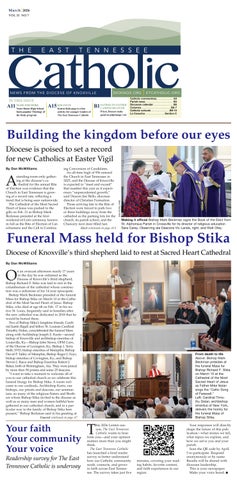
Diocese is poised to set a record for new Catholics at Easter Vigil
By Dan McWilliams
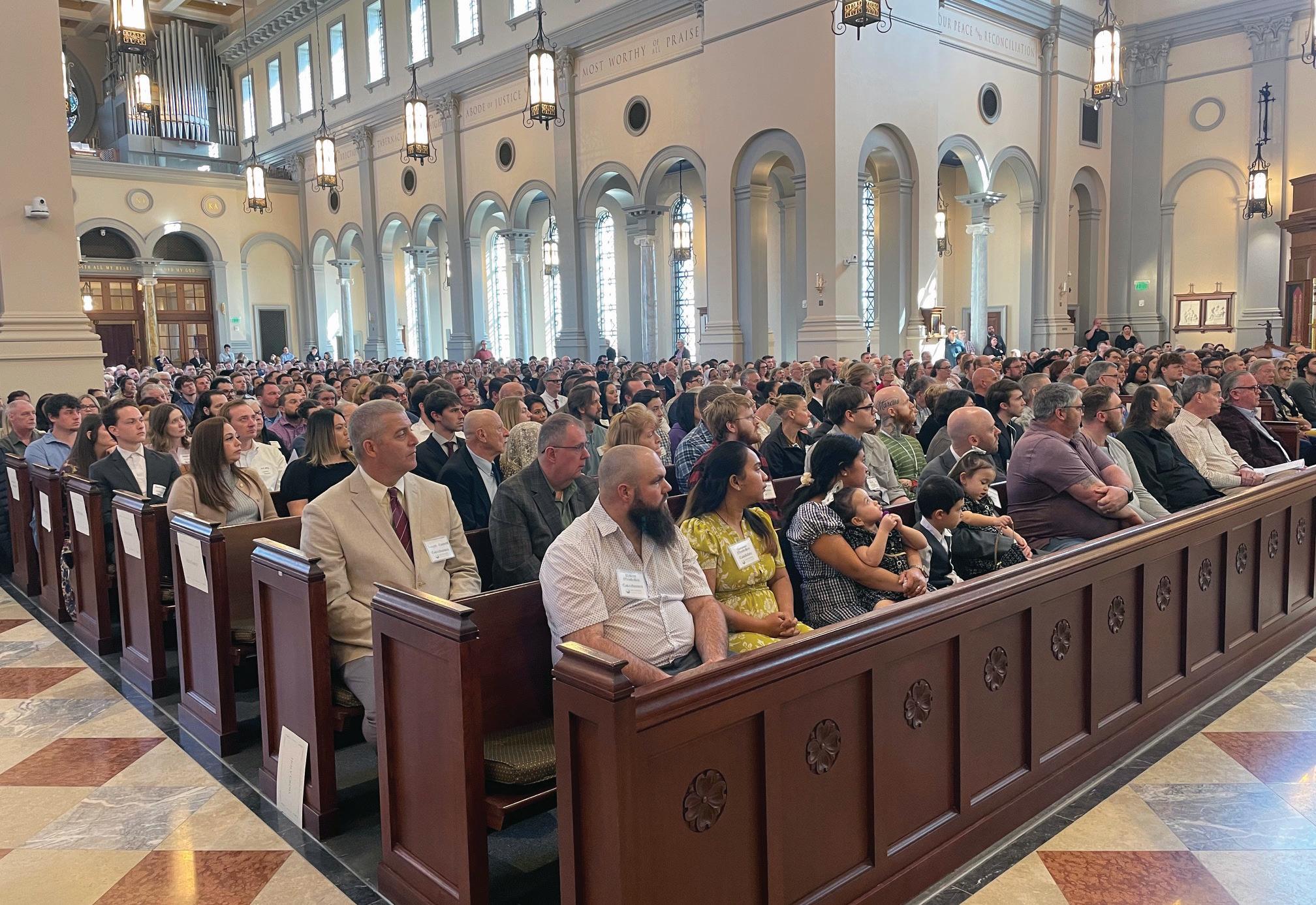
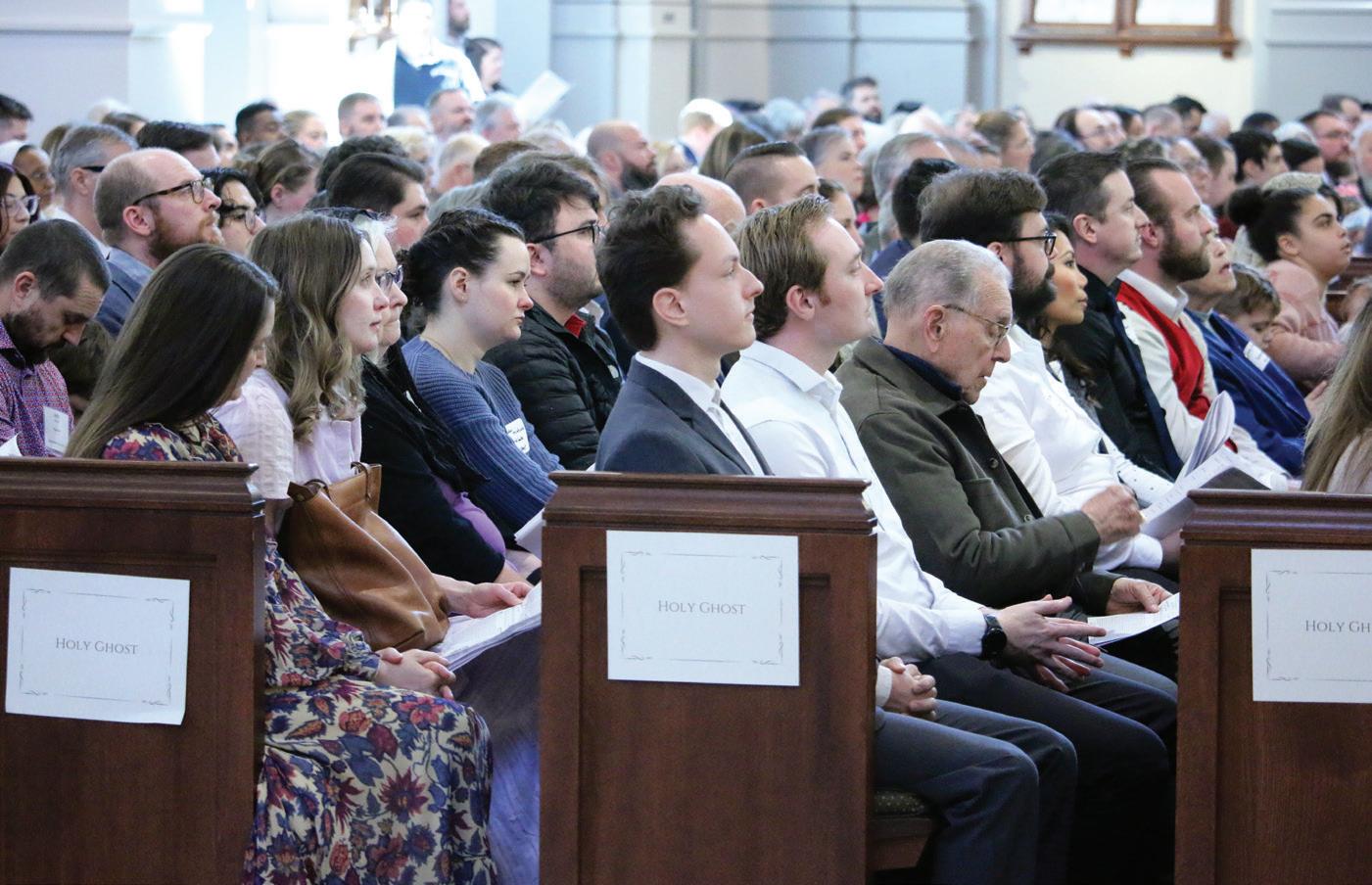
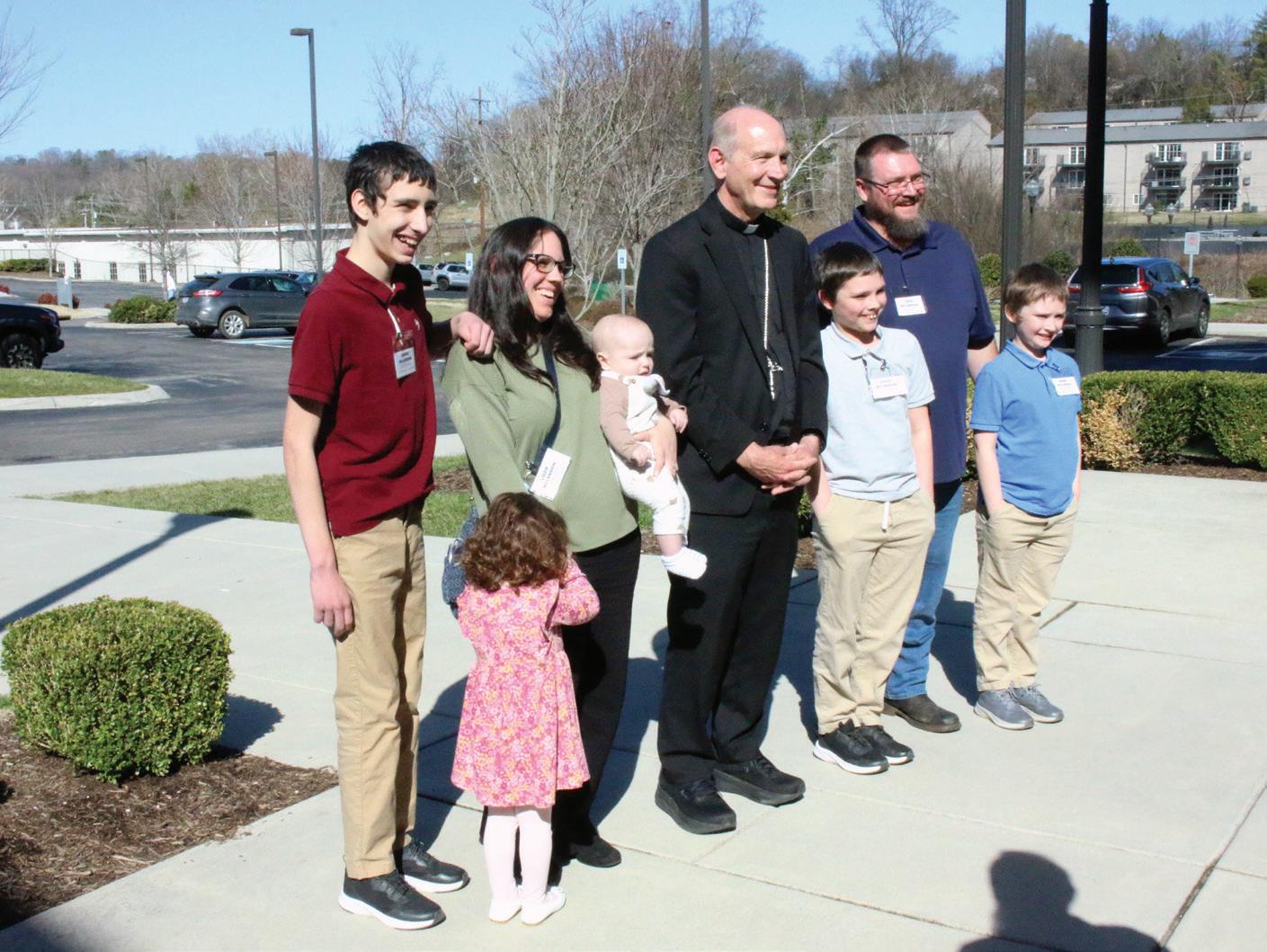
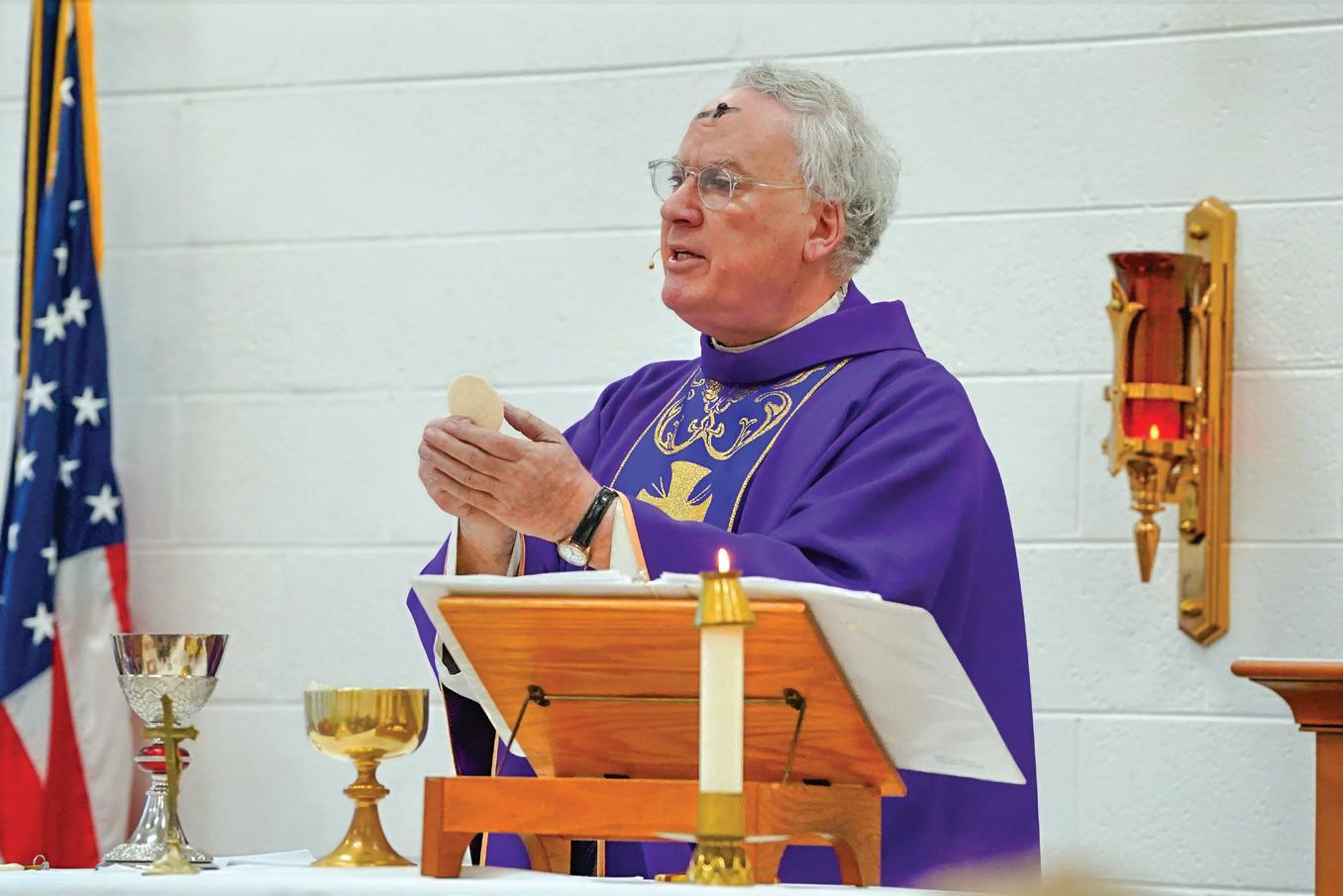
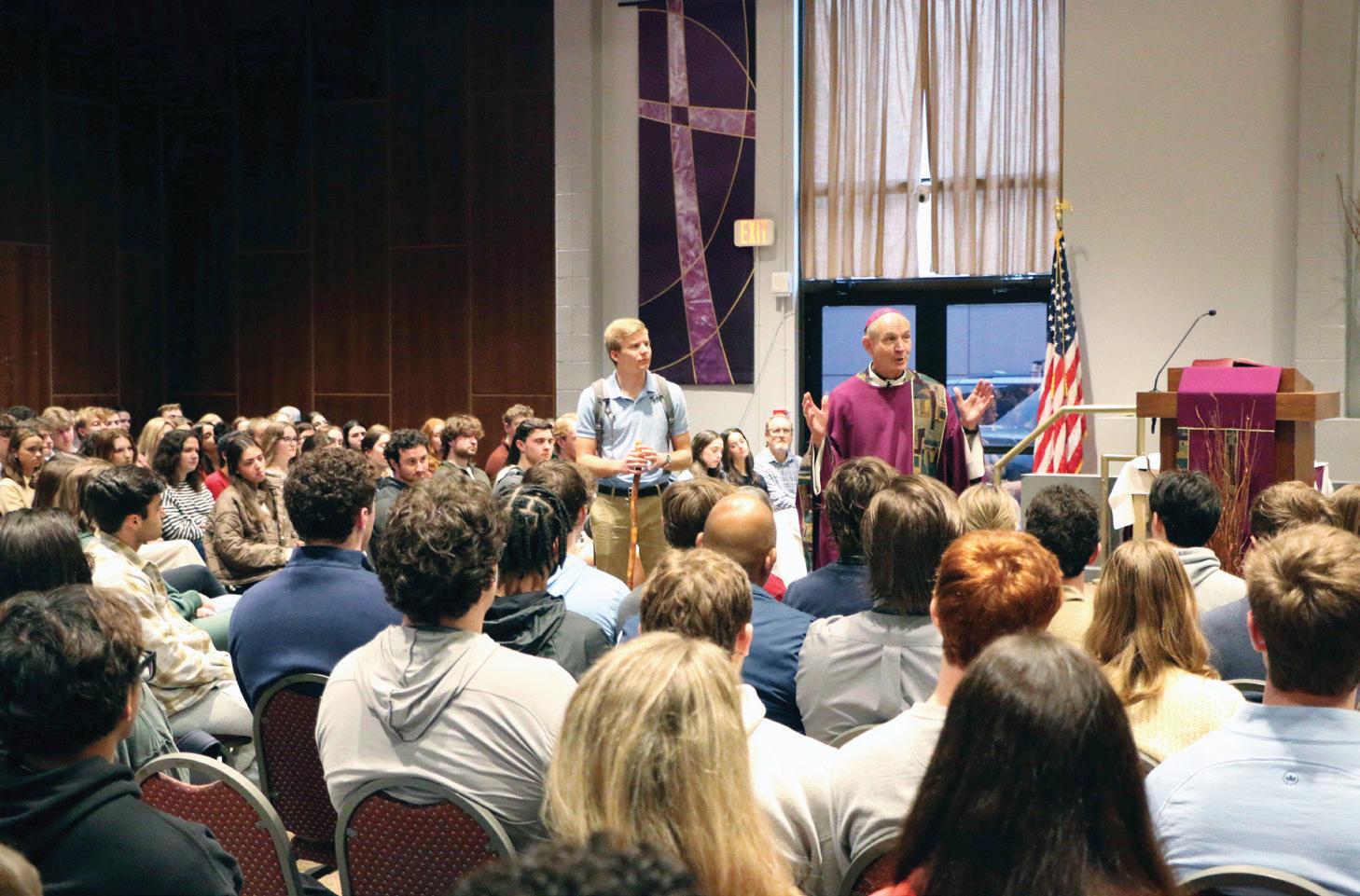
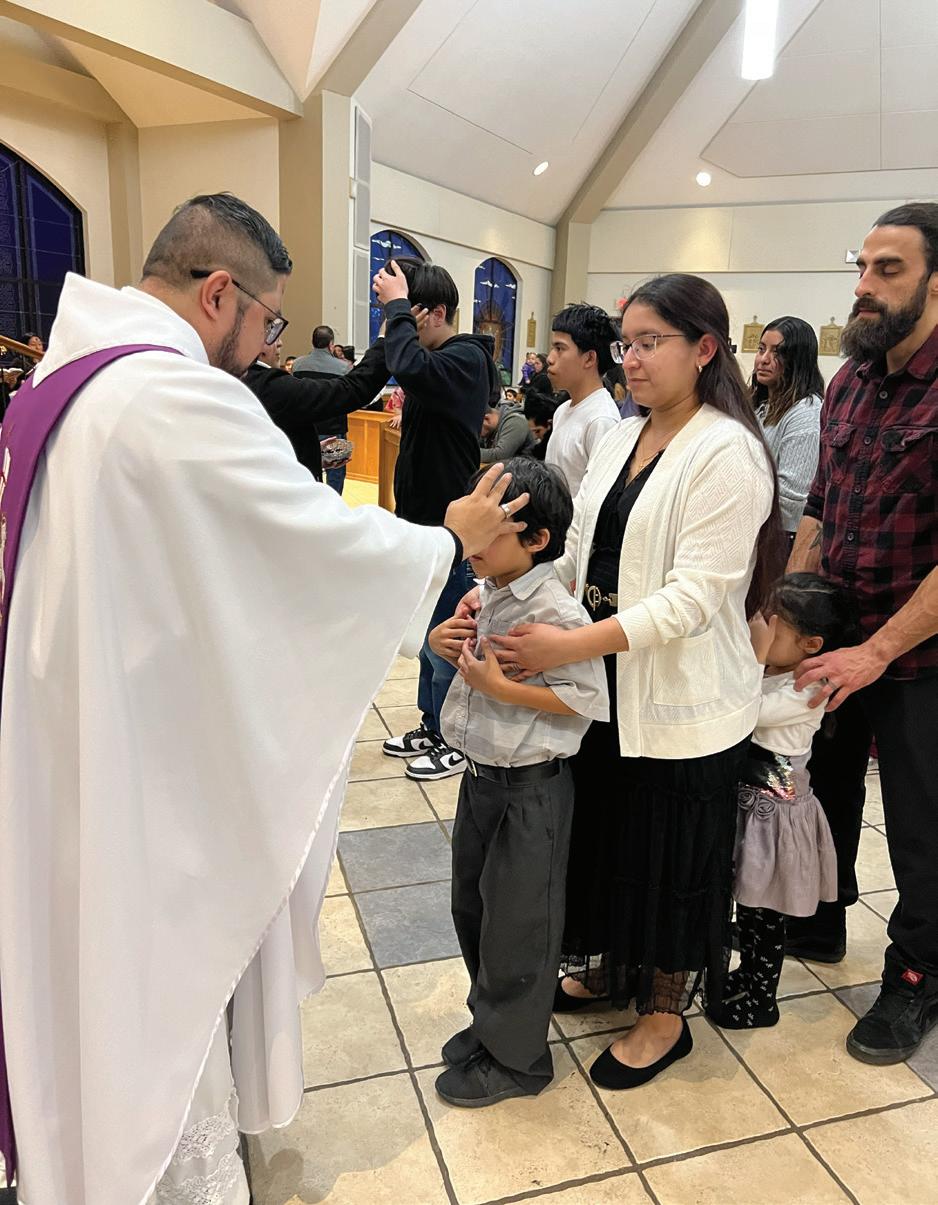
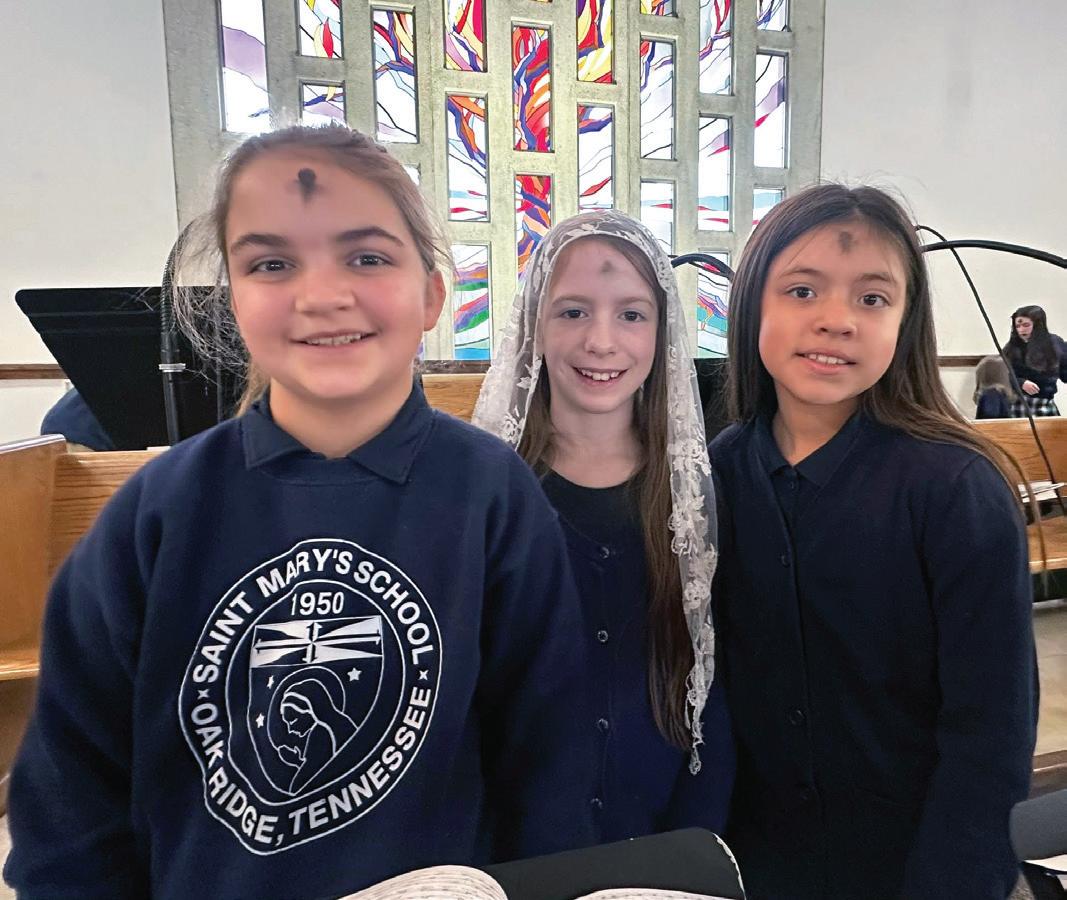
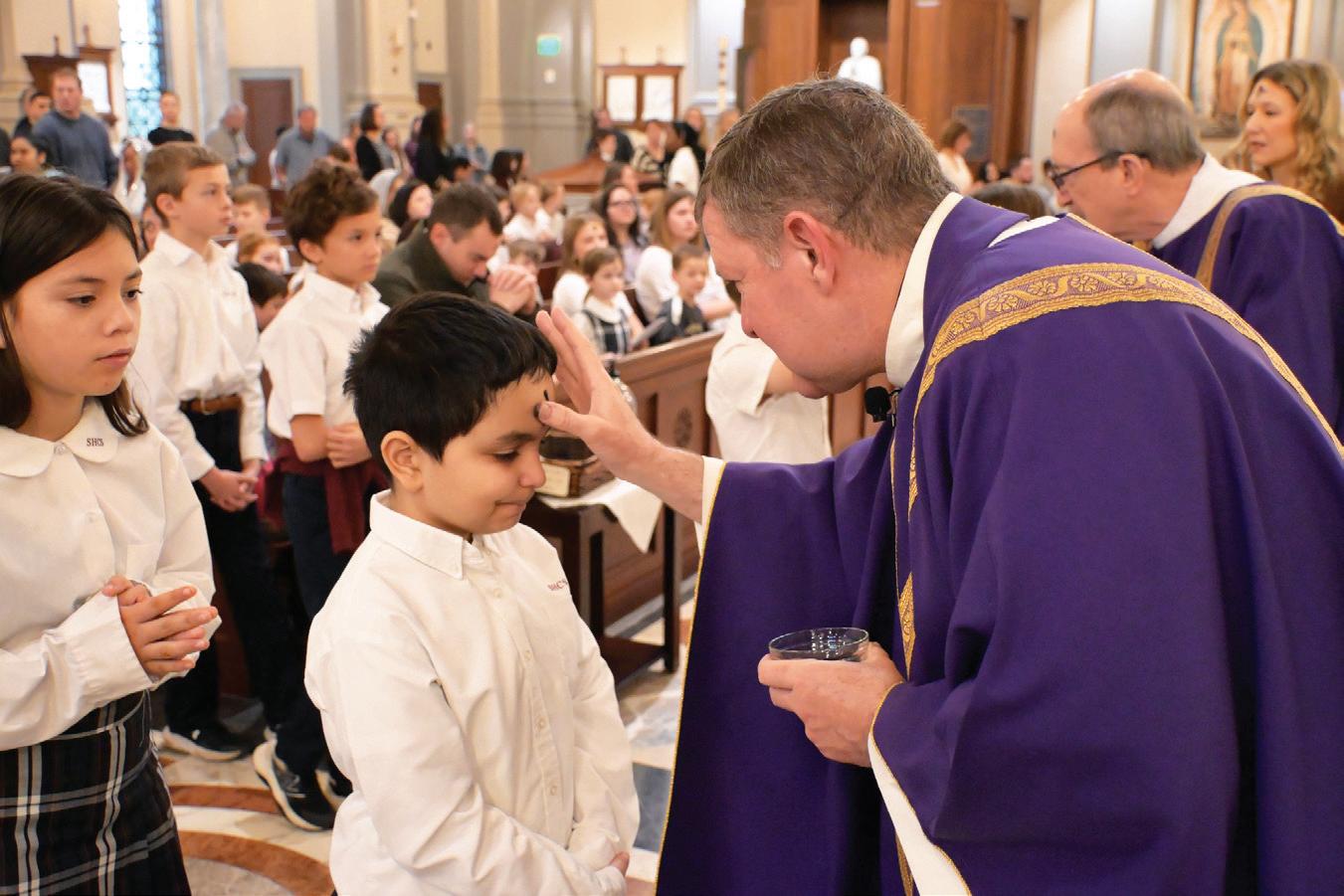
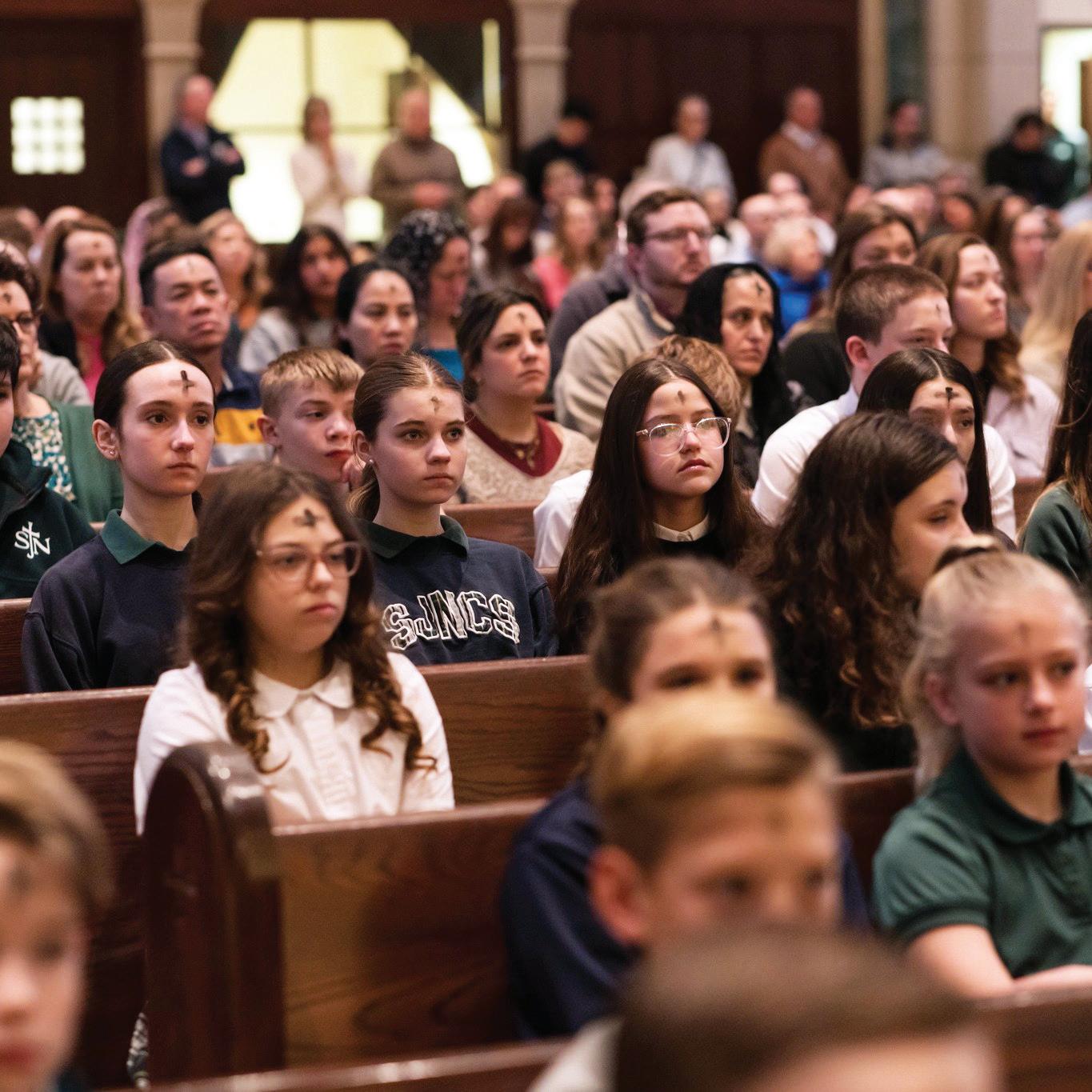
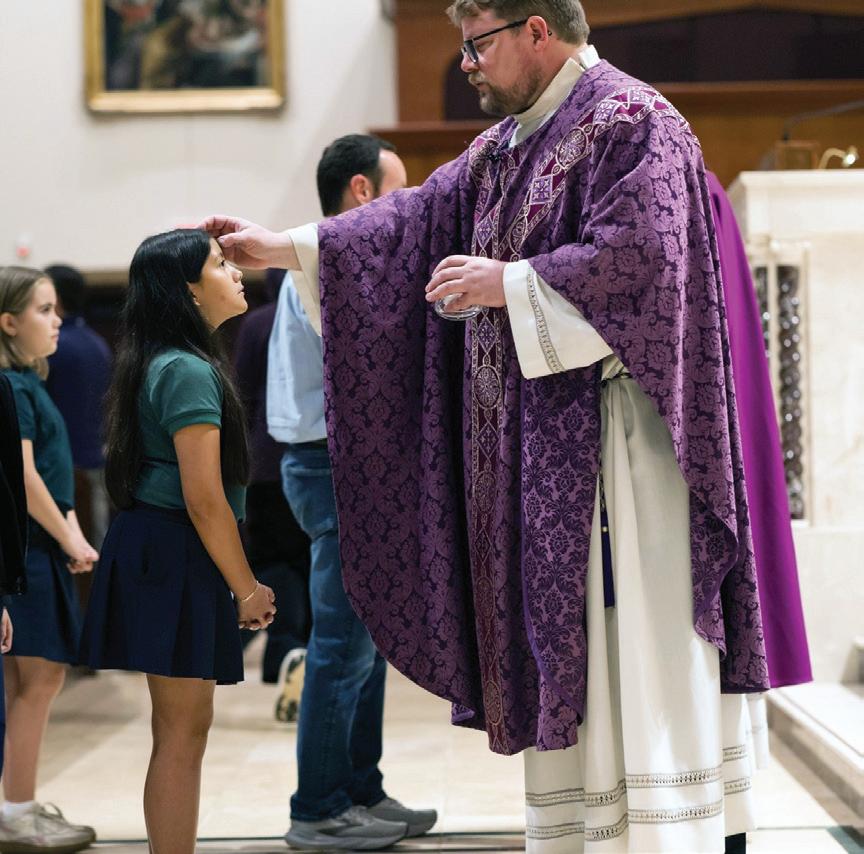
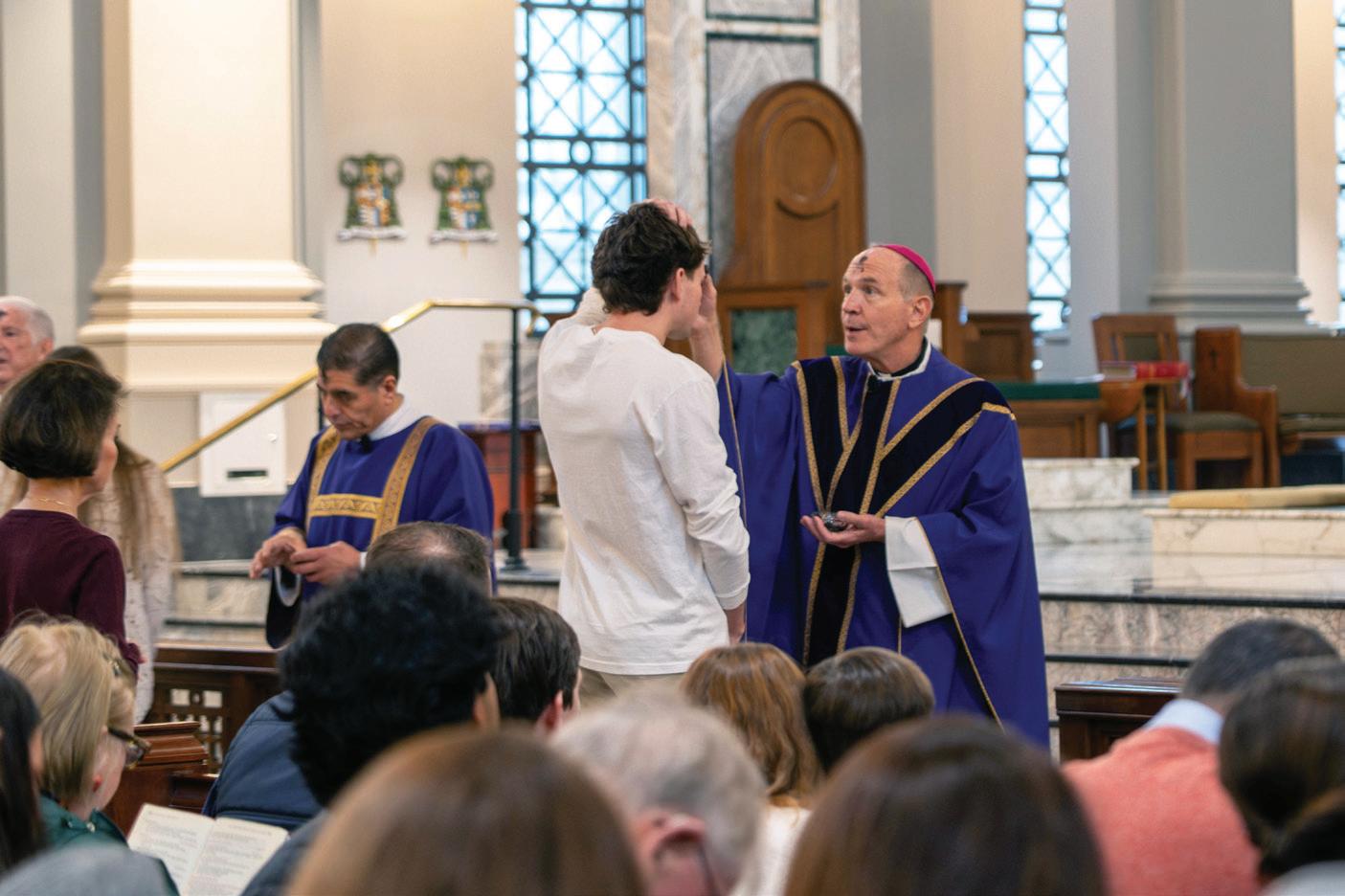
Astanding-room-only gathering at the diocese’s cathedral for the annual Rite of Election was evidence that the Church in East Tennessee is growing at a record rate, reflecting a trend that is being seen nationwide. The Cathedral of the Most Sacred Heart of Jesus was packed to the gills on Feb. 21 as Bishop Mark Beckman presided at the firstweekend-of-Lent ceremony, known in full as the Rite of Election of Catechumens and the Call to Continu-
ing Conversion of Candidates.
An all-time high of 956 entered the Church in East Tennessee in 2025, and the Diocese of Knoxville is expected to “meet and exceed” that number this year as it experiences “unprecedented growth,” said Deacon Jim Bello, diocesan director of Christian Formation.
Those arriving late to the Rite of Election were forced to park two or three buildings away from the cathedral as the parking lots for the church, its parish school, and the Chancery next door filled fast.
Elect continued on page A13
Funeral Mass held for Bishop Stika
Diocese of Knoxville’ s third shepherd laid to rest at Sacred Heart Cathedral
By Dan McWilliams
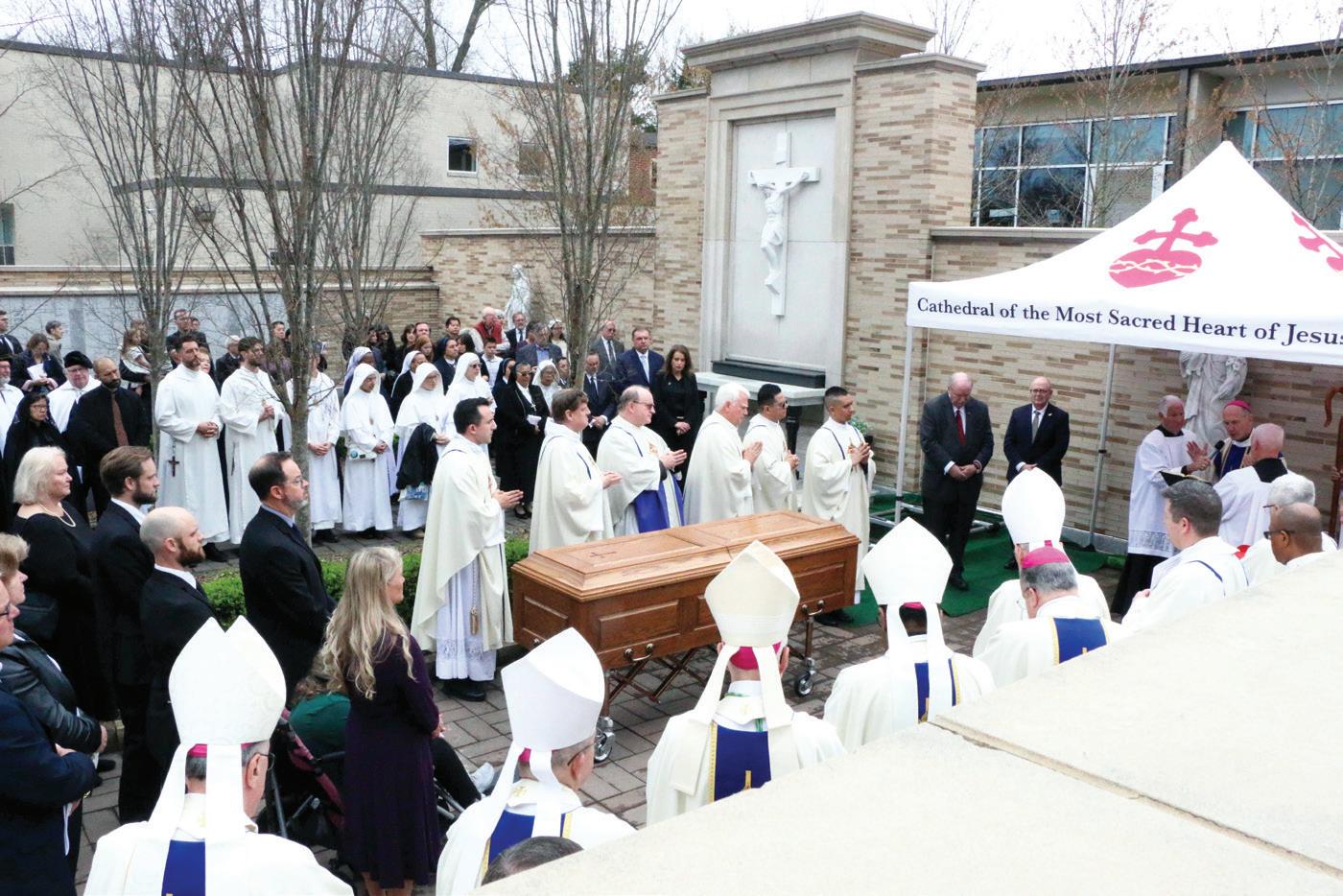
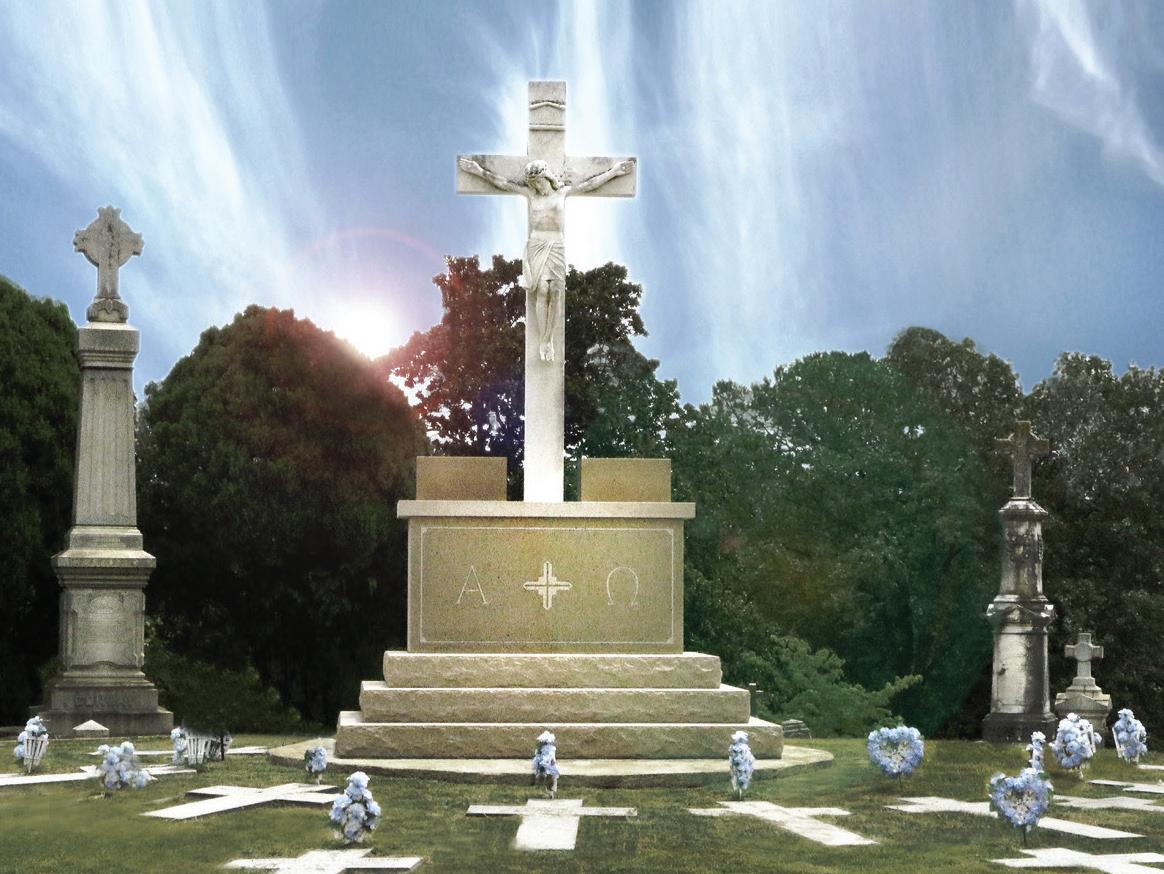
On an overcast afternoon nearly 17 years to the day he was ordained as the Diocese of Knoxville’s third shepherd, Bishop Richard F. Stika was laid to rest in the columbarium of the cathedral whose construction was a milestone of his 14-year episcopate.
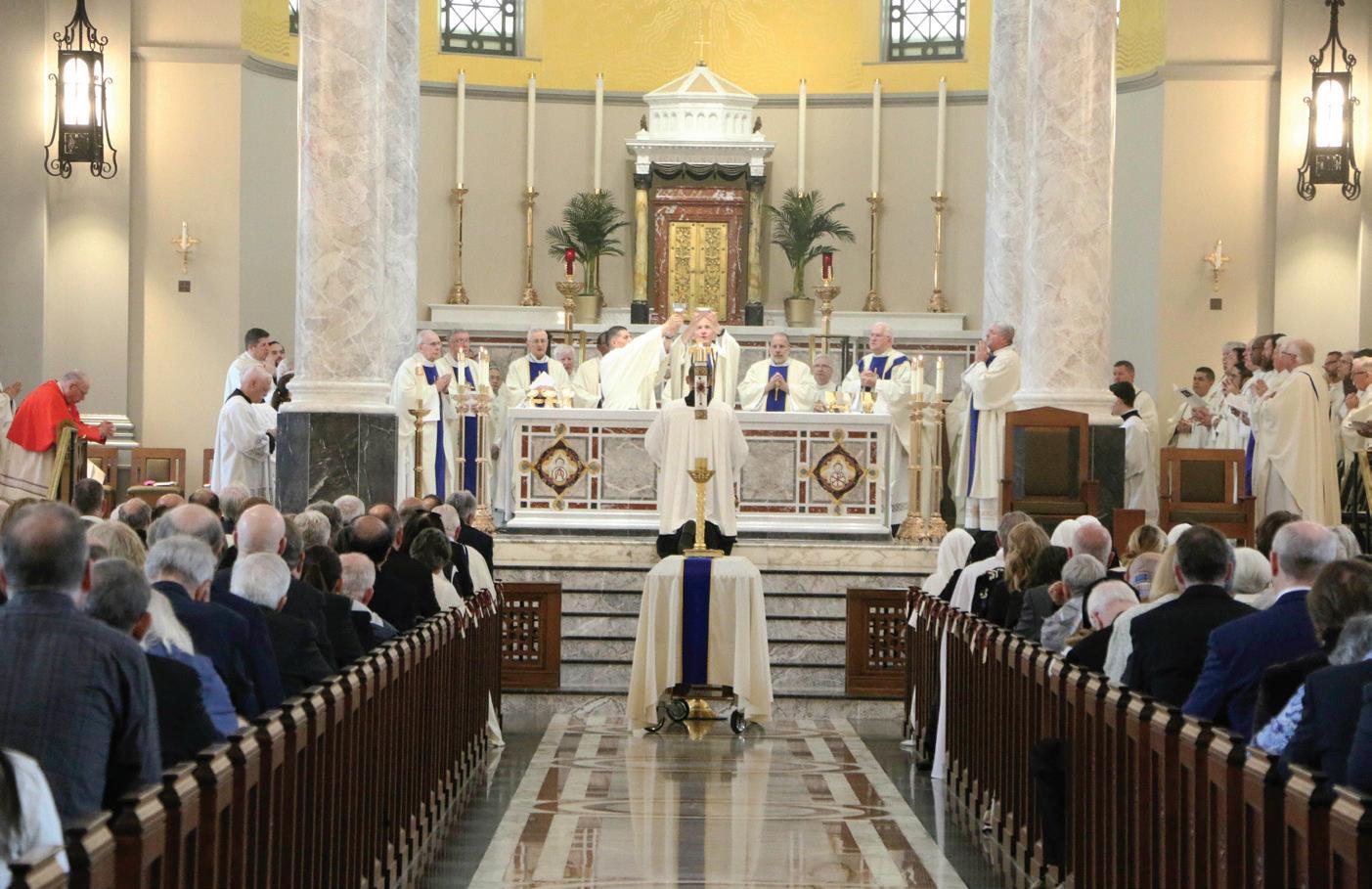
Bishop Mark Beckman presided at the funeral Mass for Bishop Stika on March 10 at the Cathedral of the Most Sacred Heart of Jesus. Bishop Stika, who died at age 68 on Feb. 17 in his native St. Louis, frequently said in homilies after the new cathedral was dedicated in 2018 that he would be buried there.
Two of Bishop Stika’s longtime friends, Cardinal Justin Rigali and fellow St. Louisan Cardinal Timothy Dolan, concelebrated the funeral Mass along with Archbishop Joseph E. Kurtz—second bishop of Knoxville and archbishop emeritus of Louisville, Ky.—Bishop John Stowe, OFM Conv, of the Diocese of Lexington, Ky.; Bishop J. Terry Steib, SVD, bishop emeritus of Memphis; Bishop David P. Talley of Memphis; Bishop Roger J. Foys, bishop emeritus of Covington, Ky.; and Bishop Steven J. Raica and Bishop Emeritus Robert J. Baker, both of Birmingham, Ala. They were joined by more than 50 priests and some 25 deacons.
“I want to take a moment to welcome all of you to our cathedral church as we celebrate this funeral liturgy for Bishop Stika. A warm welcome to our cardinals, Archbishop Kurtz, our bishops, our priests and deacons, our seminarians, so many of the religious Sisters and Brothers whom Bishop Stika invited to the diocese as well as so many men and women faithful here gathered in our cathedral church, and in a particular way to the family of Bishop Stika here present,” Bishop Beckman said in his greeting at
Funeral continued on page A7
This 2026 Lenten sea-
The East Tennessee
to
from you—and your opinion matters more than you might think.
Your responses will directly shape the future of this publication—what stories we tell, what topics we explore, and how we serve you and your parish. Scan the QR code by April 5 to participate. Respond anonymously or by name. Results will be shared with diocesan leadership. This is your newspaper. Make your voice heard. ■ Readership survey for The East Tennessee Catholic is underway
The East Tennessee Catholic has launched a brief reader survey to better understand how our Catholic community reads, connects, and grows in faith across East Tennessee. The survey takes just five
minutes, covering your reading habits, favorite content, and faith experiences in our region.
From death to life
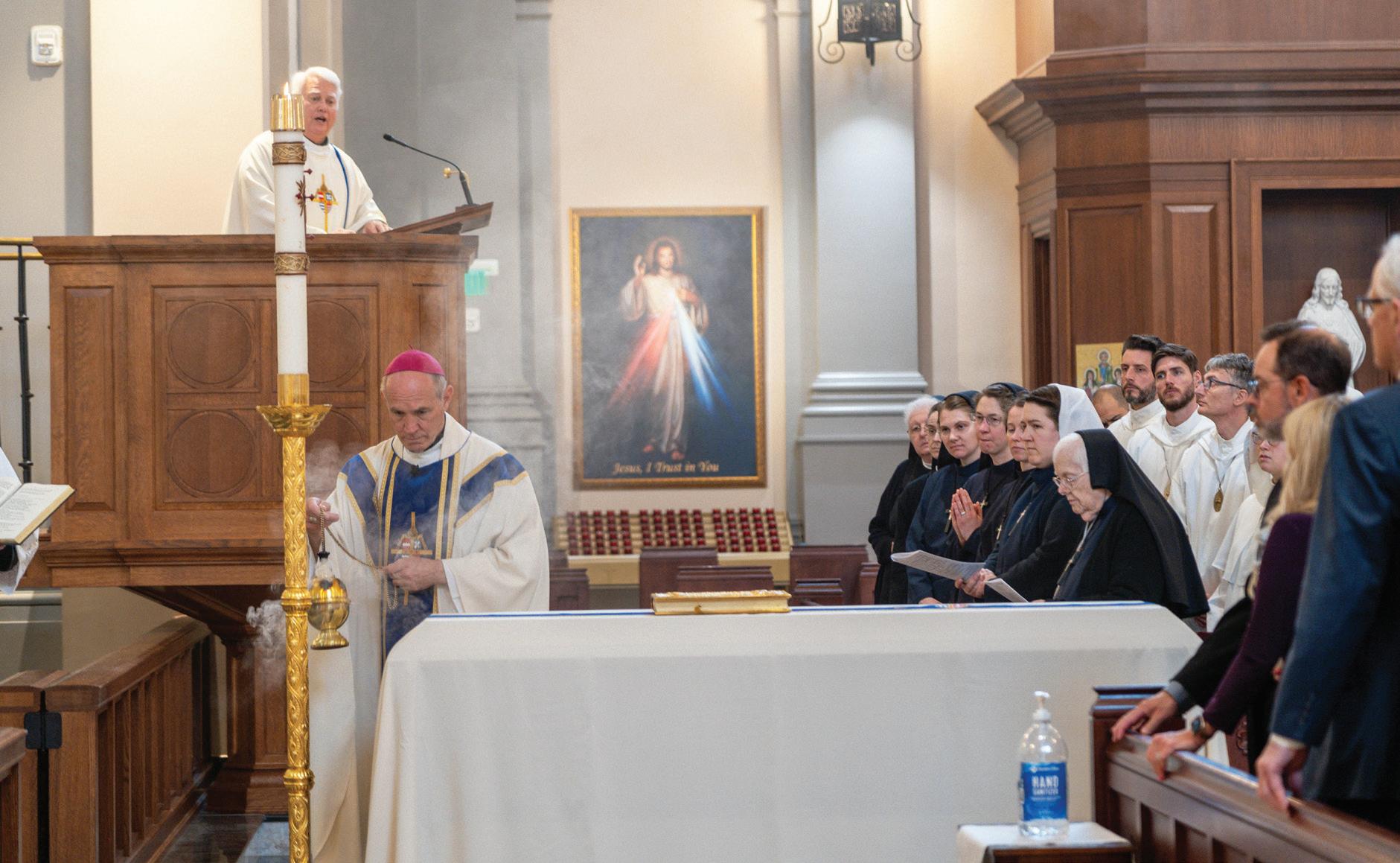
Above: Bishop Mark Beckman presides at the funeral Mass for Bishop Richard F. Stika on March 10 at the Cathedral of the Most Sacred Heart of Jesus as Father Mike Nolan sings the "Celtic Song of Farewell."
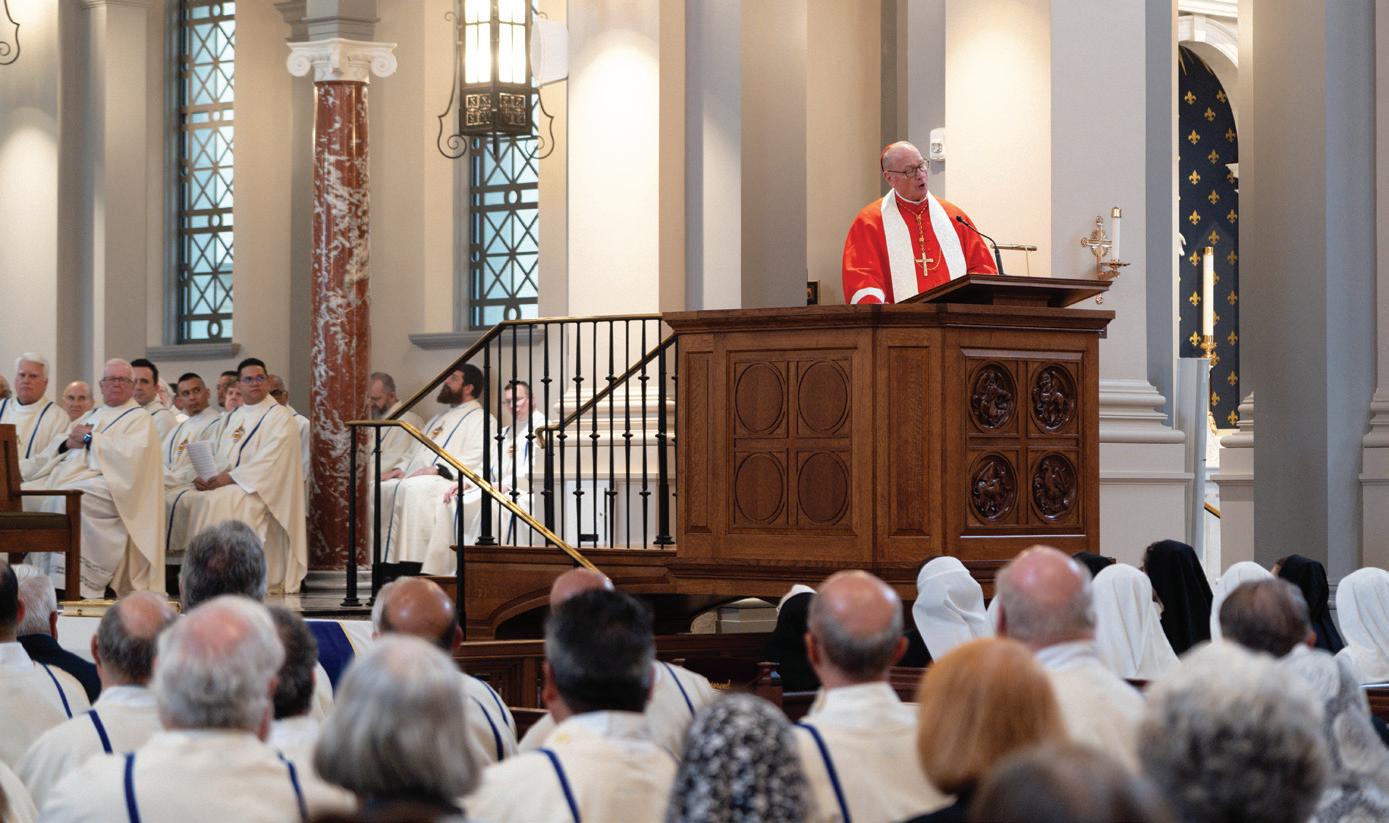
Left: Cardinal Timothy Dolan, archbishop emeritus of New York, delivers the homily for the funeral Mass of Bishop Stika.
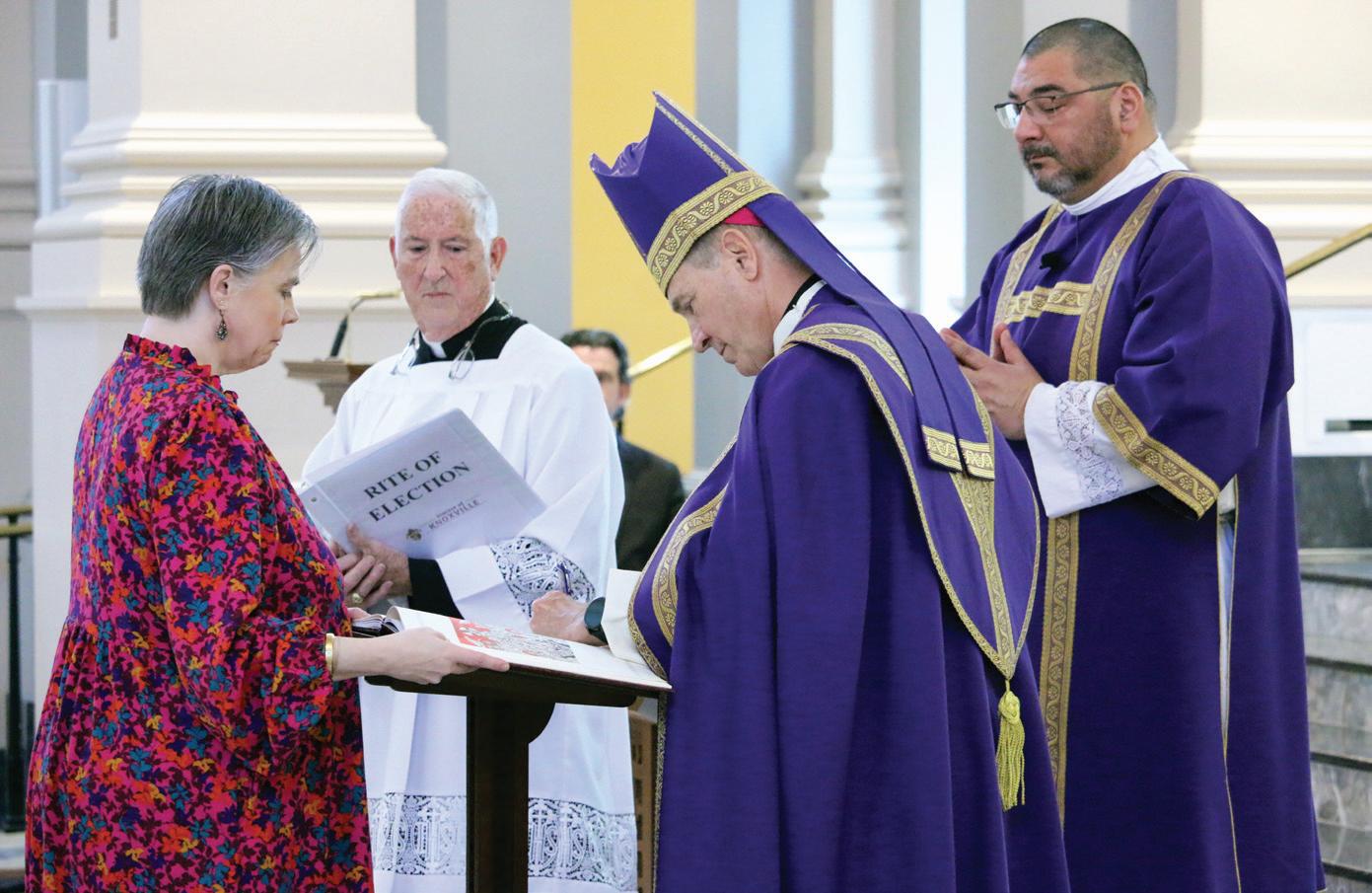
Making it official Bishop Mark Beckman signs the Book of the Elect from St. Alphonsus Parish in Crossville for its director of religious education Sara Carey. Observing are Deacons Vic Landa, right, and Walt Otey.
son,
Catholic wants
hear
DAN MCWILLIAMS
‘Chosen ’ actor honors 21 martyrs
Jonathan Roumie calls attention to those who died for their faith in Libya in 2015
By Katie Yoder OSV News
Jonathan Roumie, the actor known for portraying Jesus Christ in the hit series The Chosen, is calling attention this Lent to the 21 Christian martyrs who died in Libya for their faith in Jesus 11 years ago.
“Their story helps strengthen our own resolve, especially when we are weak in areas of our life, in moments of our life where we need stronger faith,” Mr. Roumie told OSV News at an event honoring the martyrs held in Washington, D.C., on Feb. 22. “We can look to them and say, ‘They died for Jesus. What am I doing to live for Him today?’”
Mr. Roumie, a Catholic, spoke during a press conference at the sold-out event, “21 Martyrs: Knelt but Not Broken,” held at the Museum of the Bible.
Organized by Coptic Orphans, a
nonprofit serving vulnerable children in Egypt, and the museum, the event remembered the martyrs,
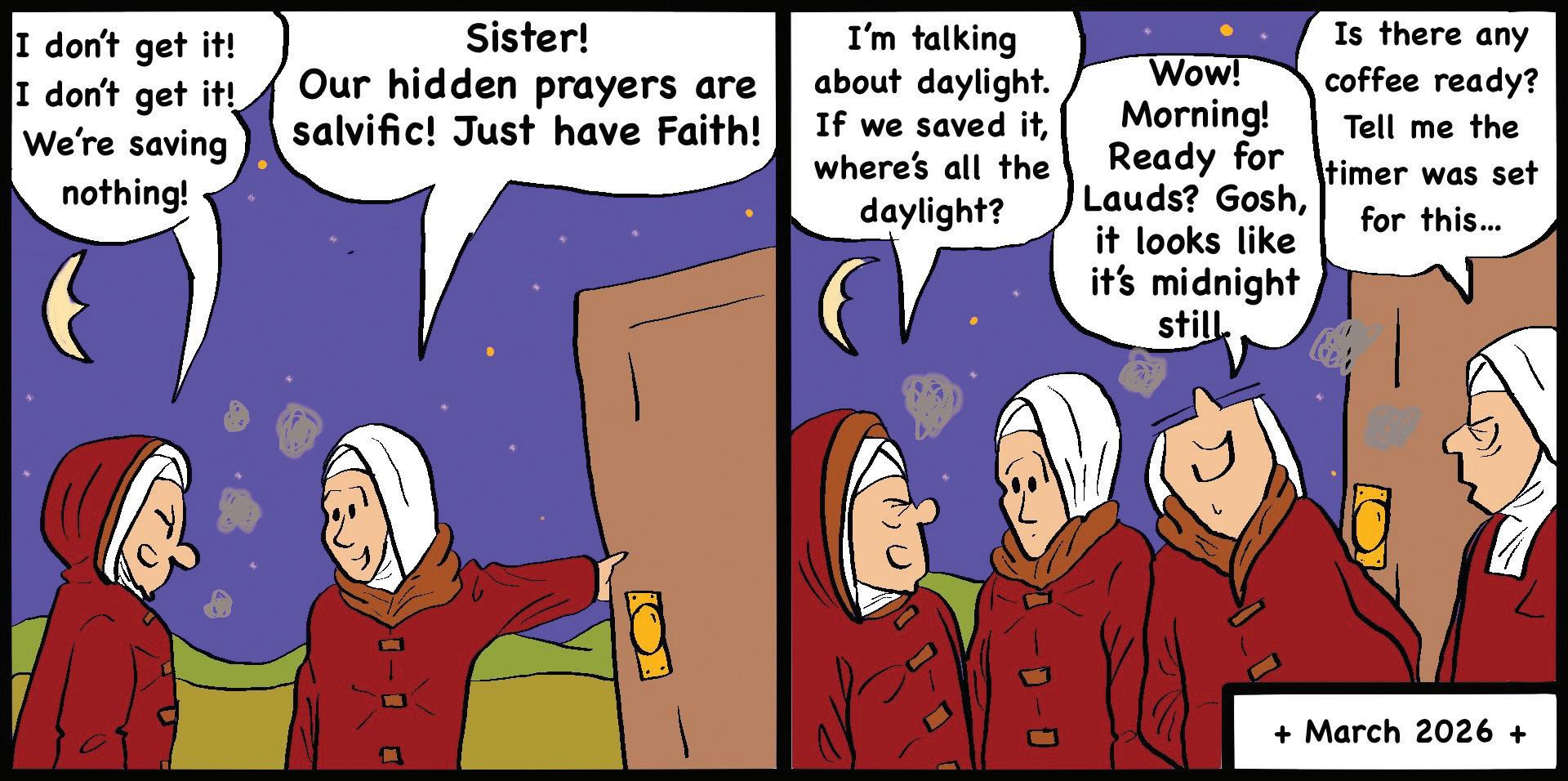
The Handmaids of the Precious Blood this year celebrate the 79th year since their founding in 1947; more than three-quarters of a century of prayer and sacrifice for priests. To receive weekly cartoons and short reflections and news from the Handmaids of the Precious Blood, visit their website, nunsforpriests.org, and sign up for the FIAT newsletter.
A March prayer intention for disarmament and peace
“Let us pray that nations move toward effective disarmament, particularly nuclear disarmament, and that world leaders choose the path of dialogue and diplomacy instead of violence.”
Pope Leo XIV
all but one of whom were Coptic Orthodox men from Egypt. The other, St. Matthew Ayariga, was a
migrant laborer from Ghana, and when questioned about his faith, he declared, “Their God is my God.”
Their brutal beheading on a Libyan beach, captured on camera, came at the hands of Islamic State militants in 2015.
Throughout the evening, speakers recognized the martyrs—canonized by the Coptic Orthodox Church and so honored in the Catholic Church—as ordinary men of extraordinary faith.
The event opened with a walk through the exhibit exploring the history of the Coptic people, the story of the 21 martyrs, and the work of Coptic Orphans. The evening also featured remarks from political and religious leaders, a screening of The 21 (an animated film about the martyrs executiveproduced by Mr. Roumie), a musical performance, and an address from the brother of one of the
How to sign up and qualify for Diocese of Knoxville’s safe-environment program
The Diocese of Knoxville has implemented the CMG Connect platform to administer the Safe Environment Program, which replaces the former Safe Environment Program (VIRTUS “Protecting God’s Children”).
CMG Connect is a web-based platform that will assist in ensuring that all employees and volunteers who are in a position of trust with children and vulnerable adults within Diocese of Knoxville schools and parishes are trained to recognize behavior patterns of potential abusers and provide pro-active measures for preventing abuse in any context.
“Safe Haven-It’s Up to You” is a three-part video that provides vignettes of real-life situations to educate the viewer about methods of grooming, desensitization, bullying, and neglect, all of which can lead to abuse.
Each part of the video is immediately followed by a brief questionnaire to further develop understanding.
Education is a key
element of the Safe Environment Program.
All clergy, employees, contracted school personnel, volunteers, members of groups and organizations over the age of 18 who work, volunteer, or participate in any capacity are required to complete the diocesan Safe Environment training and a criminal-background check before they can begin employment, volunteer, or participate with ministries, groups, and organizations affiliated with the Diocese of Knoxville.
In addition, the mandatory renewal training must be completed every five years and a new background check submitted before the five-year expiration of prior training
The Diocese of Knoxville Safe Environment compliance training and renewal training is a condition of employment and for volunteer ministry in the Diocese of Knoxville.
The CMG Connect platform contains all three elements of the Diocese of Knoxville’s Safe Environment Program: n Annual review of the Diocese of Knoxville’s Policy and Procedures Relating to Sexual Misconduct; n CMG Connect Safe Haven training program to be completed every five years; n Criminal background check to be completed every five years.
In compliance with the Diocese of Knoxville’s Safe Environment Program, all affiliates require that volunteers and employees complete the requirements prior to working and/or volunteering in a parish, school, or through Catholic Charities of East Tennessee and/ or St. Mary’s Legacy Clinic. Go to https:// dioknox.org/safeenvironment on the Diocese of Knoxville website for more information ■
of the Precious Blood
Martyrs continued on page A23
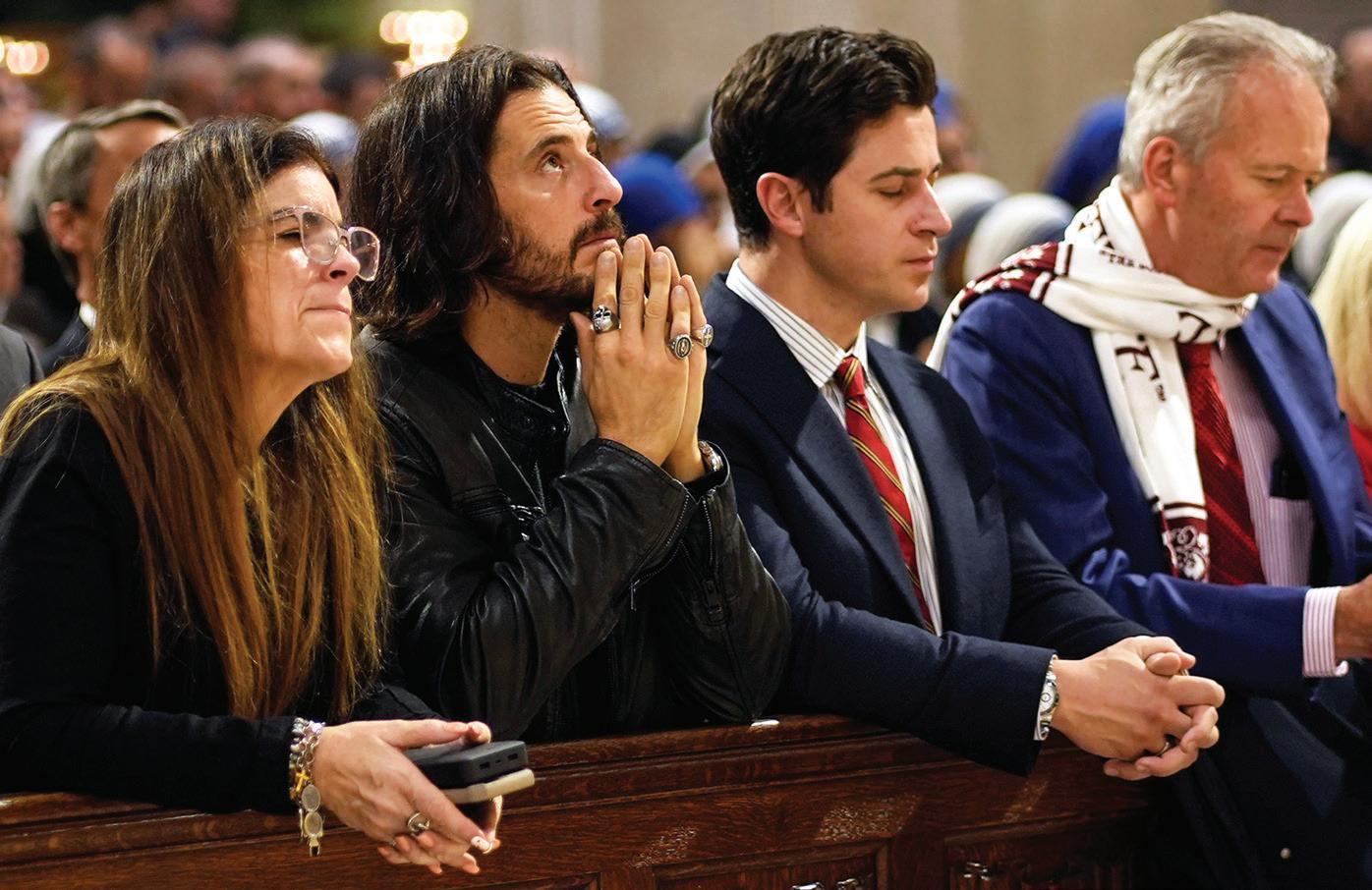
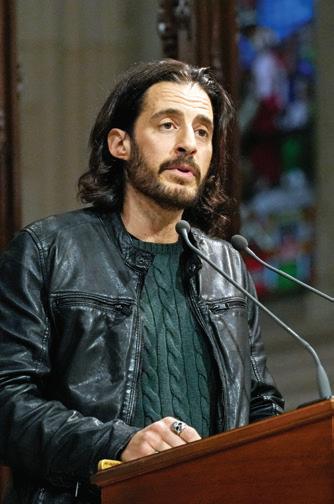
Chosen for martyrdom Actor Jonathan Roumie, who portrays Jesus in the television series "The Chosen," gazes upward during Benediction at St. Patrick's Cathedral in New York City on Oct. 14, 2025. Mr. Roumie is calling attention to the 21 Christian martyrs who died for their faith in Libya on Feb. 15, 2015.
TA Word from the Bishop
Light has dawned
Record Rite of Election shows God's presence in the Church in East Tennessee
he days of Lent had just dawned when great numbers of people gathered at our Cathedral of the Most Sacred Heart of Jesus from all across our diocese. Every pew was filled and people lined all the walls of the church. Men, women, young, and old had come for the annual Rite of Election for those journeying to the Easter sacraments.
This year’s gathering may be the largest in our diocese’s history. Tears of joy filled my eyes as I saw their faces and heard the names of their parishes called as the directors of the catechumenate brought forward the Books of the Elect to be signed
It is the ordinary task of the diocesan bishop to call people to the Easter sacraments of baptism, confirmation, and holy Eucharist. It is a deep reminder and reflection of the great mystery that it is God Himself who calls each one of us by name. “Come to me all you who are heavily burdened…” are the words of Jesus to each of us as we journey through Lent.
This year as I heard the names of our parishes spoken aloud, vivid memories of my journeys throughout our diocese came back to me.
One of the greatest joys of my first year and half has been the opportunity to visit our communities all across East Tennessee (There are still a handful of communities yet
the Rite of Election. An expected record number of people will join the Catholic Church in East Tennessee during Easter Vigil.
to visit—and I eagerly look forward to that opportunity).
I have now traveled to the four corners of our beautiful diocese, from Copperhill at the southeastern tip (where the Georgia state line runs right through the church) to Mountain City at the northeast edge (where the excellence of the music and hospitality of God’s people struck me) to Jamestown at the northwest corner near the rugged beauty of the Big South Fork, all the way down to South Pittsburg in the
southwest (where I received a castiron skillet made locally with my crest set upon it!).
Everywhere I have traveled I have witnessed our vibrant communities of faith, your dedication to the Lord, and your generosity and service. Our Catholic Church in East Tennessee is a growing and vibrant community numbering around 83,000 members.
This Lent we are invited to immerse ourselves more deeply into the mystery of Jesus Christ, cruci-
The grandparent shortage
fied and risen. The hundreds of people yearning for the waters of baptism this year are a living reminder to all of us who have been baptized that we have been claimed by Christ Jesus Himself. We are the beloved daughters and sons of God Yet in truth and humility, we know that we are also unfinished, that much in us still needs to be healed and forgiven, purified by the mystery of God’s love and mercy. The ashes that marked our foreheads, accompanied by the words “Repent, and be faithful to the Gospel!” vividly reminded us of that on Ash Wednesday.
Echoes back to the words of the baptismal liturgy “This light is entrusted to you to be kept burning brightly…” remind us that we have been entrusted with the sacred light of Christ Himself, meant to bear it to every town and hill and hollow throughout East Tennessee.
With our focus turned to the Easter celebration when the new Easter fire is lit and candlelight fills our churches, and as the Exsultet puts it, our buildings quake with joy, lest we know without a doubt that the Holy Spirit of God is at work. The Lord Jesus has conquered sin and death in His resurrection, and you and I are witnesses to this great mystery. May God who has begun this good work in us bring it to fulfillment! ■
Are Grandma and Grandpa endangered species given declining U.S. birth rates?
By Greg Erlandson OSV News
There’s been a lot written about falling birth rates in the United States. Less covered has been the simultaneous decline in grandparenthood.
Grandparents, to hear friends tell it, are an endangered species. Virtually every child-bearing demographic group except women over 40 is having fewer, if any, children. And let’s be honest: Potential grandparents with children over 40 are likely to be rapidly aging out of the “fun grandparent” demographic and into the “granny flat” demographic.
Our birth rate, according to the latest government statistics, is now 1.6 below replacement level and sinking to where countries like Italy used to be. Italy’s birth rate has now fallen further to 1.18, which makes nonno and nonna even more endangered than grandpa and grandma.
Wannabe grandparents are addressing this issue in a variety of ways. Frequently asking their children when they are planning to reproduce is probably one of the least effective stratagems. Putting a brave face on the child’s decision to “parent” a couple of labradoodles doesn’t get you anywhere either, even if you slap a bumper sticker on your car boasting that “my grandchild has four paws.”
Politicians want to throw money at the issue, of course. After all, prospective grandparents vote. Governments for the past 100 years have tried to bribe would-be par-
ents into having children.
It doesn’t really work whether in China or France or South Korea because such a life-changing experience as parenthood is not so easily incentivized by a couple thousand dollars and a tax break.
The disincentives are significant: Most cited are cost-of-living issues like expense of day care and education, but everything from school shootings to the state of the world can be cited as well.
Prospective grandparents understand this, of course. But the desire to “live to see your children’s chil-
U.S. Supreme Court rejects California’s presumption against parents in landmark gender transition case Issue pits children and schools against mothers and fathers
dren,” as Psalm 128 puts it, is wired deep inside the human heart. We want to see the children we worked so hard to parent in turn bring the next generation into being. It’s a sign of hope and resilience that surpasses the headlines and the crises and the never-ending worries we have for our planet and our species.
I am fortunate that I have one child who is now a parent. Nongrandparent friends listen to my stories with a touch of envy. We aren’t sure when our kids will be having kids, they say wistfully.
I’m honest with them about the work of grandparenting. There are good reasons why childrearing should be left to the young. Child care is exhausting! It takes us two or three days to recover from a weekend of book-reading and dia-
By Andrea M. Picciotti-Bayer National Catholic Register
On March 2, the Supreme Court of the United States did something remarkable: It told the state of California, in no uncertain terms, that parents are not the enemy. In a 6-3 decision in Mirabelli v. Bonta, the high court lifted a stay on a class-action injunction secured by the Thomas More Society on behalf of California parents, restoring protections against the state’s policy of secretly facilitating the social gender transition of children at school without parental knowledge or consent and, in many
per-changing and meal-negotiating. At the same time, grandparenting is a little bit of a time-travel experience, for we are reminded of what is generally a blur what we did and how hard we worked when we were younger parents.
Recently, in the middle of the night, a crying 1-year-old woke up both my son and me. I stayed in the dark room as my son rocked the baby and fed him a bottle. It evoked so many nights when I did that for him. I felt a great surge of parental affection for my son. The love I had shown him long before he could remember, he was now passing on to his son as he gently rocked him back to sleep. It’s a circle of life I’m blessed to be a part of.
Parenting isn’t easy, but it’s the most rewarding work there is. There’s probably never a perfect time to decide to have children, but in general, we rise to the occasion and become better people for it. As for the perfect time to be a grandparent, I think that time is now.
For would-be grandparents still waiting for the privilege, perhaps offer a prayer to St. Anne and St. Joachim, who tradition teaches us were the grandparents of Jesus.
I’ll bet they could tell stories. ■
Greg Erlandson is an award-winning Catholic publisher, editor, and journalist whose column “Amid the Fray” appears monthly at OSV News. Follow him on X @GregErlandson. Commentary
cases, through active deception.
Two of the named plaintiff families put a human face on what that secrecy regime actually meant in practice. Both are devout Catholics whose faith shapes their understanding of sex and the human person, and both were systematically cut out of their own children’s lives by the state.
One family had no idea their daughter had been presenting as a boy at school, under a dif-
Commentary Court continued on page A22
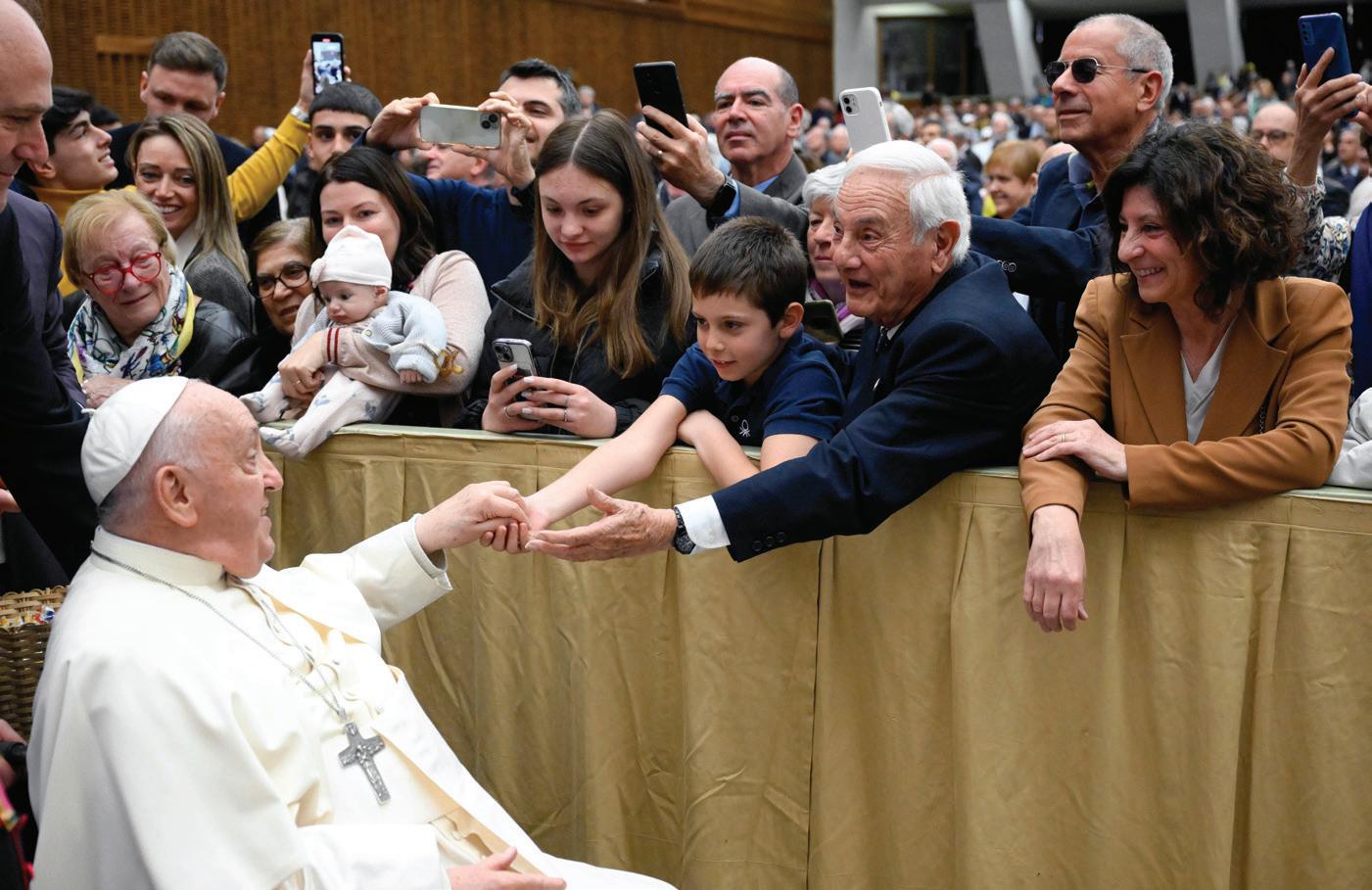
Celebrating nonnas and nonnos Pope Francis greets Italian grandparents with their children and grandchildren on April 27, 2024, in the Paul VI Audience Hall at the Vatican.
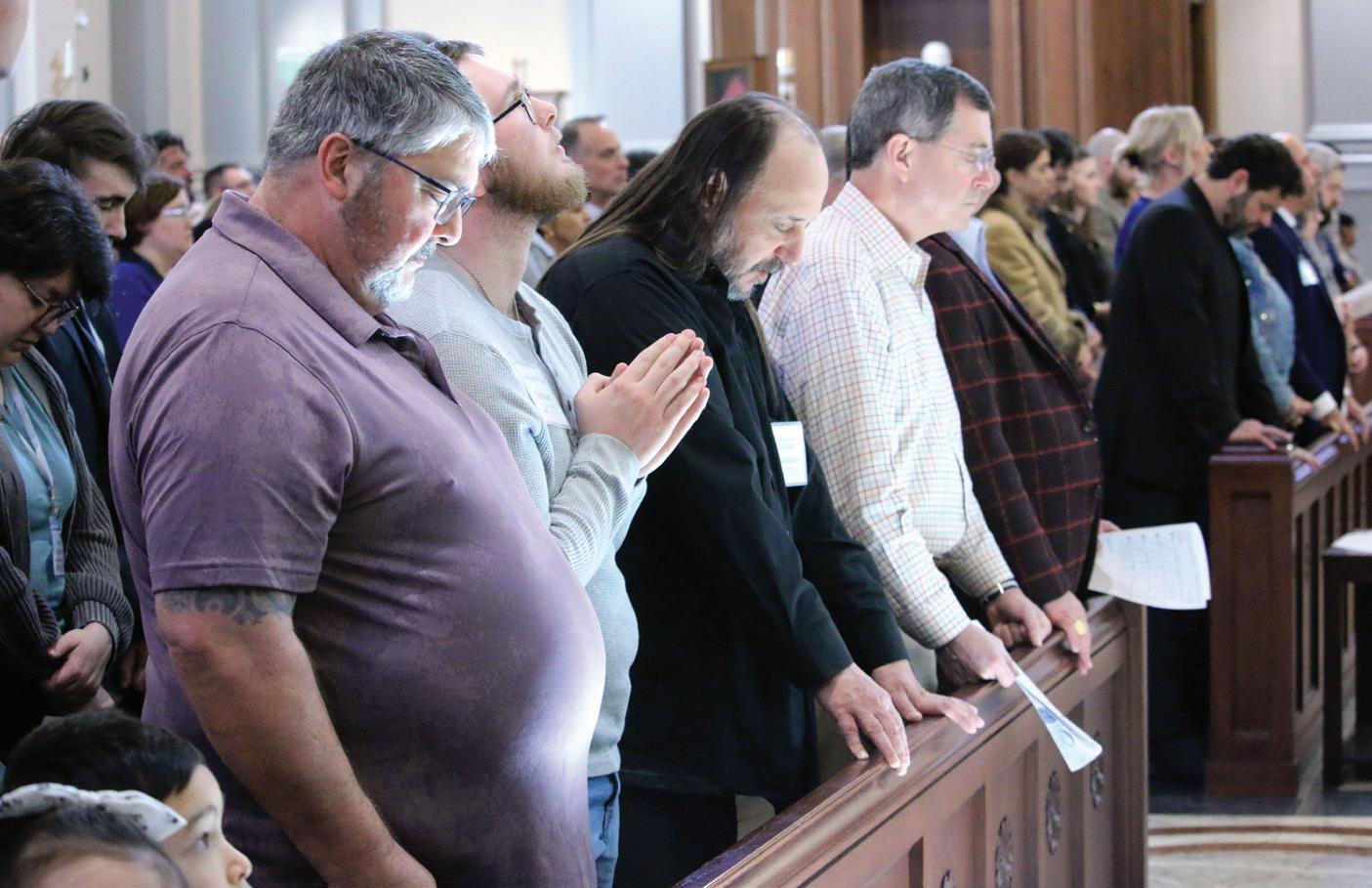
Embracing the faith Catechumens and candidates, along with godparents, sponsors, family, and friends, fill the Cathedral of the Most Sacred Heart of Jesus on Feb. 21 for
Mr. Erlandson
On the road again
Catholic Charities relaunches mobile ultrasound van and is receiving a strong response
By Bill Brewer
For Catholic Charities of East Tennessee’s mobile ultrasound clinic, the second time is apparently a charm as the year-old van is being reintroduced throughout the Diocese of Knoxville.
Following a temporary hiatus in late 2025, the mobile ultrasound team is again traveling through East Tennessee serving young women and promoting life for newborns and their parents.
A mobile ultrasound unit has been a longtime goal for Sandi Davidson, CCETN program leader for pregnancy services. Through fundraising and assistance from the Knights of Columbus and pro-life groups, Catholic Charities raised enough money to purchase the van and its onboard ultrasound equipment.
Catholic Charities first rolled out the mobile clinic on Jan. 23, 2025, at its Pregnancy Help Center in Helenwood next to St. Jude Church.
The van complements Catholic Charities’ main ultrasound clinic inside the social services agency’s Knoxville headquarters at 119 Dameron Ave.
They are part of Catholic Charities’ pregnancy services ministry that serves young women and couples from all faiths—or no faith— and all walks of life.
The ministry offers a variety of services for women and families in any and every circumstance:
n 24-hour helpline;
n Six pregnancy help centers to provide education on pregnancy and parenting;
n Free ultrasound testing to allow women to see their babies;
n Material assistance, such as diapers and formula;
n Sexually transmitted infection testing;
n Community referrals;
n Adoption services;
n Project Rachel, which provides post-abortion healing and recovery. Response to the relaunch last month of the mobile ultrasound clinic has been very positive, ac-
cording to Mrs. Davidson.
“It’s progressing really well just in the first week that we were out. We are very hopeful,” she said.
Mrs. Davidson explained that launching the ultrasound van just over a year ago was initially trial
and error logistically.
“We went to as many places as we could, doing maybe once a month at different sites. And we didn’t do a whole lot of outreach, which was difficult. But we learned from that. We learned that we really have to prepare the area ahead of time,” Mrs. Davidson said.
Another complicating factor was the departure of the mobile clinic’s registered nurse, who administered the ultrasounds and helped manage the day-to-day operation. She returned to secular health care.
In its first six months of operation, the mobile clinic performed 19 ultrasounds, and 10 of those women were “abortion-vulnerable,” meaning they were considering having an abortion as well as keeping their babies or placing for adoption.
To the credit of the clinic and the expectant mothers, none of the 10 had an abortion. The other nine women had already decided to parent their babies.
By comparison, the ultrasound clinic at Catholic Charities’ main offices in the last six months performed ultrasounds on 25 women who were seriously considering abortion. Five women gave birth, three had abortions, 17 women did not report their decision after receiving their ultrasounds, and one mother miscarried.
There were 78 women who were abortion-vulnerable, with 70 of them parenting their child, three who did not report their decision, three miscarried, and two who placed their babies for adoption with Catholic Charities’ A Loving Option Adoption agency.
“Those are pretty good stats, I think,” Mrs. Davidson said, pointing out that the statistics are confirming the need for the ultrasound clinics. Ultrasound continued on page A20
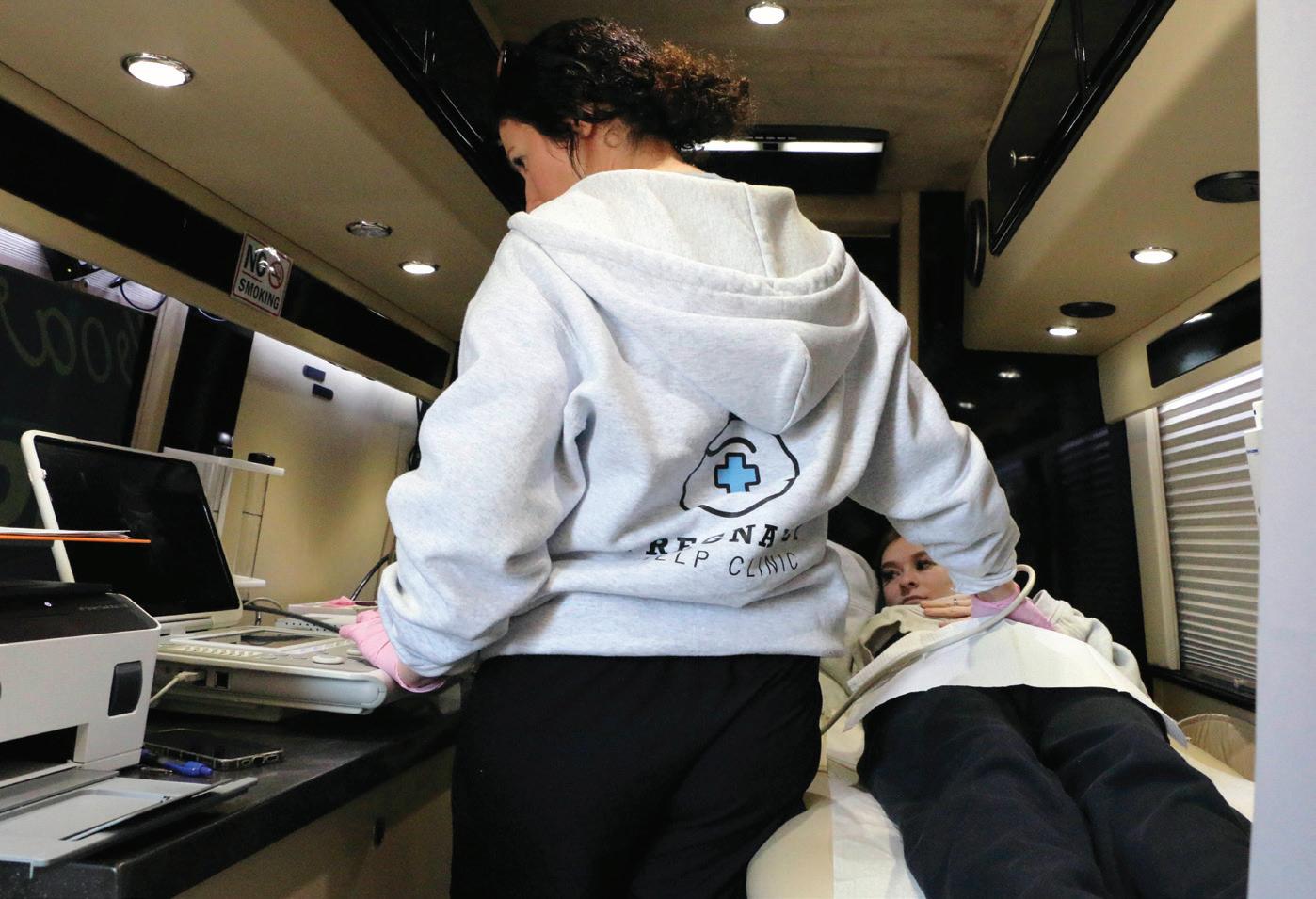
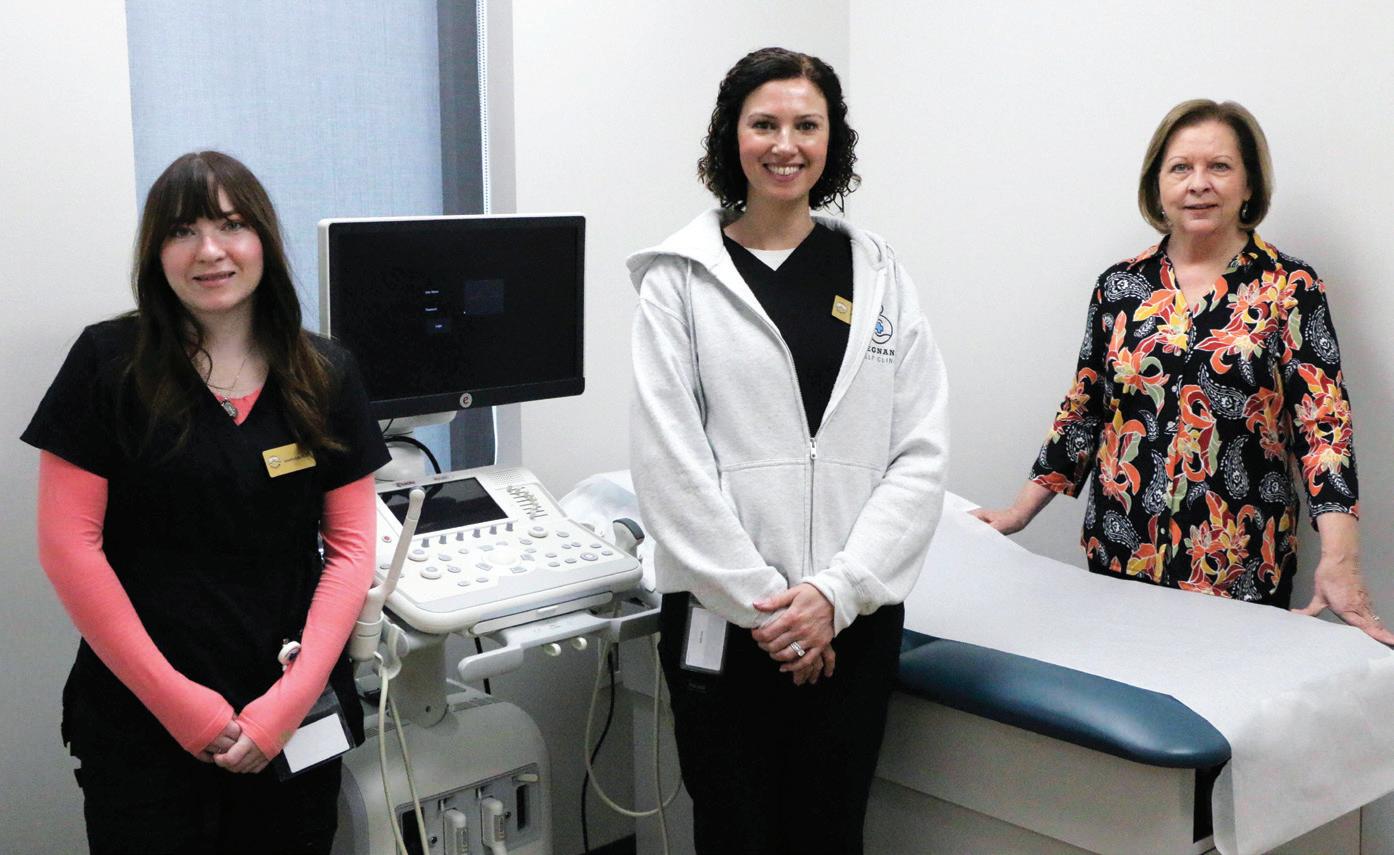
Life-affirming Above: Registered nurse Whitney Williams administers an ultrasound exam to a young woman at the Catholic Charities of East Tennessee mobile ultrasound clinic site at Central Services in Morristown on Feb. 17. Below: Catholic Charities ultrasound clinic staff includes, from left, registered nurses Samantha Bigley and Whitney Williams and CCETN program leader for pregnancy services Sandi Davidson.
BILL BREWER (2)
Shaping the Church of the future
Students at the heart of Professional Development Day as diocesan educators meet
By Bill Brewer
There was a buzz in the air on Feb. 12 as educators from around the Diocese of Knoxville gathered on the campus of Knoxville Catholic High School for the annual Professional Development Day.
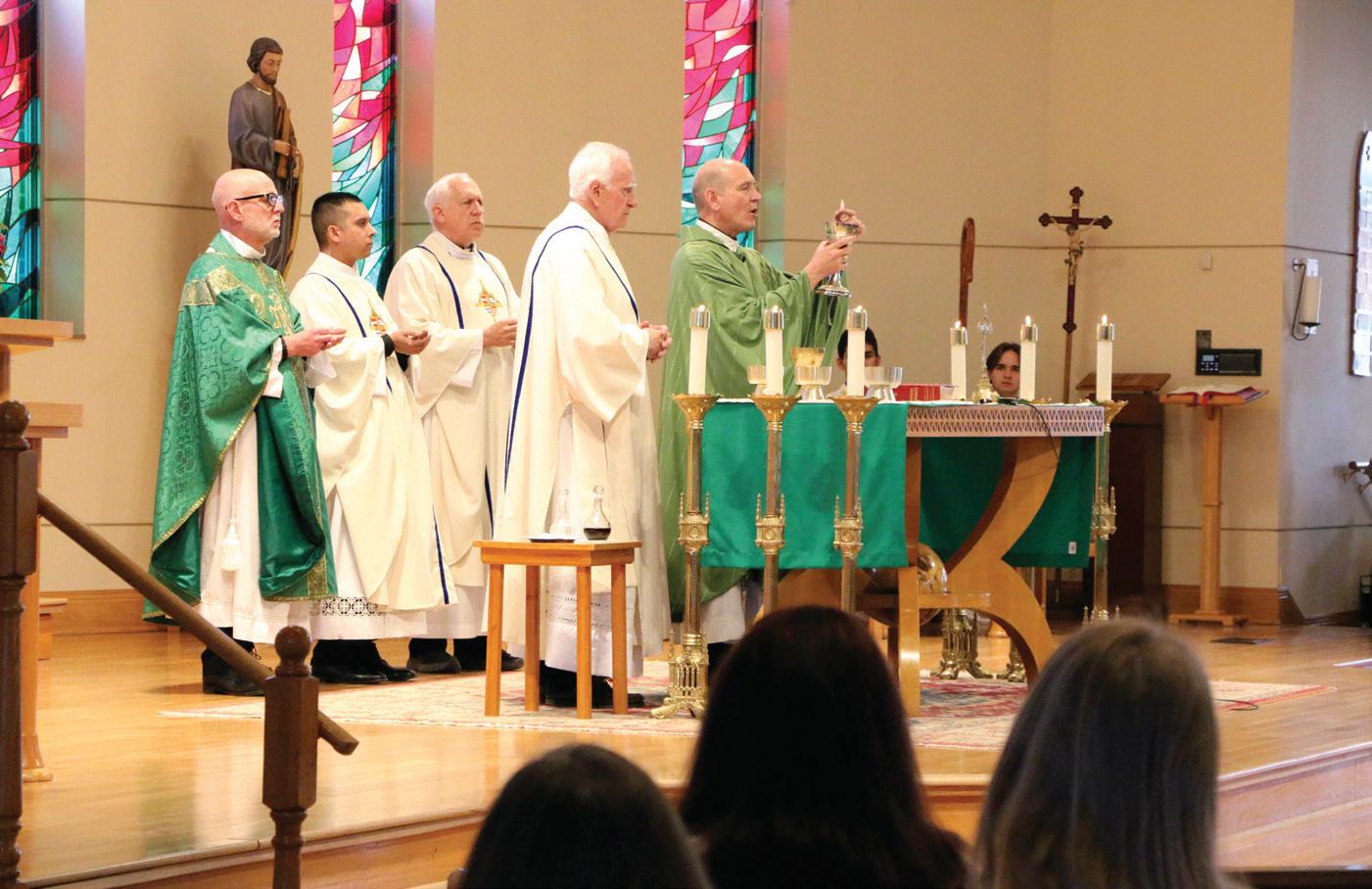
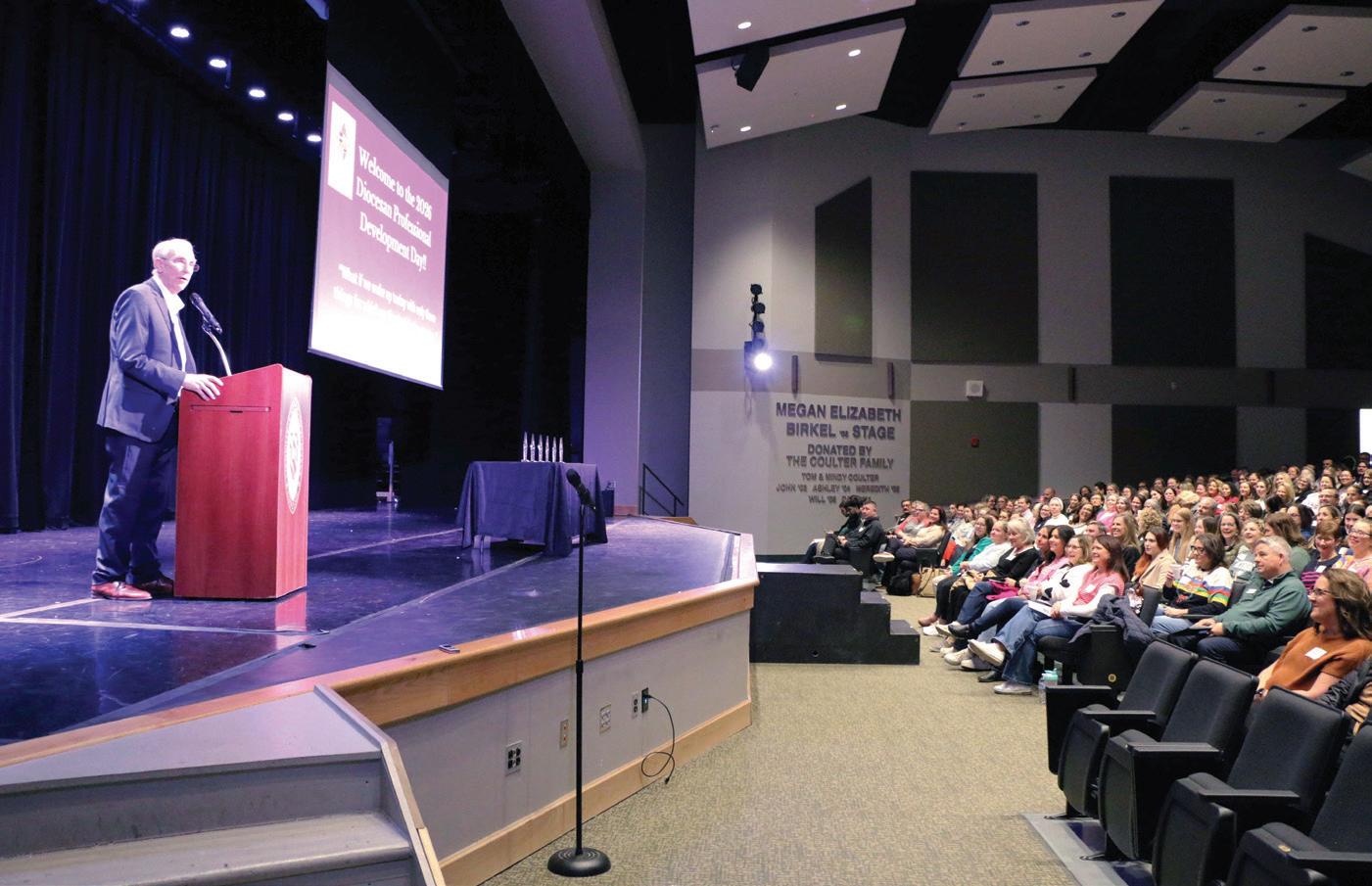
Yes, Bishop Mark Beckman was celebrating an all-schools Mass at All Saints Church and afterward was addressing the teachers and administrators. Yes, interim schools superintendent George Valadie was giving an always-entertaining address in the high-school auditorium. And yes, several teachers were being recognized for their service to education in the diocese over many years.
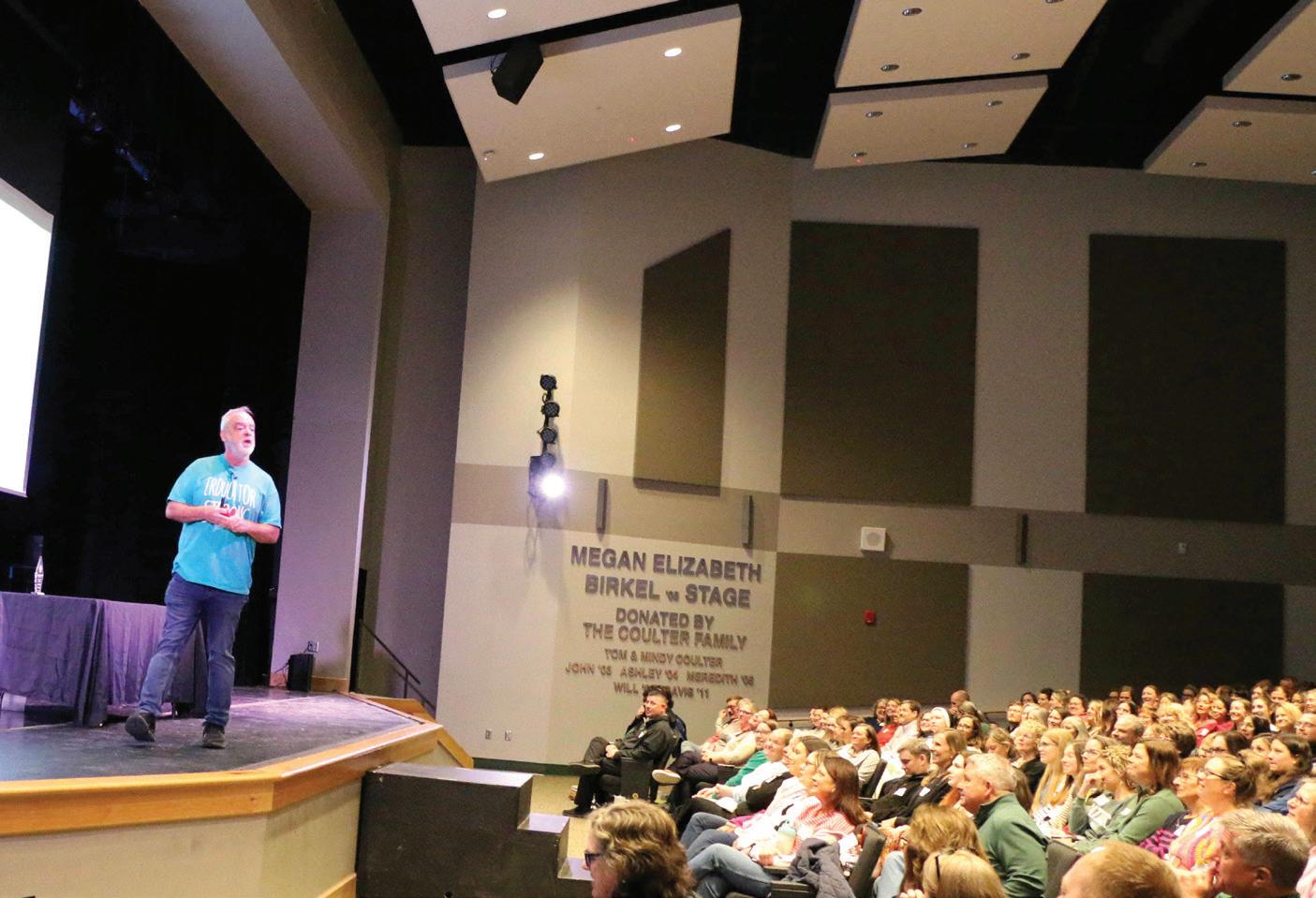
But the middle-aged guy in jeans, tennis shoes, and a T-shirt that read “Erducator Strong” (with the “o” in Strong shaped like a heart) captured the attention of most everyone in the auditorium.
Gerry Brooks, who wears the mantle of educator very comfortably, was the keynote speaker for the professional development day.
And while Mr. Brooks may be a relative unknown to much of the world, in U.S. education circles he is practically a cult hero whose popularity is growing exponentially through his short, school-based videos seen on Instagram, YouTube, and elsewhere on social media.
Encountering Jesus Himself
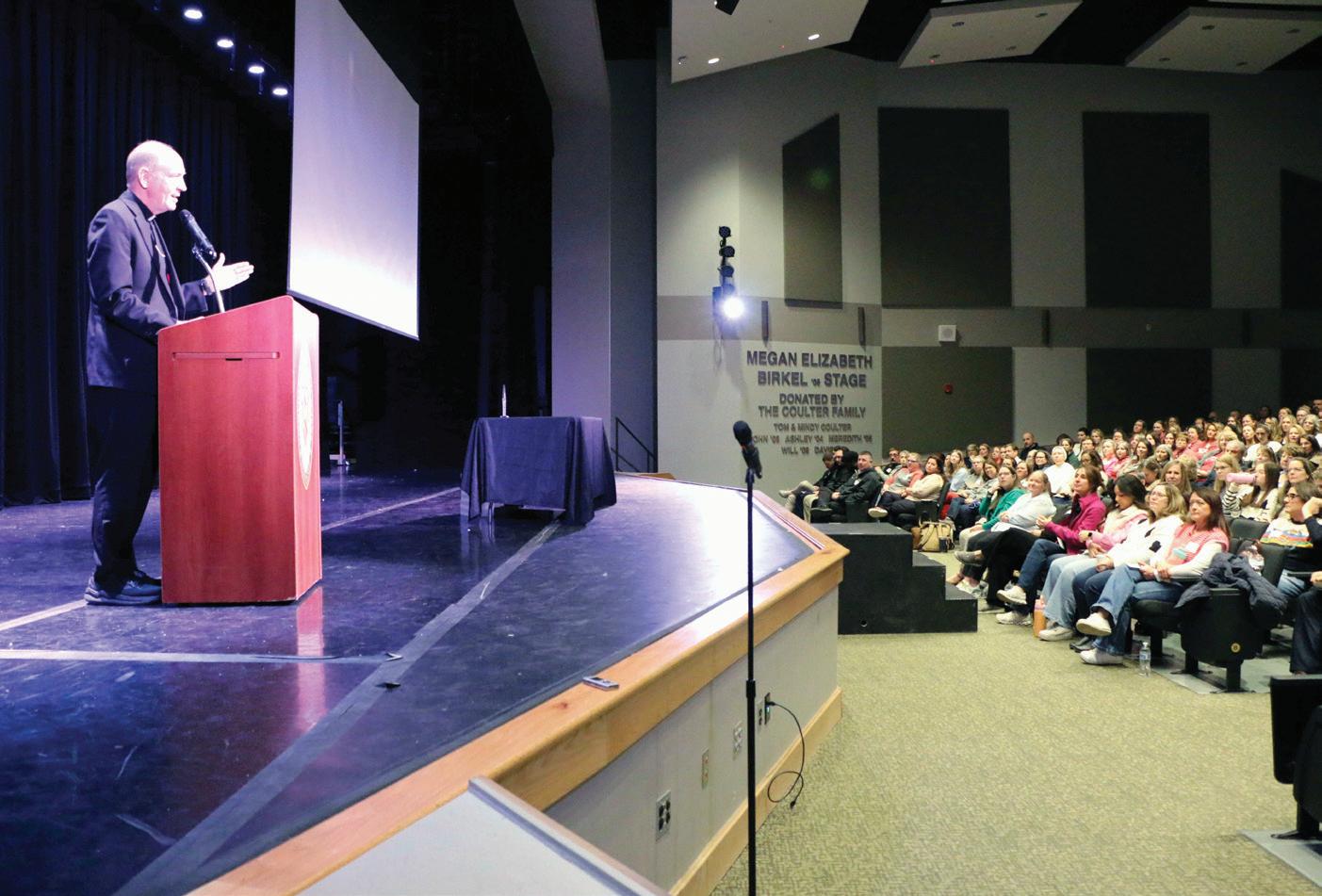
The day began with Mass and an inspirational homily given by Bishop Beckman.
In his remarks, the bishop related the story of Solomon, the king of Israel known for his wisdom, who built the first temple for God. The bishop noted how Solomon, in his later years, turned away from God, a nod to the trend of young people leaving the Catholic Church.
Bishop Beckman also talked about the diocese’s annual Priest Study Days in Gatlinburg, held in February, and the keynote speaker who addressed the young people who have left the Church over past decades. He cited the 2018 book Going, Going, Gone that reports on why young people fall away from the Church.
“For many decades, young people have been leaving the Church in droves. Once they’ve been formed as children, sometimes in our Catholic
schools, and sometimes as young adults, they become disconnected from the living community of the faith,” the bishop said.
“The book Going, Going, Gone describes those trends. But something amazing has begun to happen. Young people over the last year or two for the first time in decades are now returning to organized religion, not just Christianity. It’s a global phenomenon,” Bishop Beckman revealed.
“Young adults in almost every country and all the major religions of the world and other Christian denominations are beginning to seek out
living communities of faith again,” he said.
“The two most rapidly growing faith communities in the United States currently are the Orthodox and the Catholic Church. No. 1 is the Catholic Church,” the bishop said. “Why are young people looking for us now? Of course, the Holy Spirit is at work. There is no doubt about that.”
He noted that the current generation of young people has suffered through the COVID pandemic and sustained profound isolation and loneliness. But in a significant sign of hope, more young people are looking to believe in something greater than themselves.
“The real encounter that heals the human person is the encounter with Jesus Himself. Jesus is present in our world today just has He was present 2,000 years ago. And they are finding Jesus in living communities of people gathered as we are today—in the Church,” Bishop Beckman said.
“They are hungry to know truth. They are hungry for tradition. They don’t want simple apologetics anymore like a number of years ago. And they are seeking deeper, reflective knowledge of the faith. A depth of tradition and understanding. They are hungry for it,” the bishop added.
Bishop Beckman said the speaker at the Priest Study Days urged the priests of the Diocese of Knoxville to think about the Catholic Church in 2050 and what it will look like.
Bishop Beckman then opened the eyes of the diocesan educators attending Mass.
“One thing about the Church in 2025, and about our culture, is the people who will be shaping them are in front of you today in your classrooms. These young people will become the leaders of tomorrow. You are shaping the Church of the future, the world of the future,” he said.
The bishop, who is currently leading a series of talks on the Bible for young adults that is very successful, emphasized to the teachers and administrators that “who you are, the example of your lives” matters to students. “They are looking for living witnesses of authenticity and integrity.”
Bishop Beckman encouraged the educators to Faculty continued on page A18
Keynoter selfie Gerry Brooks, taking the selfie, is a motivational speaker whose humorous presentation has an educational theme. He spoke to Diocese of Knoxville teachers and administrators during Professional Development Day on Feb. 12 at Knoxville Catholic High School. Mr. Brooks has a national following thanks to his popular social media videos and is a faculty favorite. He is shown capturing a moment with diocesan teachers.
BILL BREWER
Bishop Richard F. Stika: July 4, 1957-Feb. 17, 2026
Third bishop of Knoxville, who served the Church in East Tennessee 2009-23, dies
By Dan McWilliams
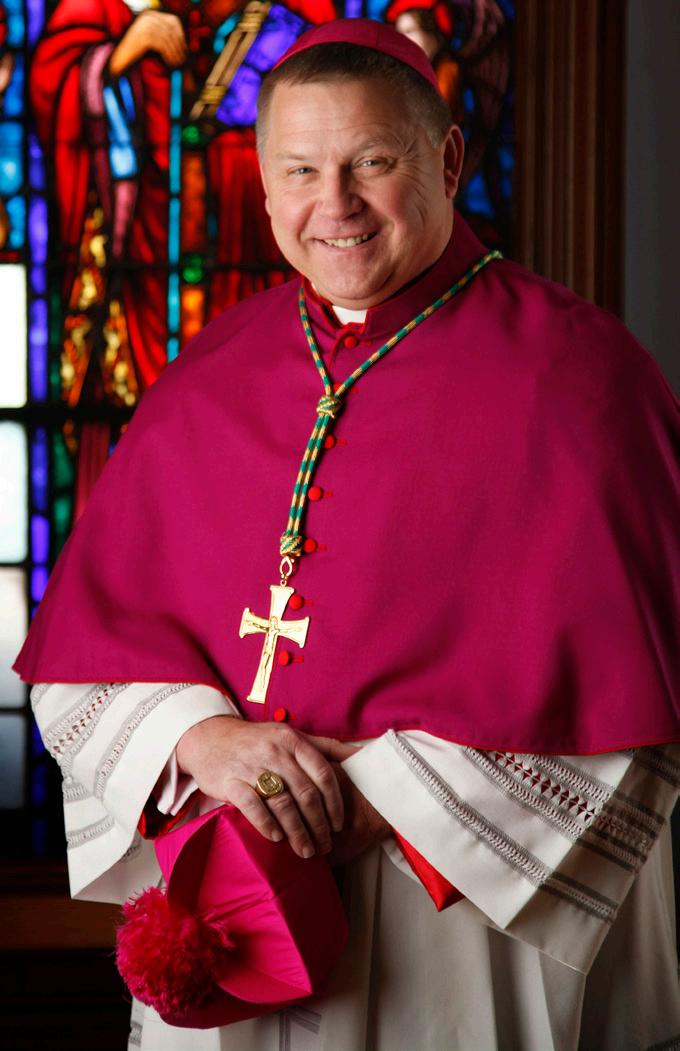
Bishop Richard F. Stika, who served as the third bishop of the Diocese of Knoxville from 2009 to 2023, died in his native St. Louis on Feb. 17. He was 68.
A memorial Mass was celebrated at the Church of the Annunziata in Ladue, Mo., a suburb of St. Louis, on March 3. The funeral Mass and burial took place on March 10 at the Cathedral of the Most Sacred Heart of Jesus in Knoxville, with Bishop Mark Beckman as principal celebrant and Cardinal Timothy Dolan as homilist.
Annunziata is where, as a monsignor, Bishop Stika served before his appointment to East Tennessee.
Bishop Beckman, Knoxville’s fourth bishop, who succeeded Bishop Stika, learned of his predecessor’s death on Feb. 17.
“We keep Bishop Stika in our prayers that the Lord may bring him fully into the light of His kingdom and for his family, and for all who mourn his passing, we offer our prayers for their consolation. May he rest in peace with the Lord,” Bishop Beckman said.
The early years
Richard Frank Stika was born July 4, 1957, in St. Louis, the third child of Frank Jr. and Helen Stika. He had two older brothers, Lawrence and Robert Stika, and a younger brother, Joe Calabro.
The future bishop grew up in a small brick bungalow on Scanlan Avenue in south St. Louis, where the family belonged to Epiphany of Our Lord Parish. The young Richard Stika attended the parish elementary school before going to St. Augustine Seminary High School in Holland, Mich., the only time he lived outside of the St. Louis area before coming to Knoxville as bishop. He returned to St. Louis and graduated in 1975 from Bishop DuBourg High School.
He studied at St. Louis University, where he earned a bachelor of science degree in business in 1979 and discerned his vocation to the priesthood. He enrolled at Kenrick Seminary in Shrewsbury, Mo., now Kenrick-Glennon Seminary, where he earned a bachelor of arts degree in philosophy in 1981 and a master of divinity degree in 1985. Cardinal John J. Carberry ordained him as a transitional deacon on May 1, 1985. He was ordained a priest on Dec. 14, 1985, by St. Louis Archbishop John L. May. Bishop Stika served as an associate pastor of Mary Queen of Peace Parish in Webster Groves, Mo.; St. Paul Parish in Fenton, Mo.; and the Cathedral of St. Louis Parish. He also served as chancellor of the Archdiocese of St. Louis.
Then-Monsignor Stika coordinated an event that was one of the most historic in the life of the archdiocese. Cardinal Justin Rigali, then archbishop of St. Louis, hosted Pope John Paul II when he came to St. Louis in 1999, with Monsignor Stika coordinating the Holy Father’s visit.
Monsignor Stika was serving as pastor of Annunziata Parish in Ladue when he received a call on Dec. 16, 2008, from the papal nuncio, Archbishop Pietro Sambi, telling him Pope Benedict XVI had appointed him bishop of Knoxville.
“It was a very gracious call that began a flood of emotion that takes me to this very special moment with you today,” he said at his initial press conference in Knoxville on Jan. 12, 2009, the day his appointment was announced. “I’ve had almost three weeks to prepare—weeks that were filled with faith-filled moments and very human moments of joy that I was coming to Knoxville but also sadness because I will be leaving a community, a city, and parishes
of
was ordained and installed
that I’ve served and where I’ve lived for nearly 52 years.”
Installation and resignation
Bishop Stika was ordained and installed as bishop on March 19, 2009, the solemnity of St. Joseph, to whom he had a special devotion. He would later credit the saint’s intercession for him after he survived major health incidents related to his Type 1 diabetes and his heart.
He resigned his episcopate in June 2023, citing health concerns and became bishop-emeritus of Knoxville. The resignation occurred amid controversy surrounding his handling of legal cases involving the diocese.
Questions arose over the manner in which he dealt with separate complaints involving a seminarian and a former priest in the diocese. This resulted in a canonical process called a “visitation” conducted by brother bishops, who forwarded their reports to the Roman Dicastery charged with advising the Holy Father on matters involving bishops. After this visitation, Bishop Stika offered his resignation as bishop of Knoxville to Pope Francis, who accepted it on June 27, 2023.
Bishop Stika will be remembered for leading the effort to build the new Cathedral of the Most Sacred Heart of Jesus, dedicated in 2018. He even operated a backhoe to turn over the first furrows of earth at the groundbreaking in 2015 and frequently rode in a crane for upclose inspections of the cathedral dome under construction. The baldacchino of the cathedral, a 45-foot-high canopy over the altar, bears an inscription of Bishop Stika’s episcopal motto: Iesu Confido in Te (“Jesus, I trust in you”).
The bishop presided at Masses for the cathedral groundbreaking on April 19, 2015, and for its dedication on March 3, 2018. The groundbreaking Mass attracted parishioners from throughout the diocese as well as many dignitaries, including Cardinal Rigali, Cardinal Dolan, Cardinal William Levada, then-Tennessee Gov. Bill Haslam, then-Knoxville Mayor Madeline Rogero, former Knox County Mayor and now Congress-
tion of the basilica, built in 1890. He presided over both the inquiry in 2020 opening the sainthood cause of Blessed Father Patrick Ryan, a Sts. Peter and Paul pastor who died in the city’s yellow-fever epidemic in the 1870s, and the re-entombment of Father Ryan’s remains at the basilica in 2021.
The bishop organized a Eucharistic Congress held in Sevierville in September 2013, which attracted Cardinal Rigali, Cardinal Dolan, Bishop Robert Barron, Dr. Scott Hahn, Archbishop Kurtz, and other bishops from around the United States.
Bishop Stika also established Christ Prince of Peace Retreat Center in Benton in 2012.
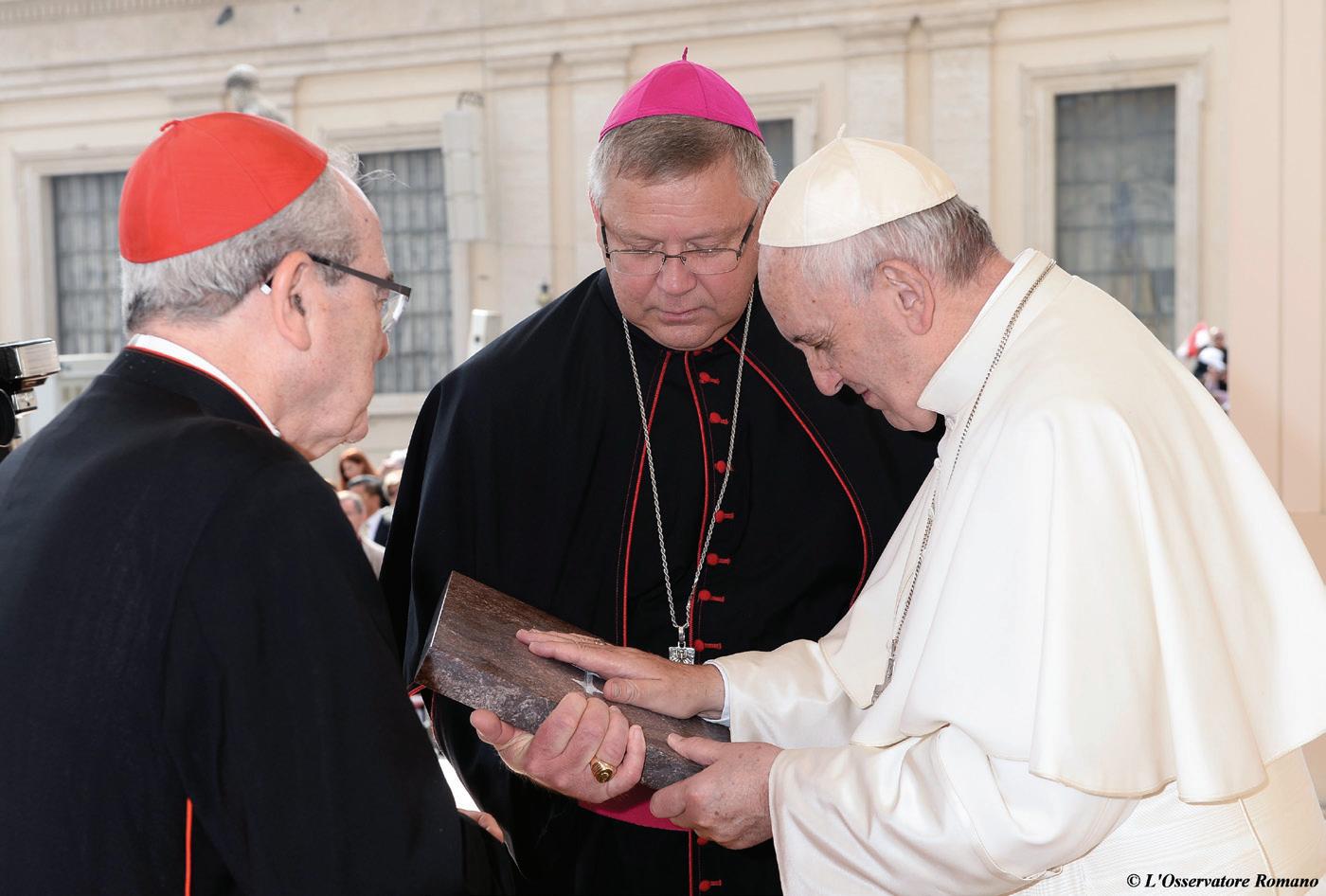
He met Pope Francis multiple times and attended the canonizations of St. John XXIII and St. John Paul II at the Vatican. Pope Francis blessed a dedication stone for the Cathedral of the Most Sacred Heart of Jesus during one visit from Bishop Stika and Cardinal Rigali.
The bishop navigated the diocese through the COVID pandemic, when Masses were suspended at all churches in early 2020 before resuming on Pentecost weekend that year.
Bishop Stika led the diocese when it celebrated its 25th anniversary in 2013. He also celebrated his own 25th and 35th anniversaries of priestly ordination while serving in Knoxville.
Forging a friendship
man Tim Burchett, former University of Tennessee president Joe DiPietro, and former UT football head coach Butch Jones.
During his tenure, Bishop Stika ordained 24 priests and 47 permanent deacons, established several parishes, and welcomed five religious communities to the diocese. He also traveled to Colombia and Mexico for two of the priestly ordinations.
Among the new Catholic communities established were two for Vietnamese Catholics: Divine Mercy in Knoxville and the St. Faustina Public Association of the Faithful in Chattanooga. St. Faustina was told by Jesus to have an image painted with the words “Jesus, I Trust in You,” the bishop’s motto.
The Religious Sisters of Mercy of Alma, Mich., were the first community Bishop Stika invited to serve in the diocese. They were followed by the Evangelizing Sisters of Mary, the Handmaids of the Precious Blood, the Benedictines of Divine Will, and the Benedictine Daughters of Divine Will. The bishop renewed affiliation with Glenmary Home Missioners, which oversaw new parishes in Maynardville and Erwin and a new mission in Rutledge, and he continued affiliations with the Dominican Sisters of St. Cecilia Congregation as well as the Paulist Fathers.
Bishop Stika dedicated numerous churches and other parish buildings, including the large St. John Neumann Church in Farragut in 2009, an extensive building project begun under the diocese’s second bishop, now retired Archbishop Joseph E. Kurtz. Under Bishop Stika’s leadership, the St. Mary’s Legacy Foundation was established following the sale of St. Mary’s Health System. In 2013, the bishop dedicated the first St. Mary’s Legacy Clinic mobile medical van, which continues to offer free medical care to uninsured residents of East Tennessee.
Sts. Peter and Paul Church in Chattanooga was declared a minor basilica by the Vatican in 2011 early in Bishop Stika’s time in the diocese. The bishop’s Home Campaign also funded a major renova-
His death occurred just days before his beloved St. Louis Cardinals baseball team played its first spring-training game, an event he looked forward to every year. The bishop was a lifelong fan of the team and a longtime friend of Cardinals legend and Hall of Fame member Stan Musial and his wife, Lillian, and he knew many other St. Louis players and front-office personnel. Bishop Stika was a celebrant at Mr. Musial’s funeral Mass in 2013.
Bishop Stika forged a decadeslong friendship with Cardinal Rigali after the latter was appointed archbishop of St. Louis in 1994. The future bishop was elevated to monsignor in 1995, and Cardinal Rigali went on to serve as archbishop of Philadelphia in 2003. After he retired in 2011, he relocated to Knoxville to live with Bishop Stika, and he continued to reside with him when the bishop returned to St. Louis.
Bishop Stika often jokingly connected Cardinal Rigali’s title with his favorite baseball team’s nickname, and he wasn’t above mentioning, even in a homily, his favorite hamburger chain, White Castle.
Cardinal Rigali was principal consecrator of Bishop Stika at his episcopal ordination at the Knoxville Convention Center. Co-consecrators were Archbishop Kurtz and Bishop Robert J. Shaheen, then bishop of Our Lady of Lebanon of Los Angeles, which is a Maronite eparchy with a cathedral in St. Louis. Bishop Stika had biritual faculties in the Maronite Church.
Bishop Stika, in conjunction with the cathedral groundbreaking, presided at a Conversation with the Cardinals event at the Tennessee Theater in 2015 with his friends Cardinal Rigali, Cardinal Dolan, and Cardinal Levada.
The bishop was only two steps removed in apostolic succession from Pope John Paul II. The future saint ordained Cardinal Rigali as an archbishop in 1985, and Cardinal Rigali would go on to ordain Bishop Stika.
“The person [in the lineage] I think I’m most proud of, because I’ve always had a special sense of him, is Pope John Paul II,” Bishop Stika said in 2009. “It’s like he’s my episcopal grandfather.” ■
End
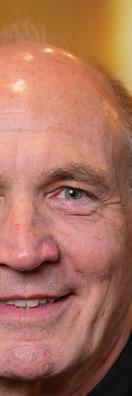
an episcopate Above: Bishop Richard F. Stika, who
as the third bishop of Knoxville on March 19, 2009, is pictured speaking at the Diocese of Knoxville Eucharistic Congress in September 2013 at the Sevierville Convention Center. Below: Bishop Stika and Cardinal Justin Rigali present the dedication stone for the Cathedral of the Most Sacred Heart of Jesus to Pope Francis for the Holy Father to bless at the Vatican on Oct. 14, 2015
Mass. “We gather today to celebrate the mystery of the Lord’s death and resurrection. We pray for Bishop Stika and all who mourn his passing.
“Let us pray: O God, who chose your servant Bishop Richard Stika from among your priests and endowed him with pontifical dignity in the apostolic priesthood, grant, we pray, that he may also be admitted to their company forever.”
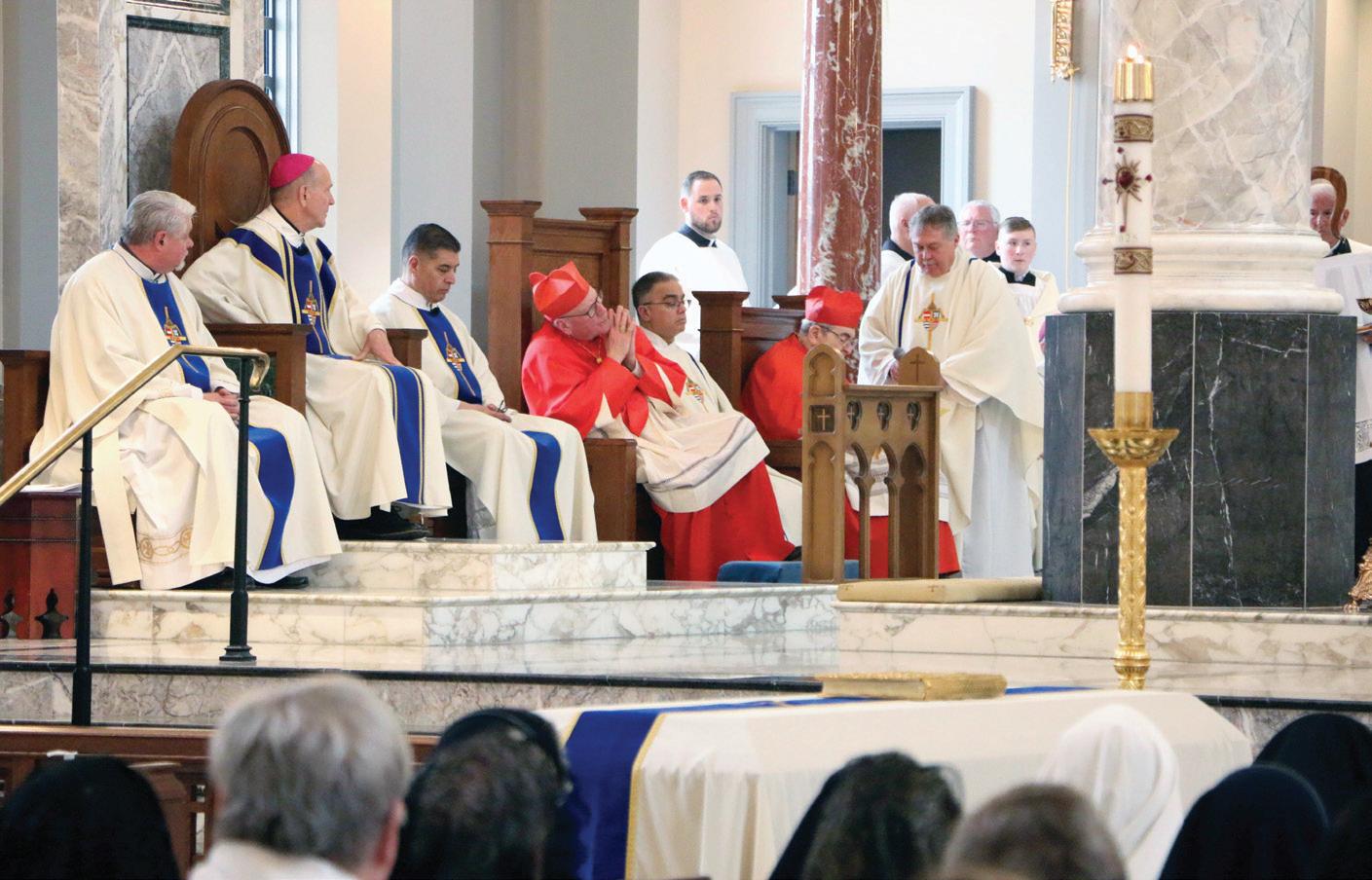
Cardinal Dolan, archbishop emeritus of New York, delivered the homily at the funeral Mass, which followed a memorial Mass on March 3 held at the Church of the Annunziata in Ladue, Mo., near St. Louis, where Bishop Stika was serving when he was appointed bishop of Knoxville. Cardinal Rigali, a former archbishop of St. Louis who lived with Bishop Stika in Knoxville from 2011 onward and continued to reside with him when they returned to Missouri in 2023, read a statement at the end of both Masses. Diocese of Knoxville chancellor Deacon Sean Smith was deacon of the Word at the funeral Mass, with Deacon Fredy Vargas serving as deacon of the altar and the cathedral’s Deacon Walt Otey as master of ceremonies.
Readings were proclaimed by Sister Mary Clara Auer, FSGM, Cardinal Rigali’s longtime secretary as well as a friend of Bishop Stika, and Brian Hazelton.
Glenn Kahler, director of music and liturgy for the cathedral, led the music ministry at the Mass. Nine singers and three instrumentalists from Sacred Heart, including cantor Michelle Pokelwaldt and organist Sarah-Clementine Mire, also took part.
The funeral Mass began in the cathedral vestibule with Bishop Beckman sprinkling the casket with holy water. The pall was placed over the casket by Bishop Stika’s niece, Michele Oswald, her husband, Todd, and their family.
Jesus, I trust in thee Cardinal Dolan began his homily by quoting Bishop Stika’s episcopal motto. The Latin version, Iesu Confido in Te, is inscribed on the front of the cathedral’s baldacchino, the 45foot canopy over the altar.
“Five words. Five words, folks— that’s all I want to propose this morning of the funeral Mass of my brother Bishop Richard Stika, and those five words are this—you ready? You know them already. ‘Jesus, I trust in thee. Jesus, I trust in thee’—five powerful words,” said Cardinal Dolan. “You realize how pivotal, how pivotal those five words were for Bishop Richard Stika? These words were his episcopal motto, as a matter of fact. This was the prayer, as you know, given us by St. Faustina in the Divine Mercy devotion, so meaningful for Pope St. John Paul II, for whom the man we mourn had such love and loyalty.”
That motto made its adopter the subject of good-natured ribbing.
“Cardinal Rigali and I would often tease Bishop Stika that this aspiration, these five words—ah! it was just a newer version of the earlier older invocation of St. Margaret Mary that we had learned as kids: ‘Sacred Heart of Jesus, I place all my trust in thee,’” said Cardinal Dolan, who was elevated to the episcopacy in 2001 as an auxiliary bishop of St. Louis, where he was consecrated by Cardinal Rigali when the latter was the Missouri see city’s archbishop.
Cardinal Dolan repeated the English version of Bishop Stika’s episcopal motto.
“Jesus, I trust in thee. Might those hallowed words ring in our souls this afternoon as we admit a sense of bewilderment at his passing at a relatively premature age, as we thank God for his life and ministry, which was an apostolate filled with its share of ups and downs, a combination of success and setbacks every faithful disciple of Jesus experiences,” he asked.
“Condolences to you, Bishop Beckman, and this diocese that he so cherished. Sympathy to you, Cardinal Justin Rigali—you were a spiritual father to him—my brother
bishops, priests, and deacons, religious Sisters whom he so loved, his family, his many friends that have come from this diocese and beyond.”
Cardinal Dolan referred to the liturgy’s second reading from Romans 6, as well as to the particular season in which Bishop Stika passed away.
“Fitting it is—no?—that we would come together in hope this blessed season of Lent as we try our best to recapture the mystery of the Passover, right? The Passover of God’s people, the people of Israel, from slavery to freedom, from death to life, from exile in a temporary home to their true dwelling and ours: the Promised Land of eternity.
The Passover, as we laser in on the Passover of Jesus, His paschal mystery, as He passed over from Good Friday to Easter Sunday, from dying to rising,” Cardinal Dolan said.
“Holy Mother Church defines this paschal mystery—listen: ‘The dying and rising of Christ and our
absorption into it,’ that’s what the Catechism says. Sure—the paschal mystery, the dying and rising of Christ that occurred 1,993 years
ago. But a mystery that still goes on as those united to Him and to that mystery are sucked up into that infinite, everlasting passage. How does that happen? Well, we just had the answer to that question in our readings from God’s holy Word. St. Paul teaches that we were indeed buried with Him through baptism into his death so that, just as Christ was raised from dead, we, too, might live in newness of life, for if we have grown into union with Him through His death, we shall also be united to Him in His resurrection.”
The cardinal stressed his words again, citing the Gospel reading from John 6.
“Did you get that? And that’s not all. Jesus assures us that ‘I am the living bread that came down from heaven. Whoever eats this bread will live forever,’” he said. “Boy, oh boy, no wonder we would whisper: ‘Jesus, I trust in thee’ with those promises.”
Cardinal Dolan added that “there’s one certainty among the ups and downs of Bishop Stika’s nearly seven decades with us” and mentioned an Italian appetizer to make his point.
“One certainty that we know for sure is that he was christened, he was baptized, at Epiphany Parish back in St. Louis, and that daily as a priest, he was nourished by the very bread of heaven. See? Baptism and the Eucharist,” he said. “This magnificent cathedral is indeed almost a shrine, an icon, to the centrality of those two paschal, Easter sacraments of baptism and the holy Eucharist. This Lenten Passover journey of 40 days is but antipasto to our celebration of the Lord’s Last Supper.”
The cardinal questioned “is there somberness as we lament” the passing of Bishop Stika.
“You bet there is,” he said. “But it’s a somberness of that Friday weirdly called ‘Good’ when the sun hid in shame and when the earth trembled in grief. Is there hope and light this afternoon in Knoxville? Yep—the hope and light that transfigured that Easter dawn, as the first Christians chanted ‘by dying He destroyed our death, by rising He restored our life.’”
Cardinal Dolan ended his homily with a couple of baseball references, one to the St. Louis Cardinals—the team Bishop Stika was a diehard fan of all of his life.
“What do you say, in conclusion? We go from those five words, ‘Jesus, I trust in thee,’ to those five decades, the mysteries of the rosary. Don’t worry, I’m not going to pray it. Joyful, luminous, sorrowful, glorious—the mysteries of the rosary that Bishop Stika and Cardinal Rigali would pray together every evening,” he said.
“Now, folks, look at the odds. As I read it, that’s 3 to 1, all right? You’ve got the joyful, you’ve got the luminous, you’ve got the glorious on the one hand. You’ve got the sorrowful on the other. That’s 3 to 1. The sports fan that he was would take those odds, and he would wager on them. That’s what we would call a pretty good bet. Better, even, than those given the St. Louis Cardinals and New York Yankees this spring training. As we confess, this is no gamble at all but a sure thing because ‘Jesus, we trust in thee.’” Deacon Smith led the intercessory prayers following the homily.
“In baptism, Richard received the light of Christ. Scatter the darkness now and lead him over the waters of death. Our brother Richard shared in the priesthood of Jesus Christ, leading God’s people in prayer and worship. Bring him into your presence, where he will take his place in your heavenly liturgy. Many friends and members of our families have gone before us and await the kingdom. Grant them an everlasting home with your Son,” the deacon said.
“Those who trusted in the Lord now sleep in the Lord. Give refreshment, rest, and peace to all whose faith is known to you alone. For the family and friends of our brother Richard, that they may be consoled
The Paschal Mystery Above: Bishop Mark Beckman, with fellow bishops and priests, celebrates the Liturgy of the Eucharist during the funeral Mass for Bishop Richard F. Stika at the Cathedral of the Most Sacred Heart of Jesus on March 10. Below: Cardinal Justin Rigali delivers remarks to the congregation during the Mass. BILL BREWER (2)
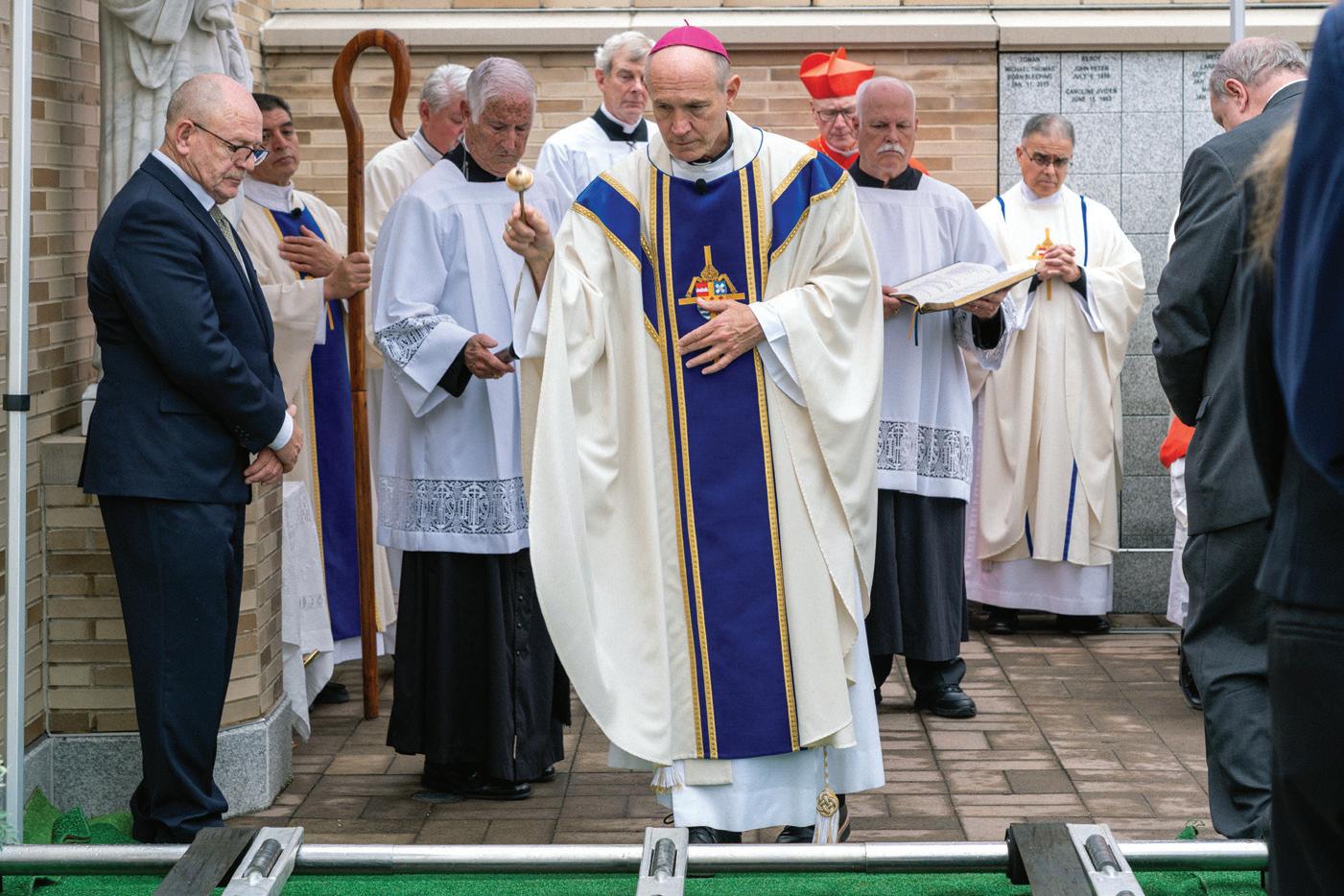
Place of rest Above: Bishop Mark Beckman leads the assembly in prayer during the burial service for Bishop Richard F. Stika in the Sacred Heart Cathedral columbarium on March 10. Below: Bishop Beckman sprinkles holy water on the grave of Bishop Stika. Bishop Stika, the third shepherd of Knoxville, expressed his wish when the cathedral was dedicated to be buried there.
BILL BREWER
Bishop Richard F. Stika
Pope Leo XIV names papal nuncio for U.S.
Archbishop Gabriele Caccia succeeds Cardinal Christophe Pierre in diplomatic role
By Courtney Mares OSV News
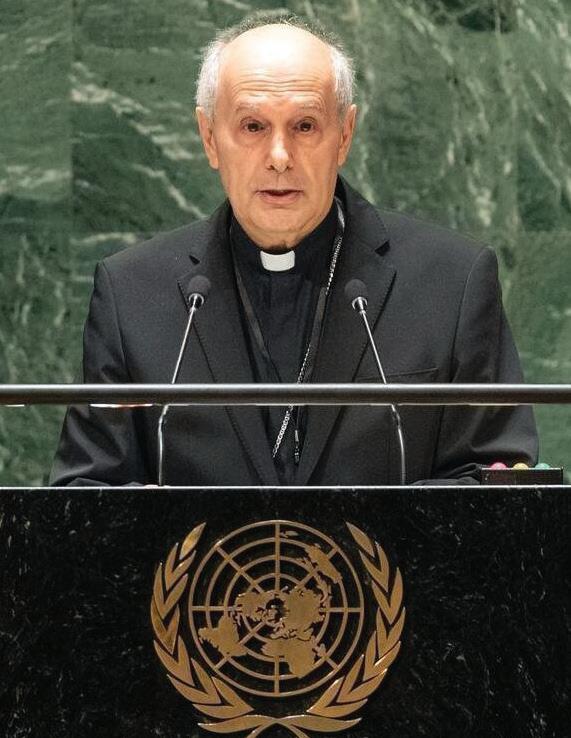
Pope Leo XIV has named Archbishop Gabriele Caccia as the Vatican’s ambassador to the United States, selecting a seasoned diplomat to serve as a crucial liaison between Rome and the pope’s home country.
The Vatican announced the new apostolic nuncio on March 7, naming Archbishop Caccia, 68, to succeed Cardinal Christophe Pierre, who turned 80 in January and had served in the post since 2016.
A nuncio is a Vatican diplomatic representative with the rank of ambassador. He acts as both the Holy See’s ambassador to the government and its representative to the Catholic
in their grief by the Lord, who wept at the death of His friend Lazarus. We all are assembled here in faith and confidence to pray for our brother Richard. Strengthen our hope so that we may live in the expectation of your Son’s coming.”
Remembering His servant
As the Liturgy of the Eucharist began, the gifts were presented by Bishop Stika’s niece, Mrs. Oswald, and her husband and their family. After concelebrating bishops joined in the Eucharistic Prayer, Bishop Beckman said:
“Remember your servant Richard, whom you have called from this world to yourself, grant that he who is united with your Son in a death like His may also be one with Him in His resurrection, when from the earth He will raise up in the flesh those who have died and transform our lowly body after the pattern of His own glorious body. To our departed brothers and sisters, too, and to all who are pleasing to you at their passing from this life, give kind admittance to your kingdom. There we hope to enjoy forever the fullness of your glory, when you will wipe away every tear from our eyes, for seeing you, our God, as you are, we shall be like you for all the ages and praise you without end, through Christ, Our Lord, through whom you bestow on the world all that is good.”
After Communion, Bishop Beckman prayed: “Almighty and merciful God, that as you made your servant Bishop Richard Stika an ambassador for Christ on earth so you may raise him purified by this sacrifice to be seated with Christ in heaven, who lives and reigns for ever and ever.”
Cardinal Rigali, who was principal consecrator of Bishop Stika at his ordination and installation in Knoxville on March 19, 2009, read a statement at the end of Mass.
“Dear friends of Bishop Stika, I thank you all for being here today, for coming here to pray for the eternal repose of the soul of Bishop Stika. We have been given a great gift by God, and we are grateful for the gift of the goodness and the love of God that we have known in Bishop Stika,” he said. “Yes, through him, our friend, we have in so many ways known what God is like. He is loving. He is faithful. He is kind and merciful. He is forgiving, always.
“Bishop Stika has taught us so well how to live, how to love, how to be generous with one another. He has taught us to share with one another and to lead others with joy to the Father. As we give thanks for his long and dedicated service to the Church, we pray that God will give him eternal life and rest.”
Father Mike Nolan, pastor of St. Thérèse of Lisieux Parish in Cleveland, sang the “Celtic Song of Farewell” as the Mass ended.
“Before we go our separate ways, let us now take leave of our brother. May our farewell express our affection for him. May it ease our sadness and strengthen our hope.
Church in the host country, maintaining ties between local bishops and Rome.
Archbishop Caccia, a native of Milan, already has significant U.S. experience, having served as permanent observer of the Holy See to the United Nations since 2020.
As papal nuncio to the United States, Archbishop Caccia will play a key role in the selection process for U.S. bishop appointments and will serve as a point of contact between the bishops and clergy in the United States and the pope, in addition to carrying out the diplomatic tasks of a foreign ambassador serving in the United States.
Like his predecessor, Archbishop Caccia will serve as the pope’s key contact with President Donald
One day we shall joyfully greet him again when the love of Christ, which conquers all things, destroys even death itself,” Bishop Beckman said before Father Nolan sang.
Afterward, Bishop Beckman led the Final Commendation and prayed: “Into your hands, Father of mercies, we commend our brother Bishop Richard in the sure and certain hope that together with all who have died in Christ, he will rise with Him on the last day. Merciful Lord, turn toward us and listen to our prayers. Open the gates of paradise to your servant and help us who remain to comfort one another with the assurances of faith until we all meet in Christ and are with you and with our brother forever. We ask this through Christ our Lord. Amen.”
Deacon Vargas concluded the Mass by saying, “in peace, let us take our brother to his place of rest.”
The assembly, led by the clergy, then processed out of the front doors of the cathedral and around to the adjacent columbarium entrance as they sang “How Great Thou Art.” When that song ended, Katie Helms played “Amazing Grace” on the bagpipes during the procession. Diocesan priests entered the columbarium gate singing “Salve Regina.”
“Our brother Bishop Richard has gone to his rest in the peace of Christ. May the Lord now welcome him to the table of God’s children in heaven. With faith and hope in eternal life, let us assist him with our prayers. Let us pray also to the Lord for ourselves. May we who mourn be reunited one day with our brother. Together may we meet Christ Jesus when He who is our life appears in glory,” Bishop Beckman said at the graveside, then quoted Matthew 25:34: “We read in sacred Scripture ‘Come, you who are blessed by my Father, says the Lord. Inherit the kingdom prepared for you from the foundation of the world.’”
The bishop sprinkled his predecessor’s grave with holy water.
“Lord Jesus Christ, by your own three days in the tomb, you have hallowed the graves of all who believe in you and so made the grave a sign of hope that promises resurrection, even as it claims our mortal bodies. Grant that our brother may sleep here in peace until you awaken him to glory, for you are the resurrection and the life. Then he will see you face to face and in your light will see light and know the splendor of God, for you live and reign for ever and ever,” Bishop Beckman said before reading the prayer of committal:
“In sure and certain hope of resurrection to eternal life through our Lord Jesus Christ, we commend to Almighty God our brother Bishop Richard as we commit his body to the ground, earth to earth, ashes to ashes, dust to dust. The Lord bless him and keep him; the Lord make his face to shine upon him and be gracious to him; the Lord lift up his countenance upon him and give him peace.”
Deacon Smith offered intercessory
Trump’s administration at a time when the administration’s immigra-
prayers before Bishop Beckman led the assembly in the Lord’s Prayer.
“Lord, you consoled Martha and Mary in their distress. Draw near to us who mourn Richard and dry the tears of those who weep. You wept at the grave of Lazarus, your friend. Comfort us in our sorrow. You raised the dead to life. Give to our brother Richard eternal life. You promised paradise to the repentant thief. Bring Richard to the joys of heaven,” the deacon said.
“Our brother Richard was washed in baptism and anointed with the Holy Spirit. Give Richard fellowship with all your saints. Richard was nourished with your body and blood. Grant him a place at the table in your heavenly kingdom. Comfort us all in our sorrow at the death of Richard and let our faith be our consolation and eternal life our hope
Bishop Beckman then gave a final prayer and blessing.
“O God of holiness and power, accept our prayers on behalf of your servant Bishop Richard. Do
tion policies have been met by resistance among U.S. bishops.
Archbishop Caccia in a March 7 statement said he was “honored and deeply humbled by the decision of the Holy Father to appoint me as Apostolic Nuncio to the country and the Church where he himself was born and raised.”
“I receive this mission with both joy and a sense of trepidation, conscious of the great trust placed in me and of my own limitations, yet confident in His Holiness’ prayerful support and guidance,” the archbishop said.
During his years of service at the United Nations in New York, Archbishop Caccia said, he has experienced “warmth and openness” from
not count his deeds against him, for in his heart he desired to do your will. As his faith united him to your people on earth, so may your mercy join him to the angels in heaven. We ask this through Christ our Lord,” he said. “Merciful Lord, you know the anguish of the sorrowful, you are attentive to the prayers of the humble. Hear your people who cry out to you in their need and strengthen their hope in your lasting goodness. We ask this through Christ our Lord.”
The faithful prayed for God to grant eternal rest to Bishop Stika and for perpetual light to shine upon him, and that “his soul and the souls of all the faithful departed, through the mercy of God, rest in peace.”
“May the peace of God, which is beyond all understanding, keep your hearts and minds in the knowledge and love of God and of his Son, our Lord Jesus Christ. And may almighty God bless you, the Father, and the Son, and the Holy Spirit,” Bishop Beckman said. ■
Funeral continued from page A7
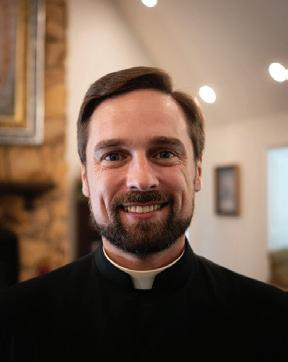
FR. BILL MCNEELEY Chaplain & Spiritual Director
SHERRI MCNEELEY Group Leader
Archbishop Gabriele Caccia
Papal nuncio continued on page A19
The qualities of a good Scout
Bishop Beckman presides at Mass, ceremony to recognize adult and young leaders
By Bill Brewer
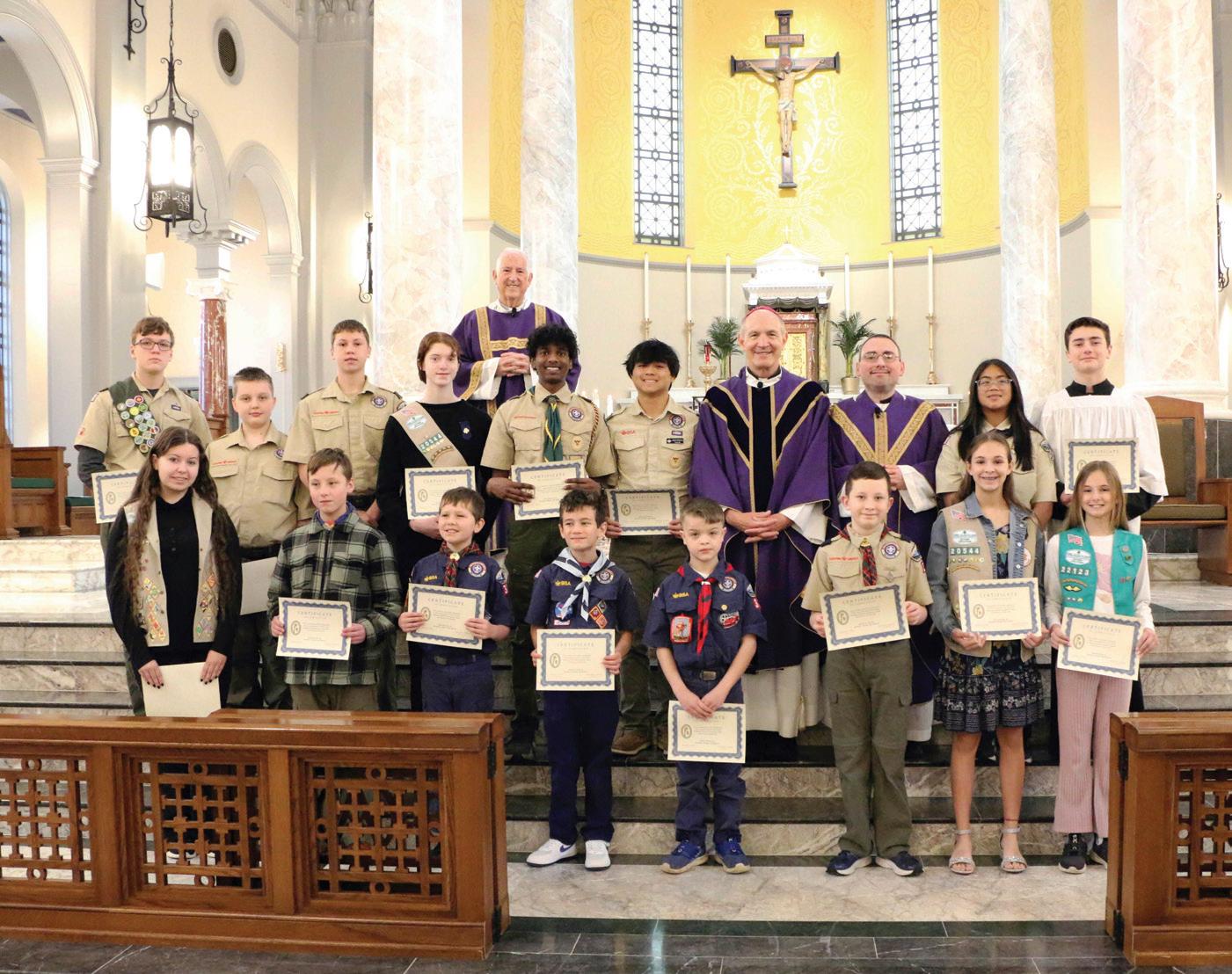
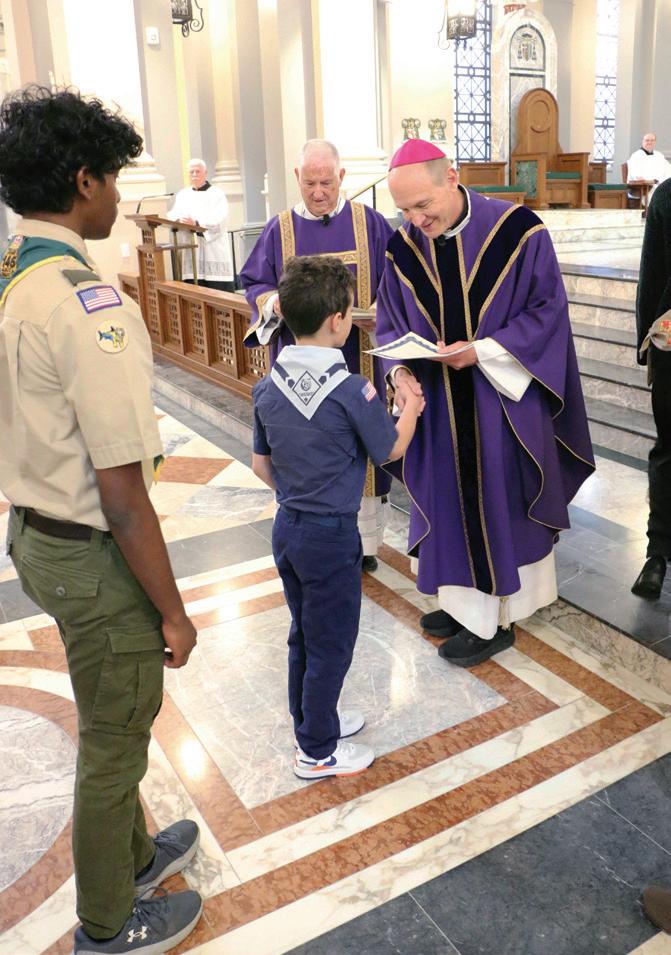
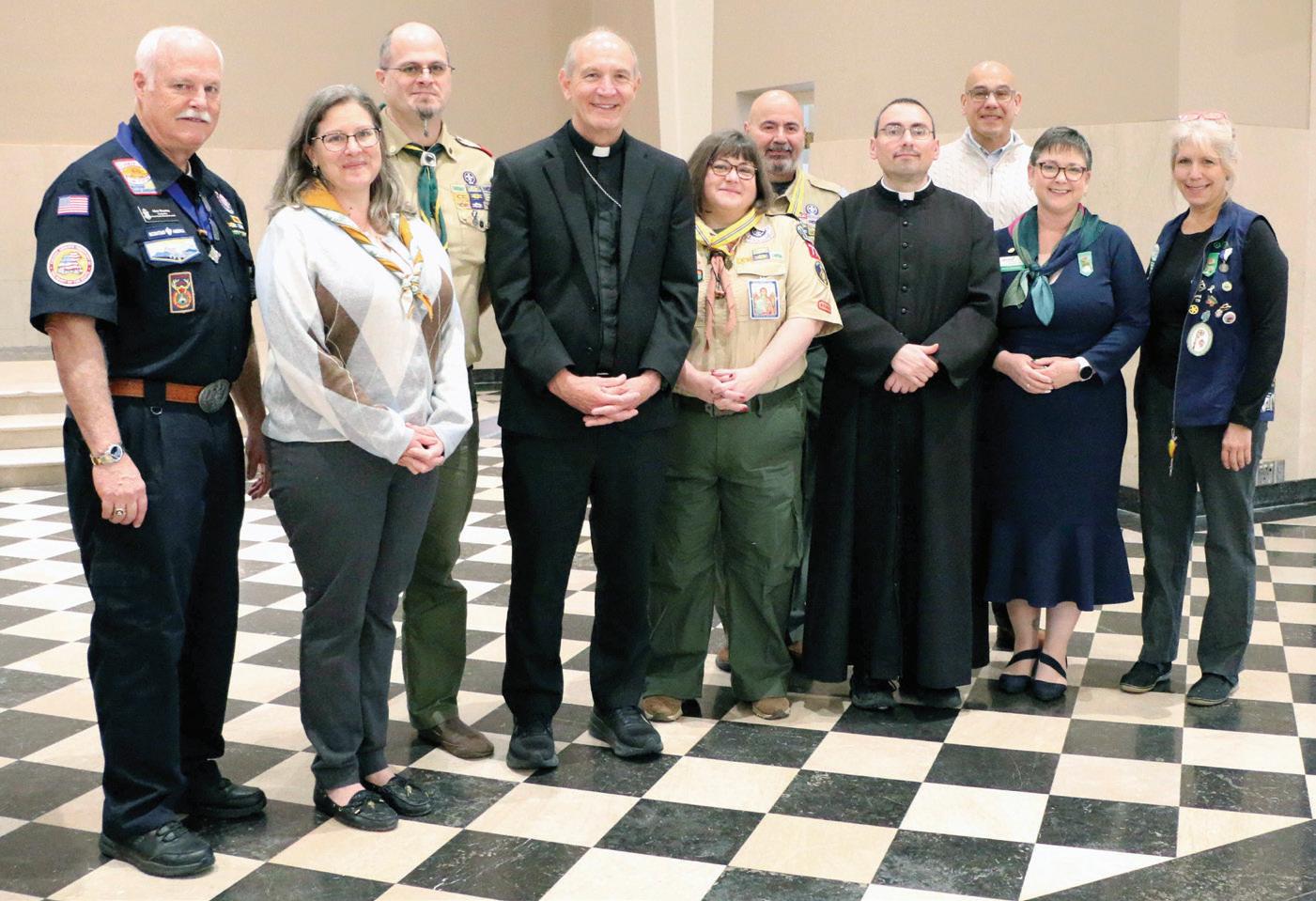
Scouts from around the Diocese of Knoxville were recognized on Feb. 21 during the annual Scouting Mass celebrated by Bishop Mark Beckman at the Cathedral of the Most Sacred Heart of Jesus.
Concelebrating the Mass was Father Dustin Collins, pastor of St. Mary Parish in Johnson City, who also serves as chaplain of the Diocesan Catholic Committee on Scouting.
Boys and girls from East Tennessee parishes who are active in the Scouts as well as adult Scout leaders were saluted by Bishop Beckman for their good works and the way the Scouting activities they take part in complement their Catholic faith.
At the end of Mass, Chris Manning, chair of the Diocesan Catholic Committee on Scouting, introduced the presentation of certificates to Boy and Girl Scouts in the diocese who have earned a religious emblem in the past year.
The young Scouts were presented their certificates by Bishop Beckman.
“One of the things that is so important is that our young people have good experiences of community that build solid character. There is no better organization for that than Scouting. I think Scouting helps our young people in a community kind of way, growing character. So, patriotism, support for living a virtuous Christian life, all those excellent qualities,” Bishop Beckman said.
The bishop underscored that Scouting and the Catholic faith are in sync in so many ways.
“They are very complementary. You know the qualities of a good Scout trustworthy, loyal, helpful, friendly, courteous, kind, cheerful,
thrifty, brave, clean, and reverent are great Christian qualities. And
quali-
ties and revealing that he was a Scout in a troop at Sacred Heart Parish in Lawrenceburg, Tenn., when he was young.
“I was a Scout. I was a Cub Scout, a Webelo, and a Boy Scout. I enjoyed many of the elements of Scouting,” the bishop shared. It was the second Scouting Mass in which Bishop Beckman has presided. He also led the Bishop’s Breakfast for Scouting, a ceremony to present adult-recognition awards held in the Cathedral Hall following the Mass and was assisted by Father Collins.
Eight adult volunteers, including Father Doug Owens, pastor of All Saints Parish in Knoxville, received awards for their work with the Scouts. Father Owens was presented his award during Mass at All Saints Church on Feb. 22.
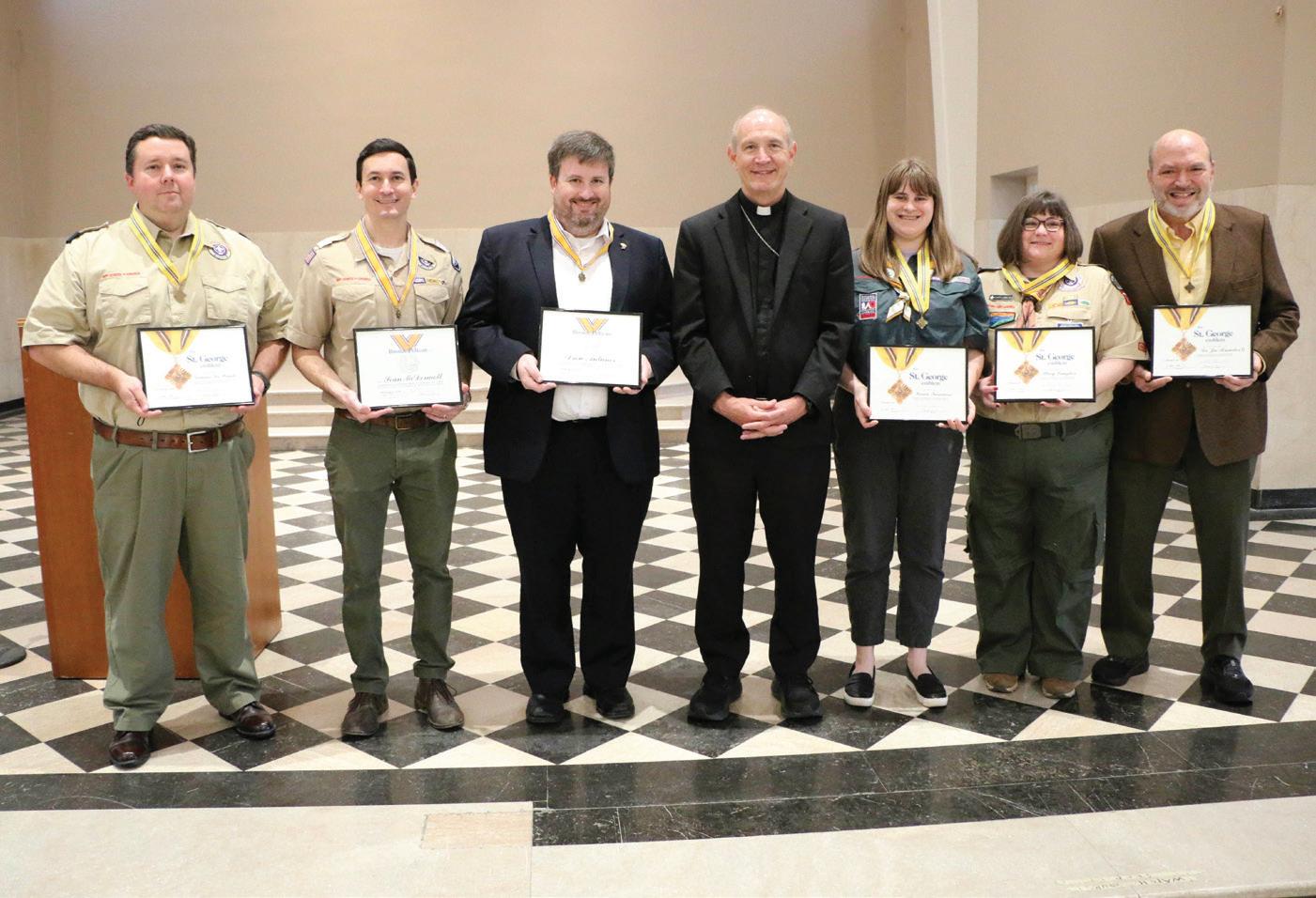
Receiving the Bronze Pelican Award were Drew Antunes and Sean McDermott.
Mr. Manning explained that the Bronze Pelican Award recognizes people who have made a significant contribution to Scouting in the field of Catholic relationships. It is given to Catholic laymen and laywomen, priests, and religious.
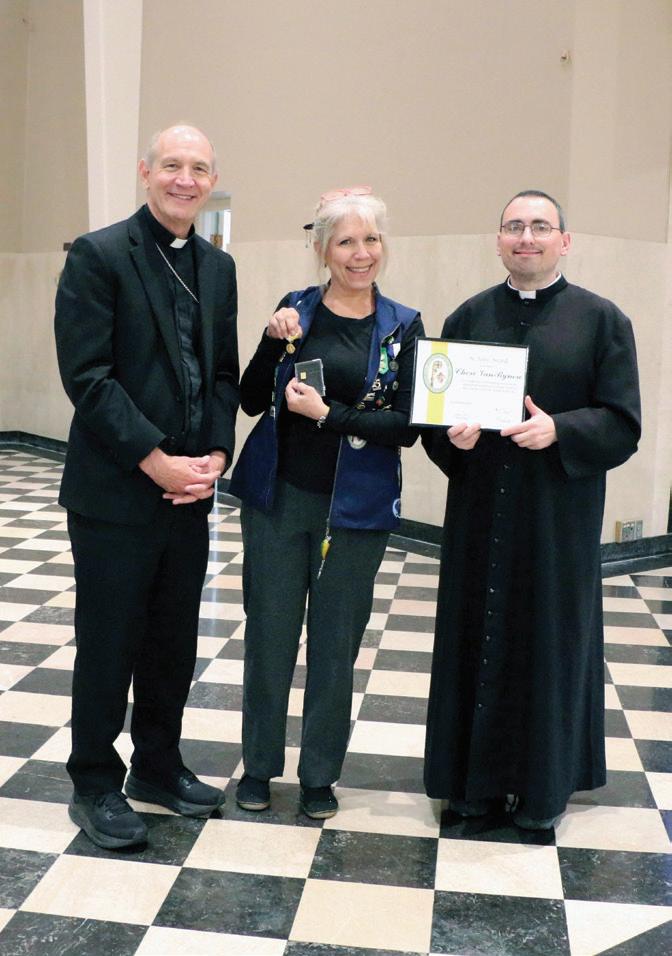
Receiving the St. George Medal were Father Owens, Dennis LaPointe of the cathedral parish, Karin Turnmire, an All Saints parishioner, Dr. Joe Browder II of the Cathedral parish, and Stacy Langlois of St. Thomas the Apostle Parish in Lenoir City.
Dr. Browder has spent many years volunteering with the Scouts and has served as an international representative for Scouting as well as a member of the local council executive board.
Mrs. Langlois is Cubmaster for Pack 770 at St. Thomas the Apostle. She also serves as the registrar for
Scouts continued on page A21
Vatican releases Synod report on women in leadership
Expanded role called for in Church governance not including ordained ministry
By Courtney Mares OSV News
The Vatican has published the final report of the synod study group examining women’s participation in the Church, which calls for expanded roles for women in Church governance and leadership in roles not including ordained ministry.
The 75-page document, published in English and Italian on March 10, discusses women’s leadership in the Church but not the specific question of a possible female diaconate.
It is the third of 15 final reports expected from the study groups of the Synod on Synodality in the coming weeks. Cardinal Mario Grech, the secretary general of the Synod of Bishops, has characterized these reports as “working documents” that will be used to form proposals submitted to the pope for consideration.
A ‘charismatic path’ for women
In the document, the study group calls for “new spaces” for women to exercise leadership in evangelization and administration in collaboration with ordained ministers.
“Alongside the sacramental path and distinct from it, there is also a charismatic path that can be fruitfully pursued to open new spaces of participation for the lay faithful, particularly for women,” it states. “It follows that even in the exercise of governance within a diocese, opportunities of this kind may arise and should be employed.”
The report argues that laywomen possess distinct charisms from the Holy Spirit that demand recognition.
“Today, laywomen have the right to affirm their participation in the
mission of the Church not only on the basis of their equal human and Christian dignity but also on the basis of the charisms given by God,” it says.
“A new evangelization has become urgent, one that depends less exclusively on priestly resources and is enriched by the presence and contributions of women,” it adds.
‘New forms of exercising authority’
The synod study group calls for theology and canon law to “explore new forms of exercising authority grounded in the sacrament of baptism and distinct from those deriving from holy orders, so that adequate canonical forms may be found to make effective the participation of women in roles of leadership within the Church.”
“There is no reason or impediment that should prevent women from carrying out leadership roles in the Church,” the report states.
The document also recommends a “reformulation of the areas of competence of the ordained ministry,” suggesting that redefining those boundaries “could open the way to recognize new spaces of responsibility for women in the Church.”
Female diaconate not addressed
Notably, the report does not address the specific question of a possible female diaconate, a controversial topic of debate within the Synod on Synodality.
During the second session of the synod, Pope Francis reactivated a commission studying women’s access to the diaconate under Cardinal Giuseppe Petrocchi. That commission’s conclusions, published in December 2025, stopped
short of recommending the female diaconate but approved by a wide margin a proposal to broaden women’s access to instituted ministries like that of catechist.
The Virgin Mary as a model
Drawing on Scripture and Church tradition, the report invokes both the Virgin Mary and St. Mary Magdalene as paradigms for female authority in the Church.
“Mary is the supreme model of
the charismatic dimension. Though she does not belong to the hierarchical structure, she possesses within the Church a unique authority and spiritual fruitfulness,” it states.
The document also notes that Christ chose a woman, Mary Magdalene, to first announce the resurrection: “The Apostles themselves received this proclamation from her.”
Jesus emulates those qualities,” he said, quickly reeling off the
Earning their religious emblems Above: Bishop Mark Beckman, assisted by Father Dustin Collins and Deacon Walt Otey, are shown with Diocese of Knoxville Scouts who were recognized for their service. Below left: Bishop Beckman presents certificates to Scouts who have earned a religious emblem in the last year. Below right: Bishop Beckman and Father Collins present Scouting volunteer Cheri Van Bynen with the St. Anne Medal.
Synod
Men’s Emmaus to be held in diocese
Spiritual gathering at Christ Prince of Peace center set for April 24-26
The East Tennessee Catholic
Registration is now open for the first Men’s Emmaus in East Tennessee. The event will be at Christ Prince of Peace Retreat Center in Benton April 24-26.
The Emmaus Retreat is based on the Gospel of Luke, chapter 24, where Jesus joins two of His disciples as they walk from Jerusalem to the village of Emmaus.
This “walk” takes these two disciples from being dejected and filled with anxiety and stress to being full of life and filled with joy after Jesus joins them and their eyes are opened to recognize Him as their Lord.
The retreat is designed for men who feel they would like to explore a deeper relationship with God.
In the early 1980s, the Emmaus Retreat, under the direction of Father David Russell, was developed at St. Louis Catholic Church in Miami as a retreat for women.
Men of the parish, seeing how the women had been transformed, worked with new pastor Father James Fetscher and modified the retreat slightly to be more in tune with what men need.
The first Men’s Emmaus was conducted in 1985
From this humble beginning, the Emmaus Retreat has spread through the United States and throughout the world including the Caribbean, Europe, Cuba, China, and Russia.
It is estimated that 1.4 million men and women throughout the world have completed the Emmaus Retreat. For the first time, men in East Ten-
nessee will have the opportunity to experience the Emmaus Retreat.
Although the Emmaus Retreat was developed by Catholics, it is open to all men regardless of religious affiliation and all are welcome to attend.
The Emmaus Retreat should not be confused with the “Walk to Emmaus,” a Methodist adaptation of the Catholic Cursillo. Despite its similar name, the Walk to Emmaus is a different program from the Emmaus Retreat.
At least 30 men from Florida, Tennessee, the Carolinas, and beyond who have previously experienced the Emmaus Retreat will form the team for East Tennessee.
These men share their experience, volunteer their weekend, travel to the retreat at their own expense, and pay a higher registration fee than the candidates.
As a special blessing, Jim Loretta, an original team member of the first Emmaus in 1985, will lead the team for the inaugural East Tennessee Men’s Emmaus.
The cost of the Emmaus Retreat is $195, which includes abundant food, lodging for two nights, an embroidered polo shirt, and most importantly, a closer relationship with Jesus.
Scholarships are available, and no one will be turned away if the retreat fee is a hardship. Candidates who need assistance can confidentially select the scholarship option on the application form.
To learn more about the Men’s Emmaus Retreat or to register, go to emmausretreats.org
Questions can be directed to Michael Hart at mikehartfl1987@gmail.com or by calling 423-414-4532.
Mr. Hart participated in Men’s Emmaus No. 2 at St. Louis Church in Miami in 1987. He is a member of St. Augustine Parish in Signal Mountain.
And for those interested in attending the Men’s Emmaus or for more information:
Q. How do these retreats work?
A. Participants will hear a series of talks by other men concerning their own experiences. They will have a chance to reflect, pray, and consider the bigger, really meaningful questions of life in a place that is far enough away to separate them from the distractions of everyday life and leave knowing that they are not alone and have a comEmmaus continued on page A11
NDHS hosts Made for More, a tribute to Theology of the Body The hunger for more
By Maggie Parsons
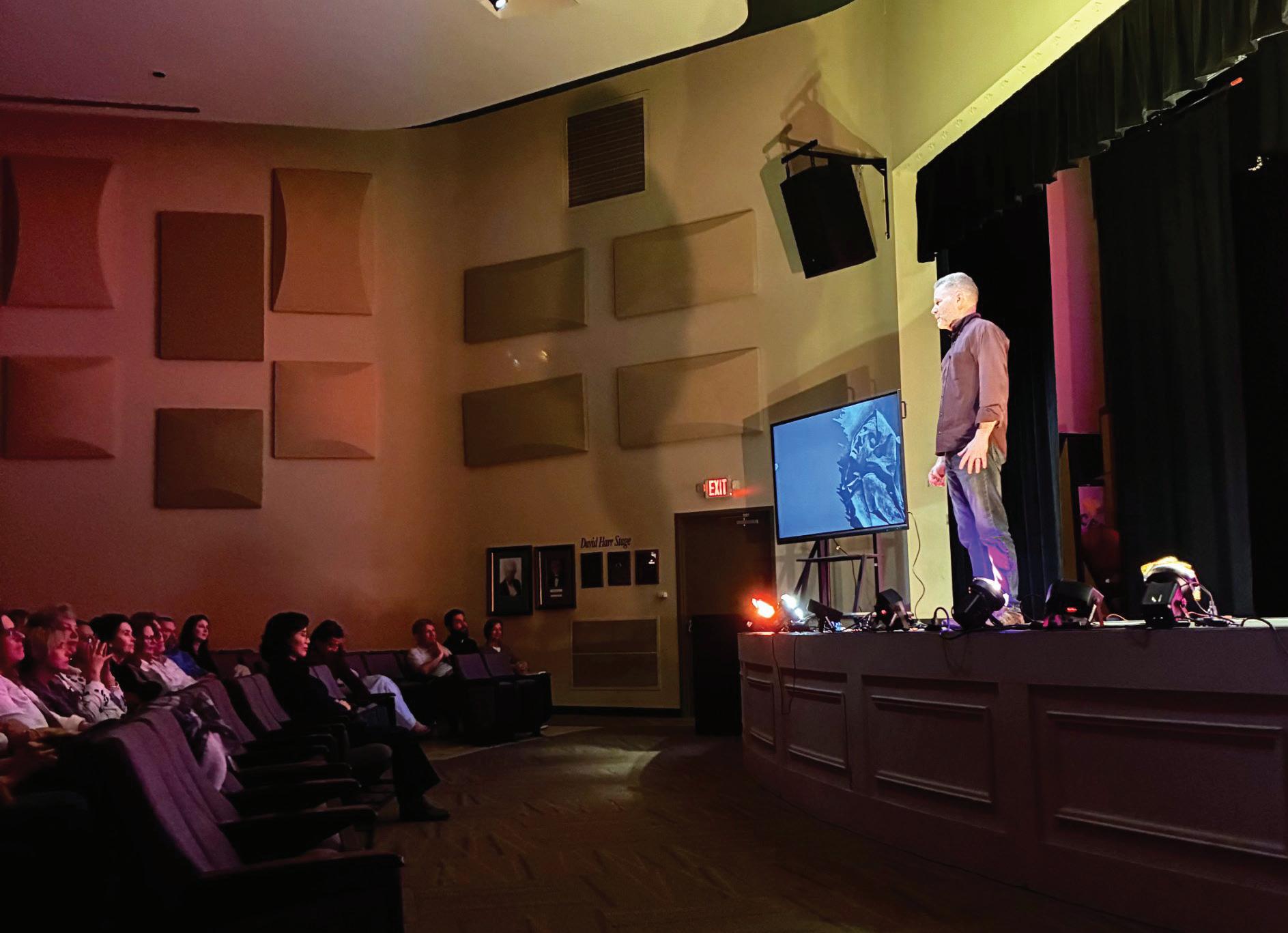
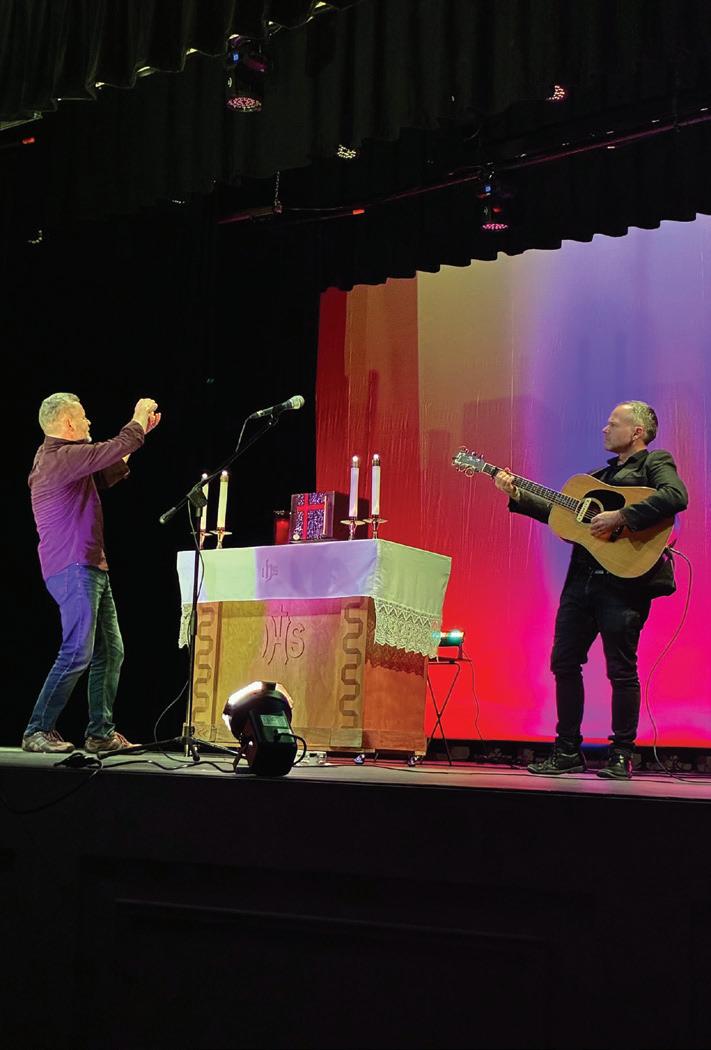
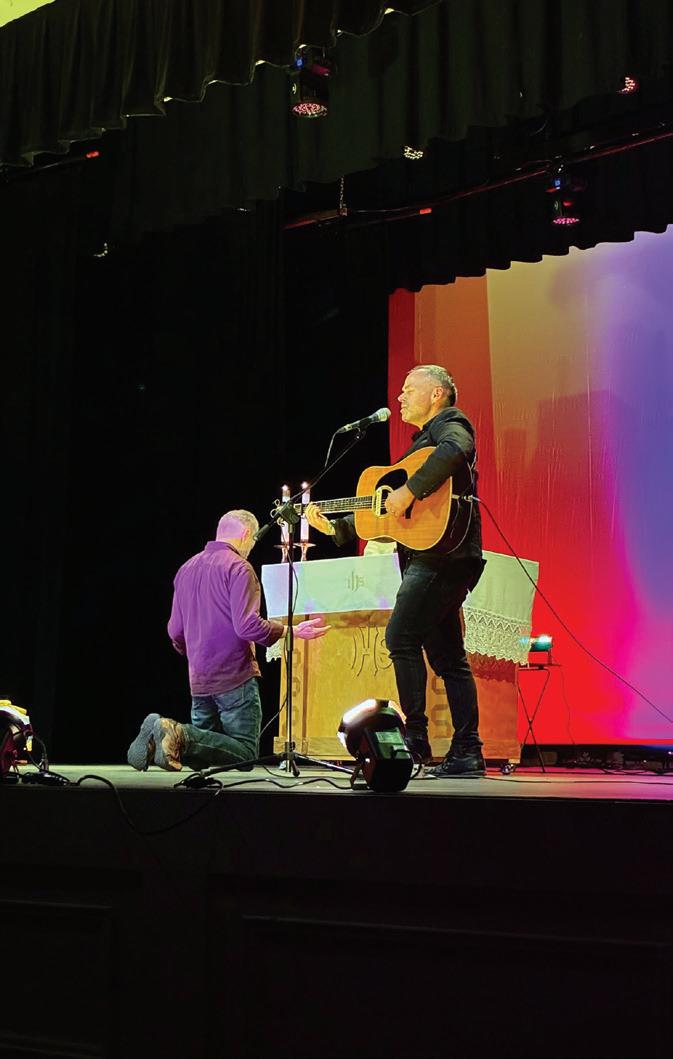
World-renowned speaker on Theology of the Body Christopher West and his supporting musician, Mike Mangione, brought St. John Paul II’s teachings to life as their live event Made for More came to Notre Dame High School in Chattanooga on March 4.
St. John Paul II established the Diocese of Knoxville on Sept. 8, 1988, and 38 years later his Theology of the Body teachings are being brought to life by Mr. West and his music partner.
What did the Made for More presentation reveal? God’s plans being perfect in His place and time for each person.
Mr. West is one of the founders of the Theology of the Body Institute, where he has served since 2004, and is the current president. He is the author of many books, all focusing on teaching Theology of the Body in all capacities.
He has written a beginner’s book on understanding Theology of the Body for those new to the groundbreaking teaching.
In other books, he discusses the hunger of beauty and answers the questions he has received most about Theology of the Body
Mr. West has been studying the Holy Father’s important writings for decades, even thinking about them beginning at a young age.
“I’ve felt ever since I was a little kid that I want to know more if there really is a banquet that corresponds to the hunger in my heart,” Mr. West said.
“Christianity is not a starvation diet; it’s an invitation to a wedding feast. That rocked my world, and I knew then I was going to spend the rest of my life studying, teaching, and sharing it with others,” Mr. West said, revealing what his first reaction was after reading John Paul II’s teachings and highlighting the good God put in his heart for what is to come.
Mr. Mangione is a professional American musician who has been sharing his talents with the Theology of the Body Institute since 2008. He has partnered with Mr. West on their live event Made for More, traveling among cities for almost 20 years.
“When we receive the gift of Christ, we give ourselves as a gift back, and it becomes a cyclical thing where you give by receiving
munity of brothers and sisters walking with them through life.
Q. What about God?
A. One way, among many, participants can help answer that question is with this Emmaus Retreat, led by men like them who have struggled with the same questions about life that they have.
The Emmaus Retreat is designed to be low-key and not “preachy.” Participants will listen to other men like themselves talk about their journey to know more about God. It is not a requirement that participants be of any particular faith or belong to a particular church.
Q. How long does the weekend event last?
A. Participants need to arrive at the Christ Prince of Peace Catholic Retreat Center, 250 Locke Lane, Benton, TN 37307 on Friday, April 24, between 5-5:30 p.m.
The weekend will conclude no later than 5 p.m. Sunday, April 26.
Q. How do those taking part dress for the weekend and what should they bring?
A. Dress is extremely casual and comfortable. Bring a change of clothes for two days and personal toiletries (toothbrush, comb, etc.). All else is provided.
Invitation to a feast Top: Christopher West, who leads the Theology of the Body Institute, gives the presentation Made for More to an assembly of youth and adults on March 4 at Notre Dame High School in Chattanooga. Bottom left: Mr. West is accompanied by musician Mike Mangione during the program. Bottom right: Mr. West and Mr. Mangione lead the assembly in prayer
and you receive by giving,” Mr. Mangione said.
“As an artist, that experience in my personal faith was an easy transition for creativity because any time I create, I’m using materials to put something together. But the Lord is the ultimate creator,” Mr. Mangione added, speaking about the beauty of using what God has created in putting a song together because it is from Him whom everything has been created.
Notre Dame’s auditorium was filled with people of all ages and from all walks of life. The event was aimed at adults as well as for those in high school and college and was billed as being applicable to everyone’s station in life.
Q. What about food?
A. All food and drink will be provided. When participants arrive Friday evening, there will be a light meal for those who will not have had time to grab dinner. If there are any special dietary requirements, let us know on the application form.
Q. Where will those taking part be staying?
A. We’ll be staying at Christ Prince of Peace Catholic Retreat Center in the Polk County town of Benton (dioknoxretreat.org).
Q. How much does Emmaus cost?
A. The cost of the weekend is $195, which includes the retreat, a twonight stay, food, and a retreat shirt. There are scholarships available for those who may need them. Those who do can select this option on the application form.
Q. How is the retreat fee paid?
A. After starting the application process, those registering will be directed to a secure web form where they can make payment online. Checks can also be sent in the mail to: Father John Dowling St. Augustine Church 1716 Anderson Pike Signal Mountain, TN 37377. Make check payable to: St. Augustine Church, note Emmaus Retreat in the memo line of the check. ■
promises.
“It’s the fullness of truth and life for everyone; there’s too many young people being distracted away from it,” said David Morais, a parishioner of Our Lady of Perpetual Help in Chattanooga who attended the event.
Mr. Morais and his wife, Ella, were in attendance at the event with two of their children and recognized the exposure the younger generation needs to understand the importance of the topic.
Mr. West started his discussion with theophany, meaning to know God and how it correlates in the Church to the revelation of divine beauty through the beauty of creation.
He continued discussing the beauty seen in nature, then asked the audience what the most beautiful thing God created was, noting that God created man and woman.
He continued, asking that if it is true humans are God’s most beautiful creation, why do we not have the same reaction meeting people as we do when we see a rainbow?
“Tonight, the invitation is to begin to understand what we call theophany through the body and how John Paul II reflects on it,” Mr. West said.
He followed by emphasizing what that dismissiveness looks like in today’s world. He highlighted a verse from the Gospel of Matthew, which says the world “looks, but does not see.”
There were just under 400 people in attendance, each person saying a quiet yes to the Lord while opening his or her eyes and heart to His
“We were destined to be born by God. It’s an incredible thought to dwell on and to think, we are not biological accidents, we were meant to be here,” said Ella Morais, highlighting the uniqueness each person is in God’s eyes and how that should not be uprooted when dismissed by those who do not quite understand.
More continued on page A23
Emmaus continued from page A10
Addressing issues of importance
Tennessee
By Katie Peterson Tennessee Register
Gbishops
attend Catholic Day on the Hill at state Capitol
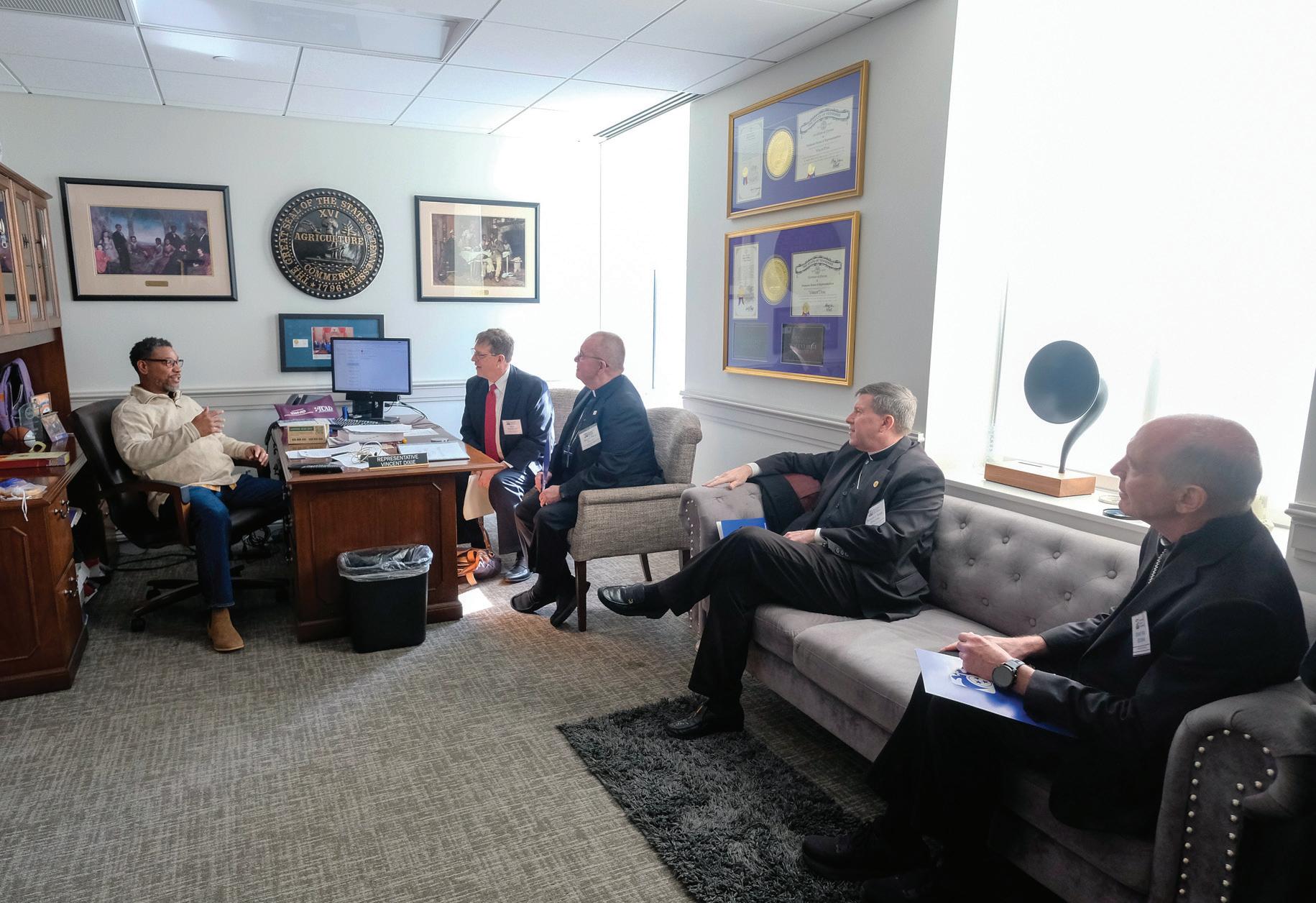
ratitude for Education Freedom Scholarships and calls for meaningful immigration reform and an end to the death penalty in Tennessee were key points of interest that members of the Catholic Church in Tennessee brought before legislators during the annual Catholic Day on the Hill on Feb. 24 at the state Capitol and the Cordell Hull State Office Building.
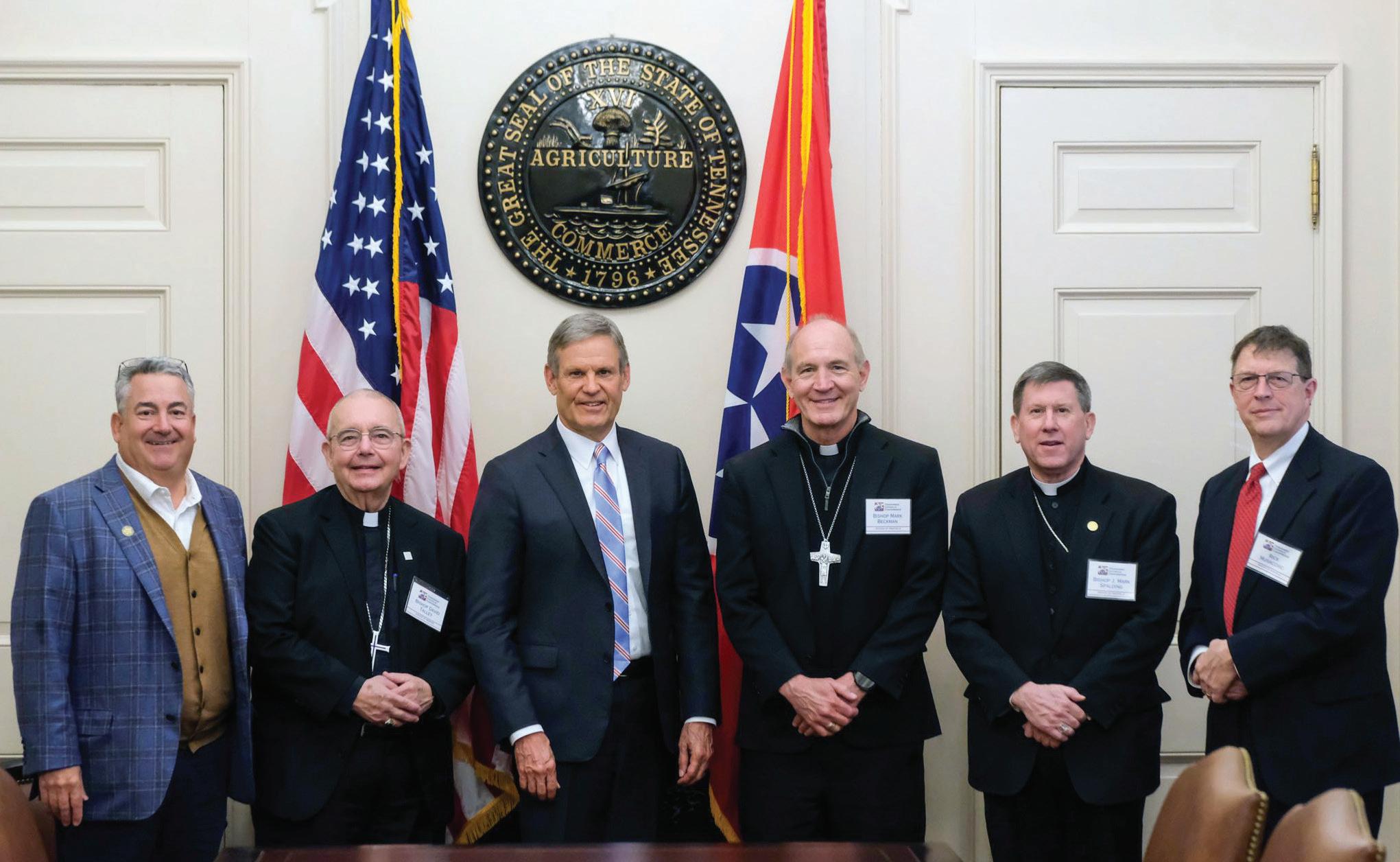
Among the voices heard were the three bishops of Tennessee: Bishop J. Mark Spalding of Nashville, Bishop David P. Talley of Memphis, and Bishop Mark Beckman of Knoxville.
Additionally, members of the Knoxville, Memphis, and Nashville dioceses attended. Catholic Day on the Hill was sponsored by the Tennessee Catholic Conference (TNCC) and organized by Rick Musacchio, executive director of the TNCC and Julie Perrey, deputy director of the conference
To begin the day, attendees of Catholic Day on the Hill met in the basement of St. Mary of the Seven Sorrows Church in downtown Nashville for a briefing and a few words from Mr. Musacchio and each of the bishops.
“I love this day in the sense that I think we have a lot of things going for us, as Church, especially in the education field, and our advocacy for the poor and the marginalized,” said Bishop Spalding. “I ask that we put forth our viewpoint with respect, with a consistent voice for those who are on the margins. Above all, we ask God to be with us this day.”
“I’m grateful for the good work that brought about the education vouchers,” added Bishop Beckman. “There are certainly things we need to work on with the death penalty, with immigration, and those in need of support throughout that process.”
Bishop Talley echoed the sentiments of his brother bishops after leading the group in a prayer.
“Father in heaven, as we remember the members of Your Son’s body, His beloved Church, as we remember our Lenten observance, also allow us to remember the gift You have given us to be ambassadors of Your kingdom,” Bishop Talley prayed. “Help us to remember that we are always at the service of You and Your kingdom as we speak to our legislators. Bless us, the men and women here, bless our families, our parishes, priests, and religious. Amen.”
During the day, the bishops of Tennessee met with Tennessee Gov. Bill Lee, as well as three Catholic legislators: Rep. Vincent Dixie of District 54 in Davidson County, a parishioner of St. Vincent de Paul Church in North Nashville; Rep. Gino Bulso of District 61 in Williamson County, a parishioner of St. Edward Church in Nashville ; and Rep. Gabby Salinas of District 96 in Memphis’ Shelby County
“The bishops had excellent visits with the governor and with several members of the General Assembly,” Mr. Musacchio said. “The platforms of neither political party fully align with Church teachings, but we hope that our respectful conversations shape policies that respect the dignity of life from conception until natural death and work
for the common good at every stage of life.”
While the bishops were in their meetings, other Church leaders met with several state representatives and senators as well as with the director of the Tennessee Emergency Management Agency.
“I had the privilege of joining dozens of Catholics from the three dioceses of Tennessee for Catholic Day on the Hill. Led by our three bishops, we gathered at the state Capitol to advocate for legislation rooted in Catholic social teaching and to bear witness to the Church’s commitment to the common good,” said Greg Pope, chief administration officer for the Diocese of Nashville. “It was a powerful reminder that our faith is not lived only within parish walls but also in the public square— where policies and priorities shape the lives of our neighbors, especially those most in need.
“I have been privileged to attend Tennessee Catholic Day on the Hill for many years, and I continue to find the opportunity to advocate both meaningful and affirming. Time and again, I am encouraged to see that many elected leaders readily understand and resonate with our concerns for justice, the protection of life, and charity toward those in need. These shared values provide a
Bishops on the Hill
strong foundation for constructive dialogue and collaboration,” he continued.
“Our conversations [with our legislators] centered on the dignity of the human person, care for the poor and vulnerable, the value and impact of Catholic education across our state, and the urgent need for civil dialogue in an increasingly divided culture. I was encouraged by the openness of many of our elected officials and by the shared desire to seek solutions that uphold human dignity and strengthen our communities.”
As a result, Catholic Day on the Hill is “a meaningful expression of faithful citizenship,” Mr. Pope said.
“It reflects the Church’s long-standing tradition of engaging public life thoughtfully and respectfully, always guided by the principles of human dignity, solidarity, and subsidiarity,” he said. “I am grateful for the leadership of our bishops and for the opportunity to represent the Diocese of Nashville in this important work. Please continue to pray for our legislators and civic leaders—that their decisions may always promote justice, protect the vulnerable, and advance the common good.” ■
Above: Gov. Bill Lee hosted bishops of the state's three Catholic dioceses: David P. Talley of Memphis, Mark Beckman of Knoxville, and J. Mark Spalding of Nashville as part of Catholic Day on the Hill in Nashville, which was organized by the Tennessee Catholic Conference and Rick Musacchio.
Left: The bishops meet with Rep. Vincent Dixie in the Davidson County representative's Capitol Hill office on Feb. 24.
Bishop Beckman duly noted the huge attendance at Sacred Heart.
“It is a fantastic sign. It brought great joy to my heart,” he said. “It’s very, very powerful. The Holy Spirit really is working—something incredibly wonderful is happening.”
In the Rite of Election, the bishop signs the Book of the Elect for the diocese’s catechumens, who will receive the Easter sacraments of baptism, confirmation, and holy Eucharist at Easter vigil, and for its candidates, who have already been baptized and will fully become part of the Catholic faith at Easter vigil with the sacraments of confirmation and holy Eucharist. The newcomers are joining the Church through the Order of Christian Initiation of Adults (OCIA), and catechumens were accompanied at the Rite of Election by their godparents and candidates by their sponsors.
Adding to the people of God
More than 500 newcomers to the Church from throughout the diocese attended the rite this year, with many others unable to. Sponsors, godparents, and cathedral parishioners helped fill all of the pews and then some.
Bishop Beckman welcomed the faithful to Sacred Heart by referring to a prophetic statement in Acts 2.
“In the Acts of the Apostles, in one moment it notes that the Apostles bore witness to the resurrection of Christ with great power, and thousands were added to the people of God that day. It is good to see the Church of God gathered in abundance today. Welcome to our cathedral for the Rite of Election,” he said.
Deacon Bello said that “a standing-room crowd is amazing” for the Rite of Election, which has been a combined ceremony for all four diocesan deaneries the last two years after previously being split into two events for two deaneries each.
“We had at least twice as many catechumens and candidates here this year as we did last year, and we knew that the Holy Spirit is just on fire in our diocese,” Deacon Bello said. “To see it all come together on a day like this with the Rite of Election and the Rite of Continuing Conversion was just astounding. I think everybody’s blown away by the number of people here and the joy that this day holds.”
Setting records for newcomers to the Church is nothing new for the diocese.
“We have consistently doubled year over year for the last four years the number who have come into the Church. It could be the case this year,” Deacon Bello said.
Young adults make up a large percentage of those joining the Church, and the director of Christian Formation attributes that in part to their “interest in seeking truth and realizing there’s a peace that can be found in the Church” as well as their desire to raise families in the Church, Deacon Bello said.
Deacon Walt Otey of the cathedral parish and Deacon Vic Landa of Blessed Sacrament Parish in Harriman assisted the bishop at the Rite of Election.
Bishop Beckman began his homily by calling the occasion “truly a day of great rejoicing in the life of this local Church in the Diocese of Knoxville.”
“It is good to see your faces here today in our cathedral church,” he continued. “The great reason for our gathering today is rooted in the Lord God Himself, who formed each one of you from the clay of the earth and breathed into your nostrils the breath of life. And so, you became a living being. The call of the Lord today is the call to share life with Him forever. He calls each one of you by name. He has known you from the first moment you were conceived in the womb of your mother and has sustained you … from that moment to this very day. He is the Lord, your God, who created you in pure love.”
The Gospel reading for the Rite of Election came from Matthew 4, which describes Jesus being led into the desert to be tempted by the dev-
“One of the most important moments in the beginning of the Gospel happens right before the temptation that we heard proclaimed here today, and it happens down at the Jordan River. Jesus enters the waters of the Jordan River, and on coming up out of the water the heavens open, and the voice of the Father speaks, ‘You are my beloved Son. I am well-pleased with you,’” Bishop Beckman said.
“The mystery of love that binds the Father and the Son is made crystal clear in that moment of baptism. But then the Spirit takes Jesus out into the wilderness for 40 days, and the enemy would attempt to undermine if he could that bond of love between Father and Son. ‘If you really are the Son of God, then turn these stones into bread. Feed yourself instead of being nourished by the Father.’”
God will also be pleased with those entering the Church at Easter this year, the bishop said.
“The deepest truth about who you are, created in the image and likeness of God and called to the waters of baptism for those who are approaching the great Easter sacraments, is that God has chosen you as beloved daughter and beloved son. You belong to God—that is the truth,” he said. “And for those of you already baptized and awaiting the sealing of that baptism in confirmation and receiving the Lord for the first time eucharistically— when you were baptized, the Father claimed you and said to you, ‘You are my son. You’re my daughter. I am well-pleased with you.’
“If the enemy can break that bond between us and the Father, that is what the enemy attempts to do: to try to undermine the call that we have received from the Lord our God. That’s why these great days ahead, these 40 days, are in some ways a final period of testing. We are with the Lord in those moments of temptation, and the enemy often tries to undermine the bond of love we share with the God who created us.”
In the face of that temptation, “Jesus never wavers,” Bishop Beckman said. “He is victorious over every assault of the enemy. The bond of love between Father and Son is never broken. It is by that bond that we are set free from the bondage of sin and death and given new life in the risen Lord, Jesus Christ. That is why we are here today: because the risen Lord Himself, victorious over sin and death, has called us to
filled with light from the new Easter candle and the lights of the baptized that fill the church. May God, who has called each one of you to Himself, keep you faithful until the end.”
After the homily, the Rite of Election of Catechumens began as Deacon Bello called up each OCIA representative, who presented his or her parish’s Book of the Elect for the bishop’s signature. Deacon Bello began with the Cumberland Mountain Deanery and continued with the Chattanooga, Smoky Mountain, and Five Rivers deaneries.
“Bishop Beckman, as the solemn paschal celebrations approach once more, the catechumens present here, relying on divine grace and supported by the prayers and example of the community, humbly request, after due preparation and celebration of the scrutinies, they be admitted to participate in the sacraments of baptism, confirmation, and the Eucharist,” Deacon Bello said.
The bishop then asked the elect to stand with their godparents.
“The holy Church of God now wishes to ascertain whether these catechumens are sufficiently prepared to be received into the Order of the Elect for the solemn paschal celebrations to come,” he said before asking the godparents three questions:
“And so, first I ask you, their godparents, to testify. Have they faithfully listened to God’s Word proclaimed by the Church? Have they begun to walk in God’s presence, treasuring the Word they have received? Have they persevered in fraternal communion and in the prayers?” Bishop Beckman said.
sons of God most high. That is cause for great rejoicing.”
Preparing for Easter Vigil Lent began on Ash Wednesday, Feb. 18, three days before the Rite of Election.
“Some 40 days from now, at the great vigil of Easter, the churches in our diocese will quake with joy,” Bishop Beckman said. “They will be
The godparents responded to each question, “They have.”
Then the bishop addressed the entire congregation.
“Now I ask you, the members of this whole community gathered here, are you willing to affirm the testimony expressed about these catechumens and include them in your prayer and affection as we move toward Easter?” the bishop asked, to which the faithful re-
The annual Bishop’s Appeal for Ministries makes possible the formation of clergy, the growth of Catholic education and campus ministries, the provision of food, shelter, and medical care to those in need, and vibrant faith formation in every parish—impact made possible each year by the generous support of the faithful of our
il. That chapter follows the account of the Lord’s baptism.
communion with Himself so that we might share the adoption of beloved daughters and
diocese.
Charities
Formation
Elect continued on page A14
The Holy Spirit at work Above: Catechumens, candidates, sponsors, godparents, family, and friends gather with directors of religious education from parishes around the diocese at the Rite of Election on Feb. 21 at the Cathedral of the Most Sacred Heart of Jesus. Below: A potential record number of people will enter the Church in East Tennessee at Easter Vigil on April 4. Many of them took part in the Rite of Election.
DAN MCWILLIAMS
SSPX rejects Vatican dialogue
Society plans to consecrate bishops without a papal mandate
By Courtney Mares and Gina Christian OSV News
The Society of St. Pius X has rejected a Vatican offer of dialogue and said it will move forward with plans to ordain bishops without a papal mandate this summer.
In a letter sent to the Vatican on Ash Wednesday, Feb. 18, and made public on Feb. 19, Father Davide Pagliarani, superior general of the traditionalist society known as SSPX, told Cardinal Víctor Manuel Fernández, prefect of the Dicastery for the Doctrine of the Faith, that he could not accept the terms under which the Vatican proposed to resume talks. Father Pagliarani added that he would not postpone the episcopal ordinations planned for July 1.
“We both know in advance that we cannot agree doctrinally, particularly regarding the fundamental orientations adopted since the Second Vatican Council,” Father Pagliarani wrote.
The letter came one week after Cardinal Fernández and Father Pagliarani met at the Vatican on Feb. 12, when the cardinal pro-
Elect continued from page A13
sponded, “We are.”
Bishop Beckman spoke again to the catechumens.
“Your godparents and catechists and our entire community have testified favorably on your behalf. Trusting in their judgment, the Church calls you in the name of Christ to the paschal sacraments,” he said. “Now it falls to you who have long listened to the voice of Christ to respond in the presence of Christ by stating your intentions.”
“It is,” the catechumens replied.
Bishop Beckman then asked a final question.
“Is it your will to be initiated into Christ’s sacraments of baptism, confirmation, and Eucharist? Then I invite those who are your leaders to offer your names for enrollment.”
The bishop then signed each parish’s Book of the Elect, after which the cathedral choir sang, “Blessed be God, O blessed be God, who calls you by name.”
Bishop Beckman, following the song, said, “My dear catechumens, you have been chosen for initiation into the sacred mysteries at the forthcoming Easter Vigil,” to which the entire assembly said, “Thanks be to God.”
“Now, with divine help, your duty, like ours, is to be faithful to God, who is faithful to His call, and to strive with a generous spirit to reach the full truth of your election,” Bishop Beckman continued. “Godparents, you have spoken in favor of these elect. Receive them now as chosen in the Lord and accompany them with your help and examples until they come to share in the sacraments of divine life.”
The Call to Continuing Conversion began as Deacon Bello again spoke from the ambo.
“Bishop Beckman, the candidates present here, relying on divine grace and supported by the prayers and example of the community, humbly request that, after due preparation, they be admitted to participate in the sacraments of confirmation and the Eucharist,” he said.
The bishop then asked the candidates “who desire to participate fully in the sacramental life of the Church” to stand with their sponsors.
“The Christian life and the demands that flow from the sacraments cannot be taken lightly. Therefore, before granting these candidates their request to share fully in the Church’s sacraments, it is important that the Church hear the testimony of their sponsors about their readiness,” Bishop Beckman said. “And so, sponsors, have
Doctrinal differences Left: Cardinal Víctor Manuel Fernández, prefect of the Dicastery for the Doctrine of the Faith, speaks to reporters at the Vatican in this file photo from 2024. Right: Father Davide Pagliarani, superior general of the traditionalist Society of St. Pius X, is pictured in 2018
posed dialogue to address the “minimum requirements necessary for full communion with the Catholic Church,” on the condition that SSPX suspend its plans for the ordinations.
The Vatican dicastery had warned that proceeding with the consecrations “would imply a decisive rupture of ecclesial communion (schism) with grave consequences for the fraternity as a whole.”
At the same time as the letter
was made public, SSPX published a statement on its website arguing that it does not believe it is acting in schism.
The specter of schism represents a significant challenge for Pope Leo XIV in the first year of his pontificate, as the pope has repeatedly emphasized his desire for Christian unity.
Father Pagliarani claims that he had recently written to the pope twice, “first to request an audience, then to clearly and respect-
they faithfully listened to God’s Word proclaimed by the Church?
Have they come to a deeper appreciation of their baptism in which they were joined to Christ and His Church? Have they sufficiently reflected on the tradition of the Church, which is their heritage, and joined their sisters and brothers in prayer? Have they advanced in the life of love and service of others?”
The sponsors answered “they have” to each query from the bishop, who then said, “Now I ask you, the members of this community, are you willing to affirm the testimony expressed about these candidates and include them in your prayer and affection as we move toward Easter?
They responded, “We are.”
Bishop Beckman returned to the candidates for his next remarks.
“The Church recognizes your desire to be sealed with the gift of the Holy Spirit and to have a place at Christ’s eucharistic table. Join with us this Lent in the spirit of repentance. Hear the Lord’s call to conversion and be faithful to your baptismal covenant,” he said, and the assembly replied, “Thanks be to God.”
The bishop asked the sponsors to “continue to support these candidates with your guidance and concern. May they see in you a love for the Church and a sincere desire for doing good. Lead them to the joys of the Easter mysteries.”
A youth movement
Deacon Landa then led the intercessory prayers before the bishop spoke again.
“I want to take a moment to express my congratulations to all of
fully explain our needs and the real-life situation of the Society” but received no timely reply.
“Yet, after a long silence, it is only when episcopal consecrations are mentioned that an offer to resume dialogue is made, which thus seems dilatory and conditional,” he wrote.
Vatican officials have sought for decades to bring SSPX fully back into communion with Rome. In his letter, Father Pagliarani justified the rejection of the Vatican’s offer of dialogue by citing a lengthy prior history of failed negotiations.
In particular, he highlighted the formal dialogue that began in 2009, continued with particular intensity for two years, then proceeded more sporadically until June 2017.
“Throughout these years, we sought to achieve what the dicastery now proposes,” he said, adding that “everything ultimately ended in a drastic manner, with the unilateral decision of Cardinal (Gerhard) Müller, the prefect of the Congregation for the Doctrine of the Faith, who, in June 2017, solemnly established, in his own way, ‘the minimum requirements
Mr. Taylor said he was impressed by the part of the rite in which OCIA leaders presented the Book of the Elect for each parish to the bishop.
“It was amazing when you saw all the representatives coming forward bringing the book full of the names of the candidates and the catechumens,” he said. “It almost felt, with the amount of people here today, like an army in the kingdom of God. It was exciting—you got to see the kingdom building right before our very eyes. It was incredible.”
Sara Carey, director of religious education for St. Alphonsus Parish in Crossville, said the Rite of Election was “great.”
you who have now received your call to continuing conversion and also to the elect,” Bishop Beckman said. “I think it very fitting that we express our support for all of you, brothers and sisters in the Lord.”
A round of applause followed. Afterward, the bishop stood outside Cathedral Hall—which hosted a reception—and greeted those attending the Rite of Election.
Deacon Bob Hunt, a columnist for The East Tennessee Catholic and OCIA director for Holy Ghost, came to the cathedral on behalf of 20 catechumens, candidates, and confirmandi entering the Church this year from the North Knoxville parish.
Those newcomers are young, the deacon pointed out.
“What’s interesting about it is that if you take everybody together, the average age of our class is somewhere around 25-26” and getting lower each year, Deacon Hunt added. “It’s amazing. The average age of our catechumens is 23. This is definitely the youngest class that I’ve seen of any OCIA or RCIA program that I’ve been involved in, and I’ve been involved with quite a few of them. This was marvelous.”
Deacon Hunt joked with Bishop Beckman that “we’re making too many converts because we don’t have any parking spaces. We need fewer converts so we can have more places to park. It is a good problem to have.”
Aaron and Julie Taylor are two of the candidates who attended the Rite of Election, which Mr. Taylor called “magnificent.”
“I thought it was great. I thought it was beautiful and really special to do a formal event like this,” Mrs. Taylor said.
“This is the most people we have had in my time as OCIA coordinator. We had 11 here today, I believe, but we have quite a few more in the program. Some of them couldn’t make it today. I think we have 21, including children—we have several children this year,” she said.
The rite began at 1 p.m., but the last to arrive needed to park some distance away.
“This is the biggest I’ve ever seen it. We had to park over at the office buildings,” Mrs. Carey said. “I had told my people, ‘Get there early because you can park at the school or the Chancery,’ and they called me at 12:15, and they were like, ‘It’s already full; you’ll have to park at the office buildings.’ It is very exciting and encouraging to see a crowd this big.”
Mrs. Carey was holding the St. Alphonsus Book of the Elect after the rite and called the bishop’s signing of it “very touching and heartening, to see him acknowledge the people and be involved and aware of them. It’s like a blessing for them to have him do this for them.”
Bishop Beckman said he is blessed to sign the book for each parish.
“This year is the second year I’ve done this, and the thing that brought joy to my heart is that I’ve been to almost every one of those parishes. Memories of being at those communities came back to me as I was signing the book and looking at the people who are joining the Church from there,” he said.
The bishop was pleasantly surprised when he learned of the large number of people entering the Church this year in the diocese.
“Wow, that is unbelievable, unbelievable. It does remind me of the quote I did at the beginning of Mass from the Acts of the Apostles: with great power the Apostles bore witness to the resurrection of the Lord, and thousands were added to their number,” he said. ■
OSV NEWS PHOTO/JEAN-MATTHIEU
Photo opportunity Bishop Mark Beckman joins a family for a photo following the Rite of Election at the Cathedral of the Most Sacred Heart of Jesus on Feb. 21. The family members will be entering the Church at Easter Vigil
DAN MCWILLIAMS
SSPX continued on page A21
CATHOLIC NEWS SERVICE
PHOTO/JUSTIN MCLELLAN
Kairos Kids
Question: Did you always want to be a bishop? -Rose, 4 grade th The ETC
A sk Th e Bish o p
LentenWo rd Se a rch
t W d
St. Joseph
Feast Day March 19th
Patron: of the Universal Church, unborn children, fathers, workers, travelers, immigrants, and a happy death
I first felt called to be a priest when I was in high school , but I honestly never thought about being a bishop!
When I became a priest , there were about 50,000 in the United States, and only a few hundred bishops. So, I never thought God would call me to be a bishop.
I am very grateful God called me to be the bishop of this beautiful Diocese of Knoxville!
“Children are a heritage from the Lord, offspring a reward from Him.” - Psalm 127:3
TheCatholickid com By Mary-Hannah MacCurdy
The season of Lent: Marked
St. John XXIII University Parish
St. Patrick Church
St. Mary School-Oak Ridge
KATHY RANKIN
St. Joseph School
Sacred Heart Cathedral School
St. John Neumann School
University of Tennessee-Chattanooga
Knoxville Catholic High School
Conception
St. John Neumann School
seek the Lord’s guidance in helping them be creative, passionate, and committed to Him and their vocation as they lead students, who are the future of the Church.
‘The Bell Schedule’
Following Mass, the educators gathered in the St. Gregory the Great Auditorium at KCHS and were addressed by Mr. Valadie.
“This is my 26th year in this diocese,” Mr. Valadie said as he received an ovation. “It’s been my experience that we are always tinkering with some aspect of this day. You would think we would have it figured out by now. But the truth is we are always trying as best we can to design it in such a way that makes the most sense and offers the most value.”
“When I say we try as best we can, that’s knowing that there are 350 different opinions of what makes the most sense and probably 350 different opinions about what offers the most value,” he added.
Mr. Valadie, who has spent his career in Catholic education, acknowledged changing the date of Professional Development Day to coincide with a school holiday in response to teacher suggestions from 2025.
“We moved the date to the start of this long weekend rather than the end. … I’m curious how many suggested it for the exact reason that I thought you did: Can we get this over so we can go ahead and enjoy the rest of the break?” Mr. Valadie said lightheartedly to another ovation.
Mr. Valadie thanked those in attendance for their service every day in teaching children at the diocese’s 10 schools across East Tennessee.
He also announced that this Professional Development Day will be his last as a faculty member, administrator, or interim superintendent, re-informing the educators that a new superintendent, Martha Mundine, will be joining the diocese in April.
Mr. Valadie led the group in an opening prayer, a supplication called “The Bell Schedule” that was appropriate for the occasion.
In the name of the Father, and of the Son, and of the Holy Spirit, Amen. The bell, so symbolic of the structure of schools, has rung again. No matter what gentle tone we make the bell, it means move now or stay now, Jarring us a bit by sending us off or settling us in. It can mean regret or relief. In my life, Lord, you have rung the bell for all sorts of things, even when I slept through it.
Thank you now for attuning me just a bit better to the changes—the time to dance, the time to weep, the time to kneel. May we be mindful that there is an appointed time for everything. Some of those times come with bells, some do not.
But all are an opportunity to grow closer to the person you want us to be. Amen.
Mr. Valadie, who also is a motivational speaker for education audiences and frequently uses humorous themes, then offered $10 to anyone who could recite the 2025 Professional Development Day theme. After several incorrect guesses, he gave the answer: “It is not you who chose Me, but I who chose you to bear fruit that will remain,” which is an excerpt from the Gospel of John.
“This year, I took a quote from Facebook,” the former teacher and principal said to laughs. “Which is probably one of the reasons they’ve been looking for a new superintendent” (to even more laughs).
He then quizzed the group about what they give thanks for after a challenging day at school.
“Snow days come to mind. Fridays. Long weekends. The teacher next door who lets you go to the bathroom every so often. The everyonce-in-a-while day when you realize ‘that kid’ didn’t come today” (to another round of laughter). “We
All-schools Mass Above: Bishop Mark Beckman celebrates Mass at All Saints Church in Knoxville on Feb. 12 for Diocese of Knoxville schools' Professional Development Day. Joining Bishop Beckman at the altar are, from left, Father Doug Owens, All Saints pastor, Father A.J. Houston, associate pastor at St. Stephen Parish in Chattanooga and chaplain at Notre Dame High School, Father Chris Michelson, special adviser to Knoxville Catholic High School and president of St. Joseph School, and Deacon Joe Stackhouse, who serves Immaculate Conception Parish and is on faculty at KCHS. Below: George Valadie, interim superintendent of Diocese of Knoxville schools, addresses teachers and administrators attending Professional Development Day in the St. Gregory the Great Auditorium at KCHS
give thanks for a working copy machine, a working coffee machine,” he said.
“You may give thanks for your teacher text group. That’s another name for drinking buddies. You just can’t name it that on your cell phone because it sits on your desk, and it might go off with a kid standing there. Drinking buddies doesn’t sound good,” he joked.
Then Mr. Valadie shared his experiences working with students who were from challenging backgrounds and struggled in school. He described how the faculty would rally around these students, determined that they were not going to “drown.”
The teachers would compare notes, trying to discern what
worked in reaching these students and what didn’t.
“I would be bold-faced lying if I told you I gave thanks for them then. It took me a while—a lot of whiles, actually—to realize the gift they were and the gift I have been given. There is a quote we should all tape to our laptops: ‘Lord, thank you for the students who stretched my patience because they stretched my heart as well,’” he said, noting that some teachers have more patience than others, and some parents have more patience than others.
‘He just gets us’
Mr. Valadie and Bishop Beckman then presented service awards to several teachers and faculty members:
Captivated audience Above: Bishop Mark Beckman gives remarks during the diocesan schools' Professional Development Day. Below: Gerry Brooks entertains the audience of fellow educators with his humorous keynote address on education and overcoming obstacles to develop a strong faculty to effectively teach students
n Mandy Mroz of St. Jude School in Chattanooga for 25 years of service;
n Angela Weddington of St. Jude for 25 years of service;
n Teresa Hale of Our Lady of Perpetual Help School in Chattanooga for 25 years of service;
n Connie McCutcheon of Notre Dame High School in Chattanooga for 30 years of service;
n Kari Ingle of Our Lady of Perpetual Help for 30 years of service; n Kelly Rexrode of Sacred Heart Cathedral School in Knoxville for 35 years of service.
Knoxville Catholic High School president Dickie Sompayrac then took the stage to present Mr. Valadie with a special award.
“George Valadie, who has worked with diocesan schools for 26 years, is a product of our diocese. He graduated from Notre Dame High School. Notre Dame is also where he met his future wife, Nancy. Following high school, George attended the University of Notre Dame. Following graduation there, George felt the calling to come back home to Chattanooga, where he started teaching and coaching at Notre Dame High School,” Mr. Sompayrac said.
Mr. Sompayrac shared that Mr. Valadie was his freshman football and baseball coach at NDHS 40-plus years ago.
“George has spent the better part of the last 50 years working in Catholic education, serving in three dioceses and schools such as OLPH, Notre Dame, Vicksburg (Miss.) Catholic to St. Benedict at Auburndale in Memphis. In addition to being a teacher and a coach, George has been a development director, alumni coordinator, a principal, an assistant principal, a president, he’s been in charge of homecoming, he’s done student council. He’s been the one who opened school in the morning and closed it after the last person left. He was in charge of financial aid for many years at Notre Dame.
“If you ever talked with teachers or staff who worked at a school where George was the leader, they would tell you, ‘He just gets us.’ Of course he does. He’s done every job in the building,” Mr. Sompayrac said.
“George was one of those four or five teachers and coaches I had as a student who influenced me in my career,” Mr. Sompayrac added.
The KCHS president described how Mr. Valadie retired as president of NDHS in 2021, and then in 2024 the diocese was looking for a schools superintendent. Mr. Sompayrac and Andy Zengel, principal of St. Joseph School in Knoxville, recommended Mr. Valadie to Bishop Beckman.
“He came out of retirement to accept the position of interim superintendent,” Mr. Sompayrac explained.
“On behalf of all of our teachers, our staff, the Chancery staff, our school leaders, George, I just want to say it has been an honor for you to be back in our diocese, and I have enjoyed just being able to call you on a regular basis to get your advice.”
Mr. Valadie received a lengthy standing ovation from the audience and was presented a special torch award for 50 years of service by Bishop Beckman.
“I am so grateful, George, for your willingness to receive that torch and for being the superintendent of schools for my first yearand-a-half as bishop. I will tell you that when I arrived, I knew that we needed this position, and when someone raised the name of George Valadie, I breathed a sigh of relief,” the bishop said. “I first met George almost 40 years ago at Notre Dame High School.”
Bishop Beckman related a story from his days in seminary when the rector of the seminary told the class of 30 seminarians that not all of them would attain a vocation to the priesthood.
“He said, ‘I know that not all of you will be ordained a priest. My goal in forming you here is that you will become a good, Christian gentleman.’ George, you are a good,
BILL BREWER (4)
the local Church, the government, and the people of the United States. “I trust that their generosity and collaboration will assist me in carrying out this new mission at the service of communion and peace.”
Archbishop Caccia invoked “the blessings of Almighty God” on all, “especially in this year that marks the 250th anniversary of the birth of the United States of America.”
The president of the U.S. Conference of Catholic Bishops, Archbishop Paul S. Coakley of Oklahoma City, welcomed the appointment on behalf of his brother bishops.
“I wish to extend our warmest welcome and our prayerful support to him as he carries out his responsibilities across the United States, and we look forward to working with him,” the archbishop said in a statement.
Faculty continued from page A18
Archbishop Coakley also expressed his “sincere and prayerful appreciation” to Cardinal Pierre, noting his “many opportunities to work with Cardinal Pierre over the years, particularly over the last four months through the U.S. Conference of Catholic Bishops,” since the Oklahoma prelate’s election in November as USCCB president. “Thank you, Your Eminence, for your tireless service to the Church in the United States, and on behalf of my brother bishops, I offer our heartfelt prayers and best wishes in your retirement,” Archbishop Coakley said.
Archbishop Caccia is a career Vatican diplomat trained at the Pontifical Ecclesiastical Academy in Rome. He holds a doctorate in sacred theology and a licentiate in canon law from the Pontifical Gregorian University. His previous diplomatic posts
Christian gentleman,” the bishop said, prompting another ovation. “He’s also an excellent speaker.”
Bishop Beckman described for the educators the process of selecting Ms. Mundine as the next superintendent and spoke about her.
“She is currently working in the superintendent’s office in the Archdiocese of New Orleans. She brings a wealth of experience in Catholic education to her role. She is going to be a great successor, and she will start in mid-April, so she and George will be able to work together for some time,” Bishop Beckman said.
“One of the things she said when asked why she was interested in joining the Diocese of Knoxville was ‘because of your superintendent, George Valadie, who reached out to my superintendent about this position, and my superintendent said to me, “You ought to consider this. You would be good for this.”’ That’s how word got handed down. Even George’s work in handing on that torch to the next superintendent has been incredibly significant,” the bishop added.
“George, I want to thank you. Half a century in Catholic education. You have made an incredible difference, and you are an inspiration for all of us,” Bishop Beckman concluded.
‘Erducator Strong’
Mr. Valadie then introduced Mr. Brooks. “I am privileged to introduce our keynote speaker. I haven’t been this excited for a professional development day since … never, actually,” he joked.
Mr. Valadie acknowledged that in recent months when he would tell teachers who the featured speaker was to be, their faces would “light up” and “they would say, ‘Are you kidding me!’”
Mr. Brooks has been an educator for 20 years, beginning as a third-grade teacher in Palm Bay, Fla. He earned a master’s degree in administration and has been an elementary-school principal for 12 years. He also is an author.
Mr. Brooks began using humorous, real-world educational videos to encourage his staff. He has become a national encourager for teachers through social media and speaking events and counts more than half a million followers on social media.
He is a voice for teachers, but his passion is leading others to be responsible for their own personal climate and culture in the workplace. His book, Go See the Principal, outlines strategies for taking on this responsibility.
Mr. Brooks and his wife, Kelly, have three adult children and live in Lexington, Ky. Mrs. Brooks grew up in Powell, Tenn., and attended
include serving as apostolic nuncio to the Philippines and Lebanon, and earlier as an attaché in Tanzania. He also worked as assessor for general affairs in the Secretariat of State under St. John Paul II in Rome.
Cardinal Pierre, who spent nearly five decades in Vatican diplomatic service, earned widespread respect among U.S. bishops for identifying episcopal candidates who embodied Pope Francis’ priorities while avoiding polarization. He was elevated to the College of Cardinals in 2023 and is expected to divide his retirement between his native France and Rome.
The United States and the Holy See have maintained formal diplomatic relations since 1984, when President Ronald Reagan and St. John Paul II established full ties. However, the relationship dates back to the U.S. founding, when Benjamin Franklin
Clinton High School.
“I am so excited to be here. I have two goals. My first goal is for you. Whether you are a preschool teacher or a football coach, whether you are in physics or English, no matter what you do: my first goal is for you as an individual and it is for you to walk out of here with something that’s going to help you not only get through the school year but to get through your days and your life,” he said.
“My second goal is more important. It’s for your team. It’s for the football coaches, it’s for the special-ed team, it’s for the specialist teachers, it’s for the kindergarten staff, whatever you consider your work family. It’s to give you something to talk about after today,” he added.
Mr. Brooks played a series of his unique videos that are not only funny but also offer a lesson every educator can relate to.
His videos and in-person comments drew constant laughs.
“If you have friends who are 20, 30, 40, 50
conveyed a message from George Washington to Pope Pius VI in 1788, affirming that the new republic’s commitment to religious liberty meant no government role in appointing bishops. The United States maintained consular relations with the Papal States from 1797 and diplomatic relations from 1848 to 1867, though not at the ambassadorial level. Congress banned funding for Vatican relations in 1867, a move partly driven by antiCatholic sentiment. For more than a century afterward, contact relied on personal envoys, including during World War II, until President Reagan and then-Pope John Paul II restored formal ties. The current Rome-based U.S. ambassador to the Holy See is Ambassador Brian Burch, who presented his credentials to Pope Leo in September. ■
years old, they think what you’re going through today is exactly the same as what they went through 20, 30, 40, 50 years ago … your non-educator friends think that your life as a teacher, as a principal, as a coach is exactly the same as when they were growing up. Nothing can be further from the truth,” he said.
He pointed to COVID and the pandemic’s impact on schools as an example of how noneducators don’t understand education today.
“The reason my videos are so popular is they are true life,” he noted. “Ask yourself, have these things happened in my school? The answer is yes. All these things have happened in your schools as well as mine.”
Mr. Brooks encouraged each faculty member to find a fellow educator who is experiencing what they are experiencing and frequently consult with them.
“Nobody understands teaching physics and having the whole class fail better than a physics teacher. No one understands coaching cheerleading better than a cheerleading coach,” he said. “What the volleyball coach is going through and what the cheerleading coach is going through are not the same thing. The cheerleading coach needs another cheerleading coach. … They will help you get through the school year.”
He pointed out that it is extremely important to recognize that educators are role models and students are watching them and learning from them. And it is equally important for the educators to understand how they interact with people because their students are closely observing that, too.
“I understand that you are sitting in a roomful of people here who are not like you. Let me remind you of something that is more important: you are sitting in a roomful of people who are exactly like you. Let me remind you again why this is important. Your kids are watching you. Every day they watch you interact with people who are not like you. We have to teach them that we have the capacity to love and accept everybody,” he said.
Mr. Brooks captivated his audience for more than an hour, delving into subjects ranging from properly motivating teachers and students, building student and staff camaraderie, and the importance of communication to faculty bathroom etiquette. His presentation was constantly flavored with humor to the delight of everyone in attendance.
And at the end of his presentation, it was apparent to everyone—both fans and the newly initiated—what Mr. Brooks meant by “Erducator Strong!” ■
Lifetime achievement Dickie Sompayrac, president of Knoxville Catholic High School, left, and Bishop Mark Beckman present Diocese of Knoxville Schools interim superintendent George Valadie with an award to mark his 50-plus years of service in Catholic education during Professional Development Day on Feb. 12 at KCHS.
The main in-house clinic began operating in January 2024, and from January to June 2024 it gave 223 pregnancy tests and 160 ultrasounds. The clinic also counseled six women who were abortion-minded, four women who parented their babies, and two women who miscarried. And of 62 women who were abortion-vulnerable, 59 kept their babies and three did not report their decision.
The mobile clinic returned to operation last month with a renewed sense of mission.
“We didn’t serve people for a good six months. That gave us some time to really look at the program and do some research on what is the best way to do this. We worked closer with Save the Storks, and we decided that we were not going to go to as many places but do it every week,” she noted.
“That way the area would be used to seeing us, and they could help us get the word out. We also were more strategic in where we went—the sites that we picked,” she added.
The ultrasound van was setting up in Chattanooga at the Basilica of Sts. Peter and Paul, which is downtown. Although Mrs. Davidson said the basilica was excellent in hosting the van, the logistics of parking downtown made the site difficult for women to access.
Now, St. Stephen Parish on the east side of Chattanooga has been hosting the van each month as well as the Ladies of Charity near the Tennessee-Georgia border.
“St. Stephen and Ladies of Charity have been very gracious in letting us use their parking lots,” Mrs. Davidson said.
Each Tuesday, the ultrasound clinic sets up at Central Services, a Morristown social services agency located at 2450 Newport Highway. Each Wednesday the van is in Crossville at Plateau Pregnancy Services, 99 Walker Hill St. And each Thursday, it is in Chattanooga, alternating at either St. Stephen Church, 7111 Lee Highway, or Ladies of Charity, 2821 Rossville Blvd.
The February relaunch is seeing results.
“We are now seeing women respond in just our first week out,” Mrs. Davidson said. “We did a lot of prep work in Chattanooga along with Morristown. Morristown has boomed. We are booked two weeks out. That one is really thriving thanks to St. Patrick Parish and Central Services.”
She noted the mobile clinic also is working with TN Strong Families, a state initiative to support children and expectant mothers, at St. Patrick.
“In that area, we are really serving very well, and I’m very proud of what they’re doing there,” she said.
Mrs. Davidson attributes part of the newly invigorated response to social media outreach the ultrasound clinic staff is doing.
In Crossville, Catholic Charities is partnering with Plateau Pregnancy Services because it does not offer ultrasounds.
“They have been so wonderful in letting use their parking lot and letting us see their clients. We need to do more outreach in that area, so we are working on that,” Mrs. Davidson said.
She credits the ultrasound nursing staff for the early success of the relaunch, and she is hoping to find volunteer client specialists to accompany the nurses.
During a recent February visit to Central Services in Morristown, registered nurses Whitney Williams and Samantha Bigley worked with young women wanting to learn more about their babies in the womb. The nurses were assisted by volunteer Jan Martocci, who is a St. Patrick parishioner.
Ms. Bigley has been working with Catholic Charities’ main ultrasound clinic for two years and with the mobile clinic for about eight months She finds the work extremely rewarding.
“It’s the best job I can think of. It’s great,” she said. “We’ve seen women from six weeks all the way to 34 weeks as they get ultrasounds. We
Warm and welcoming Catholic Charities of East Tennessee volunteer Jan Martocci of St. Patrick Parish in Morristown, left, joins CCETN mobile ultrasound clinic nurses Samantha Bigley, center, and Whitney Williams at the mobile clinic site outside of Central Services, a social services agency in Morristown on Feb. 17. The van and its staff visit three East Tennessee locations each week.
" We have great volunteers, and we’re trying to recruit volunteers so that they can greet clients and do intakes, things like that. In order to go out, we must have two people on board the van. We want to make sure that each time we go out we have two people. And we always need volunteers."
Sandi Davidson, Catholic Charities of East Tennessee program leader for pregnancy services
see patients who are excited. We’ve also seen patients who are not excited and are abortion-minded. We are able to talk with them, educate them about their options, and we are able to confirm the pregnancy and confirm that the baby is where it’s supposed to be.”
Ms. Bigley said they provide dates for when the pregnancy began and when the due date is, and she noted that patients can be as young as teens or middle-aged and come from all socio-economic backgrounds. She and Ms. Williams also counsel women who are considering an abortion.
“We’ve had many successes with women coming in and asking for an abortion or the abortion pill. We are able to talk with them and counsel them to change their mind. That is always the best-case scenario,” Ms. Bigley said.
The ultrasound image of a baby, it turns out, is always the most persuasive reason to complete a pregnancy, according to the nurses.
“That is usually the turning point for when they change their mind. Seeing that heart rate makes it all the more real. It’s definitely powerful,” Ms. Bigley said. “It’s very important. It’s life and death.”
Ms. Williams, who has been with the mobile clinic for four months, did not realize her nursing practice would go in the direction of a mobile ultrasound van.
“But the Lord did. I feel like my professional career and my personal life have led me here. And it’s just really cool to see the Lord’s hand in that,” Ms. Williams said.
Mrs. Davidson, Ms. Bigley, and Ms. Williams witness the importance of their work on a daily basis.
“Lives are changed. Absolutely. It’s so rewarding. Like Samantha said, we have moms who come in and are really excited and we have moms who are scared to death. Just being able to walk with them, hand in hand, and provide them resources and provide them hope. Truth is amazing,” Ms. Williams said.
Mrs. Davidson, Ms. Bigley, and Ms. Williams are encouraging the communities served by the mobile ultrasound clinic to take note of its presence and its impact.
“We want to let them know that we are here for them. We are excited to serve them in every capacity. There is no cost for the ultrasounds we provide. Our service is free,” Ms. Williams said.
She emphasized that the service provided by the mobile clinic doesn’t end with the ultrasound. She and Ms. Bigley provide a verification of pregnancy to the expectant mothers. If the women don’t have insurance, they can submit the form to receive WIC, which is a special supplemental nutrition program for
women, infants, and children.
“WIC is invaluable to a lot of our patients. They are not going to get in with their doctor’s office immediately, so it can take several weeks for them to even get an appointment. They can take our form straight to the health department and get started on WIC,” Ms. Williams explained.
Ms. Bigley echoed her co-worker’s message for East Tennessee communities.
“We are free. We are available. We want to change lives. We want to be able to give hope and be that sound voice to give people knowledge and truth for their pregnancy,” she said. “And we have six pregnancy help centers in addition to the ultrasound van across East Tennessee in Helenwood, Chattanooga, Johnson City, Knoxville, LaFollette, and Newcomb to provide mothers with resources.”
As a volunteer assisting the ultrasound van, Ms. Martocci witnessed the ministry’s impact up close. Tuesday, Feb. 17, was her first day on the job.
“I had been looking for an opportunity to volunteer with my parish for quite some time. I was recently laid off, so this is perfect timing for me,” she said, noting that the prolife work of the mobile ultrasound clinic and the pro-life teaching of the Catholic Church are very important to her.
“I think the mobile clinic is a great resource for the young gals who are first just needing to get some help,” Ms. Martocci added, noting that complicated medical care these days can pose a hardship for young women who are expecting a child. “Getting answers is very valuable for them. This is a wonderful option for them.”
Mrs. Davidson is grateful for faithful volunteers like Ms. Martocci, and she is hoping to find more like the St. Patrick parishioner to assist the mobile clinic.
“We have great volunteers, and we’re trying to recruit volunteers so that they can greet clients and do intakes, things like that,” Mrs. Davidson noted. “In order to go out, we must have two people on board the van. We want to make sure that each time we go out we have two people. And we always need volunteers.”
As the mobile ultrasound clinic staff works to build a presence in Chattanooga, Crossville, and Morristown, Mrs. Davidson and her team won’t be content with four sites
“We will be looking at other sites to go to. We won’t go out on Fridays. It will probably be on Mondays. We know that there is a big need in Claiborne County. So, that might be where we go. We just need to do the research and see where the best place is to go,” she said.
“We do want to go to Johnson
City. However, there is a church there that says they are offering ultrasounds. So, we don’t want to go where someone else is doing it. But it has been a year and they still have not launched,” she added. “We want to reach as many places as we can. But we want to be effective where we are at.”
Despite the van’s relatively small appearance, Mrs. Davidson shared that there are many details that go into operating it. The mobile clinic must be medically licensed and the staff must show that procedures are properly administered.
The secure van’s features include a bathroom, a refrigerator, a privacy curtain, air conditioning and heating, a security monitor, cameras, and an easy-to-clean interior.
The portable ultrasound machine on board includes a television to show patients images of their babies and a laptop to record important information about the patient and her baby
The pregnancy records given for free to expectant mothers are critical as the mothers go on to receive medical care and assistance with resources.
“What we can do is refer them to the places in their communities that will help them. We can confirm their pregnancies so they can get on WIC. We talk to them about their options. We are pretty thorough with that. If they want to parent, we have all these programs: Her PLAN, TN Strong Families Grant, our Earn While You Learn program, we can refer them to our adoption agency, and if they are abortion-minded, we definitely go over what that is and that it is illegal in Tennessee,” Mrs. Davidson said.
Mrs. Davidson noted that the registered nurses who work with Catholic Charities’ ultrasound clinics are under the direction of a physician: Dr. Marlyn Leisy, a retired obstetrician/gynecologist. Dr. Leisy is the medical director of Catholic Charities’ ultrasound clinics.
“Our volunteer medical doctor reviews records and makes sure that the program is run properly,” Mrs. Davidson explained.
She hopes to be able to reach as many people as possible through the ultrasound clinics.
The original plan for the mobile ultrasound program was to have vans in Chattanooga and the Tri-Cities in addition to the Knoxville area, although Mrs. Davidson doesn’t believe that is feasible at this point. But that won’t prevent Catholic Charities from extending its pregnancy help services as far as it can. Mrs. Davidson is concerned that pregnant women in rural areas of East Tennessee as well as in urban areas with limited or no access to health care are at risk.
“We want to make sure that if they can’t get to us, then we can get to them. Even if we don’t come to your area, we can refer you to places close to you where you can get help. There are other pregnancy centers that do ultrasounds. We refer to them if they are good. Most all of them are,” she said.
“The reason we need to cover all of East Tennessee is because some may say there are hospitals everywhere. There aren’t,” she noted. “In some of the rural areas we are going to, it takes an hour to get to Knoxville or Chattanooga or the Tri-Cities. These women are being induced early and having babies early so they don’t have them on the highway trying to get to a hospital, which is not good for the mom and not good for the baby
“There is such a big need. We have homeless women. We have those who have no transportation in our rural areas. The earlier we can get to them, the earlier they can start prenatal care, which is essential. We can connect them with those resources they need,” she concluded. “We want healthy moms and we want healthy babies. That’s our goal.”
For more information about Catholic Charities of East Tennessee’s services, including the mobile ultrasound clinic and ultrasound clinic locations, volunteer opportunities, or appointment information, visit www.ccetn.org ■
BILL BREWER
for full communion with the Catholic Church,’ explicitly including the entire Council and the post-Conciliar period.”
Father Pagliarani signed off the letter to Cardinal Fernandez by saying, “I pray for you in particular to the Holy Ghost and do not take this as a provocation His Most Holy Spouse, the Mediatrix of all Graces,” alluding to a document on Marian titles released by the dicastery in November.
The illicit consecrations planned for July 1 echo a 1988 crisis when the society’s founder, Archbishop Marcel Lefebvre, ordained four bishops without a papal mandate. St. John Paul II declared the act schismatic and excommunicated Archbishop Lefebvre and the newly ordained bishops.
SSPX was founded in 1969 by Archbishop Lefebvre in opposition to the reforms of the Second Vatican Council. Its priests celebrate the traditional Latin Mass and the society rejects the council’s positions on religious freedom and ecumenism.
Pope Leo’s appointments of women to Roman Curia
The report outlines appointments made by both Pope Francis and Pope Leo XIV as evidence that women can and already do lead at the highest levels of the Church.
It cites the Apostolic Constitution Praedicate Evangelium, which allows the possibility for a laywomen to head a Vatican dicastery, “depending on the power of governance and the specific competence and function of the dicastery or office in question.”
At the same time, the report states that women working in the Roman Curia have indicated “that certain attitudes marked by clericalism persist” in which “women, even in positions of responsibility, sometimes struggle to be involved
When SSPX first announced on Feb. 2 that it would proceed with the consecrations, a move that could lead to automatic excommunication, two traditionalist groups that celebrate the Latin Mass and remain in communion with the Holy See expressed concern.
The Vatican has not responded to a request from OSV News for comment on the Feb. 19 announcement by SSPX.
However, two prominent Catholic cardinals have expressed their profound concern and sorrow over the Society of St. Pius X decision on the matter.
“The only solution possible in conscience before God is for the Society of St. Pius X … to recognize our Holy Father Pope Leo XIV as the legitimate Pope not only in theory but also in practice, and to submit to his teaching authority and his primacy of jurisdiction without preconditions,” wrote Cardinal Gerhard Müller, former prefect of what is now the Vatican's Dicastery for the Doctrine of the Faith, in a Feb. 21 piece published by the independent Austrian Catholic
and listened to on equal footing with male colleagues, particularly in interactions with ordained ministers.”
The study group highlighted Pope Leo XIV’s appointments of Trappistine Mother Martha Elizabeth Driscoll and Sister Iuliana Sarosi, a member of the Congregation of the Mother of God, as consultors to the Dicastery for the Clergy and of Cristiana Perrella as president of the Pontifical Insigne Academy of Fine Arts and Letters of the Virtuosi al Pantheon.
The report also cited Pope Leo’s comments in an interview on July 30 in which he said that “the role of women in the Church has to continue to develop” and expressed his intention to continue “in the footsteps of Francis, including in appointing women to some leadership roles at different levels in the Church’s life.”
Father Collins was an Eagle Scout.
the Great Smoky Mountain Council of Scouting America.
St. George is the patron saint of Scouting.
The St. Anne Medal was awarded to Cheri Van Bynen of Immaculate Conception Parish in Knoxville. Ms. Van Bynen has been a volunteer with the Girl Scouts for more than 30 years and has been instrumental in an increase in Girl Scouts earning their religious emblems.
The St. Anne Medal is the highest award a volunteer can receive locally in Girl Scouts.
St. Anne was the mother of the Virgin Mary, and the award in her name is presented to those who have given selflessly to Catholic young women in Girl Scouts and the Campfire Association and is comparable to the St. George emblem.
Bishop Beckman expressed his gratitude to the award recipients for their volunteer work with Catholic youth in Scouting.
“I’m so grateful for your presence in Scouting. I want to express my appreciation for all of our adults who help support Scouting. You are a true gift to the program. One of my most enjoyable experiences last year was the opportunity to be a part of ScoutFest,” he said.
ScoutFest 2025 was a three-day event held in October in Madisonville and included troops from East Tennessee for activities, games, competitions, and adventures.
Like Bishop Beckman, Father Collins was in comfortable company at the Mass and ceremony. He also
was in the Boy Scouts and attained the rank of Eagle Scout in 2000 as a member of Troop 103 in Jonesborough. Eagle is the most advanced rank in Scouting.
“Scouting is important because it instills values in our children and is an important outreach to various faiths, including the Catholic faith. There are the religious emblems, which I think are very important in the life of our young children to stir up the flame of faith within their life. Scouting and faith are complementary in those values that are instilled,” Father Collins said at the ceremony. “One thing we say is that a Scout is reverent. Beyond reverence, there are other values we see that are played out, especially in Boy Scouting.”
Father Collins noted that Scouting also encourages accomplishment, an effort to be the best Scout you can be, which is akin to being the best Catholic you can be.
Ken Hood, Region V chair for the National Catholic Committee of Scouting, which covers Tennessee, Kentucky, Alabama, Mississippi, and Louisiana, was part of the ceremony.
Mr. Hood estimated there are about 10,000 Catholic Scouts in Region V.
“Scouting itself is a faith-based organization. Scout law has 12 points. The 12th point is a Scout is reverent. That is not because it is the least important. It’s because the founders intended that it would be the rock that Scouting’s tenets would be based on,” he said.
“Whether they’re Catholic, Protes-
newsmagazine Kath.net
“Can one who abandons the Chair of Peter still claim to be within the Church of Christ?” asked Cardinal Robert Sarah, prefect emeritus of the Dicastery for Divine Worship and the Discipline of the Sacraments, in a statement published in part Feb. 22 in the French weekly Le Journal du Dimanche
The long-running strain between SSPX and the Vatican, which St. John Paul II, Pope Benedict XVI, and Pope Francis sought to address, has left the society in “irregular” canonical status, while dampening Pope Leo XIV’s efforts to further Christian unity.
In their respective statements, Cardinal Müller and Cardinal Sarah urged Church unity, even as they respectively acknowledged frustrations with certain liturgical abuses and deviations from Church teaching among some clergy.
However, both firmly asserted that SSPX’s defiance of papal authority while claiming to preserve Church tradition was theologically untenable and schismatic. ■
Women in the Bible and Church history
The synod final report is organized in three parts. The first part recounts the history of the study group and the second part offers a “synthesis of the themes” emerging from the synodal process.
The third part is an extensive appendix containing six sections: female figures in the Old and New Testaments; significant women in Catholic Church history; contemporary testimonies of women in Catholic Church leadership; the Marian and Petrine principles; ecclesial authority; and the contributions of Pope Francis and Pope Leo XIV.
Among the examples of women highlighted by the document are St. Catherine of Siena, St. Joan of Arc, St. Elizabeth Ann Seton, Maria Montessori, and Servant of God Dorothy Day. ■
Stacy Langlois
tant, or Jewish, the faith in Scouting is one of the most important things,” he added. “Scouting’s principles are to help build better citizens, make people better members of their community, better family members. Faith ties into that a great deal.”
Mr. Hood is encouraged that Scouting continues to be an important activity for Catholic youth.
“Without a doubt. We’ve seen such an uptick in religious awards being earned by Scouts. The National Catholic Committee has a huge scholarship program, where the vast majority of that money has been given out in the Southern states, believe it or not. Most people think those scholarships would be given out in traditionally very Catholic states like Massachusetts. Our region has been well represented in that,” he said.
Mr. Manning said the Scouting Mass and Breakfast with the Bishop are a highlight for Catholic Scouts in the diocese.
“It is a wonderful opportunity for Bishop Beckman to celebrate the Mass for our Scouting community. Recognition of the youth in Mass is wonderful. The breakfast and program is a great event where, once a year, we as a diocese say thank you to these dedicated leaders. The various adult religious emblems are a source of pride for the recipients,” he said.
Mr. Manning pointed out that Scouting is an integral part of diocesan ministry.
“Scouting is youth ministry. The 12 points of the Scout Law and the virtues contained in the Scout Oath
are as relevant to being a good Catholic now, as they were 116 years ago. Scouting America is all about including every youth as we are all made in the image and likeness of Jesus Christ,” he said.
He pointed out that there are several hundred Scouts throughout the diocese. There are three Scouting America councils within the boundaries of the diocese and several Girl Scouts USA units. The Scouting America Councils are the Great Smoky Mountain Council (21 counties surrounding Knoxville), the Cherokee Council (Chattanooga and northern Georgia), and the Sequoyah Council (Johnson City and east into Virginia).
Mr. Manning believes Scouting is effective and necessary beyond the Diocese of Knoxville because it has a profound impact on the broader community.
“The Scouting program is focused on developing the future leaders in all aspects of our society. Character development is at the forefront of this effort. Teaching our children to be fair, ethical, and moral in their decision-making is critical to this end,” Mr. Manning said.
“The incremental exposure to leadership opportunities gives our youth the necessary opportunity to experience decision-making with adult guidance. The circumstances of both success and failure as an outcome are anticipated. It is only through these various experiences that they will develop into our leaders. No other program offers that. The committed volunteers make this happen for our youth,” he concluded. ■
Scouts continued from page A9
Scouts past and present Bishop Mark Beckman and Father Dustin Collins are shown with members of the Knoxville Diocesan Catholic Committee on Scouting, including from left, Chris Manning, Kimberly Turnmire, Jeffry Turnmire, Stacy Langlois, Ken Hood, Martin Vargas, Marie Flannery, and Cheri Van Bynen. Bishop Beckman was in the Scouts as a youth and
BILL BREWER (2)
Award-winning leaders Bishop Mark Beckman stands with volunteer Scouting leaders in the Diocese of Knoxville, including from left, Dennis LaPointe (St. George emblem), Sean McDermott (Bronze Pelican award), Drew Antunes (Bronze Pelican award), Karin Turnmire (St. George emblem),
(St. George emblem), and Dr. Joe Browder II (St. George emblem).
Synod continued from page A9
America at 250 Nation celebrates both a birthday and a history of religious liberty
By Kimberley Heatherington OSV News
As the United States indulges in a starspangled celebration of its 250th birthday, a cornerstone of historical significance that stands out is religious freedom, and unlike for many other nations it is a unique founding principle of this nation.
“From the beginning, we’ve had this quarrel that’s why I call it the Founders Quarrel, which, on the one hand, there was agreement that we should have religious liberty. But what that actually meant was what?” Linda Przybyszewski, associate professor of history at the University of Notre Dame, told OSV News.
“They argued about it,” she said of the Founding Fathers, “because so many of them believed that some form of belief in God was necessary to teaching people virtue and morality since we need virtue and morality in order to be a selfgoverning republic. The question then became, ‘Who’s going to teach the religion?’ ... And I don’t think that has ever gone away.”
The variety of religious traditions in the United States also complicated matters.
“At the founding of the United States, we saw a fascinating mix of groups who argued for religious liberty,” explained Ms. Przybyszewski. “There were deists people who believed in God, but had their doubts about Christ like Thomas Jefferson and James Madison. There were also sort of ‘orthodox’ churches, which were in some cases newer like the Baptists or the Presbyterians and they had been actively persecuted by colonies that had established churches; that is, churches with privileges.”
During the colonial period of the early 1700s, most colonists about 85 percent of some 500,000 lived in colonies with an official state church, typically the Congregational (Calvinist) or Anglican Church.
“This disparate group of people argued very strongly for religious liberty,” Ms. Przybyszewski said, “which is why we have in the First Amendment to the U.S. Constitution that Congress shall make no law regarding the establishment of religion or imposing on the free exercise of religion.”
Michael Breidenbach, dean of the Honors College and associate professor of history at Ave Maria University in Ave Maria, Fla., agreed.
“Religious experience for colonial Americans was very varied. There were some colonists who came specifically because they were fleeing religious persecution. There were others who were forced to come to America, in the case of enslaved people and indentured servants,” he shared.
“There were others who were trying to find a better life than what they had in Europe. And most of them were, I would say, a Christian in some description, although there are notable and important exceptions with Jews and Muslims, and of course, those who did not profess the faith, gnostics or atheists,” Mr. Breidenbach said. He noted that most frequently arguments for religious toleration involved a fair degree of selfinterest, meaning those who wished it for themselves were not necessarily committed pluralists.
“Religious toleration,” Mr. Breidenbach said, “is a kind of grant from the civil authority that allows for religious nonconformity because that does
continued from page A3
ferent name, with different pronouns through all of seventh grade, including during parent-teacher meetings where staff said nothing.
They learned the truth only when their daughter attempted suicide at the start of eighth grade. Even after her hospitalization, teachers at a new school continued to defy the parents’ explicit instructions.
The second family confronted their daughter’s school principal directly when they suspected the same was happening to their child. The principal’s response was candid and chilling: State law forbade the school from disclosing anything about a child’s gender identity without the child’s consent.
Unable to afford private school, those parents had no choice but to transfer their daughter and place her in therapy.
Confronted with this horrifying situation, a majority of the Supreme Court concluded that the parents were likely to succeed on two distinct constitutional grounds: the Free Exercise Clause of the First Amendment and the Due Process Clause of the 14th Amendment.
With regard to the religious-liberty claim, the majority held that California’s unconsented facilitation of a child’s gender transition represents an even graver intrusion on parental rights than the government conduct the court struck down last year in Mahmoud v. Taylor
Justice Amy Coney Barrett, joined by Chief Justice John Roberts and Justice Brett Kavanaugh, wrote separately to address what dissenting Justices Elena Kagan and Ketanji Brown Jackson
better for civil peace and a kind of recognition that conforming people to a religion they do not believe in makes them hypocrites, makes them not true believers, and otherwise creates a lot of dissension in a political community.”
The Maryland Toleration Act of 1649, written by Cecil Calvert (1605-1675), son of George Calvert (1580-1632), the Catholic founder of the colony of Maryland (later home of the first U.S. diocese), is typically identified as the first American law specifically referring to “the free exercise” of religion. It mandated religious tolerance for Trinitarian Christians, stating, “No person or persons shall from henceforth be any ways troubled, molested, or discountenanced for or in respect of his or her religion nor in the free exercise thereof.”
Ironically, it was repealed in 1654 when William Claiborne, who was stridently anti-Catholic, took control of the colonial government. A new law was passed barring Catholics from openly practicing their religion.
The “Great Awakening” of the 1740s an evangelical revival of Christianity that swept the colonies, ushering in both religious and political change further fueled debates.
“By the time we get to American independence,” said Mr. Breidenbach, “what changes is that we see a shift in the discourse to the natural rights of someone to freely exercise one's religion public worship according to the dictates of their conscience.”
“And that’s a different commitment because the government can’t abridge those rights,” he added. “They can maybe limit them under certain conditions, but they are natural rights, and so that’s a much more firm protection.”
Catholics, Mr. Breidenbach noted, were at the forefront of the commitment for the natural rights of religious liberty.
Archbishop John Carroll of Baltimore (1735-
questioned: whether substantive due process could still anchor parental rights after the court struck down Roe v. Wade in Dobbs v. Jackson Women’s Health Organization
Justice Barrett’s answer was both careful and clarifying. “[T]he doctrine of substantive due process has long embraced a parent’s right to raise her child, which includes the right to participate in significant decisions about her child’s mental health.”
Also significant and deserving far more attention than it will likely receive in secular media is what the court implicitly rejected: the increasingly fashionable bureaucratic assumption that parents are a threat to their own children.
California’s secrecy regime was built on exactly that premise. It presumed that a child claiming a transgender identity needed to be protected from his or her parents rather than that those parents needed to be informed and engaged as partners in their child’s care.
The Court found no basis for that sweeping presumption.
As Mark Rienzi, president of Becket, observed, California tried cutting parents out of their children’s lives while forcing teachers to hide the school’s behavior from families.
That is not child protection. That is state capture of the parent-child relationship.
1815), the first Catholic bishop in the United States, wrote publicly on the subject; his brother, Daniel Carroll (1730-1796), was a framer of the U.S. Constitution; and their second cousin, Charles Carroll (1737-1832), was the only Catholic to sign the Declaration of Independence. Still, non-Protestants often faced exclusion and outright persecution.
In the 17th century, Massachusetts hanged people for being Quakers; when the Declaration of Independence was signed, nine of the 13 colonies prohibited Catholics and Jews from holding office; in 1838, the governor of Missouri issued Executive Order 44 calling for the “extermination” of the Mormons; and during the 1830s, Protestant mobs burned convents and sacked churches during anti-Catholic riots.
“A lot of American Protestants didn’t even think the Catholic Church was producing people who were going to make good citizens,” explained Ms. Przybyszewski. “The Protestant view of Catholics was that this was a backward, superstitious, not really Christian church, which their faith had rejected centuries earlier.”
Even the first Catholic U.S. president, John F. Kennedy (1917-1963), had to convince Protestantmajority America he would not answer to the pope: “I am not the Catholic candidate for president,” President Kennedy stressed. “I am the Democratic Party’s candidate for president who happens also to be a Catholic. I do not speak for my Church on public matters, and the Church does not speak for me.”
Since May 2020, at least 410 anti-Catholic episodes have occurred throughout the country, the U.S. Conference of Catholic Bishops notes.
“Incidents,” the USCCB states, “include arson, statues beheaded, limbs cut, smashed, and painted, gravestones defaced with swastikas and anti-Catholic language and American flags next to them burned, and other destruction and vandalism.”
The USCCB itemizes an annual list of religiousfreedom concerns; the latest edition was released in mid-February.
For 2026, those identified as “critical” are “political and anti-religious violence; unjust terms and conditions on federal grants and unreliability of government; access to sacraments for ICE detainees and immigration enforcement at houses of worship; school choice and the Federal Scholarship Tax Credit; repeal of provisions that prevent religious organizations from participating in government programs; and further repudiation of gender ideology.”
While present questions of religious liberty may seem discouraging, Mr. Breidenbach nonetheless sees a lesson in the revolutionary history the nation is celebrating.
“Catholics in colonial America were presumed dangerous until proven loyal. And to go from being suspected subjects of a king to trusted patriots in a new republic is a remarkable transformation,” he emphasized.
“It’s something that still needs to be retold; it needs to be revitalized,” Mr. Breidenbach said. “Because when we think about questions of religious liberty today, we need to firmly say that whatever you think about a particular religion, one has to acknowledge that Catholics were founders and framers of this country.” ■
Becket, which represented the families in the Mahmoud case, filed an amicus brief in support of the parents in this case. Citing the court’s 1923 decision in Meyer v. Nebraska, the group sharply stated, “America is not Sparta, and unlike Sparta we do not wrest children away from their parents so they can be taught to live and believe what the State holds to be true.”
For Catholics, this ruling carries a significance beyond the legal technicalities.
The Church has always taught that the family is the first and most essential society, that parents hold a primary and irreplaceable role in the education and moral formation of their children, and that this authority derives not from the state but from God.
What the court has now affirmed in constitutional law, the Church has proclaimed in natural law for two millennia. As Peter Breen of the Thomas More Society noted, “California built a wall of secrecy between parents and their own children, and the Supreme Court just tore it down.”
This decision is not the end of the battle.
The case returns to the 9th Circuit Court for full proceedings, and California may not yield quietly.
But it is a genuine turning point.
The highest court in the land looked at a state’s systematic effort to replace parents with government functionaries in the most intimate decisions of a child’s life and said, “No.” ■
Andrea Picciotti-Bayer is a legal analyst for EWTN News and director of the Conscience Project.
Religious liberty A file photo shows an American flag flying outside Our Lady Queen of Martyrs Church in Centerport, N.Y.
OSV NEWS PHOTO/GREGORY A. SHEMITZ, LONG ISLAND CATHOLIC
Court
Ms. Picciotti-Bayer
" Theirs was the ultimate sacrifice. It is for certain people to be able to provide us reminders of what it means to live for Christ as well as to die for Him."
"Chosen" actor Jonathan Roumie
Martyrs continued from page A2
martyrs.
Adel Soliman remembered his brother, St. Maged Soliman, while speaking in words translated into English on the screen behind him. He described his brother as a man who expressed his faith quietly and strength humbly. They were raised, he said, “to believe that our lives are in God’s hands.”
Adel Soliman, who is related to several of the martyrs, saw the video of the beheading on the news. Their priest walked with his community in their pain, he said.
“Every home was heaving with grief until our priest visited the families of the martyrs, one by one, and asked one question: ‘Were St. George and St. Mina not slaughtered for their faith?’” Mr. Soliman said.
“He asked, ‘And why do we ask for their intercessions?’ We said, ‘Because they are martyrs,’” Mr. Soliman remembered. The priest replied: “Then your brothers are also martyrs. You saw them with your own eyes dying for their faith, just like St. George and St. Mina.”
At that point, silence fell over the village, Mr. Soliman said.
“We understood something very important: We did not lose our brothers,” he said. “Instead, we gained martyrs and intercessors in heaven .”
“Today, when you remember the 21 martyrs, don’t think only of the sea stained with their blood,” he encouraged those gathered. “Remember that the martyrs did not leave this world. They simply went ahead of us to heaven—and their faith became a living message inside of us, not just a story we tell about them.”
In addition to Mr. Soliman, Bishop Peter of the Coptic Orthodox Diocese of North Carolina, South Carolina, and Kentucky delivered remarks. Other speakers included Catholic human rights advocate Rep. Chris Smith, R-N.J.; Chahinda Emadeldin, deputy chief of mission for the Embassy of Egypt; Carlos Campo, president and CEO of the Museum of the Bible; and Nermien Riad, founder and executive director of Coptic Orphans.
Ms. Riad, who serves the children of the martyrs through her nonprofit, shared her greatest hope for the event: that these 21 ordinary men unite Christianity.
“My greatest hope is that all Christians come together and agree on one thing,” she said at the press conference. “It’s already started for Pope Francis to recognize them as saints in the Catholic Church, and they are saints in the Orthodox Church.”
In 2023, Pope Francis announced that the 21 martyrs would be included in the Roman Martyrology, which lists the feast days of saints and blesseds observed by the Church. Both the Coptic Orthodox Church and the Catholic Church celebrate their feast day on Feb. 15.
Following the screening of The 21, Mr. Roumie and Mandi Hart, president of MORE Productions and producer of the film, spoke. Mr. Roumie, a Catholic whose Orthodox father was born and raised in Egypt, recalled traveling to the country with Coptic Orphans in 2025 and meeting with the martyrs’ families. He spoke about how the forgiveness they showed struck him.
“How do you forgive somebody that brutally murdered one of your loved ones?” he told OSV News later, reflecting on the experience. “I don’t know how easy that would be for me.”
During the press conference, Mr. Roumie shared his struggle with forgiving those who bullied him as a kid.
“With something like that, trauma leaves a lasting impact on people sometimes for their entire lives,” he said. “I would easily say for a couple of decades I just had no forgiveness in my heart for those kids that did what they did to me.”
As he delved deeper into his faith, he found a way, he said.
“I ultimately ... was confronted with Christ’s mercy on me and what He’s allowed me to do in my life,” he said. “To see what He’s afforded me, and knowing that it's because of His mercy, well, I have to reciprocate that in my own life.”
“It takes discernment, and it takes looking into your life,” he added. “Every Lent is an opportunity to do that as we sort of venture into the desert of our own spiritual lives and reconcile ourselves to God the Father."
At another point, Mr. Roumie called the martyrs a reminder to people of faith.
“Theirs was the ultimate sacrifice,” he said, adding that God does not call everyone to martyrdom. “It is for certain people to be able to provide us reminders of what it means to live for Christ as well as to die for Him.” ■
Destination Monaco Pope Leo XIV celebrates Mass in the Basilica of the Sacred Heart of Jesus in Rome on Feb. 22 just before Lent. The Holy Father has announced that he is visiting Monaco on March 28 for a historic one-day apostolic visit.
More continued from page A11
“The culture is saying this is what you want, and anybody who goes down that path will eventually realize, I'm made for more than this,” Mr. West stated, pulling in the title of the event.
To turn around the distractions the world places in the minds of Christians, Theology of the Body must be lived out, not just listened to.
“It’d be a privilege to fan the flame of this in people’s hearts and to get them at that moment when they realize their value, their worth, their dignity in the eyes of God and begin to live that out,” Mr. Morais remarked, reaffirming what Mr. West spoke on and taking the initiative for what God calls each person to do spread the Word so that everyone might hear.
Whether it’s someone’s first time hearing Pope John Paul II’s teachings or something they have been studying for years, each person should not only hold the teaching close but also instill it as a lifestyle.
“For me, it looks like learning how to love my wife, learning how to love my kids, learning how to imitate Christ when He says, ‘Love one another as I have loved you,’ and asking how did He love us? He said, ‘this is My
body, given for you,’” Mr. West said, illustrating what Theology of the Body looks like in his life.
Off stage, he takes the Lord’s sacrifice of His body as the ultimate example to follow.
Throughout the evening, Mr. Mangione played his guitar and sang, integrating his music with Mr. West’s teaching. Mr. Mangione emphasized in his lyrics those key Theology of the Body points for those in the audience to meditate on.
“Prayer is an actual conversation; it’s a communion between two parts. So, with music, I am able to use the materials that I'm working with to form a common union with the audience and to maintain a common union with the Lord,” Mr. Mangione said, sharing how he uses his music as a way for the audience to connect with the Lord.
“I don’t try to write hits or write a certain song to manipulate people in a certain way. I try to be open to receive inspiration and then view myself as cocreating with the Creator to produce something that’s reflective of Him,” Mr. Mangione noted, showing how his work is not his own but is pointed toward God as a way for others to know Him. A beautiful way Christ was centered in the talk was the
presence of the Eucharist in the tabernacle for the duration of the presentation.
“This here in the Blessed Sacrament is the more in which we were made,” Mr. West said, turning his eyes to the presence of Jesus.
He stated the very truth that is found in being a Christian; it’s that God, who is beauty, appeared in the flesh for His people.
It is the ultimate truth of what God has in store for the lives of His believers, the example of Himself giving His life for all so that they may have eternal life through Him,” Mr. West said.
“The most important message that John Paul II holds is that the love we really desire is in the depths of our being. If we are honest with ourselves, it is possible,” Mr. West remarked. “Not by trying hard, but by being open to a gift that God wants to give us. There is a banquet that corresponds with our hunger.”
Pope St. John Paul II taught Christian people the love that is in them is possible through God’s gift. So, as each person fully opens himself or herself to the will of God’s promises, they, too, will be able to participate in the wedding feast with Him, for which they hunger, Mr. West said. ■
Dr. John McElligott
Dr. John McElligott, fondly known as “Dr. John,” a physician, veteran, educator, entrepreneur, and one of the trucking industry’s most devoted health advocates, passed away on Feb. 15 at the age of 80, leaving behind a life defined by resilience, faith, and unwavering service to others Born on Sept. 17, 1945, in Big Spring and raised in Terminal, Texas, Dr. McElligott overcame early academic struggles to graduate from Midland High School in Midland, Texas, in 1963.
Dr. McElligott was a gifted athlete who was an All-American high school swimmer and team captain at Midland High School. His love for swimming remained a steady source of strength and joy throughout his life.
In 1964, he enlisted in the U.S. Navy, serving as a hospital corpsman (E-5) attached to the U.S. Marine Corps Fleet Marine Force during the Vietnam War. Providing trauma care to Marines profoundly shaped his calling to medicine and service.
Following his time in the Navy, he pursued higher education with renewed purpose. He earned a bachelor’s degree in health sciences from Duke University, completed a master’s degree in public health at the University of Tennessee, and received his doctor of medicine degree in 1986.
He completed his internal-medicine residency at Griffin Hospital, an affiliate of the Yale University School of Medicine, finishing at the top of his class at age 40. He became board-certified in internal medicine and was elected a fellow of the American College of Physicians.
Dr. McElligott deeply appreciated the importance of the physician assistant profession, a role he held for 16 years prior to medical school. He tirelessly brought attention to and promoted the profession, served as the second national president of the Student Academy of AAPA, and educated and mentored physician assistants throughout his career.
The Stead Center, located at the Duke School of Medicine, is home to the John McElligott Veterans Memorial Garden. It is the only memorial garden in the United States that honors physician assistants who have served or are currently serving in the uniformed services.
For more than 30 years, Dr. McElligott dedicated his medical career to occupational health, founding Occupational Health Systems Inc. in Knoxville and Clinton. He believed America’s truck drivers were essential to the nation yet often underserved in health care, so he devoted his life to improving their wellness and financial stability
In 2007, he co-founded the St. Christopher Truckers Relief Fund, serving as medical director and adviser. The organization has provided nearly $5 million in assistance to more than 5,000 drivers facing medical crises. Through clinics, advocacy, writing, and national radio programs on SiriusXM’s Road Dog Radio Channel 146, he became a trusted voice for driver health and wellness.
Dr. McElligott also served in numerous academic and leadership roles and on national medical committees, and published extensively in peer-reviewed journals. His honors included the East Tennessee Healthcare Hero Lifetime Achievement Award and many other academic and military recognitions reflecting a lifetime of excellence and dedication.
Beyond his professional accomplishments, Dr. McElligott was truly unforgettable. His distinctive voice, the big, dimpled smile, and his charming personality left lasting impressions wherever he went. He was larger than life and was well known and respected for his direct, unfiltered, no-nonsense approach to medicine. He was famous for his iconic sayings, often delivered with conviction and humorous enough to make them memorable.
Dr. McElligott was a man of deep faith and was a longtime active member of All Saints Parish in Knoxville. He was a Fourth Degree Knight of Columbus and participated in medical missions to Guatemala.
In 2020, he established The Water in Midland Career Fund through the Odessa College Foundation, supporting vocational and technical students, especially veterans, and ensuring opportunities for future generations.
Dr. McElligott was preceded in death by his parents, Tom McElligott and Vivian McElligott, and his brother, Bruce McElligott.
He is survived by his beloved wife of 25 years, Lisa McElligott; six children: Kim (Sandy) McElligott, Jay McElligott, Jamey (Kayme) McElligott, Jake McElligott, Dr. Kelly J. McElligott, and Katy McGowan; seven grandchildren; two greatgrandchildren; his brother, Thomas McElligott; a host of extended family; and his loyal dogs, Harley and Rascal.
The family wishes to extend a special thank-
you to Tom Webb for his compassionate care and faithful friendship.
A memorial Mass for Dr. McElligott was held on March 14 at All Saints Church. Donations in Dr. McElligott’s memory may be made to St. Christopher Truckers Relief Fund (www.truckersfund.org) or the Water in Midland Career Fund (whatsinthewaterinmidlandtexas.com).
Dr. McElligott’s legacy will live on through the lives he touched and the family he cherished.
Wesley Rucker
Wesley Hazen “Wes” Rucker, a Knoxville native and beloved sports journalist whose life was defined by devotion to his family, community, and the stories he told, died on Feb. 19. He was 43.
Above all else, Mr. Rucker was a husband and father. He often wrote and spoke of the grounding force of life, sharing moments of everyday joy and reflecting about fatherhood, marriage, and responsibilities that come with both.
He carried deep pride in his parents, siblings, and loved ones, frequently expressing it through beautifully written reflections, though those words only hinted at the depth of love and admiration he shared privately.
Mr. Rucker is survived by his wife, Lauren; their son, Hank; and a daughter expected later this spring. He is also survived by his parents, Marty and Dale Rucker; siblings Molly (Chris Woods) and Grant Rucker (Maggie Rucker); his nephew, Casen Woods; mother in law Rosemary Phillips; and numerous aunts, uncles, and cousins. He was preceded in death by his grandmother, Jerry Carla Maranville Wade. Those closest to him knew a man of infinite knowledge and never-ending conversation.
Mr. Rucker attended St. Joseph School, Knoxville Catholic High School (class of 2000), and the University of Tennessee, where he picked up lifelong friends and graduated with a bachelor’s degree in journalism, focusing on sports communication, despite infamously missing a final exam to interview Pat Head Summitt.
Mr. Rucker turned his passion for journalism, sports, and history into a two-decade career covering Tennessee athletics across print, radio, digital, and television media. He never hesitated to share his love for the Chicago Cubs and Arsenal FC. His passing has reverberated throughout Rocky Top and the wider sports community, where his words had become a constant companion for Volunteers fans, live during events and through insightful columns.
Mr. Rucker offered a mix of thoughtful analysis and personal reflection. He shared insights about the evolving sports landscape, the pressures and privileges of covering a high-profile athletics program, and the small-yet-meaningful moments of daily life. Family milestones, humor, and introspection about growth and purpose were cornerstones of his commentary. Balancing these revealed a man constantly thinking about his audience, both personal and professional.
His work earned national recognition, and his opinions were so valued that he held votes in prestigious awards (the Heisman Trophy) and national polls, but those who followed his writing in publications, websites, or social media knew his impact traveled far beyond credentials.
He shaped conversations, mentored younger journalists, and helped define how Tennessee fans understood their teams.
Mr. Rucker leaves behind a legacy that stretches across press boxes, newsrooms, and living rooms. He will be remembered as an insightful storyteller, a man who placed his family values at the heart of everything he did, and a man who was 100 percent Wes, 100 percent of the time.
Donations in Mr. Rucker’s memory can be made to the family’s GoFundMe page (www. gofundme.com/f/support-teamrucker) or to Dolly Parton Children’s Hospital (www.etch.com).
Joan Smith
Joan Smith, beloved mother, grandmother, and great-grandmother, passed away in early February.
Mrs. Smith was preceded in death by her husband, Ron Smith. She is survived by her four children, three grandchildren, and two great-grandchildren.
A funeral Mass for Mrs. Smith was held on March 2 at St. Thomas the Apostle Church in Lenoir City, with Father Neil Blatchford, associate pastor of St. Thomas the Apostle, serving as the celebrant. Donations in Mrs. Smith’s memory may be made to the Tellico Village Volunteer Fire Department (EMS) or to St. Thomas the Apostle Parish.
John Ramaglia
John Vincent Ramaglia Sr., 75, passed away peacefully in his Washburn home on Jan. 8 surrounded by family.
Mr. Ramaglia was born in 1950 to Thelma and John Ramaglia. He married the love of his life, Denise, in 1971.
Mr. Ramaglia loved to go fishing, go swimming in the river, have family movie nights, and so much more with his grandchildren. He taught them how to work on cars and to build anything they could imagine.
He was just a very loving caring Pop-Pop and father.
Mr. Ramaglia is preceded in death by his parents; his sister, Susan Ramaglia; a great-grandson, Gunner Maness; and his granddaughter, Nova Ramaglia.
He is survived by the love of his life, Denise Ramaglia; daughter and son-in-law, Jessica and Frank Elmore; son and daughter-in-law, Andrew and Edye Ramaglia; son and daughter-in-law, Paul and Christine Ramaglia; daughter and son-in-law, Michele and Mike Maness; son, John Ramaglia Jr.; grandchildren, Landon, Sierra, John, and Milania Elmore; Nicholas, Dakota, and Justin Maness; and granddaughter, Phoibe Ramaglia.
A funeral Mass for Mr. Ramaglia was celebrated on Jan. 12 at St. Teresa of Kolkata Church in Maynardville, with Father Samuel Mungai, GHM, serving as the celebrant, and Father Joseph Maundu, GHM, concelebrating the Mass. Deacon Larry Rossini assisted at the Mass.
A burial service at Pleasant View Cemetery in Maynardville followed the funeral Mass. Pallbearers were Frank Elmore, Landon Elmore, John Elmore, Nicholas Ramaglia, Dakota Maness, Justin Maness, Paul Ramaglia, John Ramaglia Jr., and Andrew Ramaglia.
Donations in Mr. Ramaglia’s memory may be made to St. Jude Children’s Research Hospital.
Dr. John T. Whitehead
Dr. John Thomas Whitehead, age 79, of Johnson City passed away peacefully on Jan. 27 at the Abundant Christian Living Community after a brief illness.
Dr. Whitehead was born into the loving home of John and Adele Whitehead in Buffalo, N.Y., on a hot summer day on July 29, 1946. He was one of the original baby boomers, born the same summer as three U.S. presidents.
A few years later, his younger brother, Michael, would join the family in their Buffalo home.
In 1960, Dr. Whitehead's favorite football team, the Buffalo Bills, debuted. He and his family have been fans ever since.
Dr. Whitehead earned his Ph.D. in criminal justice from the State University of New York at Albany and his master’s degree in sociology from the University of Notre Dame.
He was a highly acclaimed scholar during his 29 years at East Tennessee State University. He authored and co-authored six textbooks, including the leading textbook Juvenile Justice. In recognition of his accomplishments, he was awarded Educator of the Year by the Southern Criminal Justice Association as well as Distinguished Faculty in Teaching at ETSU.
Dr. Whitehead also served as chair of the Department of Criminal Justice and Criminology on two occasions. Upon his retirement, he was awarded emeritus status at ETSU. He was a beloved colleague and teacher.
Dr. Whitehead enjoyed spending time and traveling with his wife, Patricia, and their two sons, Dan and Tim. They especially enjoyed their trips to western New York to see his father-inlaw and mother-in-law, Raymond and Frances Connell, and family vacations to places including Disney World, historical museums, and several Major League Baseball stadiums.
Besides his parents, he was preceded in death by his father-in-law and mother-in-law.
Those remaining to cherish Dr. Whitehead’s memory include his loving wife of over 46 years, Patricia; son Dan and daughter-in-law Mandy of Alexandria, Va.; son Tim of Johnson City; brother Michael of Buffalo; and many friends.
Dr. Whitehead was a member of St. Mary Parish in Johnson City and a member of the Knights of Columbus.
A funeral Mass for Dr. Whitehead was celebrated on Feb. 14 at St. Mary Church followed by a graveside service at Monte Vista Memorial Park. Donations in his memory may be made to St. Jude Children’s Research Hospital, 262 Danny Thomas Place, Memphis, TN 38105. ■