Parishes moving to MinistryPlatform; new system to strengthen parish recordkeeping and parishioner engagement
The East Tennessee Catholic
The Diocese of Knoxville is preparing to move all 51 parishes to MinistryPlatform, a new parish management software system that diocesan leaders say will modernize how parishes manage parish records, donations, and communications.
The decision, finalized in May after more than a year of planning and listening sessions with priests and parish staff, will replace Parish Data System Church Office and PDS Formation Office, software many parishes have relied on for
years to track parishioners, sacraments, and donations. The move was made with direction from the diocese's priests and is backed by Bishop Mark Beckman.
“This decision grew out of real listening to our priests, our parish staff, and the daily work of ministry across East Tennessee,”
Platform continued on page A15
To better safeguard assets of the diocese canonically and legally, DOK forms ETCCIL Inc. for Deposit and Loan Fund
By Christine Lucheon
The Diocese of Knoxville has taken a key step in strengthening financial stewardship and aligning parish and diocesan assets more in accord with Church canon law.
A new corporation called East Tennessee Catholic Community Investment and Loan Inc. (ETCCIL) will oversee and be responsible for the diocese’s long-standing Deposit and Loan Fund.
Since the founding of the diocese in 1988, the Deposit and
Loan Fund has served as a valuable resource for parishes by providing a secure place to deposit funds while offering access to loans at favorable interest rates. The fund has allowed parishes to earn interest on deposits while supporting the growth and development
ETCCIL continued on page A27
The miracle of priesthood
Father Michael Woods celebrates 60th anniversary as a priest
By Dan McWilliams
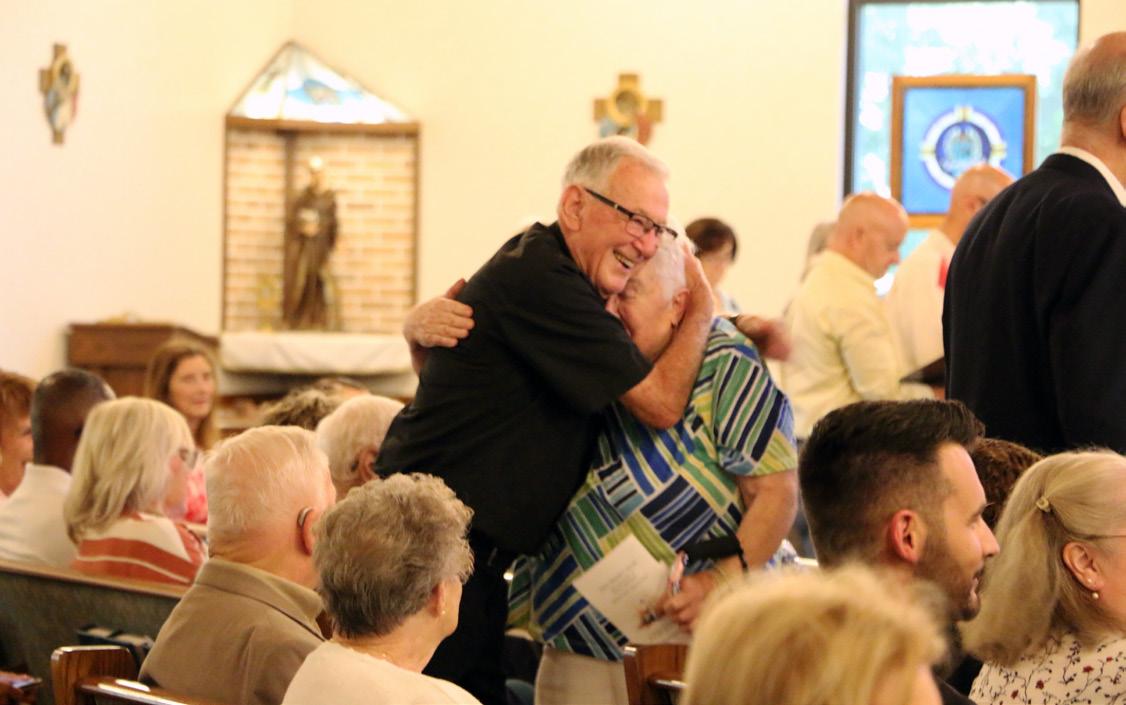
If Father Michael Woods is around, there is sure to be a great measure of laughter and song—and of the love he has for the Church and the love the people he serves have for him.
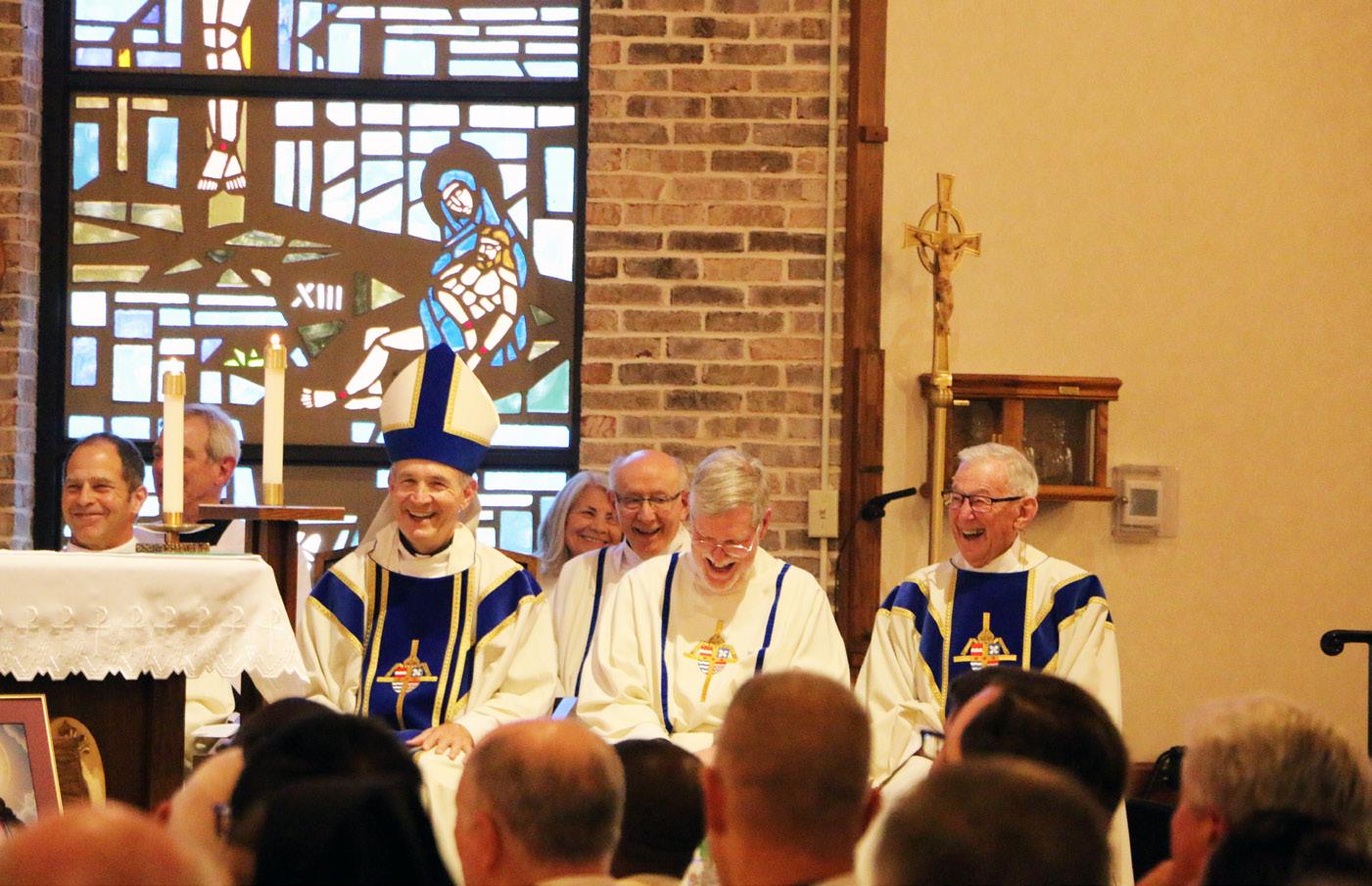
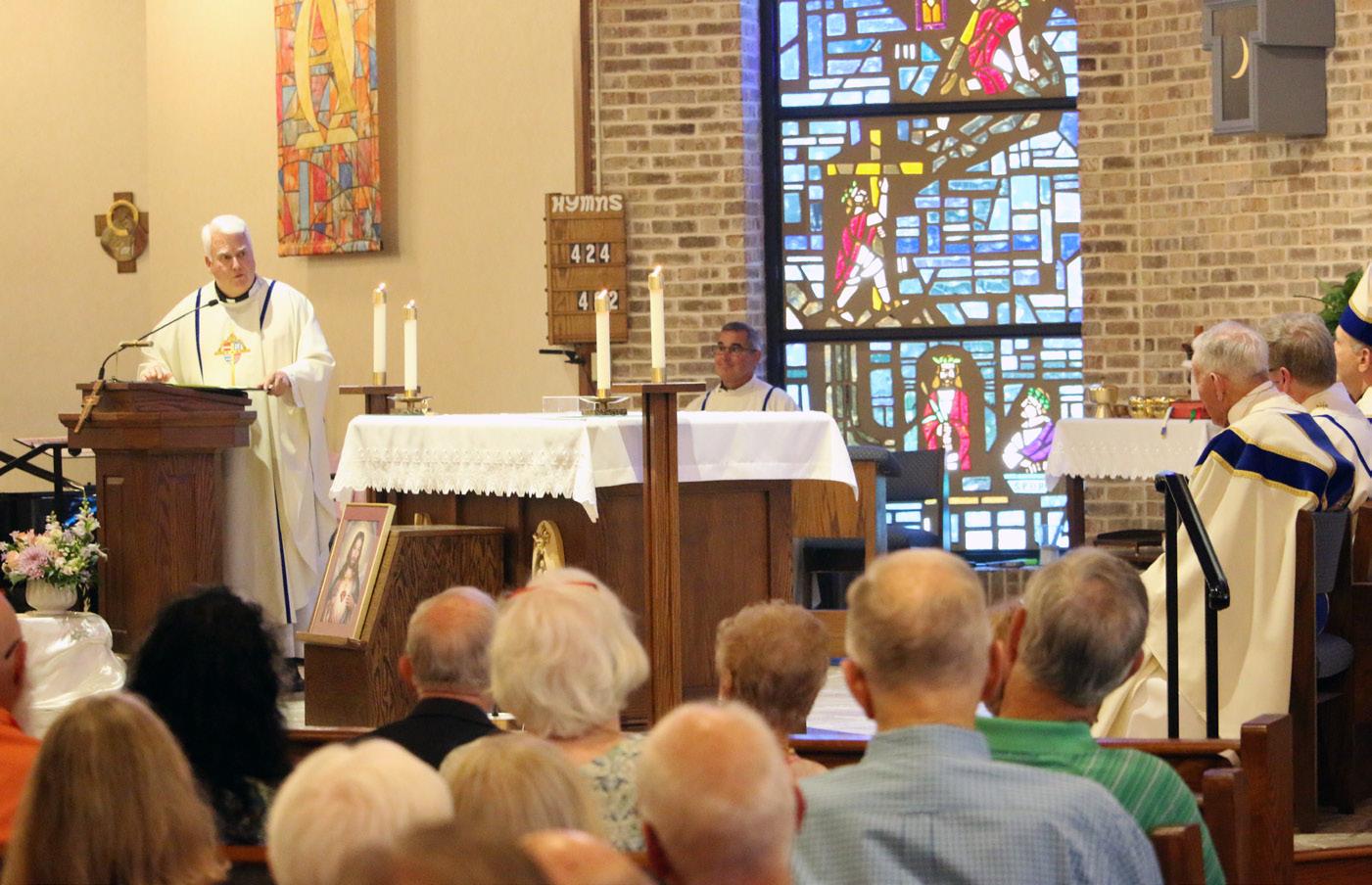
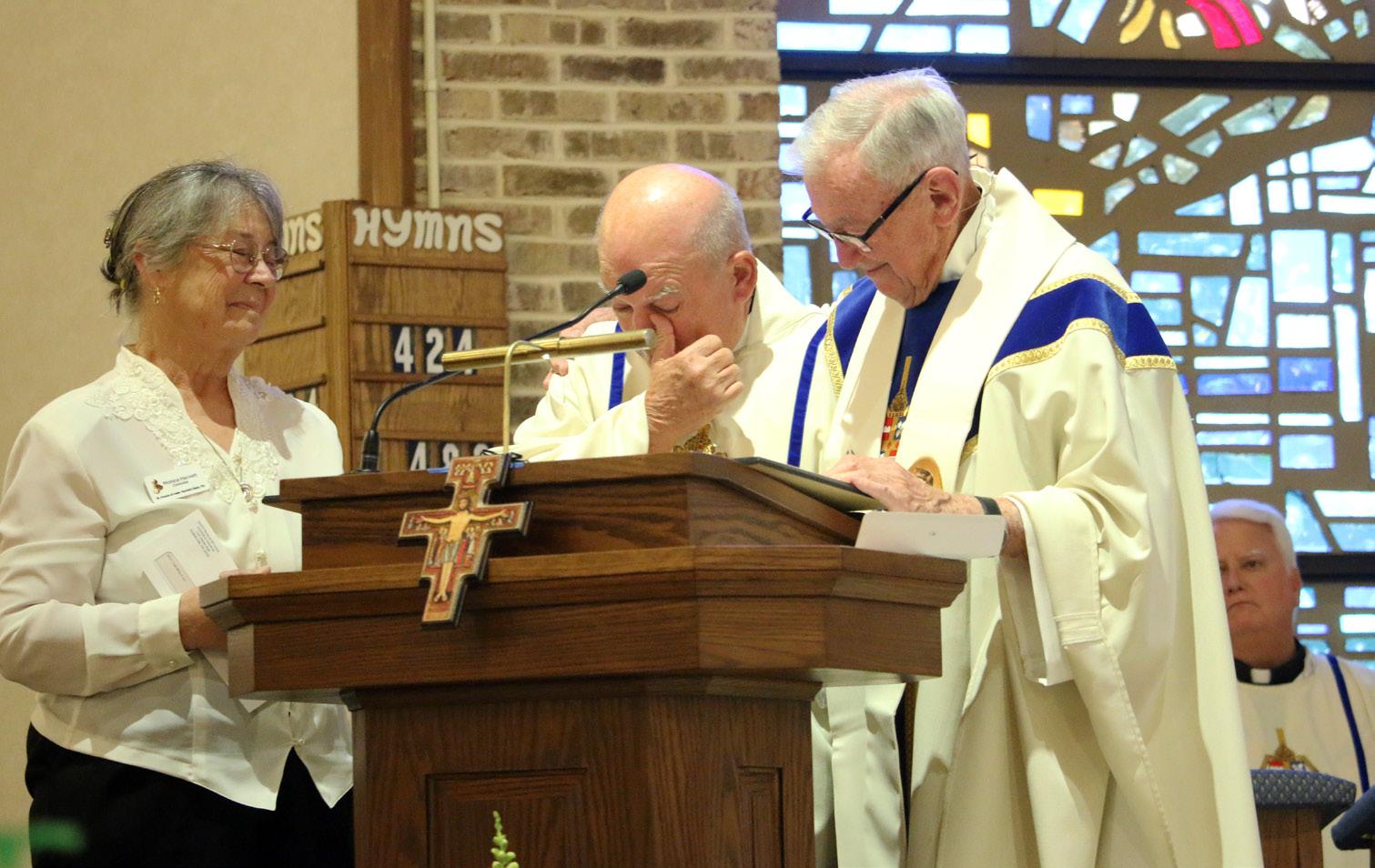
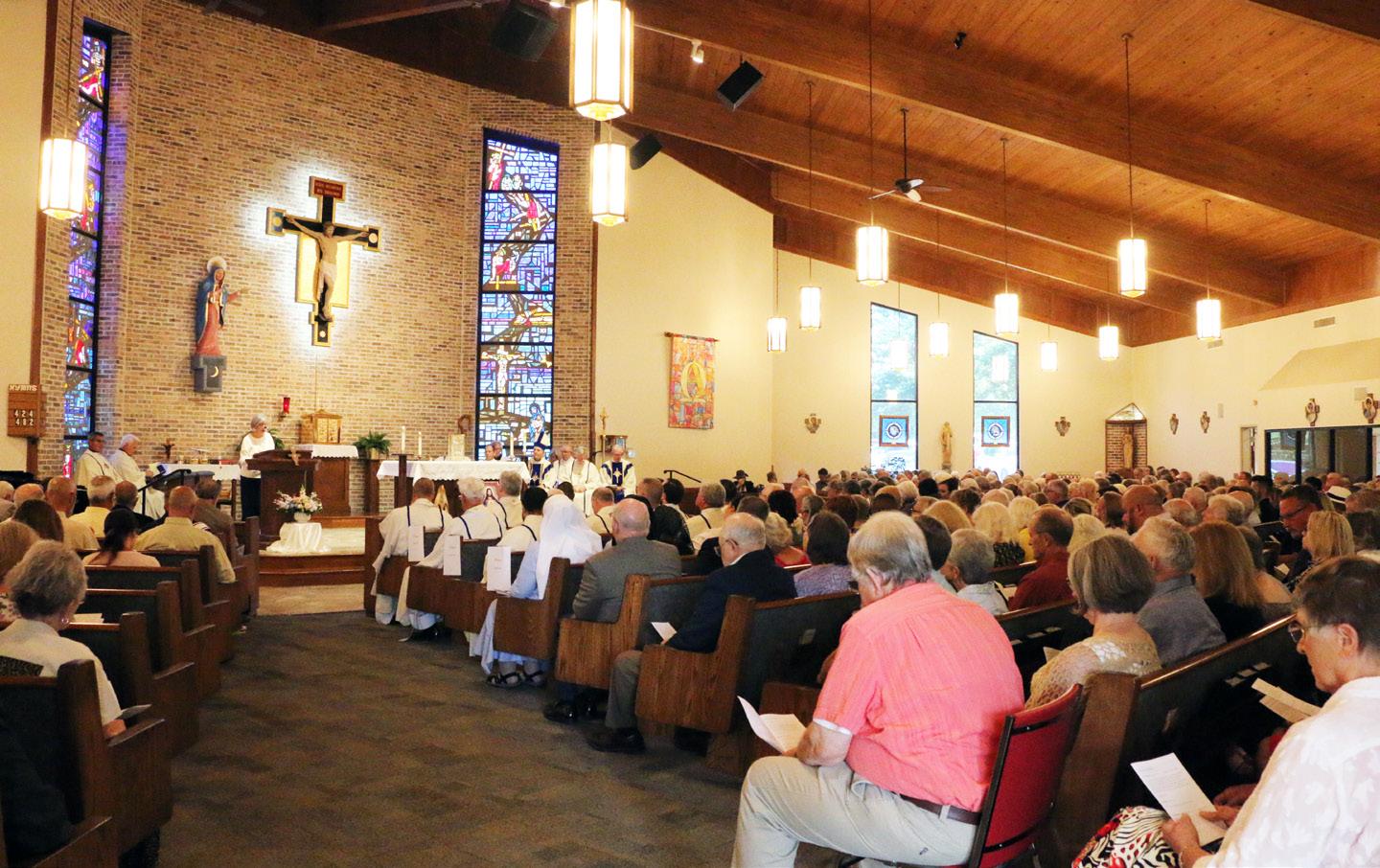
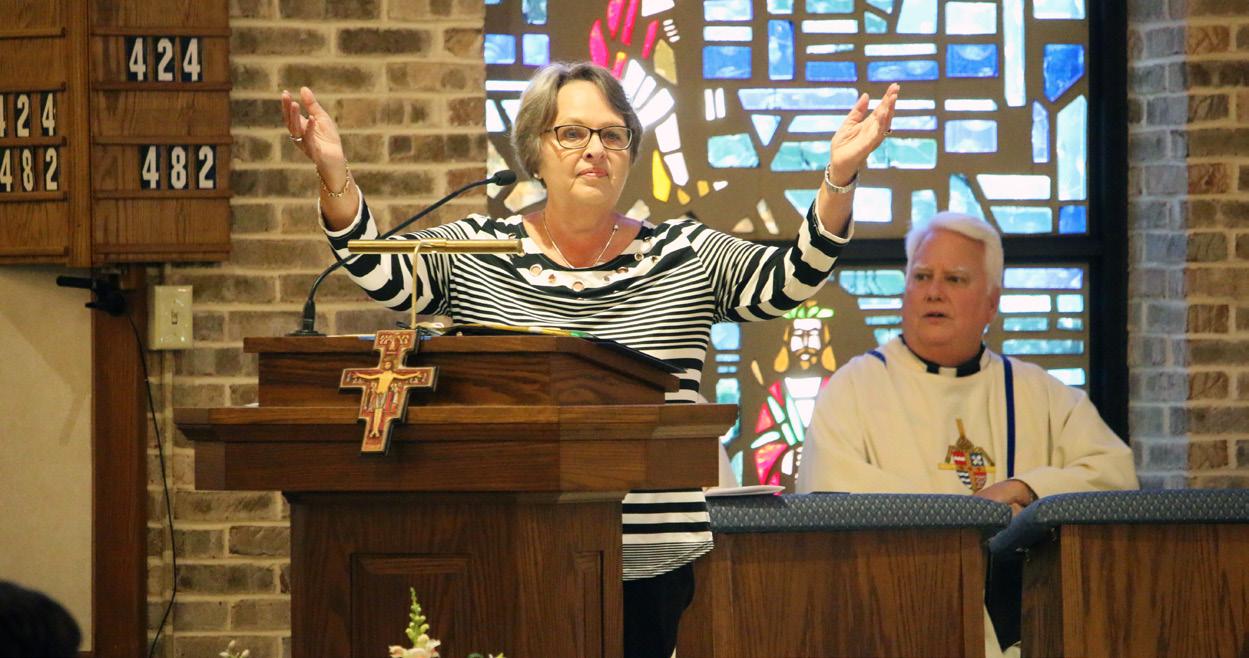
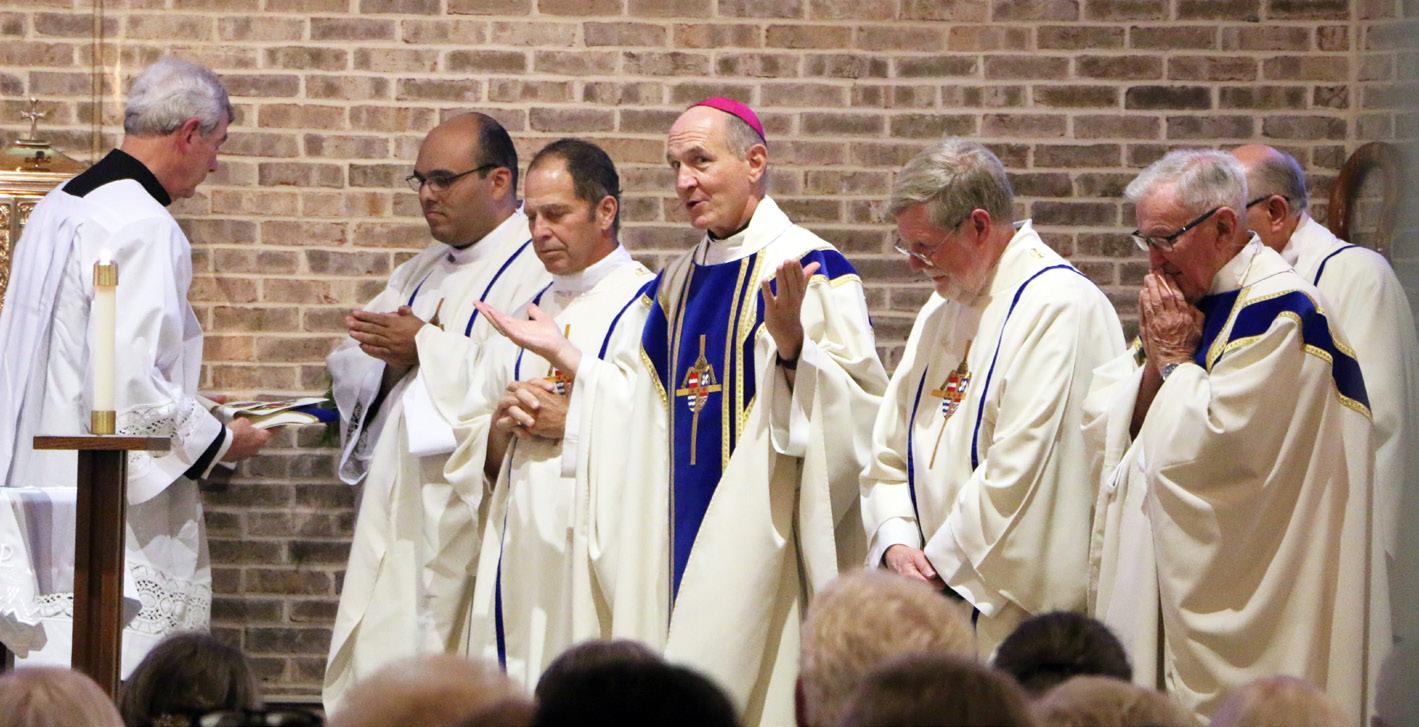
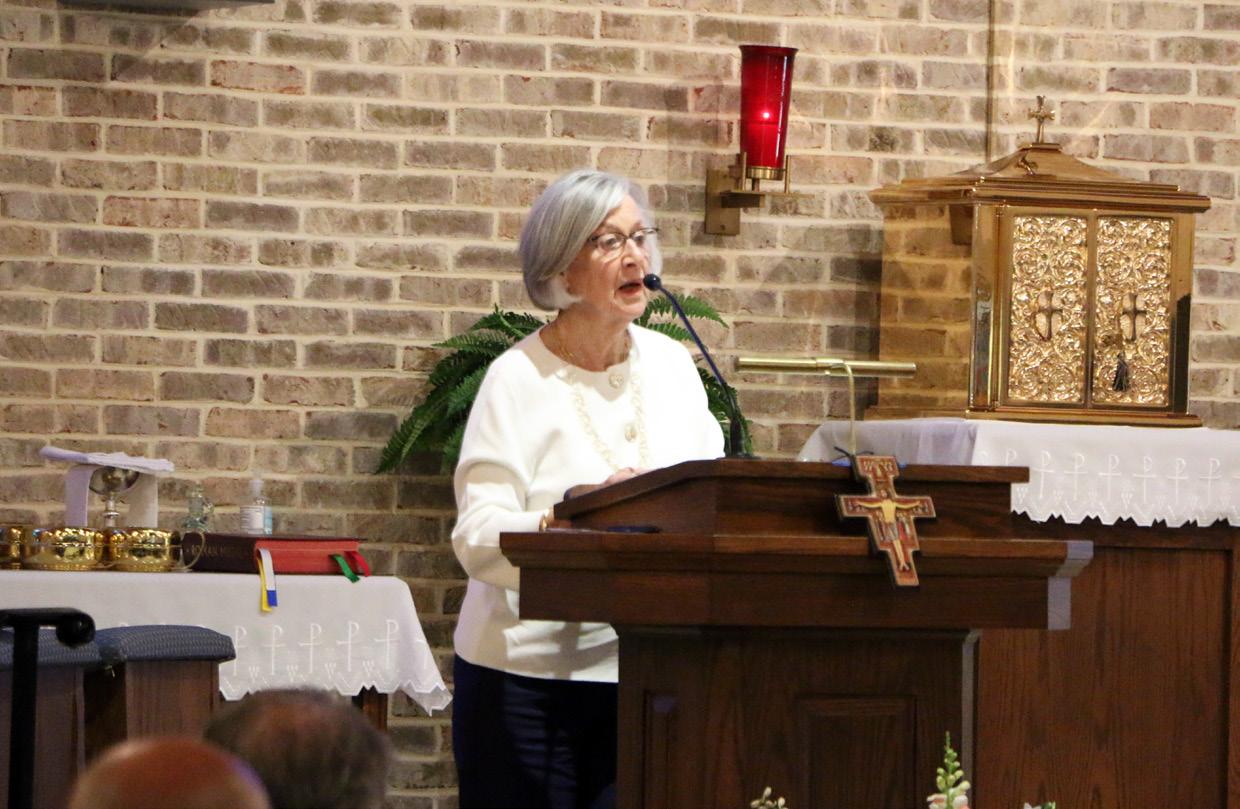
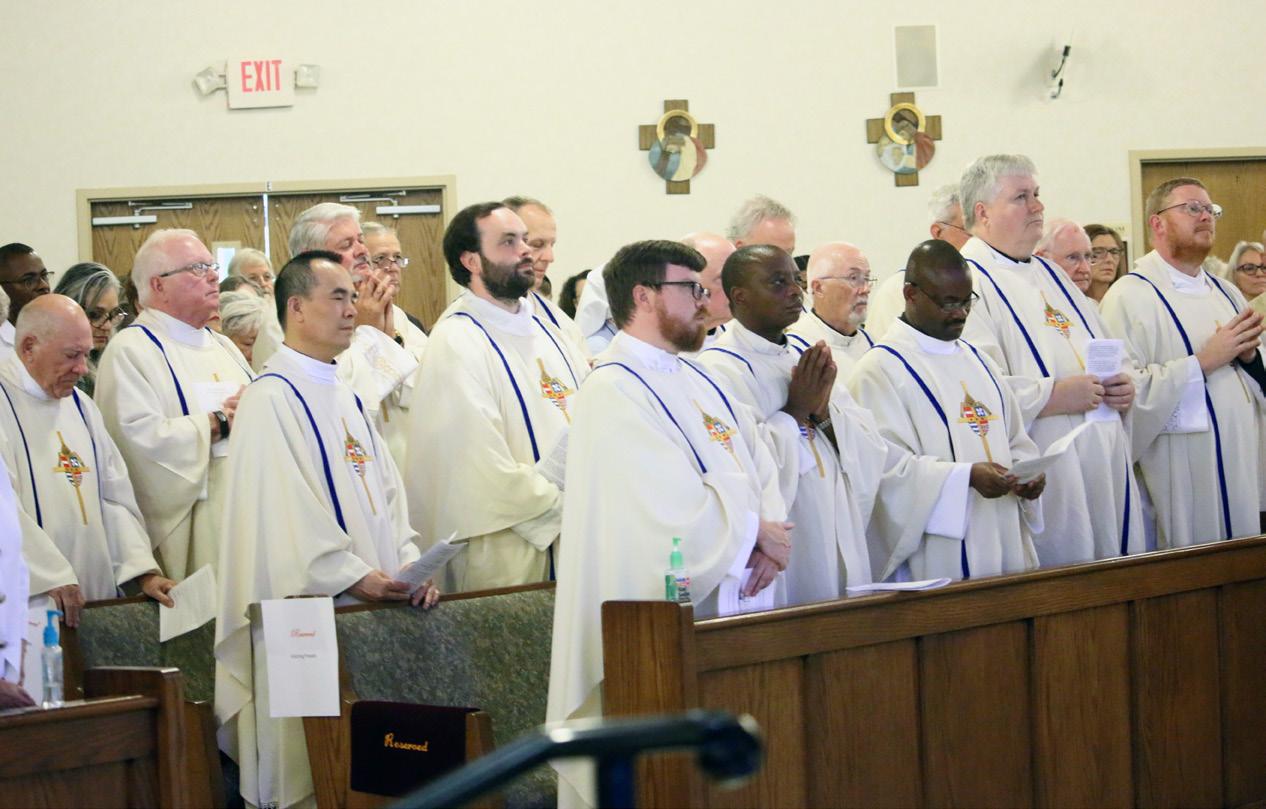
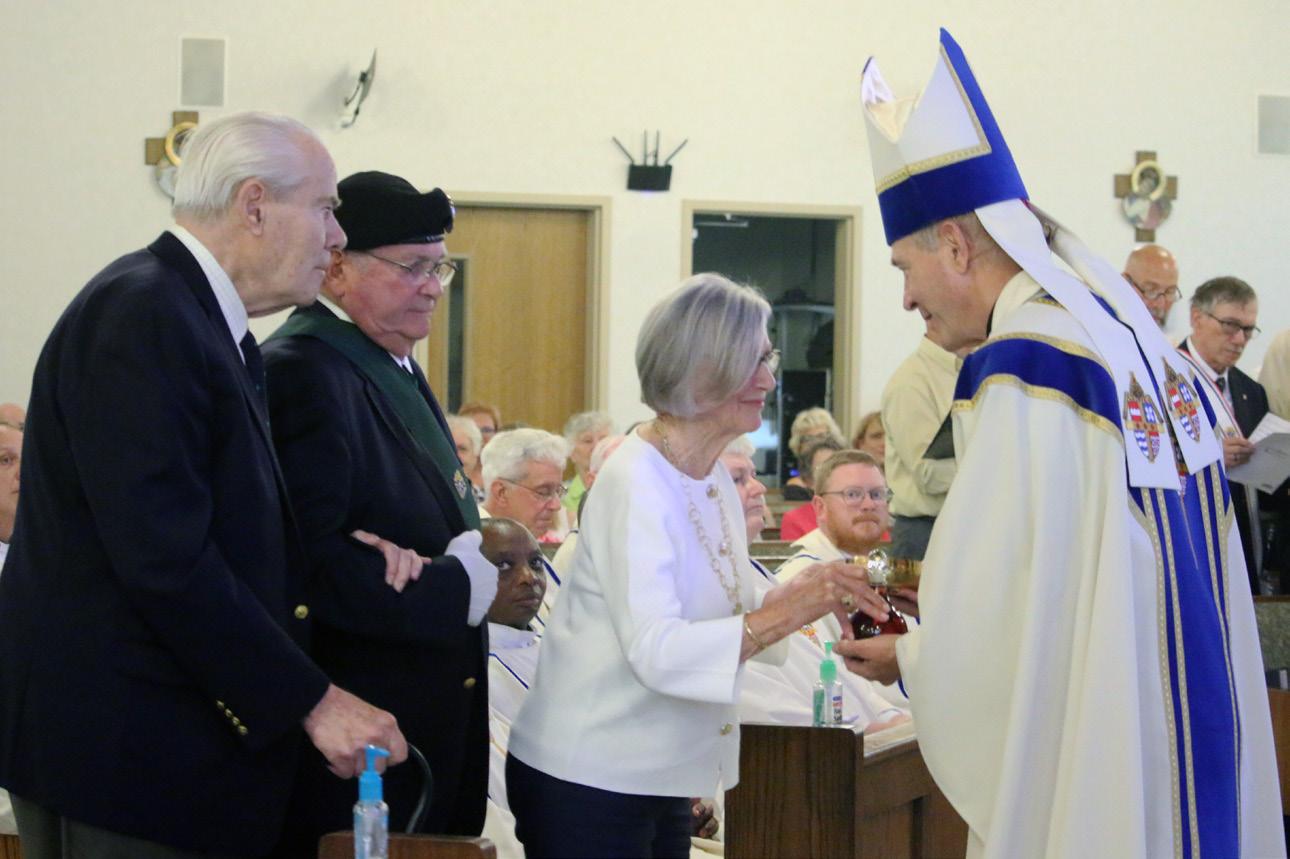
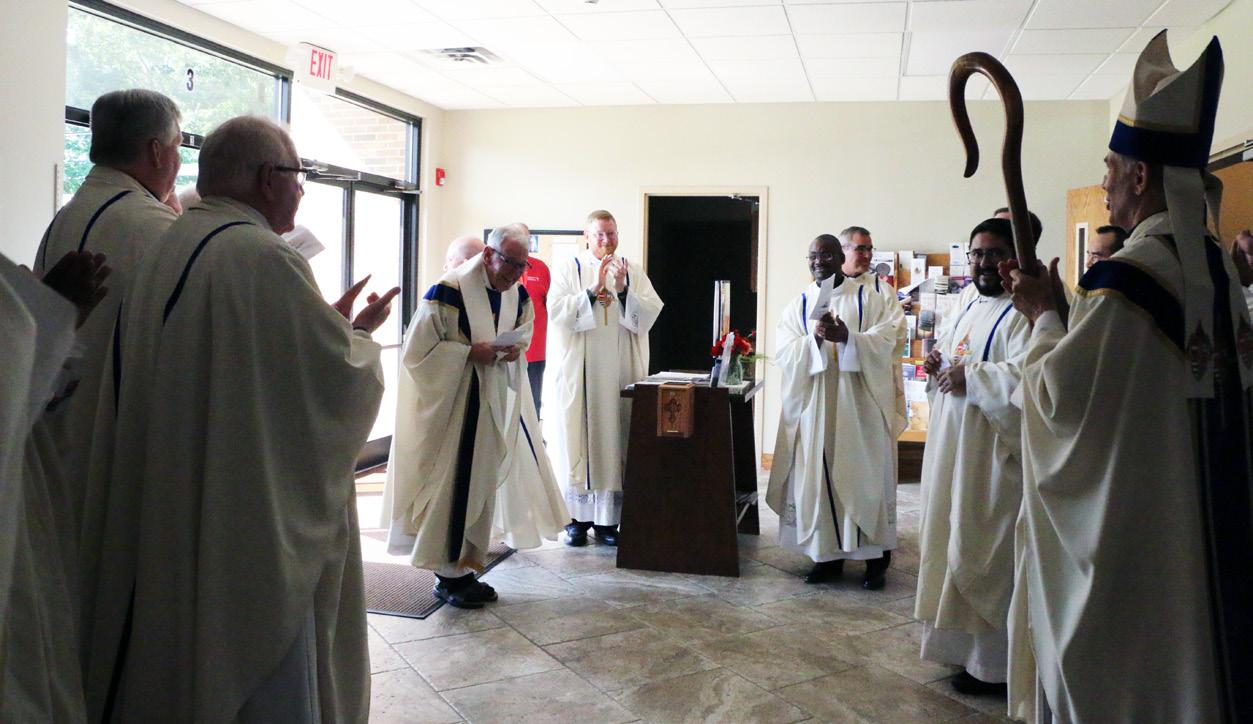
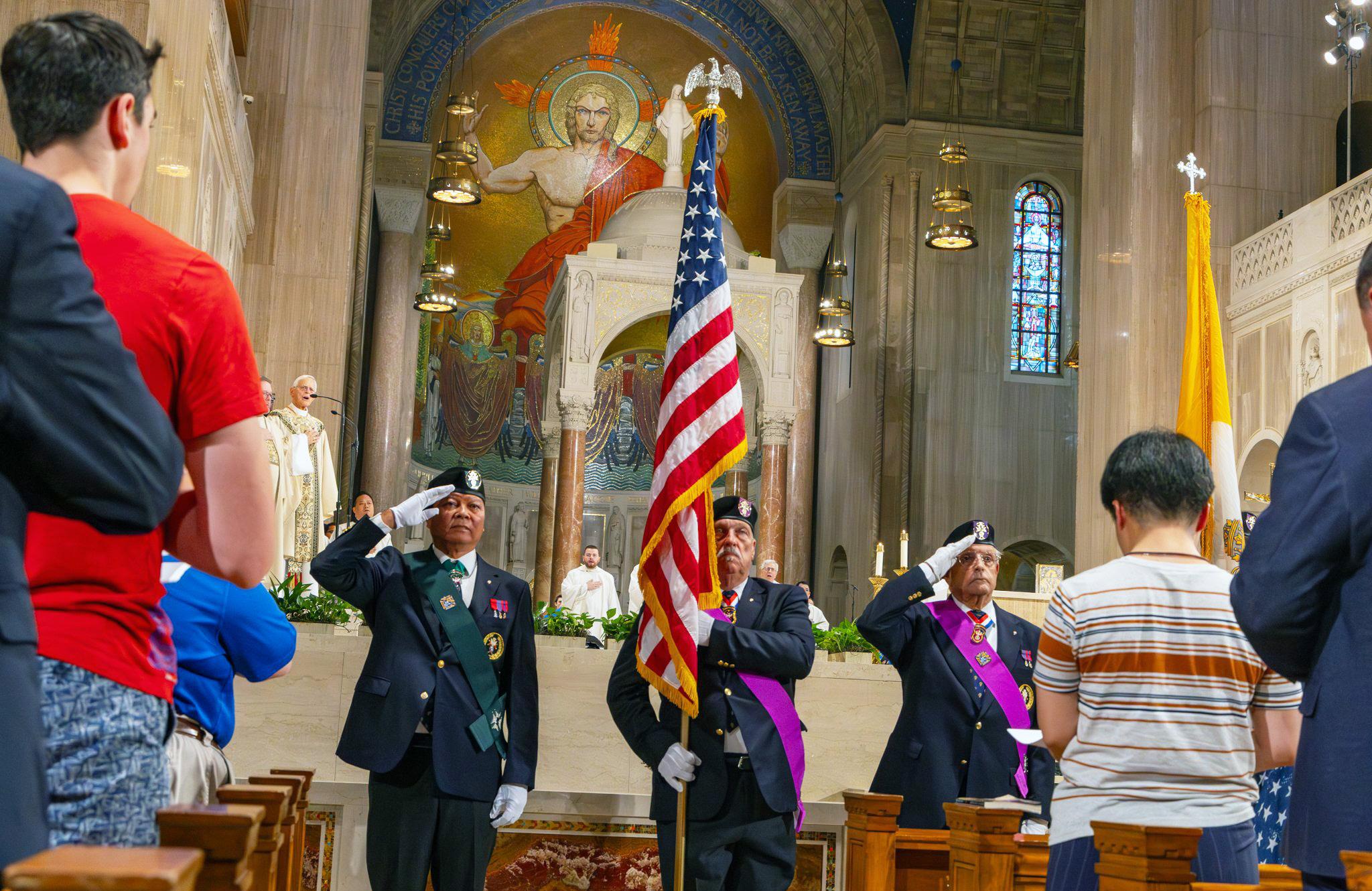
All of that was present in full on June 19 as Father Woods celebrated his 60th anniversary in the priesthood in a Mass at St. Francis of Assisi Church in Fairfield Glade, where has served as pastor since 2018.
Bishop Mark Beckman presided at a liturgy whose concelebrants also included Father John Matejek and Father Daniel Cooper of the host parish, Father Peter Iorio, and Father Michael Nolan. More than 15 additional priests from around the diocese attended as well as women religious and Fourth Degree Knights of Columbus, who provided an honor guard.
Also present was Father Glenn Meaux of the Kobonal Haiti Mission that St. Francis of Assisi Parish has long supported, and he made a special presentation to Father Woods at the end of Mass.
“There is nothing more important in a priest: that he reveal the heart of Jesus, and Father Mike, you reveal the heart of Jesus in your priesthood. We are so grateful to the Lord for you and your yes to the Lord,” Bishop Beckman said.
Deacon Gary Brinkworth was deacon of the Word, and Deacon Paul Benfanti was deacon of the altar. Deacon Hicks Armor served as master of ceremonies. The St. Francis of Assisi choir, directed by Eric Wheeler, was in full voice.
A reception at the Fairfield Glade Center followed the Mass. Father Woods, a native of Carlingford in Ireland who was ordained
for the Archdiocese of Atlanta before coming to the Diocese of Knoxville in 1994, has been pastor of three thriving parishes during his time serving East Tennessee Catholics. Faithful from his current community as well as those from his former parishes of All Saints in Knoxville and St. Mary in Oak Ridge also helped fill the Fairfield Glade church for the anniversary Mass.
‘We are the body of Christ’
“This priesthood—it is a miracle, but as we heard in the second reading at today’s Mass: there are many gifts. Sure, I stand in front of you as an example of one of those, but we are the body of Christ,” Father Woods said. “We are not a whole lot of little Jesuses running around trying to get to heaven. We are one body, and when Jesus asks us to love one another, it wasn’t because Anniversary continued on page A16
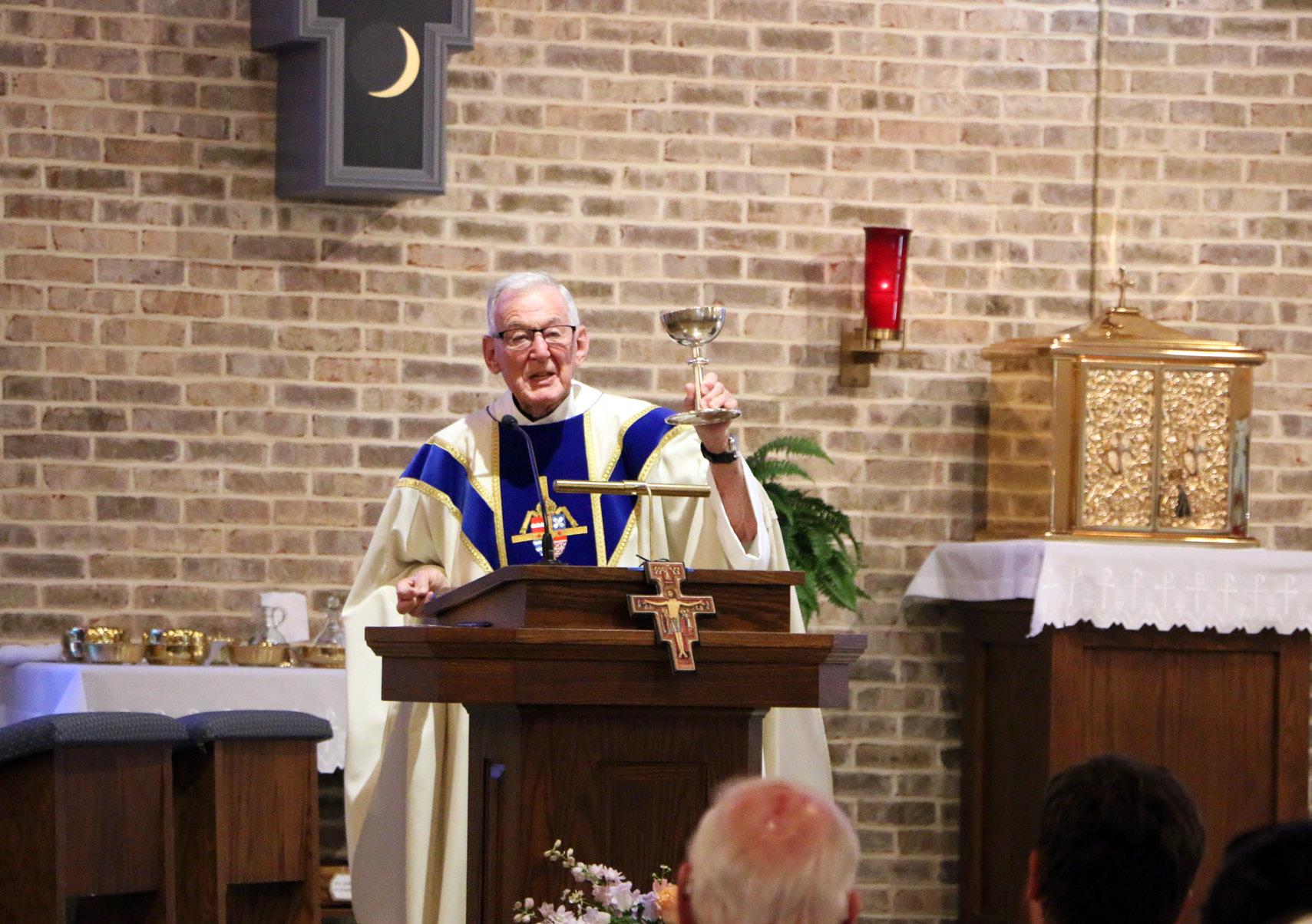
A simple chalice
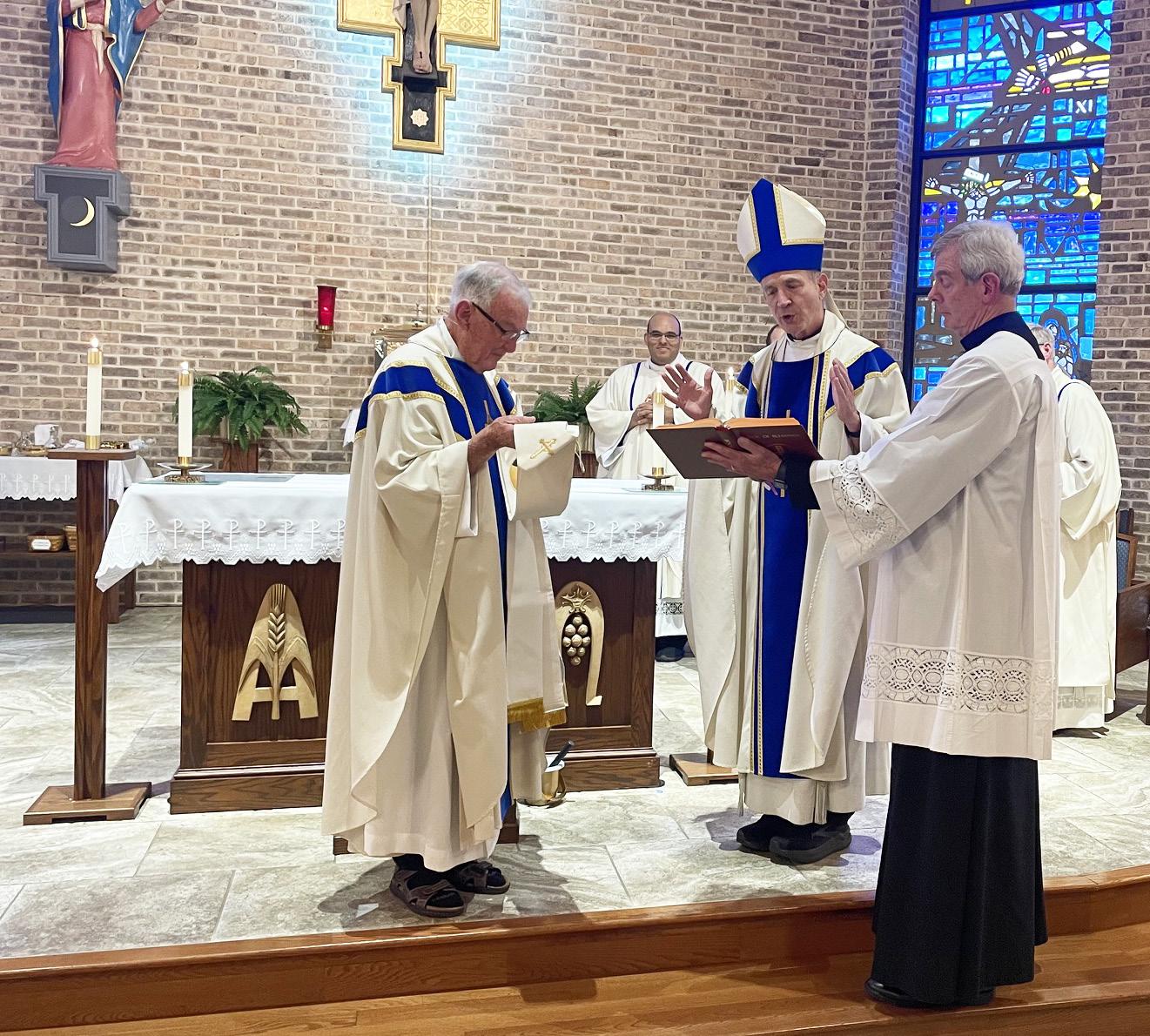
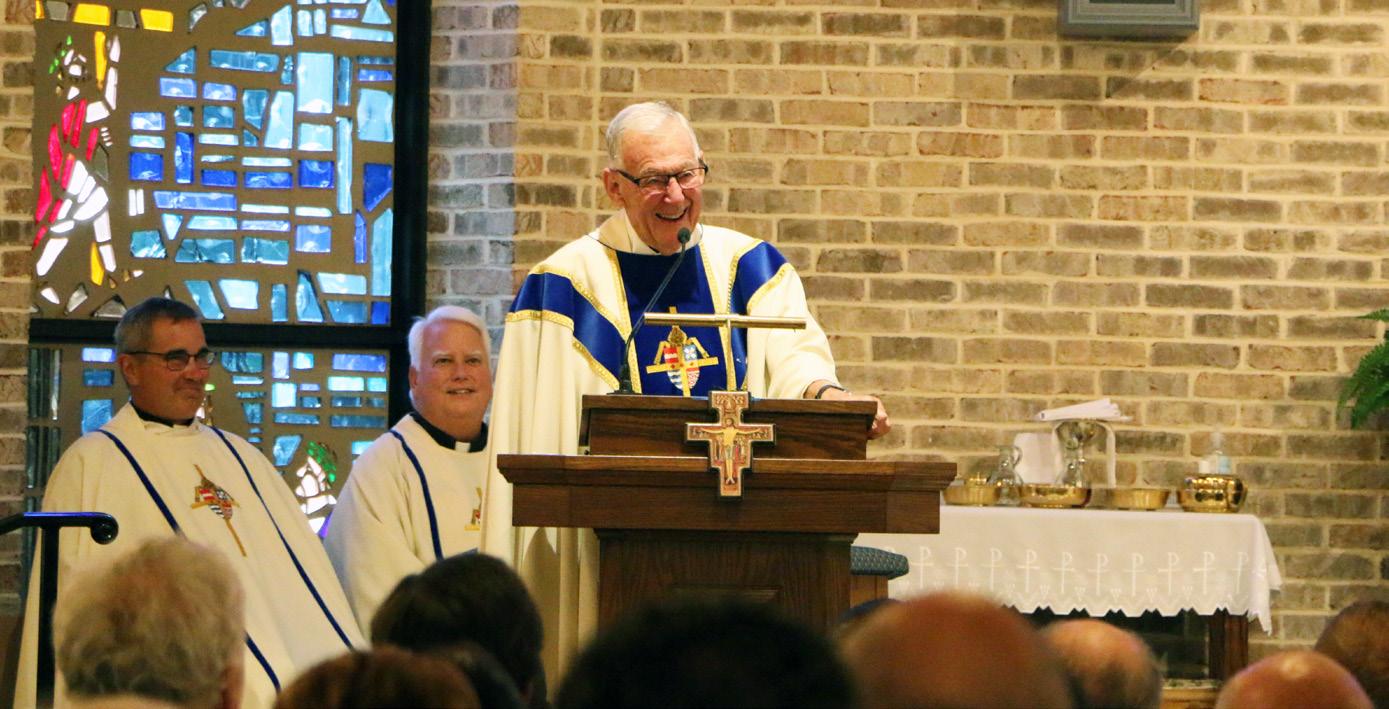
Left: Father Michael Woods, during his 60th-anniversary Mass on June 19 at St. Francis of Assisi Church in Fairfield Glade, shows a chalice that he designed at the time of his ordination to the priesthood in 1966.
Below: Bishop Mark Beckman, as Deacon Hicks Armor assists, blesses a stole that was presented to Father Woods by Grand Knight Mike Spitler of the parish Knights of Columbus.
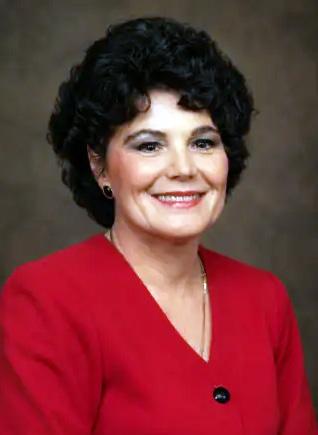
Mrs. Lucheon
Fr. Royal
Diocesan publications recognized nationally
Catholic Media Association touts The East Tennessee Catholic, DioNotes,
The East Tennessee Catholic
The East Tennessee Catholic and the Diocese of Knoxville communications office have been recognized by the Catholic Media Association with top awards for content created during the 2025 calendar year.
During the CMA annual conference June 16-19 in Atlantic City, N.J., it was announced that The East Tennessee Catholic received the firstplace award in the Best In-Depth News/Special Reporting category among non-weekly diocesan publications for its continuing coverage of the Diocese of Knoxville’s response to the devastating flooding caused by Hurricane Helene in the months following the September 2024 storm.
The in-depth coverage highlighted the severely impacted parishes of St. Michael the Archangel in Erwin, St. Anthony of Padua in Mountain City, Good Shepherd in Newport,
and Notre Dame in Greeneville and the heroic responses of those faith communities and Catholic Charities of East Tennessee.
The coverage was carried out by The East Tennessee Catholic team of editors Bill Brewer and Dan McWilliams, digital media producer Emily Booker, and multimedia journalist Gabrielle Nolan.
In their review of the package of stories in the April 2025 issue of The East Tennessee Catholic under the headline “Helene Flood: A Catholic
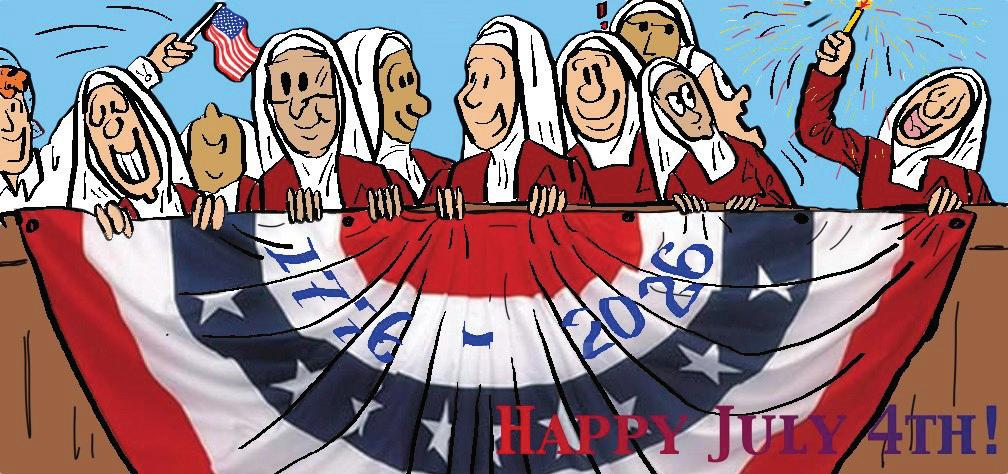
The Handmaids of the Precious Blood this year celebrate the 79th year since their founding in 1947; more than three-quarters of a century of prayer and sacrifice for priests. To receive weekly cartoons and short reflections and news from the Handmaids of the Precious Blood, visit their website, nunsforpriests.org, and sign up for the FIAT newsletter.
A July prayer intention
for respect for human life
“Let us pray for the respect and protection of human life in all its stages, recognizing it as a gift from God.”
Pope Leo XIV
Response,” the CMA judges said, “This package covered many facets of the impact of Hurricane Helene, from harrowing first-person stories of those who escaped the flood to the efforts of rescuers and supporters in the aftermath. The stories were riveting, and the breadth of coverage movingly demonstrated how people in the community rushed to help one another.”
The Diocese of Knoxville digital newsletter DioNotes and Ms. Booker, who compiles DioNotes,
won third place nationally in the category of Best Diocesan Electronic Newsletter.
In their review of DioNotes, the CMA judges said, “A broad array of well-produced local content sets this newsletter apart. Video content, slide shows, and podcasts are techniques it employs in making a vigorous effort to reach out to all in the diocese. The Diocese of Knoxville truly keeps its members well-informed.”
How to sign up and qualify for Diocese of Knoxville’s safe-environment program
The Diocese of Knoxville has implemented the CMG Connect platform to administer the Safe Environment Program, which replaces the former Safe Environment Program (VIRTUS “Protecting God’s Children”).
CMG Connect is a web-based platform that will assist in ensuring that all employees and volunteers who are in a position of trust with children and vulnerable adults within Diocese of Knoxville schools and parishes are trained to recognize behavior patterns of potential abusers and provide pro-active measures for preventing abuse in any context.
“Safe Haven-It’s Up to You” is a three-part video that provides vignettes of real-life situations to educate the viewer about methods of grooming, desensitization, bullying, and neglect, all of which can lead to abuse.
Each part of the video is immediately followed by a brief questionnaire to further develop understanding.
Education is a key
element of the Safe Environment Program.
All clergy, employees, contracted school personnel, volunteers, members of groups and organizations over the age of 18 who work, volunteer, or participate in any capacity are required to complete the diocesan Safe Environment training and a criminal-background check before they can begin employment, volunteer, or participate with ministries, groups, and organizations affiliated with the Diocese of Knoxville.
In addition, the mandatory renewal training must be completed every five years and a new background check submitted before the five-year expiration of prior training
The Diocese of Knoxville Safe Environment compliance training and renewal training is a condition of employment and for volunteer ministry in the Diocese of Knoxville.
The CMG Connect platform contains all three elements of the Diocese of Knoxville’s Safe Environment Program: n Annual review of the Diocese of Knoxville’s Policy and Procedures Relating to Sexual Misconduct; n CMG Connect Safe Haven training program to be completed every five years; n Criminal background check to be completed every five years.
In compliance with the Diocese of Knoxville’s Safe Environment Program, all affiliates require that volunteers and employees complete the requirements prior to working and/or volunteering in a parish, school, or through Catholic Charities of East Tennessee and/ or St. Mary’s Legacy Clinic. Go to https:// dioknox.org/safeenvironment on the Diocese of Knoxville website for more information ■
Parishes show the Holy Spirit is alive and well in East Tennessee
ne of my greatest joys as bishop has been the opportunity to journey to our parishes and meet the people of God in our many communities throughout East Tennessee.
A few weeks ago, I was able to visit two of our parishes for the first time. I journeyed north of Knoxville up to Caryville, where I would spend the night at one of the local hotels overlooking beautiful Cove Lake State Park.
Father Sam Sturm picked me up and drove me “up the mountain” to the small community of Helenwood, where St. Jude Church stands as a beacon of faith in the midst of a predominantly Protestant community. There are only about 19 registered parishioners but almost 40 people arrived for the liturgy on that Wednesday evening.
It is truly a gem of a parish. Catholic Charities operates a small pregnancy support clinic on location, which I was able to see, and I discovered that St. Jude is very involved with outreach to neighbors in need in their community of Helenwood.
The church itself is lovely, with a high central ceiling and incredibly beautiful stained-glass windows, which I was told were designed and placed by a monk many years ago. The crucifix behind the altar is striking and was made by a local parishioner.
The liturgy itself was simple and touching and was followed immediately by a covered-dish dinner. The people of St. Jude sure know how to cook! The meal and fellowship were wonderful.
Following our gathering, Father Sam took me to a parish founder’s home, which looks out over the mountains and New River, offering a glorious view. I was deeply reminded of how important our faithful have been in planting the seeds of the faith here in Appalachia and in continuing to nourish our parish
Bishop continued on page A15
Celebrating Mass in East Tennessee
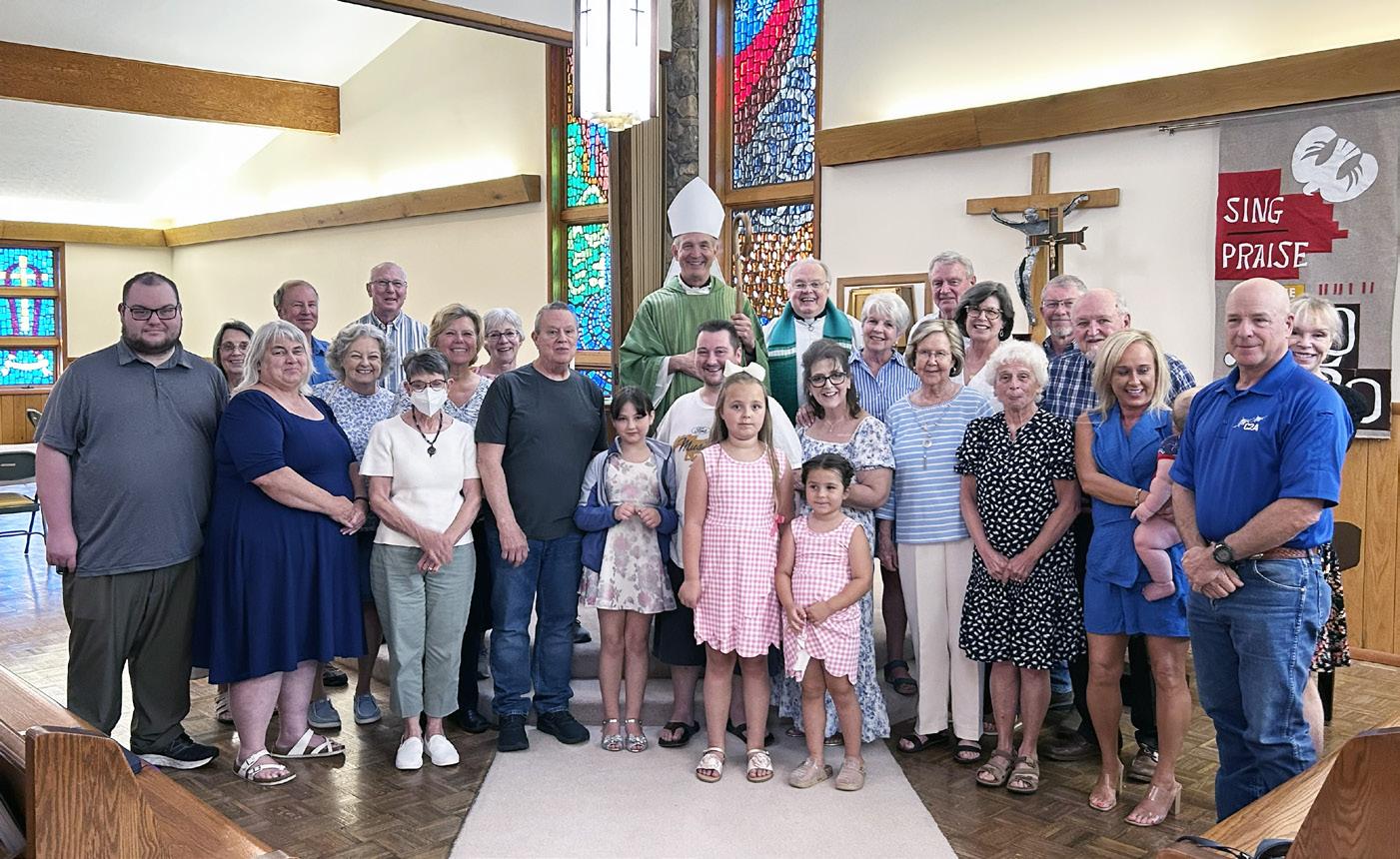
Left: Bishop Beckman joins Father Sam Sturm and members of Christ the King Parish in Tazewell following Mass at the Claiborne County church.
Below: Bishop Beckman and Father Sturm are surrounded by the members of St. Jude Parish in Helenwood following Mass at the Scott County church.
One if by land, two if by sea
National Eucharistic Pilgrimage invites nation to remember its founding on 250th birthday
By Jeffrey Bruno EWTN News
love the sea
IIts mystery and drama, its promise of adventure…the way the horizon seems to stretch forever, blurring the line between what is and what might be.
Which is why, sitting alone on a rock jetty on Kent Island, and gazing out over the Chesapeake Bay, I began to wonder if I had made the wrong decision.
An hour earlier, I’d stood in Annapolis with the National Eucharistic Pilgrimage, watching as pilgrims processed with Our Lord in the Blessed Sacrament down a wooden pier and onto a waiting trawler. It was one of the more unusual scenes I have witnessed during this year’s pilgrimage.
A eucharistic procession is not something most people expect to see.
A eucharistic procession boarding a boat is rarer still.
The boat would cross the Chesapeake to Kent Island. My heart wanted to be aboard, to feel the lift of the water, to smell the salt air, and watch the shoreline recede, as Christ crossed one of America’s great waterways.
But instead, I rolled the dice and drove ahead to the other shore, hoping that the image of their arrival would be worth seeing.
So there I sat, alone among the rocks, listening to waves slap against stone and staring into an endless horizon. The boat was nowhere in sight. Only sky. Water. Wind. And waiting.
There is a kind of waiting that belongs to faith. Not the brittle impatience of a delayed flight or a traffic jam, but the deeper waiting of a heart that knows Someone is coming, even when there is still nothing to see. It’s the waiting of Israel, of the disciples in the Upper Room, of Mary in Nazareth carrying Christ within her while the world went on unaware that its Savior was already near.
That thought lingered as I watched the bay. This crossing was only one leg of a much larger journey. For weeks the pilgrims have carried Jesus across America by road, by foot, by bridge, by boat. Through cities and countryside, bright sun and soaking rain, past homes, restaurants, government buildings, monuments, churches, and ordinary corners of the nation that became extraordinary the moment He passed by. “One if by land. Two if by sea.” The phrase belongs to the American Revolution, yet on the Chesapeake, it took on another meaning. No signal lanterns in a steeple, no warning of war. Only the visible witness of a eucharistic Lord being carried into a country approaching its 250th birthday.
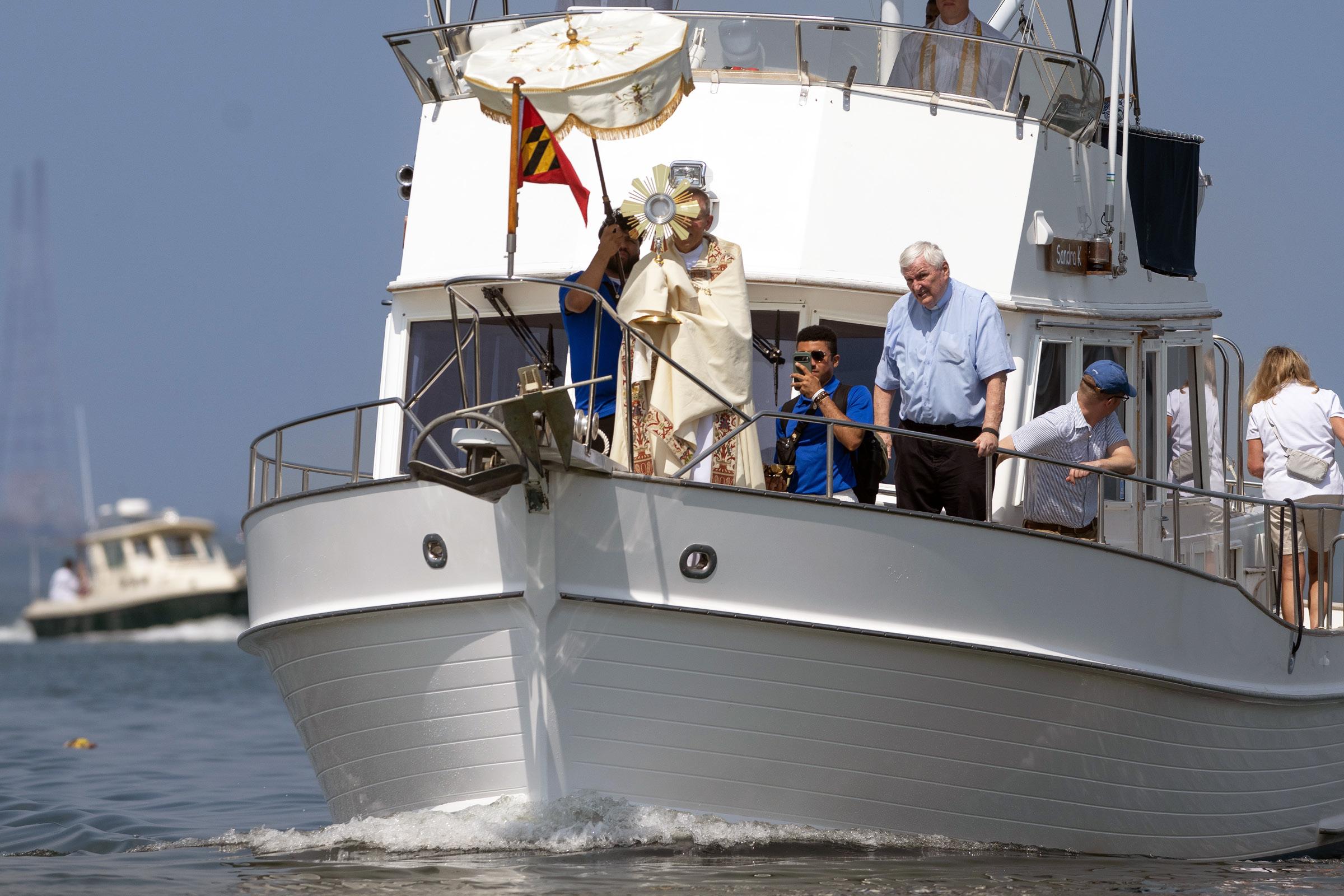
The Real Presence by land or by sea Jesus Christ in the monstrance approaches Kent Island from Annapolis, Md., via ocean-going trawler in the Chesapeake Bay as part of the National Eucharistic Pilgrimage last month. The pilgrimage, under the theme "One Nation Under God," began Me-
This pilgrimage, under the theme “One Nation Under God,” is more than a journey to Philadelphia. It is a prayer stretched across the Eastern Seaboard, a plea for healing, a procession for unity, a reminder that the American story, with all its greatness and all its wounds, still needs grace.
And along the way, people have responded. Families kneeling on sidewalks. Strangers stepping out of restaurants and offices. Tired pilgrims singing in the rain. Children waving from the edges of processions. Silence falling as Christ moved through the public square. Again and again, the reaction has been the same: hope, wonder, joy.
In the days ahead, the pilgrimage would continue toward Philadelphia for Independence Day weekend, bringing the Blessed Sacrament to the city where the nation’s founding was declared. The symbolism is impossible to miss. Two hundred and fifty years later, another procession approaches. Not with muskets or proclamations,
but with prayer.
Not to conquer.
To bless.
And then, just when I began to wonder whether my gamble had failed, something appeared on the horizon. Tiny at first. Almost imperceptible. But growing steadily larger against the vastness of the bay.
The pilgrims were coming.
And with them, Christ.
As the trawler entered the channel, the afternoon sun caught the monstrance and flashed across the water, golden and alive, like a beacon carried on the waves. The crowd moved toward the dock.
The waiting ended.
In that moment, I knew I hadn’t chosen the wrong shore. Sometimes the story isn’t found on the crossing. Sometimes it’s found in the waiting and in the quiet, overwhelming joy of receiving Him for Whom we wait. ■
Jeffrey Bruno is an award-winning photojournalist and creative director whose vocation is to present the beauty and mission of the Catholic Church around the globe
morial Day weekend in St. Augustine, Fla., and continued through most of the original 13 colonies before it ended in Philadelphia on the weekend of July 4.
Mr. Bruno
COURTESY OF CHRIST THE KING PARISH
Entrusting in His merciful love
Diocese, cathedral parish are consecrated to the Sacred Heart of Jesus
By Emily Booker
The fire of Jesus’ love is burning brightly in East Tennessee.
On June 12, the solemnity of the Most Sacred Heart of Jesus, Father David Boettner, rector of the Cathedral of the Most Sacred Heart of Jesus, consecrated the Diocese of Knoxville and the cathedral parish to the Sacred Heart of Jesus.
Concelebrating the Mass were cathedral associate pastors Father Danny Herman and Father Diego Rivera and Father Daniel Cooper, associate pastor of St. Francis of Assisi Parish in Fairfield Glade. Deacons Walt Otey, Fredy Vargas, and Mike Mescall of the cathedral parish, and Deacon Bill Jacobs of Our Lady of Fatima Parish in Alcoa, also served.
The bilingual Mass drew a large congregation, packing the cathedral as the faithful gathered to entrust their community and their lives to the love and mercy of Jesus’ Sacred Heart.
The consecration came a day after the U.S. bishops, including Bishop Mark Beckman, consecrated the United States of America to the Sacred Heart of Jesus in recognition of the country’s 250th anniversary.
Inspired by the national consecration, Bishop Beckman encouraged parishes and individuals to seize this opportunity of prayer and unity focused on the Sacred Heart. Over the past month, parishes and individuals across East Tennessee have responded to this call, turning to the Sacred Heart of Jesus in novenas, prayers, and home enthronements.
As Bishop Beckman was traveling back to the diocese from the U.S. Conference of Catholic Bishops’ gathering in Orlando, Fla., on June 12, Father Boettner had the privilege of celebrating the Mass.
“My dear brothers and sisters, we are here to celebrate the consecration of the United States of America to the Most Sacred Heart of Jesus and to consecrate our diocese and our parish. Let us imitate the love and mercy which Christ has made known to us through His Most Sacred Heart,” Father Boettner said.
“As we bow before the Lord, let us remember that in His own blood Christ has removed all divisions and out of the many nations created one people of God. As we venerate the Sacred Heart, let us reflect that we ourselves are Christ’s disciples and must therefore follow Him, loving not with stony hearts but with living hearts.”
In his homily, Father Boettner spoke on how love changes a person; it makes us willing to do difficult things and helps us to show love to others.
“With the love of God, even the love that we already have grows bigger, and it becomes so big that we can love even the most difficult things. We can love ‘the other.’ That’s the challenge. When Pope Francis wrote his encyclical on the Sacred Heart, one of the challenges he gave to us was to love people that we might consider ‘the other.’ Who is the other? Well, the other is anybody that’s not me, anybody that’s given to me, anybody that doesn’t think the way I think or act the way I act or believe what I believe. And Pope Francis challenged us to love the other.” He then explained that the love of God is a fire that does not consume.
“The heart of Jesus can be on fire with love and never consume….The heart of Jesus can
absolutely be on fire for us, and it doesn’t have to burn up. It doesn’t get exhausted. That’s why we come to the heart of Jesus today, because we come to an infinite source of love, and it’s in that infinite source of love that we have encounter.
“And when you have an encounter, you meet another. What the Church is inviting us to do today is to meet Christ in His heart, not just to think about Him, not just to admire Him, but to actually enter into the heart of Jesus.”
Father Boettner also noted that the cathedral was dedicated to the Sacred Heart of Jesus.
“The words written around the inside of this church are the Litany of the Sacred Heart of Jesus. Those words are there to invite us to encounter the heart of Christ when we enter this church. Even if there’s nothing actively taking place, we still have the opportunity to encounter the heart of Jesus Christ. And it’s in that encounter with the
Jesus' Sacred Heart
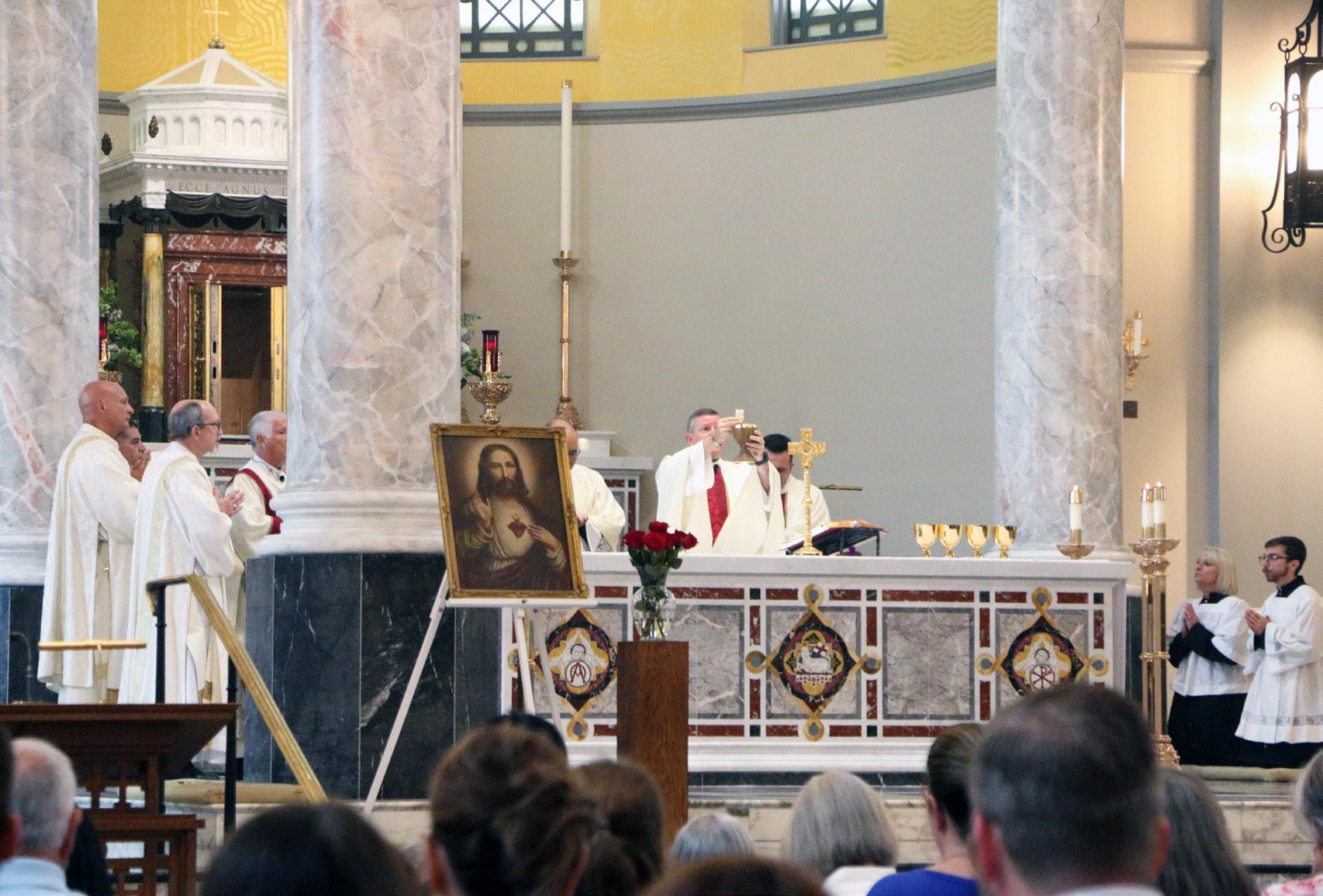
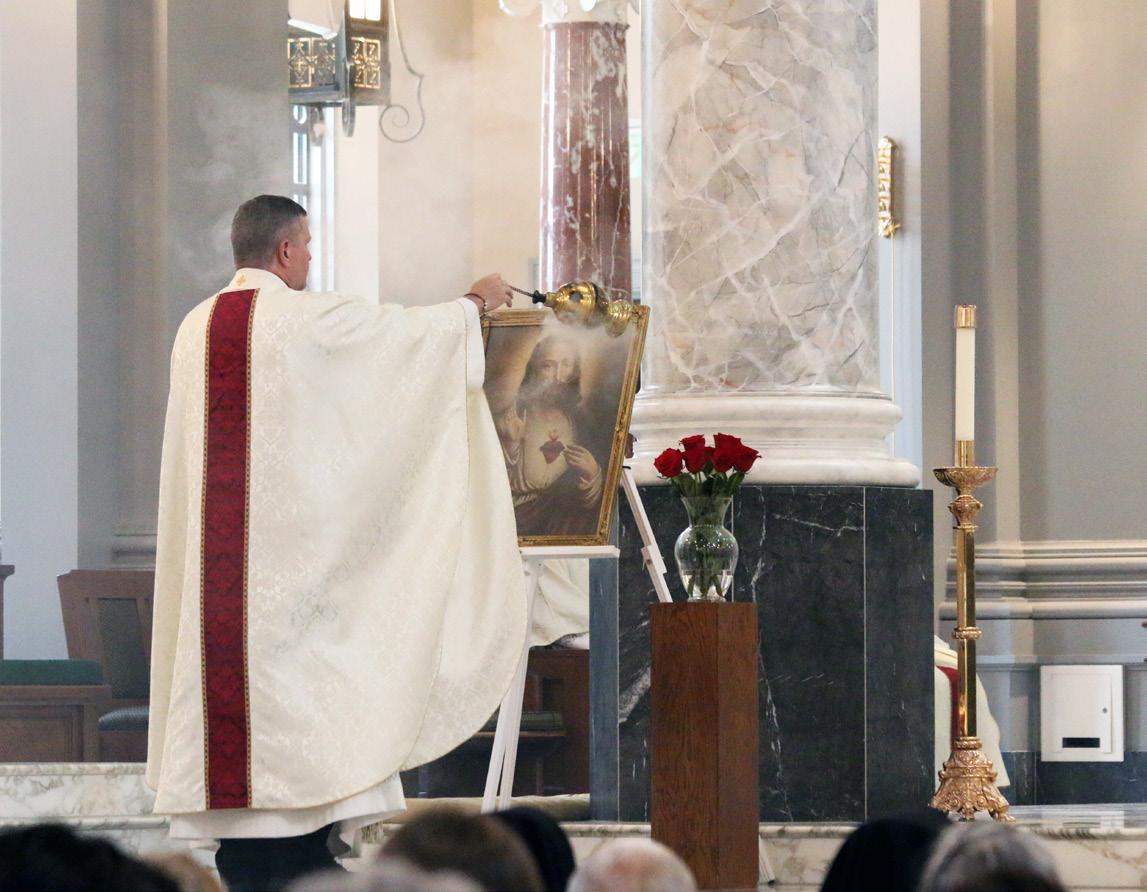
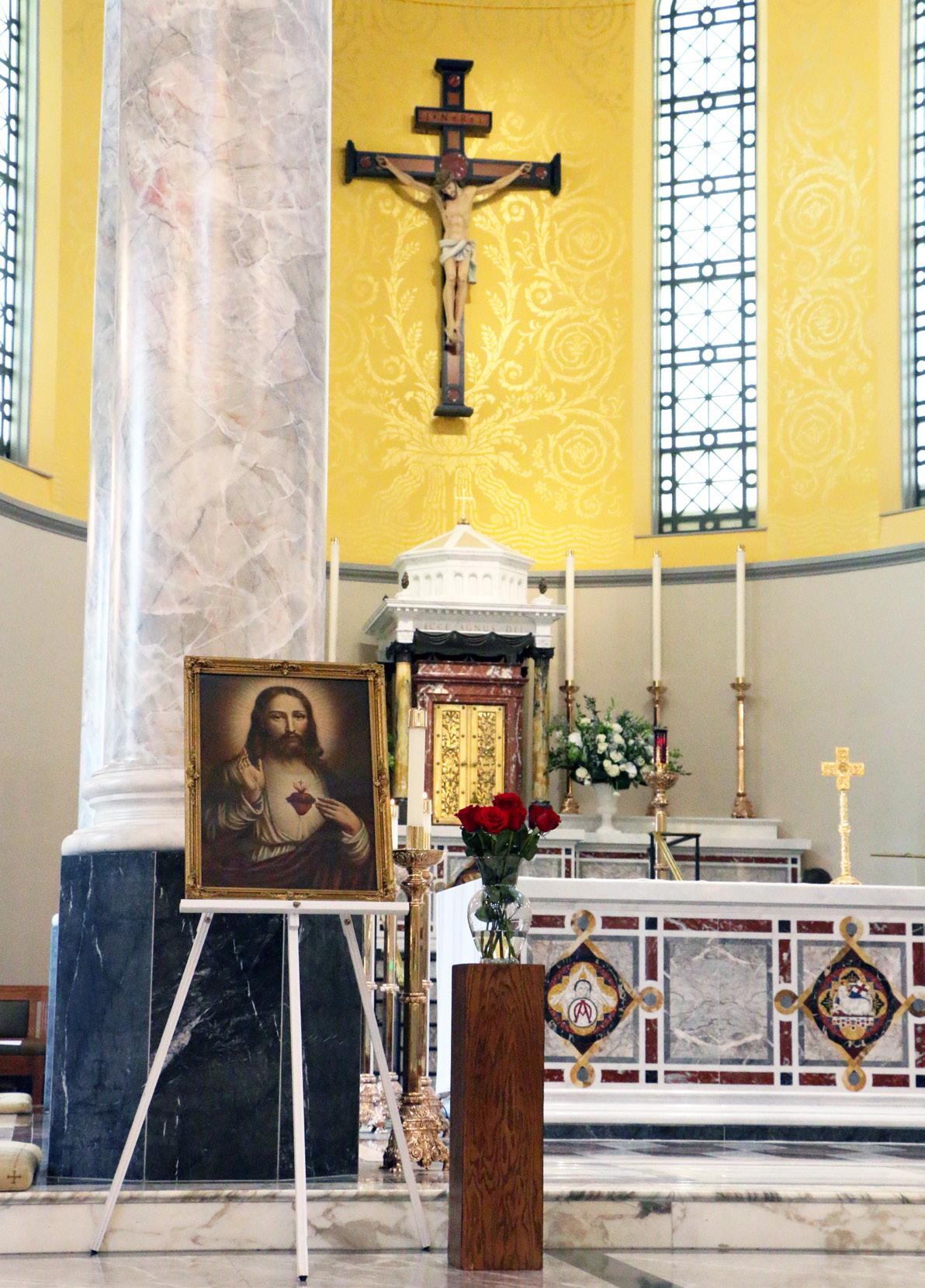
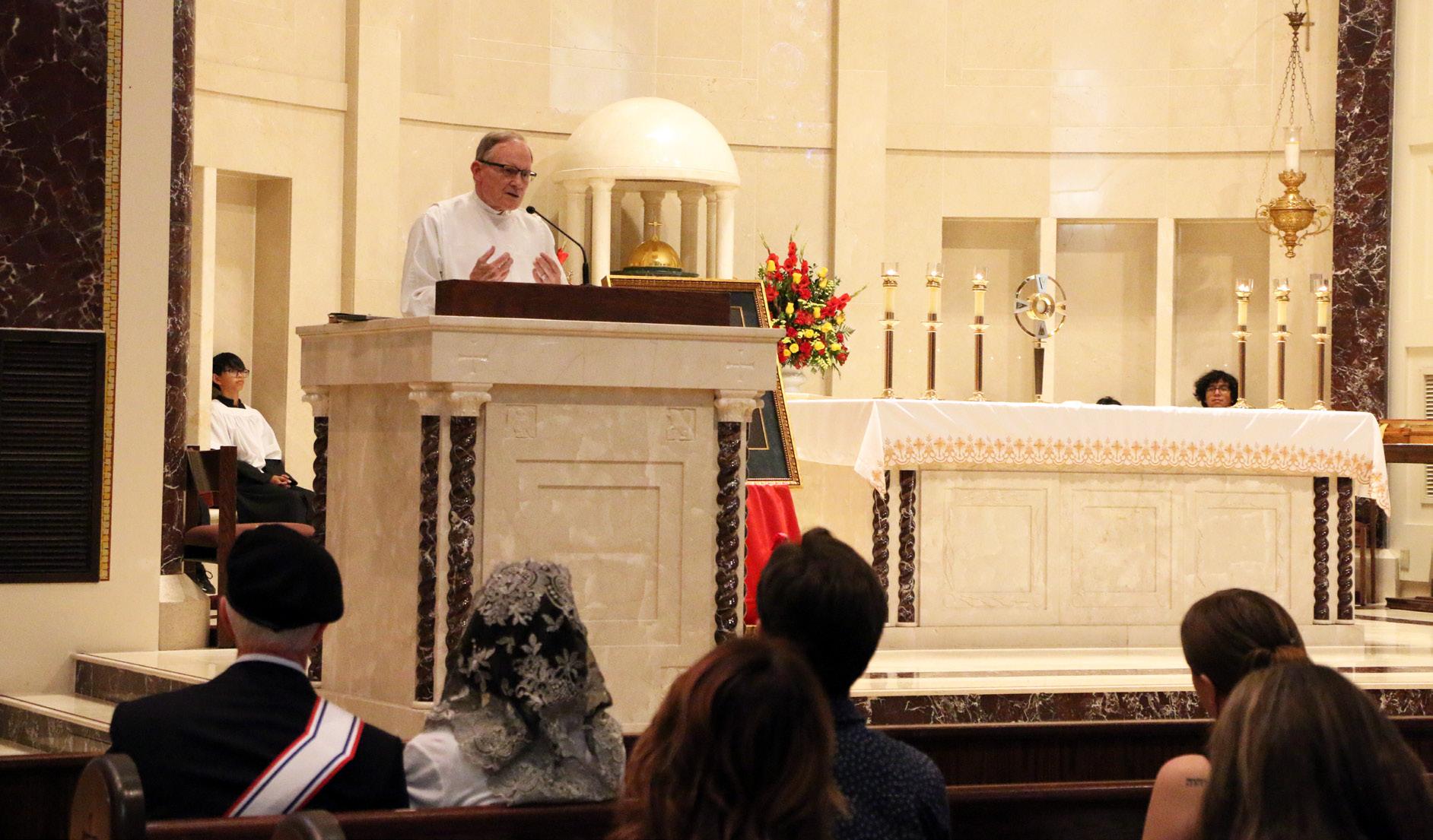
Left: Father David Boettner celebrates Mass June 12 and consecrates the diocese and the cathedral parish to Jesus’ Most Sacred Heart. Below left: Father Boettner incenses an image of the Most Sacred Heart during the June 12 Mass.
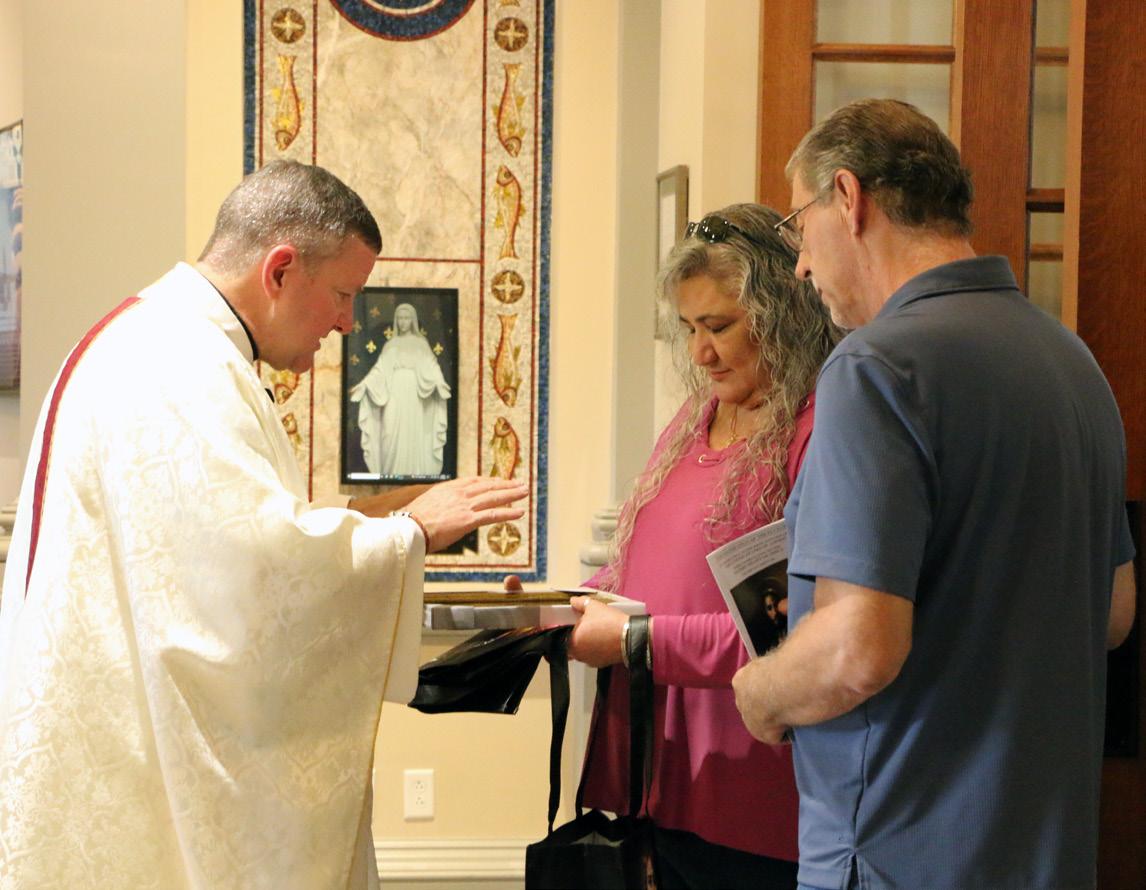
Below right: Father Boettner offers blessings after Mass. Several parishioners brought images and sacramentals related to the Most Sacred Heart to be blessed at the solemnity Mass.
heart of Christ that we start to ponder and reflect on these characteristics of the heart of Christ so that our hearts might be changed.
“So, today we pray for our country, for our diocese, for our parish. We pray for each other, that we might truly take on those characteristics of the heart of Christ, because our world needs it. Our country needs those characteristics of the heart of Christ. Our diocese needs those characteristics of the heart of Christ. We need those characteristics of the heart of Christ. And so today we come together so that we might encounter in our Lord and Savior His heart filled with love and mercy,” said Father Boettner, who as of July 1 is serving as pastor of Our Lady of Lourdes Parish in South Pittsburg and Shepherd of the Valley Parish in Dunlap.
At the conclusion of the Mass, Father Boettner led the faithful in reciting the prayer of consecration:
“O Most Sacred Heart of Jesus, you know the longings of our hearts, and you desire that we enjoy friendship with you.
“From your pierced side, you have poured out the wellspring of life, for which we thirst. Your heart burns with a love for all people to return to a right relationship with you.
“We celebrate the abundant gifts you have given this nation, founded on the self-evident truths that our Creator has endowed all people with the right to life, liberty, and the pursuit of happiness.
“We make reparation for the offenses against you and against human dignity that have taken place in this nation.
“May our hearts be united to yours, so that our families and communities enjoy peace and happiness; may broken relationships be reconciled, injustices repaired, and the wounds of our land be healed.
“May your holy Catholic Church serve as a sign, pointing all people to your infinite love.
“O Desire of Nations and Center of History, we ask you to bless these United States of America. In the name of Christ, who lives and reigns with God the Father in the unity of the Holy Spirit. God, for ever and ever. Amen.”
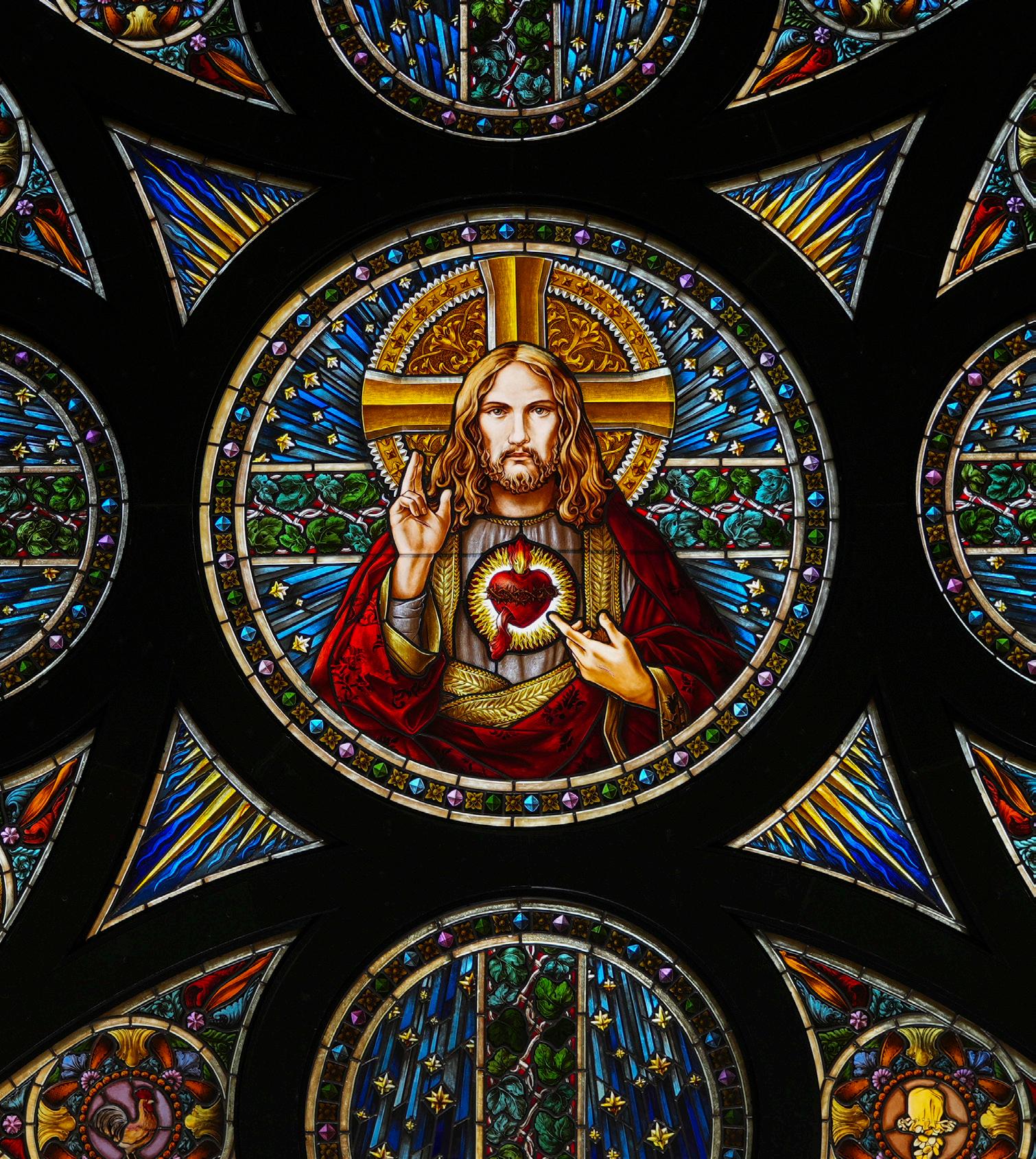
Following Mass, people received a limited-edition print of the image of the Sacred Heart of Jesus that is in the rose window of the cathedral along with resources on how to enthrone the Sacred Heart of Jesus in their homes. Some of the faithful brought their own images of the Sacred Heart or other Sacred Heart sacramentals to be blessed at the end of the Mass.
The Sacred Heart Apostolate, headquartered in the Diocese of Knoxville, works to share that love and mercy of the Sacred Heart of Jesus to people all over the world through the enthronement of the Sacred Heart of Jesus in parishes, schools, workplaces, and households.
The apostolate worked with the diocese to make the special prints available and to encourage home enthronement in conjunction with the national and diocesan consecrations. Further resources on devotion to the Sacred Heart, including enthronement, can be found at www.dioknox.org/fromthe-heart-of-christ ■
EMILY
BOOKER
(4)
'On fire with love' The cathedral of the Diocese of Knoxville is named after the Sacred Heart of Jesus, honoring His boundless love, mercy, and compassion.
‘The gift of His love’ St. John Neumann enthrones Sacred Heart of Jesus over parish and homes
By Emily Booker
St. John Neumann Parish in Farragut held a three-day mission June 28-30 focused on the love of Jesus, reconciliation, and building a civilization of love.
The mission was brought to the parish by the Sacred Heart Apostolate, which is committed to the Christian renewal of families through the Heart of Jesus. The apostolate is headquartered in the Diocese of Knoxville and brings missions such as this to parishes free of cost.
Father Richard McNally of the Congregation of the Sacred Hearts of Jesus and Mary led the three-day mission.
Each night drew a large congregation of close to 200 people who were looking to learn more about the Sacred Heart of Jesus and go deeper in their personal relationship with Christ.
“It’s gone really well, with great turnout,” Father Mark Schuster, pastor of St. John Neumann, said.
Father Schuster said he has always had a great devotion to the Sacred Heart of Jesus. He realized that it had been several years since the parish had hosted a mission, and with the parish’s 50th anniversary coming up in 2027, he felt it was the right time for a mission like this.
“In preparation of this 49th year into our jubilee year, how great would it be to begin to prepare the different homes, for people to come and hear about this then possibly enthrone the Sacred Heart into their own homes as a preparation for this jubilee for the entire parish community? So, that was part of the impetus to do this. I think the Lord wanted it. We can’t be obstacles to His will,” Father Schuster said.
A small group of parishioners began planning the mission early in the year. Later in the spring, the U.S. bishops announced that they would be consecrating the country to the Sacred Heart in honor of the country’s 250th anniversary.
“We heard about what the bishops of our country were doing, and I was like, wow, this just seems fortuitous because we have been working on this since early this year unbeknownst to what the bishops were working on. It seems like we might be praying for the same thing. The Holy Spirit is guiding this,” Father Schuster said.
The final night of the mission began with Father Michael Raj Joseph, IVE, associate pastor at St. John Neumann, exposing the Blessed Sacrament.
After the opening prayer, Lisa Morris, president of the Sacred Heart Apostolate, called the children to the front and spoke to them about St. Carlo Acutis (a teenage saint who created a website about eucharistic miracles), Jesus’ love for each of them, and living a life of sharing Jesus with others.
Following singing and Scripture-reading, Father McNally spoke on the theme of the evening, “building a civilization of love.”
Father McNally recalled one of his favorite verses in the New Testament, when Paul says in Romans 5:5, “Hope does not disappoint because the love of God has been poured in our hearts, and the Holy Spirit, who has been given to us.”
“The Holy Spirit is the Spirit of God’s love,” Father McNally said. “In our tradition, we say the Holy Spirit is substantial love…the infinite and unbounded love of God is pouring into each of our hearts through the Holy Spirit.
“This is the gift of Jesus to us, the gift of His life, the gift of His love.”
He noted that at the Last Supper, Jesus said, “This is my blood, poured out for you.”
“The very same word that Jesus uses there— the word poured—is the same word that St. Paul uses when he says ‘the love of God has been poured out into our hearts from the Holy Spirit who has been given to us.’ This great spirit of love.”
The Holy Spirit is received in the sacraments and is with us each day, he said. He reminded those listening to pray for the outpouring of the Holy Spirit each day. He also spoke about the image of the Sacred Heart and reflecting on Jesus’ outpouring of love.
“The heart is the deepest, most intimate center of the person. It is Jesus’ heart pouring out His Spirit into us, into our hearts, so that we can be transformed.”
He called for the faithful to be witnesses of Jesus’ great love in a world that desperately needs it. By being witnesses of that love and sharing it with others, they build a civilization of love.
“We are where God dwells. We, together as a Church, are a living temple of the Holy Spirit. This is a beautiful parish church. But if this church did not exist, the Church, the temple of God, would still exist because we together are the temple of God. We have the Holy Spirit dwelling in us, and the world needs us. The
world needs the power of Jesus Christ, the power of His love who dwells within us.”
Following Father McNally’s talk, Mrs. Morris spoke about the Sacred Heart Apostolate and enthroning the Sacred Heart in one’s home.
“One heart at a time. We can change our families. We can change our world,” she said.
“Some of the goals of the apostolate are the revitalization of faith and love in the home, families witnessing God’s plan for marriage and family, greater reverence for the Eucharist…we’re just trying to fulfill the mission of helping families make Christ the center of their home.”
Individuals and families were then invited to come forward to kneel in front of the Blessed Sacrament, praying for family members who were burdened or had left the Church. Members of the Knights of Columbus assisted.
Below:
At the end of the evening, Mrs. Morris called Father Schuster forward. She thanked him for hosting the mission at St. John Neumann. A reflection of gratitude and blessing was then read as a gift from the parishioners to Father Schuster. It said in part:
“Today, we anoint your hands anew with our love, not just our love but the love of the
entire Catholic Church family. Hold up your hands and look at them and remember how they fed us the Bread of Life, how they brought hope into our lives, how they comforted us and healed us, and then welcomed us home to the Church again. We wish we could take you by the hand and stand at the busiest intersection in Farragut and shout to the world: ‘Look everyone! This is our beloved priest in whom we are well pleased!’”
Mission continued on page A15
The Spirit of God's love Father Richard McNally of the Congregation of the Sacred Hearts of Jesus and Mary preaches about the Holy Spirit and building a civilization of love. He spoke on the last night of a three-day mission held at St. John Neumann Church June 28-30.
EMILY BOOKER
COURTESY OF MICHAEL WILSON/ST. JOHN NEUMANN PARISH
Sharing God's love Left: Children of St. John Neumann Parish listen to Lisa Morris talk about the love of Jesus and sharing that love with others. The parish mission included special activities and talks for children.
Father Mark Schuster, St. John Neumann pastor, displays the Eucharist. The mission included exposition of the Blessed Sacrament and adoration.
EMILY BOOKER
Enthronement Left: A Blessed Virgin Mary statue leads a procession into St. John Neumann Church during the parish’s enthronement of the Sacred Heart of Jesus. As the Sacred Heart was enthroned, more than 50 families signed up to enthrone the Sacred Heart in their homes.
COURTESY OF MICHAEL WILSON/ST. JOHN NEUMANN
Bishop Mark Beckman
Dr. Carol Akerman
All Saints Catholic Church
Bill and Theresa Allington
The Allington Family
Debra Anderson
Wally Anderson
Ana Andrade
Juana Angeles
Bob and Lisa Beldyk
Gary and Robin Bevins
The Birge Family
Robert Bokan Family
Tom and Linda Bolen and Family
The Borgeson Family
Jim and Connie Brace
Bill and Angel Brewer
Will, Becca, Penelope and George Brewer
The Briggs Family
Ronald and Shirley Bugos
Peggy Burnette
Meme/Mark Bush
Karen and Bob Byrne
The Calvert Family
John and Jenny Campbell & Daughters
Ray and Cindy Chan
Tom & Donna Charron
The Cieslik Family
Art Clancy III Family
The Cortese Family
John and Marion Croker
Frank and Mary Dale
Patricia Danko
Marion Darby
The Denning Family
Duane and Debbie Donahoo
The Donahoo Family
Ruth Dorman
Bill and Stacy Dunn
Daniel and Mary Amber Dunn & Samuel and Peter
Marieta Dunn
Mary K. Dunn
Sarah Dunn
Jerry and Suzanne Erpenbach
Ginger and Randy Fisher
Orville and Jane Fisher
The Francescon Family
Helen Freeh
The Gaertner Family
Pete Gerlach
Coral Getino and Family
Marianne & Kenneth Goodwin
Marlene Guerinot
Bill and Deedee Hansen
Leslie Hardt
Hartsfield Family
Joanne Hayden
Katie Helms
The Hopwood Family
Ryan and Leslie Hunse
Margaret and Deacon Bob Hunt
Fr. Valentin Iurochkin
Nick and Amy Iverson and Kids
Monique Jeannette
Becca & David, Georgia, Gloria, Genevieve
Dylan and Mary Margaret Jenkins and Theo and Abram
Jennie and Tom Johnson
Patricia Johnston
Mr. and Mrs. Brian Kelley and Family
The John Kiernan, Jr. Family
The Kirrsey Family
Knights of Columbus Ted H. Denning Council 8781
St. John Neumann Church
The Koelsch Family
The David J. Koss Family
Alan and Deborah Lee
The Ray Lefebvre Family
Darlene and Terry Leitz
Lynne Liddington
The Liulevicius Family
The Marlowe Family
Julie McCleary
Kecia McConville
The McDonough Family
Catherine McHugh
Maureen and Brett McLaughlin
Luke Meade
The Rich Melton Family
Jeanne Miller
Firas Mishu Family
The Neidig Family
The Martin/Ocmond Family
Reyna Ortiz
Pat Pennebaker
Kathy Perry
Judy Pickering
The Stanley Pickering Family
Pichiarella Family
Angelica Plattalwati Pluma
Bernet Poczobut
Dave and Patty Powers
Carole Price
Mary and Steve Price
Diane Przybyszewski
Stanley and Josette Rabun
The Ramirez Family
Bill Renaud
Schmidt Family
Kurt and Kristin Schueler
Annie Schwintosky
The Schwintosky Family
Tim and Donna Scripa
The Sinclair Family
Jeffrey & Andrea Smile
Cristina de Soriano
Pat and Kimberly Stapleton
Alice Stephens
Mr. and Mrs. Christopher Stevens
Nancy Stutts
Shiloh and Deb Swecker
John Sweeney
Richard and Natalie Tabler
Michael and Dorothy Terheyden
Mary Thacker
David and Susan Thompson
Ursula & Paul Thompson
Nancy and Gary Tucker
Philip G. Vance
The Walsh Family
John and Gail-Marie Walter
Matthew Walter
Janet West
The Whitt Family
Andrea Wignall
The Wilson Family
The Wolfenbarger Family
Jim and Ginny Wood
Glenn and Patsy Wyatt
Christian and Katie Young
All Saints Catholic Church
Cathedral of The Most Sacred Heart Of Jesus
Holy Ghost Catholic Church
Holy Trinity Catholic Church, Jefferson City
St John Neumann Catholic Church
St. Mary Catholic Church, Oak Ridge
St. Thomas the Apostle Catholic Church, Lenoir City
Berean Bible Church
Blount County Pregnancy Resource Center
Calvary Knoxville
Grace Lutheran Church
RIO Network of Churches
St. Nektarios Orthodox Church
Trinity Community Church
Wallace Memorial Baptist Church
Our Lady of Fatima Church Respect Life Committee
St. Mary's Knights of Columbus Council 3175
Knights of Columbus Council 3832, Our Lady of Fatima Church
In Honor of All Expectant Mothers by Helen & Roger Schwintosky
In Honor of Carol Rosenberger by the Allen Family
In Honor of Angela by Juana Angeles
In Honor of Baby Briggs by the Briggs Family
In Honor of the Bugos Children by Ronald and Shirley Bugos
In Honor of Monika by Meme
In Honor of Precious Grandchildren by Byrne & Pascoscio Family
In Honor of the Unborn by the Calverts
In Honor of Robert & Rita Charron by Tom & Donna Charron
In Honor of Mary Dunn by Mark and Rita Cook
In Honor of our Mother Laura by Frank and Mary Dale
In Honor of Charles Dorman by Dorman children
In Honor of Stacy & Bill Dunn by Helen Freeh
In Honor of Nora Galbaugh by Mark Galbaugh
In Honor of Ann Gerlach by Pete Gerlach
In Honor of Lisa Iuppa by Joanne Hayden
In Honor of Father John Dowling by Nick and Amy Iverson & Kids
In Honor of Norma Dixon by Monique
In Honor of Gemma Gianna Zelie Jenkins
In Honor of Helen Kiernan and Doris Farrar by the Kiernan Family
In Honor of Estela Munroy by Kirrsey
In Honor of John Lakso, Jr. by the Lakso Family
In Honor of McGavin and McLaughlin Families
In Honor of Kim Meade by your loving son, Luke
In Honor of Therese Ocmond, Marie Ocmond by Marsha Martin
In Honor of Victoria Marie Orr by Fr. John Arthur Orr
In Honor of Familia Gonzalez
In Honor of the LaPoint Familly by the Osorio Family
In Honor of Familia Plondiota
In Honor of Clint Price by Mary and Steve Price
In Honor of Tennessee Right to Life Staff & Volunteers by Carole Price
In Honor of the Unborn by Matthew Rogers
In Honor of Sybil Caywood by Jennifer Schmidt
In Honor of Familia Soriano Mendoza
In Honor of Mary K. St. Martin by her 3 Daughters
In Honor of Sharon Dawley by Kim Stapleton
In Honor of our Grandchildren by Richard and Natalie Tabler
In Honor of Carrie Thompson by David and Susan Thompson
In Honor of John J. Vance by Philip Vance
In Honor of Cathy by Mark Voit
In Honor of Patricia von Clef by Kristen von Clef
In Honor of Anna, Savannah and Darin by Paula Wilson
In Honor of Joy Winter & Elizabeth Borland Winter
In Memory of Lucille and Bayard Donahoo by Duane and Debbie Donahoo
In Memory of Fred and Julia Allington by Bill & Theresa Allington
In Memory of Litteureaux, John & Luella by Bill & Theresa Allington
In Memory of Mario Jorge de Andrade by Ana Andrade
In Memory of St. Louise Genest by Michelle Bender
In Memory of Pechak and Bokan by Bob and Charlene
In Memory of Alice De Mastry by your children
In Memory of Pearl by Mark
In Memory of Mary Dolan Mahler
b y John and Jenny Campbell & Daughters
In Memory of Paul T. Dunn III by Mark and Rita Cook
In Memory of Paul T. Dunn, Jr. by Mark and Rita Cook
In Memory of Our Mother Carol by Frank and Mary Dale
In Memory of Michael and Annie Danko Family by Patricia Danko
In Memory of James Darby by Marion Darby
In Memory of Tom DeGloma by Cathi DeGloma
In Memory of Phyllis & Ted Denning by Susan Denning
In Memory of Laura and Andy Blalack
b y Duane and Debbie Donahoo
In Memory of Rachel Donahoo-Wiggins by Mom and Dad
In Memory of Frank Francica by Ruth Dorman, daughter
In Memory of Paul T. Dunn III by Marieta Dunn
In Memory of Paul T. Dunn, Jr. by Mary K. Dunn
In Memory of our parents and grandparents
b y Jerry & Suzanne Erpenbach
In Memory of Helen Froula
In Memory of Justino Getino by his family
In Memory of Our parents by Marianne and Kenneth Goodwin
In Memory of Deacon Mike Gouge by Anita Gouge
In Memory of Margaret Casey by Marlene Guerinot
In Memory of Bob Hansen by Bill and Deedee Hansen
In Memory of Gabriel Miller by Mom
In Memory of James Dixon by Laurel Oaks Wellness Spa
In Memory of Tegan Johnson by Jeff & Michelle Johnson
In Memory of James Vann Johnston, Sr. by Patricia Johnston
In Memory of Dr. Daniel Koelsch by his family
In Memory of William Manks by the Lakso Family
In Memory of George J. Mares, Jr. by Alan and Deborah Lee
In Memory of Bertha and Donald Liddington by Lynne Liddington
In Memory of Patrick McCleary by Julie McCleary
In Memory of Charles & Lucille Gallagher
b y the McDonough Family
In Memory of Baby Lilith Wall by Catherine McHugh
In Memory of Margaret Redmond by Your great-grandson, Luke
In Memory of Stephen Miller by Jeanne Miller
In Memory of Thelma Wantschek by Firas Mishu Family
In Memory of Thelma Pearson-Walter by the Neidig Family
In Memory of Emilie Oubre/Thelecide LeBouef by Marsha Martin
In Memory of Gertrude Genevieve MacVeany by Fr. John Arthur Orr
In Memory of Abril by Reyna
In Memory of Carlos E. Osorio & Maria Ines Osorio
b y the Osorio Family
In Memory of Catherine and Lewis Pennebaker by Pat Pennebaker
In Memory of Tom Perry by Kathy Perry
In Memory of Ellen Anna Clancy Pickrering by Judy Pickering
In Memory of Frank G. Pickering by Leticia S. Pickering
In Memory of Stan and Ellen Pickering
In Memory of Juanito by Angelica Plattalawati Pluma
In Memory of our mothers by David and Patty Powers
In Memory of Florence Brandt by Przybyszewski Family
In Memory of the Gonzalez Family by the Ramirez Family
In Memory of Judy Schmidt by Jennifer Schmidt
In Memory of Bill and Dolores Gogar by Tim and Donna Scripa
In Memory of John Anthony Sewll & Carole Thorp by Mark and Dori
In Memory of Jessica & Joseph Appel by Jeffrey & Andrea Smile
In Memory of Christina Soriano Mendoza
In Memory of Jim Stapleton by Pat Stapleton
In Memory of Barry Stutts by Nancy Stutts
In Memory of Wilson & Rita Powers by Nancy Stutts
In Memory of Wilda Sweeney by your husband John
In Memory of 3 babes in Heaven by the Thomas Family
In Memory of Bob Turpin by Kathy Turpin
In Memory of Ellen M. Vance by Philip Vance
In Memory of Anthony & Lena Venafro by Tony Venafro
In Memory of Harry and Donna Brown by Lynn Brown Venafro
In Memory of Louise Conner by Kristen von Clef
In Memory of Mildred Morvant by John and Gail-Marie Walter
In Memory of Ellen Joy Clancy and her family of mothers
In Memory of Wood and Williams Families by Jim and Ginny Wood
In Loving Memory of GranGran and GranGrandaddy
A ‘monumental’ dedication
State’ s Monument to
The East Tennessee Catholic
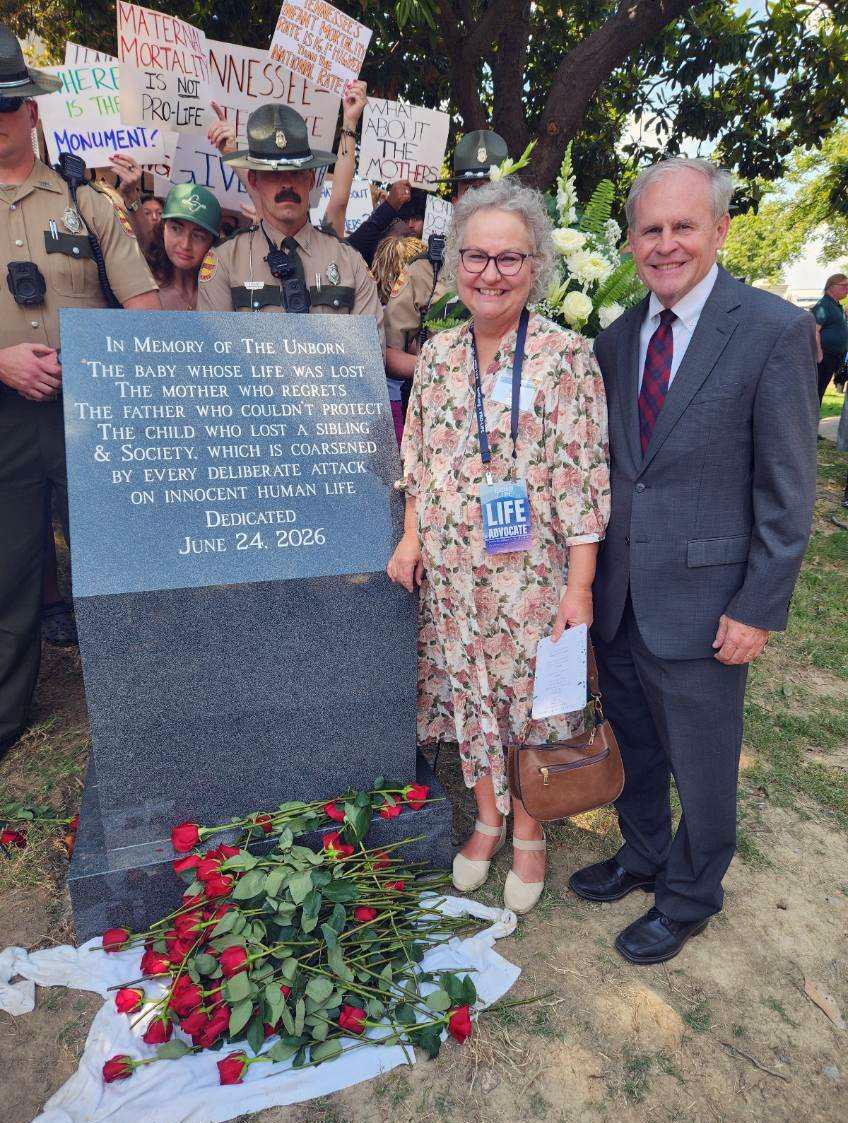
Tennessee cemented its stature as a leading right-to-life state on June 24 when lawmakers and dignitaries dedicated the Monument to Unborn Children in Nashville on the Capitol grounds.
The privately funded monument, eight years in the making, is reportedly the first one dedicated to victims of abortion that is on state capitol grounds in the United States.
Nearly 200 people from across Tennessee gathered on the southeast side of the Capitol for the ceremony, which was led by state Sens. Tom Hatcher of Maryville and Janice Bowling of Tullahoma.
Also on hand was former state Rep. Bill Dunn of Knoxville, whose initial idea for the monument was shared by former state Rep. Jerry Sexton of Grainger County years ago when the two served together in the General Assembly.
Mr. Dunn recalls broaching the idea with his wife, Stacy, who then was executive director of the Knox County Chapter of Tennessee Right to Life and now serves as the state president of the nonprofit pro-life organization.
Mr. and Mrs. Dunn, longtime Diocese of Knoxville parishioners who are members of Holy Ghost Parish, agreed the monument would be a fitting tribute to all victims of abortion and a testament to the sanctity of life, which is a foundational teaching of Jesus Christ and the Catholic Church.
The Dunns took part in a rosary for life in front of the Planned Parenthood clinic in Knoxville on the morning of June 24, which was the four-year anniversary of the U.S. Supreme Court’s Dobbs ruling that overturned the 1973 Roe v. Wade decision, before attending the monument dedication.
Roe v. Wade established women’s right to an abortion, making it a federal law and overriding each state’s authority to regulate abortion.
The Dunns pointed out that the monument dedication day was intentional.
“The date is very significant because so many victims of abortion who are memorialized are the direct result of Roe v. Wade . So, the day Roe v. Wade was ended was the day to look back. … At least in Tennessee, this monument was dedicated on the anniversary when Tennesseans were once again allowed to protect every life in this state,” Mr. Dunn said.
“The Dobbs anniversary was part of the celebratory mood of the day. In Tennessee, we’re protecting unborn children and their mothers from the tragedy of abortion. This is a day to be remembered not only for the memorial but for Dobbs day. And we still give thanks to God for the miracle of Roe being overturned. There were people at the monument dedication who thought that day would never come. We were recognizing the lives lost but we also were recognizing the miracle that God has given us,” Mrs. Dunn added.
Inscribed on the Capitol monument are the words,
“In Memory of the Unborn The Baby Whose Life Was Lost The Mother Who Regrets The Father Who Couldn’t Protect The Child Who Lost a Sibling & Society, Which is Coarsened By Every Deliberate Attack On Innocent Human Life Dedicated June 24, 2026”
Inspiration for the monument arose from the Capitol grounds itself years ago. And two existing monuments gave then-Rep. Dunn the idea.
“At the state Capitol, there are two previous markers: one for the victims of slavery and one for the victims of the (World War II) Holocaust. Personally, when I would go to the Capitol and walk the grounds, I noticed those two memorials. Being a member of Tennessee Right to Life and the whole life issue being important to me as a representative, I thought there should be a monument to the victims of abortion,” Mr. Dunn said.
He served in the state legislature from 1994 to 2020, during which time he was Speaker Pro Tempore and acting House Speaker.
“I had been thinking about it, but I never really acted on it. Then, Rep. Jerry Sexton actually filed a bill to do something very similar. When he did, I went to him and said, ‘Wow; I have thought about this, and did you realize there are two other markers on the Capitol grounds? This would be perfect.’ It would deal with the same subject of what happens when you don’t treat other humans as human,” the former state legislator added.
“On the markers for the victims of slavery and the Holocaust, both of them have inscribed near the end, ‘so this may never happen again’ or ‘so we don’t forget.’ Yet, here we
Unborn Children
unveiled at Capitol ceremony
Remembering the victims of abortion Stacy and Bill Dunn stand next to the Monument to Unborn Children on the state Capitol grounds in Nashville on June 24. The memorial was dedicated on the anniversary of the U.S. Supreme Court decision overturning "Roe v. Wade."
are in America, where we have forgotten and we are repeating the mistakes of other generations. So, Jerry Sexton actually had the bill and carried it, and Sen. Steve Southerland carried it in the Senate,” he continued.
In explaining the legislative process, Mr. Dunn said efforts were made to “water down” the legislation, instead directing the Capitol Commission that manages the Capitol grounds to only “consider” putting up a monument. However, the supporting lawmakers held their ground and insisted that the legislation require that a monument to the victims of abortion be erected.
The monument legislation was approved by the General Assembly in 2018. Then, the Capitol Commission was called on to carry out the project, which took time.
In the meantime, Mr. Dunn and Mr. Sexton decided not to run for re-election and then the COVID-19 outbreak occurred in late 2019 into 2020, which sidetracked the project.
Mrs. Dunn explained that as the Capitol Commission added the monument to its list of projects to complete, the General Assembly passed the Human Life Protection Act in 2019, giving Tennessee the strongest pro-life law in the country. Subsequently, Roe v. Wade was overturned by the U.S. Supreme Court on June 24, 2022.
A move was made to get the monument project back on track and completed before the end of Gov. Bill Lee’s second term in office. He was first elected in November 2018 and concludes his last term this year.
“Bill went to Sen. Janice Bowling and said can you help get this project spearheaded again. And she really did take it and run with it at that point,” Mrs. Dunn shared.
Mr. Dunn noted that the law establishing the Monument to Unborn Children specified that the project would be completed with private funding and that no public money would be used. He pointed out that money couldn’t be raised until the project cost was known.
The Dunns said initial estimates for the project were put at $150,000, but it was actually completed for less than $10,000.
According to the couple, Sen. Hatcher is familiar with the monument business and secured an affordable price for the marker, which was the only significant cost involved in the project.
“It was way less than what was originally said, which had been problematic,” Mr. Dunn said.
The Dunns were excited to be a part of the monument dedication.
“I thought it was amazing. It was so good to see it finally happen. There were so many state legislators there who were part of the process. That was great to see. People came from Knoxville and Chattanooga. People came from Memphis,” Mrs. Dunn said. “We had a great crowd, and the atmosphere was so celebratory. It was a great day.”
She described a solemn point in the ceremony when each person in attendance was given a rose to place at the foot of the monument in remembrance of each life lost to abortion.
Mr. Dunn emphasized that the Monument to Unborn Children is “very appropriate” and complements the other two monuments on the Capitol grounds.
The Dunns are grateful the monument finally is in place.
“I always knew that there could be hurdles placed in front of us in making this happen.
But Sen. Janice Bowling made a huge difference in staying after it,” Mr. Dunn said. Mrs. Dunn said she never doubted that the monument would be placed and dedicated once the legislation was approved.
“It was just a matter of determining what it was going to take to make it a reality. I think it was in God’s perfect time when it happened. It was all Him orchestrating the whole thing,” she said.
Mrs. Dunn shared that one woman who attended the ceremony lost a baby to abortion and expressed that she needed to be at the monument dedication because it was so important to her.
“It really made a difference that she was there. And I think we had some other folks like that,” Mrs. Dunn said. “The dedication was held on a weekday when the legislature was not in session. And it was during the heat of the day. But many people attended, and they stayed for the reception. They wanted to be there. It was such a celebration for them.”
She noted that for a number of people, like her husband, who supported life early in his time in the legislature when the General Assembly “wasn’t so friendly to life,” the dedication ceremony was “monumental” to them.
“It was a huge thing, especially for those who had been in the fight before there was more support,” Mrs. Dunn said.
Mr. Dunn, who joined Gov. Lee's staff as an adviser after he left the legislature and served there until retiring late last year, told how he wrote the words inscribed on the monument following his experience shepherding pro-life legislation through the General Assembly and his support for the work done by Tennessee Right to Life.
While Tennessee Right to Life supported the Monument to Unborn Children project, Mrs. Dunn said the memorial belongs to all in the state who support and defend the sanctity of life.
“Tennessee Right to Life played a part in this coming to fruition. I don’t see that it is a Tennessee Right to Life monument. It is a monument for everyone in the state who supports life,” she said.
The dedication ceremony wasn’t without its detractors. A group of pro-abortion protesters tried to disrupt the event, but their impact was kept in check by Tennessee state troopers.
“It was such a grand occasion that I don’t think the protesters took away much of the spirit from the crowd. For the most part, they were quiet. There were a couple of protesters who made noise. Otherwise, they held their signs and made their way among the crowd. There did seem to be some agitation when it was time to take pictures and they were holding their signs in front of the monument. But the state troopers helped,” Mrs. Dunn said.
Despite any opposition, the Dunns believe the monument and its dedication exemplified how people always find a way to make something work.
“A lot of people did something. We always say we’re all in this together. This is a perfect example of that,” Mrs. Dunn said.
Paul Simoneau, vice chancellor of the Diocese of Knoxville and director of its Office of Justice and Peace, praised the monument and those who made it happen.
“Standing on the grounds of our state Capitol, this monument proclaims a truth that neither time nor circumstance can erase: every human life is sacred from conception to natural death. It serves as both a memorial to the unborn and a call to future generations to defend and cherish the gift of human life,” Mr. Simoneau said.
“The Tennessee Monument to Unborn Children is a testament not only to the dignity of every human life but also to the perseverance of those who refused to grow weary in defending that dignity. We give thanks in a particular way for retired Rep. Bill Dunn as well as Tennessee Right to Life and Stacy Dunn and Angel Brewer (Knox County chapter executive director), whose decades of faithful service helped bring stronger protections for the unborn and this sacred memorial into being,” Mr. Simoneau added.
Mr. Simoneau also credited other pro-life organizations that serve communities in Tennessee in exemplary ways, such as Catholic Charities of East Tennessee and its pregnancy help centers and adoption services.
“It’s a reminder that the ‘first environment,’ the womb, is the most important environment,” he said. “While we give thanks for the end of Roe v. Wade , we must remain vigilant, for a culture of life is built not only by past victories but by the courage to resist every effort that would once again place innocent life in jeopardy, particularly against efforts to water down the Human Life Protection Act by those who profess to be pro-life.” ■
COURTESY OF GINGER TREECE/TENNESSEE RIGHT TO LIFE
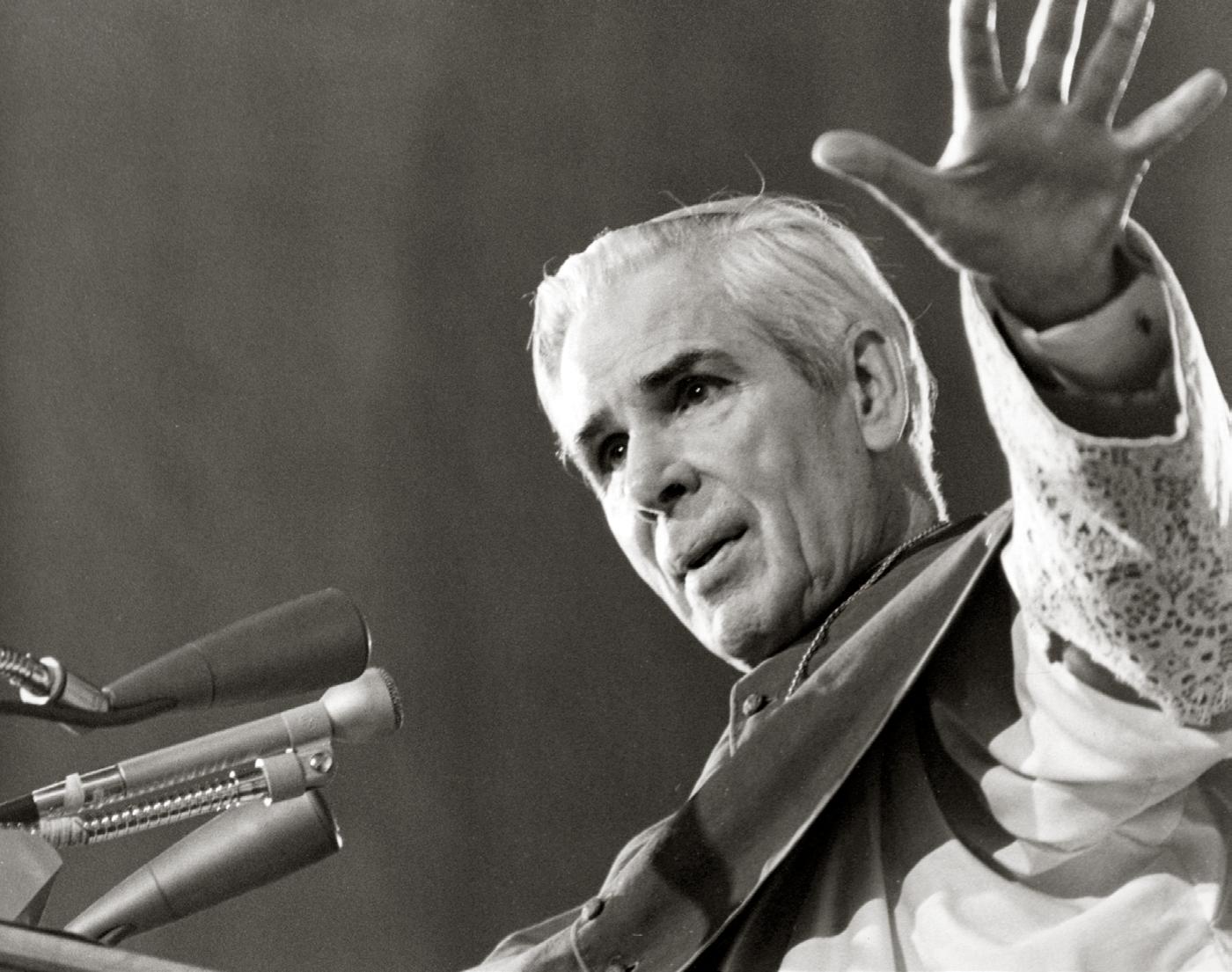
‘God’s microphone’ Fulton Sheen grew from Midwest farmboy to a Venerable Servant of God
By Bee Goodman
It is easy to picture a saint as someone born for the spotlight. We imagine sweeping vestments, packed cathedrals, a voice made for the microphone from the very start. Surely a man who wins an Emmy Award, who beats Milton Berle in the ratings, who lands on the cover of Time magazine—surely a man like that went looking for the stage.
Fulton Sheen did not.
He wanted, from the earliest age he could remember, to be a priest. Nothing more elaborate than that. He said in his autobiography, “I can never remember a time in my life when I did not want to be a priest.” He did not dream of television. Television, in the truest sense, had not even been invented yet.
And then, without asking for it, along came fame.
It landed on him the way a cross sometimes lands on an ordinary man walking home from the fields—not sought, not rehearsed, simply placed there. What he did with it, and where it has led the Church 47 years after his death, is worth pausing over.
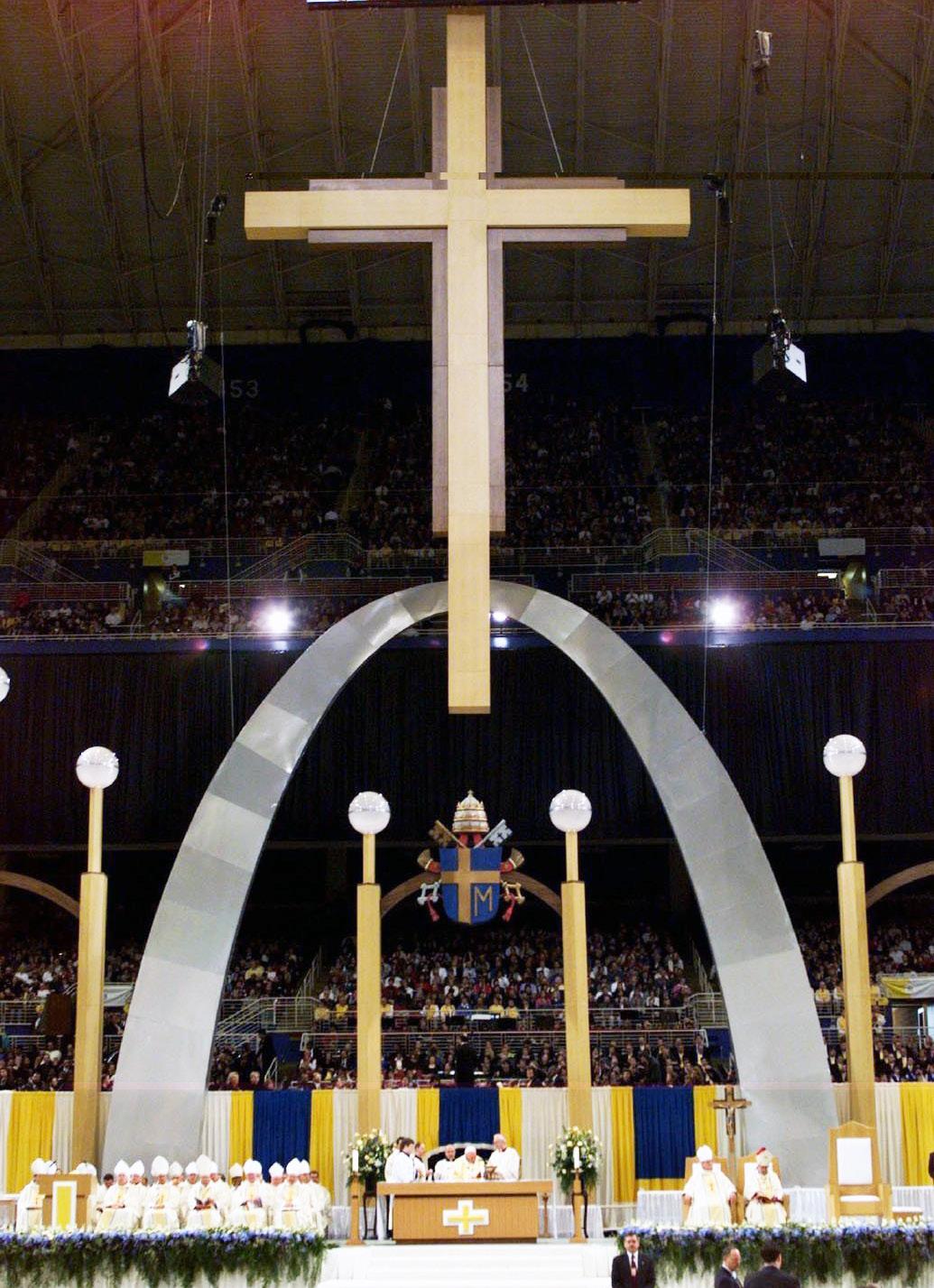
Coming Sept. 24, Venerable Servant of God Fulton J. Sheen will be beatified at a Mass at The Dome at America's Center in St. Louis, presided over by Cardinal Luis Antonio Tagle on behalf of Pope Leo XIV, the first beatification or canonization ever celebrated in the Archdiocese of St. Louis.
Far from just a farmboy
Fulton Sheen was born Peter John Sheen on May 8, 1895, in El Paso, Ill., the eldest of four sons born to Newton and Delia Sheen. When he entered first grade at St. Mary School, the name
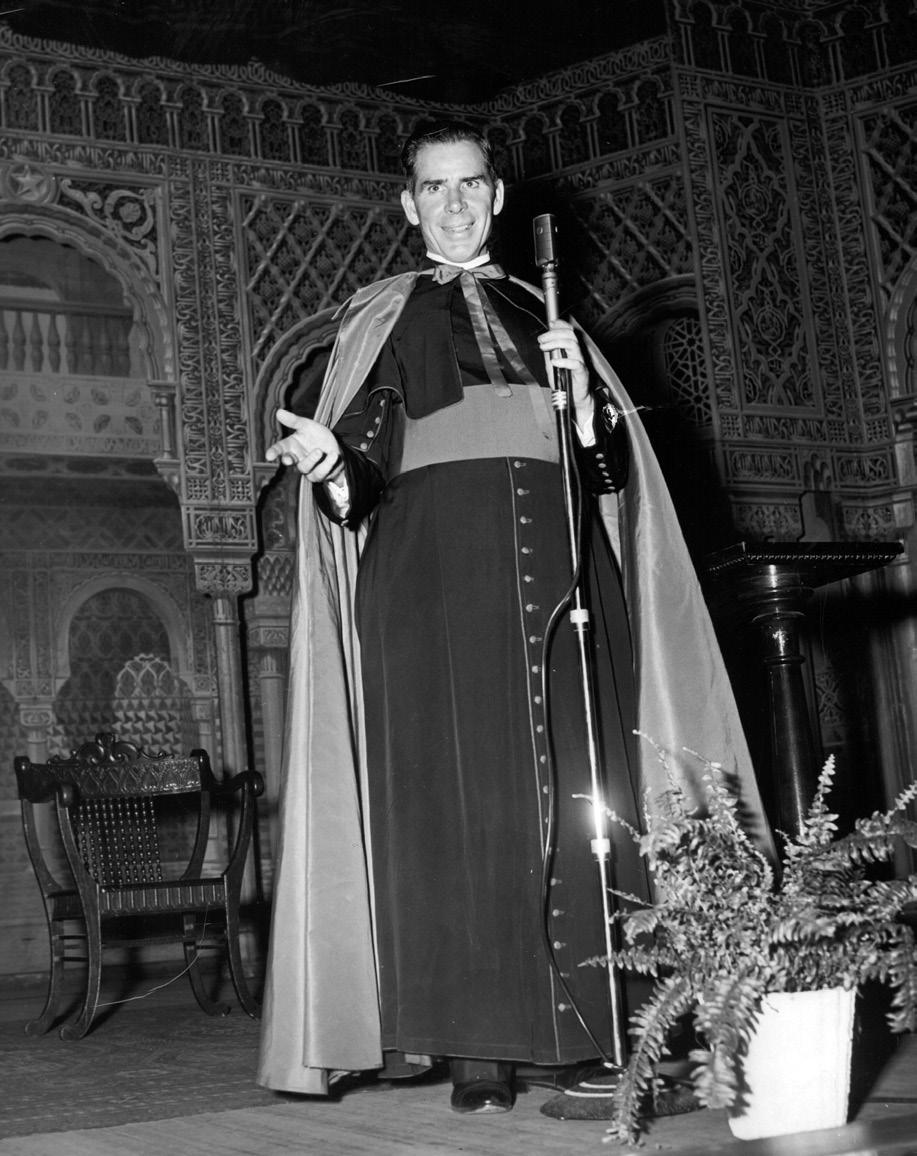
Path to sainthood Despite high-profile delays in recent years, the beatification of Venerable Servant of God Fulton J. Sheen, the popular, scholarly archbishop and 20th-century pioneer of Catholic broadcasting, is set for Sept. 24 in St. Louis. Archbishop Sheen is pictured in an undated photo.
on the roll was quietly changed to “Fulton,” his mother’s maiden name, and it stayed with him the rest of his life.
He was, by his own admission, no farmer. A neighbor once told his father plainly that his oldest boy would “never be worth a damn” because he always had his nose in a book. His brothers took to the fields without complaint.
Pope Leo: Archbishop Sheen
However, Fulton later wrote that he simply endured farm work; he did not enjoy it.
One story from his boyhood has followed him ever since. Serving Mass as an 8-year-old altar boy for Bishop John L. Spalding of Peoria, he dropped a wine cruet and shattered it on the floor.
Rather than scold him, the bishop pulled the frightened boy aside and made two predictions: that he would one day study at the University of Louvain in Belgium, and that he would someday become a bishop himself. Both became true.
Fulton Sheen graduated valedictorian of Spalding Institute in Peoria, Ill., studied at St. Viator College in Bourbonnais, Ill., and entered St. Paul Seminary in Minnesota.
He was ordained a priest of the Diocese of Peoria on Sept. 20, 1919, at St. Mary’s Cathedral in Peoria. That same day, he made a private promise to God: he would spend one hour every day before the Blessed Sacrament for the rest of his life. He kept that promise for 60 years through fame, through controversy, and through failing health.
He later called it the wellspring of everything else he ever accomplished.
“Everything else,” as it turns out, would be considerable.
‘a light of faith’ Plans underway, tickets being sold for beatification of venerable U.S.
By Courtney Mares
OSV News
Pope Leo XIV praised Venerable Fulton J. Sheen in June as “a light of faith, hope, and love” whose radio and television broadcasts brought the Gospel to millions of Americans, including the pope himself as a child.
Speaking at a Vatican audience with members of the Pontifical Mission Societies, the pope called it providential that the beloved archbishop will be beatified during the centennial year of the Pontifical Mission Societies he once led as the national director of the U.S. Society for the Propagation of the Faith.
“Archbishop Sheen was a light of faith, hope, and love that shone through the radio and television media for decades,” Pope Leo said on June 1.
“I myself am a witness of his evangelization when I was growing up,” the pope added. “His broadcasts touched millions with the hope of the Gospel, and his initiatives and efforts resulted in enormous spiritual and material aid to the churches in areas of first evangelization.”
The beatification of Archbishop Sheen is scheduled for Sept. 24 in St. Louis. His beatification was previously postponed by the Vatican in 2019. Archbishop Sheen was declared venerable in 2012. Beatification is the final step before canonization, and Archbishop Sheen will require one more miracle attributed to his intercession to be declared a saint.
“May our new Blessed be an example for all of the national and diocesan directors of the Pontifical Mission Societies throughout the world,” the pope said.
Pope Leo, 70, has said that he watched Archbishop Sheen’s television program as a child.
The American pope was elected last year on Archbishop Sheen’s birthday.
Born in El Paso, Ill., on May 8, 1895, Venerable Sheen was ordained a priest for the Diocese of Peoria on Sept. 20, 1919. He went on to become one of the most
recognized Catholic voices in American history, rising to national prominence during the 1930s and 1940s as host of The Catholic Hour on NBC radio.
Beginning in 1952, then-Bishop Sheen reached tens of millions of viewers each Tuesday evening through his television program Life Is Worth Living Armed with little more than his intellect, charisma, a cape, and a chalkboard, he won an Emmy Award for best television personality after his first season, famously thanking his writers: “Matthew, Mark, Luke, and John.”
Throughout his 60-year priesthood, Bishop Sheen sought to conform himself more closely to Christ by observing a daily eucharistic Holy Hour, what he called “the hour that makes my day.”
He also was intensely devoted to the Mother of God.
For 16 years, Archbishop Sheen served as the national director of the Society for the Propagation of the Faith, one of the four Pontifical Mission Societies, during which he sought to form American Catholics in missionary spirituality and identity and help raise funds to spread the faith and build the Church across the globe.
According to Monsignor Roger J. Landry, the current national director of the Pontifical Mission Societies in the United States, Archbishop Sheen donated more than $10 million of his media earnings to the missions during his lifetime, raised $200 million for missionary work (the equivalent of nearly $2.1 billion today), and left 40 percent of his estate along with book royalties to the ongoing work of evangelization.
“It would be almost impossible to enumerate the churches, schools, seminaries, convents, and monasteries that exist today because of his work, not to mention the amount of dioceses sustained and programs underwritten because of his efforts,” Monsignor Landry said.
Archbishop Sheen died on Dec. 9, 1979, in New York City in the presence of the Blessed Sacrament after nearly two years of declin-
ing health following open-heart surgery.
During the audience with the Pontifical Mission Societies, Pope Leo called 2026 “a year truly rich in missionary milestones,” noting that this year also marks the 100th anniversary of World Mission Sunday, established by Pope Pius XI at the request of the Pontifical Society for the Propagation of the Faith.
This year’s World Mission Sunday falls on Oct. 18 under the theme “One in Christ, united in mission.”
“In a world increasingly marked by division, war, and conflict among nations and peoples, the four Pontifical Mission Societies … render an invaluable service to the Church’s mission of proclaiming Christ, the Prince of Peace and the incarnate revelation of Divine Love for humanity,” Pope Leo said.
“Let us therefore continue our missionary journey with joy and renewed zeal,” he said. “In all that we do for the work of evangelization, may we always place Jesus Christ at the center, embracing the beautiful Gospel principle expressed by John the Baptist: ‘He must increase, but I must decrease.’”
Information and tickets for Venerable Servant of God Sheen’s Sept. 24 beatification in St. Louis and events surrounding the historic celebration were made available starting the week of June 22 through the Archbishop Fulton Sheen Foundation website at celebratesheen.com
Bishop Louis Tylka of Peoria announced the ticket availability with “profound joy and gratitude” in a June 18 letter to friends of the Beatification continued on page A22
Ms. Goodman
Saints & Souls
Sheen continued on page A22
Right before our very eyes
As the Synod unfolds, the Implementation Phase is in plain sight
By Jim Wogan
One of my most persistent and self-loathing traits is something we’ve all probably experienced in life—my not-sounique but absolutely confounding and frustrating ability to misplace things. My wife affectionately refers to it as “carelessness.” Ouch.
Where is my wallet? What did I do with the keys? And the most frequent utterance that emanates from my mind and mouth on a dreadfully consistent basis is…where did I put my glasses? For me, it’s always the simple yet essentially everyday stuff that goes missing.
Well, not always.
While preparing for the arrival of Fourth of July guests a few weeks ago, I made an effort to locate my old-fashioned, hardly used charcoal grill—which needed some cleaning. And I had just the right tool to assist me. A wire brush that I keep in an old-fashioned, hardly used toolbox in my garage. Except, it wasn’t there.
Admittedly, it’s been a long while since I’ve called on my wiry friend for help, and I kind of slightly remember seeing it recently, and even though I keep it in the same drawer of the same toolbox I’ve had for at least a decade, I couldn’t find it. Call on St. Anthony of Padua? Not yet. I usually reserve him for the important things—like my car keys. I had to tackle this challenge on my own, so on I went, checking shelves, inside old boxes, and in the very dark, scary, narrow spaces behind the storage cabinets. There was no brush, although I did find a nail and an old paintbrush. Please don’t judge me.
In a fit of frustration, retracing my steps at least three times—there it was! The only tool that would lead to a complete rebirth of my neglected grill and ensure Fourth of July
burgers, brats, and perfectly toasted marshmallows for all. I discovered it right where I had looked thrice before—in the correct (although slightly overcrowded) drawer.
So, how does my slice-of-life story about the search for an industrial cleaning brush, of all things, connect
Bishops are calling for more Synod formation
By Carol Glatz Catholic News Service
Hesitation and resistance to the Church’s synodal journey can be addressed with clearer explanations, better training and more hands-on experience of what synodality is, bishops representing North America said.
“A very clear takeaway is the need for more formation in synodality, including its meaning, its methods, and its spirituality,” Archbishop Paul S. Coakley of Oklahoma City and president of the U.S. Conference of Catholic Bishops said.
“Synodality is often presented and perceived by many as a cumbersome and complicated process with language and terminology that is unfamiliar to most Catholics. Unless we can simplify how synodality is presented, it risks becoming the exclusive domain of specialists or ‘the initiated’ rather than a way of simply living our faith together,” he told Catholic News Service.
Archbishop Coakley was one of a number of leaders of the so-called “continental bodies” who met at the Vatican in late June as part of their work during the continental stage of the global Synod on Synodality, which was launched by local churches in 2021.
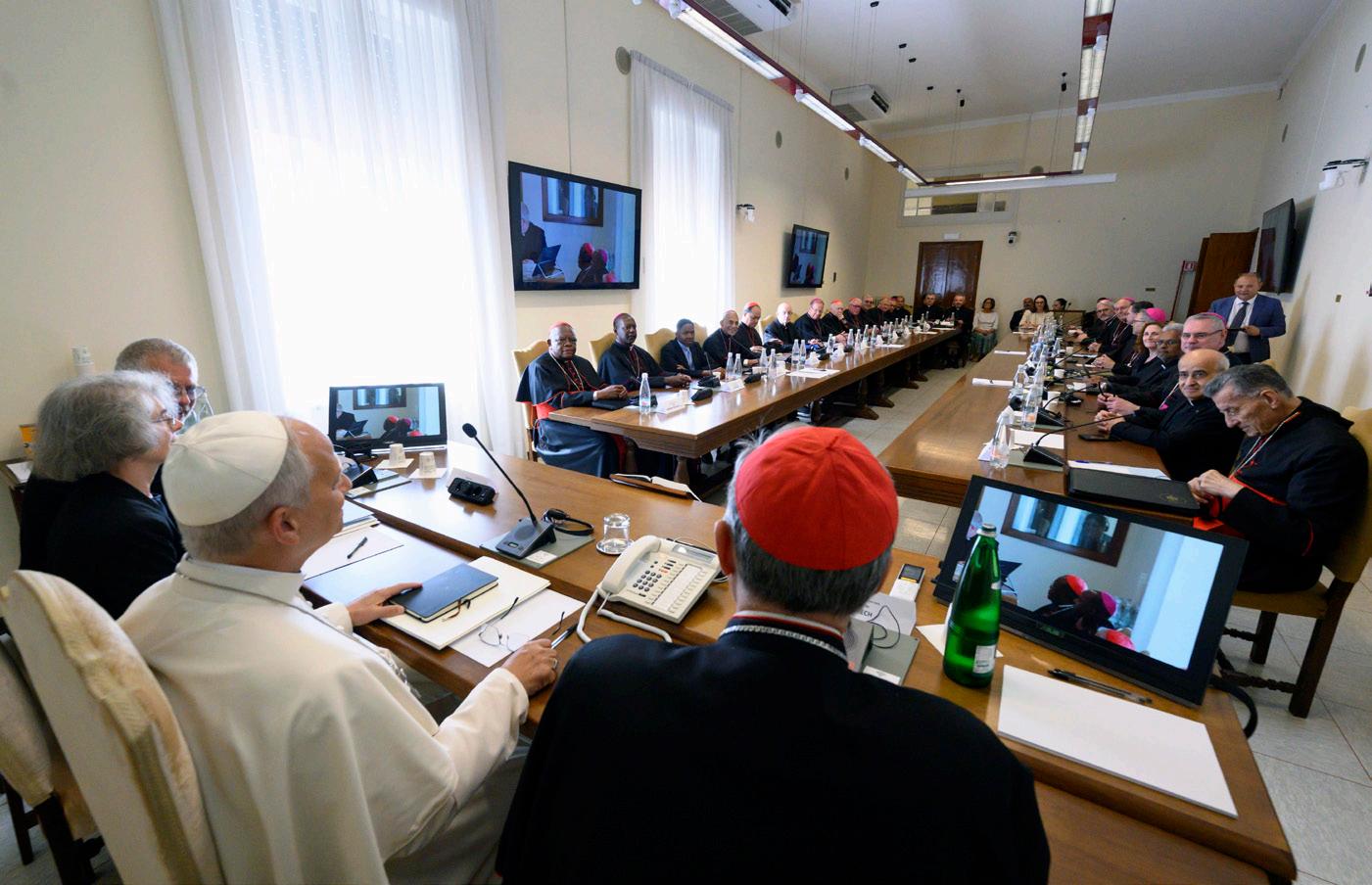
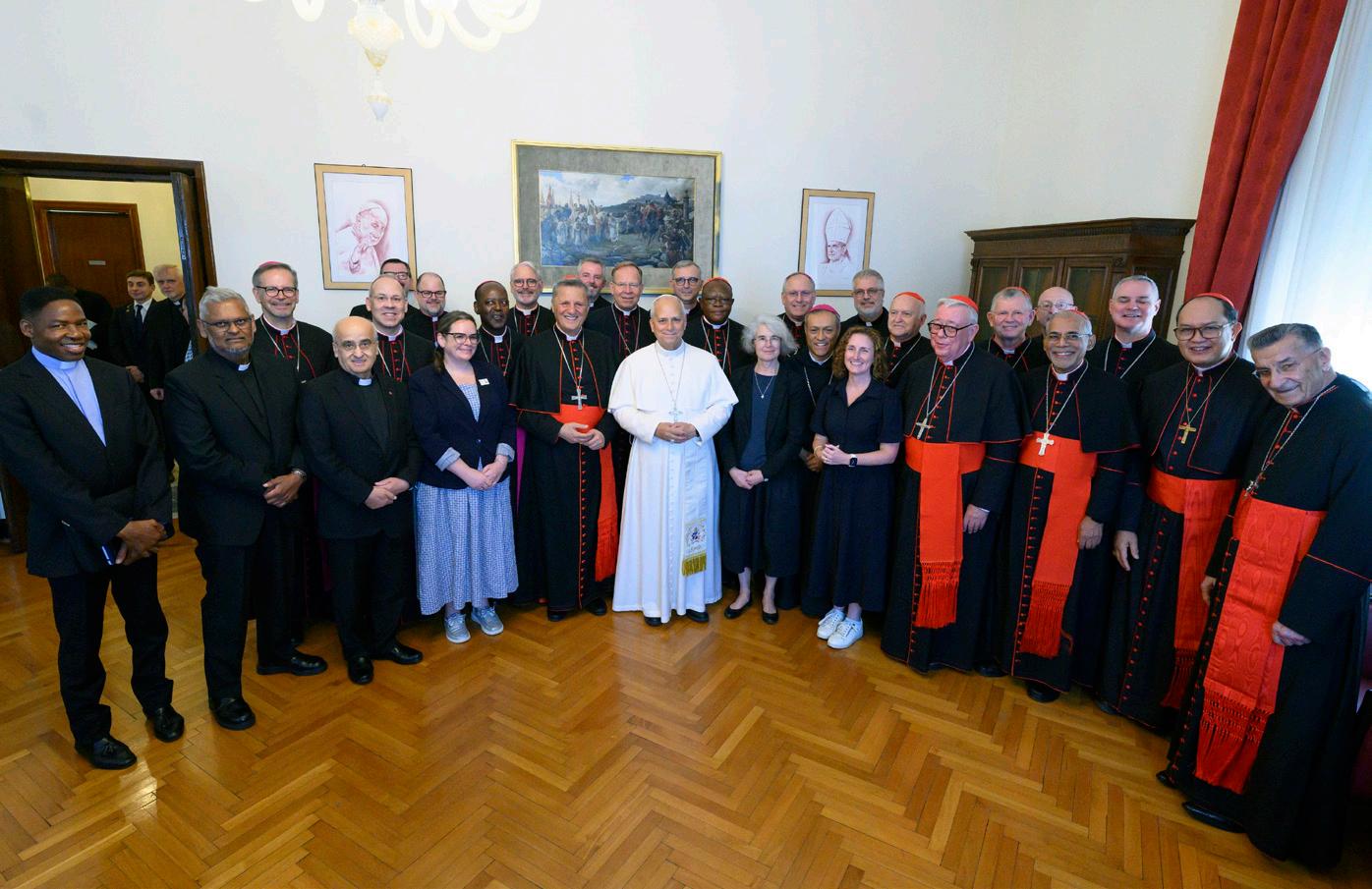
Representatives from Latin America, Africa, Asia, Europe, Oceania, the Middle East, and North America, together with the coordinators of the continental synodal teams, met privately with Pope Leo XIV and members of the General Secretariat of the Synod June 23-25 at the Vatican. Part of the meeting involved reporting on major developments in implementing, across the different continents, the final document that
was released in October 2024.
The team representing North America included: Archbishop Coakley; Auxiliary Bishop Juan Miguel Betancourt of Hartford, Conn., who is the USCCB’s bishop liaison for the synod; Bishop Pierre Goudreault of Sainte-Anne-de-laPocatière in Québec, Canada, who is president of Canada’s Conference of Catholic Bishops; and Julia McStravog, senior adviser to the U.S. synod leaders team and coordinator of the diocesan synod teams.
Responding to questions from CNS after their meeting, the three bishops shared the progress they have seen and the challenges that remain in implementing the Synod on Synodality’s final document in North America.
U.S. synod leaders meet monthly and share what they learn with all leaders and teams across the country, Bishop Betancourt wrote. These virtual gatherings “have strengthened relationships among the dioceses in the United States” and provided important “consultation, feedback, synthesis, and the setting of priorities.”
Many places in the United States have successfully implemented synodality “in a more intentional way, using the method of conversations in the spirit” and promoting the participation of the laity, religious, and clergy “to discern the good and the challenges occurring in the particular dioceses of their provinces,” he added.
“This process has been helpful in guiding pastoral planning, discernment in parish consolidation, assessment of Mass times and the priest’s workload, and more effective resource allocation,” the
Formation continued on page A18
someone in our diocese about the Synod is— “Yes, I’ve heard of it; what is it again?”
I need to make it clear that I support our Synod efforts in the Diocese of Knoxville. I was humbled to be chosen to represent our diocese along with our vicar general, Father Peter Iorio, at the Jubilee of Synod Delegates in Rome last October, and I now work faithfully to continue that mission as a member and leader of a very dedicated team of individuals—laity and clergy, men and women, Anglo and Hispanic, who make up our very small Diocesan Synod Team.
Five years ago, all of the faithful in the Diocese of Knoxville were called to participate in synodal dialogue sessions, both online and in-person, to help collect (listen to) your feelings on the direction, governance, successes, and failures of the Catholic Church. More than 4,200 people from parishes around the diocese participated.
to the current Synod effort taking place in the Catholic Church—including our diocese?
Because sometimes things are right in front of us, and through no fault of our own, we don’t see them.
One of the most common reactions I’ve received when asking
The Catholic Church listened, and in 2024 it produced the final document of the XVI Ordinary General Assembly of the Synod of Bishops. This final document is THE guiding document to be used in the assemblies in the Diocese of Knoxville later this year. These assemblies will be attended by delegates selected by our bishop and your pastors—allowing them to listen, discern, pray, and discuss in synodal fashion how best to proceed—including carrying
The spirituality of synodality Above: Pope Leo XIV speaks with leaders of the "continental bodies" representing Latin America, Africa, Asia, Europe, Oceania, the Middle East, and North America, together with the coordinators of the continental synodal teams, during a private meeting at the Vatican on June 25. Below: Pope Leo XIV poses for a photo with the leaders of the "continental bodies."
Synod continued on page A18
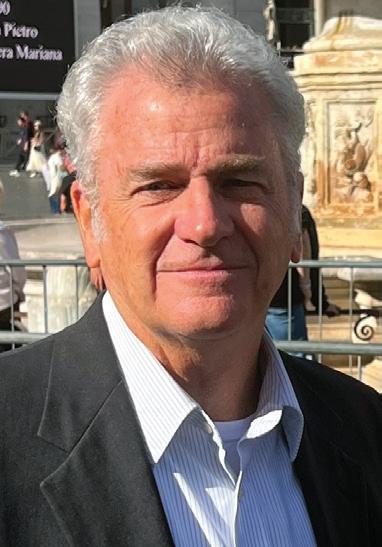
Mr. Wogan
Experiencing People of Hope
Traveling museum visiting Chattanooga, Knoxville to share stories of Catholic Charities
The East Tennessee Catholic
Atraveling museum that shares the stories of people who help and are helped by Catholic Charities will be visiting the Diocese of Knoxville in early August, with stops scheduled in Chattanooga and Knoxville.
Catholic Charities of East Tennessee is hosting the national storytelling initiative on 18 wheels.
“We are pleased to share this exciting opportunity with all those in East Tennessee who have felt the impact of Catholic Charities or want to know more about what Catholic Charities does in the communities it serves,” said Jasmine Ball, marketing and events coordinator for Catholic Charities of East Tennessee.
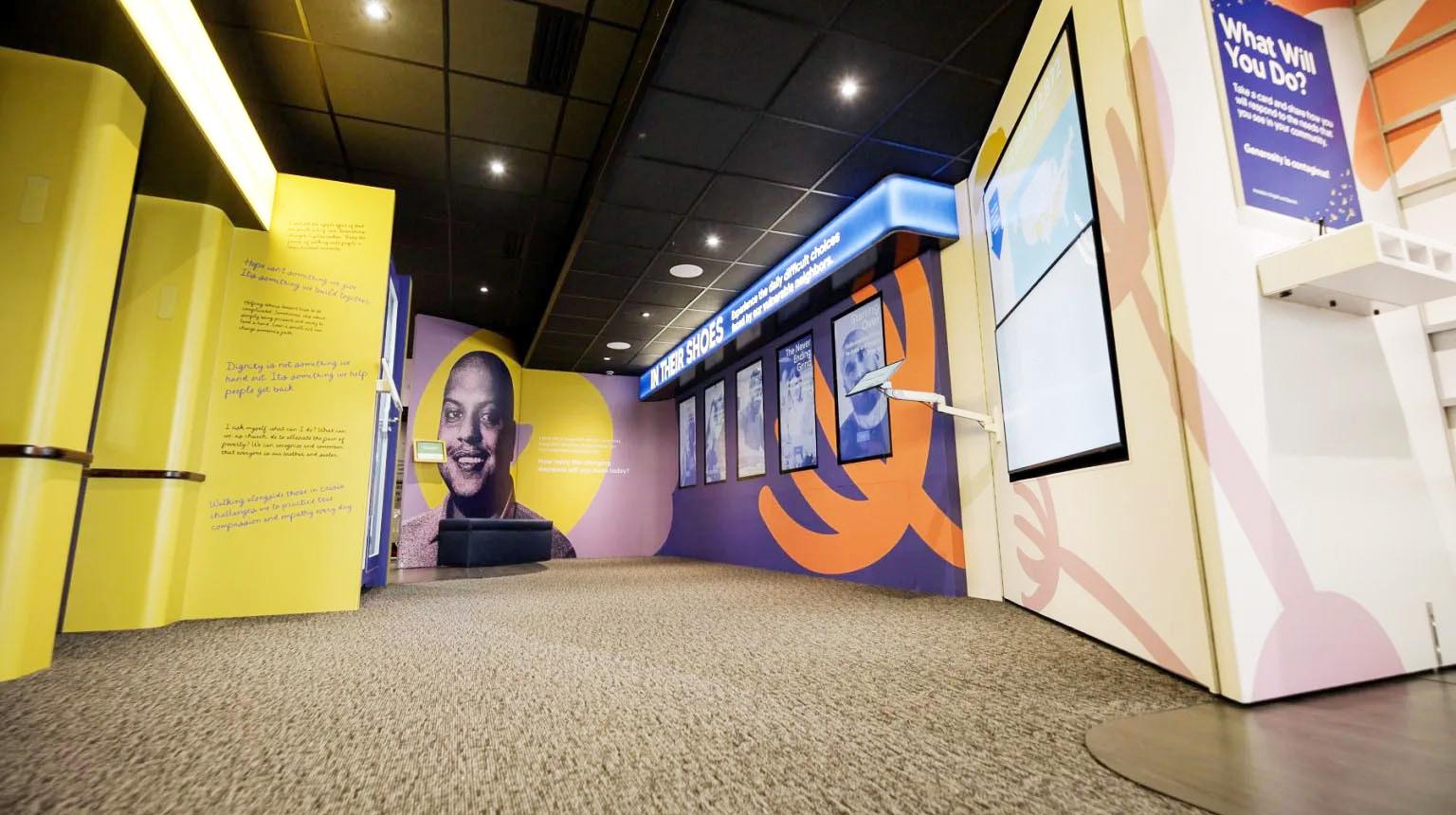
In March, Catholic Charities USA (CCUSA) launched People of Hope: Faith-Filled Stories of Neighbors Helping Neighbors, a national storytelling initiative centered around a traveling, tractor-trailer–sized museum.
Over the next two-and-a-half years, the museum will tour the United States, including a stop on Friday and Saturday, Aug. 7- 8, in Knoxville and a stop in Chattanooga Monday, Aug. 10, through Wednesday, Aug. 12.
The People of Hope Museum is a free exhibit. CCUSA is the national membership office for Catholic Charities agencies around the country. People of Hope is made possible with support from Lilly Endowment Inc.
“Its purpose is simple and deeply aligned with our shared mission: to live and lead with compassion toward our neighbors, inspire service and volunteering, and witness the hope found in the lives of those we serve,” Ms. Ball said.
The immersive museum experience features:
n First-person video stories from Catholic Charities staff and volunteers across the country about clients who impacted them deeply; n Interactive poverty-simulation activities that help visitors understand the challenges many families living in poverty face;
n U.S. and state-level poverty data visualizations that offer insight into local and national
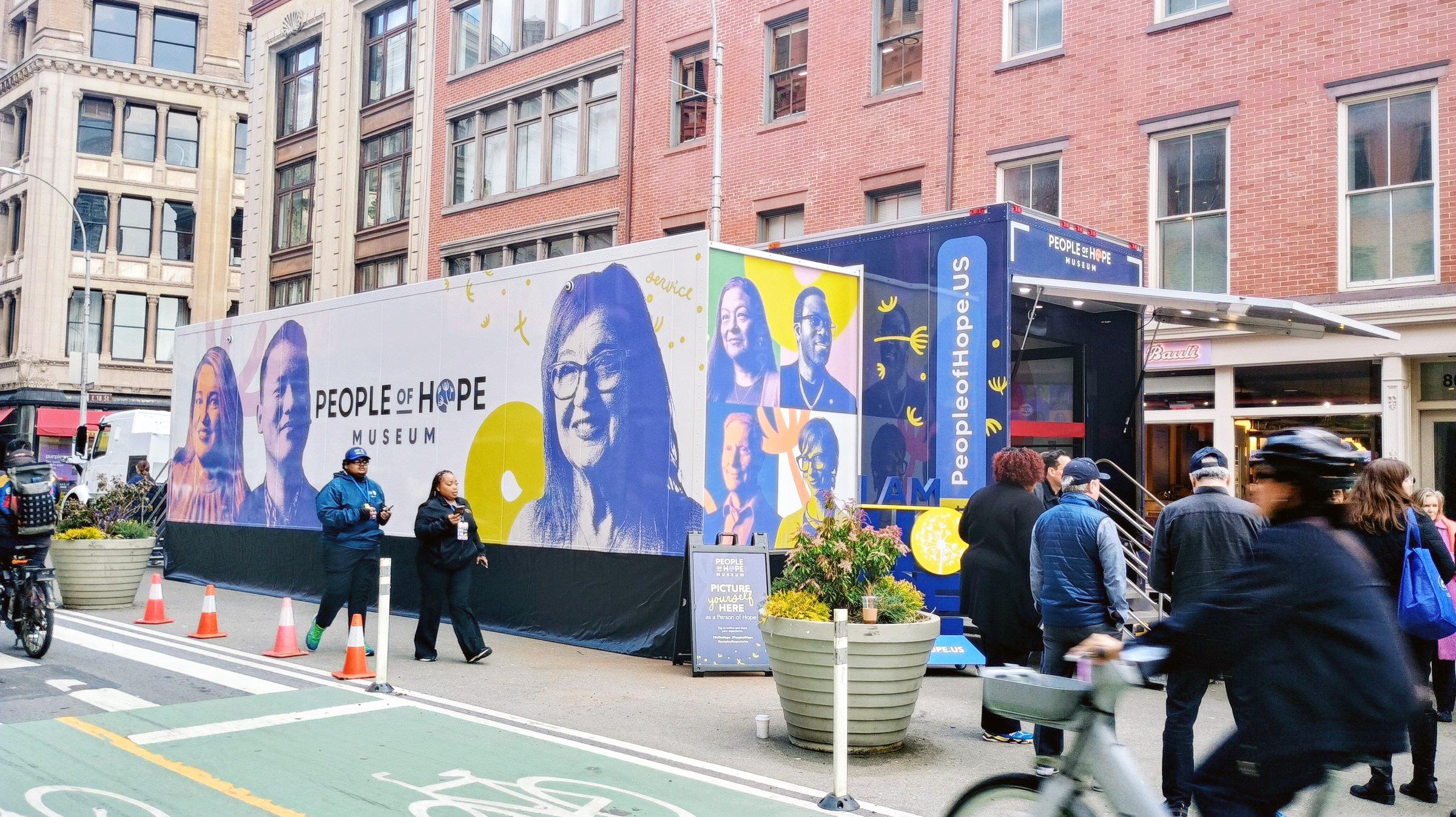
of Christian service," according to Catholic Charities organizers. Below: The interior of the People of Hope Museum is seen.
needs;
n Audio recordings of book excerpts about poverty, social isolation, and bridge-building;
n A recording booth where visitors can share their own stories of hope, service, and compassion.
Catholic Charities of East Tennessee is inviting East Tennesseans to encounter its and Catholic Charities USA’s combined mission in action and the powerful stories of faith, dignity, and hope.
The People of Hope Museum will be at World’s Fair Park in Knoxville from 9 a.m.-3 p.m. on Aug. 7 and Aug. 8 and at Miller Park in
Museum ‘celebrates power of Christian service’
By Armando Machado
The Good Newsroom and OSV News
Catholic Charities of the Archdiocese of New York welcomed the mobile People of Hope Museum on March 26, near Union Square in New York City.
The tractor-trailer-sized traveling museum is touring the country under the sponsorship of Catholic Charities USA.
With its welcome in New York, “People of Hope: Faith-Filled Stories of Neighbors Helping Neighbors” began a three-year journey across the United States.
Produced by Catholic Charities USA, the People of Hope Museum will ultimately visit more than 150 communities to promote empathy and inspire visitors to find ways to serve those in need in their local areas. The initiative is made possible thanks to a 2024 grant of nearly $5 million from Lilly Endowment Inc. through an invitational round of its National Storytelling Initiative on Christian Faith and Life.
The museum is a nationwide storytelling initiative from CCUSA “highlighting the impact of neighbors helping neighbors, and celebrating the power of Christian service,” according to organizers.
Locally, Catholic Charities of New York co-sponsored the People of Hope Museum with CCUSA, along with Catholic Charities of the Diocese of Brooklyn.
The People of Hope Museum was parked in an area near Union Square. An opening ceremony and ribbon-cutting took place in front of three dozen Catholic Charities staff, affiliates, and journalists.
“We’re here to tell the stories of many, many employees of Catholic Charities throughout the country—hundreds of Catholic Charities (chapters), thousands of employees, who day in and day out, they take care of the people who need it the most,” J. Antonio Fernandez, president and CEO of Catholic Charities of the Archdio -
cese of New York, said during the opening ceremony. “Thank you for coming today as we celebrate this wonderful museum. Thank you, and God bless you.”
Kerry Alys Robinson, president and CEO of Catholic Charities USA, was at the opening of the mobile museum, a venture she said “is a testament to mercy, service, hope, compassion, and faith. And it is a special honor that we are here in New York City, and that it is co-hosted by Catholic Charities (of the) Archdiocese of New York, and Catholic Charities Brooklyn and Queens.”
Housed in a digitally outfitted tractor-trailer, the People of Hope Museum features 42 original, authentic video stories told by Catholic Charities staff and volunteers from agencies around the country. In the brief videos, the storytellers share first-person accounts of what it means to serve someone in need in their darkest moment.
Beyond these stories, the museum contains an interactive poverty simulation of stepping into another person’s life, making difficult choices, and experiencing the realities of living on the margins.
Visitors also can peruse a learning library featuring curated twoto four-minute audio segments from prominent books on poverty, social isolation, bridge-building, and community action, including by authors Matthew Desmond, Arthur Brooks, and Robert Putnam.
National and state data illustrate the scope of need and the vital role of social services organizations across the country, and a recording room allows attendees to share their own stories of hope and service.
From New York, through December, the mobile museum will go through 21 states, from Texas to Ohio and from Maine to Florida, mostly in the eastern half of the United States. It will tour the Western states in 2027. In the first half of 2028, the museum will visit communities that were missed or would like a repeat visit, accord -
ing to CCUSA.
CCUSA, which has its headquarters in Alexandria, Va., is a
■
Chattanooga from 9 a.m.-3 p.m. Aug. 11-12. Bishop Mark Beckman will be on hand at the museum on Aug. 7. ■
Telling their story Above: Catholic Charities USA's People of Hope Museum is set up on March 26 just north of Union Square in New York City. The tractor-trailer-sized traveling museum is touring the country highlighting "the impact of neighbors helping neighbors, and celebrating the power
network of local Catholic Charities agencies in dioceses across the United States.
Pursuing a culture of life within marriage
Natural Family Planning Awareness Week, July 19-25, is guided by love
By Gabrielle Nolan
Every year, the Catholic Church celebrates Natural Family Planning Awareness Week in July with the goal of encouraging and supporting married couples in both their journeys of faith and their practical discernment of growing their families. This year’s theme is “Designed by God, Guided by Love, Open to Life.”
Natural family planning (NFP) is an important aspect of pro-life culture because, as its name suggests, it allows couples to take a natural, contraceptive-free approach to discerning having children. NFP allows a couple to track the woman’s biomarkers and discern whether a fertile or infertile window is the right time for the couple to unite together based on their desire to avoid or achieve conception.
NFP is aligned with Church teaching because the process honors both the unitive and reproductive process of intercourse within marriage, without harmful chemicals or physical barriers preventing connection and conception.
Let’s dive deeper into the ways NFP is valuable with this year’s theme as our guide!
Designed by God
Through the natural workings of our Godgiven bodies, men and women can become cocreators of new life.
Scripture illuminates God’s design for men and women in marriage in Genesis 1:27-28: “God created mankind in His image; in the image of God He created them; male and female—He created them. God blessed them and God said to them: Be fertile and multiply; fill the earth and subdue it.”
In God’s goodness and creativity, He designed for life to generate and flourish through the procreation of men and women joining together to make a family.
This model of love mirrors the Holy Trinity
The East Tennessee Catholic
and gives insight to who God is.
Guided by love
“There is no fear in love, but perfect love drives out fear because fear has to do with punishment, and so one who fears is not yet perfect in love.”
This Bible verse, from 1 John 4:18, can be a guide for couples using NFP because it showcases the “why” behind NFP: love.
Is it normal for men and women to have emotions of fear when discerning having a child? Of course! Is it understandable that parents with multiple children might be anxious about conceiving again because of finances, energy, and existing family needs? Absolutely!
But being guided by love means acknowledging those emotions and choosing to trust in the Lord. God is love. Jesus Himself says in chapter 12 of Mark’s Gospel, “You shall love the Lord your God with all your heart, with all your soul, with all your mind, and with all your strength. The second is this: You shall love your neighbor as yourself. There is no
other commandment greater than these.”
If a couple prayerfully discerns with God to avoid conception for valid reasons, they are being guided by love. If a couple chooses to pursue conception after discernment with God, they, too, are being guided by love.
The logistics of NFP—cycle tracking, lab tests, consistent communication about fertility—may not always be easy, but the choices can be guided by love—love of spouse, love of God, and love of Church teaching.
Open to life
As Catholic Christians, it is important to promote a culture of life because our God is one who creates, sustains, and resurrects life! Let’s turn to sacred Scripture once again, where Jesus speaks in John 10:10: “I came so that they might have life and have it more abundantly.”
Married couples can fight against the culture of death—abortion, contraception, euthanasia—by welcoming babies into the world. Babies, who are innocent, pure, and full of smiles, have the power to change hearts. Holy families have the power to change hearts.
Life is a gift, and each new life is an unrepeatable identity created by our Lord. This month, let us pray for married couples who are discerning having children, whether it be their first or their fifth. Let us pray that natural family planning can be a method for couples to not only achieve pregnancy but also holiness.
To learn more about natural family planning, visit the websites of the U.S. Conference of Catholic Bishops (USCCB) at www.usccb. org/topics/natural-family-planning/nationalnfp-awareness-week as well as the Diocese of Knoxville’s Office of Marriage and Family Life’s NFP page, www.dioknox.org/nfp ■
Catholic Church continues to champion NFP
Organizations like USCCB, Diocese of Knoxville are key sources for information
By Amira Abuzeid Catholic News Agency
In an era when artificial contraception often dominates public discussions on family planning, the Catholic Church continues to champion natural family planning.
Far from merely another birth control technique, NFP invites couples to cooperate with God’s plan for married love, which “is a ‘great mystery,’ a sign of the love between Christ and His Church (Ephesians 5:32),” according to the U.S. Conference of Catholic Bishops. NFP, also known as a fertility awareness-based method (FABM), honors the sacredness of spouses being open to the gift of new human life.
“Suppressing fertility by using contraception denies part of the inherent meaning of married sexuality and does harm to the couple’s unity,” according to the USCCB. “The total giving of oneself, body and soul, to one’s beloved is no time to say: ‘I give you everything I am—except…’ The Church’s teaching is not only about observing a rule but about preserving that total, mutual gift of two persons in its integrity.”
In his 1968 encyclical Humanae Vitae, St. Paul VI affirmed that couples may space births for serious reasons, using natural methods that honor the “inseparable connection between the unitive and procreative meanings” of the marital act.
The USCCB affirms that “NFP is not a contraceptive, it does nothing to suppress or block conception.”
“On the surface, there may seem to be little difference (between NFP and contraception),” according to the bishops. “But the end result is not the only thing that matters, and the way we get to that result may make an enormous moral difference. Some ways respect God’s gifts to us while others do not.”
The bishops continue: “When couples use contraception, either physical or chemical, they suppress their fertility, asserting that they
alone have ultimate control over this power to create a new human life. With NFP, spouses respect God’s design for life and love. They may choose to refrain from sexual union during the woman’s fertile time, doing nothing to destroy the love-giving or life-giving meaning that is present. This is the difference between choosing to falsify the full marital language of the body and choosing at certain times not to speak that language.”
The practice of NFP traces its modern roots to the mid-20th century, evolving from early, relatively unreliable calendar-based methods in the 1930s to the smartphone app-based approaches of today.
Common methods include the Billings Ovulation Method and sympto-thermal methods. The Marquette Model uses “several different biomarker devices to detect urinary biomarkers (estrogen, LH, and progesterone),” according to its website.
Per USCCB data, NFP, with perfect use, yields 88 percent to 100 percent effectiveness in avoiding pregnancy, with imperfect use at 70 percent to 98 percent. For couples trying to achieve pregnancy, it typically occurs in about one year for about 85 percent of couples not using NFP, and within three to six months for those who are.
Pope Francis praised the Billings method in 2023 as “a valuable tool” for “responsible management of procreative choices,” urging a “new revolution in our way of thinking” to value the body’s “great book of nature.” He noted its simplicity amid a “contraceptive culture,” promoting tenderness between the spouses and an authentic freedom.
Beyond efficacy at planning, preventing, or postponing pregnancy in a morally licit way, couples who use NFP acknowledge that it can be difficult but say it builds intimacy and improves communication as well as self-mastery, transforming what can be otherwise difficult times of periodic abstinence into
opportunities for deeper intimacy. Jessica Vanderhyde, a nurse and mother of seven who is using the Marquette method because she and her husband do not feel ready to welcome another child, told CNA that while NFP can be frustrating because of the periods of abstinence it requires, it also “leads to a lot more closeness in the marriage.”
In addition to the USCCB’s repository of information on natural family planning, the Diocese of Knoxville’s Office of Marriage and Family Life offers a variety of resources, including The Marriage Group, which provides a foundational online NFP course called NFP Life, and the Couple to Cou-
ple League, which offers an NFP preparation class via either live online, live onsite, live one-on-one, or online video-based instruction. There are other plans as well. And the Marriage and Family Life Office also can provide certified NFP instructors in Chattanooga and Knoxville as well as a Couple to Couple League online class in the Tri-Cities. NFP classes also are offered in Spanish in the Diocese of Knoxville through the Office of Hispanic Ministry. Carolyn Krings, ckrings@dioknox.org, who serves as director of the Office of Marriage and Family Life is the contact person for NFP services offered in the Diocese of Knoxville. ■
Gabrielle Nolan, her husband, Kevin, and their son, Liam, are parishioners at the Cathedral of the Most Sacred Heart of Jesus. Mrs. Nolan is a former journalist for
Helping our neighbors
Office of Hispanic Ministry leads food drive for families impacted by separation
The East Tennessee Catholic
The Diocese of Knoxville and its Office of Hispanic Ministry held a food drive June 12-14 to support immigrant families impacted by detentions and deportations of loved ones.
The Hispanic Ministry Office established a drop-off point for donated food and other goods at the Diocese of Knoxville Chancery, where food and necessities were collected from people throughout the area.
Specifically, the food drive sought rice, beans, cooking oil, salt and sugar, flour, powdered milk, pasta, bottled water, baby diapers, toilet paper, fruit, vegetables, corn tortillas, eggs, chicken, and hot dogs—all items that can be stored—for distribution in East Tennessee.
“The donated food was to support immigrant families who are facing fear and separation. We want to share love and hope with our neighbors in need,” said Blanca Primm, director of the Office of Hispanic Ministry.
Volunteers assembled the donated items into boxes, which were distributed in counties where the separation of families has been acute.
According to Mrs. Primm, the volunteers distributed food boxes to 60 families in the areas of Knoxville, Sevierville, Pigeon Forge, and Gatlinburg.
“Due to the increased number of families being separated, our Office of Hispanic Ministry took the initiative to spearhead a food drive for families who were left behind without a breadwinner and are lacking economic resources to pay their bills. That is why we felt we needed to call the community to help these families in need, and
Support and hope The Food Drive for Separated Families provided food baskets to 60 East Tennessee families. The drive was sponsored by the Diocese of Knoxville Office of
Blanca Primm and Rocio Melendez of the diocese, and Rev. Mark Lampley of Sequoyah Hills Presbyterian Church fill food boxes. Back row, Magdiel Argueta of the diocese, Jacky Mejia of Catholic Charities of East Tennessee, and Bingham Graves of Westminster Presbyterian Church also volunteered.
especially in need of food,” Mrs. Primm said.
She noted that it was especially important to transport the baskets to those in need since many of them do not have transportation.
“After the uptick of detentions in Sevierville and seeing the great need, we wanted to contribute
and share the hope and love of Jesus Christ with these families. We wanted to share with them that we are with them, the Church is with them, and we care and love them,” Mrs. Primm said.
The food drive was a gift to the families in need,
BILL BREWER
Hispanic Ministry. Above front row,
Food drive continued on page A18
Kairos Kids
Practice Your Fatih!
ac a acti t tice c Yo Your u Fa F th th!
Light a candle for a loved one
Attend Mass
Pray the Rosary
Eat as a family and begin in prayer
Find your way to the CROSS!
Co lo r Me! Saint Mary Magdalene Feast Day July 22
l o o Me Me! aint Magdale Day
Matthias, who is in the 2nd grade:
ed gin t lov a be atthias, meal fo f r breakfa f st?
Mary Magdalene was a Jewish woman who is known as “Apostle to the Apostles.” Historians believe, with much certainty, that she is a historical figure even though very little is known about her life. Her name was Mary, and it is believed she came from the town of Magdala and was known as “The Magdalene” so that she could be distinguished from the many other Marys who traveled with Jesus.
W hat is your favorite book of the Bible? And what is your favorite meal for breakfast?
Bishop Beckman says:
Bishop says: the r breakfa f st, an utter! e B sh
OK, I love the four Gospels and the Book of Psalms For breakfast, eggs, bacon, and biscuits with honey and butter!
“Children are a heritage from the Lord, offspring a reward from Him ” - Psalm 127:3
By: Mary-Hannah MacCurdy
Frs.
Gladysz,
By Bee Goodman
FOpposite sides of the aisle
Herman are the ‘Odd Couple’ when it comes to reviewing
aith is easy to talk about when nothing is asked of it. It is another thing entirely to hold onto it with a foot raised over the face of Christ, a sword at your neck, and no one watching but God.
That was the question in the room on June 12 when the Cathedral of the Most Sacred Heart of Jesus hosted Movie Night with a Priest for a screening of Martin Scorsese’s 2016 film Silence, based on the novel by the Japanese Catholic author Shusaku Endo.
The evening was billed as a discussion. It turned into something closer to a debate, and a farewell to beloved cathedral associate pastor Father Martin Gladysz.
In preparing for his new assignment, Father Gladysz said farewell to Sacred Heart Cathedral to become pastor of St. Therese Parish in Clinton, and this was among his final nights with the parish he has served since January 2019.
At Movie Night, Father Gladysz was joined by cathedral associate pastor Father Danny Herman, and the two arrived on opposite sides on purpose. Father Herman counts Silence among his favorite films. Father Gladysz has called it, in his own words, a “silent killer of faith.”
The pairing wasn’t planned so much as it grew out of a running joke. Father Herman had earlier suggested Silence as a good discussion film back when the Movie Night with a Priest ministry first began, according to Stacey Waldron, who started the lay ministry and organized the June event.
Months later, at a different movie event, Father Gladysz brought up the film unprompted, saying he’d watched it several times and did not recommend it. When the committee told him it was Father Herman who had originally suggested it, Father Gladysz’s reply set the entire evening in motion.
Platform continued from page A1
said Father Adam Royal, who is leading the implementation project for the diocese. “Our hope is that better tools will free our parishes to spend less time on records and more time with the people they serve so that our whole diocese can flourish.”
The implementation team also includes Deacon Hicks Armor, diocesan director of Stewardship and Strategic Planning, and Christine Lucheon, diocesan director of Finance.
The diocese partnered with ACS Technologies, the company behind MinistryPlatform, to guide parishes through the changeover. Mike Paralis, a project manager with ACS Technologies, and Katie Persing, a coach and trainer with the company, are leading the transition and much of the day-to-day work with parish staff.
Roughly 75 people from parishes across the diocese joined a June 30 information session introducing the new system and outlining what to expect in the months ahead.
Mission continued from page A5
“I will come back to watch Silence, but Father Danny better be here,” the priest from Poland said.
Committee members reminded Father Herman of the remark, and the young priest began teasing Father Gladysz about it, and the teasing turned into the idea of the two co-leading the discussion together.
“It turned out to be great marketing for the event, because they are both very loved at the cathedral, and
Why the change?
MinistryPlatform is a cloud-based system, allowing parish staff to access it securely from laptops, tablets, or phones instead of a single office computer. Individual logins allow different access levels based on each employee’s role.
The software will continue to handle parishioner information, sacramental records, and offertory donations while adding tools for event registration, volunteer scheduling, group communication, and religious education.
Parishioners also will be able to update their household information, view giving history, sign up for events, and manage communication preferences through an online portal
During the information session, the subject of cost was raised. Mrs. Lucheon said overall costs are expected to remain similar to current PDS-related expenses, with billing handled through the diocese once a parish goes live.
MinistryPlatform also will create a shared diocesan database, allowing parishioner records and dona-
Gifts of the image of the Sacred Heart of Jesus were then handed out to the parish priests and deacons as well as Father McNally. Susan Rigaurd was one of the parishioners who helped bring the mission to the parish. She said she was pleased by the turnout and the eagerness of families to come pray each night and
Bishop continued from page A3
communities.
The following morning, I traveled up the valley to Our Lady of Perpetual Help Church in LaFollette to see the magnificent yet simple new adoration chapel. From there, Father Sam and I journeyed farther northeast to the community of Tazewell near the Kentucky border, where the parish of Christ the King is located.
Father Sam is retiring and will be full time at Christ the King, as Father Henry Makawa arrives
people were excited to see them spar about the movie,” Ms. Waldron said.
Father Gladysz was upfront from the start about where he stood, she noted, adding, “Father Martin made it clear before we invited him that he did not endorse the film.”
That contrast was part of the draw; two priests who are close friends but very different from one another, the kind of dynamic parishioners already recognize from
tions to follow families who move or attend multiple parishes without creating duplicate records.
Parishes will still be required to maintain physical sacramental register books per canon law, and PDS Ledger will remain the accounting system for many parishes.
Rollout planned in waves
The transition to MinistryPlatform will occur in phases over the next 18 to 24 months. Parishes will be grouped into implementation waves based in part on their scheduling preferences, with the first wave expected to begin between midAugust and mid-September. Each parish will go through a period of training, testing, and staff coaching before fully switching over to the new system.
In the meantime, parish staff are being asked to begin reviewing records by removing duplicate households, updating contact information, and posting any outstanding contributions or attendance records.
Each parish also will name a point person to coordinate with the dioc-
prepare to enthrone the Sacred Heart of Jesus in their homes.
“We’ve been involved with the Sacred Heart Apostolate for about 15 years. So, when they were ready to do a mission here, especially as we have our coming jubilee year at St. John Neumann, I wanted to have a mission like this,” she said. “It’s been beautiful, really beautiful. I
this summer to become pastor of the LaFollette and Helenwood parishes that Father Sam has been pastoring so faithfully. Deacon Chad Shields greeted us at Christ the King and served at the Mass that morning to another crowd of 40 or so folks!
Christ the King is another gem of a parish on the boundaries of our diocese, and afterward we shared a delightful brunch in the parish hall. If I continue to visit parishes like this, I will need a larger belt!
My drive back to Knoxville that morning had
the way the two sometimes needle each other. It was the ministry’s second event to feature more than one priest; a movie night last November with Father David Boettner, Father Gladysz, and Father Herman drew some 150 guests.
Silence follows two fictional 17thcentury Jesuit missionaries searching Japan for their mentor, a priest who is reported to have renounced his faith under torture.
The film depicts the real persecution of Japanese Christians under the Tokugawa shogunate, including the use of the fumi-e, an image of Christ that suspected believers were forced to trample to prove they had abandoned the faith.
And yet, without priests or regular access to the sacraments, the underground Church in Japan survived roughly 250 years of hiding, a survival Pope Pius IX once called the “Miracle of the Orient.”
Mr. Scorsese has said he carried the project for nearly three decades before it reached a screen, and Mr. Endo wrote as a Japanese Catholic who often felt like an outsider in both the country of his birth and the faith he practiced, a tension that runs through the film and invites many questions and comments as well.
Movie attendees at the cathedral who stayed after the credits filled nearly every seat for the discussion that followed, and the two priests made clear before a single question was asked that they were not going to let each other off easy.
A film that divides the room
Before the deeper theology, the priests spent time on a simpler question: is Silence even a good depiction of what happened in Japan?
Father Herman defended the film’s historical bones, noting that the fumi-e, the underground Church, and the missionary suffering it portrays are all drawn from a
Night continued on page A28
esan implementation team. The role does not require technical expertise but will serve as the parish’s primary contact throughout the transition. To support the rollout, the diocese plans to hire a temporary software implementation coordinator who will travel to parishes, oversee data migration, assist with training, and provide ongoing support after each parish goes live.
Parishes with questions or those interested in beginning data cleanup before their assigned wave can contact the diocesan implementation team. A recording of the June 30 information session and additional training materials also will be available for parish staff on the diocesan website at dioknox.org/ parish-management
“Change like this can feel daunting, and no parish should have to face it alone,” said Father Royal, who is pastor of St. Alphonsus Parish in Crossville. “The diocese is here to walk with you at every step, to help, to support, and to do all we can to make this transition a smooth one.” ■
love it when families bring all the children.”
Through the mission, more than 50 families signed up to enthrone the Sacred Heart of Jesus in their homes, which is publicly proclaiming Christ as King over one’s home and family. The Sacred Heart Apostolate will help these families prepare for the enthronement ceremony in the coming weeks. ■
me pondering with gratitude the blessing of our many parishes on the boundaries of our diocese. We are truly in mission country, and to see the work of the Holy Spirit alive and well in these growing Catholic communities is a joy!
My calendar now holds dates for travel to the remaining two parishes of our diocese that I have not yet visited, St. Ann in Lancing and St. James the Apostle in Sneedville. May the Lord continue to lead us all to share the joy of the Gospel throughout East Tennessee. ■
Two sides of the same film Above: Father Danny Herman converses with several people who are attending Movie Night with a Priest at the Cathedral of the Most Sacred Heart of Jesus parish hall on June 12. Below: Father Martin Gladysz and others watch attentively the movie Silence
BEE GOODMAN (2)
Movie
60 years a priest: An anniversary Mass for Father Michael
that’s a very good thing to do and it will bring many benefits—it does and it will—but the reason He tells us to do that is because He loves His body. We are His body. There is nobody excluded from that.”
Father Nolan delivered the homily partly in a song with lyrics adapted for the honoree, and Father Woods—who turned 84 on June 23—returned the favor with a tune of his own when he spoke at the end of Mass.
Father Woods was ordained a priest on June 19, 1966, at All Hallows College in Dublin by Bishop Patrick J. Dunne. He served as an associate pastor of parishes in Atlanta and Decatur, Ga., and later pastor of parishes in the Georgia cities of Dalton, Athens, Hapeville, and Atlanta as well.
At the invitation of the Diocese of Knoxville’s founding Bishop Anthony J. O’Connell, Father Woods came to St. Mary in Oak Ridge in 1994, where he served as associate pastor for two years and as pastor until 2006. He then led All Saints as pastor for the next 12 years.
Bishop Beckman welcomed the gathering to the 60th-anniversary Mass by referring to the host parish’s patron.
“Today we gather with great joy in our hearts in this Church of St. Francis as we celebrate 800 years of the Transitus of St. Francis of Assisi and the 60 years for Father Michael, your pastor, as a priest of Jesus Christ. For these reasons and for so many more, we are grateful to the Lord God. It is a day of joy,” he said.
Father Nolan opened his homily by greeting the bishop and other clergy, parishioners, and those watching via livestream—including Father Woods’ family in Ireland and England—as well as Father Woods’ sister Madeleine Hayes, who proclaimed the first reading, and her husband, Sean.
At that point, Father Nolan directed his next remark to the jubilarian.
Dueling verses
“Father Woods, you’ll have an opportunity for rebuttal, but, remember, you asked for this,” Father Nolan jokingly warned.
Father Nolan then sang the next part of his homily to the tune of “Galway Bay”:
“Father Michael came across the sea from Ireland, from Carlingford to Atlanta, G-A. For 60 years he’s served us through his priesthood, to thank God for him, we gather here today.
“He learned his prayers through the example of his parents, the third of six born to Peter and Hilda Woods. It was clear to all who were blessed to know and love them that they were more than willing to embrace God’s chosen way.
“Though ‘The Troubles’ raged throughout his boyhood homeland, he learned respect not conflict as the way. His village of 300 knew and loved each other and reached through invisible barriers to lend a hand.
“From his early years he had strong priests to guide him. His uncle, Father Ambrose, one of many names of mentors, teachers, pastors, friends, and brothers who helped him find his footing if need came.
“Parishioners have been his greatest teachers, boosting confidence, offering love, a sense he belonged. Together they built the Church beyond the walls. He thanks God for you daily in his prayers.
“Father Woods has never suffered burnout because God is there every day in brand-new ways. His love for the Mass and holy Scriptures shows him quite clearly our love for God and God’s immense love for each of us.
“So, Father Woods for all the ways God’s formed you, we’re grateful He has caused our paths to cross. May you be blessed with the graces you desire, and may God grant you many joyful years.”
When he concluded his song, Father Nolan referred to the readings at Mass from Isaiah 61 (“the Spirit
of the Lord God is upon me”) and 1 Corinthians 12 (“there are different kinds of gifts but the same Spirit”).
“The holy Scriptures Father Woods chose for his anniversary Mass speak plainly of abundant gifts: gifts discovered, gifts received, gifts developed, gifts willingly shared, all from our loving and merciful God,” Father Nolan said.
The Gospel reading proclaimed by Deacon Brinkworth came from John 21.
“Simon, son of John, do you love me, do you love me, do you love me?” Father Nolan quoted. “Jesus ultimately asks each of us, and when we’re ready to answer affirmatively, we’re invited, equipped, and instructed to tend His flock, to feed His sheep with all the diverse gifts we have been blessed with. Indeed, many gifts but the same Spirit, the same Lord, the same God—many parts, one body, needing each other.
“Father Woods, thank you for answering God’s call and by example helping us to embrace ours: to bind up the brokenhearted, to bring liberty to captives, release to prisoners by the power and reality of forgiveness and His great love. Father Woods, you are indeed a gift generously given. The Spirit of the Lord is upon you, and we are glad indeed.”
As he ended the homily, Father Nolan led a long ovation for Father Woods, one of many times the faithful would applaud the anniversary priest during the Mass.
Father Woods later said he chose Father Nolan for the homily “because every time he would see me, he would say, ‘I’m so glad you came to our diocese. We really appreciate you.’ I was always touched by that, and that was why I asked him. He was always so genuine.”
The intercessions at Mass included a prayer that the “Lord continue to pour out His grace upon” Father Woods, “granting him health of mind and body and a renewed joy in his sacred vocation.” The prayers also offered thanks “for the parents, aunts, uncles, and elders who guided and formed” Father Woods and “first planted the seeds of faith and nurtured his vocation through their love, discipline, and example.”
Another intercession prayed “for all those he has served over these 60 years: for the families he has baptized, the penitents he has absolved, the couples he has joined in marriage, and the many lives touched by his preaching and presence.”
port and care. I know my brothers and sisters, John and Rita, Kevin and Jackie, Paul and Marie, Gabrielle and John, and all their families are watching. You have no idea how much I love you,” he said, his voice breaking with emotion.
“One month after I was ordained 60 years ago, I left my home and my family and my brothers and my sisters to be a missionary. Jesus promised that if we do that—give up family, brothers, sisters, homes— that we will have a hundred times more brothers, sisters, family, homes than we could ever imagine. I just want you to know in my case and I know in yours, you have received that and God has fulfilled His promise, and I would like you to put your hands together for the fulfillment of that promise.”
Father Woods then addressed “my brother priests.”
“You have no idea how important you are to me. You’re an encouragement to me. You really are a mess. You are! But that’s God’s fault. He chose you; you did not choose Him,” he said. “The amazing miracle is that God chooses us. I remember one time complaining to one of my brothers in Ireland about living with priests and complaining particularly about one—it wasn’t this diocese, of course—and his comment to me was, ‘Yes, I remember what a joy you were to live with.’”
The jubilarian then showed the gathering one of the “tools” of his priesthood “that is so important to me.”
When Bishop Beckman asked Father Woods to speak at the end of Mass, a tremendous ovation followed.
“I knew I should have taken up a collection,” Father Woods immediately quipped.
The host pastor said “there are people here today who have never been in a Catholic church before, but they’re here because of my anniversary. I want to tell you and assure you that I prayed for you that the ceiling wouldn’t fall in. You honor us by doing that.”
‘Thank you for 60 years’
Father Woods paused a bit before continuing, “Just … thank you, thank you for 60 years of serving with you.”
The honoree once spoke to a group of children who asked “how old are you, and I told them,” he said. “They said, ‘Wow.’ One of them piped up and said, ‘Did you fight in the Civil War?’”
Father Woods then said, “I did write a few little things down,” first stating that he thanked Bishop Beckman for his presence.
“Thank you, Bishop Mark. I wanted you to be here, and I thank you for coming … I wanted to invite you because I wanted to start this anniversary the way I began: with Bishop Dunne in All Hallows College-Dublin with 29 other guys, many of whom I haven’t seen since because they have been all over the world. You being here puts into sharp focus not just my anniversary but that we are Church and that it goes back that far. You honor me greatly by reminding me of that, and I am very grateful.”
The St. Francis of Assisi pastor then turned toward Father Nolan.
“Father Michael, you told me I could have a rebuttal, and I don’t think I’m able to do that, but in the in-between of receiving Communion and till this moment, I’m going to try,” Father Woods said.
He then sang to Father Nolan words to the tune of “Londonderry Air” (“Danny Boy”): “O Mikey boy, my heart, my heart was beating when in your song, you followed all my journeys. O Church, me girl, O Church, me girl, I love you so. That’s the best I could come up with,” Father Woods finished before another round of applause.
Father Woods thanked his sister for attending. For her “to be able to walk up here and proclaim the Scriptures is such a joy to me, and I’m grateful to you for all the sup-
“It’s my chalice,” he said. “This chalice 60 years ago sat on the dresser in my home in Carlingford waiting for me to come home. I had just celebrated my first Mass with my bishop. … It’s very simple. It tells my story. I was ordained at the time of Vatican II. Our class was encouraged to design our own chalice, and I designed it and I wanted it to be unbelievably simple. There are no ornamentations in it, but there is a Celtic cross hammered into it.
“Underneath—and I wrestled with myself because it was given to me by my mother and my father. Underneath, it says, ‘To Michael on the occasion of his ordination.’ And this is what I wrestled with: it says, ‘from Mommy and Daddy,’ and it’s very childlike. And I remembered that Jesus told us to call His Father not Father but Abba—‘daddy.’”
The secret of his priesthood, Father Woods said, “is that I had to learn how to be a priest. I wasn’t born one. Michael, with your song and the images, it just was amazing because it’s into this that we particularly as Catholics pour in our whole lives: the good, the bad, the ugly. And I learned because I tried to bring the good all the time, to be perfect, and learned that I’m not, and we must learn that we’re not either, and that what we offer up is who we are, warts and all, graces and all, because they are from God.”
Father Woods mentioned the three parishes he has served in the Diocese of Knoxville, “but I love my former Diocese of Atlanta that gave me the opportunity to come and serve when I was so young and had much to learn and stumbled and fell.”
Bishop O’Connell visited Father Woods in Indiana and invited him to serve at St. Mary in Oak Ridge.
“He spoke to me probably for three or four hours and invited me to come to Oak Ridge,” Father Woods recalled. “I said to him, ‘on one condition.’ He says, ‘You’re giving me conditions?’ I said ‘yes, on one condition that you tell the priests before I come who I am, and leave it up to them whether they will say yes,’ and you did. I want to say thank you for that. It has been such a blessing.”
Before Mass concluded, Grand Knight Mike Spitler of the parish Knights of Columbus council presented Father Woods with a stole bearing the likeness of Blessed Father Michael J. McGivney, founder of the Knights. Bishop Beckman blessed the stole.
Woods
Enjoying the moment Above: Father Michael Woods, right, joins in laughter with Bishop Mark Beckman, Deacon Paul Benfanti, Deacon Gary Brinkworth, Father John Matejek, and the congregation attending Father Woods' 60th-anniversary Mass. Below: Father Michael Nolan gives the homily during the anniversary Mass on June 19 at St. Francis of Assisi Church in Fairfield Glade
DAN MCWILLIAMS
EMILY BOOKER
60 years a priest: An anniversary Mass for Father Michael Woods
Father Meaux and St. Francis of Assisi Parish controller Monica Hackett then took the microphone. Ms. Hackett said she was recently approached about an anniversary gift for Father Woods and joked “that’s not in the budget.”
She added that “we wanted to give you something that was meaningful and would last a long time. It just seemed like a watch wouldn’t do it.”
Father Meaux founded the Kobonal ministry in 1993, and the parish’s support of it inspired the 60-year jubilee gift, Ms. Hackett said.
“Parishioners and friends and family members have raised money to build a house in your honor in Kobonal,” she told Father Woods to a round of applause. “We have also commissioned a bronze plaque that will be put on the house.”
Father Meaux then read the words that will be on the plaque.
“This home is in honor of Father Michael A. Woods for 60 years of faithful service to the people of God,” he said. “The one thing Father Michael taught me was ‘Jesus, I trust in you,’ and so Monica asked what do you want on that sign, and I said, ‘Jesus, I trust in you’ in Creole,” Father Meaux added before saying those words in Creole.
The generosity of donors resulted in plenty of funds for the house, Ms. Hackett said.
“It is our hope that the family who lives in that house, when they walk in the door and touch that plaque with your name on it, they’re going to realize how much God loves them because of how much you love us,” she said.
Madeleine Woods Hayes traveled to Fairfield Glade from Indiana and said it was “such an honor to be here” at her brother’s celebration. Father Woods during the Eucharistic Prayer
mentioned “all of my family, my mother’s family and my father’s family. It was very moving,” Mrs. Hayes said.
All of the Woods siblings are still alive.
“There are six of us. I’m the eldest, believe it or not, and believe it or not we’re all still living. Isn’t that amazing?” Mrs. Hayes said.
Father Woods was the third child in the family in Carlingford.
“He was rather shy, and he will tell you that himself,” Mrs. Hayes said. “It’s hard to believe because he’s so outgoing now. He mentioned as a priest developing your gifts, and I think that’s one of the things that has sort of transformed him over the years.”
Before Bishop Beckman gave the final blessing during the liturgy, Father Woods had one final remark.
“Let’s now go live the Mass,” he said. ■
Anniversary continued from page A16
Father Glenn Meaux wipes away a tear during a presentation to Father Michael Woods as St. Francis of Assisi Parish controller Monica Hackett looks on.
DAN MCWILLIAMS
Madeleine Woods Hayes proclaims the first reading at the anniversary Mass for her brother, Father Woods.
Bishop Beckman leads a prayer at the anniversary Mass as Father Woods (second from right) stands nearby.
Bishop Beckman and the priests attending the anniversary Mass give Father Woods a round of applause after the liturgy.
Priests and deacons from throughout the Diocese of Knoxville attended Father Woods' anniversary Mass.
DAN MCWILLIAMS
DAN MCWILLIAMS
Madeleine Woods Hayes, with her husband Sean, presents the gifts to Bishop Mark Beckman at the anniversary Mass.
The pews at St. Francis of Assisi Church were filled with parishioners from there and other parishes where Father Woods has served over the years.
Father Woods had the faithful laughing and applauding often as he spoke at the end of Mass. Father Peter Iorio (left) and Father Mike Nolan look on.
Father Woods greeted a number of people before his anniversary Mass and at a reception that followed. EMILY
Judy Lodes leads the responsorial psalm during Father Woods' anniversary Mass as Father Nolan watches.
and the Chancery was an ideal location to receive donations, assemble the boxes, and work together to distribute them. The baskets included cards for every family expressing the community’s support for them, reminding them that they are not alone and that many people in the community are praying for them. Mothers with tears in their eyes were grateful to the volunteers for delivering the food boxes to their homes. Mrs. Primm said the food was given to families from all faiths. Different faith communities in the area participated in the food drive.
continued from page A10
their ideas back to parishes for further discernment and discussion.
With all the seriousness I can muster, this is important. Pope Leo and Synod leaders in Rome have emphasized that five years into this process, we are no longer expressing our opinions.
We are now in what the Vatican calls the Implementation Phase of the Synod, which admittedly, involves a lot of discussion. But we are getting down to implementing in whatever iteration that turns out to be. Your delegates in September and November will engage in prayerful deliberation about the contents of the Vatican’s aforementioned final document and three guiding questions that have been offered by Bishop Mark Beckman to
Formation continued from page A10
bishop said.
Archbishop Coakley said the Church in the United States is “very accustomed to welcoming and fostering lay involvement, from both men and women, at every level of Church life. We have well-established consultative bodies, such as parish and diocesan pastoral councils, presbyteral councils, finance councils, school advisory councils, and so forth.”
“It seems to me that we need to continue to deepen our practice of discernment within those bodies and to develop and deepen an appropriate spirituality based on discernment and rooted in prayer,” the archbishop wrote.
The Church in the United States also is “blessed with remarkable cultural diversity,” Bishop Betancourt added.
Having “brothers and sisters from countless nations offers an opportunity to continue engaging in multicultural dialogue, broaden participation, practice co-responsibility, and, above all, strengthen missionary outreach,” he wrote.
However, Bishop Betancourt wrote, they have faced two big challenges: “the language around synodality, including the term itself, and second, resistance to participating in the process.”
“Increasing participation by the lay faithful across the global Church, especially among the marginalized or distant, is essential to making the Church’s work more synodal because all baptized persons share co-responsibility for the Church’s mission, which is rooted in their common dignity,” he wrote. “This approach helps overcome clericalism, dismantle self-referential structures, and ensure that the Church’s discernment reflects the diverse spiritual gifts of the entire People of God.”
“Synodality is not parting from Catholic tradition but a deeper return to it,” Bishop Betancourt wrote. “It’s about discerning God’s will, not
Awards continued from page A2
DioNotes is e-mailed to Catholics throughout East Tennessee and serves as a weekly news update of happenings and announcements from parishes, schools, the Chancery, and the various Catholic ministries being carried out in East Tennessee And The East Tennessee Catholic was recognized as the third-best newspaper in the United States in the Diocesan Non-Weekly category. The newspaper was ranked behind The Catholic Spirit of the Diocese of Metuchen, N.J., and the Catholic News Herald
According to the judges’ review of The East Tennessee Catholic and its team of Bill Brewer, Dan McWilliams, Emily Booker, John Mecklenborg, and Bee Goodman, “This is a beefy and interest-
Bingham Graves of Westminster Presbyterian Church in Knoxville was glad to volunteer for the food drive, saying her church has a class for members to learn more about immigration.
“I know something about immigration from my church, Westminster Presbyterian. It is time for people to stand up and do something. I was really glad to be part of the food drive,” Ms. Graves said. “It was incredibly successful. I felt so proud that we were doing something tangible to help.”
“We are grateful for the participation of people of different faith communities who through the multifaith clergy alliance network were able to learn
guide our discussions.
This is a significant undertaking and is not to be taken lightly. The Synod—officially titled the Synod on Synodality—is a landmark moment in the life of the Catholic Church. Although synods and councils have been part of the Church’s governance and discernment for centuries—the Council of Jerusalem is an example—the 2023 General Assembly at the Vatican was the first Synod of Bishops assembly to include laymen and laywomen as full voting members. A second session followed in 2024. What the diocese has been asked to do is being done in dioceses around the world, and as recently as late June, Pope Leo endorsed the synodal process once again and supported a plan that
about personal preferences or agendas, and that the ultimate goal of synodality is stronger evangelization, finding more effective ways to bring Jesus to the modern world and to bring distant or hurting souls back to His Sacred Heart.”
Bishop Goudreault told CNS that the Church in Canada also finds it “difficult to engage those who are more hesitant to join the process.”
They are developing an online resource for Catholics, and they launched a network this spring to facilitate “learning, reception, and conversion to synodality. This will take time and patience,” he wrote.
“The concrete ‘entry points’ presented on page 20 of the ‘Pathways’ document have been very helpful to us, as some communities still did not know where to begin,” he wrote. “We learn synodality by living it rather than by talking about it.”
In his own diocese, Bishop Goudreault set up a synodal team led by a woman and a priest as “a sign in favor of synodal leadership,” and they organized diocesan synodal assemblies to help him, “as bishop, to clarify pastoral guidelines on a specific issue.”
“Another initiative regarding the appointment of priests to parishes,” he wrote, was inviting priests to engage in communal discernment guided by conversation in the Holy Spirit.
“The first meeting focused on the needs of the diocese, the second on the charisms of the priests, and the third on identifying which priests would be best suited to serve in those communities,” he wrote. “At the end, the priests were open to receiving their appointments because they had taken part in a synodal process.”
Archbishop Coakley said Pope Leo “clearly wants to build on the synodal vision outlined and presented by Pope Francis” in his own unique way.
Bishop Betancourt said, “I believe Pope Leo’s focus on synodality is about communion: that all
ing publication for readers. It offers deep and wide coverage, with a mix of genuine news (and) interesting features. The wire stories are relevant and integrated well into the local content.”
“We are grateful to the Catholic Media Association for its recognition of the teamwork, resilience, and sacrifice of the faithful in East Tennessee who joined together in response to the devastation wrought by Hurricane Helene and who were illustrated in stories and photography on the pages of The East Tennessee Catholic newspaper, and on the Diocese of Knoxville digital sites,” said Bill Brewer, editor of The East Tennessee Catholic
“And we appreciate the CMA judges’ assessment of the work done by the diocese’s newspaper and its communications staff in telling the
about the food drive and volunteered their time and also brought donations,” Mrs. Primm said.
“We had very generous families who also provided funds to purchase food so that we could complete our comprehensive list of various products that made up a food box, including rice, beans, a whole chicken, eggs, onions, tomatoes, milk, fruit, cooking oil, pasta, and other nonperishable items that are must-haves for families with kids,” the Hispanic Ministry director added. “It is great when we as Christians and children of God work together. People of all ages were able to help this happen.” ■
extends the synodal work of the Church into 2028.
It’s not likely to end there. The Holy Father told the College of Cardinals at the recent consistory that this synod initiative “is not, first and foremost, a set of procedures.” He called it “an attitude, an openness, and a willingness to understand.”
How much we, as faithful Catholics, come to understand what the Synod is about will take dedicated searching—not for something lost but for something that has been there since its inception—right before our eyes. ■
Jim Wogan, who is a former communications director for the Diocese of Knoxville, is the diocesan Synod Team leader. He and his wife, Mary, are members of St. Thomas the Apostle Parish in Lenoir City.
members of the Church feel united with one another as God’s family.”
“In acknowledging and appreciating each one’s responsibility, according to their specific vocation, to build the Church in a missionary way, Pope Leo believes that formation at all levels is essential to address fears and resistance to synodality,” he added.
The pope has “repeatedly made clear that synodality is not about changing doctrine or undermining the hierarchical communion of the Church,” the bishop wrote. Rather, it “serves as a foundation for evangelization, a shared process of listening, discerning, and building relationships, making the Church in the modern world attractive as the beacon of truth and salvation in Christ.”
“It is up to the baptized and their pastor in each local church to be creative and take bold steps to put synodality into practice,” Bishop Goudreault wrote, inviting those who are hesitant “to trust and listen to the Holy Spirit so that, together with others, we may discern what He is calling us to do in proclaiming the Gospel in today’s world.”
The leaders of the continental bodies will continue to accompany the synodal process back home during this implementation phase in light of the publication of “Toward the Assemblies 2027-2028: Stages, Criteria, and Tools for Preparation.”
That text outlines the next four stages: diocesan and eparchial evaluation assemblies will review the implementation of the final document in the first half of 2027; national and regional assemblies of the bishops’ conferences will interpret those evaluations during the second half of 2027; continental assemblies will produce “forwardlooking” reports and guidance in the early part of 2028; and an ecclesial assembly of the whole Church will gather with the pope at the Vatican in October 2028. ■
impactful stories from around the diocese of the people who are spreading the Word of God, the teachings of Jesus Christ, whether they are the priests, religious, and ministry leaders, or the lay faithful,” Mr. Brewer added.
In September, The East Tennessee Catholic will mark the 35th anniversary of its first issue. The Diocese of Knoxville’s official publication, since its inception, has relied on the diocese’s priests, deacons, religious, parishes, the lay faithful, and the people of East Tennessee for stories, columns, photographs, news briefs, announcements, and advertising to further the newspaper’s mission to “inspire the people of the Diocese of Knoxville to deepen their understanding of the Catholic faith, to share that faith, and to enhance community.” ■
Synod
Food drive continued from page A13
Helping brothers and sisters in need Above left: Food drive volunteer Tabitha Mecklenborg prepares to unload a vehicle full of donated items on June 13 at the Diocese of Knoxville Chancery. Above right: Mrs. Mecklenborg, Blanca Primm, and Rocio Melendez, right, are joined by volunteers Maria Gonzalez and Cliff Stallworth in unloading food and other necessities for the food drive.
BEE GOODMAN (2)
Despite papal plea, SSPX carries out unauthorized consecration of bishops
Vatican responds with excommunications after declaring society to be 'in schism'
By Paulina Guzik and Junno Arocho Esteves OSV News
Despite a personal appeal from Pope Leo XIV, the Society of St. Pius X went ahead July 1 with the unauthorized consecration of four new bishops at its seminary in Écône, Switzerland, with Mass broadcasted live and thousands of faithful attending.
The pope warned in his letter dated June 29 the feast of Sts. Peter and Paul that the move would cause a formal schism and deprive followers of lawful, and in some cases valid, access to the sacraments.
“In this spirit, and filled with Christian affection, I plead with you and ask you with all my heart: please turn back!” the pope said in a letter addressed to Father Davide Pagliarani, superior general of the society, commonly known as the SSPX. The Vatican published the letter on June 30.
“I urge you to consider carefully the spiritual good of the faithful, because the schismatic act you are about to undertake would deprive them of the licit and, in some cases, even valid reception of the sacraments, which they love and seek for their sanctification,” Pope Leo wrote.
The SSPX consecration of bishops drew a swift rebuke from the Vatican, which declared the Society of St. Pius X to be “in schism” and then excommunicated six SSPX bishops.
And in a bombshell move, the Vatican also declared sacraments of penance and marriage invalid if they proceeded within the society. Measures the Vatican has taken extend its decree to the whole society, including the laity, and said that lay faithful “who formally adhere to the Priestly Fraternity of Saint Pius X ... are to be considered schismatic and excommunicated.”
The decree said, “Clerics and lay faithful are warned not to adhere to the schism of the Priestly Society of Saint Pius X, as they would ipso facto incur the penalty of latae sententiae excommunication.”
SSPX has filed an appeal with the Vatican against the decree. According to a statement from the society, the appeal was submitted to the Dicastery for the Doctrine of the Faith on July 11. The SSPX statement, published July 13, says that “through this appeal, the society wishes to exercise the right that the Church recognizes for any person who considers himself harmed by an administrative act to request its rectification, in a spirit of respect toward ecclesiastical authority and of faithful adherence to justice, truth, and the good of the Church.”
It adds that the appeal is “the prior requirement before the eventual filing of a hierarchical recourse” and “has the effect of suspending the execution of the decree, in accordance with Canon 1353 of the Code of Canon Law.”
A familiar situation
In a case of history repeating itself after the 1988 excommunication of the society’s founder, Archbishop Marcel Lefebvre, along with four bishops he then consecrated without the papal mandate, the Vatican on July 2 excommunicated the four SSPX bishops consecrated without the authorization of the pope along with two bishops leading the liturgical celebration on July 1.
“Despite the warnings addressed to the Superior General” of SSPX, Bishop Alfonso de Galarreta led the consecration liturgy, accompanied by Bishop Bernard Fellay, and thus “committed an act of a schismatic
nature through the episcopal consecration of four priests, without pontifical mandate and against the will of the Supreme Pontiff,” the Dicastery of the Doctrine of Faith said in the July 2 decree, released in Italian.
Bishop de Galarreta was consecrated as a bishop by Archbishop Lefebvre in 1988 and was excommunicated by St. John Paul, but in 2009, Pope Benedict declared the remission of the excommunication. And now in 2026, he has been excommunicated for the second time after leading the liturgical celebration of the bishops’ consecrations.
The rebel bishops, the Dicastery for the Doctrine of the Faith said, “have ipso facto incurred a latae sententiae excommunication reserved to the Apostolic See,” with latae sententiae meaning “automatic,” or “by the deed itself,” in Latin.
The four newly consecrated SSPX bishops Fathers Pascal Schreiber, Michael Goldade, Michel Poinsinet de Sivry, and Marc Hanappier were also excommunicated, the dicastery said in a document signed by Cardinal Victor Manuel Fernández, prefect of the dicastery; Archbishop John Kennedy, secretary of the disciplinary section; and Monsignor Armando Matteo, who serves as secretary of the doctrinal section of the dicastery.
a schism Top: Newly consecrated Society of
American, is
The apostolic mandate is required to proceed with bishops’ consecrations, which the society did not have for the July 1 ceremony a fact that the society publicly acknowledged.
Pius
the
of
Alfonso
cal celebration on July 1 in Écône, Switzerland. Middle: Pope Leo XIV is
an
speaking in northern Italy on June 20, and Father Davide Pagliarani, superior general of the traditionalist Society of St. Pius X, is pictured in 2018 in Écône, Switzerland. Bottom: Newly consecrated Society of St. Pius X bishops are seen at the altar during a liturgical celebration with Bishop Bernard Fellay of SSPX, right, on July 1, in Écône, Switzerland. The five bishops, along with Bishop Alfonso de Galarreta, leading the celebration, were excommunicated by the Vatican on July 2, as the consecration lacked the mandate of the pope and was declared to be schismatic.
At the episcopal consecrations, Father Foucauld Le Roux, secretary general of the society, read the declaration in which the society “sets forth the reasons justifying these consecrations in the current circumstances of the Church,” claiming “The authorities of the Church have been animated by a spirit contrary to that of the Faith, and act against holy Tradition.”
According to Canon 751, “schism is the refusal of submission to the Supreme Pontiff or of communion with the members of the Church subject to him.”
According to point five of the 1996 Explanatory Note, the “latae sententiae excommunication for schism concerns those of the lay faithful who ‘formally adhere’ to the said schismatic movement,” noting that the “formal adherence to the schism” must “imply two complementary elements.”
One is of “internal nature,” consisting in “freely and consciously sharing the substance of the schism,” that following the SSPX founder’s path “is placed above obedience to the pope,” and the second of “external nature,” the most evident sign of which will be “the exclusive participation in the Lefebvrian ‘ecclesial’ acts, without taking part in the acts of the Catholic Church.”
Explaining the impact
According to canon lawyer Father Jan Dohnalik, chancellor of the
Archdiocese of Kraków, Poland, the line “exclusive participation” means that “occasional participation of the laypeople does not mean automatically participating in the schism but consciously and permanently choosing to participate in SSPX liturgies does.
For instance, if a family or friend of the bishop consecrated without the papal mandate just came to that July 1 Mass to participate, they are not automatically in schism with the Catholic Church, but if they deliberately choose to participate in SSPX liturgies in the future, ignoring the papal power of the Roman Pontiff that’s participating in a schism.”
The July 1 ceremony kicked off with a lengthy oath in Latin, read by one of the newly consecrated SSPX bishops, who claimed obedience to Peter Apostle, Holy Roman Church, and Pope Leo XIV naming the current pontiff, who, along with his doctrinal chief, Cardinal Fernández, offered to continue dialogue with the SSPX on the condition that the society suspend its decision to consecrate new bishops.
After the SSPX chose not to accept, Cardinal Fernández said the consecration of bishops without a papal mandate would be considered “a schismatic act” and would incur excommunication.
Pope Leo told journalists outside Castel Gandolfo on June 17 that the decision to proceed “is their choice.”
In his homily on July 1, Father
Pagliarani called the consecration an “exceptional” measure “proportionate to this necessity” and in line with “a duty to keep the faith that the Church has always taught.”
Saying that “some might consider that we are facing a dilemma,” Father Pagliarani said SSPX did not choose “between faith and the Church.”
“We belong to the Church first and foremost through faith, through the complete profession of faith, through the complete profession of the Church’s faith,” he said, noting: “We live in the same house.”
The four priests who were consecrated bishops, Father Schreiber from Switzerland, Father Goldade from the United States, and Fathers Poinsinet de Sivry and Hanappier of France, drew an estimated 16,600 adults to the ceremony, with many children attending as well.
On June 30, following the pope’s letter, Father Pagliarani appeared undeterred from proceeding with the consecration, pressing Pope Leo to “consider the authenticity of this intention before making a decision concerning the Society of St. Pius X.”
How did we get here?
The disconnect between SSPX and the Vatican dates back decades. In 1988, St. John Paul II excommunicated the society’s founder, Archbishop Lefebvre (1905-1991), and four bishops who were then
OSV NEWS PHOTO/CPP
Declaring
St.
X Bishop Michael Goldade, an
seen kissing
ring
Bishop
de Galarreta during
SSPX liturgi-
pictured
America at 250
The United States is celebrating a unique history of religious liberty
By Kimberley Heatherington OSV News
As the United States indulged in a star-spangled celebration of its 250th birthday, a cornerstone of historical significance that has stood out is religious liberty, and unlike for many other nations, it is a unique founding principle of this nation.
“From the beginning, we’ve had this quarrel—that’s why I call it the Founders’ Quarrel—which is, on the one hand, there was agreement that we should have religious liberty. But what that actually meant— was what?” Linda Przybyszewski, associate professor of history at the University of Notre Dame, told OSV News.
“They argued about it,” she said of the Founding Fathers, “because so many of them believed that some form of belief in God was necessary to teaching people virtue and morality—since we need virtue and morality in order to be a self-governing republic. The question then became, ‘Who’s going to teach the religion?’ … And I don’t think that has ever gone away.”
The variety of religious traditions in the United States also complicated matters.
“At the founding of the United States, we saw a fascinating mix of groups who argued for religious liberty,” explained Ms. Przybyszewski. “There were deists—people who believed in God, but had their doubts about Christ—like Thomas Jefferson and James Madison. There were also sort of ‘orthodox’ churches, which were in some cases newer—like the Baptists, or the Presbyterians—and they had been actively persecuted by colonies that had established churches; that is, churches with privileges.”
During the colonial period of the early 1700s, most colonists—about 85 percent of some 500,000—lived in colonies with an official state church, typically the Congregational (Calvinist) or Anglican Church.
“This disparate group of people argued very strongly for religious liberty,” Ms. Przybyszewski said, “which is why we have in the First Amendment to the U.S. Constitution that Congress shall make no law regarding the establishment of religion or imposing on the free exercise of religion.”
A varied religious landscape
Michael Breidenbach, dean of the Honors College and associate professor of history at Ave Maria University in Ave Maria, Fla., agreed. “Religious experience for colonial Americans was very varied. There were some colonists who came specifically because they were fleeing religious persecution. There were others who were forced to come to America, in the case of enslaved people and indentured servants,” he shared.
“There were others who were trying to find a better life than what they had in Europe. And most of them were, I would say, a Christian in some description—al-
though there are notable and important exceptions with Jews and Muslims; and of course, those who did not profess the faith, gnostics or atheists,” Mr. Breidenbach said.
He noted that most frequently, arguments for religious toleration involved a fair degree of self-interest—meaning those who wished it for themselves were not necessarily committed pluralists.
“Religious toleration,” Mr. Breidenbach said, “is a kind of grant from the civil authority that allows for religious nonconformity because that does better for civil peace—and a kind of recognition that conforming people to a religion they do not believe in makes them hypocrites; makes them not true believers; and otherwise creates a lot of dissension in a political community.”
From colonial times to independence
The Maryland Toleration Act of 1649—written by Cecil Calvert (1605-1675), son of George Calvert (1580-1632), the Catholic founder of the colony of Maryland (later home of the first U.S. diocese)—is typically identified as the first American law specifically referring to “the free exercise” of religion.
It mandated religious tolerance for Trinitarian Christians, stating, “No person or persons shall from henceforth be any ways troubled,
publicly on the subject; his brother Daniel Carroll (1730-1796) was a framer of the U.S. Constitution; and their second cousin, Charles Carroll (1737-1832), was the only Catholic to sign the Declaration of Independence.
Still, non-Protestants often faced exclusion and outright persecution.
In the 17th century, Massachusetts hanged people for being Quakers; when the Declaration of Independence was signed, nine of the 13 colonies prohibited Catholics and Jews from holding office; in 1838, the governor of Missouri issued Executive Order 44, calling for the “extermination” of the Mormons; and during the 1830s, Protestant mobs burned convents and sacked churches during antiCatholic riots.
“A lot of American Protestants didn’t even think the Catholic Church was producing people who were going to make good citizens,” explained Ms. Przybyszewski. “The Protestant view of Catholics was that this was a backward, superstitious, not really Christian church— which their faith had rejected centuries earlier.”
Anti-Catholicism in the modern era
molested, or discountenanced for or in respect of his or her religion nor in the free exercise thereof.”
Ironically, it was repealed in 1654 when William Claiborne, who was stridently anti-Catholic, took control of the colonial government. A new law was passed barring Catholics from openly practicing their religion.
The “Great Awakening” of the 1740s—an evangelical revival of Christianity that swept the colonies, ushering in both religious and political change—further fueled debates.
“By the time we get to American Independence,” Mr. Breidenbach said, “what changes is that we see a shift in the discourse to the natural rights of someone to freely exercise one’s religion—public worship— according to the dictates of their conscience. And that’s a different commitment because the government can’t abridge those rights,” he added. “They can maybe limit them under certain conditions—but they are natural rights, and so that’s a much more firm protection.”
Catholics at forefront of religious liberty
Catholics, Mr. Breidenbach noted, were at the forefront of the commitment for the natural rights of religious liberty.
Archbishop John Carroll of Baltimore (1735-1815)—the first Catholic bishop in the United States—wrote
Even the first Catholic U.S. president, John F. Kennedy (1917-1963), had to convince Protestant-majority America he would not answer to the pope: “I am not the Catholic candidate for president,” Kennedy stressed. “I am the Democratic Party’s candidate for president who happens also to be a Catholic. I do not speak for my Church on public matters, and the Church does not speak for me.”
Since May 2020, at least 410 antiCatholic episodes have occurred throughout the country, according to the U.S. Conference of Catholic Bishops.
“Incidents,” the USCCB states, “include arson, statues beheaded, limbs cut, smashed, and painted, gravestones defaced with swastikas and anti-Catholic language and American flags next to them burned, and other destruction and vandalism.”
The USCCB itemizes an annual list of religious-freedom concerns; the latest edition was released in mid-February.
For 2026, those identified as “critical” are “political and antireligious violence; unjust terms and conditions on federal grants, and unreliability of government; access to sacraments for ICE detainees and immigration enforcement at houses of worship; school choice and the Federal Scholarship Tax Credit; repeal of provisions that prevent religious organizations from participating in government programs; and further repudiation of gender ideology.”
Religious liberty an American legacy
While present questions of religious liberty may seem discouraging, Mr. Breidenbach nonetheless
Rockets' red glare Fireworks explode behind the U.S. Capitol during the Freedom 250 Salute to America as the United States celebrates its 250th anniversary on Independence Day in the early morning of July 5.
OSV NEWS PHOTO/ELIZABETH FRANTZ, REUTERS (2)
Showing their true colors People in Washington, D.C., cheer during the Freedom 250 Salute to America as the United States celebrates its 250th anniversary on July 4.
Giving thanks A file photo shows soldiers from the U.S. Army’s 82nd Airborne Division participating in a prayer session at Fort Bragg, N.C.
Team prayer A file photo shows a football coach kneeling in prayer during a high school game at Hurley Field in Berkeley, Mich.
OSV NEWS PHOTO/JONATHAN DRAKE, REUTERS
OSV NEWS PHOTO/TIM FULLER, COURTESY ARCHDIOCESE OF DETROIT
Liberty continued on page A23
Schism, excommunication, and the SSPX ordinations
By Anna Kurian Aleteia
Why are the episcopal consecrations by the traditionalist Society of St. Pius X (SSPX) on Wednesday, July 1, problematic? What happens to the individuals involved? Furthermore, what becomes of the priests and faithful associated with this movement?
The SSPX has lacked official canonical status since its break with Rome in 1988. Now, relying on canon law and the expertise of canonist Pierre Chaffard-Luçon, Aleteia breaks down the implications of these ordinations.
Why are these consecrations controversial?
In the Catholic Church, any episcopal consecration requires a papal mandate. Selecting a new bishop follows a strict procedure overseen by the papal nuncio—the pope’s ambassador— and the Dicastery for Bishops.
They present three candidates—known as a terna—to the Pontiff. He then makes the final choice, though he is free to select someone outside that list. Proceeding with consecrations without a proper papal mandate constitutes an offense under current ecclesiastical law (Canon 1013). True or false bishops: What will be the status of the subjects of these consecrations?
There’s an important difference between a consecration’s validity and its liceity. According to canon law, the July 1 celebration was valid because a consecrating bishop performed the rite. However, the consecration is illicit since it lacked a papal mandate. From the Church’s perspective, the newly ordained men are true and full bishops, but they will essentially operate as “outlaws.”
What is a “schism”?
Individuals who commit a deliberate act of disobedience against the pope’s authority enter a state of schism. Canon 751 defines schism as the refusal to submit to the Roman pontiff or to remain in communion with the members of the Church.
This is primarily a disciplinary issue. It shouldn’t be confused with heresy, which is the obstinate denial of doctrinal truth, or apostasy, the total repudiation of the Christian faith. All three of these offenses incur excommunication. What exactly is excommunication?
Excommunication severs a person’s communion with the Church and serves as the penalty for a schismatic act. Once the SSPX consecrated four bishops, the excommunication became latae sententiae. This means the penalty is automatic, triggered immediately by the gravity and public nature of the
SSPX continued from page A19
consecrated without papal mandate. Nevertheless, for years the Vatican had sought ways to fully reintegrate SSPX members into the life of the Catholic Church.
Talks between the Vatican and the society began under St. John Paul and continued during the pontificates of Popes Benedict XVI and Francis.
Pope Benedict lifted the excommunications of the four bishops in 2009, opening the way for more regular talks.
Father Pagliarani referred to the 1988 excommunications during his homily, asking: “Did those who condemned the fraternity foresee its dissolution? Providence had another plan,” he said, suggesting that “God has not abandoned” SSPX and calling it a “sacrifice” that the society is now “considered as rebels.”
“All evils come from sin,” Father Pagliarani added, suggesting that through consecration unauthorized by the successor of Peter, SSPX wanted to “continue preaching the precious blood of Our Lord, and we want to continue, in a certain way, to pour it out on souls.”
Father Paglarani concluded with his advice for SSPX bishops: “Be as simple as doves and as shrewd as serpents,” explaining that they must act like serpents to “discern, grasp, and capture the duplicity, ambiguity, and cunning that are in the world and in the enemies of the cross.”
“Your worst enemies will not attack you head-on; they will try to make you slip,” he concluded.
Father Dohnalik emphasized that the move coming from the pontiff whose episcopal motto is In Illo uno unum or “In the One, we are one” was a much-needed step for the unity of the Church.
“Concerned for the faithful who may not understand the immense spiritual harm associated with separation from communion with
act. Rome simply issued a public declaration recognizing a situation that already exists, much like it did in 1988 with the apostolic letter Ecclesia Dei Unlike “expiatory” punishments, excommunication is a “medicinal” penalty to help the offender realize their fault and regularize their situation. In other circumstances, canon law provides for ferandae sententiae excommunication. When this applies, the penalty is formally declared at the conclusion of a judicial trial. Does excommunication mean damnation?
No. According to Catholic theology, breaking communion has serious consequences for earthly life, primarily because “excommunicated” individuals can’t receive sacraments. The Church doesn’t pass judgment on the sanctioned person’s ultimate salvation. That judgment belongs to God. Who incurred excommunication on July 1?
The bishops conferring the consecration and the men receiving it are personally excommunicated the moment the offense occurs. Yet, this act also carries institutional weight since the SSPX is carrying out the consecrations as an organization. Father Davide Pagliarani, the society’s superior, announced the decision and stated they would proceed without a papal mandate.
Consequently, all registered members of the organization—including clerics and religious—as well as laypeople who support the action, will find themselves in a schismatic situation in the eyes of the Church. They all face excommunication.
It’s worth noting that during the initial illegal consecrations over which Archbishop Marcel Lefebvre presided in 1988, Rome only declared excommunications for the celebrating and consecrated bishops, rather than the entire SSPX membership.
What steps are needed to return to the Church’s communion?
Lifting an excommunication is a personal matter. Rome makes the decision after the excommunicated person fulfills a period of repentance. A pontiff can also initiate the process to foster dialogue.
In 2009, Pope Benedict XVI issued a decree lifting the 1988 excommunications, describing it as “a discreet gesture of mercy” designed to “invite the four bishops once more to return” to the Church’s fold. Returning involves an “admission to full communion.” This requires a specific liturgy where the person recites the Creed before representatives of the Catholic community. What is the current status of SSPX priests?
SSPX priests are validly ordained, but they remain “suspended.” Because illegitimate bishops who are in direct conflict with Rome ordained them, they incur a suspensio a divinis. This pen-
the pope and the Church, the Holy Father made this sad but necessary move to declare excommunication, which merely reveals the dramatic consequences of this schismatic act,” Father Dohnalik said.
Keeping the faith
The Dicastery for the Doctrine of the Faith noted in the memorandum that “all the faithful are exhorted to remain steadfast in communion with the Roman pontiff, with the bishops in communion with him and with the whole Church” and to “abstain from participating in the celebrations and activities” promoted by SSPX.
The Dicastery for the Doctrine of the Faith has established a procedure for both priests and lay faithful connected to the Society of St. Pius X to return to Catholic communion, following the society’s July 1 schismatic act.
The instructions are being transmitted through apostolic nunciatures, as previously announced in the Explanatory Note published by the dicastery on July 2.
The procedure set out by the dicastery, beginning on July 1, 2026, provides that a priest who has decided to leave the Society of St. Pius X and who is willing to accept the Second Vatican Council and the legitimacy of the new order of the Mass, while remaining attached to the ancient rite must “find an ordinary a diocesan bishop, a major superior of clerical religious institutes of pontifical right or of clerical societies of apostolic life of pontifical right, etc. willing to receive him ad experimentum ,” and who will oversee specific steps for that priest to return to the Catholic Church.
The document notes that the imposition of a penalty on lay people belonging to the SSPX, in fact, “cannot be presumed automatically, but must be assessed case by case,” and it provides steps for affected individuals to take based on their involvement with the SSPX. ■
alty prohibits them from administering the sacraments. Unlike excommunicated individuals, however, they are still allowed to receive them. Are the sacraments they celebrate valid?
An SSPX priest’s ordination is illegitimate yet valid. The sacraments he celebrates may share this exact status: illicit but valid. The Church teaches that the “grace of God” remains present and active in these sacraments.
However, the Vatican declared the sacraments of penance and marriage invalid if they proceeded within SSPX.
During the 2015 Year of Mercy, Pope Francis allowed SSPX priests to validly and licitly hear confessions. He later indefinitely extended this provision. Additionally, in March 2017, the pontiff granted them the ability to celebrate licit Catholic marriages on a case-by-case basis, provided they have the local bishop’s authorization. Pope Leo XIV has taken a different stance. Are there exceptions where their sacraments are valid and licit?
Church law has made exceptions for Catholics at the point of death (in articulo mortis) who are in urgent need of a sacrament. In certain dire moments, any priest or bishop—even one under severe ecclesiastical penalties—can regain faculties to hear confessions validly and licitly, specifically for the person in need. This rule isn’t a favor to the suspended or excommunicated priest. Instead, it prioritizes the soul of the dying person and their eternal salvation.
No sign of turning back
On June 30, Leo XIV sent a final message inviting the SSPX to suspend the episcopal consecrations and engage in dialogue with the Vatican. However, Father Pagliarani replied to the pope the same day. He published an open letter on the website of the SSPX denying the request for the annulment of the episcopal consecrations. The superior of the Society of St. Pius X nevertheless thanked the pope for his “paternal solicitude” expressed in his letter, while regretting not having been able to meet with him.
The Lefebvrist superior explained that the two bishops tasked by the Holy See with engaging in dialogue with the SSPX—Bishop Vitus Huonder, then bishop of Chur, now deceased, and Bishop Athanasius Schneider, auxiliary bishop of Astana— “recognized the profoundly Catholic spirit of the society.” He said he does not want to “separate from the Roman Catholic Church.”
“One day, all the difficulties between the Holy See and the Society will be resolved,” Father Pagliarani wrote, urging the pope to make “a gesture of understanding.” ■
The annual Bishop’s Appeal for Ministries makes possible the formation of clergy, the growth of Catholic education and campus ministries, the provision of food, shelter, and medical care to those in need, and vibrant faith formation in every parish—impact made possible each year by the generous support of the faithful of our diocese.
Catholic Charities
Christian Formation
Clergy and Seminarian Formation
St. Mary’s Mobile Medical Clinic Youth, Young Adult and College Campus Ministries
CATHOLIC MINISTRIES SUPPORTED BY THE BISHOP’S APPEAL FOR MINISTRIES
The beatification “is a historic moment for the Diocese of Peoria and the Church throughout the United States and around the world,” he said.
The Illinois diocese is where Archbishop Sheen was born, ordained, and first served as a priest.
“I encourage everyone to begin considering how they can make this historic moment meaningful in their own lives,” Bishop Tylka said. “I invite you to review the schedule, prayerfully discern which events you would like to attend, and begin planning your pilgrimage now.”
The beatification will take place at 2 p.m. in St. Louis at The Dome at America’s Center, with Cardinal Luis Antonio Tagle, a pro-prefect in the Dicastery for Evangelization, presiding.
According to a schedule of events released by the Peoria Diocese in April, vespers will take place at the Cathedral Basilica of St. Louis at 5 p.m. on Sept. 23. On the day of the beatification, there will be an expo at The Dome from 8 a.m. to 6 p.m., eucharistic adoration and confession available at 9 a.m., and a pre-Mass show at 10 a.m.
Following the 2 p.m. beatification Mass, there will be veneration of a relic of Archbishop Sheen from 4-6 p.m.
In the Peoria Diocese, a novena of Holy Hours takes place every evening at 7 p.m. from Sept. 15 to Sept. 23 at the Cathedral of St. Mary of the Immaculate Conception in Peoria, and on Sept. 20, Mass will be celebrated at the cathedral at 3 p.m. to mark the anniversary of the future archbishop's priestly ordination in 1919.
Masses of thanksgiving and various parish talks will take place in the Peoria Diocese on Sept. 25, and the Sheen Award Gala, a ticketed event, will get underway in Peoria Civic Center at 6 p.m. that evening.
Meet them in St. Louis St. John Paul II celebrates Mass on Jan. 27, 1999, in the Trans World Dome, now The Dome at America's Center, under an arch built to resemble the Gateway Arch in St. Louis. The beatification Mass for Venerable Fulton J. Sheen will be held at the complex on Sept. 24. Tickets for the beatification of Archbishop Sheen began selling briskly on the first day of sales, which was June 23.
" Archbishop Sheen was a light of faith, hope, and love that shone through the radio and television media for decades. I myself am a witness of his evangelization when I was growing up. His broadcasts touched millions with the hope of the Gospel, and his initiatives and efforts resulted in enormous spiritual and material aid to the churches in areas of first evangelization." Pope Leo XIV
letter.
“My prayer is that the beatification of Archbishop Fulton Sheen will be an opportunity for each of us to renew our commitment to sharing the Gospel and leading others to a deeper relationship with Jesus Christ,” Bishop Tylka continued in his letter. “Archbishop Sheen dedicated his life to helping people encounter the truth and love of God, and his witness continues to inspire countless men and women around the world today.”
In a March 25 statement, Bishop Tylka said St. Louis was chosen as the location for the beatification Mass in “anticipation of a great number of people wanting to participate” and “because of availability, being indoors, and the close proximity to the Diocese of Peoria.”
“Together, these events form the official Sheen Pilgrimage—an opportunity to walk in the footsteps of one of the Church’s greatest evangelizers while reflecting on his life, legacy, and missionary witness,” Bishop Tylka said in his
Divine Liturgy in the Byzantine rite will conclude the Diocese of Peoria's multiday pilgrimage celebrations. It will be celebrated on Sept. 26 at the Cathedral of St. Mary of the Immaculate Conception. (Archbishop Sheen was granted special “bi-ritual faculties” by Pope Pius XII and authorized to celebrate the Divine Liturgy in the Byzantine rite alongside his Roman-rite duties.)
Then came television
His public ministry began quietly enough, in 1930, when he was asked to fill in on NBC Radio’s Sunday night program The Catholic Hour. He stayed on as its regular host for two decades, reaching an estimated 4 million listeners a week at its peak, a striking number for a Catholic priest addressing a country still uneasy, in the years after Al Smith’s failed presidential run, about whether Catholics could ever be fully American.
Then, in 1951, Father Sheen was ordained a bishop and named an auxiliary of New York. Cardinal Francis Spellman urged him to try the new medium of television. The following February, the small DuMont network slotted his program, Life Is Worth Living, opposite the wildly popular Milton Berle show, a scheduling decision made almost as a joke, since no one believed a preaching bishop stood a chance against the nation’s most popular comedian.
They were wrong.
Dressed in a flowing cassock and a gold pectoral cross, Bishop Sheen walked onto a bare set each week and delivered a half-hour, entirely unscripted talk, chalking his points onto a blackboard that an unseen stagehand—Bishop Sheen called him his “angel”—quietly erased between scenes. Catholics and nonCatholics alike could not look away. At its height, the program drew an estimated 30 million viewers a week, believed to be the largest audience any religious television program has ever reached in this country. Fan letters arrived by the thousands.
In 1952, Bishop Sheen won the Emmy Award for Most Outstanding Television Personality, beating legendary journalist Edward R. Murrow, superstar Lucille Ball, and the popular Arthur Godfrey. Accepting it, the bishop thanked his writers: “Matthew, Mark, Luke, and John.” He appeared on the cover of Time magazine in 1952.
Life Is Worth Living ran until 1957, and Bishop Sheen returned to the air from 1961 to 1968 with a similar syndicated program, The Fulton Sheen Program
He used every bit of that fame the way he had used his ordination day: to point elsewhere. He personally instructed a remarkable number of well-known Americans into the Catholic faith: noted violin-
On Feb. 9, the Diocese of Peoria announced that the Vatican had given the green light for the beatification of Archbishop Sheen to move forward six years after the Holy See had postponed the beatification, initially scheduled for December 2019. ■
God's truth in a nonconfrontational, yet no less life-giving, manner to untold millions through radio, print, and television.
ist Fritz Kreisler, automaker Henry Ford II, actress Virginia Mayo, even the former communist official Louis Budenz.
From 1950 to 1966, he served as national director of the Society for the Propagation of the Faith, crossing the country to raise money for missionaries in 129 American dioceses. This was the work that first brought him to St. Louis in 1953, when a missions exhibition he led there drew 270,000 people.
It is not lost on many that the very city where he will be beatified is the city where, decades earlier, he once asked its Catholics to give.
He attended every session of the Second Vatican Council from 1962 to 1965, working alongside a young theologian named Father Joseph Ratzinger, the future Pope Benedict XVI, who later recalled how Bishop Sheen’s evening talks would “fascinate” the churchmen gathered in Rome.
In 1966, Pope Paul VI named him bishop of Rochester, N.Y. He resigned three years later at age 75, writing in his resignation letter that he was “not retiring, only retreading.” He was named archbishop of the titular see of Newport, Wales, and spent his final decade preaching and writing.
On Oct. 3, 1979, Pope John Paul II, who was visiting St. Patrick’s Cathedral in New York, asked specifically to greet the aging archbishop, seated in his favorite spot near the
Lady Chapel. The pope embraced him and offered what has become his epitaph: “You have written and spoken well of the Lord Jesus Christ. You are a loyal son of the Church.” Archbishop Fulton Sheen died just over two months later, on Dec. 9, 1979.
A baby who did not breathe
The Church moves slowly and carefully toward sainthood, and Archbishop Sheen’s cause has been no exception. It formally opened in 2002 under Bishop Daniel R. Jenky of Peoria, followed by a decade of investigation into his writings and the sworn testimony of those who had known him.
On June 28, 2012, Pope Benedict XVI declared that Archbishop Sheen had lived a life of “heroic virtue,” granting him the title Venerable Servant of God.
The next step required a miracle.
In 2010, a baby boy in central Illinois was born showing no signs of life. For 61 minutes he did not breathe. As doctors prepared to pronounce the infant dead, his family and their community turned to Archbishop Sheen and prayed.
The child suddenly began to breathe on his own. After years of medical and theological review, Pope Francis formally recognized the healing as miraculous in 2019. The boy, named James Fulton Engstrom in the archbishop’s honor, is today a healthy young man.
A beatification originally scheduled for December 2019 was postponed at the last hour after some American bishops requested further review of Archbishop Sheen’s brief tenure in Rochester. That review has since concluded. On March 25 of this year, the solemnity of the Annunciation, the Vatican announced the beatification would finally proceed.
Not looking for the stage
With his beatification, Archbishop Fulton Sheen will receive the title “Blessed.” A second confirmed miracle would be required before the Church could declare him a saint, and many of his devotees continue to pray for one, hopeful that the man once called “God's microphone” will one day become the first American-born male saint. He never asked to be famous. He asked, at 24 years old, kneeling in a cathedral in Peoria, for one thing only: to give an hour a day to God. Everything that followed—the radio program, the Emmy, the missions raised, the souls instructed, the pope who embraced him near the end—followed from that one small, hidden promise, kept faithfully in rooms that no camera ever saw.
That is worth remembering the next time we feel life placing something on us we did not ask for—an interruption, an inconvenient face turned toward us, a burden we would rather set down. Fulton Sheen did not go looking for 30 million viewers any more than the person who finds a heads-up penny on the sidewalk. He simply kept his promise day after day and let God decide what to do with the rest.
In September, the Church will recognize the archbishop who was featured on the cover of Time magazine, bested television stars in the ratings, converted communists, and earned the praise of St. John Paul II with the words, “You have written and spoken well of the Lord Jesus Christ.”
While Archbishop Sheen never sought to become a larger-than-life figure, his simple goal of wanting to be a priest meant becoming the booming voice that was heard across the country and around the world. ■
Bee Goodman is a multimedia journalist for the Diocese of Knoxville who writes for The East Tennessee Catholic. She is a member of the Cathedral of the Most Sacred Heart of Jesus.
Sheen continued from page A9
Spreading the Gospel Archbishop Fulton J. Sheen, pictured in an undated photo, is remembered as one of the most influential and innovative evangelists in American history. Once dubbed "God's microphone," Archbishop Sheen announced
OSV NEWS
PHOTO/GARY HERSHORN, REUTERS
America’s Catholic patriots
Throughout U.S. history, people of faith in the Church contributed to the country
By Bronwen McShea U.S. Conference of Catholic Bishops
When it comes to our Church’s history, we Catholics tend to zero in quickly on canonized saints and those we hope will be canonized. This is understandable, given the importance our faith places on special exemplars of holiness and the supernatural virtues.
Often, though, we highlight wellknown saints to the exclusion of the much larger tapestry of Catholic experiences and achievements in which our most celebrated, canonized figures’ lives are interwoven.
This is true, for example, where the Church in the United States is concerned. We American Catholics tend to lack even basic familiarity with the range of men and women among us who—while not in most cases deserving the honors of the
Pre-Revolution
A Catholic salute Members of the Knights of Columbus salute at the Basilica of the National Shrine of the Immaculate Conception in Washington, D.C., on July 4 during a Mass of Thanksgiving for America’s 250th anniversary.
altar—helped to make the United States both a powerful nation and one ever striving to improve itself
morally and socially.
In this year of the nation’s 250th birthday, let us get to know more
Catholic moments in U.S. history
of these Catholic patriots active in every era since the Founding. For instance, two of note who fought in the American Revolution were Commodore John Barry and Col. John Fitzgerald. Both were born in Ireland and were devout in the faith.
Commodore Barry, alongside John Paul Jones, was one of the fathers of the American Navy. Indeed, after fighting bravely in multiple sea and land engagements in the Revolution, President George Washington put him in charge of the re-established U.S. Navy, giving him the branch’s very first commission.
Col. Fitzgerald, for his part, joined a patriot militia in Virginia in 1774 and was a loyal aide-decamp to General Washington dur-
Patriots continued on page A24
• 1513: The first Catholic Mass in what is now the United States is celebrated by Spanish explorers near present-day St. Augustine, Fla.
• 1634: English Catholics seeking religious freedom establish the Province of Maryland.
During/Post-Revolution
• 1776: Charles Carroll of Maryland is the only Catholic to sign the Declaration of Independence.
• 1789: Bishop John Carroll is appointed first bishop of Baltimore (covering all of the United States). He consecrates the new nation to the Blessed Virgin Mary.
• 1809: St. Elizabeth Ann Seton founds the Sisters of Charity of St. Joseph and lays the foundation for Catholic education in the United States. She will become the first native-born American to be canonized a saint.
• 1882: Blessed Michael McGivney founds the Knights of Columbus, which will grow into the largest Catholic fraternal service organization in the world.
• 1889: St. Francis Xavier Cabrini immigrates to the United States to minister to Italian immigrants. She will become the first American citizen to be canonized a saint.
• 1928: Al Smith becomes the first Catholic to secure a major party presidential nomination.
• 1960: John F. Kennedy becomes the first Catholic to be elected U.S. president.
• 1965: Pope Paul VI becomes the first pope to visit the United States, addressing the United Nations in New York.
• 1984: The U.S. and the Vatican establish full diplomatic relations.
• 2015: Pope Francis becomes the first pope to address a joint session of the U.S. Congress.
American saints
There are 10 holy men and women from the United States, or the land that would become the United States, who have been canonized as a saint:
n St. Frances Xavier Cabrini was born in 1850 in Lombardy, Italy, and immigrated to the United States in 1889. She established the Scalabrinian Missionaries, orphanages, hospitals, and charities to assist poor immigrants, not just across the United States but across the world. In 1946, she became the first American citizen to be canonized a saint, just eight years after her death.
n St. Kateri Tekakwitha, the “Lily of the Mohawks,” was born into a Mohawk village in what is now New York in 1656. Despite pressure and rejection from her family, she converted to Catholicism and dedicated her life to prayer and caring for the sick and needy. She became the first Native American to be canonized a saint.
n St. Junípero Serra was born in Spain in 1713. He joined the Franciscan order and became a priest. In 1749, he traveled to New Spain as a missionary to the native peoples. He established a network of missions through what is now California. He advocated for the dignity and education of native peoples, and his missions led to thousands of conversions to the Catholic Church.
n St. Elizabeth Ann Seton was born in New York in 1774. She converted to Catholicism in 1805. She founded the Sisters of Charity of St. Joseph and opened the first free Catholic school in the United States, laying the foundation for Catholic education in the country. She became the first American-born person to be canonized a saint.
n St. John Neumann was born in Bohemia in 1811. He immigrated to the United States in 1836 as a missionary. In America, he was ordained a priest and joined the Redemptorist order. Later, as the fourth bishop of Philadelphia, he established the first diocesan Catholic school system in the United States. He is currently the only male U.S. citizen to be canonized a saint.
n Rose Philippine Duchesne was born in France in 1769. In 1792, during the Reign of Terror, her monastery was shut down, but she continued to seek out ways to live a religious life. In 1818, she and four other Sisters came to Louisiana to evangelize and teach. They traveled up the Mississippi River and settled in the Missouri territory, which she described as “the remotest village in the U.S.” She established the first free school west of the Mississippi, dedicating her life to serving children and arriving settlers on the American frontier.
n St. Théodore Guérin was born in France in 1798. She immigrated to the United States in 1840, where she established a new religious order, the Sisters of Providence of St. Mary-of-the-Woods. She cared for the orphaned, sick, and poor in Indiana and Illinois. She also advocated for Catholic education and founded several schools, including St. Mary-of-the-Woods College.
n St. Katharine Drexel was born in 1858 in Pennsylvania. She founded the Sisters of the Blessed Sacrament and dedicated her life to serving Black and Native Americans. She established schools and missions across the southern and western United States. Segregationists harassed her work, even burning a school in Pennsylvania, but she continued to advocate for dignity, education, and opportunities for the marginalized.
n St. Damien of Molokai, the “Apostle to the Lepers,” was born in Belgium in 1840. As a priest of the Congregation of the Sacred Hearts of Jesus, he traveled to the Kingdom of Hawai’i in 1873 to serve the outcast leper colony. He never abandoned his people, even as he developed the disease himself.
n St. Marianne Cope was born in Germany in 1838. The following year her family immigrated to the United States. She joined the Franciscan order and served in schools serving German immigrants and in hospitals. In 1883 she led a group of Sisters to the Kingdom of Hawai’i to establish hospitals for those with leprosy. She is the most recent American citizen to be canonized a saint. ■
Liberty continued from page A20
sees a lesson in the revolutionary history the nation is celebrating.
“Catholics in colonial America were presumed dangerous until proven loyal. And to go from
being suspected subjects of a king to trusted patriots in a new republic is a remarkable transformation,” he emphasized.
“It’s something that still needs to be retold; it needs to be revitalized,” noted Mr. Breidenbach.
“Because when we think about questions of religious liberty today, we need to firmly say that, whatever you think about a particular religion, one has to acknowledge that Catholics were founders and framers of this country.” ■
Church leaders, aid workers respond to Venezuela quakes
By Gina Christian and Junno Arocho Esteves OSV News
Catholic leaders and organizations in the United States continue to aid Venezuela as that nation recovers from two deadly earthquakes that struck seconds apart June 24.
Brittany Wichtendahl, a spokesperson for Catholic Relief Services—the U.S. Conference of Catholic Bishops’ official overseas humanitarian and development agency—told OSV News on July 8 that her agency is “working extremely closely” with its in-country partner Caritas Venezuela.
Both organizations are part of Caritas Internationalis, the universal Catholic Church’s global humanitarian network.
Solemn blessing A priest gives a blessing as he stands amid rubble at the site of a collapsed building in La Guaira, Venezuela, on July 1 in the aftermath of earthquakes. Two catastrophic earthquakes hit Venezuela in quick succession June 24, leaving at least 3,500 dead, which experts say is a major undercount.
Ms. Wichtendahl confirmed that a CRS “earthquake response support team is now fully deployed” in Venezuela.
Patriots continued from page A23
“CRS-supported distributions have begun, and so far we’ve
ing the war, including during the terrible winter at Valley Forge. Wounded at the Battle of Monmouth, he later served as mayor of Alexandria and helped found the city’s first Catholic church, the Basilica of St. Mary.
In 1831, a French aristocrat named Alexis de Tocqueville was struck while touring the young United States how simultaneously patriotic and devout in the faith American Catholics were, since Catholics in his homeland were typically suspicious of republican and democratic principles in the wake of all the Church suffered in the French Revolution.
In his book Democracy in America, he expressed surprise, too, that American Catholics were attracting many Protestant converts to the Church. By the eve of the Civil War, such converts included President James Monroe’s grandnephew, Andrew, who became a Jesuit after participating in Admiral Matthew Perry’s first expedition to Japan, and James Roosevelt Bayley, a nephew of St. Elizabeth Ann Seton and a cousin of the future President Theodore Roosevelt. Father Bayley would later serve as bishop of Newark, N.J., and archbishop of Baltimore and—with both America’s and the Church’s well-being in mind—promote important social welfare and educational initiatives, including the founding of Seton Hall University.
Another leading convert of the period was the former Unitarian radical Orestes Brownson. A pioneer of American Catholic publishing, he became a leading voice of Catholic fidelity to both the Church and the United States, influencing political leaders of various faiths through writings such as The American Republic (1865), his book on the constitution. He was a strong advocate of American labor, favoring trade unions, and he spoke out against slavery and supported the Union during the Civil War—in which two of his three sons who served as Army officers gave their lives.
American Catholics were as divided as the rest of the country during the Civil War, with few of prominence standing up strongly against slavery until the war started. The Irish-born bishop of Cincinnati, John Baptist Purcell, was among the first prominent American Catholic churchmen to call for emancipation, declaring in 1862 that “a people could not long survive the fatal contrast between the Declaration of Independence and the Constitution of the United States, the one asserting that all men are born free, sovereign, and independent, that the other millions may be slaves.”
Catholics died in great numbers for both the Union and the Confederacy, and devout Catholics were among the officers leading the war on both sides. Among the Catholic generals who served the Union was William Rosecrans. Converting to Catholicism after graduating from West Point and convincing his brother Sylvester (a future bishop) to do the same, he trained cadets and young officers in engineering and later, during the Civil War, helped the Union win many early victories—bringing a crucifix and rosaries into battle.
Although sidelined in 1863 after a major setback at Chickamauga, Ga., he would go on to serve as our ambassador to Mexico and as a congressman for California’s first district.
Our nation owes a special debt to Catholics— especially religious Sisters—for advances in wartime nursing and hospital services. At the start of the Civil War, the military largely relied on untrained volunteers and male orderlies to tend to wounded soldiers—something very unsustainable as casualties mounted.
Daughters of Charity, Sisters of Mercy, and many other Catholic women already trained in nursing stepped into the breach. Sisters staffed, managed, and expanded the Union’s and Confederacy’s ability to treat and preserve the lives
handed out emergency food kits, family hygiene kits, and baby hygiene kits,” she said.
of countless soldiers. Mother Angela Gillespie of the Sisters of the Holy Cross turned a warehouse in Mound City, Ill., into one of the largest and best hospitals in the country.
Religious Sisters such Mother Mariana Flynn of the Daughters of Charity and Mother Mary Anthony Bordeaux of the Congregation of American Sisters would serve similarly in the SpanishAmerican War. Mother Mary Anthony, of the Lakota people in South Dakota, was among the first Native American women recognized by the Army for military nursing service. Sisters of Loretto, Ursulines, and women of other congregations would also staff military hospitals during World War I, including in the difficult conditions of Camp Zachary Taylor in Louisville, Ky., where more than 10,000 soldiers were hospitalized due to the global flu pandemic of 1918.
During World War II, numerous Catholic American laywomen and consecrated women served the country as nurses in Europe and in the Pacific. Catholic women’s organizations such as the National Council of Catholic Women and the Catholic Daughters of America supported the war effort in many other ways alongside men’s organizations, which included the Knights of Columbus.
Looking far beyond our wartime history, devout Catholics have in every era been among those serving America’s interests—in too many capacities to count. A Catholic great-grandniece of President Washington, Eugenia Washington, contributed to the nation’s memorialization of its early history by helping to found the Daughters
In a June 25 statement, Bishop A. Elias Zaidan, chairman of the USCCB’s. Committee on International Justice and Peace, pointed to the “significant loss of life and severe destruction” resulting from the disaster.
Approximately 5,000 were killed during the 7.2 and 7.5 quakes, which took place just 39 seconds apart.
“As rescue efforts are underway, I urge the international community to mobilize in support of the Venezuelan people, and to send the necessary humanitarian assistance to alleviate their suffering,” said Bishop Zaidan, shepherd of the St. Louis-based Maronite Eparchy of Our Lady of Lebanon of Los Angeles.
Rescue and recovery efforts have been hampered by existing longrunning crises in Venezuela. Home to the world’s largest oil deposits,
Earthquakes continued on page A26
of the American Revolution and the Daughters of the Founders and Patriots of America. Catholic philanthropists such as Sarah Peter of Cincinnati and J.J. Haverty of Atlanta helped raise the cultural tone of the young nation by building up art collections that became important museums. Layman Matthew Ahmann and Franciscan Sister Mary Antona Ebo—the latter the first Black woman to run a Catholic hospital—were among numerous Catholics active in the mid-20th-century Civil Rights Movement.
Then there are the innumerable men and women—many of them very prayerful and committed to the Church’s teachings—who have served in all levels of our government; who have fought for just wages and safe labor conditions for American workers; who have stood up for the most vulnerable among us such as the unborn; and who have built up the most extensive networks of schools, institutions of higher learning, charitable organizations, hospitals, and international philanthropic organizations the world has ever seen.
American Catholics, like all human beings, have much to repent for and which they could have done better. But we also have a long record of noble and righteous contributions to our country. While variously celebrating and critiquing the United States this anniversary year, let us learn and honor more of that history—to better understand who we are, more three-dimensionally, as a people that sometimes produces great saints, and to help inspire our own contributions going forward. ■
OSV NEWS PHOTO/ADRIANO MACHADO, REUTERS
Fr. Gerald Peterson, GHM
Father Gerald Joseph “Pete” Peterson, a Glenmary Home Missioner, died on May 13 in Cincinnati. He was 96 and in his 74th year of religious life.
Father Peterson, who was raised on a family farm in Loretto, Ky., was one of the earliest Glenmarians. He was in the second novitiate class in 1952 along with Glenmary founder Father William Howard Bishop, who underwent a second novitiate as part of Glenmary’s founding.
“Father Pete,” as he was known, led a colorful career, punctuated by multiple pastorships and periods of study. He received a doctorate in divinity from Vanderbilt University. At age 59 he went to Cuernavaca, Mexico, to learn Spanish because Spanish-speaking immigrants had begun to show up in his rural mission parishes.
He was a pioneering vocations recruiter, traveling to Nigeria to recruit new Glenmarians. Father Peterson was even named an honorary tribal chief while he was there.
Soon after Father Peterson joined Glenmary, his twin sister, Geraldine, became a Glenmary Sister. His first assignment was in Appalachia, Va., a small town in the coalfields of Wise County. He enjoyed a good story and would sometimes share the story of his first Christmas there, where he prepared the church, even setting loudspeakers outside and playing hymns to draw a crowd. A minute after midnight, the one and only person who attended Mass arrived and took a seat. It had snowed a trace and people stayed home.
Father Peterson was undeterred by bumps in the road and he was named pastor there in 1958. He served as assistant novice master from 19611966 and then moved on to Glenmary mission pastorates in Dahlonega, Ga.; Shelbyville, Tenn.; Clarksville, Ga.; and Winfield, Ala. As a senior member of the order, he lived in the Pontotoc, Miss., mission from 2001-2013, serving the needs of the local church.
Eventually Father Peterson moved to a quieter setting in Kingsport, Tenn., but soon was serving the parish in nearby Rogersville. “He called every inactive Catholic on the list and visited them,” said fellow Glenmarian Father Steve Pawelk. “In a yearand-a-half, there was a 50 percent increase. And that was in his second retirement!”
Compassion for the poor, passion for justice, and tireless creativity in meeting local needs were Father Peterson’s hallmark. A thousand people in their rural homes without transportation were delighted by his Dial-a-Bus program to provide transportation for medical appointments or groceries. He initiated a housing program, a day-care center, a dental and eye-care clinic, a rummage store, a pre-natal care program, and an emergency food service.
Father Peterson, who had nine brothers and sisters, is survived by his sister, Geraldine. He was preceded in death by his parents.
A funeral Mass for Father Peterson was held on June 3 at Community of the Good Shepherd in Cincinnati. Donations in Father Peterson’s memory can be made to Glenmary Home Missioners, P.O. Box 465618, Cincinnati, OH 45246-5618.
Regina Perez-Cisneros
Regina Perez-Cisneros, age 88, passed away on June 23.
Mrs. Perez-Cisneros was a native of Knoxville and a 1955 graduate of Knoxville Catholic High School. She went on to meet the love of her life at the University of Tennessee. Following their marriage and the birth of their three children, they embraced a life of adventure as his engineering career led them abroad.
Together they enjoyed traveling and raising their young children before returning home to Knoxville.
Mrs. Perez-Cisneros was born and raised in the Catholic faith and remained a devoted member of the Church throughout her life. Her faith inspired her service of various roles through the Ladies of Charity organization. She found great joy in learning about history, listening to classical music, and spending time in the mountains of East Tennessee, which she so dearly loved. Above all, she treasured spending time and making memories with her grandchildren as they grew.
Mrs. Perez-Cisneros was preceded in death by her father, Roy Alexander Angel, and her mother, Catherine Kinnane Angel. She is survived by her three children, daughter Angela Wittenberg (Carl), son John Michael PerezCisneros, and daughter Katherine Regina Wolski (David); her grandchildren, Jacob Best-Wittenberg (Annika), Daniel David Wittenberg, Isaac Wittenberg (Alexa Carter), Isiah Wittenberg (Morgan), Samuel Wittenberg, Eleanor Marie Wolski, William Alexander Wolski, and Elizabeth Ann Wolski; and great-granddaughters Rehab and Judah Best-Wittenberg.
A funeral Mass for Mrs. Perez-Cisneros was celebrated on June 26 at the Cathedral of the Most Sacred Heart of Jesus. A burial service followed at Calvary Cemetery in Knoxville.
Ruth Montgomery Edwards
Ruth Ellen Montgomery Edwards, born on June 21, 1965, passed away on June 9 after a long and courageous battle with multiple sclerosis.
Mrs. Edwards was a graduate of Knoxville Catholic High School class of 1983 and the University of Tennessee. She had a creative spirit and loved art, and she also had a wonderful sense of humor and a gift for making people laugh. She brought her own personality to every room she entered and was never afraid to be herself.
Mrs. Edwards is survived by her daughters, Samantha Lacy (Andrew), Tabitha Parker (Roland), and Elizabeth Coleman (Holland); her grandchildren, Gray and Lola Parker and Banks Lacy; her siblings, Elizabeth Santella (Jim), Angela Taylor (Greg), Bob Montgomery (Mindy), Jane Gaffney (Mike, deceased), David Montgomery (Ann), Joanna Dickinson (Scott, deceased), Teresa Feliciano (Gilbert), and Patty Grim (Steve); former motherin-law, Kay Edwards Zurcher; and many nieces and nephews.
She is preceded in death by her parents, Bob and Betty Montgomery; her brother, Charles Montgomery; and the father of her children, Robert T. Edwards.
Those who knew Mrs. Edwards will remember her laughter, her creativity, and the moments she shared with the people she loved. Though her family grieves her loss, they find comfort in the memories she leaves behind.
A funeral Mass for Mrs. Edwards was held on June 29 at Holy Ghost Church, with Father John Orr serving as the celebrant. Donations in Mrs. Edwards memory can be made to the National Multiple Sclerosis Society.
Stephen Price
Stephen Frederick Price, age 72, of Farragut, passed away peacefully on June 8 surrounded by his loving family.
Mr. Price was born on Feb. 18, 1954, in Oak Ridge. He graduated from Bearden High School in Knoxville and later earned a degree in marketing from the University of Tennessee.
It was at the University of Tennessee where Mr. Price met the love of his life, Mary. They were married in 1977 and recently celebrated 49 wonderful years of marriage. There was never any question that Mr. Price's love for his wife exceeded everything else in his life.
Mr. Price was a longtime member of St. John Neumann Parish in Farragut and a member of the Knights of Columbus.
Mr. and Mrs. Price made their home in Farragut in 1986, where they built a life centered on faith, family, and community. Mr. Price had many lifelong friendships that he treasured, bringing him many laughs and cherished memories throughout his life.
Mr. Price was exceptionally intelligent and detail-oriented, and he enjoyed a successful lifelong career in sales, earning numerous awards throughout his career. He was a devoted husband, father, and friend who always put the needs of others before his own. He loved cars, hunting, and all sports, especially when it involved his children growing up.
Mr. Price was an avid reader who could fix just about anything and was always on a quest to
learn more. In his later years, Mr. and Mrs. Price found their greatest joy in spending time with their grandchildren, whose laughter and love brought immense happiness to their lives. Over the last 30 years, Mr. Price faced tremendous health battles with remarkable courage and determination. What he endured was truly unbelievable, and he persevered through it all because of his unwavering faith in God and deep love for his wife and family. His resilience and determination to remain with those he loved for as long as possible were an inspiration to everyone who knew him.
Mr. Price was preceded in death by his parents, Earl and Emily Price; his son, Clinton Himmelberg Price; and his granddaughter, Addison Grace Price. He is survived by his loving wife, Mary; his brother and sister-in-law, Stuart and Suzi Price of Nashville; his son and daughter-in-law, Jason and Crissy Price; his daughter and son-in-law, Amanda and Ryan Donovan; his beloved grandchildren, Elijah and Asher Price, and Declan and Liam Donovan; as well as nieces, nephews, brothers- and sisters-in-laws.
A funeral Mass for Mr. Price was celebrated on June 12 at St. John Neumann Church, with a burial service following at Hillcrest Memorial Gardens in Dandridge.
Donations in Mr. Price’s memory may be made to the St. Luke Ministry at St. John Neumann Church, 633 St. John Court, Farragut, TN 37934.
Patricia Schaefer
On June 22, Patricia Elizabeth Schaefer left this world to be with her beloved husband, Phil. Mrs. Schaefer, known warmly as Pat, was born in Baltimore as one of nine children. She was raised in a threestory brownstone just a couple of blocks from her church and school, The Shrine of the Little Flower.
After high school, she worked as a secretary before meeting Mr. Schaefer. They married on Oct. 11, 1958, at the age of 24.
Mr. and Mrs. Schaefer, possessing a profound desire to build a family, turned to adoption, a decision that would beautifully define their lives. While living in Florida, they welcomed their first child through Catholic Charities in Tampa. Their love for this child was so great that they decided to adopt a second child a little more than a year later. Two years later, after a move to Knoxville, Catholic Charities called again to ask if they could take one more, to which they agreed immediately. Four years after that, they answered a final call for a child in need of a family. Four children, from different backgrounds, were wholly welcomed and loved by Mr. and Mrs. Schaefer.
Mr. Schaefer, a professor of mathematics at the University of Tennessee, and Mrs. Schaefer, a devoted stay-at-home mom, raised and loved their four children fiercely. Mrs. Schaefer’s life was deeply rooted in faith and service. She sang in the church choir, volunteered for organizations like the Ladies of Charity in Knoxville, played tennis with other faculty wives, delivered Meals on Wheels, and volunteered at FISH to combat hunger and help the elderly. Mr. and Mrs. Schaefer loved hosting friends in their home, playing bridge late into the evenings.
Mrs. Schaefer had many dear friends, many of whom passed before her, but she continued to live a full life at NHC Farragut, visited frequently by her children. As those children grew and built lives of their own, Mrs. Schaefer’s legacy of love expanded to include nine grandchildren, who brought a new generation of joy into her life. She lost Mr. Schaefer in 2024, but with her signature spirit, was in no hurry to see him again. She held fast to her Catholic faith, receiving Communion weekly from eucharistic ministers and praying with them.
Mrs. Schaefer was a magnificent mother and grandmother. While her path to motherhood may not have been exactly what she envisioned as a little girl, building her family through adoption was her true destiny, and she embraced it with immense pride and always with a smile. She will be deeply missed on this earth, but her children and grandchildren shine on as living examples of the boundless love she gave and taught them.
A funeral Mass for Mrs. Schaefer was celebrated on July 3 at All Saints Church in Knoxville. Donations in her memory may be made to Ladies of Charity in Knoxville, 120 W. Baxter Ave., Knoxville, TN 37917, or your own local Ladies of Charity in her honor. ■
Fr. Peterson
Mrs. Edwards
Mrs. Schaefer
Mrs. Perez-Cisneros
Mr. Price
Diocesan News in Brief
n Beth Parsons, who serves as manager of the Diocese of Knoxville’s Office of Vocations, has also been named leader of the diocese’s Echo graduate service program.
Mrs. Parsons formerly served as Echo formation assistant for the diocese in addition to her Office of Vocations responsibilities.
As diocesan leader of the Echo program, Mrs. Parsons will be the program’s primary liaison to mentors, parishes, and schools. She succeeds Father David Boettner, who has served as the Echo diocesan leader since the Diocese of Knoxville first partnered with the University of Notre Dame and its McGrath Institute for Church Life. Father Boettner is now the pastor of Our Lady of Lourdes Parish in South Pittsburg and Shepherd of the Valley Parish in Dunlap.
Echo was established by Notre Dame and McGrath in 2004 as a response to the urgent
the Latin American nation has been plagued for years by authoritarianism, human rights abuses, endemic corruption, and economic collapse.
In a situation update posted to its website, CRS noted that prior to the two earthquakes, “an estimated 7.9 million people were already in need of assistance due to years of economic crisis, food insecurity, and weakened public services.”
In her remarks, Ms. Wichtendahl said CRS has to date sent more than thousands of tarpaulins for shelter support, while already developing “plans for long-term recovery.”
So far, “Caritas Venezuela has handed out more than 5,000 emergency food kits, 3,000 hygiene kits, more than 120,000 liters of safe water, and more than 73,000 medical supplies and medicine,” she said.
Caritas Venezuela has supplied “more than 870 tools” for search and rescue teams, she added.
As they dig through the rubble, often with bare hands, many Venezuelans are now expressing anger at Venezuelan leader Delcy Rodríguez. The former vice president ascended to power following the United States’ January capture of then-leader President Nicolás Maduro and his
need for a new generation of inspiring lay leaders to help stem the tide of disaffiliation with the Catholic Church and to develop more creative and effective means of passing on the beauty and truth of the Catholic faith.
Katie Harkness, Viviana Morales, and Mallory Louque currently serve in the Diocese of Knoxville as Echo apprentices.
Kelly Deehan, who serves as the associate director of religious education at All Saints Parish in Knoxville, has been named Echo formation assistant for the Diocese of Knoxville. Ms. Deehan was an Echo apprentice who served at All Saints from 2019-2021.
n Catholic Charities of East Tennessee’s Bridge Ministry has relocated to the parking lot of Catholic Charities’ Knoxville offices at 119 Dameron Ave. in Knoxville.
The Bridge Ministry, which started in December 2015, began serving at the new location on June 28.
The ministry serves meals to hundreds of individuals each month, offering nourishment and companionship to those who are homeless.
wife, Cilia Flores, now in New York facing trial for narcoterrorism and other federal charges.
In his message, Bishop Zaidan thanked the U.S. government for its “partnership in responding to this natural disaster.”
On June 29, the State Department announced an increase in its funding for post-quake humanitarian needs, bringing the total to “more than $300 million,” according to an official statement.
Total funding for State Department partner organizations responding to the disaster—including CRS and other faith-based groups—is now at $200 million, said the statement.
CRS has also organized a donation effort through its website, with contributions accepted by phone, mail, and multiple online payment platforms, among them Venmo.
Bishop Zaidan called upon the faithful to pray for divine assistance in helping Venezuelans.
“Let us all join in prayer that Our Lady of Coromoto, patroness of Venezuela, will comfort and protect her children and that compassionate international assistance will arrive swiftly,” he said.
Archbishop Raúl Biord Castillo of the Archdiocese of Caracas has called for prayers and solidarity for the earthquake victims, the region impacted by the quakes, and the country.
n Father Jijesh Paul, a member of the Missionaries of St. Francis de Sales who has been serving at All Saints Parish in Knoxville, has been called by his order to return to India for a new assignment.
Bishop Mark Beckman said as Father Paul begins this new chapter in his ministry, the Diocese of Knoxville “offers its heartfelt thanks and will keep him in our prayers, asking God to bless him as he continues his service to our Lord.”
Father Paul was assigned to the Diocese of Knoxville in 2025.
n St. Elizabeth Ann Seton Parish of the Ordinariate of the Chair of Saint Peter has acquired a new church building in Blount County. Last month, the parish moved into the new location and began celebrating Mass there on June 7.
The church’s new address is 1015 N. Union Grove Road, Friendsville, TN 37737. The Sunday Mass time still is 10:15 a.m. ■
“We ask God that we may all face this together, finding comfort in God, and in solidarity and charity,” Archbishop Biord said on June 25, the day following the devastating twin temblors.
Archbishop Biord toured several churches in the capital following the quakes. Standing in the rubble of San José de Ñaraulí Church, the archbishop said several churches in the archdiocese suffered damage, including the Cathedral of Caracas.
Despite the circumstances, Archbishop Biord said that what was important was the feeling of unity among people helping victims and those who have lost their homes.
He was encouraged that Catholic Relief Services and Caritas Venezuela, were already responding and assessing needs.
U.S. Secretary of State Marco Rubio, in a post on X, said: “The United States extends our deepest condolences to the people of Venezuela following the devastating earthquakes. Our hearts are with all those who have lost loved ones, those injured, and the courageous rescue workers working tirelessly in the aftermath.”
(The Diocese of Knoxville held a Mass for Venezuela on July 8 at the Cathedral of the Most Sacred Heart of Jesus that was celebrated by Father Diego Rivera. Please see story on page B1.) ■
Mrs. Parsons
Fr. Paul
Earthquakes continued from page A24
of Catholic communities throughout East Tennessee.
Over the past year, Bishop Mark Beckman, other diocesan officials, and a legal team have worked to establish ETCCIL as a separate corporation for both civil and canonical purposes.
The new structure provides additional protection for assets that belong to individual parishes while enhancing transparency and accountability through an independent governing board of trustees.
It better reflects the Church’s understanding in the Code of Canon Law of the legitimate principles of subsidiarity and the status of parishes and other entities as having their own proper autonomy with regard to their own resources. These resources are still governed by the proper law of the Church both universally and in the diocese.
“For understandable reasons, when the diocese was created in 1988, we tried our best to keep things simple in accounting for funds and assets. We had fewer parishes and fewer assets and funds to manage, and so, like any young family, we simply pooled all our resources together with good faith but without the formal legal distinctions that take time and effort to create,” said Father David Carter, rector of the Basilica of Sts. Peter and Paul in Chattanooga.
As a canon lawyer for the Diocese of Knoxville, Father Carter was involved in creating the newly incorporated entity. He also is a Judicial Vicar and vice chancellor for canonical affairs.
“However, as the diocese has grown and parishes and other institutions have come into existence to serve the many needs of the faithful, the wisdom of the Church’s established law on the administration of goods has given us a sound guide on how better to understand, manage, and account for the goods entrusted to the care of individual parishes and other institutions of the diocese,” Father Carter continued. “We recognize that parishes are canonically and civilly separate legal entities in themselves, even if they are legitimately subordinate to the bishop. As such, they have a right to own their property and assets in their own name. This new corporation is a direct response to the desire to continue to provide clarity and accountability of these goods with all the formal oversight we have enjoyed from the beginning while structuring these assets to reflect proper ownership in conformity with the Church’s established law on the matter.”
In further explaining the role of ETCCIL in managing the diocese’s assets, Father Carter said, “The basic question is ‘who owns what?’ As an example, does St. Stephen Parish in Chattanooga own the money in its deposit account or does the diocese own it? We have always respected the fact that the money on deposit from St. Stephen belonged to that parish, but on paper, from a legal point of view, it appeared as if the diocese owns it. By implementing the new ETCCIL Inc., we provide clarity by bringing the legal reality into conformity with our own internal understanding of how the Church is structured.”
The newly formed board of trustees, composed of experienced and qualified members of the Catholic community, deans, and account holders, has been charged with developing different deposit and loan products as
well as policies and procedures for the various products, reviewing interest-rate structures for deposits and loans, and evaluating future investment opportunities.
As part of this work, the board will explore prudent long-term investment strategies that may provide enhanced returns for participating entities.
While the new corporation begins its work, parish deposit and loan programs will continue to operate as they do today. Most existing deposit interest-rate structures are expected to remain unchanged for the next six months while the board develops its deposit-account structure and loan products as well as policies and long-term plans.
The Diocese of Knoxville believes this new structure will strengthen stewardship, improve transparency, and position the fund to better serve parishes and ministries for generations to come.
From a parish operational perspective, the transition of the Deposit and Loan Fund to the East Tennessee Catholic Community Investment and Loan Inc. has been relatively seamless. Banking operations have remained unchanged for the parishes, resulting in little to no impact on day-to-day parish office procedures. From an operational standpoint, most processes have continued as they did prior to the transition.
Father Charlie Donahue, CSP, is one of four priests in the diocese on the ETCCIL board of trustees. The priests serving on the board are deans of the four deaneries—Chattanooga, Smoky Mountain, Cumberland Mountain, and Five Rivers.
“Because I am a Paulist Father and since I was ordained a priest, I have served in five different dioceses as a pastor. I have been involved in these dioceses. Each one has tried to find the right way to do what we are doing right now,” Father Donahue said. “This structure allows for there to be more accountability, more transparency, and an orderly way of doing the finances in such a way where there is a responsibility structure as opposed to there’s only a bishop.”
Father Donahue said each of the dioceses in which he has served has a finance structure like ETCCIL.
“Most of the dioceses, especially the larger ones, realized very quickly what monies would be at risk around different situations,” he said. “Everything we have is donated from someone’s good will. We owe it to the donors to be really precise around where money goes and what it goes to. So, the accountability structure is great.”
The pastor of Immaculate Conception Parish in Knoxville emphasized that ETCCIL is being led by both diocesan laypeople and Catholic clergy.
“There are lay leaders who happen to be successful business leaders in the community who are known and trusted for their finan-
cial acumen and their big-heartedness. The trustees of this organization are this group,” Father Donahue said.
Father Donahue pointed out that ETCCIL will give priests and pastors in the diocese the freedom to perform their ministries without being overwhelmed by financial organization, meetings, and minutiae.
“As priests, we want to visit hospitals, we want to do weddings and funerals, we want to do baptisms. There are some priests who enjoy finance meetings, and there are some who don’t. Now, there is a structure to all of this that protects everybody, not just financially, but from rumors and gossip and stuff,” he said. “Now, we are all invited to be on the same page. This formula has been very successful in other dioceses. This is a different kind of accountability for everyone.”
Father Donahue said despite any public perception to the contrary, most priests aren’t experts in finance and business.
“When you get a master’s degree in divinity, sometimes people think it’s also a master’s degree in business administration because churches are complex financial organizations as much as they are the family of God. Anything that helps level the playing field, anything that helps give everybody a chance to understand the accountability around everyone, the better,” the Paulist priest said. “In the end, as priests, we want to be men of prayer who are good stewards of the resources of our parishes and diocese. This is a way that seems to be working across the country to achieve that.”
The East Tennessee Catholic Community Investment and Loan Inc. board of trustees is composed of Bishop Mark Beckman, ex officio; Tom Coulter, president; Mark Haub, vice president; Father Adam Royal, secretary; Marie Wilson; Mike Connor; Chad Bergman; Charles Goodhard; Father Miguel Vélez Cardona, dean; Father Donahue, dean; Father Jim Vick, dean; Deacon Hicks Armor, ex officio; Christine Lucheon, ex officio; and Ward Phillips, ex officio.
Father Royal is pastor of St. Alphonsus Parish in Crossville and serves as dean of the Cumberland Mountain Deanery. Father Vick is pastor of St. Bridget Parish in Dayton and serves as dean of the Chattanooga Deanery. Father Vélez is pastor of St. Patrick Parish in Morristown and serves as the dean of the Five Rivers Deanery. And Father Donahue serves as dean of the Smoky Mountain Deanery. Deacon Armor, who serves at the Basilica of Sts. Peter and Paul, also is director of Stewardship and Strategic Planning for the Diocese of Knoxville. ■
Christine Lucheon, who is an inactive certified public accountant, is the director of Finance for the Diocese of Knoxville. She and her husband, Deacon David Lucheon, are members of All Saints Parish in Knoxville.
Fr. Vick Fr. Velez Fr. Donahue Fr. Royal
documented and painful chapter of Church history rather than invented for effect.
Father Gladysz did not dispute the history so much as the way the film uses it, arguing that historical accuracy is not the same thing as pastoral responsibility, and that a film can get every fact right while still leaving its audience with the wrong idea of what the faith asks of them.
That disagreement set the tone for the rest of the night. Neither priest budged much, and neither seemed to expect the other to.
Audience questions ranged from the practical to the deeply theological, starting with the sacraments themselves. One of the film’s missionary priests hears confessions in Japan despite a language barrier, and someone in the room wanted to know: could such a confession possibly be valid?
Father Herman said contrition and honesty matter more than fluent words, noting that the faithful confessed in Latin for centuries without understanding every syllable of what they spoke. What God asks for in the confessional, he said, is a truthful heart, not a translated one.
Father Gladysz agreed with the theology but added a caution of his own, saying a language barrier “cannot become a hiding place” for a penitent avoiding a fuller and more honest confession. A priest who cannot fully understand the words in front of him, he said, has to work harder, not less hard, to make sure nothing important slips through in the space between two languages.
The two priests went back and forth on this point for a while, with Father Herman returning to the mercy shown to penitents throughout Church history and Father Gladysz returning to the responsibility a priest carries not to let mercy become an excuse for a confession left unfinished. Several in the audience nodded along with each side in turn, suggesting the room itself was as divided as the two host priests.
Discernment in the dark
The two priests found firmer common ground in the film’s most debated scene, the moment its central missionary believes he hears the voice of Christ telling him to step on the fumi-e.
Father Herman framed the scene through Ignatian discernment, the spiritual framework St. Ignatius of Loyola laid out in his Spiritual Exercises to help a soul tell the difference between the movements that come from God and the movements that come from elsewhere.
In his reading, the missionary is a man in spiritual desolation, exhausted, isolated, and watching others suffer for his sake, in no state to discern rightly in that moment. Read that way, the scene is less an act of apos-
distort a soul’s hearing.
Father Gladysz did not disagree with the theology. He disagreed with what the film does with it. He said the movie never makes that Ignatian context clear to an audience unfamiliar with the Spiritual Exercises, and most viewers have never studied Ignatian discernment at all. Left without that framework, he said, many walk away instead with the mistaken sense that any failure of faith is quietly forgiven regardless of one’s actions, a reading he said edges toward predestination and sits uneasily beside the Letter of St. James, which insists that faith without works is dead.
It was here that the two priests came closest to meeting in the middle. Both agreed the theology behind the scene, rightly explained, is sound and even merciful. Where they parted was on whether a two-hour film, watched once in a theater, can be trusted to explain it.
Two kinds of care
From there the conversation moved to the responsibility priests carry as models for the people they serve, and to a harder question underneath it: when does a shepherd’s
The freedoms we forget to notice Both priests closed the night the same way: by asking the room not to take the sacraments for granted.
Father Herman pointed to the Christians still enduring persecution today in parts of the Middle East and Nigeria, and to the ongoing shortage of priests across South and Central America as reminders that the freedom to walk into a confessional or receive the Eucharist on any given Sunday is not shared by every Catholic in the world.
Father Gladysz offered a memory of his own from Papua New Guinea, where he was once the pastor responsible for 18 churches, and parishioners waited seven hours in the jungle for him to arrive and say Mass. He smiled telling it, noting the contrast to the complaints he sometimes hears now at the cathedral over a 10-minute delay. He left the room with one more question, not about the film’s theology but about the debate itself: which priest, he asked, had been right about Silence? No one in the room was asked to answer out loud. Perhaps that was the point. The Christians of Silence kept their faith for two and a half centuries with no priest to ask.
For Ms. Waldron, the night fit squarely into why she started Movie Night with a Priest in the first place. Before becoming Catholic, she belonged to a smaller spiritual community that watched movies together and held informal discussions afterward with ministers, an experience that pushed her, in her words, “to become more heroic and more saintlike like the movie characters.”
care for his flock’s
give way to care for their bodies, and how does a priest know which the moment calls for?
Father Herman weighed the question through Catholic moral theology, considering the object of an act alongside a person’s motivation and the mitigating circumstances surrounding it. An act that looks identical from the outside, he said, can carry very different moral weight depending on what a person knew, intended, and was capable of at the time. Applied to the film’s missionaries, that framework leaves more room for mercy than a simple passfail reading of their choices would allow.
Father Gladysz answered from experience rather than the manuals, drawing on his own eight years as a missionary in Papua New Guinea. He said the first task of a missionary priest is to enter a culture, not to impose on it, and that a shepherd who cannot tell the difference between the two will eventually fail his people in one direction or the other. Care for souls and care for bodies, he said, are not really two separate jobs. A priest who ignores one long enough will find he has lost his ability to offer the other.
She brought the idea to Father Herman, who encouraged her to get it started, and with help from him, cathedral employees Scott Barron and Rick Grinstead, and the cathedral’s Women's Ministries, the ministry ran a trial of three events the summer before it began in earnest.
Films have to carry real Christian themes and, practically speaking, fall under the cathedral’s public screening license. Audiences then vote on upcoming picks, as they did with Silence. The goal, she said, is a “low-pressure way to encounter our priests” and a chance to grow in faith alongside people who might not otherwise find a community that fits their season of life.
Of this particular screening, Ms. Waldron said the film’s weight was part of the point. “This particular movie was quite heavy but showed the reality of human imperfections and choices that people make in terrible circumstances,” she said.
“It was a good reminder of how we ought to be grateful for having such easy access to the sacraments and the importance of growing strong in our prayer life so we can more gracefully make choices that bring glory to God, even when things are very difficult,” she concluded. ■
tasy than a portrait of how far desolation can
souls
BEE GOODMAN (2)
Movie and a Q&A Above: Stacey Waldron, who started the Cathedral of the Most Sacred Heart of Jesus lay ministry Movie Night with a Priest and organized the June event that viewed the movie "Silence" in the Parish Hall, engages audience members in a Q&A session. Below: Ms. Waldron begins the Movie Night with a Priest event on June 12 with remarks as some of the ministry's movie picks are shown in the background.