August | 2026 VOL 35 NO 12
IN THIS ISSUE
TO COAST NEW LESSON PLAN A4 ADiocesan B1 SENSORY-FRIENDLY B1 COAST Our Lady of Lourdes Office of Individuals with special needs are Catholic Schools reorganizing operations
benefiting from a new Mass with their faith life in mind
parishioner bicycles across the United States
Catholic commentary ....................... A3 Parish news ....................................... B4 Diocesan calendar ............................ B5 Columns ..........................................B6-7 Catholic schools ............................. B10 La Cosecha ............................Section C
Student surge Enrollment up at Diocese of Knoxville schools amid Church growth in East Tennessee By Bill Brewer
STEVE COY/SACRED HEART CATHEDRAL SCHOOL
T
he early numbers are in, and the results reveal an exciting, healthy trend in Catholic education in East Tennessee. Student enrollment is up again at Diocese of Knoxville schools as the 2026-27 academic year gets underway. School principals have submitted initial enrollment information to the Office of Catholic Schools revealing that classroom populations in the diocese are ascending. The welcome news comes as shifts in Catholic-school enrollment across the United States show increases in some parts of the country and decreases in other regions. The takeaway is more students are attending diocesan elementary and high schools. The percentage growth tracks with a rising number of people joining the Catholic Church in the Diocese of Knoxville and the rapidly rising population of the area as more people move to Tennessee from other parts of the country. Another factor could be the impact of the state Education Freedom Scholarships, now entering their second school year, which make Catholic schools more affordable to more families. “This is a very exciting time for our Catholic schools in the Diocese of Knoxville. The fiveyear upward trend is something to be examined as we prepare for the future, considering paths of growth in continuing our mission of excellence, preparing scholars, leaders, and saints who will carry on the Catholic legacy,” said Martha Mundine, the new superintendent
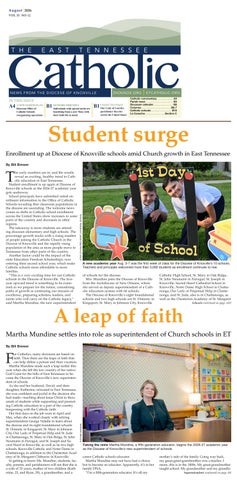
A new academic year Aug. 3-7 was the first week of class for the Diocese of Knoxville's 10 schools. Teachers and principals welcomed more than 3,000 students as enrollment continues to rise. of schools for the diocese. Mrs. Mundine joins the Diocese of Knoxville from the Archdiocese of New Orleans, where she served as deputy superintendent of a Catholic education system with 66 schools. The Diocese of Knoxville’s eight foundational schools and two high schools are St. Dominic in Kingsport, St. Mary in Johnson City, Knoxville
Catholic High School, St. Mary in Oak Ridge, St. John Neumann in Farragut, St. Joseph in Knoxville, Sacred Heart Cathedral School in Knoxville, Notre Dame High School in Chattanooga, Our Lady of Perpetual Help in Chattanooga, and St. Jude, also is in Chattanooga, as well as the Chesterton Academy of St. Margaret
A leap of faith
Schools continued on page A20
Martha Mundine settles into role as superintendent of Church schools in ET By Bill Brewer
ELEYANA NAHIGIAN
F
or Catholics, many decisions are based on faith. Then there are the leaps of faith that can help define a person and their vocation. Martha Mundine made such a leap earlier this year when she left the low country of her native Gulf Coast for the hills of East Tennessee to become the Diocese of Knoxville’s new superintendent of schools. As she and her husband, David, and their daughter, Katherine, relocated to East Tennessee, she was confident and joyful in the decision she had made—teaching about Jesus Christ to thousands of students while supporting and promoting Catholic education in a part of the country burgeoning with the Catholic faith. Her first days on the job were in April and May, when she worked closely with retiring superintendent George Valadie to learn about the diocese and its eight foundational schools: St. Dominic in Kingsport, St. Mary in Johnson City, Our Lady of Perpetual Help and St. Jude in Chattanooga, St. Mary in Oak Ridge, St. John Neumann in Farragut, and St. Joseph and Sacred Heart in Knoxville, as well as its two high schools, Knoxville Catholic and Notre Dame in Chattanooga, in addition to the Chesterton Academy of St. Margaret Clitherow in Knoxville. In getting to know Ms. Mundine, students, faculty, parents, and parishioners will see that she is a wife of 33 years, mother of two children (Katherine, 23, and Ryan, 29), a grandmother, and a
Taking the reins Martha Mundine, a fifth-generation educator, begins the 2026-27 academic year as the Diocese of Knoxville's new superintendent of schools. career Catholic schools educator. Martha Mundine may not have had a choice but to become an educator. Apparently, it’s in her family DNA. “I’m a fifth-generation educator. It’s all my
mother’s side of the family. Going way back, my great-great-grandmother was a teacher. I mean, this is in the 1800s. My great-grandmother taught school. My grandmother and my grandfaSuperintendent continued on page A8
Playbook for the soul QB Fernando Mendoza leads Hallow’s new St. Paul Prayer Challenge By Alyssa Murphy National Catholic Register
Sr. Regina
MICHAEL CLEMENS/LAS VEGAS RAIDERS
T
he popular Catholic prayer app Hallow has officially launched a major new spiritual initiative led by one of the most prominent young voices in sports: quarterback and Heisman Trophy winner Fernando Mendoza. Guided by Mr. Mendoza’s familiar voice, the series introduces listeners to the dramatic world of the early Church, exploring how St. Paul navigated monumental obstacles, intense suffering, and spiritual warfare. Known for routinely giving glory to God on and off the field, and his deep love for his mother and family, Mr. Mendoza brings his deep Catholic faith to a dynamic new audio prayer challenge designed to inspire users to find spiritual strength under pressure. For Mr. Mendoza, who led the University of Indiana to a national championship and became the first
Ready for the challenge Las Vegas Raiders first-round draft pick quarterback Fernando Mendoza poses for a photo after arriving at Las Vegas Raiders headquarters following his selection in the 2026 NFL draft in April. Hoosier to win college football’s most prestigious individual award, faith isn’t an afterthought reserved © 2026 Handmaids of the Precious Blood
for the post-game press conference. It is the very engine of his life. Known for eschewing heavy pre-
game playlist tracks in favor of quiet prayer and rosaries to stay “cool, calm, and collected,” the star quarterback has frequently spoken about treating his spiritual life with the same rigorous discipline he applies to his mechanics under center. Now, through his exclusive partnership with Hallow, Mr. Mendoza is bringing that mindset to a daily routine for millions of app users. The cornerstone of the partnership is an exclusive seven-day audio prayer challenge focused entirely on the life, trials, and relentless grit of St. Paul. Mr. Mendoza guides listeners through the life, trials, and conversion of St. Paul, covering his transformation from an opponent of Christianity to a foundational apostle. Throughout the daily reflections, the Heisman Trophy winner draws connections between the discipline and resilience required in elite football and the spiritual endurance of the Christian life. Mendoza continued on page A19
How to sign up and qualify for Diocese of Knoxville’s safe-environment program
T The Handmaids of the Precious Blood this year celebrate the 79th year since their founding in 1947; more than three-quarters of a century of prayer and sacrifice for priests. To receive weekly cartoons and short reflections and news from the Handmaids of the Precious Blood, visit their website, nunsforpriests.org, and sign up for the FIAT newsletter.
An August prayer intention for evangelization in the city “Let us pray that in large cities often marked by anonymity and loneliness we find new ways to proclaim the Gospel, discovering creative paths to build community.” –– Pope Leo XIV
DIOCESE OF KNOXVILLE PROCEDURE FOR REPORTING SEXUAL ABUSE
Anyone who has actual knowledge of or who has reasonable cause to suspect an incident of sexual abuse should report such information to the appropriate civil authorities first, then to the McNabb Center victim's assistance coordinator, 865.321.9080.
he Diocese of Knoxville has implemented the CMG Connect platform to administer the Safe Environment Program, which replaces the former Safe Environment Program (VIRTUS “Protecting God’s Children”). CMG Connect is a web-based platform that will assist in ensuring that all employees and volunteers who are in a position of trust with children and vulnerable adults within Diocese of Knoxville schools and parishes are trained to recognize behavior patterns of potential abusers and provide pro-active measures for preventing abuse in any context. “Safe Haven-It’s Up to You” is a three-part video that provides vignettes of real-life situations to educate the viewer about methods of grooming, desensitization, bullying, and neglect, all of which can lead to abuse. Each part of the video is immediately followed by a brief questionnaire to further develop understanding. Education is a key
element of the Safe Environment Program. All clergy, employees, contracted school personnel, volunteers, members of groups and organizations over the age of 18 who work, volunteer, or participate in any capacity are required to complete the diocesan Safe Environment training and a criminal-background check before they can begin employment, volunteer, or participate with ministries, groups, and organizations affiliated with the Diocese of Knoxville. In addition, the mandatory renewal training must be completed every five years and a new background check submitted before the five-year expiration of prior training. The Diocese of Knoxville Safe Environment compliance training and renewal training is a condition of employment and for volunteer ministry in the Diocese of Knoxville.
The CMG Connect platform contains all three elements of the Diocese of Knoxville’s Safe Environment Program: n Annual review of the Diocese of Knoxville’s Policy and Procedures Relating to Sexual Misconduct; n CMG Connect Safe Haven training program to be completed every five years; n Criminal background check to be completed every five years. In compliance with the Diocese of Knoxville’s Safe Environment Program, all affiliates require that volunteers and employees complete the requirements prior to working and/or volunteering in a parish, school, or through Catholic Charities of East Tennessee and/ or St. Mary’s Legacy Clinic. Go to https:// dioknox.org/safeenvironment on the Diocese of Knoxville website for more information. ■
STAY CONNECTED WATCH UPDATES CHECK US OUT FOLLOW US knoxdiocese dioknox KnoxDiocese DioKnoxTV
ADVERTISE IN THE EAST TENNESSEE CATHOLIC
> CONTACT US AT 865.584.3307 OR bbrewer @ dioknox.org.
> FIND US AT dioknox.org.
NEWS FROM THE DIOCESE OF KNOXVILLE PUBLISHER EDITOR
Bishop Mark Beckman Bill Brewer bbrewer@dioknox.org COMMUNICATIONS DIRECTOR ASSISTANT EDITOR
John Mecklenborg Dan McWilliams
THE EAST TENNESSEE CATHOLIC (USPS 007211) is published monthly by The Diocese of Knoxville, 805 S. Northshore Drive, Knoxville, TN 37919-7551. Periodicals-class postage paid at Knoxville, TN. Printed by the Knoxville News Sentinel. THE EAST TENNESSEE CATHOLIC is mailed to all registered Catholic families in East Tennessee. Subscription rate for others is $15 per year in the United States. Make checks payable to The Diocese of Knoxville. POSTMASTER: Send address changes to THE EAST TENNESSEE CATHOLIC, 805 S. Northshore Drive, Knoxville, TN 37919-7551.
A2 n AUGUST 2026
www.di o k no x .o rg
jmecklenborg@dioknox. dan@dioknox.org org MULTIMEDIA DIGITAL MEDIA REPORTER PRODUCER Bee Goodman Emily Booker bgoodman @dioknox. ebooker@dioknox.org org CONTACT US 865.584.3307 VISIT US ONLINE dioknox.org | etcatholic.org
TH E EA S T TEN N ES S EE C ATH OLI C
A Word from the Bishop
by Bishop Mark Beckman
It’s all gift ‘The finest response we can offer God in return begins with gratitude’
COURTESY OF ANTHONY HEFLIN/DREAMSTIME.COM
O
ne of the moments of my daily morning prayer that has become increasingly significant through the years is the time I spend in silent stillness with the Lord. One particular awareness during that time has often been a sense that everything in life is pure gift. As I breathe in, I am reminded that the breath of life itself is a gift from God, each and every moment of our existence in this world. The creation narrative of Genesis speaks of God breathing into man’s nostrils the breath of life and states “he became a living being.” It is by God’s creative power who formed us from the clay of the earth, created as we are in the image and likeness of God, that we have any existence at all. Our life itself is pure gift. All that we have and are is gift. From that standpoint my mind moves outward to the beauty of creation itself. The whole universe in all of its mystery and wonder, in its sheer immensity, is also pure gift from our Creator. The warmth of the morning sun, the dew upon the grass, the clouds in the sky, the gentleness of the wind against my skin, all living things great and small are formed and sustained by the loving gift of God. My backyard is a microcosm of the greatness of God’s creation.
The gift of God's creation Summer bucks with velvet on their antlers are seen grazing in Cades Cove in the Great Smoky Mountains National Park. Birdsong greets my mornings, the call of crow and blackbird. Rabbits, squirrels, chipmunks, groundhog, and boxed turtle all I have noticed meandering about my small square of creation. Plants of East Tennessee and beyond bloom almost throughout spring and summer, even into fall, and thanks to the goodness of one of our cathedral parishioners, I enjoy strawberries and tomatoes from my small backyard garden. The gift of God’s creation is revealed in the smallest of things, including fireflies and honeybees. On my journeys to our national parks, I have seen that magnificence in
mighty mountains, canyons, deserts, and dark, night skies bursting with stars. There have been places where I felt I could almost reach out to touch the stars because of the lack of light pollution. The universe itself is such a splendid gift from God. Then my mind turns to all the beautiful gifts of being particularly human. The parents and grandparents God has given, brothers and sisters and all relations, friends and mentors, teachers, and all those persons we encounter on life’s paths. The gifts of civilization: a roof over the head, air-conditioned spaces, all
the wonders that have come about because of electricity, books and hiking gear, clean, running water and food, even my hot mug of coffee in the morning! All gift. Then my mind turns to the spiritual gifts of God—every grace and goodness God has so richly blessed us with from the moment of our creation, by being claimed in baptism, and the greatest gift of all—God! That the mystery of God—Father, Son, and Holy Spirit—has been poured into our hearts and dwells in the core of our being, that we taste the goodness of God in the gift of the Eucharist, that God draws us into his own divine life! The finest response we can offer God in return begins with gratitude! From the moment that our awareness that all is gift touches our minds and hearts, we know that our entire life now must also become gift! To God, the gift of our entire self in love, praise, adoration, and worship. To this wonderful creation, that we become good stewards of what has been entrusted to our care in this time and place. To our brothers and sisters, the outpouring of our own generous love and service. In the end nothing “belongs” to us completely but is meant to be shared freely for the good of all. It’s all gift. ■
Taking control of the narrative
Catholic school supporters must shape conversation on Education Freedom Tax Credit program By Sister Dale McDonald, PBVM, Ph.D. National Catholic Education Association
TH E EAST T E N N E S S E E C AT HO L I C
OSV NEWS PHOTO/GREGORY A. SHEMITZ
A
s the new Education Freedom Tax Credit program (EFTC) is discussed, debated, and attacked across the nation, it is interesting to observe how different groups seek to control the narrative about what the program is and isn’t, as well as about private schools. More than ever, supporters of our schools and the EFTC must be prepared to shape the national conversation by proactively presenting accurate information to counter myths and other misinformation that are influencing public perceptions of the EFTC and of Catholic schools. The Education Freedom Tax Credit program has undergone several title changes over the past year. The earliest legislative proposals called it the Educational Choice for Children Act or ECCA, but Section 70411 of the bill that created it was simply titled Tax Credit For Contributions of Individuals to Scholarship Granting Organizations. As the U.S. Department of the Treasury began to develop the regulations, it was referred to as the Federal Scholarship Tax Credit program (FSTC), and then the administration decided it should be called the Education Freedom Tax Credit program (EFTC). However, despite the different titles and iterations, it remained the same legislation passed in July 2025—a tax credit program available to all individual taxpayers for a contribution to a scholarship-granting organization (SGO). The program never mentions vouchers or the U.S. Department of Education, but, rather, focuses on many options that families can use scholarships for to improve students’ learning outcomes. All students whose family income does not exceed 300 percent of the local poverty level are to be treated equally by SGOs. Families may request scholarship aid for tutoring and curriculum materials, counseling and special needs services, transportation, technology, supplies, equipment, uniforms, and other things to support learning outcomes. Additional detailed information about the EFTC is available on the NCEA website: www. NCEA.org/publicpolicy. Encountering false narratives about Catholic schools should be answered with data, not sentiment. NCEA’s annual data collection from all K-12 Catholic schools in the United States provides such information. Accordingly, of the 1.6 million students, Catholics comprise 71.8 percent of enrollment, non-Catholics 22.2 percent, and 6.8 percent are not reported. Schools are racially and economically diverse: Black 7.6 percent, Multiracial 7.7 percent, Hispanic 14.2 percent,
Catholic schools in the spotlight Students walk near a cross as they change classes at St. Patrick School in Smithtown, N.Y., on Jan. 15 during Catholic Schools Week, the annual celebration of Catholic education in the United States. and 3.9 percent are not reported. For the National School Lunch Program/Reduced Price Meals, 14.2 percent of students are eligible, and 10 percent of students served in 69 percent of the schools have a Sr. Dale McDonald diagnosed disability. According to the most recent results on the National Assessment of Educational Progress (NAEP), Catholic school students outperformed public school counterparts by these scale scores: math 10-21; reading 16-20; and science 11-14 (National Center for Education Statistics, 2024). Those are just some of the data that can counter the usual myths about Catholic schools and the EFTC program. EFTC is not a scheme to give rich families with kids in private schools more money at the expense of the poor. Catholic school data demonstrate the economic diversity in our schools, where nearly 20 percent of students receive some state or private scholarshipfunding, and it is not enough to cover total costs. Students in public schools will also have equal access to benefits that may accrue to their schools that participate in eligible programs. Another false assumption is that EFTC will www.di o k no x .o rg
Commentary take money away from public schools or harm public school students. No funds under EFTC are ever public money that would be otherwise available for public school use. The scholarships result from charitable donations to SGOs, as do the IRS grants to Red Cross, Catholic Charities, etc. EFTC is not a plot to destroy public education—public education will benefit as well, and students can use scholarships to participate in public schools’ activities or even tuition to another out-of-district public school. Some argue that scholarships will support schools that discriminate against students with disabilities or because of sexual orientation or gender identity. Catholic and other faith-based schools may hire for mission in accord with their religious beliefs, and that is not discrimination. The U.S. Supreme Court has upheld the right of religious organizations to claim a religious exemption to hire for mission and enforce policies that protect the religious tenets of the organization. This right has been affirmed in several court decisions: Hosanna-Tabor, Trinity Lutheran, Espinoza v. Montana Department of Revenue, Our Lady of Guadalupe School v. Morrissey-Berru, Carson v. NCEA continued on page A15 AUGUST 2026 n A3
Welcome back! Diocese of Knoxville students begin 2026-27 school year
Meeting, exceeding the standards Diocesan Office of Catholic Schools reorganizes as reaccreditation approaches By Bill Brewer
T
Diocesan schools advocates Diocese of Knoxville schools superintendent Martha Mundine is pictured with diocesan Office of Catholic Schools staff Mary-Hannah MacCurdy, left, and Rachael Leitner.
ELEYANA NAHIGIAN (3)
he 2026-27 academic year and a new superintendent are ushering in a reorganization of the Diocese of Knoxville’s Office of Catholic Schools. The current year promises to be a challenging one as the schools office manages significant enrollment growth among the 10 diocesan campuses, ascending student test scores, faculty retention, growing demands for resources, and the reaccreditation of each school. Superintendent Martha Mundine has announced new roles for herself and her assistants, MaryHannah MacCurdy and Rachael Leitner, to better serve the diocese and its schools. “We’re refining our roles a little bit to better align with the national standards and benchmarks for effective Catholic schools, the four pillars: Catholic identity, governance and leadership, operational vitality, and academic excellence. Rachael is going to serve academic excellence. Mary-Hannah is going to serve operational vitality. I do governance and leadership as well as the other duties of the superintendent, and then Catholic identity is everybody,” Ms. Mundine explained, noting that everything the schools office does will align with those national standards and benchmarks. She noted that the standards, benchmarks, and pillars have been established by the National Catholic Education Association (NCEA) to elevate the performances of Catholic schools in the United States. And meeting that criteria will be vital in reaching the measures for accreditation in February. “The NCEA started this years ago when we really didn’t have standards for Catholic education. We always had to supplement with something,” Ms. Mundine said. “But we always had accreditation standards through SACS or AdvancED, now Cognia.” “There was never a good way to judge the effectiveness of Catholic schools. And so a team of people has been working long and hard for years on establishing this,” she pointed out. “And they have their rubrics to critique and measure yourself and your own school and figure out how it is. And that’s what we’re here to do: help our people and help our schools.” According to Ms. Mundine, accreditation used to be based more on academics. “More and more now it’s everything,” she said. “We are able to do that because of the way accreditation is built.” As manager of the academic excellence pillar, Ms. Leitner is working with the schools to get all academic performance records in place. Cognia representatives will visit the diocese in February over several days to review the school system’s performance. Accreditation occurs every five years, Ms. Leitner noted. “We’re always working toward it, and we want to always stay accredited, so the visit from Cog-
nia is coming back up,” she said. “In aligning with those national standards and benchmarks, we are perpetually being sure that each of the schools meets the standards that are set forth.” As the school year gets underway, Ms. Leitner and the schools office will be assembling evidence through surveys, evaluations, and campus visits to establish the grounds for accreditation. “We’ll be ready to have all of our evidence whenever they come to visit,” Ms. Leitner said, pointing out that each school will be responsible for getting on board for the reaccreditation effort. “I’m looking forward to it.” Ms. Mundine is familiar with the accreditation process, having served as deputy superintendent of schools for the Archdiocese of New Orleans and as a principal and teacher in three states during a Catholic education career of more than 30 years. “As a district, every year we make sure we have schools that we focus on for their own reviews. And then every five years as a district, outsiders come in and visit us to make sure everything is in compliance. But every school has to have evidentiary pieces, and each year they do reports for what they’ve done and how they stand,” Ms. Mundine said. Ms. MacCurdy is in her sixth year as development director for diocesan schools. And her new duties will be an extension of the role she has been performing— and will be more involved. “When I was hired for this job originally, it was to do this type of thing, but this is more allencompassing,” she said. “I will be working with the schools and looking at their enrollment trends, public relations, and marketing. I’m a liaison between our office and each school to communicate back and forth about their goals in terms of their fundraising and what they are doing for their annual funds and are they doing capital campaigns and what can we do to promote not one school but all schools.” She will meet with the schools’ advancement directors and admissions directors, working with them to generate creative ways to
expand the schools’ enrollment and fundraising efforts. “Part of what I do in supervising operational vitality is to be like a cheerleader for all the schools,” Ms. MacCurdy said. “And then there is enrollment management, managing the different reports that say what we are doing in terms of enrollment and where we can improve in enrollment. Is marketing, whether by word of mouth or advertising, effective? Are we doing enough advertising? What are we doing or not doing that we need to look at?” In promoting development for each school, Ms. MacCurdy is supportive of the individual identities each school community has established. “They all have their own unique way of doing things, and they all have their own culture, and we don’t want to take away from that. But we also want them to know that they have the support of the Chancery and the Catholic Schools Office in what they’re doing,” she said. “We work within their cultures.” Ms. Mundine described the schools office as a “support system.” Ms. Leitner pointed out that the schools office supports each school’s operational autonomy, from curriculum to development, and the standards and benchmarks, including the four pillars, respect that. “We have the standards set in place of what is expected from a Catholic school. But then each school has the freedom to choose what the direction is for their students. This is a collaborative partnership,” she said. Ms. Mundine, for example, cited the three schools in the Chattanooga Deanery. “In Chattanooga alone, I think of the two elementary schools and the high school. Those two elementary schools are not cookiecutter schools. They are very different, and we respect that. And we work for that,” Ms. Mundine said. “Everybody has their own Catholic identity, their own charism that we work with.” “Our thing is establishing those foundations, what’s expected, of course, from Bishop (Mark) Beck-
Standards continued on page A8
"I will be working with the schools and
"We’re always working toward it (accredita-
looking at their enrollment trends, public relations, and marketing. I’m a liaison between our office and each school to communicate back and forth about their goals in terms of their fundraising and what they are doing for their annual funds and are they doing capital campaigns and what can we do to promote not one school but all
tion), and we want to always stay accredited, so the visit from Cognia is coming back up. In aligning with those national standards and benchmarks, we are perpetually being sure that each of the schools meets the standards that are set forth. We’ll be ready to have all of our evidence whenever they come to visit. I’m looking forward to it."
schools." — Mary-Hannah MacCurdy, who will oversee operational vitality and Catholic identity for the Diocese of Knoxville's 10 schools A4 n AUGUST 2026
man, what’s expected from legal standpoints, and helping them begin compliance,” she continued. “Again, they’re autonomous.” Even as autonomy, identity, and individual culture are supported and encouraged, Ms. MacCurdy plans to initiate some diocesanwide programs the schools can participate in as a group. “We’re going to try to start bringing them together for certain things we all can do to promote school unity among all 10 schools, which I think would be a great goal for us and without losing their identities,” she said. One example she gave is the annual Christmas card contest in which all the schools participate. Other ideas include a possible collaboration with the American Heart Association as well as the Catholic Church’s and the diocese’s emphasis on care of creation. Ms. Mundine underscored the importance of data collection and interpretation by her office and sharing that information with the schools. “It is the intentional examination of things we mentioned, looking at our test data and helping our administrators, helping our teachers and curriculum coordinators look at that data and make decisions for their own instruction, for their own professional development, and for their curriculum selections, things like that,” she shared. She noted that Ms. Leitner and Ms. MacCurdy already have been collecting data to present to the schools, and coming up there will be a diocesan performance report of test data. However, the data will not be used to compare schools publicly. “Anything we put out publicly will be diocesan data,” she said. “School leaders will know how their school is doing.” Also planned are tools to assist school leaders with budgeting and resources. Ms. Mundine said data tracking shows that test scores among the schools are consistently above the national averages. “I would like everyone to know that Catholic schools in this diocese perform very well. I actually
www.di o k no x .o rg
— Rachael Leitner, who will oversee academic excellence and Catholic identity for the Diocese of Knoxville's 10 schools TH E EA S T TEN N ES S EE C ATH OLI C
Growing Saints
CATHOLIC SCHOOLS TUITION ASSISTANCE FUND
Your gift makes it possible
YOUR GIFT HELPS STUDENTS ACROSS OUR DIOCESE OF KNOXVILLE RECEIVE A CATHOLIC EDUCATION ROOTED IN FAITH, ACADEMIC EXCELLENCE, AND SERVICE.
Acad emic s ts Hear
Service
h Fait
Diocese of Knoxville Catholic Schools www.dioknox.org/schools-collection
TH E EAST T E N N E S S E E C AT HO L I C
www.di o k no x .o rg
AUGUST 2026 n A5
BEE GOODMAN
Welcome back! Diocese of Knoxville students begin 2026-27 school year
CAROLINE WRIGHT
St. Mary School-Oak Ridge
CAROLINE WRIGHT
JACLYN HOLLOWAY/ KNOXVILLE CATHOLIC HIGH SCHOOL
St. Mary School-Johnson City
St. Dominic School
CLEO GRAVITT/NOTRE DAME HIGH SCHOOL
KATHY RANKIN/ST. JOSEPH SCHOOL
Knoxville Catholic High School
St. Joseph School
BILL BREWER
DAN MCWILLIAMS
Notre Dame High School
St. Jude School
STEPHANIE GREINER/ST. JOHN NEUMANN SCHOOL
STEVE COY/SACRED HEART CATHEDRAL SCHOOL
Our Lady of Perpetual Help
Sacred Heart Cathedral School St. John Neumann School
A6 n AUGUST 2026
www.di o k no x .o rg
TH E EA S T TEN N ES S EE C ATH OLI C
STEPHANIE GREINER/ST. JOHN NEUMANN SCHOOL
Welcome back! Diocese of Knoxville students begin 2026-27 school year
CAROLINE WRIGHT
St. John Neumann School
STEVE COY/SACRED HEART CATHEDRAL SCHOOL
JACLYN HOLLOWAY/KNOXVILLE CATHOLIC HIGH SCHOOL
St. Mary School-Johnson City
Knoxville Catholic High School
CAROLINE WRIGHT
DAN MCWILLIAMS
Sacred Heart Cathedral School
St. Jude School
BEE GOODMAN
KATHY RANKIN/ST. JOSEPH SCHOOL
St. Dominic School
St. Joseph School
DAN MCWILLIAMS
BILL BREWER
St. Mary School-Oak Ridge
Our Lady of Perpetual Help Notre Dame High School
TH E EAST T E N N E S S E E C AT HO L I C
www.di o k no x .o rg
AUGUST 2026 n A7
Sisters and students Above: Sister Catherine Marie Hopkins, OP, principal of St. Mary School in Oak Ridge, visits with young students on the first day of class on Aug. 7. Below: Sister Dominica Bickerton, OP, who teaches English at Notre Dame High School, addresses students on the first day of class, which was Aug. 6.
CLEO GRAVITT/NOTRE DAME HIGH SCHOOL
reports it can offer. As administrators look to balance their budgets based on enrollment trends, staffing size, and resource needs, they also must be mindful that the governor and state legislature control the Education Freedom Scholarship program and the president and Congress influence the Education Freedom Tax Credit. And changes in politics can affect whether those programs continue. “They (Catholic school administrators) have to look at their own trends. You can’t go building new classrooms and hiring new
Superintendent continued from page A1 ther taught school,” the superintendent shared. Now, as Ms. Mundine becomes the diocese’s lead education administrator, she will lean on that heritage as she guides the schools through an important period in the diocese’s 38-year history. The Diocese of Knoxville is experiencing surging growth as record numbers of people are joining the Church and more Catholics are moving to East Tennessee. Those trends are translating to expanding enrollment in diocesan schools as well as the positive impact the Education Freedom Scholarships that make Catholic education more affordable for families are having on the schools. There also is the new federal Education Freedom Tax Credit program for 2027 that promises to have an impact on Catholic schools similar to the state Education Freedom Scholarships. And then there is reaccreditation for all 10 diocesan schools early next year that Ms. Mundine and her team of assistants and education professionals in the schools must navigate. Ms. Mundine has been preparing for all of those situations and more, and she is a quick study. After all, school administration is nothing new to her. Since 2017, she has served as an associate superintendent and deputy superintendent in the Archdiocese of New Orleans, which oversees 66 schools. When the superintendent of schools for the Archdiocese of New Orleans learned that Mr. Valadie was retiring and was assisting in the search for candidates to fill his office, the archdiocesan superintendent thought Ms. Mundine would be right for the job and that this was an opportunity she needed to pursue.
Well-schooled
You could describe Ms. Mundine as a lifelong learner. As the superintendent launches her first full academic year leading Diocese of Knoxville schools, she is studying for her doctoral degree in executive leadership. She is on track to receive her Ph.D. from the University of Holy Cross in New Orleans in the 2027-28 academic year. She is now working on her dissertation. And you could say she is a believer when it A8 n AUGUST 2026
teachers based on one bump. We have to remember the priority of acceptance. We are here to serve our Catholic community first,” Ms. Mundine said. She stressed that all are welcome to a Catholic education, and the goal is to evangelize to everyone. “We want to offer that opportunity to anybody who wants a Catholic education. It doesn't matter what religion you are, what faith you practice. But we have to look at those things. So yes, that makes for a big challenge,” she noted. Ms. MacCurdy and Ms. Leit-
ELEYANA NAHIGIAN
Standards continued from page A4 found out not too long ago that people don’t really know that,” she said. “And as far as enrollment trends? Wow!,” she added. “The enrollment trends are going up. This is a good time for Catholic education.” So, why are enrollment trends rising among diocesan schools? “There could be so many reasons. I know that the Catholic Church is growing in this area. So, that could be a large part of it. Just belonging to the Catholic Church,” she continued. The NCEA has performed studies on why parents are choosing Catholic education for their children. Catholicism and faith are on the list, but not at the top. “It’s safety and academics,” Ms. Mundine said. “Faith is in there somewhere. But once they are in, it will all be based on faith.” Tennessee’s Education Freedom Scholarships, commonly referred to as school vouchers, also are a major factor, she pointed out. “Those have had a large impact on making Catholic education affordable for more students,” she said. “And affordability has always been a bump in the road for Catholic schools.” Ms. Mundine pointed to the Education Freedom Scholarships and a similar program the federal government is introducing early next year—the Education Freedom Tax Credit—as important reasons Catholic schools are able to manage the expensive and rising costs of education while attracting record numbers of students. Enrollment in Diocese of Knoxville schools across the board was up last year, and that trend is continuing this year. Schools are reporting waiting lists to enroll and classes that are at or near capacity. Ms. Mundine said that it will be important for schools to balance enrollment, classroom sizes, the number of classrooms, and the number of teachers on staff, and the schools office will be in a position to assist with the information it collects and analyzes, and the
BEE GOODMAN
Welcome back! Diocese of Knoxville students begin 2026-27 school year
"I want people to understand that I’m here to help. That is my biggest objective. My goal is to help the schools as much as I can so that they can help the students. That’s our ultimate goal. But I am here as the educational arm of the bishop, if you will, so I can help him learn as well. There are some things that I’m going to be putting in place administratively, not anything outrageous, just some accountability things so that I can learn a little bit more." — Martha Mundine, Diocese of Knoxville superintendent of schools comes to Catholic education. She also has the perspective of having attended public school as a child. Martha Murphy was born in Dallas into a faith-filled Catholic family. When she was about www.di o k no x .o rg
ner pointed to how unworkable it becomes to irresponsibly add students, teachers, or classrooms because of the costs to educate. “If you’re doing that, how are you affording it?” Ms. Mundine interjected. “And at the same time, we don’t want to have avenues to make it more accessible and affordable for some that qualify but drive up the price for others who are paying for that. That is why we appreciate the vouchers and the upcoming tax-credit program that will be in place but will not drive up tuition for other people.” Ms. Mundine is impressed that tuition assistance offered by diocesan schools does not come from the operating budgets of the schools. All of that makes strategic planning critical. “So, yes, we are here to help figure out strategic planning and how we can move forward. That’s also part of that governance and leadership piece. It’s always a formula that you’re trying to figure out all the time. It’s all about data and consistency in the data.” As the schools office implements its new duties, Ms. Mundine, Ms. MacCurdy, and Ms. Leitner said it is important for the schools to know they are advocates for the schools. “We’re their advocate in all that they are doing. We are here to support them. Martha has been very empowering to us in the office and also to our school leaders. I think they are really going to appreciate that,” Ms. MacCurdy said. The Diocese of Knoxville Office of Catholic Schools is excited about the academic year and what lies ahead. And Ms. Mundine, Ms. MacCurdy, and Ms. Leitner are looking forward to their interactions with the schools and their faculties. After all, everyone involved in the diocesan schools has the same goal: teaching the Catholic faith and academic success. “We are mission-oriented, and that’s our goal—to raise disciples and accompany people to Jesus Christ. We haven’t taken our eyes off the mission,” Ms. Mundine said. ■
10 years old her family moved to Lafayette, La., where her father was in the petroleum industry. As the U.S. oil business began to slump in the 1980s, the family—with a 16-year-old Martha and two other children in tow—relocated to Ocean Springs, Miss., which is where the teen would graduate from high school. She attended the University of South Alabama in Mobile, earning a bachelor’s degree in elementary education. She then returned to Ocean Springs as a fiancée to teach at St. Alphonsus Catholic School. And since then, she always has worked in Catholic education. Did she ever have a desire to return to public schools as a teacher or administrator? “No, not a desire and not a calling,” she said, explaining that early in her teaching career she applied for a teaching position in public school. “When I moved to Mobile, I had no children. I was 25 years old, and I thought I could make a lot more money in public school and so I put in an application to public school and Catholic schools. Well, I had three job offers in Catholic schools before public school even called me back. So, God had a plan. Yes, oh absolutely. And I felt better called to that,” she added. She was a classroom teacher for nine years. When she was 27 in 1997, she was asked to become an assistant principal. And then she began fulfilling a career interest. “I had always had a desire to do administration. Even when I was in college and getting my undergraduate degree, I knew that teaching was not my endpoint. It was something I was called to do, it was something I wanted to do, but it was my avenue to get where I wanted. And where I am now is not ever where I imagined I would be, but I always wanted to be a principal,” Ms. Mundine shared. At that point she returned to college in 1998 to begin earning a master’s degree, a requirement for principal-level positions, and which she received in 2001 as she juggled her career and being a wife and mother. She received her graduate degree at the end of her first year as principal of Our Lady of Lourdes School in Mobile. While that experience was invaluable in her Superintendent continued on page A9 TH E EA S T TEN N ES S EE C ATH OLI C
Superintendent continued from page A8 training as a principal, it also proved to be one of the most difficult times of her career. “It has since closed. I actually was the closing principal. You know how you look back and think, why did you do that? It was God,” she said. “It was a school that was on the verge of closure when I took it. And I found that out very quickly. But we kept it open for three more years. We actually closed it before we had to. There were other schools in the area. The parish had said, ‘We can keep you open.’ But I said, ‘I'm not going to bankrupt the parish to support the school when we know what’s going to happen.’” According to Ms. Mundine, studies showed that demographics had shifted and the parish population had shrunk. “That was probably the most difficult thing I’ve ever done in my career, closing a school. It’s very emotional. I learned so much. But that place will always have special meaning to me, and I still keep up with people from there even though that was 22 years ago. It was a great little parish,” she said. “That community was so sweet and so good. The ladies from the parish would come over and give me gifts. It was such a great place. And I had my daughter while I was principal there. The parish threw me a shower. It was just so sweet. I think my granddaughter actually still has one of the knitted afghans that one of the ladies from the parish made me. I passed it down,” Ms. Mundine continued. When she learned the school would close, she was offered a position at another school. But she could feel God guiding her in a specific way. “I knew it was God's plan when I was offered at the beginning of my third year before we knew we were closing. I was offered a position at another school. They came and just said, ‘We’d really like to see you come here.’ I just couldn’t do it. I could just feel God saying. ‘You are needed here.’ The night that we went to make the (closure) announcement and I met with the parish council and my board and some people from the parish to announce that we were going to close, I sat in my office beforehand with the priest, who asked me to make the announcement,” she recalled. “My superintendent, I looked at her and I said, ‘I should not be the one doing this.’ And she looked at me and she said, ‘God chose you to stay here. You had an out. God told you to stay here. This is why you’re here,’” she continued. “When I finished, she looked at me and she said, ‘I think I might know who my successor is.’ And I looked at her and I said, ‘If you’re talking about me, I have no desire to ever do your job.’ And she said, ‘You don’t want to be a superintendent?’ I said, ‘No. I’m too young.’ She said, ‘Well, not today.’ And I said, ‘No, that’s not something I’m ever interested in. I want to be a principal.’ And it’s funny how God calls you.” So, Our Lady of Lourdes School in Mobile closed in 2004 after enrollment declined from about 800 to 100 students. Ms. Mundine continued to serve as an assistant principal at St. Dominic School in the Archdiocese of Mobile, and in 2006 she became principal of the school. Enrollment was increasing. Test scores were “great.” And her tenure at St. Dominic was going well. But there are challenges in every family, and the Mundines are no exception. In the fall of 2010, when her son was in eighth grade and her daughter was in first grade, both attending another Catholic school, the Mundines faced a difficult choice: the need to relocate the family. Katherine was diagnosed with autism, and her physician firmly suggested to Mr. and Ms. Mundine that Katherine be enrolled in a school with a proven program to teach children with autism. That meant moving to the New Orleans area, where Katherine could be enrolled in a school recognized with awards for its special-education program. And Ryan could transfer before he started high school. The family also was moving near Ms. Mundine’s parents. “We prayed and prayed and prayed. My mother and father lived by that time in St. Tammany Parish in Mandeville, La., which is the north shore of New Orleans. And my mother said the public schools there had just won awards for the things they were doing with special education. My parents were getting older and we loved being with them. So, we would be with them before we have to take care of them. As everyone described it, we took a leap of faith because the time was right, because if we were going to move, I was not going to do it when my son was in high school if I could avoid it. When I was 16, my family had to move. I moved between my sophomore and junior year in high school. That was very hard,” Ms. Mundine shared. “I loved both places, and I have friends from both areas. But it’s very difficult. And as a result, you don’t ever feel like you have those roots in the high-school years. I didn't want my son to have to go through that. So, we decided to move and we started looking for jobs. My husband got transferred. He actually ended up living with my parents for a few months because he went early to New Orleans. TH E EAST T E N N E S S E E C AT HO L I C
COURTESY OF CLEO GRAVITT/NOTRE DAME HIGH SCHOOL
Welcome back! Diocese of Knoxville students begin 2026-27 school year
Getting up to speed Diocese of Knoxville schools superintendent Martha Mundine meets with Notre Dame High School faculty prior to the beginning of the 2026-27 academic year. The move proved to be a success. Ms. Mundine accepted a principalship at Pope John Paul II High School in Slidell, La., which is in Tammany Parish. Despite her misgivings of her children attending the same school where she worked, her son attended and graduated from Pope John Paul II. “It ended up being good. And my daughter had a great experience in public school,” Ms. Mundine recalled. The Mundines decided to move Katherine to St. Therese Academy for Exceptional Learners in New Orleans for her junior and senior years, where she thrived and graduated. In 2017, Ms. Mundine was named the associate superintendent for secondary schools for the Archdiocese of New Orleans. She oversaw 23 high schools. Then in 2020 she was named deputy superintendent of all 66 Catholic schools in the archdiocese, where she served before being named superintendent of Diocese of Knoxville schools on Feb. 12 by Bishop Mark Beckman. She began this new position on April 13.
Teaching priorities
As her new position began last spring, Ms. Mundine took a page from Bishop Beckman’s rules of thumb on learning a new diocese: look, listen, and learn. And that is what she has been doing. She shared several of her best practices for being an effective educator. “I’ve always said for years flexibility and humility are among the top characteristics of people who work in schools. And the No. 1? Always listen to God,” she said. And she fondly recalls prophetic words from her father the day before he died in March 2024. “I'll never forget this. I was on the phone about something because I was with him in his hospital room. And he asked what I was working on. I was explaining what the issue was. And he said, ‘You are going to make such a great superintendent.’ And I looked at him and said, ‘Dad, you know I don’t want that job.’ And his words to me were, ‘It’s not your decision to make.’ I will never forget that,” she recalled. Ms. Mundine noted that her parents were very faithful Catholics. And she wouldn’t be surprised if her mother joined the family in East Tennessee. Her son, Ryan, and his wife, McKenna, live in Nashville with their 3-year-old daughter. Ryan and McKenna are expecting their second daughter in September. Ryan is the head golf pro at Belle Meade Country Club. Ms. Mundine believes all of her lived experiences have been valuable in her formation as a Catholic schools superintendent, whether it was growing up in a faith-filled family, attending public school from kindergarten through 12th grade while participating in religious-education classes (CCD), becoming a Catholic schools teacher and administrator, being a wife, mother, and grandmother, or earning her master’s and doctorate degrees. They have taught her the most profound differences between a public-school education and a Catholic-school education. “The biggest difference is, I've always said, how can you teach a whole person leaving the center of the whole person out, which is Christ? You can teach to the pieces, but you can’t truly teach to the heart if you don’t have Christ in education. And to me, that’s the biggest thing,” Ms. Mundine said, lamenting how politics and political issues often enter the public-school arena. “I think there are pros and cons everywhere. But our (pro) is how we teach, integrating that faith into everything, and we are raising disciples, and we want to have disciples for life. So, we have to form discipleship, and you can’t form disciples of Christ without having people understand Christ. Yes, there are wonderful homes and parents that do a great job with it, as my parents did, but the way that I view it is it’s a partnership, and we are helping with what the parents laid the foundation for as the first teachers of their children.” In addition to having Jesus Christ in education, teaching the whole person also involves those with special needs, which is something Ms. Mundine is familiar with as a parent and as an www.di o k no x .o rg
educator. Providing the resources to effectively teach students with special needs is something public schools, to a large degree, have been able to work out. For Catholic schools, the challenge is much harder because of limited resources. “And that is the challenge. That’s the challenge everywhere. It was a challenge in New Orleans. We don’t have the resources, and I think that we have to be up-front about that. But at the same time, we can’t just say we don’t serve everyone because that’s not who we are. We are Catholic, and that is welcoming. That is universal. Accessibility is not just about making sure your tuition is low enough. Making our schools accessible to all is including those with special needs. What can we do to try to meet it? How can we work toward it?” Ms. Mundine asked. “I will say in New Orleans they began an initiative, in 2010 I believe, of starting those programs. We finally got one off the ground in a high school. They’re doing well now and it’s spreading more. But that’s been 16 years and it’s still not something that is widespread because they’re doing the best they can. They’re doing a great job. They’re doing more than they ever did. With special education, there are more regulations and legal issues that you have to jump through, and again, that’s a lot of those resources that we don't have. Hopefully it’s getting better. I think it is getting better. But our biggest challenge is we’ve got to first be open-minded about it. Instead of saying what can’t we do, what can we do?” she said.
A look ahead
Since arriving in April, Ms. Mundine has visited all 10 diocesan schools and met with their staffs. She has been impressed at how welcoming the schools are as well as the absence of negativity in teacher-student interactions. She fully endorses a positive approach in handling difficult situations, and she is looking forward to seeing more of that. “I’ve been in a lot of schools over the years. You tend to see somebody who is angry or upset or handling a situation with a child in what I would call a non-Catholic way. I didn’t see any of that. I did see students who were being reprimanded, but in a very loving way. That struck me. In one particular situation I witnessed, an older student must have been giving a hard time in the classroom. I happened to be in the hall, and the teacher opened the door and took the student out into the hall where she could talk to her privately. And the words she said were, ‘What is wrong? This is not like you,’ instead of, ‘You better quit disrupting my class!’ And I thought, that’s who we are. What is wrong? This is not like you. And of course, that student opened up. It’s teaching the individual,” Ms. Mundine shared. “I went to the principal later to say please make sure you go tell that teacher how impressed I was. The teacher didn’t know I saw it. I have been very impressed by our schools,” she added. As Ms. Mundine enters the 2026-27 school year, she has some initiatives planned for the school system. Above all, she wants the Diocese of Knoxville Office of Catholic Schools to be a resource for each school. “I want people to understand that I’m here to help. That is my biggest objective. My goal is to help the schools as much as I can so that they can help the students. That’s our ultimate goal. But I am here as the educational arm of the bishop, if you will, so I can help him learn as well,” she said. “There are some things that I’m going to be putting in place administratively, not anything outrageous, just some accountability things so that I can learn a little bit more.” She emphasized that her biggest “ask” of the schools is to work in partnership with the schools office and inform her of anything they need assistance with “so I can be aware.” Ms. Mundine and her staff in the schools office—Mary-Hannah MacCurdy and Rachael Leitner—want what is best for the students, their teachers, and parents. “I think we all want the same thing for our children. We just all go about it in different ways. I have seen people making preconceived notions and judging others because of anger and emotion. One of the greatest lessons I’ve learned over the years is to not let emotion enter into things. You have to look at the facts. You have to look at how they are. I’m all about compliance. And if you don’t like a rule, don’t just disregard it. Do something to change it or accept that it has to be that way,” she said. “That applies to children and their parents, too. It’s not easy. It’s not easy because that’s our heart. My husband was in banking for many years, and we used to laugh that we dealt with the two things that people owned: money and kids,” she added. And Ms. Mundine wants everyone involved in each school to know she is available. “I am here. I’m here for them. I serve at the pleasure of Bishop Beckman, but I’m here to help them. And we are all a system of schools. To me, that’s a beauty about Catholic schools. Each has autonomy, but we do work as a system when working properly,” she said. ■ AUGUST 2026 n A9
Welcome back! Diocese of Knoxville students begin 2026-27 school year Praying for Perspective
by George Valadie
Schools hit the lottery, but we hold the winning ticket New federal legislation in 2027 opens the door for taxpayers to transform student lives
D
angit!! I was sure we would win!! So, it’s another Sunday morning in the Valadie house. Getting ready for Mass, bagels, and Diet Coke, catching up on overnight news and west coast scores, and then lastly—and sadly—tossing out last night’s losing lottery tickets and the dreams that always come with them. I mean I was really sure we were gonna win this time. I just knew it in my soul. Haven’t you ever felt that way? Though I don’t know why. Officially, they say the odds are 1 in 292,202,338. Someone once described it this way: If you laid 292 million playing cards end-to-end, they would stretch from New York City to Sydney, Australia. Get in your car, drive along that path, and somewhere along the way stop and pick up the one and only winning card along those 16,000 miles. Those are your chances. In spite of that realization, I always make the same mistake. I’m fine losing my $2. Here in Tennessee, these dollars go to public education, a worthy cause if there is one. But every time I buy a ticket, I make the blunder of allowing myself to dream. If only … though I’m actually good with the stuff of our lives. I love our house and wouldn’t move. My car runs just fine, even has new tires. I guess I could use a few new T-shirts, and my golf glove has a hole in it. But other than that my closet meets my needs. Should I splurge with my windfall, it would probably be to travel to a few more Fighting Irish football games in South Bend, Ind. But mostly I find myself conjuring up a list of the people and places to whom I would love to pay a really fun visit. My other dream is to die without a single penny left to give away. Given my career in Catholic schools, each and every one at which I have worked or attended would be a huge beneficiary. But alas, their dreams went into my garbage can, too. But here’s the thing—miracles do indeed happen. And this one is huge! As this school year be-
gins, public, private, and parochial schools across this country have all hit the lottery. All of them. And they don’t have to beat any odds. They just need our help. Free help at that. Turns out we are their miracle. Because beginning in January, our Congress has approved the federal Education Freedom Tax Credit program. As a result, every individual in the United States who pays federal income tax will be allowed to transfer some of those tax dollars (up to $1,700) to the school of their choice and in turn receive a dollarfor-dollar tax credit. Not a deduction but a credit. Give a dollar, get a dollar. There are details. There are always details. But in a nutshell, (and who doesn’t like to get all your info in a nutshell) here are our two choices: We can either pay our federal income tax dollars to the IRS or we can give them to the school of our choice. We won’t be out a single extra dime. It’s like giving away Christmas presents without having to buy them. We are their lottery. “I don’t get it,” you say. Then you’re with the great majority since this doesn’t really go into effect until January. There is much education to be done. “Surely there’s more to it though, right? Can it really be that easy?” The answers are “Yes” and “Yes.” The federal government is involved so there’s absolutely “more to it.” But yes, it really is that easy. Let’s break it down: n Though passed by both House and Senate in Washington, D.C., each state’s governor can decide if they wish to participate (Tennessee has chosen to do so). n The purpose of this law is to assist income-qualified students with school-related expenses ranging from tuition to computers to tutoring, regardless of the sort of school they attend. n You and I and all individual income taxpayers (no corporations allowed) can restrict some of our dollars to a specific school, but to access the credit being offered we cannot give to them directly. Instead, the dollars must first be given to a
Scholarship Granting Organization (SGO). n These SGOs are 501(c)(3) charitable organizations bound to follow very specific restrictions imposed by the IRS. There will be several within our state, and our Diocese of Knoxville schools will partner with one of them. n School families can apply for assistance to the SGO (with the help of their school). n The SGO has the responsibility of verifying the applicant does indeed qualify for aid. n The monies we give to the SGO are then divided among the qualified students and ultimately end up at their school on their behalf. n Lastly, the SGO is accountable to the IRS so you can claim your tax credit when you file your income taxes. I don’t know about you but our family’s history with the IRS has been hit-and-miss. Some years we owe, some years we get a refund. Your story may be the same. But no matter which, by taking advantage of this new opportunity we will now either get a bigger refund or we’ll owe less while the schools and students get a boost as well. “If the max I can get is a $1,700 tax credit, how is this going to help schools in any significant way? Hardly seems ‘miraculous.’” I had the same question until the math did its thing. In Tennessee alone, there are some estimated 2.1 million taxpayers, each of whom pays the federal government $1,700 or more in income tax. If each of us transferred just $1,700 of our tax bill to the school of our choice, we would generate $3.5 billion. That’s billion with a B. On a national scale, the potential reaches $187 billion. Think 100 lottery jackpots. What’s the math within our diocese? A pretty close guess estimates there are about 62,000 adult parishioners in our diocese. If each made this same decision, picked a school, donated $1,700, the net result would yield $102 million. Imagine how that might change education? And by extension, imagine how that might change the Church.
And again—this new law says you can give it to a school or you can pay it to the government. But if you choose a school, the IRS will reduce your tax bill by the same amount. And when was the last time they told you that? Tennessee residents are now familiar with vouchers. Those have become a political hot-button issue. No matter which side of the aisle you support in that regard, this new law is not that. The federal government will not be sending any money to schools or students. It’s the taxpayers who will make these contributions; the government merely encourages it with a dollar-for-dollar matching tax credit. “It all sounds too good to be true!” I’m no tax accountant and would never pretend to give advice in this realm. “Consult your professional” as they say. But I know enough to say—it really is true and it really is that good. When the gathered multitudes were hungry at day’s end, the Apostles told Jesus He should send them home. His response: “There is no need for them to go away; give them food yourselves.” You do it. You feed them. Yourselves. We know what happened after that. God always multiplies our good works. He’s just waiting on one to get things going. Make a gift. Tell a friend. Take advantage. You’ll both get a tax credit. But the multiplied miracle will be what happens after that. Dear God—Thank you for the chance to join hands with others. For others. Please do your thing and multiply our few loaves. Amen. (Note: For more information on how to take advantage of this new Education Freedom Tax Credit legislation, contact your local school.) ■
George Valadie is the recently retired superintendent of schools for the Diocese of Knoxville and former president of Notre Dame High School in Chattanooga. He and his wife, Nancy, are members of St. Stephen Parish and reside in Chattanooga.
Gaining momentum Federal tax-credit launch, state programs mark turning point for school choice
S
chool choice has stacked up wins over the past decade, and leaders of the movement are hoping to keep the momentum building in 2026 at both the state and federal levels. A top priority is increasing state participation in an unprecedented federal program that could provide millions of children across the country with school choice assistance, including scholarships to attend Catholic schools. Passed as part of 2025’s “One Big Beautiful Bill Act,” the federal Education Freedom Tax Credit Program uses tax credits to raise money for scholarship-granting organizations (SGOs), which in turn disperse funds to eligible families. The program begins Jan. 1, 2027, but the enrollment period is live now, with 27 states having already formally opted in since the start of 2026. School-choice advocates are describing the program as nothing short of a “game changer.” “We have seen incredible demand for school choice programs across the country and believe this
A10 n AUGUST 2026
OSV NEWS PHOTO/LEAH MILLIS VIA REUTERS
By Jonathan Liedl National Catholic Register
Signed, sealed, and delivered Members of Congress watch as President Donald Trump signs the sweeping spending and tax legislation, known as the "One Big Beautiful Bill Act," to mark Independence Day at the White House in Washington, D.C., on July 4, 2025. Education Freedom Tax Credit represents an inflection point in the education reform movement,” said Patrick Graff, a senior fellow with the American Federation for Children, the country’s largest schoolchoice advocacy group. Meanwhile, school choice is poised to gain ground at the state level as well. While the movement may not add any new states
in 2026, advocates are optimistic about expanding programs in places that already have school choice, which include Iowa, Kansas, and Tennessee. And a new program in Texas that provides families with cash assistance for approved school-choice expenses has already received more than 100,000 statewide applications since Feb. 4.
www.di o k no x .o rg
Claudia Saucedo, 49, a mother of six from the Diocese of El Paso, says her family has applied. She told the National Catholic Register that she hopes to use funds from the Texas Education Freedom Account program to help pay for tuition for her three children in Catholic schools, allowing her family to afford things they’ve previously had to pass on, like school activity fees. “Catholic education has always been in the forefront of our family,” she said. “Having this opportunity to receive such great financial help is just a big blessing. We’re happy to be able to partake.”
Building on the momentum
The school-choice movement’s momentum heading into 2026 underscores just how far the cause has come in recent decades, and also what may soon be within reach. “Once legislators and the public see that these programs are a positive for their state, the guards come down and [the programs] are generally accepted and embraced,” said Shawn Peterson, president of Catholic Education Partners, an adSchool choice continued on page A15 TH E EA S T TEN N ES S EE C ATH OLI C
Young Readers Yo
s d i K s o r i a K
The ETC
! h t i a F r u o y h t i w n Fu
August 15 Aug
The T h Assumption A of the Blessed Virgin Mary (Major Holy Day of Obligation)
The Assumption of the Blessed Virgin Mary is a Christian belief that God took Mary, the mother of Jesus, body and soul into heaven at the end of her life. Pope Pius XII made it an official church rule (a dogma) on November 1, 1950. People celebrate this holy day every year on August 15.
Bible Bib ibl ib blele Ve V Verse ers er rse se
R O M U H
Y L O H – What’s the best church
snack? Pew-pperoni pizza!
"Do to others as you would have them do to you" (Luke 6:31)
Who is your favorite Saint, and why?
Do you have a fa ffavorite vorit ite it te saint that a you ask to at t inte intercede t rcede fo te fforr you in your job as bishop? — Anna, 6t 66thh grade
Th e sk Th A sk Biissshh oopp
often intercession Yes, I have oft fte ft ten asked fo fforr the inte t rcession of St te SSt.. Ambrose because “honey-tongued”) he was a great a bishop and preacher (called the “honey-to at t ngued”) to connection and I have fe ffelt lt a special connect c ion to ct t him ever since I st sstudied udied at a SSt.. Ambrose College St g (now Universit ge University) ity it ty) y) in Davenport Davenport, rt, rt t, Iowa, when I was a college g seminarian. ge
“Children are a heritage from the Lord, offspring a reward from Him.” - Psalm 127:3 thecatholickid.com
By: Mary-Hannah MacCurdy
TH E EAST T E N N E S S E E C AT HO L I C
w ww.di o k no x .o rg
AUGUST 2026 n A11
Discovering a love for God Catechists prepare young hearts, minds through Catechesis of the Good Shepherd By Emily Booker
EMILY BOOKER (2)
D
uring the summer as many families were enjoying a break and vacations, catechists in the Diocese of Knoxville were planning ahead, preparing to bring young hearts to Christ. Catechesis of the Good Shepherd trainings for both Level 1 and Level 2 were held in Knoxville and Chattanooga over the summer, training catechists on the Montessori-style formation program. Catechesis of the Good Shepherd is a program of instruction focused on contemplation and developing a love for God. Children learn the Gospel in an interactive, age-appropriate way in a space called the atrium, which creates an environment for learning and prayer. Many parishes and schools in the Diocese of Knoxville are using this program. The catechist’s job is less about instructing and more about cultivating an environment so that children can listen and speak with God in a space that fosters a relationship. In July, about 20 catechists met at St. John Neumann School in Farragut for a weeklong training session on Level 2 (grades 1-3). The training drew catechists from across the Diocese of Knoxville and even surrounding dioceses. “The Catechesis of the Good Shepherd is a Montessori-based method of teaching the Catholic faith. It respects the needs and characteristics of the child’s developmental age,” explained Sister Maria Teresita Rodkey, OP, who led the training at St. John Neumann. “Instead of determining what we’re going to teach based on what we think the children should know, we look at how God has designed them and what
Hands-on catechism Above: Sister Maria Teresita Rodkey, OP, demonstrates a presentation on how leaven makes dough rise during Catechesis of the Good Shepherd training at St. John Neumann School. The handson demonstration helps young students connect with Bible stories in tangible ways. Below: Catechists pass around mustard seeds and learn how interacting with the small seed helps present the parable of the mustard seed to their students and spark classroom discussion.
they are wired to learn at this particular age,” Sister Maria Teresita said.
In training to become a catechist, leaders learn the various works of the atrium and how to
communicate with the children in a way that fosters growth, learning, and love of God. The atrium is named after the entrance to a church where, in the early days of the Catholic Church, catechumens would enter because it is here that the Church’s youngest Christians grow in their relationship to Christ. It is specially designed to create an atmosphere of exploration and hands-on learning. After receiving a presentation and discussing a parable or topic, children are free to choose from materials in the atrium and work at their own pace, tangibly exploring material, recalling the presentation, and contemplating Christ. Materials might include a 3D map of ancient Jerusalem to understand the Temple area, mixing leaven into dough to see how it makes bread rise, or a set of Communion implements to practice what takes place on the altar at Mass. The goal of the Catechesis of the Good Shepherd is to foster a deeper spirituality in the child that can be built upon in years to come. The atrium provides a prayerful space to learn, explore, question, and pray. Sister Maria Teresita explained that at Level 2, children are beginning to ask deeper questions. They want to understand how and why. It is that curiosity that fosters a love for God and a desire to know Him better. “In Level 2 we are seeking to meet the needs of the developing reasoning, mind, and imagination of the child,” she said. Parishes interested in implementing the Catechesis of the Good Shepherd program or receiving training can contact Deacon Jim Bello, director of the diocese’s Office of Christian Formation, at jbello@dioknox.org. ■
KDCCW hosting event for women with entertainer ValLimar Jansen The East Tennessee Catholic
F
ather Joe Brando, a beloved priest of the Diocese of Knoxville who served the Church in East Tennessee for nearly 50 years before his death in 2021 at the age of 78, continues to give to an organization for which he served as a spiritual adviser and had great respect. A bequest by Father Brando is making possible a celebration of women sponsored by the Knoxville Diocesan Council of Catholic Women. The event is set for Saturday, Sept. 12, at All Saints Church in Knoxville. According to the KDCCW, the women’s program is given in loving memory by Father Brando, “who believed no woman in this diocese should ever wonder whether she belonged.” Inspirational performer ValLimar Jansen will provide a day of music and storytelling at the event, which is for women of all ages. Every woman in the diocese is invited to attend the free event. Priests and seminarians are also encouraged to participate in the daylong celebration in support of women of the diocese. Seats are limited and everyone planning to attend are asked to RSVP by Sept. 1. Scan the QR code in the accompanying advertisement for registration information. The first session of the program, called “You Were Never Meant to Walk the Journey Alone,” will begin at 8:30 a.m. and continue to noon. The second session will begin at 12:30 p.m. and concludes at 3 p.m. Child care will be provided. All Saints Church is located at 620 N. Cedar Bluff Road in West Knoxville next to the campus of Knoxville Catholic High School. ■
A12 n AUGUST 2026
www.di o k no x .o rg
TH E EA S T TEN N ES S EE C ATH OLI C
Children of Fátima
Faith-filled youth showed the world God has a place in heaven for everyone By Bee Goodman
Saints & Souls
ILLUSTRAÇÃO PORTUGUEZA/WIKIMEDIA COMMONS
G
od does not discriminate. He called upon David, a young shepherd boy, to defeat Goliath and later become the king of Israel. Christ didn’t seek out perfect people; He surrounded himself with tax collectors, criminals, and the sick. Jesus never told children they weren’t welcome, rather He called to them saying, “Let the children come to me.” If there is anything these little saints can show us, it’s that God calls on whom He deems as worthy. (Here’s a hint: you are all worthy, as God created us in His image.) Sts. Jacinta Marto and Francisco Marto, Portuguese siblings who died at ages 9 and 10, and their cousin, Venerable Lúcia dos Santos, who lived to tell their story, show that no matter how small, God can use you.
Signs and wonders Above: In this photo taken on Oct. 13, 1917, the crowd is looking at "the Miracle of the Sun" during the Our Lady of Fatima apparitions in Fatima, Portugal. Below: Sister Lúcia meets with Pope John Paul II in Fátima before the 2000 beatification of Lúcia's cousins, Francisco and Jacinta Marto.
It started with the three children in the field of Covia da Iria, where they were visited by a “lady all in white,” who told them to return to that spot on the 13th day of each month to pray for the conversion of sinners. She told them that at the end of her six visits a sign would prove the children’s visions. This was on May 13, 1917. Five months later, on Oct. 13, Portugal experienced “The Miracle of the Sun,” an event which proved to the faithful and nonbelievers alike that the children were telling the truth. On that day, the attendees watched the sky as the sun appeared to spin and “dance,” as the event is also called “the day the sun danced.” The first coverage of the event came from a non-Catholic, Masonic newspaper called O Seculo. O Seculo reported that approximately 70,000 people gathered to see the children’s predicted miracle, they watched the dark, cloudy sky open to clear, bright light that moved from one place to another. Witness accounts told of their rainsoaked clothes and the puddled ground beneath them drying in an instant. Pictures of the events show barefooted individuals with no marks from mud, and dry leaves surrounding them. It was reported that more than 220,000 Portuguese civilians died during World War I, most from the Spanish flu and severe food shortages. Overall morality in the country was weak, and to make matters worse, the First Portuguese Republic, which was heavily influenced by Freemasons, suppressed Christian ways. The government seized parishes and schools and killed nearly 2,000 priests and nuns from 1911-19. The administration pushed the idea that God was dead, but the visions of three children stood against them. Now Fátima stands tall as one of the most visited Marian shrines. In 1930, Bishop José da Silva officially pronounced the apparitions and associated phenomena authentic and worthy of local Church belief. Later in the 1950s, Pope Pius XII reported witnessing a similar phenomenon in the Vatican gardens, which he wrote about in his personal notes. After the apparitions, the three children faced heavy criticism and threats of imprisonment and death. It was reported they said, “if they kill us, it doesn’t matter, we are going to heaven.” Despite the threats, the children attempted to return to their civil lives. Each day as they walked to school they passed the church and stopped to greet Jesus in the Eucharist, and it was reported that others began to join them, knowing that these were the children God chose to bring a message.
Francisco
Not long after the apparitions, siblings Francisco and Jacinta were hit with deadly bronchopneumonia, TH E EAST T E N N E S S E E C AT HO L I C
JORNAL O BOM CATOLICO/CREATIVE COMMONS
She promised to send a sign
a severe lung infection that often led to sepsis. Francisco continued attending Mass until he was too sick to leave bed. Still young, he had yet to receive his first Communion. Despite his health, he fasted and prepared for confession. Too sick to travel even short distances, a priest was called to their home, and Francisco had his confession and first Communion from bed. He shared with Jacinta and Lúcia, “I am going to paradise, but from there I will pray to Jesus and Our Lady to take you up there, too, soon.” The next day, April 4, 1919, Francisco died. Lúcia explained that despite his great deal of pain, Francisco would sit up in bed for hours, eyes closed in meditative prayer. When it was announced to him that he would not live long, he told Lúcia, “You go to school, I will stay here with Jesus.” In his last days, the young Francisco had a vision of Our Lady of Fatima. She told him that he could go to heaven on the condition that he prayed many rosaries. He pledged to her, “I’ll say as many rosaries as you want!” Lúcia asked him: “Francisco, what do you prefer more, to console the Lord or to convert sinners?” He answered: “I prefer to console the Lord...did you not see how sad Our Lady was when she told us that men should no longer offend the Lord, who is already so offended? I would like to console the Lord and then convert sinners so that they will no longer offend the Lord.” After a while he continued: “Soon I will be in heaven. And when I get there, I will console Our Lord and Our Lady very much.”
Jacinta
Jacinta was two years younger than Francisco, and his death was difficult on her. Her own health continued to suffer. Jacinta knew that after her brother, she would soon follow him in death. Our Lady told her that she would go to a hospital and continue to suffer, but the young girl was not afraid. Jacinta offered her life and sufferings to the Lord as she prayed for the conversion of sinners. She begged Lúcia to pray with her: “I suffer much, but I offer everything for the conversion of sinners and to make amends to the Immaculate Heart of Mary.”
Among the three apparitions that the three children experienced together, the first “secret” offered descriptions of hell, the second offered predictions of World War II (this apparition happened in 1917, prior to the end of World War I), and the third was kept hidden. The “third secret of Fátima” was kept hidden by the Vatican for decades, only to be revealed after its prediction came true. The secret said that a man “clothed in white…falls to the ground, apparently dead.” On May 13, 1981, exactly the same day as the first apparition in 1917, two shots were fired at Pope John Paul II in St. Peter’s Square in Vatican City. During the homily of the beatification Mass on May 13, 2000, Pope John Paul II thanked Jacinta, crediting her spiritual sacrifices, made in the name of Our Lady of Fatima, as a source of protection during the assassination attempt. Being young provided a naivete that normally serves as a hindrance, but in the case of Jacinta it was a part of her unconditional love for Christ. Her childlike trust in Mary and the heavenly Father is no different from the trust young children have in their earthly parents. Even long before her death, she knew that her soul was protected and she would soon be with Our Lady and Francisco.
Lúcia
Siblings Francisco and Jacinta had numerous visitations from Our Lady, but their elder cousin Lúcia only partook in three. However, her role in their story is important, as she was reminded by her ill cousins. “You are to stay and tell our story,” Jacinta told her. Lúcia did just that. Lúcia dos Santos continued until her death at age 97 in 2005. She lived to see her dear cousins be remembered as they were beatified by Pope John Paul II in 2000. They were canonized as the “Children of Fatima” in 2017 by Pope Francis. Lúcia dedicated her life to the Lord, becoming a Carmelite nun. Pope John Paul II and Sister Lúcia met and discussed the “third secret,” which would then be officially revealed to the public. She was asked by the Church to record her experience. Between 1935 and 1941, Lúcia wrote four memoirs at the request of the bishop of Leiria. She later wrote a fifth. These are the main historical docu-
w ww.di o k no x .o rg
ments and records of the children’s apparitions, events at Fátima, as well as detailed accounts of the young cousins. As the Ms. Goodman only living source of what happened to the three children and the Marian apparitions they had, Lúcia’s life and written memoirs are a huge part of their story and a reason they are so well-known today. She is an icon for children all around the world who wish to meet Jesus. In fact, her stylish frames became a point of view for 25,000 children who pilgrimaged to Fátima on July 10, 1917. They were encouraged to pray and “see” God the way the Children of Fatima did. “Lúcia, Francisco, and Jacinta, in their desire for Jesus, put on a sort of eyeglasses to see what was invisible, a result of their desire, their search, and believing and loving like Jesus,” Bishop Rui Gouveia of Lisbon reminded them. Following the homily at the children’s Mass, a giant pair of glasses—similar to those worn by Sister Lúcia—appeared and displayed on the frames, “I want to see God.” Lúcia was not the child of Fátima left behind—she was the child whose journey continued and who kept telling the story. She was a living testimony of the apparitions and the works of God. She carried the message that even in death, God can use you. After her death in 2005, Sister Lúcia was quickly put on the path for canonization. The process typically requires at least five years post-mortem, but Pope Benedict XVI made a special exemption so that in 2008 she officially began the journey to sainthood. In 2023, under Pope Francis, Sister Lúcia was declared venerable. At just 10 years old, Lúcia dos Santos was the eldest of the three shepherd children when they encountered Mary in the fields in Fátima, Portugal. The Holy Mother shared specific instructions with the children to return each month and pray. She told them that she would send a sign of the holy presence. In 1917, the “Miracle of the Sun” took over the sky in Fátima, with thousands witnessing the light move across the sky. This event and the Marian apparitions caused the faith to explode across the country and into the culture of Portugal. Despite their sickness and deaths, siblings Francsico and Jacinta Marto lived impactful, though short, lives. They continued to pray and offered their suffering to God. Their cousin, Sister Lúcia dos Santos, went on living as a historical figure who told their story. She dedicated her life to Christ and remembered the messages her younger cousins told about sharing the love of Jesus. She lived to be 97 years old, still praying for the conversion of sinners as Mary instructed her when she was just 10 years old. Whether you are 10 or 97, the Lord can use you. ”Let the children come to me and do not prevent them; for the kingdom of heaven belongs to such as these.” No matter the size, God has a place belonging to you in heaven. No matter the size, God knows your strength, which is always much more than you can know. ■ Bee Goodman is a multimedia journalist for the Diocese of Knoxville who writes for The East Tennessee Catholic. She is a member of the Cathedral of the Most Sacred Heart of Jesus. AUGUST 2026 n A13
‘The power of God at work’ New Day program offers the promise of healing and hope amid bereavement after a loss The East Tennessee Catholic
COURTESY OF RITA REALI/ST. ALPHONSUS PARISH
W
hen a tubal pregnancy in 1997 derailed her world, Rita Reali needed support from her faith community. But not everyone was helpful. And some were outright inconsiderate. “Week after week, I’d sob through the entire Mass,” said Mrs. Reali, a Connecticut native, recalling the early weeks after her loss. “One day, a woman in the pew behind me commented, ‘I don’t know why she even bothers coming if all she’s going to do is sit there and cry!’” Fortunately, the Archdiocese of Hartford Family Life Office offered help. Dominican Sister Mauryeen O’Brien had overseen a thriving bereavement ministry in Connecticut and Rhode Island since the mid1980s. Her outreach efforts included support groups and seasonal retreats. There, Mrs. Reali found the emotional support she needed and the resources she needed to heal. In 1998, under the direction of pastoral associate Sister Ellen McNulty, OP, of St. Ann Parish in New Britain, Conn., implemented the New Day bereavement-support program. The nine-week program offered a Christ-centered path toward healing. After participating in the inaugural program at her parish, Mrs. Reali joined Sister Ellen and three other laywomen as a co-facilitator of subsequent New Day groups. “I’d read somewhere you’re never given a problem without a gift for you in its hands,” Mrs. Reali said. “The gift my loss held in its hideous hands was compassion for others experiencing loss.” Father Christopher M. Tiano, then-pastor at St. Ann, praised Sister Mauryeen’s compassion and innovation in the field of grief work, adding that his current parish (St. Paul VI in Hamden, Conn.) recently started a bereavement ministry. “Her book and her extensive training touched so many of the people in the archdiocese,”
Breaking through the grief Rita Reali, left, and Lisa Briggs hold a copy of The New Day Journal, a faith-based guidebook on managing grief. Mrs. Reali and Ms. Briggs are co-facilitators of the New Day bereavement-support program at St. Alphonsus Parish in Crossville. The book was written by Sister Mauryeen O'Brien, OP, who developed the New Day program.
"That’s the power of God at work through people. It’s such a blessing to walk alongside people in their grief." — Rita Reali, co-facilitator of the New Day program at St. Alphonsus Parish Father Tiano said. “She was groundbreaking in her work in bereavement— with those who were recently bereaved and long term. Even though she’s passed away, her work continues in the archdiocese.” And now even beyond Connecticut. Upon relocating to Tennessee in late 2013, Mrs. Reali and her husband, Frank, found a warm faith community at St. Alphonsus Parish in Crossville. Over the past few years, Mrs. Reali said she had felt a call toward establishing a bereavement-support group at her Crossville parish. “During a Council of Catholic Women brainstorming session in June 2024, that was one of the ideas advanced. Having had prior experience in that ministry, I offered to head it up,” she said. “The
others agreed, so I talked to Father Mark [Schuster] about getting it off the ground.” After she presented The New Day Journal to her pastor, he reviewed the program, approved it as being in line with diocesan guidelines, and told her to make it a reality. Mrs. Reali and licensed therapist Lisa Briggs, a fellow parishioner, promoted New Day with notices in the church bulletin, on a video display in the church narthex, and by word of mouth. The fledgling bereavement ministry’s inaugural group consisted of six participants who met in an empty classroom inside the parish hall. “It was small compared with the 12 to 15 we had at St. Ann, but we’ll take whoever God sends us,” Mrs. Reali said, noting it took a couple weeks for people to feel
comfortable sharing their stories. The response from participants overwhelmed her, and their transformation was astonishing. The first week, people came in with drooping shoulders and teary eyes. By the fourth week, sessions featured more laughter than tears. By the end, everyone entered the parish office laughing and smiling. “That’s the power of God at work through people,” Mrs. Reali said. “It’s such a blessing to walk alongside people in their grief.” The program has since hosted four more groups in both the evening and the afternoon to accommodate people with possible schedule conflicts. Another session is slated for the fall. Participants come from a variety of backgrounds, ages, and stages of the grief process. Past members’ losses have ranged from a few months to several decades. The important component is their having sought a way to navigate their grief on the way to healing and wholeness. Facilitators maintain confidentiality of all participant information. Anything said in a session stays within the room. This gives members confidence to reveal private information, secure in the knowledge it won’t be shared outside the group. This fosters camaraderie and, often, members reach out to each other during sessions with advice or suggestions on what may have helped them. Members have even asked to share contact information among themselves so they could meet socially outside of the group. “I’ve noticed folks who used to sit alone at Mass now sit together—and that really warms my spirit,” Mrs. Reali said. “It’s heartening to see friendship bonds form within the group environment and blossom afterward.” New Day is a Catholic program, developed by a Catholic Sister, following Catholic ideals and principles, but non-Catholics are welcome. Prior non-Catholic parNew Day continued on page A17
Pope Leo urges Sisters to foster vocations in U.S. By Courtney Mares OSV News
P
ope Leo XIV encouraged Sisters to foster vocations to religious life in the United States in a video message sent Aug. 12. Addressing participants in the Leadership Conference of Women Religious assembly taking place in Orlando, Fla., the pope said “the work of fostering religious vocations is of vital importance,” noting that despite secularization, there is also “a growing hunger for God” among the young. “As many of us have personally experienced, Christ's call to follow Him with an undivided heart through vows of poverty, chastity, and obedience brings joy, peace, and fulfillment,” said Pope Leo, who entered the novitiate of the Order of St. Augustine at age 21. “In your interactions with the young people, therefore, try to seek ways to introduce them to your way of life and help them to hear the voice of the Lord, who speaks to us in the depths of our hearts,” he added. The pope urged Sisters to inspire young people “to be courageous in responding to Jesus, who is never outdone in generosity, so that they, too, may share the joy that comes from following His call.” LCWR has nearly 1,270 members who are leaders of different women's congregations, representing about 66 percent of the 35,000 religious Sisters in the United States. The conference is celebrating its 70th anniversary this year with its Aug. 11-14 assembly, and this year's gathering brought together women and men religious from Canada, the United States, and Latin America for “an historic encounter.” The pope emphasized how consecrated men Sisters continued on page A22 A14 n AUGUST 2026
www.di o k no x .o rg
TH E EA S T TEN N ES S EE C ATH OLI C
Preparing for the school year A young Ladies of Charity patron is preparing for school while receiving attention from women taking part in the Ladies of Charity Back to School Backpack giveaway. Deacon Bob Smearing of St. Albert the Great Parish in Knoxville assembled 100 school backpacks for distribution on July 21. The backpacks were stuffed with school supplies for the students. The staff at Ladies of Charity also assisted with Back to School clothing needs. Photos courtesy of Ladies of Charity staff
School choice continued from page A10 vocacy group focused on expanding access to Catholic schools. Long championed by Catholic leaders as a concrete way to apply Church teaching that parents have a right to provide an education for their children that corresponds with their convictions, school choice has made significant gains since the first program was launched in Wisconsin in 1990. Today, there are 75 programs in 35 states, the District of Columbia, and Puerto Rico, serving 1.5 million children, according to EdChoice, a national school-choice organization. Much of the progress has occurred in just the past five years, with 17 states passing new or expanded programs over that period. Public opinion has largely tracked, with 71 percent of voters backing school choice, according to an August 2024 poll by Real Clear Opinion Research. “There is still much work to be done, but educational choice and freedom are here to stay,” Mr. Peterson said.
Challenges remain
That being said, advocates acknowledge that there are still political obstacles to continued growth. For instance, so-called blue states tend to oppose school choice on the grounds that it siphons money away from public schools, an argument that advocates dispute. That dynamic seems to be playing a role in who has and hasn’t opted in to the new federal program. Of the 27 states that have enrolled, all but Colorado and New Hampshire went “red” in the 2024 presidential election. Meanwhile, two of the three states that have officially opted out—Oregon and New Mexico—went blue. The third, Wisconsin, voted for Republican President Donald Trump in 2024 but is currently led by a Democrat governor who has said he will not enroll the Badger State in the federal program. The remaining 20 states, most of which are controlled by Demo-
And in Tennessee, the state legislature in April approved an expansion of the Education Freedom Scholarship (EFS) program for the 2026–27 school year, increasing total available seats to 35,000. Gov. Bill Lee signed the expansion legislation into law on May 7. ... The program grew by 15,000 slots, rising from the initial 20,000 seats offered during its inaugural year in 2025 to 35,000 seats for the 2026–27 academic term. crats, have not indicated whether they will opt in or not. And schoolchoice advocates say the time is now for Catholic and other families to let their voices be heard. “The Education Freedom Tax Credit will be a game-changer for K-12 education, and it is critical that parents make it known to their governors how important this new tax credit is for education in their community,” Mr. Graff said. In some cases, however, it can be local Republicans who pose the biggest obstacle to school choice. In Mississippi, for instance, the GOPcontrolled senate killed a proposal to establish the Magnolia State’s first school-choice program in February. “Our focus must remain on strengthening public education,” Lt. Gov. Delbert Hosemann, a Catholic who also serves as president of the senate, told local media after the result. The Wall Street Journal’s editorial board took Lt. Gov. Hosemann and Mississippi’s Republicans to task for “invest[ing] more in the status quo” and threatening the state’s recent education gains. Mr. Peterson pointed out that the Mississippi lieutenant governor’s current stance differs from that of other Catholic Republican leaders, such as Gov. Greg Abbott of Texas and Gov. Ron DeSantis of Florida, who have been great champions of school choice. He expressed hope that Lt. Gov. Hosemann would reconsider his position and allow the school-choice measure back into play at some point during Mississippi’s legislative session. Still, school choice is on the move in other states. In Kansas, the house passed an expansion of the state’s tax-credit scholarship program,
NCEA continued from page A3 Makin. Catholic schools have made significant strides in serving students with disabilities with very limited government aid. Due to low funding levels, only a few students actually receive services under the federal Individuals with Disabilities Education Act (IDEA), but most states do not offer any additional state assistance as they are required to do for public school students. Since Catholic and other private schools must use their own resources to provide additional services and programs, they can serve students with moderate, not extraordinary, needs. Legally, civil rights laws are generally observed if their requirements do not conflict with mission or compromise the independence of the school. Because schools do not receive public support (federal financial assistance), their special needs students are to be offered reasonable accommodations that would not cause the school undue financial burden or require them to fundamentally alter the program. As our Catholic schools and parishes work to implement EFTC programs, let them be mindful of all families, particularly those in religious education and other parish activities that may include students in public schools. This should be a community project to serve all students with opportunities to reach their potential. This effort should be designed to create greater parental awareness of opportunities and increase TH E EAST T E N N E S S E E C AT HO L I C
while in Iowa, a $4,000 education tax credit is scheduled for a hearing in a subcommittee. School choice proposals are also active in West Virginia, Kentucky, Utah, and Oklahoma. And in Tennessee, the state legislature in April approved an expansion of the Education Freedom Scholarship (EFS) program for the 2026–27 school year, increasing total available seats to 35,000. Gov. Bill Lee signed the expansion legislation into law on May 7. The bill expanding Tennessee’s Education Freedom Scholarship program passed the House (52–43) and cleared the Senate with an 18–14 vote before heading to the governor’s desk for his approval. The program grew by 15,000 seats, rising from the initial 20,000 seats offered during its inaugural year in 2025. The application window in Tennessee closed on Feb. 6, pulling in more than 56,000 total new and renewal applications, demonstrating a 99 percent renewal rate from the then current participants. Recipients spanned 93 of Tennessee’s 95 counties.
A higher purpose
For Catholic school-choice advocates, the movement is about making America’s education system more just. “As a result of explicit discrimination and exclusion from public funding throughout our country’s history, our education system has stacked the deck against Catholic schools since the mid- to late 1800s,” said Mr. Graff. “Rectifying this issue must continue to be a national priority for the Church and her bishops.” Advocates say that programs like the Federal Education Freedom Tax Credit provide a practical way
the likelihood of potential donors to local SGOs to have sufficient funding to meet all demands. Leveraging private donations to raise capital without corporate donors is a heavy lift. It will need more than the Catholic school community to be involved and work to obtain support from local citizens to inspire them to donate to schoolchildren rather than give it to the IRS.
An additional note on navigating federal programs in a time of transition
As U.S. Secretary of Education Linda McMahon continues her “mission” to abolish the U.S. Department of Education (USDE), the participation of students, teachers, and other educational personnel in private schools should continue uninterrupted. The law requires that equitable services for private school students cannot be waived or abolished by congressional action. However, significant reductions in the workforce at the USDE and two additional actions need to be monitored: granting state waivers for Elementary and Secondary Education Act (ESEA) programs to apply for greater local control, innovation, and flexibility, and new Interagency Agreements (IAA) to transfer program administration to other federal agencies. The education secretary is encouraging states to apply for ESEA program waivers. The greater local control, innovation, and flexibility in using ESEA funds may have negative consequences for private schools if equitable services are not monitored and protected. w ww.di o k no x .o rg
of addressing the problem. Once states opt in, taxpayers can donate to approved SGOs in return for a tax credit of up to $1,700. The SGOs, in turn, distribute scholarships for state-approved education expenses, including Catholic-school tuition. Students are eligible if their household income is no more than three times greater than the gross median income of their area. EdChoice estimates that more than 83 percent of American students could benefit from the scholarships, while the advocacy group Education Reform Now projects that more than $24 billion a year could be raised annually through the program. Mr. Peterson added that helping Catholic families access these kinds of programs is another critical part of the equation. “It is one thing to do all of the work of advocating and passing these programs, but if you don’t seize the opportunity they present, what is the point?” he said. As models, the Catholic Education Partners director pointed to dioceses in Florida and Arizona, where nearly 100 percent of families in Catholic schools participate in school-choice programs. In Florida in particular, high levels of school-choice participation have been linked with a nationaltrend-defying 12 percent increase in the state’s Catholic school student population from 2015 to 2025. During that same period, Catholic school enrollment nationally fell by 13 percent. For Mr. Peterson, the point isn’t about filling seats but allowing more students to experience what takes place in a Catholic-school classroom. “The more children you have attending a great Catholic school, the more opportunity you have to evangelize, reverse disaffiliation, and create future saints,” Mr. Peterson said, “which is, of course, the ultimate goal of a Catholic education.” ■ The East Tennessee Catholic contributed to this report.
More than 100 education programs have been moved to the Department of Labor to be administered under IAAs. Both actions raise concerns about the capacity of the agencies to administer programs through equitable services rather than direct grants, accountability and transparency, and protections regarding religious freedom and private school autonomy. By law, the Department of Education retains jurisdiction and must develop and monitor policy decisions for all federal education programs. All ESEA and IDEA provisions, regulations, and guidance remain in effect, and the Office of Nonpublic Education will continue to work with private schools. As dioceses and schools continue to consult with their local education agencies for program benefits, it is important to insist that nothing has changed regarding how equitable services are to be provided. Having all the necessary documents at consultation meetings is essential, as is an appeal to the state ombudsman if resistance is met. All documents are available on the NCEA public policy website: www.NCEA.org/ publicpolicy. ■ Sister Dale McDonald, Ph.D., a Sister of the Presentation of the Blessed Virgin Mary, has been an elementary and secondary school teacher and administrator. She now serves as the vice president of public policy for the National Catholic Education Association. She can be reached at McDonald@ncea.org1. AUGUST 2026 n A15
A fond farewell
Longtime KDCCW leader Patty Johnson honored during sendoff reception By Bill Brewer
A16 n AUGUST 2026
BILL BREWER
A
n era really has come to an end for the Knoxville Diocesan Council of Catholic Women. A farewell reception for Patty Johnson was held on July 22 as the lay organization’s longtime leader has relocated with her husband to Nashville, which is the couple’s original home, to be closer to family. More than two dozen KDCCW members from around the Diocese of Knoxville gathered with Father Dan Whitman at Mimi’s Café in Knoxville for the sendoff, which included a program emceed by KDCCW president Karen Meiring, a display of Mrs. Johnson’s volunteer work with the KDCCW through the years, a cake, gifts, and a reflection about Mrs. Johnson by each KDCCW member in attendance. “We are hosting this luncheon to recognize her, thank her, and wish her well. Patty was our first KDCCW president when we became a separate diocese, and she also has served as president of the National Council of Catholic Women. She also has been active with the St. Mary’s Legacy Clinic,” Ms. Meiring said before the event. Father Whitman, who serves as the diocesan spiritual moderator for the KDCCW, led the group in prayer and also offered personal remarks about Mrs. Johnson’s service to the diocese, thanking her for saying yes to God in serving the Catholic Church in East Tennessee and being active in the Council of Catholic Women for more than six decades. Father Whitman has been a spiritual adviser for the KDCCW for several years. Joining him as deanery spiritual moderators for the organiza-
Line of succession Patty Johnson of St. Francis of Assisi Parish in Fairfield Glade, center, is shown with other past KDCCW presidents, from left, Eileen Widmer of All Saints, Karen Vacaliuc of St. Thomas the Apostle, Suzanne Erpenbach of All Saints, Pat Ryan of Immaculate Conception, Michelle Peckham of Sacred Heart, Susan Collins of Notre Dame, Sally Jackson of St. Joseph in Norris, and Anne Wharton of Holy Trinity, at Mimi's Café in Knoxville on July 22. tion are Monsignor Al Humbrecht (Chattanooga), Father Ray Powell (Cumberland Mountain), and Father Joseph Kuzhupil (Five Rivers). Father
www.di o k no x .o rg
Whitman also is the Smoky Mountain Deanery spiritual moderator. Sendoff continued on page A18
TH E EA S T TEN N ES S EE C ATH OLI C
The Mary Belt Southern dioceses confront the challenges of rapid Catholic growth By Gigi Duncan National Catholic Register
STEVE COY
O
n a typical Sunday morning in parts of the Southeastern region of the United States, the challenge facing Catholic parishes is not finding enough people to fill pews—it is finding enough space for everyone who shows up for Mass. In fast-growing communities, churches are implementing additional Masses, opening overflow areas, and, in some cases, livestreaming liturgies for parishioners who cannot fit inside the sanctuary. In the Archdiocese of Atlanta alone, diocesan officials report that 30 percent of parishes have at least one weekend Mass at or above capacity. Parking lots fill early. Fellowship halls become temporary liturgical spaces. Parish buildings designed for a smaller Catholic presence are being asked to serve communities that have expanded far beyond their original expectations. That reality stands in stark contrast to much of the Northeast and Midwest, where many dioceses have spent the last several years navigating parish mergers, school closures, and diocesan restructuring
Filling the pews Parishioners face the rear of the Cathedral of the Most Sacred Heart of Jesus in preparation for the Palm Sunday processional on March 29. The cathedral is among many Diocese of Knoxville churches that are reporting full congregations for Masses. in response to declining Catholic populations. Across much of the Southeast, however, Catholic communities are growing alongside broader population shifts driven by migration, new housing developments, and economic opportunities. As Catholic populations surge across the American Southeast, dioceses are racing to expand parishes,
Bishop’s Very Special Day set for Aug. 29 at St. John Neumann The East Tennessee Catholic ndividuals with special needs and their families are welcome to attend the Bishop’s Very Special Day, which will be held on Aug. 29 at St. John Neumann Church in Farragut. The event promises to be a faithfilled day of fun. The day will start with Mass with Bishop Mark Beckman, followed by activities, skits, and lunch. ASL interpretation will be available. Diocese of Knoxville parishioners are encouraged to invite families in their parish who may enjoy the 2026 edition of Bishop’s Very Special Day. Check-in will begin at 10 a.m., and Mass will be celebrated at 10:30 a.m. An ASL interpreter will
be at the Mass. The event will continue until 1:30 p.m. For additional information, contact Julie Radachy, director of religious education at St. John Neumann, at radjulie31@gmail. com or go to dioknox.org/events/ bishops-very-special-day. There also will be more information at the event on the new Diocese of Knoxville Special Friends ministry, which is offering sensoryfriendly Masses and other events for special needs individuals and their families. The first sensory-friendly Mass was celebrated on July 25 in the chapel at Knoxville Catholic High School (see story on page B1). The Mass celebrant was Father Randy Stice, who serves as the director of worship and liturgy for the Diocese of Knoxville. ■
New Day continued from page A14 ticipants in St. Alphonsus’ New Day groups have reaped some of the greatest benefits. One participant converted to Catholicism through the parish’s RCIA process in 2025. Some participants had previously taken part in other grief groups offered across Cumberland County but said they found New Day “far superior” from a healing perspective. One said she found the other group “more of a gripe session” than a healing program. Another reported when she tried to discuss her grief at a meeting, the facilitator told her to “quit complaining.” She stopped attending and signed up for New Day. Another member even joyfully proclaimed Mrs. Reali and Ms. Briggs “the Lennon and McCartney of grieving.” Past participants have commented enthusiastically about their experiences with New Day. “It exceeded my expectations,” said one. “Everyone is different and their grief journey will be different. I saw and experienced that. It helped me feel OK with where I am.” Another commented, “I did not expect to come to such wonderful feelings of peace because my grief was hidden deep in my thoughts.” A third added, “I feel everyone who is grieving could learn a lot from this and that would make them feel better about what they’re going through.” Others cited appreciation for
the opportunity to speak freely, to feel heard and understood by the facilitators, and be affirmed in the normalcy of their feelings. The program is offered at no cost to the bereaved, and the parish’s Knights of Columbus council supplies The New Day Journal workbooks. “These folks have just been through a horrible loss,” said Council 8152 Grand Knight John Peaslee. “Why make them shell out money for a healing program when it’s something we can offer to them?” St. Alphonsus Parish pastor Father Adam Royal said New Day is a great addition to the parish’s roster of outreach ministries. “The New Day program has proven to be a tremendous blessing for our parish community,” Father Royal said. “The fruits are undeniable: renewed joy, deeper faith, and a sense of being truly seen and supported. I would welcome seeing this ministry expand throughout our diocese.” To that end, Mrs. Reali said she would be happy to meet with parish representatives interested in establishing and facilitating New Day programs at their own parishes. “I want to further Sister Mauryeen’s mission,” she said. “I’m confident she’d have felt gratified, knowing the ministry she founded 40 years ago had spread halfway across the country to help others heal.” Text Rita Reali at 860-796-9106 for information on starting the New Day program in your parish. ■
I
TH E EAST T E N N E S S E E C AT HO L I C
cultivate vocations, and ensure growth becomes lasting renewal.
Growth meets capacity
In Atlanta, home to one of Georgia’s two Catholic sees (the other being in Savannah), those demands are already visible every weekend. Across the archdiocese, which serves more than 1.2 million Catholics, growth is concentrated in
suburban areas where residential construction often precedes parish infrastructure by years. Parishes are adding Masses, using overflow seating or livestream participation simply to accommodate attendance. According to diocesan officials, six parishes regularly operate between 120 percent and 150 percent capacity. The archdiocese’s growth is also increasingly diverse. Alongside long-established parishes, Atlanta is home to a large and growing Vietnamese Catholic community, with two parishes and a community continuing to develop. That growth is reflected not only in parish life but also in leadership: one of the archdiocese’s three auxiliary bishops, Bishop John Nhàn Tran, is Vietnamese. Meeting the needs of that expanding population also requires a strong focus on vocations. The archdiocese recently accepted 20 new seminarians, bringing the total number of men in formation to more than 70 for the upcoming year in an archdiocese with 325 priests ministering in some capacity. “We have put our seminarians on notice that they’ve got to learn as much as they can with these languages in seminary to celebrate the Growth continued on page A19
Coordinator of Youth Ministry Wanted Parish: St. Thérèse of Lisieux in Cleveland, Tenn. Diocese: Knoxville Position type: Full-time (Includes evenings and some weekends) Age groups: Middle School (Grades 6th-8th) and High School (Grades 9th-12th) Report to: Pastor, Father Michael Nolan Collaborates closely with: Parish director of religious education (DRE) St. Thérèse of Lisieux Parish seeks a dynamic, faith-filled, and organized fulltime coordinator of youth ministry. The ideal candidate will help our current ministry thrive, fostering a vibrant missionary, disciple culture for middle and high school youth. This individual will nourish a deepening of faith through prayer, sacraments, and Scripture. Given our diverse parish community, bilingual proficiency (English and Spanish) is highly preferred to effectively engage families. 1. Program Development & Spiritual Leadership n Design and execute: Create weekly engaging youth-group nights, retreats, and spiritual formation for grades 6-12, and annual parish-wide events. n Community outreach: Collaborate on ministry opportunities with local community. n Sacrament support: Collaborate with parish DRE. n Liturgical support: Encourage youth participation in parish life, including youth choir, lectoring, and altar-serving. n Diverse outreach: Tailor ministry to be welcoming to our multi-cultural youth. 2. Collaboration & Administration n DRE partnership: Meet weekly with the DRE to align youth ministry with the overall catechetical vision. n Calendar sync: Coordinate schedules through our parish office not to conflict with but assist in parish-wide events. n Diocesan alignment: Attend Diocese of Knoxville youth meetings, training sessions, and conferences. n Budgeting: Manage youth ministry budget, fundraising efforts, and fee collections for trips or retreats. 3. Volunteer & Leadership Cultivation n Core team: Recruit, screen, train, and mentor adult volunteers (core team) from both cultural communities. n Compliance: Ensure all volunteers complete the Diocese of Knoxville safe environment training requirements. n Youth leadership: Develop peer-led youth leadership to empower high school students. 4. Communication & Family Outreach n Bilingual communication: Provide all promotional materials, social-media updates, and parent letters in both English and Spanish. n Parent partnership: Host parent meetings and provide resources to help parents form faith at home. n Digital presence: Maintain safe, professional, and compliant digital communication channels with youth and parents. Qualifications and Requirements n Faith practice: Practicing Catholic in good standing. Demonstrate a deep love for Christ and the Catholic Church. n Education: Bachelor's degree in theology, religious studies, youth ministry, or a related field (or equivalent parish experience). n Language: Bilingual proficiency highly preferred. n Experience: Two-plus years of experience leading youth ministry or working with adolescents in a parish setting. n Interpersonal skills: Exceptional communication, conflict-resolution, and collaborative skills. n Compliance: Must pass a criminal background check and complete diocesan safe environment training before hiring.
w ww.di o k no x .o rg
To apply, please submit a resume and cover letter to Father Michael Nolan at frnolan@yahoo.com
AUGUST 2026 n A17
Pope Leo offers prayers after Colombia earthquake Bishops urge solidarity as strongest tremor in a decade claims lives, destroys structures By Junno Arocho Esteves OSV News
A18 n AUGUST 2026
Assessing the damage People walk past debris in Pereira, Colombia, on Aug. 11 following a deadly 7.4 magnitude earthquake the day before. It was the second deadly earthquake to strike the region. The Colombian Association of Capital Cities reported that the death toll rose to 132, with more
than 570 injured. The association, which is a network of Colombia’s major cities, said the number is
BILL BREWER
Sendoff continued from page A16 Mrs. Johnson expressed gratitude for the farewell reception and to all the women of the KDCCW for making the organization a leader in lay ministry. Her connection to the Council of Catholic Women predates the Diocese of Knoxville by almost 25 years, when East Tennessee was part of the Diocese of Nashville. “I attended my first CCW meeting in 1964 when I was a member of St. Jude Parish in Chattanooga,” Mrs. Johnson said, explaining that she and her husband moved in 1968 to Knoxville from Chattanooga, where she joined the Junior Club of Catholic Women, a precursor to the KDCCW. She and her husband would move back to Chattanooga, where she became president of the KDCCW’s Chattanooga Deanery. “It wasn’t until we moved to Dayton, Tenn., at St. Bridget, that I really became involved. That was when the Knoxville Diocese was established in 1988. They asked me to serve as the first diocesan president to establish the CCW in the Diocese of Knoxville,” she said. Shelton and Patty Johnson were members of St. Bridget for 30 years. They also were members of Sacred Heart Parish in Knoxville at one time. The couple was married at Christ the King Church in Nashville. Mrs. Johnson recalls serving on Bishop Anthony J. O’Connell’s first planning committee, where the diocese’s mission statement and its goals were established. Following her term as KDCCW president, she was asked in the early 1990s to serve as director of the Louisville Province CCW, which included a seat on the National CCW board. The Diocese of Knoxville is part of the Louisville Province, which also includes the Archdiocese of Louisville and the dioceses of Nashville, Memphis, Lexington, Ky., Covington, Ky., and Owensboro, Ky. She then served with the CCW Associates as president for two years. This fundraising arm of the CCW supports the national organization’s education initiatives. She also was the CCW Region III vice president from 2005-07. She then ran for president of the National Council for Catholic Women and was elected to a two-year term from 2009-11. “During that time I did a whole lot of traveling. I traveled almost every month all around the country. They told me I was the most traveling president they ever had. At that time, we needed to promote the council, and I had developed a scarf that was a signature item, and I carried a suitcase full of those scarves everywhere I went. The ladies loved them. Just about every lady was adorned with a scarf by the time I finished. That was fun. I would talk about the council and ask the women to support us and be members. That was a real successful time for
OSV NEWS PHOTO/JUAN DAVID DUQUE, REUTERS
P
ope Leo XIV said he was deeply saddened by the loss of life and the destruction following a powerful earthquake that struck Colombia, leaving more than 100 dead and dozens of collapsed buildings. The pope offered prayers “for the eternal rest of the deceased and raises his prayers to the Lord for the speedy recovery of those affected by this tragedy,” said a telegram to Archbishop Francisco Javier Múnera Correa of Cartagena, president of the Colombian Bishops’ Conference, signed by Cardinal Pietro Parolin, Vatican secretary of state. The deadly earthquake struck in the morning Aug. 10, with hundreds of videos posted online of people fleeing outdoors as the ground below them violently shook.
Sharing memories Patty Johnson, standing left, former president of the KDCCW and the NCCW, is the center of attention as current KDCCW president Karen Meiring, standing right, leads the recognition program at Mimi's Café in Knoxville on July 22. Mrs. Johnson is relocating to Nashville with her husband after more than 60 years of CCW service in East Tennessee. me,” Mrs. Johnson said. Following her term as president, she served a two-year term as immediate past president of the NCCW. She would then complete a second two-year term as immediate past president. “Altogether, I served 12 years on the national board,” she noted. “That meant traveling to Washington, D.C., twice a year and going to the conventions wherever they were held around the country.” Among the many highlights of Mrs. Johnson’s service in the CCW was receiving the Our Lady of Good Counsel Award, the highest honor that the National Council of Catholic Women bestows. It recognizes a Catholic woman’s deep faith, outstanding leadership, and significant contributions to her parish, community, and the council network. Honorees must display a lifelong commitment to spirituality, service, and Gospel values in alignment with the mission of the NCCW. She also noted the association she and the CCW developed with Cross Catholic Outreach, a Boca Raton, Fla.-based Catholic ministry that partners with bishops, priests, religious, and lay workers to provide food, water, housing, education, orphan support, medical care, disaster relief, economic opportunities, and the love of Jesus Christ to impoverished people in more than 30 countries. Mrs. Johnson and her husband, Shelton, have been living in Fairfield Glade and have been members of St. Francis of Assisi Parish there for 25 years. She noted that her parish has developed a close relationship with Cross Catholic Outreach and its Kobonal Mission with Father Glenn Meaux in Haiti and also participates in Cross Catholic Outreach’s Box of Joy ministry. Mrs. Johnson deeply values her time in the NCCW and the KDCCW and is grateful for the many people she has worked with through the years. “It’s been a wonderful, wonderful experience. There have been so many opportunities to know people,
to serve, and bring the Council to the parishes,” she said. “The sad thing about this is leaving East Tennessee. I haven’t been out of the Diocese of Knoxville for such a long time. This will be all new, but I think the Lord wants us there (Nashville) with our family. It will be all right.” Among those speaking of Mrs. Johnson at the luncheon was Margarita Audette of Our Lady of Fatima Parish in Alcoa, who also serves as president of the Smoky Mountain Deanery CCW. Ms. Audette made one of several presentations to Mrs. Johnson. “The Knoxville Diocesan Council of Catholic Women wishes to thank you for dedicating over 60 years of spirituality, leadership, and service to the women across the United States. We pray that you will be blessed as you embark on your new journey to Nashville,” Ms. Audette said. “Today, we present to you a spiritual bouquet, a collection of 84 blessings, which are listed in this keepsake binder and are as follows: 48 rosaries said for you, 22 Masses, five Hail Marys, five Angelus prayers, two Our Fathers, one adoration hour, and one memorable prayer,” Ms. Audette continued. “A keychain has been handmade for you so you can carry all of the 84 blessings with you, reminding you that you are loved. There also is a keepsake bouquet that can open and close for easy transportation and a journal and pen for spiritual note-taking.” The women in attendance gave Mrs. Johnson several ovations, including after she shared with them how much they and all the women active in CCW have meant to her. And they sang to her “For She’s a Jolly Good Fellow.” “You all have outdone yourselves. I can’t believe all of this. This is wonderful,” Mrs. Johnson said. “It has been such a beautiful journey for me, the many years I’ve been here. Each one of you, we have had a very special relationship. And that is very important to me. I really will miss everybody. I can’t believe this is hap-
www.di o k no x .o rg
expected to change as damage assessments continue in the affected areas. In his message, which the Vatican published on Aug. 11, Cardinal Parolin conveyed the pope’s condolences “to the families who, in this hour of deep sorrow, mourn the loss of their loved ones.” “In the same way, he assures his spiritual closeness and expresses his gratitude to all those who, with generous dedication, are working in the search, rescue, and assistance efforts for those affected,” the message read. “Through the intercession of the Blessed Virgin Mary, he asks the Lord to pour out upon the beloved Colombian people the gifts of spiritual strength and Christian hope,” said the message. According to Colombia’s Geological Service, the quake’s epicenter was the northwestern department of Chocó, and the intense magniColombia continued on page A21
pening, but I think it’s what the Lord wants us to do right now.” “Thank you for your many years of service, leadership, and discipleship. You are loved and you will be missed,” Ms. Audette concluded. Included among several incentives Mr. and Mrs. Johnson are taking advantage of in returning to Nashville, such as being closer to grandchildren, is the fact that their son, David, was recently ordained a permanent deacon for the Diocese of Nashville and will be serving at St. Martha Parish in Ashland City. As they return to Nashville, they will be members of St. Henry Parish, where Bishop Mark Beckman served before being named bishop of the Diocese of Knoxville. The tributes Mrs. Johnson’s peers paid her were heartfelt with lots of love and respect. There also was a hint of sadness as their longtime leader departs for the Diocese of Nashville. “KDCCW wanted to honor and thank Patty for her many years of service to CCW both here in our diocese and nationally. Her dedication, guidance, compassion, and friendship have been felt throughout our four deaneries over the years. We will miss Patty when she moves to the Nashville area, but we know she will always be a part of the KDCCW sisterhood through her spirit, love, and prayers,” Ms. Meiring said. Although Mrs. Johnson will be in a different diocese, KDCCW members will take comfort in those prayers, spirit, and love. And Mrs. Johnson will continue to be one of the biggest cheerleaders for Jesus Christ, the Catholic Church, and the Council of Catholic Women. In a cover story for the NCCW’s national magazine in 2019, the former NCCW president was quoted saying, “I truly rely on the inspiration of the Holy Spirit. He is always there to guide me when I need it most. All you have to do is be open to each opportunity and the Holy Spirit will guide you in the right direction. … I get to bring the face of Jesus to other people. … Our organization gives you all kinds of wonderful connections with wonderful people. Relationships are a vital part of Council.” Her message has not wavered in all the years she has been involved in the CCW, including as a parish president, deanery president, diocesan president, province director, president of the Associates of NCCW, an NCCW board member, region vice president, NCCW president, and a member of the NCCW board of directors. “I think CCW is certainly the way to go for women. It offers so many opportunities to serve, to grow in your spirituality, to have good friendships with women of like values. It’s important to also see the bigger Church on the diocesan level and even on the national level. It’s just a wonderful organization and it keeps you close to your faith,” Mrs. Johnson said during her farewell reception. ■ TH E EA S T TEN N ES S EE C ATH OLI C
Pope Leo Night White Sox ballpark maxes out stadium capacity as fans tip their cap to Holy Father
W
hite Sox baseball fans sporting custom-designed black and gold mitre-style hats celebrated Pope Leo XIV, a fellow diehard Sox fan, at a popethemed game in Chicago Aug. 11. Dominican Sister Mary Jo Sobieck of Springfield, Ill., threw out the first pitch, and fans shook hands with the “sign of peace,” led by the Chicago Archdiocese’s Father Tom Hurley, during the fifth inning at Rate Field, home of Leo’s favorite baseball team. Chicago White Sox management handed out “pope hats” to over 38,000 fans who showed up at the third game in a series against the Cincinnati Reds. The promo project started out as a fan giveaway for the first 2,500 tickets, which sold quickly, and the team added another fastselling 500. Management expanded the promo to the full stadium capacity and the tickets flew. “The only anxiety was: Can we get 40,000 here by the time of this day?
OSV NEWS PHOTO/COURTESY OF THE CHICAGO WHITE SOX
By Simone Orendain OSV News
Mitres in demand White Sox fans smile while wearing "pope hats" resembling the papal mitre at an Aug. 11 baseball game at Rate Field in Chicago. The White Sox game paid tribute to Pope Leo XIV, a native of Dolton, Ill., with a first pitch thrown by a Sister, a performance by the ChiTown Popes, and a fifth-inning "sign of peace" while taking on the Cincinnati Reds. So, as soon as we figured out we could, it’s been a lot of fun to be part of,” Brooks Boyer, White Sox executive vice president, said in a story about the Pope Leo-themed game written for the team’s website.
“We were talking about this before. Is there anything that has rivaled this where we’d have to say, we have to go to 40,000?” he said from the dugout on Aug. 11. “We couldn’t remember anything where we’ve had
Growth continued from page A17 Mass,” Archbishop Gregory J. Hartmayer said, noting that the archdiocese is “finding it difficult to keep up with [the] growth.” A native of Buffalo, N.Y.—a diocese that has experienced numerous parish closures and mergers in recent years—Archbishop Hartmayer attributed much of Atlanta’s growth to migration, coupled with a vibrant parish life that many newcomers find unexpectedly welcoming. “There is a spirit alive in the Church itself that draws people,” he said. “It’s an exciting time for the Church in the Southeast.” Similar pressures are visible across the region. In Mobile, the seat of Alabama’s Catholic archdiocese and one of just two Catholic jurisdictions in the state, Archbishop Mark S. Rivituso said the influx of new Catholics is especially visible among young adults. Over 600 people entered the Church this past Easter, a 36 percent increase over the previous year, many of whom were university students. The archdiocese serves more than 113,000 Catholics while preparing for future needs with 13 seminarians in formation. Yet demographic growth is occurring alongside an aging priesthood; of the archdiocese’s 84 diocesan priests, 50 are age 60 or older. To prepare for continued expansion, the archdiocese has begun acquiring land for potential parish construction in several of Alabama’s fastestgrowing communities. In Opelika, St. Mary of the Mission Parish is scheduled to open a new church and multi-purpose facility this December. Meanwhile in Tennessee, Bishop J. Mark Spalding previously told the Tennessee Register that Nashville’s metro area is growing at about 1.5 percent annually, well above the national average—a pace that requires dioceses to not only respond pastorally but to anticipate structural and vocational needs years in advance. That planning is reflected in the diocese’s priestly formation. According to diocesan officials, only a handful of priests are expected to retire over the next several years, while the diocese currently has 109 priests ministering to its faithful and 35 seminarians in formation. The diocese serves more than 126,000 Catholics, while an estimated 279,000 Catholics live across Tennessee’s dioceses of Nashville, Memphis, and Knoxville. Those figures reflect a Church that is continuing to grow, with parish expansions and capital campaigns underway, including the construction of the new Mother Teresa Catholic Church in Nolensville, while operating in a culture where religion remains socially embedded. “When you come to Tennessee,” Bishop Spalding said, “they ask you where you were born,
where you went to school, and then … where do you go to church?” That familiarity, he said, often strengthens Catholic identity in a region still shaped by a strong Protestant culture. “The Catholics in Tennessee have a chip on their shoulder,” he said. “They work hard in defending the Church and promoting the faith, and that draws people in.” Across the Southeast, long known as the “Bible Belt,” Bishop Jacques E. Fabre-Jeune suggested a gradual cultural shift. With a smile, he said it could someday become known as the “Mary Belt.”
Mendoza continued from page A2 Throughout the reflections, Mr. Mendoza bridges the gap between ancient Scripture and the modern daily grind. He draws unique parallels between the discipline, resilience, and teamwork required in elite athletics and the ultimate “race” of the Christian spiritual life. Each audio session encourages users to treat their prayer life with the same consistency as an athlete training for victory, using St. Paul’s letters as a playbook for enduring life’s “bumps and bruises” with faith. Listeners walk step-by-step through St. Paul’s transformations, learning how to channel spiritual endurance whether they are facing career setbacks, personal hardships, or daily stress. In one reflection, Mr. Mendoza emphasizes that elite athletic
training isn’t just about winning games—it’s about building character capable of carrying heavy burdens. St. Paul’s famous words to Timothy—“I have fought the good fight; I have finished the race; I have kept the faith”—serve as the central rallying cry for the entire week. In announcing the partnership, the faithful Catholic footballer, who starts his first season with the Las Vegas Raiders this fall, wrote on social media: “I’ve always been drawn to St. Paul. God called him, even when he was far from perfect, and then transformed him again and again and again. He's a man who goes from persecutor to preacher, from certainty to surrender, from enemy to someone who wrote more of the New Testament than anyone else.” The challenge has quickly become a hit on the
TH E EAST T E N N E S S E E C AT HO L I C
‘We can’t build fast enough’
But behind that optimism lies a shared reality: Growth brings pressure. “We can’t build new churches fast enough,” Archbishop Hartmayer said. “We also can’t raise money fast enough to expand.” To respond more quickly, the Archdiocese of Atlanta has developed internal financing structures that allow parishes to begin construction sooner rather than waiting years to accumulate the necessary funds. Through diocesan resources, parishes can access financial support for projects such as new churches and other facilities, with funds replenished over time as projects are repaid. Covering the entire state of South Carolina, the Diocese of Charleston has taken a similarly forward-looking approach. “The diocese hired a company to see where the areas of growth are happening throughout the state,” Bishop Fabre-Jeune said, “and from those results, [we found] six lots of land for future parishes.” According to diocesan statistics, 1,754 people entered the Church this past Easter, while Catholic households in South Carolina have increased by 20.2 percent over the past decade. The diocese currently has 137 priests serving across the state, with 36 seminarians in formation. For Bishop Fabre-Jeune, responding to that growth means preparing not only for where Catholics will worship, but how they will be sustained in their faith. The diocese’s five-year pastoral plan, Via Fidelis, began with evangelization, moved into its second year focused on catechesis, and will continue through 2029 in sacraments, service, and mission. The catechetical focus of Via Fidelis takes concrete shape in what Bishop Fabre-Jeune described as mystagogy, the post-baptismal period of formation for new Catholics. “We are hoping to engage more deeply in that,” he said, “not only making sure [new members] receive the faith, but that they continue to grow and
w ww.di o k no x .o rg
to put it to 40,000.” “The place was capacity,” Richard King, a die-hard Sox fan, told OSV News. The game also featured its own familiar penitential rite for Sox fans, as the Reds rallied in the 10th inning to beat the White Sox 5-4, giving Cincinnati a lead in the three-game series that concluded Aug. 13. However, the Sox still lead the American League Central Division. Mr. King, 78, grew up on Chicago’s Southside and has been following his team since he was 7. The Sox fan, a daily Mass-goer and a member of the Knights of Columbus, said the fifth inning “sign of peace” and having Catholicism so openly on display was “great!” He expected the event would raise interest and more curiosity about the Catholic faith. “Very excited about Pope Night, and obviously a lot of people are excited about it,” White Sox manager Will Venable said in the Sox website story. “Any time we get to celebrate the pope and his fandom of the White Sox is something that we’ll White Sox continued on page A22
mature in it.” In Nashville, Bishop Spalding said dioceses are also adapting creatively as growth reshapes assumptions about available worship space. “If another denomination’s church is up for sale, we at least look at the situation,” he said. “That can either be an initial church for our community or, with some work, can be made into a more permanent church for the parish to thrive in.” Across the region, bishops emphasized that growth cannot be met by buildings alone. “We must focus on nurturing a culture of vocations,” Archbishop Rivituso added, pointing to the long-term challenge of sustaining parish life as Catholic populations expand faster than clerical capacity in some areas, “so that people who feel encouraged to say ‘Yes’ to God’s call can then give back to the growing Church communities.”
Integrating new arrivals
The challenge, according to Archbishop Rivituso, does not end when people enter the Church. “When we see people come in on Easter Vigil,” he continued, “I want to be able to see them next Easter Vigil, still connected, still part of the life of the parish.” He pointed to ministries serving the poor, immigrants, and vulnerable communities as essential to integration into parish life throughout the Archdiocese of Mobile. “We want to get the new members of the Church involved,” Bishop Spalding added. “Whether it be education, formation, charitable work, liturgical activity—giving people real ways to belong, not just attend.” According to the region’s bishops, that emphasis on integration is increasingly central across dioceses experiencing rapid growth. “It’s a good problem to have,” Archbishop Hartmayer noted. “We hope that it continues, but we cannot take any of it for granted. What’s happening in the Northeast can happen in the Southeast if we are not intentional about good liturgy, good music, good homilies, and good pastoral care for the people in our parishes.” Across dioceses, leaders stressed that success cannot be measured only by how many arrive, but by how many remain and deepen their faith. The demographic shift has redrawn the map of American Catholicism, making the South its fastestgrowing region. But bishops across the region consistently returned to the same concern: growth alone is not renewal. Whether that growth becomes lasting stability will depend on how the Church responds—not only in buildings and vocations, but in integrating, forming, and sustaining a rapidly changing Catholic population in the Southeast. ■ app, drawing massive participation from parish communities, campus ministries, and athletic programs nationwide looking to kick-start their prayer habits. By showcasing a top-tier athlete who prioritizes Mass and mental prayer above media hype, Hallow and Mr. Mendoza are proving to a new generation that true greatness is always rooted in humility and a relationship with Christ. For Mr. Mendoza, the campaign is simply an extension of the mission he lives out daily. As he often reminds young athletes looking up to him, talent and accolades pale in comparison to a life grounded in grace and family. Through this new journey, he invites believers everywhere to step onto the field of daily prayer, strap on the armor of God, and run their race with purpose. ■ AUGUST 2026 n A19
Schools continued from page A1 Clitherow in Knoxville. “We are excited that overall our Catholic schools grew 1.9 percent in enrollment, with an additional 68 students for the new school year. Compare that with 2021, and our enrollment has increased by 373 additional students, or 11 percent,” said Mary-Hannah MacCurdy, director of development for the diocese’s Office of Catholic Schools. Among the diocesan schools showing marked increases are Notre Dame High School in Chattanooga, which is up more than 30 students from last year, and St. Jude elementary school, also in Chattanooga, which is reporting an increase of 26 students over the 2025-26 academic year. Bishop Mark Beckman believes the growth of the diocese’s schools is a direct result of the skill, hard work, and faithful service of the school leaders and their faculties. “One of the most important gifts that we offer young people is the opportunity to be formed in a Catholic-school environment, and I am delighted to witness this growth in student population in our schools throughout the diocese,” Bishop Beckman said. Public- and private-school leaders and education analysts across Tennessee are busy tracking the enrollment moves as year-over-year trends are coming to light. As an example, the overall population of Knox County is growing rapidly; however, Knox County public schools are projecting a student-enrollment drop of approximately 900 students, according to a report this month in the Knoxville News Sentinel. Reasons cited for the student population shift include the Education Freedom Scholarships, more families choosing to send their children to private or parochial schools, and the rise in popularity of homeschooling. Diocese of Knoxville school leaders are understandably excited about the new academic year and what is ahead for the 3,636 students filling their classrooms.
In their words…
Some diocesan school principals and priests serving as school chaplains shared their first impressions and outlooks for the new school year. Eric Schexnaildre, head of school for Notre Dame High School: We’re thrilled with our new students. We’ve got a great freshman class coming in. And we have transfer students who are new to Notre Dame. This is an important aspect because we want to expose them to the culture we have, who we are, our customs, and our history and traditions. So, we’re really excited about all the additions we have. As far as goals, we’re continuing to look at, academically, our ACT scores. We’re really looking hard into that as far as what we can do to continue to improve our ACT. We’re really excited about our additions to our math department. We’re fortunate to hire two really, really stellar math teachers. Half of a teaching position was due to student enrollment increasing. We had a teacher also retire, so the need was there. We’re very fortunate with that. As far as other goals, we’re happy with where our admissions numbers are. That was a goal of ours two years ago. Right now, we’re at capacity, which is where we want to be, so that's always a good thing. We actually have a waiting list now. We had a family emergency come up recently, and unfortunately they had to unenroll, but we had three kids on the waiting list. That hasn't happened in a while at Notre Dame, so we're happy about that. We're currently looking at 440 students (enrolled) this year. That's about where we want to be. We were at 409 last year.” Dickie Sompayrac, president of Knoxville Catholic High School: We are excited to begin the 20262027 school year, and what an inA20 n AUGUST 2026
credible start we had on (Aug. 7) as we welcomed our newest students: the Class of 2030. Their enthusiasm, combined with the incredible energy of our faculty and staff, made for an outstanding first day. Our theme for this year is from the book of Joshua—“Choose Today Whom You Will Serve”— Joshua 24:15. Our hope is that each of our students will grow in their personal relationship with Jesus. The more we talk to Him, the more we hear Him speaking to us. Our campus is undergoing an exciting period of growth. Over the next 12 to 14 months, construction will continue on our new auxiliary gymnasium, additional classrooms, new boys and girls locker rooms, and a Hall of Fame room. I was especially excited that my son, Sam Sompayrac, a seminarian for the Diocese of Knoxville, was with us on Aug 12-13 to speak with our students during their religion classes. Sam offered a reflection on our school theme for the year. We are looking forward to a tremendous year ahead, and we sincerely thank our parents for entrusting us with their most precious resources. Joshua Overton, principal of St. Jude School: This is my 17th year at St. Jude. And as school begins, so far so good. We had 100 percent attendance on the first day, which is great. Everybody seemed happy and excited. There are obviously some nerves with (students) moving to different grades and new students. But I think holistically it was a great start. Our hopes, plans, and prayers for the 2026-27 academic year are, No. 1, teaching to the whole student. We don’t just emphasize academics. We also want them to be good stewards, to go out into the community and be good people. So often we use the term “raising scholars and saints.” And that is really what we try to do. We are seeing quite a bit of enrollment growth. We are at 388 students. Last year, we ended at 364. And to think that five or six years ago we were at 290. That was right after COVID. So, now we are figuring out where to put these students. We have a waiting list in preschool. Our maximum goal is 400 students. We could take a few more, but we would be intentional there. This is a special place, and I work with the best people on earth. They are really awesome. We’re doing this for the kids and we are doing the Lord’s work. He takes care of the rest.” Becky Frye, principal of St. Mary School in Johnson City: Each first day of school reminds me why Catholic education is such a blessing. Watching our students walk through the doors filled with excitement, hope, and possibility is a joy. My prayer is that every child who enters St. Mary’s this year knows they are loved, challenged to grow, and encouraged to become the person God created them to be. It is an honor to serve this community as we begin another year, “Anchored in Love.” Caroline Flynn, principal of Our Lady of Perpetual Help School: As we think about the ’26-’27 school year, one of the themes that we are embracing for both faculty and our students is this idea of community. We are in our 89th year, approaching the 90th year in 2027. So, everything we do is rooted in our traditions—harnessing those traditions, practicing the spirit of reflection so that we can continue to work together, bringing our community forward for the next 90 years of OLPH. The first day is a little bit of everything, which is a forecast for the year ahead. So, there are always going to be moments of joy and excitement, moments of nervousness. The best thing that we can do is we get to match those emotions and support those emotions with our wonderful faculty and staff, and it’ll be a great year ahead. We have continued to trend at a 3 percent enrollment increase year over year. And that is continuing. We are not at capacity. We like
the just-over-300 mark, and we’re nearly there. Father Randy Stice, director of worship and liturgy for the Diocese of Knoxville and a chaplain at Knoxville Catholic High School: I give presentations on the Mass during in-service to new faculty, the entire faculty, the freshmen, and for all of the students on the first day of school along with two seniors and Mr. (Dickie) Sompayrac. Each year we pick a theme that is relevant for all students but also is related to an aspect of the Mass. This year the theme is “Choose Today Whom You Will Serve” (Joshua 24:15). With the faculty and students, I focused on the Mass as the renewal of the new and eternal covenant. Our two seniors spoke about choosing God every day. Bridget Stempkowski said, “Don’t let the stress and chaos of high school pull you away from God; instead, bring it to Him.” Liam Patterson said, “God is happy with the genuine version of you.” I think there is a lot of enthusiasm around the theme of choosing to serve God each day. Andy Zengel, principal of St. Joseph School: “What profit would there be for one to gain the whole world and forfeit his life?”—Matthew 16:26. Saints have been made by hearing this question. I am grateful that my own children and so many others have access to Catholic education, where we can hear the Word of God, receive His sacraments, and be confronted by questions from our Lord like this one. We're looking forward to another great year at St. Joseph School—full of hope, full of promise, and full of students! Bonnie Saleh, principal of St. Dominic School: Our first week of school at St. Dominic has been filled with excitement, joy, and a wonderful sense of community. It has been such a blessing to welcome our students back and see our classrooms and hallways come alive again. This year, our theme is “Torchbearers: You Are the Light of the World” (Matthew 5:14–16), and we are encouraging our students to carry the light of Christ through their words, actions, and service to others. We are excited for the year ahead and all that God has in store for our St. Dominic family. Dr. Kelly Mechelke, principal of St. John Neumann School: At SJN we are starting school with hope in our hearts and faith as our guide that school and families will be united having an excellent, faithfilled year of learning and service. “You shall teach them diligently to your children, and shall talk of them when you sit in your house, and when you walk by the way, and when you lie down, and when you rise.”—Deuteronomy 6:7.
Valerie Hanks, principal of Sacred Heart Cathedral School: There is something incredibly special about seeing our students walk through the doors on the first day—the excitement, the smiles, and the joy immediately bring our school back to life. As we begin this new year at Sacred Heart Cathedral School, I am filled with gratitude and hope for all that lies ahead. Guided by Romans 12:11-12 and our call to serve, hope, endure, and pray, I look forward to watching our students grow in their faith, discover their God-given gifts, and become the people God is calling them to be. I am so grateful for our incredible students, families, faculty, and staff, and I can’t wait to see what God has in store for us this year! Father A.J. Houston, chaplain at Notre Dame High School: I was on door duty the first day, just saying hi to students as they came in and welcoming them back. This will be my second year. It’s been wonderful. It’s been a wonderful experience to grow in a love for all people. It’s just getting to know students and ministering to everyone. There’s never a dull day here. There is always something exciting going on, always events and activities. It’s always full of life here. In addition to celebrating Mass and hearing confessions, this year I’m teaching two of the freshman theology classes. And I and another teacher are reviving the choir after many years. It will be exciting. It will be the Irish Vocal Choir. School-zone speed camera installations underway Drivers who are traversing roads in the city of Knoxville during school arrival and departure hours may have noticed new traffic cameras have been installed in some school zones. In May 2025, as part of the city of Knoxville’s Vision Zero initiative and ongoing efforts to improve roadway safety on city streets, Knoxville City Council approved a contract with Blueline Solutions to install automated speed cameras in school zones within Knoxville city limits. Speed cameras are being installed in 41 school zones across the city and will be active during school drop-off and departure. Once operational, the cameras will capture speeding violations in active school zones that will be reviewed by a KPD officer, with traffic citations being issued. According to the city of Knoxville, the cameras are expected to be operational around the start of the 2026-27 school year. Motorists are warned to slow down, pay attention, and remain vigilant in active school zones. ■
ENCOUNTERING ENCOUNTERING JJESUS ESUS IN IN THE THE GOSPELS GOSP G OSPELS WITH BISHOP MARK BECKMAN
Young Adults (18-35) are invited to join Bishop Mark Beckman at the Chancery for an exploration of the Gospels: Matthew, Mark, Luke, and John.
TUESDAYS, 6:30 - 8:30PM STARTING SEPTEMBER 8TH BYOB&S (Beverages & Snacks) Scan the QR code for RSVP & Updates
w ww.di o k no x .o rg
TH E EA S T TEN N ES S EE C ATH OLI C
The 7 characteristics of a great book club A sincere love of books is quality of character, freshness, power of pleasure, power of faith By Carl E. Olson OSV News
with a home feel establishes a comfort level that shapes the entire evening: There is an authentic sense of routine and familiarity. In addition, we have long had a simple and effective structure to our two-hour meetings. The first 30 minutes or so are for greetings and informal conversation—time meant, as Scott notes, to build rapport within the group. We then open with prayer before discussing the book for about 90 minutes.
1. Clear purpose
I’ve talked to several men and women over the years who have participated in groups formed to talk about books. Most of those groups, unfortunately, had short lives. One reason, I suspect, is that while discussing books sounds Colombia continued from page A18 tude made it “the strongest earthquake felt in Colombia in the last decade.” The Geological Service also reported that, as of Aug. 10 in the afternoon, the country has recorded 18 aftershocks with magnitudes between 1.4 and 4.8 since the initial earthquake. In a message published on Aug. 10, the Colombian Bishops’ Conference expressed its closeness to the victims of the deadly 7.4 magnitude quake, as well as those who have been displaced. “We pray for those who have lost their lives, that God may grant them eternal rest, for the persons who are still missing, for the injured, and for the affected families,” the bishops said. The bishops also prayed for relief and medical personnel, as well as military and government authorities, “and all those who, with generosity and courage, are working in search, rescue, and care efforts for those affected.” “This painful moment reminds us that no one can face an emergency of this magnitude alone,” the statement read. “Colombia is called, once again, to recognize itself as one family and to respond to the suffering of its brothers and sisters with generosity, responsibility, and solidarity.” Among the videos of the destruction wrought by the earthquake were that of the Cathedral Basilica of Our Lady of the Rosary in Manizales, as well as several churches that were heavily damaged in the aftermath. The Archdiocese of Manizales also shared a 10-second video showing a Mass taking place as the earthquake struck in the morning. In a video message to the city’s faithful, Archbishop José Miguel Gómez of Manizales said that while the archdiocese continues to assess the damage to churches, “the most important thing is you, TH E EAST T E N N E S S E E C AT HO L I C
OSV NEWS PHOTO/MARGARET MURRAY
T
he plan was simple: invite some other men to join us to discuss a book chosen beforehand. The invitation turned the book club into hundreds of monthly meetings over more than a decade. In hindsight, it’s a minor miracle it worked. So much could have gone wrong; so much should have gone wrong. But we quickly discovered a truth that G.K. Chesterton expressed so well back in a 1904 essay on Shakespeare’s A Midsummer Night’s Dream: The sincere love of books has nothing to do with cleverness or stupidity any more than any other sincere love. It is a quality of character, a freshness, a power of pleasure, a power of faith. Love of books is obviously necessary for a book club, of course, but there are other important qualities, including good character, a love of truth, and a commitment to faith. A book group that lasts for many years and consistently includes edifying insights and challenging discussions is a bit like a good marriage: It requires purpose, devotion, honesty, patience, and, yes, sometimes forgiveness. This fall, consider starting a group to dive deep into some of the greatest books by Catholic authors. Here are seven characteristics that stand out to me as essential to the longevity and quality of our group.
3. Good men of common mind
A good read A bookshelf is seen in this file photo. Love of books is necessary for a book club, but there are other important qualities, including good character, a love of truth, and a commitment to faith. wonderful in theory, it is often too vague to sustain interest and commitment. We specifically aimed to have a group of Catholic men discussing good Catholic books, with an emphasis on Catholic belief, practice, spirituality, and history. What about the men-only approach? I think most Catholic men are rarely able to spend quality time—certainly not on a regular basis—with other Catholic men in a setting that allows them to converse, discuss, and debate freely and openly. Years ago, I was in a book group for about a year that included both men and women, and while it was certainly enjoyable and edifying, it had a more formal and reserved dynamic. One of our group’s longtime members sums it up well in remarking that what is special for me is the camaraderie of Catholic men unabashedly discussing, learning about, and living out their faith.
2. Stability and structure the faithful, the priests, and all our neighbors who suffered the same.” “God, our Lord, never abandons us, and it is in these moments when, lifting our eyes to Him, we must all, with humility and simplicity, ask Him for the graces we need to live through these difficulties,” Archbishop Gómez said. The archbishop also invoked the intercession of Our Lady of the Rosary, asking her to “console and comfort” those affected by the natural disaster. He also urged people to follow guidelines given by the authorities. “And, following those instructions, always seek to be attentive to those who suffer the most, so that no person is left without care in these difficult times,” he said before imparting his blessing. The Colombian Bishops’ Conference said dioceses across the country are setting up collection points to ensure food distribution to shelters, hospitals, and communities in the affected areas. Caritas Colombia, the conference said, activated its National Emergency Service “to raise funds to directly help the jurisdictions and communities that were most affected by this tragedy.” The tremor was felt across much of the country and also hit the cities of Pereira and Cali particularly hard, causing significant damage to homes, infrastructure, and several religious buildings. The Colombia disaster comes just a few weeks after the twin earthquakes that struck neighboring Venezuela on June 24. A month and a half after the Venezuela disaster, the death toll has risen to more than 6,300, according to figures released on August 10 by the president of the Venezuelan Parliament, Jorge Rodriguez. Those who want to make a donation can do so through their local Caritas organizations, which in the United States is Catholic Relief Services. The website is www.crs.org. ■
Our first meeting was in a typical Oregon pub—and it turned out to be a very loud pub. It also didn’t have the sort of relaxed feel that encourages good—or easily heard— discussion. For a couple of years, we met every month at a different home. That worked fairly well, but it had its own challenges, especially for men with young families. We’ve been fortunate for many years now to meet in the home of one of our longtime members. Such stability has proven invaluable, especially when the meeting area has its own kitchen and well-stocked refrigerator. Having a convenient location is essential, says a college professor who has been part of the group from the start, who adds: “I’d hope that any local parish would be able to offer some meeting hall or religious school classroom space for such a group. The only inconvenience would be the lack of an onsite refrigerator!” Having a regular meeting place
Chesterton mentions quality of character, and there’s no doubt that a long-lasting reading group must have men of good character. Such men respect the goals of the group and participate for the right reasons—not to hog the floor, pitch a pet project, or be contrary about every sentence read or opinion expressed. Sometimes men who are invited to attend will come to one or two meetings and then not return. In some cases, they apparently were looking for something different; in a few cases, it seemed they wanted to bend the group to their own purposes, which simply wasn't going to happen.
4. Excellent (but mostly inexpensive) books
An obvious point, but that doesn’t mean it’s easy to figure out which books exactly. Or when to read them. The first was God and the Ways of Knowing by Jean Daniélou, followed by works from Joseph Ratzinger/Pope Benedict XVI, Chesterton, Peter Kreeft, Hilaire Belloc, John Henry Newman, Father James Schall, and many others. Several books have been about Church history: the early Church, monasticism, Western culture, the Book club continued on page A24
The annual Bishop’s Appeal for Ministries makes possible the formation of clergy, the growth of Catholic education and campus ministries, the provision of food, shelter, and medical care to those in need, and vibrant faith formation in every parish—impact made possible each year by the generous support of the faithful of our diocese.
Make your gift and learn more today at dioknox.org/appeal. CATHOLIC MINISTRIES SUPPORTED BY THE BISHOP’S APPEAL FOR MINISTRIES Clergy and Seminarian Formation
w ww.di o k no x .o rg
Christian Formation
St. Mary’s Mobile Medical Clinic
Youth, Young Adult and College Campus Ministries
Catholic Charities
AUGUST 2026 n A21
By Anna Dougherty OSV News
O
hio resident Rhoda Wise was a laywoman, a wife, and an adoptive mother— but she was also a mystic, stigmatist, and now the candidate for sainthood could be declared venerable by the Church. Mrs. Wise’s cause for canonization took a significant step forward on July 7 when the Diocese of Youngstown, Ohio, announced that the official “position”—a comprehensive document detailing her life of virtue and alleged miracles— was submitted to the Vatican’s Dicastery for the Causes of Saints. The dicastery will investigate her life and determine whether she should be declared venerable and it should recommend the pope make that declaration. Mrs. Wise, declared a servant of God in 2017 when the late Bishop George V. Murry of Youngstown opened her sainthood cause, was born into a Protestant family of modest means in 1888, according to EWTN’s program “They Might Be Saints,” which aired July 7, 2022. She endured a life of hardship, including infertility, the loss of one of two daughters whom she adopted, and an alcoholic husband who could not hold down a job. In the 1930s, Mrs. Wise suffered several health challenges, including a 39-pound ovarian cyst and a broken foot that would not heal properly. During one of her stays in the hospital, she befriended the Sisters of Charity of St. Augustine, who told her how to pray
OSV NEWS PHOTO/COURTESY OF THE RHODA WISE HOUSE & GROTTO
Sainthood cause for Ohio housewife takes a step forward
Sainthood investigation An undated photo shows Rhoda Wise (second from right) with Rita Antoinette Rizzo (right), who later became Mother Angelica, founder of the Eternal Word Television Network (EWTN). the rosary and told her about St. Thérèse of Lisieux, to whom she became “greatly devoted.” She was received into the Catholic Church Jan. 1, 1939, according to her diary. On May 8, 1939, doctors at Mercy Hospital in Canton, Ohio, sent her home to die. The painful wound in her abdomen from her abdominal surgery had become infected and multiple surgical attempts to remove an abscess had failed. Shortly after she returned home, she began having visions of Christ and later, St. Thérèse. After a vision of both Christ and St. Thérèse on June 28, 1939, she wrote in her diary that she was miraculously healed. “I was astounded to find that the wound on my abdomen was entirely closed,” she wrote. “Great was the rejoicing of my relatives and friends and in the days that
Sisters continued from page A14 and women throughout history have “helped to make the mission and mystery of the Church visible in our world” through the many charisms bestowed by the Holy Spirit. “The Church needs you and all of the diversity and richness of the forms of consecration and ministry that you represent, for with your vitality and the witness of a life centered on Jesus, you can contribute to waking up the world,” Pope Leo told the religious, noting “the longstanding contributions of your institutes in the fields of evangelization, education, and caring for the poor and marginalized, to name but a few.” Speakers at the assembly included Sister
followed a large number of people came to my home to see me.” She had visions until her death in 1948, and beginning on Good Friday, April 3, 1942, she experienced the stigmata every First Friday from noon to 3 p.m. through 1945, according to the Rhoda Wise House and Grotto website. The bleeding stigmata appeared on Mrs. Wise’s forehead and continued to appear and bleed at intervals over the next two years. In 1943, bleeding stigmata appeared on her hands and feet as well as her forehead. The bleeding stigmata were witnessed by many visitors to the Wise home. As her reputation for holiness spread, many visitors came to speak with her and pray outside of her house, which continues to be a place of pilgrimage to this day. Ryan Schweitzer, who has served
Nathalie Becquart, a member of the Institut La Xavière Missionnaire du Christ Jésus and the undersecretary of the Synod of Bishops, and Sister Vicky Larson, a member of the Sisters of the Presentation of the Blessed Virgin Mary of Aberdeen, S.D., who also serves as president of the conference. Dominican Sister Mila Díaz Solano, originally from Peru, and Sister Mary Gabriel Devlin, a Sister of Life from New York, are among the facilitators for a synodal “Conversation in the Spirit” at the assembly. Pope Leo commended the assembly’s inclusion of a synodal method of listening, discussion, and discernment during the proceedings,
as the assistant director of the Wise home and nonprofit in Canton, Ohio, since the fall of 2023, said that in 2025 alone 5,500 people visited the home from 19 countries. Healing—both physical and spiritual—are commonplace at the home, Mr. Schweitzer noted. “Our Lord had told Rhoda that there would be many more miracles here on the site, many more wonderful miracles than the ones that she experienced, and our Lord has held true to His word,” Mr. Schweitzer told OSV News. EWTN has its origins in a miracle that happened at Mrs. Wise’s house. As a teenager, Mother Angelica— then Rita Antoinette Rizzo—was taken to see Mrs. Wise in hope of a healing for her debilitating stomach pain caused by a rare condition called ptosis of the stomach, according to EWTN. Mrs. Wise told young Rita to pray a novena, according to the EWTN program about Mrs. Wise, after which Rita’s stomach ailment suddenly resolved. This miracle changed the trajectory of her life, eventually propelling her to become a religious and then the foundress of EWTN. She joined the Poor Clares of Perpetual Adoration, taking the name Sister Mary Angelica of the Annunciation, and in 1981 she launched what is now the global Catholic media organization EWTN. “If there hadn’t been a Rhoda Wise, there wouldn’t have been a Mother Angelica, because her healing led to her vocation and to EWTN,” said Karen Sigler, who directs the Rhoda Wise Shrine. ■
expressing hope that “through this format of fraternal and receptive dialogue, you will be able to discern what the Holy Spirit is saying about the present and future of consecrated life in the nations where you serve.” “All Christians are called to be builders of Christ’s communion, formed in a synodal Church in which everyone cooperates in the same mission according to their own charism and ministry,” the pope said. “In a special way, those in religious life are called to become experts in synodality due to the opportunities afforded by community life to practice it, as well as the very way that your congregations are organized.” ■
OSV NEWS PHOTO
White Sox continued from page A19 lean into.” Pope Leo, a Chicago native who grew up in Dolton, Ill., a south suburb, has been pictured sporting a White Sox baseball cap at the Vatican and has received multiple Sox-themed presents since his election as pontiff in May 2024. The pope Angel in the infield being a close follower Catcher Edgar Quero of of the Sox made him the Chicago White Sox wears one of the "pope an instant hit in the hats" that the team disChicago area and tributed at an Aug. 11 across the country, baseball game at Rate where people have mentioned how relat- Field in Chicago. able he is. Video footage of then-Father Bob Prevost attending Game 1 of the White Sox’s 2005 World Series game against the Houston Astros went viral. The Sox swept the Astros 4-0 in the series, ending an 88-year drought famously known as the “Curse of the Black Sox.” A thanksgiving Mass for the pope’s election led by Chicago Cardinal Blase J. Cupich was held at Rate Field a month after the conclave. In the months that followed Pope Leo’s election, the ballpark was outfitted with papal reminders, including a mural of the pope at the entrance to the section where he sat during the World Series matchup and markers on the chair he sat in. Then, a major shareholder of the White Sox told the media the pope told him “he’d love to” throw the first pitch in a new stadium—“schedule permitting”—that is being envisioned for the team’s future. Chicago White Sox Charities, the team’s philanthropic arm, gave the Augustinians—Pope Leo’s religious order—a $14,000 donation on the Pope Leo-themed night. Father Tom McCarthy and Brother David Relstab, the prior provincial and vocations director respectively of the Augustinians’ Midwest province, accepted the gift on the ballfield. ■ A22 n AUGUST 2026
w ww.di o k no x .o rg
TH E EA S T TEN N ES S EE C ATH OLI C
Faithful Departed Dr. Stephen Harris Dr. John Stephen Harris, known to family and friends as Steve, devoted physician, husband, father, grandfather, and faithful servant of his community, passed away peacefully on July 19 at University of Tennessee Medical Center in Knoxville. He was 78. Dr. Harris was born in Jonesboro, Ark., and spent his early childhood in Hot Springs, Ark., before moving with his family to Memphis. During his years at Christian Brothers High School in Memphis, he was actively involved in school activities and Dr. Harris earned the rank of Eagle Scout before his high school graduation in 1965. He went on to attend the University of Tennessee, where he earned a bachelor’s degree in 1968. While at UT, he was an active member of the Alpha Tau Omega fraternity, forming friendships that remained among the most cherished of his life. Dr. Harris earned his medical degree from the University of Tennessee College of Medicine in Memphis in 1972. Following medical school, he entered the U.S. Navy, serving as a medical officer aboard the USS Columbus (CG-12). He later completed his residency at Bethesda Naval Hospital in Bethesda, Md. It was during his naval service that he met Mary Wasley, a Navy nurse who became his devoted wife and partner for nearly 50 years. They were married on April 15, 1978, at the U.S. Naval Academy Chapel in Annapolis, Md. Dr. and Mrs. Harris made their home in Meridian, Miss., where Dr. Harris began his career as an obstetrician/gynecologist at Rush Hospital. He later became a founding partner of Woman’s Group of Meridian, where he cared for generations of women and families throughout East Mississippi. He was known for his unwavering professionalism, meticulous preparation, and deep respect for the responsibility entrusted to him as a physician. Beyond his medical practice, Dr. Harris was deeply engaged in the Meridian community, serving on the Lamar School Foundation Board, leading the Lamar School Booster Club, and supporting numerous arts and charitable organizations in the area. After retiring from medical practice in 2015, Dr. Harris and his wife relocated to Knoxville. Retirement did not mark the end of his calling as a physician. Instead, he dedicated himself to serving patients at St. Mary’s Legacy Clinic, a ministry of the Diocese of Knoxville that provides free medical care to underserved members of the East Tennessee community. He faithfully volunteered there for many years, continuing to care for others with the same commitment that had defined his career. In recent years, he also shared that commitment to service with his grandson, Jack, who joined him as a volunteer during the summers. Dr. Harris was preceded in death by his father, Charles Preston Harris; his mother, Helen Reidling Harris; and his brother, Charles Preston Harris Jr. He is survived by his wife, Mary Harris; his son, John Harris II and wife, Fran Harris, of Knoxville; his daughter, Beth Livingston and husband, Clint Livingston, of Mount Juliet, Tenn.; his sister, Barbara Doerr of Knoxville; and his beloved grandchildren, John “Jack” Harris III, Caroline Harris, Molly Harris, Ella Livingston, and Cooper Livingston. A funeral Mass for Dr. Harris was celebrated at the Cathedral of the Most Sacred Heart of Jesus on July 31. Following the Mass, a private family inurnment was held in the cathedral columbarium followed by a reception in the cathedral’s Shea Room. Donations in Dr. Harris’ memory may be made to St. Mary’s Legacy Clinic, www.smlcares.com/ donate, in grateful recognition of the ministry that became such an important part of his life in retirement. Dr. Harris’ legacy lives on in the family he loved, the patients he cared for, the students he mentored, and the example he set through a lifetime of service, integrity, and devotion to others.
Arvey Einar Eeg Arvey Einar Eeg, born March 26, 1948, in Hennepin County in Minneapolis, passed away on July 7. He was the son of the late Einar and Joyce Loken Eeg. Mr. Eeg graduated from Cooper High School in New Hope, Minn., in 1966 and went on to earn a degree in business and psychology from the University of Minnesota in 1971. Throughout his life, he carried both a sharp professional mind and a deep appreciation for camaraMr. Eeg derie, competition, and his community. TH E EAST T E N N E S S E E C AT HO L I C
Mr. Eeg was a passionate golfer who competed on his high school and college teams and continued to play in amateur tournaments across Minnesota for many years. Among his proudest achievements was winning the Club Championship at Rarity Bay Golf & Country Club in Vonore, Tenn., along with numerous other individual and team victories throughout his lifetime. Mr. Eeg built a distinguished career in manufacturing and operations management. He served as purchasing manager at Hybrid Electronics Inc. in Chaska, Minn.; materials and logistics manager at PerkinElmer in Eden Prairie, Minn., and later as manufacturing contract manager for ScheringPlough/Merck Pharmaceutical in Cleveland, Tenn. His dedication, leadership, and integrity earned him the respect of colleagues and peers alike. In 1974, Mr. Eeg married the love of his life, Marlene Mollenhauer of Jordan, Minn. Together they shared over five decades of marriage, building a life rooted in love, partnership, and family. They made their home in Eden Prairie and Chanhassen, Minn., before relocating to Knoxville in 1999 and later settling in Bowling Green, Ky., in 2026. Mr. Eeg is survived by his devoted wife of 52 years, Marlene Mollenhauer Eeg; his sister, Christine Eeg Struwve (husband Jeff); his nieces and nephews, Jessica Merriman (children Brody, Calvin, and Nyah), Phillip Merriman (wife Candice), and Garth Merriman (wife Cassie and children Izzy and Mila); his brother-in-law and sister-inlaw, Gerald and Lynn Mollenhauer; and additional nieces and nephews, including Serena Mollenhauer (children Emmitt and Autumn Schleusner) and Dianna Mollenhauer Johnson (husband Mike and children Irving and Helena). He was preceded in death by his parents, Einar and Joyce Eeg. Mr. Eeg was deeply proud of his Norwegian heritage and remained a lifelong, devoted fan of the Minnesota Vikings. He will be remembered for his steady presence, his love of family, his competitive spirit on the golf course, and the many friendships he cultivated over the years. A funeral Mass for Mr. Eeg was celebrated on Aug. 6 at St. Thomas the Apostle Church in Lenoir City. Contributions in Mr. Eeg’s memory may be made to the Vanderbilt University Hospital Neurology Department in Nashville. Mr. Eeg’s legacy of dedication, warmth, and quiet strength will be cherished by all who knew him.
Elisa DellaSantina Please join us in mourning the loss of Elisa DellaSantina, 48, the most caring and loving woman to grace us with her presence. Mrs. DellaSantina was born in Chicago and dedicated her life to the service of the Catholic Church and the caring of her family. Her love for each was reflected in her service to Holy Cross Parish in Pigeon Forge and the family business, Ristorante DellaSantina. Her heart was so full Mrs. DellaSantina of love and joy as she cared for her three children, her parents, her husband, and her dogs. She served the Lord and prayed always with a faith unwavering. Her love for life was evident to all who had the absolute blessing of meeting her. Mrs. DellaSantina is loved by all who ever met her. Compassion, faith, tenderness, and love poured forth from her. She is survived by her three children, Claudia, Gianfranco, and Gianlucca; her husband, Gianfranco; and mother, Celina. A funeral Mass for Mrs. DellaSantina was celebrated on July 9 at Holy Cross Church. A burial service followed at Smoky Mountain Memory Gardens in Pigeon Forge. Gifts in Mrs. DellaSantina’s memory can be made to “Love Like Elisa” at Holy Cross Church, 144 Wears Valley Road, Pigeon Forge, TN 37863.
Joseph Wenther Jr. Joseph Fredrick Wenther Jr., age 83, passed away on April 14 in Knoxville. Mr. Wenther was born on May 29, 1942, in Sioux City, Iowa, to parents Joseph and Thelma Wenther. He graduated from high school and completed more than three years of college. In 1967, he joined the U.S. Army and proudly served his country. During his military Mr. Wenther Jr. service, he attained the rank of corporal and was awarded the Purple Heart. His commendations include the Sharpshooter Badge (M-16 Rifle), Vietnam Service Medal, Combat Infantryman Badge, Army Commendation Medal with “V” Device, and the National Defense Service Medal. w ww.di o k no x .o rg
During his retirement, Mr. Wenther found great joy in woodworking and wood carving. He was preceded in death by his loving wife, Barbara K. Wenther. He is survived by his sons, Scott Wenther (Stephanie), Mark Wenther (Julie), and Jay Wenther (Pam); as well as six grandchildren and a great-grandchild. The family would like to extend their heartfelt thanks to Jim and Barbara Edwards, dear friends and neighbors, who have helped tremendously since the passing of Mr. Wenther’s wife. A funeral Mass for Mr. Wenther was held on July 27 at All Saints Church in Knoxville. Following the Mass, an inurnment service with full military honors was held at the East Tennessee State Veterans Cemetery in Knoxville. Donations in Mr. Wenther’s memory may be made to the Wounded Warrior Project.
Edward ‘Ed’ Juhascik Edward “Ed” Anthony Richard Juhascik, born on March 2, 1945, in Pittsburgh, passed away in Knoxville with his loving sister, Elaine Oliver, by his side. Mr. Juhascik attended North Catholic High School in Pittsburgh and Duquesne University, studying history. He served in the U.S. Air Force and later worked for the Pennsylvania Welfare Department for 40 years. Mr. Juhascik loved Mr. Juhascik practicing his Catholic faith in both Pittsburgh and Knoxville, where he moved to be close to his sister and family. He loved his country, serving and loving the underprivileged. He was a sports enthusiast through and through; he especially loved any Pittsburgh teams. Go Steelers! Mr. Juhascik loved to travel, read, listen to live music, drive his Mustang, and spend time with his family eating delicious steaks. He had a sharp mind and quick wit, able to see the humor in life and spread laughter throughout. He always had words of encouragement, appreciating the beauty in his close friends and family. Mr. Juhascik was preceded in death by his parents, Anthony and Emily Juhascik; his brother, Anthony; brother-in-law, Custodio Oliver; and dear friend, Joyce Ray. Mr. Juhascik is survived by his sister, Elaine Oliver; nephews and niece, including Mark (Kathleen) Oliver, Jennifer (Mike) Spadafora, and Jeremy (Ann) Oliver; and great-nieces and greatnephews, including Charlie, Matt (Jessica), Nick and Ben Oliver, Mara, Anthony, Lucas Spadafora, and JJ and John Oliver. A funeral Mass for Mr. Juhascik was celebrated on Aug. 1 at St. John Neumann Church in Farragut. A burial service was held on Aug. 3 at Christ Our Redeemer Catholic Northside Cemetery in Pittsburgh. Donations in Mr. Juhascik’s memory may be made to the charity of your choice. He would have wanted his memory honored by supporting a cause that is meaningful to you.
James A. Willard James Allen “Jim” Willard, 74, of Soddy-Daisy passed away on July 23 at his residence. Mr. Willard was a native of New York who lived in Massena, N.Y., for many years. He moved to Soddy-Daisy 18 years ago. He served his country in the U.S. Air Force and was a veteran of the Vietnam War. He was an electrician for General Motors for more than 31 years, and he was active in and the treasurer for the Vietnam Veterans of America Chapter 942 in Mr. Willard Soddy-Daisy. He volunteered for several years with the Soddy-Daisy Food Bank. He loved camping, spending many summers in Massena, and enjoyed going on a nice walk. Mr. Willard was preceded in death by his father, Gerald Willard; mother and stepfather, Clara and Bernard Baxter; and brother, Byron Willard. Mr. Willard’s survivors are his wife, Shirley Willard; daughter, Shauna Willard (Jose Martinez); son, Chad Willard (Monique Chatland); stepchildren, Kris Graves and Sara Graves; grandchildren, Joseph Cash Pino, Rowan Pino, Easton Willard and Paisley Chatland; brothers, Robert and Fred; sister, Betty; as well as several nieces, nephews, cousins, and extended family. A funeral Mass for Mr. Willard was celebrated on July 28 at Holy Spirit Church in Soddy-Daisy, with Monsignor Al Humbrecht serving as the celebrant. Donations in Mr. Willard’s memory can be made to the Vietnam Veterans of America Chapter 942 Foundation, www.vva942.com or the Soddy-Daisy Food Bank, www.soddydaisyfoodbank.org. ■ AUGUST 2026 n A23
Diocesan News in Brief n Notice of nondiscriminatory policy as to students: Diocese of Knoxville Catholic schools admit students of any race, color, national and ethnic origin to all the rights, privileges, programs, and activities generally accorded or made available to students at the schools. The schools do not discriminate on the basis of race, color, national, and ethnic origin in administration of its educational policies, admissions policies, scholarship and loan programs, and athletic and other school-administered programs. n St. Mary’s Legacy Foundation is accepting grant applications: The St. Mary’s Legacy Foundation of East Tennessee is now accepting grant applications for the 2026-2027 grant year. Grant applications are due no later than Sept. 30. The St. Mary’s Legacy Foundation of East Tennessee was formed in 2011 to continue to provide support for the ministry begun by the Sisters of Mercy with the opening of St. Mary’s
Book club continued from page A21 Crusades, the Reformation, the Enlightenment, and modernity. There have been books about Jesus Christ and sacred Scripture by Benedict XVI, Brant Pitre, and Frank Sheed, and works about philosophy by Kreeft, Aquinas, Josef Pieper, and Dietrich von Hildebrand. A handful of fictional works include Wise Blood by Flannery O'Connor and Lord of the World by Monsignor Robert Hugh Benson. In many instances, current events or anniversaries influenced book choices. Some men in our group use e-books, but most prefer physical books, which means price points are important. We try to select books that can be purchased for $20 or less, and try to alternate more expensive books with books easily found for less than $10-$12. Length is also a factor; only occasionally do we take on books over 300 pages, and it is often the case that we discuss those books for two, or even three, months.
5. Leadership
This can be, without doubt, a tricky issue. On one hand, the group is quite democratic: It’s not meant to be a class, and it’s certainly not a lecture. But in order to carry on and stay the course, someone has to be at the wheel. After my group’s first leader moved to take a teaching position
Hospital in 1930. The foundation seeks to assist the needy and vulnerable of East Tennessee by engaging in general charitable undertakings and endeavors, including but not limited to providing and supporting health care and health-care education initiatives, counseling, shelter, nourishment, parochial and secondary education, spiritual education and enrichment, and undertaking other programs to relieve suffering and distress and to improve the human condition. Go to dioknox.org/smlf for a grant request form and for grant application instructions. For those recipients of grant funds for the previous grant year, please note that reimbursements must be received by Nov. 30. After that date, unused grant funds will not be available. n Diocese of Knoxville deanery synod meetings coming up: The Synod on Synodality in the Catholic Church is entering a new phase centered on prayer, listening, discernment, and faithful action. This Implementation Phase extends the Synod process through 2028. As part of this next step, the Diocese of Knox-
across the country, I took up the mantle of what I jokingly call benevolent dictator. Most of this is simply communicating well, letting the men know what day we are meeting, what book we are discussing, and so forth. While I’ve always looked for input on book ideas, I’ve often made the final decision about what book to read and discuss. I usually ask for the opinions of men who have been in the group for many years, and I emphasize that the group is not my group, even if I take up the leadership mantle in some ways. It is a matter of being consistent, charitable, and always willing to listen to ideas and questions.
6. Communication and discussion
The combination of a dozen men, some beers, and religion is bound (hopefully and usually) to lead to vigorous conversation. Boundaries are occasionally stretched; opinions are sometimes strong or even heated. Even so, personal attacks are nonexistent, a direct result of good character and strong respect. All the better, as a member once put it, for iron to sharpen iron. Where there is a love for truth, charity is close at hand, even if strong disagreements occasionally come to the fore. While the group is not supposed to be an echo
ville will host two synodal-style gatherings on Sept. 19 and Nov. 14. Pastors have been invited to select two parish representatives to participate in these gatherings, which will help guide the ongoing synodal journey within the diocese. Pope Francis launched the Synod on Synodality in the Catholic Church and Pope Leo XIV is continuing the process. n Father Vinod Joseph Kanattu, MSFS, has been assigned to the Cathedral of the Most Sacred Heart of Jesus: Father Kanattu, who joined the Diocese of Knoxville earlier this year and was initially assigned to St. Mary Parish in Johnson City as an associate pastor, will serve as an associate pastor at the Fr. Kanattu cathedral. Bishop Mark Beckman announced recently that Father Kanattu will instead serve the cathedral community. Father Kanattu is with the Missionaries of St. Francis de Sales religious order and is a native of India. ■
chamber, it should provide mutual support. Keeping discussions on track is often simply a matter of refocusing on the text at hand: What does the author mean when he states this? Or how do you think this argument or that claim by the author holds up to facts and scrutiny? In other words, the book in hand can—and even should—take the brunt of criticism on occasion. Yet, while a handful of books have proven disappointing over the years, the vast majority have edified, informed, and challenged the group, thus holding up their end of the discussion.
7. Good beer!
Drink because you are happy, wrote Chesterton, but never because you are miserable. In my experience, men who come together to talk about their faith and good books are never miserable. Not that everyone does drink (they don’t), but it’s also true that a good beer or other adult beverage among friends is the sort of irrational drinking that Chesterton praises—paradoxically, of course—for not being necessary. It simply wouldn't be quite the same if we were all drinking bottled water. And, yes, because we are in Oregon, we are beer snobs. But, regardless, a solid pint and a good book always lead to a worthwhile conversation. ■
The Assurance of Peace, Quiet Reflection & Prayer
The Columbarium
For more information on how to reserve, please contact Scott Barron: sbarron@shcknox.org A24 n AUGUST 2026
w ww.di o k no x .o rg
TH E EA S T TEN N ES S EE C ATH OLI C