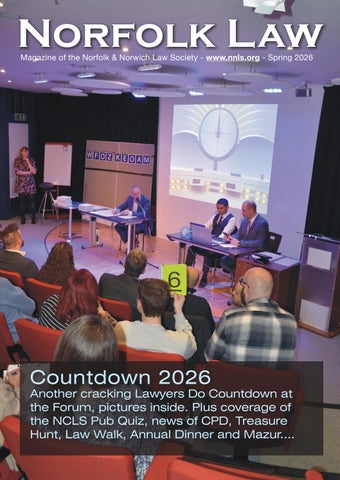
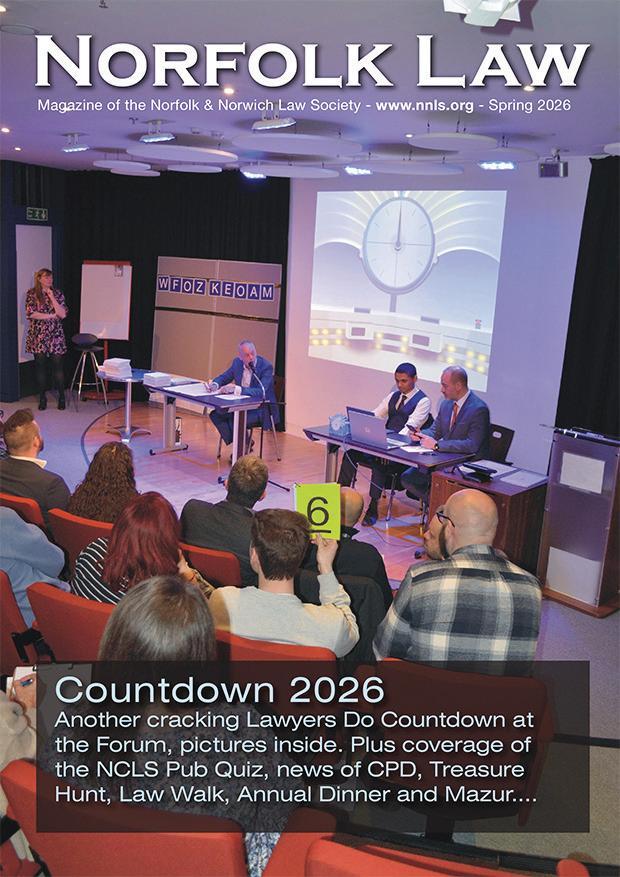
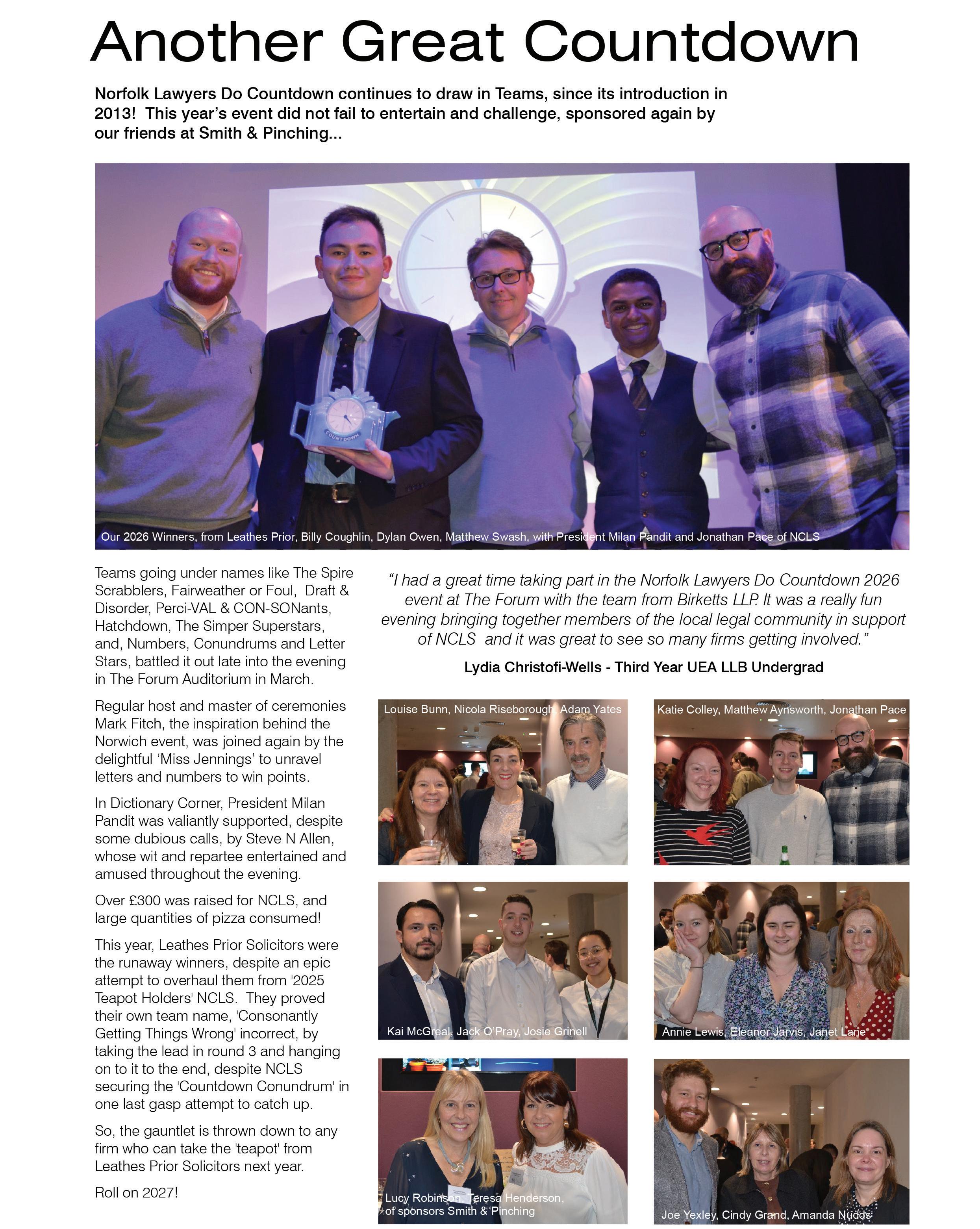
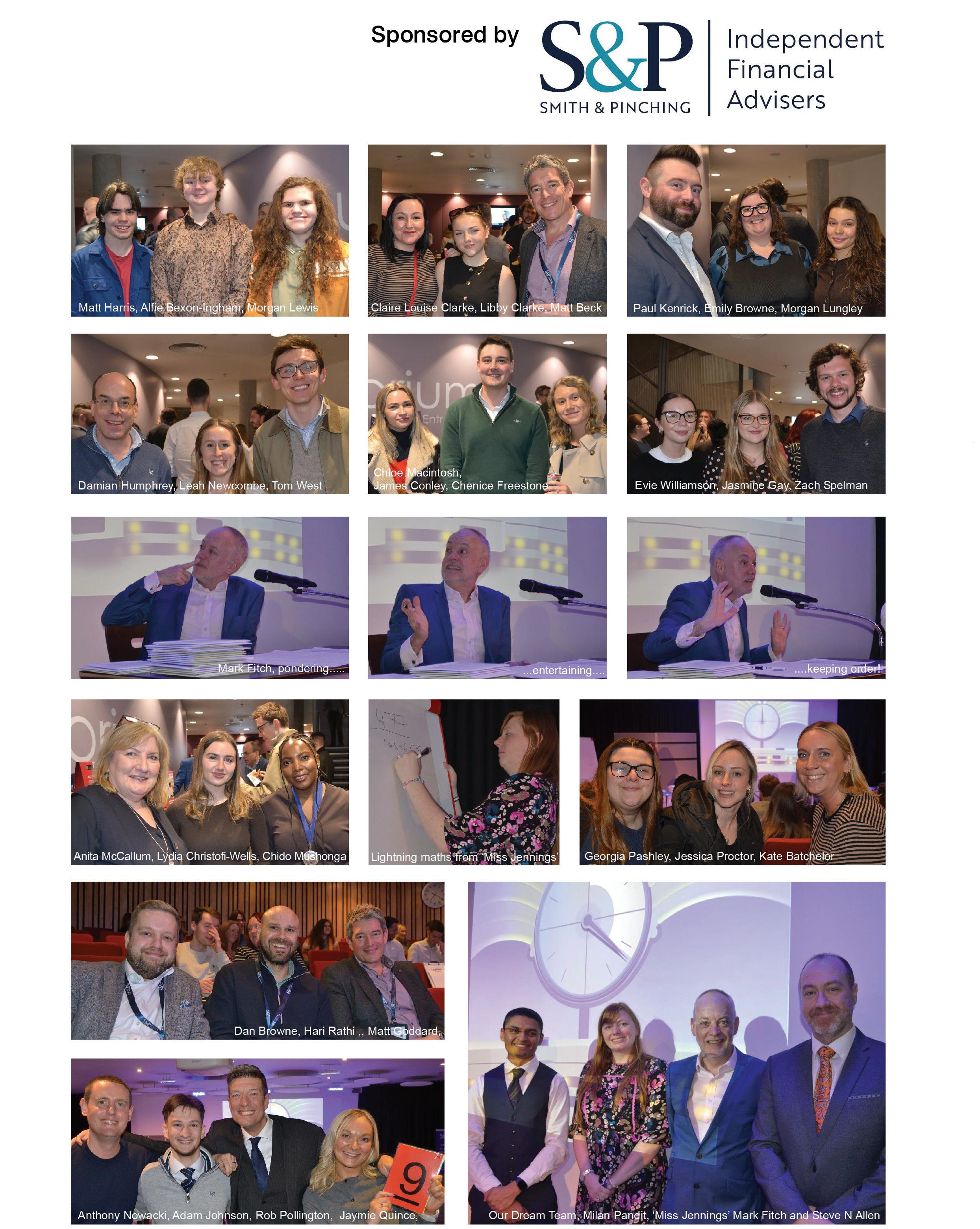
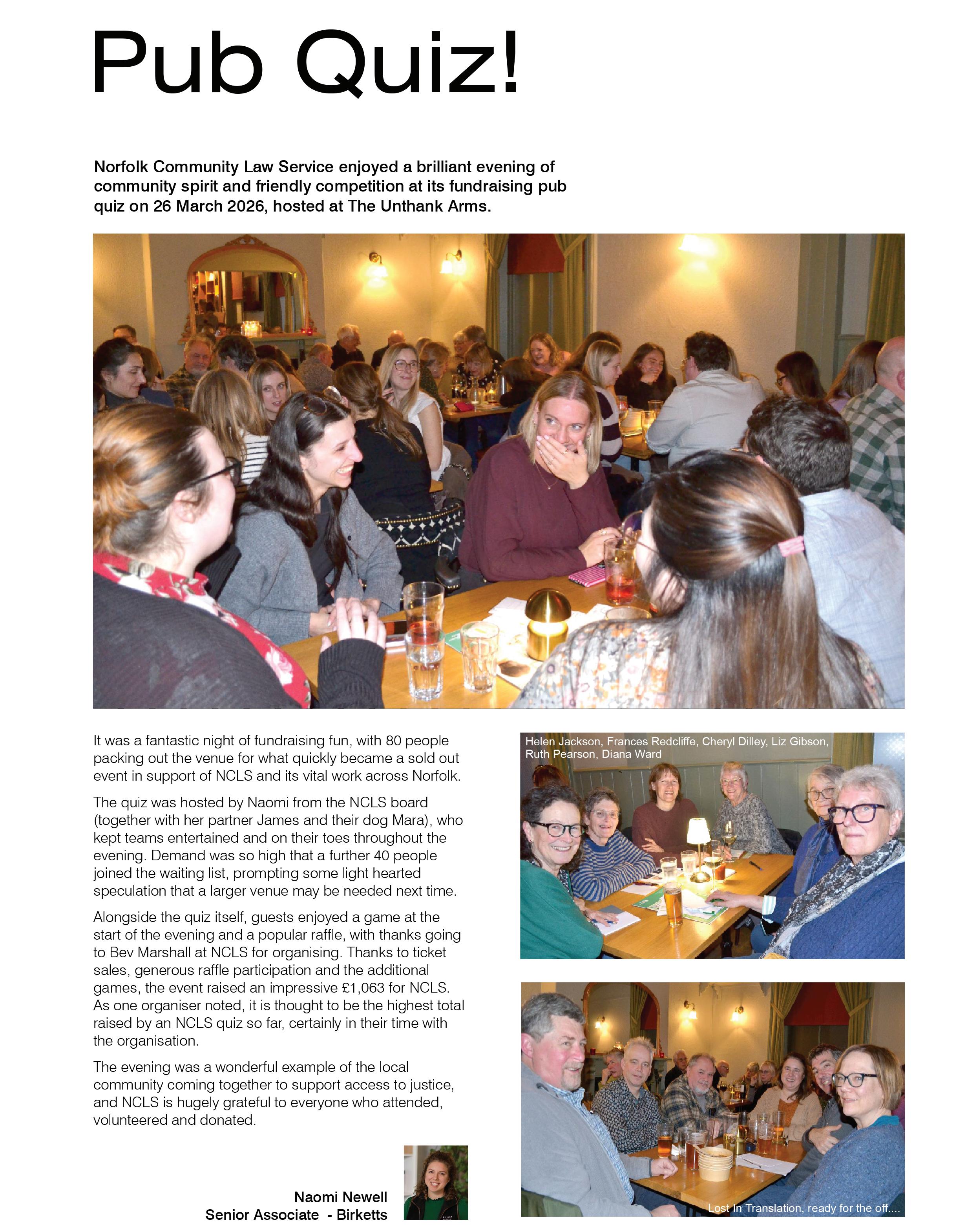
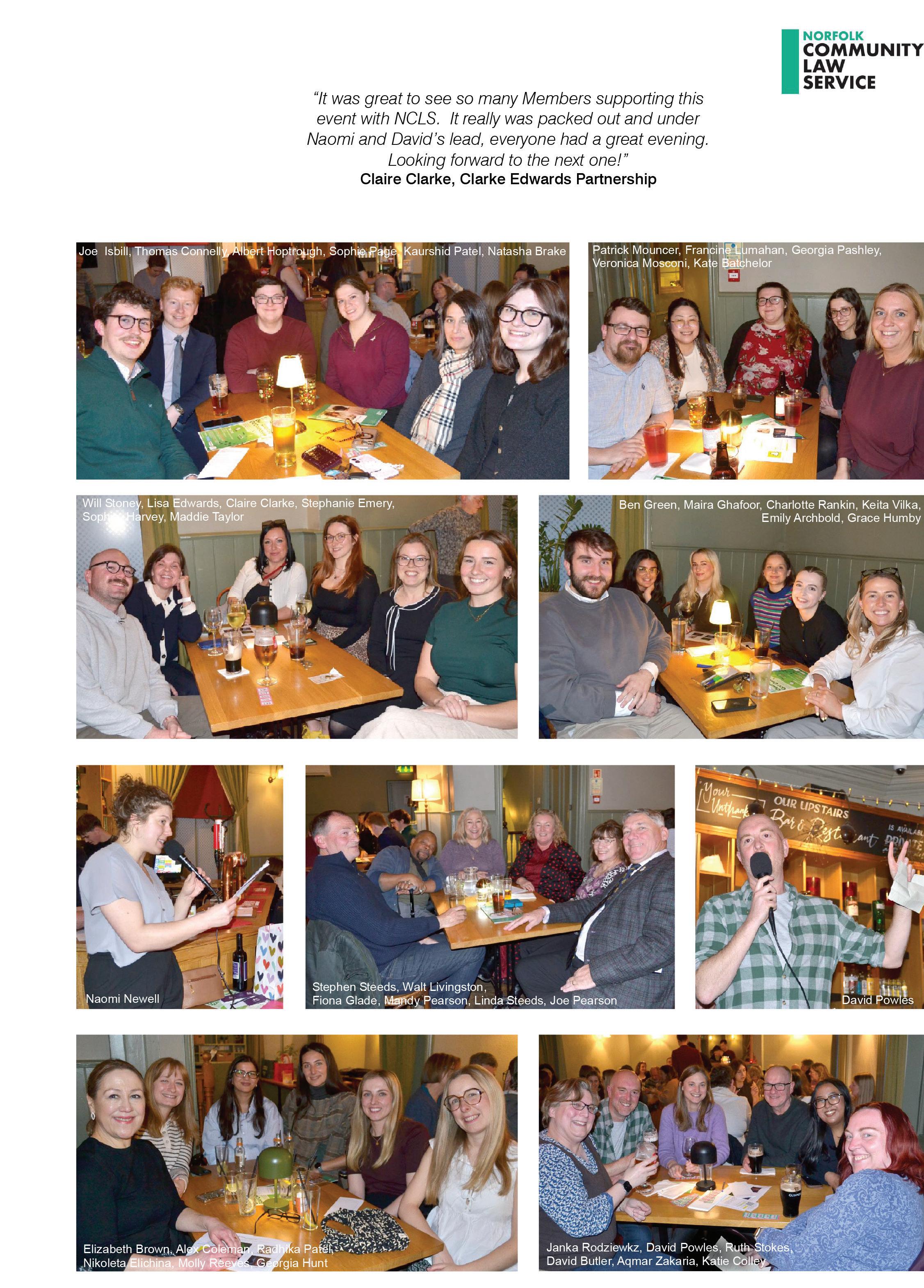
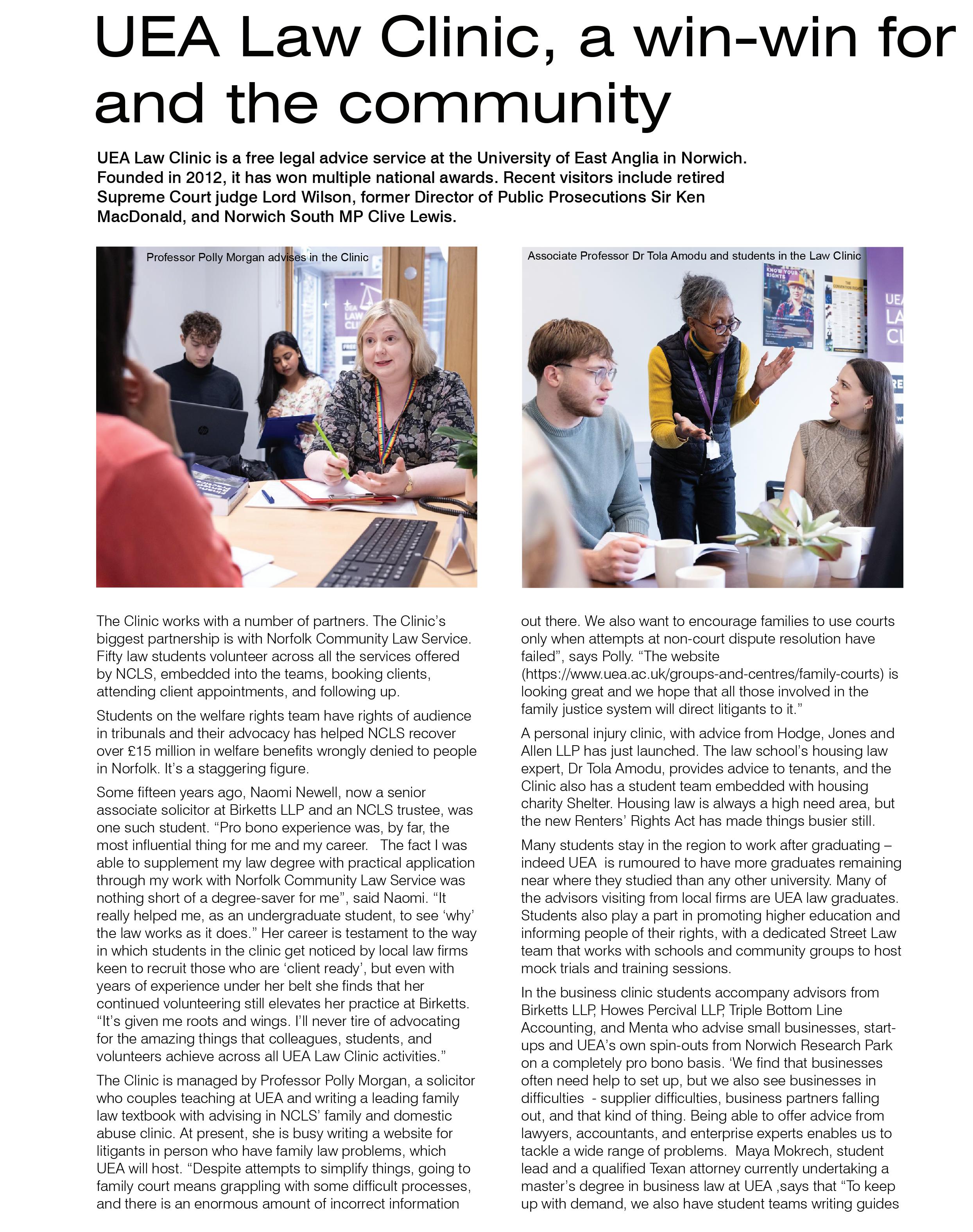
Another cracking Lawyers Do Countdown at the Forum, pictures inside. Plus coverage of the NCLS Pub Quiz, news of CPD, Treasure Hunt, Law Walk, Annual Dinner and Mazur....
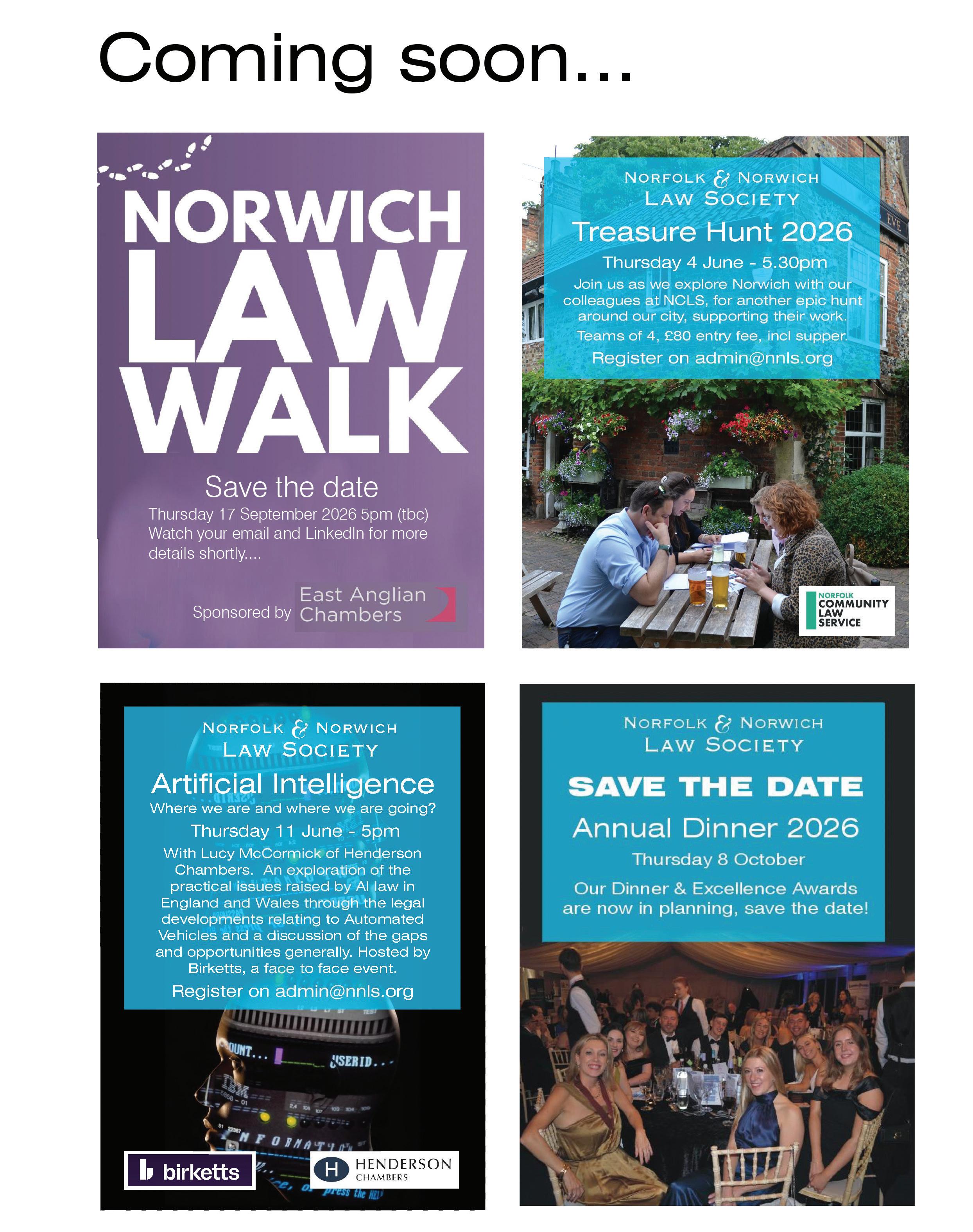
We have seen some great events recently, pictures inside from Norfolk Lawyers Do Countdown and the NCLS Pub Quiz. Plus articles, by Richard Barr looking at Mazur, and Polly Morgan looking at the UEA Law Clinic, plus the usual events rundown. We can also confirm dates for our Norwich Law Walk and Annual Dinner & Excellence Awards events - see page 6.
President’s Report
It is a great privilege to write to you as President of the Norfolk & Norwich Law Society and to reflect on what has already been a busy and rewarding start to my term. Since my appointment, I have had the opportunity to meet many members across the county and to engage with colleagues from across our profession, as well as key stakeholders in the important work we do. I have been struck by the strength and breadth of our local legal community, and the continued willingness of practitioners at all stages to contribute to its success.
As I look ahead, I am keen to focus on ensuring the Society continues to evolve for the benefit of its members, through improved communication, enhanced opportunities and by strengthening the sense of community at the heart of the NNLS. Work has already begun on a number of key initiatives, including an overhaul of our website and closer collaboration with the NNJLD – our May event at Jarrolds being a particular highlight. Planning is also underway for our annual Excellence Awards,
which will take place at an exciting new venue this year. We look forward to confirming further details, including what promises to be an excellent speaker.
Collaboration remains a central priority. We will continue to strengthen our relationships with the JLD, the UEA and the NCLS. In that regard, I would also like to acknowledge the recent changes at NCLS following David Powles’ move (a simply marvellous patron to the charity), and I look forward to working closely with the new Chief Executive moving forward.
There is much to be done in the year ahead, and I am grateful for the continued support of the Committee and our members. I would encourage everyone to engage with the Society – in the few years I have been involved, it has been my catalyst to involvement in our legal community outside of the confines of one’s firm.
Milan Pandit President, Norfolk & Norwich Law Society 2025-26
Landmark treaty protecting rule of law still not ratified
One year after the UK signed the Luxembourg Convention for the Protection of the Profession of Lawyer*, the Law Society of England and Wales renews calls for the UK government to ratify this landmark treaty without delay
The summer riots of 2024 clearly demonstrated that UK lawyers are not immune to the risks that come with upholding the rule of law. Our 2025 report revealed that nearly half of solicitors in England and Wales received threats or abuse, making immediate action a necessity**.
The convention is the first internationally binding agreement designed to protect legal professionals from harassment, threats and discrimination. By protecting lawyers, it helps ensure people can access impartial legal advice and uphold their rights.
The convention will only enter into force once eight states have ratified it. Early ratification by the UK would send a
strong signal of global leadership and commitment to the rule of law. It will also give the UK a leading role in shaping the independent expert body that will oversee compliance.
Once ratified, the treaty will be open to countries beyond the Council of Europe extending its impact worldwide***.
Law Society president, Mark Evans, said: “Lawyers are on the front line of resolving everyday legal issues so that we and our communities can thrive. Like many frontline workers, the role of a lawyer is not without risk. The 2024 riots were a wakeup call. They showed that UK lawyers are increasingly exposed to targeted threats and abuse. This convention would provide vital protections enabling lawyers to support the public safely and independently.
“The UK government has the opportunity to lead by being among the first to ratify it. Doing so would strengthen the UK’s global position as a jurisdiction of choice and a beacon of stability and the rule of
law. It would encourage other countries to follow suit and stand up for justice.”
*The Luxembourg Convention was adopted by the Council of Europe on 13 May 2025. Read our leaflet on the convention (PDF 3.3 MB) here: https://tlssc104-prd-glo-fde-01-duatf0eka4hpcxe6. a03.azurefd.net/-/media/files/topics/ international/convention-for-the-protectionof-lawyers---flyer.pdf?rev=6daf90dc1ad94 585892f68757fab2ccb&hash=E595480D7 C4DD1AC95F2125298F1098B
**The survey, organised by the Law Society of England and Wales, took place in August 2025 with 286 responses overall. 139 of the respondents claimed reported that they had to have received threats. Read the full report here: https:// www.lawsociety.org.uk/topics/research/ threats-to-solicitors-report
***The Law Association for Asia and the Pacific (LAWASIA) has recently expressed strong support for the convention and called for its wide promotion.
Adviser conversations linked to higher charitable giving in Wills, new research shows
Poppy’s
• Research reveals 60% of clients include a charitable gift after discussing it with a professional adviser
When Poppy’s Dog Guardian conta
• Awareness of Inheritance Tax (IHT) incentives of legacy giving remains low, even among higher value estates
• People are writing Wills earlier, with Gen X-ers most commonly doing so in their 40s and Baby boomers in their 60s
Professional advisers are playing a critical role in shaping clients’ decisions to include charitable gifts in their Wills, according to new consumer research from Remember A Charity.
The study shows that among individuals with a Will who have discussed leaving a charitable gift with a professional adviser, 60% have gone on to include one. This compares with just 20% of those who have not had such a conversation, underlining the significance advisers can play.
The findings are based on research carried out by independent agency OKO, which surveyed more than 2,000 UK charity supporters aged 40+ as part of Remember A Charity’s long-running consumer benchmarking study1. The study tracks long-term growth in the proportion of people choosing to include charitable gifts in Wills, which rose from 14% in 2010 to 22% in the latest annual survey (November 2025).
While legacy giving is increasingly common amongst those with Wills, it is younger generations, those with higher levels of assts and those who are aware of the tax incentives, who are most likely to leave a gift. (Gifts to charity are exempt from IHT and donations of 10% or more reduce the rate of IHT from 40% to 36%).
Despite this, awareness of the IHT benefits associated with charitable giving remains relatively low – at 42%. Even among individuals with assets of £1 million or more, 30% are unaware that leaving a charitable gift in their Will can reduce inheritance tax.
While tax incentives can support decision-making, they are rarely the primary motivation. Instead, individuals are typically driven by personal values and a desire to support causes they care about, after providing for family and friends.
Continues over page...
Adviser conversations linked to higher charitable giving in Wills...
People are writing Wills earlier
Poppy’s
When Poppy’s Dog Guardian conta
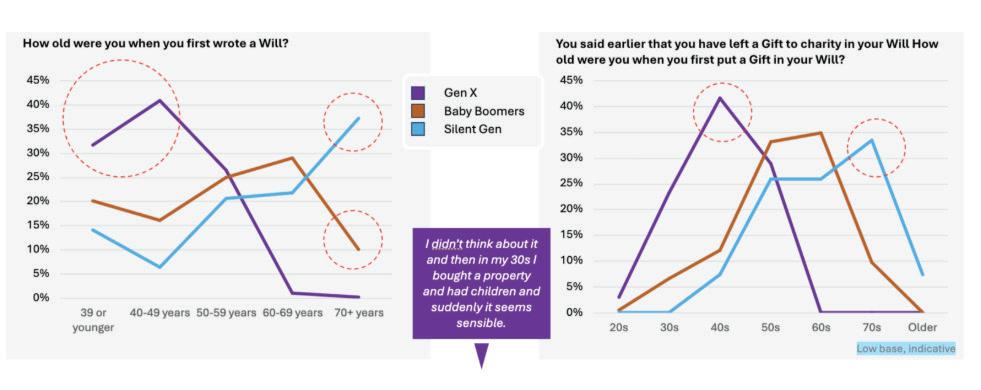
The research shows that the average age of making a first Will is 50, but that this is shifting over time. Generation X is most likely to write a Will in their 40s, Baby Boomers in their 60s and Silent Generation in their 70s. This reflects a broader shift towards earlier planning, even as traditional life milestones such as home ownership, marriage and children are occurring later.
Younger Will-makers are more likely to include a gift, with 35% of those aged 40–59 having done so, compared with 32% of those aged 60–69 and 30% of those aged 70+.
Over one third (35%) of those who have not yet included a charitable gift say they would consider doing so. (See chart below)
Professional advice and changing behaviours
Professional advisers continue to play a central role in Will-writing, with 66% of those with a Will using a solicitor and 18% a professional Will writer. At the same time, approaches are evolving, particularly among younger clients: 28% of Gen X respondents say they would make a Will online or have already done so, compared with around 10% of Boomers and Silent Generation respondents.
Demand for financial advice is also increasing. The proportion of people seeking financial advice has risen from 42% in 2021 to 53% in 2025, with younger and wealthier individuals and those supporting multiple charities most likely to seek guidance. Those aged under 55 with assets over £250k are the most engaged with professional wealth advice.
Wills as evolving documents
The study reinforces that Wills are not static and often change over time. While 49% of respondents have never updated their Will, more than half (53%) expect they will need to do so in future. Life events such as bereavement, changes in
Canine www.nnls.org
family relationships, inheritance and retirement are key triggers for reviewing a Will, creating important opportunities for advisers to revisit clients’ intentions and ensure their plans remain aligned with their wishes.
Long-term trend and adviser opportunity
Jeremy Rix , Managing Director of the independent research agency OKO, says:
“People like to feel like that they’re exerting some control in uncertain times by planning ahead. Given an easier process and a wider range of options available, making a Will is one practical way they can do this.”
Lucinda Frostick , Director of Remember A Charity, says:
“Professional advisers play a vital role in helping clients navigate complex decisions around their estates and finances. This research highlights just how influential those conversations can be, particularly when it comes to charitable giving.”
Remember A Charity offers a free Campaign Supporter scheme and a wide range of resources for solicitors and Will-writers on legacy giving 2, with a dedicated hub3 for wealth advisers.
A summary report 4 is published on the consortium’s website, with a full report available for Remember A Charity members.
Notes
1The tracking study, which follows Prochaska’s Stages of Change model, shows forward movement over 15 years from donors’ active rejection of leaving a gift in their Will and lack of awareness through to awareness, contemplation, preparation and action (leaving a gift). The Stages of Change model features six levels: rejection of leaving a gift in their Will; pre-contemplation unaware –those who have never thought about it and are not sure if they would consider it, pre-contemplation aware – those who have thought about it and given it low consideration; contemplationthose who know about it and would consider leaving a gift; preparation –those who intend to give; and actionthose who have already included a gift in their Will.
NB. A small number of respondents don’t fall into any group (i.e. those who say they’re not sure if they’ve thought about and wouldn’t consider leaving a gift in their Will, plus those who haven’t thought about it but say they would consider leaving a gift and/or intend to do so) and are excluded from the analysis and results from the other groups prorated to 100%.
Silicon Fen Moves Home: How AI is Redefining the East Anglian Property Market
For decades, the East Anglian property market has been defined by its contradictions - the hypermodern tech biosphere of Cambridge sitting just miles from the medieval timber-frames of Lavenham and the untamed coastline of North Norfolk. Buying a home here has traditionally been a game of local knowledge, whispered leads, and a fair amount of patience.
However, as we move through 2026, a new force is quietly harmonising these extremes. Artificial Intelligence is no longer a futuristic concept and will inevitably become the primary tool for how we find, value, and secure homes across the East of England.
Beyond the Search Bar:
The Death of the “Filter”
For years, house hunting was a digital chore of ticking boxes: ‘three bedrooms’, ‘detached’, ‘garden’. This binary approach often failed the nuanced beauty of our region. You couldn’t search for ‘a cottage with the character of a Broadland retreat but the connectivity for a London commute’.
Now, AI is shifting the paradigm from searching to discovering. New platforms and enhanced tools on Rightmove allow buyers to use natural language. AI understands that a buyer in Norwich might value ‘walkability to the Lanes’ over a specific square footage. By using visual recognition to ‘see’ inside photos, AI can identify unlisted features - like original flint walls or south-facing solar potential that traditional metadata misses.
The Valuation Revolution: Precision over Guesswork
In a market as fragmented as East Anglia’s, where a townhouse in Bury St Edmunds can command a vastly different premium than one in Lowestoft, valuation has always been an art. AI is turning it into a highprecision science.
By layering “hyper-local” data, everything from micro-fluctuations in local school ratings to real-time footfall data near new developments, AI-driven Automated Valuation Models are providing a level of transparency
previously unavailable to the average buyer. For the investor, AI tools are being used to predict rental yields, removing the ‘gut feeling’ and replacing it with robust ROI forecasting.
Frictionless Finance:
The 24-Hour Mortgage
The most significant pain point in the UK property journey has always been the ‘dead time’ between offer and exchange. In East Anglia, where the legal complexities of historic titles or coastal erosion risks can slow down conveyancing, AI is proving to be a critical accelerant.
We are also seeing the rise of the ‘SelfDriving Mortgage’. AI-powered lenders can now verify income, conduct credit stress tests and crossreference property data in seconds rather than weeks. When combined with AI-assisted conveyancing, which in the future may be able to flag planning discrepancies or boundary issues instantly, the dream of a “onemonth completion” is moving from a dream to reality.
The Bottom Line
East Anglia has always been a region of pioneers. Just as the physical landscape was once transformed by Dutch drainage engineers, its property market is now being reshaped by data scientists. For the modern buyer, the message is clear: the tools have changed. To secure a home in this competitive corner of the UK, embracing the Silicon Horizon isn’t just an advantage it’s a necessity.
Tim O’Brien , Managing Director, TIDE Services Ltd
Exploding the Valuation Myths: A Lawyer’s Guide to What Really Matters
In this article the valuation experts at FHM Forensic Accounting, Fiona Hotston Moore and Tom Arnold, debunk some of the key myths that we frequently come across.
Myth 1 – A company with no assets has no value
We are often asked whether a company with minimal net assets (or even net liabilities) in the accounts can have any value. This can be relevant in family law cases in determining whether appointing a Single Joint Expert to value the company is cost proportionate.
The short answer is yes, a company with no assets or even net liabilities can have value. In most cases the net assets in the published accounts will give an indication of the “bottom line valuation” of the company but the market value of the business can be significantly higher.
It may also be the case that the company owners have chosen to distribute all or most the profits each year and thus the net assets (retained reserves) are minimal but the company may be generating significant earnings and thus will have a value far higher than its net assets.
In deciding if the company has value over and above its net assets, we need to assess its ability to generate a positive cash flow in the future. There are several methods to value a profitable company. Typically, the valuer will look at the historical profits to estimate a figure for the future maintainable earnings (“FME”) of the company and then apply a multiple to the FME to assess what we describe as “Enterprise Value”. If financial projections are available these will also be considered.
Unfortunately, smaller companies are not currently required to file their profit and loss account in the published accounts and therefore it is necessary to obtain either a copy of the accounts prepared for the shareholders or other information to assess if the business is generating a commercial return.
simplistic example – Traitors Limited
Net assets as at 31 December 2024
Valuation based on net assets
£10,000
£10,000
However, from our enquiries we identify that the business is generating profits each year which are distributed in full to the owners each year and hence net assets are minimal.
Estimated future maintainable earnings
Applying a multiple of, say, 4X gives an Enterprise Value of
£50,000
£200,000
In this instance the value of goodwill is approximately £190,000 (£200,000 less £10,000).
In conclusion, if the net assets on the balance sheet are minimal or even negative, this may suggest the company has negligible value. However, reaching an informed conclusion requires some information on the recent trading performance.
Myth 2 – Start-ups cannot be valued
Start-up valuations may be required in divorce, shareholder disputes or in raising funds or investment. As in all valuation, the reason for the valuation is relevant in deciding on the approach to the valuation.
Start-ups tend to have negative cash flows and possibly minimal or no sales, limited historical cashflows and the proofof-concept may not yet have been proven. Traditional valuation methods such as capitalized earnings and net asset valuations may not be relevant depending on the stage of development.
There are several ways we can value start-ups and these are explained below. We may adopt more than one valuation method to get a broad range of valuation for the company.
The cost approach
The cost approach (also called “cost to duplicate”) looks at the costs incurred to get the start-up to its current point. The assumption is that an investor will at least cover the costs already incurred. This method gives no credit for the future value that may be generated and it gives no value to the intellectual property beyond the actual costs.
The venture capital method
Using this method, we estimate what the “exit-value” might be in a few years when the company is sold. This figure is then discounted back to arrive at the present value. The risk that this venture will not achieve the exit value will be factored into the calculation through the discount rate.
The
scorecard method
This method assesses the business against various criteria that an investor considers important including the team, the product, the target market and the strategic relationship, and then applies a value to each one. This value is discounted for the risk attributed to the start-up. This method tends to be investor specific.
Kirsty Shuckford, Graham Hines, Fiona Hotston Moore and Tom Arnold
A
Discounted cashflow
If the start-up is at a point where future cashflows can be reasonably estimated, then we can adopt the discounted cashflow method and discount future cashflows back to give us the current value.
Market multiple
If sufficient information on estimated future income is available and we have data on recent acquisitions that are similar in nature, then we may be able to use a calculated market multiple.
In summary, valuing a start-up is highly subjective and, in all methods, requires an assessment of the risk and rewards as well as the likelihood of success of the enterprise.
Myth
3 - Partnership interests can be valued in the same way as a shareholding
The key to valuing a partnership interest is an understanding of the legal framework of the partnership. The valuer should consider if there is a partnership agreement or, for an LLP, a Members’ Agreement. If not, and if the entity is a general partnership, the valuer needs to understand the implications of the Partnership Act
The starting point to assess the value of a partnership
interest is to establish the balance on the partner’s capital and current accounts (including any tax reserve). The balance on these accounts represents profits already earned and due to the partner.
The second point is to consider is whether there is any value to be attributed to goodwill (i.e. the ability to generate future profits from the partner’s interest).
The partnership agreement or LLP Members Agreement may include provisions regarding how a partner can exit the partnership agreement and how their interest in goodwill should be valued. It is typical in professional partnerships for an exiting partner to be precluded from realising any goodwill. Alternatively, the agreement may specify how any goodwill is to be valued.
Conclusion
Once the legal and commercial framework is understood, the valuer can determine if there is any value attributable to the partner’s interest beyond their capital and current accounts.
fiona@fhmforensic.co.uk +44 (0)7770 642491
tom@fhmforensic.co.uk www.fhmforensic.co.uk
Fingerprint Analysis
Working with Expert Witnesses in Construction
Working with expert witnesses... is a new monthly article series. The series takes a look at the role of expert witnesses in a range of sectors from the perspective of the legal and other professionals who work with them. If you are interested in being featured in the series, you can contact us at policy@ewi.org.uk
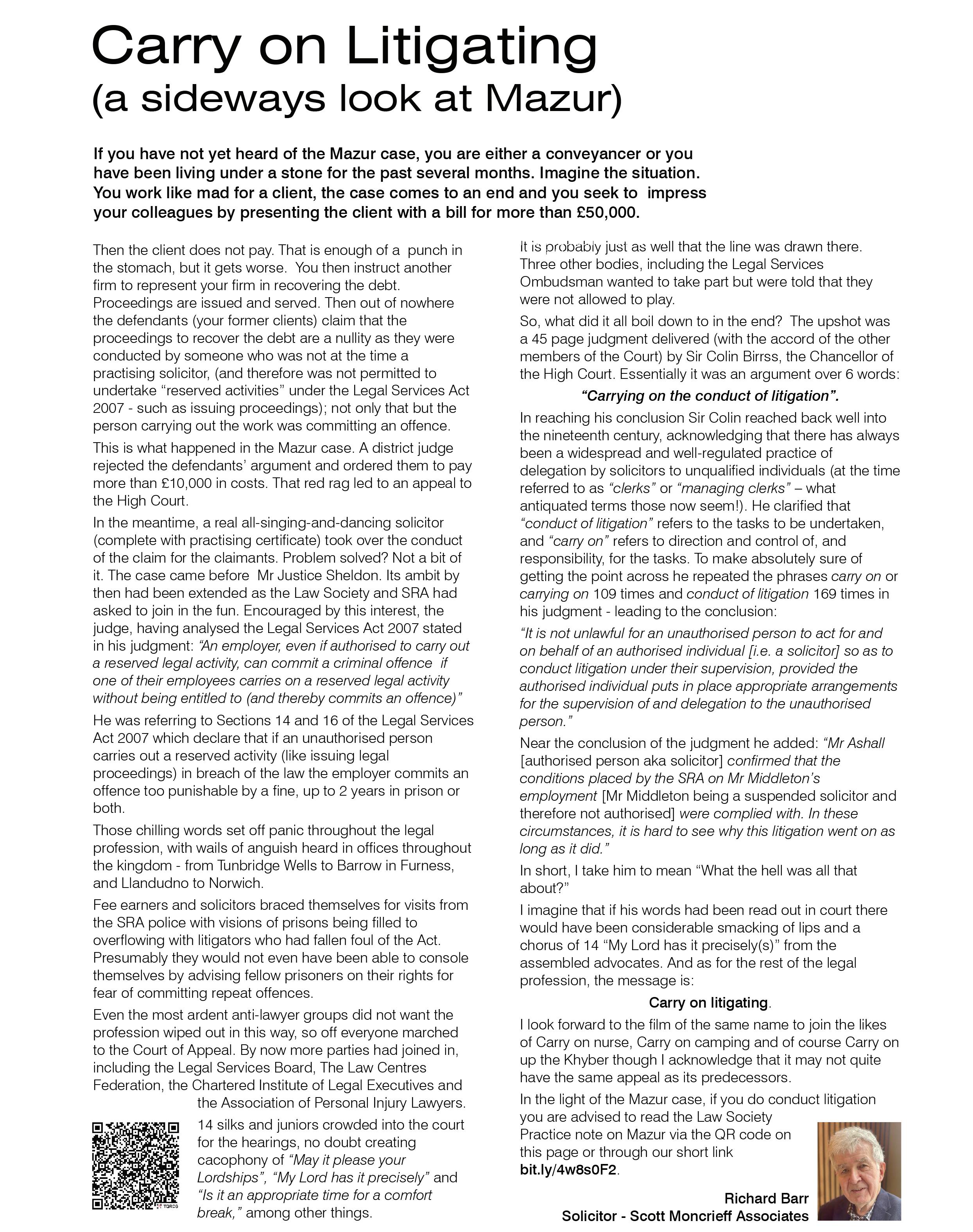
The first article in the series is by Richard Black1 and Jennifer Fitzmaurice2 from Eversheds Sutherland3 on their experience of working with expert witnesses in the construction industry.
Why is expert evidence so important in the construction industry? Expert evidence is crucial in the construction industry due to the technical, specialist, and often complex nature of disputes that arise in this sector and which go beyond the legal expertise of lawyers, arbitrators and judges.
It is common for claims to hinge on expert evidence, including as to design, defects, delay and quantum.
We will often seek expert input very early on in a matter, in order to properly understand the merits of our client’s claim or defence and advise the appropriate next steps or strategy accordingly.
Selecting the right expert is therefore of paramount importance on almost every construction dispute.
What qualities do you look for when appointing an expert?
A great expert witness combines technical expertise with integrity, clarity and fairness.
The first quality we look for is expertise – do they have extensive, hands-on experience of the particular issue in the dispute? Is this experience recent and on real projects, as opposed to perhaps more ‘career’ experts who, whilst being credible, may lack experience of the latest position or recent changes.
In some cases, where we are carrying out an early evaluation of a matter, our clients may be looking for practical advice as to how to rectify the issue, as well as support for the potential dispute. In these cases, practical and industry experience is particularly important.
Where formal proceedings are inevitable, it is important that the expert can properly and clearly communicate this experience and expertise in a way that makes it easy for a tribunal to understand.
Finally, remaining calm and credible under inevitable pressure during hearings or under cross-examination is extremely important.
When selecting an expert, we typically research their appropriate expertise, review their CVs, interview them and also seek referees where available. It is extremely helpful when experts can provide referees from past cases that they have worked on. We will also obtain
feedback from other lawyers, both inside and outside of Eversheds, if they have used the expert previously.
How much weight do you put on hearing experience?
If the matter we are working on goes to trial, we would expect our expert to attend and observe any evidential areas which are relevant to their report (subject to any restrictions imposed by the relevant tribunal)
Prior experience giving evidence before a court or tribunal is helpful, but not essential.
In cases involving delay and quantum claims, which are the most common form of construction dispute, we would expect the lead expert to have trial experience.
However, it is common for construction disputes to raise very specific technical issues. In these cases, we regularly prioritise technical expertise over trial experience.
A significant number of cases settle before a hearing takes place, and it is often the technical experience of an expert that can help achieve an early settlement by unlocking the technical issues between the parties.
In all cases, we recommend that experts attend cross-examination training prior to hearings taking place, as this can often fill the gap in trial experience, or act as a refresher for more experienced experts.
What are the main duties of an expert witness?
• Part 35 of the Civil Procedure Rules governs the use of expert witnesses in civil litigation. For example:
• Provide independent and impartial evidence
• Base opinions on facts, analysis and professional judgment
• Clearly state when an issue is outside their expertise
• Include in their report any material facts which could affect their conclusions
Continued over page...
Richard Black
Jennifer Fitzmaurice
32 - Norfolk Law -
Working with Expert Witnesses in Construction -
• Comply with any tribunal directions and deadlines.
Similar duties are often imported into international arbitration proceedings, whether by order of the Tribunal, and/or through incorporation of the Chartered Institute of Arbitrators Protocol for the Use of Party-Appointed Expert Witnesses in International Arbitration.
In any event, ensuring credibility of the expert is key to ensuring that any opinion is given sufficient weight by a Court or Tribunal. This means, as a matter of practice, presenting evidence in a neutral and balanced way.
Can you provide any tips on how experts can make an instructing solicitor’s role easier during a dispute? More often than not, the best practices are relatively simple:
• Understand and address the issues in dispute, and adopt a reporting structure which reflects the issues in dispute.
• Keep reports clear and succinct, avoiding too much technical jargon or,
where technical jargon is unavoidable, provide clear explanations and definitions. Include cross-references to any documents relied upon.
• Comply with agreed deadlines, whether set for internal purposes or by the Court or Tribunal.
• Provide reliable cost estimates and regular cost updates. This is particularly important in court proceedings which are subject to cost budgeting.
Working well with the other side’s expert is also extremely helpful, with a willingness to identify areas of agreement and disagreement in order to ultimately narrow the issues in dispute.
Experts who understand that their role is giving technical evidence rather than trying to determine the dispute underpins this approach, and can really help us to advise our clients better on the merits of their position.
Are there any common pitfalls for experts to avoid when instructed on a dispute?
There are a few mistakes that experts regularly make, which can and do fundamentally affect their credibility:
• Appearing biased towards the instructing party.
• Making assumptions or overstating conclusions without adequate evidence.
• Giving opinions which are outside of the expert’s scope or expertise, including determinations of facts or opinions of law (which are for the Court or Tribunal).
Ultimately, impartiality and accuracy are key – and credibility once lost is quite difficult to recover.
Richard Black & Jennifer Fitzmaurice, Eversheds Sutherland
Appreciations by Elizabeth Robson Taylor MA of Richmond Green Chambers and Phillip Taylor MBE, Head of Chambers, Reviews Editor, “The Barrister” and Mediator
A guide for decision-makers on acting within the law
By: Victoria Butler-Cole KC and Steve Broach KC
ISBN 978 1 91364 862 6
LEGAL ACTION GROUP
The access to justice charity www.lag.org.uk
Lawyer or not, a decision maker needs to know the law
If you have found yourself — or your client — in the position of being appointed as a decision-maker over a number of issues in either the public or private sectors, you need this book, recently published by the Legal Action Group (LAG), the access to justice charity, who are justly famed for producing legal texts accessible not only to lawyers, but to the average concerned reader.
Pertinent, applicable and directly accessible to lawyers and non-lawyers alike, this book emerges as an essential guide — no doubt about that — to both the basics and the possible and probable complexities which, more often than not, are likely to emerge in the decision-making process.
With depth and clarity, a wide range of issues are discussed, with a focus on the most controversial, including for example, cases pertaining to equality and human rights. The book therefore covers a lot of ground in explaining an extensive and complex subject, with the thoroughness and clarity that makes it accessible to all decision-makers — lawyers and non-lawyers alike.
As the LAG explains, the book’s overall aim is to ensure that “a decision-making process follows a lawful process.” And that includes, appropriately, answers to the problems of those who are aggrieved by a decision and therefore considering a complaint, or a legal challenge.
The first chapter to turn to is the ‘Checklist’ and an invaluable checklist it is. Certainly, it covers such necessities as powers, problems, evidence and much, much more, including what to do if your decision is challenged — a challenge indeed.
Certainly, this compact volume provides a treasure trove of useful resources for further research. Note the almost twenty pages of Tables of Cases plus the Table of Statutes and Statutory Instruments - and a Table of European and International Instruments. Also note the handy index, the glossary of legal terms and the extensive footnotes — indispensable if more detailed research is required — and it usually is, in so many circumstances.
“A guide for decision makers on acting within the law” is the book’s subtitle and an excellent guide it is. Any lawyer advising clients embroiled in these or similar problems should very quickly acquire a copy.
The date of publication of this paperback book is cited as July 2024.
DISCRIMINATION IN HOUSING LAW
By: David Renton
ISBN 978 1 91364 856 5
LEGAL ACTION GROUP
The access to justice charity
www.lag.org.uk
Essential reading for housing practitioners
Acting for clients faced with repossession
There is very little that strikes more terror in the souls of its victims than the threat of impending homelessness via the judicial processes involved, which culminate in the process of eviction.
There ought to be an erudite and readable le book about it — and there is, thanks to this very useful publication from the Legal Action Group (LAG), the access to justice charity, who are justly famed for producing legal texts accessible not only to lawyers, but to the average concerned reader. David Renton, the author, is a barrister who represents tenants and mortgage holders embroiled in possession hearings.
Published in handy paperback format, the book offers a broad and concise coverage of ‘the use of the principles of equality in housing law’ — and equally of prime importance — the duty of landlords to fulfil their duties under the general categories of fitness and repossession.
As the publishers point out, the book covers the often complex and controversial matters, for example, of council houses let by housing associations, as well as houses held in thrall either to mortgages, or long leases. It should be added that homeowners in mortgage arrears suffer the same anxieties as those who rent — hence the general and urgent need for all practitioners to be duly bound in support of clients who struggle with these and other difficulties in the housing sector.
Practitioners and clients alike coming to grips with these problems will find this book especially helpful. As a concise work of reference, it truly excels. The precise introduction points directly to the subject of the book, namely the Equality Act of 2010 and its related principles — which apply both to business premises and residential properties.
Straightforward to navigate, the book has a detailed table of contents, enabling the reader — lawyer of not — to find the necessary advice they may be looking for, and for those doing further research, the book contains extensive footnotes, plus a detailed and useful index at the back.
Note too, the particular advantage of a 30-page section of precedents — including for example, the precedent entitled ‘Case Summary Application to Set Aside Possession Order.’ Also included in this concise text are Tables of Statutes, Statutory Instruments and also a Table of European and International Legislation.
For practitioners and clients alike, this book emerges as a practical and indispensable purchase.
The date of publication of this paperback book is cited as 2024.