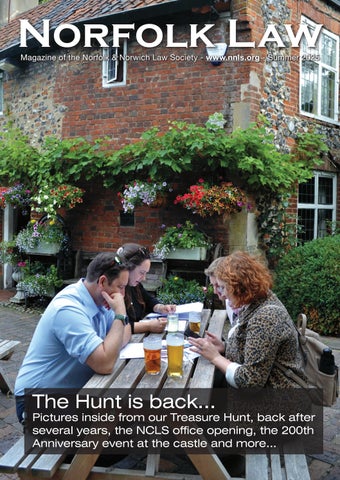
Norfolk Law Magazine of the Norfolk & Norwich Law Society - www.nnls.org - Summer 2025
The Hunt is back...
Pictures inside from our Treasure Hunt, back after several years, the NCLS office opening, the 200th Anniversary event at the castle and more...
Norfolk Law - Contents - 3
This issue... Welcome to our Summer edition of Norfolk Law. Ahead of our Annual Dinner in September, you can find the Excellence Awards nomination details along with picture coverage of our treasure hunt with NCLS and their new office opening reception. Enjoy your Summer break, if you have not done so already! See you all again in the autumn.
Contents 4
President’s Report
19
You know what really grinds my gears...?
5
Committee
20
Book Review
6
Events Roundup
22
Anticipated growth in charitable legacies
8
NNLS Excellence Awards 2025
26
How Conveyancers Can Advise Clients
10
Treasure Hunt is back with a bang!
29
The thorny issue of undisclosed cash and
13
NCLS Events
14
Celebrating 200 Years of the Law Society
30
The 2025 EWI Conference
16
Norfolk Community Law Service open new offices
32
A useful partner, not a necessary evil
18
NCLS News
34
Law Society secures funding for Diversity Access Scheme
Published by: EAST PARK COMMUNICATIONS Ltd. Merseybank Business Centre 55-57 Seabank Road, Wallasey, Merseyside CH45 7PA Tel: 0151 651 2776 simon@eastparkcommunications.co.uk www.eastparkcomms.co.uk
personal expenditure
Advertising Simon Castell Managing Editor Sue Bailey Layout Stuart Turner pp. 1-18 David Coffey pp. 19-36
Accounts Tony Kay
Legal Notice © East Park Communications Ltd.
Published Summer 2025
None of the editorial or photographs may be reproduced without prior written permission from the publishers. East Park Communications Ltd would like to point out that all editorial comment and articles are the responsibility of the originators and may or may not reflect the opinions of East Park Communications Ltd. Correct at time of going to press.
© East Park Communications Ltd.
www.nnls.org
4 - Norfolk Law - President’s Report
President’s Report our Annual Dinner on the 19 September 2025. We are going to have a fabulous night and celebrate all the things that are positive about the legal profession and commiserate with each other about all those things that are not so positive, and no doubt conclude that here in Norfolk we do it better than most! For ticket details, please contact Claire Clarke at admin@nnls.org.
If I can persuade you to pause your attention from your summer holiday and/or backlog of work caused by your summer holiday (or holidays of colleagues), please may I remind you that we have
www.nnls.org
If you or your firm wishes to nominate any worthy award winners the deadline for nominations is 29 August 2025 – for more details on the categories of awards and how to nominate, please turn to page 8. Since our last edition, we have
enjoyed our Treasure Hunt on 3 July 2025, which was a roaring success, and it was great for the Society to play its part in the national Law Society’s bicentennial celebrations. Our seminars go from strength to strength, and I am grateful to all those members of the profession who continue to back their local law society scene. The more we can do together, the more we can help each other – and there is no better place to start your introduction to the Law Society than at our Annual Dinner, so I hope to see you there. Best wishes Kerry Read President, Norfolk & Norwich Law Society 2025-26
Norfolk Law - Committee - 5
6 - Norfolk Law - Events
www.nnls.org
8 - Norfolk Law - Excellence Awards
www.nnls.org
10 - Norfolk Law - Treasure Hunt
www.nnls.org
Norfolk Law - Treasure Hunt - 11
www.nnls.org
12 - Norfolk Law
www.nnls.org
Norfolk Law - Events - 13
www.nnls.org
14 - Norfolk Law - The Law Society
www.nnls.org
Norfolk Law - Advertorial - 15
P We’ve We’ve
www.nnls.org
16 - Norfolk Law - NCLS Office Opening
www.nnls.org
Norfolk Law - NCLS Office Opening - 17
www.nnls.org
18 - Norfolk Law - NCLS News
www.nnls.org
Norfolk Law - Article - 19
www.nnls.org
20 - Norfolk Law - Interview
Book Review: TURNAROUND MANAGEMENT Unlocking and Preserving Value in Distressed Businesses - 2nd edition need this book, published recently by Globe Law and Business. Note the usefully descriptive subtitle: ‘Unlocking and Preserving Value in Distressed Businesses’. This says it all, you may say, but as its processes are linked to a complex area of law, there is a lot more to be said, especially when multi-jurisdictional complications emerge.
TURNAROUND MANAGEMENT Unlocking and Preserving Value in Distressed Businesses 2nd edition By Alan Tilley ISBN 978 1 78742 982 6 www.globelawandbusiness.com A SECOND CHANCE FOR ENTREPRENEURS FACING INSOLVENCY? CHECK OUT THIS INDEPTH ANALYSIS OF ‘TURNAROUND MANAGEMENT’ FROM GLOBE An appreciation by Elizabeth Robson Taylor MA of Richmond Green Chambers and Phillip Taylor MBE, Head of Chambers, Reviews Editor, “The Barrister”, and Mediator If you are a lawyer with a corporate client -- or clients -- facing financial distress and ultimately insolvency, you
www.nnls.org
With lengthy and detailed experience in this specialised area of consultancy, author Alan Tilley provides a broad range of authoritative advice, aimed specifically at those who are confronted with the undeniably challenging task of advising and managing companies teetering on the sharp edge of insolvency, with its intimidating spectrum of possible consequences. The book and the wealth of advice therein is aimed primarily at those who find themselves in the role of turnaround manager. Such a role, as the author explains ‘usually involves operating in an executive rather than a consultative role’ and as such, ‘exposes the professional to the risks of personal liability.’ You have been warned. However, no need to despair -- as Tilley adds that operating through a limited liability entity, with a properly constructed engagement contract reduces the risks. Proper professional performance is the ultimate guarantee of risk avoidance. Anyone in the legal profession or accountancy and/or financial services, might well wonder how this increasingly obvious need for
‘turnaround management’ got started and whether or not it is proving itself effective. The author’s positive answer is that turnaround management is becoming ‘increasingly recognized as an important part of business’ and that the understanding of its obvious benefits is growing. Tilley is confident that the concept has more than likely evolved as a result of the influence of Chapter 11 of the United States Bankruptcy Code of 1970, which is based on the concept of ‘giving entrepreneurs a second chance’ primarily by creating the concept, so called, of ‘debtor-in-possession’ (DIP) -- usually by means of a restructuring plan while the company is protected from creditors. Better results for shareholders certainly loom large here as a distinct possibility. Although a complex subject, ‘turnaround management’ is explained in this book with admirable clarity, covering as it does, the risks involved, as well as the potential rewards. Based in the author’s 40-plus years of experience in this field, the consultancy, advice, and guidance contained in this compact volume is high-value indeed. Note too, the handy appendix which contains over 20 pages of useful guidelines and policy recommendations. With its international orientation, as well as its straightforward advice, this book should be considered as an essential purchase for business and law professionals worldwide. The date of publication of this hardback second edition from Globe Law is cited as December 2023.
22 - Norfolk Law - Charity Advertorial
6 in 10 professional advisers Canine report increased demand for estate and tax planning advice and anticipate growth in charitable legacies Poppy’s
When Poppy’s Dog Guardian conta
•
• • •
92% of professional advisers say that estate and tax planning will become even more important following the Inheritance Tax (IHT) changes announced in the 2024 Autumn Statement; 60% say they are already receiving more requests for advice; 65% say charitable tax incentives will become even more important to their client base; and 62% think more people will consider leaving a gift to charity.
Upcoming Inheritance Tax (IHT) changes are already beginning to influence the charitable Will-writing and estates market, with professional advisers reporting an increase in demand for estate planning advice and predicting a rise in charitable legacy giving, according to new research from Remember A Charity. The changing IHT landscape In the Autumn Budget 2024, the Chancellor announced that IHT thresholds would remain frozen until 2030, with pension wealth no longer exempt from IHT from April 2027. As such, it’s estimated that the proportion of estates facing an IHT bill will almost double by 2030. Remember A Charity’s Professional Adviser Tracking Study* – carried out by Savanta – reveals that 60% of professional advisers (solicitors, Will-writers and financial advisers) are reporting an increase in requests for advice about estate or inheritance planning since the IHT changes were announced. 9 in 10 advisers expect estate and tax planning to become more important under the IHT changes (92%), and that more people will need to consider how to mitigate the tax due (91%). Only 15% think there will be no discernible impact from the changes. As more estates fall within the scope of IHT, two thirds of advisers believe that the charitable tax incentives will become an even more important consideration for their clients (65%), and that a greater number of people will consider leaving a gift to charity from their estate (62%). Charitable gifts are exempt from IHT and estates that donate 10% or more of the net value can qualify for the reduced IHT rate of 36%. Tanya Watson, Chartered Tax Adviser and Senior Director at Alvarez & Marsal Tax LLP, says: “The changes to IHT are prompting a fundamental reassessment of estate planning strategies, particularly among clients who may not have previously been impacted. What
www.nnls.org
we’re seeing is a growing need for tailored advice that balances financial objectives with personal values. Charitable giving can be a highly effective planning tool, and these changes provide a timely reason for advisers to revisit legacy plans with clients who may not have considered this route before.” Eleanor Evans TEP, Partner, Trusts and Estates Administration at Hugh James, says: “We’re already seeing an increase in clients seeking early advice on estate planning. Many people choose to leave legacies to benefit a cause they care about, and the tax breaks for gifts to charity provide an added incentive. As more estates will become liable for IHT once the changes take effect, charitable giving is becoming an increasingly important part of the estate planning conversation.” (continues on p.22)
24 - Norfolk Law - Advertorial
Anticipate growth in charitable legacies - continued Advisers communicating charitable giving more actively When it comes to Will-writing, over two thirds (77%) of solicitors and Will-writers now say they always or sometimes proactively raise the charitable option with clients (up from 72% in 2023). Charitable gifts are becoming more prevalent over time, with an average of 21% of Wills written through a solicitor or Will-writer now including a donation. This rises to 24% amongst those who always reference charitable legacies with clients and falls to 14% of those who never do. Tax incentives are the most prevalent reason advisers give for raising the topic of legacy giving with clients. 92% of solicitors and Will-writers and 86% of financial advisers in the study say they always or sometimes advise their Will-writing clients of the charitable tax incentives. Lucinda Frostick, Director of Remember A Charity – the consortium of UK charities working to grow the legacy giving market, explains: “Across the advisory spectrum, we’re seeing more advisers
www.nnls.org
referencing the option of charitable giving when talking to clients about their estate and inheritance planning. While the reasons for giving extend far beyond tax incentives, the fiscal framework forms a natural starting point and these IHT changes make the legacy conversation even more relevant to a wider group. This is helping to build understanding of legacy giving and to inspire more people to support the good causes they care about – alongside their loved ones – from their estate.” Remember A Charity works with professional advisers, legal partners, regulators, trade bodies and government to build awareness about legacy giving. Find out more at www. rememberacharity.org.uk/advisers. * A summary report of the findings is available here: https://www.rememberacharity.org.uk/media/seflc0aj/savantasummary-report-2025-public-june-2025.pdf
Norfolk Law - Advertorial - 25
The Poppy’s When Poppy’s Dog Guardian conta
www.nnls.org
26 - Norfolk Law - Advertorial
Climate Change and Flood Risk in Fenland: How Conveyancers Can Advise Clients Introduction The impact of climate change on flood risk is becoming an increasingly pressing issue for property transactions, particularly in low-lying areas such as Fenland. Rising sea levels, extreme weather patterns, and evolving flood defence strategies all have a bearing on property due diligence. For conveyancers, understanding these risks is critical in ensuring clients are fully informed before committing to a purchase. The changing flood landscape in Fenland Historically, the Fenlands have been highly susceptible to flooding due to their flat terrain, proximity to tidal influences, and reliance on man-made drainage systems. The Fenland Level 1 Strategic Flood Risk Assessment (SFRA) indicates that approximately 67% of the district falls within Flood Zone 3, meaning it is considered at high risk of flooding. Climate change is expected to worsen this situation, with projections suggesting that sea levels could rise by up to one metre by 2100, increasing the risk of both tidal and river flooding. In addition to rising water levels, changes in rainfall patterns are also a significant concern. The frequency of intense rainfall events is expected to increase, leading to more occurrences of surface water flooding. Furthermore, groundwater flooding could become more common as prolonged periods of wet weather heighten soil saturation levels. These factors, coupled with the natural subsidence of Fenland peat soils, pose a growing challenge for property developers and homeowners alike. Implications for property transactions A recent study by Geodesys revealed that 1 in 3 customers do not consider a flood report for every transaction, reasoning that property location plays a big part in their decision-making.
www.nnls.org
For conveyancers operating in the region, flood risk assessment is a crucial aspect of due diligence. The presence of flood risk can significantly impact mortgage lending, insurance premiums, and the long-term value of a property. Many lenders now require detailed flood risk reports, beyond the standard Environment Agency flood zone classifications, before approving finance on properties in high-risk areas. To ensure thorough due diligence, conveyancers should look for a full flood risk report providing a comprehensive assessment of the risk to the property. Insurance considerations are also becoming more complex. While the UK government’s Flood Re scheme provides affordable insurance for properties at risk, it is only available for homes built before 2009. This means new-build properties in floodprone areas may face difficulties securing viable insurance cover, which could impact their desirability and resale value. How conveyancers can support clients A comprehensive approach to flood risk assessment is essential for conveyancers advising clients in Fenland. Beyond obtaining a standard flood search, solicitors should consider climate change projections, the effectiveness of existing flood defences, and potential mitigation measures. The presence of sustainable drainage systems (SuDS), flood barriers, and raised building elevations can influence a property’s resilience against future flooding. In addition, local government planning policies are increasingly considering climate change when approving new developments. Conveyancers should ensure that clients purchasing new properties understand any planning conditions or obligations related to flood risk mitigation. In some instances, property owners
may be required to contribute to the maintenance of local flood defence schemes, which is a financial consideration for potential buyers. Jake Hawkey, Account Partner at Landmark Information Group, comments: “As climate change continues to reshape our environment, the property market cannot afford to overlook its long-term impact. Conveyancers and solicitors must now consider both current and future flood risk to homes and real estate. Landmark is proud to work with Geodesys to provide the foresight needed to provide comprehensive advice in a digestible way that’s easy to communicate, ensuring investments are protected against the uncertainties of a changing climate.” Conclusion As climate change increasingly alters the flood risk landscape of Fenland, conveyancers play a crucial role in informing property buyers about these associated risks. By keeping current with flood risk assessments, insurance implications, and local mitigation efforts, legal professionals can offer vital guidance that protects their clients’ investments and ensures long-term security. In an era of growing environmental uncertainty, conducting thorough due diligence in flood-prone areas has never been more crucial. Geodesys offers a range of flood reports and combined environmental risk searches, providing conveyancers with a comprehensive understanding of flood risks to their clients and enabling them to make more informed decisions about their purchase before proceeding. To find out more visit: http://www. geodesys.com
28 - Norfolk Law - Advertorial
www.nnls.org
Norfolk Law - Advertorial - 29
Business Valuation – the thorny issue of undisclosed cash and personal expenditure The expert may be instructed to investigate the level of private expenditure in the accounts or it may be identified through analysing the profit and loss variances. However, it can be difficult to identify, particularly if hidden in the “cost of sales” heading. The FHM team Business valuations in shareholder disputes and matrimonial cases often highlight undisclosed cash takings and personal expenditure hidden in company accounts. It can also be relevant when considering the valuation of a company for strategic planning or a business sale. When dealing with disputes, including divorces, it is not uncommon for one party to raise concerns about undisclosed cash or personal expenditure and the impact they have on the valuation. At the same time, the other party may dispute the existence, extent or relevance of the transactions. Undisclosed cash takings Historically, cash-based industries provided an opportunity to not record all takings and to either spend the cash personally or bank it in a private account. The move to a cashless economy has made it more difficult to divert cash income in this way. However, we do come across situations where certain types of business sales are omitted completely from the records and the sales receipts are diverted to a private bank account. Quantifying undisclosed cash takings is difficult unless the parties are willing to provide an estimate that we can use in our calculations. In some industries, we may be able to estimate a figure based on, for example, diary entries or bookings. Clearly if the undisclosed takings are banked in a private account, we can use statements from those accounts to quantify the amount omitted from the accounts. We have had cases where both parties are fully aware of a long-term practice of undisclosed sales and it only becomes an issue at the time of the divorce. We also
need to consider the implications in respect of underpaid tax, VAT and penalties. In terms of the impact on valuation, it depends on valuation basis in our instructions. If instructed to provide an “open market valuation”, we may decide not to include undisclosed takings in the valuation calculation. This may be because, in our view, the undisclosed takings cannot be reliably estimated or because an external buyer will not be prepared to pay for profits that are not recorded in the accounts. An external buyer may in fact discount the valuation due to the potential tax issue. Alternatively, if instructed to provide an “equitable basis” valuation, we may decide to include the undisclosed income to arrive at a fairer outcome where one party is going to retain the company and future undisclosed profits. In a divorce case, undisclosed takings may also be relevant in assessing future sustainable income if it is expected the undisclosed takings will continue. Personal expenditure within business accounts In family companies it is common for personal or discretionary expenses to be paid through the company. In the first instance the valuer needs to ascertain if the expenditure has been charged to a director’s loan account or whether it is charged within the profit and loss account. If expenditure is charged to a director’s loan account, then there is no impact on the valuation of the business. In effect a cash balance is replaced by a debt in the company. It may be an adjustment if the directors is unable to repay an overdrawn loan.
If the expenditure is in the profit and loss account and can be quantified, there is likely to be an impact on valuation – potentially significant. For example, let’s assume that the personal expenditure in the profit and loss is £100,000 annually. A value based on future maintainable earnings/EBITDA and a multiplier will increase: if we adopt a multiple of, say, 5X, then the valuation in this case increases by £500,000. Again, in divorce cases, personal expenditure within the profit and loss account will impact the assessment of future sustainable income as well as valuation. Personal expenditure within the profit and loss account may also raise potential issues in terms of potential future tax liabilities. In commercial valuations for a potential sale of the business, the seller will provide an estimate of personal and discretionary expenses which a buyer is unlikely to continue paying. They will seek to add these back in the assessment of the company’s market value. Such adjustments typically include family wages and other benefits to directors which exceed an assessment of the commercial salary for the role. In conclusion Undisclosed takings and personal expenditure are typically sensitive issues but can have a significant impact on a business valuation. If instructing an expert, it is helpful to engage early with the expert and to provide clear instructions on how the issue is to be dealt with. Valuations can be prepared based on alternative assumptions. fiona@fhmforensic.co.uk +44 (0)7770 642491 www.fhmforensic.co.uk
www.nnls.org
30 - Norfolk Law - Event Review
The 2025 EWI Conference 20.06.25: Another Virtual Success! A review by Phillip Taylor MBE, Richmond Green Chambers A legal highlight each year for those involved in expert evidence is to visit the EWI’s Online Conference It is well established as a virtual event working to update us on the work of experts with panel discussions including, this year, ADR. The Conference was again excellently chaired by Kitty St Aubyn with panel chairs. The event was no different to previous occasions and highly informative! The webinar brings together expert witnesses, solicitors, barristers and eminent judges, including, this year, Lady Rose and Birss LJ. Discussions reviewed key issues facing our expert community, giving legal updates, and delivering “an enlightening day of insight, advice and discussion”. And all online, too, from the comfort of your home or office. Lady Rose “How to be a witness as well as an expert” The day’s highlight was the leading keynote address from a Supreme Court Justice, Lady Rose of Colmworth. In her recorded address, Rose reflected on the vital role of the expert witnesses across all aspects of modern litigation and dispute resolution. Drawing on memorable cases from her time in the Chancery Division and on the Competition Appeal Tribunal, Rose highlighted the powerful impact that expert evidence can have on the outcome of a case. She cited two trends shaping expert testimony involving the nature of an experts’ work for the future. The first trend identified the growing importance of “collective actions”, where a representative brings a claim on behalf of many individuals.
www.nnls.org
These are sometimes known as “class actions”, being “the presentation of individualised evidence from numerous claimants” which can often be impractical as sole proceedings. “Such cases”, Rose said, “increasingly rely on expert witnesses to provide an aggregate analysis”. To avoid expert analyses duplication, Rose discussed use of ‘hot tubbing’ - always a favourite issue with the conference in recent years because of the imagery of the title! It’s a process where experts collaboratively present and discuss findings before the judge early in the process. It’s also an approach that does narrow the issues, promoting collaboration between experts, and it saves time. The second trend covered the increased technical nature of expert evidence. “Such evidence is becoming more technical”, she said, observing that “it makes it harder to communicate clearly to barristers and judges, who must in turn explain the evidence in their judgments”. To help experts navigate these challenges, four points emerged: Remember that your duty is to the court and not to the party instructing you. Rose stated that “it’s the judge’s trust and respect that ultimately will prove the most important factor in your evidence being accepted by the court.” Be clear and precise. “Quantity does not guarantee the quality”, Rose explained. “Sometimes the sheer weight of analysis obscures the royal the real point of issue.” Do not underestimate the tribunal’s expertise. Rose made this observation: “You may find that your most searching questions come not from opposing counsel, but from the bench.” Too true! Judges don’t want to trip you up or catch you out. Rose explained here that “We want you to help us understand what for many will be on familiar territory, and if you do that with honesty
and clarity, you will find yourselves indispensable to the process.” Lord Justice Birss “Expert witnesses: vital participants in civil justice” Colin Birss is a judge of the Court of Appeal, Deputy Head of Civil Justice, and an advisory editor to “Civil Procedure: The White Book 2025”. A self-confessed “computer wonk”, Birss offered a most useful picture of current issues in civil justice as the most experienced judge in both IP and IT matters today. We were very lucky to hear from him. Conference aims for 2025 were to assist new experts looking to develop their understanding of key issues; experienced experts looking to develop their practice; and those who work with or instruct experts, so there was much variety again this year. Expert witnesses come under continual scrutiny in the courts, so the conference provided essential insight and practical advice to help experts further develop their knowledge and skills, obtain instructions, and win repeat business. Hearing from the senior judiciary, solicitors, and experienced experts, participants could reflect on important legal updates and ethical issues when considering what instructing parties are looking for. As usual, latest case law decisions introduced by Sean Mosby were particularly helpful. There was a useful participation in a range of practical interactive sessions and discussions which are easy to use once one gets the hang of it in the virtual environment. For those who missed any sessions, recordings from the Conference are available, so thank you again, EWI, for a most successful virtual day. See you next year.
www.nnls.org
32 - Norfolk Law - Advertorial
A useful partner, not a necessary evil Building a strong working relationship with your Reporting Accountant can bring many benefits, says Shaun Mary of Lovewell Blake. With the SRA Consumer Protection Review well underway, the role of the Reporting Accountant (RA) for legal firms is very much in the spotlight. The review may lead to fundamental changes to the Solicitors Accounts Rules regulations, with the initial results from the first round of consultations likely to be released later this year. While some firms view the RA at best as a ‘necessary evil’ and at worst as being there to catch them out, in fact the relationship with the RA can be enormously beneficial to a legal firm, helping them not just to avoid breaches of the rules, but to build a reputation for good practice with the regulator. Those who foster a close working relationship with their RA can gain real advantages. Of course, the quality of the accountancy firm is vital as well – but a good relationship can only be achieved when both sides are proactive in making it happen. In many law firms, the Compliance Officer for Finance and Administration (COFA) may not have a strong financial background, and a strong working relationship with the RA enables a helpful ‘second pair of eyes’, giving peace of mind that regulatory compliance is being achieved.
www.nnls.org
It’s not just about spotting current breaches. The real benefit comes in highlighting potential future breaches – perhaps smaller or unqualified issues – to the COFA, to help ensure they don’t develop into more serious issues. A good relationship with the RA can also bring a cultural benefit: it can amplify the compliance message to fee-earners for whom it may not be front-of-mind, and act as a deterrent for unethical practices by individuals. The SRA will take comfort from witnessing such a culture, as well as evidence of improvement in compliance over time driven by the close COFA / RA relationship. A firm which can show it is taking such compliance issues seriously is less likely to attract the close attention of the regulator, and will build up a reservoir of trust and goodwill – a huge benefit for any professional firm. Outside the specific remit of holding client monies, often an accountant which works closely with a legal firm will pick up on other errors, such as VAT treated incorrectly on disbursements (a common theme), which can help prevent future problems on that score, too. Legal firms shouldn’t view their Reporting Accountant as ‘the enemy’. Get it right and build up a way of working which is collaborative, and they can bring real benefits, beyond simply auditing for compliance.
Norfolk Law - Advertorial - 33
P We’ve We’ve
www.nnls.org
34 - Norfolk Law - Advertorial
Law Society secures funding for Diversity Access Scheme The Solicitors Regulation Authority (SRA) has announced that the Law Society of England and Wales will receive funding to support disadvantaged candidates to sit the Solicitors Qualifying Examination (SQE).
supporting aspiring solicitors through our Diversity Access Scheme (DAS)** into their chosen field and career. This funding will enable us to continue our work on a greater scale.”
The SRA launched its SQE Access and Reinvestment Fund* in March 2025, calling for organisations with a track record of helping aspiring solicitors from disadvantaged backgrounds to apply for funding to cover candidates’ costs of sitting the SQE.
The Law Society’s DAS supports aspiring solicitors from disadvantaged backgrounds to complete their legal education, obtain work experience and meaningful mentorship opportunities.
Law Society president Richard Atkinson said: “Our work to support aspiring solicitors who face significant personal barriers to qualify will be greatly helped by the funding provided by the SRA. “This funding will promote social mobility and work towards increasing diversity within the legal profession by supporting individuals who face social, educational, financial or personal challenges to qualifying as a solicitor. “Over the past two decades, we have had the pleasure of
www.nnls.org
*The SQE Access and Reinvestment Fund consists of approximately £360,000 and is generated by payments from Kaplan, the SQE provider, in line with contractual arrangements linked to its performance. Read more about the fund at: https://www.sra.org.uk/become-solicitor/sqe/accessreinvestment-fund/ **Find out more about the Diversity Access Scheme at: https:// www.lawsociety.org.uk/campaigns/diversity-access-scheme/ The SRA funding received must be used exclusively to pay for SQE assessments.