None of the editorial or photographs may be reproduced without prior written permission from the publishers. East Park Communications Ltd would like to point out that all editorial comment and articles are the responsibility of the originators and may or may not reflect the opinions of East Park Communications Ltd.
Correct at time of going to press.
not
who is carrying on litigation after Mazur?
supervisory reform and what it means for small firms
“May you live in interesting times...”
One year since LAA cyber-attack: Still no compensation for firms
Adviser conversations linked to higher charitable giving in Wills, new research shows
Emerging drug trends in the UK: Testing for new substances in the family courts
Sidney Conway v Yeovil District Hospitals NHS Foundation Trust & Anor [2025]
2488 (KB)
Northamptonshire
With winter behind us, we can enjoy longer and hopefully sunnier days. The society is planning some exciting events, we held a casual social drop in session in May and the Legal Walk is almost upon us. The Legal Walk is an exciting annual event and information has been circulated. Join in for a “leisurely” walk around Northampton; it really is good fun and for a good cause.
Since the previous bulletin, I have had the privilege of attending both the Derby and Nottinghamshire Law Society dinners (on separate occasions). The hospitality at each event was excellent, and I appreciated the opportunity to celebrate that evening’s awards. During the Nottingham Annual Awards Dinner, I was honoured to meet the real (High) Sheriff of Nottingham(shire). I must state that the High Sheriff is distinct from the Sheriff of Nottingham – a role that does exist, but I hope you will permit me having a bit of a “Robin Hood” moment! The High Sheriff’s appointment is for one year and their role is to represent the King in the County for all issues relating to the judiciary. The modern role is increasingly active in the Police and emergency services sector. Our own High Sheriff for this year held his declaration ceremony on 25th March at St Leonard’s Church in Hardwick, and it was at this event that I learned about an interesting tradition: a hole is “pricked” against the person’s name on the list to mark their appointment. Historically, this method was believed to be preferable since marks made
with a pen could easily be removed, whereas a hole would be permanent, reflecting the unwelcome nature of the appointment in earlier times.
The annual awards ceremony of Derbyshire Law Society was held at the impressive Pride Park. Although I have not much knowledge of football teams, the stadium was an excellent venue.
Continuing on the topic of annual dinners, our Society’s annual dinner is scheduled for 13th November 2026. Please save the date. Preparations are underway for what promises to be a memorable event.
Kind regards,
Laura Carter
President Northamptonshire Law Society
Northamptonshire Law Society Officers & Council Members 2025
President
Laura Carter
Vice President
Ika Částka
Immediate-Past President
Sarah Franklin
Honorary Secretary
Ika Castka
Honorary Treasurer
Jabeer Miah
Constituency Member
Steven Mather
Council Members:
Maurice Muchinda
Louise Tyler
Euan Temple
David Browne
Michael Orton-Jones
Lyndsey Ward
Oliver Spicer
Edward St John Smyth
Society Manager
Janine Mulligan
Northamptonshire Law Society
The Gatehouse, Stable Lane
Pitsford
Northampton NN6 9NG
Tel: 01604 881154
Email: Sec.nls@outlook.com
All Council members should in the first instance be contacted through the Society Manager.
Responsibility, not activity: who is carrying on litigation after Mazur?
The Court of Appeal’s decision in Mazur, 1 has drawn a clearer – and more practical – boundary in litigation practice: the distinction between the ‘conduct of litigation’ and ‘carrying on the conduct of litigation.’
In doing so, the Court has confirmed that modern delivery models, including the use of non-qualified persons, remain permissible. The mere fact that tasks falling within conduct of litigation are carried out by unauthorised individuals does not, without more, amount to a breach.
However, the decision sharpens a more fundamental question for firms: Who is actually responsible for litigation in substance?
The focus is no longer on activity – who drafted, who communicated, who carried out the task – but on the delegation, appropriate controls, and supervision of the work.
Key findings
1 ‘Conduct of litigation’ and ‘carrying on’ are not the same.
The Court of Appeal confirmed that: Litigation tasks (even those falling within ‘conduct of litigation’) can be performed by unauthorised individuals.
• Without automatically amounting to a breach.
The critical issue is who is ‘carrying on’ those activities.
2 Delegation is lawful with caveats. Work may be delegated where:
• It is carried out for and on behalf of an authorised person.
• That person puts in place appropriate arrangements for the supervision of and delegation to the unauthorised individual.
In those circumstances, it is the authorised person who is ‘carrying on’ the conduct of litigation, not the individual performing the task.
• The details of proper management supervision and control are a matter for the regulators.
• However, the degree of appropriate supervision and control will vary depending on the circumstances of the matter – sometimes it will be high, with approval before things are done and sometimes a lower level of control and supervision will be required.
• It is for the authorised individual to put in place appropriate arrangements for supervision and delegation to unauthorised persons.
Thus, supervision is the mechanism by which the firm demonstrates it retains carriage of the litigation.
A regulatory gap?
While the Court of Appeal places clear emphasis on supervision as the mechanism by which an authorised solicitor demonstrates they are “carrying on” the conduct of litigation, existing regulatory guidance does not fully align with this test.
The Solicitors Regulation Authority requires firms to maintain effective systems and controls for supervision, ensuring work is competently carried out and risks are appropriately managed. However, that framework is expressed at a high level.
In particular, current guidance does not:
• Define when delegated work crosses into the ‘conduct of litigation’.
• Describe what level of supervision is required to retain “carriage” of a matter.
• Or explain how firms should evidence that responsibility and control remain with an authorised individual.
This potentially creates a gap between regulatory expectations and the test articulated by the Court of Appeal, albeit that the Court of Appeal has confirmed that it is unlikely that the following list would fall within the statutory definition of “conduct of litigation” : pre-litigation work, giving legal advice in connection with court proceedings, conducting correspondence with the opposing party on behalf of clients, gathering evidence, instructing and liaising with experts and counsel, signing a statement of truth in respect of a statement of case, and signing any other document that the CPR permits to be signed by a legal representative, as defined by CPR Part 2.3.
Practical risk mitigation
In the absence of further guidance, firms should proceed on the basis that it will not be sufficient to demonstrate that supervision exists in principle - it must be proportionate, targeted and capable of evidencing real control. Many firms can evidence this and have done so for many years, and may not need to change. However, litigation is a wide field and control and supervision vary significantly. Given the likely focus in this area, we consider all firms should test whether control can be demonstrated by reviewing their litigation practice areas.
Firms should therefore consider:
• Clarifying who has conduct of each matter in substance, not just by designation.
• Ensuring that authorised solicitors retain:
Direction over strategy and progression.
Involvement in key procedural and substantive steps.
• Strengthening audit trails of supervision, including:
evidence of review and input
instructions and guidance provided
oversight at critical stages of the matter
• Reviewing existing files against a simple but important question: ‘Can we demonstrate that an authorised solicitor was ‘carrying on’ the conduct of this litigation in substance?’
Even if such a review does not reveal any significant concerns, it is likely to surface areas where practice on the ground diverges from what management understand and expect.
A shift in emphasis to supervision
The practical effect of the decision is a shift in focus concerning conduct of litigation.
Supervision is not just a matter of good practice - it is the mechanism by which firms demonstrate that they retain carriage of the litigation.
If you would like to discuss this further, please contact:
John Kunzler , Risk and Error Management, Marsh john.kunzler@marsh.com
Victoria Prescott , Risk and Error Management, Marsh victoria.prescott@marsh.com
I was born and bred in Northampton and feel proud to join the Northamptonshire Law Society Council, giving back to the legal community in the town that has always been home.
I attended Northampton School for Girls before moving to Leicester to study Law at De Montfort University. I was the first in my family to attend university and completed my Legal Practice Course part-time while working full-time as a paralegal and then trainee. Balancing work and study taught me resilience, discipline and independence, the kind of qualities I have carried forward into my work today.
As the eldest sibling and being from an Asian background, I have always been motivated to work hard and had learnt to take on responsibility at a young age. I also speak Bengali, which helps me connect with clients from a range of backgrounds and appreciate the importance of culturally sensitive advice.
My interest in law was sparked by a difficult personal experience involving a close family member when I was a teen. Seeing the legal system from the perspective of a family navigating the criminal justice process gave me a deep respect for the profession. I then started watching all the lawyer movies and shows like Legally Blonde, Franklin and Bash, Suits, How to Get Away With Murder, all of which I thoroughly enjoyed but later realised that they do not represent the legal profession accurately at all!
I began my career in residential conveyancing before qualifying into commercial property. Following the Covid-19 pandemic, I transitioned into private client and now practise as a Private Client Solicitor at Wilson Browne Solicitors.
When my grandmother passed away just after Covid, I experienced first hand the challenges of estate administration and how it can affect families, particularly where there is no Will. This made me realise that I wanted to be the kind of solicitor that helped clients plan ahead and support families during difficult times. I genuinely enjoy all aspects of private client work from drafting Wills and preparing Lasting Powers of Attorney to assisting clients through probate. The rewarding part for me is knowing I have helped someone and made the process as seamless and stress free as possible.
I am also passionate about supporting aspiring lawyers and junior colleagues in their development and learning. Being the first in my family to enter the profession, I know how valuable guidance and encouragement can be. Throughout my own legal journey, I have been fortunate to have several mentors whose support and advice have stayed with me and shaped the way I practise. Now, being able to offer that guidance to someone else is something I find incredibly rewarding.
Outside of work, I’m a bit of a foodie and enjoy both cooking at home and trying out new places to eat. I’m definitely a dog person. I also love getting stuck into a good book, usually a thriller or a romcom and I’m always up for a true crime documentary.
I am looking forward to connecting with fellow members and representing the new generation of lawyers on the Council.
Shakira Khan Solicitor Wilson Browne Solicitors
Drafts, Disclaimers and Deaths Sarah Franklin in conversation with the author, Steven Mather
Our Law Society constituency member, Steven Mather has written a book called ‘Drafts, Disclaimers and Deaths.’ If you like a murder mystery with a legal twist, this is the book for you! Council member Sarah Franklin sat down with Steven to try to find out a bit more ….
Why did you decide to write a book? I was on holiday (really the only time I read fiction) and thought (perhaps arrogantly): “I could write a novel” - and then the ADHD kicked in, and all of a sudden, I’m writing a book!
Throughout my career I’ve always got distracted by new shiny things, unfinished projects. As I’m getting older, I’ve been trying to stay focused on them and see them to fruition.
I’ve also written books before – Money Claims Online, Settlement Agreements, Selling A Business – but they were all legal help guides.
I thought ‘What could I possibly write about?’ There’s something about the High Street law experience that doesn’t really make it on to the page very often. The big City thrillers have their glass towers and partners on eight-figure bonuses;
the TV dramas have their wigs and their courtrooms. Nobody really writes about the reality — the broken photocopier, the client who rings on a Monday morning to tell you you’ve ruined his life, the secretary who runs the entire firm while the partners take the credit. I wanted to write something that felt true to that, and then, because I’ve always loved a good whodunnit, I thought, why not drop a body into the middle of it and see what happens?
Why did you go for this genre?
A legal whodunnit with a comic streak felt like the most honest thing I could write. I’m a busy solicitor by day, with nearly 20 years in the game, 10 years or so in the high street, so the legal world was always going to be my setting — “write what you know” and all that. But I didn’t want a grim procedural read. The legal profession is genuinely funny when you’re inside it. Darkly funny, often. The mismatch between how seriously the law takes itself and how ridiculous the day-to-day can be is basically where all the material lives.
Cosy crime has had a real renaissance in the last few years, and I’ve enjoyed reading a lot of it. But I wanted something with a bit more bite — a narrator who’s flawed, a workplace with real politics, and a mystery that actually hinges on the peculiarities of the profession. So: cosy crime with teeth, essentially. Or a legal thriller that remembers to laugh at itself.
Who would you say is your target audience?
Broader than you might think. At the most
obvious level — anyone who’s spent time in the legal profession, or any professional services environment, really. Solicitors, paralegals, legal secretaries, trainees, accountants, compliance people. Anybody who has ever sat in a meeting that could have been an email will recognise the world. Beyond that, I think it’s for fans of British comic crime generally. I did have in mind Richard Osman’s books - a writer who takes a mystery seriously but doesn’t forget the humour. And, perhaps more broadly, anyone who’s ever wondered what their colleagues are really writing about them online. It’s a book about the distance between our public face and our private thoughts, which I think is fairly universal.
What difficulties or obstacles did you face during the writing process, and did you enjoy it?
The short answer is yes, I genuinely enjoyed it — far more than I expected to. There’s something very freeing about writing fiction after years of writing contracts and letters of claim. Nobody’s going to sue you over a comma. The comma’s free.
But it is tough writing a book too! A full-time legal practice doesn’t politely step aside while you chase a plot point, so a lot of this was written late in the evening, with the occasional Sunday afternoon sacrificed to writing. I love writing, and found that I’d be ‘in flow’ and all of a sudden it is midnight and I’d done a couple of chapters.
Plotting a murder mystery properly is also way harder than it looks — you’ve got to play fair with the reader, seed clues that work, and still manage to surprise people at the end. There were a few points where I had to go back and rewrite earlier chapters because a later scene made something impossible – sometimes I only realised that once an early tester highlighted it to me. It is hard to tie in something towards the end that was mentioned 9 months before – but for the reader, it could be in the same sitting so their focus and timeframe is different.
The other thing I’d mention is the selfdoubt. “I’m a lawyer, not an author”. “Who on earth is going to want to read this?”. “It’s probably rubbish”. And so on. And more so when publishing it and making it available for all – particularly for me, being so visible
on social media – imposter syndrome reminds me I’m a no one and I try to think ‘I’ve written it for me’, when really, I’m just seeking some people’s approval – just some people to say ‘it’s good’.
What would be your advice to others if they wanted to have a go at writing a book?
Start. That’s the advice. Just start jotting down ideas, and then explore the stories, characters and arcs. But start, and then once you’ve started keep it up. Most people don’t even have an idea for a book and you do! So keep at it.
I’d also build up a list of trusted contacts who are avid readers, so you can ask them to review early drafts. Invaluable support.
Did you self publish and, if so, is this something you’d recommend others to do?
Yes. It seems hard to get yourself a publishing contract, so self-publishing is a way forward.
Would I recommend it? With caveats, yes. The upside is: you retain your rights, you keep control of the cover, the pricing, the release date, the content. There’s no
waiting eighteen months for an agent to maybe reply. For a first-time author writing in a niche-ish genre, it’s a good route –although it’s not as easy as it looks. There’s quite a lot to it actually.
The caveats are worth being honest about also. You are also now your own publisher, marketer, publicist, cover designer (or at least commissioner), and accountant. Nobody is going to ring you up and tell you they’ve put your book in the front window of Waterstones. This is the bit I’m finding the hardest, ironically. Writing the book: fine; getting people to buy it: different story.
Will there be a sequel?
I hope so. Without giving too much away for anyone who hasn’t read the first one, Jamie Cross ends the book in a position where there’s plenty more to explore — professionally, personally, and in terms of the people still circling him. I think there are more stories to tell in that world.
But right now, I haven’t started working on it yet. I have a couple of potential ideas and I think I’ll start writing soon. In the meantime, though, I’m working on a sequel to a different book of mine, one called ‘Game On! How to Train Your Brain to Learn, Play
and Succeed at Sports’. That original book was written with my son Horace in mind –he plays tennis and was struggling with the mental game. I’d read widely on that over the years, not just in tennis but in life, and wanted to try to make some of the complex neuroscience ideas accessible to him as an 8-year old, so I wrote a kids’ story to help competitive sports kids with their mindset. The sequel is taking it from a novel to a book for teens playing sports competitively, so more detail, bigger words and more impact.
Where can we go to get a copy of Drafts, Disclaimers and Deaths?
The book is available in all good book shops – your local independent book shop might not hold stock, but they could order them in (why not ask them to order ten in!) – or you could just order it on Amazon like most people. It’s available in both paperback and eBook editions, just search for Drafts, Disclaimers and Deaths, or Steven Mather.
Thank you to anyone who picks it up — and doubly so to anyone who takes the time to leave a review afterwards. Reviews are genuinely the single most helpful thing a reader can do for an independent author, so they really are appreciated.
Spotlight on utilities: Why underground data is critical for developers
In property development, what lies beneath a site is every bit as important as what eventually stands above it. Beneath the surface is a complex web of gas pipes, electricity cables, water and sewer networks, and telecoms infrastructure, the unseen systems that keep modern life running.
For developers, knowing exactly where these underground utilities sit isn’t simply helpful. It is fundamental to safe working, compliant planning, and efficient project delivery. Missing or inaccurate utility information can have serious financial, legal, and safety implications, so getting the data right from the outset is essential.
The real risks of the unknown
When underground information is incomplete or inaccurate, the consequences can be severe. Striking a gas main or live electricity cable can cause major harm, force sites to shut down, and generate costly emergency works. Unplanned encounters with buried assets are also a significant source of insurance claims and legal disputes. Even when an accident is avoided, discovering an unexpected utility mid project can derail timelines and budgets.
These risks translate directly into liability concerns and compliance failures for clients and impacts the reliability and value of the services you provide. The principle is simple: the better the data, the lower the risk.
Why underground utilities matter more than ever
Safety is, of course, the most immediate concern. No developer wants workers operating blind around high-risk assets.
When development teams know what’s beneath the surface early in the planning phase, they avoid costly redesigns and delays. Planning applications and insurance processes are also smoother when there’s clear evidence of thorough utilities due diligence. This data provides an important layer of assurance that clients have met their responsibilities under CDM Regulations and HSG47 guidance. Utility information can also influence the very feasibility of a scheme. A site that appears straightforward on paper can become complex, or even unviable, once underground constraints are revealed.
How the Landmark Utilities report supports better development decisions
The Landmark Utilities report is designed to address these concerns and give developers and their professional advisers total clarity about the subsurface environment. Rather than pulling together fragmented information from multiple utility owners (of which there are now more than 300 across the UK), Landmark consolidates everything into a single, dependable resource.
Here’s what makes it so effective:
Clear, predictable pricing
• Standardised, transparent pricing for sites up to 10 hectares or 1,400m perimeter.
• Backed by Landmark’s scale and longstanding partnership with AtkinsRéalis.
• Flexible delivery options: Standard (20 days), Premium (10 days) or Express (5 days).
• Contacts all relevant statutory and emerging asset owners, not just the major providers.
• Ensures no hidden or overlooked utilities, essential for risk reduction and due diligence.
Built to industry standards
• Every search is carried out to PAS128:2022 Category D, the latest BSI specification for underground utility detection, verification, and location.
• This gives users confidence that the methods used align with industry-recognised best practice.
Robust quality assurance
• Each report undergoes three separate quality checks during production.
• Supported by external audits aligned with Landmark’s ISO accreditations, including ISO 9001.
• Ensures a consistently high quality, defensible document that legal professionals can trust.
Clarity that supports better decision-making
• Clear, colourcoded summaries make utility constraints easy to identify.
• Information is neatly grouped by asset type for quick interpretation.
• The optional Digital Overview Plan (DUOP) provides a single layered map showing all utilities at a glance.
• Helps highlight constraints, connection points, and potential diversions early.
Keeping projects moving smoothly
Ultimately, underground utility data is far more than a compliance exercise. It underpins safer working, clearer planning, and more efficient project delivery. When all relevant utility information is captured up front, the risk of delays is reduced, exposure to disputes is minimised, and communication across a project team becomes far more straightforward.
A comprehensive search also provides a transparent audit trail, supporting due diligence and offering the reassurance needed to progress with confidence. Although utilities sit out of sight, their influence on a project is significant.
The Landmark Utilities report brings this hidden picture into focus, ensuring that what’s built above ground is supported by a fully understood and carefully assessed foundation below. With accurate information available at the right time, projects run more smoothly, risks are lowered, and decisions can be made with far greater certainty.
Explore more about Landmark’s essential environmental ‘search pack’ for development deals: https://www.landmark.co.uk/news-insights/blog/theessential-environmental-search-pack-for-development-deals/
What’s next?
In the coming weeks you can expect to have more detail in the Landmark Utilities and SiteSolutions Highways report where we will uncover the key features and benefits that demonstrate why they are essential for redevelopment transactions.
Register your interest in Landmark’s upcoming webinar
Landmark Information will soon be hosting a webinar training session focused on the three essential reports for redevelopment transactions: SiteSolutions Combined, Landmark Utilities, and SiteSolutions Highways
Click here to complete the short registration form and secure your place: https://share.hsforms.com/1a-2fSnTBQHqEvIEjm5BIHQbz5ev
AML supervisory reform and what it means for small firms
Over the next three years, AML supervision of the legal profession will move from the Solicitors Regulation Authority (SRA) to the Financial Conduct Authority (FCA). The Law Society has strongly opposed this reform. It is proceeding anyway. This article summarises where things stand, what the Law Society is pushing for behind the scenes, and what you should be doing now.
I attended a recent Law Society Town Hall with Rick Kent, the Economic Crime Policy Lead at TLS, to take stock of the reform. What follows is my report back on that call and about the proposed changes as I understand them.
How we got here
The reform started life as a response to criticism that the UK’s AML supervisory regime - with 23 separate supervisors - is fragmented and inconsistent. The Financial Action Task Force (FATF) had made similar observations in its mutual evaluation of the UK.
In 2023, HM Treasury consulted on four possible models1: strengthening the Office for Professional Body Anti-Money Laundering Supervision (OPBAS), an enhanced “OPBAS plus”, consolidating the professional body supervisors by sector, or a single supervisor covering all of professional services.
The Law Society - along with most legal-sector respondentssupported sectoral consolidation. That would have meant one AML supervisor for the legal sector, one for accountancy, and so on. In October 2025, the government went a different way. It chose the Single Professional Services Supervisor (SPSS) model and named the FCA as that supervisor for the legal, accountancy, and trust and company service provider sectors.
A follow-up Treasury consultation on the FCA’s duties, powers and accountability2 closed on 24 December 2025. The Law Society’s response3 and the accompanying press statement of 17 December 2025 4 make the Society’s opposition a matter of public record.
Where the Law Society stands
The Society’s position is that the decision is wrong but final. Engagement with Treasury and the FCA is now focused on mitigating the consequences rather than reopening the choice of model.
As Rick put it on the call, the Society keeps repeating the point that it does not want this, because at the end of the day it does not - but the mechanics of transition now matter more than rerunning the abstract debate.
Under the current regime, the Law Society is a named AML supervisor under Schedule 1 of the Money Laundering, Terrorist Financing and Transfer of Funds (Information on the Payer) Regulations 2017,5 with the supervisory function delegated to the SRA. Under the new regime, both the Law Society and the SRA lose that AML function. The SRA keeps its conduct role. The FCA takes on AML compliance only.
The concerns on the table
The Law Society’s public position on what’s changing6 sets out the issues being pushed in ongoing engagement with Treasury and the FCA. In summary:
• Sector-specific supervision. FCA oversight must reflect how solicitors actually work, including legal professional privilege, client confidentiality, and the ethical duties embedded in the SRA Principles. A regime designed for financial services will not translate unchanged to law firms.
• Proportionality and cost. The stated justification for the reform is that it will save cost. The Law Society does not expect it to. Smaller firms are particularly exposed to compliance overheads that do not scale down.
• Practitioner-led guidance. Existing Legal Sector Affinity Group (LSAG) guidance is written by practitioners, supervisors and representative bodies together. The Law Society has made clear that guidance under the new regime must not be written by the FCA. Other regulated sectors already follow practitionerled models, and that should remain the benchmark for the legal sector.
• SARs integrity. One proposal would give the FCA supervisory access to Suspicious Activity Reports, not for intelligence purposes under the Proceeds of Crime Act but to review reporting quality. The Law Society has strongly objected. Opening the SARs regime to supervisory review risks compromising both confidentiality and the willingness of firms to report.
• Retention of the Solicitors Disciplinary Tribunal. The Treasury consultation floated moving disciplinary matters into the First-tier and Upper Tribunals. The Law Society has opposed that.
• Dual regulation. The interface between the SRA on conduct and the FCA on AML could generate overlapping investigations, duplicate data requests, and double jeopardy. Clear boundaries and data-sharing protocols are essential.
• Cost of transition. The working assumption is that transition costs will be funded through the Economic Crime Levy, which means firms pay either way. The real risk is that firms effectively pay twice: once to the SRA while it continues as AML supervisor during the transition, and once to the FCA as it builds the new regime.
These points are being pressed in direct engagement at ministerial, secretariat, CEO and senior management level.
What it means for your firm today
Nothing. The SRA remains your AML supervisor. The Money Laundering Regulations 2017 continue to apply unchanged. Firmwide risk assessments, matter risk assessments, client due diligence and ongoing monitoring all continue as before.
The FCA has been clear that it is still in the “understanding and learning” phase. It has declined invitations to engage with Law Society member forums on the basis that it does not yet have
enough detail to share. It is running data-gathering through bilateral meetings with the existing professional body supervisors, a CEO forum (attended by the Law Society on 4 April), and a research programme that has been sent out through the SRA to MLROs, COLPs and LCOs.
The expression of interest for that research programme closes on 1 May 2026.
If you or your firm want a seat at the table, check your inbox and register now.
The timeline ahead
The FCA’s indicative timeline is late 2026 for the design phase, May 2027 for Royal Assent of the enabling legislation, phased implementation through 2027, and full implementation in late 2028. There will not be a big-bang switchover. What a phased rollout actually looks like in practice - whether by sector, geography or firm size - has not been decided. A plenary session at the Law Society’s Economic Crime Conference in September 2026 is expected to set out significantly more detail, and is probably the next meaningful public milestone.
What you can do
Three practical things.
First, if you are an MLRO, COLP or LCO, check whether your firm has received the FCA’s expression of interest and consider registering before 1 May.
Second, if you have specific concerns or questions raised by members of your team that you think should feed into the Law Society’s engagement with Treasury or the FCA, send them to me. Specific, evidenced points carry weight with the Economic Crime Policy team; generic “we don’t like it” messaging does not.
Third, reassure your clients if they raise it. The basic proposition - a regulated, supervised, privilege-respecting legal sector - is not changing. The regulator is. The underlying compliance duties are not. For most firms, for most work, day one of implementation will not feel different on the desk.
The Law Society did not choose this reform. The Law Society will do its level best to make sure it works for solicitors and their clients. In the meantime, for firms in Leicestershire and Northamptonshire, it remains business as usual.
Steven Mather
Law Society Council Member for Leicestershire and Northamptonshire
Steven Mather is a solicitor and Law Society Council Member for Leicestershire and Northamptonshire. Contact him at steven@ stevenmather.co.uk with any issues you would like raised in the
Society’s ongoing engagement with Treasury and the FCA, or any other matters affecting your legal practise.
you live in interesting times” A personal view by Euan Temple
“May you live in interesting times” is framed as a blessing. But it is more ironic, implying that “interesting” times are turbulent,
chaotic and challenging. As they have been for me in the law, since I qualified in 1970. Harold Wilson’s “white heat of technology” speech pre-1970 promised to modernise British industry by harnessing the scientific revolution, to overcome outdated restrictive practices and to transform economic progress.
Regulation
In 1970 Solicitors retained our monopoly on conveyancing, with the same “scale fees” for all, based on a national scale, linked to property value, regardless of how much work was involved and the level of seniority of the lawyer handling it.
In 1973 the UK joined the EU and lawyers had to factor in to our advice and documentation, relevant EU legal principles and laws. Another interesting (and almost at times chaotic) time but also great opportunities. But now the “interesting times” really kicked off with the abolition of conveyancing scale fees, regarded by the Competition Commission as “price-fixing, anti-competitive, restrictive practices” and so contrary to public policy. This move allowed solicitors to set our own fees based on the amount of work, time, and expertise involved in each case, introducing real competition for conveyancing services.
Those solicitors who had qualified shortly after WW2 considered it “the end of civilisation as we know it”. One said to me that “those who select and buy a service on low price alone will get the low service that they have paid for. We are about to see a race to the bottom and a reduction in quality of service”
“Promotion” of law firms until 1986 was by reputation only, and advertising was banned. Even lawyer business cards had rules about what could be put on them,and to whom they could be handed out. Brass nameplates outside law offices were limited in size.
From 1986 Solicitors were permitted to advertise our services, when the longstanding ban on marketing and promotion
was ended. Solicitors could now use newspapers, TV, radio, billboards, websites, and social media for general marketing provided that it was not misleading, inaccurate, or intrusive and that it was within SRA regulations. For older lawyers it was an “end of civilisation as we know it”.
In 1989 Licensed Conveyancers were introduced under the Administration of Justice Act 1985, following initiatives by Margaret Thatcher’s Government in the late 1980s to increase competition in the legal sector. Today, they operate alongside solicitors as one of the two main types of qualified, regulated professionals available for conveyancing transactions. “Interesting times?”
In the 2004 Clementi report on all legal services in England and Wales, he recommended that professional bodies holding both Regulatory and Representative responsibilities (eg the Law Society) should separate those roles. The Labour Government adopted this recommendation.
The SRA was formed in 2007 under the Legal Services Act to act as the independent regulator of solicitors. Previously the national Law Society had this in-house but politicians believed it needed changed. The SRA is now a statutory creation and operationally independent of the Law Society.
At introduction, the SRA asserted it intended to regulate “with a light touch” but some older hands considered that all regulators tend to “mission-creep” towards heavy-handedness but perhaps the reform was well overdue.
The Law Society remains the Representative body for solicitors, the SRA as Regulator. I remember at one national conference, we heard a speaker from the SRA, whose opening words were “The SRA is here to help you” and to his surprise and stunned shock this was met with rumbles of amusement. Unfair perhaps, as he was really trying, but he had not previously recognised that this was not how some solicitors viewed the SRA’s help at that time.
Alternative Business Structures (ABSs) in the UK legal sector were introduced under
the Legal Services Act , allowing solicitors for the first time to enter into and register partnerships with non-solicitors, including with Licensed Conveyancers and others, including accountants and property agents. For older lawyers it was another “end of civilisation as we know it”.
External communication
In 1970, there was use only of the Royal Mail for mail delivery, subject to strikes and postage price hikes and no mobile phones, DX, fax or email. No video conferencing, or remote working. Each law firm still had a messenger for delivery of mail to the local law firms, Counsel’s Chambers, Estate Agents and Building Societies. For towns with several law firms, this got extended to a central drop-off pick-up spot where all the messengers met at pre-arranged times to exchange bundles and pick up gossip.
In 1975 the UK Document Exchange (DX) service was set up which guaranteed a before 9am next-day private, secure, delivery to anywhere in the UK. Particularly useful to law firms responding to increasing client needs but also to financial, Building Society and public sectors. This required a central drop-off pick-up point which often utilised many such already established local pick-up points.
The system of BT telephone area codes was gradually introduced over several years, with full national coverage completed around 1979. This technology allowed telephone subscribers to dial long-distance (trunk) calls directly, bypassing the tiresome need for accessing manual switchboard operators. BT Voicemail, a network-based answering service, was introduced in the mid-1990s as a way to encourage phone usage and replace or supplement physical answering machines.
Expanded use of a fax machine in the 1980s enabled lawyers, third-parties and clients anywhere in the world to exchange sheets of paper in seconds. It was a game-changer for the solicitors’ profession but has been overtaken by new technology.
In the late 1990s, mobile phones were about the size and weight of bricks but provided a useful, hand-held unit for making and receiving calls as well as emails. Fee
earners were literally able to progress their case-loads as they went about their work at home, in police stations, at court, abroad, and out in the community.
Emails did not become mainstream for law firms and many other sectors until well into the 1990s. This development had a huge effect on the advancement of law firm case management software. Some of us remember when the now widely acclaimed legal IT guru, Oxford Professor Richard Susskind, was almost banned from speaking in 1996 as a legal sector commentator for predicting that lawyers would use email as their main communication method in the future. He was accused of “…bringing the profession into disrepute.” But he was right,,
Internal back office changes
So far we have heard about the “front office” changes, brought about by regulation. But over the same period since 1970 increased pressure from clients for efficiency and cost savings, and the pandemic working from home, has encouraged law firms to embrace more of Harold Wilson’s white heat of technology in “back office” functions.
In technology terms, I started out with
seeing shorthand typists taking dictation first thing every morning to transcribe to manual typewriters. By 1997, speech to text dictation had settled enough for widespread adoption by law firms. Moving on from dictating on to a tape and it being transcribed by a PA using headphones.
The very first copier machine I used pre 1970 was an ink-based messy Photostat, wet copies pegged on a line to dry out, now changed to photocopying, scanning and printing.
The introduction of word processing in UK law firms marked a significant shift from traditional manual typewriters to automated document production, beginning in earnest in the late 1970s and accelerating throughout the 1980s. This technological shift revolutionised legal document creation, allowing for easier editing and faster production and retrieval, particularly with repetitive documentation, such as commercial leases. Core lawyer issues.
The introduction of the web browser in the 1990s made it easier for lawyers and other business people to use the internet for research. Again, when Oxford Professor
Richard Susskind, quite rightly predicted that “… the web would be a lawyer’s first port-ofcall” he was criticised for “…not understanding the significance of the law library.” Of course, for law firms, the use of the internet opened many doors. Law firm automation was able to progress much faster than before, as more and more businesses and people became connected digitally.
The integration of AI into the solicitors’ profession offers increased efficiency but brings significant risks and disadvantages, primarily centred round potential inaccuracy, bias, confidentiality breaches, and the erosion of human judgment that cannot be delegated to a machine... While AI can automate routine tasks, its potential for “hallucinating” fake information and its inability to grasp complex, contextdependent legal scenarios present severe challenges to the administration of justice. The future focus seems to be on integrating AI fully into workflows, addressing data security concerns and transforming how law firms operate. They say that “you cannot teach an old dog new tricks” but solicitors have done brilliantly with our positive responses in these “interesting times” since 1970
One year since LAA cyber-attack: Still no compensation for firms
The Law Society of England and Wales is calling for progress on compensating legal aid firms, one year on from a cyber-attack on the Legal Aid Agency (LAA).
Law Society president Mark Evans said:
“It’s disgraceful that a year on from the data breach that left legal aid firms out of pocket, they still haven’t been compensated by the LAA,”
“These firms play a key role ensuring everyone has the right to justice and for their voices to be heard, irrespective of their circumstances, such as assisting survivors
of domestic abuse and representing people facing eviction and housing disrepair.
“But they operate on the margins on economic viability and were put to substantial expense, stress and significant additional bureaucracy, through no fault of their own, when the LAA systems were attacked.
“No small business should be required to bear the burden of such major additional cost caused by the failings of a government department.”
The Law Society has long warned about the
LAA’s antiquated computer systems. Their fragility has prevented vital reforms, including updates to the means test that could help millions more access legal aid. The cyber-attack has delayed their implementation even further.
“We are seeking clarity from UK government on their timetable for implementing the means test changes,” Mark Evans added.
”Legal aid provision is crucial to ensuring a level playing field for justice. There is still time for the government to make the right investment to ensure legal advice and support is available to all of us.”
Adviser conversations linked to higher charitable giving in Wills, new research shows
• Research reveals 60% of clients include a charitable gift after discussing it with a professional adviser
• Awareness of Inheritance Tax (IHT) incentives of legacy giving remains low, even among higher value estates
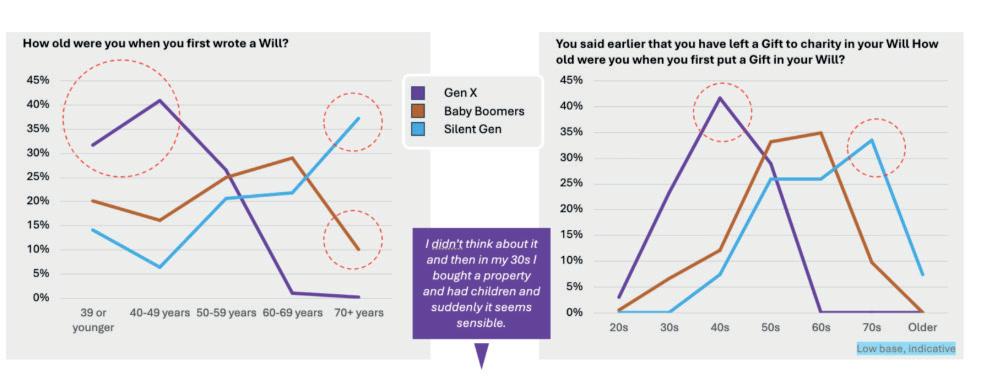
• People are writing Wills earlier, with Gen X-ers most commonly doing so in their 40s and Baby boomers in their 60s
Professional advisers are playing a critical role in shaping clients’ decisions to include charitable gifts in their Wills, according to new consumer research from Remember A Charity.
The study shows that among individuals with a Will who
have discussed leaving a charitable gift with a professional adviser, 60% have gone on to include one. This compares with just 20% of those who have not had such a conversation, underlining the significance advisers can play.
The findings are based on research carried out by independent agency OKO, which surveyed more than 2,000 UK charity supporters aged 40+ as part of Remember A Charity’s long-running consumer benchmarking study 1 . The study tracks long-term growth in the proportion of people choosing to include charitable gifts in Wills, which rose from 14% in 2010 to 22% in the latest annual survey (November 2025).
While legacy giving is increasingly common amongst those with Wills, it is younger generations, those with higher levels of assts and those who are aware of the tax incentives, who are most likely to leave a gift. (Gifts to charity are exempt from IHT and donations of 10% or more reduce the rate of IHT from 40% to 36%).
Despite this, awareness of the IHT benefits associated with charitable giving remains relatively low – at 42%. Even among individuals with assets of £1 million or more, 30% are unaware that leaving a charitable gift in their Will can reduce inheritance tax.
While tax incentives can support decision-making, they are rarely the primary motivation. Instead, individuals are typically driven by personal values and a desire to support causes they care about, after providing for family and friends.
Continues over page...
Adviser conversations linked to higher charitable giving in Wills...
People are writing Wills earlier
The research shows that the average age of making a first Will is 50, but that this is shifting over time. Generation X is most likely to write a Will in their 40s, Baby Boomers in their 60s and Silent Generation in their 70s. This reflects a broader shift towards earlier financial planning, even as traditional life milestones such as home ownership, marriage and children are occurring later.
Younger Will-makers are more likely to include a gift, with 35% of those aged 40–59 having done so, compared with 32% of those aged 60–69 and 30% of those aged 70+.
Over one third (35%) of those who have not yet included a charitable gift say they would consider doing so. (See chart below)
Professional advice and changing behaviours
Professional advisers continue to play a central role in Will-writing, with 66% of those with a Will using a solicitor and 18% a professional Will writer. At the same time, approaches are evolving, particularly among younger clients: 28% of Gen X respondents say they would make a Will online or have already done so, compared with around 10% of Boomers and Silent Generation respondents.
Demand for financial advice is also increasing. The proportion of people seeking financial advice has risen from 42% in 2021 to 53% in 2025, with younger and wealthier individuals and those supporting multiple charities most likely to seek guidance. Those aged under 55 with assets over £250k are the most engaged with professional wealth advice.
Wills as evolving documents
The study reinforces that Wills are not static and often change over time. While 49% of respondents have never updated their Will, more than half (53%) expect they will need to do so in future.
Life events such as bereavement,
changes in family relationships, inheritance and retirement are key triggers for reviewing a Will, creating important opportunities for advisers to revisit clients’ intentions and ensure their plans remain aligned with their wishes.
Long-term trend and adviser opportunity Jeremy Rix , Managing Director of the independent research agency OKO, says:
“People like to feel like that they’re exerting some control in uncertain times by planning ahead. Given an easier process and a wider range of options available, making a Will is one practical way they can do this.”
Lucinda Frostick , Director of Remember A Charity, says:
“Professional advisers play a vital role in helping clients navigate complex decisions around their estates and finances. This research highlights just how influential those conversations can be, particularly when it comes to charitable giving.”
Remember A Charity offers a free Campaign Supporter scheme and a wide range of resources for solicitors and Will-writers on legacy giving 2 , with a dedicated hub 3 for wealth advisers.
A summary report 4 is published on the consortium’s website, with a full report available for Remember A Charity members.
Notes
1The tracking study, which follows Prochaska’s Stages of Change model, shows forward movement over 15 years from donors’ active rejection of leaving a gift in their Will and lack of awareness through to awareness, contemplation, preparation and action (leaving a gift).
The Stages of Change model features six levels: rejection of leaving a gift in their Will; pre-contemplation unaware – those who have never thought about it and are not sure if they would consider it, pre-contemplation aware – those who have thought about it and given it low consideration; contemplation - those who know about it and would consider leaving a gift; preparation – those who intend to give; and action - those who have already included a gift in their Will.
NB. A small number of respondents don’t fall into any group (i.e. those who say they’re not sure if they’ve thought about and wouldn’t consider leaving a gift in their Will, plus those who haven’t thought about it but say they would consider leaving a gift and/or intend to do so) and are excluded from the analysis and results from the other groups prorated to 100%.
Emerging drug trends in the UK: Testing for new substances in the family courts
There were 5,565 deaths related to drug poisoning registered in England and Wales in 2024, the highest number since records began in 1993 and a 2.1% increase compared with 2023 (Office for National Statistics, 2024).1
Concerns about rising drug-related harm have also been highlighted by the National Crime Agency,2 which has warned that the UK has “one of the highest rates of drug deaths in Europe.” Its Director-General, Graeme Biggar, said “there has never been a more dangerous time to take drugs.”
What drugs are now commonly being used?
The spike in deaths is partly caused by novel psychoactive substances (NPS), a catch-all term for a diverse range of synthetic drugs which are on the rise across the UK. These include opioids, cannabinoids, benzodiazepines, stimulants and hallucinogens that are designed to mimic the effects of traditional illicit drugs and often significantly more potent.
Nitazenes are just one example of these. They are often mixed with party drugs or street drugs such as cocaine, synthetic cannabis or heroin, the latter of which has become both much scarcer and more expensive in the UK due to a crackdown in opium production in Afghanistan.3
The high potency of nitazenes, reportedly up to 500 times
stronger than heroin, together with their low manufacture cost and ability to evade detection using standard analytical methods, have contributed to a significant rise in the use of NPS. In some cases, consumers knowingly switch to these substances, while others may unknowingly obtain drugs that have been adulterated with, or replaced by, NPSs.
In October 2024, the Office for Health Improvement and Disparities 4 reported that nitazenes were responsible for 195 deaths in the UK in 2024, four times higher than in 2023. The number could potentially be significantly higher than is reported, due to the ever-evolving nature of these types of drugs and the lack of knowledge some drug users have regarding the combinations of substances they are taking.
The recent detection of synthetic cannabinoids in electronic cigarettes (vape pens) marketed as containing THC, the psychoactive component of cannabis, also highlights a concerning trend in the adulteration or substitution of THC products with synthetic cannabinoids, resulting in consumers unknowingly ingesting novel substances.
Many toxicology labs cannot test for novel drugs
Because the types of NPS on the market change so frequently, there is generally a lag between identification, classification and establishing accredited methods to analyse them. This can mean that many labs are still testing for a particular compound when drug use trends have moved on to something else. Notably, the ONS has stated that the proportion of drug-related deaths about which it, “holds no information on the specific substances involved,” has been, “increasing over time.” 5
In family court proceedings where drug use is a concern and testing is required, these information gaps can present significant challenges. The lag between the emergence of new substances and their inclusion in standard testing panels means that some drugs being used by a parent or guardian may go undetected, and therefore unreported. Novel substances also present difficulties for local authorities and the courts, as it may be unclear which drugs should be the subject of testing. In many cases, the individual using the substance may themselves be unaware of exactly what they have taken.
How can FTS help with testing for novel or illicit drugs? FTS has one of the most comprehensive accredited drug panels in the UK forensic toxicology market and can test for: • 43+ compounds tested as standard
• 15 stimulants/hallucinogens
• 2000+ additional compounds including novel psychoactive substances, regularly updated
• Synthetic cannabinoids (spice); FTS is the only company in the UK testing for the synthetic cannabinoid ADB Butinaca, currently one of the most used in the UK
• Pregabalin and Gabapentin, highly addictive and often overlooked prescription drugs
• FTS is also one of the only providers testing for MDPHP, the active ingredient in the drug more commonly known as ‘Monkey Dust’, which has been responsible for several deaths in Stoke on Trent and around the Midlands
Supported by a programme of continual development to address evolving drug use patterns in the UK, it is the only laboratory in this sector able to reliably detect novel substances as they emerge and reappear on the illicit market.
How to instruct FTS to test for novel drugs: Through the use of FTS’s drug panel, relevant and emerging compounds can be reliably detected, reducing the risk of public funds being spent on testing for outdated synthetic substances. More importantly, it helps ensure that novel drug misuse is not overlooked and that children are protected from unnecessary risk.
In circumstances where drug use is suspected to be a safeguarding issue, particularly NPS use, or where it is unknown what substances may be being used, FTS is able to screen for 2000+ compounds alongside the requested routine panel, which is accredited to ISO/IEC 17025 and Lab 51. Depending on the compounds detected, FTS may be able to provide additional information regarding use/exposure patterns through further analytical method development.
By providing accurate, comprehensive forensic toxicology and expert interpretation, FTS helps ensure that decisions are made in the best interests of children and their families. These services are Legal Aid Authority (LAA) compliant, and we offer a LAA Indemnity Guarantee should there be any shortfall in reimbursement. FTS experts provide reports within 8 days from the sample arriving at
our lab. We can also provide expert witnesses for court appearances.
For information on how FTS can support your testing for novel drugs, including nitazenes or monkey dust, contact us on 01924 480272 or email expert@forensic-testing.co.uk
References
1Joshi, A. (2024) UK has one of the highest rates of drug deaths in Europe as National Crime Agency warns about rise of synthetic opioids. Sky News, 15 August. Available at: https://news.sky. com/story/uk-has-one-of-the-highest-rates-of-drug-deaths-ineurope-as-national-crime-agency-warns-about-rise-of-syntheticopioids-13197427 (Accessed: 11 March 2026).
2Office for National Statistics (2024) Deaths related to drug poisoning in England and Wales: 2023 registrations. Available at: https://www.ons.gov.uk/peoplepopulationandcommunity/ birthsdeathsandmarriages/deaths/bulletins/ deathsrelatedtodrugpoisoninginenglandandwales/2023registrations (Accessed: 11 March 2026).
3Office for National Statistics (2025) Deaths related to drug poisoning by selected substances, England and Wales. Available at: https://www.ons.gov.uk/peoplepopulationandcommunity/ birthsdeathsandmarriages/deaths/datasets/ deathsrelatedtodrugpoisoningbyselectedsubstances (Accessed: 11 March 2026).
4Office for National Statistics (2025) Deaths related to drug poisoning in England and Wales: 2024 registrations. Available at: https://www.ons.gov.uk/peoplepopulationandcommunity/ birthsdeathsandmarriages/deaths/bulletins/ deathsrelatedtodrugpoisoninginenglandandwales/2024registrations (Accessed: 11 March 2026).
5United Nations Office on Drugs and Crime (2025) Afghanistan’s opium production falls to record lows amid drought and sustained ban enforcement. Available at: https://www.unodc.org/coafg/en/ stories/2025/afghanistans-opium-production-falls-to-record-lowsamid-drought-and-sustained-ban-enforcement.html (Accessed: 11 March 2026).
Sidney Conway v Yeovil District Hospitals NHS Foundation Trust & Anor [2025] EWHC 2488 (KB)
Sidney Conway v Yeovil District Hospitals
NHS Foundation Trust & Anor - Find Case Law - The National Archives1
The Claimant’s father and litigation friend alleged that the medical practitioners treating his son were negligent in not promptly carrying out an ultrasound on his head, after he had been admitted to hospital with head injuries. The judge found that the expert for the Claimant was, to an extent, seeking to fight his corner rather than taking a dispassionate approach to the issues raised.
Learning points for experts
• You must not advocate for your client.
• Making reasonable concessions may enhance the weight of your expert evidence, but there will be a point where the scale and significance of concessions undermine the level of confidence in what remains of your evidence.
• Always listen carefully to the question you have been asked, and answer only that question, not the question you wish you had been asked. You will find this point among the excellent practical advice for giving oral evidence which the Right Honourable Lady Simler, Justice of the Supreme Court shared in her recent Sir Michael Davies Lecture2 to the EWI.
The case
The Claimant suffered head injuries as a baby resulting from physical abuse by his mother. He was admitted to hospital where the favoured diagnosis was pyloric stenosis. An ultrasound scan did not provide convincing support for pyloric stenosis, and the other presenting complaints had resolved, apart from a history of increased measurements in head circumference in comparison with babies of the same age. He was discharged home, with a decision made to keep his head measurements
under review. On the next day, his mother assaulted him again causing catastrophic brain injuries.
The Claimant’s father and litigation friend alleged that it had been negligent not to promptly carry out an ultrasound of the baby’s head, which the Defendant denied. It was not disputed that, had such a scan been carried out before his discharge, it would have revealed the fact that the baby had probably sustained trauma to the head, leading to a chain of enquiry which would have prevented the subsequent abuse.
The expert evidence
The judge accepted without reservation the evidence of the Defendants’ expert, Dr R, noting that his approach was reasonable, logical and fair. Also, in contrast to the Claimant’s expert, Dr C, Dr R’s evidence had remained consistent.
The judge found that Dr C’s evidence was significantly attenuated by important concessions which eventually resulted in very little remaining of the Claimant’s original case. The judge noted that, while a willingness to see the other side’s point of view and change a previously held opinion may enhance the weight given to expert evidence, there is a point where the scale and significance of the concessions undermine the level of confidence to be attached to what remains. That had occurred in this case. It was particularly significant that the changes in Dr C’s stance were not primarily, if it all, based upon changes in the available information or the presentation of new arguments which he had previously overlooked. The judged highlighted in particular the contrast between Dr C’s early unequivocal condemnation of the defendants for not performing an ultrasound scan of the head on 6th or 7th January which was followed by an equally unequivocal concession that a scan over this time period was, after all, not necessary.
In contrast, the judge noted that Dr Rose considered all of the factors relevant to the proper approach to the Claimant’s subsequent treatment and found nothing wrong in the plan to have the health visitor follow up the issue of head circumference over the next one or two weeks. The judge was satisfied that suggesting now that an urgent ultrasound scan of the head was called for was a criticism based on hindsight rather than reasonable foresight.
The judge also noted that the Claimant was not able to point to literature from any source which tended to undermine the opinion of Dr R. In fact, Dr C was obliged to conceded in cross-examination that the literature presented to the court by the Claimant was of no assistance to the court on the issues to be determined. The judge noted that this would not, of itself, be conclusive but it undoubtedly weakened the force of any Bolam arguments.
The judge also criticised Dr C’s approach to responding to questions while giving evidence, including occasions when he was mildly combative and when he did not always answer questions directly or first time round. Dr C showed a tendency to assume the intended purpose of any given question and, rather than to answer it, to present his defence to a point not yet made. The judge formed the view that Dr C was, to an extent, seeking to fight his corner rather than taking a dispassionate approach to the issues raised. Dr R did not succumb to this temptation.
The judge was left in no doubt that Dr R’s evidence was to be preferred and the Claimant had failed to prove breach of duty.
Silicon Fen Moves Home: How AI is Redefining the East Anglian Property Market
For decades, the East Anglian property market has been defined by its contradictions - the hyper-modern tech biosphere of Cambridge sitting just miles from the medieval timber-frames of Lavenham and the untamed coastline of North Norfolk. Buying a home here has traditionally been a game of local knowledge, whispered leads, and a fair amount of patience.
However, as we move through 2026, a new force is quietly harmonising these extremes. Artificial Intelligence is no longer a futuristic concept and will inevitably become the primary tool for how we find, value, and secure homes across the East of England.
Beyond the Search Bar:
The Death of the “Filter”
For years, house hunting was a digital chore of ticking boxes: ‘three bedrooms’, ‘detached’, ‘garden’. This binary approach often failed the nuanced beauty of our region. You couldn’t search for ‘a cottage with the character of a Broadland retreat but the connectivity for a London commute’. Now, AI is shifting the paradigm from searching to discovering. New
platforms and enhanced tools on Rightmove allow buyers to use natural language. AI understands that a buyer in Norwich might value ‘walkability to the Lanes” over a specific square footage. By using visual recognition to ‘see’ inside photos, AI can identify unlisted featureslike original flint walls or south-facing solar potential that traditional metadata misses.
The Valuation Revolution:
Precision over Guesswork
In a market as fragmented as East Anglia’s, where a townhouse in Bury St Edmunds can command a vastly different premium than one in Lowestoft, valuation has always been an art. AI is turning it into a high-precision science.
By layering “hyper-local” data, everything from micro-fluctuations in local school ratings to real-time footfall data near new developments, AI-driven Automated Valuation Models are providing a level of transparency previously unavailable to the average buyer. For the investor, AI tools are being used to predict rental yields, removing the ‘gut feeling’ and replacing it with robust ROI forecasting.
Frictionless Finance:
The 24-Hour Mortgage
The most significant pain point in the UK property journey has always been the ‘dead time’ between offer and exchange. In East Anglia, where the legal complexities of historic titles or coastal erosion risks can slow down conveyancing, AI is proving to be a critical accelerant.
We are also seeing the rise of the ‘SelfDriving Mortgage’. AI-powered lenders can now verify income, conduct credit stress tests and cross-reference property data in seconds rather than weeks. When combined with AI-assisted conveyancing, which in the future may be able to flag planning discrepancies or boundary issues instantly, the dream of a “one-month completion” is moving from a dream to reality.
The Bottom Line
East Anglia has always been a region of pioneers. Just as the physical landscape was once transformed by Dutch drainage engineers, its property market is now being reshaped by data scientists. For the modern buyer, the message is clear: the tools have changed. To secure a home in this competitive corner of the UK, embracing the Silicon Horizon isn’t just an advantage it’s a necessity.
Tim O’Brien, Managing Director, TIDE Services Ltd
Is legal AI becoming ‘mandatory’ in criminal law?
There is understandable caution around the idea that AI could become ‘mandatory’ in legal practice. Strictly speaking, there is no rule requiring lawyers to use AI on cases, and I do not believe we are at the point where anyone can say it is compulsory. But I do think we are moving towards a position where lawyers should feel a growing professional obligation to consider it seriously.
At the heart of this is client care. Lawyers owe clear duties to their clients, and in criminal law, those duties sit alongside a great deal of human, emotional pressure. Being investigated or prosecuted is deeply stressful. Even where the financial cost is unconcerning to a client, the emotional toll is often significant. Delays, slow communication and administrative backlogs all add to that strain. When a client is waiting for a document, chasing for an update or wondering whether their case is
progressing, that uncertainty matters.
If there are tools available that can help legal professionals work faster, communicate more effectively and reduce avoidable delays, it is reasonable to ask whether ignoring them is really in the client’s best interests.
This is particularly relevant in high-pressure areas such as criminal practice, where workloads are heavy, timelines are tight, and unpredictability is part of the job. Used properly, AI has the potential to improve efficiency, speed up routine tasks and free lawyers up to focus on applying professional judgement, strategy and client support. Rather than replacing legal expertise, this is about giving lawyers more time to apply it where it matters most.
There is also a wider question of fairness, and an ‘equality of arms’. With Part 2 of
Leveson’s Review of the Criminal Courts suggesting that the courts, police and CPS should make responsible use of AI in case preparation, defence lawyers and private prosecutors cannot afford to stand still. If one side of the system is becoming more efficient through technology, others will need to consider how they respond.
Of course, concerns remain. Data protection, compliance and accuracy all matter, and they should. Nobody in law should adopt AI carelessly. But the answer is not to dismiss the technology outright. It is to use the right tools, with the right safeguards, and with a clear understanding of where AI helps and where human oversight remains essential – and to take the time to learn and engage with it.
Legal AI may not yet be mandatory, but for many firms, it is fast becoming too important to ignore.
Catherine Gaynor LEAP
About Catherine Gaynor
A seasoned Criminal and Regulatory Law specialist, Catherine Gaynor brings over a decade of experience to her role as Head of Criminal Law at LEAP Legal Software. Formerly a Partner at JMW Solicitors LLP, she has advised on high-profile criminal cases, VHCCs, and professional misconduct matters. At LEAP, she uses her deep understanding of the criminal justice sector to drive digital transformation and support firms in modernising their workflows.
President of The Law Society highlights “24/7 pressure” and the reluctance of the legal profession to seek support
Mark Evans has called for greater openness and attitudes to change across the legal profession in a new episode of The Legal Pause podcast.
The President of The Law Society of England and Wales has spoken candidly about the constant pressure facing solicitors and the ongoing reluctance for them to seek support.
Speaking on Episode 6 of The Legal Pause podcast, hosted by Nick Gallagher, CEO of The Solicitors’ Charity, Evans highlighted how changing client expectations and technology are contributing to an “always on” culture in law.
“Consumers can drive this ‘24/7 always on’ approach… there is the expectation that someone replies outside of usual office hours,” he said.
The episode explores how these pressures are reshaping the profession, alongside the barriers that continue to prevent many solicitors from asking for help.
Reluctance to seek support remains
Despite increased awareness of wellbeing in the legal sector, Evans acknowledged that many solicitors still found it difficult to identify and access support.
The profession’s traditional emphasis on independence and resilience can make it harder for individuals to speak openly when they are struggling, even when support services are available.
Leadership and visibility key to change Evans also emphasised the importance of leadership in driving cultural change, highlighting the role of openness and visibility in encouraging others to speak up.
“I want people to know I am a human being with emotions… talking about something can make a difference,” he said.
From social mobility to sector-wide support Reflecting on his own journey into the profession, Evans spoke about the importance of widening access to legal careers and ensuring that individuals from all backgrounds feel able to pursue law.
He also highlighted the role of organisations such as The Solicitors’ Charity, LawCare, and The Law Society in supporting solicitors throughout their careers including in less talked about situations like disciplinaries.
“The Law Society has a Practice Advice Line, Wellbeing Hub and information about charities providing support. And support for people facing disciplinaries as well and signposting
to other organisations. Every time I speak to a relevant audience, I mention The Solicitors’ Charity, LawCare, The Law Society and hope that others get the message and amplify it too.” Evans said.
A call for a more supportive profession
The episode reinforces the need for continued change across the legal sector, ensuring that support is not only available, but actively used and publicised. By combining leadership, openness, and greater awareness, the profession can create a more sustainable and supportive future.
You can hear the whole conversation: https:// thesolicitorscharity.org/the-legal-pause/
Episode 6 of The Legal Pause is available on all major streaming platforms.
About The Legal Pause
The Legal Pause is The Solicitors’ Charity’s podcast series exploring the pressures, challenges, and opportunities shaping today’s legal profession. Hosted by Nick Gallagher, CEO of The Solicitors’ Charity, the podcast features conversations with leaders and voices from across the sector on topics including wellbeing, culture, access to the profession, and the support available to solicitors and their families.
Episode 6 features Mark Evans, President of The Law Society of England and Wales, in conversation with Nick Gallagher about leadership, social mobility, pressure within the profession, and the challenge of asking for help.
Top Tips from the experts at FHM Forensic Accountants
In this article our experts at FHM Forensic Accountants share their top tips for lawyers. Fiona Hotston Moore and Tom Arnold undertake 50 to 60 forensic accounting assignments each year. We are instructed on a range of matters including business valuations, financial investigations, professional negligence, shareholder and partnership disputes. We act as Single Joint Expert, Party Expert and Shadow Adviser.
1) Beware of placing too much reliance on published company accounts
Less than 5% of companies are subject to an external audit. An external audit gives assurance that an external qualified auditor has scrutinised the accounts both in terms of the numbers and the disclosures. An audit gives an assurance that the auditor has not identified a “material” error in the accounts. However, Accounting and Auditing Standards are principles-based and you may need expert advice to interpret the accounts. If you do have audited accounts, we recommend first checking the Audit Report to see if the auditor was happy with the accounts. If the auditor was unable to give a “clean” audit report, you may see either a “Disclaimer of Opinion” or an “Adverse Opinion”. Read the qualification carefully and ideally obtain an interpretation from a qualified accountant. Additionally, the auditor may express a view as to whether the company is a “going concern” (i.e. is able to continue to trade and meet its liabilities as they fall due).
In respect of most limited companies other than the largest entities, the published accounts on Companies House, are of limited value. The accounts on public record
will be extracted from the full accounts that are prepared for shareholders. Often the published accounts comprise only a balance sheet and a few notes. The profit and loss statement is not published and so there is no information on turnover or profitability. The accounts will normally include a note of the number of employees which gives an indication on the likely size of the company.
The balance sheet in the published accounts will give you the “net assets” - a very rough estimate of the baseline net worth of a company. However, but this may be very different from the market value of the company which takes into account the value of the trade and intangibles. Also remember that assets shown in the balance sheet may be at historical cost. The current market value of, say, a property may be substantially higher than its original cost.
Finally, as experts we all too often come across errors in accounts as well as accounts that show a misleading view of the financial position. Errors can include inclusion of provisions and liabilities that are not justifiable or failure to correctly account for a share premium. Occasionally we even see accounts that do not add up!
2) Think tax
Tax impacts much of our work as forensic accountants. We may be giving a view on the after-tax valuation of a shareholding or the tax costs of extracting cash or assets from a company. The tax costs of a transaction can be substantially reduced if capital gains tax rates apply rather than income tax rates. Furthermore, there are various reliefs and exemptions that may be available.
There are also taxes that are easily overlooked in a transfer or transaction but that can be significant. For example, disposing of shares that were eligible for Business Asset Disposal Relief, may result in a substantial increase in the potential Inheritance Tax liability on an estate. Similarly, don’t overlook potential VAT on a business or asset transfer or Stamp Duty Land Tax on the transfer of a property.
The list of potential tax pitfalls is very long and early input from the company accountant or an independent expert is advisable.
We also come across tax liabilities arising from tax schemes or failed tax planning. This may include disputed Research & Development claims or Employee Ownership Trusts. In such situations an objective assessment of the likely liability is required.
3) Don’t overlook the option of engaging a shadow adviser
We are instructed as shadow adviser in a range of cases. Typically, in a financial dispute where a Single Joint Expert is engaged, we may be instructed to help the clients and legal counsel to draft the instructions, to assess the expert report, formulate questions and decide on the litigation strategy.
In family cases we can review the initial disclosure and give a view on any valuation provided by a party or company accountant. We can give a view on whether the appointment of a Single Joint Expert should be sought.
The shadow adviser can help give your client reassurance on the reasonableness of the Single Joint Expert report and help contain costs.
fiona@fhmforensic.co.uk
+44 (0)7770 642491
Tom@fhmforensic.co.uk
www.fhmforensic.co.uk
The FHM Senior Team: Kirsty Shuckford, Fiona Hotston Moore, Graham Hines and Tom Arnold
And Finally...
Hello everyone, and welcome to Spring!
It’s so nice to have lighter mornings and evenings, together with some beautiful sunshine too.
Well, I can’t believe how quickly the time is passing and I’ve now been in this role for four months. Time passes quickly and in saying that so does the legal world. As you have
read through the Bulletin there are articles on the changes proposed in respect of AML and there has been the appeal decision in the Mazur case which will leave firms needing to make changes and have various controls in place when dealing with the conduct of litigation.
As summer approaches we have our Legal Walk to look forward to on 3rd June, and I hope as many of you as possible can take part and help to raise funds for our charities in the county who benefit from the funds raised. We are seeking a minimum sponsorship of £50 per walker and I hope that we can raise a huge amount in support of this very worthy cause.
We are planning some face-to-face training events with our patrons, and we hope to provide you with the dates for those shortly so you can get booked on and have the benefit of some training with your peers away from the office.
We have booked our Annual Dinner for 13th November 2026 so put this date in your diaries. Further details about the evening will be sent and we hope you will attend and enjoy a relaxing evening with your fellow members and patrons and guests.
As a society we are always looking for new members so if you have any colleagues who would like to join as a member or associate member then please do encourage them to contact me and I would be happy to discuss this with them. We are also looking for enthusiastic individuals who would like to join Council. If this is something that is of interest to you, please reach out to any of the Council members or you can always contact myself. My details are: sec.nls@ outlook.com