Palmer Theological Seminary’s pioneering Doctor of Ministry in Leadership of Missional Church Renewal Program focuses on helping Christian leaders grow as responsive agents of God’s transforming power. The program affirms a vital relationship with Jesus Christ as the source of renewal. It looks inward at the transformation of individuals and churches, and outward at the transformation of communities and the world. It captures the essence of what it means to be the Church.
The program is designed to deepen the student’s role in leading with increasing professional, intellectual, and spiritual integrity. The goal is to provide a level of knowledge, theoretical clarity, and competence commensurate with the highest degree for practice of ministry.
Persons seeking to enter into this program must possess a clearly definable context of ministry. It requires 4 two-week residency periods over the course of three years. Prerequisites include an M.Div. degree (or its equivalent) from an accredited seminary and at least three years of subsequent ministry leadership experience.
For More Information
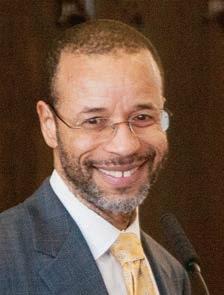
Dr. Donald Brash, Faculty Director, DMin Office
484.384.2944
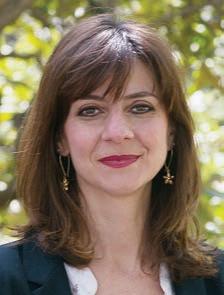
Nancy Stahl, Admissions Coordinator
484.384.2948
To apply online visit our website at: www.palmerseminary.edu
Discover how Palmer students are learning to understand and respond to the growing crisis of domestic and international human trafficking from a Christian perspective.
Read about fellow Palmer alumni—their successes, exploits, updates, and triumphs.
Illustration by Mark Lambertson based on a photo by Daniel Burke.
Praise & Promise
Daniel Burke
Daniel Burke
Rev. Dr. Aponte Appointed as Dean of Palmer Seminary
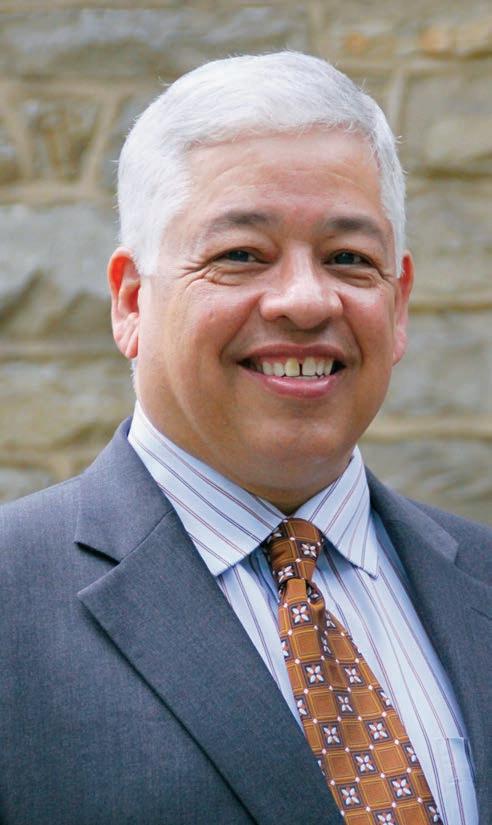
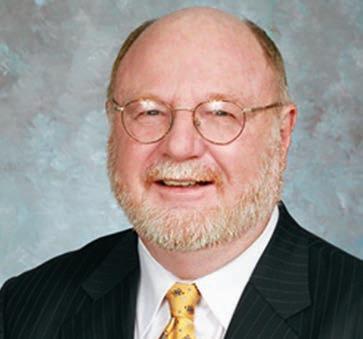
Eastern University is pleased to announce the appointment of Dr. Edwin David Aponte as the next Dean of Palmer Theological Seminary, effective July 1, 2014. Dr. Aponte previously served as the Vice President and Dean of the Faculty at Christian Theological Seminary in Indianapolis, Indiana. He brings to the Palmer community an impressive scholarly and administrative profile and a keen sense of the Seminary’s ethos and mission.
Dr. Aponte said, “With a deep sense of God’s calling, I have agreed to serve as Dean of Palmer Theological Seminary at Eastern University during this important time in its history. I embrace Palmer Seminary’s clear and demonstrated commitment to integrate faith, reason, and justice as succinctly expressed in its motto, ‘The Whole Gospel for the Whole World through Whole Persons.’ With God’s help, I will assist the community at Palmer in its mission to educate and transform students by the love of God in Christ as they concretely and lovingly care for ‘the least of these’ in a variety of ministries. I believe that we share this calling and that God has joined us in the dynamic ministry of theological education. I look forward to my tenure as Dean of the Seminary.”
“With a deep sense of God’s calling, I have agreed to
serve as Dean ...”
Prior to his tenure at Christian Theological Seminary, Dr. Aponte taught or served in administrative roles at numerous institutions, including Lancaster Seminary, Temple University, New York Theological Seminary, Southern Methodist University and Palmer itself, where he served as visiting professor in 2005. In addition to these institutional roles, Dr. Aponte is an ordained minister of the Presbyterian Church USA and has served on various professional committees for the Association of Theological Schools, Middle States Association, and American Academy of Religion.
Dr. Aponte is a visionary leader who is well suited to lead Palmer in its mission to pursue the “Whole Gospel for the Whole World Through Whole Persons.” Palmer Theological Seminary gladly welcomes Dr. Aponte and eagerly anticipates the impact that his leadership will bring to our community and to those that will be reached through it.
inMinistry is published by the University Relations Office at Eastern University
Summer 2014
inMinistry Mission Statement
inMinistry supports the mission of Palmer Seminary, the seminary of Eastern University, by improving the connection with its alumni and friends, and they with each other. Together, we will make a difference in the world through faith and service. The magazine will support this goal with up-todate news stories and features that are designed to inform and educate its readership. The editorial content will speak to contemporary events and issues from a unique, Christian perspective.
Seminary Administration
Robert G. Duffett, Ph.D., President, Eastern University
Edwin D. Aponte, Ph. D, Dean of Seminary
Seminary Committee of the Eastern University Board of Trustees
Rev. Dr. Richard E. Rusbuldt ’53, Rev. Dr. Jacob Chatman ’68, Rev. Albert G. Davis, Jr., Rev. Dr. Richard Dent, Rev. Dr. W. Wilson Goode, Sr., Mrs. Lucy Huff, Dr. John A. Sundquist, F. Ardell Thomas, M.D., and Rev. Dr. Alyn E. Waller ’98
Publisher
Sherry-Ann Morris, Chief Marketing Officer
Editors
Melissa Falk, Kyle Marie McDougall, Yolanda Whidbee
Project Manager
Yolanda Whidbee
Contributing Writers
Melissa Falk, Deborah McConomy-Wallace, Kyle Marie McDougall
Magazine Logo & Layout
Mark Lambertson
Graphic Designers
Jason James, Mark Lambertson, Daniel Peirce
Photographers
Daniel Burke, Sunny Miller
Please send magazine comments to inMinistry@eastern.edu
University Relations Office, Eagle Learning Center 1300 Eagle Road, St. Davids, PA 19087
Alumni may submit news at www.palmerseminary.edu/alumni or via email: palmeralum@eastern.edu
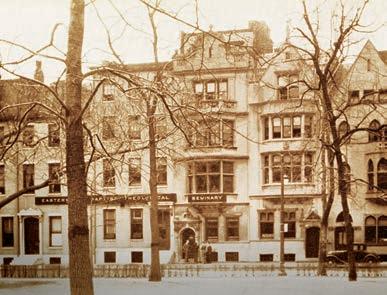
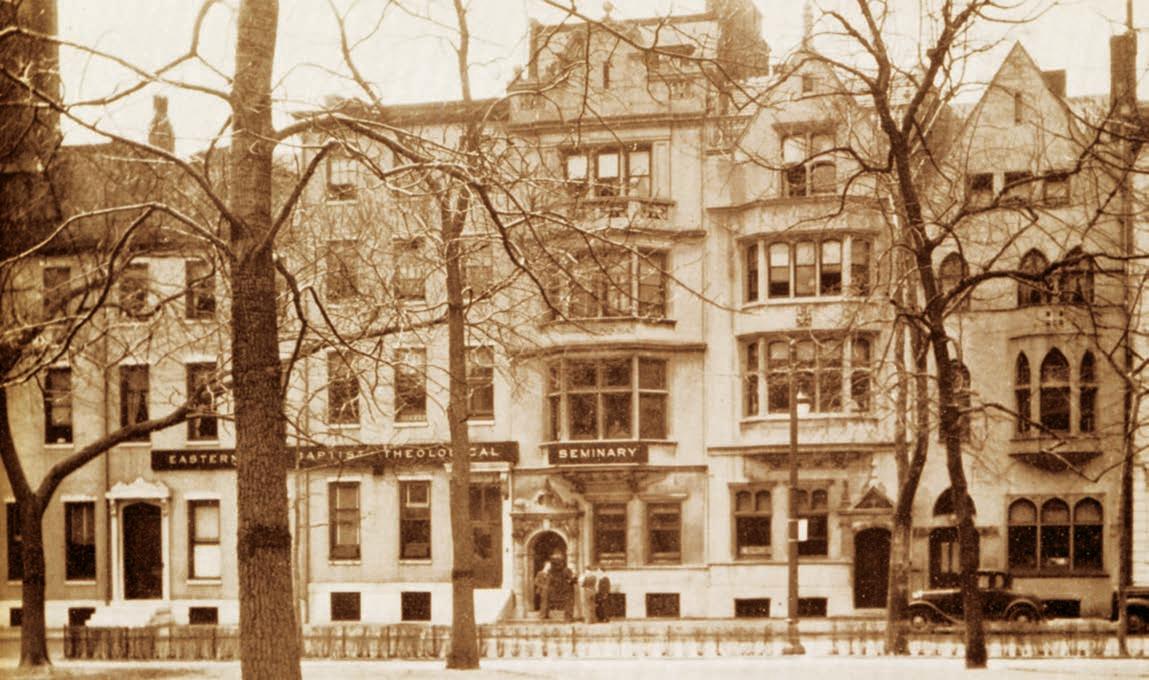
While many were talking about the need for a conservative seminary, two men in particular, Rev. L.W. Barnard and Rev. Charles T. Ball, were committed to taking action. Barnard organized a meeting in New York for November 18, 1924 to discuss the creation of a chain of Bible colleges.
At 2:00 p.m. on March 19, 1925, six men, all of them ministers, gathered at 1701 Chestnut Street in Philadelphia, the headquarters of the American Baptist Publication Society. On that historic day, Charles T. Ball, Harry Watson Barras, Groves W. Drew, Ralph L. Mayberry, John Hainer, and Gordon H. Baker held the constituting meeting for the creation of Eastern Baptist Theological Seminary.
Given the odds against this nascent seminary, the story of its first year is almost too spectacular to believe. It is no wonder that to those familiar with its story, Eastern Baptist Theological Seminary became known as the “Miracle of Faith.”
On September 22, 1925, the Seminary
opened its doors to students with four schools: the School of Theology, the School of Religious Education, the School of Missions, and the School of Sacred Music. Students were not at first charged tuition, and had to pay only $6 a week for board and lodging. All who applied were admitted and no student was denied admission because he or she could not pay for a room or an apartment.
Eastern Baptist
Theological
Seminary became known as the “Miracle of Faith.”
—Excerpt from Praise and Promise by Randy Frame
Needed Then, Needed Now
Our story is set in history and it is what binds us. We have all risked something, faced some seemingly insurmountable challenge, left someone behind in order to embark on our seminary work at Palmer. The risks we took, though unlike those of our founding colleagues, were
risks all the same and these are the cords that bind us. Our history is a part of who we are and our alumni are the fabric of glory we proudly wear when we tell of our accomplishments. We are Palmer and there is no Palmer without us.
If it has been awhile, we invite you to reconnect, email, visit, call and share your journey, your story with us. We will be collecting these stories, as we look ahead to 90 years of Palmer next year. You are the story, you are the reason for the sacrifices noted above and those we make every day to ensure that Palmer, and the work we do for our Lord and King, will live on. We persist, not because the world needs another seminary, but because the world still needs the Whole Gospel for the Whole World through Whole Persons.
—Sherry-Ann Morris
Keeping it Real
It’s not every day that a distinguished group of clergy and other church leaders are given an opportunity to explore what lessons preachers can learn from rap artists. When Dr. Frank Thomas announced his topic for the 33rd annual Mitchell Lecture and began his speech with the promise, “I’m going to offend you,” the attendees gathered at Philadelphia’s Monumental Baptist Church weren’t quite sure what to expect. What followed was a lively and unexpectedly thought-provoking lecture entitled “Keepin’ it Real: The Validity of the Existentially Authentic Performance,” in which Dr. Thomas explored the common role of authenticity in hip-hop and preaching. The point of his lecture was that, just as hip-hop artists like Jay-Z strive for the authentic in their lyrics, so must preachers strive for “the real” in their preaching.
Why Jay-Z and Hip-Hop?
Jay-Z may at first seem like a curious role model for preachers. Born Shawn Carter, he grew up in a Brooklyn housing project and earned his living selling drugs on the streets before turning to a career in music.
As an artist, Jay-Z is known for what Rolling Stone calls his “lyrical dexterity and multiple styles of delivery.” He has become widely recognized as one of the top hip-hop artists of our day.
“Preachers need to speak the ‘real,’ the reality of every day life.”
Hip-hop, a stylized, rhythmic music that accompanies chanted rhyme or “rap,” originated in performance poetry, spoken word, and the call and response patterns of African and African-American religious ceremonies. It developed during the 1970’s as an expression of urban life and culture. Hip-hop language expresses the gritty reality of drugs, murder,
rape, broken relationships, and abuse. Thomas referred to the profane words used to portray the artist’s opinion as “ sacred profanity.” This he calls an authentic expression.
Speak the “Real”
Preparing to preach is like writing hip-hop song lyrics, says Thomas. Preachers need to speak the “real,” the reality of everyday life. Although the popular perception is that violence and crime are endemic to urban life, he noted that they are pervasive in rural areas and suburbia too. All too often this reality is ignored in our churches and in our preaching. We often like our religion neat and non-political. We frequently avoid discussing the bigger problems or allow them to intrude on our worship; but nevertheless our congregations and their members are surrounded by big problems. They are real, and preachers—and our people—are living them.
Dr. Frank Thomas
Too much of the preaching done today is not real, Thomas asserted. Like cotton candy that stimulates the taste buds but leaves the person empty, inauthentic preaching “tastes good on Sunday, but doesn’t connect with the rest of the week.” Paraphrasing Jay-Z on the topic of faking style, Thomas called inauthentic preaching “a house of sand.” That is a familiar image to the reader and preacher of Scripture.
According to Dr. Thomas, the preacher who steers clear of “the real” is faking emotional truth or allowing the church to fake emotional truth. When the message is inauthentic, the listener searching for authenticity will move away from the church toward that which he or she perceives is real. For this reason, preachers need to speak the reality of truth.
Emotional Truth
Just as hip-hop’s emotional truth stems from the core beliefs of the artist, the preacher’s core beliefs—the bedrock attitudes upon which one bases trust or lack thereof—make his or her preaching real. It is the preacher’s task to exegete realness for the congregation.
According to Dr. Thomas, many preachers do not clearly know their core beliefs; therefore they cannot and do not communicate that they do, in fact, believe something deeply at their core. He advised, “Preach what you deeply believe because people have enough of their own doubts and don’t need yours.”
Get the Details Right
In order to communicate deep beliefs, the preacher is well advised to follow Jay-Z’s commitment to getting the smallest details right. Do your research! Too much detail bogs down the message; yet, providing too little detail causes the audience to miss the point. Dr. Thomas advised selecting vivid details because they will determine the listeners’ level of engagement. Then, like the hip-hop artist, we can connect with the real and help raise people to a new level of understanding the truth of the Gospel message. This is, after all, what God has called the preacher to do—to proclaim the Word of God authentically.
Re-Routing Human Trafficking
Toward the end of the spring semester, Dr. Francesca Nuzzolese partnered with the Rev. Dr. Lauran Bethell, a consultant with International Ministries of the American Baptist Churches USA, to teach a course on the subject of human trafficking.
The “Re-routing Human Trafficking” course was designed with three particular objectives. Firstly, the course gives students the opportunity to understand the complex systems and variables behind the sexual exploitation of girls and women, both domestically and internationally. Students investigate the socioeconomic, cultural, political, and spiritual circumstances that conspire to trap people in the trafficking networks.
Secondly, students can survey responses to human trafficking that are offered by government and non-government organizations, faith based nonprofit organizations and local churches. Students assess and evaluate the programs by comparing each approach and determining their respective effectiveness. Participants then question and explore what more can be done to address this issue both locally and internationally.
A third purpose of the course is to invite students to construct a Christian response to the trafficking of human beings and exploitation in all its forms. Students develop a specific project designed for the local community, aimed at directly impacting the lives of the girls and women who are victims of sex trafficking.
As part of the coursework, students had the opportunity to attend the International Christian Alliance on Prostitution Global Conference and to participate in as many as 50 workshops offered by leaders, advocates, and practitioners of care around the world. The conference was held in Green Lake, Wisconsin, May 1823. Featured keynote speakers were Eastern University’s own, Dr. Tony Campolo, and trauma expert and Christian psychologist, Dan Allender.
Sunny Miller
Dr. Francesca Nuzzolese
JennIfer CArPenTer
I did not want to attend seminary Seminary was a place that was called “cemetery” for a reason, and caused many of my friends to question their calling. Not to mention, I wasn’t sure I wanted to accept God’s call in my life to teach, preach, counsel and pastor. Could I, a woman who had grown up in a conservative southern background, truly be called to all of this? How sneaky God is! Through an insistent friend, I applied to a few different seminaries hoping I would get turned down. When I visited Palmer, something became apparent right away. Palmer is truly a place that is about its mission of “Whole Gospel for the Whole World through Whole Persons.” Everyone I encountered greeted me not only with warmth and care, but also with genuine dignity and encouragement of God’s call on my life. Even though I was resistant to come to seminary at first, I now see how important it has been for me to be here.
JACquelIne BrOWn
I came to Palmer Seminary knowing that I would be challenged. It has been one of the best times of growth in my Christian life. Palmer provides an incredible diverse community which allows for a broader understanding of cultures and many opportunities for lifelong friendships. The professors are intentional, knowledgeable and Spirit led. I have yet to meet a professor who wouldn’t talk with a student one on one. If you want a high quality of education while also building relationships, then Palmer Seminary is the place. It is hands down my favorite place to learn, pray and serve.
Shani Johnson: Student & Songwriter
Shani Akilah Johnson is a native of Philadelphia, Pennsylvania. She graduated from Palmer Theological Seminary on May 17, 2014 –receiving a Master of Divinity degree. (She graduated from Central High School in Philadelphia and then matriculated at Florida A&M University in Tallahassee, Florida).
Shani is a writer, singer, musician, artistic director, and minister; she is dedicated to using her creative gifts to illuminate the amazing Gospel of Jesus Christ. She is the founder of BLUEJAY Worldwide, a new and very innovative ministry that uses the arts to unveil the endless beauty of humanity through the teachings of an incredible Savior. BLUEJAY stands for Beauty, Love, Understanding, Enhancement, Joy, Acceptance, and Yes to God’s Will.
Presently, she is working on her first music album and writing her first book—In Search of a Blue Jay
We Shall Live On
(A song for Palmer Theological Seminary)
Written by Shani Johnson
From the blessed hallways of Wynnewood
To the growing grounds in King of Prussia
Throughout the uncertainty of transition, May we dwell in an endless worship
Wherever God leads us, there will be victory
And this love will dance around “our becoming” for eternity
God will shine on us as we embrace divine destiny
Amazing Grace will be the rhythm of our ministries.
God is with us ...
God is leading us ...
And we shall live on ...
We shall live on God’s wind is moving us
Palmer is in good hands
In God, we trust. We will—forever stand.
We celebrate our blessed learning
Took us higher in God’s love— our souls are always yearning
Prepared us for the whole world
We are not afraid
Now, we go forth to share the whole Gospel for the rest of our days
We shall live on
God’s wind is moving us
Palmer is in good hands
In God, we trust. We will—forever stand.
Whole Gospel
Whole World
Whole Persons
God is with us
We shall live on God’s wind is moving us
Palmer is in good hands
In God, we trust. We will—forever stand.
Current Students
Joe Davis
Eugene Gilbert
Michelle Ford-Johnson and Tiffany Wilson
The wall in the Administrative Wing.
Randy Van Osten
Jackie Wilson-Dandrow
Eric Sporer
Al TIzOn
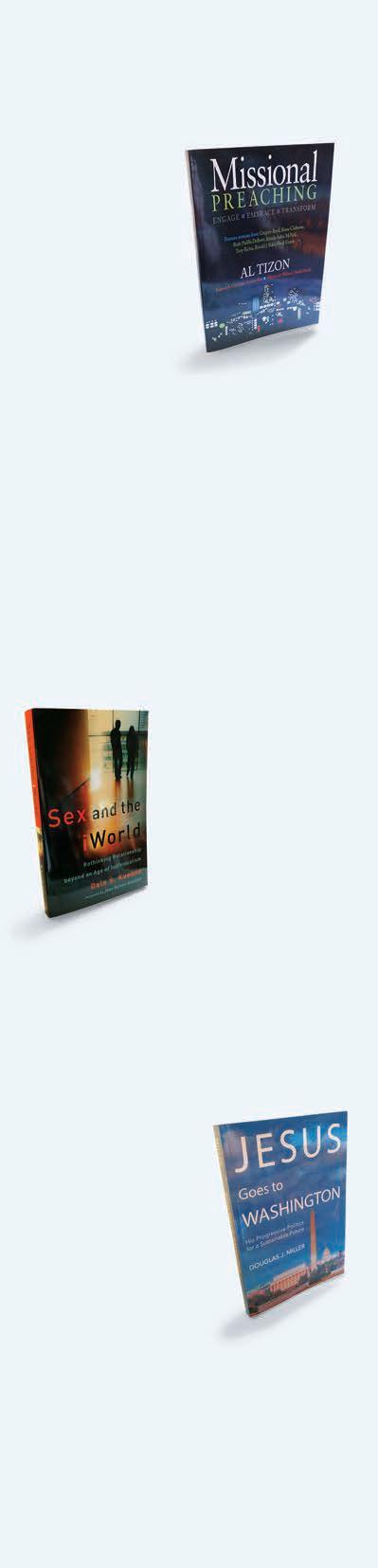
This January, Dr. Al Tizon’s book, Missional Preaching was again recognized and awarded the Silver Medal in Independent Publisher’s Illumination Book Awards. Missional Preaching combines preaching with the aims of the missional church and takes an in-depth look at the integral relationship between the two. Also a winner of the 2013 Outreach Award, this lively, holistic and compelling resource helps leaders think about how to shape people in missional thinking and practice through the work of preaching.
DAle Kuehne
The Palmer community was privileged to have Dr. Dale Kuehne as our guest lecturer on March 27th. Author of the book, Sex and the iWorld, Kuehne, a professor at St. Anselm College in New Hampshire, spoke on the topic, “Standing on the Threshold of an Inconceivable Age: Good News for a Skeptical World.”
DOuGlAS MIller
Former faculty member Dr. Douglas Miller, professor of Christian Social Ethics at Palmer from 1970 to 1990, wrote the book, Jesus Goes to Washington: His Progressive Politics for a Sustainable Future, recently published by Wipf and Stock. It is available from the publisher.
Photos by Daniel Burke
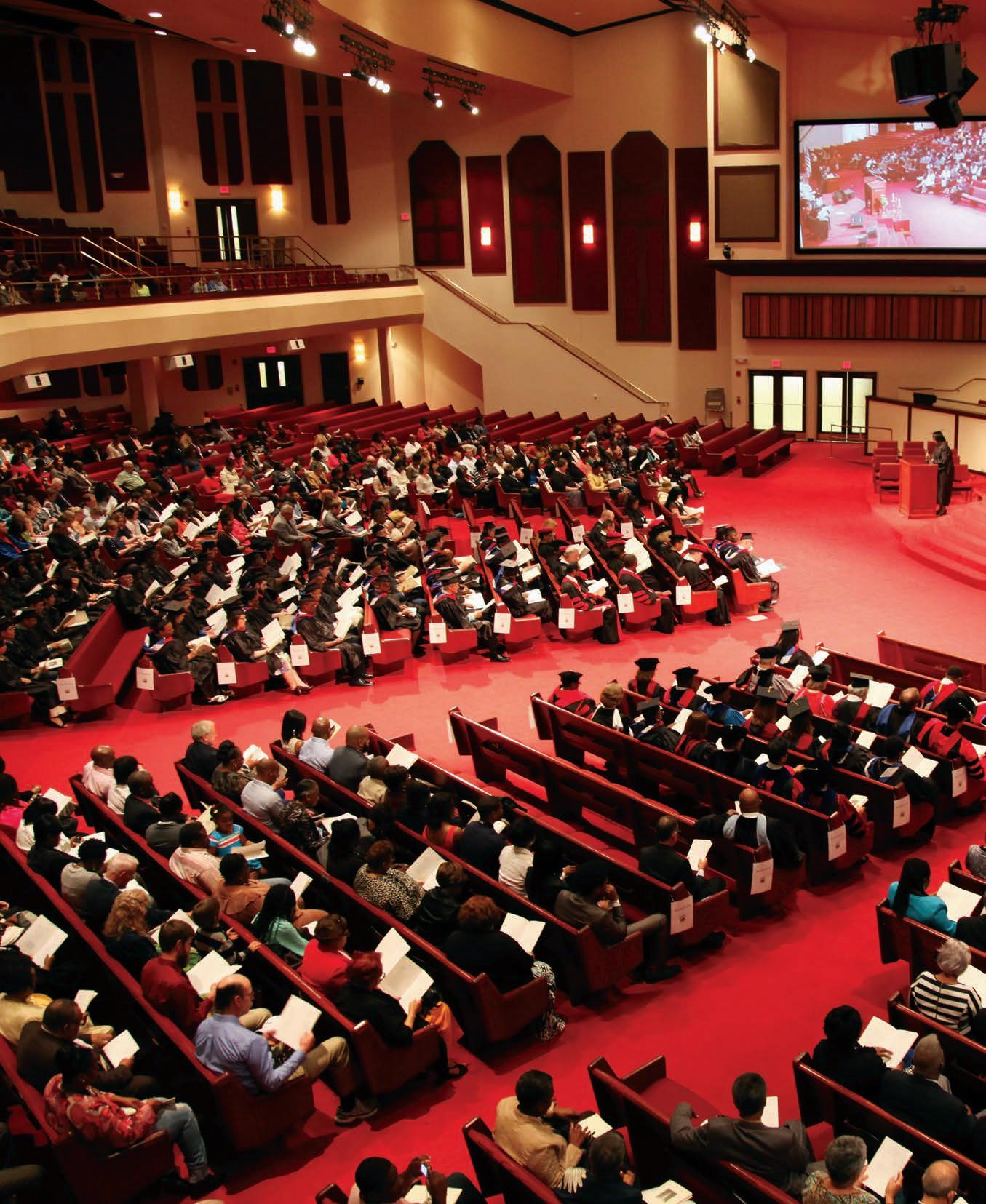
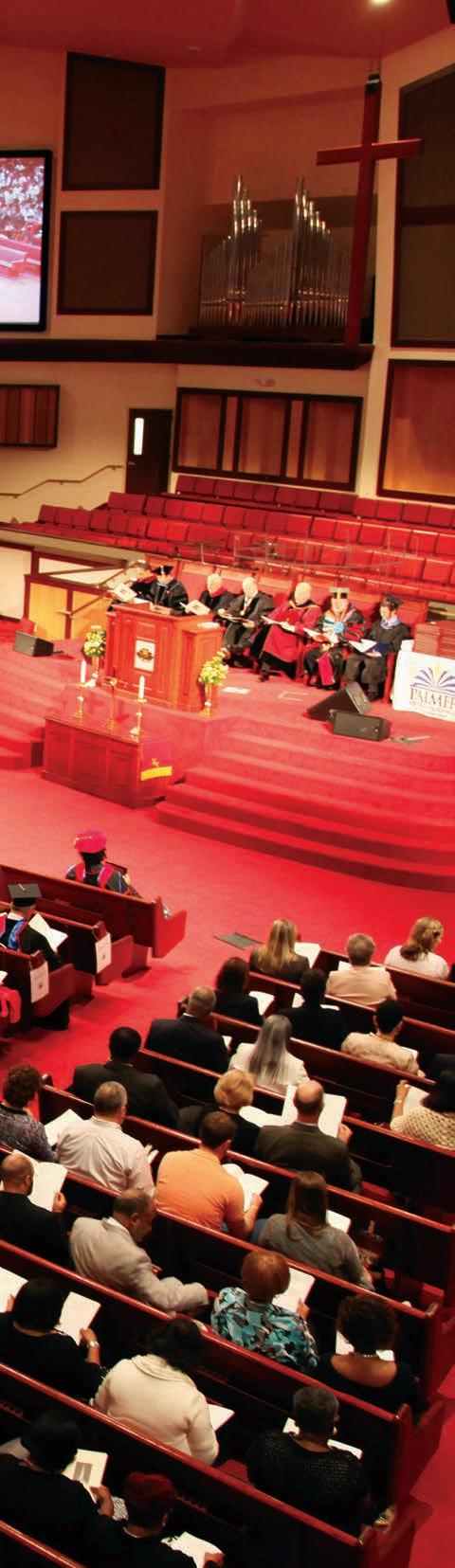
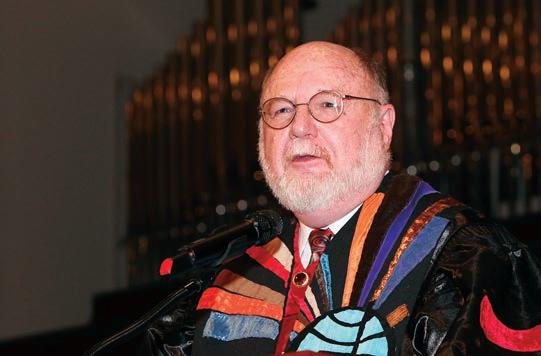
Highlights from the Palmer Graduation Address by Rev. Dr. A. Roy Medley
After a warm greeting to the Palmer Seminary leadership and greater community, Rev. Dr. Medley shared a grateful tribute to his wife, the Rev. Dr. Patricia Medley, as well as an appreciation for supportive friends and family who had gathered together for the occasion. As General Secretary of American Baptist Churches (ABC), he spoke of the fond respect and the long-enjoyed partnership between the ABC and Palmer Seminary.
Dr. Medley challenged the graduates, as well as those attending, to consider a question that was once posed to him as he prepared to enter the ministry: “Why bother with the church?” The question was relevant at the time but is perhaps even more relevant today.
Continues on page 11
Graduation photos by Daniel Burke
Interview with the Rev. Dr. Roy Medley, General Secretary of the American Baptist
Churches USA
By Deborah McConomy-Wallace
The Rev. Dr. Roy Medley was the guest speaker at Palmer Seminary’s graduation this May. During the ceremony, the Seminary awarded Dr. Medley with an honorary Doctor of Divinity degree in recognition of his ministry as General Secretary of the American Baptist Churches USA.
We met with him during Lent for a conversation about ministry and the church.
Palmer: How did parish ministry prepare you for your ministry as General Secretary?
Dr. Medley: I began my parish ministry in south Trenton, NJ, in the inner city. At that time, it was a very poor, drug-infested community. Ministry there taught me three things. First, I learned that the call of the church to exercise life for the sake of the poor is essential. When the church forsakes her concern for the poor, she risks her faithfulness to the Gospel.
Second, a pastoral approach that places people in the forefront is important no matter where you serve.
Third, I love preaching and presiding at the ordinances. I try
to incorporate these aspects of pastoral ministry in my ministry as General Secretary. I spend a great deal of time visiting congregations and preaching across the country and all over the world. If I don’t understand the things with which pastors and local congregations are grappling, I become ineffective.
I get to see the global church and learn from that. I see faithful Christians trying to live out their faith. People in some of the poorest countries on earth have some of the most vibrant expressions of faith because they cultivate relationships with people, not with material things.
Palmer: Please say some more about that.
Dr. Medley: Our culture focuses on things, not people. A Russian theologian speaking at Princeton back in the 1970s said, “In Russia, the government preaches materialism. Here in the US, you LIVE it.”
Materialism is an empty way of life that doesn’t speak to the deeper needs of the heart. Our society’s emphasis on individuality and measuring success through materialism is in contradistinction to the call to community. It shortchanges the Gospel and the healing power of community.
people sense within it the quality of life they yearn for. People will thrive in a community that is marked by the fruits of the Spirit. They want to know that the message of God’s love is revealed in the quality of life we live outside the church.
Palmer: What changes have you seen in the church since you began your public ministry?
Dr. Medley: There has been a shift away from the perception of the church as a trusted model and pillar of life in the community to suspicion and charges that the church is hypocritical and uncaring.
Church no longer occupies the center of the community or people’s lives. We’ve failed to make connection with a lot of the people living in our communities, and we have to address that.
“We are encouraging American Baptist churches to move beyond their walls and doors. The church is not a gated community!”
Palmer: How do you address the issue of materialism to congregations who are struggling financially?
Dr. Medley: A vital ministry should not depend on money. It is dangerous to think that success in ministry equals a big bank balance. For us to assume that money is a primary function of the church’s ministry is a kind of heresy. Whether or not a local congregation thrives will depend on whether
the community we understand where they live and that we are not disconnected.
But the church is not just the landlord. The ministries must be an integral part of the church’s outreach to the community. The church has to identify with the program and offer the gifts of their people to enhance them. This is holistic ministry—concern for spirituality, the dynamics of the community, employment, and family life.
Palmer: Where do you see the church going in the next ten years?
Dr. Medley: We are in a period of great experimentation. It’s time for the church to innovate and it will not be easy sailing, but it will be exciting. We need to relearn what it means for us to minister from the periphery rather than the privilege of the center of society.
Palmer: What can the church in general and congregational leaders in particular do to counteract this trend?
Dr. Medley: Pastors have feelings of failure and guilt because the churches are not the way they used to be. We can’t look at the ’50s as the church’s success model. Our success model has to be the early church’s life as a community of believers in a society that doesn’t share our values and faith.
There is no silver bullet to congregational renewal.
We are encouraging American Baptist churches to move beyond their walls and doors. The church is not a gated community! Churches can and are repurposing their buildings. This is commensurate with our concerns for the health of the community. Our role is to serve the whole community for the whole week. By doing this, we’re showing
From the beginning, the Protestant movement was a huge experiment. Protestantism developed at a time when the church was considered irrelevant and distant from its mission. We’re perceived that way now. This is an opportunity to relive our DNA and move from a more settled to a more experimental ministry model.
The church may not be popular right now, but Jesus still is. We have to address the perception that people have that thinks the church has lost the core of how Jesus teaches us to live.
Palmer: What advice would you give to seminarians preparing for public ministry?
Dr. Medley: Live and go forward with a message of God’s love and grace. Allow the Spirit to do its work reshaping lives, ours included. Be a messenger of God’s love. Speak to the fact that we are loved and called to live in a community that follows Jesus.
According to Dr. Medley, “The skeptics about the church, like the friend who posed the question, have grown in number. You know the statistics—that those who check ‘none of the above’ on religious surveys are the fastest growing demographic in America. Church attendance is significantly down. People are ‘spiritual’ but not religious. They like Jesus but they don’t care much for the church. One does not need to be an expert in sociology to know that in America the church is experiencing a significant transition in relationship to our culture. Its uncontested role of authority, moral leadership, and centrality to life and society is quickly fading. Too often the picture that the world sees of the church is one that does not resonate with the gospel we proclaim.”
To address this increased skepticism of God and an often negative public perception of the church, Dr. Medley pointed his audience back to the Christian’s source.
“The gospel is the church’s greatest gift and her greatest judge. The power of the gospel is the power to reshape our lives and the life of our community into lives that mirror the grace and love of our Lord Jesus Christ. The power of the gospel is the power to reshape our lives and the life of our community as a living word--not a dead rule book… The power of the gospel is the power to bring life where death reigns. In the hands of the Spirit, this living word, this narrative of God’s unquenchable love has transformative power.”
Dr. Medley went on to challenge Palmer’s graduates to live as those called to preach life and to embody the qualities of a first century church that demonstrated an impact on its culture.
“And you, you are called to proclaim life in the midst of death. The church is called to be a community that offers life, new life, on the basis of faith in Christ Jesus and His way. And to do that, the church cannot live as a gated community. We are called to an energetic and life-giving engagement with the world in testimony that the gospel offers a richer and more imaginative way to live where love, peace, and joy can be experienced.
“Like the first century church, we must cultivate church as community, centered in Christ, nurtured in prayer and study of scripture, invited to a richer imagination of life in Christ through the word preached, and empowered by our sacred feast and the celebration of the death and resurrection of Jesus as God’s saving act for all of creation.
“Like the first century church, we must move to the places where people gather and not remain locked inside the walls of our Christian prisons, no matter how beautiful they are.
“Like the first century church, we are called to risk. Paul commends Epaphroditus, who risked his life in ministry to Paul. The Greek word for risk is ‘to gamble.’ In the early church there were Christians who were known as ‘the gamblers’ because they risked their lives caring for those struck down by plagues and other illnesses.”
In his conclusion, Dr. Medley answered his own question. “Why do I bother with the church? Because of her story—the story by Christ Jesus. A story of love and redemption, a story of life triumphing over death, a story of old bones and old hearts being offered new life and new ways because, in Jesus, God jumped into the fire alongside of every one of us to lift us out and to give us life.” Thank you, Dr. Medley, for inspiring us to answer that same question in the same powerful Spirit of the Gospel!
The full text of Dr. Medley’s graduation address may be found at: www.palmerseminary.edu/drmedley Palmer Graduation Address continued from page 9.
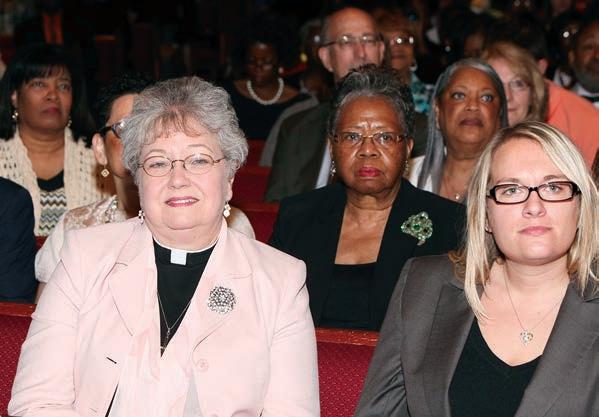
Front: rev. Dr. Patricia Stauffer Medley and Bridget holmstrom (ABC-uSA) Second row: Trustee Delores Brisbon
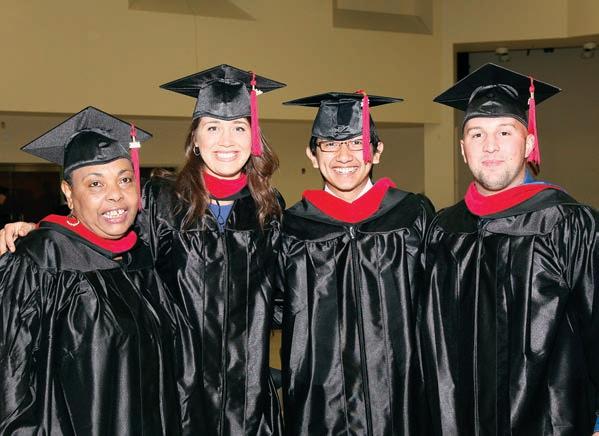
Left to right: Stephanie Wilson-Benson, Amy Wengrenovich, Max Beck, and Travis reish
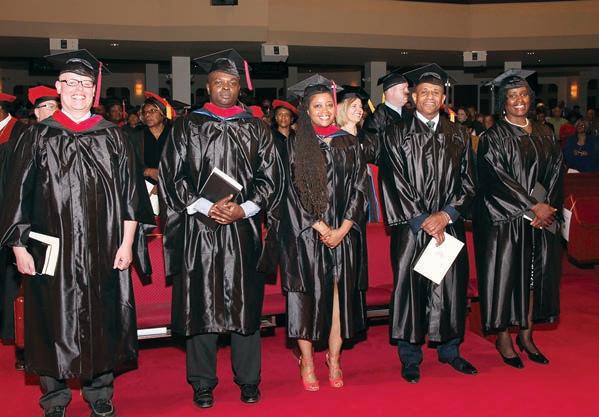
Left to right: Jacob Goertz, Dwens Chachoute, Clesha Staten, Woodrow Day, and Charmaine Ashby
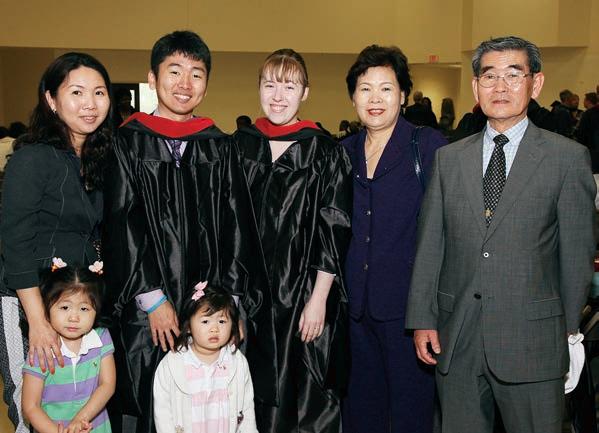
Seungmin Baik and rebecca hall, with the Baik family.
he picture windows in my office at the American Baptist Churches Mission Center give me a view of our circular building’s courtyard which features four large trees sitting on a round green carpet of beautifully manicured lawn. Since I teach New Testament, I think of the trees as representing each of the four Gospels! I am grateful for these windows even though they cannot be opened. In addition to the beautiful scenery they afford me, they remind me that my work at this desk has as much to do with what happens inside this building as it does outside. Whether I am in the classroom, at a meeting, or plugging away at my desk mired in emails and paperwork, I am not in isolation. I am part of a larger whole, be it Palmer Seminary, Eastern University, the Church, or the world. These windows keep my attitude towards my work in perspective.
Perspective is what I have needed during this past year serving as Palmer’s Interim Dean. Last summer, I was aware of a steep learning curve and what could or could not realistically be accomplished in a year. My perspective then was pragmatic and cautious. I was not thinking of major curricular reforms but tinkering with and improving on existing operations. I thought of my task as preparing the way for the new Dean, though surely I am no John the Baptist and the new Dean is no Messiah of Israel! Such a perspective, even though
it has undergone changes and refinement throughout the year, has for the most part kept me focused on what can be done and spared me from the harmful guilt trips generated by unrealistic expectations from whatever direction, including those I occasionally impose on myself.
Speaking of perspectives and windows, the phrase “window of opportunity” comes to mind. Normally, we say we do not want to miss a window of opportunity, or we take advantage of a window of opportunity to do something before time runs out. We tend to use the idiom in a temporal sense, urging action to be taken within a limited time frame.
Perhaps the word “window” can mean more than a means of light and ventilation. A window allows me to see what is out there even though I am in here, to give me an opportunity to imagine, anticipate, and connect with things further afield from my location and vantage point. In the same way, a window of opportunity is perspectival before it is temporal. An opportunity has to be seen before it can be captured. An idea has to be imagined before it can be adopted. Perspective trumps timing.
Yet the world claims, “timing is everything.” We live in an age obsessed with the ability to do things faster or at the most strategic time according to trends and projections. In our frenetic analysis of all that is happening around us in our world and in theological education, have we sometimes failed to consult the Creator of time whose perspective is the source of all wisdom? Timing is nothing if it is the world’s timing. Timing is everything if it is God’s timing. God’s timing will reveal itself if we align ourselves with God’s perspective. James 1:5 states, “If any of you is lacking in wisdom, ask God, who gives to all generously and ungrudgingly, and it will be given you.” But let us not ignore the crucial proviso in the next verse, “but ask in faith, never doubting.” God’s timing requires trust and relinquishing our need to control.
Frequently this past year I have asked God for wisdom and God has been generous. Together as faculty and staff, we have prayed for a glimpse of God’s perspective and the grace to align ourselves with it to best fulfill our mission, even though we may not always see God’s big picture or understand God’s timing. Before going to the cross, Jesus told His disciples that they would not understand some things at the moment, but they would become clear later. I often wished that the “later” would be “now.” But God withholds as much as God reveals for our good.
Being Interim Dean has been a window of opportunity for me, though the timing was entirely God’s. I have gained perspective in many ways with the help of many generous and kind folks who have shared with me their knowledge, expertise, example, and humor to make this year deeply meaningful amidst the challenges. My appointment ended on June 30, 2014, and I look forward to returning to the classroom.
Welcome, Dr. Edwin Aponte. Here is the key to the Dean’s office, and a new window of opportunity – custom made for you by the God of all windows.
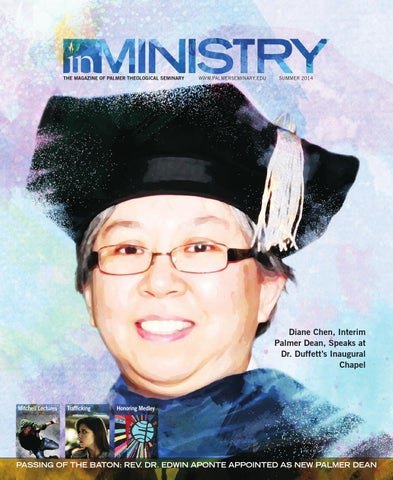
—Diane G. Chen, Interim Dean & Professor of New Testament
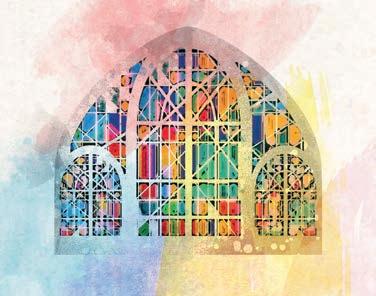
Illustration by Mark Lambertson based on “Stained Glass Window” by Jason James.
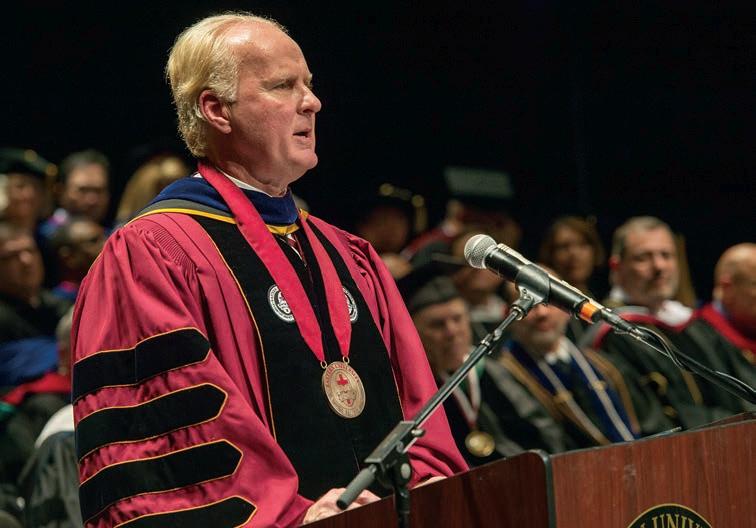
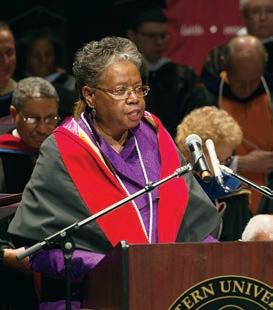
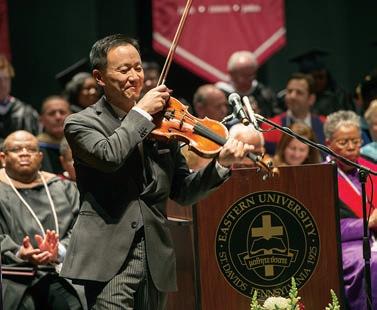
The Eastern University community recently welcomed Dr. Robert Duffett as its 9th president. This welcome was warmly expressed through three distinct inaugural events that were held on the Main campus as well as Palmer Seminary and Esperanza College. Each celebration had a unique tone and atmosphere but all were united in their joyful commitment to embrace a new season of leadership and to prayerfully support Dr. Duffett and his family as they follow God’s call to Eastern University.
On April 3rd, students, faculty and community alike gathered to celebrate the inauguration of President Robert Duffett at Esperanza College. The program was kicked off by leading the audience in song, setting the tone for an engaging and lighthearted event. The combination of lyrics in English and Spanish spilling through the crowd during the opening song, “Majesty,” truly captured the essence of Esperanza College, the Hispanic family member to Eastern University.
As Esperanza’s Founder, CEO, and former Palmer Seminary administrator, Luis Cortés began to speak, he shared of the history and legacy of Esperanza College, all the while upholding the effervescent spirit of the day. Whether a light chuckle or a quick “Amen,” audience participation was ever present as Reverend Cortés spoke of the college’s global impact and influence as well as the asset the school has gained with Duffett as president.
Continues on page 16
Following Cortés’s dialogue, Elizabeth Conde-Frazier, Dean of Esperanza College, addressed the attendees not as as superiors but rather as teammates, sharing that the vision and obligations surrounding Christian higher education is a group effort and a responsibility of the people of God. Conde-Frazier also provided necessary background information on Christian institutions as well as environmental conditions in the Philadelphia area. The reality of educational, financial and spiritual needs in the community reminded us of the importance of colleges like Esperanza and their partnership with Eastern University. Conde-Frazier touched on the transformation and wholeness that occurs in Christian higher education, which reiterated how Esperanza College offers more than just academics; it enhances and changes not only the lives of an individual, but also the communities they touch.
President Robert Duffett’s educational background and accomplishments are impressive, to say the least, but none could combat his stage presence and charismatic nature as he finally took to the microphone. Duffett poured out his gratitude toward his fellow speakers and attendees while also commending Dean Conde-Frazier for her presentation on matters relating to Christian higher education. With these topics and concerns fresh in his mind, Duffett quickly began deliberating the relevant issues immediately facing Esperanza College and the local community.
Among the many points and subjects mentioned throughout President Duffett’s inaugural speech, his encouragement directly towards the students in the audience summarized the basis of his character. “Whatever you do, don’t quit! Don’t quit! Promise me that!” he repeated over and over again. This plea to his students depicts the driving force behind President Duffett and Esperanza College—to educate students successfully and train them to truly live as a member of the body of Christ.
As the event came to a close, worship leaders led the audience in a final song. Appropriately, the ending line of the song stated, “Get to work.” From the struggles, successes and visions discussed throughout the evening, it is evident that the community of Philadelphia, Esperanza College and Eastern University has to join
together and “get to work.”
Reverend Danny Cortés, Palmer Alumnus and Executive Vice President of Esperanza, had the task of providing the closing remarks. He acknowledged President Duffett’s role as one that was not created by man but appointed by God for this place and time. Cortés also left the congregation with some final sentiments: to honor our past and build on the strength that has come from it, and to look into the future—walking through the doors that God opens with oppor tunity. This inaugural event exemplifies one of those opportune moments for Esperanza College and President Robert Duffett.
International Chapel at Palmer
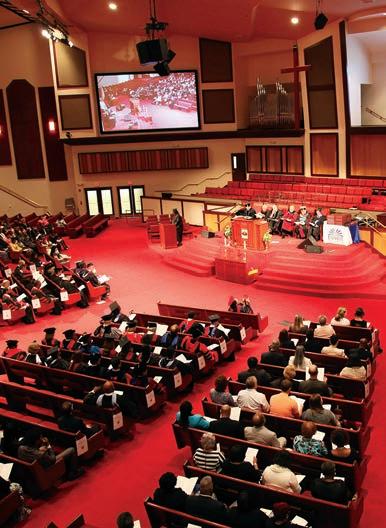
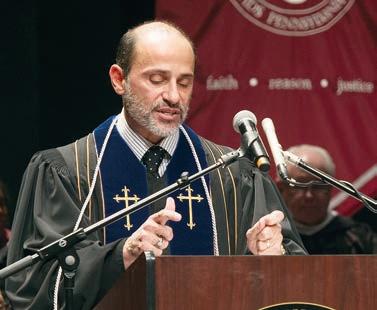
Through prayers, songs of praise sung in many languages, and a thoughtprovoking sermon by The Rev. Dr. Kamalesh Stephen (’95) on “God and the Ordinariness of Life,” Palmer Seminary celebrated Dr. Duffett’s inauguration
International
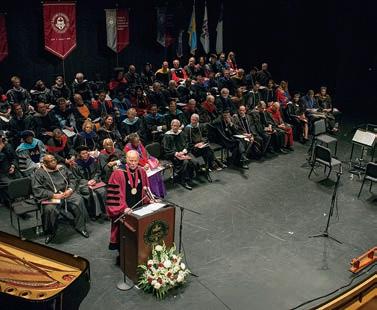
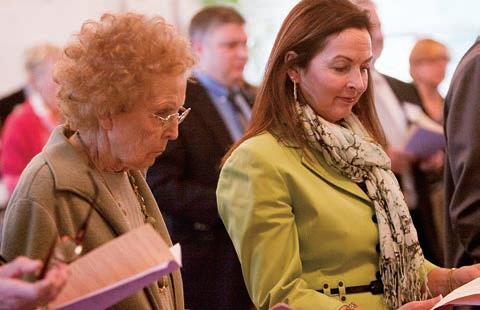
Mrs. Dolores F. Brisbon, Trustee and Presidential Committee Chair, emceed the Inaugural. Mrs. MayBelle Goudy and Connie Duffett at the International Chapel service. Rev. Daniel Cortés closed the Esperanza College’s ceremony. Front row, left to right: Board of Trustees members Richardson T. Merriman, Arthur W. Hill, Dr. Duffett, Dr. F. Ardell Thomas, and Rev. Danny Cortés
as President of Eastern University and Palmer Seminary on April 3rd, 2014.
Members of the University Board of Directors as well as guests from the University and the American Baptist Church offices attended. One very special guest at the event was Connie Duffett’s mother, MaeBelle Goudy, who flew in from Minnesota to join her family for the inaugural festivities.
For Mrs. Goudy, participating in her son-in-law’s inauguration as President added another chapter to her family’s history with the Seminary. Her brothers, Philip and Orrin Anderson, were 1945 dual degree graduates of Eastern Baptist Theological Seminary.
Following the service everyone enjoyed a reception featuring sweet treats from many of the countries represented at Palmer Seminary. The warmth of fellowship was a fitting welcome for Dr. Duffett and family from our international community of students, faculty and staff.
Dr. Duffett spoke at the Eastern University ceremony. Dr. David Kim Shaina Rajan, Student Government Association President The Rev. Dr. Kamalesh Stephen was the guest preacher at the