GRADUATE DIVISION COMMENCEMENT
Saturday, the Sixteenth of May
Two Thousand Twenty-Six
PeoplesBank Arena
Hartford, CT

Saturday, the Sixteenth of May
Two Thousand Twenty-Six
PeoplesBank Arena
Hartford, CT
Processional
Presiding Dr. Megan Stanton Grand Marshall
Land Acknowledgement
America The Beautiful * Alexandra Lavelle ’27
Dr. David Ballena Accompanist
Welcome
Greetings from the Connecticut Board of Regents
Graduate Student Address
Recognition of the Distinguished Public Service Award
Commencement Address
Recognition of Honorary Doctorates
Presentation of Degree Candidates
Conferring of Degrees
Dr. Karim Ismaili President
Theodore Yang Board of Regents for Higher Education
Olivia Gardner ’25, M’26 Master of Science Secondary Education, English
Dr. Karim Ismaili
Harold Tavares Distinguished Public Service Award Recipient
Dr. Karim Ismaili
David and Marilyn Foster Honorary Degree Recipients
Dr. Cheryl Wilson Provost & Vice President of Academic Affairs
Dr. Karim Ismaili
Hooding of Graduate Students Program Faculty
Alumni Welcome
James Woulfe ’09 Chair, Alumni Advisory Council
Closing “You Are So Beautiful” Performed by David Foster
Recessional
*The audience is requested to stand.
The audience is kindly requested to remain in their seats until all of the degrees have been conferred and all of the graduates have processed out.
Since its founding in 1889, Eastern Connecticut State University has evolved from a small teacher-training school into Connecticut’s public liberal arts university — an institution defined by access, academic excellence, and a deep commitment to public service.
Eastern began as the Willimantic State Normal School, established by the Connecticut General Assembly. That first class of 13 students met above the Willimantic Savings Institute, guided by a belief that education could transform lives and communities. Over time, the institution expanded its academic scope, campus footprint, and impact across the state, while remaining grounded in that original mission.
Through periods of growth, challenge, and renewal, Eastern continued to adapt. New academic programs were introduced, residence life took shape, and the campus steadily developed into the vibrant, 182-acre environment it is today. Along the way, the University’s name evolved to reflect its expanding purpose, culminating in its designation as Eastern Connecticut State University in 1983.
In more recent decades, Eastern has strengthened its identity as a public liberal arts institution. Under President David G. Carter, the University experienced significant growth in enrollment and facilities. President Elsa M. Núñez further advanced Eastern’s national reputation, leading the development of a distinctive Liberal Arts Core curriculum and expanding opportunities for student learning, creativity, and community engagement.
In July 2024, Dr. Karim Ismaili became Eastern’s seventh president. His leadership has focused on listening, collaboration, and a clear articulation of what makes Eastern distinctive. Through a campus-wide Listening and Learning Tour, he engaged students, faculty, staff, alumni, and community partners to better understand the University’s strengths and aspirations. These conversations affirmed a shared commitment to student success, academic excellence, and a strong sense of community, and served as an important step in shaping the University’s strategic direction.
Building on this foundation, President Ismaili has advanced a forward-looking vision for Eastern — one that strengthens the University’s role as Connecticut’s public liberal arts institution while preparing students for lives of meaning and impact. Early milestones of his presidency include the continued evolution of Eastern’s Liberal Arts Core, expanded partnerships with community and healthcare organizations, and increased national visibility, including Eastern’s feature on Amazon Prime’s The College Tour.
Today, Eastern honors its history while looking ahead with purpose. Rooted in the liberal arts and driven by a commitment to access and opportunity, the University prepares students not only for careers, but for thoughtful engagement in a complex and changing world.
We respectfully acknowledge that the land on which Eastern Connecticut State University stands, and the broader land now known as the State of Connecticut, is the ancestral territory of the Eastern Pequot Tribal Nation, Golden Hill Paugussett Tribe, Mashantucket Pequot Tribal Nation, Mohegan Tribe, Nipmuc Tribe, and Schaghticoke Tribe, who have stewarded this land throughout the generations with great care. We honor their resilience, cultural heritage, and enduring presence. As Connecticut’s public liberal arts university, we are committed to fostering greater awareness of Indigenous histories and contemporary experiences, and to building relationships grounded in respect, reciprocity, and responsibility.
Established on November 19, 2025
The Distinguished Public Service Award is presented annually at Eastern Connecticut State University’s Graduate Commencement Ceremony to honor an individual who has demonstrated an exceptional commitment to public service and made a meaningful and lasting impact.
First awarded in 2025, this recognition celebrates careers defined by service — whether in government, international development, advocacy, nonprofit leadership, or other forms of civic engagement that improve lives and strengthen communities.
The honoree is invited to address Eastern’s graduate class, offering perspective drawn from experience and a commitment to the public good. These remarks serve to inspire graduates as they begin the next chapter of their professional and personal journeys.
This award reflects a core belief at Eastern: that education carries with it a responsibility — to contribute, to lead with integrity, and to make a difference in the world.
Academic regalia has evolved from garments worn at the medieval universities of Europe. Today, academic attire indicates the chief academic degree attained, the major field of study, and the college or university attended by the wearer.
Modern academic dress in the United States is based on an intercollegiate code established in 1895. The bachelor’s gown has long, pointed sleeves, is untrimmed, and worn closed. The master’s gown, worn either open or closed, has long, crescent-shaped sleeves. The doctor’s gown, worn closed, has velvet panels down the front and around the neck, and velvet bars on the bell-shaped sleeves.
The customary head covering is either the mortarboard or the Oxford cap. The mortarboard tassel is black for bachelor’s and master’s degree holders and gold for those with doctoral degrees and for governing officials. The hood draped over the back of the gown dates to the 12th century. Its length, width, color of trim, and the color or colors of the lining denote the wearer’s highest academic achievement and the degree-granting institution. The velvet trim reveals the wearer’s major field of study.
The colors for academic fields, established by the American Council on Education in 1959, must be used on hoods, and may be used on tassels and the velvet used with doctor’s gowns. They include:
Arts, Letters, Humanities
White
Commerce, Accountancy, Business ................. Drab
Economics ................................. Copper
Education ............................... Light Blue
Engineering ................................ Orange
Fine Arts ................................... Brown
Journalism ................................ Crimson
Law Purple
Library Science Lemon
Music Pink
Philosophy Dark Blue
Physical Education Sage Green
Public Administration .................... Peacock Blue
Public Health ........................... Salmon Pink
Science ............................... Golden Yellow
Social Work ................................. Citron
In addition to the usual academic regalia, Eastern faculty members with 25 or more years of service to the University wear gold shoulder cords.

Harold Tavares is an international leader in economic development, diplomacy, and global cooperation, currently serving as executive director for Africa Group II on the World Bank Group Board of Directors. A native of Cabo Verde, he brings extensive experience advancing multilateral partnerships, human capital development, and economic opportunity across emerging markets.
Prior to his work with the World Bank Group, he served as chief of staff to the prime minister of Cabo Verde, where he acted as principal advisor on national and international policy matters. Throughout his career, he has worked to strengthen relationships between the United States and Cabo Verde while elevating awareness of African opportunities and challenges among global stakeholders.
Tavares’s global perspective is shaped by work spanning six continents and a career that bridges government, international development, and higher education. Alongside his public service, he has served as CEO and commercial director for The Ocean Race Cabo Verde (Cabo Verde stopover) and as deputy commissioner for the Cabo Verde Pavilion at Expo Dubai. Earlier, he built a strong foundation in higher education administration, playing a central role in developing international partnerships at Bridgewater State University and serving as administrative director for the Mandela Washington Fellowship Program.
A committed advocate for youth development and leadership, Tavares is a supporter of the Young African Leaders Initiative and the founder of CV Next, a program designed to provide Cabo Verdean youth with global exposure and opportunity. In 2020, he was recognized by Most Influential People of African Descent as a top achiever under the age of 40 and received the Crans Montana Forum New Leaders award.
Tavares began his academic journey at Eastern Connecticut State University, where he completed coursework that helped shape his professional path. He holds graduate degrees in financial economics from Boston University and public administration from Bridgewater State University.
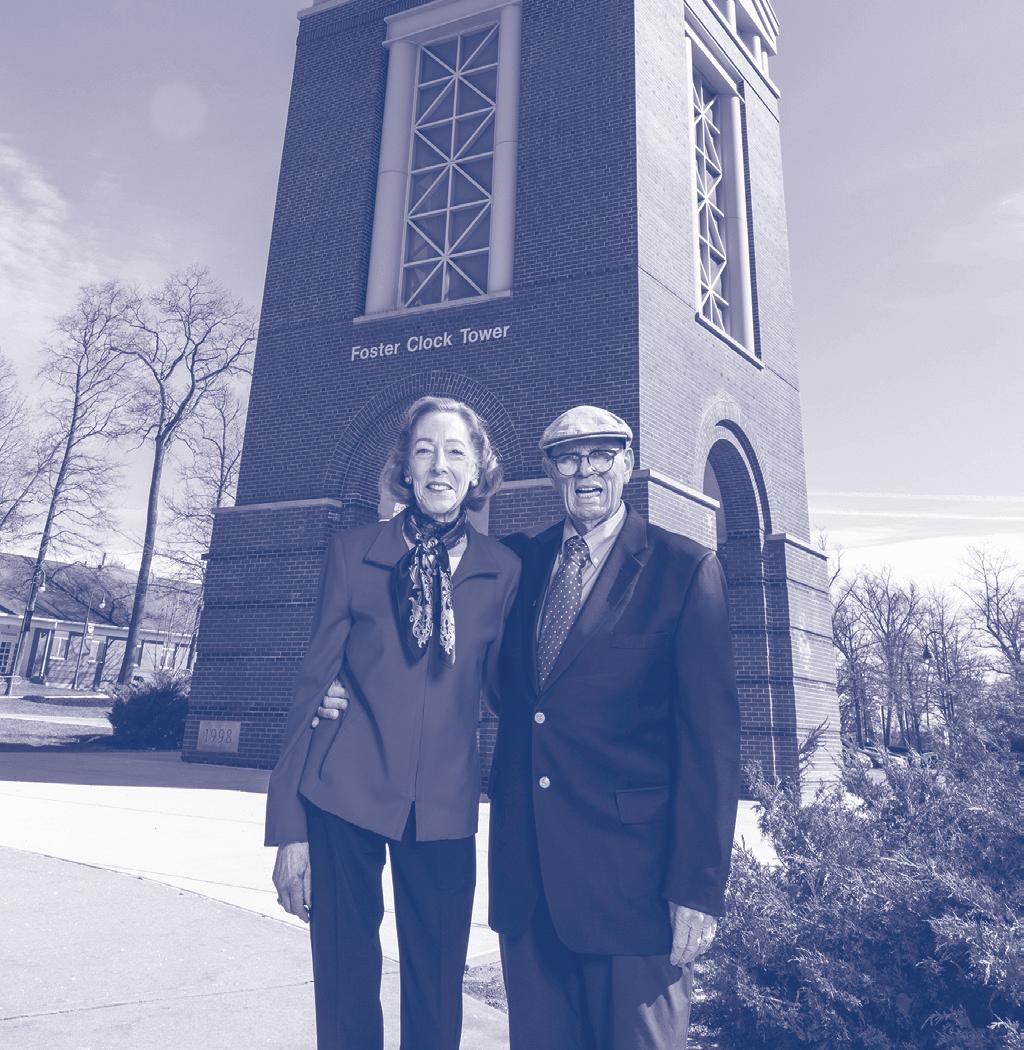
David and Marilyn Foster have demonstrated a lifelong commitment to community, philanthropy, and expanding educational opportunity across eastern Connecticut. Their leadership and generosity have had a lasting impact on the Town of Windham and the surrounding region, supporting organizations such as Windham Hospital, Windham Public Schools, the Salvation Army of Willimantic, Covenant Soup Kitchen, Project HOPE, Windham Area Interfaith Ministry, Horizons, the Lions Club, Veteran’s Memorial Park, and Eastern Connecticut State University.
Through the Lester E. Foster and Phyllis M. Foster Foundation, the Fosters have made significant and sustained contributions to Eastern. Their support includes a $250,000 gift to the David G. Carter Jr. Endowment Fund, building on more than $125,000 in prior investments in scholarships, academic programs, and student initiatives. Since 2008, Marilyn Foster has served as a director of the foundation, helping guide its philanthropic mission and stewardship.
David Foster’s impact on the region also extends through a distinguished career in music. As co-owner of the Shaboo Inn, he brought more than 3,000 concerts to northeastern Connecticut, hosting artists such as B.B. King, The Police, Muddy Waters, and Tom Petty. He later formed the Shaboo All-Stars and continues to support charitable causes through benefit performances and community events.
Among his honors, David Foster was named Willimantic’s Citizen of the Year in 2019, inducted into the Mohegan Sun Hall of Fame in 2015, and received the Connecticut Blues Society Lifetime Achievement Award in 2012. In 2015, the Connecticut Association of Schools recognized him with the Distinguished Friend of Education Award, an honor that also reflects Marilyn Foster’s longstanding dedication to education.
In recognition of their enduring contributions to community and education, David and Marilyn Foster will receive Honorary Doctorates of Humane Letters from Eastern Connecticut State University.
Frederick W. Clark Jr., Esq., President, Bridgewater State University
Dr. Garrett Dancik, Faculty Hooder, Professor of Computer Science
Tom DeVivo, Mayor of the Town of Windham
Dr. Mark Fabrizi, Reader, Professor of Education
David Foster & Marilyn Foster, Honorary Degree Recipients
Olivia Gardner ’25, M’26, Student Speaker
Dr. Sukeshini Grandhi, Faculty Hooder, Professor of Business Administration
Dr. Karim Ismaili, President, Eastern Connecticut State University
Dr. Kwangwon Lee, Faculty Hooder, Associate Professor of Education
Dr. Xing Liu, Faculty Hooder, Professor of Education
Dr. Dana Mohler-Faria, President Emeritus, Bridgewater State University
Dr. Niti Pandey, Dean of Education & Professional Studies and the Graduate Division
Dr. Moh’d RuJoub, Faculty Hooder, Professor of Accounting
Dr. Megan Stanton, Interim President, University Senate
Harold Tavares, Distinguished Service Award and Commencement Speaker
Dr. Emily Todd, Dean of Arts & Sciences
Dr. Kemesha Wilmot, ’05, Dean of Students
Dr. Cheryl Wilson, Provost and Vice President for Academic Affairs
James Woulfe ’09, Chair, Alumni Advisory Council
Theodore Yang, Regent, Connecticut Board of Regents for Higher Education
Jeremy Campbell,Vice President for Finance & Administration
Dr. LaMar Coleman, Vice President for Equity & Diversity
Shaylah Cote, Chief Human Resources Officer
Michelle Delaney, Vice President for Student Affairs
Tony Hayes, Chief Information Officer
Dr. Karim Ismaili, President
Dr. Niti Pandey, Dean, School of Education & Professional Studies and Graduate Division
Michael Pasquarella, Chief Development Officer and Executive Director, ECSU Foundation, Inc.
Dr. Benjamin Pauley, Interim Vice President for Student Success & Enrollment
Ryan Quigley, Chief of Staff and Director of University Communications & Marketing
Dr. Emily Todd, Dean, School of Arts & Sciences
Dr. Kemesha Wilmot ’05, Dean of Students
Dr. Cheryl Wilson, Provost and Vice President for Academic Affairs
Morgan P. Anjos
John William Boulay
Brianna Caiazzo
Matthew Victor Fioretti
Jaydon Griger
Thuan Thi Hartigan
Michael S. LaMalfa
Kasie Leigh Lester
Patrick Lynch
John Patrick McCarthy
Bethany Azalea Christa McCluster
Jimmy Armando Mirabito
Livian Rodrigues Perrin
James Matthew Sternat
Eamon-Antonio Toland Matos
Bo Wang
Timothy Wilson
Samuel Amoateng
Gregory J. Dalton
Oluwaseyi Naomi Fabiyi
Jasmine Joy Glaspie
Hunter Hamlin
Michael Octavio Hernandez
Israel Makolo Kabemba
Roohi RafiAhmed Khoda
Avonlea LeBeau
Alexandra Mitchell
Emma Elaine Oliano
Cole Tyler Paquin
Sadayah Marie Pinott
Laura J. Rockefeller
Samantha Sciandra
LaVickie Soares
Anaiya F. Taylor
Geeta Thapa
Nora Yastremski**
Danahy Ynostroza
Makeda Assegai
Eric Tetteh Botchway
Heather Lynn Burtchell
Oscar L. Concepcion Jr.
Travis Lee Cunningham
Aidan Patrick Daley
Christopher Daniel Louis Darazs
Daniel Doherty
Benjamin Dyer
Karim Elsayed
Muhamad Faraj
Matthew James Fitzsimons
Jacob Ivan Hall
Elizabeth Grace Hendry
Katelyn Mae Herbert
Andrew Johnson
Li Liang
Zachary Timothy Manville
June Milot
Jayla Mariah Payne
Marissa Ann Rusczyk
Chase Soulagnet
Hector Luis Tirado Jr.
Olivia Zabatta
(with certification)
Emma Blanchette
Ziwei Ding
Aidan Donnelly
Lilly Mae Dudek
Madison Riley Farrell
Joraliz Goycoechea
Kyla Grieco
Sophie Lynn Mercer
Abigail Sanchez
Alizha Jeaneira Sanchez
Faith Gwendolyn Smith
Amanda Rae Wasserman
Tavalry Kamlyn Virgo
Syeda Uttam Zahra
(with certification)
Madison Barone
Molly Ann Bonazzo
Shermine Rhoda Bousquet
Hannah Louise Fitzsimonds
Marissa Beth Ganezer
Colleen Marie Garrity
Caitlin L. Gergler
Delaney Marie Kudron
Kya Lanae Mayo
Jack David Mello
Brooke Alexandra Morgan
Leanne Pappas
Ashley I. Rivera
Allison Carrie Ronan
Olivia Grace Rovalino
Madelyn Rita Sauve
Olivia Clara Skipper
Paige Evelyn Swartzel
Sarah Elizabeth Tuttle
Riley Wielachowski
Michelle A. Zapata Nunez
(with certification)
Samuel Philip Fagerquist
Emily Lynn Feest
Olivia Paige Gardner*
Paul Gronendyke
Taylor Kranmas
Eliot Ryan
Madison Autumn Rybak
Andrew Richard Saitta
Ryan Toomey**
Jackson Trierweiler
Laila Aliyah Wilson
Mackenzie Wucik
Nishat Ahmed
Genevieve Danielle Escalante
Morgan Cole Giordano
Daniella Maria Holland
Makayla Erica Jackson
Jamie Florian
Samantha J. Pine
Allison Parker Ullger
Brigid Anne Utz
Gabriella R. Villanova
EDUCATIONAL STUDIES
Sydney Ellen Lakowsky
Kaitlin Ellen Nicol
Allison Daisy Kelleher
Wojciech Kolc
Erica Lynn Short
The academic procession dates back to European religious processions of the Middle Ages. Today, the colorful hoods, University banners, mace, and presidential medallion are reminders of this medieval origin.
Eastern’s procession includes faculty members, the president, deans and other administrators, regents, honored guests, and degree recipients.
The presidential medallion is the official insignia of the Office of the President of Eastern Connecticut State University and is worn during formal academic ceremonies to symbolize the authority and responsibility of the University’s highest office.
At its center is a cloisonné enamel rendering of the official seal of the State of Connecticut, encircled by the state’s Latin motto, “Qui Transtulit Sustinet” — “He who transplanted still sustains.” This emblem reflects Eastern’s mission and commitment as Connecticut’s public liberal arts university.
President Karim Ismaili’s medallion, presented during his investiture ceremony on April 11, 2025, features a modern design crafted in nickel silver with a standard antique finish, highlighted by enamel detailing and ruby components, symbolizing both tradition and excellence. The medallion serves as a powerful representation of Eastern’s values — leadership, learning, and service — and marks the enduring continuity of the University’s mission from one president to the next.
The word “mace” is derived from the Latin “mateola” meaning mallet or staff. In the Middle Ages, these staffs, with a ball of steel or brass at one end, were used as a weapon against armored warriors. As weaponry became more sophisticated, the mace evolved from an instrument of battle to a symbol of authority and power.
Universities in Europe adopted the mace as a symbol of authority and unity. This tradition has continued to the present day when many universities use the mace in a ceremonial context.
Eastern’s original mace was made in 1988 by Michael Elias, Department of Fine Arts, and was carried for the first time during the inauguration of President David G. Carter.
With the adoption of a university crest in 2005, Mr. Elias made a new mace which incorporates the crest on its face.