Scholarships that paved the way
ECU VOICES TALK ABOUT AMERICA AT 250
Accounting for success
SUM 2026
return A
Different Kind of
THE BRODY FAMILY INVESTS IN DOCTORS FOR NC
2
East magazine
summer 2026
Kevin Williamson ‘87, the creative force behind the Scream movie franchise, Dawson’s Creek and more, returned to ECU to give the commencement address in May. He also spent time with graduating seniors from the College of Fine Arts and Communication as they embark on their careers. (Photo by Rhett Butler)
CONTENTS
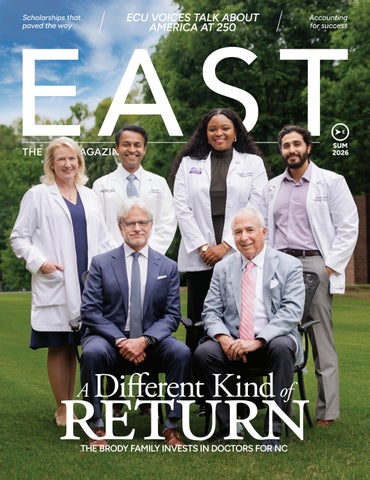
On the cover: Drs. Luan Lawson ’94 ’98 ’13 and Sunny Darji ’15, and medical students Kamryn Henderson and Mohsen Zakaib pose with Hyman, left, and David Brody. Read more about the Brodys’ most recent gift to the medical school beginning on page 30. (Photo by Steven Mantilla)
IN THIS ISSUE ECU Report. . . . . . . . . . . . . . . . . . . . . 6 Discovery. . . . . . . . . . . . . . . . . . . . . . 18 Faculty Focus . . . . . . . . . . . . . . . . . 20 Student Snapshot. . . . . . . . . . . . . 40 Pirate Nation. . . . . . . . . . . . . . . . . . 42 Pirate Spirit . . . . . . . . . . . . . . . . . . . 44
main feature
It’s been a long journey to 250, but a group of ECU students, alumni and professors see many more years ahead for America’s great experiment in democracy. Read more beginning on page 22.
More coverage, including links to videos and more photos, is at east.ecu.edu
30 At ECU, the Brody family’s latest gift is measured not in dollars, but in doctors who come home.
36 Scholarships
Empower Futures Without a scholarship, who knows what the future would have held for these ECU alumni?
40 Student
Snapshot Katelyn Haley keeps her pencil sharp with the College of Business’ Blacksail Fund.
42 A Curious Tale
Dean Tuck ’03 ’08 weaves a story — sometimes dark, sometimes humorous — about a mountain family and their shadowy secret in Twinless Twin.
East Carolina University is a constituent institution of the University of North Carolina System. Recognized as a Research 1 institution, ECU offers baccalaureate, master’s, specialist and doctoral degrees in the liberal arts, sciences and professional fields. Dedicated to fulfilling our mission to be a national model for student success, public service and regional transformation, ECU is classified as a Professions-focused Undergraduate/Graduate-Doctorate Large university with a higher earnings designation by the Carnegie Classification of Institutions of Higher Education. ©2026 by East Carolina University
east. ecu.edu
East magazine
3
A long view for ECU Cassie Burt, chair of the ECU board of trustees, talks with East about expanding access, strengthening rural healthcare and positioning the university for long-term sustainability.
What’s one change in higher education that ECU is moving toward? Embracing an enrollment strategy that will cater to those who are looking to increase their knowledge in a certain field or someone who may already have a degree but needs more to move up. We’re also seeing returns on investments such as Project Kitty Hawk. Not long ago, we met with a single mom finishing her degree through that program; it gave her the freedom to work on school after her kids were asleep. That’s a real advantage today.
What’s making a difference today for ECU students?
4
Brody School of Medicine is one of the top producers of primary care physicians in North Carolina, with a focus on training doctors who practice in rural communities. Combined with ECU Health and our nursing, dental, and allied health programs, we’re building a workforce pipeline that directly serves this region.
What’s the role of athletics in ECU’s future? In many ways, it’s the front door of the university. It has real regional impact – fans can get to Greenville easily, and you see that in the energy on game days, the tourism and the sense of community. It’s a big part of the college experience. We’re having ongoing conversations about how athletics is funded, but the focus remains on enriching the student experience and strengthening ECU’s connection to the region.
Philanthropy, especially the Chancellor’s Scholars Program. Being able to tell students, “You’ve been accepted, and here’s what we can do for you,” matters as families think about cost and value. More than half of our undergraduates receive financial aid, so expanding that support impacts access and retention. We’re also working with industry, asking what skills employers need and building programs around that. That’s leading to more internships, applied learning and stronger job outcomes.
As ECU works to reduce spending by $25 million over three years, some of the most visible changes involve program cuts and restructuring. What does the board think about those decisions?
Where can ECU have the most impact in the region over the next few years?
What’s been the most surprising part of serving as board chair?
I live in eastern North Carolina, and we have some of the state’s highest rates of chronic disease and some of its most significant provider shortages, particularly in primary care. That’s where ECU’s model comes in. The
The staff and faculty and their dedication and passion for the work of the university, because it’s not a Mondaythrough-Friday, 9-to-5 job.
East magazine
summer 2026
Faculty engagement has been key. We’ve evaluated more than 100 programs, with about 44 identified for discontinuation and others asked to improve. Sustainability is the bigger picture.
Medical school milestones Graduating medical students Al-Amin Aminu and Martin Green hug during the National Residency Match Day event March 21 at the Main Campus Student Center. Aminu is headed to Eastern Virginia Medical School for a residency in family medicine, while Green is headed to the University of Rochester in New York for a residency in neurological surgery. Of the 75 students in the Class of 2026, 29 are staying in North Carolina for residency – nine of them at ECU Health Medical Center. More than half are entering a primary care residency: family medicine, internal medicine, pediatrics and OB/GYN. A week later, on March 28, Hunter Martin of Boone was among the 99 second-year students who received their coats before beginning clinical rotations. (Photos by Steven Mantilla and Rhett Butler)
east. ecu.edu
East magazine
5
ECU Report
In This Issue Inventors recognized Pickleball builds community at ECU
Students clean up at entrepreneurial challenge A summer job pressure-washing homes might be turning into a full-time future. ECU student Sam Dewar and twin brothers Nick and Zach Willer won the Miller School of Entrepreneurship’s ninth Gene T. Aman Pirate Challenge with their company, Carolina Cleaning Boys – an outcome that has reshaped their plans after graduation. “It could definitely become a real, full-time job,” Nick Willer said. “That wasn’t in the playbook a year ago, but things are changing now.” The trio earned $50,000 in cash and roughly $60,000 in in-kind support, including legal, accounting and marketing services. A year ago, they expected their business to fade after graduation – Dewar pursuing financial advising and the Willers engineering careers. Now, they’re thinking bigger. “If we can keep growing and scaling, eventually we want to franchise,” Nick Willer said. The three met as ECU track and cross-country athletes and began working together a couple of summers ago, combining the Willers’ pressurewashing experience with Dewar’s background in landscaping. As profits grew, so did their ambition. Last fall, Dewar enrolled in an entrepreneurship course with instructor David Mayo, who also directs the Aman Pirate Challenge. As part of the class, students were required to enter the competition. “We really didn’t know about it before,” Dewar said. “That’s what got us started.” Advancing through multiple rounds, the team refined its business model and expanded operations. They credit mentorship from the
CORRECTION A story in the winter 2026 issue of East erroneously reported that Synia Johnson’s father, Keith, had died of cancer. He’s alive and well.
6
East magazine
summer 2026
Sam Dewar, center, is flanked by friends and business partners Nick, left, and Zach Willer as they pitch their company to the judges. (Photo by Steven Mantilla)
Miller School, particularly Sharon and Charlie Justice, for helping them transition from a side job into a scalable company. “Sharon helped us develop from just making money to building something that could grow,” Dewar said. Customer service has been key. “By being more communicative and personable, we built relationships that led to referrals,” Dewar said. “You have to treat people right,” Zach Willer added. “If you want long-term success, customer satisfaction comes first.” All three will stay at ECU for graduate programs – Dewar in the immersive MBA and the Willers in accelerated engineering master’s programs – while growing the business. Prize money will help fund a new truck, upgraded equipment and additional hires. The Aman Pirate Challenge awarded a total of $250,000 across six finalists. Simple Greek, a platform to streamline Greek life operations, finished second ($15,000), followed by healthcare AI assistant Clinic Wire ($10,000). Huddle Wealth, focused on student-athlete earnings, placed fourth ($5,000), with CarriOn, a roadkill recycling concept, fifth ($3,000). Mingle Maps, a dating app, placed sixth and earned an additional $5,000 award. For Dewar, the experience has already paid off. “When we started, this was just a side hustle,” he said. “But the support we’ve received at ECU showed us it could be something we take beyond college.” – Rich Klindworth
ECU honors leaders in research, creative activity and innovation Yong-Qing Li, professor of physics in the Thomas Harriot College of Arts and Sciences, received the 2026 Lifetime Achievement Award for Excellence in Research and Creative Activity during ECU’s annual research recognition event April 10. The award reflects Li’s 27 years of scientific contributions to the department’s biomedical physics doctoral degree. Throughout his career at ECU, Li has received more than $4.5 million in external research funding to support projects in physics, optics and biomedical research from agencies including the National Institutes of Health and the Department of Defense. He has published more than 170 peer-reviewed journal articles and conference papers across the disciplines of physics and microbiology. His pioneering work integrating optical trapping with Raman spectroscopy led to the invention of laser tweezers Raman spectroscopy.
Above, Adam Offenbacher, associate professor of chemistry, received the Five-Year Research and Creative Activity Award. At right, physics professor Yong-Qing Li received ECU’s 2026 Lifetime Achievement Award for Excellence in Research and Creative Activity.
Adam Offenbacher, associate professor of chemistry in Harriot College, received the Five-Year Research and Creative Activity Award. Since joining ECU in August 2017, Offenbacher has secured nearly $2 million in funding from the NIH, the National Science Foundation and other global industry partners. He has published 33 peerreviewed articles and one book chapter. His research focuses on understanding the molecular mechanisms for how proteins and enzymes function, which has implications for the development of better anti-inflammatory drugs for human diseases as well as protein design that can be employed as “green” catalysts for industrial applications. One of the niche areas of Offenbacher’s research is quantum biology – or understanding how nature incorporates and enhances non-trivial quantum phenomena in biological function. One example of such a case is animal migration through magnetoreception – the process of sensing the weak magnetic field of the Earth. Leslie Cofie, associate professor of health education and promotion in the College of Health and Human Performance, received the Scholarship of Engagement Award for his communityfocused research that addresses digital equity, health access and community well-being. Cofie’s work promotes digital opportunities and health access for communities in rural counties across the state, including agricultural workers and low-income households. The research was recently supported by a $1.39 million portion of a $9.9 million state grant to build digital equity. The university also recognized 15 faculty members who received at least $1 million in grant funding in a single year, staff members who support research efforts, faculty patent holders and others. – Lacey L. Gray
east. ecu.edu
East magazine
7
ECU Report
Sustainable practices recognized
John Gill
John Gill, assistant director of facilities services and campus landscape architect, has received the first ECU Sustainability Award. The award recognizes Gill’s contributions, commitment and leadership in campus sustainability efforts. It was presented April 29 during the annual University Service Awards. Gill said sustainability is vital at ECU. “It helps lower environmental impact – energy efficiency and waste reduction are fundamental ways this is achieved,” he said. “It also saves money. Reducing waste, using renewable energy and upgrading to efficient lighting can significantly cut operating costs over time. In addition, sustainability improves health and quality of life by promoting cleaner air, reducing waste and creating greener spaces.” Several sustainable projects are underway at ECU, including the new Brody Center for Medical Education building under construction on the Health Sciences Campus. “Some of my favorites include a large underground cistern that captures rainwater for landscape irrigation,” Gill said. “The landscape plan emphasizes mostly native trees and shrubs, and the stormwater system uses rain gardens to capture runoff and treat it before it enters local waterways. These practices are important because they make site maintenance more efficient while also enhancing the overall aesthetics.” – Crystal Baity
ECU timeline
25
50
years ago
ECU hosts first super regional Keith LeClair guided the 2001 Pirate baseball team to a 47-13 record and a Colonial Athletic Association championship. That earned ECU a No. 7 national seed and a chance to host an NCAA regional, but Harrington Field didn’t meet NCAA standards. So the regional moved to Fleming Stadium in Wilson, and the Pirates swept it. The next weekend, the Pirates hosted Tennessee in the Kinston Super Regional at Grainger Stadium, which the Volunteers won. Though the Pirates didn’t make it to Omaha, the season still goes down as one of the best in school history, with a final No. 11 national ranking.
8
East magazine
summer 2026
years ago
Buccaneer staff resigns On Nov. 1, 1976, the entire staff of the Buccaneer, ECU’s yearbook, quit in protest of the Student Government Association appropriating $61,190, or $5,000 less than the staff requested, to produce the volume. Print bids alone ranged from $54,133 to $67,725, according to the Nov. 2, 1976, edition of The Fountainhead. The budget SGA presented cut salaries and staff positions. “We cannot put out a book for that amount,” said editor Monika Sutherland (pictured). The Buccaneer wouldn’t resume printing until 1979, skipped 1991-2005 and ceased altogether in 2018.
Researchers named senior members of the National Academy of Inventors Three longtime ECU faculty members have been named to the 2026 class of senior members of the National Academy of Inventors, joining more than 30 colleagues and researchers at the university who hold membership in the prestigious organization. Colin S. Burns, a chemistry professor; Allison S. Danell, a former chemistry professor and former dean of the Thomas Harriot College of Arts and Sciences; and Jitka Virag, a physiology professor at the Brody School of Medicine, are members of the NAI’s latest cohort, its largest to date. Exactly 230 emerging inventors representing 82 member institutions worldwide count themselves among the 2026 class. Collectively, it holds more than 2,000 U.S. patents. Danell and Burns are listed on a patent with Rukiyah Van Dross-Anderson and Daniel Ladin that describes an immunotherapeutic to treat melanoma and colon cancer. Virag has three patents related to cardiovascular and blood health.
75
Colin Burns
Allison Danell
Jitka Virag
Launched in 2018, the NAI senior member program recognizes active faculty, scientists and administrators who have achieved success in innovation and who, through their work, support a culture of discovery and entrepreneurship at their institutions. An induction recognition at the 15th Annual Conference of the National Academy of Inventors was June 1-4 in Los Angeles. – Bobby Ampezzan
years ago
100
years ago
From ECTC to ECC
Wilson pergola dedicated
A record 2,312 enrolled for the 1951 fall quarter at ECC, up from 2,034 the previous year, according to the Oct. 5, 1951, Teco Echo. The number could have been larger, but with dormitory space for only 1,053 students, 328 withdrew their applications. Others found rooms in Greenville. On campus, women outnumbered men, 1,093 to 809, and another 400 students took courses off campus. New students totaled 607. All but 93 students came from North Carolina, representing 91 of the state’s 100 counties, and most enrollees were majoring in education.
Before his sudden death Feb. 1, 1922, Claude W. Wilson was a teacher, principal and superintendent in eastern North Carolina. At East Carolina, he was secretary and bursar for the board of trustees and director of the summer term from 1909-1922. President Robert Wright called Wilson’s death “the most serious blow the college has ever had when viewed from the internal workings of the institution.” In his memory, the school dedicated a pergola Jan. 16, 1926, just west of Wilson residence hall, also named for him. The pergola stood until 1968, when crews razed it, Old Austin and Wilson dorm to make way for the Jenkins Fine Arts Center.
east. ecu.edu
East magazine
9
ECU Report
Pickleball serves up community, social connections
ECU student Hope DeVitto plays pickleball at Elm Street Park in Greenville. (Photo by Steven Mantilla)
Pickleball can be a connector, pairing ECU students with other students, faculty members and aging adults. A bonus for players: no phone required. “Pickleball is kind of my thing I can focus on and have fun and unplug,” said ECU student Roz Burgess, an entrepreneurship major in the Honors College and ECU pickleball club team member. “When I’m here, I don’t pick up my phone until I leave.” The College of Health and Human Performance has hosted multiple pickleball tournaments along with clinics and community-based research led by Ollie Taniyev, Stacy Warner, Kindal Shores and Abby Schwartz. Since those clinics and the first HHP and sport management pickleball tournament in December 2024, Taniyev has focused on the social benefits of pickleball. “We know that well-managed sport and the right environment can make a huge impact on individuals’ well-being,” said Taniyev, assistant professor in the Department of Recreation Sciences and Sport Management and a former professional tennis player and collegiate coach.
10
East magazine
summer 2026
“We know sport has the potential to help bring a sense of normalcy to life and a way of bringing people together, so we want to test out the intergenerational benefits that pickleball seems to offer.” Students in sport management and other fields have gained practical experience at tournaments and in support of faculty research. Marketing major and business scholar Kathryn Adkins, who assists with social media and photography for the Sport and the Community Development Lab, emerged as a student leader and pickleball advocate. “There’s definitely a sense of community,” Adkins said. “I’ve met so many people. It’s been great to have a connection to the community. I think that my biggest takeaway is, obviously, I love the sport, but the fact that it can bring people closer together is awesome.” Schwartz is an associate professor of social work and director of the ECU Office of Healthy Aging. Her addition to this project has broadened her research profile. “I have always valued the strength of academic and community partnerships, but sport as a community-building tool is new to me,” she said. “From a gerontological perspective, successful aging includes addressing physical and emotional components of aging, but this also includes other critical aspects of individuals’ lives, including engagement in and with one’s community.” The clinics and tournaments led by ECU’s researchers have tried to blend competitiveness with people learning the sport at their own pace. “It was excellent,” said Dave Holec, 70. “You hear, ‘Good shot,’ or ‘We’ll get them next time.’ It’s very supportive.” – Ronnie Woodward
Jake Floyd, the bass player for the Cleveland, Ohio, alternative pop-rock duo The Orphan The Poet, belts out lyrics during Barefoot on the Mall on April 28. An estimated 6,500 attended the event that’s been held annually since 1979 on the last day of class. (Photo by Steven Mantilla)
east. ecu.edu
East magazine
11
ECU Report
Graduate programs perform at ECU From U.S. News & World Report’s online graduate program rankings released Jan. 27, 2026:
From U.S. News & World Report’s 2026 Best Graduate Schools rankings released April 7, 2026:
No.1
master’s in nursing among public universities in N.C. and a top-10 school nationwide
Tier 1
Brody School of Medicine among medical schools nationwide
No.1
in N.C. for the most medical graduates practicing primary care, practicing in rural areas and practicing in underserved areas
Top performer master’s in criminal justice nationwide and the only such program at an N.C. university to be ranked
No.1
among UNC System schools for nurse midwifery and nursing anesthesia
Top 15%
Top performers
online master’s in education, nationwide
among doctor of nursing practice, occupational therapy, physical therapy and speech-language pathology programs
Best for veterans online MBA
12
FOR MORE INFO
Read more at bit.ly/4cALBVf
East magazine
summer 2026
Gold-level for military-friendly and military spouse-friendly school by VIQTORY
FOR MORE INFO
Read more at bit.ly/42oP6JI
Bracing for the next big one When Hurricane Florence hit coastal North Carolina in 2018, it decided to stay awhile. The wind blew, and the rain fell for days. And though Cameron Doby didn’t experience major impacts from his home in Oxford in the central part of the state, his vivid memories of the pictures and video of coastal regions remain. “I still remember the heavy rainfall, strong winds, flooding concerns and damage that affected communities across the state,” he said. Now a senior construction management student at ECU, Doby is teaming this summer with Carol Massarra, an associate professor of construction management, to study storm mitigation in manufacturing facilities. The project will examine how manufacturing facilities are impacted by hurricanes in terms of environmental contamination risks, operational disruptions and potential pollutant releases. A key objective is to identify patterns of vulnerability and develop practical mitigation strategies that can reduce environmental and public health risks in future hurricane events. Doby, an ECU Honors College student, received $1,500 to conduct the research through the College of Engineering and Technology mini-grant program for new projects. He’s working on it in addition to his internship as a project engineer at the Fujifilm pharmaceutical manufacturing facility in Holly Springs. Hurricane season in the Atlantic basin runs from June 1 to Nov. 30. Hurricane Helene devastated western North Carolina two years ago; the last landfalling hurricane to hit coastal North Carolina came in 2020 with Hurricane Isaias, but it was Florence two years earlier that many remember. Florence came ashore at Wrightsville Beach near Wilmington on Sept. 14, 2018, and stalled, dropping 15 to 30 inches of rain in many areas from the South Carolina border to New Bern. Winds gusted to 100 mph in some areas. Waterways in the Tar, Neuse and Cape Fear river basins overflowed, flooding an estimated 74,563 structures. The storm killed 42 people and caused $16.7 billion in damage across the state, according to the National Weather Service. In Greenville, the Tar River and its tributaries overflowed, flooding some streets and structures. Limbs and leaves covered ECU’s campus, with a few trees succumbing to Florence’s wind and rain.
Doby understands storms like Florence will do damage. He hopes the research results in less pollution from that damage. “I want it to highlight what best practices should be in place and where gaps exist in real-world implementation,” he said. Doby said the research would explore past storms, analyzing common sources of contaminated runoff and air pollution while identifying ways companies can better prepare their facilities for the next storm. “The main purpose of the project is to bring more awareness to hurricane-related pollution and highlight the role construction and facility planning play in preventing it,” Doby said. “I also hope the research can encourage stronger preparedness and more practical prevention strategies in hurricaneprone areas.” – Ken Buday
Above, Cameron Doby is working on ways to help businesses better manage potential hurricane damage (contributed photo). Water flooded Charles Boulevard during Hurricane Florence. (Photo by Cliff Hollis)
east. ecu.edu
East magazine
13
ECU Report
A wet bulb globe device used by Liz Mizelle and her students sits outside of a tobacco field. (Contributed photo)
Hydration backpacks could reduce heat illness among farm workers Six days a week, 53-year-old María Hernández wakes up at 5 a.m. to work the farm fields around Salemburg, North Carolina. Having lived with diabetes for decades, she worries about working summers in tobacco fields, where temperatures in the rows can spike above 110°F. Coming from a farming family in Bertie County, ECU nursing professor Liz Mizelle is well aware of the struggles workers such as Hernández face in the fields. Together with the Roanoke-Chowan Community Health Center in Ahoskie, North Carolina, she came up with the idea of using hydration backpacks to help workers in the trying conditions. And with $324,000 in funding from the National Institute for Occupational Safety and Health, she’s been putting her idea to work in the fields. Since 1970, North Carolina’s average summer temperatures have risen by 2.3°F. According to the N.C. Division of Public Health, the summer of 2025 was exceptionally brutal, recording 5,748 heat-related emergency room visits between May and September – higher than the previous five-year average. When body temperatures exceed 104°F, heatstroke triggers organ impairment and can be fatal.
14
East magazine
summer 2026
“Every summer I have done this research, we have broken more and more records,” she said. Unfortunately, many workers ignore heat symptoms out of fear of losing their jobs. While employers are required to provide water, workers in vast fields are often too far from the supply to access it easily. In a 2020 study, Mizelle found 46% of outdoor workers were dehydrated Liz Mizelle (Photo by Ty Huff) before their shift, and 100% were dehydrated by the end. To counter this, Mizelle launched the hydration backpack experiment. The idea came from her brothers, who used similar backpacks while serving in the military. These $20 systems include a protective backpack and a 2-to-3-quart water bladder with a drinking tube. Mizelle distributed them to 47 male workers as part of a study published in the Journal of Agromedicine in 2024. The results were promising: 90% of participants reported the backpacks helped them stay hydrated, and preliminary 2025 data showed similar success. However, challenges remain. A full backpack weighs nearly 9 pounds, which could worsen the lower back pain already common among farmworkers. Cost is another barrier; with a minimum wage of $12.78, workers may hesitate to buy them. Mizelle hopes farmers and workers will share the cost, and she advocates for state lawmakers and growers to officially adopt the backpacks to prevent heat illness. Read more about Mizelle’s heat research at bit.ly/4dOInye. – Pearl Marvell/Yale Climate Connections
Grant expands access to teacher licensure, graduate education The College of Education will expand access to teacher licensure and graduate education through the Kenan Residency to Master’s Fellows program with support of a $500,000 grant from the William R. Kenan Jr. Charitable Trust. The R2M program is an accelerated, cohortbased pathway for residency teachers to earn their teacher licensure and a master’s degree while teaching full time. Residency is an alternative pathway to becoming an educator, allowing individuals to work as a teacher while taking classes to obtain an official, permanent teaching license. Fellows will benefit from supported professional growth with financial assistance throughout the program, mentorship and leadership development. Fellows will receive up to $8,500 in tuition support to become licensed in elementary education; middle grades or high school English, math, science or social studies; special education, or business and information technologies education. “We’re committed to supporting licensed active teachers who are ready to complete a master’s program, and the Kenan Trust grant will significantly further our ability to provide this pathway,” said André Green, dean of the College of Education.
Nearly half of new teachers in North Carolina enter the field through residency or emergency licensure pathways. This program seeks to address potential challenges in teacher retention and preparation in alternative licensure. The R2M program was inspired by other programs at the college, including the Maynard Scholars Program, Pirate Leadership Academy, Noyce Scholars and NC André Green Teaching Fellows. The program is structured as a four-year, sequential model. Students will spend their first two years completing the graduate certificate in teacher licensure, with select coursework from the certificate applying toward the Master of Arts in Education as they transition into the graduate degree program in their third year. Twenty fellows will start the program this fall, and another group will participate in fall 2027. Eligible candidates must be employed in a rural district (with priority given to the 43 Latham Clinical Schools Network districts), be eligible for ECU residency licensure programs and commit to completing the graduate certificate and master’s degree requirements. – Kristen Martin
Business students, from left, Madeline Wilson, Ella Slate and Whitley McCoy wait for a tour to begin at the Frankfurt Stock Exchange in Frankfurt, Germany, during an eight-day trip in May to learn about business and career opportunities in Germany — what might become a yearly event for students to experience business and culture in other countries. Said Slate, a triple major (accounting, finance and supply chain management) and rising senior, “Just because our school is in the United States, it does not mean that our opportunities are limited to the United States.” (Photo by Rich Klindworth)
east. ecu.edu
East magazine
15
ECU Report
Young alumni honored for achievements The grit, resilience and spirit of service that sets Pirates apart from others was magnified by 40 ECU alumni who were honored in April by the ECU Alumni Association at the 40 Under Forty Leadership Awards presented by ECU Health. In its ninth celebration of the awards, the program celebrated Pirates who have used their education to pursue their passions and lead change through their career achievements, leadership and service. Honorees represented a wide range of fields, including business, research, the arts, education, community leadership and healthcare. The honorees join 320 alumni recognized since 2015. This year’s 40 Under Forty class are Kristen J. Alston ’11 ’15, Eric J. Anthony ’11, Brittany Baker ’18, Tiana K. Berryman ’11 ’13, Timothy L. Brown ’08, Daniel Casale ’15, Taylor Chappell ’19 ’20, Caroline Basnight Collier ’18, Miller Diaz-Cobo ’15, J. Scott Dixon ’10, Casey Dutton ’16, Nate Evans ’11, Lily Faulconer ’17 ’18, D.J. Fussell III ’09 ’10, Katie Dodge Gillis ’15, Joel Glotfelty ’16, Cameron Gupton ’13 ’21, Adrian J. Harris ’12, Jenna Harris ’13 ’25, Julia Land Batts ’14 ’17, Kateryna Kosolapova (Kate Ker) ’20, Ali Krukowski ’12, Luke Lang ’17, Larissa Harris Liles ’11, Cornelius D. Martin ’19, Ariana McAuley ’16, Khalil McCollum ’18, Christine Mitchell ’09 ’16, Liz Mizelle ’09 ’15 ’21, Jeffrey Nickle ’09 ’10, Kate Oliphant ’16, Lucy Perry ’10 ’13, Austin Reese ’16 ’20, Nina Rose ’10, Ernest Ruffin III ’15, Andy Saunders ’12, Chase Sommer ’13 ’15, Mallory Strange Paulson ’17, Maria Jose Torres ’16 and Whitney Richardson White ’13. This was the first year the recognition was hosted by ECUAA. The program was previously hosted by ECU Student Affairs. Inductees participated in a weekend of events, including a networking social and a service project followed by the dinner and celebration at the Main Campus Student Center. – Patricia Earnhardt Tyndall
16
East magazine
summer 2026
Honorees of 40 Under Forty Leadership Awards presented by ECU Health gather for a class photo at the Main Campus Student Center. Honoree Ariana McAuley was unavailable for the photo. (Photo by Bill Hudson)
The last frigid splash
Photos courtesy of Joyner Library Digital Collections
A legendary campus event came to a frosty end Jan. 30as the 30th and final Polar Bear Plunge took place at the Eakin Student Recreation Center outdoor swimming pool. Temperatures were not much above freezing. The plunge began in 1997 to celebrate the opening of the then-new recreation center. “After 30 wonderful years, we are closing this chapter on the Polar Bear Plunge,” said Jenny Gregory, senior assistant director of communications and promotions for Campus Recreation and Wellness. “While we look back with gratitude and cherish all of the memories, we’re excited to create new traditions.” (Photos by ECU News Services)
east. ecu.edu
East magazine
17
Discovery
ECU investigations, research and creative activity benefiting the region and beyond
Gulf Coast fisheries are focus of $3.5 million grant An ECU biologist is studying longterm sustainability of the Gulf Coast ecosystem and fisheries through a new $3.5 million grant from the National Oceanic and Atmospheric Administration Restore Science Program. Rebecca Asch, associate professor in the Thomas Harriot College of Arts and Sciences Department of Biology, will lead a team of investigators on the research through September 2030. They will study fish-spawning aggregations in the Gulf and the longterm suitability of these habitats. She will work closely with other scientists and managers at the Flower Garden Banks National Marine Sanctuary, which is about 100 miles off the coasts of Texas and Louisiana, and the Gulf Council, among other partners, to verify, monitor and model FSAs and facilitate their management and conservation. “Spawning aggregations are essential for fish populations. They are special places where most of the reproduction of the species happens, and without protection, that reproduction is likely to decline over time,” Asch said. “That impacts the viability of populations of that species and any activities that are commercial or recreational, such as fishing, or in some cases tourism, that depend on those species.” At ECU, Charles Veith, a student in the Integrated Coastal Sciences doctoral program, and Brian Bartlett, a postdoctoral scholar in biology, will assist Asch on the project. Asch said
18
East magazine
summer 2026
Biologist Rebecca Asch is the lead investigator on a $3.5 million NOAA Restore Science Program grant. ECU doctoral student Charles Veith will assist her team with the research. (Photo by Steven Mantilla)
they have a general idea of what types of fish species they may encounter, but they will also study species that play a key role in the fishing and tourism industry. Asch also said the Restore grants are unique. While there are specific goals, the grantor encourages researchers to spend the first year working with stakeholders to determine how the science will work and how it will contribute to management. “You end up with solutions that are more acceptable to people, and groups are not at odds with each other,” she said. “This is our long-term vision in terms of how we want to contribute to conservation.” Ultimately, the team’s goal over the next five years is to gather data from fisheries, fishermen and independent surveys, verify where and what species are reproducing in the Gulf and develop plans for the best way to manage and conserve these sites. Learn more about Asch’s project and the team at bit.ly/3OkagFC. – Lacey Gray
Tech center sparks growth for farmers and students By his own admission, Enrique Martinez is no farmer. He doesn’t even own a plant. “My mom has a lot of plants. She’s a big plant person,” said Martinez, who graduated in May. “She likes flowers and gardening, all that stuff. And I’m like, ‘Don’t involve me.’” The information and cybersecurity technology student is part of a smart agriculture senior capstone project through the ECU Center for IoT Engineering and Innovation, where students are using technology to help farmers make informed decisions. IoT, or Internet of Things, describes physical objects that are embedded with sensors, processing ability, software and other technologies that connect and exchange data with other devices and systems over the internet or other communication networks. At ECU, the center is part of the College of Engineering and Technology and develops tools for areas such as environmental monitoring, water management, smart farming and building management. At the core of that work is PITON — Platform for IoT Open Networks — which collects and analyzes real-time data from sensors. “These stakeholders who do not have deep technological expertise need the tools, such as PITON, but also the education and the innovation guidance to find creative solutions to today’s problems,” said Ciprian Popoviciu, center director and associate professor in the Department of Technology Systems. One of those solutions is taking shape in a greenhouse outside Wilson at The Source, a smart agriculture test site operated ECU students Enrique Martinez, left, and Koray Neely, right, discuss plant sensors with Charlie Bourne, RIoT’s project lead, as part of a senior capstone project in a greenhouse in Wilson. The students are installing and managing sensors as part of a smart agriculture project. (Photo by Rhett Butler)
by Greenlight Community Broadband and RIoT, a 12-year-old organization that started in Raleigh, with support from the city of Wilson and the U.S. Department of Agriculture. There, ECU students installed and manage sensors that track air temperature, humidity, soil moisture and pH, allowing growers to monitor crops and control conditions remotely. “We’re able to wirelessly communicate and have an online dashboard and be able to set and manage all these things online,” said Koray Neely, an information and cybersecurity technology major from Wake Forest who also graduated in May. “That’s really where this ties in with having an ICT degree. … You need it to be secure.” For students, the project shows how technology can solve problems for people. “The idea of integrating agriculture with technology and seeing how technology can make farmers’ lives better and much easier, I think that’s pretty cool,” Martinez said. Popoviciu said the work reflects ECU’s mission of student success, public service and regional transformation. “It provides students a unique, hands-on learning experience where they get a chance to apply the knowledge acquired at ECU and learn how to run a real-life project while having clear and positive impact,” he said. – Ken Buday
east. ecu.edu
East magazine
19
Focus
Frances Eason College of Nursing Professor
For many university professors, five decades in front of students might be reason to take a foot off the gas and take a victory lap. Frances Eason ’71 ’79 isn’t most professors. On Sept. 5, she’ll celebrate 50 years as an ECU faculty member. This spring, she taught 113 undergraduate nursing students, which is just less than the total number of students when she enrolled in ECU’s then-School of Nursing in 1968. Eason completed her initial nursing training just four years after the inaugural class of Pirate nurses graduated and shortly after taking her first nursing job. Evelyn Perry, the second dean at the College of Nursing and her former advisor, suggested she apply for a vacant teaching position at ECU. “It was a baccalaureate program, period. Not RN to BSN, not accelerated,” Eason said. “There were nine teachers in that first course.” Eason became one of them. Donna Roberson ’86 ’93, an ECU nursing professor who considers Eason a mentor and friend, calls her a dynamic force. “From the first day I saw her in the Rivers Building, I knew she was the ultimate professional and a nurse of the highest quality,” Roberson said. “As a colleague, she has given me insight into the importance of collaboration for success as an academic citizen.” By her estimate, Eason has taught at least 8,500 nursing students – probably closer to 10,000. Some of those alumni are now her colleagues. Some have already retired from the faculty. A new scholarship in her honor will continue her spirit of service and dedication to the nursing profession after she retires – whenever that is. “I kept thinking, ‘I’ll work just one more semester,’” Eason said. “One more semester has turned into numerous semesters. As long as I am mentally and physically competent, I would like to think that I give everything I can give.” – Benjamin Abel
20
East magazine magazine
summer summer 2026 2025
FACULTY NEWS
In April, Randall Etheridge, associate professor in the Department of Engineering and associate director for the Center for Sustainable Energy and Environmental Engineering in the College of Engineering and Technology, received the University of North Carolina Board of Governors Award for Excellence in Teaching. The award recognizes a sustained record of distinguished teaching by a tenured faculty member and is one of the highest teaching awards presented at ECU.
Heidi Bonner, professor and chair of the Department of Criminal Justice and Criminology at ECU, has been selected to serve on the N.C. Sentencing and Policy Advisory Commission. Gov. Josh Stein appointed her in December. The commission has 29 members who represent the three branches of government, all areas of the criminal justice system and the public. The academic member is selected based on a background in criminal justice or corrections policy and is recommended by the UNC System president. Bonner’s term lasts until June 2027, when she will be eligible for reappointment.
Phil Lewis has been named dean of the College of Engineering and Technology. He started July 1. Lewis grew up in Zebulon and comes to ECU from Texas A&M University, where he served as a professor and head of the Department of Construction Science in the College of Architecture. Trained as a civil engineer, Lewis has bachelor’s, master’s and doctoral degrees from N.C. State University. His academic career spans 20 years, with teaching and research positions at N.C. State, Oklahoma State and Texas A&M. Lewis has secured 21 research grants and contracts totaling more than $4.1 million and has roughly 130 journal papers, conference papers, technical reports and invited presentations based on his research.
Sharon Paynter has been named senior vice provost for research and innovation, a role in which she will serve as the university’s chief research officer. Paynter joined ECU in 2009 and has held several leadership roles including acting chief research and engagement officer, interim chief research officer, and chief innovation and engagement officer. Paynter has a bachelor’s degree from the University of North Carolina at Chapel Hill, master’s degrees from the University of Denver and UNCChapel Hill, and a doctorate in public administration from N.C. State University, and she completed a postdoctoral fellowship at Brown University. A professor of public policy, administration and economic development, Paynter has secured more than $4.4 million in external funding as a principal investigator or co-investigator.
east. ecu.edu
East magazine
21
THE
LONG ROAD TO
THE AMERICAN REVOLUTION WAS FOUGHT AMONG NEIGHBORS – AND ITS LEGACY STILL SHAPES THE NATION TODAY STORY BY DOUG BOYD
22
East magazine
summer2026 winter 2026
There’s Washington and Jefferson, Bunker Hill and Valley Forge. So, it’s understandable how in North Carolina, it might be easy to overlook how vital the state was to the fight for independence 250 years ago. But the evidence is all around. “If you go to a museum or display of Revolutionary War history, you’re going to get all the things like the Boston Tea Party and the Saratoga campaign and Fort Ticonderoga and the cannons and all those kinds of things, but you’re not going to get the southern theater unless they have a little conflict star at Moore’s Creek Bridge and another at Guilford Court House,” says LeRae Umfleet ’98, project manager for North Carolina 250 at the Department of Cultural and Natural Resources. “We are first in freedom for a reason. We were the first colony to call for independence from Great Britain.” That call being the April 12, 1776, Halifax Resolves. So, this year, even after the fireworks fade, Americans and North Carolinians have a lot to celebrate – and a lot to think about – with this year’s Semiquincentennial. It’s been 250 years since John Hancock and the others signed the Declaration of Independence, and the inalienable rights it promised are still evolving.
east. ecu.edu
East magazine
23
“BEING A LOYALIST WAS BASICALLY THE DEFAULT POSITION AT THE BEGINNING. EVERYONE WAS EXPECTED TO BE LOYAL TO THE KING. THE PATRIOTS … WERE THE ONES BREAKING FROM THIS AND TAKING THIS VERY RISKY STAND.” Trevor Freeman ’20, museum educator at the Battleship North Carolina Memorial
A.I. interpretatio n
The fight for independence – from Great Britain, from King George, from taxation without representation – was never simple. It wasn’t merely Americans versus Redcoats, but often neighbor against neighbor, sometimes even family against family. It was fierce. “Many if not most Americans fail to realize how violent the Revolution was and how it was really our first civil war,” says Pulitzer Prize-winning author Rick Atkinson ’74. His latest book, Fate of the Day: The War for America, Fort Ticonderoga to Charleston, 1777-1780, was published last year. In North Carolina’s backcountry and coastal plain, loyalties were personal as much as political. “Being a Loyalist was basically the default position at the beginning,” says Trevor Freeman ’20, museum educator at the Battleship North Carolina Memorial whose master’s thesis examined Black Patriots and Loyalists in the Revolution. “Everyone was expected to be loyal to the king. The Patriots … were the ones breaking from this and taking this very risky stand.” Among those North Carolinians who fought for the Patriots were about 500 free Black men, he adds. At Moore’s Creek Bridge in 1776, Patriot forces crushed Loyalist hopes of organizing in large numbers. Elsewhere, fighters such as Loyalist David Fanning carried out raids that turned the war into something personal. The Revolution, in other words, was not only about independence. It was also about division – and the costs of choosing sides.
Photo by Denis Lemay
A war among neighbors
24
East magazine
summer 2026
Among the Continental Army soldiers who fought the British at Guilford Court House was Zachariah Jacobs, a free Black man born in New Hanover County. Trevor Freeman ’20 worked with descendants of Jacobs to bring a historical marker recognizing his service in the Revolutionary War to Wilmington. The marker was unveiled March 26. See more at bit.ly/41Bghk8.
AMERICAN REVOLUTION Battles and Campaigns in North Carolina
Why North Carolina mattered
Color coded key (no particular order) Actions against Cherokee Battle of Moore’s Creek Bridge Greene-Cornwallis (including Race to the Dan) Cornwallis to Wilmington Cornwallis to Virginia Tory War Overmountain Victory Trail Coastal/Naval Actions Corwallis’ pursuit of Greene, retreat to Wilmington Corwallis’ march to Virginia, April-May 1781 Greene’s patriot army returns to South Carolina Principal engagements Lesser engagements between Cornwallis and Greene Engagements between Whigs and Tories Engagements during Cornwallis’ march to Virginia
Photo courtesy N.C. Dept. of Cultural and Natural Resources
By the late 1770s, the British shifted their strategy south, believing Loyalist support would be stronger there. Instead, they found fierce resistance. North Carolina became central to that campaign. After the 1781 American victory at Cowpens, South Carolina, Maj. Gen. Nathanael Greene – Greenville’s namesake, though he never visited the area – began a strategic withdrawal across the Carolinas, drawing British Gen. Charles Cornwallis deeper into hostile territory. “They were marching all through the Piedmont of North Carolina from Charlotte up through Virginia and back again,” Umfleet says. “Cornwallis got so frustrated, he burned his supply chain. He expected to live off the land – and this part of North Carolina didn’t want that.” The campaign became known as the Race to the Dan – the Dan River in Virginia – a grueling pursuit that ended when Greene’s army crossed into Virginia, regrouped and returned to fight at Guilford Court House. “Technically it was a win for the Brits,” Umfleet says. “But they had a large number of wounded, and their supplies were nonexistent.” That cost proved decisive. “It was pretty much a Pyrrhic victory for the British,” says Lt. Col. William Dye ’04, commander of Air Force ROTC Detachment 600 at ECU. Dye, who is from Greensboro – the seat of Guilford County and another North Carolina city named for Greene – says the battle had consequences far beyond the field. Cornwallis limped toward the coast, then north into Virginia, where American and French forces closed in. “Had it not been for that battle, we don’t know if Cornwallis would have gone to Yorktown and the war would have ended the way it did,” he says. “The whole traipsing all over North Carolina,” Umfleet adds, “wore the British army out.” Yorktown may have delivered the surrender, but North Carolina helped make it possible.
“WE ARE FIRST IN FREEDOM FOR A REASON. WE WERE THE FIRST COLONY TO CALL FOR INDEPENDENCE FROM GREAT BRITAIN.” LeRae Umfleet ’98, project manager for North Carolina 250 at the Department of Cultural and Natural Resources
east. ecu.edu
East magazine
25
Liberty – for whom?
“THE BRITISH WERE VERY INTENTIONAL. IF YOU’RE ENSLAVED BY PATRIOTS, JOIN THE BRITISH AND WE’LL ENSURE YOUR FREEDOM. BUT WHEN THE WAR WAS LOST, ONLY 5,000 ACTUALLY SECURED THEIR FREEDOM. ... NOTIONS OF FREEDOM AND CITIZENSHIP WERE NOT EXPERIENCED THE SAME BY BLACKS, WHITES AND NATIVES.”
Photo courtesy Ohio State University
Even as the Revolution expanded ideas of liberty, it did so unevenly. “It’s vital to acknowledge that 500,000 Americans at that time – one in five – were enslaved Blacks,” Atkinson says. “The notion that ‘all men are created equal’ was aspirational, not literal.” Maria Esther Hammack ’12 ’15, an assistant professor of African American history at Ohio State University, teaches her students that Jefferson wrote about Black Americans and the need to abolish slavery in his first draft of the Declaration of Independence, but he knew those ideas would never pass in that day. That reality shaped the choices people made. “The British were very intentional,” she says. “If you’re enslaved by Patriots, join the British and we’ll ensure your freedom.” Up to 30,000 did just that. “But when the war was lost, only 5,000 actually secured their freedom,” she notes.
Maria Esther Hammack ’12 ’15, assistant professor of African American history, Ohio State University
The story, then, is not only about founders and generals, but also about people whose names are often missing from the most familiar versions of the past. Hammack points to Hannah Till, an enslaved woman who supported George Washington’s army. “If it wasn’t for her, Washington’s troops would have starved,” Hammack says. “At the end of the war … she ends up securing her freedom.” Stories like Till’s complicate and enrich the national narrative. “Notions of freedom and citizenship were not experienced the same by Blacks, whites and natives,” Hammack says.
26
East magazine
summer 2026
A promise tested over time
In North Carolina, the gap between ideals and reality did not end with independence. “The Declaration of Independence was life, liberty and the pursuit of happiness for all; however, the United States and North Carolina had a long way to go before that promise of freedom was truly made available for all Americans regardless of race or sex,” says Umfleet. The struggle would continue through the Civil War, Reconstruction and beyond. One of its darkest chapters came in 1898, when Wilmington’s biracial government was overthrown in a violent coup. “Wilmington was what I think the New South could have become had the 1898 violence not happened,” says Umfleet, whose 2009 book, A Day of Blood: The 1898 Wilmington Race Riot examines
the revolt. “Black landowning was higher, education levels were higher, Black entrepreneurship was off the charts.” The backlash was deliberate. “The white supremacists of 1898 did not like that,” she says. “They used every resource they could … to return control of state government to their hands.” The result was decades of disenfranchisement and segregation. “That’s a low point in our state’s history,” Umfleet says. The founders had flaws – Washington, Jefferson and even Benjamin Franklin owned slaves – as did the people who came after. Yet, for Gerald Prokopowicz, professor of history at ECU, that does not diminish the nation’s founding ideals. It underscores how difficult they have always been to fulfill. “The founders set out a goal that all men are created equal,” he says. “They understood that all people would not be treated equally. But they set it up as an ideal we can always attempt to approach.”
NORTH CAROLINA’S HERO IN THE WAR OF 1812 Most Americans can name a few heroes and battles from the Revolutionary War. The War of 1812, by contrast, is often remembered dimly – if at all. But for author Michael Brantley, the conflict remains one of the most significant chapters in early American history. In his new book, Captain Otway Burns (McFarland, 2025), Brantley revisits the bold Swansboro sea captain who commanded the privateer Snap Dragon and made a name raiding British shipping at a time when the young U.S. Navy had only a handful of functioning ships. Burns, Brantley says, rejected the label of pirate, considering himself “a branch of the Navy that worked on commission.” He portrays Burns as fearless, brash and impossible to ignore – the kind of larger-than-life figure who helps make history vivid and human. At the time, Burns became a national celebrity, entrepreneur and state legislator. His brick company helped build Fort Macon. Burnsville in Yancey County is named for him. But few remember him today. “There are a lot of interesting people in history,” Brantley says, “if you tell it as a story and not a bunch of dates.” – Doug Boyd
east. ecu.edu
East magazine
27
Photo by Elliott O’Donovan
Service and the next generation
“WE’VE KNOWN FOR 250 YEARS THAT DEMOCRACY IS PERISHABLE. EVERY ONE OF US IS RESPONSIBLE FOR HELPING TO SHORE IT UP.” Rick Atkinson ’74, Pulitzer Prize-winning author
At ECU, questions about service and citizenship are not confined to the classroom. For ROTC cadets, they are personal. “All these people came together and formed an amazing country,” says Cadet Holden Burroughs, a junior piano performance major from Greenville. “Our Constitution is still thriving today. It’s really cool we get to serve and protect this long-living law.” Burroughs says he hopes future generations will see today’s service members with the same respect Americans show the Revolution. “Just like we’re looking back 250 years, I hope people 250 years from now have the same view of us,” he says. “That we’re fighting for a good cause.” Cadet Simone Ellerby sees patriotism and realism as compatible. “There’s no country that’s perfect,” says Ellerby, a freshman psychology major from High Point. “But we keep growing, we keep learning from our mistakes.” Even the possibility of serving during a period of conflict in the Middle East, she says, reinforces her sense of purpose. “It’s a shocker … but it actually makes me excited to be of a different generation to come in and help,” Ellerby says. “That’s what I’m here for.” For Dye, who served as a pilot during the wars in Iraq and Afghanistan, that continuity through generations is one of the enduring meanings of military service. “When I look at the Declaration of Independence … they talked about pledging their lives, fortunes and sacred honor,” he says. “Wearing the uniform gives us an opportunity to be part of that.”
From left, Lt. Col. William Dye ’04 and Air Force ROTC Cadets Simone Ellerby and Holden Burroughs serve with pride. (Photo by Steven Mantilla)
FOR MORE INFO See North Carolina’s 250th events at america250.nc.gov.
28
East magazine
summer 2026
Photo by Denis Lemay
THE LETTER HOME Freedom is not free. To illustrate the cost, Trevor Freeman ’20, museum educator at the Battleship North Carolina Memorial, will ask students who tour the ship to read a letter – not just any letter, but an “in case” letter written by one of the ship’s World War II crewmen, Petty Officer Oscar C. Stone, to his parents.
A story still unfolding
From the Revolutionary War to today, the United States has fought many battles in the name of freedom. That brings Atkinson to the question at the heart of the Revolution. “What are you willing to die for?” he says. He calls it “the most profound question any people can ask themselves.” In North Carolina, that question played out in farm fields and river crossings, in militia musters and partisan raids, in the long retreat from Cowpens to Guilford Court House. It shaped the choices of Patriots and Loyalists, of soldiers and civilians, of enslaved people seeking freedom and officers trying to hold an army together.
Knowing that, Atkinson says, shapes how we see the past. “Understanding that the stakes were that high helps us appreciate the sacrifices and the risks that they took,” he says. “We’ve known for 250 years that democracy is perishable. Every one of us is responsible for helping to shore it up.” Two hundred and fifty years after independence, that work is still unfinished. “A passion to service, a drive to be the best you can, an empathy toward the folks you’re leading,” Dye says. “We’re all in this together, and we need to make it as best we can.” In a place like Greenville – named for a general whose campaign succeeded through endurance as much as triumph – that may be part of the lesson.
east. ecu.edu
East magazine
29
STORY BY BOBBY AMPEZZAN
return A
Different Kind of
AT ECU, THE BRODY FAMILY’S LATEST GIFT IS MEASURED NOT IN DOLLARS, BUT IN DOCTORS WHO COME HOME
A new gift from the Brody family will increase support for Brody Scholars such as Gage Outlaw who, like many before him, plans to practice in underserved areas. (Photo by Steven Mantilla)
east. ecu.edu
East magazine
31
On a late winter morning, weighted with grief, 22-year-old Gage Outlaw of Faison walked onto campus and into his Brody Scholars interview carrying more than good transcripts and ambition up his sleeve. Folded neatly into his coat pocket was the speech he would give at his grandfather’s funeral that night. L.S. Guy was a mentor, a teacher and a superintendent of Duplin County Schools. As a young man, Guy had imagined becoming a physician. He’d hitchhiked from Calypso to East Carolina University to study biology and do just that. That pathway wasn’t available to him, though, so he became first a teacher then principal of North Duplin High School, where Outlaw graduated, then administrator for the entire district. He influenced and impressed generations of young Duplin men and women – his grandson most of all. “I told my dad I couldn’t go to the interview,” Outlaw says, because of his grandfather’s death, “and he told me, ‘Your granddaddy would kill you if you didn’t.’” So Outlaw went – conflicted, grieving, resolved not to overperform. He did it for his granddad, and he did it for his dad. Bill Outlaw, who repaired electrical transformers for a living, was diagnosed with leukemia when his son was 9. After “catching a cold” that couldn’t be beat with rest and Tylenol, he was diagnosed with cancer on a Memorial Day and began a course of chemotherapy that lasted throughout the summer. During it, young Outlaw interacted with doctors and nurses; later, in high school, he shadowed his dad’s oncologist, “and I knew that was it – that was what I wanted to do.” “There were a few times when my dad should’ve died by all counts, but we were blessed, and we had great doctors.” Later that year, Bill Outlaw was told his cancer was in remission. So when his son told him he didn’t think he would go through with the interview, and the father told him that it would disappoint his late grandfather, it was implied the disappointment wouldn’t stop there. Gage Outlaw would have to dig deep. “I decided I would just be myself,” he says. “That’s not flashy.” Not flashy. The same might be said of the history of the Brody Scholars program itself and its namesake family, whose business roots stretch from retail to real
32
East magazine
summer 2026
estate development and for whom investment has always been about long-term value. At the Brody School of Medicine at ECU, that philosophy is measured not in square footage or sales, but in physicians trained to serve and strengthen eastern North Carolina as well as the rest of the state. “Being businessmen, we can tell you the ROI on these gifts has been better than anything else we could have done,” say David and Hyman Brody. Today, Outlaw has earned a part in a story that stretches from the fields of Duplin County to one of the most enduring philanthropic partnerships between a North Carolina family and one of its public universities. Along with an award that covers the cost of tuition, fees and a stipend for enrichment – perhaps the most bounteous medical scholarship in the state – comes a requirement to create and lead a community-service project between medical school years one and two. Outlaw has imagined a novel medical outreach effort aimed at migrant farmworkers in his home county of Duplin. The project required approval from the Brody Scholars Steering Committee and Brody Foundation Board – a reminder that the scholarship is not only financial support but personal stewardship. With mentors including Dr. David Eldridge, senior associate dean for academic affairs, and Dawn Robinson, a staff member with the Brody Scholars program, Outlaw designed a field-based health education initiative.
The Brody family has boosted the Brody Scholars program with a $10 million gift. Pictured from left are former Brody Scholar Dr. Sunny Darji ’15, Brody Scholar Kamryn Henderson, Hyman Brody, David Brody, former Brody Scholar Dr. Luan Lawson ’94 ’98 ’13 and Brody Scholar Mohsen Zakaib. (Photo by Steven Mantilla)
He’ll go field to field with a translator, setting up tents and providing education on dehydration, heatstroke, pesticide exposure, melanoma and basic preventive care. Each worker will receive a cinch bag with sunscreen, electrolyte packets, and a reusable water bottle along with melanoma identification materials – supplies funded directly through Brody Scholars enrichment dollars. “These workers are overlooked,” Outlaw says. “But they’re vital. We’re an agricultural region. This work matters.” For Outlaw, the project feels inevitable. “The East is the place I was made to be educated,” he says. “And the place I was meant to serve.” A pipeline with purpose
Outlaw earned his undergraduate degree from ECU in 2024 then spent a semester at Duke University School of Medicine studying tissue damage and gene sequencing using fruit flies, the gene-editing tool CRISPR and polyploidy, a condition in which the cells of an organism have more than two paired sets of chromosomes. Still, walking into the Brody Scholars interview, he felt outmatched. “I looked around the room and thought, ‘These people are smart. They’re from big places. I don’t stand a chance,’” he says. Instead, he found belonging.
Our family has always believed in betting on people and in backing institutions that can transform a region.” Hyman Brody
“I remember joining the program and thinking maybe I’d be an outcast – I don’t look like these people,” he says. “But they accepted me for who I am and encouraged me to grow in that.” A Brody Scholar like Outlaw is exactly what the Brodys envisioned when their family first invested in ECU’s School of Medicine more than 50 years ago. In March, couples David and Laura Brody and Hyman and Stacy Brody deepened their commitment with a new $10 million pledge to the scholarship program. The generosity prompted the ECU board of trustees to name the 195,000-square-foot, state-of-the-art teaching facility under construction the Brody Center for Medical Education.
east. ecu.edu
East magazine
33
impact of
giving the
Hyman Brody recalls a family conversation from years ago. “I remember when I was 15 or 16,” he says. “Dad was sitting at the kitchen table, and he said, ‘Leo came to see me’ – this was (ECU Chancellor) Leo Jenkins – ‘He wants to get a medical school, and he needs some seed money to push efforts and show commitment.’ Longer story shorter, my dad went to see his brothers, Sammy and Leo. “They came back and said, ‘Leo’s crazy, but Leo came from New Jersey. He has backbone. He has moxie. He has vision.’ I think they felt like if anybody could do it, he could, and thank goodness he succeeded. This is what they thought could transform the region the most, would make the biggest difference. “Ours was a small part we could play, but we (Brodys) were successful here, and we wanted to pass it forward.” Last summer, David and Laura Brody were in Blowing Rock when they met a Brody Scholar from the Class of 1988, Dr. Peter Purcell, originally from Wayne County. He said if he hadn’t earned the scholarship he would not have come to ECU. “But because of that scholarship, he could graduate without debt, and it meant everything – I hear that story repeated every year,” David Brody says. Purcell graduated, did residency at Harvard University and now practices vascular surgery in the foothills of the Blue Ridge Mountains. “One Mount Olive family sent three of its seven sons to the Brody School of Medicine. All three went back to Wayne County to practice,” David Brody says. “That’s why we didn’t invest in anything else. We stayed with something successful. We’ll make it more successful.” – Bobby Ampezzan
34
East magazine
summer 2026
Set to open before the 2027-2028 academic year, the seven-story building will integrate with the existing Brody Medical Sciences Building at every floor. “We’ve seen the efficacy,” David Brody says. “We’re reinvesting because we’ve seen the difference these scholarships make.” The program began when the medical school itself was in its infancy – a bold, merit-based effort to attract top students to a new institution with a clear mission: Train physicians for North Carolina, especially rural and underserved communities. “This program started when the school was brand new – how are you going to get the best and the brightest to come to ECU?” he says. Now, Brody is often a first-choice medical school for North Carolina students committed to primary care, service in underserved areas and lots of hands-on patient care. And the Brodys never viewed their giving as transactional. They’re involved – in a good way. “We didn’t just write a check and walk away,” he says. “With the Brody gift came the Brody commitment.” That approach mirrors a broader national trend in higher education philanthropy. Across the U.S., donors have increasingly made transformational gifts aimed at access, affordability and long-term impact. From Michael Bloomberg’s $1.8 billion gift to Johns Hopkins for need-blind admissions, to Ruth Gottesman’s $1 billion endowment ensuring free tuition at Albert Einstein College of Medicine, such philanthropy is reshaping who gets to become a physician or scholar. Within this landscape, the Brody family’s commitment stands out for focus and longevity. In North Carolina, where recent major healthrelated gifts include a $50 million anonymous donation to Duke University for a proton beam therapy center, the Brody family’s contributions span generations and exceed $35 million in cumulative giving to ECU. “Our family has always believed in betting on people,” Hyman Brody says, “and in backing institutions that can transform a region.”
Hyman Brody signs the final beam for the Brody Center for Medical Education during the building’s topping-out ceremony June 11. (Photo by Steven Mantilla).
Where the investment lands
The Brody Center for Medical Education will stand as a symbol of one family’s half-century of strategic giving – one that’s brick and glass on the outside and modern simulation spaces, learning studios and anatomy labs on the inside. Its purpose, like the school’s ongoing mission, is to expand the number of doctors in the state who have earned a top-tier medical education and have now been called to serve. “The Brody School of Medicine was founded to meet the healthcare needs of our state, and this gift advances that mission in profound ways,” says Dr. Mike Waldrum, dean of the medical school and CEO of ECU Health. “Brody Scholars become the kind of physicians every community needs – compassionate, skilled and committed to service. This investment ensures that more of those physicians will stay in North Carolina, where their impact is immeasurable.” Brody Scholars frequently enter primary care and practice in North Carolina’s most underserved areas. Graduates return to speak with current scholars, recounting careers spent in rural counties – often after elite residencies elsewhere. “The admissions process is very smart at predicting who will stay and serve,” David Brody says. ECU Health, the health system affiliated with the medical school, recently reported that about 40 Brody Scholars continue to practice medicine in eastern North Carolina, and they are among the 90 scholars who practice across North Carolina. (There are about 150 Brody Scholars total, excepting current medical students.) Outlaw sees these examples as inspiration and a call to duty.
“I want to be an oncologist or a family medicine doctor,” he says. “I want to do my residency here in Greenville at ECU Health. This is home.” Every Brody Scholars meeting reinforces that expectation: valuing community, leading with humility and remembering why medicine exists. “There’s a standard of service in this program,” Outlaw says. “The faculty want to make sure you leave here valuing the people you serve.” Where it leads
For the Brody family, that outcome – students such as Outlaw returning to serve the places that raised them – is the measure of success. “This is exactly what doing good looks like,” David Brody says. “Our grandfather came over here with very little, with nothing, and through hard work and effort, we were fortunate,” Hyman Brody says. “But he instilled in all of us, treat people right and be kind. And always think about the next generation. Keep it going forward.” Recently, Outlaw stopped by the gravesite of his own grandfather. He brought his lunch – Mexican street tacos bought from a food truck. “I talk to him every day,” he reflects later. “Lord have mercy do I love him. I just have an extreme amount of pride in who I was raised by and where I was raised.” Outlaw is a case study of one possible future. Standing on the edge of a medical career, guided by faith, family and a scholarship built on belief, he carries lessons learned along dirt roads and farm fields into exam rooms yet to come. “You might visit Faison and say, ‘There’s not much here,’” he says. “But if that’s all you see, you’re missing it.”
east. ecu.edu
East magazine
35
Anna Spagnuolo ’22 graduated from the University of South Carolina Joseph F. Rice School of Law in May 2025. (Contributed photo)
36
East magazine
summer2026 winter 2026
STORY BY PATRICIA EARNHARDT TYNDALL
SCHOLARSHIPS
EMPOWER
FUTURES Joeroyal Evans ’15 always knew he wanted to work in hospitality management.
At East Carolina University, an Aramark scholarship and an on-campus student manager job with the food service company connected Evans’ dreams with the money to pay for college and the start of his 13-year career. Evans was studying business management and hospitality management and began applying for “any scholarships and internships I could really get my hands on.” “It definitely validated, motivated and encouraged me to really strive harder and to be successful,” Evans says. “The scholarship definitely helped reduce some of the stress. I got that opportunity, and I wanted to make sure I made the most of it.” He also applied for Aramark’s student manager job and was hired to work as a manager at Aramark’s Einstein Bros. Bagels location in the Wright Annex. Evans served in that role for three years.
Chancellor Philip Rogers walks with first-year students Joeroyal Evans right, isDylan director of operations for Michael AramarkRaye at Alysa’15, Mayberry, Livingston-Keeter, Elon University. A scholarship helped paveare thepart wayofforthehisinaugural career. and Caroline Zick. The students (Photo courtesy group of Elonof University) 75 Chancellor’s Scholars enrolled at ECU. (Photo by Steven Mantilla)
east. ecu.edu
East magazine
37
Throughout college, he also worked in his family’s Jamaican restaurant in Wilson and Rocky Mount. “Just growing up in that environment, I knew that hospitality was the place for me,” Evans says. Today, he works as director of operations for Aramark at Elon University. He got his first post-graduate job at Fayetteville State University, where he served in multiple roles for Aramark. “Within the eight years that I was there, I grew into the general manager role, and that led me here to Elon University,” Evans says. “Honestly, I love the people piece we have and the opportunity to touch lives, and the impact that we have on the students, whether they decide to work with us or not, is huge,” Evans says. “Food plays a huge role in their experience. I tell my team every day, you have the ability to impact a student every day, so let’s make it a positive impact because it’s lasting and it truly makes a huge difference.” Evans has worked to incorporate the Aramark programs at FSU and Elon that helped him as a student. “I’m always looking for opportunities to grow individuals,” he says. “When I was at Fayetteville State, we kicked off the student manager program. Oddly enough, I have one of those student managers working with me here at Elon.” From scholarship to law school
Earning an Access Scholarship allowed Anna Spagnuolo ’22 to pursue law school after she earned a degree in criminal justice. She graduated cum laude from the University of South Carolina Joseph F. Rice School of Law in May 2025. “I was able to step into law school with a clean slate, and if I hadn’t had the Access Scholarship, my decision to go to law school may have been a little more iffy,” Spagnuolo says. “Having the Access Scholarship and being able to leave undergrad without a large amount of debt helped me to take that step into going to law school because I knew I wasn’t taking undergrad loans and then combining it with thousands of dollars from law school.” The Access Scholars program was a motivating factor for Spagnuolo’s choice to attend ECU. The scholarship made her ECU education possible and surrounded her with people who enhanced her student experience. “I had never heard of the Access Scholars program, and when I ended up getting a letter in the mail about it, it was this whole new world. I really do think it’s one of the
38
East magazine
summer 2026
Having the Access Scholarship ... helped me to take that step into going to law school because I knew I wasn’t taking undergrad loans and then combining it with thousands of dollars from law school.” Anna Spagnuolo ’22
hidden gems at ECU,” Spagnuolo says. “It’s the best program. Everybody was so supportive. These were the people that I went and talked to about wanting to go to law school. There’s such a sense of community at ECU that I feel like you don’t always get everywhere. Regardless of what I was going through, everybody around me wanted to see me succeed.” Because of relationships she made in the Access Scholars program, Spagnuolo was able to get an internship in the Child Protective Services, Adult Protective Services and Child Support Division of the Pitt County Department of Social Services. She is guided by a desire to serve and put that mission into practice in South Carolina, where she worked with the Judge Advocate General’s Corps at Fort Jackson during her second and third sessions of law school. “Those experiences gave me firsthand insight into the ways legal professionals can make a tangible difference in service of others and inspired me to pursue a career in federal service,” she says. She served as a member of the editorial staff of the South Carolina Law Review from 2023 to 2025. “My career plans are focused on building a meaningful career in public service, where I can apply my legal training to help others and contribute to larger missions that affect people’s lives in tangible ways,” Spagnuolo says. “I am particularly motivated by opportunities where I can address complex legal challenges, advise clients and colleagues, and contribute meaningfully to the mission of the federal government.”
Giving back, one patient at a time
Since 2021, more than $60.1 million has been provided to undergraduate and graduate students through scholarships. In 2023, the university’s most prestigious undergraduate award, the Brinkley-Lane Scholarship, was named and expanded. The Chancellor’s Scholars Initiative launched in 2024, resulting in 75 new four-year scholarships per class. The Brody Scholars program was expanded in 2026, increasing the number of full scholarships offered for the Brody School of Medicine. ECU offers more than 100 scholarship programs, typically ranging between $500 and $5,000. Learn more at scholarships.ecu.edu/faq.
Contributed photo
Without the burden of student loan debt, I was able to take on the financial responsibility of opening a business right after school. Otherwise, I would have been forced to seek employment elsewhere, as there are limited opportunities for associateships in smaller rural areas.”
Earning the first Phillips Family Foundation Scholarship to the ECU School of Dental Medicine changed the trajectory of Dr. Kyle Duncan’s career and will influence the dental healthcare of residents of western North Carolina for years to come. The scholarship, primarily supporting students from rural, economically distressed communities in western North Carolina, provides full tuition, fees and living expenses for four years of dental school at ECU. It was a perfect match for Duncan ’15, who was born and raised in Mitchell County, a small rural community of about 15,000 people. He developed an interest in dentistry early on because of his positive relationship with his childhood dentist. He earned an associate degree from Mayland Community College and a bachelor’s degree in biology from Appalachian State University. He entered the ECU School of Dental Medicine as a member of the inaugural class. “I chose ECU because of its mission to provide healthcare to the rural areas of our state. This mission aligns with my personal goal of bringing quality healthcare to the rural community I call home,” Duncan says. Duncan said the education and training he received at ECU were instrumental in preparing him for a rural practice. The clinical experiences at community service-learning centers allowed him to become proficient enough to open his own practice immediately following graduation. The Phillips Family Foundation Scholarship was the primary factor that allowed Duncan to return home in 2019 and start a private dental practice in Burnsville, Appalachian Family Dentistry. His wife, Dr. Rebecca Duncan ’15, whom he met at ECU, also sees patients there. In the aftermath of Hurricane Helene in 2024, the practice stayed open even on days without water service to treat dental emergencies. “Without the burden of student loan debt, I was able to take on the financial responsibility of opening a business right after school. Otherwise, I would have been forced to seek employment elsewhere, as there are limited opportunities for associateships in smaller rural areas,” Duncan says. “This scholarship helped me overcome a significant barrier to practicing in the community where I was raised.”
Kyle Duncan ’15 east. ecu.edu
East magazine
39
STUDENT SNAPSHOT
Katelyn Haley
Photo by Steven Mantilla
Hometown: Pittsboro, North Carolina Major: Finance and applied economics Career goals: High finance professional
With a sugar-free Red Bull to her left, Katelyn Haley looks back and forth at the two monitors in front of her. She is in her element. She loves to read historical fiction, but that happens only when she is on break from ECU. More often, financial reports, industry reports, The Wall Street Journal and Bloomberg have her attention for hours each day. “Financial markets have always been really fascinating to me. They’re extremely dynamic, and it’s one of those areas where there’s always something new to learn,” Haley said.
40
East magazine
summer 2026
Haley has become a leader in the College of Business’ Blacksail Fund, the student-managed fund where they make real investments with real money. It’s a great way to get experience in college, and the money they make helps fund student trips. “The pressure makes it fun,” Haley said. “You can’t predict the future and can’t control it, despite all of the research and knowledge that you put into it.” Haley graduated in May and is headed to Tysons Corner, Virginia, to work as a valuation associate for “Big Four” accounting firm KPMG -- a job offer she received last October. “I hope younger students, especially young women, see that it’s important to get involved early and not be afraid to step outside of their comfort zone,” she said. “Through researching companies, building investment theses and discussing ideas with the team, I’ve developed skills that translate directly to what I’ll be doing after graduation.” – Rich Klindworth
ECU sophomore Treyveon Purvis climbs on the back of Michael Travis Reed, a junior, as freshman Mekhi Taylor acts in the background during a Feb. 17 dress rehearsal for the Shakespeare classic Twelfth Night at McGinnis Theatre. All three are musical theatre majors. (Photo by Steven Mantilla)
east. ecu.edu
East magazine
41
PIRATE NATION
TUCK TELLS A STIRRING STORY IN TWINLESS TWIN
Dean Marshall Tuck drew on his years working at a Transylvania County country club for his new novel, Twinless Twin (University of Nebraska Press, 2025), but the characters in the book are anything but private club elites. Twinless Twin follows a hardscrabble mountain family rocked by the troubling actions of a mysterious son – a surviving twin – whose choices leave them searching for answers. The novel explores questions of responsibility, grief and what it means to move forward after tragedy. Tuck said the idea for the novel arose when he watched an episode of Unsolved Mysteries. “They say Elvis Presley was probably the most famous twinless twin,” said Tuck ’03 ’08. “But people who have lost twins in utero or shortly after birth, they had experienced these unexplained feelings of guilt and loss. Something was missing from their lives.” In other cases, he said, it was an unseen presence, a guardian angel. “I was thinking, too, about the mothers of school shooters, and what these mothers do to move on with the rest of their lives,” he said. “Certainly, you would find yourself looking backward over your life and what-ifs. What kind of launches the book, Chapter 1, is the mother, Martha, who is just constantly posing a lot of maybes: ‘Maybe if I had done this differently, this wouldn’t have happened.’ In the course of all these maybes, the characters sort of spilled out from there. “The worst thing that can happen is you could lose a child, or the child could become something you don’t recognize. But while the
42
East magazine
summer 2026
Dean Marshall Tuck ’03 ’08 (Photo by Rhett Butler)
book is gothic in nature, its chapters are often fun and offer some unexpected moments that I hope bring plenty of intrigue and light with the darkness.” Tuck, who taught in the English department at ECU from 2008-2012 and now teaches writing at Wayne Community College, received the 2024 James Alan McPherson prize for the novel by the Association of Writers and Writing Programs. Twinless Twin was published last October. “I mostly wrote short fiction for many years, and that was a genre I was comfortable in,” Tuck said. “That lends itself very naturally to most people, because we tell stories to each other all the time. I found the idea of writing a novel to be very intimidating. But after I’d written this one story and landed that story in a nice publication (EPOCH at Cornell University), … it charged me up and made me feel capable of being able to tackle a larger project.” Tuck lives with his wife and two daughters in Bailey, where he grew up working tobacco fields. His latest project is a book of poetry. Keep up with him and read the first chapter of Twinless Twin at deanmarshalltuck.com. – Doug Boyd
Christopher Kellam ’10 ’16 and David Campbell ’10 ’13 (Photo by Rich Klindworth)
ADDING UP OPPORTUNITIES
Christopher Kellam ’10 ’16 operated a cab company while attending ECU for his bachelor’s degree. David Campbell ’10 ’13 had a string of side businesses while in high school and college – resume review, credit building and budgeting.
“I’ve always had an entrepreneurial spirit. In the 10th grade, I wrote my plans for my life, and one of those included an accounting firm,” Campbell said. Their nearly 11-year partnership has created a fullservice accounting firm that supports individual and business clients with a focus on small-business owners. Kellam and Campbell (also the name of their firm) met during their undergraduate days at ECU. Kellam made his way to ECU after six years in the Air Force. Campbell chose ECU over UNC-Chapel Hill. “My experience at ECU was excellent,” Kellam said. “As a non-traditional student, husband and father of two, I approached my education with a level of focus and seriousness that I might not have had earlier in life.” After graduating, they worked at two different eastern North Carolina businesses together. The second one, a wireless company, moved its accounting department out of state. However, the pair wanted to stay in Greenville. Kellam had a potential client, and over lunch, he signed that client. He then asked Campbell if he wanted to go into business together. “At the time, I wasn’t initially set on working for myself. It really took David’s perspective and vision – his belief in what we could build and the value we could
provide to clients – to bring the idea to life,” Kellam said. “He saw the opportunity for us to move beyond traditional accounting work and into more consultative, high-level advisory services, and that ultimately shaped the direction of our firm.” This vision has pushed the duo to expand to areas across the state – Greenville, Raleigh, Cary, Charlotte and New Bern. They not only serve clients in North Carolina but also across the country – and even internationally. “We bring high-level financial insight to small businesses using technology and efficiency to deliver value traditionally reserved for larger companies,” Campbell said. They also continue to be engaged with the College of Business. Kellam and Campbell provide services to the winners of the Aman Pirate Challenge every year, and six of their seven employees are Pirate alumni. “We take pride in building a firm that reflects that connection,” Kellam said. A recent investment by the Pirate Entrepreneurship Fund, a Greenville-based venture capital firm, will help them expand to meet rising demand. Their next goal is to become a top 100 accounting firm. Campbell received a 2025 Trailblazer Award from Business North Carolina, being recognized as an under-40 business leader. “I’ve enjoyed this decade-plus journey and look forward to the next decade as I continue to grow, learn and elevate the service our clients receive,” Campbell said. – Rich Klindworth
east. ecu.edu
East magazine
43
PIRATE SPIRIT
Photo by ECU Athletics
Going the distance
Abrielle “Abi” Schweitzer For ECU distance runner Abrielle “Abi” Schweitzer, success comes from balance.
A third-year student who completed her undergraduate degree this May, Schweitzer has spent her time at ECU navigating two demanding worlds. She was an Honors College student while also competing as a Division I athlete in cross country and track and field. Between practices, meets and travel, nearly every hour outside the classroom was carefully planned. For Schweitzer, the challenge was part of what makes the experience meaningful. “Balancing academics and athletics is always a give and take,” Schweitzer said. “I never want to lose myself to either aspect of my life.” Her work ethic didn’t go unnoticed. According to ECU track-and-field distance coach Luke Cunningham,
44
East magazine
summer 2026
Schweitzer made the most of every practice and has become a role model for the team. “Abi makes coaching the easiest job in the world,” Cunningham said. “No matter what, she finds a way to maximize each day of practice.” Schweitzer originally planned to study aerospace engineering but soon discovered the university’s security studies program and quickly found a new passion. She majored in that and said enjoying what she studies makes it easier to keep up with the demands of athletics. Her dedication has shown on the course. At the AAC cross country championship, Schweitzer placed 15th and earned all-conference honors. The moment meant even more considering how far she had come since her freshman year.
Major: Security studies Hometown: Harleyville, Pennsylvania
THE BEST PART WAS CONQUERING A COURSE THAT HAD CONQUERED ME MORE TIMES THAN I WOULD LIKE TO ADMIT. “Last fall I did not finish a single crosscountry race,” she said. “It felt really validating to see the work pay off.” Another milestone came at a home meet in Greenville, where Abi earned her first collegiate win in a 6K race. Competing on her home course with teammates, friends and family watching made the moment even more memorable. “The best part was conquering a course that had conquered me more times than I would like to admit,” Schweitzer said. – Alondra Martinez
5 minutes with
WENDY PERRY ’82 By Ken Buday
Position: Owner, Aunt Dee Dee’s Kitchen; contributing recipes editor for Carolina Country magazine Degree: B.S., home economics education Resides: Zebulon, North Carolina Describe what you do: Years ago, I anointed myself a “culinary adventurist.” Much of my heart goes into Aunt Dee Dee’s Kitchen, my woman‑owned, small‑batch seasoning company where I craft blends inspired by Southern roots and just the joy of playing in my kitchen. What led you into this career? I’ve judged the daily cooking contests at the state fair for more than 30 years, and one day while I was there, I met Elizabeth Hudson, the editor of Our State magazine. She glanced at my card and casually said, “We may be able to use you at the magazine sometime.” I figured it was just friendly conversation. Well two weeks later, an email arrived. Suddenly I was preparing recipes from North Carolina church and community cookbooks they had collected for a few years. It was a whole new world I never saw coming, but I fell in love with it. Who is Aunt Dee Dee? Aunt Dee Dee is me! When my nephew, who’s 21 now, started talking, he called me Dee Dee and still does. His cousins and friends call me Aunt Dee Dee, too. What’s most rewarding about operating Aunt Dee Dee’s Kitchen? Cooking and sharing food is one of the best things in life. I was fortunate to come up in a day and time when my family sat down together and ate supper and went to Sunday supper often at one of my grandmother’s homes. We all need to slow down, unplug and connect with one another around good food cooked with love — and good seasonings, of course!
Photo by G.F. Wheeler
Learn more at wendyshomeeconomics.com.
We want to hear stories from alumni about how their experiences at ECU shaped them today and how they pass those lessons to others. Send us an email at easteditor@ecu.edu.
east. ecu.edu
East magazine
45
Photo by Rhett Butler
GOLD STANDARD
PURPLE PASSION
Hometown: Greenville, North Carolina Major: Construction management Career goal: Construction superintendent Scholarships: George C. Turner Scholarship, The Rick Judson/NCHBA/National Housing Endowment Residential Construction Scholarship, West Memorial Fund Access Scholarship, Honors College Centennial Fellow
John Diaddorio What do you like most about your major? What I like most about my major is the people I get to work with. I am honestly honored to have had the opportunity to meet and work with so many other students who desire to go do great things in the world of construction. The construction management department at ECU has fostered an environment of goal setting and productivity, and it is manifest among my classmates.
What does receiving a scholarship mean to you? I count each one of these scholarships as nothing short of a blessing from God. I am utterly dumbfounded at all the support I’ve received; they have encouraged me to keep going. Not only do they make it possible for me to go to college without drowning in student loan debt, they also motivate me to be a force of good in my classes, extracurriculars and the workforce.
46
East magazine
summer 2026
Why should alumni support scholarships? If alumni have a desire to support the education of students, supporting scholarships is fundamental in that effort. Scholarships give students the help they need to get an education, but also financial freedom in the long term. In my experience, scholarships motivate students to complete quality work and contribute to a culture of generosity. Alumni have a special opportunity to help that culture grow and continue a chain of giving for generations.
About the donors Rick Judson ’70 is a Charlotte-based home builder and chairman of the board of the National Association of Home Builders. He attended ECU on athletic scholarships and is listed on the Athletics Wall of Fame. George C. Turner is the principal officer of the Summer Rest Foundation, a private trust foundation. He served on the ECU Educational Foundation board of directors from 2011 to 2013. The scholarship was previously the Ready Mixed Concrete Scholarship, a company Turner managed for 28 years. The West Memorial Fund was established in memory of S. Eugene and Vivian S. West. The fund places priority on Greenville and Pitt County. The fund supports multiple Access Scholarships.
give.ecu.edu
At left, PeeDee launches the 10th Pirate Nation Gives. (Photo by George Crocker) Above, physician assistant studies student Adanna Iloabachie writes a thank-you note to Pirate Nation Gives donors during the March 4 day of giving. (Photo by Ben Abel)
TENTH PIRATE NATION GIVES RAISES HISTORIC $12 MILLION
East Carolina University’s 10th annual Pirate Nation Gives raised more than $12.2 million for the institution — the most in event history.
More than 2,800 donors gave during the 24-hour fundraising effort on March 4, setting a milestone annual day of giving. Giving was led by ECU alumni, who represented 30% of the day’s donors. More than 700 donors gave for the first time. Twenty-five percent of donors were students. Faculty and staff represented 22% of the day’s donors. “Pirate Nation showed what is possible when we all come together with purpose. The future of the university is stronger because of the tremendous support we have received during this milestone fundraising event,” Chancellor Philip Rogers said. “The incredible generosity of Pirates strengthens scholarships, fuels innovation and creates opportunity for our students to succeed.” More than 90 individuals, families and organizations led giving efforts as PNG champions, pledging support of $5,000 or more and making donations ahead of the event. Ten notable public gifts this year include the following: • The Harold H. Bate Foundation donated $858,000 in honor of long-term ECU donor Harold H. Bate and supporting Bate programs, including Access Scholarships, Service Days, the Student Retention Fund, the Learning Assistants Program, the Chancellor’s Excellence Fund and the ECU Athletics Purple and Gold fund. • The Bryan Family, whose $600,000 gift supports the Bryan Honors College Student Enrichment Fund in the ECU Honors College. • Frank Byungura, whose $500,000 gift supports the Studio 925 Pirate Media 1 Priority Fund. • Dr. Mary Katherine Lawrence Family Foundation, whose $175,000 gift supports the Lawrence & Klose Scholarship in the Brody School of Medicine.
• Sean ’92 and Andrea Smith, whose gift of $105,000 supports the Blacksail Fund within the College of Business and the Smith Family Scholarship in Entrepreneurship. • Tom Franklin, whose $43,655 gift honors his late wife, Annie Franklin. • Rodney Blacknall ’86, whose gift of $41,250 supports the Blacknall Family Chancellor’s Scholar Endowment. • T.A. Loving Foundation, whose $28,550 gift supports the T.A. Loving Scholarship for Construction Management in the College of Engineering and Technology. • Corin Lindsay ’08 ’10, whose $20,000 gift supports both Lindsay Family Chancellor’s Scholar Funds. • The Gorall Family, whose $10,000 gift supports the ECU Community School Priority Fund. The Chancellor’s Scholars Initiative is a top priority of ECU, and support for the ECU Foundation Board Chancellor’s Scholars Endowment surpassed its donor goal with 37 gifts raising more than $19,000 and unlocking $31,250 in additional gifts. The College of Business led the day in donor support with 407 donors raising $1,845,300. Support for the ECU Health Foundation was strong with gifts supporting the new Brody Center for Medical Education helping to drive their leaderboard activities at $2,383,317. More information about the ways to give to ECU is at give.ecu.edu. – Patricia Earnhardt Tyndall
east. ecu.edu
East magazine
47
In Memoriam A LU M N I 1940s Margaret H. Burks ’47 of Kernersville, N.C., on Sept. 30, 2025. Carlton T. Fleetwood ’50 ’53 of Rocky Mount, N.C., on Feb. 19, 2026. Dora B. “Polly” Grimes ’46 of Raleigh, N.C., on Jan. 7, 2026.
1950s Belvin F. Akins ’53 of Charlotte, N.C., on Oct. 1, 2025. Helene V. Armstrong ’55 of La Plata, Md., on Feb. 2, 2026. Elsie C. Bonds ’55 of Harrisburg, N.C., on Feb. 15, 2026. Clarence E. Brown ’56 of Yorktown, Va., on Aug. 21, 2025. James W. Gerock ’58 of Rapidan, Va., on Dec. 27, 2025. Joyce M. Hardison ’58 of Jamesville, N.C., on March 14, 2026. Rachel Hoffenberg ’52 of Stowe, Vt., on Feb. 21, 2026. Kendall “Drew” Mills ’58 of Lumberton, N.C., on Sept. 25, 2025. Juanita G. Moore ’55 of Myrtle Beach, N.C., on May 13, 2026. Minnie T. Patton ’56 of Boise, Idaho, on Sept. 12, 2025. Janet T. Register ’57 of Rose Hill, N.C., on April 8, 2026. Rubelle Shelley ’59 of Willow Spring, N.C., on March 5, 2026. Frances R. Stauffer of Point Clear, Ala., on Oct. 31, 2025. Emma B. Usher ’59 of Rose Hill, N.C., on April 5, 2026. Mary Wilkins ’56 of Rocky Mount, N.C., on Jan. 17, 2026. Nellie G. Winstead ’55 ’81 of Chesapeake, Va., on Dec. 21, 2025.
1960s Sara Y. Alligood ’60 of Concord, N.C., on Jan. 29, 2026. Willard K. “Bill” Baker ’60 of Decatur, Ga., on Feb. 14, 2026. John C. Bernhardt ’67 of Tyler, Texas, on Jan. 5, 2026. Jimmy G. Blythe ’62 of Pendleton, N.C., on April 2, 2026. Joseph “Larry” Boyte ’66 of Blowing Rock, N.C., on Dec. 4, 2025. Donald L. Brewer ’64 of Gainesville, Ga., on Jan. 21, 2026. David C. Bridgers Jr. ’65 of Jackson, N.C., on Nov. 29, 2025. Esther J. Briner ’60 of Virginia Beach, Va., on Feb. 10, 2026. Dennecia B. Brown ’68 of Winston-Salem, N.C., on Oct. 20, 2025. Gilbert R. Brown ’67 of Seagrove, N.C., on Jan. 2, 2026. Betty L. Buffington ’62 of Cary, N.C., on Jan. 14, 2026. Graham J. Burkheimer Jr. ’66 of Greenville, N.C., on Dec. 16, 2025. Marcus Cake ’68 of Nashville, N.C., on Nov. 25, 2025. Philip C. Coleman ’69 of Mooresville, N.C., on Jan. 15, 2026. Catherine W. Cousins ’69 of Mount Pleasant, S.C., on March 15, 2026. Lee C. Dietz ’63 of Lexington, N.C., on Sept. 22, 2025. Joseph W. Dupree ’68 of Myrtle Beach, N.C., on Feb. 26, 2026. Kathryn O. Edwards ’63 of Winston-Salem, N.C., on Oct. 3, 2025. Ruth A. Goodwin ’69 ’74 of Albemarle, N.C., on Jan. 28, 2026. Marion R. Harrington ’67 of Greenville, N.C., on Feb. 1, 2026. Hyacinth L. Harris ’65 of Elon, N.C., on Dec. 14, 2025. Jean F. Harris ’62 of Conetoe, N.C., on April 13, 2026. Charles A. Herman ’69 of Jacksboro, Tenn., on Jan. 11, 2026. Windsor K. Hobbs ’92 of Raleigh, N.C., on Jan. 24, 2026. Mildred P. Hogarth ’65 of Greenville, N.C., on Dec. 26, 2025. Harvey C. Holland Jr. ’69 ’77 of Kenly, N.C., on Nov. 27, 2025. Thomas G. Horne ’69 of Greenville, N.C., on Dec. 10, 2025.
48
East magazine
summer 2026
William L. Howell ’60 ’64 of Kitty Hawk, N.C., on Jan. 20, 2026. William L. Howerin ’65 of Tarboro, N.C., on Feb. 26, 2026. Walter E. “Sonny” Humphrey Jr. ’67 of Broad Creek, N.C., on Sept. 18, 2025. Joyce Innabinett ’60 of Lexington, N.C., on Oct. 15, 2025. Carolyn G. Isenhower ’67 of Charlotte, N.C., on Jan. 24, 2026. James H. Jett III ’66 of Asheville, N.C., on Jan. 20, 2026. Ronald S. Kallman ’68 of Richmond, Va., on Sept. 16, 2025. Carlton W. “Buddy” King III ’69 of Laurel, Md., on July 24, 2025. Gail R. Lancaster ’63 of Greensboro, N.C., on Nov. 14, 2025. Harry L. Land Jr. ’69 of Durham, N.C., on Feb. 28, 2026. Dennis P. Laubhan ’69 of Manhattan, Kan., on April 18, 2026. Carol R. Litchfield ’68 ’91 of Cary, N.C., on Nov. 5, 2025. Daniel F. Miller ’66 of Palm Harbor, Fla., on Feb. 23, 2026. Kathleen F. “Flash” Morrison ’68 ’72 of Greensboro, N.C., on Oct. 9, 2025. James P. Neal ’68 ’73 of Little River, S.C., on March 7, 2026. Dorothy A. Neville ’66 ’68 of Lynnville, Tenn., on Oct. 27, 2025. Doris B. Page ’56 ’61 of Raleigh, N.C., on Dec. 2, 2025. Dale G. “Gordy” Patrick ’65 ’69 ’74 of Morehead City, N.C., on Jan. 13, 2026. Gordon A. Pickett ’81 of Durham, N.C., on Feb. 12, 2026. Jimmy G. Pierce Jr. ’68 of Colerain, N.C., on Dec. 25, 2025. Peter A. Del Priore ’68 of Afton, Va., on Aug. 27, 2025. Grace D. Reavis ’66 of Roanoke Rapids, N.C., on Jan. 16, 2026. Gladys C. Rose ’65 ’80 of Raleigh, N.C., on Jan. 10, 2026. Carl S. Russ Jr. ’61 of Covington, La., on Oct. 20, 2025. Patricia E. “Gail” Smith ’62 of Linwood, N.C., on Jan. 13, 2026. Ben Scott ’65 of Castle Hayne, N.C., on Jan. 20, 2026. James H. Stokes Jr. ’69 of Greenville, N.C., on Dec. 14, 2025. Ann S. Sutton ’63 of Greensboro, N.C., on Jan. 21, 2026. Peggy W. Thomas ’61 of Spartanburg, S.C., on Nov. 20, 2025. Michael B. Tomberlin ’68 ’73 of Hickory, N.C., on Dec. 6, 2025. Judie B. Walsh ’71 of Rolesville, N.C., on Jan. 10, 2026. Kenneth I. Webster ’63 of Greenville, N.C., on Oct. 10, 2025. Terry L. Whitford ’68 of Grimesland, N.C., on Jan. 14, 2026. Nancy C. Williams ’62 of Charlotte, N.C., on Nov. 7, 2025. Frederick E. Wilson ’69 of Washington, N.C., on Oct. 12, 2025. Steve L. Woolard ’60 of Fletcher, N.C., on Nov. 12, 2025. Elizabeth J. Zappas ’62 ’71 of Turkey, N.C., on March 19, 2026.
1970s Susan C. Adcock ’73 of Midlothian, Va., on April 17, 2026. Ronder G. Barbee ’76 of Greenville, N.C., on May 8, 2026. Ellis C. Barbour Jr. ’71 of Dunn, N.C., on Feb. 4, 2026. Richard G. Bennett ’71 of Liberty, N.C., on March 7, 2026. Philip H. Bilodeau ’70 of Deerfield, N.H., on Jan. 5, 2026. James E. Bolding ’77 of Cary, N.C., on April 20, 2025. Andrew J. “John” Borders Jr. ’76 of Sandusky, Ohio, on Sept. 16, 2025. William C. Byrd III ’75 of Greenville, N.C., on Sept. 30, 2025. Emily G. Cargile ’74 of Robersonville, N.C., on March 20, 2026. Gail L. Chadwell ’78 of Morrisville, N.C., on March 4, 2026. Jeffrey B. Chinlund ’79 of Greenville, N.C., on Oct. 30, 2025. Anne R. Clarke ’75 of Pine Knoll Shores, N.C., on Oct. 13, 2025. Richard R. Cobb ’72 of Cary, N.C., on Nov. 10, 2025. Jon B. Covert ’75 of Newport, N.C., on Dec. 4, 2025.
Raymond C. Deane Jr. ’70 of Stanardsville, Va., on Oct. 22, 2025. Andrew W. DeCuzzi ’72 of Winterville, N.C., on Dec. 5, 2025. William F. Dorey ’71 ’85 of Greenville, N.C., on March 8, 2026. Troy Eason ’75 of La Grange, N.C., on Nov. 22, 2025. Clifton C. Fish ’75 of Fuquay-Varina, N.C., on Oct. 29, 2025. Fraysure K. Fulton ’70 of Reidsville, N.C., on Feb. 7, 2026. Sandra G. Garrett ’73 ’77 of Spartanburg, S.C., on Oct. 21, 2025. James E. Godfrey ’74 ’75 of Kinston, N.C., on Dec. 1, 2025. Marilyn K. Gray ’74 ’76 of Chesapeake, Va., on Nov. 21, 2025. James D. Hamilton ’70 of Charlotte, N.C., on Feb. 6, 2026. Nancy L. Heely ’77 of Damariscotta, Maine, on Jan. 7, 2026. Sue A. Heigele ’77 of Duncanville, Texas, on Dec. 3, 2025. David W. Hepler ’76 of Wallace, N.C., on Sept. 3, 2025. Glynn S. Holliday ’75 of Washington, N.C., on April 7, 2026. Barbara L. Hux ’73 ’76 of Edenton, N.C., on Nov. 16, 2025. Riley B. “Buddy” Lowery III ’76 of Mocksville, N.C., on Oct. 12, 2025. Wilbur “John” Lynch ’70 ’78 of Greenville, N.C., on Oct. 19, 2025. Trudy Matthews ’78 of Wilmington, N.C., on Nov. 13, 2025. Joyce McGuire ’70 of Mooresville, N.C., on Oct. 23, 2025. Frances Gary McInnis ’76 ’77 of Staunton, Va., on Jan. 19, 2026. Steven P. McMillan ’75 of Greensboro, N.C., on March 10, 2026. Harold Robinson ’72 ’73 ’01 of Washington, N.C., on Oct. 4, 2025. Kathryn E. “Kitty” Pope ’70 of Kenansville, N.C., on March 1, 2026. Nancy T. Quincy ’65 of Clayton, N.C., on Feb. 18, 2026. Russell G. Scales ’72 of Myrtle Beach, S.C., on Dec. 23, 2025. Janice E. Sellers ’75 of Kinston, N.C., on Nov. 25, 2025. Amory S. Sheffield ’74 ’78 of Tarboro, N.C., on Feb. 22, 2026. Ingrid P. Shields ’72 of Fayetteville, Ga., on May 1, 2026. Sue B. Sitterson ’74 of Bath, N.C., on Nov. 30, 2025. Thomas F. Sizemore Jr. ’75 of Knoxville, Tenn., on March 6, 2026. Myron A. “Nan” Smith ’71 of Atlantic, N.C., on Nov. 5, 2025. Carl W. Stephenson II ’70 of Jacksonville, N.C., on Feb. 9, 2026. William R. Stevenson Jr. ’78 of Grand Rapids, Mich., on May 8, 2026. Lawrence O. Taddie ’72 of Cottonwood Heights, Utah, on Nov. 16, 2025. Thomas L. Threlkeld ’73 of Naples, Fla., on Oct. 23, 2025. Louise M. Twilley ’74 of Lafayette, La., on March 28, 2026. H. Stanley York ’73 of Charlotte, N.C., on Oct. 3, 2025. Rebecca B. Whitwam ’75 of Oak Island, N.C., on March 24, 2026.
1980s Kay Alston ’86 of Greenville, N.C., on March 8, 2026. James E. Armstrong ’84 of Greenville, S.C., on Dec. 1, 2025. Terry F. Blakeslee ’84 of Selma, N.C., on March 17, 2026. Constance G. Bunn ’83 of Winterville, N.C., on Feb. 27, 2026. Ronald P. Cole ’80 of Aberdeen, N.C., on Dec. 28, 2025. John L. Day II ’84 of Denison, Texas, on Dec. 13, 2025. Linda B. Ethridge ’87 of Nashville, N.C., on Jan. 25, 2026. Lucille G. Eubanks ’82 of Kinston, N.C., on Oct. 28, 2025.
Robert M. Feeney ’81 of Neptune, N.J., on Nov. 8, 2025. Henry L. Felton ’84 of Hertford, N.C., on Feb. 27, 2026. Robert A. Furman ’82 of Kansas City, Mo., on Sept. 28, 2025. Andrew P. Harakas ’83 of Belmont, N.C., on April 17, 2026. Julie G. Harrison ’81 of Chapel Hill, N.C., on Oct. 30, 2025. Jill W. Lackey ’82 of Winston-Salem, N.C., on Oct. 16, 2025. Martha B. Lancaster ’80 of Glasgow, Mo., on Nov. 27, 2025. Deborah L. Levine ’87 of Greenville, N.C., on Dec. 7, 2025. Christopher J. Mitchell-McFadyen ’88 of Greensboro, N.C., on Dec. 30, 2025. Richard D. Milliken ’80 of Greensboro, N.C., on Sept. 16, 2025. Sondra M. Nobles ’84 of Southport, N.C., on Dec. 23, 2025. Mary H. O’Neal ’83 of Louisburg, N.C., on Nov. 1, 2025. Douglas J. Park ’82 of North Chesterfield, Va., on April 2, 2026. Richard P. Pierce III of Lenoir, N.C., on March 17, 2026. Doris M. Priest ’89 ’91 of Lake Waccamaw, N.C., on Dec. 14, 2025. Rena P. Sexton ’82 of Creswell, N.C., on Oct. 14, 2025. Frank W. Tayloe ’83 of Greenville, N.C., on Dec. 11, 2025. Sarah H. Taylor ’87 of Winterville, N.C., on Dec. 8, 2025. Jack E. Weathersby ’83 of Bethel, N.C., on Sept. 16, 2025. Debbie E. Wheeler ’85 of Wilson, N.C., on Feb. 18, 2026.
Tia L. Hudson ’07 of Winnsboro, S.C., on Sept. 2, 2025. Michael L. Johnson ’01 of Statesville, N.C., on Dec. 29, 2025. Christopher P. Karpowicz ’08 of Charlotte, N.C., on Oct. 17, 2025. Jason R. Lee ’06 of Pinehurst, N.C., on Dec. 4, 2025. Keri B. Pease ’01 ’03 of Apex, N.C., on Oct. 2, 2025. Colleen M. Whilldin ’03 of Beaufort, N.C., on Jan. 23, 2026.
2020s
2010s
Gary J. Ambert (foreign languages) of Greenville, N.C., on March 3, 2026. Geraldine V. “Dena” Harrell (CSDI) of Wake Forest, N.C., on March 14, 2026. Mason “Coonie” Smith (medicine) of Greenville, N.C., on Jan. 17, 2026. Billy P. Woodard (facilities services) of Greenville, N.C., on March 22, 2026.
Taylor A. Dickey ’17 of Biloxi, Miss., on Nov. 24, 2025. Christopher M. Holder ’12 of Garden Grove, Calif., on Sept. 29, 2025. Markus T. Mosley ’19 ’25 of Columbus, Ohio, on Nov. 1, 2025. Mark W. Richards ’13 of Edenton, N.C., on March 4, 2026. Zoe M. Welsh ’19 of Raleigh, N.C., on Jan. 3, 2026.
Dylan C. Bunn ’21 of Greenville, N.C., on March 14, 2026. William J. “BJ” Simmons Jr. ’20 of Charlotte, N.C, on Nov. 27, 2025.
F A C U LT Y / S TA F F
1990s Justin N. Bleicher ’93 of Kill Devil Hills, N.C., on Feb. 24, 2026. Barry D. Bunn ’95 of Greenville, N.C., on Oct. 8, 2025. Stacy T. Dembitsky ’91 of Lexington, S.C., on May 12, 2026. Matthew L. Meyer ’94 of Southern Pines, N.C., on Nov. 13, 2025. Mark D. Morgan ’99 ’00 of Morehead City, N.C., on Dec. 24, 2025. John T. Morrissett ’96 of Greensboro, N.C., on Feb. 5, 2026. Karen S. Mozingo ’96 of Ayden, N.C., on Nov. 2, 2025. Margaret M. “Midge” Olrogge ’92 of Durham, N.C., on Feb. 21, 2026. Deke S. Owens ’93 of Swansboro, N.C., on Dec. 24, 2025. Rex J. Parker ’91 of Mount Airy, Md., on Dec. 21, 2025. Craig H. Repess ’92 of Belhaven, N.C., on March 24, 2026. John T. Shirtz ’95 of Cary, N.C., on Sept. 12, 2025. Linda Smoot-Sayko ’95 of Jacksonville, Fla., on Sept. 21, 2025. Donna V. Spain ’94 of Winterville, N.C., on Feb. 24, 2026. M. Richard Speranza ’90 of Wake Forest, N.C., on Feb. 13, 2026. Christopher L. Swartz ’96 of Raleigh, N.C., on Dec. 20, 2025. Linda F. Worthington ’92 of Myrtle Beach, N.C., on Sept. 2, 2025. Amie L. Wrenn ’97 of Louisburg, N.C., on Jan. 6, 2026.
2000s Christopher T. Carter ’04 of Palatka, Fla., on Oct. 31, 2025. Timothy W. Cashion ’02 of Washington, N.C., on Nov. 4, 2025. Laurie S. Evans ’09 of Greenville, N.C., on March 18, 2026. Caroline P. Godwin ’02 of Elizabethtown, N.C., on April 7, 2026. Tom P. “T” Harris III ’05 of Morehead City, N.C., on Sept. 25, 2025.
Catherine Bolton, who coached ECU’s women’s William P. Furr ‘65 of Chapel Hill died April 15. In his professional life, he was co-founder of Cumulus Fibres, a successful manufacturer of nonwoven materials. He left an equally large mark away from work, serving as an ECU trustee from 1989 to 1997 and as a member of the College of Business Advisory Council, the steering committee of the Shared Visions campaign, the Order of the Cupola and the Chancellor’s Society as well as with numerous faith-based organizations and pursuits. Furr was the lead benefactor for the ECU Cupola, a double-size replica of the original dome topping the Old Austin Building. His support was also critical to the building of the Murphy Center, where the lobby is named in his and his wife’s honor. He and his wife, Emily, were also dedicated to the ECU Honors College. In 2022, they established the Bill and Emily Furr Honors College Distinguished Professorship, supporting the Honors College Dean. His son is current ECU trustee Tom Furr ’89.
basketball from 1969-1978, died Nov. 21, 2025. Bolton’s 1972-1973 team went undefeated in the regular season, won the state and regional championships and participated in the national AIAW tournament. This was before there was a women’s NCAA championship. She also coached field hockey, gymnastics, tennis and volleyball at ECU. Later, she would help develop, lead and participate in the N.C. Senior Games and helped establish the Pitt County Special Olympics.
east. ecu.edu
East magazine
49
Brandon Qualls ’05, left, and Jordan Whitley, a sophomore from Greenville, work on a toasted meringue for a deconstructed lemon pie at Qualls’ Greenville restaurant, Ford+Shep. Whitley, a Chancellor’s Scholar is working an internship there while pursuing a degree in hospitality management. (Photo by Steven Mantilla)
50
East magazine
summer 2026
C OwithNECUNNewsEServices CT The stories shaping Pirate Nation now have a home on Instagram. Follow @ecunewsservices for a closer look at students, faculty and researchers advancing innovation, championing wellness and making an impact across eastern North Carolina and beyond.
SUMMER 2026 VOLUME 24, NUMBER 2 East is produced by East Carolina University
Managing Editor Doug Boyd ’99
Art Director Mike Litwin ’01
Photographers Rhett Butler, Steven Mantilla
Contributing Writers Benjamin Abel, Bobby Ampezzan, Crystal Baity ’24, Ken Buday ’89, Lacey Gray, Rich Klindworth ’19, Kristen Martin ’15 ’24, Alondra Martinez, Patricia Earnhardt Tyndall, Ronnie Woodward ’08
Contributing Photographers Benjamin Abel, Bill Hudson, Ty Huff, Rich Klindworth ’19 ’24, Denis Lemay, Elliott O’Donovan, G.F. Wheeler
Copy Editor Jimmy Rostar ’94
Chief Communications Officer Jeannine Manning Hutson Contact Us • 252-737-1973 • easteditor@ecu.edu • east.ecu.edu Customer Service To start or stop a subscription or to let us know about a change of address, please contact Advancement Services at advancementservices@ecu.edu or 252-328-GIVE (4483). Send letters to the editor to: easteditor@ecu.edu or East magazine 1206 Charles Blvd. Mail Stop 108 Greenville, NC 27858-4353 30,395 copies of this public document were printed at a cost of $31,520.00 or $1.04 per copy.
east. ecu.edu
East magazine
51
1206 Charles Blvd. Mail Stop 108 Greenville, NC 27858-4353
DueEast 05.24.26 The Diamond Pirates won the American baseball championship with a thrilling 1-0 victory over the University of Texas-San Antonio to earn the conference’s automatic bid to the NCAA tournament. It was the fifth conference tournament championship under head coach Cliff Godwin ‘00 ‘02. Pirate pitcher Ethan Norby took the win and Most Outstanding Player honors for the tournament. (Photo by the AAC)