SUMMER 2026
BOARD OF TRUSTEES Karen Abraham | Chair Nadine Basha | Vice Chair HEARD MUSEUM
Ginger Sykes Torres | Secretary
2301 N. Central Ave., Phoenix, AZ 85004
Scott Montgomery | Treasurer David M. Roche | Dickey Family Director & CEO
Open:
10 a.m. – 4 p.m.
Closed:
Easter Sunday, Independence Day, Thanksgiving Day and Christmas Day
Main:
602.252.8840
Events:
602.252.8848
Membership: 602.251.0261 HEARD MUSEUM SHOP Open:
10 a.m. – 4 p.m.
Shop:
602.252.8344 or 1.800.252.8344
COURTYARD CAFÉ Open:
11 a.m. – 4 p.m.
COFFEE CANTINA Open:
9:30 a.m. – 4 p.m.
THANK YOU TO OUR SPONSORS
Partial funding provided by the Phoenix Office of Arts and Culture through appropriations from the Phoenix City Council.
Earth Song David Wheeler | ASSOCIATE DIRECTOR, MEMBERSHIP & CIRCLES OF GIVING Sean Ornelas | DIRECTOR OF MARKETING Deborah Paddison | COPY EDITING Studio[5]Eleven | GRAPHIC DESIGN Contributing Writers: Olivia Barney, John Bulla, Judi Goldfader, Kelly Gould, Mario Nick Klimiades, Lucia Leigh Laughlin, Ann Marshall, Marcus Monenerkit, Roshii Montano,
TRUSTEES Tony Astorga Jeri Y. Ben-Horin Matthew Boland Gregory H. Boyce Susan Esco Chandler John Coggins Adrian Cohen Judy Dworkin Bill Howard Sharron Lewis John F. Lomax John Lucas Janis Lyon Frank Metzler Jane Sanford, Guild President Christy Vezolles Frank Walter III Virginia Furth Weisman Trudy Wiesenberger
LIFE TRUSTEES Kay Benedict Arlene K. Ben-Horin Howard R. Berlin Mark B. Bonsall Robert B. Bulla F. Wesley Clelland, III Dr. Craig Cohen Norma Jean Coulter John Graham Mary G. Hamilton Patricia K. Hibbeler Joel P. Hoxie Mary Hudak Dr. Thomas M. Hudak Carrie L. Hulburd James R. Huntwork Gov. Stephen R. Lewis Frederick A. Lynn Carol Ann Mackay Clint J. Magnussen Robert L. Matthews Mary Ellen McKee James Meenaghan John Melamed Dr. Wayne Lee Mitchell Susan H. Navran Scott H. O’Connor Dr. Arthur L. Pelberg Leland Peterson Wick Pilcher David E. Reese William C. Schubert Richard H. Silverman John G. Stuart
Diana F. Pardue, David M. Roche, Patty Talahongva, David Wheeler
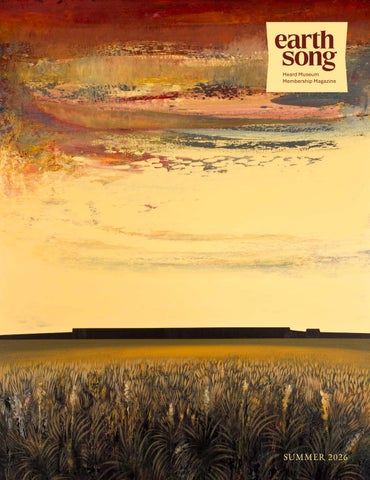
Cover image: Dan Namingha Hopi-Tewa, b. 1950 Desert Bloom, 2004 Acrylic on canvas, 60 x 40 inches Gift of Stephen and Lynda Nacht, 4742-5
2 | E A RT H S O N G — Summer 2026
The Heard Museum is a 501(c)(3) charitable organization incorporated in the State of Arizona. Exhibition, event and program funding provided in part by the Arizona Commission on the Arts, the Arizona Humanities Council, the National Endowment for the Arts, the National Endowment for the Humanities and the Phoenix Office of Arts and Culture.
14
24 12
34 8
In this
Issue
4 6 8 12 14 16 18 20 22 24 26 28 30 32 34
Letter From the Director Now On View & Upcoming On Exhibit: Wisdom from the Future On Exhibit: Blue Bird Acquisitions: Albert Looking Elk Martinez Library and Archives: A Collection Built on Trust On Exhibit: Molly of Denali Save the Date: Moondance 2026 Program Highlights On Exhibit: Paintings from the Heard Shop and Bookstore Programs: Creative Aging Member Spotlight: Rudy and Carol Van Puymbroeck Volunteering: Our Indispensable Guild Breaking New Ground
36 Membership: Events Calendar 37 Events: Artful Mornings 38 Save the Date: Indian Fair & Market, Hoop Dance Contest E A RT H S O N G — Summer 2026 | 3
LETTER FROM THE DIRECTOR
Dear Esteemed Members, The Heard Museum will be turning 100 in 2029! We will mark this major milestone with a series of celebrations and special projects that will position the Heard for success in its next century of serving the Phoenix community. You will, without doubt, be reading about our exciting centennial plans in future issues of Earth Song; but, for now, I’m delighted to share with you information on one of the largest and most ambitious projects we are planning, the reinstallation of the permanent collection in the gallery that currently features HOME. In 2005, the Heard Museum opened HOME: Native People in the Southwest, an exhibition that anchors the visitor and member experience by presenting 1,400 masterworks from the permanent collection and that serves as an essential educational resource for more than 145,000 annual visitors, including residents of and tourists to Arizona, students and educators, and thousands of Indigenous patrons who connect with their cultural heritage through a visit to the museum. 4 | E A RT H S O N G — Summer 2026
When it opened, HOME was celebrated for its innovative curatorial approach, which prominently incorporates the first-person voice throughout the exhibition. This approach to curating exhibitions was developed through years of engagement-based practice involving community members, artists and scholars—a practice the Heard Museum has expanded upon over the years. HOME has evolved into an indispensable component of the Heard’s educational and public engagement initiatives. It serves as the point of entry for visitors as they begin their journey at the museum, and it is the core of the museum experience for most of the thousands of K-12 students who visit the museum for free school tours each year. In fact, HOME represents the first exposure of any kind that many students have to Indigenous cultural practices, history and art. For visitors of all ages, the exhibition provides a crucial opportunity to dispel pernicious misconceptions surrounding Native people, art, culture and history while fostering an environment conducive to meaningful dialogue. While HOME continues to provide relevant and engaging information and experiences, after more than 20 years on view, the Heard Museum must revisit this presentation of the permanent collection to incorporate newly acquired
works, to address changing cultural dialogues and new knowledge, and to pursue approaches to the presentation of American Indian art that are relevant and timely. The 100th anniversary is the ideal time to do this. The new exhibition, with a proposed opening in November 2029, will occupy 10,000 square feet and showcase 400 years of Indigenous creative expression through a selection from the best of the best of the more than 46,000 objects in the Heard’s collection. Many of these works are currently on display in HOME, but the reinstallation will also give us the opportunity to incorporate new works that have been added to the collection over the past 20 years. The exhibition will represent more than 40 tribal nations from California to Oklahoma. The Heard Museum has historically prioritized first-person interpretations to empower artists and their communities, and the new exhibition will continue this collaborative approach. It will feature input from Native advisors, scholars, elders, artists and museum leaders, as well as community stakeholders including museum trustees, staff and members. This exhibition is envisioned as the defining statement for the interpretation of the museum’s collection and will be a vital resource for learning and inspiration. It will also
serve as a scholarly recognition of the history, diversity and identity of Indigenous cultures in the American Southwest. While the realization of this vision is still a way off, we look forward to updating you on our progress. It mustn’t go unsaid that nearly 100 years of serving the Phoenix community and achieving our mission of connecting the world to Indigenous creativity by presenting the voice and vision of American Indian artists wouldn’t be possible without the support of our members. Thank you! On behalf of the entire Heard team, we look forward to seeing you this summer. Sincerely,
David M. Roche Dickey Family Director and CEO
E A RT H S O N G — Summer 2026 | 5
ON VIEW
Explore More Experience More Twilight: Trading Posts and Legacies
Paintings from the Heard Collection
October Art: The Collection of Delores Browne Abelson
Majestic Figures: Contemporary Sculptures by Native American Artists Ongoing
Heard Museum History in the 1929 Gallery
The Third Dimension: Sculptural Stories in Stone and Bronze
October 25, 2026 – August 1, 2027
6 | E A RT H S O N G — Summer 2026
Through September 7, 2026
Ongoing
Through October 26, 2026
Ongoing
FEATURED EXHIBITION
Substance of Stars Ongoing
Experience light, sound and 360-degree video that takes you on a journey of Indigenous storytelling.
Wisdom from the Future Through December 6, 2026
Blue Bird
Through March 7, 2027
American Indian Veterans National Memorial Ongoing
Highlights | Storyteller: The Photography of Jerry Jacka Ongoing
HOME: Native People in the Southwest Ongoing
Away From Home: American Indian Boarding School Stories Ongoing
E A RT H S O N G — Summer 2026 | 7
ON EXHIBIT
Wisdom From the Future By Dr. Ann Marshall Director of Research
When we first asked 28 artists age 55 “and better” for advice they would give to their younger selves, we had no idea how emotionally moving their responses would be. In the summer of 2025, Chief Curator Diana Pardue, Collections Coordinator Olivia Barney (Diné) and I began reaching out to artists who have an association with the Heard Museum throughout long and very successful careers. Their art is well represented in the museum’s collection and frequently exhibited. Over the years, because of their knowledge, we have reached out to these artists seeking information and advice on rather predictable topics such as one of their artworks, their practice, their cultural heritage or the art world in general. But this was new, this was personal— deeply personal. They wrote their responses in the form of a postcard or letter. While each artist reflected on individual experience, some overall themes emerged. Several artists emphasized personal vision and the courage to follow it, sometimes in the face of criticism. Knowing how to manage criticism was an integral part of the artists’ advice. They recognized that criticism can sometimes be self-criticism, and knowing when to trust yourself, your inner vision, is essential. Kay WalkingStick (Cherokee) spoke of the importance of using self-criticism to balance ambition, creating paintings that are “strong and telling.” An oil stick diptych, The Vortex, which WalkingStick created while she was an artist in residence at the Heard in 1995, is included in the exhibition. Roxanne 8 | E A RT H S O N G — Summer 2026
Swentzell (Kha’P’o Ówîngeh [Santa Clara Pueblo]) cautioned young Roxanne to not be too critical of herself. Several artists recognized valid criticism, and they also addressed the challenge of deciding who should be heeded as a trusted advisor and who should be ignored. In their long and successful careers, all the artists in the exhibition have had to deal with a wide variety of art criticism and have successfully navigated the inevitable criticism that comes with success.
Honoring one’s cultural heritage was also a theme of the artists’ advice. Preston Singletary (Tlingit) saw culture and heritage as “valuable sources of creativity.” Anita Fields (Osage) underscored that advice, seeing one’s ancestors as a grounding influence that sparks imagination and dreams. Not surprisingly, cultural heritage was an important theme for Katsina doll carver Ronald Honyouti (Hopi). Katsina doll carving is one of the deepest expressions of Hopi heritage and belief. He recognized those beliefs and the teachings of elders as foundational to artistic expression and inspiration. In the exhibition, we are showing an Ang’aktsina that Honyouti carved in 1986. Painter Shonto Begay (Diné) advocated for listening to the wisdom of elders and asking them questions to deepen one’s understanding.
Roxanne Swentzell Kha’P’o Ówîngeh (Santa Clara Pueblo), b. 1962 It’s Raining, 1984 Ceramic Heard Museum Collection, purchased with funds provided by the Goldsmith Foundation, 3399-1
E A RT H S O N G — Summer 2026 | 9
Curiosity, awareness and appreciation of the surrounding world were mentioned in advice from several artists. Doug Hyde (Nez Perce/ Assiniboine/Chippewa) has worked with a wide variety of media for his sculpture and recommended experimentation to encourage thinking “outside the box.” Hyde’s sculpture is well known to Heard Museum visitors, as his pieces greet visitors at the museum’s main entrance and in its courtyards. DY Begay (Diné) recommended travel and journaling as sources of enrichment in life. James Lavadour (Confederated Tribes of the Umatilla Indian Reservation, Walla Walla) saw curiosity about the unknown, learning and gaining wisdom as spiritually uplifting and ultimately expressed through art. Lavadour’s painting in the exhibition, Shed’s Light, was purchased in 1983 from the museum’s first Biennial Native American Fine Arts Invitational. Co-curator Olivia Barney said the artists’ responses are “all inspiring and thoughtful.” Along with noting a few instances of humor, she found “heartfelt submissions that make me teary-eyed.” In Wisdom from the Future, the artists take us on a brief journey through their lives. Perhaps the question we posed to the artists will be something visitors will take away, inspiring personal reflection. If you could offer advice to your younger self, what would you say? 10 | E A RT H S O N G — Summer 2026
ABOVE, LEFT
ABOVE
DY Begay Diné, b. 1953 Journey, 2005 Churro wool, 49.5 x 35 in. Heard Museum purchase, 4345-11
Shonto Begay Diné, b. 1954 Moab Bound, 2011 Acrylic on canvas, 41.5 x 72.25 x 3 in. Gift of American Indian Art Magazine, 4682-1
LEFT Kay WalkingStick Cherokee, b. 1935 The Vortex, 1995 Oil stick on paper, 34 x 68 in. Heard Museum purchase, 3555-1
E A RT H S O N G — Summer 2026 | 11
ON EXHIBIT
Blue Bird By Olivia Barney (Diné) Collections Coordinator and Exhibition Curator
Blue Bird Flour appears in many Native gathering spaces, from a relative’s kitchen to powwows, fine-art markets, cultural centers and restaurants. It is a prized ingredient in frybread and tortilla recipes and is widely available in Arizona and the Four Corners area. While its popularity is strongest among Native people from the Southwest, it has become widely appreciated throughout the country. The flour was created by the Cortez Milling Co. in Colorado around the 1930s. The distinct flavor, texture and weight it gives to frybread can be attributed to its being a high-altitude flour, which connects to its high protein content. It’s not uncommon to hear people comment that they can tell when Blue Bird has been used in frybread. Given Blue Bird’s presence in meals and treats associated with social gatherings, it makes sense that the flour’s sack design has earned people’s affection. The Blue Bird exhibition demonstrates multiple ways in which Native people have repurposed the flour sacks into wearable fashion and functional items. Gathering and organizing the artistic works that would become the exhibition happened naturally. Once word got out that a Blue Bird–themed exhibition was being planned, Dr. Kathleen Howard offered 12 | E A RT H S O N G — Summer 2026
Toni Williams (Northern Arapaho), Shirt, c. 2015. Cotton fabric, Rit Dye, 28 x 23 1/4 inches. Collection of Kathy and Bill Howard.
shirts and tote bags made from vibrantly dyed flour sacks by Toni Williams (Northern Arapaho). The museum already had face masks in its collection made by Ginger Sykes Torres (Diné) and her mother, Sherry Denipah Sykes (Diné) depicting the flour sack design layered together with intricately patterned fabric. From these works, the exhibition began to grow and form. Colleagues and friends suggested other creatives to contact or items to incorporate. Ken Williams Jr. (Northern Arapaho/Cattaraugus Seneca), a well-respected artist known for his intricate beadwork, loaned a vest made by Linda Peshlakai (Diné), with jewelry design drawings by Norbert Peshlakai (Diné). The Peshlakais had gifted it to him when he had curated an exhibition of Norbert’s work. Multiple people suggested that I connect with artist Kathleen Tom-Garcia (Diné), and she was interested in lending a denim jacket that she designed with a Blue Bird back patch. She also showed me images of her other work. In one of the images, Jolyana Begay-Kroupa (Diné), CEO of the Phoenix Indian Center and the 50th Miss Navajo Nation, was wearing a beautiful floor-length skirt made by
Selina A. Scott (Diné, Latina, b. 1998), I knead my dough the way you showed me, 2023. Acrylic on canvas, 40 x 60 inches. Collection of the artist. Photograph by Mya Scott.
Tom-Garcia. It incorporated brightly colored fabrics, fine stitching and Blue Bird patches. I reached out to her next to ask to borrow the skirt for the exhibition in order to have two of Tom-Garcia’s works shown as an ensemble in the gallery space. More items followed, including a child’s dress by Cathy Short (Citizen Potawatomi Nation) and an eye-catching miniature backpack by Amber B. Scott (Diné/Hopi/Yavapai), both incorporating the Blue Bird four sack cloth. A 2023 painting by Arizona artist Selina A. Scott (Diné/Latina) titled I Knead My Dough the Way You Showed Me visualizes what can be made from the flour itself, and this exhibition highlights that, not only with the reimagined uses of Blue Bird Flour sacks but through the formation of the exhibition itself. It connects to other artworks depicting Indigenous breadmaking practices, reminding viewers that resourcefulness, community, and innovative cooking methods long predate wheat flour, with foods like Hopi piki, Choctaw banaha, and Cherokee bean bread. The importance of community and the resourceful use of materials are values that have long been central to Native people, and this exhibition highlights that through the reimagined uses of Blue Bird Flour sacks and the focus on foods such as frybread.
Toni Williams (Northern Arapaho), Tote bag, c. 2015. Cotton fabric, Rit Dye, 23 1/4 x 14 3/4 inches. Collection of Kathy and Bill Howard.
E A RT H S O N G — Summer 2026 | 13
ACQUISITIONS
Albert
Looking Martinez Elk By Diana F. Pardue Chief Curator
As Heard Museum staff members, we receive a range of emails. Some contacts request artist or archival information, others request loans of artwork or supporting materials, while still others request programmatic or educational resource materials. Perhaps some of the more interesting emails the curatorial staff receives are those from collectors or family members of collectors who have works they are offering to donate to the museum. Sometimes these offers come from people who have close ties to the museum: trustees, Guild members, museum members. Other times, we receive emails or phone calls from people who traveled to Phoenix and had a good experience visiting the Heard or whose family members expressed strong sentiments about the museum. All these contacts are welcome, and once they are received, the curatorial team reviews the items offered in relationship to the museum’s current holdings and in the context of the possibility that the museum will at some point have a chance to exhibit the works. Recently, the Heard was contacted by sisters Susan Little and Nancy Little, whose grandmother, Marjorie Moore Little, traveled to the Southwest in the 1920s and ’30s. During her visit, she purchased a small painting by Albert Looking Elk Martinez (1888-1940). Martinez was among a group of three artists from Taos Pueblo, along with Albert Lujan and Juan Mirabal, who began painting as early as 1915 to 1918. This was around the same time that San Ildefonso Pueblo painter Awa Tsireh was becoming recognized for his artistic talents. 14 | E A RT H S O N G — Summer 2026
For several years, Martinez served as a model for two painters who were members of the Taos Society of Artists, Oscar Berninghaus and E. Irving Couse. Berninghaus is credited with giving paints, brushes and some informal instruction to Martinez, who was self-taught. A check of the Heard collections revealed that there were no works by Martinez, Lujan or
Mirabal in the permanent collection. The painting that Susan and Nancy Little offered was representative of Martinez’s landscape paintings that feature the buildings of Taos Pueblo set against mountains reaching to the clouds above. The curatorial team agreed that the painting would be a welcome addition to the museum’s collection, and a review by the Collections Committee of the board of trustees confirmed that decision. The staff is pleased to add a painting by this early Pueblo artist and remains grateful for the consideration and generosity of donors of works of art.
Albert Looking Elk Martinez Taos Pueblo, 1888-1940 Untitled, c. 1930 Oil on board 7 x 9¼ in. Gift in memory of Marjorie Moore Little
E A RT H S O N G — Summer 2026 | 15
LIBRARY AND ARCHIVES
The Native American Artists Archives:
A Collection Built on Trust By Mario Nick Klimiades Library and Archives Director
Nestled within the Billie Jane Baguley Library and Archives is a treasure trove of cultural and artistic heritage: the Native American Artists Archives. Established in 2000, this remarkable collection serves as a vital resource for documenting, preserving and celebrating the creative lives of Native American artists. Built on trust and collaboration, the Archives reflect the richness and diversity of Native artistry across visual, literary, performing, cultural and experimental arts. As a companion to the Native American Artists Resource Collection, which documents more than 30,000 Native artists, the Native American Artists Archives are the centerpiece of the Library’s archival holdings, offering researchers, artists and the public access to unique primary source materials. These include personal papers, portfolios, sketchbooks, correspondence, scrapbooks, photographs, tools and other documentation that provide insight into the creative processes and lives of Native artists and their achievements. The Archives also house records from Indian arts organizations, art markets, galleries, curators, educators and collectors, further enriching the collection. The mission of the Native American Artists Archives is clear: to document, preserve and make accessible the 16 | E A RT H S O N G — Summer 2026
richness of Native American artistry. By working directly with artists, the Archives ensure that their wishes for their collections are respected and fulfilled. This collaborative approach fosters trust and strengthens the connection between the Heard Museum and the Native art community. The Archives also aim to raise awareness about the importance of preserving archival material, encouraging artists, collectors and other repositories to contribute to this invaluable resource. The Native American Artists Archives currently encompass more than 50 archival collections, making it an essential resource for art historians, scholars, museum curators, students and families seeking to understand the contributions of Native Americans to the arts. By providing access to these materials, the Archives promote research, learning and appreciation of Native artistry, ensuring that the legacy of these artists is preserved for future generations. The Native American Artists Archives are more than a
collection; they are a testament to the trust and collaboration between the Heard Museum and the Native art community in the Southwest and beyond. By preserving the creative legacies of Native artists, the Archives ensure that their stories, struggles and triumphs continue to inspire and educate generations to come. Through this unique program, the Heard Museum reaffirms its commitment to honoring and celebrating the profound contributions of Native Americans to the arts. Access to the Billie Jane Baguley Library and Archives is free for American Indians, museum visitors, Heard Museum members and the public. Appointments are required for accessing archival, photographic and special collections. For those unable to visit in person, the library’s online catalog and digital library can be accessed at heard.org/digitallibrary.
E A RT H S O N G — Summer 2026 | 17
ON EXHIBIT
Molly of Denali
Comes to the Heard By Patty Talahongva (Hopi) Chief Programming & Engagement Officer
Alaska is coming to the Heard Museum with a special interactive experience just for Heardlings and their families! From June 2 to Aug. 30, Molly of Denali: An Alaskan Adventure will take over Steele Auditorium and other spaces throughout the Heard. It will be the coolest place in town to be this summer! The celebration is based on the award-winning PBS KIDS® series Molly of Denali, produced by WGBH Kids. The series focuses on 10-year-old Molly Mabray, an Alaska Native girl who lives in the fictional town of Qyah with her family, friends and her dog Suki. (If your kids have not seen the series, you can watch all the episodes for free on YouTube or on the PBS KIDS® website.) In each episode, Molly teaches kids about Alaska Native values, history, traditions and even languages. Molly is no stranger to the Heard. She’s visited the museum a few times in the past, much to the delight of her faithful fans. She’ll be making personal appearances again this summer, on July 11 and Aug. 22. “Planning the program where guests could meet Molly was one of my first projects as a new member of the Heard team,” says Lucia Leigh Laughlin, Director of Engagement and Learning Programs. “I’ve been a fan of hers, and of the show, 18 | E A RT H S O N G — Summer 2026
since then, and I’ve seen firsthand how many people share that sentiment.” Last summer, when Laughlin attended the Association of Children’s Museums conference, she noticed this interactive experience and was excited to bring the opportunity to the Heard. “Knowing how many people in Phoenix love Molly and our summer programs, I couldn’t wait to pitch it to the rest of the team,” she says. Now her pitch is a reality. Molly of Denali: An Alaskan Adventure is an interactive experience in which kids and families can learn about what life is like in Alaska in both the summer and the winter. It will offer a wide variety of activities; for example, kids can shop for supplies in the Denali Trading Post, just like Molly does. In the Tribal Hall, they can learn about the drums used by different Alaska Native peoples or make beaded crafts. They can even try on a qaspeq (an article of clothing like a pullover) and hear Alaska Native languages being spoken.
Molly’s mother is a pilot, and kids can see what it’s like to fly a bush plane as they take the controls and watch the tundra passing beneath them via a video screen in the cockpit. They can also try their hand at ice fishing and learn how to care for sled dogs. “It’s important for kids to see themselves and their communities represented in all the places that they visit—whether a TV channel or app, or a museum. A show like Molly of Denali, which was thoughtfully written and created by so many talented Indigenous artists, has something to teach everyone who watches it. This in-person experience provides an opportunity for intergenerational learning through play, which is the exact type of engagement that we strive to create for our Heardlings and their families,” says Laughlin. “Molly is a wonderful role model in the ways she exhibits and learns Alaska Native values. She is generous, respectful, intentional and engaged with her community. The world would be a better place with more Mollys in it!” E A RT H S O N G — Summer 2026 | 19
S AV E T H E DAT E
MOONDANCE 2026 By Judi Goldfader Director of Development
Each fall, the Heard Museum transforms under the desert night sky for Moondance, our signature fundraising celebration and one of the most anticipated evenings of the year. On Saturday, Oct. 24, 2026, members and friends will gather once again for an unforgettable night of art, community and purpose. Co-chaired by museum trustees Arlene Ben-Horin and Jeri Y. Ben-Horin, this year’s Moondance promises a vibrant, thoughtfully curated experience. The evening begins with a lively reception and a signature auction devoted exclusively to Native American jewelry, featuring exceptional, one-ofa-kind pieces. Bidding will be available through a digital platform, allowing all members to participate, whether in person at Moondance or from afar. Dinner follows in the Central Courtyard, where artistic moments and unexpected surprises will unfold throughout the night. We are proud to honor David and Weezie Reese for their meaningful support of the Heard and its mission, alongside renowned Diné (Navajo) artist Tony Abeyta, whose work continues to shape and elevate contemporary Native art. Together, they reflect the spirit of generosity and creativity that defines Moondance. More than a beautiful evening, Moondance is a vital source of support for the Heard. Each year, it raises more than $1 million to advance exhibitions, expand educational programs, care for collections and steward the museum’s campus. At its heart, this support creates space for Indigenous artists to share their voices, honor their cultures 20 | E A RT H S O N G — Summer 2026
Arlene Ben-Horin and Jeri Y. Ben-Horin
and carry forward traditions that are both deeply rooted and continually evolving. It ensures that artists and their work can inspire connection, understanding and pride across generations. Member participation is essential to this success. Table sponsorships offer a meaningful way to gather with friends in support of the mission, while underwriting opportunities provide critical support at every level. Mark your calendar and join us for an evening that celebrates art, community and shared purpose. Moondance 2026 is a chance to come together in support of artists, their stories and the museum that brings them to life. For more information on Moondance 2026, email jgoldfader@heard.org or call 602.251.0245.
Rebecca Ailes-Fine, Carla and Adrian Cohen
Paul Weiden and Bev Linkletter
Michael Ben-Horin and Arlene Ben-Horin
Lili Chester and Lois Rogers
Elaine and Scott Montgomery, Tony Astorga
John and Teresa Lucas, Colleen and John Lomax
Janis Lyon and Wick Pilcher
Louise and David Zirretta
Tony Abeyta, Patty Talahongva, Frank and Margo Walter
E A RT H S O N G — Summer 2026 | 21
PROGRAMMING
Program
Highlights July 5 Aug 9
July 11 Aug 22
Carving Demos with Tlingit Artist James Johnson As Johnson shares, “Art was our visual language, telling our story of ‘this is who we are and where we came from’ It was completely integrated into our culture.” Our stories and the history of our people go back 10,000 years in Southeast Alaska. The ‘art’ was our visual language telling our story of ‘this is who we are and where we came from.’ It was completely integrated into our culture.” Visit the museum on Friday, July 5, from 4:30 to 7:30 p.m. or Saturday, Aug. 9, from 10 a.m. to 1 p.m. to meet the artist as he demonstrates carving these stories in Crossroads Gallery.
Meet Molly! Molly will be back at the Heard on July 11 and Aug 22, 10 a.m. – 4 p.m. Meet Molly, explore the Molly of Denali: An Alaskan Adventure experience and enjoy Alaska-inspired dishes at the Courtyard Café and Cantina.
Making the Heard
Accessible to All By Lucia Leigh Laughlin Director of Engagement and Learning Programs Look at a Kay WalkingStick landscape diptych and it becomes stunningly clear that having multiple panels, or perspectives, of a single place enhances one’s view. Sometimes the two panels blend nearly seamlessly; other times, they are separated by texture or reflection. Each time, they tell a stronger story together. We all process sensory input differently – there is no one-size-fits-all museum experience. Just like blending two paintings can blur the message, assuming everyone has the same needs ensures that none are fully met. Following a comprehensive assessment of our campus and programs from the Institute of Human Centered Design in 2024, the Heard Museum redoubled its efforts to be accessible and to be a more welcoming space for all visitors.
22 | E A RT H S O N G — Summer 2026
Scan the QR code to watch our social story, created with Pal Experiences, which forecasts what to expect during your visit. You can also request American Sign Language interpretation or live captioning for tours in advance.
Through Aug. 30, join us during the week for: • Wednesday Dance Parties at 11:30 a.m. in Crossroads Gallery inside the museum • Thursday Crafternoons at the Heardlings Art Cart from 2 to 4 p.m. in Steele Auditorium • Friday Snow Play from 10 a.m. to 12 p.m. in Steele Auditorium
July 12 & 26 Aug 15
Sept 13
The Dog Days of Summer Looking to meet or adopt a new furry friend? In partnership with AZ Husky Rescue, we’ll be hosting dogs on July 12 & 26 and Aug. 15. Come for the cuddles, stay for the learning!
Grand Time Together: A Celebration of Grandparents’ Day On Sunday, September 13, honor grandparents and foster intergenerational connections through a day of fun, learning and creativity. Don’t miss the toddler play and craft zone!
Information on these programs and more can be found at heard.org/events. Attendance is free for Heard Museum members!
During event days, take a break in the low-sensory Quiet Zone and look for adaptive tools at the activity stations.
We look forward to spending time together at the Heard. Don’t hesitate to let us know how we can make you feel welcome.
We want you to experience the Heard together. The following supports are available daily: • Sensory kits with noise-canceling headphones, fidgets and sensory timers • iPads with the Heard Museum app and audio tours • Weighted lap pads • Color-correcting glasses • Personal amplifiers and guided tour systems • Free period products • Stepstools in bathrooms
• An “Empathy Kit” at Admissions with adult- and child-size diapers, wipes, tissues, changingtable liners and alcohol-free hand sanitizer • A family-friendly museum map with a suggested route and engagement strategies • Weighted and large-grip silverware at the Courtyard Café • Large-print transcripts • Magnifiers • Wheelchairs
E A RT H S O N G — Summer 2026 | 23
ON EXHIBIT
BELOW Nani Chacon Diné/Chicana, b. 1980 Bed Rot 1, 2026 Acrylic on polytab, 45 x 72 in. Gift of William and Kathleen Howard
Paintings from the Heard Collection By Roshii Montaño Curator
In 2002, the Heard Museum invited artist Kay WalkingStick (Cherokee) to guest-curate So Fine! Masterworks of Fine Art from the Heard Museum, an exhibition that offered a revelatory view of the collection through the discerning eye of an artist and scholar. More than 20 years later, WalkingStick returns as co-curator of Paintings from the Heard Collection, bringing her insight to a new selection of more than 30 large-scale works by Native artists whose practices span generations, geographies and aesthetic approaches. From early modernists such as Fritz Scholder and Joan Hill to leading contemporary voices including Kent Monkman, Emmi Whitehorse and Steven Yazzie, the exhibition traces a dynamic and evolving conversation within Indigenous painting. In the catalogue for So Fine!, WalkingStick’s essay “Great American Artists” outlines her expectations of art’s purpose and power. “I expect great art to move me, to touch me, to express something meaningful,” she writes. “I want to laugh, cry, be mystified or enlightened … Great art is often about the mythic, if we understand the mythic to mean the great unknowables—Birth, Life, Death, Creation, 24 | E A RT H S O N G — Summer 2026
God.” Her reflections resonate profoundly today, offering a lens through which to consider the works assembled in this new exhibition. As I collaborated with WalkingStick on Paintings from the Heard Collection, it became clear that her earlier words continue to guide her thinking. We talked about technique and formal decisions, but the most memorable conversations emerged when a painting called forth an artist’s life story or prompted shared contemplation of land and memory. To me, these moments embody what WalkingStick names as “great” in art.
TOP LEFT
CENTER LEFT
BELOW RIGHT
George Longfish Seneca/Tuscarora, b. 1942 Assiniboine Dog Soldier Death Song, 1978 Acrylic on canvas Gift of Mr. & Mrs. Russell L. Howard, 4147-1
Fritz Scholder Luiseño, 1937-2005 Sunset: Church at Rancho de Taos, 1982 Oil on canvas Gift of Herb and Betty Bool, 4822-1
Leon Polk Smith Cherokee (unenrolled), 1906-1996 Cherokee, 1956 Oil on canvas Leon Polk Smith Foundation, 5033-1a–d
Many of the works in this exhibition are among the largest in the Heard’s collection, and several will be on view for the first time in decades. The Freeman Gallery presentation of Paintings from the Heard Collection opened in January 2026 alongside the Kay WalkingStick / Hudson River School and has now expanded into the Grand Gallery. Paintings from the Heard Collection honors artists who have shaped and continue to shape the field of contemporary art. It offers a renewed vision of the Heard Museum’s ongoing commitment to presenting the depth, innovation and enduring presence of Indigenous creativity. BOTTOM LEFT Linda Lomahaftewa Hopi/Choctaw, b. 1947 Untitled Woman’s Faces, 1960s Oil on canvas Gift of the artist, 4052-1
E A RT H S O N G — Summer 2026 | 25
SHOP
Embrace
Indigenous Creativity Shop Spotlight Kelly Gould Director of Retail Operations You don’t just visit the Heard. You collect it. The Heard Museum Shop offers original, purchase-ready works by renowned Native artists - jewelry, painting, sculpture, and more. heardmuseumshop.com
Preston Singletary (Tlingit) Killer Whale 29 ½"h × 6 ½"w × 20"d
MEMBERS RECEIVE 10% OFF
Roxanne Swentzell (Santa Clara) Heard 21"h × 19"w × 15"d (designed to sit on a ledge) 26 | E A RT H S O N G — Summer 2026
Denise Wallace (Chugach Sugpiaq/Alutiiq) Silver Multi-Stone Necklace 24" (chain), 2¾"h × 4¾"w (pendant)
Barbara Teller Ornelas (Navajo) Two Grey Hills Tapestry 30"h × 19"w
Denise Wallace (Chugach Sugpiaq/Alutiiq) Dollmaker II 3"h × 1 ⅝"w
BOOKS AND MORE
See More from Your
Favorite Exhibits Blue Bird Flour is well known for its use in frybread and tortilla recipes, and its logo has become a motif in Native popular culture. To mark the Heard Museum’s current exhibition exploring the iconic flour brand, Books and More is promoting handmade “Blue Bird Flour” aprons made by Hopi/Umon’hon artist, Leona Merrick Payestewa. Leona says it was her grandmother, Theresa Merrick Tyndall, who told her,
“Every Native woman should have a nice purse, a nice dance shawl and a GOOD APRON.” Her inspiration spawned from helping other women prepare for tribal feasts in Nebraska, Kansas, Oklahoma, and Arizona where she observed the pretty aprons the women wore. Now, in her Fourth Hill of Life, at 75 years old, Leona hopes to share her words and aprons with ALL women.
Limited-time Merch Now – Aug 30.
Molly of Denali: An Alaskan Adventure Totes, shirts, toys, and more this summer as Molly of Denali visits the Heard Museum. Meet Suki, a new plushy friend and carry the fun home in a tote bag. Molly of Denali: An Alaskan Adventure is a nationally traveling exhibit created by The Magic House, St. Louis Children’s Museum in collaboration with GBH Kids and Alaska Native advisors. MOLLY OF DENALI® is produced by GBH Kids and Atomic Cartoons in association with CBC Kids. MOLLY OF DENALI is a trademark of WGBH Educational Foundation. © 2023 WGBH Educational Foundation. All rights reserved. Watch MOLLY OF DENALI on PBS KIDS. PBS KIDS and the PBS KIDS Logo are trademarks owned by Public Broadcasting Service. Used with permission.
E A RT H S O N G — Summer 2026 | 27
PROGRAMS
Creative Aging
“While artistic skillbuilding remains central, the Creative Aging workshops also nurture meaningful human capacity and social connection.”
By Marcus Monenerkit Director of Community Engagement
Among the many values upheld by American Indian communities, respect for elders is one of the most enduring and essential. For generations, Native communities have honored elders as stewards of cultural knowledge, spiritual grounding and lived wisdom. Aging within Native philosophy is not understood as decline, but as a natural progression toward deeper insight and guidance. Elders serve as cultural anchors—preserving traditions, safeguarding stories and ensuring continuity across generations. These values closely align with the mission of the Heard Museum, making a 55-and-better Creative Aging art program a natural and meaningful fit within its offerings. In 2018, guided by the beliefs of Indigenous communities and the thoughtful programming practices of the education team led by Dan Hagerty, the Heard Museum launched a Creative Aging pilot program. Rooted in Native customs, the initiative also reflected the museum’s long-standing commitment to education and community engagement, a commitment strengthened by decades of 28 | E A RT H S O N G — Summer 2026
collaboration with the Heard Museum Guild. The Guild has consistently emphasized the importance of learning directly from the communities represented at the museum and has advocated for authentic connection, mutual respect and cultural understanding. The program has steadily gained visibility and integration as it aligns with broader shifts in the museum field—particularly the movement toward community-centered learning and engagement. Emphasizing culturally relevant materials, hands-on skill-building and interactive experiences, the program is designed to support lifelong wellness for older adults.
With strong community lead support, the initial class proved highly successful. Since then, museum staff have continued to offer free Creative Aging art workshops, made possible through the generous support of E.A. Michelson Philanthropy alongside other generous funders. As the program has grown, class topics have evolved organically, encompassing both traditional cultural arts and contemporary media. Each series runs for four weeks, with three-hour sessions held once per week. Participants receive focused instruction along with dedicated studio time to practice their chosen art forms. During class, they also share challenges and successes with one another, building confidence, forming friendships and navigating the vulnerability inherent in creative expression. With a strong commitment to community-
building, many instructors continue to support participants between sessions by answering questions via phone or Zoom, particularly when techniques are more complex. While artistic skill-building remains central, the Creative Aging workshops also nurture meaningful human capacity and social connection. Participants engage in informal conversations, learning about one another’s backgrounds, families and careers. Over time, these exchanges foster a sense of belonging and shared purpose. Through creativity, storytelling and mutual support, the program cultivates not only artistic growth but also community well-being. Programs like these offer participants a renewed sense of autonomy and control over their health, while also encouraging new perspectives on life and creativity. Rooted in generational knowledge and sustained by the values of respect, reciprocity, relationships and responsibility, the Creative Aging program is an exemplary fit for Native art and culture museums and the significant wisdom they seek to uphold.
E A RT H S O N G — Summer 2026 | 29
MEMBER SPOTLIGHT
Member Spotlight
Rudy and Carol Van Puymbroeck Rudy and Carol met in New York City in 1968 while graduate students, Rudy at New York University and Carol at Columbia University. They were soon married in Rudy’s hometown of Antwerp, Belgium in 1969 after a whirlwind romance. After living and working for a few years in Brussels, Belgium and Tehran, Iran, they returned to the United States in 1973 for Rudy to begin law school. Rudy spent his career as an attorney for the World Bank and taught at Georgetown University after retirement, while Carol worked as an educator at the University of Maryland and the Fairfax County Public Schools in Virginia—and all while raising their three daughters, Marieke, Christina, and Holly Ann.
After 30 years in northern Virginia, they relocated to Phoenix in 2017 to be closer to their middle daughter and two grandsons. They have been longtime admirers of the Heard, and became members in 2022 while simultaneously joining the Las Guias docent program. You are fairly recent transplants to Phoenix. What motivated you to become Heard members?
One thing that drew us to the Heard is the friendliness and supportive atmosphere, which was evident each time we visited the museum. We were looking for a place where we could contribute our time to a good cause, as well as have opportunities to learn new things and be exposed to new ideas. The Heard gave us these opportunities, as well as acquainting us with so many new friends. 30 | E A RT H S O N G — Summer 2026
“One thing that drew us to the Heard is the friendliness and supportive atmosphere, which was evident each time we visited the museum.”
What is your biggest takeaway from your time in the Las Guias docent program?
As educators, we love sharing knowledge with others. The Las Guias program is the perfect vehicle for us to do just that. The quality of the exhibitions at the Heard is outstanding, and the atmosphere is uniquely inviting, allowing visitors to learn and experience American Indian art. What have been your favorite exhibitions?
We really love them all and it is so much fun to learn about each new exhibition! It is hard to choose a favorite, but Bob Haozous: A Retrospective View transcended the normal museum experience. We both also love Majestic Figures: Contemporary Sculptures by Native American Artists. What has being a Heard member and volunteer meant to you?
A Heard membership is a standing invitation for continued learning in an atmosphere of kindness and respect. Being a part of the Heard family has made us feel more at home in Phoenix, and we always look forward to visiting. We often sit in the courtyard and listen to the flute music before giving tours—it instills a special kind of calm and readiness to enter a different understanding of the world. In addition to the Las Guias program, we enjoy volunteering for the Indian Fair & Market and traveling with the Heardsponsored trips. How would you describe the Heard to someone who has never visited before?
The enthusiasm at the Heard is infectious, and there is a feeling of hospitality and a welcoming spirit that permeates the museum. We encourage everyone to visit and take advantage of the many opportunities there are to be a part of the vibrant and enthusiastic volunteer community that supports the Heard and its mission. E A RT H S O N G — Summer 2026 | 31
VOLUNTEERING
Our Indispensable
Guild
By David Wheeler Associate Director of Membership & Circles of Giving
Heard Museum Guild members are an essential part of our community, contributing more than 37,000 volunteer hours last year alone. It’s an impressive number, but it understates the depth of their dedication and the impact they have across our museum. Their presence is felt everywhere. This year, more than 280 Guild members volunteered at the Indian Fair & Market and the Youth Art Show & Sale—two signature events founded by the Guild and now vital platforms for both established and emerging Native artists. Artists consistently tell us that the hospitality and welcoming environment created by Guild volunteers is one of the Fair’s greatest strengths. Guild members also shape the visitor experience from the moment guests arrive. Volunteers at the Information Desk greet the vast majority of museum visitors, offering guidance, warmth and a personal connection that sets the Heard apart. Inside the galleries, our docents lead thousands of tours each year, giving visitors insight and perspective that no label copy can match.
32 | E A RT H S O N G — Summer 2026
Behind the scenes, the Guild’s contributions are just as critical. The Billie Jane Baguley Library and Archives relies on a dedicated team of volunteers whose meticulous work maintains a world-class research collection used by scholars across the country and around the world. Their efforts — from processing archival materials to preparing items for binding—make the library’s work possible. The Museum Shop also benefits from a strong volunteer presence, with Guild members supporting staff and helping to create a welcoming, well-run retail experience. And throughout the year, volunteers step in wherever they’re needed: assisting at the World Championship Hoop Dance Contest, supporting Hopi carvers at the Katsina Doll Marketplace, helping with hospitality, and lending a hand with countless projects large and small. None of this is done
Heard Museum Guild By the Numbers Cumulative volunteer hours:
1,600,965
Volunteer hours last year:
37,348
Tours led last year:
3,014
Visitors served on tours last year:
20,366
Members with 10,000 volunteer hours:
13
Members with 7,500 volunteer hours:
24
Members with 5,000 volunteer hours:
43
Members with 1,500 volunteer hours:
98
Volunteers at Indian Fair & Market:
281
Active Las Guias tour guides:
72
for individual recognition, but out of genuine love for the museum and its mission. Guild members are also museum members and donors themselves, strengthening the Heard through their generosity as well as their time. And for more than 30 years, the Guild has fostered community through travel programs that explore cultural destinations across the West, Mexico and Canada—building camaraderie and deepening connections to Indigenous art and culture. The Heard Museum is profoundly grateful for the dedication, expertise and spirit of the Guild members. Their contributions enrich every corner of the museum and help ensure that the Heard remains a place of learning, connection and celebration for all. To deepen your connection to the Heard and join the Guild, please contact membership@heardguild.org.
E A RT H S O N G — Summer 2026 | 33
CONSTRUCTION
Breaking
New Ground The Heard Museum is building for the future! This fall, we break ground on two transformative spaces: a vibrant new restaurant and an inspiring Creativity Hub that will reshape the visitor experience for years to come. Construction officially begins in October 2026, marking the start of a major new chapter for the museum. The Creativity Hub will open in fall 2027, serving as an intergenerational learning hub with new spaces for lifelong learning, hands-on artmaking, workshops, artist demonstrations and community gatherings. The new restaurant will follow, offering a welcoming place to gather, relax and enjoy Southwest-inspired dining—all just steps from our galleries. These projects represent a bold investment in the Heard’s future, and we can’t wait to bring you along on the journey. Earth Song will keep members updated every step of the way as these landmark additions come to life. 34 | E A RT H S O N G — Summer 2026
E A RT H S O N G — Summer 2026 | 35
MEMBERSHIP
Membership Events Calendar
Mark your calendars for these exclusive member opportunities. Join us for Artful Mornings throughout the summer for your insider’s access to our experts and collections, and you will always see our new exhibitions before they open to the public.
JUL 18
Saturday | July 18, 11:00 a.m. – 12:00 p.m. Artful Mornings with Collections Coordinator Olivia Barney
AUG 8
Saturday | Aug. 8, 11:00 a.m. – 12:00 p.m. Artful Mornings with Chief Curator Diana Pardue
SEP 19
Saturday | Sept. 19, 11:00 a.m. – 12:00 p.m. Annual Members Meeting
OCT 17
Saturday | Oct. 17, 11:00 a.m. – 12:00 p.m. Artful Mornings with Director of Research Ann Marshall
OCT 25
Sunday | Oct. 25, 9:00 – 11:00 a.m. Member preview of Twilight: Trading Posts and Creative Legacies
36 | E A RT H S O N G — Summer 2026
EVENTS
artful mornings Artful Mornings is the Heard Museum’s monthly members-only gathering featuring sessions with museum curators, leading scholars and Indigenous artists. Each program highlights works from the Heard’s renowned permanent collection and offers an insider’s perspective on the stories, themes and creative voices shaping Indigenous art today. Every month brings something new. Past topics have explored the legacy of the Fred Harvey Company, the role of Coyote in Indigenous art and the power of artist self portraits. Guests also enjoy previews of upcoming
Start your weekend with inspiration
exhibitions and rare opportunities to hear directly from the experts who bring them to life. More than a lecture, Artful Mornings is a welcoming space to deepen your connection to the Heard, meet fellow members and supporters, and discover the richness of our collections. Enjoy complimentary pastries and coffee before the program—an ideal way to ease into a Saturday. Join us this summer for Artful Mornings and experience the museum in a whole new way.
E A RT H S O N G — Summer 2026 | 37
S AV E T H E DAT E F O R
Hoop and Fair!
Join us for our two signature annual festivals. Members receive discounted tickets, members-only entrance, and early Saturday entry for both events.
37th Annual World Championship
Hoop Dance Contest Feb. 6 & 7, 2027
38 | E A RT H S O N G — Summer 2026
69th Annual Heard Museum Guild
Indian Fair & Market March 6 & 7, 2027
E A RT H S O N G — Summer 2026 | 39
2301 N. Central Avenue, Phoenix, AZ 85004 602.252.8840 | heard.org