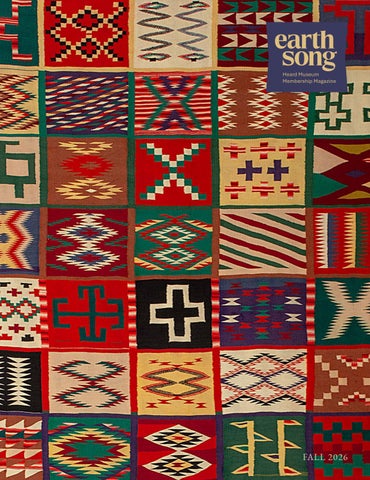
FALL 2026
BOARD OF TRUSTEES Karen Abraham | Chair Nadine Basha | Vice Chair HEARD MUSEUM
Ginger Sykes Torres | Secretary
2301 N. Central Ave., Phoenix, AZ 85004
Scott Montgomery | Treasurer David M. Roche | Dickey Family Director & CEO
Open:
10 a.m. – 4 p.m.
Closed:
Easter Sunday, Independence Day, Thanksgiving Day and Christmas Day
Main:
602.252.8840
Events:
602.252.8848
Membership: 602.251.0261 HEARD MUSEUM SHOP Open:
10 a.m. – 4 p.m.
Shop:
602.252.8344 or 1.800.252.8344
COURTYARD CAFÉ Open:
11 a.m. – 3 p.m.
COFFEE CANTINA Open:
9:30 a.m. – 4 p.m.
THANK YOU TO OUR SPONSORS
Partial funding provided by the Phoenix Office of Arts and Culture through appropriations from the Phoenix City Council.
Earth Song David Wheeler | ASSOCIATE DIRECTOR, MEMBERSHIP & CIRCLES OF GIVING Sean Ornelas | DIRECTOR OF MARKETING Deborah Paddison | COPY EDITING Studio[5]Eleven | GRAPHIC DESIGN Contributing Writers: Amal Abuqawod, Olivia Barney, Judi Goldfader, Kelly Gould, Dan Hagerty, Lucia Leigh Laughlin, Ann Marshall, Marcus Monenerkit, Sean Mooney, Diana Pardue, David Roche, David Wheeler
TRUSTEES Tony Astorga Jeri Y. Ben-Horin Matthew Boland Gregory H. Boyce Susan Esco Chandler John Coggins Adrian Cohen Judy Dworkin Bill Howard Sharron Lewis John F. Lomax John Lucas Janis Lyon Frank Metzler Jane Sanford, Guild President Christy Vezolles Frank Walter III Virginia Furth Weisman Trudy Wiesenberger
LIFE TRUSTEES Kay Benedict Arlene K. Ben-Horin Howard R. Berlin Mark B. Bonsall Robert B. Bulla F. Wesley Clelland III Dr. Craig Cohen Norma Jean Coulter John Graham Mary G. Hamilton Patricia K. Hibbeler Joel P. Hoxie Mary Hudak Dr. Thomas M. Hudak Carrie L. Hulburd James R. Huntwork Gov. Stephen R. Lewis Frederick A. Lynn Carol Ann Mackay Clint J. Magnussen Robert L. Matthews Mary Ellen McKee James Meenaghan John Melamed Dr. Wayne Lee Mitchell Susan H. Navran Scott H. O’Connor Dr. Arthur L. Pelberg Leland Peterson Wick Pilcher David E. Reese William C. Schubert Richard H. Silverman John G. Stuart
Cover image:
Artist Once Known (Navajo), sampler textile, c. 1885-1900. Commercially spun and dyed wool, 77 x 73 in. Photograph by Craig Smith, Heard Museum.
2 | E A RT H S O N G — Fall 2026
The Heard Museum is a 501(c)(3) charitable organization incorporated in the State of Arizona. Exhibition, event and program funding provided in part by the Arizona Commission on the Arts, the Arizona Humanities Council, the National Endowment for the Arts, the National Endowment for the Humanities and the Phoenix Office of Arts and Culture.
44 34 18
22
8
In this
Issue
4 Letter From the Director 6 Now On View & Upcoming 8 On Exhibit: Twilight: Trading Posts and Creative Legacies 12 Collections: Artist Self-Portraits 16 Capital Campaign Update 18 Fall and Winter Programming 20 End-of-Year Giving 22 On Exhibit: Substance of Stars Update 28 Shop and Bookstore 32 Remembering Norman Sandfield 34 Community Engagement: Cochise Stronghold 38 On Exhibit: Milestones: The Hope and John L. Furth Collection at the Heard Museum
40 42 44 46 47
Member Spotlight: Kathie and Sam Serrapede Gift Membership Private Events Membership: Events Calendar Mark Your Calendars for 2027 Festivals E A RT H S O N G — Fall 2026 | 3
LETTER FROM THE DIRECTOR
Dear Esteemed Members, We had an eventful summer at the Heard Museum. As always, it was loaded with special events and programs for our members. In June, we had a special members-only opening for Paintings from the Heard’s Collection in the Grand Gallery. The exhibition, co-curated by the legendary artist Kay WalkingStick and Heard Museum curator Roshii K. Montaño, focused on large-scale works from the past 50 years by artists such as Linda Lomahaftewa, Harry Fonseca, Jaune Quick-To-See Smith and Fritz Scholder.
relating to our collection and exhibitions. This summer, for example, Chief Curator Diana F. Pardue presented on historical Native American jewelry from the Fred Harvey Collection. While all these member activities were happening, we were, of course, planning for our fall 2026 and winter 2027 member special events and programs. Some of them are featured in this issue of Earth Song, but I encourage you to regularly visit heard.org to learn what is happening at the Heard Museum.
We also opened Molly of Denali: An Alaskan Adventure in Steele Auditorium. The programs were varied and delightful, everything from carving ice sculptures and totem poles to making blueberry ice cream (Molly’s favorite) and special crafts. There were also special film and artist presentations. Your fellow member Sharron Lewis was spotted having a snowball fight (yes, with real snowballs) in late June. We also partnered with AZ Husky Rescue four times, which brought several dogs and puppies on campus to be available for adoption. Several members commented on how pleased they were to be able to bring their children, and/or grandchildren, to the Heard this summer for cool “adventures.”
You’ll recall in the last issue of Earth Song that I wrote about the museum’s upcoming 100th anniversary in 2029. In this issue, you’ll find an article about Milestones, the first of a series of exhibitions that examine and celebrate some of the important collections gifted to the Heard Museum and that have come to distinguish it over the past 100 years.
Our Artful Mornings series ran all summer, too. This monthly morning tradition gives our members an exclusive chance to socialize with each other, enjoy a light breakfast and hear from our curators about specialized topics
I first met Hope and John in 1995 when I was a director at Gallery 10, then a leading gallery for the sale of contemporary and historical American Indian art in Carefree, Arizona. They had recently moved into a
4 | E A RT H S O N G — Fall 2026
The first “milestone” is the collection of Hope and John L. Furth, two long-standing members who donated their collection to the Heard in 2025. John, who passed away in 2024, also served on the Heard Board of Trustees. Their daughter, Virginia Furth Weisman, currently serves as a trustee.
spectacular home on the grounds of The Boulders Resort there. The home was seamlessly integrated into the distinctive landscape of the Sonoran Desert and boasted breathtaking views of the “boulder pile” and Black Mountain. In time, they developed a passion for American Indian art, creating a space that uniquely and sublimely integrated art, architecture and nature. When I think of Hope and John, I think of their warmth and intelligence. I also think of them as connoisseurs. What makes a connoisseur? In my experience, it is curiosity, commitment, discipline, bravery and, above all, passion. Hope and John possessed these traits in spades, and they are manifested in the collection they assembled over three decades. Their collection reflects the best of American Indian creative traditions from the 19th century to the present day and includes pottery, sculpture, textiles, baskets and beadwork. The group of Navajo textiles is particularly fine. Hope called upon a deep knowledge of historical quilts, and other art forms, when they began collecting Navajo textiles. Her “eye” was well developed, and she knew how to approach the process of collecting by researching, asking the right questions, trusting her instincts, and looking, looking, looking. John once commented to me that their visits to the Heard and the Heard Museum Guild Indian Fair & Market were invaluable to their education.
A masterpiece in their collection is a Navajo Germantown sampler, which had been featured on the cover of the Summer 1978 issue of American Indian Art Magazine. At that time, it was on loan to the University of Pennsylvania Museum of Archaeology and Anthropology in Philadelphia (known today as the Penn Museum). The textile dates to 1880 and measures 6 feet 4 inches by 5 feet 11 inches. It is a stunning example of Navajo weaving from a transformative time within that cultural tradition. The sampler contains 63 individual panels, each enclosing a unique design. The textile explodes with color, but the overall effect is somehow harmonious. That is the skill and artistry of the weaver. The gift of the Hope and John L. Furth collection will impact generations of visitors to the Heard. I’m honored to share a little bit about them with you in this letter. Our members, like Hope and John, make possible everything that the Heard Museum aspires to. We can’t wait to share their collection, now part of the Heard, with you on Nov. 20 at the members-only opening.
Sincerely,
David M. Roche Dickey Family Director and CEO
E A RT H S O N G — Fall 2026 | 5
ON VIEW
Explore More Experience More Milestones: The Hope and John L. Furth Collection at the Heard Museum
Simply Beautiful: Perry Shorty and the Art of Navajo Silversmithing
Wisdom from the Future
Majestic Figures: Contemporary Sculptures by Native American Artists Ongoing
Heard Museum History in the 1929 Gallery
The Third Dimension: Sculptural Stories in Stone and Bronze
Nov. 20, 2026 – April 18, 2027
6 | E A RT H S O N G — Fall 2026
Through Jan.3, 2027
Jan. 29, 2027 – Oct. 3, 2027
Ongoing
Ongoing
FEATURED EXHIBITION
Twilight: Trading Posts and Creative Legacies Oct. 25, 2026 – Aug. 1, 2027
Blue Bird
Through Feb 14, 2027
Substance of Stars Ongoing
American Indian Veterans National Memorial Ongoing
Highlights | Storyteller: The Photography of Jerry Jacka Ongoing
HOME: Native People in the Southwest Ongoing
Away From Home: American Indian Boarding School Stories Ongoing
E A RT H S O N G — Fall 2026 | 7
ON EXHIBIT
Twilight: Trading Posts and Creative Legacies By Dr. Ann Marshall Director of Research
Native people traded for centuries with elaborate networks that spanned thousands of miles and many cultures. But in the 1800s, when Native people of the Southwest were confined to reservations, those trading networks were replaced with governmentlicensed trading posts. When the people were deprived of traditional ways to gather food and resources, trading posts became a fact of life. For people living in isolated areas far from population centers, such as the Diné (Navajo) and Hopi, trade relations with the local post were extremely important. The Diné traded seasonally, primarily focused on sheep’s wool in the spring and lambs in the fall, drawing down on credit from the sale at the local post. Trading posts provided foods, fabrics, tools and containers that replaced handmade functional arts that people had practiced for centuries. Some traders became very interested in changing these functional arts to a decorative product that they could promote to the wider world. For Native makers, the market had shifted, and a new trading relationship began. Trader influence in isolated communities was considerable and shaped what could be successfully traded. This was the case for the early decades of the 1900s. But after World War II, life began to change. 8 | E A RT H S O N G — Fall 2026
Ryan Singer (Diné, b. 1973), Tuba City Spaceport, 2011. Acrylic on canvas, 29 3/4 x 39 3/4 in. Collection of JoAnne and Michael Mandracchia.
Opening on Oct. 26, the exhibition Twilight: Trading Posts and Creative Legacies traces the gradual decline in the trading post tradition as the wider world opened up to previously isolated tribal communities. Twilight descended slowly. For people of the Navajo Nation and Hopi Tribe, trading post twilight begins in the 1950s, with change accelerating into the 1970s and ’80s. After World War II, Native veterans and war workers returning to their homelands found very few paying jobs. The G.I. Bill offered opportunities for higher education, including training in the arts. Tribal governments began exerting their independence from the federal government, designing their futures and those of their tribal members. Extractive industries came to the homelands, offering employment that shifted the economy to cash, away from trade. Convenience stores and tribally developed shopping centers replaced many posts. The number of paved roads slowly increased, and pickup trucks began replacing horse-drawn wagons. The roads carried people in both directions: Merchants beyond the reservation became accessible to reservation residents and tourists could more easily visit reservations and meet artists.
As recognition and appreciation of Native artists grew throughout the 1960s and ’70s, Navajo textiles received considerable attention. On-reservation trading posts that were able to survive the changing times became increasingly tourist-focused, emphasizing the sale of Native arts. Navajo weavers, who had always assessed market demands, expanded their knowledge using a growing number of sources including trader suggestions. Publications, urban galleries and ultimately the internet all offered market information from the wider world of art. Some trading post operators established Indian art galleries in urban areas including Santa Fe, Phoenix and Scottsdale. A story as rich and diverse as Twilight is best told in several ways. The extraordinary Navajo textiles in the Heard’s collection illustrate the creative legacies of Twilight.
Calvin Toney (Diné, b. 1987) Dragonfly Dawn and Dusk, 2:09 P.M. September 2, 2023 Processed wool, aniline dye, 80 x 53 1/2 in. Gift of Susan Esco Chandler and Alfred D. Chandler, 5118-1
Textiles from the 1950s into the ’80s are from a time when regional textile styles were extremely popular, long after the traders who first encouraged the style had moved on. The Heard Museum is fortunate to have the Read Mullan collection, which includes classic award-winning textiles such as a Two Grey Hills–style textile woven by Daisy Taugelchee. The Two Grey Hills style is named for a trading post; weavers of that area preferred to use all natural sheep wool colors. The Daisy Taugelchee textile received a Grand Award at the Gallup Inter-Tribal Indian Ceremonial in 1954. Taugelchee, whose textiles were unsurpassed in fineness of weave, regularly reaching over 100 wefts per inch, was an example of a weaver who broke from the anonymity of the past and became a recognized name as an artist. She is also thought to have been one of the first weavers to have sold a textile for enough money to purchase a pickup truck.
Daisy Taugelchee (Diné, c. 1910-1990) Two Grey Hills-style textile Handspun, natural wool colors, 72 x 50 in. Gift of Read Mullan, NA-SW-Na-R-409
E A RT H S O N G — Fall 2026 | 9
Speaking of the Two Grey Hills Trading Post, Twilight includes a video interview with sisters Barbara Teller Ornelas and Lynda Teller Pete, whose father, Sam Teller, managed the post for 32 years, from 1946 to 1978. The sisters share memories of their family’s experiences at the post, and textiles from our collection illustrate the creative legacy of the Teller family. Speaking of those years, Ornelas said, “For me, the trading post means home, because that’s where I grew up. It brings back memories of my dad behind the counter, working, talking to people, laughing, teasing people and, you know, just being completely helpful …. I see my mom weaving and talking to people, explaining what her work means, and learning English just from talking to people, weaving and just a sense of humor. Because my sister was there and my brothers were there, and we were a family …. And so it’s trading post for me, it’s home.”
Video in the exhibition also includes an interview with Jed Foutz of the Shiprock Santa Fe gallery, whose family has for five generations worked with Navajo weavers at several posts on the Nation. Foutz’s perspective informs the shift from the trading post to the urban gallery and continued connections to talented families of weavers, including the family of weaver Calvin Toney. It was through Shiprock Santa Fe that the museum first became aware of Toney’s artistry, an example of which was added to our collection through the generosity of Susan Esco Chandler and Alfred D. Chandler. A brief mention of early traders forms an introduction to Twilight, including a mention of trader J.B. Moore at Crystal Trading Post. Moore is noted for being one of the first traders to create catalogues and a mail-order business selling Navajo textiles. Talented contemporary
Alisa Ann Peacock (Diné, b. 1973), Rebirth, 2013 Commercially processed wool, vegetally hand-dyed, 37 1/2 x 45 1/4 in. Gift of Mark and Julie Dalrymple, 4951-8
10 | E A RT H S O N G — Fall 2026
heritage. A lot of my inspiration comes from the style of Ye’iis my grandmother wove, because that particular style belongs in our family history.” Jerry Jacka photographs also play a part in the Twilight story. Among the many photos that the Jacka family has given to the museum is a series of trading post photos taken between 1977 and 1996. One very special group of photos features a young Bruce McGee at the Keams Canyon Arts and Crafts Shop in March 1980 talking with a group of Hopi potters.
Bruce McGee with (left to right) with Hopi potters Frieda Poleahia, Carol Namoki and Eva Maie Lalo, at First Mesa Keams Canyon Arts and Crafts Shop on March 6, 1980. Photographer: Jerry Jacka
weaver Sarah Paul Begay, who is known for her large sampler textiles, recognized Moore’s publication in a textile based on designs promoted by Moore. The textile is a gift of Drs. William G. and Kathleen L. Howard. Textiles featuring ceremonial figures, introduced at the turn of the 20th century, continued through the decades and are family creative legacies. Among the most recent is a 2013 Ye’ii woven by Alisa Ann Peacock, who cited her grandmother as her inspiration for the weaving, which she named Rebirth for the Ye’ii design textile her grandmother wove 20 years earlier. Peacock says, “I wanted to weave my rug as a spiritual awakening of the constructions and patterns of her weaving. For it was my grandmother who introduced weaving to me back in May 1994 …. She would come by my house every day to see how far I was progressing, and she was happy about how fast I had picked up the skills and techniques. By September 1994, my grandmother left this world. Within those four months of tutelage, I learned much from my grandmother. And I took that as a sign that my grandmother passed her weaving on to me to carry on her legacy and cultural
In the Freeman Gallery, the focus is on Storm Pattern textiles, often associated with the weavers in the general area of Tuba City. Weavers have taken the general Storm Pattern in many different directions, making the basic format a framework for a personal vision. For example, Larry Yazzie, who had to relocate from his former home in the contested Blue Canyon area, overlaid a Blue Canyon design on a Storm Pattern. Tuba City is further represented by a Ryan Singer painting from JoAnne and Michael Mandracchia’s collection that transports the post through time to become the Star Wars spaceport at Mos Eisley.
Twilight: Trading Posts and Creative Legacies highlights many family stories and generations of inspiring art. As the sun set on the historic trading post era, family creative legacies emerged even stronger as the enduring factor undergirding individual artistic vision, which, today, continues to grow and flourish in new directions.
E A RT H S O N G — Fall 2026 | 11
COLLECTIONS
Artist
Self-Portraits By Diana F. Pardue Chief Curator
The Heard Museum has a long history of collecting and exhibiting paintings and drawings by Native American artists. The first documented exhibition of paintings at the Heard was in 1952 and was accomplished with the help of a local gallerist, Fred Wilson. Painting exhibitions were held more frequently in the 1960s, and a series of biennial invitational exhibitions took place from 1983 to 2002.
The subjects of the paintings range broadly from those that are very personal to more general, as well as some that are abstract. Recently, I explored the Heard Museum Collection to see which artists have created self-portraits and compare their interpretations with other portraits they painted. Some, like the six or more by Fritz Scholder, were intentional reflections of the artist, while others are a bit more generalized.
OPP OS I T E PAGE, CLOCK W I S E FROM TOP LEF T Awa Tsireh (San Ildefonso Pueblo, 1898-1955), untitled, 1920-1925. Watercolor on paper, 10 7/8 x 14 1/4 in. Gift of Norman L. Sandfield, 4937-14.
12 | E A RT H S O N G — Fall 2026
Photograph of Awa Tsireh dancing. Beinecke Rare Book and Manuscript Library, Yale University.
Charles Loloma (Hopi, 1921-1991), untitled, 1948. Charcoal and graphite on paper. Gift of Steve and Dottie Diamant, 4400-1.
Newspaper clipping of Charles Loloma, 1959.
One of the earliest self-portraits in the collection is by the artist Awa Tsireh (San Ildefonso Pueblo, 1898-1955), who caught the attention of collectors as early as 1917 and gained recognition for his paintings in 1925 when Alice Corbin Henderson wrote a New York Times article about his work. She and her husband, William Penhallow Henderson, became friends with the artist when he was still a teenager. His paintings in exhibitions took him to many cities, including Chicago and New York, and at times, such as during his 1933 trip to New York, he also performed the eagle dance, a traditional dance at his home in San Ildefonso Pueblo, New Mexico.
Another early self-portrait is by Charles Loloma (Hopi, 1921-1991), completed when he was a young man. The year of the work is estimated as 1948, a time when he was studying pottery (from 1947 to 1949) at Alfred University’s School for American Craftsmen in New York. He also drew a portrait of his wife, Otellie, that same year. After completing his studies, Loloma moved back to his home at Hopi and then lived in Scottsdale in the 1950s, where he began to make jewelry instead of pottery. The portrait is partnered with a newspaper clipping from 1959 that says the young artist would be presenting a pottery demonstration at the first Heard Fair in 1959. Loloma, however, is pictured holding a tufa stone with a carved design, a technique used to cast jewelry. He was beginning to transition to contemporary jewelry, for which he would become best known as an innovator who introduced new jewelry designs and dramatically changed the techniques and materials used in that art form. E A RT H S O N G — Fall 2026 | 13
From 1982 to 1984, Mary Morez (Diné, 1946-2004) served as curator of fine art at the Heard, the first Indigenous curator to work at the museum. She had gained prominence as a painter in the 1970s and was a contemporary of Helen Hardin (Santa Clara Pueblo), with whom her works were often compared. One theme Morez frequented in her paintings was of a mother and child. She shared a close relationship with Byron Harvey III, great-grandson of Fred Harvey, who in the 1970s commissioned several works from Morez. One work donated to the museum by Byron Harvey III simply titled Study of a Navajo Woman bears a resemblance to Morez.
There is one artist in the Heard Collection who painted self-portraits almost annually. Fritz Scholder (Luiseño, 1937-2005) taught at the Institute of American Indian Arts from 1964 to 1969. He had a home in Galisteo, New Mexico, but he also lived in Scottsdale in the artist enclave called Cattle Track. The titles of Scholder’s works reveal his travels and his moods: Self-Portrait with Dark Glasses (1975), Screaming Artist (n.d.), Self-Portrait with French Wallpaper (1976), Artist at Forty as a Buffalo (1977) and Incognito Artist at Rancho de Taos (1978) are some of his selfportraits in the Heard Museum Collection.
14 | E A RT H S O N G — Fall 2026
In 1978, Herb Lotz took a photograph of the painter T.C. Cannon (Kiowa, 1946-1978) in his Santa Fe studio. At the time, Cannon was receiving accolades for his colorful paintings of Indigenous peoples placed in equally colorful settings. In 1978, Cannon was working on a series of paintings that would be reproduced as woodblock prints. There is an uncanny likeness between the photographic portrait made by Lotz and Cannon’s painted self-portrait.
A colleague once told me that all Pueblo storytellers, the ceramic figures of an adult surrounded by children, were self-portraits. If one looks closely enough, some paintings not identified as self-portraits also resemble the artists who created them.
OPP OS I T E PAGE, CLOCK W I S E FROM TOP LEF T
A BOV E, LEF T TO R IGH T:
Mary Morez (Navajo, 1946-2004), Study of a Navajo Woman, 1968-1969. Charcoal and Conté crayon on paper. Gift of Byron Harvey III, IAC904.
Fritz Scholder (Luiseño, 1937-2006), Self-Portrait with French Wallpaper, 1976. Acrylic on canvas. Gift of Lisa Scholder, 4340-1.
Mary Morez (lower left) at the Shared Visions Symposium, 1991.
Fritz Scholder. Billie Jane Baguley Library and Archives, RC62(S365)_3.
T.C. Cannon (Kiowa/Caddo, 1946-1978), Self-Portrait in the Studio, 2015. Woodblock print based on the 1975 painting. Gift of T.C. Cannon Estate, Joyce Cannon Yi, Executor, 4907-1. T.C. Cannon, 1970s. Photograph by Herb Lotz.
E A RT H S O N G — Fall 2026 | 15
DEVELOPMENT
Walk In Beauty The Heard Museum’s 100th Anniversary Capital and Endowment Campaign By Dan Hagerty Chief Advancement Officer For nearly 100 years, the Heard Museum has connected the world to Indigenous creativity by presenting the voice and vision of American Indian artists. As we approach our centennial anniversary, we have launched the Walk In Beauty Campaign to carry that legacy into our next century – creating new ways to inspire, educate and connect us all.
16 | E A RT H S O N G — Fall 2026
A $36 Million Vision
With $27 million secured, the campaign has already generated extraordinary momentum and excitement. Support of the campaign will play a seminal role in advancing the Heard’s mission and position us for a second century of engagement and impact.
The Walk In Beauty capital and endowment campaign supports the following critical initiatives: ORIGINAL PEOPLE: Indigenous Creativity in the American Southwest, a landmark new exhibition of the Heard’s permanent collection, accompanied by a scholarly catalogue and shaped by years of research and engagement with Native artists and community leaders, scholars and peer institutions The Creativity Hub, a comprehensive update to our education facilities that will be an accessible center for daily learning, making and intergenerational engagement A major new destination restaurant, creating new
Construction on the first phase begins in October 2026, with major campaign projects opening in 2027 and 2028, leading up to the opening of the new exhibition of the permanent collection in 2029 – the Heard’s centennial year.
opportunities for unique dining, special events, and expanded museum hours and experiences A more welcoming campus, with improved landscaping, wayfinding, accessibility, seating and areas of respite Critical infrastructure improvements, including
Help Shape the Heard’s Next Century
We are less than $9 million from our fundraising goal, and we need your help to get there! Anyone can be part of this critical effort: members, friends, collectors and anyone passionate about the Heard’s mission. To make a gift, learn more or explore campaign priorities, just scan the QR code below to contact the Advancement team directly!
repairs to the historical roof and upgrades to the HVAC, electrical and lighting systems Scan the QR code to learn more A stronger financial foundation, through
and support the Walk In Beauty capital
endowment growth, operating and capital
and endowment campaign.
reserves, and funds for future opportunities E A RT H S O N G — Fall 2026 | 17
PROGRAMS
Program
Highlights Nov 11
14th Annual Veterans Day Program & Sunset Tribute Wednesday | Nov. 11 | 11 a.m. to 7 p.m. Make plans this year to join us in celebrating all veterans. Starting at 11 a.m., guests can meet American Indian veterans who have become artists and see the beauty they create. You can also listen to stories, told directly by veterans, about their military service. Everyone can create veteran-themed art at and explore the American Indian Veterans National Memorial, the first of its kind in the country! Our Sunset Tribute starts at 5 p.m. This beautiful ceremony includes an honor song, keynote address and light hors d’oeuvres. American Sign Language interpretation will be provided during the Sunset Tribute. Veteran artist Filmer Kewanyama (Hopi) demonstrates his painting techniques at the 2025 Veterans Day event.
Dec 5
K-12 Educator Night: Social Studies Saturday | Dec. 5 | 9 a.m. to 3 p.m. Do you know a teacher working in rural Arizona? Tell them about the special Educator Night program we’re hosting with the National Constitution Center in Philadelphia and the Arizona Department of Education. This FREE K-12 Educator Program is designed to support rural educators and will feature guest speakers from around the county, including Civic Education for Rural and Remote Communities (CERRC) Fellows and local scholars. Students learn about Native American art during a school visit to the Heard Museum.
18 | E A RT H S O N G — Fall 2026
Dec 26-29
Holidays at the Heard Saturday to Tuesday | Dec. 26 to 29 | 10 a.m. to 2 p.m. This popular event is the perfect way to make the most of the peak Phoenix weather and entertain your out-oftown guests during the holidays. Each day will feature Indigenous music, dance and plenty of hands-on art activities. Holidays at the Heard also offers the best place to enjoy lunch and spend quality time together as you take in all the cultural demonstrations before visiting our 12 galleries filled with priceless American Indian art. Far left: Aaron White (Northern Ute/Diné) plays music in the Piper Courtyard. Left: Young Artists at work during Holidays at the Heard.
Dec 31
Noon Year’s Eve NEW Program! Thursday | Dec. 31 | 11 a.m. to 12:30 p.m. Bring the kids and welcome in the new year with Archie, our animal guide for the Heardlings. Kids and their adults can celebrate the new year together – all before naptime! This program will include a DJ spinning kid-friendly, danceable tracks just before the countdown and a balloon drop at 12 p.m. Plus, there will be plenty of art activity stations for everyone! Dancing together in Crossroads Gallery.
Jan - Feb 26 - 23
Still Life Painting in the South Courtyard Tuesdays | Jan. 26 to Feb. 23 | 10 a.m. to 12 p.m. Our outdoor painting sessions are back and better than ever! Bring a friend and join Heard Education staff members in the historic South Courtyard for one or all of these drop-in sessions inspired by the artwork currently on view at the Heard. We’ll provide the watercolor supplies and the setup; you provide the creativity! A rare opportunity to paint together in the historic South Courtyard.
E A RT H S O N G — Fall 2026 | 19
GIVING
A Season of Giving
A Legacy of Impact By Judi Goldfader Director of Development
As this season invites us to reflect on what matters most, we are reminded that the Heard Museum’s mission is made possible by the generosity of our community. We are so grateful to all the members, donors, volunteers and partners who make up this museum “family.” Year after year, you continue to raise the bar with your generosity and support.
Because of you, we can continue to expand and explore
Your support is felt throughout the museum in countless ways:
If you are considering a year-end gift, we thank you again for your continued support. Your support of the Artist Fund is essential in sustaining the Heard's direct investment in American Indian Artists. The Heard Museum also gratefully accepts gifts through Donor-Advised Funds, appreciated securities, IRA charitable distributions and planned gifts. So many Heard exhibitions, programs and initiatives rely on your support. Whatever gift is right for you, know that your generosity helps preserve, celebrate and share Indigenous creativity with the world.
Because of you, we have been connecting Indigenous
creativity to the world for almost a century. Because of you, visitors encounter world-class exhibitions
in our galleries, invaluable collections are preserved through the Billie Jane Baguley Library and Archives, and Indigenous creativity is celebrated through unique programs like the Heard Museum Guild Indian Fair & Market and the World Championship Hoop Dance Contest. Because of you, the Heard invests more than $2 million
each year directly in American Indian artists through purchases made by our award-winning Museum Shop and payments to performers, teaching artists, demonstrators, and others..
20 | E A RT H S O N G — Fall 2026
initiatives that connect new audiences with Indigenous stories, cultures and perspectives. As we approach the Heard Museum’s centennial, we are especially grateful for the community that has made nearly 100 years of impact possible. Thank you for being a part of the Heard Museum’s story year after year and for helping to shape the next chapter.
We know that your support is deeply personal. We’d love to hear your Heard Museum story and learn what inspires your generosity. Please don’t hesitate to reach out! We’re here for you. With gratitude, Amal Abuqawod Judi Goldfader Dan Hagerty
E A RT H S O N G — Fall 2026 | 21
ON EXHIBIT
Substance of
Stars an Update By Sean Mooney Guest Curator
We are very excited that the Heard Museum’s ongoing exhibition Substance of Stars will be entering a new phase. As part of a new seasonal rotation, the galleries will be refreshed to welcome communities from the Pacific Northwest Coast into the exhibition. From its conception, Substance of Stars was designed to expand like the cosmos and include additional Indigenous communities into the exhibition. This will be the first such expansion of the exhibition since its installation. We are including about 30 new artworks by contemporary artists, as well as historical traditional pieces, largely drawn from the Heard’s collection. The selection spans a range of communities and First Nations, including Haida, Tlingit, Kwakwaka’wakw, Nuxalk (Bella Coola) and Tsimshian. Video artists from Haida and Tlingit communities of Alaska and British Columbia have been commissioned to provide updated landscape footage to be included in the Sky Dome immersive video room.
22 | E A RT H S O N G — Fall 2026
Lisa Boyko and Tim Boyko (Haida and Haida, 1960-2024), frog hat, 1999. Cedar and pigment. Heard Museum Collection, Bequest of Dr. E. Daniel Albrecht, 4837-28.
Following the general theme of Substance of Stars, which traces the origin stories of each community shared through star knowledge, homeland and visual motifs, the extraordinary pieces made by artists of the Pacific Northwest explore the spiritual natures of animals, birds, fish and humans coexisting in the natural world, in accordance with the structures of their clan and crest systems. The images and forms of masks, bowls, rattles, clothing, house decorations and totems all express the stories of family histories and the mythological origins
they share. In some communities, for example, a family or clan is represented by an important original animal, such as Raven or Bear. But also expressed are associations with other beings associated with them who provide clues to episodes in the stories. The Frog, for instance, does not normally represent a specific clan or family, but it appears frequently as a symbol of resilience and transformation. It can be expressed as a shaman’s helper, who can move easily between two worlds: water and land.
E A RT H S O N G — Fall 2026 | 23
Bill Reid (a. k.a. Iljuwas; Haida, 1920-1998), Sockeye Salmon – Swag'a'nn, 1991. Artist proof screenprint. Heard Museum Collection, Gift of Robert Kampfe and Nancy Kruse-Kampe, 4935-5.
The well-known and respected Haida artist Bill Reid, or Iljuwas (1920-1998), is represented several times in the new installation, including a never-before-exhibited wire sculpture he made as a gift to his friend, the photographer Adelaide de Menil. We also include the dizzyingly beautiful print from the Heard’s permanent collection of spawning sockeye salmon (Swag'a'nn). Images of salmon are particularly symbolic and rich for the Haida, who consider themselves “people of the salmon,” and for whom 24 | E A RT H S O N G — Fall 2026
the sockeye represents the abundance of life itself, as well as its annual cycles. In Reid’s print, a school of salmon is simultaneously visualized within a soft floating egg of vibrant green, with the swimming fish expressed in traditional formline drawing and the traditional red, white and black seen in all Haida art forms. In tandem with works by Bill Reid is a wonderful print made by his great-great-uncle, Charles Edenshaw (1839-1920),
Artist Once Known (probably Haida), bears eating humans, argillite, 19th century. Heard Museum Collection, NA-NW-HA-F-4.
one of the most accomplished and skillful artists born in Skidegate, Haida Gwaii. Reid’s career as an artist was inspired upon first seeing a pair of bracelets made by Edenshaw when he visited Haida Gwaii in 1954. The Heard’s print by Edenshaw illustrates a design for a tray he carved in the black stone known as argillite, and Edenshaw was particularly gifted and renowned for his carvings in this material.
We include in the new exhibition several traditional argillite carvings from the 19th century that link Edenshaw’s Haida iconography with the present generation of artists. A wonderful example depicts in three dimensions a surprisingly grisly motif symbolizing mythical transformation, where a family of bears devours three humans.
E A RT H S O N G — Fall 2026 | 25
26 | E A RT H S O N G — Fall 2026
Further linking past to present are marvelous works in glass by Tlingit artist Preston Singletary. We pair side by side a traditional miniature totem pole carved in black argillite in the 19th century with a work in black glass by Singletary. The artist explores how traditional carving and weaving techniques and forms may be creatively reinvented by using a non-traditional material, such as blown or molded and etched glass. LEF T Preston Singletary (Tlingit, b. 1963), miniature glass totem, 2002. Cast and etched glass, 25 inch-height. Heard Museum Collection, Gift of Ann B. Ritt, 4232-1.
I conclude this teaser preview of the new Substance of Stars additions with a stunning mask representing a bee by Kwaguilth artist Jason Hunt. In Kwakwaka’wakw and other traditions, clan and crest symbols descend from animal spirits who shed their original forms to reveal themselves as humans. The bee is considered one of the first spirit animals to shed its skin and become human, and as such it is symbolic of community and generosity. Bee masks are often worn in the comic “stinging dance” usually performed by children; they pretend to sting members of the audience, who are then compensated with gifts. Like many other dances and ceremonies, the bumblebee dance, or stinging dance, is also an expression of social obligations and continuity, as parent “bees” guide their “bee” children to integrate with the community.
A BOV E R IGH T
We are eager to welcome you back to Substance of Stars to enjoy these new additions to the gallery.
Jason Hunt (Kwaguilth, b. 1973), bee mask, 1999. Red cedar and pigment. Heard Museum Collection, Gift of Dr. and Mrs. E. Daniel Albrecht, ALB-S-94A-Z.
E A RT H S O N G — Fall 2026 | 27
SHOP
Shop the Holiday Gift Guide Kelly Gould Director of Retail Operations
Find the perfect gift with the Holiday Gift Guide
Available in-store & online Monday, Oct. 26, 2026
MEMBERS RECEIVE 10% OFF
heardmuseumshop.com Avanyu water jar with multistone inlay by Russell Sanchez (San Ildefonso Pueblo).
28 | E A RT H S O N G — Fall 2026
Ornament Marketplace Celebrate the Season at the Heard Museum Shop! Join us for a members-only holiday breakfast with early access to the Ornament Marketplace Friday, Nov. 27, 9 to 11 a.m.
This year’s signature ornament by Geri Arviso (Navajo) is a detailed sterling silver dragonfly. These are available in a limited quantity of 40, each signed and numbered by the artist. The Ornament Marketplace features ornaments in a vibrant range of styles and mediums that are sure to bring warmth to your home this holiday season.
Limited Availability Nov. 27 - 29
RSVP to members@heard.org, 602.251.0261, or heard.org/events A BOV E LEF T
LEF T
2026 Signature Ornament: Sterling silver dragonfly by Geri Arviso Gurule (Navajo).
Grandmother/Hahai’wuhti ornament by Robert Jay Payestewa Daugherty (Hopi/Omaha/Cherokee).
E A RT H S O N G — Fall 2026 | 29
Find the Perfect
Vintage Jewelry
A BOV E Silver and turquoise squash blossom necklace by Kee "KC" Cook (Navajo)
LEF T & R IGH T Silver, turquoise and coral cuff bracelet by Jeanette Dale (Navajo)
30 | E A RT H S O N G — Fall 2026
BOOKS AND MORE
Explore Southwest Trading Posts with Books and More For more than a century, trading posts in the American Southwest linked the U.S. economy and culture to those of American Indian peoples.
Hubbell Trading Post: Trade, Tourism, and the Navajo Southwest by Erica Cottam
Explore titles that share the history and impact of trading posts on Native artists and communities.
Images of America: Garden of the Gods Trading Post by Pat and Kim Messier
Traders, Agents, and Weavers: Developing the Northern Navajo Region by Robert S. McPherson
E A RT H S O N G — Fall 2026 | 31
D E D I C AT I O N
Remembering
Norman L. Sandfield By Diana F. Pardue Chief Curator
Norman L. Sandfield was a serious art collector throughout his personal and professional life. He was an internationally known antiques dealer who specialized in fine antique Japanese toggles, known as netsuke, for more than 30 years. While living in Chicago, he noticed silver seed pots in a gallery managed by Marti Struever and purchased one made by Navajo silversmith Norbert Peshlakai. Sandfield was drawn to these objects because they were small, like netsuke. In 1997, when the Heard was planning a jewelry exhibition, Struever was asked for suggestions of collectors of Peshlakai’s work, and she mentioned Sandfield. He attended the exhibition’s opening and afterward began actively collecting more silver seed pots, ultimately commissioning works from artists. His collection grew to several hundred works, which the Heard exhibited, and then the museum collaborated with him on a book, Old Traditions in New Pots, published in 2007. He donated his seed pot collection to the Heard, although he continued to actively collect. Sandfield began collecting bolo ties in 2005 after a good friend gave him a Native-made belt buckle on his birthday. 32 | E A RT H S O N G — Fall 2026
His enthusiasm was contagious, and he was admired by Heard trustees, staff and Guild members. He is greatly missed but made a lasting impact on the Heard and the permanent collection.
He suggested to the Heard the idea of a bolo tie exhibition that would complement Arizona’s centennial in 2012, and he turned his collecting and research skills to the art of the bolo tie. He built a collection that includes works by a range of artists, commissioning many bolo ties in the process. His impeccable research skills were critical for his next book with the Heard, Native American Bolo Ties: Vintage and Contemporary Artistry, published in 2011. The book received a Southwest Book Award and the exhibition traveled to four other museums. Sandfield gave his bolo tie collection to the Heard, though he continued to own and wear many others. As a member of the Heard’s collection committee, Sandfield observed a staff purchase of a silver brooch by the San Ildefonso Pueblo artist Awa Tsireh, who was renowned as a painter but less known as a silversmith. Privately, Sandfield began to find and purchase silverworks
by the artist. This led him to amass another large collection. Though he stated that he would purchase only metal works, he ultimately acquired more than 20 paintings by the artist as well. Sandfield’s third book project collaborating with the Heard staff, Awa Tsireh: Pueblo Painter and Metalsmith, was published in 2017. The book received two awards, one as best New Mexico biography and one for the cover, a concept Sandfield himself suggested to the book designer. Apart from his research skills and his generous donations to the Heard of hundreds of silver seed pots, bolo ties, and metalworks and paintings by Awa Tsireh, Sandfield was an energetic and informed speaker. He shared his PowerPoint presentations with many audiences at the Heard and other museums. His enthusiasm was contagious, and he was admired by Heard trustees, staff and Guild members. He is greatly missed but made a lasting impact on the Heard and the permanent collection.
A selection of bolo ties generously gifted to the Heard Museum by Norman Sandfield will be available as part of the Moondance auction on Oct. 24, 2026. BOLO T IES, TOP
BOT TOM
Virgil and Shirley Benn (Zuni), b. 1935 and b. 1936, red fox bolo tie. Shell, mother-of-pearl, silver. Bolo ornament: 1 3/4 x 3 1/4 in. Hallmark: V & S Benn.
Vernon Haskie (Navajo, b. 1968), bolo tie, 1996. Turquoise, silver, 18K gold. Bolo ornament: 3 x 2 3/8 in. Hallmark: VH.
E A RT H S O N G — Fall 2026 | 33
COMMUNITY
Cochise
Stronghold By Marcus Monenerkit Director of Community Engagement I first heard about Cochise Stronghold through efforts connected to a land rematriation project, Ndé Bikéeyá, a community-building initiative seeking to restore relationships between Chiricahua Apache people and their homelands. The project is rooted in matrilineal systems, guided by traditional knowledge, strengthened by local alliances and deeply attentive to the land. One of the most inspiring aspects of this work is the commitment of local landowners who are exploring ways to return stewardship of ancestral lands to Chiricahua Apache descendants, including plans to place portions of the property into tribal ownership or trust. In this way, land rematriation is not only about restoring relationships with the past, it’s also about creating tangible pathways for Indigenous stewardship in the future. Rematriation invites us into meaningful relationships: a return to balance and a rebuilding of reciprocal connections with land, culture and memory. Cochise Stronghold sits about 85 miles southeast of Tucson, tucked within the Dragoon Mountains about 40 miles from the Mexican border. The rugged 20-mile range is marked by granite cliffs, ravines and natural shelters that once served as a protective base for the Chiricahua Apache, whose history in this region is both storied and painful. From 1852 to 1874, Cochise and his people lived, fought, negotiated and survived here. Following a peace 34 | E A RT H S O N G — Fall 2026
agreement with the United States in 1872, a reservation was established within much of the Chiricahua homeland. Yet the promise proved short-lived. In 1876, only four years later, the federal government revoked the reservation and reopened the land to non-Native interests, forcing Chiricahua families from their ancestral territory. After Cochise’s death, his band was eventually taken prisoner in 1886, and Chiricahua families remained prisoners of war until 1913. The land remembers all of this. Every granite wall, carved pictograph and hidden passage holds echoes of enduring Native presence, displacement and resilience. In late April 2026, the Heard Museum’s Master Artist Workshop series traveled to Cochise Stronghold for a moccasin-making workshop with Chiricahua descendants from Mescalero, New Mexico. The gathering fostered reconnection with the land, cultural traditions and community, marking the program’s 12th year of partnering with Native communities to preserve and revitalize traditional arts practices. On the day we arrived, rain drenched the area, washing away fire retardant left behind from the recent Shaw Fire, which broke out in early April 2026. Sparked by a bad electrical wire in a mobile home, the blaze had burned 16 acres in the Dragoon Mountains only weeks earlier. The fire scar served as a reminder that this ancestral landscape continues to face modern challenges and that our gathering itself easily could have been disrupted. The rain felt like a blessing over our
Rematriation invites us into meaningful relationships: a return to balance and a rebuilding of reciprocal connections with land, culture and memory.
Scan the QR code to watch and learn more.
E A RT H S O N G — Fall 2026 | 35
workshop, nourishing the land and signaling a moment of renewal after uncertainty. The entire workshop was held outdoors beneath a canopy of oak trees. This was intentional. Participants were not gathered inside a meeting hall or multipurpose room but seated in the same landscape their ancestors once knew. As moccasins were stitched and stories shared, the surrounding mountains, rocks, plants and wildlife became part of the learning experience. Making moccasins outdoors represented the way earlier generations practiced these skills and deepened the participants’ connection to their ancestral homeland. Surrounded by sunbaked granite, oak trees and wildflowers, participants encountered spiny lizards sunning themselves on warm rocks, bull snakes weaving through the brush, small Coues deer stepping lightly across open ground and flashes of Mexican blue jays cutting through the canopy. We walked the terrain, learning from the flora and fauna that thrive in this region known as part of the Sky Islands: mountain ranges named for the way they rise like islands above surrounding desert basins. These mountains are an ecological crossroads where deserts, grasslands, woodlands and coniferous forests converge. Isolated by seas of desert and grassland, more than 50 mountain ranges in the region harbor thousands of species, creating one of the most biologically diverse areas in North America. Today, many of us move through the world frantically, caught in cycles of urgency, distraction and obligations that pull us away from what truly matters. Between stitching moccasins and exploring the land, stories flowed: family stories, tribal stories, land stories. The act of making moccasins became more than a craft; it became a way of grounding ourselves and honoring the footsteps of those who walked before us.
Being in the Stronghold reminded us of something essential: We must slow down. We must allow ourselves to return to the memories that live in our bodies and trust the intuition we carry as Native people. The land teaches us how to listen. The stories teach us how to continue. And gatherings like this workshop guide us toward a future shaped not by haste, but by balance, reciprocity and remembrance.
36 | E A RT H S O N G — Fall 2026
S OURCES Sky Islands Conservation, Center for Biological Diversity, accessed July 13, 2026. https://www.biologicaldiversity. org/campaigns/sky_islands_conservation/index.html
What Are Sky Islands? Forest Service, U.S. Department of Agriculture, accessed July 13, 2026. https://www. fs.usda.gov/wildflowers/beauty/Sky_Islands/whatare.shtml
What Are Sky Islands? Isolated Havens of Biodiversity, Biology Insights, accessed July 13, 2026. https://biologyinsights.com/what-are-sky-islands-isolated-havens-of-biodiversity
E A RT H S O N G — Fall 2026 | 37
ON EXHIBIT
Milestones: The Hope and John L. Furth Collection at the Heard Museum By Diana F. Pardue Chief Curator
38 | E A RT H S O N G — Fall 2026
By Olivia Barney Collections Coordinator
Hope and John L. Furth began collecting Native arts in 1995 when they moved to Carefree, Arizona. Their home near the Boulders Resort was seamlessly integrated into the distinctive landscape of the Sonoran Desert. As they collected Native American artwork, they created a space that uniquely integrated art, architecture and nature.
As the Heard Museum moves toward its centennial year (2029), it is important to acknowledge the donations – both large and small – that have shaped the museum’s collection. Milestones, which will recognize The Hope and John L. Furth Collection, is the first in a series of exhibitions that celebrate these major gifts. The museum is now the home to their collection of more than 260 examples of carefully selected pottery, sculpture, fetish carvings, beadwork, textiles, baskets and works on paper. Each work in the collection reflects some of the best Native American creative traditions and renowned artists from the 19th century to the present day.
TOP Tammy Garcia (Santa Clara Pueblo, b. 1969), carved blackware jar, 1994. Ceramic, 7 x 5 ½ x 5 ½ in. Photograph by Craig Smith, Heard Museum.
A BOV E Artist Once Known (Lakota), doctor's bag, c. 1890-1920. Hide, glass beads, cloth, metal, thread, 6 ¾ x 12 ½ x 6 in. Photograph by Craig Smith, Heard Museum.
LEF T Sǫhahiyǫh/Richard Zane Smith (Wyandot, b. 1955), The Bowl of Gourds, 1994. Ceramic, black sand, 5 ¾ x 16 1/8 x 12 ½ in. Photograph by Craig Smith, Heard Museum.
Each work in the collection has a tale to tell visitors, too. Sǫhahiyǫh/Richard Zane Smith (Wyandot) shared with us about one of his pottery creations that it “tells a personal story. When I was a child, I grew gourds and tried to sell them. I nailed old metal roller skates to the bottom of a wooden soapbox and, towing it with a cord, I walked the neighborhood, walking up and knocking on doors. The wealthier people seemed cold and had no patience for a little burr-headed boy on their step. It was the working-class neighbors who would open their doors and talk with me. ‘What you selling there, son?’ ... ‘Gourds’ ... ‘Can I eat ’em?’ ... ‘No’ ... ‘What are they for?’ ... ‘Decoration’ ... ‘Alrighty then, I’ll take three!’ ... ‘30 cents’ ... ‘Okay, well, then, give me four.’” The Heard Museum is grateful for this significant donation and the many others that have formed the collection, which in turn has given the creations and their creators a platform to tell their stories. E A RT H S O N G — Fall 2026 | 39
MEMBER SPOTLIGHT
Member Spotlight
Sam Kathie and Serrapede
Kathie and Sam (a.k.a. Sabbatino) Serrapede married in 1993 after meeting at a New York City Ballet Company performance of “The Nutcracker.” They moved to Arizona from New Jersey 22 years ago when Kathie was offered the opportunity to establish a new human resources practice in Scottsdale. Sam is a New Yorker, born and raised in Brooklyn and educated at City College University (CCNY) in Manhattan, where he specialized in numbers: accounting and the earliest rendition of computer science. Kathie is originally from Ohio, but her family moved to Anaheim, California, when she was 11. She graduated from Occidental College in Los Angeles, specializing in words, concepts and culture: international relations with a minor in French. She spent three years after college in South America with the Peace Corps, an adventure that honed her Spanish.
“... there are so many opportunities to learn, collaborate and serve at the Heard that I consider the education we’re continually gaining here to be the equivalent of a Ph.D. program ...”
40 | E A RT H S O N G — Fall 2026
How did you become interested in American Indian art?
Kathy Serrapede: We had both visited Santa Fe before we met and discovered a mutual fascination with the city. My initial journey there was intense: a week-long backpacking trek into the Sangre de Cristo Mountains, a “vision quest” rite of passage for women inspired by Indian spiritual practice. I returned from that trip in 1991 with a stunning reversible Navajo shield pendant by Ray Tracey, who at that time owned two prominent galleries in Santa Fe. Who doesn’t fall in love at first sight with Indian jewelry?
schools described by students who lived there to key differences in cultural and spiritual practices between tribes. If you don’t know what to read or aren’t likely to explore the vast body of Indian literature on your own, I heartily recommend joining this small but dedicated group, expertly led by Linda Hefter. How has your involvement with the Heard led to other engagement opportunities?
KS: We moved to Phoenix in 2004, and after a decade volunteering at the Santa Fe Indian Market every August, the Heard was a natural fit. I retired in 2014 and joined the Guild, immediately volunteering to work at the Heard Guild Indian Fair & Market. I was invited to take over the Booth Relief function from the Beebes, a role I have overseen for a dozen years. When Sam retired in 2019, he joined the Guild too, and the two of us now organize Booth Relief together.
KS: Inspired by a speaker at a Guild meeting some years ago, book club members became aware of an organization based in Utah (Adopt-A-Native-Elder) that provides food, firewood and other basic necessities to Indian elders living on the edge in relative isolation in northern Arizona. We “adopted” two elders whom we support by collecting money amongst us to pay for two substantial food deliveries each year, plus firewood and yarn for weaving. The elders include magnificent weavers, among the last of their lines. So, another way to support them is to buy their rugs, which are collected and sold each February in Scottsdale.
What do you enjoy most about your volunteer work at
What other opportunities at the Heard do you
Indian Fair & Market?
recommend?
KS: We genuinely enjoy our Booth Relief work because it offers direct interaction with artists and opportunities to collaborate with a wide variety of Guild volunteers. Apparently, we do this so well that we have never been able to recruit anyone else to take over! We think that Booth Relief is one of the easiest, least time-consuming, most fun and rewarding tasks at the Fair.
KS: I have taken many of the courses offered by the Heard, and we both make it a habit to attend the monthly Artful Mornings presentations by Heard curators. During Guild season (September to May), we attend the Guild meetings, which feature engaging speakers.
What was your first introduction to the Heard Museum?
How has your involvement with the Heard expanded your understanding of Native cultures?
KS: I joined the Heard Book Club at the same time I joined the Guild. The opportunity to read a wide assortment of books has enormously expanded my understanding of just about every aspect of the art and culture represented at the museum, from life at Indian
In summary, there are so many opportunities to learn, collaborate and serve at the Heard that I consider the education we’re continually gaining here to be the equivalent of a Ph.D. program for which we’ll never get credit.
E A RT H S O N G — Fall 2026 | 41
MEMBERSHIP
Give the Gift of
Membership This Holiday Season Members Save $10 Off Any Gift Membership Purchase
Share your love of the Heard with your family, friends, teachers and colleagues this holiday season! A gift membership is an invitation to discover the rich and vibrant world of American Indian art all year.
Gift a membership today – call 602.251.0261, email members@heard.org, or scan the QR code to purchase online at heard.org/membership.
Enter discount code Gift10 for your discount.
42 | E A RT H S O N G — Fall 2026
E A RT H S O N G — Fall 2026 | 43
P R I VAT E EV E N TS
Private Events
Here’s what some of our recent clients had to say Heard Museum members enjoy exclusive access to an incredible lineup of special events, from opening receptions and expert lectures to seasonal celebrations and more. But did you know that our unique spaces can be rented for private events as well? The Heard hosts more than 100 private group bookings each year. Events take place during the day or evening and range from business meetings to large-scale galas, fundraisers, social events and corporate holiday parties for a diverse clientele. Groups receive complimentary museum access during their event, and we can even open the Heard Museum Shop for a private evening shopping experience.
Our dedicated staff would be delighted to help you create an unforgettable experience of your own. Please contact us at privateevents@heard.org or visit our website at heard.org/plan-an-event-at-the-heard. Circles of Giving members receive special discounts and rental fee waivers. 44 | E A RT H S O N G — Fall 2026
I couldn’t wait to write this email and shower the staff of the Heard Museum with praise! Our event Saturday night was an incredible success and went flawlessly. I can’t thank everyone enough for all of the assistance prior to the event and during. We had zero issues,
Thank you both for your warmth and hospitality for our visit to the Heard Museum. The group in attendance really loved the venue and the rich history on display.
but I felt very confident the team would handle anything if one arose. It’s a great feeling as an
– JENNIFER
event planner to know the on-site contacts have your back day-of! The catering and florist suggestions were fantastic, and I would use them both again and again. Our guests were
I am writing to express our sincere gratitude
blown away by the opportunity to tour the
and profound satisfaction with your venue and
museum and the beauty of our event space,
staff. The experience provided by your team
grounds and museum. Absolute home run for
was truly exemplary. We greatly appreciate the
our biggest event of the year, and we thank
professionalism and experience of your staff;
you. Thank you!
their attentiveness and remarkable willingness to assist were instrumental in ensuring the
– JULIA
event ran with exceptional smoothness. The seamless execution they demonstrated made a tangible difference to the success of our program. Furthermore, the venue itself was
Such a beautiful venue and a beautiful night.
perfectly configured and accommodated our
Everyone enjoyed themselves. Thank you!
group with ease, creating an ideal setting for our guests. We were thoroughly impressed
– PAULA
and are highly interested in hosting our future events at your venue. We look forward to the opportunity to partner with your outstanding
We were just discussing how much we loved the Heard Museum for our venue – it offered an amazing experience for our attendees but
team again soon.
– APRIL
also for us, coordinating the event. Colleagues have expressed that they found the auditorium/ atmosphere beautiful, appreciated having the extra foyer space for function space, and
Thank you again for such a wonderful
loved getting to visit the museum. Throughout
experience at the museum. Your entire team
the planning process, your team was friendly,
was terrific! Helpful, welcoming and gracious.
responsive and absolutely on it! We felt so
My group was blown away by the museum and
taken care of throughout the planning process,
the Native dance performance. It was truly the
which significantly decreased stress going
highlight of our trip to Arizona.
into the event. During the event, support was exceptional.
– KIMBERLY
– ROSE E A RT H S O N G — Fall 2026 | 45
MEMBERSHIP
Membership Events Calendar
RSVP to members@heard.org, 602.251.0261, or at heard.org/events
Oct 25
Sunday | Oct. 25, 2026 | 9 a.m. – 11 a.m. Circles of Giving and Member Preview, Twilight: Trading Posts and Creative Legacies
Nov 19
Thursday | Nov. 19, 2026 | 5:30 p.m. – 7:30 p.m. Circles of Giving Preview, Milestones: The Hope and John L. Furth Collection
Nov 20
Friday | Nov. 20, 2026 | 9 a.m. – 11 a.m. Member Preview, Milestones: The Hope and John L. Furth Collection
Nov 27
Friday | Nov. 27, 2026 | 9 a.m. – 11 a.m. Member Early Access to the Annual Ornament Marketplace
Dec 10
Thursday | Dec. 10, 2026 | 9 a.m. – 11 a.m. Circles of Giving and Member Preview, Substance of Stars Northwest Coast
Dec 12
Saturday | Dec. 12, 2026 | 11 a.m. – 12 p.m. Artful Mornings with Director of Research Ann Marshall
Jan 16
Saturday | Jan. 16, 2027 | 11 a.m. – 12 p.m. Artful Mornings with Chief Curator Diana Pardue
Jan 28
Thursday | Jan. 28, 2027 | 5:30 p.m. – 7:30 p.m. Circles of Giving Preview, Perry Shorty and the Art of Navajo Silversmithing
Jan 29
Friday | Jan. 29, 2027 | 9 a.m. – 11 a.m. Member Preview, Perry Shorty and the Art of Navajo Silversmithing
Feb 20
Saturday | Feb. 20, 2027 | 11 a.m. – 12 a.m. Artful Mornings with Collections Coordinator Olivia Barney
46 | E A RT H S O N G — Fall 2026
EVENTS
Start Planning for Our Annual
Signature Festivals! 69th Annual Heard Museum Guild
Indian Fair & Market March 6 & 7, 2027
37th Annual World Championship
Hoop Dance Contest Feb. 6 & 7, 2027
Members are our special guests at our annual signature festivals. Join us and immerse yourself in art, live entertainment, competition and cultural heritage as we celebrate and honor Native artists and dancers. All members receive discounted tickets, a separate members-only entrance and early Saturday entry. We also offer complimentary tickets and a VIP experience at certain membership levels. Upgrade your membership today to unlock these benefits by contacting us at 602.251.0261 or members@heard.org. E A RT H S O N G — Fall 2026 | 47
2301 N. Central Avenue, Phoenix, AZ 85004 602.252.8840 | heard.org
Trader Billy Malone with Helen Kirk at Hubbell Trading Post, Ganado, Arizona, August 1986. Photograph by Jerry Jacka. Gift of the Jacka Family, NA-221.