David M. Roche Chair Vice-Chair Secretary Treasurer
Dickey Family Director and CEO
TRUSTEES
Tony Astorga
Nadine Basha
Arlene K. Ben-Horin
Gregory H. Boyce
Susan Chandler
John Coggins
Adrian N. Cohen
Dr. Craig Cohen
Robert A. Cowie
Elizabeth Murfee DeConcini
Judy Dworkin
John Furth
John Graham
David A. Hansen
Sharron Lewis
LIFE TRUSTEES
Kay Benedict
Howard R. Berlin
James T. Bialac
Dr. George Blue Spruce, Jr.
Mark B. Bonsall
Herbert J. Bool
Robert B. Bulla
F. Wesley Clelland, III
Norma Jean Coulter
Robert J. Duffy
Mary G. Hamilton
Barbara Heard
Patricia K. Hibbeler
Joel P. Hoxie
Mary Hudak
Dr. Thomas M. Hudak
Stephen R. Lewis
Marigold Linton
Janis Lyon
John Melamed
Scott Montgomery
Susan H. Navran
Scott H. O’Connor
Leland W. Peterson
Jane Przeslica
Guild President
Trevor Reed
William G. Ridenour
Ginger Sykes Torres
Christy Vezolles
Trudy Wiesenberger
David Wilshin
Carrie L. Hulburd
Edward F. Lowry
Frederick A. Lynn
Carol Ann Mackay
Clint J. Magnussen
Robert L. Matthews
Mary Ellen McKee
James Meenaghan
Dr. Wayne Lee Mitchell
Dr. Arthur L. Pelberg
David E. Reese
William C. Schubert
Sheryl L. Sculley
Richard H. Silverman
John B. Stiteler
John G. Stuart
HEARD MUSEUM, HEARD MUSEUM SHOP
2301 N. Central Ave. Phoenix, AZ 85004
Tuesday to Sunday, 10 a.m. to 4 p.m.
Closed Mondays
Closed Easter Sunday, Independence Day, Thanksgiving Day & Christmas
Main: 602.252.8840
Events Hotline: 602.252.8848
Shop: 602.252.8344 or 1.800.252.8344
THE COURTYARD CAFÉ
Visit heard.org/dining for availability. 602.251.0204
COFFEE CANTINA
Tuesday to Sunday, 9:30 a.m. to 4 p.m.
WE APPRECIATE THE SUPPORT OF THESE SPONSORS:
INCREASE YOUR SUPPORT THROUGH OUR COMMUNITY PARTNERS:
EARTHSONG
Sarah Moore Graphic Design
Allison Lester Associate Director of Visitor and Member Engagement
Todd Vigil Director of Marketing & Communications
Deborah Paddison Copy Editing
Michael Ziffer
THE SHOP ISSUE: PAST
A Very Good Idea
Heard Shop Fosters Artist Careers
The Early Years of Phoenix Indian Shops
Lovena's Legacy
PRESENT
18 The Dynamics of the Shop Leadership
20 A Conversation with James Barajas, Laura Cardinal and Larissa Curtis
Behind the Scenes 24 Heard Museum Shop Artist Profile: Gerry Quotskuyva
COLLECTION
26 New Acquisitions from the 2021 Heard Indian Fair & Market
28 Virtual Programs
In-Person Programs
31 Café Update 32 Gotta Have It!
LEARN
34 Physically Distanced and Socially Learning: Cultural Art Workshops in the Time of COVID
36 Heard Hoop Goes Viral! 38 63rd Annual Heard Museum Guild Indian Fair & Market Recap 40 Fair Sponsors
FUTURE 44 What Goes Into a Museum Shop Redesign? 46 Investing in the Future of the Heard Museum Shop
48 Ways to Give
DIRECTOR’S LETTER
David M. Roche
Dickey Family Director and CEO
Last spring, Betty Van Denburgh, a Heard Museum member and volunteer for more than 50 years, shared something with me that deepened my appreciation for the Heard Museum Shop. She expressed her gratitude for the acquisitions she had made from the Heard Museum's Howard and Joy Berlin Shop because they gave her something beautiful and inspiring to see during the shelter-in-place order that had confined her, and all of us, to our homes. It struck me in that moment how the Shop allows so many people to take the beauty of American Indian art home with them and how art, generally, can provide inspiration during life’s most challenging moments.
As many of you know, the Heard Museum Shop promotes American Indian art by providing a distinctive shopping and educational venue. It annually organizes selling exhibitions for marquee artists such as Denise Wallace and Doug Hyde. It presents specialty markets, such as the Katsina Doll Marketplace, which brings hundreds of Hopi carvers to the Heard campus. My personal favorite is the Ornament Marketplace that kicks off Holidays at the Heard. These activities promote and educate the public about American Indian art. There is something available for purchase at every price point and our members will find a broad selection. The Shop offers jewelry, beadwork, pottery, basketry, weavings, paintings and sculpture. It also sells books, music, clothing, stationery, prints and children’s items. The Heard Museum Shop buys directly from American Indian artists, making it one of the few major retail outlets in the city that guarantees the integrity and authenticity of the art offered for sale.
I want to recognize Bruce McGee and the team of 12 employees who oversee the Heard Museum Shop, Books & More, and HeardMuseumShop.com. If you have not met Bruce already, I recommend that you do. He is a legend in the field. Fine Arts Curator Erin Joyce conducted an interview with him that can be found on page 18. The Shop also relies on the support of the Heard Museum Guild to provide more than 4,200 annual volunteer hours. Director of Research Ann Marshall writes on page 4 of the very special role that the Guild has played in the creation and sustainability of the Shop.
Many members have told me that visiting the Shop is one of their favorite things to do at the Heard Museum. Because of the quality of the offerings, some have even likened the experience of the Shop to visiting the museum itself. Of course, the Shop offers the distinct advantages of allowing visitors to handle the works of art they are seeing and take something home (with a member discount)! But I want to draw your attention to some of the other important ways the Shop serves our mission of advancing American Indian art.
For more than 60 years, the Howard and Joy Berlin Shop has played a critical role in supporting the livelihoods of countless American Indian artists and, by
extension, their tribal communities. While providing earned income to support the larger mission of the Heard Museum, the Shop also provides income to American Indian families by directly purchasing art from the artists. Providing this retail outlet for American Indian art helps to ensure the preservation and advancement of these uniquely American art forms.
Our community recognizes the importance of this commitment to supporting artists and to offering one of the city’s most unique shopping experiences. The Heard Museum Shop consistently tops the list of reader polls for “Best Museum Shop” in Phoenix Magazine, the Phoenix New Times and many other publications.
The Shop also helps to identify, develop, and build relationships with collectors who might, in turn, bequeath their collections to the museum. Our current exhibition, All at Once: The Gift of Navajo Weaving, is the perfect example of this dynamic. Collectors Mark and Julie Dalrymple acquired many works of art from the Heard Museum Shop which are now part of our permanent collection and can be seen in the Jacobson Gallery.
For all these reasons, we are dedicating this issue of EarthSong to the Shop to honor the important contributions it makes to the mission, as well as the sustainability, of the Heard Museum.
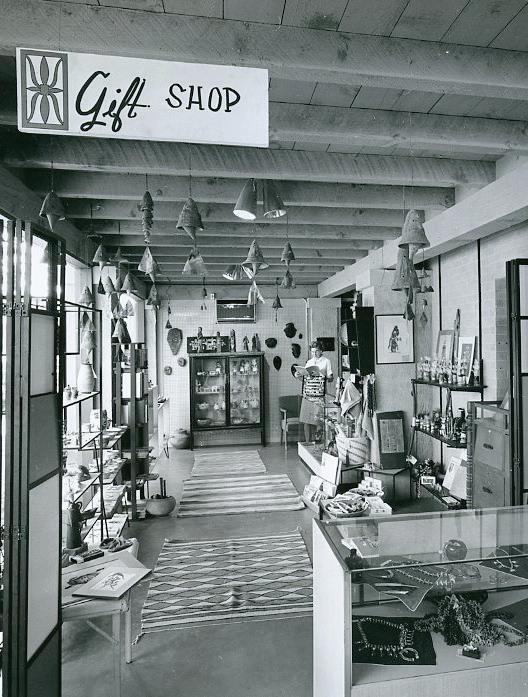
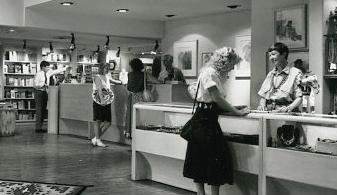
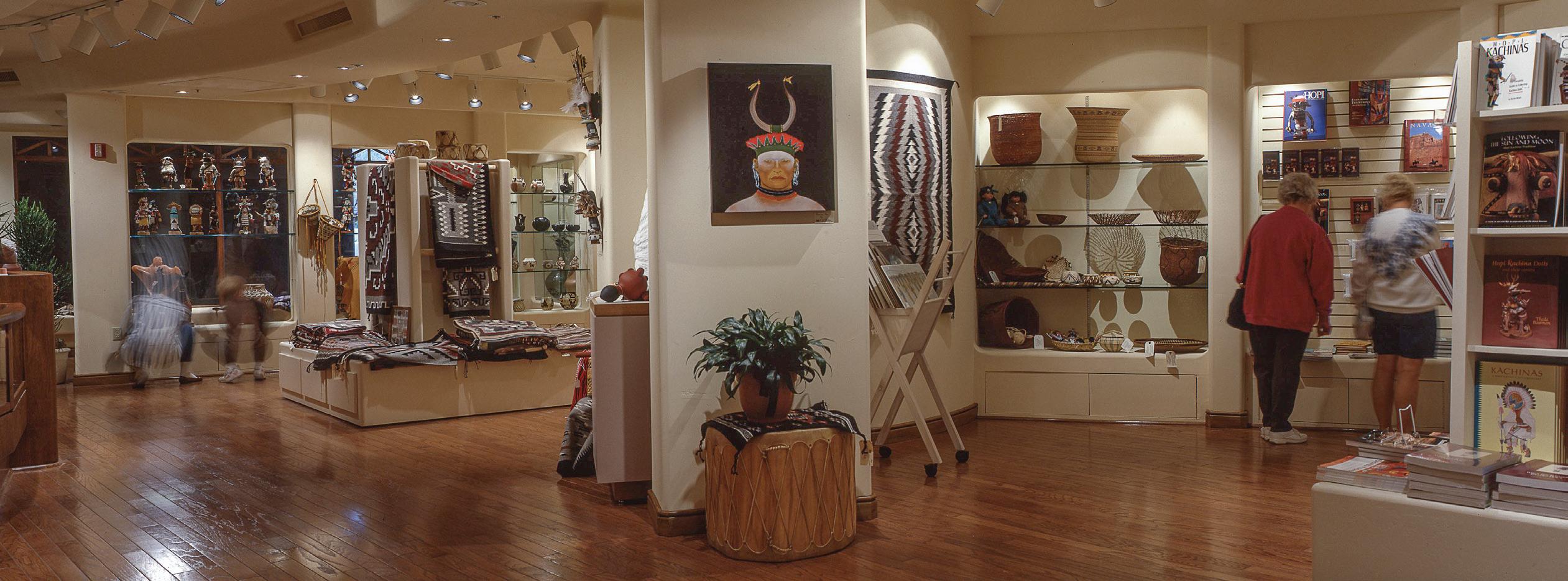
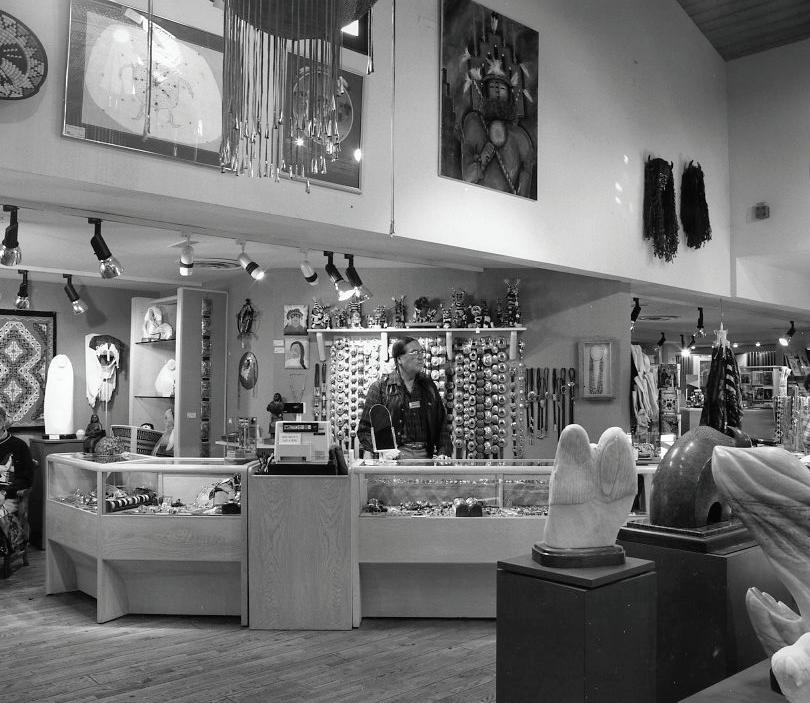
The 1960 Gift Shop’s “glamorous new setting” in the solarium is shown in this photograph, which was taken facing west. The eclectic nature of the inventory is reflected in the Paolo Soleri windbells hanging from the ceiling, a limited selection of Hopi katsina dolls on the shelves to the right, a Navajo squash blossom necklace in the jewelry case, and an African mask on the back wall.
A Very Good Idea: The Heard Museum Shop
and Bookstore
BY ANN MARSHALL | DIRECTOR OF RESEARCH
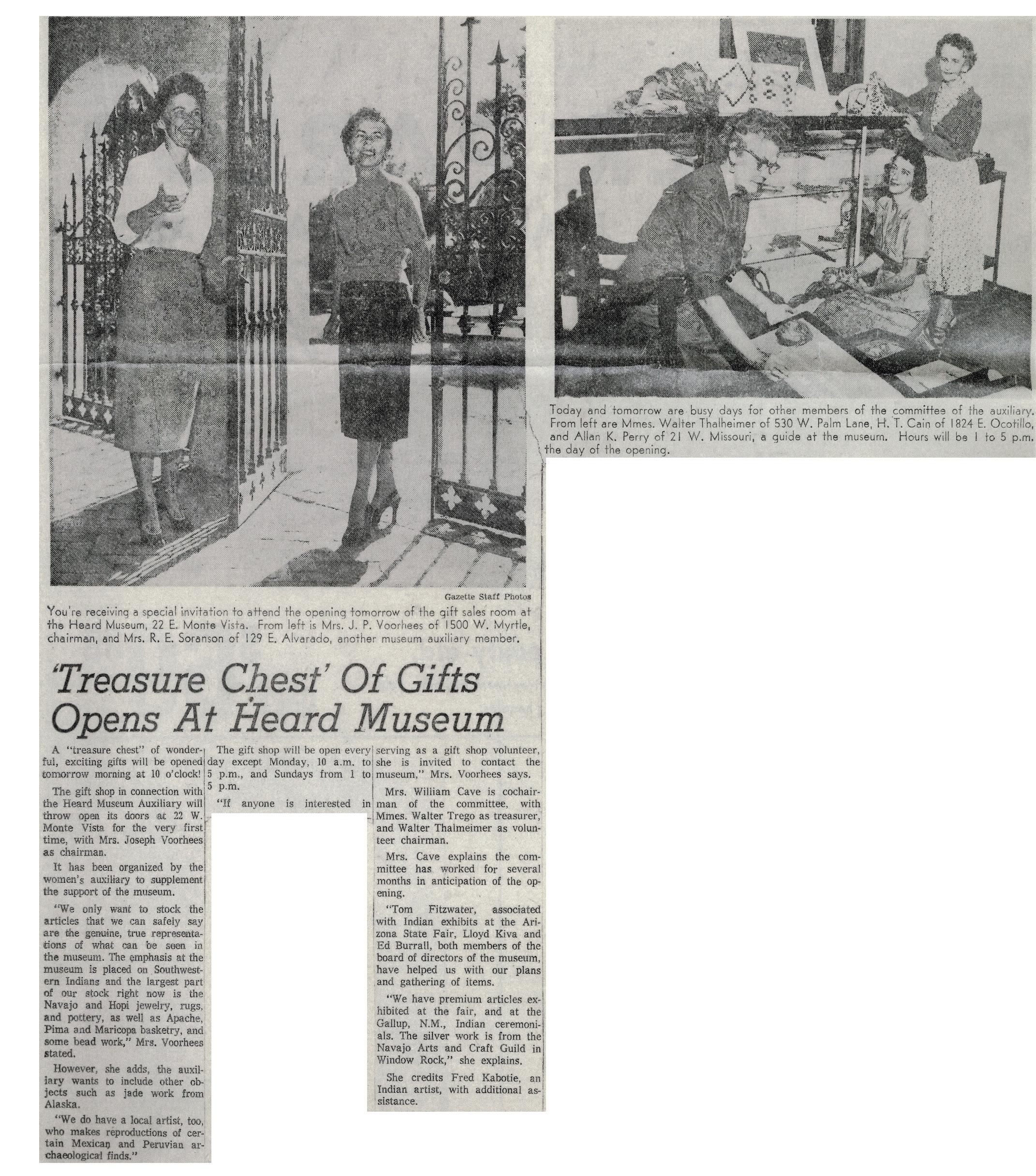
Of the many good ideas that the Heard Museum Guild has had, establishing a museum shop and bookstore is among the best. When a June 1958 Arizona Republic newspaper article described the Guild’s plans for “a sales room,” it sounded very much like a basic museum store, selling “pamphlets, books, souvenirs, and reproductions of museum articles.”
Perhaps the reporter could be forgiven for a rather inaccurate description, since the article was written approximately six months prior to the shop’s opening on Saturday, Nov. 15, 1958. What was being planned was distinctly different from the average museum store, charting a course that has continued throughout 63 years. The chair of the Guild shop committee, Mary Ann Voorhees, was quoted in a November Phoenix Gazette article as saying, “We only want to stock the articles that we can safely say are the genuine, true representations of what can be seen in the museum. The emphasis at the museum is placed on Southwestern Indians and the largest part of our stock right now is the Navajo and Hopi jewelry, rugs, and pottery, as well as Apache, Pima basketry, and some beadwork.” The reproductions mentioned in the early article did exist in one respect, as Voorhees referenced an unnamed local artist who created reproductions of certain Mexican and Peruvian archaeological finds. The store was open every day except Monday from 10 a.m. to 5 p.m. and Sundays from 1 to 5 p.m. The museum was closed during the summer, from the end of May through September.
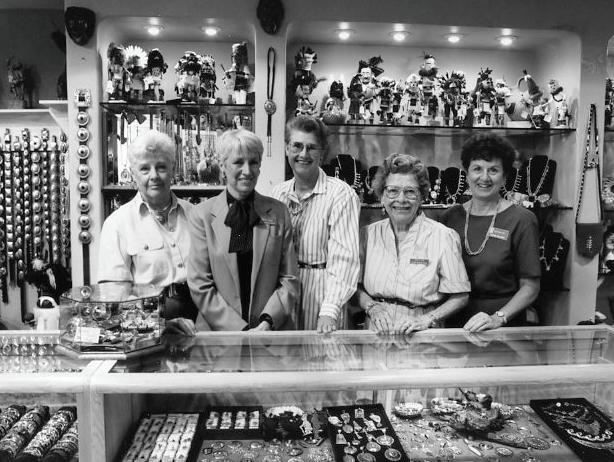
Guild volunteer Louise Rydel shows an eagle katsina doll carving to fellow Shop volunteers.
Funds to stock the store were granted by the museum’s board of trustees at the recommendation of Lloyd Kiva New. New, chair of the board program committee, moved to allocate $2,000 to stock the “sales room” at the Sept. 18 meeting of the board, and the motion passed unanimously. An artist, fashion designer and educator, New was the first American Indian member of the Heard Museum Board of Trustees. He had joined the board in 1952, and his designer fashion boutique in Scottsdale’s Craftsman Court made him keenly aware of a museum store’s potential. The approval was a huge vote of confidence in the Guild’s ability, given the very
limited funds with which the museum operated. Those helping to gather the shop inventory included New and Tom Fitzwater, who was associated with Indian exhibits at the Arizona State Fair. Voorhees said, “We have premium articles from exhibitors at the [state] fair, and at the Gallup, N.M. Indian ceremonial. The silver work is from the Navajo Arts and Craft Guild in Window Rock.” She also mentioned help received from Hopi artist Fred Kabotie, who was actively involved with developing and presenting Hopi arts.
The “Gift Shop,” as it was called then, probably opened in one of the original small galleries to the left of the museum entrance. The year 1958 was a time of growth for the museum. The addition of the West Gallery gave the museum a gallery for changing exhibitions. (For reference, in today’s space, the West Gallery was located across from the Gallery of Indian Art, now the Jacobson Gallery, which had not yet been built.)
Success came quickly. In January of 1959, a net profit of $500 was noted, with profits in each successive month. By September 1960, the Heard’s member newsletter announced that the “gift shop has moved and expanded” into “a glamourous new setting.” The shop and its contents had been moved from the front room on the west side to the solarium leading to the West Gallery, with new furnishings and decorations. Moreover, in 1961, profits from the shop, combined with earnings from the Heard Museum Guild Indian Fair, made it possible for the museum to be air-conditioned. The museum would no longer need to close for the entire summer.
Through all of this time, Voorhees had led the Guild’s shop committee, but in the October 1961 member newsletter it was announced that “Mrs. Ruth Dickenson, who previously has operated her own store in Scottsdale, is taking over management of the Gift Shop in the museum for the Guild.” Dickenson was a volunteer and was supported by eight Guild volunteer salespeople.
Dickenson enjoyed international travel. In an unsourced July 1962 clipping in the museum archives headlined “South American Buying Trip,” Dickenson characterized her management and buying for the Heard Gift Shop as a “true labor of love.” At the time, she was sailing from Los Angeles by Norwegian freighter to Panama, where she would purchase Kuna molas (traditional handmade textiles), before flying on to Peru for further purchasing of folk crafts. A trip to Thailand brought temple bells and teak wood elephants to the museum. For a time, a diverse inventory of lower-priced items seemed to increase.
Growth and change came every year for the shop. By May 1962, the Guild was able to repay the $2,000 investment from the museum’s operating fund.
In 1963, the Guild board voted to change the name of the Gift Shop to the “Heard Museum Shop.” The shop expanded into the original museum galleries that today house hands-on activities and the Harnett Theater. Although books were not mentioned in the new name, books, maps and pamphlets were an important part of the shop’s inventory. In 1965, the museum published a brochure exclusively featuring the books available in the shop. From the beginning, support for the museum’s educational mission was key.
In January 1966, the Guild reported to the board that the shop was outgrowing part-time volunteer management and needed paid management. The urgency of that need was alleviated for short time, as in June 1968, the museum closed to accommodate construction of a major three-story expansion on its east side and on the west side a second changing gallery, now the Jacobson Gallery, designed by Arizona architect Bennie Gonzales. The expansion was precipitated by the 1964 gift by Senator Barry M. Goldwater of his katsina doll collection.
Following the museum’s March 31, 1969, reopening, Lovena Ohl was hired as the manager and buyer for the shop. Ohl’s extensive knowledge of American Indian art and artists launched the shop from what had been characterized as a souvenir shop into what Sunset magazine called one of the finest museum shops in the country. Ohl brought the focus back to Native artists of the Southwest and bought art with a wide range of price points, some many times higher than what had been purchased previously. But her extensive contacts with collectors and knowledge of leading artists meant that important sales took place. A 1974 newspaper article referenced Ohl as being at the “center of all the excitement generated by the current interest in Southwest Indian arts” and cited Ohl’s dedication based in a desire to help the museum, the artist and the buyer. She worked closely with the best artists, including Fred Kabotie and Charles Loloma. At the time of Ohl’s death in 1994, Loloma’s niece, jeweler Verma Nequatewa, said, “Lovena was the one who helped my uncle with his career. She put on a one-man show for him at the Heard Museum. She always said that ‘Charles was my best teacher.’” Ohl left the museum in 1977 to manage the Lovena Ohl Gallery in Scottsdale. In 1978, she established the Lovena Ohl Foundation, and contributions from the Foundation to the Heard are recognized in the gallery named for her.
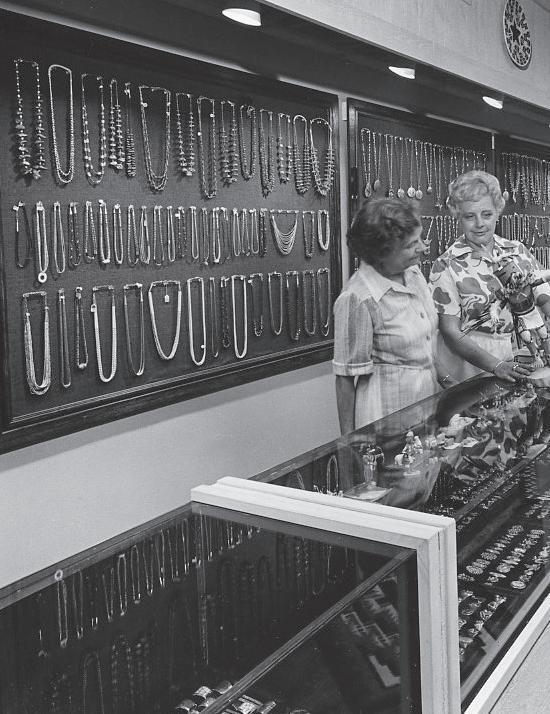
During Ohl’s nine-year tenure, the museum shop expanded to include all the original galleries along the museum’s west side, including a space dedicated to books and notecards. In Ohl’s first year, profits from the shop rose from an estimated $10,000 to $22,000. The Guild yielded its meeting room to become a workroom and office for Ohl where she could meet with important, and sometimes celebrity, collectors. In February 1974, the Guild transferred responsibility for the shop to the
The 1984 expansion of the Heard Museum Shop offered the opportunity to show a much wider variety of arts, including more publications, paintings and sculptures.
museum and the museum director. The Guild would continue in an advisory capacity, and monies were to be processed by the Guild. Guild members continued to serve as the sales staff for the shop and bookstore.
Following Ohl’s departure in 1977 to establish her Scottsdale gallery, Byron Hunter Jr. was hired to manage the shop. Coming from a family of traders, Hunter had managed trading posts on the Navajo Nation and at First Mesa on the Hopi reservation before opening Hunter’s Trading Post on Camelback Road in Phoenix in 1970. With lifelong connections to many artists, Hunter was uniquely qualified to lead the shop into the 1980s. Hunter remarked to Arizona Republic writer Linda Helser that “Several of the families I trade with now, my father traded with back in the ’40s, and this becomes a place to display their things.” His extensive experience working with Hopi katsina doll carvers made it possible to greatly expand offerings of the figures. He also widened the price range of art to
make the shop inventory affordable to more museum visitors and beginning collectors. Hunter was buying and managing the shop during a period of considerable change, as collectors from Europe and Asia became interested in American Indian arts. He told Helser that the museum was seeing more German, English and Japanese visitors who were new collectors, and he stressed the importance of the education that the shop offered these collectors, along with a deserved reputation for authenticity. The education was badly needed, as fraudulent dealers and traffic in fakes grew with the popularity of American Indian art forms.
When the museum expanded in 1983-84, the shop was relocated to the southeast corner of the museum with a separate entrance for those not visiting the museum. Under Hunter’s leadership the shop experienced several firsts: its first members-only sale in 1985, and in 1989 its first printed catalogue. In 1994, the name of the shop formally became “The Heard Museum Shop and Bookstore.” The expanded space had offered the opportunity to present more publications and recorded music.
In the fall of 1997, after 20 years leading the Shop and Bookstore, Hunter retired. Bruce McGee was hired in 1998 as the new manager. McGee had a background very similar to that of Hunter, including experience with family trading posts. He had grown up at Hopi, where
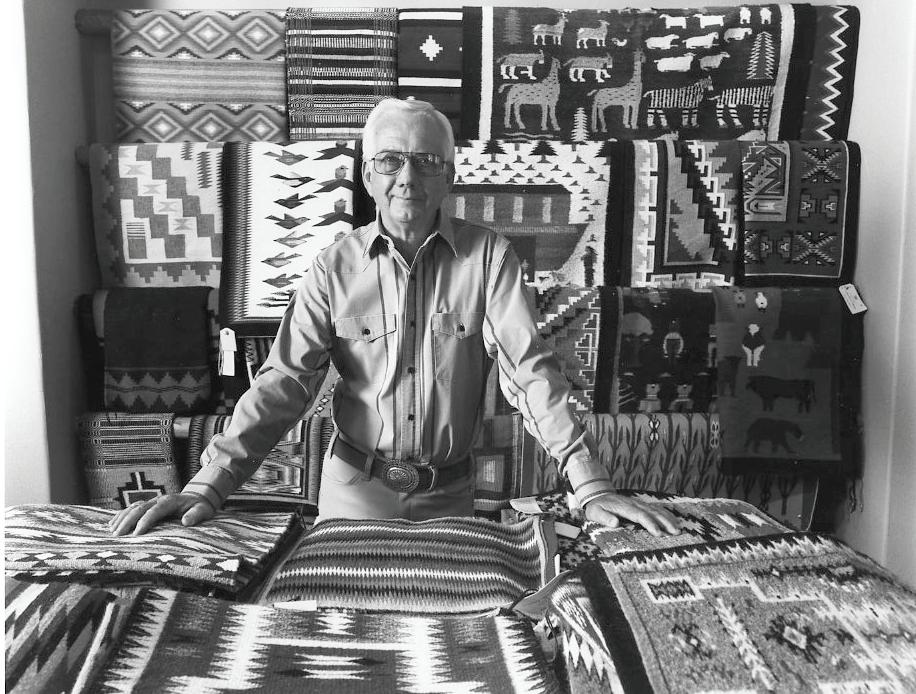
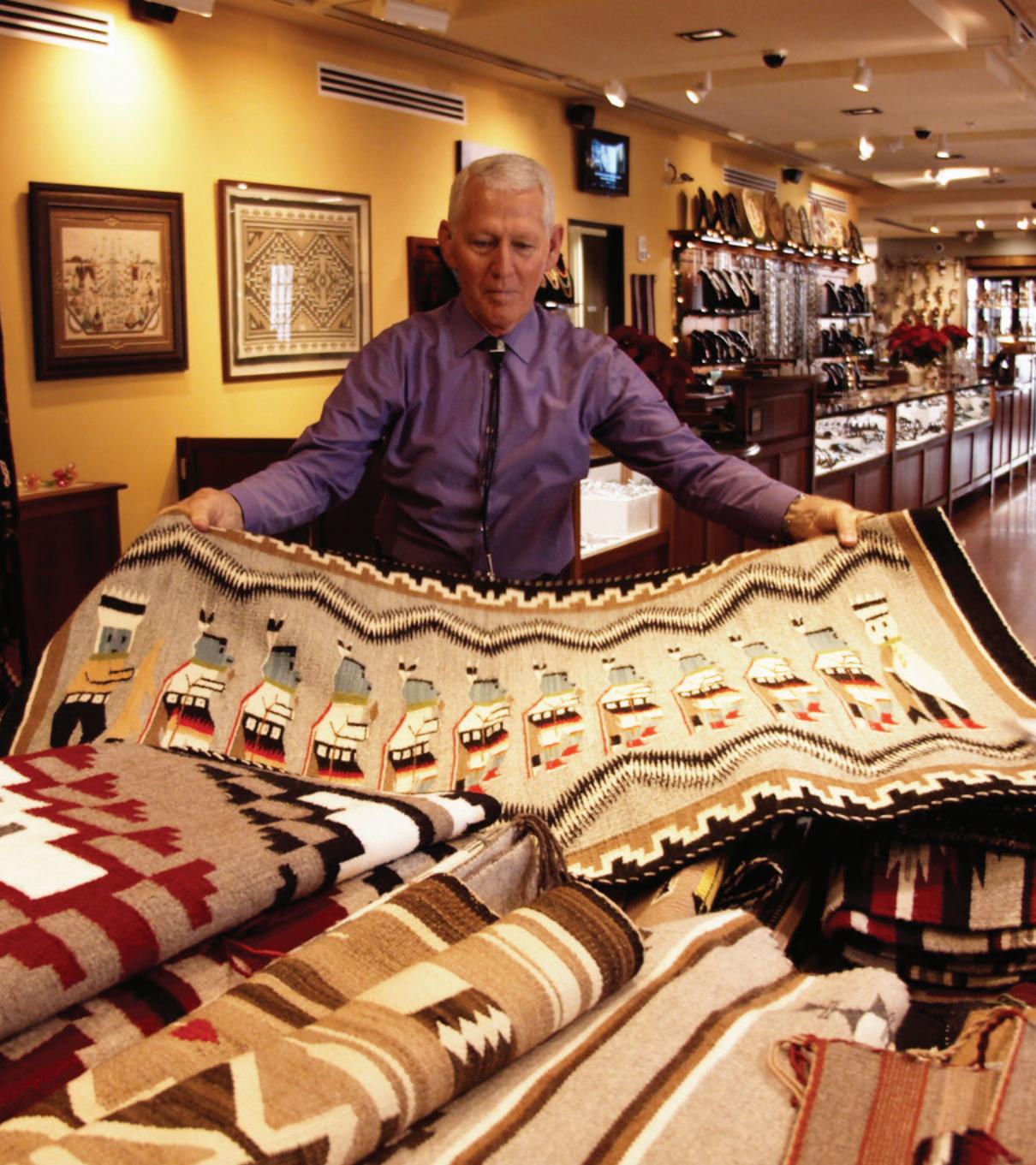
Shop manager Byron Hunter Jr. is shown with the Shop’s impressive inventory of Navajo textiles. The textile in the upper right was probably woven by Sadie Begay and is from a Noah’s Ark theme she was exploring in 1991 and 1992.
his father had owned the Keams Canyon Trading Post for nearly 61 years. As a third-generation arts trader, McGee began his career in 1967 at his family’s post in Piñon, Arizona. At the Heard, McGee continued the tradition of working with artists who were longtime friends. Noting McGee’s knowledge, Heard Museum Director Martin Sullivan remarked in 1999 that “McGee is able to recognize the masters and those in the making.”
During McGee’s tenure, which continues today as director of retail sales, many changes have taken place that provided opportunities to better present the full
range of American Indian art. With the museum expansion in 1999, the shop moved into its present location, with Books & More across the central courtyard. By 2001, the shop had an online presence. A further expansion in the summer of 2006 added 2,400 square feet of space to create the Berlin Gallery, recognizing longtime Heard supporters Howard and Joy Berlin. The gallery was created to focus attention on fine arts by recognized and developing artists. Writing about the Berlin Gallery, Heard Museum Director Frank H. Goodyear Jr. noted that of the 17 artists represented in the Gallery, 15 were in the museum’s permanent collection. Goodyear’s comment highlighted a longstanding fact and unique feature of the Shop, that the quality of art in the Shop was such that, over the years, major pieces from the Shop had been acquired for the museum collection—a circumstance that definitely does not occur in the standard museum shop.
A further revision to the mission of the gallery in 2015 created the Collector’s Room with the full range of arts presented and the entire sales operation renamed the Howard R. and Joy M. Berlin Shop and Bookstore. Today, a knowledgeable staff joins McGee in running every aspect of the shop, welcoming and encouraging artists, and educating visitors and collectors. After 63 years, Heard Museum Guild volunteers remain an important part of the shop, offering a welcoming presence and informed advice to visitors. Made possible by countless hours of volunteer service, the shop remains one of the very best ideas the Guild ever had.
past
Heard Shop Fosters Artist Careers
BY DIANA F. PARDUE | CHIEF CURATOR
The Heard Museum Shop has a long history of working with Native American artists at the onset of their careers. The first full-time staff member who fostered artist careers was Lovena Ohl. In the nine years that she managed the shop, from 1969 to 1977, Ohl worked with artists who were reaching the heights of their careers and others who were emerging.
Charles Loloma, 1971.
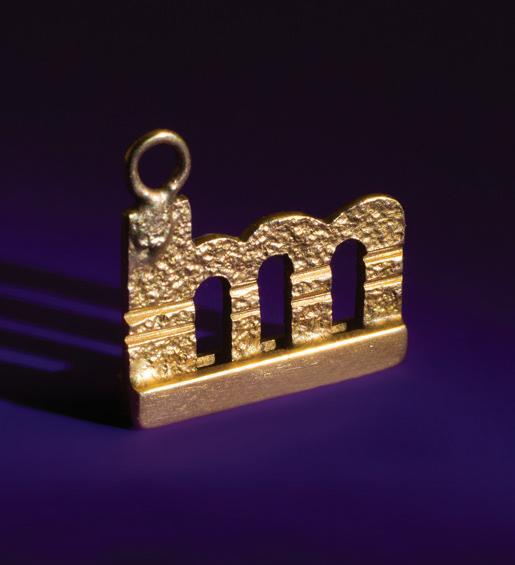
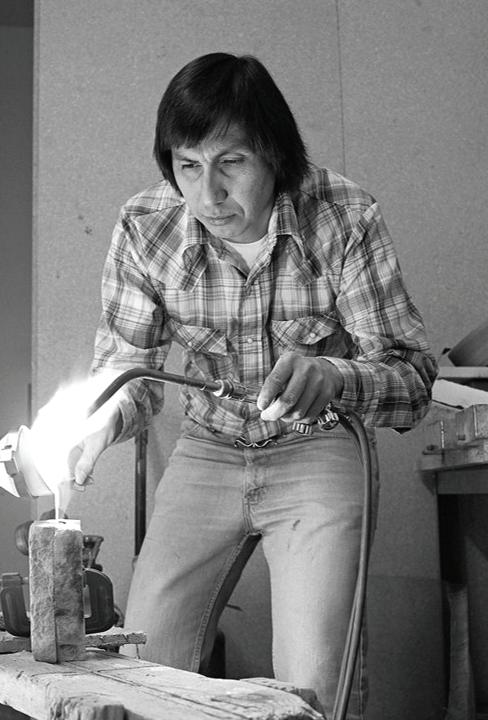
One of the leading jewelers with whom Ohl built a lifelong friendship and business relationship was Charles Loloma (Hopi, 19211991). Known as a leader in contemporary jewelry, Loloma was just beginning to make and sell jewelry at the Kiva Craft Center in Scottsdale when he was present at the first Heard Museum Fair in 1959. Although he was known primarily for his ceramics at the time, Loloma was featured in a news article with a tufa mold— volcanic stone that could be carved to form molten silver or gold—to promote the Fair. Ohl sold Loloma’s jewelry in the Heard Shop and was instrumental in his first exhibition at the Heard in December 1971. This was the first major museum exhibition to feature Charles Loloma’s jewelry. As was typical of the other exhibitions produced by the Heard, this was a sales exhibition. In 1978, the Heard hosted a retrospective exhibition and accompanying catalogue for Loloma in conjunction with the museum’s 50th anniversary celebrations. Loloma created a small 18K gold pendant in the shape of the Heard Museum logo to recognize the honorees of the 50th anniversary gala event.
One of the artists who started his career at the Heard Shop with Lovena Ohl was Larry Golsh (Pala Mission, b. 1942). Although Golsh grew up on the Pala Indian Reservation in California, his parents met at the Phoenix Indian School, where his grandmother worked. Golsh’s parents were friends with Lloyd Kiva New, who at the time was an instructor at the school. Golsh studied architecture at Arizona State University and took art classes, including sculpture as well. In 1960, during his freshman year at ASU, Golsh had a part-time job at the Kiva Craft Center in Scottsdale helping Manfred Susunkewa (Hopi, b. 1940) make silkscreens and print fabrics for the shop. Golsh worked at the Craft Center for two years.
Susunkewa had a jewelry bench in the studio at the Kiva Craft Center and had shown Golsh some basic silversmithing techniques. Fortuitously, Golsh met Charles Loloma one day at the Center, and Loloma extended an invitation to Golsh to visit him at his studio at Hotevilla. During the visit, Loloma showed Golsh tufa-stone casting techniques. Golsh experimented with casting using a variety of surfaces including cuttlefish bone casting, was shown lost-wax casting by Loloma, and perfected his skills.
Golsh entered jewelry in the 1974 Heard Museum Art and Crafts Exhibition and received several awards. During this time, he met Lovena Ohl, who requested some jewelry to sell in the museum shop. According to Golsh, when he indicated that he did not have any works, she suggested that he go home and make something for the shop. Golsh was at the onset of a career that would continue for more than 40 years.
Charles Loloma (Hopi), 1921-1991. Pendant of Heard Museum logo, 1979, 18K gold, 3/4 x 13/16 inches, Gift of Mareen Allen Nichols, 4033-240
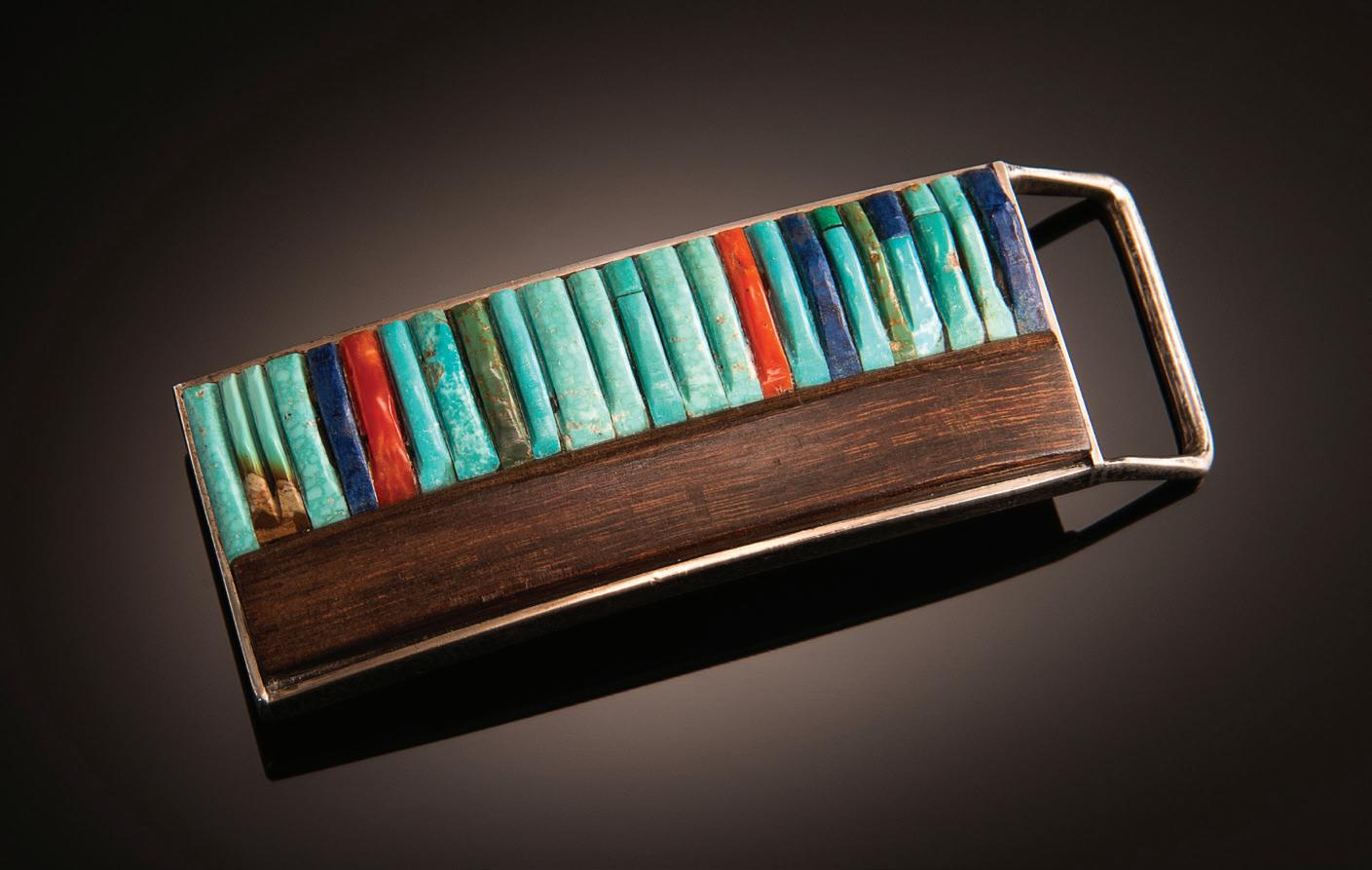
Charles Loloma (Hopi), 1921-1991. Buckle, 1970-1971, Ironwood, lapis lazuli, turquoise, coral, silver, 1 1/8 x 3 5/8 inches. Gift of Mareen Allen Nichols, 4033-200
Larry Golsh, 1979. Photograph by Jerry Jacka.
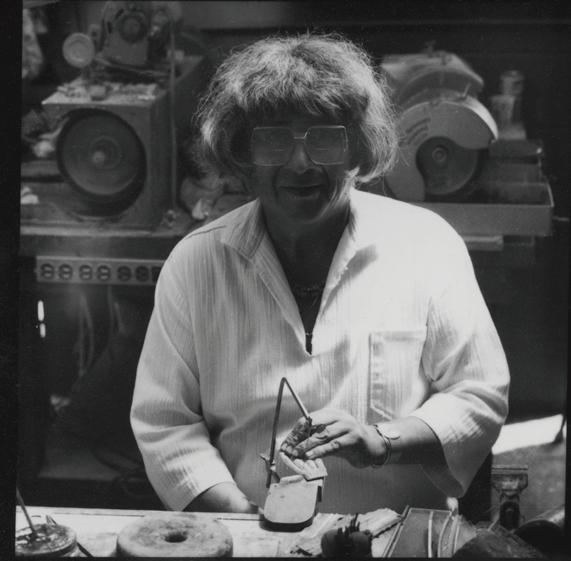
Charles Loloma at his studio in 1978. Photograph by Glen Short.
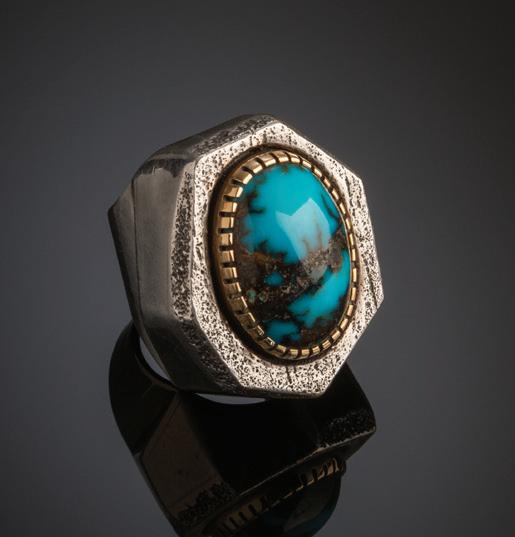
Larry Golsh (Pala Mission), b. 1942, Ring, 1975, turquoise, silver, 14K gold, 1 x 1 1/4 inches.Bequest of Edward Jacobson, 4411-31
Jesse Monongye (Navajo, b. 1952) learned to make jewelry by watching his father, Preston. Monongye lived with his father and apprenticed with him for two years, from 1975 to 1977. During this time, Monongye was aware of the work of other accomplished jewelers, such as Charles Loloma and Lee Yazzie (Navajo, b. 1946). Monongye became skilled in metalsmithing but equally proficient with cutting, shaping and inlaying stones and shells to form intricate patterns.
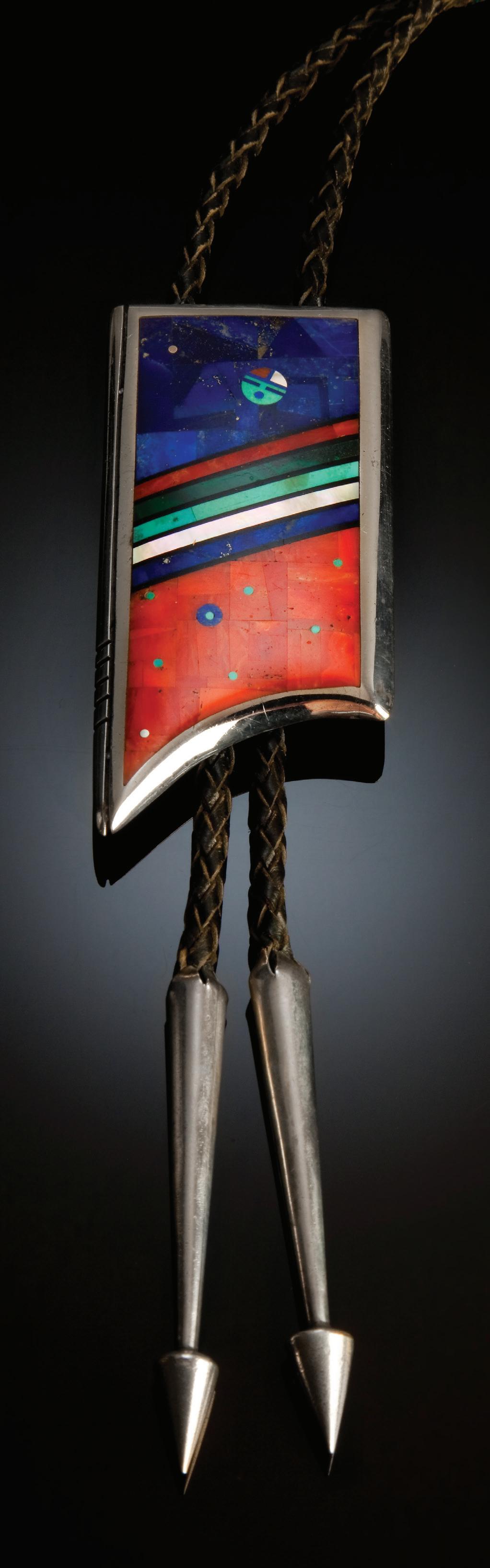
Monongye was one of several artists-in-residence at the Heard in the early 1980s. It was during this time that he began selling his jewelry to the Heard Shop through shop manager Byron Hunter. One of the designs which Monongye developed at the time featured the night sky. As a child growing up in Northern Arizona, Monongye was mesmerized by the solar system. The Big Dipper, the harvest moon and comets would all find their way into his jewelry designs. Monongye used opals to represent the moons and comets in a deep black sky made of jet or blue of lapis lazuli. Coral and turquoise filled the sky and formalized Monongye’s imagination and memories of his childhood.
Monongye was a frequent presence in the Heard Shop. He also worked on jewelry mounts for an extensive display in the Heard’s groundbreaking exhibition Native Peoples of the Southwest, which opened in 1984. Monongye sold his jewelry through the Heard Shop for about four years and then began to work more exclusively with the Margaret Kilgore Gallery.
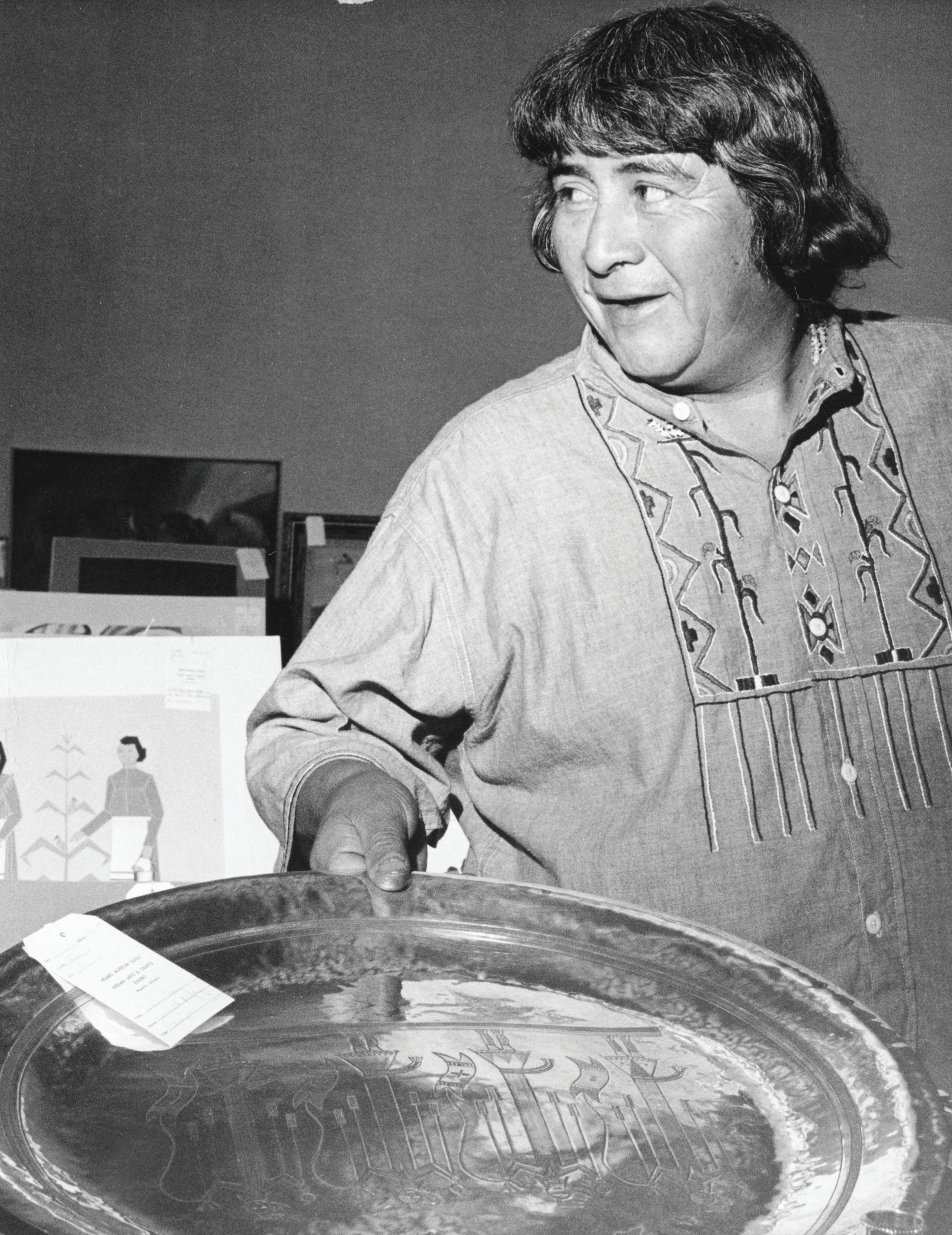
Jesse Monongye, early 1980s.
Jesse Monongye (Navajo), b. 1952, Bolo tie, 1981-1984, Lapis lazuli, turquoise, malachite, coral, jet, gold-lip mother-of-pearl, silver, 19 1/2 inches length. Gift of Barbara Haas in memory of Alvin Haas, 3662-1
In 1996, Byron Hunter met a young jeweler who came to the Heard Shop to interest the shop in buying her jewelry. Shawn Bluejacket (Shawnee, b. 1962) spent her childhood in Auckland, New Zealand, where her father worked as a geologist. She studied fashion design at the Brooks College of Design in Long Beach, California, from 1984 to 1986. She also studied with Lane Coulter from 1989 to 1990 and Duane Maktima from 1991 to 1992 at the Institute of American Indian Arts in Santa Fe.
Bluejacket emphasizes both the metal and the stones in her jewelry creations. Her use of exotic stones may in part derive from her father’s work and interest in stones. For Bluejacket, the metal is also important. She creates hollow-form, constructed sculptural jewelry. Her lapidary skills allow her to shape the stones to fit her metalwork designs. She uses etching to texture the metal surfaces.
Once Bluejacket began selling her jewelry to the Heard Shop, the pieces sold quickly. Heard staff members became steady customers, in addition to a growing group of collectors, and Bluejacket was a frequent participant in the annual Heard Museum Guild Indian Fair & Market.
The Heard Shop staff members have developed important relationships and friendships with artists. This is just a glimpse of a few partnerships that have endured through the years.
Phoenix, in the early years of its history, was home to a variety of shops that sold American Indian arts. Within a few years following the city’s incorporation in 1891, Native arts shops were competing for the favor of visitors to and residents of the growing community. Some shops lasted only a few short years, while others remained for decades.
The first businesses that sold Native arts also specialized in various household items. One of the earliest mentions of Native art sales is in an 1896 advertisement placed in the Phoenix Daily Herald by Phoenix Stationery and News. The ad lists Indian baskets and Navajo blankets for sale. A similar business begun by J.W. Benham and his business partners W.C. Barnes and Paul Brizard in about 1895 sold wood and coal in one part of the building and Native arts in the adjoining room. The business, located at 147 W. Jefferson, held a sign on one side for Phoenix Wood & Coal Co., and on the other side the sign was for The Curio. “Curio” was a term generally associated with Indian arts. A photograph of the business shows Southwestern baskets spilling out of the door and along the front of the building while Navajo blankets hang on the side walls of the shop. By 1900, Barnes left the business and Benham and Brizard had constructed a more permanent structure exclusively for The Curio. Maie Bartlett Heard purchased some items from Benham’s shop. Benham, his Phoenix shop, his shops in Albuquerque and Los Angeles, and his other business ventures were extensively detailed by historian Kathleen Howard in her 1999 master’s thesis for Arizona State University titled Curio Entrepreneurs and the Selling of the Southwest, 1890-1940, a copy of which is available in the Heard Museum Library.
Several businesses followed, and some of longer duration will be mentioned here. In 1891, R.L. Balke operated
a portrait studio in Phoenix. Within a few years, the city directory noted that he was also selling Native arts. Through the years, Balke’s business relocated several times. By 1903, it was located at 35 E. Washington and was listed in the city directory under “curio.” Balke eventually called his shop “The Big Curio.” It was located at First Avenue and Monroe when it was sold to Reese Vaughn in 1919. Vaughn owned and operated the shop into the 1930s, again relocating several times. By the time the Heard Museum opened in 1929, Vaughn’s shop was located at 25-27 N. Central. Vaughn hired Native people—primarily silversmiths—to demonstrate the making of various arts. The silversmiths made jewelry and other metal items from Mexican silver coins. The sound of hammers as the silversmiths shaped their works was a common occurrence. Two highly regarded silversmiths who demonstrated jewelry-making at Vaughn’s were Morris Robinson (Hopi, 1900-1987) and Fred Peshlakai (Navajo, 1896-1973). Several purchase receipts for Maie Heard from Vaughn’s in the 1920s-30s remain in the museum’s collection files today. Unfortunately, the notations of items purchased are very general, making it difficult to associate the listings with specific items in the museum’s collection.
Another businessman, Edward L. Graves, purchased the Underhill home in Scottsdale between 1900 and 1910. He turned the property into Graves Guest Ranch, a spot for vacationers and for tuberculosis patients, and
established a trading post as well. In 1912 or 1913, Graves opened a Native arts shop in Phoenix at 7 E. Adams. It was reported in the June 1914 newspaper Arizona that “E. L. Graves gets 90 percent of all the Apache baskets made at Fort McDowell. … and he has established the friendliest relations with the Navajos of Northern Arizona, where he goes frequently to buy the blankets made famous by Elle of Ganado and other celebrated weavers.” Maie Heard’s purchase receipts in the museum’s collections files note purchases from Graves Indian Shop as early as December 1922, and the receipts continue through 1929. Mrs. Heard mainly purchased Navajo textiles and Southwestern baskets, buying jewelry and pottery to a lesser degree. Like other Native arts businesses, Graves changed his shop location several times. By 1923, the address was 8 W. Washington, and by December of 1926, the address was 16-18 N. Central. By December 1929, Glen Skiles began signing letters on Graves Indian Shop stationery. Graves sold his shop to Skiles sometime between 1929 and 1931, and by 1931 the business was renamed Glen Skiles Indian Craft. That same year, Maie Heard purchased four katsina doll carvings for the Heard Museum. By 1933, Skiles had expanded his business with shop locations at the Arizona Biltmore, the Westward Ho and the San Marcos Hotel in Chandler, as well as a shop in Hot Springs, Arizona. Skiles passed away unexpectedly in 1937. His obituary noted: “Entering the Indian crafts business soon after coming to Arizona [in 1922], Skiles became known as one of the leaders in the field.”
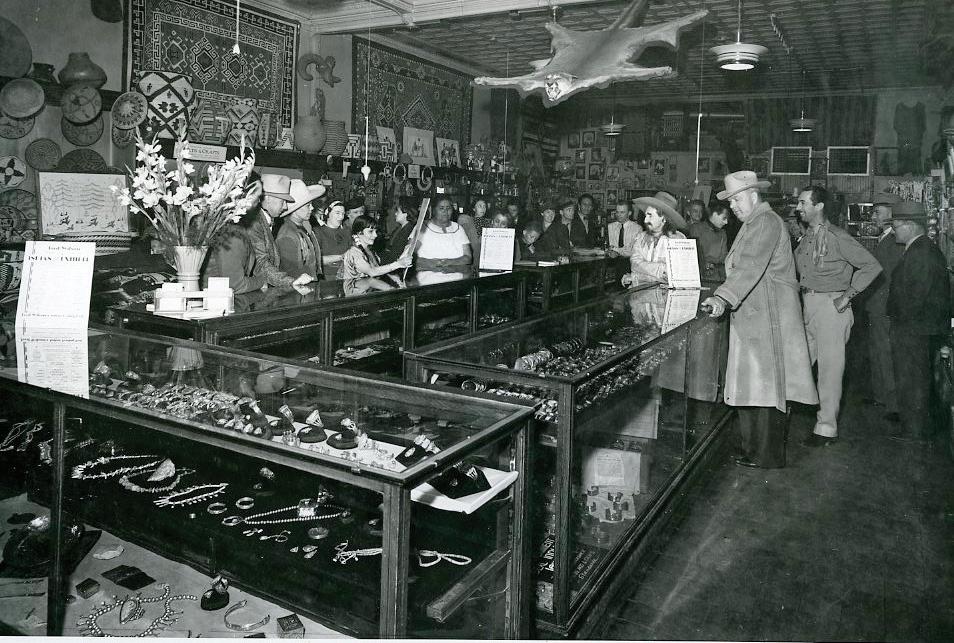
In 1936, Reese Vaughn sold his shop, Vaughn’s Indian Trading Post, to Fred Wilson. Wilson was active in the community and had organized the Arizona display for the 1933 Chicago World’s Fair, the Century of Progress. The display primarily featured Native arts, which were also sold by Wilson at the fair. After Wilson purchased Vaughn’s shop, photographs of the shop interior reveal a dense display of Native items including Navajo textiles and Southwestern pottery, baskets and jewelry, as well as Native American paintings. The photographs also show Taos Pueblo artist Pop Chalee (a.k.a. Merina Lujan, 1906-1993) in the shop holding her paintings with customers nearby and her paintings displayed in clear view. One well-known pottery maker who appears in other photographs of Wilson’s shop is Ida Redbird (Maricopa, 1892-1971). Wilson also arranged for Redbird to demonstrate pottery-making at the Heard. In 1952, Wilson’s collection of Native American paintings was exhibited at the Heard. This was the first fine-art show of its kind at the museum. In 1956, Wilson sold his shop on Central Avenue and retired from Indian art sales within a few years. Wilson’s family members Joan Palmer Wilson Haas, Ruth Sharon Wilson and Wendy Wilson Bauer donated his papers, which include numerous photographs, to the Heard in recognition of the museum’s 75th anniversary.
The early Phoenix shops illustrate the strong interest in Native arts. Through various photographs, it is possible to see the great variety and high quality of works that were sold, as well as some of the artists who were associated with the proprietors of these shops.
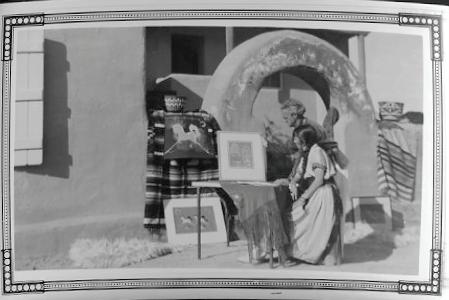
Pop Chalee holds one of her paintings and talks to customers in Fred Wilson’s Shop, n.d. Another painting by Pop Chalee can be seen on the left near the basket display. Fred E. Wilson Collection, Billie Jane Baguley Library and Archives, RC245(2.4)52.
Right: Pop Chalee and Fred Wilson, 1941. Fred E. Wilson Collection, Billie Jane Baguley Library and Archives, RC245(6)71.
Lovena's Legacy
First Manager of the Museum Shop (1969-1977)
BY ANN MARSHALL | DIRECTOR OF RESEARCH
In the nine years that Lovena Ohl was the first salaried manager and buyer of the Heard Museum Shop and Bookstore, from 1969 to 1977, she elevated The Shop to the prestigious level it enjoys today. She knew and encouraged the leading American Indian artists of the period, advanced their careers, and maintained a network of collectors who valued her knowledge and integrity. Her achievements are even more remarkable considering her beginnings. Ohl was born on a northern Pennsylvania farm in 1908. Following college graduation, she taught school for a time. Widowed in 1943, after only 10 years
of marriage, she became the first woman sales agent for Prudential Life Insurance, later establishing her own insurance agency. In 1948, her 10-year-old nephew, William Faust II, was suffering from life-threatening asthma that required him to live in a more healthful climate. Ohl moved with the young man to Phoenix, where for 15 years she sold Native American art at Clay Smith’s Fine Arts & Indian Jewelry store on Central Avenue near the San Carlos Hotel. Upon Smith’s death, Ohl worked for jeweler Pierre Touraine and later established her own shop, Jewels by Ohl.
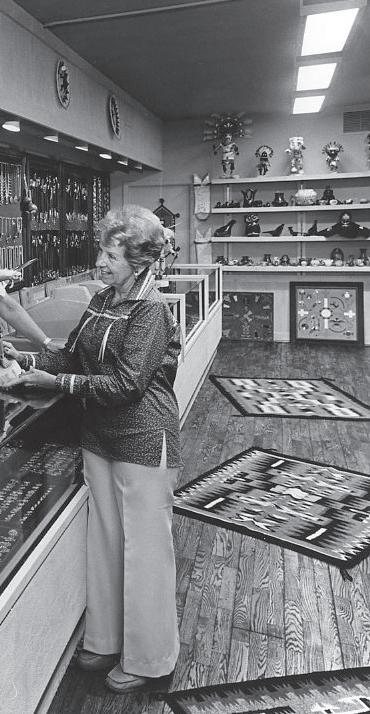
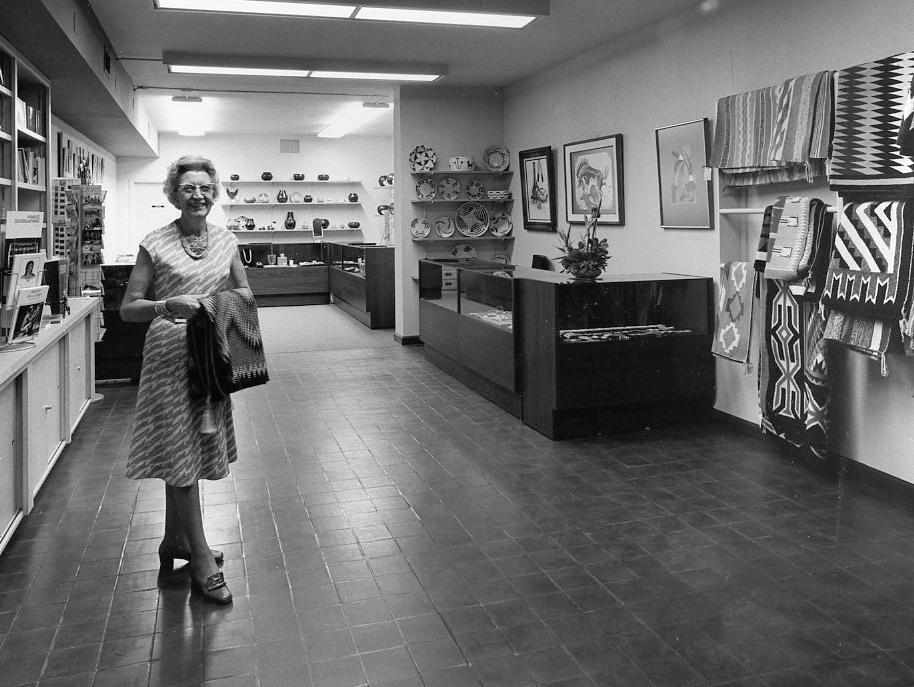
Above: Lovena Ohl in the newly redecorated Shop, August 1975. In addition to note cards and publications, the art for sale reflects Ohl’s
LOVENA
ALWAYS KNEW WHO WAS COLLECTING WHAT AND WAS QUICK TO ALERT THE RIGHT PEOPLE TO HER FINDS.
As manager and buyer of the Heard Museum Shop, Ohl was instrumental in developing its reputation as a fine source of quality American Indian jewelry and artwork. Heard Trustee Edward Jacobson said, “Lovena always knew who was collecting what and was quick to alert the right people to her finds.” Jacobson noted Ohl’s knowledge of the museum collection’s needs and said she would skillfully maneuver collectors to first acquire artwork and later donate it to the museum. Ohl’s friendships included artist/educator Al Momaday and his son, Pulitzer Prize–winning poet and artist N. Scott Momaday. Scott Momaday praised Ohl in a 1992 Phoenix Home
& Garden magazine article written by Lila Harnett for “her knowledge, her discriminating taste, her appreciation of Indigenous art forms, and her singular dedication to the efforts of Native artists.”
Upon leaving the Heard in 1977, Ohl managed the Lovena Ohl Gallery in Scottsdale for 27 years. In 1978, she established The Lovena Ohl Foundation to fund cash awards to selected American Indian artists to encourage their study and efforts to improve their work.
In 1987, Forbes magazine named her “the doyenne of Southwest Indian art,” recognizing her gallery and The Heard Shop as the primary sources of the best Indian jewelry. Even after leaving the Heard, she brought recognition for quality and integrity to the museum.
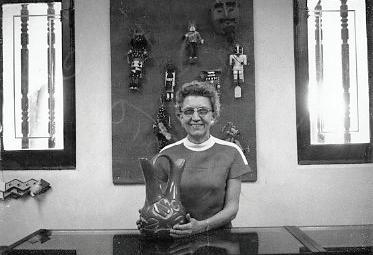
Above: Lovena Ohl, hired as Shop manager in the summer of 1969, poses in front of a selection of Hopi katsina dolls while holding a Santa Clara Pueblo carved redware wedding vase. As part of the museum’s 1969 expansion, the Shop was relocated to the former west-side galleries of the original building. The windows open onto the south courtyard.
the shop issue: present
The Dynamics of the Shop Leadership
BY ERIN JOYCE | FINE ARTS CURATOR
THE MOST EXCITING ASPECT OF MY WORK AT THE MUSEUM IS ONE OF JOY. I WAKE UP IN THE MORNINGS AND LOOK FORWARD TO SEEING THE ART THAT IS BEING CREATED AND SHARING A RELATIONSHIP WITH THE ARTISTS.
The museum as an entity is a complex network of departments, programs, projects, and most important, people. From curatorial and exhibitions, to programming, development, and operations, the landscape and variety of work that needs to be done in order to sustain an institution is vast. The Heard Museum’s Howard and Joy Berlin Shop is no exception; a vital entity at the museum, the Shop creates opportunities for artists, connects patrons with works they will treasure, and serves as an integral revenue engine for the institution.
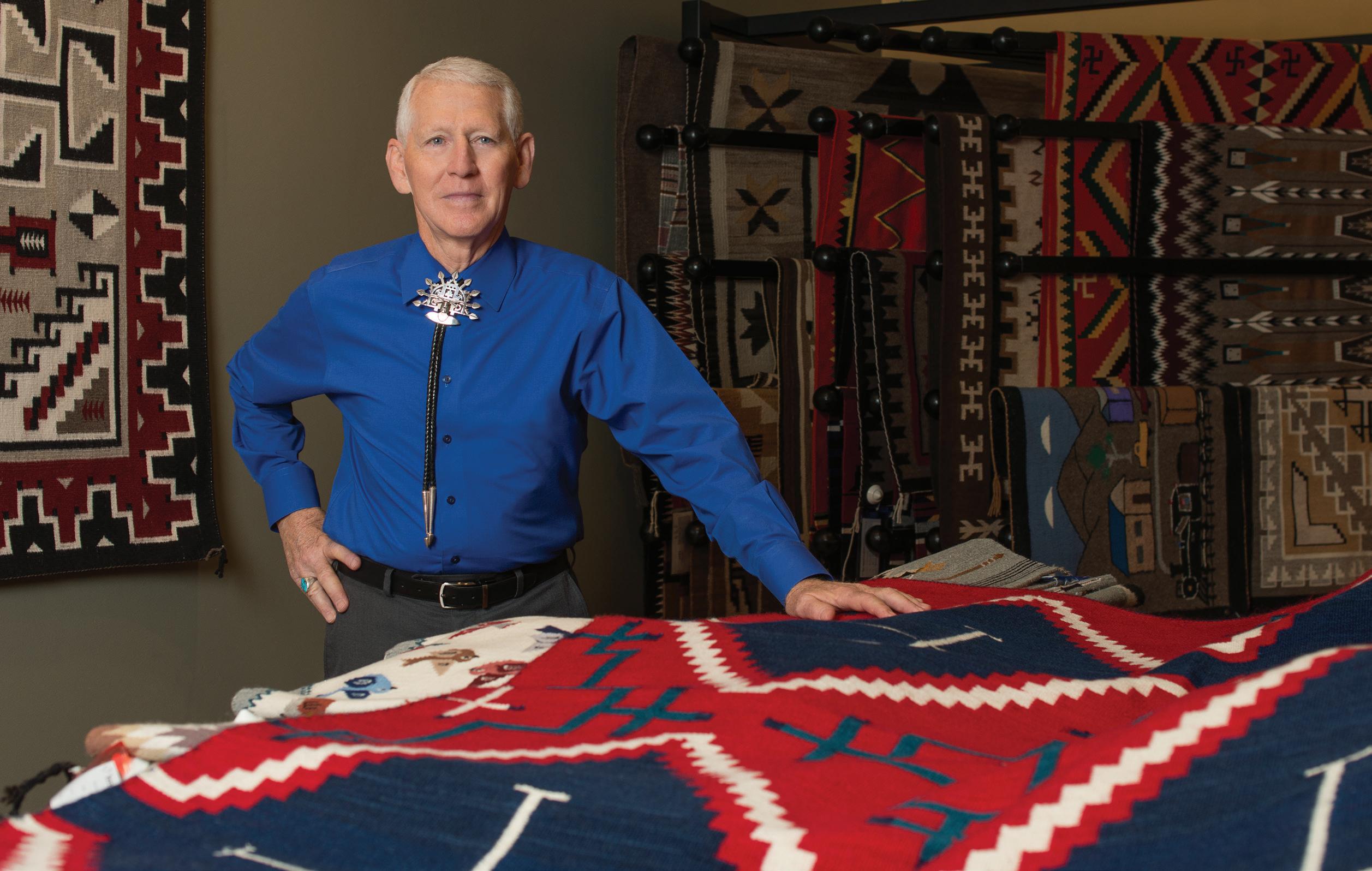
Bruce McGee, Director of Retail Sales, has been with the Heard for 23 years and has witnessed firsthand the impact and evolution of the Shop over time. McGee grew up in the business so-to-speak, with his father, Clifton F. McGee and uncle, Bill McGee, owning and operating several trading posts on the Diné Nation and Hopi Reservation, which specialized in art and cultural objects of those communities. “I was born into the art world,” says McGee. McGee worked in the shops owned by his family, and eventually bought out
his father and uncle in the business alongside his older brother, where he stayed until he came to the Museum in 1998. “When I first came to the Heard, I was over every aspect of the Shop, whether it was staff work schedules or to determine how to divide up the purchasing budget or keeping artists and retail patrons happy,” says McGee. Kelly Gould, who serves as the Shop’s Manager, notes the collaborative nature that is ensconced within the Shop. “Bruce and I work great as a team,” says Gould. “Bruce runs the art side of things and I run the business aspects, but we collaborate on nearly everything. We have a great relationship; I have enormous respect for him.”
That collaborative approach extends beyond the staff and outward to collaborating and communicating with artists and collectors. Gould adds, "[We're] not only meeting with our long-term collectors, but also working with new collectors and finding out what intrigues them in the Native art world, sharing what we know with them and seeing them mature into confident and knowledgeable buyers.” McGee has worked with many artists for years, as well as supporting emerging
talents. From generational art families to student work, supporting a vast network of artists and makers is the cornerstone of the Shop. “There are many times when working with established artists, we find our younger up-and-coming artist, [often] children of artists we are already purchasing from,” he shared. “We have always tried to be supportive of our new arrivals because we know it is sometimes difficult to break into the industry.”
That sort of support has been more crucial than ever, as the sustained impacts of the COVID-19 global health crisis have wreaked havoc on Indigenous communities, as well as the museum industry. “The pandemic really affected us,” said McGee. “For months, the only sales we had were via our e-commerce site run by Megan Richmond, and it was through her hard work and dedication that we survived till June of last year when we reopened.” Gould notes that “the entire staff responded well and continues to support our team approach.” When the Museum and Shop reopened their doors to the public in June of 2020, it allowed for the Shop staff to create new ways of supporting
artists in a safe and responsible manner. “In order to support our Native artists, we significantly increased the number of days when we invited artists to show in the Shop,” says Gould. Though the pandemic has wrought incredibly challenging circumstances to communities and individuals, it has also brought forth opportunity for innovation for artists. “During this pandemic, we have seen an uptrend in original stone sculptures as well as in bronze art. I know we will see many young artists test their skills in this dimension,” McGee remarked. “We look forward to pursuing these new artists and giving them exposure.”
Ultimately, the work that Bruce McGee and the rest of the Shop team does is about relationships—with the artists, with their families, with the patrons, and working within the ecosystem of the Museum. “The most exciting aspect of my work at the museum is one of joy. I wake up in the mornings and look forward to seeing the art that is being created and sharing a relationship with the artists.”
Bruce McGee
Shop Talk: present
A Conversation with James Barajas, Laura Cardinal and Larissa Curtis
BY JACK SCHWIMMER | MANAGER OF DONOR ENGAGEMENT
We sat down with three longtime Heard Museum Shop employees to learn more about their paths to the Heard and what they like most about their jobs. (Interviews have been edited for brevity).
Jack Schwimmer: How long have you been at the Heard, and what was your path like to arrive here?
Laura Cardinal: I have worked for the Heard since 2003.
Larissa Curtis: I’ve been here for 18 years now, almost 19.
James Barajas: I normally will just say “over 10 years,” but it’s 31. It’s been a long time; I started in 1989.
Cardinal: I studied American history in college and never finished. I went to beauty school and became a licensed cosmetologist in the State of Arizona. I still have my license. … My mother and I opened a cosmetics franchise store in the early ’80s and sold it a couple of years later. I found myself not wanting to do the beauty industry any longer, so I started working for an Indian art gallery in Scottsdale. This is what led me to the Heard … this was the ultimate place to be.
Curtis: I grew up on the Rez … Greasewood is where I lived for a while, until I went to high school in Tuba City and in Holbrook. From there, New Mexico for a couple years—Albuquerque—and then here for the rest of the time. Since then, it’s always been retail … not too much that was specifically Native art. I’d dabbled in it with family members and whatnot, but there was no school for it for me, or anything like that. Just learning as you go.
Barajas: My dad had an Indian jewelry store in Scottsdale called Fifth Avenue Shops. He had been doing jewelry repairs for the Heard Museum Shop for probably 20 years already, and I knew Lois, who was the assistant manager at the time. She said, “Come on down, we’ve got an opening!” I went immediately into a fulltime salaried position as a 22-year-old kid, and that’s all she wrote!
James Barajas
JS: How did you become an expert in your specialty area?
Cardinal: I worked in the front of the Shop and e-commerce when I started working at the Heard. I spent the previous 21 years selling art, therefore becoming very familiar with the art and the artists. The big difference at the Heard … I wasn’t reading about the artists in a book, I got to meet them and could ask questions about their culture and their artistic styles.
Curtis: Bruce (McGee) trusted me. He knew I’m a fast learner. I started with beadwork for the most part, and then a little bit of everything. Learning as I went. I knew a little about jewelry—I tried doing it when I was younger. … It’s just learning, talking to people, getting to know the artists.
Barajas: There’s such a volume and quality that we go through at the Heard that you just don’t see in any other business. If I had stayed at my dad’s business in Scottsdale, I never would’ve seen as much.
JS: What do you like about working at the Heard Museum Shop?
Cardinal: My interaction with the artists is my favorite part of the job. The Shop is a beautiful outlet and so respected among artists (as a venue) to show their work to the world. I feel that I [am] a kindred spirit with so many of the artists. I am privileged to call them my friends.
Curtis: Working with the artists. Getting [jewelry or other artwork] in, and then getting it out there to show and sell all the time. You never know what’s going to happen, or what will come into the Shop … it’s always Christmas! With mail, I’m like, “Ooh! A box! Let me see what it is!”
Barajas: It’s an awesome experience for customers to come and see us buying from artists and then putting it out for sale, seeing the whole process …. It’s fun! I wouldn’t be here if it wasn’t fun, and there’s very few jobs you can do where you look forward to going to work every day, you don’t dread it.
JS: What do you think makes the Heard Museum Shop unique?
Cardinal: We always have the best of the best and maintain the highest quality of American Indian art. I am privileged to share the work and traditions with the general public as well as the seasoned collector. I feel that the Heard Shop respects the works of so many artists and in my opinion is unrivaled in the Native community.
Curtis: Artists like coming here. They want to be part of the Heard, because the Heard is pretty well known. Because of the name, they feel like “Okay, I’ve gotten up there.”
Barajas: Most customers who become regular customers and lifelong customers do so because they know we treat the artists fairly and give them a fair price. Some stores will buy at a ridiculously cheap price, mark it up three times or more, and then add a phony discount. We don’t do that.
There’s a prestige factor that you get when you buy at the Heard Museum Shop, where the authenticity is almost without question, whereas if you’re any other shop or business, customers always have to be leery—“Am I getting the real thing?”
Laura Cardinal
Larissa Curtis
Behind the Scenes
BY TODD M. VIGIL | DIRECTOR OF MARKETING & COMMUNICATIONS
Director of Retail Sales Bruce McGee has built a dynamic team to support the Museum Shop. We introduce you to three more Shop team members, Kelly Gould, Megan Richmond, and Juan Ozuna.
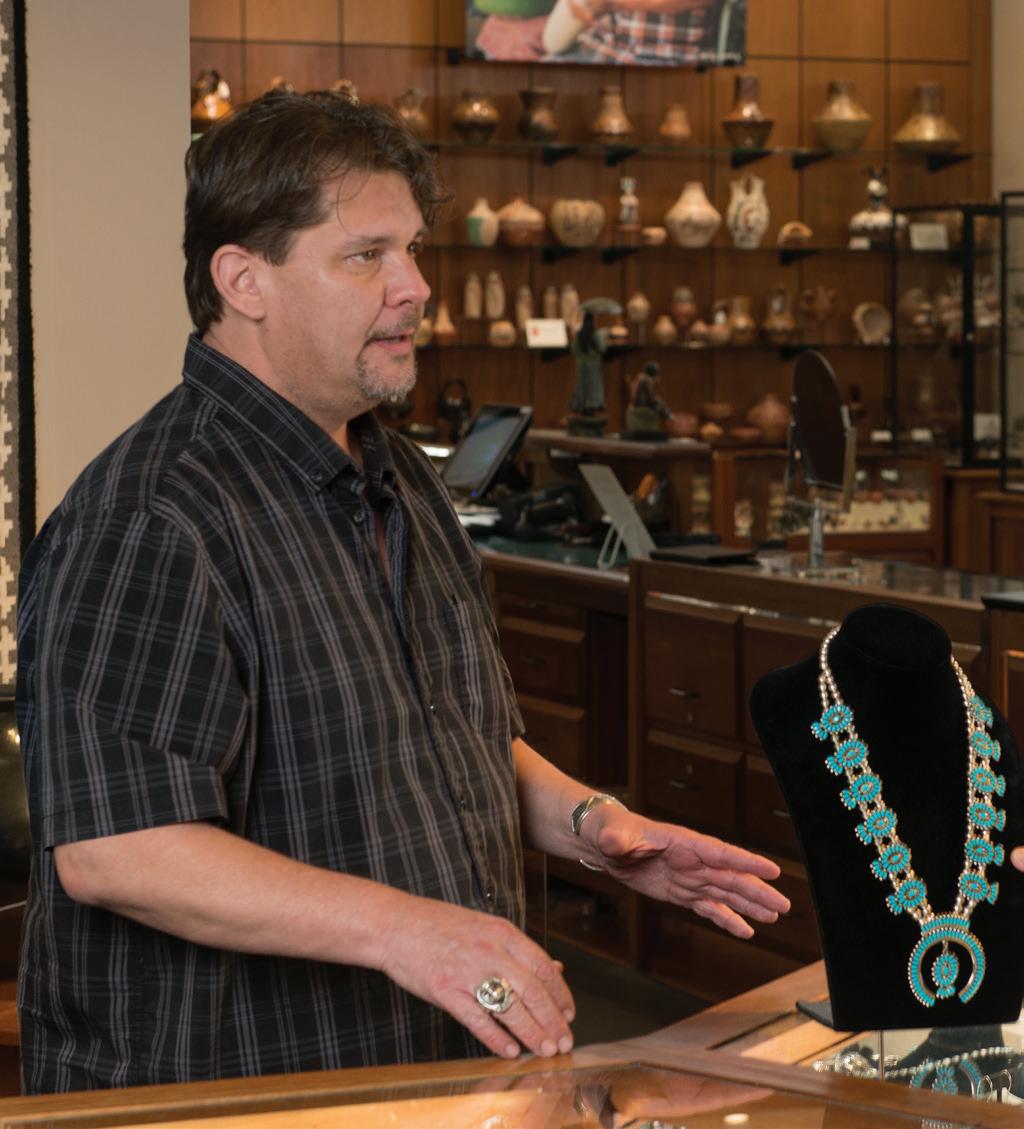
Kelly Gould has been the Heard Museum Shop Manager for nearly four years now. Originally from Missouri, Kelly moved to Arizona 31 years ago and spent his earlier career as Vice President of the Western United States for a computer networking company. As manager, Kelly is responsible for much of the Shop’s ordering, its finances, scheduling, and analysis. A Katsina collector of nearly three decades, Kelly joined the shop to learn more about American Indian art and artists. Working with the artists, the volunteers, customers, and the museum team is his favorite part of working in the Museum Shop. Kelly proudly has five grandkids who all live in the Valley.
Tucked in a small office at the back of the Shop, Megan Richmond drives the Museum Shop’s impressive eCommerce business at heardmuseumshop.com. Under Megan’s six-year tenure with the museum, the online sales for the Shop have increased by 84%. Originally from Tempe, Megan graduated from Arizona State University with a BFA in Photography. She uses her photography skills to capture hundreds of American Indian works of art and then posts them for sale on the Museum Shop website. In addition to her passion for photography, Megan is also an indoor and outdoor plant enthusiast.
Juan Ozuna is a key member of the Shop team. Juan is responsible for the Shop’s inventory controls and spearheads the annual shop inventory process which consistently results in an accuracy of 99.95%. He is also responsible for managing payments to American Indian artists who cosign their art with the Shop. Juan originally started as a tour guide at the Heard and worked in both the Coffee Cantina and Books and More before being promoted to his current position. A Phoenix Native, Juan is also Navajo and attends Phoenix College. Between his studies and his role at the museum, Juan is a writer, focusing on short stories.
Kelly Gould
Megan Richmond
Juan Ozuna
THE DIGITAL EXPERIENCE
BY MEGAN RICHMOND | E-COMMERCE MANAGER
Now more than ever, consumers are looking to the internet to fulfill their shopping needs. That means retailers must work to make the digital shopping experience not only pleasant and efficient for their customers, but one of a kind. The Heard Museum Online Shop is no different. Our e-commerce department works diligently to go above and beyond for our customers as if they were shopping in-store. We want each customer, whether first-time or frequent, to feel valued and know that their dollars are going toward a worthwhile mission that they can support without leaving home.
heardmuseumshop.com
With more than 1,200 items online and more being added daily, digital customers are sure to find a piece that is perfect for them.
We strive for a website that is easy to navigate and intuitive for our customers, without need for contact—but we also focus on providing customer attention and satisfaction when support is requested. The e-commerce staff is always just a click away, ready to respond to any requests or questions users might have with customer-acclaimed response time. Online shoppers will always be able to talk with an onsite employee who can assist with any item questions, discounts, shipping, photo requests and much more.
Heard Museum members can shop online and receive their 10% discount at checkout. To get started, go to heardmuseumshop.com and create an online account using the email address associated with your membership. Then indicate your member number (or note that you are a new member) in the order notes at checkout. This lets us know to change your account to an active member account so you can see your discount automatically at checkout moving forward. If this is ever forgotten, Heard members can rest easy knowing that each order is individually handled and processed by one of two e-commerce employees who double-check membership details and apply discounts accordingly.
Online shoppers can find all things Shop at the bottom of each landing page, including customer service and connecting with us on social media. We cherish all our new and returning online customers and thank you for your continued support of the Heard Museum Shop!
Heard Museum Shop Artist Profile: Gerry Quotskuyva
BY VELMA KEE CRAIG | ASSISTANT CURATOR
Gerry Quotskuyva (Hopi/Yaqui) is a member of the Bear Strap Clan from the Second Mesa Village of Shungopavi and currently resides in Tucson. His Hopi name, Lomahongva, means “reed standing tall and healthy.” Quotskuyva is a katsina doll carver, and he also works in the mediums of bronze sculpture, painting and fused glass. His attention to detail and unique interpretation of traditional Hopi symbolism reflect his rich and expressive heritage.
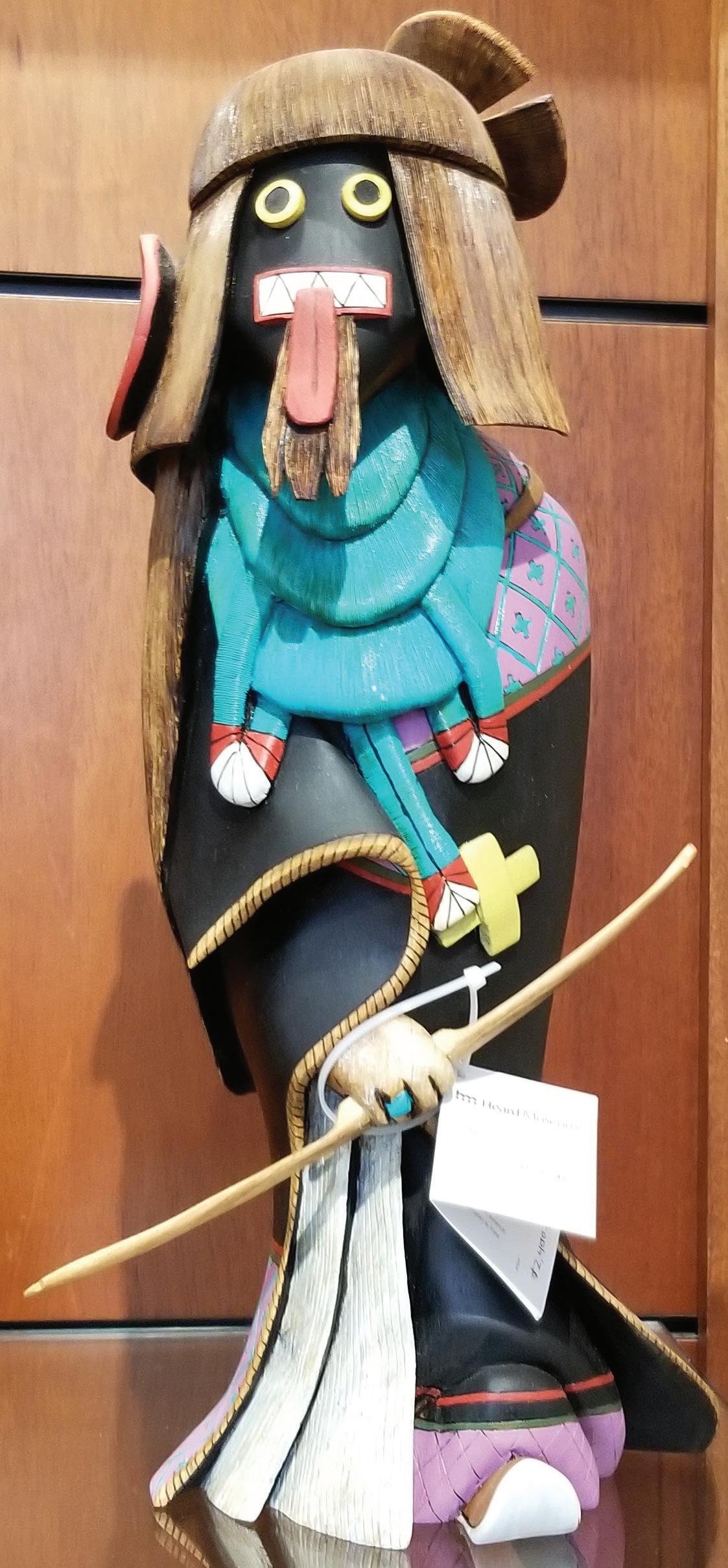
Quotskuyva has had a relationship with the Heard Museum for more than 20 years now, and he credits this affiliation with playing an influential role in shaping his career. Quotskuyva is known for his katsina dolls carved in the more stylized or sculptural style. His katsina doll titled Warrior Woman, currently for sale in the Heard Museum Shop, is an example of a katsina carved in the sculptural style. A katsina formed in the sculptural style of carving “has no body,” says Quotskuyva. Warrior Woman has only one visible formed arm, hand and foot. The remainder of her body is hidden beneath an elegantly draped black and purple garment. She wears a substantial turquoise necklace and has her fist clenched around a bow.
Gerry Quotskuyva (Hopi), b. 1959. Warrior Woman Katsina, cottonwood root and acrylic paint.
THE CONCEPT OF THE PIECE IS AS A REPRESENTATION OF THE ROMANTIC WORLD OF HOPI WITH AN EMPHASIS ON THE MATRIARCHAL SOCIETY ON THE FRONT AND DEPICTIONS OF MEN AT WORK ON THE BACK SIDE AS THEY GATHER WOOD, COAL AND WATER; HUNT FOR MEAT; AND GROW THEIR TRADITIONAL FOODS.
For Quotskuyva, it is relatively easy to remain inspired and motivated to create. “Katsinas,” he says, “represent benevolent beings, and their presence helps instruct people to conform to societal norms.” This keeps him carving. His advice for other artists is to build a foundation for your business and how you will run it, in the form of a solid business plan and customer database. Quotskuyva makes it a point to interact with his customer base and has developed many friendships with customers and fans.
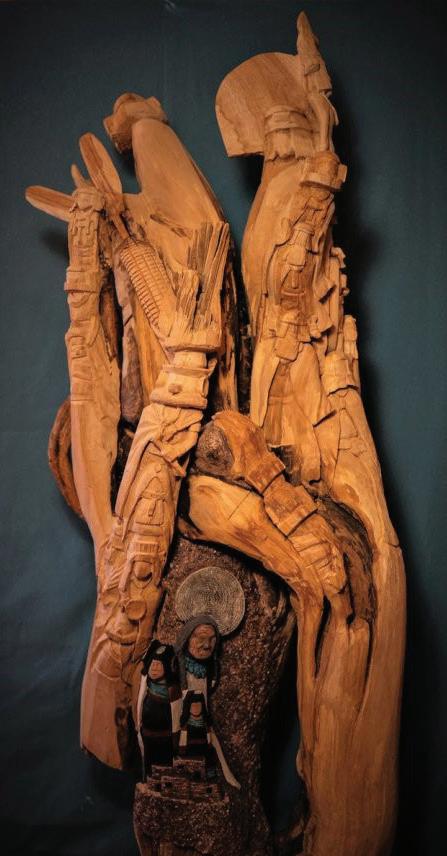
Quotskuyva’s current project is titled the Gnarly Root Project. For this, he will be carving from a phenomenal piece of cottonwood root, which stands 49 inches tall and measures 24 inches at its widest point. The root has a rock embedded in its center. He shaped arms, from the surrounding root, holding the rock to symbolize the action of prayers as they take on the burdens of life. Quotskuyva relays, “The concept of the piece is as a representation of the romantic world of Hopi with an emphasis on the matriarchal society on the front and depictions of men at work on the back side as they gather wood, coal and water; hunt for meat; and grow their traditional foods.”
You can learn more about Quotskuyva and his past and current projects at his website, www.gquotskuyva.com.
Gerry Quotskuyva (Hopi), b. 1959. The Gnarly Root Project, in-process carving, cottonwood root and acrylic paint. Photo courtesy of the artist.
New Acquisitions from the 2021 Heard Indian Fair & Market
BY DIANA F. PARDUE | CHIEF CURATOR
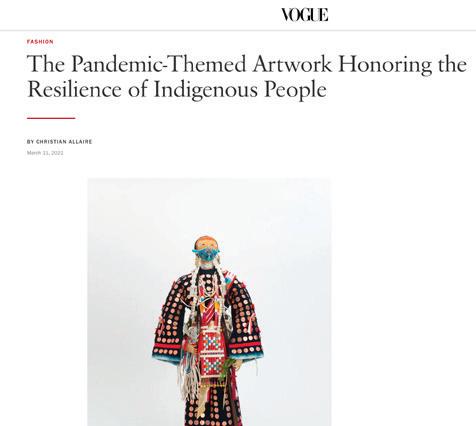
This year’s Heard Museum Guild Indian Fair & Market was the first one ever held during a pandemic. The artists responded to the challenge of a hybrid market and entered amazing works. More than 200 entries from artists across the U.S. illustrated the great creativity, talent and skill of their makers.
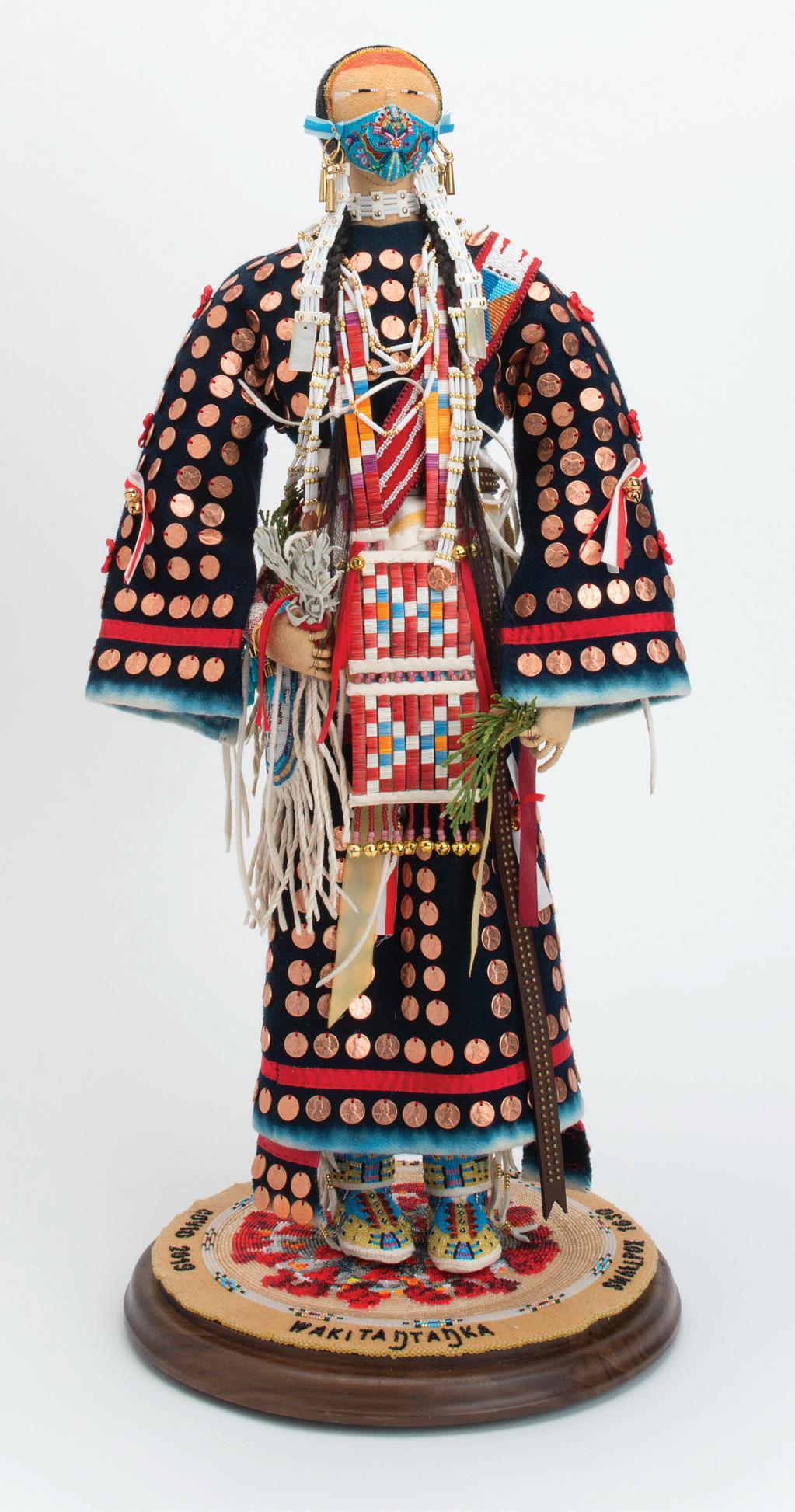
This year’s Best of Show winner was Juanita Growing Thunder Fogarty (Assiniboine/Sioux, b. 1969). With intricate detail, Fogarty created a soft sculpture doll titled Wakitantanka (Strong-Willed) Pandemic Survivalist that both delighted and spoke to the time. Fogarty noted that she did not set out to relate the figure to the COVID-19 pandemic, but the theme developed as she made it. The figure of a Sioux woman dressed in traditional clothing is elegant in blue trade wool
embellished with silk ribbon and hand-drilled replica pennies. Antique micro seed beads are used in great detail, including on the floral-design face mask, and the figure has a micro–porcupine quill necklace. Fogarty described the soft sculpture in her entry form:
“Sioux woman wearing a penny dress, signifying how she lives in the modern world and her cultural world in balance. She stands on a beaded image of the COVID-19 virus, with surrounding worded pandemics that our people have survived.”
Juanita Growing Thunder Fogarty (Assiniboine/Sioux, b. 1969), Wakitantanka (Strong-Willed) Pandemic Survivalist, 2021, leather, wool, replica pennies, antique micro seed beads, porcupine quill. 21 inches. Gift of Mary Hamilton.
The soft sculpture was purchased for the Heard Museum Collection with funds provided by Mary Hamilton.
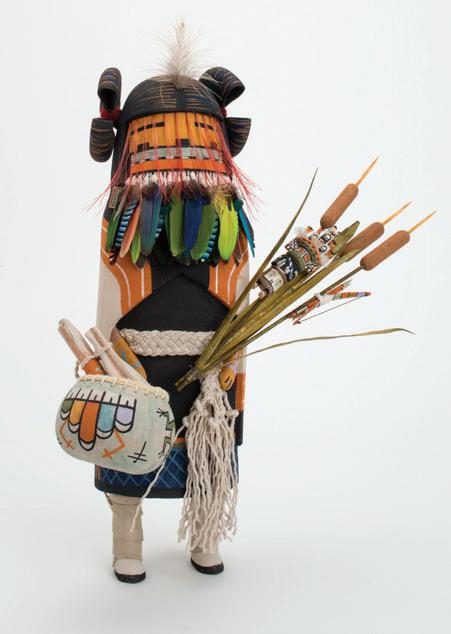
Mark Taho (Hopi/Diné) received a First Place and Best of Class Award in Pueblo Carvings for his katsina doll titled Bearing Gifts. He described his carving as a traditionalstyle katsina doll made of cottonwood root with natural mineral and pigment paints. Further enhancements were the additions of corn husks, leather and horsehair, as well as various feathers including parrot, peacock and Eurasia jay. The carving was generously donated to the Heard by museum trustee Sharron Lewis.
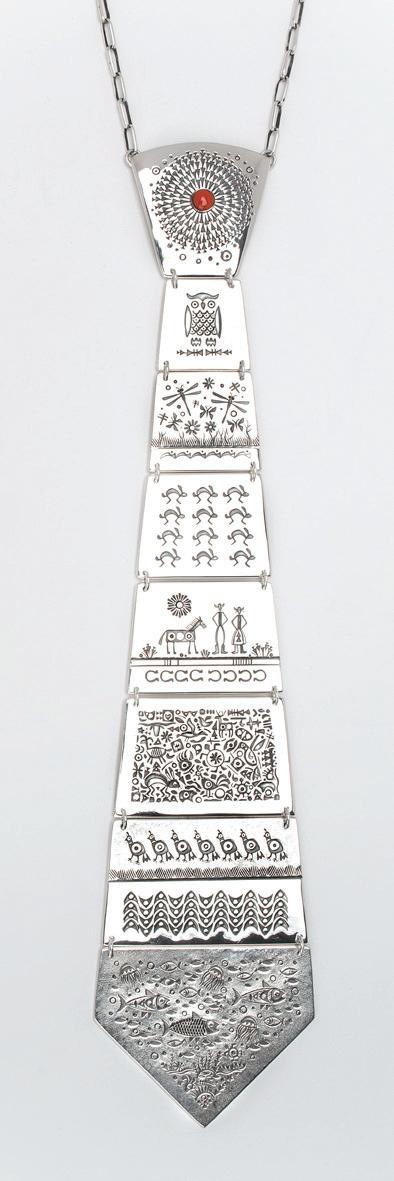
There were several amazing jewelry entries in this year’s Indian Fair & Market, and the Heard purchased three of them with funding provided by generous donors. A First Place Award was given to Norbert Peshlakai (Navajo, b. 1953) for a silver tie in the shape of a necktie. Peshlakai entered this piece in the necklace category, and he added a handmade chain to hold the tie in place. The tie is hinged in eight places so that it is flexible when worn. Peshlakai is known for the detailed stamped designs he adds to the silver items he creates. He makes his own stamps and uses multiple stamps to create a single animal or the character he incorporates into many of his designs, Slim Cowboy. In this tie, titled Mr. & Mrs. Slim Cowboy and Nature, Peshlakai places the couple in the center section. A horse is nearby, and the sun is shining overhead. If you look closely, you can see a variety of
animals: an owl, dragonflies, rabbits, quail, fish, and a multitude of small animals and birds in one segment. This piece was purchased for the Heard Museum Collection with funds provided by Norman Sandfield.
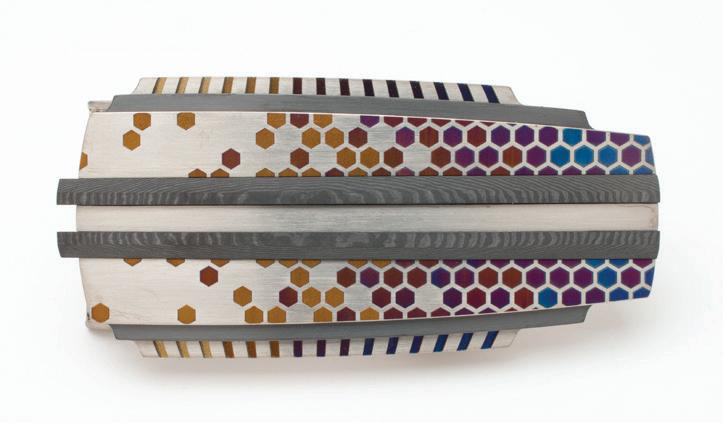
Pat Pruitt (Laguna Pueblo, b. 1973) has been a frequent award winner at the Heard Indian Fair & Market and the Santa Fe Indian Market for his innovative designs. In the 2021 Fair, Pruitt received a Second Place Award for a buckle titled Hexagonal Study in Color and made of zirconium, titanium and carbon fiber. In his details on the entry form, Pruitt noted that the buckle consists of machined components and was assembled in a laminate format concealing the structural welds. It has laser-etched and machined details. The color was achieved through a laser anodization process that he has been developing over the past several years. The buckle received the Heard Museum Council Purchase Award and was added to the permanent collection with funds provided by the Council.
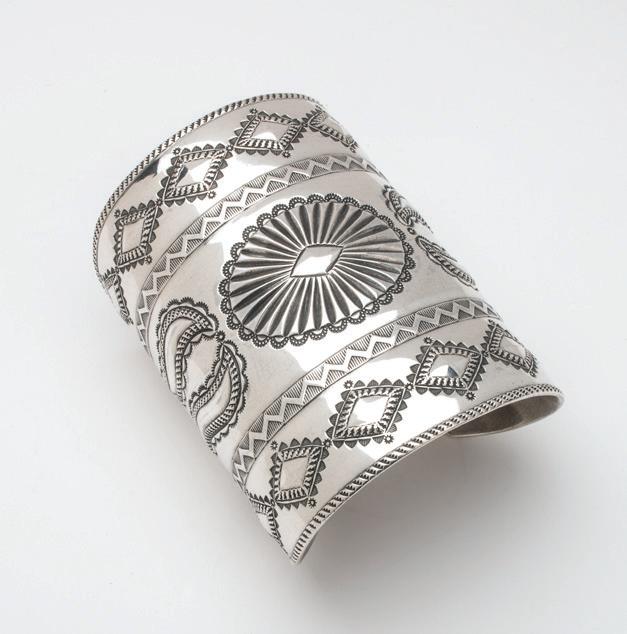
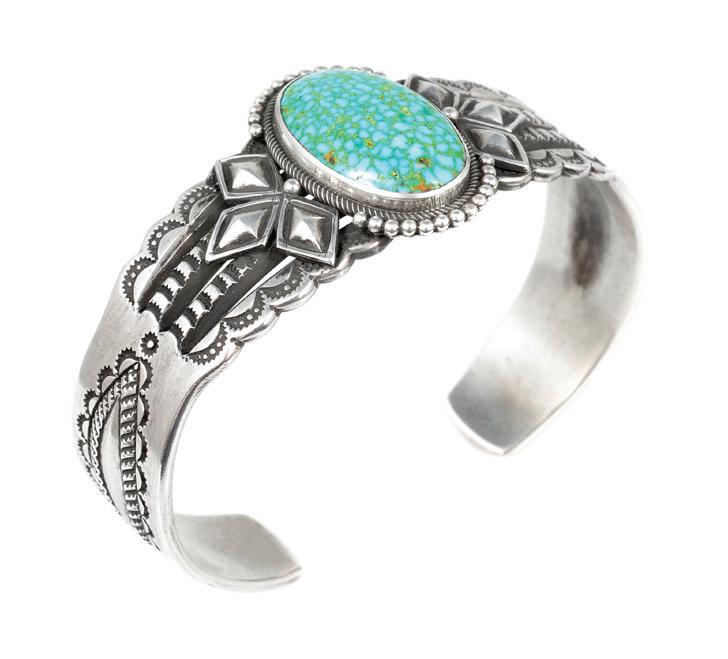
Perry Shorty (Navajo, b. 1964) is known for the jewelry he creates from coin silver. He entered a bracelet titled A Timeless Classic into the 2021 Fair. Shorty made the bracelet from silver barber coins that date from 1890 to 1915. He melted the coins into a tufa stone to form an ingot, which he then hammered and beveled to form the bracelet shape. The bracelet has both repoussé, or an impressed design from the reverse side, and stampwork. Like Peshlakai, Shorty also makes many of his own stamps, which he elegantly places with great precision. Shorty’s bracelet was added to the museum’s collection with funds provided by Drs. Kathleen and William Howard.
Perry Shorty (Navajo, b. 1964), A Timeless Classic, 2021, coin silver. 4 x 2 3/4 inches. Gift of Drs. William G. and Kathleen L. Howard.
Pat Pruitt (Laguna Pueblo, b. 1973), Hexagonal Study in Color, 2021, zirconium, titanium, carbon fiber. 4 x 2 inches. Gift of the Heard Museum Council.
Norbert Peshlakai (Navajo, b. 1953), Mr. & Mrs. Slim Cowboy and Nature, 2021, silver. 13 inches. Gift of Norman L. Sandfield.
Mark Taho (Hopi/Diné), Bearing Gifts, 2021, cottonwood root, mineral and pigment paints, corn husks, leather, horsehair, feathers. 12 inches. Gift of Sharron Lewis.
Programs on Demand
In September of 2020 we ventured into the new realm of Zoom programing. Thanks to your feedback, we’ve been able to continually shape and adjust how each event is structured, as well as identify the topics and artists you want to know more about. As you’ll see below, we will continue to offer virtual programs for you to enjoy throughout the summer, with several more in the works! The best way to stay up to date on our virtual programing is to read Members@Home, a Membersonly e-mail newsletter published every-other week. If you are not receiving these emails, please contact members@heard.org.
We are now looking towards the fall to safely return to in-person programming, so stay tuned for the next issue with more details. Thank you once again to our Members who have logged on, tuned in and submitted questions.
Program dates and times may be subject to change. For updates and additional information, please visit heard.org.
VIRTUAL PROGRAMS
All virtual programs are uploaded to our YouTube channel a week following the event. Visit youtube.com/heardmuseum to watch our previous programs.
VIRTUAL ART TALK | THE HISTORY OF THE HEARD MUSEUM SHOP WITH ANN MARSHALL AND BRUCE MCGEE
WEDNESDAY, MAY 5 | 12 NOON ARIZONA TIME
In 1958, our Shop and Bookstore began as a fundraising effort by our volunteer force, the Heard Museum Guild. Museum Members are invited to join us live online for a discussion between Heard Museum Director of Research Ann Marshall and Director of Retail Sales Bruce McGee to learn more about the many transformations our retail spaces have gone through, and a few of the extraordinary artists who have been represented in our Shops.
To register: Check your email for your Members-only link, or email us directly with the program title at members@heard.org.
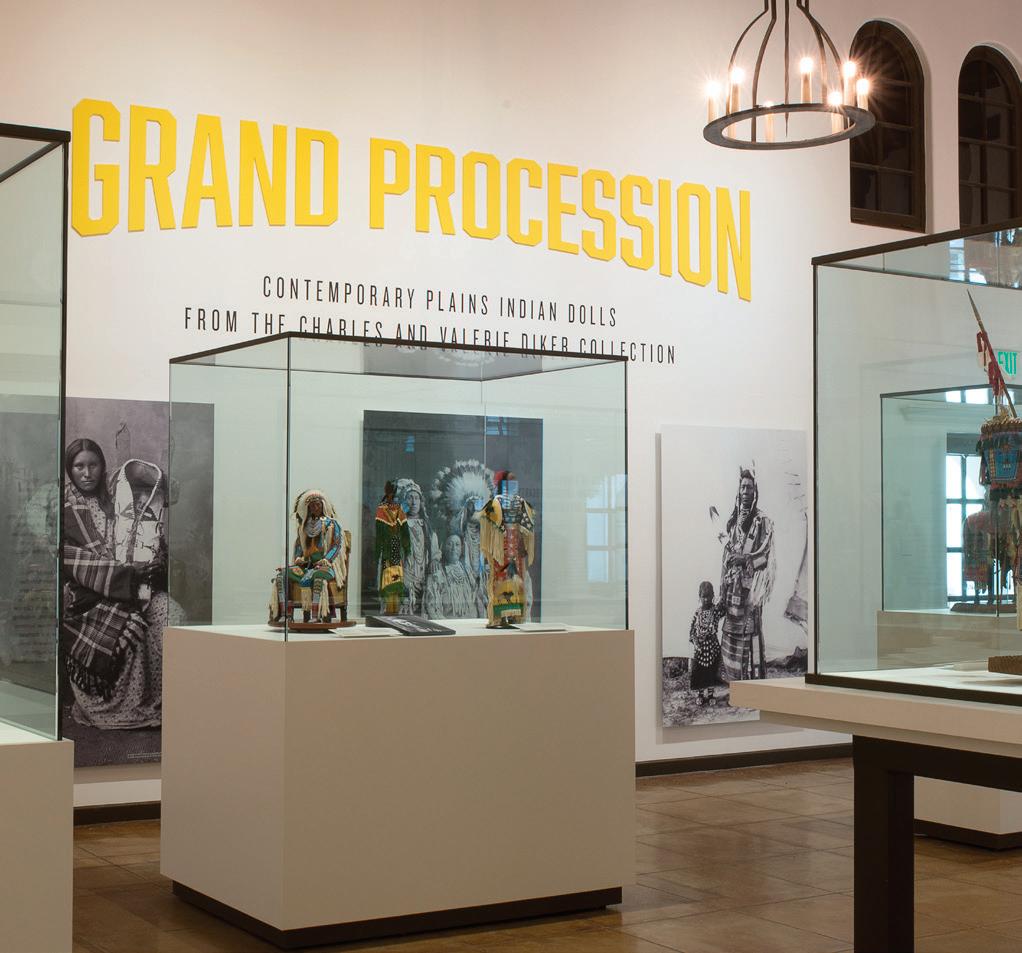
GRAND PROCESSION
VIRTUAL ART TALK IN THE STUDIO WITH JUANITA GROWING THUNDER FOGARTY AND JESSA RAE GROWING THUNDER
SATURDAY, MAY 15 | 12 NOON ARIZONA TIME COST: $5 PUBLIC | FREE MEMBERS
Join us live online for a Virtual Art Talk featuring a discussion with 2021 Heard Museum Guild Indian Fair & Market “Best of Show” winner Juanita Growing Thunder Fogarty (Assiniboine/Sioux) and her daughter Jessa Rae Growing Thunder (Assiniboine/ Sioux). Moderated by Chief Curator Diana Pardue, Juanita will be in her studio talking through their beadwork and quillwork practice, as well as the process behind Juanita’s winning piece, Wakitantanka (StrongWilled) Pandemic Survivalist
To register: https://heard.org/events/ and use promo code FREEMEM when checking out to receive complimentary registration, or email us directly with the program title at members@heard.org.
VIRTUAL ART TALK | AT HOME WITH CAROL ANN MACKAY
WEDNESDAY, MAY 26 | 12 NOON ARIZONA TIME
Museum Members are invited to join us live online for a Membersonly Virtual Art Talk and Q&A with textile specialist, collector, and Heard Museum Life Trustee Carol Ann Mackay. Most recently, Carol Ann was a guest curator and lender for Color Riot! How Color Changed Navajo Textiles, which traveled and was on view at the Museum of Fine Arts, St. Petersburg, FL, through the end of March. Carol Ann was also a guest for our 2017 exhibition, Beauty Speaks For Us. A short video shot by Yazzie Studio featuring Carol Ann Mackay talking about the textiles in her home will be released to Members prior to the Virtual Art Talk on Friday, May 21.
To register: Check your email for your Members-only link, or email us directly with the program title at members@heard.org.
SMALL WONDERS VIRTUAL ART TALK IN THE STUDIO WITH RICHARD AND JARED CHAVEZ
WEDNESDAY, JUNE 9 | 12 NOON ARIZONA TIME
Join us live and online for a Members-only Virtual Art Talk and studio tour with noted jewelers Richard and Jared Chavez (San Felipe Pueblo), moderated by Chief Curator and Small Wonders co-curator Diana Pardue. Their work is currently on view in the Small Wonders exhibition, and Richard was the subject of our 2018 retrospective exhibition, Symmetry in Stone: The Jewelry of Richard I. Chavez
To register: Check your email for your Members-only link, or email us directly with the program title at members@heard.org.
VIRTUAL ART TALK | HEARD MUSEUM COLLECTIONS
RESEARCH WITH ELLEN PEARLSTEIN AND BRYN BARABAS POTTER
WEDNESDAY, JUNE 23 | 12 NOON ARIZONA TIME
Museum Members are invited to join us live online for a discussion moderated by Director of Research Ann Marshall with Senior Objects Conservator at the Brooklyn Museum Ellen Pearlstein and former Curator of Basketry for the Southwest Museum/Autry Museum of the American West Bryn Barabas Potter as they discuss their current research of the Heard’s and other museum collections of early 20th basketry kits.
To register: Check your email for your Members-only link, or email us directly with the program title at members@heard.org.
ART IN THE MAKING, ONLINE PUEBLO EMBROIDERY WITH ELROY NATACHU JR.
WEDNESDAY, JULY 21 | 12 NOON ARIZONA TIME COST: $5 PUBLIC, FREE MEMBERS
Join us live online with artist Elroy Natachu Jr. (Zuni) as he takes viewers through a demonstration of pueblo embroidery. Co-owner of Natachu INK (along with Kandis M. Quam), Elroy Natachu Jr. focuses on providing the world with a means of exploring Zuni culture and heritage through a wide range of artistry.
To register: https://heard.org/events/ and use promo code FREEMEM when checking out to receive complimentary registration, or email us directly with the program title at members@heard.org.
VIRTUAL ART TALK | THE MUSIC OF HOOP DANCE WITH RYON POLEQUAPTEWA
AND KENNETH COZAD JR.
SATURDAY, AUGUST 28 | 12 NOON ARIZONA TIME
Join us live online for a discussion about the music of Hoop dance with Ryon Polequaptewa (Hopi) and Ken Cozad (Kiowa, Comanche), moderated by Director of Strategic Development and Programming Dan Hagerty. The panelists will discuss the long tradition of hoop dancing, explain the differences between Northern and Southern style drumming, and share their own personal experiences performing at the World Championship.
To register: Check your email for your Members-only link, or email us directly with the program title at members@heard.org.
MEMBERS VIRTUAL ANNUAL MEETING
MONDAY, SEPTEMBER 27 | 12 NOON ARIZONA TIME
David M. Roche, Dickey Family Director & CEO, invites all Members to attend the live online Members Annual Meeting. Members will have the opportunity to hear directly from key members of the Heard Museum team and learn more about the upcoming exhibition season.
To register: Check your email for your Members-only link, or email us directly with the program title at members@heard.org.
IN-PERSON PROGRAMS
FIRST FRIDAY AT THE HEARD
MAY 7 | JUNE 4 | JULY 2 | AUGUST 6 | SEPTEMBER 3 | 4 TO 8 P.M.
Museum visitors are invited to enjoy free admission to the Museum from 4 to 8 p.m. The Coffee Cantina and Books & More will also be open from 5 to 7:30 p.m. All CDC guidelines are enforced. Learn more about our safety protocols on our page, “Know Before You Go.”
CAFÉ UPDATE
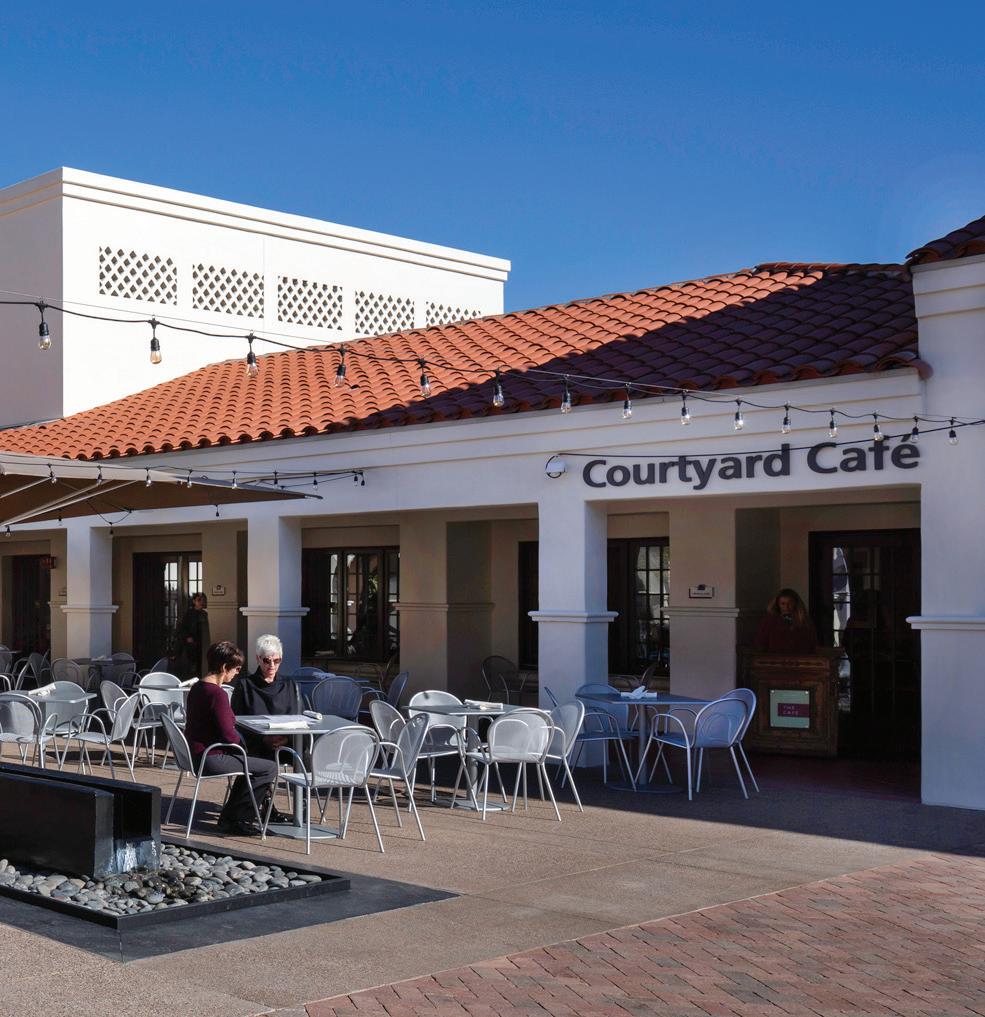
With summer soon approaching and COVID safety still a priority, Café and Museum management have decided to close our full-service Courtyard Café for the summer. The Café’s last day open prior to the summer break will be on Saturday May 15th, 2021.
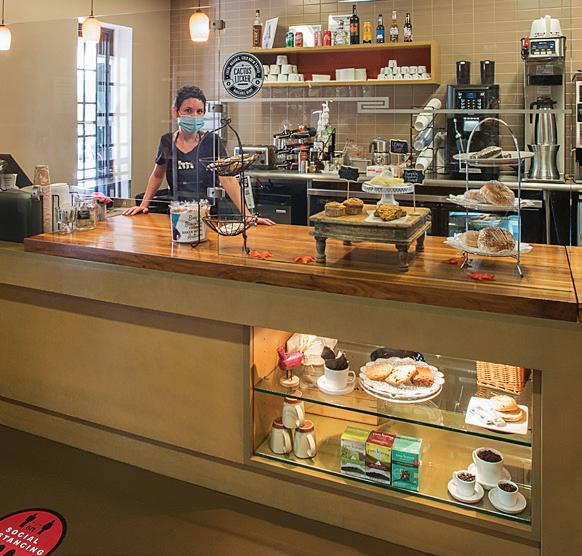
Our Coffee Cantina will continue to serve salads, wraps and other quick pick-up lunch items and indoor seating will again be available in Steele as it was last summer. You will also see familiar faces from the Café working in the Cantina over the summer!
We are already planning the Courtyard Café’s fall menu and expect to see the Café reopen at 100% indoor and outdoor seating in October of 2021!
GOTTA HAVE IT! shop
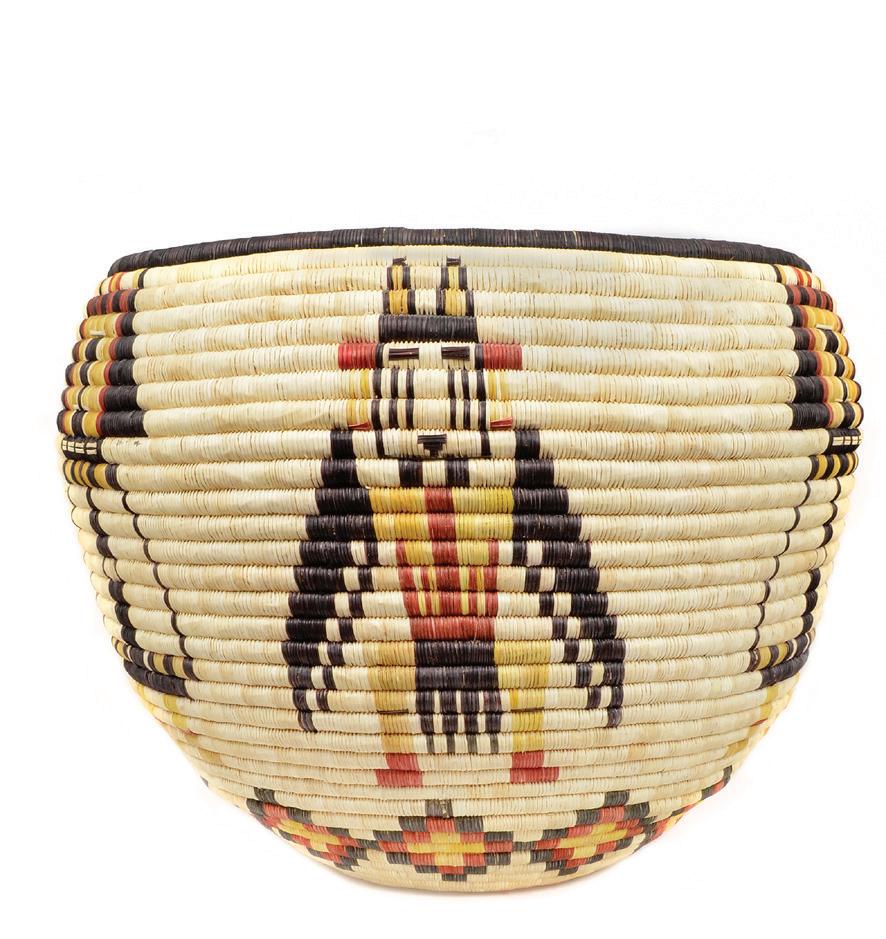
C. 1990S LARGE CROW MOTHER & FALCON COIL BASKET
by an unidentified artist (Hopi), $3,200, 17” diameter
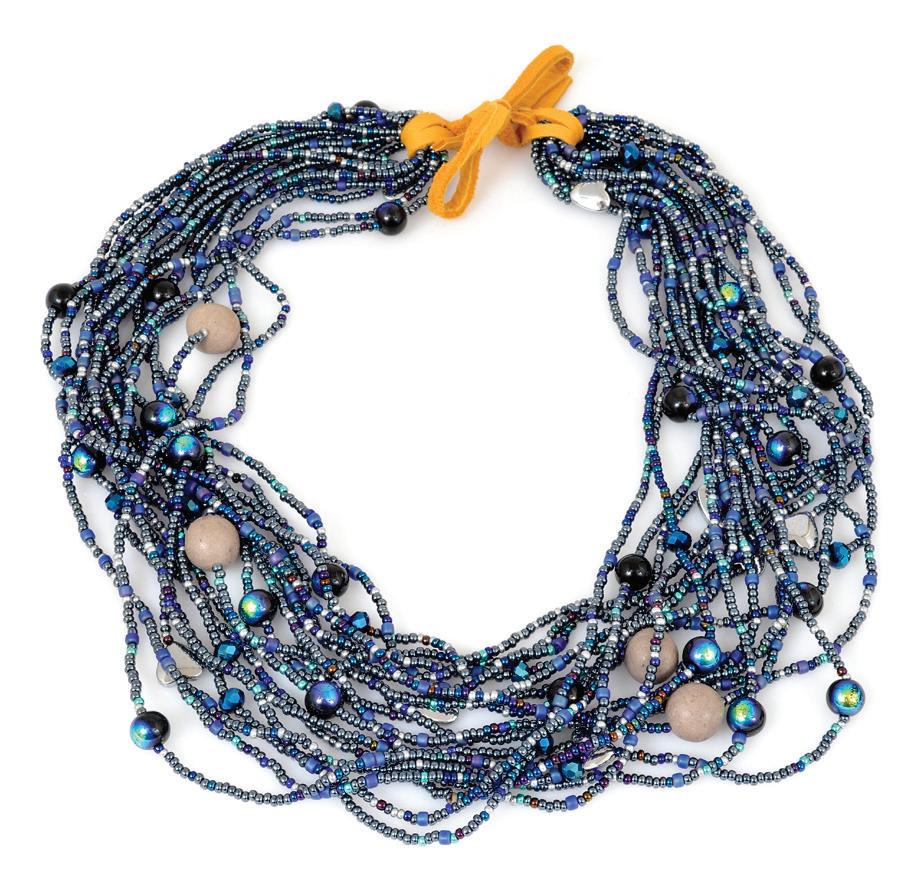
NAVY
BLUE BEADED NECKLACE
by Autumn Stevens (Gila River), $145
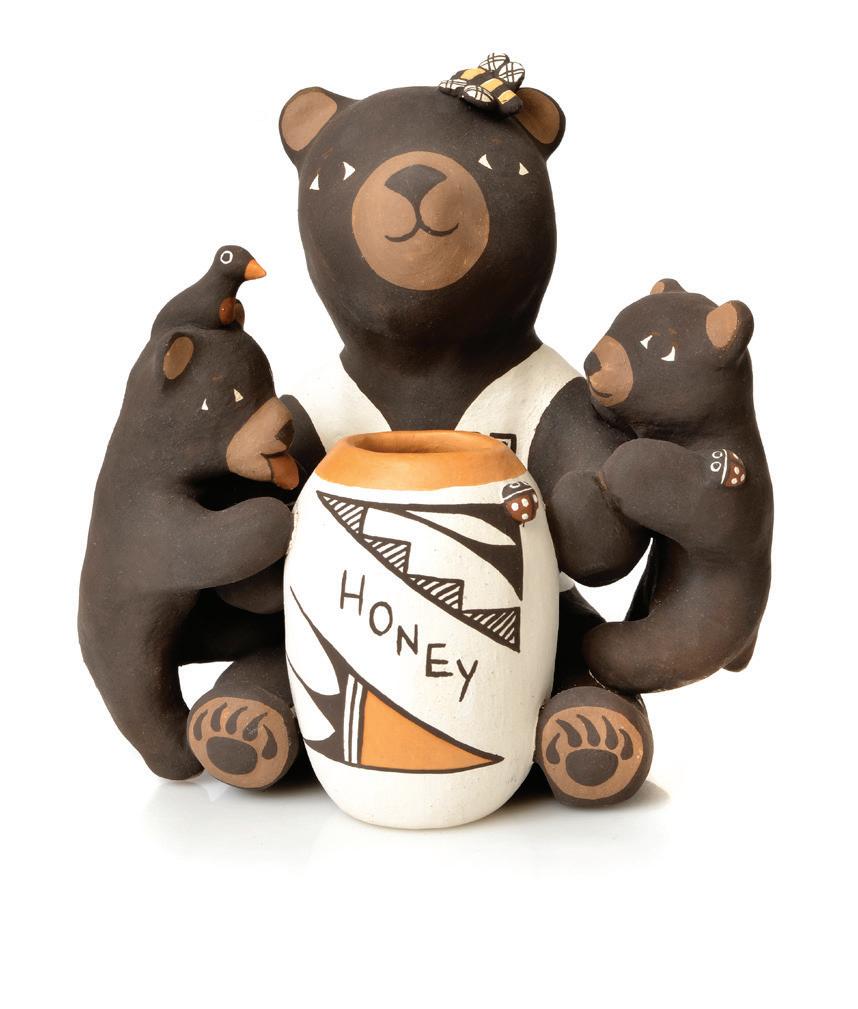
POTTERY BEAR STORYTELLER
by Marilyn Ray (Acoma), $225
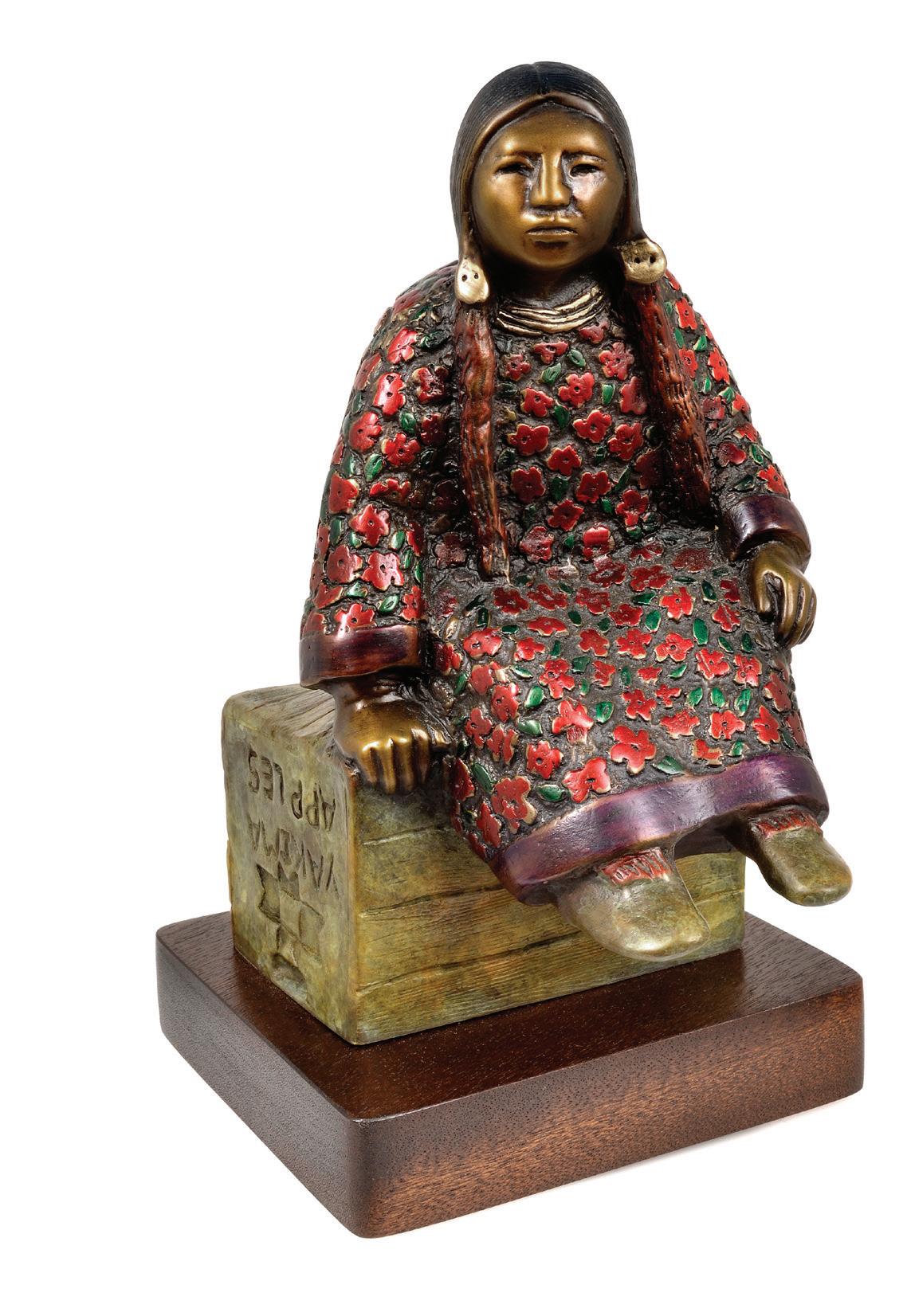
by Doug Hyde (Nez Perce/ Assiniboine/Chippewa), 37/50, $1,500
“YAKIMA APPLES” BRONZE SCULPTURE
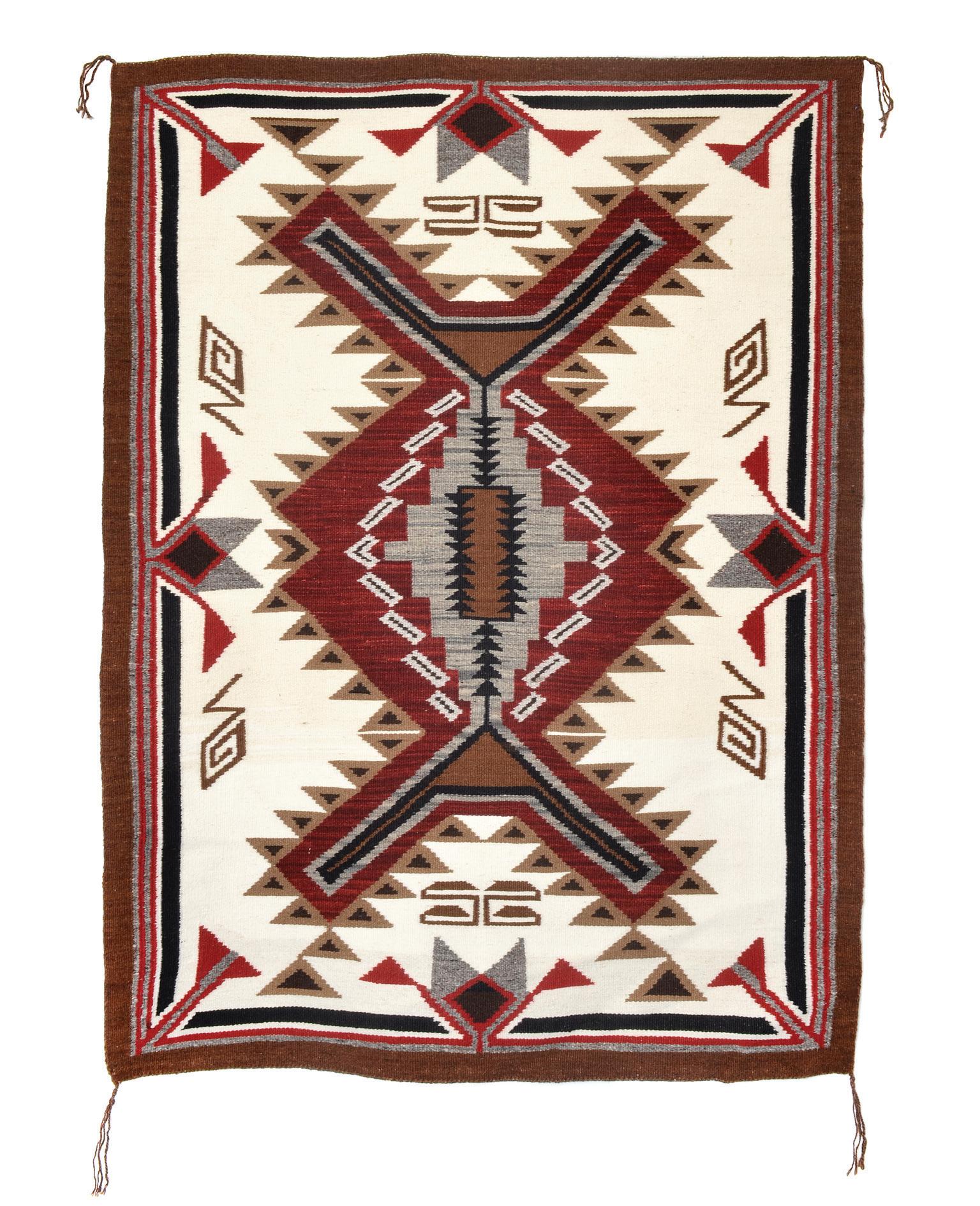
CONTEMPORARY RUG
by Lucy Begay (Navajo), $3,000, 35” x 48”
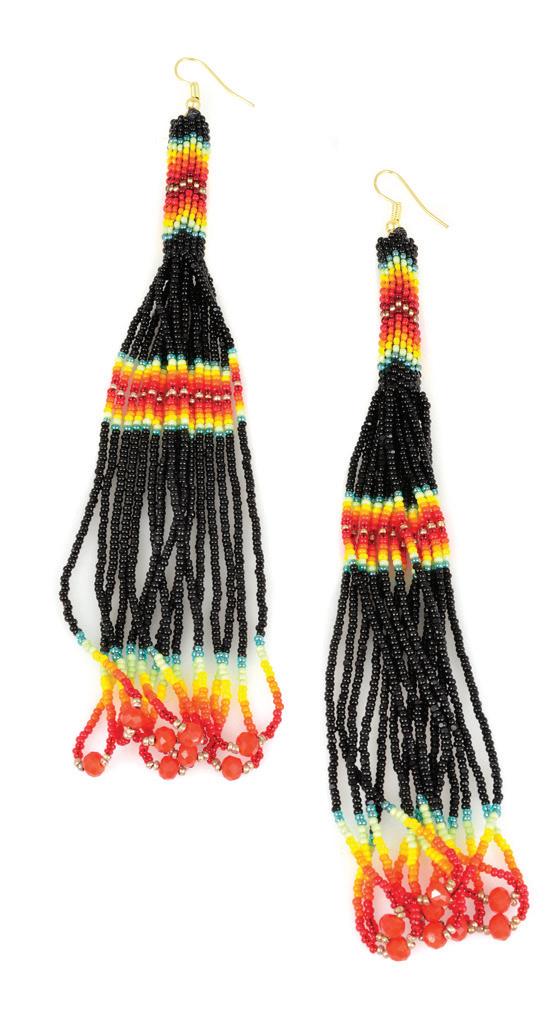
BLACK & ORANGE BEADED EARRINGS by Wendy Weston (Navajo), $150
TURQUOISE MOUNTAIN BRACELET
by Perry Shorty (Navajo), $2,500
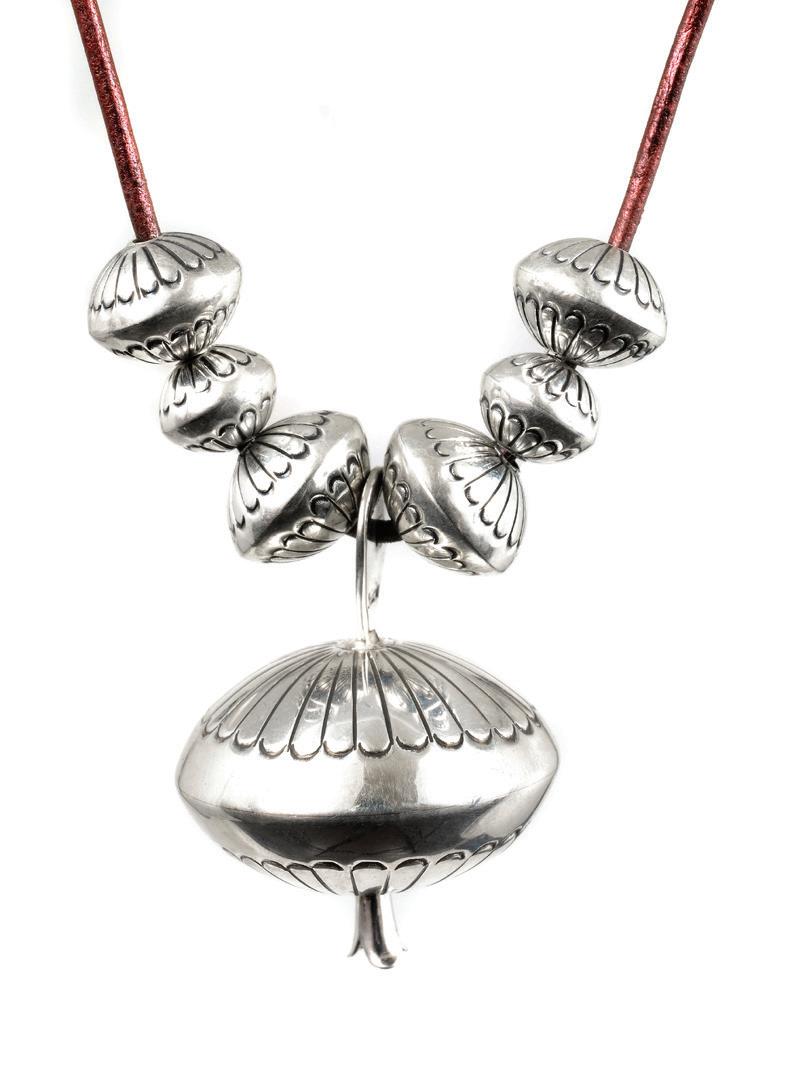
STERLING SILVER STAMPED SQUASH BLOSSOM PENDANT WITH STAMPED BEADS by Marie Yazzie (Navajo), $250
PHYSICALLY DISTANCED AND SOCIALLY LEARNING: CULTURAL ART WORKSHOPS IN THE TIME OF COVID
BY MARCUS MONENERKIT | DIRECTOR OF COMMUNITY ENGAGEMENT
I never attended an online class during my own academic journey. Of course, at that time, our “online lives” consisted mostly of checking emails. Virtual learning wasn’t on my radar in those days, and, until the pandemic, it wasn’t something that the Heard Museum had tested.
Fast-forward a decade and here we are, regularly producing online cultural art workshops to ensure that Heard Museum community engagement continues despite COVID-19. When we started our distance learning last year, we had never produced anything like the moment called for and needed. And I think initially many of us—artists, educators, students—were apprehensive about what “true” learning outcomes could be attained through an online setting. Nonetheless, we were committed to advancing our work and staying engaged with the communities we serve through our programs. We just needed to find effective methods of delivering art-education content even if we could not meet in
person. Thanks to partners like the Margaret A. Cargill Philanthropies and the Aroha Philanthropies, we had funding and total support in place to develop a model for online workshops.
We knew that, to succeed, we would need to lean on our teaching artists, seeking their creativity, enthusiasm and energy to develop an online setting that would be conducive to sharing ideas, demonstrating techniques and engaging a class just as we would during an inperson setting. Right out of the gate, our friends and
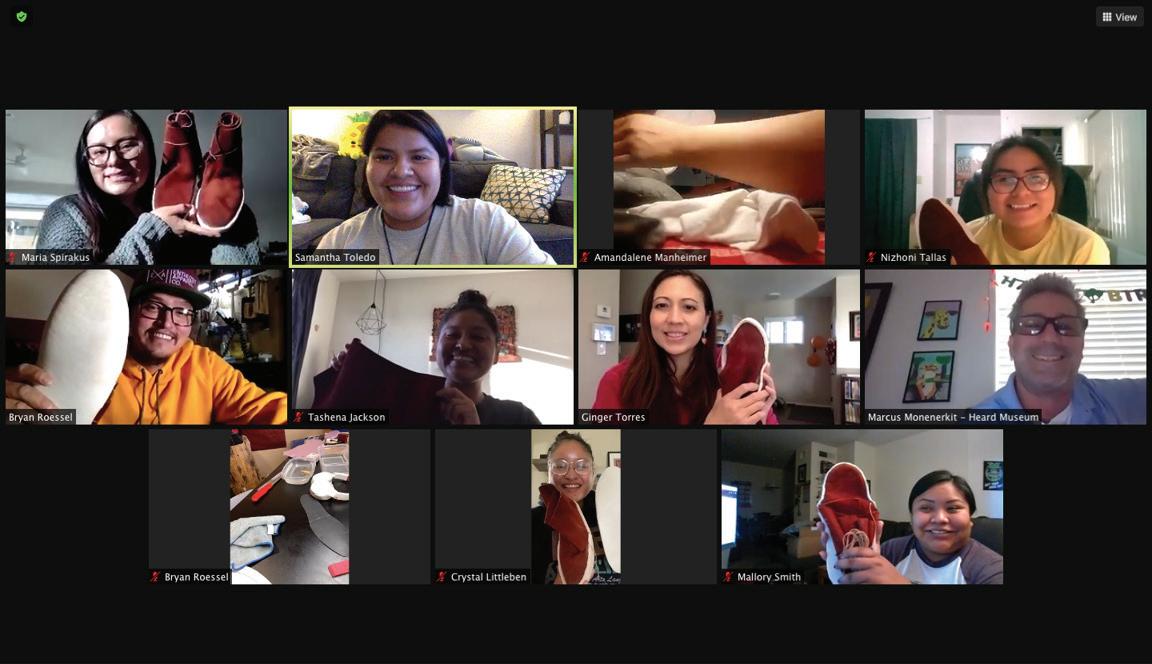
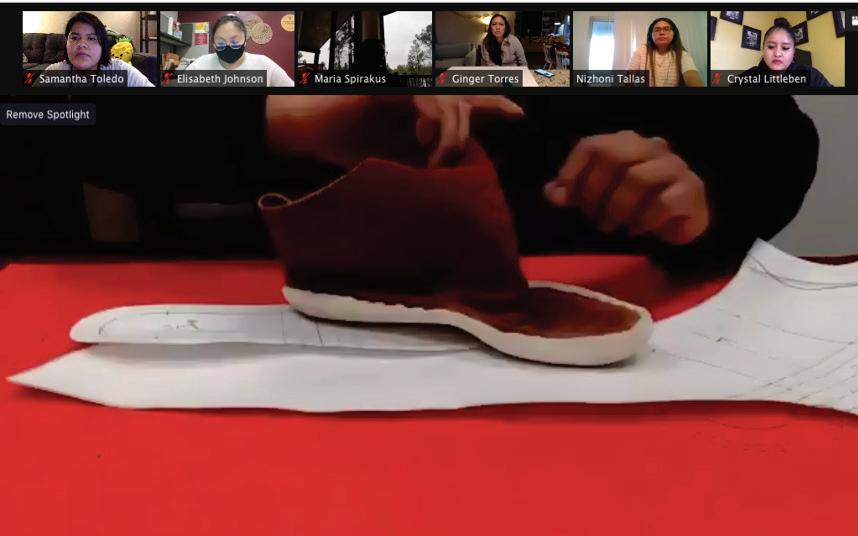
Master Artists Barbara Teller Ornelas, Lynda Teller Pete and Marlena Robbins offered to take on the challenge and create curricula and teaching resources for online workshops that would ensure their previously planned classes could continue in a safe and socially distanced manner. In May 2020, just weeks after the museum’s closure, we held our first online classes, with 30 students and instructors (Ornelas and Pete) working from two locations.
Since those first workshops, we have hosted nine online classes, teaching art forms ranging from weaving to painting, embroidery to moccasin-making. We have worked with nine teaching artists and served 111 students—nearly all of whom discussed the positive benefits of remaining connected during such distressing times. To our surprise, the classes were highly impactful, and each workshop allowed the staff team—Samantha Toledo and myself—to identify ways in which the next workshop, and the next, could be improved.
Over the past year, we have found that students were able to learn complex technical operations, like warping a loom or shaping moccasins, even in an online format.
And along the way we discovered simple tricks—like making additional learning content available for students between classes using Google Docs—that will ultimately enhance our teaching of in-person workshops when it is possible to return to the classroom. It has been incredibly rewarding to see our students learn in the face of such enormous obstacles.
Although we are looking forward to the time when our teaching artists and students can be back together in person and on campus, we feel incredibly pleased that conducting these online classes during such a difficult period helped our community remain connected and creative. Continuing to advance this work through the pandemic has proved that art and art education have the power to bring communities together during trying times and to help us remain hopeful and positive as we remember good times and anticipate returning to those special gatherings. It is my honor to help lead the Heard Museum’s community engagement work, but we do not do this work alone. We thank our artists, our students, our funding partners and our colleagues for enduring and thriving through these circumstances—together.
Heard Hoop Goes Viral!
BY DAN HAGERTY | DIRECTOR OF STRATEGIC DEVELOPMENT & PROGRAMMING
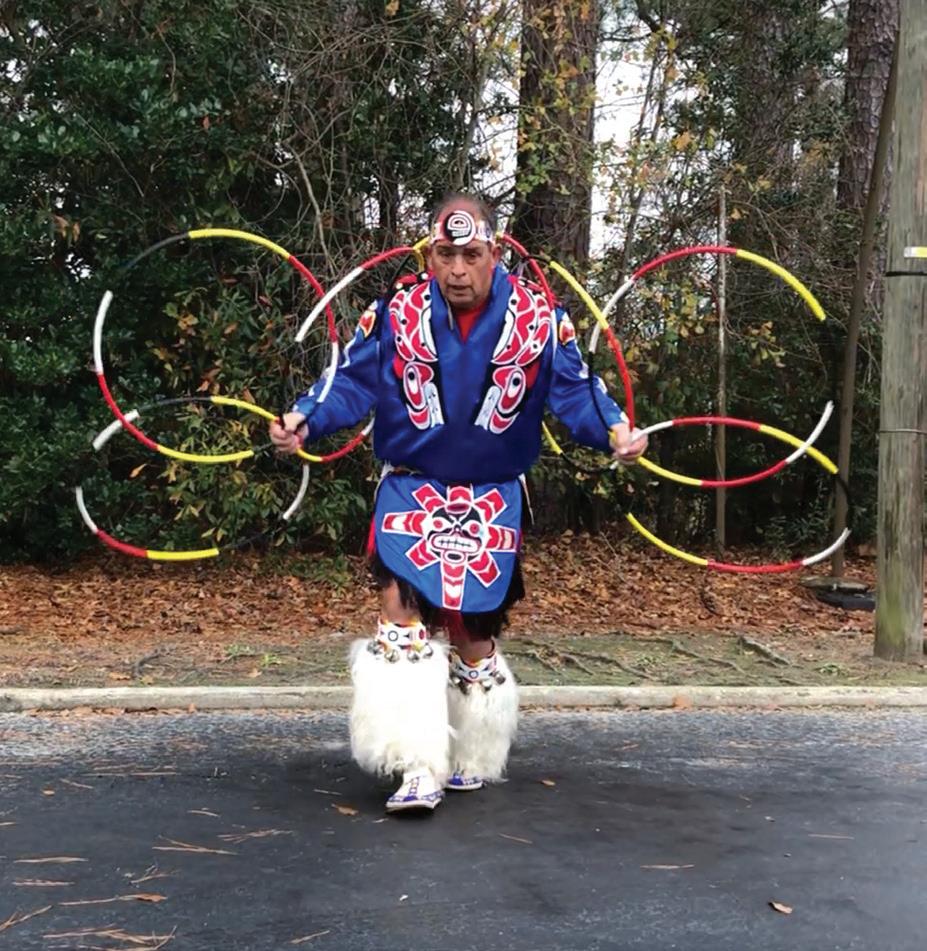
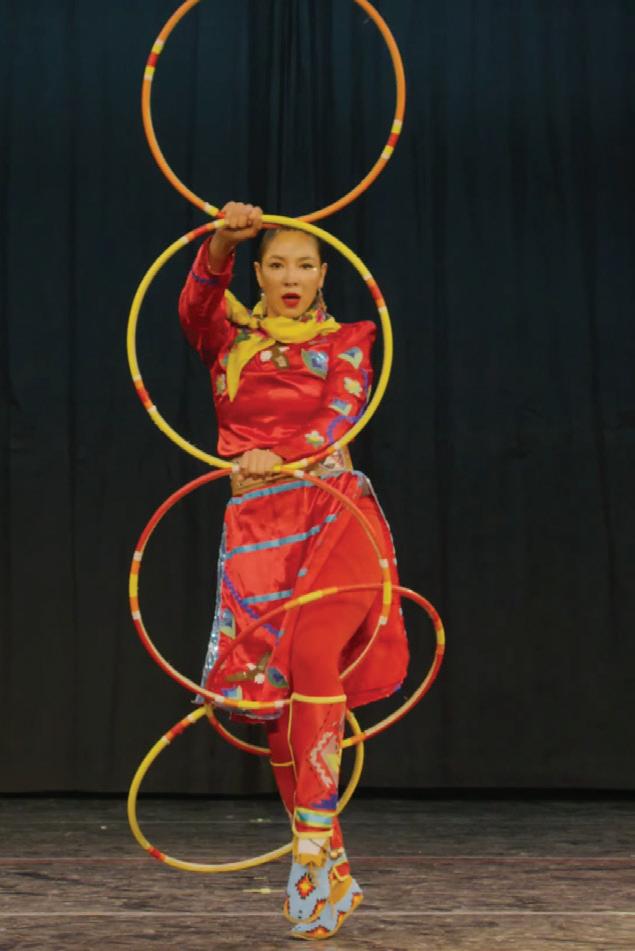
In February, more than 80 dancers participated from spectacular locations across North America in the Heard Museum’s first-ever Virtual Hoop Dance Contest, generating the largest-ever online audience in Heard Museum history.
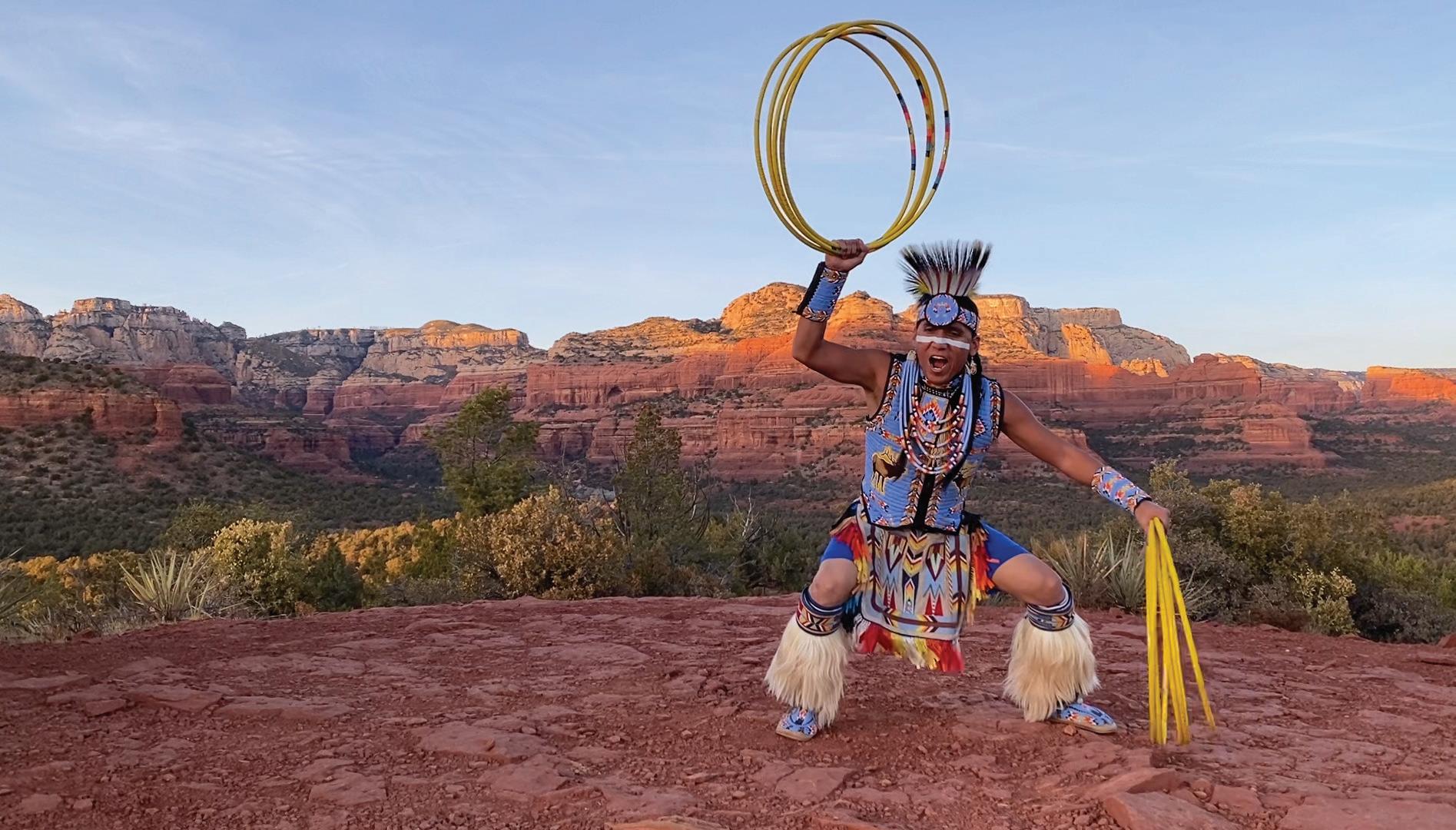
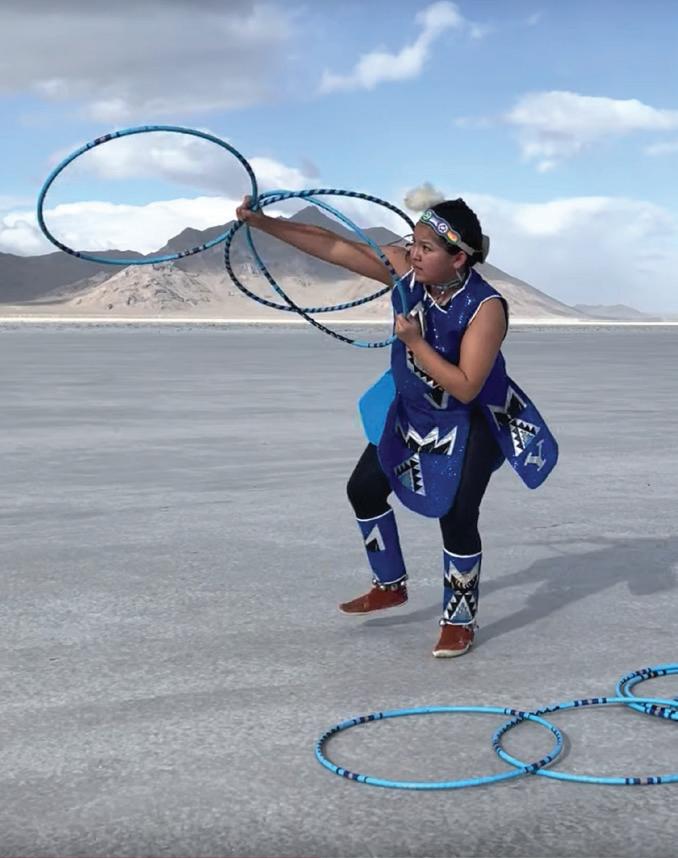
The Heard’s Annual World Championship Hoop Dance contest, held the second week of February, typically attracts more than 4,000 in-person spectators. Although COVID-19 safety measures necessitated that the event take place virtually this year, the results were no less thrilling. The participating dancers recorded their contest videos from their at-home locations, and the result was a spectacular array of settings. From golden
sunlight reflecting off the red rocks in Sedona to the salt flats of Great Salt Lake, and from snow falling on evergreens on Ontario’s Walpole Island to the shores of ‘Ewa Beach on Oahu, the 65-minute program gave viewers a thrilling look into the dancers’ communities across North America.
Kayden Denny (Navajo)
Tony Duncan (San Carlos Apache/MHA Nations)
Tony Duncan (San Carlos Apache/MHA Nations) led the field of outstanding contest winners by taking first place in the Adult Division with an amazing performance that has become the most-viewed video in Heard Museum history. Scott Sixkiller-Sinquah (Gila River Pima/Hopi), the current Hoop Dance World Champion, placed second, and Tyrese Jensen (Diné/ Pima-Maricopa), also a former World Champ, took third.
Winners were announced in all four competitive age divisions: Youth (ages 6-12), Teen (13-17), Adult (1839) and Senior (40+). The non-competitive Tiny Tots Division (5 and under), always a crowd favorite, was also featured in the program. The top prize in the Senior Division was awarded to Terry Goedel (Yakama/ Tulalip). Kailayne Jensen (Diné) took the top prize in her first time competing in the Teen Division, and Mateo Ulibarri (Pueblo of Pojoaque) took first in the Youth Division. The program also included online public voting for first-ever “Viewer’s Choice” awards. In all, $11,000 was awarded to the winning dancers, thanks to generous support from event sponsors.
This year’s program featured a tribute to dancer Nakotah LaRance (Hopi/Tewa/Assiniboine), one of the winningest competitors in Hoop Dance Contest history, who tragically passed away in 2020. LaRance’s tribute featured reflections from past World Champions and words of appreciation from many of the youths he mentored during an all-too-brief but wildly successful hoop dance career.
The contest was emceed by Dennis Bowen Sr., who has hosted the annual event from its first year at the Heard Museum in 1992. It was produced and directed by Eric Hernandez (Lumbee), a hoop dance performer and past competitor who also is a veteran of Cirque du Soleil and founder of the popular social media group CirqueLife.
The 65-minute virtual program premiered, offering free public access, on Saturday, Feb. 13, and remains available for on-demand viewing on the Heard’s YouTube channel. To date, the full-length program has reached nearly 80,000 unique views and the video of Tony Duncan’s award-winning performance achieved new online records for the Heard Museum. Tony’s video reached 1.1 million people on Facebook, had 161,000 likes and over 13,000 social shares … and counting. If you haven’t yet watched, or if you’d like to see the show again, visit heard.org/hoop
The Heard Museum 2021 Virtual World Championship Hoop Dance Contest was made possible thanks to the support of:
Ted and Mary Jo Shen
The Bob and Vanne Cowie Endowment
The Jay Kahn Memorial Fund
Terry Goedel (Yakama/Tulalip)
Shandien LaRance (Hopi/Tewa/Navajo/Assiniboine)
HOOP
63rd Annual Heard Museum Guild Indian Fair & Market Recap
BY ANNA FLYNN | FAIR CHAIR
What a year it has been! A year of many firsts—first-ever hybrid event (virtual and live events), first ever Juried Competition Show & Sale—in-person and online, and first-ever Virtual Art Market!
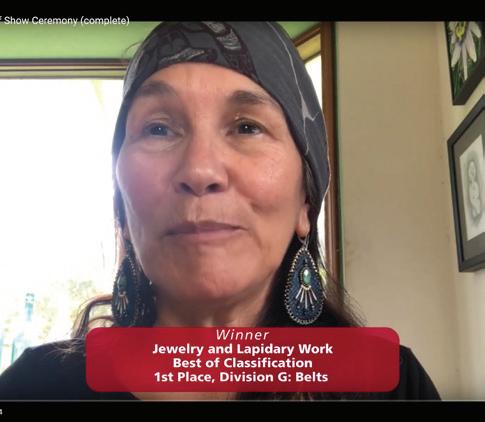
The Fair kicked off on Thursday, March 4, with the premiere of the Best of Show Awards video. The Fair officially opened at 9 a.m. on Friday, March 5 when the virtual Artists’ Galleries went live and the doors to Steele Auditorium opened to buyers at our first-ever onsite Juried Competition Show & Sale. Our first-ever virtual Juried Competition Show & Sale opened at 10 a.m. It was a whirlwind weekend until closing time on Sunday. As with all events, the pre- and post-event work consumed the most time and energy. A core group of dedicated volunteers and staff worked pre-Fair to make this event happen and continued to work post-Fair to wrap it up.
Virtual Art Market
Artists were either invited or applied and were juriedin to the virtual market, just as they are in a “normal” year. To adjust to remote work, we adopted an online application process that eliminated the majority of the bulk mailings and paper applications. Exhibitors’ Committee Chair Cathy Robertson had to learn the system and provide support to the artists, who also had to adapt to a new application process. This platform
enabled us to compress and streamline the application process and allowed jurors to rate applicant’s images remotely. A new Fair website was designed and developed to host the Artists’ Galleries. Three hundred artists participated in the virtual art market. Most artists had links to a Website, Instagram or Facebook account from which they sold their art. All sales in the virtual marketplace were between the buyer and seller.
Juried Competition
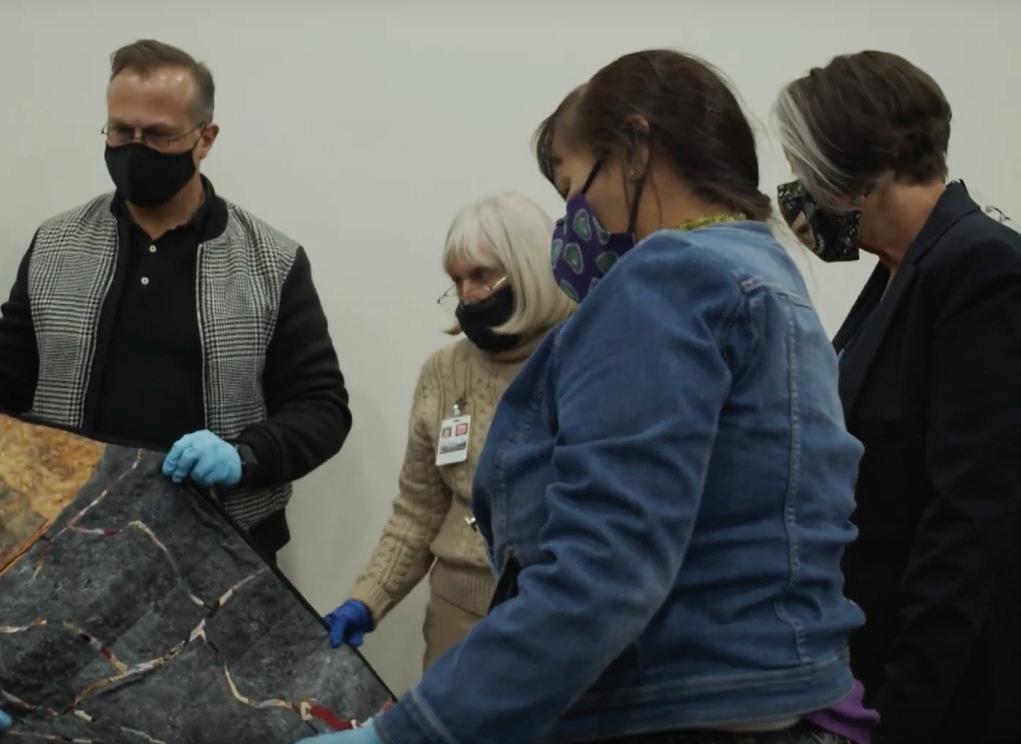
The juried competition team, curators, and museum and Fair leadership agreed that judging could not be based on images of the art. We wanted the art onsite. How do you pull off a live juried competition during a pandemic? It takes a village. A masked village. Our village included the Heard Museum Shop staff— especially Megan Richmond, who photographed all submissions—and Guild volunteers, including Lynn and Mary Endorf, who handled art receiving; Pat Kilburn and Lee Peterson who organized and conducted the juried competition; John Nesbitt who organized and managed the onsite Show & Sale; and Joel Muzzy, who coordinated staging.
Going into this, we had no idea how many artists would be able to participate given the constraints of COVID shutdowns and the cost of participating. Based on the rate of participation in a normal year, it was projected
CLICK HERE to view the Best of Show video
CLICK HERE to read the Vogue magazine article, “The Pandemic-Themed Artwork Honoring the Resilience of Indigenous People.”
that we might receive 150 submissions. Privately, we did not think this would happen. Imagine our surprise and delight when we received 258 submissions from 123 artists!
Art was received (shipped or hand-delivered) between Feb. 1 and 21. Human nature being what it is, we expected to receive most items closer to the deadline. And boy did we! More than half the submissions arrived on the last weekend. The massive winter storm caused shipping delays for some artists, and one item was damaged in transit. We received six baskets and one personal attire entry after judging, but in time for the sale. We commend the artists for their ability to create during such difficult circumstances and thank them for the effort and cost they incurred to get their art to us for the juried competition.
A single slate of five judges spent a day discussing and evaluating submissions and selecting award winners for 106 cash awards and 12 non-cash honorable mention awards. The judges uniformly commented on the high quality of the submissions.
Videographer Gabe Fermin was onsite to interview the judges and capture the art and judging process for use in the Best of Show video.
Best of Show Awards and Video
A total of $67,600 was distributed through 106 cash awards to 70 artists. Awards were given in 10 classifications, with a Best of Class Award and Innovation Award in each class and First Place and Second Place awards for multiple divisions in each classification. Additionally, ribbons were given for the Idyllwild Arts Imagination Award, the Conrad House Innovation Award, and the Indian Arts and Crafts Association Commemorative Award.
All awards, as well as some other Fair activities, were sponsored by individual donors, many of whom renew each year. In each of the last three years, the fundraising team has increased and then exceeded its fundraising goal. In 2018, we raised roughly $45,000 for awards. This year, we have already received $79,115 thanks to the generosity of our many sponsors.
Once again, Howard R. and Joy M. Berlin, Kristine and Leland W. Peterson and the Head Family co-sponsored the $15,000 Best of Show Award. Leland Peterson is a member of the Heard Museum Board of Trustees and a Guild member. Howard Berlin is a Life Trustee of the Heard Museum. The Heads are museum members from Minneapolis. The Guild thanks the Berlins, Petersons and Heads for their generous support of the Indian Fair & Market and our outstanding artists.
The Best of Show Award was given to Assiniboine/Sioux beadwork and quillwork artist Juanita Growing Thunder Fogarty for her soft sculpture Wakitantanka (StrongWilled) Pandemic Survivalist. It depicts a Sioux woman dressed in a penny dress standing on a beaded COVID image and surrounded by the words Smallpox 1630, Spanish Flu 1918, Covid 2019 and Wakitantanka, which means strong-willed.
The first annual Indian Arts & Crafts Association (IACA) Commemorative Award was announced. After 40+ years, the IACA was dissolved, and the board of directors gifted the Heard Museum Guild the balance of cash funds to provide an annual award of $1,500 for at least 10 years. The Guild is grateful to the IACA for their many years of commitment to American Indian art and honored that we were chosen to continue their mission through this award.
The IACA Award was given to Apsaalooke (Crow) beadwork artist Birdie Real Bird for Horse Medicine Her submission was a traditional Apsaalooke parade horse trapping consisting of nine beaded pieces. Her submission met a goal of the IACA award by acknowledging or educating viewers about cultural tradition, authenticity and the history of American Indians, through subject matter and execution. This was Real Bird’s first art show.
The first-ever Best of Show Awards Video was produced by Navajo painter and videographer Steven Yazzie, owner of Digital Preserve, and his associate Gabe Fermin. Background music was provided compliments of Robert Doyle, Canyon Records. The winners of the Best of Show Award, the 10 Best of Classification Awards, the Idyllwild Arts Imagination Award, the Conrad House Award and the IACA Commemorative Award appear in the video. Artists were notified of their award on a Friday and asked to record a 3-minute video on their smartphones and send it by Sunday evening. Several of the artists had to figure out how to do this and then how to email a large file. One artist said it took her four hours to get to a three-minute video that she considered acceptable. Steven Yazzie and Gabe Fermin turned 18 mostly amateur video clips into an amazing, seamless production.
Juried Competition Show & Sale
If the art was going to be in our hands, we wanted to facilitate the sale of the art. Although we had no idea what COVID restrictions would be in place in March,
we planned for both an online and in-person show and sale knowing that the onsite sale might have to be cancelled. We worked through the challenges of running an online and onsite sale simultaneously and only encountered a few glitches. Both online and in-person events ran March 5-7. We sold $302,075 worth of Juried Competition art ($265,805 onsite and $36,270 online) and nine artists reported selling $67,825 of art directly to their buyers. Others undoubtedly did the same. Thanks to our fundraising effort, we were able to return all sales proceeds to the artists with no fees retained for credit card processing or handling.
Native American Art Magazine and the
Official Fair Guide
This was the third year of our partnership with Native American Art magazine. Working from their homes, the amazing team at Native collaborated with the Fair Chair to produce the Official Fair Guide. Each year is challenging, but this year was especially so because of all the unknowns and uncertainty. Despite the challenges, the team produced yet another beautiful February/ March issue devoted to the Fair and the Heard Museum. Native also launched a podcast and conducted their first 12 interviews onsite at the Juried Competition Show & Sale. The interviewees included David Roche and 11 Fair artists. We are grateful to the publishers and staff for their contribution to a successful Fair.
Conclusion
This year was a year like no other for the Heard Indian Fair & Market. While the artists are always the center of the Fair, this year the Fair, museum and Guild leadership agreed that everything we did would be focused on the artists. All the “firsts” were exciting and terrifying. We learned a lot and laid the groundwork for a new and improved 2022 Indian Fair & Market. Kudos to the artists, the volunteers and the staff who made this happen. All the best to the new Fair team!
$302,075 JURIED COMPETITION ART SALES ($265,805 ONSITE AND $36,270 ONLINE) $67,825 DIRECT SALES REPORTED BY 9 ARTISTS.
806
2021 fair sponsors
Publisher of Official Fair Guide and Media Sponsor
Native American Art Magazine
Music for Best of Show Video and General Fair
Sponsor Canyon Records
Juried Competition Program Sponsor
Betty Van Denburgh
Best of Show Award
Howard R. & Joy M. Berlin, Kristine & Leland W. Peterson and the Head Family
Conrad House Award
Samuel J. Parker
Idyllwild Arts Imagination Award
Idyllwild Arts Foundation - Native American Arts Program & Festival
Indian Arts and Crafts Association (IACA) Commemorative Award
Funding provided by a gift upon the dissolution of the IACA for an annual award for 10+ years.
Youth Awards
Ages 12-14: Betty Van Denburgh
Ages 15-17: Betty Van Denburgh
Best of Classification Sponsors
Baskets: Sue Snyder
Diverse Arts: Mary Hamilton
Jewelry & Lapidary: Waddell Gallery
2-Dimensional Art: Deirdre & Jim Mercurio
Open Standards: Lynda Helmstadter Barber
Personal Attire: Sue Snyder
Pottery: John Ninomiya
Pueblo Carvings: Craig & Barbara Barrett Foundation
Sculpture: Mary Hamilton
Weaving: Paul & Shelia Mackasek
Innovation Award Sponsors
Baskets: Carolyn & James Halladay
Diverse Arts: Christy Vezolles
Jewelry & Lapidary: John Ward
2-Dimensional Art: Barbara Roberts-Poole
Personal Attire: Valerie & Paul Piazza
Pueblo Carvings: Dr. Neil S. Berman, Ph.D.
Pottery: King Galleries
Sculpture: Adrian & Carla Cohen
Weaving & Textiles: Nora & Jack Jones
1st Place Division
Sponsors
2-Dimensional Art (5 divisions):
In honor of Joana HallOster
Stephen Hardy & Addison Crawford
Catherine Meschter
Barry Westgate
Baskets (3 divisions):
Loren & Cathy Brown
Beverly Terry
Diverse Arts (5 divisions):
Norma & Burton J. Miller
Claire & Myron Warshaw
Barry Westgate (2 divisions)
Jewelry & Lapidary (9 divisions):
Frederick Beaubien
Coralee Auverson Brewer & Andrew Brewer
Robert & Carol Dewire
Carolyn & James Halladay
Carol Ann & Harvey Mackay
Judith & Don Miles
Elizabeth Raspolic
Delores Wiercinski
Personal Attire (3 divisions):
Adrian & Carla Cohen
Georgia Heller & Denis Duran
Barry Westgate
Pottery (7 divisions):
Patricia AtLee
Cerelle Bolon
Carol Cohen
Donnarae Freyermuth
Janis Lyon
Esther & Gil Sager
Kathleen & Sam Serrapede
Pueblo Carvings (2 divisions):
W. David Connell
Catherine Meschter
Sculpture (4 divisions):
Dee Dowers
Don & Dorothea Smith
Beverly Terry
Barry Westgate
Weavings & Textiles (3 divisions):
Mary & Mark Bonsall
Dr. Thomas B. Stevenson & Ms. Nadia Hlibka
Open Standards (1 division):
Kryptic Leaf LLC / Dr. Katsa Lehmann
2nd Place Division
Sponsors
2-Dimensional Art (5 divisions):
Dr. Casey & Mrs. Beth Huston
Deirdre & Jim Mercurio (4 divisions)
Baskets (3 divisions):
Connie Thornton
Betty Van Denburgh
Betty Van Denburgh
Diverse Art Forms (5 divisions):
Karen & Donald
Abraham
Theresa & Pat Harvey
Bob Sanderson
Andrea Waas
Jewelry & Lapidary Work (9 divisions):
Arlene and Giora Ben-Horin
Mr. & Mrs. Clay Crossland
Nancy Mossman
Mark & Sharon Pfenninger
Elizabeth Raspolic (2 divisions)
Jeanette & Charles Salerno
Don & Anna Lea Seago
Hugh Ulrich
Personal Attire (3 divisions):
Jan & Jim Darrington
Ken Noone, in memory of Phyllis Aaron Noone
Pottery (7 divisions):
Anonymous
Carol McElroy
Jane & Steve Marmon
Ms. Suzanne Niven
Territorial Indian Arts
Pueblo Carvings (2 divisions):
Dorothy Hockenberg
Sculpture (4 divisions):
Helmut & Hilde Horchler
Dr. & Mrs. Thomas
Hudak
Weavings & Textiles (3 divisions):
Anonymous
Brad Mason
Carol McElroy
Judge's Choice Awards Sponsors
MaryEllen Albrecht
Katie & Ben Blackstock
W. Dan Broome
Landon and Dorcas
Browning
Robby Buchanan
Diane Carmichael
Marilyn Collins
Christine Ann Crawford
Terry & Debbie Damron
Glen Goodman
Mary A. Hagerty
Constance Harrington & William Carlson
Linda Herold
John C. Hill Antique
Indian Art Gallery
Karen Hodges
Fred & Roberta
Horowitz–Exxon Mobil
Colleen & John Lomax
Phyllis Manning
Gregory Marshall
Cozette & Bill Matthews
Jan & Mike McAdams
Mike Miller
Carolyn Morgan
Penne Nelson
Pat & Dennis O'Connell
Margaret Osterhus
Judith Pykare
Kim & Karen Serota
Carol Seidberg
Barbara Sparman
People's Choice Award
Sandra Eiker Friends of the Fair Anonymous Anonymous
Steven Aldinger
James & Christine
Andras
Jerry & Gena Aslanian
Robert B. Bauver
Lou & Kay Benedict
Landon & Dorcas Browning
John & Judie Carpenter
Jim & Cindy Carter
Charities Aid Foundation of America (via Allie Raven)
Norma Jean Coulter
John & Anne Duffy
Denise Durazo
Ms. Lura Dymond
Barbara Filosi
Gordon & Barbara Freitag
Colleen Frojen
Nancy & Dean Graves
Michael & Spenser
Gregg
Constance Harrington & Willliam Carlson
Marilyn & Paul Harter
Nancy Henry
Cal & Virginia Ann Holman
Mark Huber
Kathy & Howard Jones
Dr. Sona Kalousdian and Dr. Ira Lawrence
Margaret Kirch
Aaron Komar
Kenneth D. Kroese
Tom & Jan Lathrop
Edward Leware
Dan & Judy Lippman
Mark & Denise Magness
Janet Margrave
John McCullough
Robert Mitchell
Frances Montasir
The Duane & Margaret
C. Morse Charitable Fund
Gloria Murison
Rex & Ellen Nelsen
Dennis Parker
Bill & Ellie Pendleton
Bill & Laurie Sue Retts
Dr. Sue Roe
Rudy & Maureen Rojas
Miki Safadi
Robert & Myrene Sari
Todd & Elizabeth Sharp
Mrs. Louise Slotta
Gary Steen
Jackie Stubbs
Holly Stuber
Anne Pettit Urrea
Lillian Vancel
Carol Ann VillarrealHyeoma
Ronnie Ann Wainwright
Polly Mills Whitehorn
Lee Worthen
Everett & Janet Zlatoff-Mirsky
the shop issue: future
What Goes Into a Museum Shop Redesign?
BY JOHN BULLA | DEPUTY DIRECTOR AND COO
The Howard & Joy Berlin Museum Shop is in the process of a redesign that will benefit Heard Museum patrons, our artists and the museum itself by providing a more impressive and accessible showcase for the American Indian artwork on display and a more enriching and elevated shopping experience.
I would like to introduce Dan Clevenger, a principal with the architectural firm DLR Group, which we have contracted for the redesign of the Heard Museum Shop. The Heard Museum has been collaborating with the DLR Group team since 2016, when they came on board for the Grand Gallery and Crosswalk expansion. Since then, we have partnered with them on the Central Courtyard and Admissions remodel.
John Bulla: You have done many projects with the Heard Museum. What makes the Heard Museum Shop redesign different?
Dan Clevenger: The Heard Museum Shop is really unique as it provides an opportunity for patrons to take home one-of-a-kind works of art. Work by Indigenous artists that could just as easily be displayed in one of the Heard Museum galleries can now be part of people’s personal art collections. Providing accessibility to such world-class art is what makes this project different and an exciting challenge. How can visitors to the Shop feel like they are shopping in one of the museum’s galleries? I think that is really the inspiring opportunity here and what we continue to explore as a design team.
JB: What is your process for creating a successful redesign?
DC: Engagement and understanding what will define success is critical. In all our projects with the Heard Museum, starting by listening and understanding the desired outcomes of a renovation from the owner’s and patron’s perspective is key. We then craft a visual narrative based around core design principles which define what success looks like at the end—in this case, the impact to the shopping experience for the museum’s patrons and guests. From a technical perspective, understanding the existing construction and systems of the building is essential. Building systems and technology are considered throughout the design process
Dan Clevenger
so they are seamlessly integrated. Detailed aspects such as display lighting are critical to provide an elevated experience for patrons and to properly capture the intricate detailing and craftsmanship of the artwork available for sale.
JB: What are the challenges for redesigning this existing space?
DC: We identify each challenge as an opportunity! We think this way as a design team because the challenges coincide with the richest, most rewarding experiences of a project. Overall, our first opportunity is in elevating the quality of the space to align with the amazing quality of the artwork on display, and that sets a very high bar! One aspect is how the objects are displayed: providing a space where they are accessible and well illuminated to allow proper attention to the craft that
goes into each. Another opportunity is to provide a means for patrons to connect with the artist and the traditions or inspiration behind a work on display, possibly through integrated technology. There is also a great opportunity to further develop a connection between the Shop and the adjacent Courtyard. Separate from the museum’s galleries, the Shop is in a unique position to connect with patrons as they enter or depart the museum. A stronger visible presence and connection to the Courtyard can attract new guests and provide a showcase of new arrivals for members.
JB: When the remodel is completed and our members walk through the doors for the first time, what is the reaction and impression you are designing for?
DC: Visitors to the Shop should feel as though the Heard Museum has opened a new gallery—one where they can own the items hanging on the wall or displayed in cases! The artwork available in the Shop is already of this caliber; we see this as an opportunity to redefine the space in alignment with the work the artists are making.
Investing in the Future of the Heard Museum Shop
BY DAN HAGERTY | DIRECTOR OF STRATEGIC DEVELOPMENT & PROGRAMMING
The Howard and Joy Berlin Shop at the Heard Museum plays a critical role in supporting the livelihoods of hundreds of American Indian artists. It remains the primary driver for the Heard Museum’s role in generating $46 million in economic activity throughout Indian Country every single year. And while performing this vital service for generations of artists, the Heard Shop is also essential to sustaining the museum’s ongoing operations.
The Heard Shop buys artwork directly from American Indian artists, making it one of the few major retail outlets in the country that guarantees the integrity and authenticity of the art offered for sale. Our community recognizes the importance of this commitment to supporting artists and to offering one of the city’s most unique shopping experiences. The Heard Museum Shop consistently tops the list of reader polls for “Best Museum Shop” in Phoenix Magazine, Phoenix New Times and many other publications.
d Museum Shop: Textile Galler y Concept Sketch
The Heard Shop was last redesigned in 2011. With projected growth of 30% over the next five years, the Shop will remain a crucial economic engine for the museum itself and the artists represented inside. Further, the Shop’s success is essential to the Heard’s long-term economic recovery from the challenges wrought by the COVID-19 pandemic. But in order to reach those goals, significant improvements are needed to ensure that this vital institution has as deep an impact on future generations of American Indian artists as it has had on past ones.
The Heard Museum has received a generous $1 million gift to be used for upgrading and updating every facet
of the Heard Museum Shop, beginning in summer 2022. Patrons and artists will enjoy many new features in the renovated Shop, including new custom lighting and casework, wide-plank hardwood flooring, a largescale textile shopping gallery, expanded jewelry and e-commerce areas, a dedicated and discreet collectors’ room, and more.
We need your help to realize this important vision for the future of the Heard Museum Shop! Naming and other opportunities are available. To learn more or to find out how you can support this important effort, contact Dan Hagerty at dhagerty@heard.org. Thank you for being part of the Shop’s past, present—and future!
Ways to Give
There are many ways to support the Heard Museum, from volunteering or becoming a member to making financial gifts that support a range of programs, exhibitions, and other priorities. As a Heard Museum Member, chances are you may be familiar with these ways of supporting the museum and our mission. But you may be less familiar with two other ways of supporting the Heard Museum, each of which also offers special tax-wise opportunities: the Grand Gallery Exhibition Fund and our Planned Giving Program.
Grand Gallery Exhibition Fund
The Grand Gallery Exhibition Fund is a new initiative that provides direct support for the Heard’s world-class exhibitions. 100% of gifts to the Fund go directly toward planning and implementing the original and ambitious exhibitions you’ve come to expect in the Virginia G. Piper Charitable Trust Grand Gallery. In addition, supporters of the initiative receive special recognition and exclusive benefits.
This year, Grand Gallery Exhibition Fund donors enabled:
• The opportunity for over 12,000 in-person visitors and 2.5 million more online to experience Larger Than Memory: Contemporary Art from Indigenous North America and Leon Polk Smith: Hiding in Plain Sight
• Virtual Art Talks and other online programs with dozens of artists, curators, and scholars associated with these two Grand Gallery exhibitions
• Recognition by Phoenix New Times of Larger Than Memory as Best Art Exhibit in their Best of Phoenix 2020 issue
• The ability and confidence to plan exhibitions months and years into the future, sustaining our creative efforts through and beyond the pandemic
To learn more, please contact Jack Schwimmer at jschwimmer@heard.org or 602.251.0245.
Planned Giving
In 1925, Dwight Heard provided $75,000 in his will to be used by his wife, Maie Bartlett Heard, “for construction, maintenance, and endowment for any form of benefaction for the benefit of Phoenix and vicinity.” And so the vision for the Heard Museum was born, through the museum’s very first ‘planned gift.’
Individuals who have embodied the Heards’ generosity and vision by similarly establishing planned gifts themselves are members of an esteemed group named for Ms. Heard: the Maie Bartlett Heard Society. Some have included the Heard Museum in their estate plans (through financial gifts, or gifts of art), while others have made lifetime gifts through tax-wise giving vehicles like IRAs or stock gifts. All have found creative ways to support the Heard in which they, their loved ones, and the Heard itself all benefit at the same time.
Whenever you might be interested in exploring such gifts, the Heard’s Development team is here to help! Visit heard.org/plannedgiving, or contact Jack Schwimmer at jschwimmer@heard.org or 602.251.0245 with any questions about the Maie Bartlett Heard Society or how to build your own legacy at the Heard Museum.
and the exhibition opening of Remembering
Saturday, October 23, 2021 at 6 p.m.
HONOREES
Mary Ellen and Bob McKee
CHAIRS
Denise Wallace (Chugach Sugpiaq/Alutiiq)
Jan Cacheris | Marilyn Harris
For more information, contact Jack Schwimmer at JSchwimmer@Heard.org or 602.251.0245, or visit www.heard.org/moondance