
The EARCOS Triannual JOURNAL
A Link to Educational Excellence in East Asia WINTER 2025/26

Featured in this Issue
Governance
Five Board Chairs, One Vision: Building the Future of Governance
Together Leadership
Growing as a Pedagogical Leader
College Admissions
Would Confucius Understand US College Admissions?
Curriculum
Engaging Every Sense: A Three-Phase Framework for Language Teaching
THE EARCOS JOURNAL
The ET Journal is a triannual publication of the East Asia Regional Council of Schools (EARCOS), a nonprofit 501(C)3, incorporated in the state of Delaware, USA, with a regional office in Manila, Philippines. Membership in EARCOS is open to elementary and secondary schools in East Asia which offer an educational program using English as the primary language of instruction, and to other organizations, institutions, and individuals.
OBJECTIVES AND PURPOSES
* To promote intercultural understanding and international friendship through the activities of member schools.
* To broaden the dimensions of education of all schools involved in the Council in the interest of a total program of education.
* To advance the professional growth and welfare of individuals belonging to the educational staff of member schools.
* To facilitate communication and cooperative action between and among all associated schools.
* To cooperate with other organizations and individuals pursuing the same objectives as the Council.
EARCOS BOARD OF TRUSTEES
Catriona Moran (Saigon South International School), President
James Dalziel (NIST International School), Vice President
Jim Gerhard (Seoul International School), Secretary
Rami Madani (The International School of Kuala Lumpur), Treasurer
Gregory Hedger (The International School Yangon), WASC Representative
Karrie Dietz (* Incoming Head of School (August 2026)
Nexus International School Singapore)
Marta Medved Krajnovic (Western Academy of Beijing)
Maya Nelson (Jakarta Intercultural School)
Matthew Parr (Nagoya International School)
Margaret Alvarez (WASC), Ex-Officio
Kevin Baker (American International School Guangzhou), Past President
Andrew Hoover (Office of Overseas Schools, REO, East Asia Pacific)
EARCOS STAFF
Edward E. Greene, Executive Director
Cameron Janzen, Deputy Director
Bill Oldread, Assistant Director Emeritus
Kristine De Castro, Office Manager & Assistant to the Executive Director
Maica Cruz, Events Coordinator
Porntip (Joom) Rattanapetch, Administrative Assistant & Membership Coordinator (Bangkok Office)
Kanjanarat (KJ) Visanjaron, Professional Learning Events Coordinator (Bangkok Office)
Edzel Drilo, Professional Learning Weekend, Sponsorship & Advertising Coordinator, Webmaster
RJ Macalalad, Accounting Staff
Rod Catubig Jr., Office Staff
East Asia Regional Council of Schools (EARCOS)
Brentville Subdivision, Barangay Mamplasan, Binan, Laguna, 4024 Philippines
Phone: +63 (02) 8779-5147 Mobile: +63 917 127 6460
Satellite Office
39/7 Soi Nichada Thani, Samakee Road, Bangtalad Sub-District, Pakkret District Nonthaburi 11120, Thailand
In this Issue
Five Board Chairs, One Vision: Building the Future of Governance Together By Dr. Hyungji Park, Anna- Marie Pampellonne, Emily Chan, Dr. Grace Lee, and Maria S. Chung
Would Confucius Understand US College
Growing as a Pedagogical Leader By Eric Sheninger
Working in the Eye of the Storm: Taming the Turbulence in Educational Leadership By Jennifer D. Klein
Igniting Innovation: Cultivating Entrepreneurial Thinking in Educational Leadership By Dr. Christopher Allen
Building a Crisis-Ready Culture in International Schools By Gregory A. Hedger & Sandy Sheppard
Curriculum Engaging Every Sense: A ThreePhase Framework for Language Teaching By Sophia Suo
Cinderella in Three Languages: Theatre as a Tool for Intercultural Learning By Ira Mathur
The Time for an Ecological Humanities is Now By Jared Rock
Unknowable Potentialities: Weaving a Shared Narrative of Pedagogical Identity By Nitasha Crishna, Kay Strenio, & Anne Van Dam
Language Integration In The Art Room: A Case Study of Collaboration between the Visual Arts Teacher and EAL By Nan Zhang & Amy Kerr
My City: Connecting Students to Yangon’s Living History By Leah Wilks
Action Research
Standards-Based Grading: Perceptions and Impact on Concordia’s Student Mastery By Shane Twaddell & Vanessa Vanek 52 Press Release
Building What Didn’t Exist: The Story of ISCA and the International Model By Cheryl Brown & Brooke Fezler
The Richard T. Krajczar Humanitarian Award: Growing Together with Refugee Communities By Sophia Hamilton
Poem
Booking a Worldwide Literacy Adventure through a Collaborative Poem
Middle School Art Gallery
Welcome from the Executive Director
As always, it is a pleasure to welcome our readers from across this vast region of international schools to the latest issue of the EARCOS Tri-annual Journal. I think, at times, many have come to undervalue the contributions a journal like ET offers. In today’s world of social media and its nearly instantaneous commentaries on all subjects—great and trivial, a journal such as this can seem like an artefact from a by-gone age. May that never be the case.
This issue contains another collection of carefully constructed and edited articles written by fellow-educators and thinkers who share a commitment to the wonders and challenges of international education. This issue of ET reflects the incredible richness, diversity and remarkable opportunities that are available to all who are so fortunate to be international educators today. I do hope you will carve out time to read what our colleagues have shared in this issue—and to take time to reflect on what they are sharing and how it might help your school and students enhance your own journey.
This journal is the created not only by those educators who have taken time to share their ideas with us, but by two individuals who work quietly and diligently behind the scenes bring ET to life three times each year. Together, for nearly two decades, editors Edzel Drilo and Bill Oldread solicit, review, edit, prepare, layout and ‘print’ each issue of this journal. I want to express my deep appreciation to them both for the many, many hours they give to ensure that this journal reaches educators across East Asia and beyond. Our schools, our students and communities are indebted to Edzel and Bill for their dedication to sharing the very best of international education through this journal’s pages. Please join me in thanking them both for the gift they have created for this region.
Please remember that this journal is YOUR journal. We look forward to receiving your ideas, reflections, program reports and insights. Please let us hear from you.
In the meantime, all best wishes from all of us at EARCOS for a wonderful start to 2026!
Thank you,
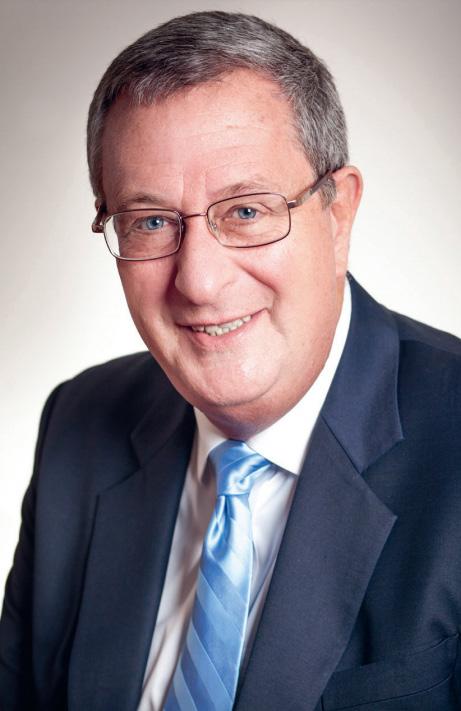
Edward E. Greene, Ph.D. Executive Director

STRANDS
Literacy/Reading
Early Childhood
Special Needs
Modern Languages
Media Technology/Libraries
Counselors
EAL Technology
Children's Authors
Child Protection
General Education
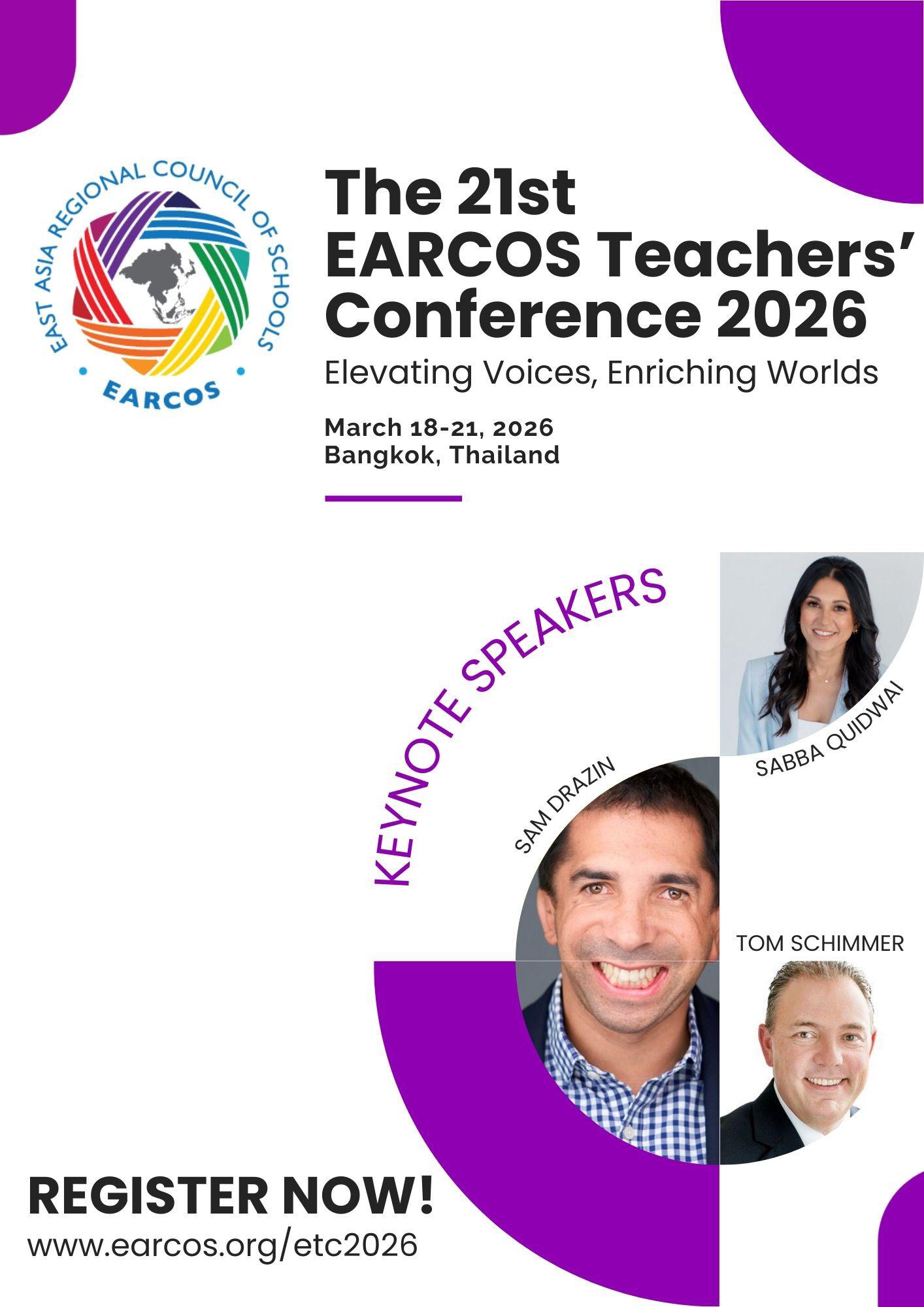
PRE-CONFERENCES MARCH 18, 2026

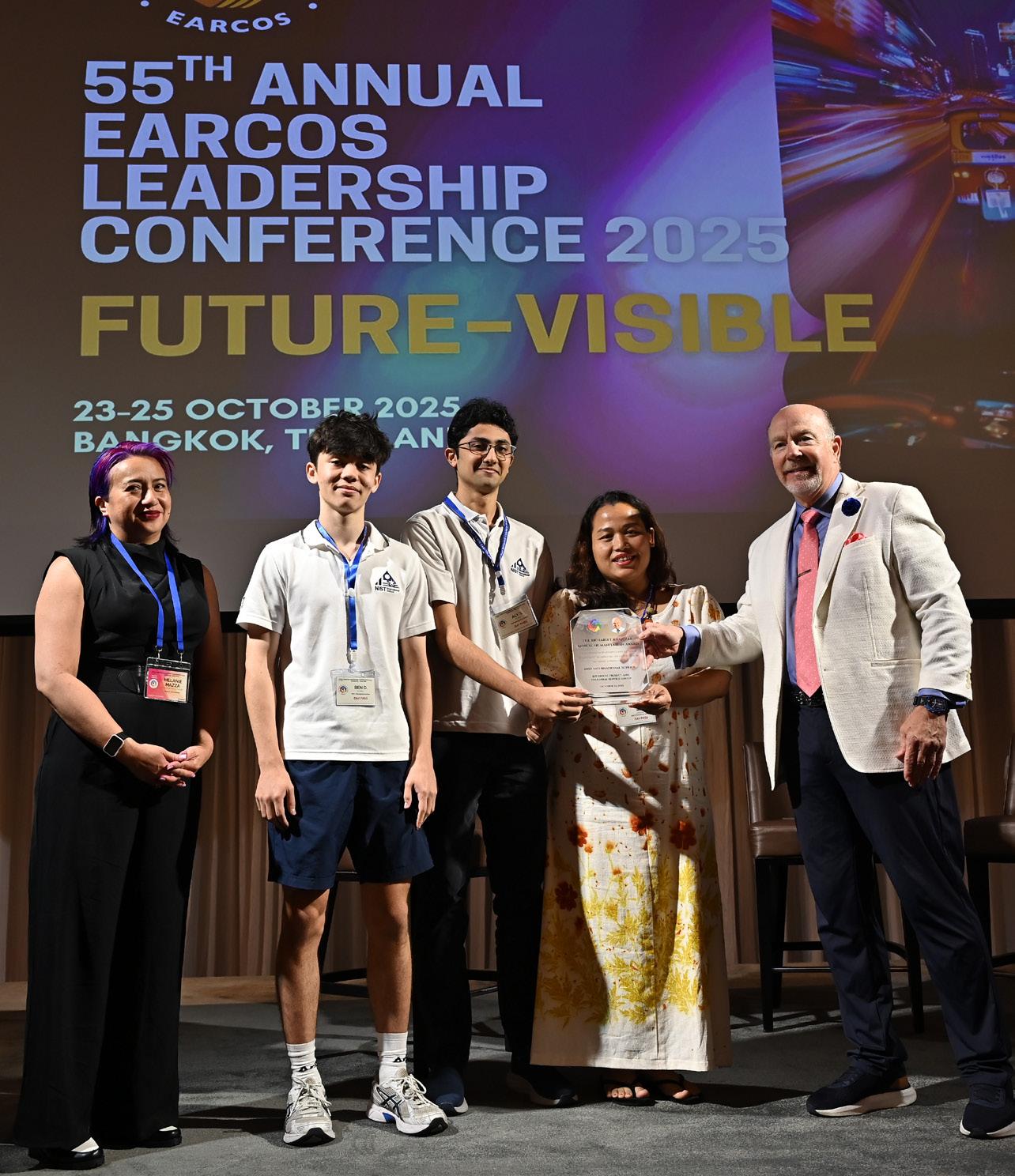
Joy House Project takes home Dr. Krajczar Humanitarian Award for 2024
The Joy House Project collaborated with the PhuLiPhay Service Group, through NIST International School in Bangkok, Thailand, to develop the winning humanitarian initiative.
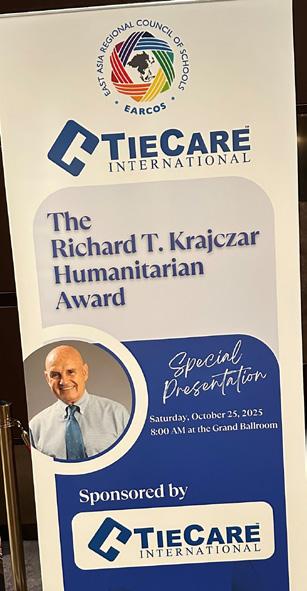
TieCare International sponsored and presented the award at the 2025 EARCOS ELC in Bangkok.
PhuLiPhay Service Group is a youth-led service group based out of NIST International School. The group has partnered with the Joy House to support refugees, channeling student passion into action.
In collaboration with NIST, the group was the recipient of the 2024 Richard Krajczar Humanitarian Award from the East Asia Regional Council of Schools (EARCOS).
Joy House is an organization based in Mao Sot, a town in Western Thailand near the border with Myanmar. Its mission involves fostering cross-cultural exchange and understanding between Thai and Myanmar children.
The project provides support and services to the local community, including refugees from Myanmar.
Together, the two groups have worked on specific projects, potentially including the use of a US$10,000 grant awarded through the EARCOS award to support their shared goals.
Together, the two groups have worked on specific projects, potentially including the use of a US$10,000 grant awarded through the EARCOS award to support their shared goals.

Mark Tomaszewski President, TieCare International
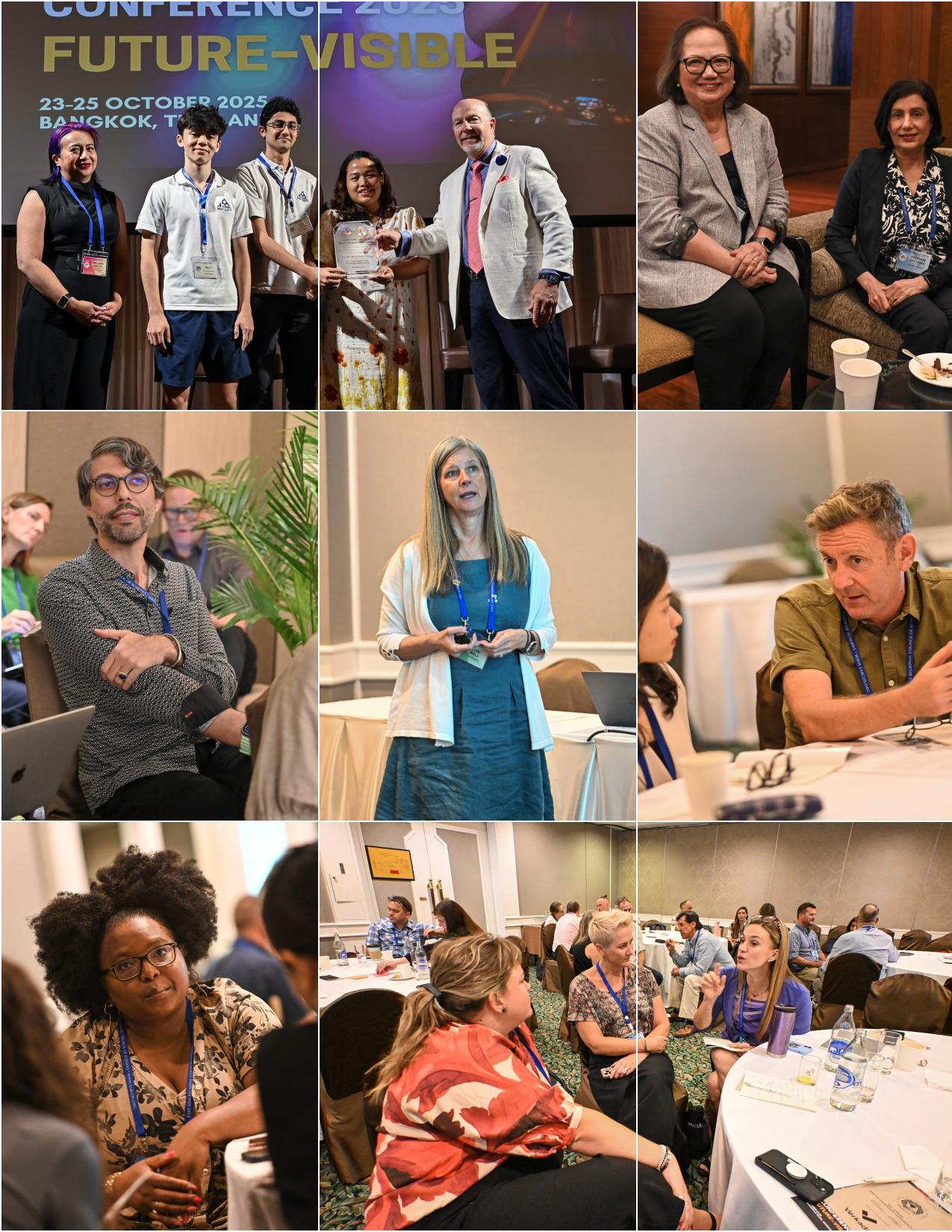
The Richard T. Krajczar Humanitarian Award Special Presentation.
Aly S. and Ben D. are part of the acceptance team of the 2024 Richard T. Krajczar Humanitarian Award.
Ms. Melanie Mazza (left) and Mr. Mark Tomaszewski (right) of TieCare International congratulate the winners of the 2024 award.

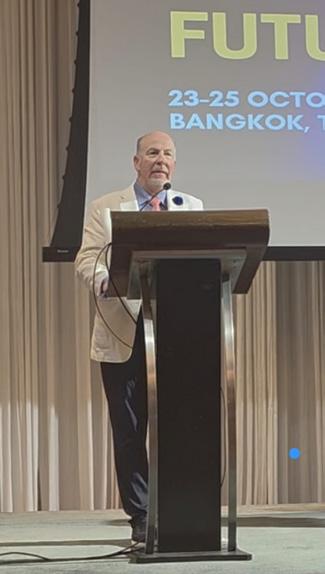
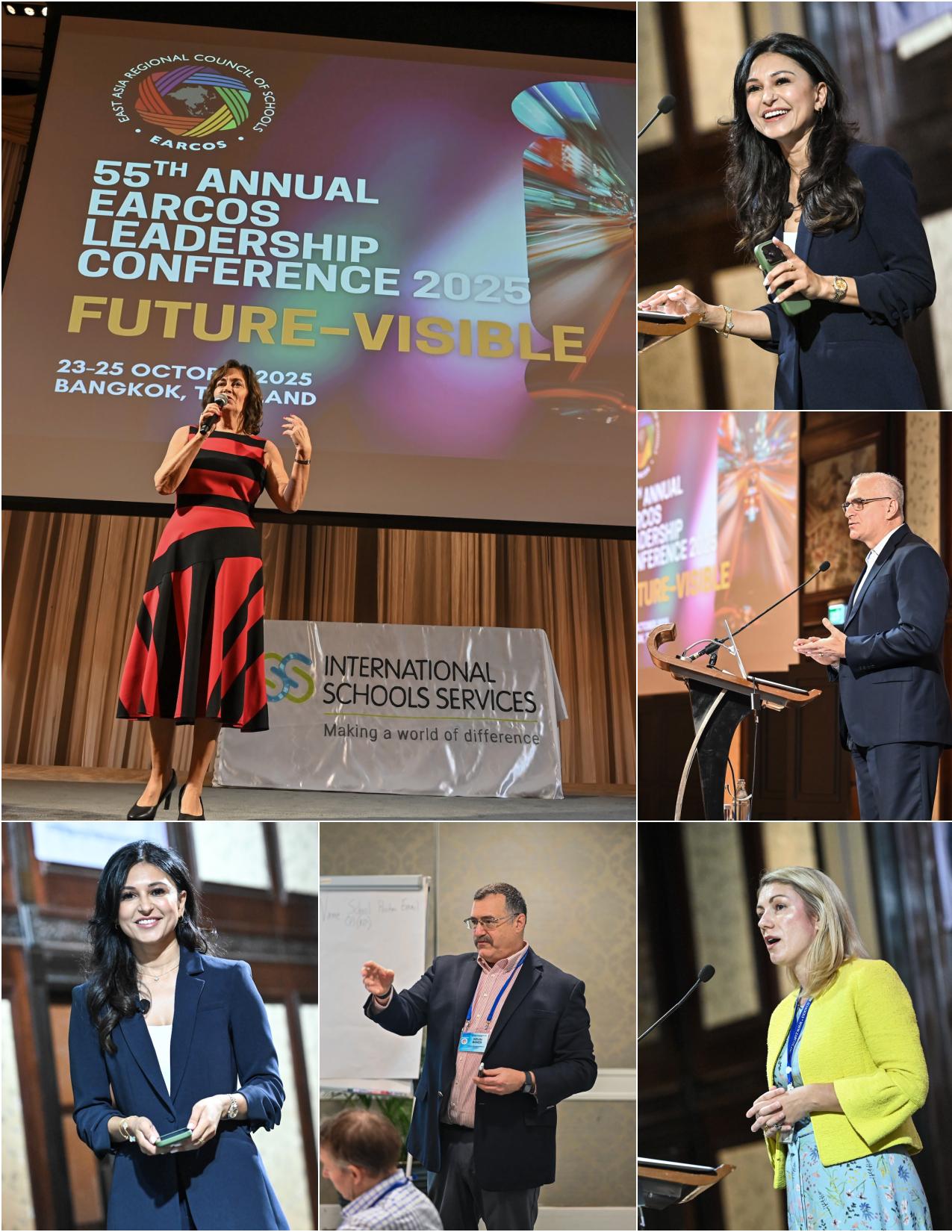
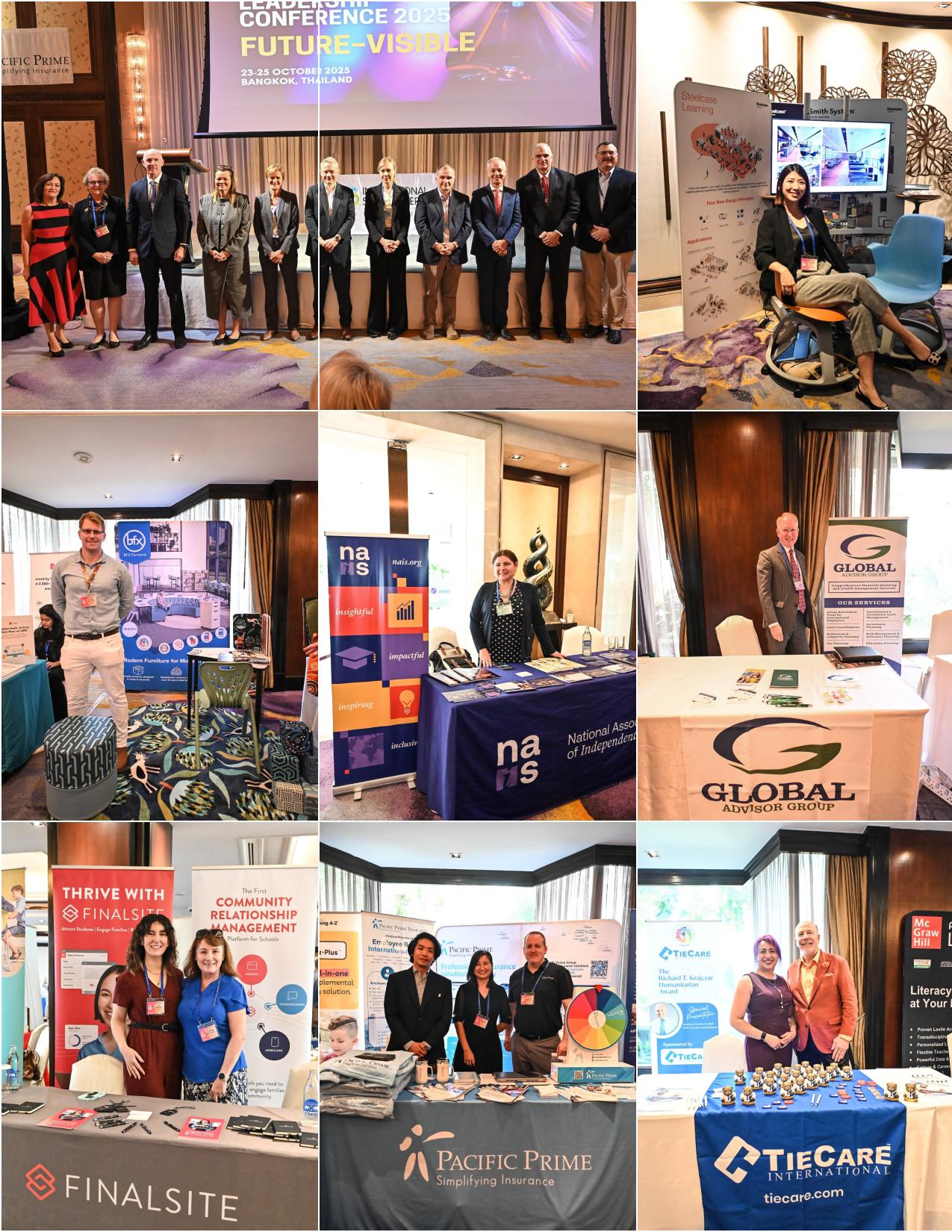
The 55th EARCOS Leadership Conference 2025
“Future—Visible”
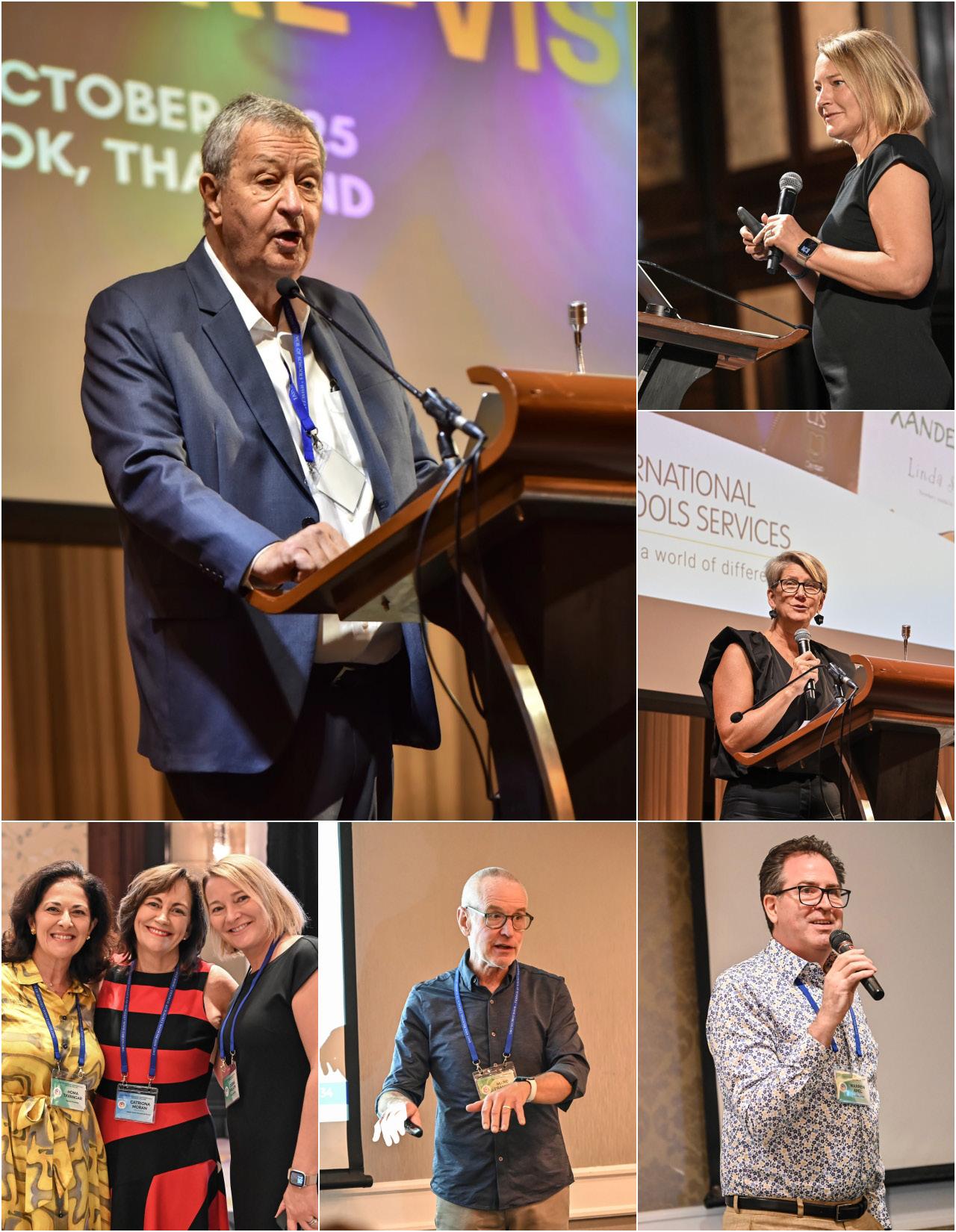
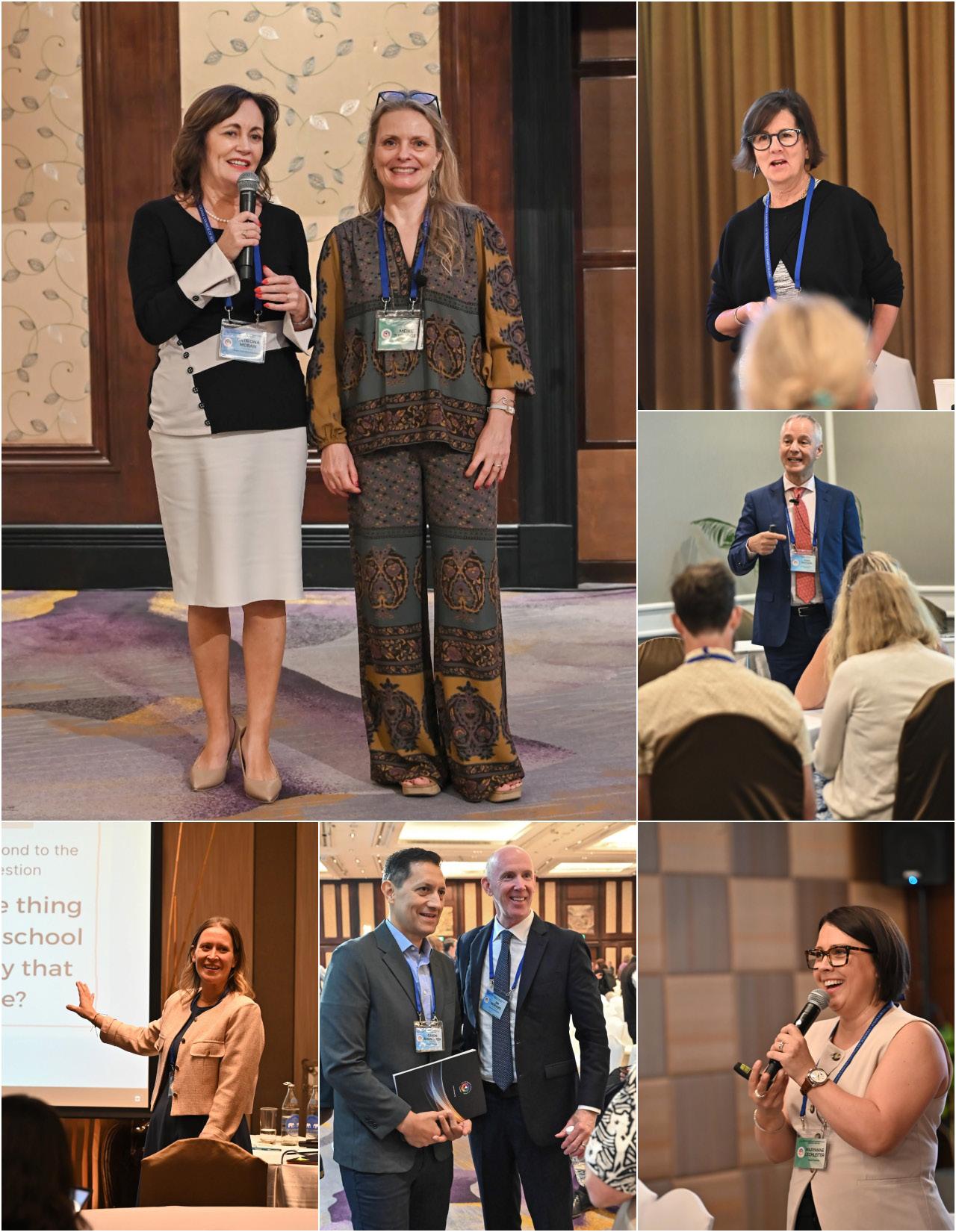
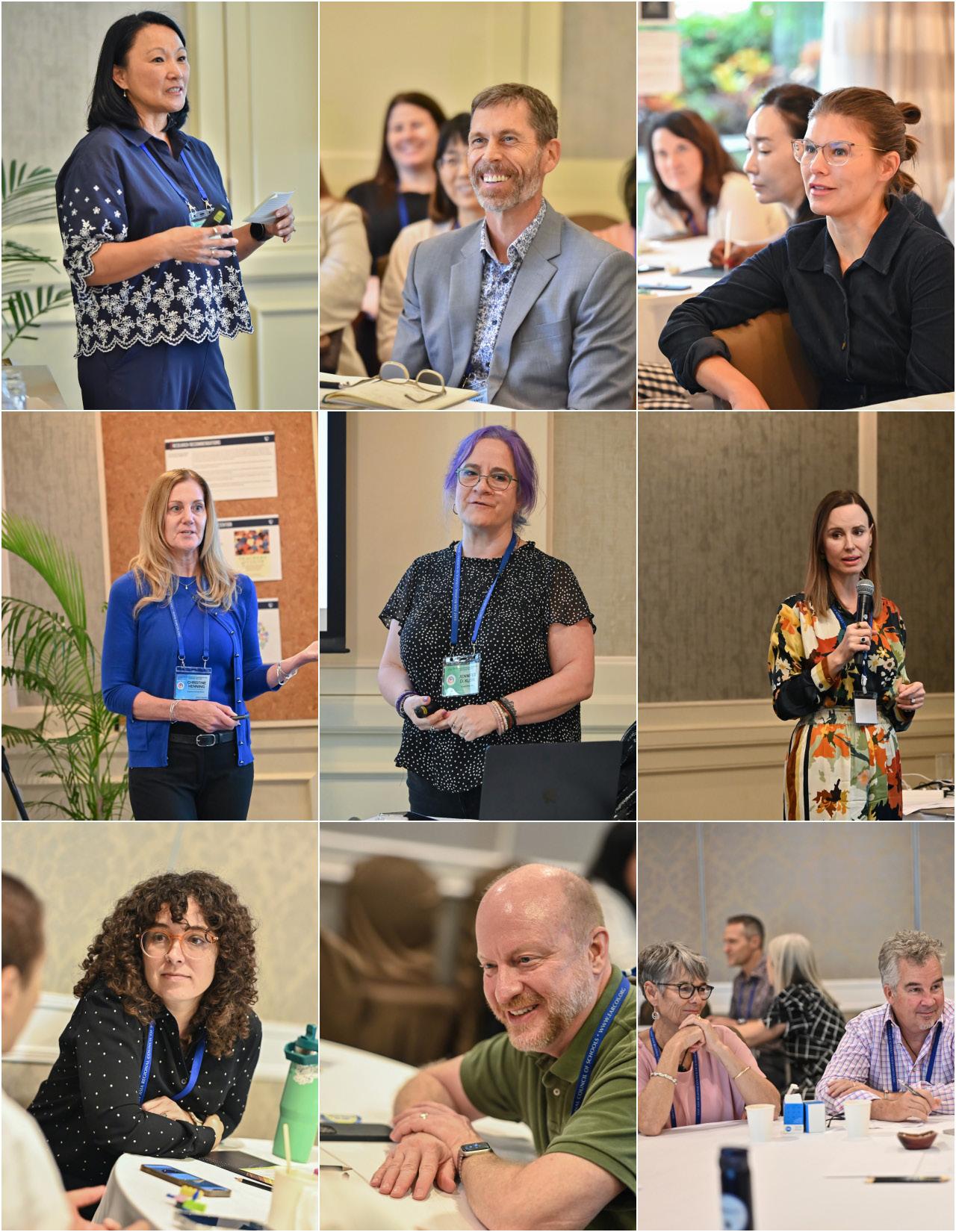
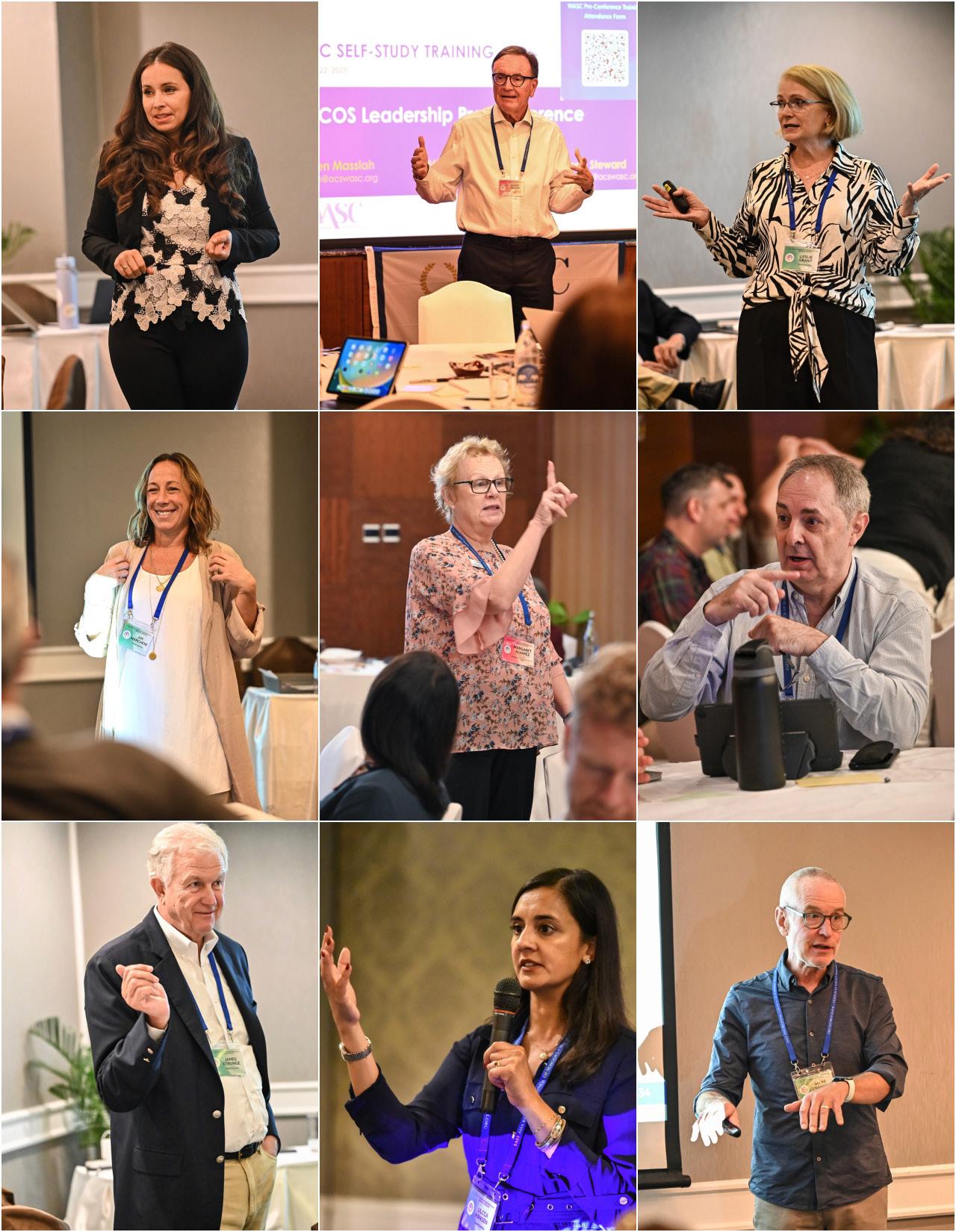
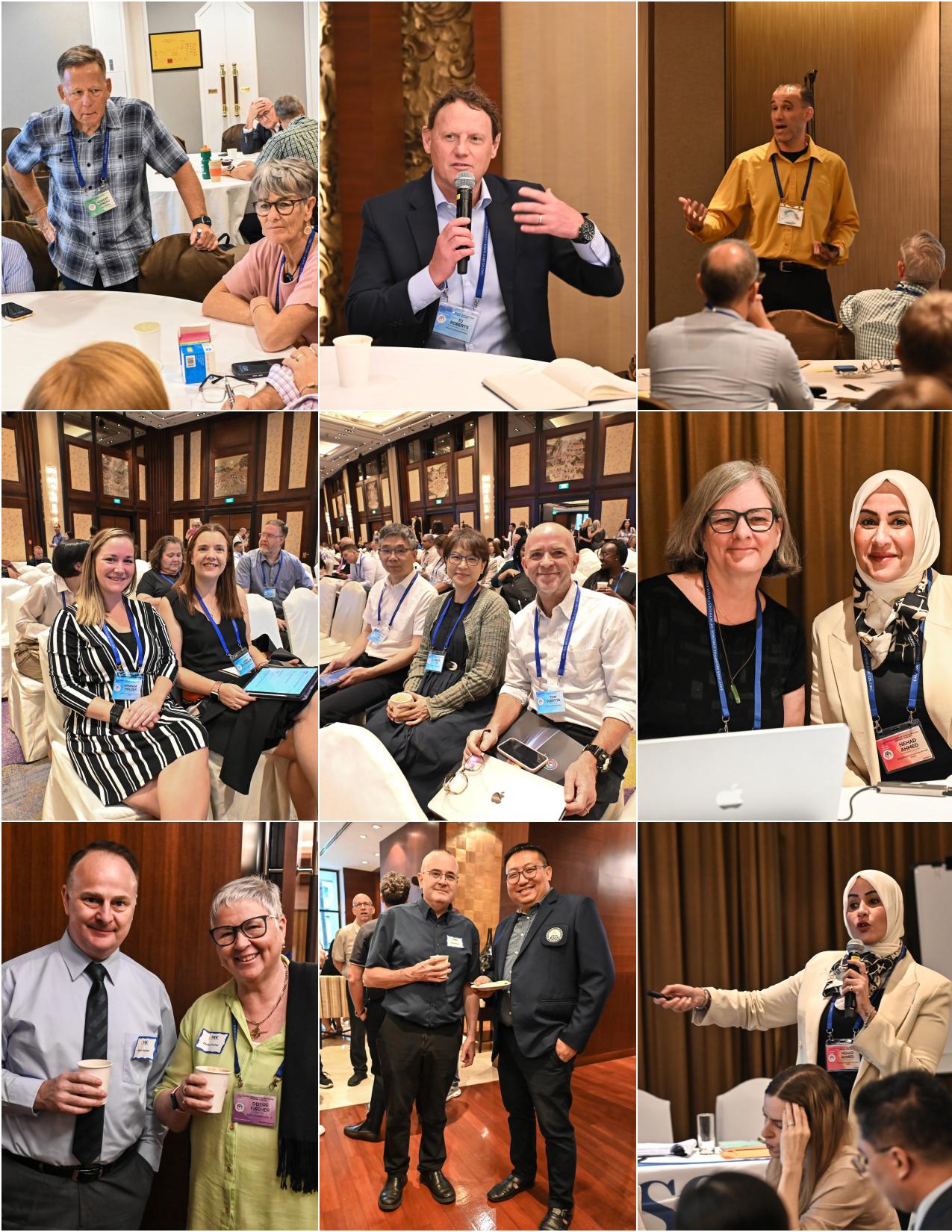
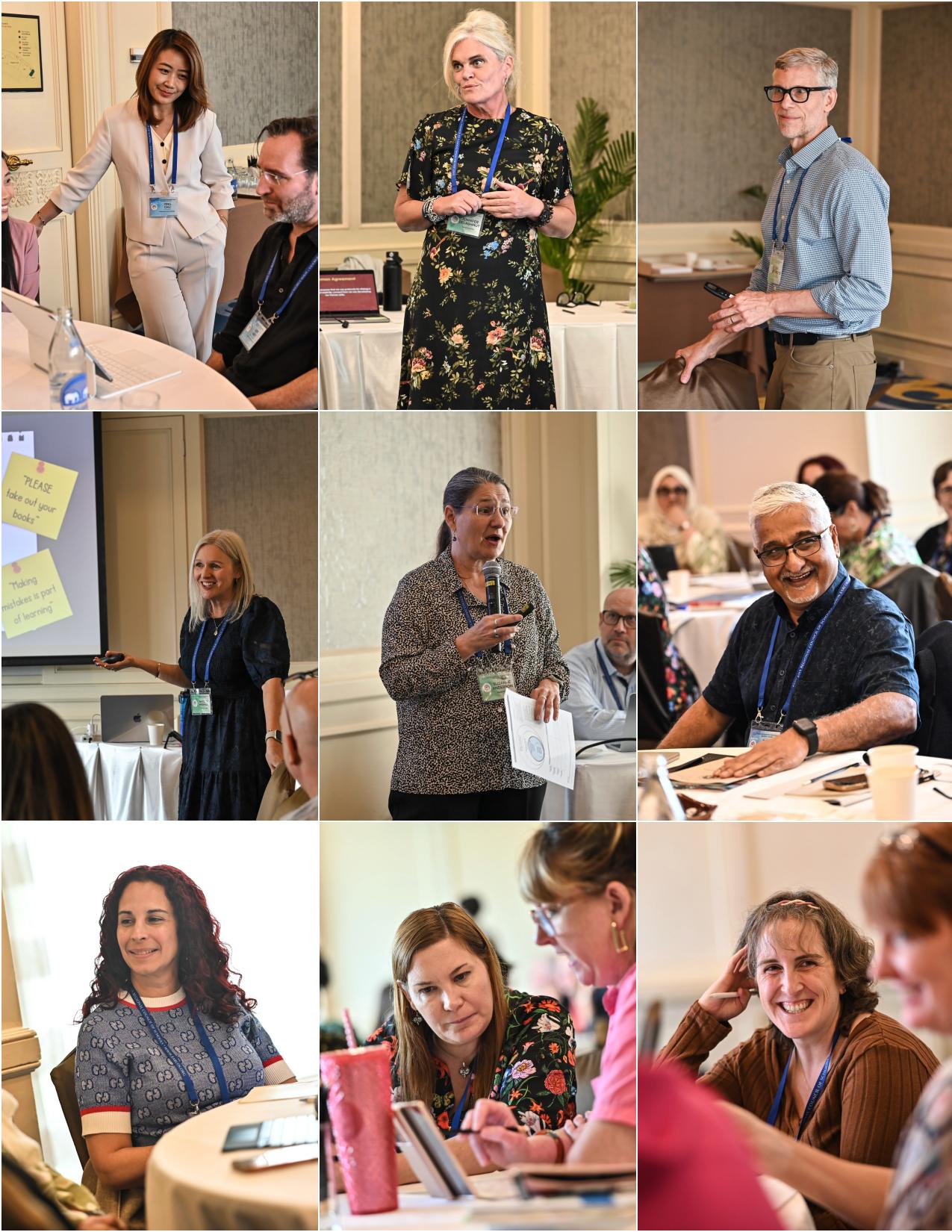
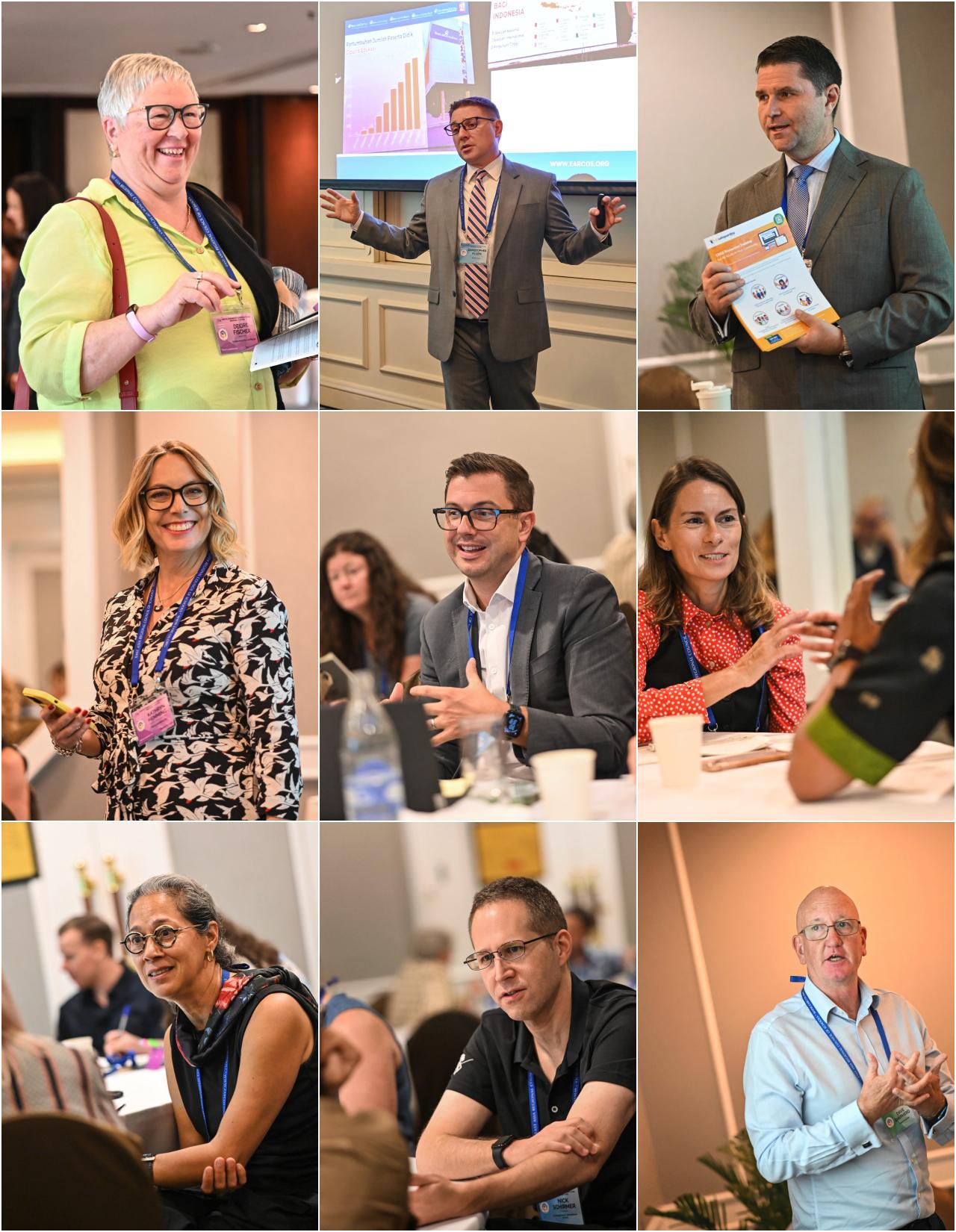
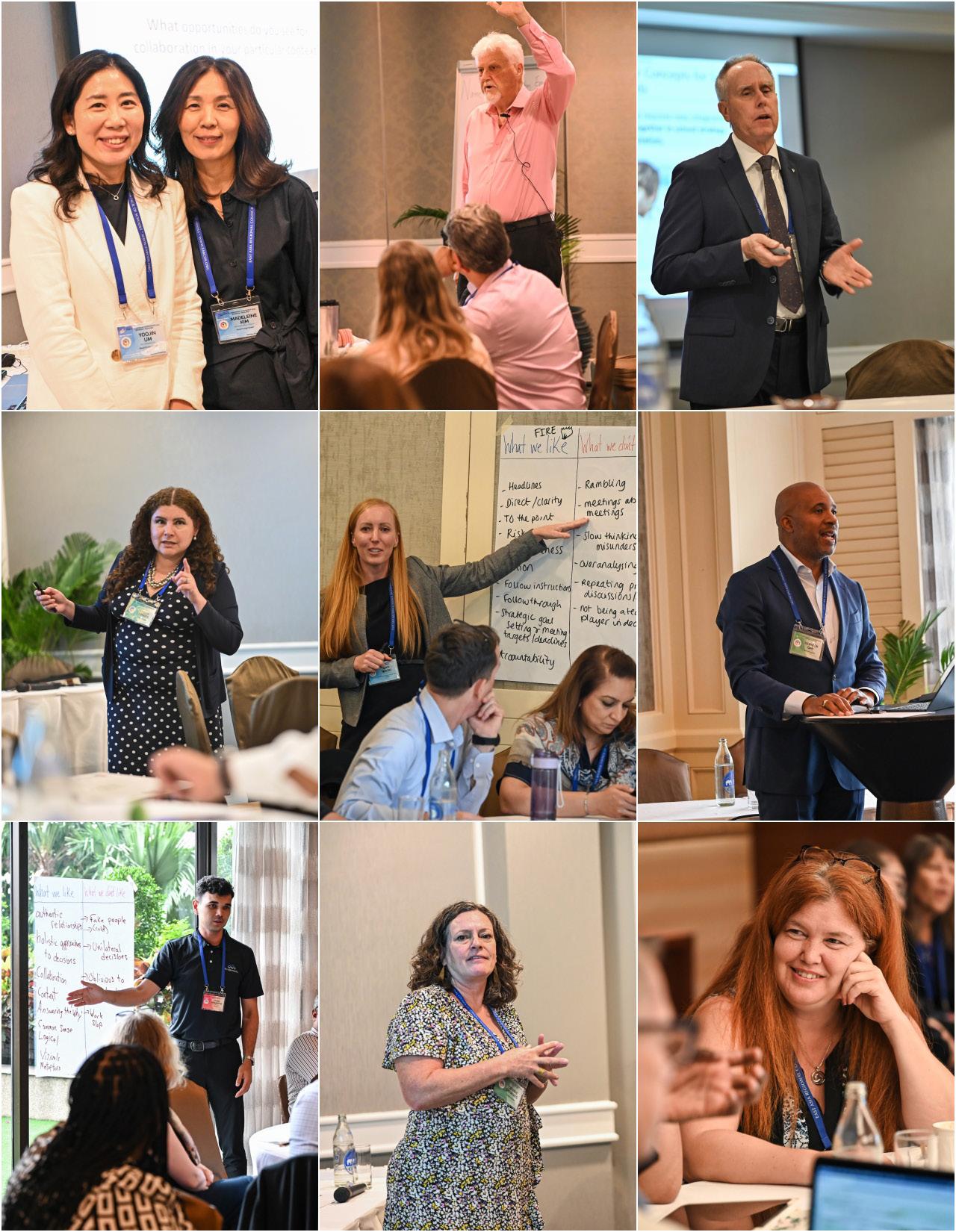
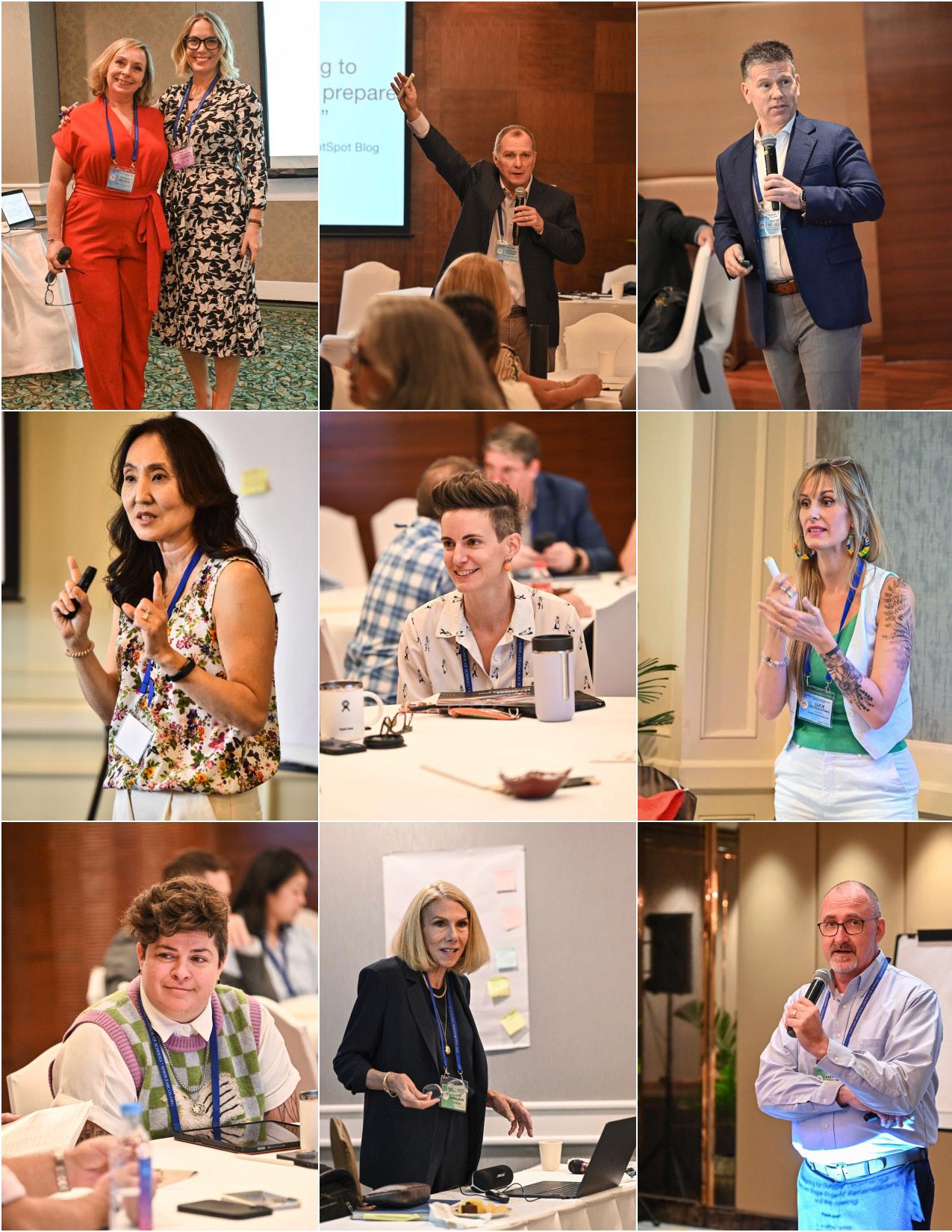
The 55th Annual EARCOS Leadership Conference brought together more than 1,000 international school leaders from across the EARCOS region and around the world for three inspiring days of learning, connection, and forward-thinking dialogue. Trustees, heads of school, principals, directors of learning, business managers, admissions officers, and Associate members gathered to explore how leadership can intentionally shape what lies ahead.
The conference opened with a warm welcome from Dr. Edward E. Greene, EARCOS Executive Director, who greeted delegates and reflected on the strength of the EARCOS community and its shared commitment to high-quality international education. He was followed by EARCOS Board President Dr. Catriona Moran, Head of School at Saigon South International School, who officially welcomed participants and set the tone for the conference—inviting leaders to engage deeply, challenge assumptions, and collaborate in making the future of education visible.
Guided by the conference theme, “Future—Visible,” participants examined how today’s leadership decisions can create schools that are innovative, inclusive, and prepared for an increasingly complex world. The conference provided a vibrant platform for collaboration, reflection, and the exchange of ideas that continue to strengthen the international education community.
Visionary Voices, Powerful Conversations
Each day opened with a plenary session featuring thought-provoking keynote presentations from respected leaders in education and organizational change.
The conference began with Debra P. Wilson, who delivered the opening keynote, “Trends and Transformations.” Drawing on her extensive experience in higher education and independent schools, she explored the evolving landscape of international education, highlighting shifts in governance, leadership expectations, and workforce dynamics. Her address challenged leaders to anticipate change and respond with agility, insight, and purpose.
On the second day, Dr. Sabba Quidwai took the stage with her keynote, “The New Leadership Advantage: Turning AI Tools into Trusted Teammates.” She invited leaders to rethink their relationship with artificial intelligence—positioning AI not merely as a technical tool, but as a catalyst for innovation when guided by empathy, ethics, and human-centered leadership.
The conference concluded with the plenary panel, “Between Rocks and Hard Places,” featuring experienced international school leaders in an open and reflective conversation about
ethical leadership. Through real-world scenarios, panelists examined the complex decisions leaders face, offering practical frameworks for navigating moral dilemmas, maintaining trust, and leading with integrity in challenging times.
Also on the second day, the Women in Leadership Luncheon, led by Meike Ziervogel, offered a powerful and inspiring forum dedicated to women leaders in the EARCOS community. Meike shared the remarkable story of the Alsama Project—an initiative that supports education and leadership development for refugee girls in Lebanon, transforming pathways from illiteracy to university. Her session highlighted resilience, empowerment, and the ways in which education and community leadership can drive transformative impact.
Learning That Matters
Complementing the plenary sessions, the conference offered more than 180 workshops spanning a wide range of leadership topics, including strategic planning, governance, AI in schools, DEIJ, child protection and safeguarding, risk management, recruitment, trust-building, and women in leadership. These sessions provided practical strategies and actionable insights that participants could immediately apply within their own school contexts.
Community, Connection, and Celebration
The conference was not only a space for professional learning but also a celebration of the EARCOS community. Networking opportunities throughout the event fostered meaningful connections and renewed partnerships. Evening receptions— marked by excellent food, lively music, and warm conversation—created a strong sense of camaraderie among attendees.
Looking Ahead
The 55th Annual EARCOS Leadership Conference reaffirmed the power of collective leadership. Through visionary keynotes, rich professional learning, and authentic connection, the conference made the future not only visible—but attainable. As participants returned to their schools, they carried with them renewed purpose, fresh perspectives, and a shared commitment to leading schools that serve students, staff, and communities with clarity and courage.

Governance
Five Board Chairs, One Vision: Building the Future of Governance Together
By Dr. Hyungji Park, Anna-Marie Pampellonne, Emily Chan, Dr. Grace Lee, and Maria S. Chung
At an EARCOS Leadership Conference panel in Bangkok in October 2025, Emily Chan, Shanghai American School’s Board Chair, spoke about how lonely her job could be. She noted that Board Chairs are sometimes described as “superheroes conducting orchestras,” and yet with few mentors, few coaches, and even fewer colleagues. This need for a community led to the creation of “Women in Governance.”
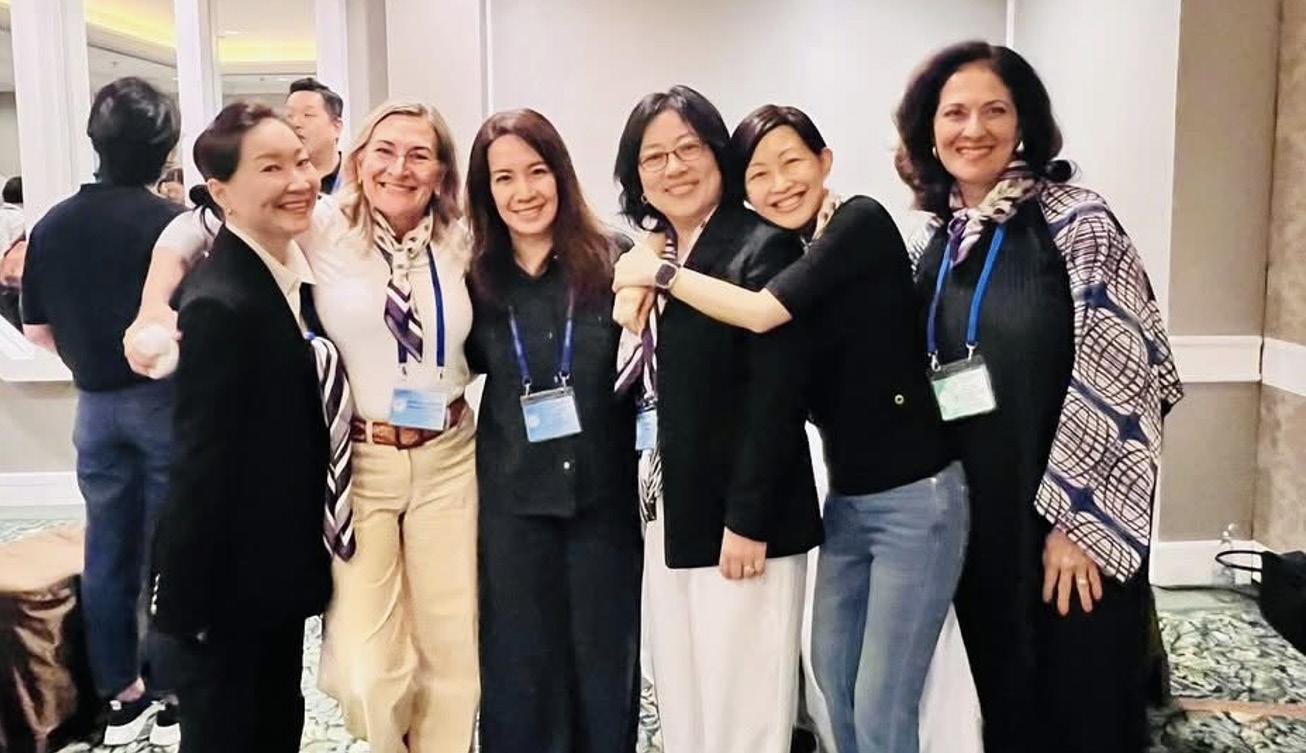
“Women in Governance”–or WIG–is an informal group of women Board Chairs of five international schools in the AsiaPacific region who came together to share ideas, support each other, and serve as sounding boards as we all navigate our “jobs”--unpaid and yet bearing significant responsibility and a major time commitment–as Board Chairs of our respective schools. We met in the fall of 2024 at the Governance as Leadership Training Institute (GALTI) hosted at UNIS Hanoi, and bonded as fellow women board chairs, and thought that we could benefit from sharing information and ideas. What began as a simple, fortuitous get-together grew into much more than we could have ever imagined: a robust community that ranges over a WhatsApp chat that pings at all hours of the day and night, site visits to each other’s schools, and a true friendship where we bond over dimsum, health concerns, and Labubus.
Our mandate, as we state on our newly minted website, is the following:
Founded in 2024, Women in Governance is a global community of women board leaders in international schools, championing excellence in governance and educational leadership through peer support, the exchange of diverse best practices, lifelong learning, and purposeful connection.
Behind this abstract statement of purpose, however, is a very real sense that we are doing something very new, even perhaps revolutionary, as we help shape the future of international education in the Asia-Pacific region. For one, we are acutely aware that our Heads of School have their own communities where they share information about everything from AI in K-12 education to compensation trends to common challenges associated with board continuity. Until now, Board Chairs haven’t had a comparable forum for communication and sharing.
For another, we are aware that it is a powerful move to bring together five women leaders who bring diverse individual perspectives and voices based upon their lived experience in and out of Asia as well as their professional backgrounds. Between the five of us, we sport decades of life in Asia, the United States, and Europe; multiple Ivy League professional and doctoral degrees; and long-term careers in business, law, and higher education. One of us even has an ancestral chateau in France to boast of! A recent report from the World Economic Forum states that gender equality is 123 years away. And when we ask AI to produce images of boardrooms, we rarely see our own images–as (mostly Asian) women of a certain age–reflected in the output. This is why WIG is powerful: because it provides a space where Board Chairs of major international schools in the Asia-Pacific region come together in solidarity over ethnicity, gender, and our dedication to the schools that we help direct.
After our initial meeting at GALTI in September 2024 in Hanoi, we met again as a group at EARCOS Leadership Conference (ELC) in Bangkok a month later, and then we went on a site visit to one of our schools, Taipei American School (TAS), in May 2025. TAS was a terrific host, inviting us to their school-wide professional development workshop and providing us with WIG-tailored small-group training with their visiting speakers. It was there in Taipei that we also decided to share our story at the next ELC, and where we ended up proposing and presenting at a session entitled “Common Ground, Unique Paths: Insights and Lessons from International School Boards.” In this debut appearance at the ELC, we shared stories grounded in our individual schools but that reflected universal concerns of EARCOS schools.
Our five testimonials centered around topics on cultivating the Board Chair’s relationship with the HOS; managing the various expectations placed on Board Chairs; how Boards can contribute to curricular innovation; what effective Board training looks like; and how Boards work together with school administrators even as we navigate our separate lanes. We invited Homa Tavangar to serve as our moderator, and the entire session was intended to share insight into how Boards think as we go about our work. For our first panel appearance at ELC, we were secretly thrilled to discover that our session had to be moved to a larger meeting room because so many people signed up in advance to attend our session.
Our fellowship as WIG started as a way to help our work as Board Chairs. Sometimes isolated, sometimes lonely, we also found ourselves with limited access to information needed to succeed
in our roles. At odd hours of the day or night, we will ask each other arcane questions over WhatsApp, questions that no one but a fellow Board Chair in the region would ever care about. Do your TAs get tuition discounts? What number Board Chair are you, for your HOS? Is such-and-such rumor about your school, in fact, true? And while we share information and swap stories, we have chosen to bind ourselves by a signed confidentiality agreement. (Or, truth be told, the lawyer among us made us sign it!)
But over the past year-plus, our community has flowered into a lot more than that. When one of us went through a health crisis, we all bonded and powwowed on how we could show our support (could we secretly contact her HOS for a home address where we can send flowers?) and ended up getting her a rare initialed mini-labubu as a “so glad you’re better” gift (and if you know, you know). And we’ve made time for each other outside of our official meetings–we’ve crashed parties in Seoul, sampled coffee in Kuala Lumpur, and bonded over late-night nachos in Chicago. Oh, and for our debut panel at Bangkok, we all wore matching silk scarves, freshly manufactured in Shanghai and printed with our “official” WIG logo, just in time for the ELC.
What does the future hold for WIG? Our honest answer is that we haven’t the faintest idea. We are aware that our community-building is important, ground-breaking, and also fragile. Our terms as Board Chairs are finite, and we discuss expansion and succession plans (should we welcome new members? Is it more important that they are Board Chairs or that they are women? What happens when many of us, founding members, are no longer Board Chairs of our respective schools?) We are, of course, in touch with other Board Chairs and members beyond our five schools. We don’t have the answers to our questions, but we have come so far in the last year or so, and we expect continuing growth and evolution. Right now, we revel in our community of support, information-sharing, and friendship. We are grateful, and when that WIG WhatsApp pings, day or night, we answer right away.
Women in Governance can be reached at wigovorg@gmail.com.
About the Authors
Dr. Hyungji Park (Board Chair, Seoul Foreign School), Anna-Marie Pampellonne (Board Chair, International School of Kuala Lumpur), Emily Chan (Board Chair, Shanghai American School), Dr. Grace Lee (Board Chair, Taipei American School), and Maria S. Chung (Board Chair, United Nations International School of Hanoi) bring together extensive leadership experience from some of the most respected international schools in the region. Their collective perspectives reflect a deep commitment to educational excellence, governance, and the advancement of global learning communities.

College Admissions
Would Confucius Understand
US College Admissions?
By Grace Cheng Dodge
In the Spring 2024 issue, I wrote an article titled “College Admissions is Not a Competition” focusing on the fact that students get themselves into universities by being their true genuine selves. The best schools can do is to encourage students to be themselves, choose to study subjects and participate in activities they love, and to be able to demonstrate a lifelong love of learning that will carry them way past their college years. This is crucial for their parents and for international school communities to know and to appreciate about school missions and visions, especially throughout East Asia.
I also stated that it is crucially important for school communities to understand that in most cases, especially in American colleges and universities, the admissions process is incredibly human. A GPA or a test score or a certain number of honors/AP/IB courses is not the reason anyone gets into college. Where a student goes to high school is also NOT the reason anyone gets an admissions offer. At this year’s 2025 EARCOS Leadership Conference, I led a mock selective admissions committee with Heads/ Directors/administrators for them to discuss the application files of three high-achieving and compelling students. Unfortunately, we could not admit all three!
What did the participants spend time fighting over? They did not fight over anyone’s grades or scores, because we were already assured they could do university-level work. They also did not discuss where students were from or from what high school. Gender, race, and ethnicity also didn’t play a role at all. Instead, the participants saw firsthand the importance of a student’s voice in his or her own writing, the power of words used in faculty and counselor recommendation letters, and the experienced the “gut” feeling of wanting a student to join the deliberate college community we were trying to put together. In reality, admissions committee members are between the ages of 18-80. They could possibly be a future classmate, a residential advisor, professor, or the director of academic support and health services, and care deeply about every new batch of students admitted to join the community.
No one is ever guaranteed to be admitted on credentials alone, nor should be led to believe they are entitled to be admitted, or that someone else is “taking their spot”. All too often, students do not do enough research on colleges and universities to be able to put together a balanced list of schools to which they want to apply. More often than not, counselors see students have a hard time articulating why they actually want to attend a certain institution (a very important college essay question!) as sometimes the clout of the name, the expectations of others, and the noise around “good colleges” cloud their abilities to truly think for themselves.
We as educators have to keep reminding our students, parents, and community members that not getting into a top choice college is NOT a judgment on a student or the high school! Colleges and universities around the world have many more qualified students apply than there is room to admit them. As the participants in my ELC session experienced for themselves, they could only admit the student who received the majority vote. The admissions committee speaks with one voice and there is no such thing as a student who is admitted (or not admitted) by mistake. But I hope you see the inherent problem when prospective families care so deeply about where your graduates go on to matriculate. This is a worldwide dilemma, but I will speak to it from my Asian perspective, both lived and observed. When a family’s perspective is that a college admissions system is based solely on testing, families want assurance that the high school they
have chosen for their children is teaching effectively enough for students to be able to score high on a national college entrance exam. But when admissions systems (most in the West) are not based solely on academic grades nor testing, and instead focus on intangible skills, SEL knowledge and EQ applicability in order to deliberately put together a freshman class of residential students who will live and learn together, herein lies the dilemma for so many international schools. Asking for proof of “soft skills” has disrupted Confucian beliefs of traditional testing and the ranking of students based on said tests.
Now add a layer of external independent counselors who have never worked in an admissions office in Western countries or even in an international high school as a counselor, and no wonder families are confused, anxious, and willing to pay for any advice as they don’t know what they don’t know to distinguish bad advice from the good. Third, add on a real societal pressure that the name of the university from which you graduate determines where you are allowed to live and where you can work, a concept that is inconceivable and relatively unknown to admissions officers just trying to do their best job at admitting students holistically.
So when families automatically now hear that colleges look at more than grades, they believe there must be a magic formula that can be cloned consisting of extracurriculars (supercurriculars!), summer activities, and every other fad-of-the-year activity that must go on a college application. It is much easier to tell a student what to do and do it well, instead of patiently waiting for
them to explore for themselves and allowing them the time and the grace to make mistakes. Education is treated much more as a transaction in the East, and any loss of face or reputational damage for the family from a simple failure (made by a child) may not be worth the longer term learning lesson for the student. From a Western perspective, the more a student’s life is curated, the more everyone loses sight of who the actual teenager really is.
Here in Asia, we are all trying to best explain and reconcile more familiar Eastern philosophies of education with Western college results that many families desire. I have asked many parents bluntly if they even know who their actual teenager is, what they love to do, and how they think for themselves. I push parents to think about what topics they love to continually learn as adults and how they are modeling this curiosity for their children. As parent education is important in all of our communities, the more they understand the values of our schools and those of prospective universities they want their children to attend, the better equipped they will be to live your school missions with you.
I mentioned last year that the best we can do is to stay true to your school missions, trust the expertise and networks of your counselors with those who will read your students’ applications on the other side of the desk, and cheer on all students alongside their parents. The more we understand the cultural differences at play against a very uniquely American concept of “college fit” and “joy of learning”, the better we can celebrate the strengths of each individual student, no matter their destination after our schools.
Confucius too preached self-reflection, integrity, curiosity, lifelong learning, and role modeling to help others learn. He advised letting go of worrying about external events not under one’s control. He might not be rolling in his grave after all, but is instead cheering on all our seniors as they prepare to head for amazing destinations all over the world.
About the Author
Grace Cheng Dodge retired as Head of School of Taipei American School. She served as the school’s second Director of College Counseling in 2011. Grace is also a former Director of Admission at Wellesley College and former Associate Director of Undergraduate Admissions at Harvard University. She currently consults for Heads and trains school counselors to increase their knowledge of worldwide college admissions and can be reached at grace@dodgeconsultants.com
SPONSORED WEBINARS
Multilingualism in International Schools: Looking Back, Looking Ahead
Presented by: Jon Nordmeyer and Dr. Virginia Rojas
Saturday, January 31, 2026
Time: 9:00-10:20 AM HKT
Free for EARCOS Members / $100 for Non-Members. Visit Website
Archaeology of the Self: Toward Sustaining Racial Literacy in Education
Presented by: Dr. Yolanda Sealey Ruiz
Saturday, February 14, 2026
Time: 9:00-10:30 AM HKT
Fee: Free for EARCOS Members / $100 for Non-Members. Visit Website
“At

Standard Application Online (SAO)
•
•
•

Leadership
Growing as a Pedagogical Leader
By Eric Sheninger
Pedagogical leadership encompasses all the many ways to support effective teaching and learning. Instructional design is a significant component as teachers need continuous feedback on how to implement the curriculum in innovative ways that result in improved outcomes. While instruction is important, it is only one of many aspects that need attention. Instruction is what the teacher does, whereas learning is what the student does. Here is where a sole emphasis on instructional leadership might not lead to efficacy at scale. Pedagogical leadership focuses on numerous responsibilities and roles that work to ensure a vibrant learning culture that helps to meet the needs of all students (Ailincăi, 2020).
The main differentiator here is a broader view that includes more attention to what the learner is doing and the supports needed for success. The pedagogical leader works to create collaborative benchmarks that lead to continuous improvement across the system. It requires a deeper understanding of how the brain works and research-based strategies that teachers can readily implement in their classrooms (Day & Leithwood, 2007). Observations, both evaluative and non-evaluative, still have immense value. However, the pedagogical leader doesn’t stop here. The use of data is extremely important. Efforts are made to help teachers analyze and use it effectively while the pedagogical leader is doing the same to find ways to close achievement gaps, scale differentiation, and create an equitable culture (Harris, Jones, & Adams, 2018).
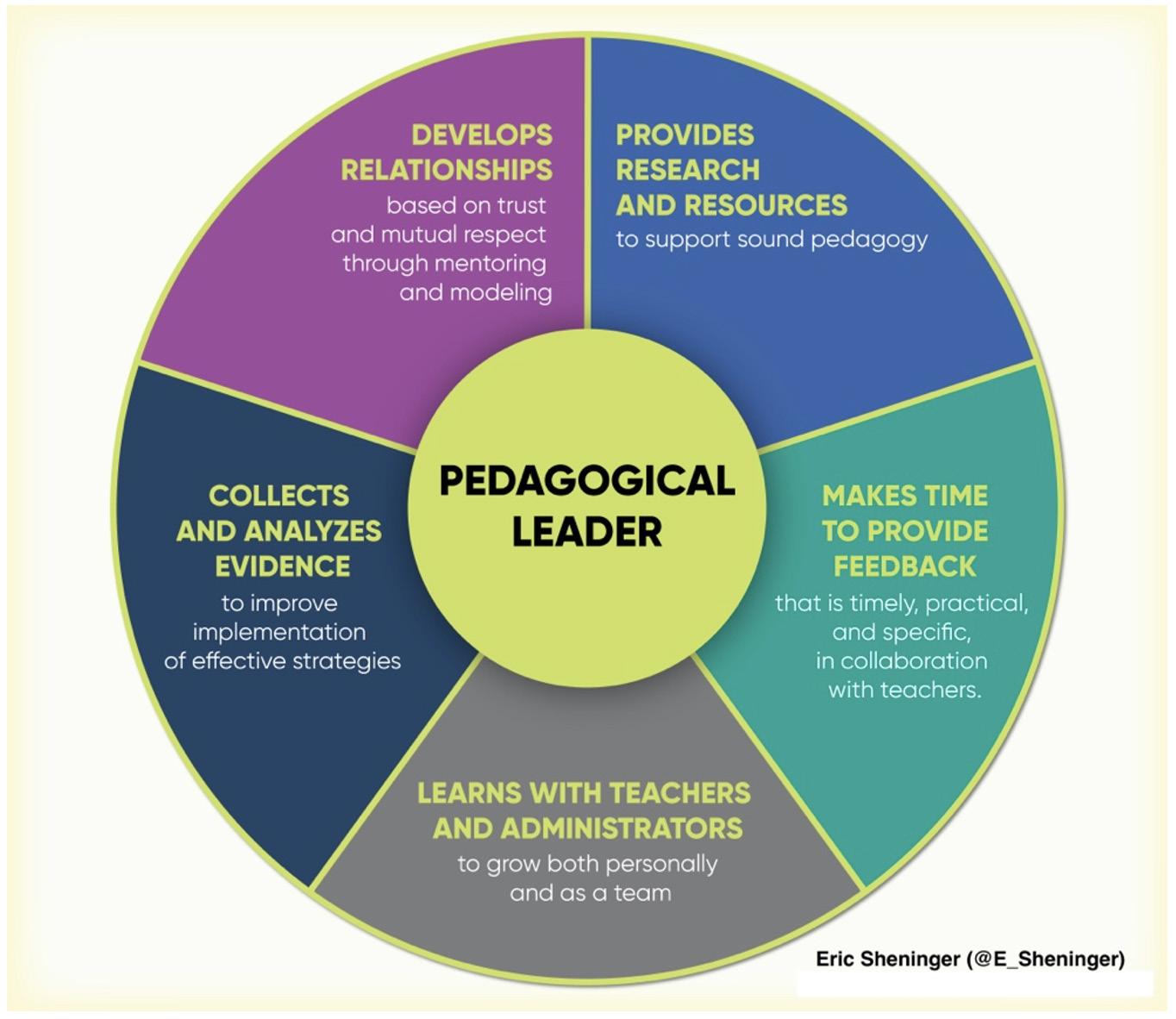
The work doesn’t stop with the above. Investments in time and resources are made to establish ongoing and job-embedded professional learning for staff. One-and-done, drive-by, the flavor of the month, or substance-less sessions are seen, not entertained. Pedagogical leaders are constantly trying to ensure learner success by employing effective strategies to improve family engagement. While working directly with teachers is of utmost importance, empowering parents and guardians to assist in the process is vital (Leithwood & Mascall, 2008).
It's simple to offer advice on improving in this area or anything else, but putting it into practice can be a constant challenge. To help you get started, I've compiled ten specific strategies that I used during my tenure as a high school principal and now help other leaders with during coaching cycles.
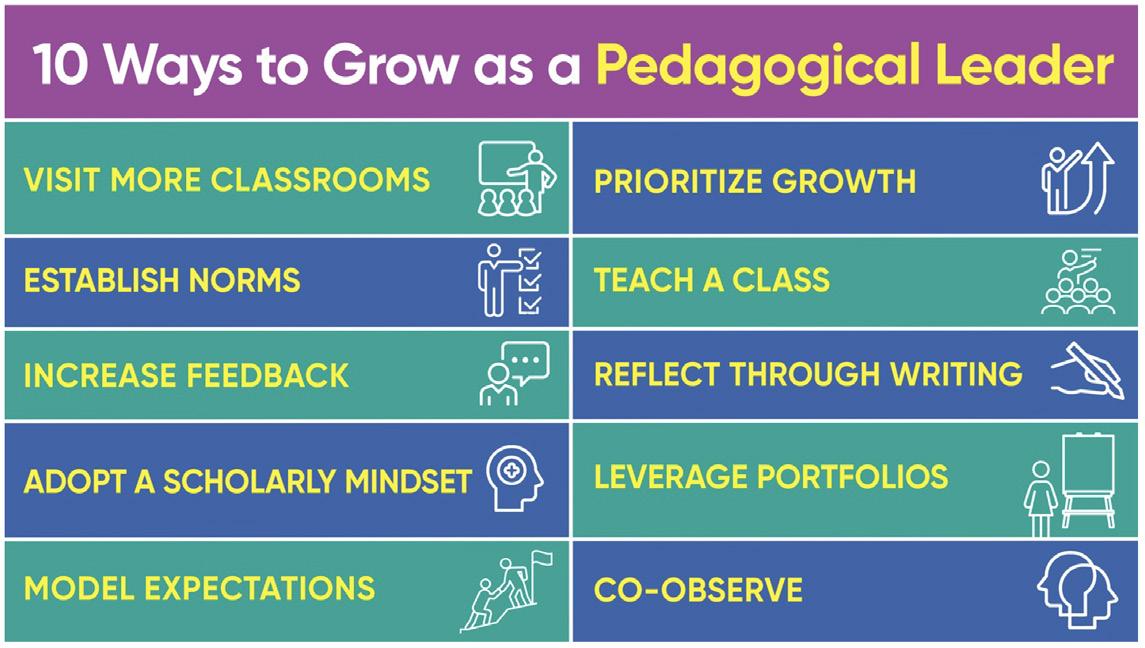
Visit more classrooms
Firstly, begin by increasing the number of formal observations conducted each year and sticking to a schedule to ensure that all teachers are observed three times annually, regardless of experience. Secondly, develop an informal walk-through schedule with your leadership team, mandating at least five walks per day for each member, and track visits and improvement comments on a color-coded Google Doc.
Establish norms
Establishing a shared vision and expectations for all teachers is crucial. You can do this by utilizing the Rigor Relevance Framework to provide them with consistent, concrete elements to focus on when developing lessons and deciding which high-effect strategies to use. Abolishing the routine of announced observations, having teachers provide artifacts of evidence to show the bigger picture since you can never see all that is done in a single observation, and prioritizing the collection assessments over lesson plans can also be effective.
Increase feedback
When observing lessons, always provide at least one practical suggestion for improvement, no matter how excellent the lesson was. These suggestions should be clear, straightforward, actionable, and timely. For learning, consider curating data weekly and present at an upcoming staff meeting. Feedback is critical to encourage growth and development.
Adopt a scholarly mindset
Improving professional practice as a leader is not the only benefit of being a scholar. It also enables you to have more effective conversations with teachers about their own growth, adding credibility to post-conference feedback. You can align critical feedback to current research by keeping a document of effective pedagogical techniques found in your readings. This approach saved time when writing up observations and improved relationships with staff as the instructional leader. When in doubt, lean on Google Scholar. Another key aspect of a scholarly mindset was brought to my attention by Thomas William Miller and that is to get curious and ask questions. When it comes to leading pedagogical change, questions are often more important than answers.
Model expectations
As I shared in Digital Leadership, leaders should lead by example and not ask teachers to do anything they wouldn't do themselves, especially regarding technology integration and improving practice. When a teacher struggles with assessments, provide or co-create an example assessment. Developing and implementing professional learning is also an effective way to lead by example and build better relationships with staff.
Prioritize growth
Attending at least one conference or workshop a year that aligns with a significant school or district initiative and reading one education book and one from another field, such as general leadership strategies or self-help, can yield powerful lessons and ideas. Creating or further developing a Personal Learning Network (PLN) is also essential to access 24/7 ideas, strategies, feedback, resources, and support.
Teach a class
One can achieve this regularly throughout the year or by coteaching with both struggling and exceptional teachers. I personally taught a high school biology class during my first few years as an administrator, which is an excellent example of leading by example. This approach also provides a better understanding of teachers' changing role in the disruption age. When a pedagogical leader sets an example, it strengthens relationships with staff and puts them in a better position to discuss and enhance learning.
Reflect through writing
As a connected educator, writing has been a valuable tool for me to process my thoughts and critically reflect on my teaching, learning, and leadership work. Our reflections aid in our personal growth and serve as a catalyst for others to reflect on their own practice and develop professionally. Encouraging teachers to write brief reflections before post-conferences can foster a more collaborative conversation on improvement.
Leverage portfolios
Incorporating portfolios into our observation process was a helpful way to provide more detailed insight into pedagogical practices over the course of the school year. Portfolios can showcase personalized learning activities, assessments, unit plans, student work, and other forms of evidence to enhance instructional effectiveness and validate good practice.
Co-observe
During the first quarter of each year, I collaborated with members of my administrative team to co-observe lessons. This allowed us to benefit from each other's perspectives and expertise and provided opportunities for us to improve our pedagogical leadership skills and reflect on our observations. In my role as a coach, I have K-12 leaders visit classrooms beyond the grade levels they serve when working with districts. For example, elementary will conduct walks in secondary to provide feedback and vice versa. We then share collective insight while processing the feedback. Gaining a perspective of strategies used at various grade levels is invaluable.
Ultimately, ensuring quality learning takes place in our classrooms is of utmost importance. These ten strategies can be implemented immediately to improve pedagogical leadership, but there may be additional strategies that others find effective.
References
Ailincăi, E. (2020). The role of pedagogical leadership in promoting quality education. EuropeanJournalofEducationalResearch, 9(2), 659-670.
Day, C., & Leithwood, K. (2007). Leadership for student learning: The contribution of leaders’ qualities and practices. Journal of Educational Administration, 45(6), 661-682.
Harris, A., Jones, M., & Adams, D. (2018). The role of school leadership in promoting student achievement. Educational Management Administration & Leadership, 46(3), 433–453.
Leithwood, K., & Mascall, B. (2008). Collective efficacy and student achievement. Educational Administration Quarterly, 44(2), 195–210.
Supporting Books
• Disruptive Thinking in Our Classrooms
• Digital Leadership
• Learning Transformed
• BrandED
• Uncommon Learning
About the Author
Eric Sheninger is a Google Certified Innovator and an Adobe Education Leader, known for his work in advancing innovative practices in education. More information about his work and publications can be found at ericsheninger.com.
SPONSORED WEEKEND WORKSHOP
Concept-Based Inquiry in Action Workshop
February 7-8, 2026
St. Johnsbury Academy Jeju
Consultant: Rachel French
Format: In-Person
Coordinator: Matthew Riniker, matthew.riniker@sjajeju.kr
Explore the new career-connected AP® course that helps students understand business and make confident financial decisions: AP Business with Personal Finance Engages students with real-world financial scenarios Fits into existing CTE programs of study or as a standalone course Helps students earn college credit and an employer-endorsed credential
Leadership
Working in the Eye of the Storm: Taming the Turbulence in Educational Leadership
By Jennifer D. Klein
What gives light must endure burning.
--Viktor Frankl
Ihad no idea what I was getting myself into when I started writing my newest book. As soon as I started interviewing educational leaders around the world and heard their stories of resistance and challenge, I knew I was on a path that would force me and my interviewees to acknowledge and process our passion for the work and the grief we experience every time we lose a fight that would have benefited learners. For me personally, writing this book was a journey; each leader’s story required I face myself as former head of an international PreK-12 school. Sometimes, leaders’ choices reflected my own and I felt validated; in other moments, their interviews brought me face to face with my own mistakes.
Across the world, educators are facing unprecedented levels of resistance to practices we know are good for learners. Whether the push back is political, cultural, religious, or simply a fear of the unknown, school leaders have to manage resistance to their efforts to meet the needs of learners while simultaneously keeping teachers safe and holding onto their jobs. Especially for schools prioritizing equity, innovation and inclusion that are located in polarized or conservative contexts, the stakes couldn’t be higher. But what I’ve learned is that visionary leaders look straight into the eye of the storm and serve their learners first and foremost, no matter how ferocious the backlash becomes.
Taming the Turbulence in Educational Leadership: Doing Right By Learners Without Losing Your Job, explores how educational leaders are confronting and “taming” resistance so they can meet students’ needs. Based on my experiences leading student-centered learning in a conservative context outside of Bogotá, Colombia, and on interviews with 67 educational leaders around the world, the book explores how leaders are navigating pushback from more traditionally-minded legislators, extremist groups, school boards, and caregivers. Their stories are sometimes heartbreaking and always inspiring, demonstrating that leaders who keep learners in the center have an internal “North Star” that isn’t swayed or misdirected by the noise when they know that what they’re doing is good for learners.
The good news is that leaders everywhere are putting learners first, making choices that move education toward more equitable and innovative practices that improve the school experience for learners. The 67 leaders I interviewed were proud to share their work on a variety of initiatives that have garnered resistance, all of which fit into two core avenues of educational thinking:
1. Pedagogical and instructional innovations that prioritize student-centered learning, helping ensure all students learn and thrive, regardless of where they live and attend school. This includes schools that are redefining what they mean by success, are ensuring innovation and opportunity for all learners, particularly through career technical education and cognitively- and physically-responsive practices, are innovating outside the system when necessary, are finding ways to innovate in more academically-driven contexts, and are working to sustain that innovation.
2. Identity-responsive programming and equity work that honors place, culture, and learners’ full spectrum of identities, perspectives and needs, ensuring all students see themselves reflected in the curriculum, are supported for who they are, and feel safe and appreciated as learners. This includes schools that are prioritizing culturally-responsive learning and teaching in communities of color and Indigenous schools, social emotional learning and wellness initiatives, gender and sexual identity inclusion, and programs that support critical thinking, pluralism, and intercultural competency development.
I heard incredible stories from these leaders about the work happening in their schools. They told me about learners who shape their own schedules, evaluate themselves without grades, and work to solve authentic problems in their communities. They shared stories about championing all learners, of how they stepped up to protect members of their communities even when others didn’t understand the need or struggled to accept their identities. Every story illuminated these leaders’ journeys and the myriad strategies they used to advance work considered controversial in their contexts, with hope and courage, for the benefit of the young people in their care. Not every story had a happy ending, but these leaders know what they stand for and which hills they’re willing to die on, myself included.
My interviews revealed an array of strategies that have allowed leaders to “do right by learners” with fewer explosions and confrontations:
• Build trusting relationships and deep connection by seeking to understand why constituents are resistant, by managing the pace of controversial work carefully, and by creating intentional structures that support relationship building.
• Use a variety of data metrics and other ways of knowing,
including a wide array of quantitative metrics, qualitative “street data” (Safir & Dugan, 2021), and other cultural ways of knowing in an effort to redefine success and how we measure it.
• Leverage community voice to shape and support change by including students in the development and advancement of work that benefits them, as well as the voices of alumni, teachers, and caregivers.
• Communicate purposefully and proactively, with an emphasis on communicating the connection between new initiatives and the existing identity of the school, finding language that doesn’t trigger our constituents, and proactively addressing the resistance we know will come.
• Prepare and protect the community through transformative professional learning, adapting systems that create obstacles for teachers, and protecting them from harm or attack so they feel safe enough to do challenging work.
• Lead with humility, courage and hope, recognizing that leaders can’t do this work without networks and partnerships, that change work is a journey, and that hope should be considered an invitation to action.
It breaks my heart to think that educators need so much courage to lead good work in schools today. It seems completely logical that the needs of learners should matter more than anything else—ensuring their well-being isn’t political or even debatable, in my opinion. Children deserve schools that support their healthy growth in communities that honor every voice, and they need leaders willing to lean into hard work because they know what matters. When leaders center their work on what learners need, and make choices based on what will benefit them—their growth, their well-being—we demonstrate that education isn’t about mandates and executive orders. Instead, it’s about the love we bring to our work every day as educators.
I hope this book provides community and solidarity for the thousands of educational leaders I didn’t interview who are facing similar storms across the world. I pray that walking together on this difficult path will serve as ballast and lift all of us, making the path a little smoother as we strive for better practices. While schools that prioritize innovative, identity-responsive education may be few, when we work together we become a global network, a powerful argument for what matters most: our learners.
About the Author
Jennifer D. Klein is a product of experiential project-based education herself, and she lives and breathes the student-centered pedagogies used to educate her. She became a teacher during graduate school in 1990, quickly finding the intersection between her love of writing and her fascination with educational transformation and its potential impact on social change. She spent nineteen years in the classroom, including several years in Costa Rica and eleven in all-girls education, before leaving the classroom to support educators’ professional learning in public, private, and international schools. Motivated by her belief that all children deserve a meaningful, relevant education like the one she experienced herself, and that giving them such an education will catalyze positive change in their communities and beyond, Jennifer strives to inspire educators to shift their practices in schools worldwide. Jennifer’s first book, The Global Education Guidebook, was published in 2017, and her second, The Landscape Model of Learning: Designing Student-Centered Experiences for Cognitive and Cultural Inclusion, written with coauthor Kapono Ciotti, was published in 2022.
Igniting Innovation: Cultivating Entrepreneurial Thinking in Educational Leadership
By Dr. Christopher Allen Sekolah Ciputra

There is a common area of tension that can been seen in many schools between the pedagogical side (the educators) and the business side (finance, admissions, etc.). One side thinks there is too much focus on money and the other side thinks there isn’t enough focus on it. The conversation often gets simplified into “for-profit” schools versus “not for profit” ones, and has been a topic of conversation for many years. More than 10 years ago there were panel discussions at the EARCOS Leadership Conference on this topic (including Heads of School, such as Anne Fowles, Chip Barder and James MacDonald), and at this year’s conference there were multiple sessions that included information on bringing the business and pedagogical sides of schools together.
There have been several podcast episodes on shows such as “Where’s Your Head At,” with co-hosts James MacDonald, James Dalziel and Richard Henry that discussed the growing need for educators (and particularly leaders in schools that may not have had this training through the traditional teacher training process) to gain a better understanding of the financial side of schools (Dalziel et al., 2025). As is often the case, once a need has been established, people quickly look for a way to fill the gap, which has led to courses being offered by The Principals’ Training Center (PTC course schedule: The PTC, 2025), The Academy of International School Heads (AISH Leadership Series - Academy for International School Heads, 2025), as well as the more traditional MBA’s being pursued by an increasing number of educators. And this brings us to the topic of conversation on my presentation at the most recent EARCOS Leadership Conference- Igniting Innovation: Cultivating Entrepreneurial Thinking in Educational Leadership.
In education we have actively promoted different types of thinking, such as Creativity (or Creative Thinking), Critical Thinking, Analytical Thinking and Design Thinking. You can find numerous books for sale, TED Talks given and workshops offered to help educators learn more about and hopefully unlock each of these in themselves and those they help educate. An area that has had much less focus over the years is Entrepreneurial Thinking and how it can not only be taught to students in schools, but actually needs to be embraced by educators, and particularly educational leaders. As Dr. Sabba Quidwai said during her Keynote Speech at the recent EARCOS Leadership Conference, “Yesterday having an entrepreneurial mindset gave you an edge. Today is it your entry ticket.”
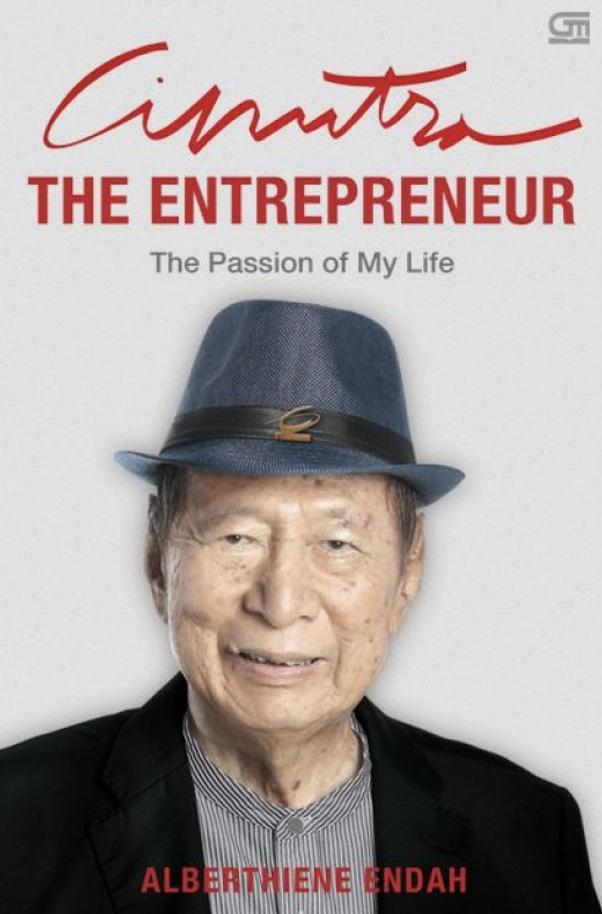
Mr. Ciputra founder of Sekolah Ciputra and mother company,
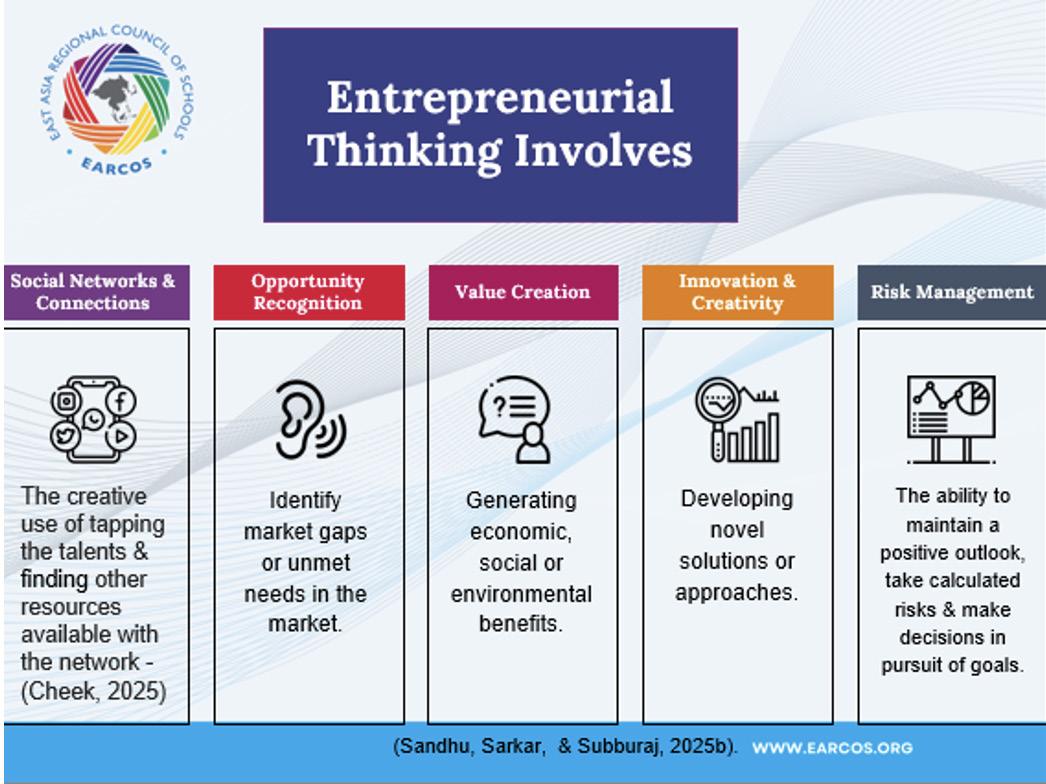
Research shows that there is some overlap between these other types of thinking and Entrepreneurial Thinking (Sandhu, K., Sarkar, P., & Subburaj, K., 2025a). Findings of further research concludes there are several key aspects of entrepreneurial thinking that are most relevant for educational leaders to learn more about and pursue. These include: Opportunity Recognition, Value Creation, Innovation and Creativity and Risk Management. An area that needs further attention is Social Networks and Connections, which Dr. Dennis Cheek, Dean of the School of Entrepreneurship at Universitas Ciputra Surabaya, said is lacking in much of the current entrepreneurial education (Cheek, 2025).
The founder of our school and “mother company,” Mr. Ciputra, believed in the power of entrepreneurial thinking and entrepreneurship education. He created the 3 pillars of the Ciputra Group: Integrity, Professionalism and Entrepreneurship, which are embedded not only in the wider company, but more importantly in our each of our educational ventures. When our school opened 30 years ago, it was the first of its kind and enrolled approximately 250 students. Now we have 12 schools and 3 universities across Indonesia, with close to 18,000 students. Mr. Ciputra’s vision is alive and well, and we hope to spread his message to other educators and educational leaders throughout the EARCOS region, which led to the initial creation of the conference presentation and now this article.
Universities and governments have given increased focus to entrepreneurship education in recent years. In 1970 there were only 16 colleges in the United States that emphasized entrepreneurship education, while there are now over 2,300 that do (Sandhu, Sarkar & Subburaj, 2025b), with over 160 having it as a major. The OECD is now studying the entrepreneurial ecosystem diagnostics in 28 nations for future measurement purposes across the OECD and beyond (Cheek, 2025). In 2013 the European Commission highlighted that acquiring entrepreneurship education and skills was critical to sustained economic growth and competitiveness. “By positioning entrepreneurship as a tool kit comprising essential skills and mindsets, educators can equip students with the ability to navigate uncertainty, think strategically and lead interdisciplinary teams” (Sandhu, Sarkar & Subburaj, 2025b). This belief aligns with what leaders in academia, industry and entertainment said during the “Global Grand Challenges Summit” I attended in Beijing in 2015. During this conference, which mainly focused on engineers and engineering students, the message was repeated by different experts in different ways: you (engineers) will need to work with and gain support from non-engineers. It doesn’t matter how great your idea or solution to the given problem is if you cannot gain funding for it and market the idea to a broader audience to buy it.
This brings us back to the idea of entrepreneurial thinking and entrepreneurial education, and more importantly, why entrepreneurial thinking for educational leaders? There are several benefits to educational leaders who actively use entrepreneurial thinking in their roles. First, they can inspire change and innovation, as well as the attitude that trying new things and methods is welcome in their school. Second, the leader can make more targeted and faster decisions on the basis of their knowledge of the situation. Next, they have the opportunity to generate income through appropriate initiatives and then use this income for the achievement of pedagogical purposes. Finally, they can build, develop and maintain a good image of the school, making them more interesting, which will usually help them get noticed by the broader public (Brauckmann-Sajkiewicz & Pashiardis, 2020). When a school leader operates like an entrepreneur, they:
“…forge strategic alliances outside the school with parents as well as with other organizations, companies or non-governmental organizations, which they think will help them enhance their capacity to do better work for their schools. Moreover, these school leaders are innovative, risk-takers and creative in the acquisition of new resources in order to do more with less…entrepreneurial leadership is associated with external engagement, parental involvement, and networking, all of which assist school organizations to gain a better outcomes. Such partnerships can contribute to creating a secure school environment, enhancing welfare services, improving academic performance, and supporting the achievement of various school objectives” (Kafa, Pashiardis & Brauckmann-Sajkiewicz, 2025).
Key characteristics of entrepreneurial leadership in school contexts includes innovation, strategic risk taking, opportunity seeking, resource acquisition, trust and relationship building, parent and community involvement and adaptability to system contexts. These can be seen in the following cycle, which brings to mind the Design Thinking Cycle, where you work your way through the different stages, moving backwards and forwards as needed, in order to solve the challenge being faced.
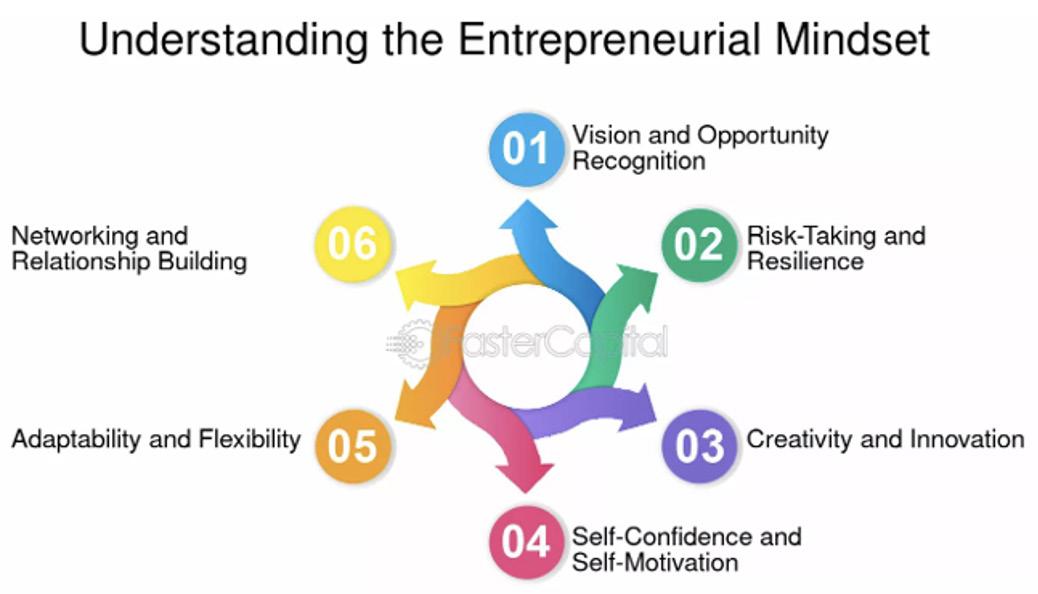
(Entrepreneurial mindset and entrepreneurial education: How to develop the skills and attitudes of successful entrepreneurs, 2025)
I have experienced several examples of entrepreneurial thinking from educational leaders in different international schools I have worked in over the past 20 years. I have also seen other examples in the schools of friends and former colleagues during this time as well. Here are some of these examples, with a brief explanation as to how they fit the description:
1. During my time in Suzhou Singapore International School, we saw an opportunity during the summer break, where we had quite a few families that either did not leave the city during the break, or if they did, it was not for the entire time the school was closed. While we routinely completed facilities upgrades at this time, we also had many facilities unused that could generate additional income. We also had a number of prospective students that hoped to join our school, but had not passed our entrance test yet. We were able to create a summer school program that was not only available to our own students, but also those prospective students hoping to join the school the following year. This was a highly successful program for the school and the broader community.
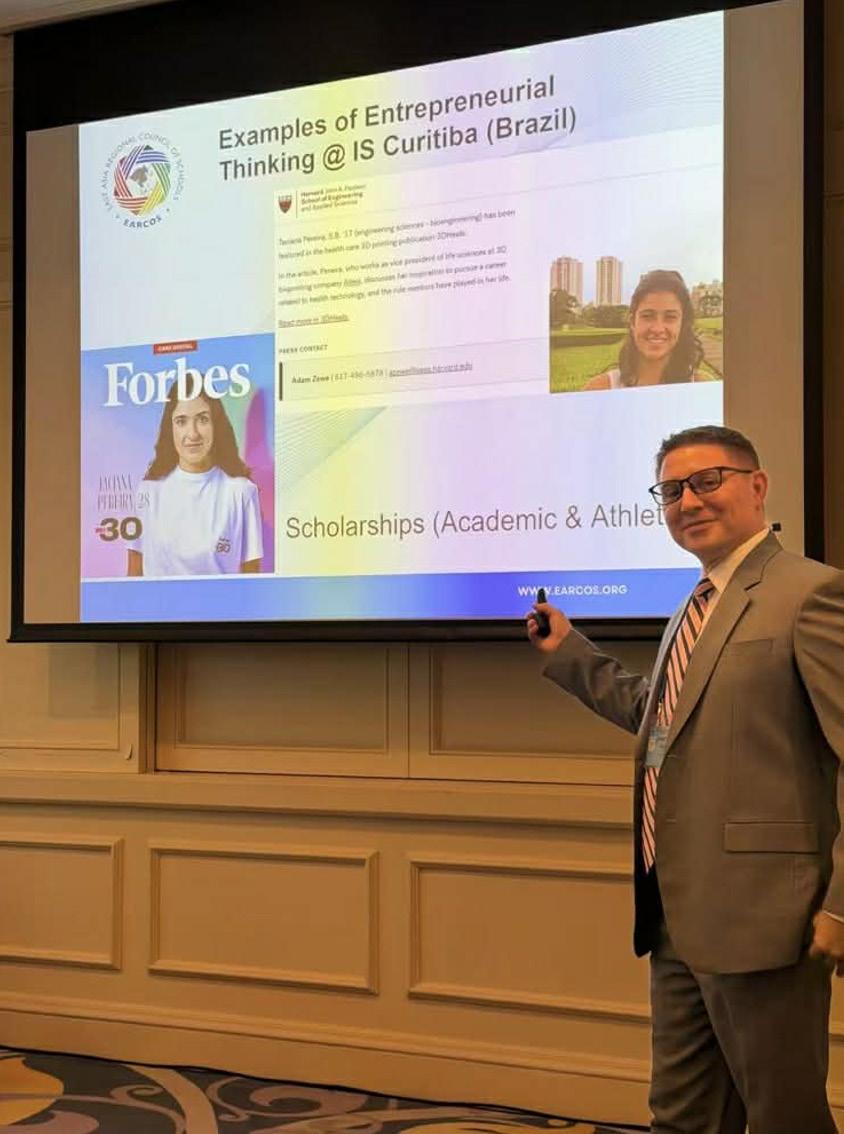
2. During my time at the International School of Curitiba we created an athletic scholarship program to help increase student enrollment, but also improving our athletic program and the opportunities it could give, attracting even more students to the school. We were lucky enough to have some of these students accepted to top universities around the world (including Harvard University) which led to even more families looking to join the school in the hopes their own children would have similar success.
3. One of my favorite examples of a school leader using an entrepreneurial mindset to try to solve a challenge was from Tarek Razik, former Head of School at the International School of Beijing. As told by he and members of his leadership team at a number of educational conferences and broader media coverage, the Futures Academy was created to provide alternative educational opportunities for students (with the hopes of differentiating themselves from other students in the region in the eyes of prestigious universities, such as Stanford University) while combating relatively new threats from other schools in the city to being the international school of choice for families there. Unfortunately, the program did not have a long life within the school, but it helped to raise the profile and increase interest in the school not only in Beijing, but throughout the broader international school world.
I will close this article in the same way I closed the presentation I gave back in October. Learning about something is great, but creating action from this knowledge is much more important. What entrepreneurial opportunities might you have in your current context? What needs in your community are currently not being met? What opportunities might be introduced that they don’t know they are missing or need? What opportunities for revenue generation, which could be reinvested into the educational program, might be created? Make a list of possibilities and prioritize them however you like.
Next, we will have you create a network map, to try to find possible connections you have that could help you and your school achieve some of these entrepreneurial opportunities. As shown in The Power of Connections: Tools to Leverage Networks, Mentors & Sponsors (Duffy, L. & Waller, A., 2023), there are three kids of networks:
• Operational- relationships with people at work that allow you to get today’s work done
• Personal- relationships of your choosing, people you like to hang out with informally
• Strategic- relationships that help you envision your future, sell your ideas and get the information and resources that you need. This group is the most important for achieving your entrepreneurial goals!
Now that you have a better understanding of the three types of networks, create a list for each group, adding everyone you can think of and what they might be able to give (help with) and what they might need. Look for connections between people in each group and your proposed entrepreneurial opportunities. Connect the dots, finding possible solutions you had not previously considered from your different networks (and your connections’ networks as well). These network maps can be used to look at any number of opportunities that come up. I wish you all success as you embark on your own entrepreneurial journey!
References
AISH Leadership Series - Academy for International School Heads. (2025). https://www.academyish.org/content. aspx?page_id=22&club_id=921789&module_id=377296
Brauckmann-Sajkiewicz, S., & Pashiardis, P. (2020). Entrepreneurial leadership in schools: linking creativity with accountability. International Journal of Leadership in Education, 25(5), 787–801. https://doi.org/10.1080/13603124.2020.1804624
Cheek, D. (2025). Personal Communication.
Dalziel, J., Henry, R., & MacDonald, J. (2025). Podcast. Where’s Your Head At Podcast. https://education2morrow.com/podcast/
Duffy, L., & Waller, A. (2023). The Power of Connections: Tools to Leverage Networks, Mentors & Sponsors. ISS Eduplatform. https://eduplatform.iss.edu/s/external-courses/details?course Id=a0x3t0000081f54AAA
Entrepreneurial mindset and entrepreneurial education: How to develop the skills and attitudes of successful entrepreneurs www.fastercapital.com. (2025, April 3). https://fastercapital. com/content/Entrepreneurial-mindset-and-entrepreneurialeducation--How-to-develop-the-skills-and-attitudes-of-successful-entrepreneurs.html#Understanding-the-Entrepreneurial-Mindset
Kafa, A., Pashiardis, P., & Brauckmann-Sajkiewicz, S. (2025). When successful school leaders go entrepreneurial: empirical insights from Cyprus. International Journal of Leadership in Education, 1–30. https://doi.org/10.1080/13603124.2025.25413 58
PTC course schedule: The PTC. TIE Online. (2025). https:// www.theptc.org/s/77/5/1/principals-training-center-courseschedule
Sandhu, K., Sarkar, P., & Subburaj, K. (2025a). Entrepreneurial Thinking in Engineering Design Education: A comparative study of cognitive paradigms with insights from industry and Academia. Entrepreneurship Education. https://doi.org/10.1007/ s41959-025-00158-5
Sandhu, K., Sarkar, P., & Subburaj, K. (2025b). Understanding entrepreneurial thinking for designers: Perspectives from entrepreneurs, academicians, product designers, and students. Thinking Skills and Creativity, 56, 101728. https://doi. org/10.1016/j.tsc.2024. 101728
SPONSORED WEEKEND WORKSHOPS
Integrating Generative AI into the School Accreditation Process – Ethical Processes and Strategic Advantages
February 21-22, 2026
Brent International School Manila
Consultant: Dr. Rolly Alfonso-Maiquez
Coordinator: Mr. John Whalley, jwhalley@brent.edu.ph
Registration
Thriving Couples in Leadership Retreat
March 6-7, 2026
Consultants: Dee & Kevin Baker, American International School of Guangzhou and Lyn & Chris Jansen, Leadership Lab Global Venue: Nirwana Resort, Bintan Island, Indonesia
Host school: American International School of Guangzhou Format: Face-to-face retreat
Registration

Crises in schools can take many forms, including political unrest, natural disasters, or medical emergencies. Through our various international leadership experiences, we have developed firsthand knowledge of how unpredictable these situations can be. We have discovered that the strength of a school's response is defined by the culture that existed before the crisis began.
When discussing crisis situations, it is important to have a shared understanding of what constitutes a crisis. As school leaders, it can sometimes feel like every day brings a new crisis, and all we do is move from one to another. While we agree with this feeling, our combined experience dealing with crisis situations like a hurricane, child sexual abuse, political strife, economic meltdown, evacuation, and a coup has led us to an understanding of a crisis as being an abnormal and unstable situation that threatens an organization’s strategic objectives, reputation, or viability. This common understanding helps us better develop the crisis-ready culture that is so important to our preparedness for any situation that may come our way.
The first step in fostering this preparedness culture is for schools to define "crisis" according to their own criteria and to build that common understanding within their school community. Coordination and well-informed decision-making are made possible by a common understanding.
Planning, Adaptability, and Trust
A comprehensive plan of action becomes the heart of a school's preparedness. However, being prepared also entails realizing that no plan can cover every possibility. The schools that foster adaptability, a mindset that enables staff to make deliberate decisions even when circumstances deviate from the plan, are often the most resilient. Here at ISY, we have decision-making matrices in place. These help us plan for different emergencies, identify trigger points to consider as a situation develops, and develop possible responses. We do not share these matrices with the community because we want to maintain that adaptive capability. However, we do make it known that we have these matrices in place and we do explain why we don’t share them out. This type of planning helps build trust in the school during a crisis.
A crisis-ready culture is built over time, not during a crisis, through relationships, trust, and a common objective. How people interact, treat one another, and take decisive action in unforeseen circumstances determines their level of preparedness. It is based on the idea that everyone has a responsibility to be prepared and that the trust that is developed through a strong sense of community cannot ever be completely replaced by planning. An example of such an approach is how information is shared out at ISY. We make every effort to ensure we are clear about the information. Clarity of information is different from transparency. This difference matters because full transparency isn't always possible; when we can't achieve it, we clearly explain why. This small difference and clarification contribute to a sense of trust that carries over when communicating during a crisis.
Living Plans and Continuous Learning
A comprehensive crisis management plan remains essential, but it must be a living document, regularly reviewed, practiced, and refined. These plans should be reviewed regularly and shared often as new faculty join the school, etc. Roles, communication procedures, and important decision-making pathways are
part of this sharing, so everyone is informed. Plans must also be adaptable enough to change, as each experience is different. After every drill or real incident, reflection is crucial. Schools should not only discuss logistics but also human reactions, what went well, what confused people, and how to strengthen communication and leadership. Over time, these reflections transform a plan into an institutional memory that strengthens community confidence.
Engaging with globally recognized accreditation frameworks, like those of the Western Association of Schools and Colleges, can support crisis readiness. Accreditation requires schools to have strong governance structures, clear policies, and documented procedures. These are all important parts of good crisis management. Beyond ensuring compliance, schools can evaluate their ability to respond, recover, and learn from crises thanks to the self-study and reflection procedures included in accreditation. Accreditation strengthens a school's dedication to safety and ongoing improvement when viewed not only as an accountability measure but also as a resilience tool. We were lucky at ISY, having just completed our re-accreditation self-study and visit the year prior to the coup that occurred here in Myanmar. This process ensured we had reviewed our planning materials and established processes. During emergencies, that accreditation connection becomes more important, as it provides a resource for discussing the situation and ensuring that the best needs of students and the community continue to be met.
Training, Collaboration, and Shared Resilience
For students and staff to respond appropriately in uncertain times, schools must actively train them. This includes tabletop simulations, scenario-based practice, and regular drills. International school leaders can also learn from each other by sharing resources and building local support systems. These relationships improve our ability as a group to deal with challenging circumstances and bounce back more quickly.
It is how successful schools learn from one another and from the resources available to them that makes them unique. Sharing knowledge across borders is a special benefit of international education. Despite the differences in crises, the leadership principles are strikingly similar. Openly sharing and documenting their experiences through peer connections, associations, and regional networks fosters a shared understanding that benefits all. This networked approach transforms crisis management from an isolated reaction to a shared resilience.
Building a Crisis-Ready Community
In the end, being prepared for emergencies involves much more than following protocols. A community that trusts, communicates, and learns together during a crisis is better prepared. Our response, planning, documentation, and review processes are what build our school’s strength. The more we learn from each setback, the more capable we become in the future.
To support international school heads, the Western Association of Schools and Colleges (WASC) and the Academy for International School Heads (AISH) have partnered to develop resources for crisis leadership. As a part of this project, we plan to feature stories from school heads who have led during a crisis. If you are a head who would be interested in sharing your story, please contact Gregory Hedger at ghedger@acswasc.org for more information.
Curriculum
Engaging Every Sense: A Three-Phase Framework for Language Teaching
By Sophia Suo Western Academy of Beijing
Abstract
How can language teachers engage students fully in the classroom and provide a practical yet enjoyable learning experience? This article introduces a practical teaching approach— the Three-Phase Framework for Language teaching—based on VARK learning style preferences, enabling students to naturally acquire language through multimodal classrooms that integrate sensory experiences, reading and writing, and kinesthetic activities.
Introduction
Often, when teachers focus on book knowledge and rely on oral explanations or reading and writing exercises to achieve the teaching goal in a lesson, they find that students respond passively, lacking active thinking and responses. It is not because they don't like language learning, but because the lesson doesn't suit their learning styles. Traditional teaching ignores individual preferences.
Neuroeducation research indicates the brain possesses a remarkable capacity to process information via multiple parallel channels. If students receive the outside information from multiple sensory channels, including sight, hearing, touch, smell, etc., the brain can interactively and intensively process such information effectively. According to this, coupled with actual needs and some vital language acquisition theory, I developed a Three-Phase Framework rooted in multimodal and sensory approaches.
2. Theoretical Foundations
2.1 VARK Model and Multimodal Learning
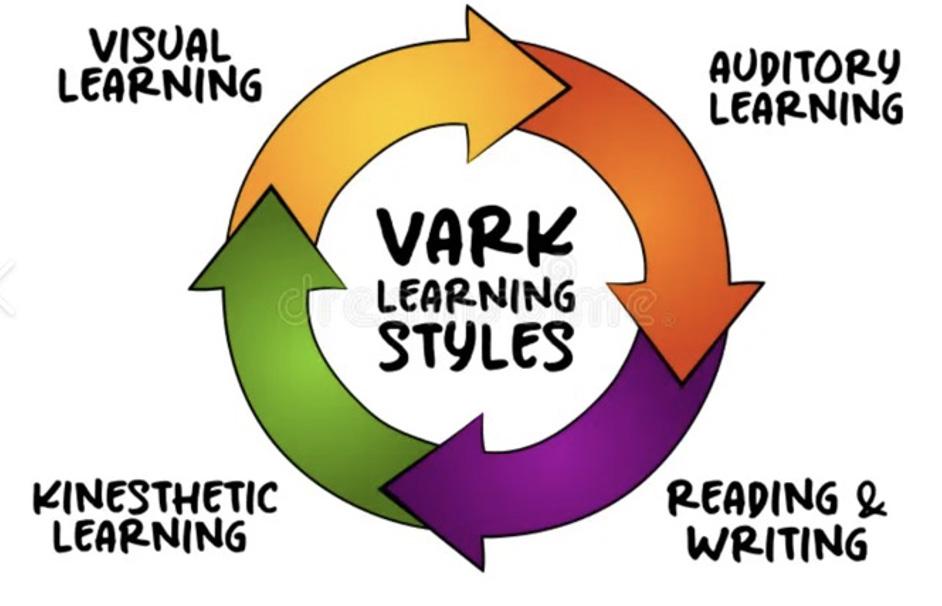
The VARK model divides learners into four types of preferences: visual preference learners are sensitive to spatial information such as images, charts, and videos; Auditory learners tend to learn by listening and discussing; Reading and writing learners are good at studying classics and papers, expressing their opinions and organizing knowledge through writing; Kinesthetic learners acquire knowledge through hands-on practice, by touching, feeling, and operating. The vast majority of people are blended learners, and multiple stimuli can promote the internalization of knowledge.
2.2 The "Input -Output" Theory in Second Language Acquisition
As Krashen suggested, when providing learners with language input slightly above their current level (i+1)—i.e., when new knowledge falls within a moderately challenging range—contextual input can stimulate their interest and curiosity, and enhance their understanding of the knowledge. Suppose the class consists of intermediate learners who have mastered basic daily
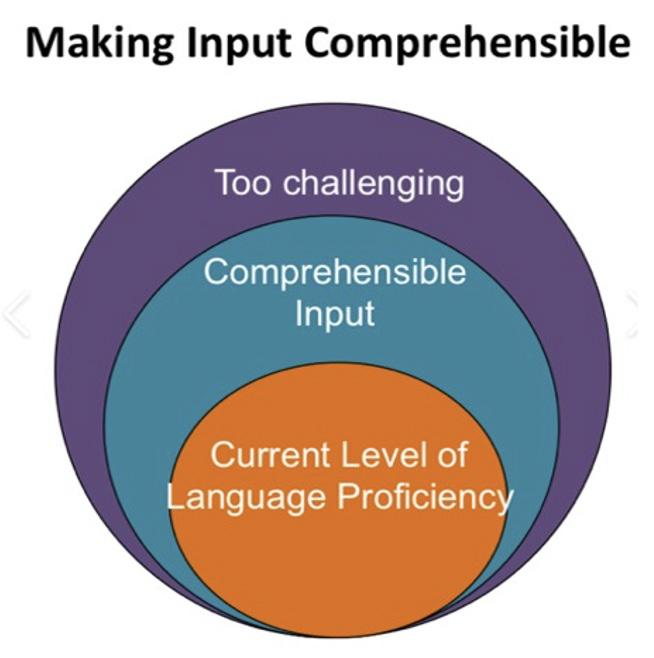
vocabulary and simple sentence structures. Giving a familiar and comprehensible context with an appropriate language challenge will help them acquire the language without frustration.
Swain proposed the key role of comprehensible output in the language acquisition process. When students output the target language, they can consolidate knowledge, connect fragmented grammar and vocabulary, and identify knowledge gaps promptly. Students can make targeted learning improvements if they know their grammar usage problems.
3. The Three-Phase Instructional Framework
3.1
Phase 1: Activating Prior Knowledge
Before language classes begin, teachers can use various sensory stimulants to create an environment for comprehensible input and quickly bring students into specific course situations. The teacher can explain abstract knowledge with concrete perception by showing pictures, videos, colors, and kinesthesis. For example, when teaching verbs and their expressions, teachers should advise students to learn how to use these words through pictures, body postures, and actions, which helps the learners to strengthen their understanding via practical applications, and reduces learning anxiety. The "mystery bag" can arouse students' curiosity when teaching adjectives. By grabbing the objects with different textures, such as the smoothness of silk and the sandpaper, students can feel these things and even produce more desire to know and express. During the lesson on "season" or "natural environment", playing music and natural sound corresponding to the themes can activate and inspire students' listening sense, and smells from nature can also stimulate their learning.
This process tests students’ prior knowledge, provides insights into their learning styles and levels, and offers a solid guarantee for building a new understanding "bridge" in the next step.
3.2 Phase 2: Multimodally Scaffolding i+1 Input
Typically, teachers need to guarantee that 85% of the words, sentence structures, and expressions are familiar to the students in the language classroom teaching, so that it is easier for the learner to build up confidence and maintain the continuity and energy of learning. The "i+1" (which are newly introduced) challenge and promote learners to step into the "zone of proximal development" to realize a gradual growth in language competence.
When introducing new knowledge, the coordinated use of multiple cognitive channels, engaging the learner's sensory (vision, hearing, touch, smell, taste) and kinesthesis, helps them immerse themselves in numerous real situations and stimulates their ability to acquire, organize, and process information. At the same time, it enables learners to quickly establish connections between the newly acquired knowledge and the real world, allowing them to understand the interweaving of language and cultural elements in real-world scenarios, thereby bridging the gap between abstract textbook knowledge and vivid, authentic culture.
Rich pictures, videos, and logically clear timelines can make abstract knowledge comprehensible.
For instance, all kinds of different sound signals can activate the class. When students listen to prose descriptions of natural
scenes, the teacher can play musical works that convey melodies and emotions to stimulate students' initial cognition of the rhythmic beauty, and the background music can build a concentrated climate. And then, enter nature, hear the wind, rain, and the birds' sound, and let students describe and express them, which can deepen students' closeness to nature.
In the "blind box" where there are all kinds of items, students guess the names of the items and describe the feelings with eyes closed, which could also facilitate vocabulary memorization and expression.
Bringing students into a particular situation with imitation activities, such as body movement, is a form of kinesthetic learning. For instance, while learning prepositions, students who can practice themselves the positioning of objects on the table while explaining the placement of objects through action and their movement in the body can learn best. Sense of smell and taste can give an exceptional language experience that includes the scent of flowers (roses), the freshness of lemons, and the richness of coffee. Students will recognize language while smelling and improve their learning experience by explaining the smell.
3.3 Phase 3: Creative Output
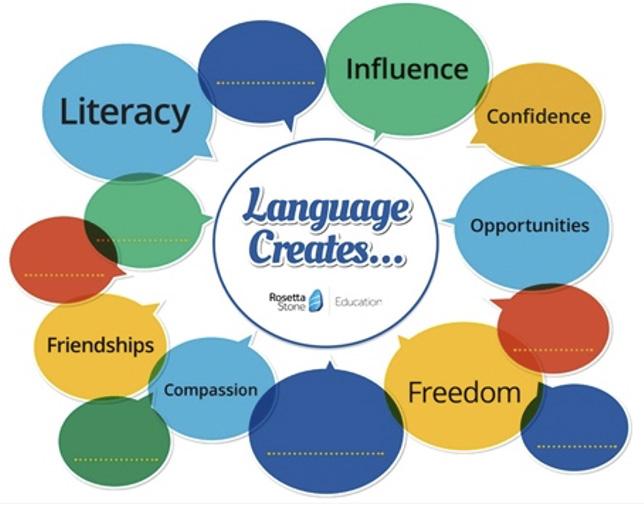
Creative output is a key link in students' acquisition and elevation of knowledge. Teachers provide demonstration samples to guide students in understanding the forms and key points of knowledge output. Showing excellent articles or videos that build up the logic can help students structurally sort out and reconstruct new knowledge from Phase 2. For example, encourage students to make vlogs, incorporate new words, sentence structures, and culture explorations into video creation, capture daily life, add explanatory text, and demonstrate understanding and application through text, images, and sound; Create interactive e-books that incorporate elements such as audio, video, and animation to encourage learners to present their knowledge diversely.
It is crucial to respect students' autonomy in choosing their output methods and topics based on their interests and strengths. At the same time, guide students to reflect and sort out their work, understand their strengths and weaknesses, all of which can recreate the learning experience in the output process.
4.
Observed Outcomes
The multimodal and sensory input method is quite effective in classroom practice. Students' classroom engagement has "reversed" from passive listening to active engagement. Multimodality lowers the threshold for expression, and cooperative interaction closely connects students. The project presentations inspire each other to learn and deepen their understanding of the knowledge.
Introducing real objects such as ethnic paintings, traditional music, and special spices allows students to have direct exposure to multiculturalism, transforming cultural cognition from abstract words into real experiences, which can deepen the artistic content of the classroom and broaden cultural horizons.
This method respects individual differences. Students can choose to show their understanding through physical movements and theatrical performances, or to express their feelings through artistic creation and written expression. Video production, which integrates multimodality, is very popular among students. To create excellent videos, they write carefully in advance, polish sentence by sentence, and record carefully. When editing, they added pictures, music, etc., incorporated creative features, and clearly presented the learning process and results.
5. Conclusion and Future Prospects
Multimodal sensory pedagogy captures the diverse needs of learners. Based on the inherent rules of second language acquisition, multimodal and multiple senses can create real, rich, and immersive learning Spaces.
Designing an excellent multimodal class, screening appropriate pictures, videos, and audios, and organizing kinesthetic activities is time-consuming and laborious. Teachers should ensure that the materials align with the teaching content and consider the safety and participation of students in kinesthetic activities. Teachers' ability to integrate information, observe the environment, and build their collection of resources daily is of vital importance.
Looking ahead, AI will inject more vitality into multimodal teaching. Virtual technology is maturing, and it will bring language learning into an unprecedented immersive new realm. You can imagine that by wearing devices, students can instantly "travel" to a foreign country, be in various scenarios, interact with virtual characters in real time, communicate in the language they have learned, and fully immerse themselves in it through multiple senses. Then it will truly be learning languages as if they were there.
References
Mayer, R. E. (2005). The Promise of Multimedia Learning: Using the Brain to Make Sense of Words and Pictures. In R. E. Mayer (Ed.), The Cambridge Handbook of Multimedia Learning (pp. 1-30). Cambridge University Press.
Krashen, S. D. (1985). The Input Hypothesis: Issues and Implications. Longman.
Shams, L., & Seitz, A. R. (2008). Benefits of Multisensory Learning. Trends in Cognitive Sciences, 12(11), 411-417.
Swain, M. (1985). Communicative Competence: Some Roles of Comprehensible Input and Comprehensible Output in Its Development. In S. M. Gass & C. G. Madden (Eds.), Input in Second Language Acquisition (pp. 235-253). Newbury House.
About the Author
Sophia Suo serves as a High School Chinese teacher at the Western Academy of Beijing.
ISCA MEMBERSHIP
OUR MISSION
The International School Counselor Association (ISCA) is a professional membership organization dedicated to meeting the unique needs of international school counselors working at international schools, benefiting student success in our global community.
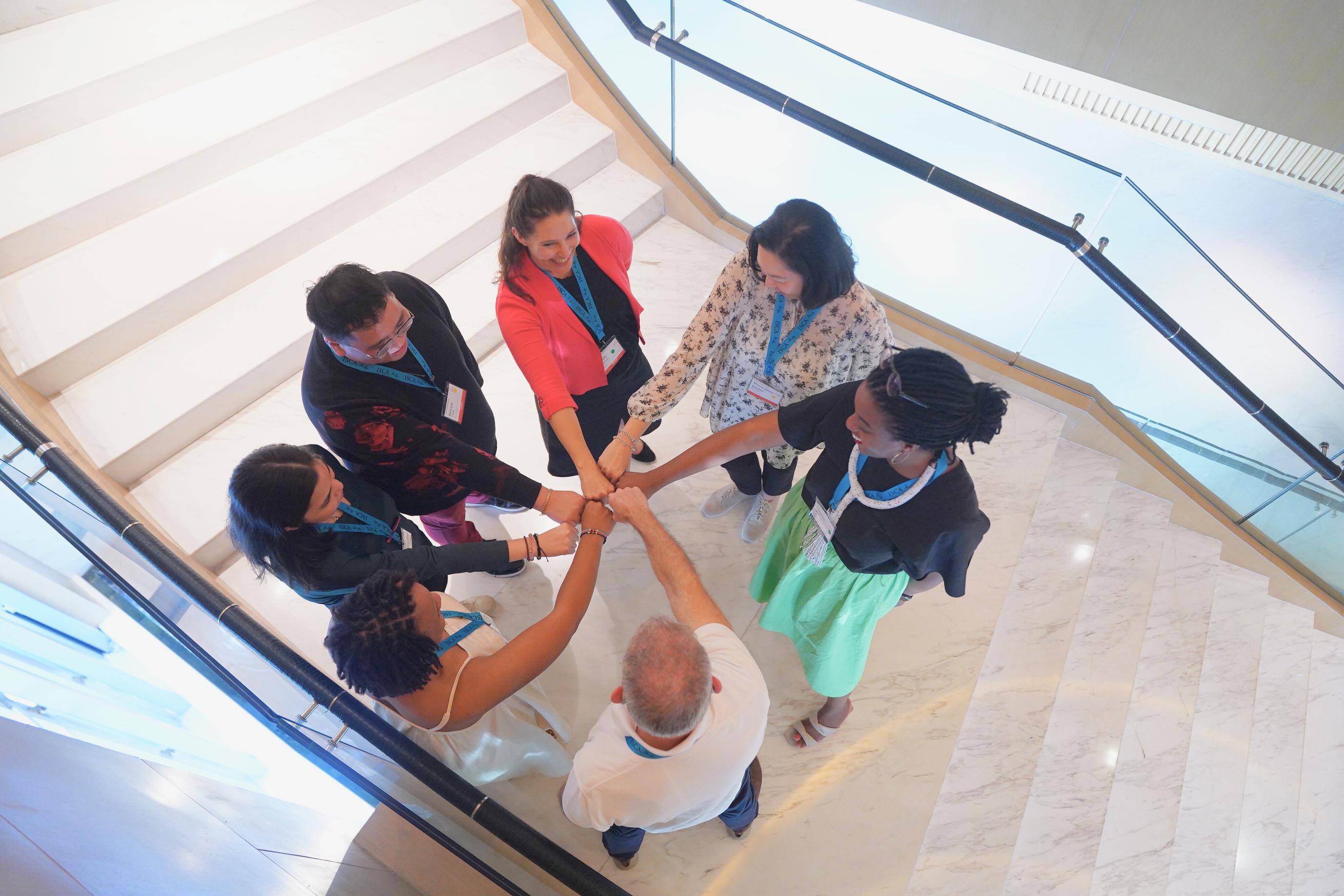
WHAT WE OFFER
We offer international school counselors community, connection, and professional learning through relevant, culturally-competent, comprehensive programs for their schools We provide real community and connection across the globe.

Advance your career
Broaden your knowledge WHY JOIN ISCA?

Connect with a community
MEETINGTHENEEDSOFCOUNSELORS OVERSEAS.
Membership Benefits
Discounts & Privileges – Member-only discounts and special access to ISCA Events, ISCA Academy, Conferences, and ISCA publications
Professional Learning – Access to ISCA Academy courses, ASCA-aligned conferences, free monthly webinars, and the Professional Development Calendar.
Resources & Tools – Full use of the ISCA Resource Library, latest articles, and international counseling job postings.
Community Engagement – Join ISCAnnect conversations, engage on community boards, and connect through the member directory
Information & Updates – Receive monthly newsletters with key insights and professional updates.

Meeting the Needs of Counselors Overseas.
ISCA is an international community of school counselors formed by counselors. With over a thousand members and hundreds of participants at our events, we are dedicated to meeting the unique needs of international school counselors.
We cultivate a safe, open-minded environment to promote community, connection, and
The ISCA Community is here to help you develop your skills and become the best school counselor you can be. How can we help you achieve those goals? professional learning.
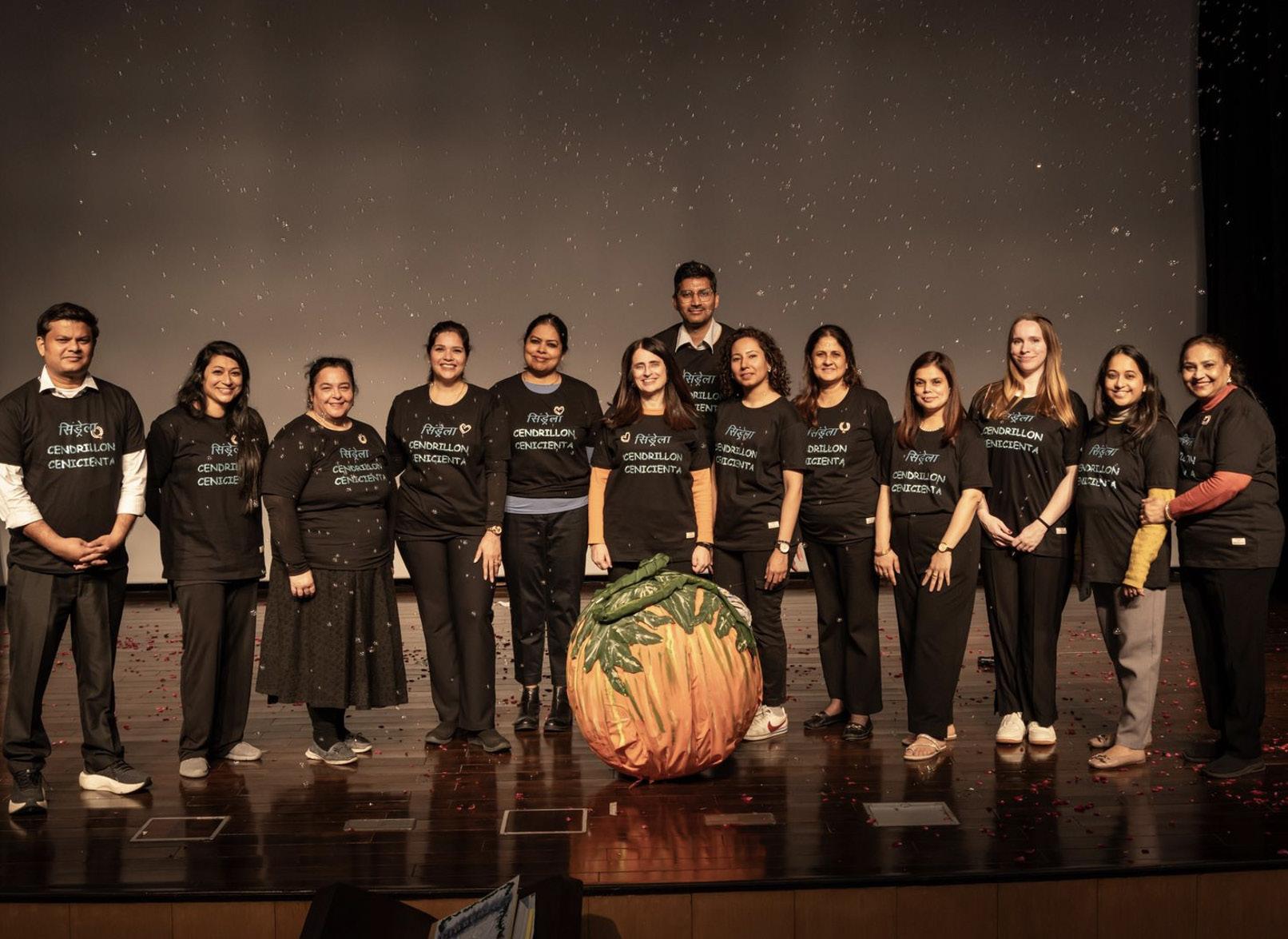
Curriculum
Cinderella in Three Languages: Theatre as a Tool for Intercultural Learning
‘Three languages… One story… Endless magic’
By Ira Mathur
The Modern Foreign Language Department team members. Ira Mathur is second from the left.
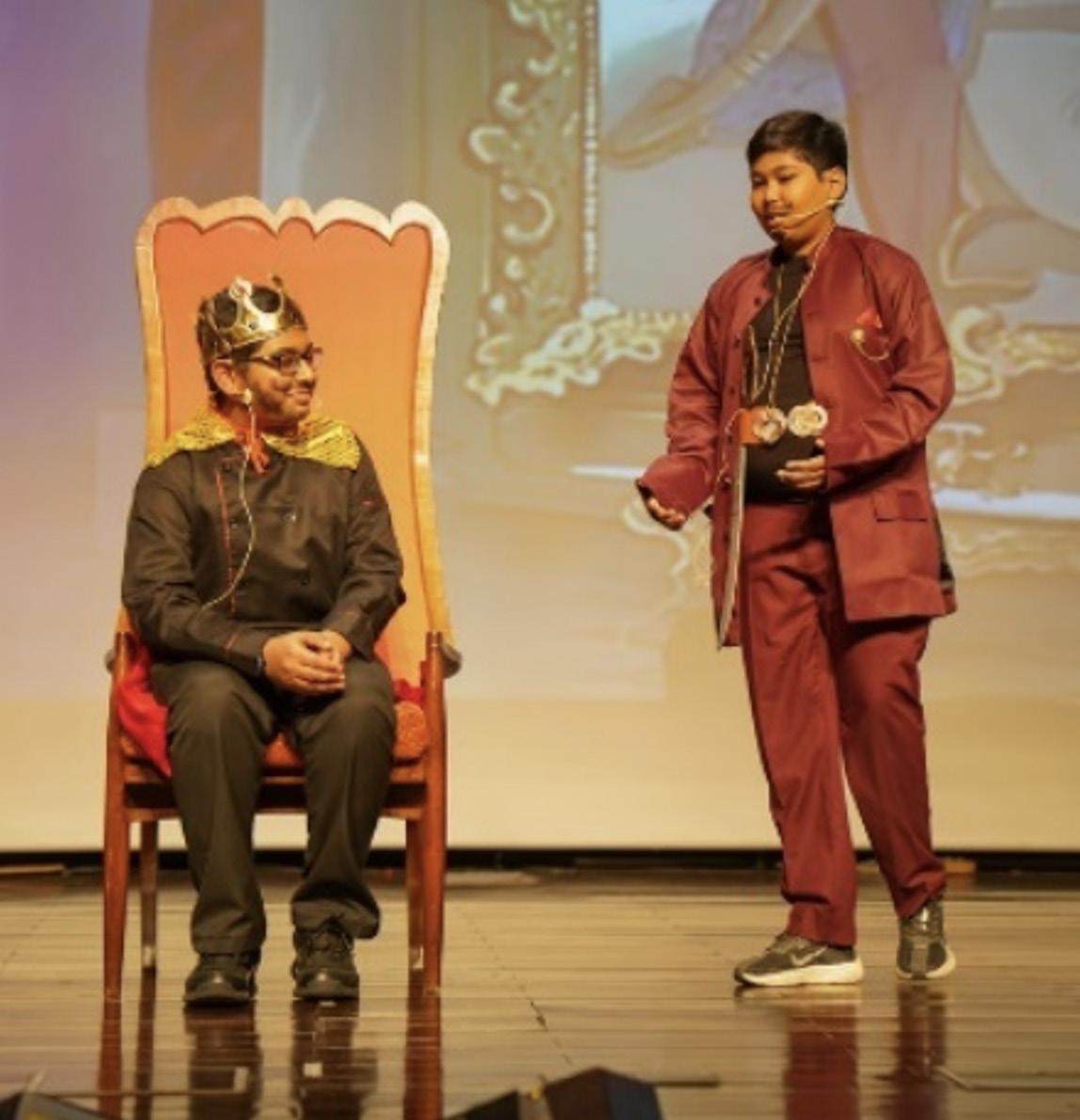
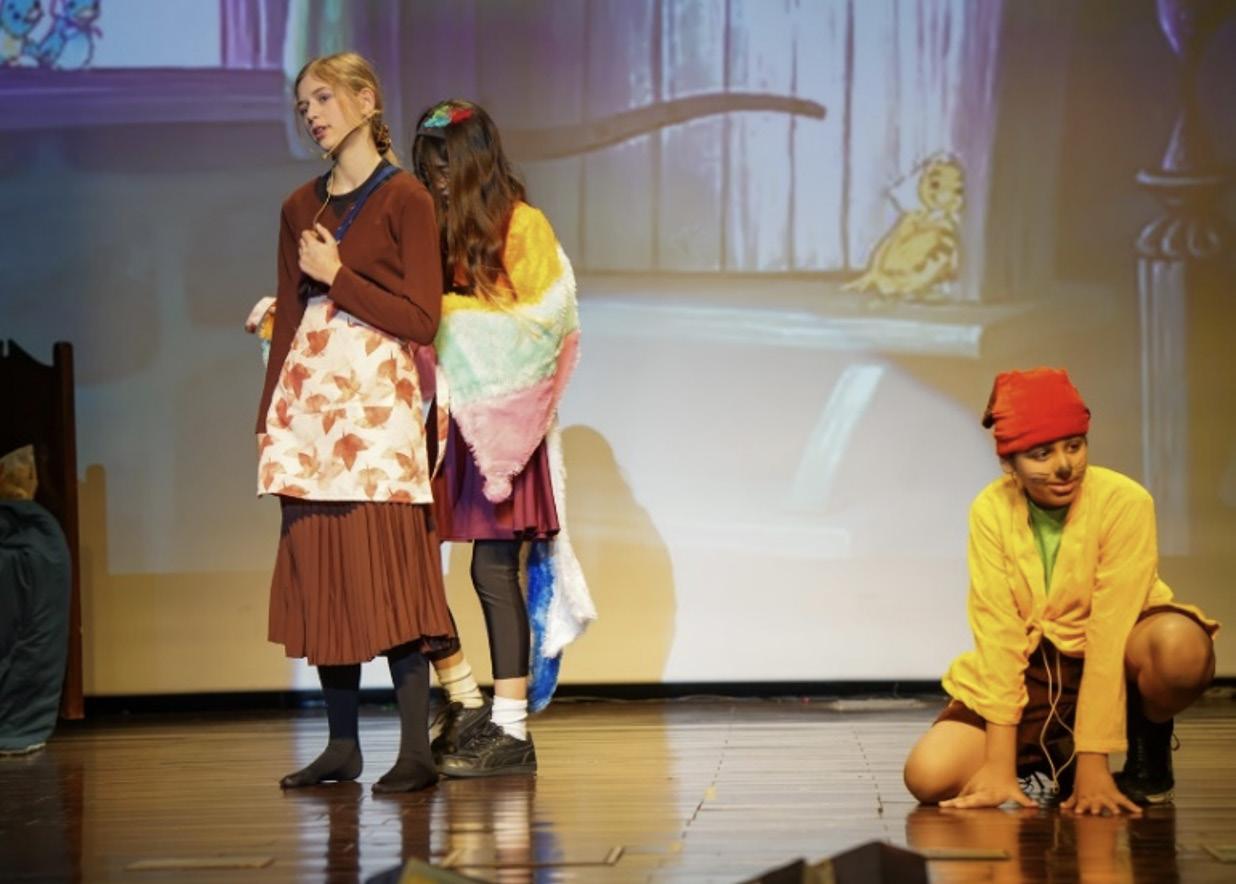
Opening scene- Cinderella sings a song of hope.
Theatre has always been close to my heart. Watching my father perform on stage sparked a lifelong love for the dramatic arts. As a young girl, I would watch my father step onto the stage, his presence instantly commanding attention. I remember my heart leaping with excitement at every curtain rise and every line delivered. The buzz of backstage, the whispered cues, the rustle of costumes—these moments etched in me a deep love for theatre.
Years later, as a language teacher at The British School, New Delhi, I rediscovered theatre’s power in education. In 2010, I directed Snow White in Spanish. The experience revealed how theatre could break the monotony of grammar drills and vocabulary exercises, and instead ignite fluency, confidence and cultural awareness in students.
This year, on February 19, 2025, our Modern Foreign Languages (MFL) team took that vision one step further: staging Cinderella as a trilingual production in Hindi, French, and Spanish. Our aim was simple but ambitious—to create a shared linguistic and cultural experience for our students in Years 7, 8, and 9, outside the four walls of the classroom. In a school where we value both academic rigor and creative exploration, this play became a powerful tool for learning: transcending linguistic boundaries, sparking confidence in public speaking and deepening intercultural understanding.
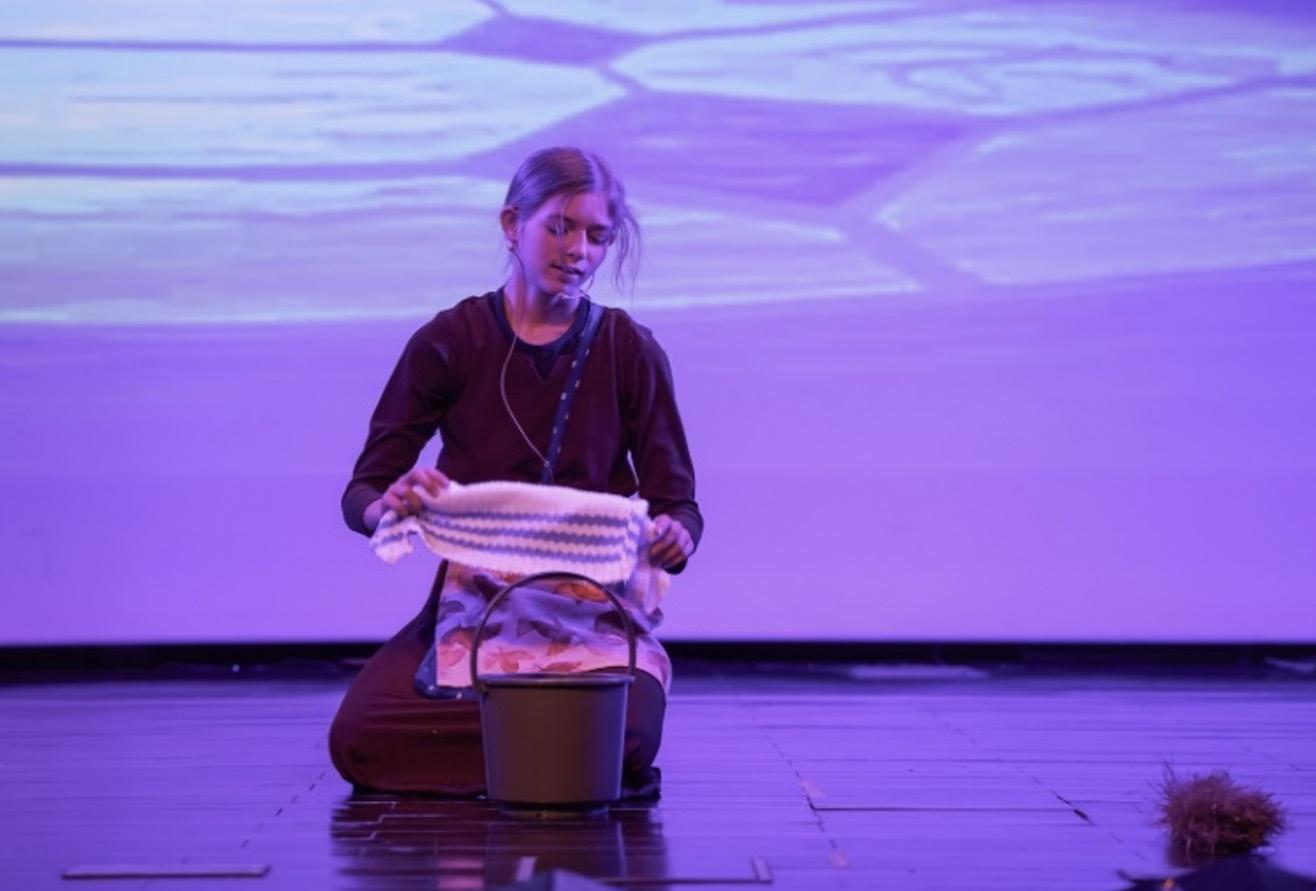
As Cinderella mops the floor, bubbles float through the audience.
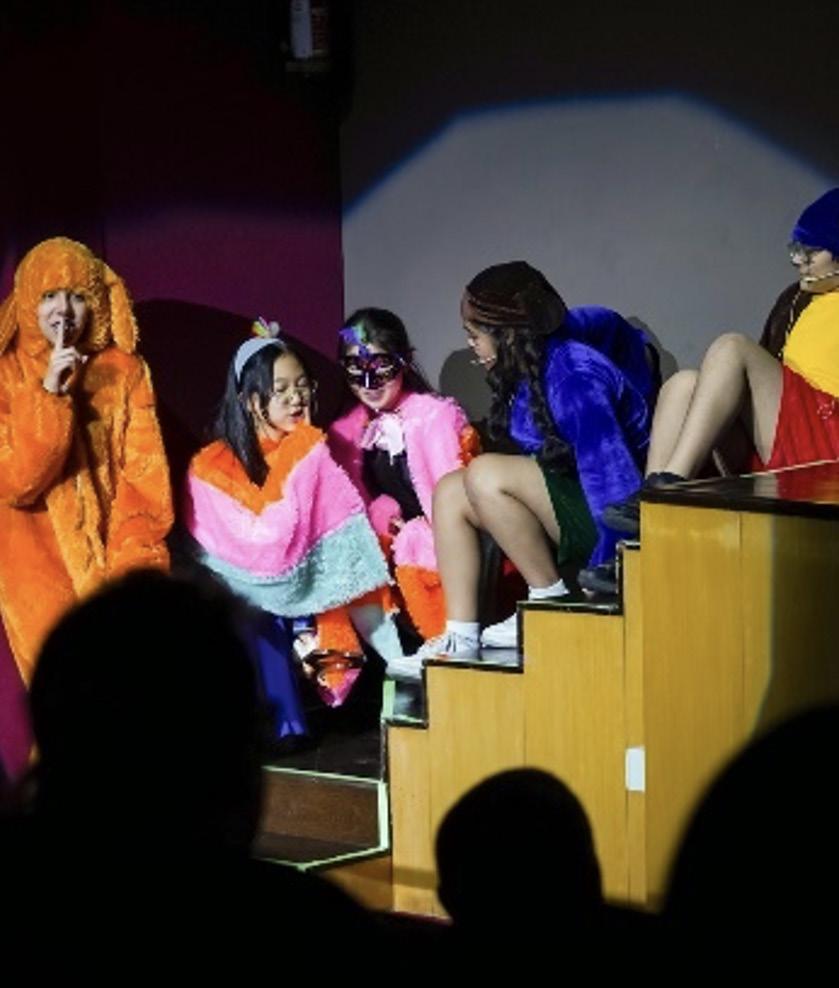
The interactive scene of the key being passed through the audience.
Cinderella’s friends- mice and birds- come together to make her dress.
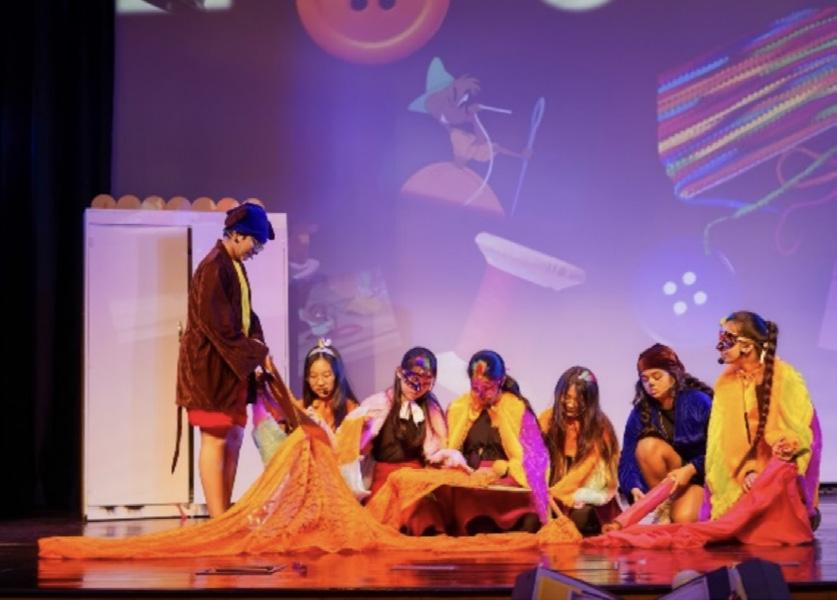
Disney’s Cinderella is a story loved universally, but our adaptation offered audiences something different. Each scene unfolded in a new language—Hindi, French, or Spanish—without English subtitles. The challenge was real: actors had to not only master their lines but also sing, dance and interact with one another fluently in a language that was not their mother tongue.
The absence of English subtitles was deliberate. We wanted the audience to experience what it means to listen, interpret, and feel without full comprehension of the words. As one Year 10 student put it: “By displaying the play in three different languages, it demonstrates how all arts are without language and can be appreciated nonetheless.”
This experiment proved transformative. It pushed students to think creatively, to rely on tone, gesture, and expression, and to realise that art, in its purest form, needs no translation. The result was a joyous celebration of storytelling that ‘immersed’ the audience into the fairytale world with fog machines, bubble showers, and interactive moments such as the passing of the key through the audience.
The vision behind staging a trilingual production stemmed from three interconnected goals:
Pedagogical Enrichment: We wanted students to experience their chosen languages beyond the textbook. A play forces stu-
King and Duke decide on hosting a ball.
dents to live the language: to speak it fluently, to use it in authentic interaction, to sing and dance in it. Some students even sang in a language that they had never learnt before!
Cultural Celebration: By weaving Hindi, French, and Spanish into a single narrative, we created a microcosm of global diversity. Students experienced firsthand that language and culture are inseparable, and that respect for linguistic diversity is central to becoming global citizens.
Confidence and Collaboration: Many students hesitate when asked to perform in a foreign language. Theatre provides a supportive, collaborative platform where mistakes become part of learning. As one Year 8 student noted: “Even though the actors’ mother tongue was not the language they were performing in, they did it—and that shows respect for culture and language.”
The broader alignment with The British School’s mission was clear: to nurture well-rounded learners who not only excel academically but also develop as empathetic, interculturally competent individuals ready to thrive in a global world.
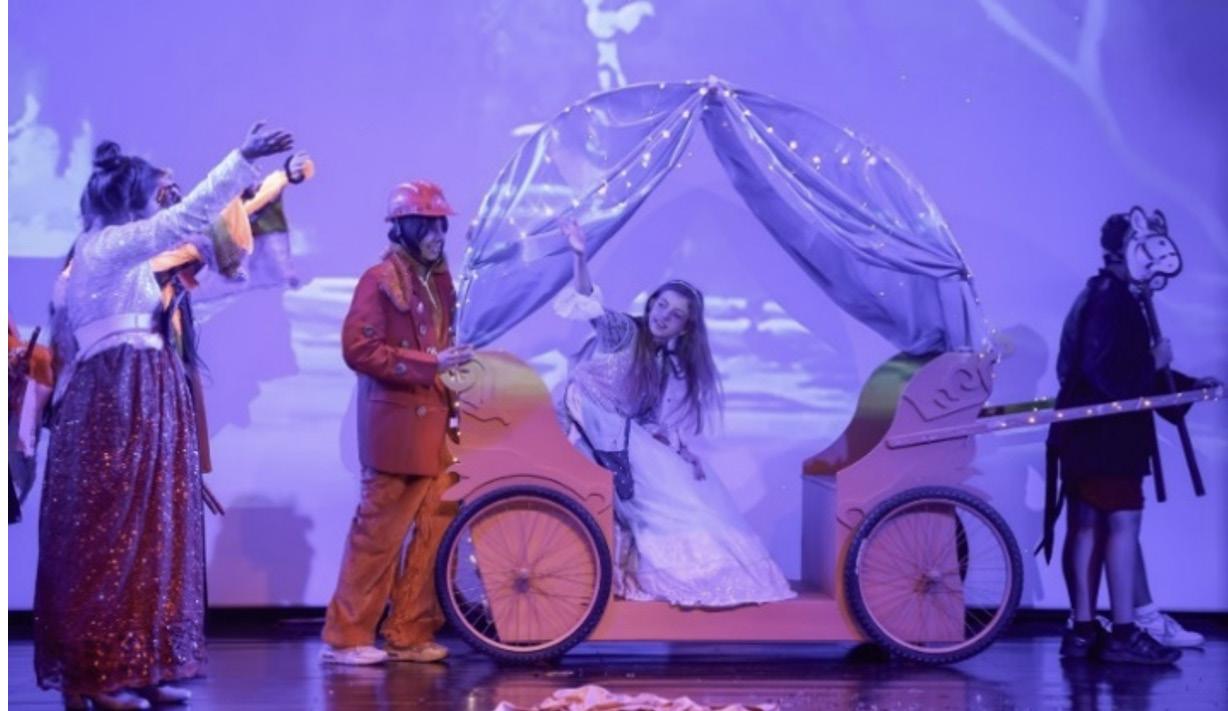
Cinderella making her way to the ball in the carriage
Producing a trilingual play demanded extraordinary effort from both students and teachers. The process was as enriching as the final performance. Students from Years 7, 8, and 9 auditioned enthusiastically. Once roles were assigned, rehearsals began in earnest. Each session became a language immersion workshop—students repeating lines, correcting pronunciation, and experimenting with intonation. Teachers coached them not only on accuracy but also on rhythm and expression, ensuring the language sounded authentic.
The magic of Cinderella lies as much in its visual world as in its narrative. Collaboration on purchasing costumes and creating props- from the pumpkin carriage to a double sided cupboard- were visual elements that helped anchor the audience, especially during scenes where language comprehension was challenging.
The fact that the inflated balloon was decorated by a member of the MFL team, the carriage designed by a parent of the school and the in -house carpenter crafted the carriage – beautifully showcases how the various stakeholders of the school contributed to making this performance a true success!
Many songs were performed live, a feat that required weeks of vocal training. From Bibbidi-Bobbidi-Boo in Spanish to Cinderelli
in Hindi and So this is love in French: the students sang with enthusiasm and clarity. Dance rehearsals tested their stamina, but the joy was evident. As one student remarked: “I really enjoyed how there were live vocals in all songs, even whilst dancing.” Another student commented: “My favourite scene was when the rabbits, birds, and mice were singing a song and making Cinderella’s gown.”
Each scene opened with a visual backdrop, which worked as the sets, further aiding in contextualising the experience. The play used fog machines, bubble showers and audience participation. The key scene, where the mice and birds helped pass the key through the crowd, delighted the audience and broke the boundary between stage and spectators.
No theatre production is without its backstage stories. Students learnt discipline, time management and the importance of teamwork. For many, this was their first time experiencing the adrenaline of quick costume changes, whispered cues, and the magic of stagecraft.

Fairy godmother transforming the pumpkin into a carriage
Productions like these matter because they connect language learning to lived experiences. Students no longer see Spanish, French or Hindi as subjects confined to textbooks; instead, they see them as living, breathing vehicles of expression. In performing Cinderella trilingually, they learnt that words can change but emotions remain universal.
For me as a teacher and director, it reaffirmed that theatre can be viewed as a rehearsal for intercultural dialogue, a stage for courage and creativity and a celebration of language as a bridge, not a barrier. As the curtains closed on Cinderella, the applause was not just for a story well told, but for the students’ courage, creativity and collaboration in making theatre a truly global language.
About the Author
Ira Mathur is the Assistant Curriculum Leader for Modern Foreign Languages at The British School, New Delhi, where she supports curriculum development and effective language teaching practices.

The Time for an Ecological Humanities is Now
By Jared Rock HS Literature Teacher
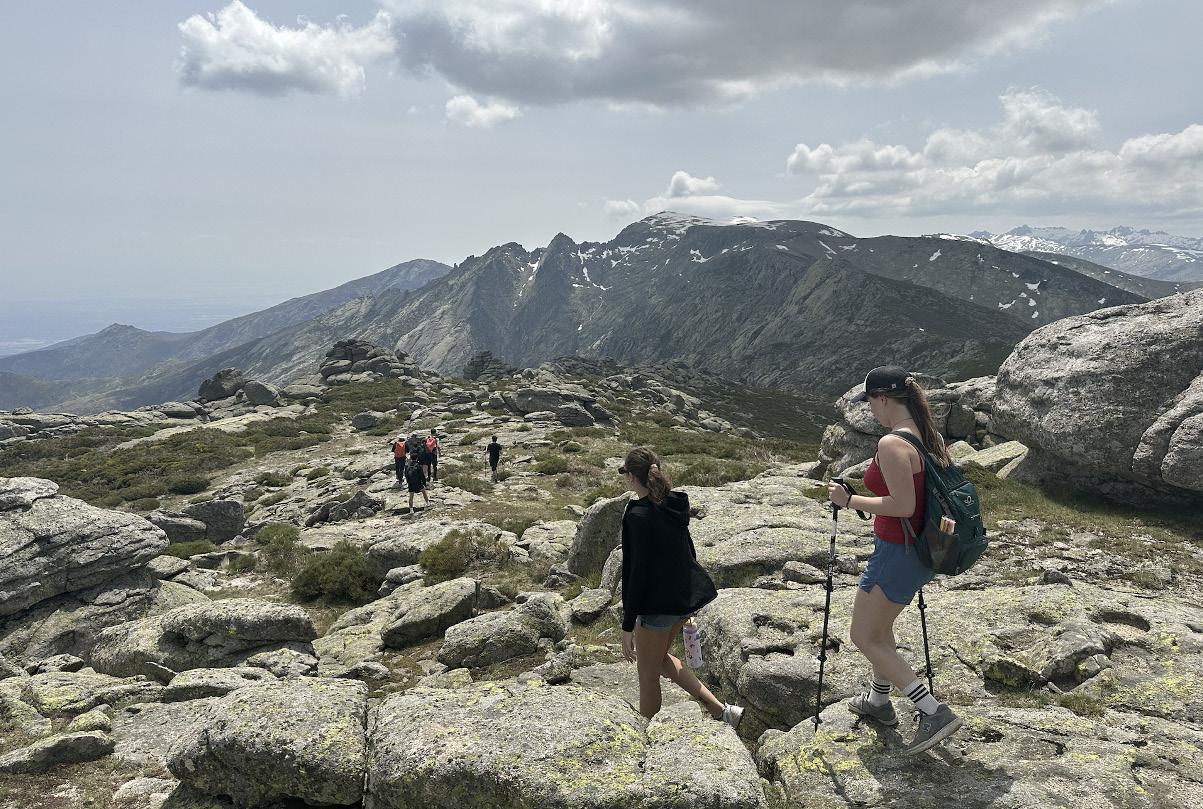
Ecology comes from the Greek oikos, “home” or “dwelling place” (Oxford English, n.d.). The dire state of our oikos urgently calls us to address its ailments. Yet, to consider this a home repair in any normal sense is misleading.
In normal home repair situations, the inhabitant depends upon the shelter but is, properly speaking, independent of that structure and master of it. Herein lies an issue recognized by many thinkers, perhaps most clearly outlined by William Cronon (1996), that an incessant dichotomy has been reinforced in our collective thinking about the natural ecosystem and our human social systems. Even our alarm over damage to our planetary systems is usually expressed and understood as concern for the continued health and survival of human societies, economies, and affairs, emphasizing the extent to which ecological disruption will be disastrous to these.
Here is where our natural oikos differs from the standard house conceit. We are not ecological inhabitants merely, but integral parts of its structure (or, more precisely, system). Every time we breathe, we both partake of our home’s protective atmosphere and actively alter it, even more so when we fly planes or make consumer choices in modern markets.
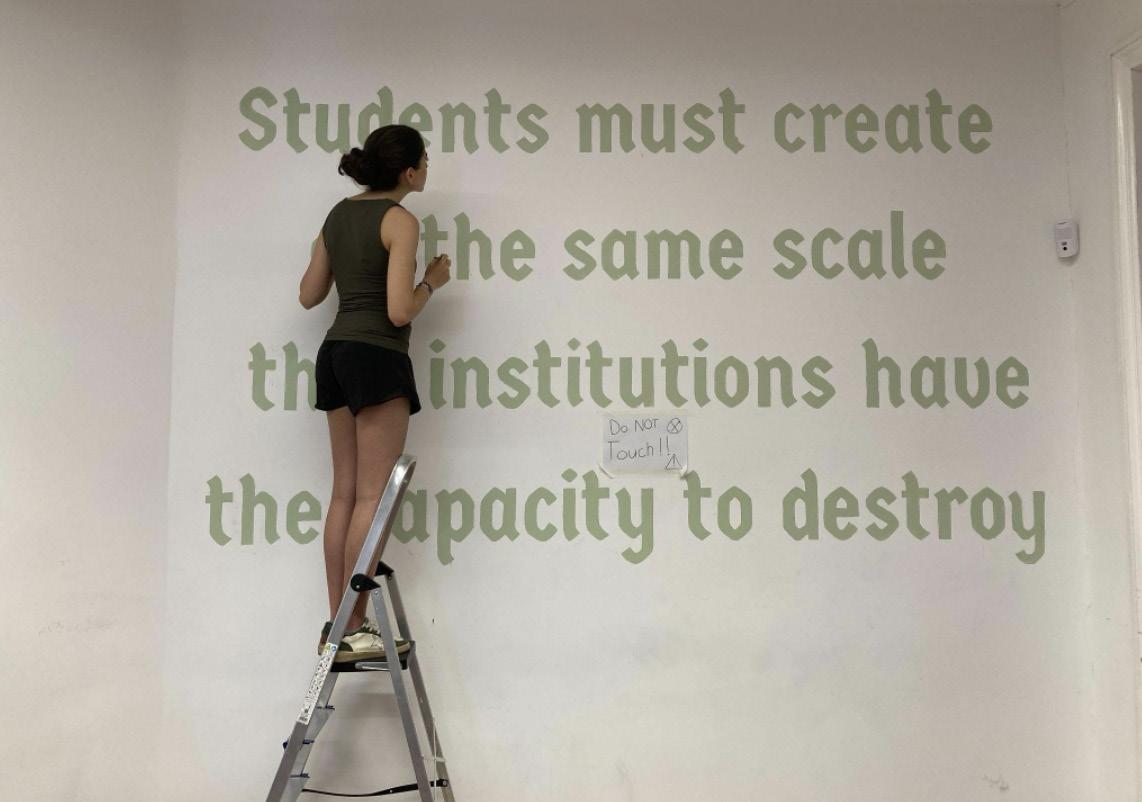
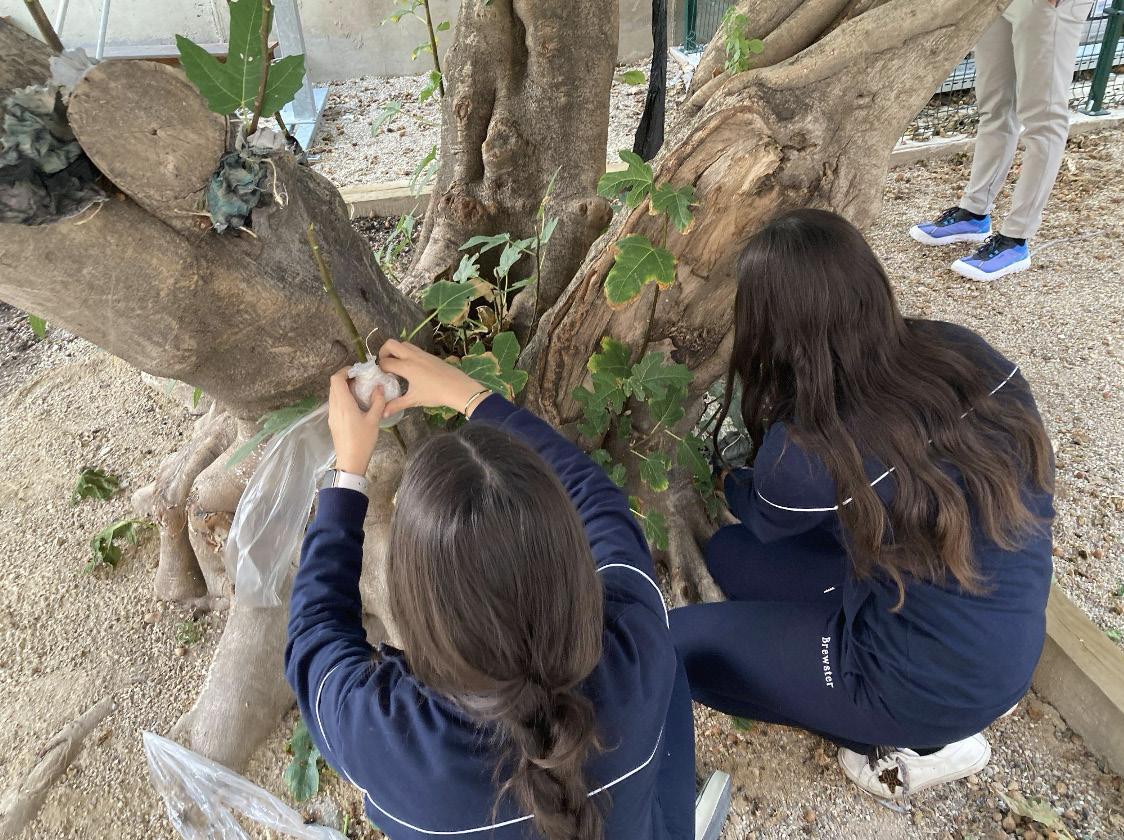
Intellectually, we all know this, but there is a persistent lack in its becoming real to us. Aldo Leopold pointed out this very problem three-quarters of a century ago (1989 [original 1949], p.201-207). While our knowledge has since advanced, a deep instinct for ecological interdependence has not. James Lovelock, weaver of the Gaia Hypothesis tale, has pointed out the systems-thinking inherent to his metaphor are important for consciousness change, yet most of us still think and feel about our world in metaphors of highly dependent but separate structures, such as that of a ‘spaceship Earth’ container home (2006, p.4-5).
Thus, we have spent much of our time pushing for atonement in the wrong direction, expecting to bring our environment into alignment with us instead of acknowledging that we must be at one with nature. Until we come to understand ecological interdependence as a real and immediate truth, we will fight the necessary and correct atonement we must make with the oikos of which we are a part.
Ecological Humanities - Planting a New Discipline
Humanities is radical practice, not just intellectual disciplines. For sure, the Humanities has a rich scholarly lineage, but the Renaissance’s studia humanitatis ushered in our modern period as a creative force advancing a new worldview that prized human dignity and flourishing for its own sake (Kristeller, 1979; Šarkan, 2021).
For some, being “radical” may conjure pictures of free-floating social disruptors appearing from nowhere. However, the term has its etymological root in the word, well, “root” (Oxford English, n.d.). To be radical is to be both rooted in a tradition and capable of grafting from it to plant new ones.
The Humanities remains a radical endeavor, and the primary place for driving change and blooming wisdom within our academies and societies. It is no surprise that authoritarians and status-quo guardians seek to eradicate the Humanities, that corporate educational programs attempt to box it up for sale as a defanged field of unimpassioned study, that schools ensconced in capitalist power structures trim back its free growth. The shift toward more and more heavily market-based schools where education is a consumer commodity has exacerbated the decline of the Humanities since the 1960s (see indicators in Academy of Arts & Sciences, 2023, as well as Heller, 2023; Schmidt, 2018; Seltzer, 2025 amongst many other sources). That same period tells the intertwined tale of eroding workers’ rights, dwindling conviction for human rights, and vanishing sense of community belonging (for example, see Streeck, 2014; World Justice Report, 2023; Caldwell, 2020; Putnam, 2020 amongst many other sources).
The forward momentum of the Humanities was bound to break, as its seed contained a flaw of perspective, one that reinforced the false dichotomy between humans/human society and nature. By placing human wellbeing as its highest value, classic Humanities seeks ecological flourishing as a means towards greater human flourishing. As the full picture of our ecological interdependence became better understood, the radical growth of the Humanities was, in essence, constrained by its root.
My call today is that we pluck a seed from the rich field of the Humanities and plant it to take root as a new radical discipline of its own: The Ecological Humanities. In reality, I do not care what name sticks, but a new field needs to be recognized, tended, and grown. The logical next step of our ever-unfolding post-Re-
naissance radicalism is a discipline that values humanity as one piece of a larger oikos, to show that we have a higher purpose as part of a transcendent and interdependent nature. The value, integrity, and flourishing of the Humanities then extends outward in its right, and not merely as a concession of necessary species chauvinism. This discipline is not scientific but uses science to gain greater understanding of our position within existence; it combines various threads of sciences and arts to develop new intellectual models and advance us down the road of wisdom.
This field already exists de facto in the work of John Muir, Emerson, Thoreau, Whitman, Rachel Carson, Annie Dillard, Leslie Marmon Silko, James Lovelock, Robin Wall Kimmerer, Lauren Bon, and others. The first move of “planting the seed” is really to point to a root now seen as a sub-division of other disciplines and name it as its own tradition. From there, we teach, talk, and work in this more unified subject, nurturing its further growth. The Ecological Humanities as its own discipline is the best shot at planting the radical seed we need within us to truly shift our consciousness to an ethic of ecological interdependence, as Leopold advocated decades ago, to know that our oikos’s special quality is that we are part of it, and it is a larger “us.”
An Ecological Humanities Curriculum
We can introduce this new discipline to students and fellow faculty through a curriculum, similar to our schools’ Math, English, History, etc. curricula. If this is to bring energy and action into the world, the curriculum and pedagogical approach must, by necessity, be left free for each school to construct around its community and place. Yet, some common principles may be discovered for our movement.
While many schools have good outdoor education experiences, sustainability projects, gardening clubs, or other environmental literacy aspects to their programs, these are not the same thing as a coherent subject, with force and prominence of those recognized core curricula. Peripheral ecological programming is often subsumed by market-driven, commodified education, rounding out the résumés of college-application-savvy students. Schools may find that their ecological curricula are profound but not consistent or prioritized enough throughout the k-12 continuum to make a meaningful dent against the dominant values of grade-competition and education as utility for professional advancement. What the Ecological Humanities must plant and nurture are new narratives that lead to radical re-invisioning of our values and institutions, practicing education through critical progress for greater flourishing.
Along the lines of Gemmell’s vision (2006), Ecological Humanities must lash together many strands (from our current perspective, “multi-disciplinary”) to found a new, unitary tradition. Below is a four-year high school course sequence created by a group of teachers to outline what an Ecological Humanities program could look like as a core subject. Such a sequence could be implemented in traditional class form, or delivered in a freer, more anarchic fashion by bringing mixed-grade students together to work on projects of shared interest with focuses matching their position on the continuum. Granted every school will make its own best curriculum, I strongly encourage birthing this subject in free design, place-based and experiential learning, and coteaching across diverse disciplines.
The goal of OL is to expose students to the outdoors so that they become comfortable being in natural settings for a variety of purposes (recreation, work, reflection, etc.) and begin to better feel a connection to the oikos of their ecosystems and develop eco-literacy.
The goal of Eco Hum is to get students to critically examine the existing social beliefs around the human/ social and the natural/ ecological, to recognize the inherent false dichotomy at the base of these concepts (the value-smuggled signified to the signs). The class should work together to deconstruct these notions, and through exposure to the work of writers, philosophers, naturalists, and artists, to construct new, personally meaningful narratives of society-nature connection.
The goal of Eco Civ is to apply research methods (data collection, hypothesis testing, interpretation, etc.) and the scientific method to better understand our interdependence with the ecosystem and the impact of our actions on that interdependent web. This should be personally meaningful and lead to eu-praxis, but also offer confidence in developing and communicating new understandings that follow the traditions of science and research.
The capstone is meant to empower students as possessors of a radical imagination that can work to shape new realities for our world. By examining existing institutions within the context of their historic developments, past and present debates, and critical benefits and shortcomings students should feel more oriented to their social oikos. Leaping from this base, students are asked to imagine radically different models for our world, departures from the current institutions that better fulfill their purposes in harmony with our social and natural systems.
Example course description Outdoor Life sets the base of ecological literacy by exposing students to the outdoors, through a mix of place-based and expeditionary learning, to gain comfort and confidence in outdoor activities, from gardening to recreation. The main takeaway from this class should be a greater sense of one’s place in the natural world, and greater desire to engage with it.
Ecological Humanities explores how the natural environment and human societies come together. The course aims to get students to better appreciate how definitions of nature betray implied values, and to rethink their own definitions and assumptions. Using a place-based, experiential approach, students set projects and topics of interest that lead them deeper into their personal understandings of nature and the interdependence of all. The main takeaway from this class should be a greater reflection on life’s purpose, a growing desire for wisdom and harmony with the natural world, and tools to make informed change in our communities.
This class is interdisciplinary, using a place-based and experiential learning approach to teach the fundamentals of ecological science and how to use that knowledge to take action as a citizen of a political and ecological community. Rather than science taught in isolation, the application of knowledge gained will be used for creating petitions, debating positions, creating artwork, etc. The course will present problems to be solved through inquiry and engagement with the world around them, connecting purpose in our social lives with a foundation in sound research and the scientific method. Ultimately, we expect students to leave this class inspired to act as citizens of an intertwined political and natural ecosystem.
This interdisciplinary, project-based class examines major social institutions through various lenses and asks students to create novel replacements for these institutions. Students become acquainted with the traditions and knowledge of three major institutions. Each institution is critically examined through five lenses: teleological, historical development (including competing models), minority and indigenous community “alternatives,” ethical, and ecological.
For each institution, students must completely recreate how the world should work by coming up with their own, new model. Each unit of study culminates in a project requiring research and creativity to propose a viable model for our future.
Example Units Concurrently:
Food systems
Outdoor Skills
Service Work
Learning “Place”
Ecosystems and Social Systems
Ecosystems and Ethics
New Narratives
and proposal for:
Campus
City/Neighborhood
Nation/Globe
Political Models
Economic Models
Education Models
Join the Call
I encourage teachers and schools excited to bring a new field into existence to take up that project with their communities. I also propose that interested teachers join together in global community to collectively discuss our larger goals, form shared principles, and share resources. Any teachers or schools that are interested in being part of an Ecological Humanities movement can email me at jaredrock@jaredrockeducation.com to join an initial group dedicated to carrying out this project together.
Closing
As the interdependence of all becomes more and more understood, felt, and urgent, a revised Humanities becomes necessary. A new Humanities must tie the human and non-human together in a system that is its own source of value worthy of study, dignity, and flourishing.
The etymological root of human is shared with the Latin humus, meaning “earth.” It is fitting that our new Humanities reconnect
the two with a radical purpose, once again shifting our values, beliefs, and institutions. Humus is also the root of “humility” (Oxford English, n.d.), and the Ecological Humanities humbles the hubris that grew from a powerful anthropocentric Humanities. Consider the Voyager 1 probe photo of earth from 6 billion km away, or that when William Shatner made his real-life visit to space, he described being overcome with grief at the vast funeral that infinitely surrounds our tiny life-supporting oasis (2022).
Such perspectives, accessible to us now in large part due to the progress set in motion by studia humanitatis half a millennium ago, should be humbling in the ways we need. Ecological Humanities is a natural growth of Humanities, the leading edge of that radical line. As such, it is unapologetically radical in its mission to transform our world. And that, I hope, can become its accomplishment.
The time for an Ecological Humanities to take root is now.
References
American Academy of Arts & Sciences. (2023). Bachelor’s Degrees in the Humanities. Humanities Indicators. http://www. amacad.org/humanities-indicators/higher-education/bachelors-degrees-humanities
Caldwell, C. (2020). The Age of Entitlement: America Since the Sixties. Simon & Schuster.
Cronon, W. (1996). The Trouble with Wilderness; Or, Getting Back to the Wrong Nature. Environmental History, 1(1), 7–28. https:// doi.org/10.2307/3985059
Gemmell, C. N. (2006). Untangling the Tangled Bank: Toward a Unitary Pedagogy of Nature. ProQuest Dissertations & Theses.
Heller, N. (2023, February 27). The End of the English Major. The New Yorker. https://www.newyorker.com/magazine/2023/03/06/the-end-of-the-english-major
Kristeller, P. O. (1979). Renaissance Thought and its Sources. Columbia University Press.
Leopold, A. (1989 [original 1949]). A Sand County Almanac: And Sketches Here and There. Oxford University Press.
Lovelock, J. (2006). We Belong to Gaia. Penguin Books.
Oxford University Press. (n.d.). Ecology, n., Etymology. In Oxford English Dictionary. Retrieved October 13, 2025, from https://doi. org/10.1093/OED/8140041101
Oxford University Press. (n.d.). Humble, adj., Etymology. In Oxford English Dictionary. Retrieved October 27, 2025, from https://doi. org/10.1093/OED/1991117560
Oxford University Press. (n.d.). Radical, adj. & n., Etymology. In Oxford English Dictionary. Retrieved October 13, 2025, from https:// doi.org/10.1093/OED/3889178833
Putnam, R. D. (2020 [original 2000]). Bowling Alone: The Collapse and Revival of American Community. Simon & Schuster Paperbacks.
Šarkan, M. (2021). Humanities Studies and Jesuit Principles of Education. Horyzonty Wychowania, 20(56), 47-56. https://doi. org/10.35765/hw.2188
Schmidt, B. (2018, August 23). The humanities are in crisis. The Atlantic. https://www.theatlantic.com/ideas/archive/2018/08/ the-humanities-face-a-crisisof-confidence/567565/
Seltzer, K. (2025, August 20). Daily Briefing: The Shrinking of the Humanities. The Chronicle of Higher Education. https://www. chronicle.com/newsletter/daily-briefing/2025-08-20
Shatner, W. (2022). Boldly Go. Atria Books.
Streeck, W. (2014). Buying Time: The Delayed Crisis of Democratic Capitalism. Verso.
World Justice Project. (2023, December 5). The World Backtracks on Human Rights as the Universal Declaration Turns 75. https:// worldjusticeproject.org/news/universal-declaration-humanrights-backtracks
SPONSORED WEBINARS
Improving Hiring Accuracy in International Schools: From Process to Predictive Success
Presented by: Richard Boerner
Saturday, February 21, 2026
Time: 9:00-10:30 AM HKT
Free for EARCOS Members / $100 for Non-Members.
Visit Website
On Becoming & Belonging: The Creative Leader (continuing from "The Imperfect Leader")
Presented by: Liz Cho
Saturday, February 28, 2026
Time: 9:00-10:30 AM HKT
Free for EARCOS Members / $100 for Non-Members.
Visit Website
Unknowable Potentialities: Weaving a Shared Narrative of Pedagogical Identity
By Nitasha Crishna, Kay Strenio, & Anne Van Dam
Introduction
At a time when education seems increasingly driven by an “input–output” narrative, it is easy to lose sight of the fact that both adults and children are not just “units” within a mechanical system but, instead, unique, complex and creative human beings. As George Monbiot and Peter Hutchison (2024, p.138) remind us, “the only thing that can replace a story - is a story.” This feels particularly resonant for the narrative we want to share about the long-term collaboration between the Early Years team at UNIS Hanoi, their leaders Nitasha Crishna and Kay Strenio, and educational consultant Anne van Dam. Ours is an account of leaders and teachers figuring things out together, for their unique educational context, guided by Peter Moss’s (2016, p.5) belief in “the endless and unknowable potentialities of people and the institutions they create.”
Before sharing our individual perspectives on what has resonated the most for us so far, from the vantage points of the Deputy Principal, PYP coordinator, and consultant, it feels important to trace the arc of our journey.
Our collaboration began online in 2021, during the COVID-19 pandemic, with an initiative to articulate a shared pedagogical identity. Together, the team created statements about values, beliefs, and practices, a foundational act of collective sense-making. The following year, our attention turned to deepening the understanding of planning as an ongoing process of collaborative dialogue and interpretation, grounded in the documentation of children’s living research and meaning-making processes.
The next investigations focused on documenting learning in ways that were both cohesive and authentic. We explored how to identify and refine formats, strategies, and systems that enhance the quality and effectiveness of documentation while preserving its aesthetic integrity and each child’s unique experience. This year, the collaboration continues with renewed depth as the team grows more comfortable navigating the layers of complexity that characterize early childhood teaching and learning. The conversations and questions now center on intersecting areas such as integrating standards into planning and expanding the understanding of learning spaces as the “third teacher.”
Throughout, these investigative threads weave together into a narrative of sustained professional inquiry, one that honors the relational, contextual, and evolving nature of pedagogy itself.
Institutional Mirroring - from the perspective of the PYP Co-ordinator, Kay Strenio
“To pay attention means we care, which means we really love.”
This concept was originally presented by philosopher, Jiddu Krishnamurti and is a concept practiced in our early years classrooms. It manifests itself in many ways: listening, noticing, following, asking questions, posing theories and documenting. In doing so, we are able to observe the process of growth over time. How does an educator develop this art of ‘paying attention’?
What if we paid attention to the educator?
The idea behind ‘institutional mirroring’ is that teachers experience the same practices that they share with their students. By doing so, they not only understand the why behind what they do, but also how it makes them feel and realize the potential for transformation.
The result of being paid attention to builds a culture of trust and vulnerability. One of our teachers shared this insight:
“For me, the most significant impact of this collaboration has been the development of trust within our team. Anne’s modelling has created a truly safe space where we feel comfortable being vulnerable and sharing our ‘messy’ teaching moments without judgement.”
When Anne steps into a classroom, she’s not there to evaluate. She’s there to learn alongside the teacher. By asking open-ended questions about what she sees and listening without judgement, she is treating the teacher exactly as we want the teacher to learn alongside a child. It takes away the fear and replaces it with a shared commitment to figuring out the best next step.
What makes our collaboration so effective is the feeling of being seen and understood. Another teacher shared how Anne’s actions reflect the best of what we do in an early years setting:
“Her feedback is honest yet reassuring, always timely and deeply personal. It’s this combination that makes me feel both seen and challenged.”
Our work together has helped us slow down. We are reminded to be fully present to notice the wonders that emerge through children’s play. This process isn’t abstract, it’s a tangible reflection of the trust and respon-
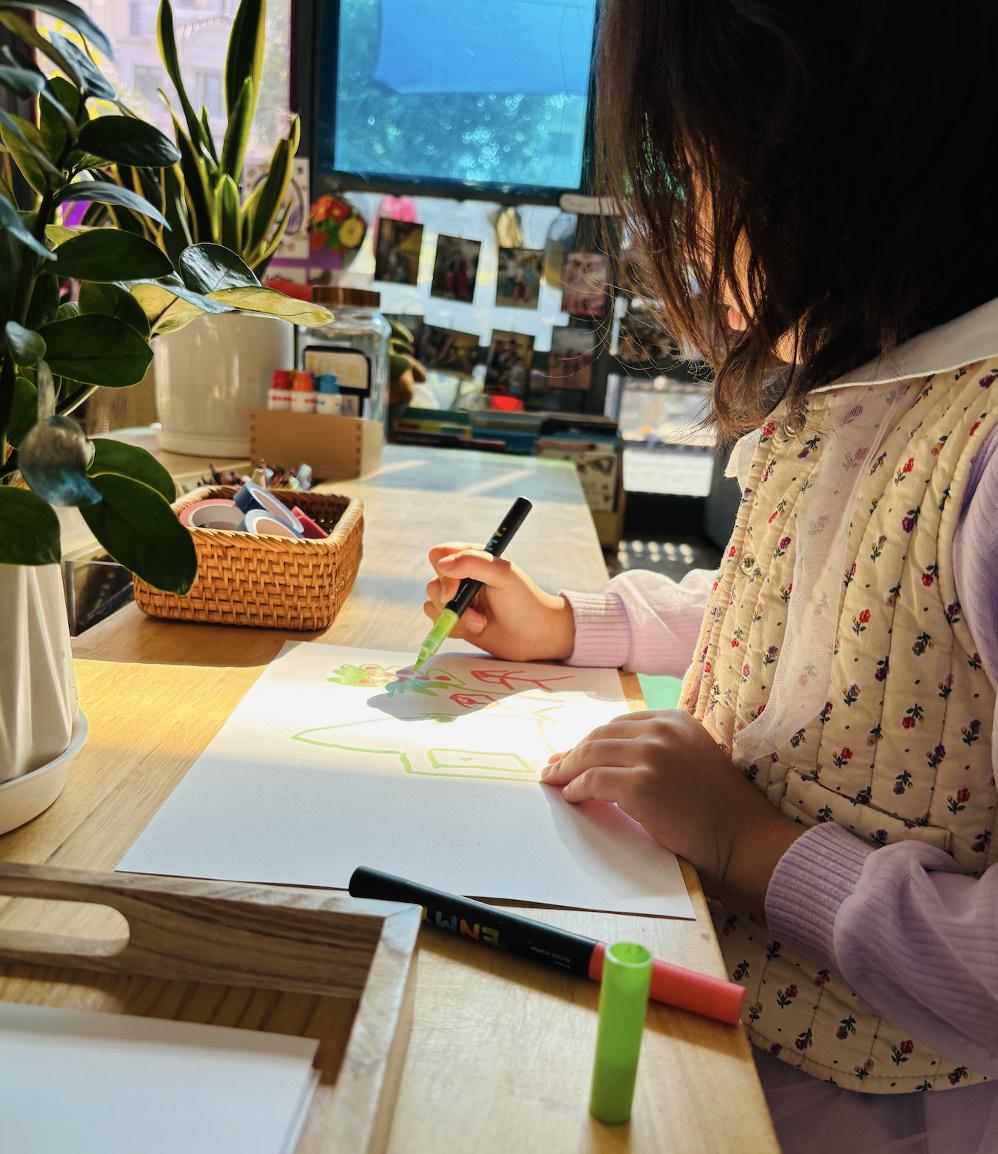
siveness we want our teachers to show every day.
This transformation has become visible in our documentation. Through questions and careful listening, we developed shared clarity and purpose. Our documentation has evolved into joyful, child-centered stories that celebrate curiosity.
Paying attention works because it’s authentic. It takes our core beliefs about how children learn best and applies those same beliefs to how adults learn. It’s through care and love that we build trust and grow together.
Systems and Structures to support listening- from the perspective of Deputy Principal, Nitasha Crishna
As an early childhood program, our first priority was to solidify our shared philosophy and be able to articulate what we hoped for while integrating the complexity of materials, embedding listening as a pedagogy, and wanting to engage in rich and meaningful practices around documentation. Once we were confident about our shared direction, we then needed to act on our philosophy—and that meant creating systems that would support our ability to listen, document, communicate, and partner with parents. As a member of the team reflected, she said,
"The effectiveness of our systems stems from our continuous dialogue and deep reflection, fueled by the dedicated time we set aside to truly listen and work alongside our students."
In our continuing work with Anne, creating systems to support our goals became a priority. Our Early Years team had time carved out in their daily schedules, after student dismissal, where they were able to come together in a collaborative setting. They now needed structures to use that time effectively.
Robert Garmston, Professor and co-developer of both Adaptive Schools and Cognitive Coaching, says that, "We don't learn from experience as much as we learn from processing our experience—both successes and failures.” Our work with Anne first got the team to pause and reflect on what systems they might have had or didn't have in place, and also on what they envisioned healthy, robust collaboration to look like. Anne supported the team in coming up with protocols to use and also in charting a year-long plan of documentation posts that would support regular communication and documentation with parents. There was parity across the five classes, with all teachers engaging in a consistent process. The result? A team of committed Early Years educators who found a rhythm in talking about moments from their students’ experience at school and being able to relax into a system of regular communication. It resulted in the richness of the students' learning being communicated regularly and with greater impact.
Power of relationships and trust - from the perspective of Anne van Dam, educational consultant
“The roots of resilience… are to be found in the sense of being understood.” These words so gracefully express the heart of this story, the listening, the noticing, the co-construction of meaning that becomes possible only through trust and relationship. Knowing that everything returns to the quality of relationships has always been a guiding principle in my work alongside teams, and over the years with UNIS, I have seen this truth revealed in powerful, deeply human ways.
“What has made this professional learning so powerful is its ongoing, unhurried nature, a slow, relational process grounded in mutual trust and respect.”
As trust grew, communication opened. Individual theories, values, and perspectives surfaced, enriching the team’s collective understanding. Feedback offered with responsiveness, to context, to timing, to each person’s professional growth—strengthened reflection and sharpened awareness. Dialogue grounded in documentation created a space of research and possibility, a place where thinking could stretch and the team could continually form and re-form its shared pedagogical identity.
Through these evolving relationships and reflective practices, the team has shaped pedagogical approaches that feel uniquely its own— authentically UNIS, coherent, and alive with shared intention. As one team member so beautifully reflected, “This sustained collaboration has shown me that time, trust, and responsiveness are what make professional growth truly transformative.” Her words capture the essence of our journey together: a slow, relational unfolding where insight, confidence, and trust grow side by side.
Conclusion
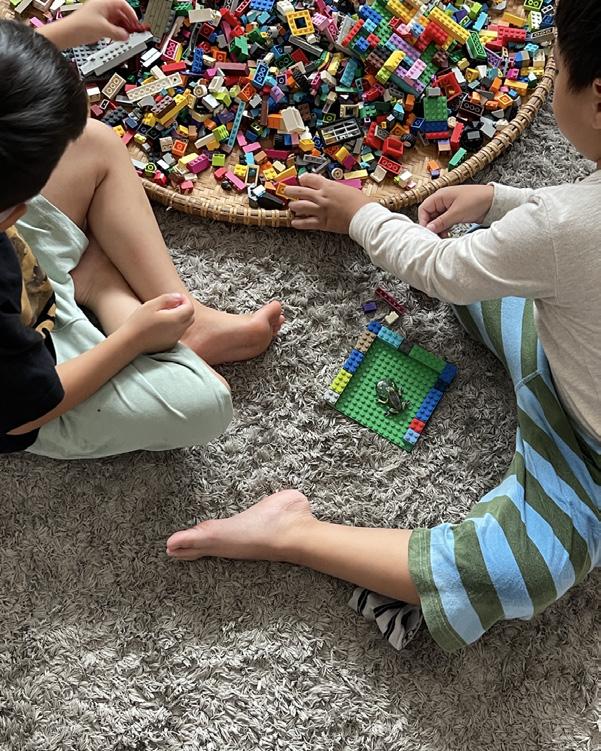
Our collective experience highlights a vital truth in early childhood education: the quality of learning for the child is inextricably linked to the quality of the environment for the adult. Through institutional mirroring, we have rediscovered the power of being seen; through intentional systems, we have found the rhythm to sustain our work; and through deep trust, we have found the courage to be vulnerable. As we continue to weave these investigative threads together, we remain dedicated to a pedagogy that honors the unknowable potentialities of our community. We are not just teaching; we are learning alongside one another, one story at a time. As we look ahead, we do so with the understanding that our work is never truly finished. Instead, it is a continuous process of listening, documenting, and evolving—a story that remains open, authentic, and rooted in the belief that when we pay attention to one another, the potential for growth is limitless.
Reference
Garmston, R. J., & Wellman, B. M. (2016). The adaptive school: a sourcebook for developing collaborative groups. Rowman & Littlefield.
Moss, P , (2025) Ten propositions for a democratic politics of early childhood education https://journals.sagepub.com/ doi/10.1177/14639491251366663
About the Authors
Nitasha Crishna serves as Deputy Principal and Kay Strenio as PYP Coordinator at UNIS Hanoi. Anne Van Dam is an Educational Consultant.
Language Integration In The Art Room: A Case Study of Collaboration between the Visual Arts Teacher and EAL
By Nan Zhang & Amy Kerr
Teaching Visual Arts in an IB PYP international elementary school comes with its own special set of challenges. While students are creative, they struggle to find the words to explain their ideas. As a Visual Arts teacher, it’s common to hear the phrases “Teacher, I want this,” or “Teacher, I want that,” accompanied by gestures rather than a student naming the specific material or tool they need. With constraints on time and number of classes per week, it can be difficult to practice the essential communication skills of expressing ideas clearly and logically and giving respectful feedback during reflections. When students can't fully describe their process or thinking, it impacts their confidence, limits their reflective growth, and impacts what teachers can assess of their understanding.
Language Integration In The Art Room
In the Elementary School at Beijing City International School, we have a large EAL department with an allocated EAL teacher to work with specialist teachers, supporting planning for languageintegrated teaching. Our collaboration focused on fostering authentic language use, equipping students with the vocabulary and structures to document and share their artistic journey within the practical constraints of the schedule.
Looking at the daily challenges, we saw the common theme was lack of vocabulary that was impacting students’ ability and eagerness to explain their thinking. The difficulty of building reflection routines within limited class time was also a challenge. Together, the EAL and G3-5 Visual Arts teachers, dedicated two 40-minute periods per week to collaborative planning. Our overall goal was to build student capacity and automaticity to apply art terminology when expressing their thoughts and procedures. Our expectation was that with more intentional rehearsal during class, students would more confidently articulate their ideas and intentions. Through our planning, we systematically unpacked the necessary terminology and designed the following, more accessible, ways to incorporate language into the classes.
1. Demonstrating Terminology
In many art units, students encounter materials, tools, and techniques for the first time. To support both conceptual and language development, we hold technique-focused mini-lessons. During these demonstrations, we introduce vocabulary like
press, roll, pinch, and smooth using purposeful gestures and clear modeling. This multimodal approach helps students immediately connect language, action, and material, supporting comprehension for learners at all English proficiency levels.
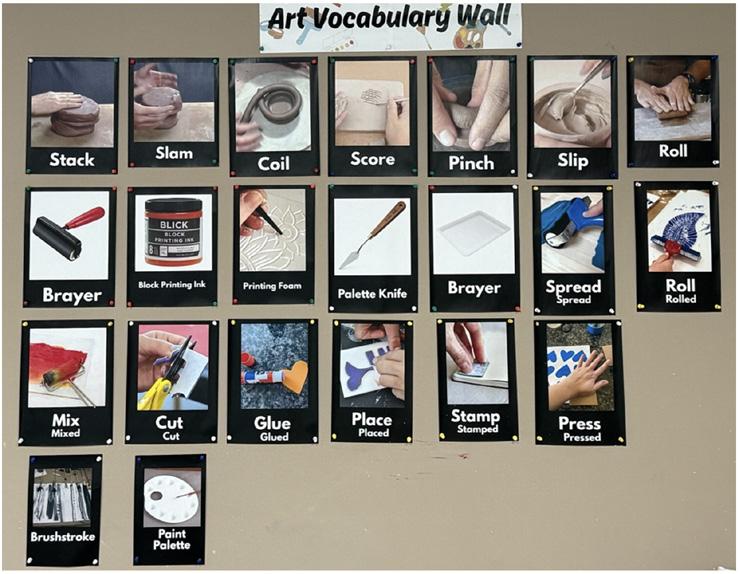
We printed new vocabulary on cards featuring real-life photos. These cards are introduced during mini-lessons. Students first listen to the pronunciation, then connect the spoken word to the visual image and written text. We use two formats: small cards kept in the teacher’s apron for immediate reference, and large cards displayed on a dedicated Art Vocabulary Wall. This consistent routine has helped students develop a shared language for art-making and articulate their learning process.
3. Practicing Through Oral Rehearsal
It is now common to hear students repeating terms like “stack, stack, stack” as they work, reinforcing the link between language and action. This oral practice strengthens conceptual understanding and long-term memory. During formative conversations, teachers ask, “Which technique are you using now?” prompting students to apply subject-specific language to describe their process in real time.
4. Applying Terminology in Art Journals
When children can visually see that their thinking and work is valued so much that it is documented and displayed proudly, they take pride and ownership over it. Visible documentation may also serve to generate new ideas and areas of learning. (Gostelow, 2018)
Art Vocabulary Wall
Every Grade 3-5 student maintains an Art Journal. We provided explicit guidance for the first unit on how to use them: one lesson for documenting the steps of a clay project, another for reflecting on what went well, and another for planning next steps. This structure allowed students to continue their work seamlessly from week to week. We have noticed that students are wanting to improve their own journals after seeing their peers’, demonstrating the positive impact of visible documentation.
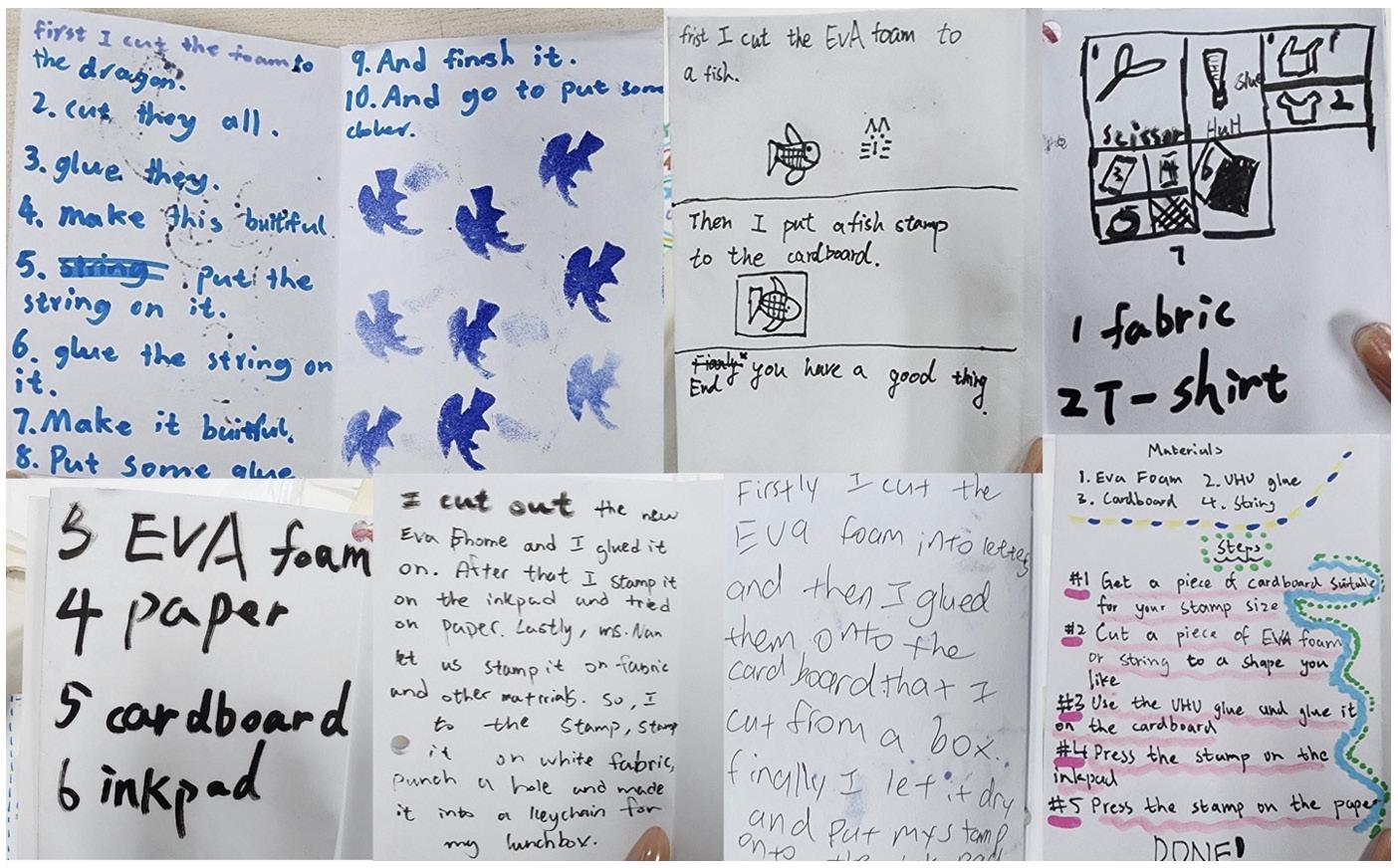
G5 Printmaking Art Journals
5. Structured Feedback with TAG/TAR
We created visual guides and sentence starters for the TAG (Tell something you like, Ask a question, Give a suggestion) and TAR (Thank them, Answer or Ask a question, Reflect on next steps) dialogue routines. Midway through units, students engage in structured peer feedback using this framework. These conversations are often recorded on Seesaw, providing evidence of language use which allows for targeted teacher support.
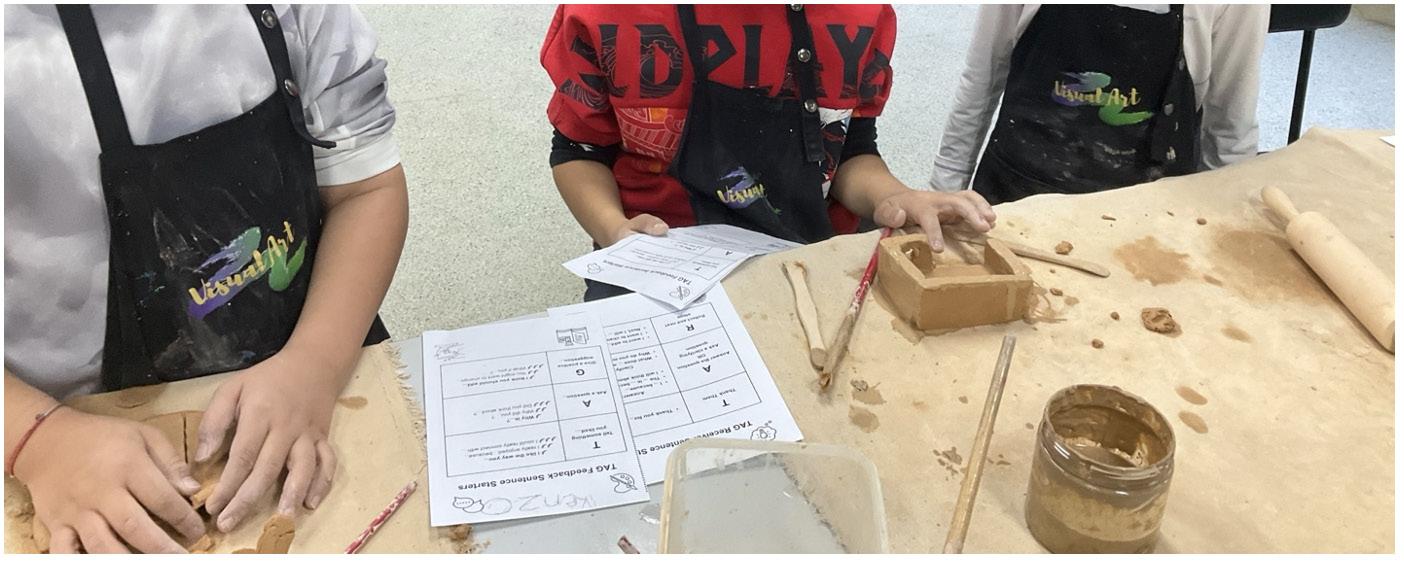
TAG/TAR feedback guidance in class
Differentiation Through Flexible Modes of Expression
Acknowledging our range of English proficiency levels, we embedded intentional differentiation into lessons. Students demonstrate understanding in their journals and artist statements through written explanations, annotated drawings, visual diagrams, or bilingual use of Chinese and English. This flexibility reduces language barriers, ensures artistic thinking isn't limited by English proficiency, and increases student motivation and ownership.
Translanguaging
Translanguaging strategies are employed during art classes. The teacher provides new words in both Chinese and English, alongside the visual, demonstration or physical object, to ensure students understand the new terminology. Students are encouraged to express themselves in the language(s) they know best and are encouraged to produce written work in all their languag-
es so as to support the development of their home language(s) and English.
Adapting Instruction Through Ongoing Reflection
Throughout our collaboration, we reflected on strategies and adapted them as needed. For example, we initially provided three differentiated versions of the artist statement. However, we noticed many students consistently chose the least demanding option. In response, we changed the name of artist statement to art label, similar to what we see in art galleries, and provided an infographic to guide the students in their thought process, giving different options for expression. This structured. visual format increased student motivation and meaningful use of terminology. Similarly, when students initially struggled with their roles in TAG/TAR feedback, we developed a visual guide with speech bubbles to clarify expectations, leading to more effective peer conversations.
Impact and Expansion
By intentionally embedding language scaffolds within hands-on artmaking, students naturally integrate language as they describe materials, explain techniques, and reflect on creative decisions. Opportunities to discuss, critique, and respond to artworks further strengthen communication skills, requiring students to use descriptive language, expand subject-specific vocabulary, and articulate ideas with increasing clarity and confidence, while reinforcing learning from homeroom and EAL classes.
When language support is intentionally embedded into Visual Arts instruction, the classroom becomes a dynamic environment where creative expression and language development reinforce one another. We are now expanding this approach by sharing the TAG/TAR protocol with Grade 5 homeroom teachers and exploring applications in subjects like MakerSpace, PE, and Music. Embedding these supports across learning environments creates consistency in how students articulate strengths, ask questions, and identify their next steps. Ultimately, we aim to nurture more metacognitive learners and confident communicators by purposefully integrating language into the art curriculum and beyond, helping every student fully participate in the creative cycle of thinking, making, and sharing.
References
Gostelow, D. (2018, June 16). The Importance of Documentation. Inquiry Being. https://inquirybeingorg.wordpress. com/2018/06/16/the-importance-of-documentation/
TAG Feedback Sentence Starters. (n.d). https://neprisstore.blob. core.windows.net/sessiondocs/doc_6e22ed17-60e8-41e58dcc-1e7d80534b49.pdf
About the Authors
Nan Zhang is a Grade 3–5 Visual Arts Teacher, and Amy Kerr is a Tier 1 EAL Teacher at Beijing City International School. Nan specializes in inquiry-based art and contemporary techniques with PYP learners, while Amy collaborates with classroom and specialist teachers to design language-integrated instruction and adaptive strategies. Together, their partnership is dedicated to creating accessible learning experiences where artistic expression and academic language development are mutually supportive.

Curriculum
My City: Connecting Students to Yangon’s Living History
By Leah Wilks
This article focuses on a Visual Arts unit of work, My City, undertaken with a group of Grade 9 and 10 art students at The International School Yangon (ISY) in Myanmar.
I arrived in Yangon in 2022 to take up a position as High School Visual Arts teacher. Exploring the city, I was struck by the vibrancy of the downtown streets; the architecture, the people, the greenery, and crowning it all, the majestic Shwedagon Pagoda. This 2,500 year old structure changes its golden hues throughout the day and is then lit up spectacularly at night. The beauty of the pagoda contrasts dramatically with the often dilapidated but grand colonial era buildings in downtown Yangon. It was these buildings with their crumbling surfaces and eroded edifices, often intertwined with the invasive banyan tree, which really fascinated me. So visually rich but also reflecting the history of this troubled country. This built environment seemed a rich source for a visual arts project.
Malpas states that “concepts of spatiality and locality are foundational to human identity and consciousness” and asserts “that our embodiment and environment are intrinsically linked to our understanding of the world.” However, oftentimes, we do not take the time to really look at and appreciate what is around us. The familiar is often overlooked or easily forgotten.
So, it was with this perspective that I devised a unit of work with a focus on Yangon and its architecture, with the specific aim of giving students the opportunity and skills to examine and respond to their unique urban environment and perhaps discover something about themselves in the process. Frameworks such as Dewey’s principle of learning through experience, the Adaptive Schools model for collaborative dialogue, and the lens of SDG 11 supported this central aim, but the heart of the work was simple: to help students connect meaningfully with the city they inhabit.
On an overcast and showery day, a trip to 26th Street in the heart of the downtown area saw students photographing, sketching, and making written observations about their surroundings.
On return to school, we used Adaptive Schools Strategies and SDG 11 (“Make cities inclusive, safe, resilient, and sustainable”) as a framing lens to consider what had been observed. Students worked in groups to consider questions focused on architecture & visual details, heritage & decay, social awareness & positionality, challenges & problem solving, and sustainability & SDG11. Below are some of the guiding questions considered following the visit:
• ●Why is it important to study and document colonial architecture in Yangon and other cities?
• How does architecture reflect the history and identity of a city?
• What are some challenges faced by cities like Yangon in preserving colonial architecture while promoting sustainable development?
• How can art help raise awareness about the need for sustainable cities and communities?
• What are the benefits of preserving historical buildings in a city like Yangon?
• How can art and architecture contribute to creating more inclusive and resilient communities?
• What role can artists and students like you play in advocating for sustainable urban development?
The collaborative consideration of the guiding questions revealed the thoughtful ways students had engaged with the visit.
Below are some comments made by students during the conversations, along with thoughts on what these comments may reveal about their engagement and their emerging understanding of what the architecture might represent. The responses highlighted that even a short visit had prompted rich insights into how architecture might embody history, community, and sustainability.
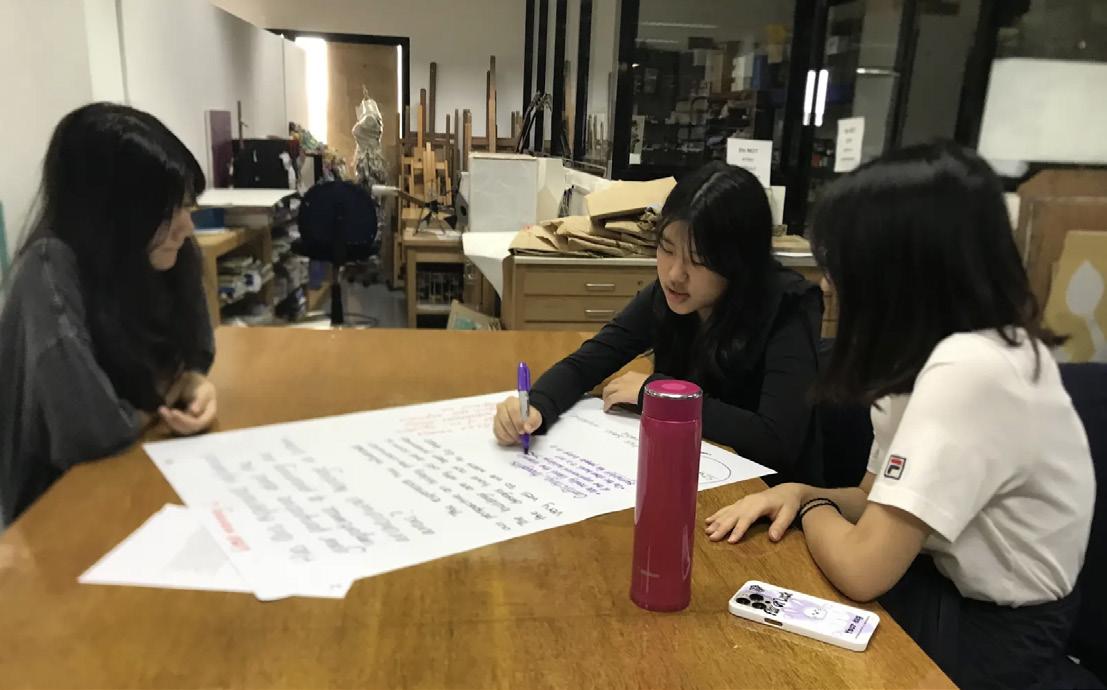
The buildings are made up of our history. Although it was from the colonial era, it is still a part of our history, and it’s important to preserve it. Demonstrating an understanding of architecture as a historical record and a key part of cultural identity.
Most ofYangon’s buildingswere built during the colonialera, and it has the most colonial buildings in Southeast Asia. However, these buildings were neglected and abandoned during military rule, making them old with mold. Learners were able to link the colonial architecture to Myanmar’s layered history.
The students recognized the tension between aesthetic preservation and practical living needs and the difficulty of maintaining cultural authenticity while modernizing. “Conflicting thoughts: buildings that have been preserved are less visually appealing, but they are more sustainable for people living in them. So, it’s like visuals vs. sustainability.”
“How can we renovate and preserve these old buildings without affecting its culture and old heritage?”
“Despite the neglect and destruction, these buildings still have hope with renovation, such as the Sule Pagoda community center.”
To the question, what role can artists and students like you play in advocating for sustainable urban development? Students saw their role as raising awareness, conducting inquiry, and fostering appreciation of heritage.
Back in the art studio, students continued to consider these questions, sometimes directly and sometimes implicitly; over a period of approximately ten weeks, students creatively explored the idea of My City. They were introduced to the work of Ian Murphy. Murphy is a British visual artist and educator. He seeks out the places that exude the qualities of neglect and abandonment.’ He believes ‘that the layers of his paintings not only embody the history of the site but also symbolise the importance of how people exist within their communities.’ His work resonated with our focus on the buildings of downtown Yangon and provided a good example of how urban spaces can be represented through layered textures and marks.
The students investigated his techniques in their own drawings; the emphasis was about investigating materials and trying to capture the surfaces and details seen on 26th Street. This initial stage built confidence in experimenting with unfamiliar media.
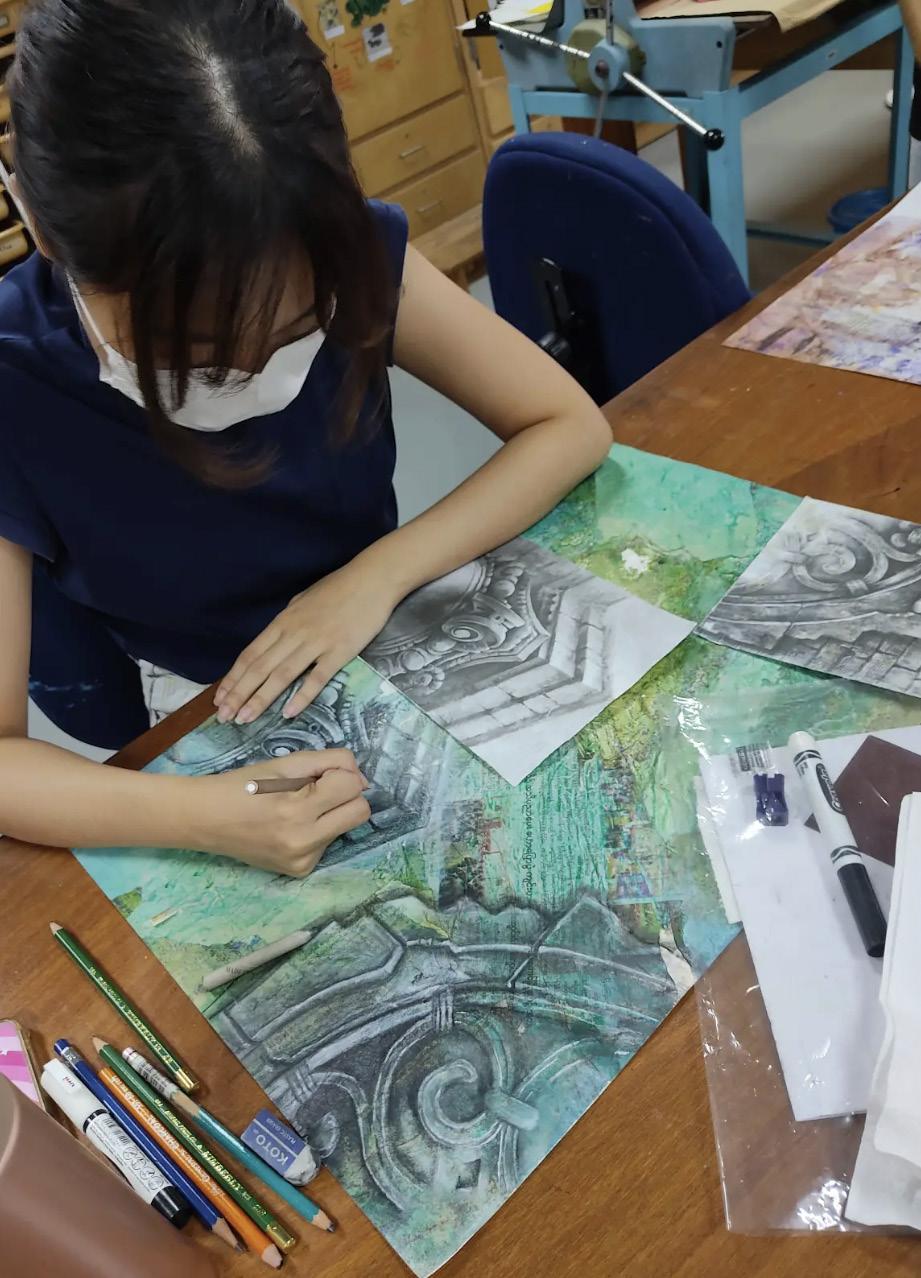
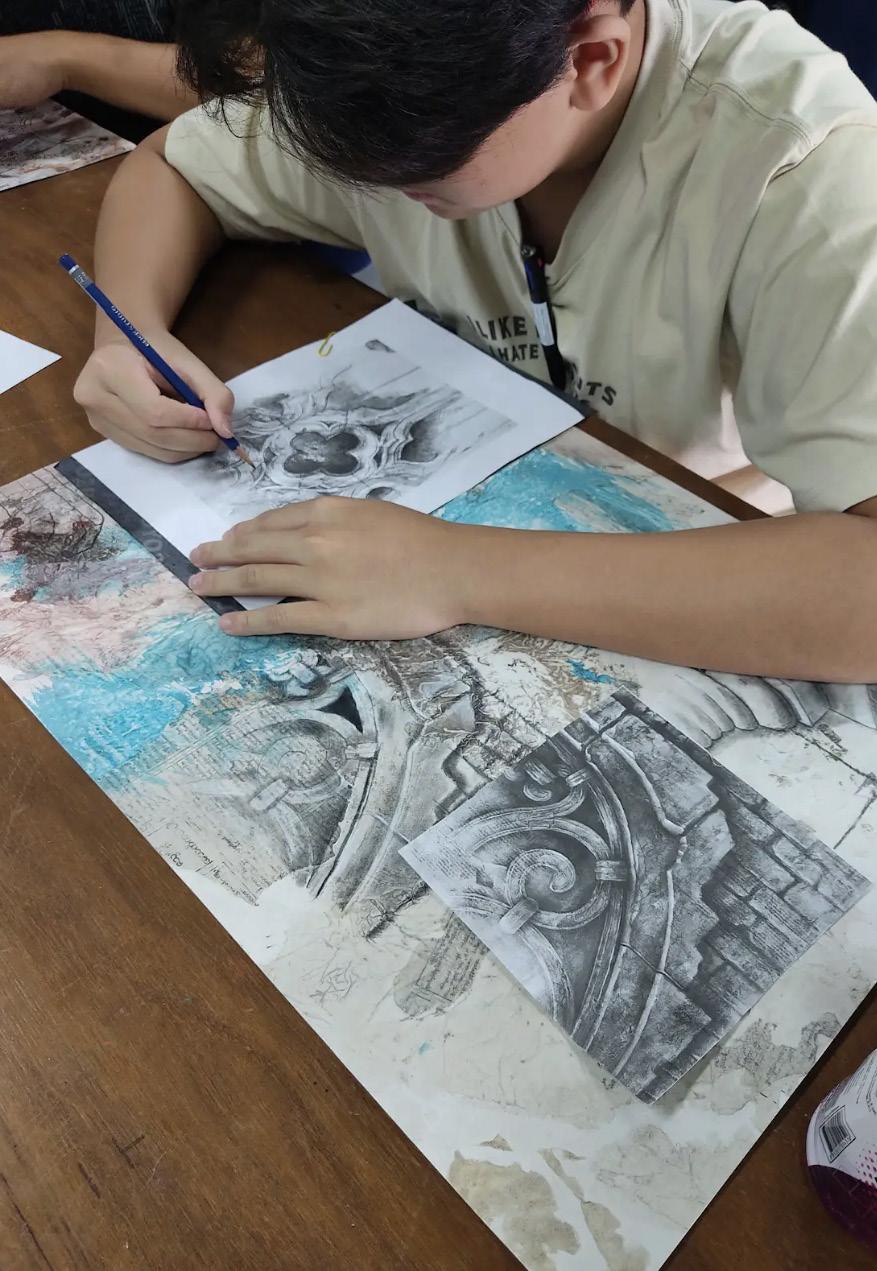
This exploratory stage was followed by a period when the students were encouraged to respond to the visit using any media and process that interested them. This approach provided multiple entry points into the project and enabled all students to find personal and meaningful ways to connect with Yangon’s architectural heritage. Some students continued to explore the idea of decay, whereas others chose to focus on the sustainability aspect. A diverse range of work reflecting a range of perspectives was created, including painting, prints, ceramics, photography, and graphics.

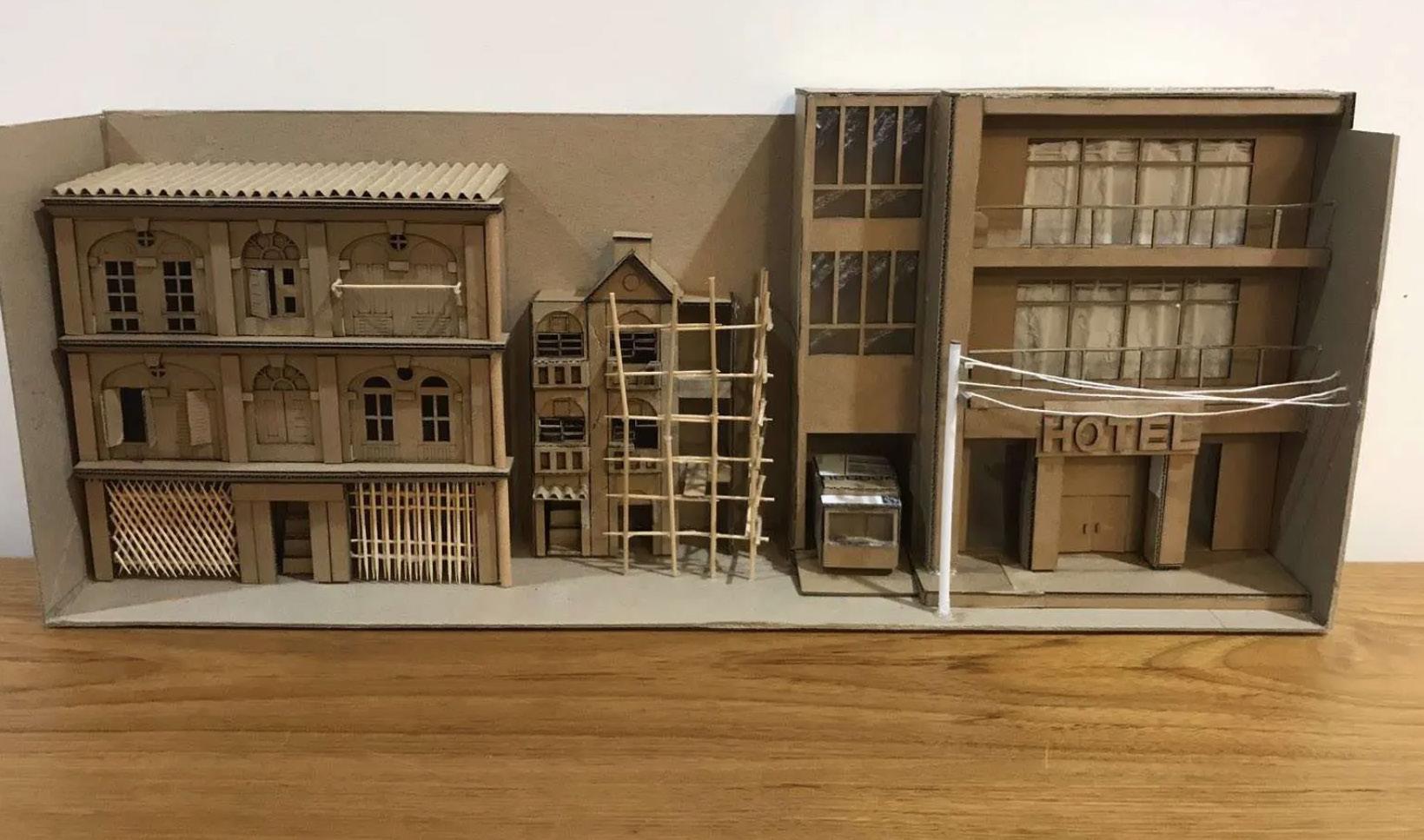
Reflecting on this work, it was evident that the students had gained a new awareness of place, heritage, and community, and their positionality in relation to these. The title of the unit, "My City," became meaningful, and there was a sense of genuine connection to the city. Many of the students did not have occasion to visit this area of the city before this work, for some it was an unknown, and so the project proved a chance to claim a sense of ownership and belonging in their city.
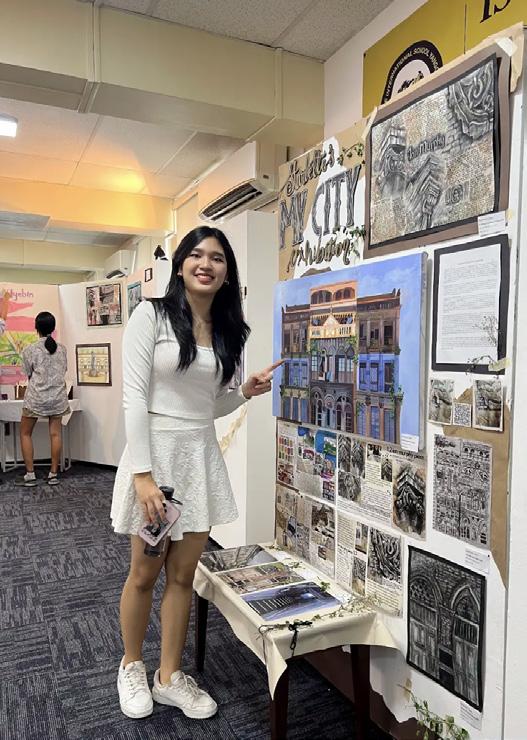
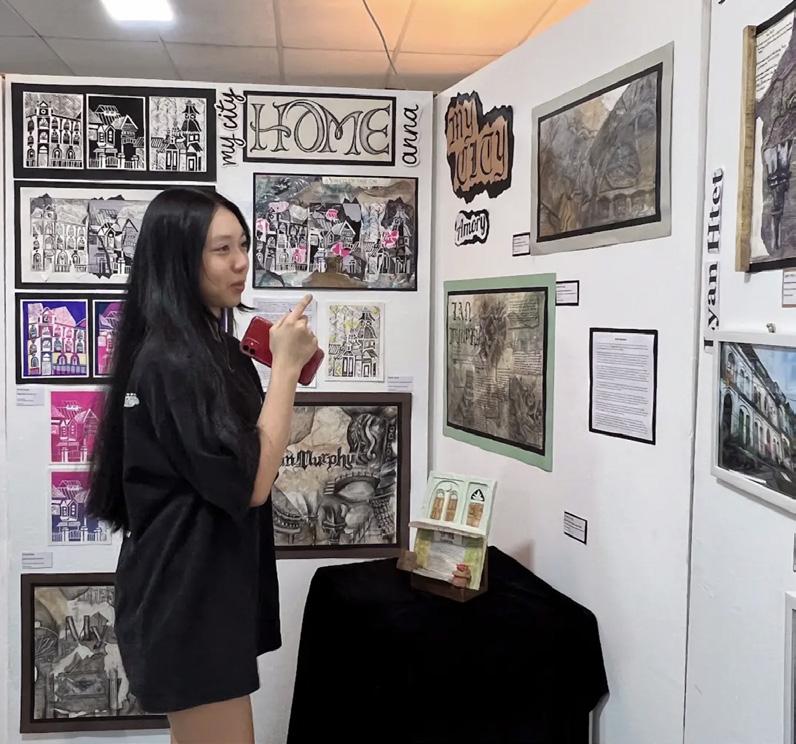
Witnessing the genuine engagement with the work and the palpable excitement when the students were preparing their final exhibition was hugely rewarding. The project was successful in that students produced work they were proud of, they had become more aware of a microcosm in the wider Yangon, and had started to extrapolate to a more global level. As their teacher, I had a great sense that I was sharing a journey of discovery. To develop further, the project could be used as an entry point to more active engagement with the community, developing the connection with SDG11 in a more sustained way and fostering a deeper sense of global citizenship. One student commented that “we have to first understand the demography and then provide a research-based analysis to help the citizens understand their own communities better.” Suggesting students saw themselves as outsiders and not contributors, but also showing an emerging awareness of how they might shift towards more active roles.
Stepping outside the confines of the school walls, even for a few hours as we did, opens up huge opportunities for place based education activities, where students can connect with communities and produce meaningful and authentic work. By grounding art education in the lived experience, we help students discover that their environment is not just where they live but can also be a starting point for contributing to a more inclusive and sustainable world.
Reference
Malpas, J. (1999). Place and Experience. [online] Academia.edu. Available at: https://www.academia.edu/5936582/Place_and_ Experience#outer_page_5 [Accessed 20 Sep. 2025].
Murphy, I. (2021). About Ian Murphy - Ian Murphy Artist. [online] IAN MURPHY, ARTIST. Available at: https://www.ianmurphyartist. com/about/
@ThinkCollab. (2025). Resources & More | @ThinkCollab. [online] Available at: https://www.thinkingcollaborative.com/resources [Accessed 20 Sep. 2025].


wida.wisc.edu/assess/model
Purchase from the WIDA Store: wceps.org/store
Use WIDA MODEL to
Gather immediate English language proficiency level scores
Screen students for identification and placement decisions
Monitor student progress over time
Inform instructional planning as well as curricular and program planning
Support decisions related to exiting students and services
Interpret proficiency in terms of Common European Framework of Reference for Languages (CEFR) levels

Standards-Based Grading: Perceptions and Impact on Concordia’s Student Mastery
By Shane Twaddell & Vanessa Vanek Concordia International School of Shanghai

Introduction
This research serves to identify many of our Concordia International School of Shanghai's students' perceptions towards traditional grading systems versus a standard-based grading system. Evidence from student responses suggests a superficial base in knowledge and critical thinking skills. In the high school division, students' and parents' primary focus is on percentages as the only success indicator. This focus often correlates with a lack of mastery and skills. Also, the level of stress put upon the students when the perception is that this is the only indicator of a student's success. Data analysis showed that student-based grading enhanced students' understanding of mastery and that the feedback from standard-based grading provided more meaningful information.
To implement data collection to gauge our community's perception towards percentages versus mastery of content as the basis for defining students' success, Mr. Shane Twaddell and Ms. Vanessa Vanek created two separate summative lessons within a unit of study. One was before implementing Standard Based Grading, and the second summative lesson was Standard Based Grading. They identified three test groups within the classes they teach: Applied Learning Graphic Design, 2D Art Studio, and 9th Grade Social Science.
From their surveys, findings revealed a misunderstanding about what mastery truly looks like, compounded by the belief that numerical scores were the only reliant indicators of learning. To support better understanding, a couple of things should be implemented: stakeholder informational meetings and providing student examples that demonstrate mastery compared to percentage-based assessments that do not provide evidence of deeper learning.
Research-Based Support for Change
A trend has been observed at Concordia International School of Shanghai, where a pervasive focus impacts students on traditional grading practices, focusing on percentages and scores with numerical values as the prime indicator of their success. This focus, though, has been linked to what has been observed across the high school division, which is superficial knowledge, limited indicators of development in critical thinking skills, and, consequently, a focus on gaining scores with the highest numerical values as the key indicator of student success. This perspective is shared by parents, discouraging evidence of mastery, deeper learning and understanding, and individual growth. This perception has created resistance and misconceptions about adopting a standards-based grading approach. It is seen as ineffective in providing students access to the universities that are looking for their children to be able to attend. That undermines the student’s academic future. This has impacted open dialogue and a willingness to pivot toward a system that fully reflects actual student learning and, in turn, promotes their growth.
This research aims to support diminishing misconceptions about percentage-based grading versus standard-based grading and to support community-wide support in understanding how standard-based grading supports students’ development in critical thinking and growth that will support them in being successful in their future university endeavors. This goal supports development in critical thinking by promoting meaningful feedback and creating a school culture that values mastery and student growth over numerical indicators. Some methods that have been looked at are strategies that will support this shift,
stakeholder informational meetings, providing student examples that demonstrate mastery, teachers’ agreement to utilize standard-based grading, and ongoing data collection highlighting standard-based grading’s effectiveness. Speaking about these issues will hopefully provide avenues for an environment where all stakeholders are open to grading reforms that fully serve student development.
Data Collection Plan
We designed and administered two surveys to gather data on how students and parents perceive our school’s grading practices, as well as their underlying values and beliefs about grading and assessment. The first survey was conducted prior to teaching a unit using standards-based grading (SBG), and the second was administered after the unit’s completion to assess any shifts in perception. Each survey was organized into the same three sections: Grading Values & Philosophy, Traditional Grading Scales, and Concordia’s Grading and Assessment Policies. Each section included a range of Likert-scale questions intended to provide insight into stakeholders' attitudes and beliefs related to the key issues examined in our research plan. The final question on the survey asked respondents to rank the felt are the most effective feedback and reporting tools: Percentage grades, Letter grades, narrative feedback, analytical rubrics, rating scales, and teacher conferences.
The first survey was sent to approximately 120 students and 240 parents. We hoped a larger sample size would yield a better understanding of the current perceptions of both groups. The beliefs of the parents were of particular importance to us since they do not have as clear a view of what occurs within the classroom. The second survey went to a smaller group of students, about 55, which were only the students who had experienced an SBG unit. The time between these two surveys was approximately 3-4 weeks, depending on how long each class took to finish the unit.
There were a few limitations that we planned to account for in our analysis. Although our first survey was an even distribution of grade levels, the post-survey was heavily weighted with freshman. This was unavoidable based on course constraints regarding rolling out the example SBG unit. We also had lower than expected participation from parents, and so the data likely captures our most invested and attentive parents. Nonetheless, as our goal is to understand our specific community, we feel the data is still valuable for shaping our recommendations.
Data Analysis Methods
As our survey questions were already grouped thematically, we analyzed our results within these established themes. With this in mind, we focused on two key analytical comparisons: students versus parents, and pre- versus post-instruction. To guide this process, we first considered difference analysis with our quantitative data, focusing on survey items that showed significant gaps in perceptions between students and parents, and then those with significant gaps in pre- versus post-perceptions. We then considered the qualitative survey feedback separately, looking for patterns and trends within each of the groups and then alongside the comparative purposes. We compared the findings of the quantitative and qualitative data to look for reinforcing, contradictory, or complementary themes. Towards the end of the process, the qualitative data also helped us explore reasons for differences and similarities in perceptions as well as further questions that needed to be addressed.

Discussion and Analysis of Project Outcomes/Results One core advantage of shifting to a standard-based grading, as pointed out in the article "The Problem with Grading" from Harvard Graduate School of Education's Ed. Magazine (Hough, 2024) states that their data revealed: "that traditional grading practices often fail to communicate what students truly understand, as noted by Pope (Hough, 2023), who states that 'assessment is seeing where a student is with their understanding — what they do not know, what they do know — and then using that to determine what they need.'This reinforces our findings that SBG, which emphasizes clear criteria and mastery, provides a more accurate and meaningful measure of student learning, supporting the shift towards grading practices that better reflect actual comprehension and progress." Mastery-based assessments like Standard-Based Grading support the development of critical thinking as students are better equipped to understand their learning and know how to progress. When given just traditional grading, focusing on point grade averages does not provide a reliable picture of the student's knowledge and ability to apply that knowledge.
When researching both elite and major research universities in the United States we discovered that each of these schools stressed that the qualities of a successful student will exhibit a deep content mastery, critical thinking skills, ongoing selfassessment, and reflective learning habits. Our research in this project shows that standards-based grading fully supports these key qualities, equipping our students to demonstrate success. Our data highlights that adopting a standards-based grading system will provide students with greater development in mastery and critical thinking, thus aligning with our findings universities like Harvard and other prestigious institutions seek in a prospective student. Standard-based grading emphasizes authentic assessments and deeper learning (Hough, 2024). Our research has shown that a mastery-focused assessment fosters the development of higher-level skills that will genuinely provide students with university readiness.
Dissemination of Results and Future Directions
To make sure our findings contribute meaningfully to ongoing conversations about assessment and grading reform at Concordia, we plan to share the results of this research with multiple groups. Both Vanessa Vanek and Shane Twaddell are Curriculum Leads for their respective departments, so initially, dissemination will occur through the Curriculum Lead meetings. We also intend to pass on a summary of findings along with recommendations to divisional leadership, emphasizing how reforms can align to Concordia’s mission to promote deeper learning, student agency, and personal growth.
Given the ongoing nature of this conversation around grading practices, our research underscores the need for further community engagement. Some of the most significant differences in perceptions we uncovered were between students and parents. One of our recommendations for our school’s next steps includes targeted informational sessions for parents to clarify what standards- or mastery-based assessment and grading looks like as well as how it supports university preparedness. We suspect the latter is more significant to most parents based on our collected data. These sessions should explore examples of student work assessed through both percentage-based and SBG approaches to make the contrast more tangible. Our parent community is highly engaged in what we do, and they need to be involved to maintain trust, demystify the grading reform process, and proactively address concerns.
Large-scale reform presents a series of potential known and unknown difficulties. To address student and parent concerns, we would recommend the implementation of a pilot program in targeted subjects or grades. A pilot program would involve multiple teachers who volunteer, allow a larger number of voices and perspectives to begin approaching logistical concerns, and facilitate divisional feedback and policy calibrations. This process would also support the gathering of more robust data from more diverse contexts to drive future decision making. Other recommendations include:
• Develop clear teacher definitions of mastery within each discipline to support meaningful implementation through common language and understandings. Without common understandings within and across departments, SBG risks becoming confusing for students and parents. Ideally, these understandings are supported by student exemplars.
• Implement reform through a staggered process that begins with 9th grade, thereby preventing larger system shock to students and parents.
• Use structured Advisory time for reflection and student education around metacognition and learning strategies.
• Collaborate with the counseling department for common and explicit messaging around college admissions. Many parents view college admissions as the primary driver of assessment practices, and this concern surfaced repeatedly in our survey feedback. We believe it is essential to work closely with counselors to create a unified and confident message about how SBG aligns with university admissions expectations.
• Solicit regular surveys from students and parents to measure changes in perception, identify areas of concern, and evaluate communication effectiveness. This data will help the school remain responsive and informed as the grading system develops.
• Share tangible student examples under both systems to support clarifying misconceptions and ensure a consistent message. To ensure that conversations about grading are grounded in evidence, we recommend the regular use of student work samples as communication tools. Teachers should curate and share examples of assessments graded under both traditional percentage-based systems and SBG frameworks. These samples should be used not only in parent workshops but also in faculty calibration sessions and student reflection activities. By making learning visible, we hope to demystify the abstract concept of mastery and reinforce consistent expectations.
• Provide information and support to the parent community in understanding SBG concepts and its benefits: reduced stress, focus on progress, and aligns with university expectations.
Conclusively, our research shows that standards-based grading prepares students for developing skills that will serve them best in the real world: critical thinking to move beyond superficial knowledge, deep mastery instead of relying solely on rote memorization, and metacognitive skills needed for continuous improvement and reflection. Standards based grading aligns more closely with the expectations of the modern workforce.
#MyFreedomDay March 11, 2026
CNN Freedom Project's global student-led day of action against human trafficking. Save the date March 11th, 2026. For examples from last year's 9th annual event see here. We have had billions of impressions on social media in over 140 countries and thousands of students participate and we aim to further that impact this year!
Here are some ideas to help get you started. Nonprofits and companies can support students in these efforts locally and on social media, as well:
• Host a Fair Trade/ethically sourced products fashion show or food sale; panel discussion with local experts; a stand for freedom; a school-wide art installation with messages of freedom; movie night that raises awareness of the issue; a film festival dispelling myths about trafficking
• Organize petition signing and letter writing to companies and local lawmakers
• Bring in curriculum to train faculty, staff, students, and parents on the dangers of human trafficking
• Do the Youth Leadership Academy Training online for volunteer/service hours
• At the very least post to social media, what makes you feel free and include #MyFreedomDay in your post.
Global Dialogues on Human Trafficking for Young People: Register now!
Street Grace and Generation Global are hosting online global dialogues for #MyFreedomDay during the week of 9 March 2026, designed for students aged 13–17. These dialogues offer young people a thoughtful space to exchange perspectives on the dignity and value of human life, reflect on difficult questions related to human trafficking, and engage with their global peers.
If your school would like to join these sessions, please register as an educator on the portal: https://adventure.generation.global/register. When signing up, enter the event code MYFREEDOMDAY. Further details can be accessed post-registration.
For any questions, please reach out to Robin Keshaw at robin.keshaw@ibo.org.
Freedom United Youth Campaign
Thank you to our partners at Freedom United for sending in this link. Get your campus campaigns started now, and get them posted on their site to be sent around the world.
MYFREEDOMDAY # MY FREEDOM DAY #

Press Release: International School Counselor Association (ISCA)
Building What Didn’t Exist: The Story of ISCA and the International Model
By Cheryl Brown & Brooke Fezler
Fifteen years ago, international school counselors around the world were all asking the same question:
What should an internationalschoolcounseling program actually look like?
There was no shared answer. Counselors were working in isolation, defining their roles according to their school culture, national training, or personal experience. The result was inconsistency, confusion, and far too many counselors working without a framework designed for the realities of international schools.
That moment sparked the idea: international schools needed their own model. Brooke and Cheryl began exploring how to build one, rooted in the ASCA Model but adapted to the unique realities of international education. After engaging directly with ASCA, they received full support to use the ASCA Model as the foundation for an international version.
The first real shift came in 2009, when they invited Dr. Judy Bowers to lead professional learning for counselors at the Jakarta Intercultural School. For many who attended, it was the first time they had experienced high-quality training dedicated specifically to school counseling programs. The energy in the room was unmistakable — connection, clarity, and a hunger for a shared professional direction. That workshop didn’t simply influence the work — it jump-started it.
Cheryl and Brooke knew the profession needed something that still didn’t exist: a cohesive, internationally relevant framework.
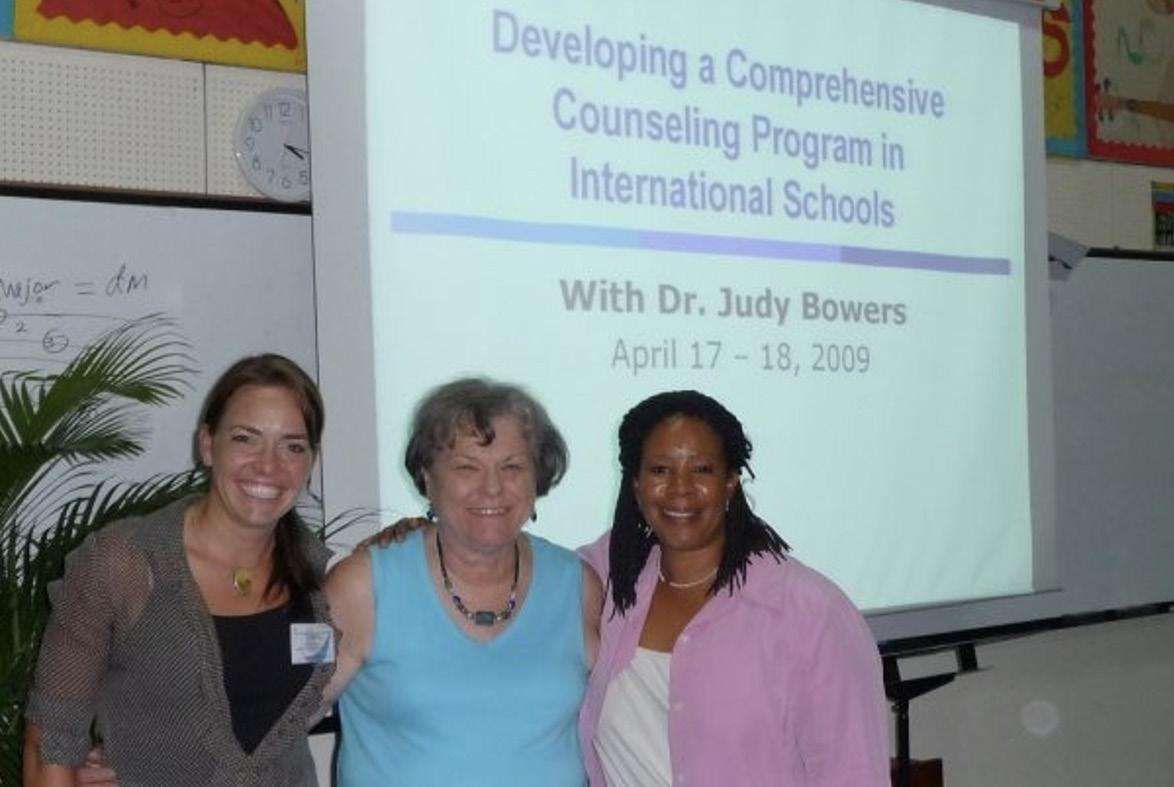
They applied for — and received — a grant from the Office of Overseas Schools at the U.S. State Department. Then came two years of research and travel, gathering input from practicing counselors and educators worldwide, and adapting the American Model into something built for global mobility, diverse communities, and the lived realities of international school students.
After input from hundreds of counselors, the first edition of the ISCA International Model for School Counseling Programs was published in 2011 — the first professional framework written specifically for international school counselors.
Three years later, in May 2014, the first ISCA Model Training took place in Paris with 21 counselors from around the world. It became clear almost immediately that counselors weren’t just looking for a framework — they were craving community.
After the training, Cheryl and Brooke sat together in a tiny Paris apartment overlooking the Eiffel Tower and reflected on what had happened in that room — connection, relief, validation, and a sense of belonging that had been missing in the profession. Counselors needed more than clarity for their work. They needed each other.
The next day, they bought a lock engraved with “ISCA 2014” and placed it on the Pont des Arts bridge — a commitment to build a professional association that would connect, support, and advocate for international school counselors.
And that is how the International School Counselor Association (ISCA) began.
From that point forward, ISCA and the International Model were built not from theory, but from practice. Cheryl and Brooke continued to work full-time as school counselors across Asia, the Middle East, South America, and Europe — writing, refining, training, and building community during evenings, weekends, and school breaks. What began as one training session and one professional model became a global movement.
As ISCA expanded, the work eventually outgrew what could be done while holding full-time school roles. Cheryl and Brooke transitioned out of counseling positions and now dedicate themselves full time to ISCA — leading workshops, trainings, and professional learning for counselors and educators worldwide.
And they don’t do it alone. ISCA has grown because of the strength of its dedicated support team, its faculty and facilitators through ISCA Academy, and the volunteers serving on the ISCA Taskforce — all committed to ensuring every school counselor feels deeply supported in their work.
Today, ISCA is in its 11th year and has grown into a global professional network of more than 2,000 members across 150+ countries. Thousands of counselors, teachers, and administrators have engaged in ISCA’s professional learning — including ten in-person conferences, five virtual conferences, ISCA Academy courses, Certificate Programs, and countless on-site trainings on the International Model.
In 2022, ISCA released the second edition of the International Model, refining and expanding the original framework. Alongside the ISCA Student Standards (2022), the Learning Progression (2024), and the ISCA SEL Toolkit: Practical Tools for Schoolwide Life Skills Integration (2025), these resources continue to support schools in building counseling programs that promote student well-being, life skills, and academic success.
From a single training room in Jakarta to a lock on a bridge in Paris to a global network spanning every region of the world, ISCA has never strayed from its founding vision:
Every international school counselor should feel connected, supported, and equipped — so every student can be seen, supported, and thrive.
To learn more about ISCA’s work, visit: www.iscainfo.com
For direct contact: Cheryl Brown — cbrown@iscainfo.com Brooke Fezler — bfezler@iscainfo.com
RLN students and the students from the RLN club pose together with the Afghan flag at Unity in Diversity Day.
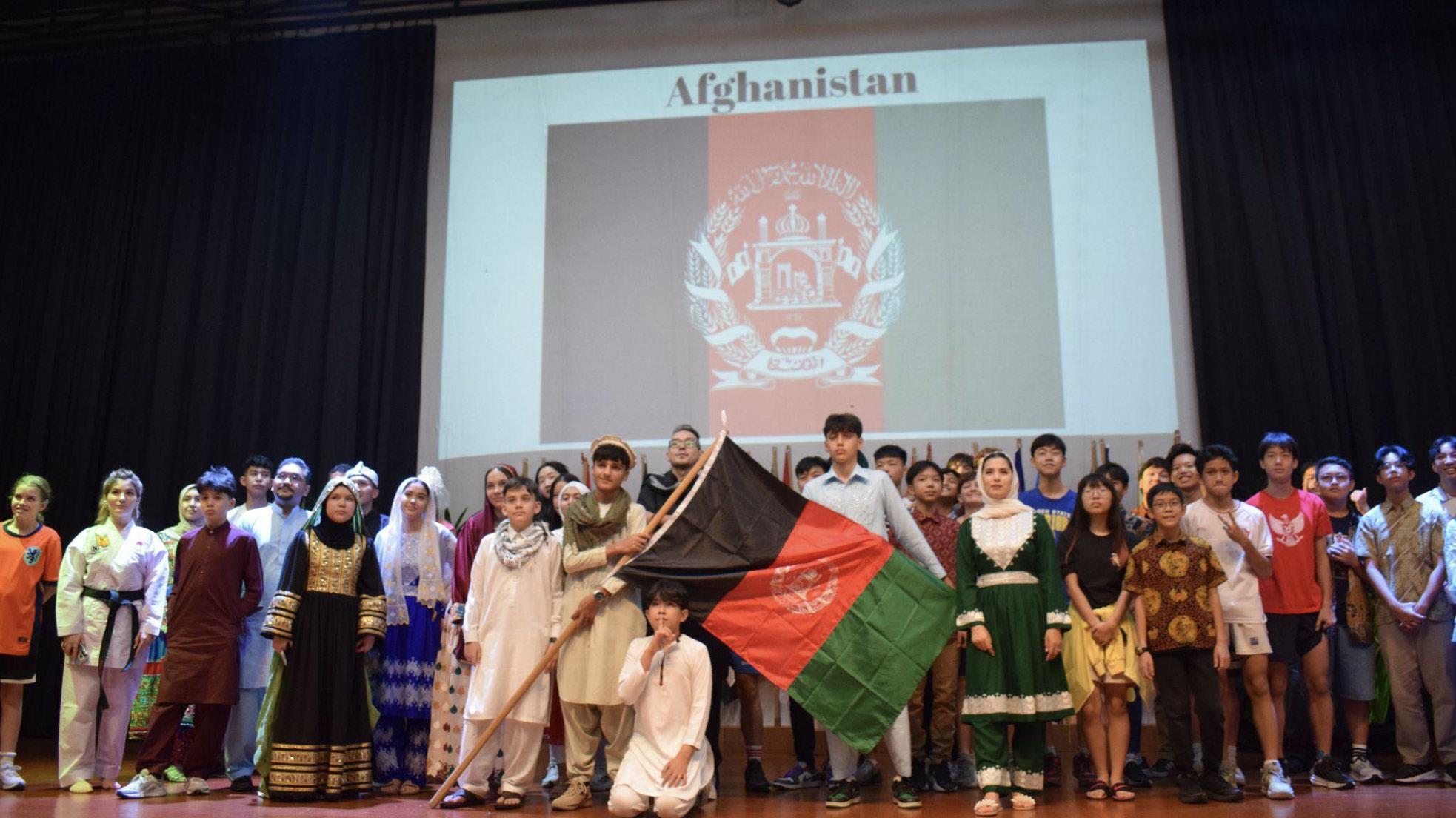
Press Release: The Richard T. Krajczar Humanitarian Award
Growing Together with Refugee Communities
By Sophia Hamilton Bandung Independent School
We are thrilled that the BIS RLN Club has received the EARCOS Richard T. Krajczar Humanitarian Award, including a grant of US$10,000 which we have been able to pass on to our friends at the Refugee Learning Nest (RLN), a learning centre for refugees awaiting resettlement from Indonesia a few hours from our school. Since refugees in Indonesia are not allowed to work or attend formal school, they have created their own learning centres and communities while waiting to be resettled to a third country. This grant will help them to run their GED High School programme, as well as run sports programmes to promote wellbeing and girls’ empowerment.
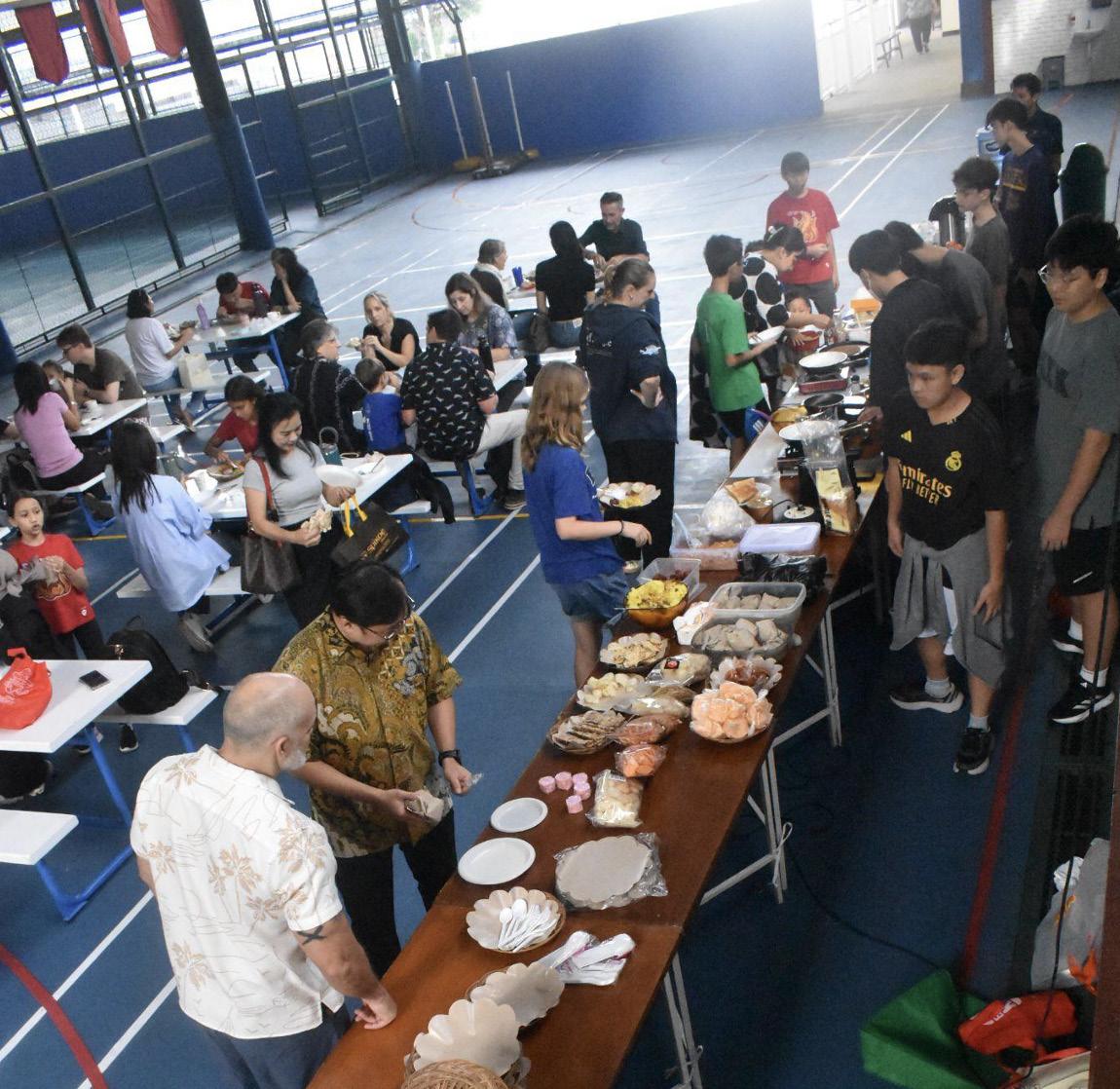
More than half the school community attends an annual breakfast to raise money for the RLN, among other fundraisers.
At our welcome back BBQ this year at Bandung Independent School, a group of Grade 6 students rushed past the ice cream and treats to sign up for the Refugee Learning Nest Club, a club which supports the RLN. Their parents told me that this club was one of the things that made them excited about moving to Secondary school - they had been waiting since Grade 4 to join the club! When I relayed this to the club’s leadership, currently in Grade 11, they smiled and told me that they had felt the same way.
Fast forward to last weekend, those Grade 6 students, along with 30 other students from Grades 6-11, hosted the students from the RLN for a weekend packed with fun games and activities, including creating a time capsule full of memories that we will open next year to mark the 10th anniversary of the club. Some of the students have known each other for years and have memories reaching back to when the RLN first visited the school in 2016: fundraisers we have run, trips to the RLN home in Bogor, Zoom calls in lockdown playing online games and getting to know each other. Others were excited to get to know each other for the first time, and enjoyed playing active games and introducing themselves.
What has stood out for me personally is the experience of two communities coming together - the RLN teachers, all refugee volunteers themselves, who have shared their culture through food and dance, opened their campus to us on numerous occasions and generously shared their painful experiences as refugees waiting for resettlement. BIS parents opening their homes for game nights, chatting to the RLN teachers during events, offering their transportation and helping their children bake elaborate creations for fundraisers. A group of teachers and their families visited the RLN during term break to guest teach while their children became RLN students. Our partnership has enriched units throughout the IB continuum, but beyond that, the RLN students and teachers have shared with us that they feel that BIS is somewhere they can call home.
When we received the EARCOS award, I contacted the group of students who formed the club in 2017 after reading a novel about refugees in Indonesia. They messaged me back straight away to let me know that they had cried at the news, and that the club was one of the key things that they remember from their time at BIS. One student is still working with RLN friends creating online content together, whereas another ran an evening of awareness at her university campus in the Netherlands. The impact of understanding more about the lives of others has run deep for these students.
This year in October, two of our club’s leadership team were chosen by the Indonesian conference of international schools (SPK) to present about the club. In the Q&A, the club president was asked what motivates him to run the club. His response? These are my friends. They’re not just statistics. I can’t sit by and do nothing, when they are here in Indonesia without access to formal education or the ability to work. I’ve played with them, gone to the zoo when we were little, got to know their hopes and dreams, just like they know mine.
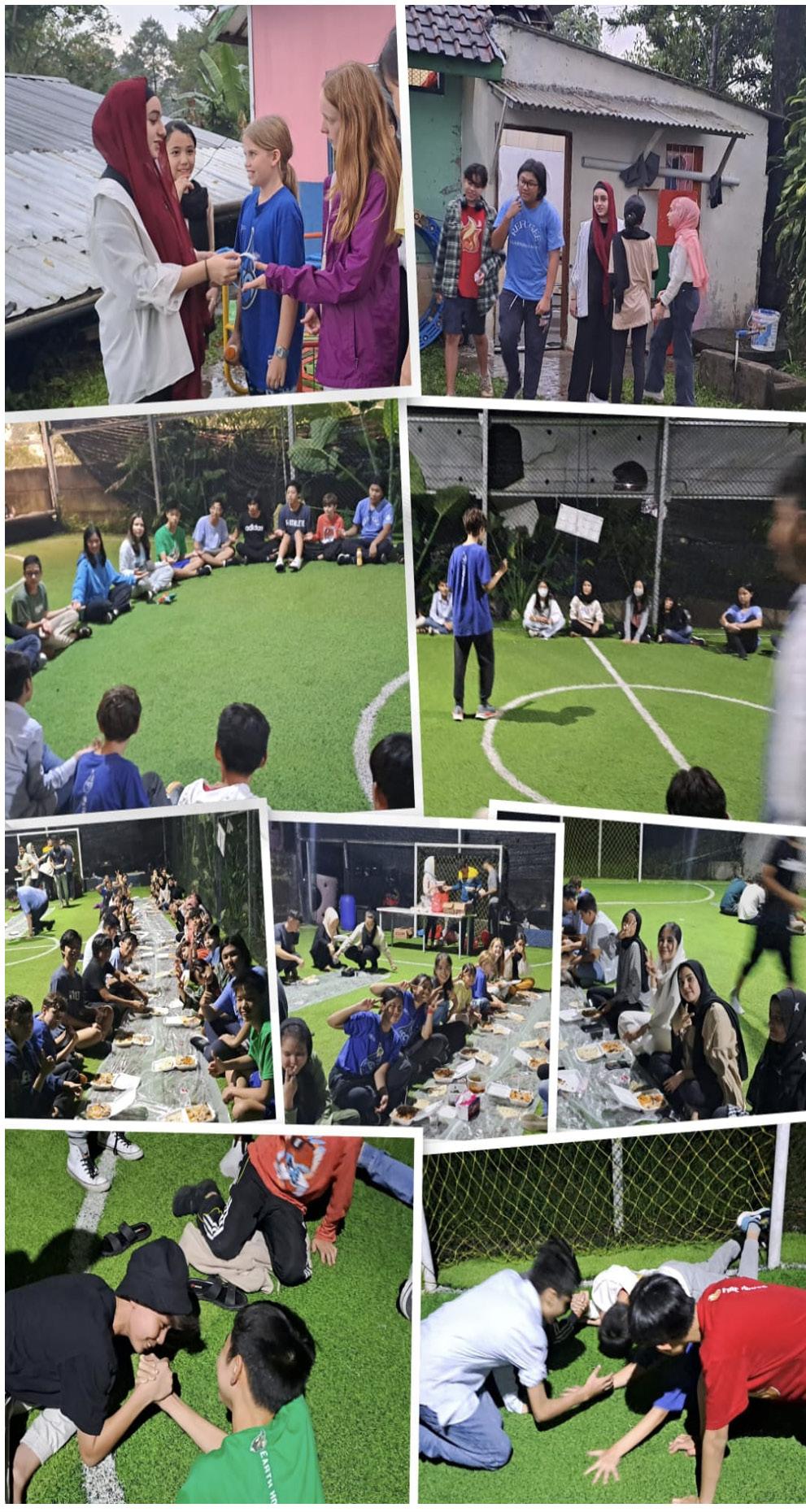
BIS students visit the Refugee Learning Nest in Bogor each year in May.

Booking a Worldwide Literacy Adventure through a Collaborative Poem
By Steven Duba-Maack, Alison Cha, and Cebu International School students, Seyoung Son, Lucian Uy, Bella Belda, Maël Christin, Roshan Hariharan, Sooji Hong, Jua Kwon, Isla Miranda,
Danny Parker, Kiew Pepito, Janna
Quisumbing,
Anthon Santos, Yuan Yap, Raya Besido, Eunkyu Ryu, Heon You, Emma Cha, Seonwoo Jang
For our celebration of Literacy Month at Cebu International School in Cebu City, Philippines, the Literacy Month committee decided to see if the students could help each other produce a collaborative poem in response to our Literacy Month theme, “Book a Worldwide Adventure.” This poem would supplement other Literacy Month activities such as our map where students and staff logged where in the world their reading material came from with facsimiles of airline boarding passes. We hosted book talks while the students planned their book cover recreations and took photos of themselves reading in “extreme situations.” Students also participated in Drop Everything and Read (DEAR) sessions, and our middle and high school students read to our elementary students to form special bonds with them and share literacy with each other.
We decided our collaborative poem might take the form of a renga, a traditional Japanese form of poem in which a master poet begins the poem and other poets independently write their haiku-like verses. Because we wanted students to focus on their own creativity, we did not hold anyone to strict rules about syllables or numbers of lines.
CIS English teacher Steven Duba-Maack wrote the opening lines in a haiku that alludes both to the four houses of Cebu International School that are all named after local trees and to the “Book a Worldwide Adventure” theme of literacy month.
We presented the idea that students could contribute to the poem to faculty and students of all levels, and the student contributions started to come in from grades 6 through 12. Korean teacher Alison Cha had her students write in Korean contributions to which she then provided translations. Steven ordered all the student writing into a reasonably coherent overall poem. While a few edits were made for clarity, each verse is presented very close to, if not entirely as, it was originally submitted. A substantial part of the community-building experience of creating a poem like this one is that everyone’s lines become integrated into whole poem without writing credit for each individual contribution.
At CIS, we strongly encourage other schools to complete collaborative poems like this one. Students had the opportunity to engage in their creative literacy and to see their names listed as authors on the finalized poem (which is presented below in a graphic design by Alison Cha). It is our sincere hope that this activity becomes a long-running part of our literacy month celebration.
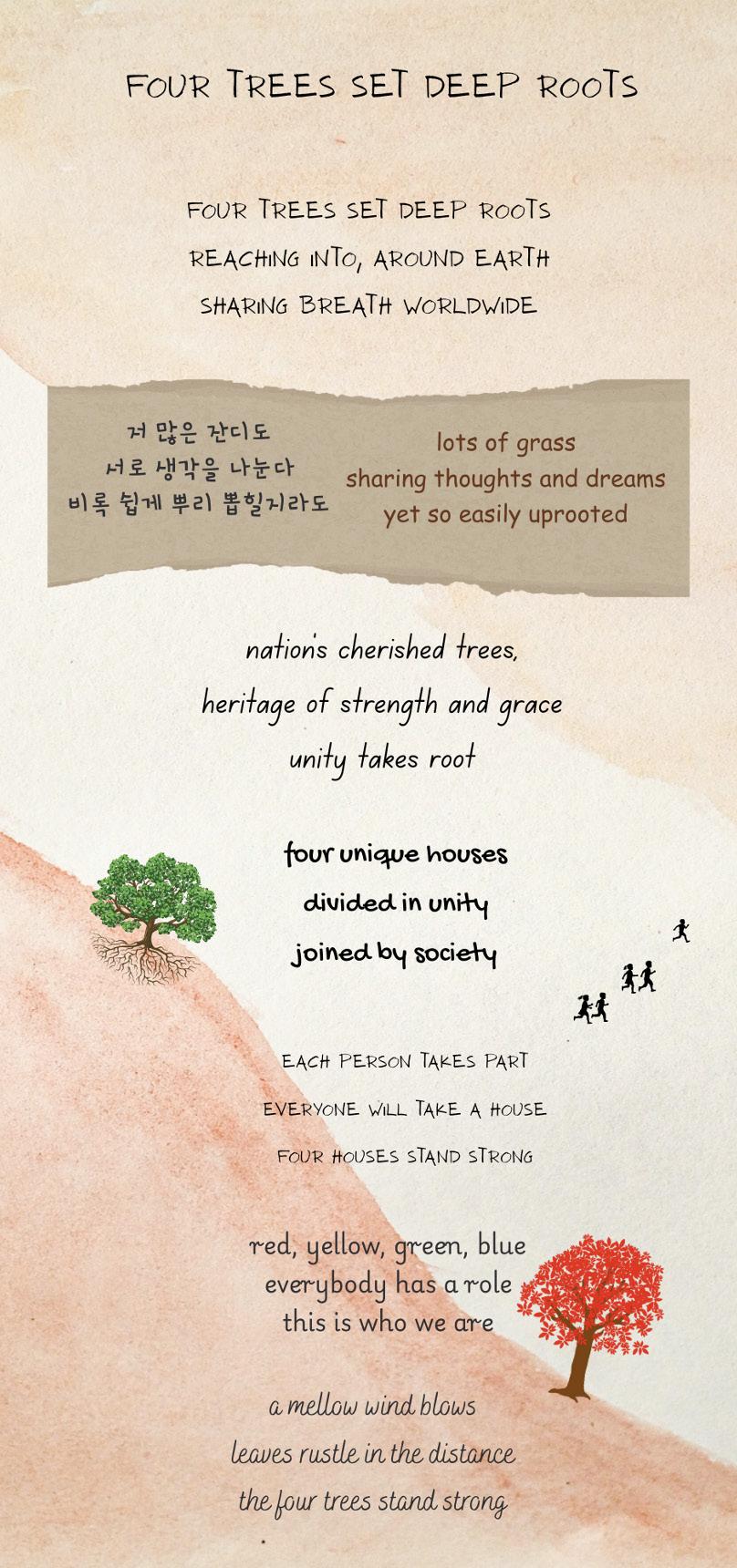
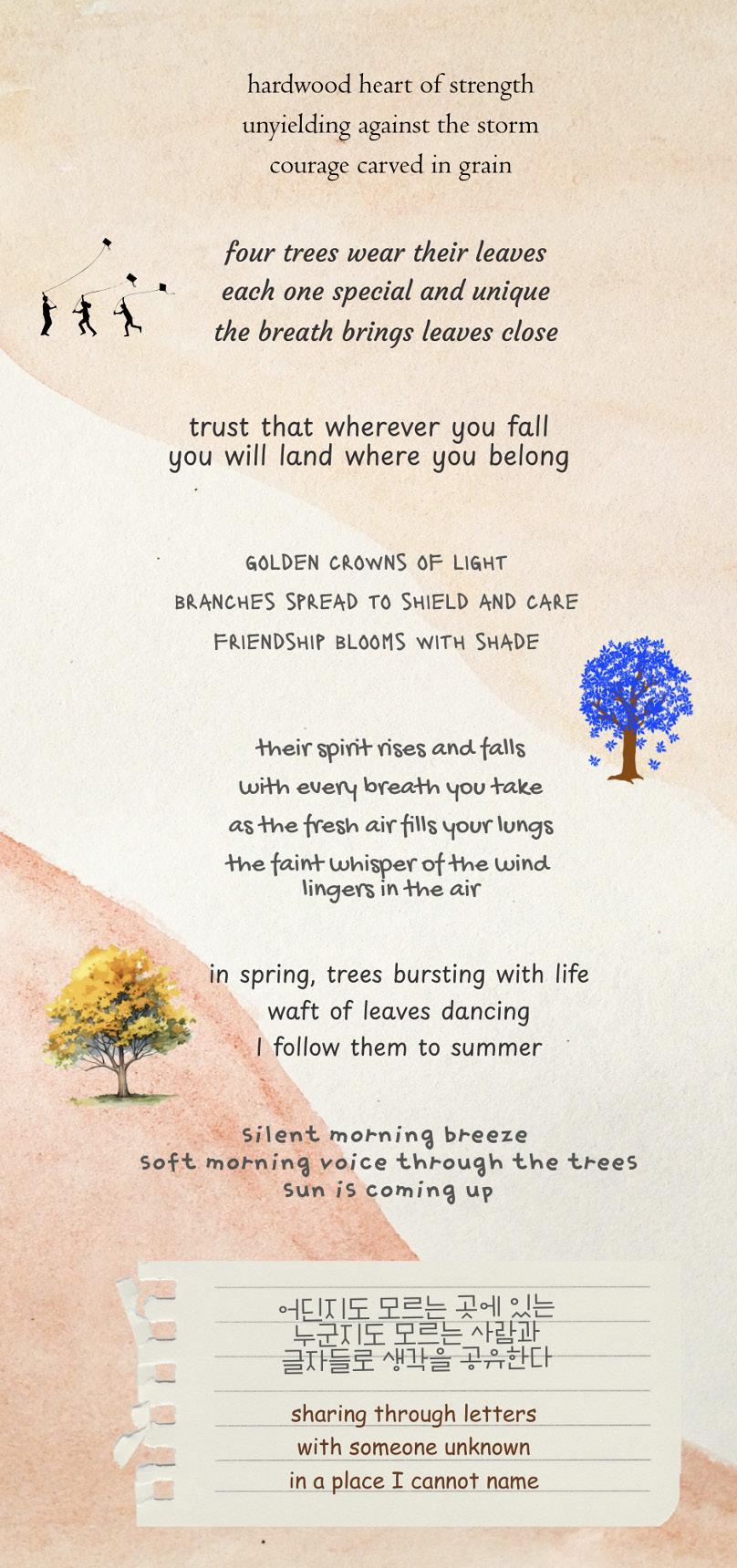





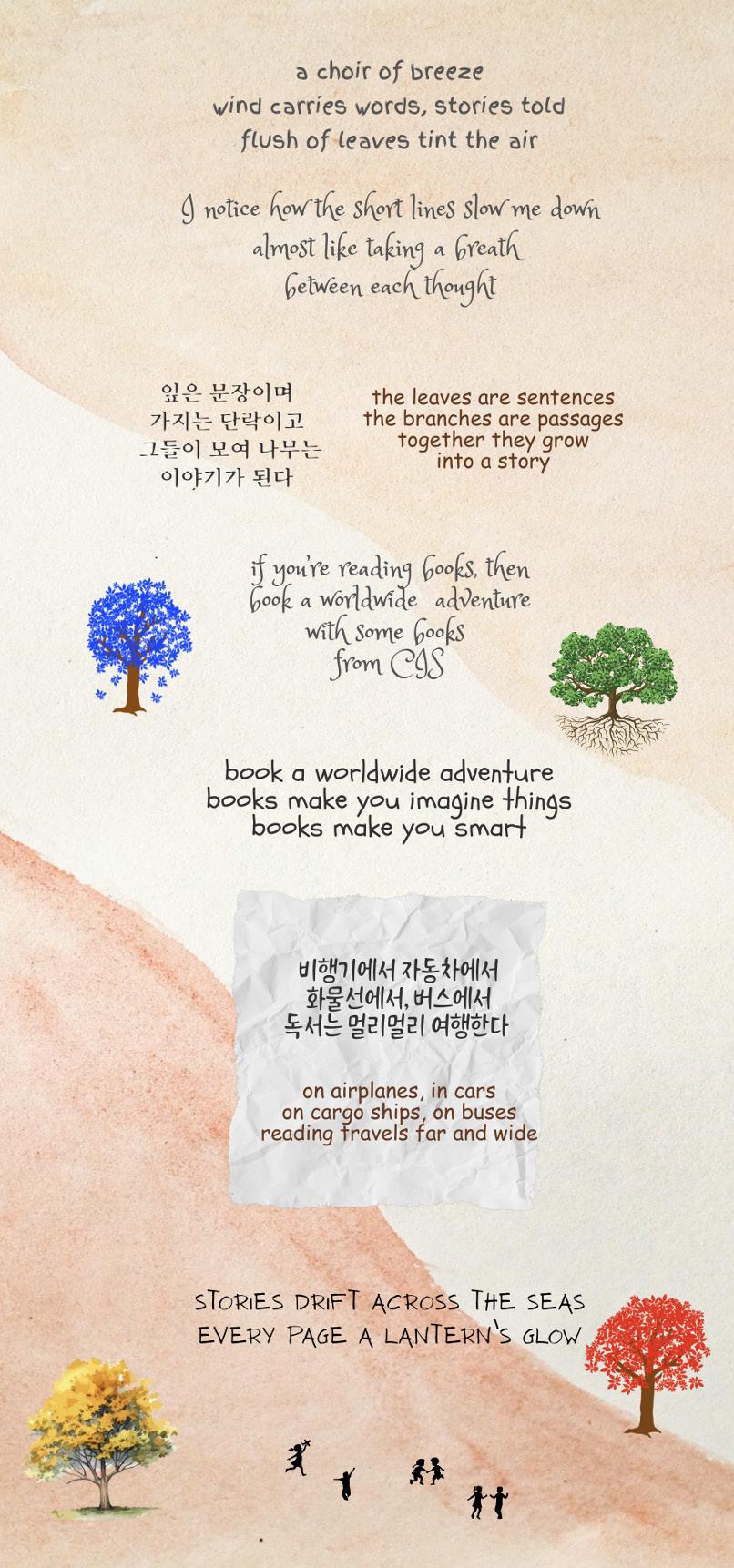
Middle School Art Gallery

The Sun's Reflection on Water Aria, Grade 6
Medium: Acrylic paint
Mt Zaagkam School

The Mysterious Horse Gilly, Grade 6
Medium: Acrylic paint
Mt Zaagkam School

Fish
Victoria Grade 8
Media: Clay, acrylic, and canvas
Sekolah Ciputra
The Beautiful and Calm Seascape
Maddy, Grade 6
Medium: Acrylic paint
Mt Zaagkam School

My Lovely Cat on the Grass Maya, Grade 6


Media: Acrylic paint
Mt Zaagkam School
Left
Happy Girl
Kathleen Joyo Utomo, Grade 8
Medium: Cubism Acrylic on Canvas
Sekolah Ciputra
Right
Computer Virus
Serengeti Claudia Gunawan, Grade 8
Media: Paper, Acrylic
Sekolah Ciputra
Middle School Art Gallery



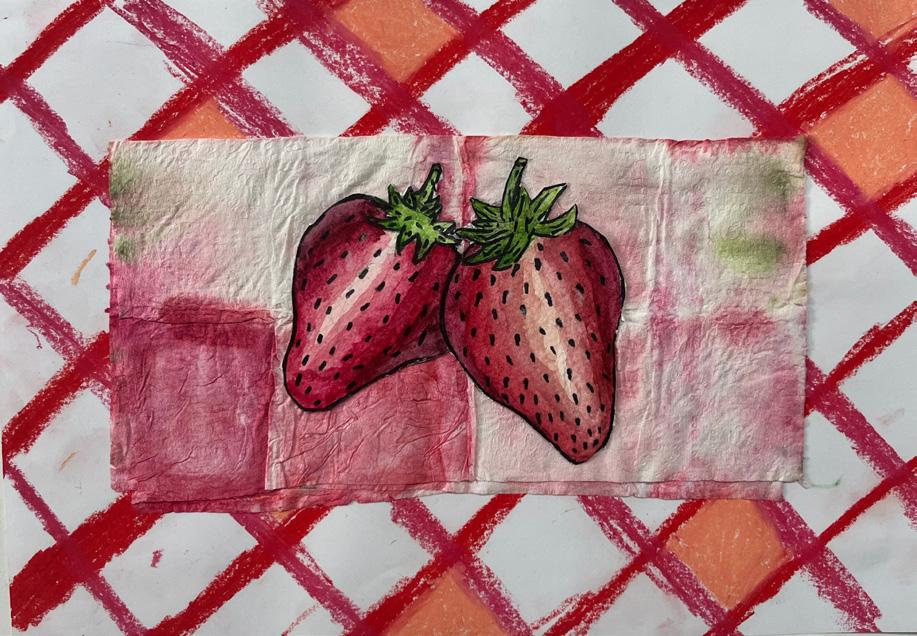
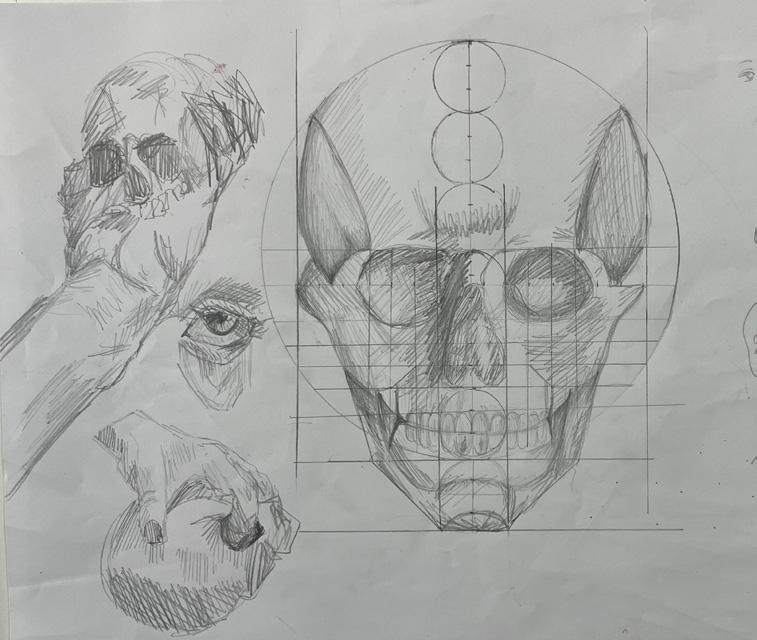
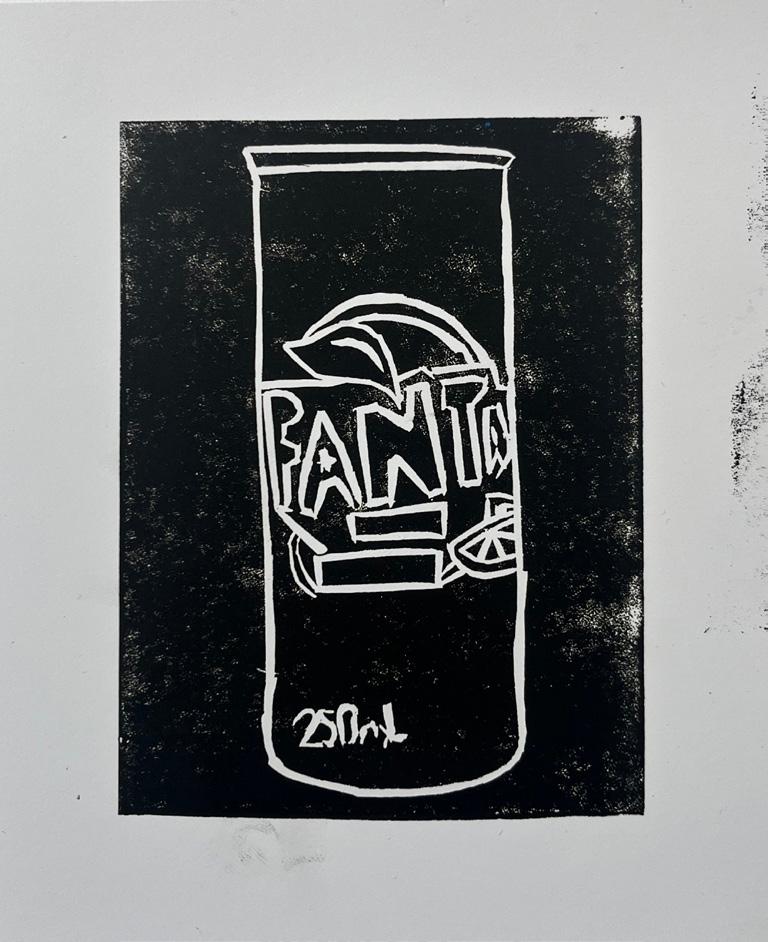

Amy Kim, Grade 6
Seoul International School
Serena Song, Grade 7
Seoul International School
Shilla Wu, Grade 8
Seoul International School
Jeon Yumin, Grade 6
Medium: Mixed media
True North International School
Kim Dana, Grade 8
Medium: Pencil on paper
True North International School
Priyal Patil, Grade 7
Medium: Linocut printmaking
True North International School