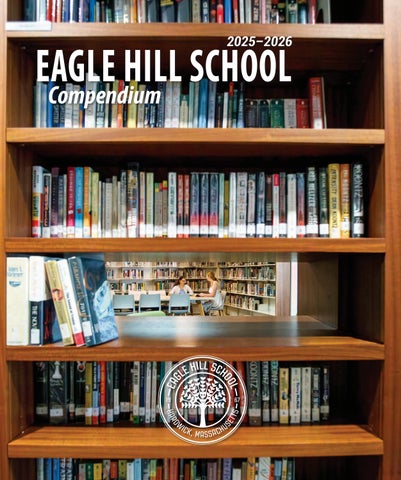
NonProfit Org. U.S. Postage Paid N. Reading, MA Permit #211
P.O. Box 116 242 Old Petersham Road Hardwick, MA 01037 413.477.6000 admission@eaglehill.school www.eaglehill.school
Address Service Requested
The Year Ahead: Dates Not to Be Missed New Family Orientation/Registration and Returning Student Registration September 14, 2026
Columbus Day/Indigenous Peoples’ Day October 12, 2026
Fall Family Weekend October 22–25, 2026
Thanksgiving Break November 20–30, 2026
Holiday Break December 18, 2026–January 3, 2027
Dr. Martin Luther King Jr. Day January 18, 2027
Winter Break February 12–21, 2027
Spring Break April 16–25, 2027
Spring Family Weekend May 6–8, 2027
Baccalaureate Dinner and Ceremony May 21, 2027
Graduation May 22, 2027
Last Day of School and Move Out May 28, 2027
EAGLE HILL SCHOOL | COMPENDIUM 2025-2026
Eagle Hill School
2025–2026
EAGLE HILL SCHOOL Compendium
Compendium: School Leadership
Message from the Head of School
D
School Leadership—2025 | 2026 ear Eagle Hill Community,
This year brought many reasons to celebrate. We watched our robotics team make school history by qualifying for the VEX World Championships. We broke ground on Saxon Hall, a transformational addition to campus that is already emerging as a symbol of Eagle Hill’s future. We cheered on championship individual Ms. Erin Wynne and team athletic performances, applauded remarkable student productions, welcomed talented new faculty, honored distinguished retirees, and gathered as a community for events that reminded us of how great it is to be a part of the Eagle Hill community. Yet what stands out most about this year is not any single accomplishment. It is the thread that connects them all: students finding confidence in their abilities, taking risks, building relationships, and discovering things about themselves that they never thought possible. Whether inside a classroom, on a stage, on a playing field or court, in a science lab, or at robotics, we witnessed our students developing not only skills and knowledge but also a stronger sense of who they are and who they might become. At its core, Eagle Hill has always been a school built on a quiet but fundamental belief: that every student can learn. That belief asks something of us. In fact, it asks a great deal of us. It asks us to design classrooms and experiences that invite curiosity and engagement rather than compliance. It asks us to see learning not as the delivery of information or the completion of a task, but as the development of critical thinking, imagination, and purpose. It also challenges us to create a place where students are known well enough to take intellectual, creative, and personal risks. Today’s world can often present challenges in these efforts. As Jane Alwis shares in her article, “If I Have AI, Why Do I Need
a Librarian?” (page 10), information today is abundant and easily accessible, but often sustained engagement with ideas is limited. For today’s students, answers to many questions can be accessed immediately, but we know that true understanding takes time. It is easy for our students—and sometimes for us, too—to confuse efficiency and speed with learning or insight. At Eagle Hill, we resist this trend. We believe the most important work of education cannot be rushed or delegated. Dr. Matthew Kim reminds us in his article, “Stacking the Shelves of the Soul” (page 2), that thinking and learning are relational and that students do not learn in isolation. Rather, students learn in conversation with teachers, texts, one another, and themselves. The habits we foster and value at Eagle Hill, such as questioning, reflecting, revising, and listening, are more than academic skills; they are essential ways of engaging with the world. This issue of Compendium reflects our shared commitment. It highlights faculty who thoughtfully consider how we teach, how students learn, and how schools can remain meaningful in a complex world. More importantly, it showcases a community that values not only what students know, but also who they are becoming.
Head of School
Board of Trustees
Parent Advisory Board
Ms. Erin Wynne
Mr. Steve Judge P ’07, ’10, Chair of the Board Mr. Erik Fleming, Vice Chair Mr. Peter Joseph P ’13, Treasurer Ms. Candace Alsop P ’00, Clerk Mr. Trevor Burgess P ’28 Mr. Jeff Gerson P ’22 Mrs. Joanna Lipman P ‘25 Mr. Mark Lopez P ’24 Mrs. Diana Merriam P ’15 Mr. Alden Bianchi, Of Counsel Mr. John Gee P ’11, Trustee Emeritus Mr. James Richardson, Trustee Emeritus
Ms. Candace Alsop P ‘00 Mr. Rob Andrews and Mr. Keith Largay P’28, ‘28 Mr. Andrew and Mrs. Nina Berman P ’27 Mr. Chris Buelow and Ms. Jenna Garvey P ’27 Mr. Trevor Burgess and Mr. Gary Hess P ’28 Mr. Ray Chan and Ms. Katherine Yang P ’27 Drs. Jason and Erin Charnley P ’26, ’27 Mr. John Dolan and Ms. Sarah Lambert P ’26 Mr. Kris and Mrs. Jaime Goodrich P ’28, ‘30 Mr. Christopher and Mrs. Becca Halpin P ’26 Mr. John and Mrs. Michelle Hernandez P ‘27 Mr. Stephen and Mrs. Molly Hoyt P ’28 Mr. Steve Judge P ’07, ’10 Ms. Heath Koch P ’26 Mr. Keith and Mrs. Amy Waryas P ’26, Co-chairs
Assistant Head of School for Academic Affairs Dr. Michael Riendeau
Assistant Head of School for Student Life Dr. Eric Stone
Assistant Head of School for Enrollment Mrs. Sue Cranford
In the end, our work is simple to describe and difficult to do well. Drawing from our work with Harvard professor Ellen Langer, as outlined by Dr. Michael Riendeau in “Creating the Mindful School” (page 26), we are reminded that our attention systems are built for novelty and that recognizing the contingent nature of knowledge is fundamentally important in our classrooms and studios, on our playing fields, and in our residence halls. That is the work you will see in these pages. That is the work we believe in. Warmly, Erin Wynne Head of School Compendium is 100% recyclable Compendium suggestions and comments are always welcome! Contact Chris Komenda, Director of Marketing and Communications e: ckomenda@eaglehill.school
Contents F EAT U R ES
2
10
14
2
Stacking the Shelves of the Soul Reimagining the library as a home for thought and presence
10
If I Have AI, Why Do I Need A Librarian? Why human judgment still matters in an AI‑driven world
14
Stories that Shape Eagle Hill's New and Notable Courses are designed to help students build confidence as readers, thinkers, and writers
18
Lessons in Proximity Finding familiarity on the other side of the world in Vietnam
24
Beyond the Feed Considering algorithms at Eagle Hill
26
Creating “The Mindful School” How novelty, curiosity, and mindful noticing can reshape how students learn
28
Baccalaureate 2026: The Power of Being Uniquely You A transcript of the faculty address
32
Commencement 2026: The Magic We Didn’t Expect A transcript of the senior class address
38
Commencement 2026: The Path You Don’t Expect A transcript of the commencement address
50
Alumni/ae Spotlight Tyler Tang ’22: Still On The Move
D EPA R T M ENTS
18
24
50
IFC 36 41 42 52 56 64 IBC
Welcome Message from the Head of School Graduating Class of 2026 End of Year Awards School News—Top Stories Alumni/ae News—Class Notes An Honor Roll of Donors With Appreciation and a Warm Welcome School Leadership
COMPENDIUM 2025-2026 | EAGLE HILL SCHOOL 1
Stacking the Shelves of the Soul Reimagining the library as a home for thought and presence
O
By Matthew Gens Kim, Ph.D., Librarian, Interfaith Spiritual Care Provider, and Chair, English department
ur library can be a sanctuary of purpose. The chaplaincy, at its best, is a sanctuary of presence. As an English teacher and department chair, and after spending two years at Jewish Theological Seminary earning a master’s degree in Spiritual Care and Counseling, I have come to realize that these spaces are not dissimilar. Students remain curious about reading books and magazines, print and digital, because they know that reading will give them facts and stories that they will use to make decisions about their lives. Students also have a hunger to connect with ideas beyond themselves. We are all living in uncertain, precarious times, so having a sense that the Divine is both close to and far from us is comforting. I have found comfort in reading and in faith across my life, and as I look towards the second half of my professional life, I am ready to offer these comforts to our students.
student’s moral imagination, and where questions are cataloged as seriously as books. This braiding of roles is not about adding religious overtones to an academic space or academicizing spiritual care. For me, it’s about acknowledging that our students will read for their whole lives. Research is not merely the retrieval of sources; it is the construction of self. And pastoral care is not a service reserved for crisis; it is the daily cultivation of attention, compassion, and agency. In one room, with one educator holding both roles, students learn that thinking well and caring well are inseparable.
In one room, with one educator holding both roles, students learn that thinking well and caring well are inseparable.
One Space, Two Vocations In my new role as librarian and interfaith chaplain, I’m reimagining the library as a pastoral commons: a place where intellectual rigor and spiritual care are a braided current. In this model, my work as the librarian will be one of curation, inquiry, information ethics, and research coaching—and my work as the interfaith chaplain will be one of listening, ritual, meaningmaking, and accompaniment. It seems natural that these two roles converge. The stacks and study tables remain, but their purpose widens: the library becomes a studio for conscience and curiosity, a place where a citation trail can accompany a 2 EAGLE HILL SCHOOL | COMPENDIUM 2025-2026
The American Library Association argues that strong school libraries significantly improve student learning. Drawing on more than twenty state studies, it shows that schools with active libraries have higher achievement in reading. Research cited in the document demonstrates that increased library staffing, access, and collaboration with teachers correlate with substantial intellectual and social gains across grades and abilities. Beyond reading, school librarians teach vital 21st century skills including research, digital literacy, online safety, and media evaluation, while also providing professional development for teachers.
Knowledge as Relationship, Not Possession The librarian’s ethic teaches that information lives in ecosystems: sources, communities, histories, and power structures. The chaplain’s ethic teaches that people live in relationships, seen
Dr. Kim having a conversation with students in the library about their work and their thinking.
and unseen—with oneself, with others, and with more-than-self. Reflecting on this notion, I have come to realize that learning is covenantal, meaning that it is a relational, trust-based, and committed endeavor. A research question carries responsibilities— toward authors, toward communities represented, and toward a student’s own integrity. A pastoral conversation carries practices of truth-telling and consent. Both are forms of faithful encounter.
protects student inquiry—even into controversial topics—while ensuring psychologically safe boundaries: no spiritual pressure, no proselytizing, no shaming. The stance is invitational: here are tools; here is time; here is trust.
I have come to realize that learning is covenantal, meaning that it is a relational, trust-based, and committed endeavor.
Freedom with Guidance The library offers our students intellectual freedom and principles of free expression; chaplaincy offers our students non-coercive presence and respect for conscience. The hybrid role
Attention as Pedagogy and Care
I have come to recognize that research requires sustained attention and that spiritual growth requires attentive presence. In a shared space, attention is cultivated through physical design, mindful practices, and rituals that normalize slowing down. We are not merely fighting distraction; we are teaching devotion—to a problem, a text, a community, a value. So much of my professional life has been devoted to developing learning spaces. I wrote my dissertation COMPENDIUM 2025-2026 | EAGLE HILL SCHOOL 3
(2014) and my first book (2017) on how teachers can reimagine their classrooms as writing studio spaces that are co-created by teachers and students and that reflect our school’s core values. Originally, I suggested that every DIY writing studio should embrace conversation, collaboration, spatial awareness, divergent thinking, and play. I still believe that! The formation of the library-chaplaincy space that I imagine does not happen only through ideas; it happens through repeated, embodied practices. Our reimagined space offers concrete rhythms—study labs, micro-rituals—that scaffold the habits of rigorous inquiry and compassionate action.
Designing the Pastoral Commons I intend to organize the library-chaplaincy space into zones that signal both academic seriousness and psychosocial safety. • Deep Work Nook: Low lighting, noise-dampening, and visible timers for focused sprints. Posted above the alcove is our “focus covenant,” a brief, student-authored set of norms for concentration. • Dialogue Tables: Small tables with writable surfaces, ideal for inquiry coaching and peer dialogue. Geometry implies equality: no head of the table, only shared investigation. • Care Alcove: Two chairs, a small table, tissues, a plant or grounding object, and clear sightlines to the rest of the library to preserve both privacy and safety. This is where pastoral check-ins happen. • Commons Shelf: A rotating display that pairs topics (e.g., Climate Grief + Environmental Science, Belonging + Biography, Conflict + Peace Studies) with research guides and reflection prompts. Each pairing model shows how knowledge and meaning-making inform each other. Subtle ritual objects help mark time and intention: a small chime to open and close work sprints, a community “question ledger” 4 EAGLE HILL SCHOOL | COMPENDIUM 2025-2026
Shared small tables with workspaces that invite conversation and focused work.
where students anonymously record the big questions animating their lives, and a “gratitude & sources” wall, where students can publicly thank an author, a librarian, a classmate, or a community they learned from. Signage makes our core values and our ethics visible: an Inquiry Charter (“We cite generously. We represent people fairly. We change our minds with evidence.”) and a Care Charter (“You can step away. You can pass. You choose how much to share.”). A one-page role description explains, in studentfriendly language, what I do, what I don’t, and the confidentiality limits of our conversations. This framing does more than decorate. It sets expectations: inquiry is generous; care is delivered within boundaries; the space belongs to the community.
Four Pillars, Many Practices The hybrid role is anchored by four interlocking pillars—study, research, meditation, and spiritual care—each with tangible practices that students can learn, repeat, and eventually modify themselves.
I. STUDY: The Discipline of Devoted Attention
Accountability as Care
The 50/10 Rhythm
Peer “study chaplains” (rotating student leaders) help classmates tweak the environment—headphones, seating, lighting—and check in on focus plans. They are not disciplinarians; they are supporters. This could be the role of students who are independent or proctors.
Library‑wide cycles—fifty minutes of quiet work and four minutes to reset (stretch, hydrate, breathe). Since our classes are 54 minutes, we can spend 50 minutes working and four minutes resting and contemplation. A soft chime marks the transitions. The routine gives students a temporal scaffold for deep work without exhaustion. These library cycles will occur during the academic day and at set times in the evenings and on weekends.
Focus Covenants At the start of study session, students write a two-sentence intention (“What will I give my attention to?”); at the end, a two-sentence reflection (“What did I learn, and whom do I thank?”). These live in the front pocket of their notebooks, building a portfolio of attention over time.
Instruction in Sacred Reading for Secular Contexts
II. RESEARCH: Inquiry with Integrity Values-Forward Research Map Every major project begins with a short, rhetorically driven protocol: 1. Name the question behind your question: Why do I need to know this? Whom does it affect?
Our reimagined space offers concrete rhythms—study labs, micro-rituals— that scaffold the habits of rigorous inquiry and compassionate action.
For complex readings, I offer students lectio divina, a mindful approach to reading and writing that originated with the Rabbinic sages and Christian mystics and that is still practiced today in high schools and colleges. Lectio: slow, attentive reading of the sacred text to hear what the text says in its plain meaning. Students read aloud or silently, slowly. They notice words, phrases, or images that stand out, avoiding interpretation at this stage—simply receiving. Meditatio: reflective engagement with the text to ask what the text means and how it connects to the students’ lives. Students turn the text over in their minds. They explore emotional and personal resonances, and they consider what is speaking to them at a particular moment.
Oratio: a prayerful response to the text in which students ask how they want to speak back to the Divine or to another audience. Students let the text shape their prayer—gratitude, longing, struggle, and request. This is relational, not intellectual. Contemplatio: resting in silence with God and with self to experience being with the Divine and self beyond words. Students let go of thoughts and responses and rest in presence and stillness.
2. Surface assumptions: What have I already decided? What voices am I missing? 3. Power scan: Who benefits from each source? Who is marginalized?
4. Triangulation plan: At least three types of sources: scholarly, journalistic, community/primary. 5. Representation check: Am I quoting responsibly? Avoiding tokenization? 6. Reciprocity: How will I give back—share findings with stakeholders, credit community knowledge, and write a note of appreciation? This map does not add busy work. It connects epistemology to ethics, helping students see research as a relationship-building exercise with people, ideas, and communities.
Annotated Bibliography as Spiritual Exercise Each source gets three brief annotations: • What it says (summary). • What it asks of me (ethical or emotional demands). • What I will do with it (how it shapes my thesis or action). Students learn to move beyond extraction toward engagement. COMPENDIUM 2025-2026 | EAGLE HILL SCHOOL 5
III. MEDITATING: Training the Mind for Curiosity and Compassion
So … What Does a High School Chaplain Do Anyway?
Reflective Pauses in the Research Cycle
S
After a challenging source, students take ninety seconds to lower their gaze and write two feelings and one question. They re-enter with clarity, and fewer unspoken reactions hiding beneath their thesis statements.
Contemplative Walks in the Stacks Five minutes of quiet browsing with a prompt, “Let a title find you,” followed by a short share: one surprise, one next step. It’s a ritual of serendipity that honors the library as a place of discovery.
The purpose is not to impose a spiritual frame but to normalize a reflective posture in the midst of academic effort. All of these practices are secular and opt-in, with alternatives for anyone who prefers quiet journaling or a short walk to the water fountain. The purpose is not to impose a spiritual frame but to normalize a reflective posture in the midst of academic effort.
IV. SPIRITUAL CARE: Accompaniment Without Agenda Visible, Predictable Drop-In Hours During office hours, after lunch, and after school, I hold short windows for research questions and for one-on-one listening. The door remains ajar; a small privacy screen ensures sightlines. Students know they can stop by without an appointment for a brief check-in.
Three-Question Pastoral Check-In 1. What’s weighing on or energizing you today? 2. Where do you feel most stuck—or most alive—in your learning? 3. What could support look like in the next week? continued on page 8 6 EAGLE HILL SCHOOL | COMPENDIUM 2025-2026
What is Spiritual Care? piritual care providers are not rabbis or priests, though we are concerned with prayer. Spiritual care providers are also not psychologists, though we are concerned with emotions. Rabbi Naomi Kalish (2013) defines spirituality as the aspect of humanity that refers to the way individuals seek and express meaning and purpose and the way they experience their connectedness to the moment, to self, to others, to nature, and to the significant or sacred. The spiritual care provider, she attests, is someone who offers those in her care the opportunity to narrate their story of illness or struggle and who helps care seekers access their own spiritual resources, whether drawn from traditional religious sources or newer, creative, and sometimes secular places.
The principal role of the chaplain is to be with care seekers helping, them find and express meaning in both pleasant and troubling situations. I do want to reiterate that a chaplain is not a psychologist. One of the fundamental guidelines for a chaplain to follow is to help a care seeker find the appropriate resources. Thus, in my conversations with students, I will guide them and even bring them to student support services. I do not diagnose. The principal role of the chaplain is to be with care seekers, helping them find and express meaning in both pleasant and troubling situations. A chaplain can help create rituals that are empowering and can discuss with care seekers the ethical, philosophical, and theological questions that are occupying their minds at a particular moment.
What are the goals/outcomes of providing spiritual care to students? If the care seeker’s primary spiritual need is meaning and direction, our goals could be: Care seeker learns and trusts that whatever decision she makes will be congruent with her own values; care seeker identifies her primary heart’s desire; care seeker attains greater clarity regarding meaning and purpose of her own life; care seeker has less angst and more support about making a particular decision.
If the care seeker’s primary task spiritual need is self-worth and belonging to community, our goals could be:
If the care seeker’s primary spiritual need is self-worth and belonging to community, the chaplain can:
Care seeker reports greater sense of belonging to the community; care seeker prioritizes self-concern in equal balance with concern for others; care seeker’s actions suggest enhanced self-worth.
Create a “community of two” by keeping care seeker company and listening to her story of suffering/struggle; make specific statements of affirmation about attributes, role, and behavior of care seeker; ask care seeker for her opinion on a subject about which she knows more than I do; empower care seeker to identify what is loveable about herself; use faith tradition (if applicable) to challenge old beliefs; regularly remind care seeker about loved ones and reference other care givers/support staff that can also provide support. If the care seeker’s primary spiritual need is reconciliation/to love and be loved, the chaplain can:
Dr. Kim helps students feel seen, heard, and valued.
If the care seeker’s primary task spiritual need is reconciliation/to love and be loved, our goals could be:
Acknowledge the brokenness and tension in the relationships the care seeker discusses; remind the care seeker of his own internal resources and abilities to advocate appropriately for himself; remind the care seeker to say what he needs rather than expect others to intuit it; state the impact of the care seeker’s behavior on others; and, after the care seeker has behaved differently, discuss forgiveness from others, self‑forgiveness, and offer a ritual.
Some ways in which a student and spiritual care provider might engage: • Praying/meditating
Care seeker realizes his behavior has an impact on other people; care seeker expresses vulnerability and feelings, instead of resorting to anger and blaming others; care seeker commits to new behavior and forgives self; care seeker seeks and experiences forgiveness from others and God (if applicable); care seeker experiences reconciliation.
• Talking
How might a spiritual care provider work with a student as care seeker?
• Creating metaphors and analogies that help a student make sense of a feeling or situation
If the care seeker’s primary spiritual need is meaning and direction, the chaplain can: Name and reflect back emotions to the care seeker; help care seeker name resources to help make decisions, answer questions, and achieve clarity; demonstrate support and guidance, as if walking alongside care seeker on a path; honor care seeker when she arrives at a new meaning; offer a blessing or ritual (religious/ non-religious/poetic).
• Walking • Creating and enacting empowering rituals • Identifying ethics and values that sustain a student and exploring how one might put those ethics and values into action
• Dramatizing real events with a group of students and considering innovative, workable solutions to problems • Writing poetry/songwriting • Journaling • Being outside in nature communing with God/universe • Making art/crafts • Hosting conversations with a friend or a group of peers
COMPENDIUM 2025-2026 | EAGLE HILL SCHOOL 7
Care Pathways Map Posted and handed out, this simple guide lists contacts for mental health, academic support, identity-based affinity spaces, and crisis resources.
content, reiterate confidentiality limits up front, and use spiritual language only when invited by the student. Clarity and consent are themselves acts of care.
Scenarios in Practice The Overwhelmed Researcher A student spirals while researching a conflict zone. Headlines blur; images haunt. We pause for a ninety-second reflective breath, name the feelings, and narrow the scope to a researchable question that avoids retraumatizing content. I add two communityauthored sources for context, model a power scan, and schedule a follow-up. The student leaves with a three-source plan and a life raft: a process for staying human while staying informed.
The Heated Debate A group project flares over identity terms. I convene a fifteenminute “language lab”: define terms using reputable style guides, identify stakes, draft a shared glossary. The exercise recasts disagreement as a problem of precision and care, not combat. We close with a round: “What I learned / what I’ll do next.” The reimagined library will give students a place that becomes their own pastoral commons for focus and purpose.
Group Circles for Meaning-Making When events touch the community, I convene a twenty-minute “After the Headline” circle: a one-page fact sheet, two grounding breaths, a round of brief sharing, a resource list, and a small actionable kindness (write a support note, compile reputable sources, plan a teach-in). We metabolize the news together, resisting both doomscrolling and silence.
Boundaries Build Trust I log sessions (topic, duration, referrals) without sensitive
The Quiet Crisis A student lingers after a deep work block, tearful about a variety of stressors. I normalize the feeling, listen, summarize for clarity, and ask consent to connect them to the counselor. We book a five-minute check-in the next day. The student leaves not with a diagnosis or prescriptive plan, but with accompaniment and a path.
Conclusion As I move into my new role this June, I invite you to come into the library-chaplaincy space and find a book, discuss a research topic or project, or sit down with me over a cup of coffee in the café and have a conversation about the world and our place in it.
ABOUT DR. MATTHEW KIM Matthew Kim is our school's librarian, interfaith spiritual care provider, and English department chair. He earned a Ph.D. in English studies from Illinois State University and a master's in spiritual care and counseling from Jewish Theological Seminary. Matthew wants our students to embrace online research resources and physical books, believing that students need to learn how to utilize both to have an authentic, meaningful school experience. As an interfaith spiritual care provider, Matthew is invested in providing an opportunity for students to narrate their stories of struggle and in helping students access their own spiritual resources, whether they come from traditional religious sources or newer, creative, and sometimes secular places. In his English courses, Matthew spends time with his students individually and as a group, engaging them in a mindfulness approach to reading and writing that includes attentive reading, contemplative reflection, dialogue, ethical or lived response, and the creation of text. 8 EAGLE HILL SCHOOL | COMPENDIUM 2025-2026
Eagle Hill Summer Session July 5—30, 2027 • ALL learning, NO homework • 5:1 student-to-teacher ratio • 3 weekends, 45 trips and activities • 100% Eagle Hill advantage The EHS Summer Session combines the excitement of a classic summer camp with our unique approach to educating diverse learners. Build confidence in the classroom. Explore a range of activities and clubs. Fast‑track friendships before school starts. Whether you’re preparing for the year ahead or simply looking for a summer of growth, the perfect mix of academics and fun is with us in July!
A philosophical look Do at food and nourishment If I Have AI,inWhy I Need A Librarian? a complicated world. Why human judgment still matters in an AI‑driven world By Jane Alwis, History Teacher and Academic Advisor
published book-length tomes of historical interpretation and analysis by this or that historian, and provided students of all ages with a wealth of primary sources. In many ways, this access to a wider array of material has led to better research skills and more in-depth knowledge; however, with the increasing pervasiveness of artificial intelligence (AI), students are once again faced with obstacles associated with selection of information.
I
In my thirty-plus years of teaching history, I have always expected a significant amount of independent yet guided research of my students. In the past, this has revolved around scheduling time for classes to take over the library space and search the catalog and the shelves for relevant materials. In the last few years, that time spent in the library has become less of a necessity as we have become more dependent on online sources for research. Access to databases of primary documents and academic research papers has taken focus away from 10 EAGLE HILL SCHOOL | COMPENDIUM 2025-2026
This past academic year, Eagle Hill faculty have had several conversations about the use of artificial intelligence in our classes and student use of AI in general. Whatever your thoughts, there is one fact that we cannot ignore: AI is here, and our students are going to use it, whether we like it or not. So, the overarching question remains: How do we teach students to use AI meaningfully while also presenting that learning should remain deeply human and personal? The answer is simple. Continued human instruction and oversight to ensure students are engaging meaningfully with the texts in front of them is vital, whether those texts are digital or old-fashioned words printed on paper. The role of the teacher, no matter the subject area, is to guide students in understanding that texts should be evaluated and
questioned. The role of the librarian as gatekeeper is essential in the age of AI because it is the librarian who provides the necessary oversight to ensure available information is accurate, unbiased, and trustworthy, which AI often fails to do. Artificial intelligence can quickly generate answers, summarize documents, and sort data. It is a tool for information retrieval, not a replacement for human judgment, ethics, and expertise.
deep learning techniques but apply them to images and videos. Where LLMs provide us with existing knowledge that is verbally rephrased, GenAI applied to images and videos can produce content that is considered more creative and, perhaps, even new. The main problem with LLMs is that they will sometimes confidently and authoritatively deliver you the wrong answer, with no sources cited to fact check the validity of the delivered content. The main problem with GenAI applied to images and videos is that they can craft visuals that never happened—thus, misleading viewers. Already, many of my history students have discovered that promising sources generated for research papers do not actually exist.
If you haven’t yet heard of the term “WorkSlop,” you soon will.
Literacy as Agency
Literacy is about equipping learners with agency and a sense of purpose so they can shape their own lives and contribute If you haven’t yet heard meaningfully to the lives of the term “WorkSlop,” of those around them. you soon will. This refers In today’s digital world, to AI-generated work we are surrounded by that looks valid but lacks an increasing volume of substance; papers quickly quickly generated content, generated by individuals a significant amount of without the necessary which involves little or research to back up the no human oversight. content. In 2024, The Some of it is inaccurate, Guardian warned that some of it is biased, and according to information some of it withholds it had garnered from important perspectives research scientists, tens readers should know. We of thousands of bogus Students learn to question text—questioning text, thinking critically about how it was created and why. therefore need to teach research papers were students to question texts being published in journals in an international scandal that is and think critically about who wrote or created the text, how it worsening every year: was created, and why. This entails engaging deeply with each text. Large Language Models (LLMs) like ChatGPT, Claude, and Co-Pilot are software tools capable of linguistic analysis and prediction. In layman’s terms, they are artificial intelligence systems that process written instructions (prompts) and are capable of generating natural-seeming language text. LLMs are trained on huge volumes of content, often scraped from the web or pulled from sites like Wikipedia or Reddit. From that content, they develop statistical probabilities that try to predict which words, in what order, will best align with the user’s query. Add to that other generative AI (GenAI) models that also use
Medical research is being compromised, drug development hindered and promising academic research jeopardized thanks to a global wave of sham science that is sweeping laboratories and universities. Last year the annual number of papers retracted by research journals topped 10,000 for the first time. 1
Librarians as Guardians It would seem that now is exactly the time when we should be looking to our librarians to fulfill the roles set out by the American Libraries Association: the verification of the legitimacy COMPENDIUM 2025-2026 | EAGLE HILL SCHOOL 11
of texts and the identification of fake texts generated by AI without oversight; the teaching of information literacy (including AI literacy) in collaboration with the subject teacher; the curation of texts and publicity of new texts; ethical oversight of the collection; and personalized, and often complex research support. Access to quality resources is not only desired but essential for our students.
Popular author John Green used the game Angry Birds to highlight and warn us of the discrepancy between the persistence applied to games and the lack of effort often given to challenging intellectual tasks like reading or math. He stated back in 2012 that it is strange to see individuals easily give up on hard work, yet "willing to grapple, for centuries, if necessary, with a single level of Angry Birds."2 Librarians and educators will continue to guide students toward reliable, curated, and legitimate resources.
WorkSlop is both the basis and product of insufficient research and questionable ethical writing practices. It is the reason why classroom educators and librarians will continue to exist as guardians of quality student research and writing.
Metacognitive Effort
Responsible AI Learning
So, as a teacher of history, what should I do? AI is here; it is a presence that we cannot deny, nor can we or should we ban our students from using it. What I can do is try to teach responsible use of AI to continue to emphasize the human qualities of learning, to teach students to develop and defend historical argument, and to accept that there are multiple perspectives on every issue.
WorkSlop is both the basis and product of insufficient research and questionable ethical writing practices.
In the past two years, three independent studies exploring student metacognition have emerged from Germany, China, and India. In the studies, student output was compared between those who had access to AI tools such as ChatGPT and editing software and those who did not. All three studies found that students who did not have to struggle to obtain information, who did not engage fully in the selection and the evaluation of relevance of information, and did not have to think about the editing process had weaker written responses and demonstrated less mastery of information at both the high school and college level. In other words, those students who did not engage working memory in all three of its natural functions, three types of mental load—intrinsic (dealing with the complexity of the material), extraneous (filtering out the irrelevant detail and distractions), and the germane (processing information and building mental schema to anchor learning)—demonstrated less mastery over the material studied. Simply put, less metacognitive evaluation led to less mastery. 12 EAGLE HILL SCHOOL | COMPENDIUM 2025-2026
Eagle Hill Pioneers should become knowledge builders, not just consumers of knowledge. They should be creators of meaning. Students only learn what they think about and need to understand that process is more important than product. I need to work with my librarian to demonstrate the importance of researching and evaluating sources to ensure that students are able to judge which sources are viable and which are the product of WorkSlop. I need to encourage my students to develop their own personal, ethical guidelines prioritizing human value over technological capabilities.
Future of AI and Librarians There seems to be a general consensus that certain human qualities, like empathy and critical thinking, cannot be replicated by AI, and these are essential elements in education. In Human Work in the Age of Smart Machines, Jamie Merisotis presents an optimistic view of smart machines and artificial
intelligence. Merisotis cautions readers not to cling to nostalgia or get lost in anxiety that “the robots will come for our jobs,”3 but rather suggests that we should embrace the ways these machines will help us focus on meaningful work. It is understandable why there is concern. However, the intention behind the machines is to eliminate repetitive tasks, which ideally will free us to focus on more important and creative
The future is not a choice between AI and librarians but should be seen as a partnership between the two. ideas. Who hasn’t used Grammarly, or spellcheck, or even predictive text to help with completion of day-to-day tasks? The future is not a choice between AI and librarians but should be seen as a partnership between the two. The United States Department of Education Office of Educational Technology argues that “augmented intelligence is a design pattern for a human-centered partnership model of people and artificial intelligence (AI) working together to enhance cognitive performance, including learning, decision making, and new experiences,” 4 reinforcing the concept that the strongest model is a collaboration where AI handles high-volume tasks, and librarians provide the judgment, empathy, and oversight needed to make that information valuable and reliable.
AI, Plagiarism, and Academic Integrity
I
magine a student who asks Copilot or ChatGPT to provide a unique thesis in response to an assignment on the book just read in their literature class. Generative AI provides the student with a thesis based on the prompt given; at the same time, it also provides the student with an outline of how to draft the paper based on the provided thesis. Is this plagiarism? Plagiarism is the act of presenting someone else’s work or ideas as your own without proper credit. It is primarily an ethical and academic concern rather than a legal one and has traditionally applied to copying from books, articles, or other students’ work. With AI, the principle remains the same: if AI-generated text is submitted without disclosure, it should generally be treated as plagiarism as it is not original work. But generative AI is fundamentally different in that it doesn’t necessarily copy exactly from previous sources; rather, it draws its output from a wealth of previously provided training material that links to original sources. A large language model (LLM) like ChatGPT produces text by predicting likely word sequences based on patterns in its training data, rather than by retrieving and crediting specific prior works. In other words, it is synthesizing previously provided data to produce a response. AI is a technology of averages based on the data already digested, and as such, it will never be able to produce anything wholly unique, unlike the human brain. AI does, however, present plagiarism and scholarly practice problems in a new light. It may not always be considered a plagiarism problem. But it may be a problem of academic integrity.
ABOUT JANE ALWIS Jane, a frequent contributor to Compendium, hails from a small town in regional Victoria, Australia. She holds an arts degree with majors in history and philosophy, along with a minor in literature, and a Graduate Diploma in Secondary Teaching from a regional campus of LaTrobe University. After moving to the United States, she earned a Master of Education in Learning, Teaching, and Education Transformation from the University of Massachusetts, Boston. Jane joined the Eagle Hill faculty in 2011 and has since become a core member of the teaching team, leading classes in world history, IB history, social justice, and writing. Jane also works with the IB Diploma Programme CAS program, helping students connect their studies to real‑world experiences and develop a strong sense of global awareness. Her seventeen years of teaching in Australian public schools, focused on history and English—along with a memorable year at a small Catholic school teaching everything from math to cake decorating—laid the groundwork for her teaching approach. After relocating to Massachusetts in 2005, she continued to build her expertise in public schools before bringing her experience and passion to Eagle Hill. Jane lives in Hardwick with her husband and enjoys reading, cooking, gardening, and importing specialty teas.
REFERENCES Robin McKie, “‘The situation has become appalling’: fake scientific papers push research credibility to crisis point,” The Guardian, February 3, 2024 https://www.theguardian.com/science/2024/feb/03/the-situation-has-become-appalling-fake-scientific-papers-push-research-credibility-to-crisis-point John Green, “On Cuties and Cooties,” February 28, 2012, by vlogbrothers, YouTube, 3:02 https://www.youtube.com/watch?v=FcifZrZ_yE4 Jamie Merisotis, Human Work in the Age of Smart Machines (Rosetta Books 2020). U.S. Department of Education, Office of Educational Technology. (2023, May). Artificial Intelligence and the Future of Teaching and Learning: Insights and Recommendations. Washington, DC. https://www.ed.gov/sites/ed/files/documents/ai-report/ai-report.pdf COMPENDIUM 2025-2026 | EAGLE HILL SCHOOL 13
Stories That Shape
Eagle Hill's New and Notable Courses are designed to help students build confidence as readers, thinkers, and writers By Taylor Turner, English Teacher
14 EAGLE HILL SCHOOL | COMPENDIUM 2025-2026
B
At Eagle Hill, we have the space, time, and privilege of seeking out that spark in each of our students that might make them pause, take stock, and reckon with the fact that language—indeed, narrative in all forms—is truly worth their attention.
efore teaching at Eagle Hill, my journey began at Boston University, where I instructed undergraduate students in creative writing while working toward my Master of Fine Arts in Fiction. Relatively speaking, those students were just beginning their journey of becoming writers. However, I didn’t realize how retrospectively envious I was of their foundational knowledge. As freshmen and sophomores at BU, they had already found niches, favorite genres they aspired to write in, subject matter they wished to engage with, and ideas and philosophies that fueled them. To put it plainly, my own foundation at their age was rocky at best.
Certainly, by my senior year of undergrad, I’d become an avid reader and writer, but my own high school experience (or my early college experience) was not particularly to thank for this. I was homeschooled through middle and high school and, like many students today whose attention is battled for by endless screens and endlessly insistent algorithms, my focus was not necessarily academic. I didn’t have access to the kinds of courses schools like Eagle Hill offer, to teachers who were devoted to finding what interested me, to the kind of curriculum EHS curates and cultivates with intention. Most of what inspired my love of language had little to do with my homeschool curriculum and more to do with desperation—for excitement, for intrigue, for texts I could relate to.
New and Notable English Courses
T
he 2026–2027 English courses invite students to explore big ideas, sharpen their writing, and connect with stories in new ways. They’re part of a wide range of New and Notable offerings at Eagle Hill, spanning everything from Computer Science to Visual Arts. Scan the QR code below to see the full catalog.
Banned Books introduces students to powerful, once‑challenged works and encourages open, thoughtful discussion about their themes.
Absolute Cinema digs into classic films and texts to explore big questions about what it means to be human.
Everyone’s A Critic teaches students how to look closely at books, films, and media and express their opinions with clarity and confidence.
All About Love: A Writing Journey gives students space to explore the many forms of love and express them through creative, personal writing.
So That’s Where That Came From shows students how stories and ideas echo across history and evolve for new audiences.
Ancient Wisdom for Modern Life helps students connect timeless ideas from global philosophers to the challenges of modern life.
Video Game Analysis explores how video games tell stories, shape culture, and connect with other forms of writing and media.
Art of the Personal Essay guides students as they study great essayists and develop their own authentic writing voice.
World Gone Wrong examines stories of conflict, upheaval, and resilience, helping students see how literature reflects the world around us. New and Notable Curriculum Guide
Writing for Publication supports young writers as they draft, revise, and prepare their work for real readers. COMPENDIUM 2025-2026 | EAGLE HILL SCHOOL 15
My willingness to sit with a classic “high school lit” novel was low. (I remember reading A Tale of Two Cities as a fourteen-year-old and only recall dwelling on how I couldn’t understand a word.) On the other hand, I loved movies. So deep was this love that I found screenplays of films I admired, both production scripts and transcriptions of dialogue, and read them with fervor (as if there wasn’t schoolwork to attend to). I eventually developed a taste for YA literature and fantasy novels—again, neglecting those chapters of A Separate Peace I owed a report on. I attempted to write scripted narratives because I’d grown to love stories—the ones I found on my own—so dearly. Those scripts were certainly terrible, but I was working toward something, for something, and nobody had asked me to do it. Digesting those classic texts, the ones adults in my life wanted so badly for me to meaningfully engage with, came more easily once I’d found my own stake in language, in storytelling. Once I’d found my spark for narrative, for words, all things became possible.
In fact, all of the courses for the 2026–2027 academic year grant the flexibility and variation of form that I can’t help but wonder would have made all the difference for me as a high school student. For all the what-ifs and could-have-beens, such an opportunity might have set me on the path to loving language far earlier than I arrived at it on my own.
The courses I crafted for next year’s catalog—Everyone’s From Banned A Critic and Art of the Personal Essay—are designed to Books to Ancient for encourage us as students and teachers to think mindfully Wisdom Modern Life, about our words as we craft them, to write in our own the English department’s unique voices, and to engage in work we can be proud of. new and notable
courses this year are thrilling. All About Love: A Writing Journey will invite students to examine how love is shaped through language, as well as what language has to do with love, passion, and desire. In Art of the Personal Essay, students will engage in the craft of creative nonfiction
If there’s anything I’ve learned from my first year teaching at Eagle Hill, it’s that the willingness of a student to sit with language has certainly changed and become harder to pin down. Yet, so did my own. I craved new forms to explore, new stories— ones not terribly common in curriculum design. That willingness to engage with literature, focused on novel forms as it may be, has not actually diminished in this generation of students. At Eagle Hill, we have the space, time, and privilege of seeking out that spark in each of our students that might make them pause, take stock, and reckon with the fact that language—indeed, narrative in all forms—is truly worth their attention. Eagle Hill is a special place, and the trust placed in faculty to design their own curriculum and create interest for our students is something I’m grateful for each day. My personal goal is to encourage students to keep asking themselves, “Why?”—to interrogate what genuinely interests them, to see where the spark is leading them, and to cultivate it. The courses I crafted for next year’s catalog—Everyone’s A Critic and Art of the Personal Essay—are designed to encourage students and teachers to think mindfully about our words as we craft them, to write in our own unique voices, and to engage in work we can be proud of. 16 EAGLE HILL SCHOOL | COMPENDIUM 2025-2026
Once banned, Fahrenheit 451 by Ray Bradbury now appears in our New and Notable course on Banned Books.
to bring their lived experiences to the page and hone their individual narrative voices. In Everyone’s A Critic, students will discuss why and how we should view and analyze art of any
kind beyond classifying it as “good” or “bad.” Assuming the role of art critics, students might look at a series of novels, films, and/or other media. Writing For Publication invites students to share their own writing with their peers and a supportive teacher—and hear their constructive criticism. This class will also compile the 2027 issue of Elm and Quill, Eagle Hill’s literary magazine.
One of the unique things about Eagle Hill’s English department is how new courses are created by students as well as faculty. Absolute Cinema, a new course for next year, was created by Danny D. ’28 alongside English teacher Thomas Hopper. In this course, students will engage in the intertextual study of “classic” films and texts. By analyzing films within philosophical and narrative frameworks, students will learn how to relate contemporary stories with so-called “classic” texts from different time periods, showing the different ways that both mediums can capture the human condition.
It’s an extraordinary thing to spend time caring so deeply for the interests of our students, to help them find their spark, and to encourage looking closely at literature and art until we recognize ourselves on the page or the screen.
Banned Books will provide an opportunity for students to be exposed to works of literary merit that, for various reasons, are or have been kept off the shelves at other institutions of learning. They’ll grapple with why certain narratives have been censored or ignited public outcry. Ancient Wisdom for Modern Life will familiarize students with classical philosophy from thinkers such as Plato, Aristotle, and Lao Tzu. Throughout the course, students will apply those philosophies to their present-day realities. From post-apocalyptic to historical texts, World Gone Wrong invites students to examine the best and worst parts of human nature and society, often through the lens of conflict and change. In So That’s Where That Came From, students will analyze recurring quotes and iconic scenes across history, explore enduring archetypes like “coming of age” or “forbidden knowledge,” and focus on direct adaptations in modern media. Video Game Analysis offers a critical exploration of how video games contribute to and interact with other forms of media. Students will analyze the narratives within games and their broader cultural impact, considering how gaming shapes and is shaped by the written word.
Not only am I thrilled at the prospect of teaching these courses next year, but I also feel distinctly honored by the opportunity to do so. It’s an extraordinary thing to spend time caring so deeply for the interests of our students, to help them find their spark, and to encourage looking closely at literature and art until we recognize ourselves on the page or the screen. Perhaps I might not have managed an Oscar-worthy screenplay in high school had I access to such resources, but I do believe my foundation would have been so much stronger. That is exactly what I hope our students gain as they engage with the core ideas and writing forms of these View the entire 2026–27 courses in the 2026–2027 academic year. Course Catalog and
One of the unique things about Eagle Hill’s English department is how new courses are created by students as well as faculty.
Curriculum Guide
ABOUT TAYLOR TURNER Taylor received her B.S. in Film and Television from Boston University, with a minor in English. She went on to receive her MFA in Fiction Writing from Boston University, where she was awarded a Leslie Epstein Global Fellowship, a Saul Bellow Prize in Fiction, and a St. Botolph Emerging Artist Grant. She was a teaching fellow during that time, instructing undergraduate students in creative writing. Her areas of interest include surrealism and magical realism in literary fiction, as well as demystifying the illusion of “the writing life.” As a teacher, she finds no greater joy than encouraging students to find the beauty in narrative, the stories we tell ourselves and each other. Taylor is excited to be part of the English Department at Eagle Hill and work with students to become confident readers and writers. She’s most enthusiastic about curating a safe space for students to explore the power of literature and the joy of finding ourselves on the page. COMPENDIUM 2025-2026 | EAGLE HILL SCHOOL 17
Lessons in Proximity
Finding familiarity on the other side of the world in Vietnam
By Andrew Ward, Science Teacher, Academic Advisor, and EF Tours Trip Coordinator
I
t may go without saying that Vietnam is very far away—not just in distance, but also in how we may interpret a place that has been dominated mainly by a war that most young Americans only understand through movies. Our twenty-four-hour-long journey started with a connection in Tokyo. Surrounded by new sights, sounds, and food choices in the Tokyo airport, some of our students did what many of us do when we are tired and far from home: they looked for something familiar. In this case, that familiar thing was McDonald’s. I may have expressed some mild disappointment in their culinary courage, especially with so many more authentic options around them. To be fair, Vietnam still felt very far away at that point. So, in that moment, I understood the pull of something familiar, even as I hoped the trip would move them beyond it.
It was one of our first lessons in Vietnam: sometimes what seems confusing from the outside begins to make sense once you are willing to spend time inside it. We arrived in Hanoi in the middle of the night and were grateful for the chance to get some sleep before beginning the next day. One of our first experiences in the city was a rickshaw ride through the streets of Hanoi, where the rules of the road appeared, at first glance, to be simple: go, and be predictable. To our students, the traffic looked chaotic. Scooters, cars, bicycles, pedestrians, and rickshaws all seemed to move in every direction at once. Yet somehow, it worked. What first looked like disorder had its own rhythm. Everyone kept moving. Despite the constant flow of people and vehicles, Egg coffee, modern life mixed with there were no endless traffic jams traditional means. and, even more surprising, very little visible frustration. We did not hear the steady blaring of horns or see the impatience that often comes with traffic back home. People seemed to understand that the only way for everyone to keep moving was to cooperate with one another. It was one of our first lessons in Vietnam: sometimes what seems confusing from the outside begins to make sense once you are willing to spend time inside it. COMPENDIUM 2025-2026 | EAGLE HILL SCHOOL 19
Our first days in Hanoi also gave the United States and befriended students their first taste of Vietnam’s one of the American pilots who coffee culture. At a small cafe, they had safely ejected from a plane he learned how to make egg coffee, using shot down. Our group barely fit whipped egg in place of milk or cream. into his living room. The students It may sound unusual at first, but it listened closely and asked thoughtful quickly became one of the many small questions. It is one thing to learn surprises Vietnam had waiting for us. about war from a textbook or a That same idea carried into our first real museum exhibit. It is another thing encounters with Vietnam’s history. In to sit a few feet away from someone Hanoi, we visited Trúc Bạch Lake, where who lived it. That visit gave John McCain was captured during the students a renewed understanding Vietnam War. We also visited Hỏa Lò that there were real human beings Prison, known to many Americans as on both sides of the conflict. the “Hanoi Hilton,” where McCain Our time in Hanoi also included and other American prisoners of war a visit to the Ho Chi Minh Exploring the beauty of Hạ Long Bay. were held. For our students, this was Mausoleum. This took a little an early reminder that the history they had heard about at home effort. Our first attempt had been rejected because we were not was only one part of a much larger and more complicated story. dressed formally enough for the guard’s liking, so we returned The prison existed long before American POWs were held there. a day later, more appropriately dressed, and were allowed in. It had first been used to imprison Vietnamese people, and the As meaningful as the site was, my favorite part of that day was conditions they endured were grim. Later, American prisoners watching our students interact with the many Vietnamese school were held there during what we call the Vietnam War and what groups who were also visiting. The younger Vietnamese students many Vietnamese people were thrilled to practice their call the American War. That English and eager to be near difference in language matters. our group. A few of our boys To the Vietnamese, the United positioned themselves near States was one more foreign the seemingly endless line of power in a long history of schoolchildren and spent their conflict and invasion. The time smiling, shaking hands, museum told its story from a and exchanging greetings with very particular point of view, hundreds of local students. It and students could sense that. was such a simple moment, There was certainly some but it said a great deal. No propaganda in the way parts interpreter was needed. A of the history were displayed, smile, a handshake, and a little especially around the treatment Paddling along in traditional basket boats in the canals around Hội An. courage were enough. of American prisoners. But that, too, was part of the lesson. History is not only about what From Hanoi, we traveled to Hạ Long, where we visited a local happened. It is also about who is telling the story. pearl farm and stayed at a hotel overlooking Hạ Long Bay. Soon One of the most powerful experiences of the entire trip happened not in a museum, but in a living room. We were invited into the home of a Vietnamese pilot who had flown MiG fighter jets during the war. He had shot down American planes, yet years later he traveled to 20 EAGLE HILL SCHOOL | COMPENDIUM 2025-2026
after we arrived that afternoon, we climbed onto oversized golf carts and headed down to the beach. The students were thrilled to get into the ocean, and soon our group was tossing a frisbee around on the sand. Apparently, frisbee is not especially
common in Vietnam: the locals food, and the staff were warm and were fascinated by this odd plastic friendly. We stopped at one island disc that could fly an impossible and explored an enormous cave with distance with just the flick of a a towering ceiling, small pools, and wrist. Even Dang, our tour guide, tiny waterfalls formed by rainwater. was completely taken with it. It was the kind of place where you While Dang may have been small could not take enough pictures, no in stature, he had an enormous matter how hard you tried. personality. On the beach in Ha From there, we flew south to Da Long, he jumped right in, along Nang and continued on to Hội An, with several locals who simply had one of the most beautiful cities in to try this strange flying toy. A few Vietnam. We arrived at night and days later, Dang introduced our walked on foot through narrow students to a Vietnamese game alleys and twisting streets, under called đá cẩu, which is something countless colorful paper lanterns, to like hacky sack, using a weighted Gabriella U. ’27 and Lauren C. ’27 enjoy the beautiful city of Hội An at night. reach the restaurant where we would feathered shuttlecock kicked with have dinner. Hội An was stunning, especially at night, when the the feet. He bought a few for the students, and before long, lanterns seemed to glow from every direction. The next day, we they were playing constantly in hotel lobbies, on sidewalks, and visited a local tailor, where many students were custom fitted for anywhere else they had a few minutes to spare. Without anyone fancy outfits. Several of them ended up wearing these outfits to planning it, the prom and graduation ceremonies. We had some sharp-dressed students and Dang kids, to say the least. Hội An was also where I discovered coconut had found a way coffee, one of the unexpected coffee flavors we found along the to trade pieces of way. It was so good that I made sure everyone in the group got home through play. one. Later that night, we hopped on small river boats in the canals around Hội An. There were what seemed like a hundred For many in the boats on the water, all decorated with colorful paper lanterns, and group, our boat the entire river seemed to glow. It was one of the most beautiful cruise in Hạ sights of the trip. We floated paper candles on the river as part of Long Bay was the a Vietnamese tradition to pray for someone important in your highlight of the life who was home, far away. entire trip. We spent the better Another trip favorite came the next day, when we had the part of a day on opportunity to ride along in traditional basket boats. While our own private the boats seemed perfectly stable, the round shape did not boat touring seem ideal for paddling in a straight line. Fortunately, they were A street vendor strolls through a lantern‑lined alley in Hội An.. through the bay. piloted by locals who knew exactly what they were doing. If our Some places look students had been in charge, we might still be endlessly paddling beautiful in postcards and online photos, only to disappoint in circles. The locals gave us rice hats to wear and paddled us when you arrive and find crowds, trash, or a reality that does through beautiful canals to an open lake where upbeat music not quite match the advertisement. Hạ Long Bay was not one was playing. Students could climb into another basket boat and of those places. It was as beautiful as promised. The towering get spun around like the teacup ride at Disney, holding on for limestone formations rose out of the water in every direction, and dear life. Needless to say, this was very popular with the kids and even though we spent hours on the bay, we saw only a fraction with a few brave adults. I am not a huge fan of spinning, so I was of what was there. Our boat seemed to have an endless buffet of COMPENDIUM 2025-2026 | EAGLE HILL SCHOOL 21
happy to watch from the side. themselves, even though they Afterward, we gathered around seemed impossibly small as in our boats while a fishing net they twisted, turned, rose, and was cast,reminding us that these dropped beneath the jungle boats were traditionally used floor. We learned later that for fishing rather than spinning these tiny tunnels had actually tourists around like tops. Later, been widened for tourists we were treated to a Vietnamese to fit through. The tunnels cooking class, where we had were not only used for trave; the chance to make several Vietnamese soldiers once lived traditional dishes, including in them, using the underground spring rolls. Everything was made system for shelter, movement, A long, hot cruise in traditional canoes along the Mekong Delta. from scratch, including the rice communication, and survival. paper we used to roll the vegetables. I am certainly no Vietnamese The area today has clearly been changed to accommodate, if not cook. In fact, I am not much of a cook at all, but I was rather simply entertain, American tourists. Still, even through that tourist proud of how my fancy dish turned out. lens, there were many opportunities to better understand the difficult conditions Vietnamese soldiers endured during the war. From Hội An, the last major leg of our tour brought us to Ho Chi Minh City, which felt completely different from the north. Ho Chi Minh City also gave students another chance to explore Parts of the city were much more westernized and capitalist, Vietnamese food at a street food market, but the most authentic with bright lights, crowded streets, and busy commercial areas food experience of the entire trip came on our way to the Mekong that looked more like Times Delta. Dang brought us to a Square than what many students local market that was clearly may have expected to find in not designed for tourists. We Vietnam. I had added another walked into an unassuming rickshaw ride in Ho Chi Minh area covered in tarps to find City because I knew that if countless stalls selling fresh the students thought Hanoi vegetables, fish, frogs, turtles, traffic was wild, they had not octopuses, and all manner of seen anything yet. I was not things alive and flopping in disappointed. This ride was much shallow pails of water, often longer, beginning before the spilling onto the wet pavement. sun went down and continuing Others were chopped and until the city lights came on placed into plastic bags for Small wooden boats decorated with colorful silk lanterns on the Thu Bon River in Hội An. all around us. At one point, locals who drove their scooters we pulled over and students had the chance to try driving the right through the middle of the tiny market to pick up dinner. rickshaw carts themselves, with friends riding in front. It was a Who needs refrigerators when everything you buy is still alive? It great opportunity for the students to better appreciate the skill was not polished or packaged. It was not designed for us. It was those drivers had to have to pilot those large, cumbersome bikes daily life, raw and unfiltered, making it one of the most authentic seamlessly through the busy streets. experiences of the entire tour. We traveled northwest of central Ho Chi Minh City to visit the Củ Chi tunnel system, an enormous network of underground tunnels dug by the Vietnamese to travel unseen during the war. Many of our students were eager to try navigating the tunnels 22 EAGLE HILL SCHOOL | COMPENDIUM 2025-2026
After the market, we took a very hot cruise in long canoes down the Mekong Delta. This included a rather unusual lunch by the river. By this point in the tour, our students had already come a long way from choosing the familiar in Tokyo. They had eaten
plenty of pho and other traditional Vietnamese dishes, but they had also become increasingly willing to try foods that would have seemed unthinkable to many of them at the beginning of the trip. It was here that some tried balut, a fertilized duck egg. Others tried field rat, organ meats, and whatever else appeared on the table. Not everyone loved everything, of course, but they tried. That mattered. The same students who had once found comfort at McDonald’s were now taking real chances, one bite at a time. Later, back in the city, we attended a Vietnamese Cirque du Soleil-like performance in a beautiful opera house in the middle of Ho Chi Minh City. It was another reminder that Vietnam cannot be reduced to any one image. It is ancient and modern, rural and urban, chaotic and organized, deeply traditional and rapidly changing.
students were ready for something familiar once more. One of the parents on the tour generously treated the kids to cheeseburgers and pizza at a local American-style restaurant. In a way, it brought the trip full circle. At the beginning, familiar food had been a safe choice. By the end, it felt more like a well-earned comfort after nearly two weeks of trying foods, games, customs, and experiences far outside their normal lives. That is the real value of student travel. It is not just seeing famous places, though we certainly did that. It is not just taking beautiful pictures, though Vietnam gave us plenty. It is not even simply learning history, though our students learned a great deal. The real value is proximity.
It is not just seeing famous places, though we certainly did that. It is not just taking beautiful pictures, though Vietnam gave us plenty. It is not even simply learning history, though our students learned a great deal. The real value is proximity.
In the final days of the tour, we traveled south and east to the beach town of Mũi Né. By then, everyone was tired, and Mũi Né was the perfect place to slow down. The students had time to swim in the ocean, relax by the pool, and enjoy a little freedom before the long trip home. One of the surprising things about Mũi Né is that it is a desert right on the ocean. Most of us do not think of Vietnam as having deserts at all, but there we were, surrounded by beautiful sand dunes running close to the sea. We visited the dunes, where students rented little sleds to slide on. The sledding did not work especially well, so naturally the students began doing cartwheels and backflips down the dunes instead. By the time they returned to the bus, they were so covered in sand that I felt bad for the bus driver, who probably wished he had a fire hose to clean them off before letting them back onto his nice, clean bus. By the end of the trip, even though the food had been excellent, the
Vietnam began as a faraway place on the other side of the world. It became the rickshaw driver navigating impossible traffic with ease. It became a young student at Ho Chi Minh’s Mausoleum smiling and reaching out to practice English. It became a former fighter pilot welcoming us into his living room and reminding us that war is fought by human beings, not actors in a movie. It became Dang laughing on a beach as he learned to throw a frisbee, and later our students kicking a feathered toy around because he had shared something of his own with them. We learned that while fear may thrive in distance, courage and understanding grow through proximity. By the time we came home, Vietnam was no longer just a distant place. It was a collection of faces, stories, meals, landscapes, jokes, questions, and shared moments. Our students brought home souvenirs, photographs, tailored clothes, sand in their shoes, and plenty of stories to share. More importantly, they brought home a deeper View next year's understanding of a place, a people, and a trip to Chile and history that had once seemed so far away. Argentina.
ABOUT ANDREW WARD Andrew grew up in Sterling, Massachusetts. His family has been a part of the Eagle Hill community since 1984, when his older brother first attended the school. Andrew studied anatomy, microbiology, and social sciences at the University of Florida and earned his master’s in education and curriculum development from Fitchburg State University. Andrew has taught courses in biology, anatomy & physiology, and many others at Eagle Hill School since 1999 and has been the school’s international trip coordinator since 2003. He also serves as an IB faculty member, academic advisor, and head coach of the varsity golf team. Andrew lives in Hardwick with his wife, two daughters, and son Aiden, who is a member of the Eagle Hill Class of 2028. His youngest daughter, Evie, is joining the Class of 2031. COMPENDIUM 2025-2026 | EAGLE HILL SCHOOL 23
Beyond the Feed
Considering algorithms at Eagle Hill By Molly Gray, Associate Director of Enrollment
W
hat happens when everyone experiences an algorithmically personalized version of reality? That question guided this year's community read, as students, faculty, and staff explored Kyle Chayka's Filterworld, a book that examines the rise of recommendation algorithms and their influence on the digital environment. Today, just about everything we do online—watch shows, listen to music, shop, read, learn—is filtered through recommendation algorithms. These algorithms use data to predict what might capture a user’s attention. In an age when we spend more time online than ever, user engagement has become a primary commodity.
us to enjoy, but also because our online spaces have been engineered to deliver content tailored to our individual tastes. But what if our tastes aren’t as unique as we think? Chayka encourages readers to consider how algorithms can use our data to reinforce our likes, shape our tastes, and reward familiarity over originality. Recommendation algorithms repeatedly promote content that resembles previously successful content, resulting in increasingly homogeneous—or, in Chayka’s words, “flattened”—forms of media and culture.
Our digital lives are no longer separate from our daily lives; for many people, relationships, information, work, and entertainment all depend on a digital presence.
Forty-one percent of American adults say they’re “almost constantly” online (Pew Research Center 2026), and nearly half of U.S. teenagers report spending too much time on social media (Faverio, et al 2025). Our digital lives are no longer separate from our daily lives; for many people, relationships, information, work, and entertainment all depend on a digital presence. Our culture is highly virtual not only because there is so much content for 24 EAGLE HILL SCHOOL | COMPENDIUM 2025-2026
Eagle Hill’s one-term community reading course extends ideas like Chayka’s into campus dialogue. The course has been offered for over a decade; each year, the school selects a new text and invites its author to campus for a collective discussion. Students, faculty, and staff encounter that text together, creating a foundation for interpretations across our classrooms. This year’s community read established a shared academic space for reflection on a digital landscape in which virtually all media is algorithmically personalized.
During Chayka’s visit, he stated that “art used to challenge us.” He now questions whether algorithm-driven digital environments create feedback loops of passivity and easy, frictionless enjoyment. An Eagle Hill student agrees: “You get on your ‘For You’ page and look at media you agree with and enjoy. I don’t see TikToks that challenge my beliefs. Does that bring me peace of mind? Absolutely, but I’m not seeing a perspective that I disagree with, so I’m not using my critical thinking skills.”
to quickly provide answers. Helpfully, Google also suggests what others search for (if you were wondering, dogs can eat celery, too).
Kyle Chayka challenged everyone to reflect on their own digital presence.
When these tools are accepted without critique, they begin to shape our culture. Algorithms have already altered digital spaces, guiding what we watch, who we listen to, and how we come to understand ourselves. After each term of discussion and reflection, Filterworld became less about whether algorithms are good or bad, and more about their influence on our attention, taste, and curiosity.
During his on-campus discussion, another student asked Chayka about the positive This year’s community read roles of algorithms. Chayka offered a shared text that invited responded that algorithms are shared reflection. It asked a necessary technology. The students and faculty not to internet is simply too big to An engaged audience listens to Kyle Chayka explore the ideas behind Filterworld. reject the tools that structure our navigate without some filtering: digital environments, but to look more closely at how those tools “Algorithms help sort massive amounts of information and make influence what they see, what they value, and what they overlook. it usable, but the problem is that the dial has been turned too far. In doing so, it also encouraged a more intentional approach to our We rely on them too heavily.” After all, why scroll to the second virtual world—one where individuals can notice what is shaping or third page of a Google search when its algorithm immediately their tastes, and make space, both online and offline, for more answers whether a dog can eat carrots? (The answer is yes, in deliberate and original ways of thinking. moderation.) Google’s methods prioritize relevant information ABOUT MOLLY GRAY Molly Gray joined Eagle Hill School as a member of the English department, where she taught writing, literature, and IB Language and Literature. She has worked with young learners, college-bound adolescents, and nontraditional students at universities and programs across the United States. In addition to her role as Associate Director of Enrollment, Molly serves as one of the coaches for Eagle Hill Crew. She rowed for Purdue Crew as a Boilermaker, which was one of her best college decisions. Whether she's meeting with families or coaching on Lake Wickaboag, Molly hopes to help students find their personal connection to the Eagle Hill community. While Molly is a Hoosier at heart and often visits her family in the Midwest, she has found her home in New England. She lives with her Labrador, Wally, in the faculty village adjacent to campus.
REFERENCES Faverio, Michelle, et al. “Social Media and Teens’ Mental Health: What Teens and Their Parents Say.” Pew Research Center, 22 April 2025, https://www.pewresearch.org/internet/2025/04/22/teens-social-media-and-mental-health/. Accessed 24 June 2026. Pew Research Center. “Daily Internet Use Is the Norm for U.S. Adults, and about 4 in 10 Say They’re Almost Constantly Online.” Pew Research Center, 8 Jan. 2026, http://www.pewresearch.org/chart/daily-internet-use-is-the-norm-for-u-s-adults-and-about-4-in-10-say-theyre-almost-constantly-online/. Accessed 24 June 2026. COMPENDIUM 2025-2026 | EAGLE HILL SCHOOL 25
Creating “The Mindful School”
How novelty, curiosity, and mindful noticing can reshape how students learn
O
By Dr. Michael Riendeau, Assistant Head of School for Academic Affairs
ver the winter and into the spring of 2026, we began our work developing the first-of-its-kind mindful school program with Dr. Ellen Langer. Dr. Langer, often referred to as “the mother of mindfulness,” continues to teach at Harvard University, where she was the first woman tenured in the Department of Psychology. She has been recognized with multiple awards and honors, including a Guggenheim Fellowship and a Liberty Science Center Genius Award. Her thinking about mindfulness and its nexus with educational practice aligns closely with the adhocratic principles that form the foundation of our educational philosophy at Eagle Hill School, and we’re excited to be exploring connections with Dr. Langer’s work as we embark on our joint venture to develop The Mindful School. Langer takes care to distinguish her work on mindfulness from meditative practice, noting in one interview that “There's nothing touchy-feely about this [mindfulness]; there's nothing foreign about this. It's something all of us do, some of the time, but we're oblivious to all the time we're not doing it.” In her straightforward manner, she defines mindfulness as actively noticing new things, something easier said than done. As a full faculty, we have read a selection of Langer’s work, including her landmark book Mindfulness and her educationfocused The Power of Mindful Learning. In the spring of 2026, we embarked on a series of meetings with Dr. Langer in which we explored her conception of mindfulness, first identifying the most salient intersections between Dr. Langer’s ideas and Eagle Hill’s core philosophy. As we anticipated, there is a close alignment between Dr. Langer’s approach to mindfulness and 26 EAGLE HILL SCHOOL | COMPENDIUM 2025-2026
Eagle Hill faculty read a selection of Dr. Langer's work, including her landmark book Mindfulness and her education-focused The Power of Mindful Learning.
Eagle Hill’s fundamental ideas about teaching and learning— and about the difficulties with learning that many of our students encounter. One important focus of our early exploration of mindfulness in education has to do with alternative conceptions of what it means to “pay attention.” Langer’s work suggests that we naturally attend to novelty, and that what may appear to be a poor strategy for attending to school tasks or even a diminished capacity for attention in general may be an expression of that novelty-seeking inclination. Helping students understand that “paying attention” means mindfully shifting the object of our attention becomes the goal, rather than imploring students to ignore distractions or limit their attention in unnatural ways. We can encourage students to look intentionally for novelty and to develop the habits of mind that support that practice. Just as powerfully, we can design instruction to prioritize novelty and eschew what Langer calls the “paint-by-number approach” (PML 117) that can readily develop in classrooms overly focused on outcomes rather than exploration. There is a clear tension here between
Langer’s observations and some approaches to explicit instruction that are often lauded in special education research—a tension that we will continue to explore in developing The Mindful School approach.
case, the comparison is stark: 36% of readers of the original text responded to a particular item accurately, while 100% of readers of the mindfully prepared text responded correctly (PML 28-30). As we discussed these insights and approaches, the faculty adopted the practice of responding to every question—from students or one another—by beginning with “It depends.” Despite the initially playful nature of this approach, we quickly realized just how useful such a practice could be in the context of classrooms or residence halls, highlighting and presenting for inspection the underlying assumptions that tend to go unexamined in our daily lives.
One important focus of our early exploration of mindfulness in education has to do with alternative conceptions of what it means to “pay attention.”
The importance of recognizing the contingent nature of knowledge—and therefore the conditional nature of learning— is a second theme in our initial work with Dr. Langer. Langer points out that in schools and elsewhere, we too often allow our understanding and our instruction to devolve into a long (and increasingly longer) index of undisputed and acontextual bits of information: 3x3=9; a noun is a person, place, or thing; water boils at 212 degrees Fahrenheit; the causes of the Civil War were…. The results of many experimental studies indicate that even the smallest adjustments in this perspective can have profound effects on how individuals learn and use new knowledge. One of Dr. Langer’s most powerful examples comes from study in which instructional texts were modified in a straightforward and simple way. Rather than presenting concepts and information as utterly settled (e.g., “All mammals bear live young”), phrases like “in most cases” and “often” or “sometimes” were interpolated into existing instructional texts. This subtle shift in perspective produced profound changes in how readers understood, retained, and used concepts and information. In one representative
A third element of our work so far centers on reinterpreting and redefining so-called learning disabilities from a mindfulness perspective. Prevailing views in special education often define so-called disability as a deficiency or a problem that exists within an individual. At Eagle Hill School, we have long understood that the situation is better understood as the intersection of naturally diverse individual talents, challenges, and shifting performance indicators with ill-advised and fixed universal standards. Dr. Langer’s approach to mindfulness promises to allow us to expand and extend that understanding.
ABOUT DR. ELLEN LANGER Ellen Langer is a Harvard psychologist and the pioneering “mother of mindfulness,” whose four decades of research show that genuine learning begins with mindful engagement, not memorizing right answers. Her work demonstrates that “ability is not a trait but a reflection of conditions,” a finding that has reshaped how schools understand student potential. She has been widely recognized for her contributions, earning multiple Distinguished Scientist Awards, the Staats Award, a Guggenheim Fellowship, and the Liberty Science Genius Award. She created the Langer Mindful School, a first-of-its-kind K–12 framework built on active noticing, conditional thinking, and seeing errors as information. Eagle Hill School is excited to partner with this groundbreaking mindful school program.
ABOUT DR. MICHAEL RIENDEAU Michael Riendeau has led Eagle Hill School’s academic programs since 1997 and has taught English at the school since 1989. He holds degrees from the College of the Holy Cross, Worcester State University, and the University of Massachusetts. His work focuses on disability theory, multicultural education, and teacher preparation. Dr. Riendeau was the founding director of the EHS Institute for Teacher Induction, created in 2005 in response to the teacher attrition crisis in urban public schools. The Institute trained more than 1,200 teachers from urban districts—including Boston, Worcester, and Springfield. He has presented at national conferences and spoken at institutions such as Boston College, Ghent University, and Harvard Graduate School of Education. He was the keynote speaker for the University of New Hampshire’s Embracing Learning Diversity Conference in 2015. He is currently leading Eagle Hill School’s collaboration with Harvard’s Dr. Ellen Langer to develop a first-of-its-kind Mindful School program. COMPENDIUM 2025-2026 | EAGLE HILL SCHOOL 27
Baccalaureate 2026 The Power of Being Uniquely You A transcript of the faculty address
By Mrs. Jane Alwis, History Teacher and Academic Advisor
G
idday! Good evening, families, friends, fellow faculty and staff, members of the Board of Trustees, other honored guests, and most importantly the Class of 2026.
It is a tremendous privilege to stand before you today as we celebrate these remarkable young adults. To the families and loved ones here tonight: thank you for the countless plane, train, and automobile rides, late-night phone calls and text messages, pep talks, sacrifices, and unwavering belief that helped bring these graduates to this moment. To my colleagues: thank you for the dedication and care you pour into your work with our students every single day. And to our graduates—today is your day. You earned this. I’d like to thank the Class of 2026 for the honor of speaking this evening. Baccalaureate is one of those rare moments when we pause—we allow ourselves time to reflect on where we have come 28 EAGLE HILL SCHOOL | COMPENDIUM 2025-2026
from, who we have become, and who we are about to be. I want to begin with a story. Years ago, a teacher reportedly told a young student that he was “too slow” and unlikely to succeed in school. That student often daydreamed, asked unusual questions, and approached problems differently from everyone else around him. But instead of forcing himself to think exactly like everyone else, he leaned into his curiosity. That student grew up to be one of the greatest minds in history; his name was Albert Einstein. Whether every detail of that story is perfectly true almost doesn’t matter. What matters is the lesson: the qualities that make us seem different are often the very qualities that allow us to make a difference. Tonight, I want to talk about something that becomes increasingly
important after graduation: the power of being uniquely you. Because the truth is this: embracing your unique perspective is not only valuable, it is essential for meaningful success.
“
those differences in our culture, our ability, our background, and the way we think that make all the difference.
Diversity is what elevates our world from dull and mundane to rich, innovative and full of depth. It’s those differences in our culture, our ability, our background, and the way we think Standing out can feel risky. Trying something that make all the difference.” unconventional can feel uncomfortable. Failure feels more personal when the path is entirely your own.
Now, if we are honest, much of life teaches us the opposite. From a young age, many of us learn there is a “correct” path. Get the right grades. Play the right sports. Join the right clubs. Choose the practical major. Land the respectable job. Build the polished résumé. Say the right things in interviews. Fit the mold. And while structure and discipline absolutely matter, there is also pressure beneath all of it: the pressure to conform. This year you all became familiar with a writer who argues that “Our phones and feeds absorb so much of our attention and dominate so many of our preferences that stepping out of their conveniently predetermined paths and choosing an experience not immediately engaging feels somewhat radical. This applies to fashion choices as well as food, which television shows we watch, which books we read, which furniture we buy, where we travel.” Kyle Chayka asks, “In passively consuming what I was interested in, had I given up my agency to figure out what was truly meaningful to me?”
“
But here is what I hope you remember long after tonight: Everything that truly changes the world begins with someone willing to be different. Every breakthrough. Every innovation. Every movement. Every work of art. Every act of courage. Someone had to step away from the crowd first.
Everything that truly changes the world begins with someone willing to be different.”
Many graduates sitting here tonight know exactly what that feels like. You may have questioned whether your interests were too unusual. Maybe you worried your voice was too quiet—or too loud. Maybe you felt like you had fallen behind because your path did not look like everyone else’s. Maybe you wanted to change direction but feared disappointing others. Maybe you had an idea that sounded too strange to say out loud. But without all its colors, a rainbow would feel incomplete—and the same goes for humanity. Diversity is what elevates our world from dull and mundane to rich, innovative and full of depth. It’s
Max De Pree states, “We need to give each other the space to grow, to be ourselves, to exercise our diversity. We need to give each other space so that we may both give and receive such beautiful things as ideas, openness, dignity, joy, healing, and inclusion.”
Think about the people who transformed the world—not because they blended in, but because they refused to ignore what made them distinct. Marie Curie pursued scientific research at a time when women were often excluded from those spaces entirely. Steve Jobs believed technology could be both functional and beautiful. Maya Angelou transformed personal experience into words that gave strength to millions. Temple Grandin showed the world that thinking differently can lead to extraordinary insight and compassion. As Martin Luther King Jr. often reminded us, strength lies in differences, not in similarities. Being different and thinking differently makes you unforgettable. History doesn’t remember the forgettable. It honours the unique minority that the majority cannot forget. COMPENDIUM 2025-2026 | EAGLE HILL SCHOOL 29
not always in the way traditional systems reward. Their projects were unconventional. Their ideas often seemed unrelated at first. More than once, they were told to “simplify” or “be more realistic.” But this student persisted.
In keeping with the school's tradition of honoring each individual, every student’s advisor presented a folder filled with heartfelt faculty notes and read one of the reflections highlighting that student’s achievements and awards.
And greatness is not limited to famous names in history books. It exists in classrooms, laboratories, studios, clinics, workshops, and communities. It exists in graduates who solve problems creatively, who ask difficult questions, who notice what others overlook, who lead with empathy, and who bring perspectives shaped by their own experiences.
“
That student taught me something important: people rarely remember those who merely followed instructions perfectly. They remember those who brought something authentically human into what they did. And that is what I hope for each of you. As you leave our beloved Hill, bring your full self into the world. Bring your ideas—even the unfinished ones. Bring your curiosity. Bring your perspective. Bring your humor, your compassion, your background, your creativity, your questions, your weird hobbies, your unexpected passions.
Courage is choosing authenticity despite uncertainty. ”
The engineers here tonight will design solutions nobody has imagined yet. The artists will help us see the world differently. The scientists will challenge what we think is possible. The educators will inspire futures they may never fully witness. The entrepreneurs will create opportunities where others saw obstacles. The caregivers and community leaders will remind us that humanity matters just as much as achievement.
And none of that happens by becoming a copy of someone else. Our uniqueness is not a weakness to be sanded down. It is a strength to be cultivated. I have seen this truth firsthand. Over the years, I have taught many remarkable students, but one stands out in particular. This student was intelligent, but 30 EAGLE HILL SCHOOL | COMPENDIUM 2025-2026
Instead of approaching assignments the expected way, they combined disciplines—bringing together art, technology, storytelling, and social impact. At times, it confused people. At times, it even frustrated people. But eventually, something extraordinary happened: their originality became their greatest strength. The very thing that made them stand out became the reason others listened.
Bring the parts of yourself you once thought you needed to overcome in order to succeed. Your ADHD, your dyslexia, your dysgraphia, your executive function challenges, your anxiety, your neurodiversity. Because this unique set of labels is what helps you think the way you do. Because difference fuels innovation. Difference fuels empathy. Difference fuels leadership. A world filled with identical thinkers does not grow. A community that silences unique voices does not progress. The people who improve our world are often the people willing to imagine it differently first.
And let me add this: being uniquely you does not mean being fearless all the time. You will still doubt yourself sometimes. You will still encounter setbacks. You will still have moments when you wonder whether it would be easier to simply blend in. But courage is not the absence of uncertainty. Courage is choosing authenticity despite uncertainty. That choice matters. Especially now. The world you are entering is complicated. It faces enormous challenges—but also extraordinary possibilities. And those possibilities require people who can think creatively, act compassionately, collaborate across differences, and imagine better futures. In other words, it requires you. So tonight, as you celebrate this achievement, I hope you also make a promise to yourself: Do not spend your life trying to
become the version of yourself you think others expect. Become the version of yourself that is fully alive, deeply curious, and unapologetically genuine. That is where meaningful work comes from. That is where real leadership comes from. That is where fulfillment comes from. And ultimately, that is where impact comes from. Class of 2026, years from now, people may not remember your test scores, your sporting achievements, or the exact wording on your diploma. But they will remember how you made them feel. They will remember the ideas you introduced. They will remember the courage you showed. They will remember the originality you brought into every room you entered. The world does not need more copies. It needs your original signature. So go forward with confidence. Trust your voice. Trust your perspective.
ABOUT JANE ALWIS Jane Alwis was named a faculty fellow in 2024 in recognition of her leadership, mentorship, and exceptional contributions to Eagle Hill School. She teaches US and world history, social justice, and global economy, and as a key member of the IB faculty she serves as both Extended Essay and CAS Coordinator. She holds a master’s degree in learning, teaching, and education transformation from UMass Boston. Beyond the classroom, Jane has led faculty professional development, written for Compendium and the Learning Diversity blog, and organized student trips to Sri Lanka. As a faculty fellow, she reflects Eagle Hill’s commitment to excellence, innovation, and student‑centered learning. Students and faculty were proud to have her deliver the student address at baccalaureate.
Watch Mrs. Alwis deliver the faculty address.
COMPENDIUM 2025-2026 | EAGLE HILL SCHOOL 31
Commencement 2026 The Magic We Didn’t Expect A transcript of the senior class address By Griffin Krombach, Class of 2026
G
ood morning, everyone, and hello to the families, friends, teachers, and mentors of the Eagle Hill School graduating class of 2026. I am Griffin Krombach, and I am proud to be a member of this extraordinary and singular group of young adults—my friends, my peers— an exceptional class. First of all, I’d like to extend some thanks, both on my own behalf and on behalf of my peers. Thank you to the Board of Trustees, Ms. Wynne, and the admin team for their leadership of the community that allowed this class to flourish. Thanks to the parents and families who let us, or compelled us to, as Mr. Geary would say, drive the bus, and take control of our lives earlier than any of us might have expected to. Thank you to our friends in other grades, who supported us and made our time here fun by giving us the gift of an extraordinary high school experience. And a huge, meaningful thank you to the teachers who gave every one of us new and important knowledge and guided us as 32 EAGLE HILL SCHOOL | COMPENDIUM 2025-2026
much as they could, never giving up when we made their task a bit difficult. Those teachers are the ones who ultimately made our Eagle Hill experience the formative and, speaking for myself, life-changing time it was. Aside from each graduate themselves, you are the biggest reason we are here today. Here at Eagle Hill, the teachers work hand in hand with the students to bring out the color in our vibrant community. Now, for what I have to share with you today. Each member of the Class of 2026 has been, whether they knew it or not, writing a story over their time at Eagle Hill. In fact, we have been composing this story throughout our whole lives, through every step we have taken and every choice we have made. It is the story of who we are, the story of our journeys. Our stories are vastly different in many ways. Some may be set to music, while others are like a beautiful painting. But each story includes a section on this school. This place, a place we came to for learning. On the surface, that is all it is. Unlike the words of Nicole Kidman in
her evergreen AMC Theaters ad, we did not “come to this place for magic”; we came here for a good education that catered to our needs. And yet, I believe some magic came about anyway. When each of us stepped onto this campus for the first time, one, two, or maybe even five years ago, we all, I guarantee, had mixed feelings about how our experience at Eagle Hill was going to go. In ringing the bell on that first day, we unlocked so many wonderful possibilities, and, at the same time, began our journeys into uncharted territory. It looked like a frightening realm. It’s hard to enter a community of people who already know each other. We assumed we would be welcomed, but taking our first steps in was still scary. The Class of ’26 each took that step hesitatingly yet with purpose, and that is why we are here today.
“
I have found that new situations, where the unknown and uncomfortable lie, are just the place to find unexpected greatness. Once we entered Eagle Hill, each of us was accepted in our own ways, and in fact flourished. We found connections in our peers, our teachers, and our mentors. The phases of our journeys were marked by the unexpected joys found in them. In the beginning, finding our way around Eagle Hill was difficult, but these halls led us to places we never thought we’d go. Stepping into the wrong classroom allowed for a conversation with a teacher you wouldn’t have had, and that conversation led you to treasures you could’ve never imagined. These unexpected benefits may have included a pastry from Mr. Harbert on a Friday morning, some useful art advice from Ms.
Once we entered Eagle Hill, each of us was accepted in our own ways, and in fact flourished. We found connections in our peers, our teachers, and our mentors.”
COMPENDIUM 2025-2026 | EAGLE HILL SCHOOL 33
Riendeau during lunch, or the solution to a complex puzzle with Dr. McCaffrey. An unexpected smile from a new friend while walking to your next class sparked you to smile, and that gleam in your eyes allowed for more unspoken goodness to be spread.
And then, once you’ve adjusted to your new surroundings and firsts become seconds and seconds thirds, you find yourself steeped in the EHS core value of purpose, the joyful feeling when you wake up in the morning that you have a reason to be here, on this campus. The knowledge that you have taken root, and those roots run deep. You venture out of the dorm and are met with so many people who, just like you, have found their own purpose and are genuinely excited for what the school day will bring, whether they are conquering a new formula or reading a vibrant new text. You go together to the STEM and the academic building, you laugh together, and you feel myriad emotions over the course of one single day, all the while discovering the person you are becoming.
These opportunities for joy came when we needed them most and gave us new feelings of pride and exhilaration. For example, after being apprehensive about even trying out, hearing a coach give you words of affirmation or your teammates praising your hard work with a crisp high five can feel simply amazing. One of my favorite feelings in my time here was that first audition for an EHS production, with all the nerves that I channeled into positive Congratulations to the Class of 2026! energy, all the while feeling that I was on the precipice of It can get tough. Sometimes something truly great. When the cast list got posted, no matter in the dead of a Massachusetts winter, getting out of bed gets what role was next to my name, I was ecstatic to be part of a harder, and you’re met with a dorm tardy note in your email only real team. These moments, when you realize you truly belong in minutes after you’ve trudged through the snow. The purpose a community of people who love you and whom you love, are you have keeps you going, along with the people. When it does golden ones. get hard, you are supported, and you feel confident that you can 34 EAGLE HILL SCHOOL | COMPENDIUM 2025-2026
ask for help from Mr. Stanley or Ms. Kat with getting out in the morning, and you will receive it. Surrounded by people who know you and know your story, you feel safe. When you venture out of your comfort zone, like when I spoke at an all-school meeting, you are listened to and respected in a way that makes you feel even more at home.
“
We just rang the bell for our second and last time. We’re entering another unknown, somewhat like the one we approached, however long ago, when we came to Eagle Hill. But this time, we know what to do. We know what it takes to pull up our roots and begin to plant ourselves elsewhere. Each one of us will use the values we learned and the experience we gained at Eagle Hill in our next adventure, and we will—no question about it—be incredible people. It’s in all of us now.
No matter your grade level or how long you’ve been here, you, in every moment, have been creating something indescribably good.”
And then your time here comes to a close. You linger on the little moments more and more. As this chapter of your story begins to end, you notice that when you were doing things that seemed mundane, like practicing a sport or an instrument, getting checked off at study hall, or visiting a teacher for office hours, you were creating something special. No matter your grade level or how long you’ve been here, you, in every moment, have been creating something indescribably good.
Today, celebrate your time here, because we must gather all the love, joy, and lessons we can before we leave. Use the gifts this place has given you, and move ever forward. The final words I leave you with are those of playwright Tony Kushner: “The great work begins.”
Watch Griffin deliver the senior address.
COMPENDIUM 2025-2026 | EAGLE HILL SCHOOL 35
COMMENCEMENT 2026-Graduating Class
Emma Agee Borsuk Gap Year
David Ford Vassar College
Ryan Lee Northeastern University
Elias Stanford Drexel University
Andrew Beatrice Bucknell University
Felipe Fraga Jimenez High Point University
Gabrielle Lotter New England Institute of Technology
Ethan Starr University of Denver
Hezekiah Benson The New School after Gap Year
Theodore Halpin Trinity College
Evan McGrew Michigan Technological University
Christopher Totah University of Denver
Mary Doster Brown Iona University
Gordon Humber Merrimack College
Nicolas Mooney Wentworth Institute of Technology
Liam Wallace Westfield State University
Diego Bryant Marshall University
Maeve Kerins College of Charleston
Griffin Okun University of Colorado Boulder
Jackson Waryas University of Denver
Carter Charnley Michigan Technological University
Charles Knickerbocker Syracuse University
Martin Olsen Endicott College after Gap Year
Jacob Wulfstat Montclair State University
Owen Corsetti Pennsylvania College of Technology
Xavier Koch Villanova University
Katherine Orphanos College of Charleston
Zachary Davis Michigan Technological University
Jessye Kramer Pitzer College
Tobias Petrokansky Auburn University
William Dillon Massachusetts Maritime Academy
Griffin Krombach Sarah Lawrence College
Phoebe Right University of Denver
Jasper Dolan Parsons School of Design at The New School
Ben Kronholm University of Vermont
Samuel Ruggles Olin College of Engineering
Krew Duprey Marshall University
Frederick Kutrieb Bucknell University
Hugh Saunders Marist University
Ayrin Fisher Wentworth Institute of Technology
Claire Lalonde Dickinson College
Rebecca Singley High Point University
36 EAGLE HILL SCHOOL | COMPENDIUM 2025-2026
Scan QR code to view baccalaureate and graduation photos.
One Teacher. On one Day. Made the Difference.
When you contribute to our Eagle Hill Annual Giving Fund, you are not donating to a concept; you are directly supporting our teachers. The Annual Giving Fund is uniquely structured so that funds go directly to the remarkable faculty and staff who make a difference in the lives of our students every single day.
The Annual Giving Fund gives back to people. Because it’s people who make a difference.
The
Annual Giving
Fund
Scan to make your gift today.
COMPENDIUM 2025-2026 | EAGLE HILL SCHOOL 37
Commencement 2026 The Path You Don’t Expect A transcript of the commencement address
By Mr. Max Schaefer ’10, investor and partner at Red Forest Capital
F
irst, and before we get into things, I want to thank Erin and the entire Eagle Hill community for having me here today. I’m honored to be back. In fact, in a way it does feel like I’m back at school, because in preparing for this I asked Dr. Riendeau (who was my English teacher while I was here) to review and proofread what you’re about to hear. He graciously agreed. We set a deadline. And I promptly missed it… just like old times. More importantly, graduates, I want to congratulate each of you on being here today. If your path was anything like mine, getting here wasn’t necessarily a straight line. Giving this speech is an honor for me. If you read the bio the school provided, you’ll know that it wasn’t that long ago that I sat in your exact seats. At least, I thought it hadn’t been that long, until I did the math and realized that it’s been sixteen years, and that most of you were only two or three years old when I was being handed my diploma. Well, I have a three-year-old; she 38 EAGLE HILL SCHOOL | COMPENDIUM 2025-2026
is sitting dutifully in the audience today (we promised her she could watch Paw Patrol the whole ride home). By that math, it stands to reason that when I graduated, some of your parents were likely the age I am today… and that is the first time that I have felt genuinely, certifiably old. This is a good segue into what I’m going to spend the next ten minutes or so occupying your time with. As I was preparing for this, I kept asking myself what I would have wanted to hear from a speaker during my graduation and what would have made me roll my eyes. So, I am not going to commend you for how hard you’ve worked, tell you that the future is yours, to never give up, or that “the sky is the limit.” Your parents and teachers have spent the last four or five years doing that—and while these things are true—I bet you’re sick of hearing them. Instead, I am going to talk to you about a simple, concrete, and tangible topic… time.
There are really two important things I want to say about time. The first is more practical. Right now, if you are like me, you have some sort of plan. A plan for how the next four years will go. What you’ll major and minor in, where you’ll study abroad, and generally how your life will pan out. When I left here, I was certain I was going to be a famous musician, and that my freshman year at college was strictly perfunctory. As you can see, I’m not yet on tour, so let me be a proof point that your path from here is very unlikely to look the way you imagine it in your mind’s eye. But I think that’s a good thing. Because you currently have more time than you ever will again, and this is a gift.
“
In fact, many build both of these principles into their operating models in an attempt to instill an entrepreneurial spirit throughout their organizations. So, what I’d say to you—whether you aspire to start and run a business of your own one day, or to be a molecular biologist—is to set that goal aside for a moment. Use this next phase of your life as an opportunity to take the time to explore diverging paths along your way. It is okay, maybe even inevitable, to take a detour. My advice to you, in a world where generating a research report or Excel model can now literally happen at the press of a button, where specialized skills are becoming increasingly commoditized, and where things seem to be moving faster and faster each day, is to learn across fields and disciplines, take the class you’re interested in that doesn’t add to your major. It will add to the fullness and richness of your lives.
Right now, you have enough time to try something, fail, and then pretty much reset the clock and try again.”
Why is this a gift? Right now, you have enough time to try something, fail, and then pretty much reset the clock and try again. You have time—and should take the time—to get lost, to experiment, and to make mistakes. And counter to what you may think, it is vitally important you make those mistakes (and not let ChatGPT make them for you, which it seems all too willing to do). A large part of where I am today is because of the missteps I made on my own path. For a long, long time, I tried my best to avoid making mistakes, but now I do my best to lean into it as part of the process. The most successful and inspiring people I know do this.
“
My advice is to treat the next four years as an adventure, not a checklist. Don’t try to plan out every last detail. To be clear, and to reassure your parents, I am not telling you to skip studying and to wing your exams. That’s not adventure, that’s just winging it. But remember that time is on your side, so much so that you can afford to be wrong and make those vital mistakes in the process of figuring out what makes you tick.
My advice is to treat the next four years as an adventure, not a checklist. ”
Most of the work I do professionally is spent evaluating and backing company founders and their teams. My role is to try to pick the best opportunities and avoid complete disaster. The businesses that I support and the people running them can look very different from one another, but there are two things that virtually all excellent founders have in common. One, they have almost always taken a winding and indirect path and, Two, they embrace making mistakes as an important part of growing.
And now for the less practical element of what I want to say. While on the one hand I am telling you that you have all of this time, I should be honest and tell you that it will go by faster than you think. I can personally attest to this. How to deal with this paradox? I’ve found that the best way is to simply try to be in the moment. It is difficult to slow down and take a breath, to pause and COMPENDIUM 2025-2026 | EAGLE HILL SCHOOL 39
appreciate the things you have right in front of you, but it is worth doing. Let me give you an example. Look around at each other. Some of you will get in your cars today and drive home, while others are heading to the airport to fly back to different states or maybe even different countries, and that’s it. High school is over. It’s very likely that you won’t ever see some of the people you just spent the last handful of years living and studying with again. Why am I saying this? Not to be a downer but to underscore that it is important to appreciate the moment—the time you are in—while you have it. Reflecting on this: how else might you have spent your time while here? Would you have done anything differently? How will you try to be in the moment moving forward? Okay, we have talked a lot about time just now, and I think I am probably pushing the limits of the time I’ve been given today, so I want to wrap things up with words from a much better speechgiver than I. Here is a quote from Theodore Roosevelt, the twentysixth president of the United States. And don’t worry, it has nothing to do with time:
“It is not the critic who counts; not the [one] who points out how the strong [person] stumbles, or where the doer of deeds could have done them better. The credit belongs to the [person] who is actually in the arena … who strives valiantly, who errs and comes short again and again, because there is no effort without error and shortcoming, but who knows great enthusiasms, the great devotion … who, at the best, knows, in the end, the triumph of high achievement, and who, at the worst … at least fails while daring greatly, so [as] … never [to take a place] with those cold and timid souls who neither know victory nor defeat.” So, graduates: strive. Fail. Don’t be timid. Change course, and change it again. Learn. Lean into life. Get into the arena. Since leaving the seat you’re in today—and largely because of my experience at this school—my life has been a beautiful adventure. It’s had its share of trials and disappointments, as will yours, but it has been full of beauty and wonder. I wish you all the best of luck, and I wonder what beautiful things are in store for each of you. Go find out.
ABOUT MAX SCHAEFER, CLASS OF 2010 Max Schaefer is an investor and partner at Red Forest Capital, a Boston-based private investment firm, where he works closely with founders and operators across private equity and venture capital. He has spent his career as an operator and investor, including as part of the early executive team at Shields Health Solutions, which was acquired by Walgreens in 2020. He now spends his time backing early-stage companies and sitting on the boards of businesses he believes in. Max holds a B.A. from Trinity College and an MBA from the University of Chicago Booth School of Business. He lives outside Boston with his wife Lauren and their three children and spends his free time with his family on the water and traveling. Max graduated from Eagle Hill School in 2010. 40 EAGLE HILL SCHOOL | COMPENDIUM 2025-2026
Watch Mr. Schaefer deliver the commencement address.
COMMENCEMENT 2026-End of Year Awards NBS Outstanding Faculty Award: Dr. Rebecca Miller The Norma B. Shields Outstanding Faculty Award is named for one of the founding members of the Eagle Hill School community and is given each year to the faculty member who best exemplifies Mrs. Shields’s unyielding, heartfelt dedication to the students of Eagle Hill School. Kneeland Distinguished Service Award: Mrs. Angela Kitzmiller The Thomas A. Kneeland Distinguished Service Award is awarded annually to a member of the faculty or staff who consistently goes above and beyond the call of duty and who continually strengthens the EHS community in a quiet, dignified, and unassuming way. Student Council Faculty Appreciation Award: Mr. Jason Pryzpek The Student Council Faculty Appreciation Award is presented to a faculty member who has built a mutually respectful relationship with students, challenges them as individuals, and has taken the time to stop and pick them up when they needed it.
STUDENT ACHIEVEMENT AWARDS Arts Department: Griffin Krombach ’26 Computer Science Department: Felipe Fraga Jimenez ’26 Diversity and Social Justice Department: Griffin Krombach ’26 English Department: Asher Intner ’27 History Department: Asher Intner ’27 Achievements in Makerspace: Olivia Jackson ’28 Mathematics Department: Sam Ruggles ’26 Physical Education Department: Collin Leonard ’27
Our Core Values: Life at Eagle Hill is driven by the observance of our four key values: honesty, respect, kindness, and purpose. Whether it be in the classroom, on the athletic field, or socially among friends, our belief is that decisions and growth are best navigated with strong underlying ethics. These core values are the foundation on which our students build lives of decency, consequence, and pride. We are pleased to recognize these students for their embodiment of these values.
KEEPERS OF CORE VALUES Honesty Nick St. Louis ’27 Cam Flanagan ’27
Respect Evan Gray ’27 Cole Charnley ’27
Kindness Maddie Doby ’27 Grace Powers ’27 Ben Thurston ’27
Purpose Lauren Chan ’27 Mackenzie Desjourdy ’27
VOLUNTEER SERVICE AWARDS To recognize community service beyond our minimum graduation requirement, seniors who complete 100 hours or more are recognized with the Volunteer Service Award pin. Emma Agee Borsuk ’26 Evan McGrew ’26 Diego Bryant ’26 Katherine Orphanos ’26 Xavier Koch ’26 Toby Petrokansky ’26 Jessye Kramer ’26 Phoebe Right ’26
STUDENT COMMENCEMENT AWARDS
Reading Department: Morgan Wynne ’28
Ronald M. Baglio Student Life Leadership Awards: Jessye Kramer ’26 and Sam Ruggles ’26
Science Department: Zachary Davis ’26
Thomas A. Schneider Entrepreneurial Award: Evan McGrew ’26
Social Emotional Wellbeing Department: Carlo Vitanza ’28
Egenberg Character Award: Ethan Starr ’26
World Languages Department: David Ford ’26
Be Like Brit Award: Jessye Kramer ’26 Citizenship Award: Zachary Davis ’26 and Maeve Kerins ’26 Head of School’s Cup Award: Sam Ruggles ’26 COMPENDIUM 2025-2026 | EAGLE HILL SCHOOL 41
SCHOOL NEWS-Top Stories The Vision Continues
Robotics Raises the Bar
Eagle Hill School marked an exciting milestone this winter with the official groundbreaking of Saxon Hall, the new dormitory for our senior‑class students set to open in September 2027. Construction is now well underway beside Jordan Field, where crews are shaping the footprint and beginning to raise the first walls of what will soon become a vibrant community living space for students and faculty.
Eagle Hill kicked off the year by hosting the finals of the Robotics Competition League for the first time—a four-week event in the Baglio Sports and Fitness Center that brought together twelve teams from five schools and showcased some impressive talent. The Pioneer Flamingos and Pioneer Ostriches turned in strong performances, and
Saxon Hall is being created with both connection and independence in mind, featuring two girls’ floors, two boys’ floors, four faculty apartments, and a generous common area, plus kitchen and laundry facilities. As the new walls go up, anticipation around campus also grows. The robotics teams celebrate with their first banner-raising ceremony.
both teams earned the title of Tournament Champions, with the Flamingos also taking home the Tournament Skills Champion and Excellence Award honors. Eagle Hill’s youngest team, the Pioneer Dodos, joined in as well, competing for the very first time.
Members of the Board of Trustees break ground on the new Saxon Hall dormitory.
The transformation is already easy to see. Community members can follow the progress in real time through the live jobsite stream, offering a behind-the-scenes look at each stage of construction. For many students, especially the Class of 2028, who will be the first to call Saxon Hall home, the work represents more than a building. It’s a glimpse into the future of their Eagle Hill experience. We extend our sincere gratitude to the donors and partners whose support brought this project to life.
Watch Saxon Hall live stream.
42 EAGLE HILL SCHOOL | COMPENDIUM 2025-2026
Scan to view campaign details.
That momentum carried into the Massachusetts VEX V5 High School State Championships, where both the Flamingos and Ostriches qualified after two demanding days of matches and engineering interviews. The Flamingos went on to earn the prestigious Think Award, marking the first time in school history that an Eagle Hill robotics team has qualified for the VEX V5 World Championships in St. Louis—an honor awarded to just thirteen of the 370 teams competing statewide. Judges highlighted the team’s standout programming, autonomous logic, and sensor-based solutions, noting their advanced use of state space algorithms through block coding. The all‑senior Flamingos team includes Sam R., Nick M., Evan M., Zach D., and Ryan L., and we extend our gratitude to Head Coach Dr. Rogelio Palomera Arias, Assistant Coaches Stephen Blacquiere and Nate Albers, and volunteer Dr. Juan Bacigalupi for their leadership. The robotics teams capped off the season with their first ever banner-raising ceremony, and the new banners proudly hang outside the Archipley Robotics Lab.
Purpose in Practice
Leading with Courage and Curiosity
Former NFL player Major Wright visited Eagle Hill School in the spring, offering students a powerful message about resilience, responsibility, and purpose. A national college football champion and former Chicago Bear, Wright shared stories from his athletic career and early challenges, including the moment he earned his team’s respect as a freshman at Florida.
A visit from Eva Vega, founder of More Connected Humans, brought an engaging presentation on identity, empathy, and human connection. Drawing on her work as an educator and civil rights advocate, she encouraged students to consider how fear, bias, and emotional awareness shape the way we treat one another.
He spoke candidly about setbacks he faced later in life and the importance of financial literacy, encouraging students to make thoughtful, intentional choices. Wright also highlighted his Good Deed Tuesday initiative, reminding the community that small acts of kindness can create Major Wright talked with students meaningful impact. about finding purpose on and off the field. Wright’s visit kicked off Purple Week, Eagle Hill’s annual weeklong commitment to wellness and connection. He left students and faculty energized to pursue their goals with clarity and to embrace one of the school’s core values: purpose.
STAR Collaboration Brings Glass Flameworking Glass artist Molly Jackson joined Eagle Hill this fall as the STAR Artist in Residence. Known for her internationally featured jewelry and sculpture, Jackson spent three months working with Makerspace Coordinator Jonnie Coutu to establish a new glass flameworking station on campus. Using existing tools and adding updated workbenches, ventilation, and safety equipment, the pair transformed a corner of the makerspace into a fully functional glass studio. Glass flameworking uses Molly Jackson demonstrates glass flameworking. a torch to heat and shape solid glass rods or tubes, making it ideal for small, detailed pieces like beads, pendants, and miniature sculptures. The two also led demonstrations to spark excitement for next year’s Maker Challenge and Maker Science flameworking programs.
Ms. Vega explained the science behind emotional responses and how understanding our own reactions can lead to more compassionate choices. She urged students to approach others with curiosity rather than judgment. Through interactive moments and personal stories, she emphasized that leadership is found in everyday actions—listening carefully, speaking up for others, and stepping into discomfort when it matters. “Humility is better than ego and always will be, and moral courage is way better than being right,” she shared. Her message aligned closely with Eagle Hill’s core values of honesty, respect, kindness, and purpose, leaving the community inspired to build true connection.
Solving Math By Thinking Differently Renowned math prodigy and parent of alum Cyndi Moore visited Dr. Tony McCaffrey’s Unsolved Problems in Computer Science class to share how her intuitive, visual approach to thinking has shaped her understanding of complex problems. As a student, she often saw answers before she could explain them, an experience that once caused anxiety but ultimately revealed a powerful, Cyndi Moore encouraged students systems‑driven strength. to think differently. Mrs. Moore reflected on how her connection to Eagle Hill helped her better understand why certain tasks feel hard for some learners and how different cognitive styles can open new pathways to understanding. She also encouraged students to consider the ethical responsibilities that come with mathematical insight, especially when solutions can be used for both good and harm. Her message landed clearly: you don’t need to think like everyone else—you need to learn how to communicate the way you already think. What feels difficult may simply be different, and that difference may be exactly what the world needs. COMPENDIUM 2025-2026 | EAGLE HILL SCHOOL 43
SCHOOL NEWS-Top Stories Athletics Recap: Three Seasons of Triumph Across fall, winter, and spring, Eagle Hill athletes delivered a year defined by resilience, teamwork, and standout achievements. From championship titles to breakthrough seasons, Pioneers across every program demonstrated commitment, sportsmanship, and heart!
Fall—Pioneers Hit Their Stride Fall Rowing—the rowing team capped off an impressive fall with strong performances and notable individual achievements. Cooper G. earned the Outstanding Team Contributor Award after competing in two races per day and medaling in the Junior Division at the New England Championship, despite being moved into the single on the morning of the event. He also medaled at the Paper City Regatta. Asher I., recipient of the Coaches’ Award, transitioned from bow seat to coxswain and stepped up when a teammate fell ill at the Riverfront Regatta, rowing an additional race with only minutes notice. Ben T. showed major growth while learning the demanding stroke seat and leading the Boys’ Second Varsity 4. The team also retained the Wickaboag Cup with a win over Marianapolis. Girls’ Varsity Volleyball matched a program record with seven wins, powered by strong chemistry and relentless defense. Coach Leyva praised their “tenacious, scrappy defense” that fueled rallies all season. Award recipients included Elly V., Outstanding Team Contributor; Olivia J., Coaches’ Award; and Nora M., Most Improved. All‑Conference honors went to Elly V. and Olivia J., First Team; Gabby L., Second Team; and Claire L., Honorable Mention. Cross Country captured the RVAL Championship, led by Rookie of the Year Hayden G. Additional honors went to Andrew A., Outstanding Team Contributor; Zak E. and Zoe W., Most Improved; and Krew D. and Hope L., Coaches’ Awards. JV Boys’ Soccer finished 3–8–2 while remaining competitive throughout the season. John W. led scoring with eleven goals, and several teammates contributed offensively. Freshman goalkeeper Konner N. earned Outstanding Team Contributor for his fearless play as the program’s first true JV keeper in years. Most Improved 44 EAGLE HILL SCHOOL | COMPENDIUM 2025-2026
went to Paul O. and Reid C., while captains Grant W. and Kit J. received Coaches’ Awards for leadership and consistency. Boys’ Varsity Soccer delivered a resilient season highlighted by a dramatic 4–3 comeback win over Williams School. The team finished 6–8 and reached the SENE semifinals. Honors went to James P., Most Improved; Martin O., Coaches’ Award; and Griffin O., Outstanding Team Contributor, who also earned All SENE First Team, NEPSAC Senior All Star, and All NEPSAC Honorable Mention. Hezzy B. joined Griffin O. on the First Team, with Carter C. and Patrick M. named to the Second Team. Despite a 2–11–1 record, Girls’ Varsity Soccer embodied growth and perseverance. Many players began with modest experience but ended the season as confident competitors. Merrin A. delivered a remarkable twenty-seven goal season, earning All League First Team honors and a nomination for SENE Player of the Year. Goalkeeper Jayla M. averaged over twenty saves per game and earned Outstanding Team Contributor. Additional awards recognized improvement, leadership, and spirit across the roster. The team closed the season with an inspiring run to the RVAL championship game.
A Winter of Record-Breakers Swimming made history by winning the inaugural SENE Swimming Championship, edging out MacDuffie and Mount St. Charles. The season featured personal bests from veterans and newcomers alike, including Gordon H., David F., Gabby L., Hope L., Diego B., Hugh S., Zina A., and Colin G. Leadership from senior captains Gabby L. and Hugh S., junior captain Hope L., and a dedicated senior group helped drive a season of steady improvement. Relay teams posted season best times, and swimmers showed grit through illness, travel, and winter training. The team carried that momentum into the NEPSAC Championships at WPI. Wrestling delivered one of the most dominant seasons in program history, finishing 12–0 in league competition and 21–3 overall while capturing both the EIL Regular Season and Tournament Championships for the fifth straight year. The team also won tournaments at Marvelwood and Hyde and crowned five individual champions at the Northern New England Championship, where thirteen wrestlers placed. A record number qualified for the New England Prep Tournament.
Milestones included Ethan S. joining Toby P. and Griffin O. as the only wrestlers in school history to reach one hundred career wins. Griffin O. was named EIL Wrestler of the Year, and the coaching staff earned Coaches of the Year honors. The season was defined by unity, energy, and exceptional depth. Girls’ Varsity Basketball delivered a landmark 2025–26 season, finishing 10–10—just one win shy of the program record—and earning first place in the regular season for the first time ever. They reached the conference championship game, falling by a single point, and swept the defending champions during the season. The team also earned the RVAL Team Sportsmanship Award. Tri-captains Merrin A., Cam F., and Claire L. led the way. Merrin averaged fifteen points per game with a twenty-six point career high; Claire averaged eight points and six rebounds; and Cam anchored the defense with three steals per game. Strong contributions came from both veterans and first-year players, supported by manager Keeley O. Boys’ Varsity Basketball embraced a season of rebuilding and rose to the challenge, finishing undefeated in league play and securing home court advantage throughout the playoffs. Their identity centered on disciplined defense, balanced scoring, and resilience in close games. The season culminated in the RVAL Championship, earned through preparation, teamwork, and steady improvement. The team also celebrated senior Xavier K. Boys’ JV Basketball began with early challenges—including injuries and tough competition—but showed major growth as the season progressed. With guidance from coaches Jed Geary and Jeff Myra, players improved their execution, conditioning, and teamwork. The season ended with a hard fought rematch win at Cushing Academy, a testament to their persistence and development.
Spring in Full Swing Girls’ Varsity Lacrosse showed steady improvement throughout the spring, growing more confident and competitive each week. Goal scorers included Ainsley R., Zoe B., Merrin A., Cam F., Mackie N., and Olivia J. Awards recognized dedication and heart: Olivia J., Coaches’ Award; Lorelei B., Most Improved; and Zoe B., Outstanding Team Contributor. Coaches praised the team’s resilience and enthusiasm. Boys’ Varsity Lacrosse delivered a breakout season, powered by a strong returning core and leadership from captains Griffin
O., Nick St. L., and Cole C. After a narrow overtime loss in the opener, the Pioneers dominated league play with an average margin of victory of +15. Cole C. scored forty-seven goals, Henry H. added forty-two, and Griffin O. scored thirty-seven while surpassing one hundred career goals. The defense, anchored by Nick St. L. and Josh C., held opponents in check. The team reached the championship game, ultimately falling 12–11 to Rocky Hill in a hard fought battle. Ultimate No Horns finished 14–3 with a large, mixed‑experience roster. Coaches Geary and Widmer’s expertise elevated the team’s strategy and development. Awards included Xavier K., Outstanding Team Contributor; Patrick M., Offensive Player of the Year; Henry T.-C., Defensive Player of the Year; Christian S., Most Improved; Krew D., Coaches’ Award; and Miles J. and Summer S., Spirit of the Game. Tennis enjoyed a season of growth and enthusiasm, with many players competing for the first time. At the SENE Championship, Hezzy B. earned second place in singles. Golf finished 8–2, led by captains Teddy H. and Jackson W., with newcomers Dodge D. and Baer I. stepping into key roles. Teddy shot under par in nearly every match. Despite harsh weather at the SENE Tournament, three golfers earned All SENE honors, and a fourth received Honorable Mention. The season also marked the farewell of seniors Teddy H., Jackson W., and Owen C. Spring Rowing featured three competitive boats and strong program leadership. Fresh novice Elly V. excelled as coxswain of the first varsity boat, while captain Asher I. mentored new athletes. The team earned wins over Worcester Academy, Bancroft, and St. Mark’s and celebrated four graduating seniors as they closed a season defined by growth and teamwork.
A Year to Celebrate Across all three seasons, Eagle Hill athletes embodied our core values. Their achievements, resilience, and spirit strengthened the community and set the stage for another year of Pioneer Pride. Scan the QR codes to view photos!
Fall 2025
Winter 2025-2026
Spring 2026
COMPENDIUM 2025-2026 | EAGLE HILL SCHOOL 45
SCHOOL NEWS-Top Stories New Teaching Faculty Arrivals at Eagle Hill School Faculty Recognition and Achievements Eagle Hill School announced several new teachers for 2025–2026, each bringing valuable skills and perspectives to our academic programs. Turner Britz joined Eagle Hill with a B.A. in anthropology and a minor in education studies from Middlebury College, where he also conducted qualitative research on how Generative AI is shaping student and teacher experiences. Before coming to Eagle Hill, he taught English and Turner Britz history through the Breakthrough Collaborative and served as the program’s lead debate coach, guiding students in Public Forum debate. Since arriving in 2025, Turner has appreciated Eagle Hill’s commitment to honoring the individual and giving students the space to be their full selves. He’s also an assistant coach for the boys’ lacrosse team. New English teacher Taylor Turner joined Eagle Hill with a B.S. in film and television and an MFA in fiction writing from Boston University, where she earned a Leslie Epstein Global Fellowship, the Saul Bellow Prize in Fiction, and a St. Botolph Emerging Artist Grant. She Taylor Turner taught undergraduate creative writing as a teaching fellow and brings a deep interest in surrealism, magical realism, and helping students demystify the writing life. Taylor loves guiding young writers to see the beauty in storytelling. The Mathematics Department welcomed Nate Albers, who brings engineering expertise, STEM outreach experience, and a genuine passion for working with students. Nate earned both his B.S. and M.S. from NYU’s Tandon School of Engineering, where he also taught robotics Nate Albers through the university’s K–12 outreach program. He has since taught a wide range of math, science, and engineering courses in private high schools and has coached both baseball and robotics. Nate joined Eagle Hill in the fall of 2025 and now teaches mathematics while coaching the school’s awardwinning robotics team. 46 EAGLE HILL SCHOOL | COMPENDIUM 2025-2026
Congratulations to Coaches Ian Kelly and Shane Francoeur, who were recognized by the Massachusetts Chapter of the National Wrestling Hall of Fame as the 2026 Prep School Coaches of the Year. Their leadership and dedication shaped an extraordinary season—see the article on pages 44–45 for a full recap of the Wrestling Coaches Shane Francoeur and Ian Kelly team’s outstanding achievements. We’re also proud to share that the EIL (Eastern Independent League) named Coaches Kelly and Francoeur its 2026 Coaches of the Year, marking a second well-deserved honor for this exceptional coaching duo. Admission Associate Kacie Breeds earned her B.A. in business administration from the University of Massachusetts Amherst. English teacher Jessica Geary graduated from Fitchburg State University with a master’s degree in educational leadership and management. Graduating in December, Ashley Green, biology teacher, earned an M.Ed. in curriculum and instruction from the University of Massachusetts Lowell. Announced in January 2026, Theater Director Will Gelinas was honored with the Broadway World Rhode Island Award for Best Direction of a Musical for Jesus Christ Superstar, presented at the Stadium Theatre in Woonsocket, Rhode Island. Theater Director Will Gelinas Matt McCann published an article in English Journal, presented at NCTE (National Council of Teachers of English) in Denver, Colorado, and was recently accepted to present a session at the 2026 NCTE Convention in Philadelphia. He also presented sessions at the YAL Summit (Summit on the Research and Teaching of Young Adult Literature) in both 2024 and 2026.
Dr. Matthew Kim received his master’s in spiritual care and counseling from the Jewish Theological Seminary in New York City. In September 2026, he will begin his new role as the librarian and interfaith chaplain at Eagle Hill—see his article “Stacking the Shelves of the Soul” on page two.
The Mathematics Department will look very different next year as two long-time faculty members retire. After thirty-five years, we will miss former Department Chair Karen Nastasi and her legendary love 2025–2026 Mathematics Department with Karen and Donna in the front row. of parabolas, along with Donna Linnehan, who has spent twenty-eight years making geometry—and many other math classes—far more fun than students imagined. Reading teacher Mary Ann Welsh is retiring after eighteen years of providing one-on-one reading support, patient encouragement, and helping students discover the joy of reading. Our tireless, unstoppable, number one Pioneer fan, Athletic Director Cindy Coughlin, is retiring after thirty-seven years. She brought Pioneer Pride and spirit to every game, and she will be greatly missed. And lastly, the Dining Commons will miss Robin Samuelson, who retired this year after eighteen years of dedicated service. Robin was a happy, familiar face who knew every student’s name and guided them toward nutritious choices. She was also known to slip an Uncrustable and a cheese stick or two to anyone with a craving.
Cindy Coughlin
Robin Samuelson
FACULTY & STAFF MILESTONES OF SERVICE 5 Years Megan Alwis Hannah Girouard Molly Gray Claudia Roach Scott Roach Patty Upshaw
10 Years Lauri Amidon Karen Goudey Ashley Green Carl Mercier 15 Years Jane Alwis Jamie Caban Tabitha Johnson Travis Stolgitis
30 Years Jed Geary Douglas Koczur Retiring Faculty Donna Linnehan Karen Nastasi Robin Samuelson Mary Ann Welsh
Eagle Hill is the only IB World School designed specifically for diverse learners. As part of the IB’s regular evaluation cycle, faculty have been updating their training for the Diploma Programme and preparing for upcoming curriculum changes. Jane Alwis completed CAS and history training on the new curriculum and attended the IB Global Conference in Denver, Colorado. Jason Przypek participated in Theory of Knowledge workshops, and Thomas Hopper completed language and literature training. Dr. Matthew Kim attended the librarian seminars at the InThinking Institute in Barcelona, Spain. CSuite Outlook named Computer Science Department Chair Dr. Tony McCaffrey their 2026 AI Visionary: Redefining the Future of Augmented Creativity and Collaborative Problem Solving, highlighting his unusual approach to artificial intelligence. Instead of chasing AI agents or blending old and new models, he’s focused on building the most effective ways for humans and AI to work together. His goal is to spark breakthroughs that neither could create on their own, a theme explored in the feature “Where Ants Meet Algorithms: Revolutionizing Human-AI Creative Collaboration.” Dr. McCaffrey is also the cover story in an issue of Entrepreneur’s ECHO issue, where he explains his belief that teens should lead the creative side of innovation while adults shape and carry out the strongest ideas. Research shows teens bring originality and adults bring plausibility, and he argues that relying on adults alone isn’t delivering the breakthroughs we need. Scan the QR codes to read the full article.
THE CLASSICS CERTIFICATE RECOGNITION the 2025-2026 Quill. and literature of The Classics Certificate Read lets students exploreElm the&languages the ancient Mediterranean. Students can earn the language track by taking Latin courses with a B+ average or the literature track by completing three classics literature courses with a B+ average. The Classics certificate is noted on the student’s official transcript. Literature Track Language Track Ethan Starr ’26 Andrew Beatrice ’26 Owen Corsetti ’26 Language and Literature Track David Ford ’26 Ayrin Fisher ’26 Nick Mooney ’26 COMPENDIUM 2025-2026 | EAGLE HILL SCHOOL 47
SCHOOL NEWS-Top Stories From Fairy Tales to Spelling Bees! highlighted their creativity and teamwork.
Into the Woods Jr. Eagle Hill students lit up the Abby Theatre with a lively and heartfelt performance of Into the Woods Jr. After months of rehearsing, building the set, and finetuning the music, the cast Scan to watch and crew were excited to Into the Woods, Jr. finally share their work with the community. Directed by Isabella Gentleman and Will Gelinas, the show blended humor, familiar fairy tale characters, and plenty of teamwork. Students spoke proudly about the effort behind every scene, and the joy onstage made the whole production feel like a true community celebration.
Love, You’re Not Alone
Scan to watch Love, You’re Not Alone.
Fairy‑tale magic took over the stage in Into the Woods Jr.
While Eagle Hill did not advance to the next round, the students’ hard work was recognized in meaningful ways. Griffin K. earned individual recognition for the role of Gideon. He also received technical excellence recognition in mural design alongside Ayrin F. ’26, Gabby U. ’27, and Olivia J. ’28, whose impressive graffiti art helped bring the set to life.
The 25th Annual Putnam County Spelling Bee
Spring Family Weekend Eagle Hill performed the one act play Love, You're Not Alone at the METG festival. At this year’s METG One Act brought big laughs as Play Festival, Eagle Hill students Eagle Hill Theatre staged presented Love, You’re Not Alone, The 25th Annual Putnam an original play written by Griffin County Spelling Bee. K. ’26. The One Act Directed by Will Gelinas, Competition class the show featured a spent weeks shaping spirited cast and the the story, learning lines, surprise of unexpected and designing the set audience participation before heading into Scan to watch from families and faculty the fast-paced festival Spelling Bee. members. The musical environment, where each follows a group of quirky school has just five minutes to set Big laughs and bigger personalities at The 25th Annual Putnam County Spelling Bee. high school spellers and the stage and less than forty minutes the equally quirky adults running the competition, and this to perform. Under the direction of Griffin and Performing Arts year’s production captured all the humor, heart, and quickteacher Will Gelinas, with support from Theater Arts teacher witted energy that made the show such a hilarious hit during Carl Mercier and ASL faculty member Amanda Damon, the Family Weekend. group delivered a thoughtful, well-crafted performance that 48 EAGLE HILL SCHOOL | COMPENDIUM 2025-2026
Great Gatsby Glam Lights Up the Prom Prom 2026 brought a glamorous night straight out of The Great Gatsby, turning the event into a lively mix of music, dancing, and time with friends. The entire evening felt joyful, relaxed, and full of Pioneer spirit. The festivities began in the upper WHIKS, where students gathered for hair and makeup before seniors made their way to the dining hall for the traditional promenade lineup. Families and friends cheered as the promenade stepped onto the quad, passing under a decorated arbor that lined the pathway. Two buses carried everyone to Hardwick Crossing, where the celebration hit full stride. After the prom, students returned to campus for an exclusive ice cream party in the dining commons, a fun and relaxing way to wrap up the night.
See more prom photos by scanning this QR code.
Elm & Quill Student Literary Magazine The Writing for Publication class proudly presents this year’s edition of Elm & Quill, a collection that highlights student creativity across many forms. Every poem, story, photograph, and work of art was produced by Eagle Hill students and thoughtfully curated and refined by the student editors. Scan to read Elm & Quill. COMPENDIUM 2025-2026 | EAGLE HILL SCHOOL 49
ALUMNI/AE SPOTLIGHT-Tyler Tang ’22 Tyler Tang ’22: Still On The Move Tyler Tang was a man on the move for the duration of his time at Eagle Hill. In the classroom, on campus, on the wrestling mat, and on the cross-country trails, his steady energy, work ethic, and enthusiasm were the hallmarks of his time in Hardwick. As it turns out, his endurance is even greater than we realized.
Second World War, Modern China, Communist China, The American Civil War and Reconstruction, The American Revolution, and The Black Death. “I’ve always been fascinated by history,” he says. “The faculty were great, and I loved the classes.”
Since graduating from Eagle Hill School in 2022, Tyler Tang has embraced every opportunity to grow as a scholar, athlete, leader, and community member at Ohio Wesleyan University. Along the way, he has earned academic honors, distinguished himself as a varsity athlete, taken on multiple student leadership roles, and developed a passion for teaching that will guide him into the next chapter of his life.
A Passion for History and Academic Excellence When it came time to choose a college, Ohio Wesleyan University immediately stood out. “It was a beautiful campus and a manageable size,” Tyler recalls. “I honestly felt like it was one of the most beautiful places I visited. Everyone I met seemed to legitimately enjoy going there, and they all said the faculty were outstanding. They said that they were excellent teachers and that they were accessible.” The transition to college life wasn’t without challenges. One of the biggest adjustments was learning how to manage his own time. “At Eagle Hill, my days were full in a really structured way,” he explains. “I never really found myself with nothing on my schedule. At Ohio Wesleyan, I suddenly had more open time, especially at night, and I had to adjust to that while balancing all the things I needed to get done.” Learning to navigate that independence while maintaining the demands of academics and athletics became an important part of his growth. A history major with a minor in educational studies, Tyler immersed himself in courses that examined some of the most significant events and eras in world history. Among his favorites were Hitler and Nazi Germany, 20th Century Europe, The 50 EAGLE HILL SCHOOL | COMPENDIUM 2025-2026
The Tang family at Tyler’s recent graduation from Ohio Wesleyan University.
His commitment to academics earned him high recognition and awards. Tyler was consistently named to the Dean’s List, and was honored with the Hastings Eells Prize in History for the highest overall GPA for history majors and the Anna H. Rusoff Memorial History Prize for the best history paper written by a graduating senior. While college coursework was often demanding, Tyler credits Eagle Hill with preparing him for the challenge. “I had a lot to do, and sometimes the coursework could seem like a lot,” he says. “I had to be disciplined and have a plan, especially with playing sports. I think Eagle Hill taught me to work on one thing at a time and believe in myself that I could do the work. That helped a lot.”
Finding His Stride as a Student-Athlete As a member of Ohio Wesleyan’s Cross Country and Track & Field programs, Tyler found a community that became one of the defining aspects of his time on campus. The friendships, challenges, and shared experiences of collegiate athletics helped
Running Ahead While Reflecting on the Past
shape his experience both on and off the course.
Even as he built new connections in Ohio, Tyler maintained strong ties to Eagle Hill.
One of his proudest athletic accomplishments came in 2023 when he was recognized as Ohio Wesleyan’s Most Improved Cross Country Runner.
“What I miss most about Eagle Hill is my friends and the faculty,” he says. “I was really close with Mr. Kanozek and Mr. Francoeur.” Many of those relationships continue today. Most improved cross country runner!
Looking back, his favorite college memories center around the teammates who became close friends. “I loved being part of cross country and track,” Tyler says. “It was a good mix of friends and teammates who were working on similar things to me. Those friendships extended beyond practices and competitions. I enjoyed spending time with my teammates, making memories during team activities, and going on countless side quests and adventures with friends who quickly became family.”
In His Spare Time … Throughout his time at Ohio Wesleyan, Tyler also found time to embrace opportunities to serve his campus community through student leadership. He served as a Senator in the Ohio Wesleyan Student Congress Association (WCSA), Secretary of OWAC, Secretary of the Phi Delta Theta Fraternity, and Community Relations Director for the Interfraternity Council (IFC). Not to be outdone by his athletic and academic achievement, his community commitment saw him receive the Patricia G. Young Award for leadership in service to children and youth.
“I still see some of my friends in the city from time to time. We’ll get together to watch sports or go out to eat or to a bar. We’ve traveled with each other from time to time. I’m grateful to be able to stay connected with them.”
Up Next: A Career in Education Befitting a young man with incredible success in his own academic journey, Tyler is pursuing a career in education. He plans to return to New York and teach history. “I’m going to be back in New York and teaching history at underserved schools,” he says. “I think teaching history is important to make students informed, but I also really believe that failing to learn history leaves you condemned to repeat it.” His goal is to broaden students’ understanding of the world and expose them to perspectives and histories that extend beyond traditional curricula. “I think students need to learn more than U.S. history, and I’m looking forward to teaching world history to students who maybe haven’t been exposed to it before.”
Tyler’s leadership extended beyond campus. His commitment to service and community For those who knew Tyler These experiences allowed him to connections is reflected in the strong relationships he built with local organizations, at Eagle Hill, his path makes strengthen his leadership skills, including the Delaware, Ohio Fire Department. perfect sense. The same curiosity, build relationships across campus, determination, and commitment to growth that defined his and contribute to the broader student experience. years in Hardwick have continued to propel him forward.
His involvement reflects a quality that Eagle Hill faculty and classmates likely remember well: a willingness to step forward, contribute, and make a positive impact on the communities of which he is a part.
From Eagle Hill to Ohio Wesleyan and now returning to the classroom, Tyler Tang remains exactly what he has always been: a man on the move setting an incredible pace.
COMPENDIUM 2025-2026 | EAGLE HILL SCHOOL 51
ALUMNI/AE NEWS-Class Notes 2002 2013 & 2016
Congratulations to Nick Sproul on his new position as a GTM Engineer at Apollo.io.
Sara Kaplan Callahan will be attending Brown University in fall 2026 to pursue her second master’s degree, an M.Sc. in organizational leadership. She’s excited to bring this next step into her work as Dean of Academic Affairs at Middlebridge School in Narragansett, Rhode Island, and shared her gratitude to Head of School Erin Wynne for being a lasting source of inspiration.
2008
Julia “JJ” Raysman recently earned her teaching assistant certification. After early preschool art internships, she returned to the field in New York’s Capital Region, moving from after-school counselor to preschool substitute to fulltime teaching assistant. She is now excited to work with two-to-four-year-olds!
Gus Gall ’13 and Jahmeelah Nash Fuller ’16 welcomed a daughter on March 31, 2026. Her name is Nash Cornwell Gall. Congratulations to the growing family!
2014
Andrew Best is starting his PhD in the Interdisciplinary Neuroscience program at The University of Texas at Austin in fall 2026.
2016
’14
Congratulations to Alexia Ford on publishing her second book, When Glass Meets Fire.
Natasha Sickenius has opened her own business, The Esthetic Haus, LLC, where she provides esthetician services to a broad and growing clientele.
2009
2019
Colleen Cluney (née Blair) is excited to be welcoming a new baby in the summer of 2026. Melissa Lunquist is excited to share that she has started a new position in the Whole Body department at Whole Foods Market. She’s also celebrating the arrival of her beautiful new niece and continues to volunteer with Dog Star Rescue, helping dogs find their forever homes.
2010
2018
Jaclyn Pike shared the news that she has navigated a remarkable few years, balancing motherhood, major family challenges, and multiple career shifts. She’s now working in the engineering field and recently purchased her first home at age twenty-five—a milestone she’s proud to have achieved on her own.
’09
April Jones and her husband are expecting a new baby in the summer of 2026.
’16
2020
Alex Balduzzi finished her first year at Framingham State University with straight A’s in their pre-veterinary medicine program. Ash LoConte recently coxed in the Head of the Charles Regatta and earned a gold medal in the 60+ Masters Women’s flight. One of the world’s most prestigious and technically demanding rowing events, the course requires expert navigation through sharp turns and narrow bridges along the Charles River. Ash first learned to cox with Pioneer Rowing at Eagle Hill School and has continued the sport with the Quinsigamond Rowing Club.
2015 Max Mazurczak checked in to share his gratitude for how Eagle Hill School transformed his confidence and academic path. He credits the school’s dedicated teachers and support systems for giving him the tools and responsibility he needed to succeed, both in college and professionally. Grant Svarre is a New York City-based photographer and videographer, has built more than a decade of experience working under the name Mr. Visuals. He is the resident photographer at Somewhere Nowhere NYC and maintains a strong roster of recurring clients across hospitality, luxury events, and bridal work. He shared his recent photograph at The Addison NY. His portfolio can be found at grantsvarre.com. 52 EAGLE HILL SCHOOL | COMPENDIUM 2025-2026
’13 &’16
2021
’15
Congratulations to Macy Jenson for being named to the Dean’s List at Holyoke Community College.
2021 Sam Campbell started his master’s in physical education at Brooklyn College. Upon graduation, he will be certified to teach K–12 Physical Education in New York City and across New York State. Congratulations to Zoe Fish, a Spanish major at the College of Charleston, for being named to the prestigious 2026 President’s List. Sam Cohen is proud to share that he has started a new role as a sales agent at the Hyatt Centric Brickell Miami.
’20
2021
’21
Culley Carson is now working in Cybersecurity and Networking Solutions as a business development representative at Infoblox. Culley recently earned his MBA from Endicott College, and he shared how grateful he is for everyone who supported him along the way. Liza O’Brien graduated from Lynn University with a degree in early childhood education. Congratulations to Xander Stein, who graduated from Lynn University with a bachelor’s degree in marketing. In his final year at Lynn, he served as president of Hillel. Sabrina Feinblatt is excited to share that she is soon to be a licensed esthetician. You can follow her work on Instagram at @EstheticallyMeXSabrina.
’21
’21
George Synodinos has begun his second internship with CKH Group, this time at their Atlanta headquarters. After a great experience last summer in the firm’s Athens, Greece office, he’s grateful to return and continue building on what he learned.
’21
2022
’22
Sophie Cranford graduated cum laude from Endicott College with her Bachelor of Science in Nursing. She credits the faculty, clinical instructors, and hands-on experiences for shaping her development as a nurse. Sophie has also accepted a registered nurse position at Duke University Hospital in Durham, where she looks forward to continuing her growth and providing compassionate care as she begins this next chapter.
’21
Mathew Symonds returned to Eagle Hill in the fall as a mentor and intern, bringing his passion for programming, 3D and game design, entrepreneurship, and metalwork. He credits Eagle Hill with shaping his work ethic and sense of belonging and now pays that forward by offering students the same respect, support, and small gestures that once made a difference for him.
’22
Ryan Fleming recently graduated cum laude from Lynn University with a B.S. in professional pilot. Achieving a dream he’s had since childhood, Ryan worked hard to overcome challenges along the way, and his family shared how proud they are of the determined young man he’s become. They also expressed deep gratitude to the Eagle Hill School teachers and mentors whose support made a lasting impact on his journey. Charlotte Marvin graduated from Roger Williams University with a degree in marine biology and a minor in environmental sciences. She’s now exploring graduate school opportunities— possibly even in Tasmania. Science teacher Mr. Ward was proud to attend her graduation celebration at the New England Aquarium.
’22
Helen Sanford is a recent Dean College graduate with a bachelor’s degree in health and society and a minor in human services. She’s passionate about healthcare, patient support, and helping others, and is now exploring opportunities in healthcare and nursing.
’22
Nia McInnis graduated from North Carolina Agricultural and Technical State University with a degree in political science.
Jane Gerson graduated from Dean College magna cum laude with a B.A. in human services and a minor in justice studies. This spring, she presented her capstone project at the Dean College Research Symposium, examining how the Netflix series Atypical aligns with the DSM’s representation of Autism Spectrum Disorder and its relevance to supporting neurodivergent individuals. She will begin dual master’s degrees in social work and special education at Boston University in the fall and is especially interested in working with children who have learning challenges.
’22
COMPENDIUM 2025-2026 | EAGLE HILL SCHOOL 53
2022
Harrison Soep wrapped up spring 2026 by continuing his sports photography internship with Dean College Athletics and expanding his work through projects for Emerson College, Providence College, Boston Legacy, and King Philip High School.
Diamond James has graduated from Morgan State University with a degree in strategic communications, where she also served as vice president of the PRSSA Bears chapter. Audrey Plumb graduated from Rochester Institute of Technology summa cum laude with a BFA in illustration and a minor in music and technology. Her graduation regalia includes honors cords and a sash recognizing her studies in ancient art and architecture in Italy.
Aimee Nelson received her associate degree from Landmark College and graduated with honors as a member of the Phi Theta Kappa Honor Society.
’22
Tyler Tang graduated with honors from Ohio Wesleyan University. All his recent achievements and story are featured in the Alumni/ae Spotlight on page 50!
’22
’22
Ainslee Rotondo is a criminal justice major at Worcester State University with minors in addiction counseling and forensic science. She was recently accepted into the Addiction Counseling program to earn her CADC and is working toward her 4,000 clinical hours.
2023
’22
As part of her final studio project, Roger Williams University student Caitlin Montague designed a 30,000‑square‑foot office building for Uber. Her proposal introduced an “Uber Membership” concept with wellness‑focused amenities—including a gym, spa, and quiet spaces—extending the company’s user‑centered philosophy to its employees. She also incorporated an employee cafeteria, collaborative work areas, and a private parking garage for leadership, showcasing the thoughtful, human‑centered approach she’s developed through her studies. Caitlin is pursuing architecture and construction management at RWU.
’23
’23
Max Kosmider, a mechanical engineering student at Wentworth Institute of Technology, is excited to begin a new position as a mechanical engineer at Clocktower Engineering.
54 EAGLE HILL SCHOOL | COMPENDIUM 2025-2026
’23
Griffin Jones, studying sports photography at Endicott College, has brought his creative eye to Eagle Hill’s marketing team, capturing the energy of sports and everyday campus life.
Spencer Charrington is a student at McDaniel College, where he is majoring in history with a minor in secondary education. He completed his practicum at Westminster High School in a tenth-grade history classroom and earned high honors for spring 2026. Spencer also served as president of the International Perspectives Club and was accepted into the Windward Alumni Summer Program, a group learning model for students in grades two through nine. Grace Walls, a theater arts major at Hofstra University, earned a GPA of at least 3.5 and made the Dean’s List.
’23
Schuyler Palmer was named to the Champlain College Dean’s List for earning a GPA of 3.5 or higher.
2024
Liam Holgate is thriving at New England Institute of Technology, where he recently earned his Associate’s degree in mechanical engineering technology and is beginning the bachelor’s program. He was the only student in his robotics class to pass the robotics certification exam and has now earned five certifications through the program. Liam and fellow alumna Tori Nootbaar ’24 also returned to campus for graduation!
’24
Alec Schwartz is part of Marist University’s ESPN+ production crew, mixing audio for live NCAA Division I broadcasts. His ongoing role with the Marist Athletics audio team has given him valuable hands-on experience in sports broadcasting. A Dean’s List junior majoring in film, Alec is pursuing a future career in audio engineering. Audrey Wallace is studying graphic design and creative media at the University of Alabama. She was featured in a solo show at Hatch Street’s Open Studios, began a graphic design internship with the Wareham Gatemen, and serves as Delta Gamma’s Director of Event Banners. Audrey earned a 4.0 GPA and was named to the UA President’s List. She also was excited to join UA’s Industry Immersion trip to Los Angeles, connecting with alumni/ae and professionals at Fox Sports, PMC Media, NBCUniversal, and E! News.
’24
ALUMNI/AE BREAKFAST Alumni/ae around the country and from different classes returned to campus to celebrate with the Class of 2026 during their graduation day. The following are just a few of our alumni/ae guests!
’24
’24
Bridget Wallace is pursuing a bachelor’s in criminal justice with minors in public policy and cybersecurity at the University of Alabama. She served as a policy intern on the Steve Marshall for U.S. Senate campaign, is director of sisterhood for Delta Gamma, and sits on the executive board of End Overdose. Bridget was also elected as an outreach coordinator for the organization. This summer, she will intern in Washington, D.C. in the U.S. House of Representatives for Congresswoman Fischbach.
Danielle Merriam ’15 Griffin Jones ’23 Ryan Borski ’24 Quincy Davis ’24 Mengistu Eisenberg ’24 Emi Glass ’24
Alex Hickey ’24 Liam Holgate ’24 Justin Hu ’24 Tori Nootbaar ’24 Harrison Barker ’25 Blue Betancourt-Poor ’25
Liam Hennessy ’25 Jack Moreland ’25 Evan Turcotte ’25 Audrey Wallace ’25 Daniel Wasserman ’25
2025 Amy Almonte, a student at Northern Essex Community College, earned a spot on the Dean’s List for achieving a GPA of 3.3 or higher. Ayden Bhagwati, a BFA architecture student at Parsons School of Design—The New School, now serves as chair of the university’s Student Senate, leading policy, funding, and advocacy efforts. He has been a student senator since 2025, contributing to both the Advocacy and Space Governance Committees. At Parsons, he also recently became AIAS chapter president, supporting academic and professional initiatives for design students.
Emi Glass ’24, Blue Betancourt-Poor ’25, Audrey Wallace ’24, Ryan Borski ’24, and Mengistu Eisenberg ’24 reunite at the alumni/ae breakfast.
’25
Danielle Friedman made the Dean’s List at Syracuse University and earned the Success Scholars Scholarship. An advertising student at the Newhouse School, she joined TNH—the university’s student run ad agency, where she’s developing a full mock campaign for a local client and strengthening her creative and strategic skills. Danielle was also selected for the NYC Newhouse Maymester, a two week immersive program that brings students inside top fashion and beauty companies across New York City, offering firsthand exposure to journalism, strategic communications, and visual media in a fast evolving industry landscape.
Danielle Merriam ’15 and Board of Trustees member Diana Merriam.
Griffin Jones ’23 and Audrey Wallace ’24.
Daniel Wasserman ’25 and Liam Hennessy ’25 with Griffin Krombach ’26.
Alex Hickey ’24 and Krew Duprey ’26
’25
Whether you have a new job, big announcement, wedding, outstanding achievement, fun photos, or just want to say hi, we want to know! Email alumni@eaglehill.school or scan the QR code to tell your story!
COMPENDIUM 2025-2026 | EAGLE HILL SCHOOL 55
Mr. Joshua and Mrs. Joanna Lipman P ’25 Mr. Nikhil and Mrs. Alka Thukral P ’29
The
Head of School’s Circle - Bronze Leader
Annual Giving
($10,000 - $14,999)
Mr. Trevor Burgess and Mr. Gary Hess P ’28 Mr. Dan and Mrs. Penelope Fireman P ’28 Mr. Paul Fireman and Mrs. Phyllis Fireman GP ’28 Zibby and Kyle Owens P ’26
Anonymous Anonymous Mr. and Mrs. Andrew H. Berman P ’27 Mr. Matt and Mrs. Amber Carey P ’27 Dr. Jason L. Charnley and Dr. Erin M. P. Charnley P ’25, P ’27 Mr. Brett P. Condron P ’29 Mr. Jeffrey and Mrs. Lisa Gerson P ’22 Mr. Christopher Halpin and Mrs. Rebecca Halpin P ’26 Mr. Steve and Mrs. Sharon Judge P ’07, P ’10 Rob and Nina Kaufelt P ’25 Ms. Paige Koudijs P ’27 Mr. Daniel and Mrs. Serena Krombach P ’26 Mr. Benson and Mrs. Erika Kutrieb P ’26 Mr. Christopher R. Larson P ’14 Ms. Ali Long P ’24, P ’26 Mr. Mark and Mrs. Karan Morein P ’20 Mr. Stephen and Mrs. Mary Neff P ’27 Mr. Cameron and Ms. Taylor Plewes P ’27 Mr. and Mrs. George E. Senkler II P ’28 Mr. Keith Waryas and Mrs. Amy Waryas P ’26
Head of School’s Circle - Gold Leader
Oak Society
($25,000 - $49,999)
($7,500 - $9,999)
Mr. Matt and Mrs. Teri Andresen P ’19 Mr. and Mrs. Thomas A. Archipley II P ’19 Mr. Evan and Mrs. Allison Damast P ’27 Mr. and Mrs. David A. Hoyt P ’15 Mr. Peter and Mrs. Diana Merriam P ’15 Ms. Camille Samuels P ’27 Mr. Benjamin and Mrs. Joan Saunders P ’26 Mrs. Abigail F. Steller ’08 Mr. John Wynne Jr. and Mrs. Katherine Wynne P ’28
Mr. Fernando and Mrs. Leslie de Oliveira P ’29
Fund
Thank you for your 2025-2026 contribution. Eagle Hill School Loyalty Club The Loyalty Club recognizes our most dedicated donors. Membership is granted to donors who make gifts of any amount to support the annual giving campaigns in three or more consecutive years, including the current year.
Founder’s Circle ($50,000 and up)
Head of School’s Circle - Silver Leader ($15,000 - $24,999) Mr. Robert Andrews and Mr. Keith Largay P ’28 Mr. Raymond Chan and Ms. Katherine Yang P ’27 Sarah Lambert and John Dolan P ’26 Ms. Catherine C. Fisher P ’26 The Howard Bayne Fund Mr. John and Mrs. Michelle Hernandez P ’27 Mr. David and Mrs. Avery Keller P ’29 56 EAGLE HILL SCHOOL | COMPENDIUM 2025-2026
Pioneer Society ($5,000 - $7,499)
Mr. Timbre and Mrs. Andrea Bernard P ’28 Mr. Christian and Mrs. Elisa Chute P ’26 Mr. Christoffer and Mrs. Kristin Davidsson P ’29 Mr. Alexander T. Dike and Ms. Siobhan S. Flynn P ’22 Ms. Donna L. Dubinsky and Dr. Leonard J. Shustek P ’10 Carrie and Stouffer Egan P ’29 Mr. Patrick and Mrs. Betsy Flanagan P ’27 Mr. Erik Fleming and Ms. Torrance Watkins Mr. John and Mrs. Paula Gambs GP ’26 ’28 Mr. and Mrs. John S. Gates Jr. P ’17 Mr. Kristopher Goodrich and Mrs. Jaime Goodrich P ’28 ’30 Mr. Allen and Mrs. Deborah Grubman GP ’27 Mr. Adam and Mrs. Stefanie Howarth P ’27 Mr. Charlie Humber P ’26 Mr. and Mrs. Peter S. Joseph P ’13
Mr. Paresh Lala and Mrs. Anna Park Lala P ’29 Mr. Sam Lambert and Mrs. Marie Sheffield P ’27 Mark and Christa Lopez P’24 Mr. Scott and Mrs. Lindsey McReaken P ’28 Mr. Kivanc and Mrs. Esra Pakel P ’28 Mr. James B. Richardson Mr. Michael and Mrs. Corinne Roffler P ’22 Ms. Marilyn Waller and Mr. Doron Weinberg P ’07, P ’10
Benefactor’s Society ($2,500 - $4,999)
Anonymous Mr. Joseph and Mrs. Kristin Bafaro Mr. Scott and Mrs. Terri Bashaw P ’23 Mr. Thomas and Mrs. Rebecca Behenna P ’25 Mr. Alden J. Bianchi and Ms. Mary Kett Ted and Beth Bonanno P ’29 Mr. Howard and Mrs. Ellen Brecher P ’13 Mr. Donato Capobianco and Ms. Kimberly Capobianco P ’25, P ’28 Mr. Charles and Mrs. Karen Clark GP ’30 Mr. Cameron and Mrs. Rebecca Cohen P ’27 Mr. Terry and Mrs. Lori Cordell P ’28 Ms. Kimberly Dreier P ’21 Mr. Grant Duers and Ms. Jane Gundell P ’29 Mr. William Intner and Dr. TJ Intner P ’27 Mr. Grant and Mrs. Stacey Jones P ’25 Mr. Jeffrey Lelliott and Ms. Andrea Aleles GP ’30 Deb Odom Stern P ’20 Mr. Dylan and Mrs. Tracy Powers P ’27 Paula, Ira, and Samantha Resnick ’22 Dr. Michael P. Riendeau and Mrs. Mary Ann Riendeau Mr. Andrew and Mrs. Heather Sannes P ’29 Mr. Hamburg Tang Jr. and Mrs. Kelly Tang P ’22 Mrs. Susan S. Wynne GP ’28 The Wynne Baglio Family
Mr. Ali Farahnakian and Ms. Beth Saunders P ’27 Mr. and Mrs. David Feinblatt P ’14, P ’21 Dr. Christopher and Dr. Anne Fender P ’27 Mr. John Fitzgerald and Mrs. Yizhe Zhang P ’27 Mrs. Stephanie Frost P ’21 Mr. Michael and Mrs. Kristin Haas P ’30 Mr. William and Mrs. Roberta Harley GP ’22 Mr. Ying Hu and Mrs. Qin Wang P ’24 Mr. Matthew and Mrs. Annmarie Jackson P ’30 Nancy and Wade Judge P ’06 Mr. Michael and Mrs. Erika Kemmerer Mr. John and Mrs. Tammy LaMagna P ’24 Mr. Alessandro and Mrs. Ulrika Lanaro P ’22 Mr. Mohamed S. Lotfi and Mrs. Wassila J. Guiga-Lotfi P ’20 Mr. Michael and Mrs. Joyce Lower GP ’29
Hardwick Society ($1,000 - $2,499)
Anonymous Ms. Candace Alsop P ’00 Ms. Jennifer Anderson P ’25 Mr. Bruce W. Baber P ’08 Mr. Nick Benson and Mrs. Lili Dyer P ’26 Mrs. Heather Campbell P ’21 Mrs. Jona Cole GP ’30 Dr. Steven and Mrs. Courtney Covici P ’28 Mr. David and Mrs. Sue Cranford P ’22 Rich and Erin Cummings P ’19 Designates member of the Eagle Hill Loyalty Club
Mr. Daniel and Mrs. Hope Mahoney P ’20 Mr. Michael and Mrs. Juliet Mazurczak P ’15 Mr. William McCartney and Ms. Patricia Bachmann P ’16 Ms. Abby Mintz P ’04, P ’05 Mr. and Mrs. Terrence W. Olson P ’18 Mr. David and Mrs. Deborah Oury P ’14 Mr. Stephen Pope and Ms. Maria Higuera P ’28 Dr. Katherine G. Rabbe and Mr. Jonas Rabbe P ’26, P ’28 Mr. Andrew C. Right and Ms. Isabel Brewster P ’26 Mr. Nick and Mrs. Cristina Riloff P ’28 Mr. Charles and Mrs. Sarah Sanford P ’22 COMPENDIUM 2025-2026 | EAGLE HILL SCHOOL 57
Mr. and Mrs. Michael J. Schumacher P ’20 Mr. David and Mrs. Linda Spath P ’99 Dr. Eric and Dr. Teresa Stone Mr. Mark Tally and Ms. Teresa Andre P ’18 Mr. Peter Thurston and Ms. Danielle Vanderzanden P ’29 Mr. Vance Thurston and Ms. Karen Loewenstern P ’27 Mr. Jonathan Tolins and Mr. Robert Cary P ’29 Mr. Robert and Mrs. DeMita Torrans P ’20 Zacharie and Louis Vinios P ’07 Dr. Douglas C. Waite and Dr. Martha B. Waite P ’17 Mr. John and Mrs. Amanda Waldron P ’28 Mrs. Deborah Weise GP ’23 Dr. Eugene Zappi and Dr. Laura Buccheri Zappi P ’22 Mr. Jason and Mrs. Margaret Zorfas P ’12
Green and White Club ($500 - $999)
Anonymous Anonymous Mrs. Sandra Allen John Amershadian and Denise Hanlon P ’06 Dottie Bachtold Mr. George and Mrs. Lisa Bartlett GP ’27 Dr. Harlan F. Bittner and Dr. Rebecca B. Bittner P ’07 Mr. Mark Brophy 58 EAGLE HILL SCHOOL | COMPENDIUM 2025-2026
Mr. and Mrs. Robert D. Daverman P’ 29 Mr. and Mrs. Peter Dawson Ms. Trudy DiGiorgio GP of Miss Katherine L. Orphanos ’26 Mr. Domenic and Dr. Ellen DiMeglio P ’27 Mr. Thomas and Mrs. Shauna Dube Mr. and Mrs. Henry Eberhardt GP ’28 Mr. Jed Geary and Mrs. Jessica Geary Ms. Jeanne Goldberg and Ms. Deborah N. Gottesman P ’18 Mr. Robert and Mrs. Mary Goldman P ’06 Mr. Jonathan Gottsegen and Mrs. Dana Gottsegen P ’25 Ms. Karen Goudey and Mr. Kurt Staven Dr. Lonnie Hanauer and Mrs. Bette Hanauer Mr. Dana Harbert Mr. Michael and Mrs. Rosemary Haseltine P ’14 Ms. Lori A. Hurley P ’28 Lamoureux Ford, Inc. Mr. Amit and Ms. Deepali Advani Javeri P ’29 Mr. Scott and Mrs. Debra Kenig Dr. Christopher and Mrs. Danielle Kenney P ’22 Ms. Stacey A. Kinnamon P ’16 Mrs. Angela C. Kitzmiller Mr. Scott and Mrs. Jennifer Kolsky P ’20 Ms. Chiara F. Lanaro ’22 Dr. Nikolajs Lapins and Mrs. Denise Lapins Ms. Anne Lawson P ’17 Mr. and Mrs. Francis F. Leaf P ’16, in memory of Nathan Leaf Mr. Peter Lelliott P ’30 Mr. Michael and Mrs. Artania Leonard P ’27 Mr. and Mrs. Richard B. Lorion Ms. Elizabeth G. McGee P ’25 Mr. and Mrs. Mike J. Melville Jr. P ’27 Ms. Aanal Bhagwati and Mr. Thomas Mookken P ’24 Dr. Susan and Ms. Tish Mooney P ’21, P ’26 The Nastasi Family Dr. Nancy Nitenson P ’28 Mr. Peter Orphanos P ’26 Ms. Nicole Orphanos P ’26 Mr. Jason L. Richardson ’83 Rich Rosen and Millie Zweir P ’18 Mr. Richard Rosenlev and Ms. Larni Rosenlev P ’21 Ms. Amy Rothschild P ’26 Mr. Harold Schwartz and Ms. Elisa Pollack P ’24 Mr. Roger and Mrs. Krista Selmi P ’29 Mr. Alan Stein and Mrs. Shirlee Stein P ’27 Mr. Dirk van Luling P ’04 Mr. Timothy and Mrs. Alison Wallace P ’24 Mr. Didier and Mrs. Susan Weizman P ’24 Mr. Andrew Wingate and Dr. Tanya Bilchik P ’16 Mr. Matthew Wulfstat and Dr. Amanda A. Wulfstat P ’26
Friendship Club ($1 - $499)
Anonymous Anonymous Anonymous Anonymous Anonymous Anonymous Anonymous Mr. William and Mrs. Laura Aldrich P ’04 Mrs. Jane Alwis Dr. Juan A. Bacigalupi Mr. Jonathan G. Baker Mr. James Barkus Mr. Patrick A. Beers P ’23 Mr. and Mrs. Michael Begin Mr. and Mrs. Robert Begin Mr. Fausto Benavides and Ms. Suzanne Holden P ’27 Darlyne Biggerstaff Ms. Pat Bock Ms. Helane Z. Brachfeld-Colvin P ’24 Mrs. Kacie L. Breeds Mr. Christopher Buelow and Ms. Jenna Garvey P ’27 Mr. David Burgess GP ’28 Mr. and Mrs. Thomas Burke GP ’26 Ms. Susan A. Casey and Peter Calkins P ’08 Mr. Cole Callahan and Mrs. Sara Callahan ’02 P’27 Ms. Noreen Cassidy Mr. David and Mrs. Martha Christie P ’07 Mr. Burrell L. Clark III P ’15 Mr. Peter and Mrs. Philippa Condakes P ’14 Ms. Jennifer Cronin Mr. Chanceller C. Curd ’20 Mr. and Mrs. Arthur Curry GP ’24 Mrs. Jeanne M. Cutrona P ’11 Mr. Frank Diliddo Ms. Suzanne Dockery P ’24 Ms. Kiarra Dorman Dr. Courtney and Mr. Jeff Elton P ’29 Mr. Daniel J. Feinblatt ’14 Mr. George and Mrs. Barbara Fenton P ’15 Shane and Becca Francoeur Ms. Genevieve Friend P ’28 ’30 Ms. Morgan M. Frost ’21 Mrs. Jean F. Geraghty P ’11 Mr. Jay Goggin Ms. Molly Gray Dennis and Betsy Grimes P ’12 Designates member of the Eagle Hill Loyalty Club
Powder, Progress, Patience An update from Saxon Hall.
F
or much of the winter, it seemed Mother Nature had taken a keen interest in the future home of Saxon Hall. Snowstorms arrived with impressive regularity and ferocity dumping feet of snow, the temperatures went nearly Siberian, and more than a few members of the Eagle Hill community wondered if the elements might delay the progress of the new senior class dorm. Fortunately, the experience and weather-tested resilience of New England construction crews ensured the project remains on schedule. Tree clearing, extensive excavation, and even occasional blasting have provided a unique distant soundtrack to the usually quiet campus. If the weather failed to inhibit the work, it failed even more miserably at dampening enthusiasm. The class of 2028 surely tops the chart when it comes to excited anticipation, their rights as first residents an honor surely lamented by the class of 2027 and envied by that of 2029. Across campus, students and faculty alike are eager to watch the vision come to life. While the snow proved not to be a problem, the snow fence that obscures the site is proving a more worthy adversary. It may spare the community the indignity of the mud, dust, and disrepair of ongoing construction, but its efficient manner of keeping the current state of the building a secret is frustrating when students and faculty want to peek. Fortunately, sections of the building are starting to take shape and rise to visible heights, and for those who want to keep tabs, a livestream view is available. Saxon Hall will be more than a building, more than a dorm, and more than a place reserved for seniors. It will be greater than the sum of its parts because it will be a part of the Saxon Hall live stream. Eagle Hill experience and mission, housing students for the culmination of their journeys. We anticipate completing construction in April 2027, with doors opening to students in September 2027. We can hardly wait for View Campaign details. it to become a reality, but, for now, we must be patient. Soon enough, the fence will come down, the ribbon will be cut, and the doors will open. COMPENDIUM 2025-2026 | EAGLE HILL SCHOOL 59
Mr. and Mrs. Robert C. Groman P ’04, P ’07, P ’09 Dr. and Mrs. Thomas Halpin GP ’26 Mr. Sheldon and Mrs. Eva Hamburger Dr. Christopher J. Hancock and Mrs. Madeleine Zurka Mr. David A. Haynes II P ’11 Mr. and Mrs. Jason Holden P ’21 Mr. Ty E. Holden ’21 Mr. and Mrs. Thomas Hopper Mrs. Jenna Hubacz Mr. and Mrs. Douglas H. Ingraham Mr. Robert Isabella Mr. Paul and Mrs. Maryann Jackson Mr. Richard and Mrs. Cynthia Jacobsmeyer P ’19 Ms. Allison M. Johnson P ’28
Mr. Cean Jones and Mrs. Diana A. Melhado-Jones P ’27 Mr. Matthew H. Joseph ’13 Mr. and Mrs. Alan Joubert Ms. Taylor A. Judge ’07 Mr. and Mrs. Joshua Kanozek Mr. David Kaplan and Ms. Christine Brown P ’02 Mr. Shahar and Mrs. Samantha Karni P ’27 Dr. Daniel and Mrs. Sharon Katz P ’19 Mr. Scott T. Kelley Mr. Richard D. Kendrick ’23 Rich Kmiec and Mary Elizabeth Messier 60 EAGLE HILL SCHOOL | COMPENDIUM 2025-2026
Mr. Douglas and Mrs. Germaine Koczur P ’16 Ms. Chris Komenda Mr. Gary and Mrs. Miranda LaCoste Dr. Stephen Lantos P ’21 Dr. David M. Leahy Ms. Karen Lerner P ’27 Mr. Kenneth Leyva Mrs. Donna Linnehan and Mrs. Joyce Ward Mr. Angus K. Lodge ’20 Mr. Daniel H. Mackinson ’08 Mr. Claude Maechling and Ms. Carrie McNally P ’22 Mr. Peter M. Mahoney ’20 Mr. Richard and Mrs. Elizabeth Mahony P ’18 Mr. and Mrs. Joseph M. Malley P ’20 Mr. Joseph and Mrs. Ginny Malley P ’20 Mr. Peter and Mrs. Lori Marabella P ’23 Mr. Gregory and Ms. Joy Margolis P ’29 Mr. James F. Marrs Dr. and Mrs. Anthony McCaffrey Mr. Matthew McCann Mr. Bryant McInnis and Ms. Rochelle Jordan-McInnis P ’22 Ms. Catharine S. Mehl P ’16 Mr. Paul Mickey Jr. P ’23 Mr. John Miller and Dr. Rebecca Foley Miller Mr. Andrew and Mrs. Carmen Moreland P ’19 ’25 Christopher, Gina and Christiana Mosca Dr. RoseAnn Murray P ’23 Mr. Jeffrey E. Myra Ms. Laurel Nahorniak Mr. and Mrs. Dennis M. O’Leary P ’14 Mr. Lucius Palmer and Ms. Sloane Lederer P ’23 Mr. Robert and Mrs. Stephanie Pangia P ’01 Mr. Eloy and Mrs. Lindsey Peral P ’29 Ms. Karen B. Pride P ’10 Mr. Jason Przypek P ’18 Mrs. Alicia J. Quigley and Mr. Ryan Merrill Ms. Clare Rashkoff P ’07 Ms. Dawn Raymond Ms. Julia N. Raysman ’08 Mr. Michael K. Reif P ’08 Ms. Caryl Rice P ’28 Mr. Wesley A. Richardson Mr. Alan and Mrs. Martha Rubenstein P ’12 Mr. and Mrs. John Rucci P ’23 Mrs. Devon Ruud Mr. Davidi and Mrs. Mary Ann Sabini P ’03 Mr. Alec P. Schwartz ’24 Mr. and Mrs. Richard Shanks Ms. Nancy J. Skamarycz
Mr. and Mrs. D. V. Smith Jr. P ’13 Mr. and Mrs. Brian Sodano P ’28 Mrs. Cheryl A. Southwick Mr. Gary R. Sporn ’96 Mr. Harrison Stern ’20 Mr. Richard Subber GP ’30 Mr. and Mrs. David and Lea Sylvestro Dr. Ellen Telzer GP ’25 Ms. Katherine Thompson Mr. and Mrs. Richard M. Tocci P ’06 Mr. Evan W. Turcotte ’25 Mr. Karl and Mrs. Kathleen Turcotte P ’25 Mr. Zachary M. van Luling ’04 Mr. and Mrs. James H. Wagner P ’11 Andrew and Tesha Ward P ’28 Mrs. Marie Ward Mr. and Mrs. Barrett Weiss P ’99 Ms. Carla H. Westcott P ’12 Ms. Stephanie Whitaker Mr. and Mrs. Stanley D. T. White P ’06 Mr. E. J. White and Rev. Kathryn White Mr. and Mrs. Robert Witt Ms. Sheri A. Young P ’19
Anonymous Mr. Jeremy Allaire P ’19 American International Group, Inc. Mr. Matt and Mrs. Teri Andresen P ’19 Mr. Robert Andrews and Mr. Keith Largay P ’28 Mr. Thomas Archipley II and Mrs. Dina Archipley P ’19 A.T. Leonard and Associates Mr. Luis and Mrs. Kristine Baez Mr. Thomas R. Banks and Ms. Candace Banks P ’24 Mr. and Mrs. John W. Bassick Mary Ruth Beaumont P ’11 Mr. Thomas and Mrs. Rebecca Behenna P ’25 Mr. and Mrs. Jonathan Beinner P ’24 Mr. and Mrs. Andrew H. Berman P ’27
Organizations and Matching Gift Companies Anonymous Andrea Cares Charitable Foundation The Baupost Group Creating Healthier Communities Foundation Dell Giving E&R Cleaners Fleming Family Foundation Fox Corporation Investment Professionals for Charity, Inc. Ira M. Resnick Foundation, Inc. John & Weezie Gates Charitable Trust Katherine and John Wynne Family Fund of the Hampton Roads Community Foundation The Longview Foundation The Losam Fund From The Paul & Phyllis Fireman Charitable Foundation PayPal Giving Fund Rollstone Bank and Trust The Springcreek Foundation
Campaign Gifts—home@eaglehill Anonymous Anonymous Designates member of the Eagle Hill Loyalty Club
Mr. and Mrs. Michael S. Bernstein P ’21, P ’24 Mr. Trevor Burgess and Mr. Gary Hess P ’28 Mr. Christian and Mrs. Elisa Chute P ’26 The Commercial Lending Team at Country Bank Mr. and Mrs. Gwynn Crowther P ’00 Mr. Evan and Mrs. Allison Damast P ’27 Davidowitz Foundation Elizabeth and Simon de Montfort Walker P ’25 Ms. Suzanne Dockery P ’24 Mr. and Mrs. David W. Donahower P ’24 Ms. Donna L. Dubinsky and Dr. Leonard J. Shustek P ’10 E&R Cleaners COMPENDIUM 2025-2026 | EAGLE HILL SCHOOL 61
Mrs. Kristin L. Farmer P ’26 Mr. and Mrs. Scott Fiore Mr. Dan and Mrs. Penelope Fireman P ’28 Ms. Catherine C. Fisher P ’26 Mr. Patrick and Mrs. Betsy Flanagan P ’27 Mr. and Mrs. Brian Friedman P ’25 Mr. and Mrs. John S. Gates Jr. P ’17 Mr. Jeffrey and Mrs. Lisa Gerson P ’22 Mr. and Mrs. Matthew S. Gilsdorf P ’24 Mr. Kristopher Goodrich and Mrs. Jaime Goodrich P ’28 ’30 Gracias Family Foundation Mr. Christopher Halpin and Mrs. Rebecca Halpin P ’26 Hanover Insurance Company Payroll Campaign Fund Mr. and Mrs. Bruce Hausser GP ’09 Mr. Max Herrnstein and Ms. Danielle Curi P ’24 Mr. Paul and Mrs. Morgan Hilton Mr. and Mrs. Thomas Hopper Mr. Adam and Mrs. Stefanie Howarth P ’27 Mr. and Mrs. David A. Hoyt P ’15 Ray and Anne Hyer P ’23 Mr. and Mrs. Peter S. Joseph P ’13 Dr. Daniel and Mrs. Sharon Katz P ’19 Rob and Nina Kaufelt P ’25 Mr. William Kennard and Ms. Deborah Kennedy P ’19 Mr. Aron Knickerbocker P ’26, P ’28 Ms. Paige Koudijs P ’27 Mr. Paresh Lala and Mrs. Anna Park Lala P ’29 Mr. Joshua and Mrs. Joanna Lipman P ’25 Ms. Ali Long P ’24, P ’26 Mark and Christa Lopez P’24 Mr. Claude Maechling and Ms. Carrie McNally P ’22 Mr. Stephen E. Maharam and Ms. Camila Pastor Marcia Brady Tucker Foundation Mr. Michael and Mrs. Juliet Mazurczak P ’15 Ms. Aanal Bhagwati and Mr. Thomas Mookken P ’24 The Moriah Fund Ms. Karen L. Mulcahy Ms. Janet Mullinax GP ’25 Mr. and Mrs. George P. Munsey IV P ’10 Zibby and Kyle Owens P ’26 Mr. Par-Jorgen Parson and Ms. Annika B. Sten Parson P ’23 Ms. Sarah Raunecker and Mr. Robert Alberts Mr. and Mrs. Rodney Reynolds P ’01 Mr. Jason L. Richardson ’83 Mr. James B. Richardson Mr. Dave Roach Mr. Frederick and Mrs. Diane Smith GP ’22 The Springcreek Foundation Mr. and Mrs. Gideon J. Stein P ’22 62 EAGLE HILL SCHOOL | COMPENDIUM 2025-2026
Mr. and Mrs. Kent Stryker P ’23 Mr. Hamburg Tang Jr. and Mrs. Kelly Tang P ’22 Mr. and Mrs. John N. Tannebring P ’10 Thesseling Family Charitable Fund Mr. Christopher Turner P ’24 United Health Group the Unum Mr. and Mrs. Philip O. Urbano P ’09 Mr. Fred Van Lennep Zacharie and Louis Vinios P ’07 Mr. Keith Waryas and Mrs. Amy Waryas P ’26 Mr. John Wynne Jr. and Mrs. Katherine Wynne P ’28
Endowments Endowments are the financial bedrock of an institution. As permanent funds, they speak to the donors’ unwavering belief in Eagle Hill School. With income providing leading support for scholarship, student life, faculty development, and more, these funds and the families and foundations behind them are forever a part of our school’s journey and growth. The Moriah Fund Endowed Scholarship The Larson Endowed Fund The 1434 Endowed Scholarship Fund The Hadley Family Endowed Scholarship The Rodney and Janice Reynolds Endowed Fund for Financial Aid The Janice and Rodney Reynolds Endowed Fund for Faculty The Beinner Family Scholarship Fund The Lynyak Family Fund The PJM Endowed Scholarship Fund The Michael Riendeau Endowed Fund for Excellence The Joseph Family Endowed Scholarship Fund The Otto-Bernstein Endowed Scholarship The Marilyn Waller Endowed Scholarship Fund The Merriam Family Endowed Scholarship Fund
Community, In-Kind, and Special Contributions Support for Eagle Hill comes in many forms. Whether it is hosting a reception for EHS families at their home (or virtually), welcoming Eagle Hill School staff and friend to their country club, volunteering on or away from campus, or any number of things in between, the Eagle Hill family is generous beyond measure. For the year 2025-2026, a special thanks to: Anonymous Brown Electric Co. E&R Cleaners Mr. Ali Farahnakian and Ms. Beth Saunders P ’26 Jeff and Lisa Gerson P ’22 Gayle Huntress
Ms. Heath Koch P ’26 Mr. Scott Mataya P ’27 Zibby and Kyle Owens P ’26 Mr. Keith Waryas and Mrs. Amy Waryas P ’26 Mr. John Wynne Jr. and Mrs. Katherine Wynne P ’28
The 1967 Society The 1967 Society harkens back to the year of Eagle Hill School’s founding and recognizes those generous and farsighted friends who have made the school’s future a part of their personal legacy. Whether made by will, annuity, trust, or another fashion, planned gifts are often a school’s most significant means of support and can have a profound impact. Ms. Candace Alsop P ’00 Mr. Thomas Archipley II and Mrs. Dina Archipley P ’19 Mary Ruth Beaumont P ’11 Mr. Alden J. Bianchi and Ms. Mary Kett Mr. and Mrs. James Bustamante P ’18 Ms. Suzanne M. Chapman P ’09 Mr. and Mrs. John M. Cobb P ’13 Mr. Ricardo Escobar ’81 and Mrs. Ingrid Escobar P ’19 Mr. and Mrs. Kevin B. Fish P ’21 Ms. Maura FitzGerald and Mr. Allen Carney P ’08 Mr. Erik Fleming and Ms. Torrance Watkins Mr. and Mrs. Thomas M. Fortin P ’16 Mr. and Mrs. John S. Gee P ’11 Mr. and Mrs. Michael E. Haskett P ’22 The David and Janyce Hoyt Family Foundation Mr. and Mrs. Peter S. Joseph P ’13 Mr. Steve and Mrs. Sharon Judge P ’07, P ’10 Mr. Arthur N. Langhaus and Mrs. Kathy Marlin-Langhaus P ’14 Dr. and Mrs. PJ McDonald P ’18 Mr. and Mrs. David Merjan P ’16 Mr. Mark and Mrs. Karan Morein P ’20 Deb Odom Stern P ’20 Mr. and Mrs. Rodney Reynolds P ’01 Mr. James B. Richardson Mr. Jason L. Richardson ’83 Dr. Michael P. Riendeau and Mrs. Mary Ann Riendeau Mr. Dave Roach Mr. and Mrs. Robert B. Rogers GP ’04 Mr. and Mrs. Robert L. Smith P ’05 Mr. Thomas G. Stemberg P ’09 Mr. Harrison Stern ’20 Mr. Fred Van Lennep Mr. and Mrs. Ryan Van Pelt P ’17 Ms. Marilyn A. Waller and Mr. Doron Weinberg P ’07, P ’10 Mr. James C. Wiley and Ms. Erica Stumvoll-Wiley P ’18
1967 Society Gifts of Distinction
D
Generational generosity.
eb Odom Stern and her son, Harrison Stern ’20, aren’t your average benefactors. This generational tag team provides both constant annual fund support and long-term investment in Eagle Hill School through their estate plans. Deb has been a regular annual donor since Harrison’s first year at Eagle Hill, and Harrison followed suit with gifts of his own soon after his graduation. They have remained steadfast and loyal supporters ever since, utilizing recurring, Society newest members, monthly gifts to divide the total cost of 1967Deb Odom Stern and Harrison Stern ’20. their contributions over the full year. Last year Deb informed the school that she had included a provision to support the school in her estate plan, thereby becoming a member of Eagle Hill’s 1967 Society. Named after the year of the school’s founding, the society recognizes those who make deferred gift plans via their will, trust, or other means. “Eagle Hill saw something in my child that even I did not know was there. They took that little kernel of potential, taught Harrison how to unlock it himself, then supported him while he SOARED—to student body president at the University of New England, a UNE master’s in marine biology, and a three‑month solo trip across Europe. For starters. Eagle Hill changed our lives, and I will be forever grateful.” Perhaps not surprising to those who know Harrison, his work ethic and attention to detail, or his fondness for Eagle Hill, he joined the 1967 Society, as well. His early creation of an estate plan is laudable on its own, but Eagle Hill is particularly moved to be included in his future-oriented inclusion of charitable intentions. At Eagle Hill, the Annual Giving Fund supports the faculty and their work to strengthen the futures of our students. The 1967 Society bolsters the long-term success of the school, ensuring that work continues for generations to come. We’re grateful beyond measure to Deb and Harrison for their generous investments in the present and the future. *For information on the 1967 Society or other philanthropic opportunities at Eagle Hill, please contact the development office.
COMPENDIUM 2025-2026 | EAGLE HILL SCHOOL 63
With Appreciation and a Warm Welcome In Gratitude–a Fond Farewell
A
Recognizing the service of Alden Bianchi and Candace Alsop
lden Bianchi is a well-respected tax and health care lawyer. For nearly twenty years, he chaired the employee benefit practice at Boston, Massachusettsbased Mintz Levin. There followed a stint as counsel at McDermott Alden Bianchi and Candy Alsop at graduation. Will & Schulte, and he recently joined SBMA, LLC, San Diego, California, as its general counsel. He is recognized as a top American attorney by Chambers, Marquis’, and Who’s Who in American Law. In 2023, he was awarded the Leonard L. Silverstein Award for Distinguished Service in Federal Tax from Bloomberg Law. His connection with Eagle Hill spans decades, originally working alongside school leadership before joining the board in 2000. In Alden, we have been blessed to have world-class expertise and guidance that is accessible and eager to help. There is no policy or practice at Eagle
Hill that has not been improved by his input, and he has played an outsized role in the school’s steady ascension to a world leader. Candace Alsop came to the Northeast in 1972, moving from Texas to Andover, MA. She taught at the Pike School through 1995, later becoming involved with the Windrush Farm therapeutic riding center and eventually joining their board of directors. After her daughter, Elizabeth, graduated from Eagle Hill in 2000, Candy was appointed to the board of trustees in 2008. She was a founding member of the Parent Advisory Board, so committed to its success that she continued to attend meetings through 2026. Candy was an integral part of creating Eagle Hill’s earliest fundraising efforts, is a leading and reliable benefactor in her own right, and has been a part of every campus and programmatic improvement that now defines the school. Her constant engagement, attending family weekends, events, and commencements without fail, has made her a visible and deeply trusted fixture of school leadership for decades. Candy and Alden are indelibly etched in the history of Eagle Hill. Their impact will continue to benefit the school well into its future. We are forever grateful for their service.
Welcome our Newest Trustee
W
Joanna Lipman joins the board of trustees.
e are pleased to welcome Joanna Lipman to the Board of Trustees. Joanna and her husband, Josh, are the parents of Allegra ’25 and have been active members of the school community, most recently serving as chairs of the Parent Advisory Board. Joanna is a graduate of the University Mrs. Joanna Lipman of Pennsylvania and holds a certificate in acting from the London Academy of Music and Dramatic Arts. Her early career was in the arts, where she produced and performed in Off-Broadway and regional theater productions 64 EAGLE HILL SCHOOL | COMPENDIUM 2025-2026
and founded a nonprofit theater company in New York City. In this role, she developed expertise in fundraising, budgeting, marketing, and organizational leadership. She also owned Ruby, a vintage clothing business that operated at shows across the country. Since moving to Memphis, Joanna has continued her commitment to mission-driven work. She is a founding team member of Girls on the Run Memphis and currently serves as its executive director. Girls on the Run is a nationally recognized program focused on empowering young girls through social and emotional development. Joanna brings to the board a strong background in nonprofit leadership, community engagement, and strategic thinking, along with a deep commitment to supporting students and families.
Compendium: School Leadership
Message from the Head of School
D
School Leadership—2025 | 2026 ear Eagle Hill Community,
This year brought many reasons to celebrate. We watched our robotics team make school history by qualifying for the VEX World Championships. We broke ground on Saxon Hall, a transformational addition to campus that is already emerging as a symbol of Eagle Hill’s future. We cheered on championship individual Ms. Erin Wynne and team athletic performances, applauded remarkable student productions, welcomed talented new faculty, honored distinguished retirees, and gathered as a community for events that reminded us of how great it is to be a part of the Eagle Hill community. Yet what stands out most about this year is not any single accomplishment. It is the thread that connects them all: students finding confidence in their abilities, taking risks, building relationships, and discovering things about themselves that they never thought possible. Whether inside a classroom, on a stage, on a playing field or court, in a science lab, or at robotics, we witnessed our students developing not only skills and knowledge but also a stronger sense of who they are and who they might become. At its core, Eagle Hill has always been a school built on a quiet but fundamental belief: that every student can learn. That belief asks something of us. In fact, it asks a great deal of us. It asks us to design classrooms and experiences that invite curiosity and engagement rather than compliance. It asks us to see learning not as the delivery of information or the completion of a task, but as the development of critical thinking, imagination, and purpose. It also challenges us to create a place where students are known well enough to take intellectual, creative, and personal risks. Today’s world can often present challenges in these efforts. As Jane Alwis shares in her article, “If I Have AI, Why Do I Need
a Librarian?” (page 10), information today is abundant and easily accessible, but often sustained engagement with ideas is limited. For today’s students, answers to many questions can be accessed immediately, but we know that true understanding takes time. It is easy for our students—and sometimes for us, too—to confuse efficiency and speed with learning or insight. At Eagle Hill, we resist this trend. We believe the most important work of education cannot be rushed or delegated. Dr. Matthew Kim reminds us in his article, “Stacking the Shelves of the Soul” (page 2), that thinking and learning are relational and that students do not learn in isolation. Rather, students learn in conversation with teachers, texts, one another, and themselves. The habits we foster and value at Eagle Hill, such as questioning, reflecting, revising, and listening, are more than academic skills; they are essential ways of engaging with the world. This issue of Compendium reflects our shared commitment. It highlights faculty who thoughtfully consider how we teach, how students learn, and how schools can remain meaningful in a complex world. More importantly, it showcases a community that values not only what students know, but also who they are becoming.
Head of School
Board of Trustees
Parent Advisory Board
Ms. Erin Wynne
Mr. Steve Judge P ’07, ’10, Chair of the Board Mr. Erik Fleming, Vice Chair Mr. Peter Joseph P ’13, Treasurer Ms. Candace Alsop P ’00, Clerk Mr. Trevor Burgess P ’28 Mr. Jeff Gerson P ’22 Mrs. Joanna Lipman P ‘25 Mr. Mark Lopez P ’24 Mrs. Diana Merriam P ’15 Mr. Alden Bianchi, Of Counsel Mr. John Gee P ’11, Trustee Emeritus Mr. James Richardson, Trustee Emeritus
Ms. Candace Alsop P ‘00 Mr. Rob Andrews and Mr. Keith Largay P’28, ‘28 Mr. Andrew and Mrs. Nina Berman P ’27 Mr. Chris Buelow and Ms. Jenna Garvey P ’27 Mr. Trevor Burgess and Mr. Gary Hess P ’28 Mr. Ray Chan and Ms. Katherine Yang P ’27 Drs. Jason and Erin Charnley P ’26, ’27 Mr. John Dolan and Ms. Sarah Lambert P ’26 Mr. Kris and Mrs. Jaime Goodrich P ’28, ‘30 Mr. Christopher and Mrs. Becca Halpin P ’26 Mr. John and Mrs. Michelle Hernandez P ‘27 Mr. Stephen and Mrs. Molly Hoyt P ’28 Mr. Steve Judge P ’07, ’10 Ms. Heath Koch P ’26 Mr. Keith and Mrs. Amy Waryas P ’26, Co-chairs
Assistant Head of School for Academic Affairs Dr. Michael Riendeau
Assistant Head of School for Student Life Dr. Eric Stone
Assistant Head of School for Enrollment Mrs. Sue Cranford
In the end, our work is simple to describe and difficult to do well. Drawing from our work with Harvard professor Ellen Langer, as outlined by Dr. Michael Riendeau in “Creating the Mindful School” (page 26), we are reminded that our attention systems are built for novelty and that recognizing the contingent nature of knowledge is fundamentally important in our classrooms and studios, on our playing fields, and in our residence halls. That is the work you will see in these pages. That is the work we believe in. Warmly, Erin Wynne Head of School Compendium is 100% recyclable Compendium suggestions and comments are always welcome! Contact Chris Komenda, Director of Marketing and Communications e: ckomenda@eaglehill.school
NonProfit Org. U.S. Postage Paid N. Reading, MA Permit #211
P.O. Box 116 242 Old Petersham Road Hardwick, MA 01037 413.477.6000 admission@eaglehill.school www.eaglehill.school
Address Service Requested
The Year Ahead: Dates Not to Be Missed New Family Orientation/Registration and Returning Student Registration September 14, 2026
Columbus Day/Indigenous Peoples’ Day October 12, 2026
Fall Family Weekend October 22–25, 2026
Thanksgiving Break November 20–30, 2026
Holiday Break December 18, 2026–January 3, 2027
Dr. Martin Luther King Jr. Day January 18, 2027
Winter Break February 12–21, 2027
Spring Break April 16–25, 2027
Spring Family Weekend May 6–8, 2027
Baccalaureate Dinner and Ceremony May 21, 2027
Graduation May 22, 2027
Last Day of School and Move Out May 28, 2027
EAGLE HILL SCHOOL | COMPENDIUM 2025-2026
Eagle Hill School
2025–2026
EAGLE HILL SCHOOL Compendium