Cover Photos: Office of Communications and Marketing
Contents Design: Brenlee Goins
Managing Editor: Micah Goff
Copy Editors: August Creter, Shepard Steadman
Faculty Consultant: Dr. Brenda Wilson
Contributors:
Rehannah Bartley, Ethan Beaty, August Creter, Chelsea Easton, Micah Goff, Brenlee Goins, Hunter Johnson, Stephen Kleiss, Gavin Stackhouse, Shepard Steadman, Meredith Woolson
ENTS
Rehannah Bartley
I Never Learned
Summer.
I was born in the summer of ‘97, June 5th, Muncie, Indiana — some weight and some inches. My mother doesn’t remember. My birth certificate is stained and torn — yellowed. Summer.
I believe it was a summer when my parents split. I was 3. Maybe. We lived in Florida. It was hard to remember anything when your life revolves around the palmetto bugs — thick things. I fidgeted in my sleep, rubbing my legs together to keep them off. I don’t think they were ever on. I remember the car rides taking my sister to school. White top, green skirt. Everyday. A uniform that wasn’t for me but still stressed that she had it on correctly.
The summers I decided I was still too scared to get on water skis for my grandfather — Grandpa Max, my father’s father. I eventually did get up, but a lot of those summers I felt unaccomplished. Unaccomplished like I was letting someone down by not performing on the water as gracefully as my older sister; my mother and father’s daughter, or as dare devilishly as my younger cousin; my father’s sister’s son. I often thought to myself he deserved the last name more than I.
The summer of July 2008: Grandpa Collins! Coins, stamps, cigarettes! Chocolate doughnuts and Pepsi! The snack choice I have come to love myself. I remember the taste and the smells. His laugh. I have his thick hair. I think of my mother a lot when I think of him. She used to be a practicing beautician. I saw her welt up once when she cut my hair. I imagine it was a lot worse when she cut his for the last time. A few mornings before, two officers showed up to our home in Hendersonville, Tennessee.
Suburban house. Nicest we ever lived in. Rent was $1,600 a month. Cheap when thinking of it now. I was curious about how the hell we could afford it. A step-father and mother working for wages at the same bar. After the funeral all that was played was “In Color” by Jamey Johnson. Displayed on repeat with my mother’s sobbing. My mother’s father. I was the only one who smiled in the family photo at the
“He was lifelined out of the field he was found in”
funeral. I never smile in pictures. Summer of 2016. Grandma Sara, without the h, Taylor. My father’s mother. They were kind enough to save the funeral for the day after my birthday, the 6th. I believe Sara was lonely for a grandparent. I regret a lot when it comes to her. They would regret knowing these passings led me to drop out of university. This was my second funeral this year, this summer. I’ll extend this one by starting in April and ending in August. The prior being my uncle Terry, my mother’s brother, in that spring month. It wasn’t the last. A cousin, my mother’s brother’s stepson. He was 18.
The most memorable surrounds a situation pertaining to memory and my father. A boy, spending his 2005 summer at his Grandpa Stackhouse’s small cottage in North Webster, Indiana. Across the street lived my aunt. We played back and forth between the houses, avoiding or racing with
the local traffic. My younger cousin and I stayed up playing the gamecube or watching “The Mask” on VHS for the hundredth time before eventually tuckering out. What I didn’t expect was waking up to my mother on my side of the bed. Telling me to listen over and over; holding my hands harshly until I wiped the sleep away and sat up enough to tell her that I was in a position to comprehend what she was saying — if there is a way to do that. I couldn’t comprehend why she was there. A child of divorced families tends to keep these lives separate from each other. At least I did; I still act differently in the different houses. She tells me not to freak out. She tells me that my father had a motorcycle accident. Indiana is a state that doesn’t require helmets. He was lifelined out of the field he was found in.
“To the man I can’t recall who he was before his accident — to my father now.”
Coma.
Tubes. So many tubes. My father, changed, slowly recov ered. Recovered to how I know and think of him now. A slow process. Often he was frustrated with himself. Often others were frustrated with him. Me, a child living with his mother
to Ride a Bike
for the majority of the year, slowly forgetting what came before the accident.
My father: my grandfather’s son; my grandmother’s son; my mom’s ex-husband; my sister’s father; my aunt’s brother; my cousin’s uncle. A man who rode a bicycle across the country. A man who wrecked a motorcycle a few counties away. To the man I can’t recall who he was before his accident — to my father now. A man who speaks in hieroglyphs and poker fascinations: fully functioning dad. I wonder if he remembers trying to teach me how to ride.
In memoriam my summer family.
“IN MEMORIAM MY SUMMER FAMILY”
Story by Gavin Stackhouse
Photos provided by PICRYL
Layout by Hunter Johnson
Gun Violence on
Gunviolence is a growing concern across the country, and college campuses are not exempt from this concern. Although campus shootings do not happen every day, the possibility is a real fear for students, staff and parents.
There are many policies and procedures that college campuses have in place to prepare for an emergency, such as a campus shooting, but are these actually enough to keep students safe?
“Honestly, I don’t know a lot about Tennessee Tech’s [active shooter] protocols, which does not make me feel safe,” Tennessee Tech senior Matthew Johnson said. “I mean, if I don’t know a lot about them, then other students probably don’t either. How can something that I don’t know about make me feel safe?”
This is the unfortunate reality many students are too afraid to admit. They don’t know what would happen in that situation, and they never hope to find out.
Going beyond campus policies, many students also wonder about the federal and state laws for campus safety and if those are enough to keep them safe.
Johnson said, “No, I don’t feel like the government is doing enough to ensure student safety. We can actively see that through what our government is doing with law-making.
The current people in power just keep saying ‘thoughts and prayers,’ but no action is actually getting done.”
While Johnson’s perspective accurately reflects the frustration many students feel, Dr. Lauren Harding, a political science professor at Tennessee Tech, explained some of the most recent developments in state and federal laws regarding gun safety.
“Tennessee, in recent years, has been taking steps to expand access to
guns. Tennessee is one of 18 states to enact permitless carry of handguns for adults 18 and older, passed in 2021, followed by legislation allowing teachers and staff to carry concealed handguns in school buildings and on campuses in 2024,” Harding said. “Although the federal government established background checks for gun sales with the Brady Act in 1993, additional measures of gun control have been largely left to the states.”
Harding also noted that other states have passed red flag laws, banned the sale of automatic weapons, and required more thorough background checks.
Even with state and federal laws in place, students can still feel unsafe on campus. In the last week, there have been 15 false alarm college shootings across the country. Although all of these alarms turned out to be fake, hearing things like this can be anxiety-inducing for students.
Sarah Hood, a junior at Tennessee Tech, is one student whose anxiety has been affected by these false alarms.
“Hearing about these false alarms just makes me nervous because what if it happens here,” she said. “You never think that something like that could happen here, but then it happens at places like UT Chattanooga or UT Knoxville, and it feels much more real. It really puts everything into perspective.”
Students are not the only ones affected by these false alarms. As these alarms happen more frequently, it can cause the parents of these students to be more anxious.
“Every time I hear about one of those fake shootings, it makes me terrified for my child’s safety,” Jacki Totty, a parent of a student at Tennessee Tech said. “I couldn’t imagine that [a false alarm] happening to her, much less the real thing.”
For parents, that fear is emotional,
but for students, it becomes real during a lockdown, whether it’s a drill or an actual threat.
In middle school, Sarah Hood had a lockdown drill that stuck with her.
“In 7th grade, we had an active shooter lockdown drill. They had planned for this for weeks. It was on the announcements as a reminder every day, and our parents even had to sign permission slips for us to participate,” Hood said.
“On the day of the drill, we all had to hide in the classroom. Some in closets, some just hiding along the wall opposite of the window. We sat there in the dark for what felt like hours.
“The worst part was that they had an actual gun and were walking around
“It’s just sad to think that we really have to go to this extent to prepare for this.”
the hallways shooting blanks. They had students out in the hallways, pretending to be victims. We heard the blanks being fired, screams and banging on other classroom doors. Although it was fake, it was terrifying. It’s just sad to think that we really have to go to this extent to prepare for this.”
Unfortunately, experiences like Hood’s are not unique. Almost every student has experienced a drill, threat, or an actual emergency situation, and these repeated exposures have lasting impacts on students.
Elizabeth Melton, a junior at Tennessee Tech, expands upon the fact that one of these lasting impacts is desensitization.
“False alarm shootings are just so common. And so is the real thing,” Melton said.
“When I see on the news that there’s been a shooting, it just seems normal. It happens frequently enough
College Campuses
to just not think twice. Knowing that it could happen at any time and how much I see it is scary.”
Melton’s perspective shows how repeated exposure to both real and false alarms creates feelings of desensitization. With campus shootings happening so frequently, many students are numb to them, which can take away the seriousness of these events.
This desensitization among students also highlights how campus safety is not just a personal concern but plays into a larger conversation in public policy and political science.
“The policy discussion surrounding gun violence prevention is politically charged as it balances the constitutional protection of citizens’ Second Amendment rights with measures to prevent gun violence by increasing restrictions on gun access and ownership,” Harding said.
“Despite this tension, there is majority support among Americans broadly for preventing those with mental illness from owning guns, increasing the minimum age of gun ownership to 21, banning high-capacity magazines, and banning assault weapons.”
For students, parents and staff, campus safety is more than just opinions or laws — it’s a reality they live with every day. It’s a nightmare they hope never comes true. It’s a phone call they never hope to receive. Despite these fears, there is still the hope that things can change.
Through awareness, preparedness and continued conversations, campuses can take meaningful steps to protect the people who live, work and learn there.
Story by Chelsea Easten
Photo provided by Unsplash
Layout by Meredith Woolson
Travel With Me: Ireland Edition
From Dublin Streets to cultrual divides. A look at Ireland from American eyes
Story by August Creter | Layout by Rehannah Bartley | Photos provided by August Creter
St. Patricks Day Parade!
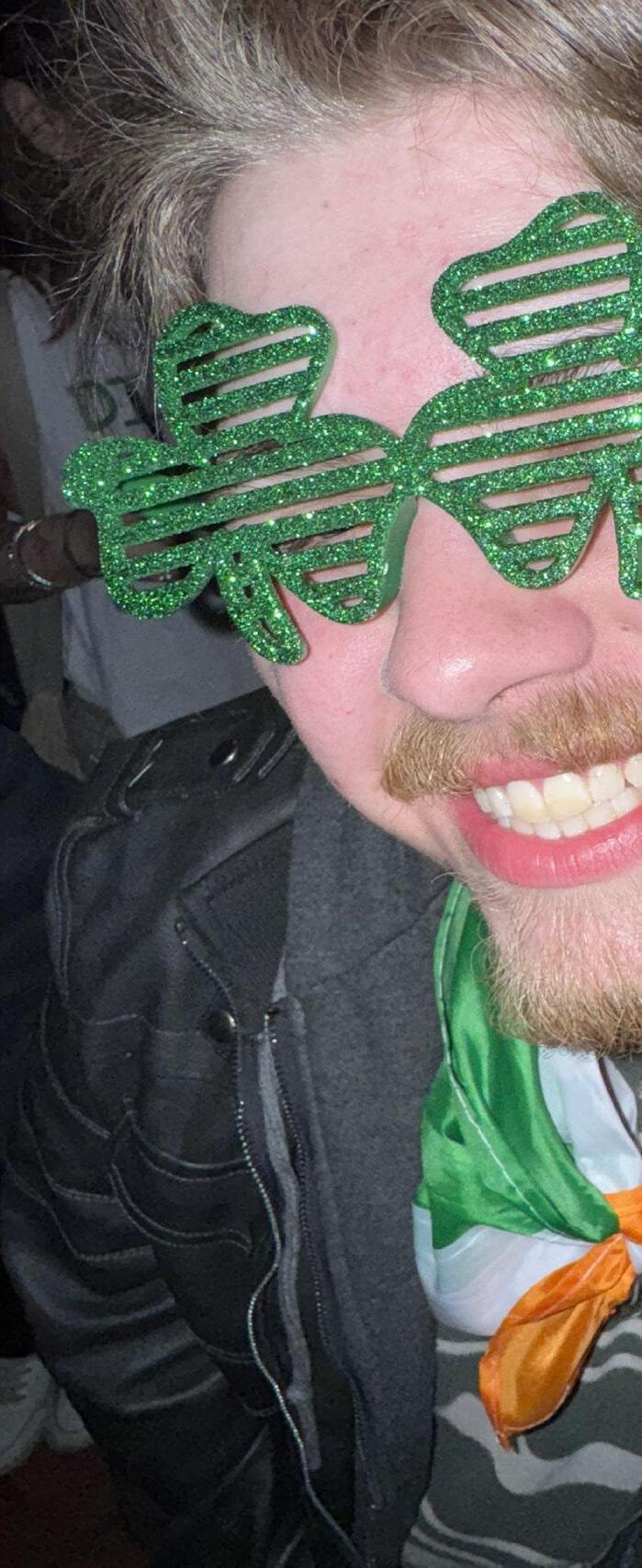
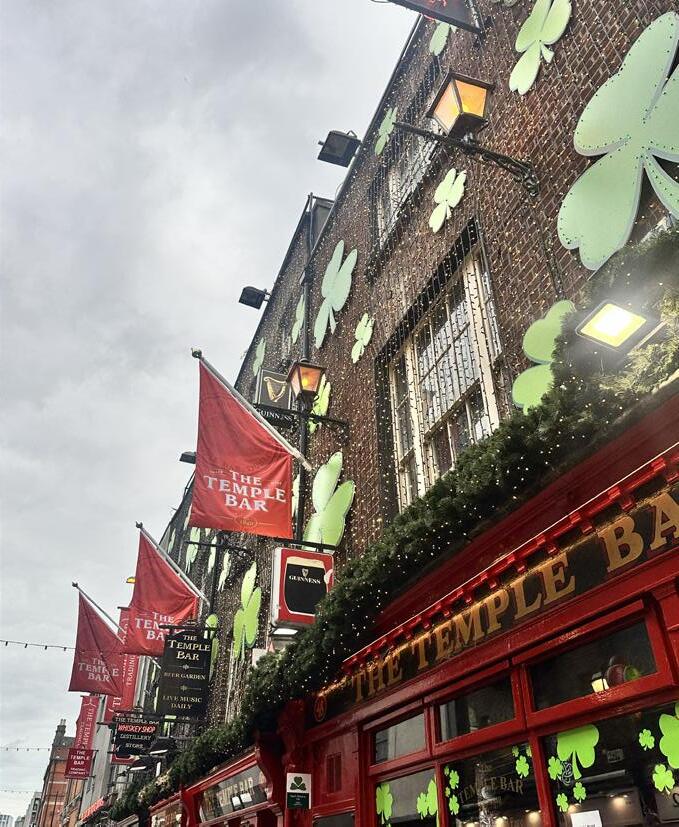
On Jan. 27, 2025, I took the short flight from Nashville to New York, followed by the slightly more strenuous flight to Dublin, Ireland to start my semester abroad at Griffith College.
Studying abroad is something I have wanted to do since I was an underclassman in highschool, but who would have known that, socially, January 2025 would be the perfect time to take a sabbatical from the United States of America.
The first thing to catch my attention upon landing, besides the trademark
Irish rain and the exceptional price for coffee considering I was in an airport, was that this driver transporting our group back to campus immediately started talking about American politics — and the man was well-informed.
The disdain for Donald Trump and Elon Musk that this random driver expressed with such ease to a group of five Americans was impressive — a level of outspokenness that almost feels taboo in the states.
Before leaving, I saw numerous headlines stating “The people of Ireland just named Donald Trump ‘the worst thing to ever come out of America.’” This headline in particular was published in Newsbreak, but the story was widely reported. Now, if I am to see our driver as representative of the wider-Irish opinion of America, this was not a lie.
Every nation, established or not, undeniably faces political corruption at some point, but the extent to which the United States has accepted this as our truth is shocking to citizens far beyond our borders.
Anecdote time! One prime example of how Ireland, and from what I
can see the EU at large, sees the U.S. was when I left my ID in my dorm on the way to the bar. Upon realizing, I hung back with the one other person in our group who left their ID and pulled up a picture of my passport, all while the bouncer said “they’re all Americans… unfortunately.”
As it goes, I agreed. I mean, I have never felt less fortunate to be an American, afterall. The bouncer looked at my photo, the best I could provide, and said “I would have to just take your word on it, and I don’t take peoples’ word. I don’t take Trump’s word.”
“Oh, trust us, neither do we,” I replied. “Why the hell do you think we’re here?” And like that, we were in. It was that simple.
At this point, as an American, the best way to acclimate is to simply prove your moral compass and acknowledge, despite our nation’s bigoted chaos through our exclusionary rhetoric, we do not all fall into that hateful routine.
When travelling abroad, be willing to learn, show care for the world around you and the people who fill it and put your pride to the side, If you can do that, you will be set to explore the world.
The Beach With Friends
Story by
Rehannah Bartley
The cold, sterile study room quickly changed ambiance with the faint smell of Taco Bell as civil engineering major Noah Simon walked into the study room, complaining about the price of his lunch. Settling into a chair, he opened his laptop and pulled up ChatGPT, working through physics formulas between bites. For Noah, artificial intelligence isn’t just an answer machine. It’s a tutor, breaking down complex steps into manageable explanations.
Across campus, music education junior Nathan Wilkins had a different perspective. Interviewed in a dorm room, he spun restlessly in a swivel chair, the squeak of its wheels punctuating his words. Nathan had used AI for music definitions, only to discover mistakes. “To me, it’s like every piece of technology,” he said. “It can polish a project, but it can also be used to lie, plagiarize, and steal someone’s hard work.”
Not every interview was face-to-face. Animal Science junior Sarah Garton typed her responses and emailed them, the faint clatter of keys bridging the distance. She described AI as helpful when used carefully but admitted she worries it is too often a crutch.
Senior interdisciplinary studies major Abby Mynatt arrived late after getting lost in the library. She spoke confidently but occasionally glanced at her phone to answer emails. Abby said she uses AI sparingly, mainly to summarize notes. She called it unreliable after it gave her incorrect information about a novel.
Together, these four Tennessee Tech students, from engineering, animal science, music education, and library science, describe both the promise and pitfalls of AI in higher education.
Layout by Stephen Kleiss
A Helpful Hand
For Sarah, AI made a tangible difference in a class project. She uploaded her proposal and rubric into ChatGPT and asked for feedback. The suggestions helped her revise. “I ended up getting an A in the class,” she said. Noah shared a similar story. “It just helps me understand how to get the proper solution rather than just telling me the answer,” he said.
Even Abby, who rarely turns to AI, admitted it had its uses. “Always ensure you are using it as a supplementary material and not a primary source,” she said.
Risks and Concerns
Each student also pointed to downsides. Nathan recalled wrong definitions. Abby said general summaries sometimes contained errors or wrong information altogether.
Sarah worried about academic value. “If people are solely relying on AI and not learning anything, then a college degree will tell them nothing to future job recruiters,” she said.
Nathan emphasized the impact on younger students. “It needs to have limited use in school, and children need to be taught how to use it properly,” he said.
Noah looked toward the workplace. “When people use it for answers and not to learn, it will disrupt what they know in the workplace,” he said.
ARTIFICIAL INTELLIGENCE: TOOL OR CRUTCH?
Photos provided by Pixabay
Rules and Responsibility
At Tennessee Tech, the use of generative AI is guided by Policy 220, which requires faculty to establish how AI may be used in their courses. Options range from a complete ban to open use with attribution. Students are responsible for disclosing any AI assistance and ensuring academic integrity. The students said this flexible approach mirrors their classroom experiences. “Every class has its own AI policy,” Nathan said. “Most professors don’t allow it at all, while others incorporate it into specific assignments.”
Sarah supported leaving decisions to professors. Abby compared AI to Wikipedia: a resource worth checking. but not a final authority.
Noah agreed but added a caveat. “I agree it should be punishable if used to cheat,” he said.
Looking
Ahead
When asked about the future, students answered based on their fields. Nathan said music should stay humancentered. “I wish it will never be able to make its own music,” he said. Sarah predicted that education would change more than her field. Abby expected little change in library science. Noah laughed at the thought of AI in engineering. “Do you think it can design a bridge? I feel safe in civil engineering, but something like Comp Sci (computer science) might be in trouble.”
A Balancing Act
Despite their differences, the four students agreed on one thing: AI cannot replace real learning.
“You can use it for the groundwork, but don’t use it for the entirety of what you do,” Nathan explained.
Noah put it more bluntly. “Don’t use it to cheat; use it to help you learn, bro.” For these students, AI is neither savior nor villain. It is exactly what its users make of it: a tool, a crutch, or sometimes both. The challenge ahead is learning how to keep it balanced.
ChatGPT is the product of Open AI, the largest AI company in the United States. ChatGPT was first released in 2022, however has been improved with multiple new models.
Survivng Arrow
ucked away in the far reaches of Arnold Air Force Base lies a a few acres of land designated “Camp Arrowhead.” Leased to the Boy Scouts of America by the base for $1 a year, the area has been in use by local Scout units for many decades. The camp consists of an open field, an amphitheater overlooking Wood’s Reservoir, a humble chapel, a pair of pavilions and a string of primitive campsites that wraps around the grounds.
While it had grown increasingly derelict through the early 2000s, the Elk River district had taken the initiative sometime in 2016 to return Arrowhead to its former glory. Many youth and adults alike carried out service projects with Arrowhead as the beneficiary, and the district leaders made a bi-yearly commitment to spend a Saturday main-
taining the grounds, which continues to this day.
Come COVID-19 in 2020, the Elk River District was uniquely prepared when all the state’s main camps were shut down. Most districts ceased operations for the year, suffering detriments to their membership that haven’t since been recuperated in some cases. Elk River, however, turned to Arrowhead, and put on their own camp with support of local businesses and the Sherrif’s Department. Demonstrations ranged from Beekeepers teaching Scouts about bees and honey, to Barett showing off some of their .50 caliber rifles — just in case the bees got out of hand.
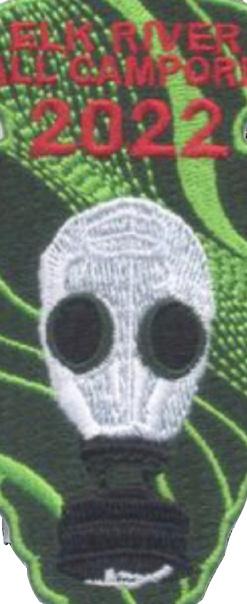
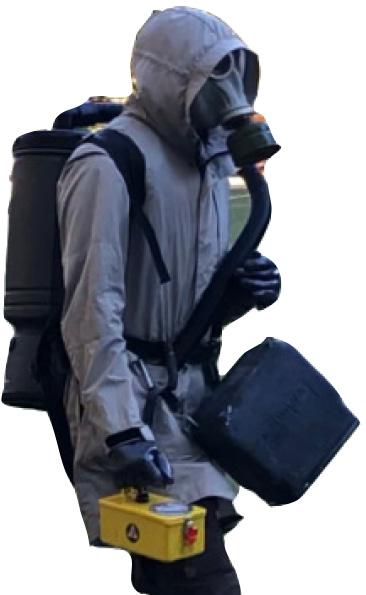
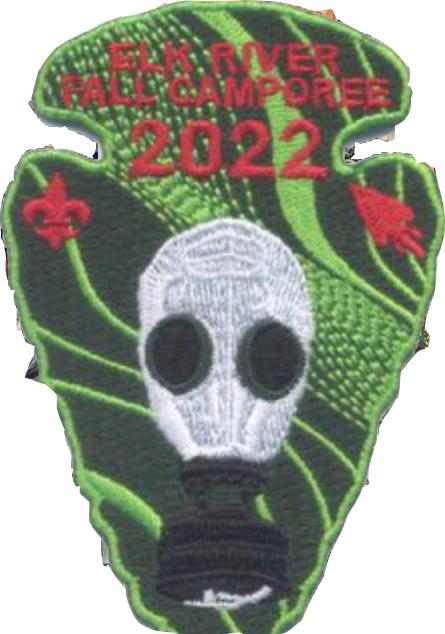
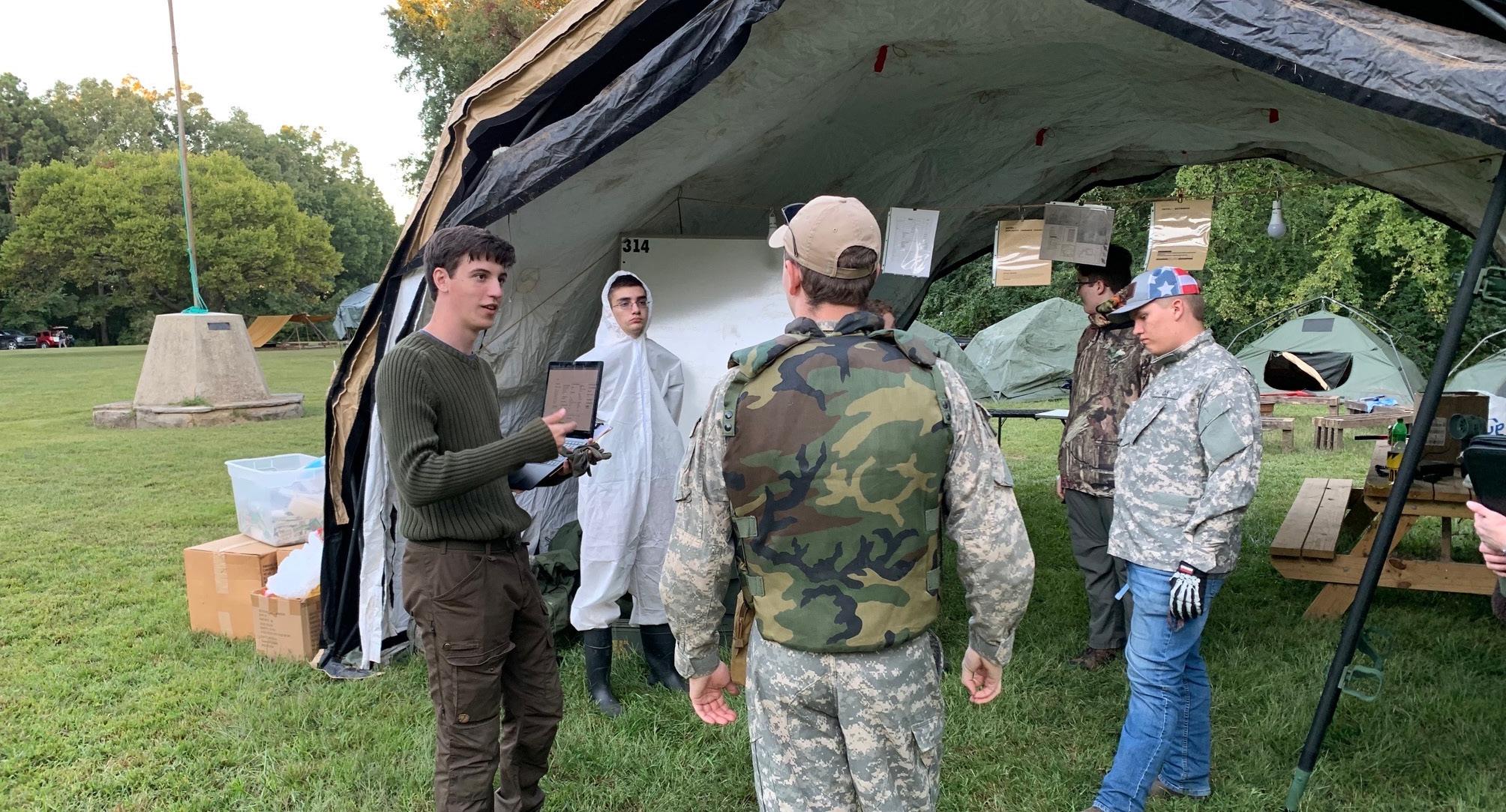
Now the year is divvied into three events: A Winter camp, a Spring camp, and a Fall camp, the latter of which is put on by the Order of the Arrow, Scouting’s national honor society. In 2022, I was serving my tenure as the Elk River OA Chapter Chief and had made my way to Arrowhead to begin setting up for the Fall camp. “Outpost Arrowhead” is what I had dubbed the apocalypse-themed event, and I had prepared a schedule full of stations covering the many skills needed to survive doomsday, each taught by experts in their respective field. I arrived to unlock the gates at noon, and once I unloaded my gear, I moved my car to the pavilion. I was anxious because
Story and Photos by Ethan Beaty
Layout by Meredith Woolson
Camp Head
I still had a sizeable chore-list to work through before hundreds of eager Scouts would be rounded up for the opening program — all of them wondering if the event would live up to the
I rounded the corner and saw a figure examining the label on one of the props I had made for the event.
hype I had amassed with my ambitious promotions. I sat on the hood of my car and surveyed the desolate field, knowing my lonely bivy would soon be encompassed in a motley herd of tents. I was content basking in the sun for a minute, so I took the opportunity to
make a few calls to certify that all was going to plan. Unfortunately, I was about to face a problem I never would have accounted for.
While I was on the phone, a car had pulled into the camp and slowly crept its way around the perimeter, crawling to a stop just past the tree line. I decided to go see if they needed me to point them toward somewhere particular, so I strolled to the car while maintaining my conversation about porta-potties. I rounded the corner and saw a figure examining the label on one of the props I had made for the event.
It was a large ammo crate, the size
a warning that read: “CAUTION: LIVE MUNITIONS, 80mm ROCKETS”. I began to shout “Hey!” but by the time I had registered what was happening, they had chucked it into the back seat of their car alongside my backpack and flew off down the gravel road, leaving me in a cloud of dust. They had taken everything I brought, except a single manilla folder that was tucked into the grass. It was the Sunday service I had prepared. The bottom of a page peeked out from the folder:
“If our hope is only in the material things of this world, it can be washed away with a flood, blown away by a tornado, or ripped away by thieves. But if our hope is in our Creator, the One who holds each day in His hand, we can be ready to face whatever tomorrow holds.”
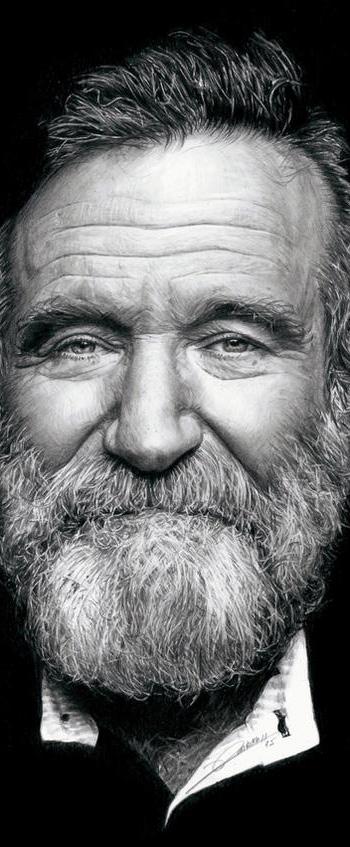
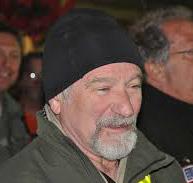
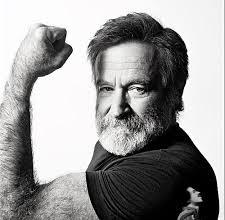
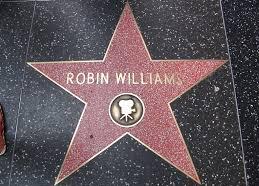
Remembering Robin Williams
Bartley
In a quiet classroom, a teacher climbs onto a desk and tells his students to “look at things differently.”
The moment, immortalized in “Dead Poets Society,” captures what made Robin Williams not just a performer, but a teacher of life. Through humor, heart and humanity, he reminded the world to “carpe diem,” seize the day.
Robin McLaurin Williams, born in Chicago in 1951, built his career on boundless energy and unfiltered imagination. Known for his lightning-fast improvisation and ability to embody dozens of characters in a single breath, Williams’ rise to fame began in the late 1970s sitcom “Mork & Mindy.” His comedic brilliance, marked by physicality and spontaneity, quickly made him a household name, but behind the laughter was a depth that transcended comedy, a compassion that allowed him to touch hearts as easily as he made people laugh.
Williams’ performances carried a rare emotional duality. In “Good Morning, Vietnam (1987),” he in-
fused humor into the darkness of war, humanizing soldiers through laughter. In “Mrs. Doubtfire (1993),” he made audiences laugh while exploring the pain of family separation. And in “Good Will Hunting (1997),” his quiet portrayal of therapist Sean Maguire earned him an Academy Award not just for acting, but for understanding. His characters didn’t simply exist on screen — they comforted, healed and taught.
“He could be in a room of strangers and make everyone feel like they belonged,” comedian Billy Crystal once said of Williams. “That was his gift.”
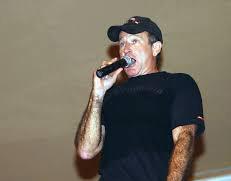
That same gift reached audiences far beyond Hollywood. Williams was deeply involved in humanitarian work, co-hosting Comic Relief with Crystal and Whoopi Goldberg to raise millions for the homeless. He regularly visited U.S. troops stationed overseas, performing stand-up routines that brought moments of joy to those serving in conflict zones. His laughter had purpose — it was a form of service.
Yet, behind the radiant humor, Williams faced lifelong battles with addiction and depression. His openness about those struggles later became one of his most powerful legacies. In
Story by Rehannah
Layout by Brenlee Goins
Photos provided by Google
a culture that often hides pain behind smiles, Williams’ vulnerability invited empathy and understanding. After his passing in 2014, conversations about mental health gained visibility, spurred by the recognition that even the brightest lights can dim in silence.
For many, Robin Williams’ films became more than entertainment. They became personal guides through moments of growth, grief and reflection. For me, that film was “Dead Poets Society.”
I first watched it as a high school student, unsure of my own voice or where I fit in the world. Williams’ character, John Keating, wasn’t just a teacher to his students — he was a reminder that life is too short to live quietly. His words, “No matter what anybody tells you, words and ideas can change the world,” settled deep within me. That film taught me that expression and creativity are not just forms of self-discovery, but acts of courage.
Even now, years later, I think of that classroom scene, students standing on desks in defiance and gratitude, and it moves me. Keating’s lesson wasn’t only for them. It was for all of us who have ever doubted our worth or potential. Through that role, Williams encouraged people like me to write, to speak and to chase what brings meaning to truly “seize the day.”
The enduring power of Dead Poets Society lies in Williams’ ability to merge authenticity with artistry. His performance wasn’t just acting — it was an invitation to live with passion and empathy. It’s rare for an artist to make audiences laugh, cry and reflect all at once, and rarer still to make them better people in the process.
Today, tributes to Williams continue to fill social media every August, the month of his passing. Fans share photos, movie clips, and quotes that once inspired them. The Robin Williams Legacy of Laughter Foundation and similar initiatives work to carry on his spirit through mental health awareness and kindness campaigns. In classrooms, theaters and homes across the world, his voice still echoes, sometimes through laughter, sometimes through tears.
What made Robin Williams a hero wasn’t his fame or his awards, but his empathy. He understood people, their pain, their joy, and their need to be seen. Whether through an animated genie, a heartfelt therapist or a passionate English teacher, he found ways to speak to what it means to be human. His legacy reminds us that laughter is not the opposite of sadness but often its companion, a bridge between struggle and hope.
Williams once said, “Everyone you meet is fighting a battle you know nothing about. Be kind. Always.” That simple philosophy defined his life, and it’s the message he left behind.
In the end, Robin Williams’ story is not just one of talent, but of generosity. His life, full of contradictions and compassion, taught us that being human means embracing both the comedy and the tragedy. And somewhere, in that classroom of imagination and courage, his voice still whispers the words that changed so many lives, including mine: “Carpe diem. Seize the day.”