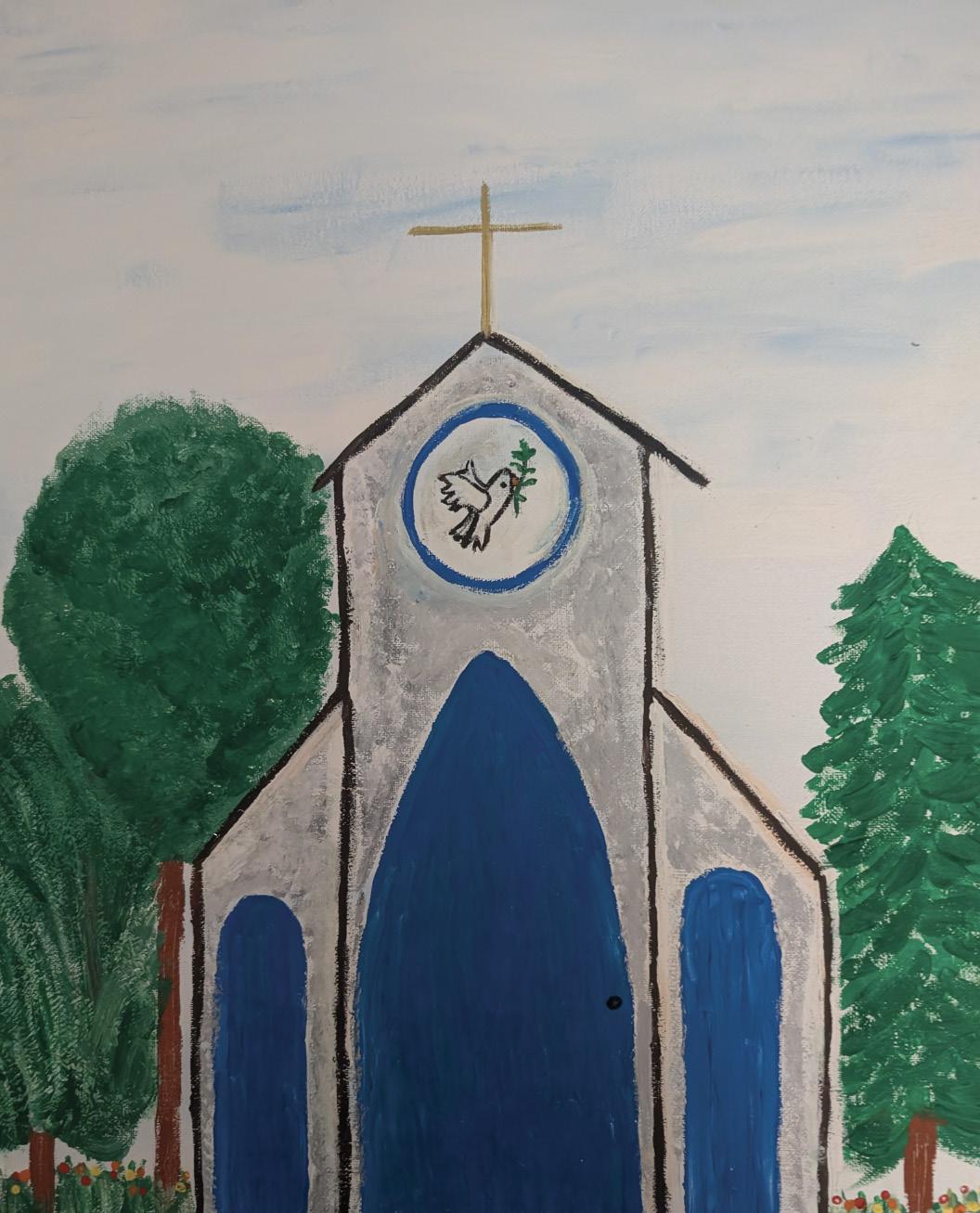
The Eagles Edition focuses on faith in our community and the environment of inclusivity that daily worship fosters. Students from various religions and beliefs talk about their religious experiences attending an Episcopal school, as well as their own spiritual journeys.
EAGLE EDITIoN
02
TEENAGERS LIVING IN WAR ZONES For the teenagers enduring the conflict with Iran, war has shifted from a crisis into what they now describe as a “new normal."
09
LOCAL GEMS Communications manager Annabel Brown explores Klyde Warren Park and all its charm.
11
TREASURED TRADITIONS
Beloved ESD traditions continue to nurture lifelong friendships and a school culture centered around hard work, which will benefit seniors in their next stage in life.
PERFORMERS EARN RECOGNITION
All three leads in the school's production of "Oliver!" secured semifinalist spots in a premier Dallas theatre awards competition.
14 28
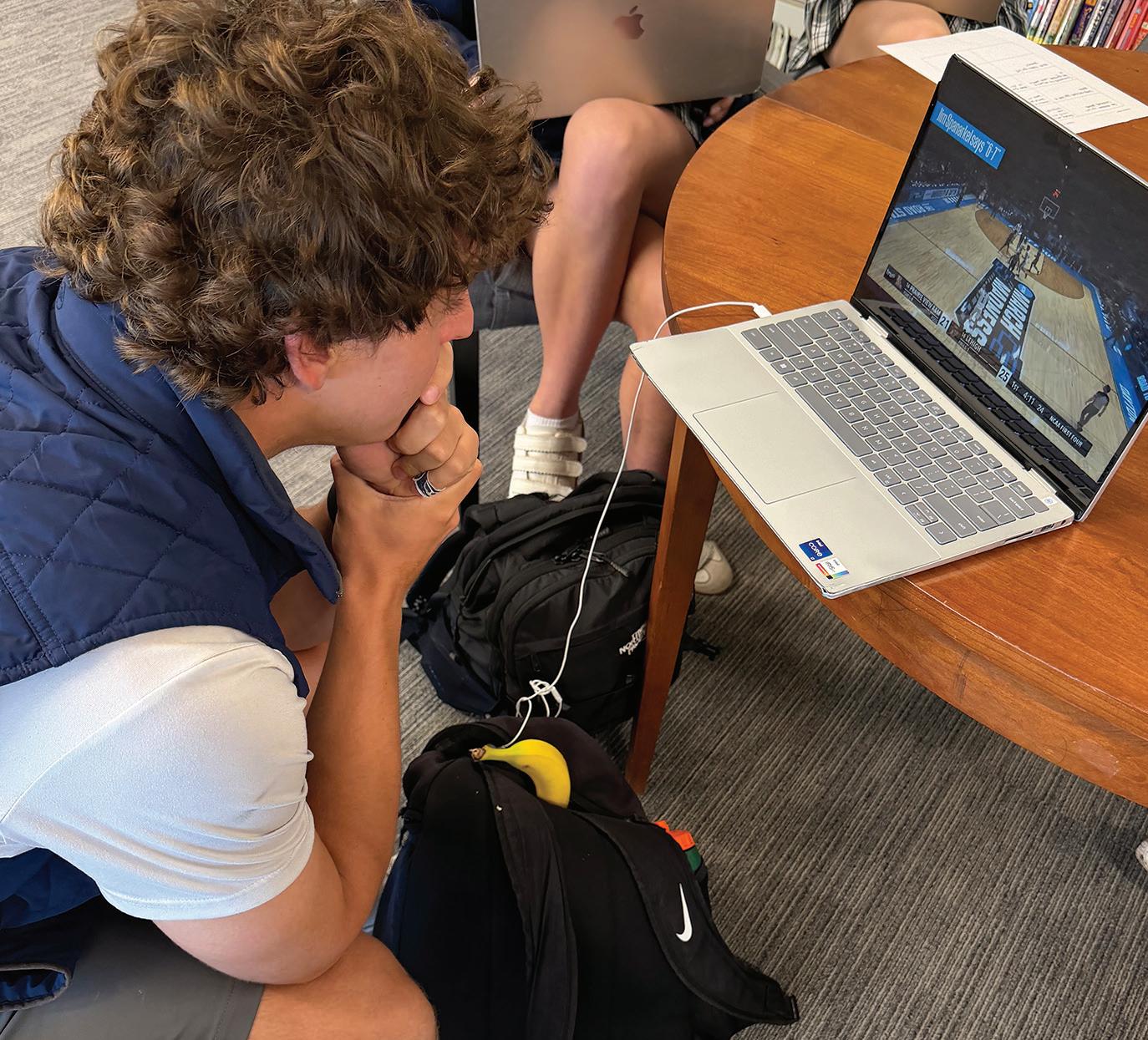
BRACKET CHALLENGE March Madness fueled a competitive spirit throughout the school. Students and faculty embraced the excitement, turning brackets and game predictions into community events.
Illustration by Searcy Mae Ferguson and McCall Moore
A
Middle East conflict engulfs teenagers' lives
The U.S.-Israeli conflict upends the lives of a young generation during crucial developmental moments
By Sheridan Bailey | Web Co-Editor-in-Chief
As American and Israeli forces directed their first airstrikes to Iran on the morning of Feb. 28 with the intention of destroying Iran’s nuclear infrastructures, it ignited a conflict that involved not just political leaders, but teenagers. Teenagers have been directly impacted by this conflict and are persevering and surviving this conflict until there is an official end to the war.
Noor Shamsi*,19, a current student at McGill University in Montreal, was born and raised in Dubai, a city and emirate in the United Arab Emirates. Despite its location, as of recently, Dubai had not been involved in conflicts in the Middle East, until Feb. 28, when the newly formed Iranian government retaliated and directed its hostilities towards the Persian Gulf, striking Dubai, when Shamsi was back visiting for a school break.
“There were some alerts saying, be careful, because there’s tensions happening in the U.S., and 20 minutes after we were watching the news and all of a sudden we hear the sound,” Shamsi said. “It sounds like explosions are happening, like above us, and our house starts vibrating.”
For a seemingly routine weeklong trip returning to Dubai to see her family, her visit turned out to be a multi-week long tenure in the middle of the conflict. The warnings on her phone were soon replaced by the reality of war, as it triggered a survival instinct for Shamsi that invoked an immediate physical response.
“My family and I ran into one room together and just kind of huddled and it was my first time experiencing something like this,” Shamsi said. “My nervous system was so freaked out, I was crying, my sisters were crying, my mom was crying, because again, you’re in a shock.”
Following the U.S.-Israeli “Operation Epic Fury,” the name of this offensive which killed several Iranian leaders, including former Supreme Leader Ayatollah Khomeini, Iran retaliated against Israel, much like its earlier attacks on Dubai, similarly disrupting the lives of Israeli teenagers.
“We can’t go to school; currently, we are studying from Zoom from home,” 16-year-old G.Kafka, who lives in Israel said. “[My friends and I] still meet,
but we have to always be close to a bomb shelter; [however], I see my friends a lot less so it’s more lonely than my day-to-day life at school.”
The impact of war extends far beyond the rubble and the headlines; war often forces a complete economic standstill, as people are required to seek shelter, instead of earning revenue for themselves and their families.
“Every time some war or conflict begins, [people] in the country really come together to help one another, and it helps with the situation,” Kafka said. “There [are] a lot of people struggling financially when there's a war because a lot of businesses can't open [and] people can't go to work.”
"EVERY NIGHT I AM THANKING GOD FOR MY FAMILY’S HEALTH."
Danielle
Dib 18-year-old student and Lebanon resident
Israel borders the south of Lebanon, where Hezbollah is based. Both regions have historically been involved in conflict with other nations and even with each other. Still, teenagers, the ones not making the political decisions, are affected by war, completely altering their lives in some of their most developmentally crucial moments
“It became risky to go out anywhere in the region, and for the first few days I stayed inside,” 18-year-old student and resident of Lebanon, Danielle Dib, said.
“But at some point, you can’t stay [inside] the whole time and life moves on. Lebanese people, they’re really used to war, sadly, so life just continued like nothing happened.”
For this generation of teenagers in Lebanon, conflict is not a distinct moment in time, but a recurring one, as the youth have learned to adapt their everyday lives to the prevalence of war.
“This habit of letting things go and normalizing everything, is not only about war,” Danielle Dib
said. “When you force yourself to get used to normalizing bombs, you can start normalizing other things in your life that shouldn’t be normalized either. It impacts our relationships, it impacts how we deal with things and it goes deeper than that.”
The experiences of living in war for teenagers have a major impact on their mental health.
In a 2025 study on the mental health of teenagers during the Ukraine-Russia War by the School of Occupational Therapy at the Hebrew University in Jerusalem, they found that teenagers in conflict are two and a half times more likely to develop mental health disorders, 35 to 45 percent more likely to experience clinical depression and 29.4 to 70 percent more likely to develop symptoms of post-traumatic stress disorder.
“I try as much as I can to disconnect myself. At first I had a mental breakdown because I was so scared, but then little by little I just built a positive mindset,” 18-year-old Maria Dib, Danielle’s twin sister, said. “I try as much as I can to distract myself because it’s actually really scary to know the amount of things that are happening and that could happen.”
Over a million Southern Lebanese people have been displaced by the war, including hundreds of thousands of children, according to the United Nations. Many are forced to flee their homes with the threat of a bomb being dropped, or when their home had already been destroyed.
“The displaced people are from the seaside, and it was sad to see that we started getting used to seeing [bombs] daily,” Danielle Dib said. “They sleep in tents and cars, and they don’t know if it’s safe to go back or not.”
As the effects of war perpetuate through each aspect of teenagers' lives, it has created a new normal for them; however, it still makes notable impacts on their health.
“Okay it’s our senior year, but more than anything war has affected our reflexes,” Maria Dib said. “Yesterday I heard a sound, and automatically ran to the hallway. It’s the sense of reflexes and fast reflexes for stuff that we shouldn’t be used to.”
Similarly, after leaving Dubai and returning back to university in Canada, Shamsi’s bodily responses to sound had been dramatically altered.
“It’s like flight or fight time that even when I come back to Montreal, it took me three weeks to get used to hearing any noises,” Shamsi said. “Sometimes I'll be in my bed in my dorm, and I’ll hear the garbage bin, it would make a loud noise, and I would physically jump in the air.”
As war became almost a new normal for these teenagers, their mental health reached a low point, causing their relationships with their religion to alter amid the hardships of the conflict.
“Your relationship with your religion grows stronger when you have difficulties because it’s there [for] you [to] remember that you can’t handle it alone,” Maria Dib said. “Everyone’s so preoccupied with their lives, so now with the war, time stops and you have more time for yourself.”
Not only has their religion changed because of the war, but also their relationships have changed as a result of the conflict.
“Every night I am thanking God for my family’s health,” Danielle Dib said. “I know how important my relationships are with other people, we are paying more attention to connections, asking, ‘Are you okay?’ ‘Are you safe?’”
For Shamsi, living in Dubai amidst the conflict was a life altering experience; however, it is also an experience that many teenagers have been experiencing their whole lives. As Maria and Danielle Dib described it, their parents' generation of Lebanese people have already lived through four wars.
“I'll see videos about what's happening in places like Lebanon or Syria or Palestine, or like all these places online, and I feel horrible for them,” Danielle Dib said. “But you don't really understand what they're going through, because you can't.”
It was not just religion alone that helped Shamsi through the war, it was individuals like Danielle and Maria Dib that helped motivate her through her few weeks of terror.
“You’re only experiencing a fraction of what these people have been experiencing all their life,” Shamsi said “And if they can still have a smile on their face, and if they can still get up the next day, and try to live their life, you have to do the same.”
*Name changed to protect the source's identity.
THE AFTER-SCHOOL DRIVE
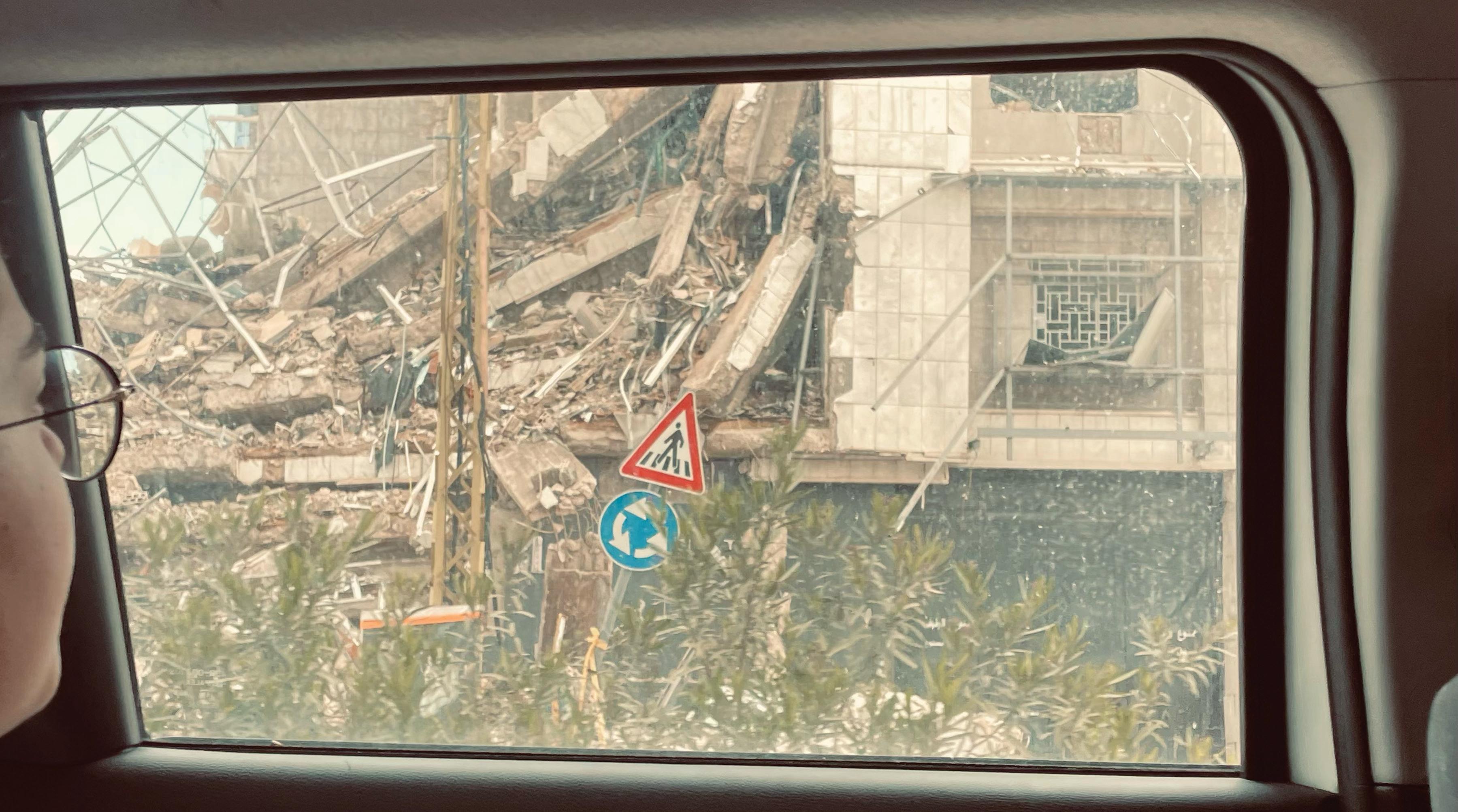
Following years of conflict and airstrikes, teenagers Danielle and Maria Dib find few buildings still standing on their way home from school in early May in Beirut, Lebanon. "It's definitely shocking, and it is sad to see.
We started to get used to seeing this daily," Danielle Dib said."It's actually so sad to think it's normal for us [and] the way we've gotten used to it."
Photo by Danielle Dib
The aerospace engineering class followed NASA's Artemis II mission and learned about it in real time.
CAPITAL JOURNAL
TTrump moves away from renewable forms of energy, causing turmoil among Americans. On Jan. 20, 2025, The White House, under President Donald Trump's “Unleashing American Energy” policy, published agendas that included removing the electric vehicle mandate and terminating the Green New Deal, an initiative aimed at fighting climate change while creating high-wage jobs.
The agenda also included expanding access to federal land for oil and gas resources, reducing the regulations involved.
“America is blessed with an abundance of energy and natural resources that have historically powered our Nation’s economic prosperity,”
The White House published on its website on January, 20, 2025. “Burdensome and ideologically motivated regulations have impeded the development of these resources, limited the generation of reliable and affordable electricity, reduced job creation, and inflicted high energy costs upon our citizens.”
According to data from the U.S. Energy Information Administration, fossil fuels account for roughly 80 percent of total U.S. energy consumption, with petroleum, natural gas and coal remaining the big three. At the same time, renewable energy sources such as wind and solar have grown rapidly and now account for about 20 percent of electricity generation.
These changes have created mixed reactions from students and faculty.
“Since there are very strong opinions regarding this subject, the fact that I can state is that there has been a funding shift from renewables to nonrenewables,” AP Environmental Science teacher John Gallo said.
The Department of Energy published data saying that the Federal Government has invested $97 billion into new,
sees the issue on a larger level, comparing energy strategies to financial investments.
“My personal opinion is that, similar to financial investments, diversity is good,” Gallo said. “It seems to me that having a diverse portfolio of energy resources [nonrenewables and renewables] is a good way to go.”
Members of the Environmental Awareness Club were concerned that the changes in policy will slow momentum in the renewable energy sector. Club leader senior Chambers Jones said continued investment in renewable energy is important for long-term sustainability.
“I think renewable forms of energy are something we should keep building on because they’re becoming more efficient,” Jones said. “I get why people want to keep fossil fuels for reliability, but it feels like a step back if we lower support for cleaner options.”
Jones believes growth in solar and wind energy shows progress. According to the International Energy Agency, solar power has become one of the fastest-growing sources of electricity worldwide. Costs have dropped more than 80 percent over the past decade.
Despite the growth in renewable forms of energy, fossil fuels still remain a primary source of energy to the U.S. economy. In May of 2023, the American Petroleum Institute published that the oil and natural gas industry supported millions of jobs and contributed significantly to GDP. Supporters of policy changes argue that expanding domestic production can strengthen economic stability and reduce dependence on foreign energy sources.
Junior William Elliot believes those economic factors are an important part of the conversation.
“I think people focus a lot on the environment, which definitely matters, but energy is also about easy access,” Elliot said. “Fossil fuels are still what the country runs on, and
historically been a major factor in policy decisions. Changes in oil and gas markets can affect anything from transportation costs to household bills.
Advocates for increased drilling argue that boosting domestic supply can help create stability among prices.
“HAVING INTEREST IN ALL RESOURCES WILL PUSH THE TECHNOLOGY IN EACH FORWARD, WHICH [IS NEVER] A BAD THING. THE MORE WE KNOW AND UNDERSTAND, THE MORE INFORMED AND BETTER OUR DECISIONS CAN BE IN THE FUTURE.
John Gallo Upper school science teacher
At the same time, renewable energy supporters argue that long-term investment in clean energy will reduce costs over time. In a Scientific American article written by Benjamin Storrow in January of 2025, wind and solar projects, once built, have lower operating costs compared with fossil fuel plants, since they do not rely on fuel purchases. According to a study published by the Environmental Protection Agency in 2024, the impact of energy production also remains a key issue. Fossil fuels are the largest source of greenhouse gas emissions in the United States. These emissions contribute to climate change, which scientists link to rising
are part of why she believes renewable energy should remain a priority.
“It’s more so about what happens in the future,” Jones said. “But, if we already have the technology to start reducing emissions, it makes sense to keep pushing towards that.”
The American Meteorology Society published in 2024 on their website that transitioning to renewable energy is challenging due to solar and wind energy being heavily dependent on weather conditions. This makes a less consistent energy supply that relies on storage systems that are costly and limited in more rural areas. Elliot said those limitations are part of why he supports a more gradual shift.
“I think we should improve renewables, but they’re not perfect yet,” Elliot said. “Until they can fully replace fossil fuels, it makes sense to keep using what works.”
According to a study published by the U.S. Energy Information Administration, the U.S. is the largest energy producer worldwide, producing 103.3 quads in 2024. Since 2019, The U.S. has been a net total energy exporter, meaning that our total energy exports have been higher than imports.
According to the website USA Facts, the U.S. does not rely on foreign renewable energy exports, making them less reliant on the global supply chain that comes with foreign oil imports.
“Having interest in all resources will push the technology forward, which [is never] a bad thing,” Gallo said. “The more we know and understand, the more informed and better our decisions can be in the future.”
For students and faculty following the issue, the discussion goes beyond politics and into everyday life.
“Everyone uses energy, so it affects everyone,” Jones said. “That’s why it’s something people should pay attention to.”
Changes in federal energy policy spark debate about long term effects
By Moss Barron | Distribution Manager
Illustration by Josephine Holmes
Iran hits U.S. bases, shakes Gulf
Iran
fires counter attacks on U.S. military bases, disrupting region economies and daily life
By Veda Bodhanampati | Arts Editor
On Feb. 28, the Islamic Republic of Iran launched missile strikes and drones targeting United States military assets across several Gulf Cooperation Council countries, including Bahrain, Kuwait, the UAE, Saudi Arabia, Oman and Qatar, in retaliation for that day’s American-Israeli assassination of the former Supreme Leader of the Islamic Republic of Iran, Ruhollah Khomeini.
Chief Cargo Officer of Qatar Airways, Mark Drusch P’27, was in Doha during the first attacks and said life remained the same for all residents.
“The missiles struck, we all heard them and some of us saw them outside, and then people just went back to their normal lives,” Drusch said. “You would never know that anything had happened. Cars and food delivery services were out all over the place.
For the population outside of the Middle East, the effects of the missile attacks were dramatized in the media.
“I know that the media back here and in general made it sound very scary, and it definitely is,” Drusch said. “The difference is that all the missiles were intercepted, so there was no damage, and not many were hurt in Doha.”
While countries like Qatar were not affected by the strikes, some countries suffered significant casualties and disruptions. The U.S-Israeli and Iranian attacks have accounted for an estimated 4,112 to 7,312 human casualties in the GCC, Israel, Lebanon, Gaza, Syria, Iraq and Jordan. According to Al Jazeera, in retaliation for the Iranian missile attacks, Israel bombed southern Lebanon, which currently suffers from the most deaths of 2,618 recorded as of May 3.
“I have family and friends along with brothers and their wives [in Lebanon],” middle school French teacher Joumana Arraj said. “The war has affected them in different shapes and forms, with different parties. I am very faithful. I know that Lebanon has lived through a lot of wars, invasions and troubles, and it will always stay. This war is happening in Lebanon, but it is a war between Iran and her proxies and Israel.”
Iran’s attacks have impacted some countries less, partly due to their historically closer diplomatic ties with Iran.
“Qatar has been the least impacted because the Iranians have a different relationship with Qatar than the rest of the GCC,” Drusch said. “Qatar historically has operated as a mediator for events in the Middle East, such as Iranian tensions with the US and the EU. The Iranians have been much less willing to attack Qatar.”
Along with the lives lost,
Iran’s intent for attacks on the Middle East has also aimed to weaken regional economies, major corporations and U.S. military bases in the Middle East. A significant share of the Middle East’s exports is crude oil, affecting trade with countries across Eurasia and the Americas. Jet fuel prices have doubled, economically pressuring airlines globally, according to Thomson Reuters.
“Crude oil is an important commodity [for] a firm or corporation to buy to make other products, and it goes into almost every plastic in the world, and the vast majority of our energy consumption,” upper school history and religion teacher Travis Gilmore said. “It is so important that when you start affecting the supply of it and the price, you see a ripple effect throughout industries and goods that people buy. The Middle East is the world's largest resource and reservoir of crude oil.”
There are roughly 20 U.S. military bases in the Middle East, along with 40,000 to 50,000 military troops deployed in the region. Iran has damaged 17 military, diplomatic and air bases, with 13 becoming completely unusable, according to the Council on Foreign Relations and Truthout.
“We have the Fifth Fleet based in Bahrain,” Drusch said. “We've got major air bases in Qatar, the UAE, Saudi Arabia, Kuwait and all over the place. They also attacked all the military bases in the US.”
According to Arab Weekly, for Qatar Airways, 91 percent of its flights have been canceled since the start of the Iranian strikes.
“The minute the missile struck, we shut down all of our flights at the airport,” Drusch said. “Qatar Airways is a major international carrier, particularly between Europe and the Americas, to the Middle East, the subcontinent, Southeast Asia, Africa and Australia. It was a very significant international disruption when we shut down our hub in Doha.”
As of May 3, Iran offered to end its blockade of the Strait of Hormuz, which was closed to U.S-Israeli allies, to secure the lifting of the U.S. naval blockade, with Pakistan acting as the main mediator between Iran and the U.S, according to The Guardian and The Washington Post.
The United States continuing its involvement in the war or choosing to back away from the war depends on the citizens of the United States.
“People do vote with their pocketbooks, and it very much matters when it starts affecting their everyday lives,” Gilmore said. “Beyond the moral implications of any war and what that brings, it could be a long war only if people in the United States have the appetite for it, and the leaders have the appetite for it and only so far as the people are willing to accept it.”
With global conflicts and attacks, inhumane tendencies can emerge, causing people to forget their shared humanity. The people have the power to foster growth out of war and become more interconnected humans, according to research published by professor Joseph Henrich at British Columbia and economist Michael Bauer at Charles University in the Psychological Science.
“There's a fight between the war lovers and peace lovers, civilizations, religions and orientations,” Arraj said. I hope humans will extend each other some grace, empathy and love. Don't put oil, gas, dollars, ideologies and religion before humans. Look at the human and then work together for peace. Conflict has always been and will always be, but let’s lessen the conflicts.”
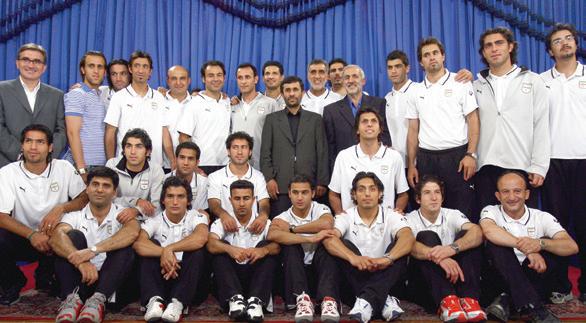
Iranian Football Federation president Mehdi Taj stated that FIFA must guarantee the respectful treatment of Iran and the Islamic Revolutionary Guard Corps before Iran’s national team can travel to the United States for the 2026 World Cup, according to NBC News. The comments came after an Iranian delegation was denied entry to Canada while attempting to attend the FIFA Congress in Vancouver. Canadian officials later confirmed that Taj’s visa had been canceled because of alleged ties to the IRGC, which both Canada and the U.S. classify as a terrorist organization. Iran is scheduled to play World Cup group-stage matches in Los Angeles and Seattle during the tournament, which will be jointly hosted by the United States, Canada and Mexico. U.S. officials said Iranian players are welcome to compete, but individuals connected to the IRGC will not be granted entry. The situation highlights growing tensions between international sports organizations and Iranian political factions.
President Donald Trump traveled to China on May 12 for a high-profile meeting with Chinese President Xi Jinping, according to CBS News. The summit is expected to focus mainly on trade relations between the United States and China, but other major issues include ongoing tensions involving Iran, energy security in the Persian Gulf and conflict over Taiwan. CBS also said that Trump claimed that both leaders would discuss Taiwan and U.S. military support for the island, which China claims as its own territory. The meeting comes at an important time for global politics, because the U.S. and China continue competing economically and strategically. Experts say both countries want to maintain stable relations while avoiding direct conflict. The summit could influence future trade agreements, global energy markets, and security in East Asia, especially as Taiwan remains a key point of tension between the two superpowers.
“Tiny ‘Mini-Pluto’ with Atmosphere Discovered Beyond Neptune.” Sky News, 5 May 2026, news.sky.com.
According to an article by Sky News, scientists have discovered an icy, minor planet beyond Neptune that appears to have its own atmosphere, something previously only confirmed on Pluto in that distant region of space. The object, officially named (612533) 2002 XV93, is about 310 miles wide, making it far smaller than Pluto. Researchers claim its atmosphere is extremely thin and may contain methane, nitrogen or carbon monoxide gases. The discovery was published in the journal Nature Astronomy and has surprised scientists, as small icy worlds were not expected to hold atmospheres due to their weak gravity. Researchers believe the atmosphere could be maintained by cryovolcanism, a type of icy volcanic activity that releases gases from beneath the surface. The finding changes how experts understand small objects in the outer solar system, suggesting they may be more active than previously believed.
were taking place on May 6 from a
with a
and
According to an article by CNN, the World Health Organization is monitoring a Hantavirus outbreak connected to the cruise ship MV Hondius after multiple passengers became seriously ill during an expedition voyage. Five confirmed infections have been identified so far, and three passengers, including a Dutch couple and a German national, have died. Health officials across several countries are tracing passengers and monitoring possible exposures as travelers return home from the ship. The outbreak is believed to involve the rare Andes strain of Hantavirus, which can sometimes spread between humans through close contact. Passengers from countries including the Netherlands, the United Kingdom, the United States, Singapore, Canada, Switzerland and South Africa are being tested or monitored for symptoms. Although the WHO expects additional cases, officials emphasized that there is currently no evidence of a large-scale epidemic similar to COVID-19. The article states that researchers believe the original infections may have occurred during sightseeing trips in Argentina before passengers boarded the ship.
IRAN DEMANDS REASSURANCE IN SIGHT OF THE '26 WORLD CUP
TRUMP TO MEET WITH XI JINPING IN CHINA
SCIENTISTS DISCOVER NEW "MINI-PLUTO"
U.S. President Donald Trump, left, talks to China's President Xi Jinping as they shake hands after their talks at the Gimhae Air Base, located next to the Gimhae International Airport in Busan on Oct. 30, 2025. (Andrew Caballero-Reynolds/AFP/ Getty Images/TNS)
Iran's President Mahmoud Ahmadinejad (center) poses with Iran's Football Federation Chief Mohammad Ali Dadkan and the Iranian national football team players prior to their departure to Germany to participate in the World Cup 2006 finals, in Tehran, Iran, on June 3, 2006. (Ghaedi/ ParsPix/KRT)
Image of Pluto from NASA New Horizons' Long Range Reconnaissance Imager. Photo from Nasa.gov
HANTAVIRUS SCARE
Evacuations
cruise ship stricken
deadly outbreak of Hantavirus Three people, two crew members
one other person, thought to be infected with the virus were being taken off the MV Hondius, anchored off Cape Verde in Africa. Photo by (AFP/ Getty Images/TNS
Battle of Bombs
A building is damaged after an Israeli airstrike attacked Beirut, southern Lebanon, on March 10, 2026. Lebanon was hit after the Iranian-backed Hezbollah attacked Israel.
Photo by Ibrahim Amro/AFP via Getty Images/TNS
Spring break trip for Alabama student takes a turn for the worse
The last time 20-year-old James Paul “Jimmy” Gracey, a junior at the University of Alabama, was seen was on March 17 at 3 a.m. He was last seen at a nightclub in Barcelona, Spain with his friends on a spring break trip when his vacation took a turn.
From Elmhurst, Illinois, Gracey was an active member of the Theta Chi fraternity, acting as the chapter chaplain and philanthropy chairman. He was the oldest of his five siblings, an honors student in Alabama’s accounting program and a hockey player.
Vaughn Langston ’25, who is currently a freshman majoring in business at the University of Alabama, said the student’s death was felt around campus.
“I never knew Jimmy personally,” Langston said. “I can’t speak for other communities, but every fraternity house did something on their front lawn to honor Jimmy and his family.”
Gracey was reported missing by his family on March 18. When his parents noticed he hadn’t been checking in on them, they suspected something was wrong.
According to WRBC News, the Fox affiliate in Birmingham, Alabama, his body was found by divers near Barcelona’s Somorrostro Beach at Port Olímpic two days after his disappearance. It was bruised from sea rocks that repeatedly struck him as he drowned. Spanish authorities confirmed that Gracey’s death was an accidental drowning.
Former ESD student Dean Kamhi, who is now a freshman in high school and is currently living in Barcelona, lives 18 minutes away from Somorrostro Beach, where
the accident took place.
“There [are] lifeguard stands, and [designated] swimming areas, but I’ve never seen a lifeguard,” Kamhi said. “There’s one person swimming always that’s like 70 [years old].”
According to NewsNation. com, a NexStar Media Group news network, Gracey disappeared after visiting the waterfront Shoko restaurant and nightclub in the Villa Olimpica area on Barceloneta Beach, a popular tourist spot. He was seen leaving with another individual.
WRBC News wrote in an article on March 25, that Gracey’s roommates told police that Gracey didn’t make it back to their shared Airbnb the night of March 17.
Footage from the Barcelona Police Department shows that, initially, Gracey was talking with someone after leaving the nightclub, but when he approached the sea, he was seen alone. Giselle Macedo, a journalist with El Periódico de Catalunya, said to the Bell Radio Corporation of Birmingham, Alabama, that the autopsy confirmed that he had died from drowning, but it was deemed a total accident.
On March 17, while Spanish police were arresting an unrelated individual, they recovered Gracey’s phone, which had been stolen. A few days later, his wallet was discovered in the water.
Middle school Spanish teacher Francisco Amparan said that he heard about Gracey’s case on the radio.
“They just said something like that for about two [or] three minutes, and it was all because they were talking about Spring Break,” Amparan said. “They were talking about people staying in
Cancún [and] Florida, and all the things that were happening.”
Amparan was one of the teachers who took ESD students to Spain last summer. While this was a school trip and can’t be compared to a spring break vacation for a college student, he said that ESD took several safety precautions on the trip.
"I CAN’T SPEAK FOR OTHER COMMUNITIES, BUT EVERY FRATERNITY HOUSE DID SOMETHING ON THEIR FRONT LAWN TO HONOR JIMMY AND HIS FAMILY."
Vaughn Langston ESD '25
“Number one, stay with the group all the time,” Amparan said. “Number two, before the trip, we have several meetings, especially with security over here, and they tell us a lot of things. We divide the [students] into small groups, and then each teacher [takes care] of their five [or] six students all the time. Number three, if we are using public transportation, we have to be very vigilant with our possessions, wallet [and] cell phones… so we have to be paying close attention, especially [when]
we're using public transportation.”
Amparan emphasized the importance of the group staying together at all times, especially at nighttime.
“This is our strong recommendation: stay with the group,” Amparan said. “Nobody stays behind by themselves… Do not leave the hotel. It doesn't matter [if] they have money for Uber or Bolt or any of those things if they are hungry, because they always are hungry … We will order some pizza. We will order something for them.”
Cavin McClay, the president of the Theta Chi fraternity, said in an interview that Gracey’s friends will remember him as a “Warrior of Christ,” spreading love and joy wherever he went. He was a responsible role model and lived a life spreading the love of the Lord.
An Instagram statement posted by The University of Alabama on March 19 said that the community was heartbroken to learn of the death of Jimmy Gracey. They also asked to respect the family's privacy as they grieved.
In a story published on March 24 by Eye Witness News, the ABC News affiliate in Chicago, Jimmy Gracey’s friends and fraternity brothers gathered in Tuscaloosa, Alabama, on March 23 for a memorial to honor and pray for him.
“Gracey's Theta Chi fraternity brothers and Bama Catholic organized the service at St. Francis of Assisi University Parish on Alabama's campus,” ABC News said. “Organizers said they ran out of printed programs to hand out and had to create a virtual version on the spot. Some feel that goes to show how much Gracey meant to this community.”
James "Jimmy" Gracey drowns near Somorrostro Beach in Barcelona
By Lola Bonfield and Phoebe Meng | Staff Writers
HALLWAY
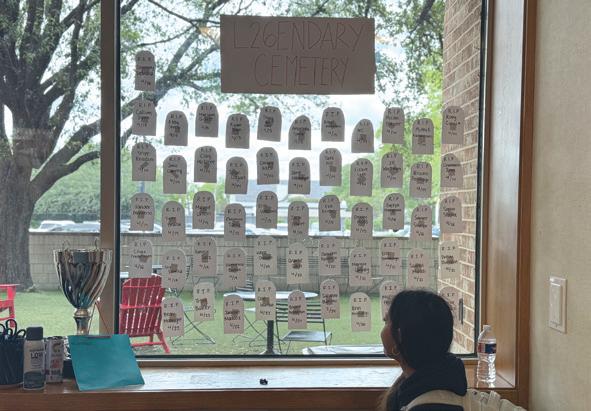
On April 13, the senior class began their annual Senior Assassin game tradition, a popular off-campus game. After participants paid a $20 entry fee to join, they were assigned a target and used the provided water guns to kick out other students in order to win a cash prize. Many of the seniors began planning their strategies early.
“I talked to my parents a lot, and my plan is [to] just to not leave the house. I feel like unless I'm going to get someone, there's no need to,” senior Courtney Del-Cid said.
This year, juniors Kate Lewis, Madison Stiles and Betty Wheeler coordinated Senior Assassin.
“Working together, especially when we’re organizing things, really continues to grow my trust in them,” Lewis said.
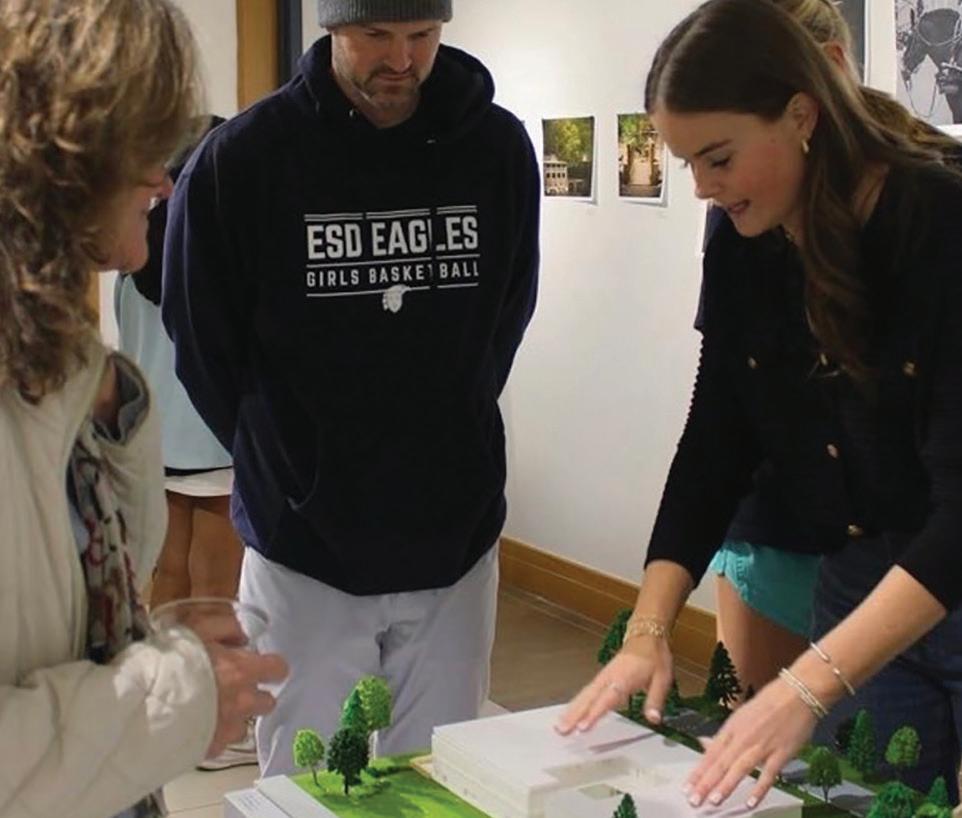
Plans for renovating ESD’s school buildings were unveiled to faculty members during a meeting that took place on April 29. Ruth Burke, the Parents Association Associate Head of School, oversees and facilitates major school projects and is the point of contact for firms and consultants that work with the school. Burke said that the unveiling of the plans shows a new future for ESD.
“The campus master plan is as bold as it is essential for the future of ESD," Burke said. "The plan provides an intentionally flexible, phased roadmap for the future development of our facilities and campus and will serve as a guiding vision, as well as a practical tool for decades to come."
Parents also were invited to attend a meeting that same
ESD hosted the last Special Programming Day of the 2025-2026 school year on Tuesday, April 20. The freshman class attended different community service events based on a form they completed earlier in the school year. Freshman Dakota McCloud went to Meals on Wheels. For her, it was more than just community service; she learned that her group could be the only people those they served would see all week.
“My group might be the only people they see that week, and giving them food can form a connection,” McCloud said.
The sophomores went on their annual sophomore retreat to Wolf Run. They participated in many activities in advisory groups of three. “It was really fun, because we could do things, not only with our advisory but other advisory groups. [We] played games, which were really
By Londyn Biel and Peyton Smith | Staff Writers
Every year, the junior class president runs the game, in order to avoid bias when deciding if a student is out of the game. Last year, senior Beau McKnight organized the game as a junior.
“Last year, it was more stressful and way less fun just because you're handling complicated rotations, sending out information, running the Instagram, posting everything and determining the rules,” McKnight said.
Four days after it started, 13 people had already been eliminated.
“The game moves fast because we don’t have goggles or any safety equipment,” Del-Cid said. Traditionally, in the game, there is safety equipment allowed, until a week called “purge week.”
On May 11 the senior assassin's Instagram page announced that only 6 people remained in the game.
afternoon. HASTINGS Architecture is working with the ESD planning committee to design the buildings. The entitlement plans for the school have not been approved by the city, and the plans are still waiting to be revealed to the ESD neighbors.
“For most of us at ESD now, we will not be able to experience the new buildings, as they will take at least 10 to 15 years to complete the project,” Burke said.
The plans main focus include expanding teaching and learning areas, making the quarry the center of the ESD experience, connecting the north and south side of Merrell road, having the All Saints Chapel be the heart of the ESD campus, creating an independent middle school identity and improving traffic and parking.
fun, and it showed how we all worked together as a team,” sophomore Lauren George said.
The juniors stayed on campus and attended college guidance seminars, a One Love presentation and the Dedman lecture given by Joshua Coombes. Junior Taylor Ampofo said that the presentation was truly impactful.
“My biggest takeaway definitely came from the One Love video, [which] made me want to become more observant," Ampofo said. "Someone that I spend time with everyday could be going through the same thing that the girl in the video did, so I would want to be able to let them know I can help them."
Usually, the seniors have their annual senior doggy day on God’s Front Lawn, but the activity was cancelled due to the weather.
Students learn in real time about Artemis II mission
OBy Vinayak Bansal and James Crigler | Staff Writers
n Friday, April 10, at precisely 5:07:27 p.m. PDT, four astronauts splashed down in the Pacific Ocean, just off the coast of San Diego, making history. NASA’s Artemis II mission’s crew, with commander Reid Wiseman, pilot Victor Glover, mission specialist Christina Koch and Canadian Space Agency astronaut Jeremy Hansen, just completed a journey around the moon and back, lasting nine days, one hour, 30 minutes and 35 seconds.
According to CNN, the mission covered more than 700,000 miles, reached a peak velocity of 24,664 mph and landed within less than a mile of its intended target. It marked the first time humans had traveled beyond low Earth orbit in more than 50 years. While most students caught the highlights on social media, one class at ESD had been preparing for this moment for months.
Students in the honors aerospace engineering class
spent the entire second semester getting ready for Friday night’s Artemis II return to Earth. Donald Snook, the Honors Engineering I and aerospace teacher, guided the class as they studied satellites, orbits, trajectories and the physics of rocketry. They even built and launched their own rockets at Wolf Run, ESD’s off-property ranch. By launch day, on April 1, students were not just watching the Artemis II project; they felt like they were a part of it.
“We have not been to the moon since 1972, so it has been over 50 years,” Snook said. “Our technology has advanced, and we gain so much in terms of scientific knowledge through exploration. I am excited to see NASA bringing this back.”
The gap between the Apollo era and Artemis spans generations, and much of the technology tested today did not exist the last time humans left Earth’s orbit. For Snook, that context makes Artemis a powerful teaching tool.
“It has been fascinating for students to see that what they are learning is actually happening in
real life,” Snook said.
That connection became even more direct one week before liftoff, when a NASA engineer joined the class via Zoom and took questions from about 40 students. The engineer explained the spacecraft’s orbital path and how it would use the moon’s gravity to perform a slingshot maneuver around the far side and return to Earth.
Senior Harrison Teegarden, a student in honors aerospace engineering, was present during the Zoom conversation
“It was cool to hear about the gravitational pull and how they save fuel by slinging around the backside of the moon for the return trip,” he said.
The session made a lasting impact on one student in particular who plans to study aerospace engineering at Rice University. After the call, the NASA engineer agreed to mentor her through college.
Snook emphasized that space exploration does not come with clear answers, and that is the point.
“The thing about the space program is these are problems
we do not even know exist yet,” Teegarden said. “There is no answer key. You have to experiment, test and be creative because these are things humans have never experienced before.”
That mindset played out in real time during the April 10 reentry. Teegarden had been closely tracking one critical component, the heat shield. After Artemis I, engineers found that parts of the ablative heat shield eroded more than expected during reentry, according to published reports. Engineers adjusted the Artemis II return trajectory to reduce heat exposure.
“I am most invested in the operation of the new ablative heat shield,” Teegarden said. “I am excited to see how their fixes affected its performance.”
For Teegarden, the mission represented more than just a technical achievement.
“The successful completion of Artemis II marks a historic milestone for everyone,” Teegarden said. “The lessons learned will set the stage for future missions that will put humans back on the lunar surface.”
According to NBC News, NASA is targeting a crewed moon landing as early as 2028. When that happens, some of the engineers behind it may trace their journeys back to classrooms like Snook’s, where launching rockets at Wolf Run and speaking with a NASA engineer helped turn a distant dream into a real career path.
The adjustments proved successful. The astronauts emerged safely, and the mission concluded without major issues. At a postsplashdown press conference, NASA associate administrator Amit Kshatriya emphasized the effort behind the success.
“That is not luck,” Teegarden said. “That is 1,000 people doing their job.”
L26ENDARY CEMETERY
Sophomore Kiya Liang views the Senior Assassin "cemetery" for all of the seniors who have been kicked out of the game.
Photo provided by Londyn Biel
HASTINGS PRESENTS TO FACULTY
HASTINGS Architecture meets with the faculty on April 29 and shares proposed building plans. Photo by Londyn Biel
SOPHOMORES AT WOLF RUN
The sophomores at Wolf Run played games to get to know each other in hopes that the grade would become closer. Photo by Londyn Biel
TSA shutdown affected travelers in airports across the country
Unlike any airport experience she has ever had, sophomore Leighton Randall and her dad took turns standing in the security line and sitting down to give their legs a break. They became unsure of how much longer it would take to get through the line, and their anxiety grew with the possibility of missing their flight home due to the shortage of TSA workers at the airport.
On March 30, TSA workers received back pay following a 44-day partial government shutdown within the Department of Homeland Security. For over a month, airports across the country experienced significant TSA staffing shortages. This was driven by the employees not receiving regular pay with uncertainties of when the shutdown would end, causing many to quit, leading to long security lines during peak periods like spring break, one of the busiest travel weeks of the year.
Since the partial homeland security shutdown began in February, over 1,000 TSA workers across the country have quit their jobs according to Airlines for America news updates. Soon, the temporary funding that the workers are receiving is set to expire if Congress does not pass the legislation to have TSA workers paid or a bill to fully reopen the department, as of April 29.
This shutdown affected travelers from across the US in different ways, as some faced significant disruptions and delays, while others had little to no impact on their travel plans.
Randall experienced the
negative effect of this shutdown while traveling back from La Guardia Airport in New York City to Dallas on March 22. She sat through multiple hour-long security lines trying to get home that night.
“Whenever I was flying home out of La Guardia, we had around a three-and-a-half to four-hour security wait line out the door of the airport," Randall said. “My dad and I barely made it onto our last flight, after canceling all of the other ones while we were in line, the door to get onto the plane was closing right as we got to the gate and thankfully, we were let in.”
The long security wait lines quickly turned into a stressful situation for Randall, as she and her dad were stuck in a cycle of constantly adjusting their travel plans, continuously booking and canceling the flights they had made in order to get back to Dallas that day.
“While we were sitting in the security line for a couple of hours, we kept on having to book new flights and cancel them because we were just not moving at all,” Randall said. “Luckily, we made it home that night on a flight back into Dallas and didn't get stuck in New York all night.”
The shutdown not only led to long security lines but also left Randall in a constant state of uncertainty as she waited to see if she would miss her next flight, which quickly turned into an exhausting experience, especially after her long day of lacrosse.
“I've never experienced anything like this at all," Randall said. "It was really bad and tiring standing in a line for so long while
also being scared about our flight getting canceled. I had also just had around a four-hour lacrosse day, so I was exhausted, and we got home really late, like probably around one or two in the morning when we were supposed to be back around 9 [p.m.]”
While Randall's airport experience reflected the worst effects of the shutdown, not all travelers faced the same difficulties; outcomes varied widely depending on airport location, travel time and preparation across the country.
Though long security lines and issues with TSA quickly spread on social media and the news, sophomore Meryl Tydlaska found her spring break travel unaffected by the shutdown, despite what she had heard online.
“I traveled to Hawaii over spring break, and I did not have any troubles at the airport. It took me only about three minutes to get through the TSA wait lines,” Tydlaska said. “I've been seeing a lot of videos of all the people in their long lines all the way to the parking garage. So we got there like two hours earlier than we usually would, but we didn't have any issues getting through TSA.”
Before arriving at the airport, Tydlaska relied on her TSA app to check the security wait lines in different airport terminals so that her family could find the shortest line and make it through security in time to board her flight.
“I think the long security lines just really depended on where you were traveling to and especially what terminal you were in,” Tydlaska said. “My family and I also looked at the terminal map
on our phones so we could get to the shortest lines or the places that were not affected by the TSA shortages.”
Although Tydlaska's experience at the airport during the government shutdown was smooth,
Spring break travelers faced challenges as TSA staffing ran short during shutdown
By Noelle Stovall | Asst. Life Editor
Preston Hollow residents protest proposed development
For two months straight, the streets of Preston Hollow have been filled with yard signs and banners. According to a group called Preserve Preston Hollow, developers want to build two skyscrapers at the southwest corner of Preston Road and Royal Lane. The signs, protesting the possible new construction project at Preston Royal Shopping Center, reflect the feelings of many residents in the area.
Both buildings are planned to be taller than those currently in the shopping center: one standing at 275 feet tall, and the other, which will be taller than the Statue of Liberty, at 325 feet tall. The current buildings stand at 54 feet tall.
“A lot of people in my neighborhood have signs that are like, no rezoning, no apartments in Preston Royal and Preston Hollow," freshman Kate Moorman, who lives in the neighborhood, said. “Personally, I don't have [a sign], but a lot of people do.”
The $650 million project is being led by two Dallas-based companies, Burk Interests and Greenway Investment Company. If approved, the development would replace the current low-rise shopping center, home to local spots like Gazebo Burgers and a Chase Bank location, with a 28-story hotel and condo tower, a 24-story apartment building, office space and upscale restaurants, according to People Newspapers. The developers also promise to plant over 100 new trees and add 1,000 feet of new sidewalks, according to CandyDirt.com, a Dallas-based real estate news website.
As developed as this plan appears, not everyone is on board. In an April 9 ESD student survey of 68 students, responses
indicated that almost 84 percent of students who live in the area of the proposed development believe that building skyscrapers would not benefit the area. The most common reason was that the skyscrapers don't align with the character of Preston Royal; they believe that this development will bring traffic to an already congested area and block views of the neighborhood.
“My biggest concern is that it will make the area even more crowded and have a big impact on the traffic that’s already bad in the area,” freshman Lexi Mercado, who lives in the area, said.
However, some students support the skyscraper project.
Roughly 15 percent of respondents said that skyscrapers would benefit the area because the proposal includes planting 100 new mature trees, which will add green spaces in an area surrounded by concrete. They also believe that this development would provide new housing options and encourage people to move to the area.
Although the proposal is getting closer to getting approved, petitions are not slowing down and signs are filling the yards of Preston Hollow residents. Mercado’s family stepped in to voice their concerns.
“My family has gotten a sign for the front yard and signed the petition,” Mercado said. “My mom emailed our city councilwoman, Gay Donnell Willis, to voice her opinion on why she wouldn’t vote for the rezoning that would allow this skyscraper to be built.”
Since the 2019 tornado, Preston Royal has developed into a boutique shopping center, filled with unique stores and restaurants. Some residents believe that building skyscrapers would not only modernize the area and make it more downtown-like, but also
demolish the local stores, salons, and well-known restaurants like Escondido. And not only residents oppose the project. The Escondido manager, who wished to remain anonymous, is against it as well.
“It's unfortunate, seeing that we just opened almost four years ago, it would be disappointing to see it go away,” the manager said, “We have such a tight community here and lots of regulars that love our food”.
Many people have concerns about the skyscrapers adding a negative character to the shopping center and taking away some of Preston Royal’s charm. With the demolition of small businesses, people are worried about the skyscrapers disrupting the area's neighborhood feel.
“Part of the [Preston Royal] charm is that it’s a neighborhood, and when you add a building that is tall, it starts to feel like you’re downtown, which isn’t what anyone who lives in Preston Hollow wants,” Mercado said. “I also live in Preston Hollow, and I would be able to see it from my house. Tall buildings belong downtown rather than in a residential area.”
The decision isn't final yet. It starts with the developer(s) proposing the idea to the Dallas City Plan Commission. Once that is approved, the community input comes into play. This is the locals' chance to voice their opinion, sign petitions and protest in order to convince the Council otherwise. The last and final step is the approval of the Dallas City Council, more specifically, Gay Donell Willis. Willis is not just any Dallas City Council member, but the representative for District 13, Preston Royal and North Dallas.
Residents are making efforts to reach out to Willis specifically, to put their personal input into the possible construction. As of now, no hearing date has been scheduled for the Dallas City Council to review the case. Preserve Preston Hollow has already met with 11 city plan commissioners and three City Council members to get ahead of the case before it even lands on an agenda.
“I’m against the building of the skyscrapers because I think they’ll harm the area more than add to it,” Mercado said.
Possible skyscraper project at the corner of Preston Road and Royal Lane sparks community concern
Kate Blum and Annabella Spears | Staff Writers
Illustration by Noelle Stovall
A bittersweet farewell to two long-loved legends
The community expresses its gratitude for faculty members Claire Mrozek and Joe Snyder as they enter retirement
By Sella Bartley | Copy Editor
TEACHERS IN ACTION
Making History
At the 11th-grade ring ceremony on April 28, junior class dean and upper school history teacher Claire Mrozek addressed her final junior class a month out from her retirement. After dedicating 38 years to guiding students through their time at ESD, Mrozek’s legacy will endure at the heart of the school through the lives she has forever changed.
Mrozek’s influence as a teacher extends far beyond the content in her history lessons. Known for her ability to challenge students and push them to think critically, she has shaped not only how her students approach academics but also how they view the world around them. Junior Will Morrison believes that Mrozek’s emphasis on incorporating modern-day events into the curriculum has changed his perspective on the relevance of history in today’s world.
“On our quizzes, Mrs. Mrozek always includes a question about an event that is currently happening,” Morrison said. “She likes looking at the past, but also looking at the present. She wants us to see how it is connected to our society or how it's still impacting the world today. I think seeing it in that kind of light is really helpful and has opened my eyes to how history tends to repeat itself.”
Beyond cultivating a newfound appreciation for history in her students, Mrozek has a gift for making each student feel special and valued for their unique talents.
“Mrs. Mrozek was the first person who made me feel truly smart, not because she praised me or gave me straight As…but because she really saw me and challenged me,” Alumna Don McCoy '96 said. “Without even knowing it, she fostered my love of writing, [which] became a lifelong gift I practice every single day. I can honestly say I wouldn't be the writer or woman I am today if Mrs. Mrozek hadn't taught and guided the girl I was then. To this day, I still get intimidated around Mrs. Mrozek, but not due to fear--rather because she is one of the most brilliant people I've ever met.”
Along with the impact she has made on her students throughout the years, Mrozek’s influence on her colleagues has been just as significant, shaping many educators’ teaching practices and the overall academic culture at ESD. Lamont English department chair and upper school English teacher Tolly Salz describes Mrozek’s strong character as one of her most admirable traits.
“When I think of Mrs. Mrozek, I think of a quotation from ‘A Midsummer Night's Dream’: ‘though she be but little, she is fierce,’” Salz said. “I have so much respect for her. She is a calm, wise, steady presence, yet full of conviction for the right things. She does the right thing, and she is like a moral compass, the center where, if there's a conflict, she can be the neutral observer [or] the voice of reason.”
While current teachers across all departments admire Mrozek’s intellectual curiosity and steady spirit, those who worked most closely beside her witnessed her dedication to leading and teaching on a daily basis, both inside and outside of the classroom. Former upper school English teacher Greg Randall recalls his time spent sharing an office with Mrozek as one of the most memorable parts of his time at ESD.
“For decades, we shared an office, and our classrooms were side by side,” Randall said. “Mrs. Mrozek focused intently on her classes before and during the school day. After school, she was ready to talk about the students that we had in common. She was a great listener, non-judgmental and a trusted presence at the end of a school day, a week or a semester.”
History department chair and upper school history and religion teacher Bryan Cupp admires her unmatched commitment to the craft of teaching and to her subject. However, what will stay with him the most is her humility, her attentiveness during conversation and her big heart.
“As a colleague and a friend, she pushed me to be better in the classroom, encouraged me to reflect on what it means to be an Advisor, conversed with me regarding our mutual love of history and its importance, and, when it was most needed, shared a good laugh,” Cupp said. “...Though I find Room E unimaginable without her, I am very excited for her as she moves forward to embrace more time with family, friends and books. Still, the Department of Historical and Religious Studies...owes a debt to Claire
paid.”
The Man Behind the Music
On April 21, the beloved ABBA song “Thank You for the Music” filled All Saints Chapel, and students swayed and smiled to its familiar melody. This particular rendition, however, held special meaning as a parting gift from the upper school girls’ choir to their teacher, Joe Snyder.
After 37 years of contributions to the ESD Fine Arts Department, upper school choir teacher Joe Snyder is retiring at the end of the school year. From the classroom to the chapel to the stage, Snyder’s impact on this community as a mentor, colleague and friend has been felt by many. Few understand this impact more personally than Performing Arts Department Chair and upper school Fine Arts teacher Lauren Redmond ’01, who worked with Snyder first as a student in his productions and later alongside him as a colleague.
“He meets students where they are, helps them find their voices and encourages them to grow not just as singers, but individual human beings,” Redmond said. “They are better for working with him, and they are better for knowing him. So am I.” Not only is Redmond grateful for his mentorship during her musical theater journey, but also for his friendship.
“He’s an amazing collaborator [and] confidant. One of the sweetest things that will always stick with me is [that] when he would introduce me to colleagues of his from other schools, he would say, ‘This is Lauren. You know, she was one of my students, one of my stars,’” Redmond said. “...it never failed to make me blush and appreciate the praise from [someone] who… means the world to me.”
Like Redmond, alumna and former ESD teacher Ashley Carter '01 formed a relationship with Snyder both as a choral member and a colleague.
“He always had a remarkable ability to balance pushing students to grow and improve while simultaneously allowing them to have fun in his class and experience the joy of music,” Carter said. “He believed deeply in his students’ potential, often before they believed in it themselves. More importantly, he saw the individual spark in each student and created an environment where they felt comfortable to be themselves.”
What is even more meaningful for Carter is seeing Snyder’s impact through her daughter, junior Jordan Johnson’s, experience.
“Watching him invest in her with the same care, encouragement and belief that he showed me has been incredibly special,” Carter said. “...It has given me an even deeper appreciation for the consistency of who he is as a teacher and a mentor…There are very few teachers who shape not just a moment in time, but an entire community across decades — Mr. Snyder is one of them.” Johnson, who has known Snyder since she was months old, expresses her gratitude for his kindness and openness, describing his classroom as a judgment-free zone.
“He is always open to talking about anything,” Johnson said. “Really, the best thing that [he’s done] is be there for us.”
For Liam Pham ’23, learning from Snyder in theater, Concert Choir and AP Music Theory deepened his love of performing arts, leading him to study musical theater in college. Some of his favorite high school memories were participating in the traditions Snyder felt were important to continue.
“When you think about it, Mr. Snyder is the ultimate custodian of so many ESD traditions,” Pham said. “I can’t imagine trying to replace him because there really is no replacing him. Daily Chapel…doesn’t happen as we know it without him, nor does Lessons and Carols, or Pass It On. I’m telling you, the man is in the fabric of the school.”
But more than that, Snyder enriched Pham’s time at ESD and changed his life in the big picture.
“Because of him, I got to sing every day in Chapel, I made lifelong friends, I found my voice, figuratively and literally, and I was doing things at school that made me happy,” Pham said. “It’s that cringey thing they say in ‘Glee’: ‘Being a part of something special makes you special.’ He made me a part of so many traditions—annual ones, daily ones, ESD rites of passage—and through all that, he made me feel special…Anyway, it’s a longwinded way of saying he made me feel loved at school, and gave me opportunities to feel loved by others.”
Mrozek that can never truly be
Claire Mrozek (left) instructs a class in Room E. Joe Snyder, pictured in blue shirt (right) smiles for a photo with All-Region Choir in 2001.
Photos provided by ESD and Ashey Carter '01
Junior and senior girls show off their stunning prom dresses,
Communications Manager explores Klyde Warren Park, a true jewel in Downtown Dallas.
Gracie Nealon | Co-Editor-in-Chief
GEMS LOCAL
01
2:30 P.M.
2:45 P.M.
CLIMBING UP
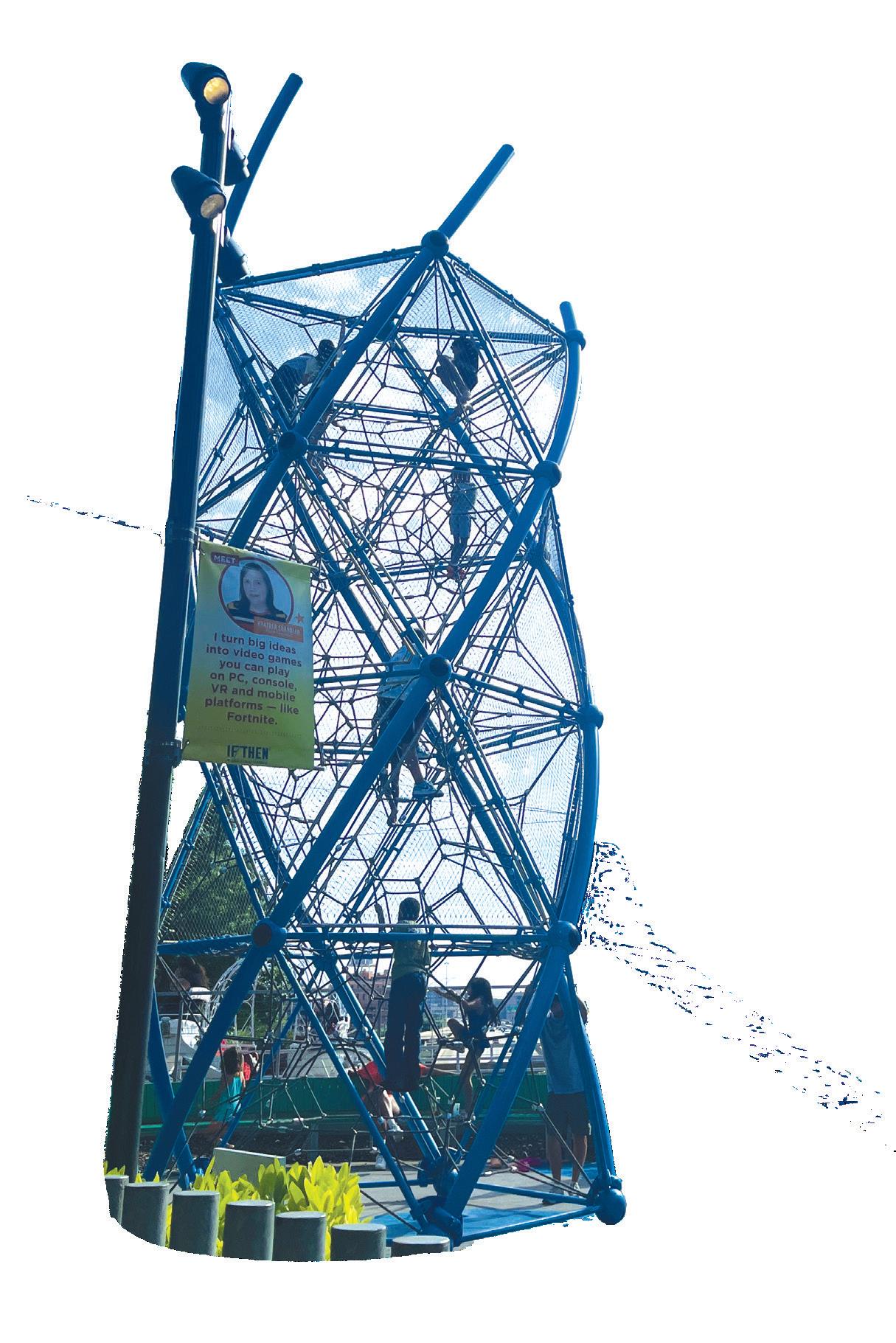
There is a wide range of activities that children (and the young at heart) can enjoy, such as the playground, which was filled to the brim with families. Children climbed on the rope playground, eagerly scaling to the very top and calling to their parents to take photos of them.
Klyde Warren Park
In each issue, a staff member highlights local gems in the DFW area. This time, Communications Manager Annabel Brown, spends a day exploring Klyde Warren Park. A childhood staple for many Dallas natives, the park is home to eclectic food, open space, water features and a sense of nostalgia. She re-explores the area to determine the must-stop spots when in Downtown Dallas. From educational activities to a focus on the performing arts, Klyde Warren Park has more to offer than just its infamous playground. It’s a place where children and adults alike go to unwind in the heart of Downtown
3:20 P.M.
3:45 P.M.
JOY, NO CHARGE
One of the cutest things I discovered was the free balloon animals given out by a handful of kind artists, who told me they come out once a week to make them and spread joy. They shared that their manifesto was based on the idea that nothing in modern-day life is free, which led them to want to spread joy without a cost.
2:50 P.M.
3:15 P.M.
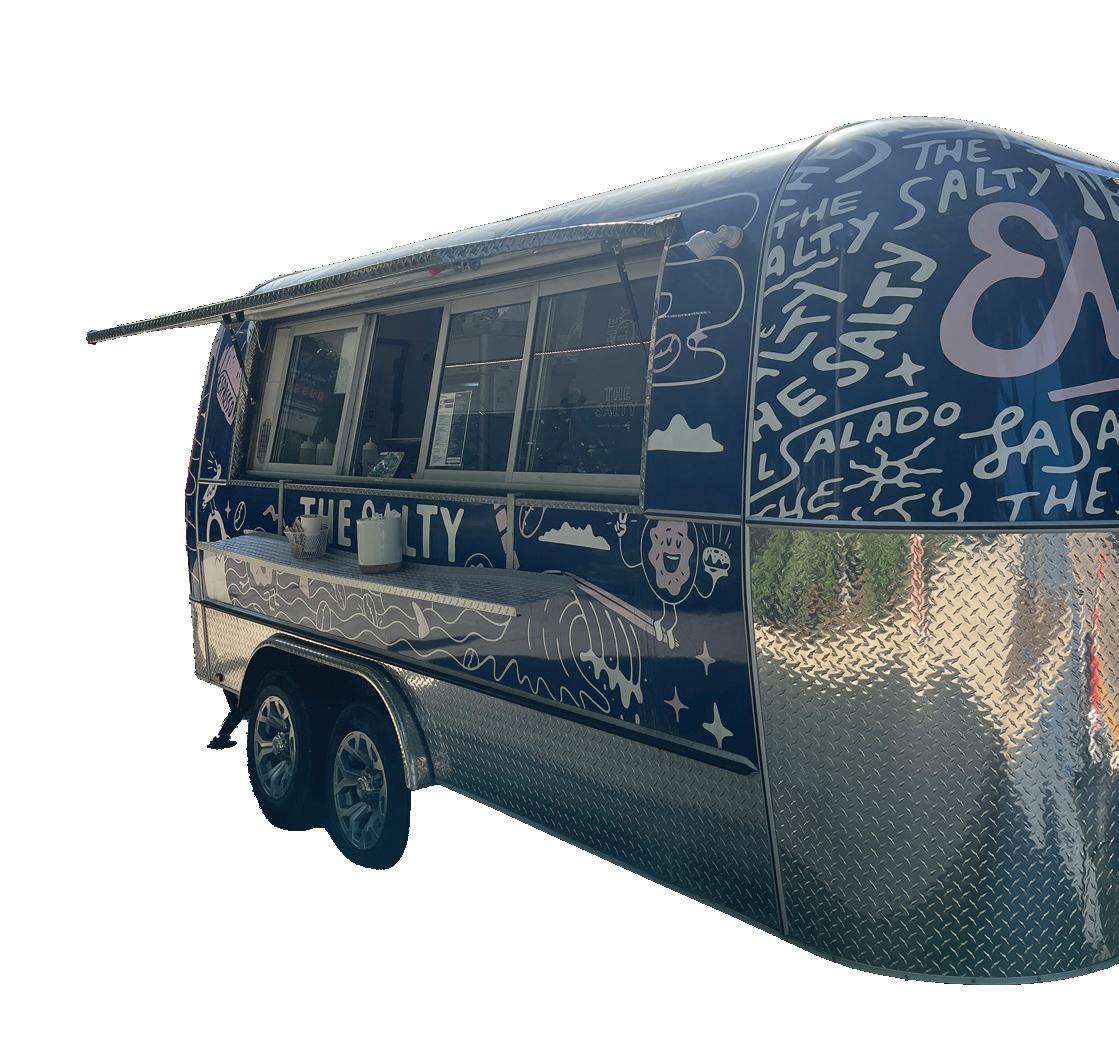
One of the park’s main attractions is the line of food trucks on either side. The culinary delights range from Ethiopian food to doughnuts and snow cones. The food truck that caught my attention was the Cookie Society, painted in an aesthetic sea foam color. The menu was extensive, serving several basic flavors alongside a handful of unconventional ones, such as lemon tart. I opted for the classic: their original chocolate
3:45 P.M. 4:00 P.M.
CINEMA CITY 4:30 P.M. 5:00 P.M.
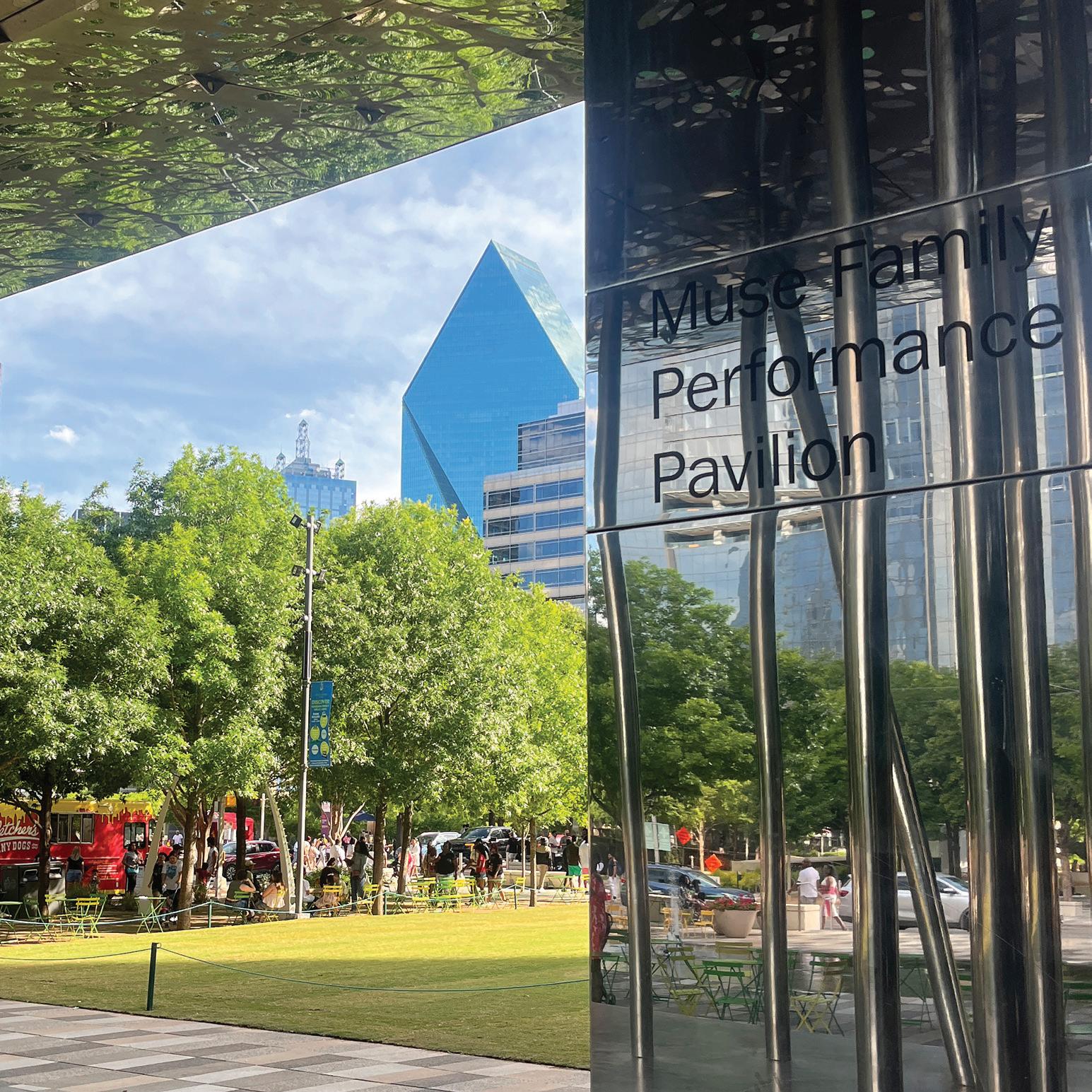
When walking the grounds, it is impossible to not notice the wide range of activites advertised throughout. One of the most heavily pictured was the weekly movie screenings on Saturdays, hosted at the Muse Family Performance Pavilion. The movies selected were all recent releases, such as “Wicked 2: For Good” and “Zootopia 2.” All of the showings were on the weekend and were aimed towards family audiences, giving busy families a chance to slow down and enjoy a family-friendly activity in a pleasant atmosphere in the center of the city.
BOOKS IN BLOOM 05 03
As I explored the remainder of the park, I discovered there is also a focus on education. I saw several advertisements promoting various educational nonprofits. These ads featured barcodes that one could scan to donate. Another aspect of the park that focused on education was the book bins, where you could take a book and read it for free, and even bring your own books as a gift to the park. To my surprise, several people were taking advantage of this amenity and were reading throughout the park.
New hopes for seniors as they leave for college
Students prepare to balance emotions navigating transition to college
By Craighton Jefferies | Managing Editor
As graduation nears, high school seniors at ESD approach one of life's biggest transitions: leaving home for college. Whether they are excited or nervous, they are leaving home in a few short months.
Some key figures in assisting with the transition and college applications overall are ESD’s college guidance counselors.
Assistant Director of College Guidance Katherine Montgomery believes that being prepared for the transition from high school to college goes beyond grades and applications.
“The counselors try our best to help students understand the nuances of going away for college,” Montgomery said. “How far are you comfortable being away from home? How easy is it to get home when you need or want to?”
Some seniors, such as Charlie Cain, are excited for the freedom college offers. Cain, who will attend the University of Texas at Austin in the fall, will have the benefit of independence at college while still living relatively close to home.
“I'd say I'm most looking forward to the freedom associated with living by yourself and being able to cook my own meals, that kind of thing,” Cain said. “But I have a good feeling that for the first few weeks, it's not gonna get done, and then I'm gonna have to learn how to manage.”
Getting into one’s top universities and college choices has become very competitive, but when students first arrive at college, reality sinks in and the emotional stress can hit hard.
“For many students [at ESD], you haven’t had to build new friendships from scratch since lower or middle school,” Montgomery said. “That can be difficult if you aren’t an extrovert. Sometimes students assume friends will come to them. You have to put yourself out there. Leave your dorm, go to the club fair, sit with someone in the dining hall you’ve never met, introduce yourself to people you meet at orientation [and] be proactive about establishing plans.”
According to Montgomery, putting yourself out there is one of the best ways to meet people. This is especially important in a college environment, where there aren’t as many familiar faces. Senior Cate Stephenson is attending the
University College London with an entirely unfamiliar student body.
“I'm really excited to just meet new people and meet people from all around the world that I probably would never meet otherwise,” Stephenson said. “Being in such a big, fun city like London, there are so many opportunities there that I wouldn't have in the U.S., but I am nervous about being far away from my family and my friends [at] home and not being able to come home as frequently to see my friends, who are going to schools closer to home.”
"YOU HAVE TO PUT YOURSELF OUT THERE. LEAVE YOUR DORM, GO TO THE CLUB FAIR, SIT WITH SOMEONE IN THE DINING HALL YOU'VE NEVER MET, INTRODUCE YOURSELF TO PEOPLE YOU MEET AT ORIENTATION [AND] BE PROACTIVE ABOUT ESTABLISHING PLANS."
Katherine Montgomery Assistant Director of
College Guidance
Homesickness is common among first-year college students, as this is the first time they find themselves without their support systems. Homesickness can affect people on different levels.
“It’s super common for homesickness to occur in the first semester,” Montgomery said. “Any setback, like an issue with a roommate, being ill away from home or a bad grade on an assignment, can test your emotions.”
For Cain, who is going to school in Austin, visiting home will be much easier than for those moving out of state.
“I know I'm gonna miss spending time with my family, my grandparents, my brother [and]
my dogs, but I'm gonna visit a lot,” Cain said. “I'm gonna be going to college three hours away, so I can come down if I need to.”
This is very different compared to someone like Cam Konradi ’24, who currently attends St. John’s University in Jamaica, New York.
“The hardest part about leaving for college is leaving behind your friends and family,” Konradi said. “Since I go to school on the East Coast, I only really get to see my family over Christmas and Summer Break, so most of our communication is over text and FaceTime. I try to call my family at least once a week.”
According to Montgomery, it can be hard to find the motivation to handle responsibilities without your parents. Konradi felt that stress.
“I definitely feel way more independent since leaving home,” Konradi said. “However, with that comes some stress with having to manage your own time and budget. Managing your time is definitely tough in college, especially while playing a sport.”
Challenges students face in college have to do with daily tasks, which can be difficult to manage.
Cain worries about life skills like cooking, laundry and time management.
“I need to make sure that I stay on top of…things that I need to do to live by myself from the beginning, because I know that if I procrastinate doing my laundry, or washing the dishes, or going to church or anything like that, then I'm gonna just never do it again,” Cain said. “[The tasks] are just gonna build on top of each other, so I gotta make sure I start the habits early.”
Stephenson says that she needs to work on being open to the UK lifestyle. Luckily for Stephenson, Konradi believes that leaving for college definitely helps with growth as an individual.
“I think I definitely feel more prepared for adulthood since leaving for college,” Konradi said. “I have definitely been forced to mature since I no longer have my parents reminding me to do stuff.”
Montgomery believes that keeping simple routines and strategies can help.
“Go to class, even on days it’s hard,” Montgomery said. “Make proactive choices to meet new people in the first semester. Friends don’t come to you; you need to go out and make friends. Set a time to check in with your parents and siblings regularly.”
APPROXIMATE PERCENTAGE OF seniors who are going out of state for college
PERCENT FEEL SOMEWHAT emotionally prepared to leave home
PERCENT THINK THAT ESD has prepared them for well for college
PERCENT ARE MORE EXCITED than nervous about college
PERCENT EXPECT TO CONTACT their family every day
70 88 44 36 84 48
PERCENT FEEL MOSTLY READY to live by themselves
SCOOTING OFF
Seniors Beau McKnight and Courtney Del-Cid wear their decorated skirts with accessories that match the colleges they will attend. "It was so fun dressing up [on Senior Skirt Day] with everyone as a class," McKnight said. "The parking lot in the morning was filled with mini scooters and cars with everyone laughing."
Photo provided by Beau McKnight
C laSh the
Seniors celebrate with traditions the last days of school
Students at ESD spend years diligently studying and completing assignments; their senior year is a welldeserved time to recognize their efforts.
As a culmination of their success, seniors spend their year with various celebrations and ceremonies in addition to graduation itself. Seniors participate in Blue and Yellow Shirt Day, Senior Skirt Day and Pass it On to celebrate their final year.
“I think it is really important that senior year is the one that resembles all the things you went through as a student at ESD,” Senior Dean Marcela Garcini said. “The traditions are things that build community and build a connection that is stronger when you leave.”
From beauty brands to pajamas, social media influencers are changing their titles from online creators to CEOs, but many have started to question if their online backgrounds qualify them for the role and whether their audiences necessarily represent their customers. While a large following can help leverage initial interest for a startup company, influencers need to ensure that their product is unique and desirable to achieve long-term success.
Famous TikToker and now singer Addison Rae started her brand, Item Beauty, in August 2020. At the time, Rae was the second-most-followed creator on the app, with over 54 million followers. The brand had a successful start, but it was removed from Sephora shelves in 2023 and has been discontinued due to low sales and failure to connect with customers. While Rae wore many hats, CEO was not one that she could hold on to.
Similarly, a smaller creator who posts daily vlogs and family content, Cecily Bauchmann, created her pajama brand, 4 the MEMS, hoping for her 2.1 million followers to become buyers. Quickly, the company received backlash for its high pricing and subpar quality, selling each pajama set for $78. Due to poor brand strategy, the company eventually filed for bankruptcy in late 2024.
On the other hand, Hailey Baldwin Bieber, daughter of actor Stephen Baldwin and wife to Justin Bieber, proves with her skincare line, Rhode, that with the correct marketing strategy, launching a company with a preexisting follower base can also give way for immense success, but other factors must be present as well.
Bieber built an entire brand on the “clean girl aesthetic” fad that was taking over TikTok. This strategic marketing laid the foundation for the Rhode empire. Since the launch, her marketing team has partnered with influential figures such as Tate McRae, Alexandra Leclerc and even her husband, Justin Bieber.
Most recently, TikToker Alix Earle, famous for her day vlogs and “Get Ready With Me” videos, started her acne prevention skincare line Reale Actives. While her following of over 8.5 million helped her brand sell out within the first 10 hours of launching, many expect Reale Actives to continue to thrive because of its credibility.
Earle has shared her long-term acne journey for years on her social media accounts, telling of her skin’s journey and connecting with viewers who struggle with similar issues. In the months before launching, Earle used her own products to clear her skin. Followers were able to see the progress and were struck by how well her skin was clearing. Once she revealed her brand on March 31, her followers were eager to try her effective product for themselves.
While the brand and products were extremely successful right off the bat, Earle has faced critical reviews from small creators, despite the product's effectiveness.
This is the case for many online creators, as they are already under intense spotlight, and viewers are constantly searching for errors and reasons to “cancel” them.
But the festivities for the Class of 2026 started at the end of their junior year, on May 13, 2025, when they partook in Blue and Yellow Shirt Day. In this annual tradition where boys wear a blue shirt and girls a yellow one, the junior class is introduced as the new seniors on campus. Aside from wearing the shirt, they usually celebrate in the senior courtyard with breakfast before school.
“Being able to spend the morning before the first day of school with my whole class really was the best start to my day,” senior Courtney Del-Cid said. “It was also bittersweet seeing everyone in the blue and yellow shirts, because it was such a special opportunity showing that we only have a year left together."
While the shirts themselves are traditional, they hold a strong and powerful meaning, as they are passed down from the grade above. Each senior, on their last day of school, passes down their blue or yellow shirt to a member of the junior class. Before the seniors pass it down, they sign the inside. Each junior receives a shirt that nearly a decade of seniors have worn.
“Getting my shirt and seeing my older sister’s signature in it was really a full circle moment for me,” senior Alex Eastin said. “I always looked up to her, and knowing that I can wear her shirt every day brings me so much joy.”
Aside from celebrations at the beginning of their senior year, the seniors conclude their final year in high school with the beloved Pass it On Ceremony and Senior Skirt Day. Pass it On has been the longest-standing ESD tradition in which the seniors pass the light of the high school down to the incoming freshman.
"Pass it on [is] the perfect symbol for ESD. If you focus on each single candle lighting, you see a wonderful celebration of connection and individuality,”
Clark
Family Head of Upper
School Matt Peal said. “However, the real magic is when you take in the scene as a whole and see the awe-inspiring power of communal action."
With two student speakers, the ceremony is a culmination of new hope and profound wisdom between the outgoing seniors and incoming freshmen. An incoming freshman and an outgoing senior are elected by their peers to speak on behalf of their class. This year’s electees are Upper School Student Body President Beau McKnight and eighth grader Shepherd Disasa.
“Knowing that my classmates voted me to represent our class makes me feel so honored,” McKnight said. “I hope I can represent our class and what it means to me in the best way possible.”
Passing on the spirit of ESD, represented in the lighting of candles during the service, was a cherished ideal of Fr. Swann’s, and Pass It On keeps this ideal alive. In addition to Pass it On, the final tradition for seniors is the coveted Senior Skirt Day that took place on May 8. Following the seniors’ college decisions, the Class of 2026 will decorate their shirts and skirts with college colors.
“Being able to wear my college on my skirt all day is so exciting to think about,” senior Lyla Zicarelli said. “I am just as excited to decorate it as I am to wear it.”
Seniors plan for this event well in advance and look forward to it throughout their entire high school career.
“After watching the seniors [who] graduated years before me, I have been planning my senior skirt for so long,” senior Tatum Reynolds said. “I am so excited to start making it so I can finally wear it and showcase my college spirit.”
While these moments are anticipated for years by all high schoolers, the magic doesn’t come out of thin air. The senior parents put in a lot of effort to plan Blue and Yellow Shirt Day, along with helping design their child’s skirt and shirt.
“As I begin to plan [the Class of 2027’s] Blue and Yellow Shirt Day, it is such a bittersweet moment for me,” Ashley Young P’27 said.
“I am so excited to celebrate the rising seniors, but I am sad that it means the class is graduating.”
For both those who look towards the future and those who reminisce on the past, these ceremonies allow everyone to reflect on their time at ESD with a genuine appreciation for their class and the school itself.
“My first day of school was special because we started the day with our whole class,” senior Ruby Cuccia said. “I know that the last day will be even more special because we are ending our high school career together.”
Class of 2026 reflects on their final weeks on campus
By Kate Lewis | Web Managing Editor
Staff writer Beau McKnight dives into the latest pop culture showdowns, breaking down the battles that have everyone talking. This issue explores influencers' entrepreneurial abilities, highlighting how a following on social media does not necessarily translate to success in the market. PASSING ON THE LIGHT
Earle and Bieber prove that much more than a following is needed to run a successful and sustainable company: the brand must have a strategic marketing plan that matches its existing profile, and most importantly, an effective and unique product.
Photo provided by Jackie Robertson
A 17-year-old tradition: Middle schoolers go on their first overnight trip
Fifth grade leaves the classroom and travels to Galveston
By Harper Axley and Vivie Miller | Staff Writers
The fifth graders reached a milestone when they took their first overnight field trip to Galveston on March 24. The class of 2033 spent two nights away from their usual routine as they explored the environment and learned more about their state's history.
According to French teacher Joumana Arraj, who has traveled with the fifth graders in the past, this is their first overnight school trip away from home.
Thirteen faculty members
accompanied more than 80 fifth graders to Galveston.
The class visited beaches, museums and learned more about the state’s history. They went to the Houston Space Center, the Bryan Museum and the Moody Gardens Educational Center. The trip also served as a break from regular schoolwork, giving students time to recharge while still learning.
“I really learned a lot about Galveston's history,” fifth grader Caroline Arnold said. “It was really cool.”
The students stayed in cabins
with classmates they may have not already known, which give them a chance to make new friends. To many, this aspect of the trip was just as important as the academic aspect of it.
“I learned more about people in my grade,” fifth grader Trey Ampofo said. “I made new friends in my cabin that I didn’t connect with before.”
Galveston was the first time for many to be away from their families, which made the experience exciting but also nerveracking. This shared experience
made them closer.
“I'd say it made us grow as an entire grade,” Arnold said. “It just brought us closer and it was really a great bonding experience for us all.”
But not every aspect of the trip was as enjoyable. Arnold said that the bus ride back was her least favorite part of the trip.
“[My least favorite part of the trip was] the bus ride back,” Arnold said. “It was kind of slow, and everyone was tired and sweaty, but it was okay because we had each other."
was really fun,"
said. "We caught a ton, [but] we had to put them back in the
From the faculty perspective, this trip is an important one.
“The Galveston trip is also about students getting along with their friends,” Arraj said. “Learning about them and spending more time with the [whole] grade, and getting to learn [about] their teachers, and see their teachers outside of a classroom.”
Current seniors who attended ESD in fifth grade remember the trip fondly.
“It definitely helped me become closer to people at ESD,” senior Stella Wynne, who went to the trip as a fifth grader during the 20182019 school year, said. “We had never been on an overnight trip before.”
This trip is the first trip the class goes on in middle school. Sixth graders go to D.C in the spring, seventh graders go to Camp Champions in the Texas Hill Country in November and the eighth grade class goes on a Colorado trip in August at the beginning of the school year.
"[The Galveston trip is] about independence, friendship and discovering Texas,” Arraj said.
GONE FISHIN' Fifth graders Russell Fortune, Robert Cosby, Zayden Ali and Logan Hurst hope to catch tadpoles at the Armand Bayou Nature Center at the end of March in Galveston. "We were trying to catch tadpoles and snakes, and it
Hurst
pond."
Photo provided by Katie Moore
The stress in finding the perfect dress. Prom night sparks many decisions leading up to the longawaited tradition
By Devyn Ampofo, Lexi Merryman and Kate Moorman | Staff Writers
Senior Valentina Boltchi found her dress early after shopping online and receiving it for Christmas. “I think I was just online shopping, and I found it online, and hydrangeas are my favorite flowers,” Boltchi said. “[I saw that it] had hydrangeas on it, and it's kind of exaggerated, which is what I wanted for senior prom.”
EAGLE'S TALONTED TRENDS
Story Sinelli '27
It took junior Story Sinelli a while to find the perfect dress for a memorable night. "I did struggle to find a dress for prom because I couldn't find my dream dress," she said. "Like, there were a lot of different colors and shapes of dresses I liked, but there was nothing that I was absolutely obsessed with, and I still don't think I'm super obsessed with my dress."
Emory Turner '27
Junior Emory Turner looked on social media for her dress but couldn't find anything. Then she went into Anthropology and found her dress. “The one that I decided on, I just randomly stopped in the store, and I just really liked the dress,” she said.
Riley Morrison '26
Senior Riley Morrison found her prom dress in March at Bronx and Banco. “I didn't really struggle that much,” Morrison said. “I found a style I liked, then went to the website and saw the perfect light blue color in the same style, and then I was sold.”
AP exams shape the end of the school year for many
After a four-hour-long AP exam, junior Curtis Mathes ran from his exam to the afterschool testing room. He needed to make up what he missed in class while he took the WHAP exam sophomore year.
This is not an unusual scene. At the end of the school year, students who are enrolled in AP courses are faced with the challenge of studying for the AP exam, taking the exam and also staying on top of regular classes at the same time.
“The hardest part is studying,” Mathes said. “I have a hard time keeping up with school work in non-AP classes while also having to study for an exam that is over content from the entire school year.”
Along with studying for an entire year's worth of content, students have to rearrange their schedules because they are missing classes to take the tests.
“It’s definitely a weird mix and [a] difficult time of year,” Ryder Sands said. “You spend the whole year preparing for these exams in the classes, but when the time comes around to study and actually take them, everything else kind of stops.”
When students actually take their exams, they can miss multiple days of regular classes. Extended time students may spend entire mornings in the testing room during their AP exams. If a student has two exams back-to-back, they lose a full day of classes. This causes students to miss lessons and assignments as well as feel disconnected from
their non-AP courses.
“Last year, I only missed the morning half of my day because I only had one AP exam,” Mathes said. “This year, I may have to miss an entire day of school just to take two AP exams.”
The loss of class time and a small window to make up assignments can cause real stress for students. In the article “The impact of school absence on mental health in children and young people,” PubMed Central noticed in a study this year on students mental health that when kids have mental health problems, it can be associated with missing classes. As the school year comes to an end, time is limited to make up assignments, but students want to finalize their grades in classes positively. This issue is difficult to manage, and it is hard to be
flexible for some.
Even students who don't take AP exams notice the stress. When students show up to class tired from studying and worried about making up assignments, it is hard to miss it.
“I can tell from my classmates how stressful this time of year is,” junior Mali Kate Venable said. “They come into class everyday looking tired and worn out.”
Missing classes not only has an effect on the students taking the exams but it also has an effect on the rest of the students in the class.
“It can be nice to have more one-on-one time with the teacher because students are gone,” Venable said.” But it is not a good experience because class can sometimes feel pointless when so many people are gone.”
This dilemma also negatively impacts the teachers. Teachers have to work around kids missing material and find a way to calm their stress.
“We spend a lot of time in make-up sessions because all courses matter in the big picture of learning,” English teacher Natilie Webb said. “We don't want any student to miss out on opportunities for growth and improvement.”
As AP exams shape the end of the school year, students and teachers are left navigating the balance between testing, teaching and learning. The challenge becomes more than just passing the AP exam but managing everything that comes with it.
“I think that there needs to be more flexibility such as exempting students from assignments,” Mathes said. “Without this, students continue to struggle and have significantly higher stress levels than necessary.”
Students miss classes and may fall behind when taking an AP exams
By Betty Wheeler | Life Editor
STRESS FOR DAYS
On Tuesday, May 5, English teacher
Shelia Holsinger sits at her desk as her students ask to reschedule assignments because they will be missing class for AP exams. “I have to miss so many classes due to AP exams this week,” junior Taylor Dosset, pictured on the far right, said. “I feel terrible for Mrs. Holsinger because she is probably so stressed with everyone asking for the same thing but it is just part of this time of year.”
Photo by Betty Wheeler
ARTS
Film teacher Bobby Weiss returned this school year in time for the 10-year anniversary of the
Performers earn recognition, competitive awards
Three "Oliver!" actors achieve semifinalist honors after standout performances
By William Hawkins, Charlie Rawson and Enzo Renda | Staff writers
This year’s winter musical production, “Oliver!” didn’t just captivate the audience, it also earned all three main characters semifinalist spots for the prestigious Outstanding Lead Performer Award at the Broadway Dallas High School Musical Theatre Awards.
From Feb. 26 to Feb. 28, juniors
William Elliot and Henry Swann and senior Evellyn Hargrave delivered standout performances as Fagin, Mr. Bumble and Nancy, respectively. Elliot played Fagin,a cunning leader of a pickpocket gang; junior Henry Swann played Mr. Bumble, a cruel parish official; and senior Evellyn Hargrave played Nancy, a member of Fagin’s gang. When the three of them learned they had been nominated for the Broadway Dallas High School Musical Theatre Awards, they knew the recognition carried real weight. They earned spots among a competitive pool of nominees in the Outstanding Lead Performance category, an honor that requires directors to personally recommend students and submit their productions for review.
"A successful lead is someone who can adapt, collaborate and improve," Performing Arts Department Chair Laura Redmond said.
Judges then attend school performances and evaluate both the production and individual performers before selecting finalists. While strong acting and vocal ability are important, equal weight is given to a performer’s work ethic, willingness to take direction and ability to grow throughout the process.
These qualities were reflected in this year’s nominees, whose performances helped earn “outstanding” ratings in nearly every category, including acting, technical execution and design.
The OLPA category in the HSMTA is one of the most selective honors in the program, with 20 to 21 students nominated
each show, roles are categorized as lead, supporting or featured. Directors recommend specific students for adjudicators to review.
“This experience has been so awesome,” Elliot said. “I was honored to be recognized as one of the top performers. I felt that I had learned and grown as an actor throughout this process.”
Hargrave's semifinalist nomination in the Outstanding Lead Performer category placed her among the best-performing students in the entire Dallas region.
"I'M LOOKING FOR TALENT… SOMEONE THAT CAN BE DIRECTED… A GOOD PERSONALITY AND A HARD WORKER… IF THEY CAN’T ADAPT AND GROW AS A PERFORMER, THAT’S DETRIMENTAL."
Laura Redmond Performing Arts Department Chair
“Being selected as a semifinalist was such an honor; I really wasn’t expecting it,” Hargrave said. “It was really exciting, and I got another chance to perform what I had been working on.”
According to Hargrave, it was not easy to play a character like Nancy because it required an actress to have various feelings.
Hargrave said. “I also got to interact with both the middle school and high school, which made it really fun.”
Despite having a successful performance in front of the judges, things did not come easy for Hargrave because she had to manage the play, her packed school schedule and college applications.
“The most challenging part was balancing it with college auditions,” Hargrave said. “I was gone a lot and wasn’t sure how I was going to keep up.”
When casting students for the play, Redmond paid attention to not just their performance capability, but also their dedication to the craft.
“I’m looking for talent… someone that can be directed… a good personality and a hard worker,” Redmond said. “The biggest thing is that they need to be a hard worker… if they can’t adapt and grow as a performer, that’s detrimental.”
The recognition of these three actors, according to Redmond, demonstrated a major accomplishment for the school’s fine arts department, given that it was their first year to qualify after submitting students’ performances several times in the past.
All three of the leading actors have made it to the semifinals, with Evellyn progressing to become a finalist. The Broadway Dallas award goes past the local level, as the best of the winners qualify for the Jimmy Awards, which are the equivalent of the Tony Awards in high schools. Despite being a small program in comparison to other public schools, ESD managed to make its mark known.
BEHIND THE SCENES
“Oliver!,” which featured a large cast and technicallydemanding musical numbers, reflected the hard work that students and staff put into the program.
“Our technicians are doing really well,” Performing Arts Department Chair Lauren Redmond said. “Our music direction, our actual direction, choreography, set design [and] all of that stuff is being recognized as being pretty exceptional, which is great. And that shows the larger Dallas area, as well as our own community, how hard we work on our productions. So it's pretty valuable to us to now be able to say that we're eligible for Broadway Dallas Awards.”
According to Music Theatre International, “Oliver!” remains one of the most enduring musicals in British theatrical history. The performance, composed and written by Lionel Bart, is based on the 1838 novel "Oliver Twist" by Charles Dickens. It premiered in London on June 30, 1960, where it ran for an impressive 2,618 performances before opening on Broadway at the Imperial Theatre on Jan. 6, 1963, where it ran for 774 performances.
One of her favorite aspects of the role was the versatility involved and interacting with other cast members.
“The character is very dynamic… I really enjoyed
"In the past, we haven't had nominations. We've been trying for several years to get the shows in, and we've just missed the cut,” Redmond said. This is the first year we've gotten the show in. There are other shows that we think would have been great, and we could have gotten nominations out of and possible wins, maybe, but this is the first time that we're actually having a
The Broadway production received 10 Tony Award nominations, winning Best Scenic Design, Best Original Score and Best Music Direction. Notably, Bart did not know how to read or write music. Composer Eric Rogers transcribed the melodies as Bart hummed them. The musical has since seen
EVELYN HARGRAVE '26 | NANCY Nancy is the main character in the musical "Oliver!" Even though she was invovled with crime, the audience still loved her caring personality. "The role was something that I felt click. It was easy to learn, and I enjoyed acting it," Hargrave said.
Photo by Justin Powell
WILLIAM ELLIOT '27 | FAGIN Fagin is the central villain of "Oliver!", A cunning criminal who ran a gang of young pickpockets in the slums of Victorian London. "Playing Fagin was a great experience,” Elliot said. “He's a villain, but the audience still roots for him. Every night I got to make people laugh while keeping them on edge; that's what made it so enjoyable.”
Photo by Justin Powell
HENRY SWANN '27 | MR. BUMBLE Mr. Bumble, the beadle of the parish workhouse, is an official in "Oliver!" responsible for enforcing order among the poor. Swann took on the role of Mr. Bumble, capturing his rigid presence and comedic flair. “To get into Mr. Bumble’s character, I studied his personality: pompous, bossy and a bit over-the-top,” Swann said.
Photo by Justin Powell
Spring Film Festival.
for acrylics
Wendy Kenneybrew Acrylics for others ee y
The ESD lower school art room was built on color, crafts and imaginative creation, but for many students, it was also shaped by the quiet guidance of assistant art teacher Wendy Kenneybrew, who worked alongside the late lower school art teacher Cathy Namanny to help bring each lesson to life. Whether assisting first-grade students with angel sculptures for their personal nativity pieces or helping fourth-graders complete rubber block print self-portraits, Kennybrew remained a steady presence in the classroom while also pursuing her own artwork outside of school.
Kenneybrew’s mother was an inspiration who ignited her interest in art from an early age. Throughout Kennybrew’s time in elementary school, her passion for art began to take shape as she spent her free time sketching and drawing.
“My mom inspired me,” Kennybrew said. “She was an artist herself. She did paintings, drawing, pottery, needlepoint, sewing and even reupholstered furniture. She did everything. My artistic background came from my mother, and it came naturally when I was young. When I was in elementary school, I remember always spending my time sketching and drawing.”
Kenneybrew pursued her passion for art alongside Namanny, as the two not only worked together as coworkers teaching young students, but also created art together outside of school at each other’s homes.
“When [Mrs. Namanny and I] worked together, I remember going over to her house to [make] art together,” Kenneybrew said. “We would do pottery pieces together, and we would restain furniture together too.”
Among her most meaningful classroom traditions with Namanny was making the first-grade angel sculptures. Each year, first-grade students shaped angels from clay and painted them with vibrant colors. Their finished creations were made ready to bring home to their families for the holiday season.
“Each year, I created angels with the first-graders,” Kenneybrew said. “The process of creating them was so meaningful to me, our students and their families. [So], helping to create the angels has given me so many wonderful memories.”
While her role in the classroom centered around student creativity, Kennybrew’s teaching also shaped the way she approached her own creativity. She noted that her own students are eager to experiment, and their creativity is an inspiration for her own artwork.
“Young children are not afraid to be creative,” Kenneybrew said. “They just go for it. They have truly taught me to think outside the box and not be afraid to do new things. At ESD, I have had the opportunity to continue practicing my own art. I enjoy sketching or drawing several times a month, and I feel that I have truly grown and strengthened my skills [as an] artist.”
Some of Kenneybrew’s most meaningful works of art are rooted in relationships. A piece titled “Natural” was created for a close friend, whose home is filled with organic materials and designed with simplicity. In another painting, she described experimenting with color as a gesture of appreciation for a friend.
“I painted this painting [titled] "Natural" for a good friend of mine who lives in Florida. Her living room is all organic and natural, so I decided to give her a piece ... to match her home,” Kenneybrew said. “[In addition to painting for close friends and family], I continue my own art education by visiting museums and exploring new artists because they bring me my true inspiration.”
By Lilly Traylor | Co-Editor-in-Chief
Wendy Kenneybrew's artistic roots and the ways she continues to nurture her artistic strengths
Behind every dark cloud is a ray of sun
"When you seem to have a dark time in your life, just remember there is hope; the sun will shine again."
Yellow Green Orange
"I painted this painting for a good friend of mine. Her husband said that everything in their home was too [organic and natural] and said they needed some color."
Valentines 2026
"I thought this would be a good piece for Valentine's Day. I love Valentine's. I love giving back to people."
White Dove
"The white church with the dove in the window represents the Holy Spirit; it symbolizes peace, purity, and the blue windows represent the heavens ..."
Chapel in the Eyes of a Chaplain
leaming with color, the stained-glass brightens the space as natural light pours through the numerous windows. Located at the heart of campus, All Saints Chapel welcomes every student and faculty member all the same.
The chapel is not only a place of worship, but also one of relaxation and introspection.
The 20 to 30 minutes of calm during daily chapel, as well as the built-in moments of silence, provide time to reflect on one's day and soak in the meaningful lessons shared within its walls.
“We have this incredible time every day where we
stop everything, we come to the chapel and we have silent time together,” Stemmons Family Senior Chaplain Father Nate Bostian said.
“There are not a whole lot of school communities [that have] that.”
Bostian has served as an ESD chaplain since 2021. He plays a large role in bringing religion into school life, and he believes his most important role is tending to five main facets: worship, the administrative team, teaching, community and healing.
“I'm on the administrative team for the upper school and for the entire school,” Bostian said. “[We help] make sure that our Episcopal virtues and our Episcopal values are part of every-
According to Bostian, around 90 students are involved in Vestry, one of ESD’s religious leadership programs. He divides participants into seven groups, with each group assigned a day on the rotating schedule. Each team assembles slides for the chapel presentation, clicks through the slides during the service and reads the scripture passage and the prayers. Bostian also makes an effort to encourage the student body to give chapel talks to offer new perspectives. He aims to split the talks evenly: 50 percent adult speakers sharing life experiences and advice on entering adulthood, and 50 percent student speakers offering more relatable insights for
“[The students] bring that fresh perspective, and bring where God is at work in their lives, in this unique place, in this unique environment,” Bostian said. “By hearing all those voices coming from Vestry [and] senior advisories, we can be enriched in our
A major component of his job as Senior Chaplain is creating an inclusive environment for everyone. According to Bostian, it used to be difficult to accommodate different religions in Daily Chapel, but with years of experience under his belt, it has become easier to do so. About 20 percent of the ESD student population is either Muslim, Hindu or Jewish. In addition to these faith groups, there are many different branches of Christianity, such as Roman Catholics, Episcopalians. Evangelicals, mainline Protestants and Orthodox
“I try [to] make sure that the principles and the values that are preached always can reach anybody, no matter where they're at,” Bostian said. “No matter what faith you are or non-faith you are, there are always practices to become a better human and pro-social values that we can all join in together.”
Bostian notices that students practice Episcopal values in small yet meaningful ways during their time at ESD. On campus, these might be everyday actions like thanking teachers, holding doors open for others and engaging in friendly hallway conversations. The school also encourages these practices off-campus through community service, such as supporting local schools like Foster Elementary. Students make an even broader impact through programs like Student Shoulder-to-Shoulder, and they continue to carry these values with them be-
“Our people then go out and become doctors, become leaders in their communities and public servants,” Bostian said. “It is incredible to see how the seeds that we plant here grow into all these different ways of reaching out into many
His intention for students walking out of the chapel each day is to instill in them these values of empathy, peace, integrity, service, creativity, openness, perseverance, appreciation and love. However, he also hopes students will consider the times when they have fallen short so that they can become better versions of themselves.
“There are always things we can work on, always things we can do better on, always ways we can grow deeper in the things that we're really good at,” Bostian said. “And I want to encourage students to work on
Bostian’s biggest takeaway from his time at ESD is the community’s ability to foster inclusivity. He notices that many people who practice Christianity make the mistake of separating themselves from those who don’t. Nonetheless, he believes ESD is succeeding in developing an inclusive Christian community that embraces all faiths and inspires all to
“We're trying to do our best to serve God…, to live into the example of Jesus, but also we welcome people from all faiths and no faith at all on that journey with us,” Bostian said. “Our school as a whole practices virtue, practices becoming our best selves and practices creating thriving communities together, and it's really a blessing to be here.”
Religion through a Muslim lens
While ESD is rooted in Christianity, students from different religious backgrounds bring their own perspectives, enriching conversations about tradition, identity and community. Sophomore Rawaan Khan's journey as a Muslim has been deeply personal.
“I’ve been a Muslim since I was born, but I wasn’t always super close to my faith when I was younger,” Khan said. “When I moved to America around age 12, that’s when I started to really think about my beliefs and wanted to grow closer to my faith.”
As students grow older, their beliefs often begin to influence their daily routines and social interactions in subtle yet meaningful ways. In a school environment where most peers practice a different faith, these differences can become opportunities to connect with the community.
“The main way my religion affects my daily life is through what I eat,” Khan said. “I have to check the ingredients of any candy I buy to make sure it doesn’t contain gelatin. I don’t think it affects my friendships at all. Although all of my friends are Christian, during Ramadan, they try to fast with me, which is really sweet.”
Chapel services offer another space where interfaith experiences come into focus. Though rooted in Christianity, the Chapel combines different themes, topics and stories to include a variety of faiths.
“A lot of stories we hear are also in the Qur’an, and some of the prayers are similar,” Khan said. “I also think that the chaplains try to be inclusive; they’ll give shoutouts to different religions and encourage people to give chapel talks about their own beliefs.”
Representation plays an important role in shaping how students experience shared spaces.
“[One of] the stained glass windows in the chapel has three main religions on it,” Khan said. “I feel as though it represents how ESD is a place that welcomes all religions, even while being a Christian school, which is something that not all schools do.”
Still, not every aspect of Chapel resonates with all students.
“Sometimes I feel disengaged during chapel talks because the speaker tends to heavily send out the message that if you don’t turn to God or turn to Christianity, then you're doing something wrong,” Khan said. “I have atheist friends [who] feel the same way, and it feels like they're insinuating that if you're not at that place in Christianity or with God, then you are in the wrong place.”
As ESD continues to navigate being a Christian school with a diverse community, student voices remain important. Even if not everything in the chapel can change, open conversations and mutual respect matter the most.
“I don’t think you can make a Christian service more inclusive without changing what it is,” Khan said. “I think it’s important to recognize that many different people have dissimilar experiences of daily worship and the environment it is in.”
"I TRY [TO] MAKE SURE THAT THE PRINCIPLES AND THE VALUES THAT ARE PREACHED ALWAYS CAN REACH ANYBODY, NO MATTER WHERE THEY'RE AT. NO MATTER WHAT FAITH YOU ARE OR NON-FAITH YOU ARE, THERE ARE ALWAYS PRACTICES [THAT CAN HELP PEOPLE] BECOME BETTER HUMANS AND [EMBRACE] PRO-SOCIAL VALUES THAT WE CAN ALL JOIN IN TOGETHER."
Chapel through a Jewish perspective
Episcopal values extend into everyday life, regardless of religious background. Junior Griffin Green, who is Jewish, has grown in his faith over the years. As someone who attends Daily Chapel, he still feels it reflects his Jewish values.
“Chapel offers a lot of new content, but it's still pretty similar to Judaism,” Green said, “It uses the same books, like the Old Testament, so it [carries] very similar tenets.”
Green almost always feels included in daily worship and believes that Chapel is most fun when it is interactive.
“I like Chapel the most when it is fun,” Green said. “Whether it is advisory competitions, games or involving the audience in the chapel talks. It's not very engaging when people just read off the slides and say prayers.”
Much of Green’s life revolves around Judaism. He feels it gives him a sense of moral purpose. He celebrates Rosh Hashanah, Yom Kippur, Hanukkah, Passover and many other Jewish holidays.
“Judaism just pushes you to be a better person, and it has really helped me with staying humble and grounded,” Griffin said. “I celebrate Jewish services and events outside of school mostly on holidays.”
Despite attending an Episcopal school, Green acknowledges that Chapel balances interfaith representation well.
“I think daily worship does a good job of including other faiths,” Green said. “It's a Christian school, so it should be primarily based on Christian values.”
Green believes that, despite being Jewish, he can take away the main ideas that Episcopal lessons teach.
“Chapel can be boring sometimes,” Green said. “But I do believe that I have learned a lot about the values that are taught.”
For Green, being Jewish is primarily a cultural identity, though it is also practiced as a religion, marked by milestones such as a bar or bat mitzvah. Attending a primarily Jewish summer camp in New York has further strengthened his connection to both the culture and his faith.
“I enjoy the culture, as I go to a summer camp in New York that is primarily Jewish,” Green said. “Experiencing a strong connection with my faith at camp helps me identify with the religion more.”
Because Green practices a different religion than most of his friends, his classmates often express curiosity about Jewish traditions and customs, especially around holidays like Hanukkah and Passover.
“I don’t mind answering questions asked by my friends because most people genuinely want to learn about my religion,” Green said. “I like that my peers want to understand more about Judaism and Jewish culture.”
When it comes to common misconceptions, Green believes people don’t look at the similarities between Judaism and Christianity. In Green’s point of view, the two religions share more than most recognize.
“I wish people better understood the similarities between Judaism and Christianity,” Green said. “They are very similar, yet I feel like a lot of people view them as very different.”
COLORS OF ONE WINDOW:
THOUSAND D
A Hindu-centered understanding of faith
Sophomore Krisha Bhatnagar, who was raised in a Hindu household, has deepened her connection with divinity through the years. Despite attending an Episcopal school, she is able to take away meaningful messages from Chapel each day and feels that her religion does not exclude her from the ESD community.
“My experience has been engaging and often enlightening,” Bhatnagar said. “Even though Chapel is rooted in Christianity, I find many of the messages resonate with the philosophical ideas I value in Hinduism, which makes it meaningful for me.”
Her faith is rooted more philosophically in Hinduism, and it has played a major role in shaping her into an “introspective” person. She is able to connect with others from diverse backgrounds because she notices that many religions share similar principles.
“I’ve noticed that many religions emphasize similar values, like choosing light over darkness, courage over fear and knowledge over ignorance,” Bhatnagar said. “Recognizing these commonalities has shaped how I approach relationships and discussions.”
Though Bhatnagar feels welcomed by the ESD community even with a different faith background, she does believe that Chapel creates an opportunity to represent the true colors of Hinduism and other religions rather than how they are perceived and misinterpreted.
“I do feel included most of the time because of the shared philosophical themes across religions,” Bhatnagar said. “However, a deeper understanding could strengthen the sense of inclusion even further.”
When considering the philosophical aspects of daily worship, Bhatnagar enjoys when speakers and the chaplains encourage self-reflection. Overall, these moments help Bhatnagar understand different perspectives.
“Moments of reflection feel the most meaningful,” Bhatnagar said. “At times, when messages are more specific to one tradition without connecting to broader ideas, they can feel slightly less engaging for me personally.” When talks fail to resonate with students, it becomes essential that they stay engaged with their faith in other ways. Participating in events and celebrations outside of school can help a student maintain a strong connection with their spirituality.
“I participate in Hindu gatherings and community events, especially during festivals like Diwali and Holi,” Bhatnagar said. “Those experiences feel both meaningful and celebratory, since they use storytelling, tradition and community to help me connect with my culture and better understand myself.”
While Bhatnagar does believe Chapel incorporates ideas from different cultures in a positive way, mainly through leaders like Fr. Nate, there are still additional opportunities to expand inclusivity. More can be done to better incorporate and promote understanding of other religions.
“One idea I have would be to create dedicated time to learn about different faiths directly from the people who practice them,” Bhatnagar said. “Hearing personal perspectives could help students better understand each other and recognize how much common ground exists. In a world that often feels divided, that kind of connection would be really valuable.”
Story by Searcy Ferguson
| Social media | Podcast | Video | and McCall Moore
| Subscriptions Manager |
All Saints Chapel rose window photograph provided by Stemmons
Family Senior Chaplain Fr. Nate Bostian
Interpreting community through Christianity
Junior and co-president of the Bible Study Club, Taylor Dossett, has been a Christian his entire life, maintaining a strong relationship with his faith and with God. But like many people of different faiths who experience periods of both strength and doubt in their beliefs, Dossett is no different.
“I used to go to Camp Ozark, a Christian camp, and early in my freshman year, when I was there, I got hurt and couldn’t do any of the fun activities,” Dossett said. “I got really close with this one counselor, and we started reading the Bible a lot together. From then on, I started taking Christianity more seriously.”
Since his injury, Dossett has become increasingly involved in many of the Christian communities at ESD and in Dallas. He became co-president of Bible Study Club and attends St. Michael's and All Angels Episcopal Church every Sunday. Additionally, the chapel at ESD plays a major role in shaping Dossett's faith.
“Some of the chapel talks [at ESD] can be a little boring,” Dossett said. “But, usually every week there are at least two or three talks [that] I enjoy.”
There are five chapel services per week throughout the school year, and each one has the potential to impact both students and faculty for the rest of their time at ESD. Many students, Dossett among them, have certain sermons that have stuck with them.
“My freshman year, this one guy gave a talk about his mom passing away, and it was really moving,” Dossett said. “He implemented a lot of different aspects of Christianity and perspectives on others' lives that were really powerful to hear.”
When guest speakers, senior chapel talks or other traditional ceremonies are taking place, the talks usually follow a consistent format aligned with the virtue of the month. Although ESD is founded on Episcopal values, these talks cover a wide range of topics and don’t always focus solely on Christian beliefs.
“I definitely wish the chapel focused on including more Christian aspects instead of random topics,” Dossett said. “I would honestly love to give a chapel talk, but haven’t had a circumstance where I know exactly what I would talk about.”
Dossett believes that, aside from chapel talks, social environments and out-of-school activities also play a role in shaping one's faith.
“Sometimes when I’m at outside functions or with certain groups, there can be a lot of peer pressure,” Dossett said. “In those moments on the weekend, I think about God, my faith and strengthening my relationship with Christ. It’s really important to always make sure I am representing and being my best self during those times.”
Navigating peer pressure as a teenager can be difficult for many. Dossett emphasizes that his faith has served as a guide through those challenging times.
“My faith is everything to me, and God has truly helped me through many pivotal moments in my life,” Dossett said. “Whether it’s Chapel, camp, BSC or outside of school, faith guides my decisions.”
Father Nate Bostian Stemmons Family Senior Chaplain
Ten years in the making: the film festival packs the dining commons Architecture projects featured in the AP art show
By Aarush Nadampali and Wynn Wheeler | Staff Writers
The film program featured 25 films, the most in its history Senior exhibits STEM building and barndominium project
By McCall Moore | Subscriptions Manager
The lights dimmed in the dining commons on March 26th as nearly 75 students and parents packed in to watch what would become one of the largest film festivals in ESD history. Starting at 7:30 p.m., the anticipated event marked a full decade since the event’s creation.
It showed every single student film that has been made this school year, which was something that hadn’t been done before. Bobby Weiss, the film teacher, founded the festival ten years ago before eventually leaving to teach at another school. His return this year made the night feel like more than just a screening.
“It’s been a decade, I mean, that’s a long time,” Weiss said. “It was kind of serendipitous to come back on the 10th anniversary.”
Weiss started the event with a short speech before the films. In the years prior, the festival was kept to be under an hour.
However, this year it ran for twice as long. Weiss even said that it was completely unintentional.
“I didn’t care about time this year,” Weiss said. “I wanted to go over because I wanted to have every student’s film represented. It was really cool to show a lot of films we wouldn’t normally show.”
Sage helped run concessions throughout the night, serving popcorn and nachos to a large crowd that almost filled the entire cafeteria.
The aftermath of the event spoke for itself. Parents, teachers and students all loved the diversity of films displayed. Weiss said that he hadn't expected the amount of energy in the room, even after all the years he has been doing this.
“The participation from faculty and students and parents was phenomenal,” Weiss said. “We almost filled the cafeteria up, and it was just great to see everybody out knowing that film is alive and well at ESD, and it’s so supported by
our community.”
Among the films shown was a comedy titled "The Mustard Invitational." Juniors Colby Chipman and Betty Wheeler, senior Davis Royal and sophomore Asher Leer, made this film; it was one of the most memorable.
The plot of the film was a golf tournament between two friends that had drifted apart and found their way back to each other playing golf. Chipman said the tone came naturally for the group.
“As a group, we were just always having fun together and joking around,” Chipman said.
“We decided that we should make it funny, just to make other people laugh and to create a good time for everyone who’s watching it.”
Chipman, who actually had never taken film before, said that the class ended up being one of the highlights of her junior year.
“The class was such a tight knit bond, we all got along so well and we learned so much from Mr. Weiss,” Chipman said.
Junior Jeffery Fu came out to support his classmate Carson Cuzalina. Fu was featured in Cuzalina's film, "Team Parody." Watching it on the big screen in front of many people felt like a different experience compared to previous years.
“I went to the festival because I was part of Carson’s film so I wanted to go to support him and see how our film was on the big screen,” Fu said. “The part that made the night special was just laughing at the films with my friends. Some of the things that I liked were the entrance, the transition between each film and the food.”
For Weiss, the night meant something so much more than just a film festival. With 21 years of
On March 27, 12 students showcased their work at the AP senior art show in the Eagle Family Gallery. The usual AP art classes participated in the show: ceramics, sculpture, art, drawing and photography.
But one class, which is not part of the arts curriculum, also exhibited its work: architecture.
Architecture student and senior Tatum Reynolds presented her design for a new ESD STEM building and barndominium at the show.
“The STEM building is a proposed building for ESD. It is filled with more spaces for handson learning, such as robotics and engineering,” Reynolds said. “The barndominium was more for fun, and is a basic home with open interiors and high ceilings.”
This STEM building initiative is intended to be a renovation of the current Cook building. According to Reynolds, many students are interested in STEM majors and the building would further enhance each student's “curiosity and depth.” Reynolds’s replica brings this idea to life. Fine Arts Department Chair and sculpture teacher Dane Larson said that architecture students don’t typically participate in the AP art show.
“This is the only year that we're going to do it this way,” Larson said. “Tatum is the first and last student to exhibit her architecture during a senior show.”
Larson scores art and architecture portfolios for the College Board. He has scored
multiple portfolios from China, Singapore and the U.S. He offered Donald Snook, the architecture and engineering teacher, the opportunity for the college board to view their portfolios. Additionally, there are too many architecture students to incorporate, so they're going to do something as part of an engineering and architecture Capstone to feature those students separately.
“Tatum is the only one who will have this experience,” Larson said. “The Capstone will happen elsewhere, and not with the AP senior art show.”
Her architecture class has been working on major and
more detailed projects all year, rather than doing smaller, less time-consuming ones. Reynold's selection of pieces was easier because she chose the two things she has worked on this year, the STEM building and her barndominium. The class requires careful scaling, precision and structural understanding. Her exhibition signified four years of practice and personal growth.
“My scaling and details have improved tremendously over the years,” Reynolds said. “I feel as though everything I do now is somewhat more professional than before.”
Since Reynolds started
teaching, his approach has shifted to helping students find something real to display.
“I’ve learned to allow students to find their creative voice and to find how it is that they like to make films,” Weiss said. “I can tell when a student is not fully engaged, and usually I can talk with them long enough to where you see the spark fire up in them and they’re excited.”
Chipman felt that firsthand.
“He taught us everything from filming angles [to] audio editing on Procreate,” Chipman said. “I put it on my resume as one of my skills, which I think will be a life skill that I’ll need in the big world.”
The 2026 ESD Film Festival may have been ten years in the making for a result like this, but for everyone who packed into that cafeteria on a Wednesday night in March, it truly felt like a new, revamped experience. Chipman said the experience changed how she sees her own creativity.
“I didn’t really think I was gonna be able to do it, but I just was reaching out of my comfort zone,” Chipman said.
With film being such a big part of society today, Weiss thinks learning how to convey a story through a camera is a very important skill for his students.
“Film is probably the most prevalent art form in our modern society," Weiss said. "I mean, everybody watches films, and everybody watches Netflix, and everybody watches series, and everybody follows a YouTuber, a content creator, and these people go in and they manipulate imagery. So they take a bunch of imagery and they take music, and they take voice over, and they're able to compose something that makes you feel something.”
taking this class as a freshman, she has seen growth in her work. According to Reynolds, architecture is a skill that takes many years to master, and her ability to reflect on her progress over the years is highlighted by ESD’s AP senior art show. But Reynolds is not the only student who has experienced growth, according to Larson, every kid who participates in the AP art show has demonstrated growth both as an artist and as a person.
“My three students in sculpture, I've known them since they were freshmen,” Larson said, “That is a really a fantastic experience. You get to know a kid from when they're weird and not safe with tools to competent adults.”
To prepare for the show, Larson and the AP art teachers met during the school year. Also, every student artist prepared a minimum of a three to six-minute presentation explaining their work. This presentation was given during the opening of the AP art show and was a culmination of their AP art career in high school. Each student artist was also responsible for arranging and installing their artwork. Larson curated the installation and provided guidance, but his favorite part of the AP senior art show every year is being backstage with the students before their presentations.
“I act as stage manager during the actual event,” Larson said. “I love sitting back with the kids backstage as they're getting ready and kind of experiencing their nervousness and their excitement.”
ART AND STEM
Senior Tatum Reynolds explains to her father her STEM building during the AP senior art show on March 27.
“My dad doesn’t usually get to see my artwork,” Reynolds said. “It was really great to have him and the rest of my family at the AP senior art show.” Photo provided by Tatum Reynolds.
MATCHUP OF A LIFETIME
In the film "The Mustard Invitational," sophomore Asher Lear takes on senior Davis Royall in a heated golf rivalry that started in childhood. "While making the golf film, Davis couldn't make a 4 foot put for a while," Lear said. "It took like 15 takes for him to make it. We had lots of laughs making this film."
Film screenshot by Wynn Wheeler
OPINION
STANCE
A98, a 100, a 77, a 100, a 90 — one of these is not like the others. 77 was the number staring back at one student from their first quiz of the year. While they were immediately stressed about the next quiz, friends were asking, "Why don’t you just retake the test?" But that was never a choice. Currently, the retake policy at ESD is at the discretion of each teacher, meaning people even within the same department can have wildly different grades and experiences, all because of a teacher’s personal preference or beliefs. Last year, ESD worked to have all academic departments standardize their grading systems to ensure equal footing for all students and fulfill our founding tenet of scholarship. If we all must be graded the same, why does this standard of equality not extend to retakes? In AP Biology, the current retake policy is that any test grade below 80 can be retaken to earn a grade up to 80, and any quiz can be retaken regardless of the grade: something vital when the quiz averages lie at 71. Meanwhile, in AP Physics, a student may only retake one test per semester. A 77, 71 or even a 26 shouldn’t mean something different in every classroom, but that is the current reality of ESD
academics.
ESD should establish a uniform retake policy by department, which would create fairness and clarity for both students and teachers. In the majority of English classes, essays are often graded, commented on and then rewritten, a beneficial pedagogy that does not vary by grade or class. Each department and teacher has their own unique teaching style, and the retake policy would not rob this individuality but rather enrich the content and possibilities of students' work.
Grade inflation has been a topic of widespread discussion at both the high school and collegiate levels. People should receive a grade that reflects their capability and effort, hence the concern for inflated grades. As of now, students with classes that enable ‘easier’ retake policies have an advantage on the academic playing field, something similar to the grade inflation ESD has tried to curb.
This policy is simply the next step forward. Given the multitude of courses required for graduation, the current retake policy is unfair to students who struggle in a particular subject. A student who receives the confidence and reassurance from the ability to retake a test or quiz, still with the
Leaders are seen as individuals, holding power in their own right. However, the most efficient and effective way leaders work is with a team, where its members take responsibility for their area of expertise. Being able to delegate to others is a skill that behooves many leaders, enabling them to work to the best of their abilities and maximize the highest benefits for the energy and time they contribute. While the ultimate goal of teamwork and delegation is ideal for all leaders, sometimes that goal is superseded by conflict within a leadership team. Whether it is two clashing personalities, beliefs or egos, ultimately, nothing can be accomplished when a team is not cooperating. It is true that sometimes people simply do not agree, but the important thing is that even when two leaders do not share the same beliefs, they can set aside their personal stake in the argument and find common ground that will benefit both parties and, most importantly, the people they are leading. Where it goes wrong is when a personal stake is brought into the matter, turning every disagreement into a personal attack.
In AP Language and
grade cap, will feel less tense when approaching assessments.
Each department can have its own system for retakes, as it currently does, but there should be consistency within the department. This logical coherence within disciplines allows for both academic integrity and progress, the pillars of an education.
"THE CRUX OF THIS ISSUE LIES IN THE INEQUALITY WITHIN THE SAME ACADEMIC EXPERIENCE, AS IT IS NO LONGER A DEMONSTRATION OF COMPETENCY BUT RATHER A MEASURE OF HOW WELL STUDENTS CAN CHASE POINTS."
Ultimately, departments understand their content best. English teachers know how hard it can be to develop a thesis or write an essay. Math teachers know the struggle of a vexing proof or unknown variable. The authority
would lie with each department, allowing them to customize their policy. Whether that be a required review packet, a mandatory meeting or a grade cap on retakes, the beauty of this is that there’s equal opportunity and possibility. Furthermore, a standardized system would reduce stress and confusion, as students do not have to navigate different rules for each class. No more remembering which class has which policy — should you prioritize studying for the test without retakes over the one with? The crux of this issue lies in the inequality within the same academic experience, as it is no longer a demonstration of competency but rather a measure of how well students can chase points. This piece is not a call to eliminate the retake policy, as it is abundantly helpful for students to learn from their mistakes and for teachers to see this progress. The point of education is the process of learning, not a grade. With an idealized, uniform retake policy, schooling can return to its focus, and students and their grades can take a breather. At a college-preparatory school, there is no doubt that the academics are rigorous, and that the school, students and teachers should be working together, not against each other.
Eagle Edition staff calls for a uniform assessment retake policy
KATE's TAKE ON LEADERSHIP
Composition, we learned about logical fallacies and how they weaken an argument. One of the most common fallacies, and one of the fallacies that weakens an argument the most, is the Ad Hominem fallacy. The Ad Hominem fallacy is shifting one’s line of reasoning from a logical argument to a personal attack on one’s opponent. This fallacy is the breaking point in teamwork within leadership. When a leader is working with a team and a team member strongly disagrees for personal reasons, not only are they making everyone’s job ten times harder, but they are also being illogical in their disagreement, which ultimately wastes the team’s time and effort.
Personal vendettas hinder leadership abilities and therefore prevent productivity, especially in dire circumstances. A clear example of this is the early Cold War relationship between President John F. Kennedy and Soviet Premier Nikita Khrushchev. Instead of approaching their disagreements with reason, Khrushchev often based his view of Kennedy on personal judgments, treating him as subordinate rather than engaging with the actual policies at hand. This shift from logical
argument to personal attack mirrors the Ad Hominem fallacy, and it created unnecessary tension that made productive leadership nearly impossible. Their clashing egos and personal stakes escalated global conflict, proving that when leaders stop focusing on the people they serve and start focusing on proving themselves right, nothing meaningful can be accomplished. It wasn’t until both leaders set aside their personal beliefs and worked toward a shared goal during the Cuban Missile Crisis in 1962 that progress was finally made, reinforcing the idea that effective leadership depends on cooperation, compromise and, most importantly, the ability to rise above personal vendettas.
While this problem is present within the highest levels of leadership, it can also be seen within high school dynamics. For example, if a captain of a sports team disagreed with their teammates, the strained chemistry off the field would hinder the team’s ability to perform on the field. While the disagreement could have nothing to do with the sport itself, the team’s personal feelings could have extremely detrimental effects on their execution.
As one develops as a leader, stepping from high school to professional levels, teamwork is imperative. However, it is not simply a corporate skill. Collaboration, when met with conflict, is evident in all relationships: spouses, friendships, siblings, etc. Conflict
is inevitable, so whether you are leading your children, a friend group or a family, it is essential to understand how to approach it.
Firstly, when met with personal attacks, put yourself in the other person’s shoes and try to understand what you might do that could upset them. Take yourself out of the equation and focus solely on what your counterpart might be feeling.
Secondly, remain focused on the challenge at hand, not the personal disagreement. Even when the other person is trying to place the blame on you instead of the actual issue, redirecting the conflict back to the original issue can help remind the person that you did not cause this problem and that the goal is to solve the problem, not fight each other.
Lastly, consider bringing in a third party. Relieving the pressure between you two can happen through spreading responsibility. If everyone shares responsibility, no one person can be held responsible. A third party can bring a new perspective to the issue at hand, and possibly present a compromise.
Ultimately, when conflict comes your way as a leader, which it will at some point or another, don’t run from it, but embrace it. Conflict can serve as a learning opportunity not only for others but also for you. Growth as a leader comes from listening to those around you, even when they are illogical at times, as understanding differing perspectives widens your outlook on situations.
The
importance of setting aside emotions and managing conflict as a leader
By Kate Lewis | Web Managing Editor
Life Editor Betty Wheeler and Communications Manager Annabel Brown debate the benefits and drawbacks of being a school "lifer."
The staff stance reflects the opinion of the Eagle Edition staff, and it does not reflect the opinion of the school, newspaper advisor, faculty or staff.
OPINION
Opposite points of view discuss the pros and cons of being a lifer at ESD
Being a lifer fosters long lasting relationships with teachers and classmates at ESD
Changing schools and starting a new education gives valuable life skills to students
Walking into the lower school and being greeted by welcoming faces reminds me of how fortunate I am to have been at ESD for my entire education. While some people might argue that switching schools and learning to adapt to a new environment are important for character development, I am incredibly grateful to be an ESD lifer. It has allowed me to maintain strong relationships with my classmates and teachers, have stability in my academic education and have a deep sense of belonging.
While there are only nine lifers in my grade, I have been able to foster deep connections with them. When I see a lifer in the hallway or outside of school, I feel at home because I have spent so much of my life with them.
Catherine Bagwell, a psychology professor at Davidson College in North Carolina, believes that having close friends to turn to helps individuals in life's challenges. She wrote an article in 2023 titled, “The science of why friendships keep us healthy,” where she argues that without close relationships, life is much harder to live. Her argument aligns with mine in suggesting that long lasting friendships, such those formed during my time at ESD, can foster positive personal growth. But it is not only friendships with my peers that I have developed. I have also been able to make long-lasting relationships with my teachers. When I was younger, I always looked forward to having the “famous” teachers in upper school, which made me excited to start each new year. Knowing how important each teacher is to the school community makes them all the more important to me and makes me want to build a deeper relationship with them.
On the other hand, I love it when new teachers come to the school because I am able to help them join the community. In the same way, I can help bring new students into the community. Whether it's forming relationships with new people or strengthening relationships with old friends, being a lifer has given me the best relationships at ESD.
Academic stability is another significant benefit of being a lifer, as I have remained within a single school's curriculum throughout my education. For many reasons, being in the same curriculum is beneficial, but the main reason is that I am used to how teachers teach, which has helped me succeed academically. Sometimes, I even have the same teachers twice because they move between grades or teach multiple classes. Having the same teacher familiarizes one with their teaching style, making it easier to succeed in their class. I appreciate the opportunity to get to know my teachers over multiple years.
Like ESD, other private K-12 schools are known for retaining students throughout their academic career, starting at a young age.
The Friends Academy in Locust Valley, New York, a private college preparatory school founded in 1876, published on their website an article in 2023 exploring the benefits of stability and staying at the same school.
“stability is incredibly important for students of any age, especially young children,” director of enrollment management & financial aid Taisha Thompson said. “Being surrounded by stable relationships in a predictable and nurturing environment is a key contributor to healthy early development, which can lead to greater creativity, collaboration and critical thinking.”
She argues that these students get better academic outcomes because they don't have to readjust, they have stronger social connections with their community, and the parents are more involved in the child's education.
And, similarly, the Saint Peter Preparatory School in England also published on their website about this very same issue. They stated, in 2025, that academic performance can be affected by a school change because the change in environment temporarily reduces concentration on academic work as students try to get settled.
Being at ESD my whole life has given me a home and a sense of belonging because I have spent so much time in one place. Changing schools, meeting new people, and learning to adapt to new environments is a valid argument against the idea that changing schools is beneficial, but being a lifer has given me a wonderful experience at ESD with constant support, deep connections and a second home.
Percent of students believe it is better to stay at the same school for their whole life
During my middle school years, I attended three different schools in three years. Although moving around so frequently and jumping between friend groups definitely proved to be a challenge, I have gained valuable social skills that I take with me wherever I go.
When I was in middle school, I learned about Swiss Semester, a program that ESD offered when I came as a new student in seventh grade. Because I had moved around so frequently in middle school, leaving for a semester and going to a foreign country with 50 strangers didn’t seem like a huge feat to conquer for me. However, when I asked some of my friends who else was considering the program, the only thing holding them back was the fear of leaving a community they had always known and venturing into the unknown. While this point is valid, it ultimately explains why a diverse education across multiple school systems is so important, as it gives students social skills and helps them jump into all adventures with confidence. If I hadn’t had such a diverse education, I most likely would have been too nervous to leave the environment I had known, preventing me from meeting my closest friends.
Another example of the importance of attending several schools while growing up, is my transition from a small private school to the large public school district in my neighborhood in sixth grade. Although I had grown up in the school district for most of my life, I didn’t know most of the students there, as I attended kindergarten through fifth grade at a private school much farther away. I entered the new school during COVID with my first month being online, which made it nearly impossible to forge friendships with my new classmates. However, as time went on and we slowly transitioned back to in-person classes, I found myself overjoyed by the number of friends I had, given the extremely large student body. Even though I only remained at that school for one year, I am still extremely close with several of the girls I met there and have even introduced them to my friends at ESD.
One of the most interesting things I have noticed when moving schools is that there is always one group of students who have been at their schools for their entire lives, never breaking free and meeting new people. I have noticed they go to the same sleepaway camps, spend their summers and spring breaks together and attend the same churches. While some could argue that this forges unbreakable bonds, it does those students an incredible disservice and puts them at a disadvantage. Because of all the experiences I have had outside of school and across all my middle schools, I am confident I could transition to any place and make friends, build bonds and create opportunities. But from what I have observed, the students who remain in one group throughout their high school careers are typically the ones who are anxious about leaving home, reaching out to other students and leaving childhood behind to pursue a career. By saying this, I don’t mean to put certain groups of students in boxes because there are certainly exceptions to this generalization; I am just saying that it is a commonality and something that I am relieved not to be a part of, as I value the various groups of friends that I have become a part of along the way. My camp friends, Swiss Semester friends, public school friends, private school friends, dance friends and musical theater friends are all extremely different people with different stories and perspectives. I know that even without just one of these special groups of people, I wouldn’t be who I am today.
Ultimately, moving schools, although certainly intimidating, gives students the skills they need for life, such as adaptability, social awareness and fearlessness. These skills are uncommon to come by, and as students navigate the harsh waters of adolescence and face obstacles along the way, they ultimately give them a leg up for the future, shaping successful, mature and accomplished adults.
Betty Wheeler | Life Editor
Annabel Brown | Communications Manager
COOKIN'
The Bread Club review
By Barrett Coble| News Editor
After weeks of seeing countless videos online naming The Bread Club one of the most authentic and tasty new additions to Dallas eats, I knew I had to try it for myself. Known for its vast selection of bread, sandwiches and salads, along with its infamous berry matcha, this quaint cafe in the heart of downtown Dallas has truly made its mark as a “must-try” food destination.
Upon arriving with my friend, junior Delaney Noland, our first impression was the traffic in the parking lot. Trying to find a spot without a parking fee and navigating through the tight streets of downtown was a hassle. For anyone planning a lunch date, parking will take a good minute, and I would recommend timing your day accordingly. As we approached the cafe, we were pleasantly surprised to see lots of people out and about, but less thrilled to see a line running out of the building and around the corner. The first question that popped into my head was, “Is this worth it?” Had I not been visiting for the specific purpose of doing a review, I might have been immediately turned away simply because of the crowded line. However, I am glad we persevered, because the food was more than worth it.
Local lunch spot
We began with the drinks: Delaney and I ordered their signature Berry Matcha and the Einspänner Latte. The latte was outstanding, a balanced mixture of vanilla, coffee and a hint of cinnamon. The airy vanilla cold foam was the cherry on top, making for a great experience for anyone who enjoys a classic vanilla latte. As for the Berry Matcha, I was less impressed. However, as someone who doesn’t typically enjoy matcha, I recommend taking my words with a grain of salt. With vanilla cold foam, berry syrup and your classic matcha taste, Delaney found that this drink was right up her alley. Enhanced with a sweet twist from the berry syrup, she noted that this drink is the flawless staple for a matcha lover.
Next was the food. Delaney and I chose two items from their diverse menu: the signature grilled cheese and the matcha-flavored chia pudding. As I mentioned earlier, I am not the biggest fan of matcha, so the chia pudding wasn’t my favorite. However, Delaney thoroughly enjoyed it, saying the texture and delicacy of the pudding was an eloquent combination. Topped with fresh strawberries, Delaney found this to be an immaculate breakfast treat for anyone who already loves matcha. As for the grilled cheese, they couldn't have made a better sandwich. The crisp crunch of the lightly buttered and toasted sourdough, combined with the rich, savory cheese pull of the Swiss and cheddar combination, made this sandwich truly life-changing. If you’re looking for a warm, crispy comfort meal, this cafe has got you covered. What seemed like a basic food item became a memorable experience.
All in all, this cafe is definitely worth a visit. Whether you’re just looking for a fun drink or a cute place to have lunch with friends, The Bread Club is a great choice. Aside from the items we sampled, the menu features many other gems I can’t wait to try, in addition to their assorted pastries. Located at 2681 Howell St., in the heart of Uptown Dallas, The
Learn to appreciate every day: Be present here, now
Teenagers are pressing "skip" on the present as they fixate on the future
By Sheridan Bailey | Web Co-Editor-in-Chief
Every morning, I take the tollway to get to school. As I drive faster, cars disappear beside me and the music blends into the background. And when the exit sign appears to inch closer and closer in my peripheral vision, my mind isn’t on the road ahead of me: it’s already on my first period test, my summer internship and opening my college decision letter next year. Recently, I realized that I’m not just speeding on the highway, but speeding through life — speeding through the present. Every day, Fr. Nate says during chapel, “Be present here, now.” I never really valued that statement until I became aware that, with my lack of presence and appreciation for everyday moments, I was missing life. By not being present in the now, I’m not only disregarding the beautiful moments of life, but actively watching life pass by. The
importance of living in the present comes from the importance of a memory. Every moment of our lives only happens once, and each one of those moments can turn into a memory or it can fade away, and be forgotten as if it never happened. When people deprive themselves of living in the present they are making the conscious decision to allow the special moments that compose their lives to disappear and quantify as if they never happened.
Last year, head of Upper School Matt Peal gave a chapel talk about the value time, demonstrating how quantified our lifetime can truly become. He began talking about the value of a second, a minute, an hour, a day and a week, and he put all of it into numbers. He projected onto the screen of All Saints Chapel a screen of dots, just lots of dots. Yet, every dot represented a day in our lives. Twenty-nine thousand days in the average lifespan, twenty-nine thousand dots, and the average 17-year-old has lived 6,391 days, mathematically that’s almost 22 percent of a lifetime, just as a teenager.
The reason that today’s teenagers are bypassing time and focusing on the future can be credited in part to a recurring cycle. This cycle is one of questions, and it’s a cycle that started long ago, when we were children, with a simple: “What do you want to be when you grow up?” Although this seemingly harmless inquiry is not something children fixate on (in fact, childhood is the most present we ever are), this question evolves into a dangerous pattern. The question becomes much more specific: “Where do you
want to go to college?” At least, that’s the question being asked of students in a highly rigorous and academically competitive environment like ESD. Then in college the question changes to, “What’s your summer internship?” And in the senior year of college, “Where are you going to work?” And the questions don’t stop there. “When are you getting married?” “Having kids?” While these questions are not unique to this Generation, they are unique in the environment they are being asked in, and that environment is filled with an unprecedented levels of stress.
Compared to other generations Gen Z has experienced an unprecedented level of mental health disorders. According to a multi-year study from the Oliver Wyman Forum, 65 percent of Gen Z has experienced at least one mental health problem as a teenager, compared to millennials with 51 percent having mental health struggles as teenagers, 29 percent of Gen X and the lowest percentage of teenagers with mental health struggles with Boomers at 10 percent. Already, today’s teenagers are feeling the impact of living in the present, one filled with pain and struggle, we aren’t living in the present because it seems like it’s the worst place to be. Additionally, we aren’t living in the present because we don’t know how. In AP English Language in Ms. Holsinger's class we studied the sublime as evident with Henry David Thoreau. Thoreau teaches us how we should appreciate the beauty and wonder of life, how to live, and disregard all the external forces that propel
us toward the future instead of living in the present. Appreciation isn’t some new revelation, it’s not a new approach, but appreciation of the present is one of the only ways to press pause on this film that is life.
"RECENTLY,
I REALIZED THAT I'M NOT JUST SPEEDING ON THE HIGHWAY, BUT SPEEDING THROUGH LIFE SPEEDING THROUGH THE PRESENT. "
Pressing pause is the solution to skipping through the present. Pressing pause is taking break from normalcy, and allowing yourself to truly breath, to truly be. And though life will keep progressing, teenagers will become adults, and from adults we will become elders, taking a break from routine, from the typical, and breaking away from the harness of comfort and conformity, allows you to not only see life but live it. This pause can start with a simple breath, taking a new route on your way home from an activity or just living in the moments, the limited and brief moments that we do have.
We proudly support the Eagle Edition
The importance of being bored
We avoid it. We fill it. We don’t understand it. Boredom never has a chance to exist. The moments we spend waiting in lines, stewing in the waiting room and standing in an elevator used to be filled with familiar emptiness, but now, those pensive moments have been replaced by the allure of a screen or the disruptive ring of a notification. Why must we always try to fill an empty moment?
In the age of attention, nothing is more valuable than your mind. When every pause is filled and silence broken, thinking is interrupted: the kind of thinking that fuels our intrinsic humanity and creativity.
Henry David Thoreau wrote “Walden” while living in isolation. Beethoven became audially isolated due to his deafness, but he continued to compose. Issa Newton isolated himself to manifest his annus mirabilis, miraculous year. These exceptional creations were born of genius and isolation.
When each of us can become bored, we encourage mental clarity and creativity by allowing the silence to permeate the space. During the exam season, it becomes increasingly difficult not to become bored. One’s mind is full of exams to study for, projects to complete, seniors to send off, and it feels as though there is never a moment of peace, let alone boredom. But even something as simple as a walk outside for
five minutes with nothing, no phones, no company, just silence, encourages us to reflect on our lives, purpose and direction. We have spent so much time trying to avoid boredom that we have stopped noticing what boredom gave us.
People are being robbed of their freedom to think. Boredom is becoming obsolete, and with it is the ability to engage with existential thoughts and concerns. When people refuse to allow a level of introspection, they deprive themselves of the ability and emotions needed to self-regulate more effectively. People have always struggled to determine the meaning of their lives; this is not a new phenomenon, but with the recent popularity and consumption of digital entertainment, it has become increasingly hard to enter that space of thought. When we, as humanity, are presented with the unknown, we become anxious.
According to a 2024 study surrounding anxiety and depression in adults by the US Centers for Disease Control and Prevention, almost one out of five adults reported symptoms of anxiety or depression.
We have never liked the dark. Like when Prometheus gave us fire, we are always searching for ways to find the light in the dark, and now, that light is boredom.
This constant stimulation is exhausting. From the moment we wake up until we go to sleep, we are routinely bombarded by screens. Computers in school, phones in our hands, watches on our wrists, each are continuous reminders of what is going on in our world. News notification, texts from friends, scrolling through a to-do list, we have been set up to fail with the omnipresent, suffocating nature of technology. We cannot be there for people who aren’t there. With our faces pointed down towards the screen, we fail to look up and see those around us. In our childhood, when times were simpler, boredom afforded us almost limitless imagination. We are nostalgic for the time, freedom and carelessness of the past. But there is a way to recover that - be bored. Allow yourself time to simply sit outdoors, listen to the birds, feel the sun on your skin and appreciate the air. When nothing is occupying our minds, we are able to better appreciate the gifts endowed to us by God and nature. We rarely experience boredom. But we also rarely experience silence, reflection or concentrated thought. Distractions aren’t going everywhere, but not every moment has to be filled. Sometimes, allowing ourselves to sit in that emptiness is less about doing nothing and more about giving our minds the space they’ve been missing all along.
We need to allow ourselves to be bored more often to encourage reflection and creativity
By Josephine Holmes | Web Co-Editor-in-Chief
Illustration by Josephine Holmes
You must be so tired of older people telling you, “Stay in the moment,” and especially seniors in their final weeks of high school saying, “It all goes by so fast.”
Let me be honest: I was always that person. Not because I didn’t trust their words, but because I was so caught up in assignments and deadlines that I struggled to be present in what was right in front of me.
I’ve been at ESD since I was a beginner, so I’ve never really been the “new kid.” School has always been a comfortable environment for me, and I’ve never walked into a class without knowing someone. I have never been someone who likes change, and I prefer a routine.
But this past summer, that changed.
I went on a travel program called Moondance through Montenegro, Albania and Greece with 12 teenagers I had never met, without my phone, for 17 days. I remember standing in the airport with a pit in my stomach, unsure of what to expect or what the next few weeks would look like.
But once I met my group, I quickly realized something: these people and the travels would teach me more about myself than I had ever known.
During the trip, I fully immersed myself in new cultures and experiences. I went trekking, white-water rafting, rock climbing and scuba diving. I tried
new foods, learned new cooking techniques and listened to the stories of people living in small towns very different from my own.
As my perspective expanded, so did my ability to connect with others without holding back.
I learned that trying new things is essential to becoming a more well-rounded person. Whether it was making new friends, learning guitar, living without a device, cliff-jumping into lagoons or even stepping on a sea urchin, I was constantly pushed out of my comfort zone.
And in that discomfort, I found growth.
I realized that discomfort isn’t something to avoid, but it’s often the key to unlocking your potential and making real progress.
Those lessons followed me into my senior year, especially through the college process. One thing became clear: I wanted a school that would push me out of my comfort zone, somewhere far from home.
Even though I applied to schools closer to home, like SMU, TCU and the University of Texas at Austin, I knew I would end up somewhere at least a plane ride away. That’s why I chose Georgetown University in Washington, D.C., which is more than 1,300 miles away.
While I know I’m putting myself in a vulnerable position, immersing myself in a school where I know few people, in a
fast-paced city, I am beyond excited for the “newness” ahead.
I also believe ESD has shaped me into a curious person, ready to take on new challenges and embrace different perspectives. I am sad that my time here is coming to an end, but I wouldn’t trade the memories, friendships, experiences and connections I’ve made for anything.
I am especially grateful to be part of the newspaper and to contribute to such a dynamic program. Serving as co-editorin-chief has truly been the highlight of my senior year, and I will greatly miss this staff, Mrs. Rosenthal and the publication as a whole.
Somehow, this group of people makes even the most dreaded weekend workdays and long hours fun, and I genuinely look forward to coming to class every day. Whether it’s our monthly brainstorming sessions, our “rivalry” with the yearbook staff, web stories, struggles with Procreate, Griffin and Moss’ “niche” memes or the countless laughs, we don’t just put work into the publication; we put our hearts into it.
When people say, “The people make the place,” they’re right. Every person at this school brings something meaningful, and our community thrives because of it.
I can’t wait to see what the future holds for all of us. Thank you for this platform, and for letting me call this incredible place home.
Letter the editors FROM Letter the editors TO
Dear Editors,
Aletter to the editors concerned about the abandonment of fastidious rules of style and grammar is quite clearly a case of preaching to the choir.
(Aside: but not literally preaching the choir. “Literally” is not an intensifier, and when one uses it as such, one destroys the intended metaphor. You did not literally die when you saw that funny video on TikTok. Otherwise, you wouldn’t be telling me this anecdote at all since you would be deceased.) Nonetheless, I have decided it is time we address a topic of grave concern, and hopefully in a jocular manner. This is a topic of particular concern for our students today. We need to talk about capitalization. First, I do not think it is fair for me to paint with a broad brush and to let generational stereotypes dictate my thinking so as to obfuscate reality. My goal, therefore, for what I say here is to apply to speakers and writers of the English language. And yet should be noted from a statistical point of view that it has become commonplace for many who are 25 or younger to ignore the existence of the uppercase script in the English alphabet. The letters that are used in text messages, emails, and even academic writings are
totally bereft of their capital counterparts. There are times when reading students’ work that something like an essay about the Euthryphro Dilemma will stylistically look more like a poem by e. e. cummings (sic). Sentences and paragraphs appear as an incessant stream of diminutive graphemes that run one after the other like little ducklings in search of their lost mother hen. Proper names and proper nouns are excommunicated as heretics from the land of the majuscules script, forced to live with the commoners of the lowercase. I did not know that “germany,” “spanish,” and the abominable “i” were even orthographically possible, let alone preferred. But I do not wish to sound like an out-of-touch kook who shakes his fist while spewing his overlyparochial jeremiad. It behooves all of us to try to understand that which we don’t understand, and to do so charitably. So why do the youth shirk the conventions of capitalization in their writings? Reasons do abound. Lowercase letters come across as less formal, less serious, less critical, and not overly rigid. The miniscule script also has the advantage of affecting a certain calmness and collegiality, as well as inviting a friendly dialogue not based on the conventions of old. There is
also the simple fact that people prefer to write like their peers, and therefore, we would expect young people to adopt the style within their own generational group identity. Surely, there are exceptions to these claims, but those exceptions are not the intended audience of this letter.
So what’s the big deal? Why care about such trivial matters as proper capitalization? Is this not Mr. Gilmore merely tilting at windmills? Let me offer some reasons for why we need to maintain proper capitalization in our language and to encourage our students to not be so megalographophobic.
First, capitalization allows us to show the breaks in our writing, and therefore, the breaks in our thoughts. This is why we capitalize the first word after every full stop punctuation. It shows that something has ended, and more importantly, that something new has begun.
Second, the first-person pronoun is important and deserves to be seen as such via the I. The indexical I picks out exactly one person. This is the writer, the speaker, the creator of content and the expressor of truth–all in the context of that which is written. Capitalization expresses uniqueness, and the first-person pronoun should be honored in the
Familia in Barcelona, as well as there being only one Barcelona. There is exactly one Chris Northrup, and exactly one Mount Everest. Failing to capitalize the words that references these entities fails to recognize their special haecceity. Finally, it is simply more aesthetically pleasing to see a variety of letters employed in a string of words that denote semantic content. For the same reason why we don’t like seeing a string of letters in all-caps (THIS SEEMS LIKE SCREAMING, NO?), a string of all-lowercase letters is overly timid and mundane. There is no variety when using only the lowercase letters, and what we lose is the interesting assortment of all the writing units our alphabet can afford. The English alphabet does not have 26 letters; it has 52. We should use them all.
Cheers, Travis Gilmore History and religion teacher
By Travis Gilmore
SPORTS
Dining revamped
ESD girls lacrosse gains insight at the next level
As the cool spring air brushed over their skin, their sweat began to settle. The varsity girls lacrosse team stepped onto the field, smiling wide as they sipped their water and caught their breath. After practice, the girls gathered to recover and settle in before watching the University of North Carolina women's lacrosse team practice on their home field in Chapel Hill.
From March 18 to 22, the varsity ESD girls lacrosse team spent four days in Chapel Hill, North Carolina over spring break for a tournament organized by coach Faith Renner. This was the second year the team has traveled during spring break. Last year, they went to Florida.
Their trip began with a Wednesday afternoon flight. Once they arrived, they checked into their Airbnb, where they cooked as a team and played games like Impostor.
“When we arrived in Chapel Hill, we got settled in our assigned rooms,” said senior Ava Sjogren. “It was fun, [and] the seniors had the whole third story to ourselves, so [we] had a lot of time to bond. Then we had hibachi where the cook [came] to the house and we all watched! We ended with some ice cream and a movie.”
The chance to visit a college program made the trip one that players across the entire roster were eager to be a part of.
“When I first found out about our team visiting the UNC women's lacrosse team, I was very excited and grateful for the opportunity,” sophomore Bella Smith said. “This was my second time going on the spring break
trip, and I was very excited to go on it again. I was excited for the trip because I got to experience it with my amazing teammates.”
Even though it was spring break, the team stayed focused and disciplined during their practice time. But they maintained a balance of both focus and fun in order to build chemistry and help the girls play better on the field.
“Our team is already applying all of the things they learned together,” Renner said. “They are doing it on their own and taking ownership, and our team had great energy and focus during our trip. I hope they remember spending time together and getting to know one another a little bit better off the field. The on-field development is a bonus!”
On Thursday, the girls stepped on the UNC practice field at 10:30 a.m. They spent about an hour and a half practicing their skills in the cool morning. They worked on their clears and on handling the ball under pressure to prepare for the fast-approaching games on Friday and Saturday. Despite how tired the girls were, they enjoyed the reward of seeing the UNC lacrosse team practice shortly after their practice ended.
“The first thing I noticed when we arrived at their team practice was that they all showed up early and not on time, because on time is late, " Smith said. “All the players were disciplined, and they encouraged each other as their coaches are very involved and always pushed them to be better by calling them out so that they can be the best players they can be.”
Not only was their trip an experience filled with lighthearted fun and bonding, but they also got to see what Division 1-level
athleticism looks like. They were exposed to the level of work and discipline required to be a part of such a prestigious team. With a few girls on the lacrosse team planning to play college lacrosse, they had a clear idea of what their lives would be like if and when they committed. Sjogren and senior Courtney Del-Cid are both committed to college lacrosse for next year, so watching the UNC women play was beneficial for both.
"THE FIRST THING I NOTICIED WHEN WE ARRIVED AT THEIR TEAM PRACTICE WAS THAT THEY ALL SHOWED UP EARLY AND NOT ON TIME, BECAUSE ON TIME IS LATE."
Bella Smith Sophomore
“Watching the UNC practice showed me the speed, precision and intensity required at the next level,” Sjogren said. “It helped me understand how much more disciplined and consistent I need to be to compete at a higher level.”
While the UNC lacrosse players remained serious throughout practice, they still showed the ESD girls how to have fun, embodying the much-needed balance of focus and enthusiasm essential to avoiding burnout at the D1 level.
“Their coaches are very involved and always push them to be better by calling them out so that they can be the best players they can,” Smith said. “But what surprised me most was that they had fun in between their drills. We saw them laughing and joking with each other before a drill, and once the coach called them, they were locked and ready to play.”
Taking cues from the UNC players' practice, the Eagles were locked in and ready to play by Friday. The team played their first game against Chapel Hill High School, losing 10-8. However, they didn't give up; they came back the next day against East Chapel Hill and won 19-15.
“This experience definitely made me think more seriously about playing lacrosse in college,” Smith said. “Watching the players up close, especially how disciplined and focused they were, made me realize how much work it really takes to compete at that level. Seeing that level of intensity motivates me to push myself more, especially going into my college recruiting summer.”
Practicing in a new environment pushed them out of their comfort zones and challenged them in new ways.
“The most exciting part was just being out there and experiencing what it’s like to practice in a college environment/ field,” Smith said. “Being there with them made it so much more fun and eventful.”
ESD girls lacrosse travels to North Carolina over spring break for Division I exposure
By Britt Reynolds | Asst. News Editor
PERCENT OF STUDENTS plan on playing Division-1 laccrosse in their future
PERCENT VIEW SPORTS trips as a mix of both bonding and competing
PERCENT BELIEVE traveling makes a team play and perform better
PERCENT SAID THEY are interested in observing a college team practice their sport to gain exposure and experience
Source: May 12 poll of 120 upper school students
our
IT ALL IN
SOAKING
The ESD girls lacrosse team gathers at Sophomore McCall Moore's grandparents house in Chapel Hill, North Carolina. “After
first full day on our spring break trip, McCall’s grandparents offered to host our whole team for a team dinner,” sophomore Kiana Fatahiyar said. “They made us a home-cooked meal and hats, which was such a fun start to our spring break trip!” Photo by Faith Renner
Photo and Design Editor Sloane Everett writes about injury prevention and the importance of staying healthy
Sports editor Jack Coben explores freshman Helen Cherons's new passion in fencing.
Student finds new passion during COVID-19 shutdown
Freshman Helene Cheron begins her fencing career after the pandemic prohibited her from playing basketball
By Jack Coben | Sports Editor
When the COVID-19 pandemic shut down team sports, one ESD athlete lost her basketball season and was left unsure about her next step. That uncertainty faded at a family Christmas party, when a conversation with a family friend’s daughter, and a freshman fencer at the University of Pennsylvania, introduced a new possibility: sabre fencing. What stemmed out of curiosity, sabre fencing quickly turned into a serious commitment for nowfreshman Helene Cheron.
YEAR ROUND BOUTS
Freshman Helene Cheron will compete in the Summer Nationals for Cadet, on July 2, 2026 in Milwaukee, Wisconsin, in order to determine her national ranking. “My main goal is to finish in the top 16 or 32,” Cheron said. “However, I really want to just improve my rating every year.”
For many people, fencing remains one of the least understood sports. It is often reduced to stereotypes about swords, costumes or old-fashioned duels. In reality, sabre fencing is anything but slow. It is fast, intense and highly strategic. Duels require a rare combination of physical explosiveness and mental strategy.
“Sabre just felt different from other sports,” Cheron said. “It is unlike [most] games, where players have time to reset and think through each moment. Sabre forces a decision almost instantly.”
The combination creates what Cheron described as an adrenaline rush that lasts throughout an entire bout. Even with natural speed, being successful continues to depend on preparation before a bout. Reading an opponent's movements, understanding the distance and controlling the pace of a bout all take preparation before the match begins.
“Sabre is a combination of boxing, sprinting and chess,” Cheron said. “It has the aggression of boxing, the explosive movements from sprinting and the mental sharpness of chess.”
The majority of sports require two of those elements, but what makes sabre particularly difficult is that it requires all three in the same instant.
“Fencing is very demanding,” Cheron said. “I train two to three hours a day, five to six days per week. On top of that, preparation includes studying old tournament videos, watching opponents and visualizing how different bouts might unfold.”
That level of preparation is necessary because sabre leaves almost no room for hesitation. One of the most difficult aspects of fencing is learning to think fast enough. In a matter of seconds, a fencer must read their opponent, choose an action and execute it. A brief delay can be the difference between winning and losing.
“Developing that kind of speed does not happen immediately,” Cheron said.
“It takes time, repetition and experience before the mind can process everything quickly enough to be effective under pressure.”
Helene Cheron ESD freshman sabre fencer
Strategy plays a crucial role in sabre; it is equally as important as physical ability. Cheron explained that a bout can be easily won or lost depending on how well one fencer reads their opponent. In close bouts, the winner is determined by who remains focused.
“During a bout, most of my
thoughts are focused on weighing options and adjusting based on the score,” Cheron said. “With the lead, I may be slightly more careful, or when I am behind, I may need to take more risks; it is all about where I am in any given situation.”
Pressure is unavoidable in close bouts, but Cheron has developed a clear way of handling it.
“I try to trust the training and avoid second-guessing,” Cheron said. “Instead of becoming overwhelmed by the score, I focus only on the next point. I have a small reset routine, adjusting the glove between points, which helps clear the mind and bring attention back to the moment.”
Like many athletes, Cheron has also learned from painful mistakes. One memory that stands out came during a direct elimination bout that reached 14-14, with everything on the line. Already carrying a yellow card, Cheron misheard the referee and started early, resulting in a red card and an immediate loss.
“It was a frustrating ending to a bout that had been one point away from continuing, and the mistake had little to do with [my] actual fencing ability,” Cheron said. “Still, the moment became an important lesson in patience, and I still remind myself of it frequently.”
Fencing has also taught her lessons beyond competition. Cheron believes that the sport has improved her quick thinking and decision-making in everyday life. Similarly, it has taught how
to deal with failure. Losses are unavoidable in fencing, and there is no way around them except to continue working. The team environment has made those experiences even more meaningful. Although fencing is considered an individual sport in many respects, Cheron described her teammates as family.
“My coaches play a major role in my development,” Cheron said. “They help most with technical instruction, teaching the correct movements and making sure skills are drilled properly in training.”
For Cheron, her most cherished experiences in the sport have been during travel. One standout memory was attending a camp in Strasbourg, France, after visiting family for Christmas. There, Cheron trained under former French National Team coach Gaël Fischer, who has worked with some of the world's top women’s sabre fencers. The camp offered a rare chance to learn from elite coaching, meet past Grand Prix medalists and experience fencing at a much higher level. It was both inspiring and unforgettable.
“I think more people should pay attention to fencing because it is one of the most exciting sports to watch once you understand it,” Cheron said. “The actions happen so fast that there is always something going on, which also causes the bouts to go by really quickly. Since the bouts go by so fast, it’s much easier to watch than watching a soccer match for over an hour.”
Photo provided by Helene Cheron
FOR STAR BASEBALL ATHLETE
junior Miles Link, practice is the highlight of his day. Being long-time favorite sport of his, baseball has given Link both an outlet, as well as a supportive group of teammates who he has grown closer to over the years. Link, a captain, has stepped into a leadership role on the varsity team, as well as has grown in skill throughout the season.
FEATURED ATHLETES
CHANGERS GAME
Every issue, the Eagle Edition highlights two athletes who stand out in their respective sports.
What’s the hardest part of baseball?
Why?
I think the hardest part of baseball is staying mentally in check during an at-bat. In baseball, you can fail 70 percent of the time and still be considered a great player. Being able to flip the page after failure, especially after you have failed over and over again, can be very challenging.
What’s something about baseball that’s unexpectedly challenging?
I think that actually hitting a baseball is the hardest thing to do in all of sports. Good pitchers throw pitches that can move left or right and be slower or faster. Being able to get the barrel on the ball, in play and not at one of the nine guys playing defense is extremely hard.
How has your view of baseball changed since freshman year?
I think with all sports, as you get older, the game slows down. When I was a freshman, I remember being scared to step into the box and compete against them. Now that I'm one of the older guys, I don't fear anyone. My mentality towards the game has completely shifted.
What’s your favorite memory with the team from this season?
My favorite memory is definitely watching Nate try to get a girl's number in San Antonio and [get] completely rejected.
What is your walk-up song? Why?
My walk-up song is "All of the Lights" by Kanye West. I honestly don't know why I chose it. I think it was just playing in my car, and I had to tell somebody something.
What does your ideal baseball practice look like?
My ideal practice is centered around taking a lot of reps at an aspect of the game we need the most help in. If we had a lot of errors in the field, then we take more ground balls and fly balls. If we were bad batting, then the practice should involve a lot of hitting. Whatever it is that we do, we should do a lot of it efficiently.
Reflecting on SPCs, what are you proudest of?
I'm proudest of our fight. SPC wasn't easy, and coming out of Houston in third is really good. The last time we got third place or better was in 2008. We faced a lot of adversity through the season, and in the tournament, and I'm proud of how we responded.
Next year will be your last season with the team. What are you most looking forward to?
I'm looking forward to seeing how we all develop. We are a fairly young team, and I think next year we will be a lot better. I'm excited to see how we all improve and mature.
SINCE SHE JOINED TRACK AND FIELD
her freshman year, junior Mackenzie Capp's love for running has only grown. A former cross country athlete, Capp has always known that distance running is her specialty. In track and field, she found a happy medium in the 800m and the mile, events that blend speed and stamina. Distance running requires great resilience and tenacity, and Capp's progress over the years is a testament to her unwavering dedication to the sport.
When you hit a point while running when you don't think you can keep going, how do you encourage yourself to keep pushing?
When I hit a low point while I'm running I usually like to play a song in my head. This not only keeps me motivated, but it takes my mind off of focusing on running. My favorite song I like to play in my head is The Sweet Escape by Gwen Stefani. My teammates also are what motivate me and encourage me to keep pushing. Knowing I'm not just running for myself, but for my teammates too encourages me to push stronger.
What's the team dynamic like? How does it affect your performance?
Our team is so supportive. If you show even an ounce of struggle, I can guarantee you that someone will be screaming your name and encouraging you to keep going. Whenever distance is doing a difficult workout on the track, my favorite thing to hear is my teammates and sprinters cheering us on.
How have you seen yourself improve since freshman year?
My times since freshman year have significantly improved. Starting my freshman year, I could not run a 5K without walking at least part of it. Now I can easily run a 5K under 23 minutes. I have also seen myself improve in mid distance running. I just started running the 800m last year, and now it's my main event.
Is distance running more mental or physical? Why?
Distance running is one hundred percent more of a mental challenge than physical. Even though distance running requires a huge amount of energy and stamina, the mental struggle of continuing to run is the most draining. No matter if I'm on the track or going on a long run through the neighborhood, I constantly find myself getting bored. Trying to keep yourself entertained for such a long time can be tiring itself. Keeping a positive and active mindset is crucial when you're running long distances.
How does being a part of the track team influence your performance, even though distance running is technically an individual sport?
Being a part of a team and running with a team has improved my performance dramatically. When I know that I'm running alongside my team, I automatically feel more confident in my abilities, as I know that they are depending on me too. I have also found that when I'm running with my teammates I pace myself better than I would if I was running alone.
What is your favorite event?
My favorite event is the 4x400, although it's not my best event or my main event, I love how I get to do it with my teammates! It's the shortest event I run, so it goes by pretty fast, too.
Next year will be your last season with the team. What are you most looking forward to?
I'm looking forward to seeing new faces next season! I'm also excited to maybe try out pole vault next year.
Miles Link Junior Miles Link as catcher for the ESD boys baseball team
Photo provided by Miles Link
Mackenzie Capp
Junior Mackenzie Capp picks up the pace during the 4x800 relay at Track and Feild SPCs.
Photo provided by Evan Hadrick
Bracket challenge: epic March Madness concludes SPORTS
NCAA's mens basketball bracket challenge fuels competitive spirit at school
By Griffin Green | Business Manager
March Madness, an event that many ESD students call the greatest sporting event in the world, has delivered once again. This year's tournament was filled with crazy upsets, buzzer beaters and again, resulted in no perfect brackets. The tournament ended with the Michigan Wolverines as champions, but the memories from the bracket challenges seem much more impactful than the tournament itself.
Every year, it is a popular tradition to fill out brackets for the March Madness tournament. This bracket competition has become extremely popular worldwide, including among ESD students, because of the unpredictability of the tournament. March Madness is notorious for massive underdog wins, which makes crafting a bracket that much more
challenging.
“I probably spent more time certainly a defining theme of this year's tournament. In the first round, top-seeded Duke narrowly survived an upset bid from No. 16 seed Siena. This would have been only the third time in history that a No. 16 seed beat a one seed in the first round. The Florida Gators, who were not only a oneseed but the reigning champions, were knocked out in the second round by the number nine-seeded Iowa.
“I had Florida winning it all,” junior Taylor Dossett said. “Once they lost that early, I knew my bracket was done for.”
Some students said that creating brackets helped them stay engaged in the tournament.
“I’m a pretty big basketball fan, but normally watching game after game in a tournament would get a little bit tedious for me,” freshman Enzo Renda said. “But, when I
have some skin in the game with the team I selected in my bracket, it helps me really get engaged in the game, and I typically watch every game through and cheer my team on.”
To get some skin in the game, ESD students choose rewards and punishments for the winners and losers of the challenge.
“In my league, we always put $20 each in the pot, the winner takes it all, and whoever comes in second place gets their money back,” said Dossett. “I always make sure to research my picks a little more when there is money on the line.”
Competing in these brackets does not always guarantee a positive reward, however. Some groups like to play with punishments involved.
“My group actually didn’t have a punishment this year, but we normally do have one for whoever comes in last place,” said Dossett. “We try to make it similar to a Fantasy Footballstyle punishment, like making an embarrassing TikTok.”
Among those who play for punishments and rewards, some simply fill out the brackets without putting anything on the line.“I never enter any groups that make you pay to join because I know I'm not going to win,” junior Mason Perry said. “I still fill out brackets though just to compete with my family for fun, or see if I can get lucky and get close to perfect.”
Renda described his bracket experience as both stressful and enjoyable, especially as his bracket quickly fell apart.
“I had a perfect bracket for like the first few games, and then everything just went wrong,” Renda said. “But honestly, that’s what makes it fun. Everyone’s bracket gets messed up, so you’re all just watching and hoping for chaos.”
There was plenty of chaos. Several games came down to the final seconds, including multiple
buzzer-beaters. One-seeded Duke was taken down by lower-seeded UConn on a thrilling buzzerbeater. Duke had the ball up by two points with only a few seconds left, and it seemed that they were certain to win. However, on the inbound pass, UConn forced a turnover and turned it into a game-winning three-pointer.
"I HAD A PERFECT BRACKET FOR LIKE THE FIRST FEW GAMES, AND THEN EVERYTHING JUST WENT WRONG. BUT HONESTLY, THAT'S WHAT MAKES IT FUN."
Enzo Renda Freshman
“That was my favorite game to watch of the entire tournament,” Renda said. “That’s what it’s all about in March.”
But beyond the upsets and highlight plays, one of the biggest storylines was Michigan’s dominant run to the championship. While most hadn’t predicted them to win it all, the Wolverines steadily proved themselves game after game. By the time they reached the Final Four, many Eagles started to believe they could win the entire tournament.
Junior John Edge Sowa said Michigan’s consistency stood out compared to other teams.
“A lot of teams had one big game and then fell off,” he said. “[However], Michigan just kept winning. They didn’t always blow teams out, but they made plays when it mattered.”
NAILBITING GAME
ESD junior Michael Goglia watches nervously as his team faces off in March Madness. "I had picked Duke to win it all," Goglia said. "There were some ups and downs, but watching them through was pretty electric."
Photo by Griffin Green
Podcast Co-Editors Jack Coben and Craighton Jefferies tackle the latest sports world news. Tune in for recent sports news. This issue, they focused on the rivalry Homecoming football game vs. St. Marks, and some of the teams hopes and preparations for the game. Scan here to listen!
Injury Prevention: Staying healthy as an athlete
Senior Abby Stacy’s world turned upside down when she tore her ACL while playing soccer during her sophomore year. After a year of training and rehabilitation, Stacy was finally able to rejoin her team in time for the winter season of her junior year, more informed as to how she could prevent future injuries.
“All I really knew about injury in general is that tearing your ACL was the worst thing that could happen to you as a soccer player,” Stacy said. “I knew the importance of stretching and taking some preventative measures. We always do band work before practice. But I was never really that injured until that happened. I really had a lot of experience with [injury prevention] after I got injured.”
A healthy athlete often overlooks injury prevention because they don’t feel pain in the moment. However, when athletes routinely push themselves too hard, they quickly become prone to injury. These injuries can be minor, like a pulled muscle, or they can be severe, oftentimes requiring surgery.
"ONE
OF THE BIGGEST FACTORS PEOPLE OVERLOOK IS MANAGING HOW MUCH THEY’RE DOING OVERALL. MOST INJURIES DON’T COME FROM ONE BAD MOVEMENT; THEY COME FROM DOING TOO MUCH, TOO QUICKLY, WITHOUT YOUR BODY BEING READY TO HANDLE IT."
Dr. Andrew Do
"Many athletes look at it as extra work," Head Athletic Trainer & Equipment Manager Crystal Howard said. "More time spent away from their actual field or court practice doesn't seem beneficial to some athletes.”
Because of this mindset, many only come to understand the importance of injury prevention after experiencing an injury themselves.
“Injury prevention isn't fun,” Stacy said. “There's no other way to put it. It kind of sucks to have to do the boring stuff, like stretching, while you just want to go [out] there and play the sport you've been wanting to play since you were a kid. So once people get injured, it's a reality check that things aren't going your way.”
Injury prevention is necessary for an athlete to stay healthy and excel in their sport. Injuries are not spontaneous; they can
be caused by stress overload or working one part of the body more than it can handle. Injury prevention includes more than stretching. According to sports chiropractor and owner of Kinrol Rehab and Sports Performance, Dr. Andrew Do, it also means resting, strengthening the weaker parts of the body, hydrating, eating well, managing stress and staying consistent with the work an athlete puts in.
“The biggest thing is consistency,” Do said. “You can do everything right in the gym or clinic, but if you’re not taking care of yourself outside of it, progress is going to be limited. You want to be at your very best as much as possible, and the only way to fill your water glass to its highest potential is to recover and prepare yourself for the next activity.”
While an athlete should prioritize their health yearround, they should take extra care of themselves during the most intense portion of their sports season. The worst thing an athlete can do during their season is ignore any pain they have and choose to continue playing.
“One of the biggest factors people overlook is managing how much they’re doing overall,” Do said. “Most injuries don’t come from one bad movement; they come from doing too much, too quickly, without your body being ready to handle it.”
Learning how to strength train is also an important aspect of injury prevention. Strength training helps build up muscles to support tendons. When strength training, it is important to not only focus on the entire body but also on weaker areas. Stacy does exactly that by working out at Oakfit: a gym that focuses on personalized strength and agility training.
“I go to Oakfit all the time,” Stacy said. “It has helped me so much, but not only with injury prevention. They're the reason I strength train all the time. They do one-on-one sessions. I think for a lot of girls, it's really scary to go to the gym when you don't know what you're doing. There are people everywhere. It's really overstimulating. Being in a personal, curated area where everybody cares about your well-being, and is custom to you and what you need, is really beneficial.”
Some programs help athletes recover from injuries and learn effective injuryprevention routines. The recovery process can teach an athlete how to engage their muscles properly, as well as how to trust themselves when playing and how to read their own bodies. Often, after athletes return to their sport following an injury, it takes time to rebuild the confidence they had before.
“What I look for at the office is whether the athlete has regained athletic function.”
Do said. “Those things include strength, limb symmetry, force development, ability to handle chaotic environments, the ability to handle load without compensating and psychological readiness. Although there is no foolproof way to prevent future injuries we can be as prepared physically and mentally as possible.”
While athletes may choose to ignore signs of injury, there are ways they can take care of themselves
By Sloane Everett
| Photo and Design Editor
NORMATECH NormaTech is utilized for recovery. It is a process of compression and decompression. This helps with swelling, pain and blood flow.
BAND PULL APARTS Band Pull Aparts strengthen the rear deltoids, traps and rotator cuff muscles. The tighter the workout band is held, the harder the exercise is.
Photos by Sloane
Sports chiropractor and owner of Kinrol Rehab and Sports Performance
CHIN UPS Chin ups activate the shoulder, bicep, lat, chest and core muscles. Having a strong core lowers risk of injury.
BIKING The Fan Bike helps build endurance, strengthens leg muscles and increase mobility of the knee. The fan increases the endurance, making it harder to pedal.
2026 draft reveals strategy, pressure and opportunity
By Margot Cathey | Staff Writer
Every spring, the NFL Draft becomes one of the most anticipated events in football, marking the moment where college athletes take the next step into their professional careers. Drafts are more than simply selecting players; they mark a significant moment in athletes’ careers as they enter professional sports.
For franchises, drafts are an opportunity to rebuild their programs by adding new talent. At the same time, fans watch with anticipation, hoping that their team will improve with the new selection.
The draft is not just about who gets picked early but also the talent that remains available as teams continue to shape their rosters. According to the article on the official NFL website “2026 NFL Draft Results: where did Daniel Jeremiah’s top 150 prospects land,” written by
MARGOT'S
DRIVE GOES BEYOND THE SCOREBOARD AND EXPLORES WHAT MOTIVATES ATHLETES, TEAMS AND FANS ALIKE
Daniel Jeremiah about his opinion regarding the drafts and their results. Jeremiah shares that even after multiple rounds, there were still highly skilled players waiting for their opportunity. Analysts emphasized that “talent can still be found beyond round [one].” This highlights that many good players deserve a fair chance, even if they are not the first-round pick. After successful college seasons, these players not only have lots to bring to a new team, but they also benefit greatly from the fame and opportunities that come with playing for the NFL.
In the 2026 draft, teams use various strategies when drafting players. Teams sometimes prioritize personal needs or select some players to fill gaps in their rosters. Other teams focus on drafting the best players for talent or just to get players who are better at a certain position.
These differences highlight the
complexity of the draft process and that there is no true answer to success; it varies from team to team. For the Las Vegas Raiders, quarterback Fernando Mendoza was the number one pick after leading his collegiate team, Indiana, to a national championship against Miami on Jan 19, 2026. According to the ESPN draft analysis, “[Mendoza] is accurate and is a good decisionmaker, which are two traits that Raiders coach Klint Kubiak wants from a quarterback.”
The season before the draft starts is when scouting season is particularly important. In order for these NFL teams to start getting ideas as to who they will select for the draft, they have to get a feel for the players who could be playing for their team in the future.
According to the PFF website, Trevor Sikkema is a lead NFL Draft Analyst for Pro Football Focus. He analyzes the essential all-season evaluations
and how teams scout these players year-round before making a pick during the week of the draft. These evaluations are built entirely on tape from prior seasons, shaped by the initial 2026 NFL draft Big Board and continue to inform projections in the 2026 Mock Draft Simulator.
For many college athletes, the process of being drafted is filled with stress and uncertainty, especially as they hope to land with a particular team. However, in the end, they hope their hard work pays off and leads to a successful career on a professional level.
In the end, the drafting process is difficult, and described by the 2026 NFL draft overview on NFL.com as “intense [process with] emotional highs, featuring overwhelming joy, relief and gratitude from prospects as years of sacrifice culminated in draftday calls.”
From high school standouts to college competitors
Senior athletes prepare for the speed, pressure and intensity of the next level
By Lincoln Clarke | Opinion Editor
As most students begin to hang up their cleats and put their equipment in storage, a select few will continue to push themselves in their sport at the college level. As they transition from high school standouts to incoming college athletes, six seniors have dedicated themselves to a new level of their sport and are training, adjusting and preparing for what lies ahead.
Girls’ lacrosse player and captain of the ESD Girls’ lacrosse team, Courtney Del-Cid, will be attending the University of Pittsburgh in the fall. Del-Cid has already begun training and has met many of her teammates through activities with the girls in her recruiting class.
“I am preparing by attending camps, workouts and training sessions during the summer with my trainers and college coaches,” Del-Cid said. “During the summer, most committed D1 lacrosse players are invited to camps, clinics and workouts if needed, so I have all of those at my disposal as well as workouts I can do with my trainers here every day.”
Del-Cid is not the only ESD girls’ lacrosse player who has committed to play in college; her teammate, senior Ava Sjogren, will attend Chapman University. She plans to use this spring and summer to train and prepare for her first upcoming season there.
“I am starting strength and conditioning classes in order to further prepare myself for lacrosse,” Sjogren said. “I am also taking lessons at The Lacrosse Barn with coach Tintle and working on specific drills to deepen my strength.”
Another ESD lacrosse star has committed to play in college.
Senior and boys’ lacrosse captain Josh Logan will play lacrosse at the University of Virginia. In preparation for his college season, he has continued to lift more frequently and has been watching a lot of college lacrosse.
“My goal is really to just get stronger and faster,” Logan said. “Truly working on my game is the main thing I'm focused on right now.”
While most of these athletes are focused on becoming the best on their team next year, they will be playing with and against the best
of the best, which will bring on an entirely new challenge. At the college level, athletes must balance intense training schedules with academics, while also competing against players who were all top performers in high school. The intensity of the game changes, with new speed, physicality, time commitment and competition for playing time.
Senior Maggie Chein, who is committed to Yale University for rowing, admits that there is plenty of pressure aside from the excitement that comes with continuing her sport in college.
“I think there's definitely some pressure to perform at a higher level for the team,” Chein said. “It will be a huge transition in terms of training intensity and team structure.”
In addition to their athletic commitments, these seniors are also preparing for the academic and social transitions that come with college. The more traditional aspects of college still play an important role in the studentathlete lifestyle, as many still face the challenges of finding roommates and matching up practice schedules. Logan and
Del-Cid will be rooming with teammates from their recruiting class. On the other hand, Chein and Sjogren are both in programs that randomize roommates, so they will not know their match until this summer.
Varsity girls lacrosse coach Faith Renner coached both DelCid and Sjogren all four years of high school. Renner has seen both girls grow each season, and she is eager to see how far they go in their athletic careers.
“Ava is an integral part of our team's success and continues to grow and get better each time she's on the field,” Renner said.
“While Courtney is an important leader of the defense, she has worked her way into the midfield and has made a huge impact on both sides of the field.”
Both girls have also faced small yet frustrating injuries over the past few years. Renner has been by their side the entire time and is proud of the way they have handled these challenges.
COMMITTED ATHLETES
Six seniors have officially committed to
“They have each handled their injuries with grace and continued to dedicate themselves to their growth on the field to prepare for college lacrosse,” Renner said. “Their level of dedication shows each day on the field.”
Renner knows this spring season is vital for both girls, as it will lay the foundation for their college seasons. Throughout the spring, she will continue to train and prepare them for the elite level of lacrosse that lies ahead.
“The pace of college lacrosse is much faster than high school lacrosse, so they have their work cut out for them,” Renner said. “They are both up for the challenge and continue to develop their specific skill sets as we head into the end of our regular season play and postseason.”
The following seniors will also be continuing their athletic careers in college: Micah Kwende will attend Eastern Tennessee State University to play Division 1 Soccer, and Sawyer Stuelpe will attend Hamilton College to continue rowing.
various colleges for their sport. Maggie Chein to Yale University, Courtney DelCid to the University of Pittsburgh, Micah Kwende to Eastern Tennessee State University, Josh Logan to the University of Virginia, Ava Sjogren to Chapman University and Sawyer Stuelpe to Hamilton College.
Photos by Gigi Madans
Word Search Eagle Eye
Recognizing
| Rice University
Josh Logan | University of Virginia
Jack Lovitt | University of Colorado Boulder
Saanvi Maddi | University of North Carolina
Jackson Maddox | University of Texas at Austin
Clay McElree | Auburn University
Beau McKnight | University of Virginia
Mariam Mekbeb-Gillett | Austin College
Xander Monteiro | Savannah College of Art and Design
Riley Morrison | University of Texas at Austin
Emmy Moss | University of Virginia
Erin Muriungi | University of Miami
Mithul Nadampalli | Tulane University
Jackson Paddock | Texas Christian University
Ryann Parker | Elon University
Michael Peralta | University of Oklahoma
Maddie Posten | Dartmouth College
Brooks Prestidge | University of Texas at Austin
Josh Ramirez | Cornell University
Reese Rawson | Georgetown University
Tatum Reynolds | Texas Christian University
Tripp Rhodus | Auburn University
Davis Royall | Southern Methodist University
Andrew Russell | University of Texas at Austin
Gianluca Sabella | Undecided
Giovanni Sabella | Boston College
Isabella Sabol | Southern Methodist University
Aaron Sada | Undecided
Patrick Salz | Southern Methodist University
Harper Sands | University of Texas at Austin
Ryder Sands | University of Texas at Austin
Ella Scarborough | Auburn University
Anoushka Sinha | University of California, Los Angeles