ISSUE 2 Friday 9 October 2026
DAILY NEWS
INNOVATE DISCOVER EDUCATE
The official newspaper of the 40th EACTS Annual Meeting 2026 An interview with the President President Rafa Sádaba discusses his career, influences, his vision and his lifelong commitment to education
4
Late breaking clinical science Discover the most up-to-date science from recent trials
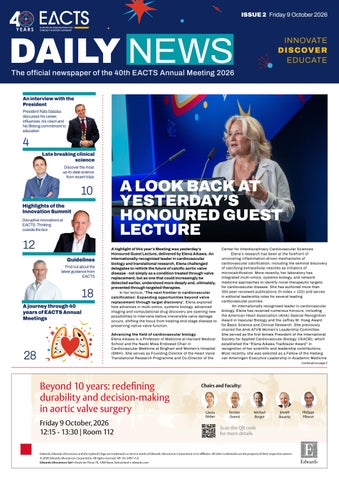
A LOOK BACK AT YESTERDAY’S HONOURED GUEST LECTURE
10 Highlights of the Innovation Summit Disruptive innovations at EACTS: Thinking outside the box
12 Guidelines Find out about the latest guidance from EACTS
A journey through 40 years of EACTS Annual Meetings
28
18
A highlight of this year’s Meeting was yesterday’s Honoured Guest Lecture, delivered by Elena Aikawa. An internationally recognised leader in cardiovascular biology and translational research, Elena challenged delegates to rethink the future of calcific aortic valve disease - not simply as a condition treated through valve replacement, but as one that could increasingly be detected earlier, understood more deeply and, ultimately, prevented through targeted therapies.
In her lecture, 'The next frontier in cardiovascular calcification: Expanding opportunities beyond valve replacement through target discovery', Elena explored how advances in multi-omics, systems biology, advanced imaging and computational drug discovery are opening new possibilities to intervene before irreversible valve damage occurs, shifting the focus from treating end-stage disease to preserving native valve function. Advancing the field of cardiovascular biology Elena Aikawa is a Professor of Medicine at Harvard Medical School and the Naoki Miwa Endowed Chair in Cardiovascular Medicine at Brigham and Women’s Hospital (BWH). She serves as Founding Director of the Heart Valve Translational Research Programme and Co-Director of the
Center for Interdisciplinary Cardiovascular Sciences. Elena’s research has been at the forefront of uncovering inflammation-driven mechanisms of cardiovascular calcification, including the seminal discovery of calcifying extracellular vesicles as initiators of microcalcification. More recently, her laboratory has integrated multi-omics, systems biology, and network medicine approaches to identify novel therapeutic targets for cardiovascular disease. She has authored more than 350 peer-reviewed publications (h-index = 102) and serves in editorial leadership roles for several leading cardiovascular journals. An internationally recognised leader in cardiovascular biology, Elena has received numerous honours, including the American Heart Association (AHA) Special Recognition Award in Vascular Biology and the Jeffrey M. Hoeg Award for Basic Science and Clinical Research. She previously chaired the AHA ATVB Women’s Leadership Committee. She served as the first female President of the International Society for Applied Cardiovascular Biology (ISACB), which established the “Elena Aikawa Trailblazer Award” in recognition of her scientific and leadership contributions. Most recently, she was selected as a Fellow of the Hedwig van Ameringen Executive Leadership in Academic Medicine Continued on page 2
Beyond 10 years: redefining durability and decision-making in aortic valve surgery Friday 9 October, 2026 12:15 - 13:30 | Room 112
Chairs and Faculty:
Gloria Färber
Torsten Doenst
Michael Borger
Joseph Bavaria
Scan the QR code for more details
Edwards, Edwards Lifesciences and the stylized E logo are trademarks or service marks of Edwards Lifesciences Corporation or its affiliates. All other trademarks are the property of their respective owners. © 2026 Edwards Lifesciences Corporation. All rights reserved. NP--EU-3497 v1.0 Edwards Lifesciences Sàrl • Route de l’Etraz 70, 1260 Nyon, Switzerland • edwards.com
Philippe Pibarot
IN THIS ISSUE Scientific Programme
14 EACTS Academy
20 Exhibition floor plan and Exhibitor list
22
EACTS TV
Watch live and recorded content from this year's Annual Meeting on EACTS TV, featuring compelling panel debates, highlights and interviews with the world’s leading cardiothoracic surgeons.
(ELAM) Programme and received the AHA ATVB Women’s Leadership Committee Award for Outstanding Mentorship of Women. In 2026, Elena was selected as Centre Director of the VALVE-iPROTECT Strategically Focused Research Network, one of only three AHA-funded centres nationwide dedicated to earlier detection and delaying progression of valvular heart disease. She leads a multidisciplinary team of basic researchers, imaging specialists, and population scientists working to transform calcific aortic valve stenosis care from a predominantly surgical disease to one focused on early detection, prevention, and targeted intervention. A dedicated mentor, Elena has trained more than 90 fellows and students and serves as Co-Chair of the Women in Cardiovascular Medicine Committee at BWH, where she is committed to advancing the careers of women in science and medicine and fostering the next generation of leaders in cardiovascular research. The next frontier in cardiovascular calcification Valve replacement, whether surgical or transcatheter, remains a lifesaving treatment for severe aortic stenosis. However, as Elena emphasised, it addresses the final mechanical consequence of calcific aortic valve disease rather than the biological processes that initiate and drive
24
Looking ahead Cardiac surgeons have transformed the treatment of advanced valve disease. Together, we now have an opportunity to transform its prevention. The goal is not to replace surgery or TAVR, but to build a broader continuum of care, one in which we detect disease earlier, intervene biologically and preserve the native valve for as long as possible.
Learning Labs
Take advantage of the invaluable opportunity to train with some of the world’s best cardiothoracic surgeons at the EACTS Learning Lab. Our hands-on workshops are designed to advance your technical abilities and include wetlabs, drylabs, simulation and practical sessions.
26
Satellite Symposia
Join experts as they discuss the latest clinical data, current and future approaches to patient care and much more in a wide range of satellite sessions hosted by industry.
26
DOWNLOAD THE EACTS APP HERE
irreversibly damaged. Finally, cardiac surgeons are indispensable partners in this next phase. Surgically explanted valves, linked to imaging, clinical phenotypes and patient outcomes, provide an extraordinary window into human disease and allow us to validate targets that are genuinely relevant to patients. Every explanted valve can become more than a surgical specimen: it can become a molecular map leading us toward the first effective therapies for calcific aortic valve disease.
it. Elena’s lecture explored the opportunity to move upstream: from treating end-stage obstruction to identifying therapeutic targets that could slow or prevent disease progression before irreversible valve damage occurs. She discussed how multi-omics, single-cell analysis, systems biology, advanced imaging and computational drug discovery are revealing previously unrecognised mechanisms of calcification, including extracellularvesicle–mediated mineralization, mitochondrial dysfunction and emerging targets such as SORT1, MFSD5 and CROT. These discoveries provide a foundation for developing pharmacological treatments that may one day preserve native valve function and delay or potentially prevent the need for valve replacement. The central message Elena delivered is that calcific aortic valve disease is not simply passive, inevitable “wear and tear.” It is an active, heterogeneous and potentially modifiable biological disease involving inflammation, fibrosis, cellular reprogramming, mitochondrial dysfunction and calcification. A second key point is that timing will be critical. Once extensive calcification and severe stenosis are established, intervention remains essential. The greatest opportunity for medical therapy is likely to be earlier, when the disease is biologically active, but the valve is not yet
WE ARE PLEASED TO SHARE THAT ALL THE PATIENTS WHO FEATURED IN LIVE SURGERY AT TECHNO-COLLEGE ARE DOING WELL . Status on post-operative day #1: Monica Gianoli et al.: CABG, Ablation and LAA-Clip Uncomplicated course, timely extubation, no neurological deficit, hemodynamically stable, sinus rhythm, scheduled to be transferred to ward. Martin Grabenwöger et al.: Ascending and Total Arch Replacement (FET) Uncomplicated course, timely extubation, no neurological deficit, hemodynamically stable, minor drainage blood loss, scheduled to be transferred to ward. Markus Kofler et al.: DV5 Robotic Mitral Valve Repair Uncomplicated course, timely extubation, no neurological deficit, hemodynamically stable, scheduled to be transferred to ward. Mario Castillo-Sang et al.: Endoscopic Mitral Valve Replacement Retrograde Type A Dissection during cannulation, conversion to sternotomy, replacement of ascending aorta and hemiarch, mitral valve replacement, MAZE and LAA-clip. Hemodynamically stable with MCS.
A SNAPSHOT OF FRIDAY'S SESSIONS 08:30 - 09:30 Room 131-132
11:15 - 12:00 Room 115/116/117
EACTS Rising Researches Session 1
Presidential Address
10:00 - 11:00 Room 112
13:45 - 14:45 Room 211 Escape the Coffin
“Oops, I did it again!” - How to manage iatrogenic dissection
Residents session - Nightmares
15:15 - 16:15 Room 131-132 European perspectives on training in robotic cardiac surgery: Learning from expert practice
10:00 - 11:00 Room 113
15:15 - 16:15 Room 133-134
10:00 - 11:00 Room 131-132
EACTS – EACTAIC joint session: Challenges in monitoring and transfusion management in neonatal cardiac surgery
2 EACTS DAILY NEWS
EACTS/AATS foundation award session
PRESIDENTIAL ADDRESS
AN INTERVIEW WITH
THE PRESIDENT
From attending his first EACTS Annual Meeting in Glasgow in 1999 to now leading the Association, President Rafa Sádaba’s journey reflects a lifelong commitment to education, collaboration and innovation in cardiothoracic surgery. We sat down with Rafa to discuss his influences, his vision and his role as the 40th President of EACTS. Did you always want a career in medicine, and why did you choose cardiac surgery? Yes, I have always wanted to be a doctor. It’s what I’ve known from childhood. When I was born, my father was a young chest physician at the Sanatorio de Leza in northern Spain. Our home was right on the hospital grounds, so medicine shaped our daily lives, and my siblings eventually also followed our father's path. Growing up in that environment, at a time when the sanatorium was transitioning into a pioneering hub for early cardiac surgery, left a lasting mark on who I became.
Who was the greatest influence on your career?
My father is the best doctor I have ever come across. Medicine was everything to him, and through that I have learned so much. I’m grateful to have learned from so many different people throughout my career, but if I had to choose the person who has influenced me the most, it would be my father.
Your training took you from Spain to the UK and Australia before returning to lead cardiac surgery at the University Hospital of Navarra. How have those international experiences influenced your approach as both a surgeon and a leader? Working in different countries gave me a much wider view of the profession and of how patients can be cared for. It taught me that there isn’t always just one way to treat or approach a problem. You learn different techniques, different ways of organising care and, importantly, different ways of treating patients and their families. I spent 13 years away before coming back home, and I brought all those experiences back with me. Perth has a particularly special place in my heart, as does Leeds and East Yorkshire in the UK, where my children were born. It was
enriching both professionally and personally. I would recommend travelling and working internationally to anyone. It gives you flexibility and more than one tool for the same problem. I came back with a different perspective, and that has been very valuable throughout my surgical career.
Looking back on your training and career, what experience has taught you the most valuable lesson as a cardiac surgeon? Communication and teamwork are vital in our specialty, including with colleagues, managers, nurses, perfusionists, and fellow surgeons. Everyone must know exactly what is happening before, during, and after a procedure. Ultimately, we work for our patients, and we have a moral obligation to ensure they feel cared for and understood. We are not simply there to relieve their suffering, we must keep them informed, explain our actions, and communicate the plan clearly. It makes a huge difference when people feel valued and comfortable speaking up, a principle that applies equally to colleagues, patients, and relatives. Good communication truly takes you far.
Education has been a recurring theme throughout your EACTS involvement. Why has this been such an important focus for you?
Education is in the DNA of EACTS. We are responsible for ensuring our members have access to high-quality education and training. As medical training moves away from the traditional apprenticeship model, EACTS provides a solid structure, ensuring that procedures are taught safely and knowledge is shared effectively. EACTS has a global reach that we are very proud of. We are continually looking at ways to remove barriers and increase opportunities to engage with EACTS, including through scholarships and grants. We aim to give access
Richard Milton, Academy Director
to everyone, no matter where they come from.
What advice would you offer to a young cardiothoracic surgery resident?
Firstly, be humble. Humility is incredibly useful and keeps you open to learning. If you already think you know everything, you are in the wrong position. It also enables you to accept correction if you did something wrong, to learn from your failures and recover from them more easily. Being humble also helps you judge the work of others more fairly. Second, be ambitious. Give your very best to whatever you do and don’t accept limitations too easily; once you accept them, you have already limited yourself. Aim high and go as far as you possibly can.
What do you think are the biggest challenges facing the specialty in the next decade, and what role can organisations like EACTS play in addressing them?
One of our biggest challenges is how the wider
DO NOT MISS!
Rafa Sádaba’s Presidential Address
“Do what you can, with what you have, where you are” 11:15-12:00 Room 115/116/117 4 EACTS DAILY NEWS
Cardiothoracic surgery is generally the same, irrespective of which unit, or indeed which country one works in. The difference between a good unit and a great one, is the people – the fundamental building blocks of any unit. Colleagues to discuss cases with, have a laugh with, or to talk to when things don’t go the way intended, or to celebrate with when passing an exam, or after the birth of a child. Colleagues like this are priceless and to be cherished, even when career progression puts thousands of miles in between. Rafa is one such colleague. A dear friend whom I met early in my cardiothoracic residency in Leeds, UK, more than 25 years ago, when he was perhaps one or two years my senior. We were tutored by the same consultant surgeons in the region and shared many of the same experiences. Rafa introduced me to EACTS whilst we were still trainees and I have been a hardcore EACTS devotee ever since. Rafa and I would meet religiously at the Annual Meeting. Ultimately, our careers took us down opposite ends of the same road – Rafa is now Head of the Cardiac Surgical Department at the University of Navarra in Pamplona, Spain; I am now one of the senior thoracic surgeons in Leeds. Irrespective of where we are, birthday wishes are exchanged every year without fail. Despite the advancing years, when we meet, it is as though we are still freshfaced young residents. Rafa, you’ve been one of my true friends over these years, and an inspirational colleague.
TODAY
medical community perceives cardiac surgery as an aggressive specialty. It is not always popular among medical students; we perform major operations that require long hours in the operating theatre. Some procedures involve large incisions and prolonged patient recovery times, whereas cardiologists are increasingly able to treat patients using quicker, less invasive methods. We need to acknowledge that perception and respond to it. We need to continue teaching and training surgeons in less invasive approaches where they are appropriate. At the same time, we shouldn’t lose sight of one of the major advantages of surgery: in many cases, the results are more durable in the long term. The challenge is to combine that durability with faster recovery and getting patients back to their
normal lives sooner, while remaining as safe as we always have been. I think we also need to explain and promote our speciality better. Cardiac surgery can be an invasive form of treatment, but it is also safe, effective and capable of delivering excellent longterm results.
What are your current areas of research and interest?
My research interest focuses in heart valve disease. We started with degenerative aortic valve disease, which is what I completed my PhD thesis on. We have grown tremendously, from a small group of people to a big lab – so now we get to investigate more, on the basic science level as well as some clinical studies.
You've held several leadership roles within EACTS, from Residents'
Committee Chair to Secretary General, and have been integral to EACTS’ development. How has each of these experiences shaped your approach to leading the Association today?
I’m very proud of my my time in EACTS, and I’m extremely grateful for all the people I have met along the way. We surgeons are not always easy to deal with! And working with people from all over the world with such different personalities and perspectives has taught me a huge amount. EACTS has been the organisation I have been involved with for the longest time in my professional life, and I am always learning here. Tough periods, both in the speciality and within the organisation, have taught me the importance of stepping up and supporting each other when things are difficult. We wouldn’t be where we are today without the members, the staff, and all those volunteers who contribute to EACTS’ mission daily. This year marks an important milestone as you are the 40th President of EACTS. What does this appointment mean to you personally, and how do you hope your Presidencywill build on the Association's legacy? My first EACTS Annual Meeting was on 5 September 1999. Since then, I have grown professionally and personally within the Association. I never dreamed that one day I would become President, so it is incredibly special for me. For any cardiothoracic surgeon in the world, becoming President of EACTS is one of the highest honours you can receive. Having the opportunity to serve the organisation in this role is a privilege that is difficult to put into words. I hope to continue to build on the work of the people who came before me, as we continue to grow EACTS and serve more members of our community. So many times, I have sat on the other side of the room and watched the Presidential Address at the Annual Meeting. Knowing that I will now have that experience myself is still quite unbelievable. As EACTS President, what are the most rewarding and challenging aspects of the position? It is so rewarding to see the confidence your peers have placed in you. To have their respect and recognition, and to be trusted with this position, is a great honour. At the same time, it comes with a huge responsibility. It is not just about me as President; it is about EACTS and everything the Association represents. There is a responsibility to protect the prestige of the organisation, make the right decisions and deal
with situations where the answer is not always black and white. I always want to improve and ask, “How can we do better?” We must ensure our members feel they are receiving good value for their membership. I want members to be proud to be part of EACTS and proud of what we represent: quality, high standards, inclusivity and diversity. It is important that people feel listened to and feel free to speak up, whether that is asking a question at a course or contributing to a wider discussion. EACTS belongs to its members, and we want to make sure they feel that.
I have had the privilege of working alongside Rafa within EACTS for more than 15 years, going back to his time as Chair of the Surgical Training and Manpower Committee, which was the precursor to the Residents' Committee. He is one of the calmest and most thoughtful colleagues I know - someone who listens carefully, brings people together and leads with quiet authority, always finding consensus. It is wonderful to see my friend and colleague serving as EACTS President, and he brings the same humanity, integrity and sound judgement to this role that have characterised his contribution to our Association over so many years. Patrick Myers, Secretary General
I’ve known Rafa for more than 15 years. We first met on the jury for the Young Investigator Award in 2011. My friend - who unfortunately is no longer with us – Juan Comas, put us in contact. In the following years, our involvement in EACTS gradually increased, as did the opportunities to meet up. Rafa, Domenico Pagano, Ruggero De Paulis and I built a small Latin group within EACTS. One of the nicest memories I have of Rafa was the way he helped the Association when it required someone to take over as Secretary General. Rafa spontaneously offered his support, without expecting anything back. Two years later, during a programme meeting, I told Rafa that I thought that he should become EACTS President. He replied that he did not think it would be possible, but it happened – and I like to think that I brought him luck. Jokes aside, I personally believe that Rafa is an excellent surgeon and has great qualities as a team leader with a great vision. Lorenzo Galletti, Vice-President
How do you relax away from surgery? I really enjoy being outdoors, particularly walking and playing golf. I love being around people and going out with friends at the weekends. I have three children, so I take every opportunity I can to spend time with them. Going away on holiday together is something I really value.
Over the years, I have had the opportunity not only to admire Rafael’s exceptional contribution and leadership within EACTS, but also to experience his human empathy in many occasions. I have particularly fond memories of my visit to Pamplona many years ago, when Rafael, his family and his coworkers made me feel truly at home. At that time and often later on we shared many ideas and visions about cardiothoracic surgery. These personal memories are as precious to me as the professional mutual respect and friendship we have enjoyed over the years. With all my heart I wish Rafael continued success and happiness in the years ahead. Ottavio Alfieri, Past President
Issue 2 Friday 9 October 5
Thoracic Disease Domain FOCUS SESSION
Is Segmentectomy Not Oncologically Safe? 15:15 - 16:15
RETHINK the REPAIR
S
For acute DeBakey Type I aortic dissections, repair is more than replacing the ascending aorta.
Successful repair should aim to address both the immediate surgical emergency and the
downstream consequences of
acute DeBakey Type I aortic dissection.
A comprehensive repair strategy should:
ROOM 111
egmentectomy has been proposed as the new standard for small (≤2 cm ≤50% groundglass) peripheral non-small-cell lung cancer (NSCLC), based largely on JCOG0802, which reported segmentectomy to be non-inferior, and at 5 years statistically superior, to lobectomy for overall survival (94.3% vs 91.1%, p=0.0082). ¹ This presentation asks whether that verdict is oncologically as solid as it appears once the trial’s functional data, survival paradox and recurrence patterns are examined together, and translates that into selection suggestions for surgeons as to counsel patients on the trade-off between recurrence risk and functional preservation. Perioperative safety: the postoperative course was similar between arms, except for significantly more air leak and chest-tube reinsertion after segmentectomy. Both ≥20 pack-years of smoking and complex, multiplane segmentectomy were independent predictors of pulmonary complications.2 Lung function and the “statistical trap”: JCOG0802 predefined a ≥10% difference in median FEV1 preservation as clinically meaningful, yet the observed median difference was only 3.5%, seemingly undermining the functional rationale for segmentectomy.1 However, comparing median FEV1 misses the clinically relevant signal: what matters is the proportion of patients who cross a harmful threshold, not the average patient. A “doseresponse relationship” has been demonstrated: the fewer segments resected, the greater the proportion of patients preserved above a critical FEV1 threshold, and the lower the incidence of death from causes other than lung cancer, such as reduced pulmonary reserve, chronic hypoxia, reduced stress tolerance and frailty.3 This offers a plausible mechanism for the survival benefit that the trial’s headline overallsurvival curve alone cannot explain. Independent confirmation comes from Gavin Wright’s post-hoc analysis of CALGB 14050.5 Similar outcomes between sublobar (30% wedge) vs lobar resection in peripheral lesions ≤2 cm were originally reported. New analysis shows that the percentage FEV1 change at 6
Herbert Decaluwé ZOL Genk, Belgium
months differed significantly across the full distribution, not only at the median (Kolmogorov-Smirnov p=0.021), with lobectomy carrying a higher rate of severe decline at every clinically relevant threshold (≥10%: 38.1% vs 26.4%; ≥15%: 23.7% vs 16.8%; ≥20%: 15.6% vs 10.4%). Notably, this functional gradient did not translate into higher non-lung-cancer mortality in CALGB 140503, an open question that tempers the mechanistic hypothesis raised by JCOG0802. Overall survival at 5 vs 10 yrs: The planned 5-year overall survival analyses favored segmentectomy. By 10 years, the overallsurvival advantage was only numerical (83.6% vs 79.8%), no longer significant.6 With a median patient age of 77 at that time point, meaning a substantial proportion of patients were over 80, the proportional-hazards assumption underlying the trial’s statistics no longer holds: competing risks and high baseline mortality at advanced age narrow the observed curves regardless of which operation was performed, so no valid conclusion can be drawn from the 10-year difference.⁵ Recurrence: The 5-year relapse-free survival was identical between arms, and local recurrence was higher after segmentectomy (8.9% vs 6.9%). A pure-solid appearance on thin-section CT, a surgical margin smaller than tumor diameter, and male sex were independently associated with local recurrence after segmentectomy.To keep the margin adequate, the distance from the intersegmental plane to the tumor center should approximate 2
Figure. Postoperative FEV1 decrease at 12 months by number of resected segments — the dose-response relationship between extent of resection and preserved lung function (AATS 2024; ref. 3).
cm plus the tumor radius. The effect of the exact segment varies across studies, mostly underpowered, with the lingula, basal segments, S6, and right upper lobe segments identified as higher risk.7-9 Take-home message: segmentectomy is the standard surgical procedure for small, peripheral NSCLC based on better overall surival and less chance of critial lung function loss. “Oncologically safe” is conditional. Lobectomy can be favored in younger patients with good lung function, especially if the tumor is pure solid, has high FDG uptake, pleural invasion or when a good margin is technically difficult to achieve. References 1. Saji, H., Okada, M., Tsuboi, M. et al. (2022) ‘Segmentectomy versus lobectomy in smallsized peripheral non-small-cell lung cancer (JCOG0802/WJOG4607L): a multicentre, openlabel, phase 3, randomised, controlled, non-inferiority trial’, The Lancet, 399, pp. 1607–1617. 2. Suzuki, K., Saji, H., Aokage, K. et al. (2019) ‘Comparison of pulmonary segmentectomy and lobectomy: safety results of a randomized trial’, The Journal of Thoracic and Cardiovascular Surgery, 158(3), pp. 895–907. 3. Tsutani, Y. (2024) ‘The association between the incidence of non-lung cancer death and the number of resected segments and postoperative pulmonary function from the randomized phase 3 trial – JCOG0802/
4.
5.
6.
7.
8.
WJOG4607L’. Oral presentation 19, AATS Annual Meeting, 27 April. Wright, G., Damman, B., Wang, X. et al. (2026) ‘Severe functional decline after lobectomy versus sublobar resection: a post-hoc analysis of the randomised CALGB 140503 (Alliance) trial’. Abstract O099/#1809, ESTS Annual Meeting, Late-Breaking Clinical Trials Session, 9 June. Onaitis, M. and Nakajima, R. (2025) ‘Long-term outcomes of segmentectomy versus lobectomy in small-sized peripheral non-small cell lung cancer: a 10-year follow-up analysis of the phase 3 randomized trial (JCOG0802/ WJOG4607L)’. Late-Breaking Abstract 9 (LB9), AATS Annual Meeting, 3 May. Nakagawa, K. et al. (2025) ‘Risk factors for locoregional relapse after segmentectomy: supplementary analysis of the JCOG0802/ WJOG4607L trial’, Journal of Thoracic Oncology, 20(2), pp. 157–166, including supplementary data. Schuchert, M.J., Pettiford, B.L., Keeley, S. et al. (2007) ‘Anatomic segmentectomy in the treatment of stage I non-small cell lung cancer’, The Annals of Thoracic Surgery, 84, pp. 926–933. Ueda, K., Tanaka, T., Hayashi, M. et al. (2012) ‘What proportion of lung cancers can be operated by segmentectomy? A computedtomography-based simulation’, European Journal of Cardio-Thoracic Surgery, 41(2), pp. 341–345.
• Restore true lumen flow1,2
KEYNOTE PREVIEW
• Support the dissected aorta3 • Promote favorable remodeling1,4,5 • Support future treatment options5,6
AMDS DOESN’T REPLACE HEMIARCH REPAIR— IT COMPLETES IT. References:
1. Bozso SJ, et al. Single-Stage Management of Dynamic Malperfusion Using a Novel Arch Remodeling Hybrid Graft. Ann Thorac Surg. 2019;108(6):17681775. 2. Szeto WY, et al. One-Year Results of Novel Aortic Arch Hybrid Prosthesis for Repair of Acute DeBakey Type I Dissection with Malperfusion: PERSEVERE Study. Ann Thorac Surg. 2025. 3. Artivion, Inc. Data on File. 4. Bozso SJ, et al. 3-Year Outcomes of the Dissected Aorta Repair Through Stent Implantation Trial. J Thorac Cardiovasc Surg. 2022. 5. El-Andari R, et al. 5-Year Outcomes of the Dissected Aorta Repair Through Stent Implantation Trial. Ann Thorac Surg. 2026. 6. Montagner M, et al. The Arch Remodeling Stent for DeBakey I Acute Aortic Dissection: Experience with 100 Implantations. Eur J Cardiothorac Surg. 2022.
6 EACTS DAILY NEWS
All products and indications are not available/approved in all markets. Refer to the device’s Instructions for Use for indications, contraindications, warnings, precautions, and possible complications. All trademarks are owned by Artivion, Inc. or its subsidiaries. Ascyrus Medical GmbH is a wholly owned subsidiary of Artivion, Inc. © 2026 Artivion, Inc. All rights reserved. Artivion, Inc. 1655 Roberts Blvd. NW, Kennesaw, GA 30144 USA Phone: 888-427-9654 | Fax: 770-590-3573 | E-mail: inquiries@artivion.com For contact information by region, please visit: www.artivion.com/contact
Ascyrus Medical GmbH, Grosse Gallusstrasse 16-18, 60312 Frankfurt, Germany MLENG2121.000 (2026-08)
This year's highly anticipated Keynote Lecture will be delivered by Toni Nadal, a Spanish tennis coach who coached professional tennis player Rafa Nadal for 27 years. In this exciting session tomorrow at 12:45, learn more about Nadal's ethos 'Everything can be trained' and take part in the Q&A! Throughout his professional career, Toni Nadal has always believed that the development of any athlete must be based on three fundamental areas: technical work, character building and education in values. In his lecture, he will explore
how resilience, preparation, and mental strength enable individuals to excel under pressure and emerge stronger from challenges. As a coach, together with Rafa Nadal, he achieved Toni Nadal one of the most successful records in the history of commitment, self-demand the international tennis and resilience, but above circuit. all, the importance of not looking for excuses and of He currently combines his neither overvaluing role as ambassador of the success nor magnifying Rafa Nadal Academy with defeat. his work as a speaker, delivering talks aimed at sports coaches, young people and companies. Some of the topics he addresses in his conferences include adversity management, Issue 2 Friday 9 October 7
FOCUS SESSION FOCUS SESSION
10:00 - 11:00
Can MICS-CABG be done on pump? 10:00 - 11:00
ROOM 115/116/117
learning curve belongs to the entire team, not only to the surgeon. But before considering minimally invasive access, the surgeon must first be completely comfortable performing CABG through sternotomy. My preferred progression is deliberate: conventional on-pump CABG through sternotomy, then all-arterial revascularization on pump; LIMALAD off pump through sternotomy; multivessel all-arterial off-pump CABG through sternotomy; and only then MICS LIMA-LAD. Once minimally invasive LIMA harvesting and LIMA-LAD grafting become highly reproducible, the program can progress toward increasingly complex multivessel MICS-CABG and eventually bilateral internal mammary artery strategies. There is an important reason for this sequence: the surgeon’s brain needs to progressively learn how to think differently. During an operation, our attention has a limited capacity. When learning MICS-CABG, everything can initially feel new: orientation through a lateral incision, long instruments, mammary harvesting from a different perspective, limited exposure, stabilization of a beating heart,
Gustavo Orellana Sapedro Westchester Medical Center, USA
S
tarting a minimally invasive coronary artery bypass grafting (MICS-CABG) program is not simply about performing coronary surgery through a smaller incision. It requires building a team, following a progressive learning pathway and understanding how much complexity the surgeon and team can safely manage at each stage. The first requirement is team mentality. Anesthesia, perfusion, scrub nurses and surgical assistants must understand the program and be committed to developing it together. Early operations take longer, exposure is different and communication becomes critical. The
identifying targets, performing an anastomosis through a small working space and simultaneously interpreting hemodynamic changes. Trying to learn all of these elements at once creates unnecessary cognitive overload. Instead, complexity should be added one layer at a time. Learn all-arterial grafting while exposure is familiar. Learn off-pump coronary surgery while the chest is still open and every coronary territory is accessible. Learn how the heart responds when it is displaced, how anesthesia and the surgeon communicate during hemodynamic changes, and when to stop manipulating the heart. Only when these decisions become almost automatic should the incision become smaller. The initial minimally invasive cases should therefore be carefully selected LIMA-LAD procedures. The objective is not to demonstrate what is technically possible, but to make minimally invasive LIMA harvest and a high-quality LIMA-LAD anastomosis reproducible. This is also where the interventional cardiologist becomes essential. In my opinion, an excellent relationship with
interventional cardiology is obligatory when developing a MICS-CABG program. They should be involved from the beginning and should see themselves as part of building the program, not as competitors. Hybrid coronary revascularization can provide an excellent bridge during the learning curve. Selected patients can receive the durability of a surgical LIMA-LAD graft while appropriate non-LAD lesions are treated with PCI. For an interventional cardiologist accustomed to treating proximal or mid-LAD disease percutaneously, referring the LAD for surgery can represent a significant change in practice. That requires trust, communication and a genuine Heart Team relationship. Once LIMA harvesting and LIMA-LAD become routine, progression to multivessel MICSCABG represents another major step. Exposure of different coronary territories, heart positioning, stabilization, graft configuration, sequencing of anastomoses and hemodynamic management all become more demanding. Transitioning from one internal mammary artery to bilateral IMA harvesting is another significant leap
and should come only when the previous stage feels extremely comfortable. Throughout this progression, minimally invasive should describe the access, never a compromise in coronary surgery. Graft quality, completeness and durability of revascularization remain the priorities, and conversion should never be considered failure. Ultimately, starting a MICS-CABG program is not about making the incision smaller as quickly as possible. It is about progressively making a complex operation feel simple. Build the surgeon first. Build the team around the surgeon. Bring interventional cardiology into that team. Master each step before adding another variable. Then, when the operation is already familiar to the brain, make the access smaller. The goal is not simply to create another MICS-CABG surgeon. It is to create a coronary program capable of bringing more physicians together and offering more patients the benefits of surgical revascularization.
FOCUS SESSION
Surgery of the Aortic Root in Conotruncal Anomalies 15:15 - 16:15
ROOM 113
ROOM 118-119
Left Ventricular Assist Devices and Temporary Right Ventricular Support in Advanced Heart Failure Introduction & the Clinical Problem Right heart failure (RHF) remains one of the main causes of early morbidity and mortality after left ventricular assist device (LVAD) implantation1. The HeartMate 3 has largely solved pump thrombosis and reduced stroke2, but it has not changed the right ventricle (RV): RHF still occurs in roughly a third of patients, up to 10% need temporary RV support, and those who develop it pay with end-organ dysfunction, prolonged hospital stay and worse survival3. Post-LVAD RHF is multifactorial. In some candidates the RV is already failing before surgery – dilated, poorly contracting, with severe tricuspid regurgitation (TR), high CVP and congested liver and kidneys. In others it appears adequate and fails only after the operation: an abrupt rise in preload as pump output and venous return increase, leftward septal shift with loss of septal contribution and worsening TR, myocardial stunning, loss of pericardial constraint, bleeding and arrhythmias. Predicting which RV will fail remains difficult. The available risk scores (Michigan, Penn, CRITT, EUROMACS-RHF) perform poorly outside the cohorts they were derived from, with AUCs mostly below 0.7 in external validation4. Machine-learning models have reached AUCs above 0.8 in single-center and registry studies, but none has been validated prospectively. Until then, the decision rests on a structured clinical protocol5.
Preoperative Risk Stratification: The IKEM Protocol In the absence of a reliable score, most centers rely on an institutional protocol. This talk presents the one we use at the Institute for Clinical and Experimental Medicine (IKEM) in Prague. Preoperative assessment rests on three pillars: hemodynamics (CVP, PAPi), echocardiography (TAPSE, RV/LV diameter ratio) and laboratory markers of end-organ function (bilirubin, creatinine). Patients are assessed 48 hours before surgery, optimized and assigned to a risk category. For those with severe RV dysfunction the protocol calls for an elective temporary RVAD (t-RVAD) implanted at the index operation: in published series a planned t-RVAD in a stable patient does better than a rescue RVAD implanted in the ICU after the RV has already failed. Surgical Prevention & Cannulation Strategies
Zuzana Tucanova Institute for Clinical and Experimental Medicine, Czech Republic
Surgery itself can lower the risk. Less-invasive implantation (LIS) through a left thoracotomy and upper hemisternotomy leaves most of the pericardium intact, preserves the constraint on the RV and, in observational series, is associated with less severe RHF and less bleeding than full sternotomy6. When the RV does need support, the configuration is tailored to the patient. We will go through the advantages, drawbacks and practical tips of the options we use: Percutaneous closed-chest systems (Impella RP or the duallumen ProtekDuo™ via the internal jugular vein) 7,8. Surgical central cannulation (right atrium to pulmonary artery). Hybrid and bedside configurations for acute stabilization. Finally, we will present our stepwise protocol for weaning and explanting the t-RVAD and the transition back to LVAD support alone. Why You Should Attend The right ventricle is a team
problem – surgeon, cardiologist and intensivist see the same patient at different moments, and the talk is meant for all three: how to identify the patient at risk, when to decide on a t-RVAD, which configuration to choose and how to wean it. Do it early. Do it right. References: 1.
Mehra, M.R., Goldstein, D.J.,
5.
mechanical circulatory support for acute
outcomes in patients receiving a fully
right ventricular failure: a clinical
magnetically levitated left ventricular assist
consensus statement from the European
device: final results from the MOMENTUM
Society of Cardiology’, European Heart
3 randomized trial’, The New England
Journal: Acute Cardiovascular Care, 12(6),
Journal of Medicine, 379(20), pp. 1897–1907. 2.
pp. 395–404. 6.
(2020) ‘Less-invasive implantation of the
D.J. et al. (2020) ‘Updated definitions of
HeartMate 3 left ventricular assist device: a
adverse events for trials and registries of
multicenter experience’, The Journal of
mechanical circulatory support: a
Thoracic and Cardiovascular Surgery,
Circulatory Support Academic Research
159(3), pp. 902–909. 7.
Anderson, M. et al. (2020) ‘Evaluation of
Consortium’, The Journal of Heart and
the Impella RP device for right ventricular
Lung Transplantation, 39(8), pp. 735–750.
failure after left ventricular assist device
Geller, B.J., Jorde, U.P. and Saeed, O.
implantation’, The Journal of Heart and
(2022) ‘Management of right heart failure in patients with left ventricular assist
4.
Netuka, I., Ivák, P., Tučanová, Z. et al.
Kormos, R.L., Antonides, C., Goldstein,
consensus statement of the Mechanical
3.
Soliman, O. et al. (2023) ‘Temporary
Cleveland, J.C. et al. (2018) ‘Five-year
Lung Transplantation, 39(4), p. S112. 8.
Saeed, O., Jorde, U.P. et al. (2021)
devices’, Current Heart Failure Reports,
‘Dual-lumen cannula (ProtekDuo) for
19(4), pp. 193–203.
temporary right ventricular support in
Loghmanpour, N.A., Kormos, R.L., Kanwar,
patients with left ventricular assist devices’,
M.K. et al. (2016) ‘Predicting right
ASAIO Journal, 67(8), pp. 882–888.
ventricular failure after left ventricular assist device implantation: a systematic review of clinical risk scores’, The Journal of Heart and Lung Transplantation, 35(3), pp. 395–396.
FOCUS SESSION
Nationwide, 10-Year Outcomes of Mitral Valve Surgery in U.S. Dialysis Patients: Repair versus Replacement
10:00 - 11:00
Ruggero De Paulis
Giulio Folino
Lorenzo Galletti
European Hospital, Unicamillus University, Italy
European Hospital, Unicamillus University, Italy
EACTS Vice-President
ROOM 212
Marco Tagliafierro Columbia University Irving
C
onotruncal anomalies — a heterogeneous group of congenital heart defects including truncus arteriosus, tetralogy of Fallot (ToF), transposition of the great arteries (TGA), and double outlet right ventricle — are frequently associated with structural and functional abnormalities of the aortic root. The surgical management of aortic root pathology in this setting represents one of the most challenging frontiers in congenital cardiac surgery. The Aortic Root in Conotruncal Disease The aortic root in conotruncal anomalies is inherently abnormal, both embryologically and structurally. In patients with tetralogy of Fallot, a dilated aortic root is a natural consequence of the anomalous conotruncal septum. The degree of root dilation is proportional to the
8 EACTS DAILY NEWS
Medical Center, USA
severity of outflow tract obstruction. Similarly, in patients with TGA following the arterial switch operation, the neo-aortic root — derived from the native pulmonary root — is prone to dilatation and regurgitation due to its inherently different tissue properties and altered biomechanical environment. After the arterial switch operation, up to 40% of patients will have mild AR immediately postoperatively and after 25 years, 15% of patients either had required aortic root surgery or developed moderate or greater neo-aortic valve regurgitation (1 -2). Truncus arteriosus results from the failure of the primitive outflow tract to separate. Around 15% of these valves present with more than moderate regurgitation at birth, and a total of 20% ultimately develop regurgitation requiring surgery in the paediatric age group. Around 60% of the valves are tricuspid, 10% are bicuspid, and 30%
are quadricuspid (3) (FIGURE). Surgical Considerations Aortic root surgery in this population must account for the unique anatomy, prior surgical history and the strong desirability of valve preservation. Aortic valve repair and valve-sparing aortic root replacement procedures are the cornerstone treatment for the paediatric and young adult population, where feasible. Standard techniques can be used, taking into consideration smaller cusp size and planning for growth. Key Takeaways Aortic root dilation and regurgitation are common long-term sequelae in conotruncal anomalies and require lifelong surveillance. Patients that require surgery are often young and therefore a valve-sparing procedures should be considered whenever anatomically feasible. A
multidisciplinary approach integrating congenital cardiac surgeons, imaging specialists, and cardiologists is essential, and early referral to specialized centres is recommended before the onset of irreversible ventricular dysfunction. interventional cardiology into that team. Master each step before adding another variable. Then, when the operation is already familiar to the brain, make the access smaller. The goal is not simply to create another MICS-CABG surgeon. It is to create a coronary programme capable of bringing more physicians together and offering more patients the benefits of surgical revascularisation. References 1. Fricke TA, Buratto E, Weintraub RG, Bullock A, Wheaton G, Grigg L, Disney P, d'Udekem Y, Brizard CP, Konstantinov IE. Long-term
2.
3.
outcomes of the arterial switch operation. J Thorac Cardiovasc Surg. 2022 Jan;163(1):212-219. PMID: 33715839. Zhu MZL, Fricke TA, Buratto E, Chowdhuri KR, Brizard CP, Konstantinov IE. Outcomes of neo-aortic valve and root surgery late after arterial switch operation. J Thorac Cardiovasc Surg. 2024 Apr;167(4):1391-1401.e3. PMID: 37757970 Naimo PS, Bell D, Fricke TA, d’Udekem Y, Brizard CP, Alphonso N, et al. Truncus arteriosus repair: A 40-year multicenter perspective. J Thorac Cardiovasc Surg. 2020:S0022-5223(20)31137-5.
An evidence gap in a highrisk population Clinically significant mitral regurgitation affects up to 40% of dialysis patients, approximately fivefold the general-population prevalence, yet neither the ACC/AHA nor the ESC/EACTS valvular heart disease guidelines address repair versus replacement here1,2. Decision making therefore relies on extrapolation from non-dialysis cohorts, small single-centre series, and national data with limited follow-up3. Correction of severe valvular disease may also bear on transplant eligibility: the 2020 KDIGO guidance recommends against transplantation with uncorrectable severe valvular disease4. Study population At Columbia University (New York,
USA), we used the United States Renal Data System to identify 3,909 US dialysis patients undergoing isolated mitral valve surgery for mitral regurgitation between 2000 and 2015: 1,614 repairs and 2,295 replacements, with follow-up complete through December 2020. Propensity-score matching incorporated mitral valve disease aetiology, year of surgery, demographics, cause of kidney failure, dialysis duration, and medical and surgical history, yielding 1,460 well-balanced pairs (all standardised mean differences <0.1). Early and long-term outcomes Perioperative stroke, prolonged ventilation, and de novo ECMO use did not differ significantly, whereas replacement was associated with higher mortality at 30 days (7.2% vs. 5.1%; p=0.021) and 1 year (32.8% vs. 22.3%; p<0.001). At 10 years, survival remained higher after repair (27.8% vs. 19.7%; log-rank p<0.001), an association that persisted with kidney transplantation as a competing event. Repair was also associated with a lower cumulative burden of stroke (p=0.012) and bleeding (p=0.004), without a difference in all-cause readmission (p=0.703).
Because the proportional hazards assumption was violated, a piecewise Cox model used a 3-year landmark. During the first 3 years, replacement carried a 45% higher hazard of death (HR 1.45, 95% CI 1.30 to 1.61; p<0.001); beyond 3 years, the association was attenuated and no longer significant (HR 1.09, 95% CI 0.94 to 1.27; p=0.268). Over 10 years, restricted mean survival was 5.05 years after repair versus 3.88 after replacement (an absolute difference of 1.17 years). Durability and reintervention Durability is a central concern given uraemia, annular calcification, and altered tissue quality, raising the possibility that an early survival advantage is offset by later reintervention. We found no higher burden of mitral reintervention after repair over 10 years (p=0.124). Among those replaced, outcomes did not differ significantly between mechanical and bioprosthetic prostheses. Transplantation and posttransplant survival Procedure type was not significantly associated with the hazard of waitlisting (HR 0.71, 95% CI 0.47 to
1.08; p=0.114) or transplantation (HR 1.28, 95% CI 0.81 to 2.03; p=0.293), suggesting that the higher transplant rate after repair may reflect greater survival to eligibility rather than access. Among the 391 patients subsequently transplanted, 10-year survival measured from transplantation was again higher after prior repair (71.9% vs. 52.5%; p=0.018). Because follow-up was reset at transplantation, this comparison isolates post-transplant survival, although it remains conditional on surviving to transplant. Interpretation and limitations This study has the inherent limitations of a retrospective analysis. Despite matching, residual confounding from unmeasured factors (frailty, functional status, echocardiographic and anatomic detail, heart-team decision making) cannot be excluded; allocation was not randomised, and the registry does not capture the technical details of repair that determine durability. Nevertheless, repair was associated with lower early mortality and a persistent long-term survival advantage, without excess reintervention. These findings support a preference for repair when durable repair is technically feasible, while
prospective studies are warranted to confirm these results and identify which patients would benefit most. For any questions or inquiries, please reach out to: marco. tagliafierro100@gmail.com References 1.
Otto, C.M., Nishimura, R.A., Bonow, R.O. et al. (2021) ‘2020 ACC/AHA guideline for the management of patients with valvular heart disease’, Circulation, 143(5), pp. e72–e227.
2.
Praz, F., Borger, M.A., Lanz, J. et al. (2025) ‘2025 ESC/EACTS guidelines for the management of valvular heart disease’, European Heart Journal. Published online 29 August 2025. doi: 10.1093/eurheartj/ ehaf194.
3.
Vassileva, C.M., Brennan, J.M., Gammie, J.S. et al. (2014) ‘Mitral procedure selection in patients on dialysis: does mitral repair influence outcomes?’, The Journal of Thoracic and Cardiovascular Surgery, 148(1), pp. 144–150.
4.
Chadban, S.J., Ahn, C., Axelrod, D.A. et al. (2020) ‘KDIGO clinical practice guideline on the evaluation and management of candidates for kidney transplantation’, Transplantation, 104(4S1 Suppl 1), pp. S11–S103.
Issue 2 Friday 9 October 9
LATE BREAKING
LATE BREAKING
When the Curves Cross: Time-Dependent Differences in Mortality After Transcatheter versus Surgical Aortic Valve Replacement in Low-Risk Patients
Biodegradable soaked Amiodarone patch use for the prevention of Atrial Fibrillation after cardiac surgery (The BEAT-AF Trial): Primary efficacy analysis
16:30 - 17:30
13:45 – 14:45
ROOM 118-119
Milan Milojevic Medical Director for Clinical Practice Guidelines at EACTS
F
or a decade, the low-risk TAVI trials have been read through a single number: a hazard ratio, or a non-inferiority margin at one or two years. That framing served its purpose early on, but it does not answer the question our (young) patients truly care about: how they will be doing in ten or twenty years. Will their valve still function properly? Will they have undergone a reintervention? And most importantly, will they still be alive? Non-inferiority at one or two years should not ever be mistaken for lifetime equivalence. With 7-year data now available from several pivotal low-risk trials, we returned to that question. In an outstanding collaboration between surgeons, we reconstructed patientlevel time-to-event data from the published survival curves of three randomised trials at the 7-year timepoint; PARTNER 3 1, Evolut Low Risk 2, and NOTION 3, together comprising 2644 patients, and we analysed all-cause mortality as a function of time rather than as a single average effect. Our central finding is that the treatment effect is not constant over time. The hazards are demonstrably non-proportional, meaning any single hazard ratio, in either direction, averages two quite different periods. Early on, mortality numerically favoured TAVI (HR 0.61, 95%CI
0.38-1.00, p=0.051, Figure 1). Between years 5 and 7, the pattern reverses, and we observe a later difference in all-cause mortality significantly favouring surgery (HR 1.64, 95%CI 1.27-2.12, p<0.001, Figure 1). As shown in Figure 1, and in several sensitivity analyses using different time-period cut-offs, this time dependence is robust. A single hazard ratio may be statistically convenient, but when hazards change over time it can be clinically misleading. These findings extend the concerns raised in our recent review of longer-term evidence in low-risk patients 4, reinforcing the need to interpret early trial results within the much longer lifetime horizon, particularly relevant to contemporary younger patients. For our community, we believe three conclusions are important. The first is methodological in nature and concerns how we read trials. Nonproportional hazards are the rule rather than the exception when a catheter-based (or medical) approach and a surgical strategy are compared, and a single summary estimate is not reliable, and will systematically obscure an adequate interpretation of the actual findings. Second, adequate and sufficient follow-up is important, particularly in (young) low-risk patients. Although five-year data already revealed a seemingly similar
Sam Heuts Maastricht University Medical Center, The Netherlands
pattern when low- and intermediate risk trials were combined 5, mid-term follow-up will never answer the lifetime question, and even seven years is still (too) short of follow-up for a contemporary 70-year-old low-risk patient. Our speciality has the obligation to follow patients for decades, through national registries and long-standing institutional cohorts. That capacity is one of our strongest scientific assets, and we should invest in it continuously. The third concerns the Heart Team and shared decision-making. An early advantage measured in the first weeks and months must be weighed against a non-negligible reversal that now seems to appear in the fifth to seventh year. For an 85-year-old, the first period is what counts. For a 70-year-old with fifteen years ahead of them, it is a small fraction of the time at stake, and the later period is where most of their risk lies. That calculation changes with every additional year of life expectancy, and it is not as trivial to reduce to an arbitrary non-inferiority margin. It requires a Heart Team willing to name the trade-off explicitly, and to revisit it as the evidence lengthens. The question is therefore not simply which treatment performs better early, but whether that early advantage remains durable over the decades that a younger low-risk patient is expected
to live. Figure 1: A: 7-year all-cause mortality event curves. B: Continuous time-varying hazard ratio between TAVI and SAVR. C: Exploratory piecewise Cox proportional hazards analysis of all-cause mortality. Evolut Low Risk contributed published Kaplan–Meier follow-up through 7 years 2; follow-up beyond 6 years was incomplete and is therefore interpreted cautiously. Piecewise intervals correspond to standard clinical and trial-reporting landmarks. Interval-specific estimates are exploratory because they are conditional on survival to the start of each interval. PARTNER 3 estimates are based on the published vital-status sweep analysis 1; protocol-defined curves without the vital-status sweep were not available for reconstruction. CI: confidence interval; HR: hazard ratio; SAVR: surgical aortic valve replacement; TAVI: transcatheter aortic valve implantation.
Mario Gaudino Editor-in-Chief
P 3.
surgical aortic valve implantation: 10-year outcomes of the NOTION trial’, European Heart Journal, 45, pp. 1116–1124. doi: 10.1093/eurheartj/ehae043. 4.
Cuartas, M. et al. (2026) ‘Emerging longer-term evidence on transcatheter
(2026) ‘Transcatheter or surgical
aortic valve implantation for severe aortic
aortic-valve replacement in low-risk
stenosis in low-risk patients: a call for
patients at 7 years’, The New England
caution’, The Annals of Thoracic Surgery.
Journal of Medicine, 394, pp. 773–783.
doi: 10.1016/j.athoracsur.2026.08.016. 5.
Marin-Cuartas, M., Kawczynski, M.J., de
Edoardo Zancanaro Residents’ Committee Chair
Reardon, M.J. and Evolut Low Risk Trial
outcomes of transcatheter versus surgical
Editor-in-Chief
Investigators (2026) ‘Six-year outcomes
aortic valve replacement in patients with
after transcatheter vs surgical aortic valve
severe aortic stenosis at low- to
replacement in low-risk patients with aortic
intermediate-surgical risk’, Heart. doi:
stenosis’, Journal of the American College
10.1136/heartjnl-2025-327092.
of Cardiology. doi: 10.1016/j. jacc.2026.02.5063.
P
ure aortic regurgitation (AR) haslong been the “orphan” indication of transcatheter aortic valve therapy. Without annular or leaflet calcification to anchor a conventional transcatheter valve, off-label use of TAVI devices has been associated with valve embolisation, the need for second valves, and residual regurgitation. Surgical aortic valve replacement (SAVR) has therefore remained the only established option, even for patients at elevated surgical risk. The arrival of the JenaValve Trilogy, the first transcatheter heart valve designed specifically for pure AR, has changed this landscape. However, until now no multicentre study had compared it directly with surgery in real-world
10 EACTS DAILY NEWS
To provide a fairer comparison, we performed 1:1 propensity-score matching, obtaining 237 wellbalanced pairs.
•
13:45-14:45 Mario Gaudino
ROOM 118-119
Key findings In the matched cohort, survival was comparable between strategies: 97.5% with JenaValve versus 97.2% with SAVR at 30 days, and 91.7% versus 94.2% at 1 year (HR 1.35, 95% CI 0.61–2.99). Technical success exceeded 99% in both arms. This is reassuring for a technology that, until a few years ago, had no reliable solution for this anatomy. The two strategies showed distinct profiles: • Haemodynamics favoured JenaValve. Mean gradients were lower (4 vs 11 mmHg) and the effective orifice area larger (2.5 vs 1.8 cm²). • Procedural recovery favoured JenaValve. Procedures were considerably shorter (65 vs 174 minutes), and new-onset atrial fibrillation was less frequent (25% vs 52).
Surgery retained two clear advantages. Permanent pacemaker implantation was much lower (3.4% vs 17%), as was any paravalvular leak (1.6% vs 24%).
“The key message from BEAT-AF is straightforward: topical amiodarone was technically simple and biologically appealing but did not provide additional protection against POAF when added to contemporary preventive care.” Selected references 1.
Gaudino, M., Di Franco, A., Rong, L.Q., Piccini, J. and Mack, M. (2023) ‘Postoperative atrial fibrillation: from mechanisms to treatment’, European Heart Journal, 44, pp. 1020–1039.
2.
Chatterjee, S., Grant, M.C., Hui, D.S. et al. (2026) ‘The Society of Thoracic Surgeons 2026 clinical practice guidelines for the prevention and treatment of new-onset postoperative atrial fibrillation after cardiac surgery’, The Annals of Thoracic Surgery, 122, pp. 255–277.
3.
Lemma, M., Chao, L., Scorsin, M. et al. (2026) ‘BiodEgradable soaked Amiodarone paTch use for the prevention of Atrial Fibrillation after cardiac surgery (The BEAT-AF Trial): rationale and design’, CJC Open. Published online 11 August 2026.
The Arterial Revascularization trial: fully adjusted MAG vs SAG analysis
Waha, S. et al. (2026) ‘Updated 5-year
Dedicated transcatheter versus surgical valve replacement for pure aortic regurgitation: first multicentre European data from EROICA practice. In this Late-Breaking Clinical Science session, we will present the results of EROICA, an investigatorinitiated registry from 13 high-volume European centres in six countries. EROICA enrolled 1,194 consecutive adults with severe pure native AR treated between July 2021 and December 2025 with either isolated SAVR (n=764) or transfemoral TAVI with the JenaValve Trilogy (n=430). Patients with concomitant aortic stenosis, bicuspid anatomy, prior aortic prostheses, combined procedures or active endocarditis were excluded, in order to isolate the comparison of interest. The coprimary endpoints were all-cause mortality at 30 days and at 1 year, and secondary endpoints were adjudicated according to VARC-3 definitions. As expected, the two populations were very different. Transcatheter patients were 15 years older (median 80 vs 65 years), more symptomatic, and at higher surgical risk, which reflects current Heart Team selection.
saline. Application required less than one minute. The primary endpoint was newonset POAF within the first five postoperative days. POAF occurred in 13.4% of patients assigned to topical amiodarone and 15.5% assigned to saline. The adjusted odds ratio was 0.84 (95% CI 0.51 - 1.40; p=0.52), corresponding to an absolute risk difference of -2.01%. No significant differences were observed in secondary outcomes, and the primary finding remained consistent across prespecified subgroup and
sensitivity analyses. These results are important because local amiodarone delivery is an attractive concept. It offers the possibility of targeting the atrial myocardium while avoiding the systemic exposure associated with conventional administration. Nevertheless, biological plausibility does not always translate into clinical benefits. In BEAT-AF, adding epicardial amiodarone patches to contemporary POAF prophylaxis did not significantly reduce postoperative atrial fibrillation. Notably, the incidence of POAF was low in both treatment groups 13.4% with topical amiodarone and 15.5% with saline - compared with rates commonly reported after cardiac surgery. This may, at least in part, reflect the broad implementation of contemporary preventive strategies in BEAT-AF: posterior pericardiotomy was performed in 87% of patients and approximately 90% received postoperative beta-blockers. Against this background of intensive POAF prophylaxis, topical amiodarone did not provide additional benefit.
LATE BREAKING
Forrest, J.K., Yakubov, S.J., Deeb, G.M.,
LATE BREAKING
16:30 - 17:30
ostoperative atrial fibrillation (POAF) remains the most common complication after cardiac surgery, affecting approximately 20-40% of patients depending on patient characteristics, procedure type, and the method used for detection. Beyond being a frequent postoperative event, POAF is associated with an increased risk of stroke, hemodynamic instability, prolonged hospitalization, and higher healthcare costs. Amiodarone is effective for the prevention of POAF, but systemic administration exposes patients to a drug with well-recognized extracardiac toxicities and potential drug interactions. This provided the
rationale for a different approach: delivering amiodarone directly to the heart. Preclinical studies have demonstrated that epicardial administration can achieve targeted cardiac drug delivery with minimal systemic exposure, while small previous clinical studies suggested a potential reduction in POAF. However, robust clinical evidence has been lacking. In the BEAT-AF trial, we therefore investigated whether local epicardial delivery of amiodarone could prevent POAF in patients undergoing elective cardiac surgery. BEAT-AF was an adaptive, single-center, double-blind, placebocontrolled randomized trial. A total of 502 patients were randomized 1:1 to topical amiodarone or saline control in addition to routine POAF prophylaxis. The intervention was deliberately simple. Two biodegradable patches were soaked with 150 mg of amiodarone and positioned over the epicardial ganglionated plexuses immediately before sternal closure. Patients assigned to the control group received identical patches soaked in
Sousa Uva, M., Milojevic, M., Marin-
Leon, M.B., Mack, M.J., Pibarot, P. et al.
doi: 10.1056/NEJMoa2509766. 2.
Thyregod, H.G.H., Jorgensen, T.H., Ihlemann, N. et al. (2024) ‘Transcatheter or
References 1.
ROOM 118-119
refined implantation depth, patient selection and device iteration. Their long-term clinical impact in a relatively younger AR population needs dedicated follow-up. As with any observational study, residual confounding cannot be Take-home messages excluded despite matching, and Dedicated transcatheter therapy follow-up is currently limited to 1 year. appears to be a credible alternative to EROICA provides the largest surgery for selected patients with pure European real-world benchmark to AR, particularly older and higher-risk date, but a properly powered patients, with early survival similar to randomised comparison is the SAVR. Surgery, however, remains the necessary next step. benchmark for younger patients, for We look forward to discussing whom a lifetime without conduction these data, and their implications for disturbances or residual leak matters Heart Team decision-making in pure most. AR, with the EACTS community. Pacemaker implantation and paravalvular leak are now the key targets for improvement, through
T
ROOM 118-119
he evidence surrounding arterial grafting has evolved considerably since the Arterial Revascularization Trial (ART) was launched more than two decades ago. At the time, the central question was whether adding a second internal thoracic artery could improve long-term outcomes after coronary artery bypass grafting (CABG). Since then, the radial artery has become increasingly established as an additional arterial conduit. The contemporary question has therefore broadened from bilateral versus single internal thoracic artery grafting to multiple versus single arterial grafting. With more than 3,000 randomized patients and now 15 years of followup, ART provides a uniquely rich dataset in which to examine this contemporary question. The recently
published intention-to-treat analysis showed virtually identical all-cause mortality among patients randomised to bilateral or single internal thoracic artery grafting: 37.8% versus 37.6%, respectively (HR 1.00; 95% CI 0.89–1.12). Yet the treatment patients actually received did not always correspond to their randomized assignment. Fourteen percent of patients allocated to BITA received SITA, while radial artery grafts were used in 23% of patients allocated to SITA and 18% allocated to BITA. Consequently, the randomized BITA-versus-SITA comparison does not fully answer a question that has become increasingly relevant to contemporary CABG practice: what are the longterm outcomes of multiple arterial grafting (MAG) compared with single arterial grafting (SAG)? In this prespecified analysis, we used the ART dataset to examine outcomes according to the revascularization strategy patients
actually received. Outcomes among 1,690 patients receiving MAG were compared with those of 1,330 patients receiving SAG. Because this comparison is no longer randomized, we applied several complementary methods to address measured confounding, including multivariable Cox regression, inverse probability of treatment weighting, overlap weighting and propensity-score matching. The results were remarkably consistent across these approaches. At 15 years, MAG was associated with lower all-cause mortality, with adjusted hazard ratios ranging from 0.85 to 0.89 across the different adjustment methods. The multivariable-adjusted analysis yielded an HR of 0.86 (95% CI 0.76–0.96), while propensity-score matching yielded an HR of 0.85 (95% CI 0.75–0.96). A similar pattern was observed for major adverse cardiovascular events, with adjusted hazard ratios consistently between
0.85 and 0.88. These findings provide important additional context to the neutral intention-to-treat results of ART. They do not overturn the randomized BITA-versus-SITA comparison; rather, they use the long-term ART dataset to address a different and increasingly contemporary question. The consistency of the association across multiple adjustment strategies is reassuring, but this remains a non-randomised comparison and residual or unmeasured confounding cannot be excluded. Randomized evidence specifically comparing MAG with SAG is therefore still needed, and the ongoing ROMA trial will provide important further information. ART has generated evidence in coronary surgery for more than 20 years through the vision and leadership of Professor David Taggart. The EACTS presentation is dedicated to his memory, reflecting his central role in the trial and in the wider debate surrounding arterial
revascularization. Fittingly, this latest analysis uses the extraordinary long-term ART dataset to ask a question that has evolved alongside coronary surgery itself. “ART was designed around BITA versus SITA. Fifteen years later, its uniquely rich dataset allows us to ask the contemporary question of multiple versus single arterial grafting.” Selected references Taggart, D.P. et al. (2019) ‘Bilateral versus single internal-thoracic-artery grafts at 10 years’, The New England Journal of Medicine, 380(5), pp. 437–446. doi: 10.1056/NEJMoa1808783. Taggart, D.P. et al. (2026) ‘Long-term outcomes following bilateral vs single internal thoracic artery grafts: a secondary analysis of a randomized clinical trial’, JAMA Cardiology. Published online 2 September 2026. doi: 10.1001/jamacardio.2026.3232.
Issue 2 Friday 9 October 11
Highlights of the Innovation Summit 16:30 - 17:30
Chair of the EACTS Innovation Committee
Mark Hazekamp
Chair of the EACTS Innovation Committee
The annual Innovation Summit showcases ground-breaking innovations that have the potential to impact the future of cardiothoracic surgery. Launched in April 2023, the milestone fifth Summit will be held in April 2027. The Summit aims to foster exchange between its participants and is held in a remote place where participants are together from breakfast to dinner – with the opportunity to talk and exchange ideas and insights. EACTS spoke to Innovation Committee Chairs and Founders of the Innovation Hub Friedhelm Beyersdorf and Mark Hazekamp about this year’s event.
We cannot progress without innovation. It is critical. That is the concept: idea to bedside. Joseph Bavaria , EACTS Treasurer
medicine and human space exploration.”Some of the most striking examples came from projects demonstrating how emerging technologies could be applied to established areas of cardiothoracic surgery. Among the 18 selected abstracts, Vera Zut (Leiden University Medical Center, The Netherlands) received the Innovation Summit Award for her work on “An expandable auxetic Fontan conduit.” Her research addresses a limitation of conventional Fontan conduits, which do not grow with paediatric patients and can become undersized in adulthood. “Vera Zut impressed everybody with her ideas - with what she has done and with what she could achieve with her coworkers,” said Beyersdorf.
Meet our 2026 Innovation Grant recipients Three awardees received an EACTS Innovation Grant and were invited to present their projects at the 4th EACTS Innovation Summit. Alongside funding, they will receive expert advice from members of the EACTS Innovation Committee. Leila Louise Benhassen (Aarhus University Hospital, Denmark) for ‘HomEcmo: The Portable Artificial Lung.’ The project aims to support earlier rehabilitation and improve outcomes for patients with severe lung failure. Paul Philipp Heinisch (German Heart Centre Munich, Germany) for ‘Hybrid Cellulose Valved Valsalva Conduit for Congenital Cardiac Surgery.’ His research aims to reduce repeated operations in children with right ventricular outflow tract abnormalities and improve quality of life.
12 EACTS DAILY NEWS
Innovation is essential both for the future of our patients and for the future of our specialty. It is much more important today than it was 40 years ago. Innovation does not wait until everybody has boarded the train; it is already at full speed.- Friedhelm Beyersdorf
Grant recipients. The presentations were followed by Q&As, with more time allocated for discussion than at a traditional conference. The programme focused on technologies and research with potential to change future patient care, spanning artificial intelligence, robotics, regenerative medicine, bioengineering, virtual reality, advanced implants, and space technology. Aditi Sathe, Satellite System Engineer at ATG Europe for the European Space Agency, presented the keynote “Space innovation, space for
“We want to turn innovative ideas into clinical reality. Only a certain percentage of attendees are surgeons. The Innovation Summit creates an ecosystem where surgeons, scientists, engineers, startups, and industry can meet and turn new ideas into better treatments for our patients,” said Beyersdorf. “Our goal is not simply to talk about innovation, but to create an environment in which innovation can actually happen,” added Hazekamp. The fourth Summit brought experts from 20 countries to Paris this year, from 23-25 April, to explore and shape the future of cardiothoracic surgery. Surgeons, Highlights of the Innovation Summit cardiologists, allied health professionals, At today’s session, William Cohn (Texas engineers, industrialists, biochemists, Medical Center) will speak about innovation in scientists, health economists, and academics cardiovascular care, followed by Joseph Woo all attended. The two-day meeting featured 34 (Stanford University) on new approaches to the presentations, including 18 selected abstracts Ross operation and Vera Zut on the use of and three presentations from 2026 Innovation auxetic stent-graft technology in Fontan surgery.
•
Save the date for the 5th EACTS Innovation Summit
ROOM 131-132
Friedhelm Beyersdorf
•
EACTS Innovation Committee
•
Sarah Wollmann (Medical University of Vienna, Austria) for ‘A Two-Stage Ventricular Assist Device for Paediatric Patients.’ Her project aims to develop a ventricular assist device specifically for children, addressing the limited mechanical circulatory support options available for smaller patients
“We are delighted to announce that the 5th EACTS Innovation Summit will take place from 2-4 April 2027 in Frankfurt, Germany. The Innovation Summit is growing, and Frankfurt will reflect that growth. There will be more attendees than ever before, while retaining the same château-style setting where participants can stay together and fully immerse themselves in the meeting. Everybody loves the format, so we are now building on that success with a larger meeting and broader participation. For the first time, registration will also be open, allowing more members of the cardiothoracic community to take part.” Leila Louise Benhassen (Aarhus University Hospital, Denmark) will present work on a portable ECMO system, which Beyersdorf has highlighted for its potential to change patient care. He described the technology as having been “very impressive to everybody at the last Summit.” Mark Hazekamp will discuss the development of a partially resorbable cardiovascular patch, while Hazem Fallouh (Fallouh Healthcare) will close the session. Innovative technologies and Artificial Intelligence “I am so excited about all these new techniques,” said Beyersdorf. They open new doors for us to make this dream, next day discharge, a reality. And we are working on that. Not only dreaming but actively working on it.” At the Summit, during “Every token has a cost: Energy, AI and the future of compute,” Sandy Engelhardt (University Hospital Heidelberg, Germany) examined the growing energy demands of AI and remarked that data centres currently account for around 1.5% of global electricity demand, with that figure potentially reaching 3.5% by 2030 if the AI boom continues. Engelhardt also addressed AI’s growing role in healthcare and questioned whether healthcare organisations should consider open-source AI for clinical applications where compliance and data governance are concerns.
The risks of AI were also examined by Mario Gaudino (Weill Cornell Medicine, USA) in “Friend or Foe? AI in scientific publishing.” AI can automate routine tasks, refine manuscripts, summarise complex subjects and improve language, but Gaudino warned of fabricated research, citation errors, declining critical thinking, and confidentiality concerns. “AI is an incredibly strong assistant that can help with time-consuming steps, allowing researchers to focus on more intellectual and innovative steps. However, AI use may also erode critical thinking. Clear oversight of every AI-driven step is needed,” said Gaudino.
The 2027 Innovation Summit will unveil a re-designed programme focused on cuttingedge innovation, equipping participants with the insights, connections and tools needed to accelerate ideas from concept to patient care. The programme will feature fast-paced elevator pitches, insightful panel sessions, inspiring keynote presentations, and interactive demonstrations.
said Hazekamp, with Beyersdorf adding that he is “particularly excited about our new demonstration room. Once you see these technologies demonstrated in front of you, you realise just how much is possible.” The 5th EACTS Innovation Summit is now accepting submissions for abstract presentations and elevator pitches. If you have an idea that could shape the future of cardiothoracic surgery, now is your chance to turn it into action and join this pioneering event. Early bird registration will open later this year. For everything you need to know please scan QR code
“Next year, Frankfurt will move us further from talking about innovation towards seeing it, experiencing it, and building it together,”
The Grant is a powerful validation of our mission: bridging a critical medical gap by providing a dedicated, implantable two-stage ventricular assist device for our youngest patients.
Scan for more information!
Sarah Wollmann
5th EACTS INNOVATION SUMMIT 2-4 APRIL 2027 | FRANKFURT, GERMANY
OPEN NOW: Abstract and rapid-fire pitch submissions
��3 November 2026: Early bird registration opens
Applications are now open for the 2027 Innovation Grants! Scan the QR code for more information and to apply.
Issue 2 Friday 9 October 13
SCIENTIFIC PROGRAMME
e-POSTERS Acquired Cardiac Disease Domain
Aortic Disease Domain
Thoracic Disease Domain
General Interest
Congenital Disease Domain
FRIDAY 9 OCTOBER
Enjoy even more science at the 40th EACTS Annual Meeting
FRIDAY 9 OCTOBER Time
Room 115/116/117
Room 111
Room 112
Room 113
Room 114
Room 118-119
Room 120-121
Room 131-132
Room 133-134
Room 211
Room 212
08:30 – 09:30
08:30 – 09:30
08:30 – 09:30
08:30 – 09:30
08:30 – 09:30
08:30 – 09:30
08:30 – 09:30
08:30 – 09:30
08:30 – 09:30
08:30 – 09:30
Precision is
Current challenges
Hereditary Thoracic
Focus on Ross
New techniques and
Precision recovery
Optimising sternal
EACTS rising
Thoracic Abstract
Innovative solutions
teachable:
and future aspects
Aortic Disease
operation and aortic
outcomes of aortic
in cardiac surgery:
outcomes:
researchers session
Session
and risk stratification
Endoscopic and
of lung cancer
(HTAD) - Closing the
repair
valve interventions
Long‑term ERAS
Comparative fixation
1
robotic mitral repair
treatment
knowledge gap
insights, remote risk
methods, novel
between genes and
modification &
infection therapies,
sutures
intelligent
and AI‑enhanced
medication
rehabilitation
09:30-10:00
in advanced heart failure
14:45-15:15
management
Topic
SATURDAY 10 OCTOBER Location
Time
Acquired Cardiac - Endocarditis
e-Poster Theatre 1
Aortic Domain 3
e-Poster Theatre 2
Congenital Domain 3
e-Poster Theatre 3
Thoracic Domain 3
e-Poster Theatre 4
Coronary Moderated e-Poster
e-Poster Theatre 1
Aortic Domain 4
e-Poster Theatre 2
Congenital Domain 4
e-Poster Theatre 3
Thoracic Domain 4
e-Poster Theatre 4
09:30 – 10:00 Moderated e-Posters, e-Poster Theatres 1, 2, 3 and 4 10:00 – 11:00
10:00 – 11:00
10:00 – 11:00
10:00 – 11:00
10:00 – 11:00
10:00 – 11:00
10:00 – 11:00
10:00 – 11:00
10:00 – 11:00
10:00 – 11:00
10:00 – 11:00
Promoting big trials
AV valve surgery in
Starting a
Unanswered
“Ooops, I did it
EACTS – EACTAIC
Pushing the limits in
How I teach
EACTS - EBCP:
Residents session
Thoracic Abstract
MICS-CABG
questions in pleural
again!” - How to
joint session:
aortic valve and root
mechanical
From the hype to
- Nightmares
Session
program: What you
disease
manage iatrogenic
Challenges in
surgery: Hostile
circulatory support
practice: Making AI
need to know
management - Joint
dissection
monitoring and
anatomy,
and transplant
work in cardiac
EACTS-ERS
transfusion
complications, and
strategies in
surgery
session
management in
salvage
advanced heart
JOINT SESSIONS
"Do what you can, with what you have, where you are"
13:45 – 14:45
13:45 – 14:45
13:45 – 14:45
13:45 – 14:45
13:45 – 14:45
13:45 – 14:45
2026 EACTS expert
EACTS - ERAS:
Lifetime-
Focus on heart
EACTS - EACTAIC
Late breaking
Composite
CSIA @ EACTS:
Francis Fontan
consensus
Complications in
management of the
transplant and
joint session:
clinical science 2
endpoints in the
Stakeholders and
Fellowship
documents
cardiac surgery we
organ aorta after
mechanical support
Haemostasis and
contemporaries trial:
sustainability in
don’t like to talk
index Type A repair
fast-track recovery:
Are we measuring
global cardiac
about: Building
– Guidelines and gut
From bleeding
what matters?
surgery
zero-harm pathways
feeling (STS@
control to early
13:45 – 14:45 Escape the coffin
13:45 – 14:45 Thoracic rapid response on lung transplantation
extubation pathways
EACTS)
Aortic Domain 5
e-Poster Theatre 2
Congenital Domain 5
e-Poster Theatre 3
Thoracic Domain 5
e-Poster Theatre 4
VIEW THE MODERATED e-POSTERS
13:45 - 14:45 Room 112 Lifetime-management of the organ aorta after index Type A repair – Guidelines and gut feeling (STS@EACTS)
10:00 - 11:00 Room 120-121 EACTS – EBCP: From the hype to practice: Making AI work in cardiac surgery
12:00 – 13:45 Lunch, Exhibition Hall, Satellite Symposia, e-Poster Browsing 13:45 – 14:45
e-Poster Theatre 1
13:45 - 14:45 Room 131-132 CSIA @ EACTS: Stakeholders and sustainability in global cardiac surgery
FRIDAY 9 OCTOBER
11:15 – 12:00 Presidential Address - Rafael Sádaba, Room 115/116/117
13:45 – 14:45
Acquired Cardiac – Mitral Valve
scenarios
surgery
13:45 – 14:45
09:30-10:00
Location
challenging clinical
failure
neonatal cardiac
Topic
15:15 - 16:15 Room 113 EACTS – STS joint session: Management of the aortic root in patients with CHD
10:00 - 11:00 Room 111 Unanswered questions in pleural disease management - Joint EACTS-ERS session 10:00 - 11:00 Room 113 EACTS – EACTAIC joint session: Challenges in monitoring and transfusion management in neonatal cardiac surgery
15:15 - 16:15 Room 133-134 EACTS/AATS foundation award session
14:45 – 15:15 Break, Exhibition Hall, Moderated e-Posters, e-Poster Theatres 1, 2, 3 and 4 15:15 – 16:15 Pushing the
15:15 – 16:15 Sublobar resection
15:15 – 16:15
15:15 – 16:15
Managing the left
EACTS – STS joint
Optimising
15:15 – 16:15
15:15 – 16:15
15:15 – 16:15
15:15 – 16:15
15:15 – 16:15 Reinventing valve
European
EACTS/AATS
Contemporary
Big trials across the Atlantic: CTSN
subclavian artery in
session:
outcomes in patients
therapy: The next
perspectives on
foundation award
approaches for aortic
NSCLC: Translating
aortic arch repair –
Management of the
with poor ejection
wave of innovation
training in robotic
session
valve intervention
landmark trials into
The most important
aortic root in patients
fraction
standard surgical
technical question in
with CHD
care
aortic arch surgery?
boundaries of CABG for early-stage
15:15 – 16:15
15:15 – 16:15 WiCTS session
cardiac surgery: Learning from expert practice
16:15 – 16:30 Break, Exhibition Hall, e-Poster Browsing 16:30 – 17:30
16:30 – 17:30
16:30 – 17:30
16:30 – 17:30
One appendage
Robotic surgery –
2026 Clinical
16:30 – 17:30
Focus on adult
16:30 – 17:30
Complex aortic root
16:30 – 17:30
Late breaking
16:30 – 17:30
The future of cardiac
Highlights of the
Tips and Tricks in
Aortic surgery
Endoscopic aortic
– Three strategies:
From segments to
practice guidelines
patients with
procedures: How I
clinical science 3
repair: From
Innovation Summit
minimally invasive
innovations - What's
valve surgery: A new
Evidence versus
transplant
congenital heart
teach
and robotic surgery
hot... and not!
paradigm in the
immunomodulation
16:30 – 17:30
16:30 – 17:30
lifetime
to regeneration
disease
enthusiasm
16:30 – 17:30
management of aortic valve disease
SATURDAY 10 OCTOBER Room 115/116/117
Room 111
Room 112
Room 113
Room 114
Room 120-121
Room 131-132
Room 211
Room 212
08:30 – 09 :30
08:30 – 09 :30
08:30 – 09 :30
08:30 – 09 :30
08:30 – 09 :30
08:30 – 09 :30
08:30 – 09 :30
08:30 – 09 :30
08:30 – 09 :30
Beyond repair: Mastering
Nightmares of thoracic
Post-operative
Aortic valve repair
When surgeon and
EACTS Rising
Congenital rapid response
mitral valve replacement
surgery
management of Type A
without root aneurysm –
machines collaborate - AI
researchers session 2
2
dissection – The
Video session
tools every surgeon
Back to the future
Live Translation
DOWNLOAD THE EACTS APP HERE
1. Scan the QR code using your personal device
should know
importance of multidisciplinary teams in the treatment of acute dissection
09:30 – 10:00 Moderated e-Posters, e-Posters Theatres 1, 2, 3 and 4 10:00 – 11:00
10:00 – 11:00
10:00 – 11:00
10:00 – 11:00
10:00 – 11:00 Commandos / VSD
10:00 – 11:00
10:00 – 11:00
10:00 – 11:00
10:00 – 11:00
Improving CABG
Remodel, resect, or
Endovascular repair in
Basic Science and
Transcatheter therapies
Nursing and allied health
Contemporary challenges
The changing landscape of
outcomes in the OR
replace? – How best to
Heritable Thoracic Aortic
innovation for congenital
in clinical action:
professionals in
and innovations in
heart transplantation
treat the severely
Disease – Do as much
heart disease
Real‑world cases that
cardiothoracic surgery
minimally invasive valve
emphysematous lung
nothing as possible or
and atrial fibrillation surgery
sharpen decision‑making
pushing the limits? 11:15 – 12:15
11:15 – 12:45 Trial update session
Airway sparing surgery 12:00 – 12:45 Artificial Intelligence in thoracic surgery
11:15 – 12:15
11:15 – 11:45
Special session
Abstract session –
dedicated to J.V. Comas
Nursing and allied health
on transposition of the
professionals
https://attend.wordly.ai/join/XWJN-2581
2. Select your preferred language 3. Click attend If you wish to listen to the audio translation, please use your headphones and ensure that your device is unmuted.
great arteries 12:45 – 13:30 Closing Plenary, Room 115/116/117 Keynote Lecture – Toni Nadal: Everything can be trained EACTS Awards Ceremony Farewell Drinks Reception from 13:30, Entrance Hall
For detailed programme and break times please refer to the EACTS App.
14 EACTS DAILY NEWS
Issue 2 Friday 9 October 15
EACTS develops training pathway for robotic cardiac surgery TERUMO AORTIC SYMPOSIUM
Published earlier this week, the Robotic cardiac surgery minimum standards for programme
Friday 9th October
implementation, training and quality assurance Expert
15 Years of Thoraflex™ Hybrid: Innovation That Continues to Shape Aortic Surgery
Consensus Document provides a clear blueprint for robotic cardiac surgery training pathways. EACTS supports the use of advanced robotic platforms for performing cardiac surgery. The technical complexity of such systems and the requirements with regards to endoscopic skills and experience that surgeons need to perform robotic cardiac surgery. EACTS therefore recommends to follow the dedicated training pathways defined by the manufacturers of such systems and to submit case specific data to a dedicated registry hosted by EACTS, the EACTS Robotic Cardiac Database. Minimum Requirements In order to acquire the skills in robotic cardiac surgery, the following minimum requirements need to be met. Completion of the recommended training protocols as defined by the respective manufacturer of the robotic platform. This recommendation is device agnostic but
acknowledges that platform specific training curricula exist and that surgeons have to participate in these trainings before first patient contact. The trainings may include simulation-based training, practical hands-on training, animal or cadaver labs, site visits and/or proctored cases Completion of accepted robotic courses depending on the planned type of robotic procedures (i.e. revascularisation or intracardiac repairs). Compliance with the EACTS Expert Consensus Document on robotic cardiac surgery. The consensus document covers all aspects of training, technical and logistical aspects, site qualification as well as professional requirements. Agreement to submit all data to the EACTS Robotic Cardiac Database.
In order to capture the growing experience with robotic cases it is mandatory that the relevant outcome data are reported from participating sites to the EACTS Database on robotic surgery. Agreement to have an external review of the data after 6 months of operation. EACTS will provide the option to review and discuss site outcomes with experts from the Task Force on Robotic Surgery. This will help sites to understand their strengths and areas for improvement. Certificate Upon completion of the suggested training pathway, EACTS will verify the fulfillment of the criteria in a formal process and issue a certificate that the standards to perform robotic cardiac surgery are met.
Find out more at today's sessions 15:15-16:15 | Room 131-132 European perspectives on training in robotic cardiac surgery: Learning from expert practice
13:45 - 14:45 | Room 115/116/117 2026 EACTS expert consensus documents
Read more!
12:15 – 13:30
Room 129, Level P1
M O D E R ATO R / S P E A K E R
Prof. Malakh Shrestha Germany 15 Years of Thoraflex™ Hybrid: Innovation That Continues to Shape Aortic Surgery
SPEAKER
Dr. Aakash Shah
A fee may be required for the delivery of this certificate.
USA In Situ Fenestration with Thoraflex™ Hybrid: Expanding Options for Left Subclavian Artery Management (PSIDE).
LATE BREAKING
The Arterial Revascularization trial: fully adjusted MAG vs SAG analysis
Yunpeng Zhu Ruijin Hospital Shanghai Jiao Tong University School of Medicine, China
I presented the final 10-year clinical follow-up of the DACAB trial – the longest randomized assessment to date of a time-limited antiplatelet strategy after coronary artery bypass grafting (CABG). The presentation compared three regimens used during the first year after elective CABG: ticagrelor plus aspirin (T+A), ticagrelor alone (T), and aspirin alone (A), and reported outcomes in 500 randomized patients followed for a median of 10.7 years. Primary outcome data were available for 467 patients (93.4%). The primary endpoint, 4P-MACE (all-cause death, myocardial infarction [MI], stroke, or coronary revascularization), occurred in 81, 79, and 85 patients in the T+A, T, and A groups, respectively. Neither ticagrelor-based strategy significantly reduced 4P-MACE versus aspirin (T+A vs A: HR 0.85, 95% CI 0.62–1.15, P=0.27; T vs A: HR 0.93, 95% CI 0.68–1.26, P=0.63; T+A vs T: HR 0.91, 95% CI 0.67–1.24, P=0.56). The key original finding is that the prespecified
16 EACTS DAILY NEWS
secondary endpoint, 3P-MACE (cardiovascular death, MI, or stroke), was significantly reduced with T+A versus A (HR 0.64, 95% CI 0.45–0.93, P=0.018), corresponding to an absolute risk reduction of 11.4% and a number needed to treat of 9 over 10 years. This benefit was driven mainly by fewer MIs (23 vs 37; HR 0.58, P=0.037). T+A also reduced MI versus T alone (HR 0.50, P=0.007), suggesting an additive anti-MI effect of aspirin when combined with ticagrelor. In contrast, ticagrelor monotherapy significantly reduced stroke versus aspirin (11 vs 28; HR 0.37, 95% CI 0.19–0.75, P=0.006), whereas T+A vs A did not reach significance for stroke (HR 0.64, P=0.13). Landmark analyses showed that the 4P-MACE benefit of T+A versus A was concentrated in the first 5 years (HR 0.70, 95% CI 0.45–1.07), with no further benefit between years 5 and 10 (HR 1.04, 95% CI 0.67–1.61). Thus, the early absolute difference was largely preserved but not extended. All-cause and cardiovascular mortality, major bleeding, and net adverse clinical events did not differ significantly among groups. However, all-cause and cardiovascular mortality were numerically higher with T+A than with T alone (HR 1.37 and 1.47, respectively), a finding based on small event numbers that requires cautious interpretation. At 10 years, antiplatelet medication use had largely converged, with aspirin monotherapy predominant among patients with available data. Exploratory subgroup analyses showed no significant treatment-by-subgroup interaction for T+A versus A across most variables. Sex interactions were observed for the T+A versus T
SPEAKER
Prof. Malakh Shrestha & Dr. Aakash Shah Germany / USA Expert Debate: Left Subclavian Artery Management During Frozen Elephant Trunk – Surgical Reconstruction or In Situ Fenestration?
and T versus A comparisons, but these were based on few women and are hypothesisgenerating only. Attendees should therefore interpret secondary and subgroup findings as exploratory, especially given the neutral primary endpoint and no multiplicity adjustment. One year of ticagrelor-based dual antiplatelet therapy after CABG produces an early benefit that is preserved for hard cardiovascular events over a decade, mainly through fewer MIs, but it does not significantly improve the broader primary composite or extend benefit beyond 5 years. These findings support – but do not definitively establish – long-term efficacy and reinforce individualized antiplatelet selection according to ischemic and bleeding risk.
Adequately powered trials are needed to confirm durability and safety. References Zhao, Q., Zhu, Y., Xu, Z. et al. (2018) ‘Effect of ticagrelor plus aspirin, ticagrelor alone, or aspirin alone on saphenous vein graft patency 1 year after coronary artery bypass grafting: a randomized clinical trial’, JAMA, 319(16), pp. 1677–1686. Zhu, Y., Zhang, W., Dimagli, A. et al. (2024) ‘Antiplatelet therapy after coronary artery bypass surgery: five year follow-up of randomised DACAB trial’, BMJ, 385, e075707. Figure 10-year Kaplan– Meier curves for 3P-MACE
SPEAKER
Prof. Marco Di Eusanio Italy The Evolution of Thoraflex™ Hybrid: Expanding Solutions for Complex Aortic Surgery
GUIDELINES Beyond Troponin Levels: The Fifth Universal Definition Reshapes How We Diagnose Periprocedural Myocardial Infarction After Cardiac Surgery
2026 ESC Heart Failure Guidelines: What Cardiac Surgeons Need to Know 16:30 - 17:30
ROOM 112 irreversible deterioration, allowing assessment while meaningful treatment options remain available.
Evgenij V Potapov
Roberto Lorusso
German Heart Centre, Berlinw
MMCTS Editor-in-Chief
The 2026 ESC Guidelines for the management of heart failure, developed with the Heart Failure Association and endorsed by EACTS, introduce important changes to surgical practice. From earlier referral for advanced therapies to more selective use of mechanical circulatory support, they emphasise coordinated decision-making among heart failure, interventional and surgical teams A common framework for treatment The guidelines simplify classification into heart failure with reduced ejection fraction (HFrEF; left ventricular ejection fraction [LVEF] <50%) and heart failure with preserved ejection fraction (HFpEF; LVEF ≥50%). The former mildly reduced ejection fraction category is now included in HFrEF. They also distinguish foundational medical therapy, additional medical therapy, and guideline-directed interventional therapy. For surgeons, these changes matter beyond terminology. Surgical assessment
should be integrated with optimisation of medical and device treatment, while recognising when further escalation is unlikely to reverse deterioration. Medical optimisation and timely consideration of advanced therapies should be part of one coordinated pathway. The central illustration summarises this integrated approach across the ejection fraction spectrum, placing surgical and device-based interventions alongside medical therapy and additional management (Figure 1). Refer before the window closes Early consultation with an advanced heart failure centre receives a Class I, Level A recommendation for patients with advanced heart failure, or at risk of progression, who may be candidates for transplantation or durable mechanical circulatory support. Repeated admissions, escalating diuretic requirements, intolerance of prognostic medication and worsening organ function should prompt reassessment. Practical tools such as the “I NEED HELP” criteria can support recognition. Referral should precede
A stronger recommendation for durable support Durable left ventricular assist device implantation now carries a Class I, Level C recommendation in selected patients with advanced HFrEF despite foundational medical and indicated interventional therapies. Its role includes bridging to transplantation, candidacy or recovery, as well as destination therapy, to improve symptoms and reduce mortality. This stronger recommendation places durable support firmly within the advanced heart failure pathway. Patient selection remains essential, including assessment of right ventricular function, end-organ status, comorbidities and the capacity to manage long-term device care. Transplantation remains a central option for suitable candidates. Temporary support: selection matters The guidelines recommend a multidisciplinary Shock Team to guide temporary support device selection according to patient characteristics and the underlying condition. A microaxial flow pump should be considered in selected patients with ST-elevation myocardial infarction complicated by cardiogenic shock, left ventricular systolic dysfunction and no risk of hypoxic brain injury. Conversely, temporary mechanical support is not recommended in unselected patients with infarct-related shock because
16:30 - 17:30
of potential harm. Temporary support also retains a role as a bridge to definitive treatment for mechanical complications of myocardial infarction. Device use therefore requires a defined indication and treatment goal. CABG: a clear place in the treatment algorithm The chronic coronary syndrome recommendations and treatment algorithm makes an important distinction. In patients with HFrEF, multivessel coronary disease and LVEF ≤35%, the pathway proceeds from foundational medical therapy through Figure 1. Central illustration: an integrated Heart Team assessment to CABG (Class framework for heart failure management across the ejection fraction spectrum. IIa, Level B1). This branch includes only CABG; PCI is not included. Following the neutral findings of regurgitation despite optimised therapy REVIVED-BCIS2, CABG remains the only who meet specified clinical and revascularisation modality recommended echocardiographic criteria. In advanced to improve long-term survival in this heart failure, assessment for durable population when patients are suitable for support or transplantation remains surgery. Although the recommendation essential when selecting treatment. uses the term “preferred”, the algorithm The surgical message is consistent: clarifies the intended pathway. PCI identify progression early, select remains an option in other branches, interventions carefully and ensure that including for persistent angina despite each procedure contributes to a longeroptimised medical therapy. The distinction term treatment strategy. between improving prognosis and relieving symptoms is therefore essential. Join the discussion Heart failure guidelines will be presented Valve intervention within the heart on Friday 9 October at 16:30, opening the failure pathway 2026 Clinical Practice Guidelines Focus Mitral transcatheter edge-to-edge repair Session in Room 112. The session runs receives a Class I, Level B1 until 17:30 and also covers the Fifth recommendation in haemodynamically Universal Definition of Myocardial stable, symptomatic patients with HFrEF Infarction, cardiac rehabilitation and the and persistent severe secondary mitral Heart Team.
EACTS Expert Consensus Document on Aortic Valve Repair and Valve-Sparing Aortic Root Replacement 13:45 - 14:45
ROOM 115/116/117
Ruggero De Paulis European Hospital, Unicamillus University, Italy
This new EACTS Expert Consensus Document takes a closer look at how aortic valve repair and valve-sparing root replacement are shaping contemporary aortic surgery. With growing experience in repair techniques and increasing emphasis on preserving the native valve, the document addresses where repair fits in current practice and what is needed to achieve consistent, durable results. Aortic valve repair (AVr) and valvesparing aortic root replacement (VSARR) represent a rapidly evolving field in cardiac surgery, aiming to preserve the native aortic valve rather than replace it with a prosthesis. This EACTS Expert Consensus Document, led by a multidisciplinary international task force, provides a comprehensive, evidencebased framework to guide clinical practice across a broad spectrum of aortic valve pathologies.
18 EACTS DAILY NEWS
management of aortic valve disease, promoting repair as the standard of care where indicated, and providing the surgical community with actionable guidance to expand and standardize AVr practice globally.
Giulio Folino
European Hospital, Unicamillus University, Italy
REFERENCES 1.
Arabkhani, B., Klautz, R.J.M., de Heer, F., De Kerchove, L., El Khoury, G., Lansac, E.
Rationale for Repair Preserving the native aortic valve avoids lifelong anticoagulation, reduces prosthesis-related complications including endocarditis, and has been shown to improve both survival and quality of life compared to replacement (1-3). These advantages make AVr the preferred strategy whenever technically feasible, particularly in younger patients who stand to benefit most from long-term valve durability. Understanding the Disease Aortic regurgitation (AR) can result from primary valve abnormality, i.e., intrinsic changes of the cusps (cusp mechanism) or from alterations in the aortic root dimensions (root mechanism). This classification (Figure 1) directly guides the choice of repair technique, primary AVr or VSARR. Both tricuspid and bicuspid aortic valves (BAV) — the most common congenital cardiac anomaly — can be successfully repaired when carefully selected, with BAV phenotype and reparability forming a cornerstone of patient evaluation.
Figure 1.
Key Technical Principles Successful AVr requires standardized preoperative imaging, including two- and three-dimensional echocardiography and computed tomography, to assess cusp geometry and root dimensions. To enhance patient selection, anatomical features favouring aortic valve repair have been identified and summarized in a schematic figure (Figure 2). Different reparative techniques share common principles: annular stabilization, restoration of cusp geometry and motion, root replacement with recreation of new sinuses. The consensus document outlines these fundamental surgical principles and provides consensus statements to guide clinical practice. Clinical Outcomes and the Role of Aortic Centres Long-term durability is influenced by valve morphology, cusp tissue quality, and technique. Moreover, AVr carries a well-characterized learning curve. Therefore, the role and structure of dedicated Aortic Valve Centres is defined
et al. (2023) ‘A multicentre, propensity
and promoted. The Aortic Valve Centres needs integrating multidisciplinary expertise, minimum case volumes and systematic data collection to ensure
score matched analysis comparing a valve-sparing approach to valve replacement in aortic root aneurysm: insight from the AVIATOR database’, European Journal of Cardio-Thoracic Surgery, 63(2), ezac514. 2.
Ouzounian, M., Rao, V., Manlhiot, C., Abraham, N., David, C., Feindel, C.M. et al. (2016) ‘Valve-sparing root replacement compared with composite valve graft procedures in patients with aortic root dilation’, Journal of the American College of Cardiology, 68(17), pp. 1838–1847.
3.
Jabagi, H., Chan, V., Ruel, M., Mesana, T.G. and Boodhwani, M. (2022) ‘Aortic valve repair decreases risks of VRE in AI at 10 years: a propensity score-matched analysis’, The Annals of Thoracic Surgery, 113(5), pp. 1469–1475.
ROOM 112
The Fifth Universal Definition of Myocardial Infarction (UDMI) marks an important shift in how we recognise periprocedural myocardial infarction after cardiac procedures, particularly cardiac surgery. Its central message is straightforward: troponin elevation signals myocardial injury, but it does not, by itself, diagnose myocardial infarction. For cardiac surgeons, anaesthesiologists and cardiologists, this distinction is essential when interpreting biomarker release following cardiopulmonary bypass, cardioplegic arrest and surgical manipulation.1 A joint statement from the European Society of Cardiology (ESC), the American College of Cardiology (ACC), the American Heart Association (AHA) and the World Heart Federation (WHF), the Fifth UDMI was developed by a multidisciplinary task force spanning 12 countries and five continents. It also marks an important development in surgical engagement: for the first time, EACTS and the Society of Thoracic Surgeons (STS) were formally invited to review and endorse the document. Although neither organisation was represented on the writing group, this opportunity brought a surgical perspective into the review process and represents a step towards closer collaboration on definitions that directly affect cardiac surgical practice. This contribution also builds directly on the 2024 EACTS expert consensus document on periprocedural myocardial infarction after cardiac surgery, which highlighted the limitations of isolated biomarker thresholds and the need for definitions with both clinical applicability and prognostic validity.2
Milan Milojevic Medical
Director for Clinical Practice Guidelines at EACTS
patient, the procedure and objective evidence of ischaemia. For the cardiac surgical community, this should support more consistent diagnoses, more meaningful trial endpoints and fairer comparisons between treatments. Supported by the leading cardiology and cardiac surgical organisations, the document provides a common reference for clinical practice and future research.
Figure 1. Classification of myocardial infarction in the Fifth Universal Definition:
Joseph F Sabik III University Hospitals Cleveland Medical Center, United States
consensus statement on perioperative myocardial infarction after cardiac surgery’, European Journal of CardioThoracic Surgery, 65(2), ezad415. doi: 10.1093/ejcts/ezad415. Gregson, J., Stone, G.W., Ben-Yehuda, O., Redfors, B., Kandzari, D.E., Morice, M.C., Leon, M.B., Kosmidou, I., Lembo, N.J., Brown, W.M. III, Karmpaliotis, D., Banning, A.P., Pomar, J., Sabaté, M., Simonton, C.A., Dressler, O., Kappetein, A.P., Sabik, J.F. III, Serruys, P.W. and Pocock, S.J. (2020) ‘Implications of alternative definitions of peri-procedural myocardial infarction after coronary revascularization’, Journal of the American College of Cardiology, 76(14), pp. 1609–1621. doi: 10.1016/j.jacc.2020.08.016.
primary, secondary and procedure-related myocardial infarction.¹
resolve this longstanding uncertainty by providing a common framework to guide clinical practice and future research.
From biomarker thresholds to clinical meaning The Fifth UDMI introduces a broader concept of procedure-related Why was change needed? myocardial infarction, applying Over the last decade, professional common diagnostic principles across societies and trialists adopted cardiac interventions and surgery different definitions of periprocedural rather than maintaining fundamentally myocardial infarction, leaving different approaches for PCI and clinicians uncertain about which CABG. The classification criteria to follow in daily practice. This distinguishes primary, secondary and inconsistency also created major procedure-related myocardial research challenges. Applying infarction (Figure 1). different definitions to exactly the Procedure-related MI is defined as same CABG population can produce a complication occurring within 30 markedly different MI rates, days of a cardiac procedure, including depending on whether SYNTAX, coronary and structural interventions, Universal Definition, ISCHEMIA, catheter ablation, and open or SCAI or trial-specific criteria are used. minimally invasive cardiac surgery. These differences affect reported Arbitrary multiples of the biomarker safety outcomes, comparisons upper reference limit no longer serve between PCI and CABG and optimal as diagnostic criteria on their own medical therapies, and ultimately how (Figure 2). revascularisation trials are Troponin concentrations remain interpreted. clinically useful. A substantial and At the same time, large studies continuing rise may warrant further have confirmed that substantial assessment, particularly imaging.4 postoperative troponin elevations However, the diagnosis of MI requires carry prognostic information. objective evidence of an ischaemic However, mortality thresholds vary mechanism linked to a relevant considerably by assay and procedure. procedural complication. Troponin values must therefore be For cardiac surgery, this represents interpreted in context, and thresholds an important conceptual shift. An that predict mortality should not isolated postoperative troponin rise in automatically be treated as diagnostic a clinically stable patient should be criteria for myocardial infarction. interpreted in the context of the Supported by the leading cardiology baseline concentration, assay, timing, and cardiac surgical organisations, trajectory and procedure performed. the new document should help By contrast, unexplained
haemodynamic deterioration, new ischaemic ECG changes or suspected graft failure should prompt immediate assessment for a coronary complication. Investigation should not be delayed while waiting for troponin to reach an arbitrary threshold or its peak concentration. A fairer framework for clinical trials The implications extend beyond bedside diagnosis. Future trials should use prespecified definitions, comparable biomarker surveillance, consistent imaging criteria and uniform event adjudication across treatment groups. Procedure-related MI should also be reported separately from subsequent primary or spontaneous MI. This is particularly important in treatment strategy trials, especially when comparing PCI and CABG. When event rates depend on different procedural definitions or biomarker thresholds, treatment comparisons become difficult to interpret.3,4 The Fifth UDMI offers a common framework for more clinically meaningful and methodologically consistent cardiovascular research. Dedicated ICD-11 codes for procedure-related MI should further support standardised reporting and more reliable epidemiological follow-up. The takeaway The Fifth UDMI places postoperative troponin elevations within a broader diagnostic framework. Biomarkers remain essential, but their interpretation must account for the
Figure 2. Diagnostic pathway for possible procedure-related myocardial infarction. aRising cardiac troponin values with at least one value
Hara, H., Serruys, P.W., Takahashi, K., Kawashima, H., Ono, M., Gao, C., Wang, R., Mohr, F.W., Holmes, D.R., Davierwala, P.M., Head, S.J., Thuijs, D.J.F.M., Milojevic, M., Kappetein, A.P., Garg, S., Onuma, Y. and Mack, M.J.; SYNTAX Extended Survival Investigators (2020) ‘Impact of peri-procedural myocardial infarction on outcomes after revascularization’, Journal of the American College of Cardiology, 76(14), pp. 1622–1639. doi: 10.1016/j. jacc.2020.08.009.
above the sex-specific 99th percentile AND pre-procedural value (if known) on serial testing.
Devereaux, P.J., Lamy, A., Chan, M.T.V.,
bImmediately following a procedure, the diagnosis Allard, R.V., Lomivorotov, V.V., Landoni, G., is more likely with higher cardiac biomarker levels Zheng, H., Paparella, D., McGillion, M.H., that have increased from pre-procedural levels and Belley-Côté, E.P., Parlow, J.L., continue to rise at 6 h (e.g. >5 times upper
Underwood, M.J., Wang, C.Y., Dvirnik, N.,
reference limit [URL] for intervention) and 24 h (e.g. Abubakirov, M., Fominskiy, E., Choi, S., >35 times URL for surgery).¹
References Mills, N.L., Newby, L.K., Zaman, S., Almahmeed, W.A., Bucciarelli-Ducci, C., Colvin, M.M., Dangas, G.D., DeVon, H.A., Dharmakumar, R., Gaziano, T.A., Hausenloy, D.J., Jeilan, M., Koskinas, K.C., Lindahl, B., Motovska, Z., Rubini Gimenez, M., Salvati, A.M., TamisHolland, J.E. and ESC/ACC/AHA/WHF Universal Definition Document Advisory Group (2026) ‘Fifth Universal Definition of Myocardial Infarction’, European Heart Journal. Published online 28 August 2026, ehag101. doi: 10.1093/eurheartj/ehag101. PPubMed
Fremes, S., Monaco, F., Urrútia, G., Maestre, M., Hajjar, L.A., Hillis, G.S., Mills, N.L., Margari, V., Mills, J.D., Billing, J.S., Methangkool, E., Polanczyk, C.A., Sant’Anna, R., Shukevich, D., Conen, D., Kavsak, P.A., McQueen, M.J., Brady, K., Spence, J., Le Manach, Y., Mian, R., Lee, S.F., Bangdiwala, S.I., Hussain, S., Borges, F.K., Pettit, S., Vincent, J., Guyatt, G.H., Yusuf, S., Alpert, J.S., White, H.D. and Whitlock, R.P.; VISION Cardiac Surgery Investigators (2022) ‘Highsensitivity troponin I after cardiac surgery and 30-day mortality’, The New England Journal of Medicine, 386(9), pp. 827–836. doi: 10.1056/NEJMoa2000803.
Gaudino, M., Flather, M., Capodanno, D., Milojevic, M., Bhatt, D.L., Biondi Zoccai, G., Boden, W.E., Devereaux, P.J., Doenst, T., Farkouh, M., Freemantle, N., Fremes, S., Puskas, J., Landoni, G., Lawton, J., Myers, P.O., Redfors, B. and Sandner, S. (2024) ‘European Association of CardioThoracic Surgery (EACTS) expert
Figure 2.
quality assurance and drive further standardization. Conclusion This consensus document sets a new benchmark for the evidence-based
Issue 2 Friday 9 October 19
EACTS ACADEMY Aortic Valve Repair: A Step-by-Step Approach
Course Director
This Level 3 EACTS course offers attendees a deep dive into a standardised and reproducible approach to aortic valve repair. This will include the rationale, physiological sizing and insertion techniques for incorporating an external aortic annuloplasty ring as part of any repair procedure. The course will provide in-depth training of aortic valve repair from valve-sparing root replacement (for root aneurysms) to isolated aortic valve repair (for isolated aortic insufficiency). Repair techniques for tricuspid, bicuspid and unicuspid valves will be covered in step-by-step detail. A combination of technical lectures combined with live surgeries and live-in-a-box video sessions on different lesion sets will teach attendees how to repair different valve morphologies and aortic phenotypes. Further lectures on echocardiographic
VE
L 3
Course format • • • •
Surgical Management of Congenital Aortic Valve Disease and Aortopathies LE
EMMANUEL LANSAC
assessment of the aortic valve and root, evidence for aortic valve repair, guidelines and indications, repair in aortic dissections, paediatric aortic valve repair, and alternatives to repair including the Ross procedure will be covered by an esteemed international faculty. The aim is to integrate state-of-the-art into daily practice as well as to challenge current knowledge through lectures from our international faculty, live surgeries, detailed technical video sessions and wetlab on human hearts.
LE
7-9 April 2027
VE
L 3
4-5 November | Rome, Italy This two-day Level 3 Course structured around decisionmaking, long-term evidence and honest controversy, addresses the full surgical spectrum of congenital aortic valve disease and aortopathies, from the critically ill neonate to the young adult with congenital heart disease. Course Directors:
Invited presentations Live surgeries Technical video sessions Technical wetlab on anatomical hearts
Who is this course aimed at? Cardiac surgeons and echocardiographers (cardiologists and anaesthetists) who are willing to start, or are already part of, a valve-sparing aortic root replacement and aortic valve repair programme. Advanced residents interested in the field of valve repair are also welcome.
Lorenzo Galletti
Vladimiro Vida
Emre Belli
Register now!
10th EACTS Mechanical Circulatory Support Summit 1 6 - 1 8 J U N E 2 0 2 7 R O M E , I T A LY
In June 2027, the world’s aortic surgery community will come together for an exceptional programme focused on how complex aortic disease is treated in practice.
Renowned experts will share their personal approaches and surgical techniques in detail, providing practical insights into the decisions, strategies and technical nuances that shape their daily practice. I expect an even larger turnout than last year. We saw increased participation in the last forum – speciality meetings are on the rise. This is a highly interactive, engaging meeting. In addition to expert lectures and lively debates, dedicated video sessions will take participants step by step through challenging procedures, with ample opportunity for discussion and direct exchange with the faculty.
Expect world-class expertise, technical detail, challenging cases, live procedures and open discussion - with the opportunity to see not only what the experts do, but how and why they do it. Plus, it’s in Rome in June too – what more needs to be said!
Tune in to EACTS TV to find out more! What to expect - Aortic Forum 2027
20 EACTS DAILY NEWS
Florian Schoenhoff, Chair of the Aortic Disease Domain
will bring the operating room into the meeting and offer participants an unparalleled opportunity to observe how world-class surgeons approach demanding cases. An unparalleled opportunity to learn directly from the surgeons and experts who are shaping the future of aortic treatment.
A highlight of the programme will be four live surgeries, where leading experts will perform complex procedures and discuss their decision-making and operative techniques in real time. This unique format
17:00-17:15
7-9 April 2027
JAN GUMMERT
10th EACTS MCS Summit Chair
The 10th EACTS Mechanical Circulatory Support (MCS) Summit brings together the people shaping the future of MCS, and I would encourage everyone working in the field to join us - from surgeons, anaesthesiologists and heart failure cardiologists to residents and students. The Summit is an opportunity to get a comprehensive overview of where MCS therapy stands today, covering all aspects of research, patient care, surgical issues
and what is in the pipeline for the future. We will see how experts approach complications and complex cases through practical how-to sessions. The Rising Stars Quiz is always a highlight, as residents from some of the largest MCS centres in Europe put their knowledge to the test! Th Summit is also an opportunity to meet and connect with leaders from across the MCS community. These connections are invaluable when you are faced with a difficult patient and need to seek advice from colleagues and experts. I’m looking forward to the 10th edition - to discovering new devices and research projects, and, of course, to meeting friends from other centres in the community.
Francis Fontan Fellowship Focus Session 13:45 - 14:45 Room 133-134 Interested in taking part in a Francis Fontan Fund (FFF) Fellowship? Hear directly from FFF Fellows about their experiences and get your questions answered!
13:45 - 14:45
Issue 2 Friday 9 October 21
VENTURA MEDICAL TECHNOLOGIES
EXHIBITION FLOOR PLAN
EXHIBITION OPENING TIMES: Thursday 8 October Welcome Reception Friday 9 October Saturday 10 October
Annual Meeting
09:00 - 18:30 17:00 - 18:30 09:00 - 17:00 09:00 - 12:00
T
his year's exhibition marks a special milestone as EACTS celebrates
We are equally delighted to welcome new exhibitors joining us this year and
40 years of advancing cardiothoracic surgery. Over four decades,
look forward to building new relationships as we embark on the next chapter of
the Annual Meeting has grown into a truly global event, bringing
collaboration, innovation and progress together.
together delegates from more than 100 countries and showcasing the
09
11
12
168 22
23
latest innovations from industry partners across the world.
167
64
147
148
150
07
25
06
26
27
137
63
138
EACTS LEARNING LABS
28
139
62
136
135
127
128
133 130
129
76
117
152
116
04
159
153
160
154
161
162
30 116
77
61
03
31
57
58
60
TV STUDIO 78
59
115
32
100
33 02
79
102
98
99
108
34 35
107
56
CATERING POINT
94 80
92
88
106 105
36
EACTS
37 90
01
55
38
54
81
89
88
82
87
155
83 157
41
42
43
44
45
46
E- POSTER AREA 3
163 165
103
39
166
47 E- POSTER AREA 1
169 170 171 172
E- POSTER AREA 4
22 EACTS DAILY NEWS
appreciation to the many companies that have supported EACTS throughout its
perfect space to take a break from the busy programme, connect with
journey. Their longstanding partnership has played a vital role in the success
colleagues and enjoy a friendly challenge between sessions.
Exhibitor Company Name
ENTRANCE
ENTRANCE
offer a dedicated networking area, complete with a foosball table, providing the
and evolution of the Association over the past four decades.
08
05
opportunities for learning, networking and discovery. We are also pleased to
As we celebrate this landmark anniversary, we extend our sincere
24
The exhibition floor is as vibrant and dynamic as ever, creating countless
E- POSTER AREA 2
173
NETWORKING AREA
Stand Number
Exhibitor Company Name
Stand Number
AATS – American Association for Thoracic Surgery
168
Jafron Biomedical
163
Abacus Medicine Pharmaceuticals
2
JenaValve Technology
155
ABBOTT
63
Johnson & Johnson MedTech | Heart Recovery
62
ADCORPUS
165
Johnson & Johnson MedTech Surgery
157
Advanced Medical Solutions
116
KLS Martin Group
35
Advanced Medtech Solutions
88
LivaNova
79
ADVITOS
92
LSI Solutions
139
Andocor
59
Medela AG
117
Ansabere Surgical
152
Medistim ASA
80
Arthrex GmbH
115
Medtronic
56
Artivion, Inc.
76
MedXpert
42
AtriCure
3
Meril Life Sciences
150
Avenns Medical
108
METRUM CRYOFLEX
107
Baxter International
27
Miconvey Technologies
161
Beijing Bohaikangyuan Medical Devices
45
MicroPort® Surgical
148
BioCer Entwicklungs-GmbH
127
NEOS Surgery
25
NEXT
84
Nordson MEDICAL
159
BIOMED® SURGICAL
87
Novlead Biotech
172
Biotest GmbH & Co. KGaA
44
OpInstruments GmbH
55
BrioHealth Technologies
6
OSTEOBIONIX
154
Cardia Innovation AB
135
Osypka GmbH
102
Cardio Medical GmbH
199
PRRI Cardiothoracic
37
Cardio Surgical Ltd
133
Qualiteam - Products to Advance Recovery
32
CARL.
54
Redax
100
CARMAT
147
ROCOR MEDICAL
82
Chalice Medical
128
Santec Atramat
60
Changzhou Ankang Medical Instruments Co., Ltd.(CAK)
98
Scanlan International, Inc.
47
CORCYM
30
SCTS - Society for Cardiothoracic Surgery
166
CTSNet
39
SERAG-WIESSNER GmbH & Co. KG
118
DELACROIX-CHEVALIER
137
Shanghai XINCHANG Memory Alloy Technology
160
Dendrite Clinical Systems
24
Simurghy
77
Designs for Vision
46
Sinapi Biomedical
57
DIMEDA Instrumente GmbH
11
SmartCanula
37
Dr. Franz Koehler Chemie GmbH
54
SpectroCor
34
Geister Medizintechnik GmbH
51
SS Innovations
60
EACTS - The European Association For Cardio-Thoracic Surgery
1
STS - The Society Of Thoracic Surgeons
167
Edwards Lifesciences
61
Sunoptic Technologies
26
enableCV
41
SURGIMED
58
ESTS
162
Teleflex
130
Eurosets
5
4
105
Terumo Aortic
Exstent Limited FEHLING INSTRUMENTS GmbH
38
Terumo Cardiovascular
4
FIAB
89
TI MEDICAL PRIVATE LIMITED
64
Fresenius Medical Care Germany GmbH
138
TJ WELCOME MEDICAL EQPT.
103
Fuji Systems
33
Transonic Europe BV
136
Geister Medical
78
USB Medical
91
Genesee BioMedical, Inc.
90
Vivostat
129
Getinge
31
Waston Medical
8
Grena Ltd
22
WEGO GROUP
7
Haemonetics
9
Wexler Surgical
36
HEMONART
43
Wisepress
173
HMT Medizintechnik GmbH
12
XENOSYS
81
HXCORMED
170
XVIVO
106
International Society for Minimally Invasive Cardiothoracic Surgery (ISMICS)
169
Zimmer Biomet
94
INTUITIVE
28
VENTURA MEDICAL TECHNOLOGIE
153
Issue 2 Friday 9 October 23
EACTS TV
EACTS/STS/LACES LATIN AMERICA Your guide to what's on
TUNE IN Watch live and recorded content from this year's Annual Meeting on EACTS TV. Educational and entertaining, EACTS TV features compelling panel debates, Annual Meeting highlights and interviews with the world’s leading cardiothoracic surgeons.
SATURDAY 10 OCTOBER
FRIDAY 9 OCTOBER Time
Session Title
Panelists
Time
Session Title
Panelists
09:30–09:45
Your daily briefing: Friday
Michael Borger Julia Dumfarth Polina Danchenko
09:30–09:45
Your daily briefing: Saturday
Florian Schoenhoff Korkut Bostanci Emily Pan
10:00–10:15
Shaping the future of research - designing trials with and for patients
Cristina Ruizsegria Claire Tiffany Rebecca Maier
10:30–10:45
Annual Meeting highlights & looking forward to 2027
Patrick Myers Lorenzo Galletti
10.00-10:15
10:30–10:45
EACTS 40 under 40
Nabil Hussein Beatrice Bacchi Laura Rings Erik Vinck
Better Data, Better Outcomes: How Quality Improvement Is Changing Cardiac Surgery
Paola Quattroni Edgar Daeter Duncan Ingram
12:30–13:15
CT Surgery Resident Showdown!
Hosted by: Richard Milton Juan Grau
15:15–16:00
Then vs Now: 40 Years of Heart Surgery
Can Gollmann-Tepeköylü Miia Lehtinen Ernst Wolner Jose Luis Pomar Rafael Sádaba
16:15–16:45
Latin Heart Rounds live at 40th EACTS Annual Meeting
Jorge Casanova Rui Almeida Lorena Montes Victor Bautista-Hernandez
17:00–17:15
What to expect - Aortic Forum 2027
Florian Schoenhoff Martin Czerny Anthony Estrera
17:30–17:45
The experience exchange
Volkmar Falk Edoardo Zancanaro
CARDIOVASCULAR SURGERY CONFERENCE Santiago, Chile December 3-5 2026
REGISTER NOW!
EACTS Booth
There’s more to discover at the EACTS Booth this year! Explore our new and improved schedule of activities, meet EACTS Committees, connect with fellow members and find out what’s happening across the Association. With plenty of opportunities to engage, connect and get involved, make the booth a must-visit. Check the schedule and come along we look forward to seeing you there!
24 EACTS DAILY NEWS
Friday 9 OCTOBER Time 09:15
09:30
Session MedXpert - Chest Wall Reconstruction Techniques with STRATOS System I Speaker: Dr Jose Matilla Siguenza MD F.E.BT.S. Surgeon Cardiothoracic General University Hospital Vienna, Department of Cardiothoracic Surgery
MedXpert - Chest Wall Reconstruction Techniques with STRATOS System II Speaker: Dr Jose Matilla Siguenza MD F.E.BT.S. Surgeon Cardiothoracic General University Hospital Vienna, Department of Cardiothoracic Surgery
12:15
Learn more about the EACTS Grants and Scholarships
12:45
Robotic Cardiac Database Info Drop In
13:15
AtriCure - Learning, Innovating, Advancing: The Future of Surgical AF Care Speaker - Prof. Rega
14:30
Adult Cardiac Database Demo Drop In
14:45
Residents Open Mic session
Issue 2 Friday 9 October 25
GUIDELINES
Learning Labs
EACTS Expert Consensus Document on Civil Aviation Following Cardiothoracic Surgery and Transcatheter Procedures
LEARNING LABS
13:45 - 14:45
When is it safe to fly after cardiothoracic surgery or a transcatheter procedure? And when can a professional pilot safely return to the cockpit? The new EACTS Expert Consensus Document on civil aviation following cardiothoracic surgery and transcatheter procedures tackles these practical questions, bringing together contemporary cardiothoracic and aeromedical perspectives in a dedicated framework for patients, passengers and professional aircrew.
For the first time, EACTS issues a dedicated Expert Consensus Document on fitness-to-fly after cardiothoracic surgery and transcatheter cardiac procedures, closing a gap in guidance that has, in places, remained largely unchanged for decades while surgical and interventional outcomes have moved on considerably. Developed by the EACTS Aviation Task Force, a 19-member multidisciplinary group spanning cardiothoracic surgery, interventional and non-interventional cardiology, aviation medicine, physiology and clinical epidemiology, and tracing its roots to the 2013 EACTS Annual Meeting in Vienna, the document covers both
Hands-on guidance from the experts
EACTS LEARNING LAB SCHEDULE Friday 9 October
Location
Learning Lab - Coronary
EACTS Learning Lab 1
Endoscopic Dry Lab Training - Basic, Mitral & Aortic
EACTS Learning Lab 2
Learning Lab – Mitral Valve
EACTS Learning Lab 1
Endoscopic Dry Lab Training - Basic, Mitral & Aortic
EACTS Learning Lab 2
Congenital Learning Lab: Arterial switch operation: Hands-on surgical simulation on 3D models
EACTS Learning Lab 1
Endoscopic Dry Lab Training - Basic, Mitral & Aortic
EACTS Learning Lab 2
09:00 – 11:00
12:15 – 14:15
15:00 – 17:00
Saturday 10 October
Location
09:00 – 10:00
Learning Lab – Touch the valves
EACTS Learning Lab 1
09:00 – 11:00
Endoscopic Dry Lab Training - Basic, Mitral & Aortic
EACTS Learning Lab 2
DOWNLOAD THE EACTS APP HERE
12:15–13:30
26 EACTS DAILY NEWS
Room
Trialogue on Cardioplexol® A New Low-Volume, Cardiac SurgeonAdministered Cardioplegic Solution in Clinical Practice From randomized Phase 3 evidence to 15 years of clinical experience
Room 130
The First Valve Matters Most: Redefining Surgical Valve Choice in the Era of Lifetime Management
Room 111
The Robotic Revolution: Redefining coronary and Valve surgery in the Modern World
Room 133+134
The Rise of Physiologic Heart Replacement Therapy in advanced heart failure
Room 131+132
MEMO: Two decades of Memory in Motion. The future of valve repair begins here
Room 113
Beyond 10 Years: Redefining Durability and Decision-Making in Aortic Valve Surgery
Room 112
Time
12:15–13:30
•
•
•
Findings carry direct relevance for the 1,000,000 professional aircrew regulated worldwide. For the 5.2 billion annual air passengers, the document clarifies practical travel timing. New pathways for recertification of aircrew are proposed across valve procedures, revascularisation, cardiac implantable electronic devices, arrhythmia surgery, adult congenital heart disease, mechanical circulatory support/transplant, and
EACTS Aviation Medicine and Cardiac Surgery Task Force Chair
EACTS Aviation Medicine and Cardiac Surgery Task Force Member
thoracic non-cardiac surgery. Every recommendation for aircrew is anchored to the aviation industry standard 1% annual risk threshold for sudden incapacitation.
The document is dedicated to the memory of Dr Stuart Mitchell, a founding figure of the EACTS Aviation Task Force. He didn't live to see it finished.
2026 EACTS Expert Consensus Documents focus session 13:45 - 14:45 Room 115/116/117
Single-session Uniportal VATS for Descending Necrotizing Mediastinitis
FRIDAY 9 OCTOBER Session
Key takeaways:
•
Carlos Mestres
When complexity meets minimally invasive surgery
These sponsored programmes do not form part of the official Annual Meeting scientific programme.
Company
professional aircrew and the flying public.
Thomas Syburra
MMCTS VIDEO SESSION
SATELLITE SYMPOSIA Time
ROOM 115/116/117
Company
Session
Room
Traditionally, achieving surgical source control necessitated aggressive debridement via open posterolateral thoracotomy or median sternotomy. Although effective for drainage, these open approaches inflict substantial surgical trauma, Mostafa Abdelhafeez require prolonged postoperative recovery, and carry significant Assiut University, Egypt morbidity – particularly in elderly, fragile, or immuno-compromised Descending necrotizing mediastinitis patients. (DNM) represents one of the most To mitigate the severe morbidity formidable emergencies in thoracic associated with traditional open surgery, historically associated with procedures, we adopted a singlemortality rates as high as 20%. Typically originating from odontogenic, session Uniportal Video-Assisted Thoracoscopic Surgery (uVATS) peritonsillar, or deep cervical fascial strategy combined with prompt space infections, the disease cervical surgical drainage. All patients progresses rapidly as gravity and were initially scheduled for uVATS. negative intrathoracic pressure draw Performed through a single 3-to-4 cm purulent exudate down into the mediastinal compartments and thoracic intercostal incision, uVATS delivers high-definition, magnified cavity. This spread usually leads to visualization of the mediastinum and mediastinal abscesses, severe sepsis, pleural cavities. Through this single pleural empyema, and multi-organ port, we can disrupt loculated dysfunction.
collections, perform thorough debridement, and execute radical mediastinal necrosectomy under direct vision. Our clinical series comprises 11 patients with intrathoracic extension below the level of carina – representing the largest single-center series of single-session UVATS for DNM – treated over a 10-year period (2015–2025). Bilateral single-session uVATS was performed in 8 patients; unilateral uVATS in 2 patients, and
Rethinking antiplatelet therapy in cardiac surgery. Precision PlateletMapping® testing in cardiac surgical pathways
Room 127
Protected Cardiac Surgery: Avoid Acting Under Pressure
Room 118+119
Y-incision aortic annular enlargement & optimising surgical site infection prevention after sternotomy
Room 212
Innovative and multidisciplinary solutions: Optimize outcomes in minimally invasive cardiac surgery
Room 114
A Safe and Wearable thoracic drainage: ideal to promote early patient mobilization
Room 128
Friday 9 October 2026 | 17:45-18:30 Room 111
5 Years of Thoraflex™ Hybrid: Innovation That Continues to Shape Aortic Surgery
Room 129
For EACTS members, the General Assembly is the opportunity to help shape the future of EACTS and have a direct say in key decisions, elect leaders, and help guide our strategic direction.
EACTS GENERAL ASSEMBLY
conversion to open thoracotomy was required in 1 patient. The overall survival rate was 81.8% (9 of 11 patients), with zero reoperations required for residual collections. In this video session, we discussed a few tips and tricks in evacuation and complete eradication of mediastinal abscess. Based on these outcomes, single-session uVATS delivers equivalent, if not superior, surgical source control compared to traditional open thoracotomy. Patients managed with uVATS benefit from shorter hospital stays, and lower overall complication rates. Single-session uVATS represents a safe, highly effective, and minimally invasive strategy for managing descending necrotizing mediastinitis, significantly
reducing septic burden and improving patient survival relative to conventional staged or open approaches. References: Leonardi, B., Fallico, G., Volpicelli, A. et al. (2024) ‘Multidisciplinary management of descending necrotizing mediastinitis: Is thoracoscopic treatment feasible?’, Journal of Clinical Medicine, 13(8), p. 2440. Congedo, M.T., Nachira, D., Hetjens, S. et al. (2022) ‘Risk factors associated with postoperative complications in multidisciplinary treatment of descending necrotizing mediastinitis’, Journal of Clinical Medicine, 11(21), p. 6364. Venegas Pizarro, P. et al. (2024) ‘Descending necrotizing mediastinitis: Key points to reduce high mortality in a consecutive case series’, Mediastinum, 8, p. 2.
MAKE YOUR VOTE COUNT!
Members will also have an opportunity to endorse 999 membership applications.
Issue 2 Friday 9 October 27
A journey through our 40 From its first gathering in Vienna in 1987 to its 40th Annual Meeting in Barcelona this year, the EACTS Annual Meeting has charted a remarkable journey across Europe. As we move forward, the 40th Annual Meeting provides a natural moment to look back on the meetings by meeting, cities and Presidents.
EACTS Annual Meetings 2014 | Milan, Italy President: Martin Grabenwöger (2014–2015) 2015 | Amsterdam, The Netherlands
1987 | Vienna, Austria
2000 | Frankfurt, Germany
President: Keyvan Moghissi (1987–1988)
President: Marcos Murtra (2000–2001) The new millennium began with the meeting in Frankfurt.
The story begins in Vienna, where the first EACTS Annual Meeting was held in September 1987. The meeting established a tradition that would continue for almost four decades: bringing together the EACTS community each autumn in a different European setting. 1988 | Bordeaux, France President: Fritz Sebening (1988–1989) 1989 | Munich, Germany President: Hans Huysmans (1989–1990) 1990 | Naples, Italy President: Maurizio Cotrufo (1990–1991) 1991 | London, UK President: Ramiro Rivera (1991–1992) 1992 | Geneva, Switzerland President: Jaroslav Stark (1992–1993) 1993 | Vienna, Austria President: Armand Piwnica (1993–1994) 1994 | The Hague, Netherlands President: Hans Borst (1994–1995) 1995 | Paris, France President: Toni Lerut (1995–1996) 1996 | Prague, Czech Republic President: Ernst Wolner (1996–1997) 1997 | Copenhagen, Denmark President: Eugene Baudet (1997–1998) 1998 | Brussels, Belgium President: David Wheatley (1998–1999) 1999 | Glasgow, Scotland President: Joachim Hasse (1999–2000) Glasgow hosted the final Annual Meeting of the 1990s.
28 EACTS DAILY NEWS
2001 | Lisbon, Portugal President: Marko Turina (2001–2002) 2002 | Monte Carlo, Monaco President: Walter Klepetko (2002–2003) 2003 | Vienna, Austria President: James Monro (2003–2004) 2004 | Leipzig, Germany President: Torkel Aberg (2004–2005) 2005 | Barcelona, Spain President: Tom Treasure (2005–2006) 2006 | Stockholm, Sweden
President: Friedrich-Wilhelm Mohr (2015–2016) 2016 | Barcelona, Spain President: Miguel Sousa Uva (2016–2017) The 30th Annual Meeting returned to Barcelona, marking three decades of the gathering. 2017 | Vienna, Austria President: Marian Zembala (2017–2018) 2018 | Milan, Italy President:Ruggero de Paulis (2018–2019) 2019 | Lisbon, Portugal President: Peter Licht (2019–2020) 2020 | Online President: Mark Hazekamp (2020–2021)
Twenty years of Annual Meetings!
In 2020, amidst the Covid-19 pandemic, the Annual Meeting moved online. It was a unique moment in EACTS history and demonstrated the ability of the Association's annual gathering to continue despite circumstances that made a traditional meeting impossible.
2007 | Geneva, Switzerland
2021 | Barcelona, Spain
President: Siegfried Hagl (2006–2007)
President: Paul Sergeant (2007–2008) 2008 | Lisbon, Portugal President: Erino A. Rendina (2008–2009) 2009 | Vienna, Austria President: Pascal Vouhe (2009–2010) 2010 | Geneva, Switzerland President: Ottavio Alfieri (2010–2011) 2011 | Lisbon, Portugal President: Ludwig K. von Segesser (2011–2012) 2012 | Barcelona, Spain President: Jose Luis Pomar (2012–2013) 2013 | Vienna, Austria President: Paul Van Schil (2013–2014)
President:Friedhelm Beyersdorf (2021–2022) 2022 | Milan, Italy President: Patrick Perier (2022–2023) 2023 | Vienna, Austria President: Franca Melfi (2023–2024) 2024 | Lisbon, Portugal President: Volkmar Falk (2024–2025) 2025 | Copenhagen, Denmark
Looking back at the Annual Meeting chronology shows the continuity of an organisation whose annual gathering has travelled with its members through four decades of evolution. Presidents have changed, generations have followed, and the format of the meeting has adapted when circumstances demanded it. Each meeting has added another chapter, and so, the journey continues.
President:J Rafael Sádaba (2025–2026) 2026 | Barcelona, Spain President:J Rafael Sádaba (2025–2026) In October 2026, Barcelona hosts the 40th EACTS Annual Meeting. It is the city's sixth time welcoming the meeting, placing Barcelona alongside Vienna as one of the most familiar destinations in the history of EACTS.
Issue 2 Friday 9 October 29
CSIA and EACTS Stakeholders and sustainability in global cardiac surgery Emily A. Farkas
Despite remarkable advances in cardiovascular care, access to cardiac surgery remains profoundly unequal. For much of the world, the challenge is no longer simply defining the burden of disease, but determining how the global cardiac surgical community can help develop sustainable, locally led solutions. This challenge lies at the heart of the Cardiac Surgery Intersociety Alliance (CSIA). The first transcontinental collaboration of the major cardiothoracic surgical societies, CSIA was created around a mission to academise the scaling of locally sustainable cardiac surgery programs for the millions of patients who lack access to contemporary cardiac care, leveraging the united strength of our societies to amplify impact. The CSIA @ EACTS Focus Session, ‘Stakeholders and Sustainability in Global Cardiac Surgery,’ translates that vision into practice. Through perspectives from Africa, Europe and North America, the session will explore how locally relevant science, institutional development, education and international partnership can move global cardiac surgery beyond episodic intervention toward sustainable capacity building. The session begins with ‘Mind the Gap: Our Responsibility to Science and Service’ challenging the cardiothoracic surgical community to consider its responsibility not only to advance the science of our specialty, but also to address profound disparities in access to that science and care.
From there, ‘EuroSCORE vs. AfroSCORE for Risk Stratification in LMICs’ asks whether tools developed in well-resourced health systems adequately reflect different patient populations and healthcare environments. It underscores an important principle: sustainable solutions must be grounded in locally relevant data and context. Exploring the ‘Model of the Magdi Yacoub Foundation’ in Egypt will be a compelling case study in institution building: combining clinical excellence, education and access while asking which elements of a successful model can be replicated elsewhere. This is followed by the introduction of an innovative ‘Flying Simulation Platform for sub-Saharan Africa’ to demonstrate how portable simulation and locally delivered education can strengthen technical expertise while allowing trainees to remain within their own institutions and communities. The session culminates with the review of ‘From Cape Town Forward: Lessons Learned from the Inaugural ‘In Africa for Africa’ Conference.’ The recent EACTS / STS / CSIA meeting brought close to 300 delegates from 30+ countries to Cape Town, with nearly 100 delegates supported through scholarships thanks to donations from Edwards Lifesciences Foundation, the Thoracic Surgery
Foundation, CTSNet, and the sponsoring societies. More important than the numbers, however, was the model: international societies coming together around a meeting held in Africa, shaped around African priorities, and designed to expand access to education, mentorship, professional networks and collaboration. In many ways, Cape Town represented the CSIA model at scale. CSIA's approach is not to replace local programs with external expertise, but to facilitate force multiplying partnerships to strengthen existing capacity - connecting local champions and institutions with training opportunities, academic partners, professional societies and resources that can support sustainable growth. Together, the presentations offer a common message: sustainable global cardiac surgery requires more than missions. Data and risk assessment must reflect local populations. Training must strengthen local teams. Technology must be adaptable and accessible. Successful institutions must generate transferable lessons. And professional societies can accomplish collectively what individual organizations often cannot connecting expertise and resources across borders while keeping local capacity at the center.
BECOME A MEMBER OF EACTS TODAY! Why become a member of EACTS? As part of our global community, you’ll gain access to world-class resources, expert-led training and a network of professionals driving innovation in cardiothoracic surgery. Apply now to become a member of EACTS and enjoy access to all the below membership benefits. Connect
Network with peers at the EACTS Annual Meeting – the leading global event in cardiothoracic surgery Access exclusive member-only rates for events COMING SOON: EACTS mentorship programme
Learn
Free access to the European Journal of Cardio-Thoracic Surgery (EJCTS) Reduced rates to contribute to the Interdisciplinary Cardiovascular and Thoracic Surgery journal (ICVTS) Free access to EACTS educational webinars Preferential rates for EACTS Academy training Apply for exclusive fellowships and bursaries
Advance
Join task forces and committees shaping surgical standards and practice Be part of initiatives supporting women, early-career clinicians and Allied Health Professionals Free access to the Adult Cardiac Database Apply for Outreach Grants Apply for Innovation Grants Vote at the General Assembly and help shape EACTS’ future.
Full active members pay just €300 a year. Visit the Membership Team on the EACTS Booth in the Exhibition Hall to find out more or apply online here >>
eacts.org 30 EACTS DAILY NEWS
Issue 2 Friday 9 October 31