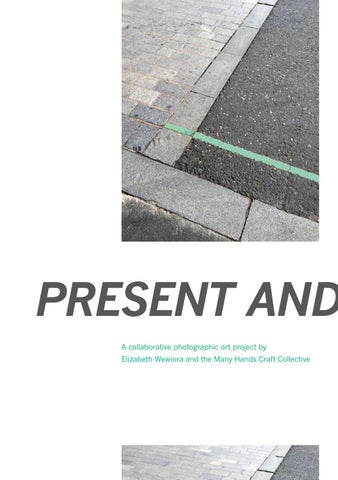
PRESENT AND A collaborative photographic art project by Elizabeth Wewiora and the Many Hands Craft Collective
More than a click. Patrick Fox
In 2006 Time Magazine1 declared their annual person of the year “YOU”, recognising millions of individual content creators across the globe. “YOU” they declared blogged, tweeted and reviewed; you informed, dissected and imagined, in other words “YOU” made meaning. Since 2006 this enhanced connection to authorship at a fundamental level has impacted all sectors, none more so than the cultural sector. We have re-framed our relationship to content and content creation. We have shifted from passive receiver to active agent.
The art critic Grant Kester directly positions collaborative practice in relation to avantgarde traditions in modern art. Identifying the recent growth of collaborative projects as a “global phenomenon” Kester notes that the rise of collaborative practice evidences a “paradigm shift within the field of art, involving an increased permeability between ‘art’ and other zones of symbolic production”.
In the twelve plus years since this declaration by Time Magazine we have also found ourselves in a period of unprecedented political, social and environmental change. One way in which the cultural sector and artists have responded to these changes has been a dramatic shift by the
This is not a new phenomenon, tracing the history of collaborative arts practices and its many sub-sectors, reveals in many cases, a practice that emerged in opposition to trends within ‘mainstream’ art, and practices that directly reflect the social and political struggle of the time. In many respects
1
2
sector towards more collective processes and methodologies – a more collaborative and social arts practice.
the reason for the continued relevance of collaborative practice today is its flexibility, allowing it greater power to comment on momentous events in history. A lineage can be traced to movements such as Constructivism – an arts practice rejecting the idea of autonomous art, favouring instead art as practice for social return, Dadaism – anti-bourgeois and politicised, and Surrealism – re-imagining the ordinary and breaking from convention. The impact has been felt across all forms, rejecting the idea of artist as solitary genius waiting for inspiration to strike, and more artist as participant or co-author, bringing their unique skills and perspectives into direct interaction with other skills and knowledge in the hope of creating new knowledge. Some art forms bend more easily to this methodology, theatre
Time is an American weekly news magazine and news website published in New York City. It was founded in 1923.
for example is an inherently collaborative form which tends to naturally harness collective voices in the creation of work. Photography has traditional been viewed as a singular form, but of course the creation of photographs can also be dependent on social relations and temporal processes even if these aspects of the practice are not immediately evident in the work or communicated by the artist. There is however a growing community of artists and photographers who are interested in the process of working with communities (of place and/or interest) in the creation of material, photographic or otherwise. This is a particularly fascinating discourse, precisely because photography has been viewed historically as a singular form, but also a form that through the advent of modern technology has met the margins. This
trajectory allows for a particularly fascinating in depth analysis and critical reflection of authorship and co-creation. It allows us to explore the formation of meaning through cultural production and the need for an aesthetic language to describes processes as well as product. Photography in many ways, is leading the charge to place a value on the journey as well as the destination. After all, an author and artist is far more than just the person who presses ‘click’.
3
Exploring photography as a collaborative endeavor Present and Continuous is the result of a 9-month collaborative project between photographic artist and producer Elizabeth Wewiora and Many Hands Craft Collective, an Over60s group based within Ancoats, Manchester. The group itself regularly meet within Victoria Square, a Northwards Housing building, one of the oldest social housing buildings in Europe. The project looked to explore the role of photography as a tool for social engagement. It further aimed to analyse how this medium, arguably one of the most accessible means of communication today, can be used as a way to co-author work between photographer and community. Present and Continuous resulted in an exhibition at Manchester Craft and Design Centre, which brought together the work of all involved. The process behind the project was formed from a collaborative approach to the creation of conceptual ideas, production of work, editing and the final curation of its public showcase. The group decided to focus on what brings them together as a collective, and why this collective through a shared passion for craft and creativity, now consider themselves a community? Ideas were developed through time spent discussing existing visual metaphors, exploring photography as archive, self-representation through portraiture and the relationship between photography and the printed image. Many images focus on the positivity of craft and social gathering as a means to wellbeing and a sense of togetherness, breaking down stigma that being older means being isolated. A teal green colour palette is regularly utilised within an otherwise black and white body of work. Whilst the monochrome prints reference the collective’s relationship to past and present, the use of teal and green acts as a fond reference to the Many Hands Craft Collective logo – a symbol of which they feel all brings them together.
4
The work is all brought together by a poem by Many Hands Craft Collective member, Charlie, which utilizes the collective words or phrases the group decided to identify with throughout the duration of the project. This poem weaves throughout the rest of this bookwork. This publication marks the second public presentation of this body of work. It acts as a celebratory document and legacy of the project. As with the approach to the rest of the project, the publication has been co-designed with Many Hands Craft Collective, Elizabeth Wewiora and design agency Wild Ilk. Thanks goes to Northwards Social Housing for funding support towards its realisation. Elizabeth Wewiora has a long standing relationship with the local craft group, through various curatorial projects but Present and Continuous marked the first time she would work with the group as a socially engaged photographer. It also marked the first time the craft group would work with photography and lens based media as a medium for creative expression. In this sense the pair (artist and community) took on photography together as a new collaborative endeavor. Present and Continuous was part of a practice based Masters by Research project at Manchester School of Art, Manchester Metropolitan University, by Elizabeth Wewiora and local communities across the North West.
Supported by and in partnership with:
5
Based predominantly within the community centre at Victoria Square, although some members come from as far as Oldham to attend each week, the building itself and its surrounding areas became a key area of focus. Whilst Victoria Square remains a towering example of Ancoats and Manchester’s industrial past, the area around the building is constantly shifting and developing under the inevitability of urban regeneration. A selection of the work produced references the collective’s reflections in how the current urban landscape is being shifted. Early stage photographic sessions included the sharing of their own personal family photographs as a form of social history a connection to the area. These were followed by a series of photo walks of the surrounding Ancoats neighbourhood. These images arguably formed the basis of the context for the rest of the project to develop and are spotted again throughout the final body of work.
6
Setting the Scene
7
8
Present and Continuous Is in the here and now. Come and join our popular group and we will show you how.
9
10
We do knitting, we do sewing as part of the community, there’s art and crafts and making things to the best of our ability, of the highest quality.
11
Friendship forms close ties, we all get on so well.
12
Each has some form of creative talent a combination in which we gel.
13
Our group is growing day by day, community spirit is here to stay.
14
15
Warm, neighbourly and very sociable the work we create is presentable and done to the highest degree, when you see it I know you’ll agree.
16
17
Togetherness and side by side the end result fills us with pride
18
19
and helps prevent isolation, a very common situation.
20
21
22
What we do is mixed and varied an assortment of variety. Delivering products of a high standard, I call this diversity.
23
And Many Hands Craft Collective Is the name by which we are known, a multi-talented group of people whose experience has grown and grown.
24
25
Present and Continuous Is in the here and now. Come and join our popular group and we will show you how. We do knitting, we do sewing as part of the community, there’s art and crafts and making things to the best of our ability, of the highest quality.
26
Poem by Charlie, group member.
27
Jim, Collaborative Portraits, created for Present and Continuous Š Elizabeth Wewiora and Many Hands Craft Collective 2018
Rose, Collaborative Portraits, created for Present and Continuous Š Elizabeth Wewiora and Many Hands Craft Collective 2018
CONTINUOUS