03
Active and healthy VOCABULARY Sports and fitness, injuries, accidents and emergencies, diet and nutrition GRAMMAR Past Simple, Past Continuous and Past Perfect; used to and would Use of English > page 192 SPEAKING
Being polite
WRITING
A short story
VIDEO
Grammar
Communication
Documentary
E
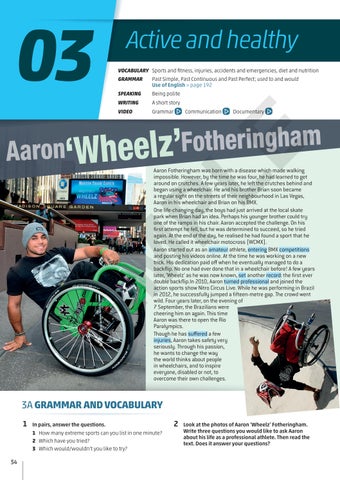
m a h g n i r e h t o F Aaron‘Wheelz’
SA
M PL
Aaron Fotheringham was born with a disease which made walking impossible. However, by the time he was four, he had learned to get around on crutches. A few years later, he left the crutches behind and began using a wheelchair. He and his brother Brian soon became a regular sight on the streets of their neighbourhood in Las Vegas, Aaron in his wheelchair and Brian on his BMX. One life-changing day, the boys had just arrived at the local skate park when Brian had an idea. Perhaps his younger brother could try one of the ramps in his chair. Aaron accepted the challenge. On his first attempt he fell, but he was determined to succeed, so he tried again. At the end of the day, he realised he had found a sport that he loved. He called it wheelchair motocross (WCMX). Aaron started out as an amateur athlete, entering BMX competitions and posting his videos online. At the time he was working on a new trick. His dedication paid off when he eventually managed to do a backflip. No one had ever done that in a wheelchair before! A few years later, ‘Wheelz’ as he was now known, set another record: the first ever double backflip.In 2010, Aaron turned professional and joined the action sports show Nitro Circus Live. While he was performing in Brazil in 2012, he successfully jumped a fifteen-metre gap. The crowd went wild. Four years later, on the evening of 7 September, the Brazilians were cheering him on again. This time Aaron was there to open the Rio Paralympics. Though he has suffered a few injuries, Aaron takes safety very seriously. Through his passion, he wants to change the way the world thinks about people in wheelchairs, and to inspire everyone, disabled or not, to overcome their own challenges.
3A GRAMMAR AND VOCABULARY 1 In pairs, answer the questions. 1 How many extreme sports can you list in one minute? 2 Which have you tried? 3 Which would/wouldn’t you like to try?
34
2 Look at the photos of Aaron ‘Wheelz’ Fotheringham.
Write three questions you would like to ask Aaron about his life as a professional athlete. Then read the text. Does it answer your questions?
03 3 Identify the tenses of the verbs in bold: the Past
Simple, the Past Continuous and the Past Perfect. Then match sentences 1–5 with meanings a–e in the Grammar box.
□ While he was performing in Brazil in 2012, he successfully jumped a fiteen-metre gap. 2 □ … he fell, but he was determined to succeed, so he tried again. 3 □ The boys had just arrived at the local skate park when Brian had an idea. 4 □ At the time, he was working on a new trick … 5 □ … on the evening of 7 September the Brazilians 1
were cheering him on again.
Past Simple, Past Continuous and Past Perfect
the verbs in brackets. Use the Past Simple, the Past Continuous or the Past Perfect.
Unlucky Katie Katie Ormerod is a world-class snowboarder who qualified for the 2018 British Winter Olympic team and she 1 was (be) a favourite to take home a medal. In 2017, she had injured her back, but by the time the 2018 season started she 2 (recover). Katie 3 (arrive) in South Korea before the 2018 Games and 4 (start) practising on the Olympic course. She 5 (only do) a few practice runs when she 6 (fall) and broke her wrist. Thankfully, it wasn’t serious so she decided to carry on. Two days later, she 7 (train) again when she 8 (crash) and broke her heel in two places! This time it was serious, and she was out of the Games.
M PL
We use the Past Simple: a to describe finished actions and tell the main events of a story in order. Time expressions: yesterday, last night/week/year/ Wednesday, when I was young, two months ago, in 2017, one day/evening
6 Complete the text with the most suitable tense of
E
Past Simple, Past Continuous and Past Perfect
We use the Past Continuous: b for longer actions interrupted by shorter ones. For shorter actions we use the Past Simple. c for temporary situations/habits. d to describe things which were in progress at a precise time in the past. Time expressions: as, when, while, at noon, this time last week, all last night
We use the Past Perfect: e to talk about an action in the past that was completed before another action or a time in the past. We often contrast an action in the Past Simple with an earlier one in the Past Perfect. Time expressions: after, already, as soon as, before, by, by the time, just, once, until
7 Complete the questions with the correct form of the
highlighted words in the texts about Aaron and Katie. Then ask and answer the questions in pairs. 1 Have you ever suffered an injury while doing a sport at school? What happened? 2 Do you know anyone who started out as an ? What do you know about athlete then turned their career? 3 Has a team from your school ever won a ? Had they taken part in an event like that before? 4 Has a team from your country ever for the finals of a major sporting competition? What happened? 5 Can you name someone from your country who has set ? What was it? a world 6 Does your country usually a lot of medals from the Olympic Games? For which sports?
8 SPEAKING In pairs, talk about a time when you or
4 In pairs, answer the questions using full sentences.
I won a silver medal at the school’s championships. I’d never run in a competition team before …
Then check your answers in the text.
1 What had Aaron learned to do by the age of four? 2 How did Aaron react to his brother’s idea in the skate park? 3 Why was Aaron’s first backflip special? 4 What did Aaron do in 2012? 5 What did he do the second time he went to Brazil?
5 Choose the correct tense to complete each sentence. 1 When Aaron arrived at the skate park, his friends already left / had already left. 2 Aaron broke his wheelchair while he had practised / was practising a new trick. 3 After Aaron had broken / was breaking his first wheelchair, he got a new stronger one. 4 The crowds in Brazil were amazed when they saw / were seeing how far Aaron jumped.
8 Read the question below and watch the video. Say what the speakers answer. Then in pairs, ask and answer the question. Tell me about a sports injury you had. GRAMMAR VIDEO
SA Grammar Reference and Practice > page 176
someone you know did well in a sport, a performance or some other kind of challenge. Use the prompts on page 197 to help you.
□ I can use the Past Simple, Past Continuous and Past Perfect to talk about past actions.
35
3B VOCABULARY | Sports, activities, fitness and exercise 1 THINK BACK Make a list of sports and fitness activities you enjoy/don’t enjoy. Then compare your lists in pairs.
4
I enjoy: swimming, yoga, … I don’t enjoy: Zumba, cycling, …
1.24 In pairs, read the leaflet again. Then complete the sentences with the words from the box. Listen and check. build get (x 2) good keep lift shape unfit
2 Read the leaflet for BFITA and the comments below. Which
John
sports and activities does it mention? What special offer does the leaflet mention? Is BFITA a good club? How do you know? Jackie
Special offer
BFITA LEISURE CENTRE
5
1.25 Study Watch out! Then complete the sentences with the correct form of the phrases in the box. Listen and check. Does John agree to try the leisure centre? Why?
M PL
For our 16th anniversary, we’re giving away one month’s free membership for all 16–18-year-olds.
E
John Jackie
I’m really out of 1 shape . My gran’s fitter that I 3 out than I am! I’m so 2 of breath when I run for the bus! You really need to 4 into shape. Why don’t you come to the leisure centre? You can 5 up your muscles, do exercises weights – that really helps me and 6 7 fit. No, thanks. Come on! It’s done me a world of 8 . They’ve got great fitness coaches and a …
ake the most of our tennis and squash courts, a boxing ring, •M a basketball court and a full-size outdoor football pitch with an athletics track. ry our state-of-the-art gymnasium, now with brand new rowing •T machines! • L ift weights and build up your muscles in our weightlifting centre. limb our 10-metre-high rock climbing wall. •C wim in our 25-metre swimming pool and relax in the Jacuzzi, •S sauna or steam room. ind motivation with our expert fitness coaches and personalised •F training programmes. hill, chat and watch sports in our award-winning café. •C
GET FITTER with BFITA!
SA
‘I’ve never been a sporty person and I’d never joined a leisure centre before so I had no idea how much fun it would be to keep fit.’ (Ali)
I was so unfit. I got out of breath climbing the stairs! But I really got into shape thanks to BFITA. Even the changing room is awesome!’ (Keira)
1 John’s dad dislocated his shoulder during a match. 2 John’s mum in two places when she was playing hockey. 3 John when he scored a goal – he was unconscious for several minutes. 4 John’s sister when she was jogging on a rocky path. 5 Jackie in her leg because she didn’t warm up. 6 John when he fell in the shower.
WATCH OUT!
We say she banged her head or broke her leg. NOT the head or the leg. But we say she pulled a muscle in her back NOT her muscle. This is because we have lots of muscles but only one head, two legs, etc.
‘At first, I was totally out of shape. I felt exhausted. But now I feel great. BFITA did me a world of good.’ (James)
6 SPEAKING Work in pairs. Use the examples below
3 Use the words and phrases highlighted in the leaflet to
1 How fit are you? What do you do to get/keep fit? 2 Do you often get out of breath? When? 3 Do you think it’s a good idea to build up your muscles? 4 Do you find it easy to get into shape? 5 Can you think of something that does you a world of good? 6 Have you ever twisted your ankle/broken your leg/ …? How did it happen?
complete the questions. Then ask and answer the questions in pairs. 1 Has your school got: a football pitch ; a tennis ; ; an athletics ; a boxing ; a swimming ; a rock climbing ? Which of these a rowing things does a school need? 2 Should students get a personalised training in their PE class? Say why. 3 What are the changing in your school gym like? How could they be better? 4 Have you ever joined a leisure ? If so, what was it like? If not, would you like to? 5 Have you ever tried lifting ? If so, what’s it like? If not, why not?
36
bang/head break/leg dislocate/shoulder pull/muscle sprain/wrist twist/ankle
□ I can talk about sports, activities, fitness and exercise.
and the vocabulary in Exercises 3–5 to ask and answer the questions.
7 Imagine you joined the BFITA Leisure Centre
a week ago. Write a description of your first week there. Mention the things you have done and an injury you had. Use the vocabulary in this lesson and the past tenses from lesson 3A.
03 1 2
3C L ISTENING AND VOCABULARY do you need to call an emergency number?
4
1.27 Listen and choose the correct answers. Use Active Listening to help you with questions 1 and 4.
E
1 Look at the photos and the Fact Box. In what situations
3
1 You are going to hear a school pupil talking to a teacher. What’s his main purpose? a to express an opinion b to offer to call an ambulance c to inform her about an accident 2 You are going to hear the teacher calling 999. Where is Eric? a on a path near the river b at the foot of a hill c on a railway line 3 You are going to hear a man from the school calling Eric’s mother. How does she seem by the end of the conversation? a fine b worried c relieved 4 You are going to hear a bus driver talking to a policeman. Why is he talking to him? a to explain what happened b to complain about something c to persuade him to do something 5 You are going to hear a conversation between Eric and his father. What does Eric think of his mother’s driving? a she drives too fast b she’s a safe driver c she doesn’t always pay attention
FACT BOX Emergency phone numbers
M PL
In the UK, the emergency number for police, ambulance and fire service is 999, but you can also use the European number, 112. In the USA, dial 911.
2 In pairs, work out the meaning of the highlighted words. In each emergency decide if you should call the police, ambulance or fire service, or if you should deal with it yourself.
SA
1 A car knocked down a girl, she’s got a few cuts and bruises and she’s in shock. 2 A neighbour fainted and is unconscious; it might be a heart attack. 3 The school fire alarm is ringing. 4 You want to report a crime – someone has set fire to a car. 5 You hurt your head, you’re not bleeding but it’s quite painful, and you’re seeing double – you think you have a concussion. 6 Your cat is stuck up a tree. 7 Your little brother burned his hand when he was cooking. 8 A shop in your street is burning down.
1 You should call the police and the ambulance service.
3
1.26 Study Active Listening. Then listen and choose the correct answer. You are going to hear a P.E. teacher talking to her students. What’s her main purpose?
a to persuade them to run as fast as they can b to advise them to be careful c to complain about their attitude towards P.E.
ACTIVE LISTENING | Identifying the speaker’s purpose When someone speaks, they have a purpose for speaking. It may be to inform, to explain, to express an opinion, to agree, to complain, to advise, to persuade or to make an arrangement, an offer, a request, or a suggestion. The context, the language the speakers use and their tone of voice can help you identify their purpose. Understanding the speaker’s purpose can help you to take part in a conversation and respond appropriately.
5
1.28 Complete the sentences with the words and phrases from the box. Listen to the extracts and check. blood concussion cuts and bruises elbow fainted heart hurt painful shock sprained twisted 1 The bus driver sprained her wrist. It was really . . She didn’t know if the car driver was badly 2 Eric got some , broke his leg, his ankle, . and suffered a 3 Eric’s mum lost a little , dislocated her but she’s and banged her head. She was in better now. 4 Eric’s dad didn’t have a attack, he because of stress.
6 SPEAKING In pairs, use the tenses in lesson 3A to retell the story in this lesson from two different points of view. Student A, imagine you are Eric. Student B, imagine you are Eric’s mum.
□ I can identify the speaker’s purpose and specific information in conversations and talk about accidents.
37
s l a i c e p s s ’ y Toda s
3D GRAMMAR
4 Study the sentences in Exercise 3. Then decide when we use
1 Write six ways in which you, your life, your
Used to and would
When I was little I was super active, and now I hardly ever leave the house. I watched TV every day when I was little but now I hardly ever watch it. I believed in Santa Claus but now I don’t.
2
1.29 Look at the photo and the menu. Then listen to a conversation and answer the questions. 1 How has Colin’s life changed since he had a skiing accident? 2 What do Colin and Daisy order? 3 What problem do they have?
Used to and would
1.29 In pairs, complete extracts 1–7 with phrases or sentences a–g. Listen again and check.
SA
3
used to and would. Tick the correct boxes in the Grammar box.
M PL
friends or your family are different from before. Then compare your sentences in pairs.
1 I used to come here a lot. e . 2 They didn’t use to have many vegetarian . dishes 3 I used to be into winter sports. whenever I could. 4 But one day, someone knocked me over on the . ski slope and 5 After the yoga class and that’s where I got into healthy eating. 6 I used to love my leather biker’s jacket and my . cowboy boots. 7 . I used to have a pair just the same. a but now they’ve even got vegan options. b I got a serious back injury. c I’d go skiing and snowboarding d I’d wear them almost every day. e It’s different now. f we’d often go to a vegetarian café nearby g Your canvas shoes are very nice.
38
E
Starter é Rabbit apâlatd Tu_na_s____ _ _ Mains otto Salmon rischips k an_d___ Stea_ __ _ s Vegan disheil pâté lent d n a n o i n O lasagne m o o r h s u M
We use used to and would to talk about things that were true but are not true anymore. used to would • for habitual/repeated actions in the past • for past states with verbs like have, be, believe, love ...
Grammar Reference and Practice > page 176
WATCH OUT!
I used to go skiing every year when I was younger. = I went skiing many times. One day someone knocked me over on a ski slope. = It happened once.
5
1.30 Study the Grammar box and Watch out! again. Then rewrite the text changing the underlined verbs to used to wherever possible. Listen and check.
I had used to have a very unhealthy diet when I was growing up. I loved cakes and biscuits. I ate chips with almost every meal. I never ate fresh fruit and I didn’t drink water, just cola. I believed it was good for you. We didn’t sit at the table to eat, we ate in front of the TV. So I was overweight and unfit. But then one day, my friend Dev invited me to eat with his family. It was amazing. We had a fantastic meal with salad and lots of fresh fruit. That was the day I changed the way I eat.
6
1.31 Now rewrite the text in Exercise 5 changing used to to would wherever possible. Listen and check.
7 SPEAKING In pairs, use used to and would to talk about
changes in your life. Remember to use the Past Simple if something only happened once. A Did you use to do any sports that you don’t do any more? B I used to be in a football team but …
□ I can use used to and would to talk about past habits and routines.
03
in the photo and answer the questions below.
1 What kind of shop is it? What is happening? 2 What do you think the shop assistant and the customer are talking about? 3 How are the people in the photo feeling?
2
9 1.32 Watch or listen to a conversation in a health food store. Does Marie find her first day in the shop easy?
3
1.33 Study the Speaking box and complete the polite requests and refusals with one word in each gap. Listen and check.
M PL
1 Would you mind telling me where the organic kale is? 2 That’s very of you, dear, but I think I’ll manage. 3 I’d like to whether your fruit and veg is locally grown. 4 Have you got any whether it's local? 5 I'm sure they look lovely but I’m it's local or nothing for me. 6 I if you have any free-range eggs. 7 you possibly tell me where I can find those eggs? 8 No, that’s , thanks. I’ll be fine. 9 Do you to know if you've got any wholemeal bread in there?
E
1 In pairs, take turns to describe what you can see
COMMUNICATION VIDEO
3E SPEAKING AND VOCABULARY
SPEAKING | Being polite
4 Rewrite the questions as indirect questions. 1 Are these apples organic? → I wonder …
I wonder if/whether these apples are organic. 2 What time does the juice bar in the gym close? → I was wondering … 3 Does this bread contain gluten? → Have you got any idea …? 4 Could I have soy milk? → Do you think …? 5 Where can I buy freshly-squeezed apple juice? → Would you mind …? 6 How much is a wholemeal loaf? → I’d like to know … 7 Who writes the ‘Healthy Living’ blog? → Do you happen to know …?
Asking politely We often use indirect questions to make polite requests or to ask for opinions and information in English. Use the polite phrases below and affirmative word order.
SA
Indirect questions I wonder if/whether you could help me. = Could you help me? Could you (possibly) tell me how much this is? = How much is it? Do you think it will take long? = Will it take long? Other phrases I was wondering ... I’d like to know … Have you got any idea …? Do you (happen to) know/have/sell, etc. …? Would you mind telling me …? Refusing politely That’s very kind of you, but ... They look/sound very nice, but I’m afraid … No, that’s alright thanks. Thanks for the offer, but … Thank you, but I’m alright.
5
1.34 PRONUNCIATION Listen to how the underlined words are pronounced. Then practise saying the sentences. 1 Could you tell me how much it is? 2 Would you mind telling me what this is? 3 I don’t know really. 4 I’m going to ask my colleague. 5 You’ve got to eat more fruit.
6 Check that you understand the adjectives in the box. In groups, use them to prepare polite questions about your teacher's eating habits. Use the phrases from the Speaking box. free-range freshly-squeezed wholemeal
locally grown organic
Would you mind telling me whether you buy any organic food?
7 In pairs, role play the situations at the back of your book. Student A, go to page 196. Student B, go to page 199.
□ I can use indirect questions to make polite requests or to ask for opinions and information.
39
3F READING AND VOCABULARY 1 Make a list of healthy and unhealthy foods that you
6 Complete the sentences below with the words from
Healthy things I usually eat: bananas, yoghurt, …
calories diet fizzy foods fresh full ingredients junk outlets processed
Unhealthy things I usually eat: crisps, muffins, fried bacon, …
2 Look at the photo and the title of the article. What do you think the text is about? Read it quickly to check.
3 Read the text again. Match sentences A–H with gaps 1–5 in the article. There are three extra sentences.
1 Do you know much about the food you eat? Which of foods are high in calories ? Which are vitamins? 2 In your family, do you cook meals with raw or foods that are high in do you buy ready-made fat, sugar and salt? 3 Do you think you have a healthier or unhealthier than your parents? Say why. 4 What are your favourite comfort ? When and where do you eat them? 5 Do you prefer drinks, freshly-squeezed orange juice or still water? 6 How often do you eat food like burgers, hot dogs, or kebabs? 7 How many fast food are there in your neighbourhood? 8 Is it hard to buy produce like fruit and vegetables where you live?
M PL
A And perhaps even more importantly, it has brought a community together. B It might seem expensive but it can actually cost less. C In 2011, three women decided to do something about it. D Nobody in that area had tried anything like that before. E The idea is to have a chain of healthy food from the ground to your plate. F The kids uploaded the video to YouTube and it went viral. G They get some support from government and generous individuals. H What’s more, most people didn’t realise how unhealthy their diets were.
the box. Then ask and answer the questions in pairs.
E
eat. Then compare your lists in groups. Who do you think has the healthiest/unhealthiest diet?
some questions of your own if you like. Then in pairs, ask and answer your questions. 1 What / think / AFC? 2 What / rap / about? 3 Where / AFC / start? 4 How / start?
5 What / aims / organisation? 6 What / three steps? 7 Where / money / from? 8 How / successful?
What do you think of Appetite for Change?
5 In pairs, read the Fact Box. Which statement do you
SA
think is false? Which one is the most interesting/ shocking? How is the situation in your country similar/ different?
FACT BOX American eating habits
1 Last year Americans ate over 400 million hamburgers – that’s enough to circle the world. 2 52% of Americans believe doing their taxes is easier than figuring out how to follow a healthy diet. 3 The average American consumes 22 teaspoons of sugar every day, most of it in drinks and candy bars. 4 Junk food first became popular in the US in the 1920s, but it really took off in the 1950s thanks to TV advertising. 5 Native Americans were already eating popcorn over 5,000 years ago. 6 In 2014, 1% of Americans were vegans, now it’s 6% and rising.
40
healthy eating at schools in your area. In pairs, discuss the ideas below. Which are the best? Say why. Can you think of any better ideas?
• Ban unhealthy snacks, fizzy drinks, sweets, crisps and junk food from schools. • Show videos and films that demonstrate the negative effects of unhealthy diets. • Organise a cooking competition for students in the area. • Include ‘Diet and Nutrition’ as part of the P.E. class and have all students sit an exam on it. • Open an affordable café serving healthy food in every school.
8 REFLECT | Society People today consume more
unhealthy food and drink than ever before. Do you think that’s true? Say why. Discuss in groups.
10 WATCH AND REFLECT Go to page 164. Watch the documentary Pushing yourself to the limit and do the exercises. DOCUMENTARY VIDEO
4 Use these prompts to write questions about AFC. Add
7 SPEAKING The Education Authority wants to encourage
□ I can understand the development of ideas in an article and talk about eating habits.
1.35
M PL
GROW FOOD, EAT WELL, BE HEALTHY
E
03
SA
A group of kids from a historically underprivileged neighbourhood in the American mid-west made a music video of a hip-hop track. It was called ‘Grow Food!’ and the lyrics urged 5 people to grow their own food and cook their meals with natural ingredients; to drink water and milk, not fizzy drinks full of sugar; to give up fake food that puts ‘poison in your brain’ and to eat better options, like broccoli, salad and fresh 10 fruit instead. 1 So far, it’s had over half a million views. That’s pretty amazing, and so is the organisation that inspired it. North Minneapolis is similar to many urban areas across North America. There is a lack 15 of shops, development projects, and healthy food options. Many of the residents suffer from bad health, partly because of unhealthy diets with too much junk food. 2 Along with young community members, they concluded 20 there were thirty-eight fast food outlets within two miles of where they lived, but there was nowhere you could sit down to eat a nutritious meal. They knew that poor diets were causing serious health problems, for example, heart 25 conditions, high blood pressure and obesity. The community also suffered from high unemployment, which is a major cause of crime. The solution, they thought, was to encourage healthy living, to strengthen families and to 30 create economic prosperity. So they set up a non-profit, community-owned association called ‘Appetite for Change’ (AFC).
AFC’s mission is ‘to use food as a tool to build health, wealth and social change’. 3 They achieve this in three steps.
35
1 U rban Agriculture. AFC turns unused urban land into cooperative farms where kids and adults grow and pick fresh produce.
2 Good Food Policy. The organisation argues in favour of healthy eating and persuades people to swap junk food high in 40 calories for natural food full of vitamins and to eat meals made with raw ingredients rather than processed foods. 3 Community Cooks Project. AFC organises cooking workshops in which people come together to cook a meal, to eat and to talk about the changes they want to see in their community.
45
All of this costs money, of course, so how does AFC pay for it? 4 In addition, they run two successful money-making projects:
• Small local businesses rent the Kindred Kitchen to help them run their food trucks, catering businesses and meal 50 preparation services. • The Breaking Bread café sells delicious healthy comfort foods and gives job opportunities to young members of the community. 55
AFC has been a great success. It has improved people’s health and created jobs. 5 Its strongest supporters are young people concerned about the unhealthy food full of fat, sugar and salt that damages the health of their friends, families and neighbours. The lyrics of their rap send out their message loud and clear.
OD PLEASE CHANGE THE FO OD. GO IN MY SCHOOL, MAKE IT MY ’HOOD. P OUTTA GET THAT FAKE FOOD U MISUNDERSTOOD. T HOPE THE MESSAGE NO OWN FOOD – GROW AND COOK YOUR YES, YOU COULD! 41
3G WRITING | A short story 1 In pairs, use the pictures and the words in the box to
tell a story. Then read the story below and compare it to yours. lifeguard surfer fin
shark
2 How do you think the surfer, the lifeguard, the people
on the beach and the shark felt after the events on the beach? I think the surfer was probably terrified.
punch
2
4
SA
3
M PL
E
1
That day the skies were clear, the sun was hot, and the sea was a beautiful deep blue. Ava was on the beach lying on the golden sand, listening to the radio and happily watching the surfers riding the powerful waves. It was busy, and families were playing in the warm, shallow water near the beach. ‘This is the life’ she thought, and turned over to get some sun on her back. She had just fallen asleep when a noise woke her. From nowhere, a lifeguard ran past her at full speed, shouting at people to get out of the way. Everyone on the beach sat up and watched as she dived in and swam towards a guy who was kicking his legs, waving his arms and shouting something. All of a sudden, the huge, dark fin of a shark appeared. People in the water started screaming. They grabbed their children and swam for their lives. Now wide awake, Ava watched through her fingers as the lifeguard reached the panicking man then raised her arm and… punched the shark in the face! Amazingly, it turned and swam away. While the crowds cheered, the fearless lifeguard carried the shocked surfer back to safety. She had saved his life. That was the day Ava decided to become a lifeguard.
42
03 story on page 42.
1 From which point of view is the story written, first or thirdperson? 2 Where does the story take place? 3 What information does the writer give in the first line? 4 What is the main event in the story? 5 Which tenses has the writer used to describe the action? 6 Which sentences introduce the lifeguard and the shark? How does the writer make them dramatic? 7 How does the writer finish the story?
WRITING | A short story General Short stories are usually written in either the first or third person point of view.
it connected to the story on page 42? From which point of view is it written, first person or third person?
That afternoon the water was cool and clean. The waves looked gorgeous 2 they moved above me. I’d just eaten a delicious octopus lunch and I decided to head to the beach to see what the two-legged creatures were doing. 3 I got there, some of them were standing on those strange long things and riding on the waves. I’m really not sure why they do that, but I watched them for a while. 4 I noticed one of them, it was male I think, kicking its legs and making those bubbles I love. Friends are always telling me not to go too close, but... those beautiful bubbles! 5 , a female came out of nowhere. 6 , it punched me in the face! Right on the end of my nose where it really hurts. What on earth is wrong with these creatures? They really shouldn’t be allowed in our water. I considered a second lunch if you know what I mean, but 7 , I decided to be the grown up one and just swim away. Horrible, violent creatures.
1
M PL
Beginning Catch the reader’s attention: use a detail related to the place where the story begins or a statement by one of the main characters. That day the skies were clear, the sun was hot, and the sea was a beautiful deep blue. Say where and/or when the story happened. Use longer sentences to set the scene. Ava was at the beach lying on the golden sand, listening to the radio and happily watching the surfers riding the powerful waves.
5 Read the story below ignoring the gaps. How is
E
3 Study the Writing box and answer questions 1–7 about the
SA
Middle Describe the action. Use mainly the Past Simple with the occasional Past Continuous and Past Perfect. Avoid long strings of the Past Simple. Use direct speech to express the characters thoughts or give them a voice. ‘This is the life’ she thought. Use a variety of verbs to report speech e.g. scream, whisper, ask, shout, etc. From nowhere, a lifeguard ran past her at full speed, shouting at people to get out of the way. Use shorter sentences and/or dramatic linkers to add drama. All of a sudden, the huge, dark fin of a shark appeared. End Describe how you or the main characters felt at the end, what you/they learned from the story, or decisions you/they made because of what happened. That was the day Ava decided to become a lifeguard.
4 Add the words in bold from the story to the appropriate group of linkers.
• Start the action: (at) first, in the beginning, 1 that day / morning/evening; • Move the action: 2 , next, later, after that/a while, by the time; • Introduce a dramatic moment: suddenly, just then, out of ,4 ; the blue, without warning, 3 • Describe events that happen at the same time: when, at ,6 ; the same time (as), 5 • Finish the action: finally, eventually, in the end.
6 Complete the story in Exercise 5 with the
linkers from the box. Sometimes more than one answer is possible.
all of a sudden as in the end that afternoon then when without warning
7 The underlined adjectives in the story on page 42 help the reader to visualise characters, events and objects. Find and underline similar adjectives in the story in Exercise 5. cool, clean, …
8 Work in pairs. Follow the instructions on page 197 to tell another story.
9 WRITING TASK Write a short story. Use your own ideas or write the story you told in Exercise 8. Use the Writing box and the tips in this lesson to help you.
□ I can write a short story.
43
Word List REMEMBER MORE 1 Find names of places on the word list where you can … 1 play football: 2 go running: 3 play basketball: 4 play squash:
2 Complete the sentences with
3A GRAMMAR AND VOCABULARY 5.15 amateur (adj) /ˈamətə/
build up your muscles /ˌbɪld ˌʌp jə ˈmʌsəlz/ changing room (n) /ˈtʃeɪndʒɪŋ ruːm/
athlete (n) /ˈæθliːt/
chill (v) /tʃɪl/
attempt (n) /əˈtempt/ break your wrist/heel /ˌbreɪk jə ˈrɪst/ˈhiːl/ carry on (phr v) /ˌkæri ˈɒn/
climb the stairs /ˌklaɪm ðə ˈsteəz/ dislocate your shoulder /ˌdɪsləkeɪt jə ˈʃəʊldə/ do exercises /ˌduː ˈeksəsaɪzɪz/
challenge (n) /ˈtʃæləndʒ/
verbs from the word list.
championships (n) /ˈtʃæmpjənʃɪps/
If you’re not careful, you could … 1 your head against the door. 2 your hand in hot water. 3 your muscle playing volleyball. 4 your leg skiing.
cheer on (phr v) /ˌtʃɪər ˈɒn/
do sb the world of good /ˌduː ˌsʌmbɒdi ðə ˈwɜːld əv ˌɡʊd/ exhausted (adj) /ɪɡˈzɔːstɪd/
course (n) /kɔːs/
dedication (n) /ˌdedəˈkeɪʃən/
E
fitness coach (n) /ˈfɪtnəs kəʊtʃ/
crutches (n) /ˈkrʌtʃɪz/
determined to do sth /dɪˌtɜːmənd tə ˈduː ˌsʌmθɪŋ/
football pitch (n) /ˈfʊtbɔːl pɪtʃ/ full-size (adj) /ˌfʊl ˈsaɪz/
get into shape /ˌɡet ˌɪntə ˈʃeɪp/
disabled (adj) /dɪsˈeɪbəld/
get out of breath /ˌɡet ˌaʊt əv ˈbreθ/
disease (n) /dɪˈziːz/
M PL
3 Write the missing negative
break your leg /ˌbreɪk jə ˈleɡ/
prefixes. Then check with the word list.
1 You understood what I said. 2 Sandy never gets any exercise, fit. so she’s really 3 There are huge areas of used land in this part of the country. 4 -profit associations use all their money to help people.
4 Complete the sentences with the adjectives from the word list.
flip/backflip (n) /flɪp/ˈbækflɪp/ gap (n) /ɡæp/
have/suffer an injury /ˌhæv/ˌsʌfər ən ˈɪndʒəri/ injure (v) /ˈɪndʒə/
44
get/keep fit /ˌɡet/ˌkiːp ˈfɪt/ gymnasium (n) /dʒɪmˈneɪziəm/ hockey (n) /ˈhɒki/
Jacuzzi (n) /dʒəˈkuːzi/
leisure centre (n) /ˈleʒə ˌsentə/ lift weights /ˌlɪft ˈweɪts/
inspire (v) /ɪnˈspaɪə/
make the most of sth /ˌmeɪk ðə ˈməʊst əv ˌsʌmθɪŋ/
overcome (v) /ˌəʊvəˈkʌm/
Paralympics (n) /ˌpærəˈlɪmpɪks/
membership (n) /ˈmembəʃɪp/
passion (n) /ˈpæʃən/
motivation (n) /ˌməʊtəˈveɪʃən/
pay off (phr v) /ˌpeɪ ˈɒf/
out of shape /ˌaʊt əv ˈʃeɪp/
qualify for sth (v) /ˈkwɒləfaɪ fə ˌsʌmθɪŋ/
outdoor (adj) /ˌaʊtˈdɔː/
ramp (n) /ræmp/
personalised (adj) /ˈpɜːsənəlaɪzd/
recover (v) /rɪˈkʌvə/
pull a muscle /ˌpʊl ə ˈmʌsəl/
run (n) /rʌn/
rock climbing wall (n) /ˈrɒk ˌklaɪmɪŋ wɔːl/
set a (world) record /ˌset ə (ˌwɜːld) ˈrekɔːd/
rowing machine (n) /ˈrəʊɪŋ məˌʃiːn/
SA
1 At 3 a.m. I was still wide . I was too excited to fall asleep. 2 I always buy vegetables from shops which sell produce from organic farms. 3 drinks, such as cola, are bad for your teeth. 4 eggs are believed to be healthier than factory-farmed eggs.
enter/win a competition /ˌentər/ˌwɪn ə ˌkɒmpəˈtɪʃən/
skate park (n) /ˈskeɪt pɑːk/ snowboarder (n) /ˈsnəʊbɔːdə/ start out as sb (phr v) /ˌstɑːt ˈaʊt əz ˌsʌmbɒdi/
ACTIVE VOCABULARY | Flashcards
succeed (v) /səkˈsiːd/
Use ‘smart’ flashcards to review new vocabulary. On one side of the card, write a short sentence that you will find easy to remember including the word or phrase you want to learn, e.g. I always start my workout on a rowing machine. On the back of the card, write the word translated into your language. When you are doing a vocabulary review, look at the translation on each card and try to recall the word or phrase and the example sentence that you have written.
turn professional /ˌtɜːn prəˈfeʃənəl/
take home a medal /ˌteɪk ˌhəʊm ə ˈmedl/
wheelchair motocross (WCMX) (n) /ˌwiːltʃeə ˈməʊtəʊkrɒs (ˌdʌbəljuː ˌsiː ˌem ˈeks)/ world-class (adj) /ˌwɜːld ˈklɑːs/
3B VOCABULARY
5.16
athletics track (n) /æθˈletɪks træk/
sauna (n) /ˈsɔːnə/ school gym (n) /ˌskuːl ˈdʒɪm/ sporty (adj) /ˈspɔːti/ sprain your wrist /ˌspreɪn jə ˈrɪst/ state-of-the-art (adj) /ˌsteɪt əv ði ˈɑːt/ steam room (n) /ˈstiːm ruːm/ swimming pool (n) /ˈswɪmɪŋ puːl/ tennis/squash court (n) /ˈtenəs/ˈskwɒʃ kɔːt/ training programme (n) /ˈtreɪnɪŋ ˌprəʊɡræm/ twist your ankle /ˌtwɪst jər ˈæŋkəl/
award-winning (adj) /əˈwɔːd ˌwɪnɪŋ/
unconscious (adj) /ʌnˈkɒnʃəs/
bang your head /ˌbæŋ jə ˈhed/
unfit (adj) /ʌnˈfɪt/
basketball court (n) /ˈbɑːskətbɔːl kɔːt/
weightlifting (n) /ˈweɪtˌlɪftɪŋ/
boxing ring (n) /ˈbɒksɪŋ rɪŋ/
Zumba (n) /ˈzʊmbə/
03 ambulance service (n) /ˈæmbjələns ˌsɜːvəs/ badly hurt /ˌbædli ˈhɜːt/ bleed (v) /bliːd/ burn down (phr v) /ˌbɜːn ˈdaʊn/ burn (your hand) /ˌbɜːn (jə ˈhænd)/ call an ambulance /ˌkɔːl ən ˈæmbjələns/ concussion (n) /kənˈkʌʃən/
cuts and bruises (n) /ˌkʌts ənd ˈbruːzɪz/ dial (v) /daɪəl/
emergency number (n) /ɪˈmɜːdʒənsi ˌnʌmbə/ faint (adj) /feɪnt/ fire alarm (n) /ˈfaɪər əˌlɑːm/
heart attack (n) /ˈhɑːt əˌtæk/
hurt your head /ˌhɜːt jə ˈhed/
knock down (phr v) /ˌnɒk ˈdaʊn/
lose some blood /ˌluːz səm ˈblʌd/ painful (adj) /ˈpeɪnfəl/
poor diet /ˌpɔː ˈdaɪət/
soy milk (n) /ˈsɔɪ mɪlk/
processed food (n) /ˌprəʊsest ˈfuːd/
wholemeal bread/loaf (n) /ˌhəʊlmiːl ˈbred/ˈləʊf/
raw ingredients (n) /ˌrɔː ɪnˈɡriːdiənts/
3F READING AND VOCABULARY 5.20 affordable (adj) /əˈfɔːdəbəl/ appetite for sth (n) /ˈæpətaɪt fə ˌsʌmθɪŋ/ ban (v) /bæn/ bring together (phr v) /ˌbrɪŋ təˈɡeðə/
catering business (n) /ˈkeɪtərɪŋ ˌbɪznəs/ comfort food (n) /ˈkʌmfət fuːd/ community (n) /kəˈmjuːnəti/
concerned about sth (adj) /kənˈsɜːnd əˌbaʊt ˌsʌmθɪŋ/
ready-made (adj) /ˌredi ˈmeɪd/ rent (v) /rent/ solution (n) /səˈluːʃən/ step (n) /step/ still water (n) /ˌstɪl ˈwɔːtə/ strengthen (v) /ˈstreŋθən/ supporter (n) /səˈpɔːtə/
swap sth for sth (v) /ˈswɒp ˌsʌmθɪŋ fə ˌsʌmθɪŋ/ take off (phr v) /ˌteɪk ˈɒf/ teaspoon (n) /ˈtiːspuːn/ tool (n) /tuːl/
unused (adj) /ˌʌnˈjuːzd/
report a crime /rɪˌpɔːt ə ˈkraɪm/
urban (adj) /ˈɜːbən/
co-operative farm (n) /kəʊˌɒpərətɪv ˈfɑːm/
urge sb to do sth /ˌɜːdʒ ˌsʌmbɒdi tə ˈduː ˌsʌmθɪŋ/
do your taxes /ˌduː jə ˈtæksɪz/
vegan (n) /ˈviːɡən/
economic prosperity /ˌekəˌnɒmɪk prɒˈsperəti/
wealth (n) /welθ/
fake (adj) /feɪk/
workshop (n) /ˈwɜːkʃɒp/
figure out (phr v) /ˌfɪɡər ˈaʊt/ fizzy drink (n) /ˌfɪzi ˈdrɪŋk/ foodstuff (n) /ˈfuːdstʌf/
see double /ˌsiː ˈdʌbəl/
set fire to sth /ˌset ˈfaɪə tə ˌsʌmθɪŋ/ unconscious (adj) /ʌnˈkɒnʃəs/
3D GRAMMAR
consume (v) /kənˈsjuːm/
fast food outlet (n) /ˌfɑːst ˈfuːd ˌaʊtlet/
relieved (adj) /rɪˈliːvd/
5.18
fresh produce (n) /ˌfreʃ ˈprɒdjuːs/
full of vitamins /ˌfʊl əv ˈvɪtəmɪnz/ ground (n) /ɡraʊnd/ grow (v) /ɡrəʊ/
have/follow a healthy diet /ˌhæv/ˌfɒləʊ ə ˌhelθi ˈdaɪət/
SA
dish (n) /dɪʃ/
organic (adj) /ɔːˈɡænɪk/
M PL
fire service (n) /ˈfaɪə ˌsɜːvəs/
ring (v) /rɪŋ/
poison (n) /ˈpɔɪzən/
candy bar (n) /ˈkændi bɑː/
elbow (n) /ˈelbəʊ/
in shock /ˌɪn ˈʃɒk/
locally grown (adj) /ˌləʊkəli ˈɡrəʊn/
E
3C LISTENING AND VOCABULARY 5.17
knock over (phr v) /ˌnɒk ˈəʊvə/
mushroom lasagne (n) /ˌmʌʃruːm ləˈsænjə/ onion (n) /ˈʌnjən/
rabbit/lentil pâté (n) /ˈræbɪt/ˌlentl ˈpæteɪ/
have an unhealthy diet /ˌhæv ən ʌnˌhelθi ˈdaɪət/ heart condition (n) /ˈhɑːt kənˌdɪʃən/ high blood pressure (n) /ˌhaɪ ˈblʌd ˌpreʃə/
3G WRITING
5.21
at full speed /ət ˌfʊl ˈspiːd/ bubble (n) /ˈbʌbəl/ clear (adj) /klɪə/
consider (v) /kənˈsɪdə/ cool (adj) /kuːl/
creature (n) /ˈkriːtʃə/
deep blue (n) /ˌdiːp ˈbluː/ fearless (adj) /ˈfɪələs/ fin (n) /fɪn/ golden (adj) /ˈɡəʊldən/
gorgeous (adj) /ˈɡɔːdʒəs/ grab (v) /ɡræb/
salmon risotto (n) /ˌsæmən rɪˈzɒtəʊ/
high in calories/fat/sugar/salt /ˌhaɪ ɪn ˈkæləriz/ ˈfæt/ˈʃʊɡə/ˈsɔːlt/
ski slope (n) /ˈskiː sləʊp/
hot dog (n) /ˈhɒt dɒɡ/
starter (n) /ˈstɑːtə/
octopus (n) /ˈɒktəpəs/
in favour of sth /ˌɪn ˈfeɪvər əv ˌsʌmθɪŋ/
steak (n) /steɪk/
panic (v) /ˈpænɪk/
junk food (n) /ˌdʒʌŋk ˈfuːd/
tuna salad (n) /ˌtjuːnə ˈsæləd/
powerful (adj) /ˈpaʊəfəl/
kebab (n) /kəˈbæb/
vegan options (n) /ˈviːɡən ˌɒpʃənz/
punch sb in the face /ˌpʌntʃ ˌsʌmbɒdi ɪn ðə ˈfeɪs/
land (n) /lænd/
ride on the waves /ˌraɪd ɒn ðə ˈweɪvz/
misunderstand (v) /ˌmɪsʌndəˈstænd/
shallow (adj) /ˈʃæləʊ/
native American (n) /ˌneɪtɪv əˈmerəkən/
shark (n) /ʃɑːk/
free-range eggs (n) /ˌfriː ˌreɪndʒ ˈeɡz/
non-profit association (n) /ˌnɒn ˌprɒfɪt əˌsəʊsiˈeɪʃən/
surfer (n) /ˈsɜːfə/
freshly-squeezed juice /ˌfreʃli ˌskwiːzd ˈdʒuːs/
nutrition (n) /njuːˈtrɪʃən/
terrified (adj) /ˈterəfaɪd/
gluten (n) /ˈɡluːtn/
obesity (n) /əʊˈbiːsəti/
two-legged (adj) /ˌtuː ˈleɡɪd/
imported (adj) /ɪmˈpɔːtɪd/
pick (v) /pɪk/
wide awake (adj) /ˌwaɪd əˈweɪk/
3E SPEAKING AND VOCABULARY 5.19
head to sth (v) /ˈhed tə ˌsʌmθɪŋ/
45
03 Revision VOCABULARY AND GRAMMAR 1 Complete the collocations with the words from the
4 Tick the correct verb forms 1–10 and correct the incorrect ones.
box.
1 accept / overcome a challenge 2 start out as an 3 enter / do well in a 4 become a / turn 5 set a 6 take home a 7 twist / sprain / break your
2 Choose the correct word in each sentence.
M PL
1 When she’s depressed, she eats fizzy / comfort / poor food. 2 As part of his healthy diet he has locally grown / raw / wholemeal bread for breakfast. 3 They are very health conscious and never eat processed / organic / fresh food. 4 After a competition the athletes always eat foods that are high in junk / ingredients / calories. 5 The new stadium will have a world-class athletics track / ring / court. 6 She always uses the rowing pitch / wall / machine to warm up before a training session. 7 The goalkeeper dislocated / banged / pulled his head hard when he fell. 8 We got out of breath / weights / muscles after thirty minutes of running. 9 There’s nothing like freshly-squeezed fat / food / juice to start the day.
E
amateur ankle challenge competition medal record professional
3 Complete the sentences with the Past Simple, Past
SA
Continuous or Past Perfect forms of the verbs in brackets.
1 By the time they arrived at the stadium, the game (already/start). 2 While she (travel) round South America, she (visit) Rio de Janeiro. 3 I (rock climb) yesterday evening between 6 (not hear) your and 7 o’clock, which is why I call. 4 What (you learn) to do by the time you (be) five years old? 5 I (run) after the ball when suddenly I (feel) as if someone (pull) a muscle. It (shoot) me! 6 It (be) a lovely day when I woke up. The sun (shine) and the birds (sing), but then (start) to pour with rain. all of a sudden it 7 I (ask) for freshly squeezed orange juice so I was upset when I (see) the waiter pouring me an orange drink from a bottle. 8 They (decide) to follow a healthier diet (see) a documentary about the after they effects of processed foods.
46
□
When I was at school I 1 would love loved/used to love 2 sports. I used to play for the school netball and hockey teams, which 3was fun. However, our head teacher 4 would believe that academic subjects were more important than sports, so she didn’t spend much money on sports facilities. The P.E. teachers 5used to organise a sports day every year but it 6wouldn’t be very good. Luckily for me, though, when I was eleven, my family 7used to move to a new house, which was next door to the local tennis club. I 8would spend hours there in the summer playing with my friends. I wasn’t very good but I 9used to enter the club tournament every July and once 10 I even would win the junior championship! I don’t play tennis these days but I still love sports.
□
□ □
□
□
□
□
□ □
USE OF ENGLISH 5 Complete the text with one word in each gap.
Lee’s blog I’m a nurse in the accidents and emergencies department at a big hospital. However, I started my professional life working 1 as a secretary in a big company! Although I never regularly tell really enjoyed working in an office, I 2 my family and friends how interesting my job was. One lunchtime I was crossing a road near my office listening to music on my earphones 3 a car knocked me down. I can’t remember much about what happened as the car hit me. Luckily, because I fainted as 4 seen everything and called a very kind passer-by 5 for an ambulance right away. She realised I was 6 shock and lent me her jacket to keep me warm. Amazingly, ten minutes later I was in hospital. That was 7 day my life changed forever. I trained as a nurse and now I have a very rewarding job. It’s true to earn a lot more before, but money isn’t that I 8 everything!
so that it means the same as the first one. Use between two and five words, including the word in bold.
Met Aunt Gina while I was walking the dog and we’ve gone for a coffee. Dinner is in fridge. Heat lasagne in microwave for ten minutes. There’s also some salad to go with it. Back soon. Dad 3 a Jack’s dad will cook dinner this evening. b Jack knows the recipe for lasagne. c Jack’s dad is telling Jack what to do for dinner. Road ahead closed apart from resident access due to Great South Run Sat 9.30–15.30. Access vehicles should not exceed 15kph.
4 a People who live in this road will not be allowed to drive along it on Saturday morning. b There will be a speed limit in force for any vehicles on the road on Saturday morning. c A sporting event will close the road to pedestrians and all vehicles on Saturday morning.
M PL
1 I’d like to know what time the restaurant opens. MIND Would you mind telling me what time the restaurant opens? 2 When I was a child, I would spend hours in this park. TO When I was a child, I in this park. 3 Thanks for the offer, but I don’t need any help. KIND you, but I don’t need any help. 4 He wanted to get fit, so he went running every day. INTO He went running every day because he wanted . 5 Could you help me, please? IF I help me? 6 When he was young, my father used to go fishing every weekend. WOULD My father every weekend when he was young.
Jack
E
6 Complete the second sentence using the word in bold
Use of English > page 192
READING 7 Read texts 1–4 and choose the correct answers a, b or c. STRATEGY | Multiple choice
Read each text and identify what kind of text it is and where it would appear. Before you read the questions, think what the main message of each text is. To: Katy From: Jenny
SA
Got your invitation to dinner this morning. Thanks! Really looking forward to it – you’re such a good cook! Please remember that Ed doesn’t eat meat! We’ll bring a chocolate cake for dessert. See you about 7.30. Be great to catch up! 1 Jenny is writing to a invite Katy to a meal she’s going to cook. b suggest that Katy makes a chocolate dessert. c remind Katy that someone is a vegetarian.
Is competition a good or bad thing? Come to the weekly debate after school in the Main Hall. Arrive before 4.15 as only 100 people can be seated. Debate starts at 4.30.
2 a Students should arrive early as numbers are limited. b People who arrive after 4.30 will not be allowed into the debate. c The debate is part of a school competition.
SPEAKING 8 In pairs, role play the situation below. Then change roles and do the task again.
Student A You are speaking to a teacher about your class project for the school health week. You’d like to set up a lunchtime health food café in school. In the conversation discuss the points below: • Explain what you’d like to do and give examples of healthy food the café could sell. • Say you will ask parents and teachers to donate food. • Suggest the money the café makes goes towards paying for new school sports equipment. • Explain that students would like to organise everything themselves and thank the teacher for his/her offer to help. Student B You are Student A’s teacher. You are discussing Student A’s class project for your school’s health week. Use the phrases below to help you. You start first. • Have you got any ideas for our school health week? • Would you mind telling me who is going to pay for the food? • Would you like the teachers to help? • Thank you. That’s a very good idea.
WRITING 9 Write a story beginning with this sentence. I walked into the gym and looked around.
47