03
Far from home VOCABULARY Holiday activities, travelling, transport GRAMMAR
Past Continuous and Past Simple, relative pronouns Use of English > page 185
SPEAKING
Asking for information
WRITING
A blog post
VIDEO
Grammar
Communication
M PL
E
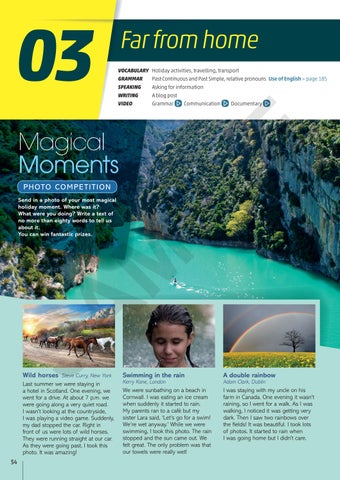
Magical Moments
Documentary
P H OTO C O M P E T I T I O N
SA
Send in a photo of your most magical holiday moment. Where was it? What were you doing? Write a text of no more than eighty words to tell us about it. You can win fantastic prizes.
34
Wild horses Steve Curry, New York
Swimming in the rain
A double rainbow
Last summer we were staying in a hotel in Scotland. One evening, we went for a drive. At about 7 p.m. we were going along a very quiet road. I wasn’t looking at the countryside, I was playing a video game. Suddenly, my dad stopped the car. Right in front of us were lots of wild horses. They were running straight at our car. As they were going past, I took this photo. It was amazing!
We were sunbathing on a beach in Cornwall. I was eating an ice cream when suddenly it started to rain. My parents ran to a café but my sister Lara said, ‘Let’s go for a swim! We’re wet anyway.’ While we were swimming, I took this photo. The rain stopped and the sun came out. We felt great. The only problem was that our towels were really wet!
I was staying with my uncle on his farm in Canada. One evening it wasn’t raining, so I went for a walk. As I was walking, I noticed it was getting very dark. Then I saw two rainbows over the fields! It was beautiful. I took lots of photos. It started to rain when I was going home but I didn’t care.
Kerry Kane, London
Adam Clark, Dublin
03
3A GRAMMAR AND VOCABULARY 1 In pairs, check you understand the holiday activities in the box. Then think of some more things we typically do on holiday.
7 Look at the photos and stories again and correct the sentences.
1 Kerry was eating lunch when it started to rain. No, she wasn’t eating lunch. She was eating an ice cream. 2 Lara was looking at the camera when Kerry took the photo. 3 Steve’s mum was driving the car when the horses appeared. 4 The horses were running away from Steve’s car. 5 Adam was staying in a hotel in Canada. 6 The sun was coming up when Adam saw the rainbows.
climb a mountain go for a swim/drive lie/sunbathe on the beach make a trip pack your bag see the sights watch the sun rise/set visit relatives
2 SPEAKING In pairs, use the vocabulary in Exercise 1 to
talk about the things you did during your last holiday.
3 Look at the ‘Magical Moments’ photos and read the
8 What do you think your partner was doing at these times? Ask and check if your guesses were correct.
E
A Did you see the sights the last time you went on holiday? B No, I didn’t. I just lay on the beach all day. stories. Which one is your favourite? Say why.
ten o’clock last night six o’clock this morning last Saturday at 8 p.m. last Sunday at 11 a.m.
Past Continuous and Past Simple
A Were you sleeping at ten o’clock last night? B No, I wasn’t. I was studying Maths.
4 Match sentences 1–2 with the uses of the Past Continuous a–b.
□ At about 7 p.m. we were going along a quiet road. □ I was staying with my uncle on his farm in Canada.
M PL
a to give the background to a story b to say that someone was in the middle of an action at a specific time
5 Read this sentence from one of the stories and answer the questions.
While we were swimming, I took this photo. 1 Did these actions happen a one after another? b at the same time? 2 Which action was shorter and which tense do we use to talk about it?
6 Read the Grammar box and find more examples of the Past Continuous and Past Simple in the stories.
SA
Past Continuous and Past Simple
We use the Past Continuous: • to give the background to a story • to talk about an unfinished action at a time in the past • to show that a long activity was interrupted by a short one (in the Past Simple)
I • He • She • It
We • You • They
+
I was swimming.
They were running.
–
She wasn’t dancing.
We weren’t walking.
?
Was he sunbathing?
Were they singing?
Yes, he was./ No, he wasn’t.
Yes, they were./ No, they weren’t.
Wh-? Whose car was he driving?
What were you doing yesterday at 10 p.m.?
9
1.28 Complete the text with the Past Simple or Past Continuous. Listen and check. We 1were travelling (travel) to France on a car ferry. (feel) a bit sick, so I 3 (go) outside to get I2 (look) down at the sea, some air. While I 4 (see) a dolphin. It 6 (swim) next I5 (watch), it 8 (jump) high to the ship. As I 7 (get) a wonderful photo. out of the sea. I 9
10 Complete the sentences with the correct forms of
the travel verbs from the box. Then in pairs, say if the sentences are true for you.
catch drive ride sail wait
1 I was running to catch a bus to school when I realised it was a holiday. the car, my dad was sitting 2 The first time I beside me with his eyes closed. at a bus 3 I met my boyfriend/girlfriend while I stop. 4 I my bike when I saw our teacher. on a ferry, there was a storm. 5 While we 9 Read the sentence below and watch the video. Say what the speakers answer. Then in pairs, ask and answer the question. Tell me about a magical moment that happened to you on holiday. GRAMMAR VIDEO
1 2
Linkers: when, while, as Grammar Reference and Practice > page 175
□ I can use the Past Simple and Continuous to talk about past experiences.
35
3B VOCABULARY | Travelling 1 THINK BACK In pairs, talk about the kind of transport you can/can’t take in/from your town or region.
5 Study Watch out! and choose the correct verbs to
complete the sentences. Use the holiday reviews to help you.
You can’t take the underground in our town but you can take a bus. You can take a plane from … airport.
1 Did you go / take by train or coach? 2 We got / went a taxi to the airport. 3 I stayed / travelled in the worst hotel in London. 4 Two days later we left for / to Moscow. 5 As the plane was checking in / taking off, I shut my eyes. 6 I fell asleep while we were flying / landing over the Atlantic Ocean. 7 We arrived / left at the airport three hours before the flight. 8 What time did you arrive in / at the station? 9 We boarded / missed the plane early. 10 It took us five minutes to put on / put up the tent. 11 Yesterday we arrived in / at Thailand.
2 Check you understand the highlighted words. Then in groups, say which holidays you would/wouldn’t like to go on and why.
E
1 a one-day excursion to a theme park 2 a weekend city break in London or Paris 3 a school trip to an outdoor centre in Wales 4 a package holiday to a Greek island 5 a three-week cruise in the Caribbean 6 a scientific expedition to the Antarctic 7 an adventure holiday in an African safari park 8 a nine-month journey around the world
WATCH OUT!
3 Read the holiday reviews below. What kinds of holiday from Exercise 2 do they describe? Which trip do you prefer? Say why.
M PL
We say arrive in a city/country or at a station/airport, etc., NOT arrive to. We say leave for a place, NOT leave to. When travelling by plane, take off = leave and land = arrive.
4 In pairs, complete the table using the highlighted
verbs from the reviews. Add words and phrases from the reviews to make collocations. Then use a dictionary to help you make more collocations. Transport
go/travel by train, coach, … take the underground, …
6 SPEAKING Think about a holiday or school trip you
went on. In pairs, ask and answer the questions. Use the vocabulary from Exercises 4 and 5.
Accommodation stay in a five-star hotel, a budget hotel, … Activities
1 How did you get there? 2 Where did you stay? 3 What did you do? 4 Was it a good trip?
go climbing, put on your sunscreen, …
HOLIDAY REVIEWS
2
SA
1
Destination: Brecon Outdoor Centre, Wales Review by: Joe Queen, Norwich GETTING THERE
We went by coach to Wales. We had a lot of fun on the way but the trip took five hours and it was too hot. I was glad when we arrived at the campsite.
ACCOMMODATION
It wasn’t easy to put up the tents but they were big, so there was plenty of space for our backpacks and boots. Unfortunately, there were no beds, so we had to put our sleeping bags on the ground.
Destination: Heraklion, Crete Review by: Helen Green, Oxford GETTING THERE
We missed the bus, so we got a taxi to the train station. Then we travelled by train to London and took the underground to the airport. We boarded the plane on time but there was a delay before we took off. Although we flew directly to Crete, we landed an hour late. I was exhausted when we finally checked in.
ACCOMMODATION
ACTIVITIES
We stayed in a budget hotel but it was fantastic! Big swimming pool, excellent food and my room had a double bed. I’m not surprised the hotel was fully booked.
YOUR VERDICT
We went sightseeing every morning and visited lots of museums. In the afternoons I just put on my sunscreen and sunbathed by the pool!
We went kayaking on the river, windsurfing on a lake, mountain biking and hiking in the mountains. We were always doing something. It was brilliant! A great school trip, especially the activities. I really recommend it. I was sorry to leave.
36
CLICK HERE to write a review of your holiday
ACTIVITIES
YOUR VERDICT
It was our first package holiday. I loved the hotel and Crete is a great place to visit but the journey was a nightmare.
□ I can talk about holiday activities, transport and accommodation.
03
5
What kind of things do they like doing? Discuss in pairs.
Hazel Excuse me. What time is the 1next train to Glasgow? Man Five fifty–nine. that. Can you 3 Hazel I’m sorry, I didn’t 2 again, please?
2 Match the places from the box with the descriptions. Left Luggage taxi rank tourist office travel centre tube station waiting room A place where you can … a sit and wait for a bus/train waiting room b get a taxi c catch an underground train d leave heavy bags for a few hours e ask about timetables, buy tickets f find out travel information, book hotels, get maps/leaflets
3
SA
10 1.29 Study the Speaking box. Watch or listen again and tick the expressions you hear.
SPEAKING | Asking for information
□ □ □ □ □ □ □
Excuse me, what time is the next train to …? Which platform does the train leave from? Where‘s the nearest tube station/bus stop/taxi rank? Is there a bus/tram we can catch to …? Is there a restaurant/bank/Travel Centre near here? How far is it to …? Pardon me, I didn't hear that. I'm sorry, I didn't catch that.
it
Joe Lee
Which 4 8B.
Joe Alda Hazel Joe
is it to the Brunswick Centre? How 5 It’s not far. It’s about … a bus we can catch to get there? Is 6 Or maybe we can take a cab. Where’s the 7 taxi rank? The taxi rank is over there. But you can 8______. It’s only five minutes.
Alda
10 1.29 Look at the photo, watch or listen to the conversation and answer the questions. 1 Where do the tourists want to go? to Glasgow 2 What information do they want? 3 What problem do they have? 4 Why are they surprised at the end?
4
1.30 Complete the conversations with one word in each gap. Listen and check. Then in pairs, practise the conversations.
M PL
1 Where do most tourists to your country come from?
E
COMMUNICATION VIDEO
3C SPEAKING AND VOCABULARY
Joe Alda
does the train leave from?
is the Left Luggage? Next to Platform 16.
9
WATCH OUT! British English tube/underground lift taxi
6
American English subway elevator cab
1.31 PRONUNCIATION Listen to questions 1–4 and repeat. Pay attention to the underlined words. 1 How far is it to the bus station? 2 Is there a map of the underground? 3 What time is the next coach to Leeds? 4 Is there a tram we can catch to the Old Town?
7
1.32 Listen and write down the answers to the questions in Exercise 6. Then in pairs, practise the conversations.
8 In pairs, role play the situations. Student A, go to page 189. Student B, go to page 191.
□ I can ask for information in situations related to travelling.
37
3D GRAMMAR 1 In one minute, write down everything you know about England. Then in pairs, compare your lists.
2
1.33 In pairs, read the quiz. Do you know the answers? Listen and check.
Relative pronouns
3 Look at the quiz and answer the questions.
England is a country that a lot of people visit, but what do you know about it? Read the clues below and find the answers! 1 2 3 4 5
A graffiti artist who likes to be anonymous. A young woman that has a great voice. A detective whose residence is at 221B Baker Street, London. A prehistoric monument which is over 4,000 years old. A company that started making very expensive cars in Manchester in 1906. A train station which is famous for Platform 9¾. The town where William Shakespeare was born. A drink we love in England.
SA
6 7 8
4 Look at clues 7–8 in the quiz and answer the questions. 1 What comes after where when we define a place – a noun/pronoun or a verb? 2 When can we leave out who, which and that – when the next word is a noun/pronoun or a verb?
M PL
Things to KNOW before you GO!
E
Which of the underlined words refer to … a things? which and b people? and c places? , and d possessions?
5 Study the Grammar box and check your answers to Exercises 3 and 4.
Relative pronouns
Which and that refer to things and places. Who and that refer to people. We also use where for places when the next word is a noun or pronoun. Whose refers to possessions. We can leave out who/which/that when the next word is a noun or pronoun. Grammar Reference and Practice > page 175
6 Choose the correct relative pronouns. There may be more than one correct answer. Tick two sentences where you can leave out the relative pronoun.
□ Breakfast was the only meal that / who / whose I liked. 2 □ Old Trafford is the stadium what / where / who Manchester United play. 3 □ London is a city where / which / who has some great museums. 4 □ Coldplay is a group which / who / whose songs make me sad. 5 □ Benny Hill was an English comedian that / which / 1
who my parents loved.
7
1.34 In pairs, complete the questions with relative pronouns and try to answer them. Listen and check. What’s the name of … 1 the place where the Queen of England lives? 2 the city ___ is famous for the Beatles? 3 the woman ___ wrote the Harry Potter books? 4 the singer ___ songs include ‘Castle on the Hill’ and ‘Shape of You’?
8 SPEAKING Think of three interesting facts about your
country (a person, a place, a product, food or drink) and share them with the class. Use relative pronouns.
38
□ I can use relative pronouns to talk about people, things and places.
03
3E LISTENING AND VOCABULARY 1 SPEAKING In pairs, answer the questions. 1 How do you feel when you travel (e.g. relaxed, bored, nervous)? 2 Do you prefer to travel by coach, plane or train? Say why. 3 The last time you travelled, did you arrive at the airport or station early, on time or late? Talk about the trip.
2 In pairs, match the airport vocabulary from the box arrivals boarding pass book a flight budget airline cancelled check-in (desk) delayed departure lounge gate hand luggage security trolley
3
1.35 Complete the text with the correct forms of the words and phrases from Exercise 2. Listen and check.
SA
I 1booked my flight to New York online with a 2 at home, so airline. It was a bargain! I printed my 3 . I just went straight to I didn’t need to go to the 4 5 . I checked a monitor in the 6 and saw that by half an hour. I wasn’t happy but my flight was 7 ! My 9 was heavy, so I got at least it wasn’t 8 10 and went round the shops. I bought a present a to board the plane. for Caitlin. Then I went to the 11 The flight was fine. I went to sleep thinking about Caitlin at JFK. waiting for me in 12
4
5
1.36 Listen to the conversation again and choose the correct answers.
M PL
1 A bag or case that you take onto the plane with you. hand luggage 2 A company that sells cheap flights. 3 A thing that you put your bags on. 4 A thing that you need to get on the plane. 5 A place with lots of shops and restaurants. 6 The place where they check you and your luggage. 7 The place where you first show your ticket. 8 The place where you go after you land. 9 The place where you wait to board the plane. 10 To buy a plane ticket. 11 Bad news: your flight is late. 12 Worse news: your flight is not taking off.
E
with the definitions.
1.36 Study Active Listening and read the questions in Exercise 5. Then choose the correct answers in the summary below. Listen to the conversation and check. This is a conversation between 1two / three people on a 2plane / train. They’re talking about the 3fun / problems you can have when you travel.
ACTIVE LISTENING | Predicting
• Look at the visuals to help you decide what the context of the audio recording is. • Try to guess what the people are talking about. That will help you activate the vocabulary you need. • Listen for key words from the questions. They can confirm that your predictions are right or wrong.
1 Why did Tom almost miss the flight? a He didn’t know his seat number. b He had a problem at security. c He spent too long in the café. 2 Why did he miss his flight to New York? a Because of the weather. b He got to the airport late. c He didn’t have his passport with him. 3 Kate’s dad was flying to a Istanbul. b Edinburgh. c Frankfurt. 4 Her dad missed his flight because he a was talking on the phone. b had a problem with his computer. c didn’t hear them calling his name. 5 How much did Tom’s ticket cost? a £150 b £115 c £500 6 Where is the plane going? a To an island in the Caribbean. b To a city in Spain. c We don’t know.
6 SPEAKING Think of a time you had a problem when you were travelling. What happened? In pairs, tell your stories. Use the prompts below to help you.
you miss your train you can’t get a seat it’s too crowded it’s fully booked you can’t find your ticket you feel ill on the coach your flight/bus is delayed you get on the wrong bus
7 In pairs, discuss how to avoid/solve the problems in Exercise 6. Use the ideas below or your own.
allow plenty of time for your journey book a seat book your ticket early check for up-to-date travel news not travel in the high season make a list and pack carefully pay attention You should reserve a seat before you travel.
□ I can predict what an audio recording is going to be about.
39
3F READING AND VOCABULARY 1 SPEAKING In pairs, answer the questions.
5 Complete the questions with words from Exercise 4. Then in pairs, ask and answer the questions.
1 Do you like travelling? Say why. 2 What countries would you like to visit?
1 Is it a good idea to hitchhike on your own at night? 2 Have you got a passport? When did you get it? 3 Are people in your country ? 4 What countries has your country got a with? 5 How do you feel when you on a long journey? 6 Do you need a in your passport to visit the UK? 7 Can you travel from your country to Norway? 8 Do you prefer to travel or with someone else? 9 Is Scotland an independent ?
2 Look at the photo, the map and the title of the text.
Then read the first and last paragraph. What is the text about?
3 Read the text and choose the correct answers.
1.38 Listen to a description of the charity that Graham was collecting money for. Complete the notes with 1–2 words in each gap. WaterAid Objective: It provides people around the world with 1clean water, safe toilets and hygiene education. President: Prince Charles Works in 2 countries in Africa, Asia, Central America and the Pacific. Started in 3 . Main office is in London but also has offices in Australia, Japan, Sweden and 4 Organises sports activities to raise money. Publishes ‘Oasis’ Magazine 5 a year. Website: 6
4 Match the highlighted words from the text with the definitions.
1 A country or nation. state 2 A line between two countries. 3 Not by sea or air. 4 A stamp in a passport that lets you visit a country. 5 Legal, authentic, acceptable. 6 Start a journey. 7 Alone. 8 Travel in another person’s vehicle. 9 Welcoming to visitors or guests.
40
7 In pairs, find information about another charity. Then present your charity to the rest of the class. 1 What does it do? 2 Where does it operate? 3 When did it begin? 4 How does it raise money? 5 Does it publish a magazine?
8 REFLECT I Values In pairs, discuss the questions. 1 Why are charities important? 2 Would you like to join a charity? Say why. 11 WATCH AND REFLECT Go to page 164. Watch the documentary A great adventure and do the exercises. DOCUMENTARY VIDEO
SA
M PL
1 Which sentence is true? a Graham planned to travel by air and sea. b Graham made the journey for more than one reason. c Graham wanted to do dangerous things. d Graham reached his destination in less than 12 months. 2 In which part of the world did Graham have the most problems? a South America b the Caribbean c Europe d Africa 3 Where did he get the visa for Mauritania? a on a bus b at the border c in Morocco d in Mauritania 4 What was the worst thing that happened to Graham? a He fell ill. b Someone stole his passport. c The police arrested him. d Nothing bad happened to him. 5 The woman on the bus in Iran a couldn’t speak English. b was worried about her grandson. c asked Graham what time the bus arrived. d invited Graham to meet her family. 6 Why was South Sudan important for Graham? a It was the first country on his list in 2009. b It was the last country he visited. c It was the only country he didn’t visit. d It became a country after he visited it.
6
E
a A man who travelled alone from England to South America. b A man who travelled around the world without using planes. c A man who broke the world record for a round-theworld trip.
□ I can get the main idea and find specific details in an article and talk about travelling and charities.
03
start
1.37
5
M PL
Graham Hughe s
On 1 January 2009, Graham Hughes from Liverpool, England, sailed across the River Plate from Argentina to Uruguay on a ferry. He was setting out on an incredible solo journey. He was going to visit every country in the world. And he was going to be the first person to do it without flying.
SA
He was doing it to set a Guinness World Record and to collect money for the charity WaterAid. But he also wanted to show that the world isn’t such a dangerous 10 place.
Graham hoped to complete the trip in under a year. In the end it took him almost four years.
It started well. He visited all twelve countries in South America in only two weeks. But then in the Caribbean, 15 he met his first big problem – islands! You can’t travel overland to every country in the world, often there are no ferries between islands and Graham can’t walk on water. He solved his problem by hitchhiking on other people’s boats. 20
25
E
end
From North America, he sailed to Iceland on a container ship. Europe was easy. He got a railway ticket which allowed him to travel everywhere in Europe by train. It only took him a few weeks to visit fifty countries. Then he arrived in Africa. He was planning on just three months there. It took him almost three years! He had problems with transport and also with politics. For example, he had a valid
n
o i t i d e p sey Ex
s the Ody
passport, but he also needed a visa to enter Mauritania. Unfortunately, they weren’t selling visas at the border border. 30 So, he travelled 1,250 miles by bus all the way back to the place where he knew that he could get a visa – Morocco. When he returned to Mauritania a week later, he couldn’t believe his eyes. They were selling visas at the border. And they were $5 cheaper than the 35 visas in Morocco! During his journey Graham was never seriously ill. And nobody stole anything particularly valuable from him. However, he was arrested twice. Once in Cape Verde, when the police thought he was transporting 40 immigrants. And again in the Congo, for being a spy! On both occasions he spent six days in jail. He had some bad times but many more good times. Above all, he learned how hospitable people can be. One time when he was travelling on a night bus in 45 Iran, he saw an old woman who was talking on her phone. She handed it to him. It was the woman’s grandson. ‘My grandmother’s worried because the bus arrives very early,’ he explained in English. ‘She wants to invite you home to make you breakfast.’ Graham 50 accepted the invitation. Finally, after three years, ten months and twenty-one days Graham arrived in the 201st and final country on his odyssey. It was South Sudan, the newest state in the world, a country that didn’t even exist when he started 55 his journey. 41
d l r o r e t s The w y o r u o y is
SA
M PL
E
e.com c a p s g o ster.bl y o r u o www.y
I’m Dominykas, I’m nineteen and I’m from Lithuania. I write about culture, food and, above all, travelling! The name of my blog comes from Shakespeare: I can do anything I want to, the world’s my oyster. It means ‘use all the opportunities that the world offers you’ – that’s my philosophy in life!
15th May. A wonderful trip to Wales. My cousin Lukas recently invited me to the small seaside town where he studies – Aberystwyth in Wales. I flew to Birmingham. Lukas was waiting for me at the airport. From Birmingham, we caught a train to Aberystwyth. The train journey was slow but very scenic. It was raining when we arrived, so we went straight to the house that Lukas shares with five friends. Everyone was very welcoming.
42
The next day we explored Aberystwyth. We had a walk along a beach, I took some fantastic photos and we visited the castle, too. It was too cold to swim but some brave people were windsurfing! On the third day, we climbed Cader Idris – a big mountain north of the town. It was snowing when we got to the top but the view was spectacular. On the last day, we went for an enjoyable drive along the coast. Like Lithuania, Wales is a small country but people are very open and friendly. For example, everyone smiles and says ‘hello’ when you pass them on the street – it made a really positive impression. Overall, I had a brilliant time and made some great new friends!
03
3G WRITING AND VOCABULARY | A blog post place in the photo? Say why.
2 Read the blog post and answer the questions in pairs. 1 Where does Dominykas come from? Lithuania 2 Who is Lukas? 3 How did Dominykas travel to Wales? 4 How many days did he stay there? 5 What was the weather like during his stay? 6 Did he enjoy himself?
3 Read the blog post again and tick the things Dominykas writes about. ✓ how he got there
what he did what the people were like history of the place overall impression how much it cost
correct order. Then in pairs, say which of the things in Exercise 3 the author mentions. A After we checked into the hotel, we took the underground to the centre and walked along the Champs-Élysées. It was really beautiful. B It was my first trip abroad and it made a positive impression. The people aren’t so friendly and it’s expensive but I had a really enjoyable time. 1 C I visited Paris on a school trip last May. D The next day was brilliant. We visited museums, ate some fantastic food and even spoke some French (very badly!) On the third day, we took a boat ride on the river Seine and climbed to the top of the Eiffel Tower. The view was spectacular. E We took the train to France through the Channel Tunnel. The journey was a bit dull because it was raining, so we couldn’t enjoy the scenery.
WRITING | A blog post
M PL
4 Find at least eight positive adjectives in the blog post.
7 Study the Writing box and put paragraphs A–E in the
E
1 Look at Dominykas’ blog. Would you like to visit the
Then match the adjectives from the box with their synonyms. enjoyable scenic spectacular welcoming
1 amazing spectacular 2 attractive 3 fun 4 hospitable
5 Replace the underlined adjectives in the sentences
below with more interesting ones. Use Exercise 4 to help you.
1 The local people we met were nice. hospitable 2 The journey through the mountains was great. 3 The weather was good all week. 4 There were attractive views of the sea. 5 I thought the country was nice.
SA
6 REFLECT I Culture In pairs, answer the questions.
1 According to Dominykas, how do people in Wales greet strangers? 2 How do people in your country greet people they know/don’t know? Use the prompts below. avoid eye contact bow ignore kiss (on the cheek/ hand) say ‘hi’ shake hands (with) smile wave
In our country we generally only greet people we know but sometimes we say ‘hello’ to people hiking in the mountains ... 3 Why are greetings important?
Paragraph 1 Mention where you went: I recently visited … My cousin/friend invited me … I stayed with my aunt in … It’s a seaside town/a tourist centre/a small town in the mountains. Paragraph 2 Mention how you got there and what the journey was like: We flew to … /caught the train to … The journey was slow/(un)comfortable/tiring/pleasant/ scenic. Paragraph 3 Talk about how you spent your time: On the first/last/second/third day, … (On) the next day … We swam, sunbathed, went sightseeing/ mountain biking. I had a(n) amazing/magical/enjoyable/fantastic time. Paragraph 4 Sum up your overall experience: … made a positive impression. People were welcoming/great/friendly/interesting. Overall, I had a wonderful/enjoyable time. It was great fun.
8 WRITING TASK Write a blog post about a trip (real or imaginary) you made to a town.
• Describe the town you visited and when the trip took place. • Give and justify your opinion about the town. • Recommend one place that is especially interesting. • Describe a problem that occurred during your visit and the way you solved it.
Aberystwyth
WALES
□ I can write a blog post.
43
Word List 1 Complete the text with one
word from the word list in each gap. Our f was at 5 p.m., so we arrived at the 2a at 3 p.m. We went to the 3c - desk and then through security. The plane was on 4t and we 5 t o at five o’clock exactly. Our 6d ? Orlando in Florida! 1
2 Match the two parts of the
collocations. Then check with the word list.
□ pack □ buy □ take □ miss
a a souvenir b a photo c the bus d a bag
café (n) /ˈkæfeɪ/
3 Choose the correct words. Then check with the word list.
1 Which word means that something happened later than planned? cancelled / delayed 2 Where do people go when they are flying from an airport? arrivals / departure lounge 3 Which of these do you leave at the check-in desk? suitcase / hand luggage 4 Which word completes the phrase: The world is your …? border / oyster
4 Complete the sentences with the
cruise (n) /kruːz/ delay (n) /dɪˈleɪ/
camera (n) /ˈkæmərə/
destination (n) /ˌdestɪˈneɪʃən/
car ferry (n) /ˈkɑː ˌferi/
double bed (n) /ˌdʌbəl ˈbed/
catch a bus /ˌkætʃ ə ˈbʌs/ climb a mountain /ˌklaɪm ə ˈmaʊntən/ come out /ˌkʌm ˈaʊt/
excellent (adj) /ˈeksələnt/ excursion (n) /ɪkˈskɜːʃən/ expedition (n) /ˌekspɪˈdɪʃən/
drive a car /ˌdraɪv ə ˈkɑː/
fall asleep /ˌfɔːl əˈsliːp/
fantastic (adj) /fænˈtæstɪk/
flight (n) /flaɪt/
field (n) /fiːld/
fly (v) /flaɪ/
get dark /ˌɡet ˈdɑːk/ get some air /ˌɡet səm ˈeə/
go for a walk/swim/drive /ˌɡəʊ fər ə ˈwɔːk/ ˈswɪm/ˈdraɪv/ go on holiday /ˌɡəʊ ɒn ˈhɒlədeɪ/ ice cream (n) /ˌaɪs ˈkriːm/
lie/sunbathe on a beach /ˌlaɪ/ˌsʌnbeɪð ɒn ə ˈbiːtʃ/ magical (adj) /ˈmædʒɪkəl/
fully booked /ˌfʊli ˈbʊkt/ get a taxi /ˌɡet ə ˈtæksi/
go climbing/hiking/kayaking/mountain biking/ sightseeing/windsurfing /ˌɡəʊ ˈklaɪmɪŋ/ ˈhaɪkɪŋ/ˈkaɪækɪŋ/ˈmaʊntən ˌbaɪkɪŋ/ˈsaɪtˌsiːɪŋ/ ˈwɪndsɜːfɪŋ/
1 I’d love to be a . I like making people laugh. COMEDY 2 Thank you for the to your birthday party. INVITE 3 We had a holiday in France. WONDER 4 Don’t be scared. Plane travel isn’t . DANGER
pack your bag /ˌpæk jə ˈbæɡ/ rainbow (n) /ˈreɪnbəʊ/
Rhymes can help us remember new words and phrases. You can find many rhymes in songs and poems. For example, you could say the next station is my destination. Look at the wordlist and find more words that rhyme.
lake (n) /leɪk/
land (v) /lænd/
miss the bus /ˌmɪs ðə ˈbʌs/
run (v) /rʌn/
sail on a ferry /ˌseɪl ɒn ə ˈferi/ see the sights /ˌsiː ðə ˈsaɪts/ ship (n) /ʃɪp/
stay with sb /ˈsteɪ wɪθ ˌsʌmbɒdi/ take a photo /ˌteɪk ə ˈfəʊtəʊ/ towel (n) /ˈtaʊəl/
visit relatives /ˌvɪzɪt ˈrelətɪvz/
wait at the bus stop /ˌweɪt ət ðə ˈbʌs stɒp/ watch the sun rise/set /ˌwɒtʃ ðə ˈsʌn ˌraɪz/ˌset/ wet (adj) /wet/
nightmare (n) /ˈnaɪtmeə/ on time /ˌɒn ˈtaɪm/
outdoor centre (n) /ˌaʊtdɔː ˈsentə/ package holiday (n) /ˈpækɪdʒ ˌhɒlədeɪ/ put on sunscreen /ˌpʊt ɒn ˈsʌnskriːn/ put up /ˌpʊt ˈʌp/
recommend (v) /ˌrekəˈmend/ review (n) /rɪˈvjuː/ river (n) /ˈrɪvə/ school trip (n) /ˈskuːl trɪp/ sleeping bag (n) /ˈsliːpɪŋ bæg/
wild (adj) /waɪld/ wonderful (adj) /ˈwʌndəfəl/
5.16
stay in a hotel/campsite/tent /ˌsteɪ ɪn ə həʊˈtel/ ˈkampsaɪt/ˈtent/ swimming pool (n) /ˈswɪmɪŋ puːl/
activity (n) /ækˈtɪvəti/
take a coach/plane/taxi/bus/train/the underground /ˌteɪk ə ˈkəʊtʃ/ˈpleɪn/ˈtæksi/ˈbʌs/ ˈtreɪn/ði ˈʌndəɡraʊnd/
adventure holiday (n) /ədˈventʃə ˌhɒlədeɪ/
take off /ˌteɪk ˈɒf/
airport (n) /ˈeəpɔːt/
train station (n) /ˈtreɪn ˌsteɪʃən/
arrive at/in /əˈraɪv ət/ɪn/
visit a museum /ˌvɪzɪt ə mjuːˈziəm/
accommodation (n) /əˌkɒməˈdeɪʃən/
ACTIVE VOCABULARY | Rhymes
have (a lot of) fun /ˌhæv (ə lɒt əv) ˈfʌn/
leave (v) /liːv/
ride a bike /ˌraɪd ə ˈbaɪk/
3B VOCABULARY
go/travel by train /ˌɡəʊ/ˌtrævəl baɪ ˈtreɪn/
journey (n) /ˈdʒɜːni/
make a trip /meɪk ə trɪp/
SA
correct words formed from the words in bold. Then check with the word list.
board the plane /ˌbɔːd ðə ˈpleɪn/ brilliant (adj) /ˈbrɪljənt/ budget/five-star hotel (n) /ˌbʌdʒət/ˌfaɪv stɑː həˈtel/ check in /ˌtʃek ˈɪn/
44
city break (n) /ˈsɪti breɪk/
M PL
1 2 3 4
3A GRAMMAR AND VOCABULARY 5.15
E
REMEMBER MORE
3C SPEAKING AND VOCABULARY 5.17 leaflet (n) /ˈliːflɪt/ Left Luggage (n) /ˌleft ˈlʌɡɪdʒ/
03 lift/elevator (n) /lɪft/ˈeləveɪtə/
miss your flight/train /ˌmɪs jə ˈflaɪt/ˈtreɪn/
valid (adj) /ˈvæləd/
map (n) /mæp/
monitor (n) /ˈmɒnɪtə/
visa (n) /ˈviːzə/
opening/closing times (n) /ˈəʊpənɪŋ/ˈkləʊzɪŋ taɪmz/
passport (n) /ˈpɑːspɔːt/
visitor/guest (n) /ˈvɪzətə/ɡest/
rucksack (n) /ˈrʌksæk/
website (n) /ˈwebsaɪt/
taxi rank (n) /ˈtæksi ræŋk/ taxi/cab (n) /ˈtæksi/kæb/ ticket (n) /ˈtɪkɪt/ timetable (n) /ˈtaɪmˌteɪbəl/ tourist (n) /ˈtʊərɪst/ tourist office (n) /ˈtʊərɪst ˌɒfɪs/ tram (n) /træm/ travel centre (n) /ˈtrævəl ˌsentə/ tube station (n) /ˈtjuːb ˌsteɪʃən/
3G WRITING AND VOCABULARY 5.21
security (n) /sɪˈkjʊərɪti/ trolley (n) /ˈtrɒli/
amazing (adj) /əˈmeɪzɪŋ/
3F READING AND VOCABULARY 5.20
attractive (adj) /əˈtræktɪv/ avoid eye contact /əˌvɔɪd ˈaɪ ˌkɒntækt/
acceptable (adj) /əkˈseptəbəl/
bow (v) /baʊ/
aid (n, v) /eɪd/
castle (n) /ˈkɑːsəl/
arrest (v) /əˈrest/ authentic (adj) /ɔːˈθentɪk/ border (n) /ˈbɔːdə/ charity (n) /ˈtʃærɪti/
coast (n) /kəʊst/
comfortable/uncomfortable (adj) /ˈkʌmftəbəl/ ʌnˈkʌmftəbəl/ dull (adj) /dʌl/
enjoy yourself /ɪnˈdʒɔɪ jəˌself/
M PL
tube/underground/subway (n) /tjuːb/ ˈʌndəɡraʊnd/ˈsʌbweɪ/
seat number (n) /ˈsiːt ˌnʌmbə/
E
platform (n) /ˈplætfɔːm/
wait for a bus/a train /ˌweɪt fər ə ˈbʌs/ə ˈtreɪn/
collect/raise money /kəˌlekt/ˌreɪz ˈmʌni/
waiting room (n) /ˈweɪtɪŋ ruːm/
container ship (n) /kənˈteɪnə ʃɪp/
walk (v) /wɔːk/
dangerous (adj) /ˈdeɪndʒərəs/
3D GRAMMAR
5.18
anonymous (adj) /əˈnɒnɪməs/ comedian (n) /kəˈmiːdiən/ detective (n) /dɪˈtektɪv/ famous for /ˈfeɪməs fə/
graffiti artist (n) /ɡræˈfiːti ˌɑːtɪst/ monument (n) /ˈmɒnjəmənt/
prehistoric (adj) /ˌpriːhɪˈstɒrɪk/ residence (n) /ˈrezɪdəns/ stadium (n) /ˈsteɪdiəm/
hitchhike (v) /ˈhɪtʃhaɪk/
hospitable (adj) /ˈhɒspɪtəbəl/ hygiene (n) /ˈhaɪdʒiːn/
immigrant (n) /ˈɪmɪɡrənt/
incredible (adj) /ɪnˈkredɪbəl/ invitation (n) /ˌɪnvəˈteɪʃən/ invite (v) /ɪnˈvaɪt/
island (n) /ˈaɪlənd/ jail (n) /dʒeɪl/
legal (adj) /ˈliːɡəl/
magazine (n) /ˌmæɡəˈziːn/
arrivals (n) /əˈraɪvəlz/
odyssey (n) /ˈɒdɪsi/
boarding pass (n) /ˈbɔːdɪŋ pɑːs/
operate (v) /ˈɒpəreɪt/
book a flight/seat/hotel /ˌbʊk ə ˈflaɪt/ˈsiːt/ ˈhəʊˈtel/
overland (adv) /ˌəʊvəˈlænd/
SA
3E LISTENING AND VOCABULARY 5.19
nation (n) /ˈneɪʃən/
budget airline (n) /ˌbʌdʒət ˈeəlaɪn/ cancelled (adj) /ˈkænsəld/
change flights /ˌtʃeɪndʒ ˈflaɪts/
check-in desk (n) /ˈtʃekɪn ˌdesk/ crowded (adj) /ˈkraʊdɪd/ delayed (adj) /diˈleɪd/
departure lounge (n) /diˈpɑːtʃə ˌlaʊndʒ/ early (adj) /ˈɜːli/ gate (n) /ɡeɪt/ get on the plane /ˌɡet ɒn ðə ˈpleɪn/ hand luggage (n) /ˈhænd ˌlʌɡɪdʒ/ high season (n) /ˌhaɪ ˈsiːzən/
occasion (n) /əˈkeɪʒən/
plan (n, v) /plæn/
enjoyable (adj) /ɪnˈdʒɔɪəbəl/ explore (v) /ɪkˈsplɔː/
friendly (adj) /ˈfrendli/ fun (adj) /fʌn/
greet (v) /ɡriːt/
have a brilliant time /ˌhæv ə ˌbrɪljənt ˈtaɪm/ ignore (v) /ɪɡˈnɔː/
kiss on the cheek/hand /ˌkɪs ɒn ðə ˈtʃiːk/ˈhænd/ local people (n) /ˌləʊkəl ˈpiːpəl/ make a positive impression /ˌmeɪk ə ˌpɒzətɪv ɪmˈpreʃən/ make new friends /ˌmeɪk njuː ˈfrendz/ open (adj) /ˈəʊpən/
opportunity (n) /ˌɒpəˈtjuːnɪti/ pleasant (adj) /ˈplezənt/ say hi /ˌseɪ ˈhaɪ/ scenery (n) /ˈsiːnəri/ scenic (adj) /ˈsiːnɪk/ seaside (n) /ˈsiːsaɪd/
publish (v) /ˈpʌblɪʃ/
shake hands with sb /ˌʃeɪk ˈhændz wɪθ ˌsʌmbɒdi/
safe (adj) /seɪf/
smile (n, v) /smaɪl/
set out /ˌset ˈaʊt/
spectacular (adj) /spekˈtækjələ/
solo (adj) /ˈsəʊləʊ/
stranger (n) /ˈstreɪndʒə/
solve a problem /ˌsɒlv ə ˈprɒbləm/
the world is your oyster /ðə ˌwɜːld ɪz jər ˈɔɪstə/
spy (n) /spaɪ/
tiring (adj) /ˈtaɪərɪŋ/
stamp (n) /stæmp/
view of the sea /ˌvjuː əv ðə ˈsiː/
state (n) /steɪt/
wave (v) /weɪv/
transport (n) /ˈtrænspɔːt/
welcoming (adj) /ˈwelkəmɪŋ/
transport (v) /trænˈspɔːt/ travel around the world /ˌtrævəl əˌraʊnd ðə ˈwɜːld/
45
03 Revision A boarding budget check-in city double fully hand safari tourist 1 double bed 2 booked 3 break
4 5 6
desk hotel office
7 8 9
park pass luggage
B airline bag hotel holiday luggage park rank room station 10 five-star 11 left 12 taxi
13 package 14 budget 15 sleeping
16 theme 17 tube 18 waiting
2 Complete the questions with the verbs from the box.
Past Continuous forms of the verbs in brackets.
1 When I woke (wake) up this morning, the sun (shine), but as we (drive) to school, it (start) to snow. 2 George (cycle) down a mountain when he (see) wild horses. He (not look) where he (go), so he (crash) into a tree. 3 My grandmother (fall) asleep while she (sit) on a bus. She (still/sleep) when the bus (reach) the end of the line. 4 ‘What (you/do) when I (call) you last night?’ ‘I (pack) my bag for my holiday. I (listen) to music, so I (not hear) the phone. Sorry.’
5 Complete the sentences with the correct relative
pronouns. If it’s possible to omit the pronoun, put it in brackets.
1 Bath is a city (that) you should visit. 2 Dr Watson is the doctor lives with Sherlock Holmes, the detective. 3 Roald Dahl is a writer most famous books are for children. 4 The pound is the currency the British use. 5 The Thames is the river goes through London. 6 This is the house Charles Dickens lived.
M PL
buy climb go (x3) pack see sunbathe stay take travel visit watch
4 Complete the sentences with the correct Past Simple or
E
VOCABULARY AND GRAMMAR 1 Complete the phrases with the words from each box.
WOULD YOU RATHER …
SA
1 travel by train or plane? 2 your bag the night before or at the last minute? 3 photos with your phone or a camera? 4 in a hotel or camping? 5 on a beach or a mountain? 6 for a swim or the sights? 7 a museum or hiking? 8 souvenirs or the sun rise?
3 Choose the correct verbs to complete the sentences. Sometimes more than one verb is possible.
1 As the plane was going / landing / taking off, I shut my eyes tightly. 2 Excuse me, do you know how to make / put on / put up a tent? 3 I had to stand all the way because I forgot to book / check / pay a seat. 4 I love driving / riding / sailing boats but my boyfriend prefers driving / riding / sailing a bike. 5 It was an easy trip. It only stayed / took / travelled an hour. 6 The train arrived / left / went on time. 7 We caught / missed / waited for the bus, so we had to walk home. 8 It’s 9 a.m. What time can we board / book / check in at the hotel?
USE OF ENGLISH 6 Choose the correct words a–d to complete the text. STRATEGY | Multiple choice cloze
First, read the text and try to understand as much as you can while ignoring the gaps. Then do the task. An act of kindness A few years ago I was travelling abroad 1 bus. We got to the 2 with another country. I showed the guard my 3 . I wasn’t worried because it was 4 and I knew I didn’t need a 5 for that country. Unfortunately, he told me to get off the bus and wait. Soon, the bus 6 without me. An hour later, they gave me my passport. I tried to 7 but nobody stopped, so I started walking. The countryside was 8 but I felt exhausted and it was getting dark. Then a man on a motorbike stopped. He spoke to me. We 9 hands. He took me home to meet his family and spend the night. They were so 10 that I invited them to visit me in my country.
1 a at 2 a border 3 a money 4 a safe 5 a number 6 a arrived 7 a fly 8 a friendly 9 a kissed 10 a enjoyable
b by b journey b pass b valid b problem b left b hitchhike b overland b shook b hospitable
Use of English > page 185
46
c in c state c passport c valuable c vehicle c sailed c ride c spectacular c smiled c magical
d on d transport d photos d welcoming d visa d stayed d travel d tiring d waved d scenic
READING 7 Read the short story below and choose the correct answers.
SPEAKING 8 Look at the photo showing a passenger at an airport.
In pairs, take turns to describe what you can see in the photo and answer the questions below.
STRATEGY | Multiple choice task
Luck
1 What do you think happened? 2 How do you think the man is feeling?
WRITING 9 You see this ad on a booking website.
M PL
1 Why did Randy wake up late? a He forgot to set his alarm. b His clock wasn’t working. c His clock was slow. 2 Who was Kate? a a girl Randy met on the bus b a friend of Randy’s in Boston c Randy’s girlfriend from Miami 3 How did Randy finally get to the airport? a by car b by bus c by subway 4 Why couldn’t Randy board his flight? a He forgot his boarding pass. b The plane was taking off. c He was at the wrong gate. 5 How do you think Randy felt at the end of the story? a delighted b unlucky c sad
E
First, read the text and the main parts of the questions without reading the answers. Try to answer the questions yourself. Then read the options a–c; if your answer is one of them, it’s probably correct.
SA
Randy woke up and checked the time. It was 6.05. No problem. His flight to Miami was at 7.45. However, then he realised the alarm clock wasn’t ticking. He reached for his phone. It was 6.50. He was late. He thought fast. The airport was a twenty-minute drive from his apartment in Boston. He could still catch the plane. Randy grabbed his bag and the car keys, ran down the stairs and got into his car. It was 6.58. He turned the key but the car didn’t start. He tried again. The battery was dead. Suddenly, he saw a bus. It was the airport express! He jumped out of his car. A few seconds later he was sitting on the bus, a smile on his face. He was going to make it. He was going to see Kate, the girl he loved. Ten minutes later the bus was stuck in a traffic jam. Randy checked his phone. 7.09! What could he do?
Holidays and problems
Tell us about a holiday when things went wrong. Say when and where you went, describe the journey, mention the problems you had and how you solved them.
Write a blog post about a trip in which you had some problems.
The subway! There was a direct line to the airport. He got off the bus, ran to the station and got on the train just as it was leaving the platform. He got to the airport at 7.25. Fortunately, the security check was quick. Unfortunately, the gate was a long way from the departure lounge. When he got there, he showed his boarding pass. The woman at the gate shook her head and pointed out of the window. A plane was moving down the runway. Randy watched sadly as his plane left for Miami without him. Later, Randy was sitting at home, wondering why he was so unlucky. The door bell rang. He got up and walked slowly to the door. It was probably going to be more bad news. He opened the door and there was Kate. She was standing in the doorway, smiling. ‘Surprise!’ she said.
47