VOCABULARY School, education collocations GRAMMAR
Present Continuous, Present Simple and Present Continuous Use of English> page 172
SPEAKING
Asking for, giving or refusing permission
WRITING
An Internet forum post
VIDEO
Grammar
Documentary
Communication
E
04
School life
Josh Carrie
SA
M PL
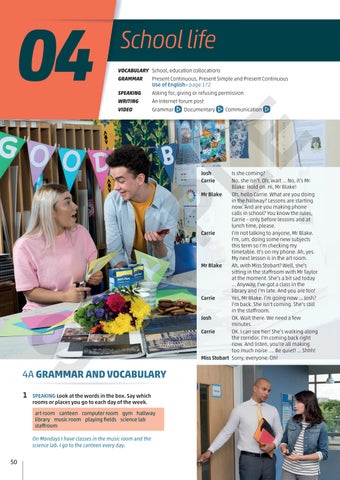
Is she coming? No, she isn’t. Oh, wait … No, it’s Mr Blake. Hold on. Hi, Mr Blake! Mr Blake Oh, hello Carrie. What are you doing in the hallway? Lessons are starting now. And are you making phone calls in school? You know the rules, Carrie – only before lessons and at lunch time, please. Carrie I’m not talking to anyone, Mr Blake. I’m, um, doing some new subjects this term so I’m checking my timetable. It’s on my phone. Ah, yes. My next lesson is in the art room. Mr Blake Ah, with Miss Stobart? Well, she's sitting in the staffroom with Mr Taylor at the moment. She’s a bit sad today … Anyway, I’ve got a class in the library and I’m late. And you are too! Carrie Yes, Mr Blake. I’m going now ... Josh? I’m back. She isn’t coming. She’s still in the staffroom. Josh OK. Wait there. We need a few minutes. Carrie OK. I can see her! She's walking along the corridor. I'm coming back right now. And listen, you're all making too much noise .... Be quiet! ... Shhh! Miss Stobart Sorry, everyone. Oh!
4A GRAMMAR AND VOCABULARY 1 SPEAKING Look at the words in the box. Say which rooms or places you go to each day of the week.
art room canteen computer room gym hallway library music room playing fields science lab staffroom On Mondays I have classes in the music room and the science lab. I go to the canteen every day.
50
04 2.3 Read and listen to the conversation and look at the photos on page 50. Which places from Exercise 1 are the people in?
3
2.3 Read and listen to the conversation again. Where is Carrie? Where are her friends? Where is Miss Stobart?
Present Continuous
4 Read the sentences. Then choose the correct option in the rule below.
I’m not talking to anyone. I’m checking my timetable. We use the Present Continuous to talk about activities that happen regularly / are happening now.
5 Read the Grammar box and check your answers to Exercise 4.
+
I’m having lunch at the moment. She’s getting up now. They’re playing games.
–
I’m not talking to anyone. He isn’t coming. You aren’t listening.
Are you doing your homework? Yes, I am./No, I’m not.
Wh-? Where is she going?
Spelling rules: do doing, write writing, swim swimming
SA
Grammar Reference and Practice > page 164
6 Complete the sentences. Use the Present Continuous affirmative or negative. Then check with the conversation on page 50.
1 Carrie and Mr Blake aren't talking (talk) in the staffroom. 2 Miss Stobart (feel) happy. 3 Josh (wait) in the art room. 4 Carrie (sit) in a classroom. 5 The students in the art room (make) a lot of noise.
7 Look again at the photos on page 50. Use the prompts to describe what is happening.
1 Carrie/talk/teacher 2 Carrie/stand/hallway. 3 Students/prepare/decorations/classroom 4 Josh/talk to Carrie/on the phone
8
ask the teacher a question do an exercise eat play a game read sit on chairs write in a notebook 1 I'm ... 2 One person ... 3 A few students ... 1 I'm doing an exercise now.
4 Our teacher ... 5 A lot of students ...
10 SPEAKING In pairs, think of one person in your
classroom. Take turns to ask and answer questions and guess the people. A Is the person writing at the moment? B No, he isn’t. A Is he doing an exercise? B Yes, he is.
11 Study Watch out! and read the sentences. Is the speaker describing an event happening now or a temporary situation?
1 We're leaving right now. Do you want to come? now 2 I'm learning Spanish at school this year. 3 I can’t talk now. I’m having breakfast. 4 We’re reading Shakespeare this term. 5 Look! Deb isn’t wearing her school uniform.
WATCH OUT!
We also use the Present Continuous to talk about temporary situations that aren't happening exactly at the time of speaking: I’m doing some new subjects this term.
12 SPEAKING In pairs, ask and answer the questions. 1 What TV shows are you watching at the moment? 2 Are you reading any interesting books at the moment? 3 Are you doing any after-school clubs this term? 4 What subjects are you really enjoying this term?
11 Read the question and watch the video. Say what the speakers answer. Then, in pairs, ask and answer the question. Are you learning anything new at the moment? GRAMMAR VIDEO
We use the Present Continuous to talk about actions that are happening now, at the moment of speaking.
?
Use the words and phrases from the box to make affirmative and negative sentences in the Present Continuous.
M PL
Present Continuous
9 Write sentences about people in your classroom.
E
2
2.4 Listen and answer the questions. 1 Why are the students feeling sad? 2 What is happening in the classroom now?
□ I can use the Present Continuous to talk about things happening now or temporary situations.
51
4B VOCABULARY | School subjects and classroom objects 5
□ □ □ □ □
Art Biology Chemistry Computer Science Drama Foreign Languages Geography History Maths Music Physical Education (PE) Physics
2
highlighters a tissues b textbook c dictionary d e 1 headphones calculator f
6
Music
7
Chemistry calculator Biology
3 4
5 6
3 SPEAKING In pairs, take turns to describe a school subject for your partner to guess.
2.8 Listen to five more words and write them in the correct column in the table in Exercise 6.
1 What subjects are easy or difficult for you? 2 What foreign languages are you learning at school this year? 3 Which teachers give you a lot of homework? 4 How many objects in the picture in Exercise 4 are you carrying in your school bag/backpack right now? 5 What other things do you always carry? Make a list. Is there anything surprising about other students’ answers?
A We have it on Mondays and Thursdays. We learn about animals, humans and plants. B It's Biology.
4 Match objects 1–11 in the pictures with the words from the box.
SA
calculator dictionary folders headphones highlighters keys notebooks ruler school backpack textbook tissues
1
4
3
5
11
7 6
8 9
52
education
8 SPEAKING In groups, discuss the questions.
2.5 Listen and match the school subjects in Exercise 1 with lessons 1–6 in the recording. 1 Art 2
2.7 PRONUNCIATION Listen and notice the number of syllables and the stress. Then listen again and repeat the words.
M PL
1 In Biology we learn about animals and plants. 2 In we study important events from the past. 3 In we learn how to sing and play an instrument. 4 In we learn about electricity and atoms. 5 In we study elements and substances. 6 In we exercise and play sport. 7 In we learn how to draw and paint. 8 In we study numbers. 9 In we learn how to act. 10 In we learn how to use computers and write computer programs. 11 In we study things like continents or climate. 12 In we learn how to speak, read and write in a different language.
2.6 Listen to the descriptions of six objects. Put objects a–f with recordings 1–6.
E
1 Match the school subjects with definitions 1–12.
□ I can talk about school, school subjects and classroom objects.
10
2
04
4C GRAMMAR This looks like a normal classroom in the UK. The students are wearing uniforms and right now they’re having a debate. There are some books and folders on the desks, but there aren’t any pens. 'No Pens Day Wednesday' happens once a year, every year in the UK. The aim of the day is to improve students' listening and speaking skills. Thousands of schools join the event. For one day, students put down their pens. They don’t write anything all day. In every lesson, from languages to Maths and even Art, students only do speaking activities. ‘It’s a great idea,’ says Emma Davis, a student in Brighton. ‘On Wednesdays we usually practise writing essays but today we’re talking about our favourite characters in the book that we’re reading this term.’
5 Choose the correct form of the verb to complete the
M PL
1 SPEAKING Look at the photo and answer the questions.
E
NO PENS DAY WEDNESDAY
1 What are the students doing? 2 Is it a typical lesson? Say why.
2 Read the article and check your answers in Exercise 1. Then, in pairs, discuss the questions.
1 Do you think ‘No Pens Day Wednesday’ is a good idea? 2 Would you like a day like this in your school? Say why.
Present Simple and Present Continuous
3 Are the underlined verbs in the sentences in the
Present Simple (PS), Present Continuous for now (PC for now), or Present Continuous for temporary situation (PC temporary)?
SA
1 Right now they’re having a debate. PC for now 2 No Pens Wednesday happens once a year, every year in the UK. 3 On Wednesdays we usually practise writing essays but today we’re talking about our favourite characters in the book we’re reading this term.
4 Read the Grammar box and check your answers to Exercise 3.
Present Simple and Present Continuous
We use the Present Simple to talk about regular actions/ activities and facts. We have music lessons twice a week. Time expressions: always, usually, every day, once a week, etc. We use the Present Continuous: • to talk about actions/activities happening now • to talk about temporary situations. Today we’re practising for a concert. This term I’m learning to play the guitar. Time expressions: now, at the moment, this week/month/ term, etc. Grammar Reference and Practice > page 164
sentences.
1 We have / are having Maths classes twice a week. 2 Do you eat / Are you eating? Please don’t eat in the classroom. 3 Sports Day happens / is happening once a year at our school. 4 I learn / ’m learning to write computer code this term. 5 Jamie’s angry about something. He doesn’t talk / isn’t talking to me at the moment. 6 There’s chicken on this pizza. Do you eat / Are you eating meat or are you a vegetarian?
6 Complete the email with the correct Present Simple
and Present Continuous forms of the verbs in brackets. Hi Jin, Today is Takeover Day in my school. It 1happens (happen) once a year. Students take over adult roles at school for just one day. For example, some students 2 (become) teachers for the day, others 3 (be) cooks or school secretaries. I’m the assistant head teacher of my school today. At the moment, I 4 (sit) in a meeting about school meals. Head teachers 5 (have) a lot of boring meetings but I 6 (enjoy) this one. All the other teachers 7 (listen) to my opinions!
7 SPEAKING In pairs, ask and answer the questions. 1 What do you usually do after school on Wednesdays? 2 Are you learning to play a sport or an instrument at the moment? What is it? 3 What do you usually do on your way to school (listen to music, talk to friends, etc.)? 4 What is your teacher doing now?
□ I can use the Present Simple and the Present Continuous to talk about regular actions and activities happening now.
53
4D READING AND VOCABULARY important to you? Put the phrases in order 1–6 (1 = very important). Then compare your ideas in groups.
□ subjects you can study □ the school building □ opinions about the school □ the sports □ the distance from your house □ friends at the same school
2 Read the article quickly. Choose the best answer. The author of the article is
a thinking about studying at the Studio. b a new student at the Studio. c an adult.
3 Study Active Reading and read the text again.
At the ESBC school in Berlin, Germany, students can’t pass or 1 exams because they don’t get any grades until they are fi een. A er that, students only 2 exams when they want to. Students do normal 3 , such as German, Maths and English. But in a subject called ‘Challenge’ they also do 4 based on real life. For example, the school gives them €150 each to plan an ‘adventure’ by themselves, from kayaking to working on farms. 1 a do 2 a make 3 a subjects 4 a practice
b fail b pass b activities b projects
c get c take c languages c qualifications
M PL
Complete the school profile.
6 Choose the correct words to complete the article.
E
1 SPEAKING Imagine you can study at any school. What’s
ACTIVE READING | Finding specific information
• Read the questions or task. Think about what information you need, e.g. a number, a name, or a date. • Read the text quickly and find the parts of the text with the information you need. Don’t worry about the rest of the text.
SA
4 Read the article again. Answer the questions.
1 How old are the students at the school? 2 How much is breakfast at the school? 3 What do students often do for the computer game companies near the school? 4 When does the canteen serve food? 5 What adjectives does the author use to describe the students at the end of the article?
5 Look at the highlighted phrases in the article. Complete the collocations with the words from the box.
break exam (x2) grades project qualification subject
1 do 2 take 3 get 4 pass/fail
54
a subject a an a a good/bad an
7 SPEAKING Tick the sentences that are true for you. Then, in pairs, compare your answers.
1 2 3 4 5
□ I take a break from studying every half an hour. □ I’m doing an art project at the moment. □ I like taking exams. □ I don’t usually get good grades in Maths. □ When I pass an exam, my mum usually cooks me my favourite dinner!
8 REFLECT | Society In pairs, discuss the questions. 1 Do you think practical subjects like designing computer games or planning an adventure are useful or a waste of time? Say why. 2 Do you do any unusual subjects at your school? 3 What new subjects would you like to do at school? Say why. 4 Look at the list of features of The Studio and ESBC in Berlin. Which would you like to have at your school? 'real life' projects a school cinema an all-day canteen free breakfast lessons until 5 p.m. optional exams 12 WATCH AND REFLECT Go to page 153. Watch the documentary A different kind of school and do the exercises. DOCUMENTARY VIDEO
1 Name The Studio 2 Where , UK Finishes: 4 The school day Starts: 3 Number of students About: 5 Subjects Typical subjects and designing 6
□ I can identify specific information in an article and talk about school life.
t s r i f ’s K U e Th
l o o h c s g gamin rs
2.9
5
10
M PL
E
e by Thomas Rog
04
Today I’m visiting The Studio in Liverpool. It’s the UK’s first gaming school for students between the ages of fourteen and nineteen. The school is different from normal schools: students mix lessons with real work and each day starts at 9 a.m. and finishes at 5 p.m., like a typical working day.
The time is 8.45 a.m. and some students are arriving at school. Some are already enjoying a free breakfast inside. They’re all wearing uniforms and they look smart. The school looks cool, like the office of an Internet tech company.
Students don’t only study games, of course. They do typical subjects like Maths, Foreign Languages and History. They take exams too. But at the end of 35 their time at the school, they also get a qualification in designing computer games. The students at the school look happy and motivated. They want to learn, they want to pass their exams and get good grades.
40
This really isn’t like my old school. I want to be a student again. But in this school.
SA
It’s now 9 a.m. and school is starting. First there’s an assembly, in the school cinema. I’m sitting in a really comfortable chair. This isn’t like my old school …
15
20
25
Lessons usually start at 9.20 a.m. But today is Games Day at the school and the students are doing projects in teams all day. Each team is designing, writing and making a computer game. They have adults to help them. But the adults aren’t teachers – they’re real games designers. In fact, there are a lot of computer game companies near the school. Students often test games for the companies and sometimes they get money for it. Suddenly it’s 1 p.m. and I’m getting hungry. When is lunch? ‘There isn’t a special time,’ a student tells me. ‘The school serves food all day so students can take a break when they need to – like in the working world.’
30
In the canteen, students and teachers are eating together and talking about their games. In total, there are about 250 students at The Studio.
55
A
B
E
C
M PL
4E LISTENING AND VOCABULARY 1 SPEAKING In pairs, discuss the questions.
5
1 How do you usually get to school? By car, by public transport or on foot? 2 How long does the journey take? 3 What do you usually do on the journey?
crowded dangerous expensive freezing fun simple tiny
2 Look at the photos. Find these things in the photos.
1 I have a simple journey in the morning. 2 The bus is always really , so I can never sit down. 3 These Chinese students are from a village in the mountains. 4 That looks like a journey for children. 5 It looks cold – in fact, it’s ! 6 Ice-skating! That’s a way to get to school. 7 But London is really so Jonathan lives in Gdańsk, Poland.
canal ladders plane skaters
3
2.10 Listen to the podcast. Number the photos A–C in the order the speaker mentions them. 1
4
□
2
□
3
□
2.10 Read the questions. Then listen again and choose the correct answer.
SA
1 Josie gets to school a by car. b by bus. c on foot. 2 The students in China a use the ladders to go to school every day. b don’t see their parents at weekends. c live about a kilometre from their school. 3 The Rideau Canal a is eight kilometres long. b is open for skating for about two months. c is closed in the afternoons. 4 Jonathan Davey a studies at a university in Poland. b takes a flight on Wednesdays and Fridays. c spends £10,000 on flights every year.
56
2.11 Complete the sentences from the podcast with the adjectives from the box. Then listen and check.
6
2.12 Dictation. Listen to a short part of a podcast. Then listen again and write exactly what you hear.
7 REFLECT | Society Read the advert and in pairs, discuss the questions.
1 What does the advert ask students to do? 2 What are the good things about walking to school in the advert? Can you think of any others? 3 Are there similar challenges at your school?
FREE YOURf e e t Our five-day walking challenge encourages students to walk all or part of the way to school every day for a week. It’s a great way to feel good and help the environment.
□ I can identify key details in a podcast and talk about commuting.
1 Who are the people in the photo? 2 Where are they? 3 What do you think they are talking about?
2
13 2.13 Watch or listen to Lucas and Zoe’s conversation. Why does Zoe feel annoyed with Lucas?
3
13 2.13 Which things does Lucas ask to borrow from Zoe? Which of them does she not give him? Read the dialogue and complete the gaps from memory. Watch or listen again to check. Lucas Zoe
M PL
Hi, Zoe. Is anyone sitting here? Hi, Lucas. No … That’s all my stuff. Sorry. Your music’s quite loud! Lucas Sorry! Zoe Shhhh! , please? Lucas Sorry. Can I borrow your 1 Zoe Yes, of course. Here you are. ? Mine is Lucas Zoe. Could I borrow your 2 at home. Zoe Yes, sure. But I have physics homework today so I need it soon. There are apps, you know … for your phone. Lucas I know, but I don’t have one. Thanks. Just ask when you need it. Everyone Shhhh! Lucas Just one more thing … Is it OK if I use your 3 ? Zoe No, sorry but you can’t. I’m using it at the moment. OK? Librarian Zoe! Please be quiet. This is a library! Zoe Thanks a lot, Lucas!
E
1 Look at the photo and answer the questions.
04
COMMUNICATION VIDEO
4F SPEAKING
4 Study the Speaking box and complete the
conversations with one or two words in each gap.
SA
1 A ask you a question? B Yes, 2 A Is it I use your dictionary? B but you can’t. It’s at home. 3 A Could your highlighter? B Yes, that’s fine. are.
SPEAKING | Asking for, giving and refusing permission Asking for permission Can I borrow your headphones, please? Could I borrow your calculator? Is it OK if I use your ruler? Saying ‘yes’ Yes, of course. Yes, sure. Here you are. Yes, that’s fine. That’s no problem.
Saying ‘no’ (and giving a reason) No, sorry. (I don’t have one.) I’m sorry but you can’t. (I’m using it at the moment.)
5 Study Watch out! and complete the sentences with one or ones.
1 That train is really crowded. Let’s take the next one. 2 I need some new glasses. My old are really old. 3 Buy two bottles of water and get a third free! 4 Can you see the two girls? The tall is Cassie and the other is Marta. 5 These tissues are really expensive. Have you got any cheaper ? 6 We do a lot of different subjects at school, but my favourite are Art and Music.
WATCH OUT! We use one and ones to avoid repeating countable nouns. Can I borrow a pen? Yes, of course. Which one do you want? Which headphones are yours? The red ones.
6 In pairs, take turns to ask for permission and respond. 1 borrow your phone? 2 look at your answers? 3 go to the toilet? 4 go out with my friends? 5 take a break? 6 use your highlighter? 7 move your backpack? A Can I borrow your phone, please? B No, sorry. I don’t have it with me
7 In pairs, role play the situation. Student A turn to page 175. Student B, go to page 176. Then change roles.
□ I can ask for and give, or refuse permission.
57
What is a typical school day like in England? Elijah Watson, Secondary School student in York, England. Chelsea FC fan I’m at Bridge School, in York, England. I’m sixteen and I’m in Year 11.
At 11 o’clock there is a 15-minute break. We usually have a snack and chat with friends. Then there are two more lessons before lunchtime.
M PL
We have lunch at 12.45 p.m. The school canteen gets really crowded! Some students bring sandwiches from home but you can buy food, like pasta, salads, and burgers. A lot of it is quite healthy so I eat at school. A er lunch I play football outside on the playing fields.
E
Our school day starts at 8.45 a.m. We have an assembly in the gym. The head teacher talks about news at the school. Then we have two hours of lessons.
A ernoon lessons finish at 3.30 p.m. but there are lots of a er-school clubs. This term I’m doing Spanish.
4G WRITING | An Internet forum post 1 SPEAKING Look at the photo. What are the students doing?
2 Read the question on the website and Elijah’s answer. Choose three topics Elijah mentions.
SA
extra classes after school the computers at school the food at lunchtime his favourite subjects sport
3 Study the Writing box. Find the phrases in Elijah’s post. WRITING | An Internet forum post
• Introduce yourself (your name, your school, your age, your year): I’m at Bridge School. I’m in Year … • Say what happens in the morning: Our school day starts at … Then we have … At 11 o’clock … • Say what happens at lunchtime: We have lunch at … You can buy food, like … • Talk about the afternoon and after-school activities: Afternoon lessons finish at … This term I’m doing …
58
□ I can describe a typical day at my school.
4 Study Watch out! Then replace the underlined words and phrases in 1–4 with a pronoun.
1 I really enjoy English. English is my best subject. 2 I never bring sandwiches to school. I can’t stand sandwiches! 3 We like our Maths teacher, Mr Thomas. But Mr Thomas gives us a lot of homework. 4 We’re lucky because we have great playing fields at our school. The playing fields are really big! I really enjoy English. It is my best subject.
WATCH OUT! We use pronouns to avoid repeating nouns: You can also buy food, like pasta, salads, and burgers. A lot of it is quite healthy.
5 SPEAKING Work in pairs. Compare your school and
Elijah's school. Use the prompts in Exercise 2 to help you.
6 WRITING TASK Write about your school. Use the text in
Exercise 2 to help you. Use the Writing box as a guide. • Use pronouns to avoid repeating nouns. • Use linking words: and, but, and then.
04
Word List 4A GRAMMAR AND VOCABULARY 5.22 afterschool club (n) /ˌɑːftəˈskuːl klʌb/ art room (n) /ˈɑːt ruːm/
notebook (n) /ˈnəʊtbʊk/
practical (adj) /ˈpræktɪkəl/
object (n) /ˈɒbdʒɪkt/
smart (adj) /smɑːt/
Physical Education (n) /ˌfɪzɪkəl ˌedjʊˈkeɪʃən/
take a break (from sth) /ˌteɪk ə ˈbreɪk (frəm ˌsʌmθɪŋ)/
Physics (n) /ˈfɪzɪks/
be late /ˌbi ˈleɪt/
take an exam /ˌteɪk ən ɪgˈzæm/
plant (n) /plɑːnt/
check your timetable /ˌtʃek jə ˈtaɪmˌteɪbəl/ classroom (n) /ˈklɑːsrʊm/ computer room (n) /kəmˈpjuːtə ruːm/ documentary (n) /ˌdɒkjəˈmentəri/ gym (n) /dʒɪm/ hallway (n) /ˈhɔːlweɪ/
play an instrument /ˌpleɪ ən ˈɪnstrəmənt/ ruler (n) /ˈruːlə/ school bag (n) /ˈskuːl bæg/
working day (n) /ˌwɜːkɪŋ ˈdeɪ/
substance (n) /ˈsʌbstəns/
4E LISTENING AND VOCABULARY 5.26
textbook (n) /ˈtekstbʊk/
advert (n) /ˈædvɜːt/
the past (n) /ðə ˈpɑːst/
by car/bus/public transport /ˌbaɪ ˈkɑː/ˈbʌs/ˌpʌblɪk ˈtrænspɔːt/
tissue (n) /ˈtɪʃuː/
hold on /ˌhəʊld ˈɒn/
test (v) /test/
E
canteen (n) /kænˈtiːn/
canal (n) /kəˈnæl/
make a phone call /ˌmeɪk ə ˈfəʊn kɔːl/
assistant head teacher (n) /əˌsɪstənt hed ˈtiːtʃə/
closed (adj) /kləʊzd/
music room (n) /ˈmjuːzɪk ruːm/
character (n) /ˈkærəktə/
crowded (adj) /ˈkraʊdɪd/
playing fields (n) /ˈpleɪɪŋ fiːəldz/
computer code (n) /kəmˈpjuːtə kəʊd/
dangerous (adj) /ˈdeɪndʒərəs/
prepare (v) /prɪˈpeə/
essay (n) /ˈeseɪ/
expensive (adj) /ɪkˈspensɪv/
school uniform (n) /ˌskuːl ˈjuːnəfɔːm/
have a debate /ˌhæv ə dɪˈbeɪt/
free (v) /friː/
science lab (n) /ˈsaɪəns læb/
improve (v) /ɪmˈpruːv/
freezing (adj) /ˈfriːzɪŋ/
staffroom (n) /ˈstɑːfruːm/
join (v) /dʒɔɪn/
fun (adj) /fʌn/
term (n) /tɜːm/
listening/speaking skills (n) /ˈlɪsənɪŋ/ˈspiːkɪŋ skɪlz/
get to school /ˌget tə ˈskuːl/
M PL
4C GRAMMAR
4B VOCABULARY act (v) /ækt/ Art (n) /ɑːt/ atom (n) /ˈætəm/
5.24
challenge (n) /ˈtʃæləndʒ/
library (n) /ˈlaɪbrəri/
5.23
meeting (n) /ˈmiːtɪŋ/ pen (n) /pen/
practise doing sth /ˌpræktɪs ˈduːɪŋ ˌsʌmθɪŋ/ role (n) /rəʊl/
backpack (n) /ˈbækˌpæk/
take over /ˌteɪk ˈəʊvə/
Biology (n) /baɪˈɒlədʒi/
takeover (n) /ˈteɪkˌəʊvə/
calculator (n) /ˈkælkjəleɪtə/
climate (n) /ˈklaɪmət/
kilometre (n) /ˈkɪləˌmiːtə/ ladder (n) /ˈlædə/ on foot /ɒn ˈfʊt/
plane (n) /pleɪn/
simple (adj) /ˈsɪmpəl/ skater (n) /ˈskeɪtə/
4D READING AND VOCABULARY 5.25
skating/ice-skating (n) /ˈskeɪtɪŋ/ˈaɪs ˌskeɪtɪŋ/
SA
Chemistry (n) /ˈkeməstri/
journey (n) /ˈdʒɜːni/
take (v) /teɪk/
adventure (n) /ədˈventʃə/
Computer Science (n) /kəmˌpjuːtə ˈsaɪəns/
take a flight /ˌteɪk ə ˈflaɪt/
arrive at (school) (v) /əˌraɪv ət (ˈskuːl)/
continent (n) /ˈkɒntɪnənt/
tiny (adj) /ˈtaɪni/
assembly (n) /əˈsembli/
dictionary (n) /ˈdɪkʃənəri/
travel (v) /ˈtrævəl/
Drama (n) /ˈdrɑːmə/
design a computer game /dɪˌzaɪn ə kəmˈpjuːtə geɪm/
village (n) /ˈvɪlɪdʒ/
education (n) /ˌedjʊˈkeɪʃən/
do a project /ˌduː ə ˈprɒdʒekt/
electricity (n) /ɪˌlekˈtrɪsəti/
do a subject /ˌduː ə ˈsʌbdʒɪkt/
4F SPEAKING
element (n) /ˈeləmənt/
games designer (n) /ˈɡeɪmz dɪˌzaɪnə/
borrow (v) /ˈbɒrəʊ/
folder (n) /ˈfəʊldə/
gaming (n) /ˈgeɪmɪŋ/
go to the toilet /ˌgəʊ tə ðə ˈtɔɪlɪt/
foreign languages (n) /ˌfɒrɪn ˈlæŋɡwɪdʒɪz/
get a qualification in sth /ˌget ə ˌkwɒlɪfɪˈkeɪʃən ɪn ˌsʌmθɪŋ/
loud (adj) /laʊd/
get good grades /ˌget gʊd ˈɡreɪdz/
4G WRITING
mix (v) /mɪks/
chat with friends /ˌtʃæt wɪð ˈfrendz/
motivated (adj) /ˈməʊtəveɪtəd/
give a talk /ˌgɪv ə ˈtɔːk/
office (n) /ˈɒfɪs/
Internet forum post (n) /ˌɪntənet ˈfɔːrəm pəʊst/
optional (adj) /ˈɒpʃənəl/
secondary school (n) /ˈsekəndəri skuːl /
Geography (n) /dʒiˈɒgrəfi/ headphones (n) /ˈhedfəʊnz/ highlighter (n) /ˈhaɪlaɪtə/ History (n) /ˈhɪstəri/ keys (n) /kiːz/ Maths (n) /mæθs/ Music (n) /ˈmjuːzɪk/
walk (v) /wɔːk/
5.27
5.28
pass/fail an exam /ˌpɑːs/ˌfeɪl ən ɪgˈzæm/
Remember More > page 174
59
04 Revision 1 Match definitions 1–10 with the words in the box. There are two extra words.
□ Art □ Biology □ canteen □ Chemistry □ Drama □ Geography □ gym □ hallway □ History library □ Music □ staffroom 1 You read books here. 2 You learn about the past in this subject. 3 You eat your school lunch here. 4 Teachers meet and prepare lessons here. 5 You act in plays in this lesson. 6 You do Physical Education (PE) here. 7 You draw pictures in this lesson. 8 You study plant and animal life in this lesson. 9 You play instruments or sing in this lesson. 10 You learn about the world in this lesson.
forms of the verbs (in brackets). Tick the sentences that talk about temporary situations.
(not listen) to the teacher, □ The students they (play) a game of cards. (not do) his homework, he 2 □ John (use) his mobile phone. (not run) this week because I feel ill. 3 □I (you read)?’ ‘It’s a book about 4 □ ‘What art.’ (the girls have) lunch?’ ‘No, they 5 □‘ (not be). They (eat) chocolate!’ (you study) the Romans this term?’ ‘Yes, 6 □‘ 1
I
(be).’
5 Complete the text with the Present Simple or Present Continuous forms of the verbs in brackets.
M PL
2 Choose the correct words to complete the sentences.
4 Complete the sentences with the Present Continuous
E
VOCABULARY AND GRAMMAR
1 Turn to page 21 in your notebooks / textbooks, please! 2 You need to use a calculator / dictionary to solve this Maths problem. 3 I haven’t got any headphones / highlighters to mark the important parts in the book. 4 Class! Put your things away in your folders / backpacks. It’s break time.
3 Complete the sentences with the words from the box. break cool exams expensive grade pass simple subjects Josh Lana Josh
SA
Lana
Which 1subjects are you studying at the moment, Lana? this Maths. I want a really good 2 year. for you! You never fail any That’s 3 4 , not like me! tonight, Hey! Why don’t we take a 5 stop studying and have some fun? ! There’s a new pizza That sounds 6 . And who place in town. It’s not very 7 knows, a night out with a genius could help me 8 my exams too!
Josh
60
OUTDOOR
CLASSROOM DAY
Across the world today students 1are not studying (not study) in their classrooms, they 2 (take part) in Outdoor Classroom Day. For example, at this time on Thursdays, Pablo in Rio usually 3 (study) Physics in the Science room, but today he 4 (learn) about nature in the fields around his school. In fact, the whole school 5 (do) a project on nature this term. Maria in Athens usually 6 (have) double Maths now, but today she and her classmates 7 (measure) an area outside the school for a new vegetable garden. This is because Greek schools 8 (try) to become green this year. Sven and Anna 9 (not leave) their school in Stockholm very often, but today they 10 (clean) a local beach. What about you? Tell us what 11 (usually/you/do) at school and what 12 (happen) today!
USE OF ENGLISH
2 What does Jamie borrow from Amy?
6 Choose the correct words a–c to complete the texts.
A
2
b cool
b playing
b funny
c strange
b tissues
c trainers
If you are interested in a programming project this term please come to the computer room at 3 p.m. a doing
b getting
c taking
Please don't climb over the school walls. It's against the rules and it's . a crowded
b dangerous
c expensive
Use of English > page 172
SA
LISTENING
7
3 Which homework is Becky doing? A
B
C
M PL
PLEASE WEAR AND NOT SHOES IN THE SCHOOL GYM AT ALL TIMES! a headphones
6
c game
This year all students studying languages can take part in our school exchange project. a foreign
5
c cold
SPORTS DAY starts at 9 a.m. on the school fields. Don’t be late! a drama
4
C
School is closed this week because it’s and the central heating isn’t working. a tiny
3
B
E
1
2.14 Read questions 1–5 and study the pictures. Then listen and choose the correct answer for each recording.
STRATEGY | Multiple choice task with picture options
Look at the pictures and questions carefully to check that you understand what the pictures show. This will give you an idea of what sort of information to look for.
SPEAKING
8 In pairs, take turns to ask and answer the questions. 1 What time do you usually finish school? 2 What is your favourite subject? 3 Which subjects don’t you enjoy studying? 4 What are you learning in English at the moment? 5 Which sports are you doing at the moment? 6 What kind of music are you listening to these days?
WRITING
9 Write an email to an English-speaking friend about your typical school day in which you:
• introduce yourself (your name, your school, your age, your year) • say what happens in the morning • say what happens at lunchtime • talk about the afternoon and after-school activities. From: danrob@qmail.com To: steven04@qmail.com Subject: Hi Steven
1 How does Jodie usually travel to school?
A
B
C
61