a letter to the editor based on prompts (Writing tip: formal style; supporting details)
a for-and-against essay (Writing tip: topic sentences)
•role playing an informal email giving advice (Writing tip: prompts; introduction; providing results)
•making a recommendation •discussion (responding to what you hear)
a review of a film (Writing tip: negative review)
•persuading •asking for clarification an essay providing solutions to problems (Writing tip: providing results)
•asking for/giving information
•collaboration an article describing a person (Writing tip: describing physical appearance/ character)
•attending a job interview
•speculating an informal email giving information (Writing tip: rubrics with multiple points; use of tenses; register)
Unit 1 Leaving home p.16
Unit 2 Travel habits p.18
Unit 3 Coins in the UK p.40
Unit 4 Educational TV p.42
Unit 5 Robot Wars p.54
Unit 6 Take away food in the UK p.66
Unit 7 British honours p.78
Unit 8 Volunteers in Australia p.91
Unit 9 England’s national sport p.102
Unit 10 A traditional British job p.115
MEDIATION
Unit 1 Present a person who does amazing activities for charity p.12
Unit 2 Give a summary of a story p.24
Unit 3 Present your monthly budget sheet p.40
Unit 4 Explain unknown vocabulary p.43
Unit 5 Mime feelings using body language p.55
Unit 6 Explain a graph p.67
Unit 7 Tell a friend what makes a film special p.79
Unit 8 Design a poster p.91
Unit 9 Mediate a disagreement during a game p.112
Unit 10 Report statements to others p.117
LIFE SKILLS
Unit 1 How can we develop strong family relationships? p.16
Unit 3 How can we budget money? p.40
Unit 5 How can we avoid scams on social media? p.64
Unit 7 How can we solve problems? p.88
Unit 9 How can we be a good sport? p.112
PRESENTATION SKILLS
Unit 2 Present a visit to a tourist destination p.28
Unit 4 Present a school with a difference p.52
Unit 6 Present how to get a good night’s sleep p.76
Unit 8 Present an interesting environmental volunteer group p.100
Unit 10 Present your dream job p.124
Symbols think pairwork groupwork video flipped video mediation find examples
research audio Values Vocabulary from text Debate
BUSY BEES
OBJECTIVESVocabulary: hobbies; free-time activities; character traits;
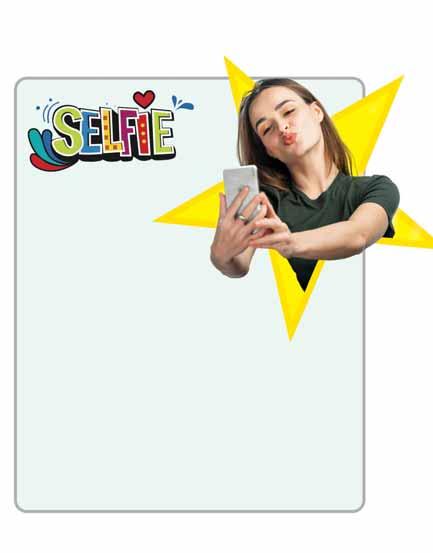
Reading: an article about selfies (4-option multiple choice)
Grammar: present simple; present continuous; stative verbs; infinitive; -ing form
Listening: an interview about an unusual hobby (3-option multiple choice)
Everyday English: introducing yourself (asking for & giving personal information)
Writing: an informal email making suggestions
Mediation: present a person who does amazing activities for charity
Culture: leaving home
Life Skills: How can we develop strong family relationships?
Values: character
Watch the video. Make notes, then prepare questions to ask your classmates.
Watch the video. Who said that customs are the guide of human life?
a David Hume b Aristotle
How important are routines and daily habits to you? Why? Tell the class. You can use the words from the list.
• essential • unimportant
• necessary • helpful
• enjoyable • dull
Routines and daily habits are essential to me because …
READING a
1
2
Watch the video. Make notes and prepare a short quiz.
Watch the video. Where is the ‘capital of selfies’ Miami, Makati City or Manhattan?
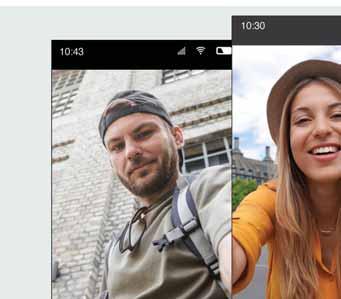
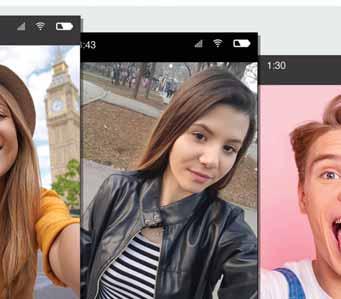
a)Look at the selfies below. What can you tell about the people in them? Discuss with your partner.
b) Which two things are important in selfies? Listen and read to find out.
Nowadays,
everyone takes selfies, from famous actors and politicians, to normal everyday people. Selfies are a great way to share your hobbies and daily routines, and thanks to smartphones and their high-quality cameras, anyone can take and upload these images on social media. But is there more to selfies than just showing your holidays or your new clothes? According to research, our selfies and how we take them also says a lot about our character. A lot more than most people think!
Researchers found that both the poses that we choose and the way that we actually take a selfie can show the world things that we might not realise. For example, selfies that consist of popular poses can be full of extra information. People who like to make the ‘duck face’ or pout may be in a bad mood, while those that stick their tongues out could be fun-loving and silly, but might actually feel uncomfortable in front of the camera.
Even how often we smile in our selfies, and the way we smile, tells people about our character. Someone who smiles a lot is more likely to be outgoing and open to new experiences while someone with a large broad smile may be a risk-taker. It’s not just our expression, though, that gives away things about us. Our eyes can too! For example, people who look directly at the camera could be cooperative and sociable.
The position of the camera is also important. In fact, how people view you as a person can depend on it. Studies found that showing the left side of the face and cheek in a selfie communicates emotions better and makes people seem more attractive to others. People who take a selfie from below often want to appear bigger and stronger, while those taking a picture from above looking down, could want to appear shorter and sweeter.
It’s amazing to think that a simple selfie tells the world so much about your character. Next time you grab your smartphone, hold on for a moment and think about what your next post is really saying about you!
Quickly read through the text and the question stems (not the possible answers). Read the text again carefully and underline the parts which answer each question. Now look at the four options and decide which one best answers each question. Make sure your answer is mentioned in the text and not just generally true. Remember all the answer options will be written differently from what is in the text.
Read the text in Ex. 2b and the questions below. For each question, choose the correct answer A, B, C or D.
1 Most people like to take selfies in order to
A copy their favourite celebrities.
B learn about their personality.
C enjoy their smartphones.
D show their friends what they’re doing.
2 What can a pout show about a person?
A They like to have a good time.
B They have a sense of humour.
C They feel annoyed or worried.
D They don’t feel confident being photographed.
3 People who get on well with others often
A like smiling in photographs.
B face the camera during a photo.
C have very obvious smiles.
D control their body language.
4 What is the reason that people take photographs from a low position?
A to look more powerful
B to help express their feelings
C to appear more beautiful
D to seem less scary
5 What advice might the writer give selfie takers?
Think about your poses if you don’t want to reveal your character.
Don’t think too much before taking selfies.
4 Do you agree with the points about selfies in the text? Do you think we judge people fairly by their selfies? Why/Why not?
VOCABULARY
5
Always look to your left in selfies.
Try lots of different angles for the best picture.
VALUES
Beauty is in the eye of the beholder. Discuss.
6
Look at the adjectives in bold in the text and match them to their synonyms below. Check in your dictionary.
I really enjoy art and I like using my imagination.
I’m very relaxed and like to take things easy.
I don’t mind waiting for things and I don’t get bored easily.
People say that I’m really good at my hobby and have a lot of skill.
I don’t do dangerous things.
I like to know where everything is.
hobbies
TopAccounts Tags
#May
I do my hobby at home and it 1) ______________________ me to be creative and 2) __________________ my skills in the kitchen.
#Scott
I love music, but I don’t play an instrument. Instead I 3) ______________________ my voice into a drum machine. I get to 4) ______________________ in contests, too. B
#Jane
I love Latin music and I’m crazy about dancing and 5) ______________________ in the gym. Luckily for me, my hobby 6) ______________________ all those things! C
#David
My hobby lets me 7) _____________________ with technology and learn how it works. I also 8) ______________________ things.
b)Match the people (A-D) in Ex. 2a to their hobby (1-7) below. Three are extra.
4
b) Use the adjectives in Ex. 3a and the hobbies/free-time activities in Exs. 1 & 2b to make sentences as in the example.
I’m quite sensible so I don’t do things like extreme sports.
Student A, read the blog post while Student B reads the comments. Choose the correct option for each section. Then, tell each other what you read.
Todd’s blog
Todd Hi everyone!
What do you do during your free time? I usually 1) spend/use my time at an outdoor adventure park with my friends. You should 2) give/offer it a try! There are so many cool things you can do there and the list 3) confirms/contains individual and team activities. You can 4) attempt/challenge to do an obstacle course or 5) go/do zorbing. You can also 6) build/make friends with people your age. Post a comment about what you like to do!
Sunday at 10:30am Like Comment Remove Tag
7 people like this.
Jason @ Todd I love rollerblading. It’s a really fun free-time activity and an awesome way to 7) express/share yourself. You can also 8) get/learn tricks and cool moves! But be careful on the rollerblades, it’s a bit hard to 9) play/stay on your feet at first! View all 19 comments
Jane @ Todd my favourite activity might not 10) involve/ interest everyone, but it’s fun. I like to go to escape rooms! Inside an escape room you have to 11) collect/take clues to find the way out. Don’t take too long to 12) make/decide your decisions though, there’s a time limit to solve the puzzles!
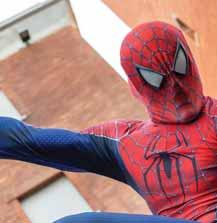
Jim: It’s a photo from the local comic con. You know, the meeting of comic superhero fans that happens every year and is becoming more and more popular. In fact, this year’s comic con is happening next week at the Lewis Street Convention Centre. If you want to come. I’m thinking of inviting Terry, too.
Mark: I think it looks cool, but I don’t know much about it. Does everyone wear a costume?
Jim: No, they don’t. Those are cosplayers. Cosplay is a really cool hobby where you pretend to be your favourite superhero.
Mark: Nice! Do you and your brother usually go?
Jim: Yes, we do. Actually, we go to a cosplay club every weekend. We’re making costumes for this year’s comic con these days. Ben wants to be Spider-Man. He isresearching his outfit at the moment. He is always excited before comic con.
Mark: Yeah, I’m sure! Well, I love comics, so OK. Let’s go together. I’m not doing anything then.
Jim: Awesome! It starts at 3 pm on Friday so let’s meet at 2.
1 Read the dialogue. What is a cosplayer?
2
Identify the tenses in bold in the dialogue. How do we form each tense? Match the verbs in bold to their uses:
• permanent state • temporary situations
• actions happening at the time of speaking
• changing situations • repeated actions • habits
• fixed arrangements for the near future • timetables
• actions happening around the time of speaking
3
4
Put the verbs into the present simple or present continuous. Give reasons.
1A: Is Tom studying (Tom/study) at home now?
B: No. He (have) Zumba class at 4 pm every day.
2A: (Julie/listen) to that loud music upstairs?
B: Yes. She (always/play) the radio at full volume!
3A: (you/stay) at home today?
B: Yes, unfortunately. It (rain) a lot at this time of year.
4A: (Mary/usually/make) such nice models?
B: Yes, and her skills (improve) every day!
a) Look at the highlighted adverbs of frequency in the dialogue. When and how do we use them in a sentence?
b) Use the ideas from Ex. 1, p. 8, to talk about your free-time activities. Use: always, usually, often, sometimes, rarely, never
A: I always go shopping in my free time. Sometimes I ... .
B: I usually have friends over in my free time ... .
5
6
Look at the underlined verbs in the dialogue. Do they have a continuous form? Why/Why not?
Put the verbs in brackets into the correct tense. Then ask and answer questions, as in the example.
ENTERTAINMENT PLUS
That’s News to me!
Meet Martin. During the day Martin 1) works (work) for the council, but at the weekends he 2) (enjoy) a very unusual hobby that makes him famous. In fact this weekend he 3) (appear) on the news! Martin isn’t an actor, athlete or reporter, though. He’s a newsraider! Newsraiding is a hobby where people who 4) ____________________ (hope) to be famous, stand behind journalists while they 5) (report) the news. Some newsraiders dance, some just look at the camera, but all of them 6) (love) the limelight! Newsraiders 7) (have) lots of fans, like Paul Yarrow, a famous newsraider who 8) ___________________ (live) in London and 9) ___________________ (appear) in videos online. Even though it 10) _____________________ (seem) weird, more and more people 11) (join) inthis hobby. After all, who 12) (not/want) to be a star?
‘Does Martin work for the council?’ ‘Yes, he does.’
7 What do you like doing at weekends? What are you doing this weekend? Discuss.
8
a) Look at the circled verbs in the dialogue. How does their meaning differ?
b)Use the verbs in bold in the correct form.
1a I’m sorry but I don’t see (not/see) what you mean.
b (you/see) Beth tonight?
2a Chris (have) a new hobby.
b Lucy (have) a party tonight.
3a Rob (look) at new watches.
b You (look) rather upset.
GRAMMAR IN USE d
INFINITIVE/-ING FORM (pp. GR2-GR3)
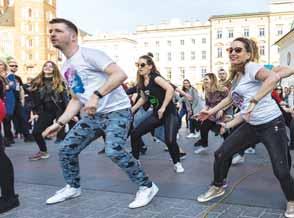
FLASH MOBBING
Would you like to perform on stage or be a famous dancer? Maybe you see celebritiesdance on TV and want to be a superstar yourself? If that sounds familiar then you might fancy giving flash mobbing a try! A flash mob is a large group of people who love meeting up secretly in public places to dance. The really fun thing about a flash mob is that the dancing is a total surprise that no one expects to happen! After all, you don’t see a crowd dancing in the middle of the supermarket every day, so it’s something you’ll never forget experiencing! Flash mobbing isn’t just a crazy stunt though, it’s also a super fun free-time activity that everyone can try. So, next time you go to the mall you had better keep your eyes open and don’t forget to have your phone camera ready. You never know when you might need it!
1 Read the text and say what flash mobbing is in a sentence.
2
a) Read the text. Which verb form do we use after:
1 like/love/enjoy/hate/don’t mind + -ing
2 suggest/avoid/fancy +
3 would like/would love/would prefer +
4 want/decide/ask/expect/hope/plan +
5 can/should/must/might +
6 make/let/had better/would rather +
b)Look at the phrases in bold in the text. Which describes: a complete action? an incomplete action?
3 Put the verbs into the correct form.
1 In addition to trying (try) slacklining you can also do zorbing.
2 Lifeguards prevent (run) by the pool as it’s dangerous.
3 The adventure centre advises us (book) our activities before we arrive.
4 (tell) you the truth I do feel quite tired.
5 Bob is eager (go) rollerblading this afternoon.
6 Imagine (climb) Mount Everest.
4 Use the verbs in box A and the phrases in box B to talk about your free-time activities, as in the example.
5 a) Look at the underlined verb forms in the text. How do they differ in meaning?
b) Put the verbs in brackets into the toinfinitive or -ing form. Explain the difference in meaning.
1a Remember to take (take) your bag to the gym, Lewis.
b Karen remembers last (see) her skateboard in the garden.
2a Jack means (build) a robot to help his mum clean the house.
b Being good at ceramics means (work) hard and practising a lot.
3a You should try (run) to keep fit.
b Jason tries (spend) as much time outdoors as he can.
TRANSFORMATIONS (Review)
6
Complete the second sentence using no more than three words.
1 Could you please sign me up for the ballet class, too? Would you mind signing me up for the ballet class, too?
2 Karen is thinking of joining the robotics club. Karen wants _____________________ the robotics club.
3 You can learn a lot easily on a field trip. It’s easy ________________________ a lot on a field trip.
4 Selfies are really fun and a great way to share your hobbies.
In addition to _________________________________ fun, selfies are a great way to share your hobbies.
5 We spend hours deciding what to do every weekend. It takes us hours __________________________________ what to do every weekend.
6 Katie always sings loudly during her karaoke game and it really annoys me.
Katie is ____________________________________ loudly during her karaoke game.
PHRASAL VERBS (related to hobbies)WORD FORMATION (adjectives from verbs)
join in: to become involved in an activity hang out: to spend time with someone try sth out: to do sth for the first time to see if you like it sign up: to join a group or activity as a member stay in: to remain at home instead of going out calm down: to relax and feel less stressed
1
Jill
Fill in the gaps with phrasal verbs from the box above in the correct form. Compare with your partner.
Hey, Anna! Are you 1) tonight?
Yeah. I don’t have any plans really. Any suggestions?
We add these suffixes to form adjectives from verbs: -able (read – readable) -ative (talk – talkative) -ive (create – creative) -ent (differ – different)
3
Read the Word Formation box, then complete the gaps with the correct word derived from the words in brackets. Check in your dictionary.
1 Mountain climbing is a(n) hobby; I love it! (EXCEL)
2 Photography is a hobby that requires you to be (IMAGINE)
3 Julie is an girl who loves sports. (ACT)
4 The training for my hobby is hard, but still (MANAGE)
Anna
Jill
Jill
Actually, I have a new hobby, candle making. Would you like to come and 2) ______________________ with my class at the club? It’s really fun and we can 3) __________________________ with some of my classmates afterwards.
Sure! It sounds like it might be fun. Can I 4) ______________________ it ______________________ , first, to see if I like it?
Of course! You can do a one-week trial. You don’t need to 5) _____________________________ for the class right away.
Cool! Candles are really pretty.
Anna
4
PHRASES WITH TIME
Fill in with: wastes, spending, lose, makes, having
1 Ellen loves time with her friends.
2 I love it here! I’m the time of my life!
3 James always time for his hobbies.
4 It’s easy to track of time when you’re having fun.
5 Paul too much of his time online.
SUMMING UP
Anna
Jill
Yes, and it’s really relaxing. It helps me 6) after a tough day.
Nice! I’m looking forward to it!
PREPOSITIONS
2 Fill in: of (x2), for, about, to, in. Check in your dictionary.
Anna
1 Having a hobby comes handy when you want to meet new people.
2 Jane is crazy bungee jumping.
3 It’s nice to be able to do something fun at the weekend.
4 Building models of old planes really helps bring history life.
5 Robert is fond baking.
6 It’s easy to get the hang zorbing.
Choose the correct option.
Looking for a new hobby? Are you fond 1)for/with/of/about walking? Then you should 2)give/to give/giving/gives hiking a go! Hiking is a fantastic free-time activity that offers a great way to 3)lose/send/waste/spend your time while enjoying the outdoors! What’s cool is that unlike other outdoor activities it isn’t very dangerous, so if you’re a(n) 4)helpful/organised/ sensible/creative person, this might be the right activity for you. But don’t get the wrong idea! Although it’s not extreme, it isn’t easy, either. Expect a good workout that can 5)involve/ improve/confirm/challenge even the best hiker at times. Although it can be tough, it’s still a great hobby to 6)bring/ turn/take/sign up at any age, as it’s a great group activity and an ideal way to 7)make/build/do/bring new friends and meet people. Another nice thing about hiking is that unlike a lot of sports it isn’t competitive and you aren’t trying to beat anyone else. It’s all about 8)setting/to set/set/sets yourself goals and reaching them. So, if you want to try a new free-time activity that 9)work/is working/works/are working up a sweat and gets you out of the house, try hiking and 10)offer/use/share/ have the time of your life!
LISTENING SKILLS f
MULTIPLE CHOICE
Preparing for the task
1
2
a)Read the question and the answer choices, paying attention to the underlined words. Think of words/phrases related to them.
1 What does Jim like most about doing parkour?
A the fact that it’s free
B the exercise benefits
C the chance to meet others
b)Now read the script. Match the underlined phrases to the underlined phrases in Ex.1a. Which is the correct answer? Why might the other options be confusing?
Anna: Do you like parkour, Jim?
Jim: Oh, absolutely! I’m having a great time doing it. It’s true that unlike other things it doesn’t cost a penny to do, but that’s not the real benefit.
Anna: I guess it’s a great way to keep fit, huh? It looks really challenging with all the jumps and flips.
Jim: That’s true, but you can get that at the gym as well. It’s the people that I love. I’ve made some amazing friends.
STUDY SKILLS
Predicting content
Read the questions and the answer choices. Underline key words and think of synonymous words/phrases. Often, the information is paraphrased, so predicting the key vocabulary is important. Remember that you will hear words that relate to all the options, but only one answer is correct. Pay attention to who says the statement and the words around it. This will help you choose the correct answer.
a)You will hear an interview with a girl called Jane Thomas. Read the questions (1-6) and underline the key words. What is the interview about?
1 Jane first became interested in her hobby because
A her relatives already had an interest.
B she tried it when she was young.
C she came across it on social media.
2 In the beginning lessons involve
A physical exercise and basic steps.
B using the rope at various heights.
C gym sessions every Monday to Friday.
3 What does Jane think is the most difficult thing for new learners?
A doing the gym programme
B dealing with scary situations
C concentrating during boring tasks
4 Why might people know Jane?
A She breaks lots of records.
B She does a lot of fundraising.
C She’s always on television.
5 How does Jane feel about her hobby?
A Pleased that it helps make a difference for others.
B Fed up with how much training she does.
C Grateful that she gets to travel for it.
6 In the future, Jane plans to
A write her life story.
B run her own centre.
C open a charity.
b) Listen and for questions 1-6 in Ex. 2a choose the correct answer.
3
4
Listen to Ex. 2b again. Make notes. In your own words, tell your friend about what Jane does for charity and why.
What is another popular free-time activity/hobby that you could do to raise money for charity? Why is it a good idea?
INTONATION IN COMPOUND NOUNS
Compound nouns are nouns with two or more words. These words can be different or the same parts of speech (e.g. noun + verb – handmade, noun + noun – football etc) They can be joined together to make one word (paintbrush), two words (baking powder) or a hyphenated word (singalong)
Whether it is one word, two words or hyphenated, the first part of the compound noun is usually stressed.
5 Match the words to form compound nouns. Which part in each compound noun is stressed? Listen, check and repeat.
play
SPEAKING SKILLS g
EVERYDAY ENGLISH
Introducing yourself (Asking for & Giving personal information)
A What school subjects do you like most?
B My name’s Kim, nice to meet you.
C I usually go to the gym, but I also like paintballing.
D Where are you from?
E You’re from Toronto too?
1
Scott: Hi, I’m Scott. I think you are in my science class.
Kim: Yes, I am. 1)
Scott: Nice to meet you too. 2)
Kim: I was born in Toronto, Canada, but I live here in Bristol now. I just started school here last week.
Scott: Great! 3)
Kim: I love English and geography.
Scott: I like geography, too. In fact I love being outdoors, so it’s kind of my hobby too. What do you do at the weekend?
Kim: 4) . It’s really fun.
Scott: Awesome! I’d love to try paintballing one day.
Kim: You should come with me, I think you’d really like it.
Scott: Thanks! I’d love to!
a)Complete the dialogue. Use the sentences (A-E) in the list. One sentence is extra.
b) Listen to Ex. 1a and check your answers. What free-time activity does Kim invite Scott to try? Use the underlined words/ phrases in exchanges of your own.
2 Act out a similar dialogue. Use phrases from the language box. Follow the diagram. Record yourselves.
Asking
HOME • Where are you from? • Are you from here? STUDIES • What school subjects do you like most? • What’s your favourite school subject? HOBBIES & INTERESTS • What do you like doing in your free time? • What do you do at the weekend? • What are your (other) hobbies?
Responding
HOME • I’m from/I come from ... • I was born in … STUDIES • I love … • I’m interested in … HOBBIES & INTERESTS • I usually … • I enjoy/like … • I’m keen on … • I’m crazy about … • I regularly take part in ...
Greet B. Say B is in your class.
Ask where B is from.
Ask B what school subjects they like most.
Tell B that you like one of the subjects, too and ask B what their hobbies are.
Say you’d like to try one of B’s hobbies. Thank B
Say that you are and introduce yourself. Reply.
Tell A which subjects you like most.
Tell A what your hobbies are
Invite A to join you.
3
PERSONAL QUESTIONS
STUDY SKILLS
In your everyday life you will often be asked questions that need factual and personal information (routines, personal details, likes and dislikes). When answering questions about yourself you should provide a little extra information to expand on your answer and not just give short answers.
Read the questions below. Listen to speakers A and B answering them and tick (✓) the correct box (A or B).
Where are you from?
What do you like doing in your free time? What are your other hobbies?
Which speaker: AB
1 uses short sentences?
2 gives detailed answers and expands on their answers?
3 speaks with some hesitation?
4 uses a variety of grammar structures?
5 uses rich language?
4
Work in pairs. Answer the questions in the box in Ex. 3. Use the questions (1-5) in Ex. 3 to evaluate your partner’s performance.
WRITING TIP
Prompts
When writing an email based on prompts make sure you cover all the prompts given. You should also give extra information about each one.
1
WRITING SKILLS
INFORMAL EMAIL MAKING SUGGESTIONS BASED ON PROMPTS
RUBRIC ANALYSIS
Read the rubric and underline the key words. Then answer the questions.
Read this email from your English-speaking friend Jason and the notes you have made.
From: Jason
Subject: New hobbies
How are things? I’m thinking about starting a new hobby so I have something to do in my free time. Do you think that’s a good idea?
Fantastic idea!
WRITING TIP
Informal style
Informal style consists of:
•everyday language and vocabulary How’s it going?
•omission of pronouns
Have to make a move.
•short verb forms won’t, you’re
2
Let me know, Jason Suggest No, because … Explain
I’m quite adventurous but I don’t like sports. I guess I could try an outdoor activity like caving or zorbing. Which do you think is better?
I’d also like to do something at home in the evenings. What other hobbies could I do?
I’d like to look for some clubs in my area. Would you be able to come to my house tomorrow to help?
Write your email to Jason (100 words) using all the notes.
1 Who are you writing to?
2 Why are you writing to them?
MODEL ANALYSIS
3 What points should you cover in your email?
4 What style should you write in?
a)Read the model email and complete the gaps with the missing phrases (a-f).
Hey Jason,
A Nice to hear from you! It’s great that you are thinking about 1) ____________ . That’s a fantastic idea!
B I think it’s a good idea to 2) ____________ . Since you don’t like sports, caving would be better because you are curious, brave 3) ____________ . Now, as an evening hobby why don’t you try making models? It’s great fun and 4) ____________ .
C Wish I could help you find a club, 5) ____________ to your house tomorrow because I’m going out with my parents. How about 6) ____________ together next week?
D Hope my suggestions help. Let me know what you decide. Best wishes, Kevin
b)Find examples of informal style in the model email.
a a nice way to be creative
b starting a new hobby
c but I can’t come round d do an outdoor activity
WRITING TIP
Making suggestions
When making suggestions you should always support them with reasons or any possible results/consequences.
3
e looking for clubs online f and like exploring
Read the model email in Ex. 2a again. What suggestions does Kevin make? What reasons does he give to support his suggestions? Complete the table.
SuggestionsReasons
USEFUL LANGUAGE
Opening remarks
• Thank you/Thanks (so much) for your email.
• It’s great/good/nice to hear that …/from you (again).
Giving opinion
I think it’s a good/nice idea … because/since …
Making suggestions
• How/What about … ?
• I think you would enjoy/ like …
• You could/should …
• Why don’t you … ?/Why not do/try/go …?
Giving reasons
• It’s great/good fun and a nice/good way to …
• … would be better because/since …
Closing remarks
• Let me know how things go/what you decide.
• Hope these ideas/my suggestions help.
4
5
CHECKLIST
When you have finished your email, check that you have:
What phrases does the writer use to introduce their suggestions in the model email in Ex. 2a. Replace them with similar ones from the Useful Language.
a)Read the rubric and underline the key words. Then answer the questions in Ex. 1.
Read this email from your English-speaking friend Mary and the notes you have made.
From: Mary
Subject: Weekend activities Hi
I’m thinking about looking for a free-time activity so that I have something to do at weekends. Do you think I should start something new?
I’m athletic, but I do a lot of sports already. So I want to try an activity like bungee jumping or tightrope walking. Which do you think is better?
I’d also like to do something at home with my brother. What other hobby could we do together?
I’d like to go to an activity centre one weekend to start what I pick. Would you like to come with me and try it too?
Let me know, Mary Suggest No, because … Explain Great idea!
Write your email to Mary (100 words) using all the notes.
b)Read the ideas below and decide what information you should include in your reply to Mary’s email. Tick (✓) the boxes.
1 which of the two activities is better
2 what hobby Mary and her brother might enjoy
3 why a free-time activity is a good idea
4 why you enjoy doing your hobby
YOUR TURN
5 the phone number of the activity centre
6 why you can’t come
7 what you’re doing this weekend
8 how you feel about Mary’s idea
Brainstorming: Before you start writing it is a good idea to brainstorm for ideas. Read the email in Ex. 5a and complete the spidergram.
4)
7
Use your ideas from Ex. 6 and suitable phrases from the Useful Language to write your reply to Mary’s email in Ex. 5a. Follow the plan.
(Para 1) opening remarks, express opinion about your friend’s idea (Para 2) make suggestions giving reasons (Para 3) explain why you can’t join them (Para 4) closing remarks
LIFE SKILLS i
Watch the video. Ask your classmates what each type of family consists of.
HOW CAN WE DEVELOP STRONG FAMILY RELATIONSHIPS?
1 Watch the video and match the people (1-3) to the types of family (a-c). 1 Marco 2 Janet 3 Todd a Nuclear family b Extended family c Single-parent family
2
Look at the list. Which of these things make strong family relationships? Choose and discuss. You can add your own ideas. Then read the text below and check your answers.
• Go on holiday together. • Ask to know our relatives’ secrets. • Show love and affection.
• Share free-time activities/hobbies. • Communicate with each other. • Turn to our friends for help.
• Make up after arguments. • Share our problems.
3 Read the text. Put the paragraphs (A-D) in the correct order. Listen and check.
A By doing these things we can make our families the best that they can be. After all, family is a wonderful gift that we have to take care of and shouldn’t take for granted. It gives us friendship and love and is always there through thick and thin. Nothing else gives us the same joy in good times and helps us in difficult moments. As actor Michael J. Fox said, ‘Family is not an important thing. It’s everything.’
B Another way to keep a family healthy is to be there for each other. It’s important for us to share our problems and listen to what each other says. Communication is essential, but members of the family should also respect each other’s private lives. It’s also important to be kind to each other, especially when we are angry. Of course, arguments happen and can’t be avoided, but after an argument we must always say sorry.
C There are many types of families in the world, but one thing stays the same in all of them: family relationships. No matter what, the things that hold a family together don’t change. At the heart of any family is love and friendship. How can we make these relationships stronger, though? The good news is that it’s easier than you think!
D One thing we can do is spend time together. There are lots of ways to do this both inside and outside the home. We can go on holiday together, and share free-time activities and hobbies. By choosing to spend our time together in these ways we can show our relatives how much we care about them.
In the UK the law says that anyone 18 years old can leave home and start their own life. It’s common for many teenagers to do so when they go to university, however the average age for young people to leave home in the UK is actually 24 years old. How about your country?
4
5
friendship, relative, communication, essential, respect, private, argument, take care of
Which of the things mentioned in the text in Ex. 3 do you do with your family? Do they help? Why/Why not?
I share free-time activities and hobbies with my family because it’s fun and makes us closer.
Interview your classmates about the best ways to develop family relationships. Choose the ten most popular ideas and prepare a short presentation for International Day of Families.
4MINDS is a multi-level course that turns language learning into an opportunity for learners to explore the world and their potential, preparing them for the real world outside class. The series fosters 21st century skills developing learners’ creativity, collaboration, critical thinking, public speaking and digital literacy skills and provides a multimodal learning experience and self-directed learning with theme-related grammar and writing videos. It promotes an inclusive use of the language with Mediation tasks and generates contexts within which learners use ethical principles to resolve issues of common concern (Life skills) while encouraging experiential and holistic learning with STEAM activities.
For the StudentFor the Teacher
• STUDENT’S BOOK WITH DIGI APP
• WORKBOOK & GRAMMAR BOOK (WITH STEAM ACTIVITIES) STUDENT’S WITH DIGI APP
• TEACHER’S BOOK
• WORKBOOK & GRAMMAR BOOK (WITH STEAM ACTIVITIES) TEACHER’S WITH DIGI APP
• AUDIO (DOWNLOADABLE)
• TESTS & TEACHER’S RESOURCE MATERIAL (DOWNLOADABLE)