stewardship.adventist.org
April–June 2026 Vol 29, No. 2
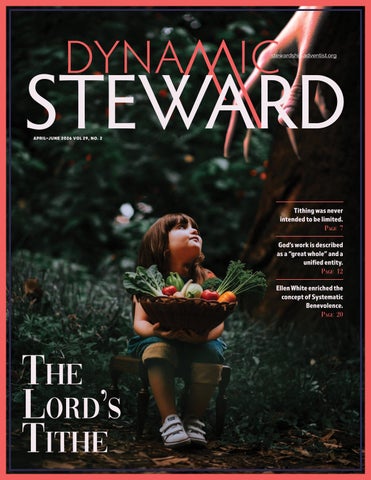
Tithing was never intended to be limited. Page 7 God’s work is described as a “great whole” and a unified entity. Page 12 Ellen White enriched the concept of Systematic Benevolence. Page 20
The Lord’s Tithe
PERMISSIONS The Dynamic Steward grants permission for any article (not a reprint) to be printed, for use in a local church setting such as a small group, Sabbath School, or classroom. The following credit must be given: Used by permission of the Dynamic Steward. Copyright © 2026. Written permission must be obtained for any other use. EDITOR'S NOTE The articles in this publication have been revised for the intended audience and nature of the Dynamic Steward. Unless otherwise noted, all Scripture quotations a r e f r o m T H E H O LY B I B L E , N E W INTERNATIONAL VERSION®. Copyright © 1973, 1978, 1984, 2011 by Biblica, Inc.® Used by permission. All rights reserved worldwide. Scripture quotations marked ESV are taken from The ESV® Bible (The Holy Bible, English Standard Version®), © 2001 by Crossway, a publishing ministry of Good News Publishers. ESV Text Edition: 2025.. Scripture quotations marked YLT are taken from the 1898 Young’s Literal Translation by Robert Young who also compiled Young’s Analytical Concordance. Copyright © 1898 by Baker Book House, Grand Rapids Michigan. S c r i p t u re q u o t a t i o n s m a r ke d N K J V are taken from the New King James®. Copyright © 1982 by Thomas Nelson. Used by permission. All rights reserved. DISCLAIMER The content or opinions expressed, implied, or included in or with any recommended resources are solely those of the authors and not those of the publishers of the Dynamic Steward. The publishers do, however, advocate these resources on the basis of their rich contributions to the area of stewardship ministry, and assume that readers will apply their own critical evaluations as they make use of them. The Dynamic Steward is published quarterly by the Stewardship Ministries of the General Conference of Seventh-day Adventists.® Director:Marcos Bomfim Associate Director: Aniel Barbe Senior Editorial Assistant: Johnetta B. Flomo DYNAMIC STEWARD Editor: Aniel Barbe BarbeA@gc.adventist.org Assistant Editor: Johnetta B. Flomo FlomoJ@gc.adventist.org Editorial Assistant: Megan Mason Layout & design: info@180.social
3 4 7 12 16 20 24
CONTENTS
ADDITIONAL CONTRIBUTING EDITORS ECD Meshack Mbago ESD Vadim Grinenko EUD Norbert Zens IAD Roberto Herrera NAD Michael Harpe NSD Choi Ho Young SAD Josanan Alves, Jr. SID Mundia Liywalii SPD Julian Archer SSD Francis Amer SUD Sunderraj Paulmoney TED David Neal WAD Bright Osei Yeboah MENA Amir Ghali IF Ebenezer C. Loriezo, Jr. CHUM Steve Rose Ukraine Konstantin Kampen
Tithe Was Made for Men A n i e l B a r be
The Heart of Tithing: Divine Ownership and Faithful Stewardship E l i a s B r a s i l d e S o u z a , B RI
A Tithe of Everything Melak Tsegaw
Malachi 3:10 In the Biblical Context and in the Writings of Ellen G. White D em ó s te n e s N e v e s d a S i l v a
Recipients of Tithes: The Biblical Practice and Its Application to the Church Daniel Bediako
The Role of Ellen White i n t h e S D A’s F i n a n c i a l Support Donny Chrissutianto
A Restrictive Use of Tithe A Historical Perspective A n i e l B a r be
Contact us: 12501 Old Columbia Pike Silver Spring, MD 20904 USA Tel: +1 301-680-6157 gcstewardship@gc.adventist.org www.facebook.com/GCStewardshipMinistries www.issuu.com/Dynamicsteward
GOD FIRST ADVENTIST STEWARDSHIP MINISTRIES
Listen to this Magazine
Editorial
A
s we reflect on the Lord’s tithe in this issue of our magazine, I would like to suggest that, similar to the Sabbath, the tithe—also holy to the Lord—was made for humanity. The practice of tithing was intended to bring blessings to us and, foremost, to make us a source of blessing to others.
The real value of the tithe is not monetary. Rather, it reminds and invites us to acknowledge God as the Giver of all things. The productions of the earth, the bountiful harvests, the treasures of gold and silver, are His gifts. Houses and lands, food and clothing, He has placed in the possession of men [and women]. He asks us to acknowledge Him as the Giver of all things; and for this reason He says, Of all your possessions I reserve a tenth for Myself, besides gifts and offerings, which are to be brought into My storehouse (Counsels on Stewardship, p. 65). The apostle Paul likewise affirms God as the generous Giver of all things: “Command those who are rich in this present age not to be haughty, nor to trust in uncertain riches but in the living God, who gives us richly all things to enjoy” (1 Timothy 6:17, NKJV). He then highlights the outcomes of recognizing God as the Giver (verses 18 and 19).
Tithe Was Made for Men
Not acknowledging God as the Giver can lead to an attitude of arrogance or being “haughty.” It is easy to boast about what we believe we have acquired through our own efforts. Additionally, when we fail to recognize God’s hand behind our wealth, we begin “to trust in uncertain riches” rather than in God. In this way, our wealth can become our idol. In contrast, acknowledging God as the Giver shapes how we relate to others. When we recognize that God has been good to us, we are moved to do good to others. Recognizing that all we have is a gift from God also cultivates a generous spirit, prompting us to give and share with others. Moreover, it teaches us to live in the present with eternity in view, seeing the good things of this age as glimpses of the greater things to come rather than as the ultimate purpose of life.
Tithing frees us from the illusion of self-sufficiency, cultivates generosity toward others, and helps us hold the blessings of this present life with an eternal perspective. The exercise of tithing, as an acknowledgment of God’s ownership and provision, is therefore more than a financial giving practice. As we return to God what belongs to Him, we are reminded that everything we have comes from Him. Tithing frees us from the illusion of self-sufficiency, cultivates generosity toward others, and helps us hold the blessings of this present life with an eternal perspective. In this sense, the tithe truly was made for us—to bless us and, through us, to become a blessing to others. We pray and hope that the articles in this issue will contribute to your readiness to give an answer regarding your practices and teachings.
Listen to this article Dynamic Steward • Stewardship Ministries
Aniel Barbe Editor
3
Elias Brasil de Souza
The Heart of Tithing: Divine Ownership
and Faithful Stewardship Elias Brasil de Souza, BRI
I
t is often observed that Scripture addresses money and its use more frequently than nearly any other topic, except for love and God’s judgment. Likewise, roughly one-third of the New Testament parables deal with financial matters or the use of material resources.1 We all know that our entire life should be dedicated to God, but a particularly telling area for determining one’s religious commitment involves one’s finances.2 And when dealing with financial matters, tithing becomes a major expression of our faithfulness to God.
A close examination of Scripture reveals that tithing is a theological act grounded in the truth that God is both Creator and Redeemer.3 As such, tithing is not a late institutional development, but a practice embedded in the history of redemption—one that precedes Israel and continues into the New Testament. Tithe is not an optional regulation, but an opportunity to demonstrate our loyalty to God and acknowledge His ownership of everything we possess. 4
Listen to this article Dynamic Steward • Stewardship Ministries
The Heart of Tithing
General Considerations When the Bible uses the term “tithe” (ma’aser), the word clearly designates one-tenth of one’s income, as the Hebrew word means “a tenth part.” The word appears for the first time in the narrative of Abram’s encounter with Melchizedek. After his victory over enemy kings, the patriarch acknowledges God’s sovereignty by returning tithes to the priest of the Most High. This is significant because it shows that the practice of tithing long preceded God’s covenant with Israel and is thus not restricted to the Sinaitic Covenant. Interestingly, the biblical text does not explain the necessity of tithing; it simply assumes that the practice was known to Abram and practiced by the patriarch. Later, Jacob also promised he would give God the tithe (Genesis 28:12–22). In the agrarian and pastoral world of ancient Israel, tithing consisted of bringing one-tenth of the produce of the land and the increase of livestock to the sanctuary or temple. The purpose of these offerings was clear: to support those devoted to sacred service. The Israelites were to give their tithes to the Levites, who in turn presented a tithe of their tithe to the priests (Numbers 18:25–29; Nehemiah 10:37, 38). In this way, the tithe sustained both Levites and priests, providing the necessary resources for the various aspects of sanctuary ministry and for instructing the people in the ways of the Lord. From this emerges a key theological principle: the tithe is not charity—it belongs to God. In the biblical context, as noted above, the tithe sustains the worship system, priestly mediation, and the teaching of the law. This explains the strong biblical emphasis on its holiness: “And all the tithe of the land, whether of the seed of the land or of the fruit of the tree, is the Lord’s. It is holy to the Lord” (Leviticus 27:30, NKJV). In other words, tithing is not a discretionary act but a sacred obligation. To withhold the tithe, therefore, constitutes a serious theological violation, as it breaches the covenant relationship (Malachi 3:8–10).4 Although most references to tithing in Scripture come from the Old Testament and Israel’s experience, the tithe system is reaffirmed in the New Testament. Jesus states: “Woe to you, scribes and Pharisees, hypocrites! For you pay tithe of mint and anise and cummin, and have neglected the weightier matters of the law: justice and mercy and faith. These you ought to have done, without leaving the others undone” (Matthew 23:23, NKJV). However, the strongest confirmation of the tithe continuity in the New Testament comes from Paul: “Do you not know that those who minister the holy things eat of the things of the temple, and those who serve at the altar partake of the offerings of the altar? Even so the Lord has commanded that those who preach the gospel should live from the gospel” (1 Corinthians 9:13, 14, NKJV). Note that Paul draws a direct parallel between the Old Testament tithe system and the New Testament theology of ministry support:
Old Testament
New Testament
Levites supported by the tithe
Ministers supported by believers
Sanctuary service
Gospel ministry
Divine ordinance
Divine command
Dynamic Steward • Stewardship Ministries
Paul does not explicitly use the word “tithe,” but the structure is identical, and we can safely presume that Paul affirms the continuity between the Old Testament system and the New Testament theology of ministerial support. The form changed. The sanctuary/temple, with its ritual services, sacrifices, and a Levitical priesthood, has been superseded by Christ’s superior offering and heavenly ministry. However, the principle and teaching that the believers must sustain those who serve the Lord in the ministry of the word remains unchanged. After all, a believer who has experienced God’s grace through the cross should not do less than those who lived under the Mosaic system and could only apprehend the Messiah’s infinite sacrifice through the shadows of the sacrificial system.5
The Heart of Tithing When the discussion of tithing becomes restricted to its material aspects, it tends to miss its profound theological and spiritual dimensions. Before considering the tithe as our gift to God, we must pause and recognize it as God’s gift to us. Returning our tithes to God is a privilege and an opportunity to demonstrate our acknowledgment that everything we have comes from Him and belongs to Him. Thus, in returning our tithes to the Lord, we express our recognition of His lordship over who we are and all that we possess. The very act of giving is itself a gift from God. Many people are unable to give, even if they desire to do so, because they have no material resources to offer. “The very fact that we have a tithe to bring indicates that God has given material blessings. As 5
Elias Brasil de Souza
we calculate our tithe, we better understand God’s provisions.”6 Therefore, being in a position to give is already a gift. Indeed, one of the most meaningful gifts is the gift of giving—the opportunity to reflect the character of our Creator and Savior, who, in the person of His Son, gave His most precious gift to us. Moreover, the discipline of giving shapes our life by leading us to offer ourselves wholly to God, to order our priorities in harmony with the divine will, to remain attentive to the needs of others, and to recognize that faithful stewardship extends beyond the tithe to include the responsible use of the remaining portion entrusted to us.7 The decision and discipline to give tithe is never a neutral ground. It occurs in a context in which we must choose which master to serve. No one can serve two masters, as Jesus clearly stated. It is not possible to retain what belongs to God in this life and expect to be part of the world to come. The alternatives are mutually exclusive. It is not possible for us to serve two masters in the way in which people today often work two jobs. We must choose one. Either we serve mammon—a reference to money, material resources—or serve God (Matthew 6:24 and Luke 16:13). Indeed, the greatest threat to Western Christianity is not external ideologies but the pervasive materialism of an affluent culture. In pursuing a comfortable, self-made “good life,” people often treat Christianity as an optional addition rather than a total commitment. Jesus teaches that true discipleship requires wholehearted devotion—especially in the use of material resources—without which one cannot genuinely serve Him8 (Luke 12:34; 14:33).
Conclusion When we bring our tithes to the Lord, we express our faith that He will bless the remaining ninety percent so that it will be sufficient for our needs. At times, we may feel that by giving the tithe, we will not have enough resources to meet our obligations.9 Yet this is precisely what makes tithing so important. In returning to God what belongs to Him, we confess that everything we have comes from Him and ultimately belongs to Him. By being faithful in our tithes, we acknowledge that we are God’s stewards and partners in His work. Because there is a direct line connecting our hearts to our resources, faithfulness in tithes and offerings can serve as a reliable indicator of the level of maturity of our spiritual life.
Elias Brasil de Souza is director of the Biblical Research Institute at the General Conference of Seventh-day Adventists. A former pastor, seminary dean, and professor of biblical studies, he holds a PhD in Old Testament from Andrews University.
Hemphill and Eklund, “The Foundations of Giving,” in Perspectives on Tithing: Four Views, ed. David A. Croteau (B&H Academic, 2011), 21. Craig L. Blomberg, Neither Poverty nor Riches: A Biblical Theology of Possessions, ed. D. A. Carson, New Studies in Biblical Theology, vol. 7 (InterVarsity Press; Apollos, 1999), 244 3 See Angel Manuel Rodríguez, Stewardship Roots: Toward a Theology of Stewardship, Tithe and Offerings (General Conference of Seventh-day Adventists, 1994), 27–50. 4 It is also important to note that Scripture refers to a tithe shared with the poor (Deuteronomy 14:28, 29). Ellen G. White, Patriarchs and Prophets (Review and Herald Pub. Assn., 1890), 530, refers to this tithe as a “second tithe,” which should not be confused with the regular tithe 1 2
6
designated to support the priests and Levites, but is a distinct, additional tithe. Hemphill and Eklund, “The Foundations of Giving,” 20. Bobby Eklund and Terry Austin, Partners with God (Convention Press, 1994), 78. 7 Hemphill and Eklund, “The Foundations of Giving,” 21 8 Craig L. Blomberg, The New American Commentary, vol. 22 (Broadman Press, 1992), 123, 124 9 Eklund and Austin, Partners with God, 73. 5 6
Dynamic Steward • Stewardship Ministries
A Tithe of Everything
A Tithe of Everything Melak Tsegaw
S
ome have argued that the limitation of titheable items to the produce of the land and the livestock of the field restricts tithing to its original agrarian context. The argument, taken to its conclusion, holds that tithing cannot be practiced on other forms of income today. However, a closer study of Scripture and a sound interpretive approach do not support such a conclusion. This article examines what the Word of God teaches on this matter. It will first consider what Scripture depicts regarding items for tithe. It will then draw out the principles that those depictions convey. Finally, it will consider how those timeless principles apply in our modern setting.
All-Encompassing Patriarchal Tithe Tithe passages are found across all the major sections of Scripture. The first mention appears in the account of Abram in the book of Genesis—the opening book of the Torah. Returning from a victorious battle with the spoils of war, Abram gave the priest-king of Salem, Melchizedek, “a tithe of all” (Genesis 14:20, NKJV). What is noteworthy here is that this first reference to titheable items is not confined to specific goods. Instead, it uses the Hebrew word rĕkûš, which “covers a wide variety of property including: movable possessions of all kinds (Genesis 14:16, 21), cattle and other domestic animals (Genesis 31:18), movable property besides cattle (Genesis 46:6), supplies and stores (Daniel 11:13).”1 The second mention of tithe appears in the vow Jacob made while fleeing to his uncle for safety. He declared: “Of all that You give me I will surely give a tenth to You” (Genesis 28:22, NKJV). The word translated “all” signals that Jacob’s tithe was intended to encompass everything the Lord would give him, without exception. These two patriarchal accounts leave many questions unanswered, but two important observations can be made. First, tithe appears very early in Scripture and without any introduction, implying the practice was already familiar by the time of Abraham. In both instances, the narrator assumes the reader knows the custom, offering no explanation of its origin or purpose. Second, both accounts describe titheable items in broad, all-encompassing language—not a restricted list.
Listen to this article Dynamic Steward • Stewardship Ministries
7
Melak Tsegaw
Titheable Items and the Temple Service A larger portion of the tithe passages is found in Leviticus, Numbers, and Deuteronomy. Each of these Torah books highlights a different dimension of the tithing system. Three types of tithe can be discerned from a careful reading: the Levites’ tithe, the feast tithe, and the charity tithe.2 The first legislative statement on tithe comes at the end of Leviticus. For the first time, a list of titheable items is given: “And all the tithe of the land, whether of the seed of the land or of the fruit of the tree, . . . tithe of the herd or the flock” (Leviticus 27:30–32, NKJV). Notably, Leviticus does not specify who will receive the tithe. Numbers 18:21 takes up the next legislative occurrence of tithing. Rather than listing titheable items, it names the beneficiaries—the Levites—and explains the rationale. The Deuteronomy passages address different types of tithe from those in Numbers. The feast tithe involved all participants in the feast, while the charity tithe benefited the economically disadvantaged and the Levites. Both types specify titheable items: “The tithe of your grain or your new wine or your oil, of the firstborn of your herd or your flock” (Deuteronomy 12:17, NKJV), and “all the increase of your grain that the field produces year by year [,] . . . the tithe of your grain and your new wine and your oil, of the firstborn of your herds and your flocks” (Deuteronomy 14:22, 23, NKJV). The specificity of titheable items in these three books reflects the purpose of the giving. When God designed a means to support the priestly ministry of the temple service, He did not invent a new method. Rather, he adapted the already existing practice of tithing to meet the need. Since the Levites would have no land or cattle of their own, the titheable items became the means of sustaining the ministers. Because Israel lived in an agrarian economy, it was fitting for God to design the tithing system around agricultural produce and livestock for the support of those in temple ministry. Yet even within that legislation, the law made provision for adjustment: “But if the journey is too long for you, so that you are not able to carry the tithe, or if the place where the Lord your God chooses to put His name is too far from you, when the Lord your God has blessed you, then you shall exchange it for money, take the money in your hand, and go to the place which the Lord your God chooses” (Deuteronomy 14:24, 25, NKJV).
Tithing was never intended to be limited to land, produce, or livestock alone. This provision clearly shows that money was already incorporated into the tithing process. Tithing was never intended to be limited to land, produce, or livestock alone. The system has an inbuilt adaptability: What matters is that the purpose of the tithe is fulfilled, not that the specific medium remains unchanged. The lists in Leviticus and Deuteronomy should therefore be understood as complementary examples, not an exhaustive catalogue. Other items could be included so long as they served the intended purpose. A compelling illustration of this flexibility appears in the history of Israel’s later worship. During the revival and reformation led by 8
King Hezekiah, the temple service was restored to full operation. Scripture records the following about the people’s tithing: “And at the spreading forth of the thing the sons of Israel multiplied the first-fruit of corn, new wine, and oil, and honey, and of all the increase of the field, and the tithe of the whole in abundance they have brought in. And the sons of Israel and Judah, those dwelling in cities of Judah, they also a tithe of herd and flock, and a tithe of the holy things that are sanctified to Jehovah their God, have brought in, and they give—heaps, heaps” (2 Chronicles 31:5, 6, YLT, emphasis added). The inclusion of honey is significant. Honey does not appear anywhere in the earlier legislative lists of titheable items. Its addition shows that the list was never meant to be final. The closing phrase—bringing in “the whole in abundance”—echoes the broad, all-encompassing language of the patriarchal accounts. This survey of titheable items across Scripture makes one thing clear: There is no single timeless and universal list. Different items were tithed in different contexts and for different purposes. The one constant across all of them is the proportion—a tenth. This is precisely what the Hebrew name conveys: ma’aser (tithe) derives from ‘asar (tenth). Dynamic Steward • Stewardship Ministries
A Tithe of Everything
Rightly Dividing the Word At this point, it is worth pausing to address the question raised at the outset: Does the specificity of titheable items in the Old Testament render tithing inapplicable beyond its original context? Paul’s admonition to Timothy to rightly divide the Word of God is a fitting guide here.
Tithing, as it functioned within the Levitical system, cannot continue in exactly the same form, since that system no longer exists after the cross. Nevertheless, the underlying rationale—supporting those in full-time ministry—remains fully valid in the New Testament. First, a sound understanding of the relationship between the old and new covenants is essential. The temple and its priestly ministry served as shadows of the reality revealed in the New Testament. Some elements of the old covenant were entirely discontinued— animal sacrifice is the clearest example. Other elements, however, carried over with adjustments suited to the new setting. Tithing, as it functioned within the Levitical system, cannot continue in exactly the same form, since that system no longer exists after the cross. Nevertheless, the underlying rationale—supporting those in full-time ministry—remains fully valid in the New Testament. Paul’s argument in 1 Corinthians makes this connection explicit.3 Second, Paul presents Abraham as the father and model of those who are justified by faith. Abraham is also the first person Scripture records as tithing from all he possessed. The letter to the Hebrews, though primarily concerned with establishing the supremacy of Christ, recalls Abraham’s tithing in a positive light. Crucially, Abraham gave his tithe to Melchizedek—the priest whose order directly foreshadows the priesthood of Jesus. This connection makes Abraham’s tithe especially instructive for Christians in the new covenant. John Frame articulates this point well in responding to the argument that tithing belonged only to Israel’s possession of the Promised Land: “We note, however, that Abraham, who owned no land in Canaan, paid a tithe to Melchizedek, the mysterious priestking who in Hebrews foreshadows Christ (Genesis 14:20; Hebrews 7:4–10), indicating that tithes were sometimes appropriate even apart from Israel’s ownership of the Promised Land. Can we give anything less to Christ, who fulfills the priesthood of Melchizedek?”4
church can draw real benefit from applying them, as they lead believers into a life of genuine worship—the offering of themselves as living sacrifices to the Lord (Romans 12:1). Roy Gane captures the practical implication well: “Most Christians, at least in the developed world, are not farmers, so our incomes are money rather than agricultural produce. If we choose to adopt the LeviticusNumbers mode of tithing, we can easily adapt it by giving to God’s work 10 percent of our incomes.”5
ASSER TE’ASER— You Shall Surely Tithe In Deuteronomy 14:22, the command “you shall surely tithe” (NKJV) is rendered in Hebrew as Asser Te’aser. The syntax is emphatic, conveying a wholehearted and unconditional commitment to tithe. Equally significant is the scope of what is to be tithed: “all the increase.” This phrase is all-encompassing. Even when tithing is limited to the produce of the land, Scripture insists it covers everything that land yields. The adverb “all” appears repeatedly whenever tithing is mentioned in Scripture—and this is no accident. God deserves our fullest devotion in response to His extraordinary gift of life and every blessing that accompanies it. Tithing, rightly understood, is one of the ways we acknowledge His goodness and confess that everything we have ultimately belongs to Him. Marvin Tate, though he does not fully endorse a mandatory tithe for all Christians, nonetheless articulates its practical benefit clearly: It does provide a definite plan for giving and fosters discipline in the affairs of the tither. It is a constant reminder that the church deserves the highest priority. The tither is made aware that the ministry and ministers of Christ deserve more than the haphazard and slothful giving which has characterized so much of Christian stewardship. Surely, even legalistic tithing honors Christ more than the sorry and selfish giving of the tidbits of money and goods left over after church members have satisfied their own desires. Tithing has the capability of producing liberality. It has been the experience of many that it is easier to give more when one begins with the tithe as a benchmark.6 The evidence of Scripture—from the patriarchs to the Torah to the prophetic history to the New Testament—consistently points in the same direction: the tithe is not a relic of a particular agrarian economy. It is a principle, proportionate and adaptable, that calls every believer to honor God with a firstfruit of whatever he has given them.
Melak Alemayehu Tsegaw, PhD, is an ordained minister and currently serves as the Head of Department of Biblical Theological Studies at the Adventist University of Africa in Nairobi, Kenya. Originally from Ethiopia, Melak is married to Mihret and blessed with two children, Pheben and Paulos.
Third, though titheable items varied across different contexts, two principles remain constant: the proportionate nature of the gift and the recognition of God as the source of every good thing. These are abiding truths. The New Testament 1
2
William White, “2167 ׁשַכָר,” in Theological Wordbook of the Old Testament, ed. R. Laird Harris, Gleason L. Archer Jr., and Bruce K. Waltke (Moody Press, 1999), 848. Angel M. Rodríguez, Stewardship Roots: Toward a Theology of Stewardship, Tithe, and Offering (Stewardship Ministries, General Conference of Seventh-day Adventists, 1994), 40. Rodríguez presents the possibility of three types of tithe but suggests that the feast and charity tithes may be considered as one, noting: “Some have interpreted it as a third tithe, but others have argued that this legislation describes a different use of the second tithe every three years.”
Dynamic Steward • Stewardship Ministries
Rodríguez, Stewardship Roots, 46. Rodríguez draws out this connection as follows: “The basic purpose of tithing remains the same: the Lord uses it to provide for those who dedicate their lives to the proclamation of the gospel. The theological significance of tithing in the Old Testament lies at the very foundation of Christian tithing.” 4 John Frame, The Doctrine of the Christian Life (P&R Publishing, 2008), 801. 5 Roy Gane, Old Testament Law for Christians: Original Context and Enduring Application (Baker Academic, 2017), 349-350. 6 Marvin E. Tate, “Tithing: Legalism or Benchmark?” Review & Expositor 70, no. 2 (1973): 161. 3
9
Demóstenes Neves da Silva
Malachi 3:10 in the Biblical Context
and in the Writings of Ellen G. White Demóstenes Neves da Silva
I
n the discussion of the “House of Treasure” of Malachi 3:8–10, the question arises as to whether it carries a congregational emphasis or applies to a broader institution. In other words, does the “storehouse” refer to each local church or to a centralized financial administrative system? For the Seventh-day Adventist reader, it is important to determine which of the two aforementioned proposals aligns most closely with the context of the biblical passage in question. In this article, we will also consult the writings of Ellen G. White—pioneer, co-founder, and inspired messenger of the Seventh-day Adventist Church.
Listen to this article 12
In this approach, we adopt the principle that Scripture encompasses both the Old Testament (OT) and the New Testament (NT), being inspired by God and useful for instruction (2 Timothy 3:16, 17; 2 Peter 1:21)—and that whatever was written in earlier times [in the OT] was written from our instruction (Romans 15:4). Therefore, the content of the entire Bible remains in full force, and its lessons, including those about the “storehouse,” continue to serve as valid guidance for both individual and denominational faith and practice. Thus, this article constitutes a bibliographic study on the concept of the “storehouse.”1 Dynamic Steward • Stewardship Ministries
Malachi 3:10
6. The Levites themselves were charged with administering the sacred funds for their own support with faithfulness (2 Chronicles 31:12–15). 7. There was a need to prevent the Levites from fleeing to secular activities. They were to dedicate themselves specifically to the ministry (Nehemiah 13:10, 11). 8. The Levites were assisted according to their family records (2 Chronicles 31:18, 19). Financial and material assistance did not prioritize the places that were the largest donors, but rather the maintenance needs of individuals and the work in Israel as a whole (2 Chronicles 31:17–19). 9. God’s “treasury” involved not only tithes but also offerings (2 Chronicles 31:12; Malachi 3:8). These were given in kind or in money, depending on the donor.3
In all these instances, the construction and renovation of the temple were carried out exclusively using other offerings, never using the tithes. The Concept of Organization Malachi’s ministry is dated to approximately 432–424 bc. His book describes issues of unfaithfulness among worshippers and within the house of God. A contemporary of Nehemiah (444 bc), Malachi refers to the “storehouse” as it existed following the organization and reformation of the temple system implemented by Nehemiah after the return from captivity. In this system restored by Nehemiah (Nehemiah 12:44–47; 13:10–13), whose structure and dynamics remained the same as they were following the reform of King Hezekiah (2 Chronicles 31) centuries earlier (729686 bc), the researcher finds the meaning and functioning of the “storehouse” as follows: 1. The distribution was centralized and controlled from Jerusalem, and from there the resources were distributed among all the Levites throughout the country (2 Chronicles 31:4–6; Nehemiah 12:44). 2. One team oversaw the distribution in Jerusalem, and another team oversaw the rest of the country (Nehemiah 13:13). 3. There were chambers in which to “bring into the storerooms the portions required by the Law for the priests and the Levites” (Nehemiah 12:44). 4. There was a careful separation between the tithes and the offerings (Nehemiah 12:44). The tithe referred to in Malachi is what is allocated to the Levites (Numbers 18:21). This is different from the “second tithe” of Deuteronomy (Deuteronomy 14:22–26; 26:12), which was retained and used entirely by the worshipper in religious festivals and special assistance to the poor and those who did not have “inheritance in the land,” as was the case with widows, foreigners, and the Levites.2
The same pattern, along with other additional details, can be found in the great spiritual reforms undertaken by God’s people under Joash (835–796 bc)—in 2 Kings 12:4, 5 and 2 Chronicles 24:1–14; Hezekiah (729–686 bc)—in 2 Chronicles 31:2–21; and Josiah (640–609 bc)—in 2 Kings 22:1–7 and 2 Chronicles 24:8–10 and 31:14. In all these instances, the construction and renovation of the temple were carried out exclusively using other offerings, never using the tithes. Therefore, in the Bible, the tithes and offerings intended for the priests were not retained in individual villages or cities, nor did they remain in the possession of the worshippers themselves or with any other independent religious enterprise, be it a Levite, a priest, or someone from the people. The only attempt to have their own religious system receive sacrifices and offerings was in the apostasy of King Jeroboam, who led Israel astray (1 Kings 12:25– 33; 13:33; 2 Chronicles 11:14, 15). In this case, fortunately, the faithful abandoned Jeroboam’s independent religious movement and returned to sacrificing and bringing tithes and offerings to the treasury house, according to the original guidance of the law to sacrifice and bring tithes and offerings to just “one place,” which God established, in the treasury house (Deuteronomy 12:1–6, 11; Malachi 3:10). The available biblical and historical accounts indicate that the “treasure house” was always a centralized financial administrative model to which Malachi appealed for all donations to be directed. From this administrative center, all Levites received assistance, according to the record of their families (2 Chronicles 31:17–19). Thus, the treasury house functioned by receiving resources and hiring and paying priests and Levites. In this sense, according to the accounts in the Scriptures, it was the organized and structured center in the sanctuary and the headquarters of religious action in Israel.
5. There were specific treasurers for each storehouse, as in the days of Hezekiah (2 Chronicles 31:19). Dynamic Steward • Stewardship Ministries
13
Demóstenes Neves da Silva
Ellen G. White Writings In the writings of Ellen G. White, the expression “storehouse” is used indiscriminately to refer to the treasuries of local churches, institutions, conferences, unions, and the General Conference. Added to this is the concept—present in her teachings—that the work constitutes a unified whole, rather than a mere congregational dispersion,4 as follows: God’s work must be viewed as a worldwide unit rather than as “independent” units.5 The work must be considered worldwide.6 “His work is one great whole,”7 which must be united on all fronts—including schools, the ministry, and medical work.8 Furthermore, when referring to conferences, she highlights the role of the work’s headquarters in directing resources for the benefit of a unified cause.9
The Administrators of Tithes and Offerings In the writings of Ellen G. White, the terms “treasury” and “storehouse” are frequently associated—directly or indirectly— with Malachi 3:10 and applied to the church. In this context, she identifies conference presidents as being responsible for the finances of their fields, noting that it is their duty “to see that the elders and deacons of the churches do their work in the churches, by seeing that a faithful tithe is brought into the treasury.”10 Furthermore, the tithe is not the exclusive property of any local church. Rather, it is the resource for sending God’s messengers “to the uttermost parts of the earth.”11 Opposition to the organization—aimed at preventing the tithe from being brought into the storehouse, as prescribed in Malachi—runs counter to the means ordained by God and is the work of the enemy.12 Finally, let’s look at an example. Before the resourcesharing system was fully mature, as per her message about the organizational system as the “treasury house,” pastors in the southern United States were without assistance. To help them, Ellen G. White had the special mission of collecting tithes and sending them to support those workers for a time. Later, with organizational integration and the resolution of the financial problem among our pastors in the South, some members still approached her to give tithes so that she could direct them wherever she saw fit. In an emblematic response dated 1911, she responded to those who still looked to her: You ask if I will accept tithe from you and use it in the cause of God where most needed. In reply, I will say that I shall not refuse to do this, but at the same time I will tell you that there is a better way. It is better to put confidence in the ministers of the conference where you live, and in the officers of the church where you worship. Draw nigh to your brethren. Love them with a true heart fervently, and encourage them to bear their responsibilities faithfully in the fear of God. “Be thou an example of the believers, in word, in conversation, in charity, in spirit, in faith, in purity.”13 Therefore, for her, the “best way” to return tithes is through the conference, an entity we should trust and support with Christian love. Thus, according to Ellen White, the management of tithes should be under the administration of the conferences.
14
Dynamic Steward • Stewardship Ministries
Malachi 3:10
Conclusion Biblical accounts address the issue of tithes for priestly support and offerings as resources that were entirely administered within and from the temple. The temple functioned as the headquarters of the work, exercising unifying control over religious, administrative, and financial matters alike.
In both the biblical accounts and the writings of Ellen G. White, God’s work is described as a “great whole” and a unified entity. It is presented as an organizational system; there is no evidence of a congregational structure or an administration fragmented along regional lines. From Ellen G. White’s perspective, the work is not merely local but global. She advocates a strong institutional vision, pushing back against tendencies toward organizational fragmentation. For her, as we have seen, the “storehouse” refers to the church treasury at every level. However, the administration of these resources is to be conducted at the organizational level—through conferences and unions—rather than by the local church. The individual personally responsible for promoting, clarifying, and administering offerings designated for the conference—especially tithes—is the field president. Local church officers play a vital role in raising awareness and facilitating the transfer of these resources. In both the biblical accounts and the writings of Ellen G. White, God’s work is described as a “great whole” and a unified entity. It is presented as an organizational system; there is no evidence of a congregational structure or an administration fragmented along regional lines. In other words, in both models—the biblical one and that of Ellen G. White—the “storehouse” possesses an institutional and broader character. It refers not to the local church, community, or city, but rather to the administrative hub of a single, cohesive organization. Demóstenes Neves da Silva holds a doctorate in Psychology and a master’s degree in Theology. A former professor at UNIAENE (Northeast Adventist University Center), he is currently retired but remains active as a preacher and writer.
Laird R. Harris, Gleason L. Archer, and Bruce K. Waltke, Dicionário Internacional de Teologia do Antigo Testamento (Vida Nova, 1998), 113. The expression used to define “storehouse” in Malachi 3:10 is beth ôtsar, which means “treasure, stock, or repository”; it appears approximately 80 times in the Old Testament and literally refers to the treasure of the king, the temple, or even a private treasure. Nine other words are used in the Old Testament in addition to ôtsar. 2 About the second tithe see Joachim Jeremias, Jerusalem in the Time of Jesus: Economic-Social History Research in the New Testament Period (Edições Paulinas, 1983), 43, 86; also, Flávio Josefo, Antiquities, XVIII, 9, 1, paragraph 313; Fred Skolnik and Michael Berenbaum, eds. Encyclopaedia Judaica, vol. 6 (Thomson Gale, 2007), 101; vol. 8, 254, 313,314. The same in Ellen G. White, Patriarchs and Prophets (Review and Herald Pub. Assn., 1890), chap. 51. 3 There is no reason to assume that tithes and offerings were rendered solely in the form of produce, given the agrarian-pastoral culture of ancient Israel. Examples such as Abraham, who returned redeemed goods and supplies (Genesis 14:11, 20), Jacob, who voted to tithe “everything” that God gave him (Genesis 28:22), and the guidance for the “redeeming” of the tithe that was made with money (Leviticus 27:31) indicate giving tithes of everything, including money, as pointed out in the Encyclopaedia Judaica, vol. 1, p. 47, 48, 83, 189 and vol. 19, p. 736. 4 The application of the text of Malachi in Ellen G. White’s description in Prophets and Kings is that tithes and offerings should be given with “unselfish interest in the upbuilding of His work in all parts of the world” (Pacific Press Pub. Assn., 1917), 708. 5 Ellen G. White, Gospel Workers (Review and Herald Pub. Assn., 1915), 487: “Some have advanced the thought that as we near the close of time, every child of God will act independently of any religious organization. But I have been instructed by the Lord that in this work there 1
Dynamic Steward • Stewardship Ministries
is no such thing as every man’s being independent.” White, Gospel Workers, 454: “The work all over the world is to receive consideration. New fields are to be entered. Let our brethren remember that much means and much hard labor are required to carry forward the work in new fields.” 7 White, Gospel Workers, 456: “The Lord is no respecter of persons or places. His work is one great whole.” 8 Ellen G. White, Testimonies for the Church, vol. 9 (Pacific Press Pub. Assn., 1909), 169: “If ever the Lord has spoken by me, He speaks when I say that the workers engaged in educational lines, in ministerial lines, and in medical missionary lines must stand as a unit, all laboring under the supervision of God.” 9 Ellen G. White, Testimonies to Ministers and Gospel Workers (Pacific Press Pub. Assn., 1923), 399: “The Lord calls for united action. Well-organized efforts must be made to secure laborers.” Also, “Let none entertain the thought that we can dispense with organization. It has cost us much study and many prayers for wisdom, that we know God has answered, to erect this structure” (White, Testimonies to Ministers, 27) 10 White, Testimonies to Ministers, 305 11 White, Counsels on Stewardship (Review and Herald Pub. Assn., 1940), 71. 12 White, Testimonies to Ministers, 53: “Those who are carrying this message of error . . . [are] in opposition to the plain command of God spoken by Malachi in regard to bringing all the tithes into the treasury of God’s house.” 13 Ellen G. White, Manuscript Releases, vol. 2 (Ellen G. White Estate, 1987), 101. 6
15
Daniel Bediako
Recipients of Tithes: The Biblical Practice and Its Application to the Church
Listen to this article
provision (Genesis 14:14–20; 28:10–22; Deuteronomy 14:24; 26:15; Malachi 3:10–12). Tithing is giving back to God (Genesis 28:22). God assigned Israel’s tithes to the Levites “while serving at the tent of meeting” (Numbers 18:21). And the Levites gave a tithe of the tithes of Israel to the priests as their “contribution” to Yahweh (Numbers 18:25–32). Outside of the Pentateuch, the tithe was brought to the temple storehouses, where it was apportioned and distributed to Levites and priests (2 Chronicles 31:2–19; Nehemiah 10:28–39; 12:44; 13:5–13; Malachi 3:10). Malachi 3:8–12, for example, asserts that the tithe belongs to the Lord, that it must be brought to the storehouse (temple), that withholding the tithe displeases God, and that God blesses His people as they bring the tithe and fulfils His mission through the tithes.
T
Jesus excoriated the Pharisees for even tithing herbs, which was not explicitly specified by the law, and yet neglecting justice, mercy, and faithfulness, which were weightier matters of the law (Matthew 23:23, 24; Luke 11:42). And in a parable, a Pharisee boasts of his acts of piety, including tithing everything he acquired (Luke 18:12). Jesus’ statements (e.g., Matthew 23:23: “You should have practiced the latter without neglecting the former.”) affirm tithing for believers. And the book of Hebrews cites the fact that Abraham (and through him Levi) gave a tithe to Melchizedek to show that the Levitical priesthood was inferior to that of Melchizedek, whose priesthood is likened to Christ’s (7:5–16).
Scripture is clear that the tithe “belongs to the Lord; it is holy to the Lord” (Leviticus 27:30–33; see also Deuteronomy 26:12– 15). God instructed tithing in Israel and expected His people to follow His instruction as part of their responsibilities in the covenant relationship (Leviticus 27:30–33; Deuteronomy 14:22, 28; Malachi 3:10). Tithing is connected to God’s blessings and
Beyond the explicit references to the tithe, Jesus’ statement that “the laborer deserves his food” (Matthew 10:10, ESV) or “wages” (Luke 10:7) in the context of gospel ministry seems to base believers’ material support of gospel workers on the tithing principle. And Paul makes this more explicit in 1 Corinthians 9:4– 14 by alluding to Numbers 18 and asserting that gospel workers deserve their wages from the ministry just as the Levites received their wages from the ministry. Paul thus presents the system of tithing and offerings in Israel as an authoritative example of the application of the principle that those who work in the ministry warrant material support from the ministry.
Daniel Bediako
oday, questions regarding tithing range from whether the practice is normative for Christians to who qualifies to receive the tithe, the latter being the interest of this article. Can believers give their tithes to anyone they deem worthy? It has been argued elsewhere that tithing applies to the church in principle, and that Jesus’ and Paul’s statements that gospel workers should receive their living from the ministry allude to the receipt of tithes by the Levites as a pattern for gospel workers.1 Here, we briefly take an overview of the concept of tithing and then discuss the rationale for which the Levites received the tithes and how that applies to gospel workers.
A Brief Overview Of Tithing
16
Dynamic Steward • Stewardship Ministries
Recipients of Tithes
Recipients of the Tithe Since the tithe belongs to God, He is its recipient (Leviticus 27:30–32; Malachi 3:8–12). However, God receives His tithe through His servants whom He has appointed to the ministry (Numbers 18:21–32). The table below presents passages where the tithe and those who received the tithe are mentioned (explicit or implied):
Passage
Recipient of Tithe Explicit
Implicit
1
Genesis 14:14–20
Melchizedek
~
2
Genesis 28:10–22
~
[not certain]
3
Leviticus 27:30–32
~
Priests & Levites
4
Numbers 18:21–32
Levites
~
5
Deuteronomy 12:4–19
Eaten by Tithers and Levites
~
6
Deuteronomy 14:22–27
Eaten by Tithers and Levites
~
7
Deuteronomy 14:28, 29
Levites, Widows, Fatherless, & Strangers
~
8
Deuteronomy 26:12–15
Levites, Widows, Fatherless, & Strangers
~
9
2 Chronicles 31:2–19
Levites & Priests
~
10
Nehemiah 10:28, 29
Levites & Priests
~
11
Nehemiah 12:44
Levites & Priests
~
12
Nehemiah 13:5–13
Levites & Priests
~
13
Amos 4:4
~
Priests
14
Malachi 3:8–12
~
Levites & Priests
15
Matthew 23:23, 24/Luke 11:42
~
Levites & Priests
16
Luke 18:12
~
Levites & Priests
17
Hebrews 7:1–13
Melchizedek, Levites & Priests
~
As this table makes clear, the primary human recipients of the tithes of Israel were the Levites and priests, whom God appointed to the service in His tabernacle. Thus, the Lord assigned the tithes as an “inheritance” and reward (Numbers 18:21–32) to those whom He called to full-time ministry. Even before Israel, the example of Abraham shows that the tithe is given to the Lord’s priests (Genesis 14:14–20). In Deuteronomy, a distinction is made between the yearly tithe of which the Israelites could eat at the sanctuary during the festal celebrations in the form of sacrifices (12:6–19; 14:22–27) and the tithe of the “third year,” which they could not eat but give out to the Levites and the widows, fatherless, and strangers (14:28, 29; 26:12–15). As suggested elsewhere, the eating of the tithe by lay Israelites was an accommodation that would be discontinued when necessary.2 Further, while there were other beneficiaries of the tithe of the third year, the instruction that the Levites receive the tithes and apportion a tithe of the tithes for the priests (Numbers 18:25–32) required that they collect the tithes at central places. It is probable that, as in the case of the priests, portions for the other beneficiaries were assigned by the Levites, who managed the storehouses. The instructions in Numbers 18 and the practice of tithing in the rest of the Old Testament indicate that even though the Levites received the tithes, Israelite tithers did not give their tithes to individual Levites or priests. Rather, they brought the tithes to the Dynamic Steward • Stewardship Ministries
central collection point (Deuteronomy 14:28, 29) or storehouse (Malachi 3:10), from where the Levites apportioned and distributed them (2 Chronicles 31:11–19; Nehemiah 12:44; 13:9–13). The biblical instructions left no room for a tither to decide to give his/her tithe to whomever he/she considered worthy. Nor did the tither decide how the tithe was to be used. When the tithe is given to those designated by the Lord to receive it, it is He who has received it. At official meetings, financial reports covering tithes and offerings are given to constituted bodies of the church, and that is where accountability is required. It does not lie in the hands of individual givers to require accountability from those who benefit materially from the tithe.
17
Daniel Bediako
Rationale for the Levitical Receipt of Tithes and Its Application to Gospel Workers The reason Yahweh assigned His tithe to the Levites is repeated several times in Numbers 18: • “I have given the children of Levi all the tithes in Israel as an inheritance in return for the work which they perform, the work of the tabernacle of meeting” (verse 21, NKJV). • “For the tithes of the children of Israel . . . I have given to the Levites as an inheritance; therefore I have said to them, ‘Among the children of Israel they shall have no inheritance’” (verse 24, NKJV). • “You may eat it in any place, you and your households, for it is your reward for your work in the tabernacle of meeting” (verse 31, NKJV).
The basis for which the Levitical priesthood received the tithes of Israel is equally the legitimate basis for which the gospel ministry may receive the tithes of the church. These statements clear every doubt that Yahweh gifted the tithes to the tribe of Levi because He appointed them to the ministry of the tabernacle, for which they were also not to receive a tribal territory to make a living (Numbers 18:21–32). Subsequent references to the right of the Levites to the tithe recall Numbers 18. Even though the Levites received the tithe, it remained Israel’s contribution holy to Yahweh (Leviticus 27:30–32; Deuteronomy 26:12–15). The principles underlying the practice of tithing in Israel (i.e., the theological basis of the tithe and the rationale for giving it to the Levites) are transferable to the church as God’s new covenant people. As in Israel, the Levites and priests were called by the Lord into full-time ministry and affirmed by the congregation (Numbers 8:6–13), so in the church He calls some persons to fulltime gospel work affirmed by the church (Acts 13:1–3). For this reason, the basis for which the Levitical priesthood received the tithes of Israel is equally the legitimate basis for which the gospel ministry may receive the tithes of the church. Thus, if the Levites qualified to receive the tithes because of their full-time engagement in the ministry of the tabernacle, then, in principle, full-time gospel workers are worthy to receive the Lord’s tithe, the difference between the two ministries notwithstanding. Beyond the analogy of full-time ministry, however, statements of Jesus and Paul affirm the validity of the tithing principle in the church in support of the gospel ministry. They maintain that gospel workers deserve their food or wages from the ministry, and Paul alludes to the principle underlying the support of the Levites and priests through tithes and offerings as being applicable to gospel workers. As Jesus sent out disciples to preach and to heal, He instructed them to make no provisions for themselves but to depend on the ministry for their sustenance (Matthew 10:5–10; Luke 10:7, 8). His 18
reason was that the laborer deserves his food (Matthew 10:10) or wages (Luke 10:7). The Lord’s instruction presents the foundational principle for the material support of gospel workers by the church. In 1 Corinthians 9, Paul makes several assertions in support of the fact that gospel workers are worthy of sustenance from the ministry. He does this in four ways. First, he argues from common sense or everyday life: Apostles have the right to refrain from working for a living and yet have the right to eat and drink (verses 4, 6, 11); the soldier, the farmer, and the shepherd deserve to eat from their labors (verse 7); and those who plow, sow, or thresh do so in hope of partaking of the crop (verses 10, 11). Second, he cites a biblical civil law: One should not muzzle an ox when it treads out grain (verses 8, 9). Third, Paul alludes to the example of the Levites and priests: “Don’t you know that those who serve in the temple get their food from the temple, and that those who serve at the altar share in what is offered on the altar?” (verse 13). In this verse, he makes a distinction between (a) “those who serve in the temple service” and (b) “those who serve at the altar,” the former describing the Levites and the latter the priests. While both groups were employed in the tabernacle, there were distinctions in their ministries as well as in food. And Paul preserves that distinction here too: Food from the temple (“get their food from the temple”) and sacrificial offerings (“share in what is offered on the altar”) allude to distinctions in food Dynamic Steward • Stewardship Ministries
Recipients of Tithes
outlined in Numbers 18. This chapter highlights that the tithes are shared by both Levites and priests (Numbers 18:21–32) and that sacrificial portions are for the priests only (verses 8–20). In Paul’s reasoning, the receipt of Israel’s tithes by the Levitical priesthood is an authoritative pattern for the church’s support of the gospel ministry. But Paul’s use of the word “employed” suggests that those who receive such support are officially engaged as servants in the ministry (not self-employed), as was the case with the Levites. Paul’s ultimate authority is the Word of God: “In the same way, the Lord commanded that those who proclaim the gospel should get their living by the gospel” (1 Corinthians 9:14, ESV). The “command” (diastassō: to arrange, appoint, prescribe) of the Lord probably refers to His principle that the gospel worker deserves his/ her food or wages. If verse 13 asserts that gospel workers deserve their wages from the gospel ministry as the Levitical priesthood deserved their sustenance from the tabernacle ministry, then verse 14 specifies that gospel workers should receive their sustenance “the same way”(houtōs kai: thus, also) the Levitical priests did. “In verses 13, 14, therefore, Paul grounds Christian giving in support of the gospel work on the tithing principle and the command of Jesus to that effect, thus preparing the way for the configuration of a system of giving in line with that principle.”3
Conclusion Scripture is our final authority in all matters of doctrine and practice. Scripture shows that the human recipient of the tithe is the body of ministers appointed or called by the Lord to full-time ministry, whether of the tabernacle or of the gospel. Statements of Jesus and Paul make clear that gospel workers should be sustained by the ministry and further allude to the tithing principle as the pattern for such support. As in the case of the Levites and in Paul’s statements, the recipients of the tithe are those officially employed in the ministry. On the authority of the New Testament and the principles of tithing in the Old Testament, therefore, fulltime gospel workers may live on tithes. And as in the Old Testament model, the Levites collected the tithes at central locations before distributing them. So in the church, the tithes need to be collected at central locations and distributed. Ultimately, the question is not whether one can give the tithe to persons he/she considers worthy, but whether one recognizes that the tithe is the Lord’s and is given through the channel He has appointed, even if the tither has concerns about the services of those who benefit from the tithe. The “quality of the services rendered by the Levites to the Israelites did not affect the tithing practice of the people at all. They returned their tithe to the Lord, and He gave it to the Levites.”4 Scripture calls believers to give freely and generously, a sacrificial giving that goes beyond a tithe of their income. Believers may feel free to give for specific projects, but the Lord’s tithe must be given through the main channel of the gospel ministry.
Daniel K. Bediako is an Associate Director of the Biblical Research Institute of the General Conference of Seventh-day Adventists, Silver Spring, Maryland, USA.
For a comprehensive study of tithing, see Daniel Bediako, “Tithing as a Christian Practice,” BRI Reflections 94 (April-June 2026): 2–12 Bediako, 5. Bediako, 10. 4 Ángel M. Rodríguez, Stewardship Roots: Toward a Theology of Stewardship, Tithe, and Offerings (Stewardship Ministries Department, 1994), 39. For more on tithing, see Rodríguez, Stewardship Roots, 42–68; Ángel M. Rodríguez, Tithing in the New Testament and the Christian Church (Stewardship Ministries Department, 2010); Ángel M. Rodríguez, Tithing in the Writings of Ellen G. White (Stewardship Ministries Department, 2010). 1 2 3
Dynamic Steward • Stewardship Ministries
19
Donny Chrissutianto
Listen to this article
The Role of Ellen White in the SDA’s Financial Support Donny Chrissutianto
A
s the church grew in early Adventism, it became clear that financial support was needed. The financial aid came from those who generously supported the self-supporting ministers’ work. However, not everyone was involved in this liberal giving. It led charitable individuals to perceive the inequity of sharing the burden and “to withhold
their support.”1
Background of the Financial Support Need
One of the early pioneers, Heman S. Gurney, observed this inequality and appealed for financial support by denying themselves. He wrote, “Time progresses, and how do we keep pace in carrying our part of the work which is revealed on the principle of benevolence and obedience? . . . Those who cannot see sufficient inducement held out in the word of God through Jesus Christ, to sacrifice the selfish interest, the vain and deceitful pleasures, that this world affords, are hardly worthy of the name of Christian.”2 20
James White also urged the brethren to be involved in this benevolence principle by emphasizing that everyone should participate “in supporting the gospel,” reasoning that “nothing could be better calculated to create and preserve sweet union in the body of Christ, than for all its members to unite in such acts of duty and love, as God hath prospered them.”3 However, these appeals had little response from the pioneers. When support continued to be lacking, some of the most able ministers left the ministry. J. N. Andrews went to Waukon, Iowa, in 1855, and was followed by J. N. Loughborough in 1856. James and Ellen White did not allow this situation to continue because it would jeopardize the church’s mission. Thus, in the last month of 1856, the Whites traveled, crossing the frozen river to bring them back to the ministry.4 Observing this condition, in 1857, Ellen White appealed for the church to notice the early Christians’ “spirit of liberality, and to consecrate to the Lord a portion of all their increase.” She called the church, “who are living in the last days, and who are waiting for their Lord, are required to do even more than this. God requires them to sacrifice.”5 Her role remains significant in developing the concept of Systematic Benevolence and in its practice within this denomination. Dynamic Steward • Stewardship Ministries
The Role of Ellen White
Systematic Benevolence Idea As J. N. Andrews returned to the ministry, he studied how to support the work biblically. In April 1858, he led a Bible class on Systematic Benevolence. In January 1859, Andrews and J. B. Frisbie presented the idea of Systematic Benevolence at the Battle Creek Church. This presentation moved the church to select three people to prepare a document on this subject. On January 29, these three individuals, Andrews, Frisbie, and James White, read the plan on Systematic Benevolence and got “a unanimous vote.”6 The idea of Systematic Benevolence was based on two main texts. The first was 1 Corinthians 16:2 about systematic giving. In this text, Paul encouraged the early church to contribute every week. The other text was from 2 Corinthians 9:5–7, which was concerned with the giver’s benevolence. The apostle stressed that the contributor was to share it freely, voluntarily, and cheerfully. The idea was that everyone could participate in sharing, with financial contributions made equally. To make it practical, an arrangement was made that every Sunday, men aged 18 to 60 should set aside 5 to 25 cents, and women of the same age range should contribute 2 to 10 cents. In addition, every adult member who had property worth $100 added 1 to 5 cents each week.7 For the Adventist pioneers at that time, this system was a better way to support gospel proclamation.
On the biblical tithing idea, Ellen White enriched the concept of Systematic Benevolence by connecting it to the Old Testament passages of tithing. When the church asked about the purpose of Systematic Benevolence, James White answered that it helped cover the costs of itinerant preachers, who often sacrificed by borrowing money for travel. He also explained that the fund would help cover the cost of using tents for evangelism.8 Finally, this new arrangement got its approval from the Battle Creek Church in Michigan. Joseph Bates and Uriah Smith reported that this Systematic Benevolence “was the best recommendation any system could have,” and it “aims at an equality.”9 Regarding the Systematic Benevolence system, Ellen White confirmed this idea in June 1859: “The plan of Systematic Benevolence is pleasing to God.” She also commented that “God is leading his people in the plan of Systematic Benevolence, and this is one of the very points which will cut the closest with some, to which God is bringing up his people. To them this point cuts off the right arm, and plucks out the right eye, while to others it is a great relief.”10 Thus, the idea of Systematic Benevolence originated in the pioneers’ Bible study; Ellen White’s role was to confirm the plan.
Biblical Tithing System In January 1861, James White used tithing terminology in his article to encourage Sabbatarian Adventists to support gospel ministry. A. S. Hutchins, an Adventist pastor, asked for clarification from White since “we do not all understand” what he talked about. James White clarified that he did not think the Adventists should return the tithe as the Israelites did. “We do not urge the Israelitish Dynamic Steward • Stewardship Ministries
21
Donny Chrissutianto
tithing system,” said White, since he could not see the “perfect equality” in this arrangement. Then he suggested that the church continue the proportional system adopted by Michigan churches.11 In this way, James White had not yet connected the Systematic Benevolence plan with the tithing system. In the same month, Ellen White wrote about Systematic Benevolence and linked it to the idea of tithing. In her 1861 Testimonies, she connected Systematic Benevolence to the Old Testament idea of tithing. In this publication, under the topic of “Systematic Benevolence,” the people of God should “rob not God by withholding from him your tithes and offerings.” She continued with an affirmation: “I saw that in the arrangement of Systematic Benevolence, hearts will be tested and proved.” Then, she concluded the discussion by quoting Malachi 3:8–10.12 In this statement, Ellen White enriched the concept of Systematic Benevolence and linked it to the tithing system. It seems she was the first to connect these two ideas among other pioneers. James White finally revised his earlier position and could see the relation between Systematic Benevolence and the tithe in early January 1863. His opening statement was that “the children of Israel were required to give a tithe, or tenth, of all their increase.” Then he continued with the explanation from Malachi 3:8–10.13 Even though there was a slight change in the way contributions to Systematic Benevolence were counted, the practice remained similar in 1859. Ellen White continued to support the idea of Systematic Benevolence and tithing in the 1870s. In her Testimonies, published in 1875, she wrote chapters about “Tithe and Offering,” followed by “Systematic Benevolence.” In these sections, she emphasized the importance of returning the tenth and called it a “sacred” duty.14 22
While support to contribute a tenth of the increase was growing in the church, D. M. Canright wrote two significant articles to stress the importance of the tenth and its practices. He explained, “Onetenth, then, of all our income, is the Lord’s. Notice, the Lord does not say you shall give me a tenth, but he says one-tenth is the Lord’s.”15 How was this idea to be implemented? He said that “onetenth of all we make during the year with our means and our labor. That is, if I earn ten dollars, one dollar of it should be given to the Lord whether it is earned by working on the farm, at a trade, teaching school, or in any other manner.”16 Over the next two years, the General Conference worked to circulate this practice among its members.17 On the biblical tithing idea, Ellen White enriched the concept of Systematic Benevolence by connecting it to the Old Testament passages of tithing. This perception was initially hardly understood by early Adventist pioneers. Thus, she helped the church to see a more biblical practice of Systematic Benevolence.
Educational Institutions’ Financial Crisis The Seventh-day Adventist Church experienced a financial crisis in the 1890s. This situation resulted from the United States’ financial setback in 1893. When the economic depression continued into 1897, it affected the church’s income. In addition, some institutions fell into debt, including hospitals, publishing houses, and schools.18 Even the General Conference could not escape from this monetary problem. In 1899, its workers received one-fourth less salary. The largest debt among others was that of educational institutions, totaling US$350,000.19 Ellen White had an idea to cover this debt. She came to the GC president, G. A. Irwin, and proposed a solution. Irwin wrote, “Sister Dynamic Steward • Stewardship Ministries
The Role of Ellen White
White proposes to give all the royalty on her latest book, entitled, ‘The Parables of Jesus,’ or, ‘Christ’s Object Lessons.’ This book, the manuscript of which is now in the hands of the publishers, is said to be one of the best of Sister White’s productions, and it is believed that it will be one of the best selling books that she has as yet brought out.” Then, he continued that “this gift, however, is on condition that the General Conference, all publishing houses, State conferences, tract societies, ministers, and workers in general unite with her in the spirit of sacrifice and a donation of time or means commensurate with the ability of each.”20 In this statement, Ellen White encouraged all institutions and church structures to work together to help colleges and universities settle their debts. All gains from purchasing or selling the book would go toward the educational institutions’ debt. In 1903, A. G. Daniells, the successor of G. A. Irwin, reported the result of this plan. US$263,000 was collected to pay the debt. There was still stock of Christ’s Object Lessons available for sale, and it was worth another US$100,000. Of the US$263,000, Ellen White contributed US$15,000.21 It seems to be one of the largest personal donations. Through this solution, schools’ debt could be solved. Ellen White’s role in the financial crisis at educational institutions was to propose a plan to settle the debt and to personally contribute money and time to this end. Through this plan, she raised funds from all the church structures to help the schools pay their debts. Her role was exemplary in addressing the financial crisis.
Conclusion Of the three issues in the financial support system, Ellen White’s role in each situation was unique. She played a confirmatory role in the initial formulation of the idea of Systematic Benevolence. While the church was studying for a more biblical practice of financial support, she enriched the concept of Systematic Benevolence by connecting it to Old Testament tithing. During the financial crisis in educational institutions, she proposed mobilizing all church lines to settle school debts and to be generous donors. She did not just offer an idea; she was also actively involved in this financial emergency. In this way, she became an exemplary figure in this crisis.
Donny Chrissutianto is an associate professor in the theological-historical department at AIIAS, the director of the Ellen G. White Estate Branch Office at the same institution, and serves as regional editor of the Encyclopedia of Seventhday Adventists.
James White, Life Incidents (Adventist Pioneer Library, 2017), 275. H. S. Gurney, “Letters: From Bro. Gurney,” Review and Herald 3, no. 16 (1852): 127. James White, “Gospel Order,” Review and Herald 4, no. 25 (1853): 197. 4 Gilbert M. Valentine, J. N. Andrews: Mission Pioneer, Evangelist, and Thought Leader (Pacific Press Pub. Assn., 2019), 188–191. 5 Ellen White, Testimonies for the Church, vol. 1, (Pacific Press Pub. Assn., 1885), 170. 6 James White, “Systematic Benevolence,” Review and Herald 13, no. 11 (1859): 84. 7 James White, “An Address,” Review and Herald 13, no. 11 (1859): 84. 8 James White, “Systematic Benevolence,” Review and Herald 13, no. 15 (1859):120. 9 Joseph Bates and Uriah Smith, “Business Proceedings,” Review and Herald 14, no. 3 (1859): 20. 10 Ellen G. White, Spiritual Gifts, vol. 2 (Seventh-day Adventist Pub. Assn., 1860), 230, 231. 11 James White, “Systemtic Benevolence: Reply,” Review and Herald 17, no. 21 (1861): 164. 12 White, Testimonies for the Church, vol. 1, 220, 221. 13 James White, “Systematic Benevolence,” Review and Herald 21, no. 6 (1863): 45. J. White was not the first one to respond to Ellen White’s connection between Systematic Benevolence and tithing. J. Clarke earlier responded to this connection in “Posting Up,” Review and Herald 20, no. 8 (1862): 61, 62. 14 Ellen White, Testimony for the Church–no. 24 (Review and Herald Pub. Assn., 1875), 71, 113. 15 D. M. Canright, “Systematic Benevolence, or the Bible Plan of Supporting the Ministry,” Review and Herald 47, no. 7 (1876): 50. 16 D. M. Canright, “Systematic Benevolence, or the Bible Plan of Supporting the Ministry,” Review and Herald 47, no. 9 (1876): 66. 17 For further short but informative treatment of this idea, see Johannes Kovar, “Systematic Benevolence,” Encyclopedia of Seventh-day Adventists, November 27, 2021, https://encyclopedia.adventist.org/article?id=5JHL&highlight=systematic|benevolence#fn40 18 Richard W. Schwarz, Light Bearer to the Remnant (Pacific Press Pub. Assn., 1979), 257–260. 19 Richard W. Schwarz, “The Perils of Growth 1886–1905,” in Adventism in America, eds. Gary Land, Godfrey T. Anderson, and Wm. Frederick Norwood (Andrews University Press, 1998), 98, 99. 20 George A. Irwin, “Help for Our Schools,” Review and Herald 77, no. 18 (1900): 283. 21 A. G. Daniells, “The Chairman’s Address,” GC Bulletin, March 31, 1903, 19. 1 2 3
Dynamic Steward • Stewardship Ministries
23
Aniel Barbe
A Restrictive Use of Tithe:
Listen to this article
A Historical Perspective Aniel Barbe
H
ow did the Sabbatarian Adventists adopt a systematic giving plan? How did the systematic giving plan evolve into the tithing system? This article addresses tithing from a Seventh-day Adventist historical perspective, focusing on the period from 1850 to 1900, highlighting the question about the use of tithe.
Adoption and Use of the Systematic Giving Plan
After the Great Disappointment and a new understanding of their prophetic calling, the Sabbatarian Adventists of the 1850s were on fire to proclaim the three angels’ messages. But they faced a practical challenge. Bert B. Haloviak and F. Donald Yost (1976), former director and associate director of the Adventist archive, wrote: “After 1854, when tents were first used for attracting large crowds to our evangelistic meetings, more and more ministers were needed, giving necessity to regular means of full-time support of workers.”1 Progress in mission requires financial resources. During this early period, the giving practices of Sabbatarian Adventists were quite erratic. Most pastors had to work during the week to support their families (John N. Loughborough and John N. Andrews were engaged in carpentry and other kinds of secular employment to make a living). The economic depression of 1857–1859 further aggravated the ministers’ financial situation. In his book Life Incidents, James White described his personal condition during these years: “My only suit of clothes was much worn, and I had no money. I had not received the value of five dollars for my labors.”2 24
Dynamic Steward • Stewardship Ministries
A Restrictive Use of Tithe
Use of Systematic Benevolence Funds The question of the use of the Systematic Benevolence funds was raised from the beginning. An article in the March 3, 1859, Review and Herald reports such a question from Brother Vaughn from Hillsdale, Michigan, whose local church had adopted the Systematic Benevolence plan. They liked the new plan and asked: “What is to be done with the money at the end of the month?” In response, James White answered: “We suggest, that each church keep at least $5.00 in the treasury to help those preachers who occasionally visit them, and labor among them. This seems necessary…. Let there be a few dollars in every church treasury. Beyond this, the debt on the tent enterprise.”5 From James White’s response, the SB fund should be used primarily to support the itinerant ministers serving the local church communities, and some subsidiary uses were also accommodated. After the organization of the church in 1863, James White instructed that the SB funds were to be placed in the local or the General Conference (GC) treasuries.6 Arthur White explained the restricted purpose of these funds: “The large need was the support of the ministry, and the funds yielded by systematic benevolence, which included both tithes and offerings, were channeled almost exclusively toward ministerial support.”7 He further added that the publishing house and the sanitarium employees were supported by the incomes of their institutions rather than from the SB funds during these early years.
Exceptions were accommodated, but the primary use remained the support of ministers.
A Giving Plan It was in this context of great precarity that the movement’s leaders established a Bible study group to learn what God has to say about supporting the ministry. It resulted in the discovery of the concept of Systematic Benevolence (SB) with four key giving principles, based mainly on 1 Corinthians 16:1, 2: regularity, participation, planning, and proportion. As their study was centered in the New Testament, they had limited practical instructions on the mode of giving. However, after some time, James White would use the word “tithe” in the implementation of the Systematic Benevolence principles: “We propose that the friends give a tithe, or tenth, of their income, estimating their income at ten per cent of what they possess.”3 Tithe was calculated on possession, not on earnings. Additionally, he promoted the practice of personal donation: “Let the young men who have no taxable property come up nobly here, also the young women.”4 The Systematic Benevolence funds consisted of the so-called “tithe” and “donations.” Dynamic Steward • Stewardship Ministries
Was there any other use of the SB fund besides ministerial support? The honest answer is yes. We learn that in 1863, SB funds were used for “the support of the ministers and tent operations, and for such other purposes as may be necessary for the advancement of the cause.”8 James White also advised: “Those churches that have to build houses of worship, and meet the expenses of lights, fuel, etc., and do not feel able to come up to the figures of our illustration of systematic benevolence besides, can at their annual meeting appropriate by vote such a percent of their entire S. B. funds to such objects as they think proper. But it is supposed that the instances where such a course would be necessary would be very few.”9 Exceptions were accommodated, but the primary use remained the support of ministers. These historical materials reveal that there was not yet a clear understanding of the tithe among the early Adventists. Additionally, the SB funds, the “tithe,” and “donations” were not divided by the giver as by the local church, nor in the account of conferences and GC into tithe and non-tithe funds. It was only in 1889 that the General Conference Committee took action to distinguish between tithe and non-tithe funds at the General Conference level. It would be an anachronism to use the practices of this period to establish the rules for the use of tithe for the Adventist Church. Nonetheless, it was abundantly clear that the SB funds, including both tithe and donations, were primarily meant for ministerial support. 25
Aniel Barbe
Adoption of the Tithing System and Use of Tithe There was a progressive understanding and adoption of tithing within the Adventist Church. In 1862, J. Clarke was one of the first to draw a connection between tithing and Systematic Benevolence using Malachi 3.10 It is worth noting his reference to the Old Testament in contrast to the study group of 1858. James White restated the Systematic Benevolence plan in November 1864, and in so doing tied it very closely with the tithe: “The children of Israel were required to give a tithe, or tenth, of all their increase.... And it cannot be supposed that the Lord requires less of [H]is people when time is emphatically short, and a great work is to be accomplished in the use of their means in giving the last merciful message to the world.” In this same article, he explained how to calculate tithe: “A tithe, or tenth of their increase is just exactly one-tenth of the increase of their property. Has a brother or sister increased his or her property during 1864 [by] the sum of $1, 000, a tithe would be just $ 100.”11 His calculation was not based on direct income, but on an increase in property value. An important turning point in the tithing history of the Adventist Church took place at the 1876 special session of the General Conference. The church adopted three resolutions directly associated with the adoption, pastoral responsibility, and teaching of the tithing system (see Review & Herald, April 6, 1876, p. 108; GC Session Minutes, vol. I, p. 121). From this time onward, tithing would become the basic mode of practicing Systematic Benevolence within the Adventist Church. Our current calculation of tithe, one-tenth of one’s income (see Bert B. Haloviak and F. Donald Yost, Report of the Use of Tithe in Seventh-day Adventist Church), was explained in a pamphlet released by the General Conference in 1878, recognizing limitations of previous understanding: “By the defective plan, those who had little or no property, and at the same time had considerable income, in some cases robbed the Lord of nearly or quite all the tithes of their actual income. By the Bible plan, one dollar of every ten earned is secured to the Lord’s cause.”12
Use of Tithe after 1876 After the adoption of the tithing system, the church started defining the practical use of tithe. The General Conference session of October 6, 1880, took a resolution: “Resolved, That no church should devote any portion of the tithe to the erection or repairing of its church, without the free consent of the State Conference Committee.”13 This action would imply that some local churches were using tithe funds for church expenses, and the highest administrative body of the church disapproved of the practice unless receiving exceptional authorization. George Butler, GC president, who was personally in favor of widening the use of the tithe, acknowledged the restricted usage prevailing within the church during his time: “Until within a few years past, the tithe has been used almost wholly for sustaining ministers of the gospel, those who preach from the stand. In some way it seemed to be universally understood that no others were entitled to any of the tithe.”14 An incident in 1889 also confirmed the church’s restrictive use of tithe. A sister named Gillett from Graysville, Tennessee, requested authorization from the GC for a group of believers to retain their tithes for one year to assist in building a meeting house. In response, 26
the GC Executive Committee took the following action: “It is the sense of this committee that we do not endorse the withholding of tithes for such purposes under any circumstances.”15 However, they promised to assist the brethren at Graysville with a donation. By the end of the 19th century, an extract of the answer from the GC president in 1897 corroborated the restricted usage of tithe by the church: “Up to this time, the tithes received by the General Conference have been used to support two classes of laborers; first, the general laborers not dependent upon any particular field; and, second, mission workers in this country; and from the surplus thus remaining, appropriations have been made to other fields.”16
After the adoption of the tithing system, the church started defining the practical use of tithe. Historical evidence testifies to the consistent position regarding the restricted use of tithe after the adoption of the tithing system. Those working in the ministerial line were the primary recipients. Dynamic Steward • Stewardship Ministries
A Restrictive Use of Tithe
Ellen G. White on Tithing and Use of Tithe Ellen White gave unequivocal support to the adoption of the biblical tithing plan by Seventh-day Adventists: “The special system of tithing was founded upon a principle which is as enduring as the law of God. This system of tithing was a blessing to the Jews, else God would not have given it them. So also will it be a blessing to those who carry it out to the end of time.”17 Regarding the use of tithe, her writings point to a restrictive and primary use. She consistently asserted that tithe should be “devoted solely to support the ministry of the gospel”18 and “be used for one purpose—to sustain the ministers.”19 She clearly opposed the practice of using tithe to assist the “feeble and the aged”20 or as a “poor fund.”21 In some regards, like supporting schools, she adopted a more nuanced position. She would appeal to conferences to provide schools with “a most hearty and intelligent support” and declare that those who minister in our schools “should be supported by the tithe money.”22 To the question, “Could not the second tithe be used for the support of the church school work?” her answer was, “It could be used for no better purpose.”23 Her appreciation of the nature of the work of teachers could explain her position: “True missionary work done by teachers who are daily taught of God would bring many souls to a knowledge of the truth as it is in Jesus, and children thus educated will impart to others the light and knowledge received.”24 These words provide one key reason for Ellen White’s general restrictive position regarding the use of tithe: “One reasons that the tithe may be applied to school purposes. Still others reason that canvassers and colporteurs should be supported from the tithe. But a great mistake is made when the tithe is drawn from the object for which it is to be used—the support of the ministers. There should be today in the field one hundred well qualified laborers where now there is but one.”25 The principle appears to be that tithe should not be diverted to other “good” missional purposes because it can compromise the support of pastoral frontline ministry. Bert B. Haloviak and F. Donald Yost explain the restrictive position in the context of the SDA Church history: “As the institutions developed, more and more counsel poured forth from the pen of inspiration to safeguard the tithe for the evangelistic work of the church. It would have been easy for the developing sanitariums, publishing houses, and schools to absorb the tithe to such an extent that there would have been little left to support a direct evangelistic force and a pastoral ministry.”26 Throughout Adventist history, there has been a clear connection between what the church has understood to be its core mission and its use of tithe. Dynamic Steward • Stewardship Ministries
Conclusion The adoption of the tithing system reveals how God has progressively guided His people to grow into a strong missional church. While tithe is an expression of believers’ faithfulness, from the beginning of the Adventist Church, it was closely associated with the support of God’s mission. To ensure that resources are maximized for the advancement of the final mission, the church administration has consistently prioritized supporting those serving in the gospel ministry with both the SB and tithe funds. Today, as we make decisions regarding the use of tithe, let us not lose sight of its primary aim, the direct support of ministers, those serving on the frontline. Decision-makers across the church organization should continually seek to increase the proportion of tithe invested in frontline mission and remain on alert whenever there is a risk of departure from this historical perspective.
Aniel Barbe serves as Associate Director, GC Stewardship Ministries, General Conference of SDA
Bert B. Haloviak and F. Donald Yost, Report of the Use of Tithe in Seventh-day Adventist Church (Washington, D.C.: General Conference of Seventh-day Adventists, 1976). James White, Life Incidents (Steam Press of the Seventh-day Adventist Pub. Assn., 1868), 96. 3 James White in Good Samaritan, no. 5 (January 1861), quoted in A. S. Hutchins, “Systematic Benevolence,” Review and Herald 17, no. 21 (1861): 164. 4 James White, “Systematic Benevolence,” Review and Herald 17, no. 21 (1861): 164. 5 James White, “Systematic Benevolence,” Review and Herald 13, no. 15 (1859): 120. 6 James White, “Systematic Benevolence,” Review and Herald 25, no. 1 (1864): 1, 2. 7 Arthur L. White, “Highlights of the Beginning of the Tithing System,” Biblical Research Institute, accessed August 24, 2026, https:// adventistbiblicalresearch.org/articles/highlights-of-the-beginning-of-the-tithing-system?utm_source=chatgpt.com. 8 General Conference of Seventh-day Adventists, Extracts from the Doings of the Michigan State Conferences 1863 to 1866: Review and Herald Pub. Assn., 1984), 2. 9 James White, “Systematic Benevolence,” Review and Herald 25, no. 1 (1864): 2. 10 J. Clarke, “Posting Up,” Review and Herald 20, no. 8 (1862): 61, 62. 11 James White, “Systematic Benevolence,” Review and Herald 25, no. 1 (1864): 1. 12 General Conference of Seventh-day Adventists, Systematic Benevolence or the Bible Plan of Supporting the Ministry, Review and Herald Pub. Assn., 1878). 13 James White, “General Conference of S. D. Adventists,” Review and Herald 56, no. 16 (1880): 252. 14 G. I. Butler, An Examination of the Tithing System from a Bible Standpoint (Battle Creek, MI: Review and Herald Pub. Assn., 1884), 71, 72. 15 General Conference of Seventh-day Adventists, GC Committee Minutes, December 28, 1889 (Battle Creek, MI: Review and Herald Pub. Assn., 1889). 16 General Conference of Seventh-day Adventists, GC Daily Bulletin: March 3, 1897 (Battle Creek, MI: Review and Herald Pub. Assn., 1897), 255, 256. 17 Ellen G. White, Testimonies for the Church, vol. 3 (Pacific Press Pub. Assn., 1885), 404. 18 Ellen G. White, “Liberality the Fruit of Love,” Review and Herald 70, no. 19 (1893): 290. 19 Ellen G. White, Letters and Manuscripts, vol. 19 (Ellen G. White Estate, 1904), Ms 82, 1904. 20 Ellen G. White, Letters and Manuscripts, vol. 15 (Ellen G. White Estate, 1900), Ms 43, 1900. 21 Ellen G. White, Counsels on Stewardship (Review and Herald Pub. Assn., 1940), 103. 22 Ellen G. White, Testimonies for the Church, vol. 6 (Pacific Press Pub. Assn., 1900), 215. 23 Ellen G. White, Letters and Manuscripts, vol. 16 (Ellen G. White Estate, 1901), Ms 67, 1901. 24 White, Ellen G. Testimonies for the Church, vol. 6, p. 217 25 White, Ellen G. Testimonies for the Church, vol. 9, 248. 26 Bert B. Haloviak and F. Donald Yost, Report of the Use of Tithe in Seventh-day Adventist Church. 1
2
27