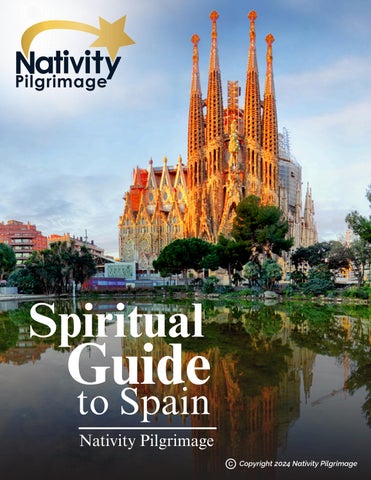
Spiritual
Guide to Spain
Nativity Pilgrimage Copyright 2024 Nativity Pilgrimage
1
Table of Contents
2
Pilgrimage Prayers
04
La Rambla
16
Introduction
08
Royal Palace of Madrid
18
Almudena Cathedral
10
La Sagrada Familia
20
Plaza Mayor
12
Barcelona Cathedral
22
Park Retiro
14
Santa Maria del Mar
24
Park Güell
26
Basilica of Loyola
36
St. James Cathedral
28
Basilica del Pilar
38
Convent of St. Teresa
30
Our Lady of Montserrat
40
Incarnation Convent
32
Contact Us
42
Burgos Cathedral
34 3
Pilgrimage Prayers
Before the Pilgrimage Opening Prayer: “Heavenly Father, as we prepare to embark on this sacred journey, we ask for Your protection and guidance. May this pilgrimage deepen our faith, strengthen our spirit, and draw us closer to You. We entrust our travels to Your care and pray for open hearts to receive the graces You have in store for us. Through Christ, our Lord.”
Amen 4
During the Pilgrimage Morning Prayer: “Lord Jesus, as we begin this pilgrimage, we ask You to walk with us. Open our eyes to see Your presence in the holy places we visit and the people we meet. Grant us the grace to grow in faith, hope, and love and to carry Your light in our hearts throughout this journey.”
Amen
5
Prayers at Each Site Before entering a shrine or church, pilgrims can recite: “Holy Spirit, guide us as we enter this sacred space. May we be filled with reverence and awe as we contemplate the mysteries of our faith. Help us to listen with open hearts and to be transformed by the grace of this encounter.”
6
Amen
After the Pilgrimage Closing Prayer: “Gracious God, as our pilgrimage ends, we thank You for the many graces we have received. May the memories and experiences of this journey stay with us, guiding us in our daily lives. Help us to live out the lessons we have learned and to share Your love with others. We ask this through Christ, our Lord.”
Amen
7
Spain Welcome to Spain, a country where centuries of history, diverse landscapes, and vibrant culture combine to create a unique travel experience. From the sun-soaked beaches of the Mediterranean to the bustling streets of Madrid, Spain offers endless adventures and unforgettable moments. Begin your journey in the capital, Madrid, home to world-class museums like the Prado and the Royal Palace, where Spain’s royal heritage comes to life. In Barcelona, marvel at the architectural wonders of Antoni Gaudí, including the breathtaking Sagrada Família and the whimsical Park Güell. Spain’s rich history is on full display in cities like Seville, with its grand Alcázar and the iconic Giralda Tower, and Granada, where the Alhambra’s Moorish architecture 08
enchants visitors. Travel further north to explore the medieval charm of cities like Toledo and Salamanca, or follow the famous Camino de Santiago pilgrimage route to the cathedral city of Santiago de Compostela. For nature lovers, Spain offers a diverse range of landscapes, from the rugged cliffs of the Costa Brava to the serene beauty of the Pyrenees Mountains. The country’s beaches, whether along the Costa del Sol or the Balearic Islands, are perfect for soaking up the Mediterranean sun. Spain’s culture is a vibrant mix of tradition and modernity, with flamenco music and dance, delicious tapas, and lively festivals like La Tomatina and Running of the Bulls. Whether you’re exploring historic cities or savoring local cuisine, Spain promises an unforgettable journey filled with passion and charm.
09
Almudena Cathedral Madrid
Introduction The Almudena Cathedral is the principal Roman Catholic church of Madrid, dedicated to the Virgin Mary under the title of Our Lady of Almudena. Located near the Royal Palace, it combines elements of Gothic, Romanesque, and Neoclassical styles. Though modern in construction, it serves as a vital center of worship and devotion in Spain’s capital.
Spiritual Reflection
10
The beauty of the Almudena Cathedral speaks to the timelessness of faith. Though newly built, it carries the ancient tradition of reverence to the Virgin Mary. As we stand before its altars, we are reminded that the faith we practice today is part of a long, unbroken chain of devotion passed down through generations.
“Blessed are those who hunger and thirst for righteousness, for they will be filled.”
Matthew 5:6
Spiritual Insight The Almudena Cathedral is a testament to the enduring call of faith in a modern world. Its blend of old and new architectural styles reflects the way the Church adapts to the present without losing its spiritual essence. As we pray within its walls, we are encouraged to hunger and thirst for righteousness, seeking God’s grace to fill our hearts and lead us in lives of holiness and service. 11
Plaza Mayor Plaza Mayor, located in the heart of Madrid, Spain, is one of the city’s most iconic landmarks. It dates back to the 17th century, when it was commissioned by King Philip III and designed by architect Juan Gómez de Mora. This grand rectangular plaza, framed by three-story residential buildings with balconies, has witnessed many significant events in Spanish history, including royal ceremonies, bullfights, and public executions during the Spanish Inquisition. Its central feature is a bronze statue of Philip III on horseback, erected in 1848. The plaza has been rebuilt several times due to fires, but its current form is largely from an 18th-century renovation by architect Juan de Villanueva. Plaza Mayor has a rich architectural style 12
characterized by uniformity and symmetry, reflecting the austere elegance of the Habsburg period. Today, it serves as a bustling gathering place for locals and tourists alike, lined with restaurants, cafes, and shops under its arcades. The square hosts numerous festivals and cultural events throughout the year, making it a vibrant hub of activity. Plaza Mayor’s historical significance, combined with its architectural beauty and lively atmosphere, makes it a central feature of Madrid’s cultural and social life. Visitors can stroll through the plaza to experience the city’s past while enjoying a taste of modern Spanish culture. It remains one of Madrid’s most beloved public spaces, embodying the city’s rich history and charm.
13
Park Retiro Retiro Park (Parque del Buen Retiro) is one of Madrid’s largest and most iconic green spaces, offering a peaceful escape from the bustling city. Established in the 17th century as a royal retreat for King Philip IV, it was gradually transformed into a public park in the 19th century after the Napoleonic wars. Covering 350 acres, it features an array of historical monuments, gardens, and cultural landmarks. One of its most famous attractions is the Crystal Palace (Palacio de Cristal), an exquisite glass pavilion built in 1887, originally intended to house exotic flora. Nearby is the large Retiro Pond, where visitors can rent rowboats and enjoy the serene atmosphere. The park is also home to the Monument to Alfonso XII, a grand structure featuring a semicircular colonnade and an equestrian statue of 14
the monarch. Retiro is known for its beautifully landscaped gardens, including the Rosaleda (rose garden) and the Parterre, which features an ancient bald cypress tree, considered to be Madrid’s oldest. The park plays host to various events throughout the year, such as art exhibitions, concerts, and book fairs. It is also a popular spot for joggers, cyclists, and families enjoying picnics. Retiro Park is listed as a UNESCO World Heritage site, along with Paseo del Prado, due to its historical and cultural significance. Its blend of nature, history, and recreational activities makes it a must-visit for both locals and tourists in Madrid. 15
La Rambla La Rambla is a famous tree-lined boulevard in the heart of Barcelona, Spain, stretching for 1.2 kilometers from Plaça de Catalunya to the Christopher Columbus Monument at Port Vell. Known for its vibrant atmosphere, La Rambla attracts both locals and tourists, offering a mix of historical landmarks, street performers, cafes, and markets. Historically, the street was once a small riverbed that marked the boundary between two areas of medieval Barcelona. Over time, it evolved into a bustling promenade. Today, it’s divided into sections, each with its own distinct features. One of its most well-known spots is the Mercat de Sant Josep de la Boqueria, a sprawling food market where visitors can enjoy fresh produce, meats, seafood, and 16
local Catalonian delicacies. La Rambla is also home to important cultural landmarks like the Gran Teatre del Liceu, a renowned opera house, and the Plaça Reial, a picturesque square surrounded by palm trees and filled with cafes and nightlife. The street’s lively energy is often accompanied by street artists, human statues, and a range of shops and stalls selling everything from souvenirs to handmade crafts. While it is a hub of activity, La Rambla has faced criticism for its commercialization and pickpocketing, a concern for many tourists. Despite these challenges, it remains an essential part of Barcelona’s identity, embodying the city’s rich history, culture, and modern vibrancy. 17
Madrid Royal Palace The Royal Palace of Madrid, known as “Palacio Real de Madrid,” is one of the most significant landmarks in Spain. Located in the heart of the city, it serves as the official residence of the Spanish royal family, though it is primarily used for state ceremonies today. The palace was constructed on the site of the former Alcázar, a Moorish castle that was destroyed by fire in 1734. King Philip V commissioned its reconstruction in the Baroque style, and the project was completed under King Charles III in 1764. The palace spans over 1.45 million square feet, making it one of the largest palaces in Europe, with 3,418 rooms. Inside, visitors can explore various opulent spaces such as the Throne Room, the Royal Armory, and the Royal Chapel, 18
all showcasing an array of period furniture, tapestries, paintings, and decorative arts from artists like Velázquez and Goya. The palace also houses significant collections of clocks, silverware, and musical instruments, including rare Stradivarius violins. The Royal Palace is surrounded by beautifully landscaped gardens, including the Campo del Moro and Sabatini Gardens, offering stunning views of the building and the city. It is open to the public year-round, allowing visitors to immerse themselves in Spain’s royal history while also admiring its architectural grandeur and cultural treasures. While the current royal family resides in the more modest Zarzuela Palace, the Royal Palace of Madrid remains a vital symbol of Spain’s monarchy and cultural heritage. 19
La Sagrada Familia Barcelona
Introduction The Basilica of La Sagrada Familia in Barcelona is one of the most iconic architectural masterpieces in the world. Designed by Antoni Gaudí, its towering spires and intricate designs reflect the beauty of creation and the mysteries of the Christian faith.
Spiritual Reflection La Sagrada Familia invites us to marvel at the beauty of God’s creation and the creativity with which He inspires humanity. As we gaze upon the intricacies of this basilica, we are reminded that we, too, are called to build our lives on the foundation of faith, using our gifts to glorify God. 20
“For every house is built by someone, but God is the builder of everything.”
Hebrews 3:4
Spiritual Insight La Sagrada Familia is a testament to the grandeur of God’s plan and the human capacity to participate in His creation. Just as the basilica’s construction spans generations, so too does our faith journey, requiring patience, perseverance, and dedication to God’s will. We are called to build our spiritual lives with the same care and reverence, trusting in God as the ultimate architect. 21
Cathedral of Saint Eulalia Barcelona
Introduction Barcelona’s Gothic Cathedral, also known as the Cathedral of Saint Eulalia, is a majestic structure dedicated to the co-patron saint of the city. This sacred space is known for its stunning architecture, beautiful cloisters, and deep historical significance in Catalonia’s Christian heritage.
Spiritual Reflection This cathedral invites us to honor the saints who, like Saint Eulalia, were willing to suffer for their faith. Their steadfastness and courage in the face of persecution inspire us to live our faith boldly, regardless of the challenges we may encounter. 22
“Blessed are those who are persecuted because of righteousness, for theirs is the kingdom of heaven.”
Matthew 5:10
Spiritual Insight The Cathedral of Saint Eulalia reminds us of the power of perseverance in faith. Saint Eulalia’s martyrdom is a testament to the strength found in Christ. In our lives, we are called to stand firm in our beliefs, trusting that God will give us the courage to endure all trials and lead us to eternal life. 23
Santa Maria del Mar Barcelona
Introduction The Church of Santa Maria del Mar, located in Barcelona, is a stunning example of Catalan Gothic architecture. Built by the citizens of Barcelona in the 14th century, it has long been a place of devotion to the Virgin Mary and a symbol of faith built by the hands of the people.
Spiritual Reflection This church, often referred to as the “Cathedral of the Sea,” represents the unity and strength of the faithful community that built it. The solidarity of the people who constructed it with their own hands speaks to the power of collective faith and devotion to God. 24
“For where two or three gather in my name, there am I with them.”
Matthew 18:20
Spiritual Insight The Church of Santa Maria del Mar is a reminder of the power of community in the life of faith. Just as the church was built by the collective efforts of the people, we are called to build up the body of Christ, the Church, through our love, service, and devotion. Together, we form a spiritual edifice that glorifies God. 25
Park Güell Park Güell, located in Barcelona, Spain, is one of the most iconic works of the Catalan architect Antoni Gaudí, a key figure in the modernist architectural movement. Originally intended as a housing development for the wealthy, the park was commissioned by Gaudí’s patron, Eusebi Güell, in the early 20th century. Though the residential project was ultimately unsuccessful, Gaudí transformed the site into a public park that today stands as a UNESCO World Heritage Site. The park features Gaudí’s distinctive style, blending organic forms with colorful, intricate mosaics and innovative structural designs that integrate seamlessly with the surrounding natural landscape. Park Güell’s most famous elements include the serpentine mosaic bench that snakes along the main terrace, offering panoramic views of Barcelona, and the 26
whimsical “Dragon Stairway,” adorned with a vibrant mosaic lizard statue, now an iconic symbol of the park. The architectural style reflects Gaudí’s fascination with nature, as he used flowing forms, natural motifs, and vibrant ceramic tiles to create a space that feels both fantastical and harmonious with its environment. Visitors can also explore the park’s colonnaded pathways, porticos, and structures that mimic the shapes of tree trunks and cave-like formations. Although a portion of the park is freely accessible, the central monumental zone requires an entry ticket. Park Güell remains one of Barcelona’s most visited tourist attractions, drawing millions of visitors each year who come to experience Gaudí’s visionary blend of architecture and nature. 27
St. James Cathedral Santiago de Compostela
Introduction The Santiago de Compostela Cathedral is one of the most important Christian pilgrimage sites in the world, believed to be the resting place of St. James the Apostle. Located in the region of Galicia, Spain, this majestic cathedral marks the end of the Camino de Santiago, a centuries-old pilgrimage route that has drawn millions of pilgrims seeking spiritual growth and renewal.
Spiritual Reflection
28
Santiago de Compostela is not just a destination; it is a journey of faith. The pilgrimage reminds us that our spiritual lives are a continuous journey toward God. As pilgrims walk the Camino, they experience the physical and spiritual challenges of life, learning to rely on God’s grace and strength.
“Blessed are those who hear the word of God and obey it.”
Luke 11:28
Spiritual Insight The Santiago de Compostela Cathedral invites us to reflect on our own spiritual journey. St. James, who was among the first apostles to give his life for Christ, reminds us of the call to discipleship and the sacrifices we are willing to make for the sake of the Gospel. Reaching the cathedral is not the end, but a new beginning in our relationship with God. 29
Convent of St. Teresa Avila
Introduction Located in St. Teresa of Ávila’s hometown, the Shrine and Convent of St. Theresa honors one of the greatest mystics and reformers in the history of the Church. It is built on the site of her birthplace, offering pilgrims a space to reflect on her teachings and her profound spirituality.
Spiritual Reflection This site invites us to embrace the spirit of St. Teresa, who taught the importance of humility, detachment, and prayer. Here, we are called to simplify our lives and focus on what truly matters—our relationship with God and the pursuit of holiness. 30
“Blessed are the pure in heart, for they shall see God.”
Matthew 5:8
Spiritual Insight St. Teresa’s life and teachings challenge us to examine our own hearts. She demonstrated that true holiness is found in living simply, seeking purity of heart, and surrendering fully to God. In this sacred place, we are reminded to prioritize inner transformation over worldly pursuits, trusting that God will lead us to greater heights of faith. 31
Convent of the Incarnation Avila
Introduction The Convent of the Incarnation in Avila is where St. Teresa of Ávila lived and experienced her profound spiritual transformation. It is a place that still echoes with her writings on mysticism, prayer, and reform within the Carmelite order.
Spiritual Reflection
32
This convent invites us to reflect on the power of prayer and inner conversion. Just as St. Teresa’s deep union with God was born from contemplation and solitude, we too are called to retreat from the noise of the world and seek the voice of God in the silence of our hearts.
“Be still, and know that I am God.”
Psalm 46:10
Spiritual Insight St. Teresa’s experience at the Convent of the Incarnation encourages us to embrace the transformative power of prayer. Through silence and deep communion with God, we are invited to experience personal conversion, letting go of worldly distractions to focus on what truly matters—our union with the Divine. 33
Burgos Cathedral Burgos
Introduction The Cathedral of Burgos is a masterpiece of Gothic architecture and a UNESCO World Heritage Site. Dedicated to the Virgin Mary, this cathedral is a symbol of devotion, artistry, and the rich Christian heritage of Spain. Its soaring spires and intricate details invite awe and reverence.
Spiritual Reflection
34
The grandeur of Burgos Cathedral mirrors the majesty of God. As we enter this sacred space, we are reminded of the greatness of God’s presence and the beauty that comes from dedicating our lives to Him. The cathedral’s art and architecture lift our hearts and minds toward heaven.
“Great is the Lord, and greatly to be praised, and his greatness is unsearchable.”
Psalm 145:3
Spiritual Insight The Burgos Cathedral invites us to contemplate the majesty of God. Just as the cathedral’s builders sought to create a space that reflects God’s glory, we are called to build lives that honor Him. Through our prayers, actions, and devotion, we can make our hearts a dwelling place for God’s greatness and love. 35
Basilica of Loyola Loyola
Introduction The Baroque Basilica of Loyola is a stunning church built in honor of St. Ignatius near his birthplace. The basilica’s grandeur reflects the deep reverence for St. Ignatius and his contributions to the Church, particularly through the Jesuit order and his spiritual exercises.
Spiritual Reflection This basilica invites us to reflect on the spiritual exercises of St. Ignatius, which emphasize discernment, self-reflection, and finding God in all things. The beauty of the basilica mirrors the inner beauty we discover when we seek God in every aspect of our lives. 36
“Whether you eat or drink, or whatever you do, do all to the glory of God.”
1 Corinthians 10:31
Spiritual Insight The Baroque Basilica of Loyola inspires us to see the divine in every moment. St. Ignatius’ teachings encourage us to live with a heightened awareness of God’s presence in our daily lives, allowing every action and decision to be a response to His love. This site is a reminder that our journey toward God involves constant discernment and openness to His grace. 37
Our Lady of the Pilar Zaragoza
Introduction The Basilica of Our Lady of the Pillar in Zaragoza is one of Spain’s most revered Marian shrines, where tradition holds that the Virgin Mary appeared to St. James on a pillar. It is a place of deep devotion to Our Lady and a symbol of Mary’s presence and care for the early Church.
Spiritual Reflection
38
This basilica reminds us of the Virgin Mary’s continual guidance and support in the mission of the Church. Like St. James, we are invited to draw strength from her presence, trusting that she intercedes for us and accompanies us in our journey of faith.
“Behold, I am with you always, to the end of the age.”
Matthew 28:20
Spiritual Insight The Basilica del Pilar stands as a powerful reminder of Mary’s closeness to the Church. As the mother of all believers, she is always present, interceding for us and helping us fulfill our mission. By placing our trust in her maternal care, we are strengthened to carry out our call to discipleship with faith and courage. 39
Our Lady of Montserrat Montserrat
Introduction Nestled in the mountains near Barcelona, the Sanctuary of Our Lady of Montserrat is a renowned Marian shrine dedicated to the Black Madonna. The breathtaking views and the serene atmosphere make this a special place for contemplation, prayer, and devotion to the Virgin Mary.
Spiritual Reflection The beauty and serenity of Montserrat inspire a sense of awe for God’s creation. As pilgrims journey to this sacred mountain, they are reminded of the majesty of God and the tender care of Mary, who watches over them as they seek deeper union with her Son. 40
“I lift up my eyes to the hills—where does my help come from? My help comes from the Lord, the Maker of heaven and earth.”
Psalm 121:1-2
Spiritual Insight The Sanctuary of Montserrat symbolizes the meeting of heaven and earth, where the divine meets the human. Pilgrims are encouraged to lift their eyes to the heights of God’s love and trust in His protection. The presence of the Black Madonna at Montserrat serves as a reminder of Mary’s maternal care for all, guiding us closer to Christ through her intercession. 41
42
90
Copyright 2024 Nativity Pilgrimage