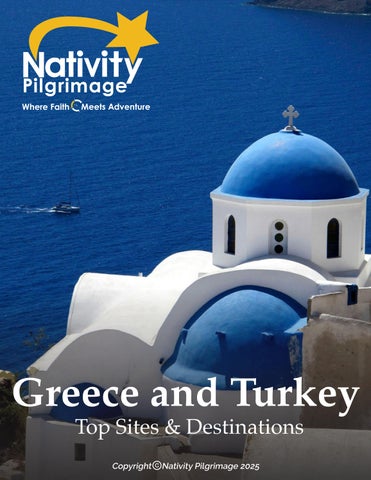
Greece and Turkey Top Sites & Destinations Copyright
Nativity Pilgrimage 2025
1
Table of Contents
2
Greece 04
Thessaloniki 20
The Acropolis 06
Delos 22
Santorini 08
Corinth Canal 24
Delphi 10
Epidaurus Theater 26
Meteora 12
Nafplio 28
Mykonos 14
Mount Olympus 30
Knossos 16
Parga 32
Rhodes 18
Turkey 34
Sumela Monastery 48
Cappadocia 36
The Basilica Cistern
50
Pamukkale 38
The Temple of Apollo
52
Topkapi Palace 40
Dolmabahçe Palace 54
Mount Nemrut 42
Lycian Rock Tombs
Troy 44
Contact Us 59
56
Bodrum Castle 46
3
Greece
Welcome to Greece, a land where ancient history and breathtaking landscapes come together in perfect harmony. From the iconic ruins of Athens to the sun-soaked shores of its many islands, Greece is a destination that promises both adventure and relaxation. In Athens, the birthplace of democracy, you’ll find the majestic Acropolis towering over the city, home to the Parthenon and other remnants of a glorious ancient civilization. Beyond the capital, Greece is a treasure trove of historical wonders, including the ancient city of Delphi, the Palace of Knossos in Crete, and the well-preserved ruins of Olympia, the birthplace of the Olympic Games. The Greek islands offer a paradise for every type of traveler. Visit Santorini for its stunning sunsets 4
and white-washed buildings, Mykonos for its vibrant nightlife, or Crete for its rugged beauty and rich Minoan history. Whether you’re swimming in the turquoise waters of the Aegean Sea or exploring hidden coves in the Ionian, Greece’s coastlines never fail to impress. Greek culture is deeply rooted in its traditions, mythology, and a love for the arts. Savor the country’s incredible cuisine, from fresh seafood to moussaka, and experience the warmth and hospitality of its people. Greece is also home to vibrant festivals, music, and dance that bring its ancient heritage to life. With its blend of history, culture, and natural beauty, Greece offers an unforgettable journey for those seeking to explore one of the world’s most fascinating destinations. 5
The Acropolis The Acropolis of Athens is one of the most iconic symbols of ancient Greece and Western civilization. Perched high on a rocky outcrop, the Acropolis is home to several significant ancient structures, the most famous of which is the Parthenon, a temple dedicated to the goddess Athena. Built in the 5th century BC, the Parthenon exemplifies classical Greek architecture with its Doric columns and exquisite sculptures. 6
Other important sites on the Acropolis include the Erechtheion, known for its distinctive Caryatids (female figure columns), and the Temple of Athena Nike. The Acropolis Museum, located nearby, houses many of the artifacts and sculptures found on the site, offering a deeper understanding of its historical and cultural significance. Visiting the Acropolis offers not only a glimpse into ancient Greek history but also spectacular views of modern Athens below. 7
Santorini Santorini is one of Greece’s most famous islands, known for its stunning whitewashed buildings, blue-domed churches, and dramatic views over the caldera. Formed by a volcanic eruption, the island’s unique geological features include towering cliffs and black sand beaches. The main towns of Fira and Oia are perched on the edge of the caldera, offering some of the most breathtaking sunsets in the world. 8
Santorini is also home to archaeological sites like Akrotiri, an ancient Minoan settlement buried by volcanic ash, which has been well-preserved. Wine lovers will appreciate Santorini’s vineyards, where they can sample the island’s distinctive white wines, particularly those made from the Assyrtiko grape. With its blend of natural beauty, history, and romance, Santorini remains a top destination for travelers worldwide. 9
Delphi Delphi, once considered the center of the ancient world, is one of Greece’s most significant archaeological sites. Nestled on the slopes of Mount Parnassus, Delphi was home to the famous Oracle, where the priestess Pythia delivered prophecies from the god Apollo. The site’s most important structures include the Temple of Apollo, the ancient theater, and the stadium where the Pythian Games (similar to the Olympic Games) were held. 10
Delphi’s setting is as impressive as its history, with sweeping views of the surrounding valley and olive groves. The Delphi Archaeological Museum houses many artifacts found at the site, including the renowned Charioteer of Delphi statue. Delphi continues to be a symbol of ancient wisdom and religious devotion, drawing visitors interested in both history and mythology. 11
Meteora Meteora is a breathtaking region in central Greece, known for its towering rock formations and monasteries that seem to float in the sky. These monasteries, built on top of the natural sandstone pillars, date back to the 14th century and were once inhabited by monks seeking solitude and spiritual contemplation. Of the 24 original monasteries, six remain active today, each offering a unique glimpse into the monastic life of centuries past. 12
Visitors to Meteora can explore the monasteries, many of which house beautiful frescoes, religious icons, and manuscripts. The area is also a popular destination for hiking, with numerous trails offering stunning views of the rock formations and the surrounding plains. Meteora’s combination of natural beauty and spiritual significance makes it one of Greece’s most aweinspiring sites. 13
Mykonos Mykonos is one of Greece’s most famous islands, renowned for its vibrant nightlife, stunning beaches, and charming Cycladic architecture. The island’s main town, also called Mykonos or Chora, is a labyrinth of narrow streets lined with whitewashed buildings, boutiques, cafes, and tavernas. Iconic landmarks include the 16th-century windmills, which overlook the town and serve as a reminder of the island’s agricultural past. 14
Mykonos is also home to several beautiful beaches, such as Paradise Beach and Super Paradise Beach, which attract partygoers and sunbathers alike. For a more tranquil experience, visitors can explore the island’s hidden coves or take a boat trip to the nearby island of Delos, a UNESCO World Heritage site and the mythical birthplace of Apollo and Artemis. Whether for relaxation or revelry, Mykonos offers something for every traveler. 15
Knossos, Crete Knossos, located near Heraklion on the island of Crete, is the largest Bronze Age archaeological site in Greece and is considered Europe’s oldest city. The Palace of Knossos is the centerpiece of this ancient Minoan city, believed to be the home of King Minos and the legendary Minotaur. Excavated by Sir Arthur Evans in the early 20th century, the palace complex reveals a sophisticated civilization with advanced architecture, vibrant frescoes, and a highly organized society. 16
Visitors can explore the labyrinthine ruins of Knossos, including the throne room, royal apartments, and ceremonial spaces. The site provides a fascinating glimpse into the Minoan culture, which flourished around 2000 to 1400 BC. Many of the artifacts found at Knossos, including the famous bullleaping fresco, are displayed in the Heraklion Archaeological Museum. Knossos is a must-visit for anyone interested in ancient history and mythology. 17
Rhodes Rhodes Old Town, a UNESCO World Heritage site, is one of the best-preserved medieval towns in Europe. Enclosed by thick stone walls, the town is a maze of cobblestone streets, historic buildings, and lively squares. The Palace of the Grand Master, a massive fortress built by the Knights of St. John, dominates the town and offers insight into Rhodes’ role as a stronghold during the Crusades. 18
Visitors can wander through the Street of the Knights, explore the medieval fortifications, and visit the Archaeological Museum housed in the former Hospital of the Knights. Rhodes Old Town also has a vibrant atmosphere, with plenty of cafes, shops, and restaurants where visitors can relax and enjoy the local cuisine. Its blend of history and charm makes it a mustsee destination for travelers to the Greek islands. 19
Thessaloniki Thessaloniki, Greece’s second-largest city, is a vibrant and cosmopolitan hub known for its rich history and dynamic cultural scene. Founded in 315 BC, Thessaloniki boasts a mix of Byzantine, Roman, Ottoman, and modern Greek influences. The city’s most famous landmark is the White Tower, a 15thcentury fortress that stands on the waterfront and offers panoramic views of the city and the Thermaic Gulf. 20
Other highlights include the Rotunda, a massive Roman structure later converted into a Christian church, and the Arch of Galerius, a monument built to commemorate Emperor Galerius’ military victories. Thessaloniki is also home to several important Byzantine churches, such as Hagia Sophia and the Church of St. Demetrius, a UNESCO World Heritage site. The city’s lively markets, restaurants, and cafes make it a perfect blend of history and modern Greek culture. 21
Delos Delos, a small island near Mykonos, is one of the most important archaeological sites in Greece and a UNESCO World Heritage site. In ancient Greek mythology, Delos was the birthplace of the gods Apollo and Artemis, and it became a major religious and commercial center in antiquity. The island’s ruins include temples, sanctuaries, and a theater, as well as the famous Terrace of the Lions, a row of marble lion statues dedicated to Apollo. 22
Exploring Delos offers a fascinating glimpse into the religious and cultural life of ancient Greece, with well-preserved mosaics, statues, and inscriptions providing insight into the island’s past. Visitors can also enjoy the island’s natural beauty, with its tranquil landscape and panoramic views of the Aegean Sea. Delos is a must-visit for history enthusiasts and anyone interested in Greek mythology. 23
Corinth Canal The Corinth Canal is an engineering marvel that connects the Ionian Sea with the Aegean Sea, cutting through the narrow Isthmus of Corinth. Completed in 1893 after centuries of planning and failed attempts, the canal is just over 6 kilometers long and dramatically narrow, with steep rock walls towering up to 90 meters high.Though the canal is too narrow for modern ships, it remains an impressive feat of engineering 24
and is used primarily by smaller vessels and tourist boats. Visitors can admire the canal from viewing platforms or take a boat tour through the waterway, experiencing the towering cliffs and the ingenuity behind the project. The Corinth Canal is a popular stop for travelers exploring the Peloponnese, offering both historical significance and striking scenery.
25
Epidaurus Theater The ancient theater of Epidaurus is one of the best-preserved and most beautiful theaters in Greece. Built in the 4th century BC, the theater is renowned for its incredible acoustics, allowing even the softest sounds from the stage to be heard by spectators in the uppermost seats. It was part of the sanctuary of Asclepius, the god of healing, and was used for performances during religious festivals. 26
Today, the theater is still in use for performances, particularly during the annual Epidaurus Festival, which showcases ancient Greek drama. Visitors to Epidaurus can also explore the nearby archaeological site, including the remains of the sanctuary and a small museum. The theater’s blend of architectural brilliance and cultural heritage makes it one of Greece’s top attractions for history and arts enthusiasts. 27
Nafplio Nafplio is one of the most picturesque towns in Greece, located on the eastern coast of the Peloponnese. Once the capital of modern Greece, Nafplio is known for its well-preserved Venetian architecture, narrow streets, and beautiful waterfront. The town is dominated by the Palamidi Fortress, a massive Venetian castle perched on a hilltop, offering spectacular views of the Argolic Gulf and the surrounding countryside. 28
Visitors can also explore the Bourtzi, a small fortress located on an island just off the coast, and the town’s charming old quarter, filled with neoclassical mansions, cafes, and boutiques. Nafplio’s rich history, combined with its romantic atmosphere, makes it a favorite destination for both Greek and international travelers. 29
Mount Olympus Mount Olympus is the highest mountain in Greece and holds a special place in Greek mythology as the home of the twelve Olympian gods. Rising to 2,917 meters, Mount Olympus is a popular destination for hikers and nature enthusiasts, offering challenging trails and stunning views of the surrounding landscape. The mountain is part of a national park and is home to diverse wildlife and flora. 30
Visitors can hike to the summit, known as Mytikas, or explore the lower trails, which pass through forests, waterfalls, and picturesque villages. For those interested in Greek mythology, Mount Olympus represents the ultimate connection between nature and the divine, making it a must-visit destination for both adventure seekers and history lovers. 31
Parga Parga is a picturesque coastal town located on the northwestern coast of Greece, known for its colorful houses, crystal-clear waters, and lush green hills. The town is built amphitheatrically around a bay, with a Venetian castle perched on a hill overlooking the harbor. Parga’s beaches, such as Valtos and Lichnos, are among the most beautiful in the region, with golden sand and turquoise waters. 32
Visitors can explore the town’s charming streets, lined with shops, cafes, and restaurants, or take a boat trip to nearby islands and hidden coves. Parga’s combination of natural beauty and traditional Greek charm makes it a popular destination for both Greek and international travelers.
33
Turkey
Welcome to Turkey, a country where East meets West, blending ancient history, rich culture, and stunning landscapes into a truly unique travel experience. With its diverse offerings, Turkey invites you to explore everything from bustling cities to serene coastlines and ancient ruins. In Istanbul, you can visit the majestic Hagia Sophia, the Blue Mosque, and the Topkapi Palace, once home to Ottoman sultans. Wander through the vibrant Grand Bazaar, or take a cruise along the Bosphorus for breathtaking views of the city’s skyline. Turkey’s ancient history comes to life in places like Ephesus, one of the best-preserved ancient Roman cities, and Cappadocia, where surreal landscapes and cave dwellings create an otherworldly experience. Visit the city of Troy, immortalized in Homer’s epic poems, or 34
Pamukkale, where natural thermal springs have created terraces of mineral-rich pools. The Mediterranean and Aegean coastlines offer stunning beaches, charming seaside towns, and opportunities for sailing and water sports. The turquoise waters of Antalya and the rugged cliffs of Bodrum are perfect for sun-seekers and adventurers alike. Culturally, Turkey is a feast for the senses. Enjoy traditional Turkish cuisine, from savory kebabs to sweet baklava, and experience the country’s vibrant arts, music, and dance. The famous whirling dervishes and lively bazaars showcase Turkey’s rich cultural heritage. Whether you’re exploring ancient ruins, savoring local delicacies, or relaxing by the sea, Turkey promises an unforgettable journey through time and culture. 35
Cappadocia Cappadocia is a region known for its otherworldly landscapes, characterized by unique rock formations, fairy chimneys, and ancient cave dwellings. Located in central Turkey, this area was formed by volcanic eruptions and erosion over millions of years. Cappadocia is also home to underground cities such as Derinkuyu and Kaymakli, which were once used by early Christians seeking refuge from invaders. 36
One of the most popular activities in Cappadocia is taking a hot air balloon ride at sunrise, offering breathtaking views of the region’s surreal landscapes. Visitors can also explore the Göreme Open-Air Museum, a UNESCO World Heritage site that features rock-cut churches adorned with Byzantine frescoes. Cappadocia’s unique geology and rich history make it one of Turkey’s most magical destinations. 37
Pamukkale Pamukkale, meaning “Cotton Castle” in Turkish, is a natural wonder in southwestern Turkey, famous for its white terraces of mineral-rich thermal waters. The terraces are formed by calcium deposits left behind by the hot springs that have been used for thousands of years for their healing properties. The nearby ancient city of Hierapolis, a UNESCO World Heritage site, was built around these springs, and its ruins include a 38
large necropolis, a well-preserved Roman theater, and the ancient thermal baths. Visitors can walk barefoot across the travertine terraces, bathe in the warm, mineral-rich waters, and explore the ruins of Hierapolis. Pamukkale’s combination of natural beauty and historical significance makes it one of Turkey’s most unique and sought-after destinations.
39
Topkapi Palace Topkapi Palace, once the primary residence of the Ottoman sultans for over 400 years, is a stunning symbol of Ottoman power and grandeur. Built in the 15th century by Sultan Mehmed the Conqueror, the palace complex covers a vast area and consists of several courtyards, pavilions, and gardens. It was not only a royal residence but also the administrative and educational center of the empire. Today, Topkapi Palace is a museum showcasing Ottoman treasures, including the 40
imperial collections of jewelry, manuscripts, and relics. Highlights include the Harem, where the sultan’s family lived, and the Chamber of the Sacred Relics, which contains artifacts related to Islamic prophets, including the cloak and sword of the Prophet Muhammad. Topkapi Palace offers visitors a chance to immerse themselves in the opulence and history of the Ottoman Empire.
41
Mount Nemrut Mount Nemrut is one of Turkey’s most awe-inspiring archaeological sites, located in southeastern Anatolia. At the summit of the mountain, King Antiochus I of Commagene built a monumental tomb in the 1st century BC, surrounded by colossal statues of gods, animals, and himself. These statues, some over 9 meters tall, are arranged on terraces that face both the east and west, providing spectacular views of the sunrise and sunset.
42
The site is a UNESCO World Heritage site and offers a fascinating insight into the Hellenistic Kingdom of Commagene, which blended Greek, Persian, and Armenian cultures. Visitors can hike to the summit to explore the enigmatic statues and tomb, while also enjoying panoramic views of the surrounding landscape. Mount Nemrut is a testament to ancient ambition and creativity, making it one of Turkey’s most remarkable historical attractions.
43
Troy The ancient city of Troy, made famous by Homer’s Iliad, is one of the most legendary archaeological sites in the world. Located near the Dardanelles in northwestern Turkey, Troy was the setting of the Trojan War and the story of the Trojan Horse. Excavations at the site have revealed several layers of settlement, indicating that Troy was inhabited for thousands of years.
44
Visitors to Troy can explore the ruins of the ancient city, including its walls, gates, and remnants of palaces and temples. A replica of the famous wooden Trojan Horse stands at the entrance to the site, adding a touch of mythology to the historical ruins. Troy offers a fascinating journey into the world of ancient Greek legends and one of the most famous conflicts in history.
45
Bodrum Castle Bodrum Castle, also known as the Castle of St. Peter, is a wellpreserved medieval fortress located in the coastal town of Bodrum. Built by the Knights of St. John in the early 15th century, the castle was a strategic stronghold during the Crusades. Today, it houses the Museum of Underwater Archaeology, which displays a fascinating collection of artifacts recovered from shipwrecks in the Aegean Sea, including ancient glass, pottery, and jewelry. 46
The castle’s towers and ramparts offer stunning views of the surrounding harbor and coastline. Visitors can explore the various halls and chambers of the castle, including the dungeons and chapel, while learning about the region’s rich maritime history. Bodrum Castle is a must-visit for history buffs and those interested in the ancient and medieval past of the Aegean region.
47
Sumela Monastery Sumela Monastery is a Greek Orthodox monastery nestled on the steep cliffs of the Pontic Mountains in northeastern Turkey. Founded in the 4th century AD, the monastery is dedicated to the Virgin Mary and has been a site of pilgrimage for centuries. The monastery’s remote location and stunning setting make it one of the most unique religious sites in Turkey. Visitors to Sumela can explore its frescoed chapels, monastic cells, and courtyards while enjoying breathtaking views of the lush green 48
valleys below. The interior of the main church is adorned with well-preserved frescoes depicting scenes from the Bible and the life of the Virgin Mary. Sumela Monastery’s combination of religious significance, natural beauty, and historical intrigue makes it one of Turkey’s most captivating attractions, offering visitors a peaceful and spiritual experience in a truly dramatic setting.
49
The Basilica Cistern The Basilica Cistern is one of Istanbul’s most fascinating historical sites, located beneath the city’s bustling streets. Built in the 6th century during the reign of Emperor Justinian I, this underground cistern was used to store water for the Great Palace of Constantinople and nearby buildings. The cistern is supported by 336 marble columns, many of which were repurposed from earlier Roman and Byzantine structures. The dimly lit, atmospheric space is often described as eerie 50
and enchanting, with its reflections of the columns in the shallow waters creating a surreal experience. Two of the columns feature carvings of Medusa heads, adding to the mystery and intrigue of the cistern. Visitors can walk along elevated platforms to explore this subterranean marvel, learning about its history and role in ancient Istanbul’s water supply system. The Basilica Cistern is a must-see for those fascinated by Byzantine engineering and the hidden history beneath Istanbul’s surface. 51
Temple of Apollo The Temple of Apollo in Didyma, located near the Aegean coast, was one of the most important religious sanctuaries of the ancient world. It was a major center for oracular consultations, second only to Delphi in Greece. The temple, originally built in the 4th century BC, was dedicated to Apollo, the Greek god of prophecy, and was known for its colossal size and grandeur. Although the temple was never fully completed, its remains are still impressive today, with 52
towering columns and intricately carved reliefs. Visitors can walk through the ruins, which evoke the magnificence of ancient Greek architecture, and imagine the importance this sanctuary once held for pilgrims seeking divine guidance. The Temple of Apollo is a fascinating testament to the religious and cultural influence of the ancient Greek world in Turkey.
53
Dolmabahçe Palace Dolmabahçe Palace is a stunning example of Ottoman imperial architecture, located on the shores of the Bosphorus Strait in Istanbul. Built in the 19th century during the reign of Sultan Abdülmecid I, the palace was designed to reflect the growing influence of European styles on Ottoman art and architecture. The result is a lavish, European-style palace with elements of Baroque, Rococo, and Neoclassical design. 54
The palace features over 285 rooms, including the famous Crystal Staircase and the grand Ceremonial Hall, which boasts one of the largest chandeliers in the world. Visitors can tour the opulent rooms, which are filled with luxurious furniture, art, and decorations, offering a glimpse into the extravagant lifestyle of the Ottoman sultans. Dolmabahçe Palace is a mustsee for those interested in the later period of Ottoman history and the fusion of Eastern and Western styles. 55
Lycian Rock Tombs The Lycian Rock Tombs, located near the town of Dalyan on Turkey’s southwestern coast, are one of the most iconic sights in the region. Carved into the cliffs by the ancient Lycian civilization over 2,000 years ago, these tombs were the final resting places for Lycian rulers and nobility. The tombs, particularly the impressive King’s Tombs, are characterized by their ornate facades, which mimic the architecture of Lycian temples. 56
Visitors can take boat tours along the Dalyan River to view the tombs from the water, or hike up to the site for a closer look. The tombs are a remarkable example of ancient Lycian craftsmanship and provide insight into the funerary practices and beliefs of this enigmatic civilization. The combination of history, culture, and natural beauty makes the Lycian Rock Tombs a must-visit attraction in Turkey. 57
Enjoy Your Trip! Wishing all those preparing for their pilgrimage to Greece & Turkey a journey filled with spiritual enlightenment, cultural richness,
and moments of reflection. As you walk in the footsteps of ancient traditions and visit sacred sites, may you find peace, wisdom, and
inspiration along the way. May your travels be safe, your hearts be
full, and your experiences bring lasting blessings. Kalo Taxidi, and may your pilgrimage be truly transformative!
58
59
60
Copyright
Nativity Pilgrimage 2025