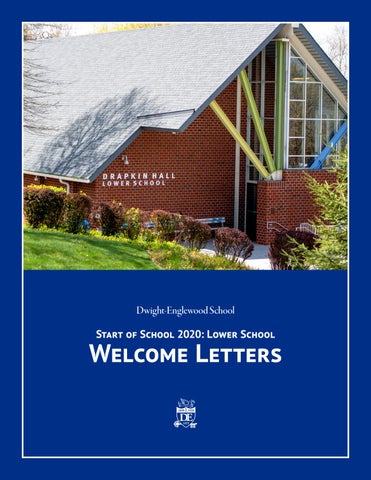
Dwight-Englewood School Start of School 2020: Lower School
Welcome Letters
Table of Contents 1 - Letter to All Lower School Families 2 - Grade-Specific Letter: Preschool 3 4 - Grade-Specific Letter: Preschool 4 6 - Grade-Specific Letter: Kindergarten 8 - Grade-Specific Letter: First Grade 10 - Grade-Specific Letter: Second Grade 12 - Grade-Specific Letter: Third Grade 14 - Grade-Specific Letter: Fourth Grade 16 - Grade-Specific Letter: Fifth Grade
Dear Lower School Families, Welcome to the Lower School! We are proud of our well-planned, carefully implemented curriculum. Our academic programming provides a coherent, consistent, and intellectually robust experience for our students. What follows are descriptions of what students typically learn and experience at each grade level. While we plan to safely re-open the Lower School in September, we expect modifications to the program in deference to the health and safety of our community. That said, we remain committed to the ideals described in our founding documents - and committed to bringing those ideals to life in the daily experience of the children we are honored to serve. We hope you enjoy reading and learning a bit about the Lower School. Welcome to our community! Best Wishes, Dwight-Englewood Lower School
1
Welcome to Preschool 3! Pre-school Three is a significant entry point to the Lower School, and starting school is a significant milestone in the life of a child and for the family. We pay close attention to this important transition, nurturing and supporting our youngest students as they navigate their new space. The pre-school space is extremely well-thought out and is designed to promote independence. In addition, the predictable, carefully paced schedule allows children to develop and feel a sense of mastery over their environment – and this sense of mastery is essential for developing independent, confident young learners. Of course, play is a significant component of the pre-school three day as well. Very interesting developments start to happen around early childhood play. Preschooler starts to play sitting next to another child, often someone with similar interests. This naturally shifts, through the use of language, to the beginnings of cooperative play. Early childhood teachers know they can facilitate this process by setting up a space for two or more small bodies and helping children express their questions or needs. They talk with children frequently and at length about their pretend play, their artistic creations, their outdoor games, and about their everyday activities. These conversations foster expressive language and encourage vocabulary development. Through generous amounts of open-ended play, children learn to listen, express themselves, manage strong feelings, develop patience, develop self-control, and learn how to ask for help. Pre-school three students begin to experience the joys and challenges of social interactions. Teachers support children in acquiring the social skills of cooperating, sharing, and taking turns. They model the social skills needed for resolution. Using the skills described above, children learn to navigate social interactions, and friendships bloom. The pre-school three classroom opens directly to an early childhood outdoor play space, and they spend as much time outdoors as possible. This active play develops gross motor coordination. Imagination Playground blocks and tricycles, as well as buckets and shovels for collecting natural specimens and “treasures� are available for children to engage in many different types of play. Early childhood literacy includes drawing attention to the sounds. Sounds in words eventually introducing rhyming, identifying names of classmates, providing a print-rich environment and using many different tools and writing implements to support eye-hand coordination and develop the skills they will need later down the road to produce written work. Opportunities to practice numeracy and number sense are embedded in the daily routines and play experiences in our classroom. While manipulating building materials, the children develop an understanding of size, shape, weight, and volume, and children are prompted to use math vocabulary. The early childhood classroom allows children to explore and express themselves with a wide variety of materials. These include tempera paint, watercolors, crayons, colored pencils, different kinds of paper and cardboard, tape, glue, scissors, fabric, wood, clay, and materials from nature. The pre-school teachers help them create highly individualized pieces of art, towards which they feel a strong sense of ownership. Beautiful, thoughtful displays honor and celebrate their work. Music and Spanish are deeply embedded into the program, and special-area teachers with training in these subjects visit the classroom to introduce these subjects in a developmentally appropriate manner.
2
Hi,
Preschool 3
3
Welcome to Preschool 4! The preschool 4 teachers excel at nurturing the natural curiosity of young children. Each of our teachers watch closely to see what students are drawing, discussing, and building. Their observations, combined with the developmental needs of four-year olds, allow the teachers to build a program that meets their needs and interests. Walk into our preschool 4 classroom on any given day and you will see emergent literacy through play, expressive language and print. As teachers listen in on student play, they take notes and help students expand vocabulary and language. Interactive read-alouds promote a love of story and the written word, as well as helping to develop understanding about how print works. The Sounds in Motion program supports auditory processing and phonemic awareness skills through gross motor kinesthetic movements, and Handwriting Without Tears supports pre-writing readiness skills by introducing proper pencil grip and correct letter formation. This focus builds a solid foundation and good writing habits for the years to follow. These opportunities and many more - which teachers will explain in greater detail at Back-to-School Night and throughout the year - ensure that students are exposed to the wonderful world of quality literature, awareness of print, features of books and reading and writing readiness, while protecting the four- year old’s place in early childhood. Beginning mathematicians organize and sort shapes, build and extend patterns, practice one-to-one correspondence, and develop spatial awareness. Mathematical thinking is infused throughout the day in the form of daily calendar work and play. We are committed to maintaining play throughout each day. In the dramatic play area, peers interact with one another and generate and exchange ideas. They explore and experiment with real-life situations through their dramatizations and take opportunities to lead and follow. They negotiate, listen, pay attention to nonverbal cues and of course, exercise their imaginations. The block area is a space with much to do, think and talk about. Teachers ask “What do you think will happen?” or “What made you put that block in that position?” so that the block area becomes a place where students express themselves, as well as ultimately learning how to exchange ideas using increasingly more complex language and vocabulary. The arts make up a vital part of the classroom environment. The classroom itself is a studio environment inviting students to create, explore, and express themselves with a variety of materials such as tempera paint, watercolors, crayons, colored pencils, different kinds of paper and cardboard, tape, glue, scissors, fabric, wood, clay, and materials from nature. Students create highly-individualized pieces of art, towards which they feel a strong sense of ownership. We honor their work by discussing and displaying it proudly in our halls.
Continued on the next page
4
In preschool 4, children are introduced to Spanish in a cultural context meant to be inviting and fun, and they are exposed to Spanish in their classroom during lunch and choice times. Themes explored include greetings, friendship and family, colors, numbers, and shapes, games, music and dance, books, and videos. Young children are natural scientists. They are curious, full of wonder and eager to investigate. Our preschool children carry out the work of scientists as part of their everyday lives when they observe their surroundings, test things out and make discoveries. Using all their senses to observe and learn about the world around them, they discover relationships of change and growth and cause and effect. This is scientific thinking, and it takes place throughout the day and the year in the classroom, as well as outside in the preschool 4 play spaces. Preschool 4 class has music class twice each week. They learn to identify changes in pitch, tempo, loudness, and musical duration. They memorize songs to sing and write their own. They also have another opportunity to sing within a larger community during a regularly scheduled early childhood singalong. Four-year olds love to move, and they learn to move rhythmically and smoothly. They share their music during “Grandparents’ and Special Friends’ Day”, always one of the highlights of the spring. Students visit the Lower School gym for physical activities once a week. This experience, along with ample time outside, gives students time and space to climb, run, walk, bike, roll, slide, jump and play! Directly outside the classroom is their own space which includes tricycles, balls, Imagination Playground Blocks and other equipment specifically designed for children of this age. Four is a magical time of time. Four-year olds can do things for themselves - and they want to! In the course of the day, they can go from being a reader to an astronaut to a dinosaur hunter to a storyteller to an engineer. Opportunities to be all of these things inside a preschool classroom give children the range of experiences and structure to become secure in their relationships and their environment and, most of all, to be themselves.
Hi,
Preschool 4
5
Welcome to Kindergarten! It is often said that play is the work of the young child. In kindergarten opportunities abound for students to explore and learn through play. They are also introduced to the structures and routines that bridge the early childhood and elementary programs. Reading Workshop and Writing Workshop are on the daily schedule. A balanced literacy approach, fosters an appreciation for good literature and the ability to speak clearly, listen carefully and write with purpose. Balanced literacy includes phonological awareness, letter–sound correspondence, genre study, and lots of time reading, listening to and talking about many different types of texts. Students work independently, in small groups and as a class. In kindergarten there is an emphasis on story. We nurture early literacy development while allowing students to connect literacy to play, thus protecting the kindergartners special place in early childhood. Kindergartners are already writers, filled with stories to tell and ideas to express. All they need to grow is a teacher who recognizes what they can do and can help them with what they are ready to learn next. Kindergarten writing includes talking, planning and drawing, as well as formal print work. They learn about print –upper and lower case letters, formation of letters and more, through the Handwriting Without Tears curriculum. We also focus on nurturing a writing identity and building the confidence to share ideas using oral language, words, and pictures. We want our young writers to develop a sense of pride and ownership in this work. Writing units of study are grounded in Teachers College Reading and Writing Units of Study and include units in narrative, information and opinion writing. Mathematics focuses on comparing whole numbers, initially with sets of objects and describing shapes and space. Students use numbers to represent quantities, count objects in a set and compare sets. They model joining and separating situations with sets of objects or eventually represent their process with equations such as 5 + 2 = 7 and 7 – 2 = 5. Our emphasis is on building students’ experiences, language and number sense as they construct their mathematical understandings. Units of study include comparing sets and numbers to 20; addition and subtraction; shape, pattern and size; numbers to 100; time and money. Social studies begins with a study of ourselves and others in our classroom. Students learn what others bring to the community, what we have in common with one another, as well as how we are different. Students learn to articulate and ask questions, listen to one another, and build upon the ideas of others. In the spring, students incorporate all they have learned as readers and writers into their study of animals and zoos. Students select an animal, and with support from teachers, research and share what they learn. Students learn Spanish through a series of lessons called SALSA. These are based on stories, folktales and fables. Students have hands-on opportunities to learn Spanish words, phrases, songs and games and gain facility listening to and speaking Spanish. We also host many cultural celebrations where we sing Spanish songs and Spanish learn vocabulary that is important for daily life. Kindergartners are natural scientists. They discover relationships of change and growth and cause and effect. Kindergarten students visit the science room once a week and learn about classroom animals and how to care for them, the environment around our school, and how to observe and describe scientific phenomena.
Continued on the next page
6
Kindergartners have formal art instruction once a week to learn about elements of color, line and shape while exploring basic concepts of drawing, painting, collage, sculpture, arrangement and related vocabulary. Students create collections of work to demonstrate their understanding of the medium and concepts explored. The music program provides opportunities for students to perform, create, and respond to music. Twice a week, kindergartners attend music class. Through singing, playing instruments, moving to and creating music, students acquire musical skills and knowledge by doing. They learn to match pitch, move to a beat, repeat a rhythm with their bodies and use small percussion instruments. They participate in a Valentine’s Day Concert in which they perform traditional folk songs and songs from around the world. They also have a performance opportunity during “Grandparents and Special Friends Day” held in the spring, always a highlight of the season. Kindergarten is a magical time. We work hard to protect the kindergartners’ special place in early childhood while introducing the skills, routines and structures that will shape their experience as they move through the Lower School.
Hi,
Kindergarten
7
Welcome to First Grade! First grade is a transcendent experience. Eager to come to school each morning, first graders are becoming “the big kids”. It is a year of many firsts: they have lockers to store their belongings in and they eat in the lunchroom for the first time. They use the larger playgrounds where some organize games basketball and soccer. Others inhabit a universe where fantasy play and magical thinking are very real - it’s important first graders have opportunities for both kinds of play. Structures introduced in kindergarten – reading workshop and writing workshop - continue. Teachers work with whole groups, small groups and individuals to provide targeted instruction in reading, writing and spelling. As in all grades, assessment is frequent. First-grade homework expectations and routines are explained by the classroom teachers at Back-to-School Night. Literacy work focuses on building independence and learning a great deal about print as both readers and writers. Strategies for decoding and building reading fluency are explicitly taught in the first reading unit of study. Other reading units include realistic fiction, poetry, and informational text. Students are given a Kids A to Z account to practice at home. This account is kept throughout their time in Lower School and will be explained at Back-to-School Night. First graders write in complete sentences, and they grow to love incorporating the writing conventions. They learn about punctuation not only periods, question marks and exclamation points but also commas and ellipses as they study the works of other writers. They will try these out in their writing because first graders are wild for new tools and techniques! They write stories called “small moments”, fairy tales, informational books and pieces connected to social studies. Words Their Way provides the sequence for spelling rules and patterns, and handwriting follows the Handwriting Without Tears sequence. Math includes acquisition of skills and problems that are open-ended. More formal notation is introduced. First graders get a Dreambox account which is a tool for practicing skills and concepts at home. Math units of study in first grade include tools and routines; cardinal & ordinal numbers; addition and subtraction within 10; shapes and patterns; graphing and comparison; numbers and operations within 40; measurement of length, weight, and time; and numbers and operations within 100. Social studies includes a study of houses and homes in which families are invited in to help students construct models of homes from around the world. For many students this experience is one of their most cherished Lower School memories. A study of oceans includes a visit to the aquarium. Students use all they have learned about literacy to publish books about oceans and ocean life. Twice a week they visit the music room to learn the language of music, particularly beat, rhythm and melody. Budding musicians sing, move, improvise, listen and respond. They study instruments of the orchestra and are introduced to the lives and music of Bach, Handel, Haydn and Mozart. They present a concert for Valentine’s Day in the music room, perform for “Grandparents’ and Special Friends’ Day” in the spring and visit NJPAC for a concert performed by the New Jersey Symphony Orchestra. In Health and Wellness students practice balance through gymnastics activities, learn skills and rules for sports such as soccer, basketball, floor hockey and base games, as well as tag games. They learn about good sportsmanship, safety rules and procedures, and how to problem-solve. Classes are held twice a week. Continued on the next page
8
Spanish is a FLEX (Foreign Language Exploratory Program). Twice a week students learn Spanish through animation, stories, puppets, plays, games and music. Numbers, colors, greetings, days of the week and months of the year are topics students learn and practice. First-grade scientists visit the science room where they investigate, observe and record information with drawings and age-appropriate writing. They learn to make evidence-based inferences and practice using the tools of science including but not limited to hand lenses and binoculars. Units of study including the life cycles of plants and the life cycles of animals such as birds, butterflies and mammals. They also study simple machines. They spend a great deal of time studying and learning from the outdoor classroom, which is just outside the Lower School science classroom and is a wonderful place for our students to become invested in the natural environment. First graders visit Swartley Art Center once a week. Here they learn about the elements of color, line and shape through drawing, painting, collage, sculpture and printmaking. Students work independently and collaboratively, and each child creates a collection of work to represent their understanding of the medium and concepts taught. First graders have formal instruction in technology. They are introduced to flowcharts and simple coding using apps such as Light-Bot, Kodable, Scratch Jr., and Hopscotch. Most technology work in first grade is done using the school’s iPads. We see first grade as a time of robust energy and excitement. It is a time filled with learning new skills and solidifying many skills while “trying on” others. It is also a magical time in which students experience an explosion of learning while the beautiful sheen of childhood is still upon them.
Hi,
First Grade
9
Welcome to Second Grade! Second graders with their gap-toothed smiles are a marvel! They look a little different from day to day, with some teeth falling out while others are coming in, and because they cannot always keep track of their growing bodies, they may stumble as they run across the playground. Second graders can plan more than in years past, and this means they can begin thinking more strategically. They make plans with friends and recess games are more easily organized and can go on for days. Negotiating the rules and fair play is an important topic during second-grade recess, one that teachers help students with throughout the year. Reading and writing workshop are part of the schedule for all grades. Second graders are more likely to read books that cannot be completed in a single sitting. The world is fascinating to a second grader and reading and writing units on informational text allow them time to study, explore and share their interests. Also included in the second grade are units on folk tales, series books and realistic fiction. Students are given a Kids A to Z account, an application for reading practice at home. Poetry is everywhere, and a beautiful end-of-the-year unit on poetry is a chance to think a bit more carefully about word choice and how words can be organized on a page to communicate ideas. Second graders plan their writing lives and live with a piece of writing a bit longer, thus revision and editing are an important part of second grade. They write in complete sentences and spell more words conventionally. Following the Words Their Way sequence, we provide targeted instruction about spelling rules and patterns. Students practice handwriting (manuscript), following the sequence of Handwriting Without Tears. Second-grade writers have an opportunity to publish their work in the Lower School literary journal, DEscribe. Writing units of study are grounded in Teachers College Reading and Writing Units of Study and include units in narrative, information and opinion writing. Solving problems is at the heart of the Lower School’s mathematics curriculum. Students begin solving simple multi-step word problems in second grade, using a technique called the “bar model” method. Bar models are a tool to represent arithmetical quantities by line segments. As in all grades, this problem-based math approach is supported by the Singapore Math program. Second-grade math units of study include operating in a base ten number system, measurement (length and weight), multiplication and division; mental math and algebraic thinking, measurement II (money, fractions, time, capacity), and data and geometry. Students are given a Dreambox account where they can practice, develop and master math skills and concepts at home. In social studies second graders study the idea of community with a focus on the community of Dwight-Englewood school and the city of Englewood as well. They explore the campus of Dwight-Englewood and learn about the people who make up the community. A study of the city of Englewood introduces the roles and responsibilities of local government. Students read and create simple maps and learn about the geography of Englewood and New Jersey. Twice a week second graders visit the music room where they play rhythm instruments, listen to music, and sing songs with more than one verse. They work with pitched and unpitched percussion instruments, learn about the lives and music of Beethoven, Schumann, Brahms and Tchaikovsky and in the spring attend a concert at NJPAC presented by the New Jersey Symphony Orchestra. They also perform during the annual Lower School Spring Concert and Art Show, as well as during “Grandparents and Special Friends Day” held in the spring. Health and Wellness takes place in the Lower School gym. Second graders are exposed to a wide variety of activities to develop an understanding of fitness and basic skills. They learn to use a fitnessgram and participate in Jump Rope for Heart. Sports introduced and practiced include soccer, flag football, handball, basketball, floor hockey, base games and lacrosse. They also engage in basic movement and motor skills to improve overall fitness, hand/eye and foot/ Continued on the next page
10
eye coordination, and body/spatial awareness. When possible, and frequently in the spring, students have Health and Wellness on the school’s Leggett Field. Second-grade amigos have Spanish twice a week. They practice the days of the week and months of the year, learn numbers, greetings, foods and weather terms. They begin to maintain a simple conversation and gain more confidence speaking! They practice their skills in the Mis Amigos y Yo textbook series. Twice a week students travel to the Swartley Arts Studio. They learn about color, line, shape and pattern while exploring drawing, painting, collaging, sculpture and printmaking. Students work independently and collaboratively, and all students produce a collection of work to represent their progress within each medium. They develop the language for talking about art by studying their own work, the work of their peers and professional artists. As part of technology students learn flowcharts and simple coding through the use of programs such as Light-Bot, Kodable, Scratch Jr., and Hopscotch. Most technology in second grade is done using the school’s iPads. Budding scientists visit the science room twice a week. Beginning the year with a study of the plants they planted in first grade, they learn about the life cycle of a plant and how to record their observations. Topics covered in science include states of matter and the water cycle, mammals, amphibians and reptiles. They learn to use a microscope and various tools for measurement. Second graders can do a lot! Their competencies are growing, and we work hard to help them feel grown-up and capable, while at the same time protecting their childhood and giving them time for fun and playfulness – for it is that combination which is the special joy of second grade!
Hi,
Second Grade
11
Welcome to Third Grade! Third grade is a significant year as students start to show real awareness of themselves in the world. They are more attentive to how peers and adults around them behave and start to be more aware of their place in the group. Reading and Writing work is grounded in The Teachers College reading and writing units of study. Throughout the year students learn to share ideas with their peers, build upon one another’s ideas and look to the text for evidence. Reading needs are met through whole class and small group instruction. Students use Kids A to Z accounts, an athome application for reading practice. Students respond to reading in journals which become an important tool for teachers to chart progress. They learn to cite evidence from the text to support their ideas and read for both inferential and literal meaning. Reading assessment, formal and informal, is frequent. Third graders write in full sentences and spell more words conventionally. They write about a single topic in greater detail, thus paragraphing is introduced. Revising and editing is an essential part of the writing process. The program Words Their Way provides targeted instruction on spelling rules and patterns. Students learn and practice cursive handwriting. Units of study correspond with the reading units and include narrative, opinion and informational writing. Third graders are invited to publish their work in the Lower School literary journal, DEscribe. As in all grades, a problem-based math approach, supported by the Singapore Math program, helps develop strong conceptual understandings and skills, flexible thinking and a willingness to engage with open-ended problems. As in all grades, teachers work with whole groups, small groups and one-on-one, as needed and determined by frequent assessment. Students are given an ALEKS (Assessment and Learning in Knowledge Spaces) account. ALEKS is a webbased, artificial intelligent assessment and learning system that allows students to practice, develop and master skills at home. Topics in third grade include becoming problem solvers; operations in base ten; geometry; measurement and money; multiplication, division, and fractions. Social studies work becomes more complex for third graders, and they study historical time periods for the first time through studies of Native Americans and immigration. In these units they learn to read for information and content, imagine different perspectives, and develop an inner timeline of American history. Third-grade musicians continue to build on the concepts of beat, melody, rhythm and dynamics. Music class is held twice a week. Students learn to play the recorder and read and play notes B, A, G, E, D and High C, and D. They also learn to identify quarter, half, dotted-half, whole, and eighth notes, as well as verse, refrain and coda. Students present a concert on the main Dwight-Englewood stage and perform at “Grandparents and Special Friends Day.” Both performance events are held in the spring. They attend a concert performed by the New Jersey Symphony Orchestra at NJPAC. Budding scientists have science twice a week. They study biomimicry and look for examples in their world. They do scientific drawings of plants in the Lower School garden and record ideas in science journals. They learn to conduct simple experiments and the vocabulary associated with this process. They learn about collecting, organizing and studying data. In the spring they create a “Three Sisters Garden” which incorporates the indigenous tradition of planting. Amigos visit the Spanish classroom three times a week for a FLES (Foreign Language in the Elementary School) program. Units include the Spanish speaking world and our Lower School environment. In these units students use
Continued on the next page
12
words and memorize phrases to express themselves orally and in writing. Listening and reading comprehension are taught and reinforced through songs and videos. Third graders visit Swartley Art Center twice a week. They learn about color, line, shape and pattern while exploring drawing, painting, collaging, sculpture, digital art and printmaking. Students work independently and collaboratively, and all students produce a collection of work to represent their work within each medium. They develop the language for talking about art by studying their own work, the work of their peers and professional artists. Health and Wellness class meets twice a week in the Lower School gym. Students are exposed to a wide variety of activities to help develop an overall understanding of fitness and basic skills. They learn to use a fitnessgram and participate in Jump Rope for Heart. Sports introduced and practiced include soccer, flag football, handball, basketball, floor hockey, base games and lacrosse. They learn to become more strategic teammates. They engage basic movement and motor skills to improve overall fitness, hand-eye and foot-eye coordination, and body/spatial awareness. When possible, and frequently in the spring, students have physical education on the school’s Leggett Field. Third graders are naturally more independent and not only tie their own shoes but also manage materials such as laptop computers and iPads. We work hard to recognize and celebrate their independence while keeping in mind they still want hugs from the adults in their lives and may still sleep with a favorite stuffed animal at night.
Hi,
Third Grade
13
Welcome to Fourth Grade! Fourth graders are extremely busy! They are busy with new experiences, learning, friendships and relationships. But do not be fooled by how old they look and act: fourth graders will still organize a pretend game with a group of friends, take on the roles in a made-up performance and write funny poems. Fourth graders are coming into their own, and what looks like play might hint at the talents and interests the child may embrace later in life. Reading and writing work is grounded in the Teachers College reading and writing units of study. Students respond to reading in journals which become an important tool for teachers to chart growth. They cite evidence from the text to support their ideas and read for both inferential and literal meaning. Reading is assessed frequently throughout the year. Students have access to the online reading program, Kids A to Z, to practice targeted skills at home. Writing workshop includes units in narrative, information and opinion writing. Students learn and are expected to write more complex sentences, organize their ideas into paragraphs, and revise their work independently. Spelling follows the Words Their Way sequence. They learn to use google.docs to share, edit and revise their pieces with a peer or teacher editor. Students are invited to publish a piece to the Lower School literary magazine, DEscribe. As in all grades, a problem-based math approach supported by the Singapore Math program helps develop strong conceptual understandings and skills, flexible thinking and a willingness to engage with open-ended problems. Teachers work with whole groups, small groups and one-on-one, as needed and determined by frequent assessment. Students are given an ALEKS (Assessment and Learning in Knowledge Spaces) account. ALEKS is a web-based, artificially intelligent assessment and learning system that allows students to practice, develop and master skills at home. Math units of study in fourth grade include whole number operations within numbers up to 100,000; factors and multiples; multiplication and division; graphing, data and measurement; and fractions and decimals. Students learn about government and also participate in the World Peace Game. The game is a simulation that provides the opportunity for students to participate in making far-reaching decisions. Students try to extricate their world community from various economic, social, military and environmental crises. The goal of the game is to achieve world prosperity and peace with the least amount of conflict. Fourth-grade musicians work with pitched percussion instruments such as xylophone, metallophone, and glockenspiel and are able to play alone, as well as in a group. They have music class twice a week. Students present a concert on the main Dwight-Englewood stage in the spring. Students attend a concert at NJPAC presented by the New Jersey Symphony Orchestra. They research and report on the life of a composer of their own choosing from the Baroque, Classical, Romantic, 20th Century and Contemporary Periods. Health and Wellness meets twice a week. They are exposed to a wide variety of activities to help develop an overall understanding of fitness and basic skills. They learn to use a fitnessgram and participate in Jump Rope for Heart. Sports introduced and practiced include soccer, flag football, handball, basketball, floor hockey, base games and lacrosse. They learn to become more strategic teammates. They engage in basic movement and motor skills to improve overall fitness, hand-eye and foot-eye coordination, and body/spatial awareness. When possible, and frequently in the spring, students have physical education on the school’s Leggett Field. Science begins with a plant study and includes plant classification and reproduction. The students record data from the garden and take measurements for our records. They become immersed in environmental issues forming their own opinions and discuss them articulately. They are able to use microscopes, reason based on evidence and make inferences. They conduct experiments independently. They are shown the basics of working in a chemistry lab and
Continued on the next page
14
expand their science vocabulary. The fourth-grade science class meets twice a week. As part of technology fourth graders use Lego WeDo kits and are challenged to build several design models, and then use software to make the objects move. Students come up with their own designs as well. While studying the Pilgrims, students use iPads to research and take notes about the time period. Fourth graders have Spanish three times a week. They use memorized phrases and full sentences to express messages verbally and in writing. There is an increased emphasis on conversation. A thematic unit on lifestyle covers the following topics with a cultural perspective from Spanish speaking countries: food and nutrition; leisure activities; environment. During the twice weekly art classes, students build on the importance of knowing elements of color, line and shape, pattern, design and composition, while exploring broader concepts of drawing, painting, collage, sculpture, printmaking, digital art and photography. Each student creates a collection of their work within each medium that demonstrates their understanding of the mediums and concepts taught. Students will add to and shape their digital portfolios which will highlight their art projects. They are also exposed to art and art history.
Hi,
Fourth Grade
15
Welcome to Fifth Grade! In his poem “On Turning Ten” American poet laureate, Billy Collins, describes turning that “first big number.” He describes the age as both young and old at the same time, and that is the wonder of teaching fifth graders. Fifth graders try on new roles, explore themselves and how they fit in with their peer group. They start identifying with peers more than adults and are becoming aware, and making sense, of a complicated world. Our fifth-grade program tries to recognize this as it helps fifth-grade students navigate their social, emotional and academic worlds. We are mindful that this is the last year of Lower School for students and work hard to protect their time as Lower School students while giving them the skills and confidence for their transition to Middle School. Fifth-grade science takes place in the classroom and is a STEM program building on what came before in the science classroom while anticipating what comes next. Students use and apply the tools and principles of science, technology, engineering and mathematics to think, collaborate, ask questions, solve problems and create while under the guidance of the Lower School STEM leader. Fifth-grade language arts speaks to the sophisticated thinking students of this age bring to their work. Reading closely to determine multiple layers of meaning, citing text evidence, determining central ideas and analyzing how individuals, events and ideas develop over the course of the text are all central to their work. Writing units of study are grounded in Teachers College Reading and Writing Units of Study and include units in narrative, information and opinion writing and poetry. In these units, writers move through a writing process which includes brainstorming, outlining, drafting, revising and editing. Sentence work, spelling and grammar are important components of the writing instruction. Fifth graders are more facile on the keyboard and many of their written assignments are typed. They frequently use google.docs to share, edit and revise their written work with both peers and teachers. The Lower School librarian oversees the publication of the Lower School literary magazine, DEscribe, to which fifth graders are invited to contribute. As in all grades, a problem-based math approach supported by the Singapore Math program helps develop strong conceptual understanding and skills, flexible thinking and a willingness to engage with open-ended problems. Students are given an ALEKS (Assessment and Learning in Knowledge Spaces) account. ALEKS is a web-based, artificially intelligent assessment and learning system that allows students to practice, develop and master skills at home. Math units of study in fifth grade include whole number fluency; fractions and decimals; ratio, rate and percent; and geometry. Solving all types of word problems by carefully analyzing the problem and creating bar models is a vital component of fifth-grade math and is a precursor to algebraic thinking. Social studies covers the American Revolution. In this study of The American Revolution students learn about the key individuals and events that led to The American Revolution and the creation of the United States. They read and analyze primary sources such as the Constitution and Declaration of Independence. They consider multiple perspectives on an event and understand that history is a story not just of events that happened in the past but is also a story about human beings. The Lower School art and music program come together in a culminating experience, Creating Original Opera. In Creating Original Opera students create an opera from inception to completion with the support and guidance of a team of teachers. They make use of the skills and knowledge they have gained in other curriculum areas, including music, art, social studies, science, math, technology and physical education. As part of this year-long process students
Continued on the next page
16
attend a performance presented by the Metropolitan Opera Company, and they present their original opera to the Lower School and their families in spring. In Spanish class students use memorized words and phrases to express messages, but they also start creating their own sentences with their learned vocabulary. They read and write in Spanish and continue practicing conversational Spanish with peers and adults. Units of study include all about me; family; places; modes of transportation and art. Art projects, songs, dances and drama all support this learning. In Health and Wellness students practice balance through gymnastics activities, learn skills and rules for sports such as soccer, basketball, floor hockey, base games, as well as tag games. They learn about fair play, safety rules and procedures, and howto problem-solve. Classes are held twice a week, and when possible and frequently in the spring, on Leggett Field. Whether your child is joining us in fifth grade or has been here since they were in preschool, fifth grade is an exciting year in the Lower School. Towards the end of the year there are many opportunities to learn about the Middle School program that will help students with the transition. We look forward to working with your child in the final year of Lower School!
Hi,
Fifth Grade
17
Dwight-Englewood School 315 East Palisade Avenue Englewood, NJ 07631 www.d-e.org