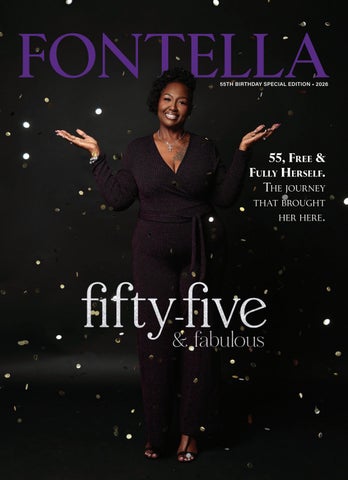
FONTELLA 55TH BIRTHDAY SPECIAL EDITION • 2026
55, FREE & FULLY HERSELF. THE JOURNEY THAT BROUGHT HER HERE .
“It’s because of the dark side that I’m able to shine my light.”
FONTELLA
Fifty-Five & Free How Fontella Humphrey Finally Learned to Love Herself
T
by Candice Marie Benbow Photography by John Brown
here is a particular kind of freedom that only comes from having survived your own life. Fontella Humphrey knows this freedom intimately. At 55, the North Carolina native—social worker, mother of two, grandmother of three—carries herself with the quiet authority of a woman who has walked through fire and decided, on the other side, to build something beautiful. Fontella is quick with a laugh, slower with her tears, and absolutely ferocious in her self-awareness. She doesn’t speak in platitudes. She speaks in truth, the kind that costs something to say out loud. “It’s because of the dark side that I’m able to shine my light.” THE GIRL SHE WAS By the time Fontella was 12 years old, she had already become a mother—not to her own children, but to her younger siblings. “I can’t say that my childhood was bad,” she says. “But I took on a lot of responsibility early because I didn’t have a choice.” That early weight-bearing shaped her in
ways she is still uncovering. Like most Black families, the household rule was airtight: what happens in the house stays in the house. Silence, she learned, was survival. But silence has a way of accumulating. By the time she was a teenager, she was carrying trauma she had no words for and no safe place to set it down. At the same time, Fontella became among the 60% of Black girls who experience some form of sexual abuse and violence before the age of 18. And like most girls, she held it in and learned to adapt to her trauma. That was until those were no longer options. “When it started to manifest,” Fontella says, “it came out as fighting. I didn’t take no [mess] from nobody.” She pauses, reflecting. “And I realized that was never really me. That person was reacting that way because of the trauma.” “I’ve always felt like I couldn’t do certain things because of my height, my size. If I spoke my mind, then she’s mad. She’s an aggressive Black woman. Why can’t I have the same passion that you have?”
THE WOMAN SHE BECAME At 25, Fontella was running. Hard. Working two jobs, raising kids, trying to fit together pieces of a puzzle she hadn’t chosen. “I was on a fast track to going nowhere,” she says with the clarity of hindsight. “I lost sight of myself because I was trying to be everything for everybody and prove that I could do things a better way.” She would eventually go back to school, attending Shaw University and earning a degree in social work. She saw it not just as a career, but as a calling. For 23 years, she gave that calling to the state of North Carolina. She worked at a prison, with people living on the margins and long forgotten by society. But institutions, she discovered, do not always honor what they consume. When a workplace incident left her vulnerable, the system that had benefited from her labor for over two decades shut her out. “Those people did not care anything about me,” she says plainly. “I am not going to ever live my life in a bubble because I’ve let someone condition my mind to think that this is the best that I can do.” She resigned. And in the leaving, she found something she hadn’t expected: herself. “When I walk into the room, if you look, keep looking
because I’m going to give you something to look at. I used to walk with my head held down. Not anymore.” ON LOVE & LOSS Fontella is honest about romantic love in a way that women her age are rarely given permission to be. She has had heartbreaks. She has settled. She has looked for love in people who were, as she puts it, “only there for what they could get.” “Hurt people, hurt people,” she says without flinching. But she is not bitter. She is, remarkably, hopeful. “I think my later years will probably bring about the love of my life,” she says with a grin in her voice. And then there is her grandmother. Ruth Humphrey, the woman who raised her and kept the family anchored. “I always thought that my grandma would never, ever leave me in this cruel world by myself,” Fontella says, her voice softening. Navigating the world without her grandmother’s voice at the end of a phone call has been one of the hardest chapters. Fontella smiles as she remembers her grandmother, often having to endure her blunt truth that Ms. Humphrey could never seem to soften. “What I wouldn’t give to have her hurt my feelings now,” she says, laughing through something tender. “I think I’m okay. And I think she knew that I was
going to be okay.” “I don’t have to drain myself dry. I can take time to fill my cup now. I love my kids. I love my family. But I’ve also learned to love me.” THE GRANDMOTHER GETS TO BE
SHE
If motherhood taught Fontella how to protect, being a grandmother has taught her how to soften. She admits that, being a young mother and trying to raise two Black boys in the ‘90s, hardened her in ways that weren’t always healthy or helpful. Now, grandparenthood is giving her another chance. “I feel like it’s given me the opportunity to correct some of my wrongs,” she says. “I wasn’t that soft mom because I never had that.” With her grandchildren, she is different. She laughs, recounting how her sons still clock the shift. But she doesn’t apologize for it. She has earned the right to delight in her grandchildren without the weight of survival pressing down on every interaction. “I’ve always wanted to give my kids those things that I didn’t have,” she says. “I didn’t get to do that how I wanted with them but I get to do that with my grandchildren and that really makes me happy.”
FONTELLA
WHAT FREEDOM FEELS LIKE AT 55
it’s in God’s time. Anything I’ve ever prayed for, I’ve always received it.”
Ask Fontella to describe a perfect day and she will tell you, without hesitation, no agendas. “I’m a free spirit. I hate agendas.” A perfect day starts with morning tea and prayer, then opens into whatever calls to her: lunch with friends, the beach, the bed. “I love being around my house,” she says. “It’s just a sense and a feeling of peace that I get when I come through my back door.” That peace wasn’t given to her. She built it, slowly and intentionally, through a decade of doing the hard inner work—making amends to people she had wronged, releasing anger she carried too long, forgiving others and herself. Her faith, she says, is not the performative kind. She is not a “Bible thumper”. She’s something much more substantive and honest. She is a woman who believes that what she puts into the universe returns to her. “I spent a lot of time not believing that I was good enough,” she says, with a tenderness in her voice that is its own superpower. But I know who I am, and I know that was never true. I was a good woman. I am a good person.” And she is still on the journey. “I’m still learning more about me and embracing me a little bit more every day.” “I always say that what is meant for me is for me. It’s not in my timing,
HER HOPES FOR THE YEARS AHEAD Fontella Humphrey does not want a small life. She wants to travel and watch her grandchildren grow. She wants to see her sons continue to flourish, and she wants to love freely and be loved fully. “I want to live out my years, however many God sees fit for me, with love and with peace,” she says. “With dignity and respect.” She isn’t asking for much but what she’s asking for is everything. “I just want to live life and just be happy. I want to live my life like it’s golden.” “Self-awareness is a beautiful thing. It can be difficult, but self-awareness is a beautiful, beautiful thing.” When Fontella turned 50, she thought she already understood what people meant when they said things shift. She didn’t, not yet. But then it happened. “I don’t see things the same way. The small things, I appreciate more.” She is, she says simply, just happy being her.
—Fontella Humphrey
FONTELLA
scan to receive gift registry & more photos
FONTELLA & fabulous