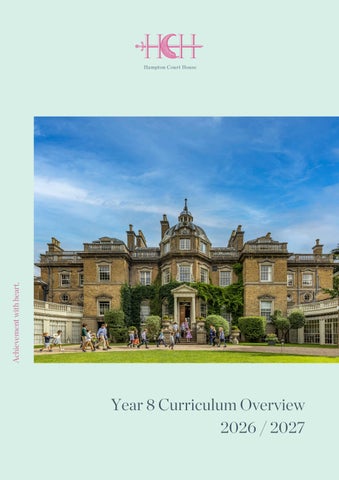
Achievement with heart.
Year 8 Curriculum Overview 2026 / 2027
Year 8 Curriculum Overview 2026 / 2027
Achievement with heart.
Contents Introduction
4
Art
7
Computer Science
9
Design & Technology
11
Drama
13
English
15
French
17
FLAM
19
Geography
21
History
23
Latin
25
Mandarin
27
Maths
29
Music
31
Philosophy
33
PSHE
35
Science
37
Spanish
39
Sport
41 2
Year 8 Curriculum Overview 2026 / 2027
Teaching and Curriculum at Hampton Court House At Hampton Court House Senior, we take pride in the breadth and depth of our curriculum. Our commitment to providing an exceptional educational experience for your child is at the heart of everything we do. We know that every child is unique, and so we tailor our approach to ensure that each individual thrives academically, socially, and personally. While our curriculum is carefully planned, we are also strong believers in adaptive teaching that responds to the needs and interests of our students. Therefore, whilst our core curriculum is outlined here for all students, the way in which it is delivered and the depth in each subject will vary to ensure your child gets the very best educational experience. Lessons are designed to be not only informative but also interesting, engaging, supportive, and challenging. Our teachers enable children to actively participate in lessons, learn, and demonstrate new knowledge, skills, and ideas. We believe in empowering our students to shape their own voices within our dynamic yet nurturing community. The curriculum for Years 7 – 9 at Hampton Court House is designed to deepen children’s knowledge and understanding while developing approaches to critical thinking, creativity, and independence. We aim to provide a challenging and stimulating learning environment that encourages children to explore their interests and develop their strengths whilst creating a setting where mistakes are allowed, and questions are welcomed. Our intent is to prepare children for GCSE’s, A levels and beyond with a skillset that allows them to make the most of any opportunities afforded to them, taken with a global perspective. Our curriculum implementation for Years 7 – 9 involves a diverse range of teaching strategies and learning experiences. We emphasise subject-specific expertise and interdisciplinary connections through both lessons and a comprehensive programme of extra-curricular activities to ensure both breadth and depth that both enrich the curriculum and promote intellectual curiosity. Teachers use formative and summative assessments to guide instruction and provide constructive feedback on a half termly basis whilst additionally imbuing in them the techniques needed ultimately to respond to GCSE style questions. Where needed, we also offer open subject clinics to help address individual learning needs and foster academic excellence. The impact of our curriculum for Years 7 – 9 is reflected in the high level of academic achievement and personal development of our students. Typically, at least one grade higher compared to matched peers nationally at GCSE. They demonstrate proficiency in advanced subject areas, strong analytical and research skills, and a readiness to tackle complex challenges whilst not being afraid to make mistakes. Our students show increased confidence, leadership abilities, and a sense of community responsibility. They immerse
Achievement with heart.
themselves in Drama and the Arts, performing, creating, and representing the school in many ways. Ultimately, they are confident to embark on their GCSE programmes with a sense of purpose and belief, safe in the knowledge they will be supported as they enter then next phase of their education.
4
Year 8 Curriculum Overview 2026 / 2027
Key Contacts Katy Deacon Vice Principal Academic kde@hchnet.co.uk Rob Armiger Assistant Principal | Director of Studies rwa@hchnet.co.uk
Achievement with heart.
Head of Upper Prep and Lower Senior (Year 5 - 8) Jack Ginger jgi@hchnet.co.uk
6
Year 8 Curriculum Overview 2026 / 2027
Art Introduction A graphic design project to create an illustrated letter form. This project involves collecting personal visual research, learning skills to simplify information into bold design elements, and combining those elements creatively to represent a place visually in its initial letter. Assessment Student work is assessed during the lessons with practical help offered when necessary. Understanding is assessed gradually as they progress because students learn by doing. Students are also encouraged to selfassess through refining their own work and reflecting on each other's. Their memory and understanding of processes are assessed through write ups which they are asked to document in their sketchbooks at the end of each project. Year Overview
Achievement with heart.
Term
What are we studying?
Autumn 1
Graphic design
Autumn 2
Interaction of colours Looking at the work of Josef Albers, students reinforce their knowledge of The properties of colours And study How colour and tone create form How context changes appearance
Spring
Continuation with colour studies Looking at the work of German Expressionist painter Gabrielle Munter students will study Complementary palettes How to create harmony through limited palettes The use and effects of cloissonism Students will be working throughout this term with acrylic paint
Summer
Automata Looking at the history of automata from early Egyptian toys to the Cabaret Mechanical Theatre in the 1970s Students make their own flying bird automata Creating wire and cardboard mechanisms, with cranks and levers Making coloured textured papers to decorate their birds Skills: construction, design, colour, humour.
7
Year 8 Curriculum Overview 2026 / 2027
Computer Science Introduction The syllabus in Year 8 includes materials and concepts recommended by the National Centre for Computing Education for Key Stage 3, as well as topics and resources from other established and respected educational organisations. The activities alternate throughout the year between predominantly theory topics and then more practical applications. This ensures the students have hands-on experience of early programming concepts, as well as building an understanding of the wide scope and complexity of the subject. In the theory periods, gamified learning will also be used to illustrate and embellish the topics to maintain student engagement, and in the more practical sessions, students will be required to maintaina log of their activities, which will form part of their assessment. Year Overview Throughout each term, low-stakes testing will check on the student’s progress, homework tasks will be checked, and the student’s electronic exercise book in Class Notebook will be reviewed. After each unit is completed there will be a formal test. These will take place online during normal lessons. At the end of the year there will be an end of year exam covering all the topics from the whole year. This will be during the school’s assessment week. Throughout the year, each student’s written work - completed entirely in Teams/Class Notebook – will be considered in the assessment of their progress. Assessment
Achievement with heart.
Term
What are we studying?
Autumn 1
We start the year off with the NCCE’s unit on Computing layers – covering a brief history of computing, hardware, CPU and Operating Systems, Logic and AI.
Autumn 2
We continue with the NCCE’s unit on Computing layers. There will be an assessment before the end of term. In the last lesson before Christmas, students will create a Christmas-related image using Python.
Spring 1
After Christmas, students will start with Python programming. They will be using Python to control a turtle drawing geometric shapes. There will be a short assessment in the final lesson.
Spring 2
The half term leading up to Easter will be spent studying data representation – bits, binary and hex.
Summer 1
The summer term will see students studying how AI works, what machine learning is, how image recognition works and what ethical questions arise from how AI learns.
Summer 2
After a revision lesson and assessment week, students will return to Python programming for the final few lessons of the term. 9
Year 8 Curriculum Overview 2026 / 2027
Design & Technology Introduction In the first half of the term, Year 8 students will design and manufacture a USB rechargeable handheld fan with an ergonomic handle. Through this project, they will develop their understanding of basic electronic systems, including simple circuits, motors, power sources, and premade electronic components. Students will explore how design influences product performance by considering factors such as aerodynamics, stability, user comfort, collapsibility and functionality. Alongside the electronic elements of the project, students will investigate ergonomics and anthropometrics to design a handle that is comfortable and suitable for a range of users. They will also explore the properties and suitability of different materials, learning how material selection affects durability, sustainability, appearance, and performance. Practical workshop activities will develop students' confidence in measuring, marking out, cutting, shaping, forming, and assembling materials accurately and safely. Students will also investigate colour stability and finishing techniques, considering how products can maintain their appearance over time. In the second half of the term, students will be introduced to casting and mould making techniques. They will work with materials such as Jesmonite and plaster to design and manufacture a range of small products, including coasters, jewellery, and keyrings. Through this process, students will learn how to create moulds, mix and pour materials correctly, and apply finishing techniques to achieve a high-qualityoutcome. Students will explore the properties of casting materials and evaluate the suitability of different manufacturing methods for a range of products. Throughout the term, students will continue to record their work in an online PowerPoint portfolio. They will document their research, design development, practical processes, testing, and evaluations, developing their ability to communicate ideas effectively while building their technical understanding of Design and Technology. Assessment Design portfolio presentation, peer assessment, quizzes and questionnaires. Year Overview Term
What are we studying?
Achievement with heart.
Core technical principles: Developments in new materials Materials and their working properties.
Autumn, Spring, Summer
Specialist technical principles: Using and working with materials Surface treatments and finishes Specialist techniques and processes. Designing and making principles: Investigation, primary and secondary data Prototype development Material management Specialist tools and equipment Specialist techniques and processes.
11
Year 8 Curriculum Overview 2026 / 2027
Drama Introduction Year 8 Drama develops students’ confidence, creativity and performance skills through a variety of theatrical styles and genres. Students begin by exploring comedy, learning techniques such as slapstick, physical theatreand scripted comedic performance. They then study and perform a full play, building skills in characterisation, collaboration and audience awareness. Later in the year, students take part in an immersive promenade theatre adaptation of The Wind in the Willows, exploring creative storytelling and the use of performance space. The year concludes with a Whodunnit murder mystery unit, where students develop devising, improvisation and suspense-building skills while creating engaging mystery narratives. Throughout the course, students strengthen their performance, teamwork, communication and problem-solving abilities. Assessment Students are assessed throughout the year on both their rehearsal process and final performances. During rehearsals, teachers assess students’ creativity, collaboration, problem-solving and contribution to group work through ongoing observation in lessons. Performance assessments focus on students’ ability to create and sustain believable characters using a range of vocal, physical and spatial techniques. Students will also take part in a live performance of The Wind in the Willows, demonstrating their ability to apply rehearsal skills in front of an audience. Regular verbal feedback is provided in lessons, with individual feedback shared via MS Teams to support students’ progress and development. Year Overview
Achievement with heart.
Term
What are we studying?
Autumn 1
Comedy Techniques Slapstick Mime Exaggeration Improvisation
Autumn 2
Comedy Performances and evaluation Using voice for comic effect Performing comedic scripts Analysing the impact of choices
Spring 1
The Wind in the Willows Exploration Exploring the themes of the story focusing on suspending the audience’s disbelief using physical theatre to create imaginary locations Learning a range of techniques to bring the story from page to stage
13
Year 8 Curriculum Overview 2026 / 2027
Drama
Achievement with heart.
Year Overview Term
What are we studying?
Spring 2
The Wind in the Willows Performances and Evaluation Performing small scenes from the story in groups Learning how to use voice, physicality and space to convey character and themes. Evaluate the impact of their dramatic choices
Summer 1
Performing a ‘promenade’ piece: Performing a piece that takes the audience through various locations Devising ideas and developing characters based on a theme Working as an ensemble to produce a performance
Summer 2
Darkwood Manor: Exploring a ‘Whodunnit?’ Character development through understanding motives, backstories, and emotional depth Learning how to build tension and deliver dramatic moments effectively Using tone, pace, and body language to convey suspicion or innocence.
16
Year 8 Curriculum Overview 2026 / 2027
English Introduction We begin the year with an exciting class reader - Witi Ihimaera’s The Whale Rider. This wonderful story is used as a stimulus for a range of analytical and creative work, before we move briefly on to a short unit of poetry. After Christmas, we explore the world of ancient epic poetry: Homer’s Iliad and Odyssey and Virgil’s Aeneid – understanding what is arguably the foundational myth of European literature: the Trojan war and its aftermath. From there, we leap into the late 19th century to sample Arthur Conan Doyle’s Sherlock Holmes short stories, before rounding off the year with one of Shakespeare’s most complex, funny and beautiful plays: The Tempest. Assessment Students are assessed informally on a rolling basis. More formally, each unit of work will be assessed by a piece of extended writing every half term: an analytical essay or a creative piece, depending on the unit’s content. Year Overview
Term
Autumn
Spring 1
What are we studying?
The Whale Rider by Witi Ihimaera Introduction to poetry unit
Classical Epic Poetry Students will explore Homer’s epics The Iliad and The Odyssey, and Virgil’s The Aeneid. They will focus on the following themes: Love and friendship Fate Free will Honour The glory of war Rage Betrayal
Achievement with heart.
Students will practise their comprehension skills and examine the text with a creative lens, producing text transformations and different pieces of transactional writing. The final assessment will be a stylised rhetorical speech from the point of view of Odysseus’s wife Penelope, which will be marked both as a piece of writing and as a spoken performance.
Spring 2
Sherlock Holmes Short Stories by Arthur Conan-Doyle: Character analysis, language, context and structure.
15
Year 8 Curriculum Overview 2026 / 2027
English Year Overview
Term
What are we studying?
The Tempest by William Shakespeare In Summer 1, students will begin and cover the first half of the play.
Summer 1
Students will learn about the context of the play and the time it was written Students will conduct a detailed exploration of character relationships Key themes that will be covered: Fate Magic and the supernatural Revenge Love Forgiveness Man and monster Students will continue to develop their analytical skills and in-depth essay writing. The Tempest by William Shakespeare In Summer 2, students will complete and cover the second half of the play.
Achievement with heart.
Summer 2
Students will learn about the context of the play and the time it was written Students will conduct a detailed exploration of character relationships Key themes that will be covered: Fate Magic and the supernatural Revenge Love Forgiveness Man and monster Students will continue to develop their analytical skills and in-depth essay writing.
16
Year 8 Curriculum Overview 2026 / 2027
French Introduction The KS3 French course follows the Tricolore programme, providing students with a solid foundation in the four key language skills: listening, speaking, reading and writing. The course is designed to develop confidence and enjoyment in language learning while building the knowledge and skills required for future GCSE study. Throughout the year, students will develop their vocabulary, grammar and pronunciation through a wide range of engaging and communicative activities. Cultural awareness is also an integral part of the course, helping students to gain an appreciation of the French-speaking world. Where appropriate, students who demonstrate the required level of proficiency will be prepared for the DELF Junior A1 or A2 examinations, providing them with the opportunity to gain an internationally recognised qualification in French. Assessment Students' progress in the four key language skills - reading, writing, listening and speaking - will be assessed regularly throughout the year. At the end of each unit, students will complete an assessment covering reading, writing and listening. Speaking is assessed separately, allowing teachers to evaluate students' oral communication when they are confident and ready to demonstrate their abilities. In addition, regular vocabulary tests will help to reinforce learning and monitor students' progress in acquiring and retaining new language.
Achievement with heart.
Year Overview
Term
What are we studying?
Autumn 1
In Unit 1, the pupils will learn to talk about shops and shopping including what is sold in shops and say how much of something you want to buy they will also learn to talk about money and prices, and they will discuss choices when shopping. they will learn about shopping in France and practise expressing their opinions. at the end of unit 1 they will practise creative writing.
Autumn 2
In Unit 2, the pupils will talk about countries in Europe, they will learn the names of different countries and continents. they will talk about modes of transports and what they are or aren't going to do. the pupils will learn to talk about what they can and cannot do and they will be describing places.
17
Year 8 Curriculum Overview 2026 / 2027
French
Achievement with heart.
Year Overview
Term
What are we studying?
Spring 1
In Unit 3 we will work on school and routine. We will learn how to describe a morning or an evening routine, talk about daily activities, talk about what you do and don't want to do, talk more about school and describe a school trip or a day in a French school. Our cultural focus will be to find out about Louis XIV.
Spring 2
Unit 4 is about family, we will learn how to describe yourself and others, greet and introduce people, talk about staying with a French family, discuss helping at home, talk about the past, use expressions of time, talk about presents and what you have done recently, describe a visit, talk about choices, talk about television and books, describe a favourite programme or book.
Summer 1
In unit 5, we will find out about cafés in France, say what drink we’d like, learn how to buy drinks, food and snacks, describe food and recent meals, understand a short story, say what things did and did not happen, discuss menus, express likes and dislikes and order a restaurant meal.
Summer 2
In unit 6, we will discuss travel plans and revise the 24-hour clock, understand and ask for rail information, learn which verbs of the perfect tense need the auxiliary être, talk about air travel, describe a journey and a day out, discuss what we did recently, give our opinion, find out about William the Conqueror, describe a journey in the past and practise creative writing.
18
Year 8 Curriculum Overview 2026 / 2027
FLAM Introduction
16
At HCH, pupils learn French through one of two programmes: FLE (Français Langue Étrangère) is designed for pupils who are learning French as an additional language. FLAM (Français Langue Maternelle) is designed for pupils who already speak French fluently, have previously been educated in a French or bilingual setting, or have French as one of their native languages. The FLAM programme helps pupils develop and extend their existing language skills while maintaining a strong connection with the French language and culture. FLAM lessons take place at the same time as FLE lessons, but pupils are taught in a dedicated classroom in a small-group setting, allowing for personalised teaching. We follow the CNED (Centre National d'Enseignement à Distance) programme for French, which is aligned with the French National Education curriculum. From time to time, pupils in the FLE programme—particularly those who joined the French Immersion Programme in Prep and continue to demonstrate a high level of proficiency—may be invited by their French teacher to complete a trial assessment. This helps determine whether they are ready to join the FLAM programme, which is designed for fluent French speakers. Our small class sizes provide a supportive learning environment where pupils can build confidence, extend their language skills, and continue to thrive as bilingual learners. Assessment The programme is divided into units. Pupils complete one unit per term and are assessed at the end of each unit. However, the pace of learning is tailored to each pupil's individual needs and progress, so some pupils may complete more units during a term.
Achievement with heart.
Year Overview Term
What are we studying?
Autumn
Pupils will read extracts from a range of well-known French and international authors, including The Adventures of Tom Sawyer, La Gloire de mon père, Boy, and Autobiographie d'une courgette. Through these texts, they will explore childhood, family relationships and growing up, while discovering different literary genres and the use of humour in literature. They will continue to develop their reading, writing and grammar skills, focusing on sentence structure and the present and past tenses.
19
Year 8 Curriculum Overview 2026 / 2027
FLAM Year Overview
Achievement with heart.
Term
What are we studying?
Spring
Pupils will discover famous heroes through works such as The Iliad, The Odyssey, Treasure Island, Tintin and The Hunger Games. They will explore what makes a hero, compare different types of adventure stories, and learn about the unique features of graphic novels and comics. Grammar work will include using descriptive language and developing confidence with past tenses.
Summer
Pupils will study Molière's Les Fourberies de Scapin, exploring dramatic performance, different typesof comedy and the conventions of theatre. They will also read Hans Christian Andersen's The Little Mermaid, using it as inspiration to explore magical worlds and imaginative writing. Throughout the term, pupils will continue to strengthen their grammar and writing skills, including the use of the imperative, the present subjunctive, noun groups and narrative tenses.
28
Year 8 Curriculum Overview 2026 / 2027
Geography Introduction In Year 8, students build on the knowledge and skills developed in Year 7 by exploring how people, places and environments are connected in an increasingly globalised world. The curriculum encourages students to think critically about contemporary issues, including urbanisation, migration, global trade and climate change, while developing an understanding of how these shape the world around us. Throughout the year, students investigate how settlements develop and become sustainable, explore the impacts of globalisation through real-world case studies, examine the causes and consequences of migration, and evaluate the challenges posed by climate change. They also deepen their understanding of the geography of the UK and explore how exploration and map-making have shaped our understanding of the world. Alongside subject knowledge, students continue to develop the skills of a geographer. They learn to interpret maps, graphs and geographical data, construct detailed explanations, analyse evidence and evaluate different viewpoints using examples and case studies. These skills prepare students for the increasingly analytical demands of Year 9 and provide a strong foundation for future GCSE study. Assessment Assessments will be twice per topic, alongside one book check per half term. Examples of assessments will be: Key terms tests End of topic tests Graphical analysis X2 Poster presentations.
Achievement with heart.
Year Overview Term
What are we studying?
Autumn 1
Settlements and Urban Geography What is a settlement, site and situation, factors for location. The function and role of settlements; high and low order services and settlements. Considering the spatial distribution of settlements (various types). Why some settlements grew. What the functions of a settlement are, and how this helped some to prosper. E.g. Manchester Urban land use models (Burgess Model) and the characteristics of different urban zones. Integrated transport systems and the problem with cars; public transport The concept of sustainability; emphasise public transport, green spaces and safety.
21
Year 8 Curriculum Overview 2026 / 2027
Geography
Achievement with heart.
Year Overview
Term
What are we studying?
Autumn 2
Globalisation – ‘What lies in my Frappuccino? Understanding Globalisation: Students explore how the world is increasingly interconnected through products, people, ideas, and technology. Global Trade and Supply Chains: The journey of everyday items—like iPhones and coffee—is used to illustrate complex international supply chains. The Coffee Case Study: Coffee is used as a central case to explore food miles, production conditions, and global demand. Ethical Trade and Fairtrade: Students critically assess the inequalities of global trade and examine how Fairtrade aims to create a more just system.
Spring 1
Population Change - ‘Do the push factors outweigh pull factors for international migration?’ Understanding population distribution in the UK and factors influencing these patterns Creation of population graphs through time Describing different types of migrants and causes for migration. Understanding both push and pull factors and their link to migration patterns. Describing and explaining the positive and negative impacts of migration to both the source and origin countries Exploring two separate case studies of migration: Mexico and Syria.
Spring 2
Climate Change – ‘How dangerous is climate change to our future?’ Understand the causes of climate change, including natural and human factors. Explore the greenhouse effect and its impact on global temperatures. Examine evidence of climate change and its global and local impacts. Investigate how individuals, governments, and organisations are responding to the climate crisis. Consider the importance of sustainability and personal responsibility in tackling climate change.
Summer 1
What is the Geography of the UK? Students develop knowledge of the UK’s key physical and human features. Students locate major upland and lowland areas and understand how landscapes vary. Students explore UK culture and how places differ across the country. Students examine opportunities and challenges in urban areas, especially London. Students learn how UK industry has changed over time, from manufacturing to services and technology. Students consider how these changes have shaped people’s lives and different places in the UK.
Summer 2
Maps, Myths and Legends Students to explore the history of cartography and what has driven changes in our understanding the of world through time. Follow the footsteps of four major explorers and how they shaped our understanding of the world. To investigate if exploration was only a force of good (cultural and Colombian exchange) or led to exploitation and spread of diseases.
22
Year 8 Curriculum Overview 2026 / 2027
History Introduction Students will be exploring British, European and world history, c.1500-c.1900. Within each of the broad topics listed below, students will investigate a series of enquiry questions, written to pique their interest in the past and provide them a problem to wrestle with, just as historians do. Assessment Students will complete in-class assessments, including essay writing, source analysis, knowledge tests, and creative challenges. Essay writing will challenge students to communicate arguments about historical concepts, such as causes or change and continuity. Source analysis will challenge students to critically evaluate materials from the past, explaining what we can learn from those materials and why they are valuable. Knowledge tests are intended to teach students the important skill of revising content, so they are well prepared in techniques that will serve them through to A Level should they wish to pursue it. Creative challenges are designed to push students to represent their historical knowledge and understanding in a way that mimics the application of history in the world today, including media-based applications such as TV and documentaries. Assessments will take place each half-term, giving students opportunities to learn, apply, reflect and then practise again at regular intervals. Year Overview
Achievement with heart.
Term
What are we studying?
Autumn 1
The Big Story of the Early Modern period, 1500-1900 Assessment: Do you agree with Collin’s view on how Europeans redefined themselves, 1500-1900?
Autumn 2
Rulers in focus: Why did the Mughals become so powerful during the early modern period? Assessment: A short documentary on the power of the Mughal Empire
Spring 1
Early Modern Beliefs & Power Assessment: Substantive knowledge test
Spring 2
Early Modern Ordinary Lives: did they get better? Assessment: Substantive knowledge test
Summer 1
Diversity: Early Modern Migrants Assessment: Create and explain a poster, infographic or digital presentation commemorating the impact of at least one of the four migrant groups studied in this unit
Summer 2
World Study: The Americas Assessment: Write a diary/journal from the perspective of a traveller to the Americas, documenting the impact over time of European exploration and colonisation of the region
23
Year 8 Curriculum Overview 2026 / 2027
Latin Introduction In Year 8, pupils build confidence as linguists and historians as they pick up the story of much-loved characters after the eruption of Vesuvius in Book I of the Cambridge Latin Course. In Book II, we first journey to the fringes of the Empire in Roman Britain, where we meet our villain, Salvius, before having a brush with the criminal underworld of Alexandria! Pupils encounter more complex grammar and a broader Roman world, learning to approach translation with growing independence while making meaningful connections between language, culture and civilisation. Assessment Regular vocabulary tests Grammar assessments Translation assessments Civilisation assessments End-of-year examination.
Achievement with heart.
Year Overview Term
What are we studying?
Autumn 1
Stages 13–14: in Britannia and apud Salvium Culture: life on a British farm; Roman rule, villas, slavery and provincial administration. Grammar: review of imperfect and perfect tenses; infinitives; adjective agreement. Development of translation strategies for longer narrative passages.
Autumn 2
Stages 15–16: rex Cogidubnus and in aula Culture: client kings, baths, palaces, entertaining guests and displays of status. Grammar: relative clauses with qui, quae, quod; consolidation of noun cases; genitive of possession. Vocabulary building around court life, power, loyalty and conflict. End of term assessment.
Spring 1
Stage 17: Alexandria Culture: Alexandria, trade, travel, the harbour, libraries and life in a cosmopolitan province. Grammar: personal pronouns; demonstratives such as hic, haec, hoc; further work on cases and agreement. Practice in identifying who is doing what in more complex sentences.
25
Year 8 Curriculum Overview 2026 / 2027
Latin
Achievement with heart.
Year Overview Term
What are we studying?
Spring 2
Stage 18: Eutychus et Clemens; everyday life, work and danger in Alexandria. Culture: trade, shipping, occupations, freedmen and social mobility in the Roman Empire. Grammar: irregular verbs including possum, volo, nolo and malo; further use of infinitives. Expansion of vocabulary for movement, work, danger and decision-making. End of term assessment.
Summer 1
Stage 19: Isis Culture: Egyptian religion under Roman rule, temples, festivals and the worship of Isis, mystery cults in Roman Egypt. Grammar: pluperfect tense; questions; consolidation of tenses to distinguish sequence of events. Translation focus on narrative order, cause and consequence.
Summer 2
Stage 20: medicus Culture: ancient medicine, doctors, healing practices and daily life in Alexandria. Grammar: imperatives; vocative case; demonstrative and personal pronoun consolidation; revision of declensions. End-of-year consolidation of Stages 13–20: vocabulary, cases, tenses, infinitives, relative clauses and pronouns. End of year examination.
26
Year 8 Curriculum Overview 2026 / 2027
Mandarin Introduction In Year 8, students build on the language and cultural knowledge developed in Year 7, increasing their confidence and fluency in Mandarin through a wider range of everyday topics. Students further develop their speaking, listening, reading and writing skills while expanding their vocabulary and understanding of Chinese grammar. Throughout the year, students learn to talk about school life, including subjects, timetables, uniforms and school facilities, before moving on to topics such as food and drink, ordering meals in a restaurant, and expressing likes and dislikes. In the summer term, students develop the language needed to discuss holidays, including destinations, transport, weather, activities and personal opinions, while using longer and more varied sentence structures. Cultural learning remains an important part of the curriculum. Students explore similarities and differences between schools, holidays and everyday life in China and the UK, as well as learning about Chinese meals, table manners and the traditions of Chinese New Year. Through role-play, collaborative activities and authentic cultural experiences, students continue to develop both their language skills and their understanding of Chinese culture. By the end of Year 8, students will be able to communicate with increasing accuracy and confidence across a range of familiar topics, using a broader range of vocabulary, sentence structures and Chinese characters. Assessment Assessment is continuous throughout the year and includes weekly vocabulary tests to reinforce new vocabulary and Chinese characters. At the end of each half term, students complete assessments in listening, reading, translation and writing, alongside regular speaking activities and oral assessments to develop fluency and confidence. Teacher observation, classwork and homework are also used to monitorprogress across all four language skills and support students' preparation for future GCSE study. Year Overview
Achievement with heart.
Term
What are we studying?
Autumn 1
School life Talking about school subjects Expressing opinions about different lessons Describing the school timetable
Autumn 2
Continuing School life Describing classrooms and school facilities Talking about what you wear to school Comparing schools in China and the UK Using connectives to extend sentences
27
Year 8 Curriculum Overview 2026 / 2027
Mandarin Year Overview
Term
Spring 1
Achievement with heart.
Spring 2
What are we studying? Jinbu 1 Food and Drink Talking about what you eat and drink Ordering food in a restaurant Expressing likes and dislikes Continuing Food and Drink Learning about Chinese meals and table manners Role-playing a Chinese menu conversation Preparing for and celebrating Chinese New Year through themed vocabulary and activities
Summer 1
Holidays Talking about where you went on holiday Describing the weather and transport Talking about how you travelled and who you went with
Summer 2
Continuing Holidays Giving opinions about your holiday Talking about holiday activities in more detail Comparing holidays in China and the UK Revision and end-of-year assessments
28
Year 8 Curriculum Overview 2026 / 2027
Maths Introduction The core focus of the Year 8 curriculum is for students to develop mathematical reasoning, alongside developing their procedural skills. Where students are revisiting a familiar topic, they will be extending their skills by solving thought-provoking mathematical problems. When learning an entirely new skill, students will be expected to show conceptual understanding as well as procedural fluency. Reasoning includes being able to follow a line of enquiry, conjecturing about relationships and generalisations, and developing a justification or proof using precise mathematical language. Students are encouraged to use concrete and pictorial representations of mathematics and to use these as tools to both understand and communicate the mathematics that they are learning. The correct use of mathematical language and notation is encouraged throughout, as it is a key feature for communicating mathematical thinking accurately. Assessment Students will sit a 45-minute written assessment at the end of the Autumn term, and in the Summer term. They will also have continuous assessment through low-stakes mini-tests, so that they can track their progress and identify what areas of they might need to work on. Any work that students complete online, on app.century.tech, will be considered when evaluating their progress and attitude towards learning. Year Overview
Achievement with heart.
Term
What are we studying?
Autumn 1
Accuracy and estimation Percentages Forming and solving linear equations
Autumn 2
Sequences Linear graphs Transforming 2-D figures
Spring 1
Ratio review Real-life graphs Direct and inverse proportion
Spring 2
Univariate data Bivariate data
Summer 1
Angles in polygons Bearings
Summer 2
Circles Volume and surface area of prisms.
29
Year 8 Curriculum Overview 2026 / 2027
Music Introduction Year 8 Music is taught through practical performing, composing and listening activities. Pupils explore film music, ensemble performance, popular songwriting, theme and variations, jazz improvisation and Programme music, while developing their skills in keyboard playing, singing, composition, notation, ensemble performance and music technology. They use GarageBand and other digital tools to create and arrange music, working both independently and collaboratively. Assessment Pupils are assessed through performances, compositions, music technology projects and short listening or written tasks. Assessment focuses on performing skills, creativity, musical understanding and the use of appropriate musical vocabulary. Pupils receive regular verbal and written feedback during lessons, identifying what they have done well and how they can improve. They are given opportunities to rehearse, refine and develop their work.
Achievement with heart.
Year Overview Term
What are we studying?
Autumn 1
Film Music Pupils explore how music is used to create mood, atmosphere, character and tension in films. They develop their understanding of techniques such as leitmotifs, underscoring and sound effects before composing music for a short film sequence using instruments or music technology.
Autumn 2
Christmas ensemble Pupils develop their singing and instrumental skills by rehearsing Christmas music as an ensemble. They learn to maintain an individual part, follow a conductor and perform confidently with others, preparing music for the school carol service.
Spring 1
Pop song writing Pupils explore the musical features and structure of popular songs. They develop ideas for chords, melodies, bass lines, rhythms and lyrics before composing, arranging and performing their own song.
Spring 2
Theme and variations Pupils learn how a musical theme can be developed and transformed. They experiment with changes to rhythm, pitch, tempo, dynamics, texture and instrumentation before creating their own set of variations.
31
Year 8 Curriculum Overview 2026 / 2027
Music
Achievement with heart.
Year Overview Term
What are we studying?
Summer 1
Jazz improvisation Pupils explore the main features of jazz and develop their improvisation skills. They perform chord patterns and bass lines and use scales and rhythmic ideas to create and perform their own improvised melodies.
Summer 2
Programme Music Pupils explore how composers use musical elements to represent stories, characters, places and events. They then develop and compose their own piece of programme music.
48
Year 8 Curriculum Overview 2026 / 2027
Philosophy Introduction In Year 8, students build on the foundations established in Year 7 by exploring some of philosophy's most challenging questions about knowledge, truth, responsibility and justice. They learn how to evaluate arguments, distinguish strong from weak reasoning, and consider how philosophical ideas continue to shape modern society. Throughout the course, pupils are encouraged to think critically, challenge assumptions respectfully and support their views with reasoned evidence. The year begins by extending students' understanding of the Abrahamic religions through a study of Islam before moving into epistemology - the philosophical study of knowledge and truth. Students then explore the debate over free will and moral responsibility, apply ethical theories to contemporary medical issues, and conclude by examining competing ideas about justice, punishment and the organisation of society through the work of thinkers such as Plato, Rawls and Marx. Assessment Year 8’s “Big Question” is “How can we know things?” Half-termly assessments will develop students’ oracy skills, using a range of tasks such as roundtable discussions, formal debates and solo presentations. Year Overview
Achievement with heart.
Term
What are we studying?
Autumn 1
Ethics and the Abrahamic religions: How does Christianity judge what is right? How does Judaism judge what is right?
Autumn 2
How does Islam judge what is right? Comparison of the three Abrahamic religions and their approach to ethics
Spring 1
An introduction to epistemology: Knowledge, belief, truth and justification Valid vs. sound argument Sources of knowledge: a priori and a posteriori Necessary vs. contingent truth
Spring 2
Free will: Determinism Science Compatibilism Are we morally responsible? 33
Year 8 Curriculum Overview 2026 / 2027
Philosophy Year Overview
Achievement with heart.
Term
What are we studying?
Summer 1
Medical ethics: Human and medical rights Attitudes and debates around life in medicine Organ donation and transplantation
Summer 2
Justice: Punishment John Rawls A return to Plato’s Cave Marx and modern analysis
34
Year 8 Curriculum Overview 2026 / 2027
PSHE (Personal, Social, Health and Economic Education) Introduction Personal, Social, Health and Economic Education (PSHE) supports students’ personal development, emotional wellbeing and understanding of the wider world. The Year 8 programme includes the statutory elements of Relationships and Sex Education (RSE) and Health Education, and helps students develop the knowledge, confidence and practical skills needed to make informed, responsible and healthy choices. The curriculum is organised around six key learning themes: Careers and Aspirations, Finance and British Values, Healthy Relationships, Sex Education, Healthy Body and Healthy Mind. These themes are revisited throughout the Senior School so that students can deepen their understanding as they mature. This spiral approach helps students build confidence, empathy, resilience and independence over time. Lessons are predominantly discussion-based, supported by written activities where these help students explore ideas in greater depth or apply their learning. At the end of each half term, students complete selfreflection sheets so that teachers can monitor understanding and adapt future teaching. The programme may also be adjusted where appropriate to respond to students’ current needs, concerns and feedback. Parents have the right to request that their child be withdrawn from sex education delivered as part of RSE up to three terms before the child turns 16. At that point, if the student wishes to receive sex education, the school will make arrangements for this to take place during one of the three terms before their 16th birthday. Further information will be shared with parents by the school. Assessment PSHE lessons are predominantly discussion-based, with written activities used where they support deeper understanding and application. At the end of each half term, students complete a self-reflection sheet. Teachers use these reflections, alongside their observations of participation and understanding, to monitor progress and adapt future teaching. PSHE is not assessed through formal examinations or grades. Year Overview
Achievement with heart.
Term
What are we studying?
Autumn 1
Living in the Wider World - Careers and Aspirations Managing my behaviour to achieve Communication skills Teamwork Navigating work, study and careers Entrepreneurship.
Autumn 2
Living in the Wider World - Finance and British Values Understanding credit and debit Staying in control of money Consumer rights Friendship challenges Similarities, differences and peer influence.
35
Year 8 Curriculum Overview 2026 / 2027
PSHE (Personal, Social, Health and Economic Education) Year Overview
Achievement with heart.
Term
What are we studying?
Spring 1
Relationships - Healthy Relationships and Friendships Healthy behaviours in relationships Gender and stereotyping Homophobia and transphobia Prejudice.
Spring 2
Relationships - Sex Education Consent Contraception Sexting The dangers of pornography Sexually transmitted infections (STIs).
Summer 1
Healthy Body - Building Blocks of a Healthy Body Body image and self-perception Nutrition, diet and energy balance Vaping, nicotine and addiction Movement, motivation and physical strength Cancer awareness and prevention.
Summer 2
Healthy Mind Mindfulness Building self-confidence Emotions Self-awareness.
36
Year 8 Curriculum Overview 2026 / 2027
Science Introduction This year we will expand on the science taught in Years 6 and 7 and begin to lay the foundations for starting your GCSEs next year. There are four main topic areas: Maths for Science, which will be taught throughout the year Biology topics: Health and Lifestyle, Photosynthesis and Respiration & Ecosystems and Adaptations Chemistry topics: The Periodic Table, Separating Mixtures & Metals Physics topics: Electricity and Magnetism, Energy & Motion and Pressure. The textbook we are using is Oxford Smart Activate 2, which is available to you online using a website called Kerboodle. You will have three science lessons per week and should expect to do about one hour of science work each week at home to support your learning. Assessment There will be small tests at the end of each topic, the results of which will contribute to your flight path assessments in the autumn and spring terms. There will then be a larger exam in the summer which will be used to evaluate your overall flight path for the year. You will also take an assessment on the Quest platform online. Year Overview
Achievement with heart.
Term
What are we studying?
Autumn 1
Health and Lifestyle The Periodic Table
Autumn 2
Electricity and Magnetism Separating Mixtures
Spring 1
Energy
Spring 2
Metals
Summer 1
Photosynthesis and Respiration
Summer 2
Ecosystems and Adaptations Motion and Pressure.
37
Year 8 Curriculum Overview 2026 / 2027
Spanish Introduction 2 lessons a week Year 8 will begin this course by delving deeper into GCSE topics, taking most resources from Viva 2. During the first term, they will learn to introduce themselves and talk in more detail about themselves, both physically and in terms of personality and their families, as well as what they like to do in their free time, even depending on the weather. They will also be able to express their hobbies in detail, including when they do them and why they like them. The futureand conditional tenses will be introduced to discuss future plans related to these topics. Assessment When it comes to assessing this part and ensuring that students have acquired the appropriate knowledge on the topic, they will have a written exam that includes reading, listening, translations, and writing sections. Year Overview
Achievement with heart.
Term
What are we studying? Stream 1 (4 lessons p/w)
Autumn 1
“ Mi familia y yo” (My family and I) Description of myself and members of my family Comparatives Who do I look like? Relationships: To get on well with… And reasons Things you like to do with your family “En mi tiempo libre/Mis pasatiempos” (Hobbies) Things you like to do and reasons Things you do depending on the weather Sports Adverbs of time.
Autumm 2
Todo sobre mi vida” (All about my life) What do you use your phone for? Music TV programmes and cinema Past tense Things you did recently Revision of the whole topic.
39
Year 8 Curriculum Overview 2026 / 2027
Spanish Year Overview
Achievement with heart.
Term
What are we studying? Stream 1 (4 lessons p/w)
Spring 1
“ En el restaurante” (At the restaurant) Meals during the day Understanding the menu How to order at the restaurant Near future (I´m going to have…) Things you are going to buy Using three tenses together. Improving how to get opinion Revision.
Spring 2
“Planes con los amigos” (Plans with friends) Arranging to go out Querer/poder Getting ready. Using reflexive verbs Clothes Events Revision.
Summer 1
“ De compras” (Shopping) Shops and items What you have in your city And what you would like to have Problems at the shops and solutions
Summer 2
Revision of the whole year material for the end of year assessment.
40
Year 8 Curriculum Overview 2026 / 2027
Sport Introduction Physical activity plays an important role in supporting students' physical, cognitive, social and emotional development. In Year 8, students will further develop their skills and understanding in two invasion games, football and netball. Lessons will take place off-site at St Mary's University, making use of its indoor sports facilities, and at Xcel Elmbridge, where students will access specialist 3G football pitches. In football, students will refine and apply a wider range of skills, including passing, shooting, dribbling, ball control, first touch and movement off the ball, within a variety of practices and small-sided games. There will be a strong focus on attacking and defending principles, helping students develop tactical awareness, decision-making and effective teamwork. Through individual practice, partner work and group activities, students will gain a deeper understanding of game play, strategy and positional responsibilities. In netball, students will further develop their throwing, catching and movement skills while improving their footwork, shooting accuracy and positional play. They will enhance their understanding of the rules and tactical aspects of the game, practising a range of passing techniques and applying them effectively in competitive situations. Learning will take place through paired activities, skill-based drills and team games, allowing students to develop confidence, communication, collaboration and leadership skills. Assessment Assessment will be ongoing throughout the term and will be based on teacher observation during lessons, skill-based practices and competitive game situations. In football and netball, students will be assessed on their ability to consistently perform and apply a range of technical skills with accuracy, control and confidence under pressure. They will be expected to demonstrate effective decision-making, adapt their tactics in response to different situations, and contribute positively to both attacking and defensive phases of play. Students will also be assessed on their tactical awareness, positional understanding and ability to influence game outcomes through effective communication, teamwork and leadership. Opportunities for selfassessment and peer evaluation will enable students to analyse performances, identify strengths and areas for development, and provide constructive feedback to others. Performance in both isolated skill practices and full-game situations will contribute to the overall assessment, alongside the demonstration of positive
Achievement with heart.
sportsmanship, resilience and commitment to improvement.
41
Year 8 Curriculum Overview 2026 / 2027
Sport Year Overview
Achievement with heart.
Term
What are we studying?
Autumn
Football: Passing, shooting, dribbling, heading, goalkeeping and attack vs defence. Netball: Passing, shooting, attack vs defence, positions & conditioned games.
Spring
Basketball: Passing, shooting, dribbling, tactics, attack vs defence. Badminton: Serving, rallying, shot selection, in game tactics and gameplay.
Summer
Athletics: 4 x 100m relay race, 100m race, 200m race, 400m race, 800m race, shot-put throw, javelin throw, discus throw, long jump, triple jump and high jump.
66