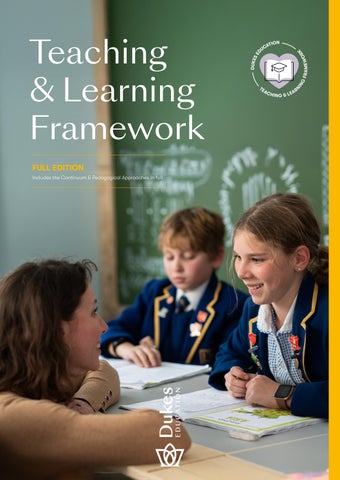
Teaching & Learning Framework FULL EDITION Includes the Continuum & Pedagogical Approaches in full
Contents 4
SECTION ONE:
16
Purpose & Principles
SECTION THREE:
Why the framework exists, what it stands for,
Understanding the Developmental Continuum
and how it supports high-impact teaching
How the continuum works as a roadmap for
and professional growth across Dukes.
growth, helping teachers and leaders reflect on practice and identify next steps.
8
SECTION T WO:
High-Impact Teaching & Learning at Dukes
38
Pedagogical Approaches
A shared definition of high-impact teaching,
The evidence-informed approaches that underpin
including the teacher standards and practices
the teacher standards and show how high-
that describe what great teaching looks like.
T H E D U K E S T E AC H E R S TA N DA R D S : 12 12 12 13
SECTION FOUR:
impact teaching comes to life in practice.
50
SECTION FIVE
1. Engage in professional learning
lllustrative Practice & Exemplars
2. Understand the student and how
examples, resources, shared practice and the
How the framework will be supported through Dukes Hub.
they learn 3. Know the content and how to teach it 4. Create supportive and safe learning environments
52
SECTION SIX:
Using the Framework in Practice Guidance on how teachers, leaders and schools
13
5. Act with Unconditional Positive Regard
13
6. Uphold Professional Ethics and Conduct
14
7. Plan for progression
14
14
15
can use the framework for reflection, coaching, professional learning and improvement.
8. Implement high impact strategies for cognitive engagement 9. Use assessment to gather evidence, provide feedback, and adapt teaching 10. Engage professionally with colleagues, parents/carers and the community
3
4
TEACHING & LEARNING FRAMEWORK
SECTION ONE:
Purpose & Principles At Dukes, our purpose is to empower our children to live an extraordinary life through education. This means supporting them to thrive as learners and individuals, both now and in the future.
THIS PURPOSE IS EXPRESSED T H R O U G H O U R C O R E VA L U E S :
We love learning. We lead with heart. We do it well. We’re a team. The role of the teacher in this endeavour is vital. High-impact teaching and learning sit at the centre of this purpose. Teaching is both a professional craft and a deeply human practice. It requires knowledge, judgement and skill, alongside presence and care. When these elements come together, they create the conditions in which students are engaged, take ownership of their learning, and thrive.
P u r p o s e a n d P r i n ciple s
5
This framework provides a clear articulation of what
Section 6 sets out in more detail how this framework
high-impact teaching means at Dukes. It establishes
can be used in practice. For example, it may support
shared expectations across our community while
professional growth and sustained improvement in
respecting the diversity of contexts in which our schools
teaching, or provide a shared language for reflection,
operate. It is aspirational and developmental in intent,
coaching, professional dialogue and classroom
designed to support professional growth over time.
observation. Schools might also choose to use the framework within cycles of professional learning that
The ten Dukes Teacher Standards are mandatory across
connect teacher development, classroom practice and
all Dukes settings and represent the shared expectations
evidence of student learning over time. The intention
for professional practice across the Dukes community. How
is that the framework supports improvement and
these standards are enacted and developed is determined
collaboration rather than compliance, helping teachers
locally, enabling schools and teachers to respond to
and leaders focus on a small number of high-impact
their unique context while working within a common
practices and develop them deeply together.
framework for excellence. The framework sets out: The primary purpose of this framework is to support –
–
what we mean by high-impact teaching
professional growth, reflection and the continuous
(teacher standards and practices)
improvement of teaching and learning. While schools may
the evidence-informed pedagogical approaches that underpin those standards
–
a developmental continuum to support professional growth, and
–
choose to draw upon the framework within appraisal, performance development or quality assurance processes, it is not intended to function primarily as an accountability tool. Its purpose is to provide a shared language for professional dialogue, development and improvement.
guidance on how the framework is used in practice across roles and contexts.
To balance consistency across the Dukes community with local autonomy, the framework distinguishes between those elements that are common to all settings and those that are determined locally.
6
Across Dukes
Determined Locally
10 Teacher Standards
Professional learning priorities
Shared language and expectations
Coaching and support approaches
Commitment to safeguarding and professional conduct
Implementation strategies
Developmental continuum and pedagogical guidance
School improvement and development planning
TEACHING & LEARNING FRAMEWORK
OUR GUIDING PRINCIPLES: These set out what this framework stands for.
1.
2.
Values-Driven
4. Evidence-Informed
Committing to Learning: Learning sits at the
Defining High-Quality Teaching: The standards
heart of Dukes. This framework reflects a shared
are grounded in established and emerging
responsibility to refine practice, model curiosity
research, translating evidence into practical
and sustain high expectations for both students
clarity across planning, teaching, assessment
and educators.
and review.
Global, Locally Adapted Connecting the Dukes Community: The framework establishes a common language for high-quality teaching across phases and regions, while allowing for professional judgement and thoughtful local adaptation.
5.
Coherence Aligning the Dukes Ecosystem: This framework is designed to sit coherently within the wider Dukes ecosystem. It aligns with the Dukes Diploma, which defines the content, skills and dispositions we seek to develop in our pupils, and provides the pedagogical clarity to support this work in classrooms. It is also intended to connect with approaches to professional development,
3.
Aspirational and Developmental
appraisal, quality assurance and school improvement across the group, while allowing flexibility for schools to implement this in ways that best suit their context.
Growing Professional Expertise: Teaching expertise develops over time. The framework includes a developmental continuum to support reflection, dialogue and continuous improvement.
P u r p o s e a n d P r i n ciple s
7
8
TEACHING & LEARNING FRAMEWORK
SECTION T WO:
High-Impact Teaching & Learning at Dukes Education What do we mean by high-impact teaching? Across Dukes schools, high-impact teaching is a shared, values-driven professional practice. It combines strong subject knowledge, an understanding of how students learn, and the ability to respond to evidence from the classroom. It is both precise and relational: grounded in evidence, and shaped by care, judgement and professional expertise. While there is a common standard across Dukes, we recognise that this will look different across phases, subjects and contexts. What remains consistent is the focus on enabling all students to learn, participate and succeed.
H igh - I m pact T eachi n g & L ea r n i n g at D u k e s E ducati o n
9
Teaching and Learning in Action:
Professional Practice and Impact:
High-impact teaching starts with the learner. Teachers
High-impact teaching is sustained through professional
interpret evidence of student thinking to understand what
learning and collaboration. Teachers reflect on and
students know, where they are struggling, and what
refine their practice, work with colleagues and engage
they need next. This allows teaching to be responsive,
constructively with families and the wider community.
equitable and inclusive. Teachers use their subject
When teaching is high-impact, students become active
expertise to structure learning clearly. They identify
and confident learners. They connect ideas, explain
key concepts, anticipate misconceptions, and support
their thinking, address misconceptions and apply
students to think, talk, write and represent ideas with
their learning in new contexts. They take increasing
increasing precision. Classrooms are safe, predictable
responsibility for their learning and experience school
and inclusive. Relationships are built on trust and
as a safe, inclusive and purposeful environment.
respect, and routines support focus and participation. Teachers create the conditions for students to take intellectual risks and persist through challenge. Teaching is purposeful. Learning goals are clear, new learning is connected to prior knowledge, and strategies such as modelling, scaffolding, questioning and guided practice
Bringing this together This section defines what high-impact teaching looks like
support understanding and independence over time.
at Dukes. The standards and practices that follow break
Planning, Assessment and Adaptation:
practice develops over time and the relevant evidence
Planning turns curriculum intent into coherent
base. Together, the framework provides a shared
learning over time. Teachers set high expectations,
language and clear direction, while allowing professional
sequence learning carefully, and consider how all
judgement and local adaptation in each school context.
this down further, while Sections 3 and 4 explain how
students will access and engage with the learning, including those with additional needs, language differences, or high prior attainment. Assessment is used to make learning visible and guide next steps. Teachers draw on diagnostic, formative and summative evidence to identify misconceptions, monitor progress and adapt teaching. Feedback is specific and actionable. It helps students understand what to do next and supports them to improve their work and take increasing responsibility for their learning. Inclusion, Participation and Belonging: High-impact teaching ensures that all students can access and participate in learning. Teachers respond to diverse needs through appropriate support, challenge and adaptation, and create equitable opportunities for participation so that all voices are heard. Students experience classrooms where they feel respected, valued and supported, and where a strong sense of belonging enables both wellbeing and learning.
10
TEACHING & LEARNING FRAMEWORK
The 10 Dukes Teacher Standards We love learning
1
2
We lead with heart
3
4
5
Engage in
Understand the
Know the
Create supportive
Act with
professional
student and how
content and
and safe learning
unconditional
learning
they learn
how to teach it
environments
positive regard
We lead with heart
We do it well
We’re a team
6
7
Uphold
Plan for
Implement high
Use assessment to
Engage professionally
professional ethics
progression
impact strategies
gather evidence,
with colleagues,
for cognitive
provide feedback,
parents/carers and
engagement
and adapt teaching
the community
and conduct
8
9
10
H igh - I m pact T eachi n g & L ea r n i n g at D u k e s E ducati o n
11
We love learning We develop deep professional knowledge about our students, our disciplines, and how learning develops over time. We remain curious and structure the content that responds to students’ thinking, readiness, interests and learning profiles, supporting learners to build understanding, meaning and purpose.
Standard 1 Engage in
Practices 1.1 Identify and plan professional learning goals 1.2 Participate in continuous cycles of professional learning
professional learning
2 Understand the student and how they learn
2.1 Understand how students learn 2.2 Understand the diverse needs of students 2.3 Understand culturally responsive teaching (languages, cultures and identities)
3 Know the content and how to teach it
3.1 Understand the content, key concepts, patterns and relationships within and across subjects 3.2 Structure the content with logical sequence and coherence 3.3 Understand evidence-informed teaching strategies 3.4 Understand literacy and numeracy as foundational learning
12
TEACHING & LEARNING FRAMEWORK
We lead with heart We cultivate safe, caring and inclusive learning environments where every student feels seen, valued and supported. We prioritise wellbeing, respond with compassion, and build trusting relationships that enable students to flourish both personally and academically.
Standard 4 Create supportive and safe learning environments
Practices 4.1 Build positive and respectful relationships 4.2 Develop social and emotional competence 4.3 Establish routines that maximise engagement 4.4 Promote risk-taking through psychological safety 4.5 Ensure equitable participation where all voices are valued
5 Act with unconditional positive regard
5.1 Champion the fundamental right of every student to be known, valued and treated with dignity and inherent worth 5.2 Cultivate a sustained sense of belonging through consistent, safe and respectful relationships 5.3 Embed a strengths-based approach that elevates student voice, agency and growth 5.4 Model a calm, responsive presence that fosters student wellbeing and relational trust
6 Uphold professional ethics and conduct
6.1 Demonstrate professional integrity and ethical judgment 6.2 Maintain professional boundaries across all learning environments 6.3 Promote equity, diversity, and social justice 6.4 Meet professional statutory and regulatory responsibilities
H igh - I m pact T eachi n g & L ea r n i n g at D u k e s E ducati o n
13
We do it well We design purposeful learning and teach with clarity. Evidence of learning informs our pedagogical decisions, shapes responsive instruction, and supports the ongoing monitoring and improvement of student progress.
Standard 7 Plan for progression
Practices 7.1 Set high expectations 7.2 Plan with intent (knowledge, skills, dispositions) 7.3 Ensure new learning connects to prior knowledge. 7.4 Design learning that develops thinking from surface to deep, enabling students to understand, apply and transfer 7.5 Secure learning through spaced retrieval and practice.
8 Implement high impact strategies for cognitive engagement
8.1 Develop learning intentions and success criteria 8.2 Use structured and inclusive questioning strategies 8.3 Apply metacognitive strategies 8.4 Adapt teaching responsively to provide support and stretch, ensuring challenge for all 8.5 Promote productive struggle and persistence in challenging work 8.6 Facilitate purposeful collaboration and peer learning
9 Use assessment to gather evidence, provide feedback, and adapt teaching
9.1 Design and implement assessments aligned to learning intentions and success criteria 9.2 Orchestrate effective discussions, questions and tasks that elicit evidence 9.3 Measure progress and adapt teaching in response to evidence 9.4 Provide feedback that moves learning forward 9.5 Mark and moderate student work to ensure accurate assessments 9.6 Support students to self-assess and monitor their learning
14
TEACHING & LEARNING FRAMEWORK
We are a team We work collaboratively to strengthen learning across our classrooms, schools and communities. We communicate openly, share professional responsibility for student success, and engage constructively with colleagues, families and the wider community.
Standard 10 Engage professionally with colleagues, parents/carers, and the community
Practices 10.1 Communicate effectively 10.2 Engage with the parents/carers 10.3 Actively contribute to the wider educational setting 10.4 Collaborate with colleagues to strengthen teaching and learning
H igh - I m pact T eachi n g & L ea r n i n g at D u k e s E ducati o n
15
SECTION THREE:
Developmental Continuum
16
TEACHING & LEARNING FRAMEWORK
How the continuum works: 1
The Domains The 4 Dukes Values.
3
Developmental Stages There are 4 stages.
We do it well
Each practice within a standard is described across developmental
We design purposeful learning and teach with clarity. Evidence ofestablishing learning → levels (e.g., Dukes Teacher Standards 2 The informs our pedagogical decisions, shapes responsive instruction, developing → and embedded → lead). There are 10 standards. supports the ongoing monitoring and improvement of student progress.
This is not a rating; it is a roadmap for growth with clear next steps.
Standard 7: Plan for progression Establishing
Developing
Embedded
Leading
Student Learning Indicators
7.1 Set high expectations
4
Practices
Communicates clear learning intentions and maintains consistent expectations for participation, effort, and completion of learning.
Frames learning as challenging and achievable for all, using structured support to ensure all student engage with ambitious learning
The continuum maps the Creates a Dukes Teacher Standards into Promotes positive climate evidence-based practices. where effort is recognised and students are encouraged to complete and improve their learning
persistence and resilience, using feedback and routines to support students in improving their learning.
Sustains high challenge, adapting teaching responsively to remove barriers and ensure all students access and succeed in challenging, ambitious learning. Builds a strong learning culture where effort, reflection, and refining learning are expected and valued, and students take increasing ownership of their progress.
Champions a Students: culture of high – attempt expectations challenging across teams, tasks and modelling how engage with to maintain learning that challenge while stretches their ensuring equity thinking. of access and – sustain effort, success for persist when Indicators 6 Student Learning every learner. learning is impact Included to illustrate the difficult, and Shapes and of embedded practice. continue working sustains a culture towards success. For each standard, the of excellence – take pride beyond the continuum specifies what in improving classroom, students will betheir doing when learning, enabling practice is secure and using feedback colleagues to to refine and consistently embedded. embed shared develop their norms of highlearning quality learning, over time. reflection, and pride
5
Developmental Descriptors For each practice, the continuum specifies what you will see teachers do at the different developmental stages (see 4b for more info)
D evel o p m e n tal C o n ti n uu m
17
We love learning We develop deep professional knowledge about our students, our disciplines, and how learning develops over time. We remain curious and design learning that responds to students’ thinking, readiness, interests and learning profiles, supporting learners to build understanding, meaning and purpose.
Standard 1: Engage in professional learning Establishing
Developing
Embedded
Leading
Student Learning Indicators
1.1 Identify and plan professional learning goals
1.2 Participate in a continuous cycle of professional learning
18
Identifies broad areas for development based on feedback, appraisal or school priorities.
Uses a range of evidence (e.g. student outcomes, feedback, observation) to identify specific areas for development.
Uses multiple sources of evidence to identify precise and focused priorities for improving teaching practice.
Models rigorous use of evidence to diagnose development priorities and supports others to do the same.
Sets general professional learning goals, though links to student learning may be implicit.
Sets clear and specific goals linked to teaching practice and emerging student needs.
Sets precise, purposeful goals explicitly linked to student outcomes and learning priorities.
Models and supports others to set ambitious, evidence-informed goals linked to measurable student impact.
Participates in professional learning when directed and attempts to apply new ideas in practice.
Engages proactively in professional learning and applies new strategies with increasing consistency.
Selects and applies professional learning purposefully, adapting approaches to improve teaching.
Models sustained engagement in professional learning and supports others to apply learning effectively in practice.
Reflects on professional learning.
Reflects on the impact of new approaches and begins to identify what is working and why.
Evaluates the impact of practice using evidence and refines approaches over time to improve outcomes.
Leads reflective practice, using evidence to support ongoing improvement across individuals and teams.
TEACHING & LEARNING FRAMEWORK
Not applicable
Not applicable
Standard 2: Understand the student and how they learn Establishing
Developing
Embedded
Leading
Student Learning Indicators
2.1 Understand how students learn
Recognises attention and memory affect learning.
Recognises motivation affects engagement and learning.
Notices when students struggle to learn or make limited progress.
Explains key features of memory systems, including the role of working memory and long‑term memory, and explains how encoding, retrieval, and prior knowledge influence students’ understanding of new learning.
Understands the relationship between attention, working memory, long‑term memory, and schema to support comprehension, meaning‑making, and the potential for transfer across contexts.
Explains how emotion and self‑efficacy influence students’ motivation and engagement in learning.
Analyses how motivation, emotion, and cognition interact to influence learning and performance.
Explains basic cognitive explanations for struggle in learning (memory, attention, overload, prior knowledge, motivation)
Interprets patterns of misunderstanding to understand where and why breakdowns in learning occur.
Leads colleagues to develop and sustain a shared understanding of how attention, memory, cognitive load, and schema shape learning, using this understanding to guide collective instructional decision‑making and improve transfer across contexts.
Leads teams to implement shared, evidence‑informed approaches that enhance student motivation, engagement, and learning.
Students: – can focus their attention and remember key ideas when learning new content. – remember what they have learned and use it again in new situations. – recognise when they don’t understand something and try different ways to improve their understanding. – use practice and feedback to improve what they know and correct their mistakes – stay engaged in learning and keep trying even when it feels challenging.
Builds team capacity to identify and remove barriers to student learning.
D evel o p m e n tal C o n ti n uu m
19
Standard 2: Understand the student and how they learn Establishing
Developing
Embedded
Leading
Student Learning Indicators
2.2 Understand the diverse needs of students
Recognises typical physical, cognitive, social, and emotional developmental stages of students.
Anticipates how developmental and experiential factors shape students’ engagement and understanding across a range of tasks in both virtual and physical learning contexts.
Builds shared understanding of developmental and contextual influences to support inclusive thinking across teams.
Explains the impact of neurodiversity, language proficiency, and additional learning needs on engagement and outcomes
Describes student variability as dynamic and context dependent, shaped by task design and learning environments.
Supports teams to identify student needs and strengths and leverage digital tools to remove barriers for individuals and groups.
Recognises that students bring diverse languages, cultures, and identities into the classroom.
Explains how cultural knowledge, home languages, and lived experiences can support engagement and understanding.
Identifies learning experiences that intentionally draw on students’ linguistic and cultural strengths to support access, challenge, and achievement.
Leads practices that affirm identity and embed culturally sustaining approaches across curriculum design and classroom routines.
Recognises that participation and communication may differ due to cultural and linguistic norms.
Explains how expectations, interactions, digital access, and task design can create advantage and disadvantage for students from different backgrounds
Designs tasks, groupings, and communication structures that support equitable participation across languages and cultures.
Leads teams to examine and redesign virtual and physical learning environments to better support culturally and linguistically diverse learners.
Avoids deficit‑based assumptions and maintains high expectations for all learners.
Explains how identity threats, bias, or exclusion can impact confidence, engagement, and achievement.
Identifies cultural, linguistic, and systemic barriers that may limit equitable access to learning .
Leads professional reflection to remove structural (virtual, physical, and systemic) barriers and strengthen culturally responsive and equitable practice.
Recognises that students experience diverse needs, strengths, and challenges
2.3 Understand culturally responsive teaching (languages, cultures and identities)
20
Explains how executive function, self‑regulation, and prior experiences influence learning behaviours and outcomes
TEACHING & LEARNING FRAMEWORK
Students: – choose tasks, support, or ways of showing their learning that align with their strengths, needs, and ways of learning. – adjust how they work when the task, environment, or group changes, knowing that what helps them learn can differ across both digital and physical situations. – plan, monitor, and adjust their learning strategies independently when a task becomes easier, harder, or different.
Students: – see their language, culture, and identity reflected in learning – collaborate with others in ways that respect how they communicate, collaborate, and learn. – participate confidently in learning because barriers linked to culture, language, or identity are recognised and addressed.
Standard 3: Know the content and how to teach it Establishing
Developing
Embedded
Leading
Student Learning Indicators
3.1 Understand the content, key concepts, patterns and relationships within and across subjects
3.2 Structure the content with logical sequence and coherence
Uses accurate subject terminology and notation and defines key terms correctly, in student-friendly language.
Explains key terms with conceptual precision (what they mean and what they do not mean) and clarifies common misconceptions in language.
Uses consistent, accurate disciplinary language to strengthen meaning across related topics and explains why language choice matters for understanding.
Builds shared disciplinary language, notation and conventions across a team to improve clarity and consistency.
Students:
Identifies the core concepts and big ideas in a topic.
Explains the key concepts, relationships, patterns and connections that structure the topic and gives content meaning.
Articulates the conceptual architecture across topics so understanding is coherent rather than fragmented.
Co-develops shared concept maps and progression narratives with colleagues to strengthen coherence within and, where relevant, across subjects.
Notices when student responses suggest recall or guessing rather than conceptual understanding and can state what “understanding” would look like beyond correct answers.
Interprets student work and talk to identify whether understanding is conceptual, partial or superficial, and names the likely misconceptions or barriers to learning.
Uses multiple forms of evidence (explanations, representations, reasoning, examples/nonexamples) to evaluate whether understanding is coherent and likely to transfer; justifies statements with examples of student work.
Leads collaborative analysis/ moderation of student work to calibrate what counts as conceptual understanding (and transfer, where relevant), strengthening consistency across classes and themes.
Identifies the required background knowledge and skills required for a topic, and the typical order in which ideas are introduced.
Explains dependencies (what must be secure first) and anticipates likely misconceptions if background knowledge is insecure.
Evaluates sequencing choices across a unit by mapping how conceptual and procedural complexity increases, and where consolidation is needed.
Co-develops shared background knowledge maps and checkpoints with colleagues to strengthen progression across classes and, where relevant, across subjects.
Students:
Describes how key ideas connect and notices when learning becomes fragmented.
Explains connections using accurate language and representations so students can see how ideas build over time.
Articulates a coherent learning narrative across lessons so understanding develops as a whole rather than isolated parts.
Builds shared progression narratives that support coherence and consistency across teams.
– sustain logical reasoning, avoiding fragmented steps or reliance on rote procedures without understanding.
– use disciplinary language, notation, and representations to explain and justify thinking – make accurate connections across ideas and apply core concepts in unfamiliar contexts (showing conceptual transfer rather than rote recall). – identify and correct misconceptions using evidence.
– identify connections between ideas and articulate the bigger picture – connect prior learning to new learning to construct coherent lines of reasoning
D evel o p m e n tal C o n ti n uu m
21
Standard 3: Know the content and how to teach it Establishing
Developing
Embedded
Leading
Student Learning Indicators
3.3 Understand evidenceinformed teaching strategies
3.4 Understand literacy and numeracy as foundational learning
22
Describes a core repertoire of evidenceinformed strategies and the learning they typically support. (e.g. inductive teaching, worked examples, guided practice, retrieval, examples/nonexamples)
Explains why particular strategies work and when they are likely to be most effective (e.g. to reduce overload, strengthen memory, support a phase of learning)
Uses learning principles to evaluate tasks, scaffolds, resources, and technologies for strategy fit and cognitive demand, justifying decisions.
Recognises different types of knowledge (e.g. factual, conceptual, procedural, or metacognitive) and how they contribute to conceptual understanding and transfer.
Selects strategies that align to the knowledge type and student readiness, recognising when approaches may not support understanding.
Evaluates and combines strategies across a sequence, aligning knowledge type, cognitive demand, and phases of learning to support understanding and fluency.
Supports colleagues to make precise, evidence-informed decisions about strategy selection, co-developing shared guidance and exemplars that align strategies to knowledge types across subjects and phases.
Identifies key vocabulary, notations and symbols, and basic reading and writing demands, as well as where numeracy (units, scales, graphs, measures) matters.
Explains how language, text structures, representation and numeracy carry meaning in the discipline and anticipates common misunderstandings they can create.
Evaluates which literacy and numeracy demands are most essential in a unit and prioritises them for accuracy and clarity, distinguishing misunderstandings caused by language/ numeracy from conceptual misunderstanding.
Co-develops shared disciplinary literacy and numeracy expectations and exemplars to improve coherence across classes and subjects.
Notices when misconceptions may be driven by language, or numeracy barriers rather than conceptual misunderstanding.
Uses student dialogue and writing to interpret whether the barriers to learning are generated by literacy and numeracy gaps.
Analyses patterns across learners to identify recurring literacy and numeracy barriers and refines support accordingly.
Supports colleagues to diagnose barriers consistently and to strengthen disciplinary literacy and numeracy across their team.
TEACHING & LEARNING FRAMEWORK
Builds shared understanding of how and why strategies work, developing common language and expertise across teams.
Students: – experience approaches that align with the learning goal – show increasing clarity and accuracy in explanations and performance. – demonstrate more secure understanding and fluency and can apply learning in new contexts.
Students: – interpret texts and data accurately. – use academic language, notation and quantitative representations to communicate understanding – reason clearly within and across subjects.
We lead with heart We cultivate safe, caring and inclusive learning environments where every student feels seen, valued and supported. We prioritise wellbeing, respond with compassion, and build trusting relationships that enable students to flourish both personally and academically.
Standard 4: Create supportive and safe learning environment Establishing
Developing
Embedded
Leading
Student Learning Indicators
4.1 Build positive, and respectful relationships
4.2 Develop social and emotional competence
Uses polite, respectful language and appropriate tone with students.
Demonstrates warmth and consistency in interactions, building rapport with most students.
Builds strong, respectful relationships with students, characterised by trust and consistency.
Models highquality relational practice and supports others to strengthen relationships with students.
Shows some awareness of students’ needs, interests or backgrounds.
Uses knowledge of students to shape interactions and support engagement.
Demonstrates deep understanding of students and uses this to inform teaching and relationships.
Supports others to develop meaningful understanding of students and apply this to practice.
Responds to students in a fair and consistent way.
Maintains consistent expectations and responses, contributing to a sense of fairness.
Builds trust through consistent, fair and predictable interactions, including repairing relationships when needed.
Contributes to a culture of trust and respect across the classroom, team or school.
Recognises when students may be experiencing difficulty managing emotions.
Responds to students’ emotional needs with appropriate support and guidance.
Proactively supports students to manage emotions and remain ready to learn.
Models and supports approaches that develop emotional regulation across the classroom or team.
Reinforces basic expectations for behaviour and interaction.
Encourages respectful behaviour and supports students to interact positively.
Develops a classroom culture where positive behaviour and interactions are embedded.
Supports others to establish consistent approaches to behaviour and interaction.
Encourages students to persist when learning is challenging.
Supports students to develop strategies to manage challenge and setbacks.
Explicitly teaches and reinforces strategies for resilience and self-regulation.
Leads or contributes to approaches that strengthen resilience and self-regulation across the school.
Students: – feel respected, valued and known as individuals – build trusting relationships with their teacher and peers – show confidence to participate and engage in learning
Students: – manage emotions and behaviour to support learning – interact positively and respectfully with others – persist with challenge and respond constructively to difficulty
D evel o p m e n tal C o n ti n uu m
23
Standard 4: Create supportive and safe learning environment Establishing
Developing
Embedded
Leading
Student Learning Indicators
4.3 Establish routines that maximise engagement
4.4 Promote risk-taking through psychological safety
4.5 Ensure equitable engagement where all voices are valued
24
Establishes basic routines and communicates expectations for behaviour and learning.
Uses consistent routines and expectations across virtual and physical contexts to support organisation, transitions, and sustained engagement.
Embeds clear and efficient routines that maximise learning time, ensure smooth transitions, and sustain high levels of engagement.
Supports others to establish and refine routines that maximise engagement.
Manages transitions with some structure, though consistency may vary.
Uses routines to manage transitions more smoothly and reduce lost learning time.
Ensures transitions are efficient and purposeful, maintaining momentum in learning.
Models and supports effective management of classroom flow across teams.
Responds to offtask behaviour as it arises.
Anticipates and reduces disruption through clear expectations and routines in virtual and physical environments.
Creates a calm, focused and purposeful learning environment where engagement is sustained.
Contributes to consistent approaches that support engagement across the school.
Responds to student contributions, including errors, without judgement.
Uses language and responses that normalise mistakes as part of learning.
Builds a classroom climate where students feel safe to share ideas, ask questions and make mistakes.
Models and supports approaches that build and sustain psychological safety across classrooms, virtual spaces, and teams.
Provides opportunities for students to attempt unfamiliar or challenging tasks.
Encourages students to try different approaches and explain their thinking.
Designs learning that requires sustained thinking, exploration and justification.
Leads or supports approaches that embed intellectual risk-taking within learning design.
Provides opportunities for different students to contribute.
Uses strategies to increase participation from a wider range of students.
Structures participation so all students are expected and supported to contribute.
Supports others to develop inclusive participation strategies.
– understand and follow routines that support learning – remain focused and engaged for sustained periods
Responds respectfully to student contributions.
Builds on student responses to extend thinking.
Ensures contributions are valued and used to deepen learning across the class.
Promotes a culture where all contributions are recognised and built upon.
Notices when some students participate more than others.
Begins to address imbalances in participation.
Actively monitors and adjusts practice to ensure equitable participation.
Uses evidence to support equitable participation across teams or settings.
TEACHING & LEARNING FRAMEWORK
Students:
– transition smoothly between tasks with minimal disruption
Students: – feel safe to share ideas, ask questions and make mistakes – demonstrate intellectual confidence by taking risks with their contributions and sharing their views in relation to evidence – demonstrate the ability to be agile, abandoning ideas and adopting new ones Students: – have regular opportunities to think, contribute and be heard – feel their ideas are valued and built upon – participate in increasingly balanced and inclusive ways
Standard 5: Act with unconditional positive regard
5.1 Champion the fundamental right of every student to be known, valued and treated with dignity and inherent worth.
5.2 Cultivate a sustained sense of belonging through consistent, safe and respectful relationships.
5.3 Embed a strengthsbased approach that elevates student voice, agency and growth.
Establishing
Developing
Embedded
Leading
Student Learning Indicators
Acknowledges students positively
Uses interactions that combine care with high expectations.
Builds trust through consistent, fair interactions that establish a predictable and respectful classroom climate.
Supports colleagues to develop consistent, respectful, high-expectation interactions.
Students:
Uses respectful language, tone, and non-verbal communication with all students.
Responds to student contributions in ways that affirm effort and thinking.
Uses knowledge of students (interests, needs, backgrounds) to shape interactions and engagement.
Models relational practice through coaching or demonstration.
Checks for understanding and basic wellbeing during learning.
Anticipates points of challenge and provides scaffolds (cognitive and emotional).
Calibrates challenges and support to maintain engagement and confidence.
Supports colleagues to balance high challenge with appropriate support.
– interact respectfully with the teacher and peers, using appropriate language and behaviour. – contribute willingly during learning, showing trust in the classroom environment. – demonstrate a sense of belonging by engaging positively and responding constructively to feedback.
Provides reassurance or clarification when students demonstrate frustration or disengagement.
Uses language that normalises effort, challenge, and struggle.
Uses routines and prompts that support focus, regulation, and perseverance.
Shares strategies with colleagues that maintain both wellbeing and cognitive demand.
Encourages students to contribute and recognises effort and participation.
Uses strategies to promote student voice and builds on student ideas during learning.
Creates opportunities for students to take ownership of learning, make choices and reflect on progress.
Models and promotes emotionally intelligent practice across teams. Supports colleagues to maintain calm, consistent responses that enable wellbeing and high performance.
Students: – remain engaged and persist when learning becomes challenging. – seek support appropriately and use feedback to improve their work. – demonstrate emotional regulation, maintaining focus and readiness to learn.
Students: – follow classroom routines independently and consistently. – transition efficiently between tasks with minimal disruption. – maintain focus and contribute to a calm, purposeful learning environment.
D evel o p m e n tal C o n ti n uu m
25
Standard 5: Act with unconditional positive regard
5.4 Model a calm, responsive presence that fosters student wellbeing and relational trust
26
Establishing
Developing
Embedded
Leading
Student Learning Indicators
Maintains a calm tone and controlled body language during interactions, responding to low-level disruption without escalation.
Responds to student emotions and behaviour in ways that reduce anxiety and maintain dignity, using language that supports regulation and encourages reengagement.
Sustains a calm, responsive presence during uncertainty, challenge, or escalation, rebuilding trust and supporting students to recover, reengage, and persist with learning.
Models and promotes emotionally intelligent practice across teams.
Students:
TEACHING & LEARNING FRAMEWORK
– remain calm and regulated, even when tasks are challenging or situations escalate. – re-engage with learning quickly following correction, feedback, or disruption. – seek support and respond positively to adult guidance, showing trust in the classroom environment.
Standard 6: Uphold professional ethics and conduct
6.1 Demonstrate professional integrity and ethical judgment
6.2 Maintain professional boundaries across all learning environments
Establishing
Developing
Embedded
Leading
Student Learning Indicators
Understands and follows professional codes of conduct, school policies, and legal requirements.
Explains ethical responsibilities related to confidentiality, respectful relationships, and professional boundaries.
Consistently applies ethical judgment in decision‑making, particularly in complex or sensitive situations.
Models professional integrity and supports others to interpret and apply ethical standards in their practice.
Students:
Recognises situations that require ethical consideration or discretion.
Explains how professional judgment is informed by ethical principles, policy expectations, and the best interests of students.
Balances competing demands by making transparent, reasoned decisions grounded in professional values and student wellbeing.
Leads ethical decision‑making by mentoring others and fostering shared accountability for professional standards.
Maintains appropriate professional boundaries with students, colleagues, and families.
Explains how trust is built and sustained through honesty, consistency, and ethical interactions.
Demonstrates professional discretion and integrity when communicating, documenting, and responding to concerns.
Leads a culture of trust by promoting ethical relationships, respectful communication, and accountability across the school community.
Maintains clear and appropriate professional boundaries in physical, emotional, and digital interactions with students.
Explains how professional boundaries support student safety, trust, and respectful learning relationships.
Exercises professional judgment to manage boundaries in complex, emotionally demanding, or ambiguous situations across virtual and physical learning environments.
Strengthens shared understanding of professional boundaries by supporting others to reflect on practice and prevent boundary erosion.
Uses professional language, tone, and conduct across all communication and learning environments, including digital platforms.
Explains how informal, digital, or extended interactions can blur boundaries and create ethical risks.
Applies discernment to maintain appropriate boundaries across varied communication modes, platforms, and learning contexts.
Guides others to maintain clear, consistent, and professional communication practices across evolving learning environments.
– ask questions, share concerns, and seek help from adults. – participate confidently and take risks in learning. – experience fair and consistent treatment from adults. – access learning and support without barriers to participation. – feel safe and protected through clear boundaries and safeguarding practices.
Students: – feel safe and respected because adults maintain clear, appropriate, and professional boundaries at all times. – feel safe at school because adults notice risks, respond to concerns, and act to protect their wellbeing across all learning environments.
D evel o p m e n tal C o n ti n uu m
27
Standard 6: Uphold professional ethics and conduct
6.3 Promote equity, diversity, and social justice
6.4 Meet professional statutory and regulatory responsibilities
28
Establishing
Developing
Embedded
Leading
Student Learning Indicators
Provides equitable access by maintaining high expectations for all students and using approved adjustments and supports to ensure fair participation and learning opportunities.
Explains and applies equity principles, recognising that students experience different barriers and may require varied supports to participate and succeed.
Analyses patterns of access, engagement, and outcomes, intentionally designing learning and assessment to remove barriers and improve equity for individuals and groups
Leads equitable practice by supporting colleagues to identify systemic barriers, use evidence to address inequity, and strengthen equitable access and success across the school.
Students:
Demonstrates respect for diversity by using inclusive language, avoiding deficit‑based assumptions, and responding appropriately to discriminatory behaviour.
Explains how bias and exclusion affect students, addressing stereotypes, assumptions, or unfair treatment when they arise.
Intentionally integrates diverse perspectives into curriculum and classroom dialogue, supporting students to engage respectfully and critically with difference.
Leads inclusive practice by guiding colleagues to reflect on bias, challenge exclusionary practices, and embed diversity and inclusion across curriculum and culture.
Meets mandatory child safety, duty of care, and reporting requirements in line with law, policy, and role expectations.
Demonstrates clear understanding of statutory and regulatory responsibilities and applies required procedures, documentation, and reporting processes accurately and consistently.
Acts proactively to identify concerns, record actions, and follow safeguarding, reporting, and regulatory processes within required timeframes, managing ongoing compliance confidently.
Leads compliant practice by strengthening systems, supporting colleagues, and promoting shared accountability for statutory, regulatory, and child safety obligations across the organisation.
TEACHING & LEARNING FRAMEWORK
– have fair access to learning, support, and success because barriers to participation and achievement are recognised and addressed. – feel respected and valued and are supported to engage with diverse perspectives and experiences.
Students: – feel protected because adults consistently follow laws and procedures that are designed to keep them safe.
We do it well We design purposeful learning and teach with clarity. Evidence of learning informs our pedagogical decisions, shapes responsive instruction, and supports the ongoing monitoring and improvement of student progress.
Standard 7: Plan for progression Establishing
Developing
Embedded
Leading
Student Learning Indicators
7.1 Set high expectations
7.2 Plan with intent (knowledge, skills, dispositions)
Communicates clear learning intentions and maintains consistent expectations for participation, effort, and completion of learning.
Frames learning as challenging and achievable for all, using structured support to ensure all student engage with ambitious learning
Sustains high challenge, adapting teaching responsively to remove barriers and ensure all students access and succeed in challenging, ambitious learning.
Champions a culture of high expectations across teams, modelling how to maintain challenge while ensuring equity of access and success for every learner.
Creates a positive climate where effort is recognised and students are encouraged to complete and improve their learning
Promotes persistence and resilience, using feedback and routines to support students in improving their learning.
Builds a strong learning culture where effort, reflection, and refining learning are expected and valued, and students take increasing ownership of their progress.
Shapes and sustains a culture of excellence beyond the classroom, enabling colleagues to embed shared norms of highquality learning, reflection, and pride
Identifies the intended knowledge and skills for learning and references relevant dispositions where appropriate.
Specifies learning intentions across knowledge, skills and dispositions and makes the purpose of learning explicit.
Articulates the essential knowledge, skills, and dispositions that underpin learning, ensuring clarity and shared understanding.
Co-develops shared language and exemplars for learning intent (knowledge, skills, dispositions) across teams and phases.
Chooses learning tasks that broadly relate to the intended learning.
Aligns tasks and checks for understanding to the intent and identifies what evidence will show progress.
Designs coherent sequences of tasks and assessment that are tightly aligned to learning intent, generating valid evidence of explanation, reasoning, and application.
Supports colleagues to strengthen alignment through shared planning, moderation, and review of evidence.
Students: – attempt challenging tasks and engage with learning that stretches their thinking. – sustain effort, persist when learning is difficult, and continue working towards success. – take pride in improving their learning, using feedback to refine and develop their learning over time.
Students: – articulate what they are learning (knowledge and skills), why it matters, and what quality looks like. – demonstrate growing capability and positive learning dispositions aligned to the intent.
D evel o p m e n tal C o n ti n uu m
29
Standard 7: Plan for progression Establishing
Developing
Embedded
Leading
Student Learning Indicators
7.3 Ensure new learning connects to prior knowledge
7.4 Design learning that develops increasingly complex thinking through progression from surface to deep and transfer.
30
Identifies likely background knowledge and plans simple ways to activate it.
Uses diagnostics to check prior learning and adjusts the starting point when background knowledge is insecure.
Uses evidence of prior knowledge to precisely determine starting points, ensuring learning builds from secure foundations and addresses gaps.
Maps key knowledge across the curriculum with colleagues, strengthening coherence and shared understanding across classes and teams.
Anticipates common misconceptions and uses prompts to reveal them.
Plans explicit bridges from prior knowledge to new learning using representations, examples/nonexamples, and comparison, identifying where misconceptions may arise.
Designs sequences that diagnose and address misconceptions, using representations, comparison, and consolidation to refine understanding and strengthen accurate connections over time.
Co-develops shared misconception banks and bridging strategies, ensuring consistent approaches to diagnosing and addressing misconceptions across the team.
Encourages students to make links to what they already know.
Plans tasks that require students to connect prior and new learning in explanations and reasoning.
Designs prior knowledge tasks that reveal students’ accuracy, understanding, and flexibility, enabling precise connections to new learning.
Supports crossunit and, where relevant, crosssubject coherence, so students develop connected knowledge across contexts.
Plans essential knowledge and procedures, enabling students to identify, recall, and describe key information.
Uses modelling and guided practice to enable students to recall, use, and demonstrate knowledge accurately.
Designs sequences that enable students to retrieve, apply, and use knowledge fluently to support thinking.
Supports colleagues to design learning that enables all students to retrieve and use knowledge fluently and flexibly across contexts.
Designs learning that supports students to explain ideas and begin to give reasons for their thinking.
Designs tasks that enable students to explain, connect, and organise ideas and begin to justify their thinking.
Designs sequences that enable students to analyse, compare, and justify ideas using clear and coherent reasoning.
Supports colleagues to design learning that enables students to evaluate, justify, and refine their thinking across subjects and contexts.
Plans opportunities for students to apply knowledge and methods in familiar contexts.
Designs learning that enables students to apply and adapt knowledge in varied contexts with support.
Designs learning that enables students to apply, select, and use knowledge independently in unfamiliar contexts.
Supports colleagues to design learning that enables students to solve problems, create ideas, and make informed decisions across subjects and contexts.
TEACHING & LEARNING FRAMEWORK
Students: – routinely connects new learning to relevant prior knowledge. – recognise and correct misconceptions. – use prior learning to access new ideas with increasing independence. – actively seek connections beyond the subject being studied.
Students: – retrieve and use knowledge fluently to support thinking (Surface) – explain, justify, and evaluate their thinking (Deep) – apply and adapt knowledge in unfamiliar contexts (Transfer) – solve problems and make decisions using reasoning and creativity (Transfer)
Standard 7: Plan for progression Establishing
Developing
Embedded
Leading
Student Learning Indicators
7.5 Secure learning through spaced retrieval and practice.
Includes review of previously taught learning.
Plans opportunities for students to revisit previously learned knowledge.
Plans spaced review and retrieval opportunities so learning begins to be retained over time.
Plans opportunities for students to recall and use knowledge over time to strengthen retention.
Designs sequences that incorporate spaced and interleaved retrieval and application to secure durable learning and enable transfer.
Develops shared routines and curriculum-wide approaches for retrieval and application, using evidence to ensure learning is retained and transferable over time.
Designs learning that ensures knowledge is retained, fluently recalled, and applied flexibly over time.
Supports colleagues to design curriculum and routines that ensure knowledge is durable, fluent, and transferable across subjects and phases.
Students: – remember and retrieve previously learned knowledge with increasing accuracy and fluency over time – apply knowledge and skills confidently across different contexts, subjects and phases of learning – demonstrate durable understanding by connecting prior learning to new learning and using it independently in unfamiliar situations
D evel o p m e n tal C o n ti n uu m
31
Standard 8: Implement high impact strategies for cognitive engagement Establishing
Developing
Embedded
Leading
Student Learning Indicators
8.1 Develop learning intentions and success criteria
8.2 Use structured and inclusive questioning strategies
8.3 Apply metacognitive strategies
32
Develops clear learning intentions that identify what students are expected to learn, aligned to curriculum outcomes.
Explains learning intentions so students understand the purpose and focus of learning, not just the task.
Designs clear learning intentions that define what learners will learn, align with the curriculum, are not task-specific, and are made explicit with students.
Leads shared understanding of effective learning intentions by supporting others to align curriculum intent, pedagogy, and assessment.
Develops success criteria that describes what successful learning looks like in relation to the learning intention.
Deconstructs success criteria into student‑accessible language and uses it to support understanding and assessment.
Communicates and, where appropriate, co‑constructs success criteria, supported by worked examples, to guide teaching decisions, feedback, and student self‑monitoring.
Leads purposeful and consistent use of success criteria to strengthen assessment, feedback practices, and student ownership of learning.
Asks questions aligned to the learning intention that focus on key ideas or knowledge.
Uses a range of question types to prompt recall, explanation or reasoning, depending on the learning purpose.
Plans and sequences questions that progressively deepen thinking and make connections to the learning intention.
Leads shared practice in designing high‑quality questions that surface student thinking, reveal misconceptions, and deepen learning across contexts.
Uses simple structures such as think time or wait time to support student readiness to respond.
Applies structured routines (e.g. think–pair–share) to increase participation.
Selects and adapts structures to ensure all students think, respond, and contribute.
Builds consistent inclusive questioning practices that maximise participation across contexts.
Models thinking through simple think-alouds and supports students to begin to plan and check their thinking during tasks.
Uses scaffolds and questioning to support students to plan, monitor, and evaluate their thinking, identifying simple improvements.
Designs learning that requires students to monitor, evaluate, and adapt their thinking independently using evidence.
Leads consistent approaches that develop selfregulated learners who plan, monitor, and evaluate their thinking across contexts.
Introduces simple strategies and models how to use them to approach tasks.
Explicitly teaches strategies, including when and why to use them, supporting students to select and use strategies with guidance.
Designs learning that requires students to select, justify, and adapt strategies in relation to the task.
Leads shared practice in developing strategic learners who select, use, and refine strategies effectively across subjects.
TEACHING & LEARNING FRAMEWORK
Students: – understand what they are learning and why it matters – explain their learning using appropriate language, examples, or connections – know what successful learning looks like – use success criteria to guide, check, and refine their work – identify and act on next steps to improve their learning using success criteria and feedback Students: – respond to questions by explaining and justifying their thinking – build on, challenge, or respond to the ideas of others during discussion – use thinking time to prepare clear and considered responses – contribute consistently within structured questioning and discussion routines Students: – plan their approach by selecting strategies appropriate to the task – monitor and adjust strategies during learning – justify their strategy choices in relation to the task – evaluate and adapt their approach to improve outcomes
Standard 8: Implement high impact strategies for cognitive engagement Establishing
Developing
Embedded
Leading
Student Learning Indicators
8.4 Adapt teaching responsively to provide support and stretch, ensuring challenge for all
8.5 Promote productive struggle and perseverance in challenging work
8.6 Facilitate purposeful collaboration and peer learning
Notices how students are responding to learning, including difficulty, secure understanding, and readiness for challenge.
Uses questioning and observation to identify when students need additional support or increased challenge.
Adapts support in response to how students are engaging with learning.
Adjusts teaching to provide timely support and appropriate challenge
Recognises variability in readiness and adapts teaching to ensure all students can access and engage with the same ambitious learning.
Supports colleagues to use evidence to make precise decisions about challenge, support, and strategy, ensuring all learners work towards common ambitious goals.
Designs and adapts teaching through variation in explanation, questioning, scaffolds, pacing, and use of tools to maintain access and challenge.
Supports colleagues to design and adapt teaching across sequences, ensuring consistent challenge, support, and access for all students
Provides opportunities for students to attempt solutions independently, using prompts to support thinking.
Designs tasks that require sustained thinking, ensuring all students engage with challenge.
Designs and sequences learning that embeds productive struggle, enabling sustained thinking and successful outcomes.
Supports colleagues to design and sequence learning that consistently embeds productive struggle and sustained cognitive challenge.
Normalises struggle and positions effort as part of learning.
Uses consistent language, routines, and expectations that promote persistence.
Intentionally plans for productive struggle, using questioning, routines, and feedback to develop independence and sustained effort.
Supports colleagues to embed shared expectations around perseverance, challenge, and effort across contexts.
Provides opportunities for students to work collaboratively.
Structures collaboration through defined roles, tasks, or prompts to support participation and discussion.
Designs collaborative tasks where students work interdependently to explain, justify, and refine ideas, using interaction to deepen thinking.
Supports colleagues to design and implement collaborative learning that consistently develops shared reasoning, problem solving, and coconstruction of understanding.
Sets clear expectations for behaviour and participation during group work.
Uses structured questioning and prompts to support students to explain ideas and respond to others.
Designs and directs purposeful dialogue where students build on, challenge, and refine ideas through reasoning.
Develops shared approaches to high-quality dialogue, enabling consistent use of talk to develop thinking across contexts.
Students: – engage with the same ambitious learning through appropriate support and challenge – use scaffolds, models, and resources to access learning when needed – adjust their approach in response to support and challenge – work with increasing independence as support is reduced Students: – persevere when work is challenging and do not give up quickly. – try alternative approaches when initial attempts are unsuccessful. – demonstrate resilience by sustaining effort and improving outcomes over time.
Students: – articulate the benefits of collaborating and involving others when working. – explain their thinking and respond constructively to the ideas of others. – build on, challenge, and refine ideas through discussion.
D evel o p m e n tal C o n ti n uu m
33
Standard 9: Use assessment to gather evidence, provide feedback, and adapt teaching Establishing
Developing
Embedded
Leading
Student Learning Indicators
9.1 Design and implement assessments aligned to learning intentions and success criteria
9.2 Orchestrate effective discussions, questions and tasks that elicit evidence
9.3 Measure progress and adapt teaching in response to evidence
Designs assessment tasks that align with the learning intention.
Selects or adapts assessment tasks that require students to demonstrate the intended learning rather than task completion alone.
Designs assessment tasks that make learning visible to students and support them to understand what quality learning looks like.
Leads assessment design practices that strengthen alignment between learning intentions, success criteria, and opportunities for students to demonstrate and reflect on their learning.
Students: – demonstrate what they have learned in relation to the learning intention – explain how their work meets the success criteria – identify strengths and areas for improvement using success criteria
Uses success criteria to review student work in relation to the learning intention.
Uses success criteria to highlight strengths and areas for improvement in student work.
Uses success criteria to help students recognise quality in their own and others’ work and reflect on their learning.
Leads shared assessment practices that enable students to use success criteria independently to evaluate and improve their learning over time.
Uses tasks, questions, or discussion to check students’ understanding.
Plans tasks, questions, and discussion that prompt students to explain ideas, show working, or give reasons.
Designs tasks, questions, and structured discussion that consistently reveal student thinking, reasoning, and misconceptions.
Leads shared practice in designing and using tasks, questions, and discussion that reliably elicit evidence of learning and inform teaching across contexts.
Students:
Supports colleagues to interpret assessment evidence accurately and use it to inform responsive teaching across contexts.
Students:
Uses questioning and simple checks to gauge understanding.
Uses a range of evidence (e.g. questioning, work, discussion) to identify gaps and misconceptions in learning.
Interprets patterns in evidence across the class to diagnose understanding and inform precise adjustments to teaching.
– use success criteria to improve the quality of their work
– make their thinking visible through tasks, questions, and discussion. – demonstrate what they understand and where they need further support. – explain, compare, and refine their thinking in response to questioning and discussion.
– demonstrate improved understanding following reteaching or adjusted instruction – produce more accurate or complete responses over time – apply learning securely following targeted support or challenge – show increased independence as misconceptions are addressed
34
TEACHING & LEARNING FRAMEWORK
Standard 9: Use assessment to gather evidence, provide feedback, and adapt teaching Establishing
Developing
Embedded
Leading
Student Learning Indicators
9.4 Provide feedback that moves learning forward
Provides feedback that identifies successes and misconceptions.
Provides clear, specific feedback that prompts students to think and respond.
Uses feedback precisely to extend learning and thinking, ensuring students act on feedback to refine, improve, and deepen their work.
Supports colleagues to design and deliver high-impact feedback that ensures students consistently act on feedback to improve learning.
Students: – act on feedback to improve the quality of their work. – explain how feedback has informed changes to their work or thinking. – refine and develop their work and thinking over time in response to feedback.
9.5 Mark and moderate student work to ensure accurate assessments
Marks work in line with agreed criteria or guidance.
Applies assessment criteria consistently to judge the quality of student work.
Applies assessment criteria consistently and uses moderation to check, refine, and calibrate judgements across classes or groups.
Leads moderation processes and develops shared exemplars and standards to ensure consistent and accurate assessment across teams.
Not applicable
9.6 Support students to self-assess and monitor their learning
Asks students to review their work against simple criteria.
Teaches students how to assess their work using success criteria or models.
Embeds routines where students regularly monitor and evaluate their learning.
Supports colleagues to develop student selfregulation and metacognition.
Students: – identify strengths and areas for improvement in their work. – set goals and take steps to improve their learning. – monitor their progress and adjust strategies independently.
Provides prompts to help students identify strengths and areas for improvement.
Prompts students to reflect on their learning and identify next steps.
Supports students to set goals and adapt strategies based on reflection.
Develops shared approaches to self-assessment across subjects or teams.
D evel o p m e n tal C o n ti n uu m
35
We are a team We work collaboratively to strengthen learning across our classrooms, schools and communities. We communicate openly, share responsibility for student success, and contribute to a culture of trust, reflection and continuous improvement. Through strong partnerships with colleagues, families and the wider community, we support the wellbeing, growth and achievement of every student.
Standard 10: Engage professionally with colleagues, parents/carers, and the community Establishing
Developing
Embedded
Leading
Student Learning Indicators
10.1 Communicate effectively
10.2 Engage with the parents/ carers
36
Shares required information using basic professional communication, with variable clarity or audience awareness.
Communicates clearly in familiar contexts, adapting language and format in line with school protocols.
Communicates clearly, respectfully, and purposefully, adapting communication to audience, context, and intent.
Models and promotes effective communication practices, supporting colleagues to refine clarity, tone, and impact.
Responds to communication inconsistently and may require prompting to follow up.
Responds within expected timeframes and follows up when prompted.
Responds promptly, follows through reliably, and anticipates communication needs.
Establishes and supports consistent communication practices that enhance team reliability and responsiveness.
Engages with parents/carers when directed or in response to specific situations.
Maintains respectful relationships through regular, appropriate communication.
Actively builds and sustains constructive partnerships to support student learning and wellbeing
Models and supports effective parent/carer engagement practices across the school.
Shares information about student learning and/or wellbeing when required.
Communicates about progress and responds appropriately to parent/carer concerns.
Collaborates proactively with parents/carers to support student learning and wellbeing.
Builds collective capability by sharing strategies that strengthen parent/carer partnerships and improve outcomes.
TEACHING & LEARNING FRAMEWORK
Not applicable
Not applicable
Standard 10: Engage professionally with colleagues, parents/carers, and the community Establishing
Developing
Embedded
Leading
Student Learning Indicators
10.3 Actively contribute to the wider educational setting
10.4 Collaborate with colleagues to strengthen teaching and learning
Participates in required school activities and meetings.
Contributes ideas and supports agreed team or school initiatives.
Contributes professional expertise to improve team and school practices.
Influences professional practice by sharing expertise within and beyond the school.
Demonstrates awareness of the broader school context.
Participates in wider school activities when invited.
Contributes meaningfully to cross-team and whole-school initiatives.
Actively fosters and sustains collegial engagement across the school community.
Works cooperatively with colleagues when directed.
Collaborates willingly, sharing ideas, resources, and approaches.
Actively seeks and uses feedback and evidence to improve practice collaboratively.
Models and enables effective collaborative practices that improve collective outcomes with colleagues and across their professional learning network.
Not applicable
Not applicable
D evel o p m e n tal C o n ti n uu m
37
38
TEACHING & LEARNING FRAMEWORK
SECTION FOUR:
Core Pedagogical Approaches This section sets out evidence-informed approaches that underpin the standards outlined in section 2 and 3 and which are linked to teaching across developmental phases, subjects and contexts. The core pedagogical approaches describe how teachers achieve the standards through evidence- informed methods, strategies and instructional routines. This section bridges theory and practice: it connects the definition of high-impact teaching and learning in Section 2 with the developmental standards and the continuum in Section 3.
Links to the Standards Over the following pages, we describe the ten approaches that this framework sets, together with the links to the standards and continuum in Sections 2 & 3.
Teacher Reflective Questions Each approach description is accompanied by teacher reflective questions, aligned with practices.
Literature Anchors Each of the pedagogical approaches is supported by two pieces of literature– one that outlines the WHY of the approach and a second one more practical, underlining HOW teachers can master the approach.
C o r e P edag o gical A pp r o ache s
39
PEDAGOGICAL APPROACH 1:
Adults learn continuously to improve student learning Description
1
Engage in professional learning
High-impact teaching improves through sustained professional learning: goal setting anchored in student-learning, disciplined cycles
Teacher Reflective Questions
of trying and refining practice, and collaboration that builds shared expertise. Professional learning is not an event but an ongoing habit of inquiry – using
Which aspect of student learning most needs to improve, and what evidence makes this is right priority of my professional learning goal?
evidence, feedback and reflection
What will I try next, what evidence will I gather,
to strengthen practice over time.
and when will I review impact and refine? Who will I learn with, and how will we use shared evidence to improve consistency?
Literature Anchors Literature
How literature links to the approach
Hattie, John. Visible Learning for Teachers:
This text underpins the principle that professional
Maximizing Impact on Learning. Routledge,
learning should be driven by its impact on student
2012
learning. Hattie emphasises the importance of teachers evaluating the effectiveness of their practice through evidence, feedback and reflection, supporting the framework’s focus on continuous improvement.
Wiliam, Dylan. Embedded Formative
This provides practical approaches for improving
Assessment. Solution Tree, 2018.
teaching through small changes embedded within everyday classroom practice. The text supports the framework’s emphasis on improvement, responsive teaching, and the use of evidence to refine practice over time.
40
TEACHING & LEARNING FRAMEWORK
PEDAGOGICAL APPROACH 2:
Learning accelerates when we understand how students learn Description
2
Understand the student and how they learn
Learning is shaped by prior understanding and misconceptions, attention and memory, motivation and emotion, and patterns in student
Teacher Reflective Questions
variability. Teachers’ understanding becomes visible through accurate interpretation of evidence of students’ thinking, distinguishing misunderstanding from missing
What does the evidence suggest is the main barrier to learning right now, and what makes you state that?
background knowledge, overload,
What patterns of need are emerging across groups
or disengagement, so support is
of students (language, confidence, SEND, prior
equitable and responsive across
gaps), and what would equitable access look like?
cultures, identities and contexts. Over time students build and
Whose identities, languages and perspectives are
strengthen the mental models and
visible and valued in my class, and who might be
underlying neural connections that
marginalised by materials norms or task demands?
make new thinking possible.
Literature Anchors Literature
How literature links to the approach
Willingham, D. T. (2009). Why don’t students
Drawing on cognitive psychology, Daniel Willingham
like school? A cognitive scientist answers
explains that learning is shaped by the interaction of
questions about how the mind works and
attention, working memory, long-term memory, and
what it means for the classroom. Jossey Bass. prior knowledge. He highlights that students learn most effectively when teaching is designed to support successful thinking, as “memory is the residue of thought,” and that secure knowledge enables deeper understanding and problem-solving Agarwal, P. K. (n.d.). Retrieval practice:
RetrievalPractice.org provides practical, evidence-
Unleash the science of learning.
based strategies that translate cognitive science
RetrievalPractice.org.
into classroom routines, enabling teachers to design
https://www.retrievalpractice.org
learning that strengthens memory, builds prior knowledge, and makes student thinking visible.
C o r e P edag o gical A pp r o ache s
41
PEDAGOGICAL APPROACH 3:
Learning becomes transferrable when expertise guides teaching Description
3
Know the content & how to teach it
Disciplinary expertise supports both conceptual understanding and procedural fluency: teachers know the key ideas, patterns and relationships
Teacher Reflective Questions
that give content meaning, and the foundations that enable accurate, confident application of learning. This expertise becomes visible when teachers articulate the conceptual
What is the surface – deep – transfer learning spine of this unit and what would secure understanding and fluency look like?
spine of a topic and how ideas connect
What prerequisites and dependencies matter most
and build over time, judge what counts
for coherence, and where do students typically
as secure understanding and transfer,
struggle conceptually and procedurally?
and interpret student explanations, representations and performance
Which evidence-informed pedagogical approach
with precision. This includes knowing
best fits the knowledge goal (factual/conceptual/
which evidence-informed approaches
procedural/metacognitive)?
best fit different knowledge goals, and recognising the literacy and numeracy demands through which disciplinary meaning is expressed.
What literacy and numeracy demands are essential for meaning and accuracy, and what evidence would show students can communicate understanding?
Literature Anchors Literature
How literature links to the approach
Coe, Robert, Cesare Aloisi, Steve Higgins, and Highlights pedagogical content knowledge and Lee Elliot Major. What Makes Great Teaching? teacher quality as key contributors to student Review of the Underpinning Research. Sutton
learning, supporting the need for deep disciplinary
Trust, 2014.
expertise, careful interpretation of student thinking, and strategic instructional choices.
Erickson, H. Lynn, Lois A. Lanning, and Rachel Shows how disciplinary expertise is made transferable: French. Concept-Based Curriculum and
teachers identify the conceptual spine (key concepts,
Instruction for the Thinking Classroom. 2nd
patterns, relationships), build coherent understanding,
ed., Corwin, 2017.
and look for evidence of transfer: students explaining, justifying and applying ideas beyond recall.
42
TEACHING & LEARNING FRAMEWORK
PEDAGOGICAL APPROACH 4:
Students thrive when they feel safe, seen, and heard Description
4
Create supportive & safe learning environments
Students think, participate, and persevere when classrooms are safe, caring, and predictable. Relationships, routines and psychological safety
Teacher Reflective Questions
support intellectual risk-taking, while equitable engagement ensures every voice matters. These conditions are not “nice to have”, they are necessary for the learning to happen.
How am I intentionally building trust and respect with students who might feel least connected? What socio-emotional skills are needed for learning for this group of students and how am I developing them intentionally? What routines would maximise learning time and cognitive engagement in my classroom? What will make intellectual risk-taking safe and how do I respond to mistakes? Whose voice is heard most and whose least, and what structure would make participation equitable?
Literature Anchors Literature
How literature links to the approach
Siegel, Daniel J. The Developing Mind: How
This explains how relationships and interpersonal
Relationships and the Brain Interact to Shape
experiences shape attention, regulation and the
Who We Are. Guilford Press, 2020.
ability to learn. The text provides a neurobiological foundation for psychological safety, belonging, and supportive learning environments as essential conditions for cognitive engagement and learning.
Dix, Paul. When the Adults Change,
This text translates psychologically safe practice
Everything Changes. Penguin, 2017.
into everyday classroom routines and behaviours. The text focuses on consistent adult behaviour, predictable routines, calm responses, relational trust, and classroom cultures where students feel safe to participate, take risks, and learn from mistakes.
C o r e P edag o gical A pp r o ache s
43
PEDAGOGICAL APPROACH 5:
Unwavering belief in the student unlocks agency and growth Description
5
Act with unconditional positive regard
Students flourish when they experience unconditional positive regard: being known, valued and treated with dignity and inherent worth. This is made
Teacher Reflective Questions
visible through consistent, respectful relationships that cultivate belonging; a strengths-based approach that builds voice, agency and growth; a calm, responsive adult presence
How does my practice uphold each student’s dignity and fundamental rights in my learning space and all interactions?
that supports wellbeing and trust,
What signals of belonging and relational
especially under stress, uncertainty
safety do I see, and which students need
and challenge. Unconditional positive
more consistent reassurance and connection?
regard creates relational safety that enables students to engage, recover
How am I naming and building on strengths
from setbacks and grow.
to amplify agency and growth, especially for students who doubt themselves? How will I stay steady and responsive when emotions and behaviour escalate, to rebuild trust and readiness to learn?
Literature Anchors Literature
How literature links to the approach
Paul Dix. When the Adults Change,
Highlights the importance of teachers giving the
Everything Changes.
first attention to those students demonstrating best conduct. This promotes a culture where other students aim to follow.
44
Eyre, Deborah. High Performance Learning:
Anchors the “high expectations for many more
How to Become a World-Class School.
students” goal and gives a model associated with
Routledge, 2016.
stretch, ambition and learned success behaviours.
TEACHING & LEARNING FRAMEWORK
PEDAGOGICAL APPROACH 6:
Integrity and ethical practice sustain trust Description
6
Uphold professional ethics & conduct
Professional integrity, appropriate boundaries, equity, and statutory responsibilities protect students and sustain trust in school communities.
Teacher Reflective Questions
Ethical judgement is exercised in daily decisions – especially when dilemmas arise – ensuring learning environments are safe, respectful, and aligned with professional and legal expectations.
What ethical dilemmas might arise, and how would I justify my decisions in students’ best interests? Where are boundaries most at risk and what does professional practice look like in that area? Where might bias or inequity appear in materials, interactions and outcomes, and what will I do to counter it? What statutory responsibilities apply, and what is a correct process if a concern arises?
Literature Anchors Literature
How literature links to the approach
Department for Education. (2025). Keeping
This research, as outlined in Department for Education
children safe in education: Statutory
(2025) Keeping Children Safe in Education, underpins
guidance for schools and colleges.
the approach by establishing clear expectations for
https://www.gov.uk/government/publications/ safeguarding practice, which are enacted through keeping-children-safe-in-education--2
systems such as CPOMS and TES training to ensure consistent reporting, informed professional judgement, and timely action to protect students.
“Welcome | Safeguarding in Schools |
A recommendation to sign up to the weekly bulletin
Safeguarding Training and Consultancy.”
- a practical safeguarding resource for school
https://www.safeguardinginschools.co.uk
leaders and DSLs. Andrew Hall draws on real cases and current safeguarding developments, translating statutory expectations and DfE recommendations into clear implications for school systems, culture and everyday practice.
C o r e P edag o gical A pp r o ache s
45
P E DAG O G I CA L A P P R OAC H 7:
Purposeful planning builds progression, depth and transfer Description
7
Plan for progression
Effective planning turns curriculum intent into coherent learning journeys. Teachers plan with clear intent, connect new knowledge to prior
Teacher Reflective Questions
learning, and design tasks that demand depth and transfer while keeping expectations high, and plan practice and retrieval so learning
What do high expectations look like for this group, and how will I communicate them without limiting beliefs?
becomes secure over time. Planning is
What knowledge, skills and dispositions are intended,
purposeful when it makes it clear what
and how do they connect to future learning?
evidence will show progress. What prior learning must be activated and what misconceptions surfaced to bridge confidently to new learning? How will the planned learning require deep thinking and transfer, not just completion and coverage? How will I build spaced retrieval and purposeful practice so learning becomes secure over time and how will I vary practice so students can apply it beyond the initial, familiar context? Literature Anchors Literature
How literature links to the approach
Sweller John, Paul Ayres, Slava Kalyuga.
Gives a strong evidence base for why sequencing,
Cognitive Load Theory. Springer, 2011.
coherence and managing complexity matter for learning, with a focus on the need to structure learning so students can build schemas over time.
National Academies of Sciences, Engineering,
Synthesises the science of learning and shows why
and Medicine. How People Learn II: Learners,
effective planning must account for complexity (prior
Contexts, and Cultures. The National
knowledge, sense-making, motivation, culture, and
Academies Press, 2018.
self-regulation), so learning builds coherently and can transfer beyond the taught context.
46
TEACHING & LEARNING FRAMEWORK
PEDAGOGICAL APPROACH 8:
Cognitive engagement is activated through intentional design Description
8
Implement High Impact Strategies for Cognitive Engagement
Students learn through purposeful cognitive work: clear goals and models, metacognitive routines, productive struggle, and structured
Teacher Reflective Questions
collaboration. High-impact teaching blends strategies deliberately, so all learners are challenged and supported, and students increasingly take ownership of how they learn.
How will students know what success look like, and how will they check their work against it during learning? What routines will help students plan, monitor and evaluate their learning? Where will I add or fade scaffolds, so challenge remains high and access is wide? What productive struggle do I want and how will I prevent it becoming frustration or giving up? How will collaboration be structured so it improves positive interdependence, equal participation, individual accountability and simultaneous interaction?
Literature Anchors Literature
How literature links to the approach
Rosenshine, B. (2012). Principles of instruction: Research-based strategies that all teachers should know. American Educator, 36(1), 12–19. https://www.aft.org/sites/default/files/ Rosenshine.pdf
Rosenshine (2012) provides a synthesis of cognitive science, classroom research, and instructional practice, demonstrating that effective teaching is intentionally structured through modelling, guided practice, frequent checking for understanding, and the gradual release of responsibility.
Harvard Graduate School of Education, Project Zero. (n.d.). Thinking routines toolbox. https://pz.harvard.edu/thinking-routines
This resource connects directly to high-impact teaching by providing practical routines that make cognitive processes explicit and structured within lessons. It supports intentional design by embedding metacognitive prompts, guiding student reflection, and structuring collaboration so that all learners actively participate and take ownership of their thinking. This ensures that strategies such as modelling, scaffolding, and collaboration lead to sustained cognitive engagement rather than surface-level activity.
C o r e P edag o gical A pp r o ache s
47
PEDAGOGICAL APPROACH 9:
Evidence and feedback move learning forward Description
9
Use assessment to gather evidence, provide feedback, and adapt teaching
Assessment is most powerful when it improves learning: makes learning visible, shapes responsive teaching and builds student self-regulation.
Teacher Reflective Questions
Assessment includes diagnostic, formative and summative evidence; even when an assessment is summative by design, we use
What evidence will best reveal understanding right now (and not just performance), and how will I capture it efficiently?
its evidence formatively, to diagnose strengths and gaps, guide next steps and help students understand what quality looks like and how to improve. Feedback is effective when it is specific, timely, actionable and respectful, and when progress is monitored over time and communicated clearly to students and families.
Literature Anchors
What evidence suggests that it is needed for learning, and what is my next best move? (e.g. re-model, re-teach, change representation, strengthen pre-requisites, adjust task) What feedback will students act on, and when will they have time to respond and improve? How will students monitor their own progress, choose strategies and decide their next steps? After a summative or formative check point, what will it change (in my teaching, in students’ practice, or in the next sequence of learning) because of what we know now?
Literature
How literature links to the approach
Sortwell, A., Trimble, K., Ferraz, R., Geelan,
International evidence shows that formative assessment
D. R., Hine, G., Ramirez-Campillo, R., Carter-
has a significant impact on student learning and self-
Thuiller, B., & Gkintoni, E. (2024). A systematic regulation, particularly when evidence is used to adapt review of meta-analyses on the impact of
teaching and provide actionable feedback
formative assessment on K–12 students’
(Sortwell et al., 2024).
learning. Sustainability, 16(17). https://doi.org/10.3390/su16177826 Education Endowment Foundation. (2021).
Assessment improves learning when evidence is used
Teacher feedback to improve pupil learning.
to shape teaching and guide next steps. The Education
https://educationendowmentfoundation.org.
Endowment Foundation highlights the importance
uk/education-evidence/guidance-reports/
of diagnostic, formative and summative assessment,
feedback
alongside timely, actionable feedback that helps students improve (Education Endowment Foundation, 2021).
48
TEACHING & LEARNING FRAMEWORK
PEDAGOGICAL APPROACH 10:
Partnerships amplify learning, wellbeing and future success Description
10
Engage professionally with colleagues, parents/carers, and the community
Students benefit when adults work in partnership within and beyond the classroom: clear communication, shared expectations
Teacher Reflective Questions
and coordinated support across school and home. Coordinated adult practice ensures consistency for students, engages parents as
What message needs to be communicated, to whom, and what tone and channel build trust and clarity?
partners and builds community
How can I partner with parents so support is aligned,
connections that widen opportunities
realistic and focused on learning and wellbeing?
and strengthen wellbeing. How will I contribute within and beyond my classroom to strengthen community, enrichment and professional learning?
Literature Anchors Literature
How literature links to the approach
Hattie, John. Visible Learning: A Synthesis of Over 800 Meta-Analyses Relating to Achievement. Routledge, 2009.
In this analysis, Hattie highlights the significant influence of collective teacher ability, strong teacherstudent relationships, and home-school partnerships on student achievement and wellbeing. The text highlights that learning is strengthened when adults communicate, collaborate, and work in partnership around the student.
Henderson, Anne T., et al. Beyond the Bake Sale: The Essential Guide to Family–School Partnerships. The New Press, 2007.
This text gives practical approaches for developing partnerships between schools, families, and communities. It emphasises respectful communication and collaborative problem-solving that strengthens student learning, wellbeing, and belonging.
C o r e P edag o gical A pp r o ache s
49
SECTION FIVE:
Illustrative Practice & Exemplars This section sets out how the framework will
T H E S E M AT E R I A L S W I L L I N C L U D E :
be brought to life through practical examples, resources and shared professional learning.
–
Short video examples of classroom practice, drawn from across Dukes schools, illustrating different approaches, phases and subject areas.
While the framework defines what high-impact teaching looks like, it is through illustrative practice and exemplars that teachers are supported to
–
Annotated examples of teaching, including
understand how this can be enacted in different
lesson sequences, explanations and questioning,
classrooms, subjects and phases. The intention is to
highlighting key teacher moves.
make practice visible, accessible and usable so that teachers can see, interpret and apply the framework
–
levels of understanding and progression across the
in ways that are meaningful to their own context. At the centre of this work will be the Dukes Hub, which will act as the main platform for accessing and engaging
continuum. –
day-to-day teaching.
evolving library of practice, where teachers can explore alongside a curated range of supporting materials.
Planning models and tools, showing how the framework connects to curriculum design and
with these resources. The hub is developing into a live, the standards, practices and developmental continuum
Samples of student work, demonstrating different
–
Short case studies, capturing how teachers or teams have developed aspects of their practice over time.
Bring the framework to life on the Dukes Hub Explore practical examples, shared resources and professional learning materials to support your next steps.
dukeshub.com
50
TEACHING & LEARNING FRAMEWORK
Where possible, resources will be tagged and organised by
and creating opportunities for teachers to observe,
standard, phase, subject and area of practice, enabling
collaborate and share. This may include:
teachers to quickly find what is most relevant to them. –
Cross-school visits and lesson observation.
support professional dialogue and reflection, through:
–
Subject or phase networks sharing practice.
–
–
Collaborative planning and reflection across settings
Alongside these practical examples, the Hub will also
Guiding questions for coaching and mentoring conversations.
–
Importantly, these resources are not intended to prescribe a single way of teaching. They are designed to support
Tools to support self-reflection and appraisal.
professional judgement, not replace it. Teachers will –
–
Opportunities for teams to engage with
continue to adapt and interpret the framework in ways
the framework collaboratively.
that best meet the needs of their students and context.
Access to webinars, discussions and
We recognise that this area will develop over time. The
shared practice across schools.
Hub already contains a number of aligned resources and e-learning modules, and this will continue to grow
The emphasis throughout is on practical application
into a more comprehensive suite of support, including:
rather than just theory. The underpinning research remains important, but will sit behind and support the
–
Self-paced e-learning.
–
Live online sessions.
–
In-person professional development.
resources, rather than leading them. The aim is that a teacher can engage with a resource and immediately see how it might translate into their own classroom. A key strength of Dukes is the breadth of expertise across our community. This section therefore also reflects a commitment to learning from within the group, by drawing on real examples of practice
Together, these elements will ensure that the framework is not simply a document, but a practical tool that supports ongoing professional learning and development across the Dukes community.
I llu s t r ative P r actice & E x e m pla r s
51
SECTION SIX:
Using the Framework in Practice How to use the Teaching and Learning framework
Built around four domains
How to use the developmental continuum
interconnected. Aligned to the standards
The continuum organises teaching into four core domains (the Dukes Values). In practice, teaching draws on aspects of all four domains as they are
The developmental continuum is a practical tool that translates the Dukes Domains and Standards for
The Dukes Standards for Teachers describe what teachers
Teachers into everyday classroom practice. It shows
should know and be able to do. The continuum maps
what high quality teaching looks like at increasing
those standards into evidence-based focus areas,
levels of sophistication, so teachers can see where they
turning key expectations into concrete, observable
are now, what comes next, and how to get there.
actions you can plan, implement and reflect on.
How does it work?
Developmental
The purpose of the continuum is to provides a shared
Each focus area within a standard is described
reference point for what extraordinary teaching at
across developmental levels (e.g., establishing →
Dukes looks like and how practice develops over time.
developing → embedded → lead. This isn’t a rating;
It supports ongoing improvement through deliberate
it’s a roadmap for growth with clear next steps.
cycles that connect professional learning, classroom enactment and evidence of student learning. Improving
From focus area to practice
teaching is not about adding more initiatives; it is
For each focus area, the continuum specifies:
about deepening a small number of high-quality practices, informed by evidence and refined over time.
52
–
What you’ll see teachers do (teacher moves)
–
What students will be doing (learner evidence)
–
Illustrations and artefacts of practice (still to come)
TEACHING & LEARNING FRAMEWORK
It aims to:
–
Use the continuum for growth, not judgement: Engage with the standards,
–
–
support teachers to develop a clear understanding
focus areas and developmental continuum as
of what effective practice looks like
tools for reflection, learning and improvement and not comparison or compliance.
enable teachers to self-assess their current practice and identify areas for growth
–
–
Use the continuum to support progression
support school leaders to engage in
over time, recognising that teachers
meaningful performance and development
engage from different starting points.
conversations, including the provision of improvement-focused feedback –
–
teaching visible, support feedback and reflection, and inform everyday classroom decisions.
locating evidence of practice –
inform targeted professional learning aligned
to inform reflection, dialogue and decisions.
establish a shared language for describing,
–
discussing and improving teacher practice
Learn and improve together: Use the shared language of the framework in collaborative planning, observation, feedback and professional dialogue.
Key considerations when using the continuum: –
Use evidence to guide next steps: Draw on multiple sources of evidence alongside the phases
to an individual’s stage of development –
Use the standards and practices as a shared language for teaching and learning: Make
support classroom observation by providing a shared framework for identifying and
–
Recognise that growth is developmental:
–
Keep the focus on student learning: Use
Embed improvement before extending it: Use the continuum to strengthen and sustain
the continuum to reflect on how teaching
practice over time before scaling more widely.
practices influence student learning, not just to describe or label practice. –
Work with focus and depth: Use the continuum to prioritise a small number of high-impact focus areas rather than attempting to address everything at once.
U s i n g the F r a m ew o r k i n P r actice
53
Dukes Education Dukes House 58 Buckingham Gate London, SW1E 6AJ +44 (0) 203 696 5300 info@dukeseducation.com dukeseducation.com