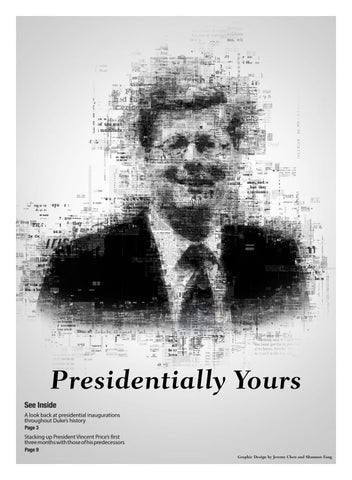
Presidentially Yours See Inside A look back at presidential inaugurations throughout Duke’s history Page 3
Stacking up President Vincent Price’s first three months with those of his predecessors Page 9 Graphic Design by Jeremy Chen and Shannon Fang
2 | WEDNESDAY, OCTOBER 4, 2017
The Chronicle
dukechronicle.com
Campus gets VINCENT PRICE NAMED TENTH PRESIDENT ready for Price’s inauguration From the Archives
By Claire Ballentine | Towerview Editor Abigail Xie | Investigations Editor
Vincent Price, previously the provost of the University of Pennsylvania, was announced as Duke’s president last December. Upon the announcment, The Chronicle sat down with Price to discuss race and bias issues, free speech and other challenges he will face on campus. The following conversation has been condensed and a full video of the discussion is available on dukechronicle.com.
By Joyce Er University News Editor
The Chronicle: How are you feeling right now? Vincent Price: Exhilarated, just so excited to be here right now at Duke. This is a fantastic community—outstanding faculty, fabulous students, incredible staff and such passionate alumni. So as a community willing to have us join, I just have enormous respect for Duke University. TC: During your time at Penn, you’ve been a proponent of free expression and free speech. What do you think is the role of free expression at a university and how do you hope to foster that at Duke? VP: It’s critical to a great research university. To have the sorts of breakthroughs that we expect to generate in our research and scholarship, it requires open mindedness. It requires multiple perspectives, and multiple perspectives only come with diversity in experience. So the more diverse our community, the wider the range of perspectives, the greater our ability is to think deeply and honestly about the full dimensions of every problem we face and to be fair and equitable in how we approach them. So I think from a philosophical point of view, it’s an absolute necessity for universities to build the most diverse community they can possibly develop. Socially, it’s important because higher education is such a powerful good in our society today. There are few things that unlock the opportunities that education unlocks. And to the extent that we can distribute that fairly and broadly across the population, the entire society benefits. And finally, I think there’s a moral obligation for us to be honest and thoughtful, and the best way to do that is to have respectful conversations with people who are just not like us. So the diversity of Duke is a huge attraction to me. I think we can do more on that front, but it requires being open and honoring free expression—even when we confront ideas that we find very different, very challenging, even offensive, because that’s when we’re tested and our commitment to open expression is tested. And basically through our confidence and our faith, on the other side of that difficult conversation is a meeting point.
Ian Jaffe | Photography Editor Vincent Price assumed the Duke presidency July 1 after Richard Brodhead filled that role for more than a decade.
community is robust, if students, faculty, staff, administrators, confront those issues together, we’ll learn. Let’s not forget that these kinds of incidents are not [unique]. They come from the outside environment to Duke and brought from all parts of the globe. The prospect for educational institutions, because we build this microcosm of society and we live to the highest ideals, the possibility we have to make real progress exceeds the possibilities at any other venue that I can imagine. And although we’re headed for challenging times, I can’t think of a better place to confront those challenges than a place that’s so committed to open expression and committed to diversity and inclusion. People have to understand that everyone belongs here. People who are part of the community are here because they share our goals, our ideals. That sense of belongingness, has to be worked at and cultivated.
TC: What do you think is the value of a task force at the University in identifying problems and bringing about change? Do you think they actually work? VP: I do. One can have committees and task forces, and task forces on committees. TC: Duke has had to handle a number In our university and in our faculty senate, of racist incidents and incidents of bias and there is a committee on committees, which hate, as I’m sure every university has, but is charged to identify people who will serve how do you plan to handle those incidents at on committees. Duke in particular? Let me put it this way—I believe in VP: I think the best response to collaboration, I believe in conversation. If problematic speech and behavior is more task forces are serious ventures, they’re not speech. The community has to identify it as done for the purposes of publicity. They’re a problem and then work collaboratively to done because an issue has been identified and address it. Duke doesn’t have speech codes a deep dive into those challenges is required, and nor does the institution I serve. That and a venue is created that canvasses the produces real community challenges, because viewpoints across the campus and percolates that means that when we identify something those into a set of recommendations that we find problematic we have to attack it. can then be considered by the administration. Some of these are matters of conduct and I think that’s a powerful thing to do. So I can be addressed through that system, but like them. some of them are matters of speech and You can do too many of them—you have that’s a very fine line. What one community to be focused. I think the main challenges would define as a matter of conduct another with these kinds of task forces is that the would define as a matter of a speech. If the nature of the problems that are confronting
us are repetitive and profound, so if you have too many of these task forces people start to feel a bit jaundiced about them. But I’m not jaundiced about them. I think they’re incredibly powerful, and most powerful when they engage students. Because students are a constituency who live and work here every day—they know the institution. You have to know where the shoe pinches. I think the task forces give—there are a lot of other opportunities, meeting with student leaders, these kinds of conversations—but these create structured opportunities in a focused way to learn about student concerns. It doesn’t mean we’ll solve all those issues, but I think they can be a powerful vehicle. TC: A big problem facing college campuses everywhere is sexual assault. Just a few days ago, a woman reported being sexually assaulted on campus in broad daylight. What do you think are the ways to go about fighting back against that issue? VP: Well, problems surrounding sexual assault, and sexual harassment more generally, are profound problems of our society. These are not problems that are generated locally, but they come with the attitudes of students arriving on campus. But this is a place where college campuses can deliver an enormous service. I think that women speaking out and our LGBTQ community speaking out to elevate the visibility of the kinds of challenges they face is the first important step. So the first thing we have to do is listen— listen very carefully to the concerns of the community and work constructively to try and address them. That means having good avenues for reporting incidents and having a support structure that mobilizes immediately to support anybody who’s been a victim of sexual assault. And also to support the accused party, because they are often times wondering what resources they have access to. So wraparound student See PRESIDENT on Page 11
Vincent Price will be inaugurated as Duke’s 10th President in a campus-wide celebration on Thursday. Price’s inauguration will take place on Abele Quad Thursday at 5 p.m., in front of the Duke Chapel. On Wednesday evening, Duke students can also attend PricePalooza, a studentorganized carnival held on East Campus to celebrate Price. The inauguration ceremony is expected to draw more than 3,000 guests. Michael Schoenfeld said speakers will include University of Pennsylvania President Amy Guttman and Luke Powery, dean of the Duke Chapel. Schoenfeld added that Price will give a “very good and powerful speech.” “President Price wanted to have a peaceful, elegant and meaningful inauguration and then get back to work,” Schoenfeld said. The inauguration ceremony will follow several different events Thursday, according to a Duke Today release. Delegates from 75 other educational institutions, including 17 schools in North Carolina, and other academic organizations. will also be on campus Thursday. They will attend a luncheon at noon before Price and other prominent professors convene a faculty symposium in the Griffith Theater in the Bryan Center at 1 p.m. There will be two panels at the faculty symposium. The first will look at what “public deliberation” is and how elite research universities contribute to it. The panelists will include Sunshine Hillygus, professor of political science, Robert Califf, vice chancellor for Health Data Science at Duke Health, Megan Mullin, associate professor of environmental politics, and Curtis Bradley, William Van Alstyne professor of law and professor of public policy studies. Price will serve as commentator on the first panel. The second panel will ask the panelists about the social good of “extending the frontiers of human knowledge” and what Duke’s role is in that process. This panel will be moderated by Abbas Benmamoun, vice provost for faculty advancement. After the inauguration ceremony, students, faculty and other guests can attend a catered reception at the Brodhead Center. Larry Moneta, vicepresident for student affairs, wrote in an email to students that the Brodhead Center will be closed all day Thursday to prepare for the reception. On Wednesday evening, PricePalooza will take over East Campus. The carnival will feature ferris wheel rides, free food, music and performances by multiple Duke dance groups and will only be open to members of the Duke community. Students over the age of 21 may preregister for wristbands, while people who want to ride the ferris wheel must sign waivers beforehand. Moneta added that students may be able to spot Price around campus on Wednesday and Thursday. “Please join me in welcoming President Vincent Price as Duke’s 10th president... and maybe grab a selfie with him when you see him!” Moneta wrote.
The Chronicle
dukechronicle.com
WEDNESDAY, OCTOBER 4, 2017 | 3
Comparing this year’s inauguration festivities to past ones By Claire Xiao Contributing Reporter
Even though President Vincent Price began his presidential duties back in July, the inauguration on Oct. 5 officially marks Price’s commencement at Duke University. “While there have been other moments President Price has interacted with the populations on campus, when you think of it, this is his first big reveal,” said Kaitlin Briggs, senior program coordinator of university ceremonies. “This will be the first time that he has an address that everybody can hear and really truly be a part of. This will be important to set the tone for the next 10 to 15 years.” However, how will this year’s commemorative carnival rides and free food compare to former presidents’ inauguration festivities? Earlier ceremonies In 1949, Duke held its first presidential inauguration ceremony for President A. Hollis Edens—even though Edens was the University’s third president and ninth leader. Subsequent inauguration ceremonies have been modeled after this initial ceremony. Before Edens, inaugurations were simpler affairs, like the start of John Crowell’s presidency in 1887. Crowell’s inauguration was not its own ceremony, but rather a set of exercises following that year’s commencement. In his personal recollections, Crowell wrote about how his inauguration took an unexpected turn when the class of eight students insisted he sign their diplomas even though he had not been inaugurated as president yet. And sometimes, soon-to-be presidents consider backing down from the immense responsibility that comes with leading an institution. On the eve of Crowell’s inauguration, nerves got the best of him as he considered refusing the presidency. He feared for the difficulty that would come with elevating Duke University—Trinity College at the time—beyond “a cheap, crude brick building, with not a single outbuilding, without even respectable sanitary facilities.” However, by morning, Crowell swallowed his doubts and decided to remain at the
Kevin Zheng | Associate Photography Editor University employees started setting up Monday for the inauguration ceremony on West Campus.
college, admiring its enduring force and spirit. While Crowell’s inauguration involved very little fuss, other inaugurations have been much more elaborate. At President William Preston Few’s inauguration in 1910 there were so many special delegates from other universities that a privately-chartered, luxurious Pullman train carried attendees to Durham from the primary East Coast rail line. Yet, Duke’s presidential inaugurations have not always been such happy affairs. At President Nannerl Keohane’s 1993 inauguration, students organized a silent protest, as part of the multicultural group Spectrum House’s “We Want a Real Education” campaign. Holding signs and posters, campaign members criticized Duke’s curriculum as being too Eurocentric and
not adequately broad or culturally inclusive. Recent trends Despite the simplicity in the earlier ceremonies, today presidential inaugurations are much grander and encompass more traditions, events and planning. President Richard Brodhead’s inauguration in 2004 was held inside the Duke Chapel—the first inauguration to be held indoors—due to remnants from Hurricane Ivan. Terry Chambliss, senior director of special events and university ceremonies, described the standard ceremony as an academic procession including delegates from other See FESTIVITIES on Page 11
Price Palooza WED OCT.4 6PM-10PM
events.duke.edu/pricepalooza
dukechronicle.com
4 | WEDNESDAY, OCTOBER 4, 2017
The Chronicle
A look back at Duke presidential in
William Few succeeded John Kilgo as president of Trinity College in 1910.
This picture was taken at President Keith Brodie’s inauguration on September 28, 1985.
The procession at President William Few’s inauguration on what is now East Campus.
President Keith Brodie, who passed away in 2016, spoke at his inauguration to hundreds of attendees.
Hundreds of people came to see Duke’s ninth president Nannerl Keohane
Willis Smith, president of the Board of Trustees, presided over the inauguration of A. Hollis Edens on October 22, 1949.
The Chronicle
dukechronicle.com
WEDNESDAY, OCTOBER 4, 2017 | 5
naugurations throughout history Courtesy of Duke Archives
Pictured above is the inauguration committee for President Douglas Knight’s inauguration in 1963.
e’s inauguration.
President Douglas Knight gave his speech at his inauguration on December 11, 1963.
The chain was placed on Duke’s eigth president Nannerl O. Keohane outside of Duke Chapel on October 23, 1993.
Protesters attempted to disrupt next to the Flowers building at Terry Sanford’s inauguration.
Former President Terry Sanford, after whom the public policy school is named, was inaugurated into office on October 18, 1970.
6 | WEDNESDAY, OCTOBER 4, 2017
dukechronicle.com
The Chronicle
The faculty, staff and students of Duke University values that have made us the #1 Graduat
The Chronicle
dukechronicle.com
WEDNESDAY, OCTOBER 4, 2017 | 7
y School of Nursing commit ourselves to the core te Nursing School in the nation for 2018.
The Chronicle
dukechronicle.com
8 | WEDNESDAY, OCTOBER 4, 2017
Faculty symposium to address role of elite research universities By Nathan Luzum Health and Science Editor
Some of Duke’s most accomplished professors will convene at a faculty symposium this Thursday to share their diverse perspectives with President Vincent Price. The symposium at 1 p.m. in the Griffith Theater in the Bryan Center will precede Price’s inauguration later Thursday and will include two panels of faculty members. The first panel will discuss how elite research universities can help individuals negotiate their differences in an age of division and controversy. The second will focus on Duke’s role extending the frontiers of human knowledge. “These are some of the most world-renowned faculty we have, so they embody the best of values we hold dear here at Duke,” said Abbas Benmamoun, vice provost for faculty advancement and moderator of the second panel.
Courtesy of Duke Photography Robert Lefkowitz, winner of the 2012 Nobel Prize for Chemistry, will be on the second panel.
Although the event is designed for faculty, students and other community members can also attend the discussions, said Peter Feaver, MC of the symposium and professor of political science and public policy. As the chair of the four-member committee that planned the faculty symposium, Feaver said it was important to make the panel topics relevant to President Price’s past as a professor and future as president of the University. The committee members drew on Price’s previous research on the role of public deliberation and differences of opinion as inspiration. “It struck us that that research area was perfectly positioned for [Price’s] new role because his new role is leading a university that is itself contributing to public deliberation, where members of the public disagree,” Feaver said. He explained that another objective in the planning was to develop panels that showcased faculty talent and expertise from many disciplines. Members on the first panel include D. Sunshine Hillygus, professor of political science and Robert Califf, former commissioner of the Food and Drug Administration and Donald F. Fortin professor of cardiology. The second panel will feature Robert Lefkowitz— winner of the 2012 Nobel Prize for Chemistry and James B. Duke professor of medicine—along with Thavolia Glymph, associate professor of history in African and African American studies, among others. “We wanted to pick people who we thought would have interesting things to say in the short amount of time they have to say it,” Feaver said. “Of course, there are lots more faculty that we could have picked, but there’s only so much time, so that’s a tough choice.” Benmamoun added that such accomplished and diverse faculty members would give Price valuable advice to guide him during his tenure at Duke. “What we want this panel to do is basically share with the President and the larger university community how being at Duke has helped them explore the frontiers of human knowledge and also how Duke is positioned to do that more broadly,” he said.
Courtesy of Duke Photography Peter Feaver, professor of political science and public policy, will be the MC of the symposium.
In addition to its panelists, each panel will also have a moderator to guide the conversation. The first panel will be moderated by Philip Bennett, Eugene C. Patterson professor of the practice of public policy studies and journalism. Benmamoun will moderate the second session. Each panel will also feature a commentator who will provide concluding remarks to “put the discussion in a broader context of the University’s mission and the University’s strategic vision,” Benmamoun said. Provost Sally Kornbluth will be the commentator for the first panel, and Price will conclude the second panel. Feaver stressed the importance of bringing a wide array of faculty members together—something that is “surprisingly rare.” He explained that the faculty gather See SYMPOSIUM on Page 10
HAVE A STARTUP IDEA? Find a problem to solve, come up with a solution, write it up. APPLY BY OCTOBER 30TH DUKE STARTUP CHALLENGE .ORG
OVER $50,000 IN TOTAL PRIZES! DukeStart
DukeStartupChallenge
The Chronicle
dukechronicle.com
WEDNESDAY, OCTOBER 4, 2017 | 9
THE FIRST THREE MONTHS From removing the Robert E. Lee statue to raising the minimum wage, it’s been an eventful first few months for President Price By Delaney Dreyfoos Contributing Reporter
From the removal of the Robert E. Lee statue, to the decision to increase the minimum wage to $15 by 2019, President Price has had an eventful first three months. But have Price’s experiences his first three months truly been as unique as they may seem? To answer this question, The Chronicle searched through its archives to compare the first three months of prior Duke presidents. Earlier presidencies We found that the initial few months of each presidency have varied greatly, especially as time has progressed from early in Duke’s history to present day. The capabilities of The Chronicle have also advanced in these years, making the study of later presidents much more in depth. William Preston Few, the first Duke president, began his term as president of Trinity College in 1910 and oversaw the college’s transition into Duke University in 1924. From 1910, he dedicated his life to the University and served as president until his death in 1940. The Chronicle’s records showed that the events during Few’s first three months in 1910 were mainly speeches. Few’s first act as president was the creation of a faculty committee to “develop a ‘more sweet and wholesome’ life among the students of the college.” His second speech targeted “a much discussed present day problem,” the relationship between religion and education. The talk’s emphasis on Christianity—specifically the United Methodist Church based on which Duke was founded— shows one clear difference between the priorities of the University more than 100 years after Few’s inauguration. Robert Lee Flowers succeeded Few in 1941 following his death in office on Oct. 16, 1940. Flowers’ first three months were mostly shaped by world events, with the exception of the separation of the Engineering Student Government from the Trinity College Student Government. Two different Duke professors both made predictions of world politics in The Chronicle. Dean Calvin B. Hoover
Ian Jaffe | Photography Editor On Aug. 19, President Vincent President ordered the removal of the Robert E. Lee statue outside of Duke Chapel.
stated that a British victory in World War II was “improbable without U.S. entry into war” and Dr. Paul H. Clyde expressed the Japanese foreign minister’s dread of a U.S. war with Japan, on April 8, 194—eight months before Pearl Harbor. One of Flowers’ first responses to the war was for the College of Engineering to open an aeronautical engineering department as part of a national defense program.
segregate the University. Dr. Benjamin Mays, a prominent “Negro educator” spoke in Page Auditorium on Nov. 29, 1960, to voice how he “believes segregation interferes in education and that southern Universities have failed to achieve the status of those in the North because ‘our minds are circumscribed by the walls of segregation.’” The Board of Trustees eventually voted to desegregate the graduate and professional schools on March 8, 1961. Following Flowers Douglas Maitland Knight succeeded Edens in 1963, Arthur Hollis Edens succeeded Flowers in 1949. His tackling Greek life at Duke by saying that fraternities and first three months were relatively light; however, he did sororities “are integral to the place, and if they are not, they give tentative approval for the creation of a campus can be.” He went on to “suggest three ways in which Greeks radio station. could ‘justify’ their existence now that the historic function Following Edens’ resignation, J. Deryl Hart was chosen as of ‘civilizing’ students has disappeared.” an interim President in 1960. See MONTHS on Page 11 Edens’ presidency began with the issue of whether to de-
From the Archives
Price creates Comparing salaries of University Commission on presidents: What’s the price for Price? Memory and History By Gautham Hathi The Chronicle
Staff Reports The Chronicle
Duke is forming a new commission to review controversial names of facilities and buildings on campus and recommend next steps for the entrance of Duke Chapel. In an email announcing the members of the commission to Duke students and staff Friday morning, President Vincent Price said the Commission on Memory and History will help the campus engage in a broader conversation about its history and inclusion. “Every member of the Duke community deserves a voice in this vitally important conversation, and the students, alumni, faculty and staff with whom I have spoken in the past few days hold a diversity of views about the best way forward for the University,” Price wrote. “At Duke, we have the courage and integrity to engage productively around our disagreements without resorting to incivility or vandalism, instead finding collective strength in open-minded participation and mutual respect.” See COMMISSION on Page 10
Vincent Price’s large paycheck will likely get even larger when he starts his term as president next year. Duke’s next president is currently the provost at the University of Pennsylvania, where he is one of the highest paid provosts at elite private universities nationwide, according to The Chronicle’s analysis of records filed with the Internal Revenue Service. It’s likely that Price’s upgraded title at Duke will come with an improved pay package. As a result, Price could be paid even more than he is in Philadelphia when he arrives in Durham. “We don’t discuss compensation,” said Michael Schoenfeld, vice president for public affairs and government relations. “In general, and we’ve said this before, the University and the Board seek to be competitive with the marketplace and have compensation that will attract and retain the best talent.” John Burness, visiting professor of the practice in the Sanford School of Public Policy and former senior vice president for public government affairs and public relations, explained that University officials’ compensations are set by the Board of Trustees based on outside evaluations of compensation for similar positions. “One would assume that in the case of the president they would take a look at what compensation is for
presidents at like-minded institutions and somewhere within that range would be how it would be determined,” he said. “That’s how traditionally it has been done.” President Richard Brodhead’s total compensation from the University was $1.3 million in 2013-14, more than double the $500,000 he made during his first year at Duke. However, Brodhead’s seven-figure payday was actually below average among a group of 10 private peer institutions, according to The Chronicle’s analysis. The highest paid university president among this group was Columbia University’s Lee Bollinger, who took home a grand total of $4.64 million in 2013-14. Number two on the list was the University of Pennsylvania’s Amy Gutmann, whose total compensation during the same period was $3.43 million. The University of Pennsylvania apparently favors paying its officials well, since Price also receives a paycheck that is above his peers. In 2013-14, he made a total of $880,713, more than any other provost at an elite private research institution in Duke’s peer group. In fact, Price’s current total compensation is greater than that of several university presidents in the same group, The Chronicle’s analysis found. Peter Salovey, president of Yale University, and Christopher Eisgruber, president of Princeton University, both took home less See PRICE on Page 10
The Chronicle
dukechronicle.com
10 | WEDNESDAY, OCTOBER 4, 2017
From the Archives
SYMPOSIUM FROM PAGE 8
OPINION
for administrative tasks and graduation ceremonies, but neither of those types of events provides them with the opportunity to discuss the big-picture objectives for faculty at Duke. “I hope my faculty colleagues will see that it’s a rare thing, and it’s worth taking a few moments out of their busy work week just to stop and reflect on what it means to be doing what we’re doing together in a larger community,” Feaver said. Benmamoun added that although Price will formally assume the role of President Thursday, he is still technically a faculty member. “It’s a good message to have his own colleagues and peers celebrate his inauguration,” he said.
Courtesy of Duke Photography Abbas Benmamoun, vice provost for faculty advancement, will moderate the second panel.
Ushering in the Price administration Editorial Board The Chronicle
On July 1, 2017, Richard Brodhead will formally step down as the 9th president of Duke University after over 13 years at the helm. In his place, current University of Pennsylvania provost Vincent Prince will begin his tenure as the 10th president of Duke University. Price will inherit from Brodhead a dynamic university that consists of 15,000 students, 3500 faculty members, 36,000 employees and over 150,000 active alumni. When he begins his service to the university, he will inherit a task of gargantuan proportion equal to those numbers: successfully administrating Duke’s colossal multifaceted campus community. A key component of a successful presidency will hinge on Price’s ability to communicate effectively with Duke’s diverse student body. Besides attending hackneyed town hall style events, President Price will need to utilize other approaches to acclimate himself to the Duke student body, such as setting up meetings directly with affinity groups and campus organizations. He should not just use DSG as a blanket voice for the campus community, but rather work with individual student organizations and activist groups in order to carry out his goals and serve their interests. In the process, students and faculty will come to know and respect the man who runs our university in ways beyond biweekly emails sent from the Allen Building. Besides getting to know students and faculty, President Price will also need to familiarize himself with Duke’s unique character as a young, rising research university. Duke proudly differentiates itself from Northern peers on multiple levels—from our Division I basketball program to our signature service-learning programs like DukeEngage. Moreover, Duke possesses its own distinct history as a relatively new university in the American South. Unsavory events like the university’s long standing
segregationist policy or the lacrosse scandal that plagued the early part of Brodhead’s presidency feature prominently in our institutional history. A two-decade long Quaker, President-elect Price will need to learn the history and character of Duke in order to effectively serve in the Allen Building next year. Of course, a significant part of President Price’s administration will be devoted to the financial stewardship of the university. As well as keeping an eye on the university endowment, President Price should expand upon Brodhead and Keohane’s successful multi-billion-dollar capital campaigns. Although raising money is hardly sexy, doing so allows our institution to keep providing sufficient financial aid to students, fund new research ventures and maintain a first-class faculty. In leading the Duke community for the foreseeable future, President Price will also have room to spearhead personal projects to improve the university. Past leaders of the university have all defined their presidencies through their own initiatives to improve the Duke experience. President Keohane spearheaded a successful campaign to transform East Campus into a freshmen learning community, while institutions like DukeEngage and Duke Kunshan remain hallmark accomplishments of the Brodhead era. In addition to taking on his own concrete projects, we hope President Price will keep in mind the intangible improvements he can make on campus—from solidifying administration-student relations to holding our campus to Duke’s honor code. With the Brodhead presidency ending this year, we hope to see a successor up to the task of building upon the legacies of Brodhead, Keohane, Brodie and Sanford. We look forward to seeing an administration that will perhaps even expand upon the president’s role, becoming a visible figure within the campus community whether it be through direct conversations with students or simply dining in West Union.
COMMISSION
FESTIVITIES
PRICE
FROM PAGE 9
FROM PAGE 3
FROM PAGE 9
The 16-member commission includes administrators, professors, trustees and students and will be chaired by Frank Emory Jr., trustee emeritus. Other members include Michael Schoenfeld, vice president for public affairs and government relations, Luke Powery, dean of Duke Chapel, Thomas Pfau, Alice Mary Baldwin professor of English, and Michael Ivory Jr., president of the Black Student Alliance. Price said students can offer their input to the commission online. He said he has asked the commission to complete its work Nov. 17. The announcement came almost three weeks after Price decided to remove a statue of Confederate Gen. Robert E. Lee from the entrance of Duke Chapel. It remains unclear which building names will be reviewed. But Price’s announcement elicited different reactions from students. Sophomore Patrick Botros said he supported the committee’s creation, but expressed concerns about changing the names of buildings. Sophomore Olivia Lee said she does not believe that Duke should glorify Confederate generals and praised the creation of a commission, noting that the University still has questions to confront after the statue’s removal. “I hope that the commission is a balanced place of ideas for both sides of the issue.” Lee said. “I agree with President Price’s decision to take down the Robert E. Lee statue, but I do think we can’t forget it. I think it’s really important that we maintain not monuments, but museums, and I think it’s really important that we remember the history instead of embracing it.”
universities and an installation part in which the president receives the symbols of office. For inaugurations at Duke, the president always receives four objects: the charter of the university, the university seal, the chain worn at the university ceremony and the Duke bylaws. Briggs recounted an amusing moment during Brodhead’s inauguration involving the chain. “There’s a moment when they were trying to put the chain on him, and it kept hitting his face. But the person putting the chain couldn’t see, so someone had to come help,” Briggs said, laughing. In general, inaugurations take place several months after a university president takes office. “Summer would just not be an ideal time because no one would be here. Students are gone. A lot of faculty are doing projects off campus,” Briggs said. “It also gives the president a little time to get the pulse of the university, so they can feel out what it’s going to look like for them as president as well as get their feet wet.” Duke’s presidential inaugurations, much like those at other universities, tend to have similar trends or overarching themes. “In general, there’s some kind of way students are involved. [There’s] a general theme, but everyone tries to do something creative with it,” Briggs said. Brodhead’s ceremony capped off a week of inaugural festivities centered around the theme of Duke as a global institution, including talks on global health and global culture and the start of “Into the City,” a community service project focused on
total compensation in 2013-14 than Price did as provost at Penn. Peter Lange, who was Duke’s provost in 2013-14, earned a total of $639,929 during that time period. When Price is inaugurated as Duke’s president, his pay will probably be more than it is in his current position. “The president would likely be paid more than a provost, let’s put it that way,” he said. Price may earn less than what Brodhead currently makes, however. The Chronicle’s analysis found that new university presidents in Duke’s peer group on average make 12 percent less during their first year in office than their predecessors did during their last year in office. All of the new presidents in
See FESTIVITIES on Page 11
Duke’s peer group who took office after 2010 made more than 20 percent less in their first year than their predecessors did before leaving. When Richard Brodhead began his term at Duke in 2004, he made about 2 percent less than Nannerl Keohane, Duke’s previous president, did during her last year at the University. Burness noted, however, that pay is rarely a key factor in whether a university recruits a particular candidate as president. “Having watched several presidential searches at different institutions over time, the compensation is very rarely a big issue,” he said. “The issue is whether they find the right fit and does the person they’ve selected want the job. The compensation sort of sorts itself out. It’s not variable number one, it might be variable number four.”
The Chronicle
FESTIVITIES FROM PAGE 10 connecting Duke and Durham. Following his inauguration, there was a Saturday night soiree and Sunday morning Chapel service. Inaugural week festivities Planning for Price’s inauguration took over a year, with the Office of Special Events and University Ceremonies in charge of checking space availability and organizing a steering committee consisting of Duke students, employees, alumni and trustees. The committee—as well as Price himself— made recommendations and gave input on the inauguration. The committee helped plan the traditional luncheon to welcome academic delegates, the faculty symposium and the community celebration in the Brodhead Center. University Archivist Valerie Gillispie
dukechronicle.com
will organize a digital exhibit highlighting “important events and dates related to presidential history.” She wrote in an email that the exhibit will be displayed on the library website and also posted outside the Gothic Reading Room in Rubenstein Library. Both Briggs and Chambliss stressed the idea of inclusion and the importance of involving not only the faculty and students at Duke, but also the greater community. “Our theme is to be inclusive of students and faculty and alumni, and I think in our history, the program has been the same, incorporating the wider Durham community,” Briggs said. On October 4, the night before the inauguration, there will be the PricePalooza, which is sponsored by students and the Office of Student Affairs, Chambliss said. The PricePalooza will be a huge carnival on East Campus with games, rides and food. Briggs explained that PricePalooza was a way to directly involve students
PRESIDENT FROM PAGE 2 support, to make sure that by experience students never feel that if they raise a concern to the University, things will go from bad to worse. The point is to have things go from bad to better, so you have to have those services in place. And having good, sound adjudication procedures in place to make sure that there’s fair opportunity for consideration of the nature of the case. Many of these cases do not rise to the point of being subject to criminal complaint and the University is going to be dealing with a lot of activities in that area. Like many campuses, I know Duke has invested in this tremendously. TC: How do you feel about the University, or yourself, taking positions on social issues? An example would be with House Bill 2, which the University publicly condemned. What do you think about that decision and how you would approach that as a public figure here? VP: Universities as institutions have an obligation and responsibility to take stands on issues that affect the institution’s activities or values. And there’s a lot of advocacy—both collective advocacy in the higher education sector and individual advocacy by campuses—that’s really directed at ensuring that our work, such as our educational programs and our research programs, is able to move forward in the best possible way. So there’s a wide range of issues that fall into this definition of being relevant to the core values of an institution like Duke. And HB2 is a good example given the nature of the community of students that we have here. And what I just said about this importance of making sure that every student belongs and feels like they have access to the opportunities that Duke provides. That being said, there is constant pressure on institutions
MONTHS FROM PAGE 9 The biggest event of Knight’s first three months was the assassination of President John F. Kennedy on Nov. 22, 1963. Knight cancelled Saturday classes—which were a facet of a Duke education at the time—as well as all weekend social activity. Knight replaced these with religious services featuring a memorial service attended by 1,500 people. Terry Sanford succeeded Knight in 1970 after finishing his term as the 65th Governor of North Carolina. His first three months were the most eventful thus far with the high frequency of anti-Vietnam war activities as well as other campus demonstrations. Sanford didn’t waste time calling for the end of the Vietnam War less than 10 days into his term. In addition, he presented the opening address for the new William R. Perkins Library on April 15, 1970. In the same edition of The Chronicle, the news that the University failed to graduate 42% in a four-year period was published. On May 4, 1970, in response to the deadly shootings of four students at Kent State University by National Guard gunfire, Sanford said that “he would consider bringing troops onto campus ‘only if the lives of students are in danger.’” One way Sanford supported students’ demonstrations was by saying that a “Duke student who [wanted] to work in congressional election campaigns next fall will be given a
WEDNESDAY, OCTOBER 4, 2017 | 11
in the inaugural activities. Registration for PricePalooza wristbands as well as inauguration information can be located on the inauguration website. The inauguration itself will be livestreamed—another way for students to get involved, Chambliss noted. This year’s inauguration includes a faculty symposium with two panels of Duke faculty. Price himself will commentate on the first panel and Provost Sally Kornbluth will serve as a commentator for the second. Briggs and Chambliss said that the symposium is a way to involve faculty. Following the symposium, the inauguration ceremony will take place at 5 p.m. when faculty and delegates join the academic procession and Price gives his inaugural address. The inauguration will also welcome President Amy Gutmann from Price’s former institution—the University of Pennsylvania—to speak at the ceremony.
to take stands on all manners of things. Largely because, and I don’t blame people for thinking of this, institutions have visibility and very respectable standing. So a constituency that can convince a university to take a public stand on something achieves a win. The University should only do this when it’s absolutely in the interest of Duke University. We just have to be careful about that. Otherwise we will find ourselves under pressure to take stands on everything that comes down the pipe, but we have to be focused—focused on those things that matter to Duke, that are critical to Duke, and not allow ourselves to become a political megaphone. Even if we’re inclined to support those causes, because we’re talking about an institutional stand. TC: One complaint that students have had in the past about the administration has been a lack of communication or clarity about what’s going on on campus. What’s your plan to communicate with students about what you’re doing, or just to get to know them in general? VP: There’s no substitute for spending time with people. I hope to be out-and-about. I hope students get to the point where they’re tired of seeing the president—that would tell me that I’m doing a good job. The president is busy, has a lot of things to do. But I think that’s the first thing. I can’t afford as president to lose contact with the lived experience of students, and that means having dinner occasionally in the dorms, just hanging out. The athletics are great. So you’ll see me around. And I think that’s the one best thing I could possibly do. The second thing I would say is use the channels available to us through student government and through student media and through different student-organized groups to have periodic conversations—understand student interests, and what’s on their agenda. Not because we want to meet those needs—we can’t meet all of those needs. But just so that we can have a frank conversation, and if we can’t meet a particular demand or need of a student group, I’d like them to understand why that’s the week off from classes to do so.” H. Keith H. Brodie succeeded Sanford in 1985. The Chronicle’s article announcing Brodie’s succession described the transition period as “almost unnoticed,” adding that, “Keith Brodie’s first official act as University president was to take his family on a vacation to Maine.” The article continued, “but more than anything, Brodie’s taking leave the first month on his new job signals the smooth transition between him and his predecessor.” One of Brodie’s first official decisions was to decline the appeal of varsity football player John El-Masry to re-open the assault case that resulted in his suspension from the University for two semesters. During his first three months, Brodie also created a new committee to study the feasibility of a new residential college on East Campus and revived a committee to determine how Duke could best help dismantle apartheid in South Africa. Nannerl O. Keohane succeeded Brodie in 1993, becoming the first female president of the University. “Traditionally incoming presidents are accustomed to a honeymoon period, but for Keohane there are already a number of issues that demand her immediate action,” read the article announcing Keohane’s assumption of the presidency, on July 1, 1993. One of Keohane’s first actions was to charge a new administrator to examine a proposed general harassment policy. Additionally during her first three months, the University brought in six new black professors, Hurricane
“We haven’t always had someone from outside come and speak this way, so this is a newer element,” said Briggs. The ceremony will be in the heart of West Campus on Abele Quad, a traditional inauguration location. In the event of rain, the ceremony will be moved into the Duke Chapel. An array of performers, including the Duke Chorale, will be on hand for the night’s festivities. After the ceremony, a community celebration open to the public will take place in the Brodhead Center. Chambliss said this year’s inauguration will definitely have a lot of food, perhaps challenging the 20,000 hors d’oeuvres and 10,000 sweets at Keohane’s inauguration. As the sun goes down, the buildings will light up blue, against a backdrop of fireworks flying through the sky. “President Price wanted it to be something that the community could be excited about and felt a part of,” Chambliss said.
case. I think open communication is a highly valued part of a smooth-running situation. And students should feel that they’re connected to the administration and feel that they have a role. Students are here typically for four—let’s hope they love Duke so much, they could be here for eight, or 12 years. But there’s a sense, which I fully understand, among students to get things done and get them done now. The window of opportunity sometimes feels short. In institutional history, one observes, it takes time to get things done. Students should understand that some of the things they’re advocating for might not be realized while they’re a student at Duke. But if they’re expressed, if they have conversations with administrators and faculty members, they’ll percolate into programs down the road. TC: You have several months now before the end of your time at Penn and before you come to Duke. What will you be doing to prepare? VP: I’ll be talking with President Brodhead regularly and getting to know the staff, which is outstanding I will tell you. One of the things I’ve learned as I’ve started to tell my colleagues at Penn that I’ve been invited to take this opportunity at Duke, they’ve said ‘my counterpart at Duke is the best.’ Getting to know the president’s agenda, ensuring that there’s continuity and I’m confident nothing will be dropped during the process of the transition. And then thinking about how those available systems and programs and people might make adapt going forward. It’s great to have these eight months for the transition. The staff on my end is going to be extremely cooperative, and I expect to be down in Durham quite a bit. I do have a day job, I will have things to do in Philadelphia as well, but after everything I’ve seen in the process of the interview and the search— which was led masterfully and impressively I will say—I think this is going to feel like like hand in glove. I think for students and faculty and staff it’ll feel seamless. Emily forced the evacuation of the Duke University Marine Lab, two law professors formed a non-profit corporation to fight gerrymandering, a curriculum review committee proposed a new undergraduate curriculum for Trinity College, two committees were formed to address criticisms lodged against student advising, a new center for improving teaching was introduced, a memo warned faculty about subtle sexism and a task force was created to examine Greek life. Keohane also made the still-standing decision to house all freshmen on East Campus despite protests. Brodhead’s early months and looking ahead Richard Brodhead succeeded Keohane in 2004. On almost the same day Brodhead started as president, the Los Angeles Lakers “’had serious discussions’ regarding their vacant head coaching position” with men’s basketball head coach Mike Krzyzewski. However, the same edition of The Chronicle announcing Brodhead’s start also featured the headline, “Coach K: No Way, L.A.” on its front page. Brodhead also oversaw the improvement of technology on campus in the form of video camera installations at dorm entrances for safety and the distribution of more than 1,600 iPods to freshmen. However, despite the new video cameras, two instances of armed robbery, one on Edens and one off East Campus, led to an increase in campus police officers. Finally, Vincent Price succeeded Brodhead in 2017. He took office July 1 and his inauguration is set for Oct. 5.
The Chronicle
dukechronicle.com
12 | WEDNESDAY, OCTOBER 4, 2017
Putting Knowledge to Work. Duke I&E provides a comprehensive set of programs and resources that encourage members of the Duke community to tackle challenges and create solutions that impact lives.
Explore Some of Our Programs and Resources:
entrepreneurship.duke.edu
THE IND
RSIT UKE UNIVE D A I LY AT D EPENDENT
WW W.D UKE MONDAY, DECEMBER
5, 2016
CHR ONI CLE .CO M
Y
ONE HUNDRED AND
E 40
TWELFTH YEAR, ISSU
The Chronicle welcomes President Vincent Price