Bowl hopes washed away
Mold front sweeps the nation
Miami QB Brad Kaaya threw for 396 yards and four touchdowns to end Duke’s season | Sportswrap
Colleges across the country experience problems with mold in their dorms | Page 2
The Chronicle T H E I N D E P E N D E N T D A I LY AT D U K E U N I V E R S I T Y
MONDAY, NOVEMBER 28, 2016
WWW.DUKECHRONICLE.COM
ONE HUNDRED AND TWELFTH YEAR, ISSUE 37
Trustees to decide fate of DKU undergraduate program Bre Bradham The Chronicle Creating a liberal arts college in the middle of China is no easy task—and there are still many steps to go before Duke Kunshan University can open its doors to undergraduates. At the December meeting of the Board of Trustees, members will vote on a resolution to establish an undergraduate liberal arts degree at Duke Kunshan University—the final step in a years-long approval process. Last week, the Academic Council voted to endorse the creation of the undergraduate degree by a vote of 57 to 18. However, if the Board approves the resolution, there is still much work to be done before students can enroll in the undergraduate program. “Universities do not appear by magic, and certainly not a university that Duke would want to have its name attached to,” said Michael Schoenfeld, vice president of public affairs and government relations. Provost Sally Kornbluth said that the
Carolyn Sun | The Chronicle
University is aiming to launch the program in 2018 or 2019. First, Duke must hire faculty and develop a plan for student recruiting, she explained. Kornbluth noted that she hopes to see about 175 students in the first class, with the
program growing to hold 500 students per class over time. “We have had a few years of operation with the master’s programs, so we are not starting from a blank slate, but there is a lot of work to be done to launch a full undergraduate degree
program,” she said. In Kunshan, a task force will address issues including student recruitment, financial aid, faculty hirings and the student experience, said Denis Simon, executive vice chancellor of DKU. He noted that approximately 60 percent of the faculty will be DKU employees and around 25 percent may be Duke-affiliated. Kornbluth said that DKU will be a place for faculty members to try out new forms of teaching that they can then bring back to Duke in Durham. “It is a great platform for research for faculty and students that are interested in problems that are pertinent to China,” she said. Nan Jokerst, J.A. Jones distinguished professor of computer and electrical engineering and chair of the Academic Council, noted the value of facultyadministrator cooperation going forward. “When there is this kind of transparency and this level of discussion with feedback and revision of proposals based on this feedback, this makes the end product extremely strong,” she said. “You have the administration and the See TRUSTEES on Page 4
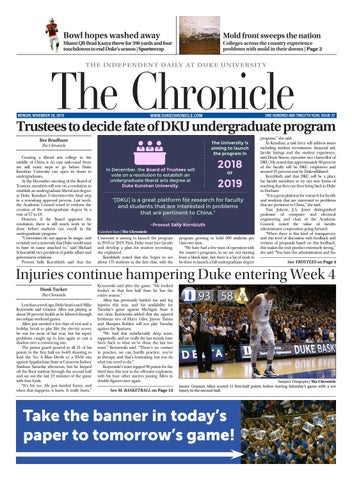
Injuries continue hampering Duke entering Week 4 Hank Tucker The Chronicle Less than a week ago, Duke head coach Mike Krzyzewski said Grayson Allen was playing at about 50 percent health as he labored through two subpar weekend games. Allen just needed a few days of rest and a holiday break to play like the electric scorer he was for most of last year, but his injury problems caught up to him again to cast a shadow over a convincing win. The junior guard poured in all 21 of his points in the first half on 6-of-9 shooting to lead the No. 6 Blue Devils to a 93-58 win against Appalachian State at Cameron Indoor Stadium Saturday afternoon, but he limped off the floor midway through the second half and sat out the last 12 minutes of the game with four fouls. “It’s his toe. He just landed funny, and when that happens, it hurts. It really hurts,”
Krzyzewski said after the game. “He looked fresher in that first half than he has the entire season.” Allen has previously battled toe and leg injuries this year, and his availability for Tuesday’s game against Michigan State is not clear. Krzyzewski added that the injured freshman trio of Harry Giles, Jayson Tatum and Marques Bolden will not play Tuesday against the Spartans. “We had this unbelievably deep team, supposedly, and we really the last month have been back to what we’ve done the last two years,” Krzyzewski said. “There’s no contact in practice, we can hardly practice, you’re in therapy, and that’s frustrating, but you do what you need to do.” Krzyzewski’s team topped 90 points for the third time this year in the offensive explosion, with his four other starters joining Allen in double figures once again. See M. BASKETBALL on Page 13
Sanjeev Dasgupta | The Chronicle Junior Grayson Allen scored 21 first-half points before leaving Saturday’s game with a toe injury in the second half.
Take the banner in today’s paper to tomorrow’s game!
2 | MONDAY, NOVEMBER 28, 2016
The Chronicle
www.dukechronicle.com
Mold runs rampant in Early childhood programs have colleges across the country long-term benefits, study finds Adam Beyer The Chronicle In the past several weeks, students have complained of mold in dorms and apartments. But we are not the only campus to experience the problem. Duke recently contracted with the environmental and engineering consulting firm Duncklee & Dunham to test all Central Campus apartments for mold. Housing, Dining and Residence Life administrators announced earlier this month that the tests have been completed and that they are
Special to The Chronicle Students have complained that mold growing in their apartments (shown above) has caused them respiratory problems.
working to evaluate the best responses for apartments that the tests showed needed attention—including cleaning the air handling units and using HEPA vacuums on furniture and carpets. Across the country, other colleges are responding to mold outbreaks in a variety of ways. At Northwestern University, several dormitories tested positive for mold, The Daily Northwestern reported. Northwestern’s process for handling mold complaints is similar to Duke’s. Students report mold to housing officials, who follow up with a visual inspection, and test results are sent to a thirdparty laboratory. The mold at Northwestern was not found to be toxic, although it could cause allergies in susceptible students. Northwestern students in dorms with mold were given the option of being relocated or having their linens washed. However, some were not confident their problems had been fully addressed, citing concerns that mold could not simply be “wiped off” contaminated mattresses. Northwestern also tested the affected building’s ventilation system, The Daily Northwestern reported. Several students at the University of Louisville discovered mold as well, according to The Louisville Cardinal. The students noted that mold was growing on the ceiling and walls and said it was causing them to feel sick. Mold is not a new issue for the University of Louisville, which had to relocate more than 250 students out of a residence hall in 2012 due to mold concerns. The University of Louisville’s campus See MOLD on Page 4
Grace Mok The Chronicle New research from Duke shows that early childhood education programs have longterm positive impacts. Researchers from the Center for Child and Family Policy examined two of North Carolina’s early childhood programs: Smart Start and NC Pre-K, formerly called More at Four. They concluded that these interventions have had positive effects that endure through late elementary school. Early childhood education research is important for policymakers considering long-term investments, explained Kenneth Dodge, director of the Center for Child and Family Policy. Courtesy of Duke Photography “[Smart Start and NC Pre-K] have been Researchers examined two early childhood heralded nationally as examples of high education programs and found that they quality, pioneering efforts,” Dodge said. benefit students through elementary school. “They represent the two kinds of approaches to early child care and education. The some other studies, which have found “fadeout national child care community and state effects,” Duke’s study found enduring positive governments are looking to North Carolina effects from early childhood programs. to see if those programs have a positive To compare the effects of these programs, impact and last a long time.” the study exploited two features of the The study’s authors found that at programs—first, some North Carolina counties average funding levels, students who had implemented the programs before others, and been through Smart Start and More at second, shifting state budget allocations created Four performed significantly better on funding fluctuations. These variations allowed standardized testing, had less need for the researchers to compare children who special education and were less likely to be participated in the early stages of the programs held back in school. to those who did not, as well as examine the In terms of instruction time, it was as if effects of different levels of funding. They found the students had an additional six months of reading and three months of math. Unlike See CHILDHOOD on Page 4
CREDIT : © TOURISME MONTRÉAL, STÉPHAN POULIN
STUDY AWAY INFO SESSIONS DUKE IN THE ARAB WORLD SUMMER II
go for it. STUDY ABROAD/AWAY DEADLINES SUMMER ‘17: Apply by February 1 FALL ‘17: Apply by March 1
November 28 5:00 pm Allen 304i
DUKE IN MONTREAL SUMMER II
November 30 4:30 pm Languages 114B
DUKE IN BOLOGNA SUMMER I
December 1 5:30 pm Languages 320* *Location is tentative, confirm at globaled.duke.edu on day of event.
globaled.duke.edu
The Chronicle
www.dukechronicle.com
MONDAY, NOVEMBER 28, 2016 | 3
Head of Marxism certificate explains program’s role at Duke Neelesh Moorthy The Chronicle Michael Hardt, professor of literature and a pre-eminent Marxist scholar, has directed the Marxism and Society certificate program at Duke for several years. At the same time, his career has generated controversy from some who consider him a radical academic—he was named on a recent Professor Watchlist, which seeks to document college professors who “promote leftist propaganda” and is produced by the conservative nonprofit organization Turning Point USA. The Chronicle spoke with Hardt about his work on Marxist thought and his response to the criticism. The following conversation has been edited and condensed for clarity.
through Marxist theory? MH: Marx was thrilled about the Paris Commune. In 1871, the citizens of Paris took over the government and exiled the rulers, and one of the things Marx was excited about was that they formed a new government, democratic in ways other governments haven’t been. They had done away with this [system of] every four years choosing who to rule over you from a limited selection of candidates in the ruling class, candidates you didn’t want. Instead they set up a system with very local representatives who were revocable at short intervals. In order to think more about democracy, rather than propose some utopian blueprint, it might be better and more realistic, even if a little frustrating at times, to follow tendencies in social and political movements. I would try to read many of the most inspiring social movements today as a demand for a fuller democracy. I would read Black Lives Matter in that way—an end of white supremacist institutions and activities, including in the actions of police, prison and courts. That’s one arm of a movement toward a fuller democracy in the U.S. I find another in Occupy and another in the protests at Standing Rock. You can create a network or a web of these movements and their demands and aspirations, and construct them together as a kind of vector leading toward fuller democracy.
The Chronicle: Could you explain exactly what Marxist theory entails? Michael Hardt: In a most basic way, Marxism is in all of its forms a critical understanding of capitalism. By critical, I don’t mean always an outright rejection of capitalism. Marx’s own work definitely recognizes the accomplishments of the capitalist era, and then tries to understand how something different and better could be built out of that. That’s at least one strain of Marxism, but all strains can be used to have a critical understanding of capitalist society. Not just economics—of profit, of wage labor—but also the social condition from it, the commodification of different TC: What sparked your interest in parts of the world. Marxism seems to me studying Marxist philosophy? relevant as long as capital is relevant. MH: Here’s a purely personal, anecdotal version of this. After I graduated from TC: How does current American college, I was involved with something democracy deviate from your concept of it called the Sanctuary Movement, which
involved bringing refugees from El Salvador and Guatemala into the U.S. illegally, as a way of helping people in the U.S. understand the civil wars at the time and the U.S.’s role in them. I, with my partner at the time, had moved to Mexico City to help people come north, and there I was introduced to [the work of] the Italian Marxist Antonio Gramsci. I was intrigued by how the theoretical focus fit for the people I knew then with an activist project. It seemed to me at the time—this was the early 1980s—that the U.S. activist groups I had been involved in were what I considered anti-theory and antiintellectual in a lot of ways. Through these Central Americans, who were very interested in theory and its relationship to what they were doing, I found a way my intellectual interests and my practical interests could go together. TC: How did the Marxism and Society certificate get started? MH: Duke has long been known internationally as a center of Marxist thought. It’s not always advertised that way, but it definitely is, and that’s partly based on the faculty. I inherited the certificate program and the core course, which I’ve taught most years I’ve been at Duke. They were already in existence, so I can’t tell you when they were constructed, but it was over 23 years ago. The certificate program, which I’ve transformed a bit, is not really about Marxism directly. The electives are constructed around either theoretical approaches that have a contiguous and sometimes antagonistic relationship to Marxism, like feminist theory, critical race theory or queer theory, that can
Courtesy of Duke Photography Michael Hardt was recently included on a Professor Watchlist, which names professors who “promote leftist propaganda.”
have alliance with and can conflict with Marxist theory. That’s what I encourage in the certificate, the possible relations and limitations of Marxist theory in relation to feminist struggles, struggles relating to sexuality or race struggles. TC: What did you mean by Duke being ‘a center of Marxist thought’? MH: Certainly a mainstay of that for a long time is Frederic Jameson’s presence on the faculty. He is the most renowned American Marxist. He’s an important global figure, so that’s partly it. But also among many faculty and graduate students See MARXISM on Page 4
Distinguished Speaker Series 59.01 The Language of HIV and AIDS 59.02 Black Girl Alchemy: Beyoncé and Black Feminism 59.03 Kanye 101: Our Beautiful Dark Twisted Fantasy 59.04 Foundations of Scientific Research 59.05 Undergraduate University Scholars DPS Middle School Outreach Project 59.06 Mind-Blowing Minds: Neurological Phenomena in Science and Society 59.07 Traveling, Volunteering, and Doing Research in Latin America 59.08 The Millennial Perspective: Intergenerational Ethics 59.09 Tools for Financial Coaching
Doug McMillon
59.10 Experiential Education and Outdoor Leadership
President and Chief Executive Officer Wal-Mart Stores, Inc.
59.12 How We Do Mission: Sustainable, Informed, and Relational Christian
Wednesday, November 30, 2016 2:00 PM - 3:00 PM Geneen Auditorium The Fuqua School of Business
59.15 Durham Giving Project
The university community is invited to attend.
59.11 The Theology of CS Lewis in The Chronicles of Narnia Service Abroad 59.13 Women and International Development 59.14 B.N. Duke Carolina Summer of Service 59.16 PASH Center Training - Sexual Health Peer Education (Sex Peer Ed: Condoms and Counseling) 59.17 Neglected Tropical Diseases 59.18 Personal Finance: Managing Your Money
REGISTER ONLINE ON DUKEHUB – LOOK FOR HOUSECS COURSE DESCRIPTIONS & MORE INFORMATION AVAILABLE AT TRINITY.DUKE.EDU/HOUSE-COURSES
The Chronicle
www.dukechronicle.com
4 | MONDAY, NOVEMBER 28, 2016
TRUSTEES from page 1
MOLD from page 2
faculty saying together in partnership, to the world, that we all agree.” One key component of the proposal is the curriculum that the degree will be based on. This has been the topic of extensive committee work and debate by faculty members since the winter of 2012. “This was the most involved process at Duke that I’ve been a part of,” said Noah Pickus, associate provost and senior advisor to the provost. “We took our curriculum through 10 committees and went back to them several times. We consulted in China. That process of deliberation, and the incredible faculty that worked on the curriculum, really made it much better.” The curriculum that resulted from this process divides subjects into divisional areas of knowledge—social sciences, natural sciences and arts and humanities—rather than traditional departments. Thomas Robisheaux, professor of history and former chair of the Arts and Sciences Council, noted that in addition to maintaining the basic components of a Western liberal arts education, the curriculum captures key aspects of a Duke education such as experiential learning and interdisciplinary work. “I think the curriculum embodies the finest we have to offer at Duke, but it is not like the Duke undergraduate curriculum that we have here,” he said. On campus in Kunshan, Simon noted that graduate students and faculty are ready to welcome undergraduates. The proposal, which President Brodhead called “aspirational” at the November meeting of the Academic Council, lacks only a positive vote by the Board of Trustees for implementation. “Now all we have to do is make it work,” Pickus said.
housing director noted at the time that the age of the dormitories—45 years-old—could have played a role in the outbreak. The housing department uses dehumidifiers and has updated the air conditioning systems to help with the issue, the director said in the article. Another old building at the University of Kansas experienced mold earlier this year in its air conditioning, which was subsequently “cleaned and disinfected.” Closer to home, residents of the University of North Carolina at Chapel Hill’s Morrison Residence Hall experienced “widespread mold” in early 2015, according to a report in The Daily Tar Heel. One student who submitted a maintenance request for the mold said that a “dusty substance” was coming out of an air vent into his room. UNC’s Department of Housing and Residential Education said the problem was due to a build-up of moisture in the HVAC system. They completed an approximately $90,000 repair that included replacing air filters and cleaning the ductwork. Other colleges that have addressed recent mold concerns include Kenyon College, Grayson College and the University of Indianapolis.
MARXISM from page 3 there is a strong relationship to Marxism even when [they] don’t work explicitly or simply on Marxist theory. I think that’s one thing Duke has to be proud of. TC: What would you say to an employer about the value of this certificate on a student’s resume? MH: Certainly with graduate programs in humanities and the social sciences,
because Duke has such a reputation with Marxism, that designation has an immediate value. With regards to employers, I could imagine it can show an independence of thinking. I’m not sure if your application to Goldman Sachs would be enhanced or not by this, but there are many companies that value creative and original thought. It’s not going to win you favors on Wall Street. TC: You’ve been criticized in the past— including on a recent Professor Watchlist— for being too radically on the left or perhaps indoctrinating students in Marxist ideology. How do you respond to such critics? MH: About five years ago, I was on West Campus just as classes were ending, and the Dean asked me what I was doing for the summer, and I said I was going to the G8 meetings in Japan, and he was delighted and proud that Duke had someone inside the G8 meetings. I said I was actually going to be one of the protestors outside the meetings, and he said, well, that was great, too. I respected that—that there wasn’t an ideological test. That Duke takes pride in the accomplishments of faculty and students across the political spectrum. There is an important thing to say, that students should not be expected to agree with the authors they read or the professors they learn from. I feel like my intention for myself is that there isn’t indoctrination in that sense. That indoctrination term often gets tossed around like a red herring or a false element of fear—I don’t think students are indoctrinated in classes at Duke. They can study capitalist economics in an economics department and still feel critical of it, and they can study feminist theory in the women’s studies department and still be critical of it. Myself too. I provide a perspective for students to engage with critically.
CHILDHOOD from page 2 that both participating in the programs and a higher level of funding had positive effects on student achievement. Clara Muschkin, associate research professor in the Sanford School, explained that pre-Kindergarten programs must have highly-trained teachers in order to be effective. “The classroom size and the teacher to child ratio is very important as well,” she said. “The use of evidence based curricula that are developmentally appropriate [is also important].” Not only did the programs improve the future outcomes of those enrolled, but they also had positive impacts on the rest of the children. Dodge and his co-authors’ tentative explanation for these “spillover effects” was that teachers no longer had to spend as much time addressing behavior problems and could instead focus on teaching, since the students came to Kindergarten more ready to learn. “The important point there is that for middle-income families who might wonder what’s in it for them to support a program that’s directed at low income children, the findings are pretty clear in showing that all children will benefit,” Dodge said. However, Dodge described the political climate for primary and early childhood education as a “difficult battle,” referring to low preschool teacher salaries in North Carolina in comparison to other states. Both Dodge and Muschkin explained ways that early childhood programs could and have attracted bipartisan support. Investments in early childhood education are cost-saving in the long run and help reduce inequality, Muschkin observed. “These are all benefits that have appeals across the political spectrum,” Muschkin said.
WELL B E YO N D ordinary. When you get through this intensive, year-long program, you won’t be a student with a business education, you’ll be an entrepreneur with a business. Learn from a dedicated team of mentors, attend exclusive workshops and presentations, visit area start-ups, and get direct access to Melissa and Doug Bernstein.
You could be the next success story. Apply today. MelissaAndDougEntrepreneurs.com
entrepreneurship.duke.edu
The Chronicle
the chronicle
www.dukechronicle.com
MONDAY, NOVEMBER 28, 2016 | 5
november 28, 2016
SAMEER PANDHARE | THE CHRONICLE
sportswrap
BOWL HOPES WASHED AWAY
WOMEN’S SOCCER: FALLS IN ELITE EIGHT • WOMEN’S BASKETBALL: EARNS 2 CALIFORNIA WINS
The Chronicle
www.dukechronicle.com
6 | MONDAY, NOVEMBER 28, 2016
FOOTBALL
BOWL STREAK COMES TO ‘PAINFUL’ END Blue Devils allow 30 unanswered points in season-ending blowout loss at Miami
Sam Turken The Chronicle MIAMI GARDENS, Fla.—Duke entered its regular season finale fighting for a bowl bid and hoping for its first road win against Miami since the Hurricanes joined the ACC in 2004. The Blue Devils will instead begin their offseason wondering what happened in two blowout losses that ended their season. Duke’s four-year bowl streak came to an end after the Blue Devils fell to Miami 40-21 Saturday afternoon at Hard Rock Stadium. Duke needed a win to potentially qualify for the postseason with five wins and showed that urgency in the first half, scoring 14 points on its initial two drives to take a four-point lead. But the Blue Devils came out of the locker room as a completely different team in the second half, allowing 24 unanswered points. “The game was painful in a lot of ways,” Duke head coach David Cutcliffe said. “We just couldn’t convert and keep drives alive. And our defense struggled as it stayed on the field. Miami is a very talented team.” After recording 159 yards on its two touchdown drives, the Blue Devil offense posted 148 total yards on its next eight possessions. Quarterback Daniel Jones completed 34-of-50 passes for 316 yards
Sameer Pandhare | The Chronicle The Blue Devils gave up two long touchdowns to Miami tight end David Njoku and surrendered 396 passing yards and four touchdowns Saturday.
and three touchdowns, but the redshirt freshman was under duress all game and rarely had time to look down field. Duke’s inability to run the ball did not help. The Blue Devils (4-8, 1-7 in the ACC) registered 72 yards on 18 rushes in the first half, but compiled just seven rushing yards in the second half. As the offense stumbled, Duke’s defense failed to defend Miami’s athletes on the outside and surrendered several
explosive plays. The Blue Devil front could not generate any pressure on quarterback Brad Kaaya—who became Miami’s alltime passing leader with 396 yards and four touchdowns—and the Hurricane rushing attack tallied 119 yards. “The nemesis has been the big plays on defense,” Cutcliffe said. “[The Hurricanes] attacked us well…. When those plays come in chunks, it’s very
difficult to limit points.” Duke initially held firm in the first half, scoring on its first two drives to take a 1410 lead despite allowing Miami to also score on its first two possessions. Jones led the Blue Devil charge early on, capping off the drvies with touchdown passes to wide receivers Jonathan Lloyd and Aaron Young. Offensive coordinator Zac Roper’s unit relied on screen passes to open up the field and took advantage of a Miami secondary that initially played conservatively in coverage. Duke’s defense also kept the Hurricanes (8-4, 5-3) out of the end zone on four of their first five possessions. But toward the end of the first half, Miami began to shut down the Blue Devil screen game and dialed up pressure on Jones, a pattern that continued into the third quarter. “[Miami] brought a good defensive front against us,” redshirt junior center Austin Davis said. “When it came to every pass down, they were blitzing all over the place and they did a really good job disguising it.” Kaaya took advantage of Miami’s defensive stops when he found tight end David Njoku down the sideline for a 76-yard touchdown. Njoku ran by Duke defensive backs Deondre Singleton and Mark Gilbert on a go-route before stiff-arming Alonzo See FOOTBALL on Page 13
A TERRY SANFORD DISTINGUISHED LECTURE and The Sanford Innovator-in-Residence program kickoff, made possible by Barbaralee Diamonstein-Spielvogel and Carl Spielvogel
TRANSFORMING CITIES THROUGH INNOVATION MONDAY, NOV. 28
5:30 p.m.|Fleishman Commons RECEPTION TO FOLLOW | FREE AND OPEN TO THE PUBLIC MORE INFO: SANFORD.DUKE.EDU
MAYOR OF NEW ORLEANS
MITCH LANDRIEU America’s top turnaround mayor. —Politico, 2016
The Chronicle
www.dukechronicle.com
MONDAY, NOVEMBER 28, 2016 | 7
Where Real Duke Basketball Fans Shop!
TOP QUALITY MERCHANDISE. EXCELLENT CUSTOMER SERVICE. Providing you with the largest selection of officially licensed Duke apparel, gifts and souvenirs, we are your headquarters for the largest selection of everything Duke!
SHOP OUR ENTIRE COLLECTION at
SHOPDUKESTORES.DUKE.EDU Upper Level, Bryan Center, West Campus Phone: 919.684.2344 Academic Year Store Hours: Monday - Wednesday: 8:30am - 7pm Thursday & Friday: 8:30am - 8pm Saturday: 9am - 6pm | Sunday: 11am - 4pm
www.shopdukestores.duke.edu Department of Duke University Stores®
8 | MONDAY, NOVEMBER 28, 2016
www.dukechronicle.com
The Chronicle
Spar
Ov
The Chronicle
www.dukechronicle.com
MONDAY, NOVEMBER 28, 2016 | 9
rty’s
ver
10 | MONDAY, NOVEMBER 28, 2016
www.dukechronicle.com
The Chronicle
ONS. GIVE US YOUR OPINIONS.
GO DUKE! DEBBIE LEONARD
uke University Stores!
any of our operations via our page, DevilSpeak. s.duke.edu ak link.
k for You!
ation PUBLICATION: Chronicle DATES: TBA
NICHOLAS SCHOOL OF THE
ENVIRONMENT
The Chronicle
www.dukechronicle.com
MONDAY, NOVEMBER 28, 2016 | 11
WOMEN’S SOCCER
West Virginia ends Duke’s season in Elite Eight Jack Dolgin The Chronicle For Duke, it will be a season of what-ifs. What if the Blue Devils had not lost three of their starters to injuries for the latter half of the season? What if junior Imani Dorsey’s second-half header traveled slightly lower? What if Ella Stevens’ shot that hit the inside of the crossbar was called DUKE 0 a goal? 1 What if, oddly WVU enough, Canada’s U20 soccer team had been more successful in Papua New Guinea last week? Back for the first time in seven games after a first-round defeat with Canada in the U20 World Cup, West Virginia freshman goalkeeper Rylee Foster powered the top-seeded Mountaineers to a 1-0 Elite Eight victory against the third-seeded Blue Devils Saturday afternoon at Dick Dlesk Soccer Stadium in Morgantown, W. Va. The loss ends Duke’s season and marks the fifth time in the past 10 years that the Blue Devils have fallen a game short of the national semifinals. After allowing a goal to midfielder Alli Magaletta in the 16th minute off a corner kick, the Blue Devils played tough second-half defense behind Lizzy Raben and Christina Gibbons—both of whose careers came to a close in a disappointing
fashion. Duke finished the game with 17 shots to West Virginia’s 12 and 10 corner kicks to six for the Mountaineers, but as has been the case for much of the year, the Blue Devils struggled to execute on their opponent’s back third of the field. “We had a couple we should have finished,” Duke head coach Robbie Church said at the postgame press conference. “Set plays [are] what can separate you.” West Virginia (22-1-2) dominated the first half with nine shots and five corner kicks. The constant pressure applied by the Mountaineer offense and corner-kick opportunities foreshadowed the goal that was to come later, as West Virginia found second chances in the crowded box time and time again. Off the team’s fourth corner of the game, forward Michaela Abam served in a ball that teammate Kadeisha Buchanan got a head on. Junior defender Schuyler DeBree ball-watched for just a moment, and the ball found an unmarked Magaletta, who kicked it across her body from a few yards outside the goal and into the net. Although Duke also trailed the Mountaineers in the first half of West Virginia’s 3-1 victory in Durham earlier this season, the Blue Devils (15-5-3) could not find the same success on their own set pieces to get on the scoreboard this time around. Duke had trouble getting many good looks on corner kicks,
Get Get Tested Tested Today Today
&& Know Know Your Your Status Status
•!••!• Free, confidential HIV tests Free, confidential HIV tests •!••!• Oral swab (no blood) Oral swab (no blood) •!••!• Results in 20 minutes Results in 20 minutes •!••!• Free Fight Stigma T-shirt Free Fight Stigma T-shirt
Every Monday in the Center for Multicultural Affairs (in Every Monday Every in the Center for Multicultural Affairs (in Tuesday the Bryan Center) from 10:00 AM tofrom 4:30 PM the Bryan Center) from 10:00 AM to 4:30 PM PM to 4:00 Every Friday in 12:00 the Marketplace from PM 11 :00 AM to 1 :30 PM Every Friday in the Marketplace from 11 :00 AM to 1 :30 PM
Sign up for an appointment on our Facebook page @dukekys or stop by our table at the Bryan Center
FIGHT STIGMA
Chris Teufel | The Chronicle Junior Imani Dorsey had one of Duke’s best scoring chances on a header off a corner kick Saturday, but the shot hit the crossbar.
as Dorsey, freshman Olivia Erlbeck and juniors Ashton Miller and Casey Martinez all took turns from the corner flag. Miller’s only corner in the 53rd minute gave Duke one of its best chances of tying the game. The kick went straight onto the head of a crashing Dorsey, but the header hit the crossbar before ricocheting away. After West Virginia controlled the first half, the Blue Devils responded with 45 minutes of their own excellence and played some of their best soccer of the
year. Church dropped Gibbons back to defense and changed his formation from four defenders to three, thereby adding an additional attacker. “I’m not sure I’ve seen a team more athletic, especially the back line,” Church said of the Mountaineers. In the 68th minute, the Blue Devils came as close as the game itself allows to put a ball in the back of the net. After scoring in the team’s opening game See W. SOCCER on Page 13
12 | MONDAY, NOVEMBER 28, 2016
The Chronicle
www.dukechronicle.com
WOMEN’S BASKETBALL
Blue Devils dominate during West Coast trip Andrew Donohue The Chronicle After a blowout win Friday night to begin their California weekend swing, the Blue Devils were looking to continue the momentum in the last game of their Thanksgiving break trip. Rebecca Greenwell made sure they did just that with a record-setting performance. The redshirt junior’s career-high 31 points paced Duke in a 99-65 romp against Pepperdine Sunday afternoon at Firestone DUKE 83 Fieldhouse in Malibu, Calif. Five Blue Devils LBSU 46 scored in double DUKE 99 figures as Duke jumped out to an PEPP 65 early 25-8 lead to start the game and never looked back, sharing the ball with a season-high 26 assists on their 37 field goals. Greenwell was the main beneficiary, knocking down a program-record eight 3-pointers to set a new career high in points for the third time already this season. “To have that kind of accuracy and that kind of balance on the floor is very hard to do,” Blue Devil head coach Joanne P. McCallie told GoDuke.com. “Having her teammates get [Greenwell] the ball, that’s key, in the right spot, but I’m not surprised at all. I’m very excited for her and proud of her.” Duke (7-1) did a better job taking care
Carolyn Chang | The Chronicle Rebecca Greenwell had a career-high 31 points and team record eight 3-pointers in Sunday’s blowout, bringing her season average to 22.0 points per contest this season.
of the ball Sunday, committing a season-low 10 turnovers after giving it away 19 times Friday in its win against Long Beach State. The Blue Devils’ offensive efficiency coupled with suffocating pressure defense that forced 24 turnovers made for a long night for the Waves (0-5), who got blown out despite making 11 3-pointers. McCallie’s team set the tone by controlling the paint, with senior forward Kendall Cooper starting for the third straight game in place of junior Erin Mathias. The
new-look starters raced out to an 11-0 lead three minutes into the first quarter and continued their recent dominance in the post, outscoring Pepperdine 42-10 inside. Cooper and fellow senior forward anchor Oderah Chidom combined for 22 points and 12 rebounds in their return to their home state. But the night belonged to Greenwell, who wasted little time taking dead aim from the perimeter. The second-team All-ACC guard knocked down two 3-pointers within the game’s
first three minutes, and continued pouring it on to the tune of 14 first-half points. The second half was more of the same, as the Owensboro, Ky., native nailed five more triples to make sure Pepperdine never threatened even though Wave guards Sydney Bardonaro and Allie Green combined for 40 points and 10 3-pointers of their own. Greenwell finished the night 11-of-20 from the field and 8-of-16 from long range. “It’s something I’ve always wanted, to set that record,” Greenwell said. “I set that record in high school, I actually have the national record for most [3-pointers] in a game in high school, so I’ve always wanted to set the Duke record. It feels great and hopefully I can beat it again sometime.” With Greenwell feeling it, junior point guard Lexie Brown focused on creating for her fellow backcourt mate, posting a careerhigh 12 assists to go along with her 14 points for the first double-double of her career. Sophomore guard Kyra Lambert also added six assists and has registered 26 in the last four games. With the Blue Devils in control at halftime, some of the team’s reserves got extra playing time and took full advantage of it. Freshman forward Leaonna Odom benefitted greatly, scoring a career-high 16 points to go along with 10 rebounds to also record the first double-double of her young Duke career. “I’m not surprised,” McCallie said. “She’s a special player. We demand a lot from her,
We, the members of the Faculty Advisory Board, affirm that The Duke Human Rights Center @ the Franklin Humanities Institute is dedicated to teaching and practicing human rights both at home and abroad. As a university entity, we encourage our students to think deeply about human dignity and rights at the same time that they understand their history, development and practice. With this in mind, we take this extraordinary opportunity to reassert, for our faculty, staff and students, the critical importance of respect for human rights as a core value. Sexism, racism and hatred of the other based on ethnic origin, sexual orientation, gender identity, disability or religion are abhorrent. They are also violations of basic rights principles of equality and mutual respect, so essential to democracy. Robin Kirk, Co-Director of the Duke Human Rights Center @ FHI William Chafe, Co-Director of the Duke Human Rights Center @FHI and Alice Mary Baldwin Professor of History, Emeritus Nancy MacLean, William H. Chafe Professor of History and Public Policy Erika Weinthal, Lee Hill Snowdon Professor of Environmental Policy, Associate Dean of International Programs for the Nicholas School of the Environment Adriane Lentz-Smith, Associate Professor of History, African and African American Studies, and Women’s Studies Elizabeth Albright, Assistant Professor of the Practice of Environmental Science and Policy Liliana Paredes, Professor of the Practice of Romance Studies and Linguistics Deborah Jenson, Director of the Franklin Humanities Institute, Professor of Romance Studies and Global Health Patrick Stawski, Human Rights Archivist at Duke University Libraries Ellen McLarney, Associate Professor of Asian and Middle Eastern Studies, Assistant Professor of Women’s Studies Ariel Dorfman, Walter Hines Page Research Professor Emeritus of Literature Claudia Koonz, Peabody Family Professor Emeritus of History in Trinity College of Arts and Sciences Barbara Lau, Director of the Pauli Murray Project James Chappel, Assistant Professor of History Catherine Admay, Professor of Public Policy, Assistant Director of Undergraduate Studies in Public Policy Rebecca Stein, Nicholas J. and Theresa M. Leonardy Associate Professor of Cultural Anthropology in Trinity College of Arts and Sciences Abdullah Antepli, Chief Representative of Muslim Affairs, Adjunct Faculty of Islamic Studies Laurent Dubois, Professor of Romance Studies and History, Director of the Forum for Scholars and Publics Robert Korstad, Kevin D. Gorter Professor of Public Policy and History Subhashini Chandrasekharan, Assistant Research Professor in the Duke Global Health Institute Mary McClintock Fulkerson, Professor of Theology and Women’s Studies Wesley Hogan, Director of the Duke Center for Documentary Studies, Research Professor, Franklin Humanities Institute and History David Schaad, Professor of the Practice of Civil and Environmental Engineering J. Kameron Carter, Associate Professor of Systemic Theology and Black Church Studies
Saving for Savannah
See W. BASKETBALL on Page 13
The Chronicle
www.dukechronicle.com
M. BASKETBALL from page 1 Allen set the tone with two 3-pointers in the first 30 seconds of the game to propel the Blue Devils (6-1) to an early double-digit lead, and Duke did not look back the rest of the game. After the Blue Devils took a 21-point lead into the locker room at halftime, they opened the second half much like they started the first one. Duke scored the first 12 points after the break in just more than two minutes, as freshman guard Frank Jackson opened the half with a triple and Luke Kennard punctuated the run with a steal and breakaway dunk to put the Blue Devils in front 67-34. “We wanted to come out in the second half and push right away and stay aggressive,” Jackson said. “We’ve had a game [against Kansas] where we didn’t play the way we wanted to coming out in the second half and kind of got down a little bit, but we just wanted to stay motivated.” Although Bolden and Giles warmed up but did not play for the second straight game, graduate student Amile Jefferson had another big day in the post with 15 points, six rebounds and five assists. He also got help from the Blue Devils’ healthy frontcourt options off the bench—Antonio Vrankovic and Javin DeLaurier combined for 10 points and 10 rebounds. Duke’s guards crashed the boards effectively to ease the burden on Jefferson, with Kennard leading the team with nine rebounds to go along with his 18 points. The well-rounded effort on the glass resulted in a 45-30 rebounding advantage against a Mountaineer team that entered the day 15th in the nation in rebounding margin. “We knew they took a lot of jump shots, so the rebounds would be long, so everybody
FOOTBALL from page 6
had to be a rebounder,” Jefferson said. “We have to gang rebound like that to be a really good team. To have our perimeter rebound as well as they did, it really helps us.” Although Appalachian State (2-3) started the game shooting well and knocked 5-of-9 3-point attempts in the first half, it went cold and only scored 24 points after the break. The Blue Devils forced 18 turnovers to keep the Mountaineers from getting into an offensive rhythm, tightening up after they converted several easy layups in the early going. “In the first half, our offensive execution was spectacular, and it translated in the second half to good defense,” Krzyzewski said. Duke will return to its home floor shorthanded for an ACC/Big Ten Challenge showdown with Michigan State Tuesday night at 9:30 p.m.
W. BASKETBALL from page 12 defensively as well as offensively, and she certainly had a great game.” All three California natives on the Blue Devil roster—Chidom, Cooper and Odom— finished in double figures Sunday as they relished the opportunity to return home and see family during the holiday week. Duke spent time with Cooper’s family and did some sightseeing during its few days in Long Beach and Malibu for Thanksgiving. “Just seeing my uncle, who never has watched me play, come to one of my games... He came three hours so I just wanted to play well,” Odom said. “I just didn’t want to disappoint.” The Blue Devils will hit the road for their next game, traveling to New Jersey to take on Rutgers as part of the Big Ten-ACC Challenge Thursday. Duke fell in its first true road game against a Power-5 conference opponent at Vanderbilt Nov. 20.
SERVER AND HOST Vin Rouge is looking for a full time server committed to exceptional service in a dynamic bistro environment� Must be able to work weekends� Must have at least one year of experience� Food and wine knowledge a plus but willing to train the right person� Vin Rouge is also looking for a full time host� Must be able to work weekends� Experience with Open Table is a plus� Must be able to multi-task, take control of the situation, work well under pressure in a busy environment� Please come by the restaurant between the hours of 2-5 Tues-Sat with a resume and fill out an application� Email rlsmerrill@gmail�com
TRAVEL/VACATION BAHAMAS SPRING BREAK $189 for 5-Days� All prices include: Round-trip luxury party cruise� Accommodations on the island at your choice of ten resorts� Appalachia Travel� www�BahamaSun�com 800-867-5018
The Chronicle classified advertising www.dukechronicle.com/ classifieds
The Chronicle Our Thanksgiving break ailments: Car crash: ��������������������������������������������������������������������������������������������������������� clairity Too much Netflix: ������������������������������������������������������������������������������������theneeldeal Not enough protein:����������������������������������������������������������������������������������������� bigxie Too many tears: ���������������������������������������������������������������������������������� jackofalltrades Another twisted ankle: ���������������������������������������������������������#amrithisnotimpressed Food coma: ��������������������������������������������������������������������������������������������������jaffetaffy Student Advertising Manager: ��������������������������������������������������������������� John Abram Student Marketing Manager: �������������������������������������������������������Beatriz Gorostiaga Account Representatives: ��������������������������������Megan Bowen, Griffin Carter, TJ Cole, Paul Dickinson, Jack Forlines, Francis L’Esperance, Leeshy Lichtman, Rachel Louie, Gabriela Martinez-Moure, Jack McGovern, Jake Melnick, David Meyer, Lauren Pederson, Levi Rhoades, Maimuna Yussuf, Matt Zychowski Creative Services: ��������������������������������������������������������Daniel Moore, Myla Swallow Marketing ����������������������������������������������������������Hunter Bracale, Nicolette Sorensen
Crossword ACROSS ACROSS 11 Plumbing Molars usually problem have four of 5 Gulf of ___ (arm these of the Red Sea) 6 Prisons 10 Abbr. a 11Progeny: Place to enter 14 Flying PIN start? 15 of words, 14Stock First-stringers 15informally Final stanza of a 16 Country’s ballad 16McEntire Musician Reed 17 171961-75 Virginia city 19 Asia’s known for its disappearing shipbuilding ___ 19Sea Dashboard20 ___ Master’s mounted gadget, Voice for short 21 20Reprimand Mine cart to a dog, maybe contents 23 21Prank Cabbagelike vegetablestat 26 Cigarette 22Manipulators San ___ (Silicon 28 Valley city) 29 Public 23transportation Manuel ___, former in dictator system of Panama the capital of 25Catalonia Presided over, as a meeting 32 Carnival city, 28casually Flow of narcotics 33 of in one’s 30Time Money Yemen 33life? Lash mark
34 and I-77 to 34I-85 Prefix with get from Atlanta -ceratops to Cleveland, 36e.g.: Not feeling Abbr. so hot 41National China’s ___ 35 Historic Zedong in Landmark Pearl Harbor 42 Coffin stand 42 parlor 43Tattoo CPR experts supply 44 Killjoys 43 Prefix 49Egg: Really dislikes 44 Rap’s ___ 50 Shoe Dr. material 45 Comics 54Marvel Anything below 7 superhero on the pH scale wielding a nearly 55indestructible Norse god of war 56shield “As I see it,” in texts ___ 50 Ralph 57Emerson Inhabitant of Kanga’s pouch 51 Wine: Prefix 58 Breakfast-time 52 What birds TV fare thatof prey do includes usually the endsneed of 17-, 53 Clarinet 28-, 36- and 55 “___ Little 44-Across Teapot” 62 Anderson 56 Roasted: Cooper’s Fr. channel 57 50-Across 63What Best of the best is … or a clue 64to Speak 17-, 29-, 35grandiloquently and 45-Across 65 Gridiron gains: 63 Belarussian, e.g. Abbr.
ANSWER ANSWER TO TO PREVIOUS PREVIOUS PUZZLE PUZZLE R M PA MI
AC LI AM
TG AR IA
II NS N M
M L OE SC EO S
A IR LR AO NN A
E EN AE T
SS TP AE KC ES
B WA AU TB EL RE
V BI ET NY CS HR W A AI RN MB EO R W
T LO AL PL T OT PS SE
OL KE CA ON RS R AL LA
L A ON D AE YN I AG C M LA U
O LS O SP O I ND E FO R LR
C R U EB LO
W. SOCCER from page 11
Saxton II on his way to the end zone. against Wofford Aug. 19 by flicking the The Blue Devils had an opportunity ball to herself in the box and finishing, to quickly respond down 23-14 as Jones Stevens pulled off a similar move. briefly found a rhythm and led the offense But this time, her shot hit the inside to the Hurricane 22 yard-line. But Duke’s of the crossbar and did not cross the goal season-long struggles in the kicking game line—or so said referee Mark Gorak. continued when freshman kicker A.J. After the ball was quickly cleared off Reed missed a 39-yard field goal. the back line, Church argued for a goal Reed finished the season 3-of-10 on the play, but to no avail. on field goals, with Miami’s Michael The close call was ironic after Badgley—who went 4-of-4 on field goal Church had said before the exhibition attempts—making more kicks Saturday opener that he did not want the newlythan the Blue Devils made all season. approved use of instant replays during The Hurricanes then blew the game his games in the season. A host would open with more chunk plays. Kaaya found have to supply the system and both wide receiver Stacy Coley for 33 yards teams would have to agree to its use before connecting with Braxton Berrios before the game. for another 38 yards. Miami then capped “We’ve all been on both sides where off the drive with a three-yard pass to maybe a judgment call has gone against Coley to make it 30-14. us, and then we’ve been on sides where “After we [went] down and missed maybe a judgment call has gone for us,” the field goal, our team went flat. That he said. “That’s just maybe the old school was the most difficult point of the game in me, but it’s part of the game.” emotionally,” Cutcliffe said. “We weren’t Duke continued to control play afterwards the same team.” but could not get by Foster, who finished with As Duke’s offense continued to falter, five saves. A win would have set up a matchup the Hurricanes extended their lead with a between the Blue Devils and in-state rival 43-yard field goal and a 58-yard touchdown North Carolina—the alma mater of assistant pass to Njoku down the left sideline. coach Carla Overbeck. After upsetting then-No. 15 North But after falling to Penn State 1-0 in Carolina Nov. 10, the Blue Devils were the national championship a year ago outscored 96-35 at Pittsburgh and and coming up short again Saturday, Miami. Now, they will say goodbye to a Duke will have to move on and look senior class that accumulated 31 wins in forward to next year, when it will return four years. eight of 11 starters in addition to the trio “It’s been a very tough year,” Cutcliffe of Rebecca Quinn, Taylor Racioppi and said. “We’ve got to evaluate where we Kayla McCoy. The New Times Syndication Sales Thehave New York Times to Syndication Sales Corporation Corporation are…. We’ll aYork banquet celebrate “We were pushing to the very last 620 620 Eighth Eighth Avenue, Avenue, New New York, York, N.Y. N.Y. 10018 10018 our seniors. WeFor willInformation then move forward second,” Church said. “It’s a really hard Call: 1-800-972-3550 For Information Call: 1-800-972-3550 For Release Tuesday, 22, and everything will be about 2017.” November to let go.” For Release Monday, Novembergroup 28, 2016 2016
CLASSIFIEDS HELP WANTED
MONDAY, NOVEMBER 28, 2016 | 13
A M II RS SS U SS AA T UD PR
O CZ SE P O TG U E SM OE NS LN UE EA GT
II DN SU I PT E A LB SA N LE AS S S O
TC K AE DY AD M S EA N RD EO NU OT ER E TS AU GR SE D AE D DR LA EN A G EP BE ON YT NV EE CL AD T NI D OE TA T O AO PG A TR ET XS L IY R EN NE ET DA E FE RT AS YY US CS KN YO MT E S HT R O T S TB AO RO TT EU RP I R M AB II NB YE O TP HE EN SE ED
64 from “I 66Change Kids’ building do” toysto “I don’t”? 65 Illusionist 67Henning Having eaten enough 66 3M product 67 Guess things DOWN 68 Additionally 1 Maker of the EOS and DOWN PowerShot cameras 1 Cleveland player, short 2 for In ___ (unborn) 2 Hawaiian shirt 3 go-with Waste conduit Driveldeposit? 34 Bank One often 45 “Wuthering seen standing Heights” genre just outside 5 Actress Gardner a building’s and others entrance 6 Iranian holy city 6 Problem after 7 Top fighter pilot a trans-Atlantic 8 Singer flight Streisand 97 Rhyme Actressscheme in the last verse Hathaway of a villanelle 8 “___ Gotta Be 10 “The Fast and Me” (Sammy the Furious” Davis Jr. song) racer 9 Gentle heat 11 More spooky setting 12 Italian restaurant 10chain Bro’s sibling 11“Safe!” Procedure 13 and for solving a “You’re out!” mathematical 18 French city problemafter the named 12Greek Highlygoddess classifiedof victory 13 Ruminated (on) 22 As a result of 18 Italian-style 23 Start a sauceofbrand magician’s cry 22 Skippy rival 24 Commercial 24alternative “___ handsto are the devil’s waxing playthings” 25 Enterprise 25counselor All hands on deck 26 for Atticus 26Attire Physically fit 27 27Tentacled Old Spice marine creature alternative
Edited Edited by by Will Will Shortz Shortz 1 1
2 2
3 3
4 4
5
14 14
15
17 17
18 20
20 23 23
24
25
29 32 30
5
41 45 44
46
38
63 62 66 65
45
39
54
66
26
57 59
13 13
40
41
52
53
61
62
16 19
34 40 43
47
48 48
44
56
59
67
35
51
55
64
39
49
52
50
58
12 12
22
34
55 60
11 11
31
46
51
63
25
28 27
38
47
58
22
33
42
53 54 56 57
27
21
43
50 49
10 16
29
33
42
10
19
30
37 37
9 9
18
24
36
8 8
15
26
32
35 36
7 7
21
28 31
6 6
No. No. 1018 1024
61 64 67
60
65 68
PUZZLE BY MARY LOU GUIZZO PUZZLE BY JOHN GUZZETTA
30 ___ 29Sri Pipsqueak 31 1983 Michael 30 ___ and Coke Keaton comedy 31 “Be there soon” 36 Obsolescent storage 32data Humane Society device successes
40 39Gas Gas brand company rendered all selling toyintrucks capital letters 40 Trial run 41 ___ of faith 45 British ref. work 45 Olive oil 46alternative Music from the ’50s or ’60s, say 46 Pub fixture 47 Bridle strap 35En Recipient 37 pointe, of in 47 What I may many checks 48stand Argentine ballet for? dances dated Apr. 15 49Salinger Mr. ___ of “Pride 48 title girl 38 ___ Spiegel, and Prejudice” 37co-founder Stats for sluggers of 49 Neighbor of 51 Pair of cymbals Snapchat 38 Feature of the Tanzania operated by a earth’s axis foot pedal 39 Prefix with the 50 Razzie Award that causes -syncratic word seasons 52 Overact
54 four 53Key Usedwith oars sharps: Abbr. 55Woes Aware of 55 58Subject Gibson who 58 for directedand “The Watson Crick Passion of the Christ” 59 Grayish-brown 59 Cheer for a 60 The “A” of AIM torero 61 60Followers Oil-drillingof lambdas apparatus 62 counterpart 61Id’s Spanish Mrs.
Online Online subscriptions: subscriptions: Today’s Today’s puzzle puzzle and and more more than than 7,000 7,000 past past puzzles, puzzles, nytimes.com/crosswords nytimes.com/crosswords ($39.95 ($39.95 aa year). year). Read Read about about and and comment comment on on each each puzzle: puzzle: nytimes.com/wordplay. nytimes.com/wordplay. Crosswords Crosswords for for young young solvers: solvers: nytimes.com/studentcrosswords nytimes.com/studentcrosswords..
www.dukechronicle.com commentary
T H E I N D E P E N D E N T D A I LY AT D U K E U N I V E R S I T Y
The Chronicle
14 | MONDAY, NOVEMBER 28, 2016
Standing up for Standing Rock
S
ince April, hundreds of protesters have marched into North Dakota to camp alongside native tribespeople in protest of the construction of the Dakota Access Pipeline. The project is a 1,172-mile-long underground oil pipeline that will carry almost 500,000 barrels of crude oil per day from northwest North Dakota to southern Indiana. At its heart, the struggle being fought over it is one against the clout of big oil interests in our government processes and against the continued invisibility of indigenous peoples and their issues in the media. Earlier this year, the District Court for the District of Columbia ruled in Standing Rock Sioux Tribe v. U.S. Army Corps of Engineers that it would not issue a stop to the Corps’ permits being used by Dakota Access to build the pipeline. The court’s opinion explored whether the obligations of the National Historic Preservation Act and other relevant laws were met by the Corps with respect to the Tribe. Ultimately, it found that they were: the opinion concluded that the tribe was “unlikely to succeed on the merits of its NHPA claim” and “failed to show that any harm [would] befall it in the absence of an injunction.” That was in spite of small but nonetheless clear pieces of evidence in the opinion Cartoon by Jackie Park | The Chronicle
Est. 1905
The Chronicle
The Chronicle
Inc. 1993
that revealed the pipeline would pose a risk to cultural sites missed by official inspections and that the tribe did eventually articulate concerns about DAPL’s construction in straightforward, negotiable terms. While the broader facts of the case, legal standards for an injunctive ruling and the ruling itself are all clear, it is evident from the outcome that the legal protections designed to safeguard native lands and cultural resources have failed. To make matters worse, in the face of injustice,
Editorial
media coverage of the entire ordeal by major networks has been spotty at best. A few organizations have covered statements by the Corps and Dakota Access and a smattering more have discussed statements by President Obama and Senator Bernie Sanders, but almost none have promoted the story of or held in-depth discussion about how a corporate powerhouse has essentially trampled through tribal protections. For example, there has been little discussion of the implications of the Fort Laramie Treaty of 1851 which may be standing law in favor of the tribe in this conflict. And more broadly, the news
media has steadfastly ignored the entire constellation of struggles over the course of American history concerning how colonialism and imperialism have come into conflict with and effectively stamped out indigenous people’s land rights, ways of life and selfdetermination. That is unacceptable: as we wrote after Columbus Day, media attention that fails to bring consumers into conversations about history and questions of responsibility “not only glosses over mass genocide and oppression but also contributes to the continued invisibility of native communities and issues in today’s world.” We all ought to pay more attention to the plight of those at Standing Rock. The ongoing protests are about water rights, the wellbeing of indigenous populations and the clout of the oil industry in our government, but they are also fundamentally about disrupting the darker sides of capitalism and the steady state of injustice against indigenous peoples that has fueled parts of our country’s success from its beginning. They stand as a flashpoint of countless issues that are fundamental to the hard questions about justice in America, what it looks like and for whom it is served. The Editorial Board did not reach quorum for this editorial.
Ilhan Omar: A story of hope
W
ith the divisiveness, fear and hopelessness brought by the election results also came news to lift spirits-news of a recent wave of women of color being elected to highly ranked political roles. One of these women is Ilhan Omar. Omar is not only Somali-American (the first of whom to serve as a representative in U.S. government), but she is also a former refugee, a Muslim and a mother of three children. Omar is the youngest of seven children; she was born in Somalia and lived there for nine years. In 1991, she and her family fled Somalia due to the civil war, which started when armed rebel groups formed a rebellion against the regime of Siad Barre’s administration, who was head of the Supreme Revolutionary Council. After the leader of the Supreme Revolutionary Council, Barre, was overthrown, multiple armed factions fought to gain power, depleting Somalia of a central government, and replacing
Not long after, she developed expertise in politics and business administration. After college, Omar worked various jobs in the fields of education, civil rights, human rights, economic empowerment, social justice and politics. In September 2015, she became the Director of Policy & Initiatives of the Women Organizing Women Network. This year, Omar became a candidate for the Democratic-Farmer-Labor (DFL) Party for the Minnesota House of Representatives. She won the DFL primary and then won the election in November 2016. Omar symbolizes hope for many people. As a woman who has faced adversaries and belongs to multiple marginalized groups, she awakens the dying spirit that many people have post-election. Omar said herself, “I think I bring the voice of young people...I think I bring the voice of women in the East African community. I bring the voice of Muslims. I bring the voice of young mothers looking for opportunities.”
Maram Elnagheeb HERE WE GO AGAIN
CLAIRE BALLENTINE, Editor AMRITH RAMKUMAR, Sports Editor ABBY XIE, News Editor NEELESH MOORTHY, Managing Editor ADAM BEYER, Digital Content Director HAN KANG, Photography Editor JACKSON PRINCE, Editorial Page Editor SAMANTHA NEAL, Senior News Reporter SURABHI BERIWAL, Editorial Board Chair ASA ROYAL, Editorial Board Chair
CHRISSY BECK, General Manager FRANCES BEROSET, University News Department Head
KENRICK CAI, Local & National News Head
LIKHITHA BUTCHIREDDYGARI, Local & National News Head
VIR PATEL, Health & Science News Head
JIM LIU, News Photography Editor
IAN JAFFE, Sports Photography Editor
DILLON FERNANDO, Recess Editor
CHRISTY KUESEL, Recess Managing Editor
AUSTIN PEER, Recess Photography Editor SAM TURKEN Sports Managing Editor CAROLYN SUN, Graphic Design Editor RACHEL CHASON, Towerview Editor RACHEL CHASON, Recruitment Chair SARAH KERMAN, Senior News Reporter MEGAN HAVEN, Advertising Director
SAMEER PANDHARE, Sports Managing Editor ADDISON MERRYMAN, Editorial Page Managing Editor GAUTAM HATHI, Towerview Editor CAROLYN CHANG, Towerview Photography Editor AMRITH RAMKUMAR, Recruitment Chair
it with regional governments. Though central governments formed in the following years and factions continued to fight. Because of the chaotic status of Somalia, Omar and her family fled to a refugee camp in Kenya. She and her family stayed in the camp in Kenya for four years before coming to the United States in 1995. Settling originally in Arlington, Virginia, her family later moved to Minneapolis. Omar came to the U.S only knowing how to speak Somali. She quickly learned English, and at the age of fourteen, she began to serve as her grandfather’s translator when accompanying him to his caucus meetings. Since a young age, Omar’s father and grandfather accentuated the importance of democracy to her. She took this to heart and became a student organizer while attending Edison High School. After completing high school, she attended and North Dakota State University, earning a bachelor’s degree in political science and international studies.
Omar’s statement certainly rings true. She is a big inspiration to refugee women, to young mothers, to women interested in politics, to Muslim women and to East African women. Though I felt completely heart-broken and hopeless about this election, Ilhan Omar revived my spirit. Seeing someone who I shared multiple identities with and who came from multiple marginalized groups that I was a part of gave me hope, and even though I do not know her, I connected to her story. Omar shows us why media representation and representation in politics for marginalized groups is so essential, especially for young women of color. Having outstanding women of color represented in politics and media not only gives hope to young women like me, but it also awakens our strength, courage and resilience to keep moving beyond the adversaries yet to come and to not allow fear to silence us. Maram Elnagheeb is a Trinity freshman.
HEATHER ZHOU, Senior News Reporter MARY WEAVER, Business Manager JULIE MOORE, Creative Director
The Chronicle is published by the Duke Student Publishing Company, Inc., a non-profit corporation independent of Duke University. The opinions expressed in this newspaper are not necessarily those of Duke University, its students, faculty, staff, administration or trustees. Unsigned editorials represent the majority view of the editorial board. Columns, letters and cartoons represent the views of the authors. To reach the Editorial Office at 301 Flowers Building, call 684-2663 or fax 684-4696. To reach the Business Office at 1517 Hull Avenue call 684-3811. To reach the Advertising Office at 2022 Campus Drive call 684-3811. One copy per person; additional copies may be purchased for .25 at The Chronicle Business office at the address above. @ 2016 Duke Student Publishing Company
Join the conversation! dukechronicle.com/section/opinion
The Chronicle
I
www.dukechronicle.com commentary
A stitch in time saves nine
n all of the sky-is-falling coverage surrounding Trump’s election, most mainstream news networks have neglected to investigate what this election means for combatting sexual assault. President Obama and his administration have been vigorous enforcers of Title IX, a decades-old law that requires gender equality in education and requires schools to handle complaints of harassment. While historically understood to mean equality in sports, an influential 2011 “Dear Colleague” letter released by the Department of Education clarified that sexual violence is a form of harassment prohibited by Title IX, leading to a flurry of investigations
of the evidence.” That means that if the school determines it is more likely than not that the sexual violence took place, they are obligated to find the student responsible. The preponderance standard is certainly lower than the “beyond a reasonable doubt” standard used in criminal court, but schools aren’t deciding whether to lock someone up; they are determining whether the student in question has abided by the norms the community has set. Trump and Betsy DeVos, likely the new Secretary of Education, could go further. OCR has asked for more money in order to complete their open investigations and eliminate their backlog; they are unlikely
MONDAY, NOVEMBER 28, 2016 | 15
Opening the Board of Trustees
I
f the Young Trustee matters to you, then it should matter substantially more which 11 undergraduates secure appointments to the standing committees of the Duke Board of Trustees. The Young Trustee is a member of the full Board of Trustees, as well as one of five standing committees— Undergraduate Education, Institutional Advancement, Facilities, Academic Affairs or Business and Finance. Standing committees are where much of the Board’s consequential work occurs—a standing committee meeting, in most cases, is the room where it happens.
Dana Raphael
Tanner Lockhead
PROBLEMATIC PEOPLE DOING PROBLEMATIC THINGS
NOT STRAIGHT TALK
into universities mishandling sexual assault reports. As of September, the Office of Civil Rights (OCR), the office in charge of Title IX enforcement, had over 200 active Title IX investigations. The importance of the federal government enforcing Title IX requirements cannot be overstated. Before OCR had released numerous documents detailing what was required of schools in handling complaints, schools had very few requirements to work with. As a result, allegations of sexual violence often went unanswered, were swept under the rug, or resulted in grossly inadequate disciplinary processes. OCR’s clarification regarding the process by which schools must handle complaints has revolutionized the way universities and administrators treat sexual violence. Beyond the importance of OCR’s guidance to schools and vigorous enforcement of Title IX, we have spent the last eight years with a president and administration wholeheartedly committed to ending sexual violence. President Obama and Vice President Biden speak frequently about sexual assault prevention; the White House pioneered a prevention program called “It’s On Us.” Biden has appeared in numerous awareness campaigns and videos aimed at prevention. President Obama penned a widely read essay about why he’s a feminist. As the age-old saying goes, elections have consequences. While much of what Trump intends to do as president remains unclear, we can be certain he will be no President Obama. A man thrice accused of rape and accused over a dozen times of sexual assault will likely not be leading the charge to end rape on campus. At best, his administration will leave the pillars of Title IX largely alone. While the kind of vigorous federal enforcement of Title IX we’ve seen over the past several years is almost certain to decrease, emerging from a Trump presidency with the core of Title IX in tact would allow the next administration to (hopefully) return to the kind of vigorous enforcement of the Obama days. At worst, a Trump administration could gut some of the core provisions of Title IX. Since many of the regulations in place are the result of guidance from OCR and the Department of Education, many core tenets could be rescinded. Likely on the chopping block is the standard by which schools must adjudicate cases of sexual violence: by a standard of “preponderance
to receive more money. If anything, OCR faces elimination or downsizing, and Trump surrogates have suggested moving the work OCR does, such as Title IX enforcement, to the Department of Justice. The Department of Justice is likely to be headed by Jeff Sessions, a senator who said that “grabbing women by the pussy, ” in reference to Trump’s comments, would not constitute sexual assault (which, hint, it does). Experts also worry about DeVos’ influence on Title IX; her family has given millions to anti-LGBTQ organizations and she attended a college that received a Title IX exemption in order to provide certain scholarships to men only. OCR under Obama has interpreted Title IX to protect against anti-LGBTQ harassment; a recent directive has ordered schools to allow transgender students to utilize facilities in line with their gender identity. That directive may be one of the first targeted by the new administration. At the very worst, Title IX itself is vulnerable. As I’ve mentioned in previous columns, it’s notable that the Republican Party platform for the first time ever explicitly stated that university handling of sexual assault “must be halted before it further muddles this complex issue,” despite convincing evidence to the contrary. The olatform suggests limiting Title IX to not include sexual violence. Regardless of the extent to which Title IX will be attacked in the Trump era, student activists are going to be more important than ever. If the federal government isn’t holding universities’ feet to the fire, students are going to have to pick up the slack. We need to be preparing for what comes with Trump, not waiting around for policy changes to fight. That means codifying as much as possible into university policy. At Duke, organizations like Duke Support, We Are Here Duke, DSG Equity and Outreach, and many others are working on policy changes to Duke’s sexual misconduct policy. If you’re interested in helping to lay the groundwork for the policy we’ll need to keep Duke accountable, please join one of these organizations and help. Duke has made a commitment to fight sexual violence regardless of whether or not OCR will continue to exist. It’s on us to hold them and other institutions accountable to that promise. Dana Raphael is a Trinity senior. Her column, “problematic people doing problematic things,” runs on alternate Mondays.
You may not know that for every one young trustee, 11 undergraduates are seated on standing committees of the Board. Three seats are chosen through a rigorous selection process open to the student body, but eight of the 11 are automatically appointed from the DSG Executive Board, and for a number of reasons, that model doesn’t make much sense. Last spring alongside then DSG President-elect Tara Bansal, I proposed a reform of the DSG University by-laws to open all undergraduate seats on the Board of Trustees to applications from the undergraduate student body. One of those automatic appointments was— and still is—mine. And while serving on the Institutional Advancement committee of the Board of Trustees is both the greatest privilege and largest responsibility I hold at Duke, it is a position I should have had to earn. An undergraduate representative’s job is to offer a deep understanding of how the Board’s decisions will affect students—to provide feedback and insight otherwise inaccessible to current Trustees. In the room, that feedback is often essential. These positions exist for a reason, and it matters which voices are in the room. And although DSG executive board members have, in my judgment, done a good job, there is a lot to be gained from removing automatic appointments. That reform bill—which held reform reasonable enough that it persuaded Executive Board members to vote to forfeit their own seats—narrowly failed to pass DSG Senate. Part of that was a failure to communicate to students that this reform matters, and I want to explain why. First, with very few exceptions, DSG VPs simply do not need to sit on the Board. The information VPs receive from the Board is not merely confidential (and thus virtually un-actionable through traditionally public DSG advocacy channels), but is often completely irrelevant to the VP. DSG’s work rarely touches on Board-level issues of university policy. And when it does, need-to-know information is available through administrators to inform the work of the DSG Executive Board. But even if that information was
necessary, the purpose of the appointment is not for the Board to empower student government, but for the perspective of student government to influence the decision making of the Board. Second, the VP granted the automatic appointment is not necessarily the student with the most subject area expertise. In fact, the purview of the VP does not always align with the purview of the standing committee: for example, the VP of Equity and Outreach historically sits on the Business and Finance standing committee. Moreover, the skills that make a strong trustee are not the same skills required to win a DSG election—or to run a successful YT
campaign for that matter. In my experience, an effective Board member is someone who listens to understand, who pairs open mindedness with extensive preparation. And while YT candidates are vetted during a rigorous pre-election selection process, automatic appointments are not. This year, two of the three open slots were awarded to individuals also serving on this year’s DSG Executive Board in positions without automatic appointments. If the most qualified applicant for an open seat is also a member of DSG, it has become clear that they will be selected anyway. Third, and perhaps above all else, the Board benefits from diverse voices. Of the 11 people chosen to represent six thousand undergraduates, 10 have had the same defining extracurricular experience. While I have spent literally hundreds of hours debating university policy with the DSG Executive Board, we all heard the same debate. In some cases, more than one DSG representative sits on the same standing committee—wasting an opportunity for the Board to uplift the voice of someone from another corner of Duke. This reform does more than create a more open Board. When we make space for students across the University, undergraduates engage more deeply in the hugely consequential choices Duke confronts—choices about Duke Kunshan, curriculum change, construction planning. A student body whose entire voice is empowered on the Board is a student body more likely to take interest in Duke’s pressing issues, to discuss them in classrooms and dining halls, and to invest in the direction of our University. And the best debate about those issues is one that extends beyond the DSG boardroom walls. Reforming the Board does more than fulfill DSG’s basic commitment to transparency and representativeness, or even create a more effective Board of Trustees. Opening the Board matters because it would uplift the voices of students often unheard— and achieve a better Duke in the process. Tanner Lockhead is a Trinity senior. His column, “not straight talk,” runs on alternate Mondays.
Interested in contributing to campus dialogue? Submit a guest column to jackson.prince@duke.edu.
16 | MONDAY, NOVEMBER 28, 2016
The Chronicle
www.dukechronicle.com
A Fracked Gas Power Plant at Duke University? The accelerating climate crisis requires leadership – not an expansion of fossil fuels.
• The proposed Duke Energy power plant would increase campus greenhouse emissions by 61%. • It would increase local air pollution, barely improve campus power reliability and perpetuate the climate-destructive fracking boom. • Methane leaking and venting from US natural gas operations is making the climate crisis rapidly worse. It’s likely a key factor in the record-breaking, three-year global heat wave. • A large excess of regional power means the plant would unnecessarily boost rates for all Duke Energy customers. • The University has many clean energy options, including huge solar power potential at prices lower than it’s now paying for electricity. See NC WARN’s report on an alternate path for Duke University: bit.ly/2eSvrbV.
Building People Power for Climate & Energy Justice
Take Action! Urge Duke University President Richard Brodhead to reject Duke Energy’s expansion of climate-wrecking fracked gas on campuses. Tell him to join Stanford and others using climate-protective energy solutions: President@duke.edu. President Brodhead, we need your leadership to help avert runaway climate chaos.
ncwarn.org • 919-416-5077 • PO Box 61051, Durham, NC 27715
Paid for by NC WARN