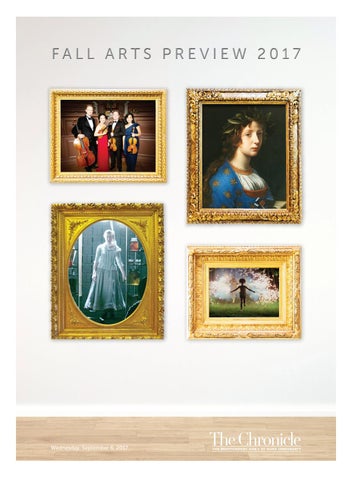
FALL ARTS PREVIEW 2017
Wednesday, September 6, 2017
The Chronicle
dukechronicle.com
2 | WEDNESDAY, SEPTEMBER 6, 2017
Campus Arts
‘MONK@100’ brings life to the legacy of musician Thelonious Monk Jake Parker The Chronicle Before Thelonious Monk revolutionized American music alongside players with names like Charlie Parker and Dizzy Gillespie, before he raised eyebrows and lit up souls, by playing in the cracks and experimenting with dissonance, he was just a kid from Rocky Mount, N.C. And in just a little over a month, the legacy and music of the singular jazz icon will return in full force to where it all started, or, to be precise, roughly 90 miles from where it all started. Oct. 17 through Oct. 26, Monk’s mammoth legacy will be on full display at the Durham Fruit & Produce Company—the site of Duke Performances’ “MONK@100: A Century of Genius,” a ten-day event commemorating what would have been Monk’s 100th birthday. The event aims to provide an immersive experience, traversing the entire Monk songbook in one way or another. The concerts will include a variety of musical configurations. That means everything from solo pianists working through Monk’s compositions to the JD Allen Trio playing alongside assorted soloists to duos working in tandem. In short, the musical offerings of “MONK@100” run the gamut of the icon’s career; no easy feat. In addition to conventional concertizing, the event will include a public conversation moderated by former New York Times music critic Ben Ratliff, a pair of free public jam sessions, listening stations equipped with Monk’s records and work by Raleigh-based artist André Leon Gray, who is creating a backdrop for the stage and two or three sculptural pieces. “We’re spending significant resources and a lot of energy making this festival around Thelonious Monk because we think he’s important, because he’s from the state of North Carolina, because he’s one of the most important composers,
W. Eugene Smith | Special to the Chronicle Jazz pianist Thelonious Monk’s 100th birthday will be celebrated at “MONK@100.”
musicians, thinkers in the history of American music and, of course, jazz,” Duke Performances Executive Director Aaron Greenwald said. In planning “MONK@100,” Greenwald enlisted the help of cocurator Ethan Iverson—who, in addition to being an active pianist and member of the band The Bad Plus, also writes extensively on the subject of jazz for his website, Do the Math. He is, in the words of Greenwald, “a total jazz geek from head to toe.” Iverson’s comprehensive knowledge of Monk’s sizeable oeuvre and his feel for which artists might work best in the per formance space made him an ideal collaborator on “MONK@100.” A cursory glance at the musicians slated to play the event reveals the wealth of jazz talent Duke Performances and Iverson have gathered for
“MONK@100.” It is a mix of national and North Carolina-based musicians. “There’s a really good community of jazz musicians in Durham,” Greenwald said. “We want to integrate the excellent musicians from the Durham community with the musicians we’re bringing in.” Of the five pianists who will take turns playing through the complete Monk songbook during Saturday and Sunday of the event, three of them have unique ties to North Carolina. Chris Pattishall is from Durham, Frank Kimbrough is from Roxboro and Jeb Patton, Trinity ’96, is a former Duke student. Though the format of “MONK@100” is unique, it will not be the first time Monk’s legacy has been honored in Durham. A decade ago, in celebration of the jazz icon’s 90th birthday, Duke Performances launched a far-flung series titled “Following Monk.” The
Songs of Journey
Gala concert featuring the premiere of Stephen Jaffe's Migrations, with Gustav Mahler's Songs of a Wayfarer and works by Bright Sheng and Duke alumna Penka Kouneva (Ph.D. ‘97)
series unfolded over the course of six weeks and included around 16 separate events, examining Monk’s broad cultural influence through varied mediums, including dance, music and a meta-theatrical project. Jazz pianist and composer Jason Moran brought his “In My Mind,”a mixed media piece centering on Monk’s iconic Town Hall concert, to that series. In Moran’s words, it is “[his] history meets Monk’s history meets the history of America.” Moran will return to Durham for Duke Performances’ latest celebration of Monk. This time, he will perform as part of a duo alongside composer and multi-instrumentalist—this time, drummer—Tyshawn Sorey. And though Moran has studied and interpreted Monk’s compositions extensively, he still feels there are new layers to identify. “When he was 90, America was in a different place, and now that he’s 100, America’s in another place,” Moran said. “So how do you paint his songs? What kind of brushes to the surface now that we are where we are?” “MONK@100” will bring together a variety of musicians with different understandings of Monk’s legacy and divergent interpretations of his enigmatic, at times, confounding, style. What the tenor quartet sees in his work may not be what the solo pianist does. “Monk is so deep in such an unusual way; he’s a conundrum in the world of jazz,” Stephen Anderson, professor of composition and jazz studies at the University of North Carolina at Chapel Hill, said. Monk only spent a few early years in North Carolina before moving north, but his legend is so towering, his influence so thick in the musical ether of Durham—and everywhere else, for that matter—that celebrating his legacy, here, anywhere, feels natural. “[Celebration of Monk is] the kind of thing that you would hope would happen everywhere, but it was great that his home state of North Carolina gave up the props to Thelonious Monk,” Moran said.
ON THE COVER 1. (Top left) Photo from Villiers Quartet group from Oxford University courtesy of the Department of Music. See Villiers Quartet on Friday, Nov. 3 at 8 pm at Baldwin Auditorium. 2. (Top right) Carlo Dolci, Poetry (Poesia), late 1640s. Oil on panel, 21 1/4 x 16 1/2 inches (54 x 42 cm). Galleria Corsini, Corsini Palace, Florence. Now on display at the Nasher Museum of Art through Jan. 14, 2018. 3. (Bottom left) Photo by Les Todd from An Experiment With An Airpump, directed by Dr. Jules Odendahl-James courtesy of the Department of Theater Studies. This fall, Dr. Odenhdahl-James is directing Vinegar Tom from Nov. 9-19 at Shaefer Theater.
Stephen Jaffe, Hsiao-mei Ku, Gabriel Richard, the Ciompi Quartet, Susan Dunn and a faculty/student chamber orchestra conducted by Rodney Wynkoop and Stephen Jaffe
Saturday, September 16
Free admission
8 PM
Baldwin Auditorium
music.duke.edu
Presented by the Duke University Department of Music in association with the Franklin Humanities Institute as part of the Humanities Futures capstone conference, "Health Humanities and Social Justice: Breath, Body, Voice."
4. (Bottom right) Photo from Beasts of the Southern Wild with Wordless Music, North Carolina Symphony & Lost Bayou Ramblers courtesy of Duke Performances. See Beasts of the Southern Wild Sept. 8 and 9 at 8 pm at Reynolds Industrial Theater.
The Chronicle
dukechronicle.com
WEDNESDAY, SEPTEMBER 6, 2017 | 3
Campus Arts
In wake of Harvey, ‘Beasts of the Southern Wild’ strikes a chord Sarah Derris The Chronicle In 2012, the film “Beasts of the Southern Wild” earned recognition at the prestigious Sundance and Cannes film festivals in addition to garnering four Oscar nominations, bestowing “universal acclaim” upon director Behn Zeitlin from viewers and critics alike— the oft-overlooked score that smoothly transitions the audience from feelings of tears to triumph was co-produced by Zeitlin himself. “‘Beasts of the Southern Wild’ is truly a venereal sound experience and a spectacle,” said Aaron Greenwald, executive director of Duke Performances. “An interesting aspect of the film is that Zeitlin directed the film and composed the score, which is a testament to his capacity as a filmmaker and artist.” Zeitlin intended the score to reflect Hushpuppy, the feisty heroine of the film, blending a contemporary take on traditional Cajun music—featuring Louisiana’s Lost Bayou Ramblers—and classical components, making for an exuberant folk-infused backing track filled with jubilance and valor but also a cosmic sense of mystery indicated in the protagonist’s persona. “The movie score needed to show a much more mystical side of her personality, and the Cajun music functions in the film when it’s happening in real life,” Zeitlin previously stated in a 2013 interview with The Hollywood Reporter. “We take
this piece of live music the musicians are playing onscreen, a very traditional South Louisiana song, and then as Hushpuppy starts to think about it, the actual musical score re-voices that Cajun song into her type of music. A mixture of this traditional thing and a much more mystical thing.” The eclectic film, presented by Wordless Music, will grace the screen of Duke’s Reynolds Industries Theater Sept. 8 and 9 at 8 p.m. with a live performance of the score by the North Carolina Symphony and the Lost Bayou Ramblers. The show will emphasize the strong sense of identity and solidarity within the fictional Louisiana town through a sense of refined Cajun flair. “The Lost Bayou ramblers are actually from Louisiana and performed the music for the film, and the North Carolina Symphony is a group of very talented musicians from Raleigh who haven’t played at Duke for almost ten years, so we are very excited about that,” Greenwald said. Indeed, the Ramblers identify as a progressive band rooted in Cajun traditions, highlighting a deep sense of southern culture and a mystical
T
he events in the film parallel current events and relate to the current state of things, all the while offering a beacon of hope.
— Aaron Greenwald
Special to the Chronicle The N.C. Symphony and Lost Bayou Ramblers present a live score of the 2012 film.
fascination with the natural world that the film presents. Greenwald further contended that the film imagines a place that is different than the place we live, but its themes still hold a sense of familiarity. In focusing on Hushpuppy’s curiosity, naivete and altogether fierceness, Zeitlin composes the score to reflect her thoughts, her speech and her emotions, adding a unique touch to the film in that the score does not reflect merely the action but rather a six-year-old taking on a world— her world—that is seemingly being destroyed before her very eyes.
“When she’s looking inward and analyzing herself, her place, analyzing nature—that is when you’re hearing music,” Zeitlin said in the interview with The Hollywood Reporter. “When she is unstable, those are a lot of the silent parts of the film, because she is not in a space to contemplate and analyze the world. She is a very quiet person onscreen. It isn’t like she has tons of friends to talk to, it’s not like her dad is a conversationalist. So, we knew from the very beginning that the way you were going to get to See BEASTS on Page 7
4 | WEDNESDAY, SEPTEMBER 6, 2017
The Chronicle
dukechronicle.com
Campus Arts
Duke professor to lead symposium on humanities and technology Sydny Long The Chronicle
Courtesy of OpenDurham.org Located just off East Campus, the Carpentry Shop will host a symposium led by Duke professor Joshua Gibson.
Admission is always free for Duke students.
Stacks of 16mm film canisters—each painstakingly labeled with duct tape and Sharpie—tower over a pair of enormous iMac monitors and a man who seems acutely aware of the comical contrast in technologies. That man is Joshua Gibson, associate professor in the department of Art, Art History & Visual Studies, and his office encapsulates the conflict between the ubiquity of digital technologies and the nostalgic return of analog devices, a conflict Gibson himself plans to address in his upcoming symposium “Material Desire in the Digital Age.” “This whole thing started as a movement,” Gibson explained, tracing inspiration for the symposium back to the Franklin Humanities Institute, where the term “digital humanities” first gained traction. Now that so many fields of study have been revolutionized by the decade’s massive strides in technology, the question has emerged of whether there is still a longing for material things. “Artists are making a choice to work with older technologies,” Gibson said. “One of the speakers at the symposium…makes robots using mud and sticks.” The symposium is more than just a simple debate about the virtues of these disparate technologies. It is an exploration of the reconciliation of old and new, of permanence and evanescence. Gibson recalled witnessing the abrupt transition from analog to digital and how it shaped his perspective on using analog materials—which encompass everything from celluloid to record players. “I went from using celluloid as an undergrad to digital computers in grad school.… When my son was born, I took pictures and videos on my phone…then I wondered, ‘Will he ever see these?’” Gibson said of his decision to start filming his son’s childhood on 16mm film. It’s a choice that reflects a common fear among creators and artists: Will their work survive rtists are making it is not physically a choice to work if archived? with older technologies. Automation and virtual annals — Joshua Gibson have replaced the clunky gear of yesteryear, but this shift has prompted a conversation about preservation in the field of humanities. Obsolescence is a major concern: if the technology used to store important documents and works is suddenly outdated, will there be any way to access it? Some artists are returning to the archaic forms of their mediums not just out of nostalgia or aesthetic appeal, but in order to imbue their work with a permanence that the current technological state does not allow. The goal of the symposium is to address these decisions, as well as foster a dialogue on how these choices will impact the future of creation and curation and how the past can still play an integral role in modern art. These conversations will be led by professionals from a variety of backgrounds, including Tom Whiteside, whose work focuses on the use of film projectors to create a more unique viewing experience and will be presented on the first night of the symposium. Whiteside’s oeuvre reflects the struggles of artists to return to the base element of their work in a world where technology has made creative execution deceptively simple. He will contribute a new dimension of thought to the discussion. Work that incorporates the analog—such as Whiteside’s—has seen a recent surge in popularity as audiences who are overwhelmed by the rapid developments in technology experience nostalgia for the relics that have since been replaced by shinier, speedier hardware. People have a deep appreciation for media that can be held, that can be materialized, that can be given. As convenient as it is to download a musician’s entire library onto one’s phone, nothing compares to the pride of owning a CD or vinyl record. The desire to own the material good has survived in spite of the deluge of digital books, streaming movies and virtual artwork. Analog
A
The Medici’s Painter
CARLO
DOLCI and 17th-Century Florence
On view through January 14, 2018
Carlo Dolci, Angel of the Annunciation (detail), early 1650s. Musée du Louvre, Paris. © RMN-Grand Palais / Art Resource, NY. This project was supported by the N.C. Arts Council, a division of the Department of Natural & Cultural Resources. This exhibition was made possible by the William R. Kenan, Jr. Charitable Trust, with additional support from the Mary Duke Biddle Foundation; the E.T. Jr. and Frances Rollins Family Foundation; Patricia Roderick Morton; Katie Thorpe Kerr and Terrance I. R. Kerr; the Mary Duke Biddle Trent Semans Foundation, in loving memory of Jenny Lillian Semans Koortbojian; Lisa Lowenthal Pruzan and Jonathan Pruzan; Kelly Braddy Van Winkle and Lance Van Winkle; Caroline and Arthur Rogers; and Karen M. Rabenau and David H. Harpole, M.D.
See SYMPOSIUM on Page 7
The Chronicle
dukechronicle.com
WEDNESDAY, SEPTEMBER 6, 2017 | 5
Campus Arts
Nasher highlights Florentine master Dolci in ‘The Medici’s Painter’ Keyin Lu The Chronicle A young woman wreathed in a laurel crown gazes at you from across the room. She is framed in golden opulence and surrounded by an expanse of blue. Her name is Poesia. Carlo Dolci created this portrait of “Poetry” that hangs in the Nasher Museum of Art. One of the first and only exhibits in the U.S. dedicated to the “Old Master,” “The Medici’s Painter: Carlo Dolci and 17th Century Florence” will be on view Aug. 24 to Jan.14. Tickets are free for Duke students, faculty and staff. Passing through the rooms of the gallery, visitors will meet the eyes of religious figures and those of the painter himself. Dolci’s self-portrait shows a quiet and introspective man holding a sketch of himself painting. From the sketch, viewers get a glimpse of Dolci as an artist; he works with immaculate technique and an undivided concentration. “I really like his self-portrait because it is so complex,” Assistant Curator Molly Boarati. “It shows many different levels of who Dolci the artist was. You get a sense of his character but also his seriousness in his art.” While technique and concentration are both essential traits of any great painter, what sets Dolci apart from his contemporaries is his spiritual devotion combined with the tireless pursuit of highly refined details. He would use brushes with only a few bristles to build an area and was known to pray in between brushstrokes. As a result, it often took him years to complete a painting. In “Angel of The Annunciation,” the golden embroidery on the angel’s garment appears to be sewn onto the canvas. Gemstones and fabrics take on realistic textures, appearing reflective or transparent. Dolci also used powdered gold mixed with oil for halos, giving his religious figures an added air of spirituality and presence.
Special to the Chronicle Carlo Dolci’s work has been given new life in the Nasher Museum of Art’s fall exhibit “The Medici’s Painter.”
Dolci’s process of rendering every detail was his form of spiritual meditation. A deeply religious man, he represented his own connection to God and the divine in the emotional lives of his subjects. “His purpose of the picture was to inflame the faith of the viewer. And he vowed when he was very young that he would only paint religious subjects,” Nasher Museum Director Sarah Schroth said. Depictions of the Virgin and Child and numerous
saints hang from the many rooms of the Nasher gallery, but in one room, visitors get to experience Dolci less as a man of deep faith and more as a father and teacher. One of the last rooms of the exhibit contains an example of Dolci’s handwriting and an iPad containing his sketchbook. Inside, visitors will
Fall Jazz at Duke! Friday, Oct. 20 8 p.m. Baldwin Auditorium Family Weekend Concert: Duke Jazz, Djembe and Afro-Cuban Ensembles with Nicholas Payton, trumpet Friday, Dec. 1 8 p.m. Baldwin Auditorium Duke Jazz Ensemble with Joey DeFrancesco, jazz organ
See DOLCI on Page 7
6 | WEDNESDAY, SEPTEMBER 6, 2017
The Chronicle
dukechronicle.com
Campus Arts
Once led by Bach, St. Thomas Choir of Leipzig comes to Duke Ashley Kwon The Chronicle The St. Thomas Choir of Leipzig has been performing for 805 years. Originally part of St. Thomas Monastery, the Choir grew from a musical school that trained boys for religious singing at church services to an internationally famous musical group. The all-boys choir is a living legacy of Johann Sebastian Bach, who served as the leader of the choir from 1723 to 1750. Although many contemporary composers write for the choir, Bach’s pieces remain the center of the choir’s performances. In November the choir is performing at Duke Special to the Chronicle Chapel. Despite performing several times in the The St. Thomas Choir, led by Johann Sebastian Bach in the 18th century, comes to Duke Chapel Nov. 14. United States, it is the choir’s first time performing in Durham. “It’s unusual that such a large choir tours internationally with all of its singers—there are fifty young musicians in St. Thomas Choir,” Ariel Fielding, marketing director of Duke Performances, said. “The choir is amongst the most exceptional choirs in the world, certainly the premier of children’s choir in the world,” Aaron Greenwald, executive director of Duke Performances, said. “Not only does the choir have an exceptional history, but it seems to have been able to maintain the enormously high quality of music.” Aged between nine and 18 years old, all members of the choir, called “Thomaners,” live in a dormitory, called “alumnat,” and attend St. Thomas school. The younger members who have not gone through puberty tend to be sopranos. As they get older and The Wild Duck, Fall 2016 department mainstage their voices break, they are moved to positions that require lower voices. When they are not practicing together, the boys take individual voice lessons, learn instruments or play at the school gym like other children their age. The program is centered on the works of Bach, FOR WHOM THE SOUTHERN BELLE TOLLS DUKE PLAYERS LAB but it also includes the works of other composers Brody Theater, East Campus Duke Players presents a comic one-act by Christopher like Johann Schein, who led St. Thomas choir about February 8-11 Durang, directed by senior Meredyth Albright a hundred years before Bach. Brody Theater, East Campus “The program is fairly wide-ranging in terms August 25-26, September 1-2 of style, but the through line is that this is all BEDLAM RESIDENCY sacred music,” Fielding said. “This is all music that HAMLET AND SAINT JOAN THE CIVILIANS RESIDENCY the choir might sing in services at St. Thomas in Upstart Brooklyn theater company in repertory Leipzig.” SCHOOL PROJECT Presented by Duke Performances Duke University Chapel Organist Christopher Presented by Duke Performances, Theater Studies, and Von der Heyden Studio Theater, Rubenstein Arts Center Jacobson will be playing couple of selections by Center for Documentary Studies February 19-25 A work in progress from the Obie-winning, NYC-based Mendelssohn and a solo by Bach. His solos will investigative theater company and playwright Ethan complement the music that the choir sings. Lipton “The choir is going to be in the front of the SENIOR DISTINCTION PROJECT September 30 - Oct. 5 staged reading of original script by senior Wesley Chapel, and the organ I will be playing is the one Workshop reading at Motorco Music Hall on October 4 Caretto in the back,” Jacobson said. “The idea is to have Brody Theater, East Campus a setup similar to their home church, St. Thomas ONCE ON THIS ISLAND March 29-30 Church in Leipzig.” Duke Players presents a Caribbean musical by Lynn Having attended a boarding choir school from age Ahrens and Stephen Flaherty, directed by senior nine to 14, Jacobson has a meaningful connection TWO GENTLEMEN OF VERONA Sophie Caplin to such a performance. He recalled that his years department mainstage, a rock musical by John Guare Brody Theater, East Campus at the choir school were parts of an incredible and Galt MacDermot, based on Shakespeare’s comedy, October 19-28 formative experience, because singing in the choir directed by Professor Thomas DeFrantz gave him the privilege to have professional musical Sheafer Theater, Bryan Center, West Campus VINEGAR TOM exposure and to participate in high quality choral April 5-15 department mainstage, a play about power, sex and music at such an early age. Jacobson considered it witches by Caryl Churchill, directed by Professor Jules an honor to be asked to play the organ for such a Odendahl-James world-famous choir. Sheafer Theater, Bryan Center, West Campus “A group of folks teaches you how to be a part November 9-19 of a team, how to be a part of something coming T H E AT E R ST U D I ES together to form something bigger than yourself, DON DELILLO’S THE BODY ARTIST and to understand that people are counting on you new work adapted and directed by Professor Jody WWW.THEATERSTUDIES.DUKE.EDU and you are counting on them,” he said. McAuliffe with professional cast @DUKETHEATER St. Thomas Choir’s performance is a part of Duke Reynolds Theater, Bryan Center, West Campus Performances’ decade long Vocal Ensemble Series, January 25-27 THEATER@DUKE.EDU T H E AT E R in which it has invited many exceptional choirs. ST U D I ES “Duke Performances has for the last decades built a good reputation for being able to generate robust audience and for having exceptional venues like Duke Chapel and Baldwin Auditorium where the choirs can perform,” Greenwald said. Durham’s high demand for vocal ensemble performances also made the rare opportunity possible. “Choral music is an interesting genre in that the amateur can perform at quite a high level and is
DUKE UNIVERSITY DEPARTMENT OF THEATER STUDIES 2017-2018 SEASON
See CHOIR on Page 7
The Chronicle
dukechronicle.com
DOLCI from page 5 find Dolci’s loose and casual sketches alongside his children’s replicas. Eventually, the Nasher is hoping to put paper and pencils in the space for visitors to do their own sketching. “Sketching was so important to Dolci as well as to the tradition of art history in Florence so it seems appropriate to show his sketches to also encourage others to do so,” Boarati said. Schroth and her team thought carefully about the design of the gallery. Because the exhibit differs slightly from the first one in the Davis Museum at Wellesley College, which obtained the pieces from lending institutions, things had to change to accommodate the space at the Nasher. “We wanted to guide the visitor through in one main direction and really astound them with the masterpieces,” Boarati remarked. The gallery was divided into several rooms to convey a sense of intimacy and complement the smaller size of Dolci’s works. Schroth also made sure that Dolci’s best works would be highlighted by placing them in places where viewers can see them through doorways. The entire exhibit houses around 34 pieces of Dolci’s work borrowed from world-class institutions like the Louvre and the Metropolitan Museum of Art. This show is the first exhibit dedicated to Dolci in the U.S. and provides a rare opportunity to rediscover an “Old Master” who had been forgotten by the public until now. Ironically, Dolci was hugely popular in his time and had many followers who produced copies of his work. Many of these copies were wrongly attributed to Dolci and people assumed that he was not a good painter. His reputation further declined when John Ruskin, a highly influential critic, wrote negatively about his work. Coupled with the movement towards reason and away from religious devotion during the Enlightenment, Dolci was pushed further into obscurity. “I think that for anyone who has never heard of Dolci or seen his work, you’re in for a great treat,” Boarati said. “This is a wonderful discovery and it’s
WHAT’S YOUR
something that can really only be explored by seeing the works in person.”
BEASTS from page 3 understand this girl was by being able to understand her thoughts, and her thoughts are a combination of the music and words.” Greenwald also argued that the film screening will strike a chord with people from across the country, especially as the citizens of Houston have lost homes, possessions and loved ones due to recent flooding that has devastated the community. “Beasts of the Southern Wild” parallels these events with the tragic flooding of the fictional Bathtub, La., forcing the characters to take measures necessary for survival, all the while remaining defiant and optimistic in the face of adversity. “I think it is truly a generational film, it’s not quite in our time but is connected to events going on in our country, a large conflict in the film being an environmental disaster,” Greenwald said. “As many of us know, obviously what has happened in Houston is absolutely tragic and the events in the film parallel current events and relate to the current state of things, all the while offering a beacon of hope.” This performance follows the success of last year’s screening and live score of the film “Birdman,” featuring Antonio Sánchez on the drums—Greenwald, who has spearheaded the Duke Performances program, notes a greater appreciation for arts at Duke and adds that tickets are selling especially quickly for this event since they went on sale Aug. 29. “As with ‘Birdman,’ and I’m sure with ‘Beasts,’ audiences come away from the experience of a live symphony playing through what is essentially a film stripped of its music audio with a heightened understanding and emotional connection to the story and its characters,” Greenwald said. “Beasts of the Southern Wild” will be screened with a live rendition of its score, presented by Wordless Music, North Carolina Symphony and Lost Bayou Ramblers, Sept. 8 & 9 at 8 p.m. at the Reynolds Industries Theater.
WEDNESDAY, SEPTEMBER 6, 2017 | 7
CHOIR from page 6 a participatory performance genre,” Fielding said. “A lot of people in the audience for the St. Thomas Choir performance at Duke Chapel will have some experience [being choir members] themselves.” The audience’s insight into the choir’s techniques and approaches to the pieces will help the audience appreciate the performance better. However, Fielding added that such expertise is not required to enjoy the show. “Bach was one of the greatest composers of the whole time, and the choir is a direct descendant of him in terms of musical lineage,” Fielding said. Listening to the choir’s music as it resonates through the gothic chapel will be like bringing Bach back to the 21st century and promises to be a memorable experience.
SYMPOSIUM from page 4 still holds a stake in the mainstream, a stake that is expected to grow as the escalation of obsolescence and automation kindles feelings of nostalgia and dissatisfaction in audiences. “It’s a project that has self-importance,” Gibson said when asked what he hopes to gain from the symposium. “I want to understand why I enjoy this process.” He invites both graduate and undergraduate students to attend, hoping to gain some insight into the issue from the youth who hold the most influence over which forms of creation will dominate art and academia in the coming years. And, hopefully, they will turn away from their screens for a night to glean the importance of the analog technology that preceded their iPhones and MacBooks. “We have to understand original technologies to understand digital,” Gibson explained. “We’re emulating this other language and we have to understand it in order to understand everything that comes after.” “Material Desire in the Digital Age” will be held Sept. 7 and 8 at the MFA Carpentry Shop.
scene?
FIND OUT AT DUKECHRONICLE.COM/EVENTS
ARTS + ENTERTAINMENT | CAMPUS FAIRS | CAMPUS OUTREACH RELIGIOUS + SPIRITUAL | SPEAKERS | SPORTS + REC | VOLUNTEER
8 | WEDNESDAY, SEPTEMBER 6, 2017
The Chronicle
dukechronicle.com
FULL FRAME
Quest
can’t miss
events
Directed by Jonathan Olshefski Sep. 21 | 7 p.m. Hayti Heritage Center Filmed over the course of ten years, QUEST is a thoughtful and nuanced observation of the Rainey family—led by father Christopher (“Quest”) and mother Christine (“Ma”). As Quest and Ma raise their children, Olshefski weaves pivotal life experiences with grander issues of poverty, politics, and gun violence. QUEST is an ode to the unwavering love and resilience of a specific family, and a universal reminder that family can give us the strength to keep on going. http://quest-documentary. com/
MUSIC
Songs of Journey Songs of Journey: Gala concert featuring the premiere of Stephen Jaffe’s “Migrations” and Mahler’s “Songs of a Wayfarer”
PHOTO BY ALEC HIMWICH
Sep. 16 | 8 p.m. Baldwin Auditorium This concert explores themes of migration and immigration, and is the final event in the Franklin Humanities Institute’s Humanities Futures capstone conference, “Health Humanities and Social Justice: Breath, Body, Voice.” Featuring conductors Stephen Jaffe and Rodney Wynkoop leading a faculty/student chamber orchestra.
DANCE
November Dances 2017
Nov. 17-18 | 7:30 p.m. Bryan Center Reynolds Industries Theater The Duke Dance Program’s fall concert featuring ballet, modern, jazz, and African Dance works by Duke faculty and students
SCREEN/SOCIETY
Film Screening: Her
(Spike Jonze, 2013, 126 min, USA, in English, Color, DCP) Dec. 5 | 5:30-7:45 p.m. Bryan Center Griffith Film Theater A sensitive and soulful man earns a living by writing personal letters for other people. Left heartbroken after his marriage ends, Theodore (Joaquin Phoenix) becomes fascinated with a new operating system which reportedly develops into an intuitive and unique entity in its own right. He starts the program and meets “Samantha” (Scarlett Johansson), whose bright voice reveals a sensitive, playful personality. Though “friends” initially, the relationship soon deepens into love.
THEATER
Caryl Churchill’s Vinegar Tom
Nov. 9-19 Shaefer Theater
This exciting early play by an acclaimed Obie Award winnin created in association with a British feminist theater compa about witches. Although Vinegar Tom is set in the 16th or 1 it has a contemporary feel and includes songs. It tells the st who are named as witches by a man whom they have spurn between fear of female sexuality and witch hysteria is show of society’s problems.
The Chronicle
dukechronicle.com
WEDNESDAY, SEPTEMBER 6, 2017 | 9
NASHER
Disorderly Conduct: American Painting and Sculpture, 1960-1990 Sep. 21-Feb. 25
ng author Caryl Churchill was any who requested a play 17th century in rural England, tory of two farm women ned sexually. The connection wn to be at the root of many
PHOTO BY PETER PAUL GEOFFRION
The decade immediately following World War II was one of significant artistic achievement in the United States. In the late 1950s, artists took divergent aesthetic paths in reaction to the dominance of Abstract Expressionism, laying the foundation for a plurality of styles that proliferated in the ensuing years. The Nasher Museum presents “Disorderly Conduct: American Painting and Sculpture, 1960-1990,” drawn primarily from the collection. This exhibition presents some of the varied artistic approaches developed during that time. Disorderly Conduct is organized by Marshall N. Price, Nancy Hanks Curator of Modern and Contemporary Art.
JAZZ PROGRAM
Family Weekend Concert: Duke Jazz, Djembe, and Afro-Cuban Ensembles with Nicholas Payton, trumpet Oct. 20 | 8 p.m. Baldwin Auditorium
PHOTO COURTESY OF DUKE PERFORMANCES
Nicholas Payton is a Grammy Award-winning trumpet player, composer, and multi-instrumentalist from New Orleans, Louisiana. A founding member of the SFJAZZ Collective, he has performed with such artists as Marcus Roberts, Elvin Jones, Herbie Hancock, Stanley Jordan, Ray Charles, among others. His numerous recordings include the 1997 album Doc Cheatham & Nicholas Payton, for which he received a Grammy Award for Best Instrumental Solo.
DUKE ENTERTAINMENT, MEDIA AND ARTS NETWORK
DEMAN Weekend
Nov. 3-4
DEMAN Arts & Media Weekend is the annual signature event at Duke that brings together students and alumni interested in creative industries and features industry sessions, receptions, arts center tours and more! Event is FREE. 2017 DEMAN Weekend Keynotes: Peter Friedlander ‘96, NETFLIX, Vice President, Original Series; Lisa Katz ‘95, NBC, Executive Vice President, Drama Development; John Solomon ‘03, Beats By Dr. Dre, Head of Digital Marketing & Media; moderated by Blayne Alexander ‘08, NBC NewsChannel, Correspondent. DukeDEMAN.com
DUKE PERFORMANCES
World Premiere: New Work for Goldberg Variations Pam Tanowitz Dance & Simone Dinnerstein, Piano Oct. 6 | 8 p.m. Reynolds Theater
When pianist Simone Dinnerstein and choreographer Pam Tanowitz began discussing an evening-length dance collaboration in 2015, they faced an obvious question: what would they perform? Bach was a clear choice for Dinnerstein, who became a sudden classical star in 2007 with her selffinanced interpretation of “Goldberg” Variations. Duke Performances - a longtime supporter of Dinnerstein and the lead commissioner for this project - presents the two-night world premiere of New Work for Goldberg Variations, an audacious setting for piano and seven dancers. Brought to you by Department of Art, Art History and Visual Studies, Center for Documentary Studies, Dance Program, Music Department, Master of Fine Arts in Experimental & Documentary Studies, Nasher Museum of Art, Screen/Society, Theater Studies with support from the Office of the Vice Provost of the Arts.
The Chronicle
dukechronicle.com
10 | WEDNESDAY, SEPTEMBER 6, 2017
Campus Arts
‘Vinegar Tom’ puts a startling spotlight on modern violence Taylor Plett The Chronicle The Theater Studies department is hard at work on their production of “Vinegar Tom,” a 1976 play by feminist playwright Caryl Churchill, which will open at Sheafer Lab Theater Thursday, Nov. 9, and run through Sunday, Nov. 19. Set in the late 17th century, “Vinegar Tom” is a grim tale of the peril that befalls four women who don’t subscribe to accepted standards— women slandered as witches. “Don’t expect ‘The Crucible,’” warned Dr. Jules Odendahl-James, adjunct faculty director of the Theater Studies department and director of “Vinegar Tom.” For Odendahl-James, the play steps beyond the outdated witch hunt tale and suggests more complexity than a battle of good versus evil. “This [witch hunt] is a metaphor that strikes close to home for women specifically,” Odendahl-James said. “Unlike ‘The Crucible,’ the women at the core of this are not the troublemakers, but the victims. They’ve done nothing but be the wrong kind of person.” While the show has a historical setting, its themes and and messages carry weight in modern social and political terrains. “I hadn’t imagined the amount of ‘witch hunt’ rhetoric that would emerge since the time I chose this play,” Dr. Odendahl-James said. “But what does it
mean to have that really happen?” She hopes “Vinegar Tom” will instruct audiences on the horrific yet common set of circumstances that come about when people are “othered and persecuted for that otherness.” Plays written by women that expose the injustices women face are central to the work of Odendahl-James, who also serves as director of academic engagement for the Humanities at the Duke Academic Advising Center and associate artistic director at Manbites Dog Theater in Durham. This season alone, she is directing three shows by female writers, featuring primarily female casts. “Once you are attached to being seen as a woman or behaving in particularly feminine kinds of ways, there are burdens that come with that,” she said. “So I’m always looking for plays that take women’s experiences seriously.” But beyond the disparagement and shame faced by unconventional women, “Vinegar Tom” casts a startling light on the violence such women have historically been subjected to. Horrors ranging from torture to a hanging are
I
’m always looking for plays that take women’s experiences seriously. — Jules Odendahl-James
Courtesy of Wikimedia Commons The play “Vinegar Tom” presents a modern take on a 17th-century witch hunt.
performed onstage, posing the difficult task of presenting violence in a way that is shockingly meaningful rather than sensationalizing. Odendahl-James envisions a thematic rather than hyper-realistic portrayal of the show’s explicit brutality, and has hired professional fight choreographer Jeff A.R. Jones to help communicate the personal horror within the violence. The director has also been collaborating with a number of professional designers to see her vision for the show come to fruition. Among them is lighting designer Chuck
Catotti, who will enlist the help of his lighting design class in his work on the show. Likewise, AAHVS Professor Raquel Salvatella de Prada will head production design and work in concert with her class, “Animation, Comics & Theater.” Set designer Sonya Drum is creating a unique stage setup in which time periods collide, pieces perform multiple functions and plaques commemorating the characters’ ultimate deaths give the stage a memorial air. See VINEGAR on Page 15
Get TheDirt The Chronicle brings you a weekly summary of events, ideas and news items that that are trending at Duke and in the Triangle. Read all you need to know with The Dirt!
thebluedirt.com
The Chronicle
dukechronicle.com
WEDNESDAY, SEPTEMBER 6, 2017 | 11
Local Arts
In 20th year, Retro Film Series continues at Carolina Theatre Eva Hong The Chronicle The Retro Film Series continues at the Carolina Theatre in downtown Durham from July to December. The series will celebrate its 20th birthday next year and includes RetroFantasma, RetroClassics, RetroTreasures and RetroAmore—four sections in which anyone in their mid-30s to early-40s will find the fancy of his or her youth. All the featured movies were released between 1920 and 1997. “I always say to qualify for retro, a movie has to be at least 20 years old,” Jim Carl, senior director of film programming, said. “Why 20 years old? Because I feel that’s about how much time it takes for one generation to grow up, have kids, and actually miss seeing that movie back on the big screen. It takes about 20 years for that cycle to happen.” The Retro Film Series helped craft the Carolina Theatre’s identity when it reopened in 1994 by providing sources of nostalgia for people who, like Jim Carl himself, miss the movies in the ‘70s and ‘80s. Since no other venue in the Triangle was doing anything similar, the area’s residents reacted excitedly. Encouraged by the success and the viewer’s requests, the series has expanded over the years from only showing horror and sci-fi films to also including dramas, musicals, rom coms, foreign films, epics and even silent films. “What [the viewers] really were excited to see were some of the films that they grew up on,” said Jim Carl. He makes sure that the audience will have the best retro experience by surveying what movies viewers want to see back on the screen. This year, the chosen films range from “White Christmas” to “Halloween II”, “Alien” to “Westworld” and “Man of La Mancha” to “Motel Hell.” Among these are some movies that the viewers would never get tired of, as Carolina Theatre puts down the same titles on its survey slip every year. They are “the Great Stories” described by the Booker-Prize-winning writer Arundhati Roy: “The Great Stories are the ones you
Josh Hofer | Special to the Chronicle The Carolina Theatre, located in the heart of downtown Durham, has hosted the Retro Film Series for 20 years this fall.
have heard and want to hear again. The ones you can enter anywhere and inhabit comfortably. They don’t deceive you with thrills and trick endings. They don’t surprise you with the unforeseen. They are as familiar as the house you live in. Or the smell of your lover’s skin. You know how they end, yet you listen as though you don’t. In the way that although you know that one day you will die, you live as though you won’t.” And it’s not just the movies. The entire theater experience has been synchronized to help the audience go back in time. For instance, as you are sitting in the theatre to watch “Cat’s Eye,” the opening screen would read, “Tonight is April 12, 1985. It’s the opening night of ‘Cat’s Eye’ across the country. The following motion pictures are coming soon to a theatre near you.” The trailers that follow are the ones you would see had you sat
in a movie theater on April 12, 1985. Maybe some people do go there just to watch the movie. But some are there to be reminded of the sweetness and saltiness of the buttered popcorn they were eating 20 years ago, the coldness of that Coke they were holding and the person they sat with through the movie at the time. The audience is there to get goosebumps at the exact same line, laugh at the exact same joke and cry at the exact same scene. “We sell nostalgia,” Jim Carl said. “We really do.” If 20 years is how long it takes for one generation to grow up, then the almost20-year-old Retro Film Series has surely witnessed the history of one generation. “We’ve had people come to the Retro who went on their first date at the Retro, fell in love, got married, have kids, and bring their kids to the Retro,” Jim Carl said. “I remember
we’ve had some grandparents bringing their grandchildren to the Retro. Those kids are now grown up and in college and sometimes come back during their breaks.” As young adults, we are constantly urged to look into the future. As Duke students, we are educated to actively shape the future. But it is also important to pause on our way sometimes and reflect on the past, the history and where we have come from. Only when combing the vertical experience of the past with the horizontal experience of the present can we be better informed to walk into full maturity. Besides, in 20 years, we will be the ones bringing our kids to the Retro Film Series. That’s how it works. What we consider as new today will always be replaced by the newer. The new is transient, and only becomes eternal when it becomes the retro.
Special to the Chronicle Jacques Demy’s classic 1964 musical “The Umbrellas of Cherbourg” is one of the films featured in this fall’s Retro Film Series at the Carolina Theatre.
12 | WEDNESDAY, SEPTEMBER 6, 2017
The Chronicle
dukechronicle.com
Campus Arts
For Week of Wellness, Dance department to host free classes Mikaela Johnson The Chronicle
Courtesy of Duke Dance The Dance department offers free dance classes during Duke’s Week of Wellness between Sept. 11 and 15.
I believe it was the late, great William Shakespeare who once said, “For never was a story of more woe than that of the subpar college dancer.” Between Shooters, a canceled Lil Jon concert and a cappella shows, somehow the situation always arises where college students have to dance. It is precisely at this moment that panic falls upon the average fist-bumper. “How do I move my feet when there are hundreds of people surrounding me? All of my friends are enrolled in the same Zumba class, but I have zero sense of rhythm!” Well, have no fear. Instead of going to the Shooters balcony to avoid the dance floor, we here at Duke are given the opportunity to remedy our woeful, subpar dancing status. That’s where Week of Wellness comes in, a Duke initiative to showcase the services available for the Duke community to address various aspects of their health. The Dance department is participating, offering a week of free dance classes starting Sept. 11 for students, faculty and staff. The department welcomes everyone to attend any of the various classes offered and learn more about the different styles students can take on Duke’s campus for academic credit. And don’t worry—these classes are open to anyone who’s interested, meaning there’s no prior experience necessary. Professor Katya Wasowski, who is teaching the class on capoeira, an Afro-Brazilian martial-arts style of dance, assured me that she even prefers people with no dance experience. “Sometimes, if you come in with a ballet background, you are thinking elevation and pointed toes, but capoeira is down and in the ground so it can be harder to work with people who have been trained in a specific style,” she said. By opening up her capoeira dance studio, tress lives in the body W a s o w s k i and if you’re not movhopes not only to introduce ing your body, you are not people to a letting go of that. rapidly growing dance style — Keval Kaur Khalsa but to teach the Duke community about the fascinating cultural history that comes with the movements. As such, her class introduces students to a fun form of exercise and provides a glimpse into the importance of capoeira’s context and history. “Capoeira was seen as a social threat for most of its history. ... It is a game and a fight, so it can be rough and aggressive,” Wasowski said. “But then politics and racial dynamics radically shifted in Brazil and Afro-Brazilian culture started to be celebrated.” Although a greater comfort in your dancing ability is surely a stress-reliever in and of itself, the Dance department is also hoping to use this week to educate students on the importance of a longerlasting awareness of the connection between your mind and body. “Dance is very experiential, and a very embodied experience,” Keval Kaur Khalsa, planning committee member and modern dance instructor, said. “Stress lives in the body and if you’re not moving your body, you are not letting go of that. It is important to carve out time to move, and move in a mindful way. A full awareness of your movements is very empowering and can help alleviate stress.” Instead of ineptly tossing weights around in Brodie, or secretly crying when the attempt to run from East to West Campus fails halfway, students can discover a different opportunity for mindful fitness—perhaps something they never even considered before. “There are a lot of pre-professional students at Duke,” Wasowski remarked. “But Duke is so rich in terms of what it has to offer. It is a shame if students don’t take advantage of that. The Dance department in particular offers some wonderful classes that students are not aware of. The studio allows people to relieve built up stress while also going outside their trajectory.”
S
See DANCE on Page 15
The Chronicle
dukechronicle.com
WEDNESDAY, SEPTEMBER 6, 2017 | 13
Local Arts
N.C. Museum of Art presents five free exhibits in fall season Selena Qian The Chronicle This fall the North Carolina Museum of Art in Raleigh will feature five new free exhibitions, two of which have already opened. These temporary exhibitions are housed in a separate building next to the one containing the museum’s permanent collection. The exhibitions include artist Andrea Donnelly’s textile collection “We’ve Met Before” and media artist Sabine Gruffat’s interactive computer animation “A Kiss of the Earth.” The two both opened Aug. 26 and will be available for public viewing until Jan. 28, 2018. Donald Sultan’s “The Disaster Paintings” will be open from Sept. 23 to Dec. 31, and the collaborative photography collection “Night(Light),” as well as photographer Barbara Morgan’s “Rhythmic Vitality,” will open Sept. 30 and close Jan. 28, 2018. The exhibitions showcase a variety of artistic styles and mediums, according to Jennifer Dasal, associate curator of contemporary art. “All these exhibitions are so different, and there really is something for everybody,” Dasal said. Dasal also said the exhibitions are the culmination of multiple years of planning work. The larger shows required at least two years of planning to determine what pieces would be displayed and how to fit them into the available space. “It really is a large process, so by the time it opens, it’s just exciting all of a sudden to have a big payoff for all the work that you’ve done,” Dasal said. As a contemporary art curator, Dasal said she enjoys the opportunity to work directly with artists and have their input into the exhibitions. She worked directly with media artist Sabine Gruffat to choose which of Gruffat’s works to display. Gruffat said she initially proposed several projects, and the museum chose to show “A Kiss of the Earth.” Her inspiration came from the original 1913 dance production of “The Rite of Spring” and its avant-garde, modern nature, as well as the story of the audience riot and dancer response, which Gruffat said she thinks of as interactive. Like “The Rite of Spring,” Gruffat’s work is in two parts and includes interactive elements. To start the second part, the viewer must text the word “sacrifice,” the title of part two of the dance, to the provided phone number. “[The dance] was talking about nature, how nature necessitates a sacrifice,” Gruffat said. “My act two of the piece is really about the environment and how
Special to the Chronicle Lynn Saville’s “Pepsi-Cola, New York” features in “Night(Light),” one of five exhibits offered by NCMA this fall.
we’re kind of sacrificing our environment and nature, and how that environment is affected by climate change and pollution and all these toxic chemicals.” Dasal said the process for developing the “Night(Light)” exhibition was different from individual artist works because it carries a central theme throughout the photos, all chosen from the permanent collection. Fine art photographer Lynn Saville, who graduated from the Women’s College at Duke in 1971 before it combined with Trinity College, will feature a photo entitled “Pepsi-Cola, New York” in the exhibition. The themes of “Night(Light)” parallel many of the themes Saville said she likes to explore, such as light and dark and the transition period between day and night. For “Pepsi-Cola, New York,” Saville
said that though she had seen images of the sign previously, this moment was special for her. “It suddenly made me think of the history of New York,” Saville said. “New York is so built up, it’s so electric and alive and paved, so to see it and think you’re on a farm or how…[New York] was completely natural and then little by little, by hand, people built this amazing metropolis.” In the same way, the curators, artists, editors and registrars go through a lengthy process that culminates in new exhibitions like the five opening this fall, according to Dasal. “It’s always such an exciting time,” Dasal said. “It’s always most gratifying to see people walking through the galleries and admiring the work. People asking questions is always really exciting.”
Special to the Chronicle Sabine Gruffat’s “A Kiss of the Earth,” inspired by Stravinsky’s “The Rite of Spring,” is an interactive animation projection that will be on display at NCMA this fall.
dukechronicle.com
14 | WEDNESDAY, SEPTEMBER 6, 2017
The Chronicle
Local Arts
Regulator Bookshop to host author of ‘Before It Was Legal’ Lexi Bateman The Chronicle “It’s an honest story about a relationship, and I think of it as a sociological study… It really is about the influence of culture,” author Nancy Poling said of her newest book, “Before It Was Legal: A Black-White Marriage (1945-1987).” Released earlier this year, “Before It Was Legal” is equal parts biography and memoir, a work of creative nonfiction that merges history with Poling’s own understanding of past events. In the book, Poling chronicles the lives of Anna Harley and Daniel Winters, a white woman and black man who found love in a most unlikely and unfriendly time. Indiana natives, the couple faced the reemergence of the Klu Klux Klan in the 1920s and a midwestern racism that rivaled its southern iteration. In 1945, the couple journeyed to Chicago to marry—interracial marriage would not be legalized in Indiana until 1965. In a final attempt to escape the American racism that had plagued their relationship from its inception, the couple moved abroad, where they encountered a different set of challenges entirely. Anna Harley and Daniel Winters’ relationship takes place against a backdrop of resurfacing racist activity and religious turmoil. Poling doesn’t shy away from these issues, but rather uses them to tell a story of the time—a story in which the Klan finds its stronghold within the Protestant Church and dwindling jobs intensify racist sentiment. And although “Before It Was Legal” is Poling’s third book, all of her works speak in some way to a similar idea. “I’m a feminist,” Poling said. “I think that is what draws [my novels] all together. … The common thread is my concern about women.” Her two previous books, “Had Eve Come First and Jonah Been a Woman” and “Out of the Pumpkin Shell,” are perhaps more obviously feminist in their
20
Will Atkinson | The Chronicle Author Nancy Werking Poling will read her new book, “Before It Was Legal,” at the Regulator Bookshop Sept. 14.
content—the former a rewriting of Biblical stories in which the hero is a woman and the latter a comment on domestic violence and the power of strong female friendships. Still, Poling finds threads of feminist ideas in her newest book as well. “[Being a white woman was] one of the things that made it difficult to write ‘Before It Was Legal,’” Poling mentioned. “I began to see that the only way I could tell this story is from the standpoint of the white woman, and to make every effort I can to be fair and sympathetic and let the black man have his voice. The one issue that it raises in the end is a feminist question about [Anna’s] choices as a white woman.” Poling doesn’t promise her book is an uplifting one. In fact, she describes it as quite the opposite. If you’re interested in a feel-good book about a resilient
love, this is likely not the novel for you. “It’s not a happily-ever-after story like I thought it was going to be when I went into it,” Poling stressed. Still, “Before It Was Legal” has valuable insights. It sheds light on the ways culture influences not just individuals but longstanding institutions. It provides a personal account of the struggles of interracial couples, and it raises feminist questions about a woman’s choice. Poling assured that “for anyone interested in a sociological understanding of marriage and relationships and the impact of culture on that, it’s a valuable read.” Poling will be presenting excerpts of her book at the Regulator Bookshop, a popular Ninth Street hangout See POLING on Page 15
ARTSY THINGS TO DO BEFORE YOU GRADUATE
For the full list of 101 Things to Do Before You Graduate visit welcome.dukechronicle.com o Take an art class o See a local band play at Motorco o Read an issue of FORM and check out The Standard o Go to a Def-Mo show
o Host a Duke radio broadcast o See the Pitchforks or another student a cappella group perform o Catch a concert at Cat’s Cradle o See a show at the Carolina Theatre o Dance for a cause at the Duke Dance Marathon o Check out the galleries at the 21c Museum Hotel
The Chronicle
dukechronicle.com
POLING from page 14
VINEGAR from page 10
for Duke students and faculty alike. Poling’s talk comes at a fitting time, as this year marks the 50th anniversary of the 1967 Loving v. Virginia Supreme Court case. This landmark civil rights case deemed unconstitutional all laws prohibiting marriage due to race. Tom Campbell, co-owner of the Regulator, said the shop is excited to host Poling because her book touches on an issue that has become more and more common. “It still, to some people, maybe to a lot of people, creates a reaction,” Campbell said. “This is a book about [interracial relationships]. It should have some relevance to a lot of people right now.” As issues regarding race and culture continue to brew in our supposedly “post-racial” society, Poling’s book highlights just how far, and perhaps how little, we’ve come in the last 50 years. Nancy W. Poling will present excerpts of her newest book, “Before It Was Legal: A Black-White Marriage (1945-1987)” Sept. 14 at 7:00 p.m. at the Regulator Bookshop in Durham.
As a play with music, “Vinegar Tom” invites creativity; seemingly antiquated scenes are studded with songs in a range of modern genres. These unconventional additions to an otherwise period-specific plot act as a vessel for commentary, framing the show as a mirror to modern society. But in lieu of a band, the actors will step out of their character and perform the songs themselves, led by music director and arranger Bart Matthews, Trinity ‘96. To define the role that different period settings will play in the show, Odendahl-James enlisted Trinity sophomore Meg Hancock as dramaturg. Hancock devised a cast reading list that will instruct performers’ acting choices as 17th-century townsfolk, while bringing light to the relevant issues at play in
WEDNESDAY, SEPTEMBER 6, 2017 | 15
“Vinegar Tom.” Her list ranges from the writings of Emma Donoghue, author of “Room,” to Duke professor Thomas Robisheaux’s “The Last Witch of Langenburg.” Hancock’s work also finds links between the play’s themes and issues relevant to a Duke student audience. “The big issues in this show are about bodily autonomy and women’s rights, which are things that should be in the minds of all college students,” she said. “It also poses questions about why people are so quick to blame the minorities in society.” For Odendahl-James, art like “Vinegar Tom” is most effective in sounding these messages when performed on a stage. “Theatre does not happen in a vacuum,” she said. “It tells a story that you can hold at a distance, but respond to in a way that feels very visceral.”
DANCE from page 12 Though we all have different levels of familiarity with dance, nobody is a stranger to stress, and this week might provide students and faculty a different perspective on handling it. Instead of re-watching the “Game of Thrones” season finale for the 20th time, or hanging around Marketplace instead of starting that history essay, try out a dance class. It’s an opportunity to burn those extra late-night Pitchfork calories while gaining a better understanding of mental health and different cultures. At the very least, Healthy Duke Dance Week might be your only chance to avoid that Shakespearean tragedy. For more information on the free classes offered by the Dance department, visit https://danceprogram.duke. edu/events.
Special to the Chronicle Andrea Donnelly’s “Body Blot #1,” made of handwoven and dyed cotton, will be on display at NCMA this fall.
o Go to The Nasher to check-out art exhibits, then grab brunch at the Café o Check out local art galleries at Third Friday Durham o Attend a Chapel service o Enjoy Jazz at the Mary Lou Williams Center
o Attend Me Too Monologues, All of the Above, or a Hoof ‘n’ Horn production
o Instagram the Chapel/ take a Chapel selfie
o See the Ciompi Quartet perform at Baldwin o Watch live music at the Coffeehouse o See an event at DPAC o Keep up with the arts — read The Chronicle’s Recess section every Wednesday. o See a movie at the annual Full Frame Documentary Film Festival
The Chronicle
dukechronicle.com
16 | WEDNESDAY, SEPTEMBER 6, 2017
D U K E PE R F O R M A N C E S
2 0 1 7/ 2 0 1 8 S E A S O N | M U S I C , T H E AT E R , D A N C E & M O R E .
I N D U R H A M , AT D U K E , E S S E N T I A L & E X T R A O R D I N A R Y.
65 SHOWS
$10 TICKETS FOR DUKE STUDENTS & PATRONS UNDER 30
BEASTS OF THE SOUTHERN WILD WITH WORDLESS MUSIC, NC SYMPHONY & LOST BAYOU RAMBLERS FRIDAY & SATURDAY, SEPTEMBER 8 & 9 REYNOLDS INDUSTRIES THEATER
11 ARTISTS IN RESIDENCE ARTISTS FROM 17 COUNTRIES 13 VENUES ON CAMPUS & IN TOWN 4 WORLD PREMIERES & 2 WORLD-CLASS FESTIVALS
WWW.DUKEPERFORMANCES.ORG