Fixing North Carolina districts
Fall sports preview
Retired NC justices propose a solution to gerrymandering | Page 2
Get caught up on some of the Blue Devils’ most talented 2016-17 teams | Sports
The Chronicle T H E I N D E P E N D E N T D A I LY AT D U K E U N I V E R S I T Y
WEDNESDAY, AUGUST 31, 2016
WWW.DUKECHRONICLE.COM
ONE HUNDRED AND TWELFTH YEAR, ISSUE 5
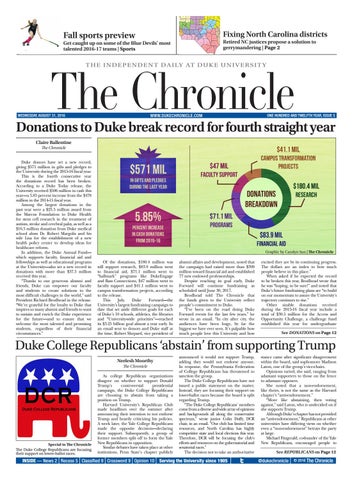
Donations to Duke break record for fourth straight year Claire Ballentine The Chronicle Duke donors have set a new record, giving $571 million in gifts and pledges to the University during the 2015-16 fiscal year. This is the fourth consecutive year the donations record has been broken. According to a Duke Today release, the University received $506 million in cash this year—a 5.85 percent increase from the $478 million in the 2014-15 fiscal year. Among the largest donations in the past year were a $25.5 million award from the Marcus Foundation to Duke Health for stem cell research in the treatment of autism, stroke and cerebral palsy, as well as a $16.5 million donation from Duke medical school alum Dr. Robert Margolis and his wife Lisa for the establishment of a new health policy center to develop ideas for healthcare reform. In addition, the Duke Annual Fund— which supports faculty, financial aid and fellowships as well as educational programs at the University—also set a new record in donations with more than $37.5 million received this year. “Thanks to our generous alumni and friends, Duke can empower our faculty and students to create solutions to the most difficult challenges in the world,” said President Richard Brodhead in the release. “We’re grateful for the loyalty to Duke that inspires so many alumni and friends to want to sustain and enrich the Duke experience for the future—and to ensure that we welcome the most talented and promising students, regardless of their financial circumstances.”
Graphic by Carolyn Sun | The Chronicle
Of the donations, $180.4 million was will support research, $83.9 million went to financial aid, $71.1 million went to “hallmark” programs like DukeEngage and Bass Connections, $47 million went to faculty support and $41.1 million went to campus transformation projects, according to the release. This July, Duke Forward—the University’s largest fundraising campaign to date that set aside different goals for each of Duke’s 10 schools, athletics, the libraries and “University-wide priorities”—reached its $3.25 billion goal almost a year early. In an email sent to donors and Duke staff at the time, Robert Shepard, vice president of
alumni affairs and development, noted that the campaign had raised more than $390 million toward financial aid and established 77 new endowed professorships. Despite reaching its goal early, Duke Forward will continue fundraising as scheduled until June 30, 2017. Brodhead told The Chronicle that the funds given to the University reflect people’s commitment to Duke. “I’ve been on the road doing Duke Forward events for the last few years,” he wrote in an email. “In city after city, the audiences have been huge, by far the biggest we have ever seen. It’s palpable how much people love this University and how
excited they are by its continuing progress. The dollars are an index to how much people believe in this place.” When asked if he expected the record to be broken this year, Brodhead wrote that he was “hoping, to be sure!” and noted that Duke’s future fundraising plans are “to build on our momentum to assure the University’s trajectory continues to rise.” Other sizable donations received during the 2015-16 fiscal year include a total of $30.5 million for the Access and Opportunity Challenge, a challenge fund established this year for undergraduate See DONATIONS on Page 12
Duke College Republicans ‘abstain’ from supporting Trump Neelesh Moorthy The Chronicle
Special to The Chronicle The Duke College Republicans are focusing their support on lower-ballot races.
|
|
As college Republican organizations disagree on whether to support Donald Trump’s controversial presidential campaign, the Duke College Republicans are choosing to abstain from taking a position on Trump. Harvard University’s Republican Club made headlines over the summer after announcing their intention to not endorse Trump and heavily criticizing his policies. A week later, the Yale College Republicans made the opposite decision—declaring their support. Subsequently, a group of former members split off to form the Yale New Republicans in opposition. Similar debates have taken place at other institutions. Penn State’s chapter publicly
|
|
INSIDE — News 2 Recess 5 Classified 9 Crossword 9 Opinion 10
|
announced it would not support Trump, adding they would not endorse anyone. In response, the Pennsylvania Federation of College Republicans has threatened to sanction the group. The Duke College Republicans have not issued a public statement on the matter. Instead, they are focusing their support on lower-ballot races because the board is split regarding Trump. “The Duke College Republicans’ members come from a diverse and wide array of opinions and backgrounds all along the conservative spectrum,” wrote junior Colin Duffy, DCR chair, in an email. ”Our club has limited time resources, and North Carolina has highly competitive state and local elections this year. Therefore, DCR will be focusing the club’s efforts and resources on the gubernatorial and senatorial races.” The decision not to take an authoritative
Serving the University since 1905
|
stance came after significant disagreement within the board, said sophomore Madison Laton, one of the group’s vice-chairs. Opinions varied, she said, ranging from adamant supporters to those on the fence to adamant opposers. She noted that a non-endorsement, like theirs, is not the same as the Harvard chapter’s “anti-endorsement.” “More like abstaining, then voting against,” said Laton, who is undecided on if she supports Trump. Although Duke’s chapter has not provided an “anti-endorsement,” Republicans at other universities have differing views on whether even a “non-endorsement” betrays the party at large. Michael Fitzgerald, co-founder of the Yale New Republicans, encouraged people to See REPUBLICANS on Page 12
@dukechronicle
|
© 2016 The Chronicle
www.dukechronicle.com
2 | WEDNESDAY, AUGUST 31, 2016
The Chronicle
Retired NC justices map independent congressional districts Rachel Sereix The Chronicle A nonpartisan panel of 10 retired North Carolina judges released an unofficial congressional map Monday in an effort to demonstrate the importance of independent congressional redistricting. This new congressional map wraps up a redistricting simulation that started in April and was co-sponsored by the Sanford School of Public Policy and Common Cause North Carolina. Thomas Ross—former president of the University of North Carolina system and currently the Terry Sanford distinguished fellow at Duke—advised the judges during the simulation. “The group of judges—half of them are Democrats and half of them are Republicans—came together and prepared a mock congressional redistricting map,” Ross said. “They did so without considering party registration or voting history so it was a very nonpartisan effort. And I think they produced very compact districts as well as more competitive districts.” Having competitive districts allows elected government officials to be held more accountable to their voters, Ross said. This is in contrast to gerrymandered districts, where legislators have drawn districts to specifically benefit one party. “If districts are not intentionally gerrymandered to support one party or another, the districts that are drawn without regard to party politics are more competitive,” Ross said. “I think that is important for democracy to function well because it gives voters a real voice that
Special to The Chronicle The proposed map would increase the number of competitive districts in North Carolina’s congressional race.
matters in elections.” A federal court determined earlier in February that two of North Carolina’s 13 congressional districts had been unconstitutionally gerrymandered along racial lines. There were ten safely Republican districts and three likely Democratic seats in that map, John Aldrich—Pfizer-Pratt professor of political science—explained at the time. The court’s ruling forced the General
ASK US YOUR QUESTIONS. GIVE US YOUR OPINIONS.
Connect with Duke University Stores! Give us your feedback on any of our operations via our online question/comment page, DevilSpeak. Just visit www.dukestores.duke.edu and click on the DevilSpeak link.
Duke University Stores. We are the Stores that Work for You! OPERATION: Stores Administration PUBLICATION: Chronicle
Assembly to redraw districts, which it did later in the month after the Supreme Court declined to delay the decision. As a result, Congressional primaries were moved from March to June. The Supreme Court will take up the case this term to evaluate the state’s original map. Common Cause North Carolina recently filed another lawsuit challenging the state’s redrawn districts as partisan gerrymanders. In 2014, Democrats won 44 percent of the
congressional vote in North Carolina while only three of 13 seats. Earlier this month, a panel of three federal judges struck down the state’s legislative districts as racial gerrymanders the and told the General Assembly to redraw those maps next year. The judges’ unofficial map has six likely Republican districts, four likely Democratic districts and three districts that could go to either party. The map struck down in February had no districts that would be considered toss-ups. Under the proposed map, Durham County would be entirely in one district, along with Orange and portions of Alamance, Chatham and Granville counties. Durham is currently split into two congressional districts—the first and the fourth—in the new map drawn by the legislature. The old map split Durham four ways. Jonathan Mattingly, professor of mathematics and statistical science, said in drawing the unofficial map, judges focused on populations, what they knew about the state of North Carolina and compliance with the Voting Rights Act. The judges also prioritized not splitting counties and keeping districts compact. “The primary challenge is to get political self-interest out of it and worry more about the health of our democracy and less about winning,” Mattingly noted. Ross added that he hopes students could potentially be involved in drawing legislative districts. Mattingly leads a group of Duke students doing their own studies of independent redistricting. “The group found that they were very capable of doing this in a fairly apolitical way,” Mattingly said.
The Chronicle
www.dukechronicle.com
WEDNESDAY, AUGUST 31, 2016 | 3
2016 A Cappella Showcase
Carolyn Chang | The Chronicle The annual Duke a cappella showcase was held Monday night in Page Auditorium.
Carolyn Chang | The Chronicle The groups held a recruiting session for freshmen outside of Page Auditorium after the concert.
Carolyn Chang | The Chronicle Speak of the Devil, one of Duke’s all-male a cappella groups, showcased their latest songs Monday night.
Carolyn Chang | The Chronicle Founded in 1980, Out of the Blue is Duke’s oldest female a cappella group and has performed in Carnegie Hall.
Can a child count on you this fall? Join the national effort to improve math education this fall by becoming a tutor in the America Counts program. Modeled after the very successful America Reads Challenge, America Counts lets volunteers and university students in the federal work-study program tutor elementary-school students in basic math.
America Counts FAQs
Why be a math tutor?
Who can tutor?
• Students need solid math skills in the information age.
America Counts welcomes undergraduate and graduate student tutors. Volunteers tutor two hours each week. Students eligible for federal workstudy tutor up to six hours each week. The rate of pay for undergraduate work-study tutors starts at $13.50 per hour. For graduate students, the rate starts at $16.50.
Where do tutors work?
At Duke-Durham Neighborhood Partnership elementary and middle schools, nearby charter schools and community centers.
When do I tutor?
America Counts tutors work with children during school, Monday through Friday.
• Low income students who take algebra and geometry attend college at three times the rate of those who do not. • Math teaches students ways of thinking that apply in every workplace. • Math tutors are great role models. • Local schools need math tutors. • It’s fun!
How do I apply?
Submit online by 5 p.m. on September 7th. Application is available here: http://sites.duke.edu/arac/ The Community Service Center is a department of Duke University Office of Durham and Regional Affairs
The Chronicle
www.dukechronicle.com
4 | WEDNESDAY, AUGUST 31, 2016
Study shows resiliency can decrease effects of PTSD Ajay Desai The Chronicle A Duke professor’s research on Nepalese child soldiers demonstrates that resilience could curb effects of post-traumatic stress disorder. For nearly twenty years, Brandon Kohrt—assistant professor of psychiatry, global health and cultural anthropology—has been conducting mental health research projects in Nepal. His latest initiative, which involved working with child soldiers who fought in the country’s civil war as well as children that experienced the war as civilians, has attempted to highlight the role of resiliency in combatting post-traumatic stress disorder. Kohrt started working with child soldiers in 2006 just after the end of the Nepalese Civil War. He conducted research with the Transcultural Psychosocial
Organization, a Nepalese non-governmental organization, to help find better ways to reintegrate child soldiers in their communities post-war. “We first started out finding out different possible avenues to help child soldiers reintegrate into their communities, to return to school, to be accepted by their families, to be allowed to participate in community activities, and we also then began a large research project with former child soldiers,” Kohrt said. The child soldiers who participated in the study were primarily either those who had returned home or fled the army on their own accord, explained Kohrt. He interviewed the child soldiers in 2007 just after the war, in 2008 after a 12-month intervention program by United Nations Children’s Emergency Fund and in 2012 about five years after their traumatic experience in the war. His most recent publication, based on the findings from 2012, shows that resilience is a key factor in
Interim Chaplain:
Imam Abdul Waheed
ahwaheed721@gmail.com
406 Swift Avenue l 919-613-6778 Program Coordinator: Kiah Glenn kiah.glenn@duke.edu
studentaffairs.duke.edu/ muslimlife
@DukeCML
Duke CML
Look out for us during Orientation Week!
MUSLIM LIFE AT DUKE
Jummah Prayers ~ Eid Celebrations ~ Retreats Speakers and Scholars ~ Islamic Awareness Monty Triangle MSA Trips ~ Campus Wide Fastathon ~ Halaqahs Spiritual Counseling ~ Social Events
Muslim Student Association President Farhan Khan / farhan.khan@duke.edu
dukemsa.com MSA
@dukemsa
Duke
Invent
ideas
determining how individuals respond to trauma at the molecular level. “What we did in this study was that we defined resilience in the fashion of an individual self-efficacy of their own ability to be able to solve problems they face in the world and cope with those challenges,” Kohrt said. “Our goal and our work is to be able to promote these qualities of self-efficacy and resilience.” The primary mechanisms for achieving this, according to the study, were to engage child soldiers with their peers and make them feel like contributing members of the community. “Our idea of resilience is to help people help others. So for former child soldiers, a lot of that is about being able to help their peers, being able to feel like they’re making a difference in their community,” Kohrt said. The research, which is primarily funded by the National Institutes of Health, also looks at mental health integration into primary care for countries like Nepal, which has very few psychiatrists. This is primarily achieved by providing mental health services through primary care doctors and community health workers. Kohrt has already begun to put his plan into action by finding alternative ways to provide mental health services through schools. “One of the projects we completed this summer is a school-based mental health program for students in the most affected areas,” he said. “A lot of that intervention work has been built upon the findings of our work with child soldiers and the impact of early trauma on child and adolescent development.” Kohrt’s commitment to supporting mental health patients in the most vulnerable places around the world has culminated in a public charity called HeartMind International. “Through that organization, he has been providing free-of-cost mental health services in the poorest parts of Nepal,” said Sauharda Rai, a Nepalese native and research program coordinator at the Duke Global Health Institute. “He’s very dedicated to Nepal and has been working there for a very long time.” Rai has been supporting Kohrt’s research in Nepal for the past five years. HeartMind International provides a number of different relief sources for people in Nepal. Most recently it has been supporting those affected by the 2015 earthquake. “This past year we’ve been working on earthquake relief programs, looking at people that are most affected by the earthquake and what mental health services they need,” Kohrt said. Kohrt said that he hopes to continue his research in Nepal, noting that more work needs to be done, particularly with developing a universal school-based mental health program to support those suffering from the consequences of any traumatic event. He noted that he would also like to continue to study the group of child soldiers later into their lives to assess the long-term impacts of their childhood trauma on their adult lives. “Our hope is to continue to follow these child soldiers over time to see what their life is like and to see what the impact of early trauma is on their overall physical and mental health,” Kohrt said.
KUNSHAN INNOVATION SCHOLARSHIP PROGRAM A unique opportunity to combine study abroad with a self-defined project
Implement your project
Integrate
your ideas within the Duke Kunshan community
www.dukekunshan.edu.cn
Selected students receive a full tuition scholarship for a semester. For more information about the Kunshan Innovation Scholarship or any academic programs at Duke Kunshan University, please contact Jennifer Bailey at Jennifer.Bailey@duke.edu.
Courtesy of Duke Photography Brandon Kohrt has worked with child soldiers since 2006 to help find better ways to reintegrate them into their communities post-war.
R
The Chronicle
www.dukechronicle.com
WEDNESDAY, AUGUST 31, 2016 | 5
recess
VOLUME 18, ISSUE 1
AUGUST 31, 2016
Bill Burr and ‘Ben Hur’
Recess chats with critically-acclaimed
comedian Bill Burr and reviews the movie ‘Ben Hur’
Grad student Jon Holt creates new EP And you spent your summer how? , page 8
Featuring ‘Filbert’ Comic Cerebral humor for the soul, page 9
R
6 6| WEDNESDAY, | WEDNESDAY,AUGUST AUGUST31, 31,2016 2016
recess editors Cringeworthy O-Week moment?
Kirby Wilson ................................ belt Georgina Del Vecho.......... pet banana Jessica Williams ..... nightly exorcisms Dillon Fernando .............. showerhead Christy Kuesel ...........get some cactus Drew Haskins .... garlic knots & vamps Tim Campbell ...........lost in translation Aditya Joshi ......catching z’s at Shootz Alex Griffith ........... better things to do Claire Ballentine .............infosessions
The TheChronicle Chronicle
www.dukechronicle.com recess
Perhaps the greatest part of sophomore year so far is seeing how much I have changed since the beginning of freshman year. Freshmen, for the most part, are still easy to pick out on West. They tend to travel in large groups, wandering around with a strange mix of false confidence and awkwardness that makes it clear that they have absolutely no idea what they’re doing. It feels like just yesterday when I was one of them, following around my new friends from my pre-orientation group, going to the First Night Carnival and tr ying to figure out where on earth LSRC was. Before O-week, countless upperclassmen told me how much fun O-week was, with all the planned activities and opportunities to bond with your class. Only later did I realize what a cruel joke that was, and that O-week is possibly one of the most intensely uncomfortable times in a Duke student’s life. Freshmen have to deal with homesickness, worries about finding friends and making the transition to college, all while putting on a happy face and making small talk with their peers for days in a row. There are only so many times in one’s life when you’re put with over a thousand strangers, left alone with barely any adult super vision and told to immediately make friendships to last a lifetime. What I remember most clearly from O-week and the first weeks of college was how out of my element I felt. I had never been in a completely new place with no one I knew before. All of the upperclassmen I talked to seemed
impossibly cool, with their majors all figured out and involved in a million different equally impressive activities. I had no idea what I wanted to major in or even what I could major in, and I didn’t know how to go about joining any of the clubs I heard about. I was getting by at Duke, but I didn’t understand what all the hype was about college just yet. I wasn’t sure if I could ever be one of those upperclassmen who I looked up to so much during my first days at Duke. A year later, ever ything has changed. I’ve spent the last part of O-week juggling meeting up with all
editor’s note my friends who I missed dearly over the too-long summer with freaking out over the opening of West Union and catching up on homework I’m already behind on. The past year has been a transformative one, as I’ve gone to Oxford for a summer program, gotten an editor position at The Chronicle and fallen in love with Duke and the opportunities it has given me. Being at Duke marks some of the happiest times in my life so far, and I wouldn’t want to go to college anywhere else. As I sit writing my ver y first editor’s note in the newly open West Union,
occasionally looking up to wave to a friend from my sorority or my study abroad program, I can’t help but think about how different I felt a year ago. Last summer, I couldn’t even dream of inter viewing the producer of “Frozen,” frequenting the Durham Farmer’s Market or traveling to a new countr y by myself. I knew that most people changed a I eagerly await the next three years of finding myself at Duke and in Durham and all the memories to be made along the way. So upperclassmen: be nice to the freshmen. They are just as lost and confused as you were when you first got to Duke. They could use advice from students who were in their shoes just a few months or years earlier. Freshmen: if O-week didn’t go to way you thought it would or if you still don’t feel comfortable at Duke, give it time. Duke has so much to discover, and it takes a full four years to do so. Don’t be afraid to tr y extracurriculars you wouldn’t have done in high school or to make friends with people who seem to be different from you. O-week is definitely the beginning of ever y Duke student’s college experience, but it doesn’t have to signify how the next four years will go. You certainly won’t have ever ything figured out on freshman move-in day, and you probably won’t have ever ything figured out by graduation. Like O-week, Duke can be scar y and over whelming at times, but it can also offer you some of the greatest and most memorable times in your life. If you let it.
—Christy Kuesel
Student Life
Class of 2020 summer reading features less controversy Georgina Del Vecho The Chronicle The Duke Common Experience is one almost ever y student has endured; it is common, after all. This year’s common experience was “Just Mercy” by Br yan Stevenson, an emotional novel about the author’s experiences working as a lawyer with underprivileged people on death row. The novel particularly focuses on the author’s work with a wrongly convicted man named Walter McMillian. Even if you are not a part of the Class of 2020, chances are you’ve heard of the book, the author or the rave reviews the first years have been giving it. Despite the fact that it touches on some pretty touchy topics — the death penalty and race relations in the South, for example— so far “Just Mercy” has not generated the negative publicity that “Fun Home” did last year after one freshman publicly and adamantly refused to read it. “Just Mercy” may have been a less controversial choice than last year’s because of just that: it’s a less controversial book. Despite the fact that it does touch on divisive topics, Stevenson supports his claims with facts and statistics, and the personal stories of his clients’ incarcerations and trials are heartbreaking regardless of one’s political views. “I wouldn’t necessarily label [“Just Mercy”] as controversial” said Andres Camino, a First-Year
Advisor y Council Co-chair and member of the summer reading selection committee. “It will definitely spark conversations, which in the end is the goal of the summer reading book.” Camino also noted that the controversy surrounding last year’s novel did not affect this year’s decision. Instead, the book was chosen because of the lessons it teaches and important themes it embodies. “I think one of the most important lessons to learn from reading the book is about listening to and understanding others’ stories,” Camino said. “You come to Duke and meet all these amazing and diverse students and ever yone has a unique stor y and one of the biggest first steps to understanding and growing is listening to others.” Although the book may not have been as publicly controversial as “Fun Home,” it still attracted its fair share of criticism. One of the topics touched on in the novel is the unfair incarceration of mentally ill individuals, and some first-year readers believed Stevenson was arguing that mentally ill individuals should not be held responsible for their crimes. Another criticism was not of the book, but of the audience. “Just Mercy” was written with a more liberal tone, so it makes sense that it was accepted by the more liberal audience that Duke students make up. Overall,“Just Mercy” is a power ful book and a logical choice for this year’s summer reading. It touches
on a plethora of topics that are not generally brought up in dayto-day conversation and that are not often publicized by the media. While the death penalty has been a subject of debate for as long as anyone can remember, issues like juveniles ser ving life sentences for crimes they committed when they were 13 or 14 or mothers not being
able to afford proper prenatal care and getting blamed for the deaths of stillborn babies are just two examples of the topics this novel brings to the forefront. Criticisms aside, it makes for an emotional and interesting read, and is a book for all future lawyers. Duke students and open-minded people should have it in their librar y.
Courtesy of Wikimedia Commons “Just Mercy”, the Class of 2020 summer reading book, discusses themes like the death penalty, mental illness and race relations in the South.
The TheChronicle Chronicle
www.dukechronicle.com recess
WEDNESDAY, WEDNESDAY,AUGUST AUGUST31, 31,2016 2016| 7| 7
Local Arts
Bill Burr to perform at Carolina Theatre Sept. 15-17 Tim Campbell The Chronicle Internationally famous comedian Bill Burr will be per forming three shows at the Carolina Theater Sept. 15, 16 and 17. The shows will feature new material as Burr prepares to film his latest stand-up special. His previous specials have been critically acclaimed and garnered him both national and global recognition. Burr’s fame overseas has grown alongside his decades-long standup career and was bolstered by a successful European tour earlier this summer. “It was probably one of the biggest tours of my life as far as being an important one to feel like I’m solidified over there [in Europe],” Burr said. Burr grew up near Boston and began his stand-up career there; to this day, he uses an exaggerated Boston accent in his act. Due to his roots in the northeast, many viewers assume that his Netflix original show, “F is for Family,” is set in the Boston area. “ I t ’s k i n d o f v a g u e , ” B u r r s a y s . “ I t ’s f r o m m e d o i n g t h e r o a d . I grew up on the east coast, I’ve been e v e r y w h e r e … t h e r e ’s e l e m e n t s of my hometown, all across the Midwest, the East Coast, all of t h a t , s o y o u k n o w t h e r e ’s n o r e a l specific place.” Set in a Rust Belt town in 1973, the show makes frequent references to its time period with jokes about economic stagnation, outdated gender roles and prog-
Special to the The Chronicle Comedian Bill Burr will perform his iconic “uninformed logic” style of standup this Sept.
rock. The deliberate ambiguity of the setting of “F is for Family” also applies to the characters and p l o t l i n e s i n t h e s h o w. “I wanted to make sure that my family could sit down and watch it without being mortified that I’m telling all our stories, so really it’s an amalgam of ten or fifteen different people’s dads, experiences, bullies, and all the rest,” Burr said. The writing process of “F is for Family” ensures that each episode is a hodge-podge of experiences, all of which are based in some reality of Burr’s or the other writers’ lives. Growing up in the 1970s, Burr and his colleagues had a variety of shared experiences that mesh well to create stories that fit common notions of American culture at the time. “We’ll just be writing and then something will come up, and someone will be like ‘Oh, I was in this situation, and this is what happened,’” Burr notes. “[W]e use that as jump-off point and it usually becomes something else.” One product of the creative
process for “F is for Family” is a family whose relationships are often strained in different ways. While previous animated shows such as “The Simpsons” and “Family Guy” have depicted similar middle-class families, “F is for Family” treats the problems that the family faces like real, lasting issues. The tone of the show therefore shares some similarities with Burr’s standup, which is often described as “uninformed logic”. While he often mentions real issues like climate change and overpopulation in his act, these topics usually ser ve as the basis for infuriated rants and broad, simplistic claims rather than actual discussion. “I never pretend to know what I’m talking about,” Burr said. “My job isn’t to understand issues. My job is to make people laugh.” Because of his often-bombastic and sometimes ignorant style, one would expect Burr to be a target of politically correct commentators. Many people believe that comedians are often under fire from “social
justice warriors,” a notion that has been reinforced by such events as the publishing of an article claiming that Jerr y Seinfeld won’t per form at colleges due to excessive political correctness and the media fallout that followed Louis C.K.’s appearance on SNL in May 2015. However, Burr was quick to correct this assumption. “ I t h i n k i t ’s r e a l l y e x a g g e r a t e d , ” B u r r s a i d . “ I t ’s a v e r y s m a l l p o r t i o n of the population that ever c o m p l a i n s … T h e r e ’s t h o u s a n d s o f comics doing thousands of shows e v e r y n i g h t a n d i t ’s l i k e o n c e e v e r y six months that somebody raises a stink about something.” Mr. Burr further opined that many of these claims are completely unsubstantiated and merely exist to fuel bad reporting. “ To b e h o n e s t w i t h y o u , p e o p l e are adults. They go to comedy clubs, and they understand what they’re going to see,” he said. “They wanna make it seem like e v e r y o n e ’s w a l k i n g o n e g g s h e l l s when you go up there [on stage] but that certainly has not been m y e x p e r i e n c e … I t h i n k i t ’s a n e a s y s t o r y. I t ’s c l i c k b a i t , h a l f t h e t i m e i t ’s t a k e n o u t o f c o n t e x t , sometimes they even create it via websites just to get something going so they can get hits and m a k e m o r e m o n e y. ” Keep an eye out for Burr’s next special which he plans to film in October and for Season 2 of “F is for Family” which is on track to be released in May 2017. An abbreviated version of this ar ticle appears here. A full version can be found online at dukechronicle.com.
Playground Reviews
Frank Ocean simplifies sound in new album “Blonde” Alex Griffith The Chronicle I n s t e a d o f f o l l o w i n g u p 2 0 1 2 ’s “channel ORANGE” with another concept masterpiece, Frank Ocean opted for something simpler— and better—with his new album, “Blonde.” The scope of “Blonde” is far more intimate than that of “channel ORANGE,” which touched on t h e m e s r a n g i n g f r o m O c e a n ’s bisexuality to race and class divides to prostitution to drug abuse. “Blonde” instead focuses, for the m o s t p a r t , o n O c e a n ’s f e e l i n g s following a breakup with a person whose gender is intentionally obscured by a lack of pronouns, and feels much more personal, an impressive feat considering the emotion poured into every track on his previous effort. The album opens with “Nikes,” which is easily the track least f o c u s e d o n t h e a l b u m ’s g e n e r a l theme of love. A cold critique of the trappings of wealth and those who wish to take advantage of O c e a n ’s s u c c e s s , t h e t u n e f e a t u r e s O c e a n ’s p i t c h e d - u p v o i c e s i n g i n g a rambling verse over a hazy trap beat. The drums drop out and the singer plunges into another verse about the wait between his albums and his drug use before an autotuned coda addresses the past
lover— “I’m not him, but I’ll mean something to you.” T h e s e c o n d s o n g , “ I v y, ” f o l l o w s a similar theme as Frank sings about a failed relationship which, despite the animosity between himself and his ex, was still worth it — “But we both know that deep down / The feeling still deep down is good.” A gentle dreampop guitar lifted straight out of a Beach House song and written by Rostam Batmanglij, previously of Va m p i r e We e k e n d , a c c o m p a n i e s F r a n k ’s v o i c e . Guitar defines “Blonde,” which differs from “channel ORANGE” in the intimacy of its production. Songs are often built around a single guitar part, rather than the traditional R&B drums and b a s s f o u n d i n O c e a n ’s o t h e r w o r k . T h i s l e t s O c e a n ’s v o i c e t a k e c e n t e r stage, where, of course, it thrives. The album starts out clear and unambiguous, with songs including “ N i k e s , ” “ I v y, ” a n d t h e w a l t z “ P i n k + White” all featuring unexpected, but clear production. The end o f t h e a l b u m , h o w e v e r, v e n t u r e s further into the experimental range, as songs like “Pretty Sweet” a n d “ C l o s e t o Yo u ” a r e b u i l t a r o u n d walls of feedback and skittering electronic drums, in addition to a strong James Blake influence in the l a t t e r. T h e a l b u m l o s e s f o c u s o v e r these songs—which are separated by a monologue about a Facebook-
Courtesy of Wikimedia Commons Frank Ocean recently released his heavily anticipated album that has had fans anxiously waiting for four years.
facilitated breakup by French DJ Sebastian—but regains it by the emotional close of the album. The album also features per formances from a variety of g u e s t s : B e y o n c é b a c k s O c e a n ’s voice in “Pink + White”; a c h i l d h o o d f r i e n d ’s m o t h e r w a r n s about “weedheads” and other substances in the voicemail skit “ B e Yo u r s e l f . ” K e n d r i c k L a m a r whispers about six words in total in the structure-less “Skyline To . ” André 3000 receives an entire song to himself in “Solo (Reprise),” in which he extols his ability to do it alone—calling out
rappers with ghostwriters in the process. With “Blonde,” Ocean does not try to answer any questions, and, compared to “Channel O R A N G E , ” b a r e l y e v e n a s k s a n y. The comparatively narrow focus of the album allows Ocean to more fully develop his thoughts on love, and the pared-back and slightly unorthodox production only brings his voice more fully into light. “Blonde” is a worthy successor to the excellent “Channel ORANGE,” and only opens up more and more to the listener after each spin.
The Chronicle
www.dukechronicle.com recess
8 | WEDNESDAY, AUGUST 31, 2016
Campus Arts
Grad student Jon Holt releases new solo EP ‘South’ Kirby Wilson The Chronicle Second-year civil and environmental engineering Ph.D. student Jon Holt released “South,” his first solo EP, on Aug. 26. A classically-trained dr ummer, Holt, 26, graduated from UMass-Amherst and spent two years in New Orleans teaching high school science for Teach for America before ar riving at Duke. We sat down at Twinnie’s to talk about his musical influences, finding time for passions in the chaos of Duke and YouTube stardom. The following conversation has been edited and condensed for clarity. The Chronicle: So tell me more about your musical background. How did you decide to make this EP? Jon Holt: I’m classically trained as a drummer and I was really into marching band and stuff in high school and college. I did the marching band at UMass, I got to travel a lot with them, and I met some really, really talented drummers. College is also when I started to get into pop music and pop production...My third year in New Orleans, I tried my hand in production software. I started using Logic Pro, which is sort of like GarageBand, all grown up. I still had never sung at this point, really, other than, like, elementar y school choir. I had a few good friends who were really good singers, and I would invite them
over to my house and I would make some beats and stuff and have them sing and put it all together. I put out a couple of different tracks. I made a SoundCloud at that time. When I moved to Durham is when I found myself all alone. I had these production skills that I had developed over the years, but I didn’t have any more singer friends. So this was last fall and winter, when I was like, well, I guess I’ll just sing for myself now. And I think that’s really sort of the period of time when I found my voice. New city, didn’t really have any friends yet, so I would just stay up really late at night in my house with my two pets and my wife, who I had just married in October, and just sort of experiment with some different sounds. I think you can hear on the EP, there are a couple of different voices that I use. TC: It’s interesting to hear you say that you’re a newlywed, because I found the EP to be incredibly sweet. All of the songs are really kind of hopeful. Do you think that your wedding might have influenced the messages or the tone of the record? JH: I think that I’m a romantic. I think I’ve always been a romantic. I think my personality just in general lends itself to a lot of the nostalgic lyrics. The sweetness and the nostalgia is intertwined. On my YouTube channel, I also have a really sappy proposal video.
TC: Careful, we’re going to link to that now. JH: It’s funny. This is a separate conversation, but I orchestrated this whole proposal thing in New Orleans, and that video went viral. It’s got 2.5 million views. So I think I’m just sort of into the sweet stuff. I can’t deny that my wife has got
some influence on some of the songs, but I don’t want to give her too much credit. The full version of this interview can be found online at dukechronicle.com. You can find “South” on Soundcloud at Soundcloud.com/jon_holt/sets/south. His songs are also uploaded to his YouTube channel.
Special to The Chronicle Graduate student Jon Holt releases his first EP, focusing on sweetness and nostaglia he experimented with when he first moved to Durham.
Admission is always free for Duke students.
sign up. Be the first to know about new arrivals, special collections, the latest in technology, sales events, textbook buyback and more. For more information, visit our website at www.dukestores.duke.edu and click on the BTFTK icon on the left.
September 1, 2016 – January 8, 2017
2001 Campus Dr., Durham, NC 27705 I nasher.duke.edu/southern Our Privacy Policy: We respect your right to personal privacy. We promise to use this subscription service for the express purpose of keeping you informed of only those services that you have requested. Your personal information will not be disclosed to any third parties. We hope you will find our e-mails of benefit. We promise to keep them informative and to-the-point. You will have the option of unsubscribing from this service with each e-mail campaign.
OPERATION: Stores Administration PUBLICATION: Chronicle
Douglas Bourgeois, American Address, (detail), 2006. Oil on panel; 20 x 16.75 inches (50.8 x 42.55 cm). Private collection. Image courtesy of the artist and Arthur Roger Gallery, New Orleans, Louisiana. © Douglas Bourgeois.
Southern Accent is supported by the Andy Warhol Foundation for the Visual Arts; the William R. Kenan, Jr. Charitable Trust; Jennifer McCracken New and Jason New; Trent Carmichael; Katie Thorpe Kerr and Terrance I. R. Kerr; Drs. Victor and Lenore Behar; Caroline and Arthur Rogers; Ann Chanler and Andrew Scheman; Parker & Otis; Lisa Lowenthal Pruzan and Jonathan Pruzan; Kimball Richmond and Rodney Priddy; Sam Tsao; Gail Belvett; and Richard Tigner.
The Chronicle
www.dukechronicle.com recess
WEDNESDAY, AUGUST 31, 2016 | 9
Playground Reviews
‘BEN HUR’ REMAKE FLOPS IN BOX OFFICE AND EVERY OTHER WAY Jessica Williams
and friendship between the two men, making it all the more tense when they come to compete. The modern day attempt to recreate this bond so lacks subtlety that the intended emotional payoff comes off as contrived. This negatively impacts the entire film, as all of the competition and drama between the two men feels less real. T h e s a m e i s t r u e f o r B e n - H u r ’s relationship with his wife and m o t h e r. T h e r o m a n c e o f t h e 1 9 5 9 film is entirely nonexistent in the Courtesy of Wikimedia Commons 2 0 1 6 f i l m , a s h i s w i f e h a s b a r e l y The 2016 remake of Ben Hur (right) does not live up to the legacy of the 1959 classic (left). a n y t h i n g t o d o . I n b o t h f i l m s B e n hour running time, the new who lived during 26 A.D. However, H u r a t t e m p t s t o s a v e h i s m o t h e r “Ben-Hur” could barely retain the drama falls short in the new a n d s i s t e r f r o m M e s s a l a ’s w r a t h , my attention for half of the two film when depicting Ben-Hur’s b u t h e s e e m s f a r t o o a p a t h e t i c hours I spent watching it. In spite relationships with his rival and a b o u t t h e r e s c u e i n t h e u p d a t e d of more color ful and intricate his family. A major theme of the v e r s i o n . T h i s l a c k o f i n v e s t m e n t sets and costumes, the new film film is the conflict between Ben- m a k e s modern B e n - H u r ’s lacked the emotional drama a long Hur and his childhood friend— m o t i v a t i o n s a n d t r i b u l a t i o n s s e e m epic necessitates. and later enemy—the Roman t r i v i a l b y c o m p a r i s o n . Both films focus on a Jewish tribune Messala. The 1959 film All in all, the recent “Ben-Hur” nobleman named Judah Ben-Hur carefully established the old love w a s d r a s t i c a l l y l e s s m e a n i n g f u l than the 1959 version due to the aspects that should have made i t b e t t e r. I t s s t r i k i n g v i s u a l s a n d action scenes drew attention away from the unspoken drama that made the older film so great. Violent action scenes took t h e p l a c e o f c l a s s i c ’s o l d - w o r l d s i m p l i c i t y, e s p e c i a l l y i n r e g a r d s t o acting and emotion, turning the story into another popcorn flick TheNew NewYork YorkTimes TimesSyndication SyndicationSales Sales The i n Corporation sCorporation tead of the dramatic epic the 620Eighth EighthAvenue, Avenue,New NewYork, York,N.Y. N.Y.10018 10018 620 f i l m makers intended it to be. For Information Call: 1-800-972-3550
The Chronicle It is often said that a remake of a movie is never as good as the original. This is counterintuitive, though—with advancing technology and increased moviemaking experience, it seems the film industr y should get better and better as time goes on. This was definitively false for the most recent version of “Ben-Hur,” which was released Aug. 19. While the 1959 version is widely lauded as one of the best films ever made, the 2016 version was a flop, receiving horrible critical reviews and only earning about $22 million at the box office compared to its $100 million budget. Comparing the two movies, it’s easy to see why the new “BenHur” was received so poorly by viewers. While the old “Ben-Hur” was interesting for the entirety of its whopping three and a half
For Information Call: 1-800-972-3550 Release Tuesday, August ForFor Release Wednesday, August30, 31,2016 2016
CLASSIFIEDS TUTORING
HOMES FOR SALE
GRE PREP SEPTEMBER 11TH OR OCTOBER 3RD
2209 CAROLINE DR 3BR, 2BATH 4 MILES TO DUKE
PrepSuccess has helped thousands of students prepare for the GRE� We partner with programs from UNC, Duke, Campbell, and FSU� The Early Bird rate for our 42 hour course is $504 ($12/hour)� Attend on weekends, weeknights, or via Live Online� To learn more visit www�PrepSuccess�com or call 919�791�0810�
This beautiful cape cod home, 3BR, 2bath home for sale by owner in established neighborhood 4 miles to Duke� Open concept, new hardwoods, new kitchen cabinets, granite, stainless appliances, fenced backyard, patio, sunroom, master downstairs, lots of storage with outbuilding� 1619 sq� ft, 0�24acre� Built 1988� Email for showing: paula�mckinzie@duke�edu�
The Chronicle classified advertising www.dukechronicle.com/classifieds
PETS Dog care, personal, 1 on 1� Oneacre,fenced yard� $30 day,$40 night� www�dogvacay�com/pro/donnaacre
The Chronicle How our night went: Ladybug: �������������������������������������������������������������������������������������������������������clairity Acappella’s biggest fan: ���������������������������������������������������������������������� theneeldeal Missing in action: ����������������������������������������������������������������������greeneggsandsam Running the show: ���������������������������������������������������������������������������������� jaffetaffy Lots of deep breaths: �������������������������������������������������������� #amrithisnotimpressed Longing for Mexican food: ��������������������������������������������������������������������� thebigxie Master of Twitter:������������������������������������������������������������������������������ beyerbeware Student Advertising Manager: ����������������������������������������������������������� John Abram Student Marketing Manager: ��������������������������������������������������� Beatriz Gorostiaga Account Representatives: � Megan Bowen, Griffin Carter, TJ Cole, Paul Dickinson, Davis English, Philip Foo, Jack Forlines, Shiv Gidumal, Francis L’Esperance, Leeshy Lichtman, Rachel Louie, Gabriela Martinez-Moure, Jack McGovern, Jake Melnick, David Myer, Lauren Pederson, Levi Rhoades, Maimuna Yussuf, Matt Zychowski Creative Services: ����������������������������������������������������������������������������� Myla Swallow Marketing ������������������������������������������������������ Hunter Bracale, Nicolette Sorensen
Crossword rossword C ACROSS ACROSS Ones whose 11Attracted business is and 5 Talk and talk picking up? talk Yodeling locale 85Opposites of 9busts Up until now 13 in incense 14Scent Mideast and insect monarchy repellents 15“That’s “Stop 15 procrastinating!” unbelievable!” 16Place “Fromtoyour 16 find mouth one ¡ to God’s ears!” 17 ___ vincit amor 17“On *Drink 18 top holder of that near a sofa …” 19InDiscombobulate 19 a Yoda-like 20manner Think tank output 21 Do the wrong 21thing *Listing on a 22 Place to find Billboard chart two ¡s 23 Kit ___ bar 24 Mexican shekels 25 Braxton with 27 “That’s what ___ seven Grammys said!” 26Place Instant 28 to lawn find ¡s cruise, 27three *Carnival e.g. said!” 32 “___ 31Messes Dept. ofwith Justice 36 headsmartini 007’s
33Year, Moveinslowly 37 the (along) Yucatán 38 Bennifer 342003 *Things that bomb stick out conspicuously 39 “That’s clear to me now” 40 Foe of Rocky and 40 Place to find Bullwinkle four ¡s 42 Deli delicacy 42 Vegas 43performance Rainbow ___ 44 “Maleficent” star, 442014 *Craving for desserts 45 Place to find 47five “Little” ¡s girl in “David 51 “That’s Copperfield” unbelievable!” 48Snatched ___ Four 52 53 49Snatches *Tearjerker 57 of type 51Type Fraction of a 59 Wagner joule work … or a possible title 54for Huckleberry this puzzleFinn carrier 61 Start of el 5737-Across “Not impressed” 62 stop R&B 58“Oh, *Bygone moping!” showcase 63 Muscle/bone 61connection Prancer’s partner onthe 64 It’s said at Santa’s team exchange of ¡s 65Rung Stun gun 65
ANSWERTO TOPREVIOUS PREVIOUSPUZZLE PUZZLE ANSWER CH AA BH SA AC LA PS ST S S OB FE AN RT OE MR AA NS DO OP IA TR T I HA OT PO EM SY IA DL EE T AB BE LL EI E T HD RU ON WE I DB EO AX SE R SR OE NB GE TL IL TI LO EN KU AM TA T O NL IO U S O D SM EA AD TA RM I PC A M AE GL SC A S E IE NM CI HL Y S OA RL EA TR H UK MI BL SN BD OI RS I S D LP OL XU S T R OD UA TD SI WN EC EA T TU OR OA TL H A EG MA LV YE C O O FL AB BE A N SS A DC TA AN LE ER E R G L RA AN F T MA ED HS SB OL UO LW TH RO AT IA NN D VC IO XL ED N TL AI SM EO R R SA EB AI SD O NH TA WJ OJ EU SS TE ER E T TR UU NC EE GO RR OE GO SR TA ON RK K H SA PT OE TR SL AA KD SE
66 *What good DOWN ratings of forthe a new 1 Creator show can lead to Oompa-Loompas thename BFG that 68and Girl’s phonetically 2 They’re marked provides on maps: the Abbr. initials to the 3 “Hello … hello answers to the … hello …”clues asterisked 4 First baseman in 69aAdjust, guitar classicas comedy strings routine 70 Pirate’s House quaff 5 Maxwell 71alternative Bird on a birth announcement 6 Sync up 72 Dick andasJane’s 7 Floated, a bad check dog 8 “How do yourival like 73 Nordstrom dem apples?!” 9 Resistance DOWN measure “___Turner Fan Tutte” 101Ted the by 2vis-à-vis Surrounded Atlanta Braves, 3once Requested 114Shearer of “The *Shoplifter, e.g. Red Shoes” 5 Decay-fighting 12 Bunch org. of bees 136Local fund- tennis Defensive raising shots grp. 147Lose sleep (over) Charles 20 Itemize Lindbergh, e.g. 228You, ___ in padNice 239Nice *“Don’t go anywhere!” 24 Tire-changing 10spots “Fancy meeting you here!” 25 Lake that stretches from 11Toledo Knox and Dix to Buffalo 12Scary Speedmovie skater 26 ___ spawned Ohno that spoof “Scary 13the Take some new Movie” vows 28 TV 18Forensic Winter Palace franchise autocrat 29 Letter on a 22sorority Cookouthouse annoyance 30 A ¡ doesn’t have 24one “___ a pity” 27“There’s Close kin, 31 ___forin short team”
Edited by by Will Will Shortz Shortz Edited 1
12
23
34
4
14 13
28 24
29 25
22
89
21
22 20
41
44 39
23
29
31 27 35 30
48 42
54 59
13 12
37 33
38 34
39 35
49 55 48
62 54
63 55
64 56
56 49
50
44
68 61
69 62
71 63
72 64
47 50
57
60 66 59
26
43 38 46 41
52
58
32
42 37
43
53 47
12 11
32
36 31
45 40
52 46
11 10
21
25 30
34
40 36
910
16 15
24
26
33 28
65 57
78
19 17 19
23
58 51
67
18
20 18
51 45
56
15 14
17 16
27
5
No. 0727 0726 No.
61 67
53
60
70 65
73
PUZZLEBY BYNATAN BRUCELAST, HAIGHT PUZZLE FINN VIGELAND AND J.A.S.A. CROSSWORD CLASS
28Citrus Sufficient, 33 hybridto a bard name whose suggests its 29appearance Part of a plot
39British Irritating 43 scientist/ subject with for an novelist a ophthalmologist? wintry name 41Fiona *Filmand words 45 Shrek, 30 Casual Friday for two “Nemesis,” before 34 Head shirt for the hills “IntoofDarkness” 46 Star “Madam and “Beyond” 32Common *Really safe 35 Yuletide Secretary” purchase bets 45Present-day Ski lift 47 35Sci. Friend Pooh of ancient 38 withofmaps 46locale With 52-Down, Sheba Sunday entree 36 Tel. no. add-ons 40 Going ___ 48 at Queen 50Pet “Whip It” rock 37(battling) N.Y.C. cultural Elizabeth II’s side band center 41 Title role in a 49 ___ out (didn’t 51 ___ Park, Colo. 382012 Animal in a Wall Tarantino make it on base, Street sculpture 52inSee 46-Down film a way)
53Slow, Zeal in music 50 55Refusal Eschews food 53 from 56Putin Traffic jam 54 100 in 59One Evil of look Winnie-the60Pooh’s Small wood Apple offering 55 anomaly 62Tiny More, in ads 56 goal 63Collector’s Furry Endor creature 58 “___ You the (MTV 64One?” Yuletide quaffs reality show) 67 Game-match connector rival 60 Walgreens
Onlinesubscriptions: subscriptions:Today’s Today’spuzzle puzzleand andmore morethan than7,000 7,000past past Online puzzles,nytimes.com/crosswords nytimes.com/crosswords($39.95 ($39.95aayear). year). puzzles, Readabout aboutand andcomment commenton oneach eachpuzzle: puzzle:nytimes.com/wordplay. nytimes.com/wordplay. Read Crosswordsfor foryoung youngsolvers: solvers:nytimes.com/studentcrosswords nytimes.com/studentcrosswords. . Crosswords
T H E I N D E P E N D E N T D A I LY AT D U K E U N I V E R S I T Y
The Chronicle
“
Demystifying safe spaces
T
his month, a letter written by the University of Chicago’s dean of students to its incoming class reenergized the stream of think pieces online about safe spaces. The debate is often complicated by the tendency of participants to dig into their positions at the very mention of “safe spaces” and “trigger warnings.” We believe however, that the ferocity and political nature of the debate has obscured the simple values behind safe spaces. We challenge students to think with clear minds on these issues and reflect on their role in creating a cooperative and productive university community for themselves and their peers. Safe spaces already exist on campus in formal and informal ways, established by intangible norms. For some, safe spaces are specific places of sanctuary like the Women’s Center where understanding and resources can be found; notably, the norms, not the physical features of places like this, are the reason for the safeness of the spaces. For others, safe spaces are communities of friends and allies who are supportive of difficult experiences or sensitive to marginalized identities. The raison d’être of all of these spaces is found neither in a thirst for censorship of opposing viewpoints nor in some ulterior motive to assail academic freedoms. Instead, these spaces are born of a norm at our university and
society generally to maintain civility and mutual respect for others. All students unconditionally accept this burden when they agree to uphold the second tenet of the Duke Community Standard, which requires them to conduct themselves honorably in all endeavors. To act honorably is to conduct oneself in a way that brings esteem and, by extension, to treat others with that same respect. The Community Standard’s prescription is matured by an understanding that “others” are more than
Editorial members of some prototypical human being class— there is no such thing—and that we are surrounded by individuals carrying collections of experiences that are unambiguously unique. It is in this understanding that we find an appropriate definition of safe spaces: places demarcated by shared expectations where students can be free from or forewarned of traumatic materials and brusque or deleterious insensitivities. For example, in a class, nobody ought to be able to demand a student publicly
engage with a topic that will—not might, but will—cause them undue psychological distress. Teaching and testing the material in a way that enables learning in light of student experiences should never be too tall an order for a professor or willing peers who share in the burden of creating a healthy academic community. With these motivations in mind, if it is chilling to you that you must be respectful to others in a classroom or audience, you ought to reevaluate your approach to class discussions and how you interact with everybody from your peers up to your professors. Safe spaces are not about censoring discussions or allowing students to skip classes at will. They are about how students at universities—places of learning, scholarship and community—ought to approach their fellows on campus, what group ground rules we can reasonably expect of one another in pursuit of those aspirations and lastly of how no single person can understand the experiences of everybody around them. They come from senses of sympathy and charity that any professor will tell you are the most basic foundation for their work and collaborations. Editor’s Note: This editorial was written by members of staff rather than The Chronicle’s independent editorial board.
Why $13 isn’t enough
onlinecomment “We have spent trillions trying to make our society more equal and for what? Legislating equality--as opposed to ensuring all doors are open to the best candidates--is a fool’s game and can only lead to mediocrity.” — “Arafat,” responding to “The posturer’s folly” by Sabriyya Pate, published August 29, 2016
”
LETTERS POLICY
Direct submissions to:
The Chronicle welcomes submissions in the form of letters to the editor or guest columns. Submissions must include the author’s name, signature, department or class, and for purposes of identification, phone number and local address. Letters should not exceed 325 words; contact the editorial department for information regarding guest columns. The Chronicle will not publish anonymous or form letters or letters that are promotional in nature. The Chronicle reserves the right to edit letters and guest columns for length, clarity and style and the right to withhold letters based on the discretion of the editorial page editor.
Est. 1905
The Chronicle
www.dukechronicle.com commentary
10 | WEDNESDAY, AUGUST 31, 2016
E-mail: chronicleletters@duke.edu Editorial Page Department The Chronicle Box 90858, Durham, NC 27708 Phone: (919) 684-2663 Fax: (919) 684-4696
The Chronicle
Inc. 1993
CLAIRE BALLENTINE, Editor AMRITH RAMKUMAR, Sports Editor
O
n August 12, I boarded a bus in Durham and head up I-85 towards Richmond, Virginia, the erstwhile capital of the old Confederacy. The bus was filled to the brim with fastfood, retail and home health-care workers; airport baggage handlers; state employees; early childhood educators; part-time and contingent faculty and other graduate student-workers like myself. We were travelling to Richmond to join 8,000 other workers from around the country for the first ever Fight for $15 national convention. We were travelling to Richmond because we understood the deep historical links between the forces of unbridled capitalism and those of white supremacy. We were travelling to Richmond because we knew that our demand of “$15 and a union” was a demand, not just for economic justice, but for racial, gender and immigrant justice. In Richmond, we met workers and organizers from around the country, shared stories and deepened our historical and
I thought about both of those speeches a few days later when I returned to Durham and read that University administration had increased the minimum wage to $13 an hour. I thought about how much time and energy and struggle it had taken— on the part not just of Duke Students and Workers in Solidarity but of countless faculty and community allies—just to get Duke to increase its minimum wage by one paltry dollar. I thought about how vitally necessary it is to celebrate even that partial victory and, simultaneously, I thought about all the reasons why $13 an hour isn’t enough. $13 isn’t enough when the city of Durham has already adopted a path to $15 for all city employees. $13 isn’t enough because costs of living are rising rapidly across the city, in large part due to university-driven gentrification. $13 isn’t enough because workers and students on campus and around the country have been fighting for $15 for years now. $13 isn’t enough because even that low
Bennett Carpenter GUEST COLUMN
ABBY XIE, News Editor SAMANTHA NEAL, Assistant News Editor NEELESH MOORTHY, Managing Editor ADAM BEYER, Digital Content Director HAN KANG, Photography Editor JACKSON PRINCE, Editorial Page Editor SURABHI BERIWAL, Editorial Board Chair ASA ROYAL, Editorial Board Chair
CHRISSY BECK, General Manager FRANCES BEROSET, University News Department Head
JAIME GORDON, University News Department Head
LIKHITHA BUTCHIREDDYGARI, Local & National News Head VIR PATEL, Health & Science News Head IAN JAFFE, Sports Photography Editor CHRISTY KUESEL, Recess Managing Editor SAMEER PAMHARE, Sports Managing Editor ADDISON MERRYMAN, Editorial Page Managing Editor GAUTAM HATHI, Towerview Editor MELANIE PARK, Towerview Photography Editor AMRITH RAMKUMAR, Recruitment Chair HEATHER ZHOU, Senior News Reporter MARY WEAVER, Business Manager
KENRICK CAI, Local & National News Head JIM LIU, News Photography Editor DILLON FERNANDO, Recess Editor AUSTIN PEER, Recess Photography Editor SAM TURKEN Sports Managing Editor CAROLYN SUN, Graphic Design Editor RACHEL CHASON, Towerview Editor RACHEL CHASON, Recruitment Chair SARA KERMAN, Senior News Reporter MEGAN HAVEN, Advertising Director JULIE MOORE, Creative Director
The Chronicle is published by the Duke Student Publishing Company, Inc., a non-profit corporation independent of Duke University. The opinions expressed in this newspaper are not necessarily those of Duke University, its students, faculty, staff, administration or trustees. Unsigned editorials represent the majority view of the editorial board. Columns, letters and cartoons represent the views of the authors. To reach the Editorial Office at 301 Flowers Building, call 684-2663 or fax 684-4696. To reach the Business Office at 1517 Hull Avenue call 684-3811. To reach the Advertising Office at 2022 Campus Drive call 684-3811. One copy per person; additional copies may be purchased for .25 at The Chronicle Business office at the address above. @ 2016 Duke Student Publishing Company
political education. We learned about the efforts of Black folks and poor whites to come together in the era of Black Reconstruction, and how those efforts were destroyed by the emergence of the KKK and the resurgence of white supremacy. We learned about how the National Labor Relations Act of the 1930s came to exclude domestic and agricultural workers, a racist decision which denied Black workers decent wages and benefits and the right to collectively bargain. Not coincidentally, these are many of the same kinds of workers still fighting for $15 and a union today. The next day we marched across Richmond, in sweltering heat, to end beneath a statue of Robert E. Lee that—inexplicably in 2016— remains standing. There, the Rev. Dr. William Barber II of the North Carolina NAACP, fresh off his performance at the Democratic National Convention, delivered a powerful sermon. It contained many of the same themes as the speech he had delivered outside the Allen Building just a few months earlier at the end of a week-long sit-in demanding accountability and transparency from Duke University administration as to providing justice and living wages for the majority Black and Brown service workers.
figure excludes part-time, seasonal and temporary workers, forms of work which have always been gendered and racialized (and which the university’s affirmative action plan doesn’t even bother to count). $13 isn’t enough when our University pays top administrators up to $8 million a year but claims $15/hour is unaffordable. $13 isn’t enough, ultimately, because this isn’t about wages. Or rather, it’s about wages but it isn’t just about wages. It’s about rectifying deeply-instilled systems of power and inequality. It is about ensuring that all workers on this campus are treated with respect and dignity. It is about granting workers a voice and a seat at the table in determining their wages and work conditions. It is about building a Duke for all. Over the coming weeks and months, many of us on this campus will continue in a long legacy of struggle as we work to build that better Duke. There will be many ways to get involved. I hope you will join us. If you’re ready to take the first step, you can sign the petition at dukeforall.org. Bennett Carpenter is a graduate student in the literature department.
The Chronicle
T
www.dukechronicle.com commentary
Taking on Trump
he American presidential election of 2016 has been absolutely unprecedented. Rather than the usual stump speeches and political rallies that rely heavily on community organizers, we are seeing a new type of campaign: the Twitter-fueled, Trump train with rotating campaign leaders and invisible tax returns. Regardless of all the drama, this is a truly historic election. After electing our nation’s first AfricanAmerican president we have once again come to another historic feat: potentially electing the nation’s first
saying, “They’re bringing drugs. They’re bringing crime. They’re rapists.” He continued his attacks in later comments when he said, “I’ve been treated very unfairly by this judge. Now, this judge is of Mexican heritage. I’m building a wall, O.K.? I’m building a wall,” while speaking about Mexican-American judge Gonzalo P. Curiel, who was overseeing a case against Trump University. He’s also been surprisingly skittish about denouncing known white supremacists saying, “I don’t know anything about David Duke. Okay? I don’t know anything about what
Our social paradox
W
e often use the phrase paradox in its scientific or philosophical context. Whether it is the notion of Schrödinger’s cat or Zeno’s idea of motion, paradoxes take seemingly reasonable arguments and illustrate why they are in fact senseless. I hope to illustrate a more socially relevant paradox, one that all students will have some experience with during their Duke careers. For social culture at Duke to become better on campus, the administration must continue to more heavily regulate it. Seemingly simple and uncontroversial, this statement has it origins way beyond our institutional memory. Following the events of the infamous “Duke Lacrosse Scandal” in 2007,
Shruti Rao
George Mellgard
TAMING OF THE SHRU
ESSE QUAM VIDERI
female president. However, Hillary Clinton’s historic candidacy for president has been overshadowed by a candidate who seems to defy all that is expected of a traditional presidential candidate. There has been no candidate in modern history that has engaged so forcefully in language the dehumanizes and disrespects such as Donald Trump. I’ve watched in horror as what was once a laughable outsider has single-handedly provoked an entire political party into electing him as their candidate for the highest office in our nation. It is difficult to truly capture who Donald Trump is or what he stands for, but even more puzzling has been watching the complete normalization of Trump’s antics. Part of this is simply the nature of the deep political polarization we are currently facing at a national level. Another more complicated part has been the gradual normalization of Trump’s antics. His campaign has embraced the old saying, “Any attention is good attention.” And news cycle after news cycle obsessively replays his latest gaffes. The greatest disservice of constant 24-hour coverage has been to trivialize the extreme gravity of his words and thus to help create a culture of indifference to deeply offensive, and once unacceptable, rhetoric. It’s challenging to prove that constant exposure to Trump has made us, well, less upset about his candidacy. Perhaps because we are so overwhelmed by all of his mistakes and scandals, we are more susceptible to writing him off as a rogue crazy old man who just needs to “stay on target.” However, perhaps by taking just a broad look at some of his most controversial statements in one concentrated area, we can gain a clearer picture of the man behind all of this controversy. Donald Trump began his campaign for the presidency insulting Mexicans
you’re even talking about with white supremacy or white supremacists.” Even when supposedly appealing to minority groups, Trump can’t seem to resist patronizing African Americans saying, “You’re living in poverty, your schools are no good, you have no jobs, 58 percent of your youth is unemployed —what the hell do you have to lose?” Donald Trump has also had significant issues relating to his treatment of women. He is accused of calling New York Times columnist Gail Collins a dog, has publicly berated women, has made references to women’s menstrual cycles as a way to demean them and much, much more. Trump also has a questionable history on issues related to patriotism and national security. He has insulted John McCain, a hero and prisoner of war as well as the parents of a Gold Star family. He has genuinely suggested that the sitting President of the United States as well as the former Secretary of State co-founded ISIS and the center of his foreign policy has been to build a wall and make Mexico pay for it. This certainly doesn’t cover all the Trump controversies, but perhaps by seeing some of them all together in one place we can begin to uncover the truth about who Trump is. No person accidently suggests all of these ideas due to lack of political experience or a “different” attitude. Donald Trump isn’t just an obnoxious politician plastered all over CNN, FOX and MSNBC. He is a real human being who speaks real, damaging words and undermines everything about basic human decency. It’s time for us to realize that even though he may seem like a bad publicity stunt, Trump is everything that he says he is. Believe him. Shruti Rao is a Trinity junior. Her column, “taming of the shru,” runs on alternate Wednesdays.
Interested in writing for the Opinion pages? Contact Jackson Prince at jrp56@duke.edu.
WEDNESDAY, AUGUST 31, 2016 | 11
the university started a Campus Culture Initiative Steering Committee to examine, among other university issues, social culture and campus life. Starting with the recommendations from this committee, the administration began to implement a series of regulations that did everything from decrease students’ rights in the conduct process to increase the role of the RA in regulating on campus social events. More of the aftermath of the CCI can be found in an unpublished report written by Bryan Dinner and Duke Student Government’s Social Culture committee last year. I am not saying all these regulations were disadvantageous. There were, and still are, incredibly toxic elements of the Duke social culture, including but not limited to alcohol dependence, sexual assault, and exclusivity. But at this point in time there exist certain administrative policies that encourage students to seek refuge off-campus and, therefore, even create an environment in which these toxic elements can thrive. After all, if a student feels like they are unable to have an active social life on-campus for fear of being written up, they will seek an off-campus event where those regulations do not exist. As a result, this student will expose themselves to an environment free from all regulations even those that are meant to protect them. Consequently, Duke’s current social culture might be considered even less regulated than social culture before the Campus Culture Initiative in 2007. The paradox itself lies in the fact that by regulating social culture on campus to make it better, the administration pushed social culture off campus and made it inherently worse. Worse in respect to availability to students, safety, and neighborhood relationships as well. In these neighborhood relationships lie further contradictions toward the policy of our administration. Given the roots of Duke and the social context of the surrounding Durham community, Duke has been actively trying to improve its relationship with and reputation among Durham residents. Duke’s social culture compounds this issue. Since Duke’s social culture continues to move off campus, relationships with our Durham neighbors continue to deteriorate. Since 2014, Durham Neighborhood United has come into existence with the sole purpose of responding to the development of off-campus social culture. They circulate a document to Durham residents that live in proximity to Duke’s campus. In this document, all levels of dealing with off-campus student events involve calling the cops. Rather than find a way to mediate the situation, however, Duke Administration continues to drive a further wedge between the Duke students living offcampus and their Durham neighbors. Take, for example, the warning issued by Dr. Larry Moneta following the conclusion of this year’s orientation week. “And to those of you hosting or attending off campus parties, I offer fair warning. Neighbors are well organized to respond to large and loud crowds and Durham police will be issuing citations. You don’t want to be standing in front of a Durham magistrate for under-age drinking, or,
worse for having served minors or violating local noise, or other local/state ordinances.” From an administrative standpoint, I understand why Dr. Moneta has to issue warnings such as the one above. Duke students off-campus are loud and social events do happen and there is a host of liability issues that go along with them. However, from a student standpoint, warnings like these do nothing other than irritate both students and neighbors and actually make things worse. If the administration is unable to compromise with Duke students on campus, then why on earth would they want to prevent further compromise off-campus? Not all situations have to end in arrests and bitterness. Compromise is still possible. Duke
students off-campus are not deviant criminals but still intelligent and empathetic individuals capable of working with their neighbors. Yet this issue is still part of the overarching paradox. As long as Duke continues to heavily regulate the on-campus events through stricter policies and a stagnant judicial system, Duke students will continue to host events off-campus and Durham neighbors will continue to get more frustrated with the university. In the short-term, there needs to be an active movement by both the administration and students to bring these sort of events back onto campus. I am not referring to something like Devilsgate either. Rather an on-campus section or quad event where individuals are not constantly afraid of being written up by an RA or shut down by the RC. For such an event to occur there needs to be a mutual establishment of trust on both ends. The administration must have faith that on their own and slightly less regulated, students will not burn the campus to the ground. Students must then trust that the administration is not completely out to get them. Only once this mutual trust is established can we make any progress moving forward and can the paradox be resolved. These arguments are not new. But I believe they reflect the reality of the continued off-campus social culture trend as well as a continued failure to compromise. Now let me give my own warning to both Duke students and the administration about our social paradox. If we continue on our current path of pushing social culture off-campus, we will eventually reach a point of no return. What does that point look like? Look no further than Harvard for an example of what our social culture could become. There, off-campus social events have reached a point of such deregulation and exclusivity that the administration is forced to take desperate measures to force them to change. Punishments for those involved in unrecognized groups there include the prevention of members of off-campus, selective organizations from holding leadership positions in on campus clubs. A situation like Harvard’s is bad any way you look at it. Harvard students are less safe because almost all social events take place in off-campus, unaffiliated organizations. Harvard Administration has little to no control over these organizations since they are pushed so far off-campus. Furthermore, Harvard students as a whole have less access to a social scene in general. Now fraternities, sororities and selective-living groups are recognized by the university. However, their unofficial off-campus houses and events are not. The question therefore remains as to whether Duke as a whole goes forward, failing to compromise until we have a social culture reminiscent of Harvard’s where exclusivity thrives and compromise is non-existent. Or, do we try to find an on-campus social culture that actually— rather than theoretically—works for everyone? George Mellgard is a Trinity senior. His column, “esse quam videri,” runs on alternate Wednesdays.
12 | WEDNESDAY, AUGUST 31, 2016
10 questions
The Chronicle
www.dukechronicle.com
with senior David Soled, president of Duke University Union Campus Concerts which is bringing electronic dance music group Cash Cash to the Heatwave concert Friday.
The Chronicle: What was the first concert TC: Who is your dream performer to bring to TC: What was the last song you listened to? you went to? campus? DS: “Closer” by the Chainsmokers played David Soled: The Jonas Brothers concert DS: A Beyonce and Jay Z dual concert featuring on repeat. Drake. with my sisters and my parents. TC: What was the runner-up for the TC: Who is the most underrated artist? TC: What’s the best campus concert that Heatwave concert? DS: Kesha. She is a lyrical genius. you’ve been to? DS: I’d say Kanye but I don’t think Kanye DS: LDOC 2015 has to be best concert I’ve would ever want to be thought of as a TC: Which artist can you not stand? ever been to. T-Pain and Misterwives. runner-up. DS: Justin Bieber—like his songs, hate his personality. TC: What’s the best concert you’ve been to in TC: What’s the best and worst thing about the Triangle area? Duke? TC: What song do you listen to when you DS: Florida Georgia Line with Dierks Bentley. DS: Best—the people, where they came need to get excited for something? It was unreal. It was outside, great vibes. from, who they are. Worst—the parking. DS: “Jumpman” by Drake.
REPUBLICANS from page 1 speak their minds and work to make the party more inclusive. John Lambert, vice-chairman of the national Students for Trump organization—which has about 50 chapters listed on its website—said not endorsing Trump was irresponsible. “Not endorsing a candidate if you’re in a position of power and in politics when we need every hand on deck, is helping the Clintons,” Lambert wrote in an email. Lambert also confirmed that Duke does not have a Students for Trump chapter. Both Laton and senior Adam Lemon—a former DCR chair who still serves on the board—said the majority of the board does not support Trump. Lemon wrote in an email that half disapproved, and Laton said two-thirds, noting an exact count was difficult. Instead of focusing on the presidential campaign, Lemon wrote, the group will likely split into three groups. One will deal with presidential matters and one will deal with the re-election of Republican Senator Richard Burr in his race against Democrat Deborah Ross. The last group will support the re-election of Republican Governor Pat McCrory in his race against Democrat Attorney General Roy Cooper. This system was an ideal compromise to deal with ingroup disagreements, Lemon—who referred to himself as a “Never-Trumper”—wrote. “Colin has done a good job navigating the big splits within the group at present, deciding to split the group up during the election season into teams that are specifically tasked with working on the Presidential race, the Senate race, or the Governor’s race,” he said. “This way those of us that despise Trump won’t have to lift a finger to support him while still being involved in DCR.” Asked why he did not run for re-election as chair, Lemon wrote that the Trump candidacy played a role. He explained that “the chair is bound to provide some semblance of support to the nominee,” a role he could not fulfill. A desire to mentor the group as a senior also played a role, however. Even though DCR will have a presidential team, that team will not have authority to endorse Trump or any other candidate, Laton said. Instead, it will likely focus on organizing on-campus events, helping people get registered to vote and connecting with off-campus political groups. “That’s something everyone can do, no matter who their nominee,” she said. “People can choose to get involved if they want to get involved.”
DONATIONS from page 1 financial aid. A $4 million gift was also given by William Powers to Duke Athletics in order to name the west gate of Brooks Field at Wallace Wade Stadium in honor of his father N. Thompson Powers, who played football and baseball at Duke and has held the University’s single-game record for touchdowns since 1950. Large donations were also given to support programming and events for the arts and for the new arts center announced earlier this year. David Rubenstein, Trinity ‘70 and chair of the Board of Trustees, donated $25 million in 2015 to help fund the construction of the new $50 million arts center, expected to be completed by Summer 2017. “The continued generosity of Duke’s donors has kept us in the forefront of education, research and health care, and allowed us to tackle head-on some very critical global problems,” said Robert Shepard, vice president for alumni affairs and development, in the release. “We are especially grateful for the resources to give our students the best possible experience.”
PHOTO ILLUSTRATION BY MATTHEW CONLEY AND IAN JAFFE | THE CHRONICLE
the chronicle august 31, 2016
2 | WEDNESDAY, AUGUST 31, 2016
www.dukechronicle.com
The Chronicle
The Chronicle
www.dukechronicle.com
WEDNESDAY, AUGUST 31, 2016 | 3
FIELD HOCKEY
Replacing Blazing: New keepers look to make mark Sid Bhaskara The Chronicle After missing the NCAA tournament in two of head coach Pam Bustin’s first three seasons, the Blue Devils have been one of the top teams in the country recently, making two Final Fours in the past three years. But now No. 4 Duke must replace its anchor for its most recent Final Four appearances—the fifth and sixth in program history—three-time All-American goalkeeper Lauren Blazing. Blazing ranked among the nation’s best in save percentage
Beat’sTake
The Scoop: After two final four appearances in three years, head coach Pam Bustin hopes her team can compete for a championship again in her sixth year at the helm. The No. 4 Blue Devils return a veteran offense but are replacing two defensive starters and three-time All-American goakeeper Lauren Blazing. Key Players: Forward Heather Morris— Duke’s leading scorer from a season ago returns as the unquestioned leader of this year’s team. Goalkeeper Sammi Steele—Steele will see her first meaningful action this year and be expected to anchor Duke’s defense.
when the team reached the national title game in 2013 and finished third in program history in saves. The Blue Devils—having won their first two games of 2016 by a combined score of 12-4 with sophomore Sammi Steele and senior Kelsey Wagner between the pipes—are hoping the foundation Blazing left behind can help less experienced players pick up where the Durham native left off. “She’s been here five years, and she [gave] the team a level of maturity that, in the backfield, that was irreplaceable, honestly. It takes time to build that,” Bustin said. “[But] there was a time when Lauren was a freshman, and there
was a time when she was gaining her experience through the NCAA, so we’re just back to that.” Although the loudest voice on the team may have graduated, Bustin returns starting defenders Alyssa Chillano and Sarah Furey. Chillano tied for the ACC lead in defensive saves last season, and junior Stephanie Pezzuti and senior Savannah Story will help replace veteran starters Hannah Barreca and Amanda Kim. Even with experience in front of the net, the Blue Devils will need a strong year from Steele and Wagner to get back to Norfolk, Va., and the Final Four. The duo
will have to develop chemistry with their teammates quickly to direct the back line in front of them. “The voice comes from the back, regardless,” Bustin said. “The goalkeepers are pretty vocal which is good, but now with the experience that’s in front of both of them, again, Lauren had that four years ago, three years ago—it’s an evolution.” With Blazing gone, Bustin’s team also has a new leader—senior forward Heather Morris. Duke’s leading scorer last season, Morris worked with junior Ashley Kristen, graduate student Aisling Naughton and See FIELD HOCKEY on Page 6
Defender Alyssa Chillano—Despite being designated a defender, Chillano has proven her versatility, ranking fifth on the team last year in points, including four goals. The junior also led the team in defensive saves with six last year. Games to Watch—Sept. 9 against No. 5 Virginia; Sept. 25 at No. 1 North Carolina; Oct. 7 at No. 2 Syracuse; Oct. 22 vs. No. 1 North Carolina Prediction: Third in ACC, NCAA tournament second round/quarterfinals
—Sid Bhaskara
Carolyn Chang | The Chronicle Senior forward Heather Morris has stepped into a leadership role after the departure of threetime All-American goalkeeper Lauren Blazing.
Labor Day Weekend Athletic Events Thursday, September 1 • Volleyball vs. UNC at 6:30 p.m. in Cameron Indoor Stadium
Friday, September 2 • Cross Country Alumni Meet at 5:30 p.m. • Volleyball vs. TCU at 6:30 p.m. in Cameron Indoor Stadium • Women’s Soccer vs. UNC at 7:30 p.m. in Koskinen Stadium
Saturday, September 3 • Football vs. NCCU at 6 p.m. in Wallace Wade Stadium
Sunday, September 4 • Women’s Soccer vs. Minnesota at 2:30 p.m. in Koskinen Stadium
4 | WEDNESDAY, AUGUST 31, 2016
www.dukechronicle.com
The Chronicle
WOMEN’S SOCCER
‘OUR DEEPEST TEAM WE’VE EVER HAD’ Taylor Racioppi unexpectedly skips U20 World Cup to return to Duke Jack Dolgin
New formation creates more scoring chances
The Chronicle
Jack Dolgin
Taylor Racioppi elected to return to the No. 2 Blue Devils instead of competing in the U20 World Cup this fall—and probably not for the reason you might expect. The sophomore passed up the chance to compete with the U.S. U20 national team from Nov. 13 to Dec. 3 in Papua New Guinea, a period that almost entirely overlaps with the NCAA tournament. The Blue Devils’ leading scorer with seven goals and six assists last year, Racioppi’s decision to skip the international event gave Duke 10 returning starters from the team that went to last year’s national title game. But pursuing a collegiate national championship was a secondary factor for the Ocean Township, N.J., native. “The real decision came back to academics for me,” Racioppi said. “Missing a semester of school, that was a big hit to my personal academic goals, and to be able to stay at Duke and take those classes and have a support system around me, still getting awesome training of course with our team—I feel good about it.” A certified EMT who is considering going to medical school, Racioppi has gained plenty of international experience as one of the top young players in the country. She came to Durham as the No. 2 recruit in the nation, already having played for the U15, U17 and U18 national teams. The All-ACC academic team performer was also the second-youngest member of the American team at the 2014 U20 World Cup, making appearances in two of the team’s four games. In addition to offering another chance to represent her country, playing for the U20 team again this year would have allowed Racioppi to showcase her skills at an international level and train with many of the other top players in the country. Players from other top-15 teams such as Penn State—the defending national champion—Virginia, Florida and North Carolina said yes to the opportunity, hampering their college teams this year with the hope that they
The Chronicle
Beat’sTake
Carolyn Chang | The Chronicle Duke’s points leader from 2015 decided to return for her sophomore season instead of redshirting to compete in Papua New Guinea.
will return even better in 2017 after the international experience. “[It] was the hardest decision of my life,” Racioppi said. “To be torn between a national team opportunity and the college you play for…. I talked to my parents, my coaches—I hit up everybody for some answers.” Although Racioppi is not competing with the U20 national team this year, Duke could still have a player in Papua New Guinea. Freshman Brooke Heinsohn, the No. 1 goalkeeper in the Class of 2016, is redshirting this season behind starter and 2015 College Cup Most Outstanding Player on Defense E.J. Proctor. The Norfolk, Mass., native will battle for a spot on the final U20 roster from Sept. 1 to Sept. 19 in the team’s training camp as Racioppi and the Blue Devils navigate the early part of their schedule. Duke is 3-1 so far this year, with Racioppi recording one goal and four assists early in her sophomore campaign. “She’s one of the best players on our team, and her creativity and spark is essential to our attack,” said senior forward Toni Payne, who trained with the U20 team in 2014 and U23 team this summer. Blue Devil head coach Robbie Church and company planned for
The Scoop: The Blue Devils have high aspirations after falling 1-0 to Penn State in last year’s national championship game and bringing back 10 of 11 starters. Head coach Robbie Church’s squad has depth thanks to three straight top-six recruiting classes and is using a 3-5-2 formation to create more scoring chances on the wing in 2016.
the 2015 season with five goals, but she already has three and an assist through four contests in what could be a breakout junior campaign.
Key Players: Defender Christina Gibbons— The unquestioned leader of the team is a first-team All-ACC defender and has also had success coming forward early in her senior campaign.
Games to Watch: Sept. 2 vs. No. 8 North Carolina; Sept. 9 vs. No. 4 West Virginia; Oct. 15 vs. No. 3 Virginia; Oct. 20 at No. 1 Florida State
Midfielder/forward Imani Dorsey—The former No. 3 recruit in the country finished
Racioppi’s absence but are taking full advantage of her unique skillset. The sophomore played outside with more defensive responsibilities in Duke’s first three games, then played forward Sunday in the Blue Devils’ bounce-back win against Coastal Carolina coming off a loss at Arkansas. Duke will now look to beat No. 8 North Carolina at Koskinen Stadium for the first time ever in its next game Friday. The Tar Heels are missing two of their most talented players—freshman Taylor Otto and leading returning goal scorer Jessie Scarpa—because of the U20 World Cup, a reminder of the unique circumstances affecting the 2016 women’s soccer season. Of the five U20 World Cups that have been contested, four have taken place in the summer, and for the fifth college players were able to split their season with the national team. “It’s a tough decision—whether to play for your country or come back and play for Duke,” said senior defender Christina Gibbons, Racioppi’s former U20 teammate in 2014. “It came down to really academics and what she’s trying to do going forward, which I really respect. And I think she did what’s best for her, which is awesome.” Amrith Ramkumar contributed reporting.
Last year, Duke head coach Robbie Church said his best teams have had 17 or 18 players capable of contributing. Coming off a national title game appearance, the Blue Devils have that depth but must now find the best structure for their talent to mesh. So far this year, Duke has been utilizing variations of a 3-5-2 formation with three defenders. The Blue Devils were shut out seven times in 2015 and still advanced to the national championship game thanks to a stingy defense. With almost its entire starting lineup returning and a third straight top-six recruiting class, Duke hopes to create more scoring chances by getting the ball to its outside midfielders. The Blue Devils showed how the formation works at its best Sunday with its first goal against Coastal Carolina. Senior defender Lizzy Raben sent a ball over the top of the Chanticleer defense along the left sideline, where Christina Gibbons— one of the keys to the formation as a defensive-minded midfielder—then sent a cross to a crashing Imani Dorsey in the penalty box for the goal. “We’ve been able to get players like Taylor [Racioppi], Mia [Gyau] out wide and higher up the field, to be able to get more people up into the box for the attack,” senior forward Toni Payne said. “It’s worked very well for us.” Gibbons is naturally a defender, but with Raben, Rebecca Quinn and Schuyler DeBree all seasoned on the back line, Church used Gibbons further up and the first-team All-ACC performer finished her first match of the year in the midfield with two assists. Last season, Duke normally played with four defenders, allowing just three goals in six NCAA tournament games. This year, the Blue Devils will usually have three defenders—even if that’s not how the formation appears on the scorecard. Although Duke technically played a 5-3-2 on the scorecard Sunday against Coastal Carolina, its formation looked exactly the same as it did with the 3-5-2. See FORMATION on Page 7
Midfielder Taylor Racioppi: After deciding to skip the U20 World Cup this fall, the team’s leader in points last year can play center or outside midfield and forward.
Prediction: First in ACC, NCAA champions —Jack Dolgin
Ian Jaffe | The Chronicle Junior Imani Dorsey has recorded three goals and and an assist through four games, the beneficiary of several feeds from Duke’s outside midfielders.
The Chronicle
www.dukechronicle.com
WEDNESDAY, AUGUST 31, 2016 | 5
MEN’S SOCCER
VEERING IN A NEW DIRECTION
Blue Devil freshmen stepping into critical starting roles from the get-go Moewes gives Duke a defensive anchor in net Brian Pollack The Chronicle
Mitchell Gladstone
Looking at the Blue Devils’ opening day lineup—one missing three of its top four scorers and more than half of last year’s overall goal production—it would have been reasonable to expect Duke to struggle to put balls in the back of the net in its first two regular season games. For one and a half games, that was the case. Then Suniel Veerakone took over. With 19 goals and 13 assists combined from last season gone due to the graduation of midfielder Zach Mathers, the departure of forward Jeremy Ebobisse to Major League Soccer and senior forward Brody Huitema’s current injury, Veerakone has had little time to ease into his college career. The Caledonia, Mich., native is starting right away at the center attacking midfielder spot for the Blue Devils but showed he is more than capable of shouldering the load in the second half of Sunday’s game against UNCAsheville. Veerakone unleashed a pair of freekick goals to help Duke pull away from the Bulldogs and defend its title at the John Rennie Nike Invitational with a 5-1 win Sunday afternoon. Veerakone drew plenty of praise before coming to Durham as the No. 41 player in his class, but his performance on the pitch was dazzling—even for someone who sees him practice every day. “It’s about time we have someone who can score goals like that. We create a lot of free kicks in the offensive third, and now we have someone who can punish other teams,” Blue Devil head coach John Kerr said. “I’m very happy with him, and I’m excited for his future.” At just 5-foot-8 and 135 pounds, Veerakone can easily get lost in the middle of the field among a swarm of bigger teammates and opponents. He turned 18 the day before the Blue Devils’ first regularseason game last Friday, but he is able to hold his own against players a few years older and more physically imposing thanks to his field vision and quickness. Veerakone is already showing the maturity and poise to see the field and direct Duke’s attack—even playing mind games Sunday with the Bulldogs’ goalkeeper, who stood helplessly frozen as Veerakone’s second goal curled past him
The Chronicle
Khloe Kim | The Chronicle Freshman Suniel Veerakone scored two goals on free kicks Sunday in the second half against UNC-Asheville.
into the corner of the net. “I just thought the keeper, I guessed that he’d cheat a little bit, guessing I would go back to that near post, so I put it back post,” Veerakone said. “Maybe he tried shifting his weight and realized it was going the wrong way, so he couldn’t move.” With fellow rookies Max Moser and CC Uche joining Veerakone in the starting lineup and Colby Agu already racking up four points as a forward off the bench, the Blue Devils have four freshmen playing critical roles right away. The emphasis on young contributors serves as a nice parallel to the 2014 Duke squad, which Huitema led in scoring as a sophomore. Huitema was the eldest member of that group’s goal scorers, with Ebobisse, Cameron Moseley and Brian White combining for nine goals as freshmen. Moseley, in particular, hit the ground running and notched a pair of two-goal performances in his first four career games, drawing attention on the field similar to Veerakone’s current buzz. Now juniors, Moseley and White are the experienced veterans offensively and get to come full circle mentoring a new crop of young players. Huitema said that he sees plenty of talent in this group, and that their success two years ago showed him that experience was not a requirement to perform well at the collegiate level. “There’s definitely quality in the class. As with every year, there’s a couple kids
who can provide right away, and they’ll be starting,” Huitema said. “In the attacking mid we have freshmen, but that’s no different than two years ago when I was a sophomore and played a big role, so these guys will be able to do just as well.” Despite a quartet of skilled underclassmen filling the attacking third, Kerr’s 2014 team could not clear the .500 mark and finished 9-9-1. Moseley cooled off considerably after his scorching start and scored just one more goal in the final 13 games as he encountered more physical ACC teams. Last season, the Blue Devils relied on a core group of returning starters and bumped their record up to 10-7-2 but fell to Louisville in the first round of the ACC tournament and failed to make the NCAA tournament for the fourth straight year. To clear the hump and progress deeper in postseason play, Duke will need its freshmen to sustain their early levels of play through the rigors of a full season—something Moseley noted he has seen great indications for throughout the preseason. “I’d say [the biggest change from last year to this year] is the overall commitment from the younger guys,” Moseley said. “Sometimes earlier, the younger guys— including myself—checked out because they weren’t getting playing time, but this year, that’s not the case.”
For more than 10 years, Duke has had little consistency at one of the most crucial positions in college soccer—goalkeeper. Only James Belshaw—an All-ACC performer in 2011 and 2012—has earned all-conference honors at the position since 2004. And although the trend of temporary graduate transfer or upperclassmen netminders will continue this season, head coach John Kerr’s team may finally have the right presence in goal to lead Duke back to the NCAA tournament for the first time since 2011. Including a pair of exhibition matchups against No. 10 Georgetown and No. 3 Clemson, goalkeeper Robert Moewes has surrendered just four goals in as many games after opening his Duke ledger with a preseason shutout of the Hoyas. The 6-foot3 graduate student came to Durham with just one year of eligibility after spending the past three seasons at Binghamton. Now, the two-time America East Goalkeeper of the Year hopes to make the most of his final season by playing against some of the nation’s top teams. “Robert’s one of those guys that is enabling us to be a little more confident because he’s able to make that big save,” Kerr said. “That’s something that’s huge— if you can have a team that’s confident and have a goalkeeper that’s very vocal and solid back there, it’s comforting.” The Blue Devils replaced departed keepers Mitch Kupstas and Wade Clement with Moewes and graduate transfer Ben Hummel via Princeton University. Although the two entered the season in a competition along with junior Joe Ohaus for the Blue Devils’ starting role, Moewes won the job. The Dortmund, Germany, native has stood out so far because of his communication as the Blue Devils break in several new freshman starters and contributors. Alongside juniors Markus Fjortoft and Carter Manley, Kerr has started a pair of freshmen defenders in CC Uche and
Sam Turken and Delaney King contributed reporting.
See MOEWES on Page 6
Beat’sTake The Scoop: After a disappointing campaign in 2015, the Blue Devils are hoping a loaded freshman class and graduate student goalkeeper can inject life into a program that hasn’t made the NCAA tournament since 2011. Key Players: Goalkeeper Robert Moewes— The graduate transfer from Binghamton started each of the Blue Devils’ first two games, allowing just two goals
Khloe Kim | The Chronicle Robert Moewes transferred to Duke to play against the top offenses in the nation after spending three seasons at Binghamton.
Defender Carter Manley—One of two Blue Devils to register a goal in the team’s exhibition games, the junior has both versatility, with the ability to play on both halves of the field, and experience. Those
are qualities Duke’s defense lacked last year, finishing among the worst units in the ACC. Midfielder Suniel Veerakone—One of the Blue Devils’ touted freshman, Veerakone will look to help replace the production of Ebobisse and Mathers. Games to watch—Sept. 16 vs. No. 21 Wake Forest; Oct. 14 vs. No. 3 North Carolina; Oct. 21 vs. No. 4 Notre Dame Prediction:—Fourth in the Coastal Division; seventh in the ACC; NCAA tournament first round
—Mitchell Gladstone
6 | WEDNESDAY, AUGUST 31, 2016
The Chronicle
www.dukechronicle.com
VOLLEYBALL
Closer Duke team eyes NCAA tournament berth Hank Tucker The Chronicle Few teams can withstand the loss of one of the most dominant players in program history right away, and head coach Jolene Nagel is not looking to any individual to fill the void left by threetime All-American Emily Sklar. But Nagel needs a team effort to do the trick. Sklar graduated with the fifth-most career kills in the school record books, and her absence forces senior middle blockers Jordan Tucker and Alyse Whitaker to step up in 2016. It also creates opportunities for more underclassmen to see the floor. Freshman Jamie Stivers and sophomore Jessi Bartholomew each started Duke’s first three matches of the season as outside hitters—Sklar’s position. “I don’t know if you can replace an Emily Sklar,” Nagel said. “I just think it is a team, and that’s a wonderful thing about volleyball, so fortunately, we don’t have to depend necessarily on [one player]. We have some other things we can really work with and ultimately make it just as good, if not better.” The Blue Devils started developing that sense of team chemistry soon after a disappointing 2015 season ended with some off-the-court changes in the program. Nagel said the team reorganized the locker room so that players were not split apart by class and seniority. The four seniors—co-captains Tucker and Sasha Karelov and Whitaker and Chloe DiPasquale—embraced the changes and made a conscious effort to get to know the freshmen from the day they arrived on campus in July. “We’ll go take them out to dinner, take them to Target. They don’t have cars yet, so we’ve gotten to spend a lot of time with them,” Tucker said. “They’re a crazy group of girls, and they’re so fun to just hang out with. Our whole team is.” The improved chemistry is starting to pay dividends on the court with no clear
FIELD HOCKEY from page 3 freshman Margaux Paolino to overwhelm William and Mary and No. 13 Liberty last weekend. The Blue Devil offense was firing on all cylinders, taking advantage of penalty corner opportunities to erupt for the 12 goals against the two teams. Lauren Blazing’s younger sister Robin will also be a big part of the offense coming back as a starting forward. And as they gets more comfortable with their new goalkeepers and back line starters, the Blue Devils could become even more dangerous. “It is very different because I have played with Lauren for a long time. She took a fifth year, so I overlapped three years with her, some people did four but three is a lot,” Morris said. “It’s weird not having her back there, but our goalies are strong and they’re really improving and really starting to step up into her position.” Newcomers like Paolino and Naughton give Duke depth it has lacked up front in recent years, but the contributions
Chronicle File Photo Jordan Tucker and Duke’s three other seniors are hoping to bring together a team laden with underclassmen contributors to bounce back from a disappointing 2015 season.
go-to offensive weapon. Five different players led Duke in kills during its three wins to open the season— Bartholomew notched 11 against UNCGreensboro, Tucker had 16 against Eastern Kentucky and Stivers, Whitaker and junior Anna Kropf all finished with more than 10 kills each to lead the Blue Devils past LSU. Stivers took two matches to find a rhythm but finally got on the same page as her teammates against the Tigers, with many of her sets coming from fellow newcomer Cindy Marina. Both starting freshmen were PrepVolleyball.com High School All-Americans, and Stivers credited her veteran teammates for her early success and confidence at the college level. “They just welcomed us in so well, and I know I can always look to them if I’m struggling or if I need a shot that I need to go to,” Stivers said. “A goal to shoot for would be ACC Freshman of the Year. That’s a big thing for me.” Another talented underclassman, Bartholomew saw the floor infrequently last year as a freshman, playing behind Sklar and notching just four starts. But
her work in practice and during the offseason paid off immediately with a career high in kills in the season opener against the Spartans. The Newnan, Ga., native added 14 kills combined in the next two matches to help the Blue Devils remain unbeaten. “She has really worked at trying to get
of newcomers this season might not be limited to players. Bustin also brought in assistant coaches Valerie Dahmen and Wesley Drew. Dahmen was Wake Forest’s goalkeeper from 2013 to 2015 and averaged 5.4 saves per game as a senior, good enough for second in the ACC. Her experience could help guide Steele and Wagner through a difficult ACC slate that features contests against No. 1 North Carolina and No. 5 Virginia. And despite losing a face of their program, the Blue Devils know that having a different team dynamic this season doesn’t mean that their goal of capturing the program’s first national championship is out of reach. “We have our core values, and that kind of sets the tone for who we are as a team,” Bustin said. “Of course personalities matter, but it’s a very inclusive team and everybody really opens up for the good of the team, and that’s something that hasn’t changed.”
MOEWES from page 5
Delaney King and Sameer Pandhare contributed reporting.
Beat’sTake
better and also being more efficient as a hitter,” Nagel said. “She’s really worked on her arm swing, she’s worked on communication, she’s really worked on trying to have a good contact point and everything, so she’s made a lot of progress since our season ended last year.” Tucker leads the team with 3.0 kills per set through three matches, but that number is only slightly better than her total from last season and still does not approach Sklar’s 3.8 kills per set in 2015. Instead, the added production is coming from the newcomers to the lineup— Bartholomew, Stivers and Kropf—taking pressure off of Tucker and Whitaker on the floor. Sophomore middle blocker Leah Meyer missed the first three matches of the season with an ankle injury after starting every match and playing all 109 sets last year, but when she returns, Duke will have six legitimate attacking threats that can all play together. Even without Sklar, Duke’s depth and young talent could surprise opponents in the ACC this year and should lay a strong foundation for years to come. Amrith Ramkumar contributed reporting.
The Scoop: After missing the NCAA tournament for the first time in three years, the Blue Devils hope to get back near the top of the ACC standings in 2016. To do that, head coach Jolene Nagel’s team will have to replace three-time All-American outside hitter Emily Sklar, who paced the team in kills from 2013 to 2015.
use her experience as a three-year starter to anchor the Blue Devil defense this season.
Key Players: Middle blocker Jordan Tucker— As one of the team’s co-captains last year, Tucker finished the season strong and was second on the team behind Sklar in kills.
Games to Watch: Sept. 1 against No. 19 North Carolina; Oct. 2 at. No. 23 Louisville; Nov. 18 vs. No. 17 Florida State; Nov. 23 at No. 19 North Carolina
Libero/defensive specialist Sasha Karelov— Another senior, Karelov ranked second in the ACC in digs per set last year and will need to
Prediction: Fifth in ACC, NCAA tournament first round
Max Moser in Duke’s first two regularseason contests. The Blue Devil offense also features freshman midfielder Suniel Veerakone and key reserves Colby Agu and Brandon Williamson, all freshmen. But despite Duke’s limited experience playing together, the team has held steady defensively so far in 2016. “[Moewes] has a big presence in the back,” junior midfielder Brian White said. “We build off of that. He’s loud— he keeps us motivated, he keeps us going, he pushes us when we’re down and out.” The Blue Devils’ early-season improvement comes after they were among the ACC’s worst defenses last year. Duke finished tied for last in goals allowed per game at 1.6 and 11th out of 12 in saves with only 2.6 per contest. The Blue Devils also had just three shutouts in 19 games and committed the third-most fouls of any team in the conference. In addition to offering a chance to make an enormous impact, Duke also
Middle blocker Leah Meyer—Meyer was named to the All-ACC Freshman Team last year, and at 6-foot-3, has the chance to post another standout campaign in 2016. Meyer led the team in hitting percentage and blocks per set last year.
—James Li
provides Moewes—who saved 78.6 percent of the shots he faced in 2015—a chance to see how he stacks up against the best offenses in the nation. The ACC had seven preseason top-25 teams. “I’m excited for [a high level of play]. That’s exactly what I was looking for,” Moewes said. “To have better competition and games against some of the top teams in the nation, that’s the way to go.” The team’s first regular-season game against a ranked team will come at No. 9 UCLA Friday night before Duke’s schedule really ramps up. The Blue Devils visit No. 11 Boston College then host No. 21 Wake Forest to begin ACC play, but their star goalkeeper probably wouldn’t have it any other way. Moewes is the third graduate transfer goalkeeper for the Blue Devils in four years, with the increasing number of graduate transfers across all collegiate sports also impacting Kerr’s program. “He’s been a joy to be around so far— I’ve really gotten to know him, and he’s ambitious and really wants to do well for our school and our team,” Kerr said.
The Chronicle
www.dukechronicle.com
WEDNESDAY, AUGUST 31, 2016 | 7
CROSS COUNTRY
Blue Devils move forward without stars Banks, Thompson Sameer Pandhare The Chronicle Heading into his 26th year at the helm of Duke’s cross country program, men’s cross country head coach Norm Ogilvie is accustomed to the yearly change that comes with collegiate sports. This year will certainly be no different. “It’s always a brand new start in the fall when you rest everything,” Ogilvie said. “Whatever you accomplished in the past counts for nothing, unless it’s a sense of tradition. You have to produce again and again, and that’s the challenge.” The Blue Devils enter this season in transition after losing top runners Shaun Thompson and Anima Banks on the men’s and women’s teams. On the women’s side, Duke also has a new head coach, as Rhonda Riley took over for Christine Engel, who unexpectedly resigned in May. Riley comes to Duke with substantial coaching experience after spending the last nine seasons at Vanderbilt. During that time, the Commodores appeared in five consecutive NCAA championships and claimed back-to-back South region titles in 2014 and 2015. In addition to doing work with the track and field program, Riley helped Vanderbilt freshman Caroline Pietrzyk become the first All-American in
Sanjeev Dasgupta | The Chronicle Rebecca Quinn rejoined the Blue Devils Sunday evening after competing in Rio.
FORMATION from page 4 Gibbons, Racioppi, Gyau and Morgan Reid are all capable of playing the wingback position, carrying out defensive responsibilities then going forward to
program history. But Riley’s decision to head to Durham has as much to do with factors off the course than it does on the course. “Coming from Vanderbilt, I’m used to an academic school and Duke certainly fit that mold,” Riley said. “Duke has a lot of potential to be a very strong cross country program, and I saw a lot of promise in that.” Riley will likely have to rely on graduate student Madison Granger to lead a young Blue Devil squad. The Belchertown, Mass., native was an AllAmerica honorable mention and NCAA qualifier in the spring in track but has struggled with injuries on occasion and will be under the stewardship of her third head coach during her time at Duke. The rest of the women’s roster will come down to developing young talent. The Blue Devils bring in one of their most talented recruiting classes in recent memory, highlighted by Sophia ParviziWayne. The London native finished first in the 2013 London Youth Games. Duke will also get a chance to look at a number of new runners, with every team member other than Granger entering the season as a freshman or sophomore. “To be able to come in as a new coach and structure things how I would like and envision and to be able to grow it
together is very exciting to me,” Riley said. “It’s going to be a challenge. We’re asking our underclassman to kind of grow up a little faster in the fact that they’re going to be racing experienced Division I athletes.” On the men’s side, the Blue Devils return a solid group of middle-distance runners and will look to the 1-2 punch of Daniel Moore and Alec Kunzweiler to lead on and off the course. As a fifth-year senior, Moore will look to build on his strong outings a year ago when he clocked personal bests in the 8K and 10K, as well as the indoor 5,000 meters. Kunzweiler was a second-team All-ACC selection a year ago and will likely be one of the core scorers for Duke this season. Along with the duo, the Blue Devils will also expect solid performances from the sophomore duo of Stephen Garrett and Nikhil Pulimood, as well as senior Stephen Shine. Around the more experienced group, Duke will bring in seven freshman runners that have impressed Ogilvie so far in practice. But the big question remains how the team’s youngsters will actually fair when put on the course against strong ACC competition. Luckily, the Blue Devils will have a veteran in Ogilvie to turn to when the
create chances for players like Dorsey, Payne and sophomore Kayla McCoy when they see openings. That means that regardless of whether they’re classified as defenders or midfielders, the Blue Devils will likely have the same mindset. “Even though I’m out wide and technically in the back line, I have this ability to release,” Racioppi, who also played forward against the Chanticleers, said. “I know the rest of the defenders are shifting over, and I can get all the way up into the other team’s back line.” Against Coastal Carolina, when Duke had possession on the Chanticleers’ side of the field—as was the case for most of the game—Gibbons and Gyau would go up to support, with the two trying to serve balls from the wing into the box. When the Blue Devils have the ball, their three defenders spread out in front of goalkeeper E.J. Proctor, with defensive midfielders like freshman Olivia Erlbeck
providing support. Duke’s new attacking strategy does come with some risk. Against Arkansas last Friday, the Blue Devils were caught napping on defense, allowing the Razorbacks to extend an early 1-0 lead to score a shocking 2-1 upset at home. “If we turn the ball over in the wrong part of the field, then people are going to get in,” Church said. “That second goal at Arkansas, we took a big shape, and we turned the ball over, they played a girl through, and then she’s in and she buried it. We understand those are going to happen because of how we play offensively.” As teams start adjusting to Duke’s sidelinefocused attack, the Blue Devils will also have to be ready to counter, but they should have the personnel to do so in 2016. Racioppi, Dorsey and junior Ashton Miller have played forward and midfielder, and Reid, Gibbons and Gyau have all logged
Bre Bradham | The Chronicle A young crop of Blue Devils are hoping they can make up for the loss of Anima Banks.
going gets tough. “The big thing you have to remember when you’ve been doing it a long time is that it’s always new for the new guys,” he said. “You can’t assume that they know anything, so you do have to spend some time going over some stuff the other guys may have heard already.” The beat’s take for cross country can be found online. minutes as defenders and midfielders. The result is that opponents will not easily be able to predict where players will be on the field either before or during a matchup. For its new formation to pay off, Duke will have to convert its scoring chances into goals, something it did extremely well in its first two games but struggled with in its next two. On Sunday, the Blue Devils took 39 shots, but only two found the back of the net. As its players continue adjusting to the more fluid offense, one of the nation’s best back lines could soon link up with an even more dangerous counter-attacking unit. “It’s a change, but a good one,” Racioppi said of moving from center midfield to wingback at times this year. “As for not being in the midfield, we’ve got some stellar players there, so we’re not missing anything.” Amrith Ramkumar contributed reporting.
8 | WEDNESDAY, AUGUST 31, 2016
www.dukechronicle.com
The Chronicle
One Team. One Common Goal. To Provide Quality Service & Products to the Duke University Community.
RETAIL STORES University Store Duke Team Store eSTORE/Concessions Terrace Shop Nasher Museum Store Food Concessions Provisions at Integrative Medicine BOOKSTORES Textbook Store Medical Center Store Gothic Bookshop Duke Divinity Bookshop COMPUTERS Duke Technology Center Computer Repair CONVENIENCE STORES Lobby Shop Uncle Harry’s East Campus Store
THE MISSION of DUKE UNIVERSITY STORES OPERATIONS
is to be an integral component of the educational, research and patient care functions of the University by providing books, educational resources, convenience products, and service contributions to enhance the quality of life in our community. We are committed to sound management of University resources, providing a fair return on investment, and offering quality products and services at competitive prices in a professional and customer-driven manner.
Quality Now – The Excellence that Duke Deserves. Duke University Stores has been serving the Duke Community for over 80 years. The department now consists of 28 varied book, computer, retail, office services, vending and licensing operations, with 9 of those being contracted operations, and 19 self-operated.
OFFICE PRODUCTS Office Products Copy Center Fax Machines Sales/Service VENDING Drink/Food Vending Office Coffee Washers/Dryers Barbershop SUPPORT FUNCTIONS Business/Information Technology Marketing Warehouse Licensing
Box 9 085 0 D ur ham, NC 2770 8 9 19. 6 84. 2065 ww w.du kesto res.d uke.ed u